WO2014175247A1 - 熱寸法安定性に優れた網状構造体 - Google Patents
熱寸法安定性に優れた網状構造体 Download PDFInfo
- Publication number
- WO2014175247A1 WO2014175247A1 PCT/JP2014/061242 JP2014061242W WO2014175247A1 WO 2014175247 A1 WO2014175247 A1 WO 2014175247A1 JP 2014061242 W JP2014061242 W JP 2014061242W WO 2014175247 A1 WO2014175247 A1 WO 2014175247A1
- Authority
- WO
- WIPO (PCT)
- Prior art keywords
- network structure
- thermoplastic elastomer
- fineness
- linear body
- acid
- Prior art date
- Legal status (The legal status is an assumption and is not a legal conclusion. Google has not performed a legal analysis and makes no representation as to the accuracy of the status listed.)
- Ceased
Links
Classifications
-
- D—TEXTILES; PAPER
- D04—BRAIDING; LACE-MAKING; KNITTING; TRIMMINGS; NON-WOVEN FABRICS
- D04H—MAKING TEXTILE FABRICS, e.g. FROM FIBRES OR FILAMENTARY MATERIAL; FABRICS MADE BY SUCH PROCESSES OR APPARATUS, e.g. FELTS, NON-WOVEN FABRICS; COTTON-WOOL; WADDING ; NON-WOVEN FABRICS FROM STAPLE FIBRES, FILAMENTS OR YARNS, BONDED WITH AT LEAST ONE WEB-LIKE MATERIAL DURING THEIR CONSOLIDATION
- D04H3/00—Non-woven fabrics formed wholly or mainly of yarns or like filamentary material of substantial length
- D04H3/08—Non-woven fabrics formed wholly or mainly of yarns or like filamentary material of substantial length characterised by the method of strengthening or consolidating
- D04H3/16—Non-woven fabrics formed wholly or mainly of yarns or like filamentary material of substantial length characterised by the method of strengthening or consolidating with bonds between thermoplastic filaments produced in association with filament formation, e.g. immediately following extrusion
Definitions
- the present invention is suitable for office chairs, furniture, sofas, bed pads, mattresses, vehicle seats such as trains, automobiles, and two-wheeled vehicles that have low dry heat shrinkage and boiling water shrinkage and are less likely to undergo dimensional changes even after washing and drying.
- the present invention relates to a simple network structure. Especially, it is related with the net-like structure suitable for use, such as a bed pad for a nursing care, a mattress, and a cushion for a wheelchair, which require washing durability.
- foam-crosslinked urethane is widely used as a cushioning material used for furniture, bedding such as beds, and seats for vehicles such as trains and automobiles.
- Foam-crosslinked urethane has good durability as a cushioning material, but has poor moisture permeability and air permeability, and has a problem of being easily stuffy due to heat storage.
- problems such as increased damage to the incinerator when incinerated and cost for removing toxic gas generated during incineration have been pointed out. . Therefore, landfill disposal is increased, but there is a problem that the landfill site is limited and the cost is increased because it is difficult to stabilize the ground of the landfill.
- various problems have been pointed out, such as pollution problems of chemicals used during production, residual chemicals after foaming, and odors associated therewith, although the processability is excellent.
- a bed pad or bed mat made of polyurethane material has excellent cushioning performance but poor breathability, and if you keep sleeping in the same posture for a long time, you may suffer from pressure ulcers etc. There is. In addition, it is difficult to wash when it becomes dirty, and it tends to cause hygiene problems.
- Patent Document 1 and Patent Document 2 disclose a network structure. This can solve various problems derived from the above-mentioned foam-crosslinked urethane, and is excellent in cushioning performance and ventilation performance. However, there is a problem that the heat shrinkage rate is large and dimensional changes occur when washing and drying.
- the present invention has been made against the background of the problems of the prior art described above, and an object of the present invention is to provide a network structure having a low thermal shrinkage rate and excellent thermal dimensional stability.
- the present invention is as follows. 1. A three-dimensional random loop bonded structure in which a continuous linear body having a fineness of 100 to 60000 dtex is formed by twisting a continuous linear body made of a thermoplastic elastomer, and each loop is brought into contact with each other in a molten state. A network structure having a dry heat shrinkage of 130 ° C. of 1.5% or less. 2. 2. The network structure according to 1 above, wherein the apparent density of the network structure is 0.005 g / cm 3 to 0.20 g / cm 3 and the thickness is 10 mm or more and 120 mm or less. 3. 3. 3.
- thermoplastic elastomer is at least one thermoplastic elastomer selected from the group consisting of a polyester-based thermoplastic elastomer, a polyurethane-based thermoplastic elastomer, and a polyamide-based thermoplastic elastomer. 4).
- thermoplastic elastomer selected from the group consisting of a polyester-based thermoplastic elastomer, a polyurethane-based thermoplastic elastomer, and a polyamide-based thermoplastic elastomer. 4).
- the network structure according to the present invention is a network structure having a low boiling water shrinkage rate and a low dry heat shrinkage rate and excellent thermal dimensional stability. With this excellent thermal dimensional stability, it is possible to provide a net-like structure suitable for cushioning materials used for bedding such as office chairs, furniture, sofas, beds, and vehicle seats such as trains, cars, and motorcycles. It was. In particular, it has become possible to provide a network structure suitable for various types of cushions for use in nursing care requiring durability for washing and drying.
- thermoplastic elastomer in the present invention refers to one or more thermoplastic elastomers selected from the group consisting of polyester-based thermoplastic elastomers, polyurethane-based thermoplastic elastomers, and polyamide-based thermoplastic elastomers. In this invention, what added various additives etc. to those thermoplastic elastomers as needed is included.
- the network structure of the present invention uses a continuous linear body made of a thermoplastic elastomer, so that the rubber elasticity of the material, which will be described later, and the entire three-dimensional structure are integrated, and the effect of the pseudo crystallization process described later is given. To achieve high durability and heat resistance. Furthermore, by having the appropriate fineness of the continuous linear body and the number of joints per unit weight of the three-dimensional structure, it is possible to realize a high resilience cushion that suppresses soft tactile sensation and bottoming feeling and is comfortable to sit on. . Moreover, since it becomes possible to regenerate by remelting, recycling becomes easy.
- thermoplastic elastomer in the present invention refers to the following thermoplastic elastic resin having rubber elasticity.
- polyesters obtained by block copolymerization of glycols having a number average molecular weight of 300 to 5000, polyester glycols, polycarbonate glycols, or olefinic compounds having a long-chain hydrocarbon terminal as a carboxylic acid or hydroxyl group as soft segments.
- polyester-based thermoplastic elastomer examples include a polyester ether block copolymer having a thermoplastic polyester as a hard segment and a polyalkylene diol as a soft segment, or a polyester ester block copolymer having an aliphatic polyester as a soft segment.
- polyester ether block copolymer examples include terephthalic acid, isophthalic acid, naphthalene-2,6-dicarboxylic acid, naphthalene-2,7-dicarboxylic acid, diphenyl-4,4′-dicarboxylic acid and the like.
- Dicarboxylic acids selected from aromatic dicarboxylic acids, alicyclic dicarboxylic acids such as 1,4-cyclohexanedicarboxylic acid, aliphatic dicarboxylic acids such as oxalic acid, adipic acid, and sebacic acid dimer acid, or ester-forming derivatives thereof.
- At least one acid, and aliphatic diols such as 1,4-butanediol, ethylene glycol, trimethylene glycol, tetramethylene glycol, pentamethylene glycol, hexamethylene glycol, 1,1-cyclohexanedimethanol, 1,4- Alicyclics such as cyclohexanedimethanol
- the polyester ester block copolymer is a ternary block copolymer composed of at least one of the dicarboxylic acid, diol, and polyester diol such as polylactone having a number average molecular weight of about 300 to 5000.
- dicarboxylic acid is terephthalic acid or naphthalene 2,6-dicarboxylic acid
- diol component is 1,4-butanediol
- polyalkylene The diol is particularly preferably a polytetramethylene glycol ternary block copolymer or the polyester diol as a polylactone ternary block copolymer.
- a polysiloxane-based soft segment can be used.
- thermoplastic elastomer resin of the present invention includes those obtained by blending non-elastomeric components with the above elastomer, those obtained by copolymerization, those obtained by using polyolefin-based components as soft segments, and the like.
- polyurethane-based thermoplastic elastomer examples include (A) a polyether and / or polyester having a hydroxyl group at the terminal having a number average molecular weight of 1000 to 6000 in the presence or absence of a normal solvent (dimethylformamide, dimethylacetamide, etc.) (B A typical example is a polyurethane elastomer obtained by extending a chain with a polyamine containing (C) a diamine as a main component to a prepolymer obtained by reacting a polyisocyanate containing an organic diisocyanate as a main component with both ends being isocyanate groups.
- a typical example is a polyurethane elastomer obtained by extending a chain with a polyamine containing (C) a diamine as a main component to a prepolymer obtained by reacting a polyisocyanate containing an organic diisocyanate as a main component with both ends being isocyanate groups.
- the polyesters and polyethers (A) include polybutylene adipate copolymer polyesters having a number average molecular weight of about 1000 to 6000, preferably 1300 to 5000, polyethylene glycol, polypropylene glycol, polytetramethylene glycol, ethylene oxide-propylene oxide copolymer.
- Polyalkylene diols such as glycols made of a polymer are preferred, and as the polyisocyanate of (B), conventionally known polyisocyanates can be used, but isocyanates mainly composed of diphenylmethane 4,4′-diisocyanate are used. Depending on the above, a small amount of conventionally known triisocyanate may be added.
- polyamine (C) known diamines such as ethylenediamine and 1,2-propylenediamine are mainly used, and a small amount of triamine and tetraamine may be used in combination as required. These polyurethane-based thermoplastic elastomers may be used alone or in combination of two or more.
- polyamide-based elastomer in the present invention examples include those in which polyamide is used as a hard segment, polyol is used as a soft segment, and both are copolymerized.
- the hard segment polyamide compound include at least one polyamide oligomer obtained from a reaction product such as a lactam compound and a dicarboxylic acid or a diamine and a dicarboxylic acid.
- the soft segment includes at least one or more of polyether polyol, polyester polyol, polycarbonate polyol, and the like.
- lactam compound examples include at least one of aliphatic lactams having 5 to 20 carbon atoms such as ⁇ -butyrolactam, ⁇ -caprolactam, ⁇ -heptalactam, ⁇ -undecalactam, and ⁇ -lauryllactam.
- Dicarboxylic acids such as oxalic acid, succinic acid, glutaric acid, adipic acid, pimelic acid, suberic acid, azelaic acid, sebacic acid, dodecanedioic acid and other aliphatic dicarboxylic acids having 2 to 20 carbon atoms, and cyclohexanedicarboxylic acid and other fats
- dicarboxylic acid compound such as an aromatic dicarboxylic acid such as a cyclic dicarboxylic acid, terephthalic acid, isophthalic acid, and orthophthalic acid.
- Diamines include ethylenediamine, trimethylenediamine, tetramethylenediamine, hexamethylenediamine, heptamethylenediamine, octamethylenediamine, nonamethylenediamine, decamethylenediamine, undecamethylenediamine, dodecanemethylenediamine, 2,2,4-trimethylhexa
- aliphatic diamines such as methylene diamine, 2,4,4-trimethylhexamethylene diamine, and 3-methylpentamethylene diamine
- aromatic diamines such as meta-xylene diamine.
- Polyether polyols such as polyethylene glycol having a number average molecular weight of about 300 to 5,000, polypropylene glycol, polytetramethylene glycol, glycol comprising ethylene oxide-propylene oxide copolymer, etc. Among these, at least one of them can be mentioned.
- the polycarbonate diol is a reaction product of a low molecular diol and a carbonate compound, and examples thereof include those having a number average molecular weight of about 300 to 5,000.
- Low molecular diols include ethylene glycol, 1,2-propylene glycol, 1,3-propylene glycol, 1,4-butanediol, 1,5-pentanediol, 3-methyl-1,5-pentanediol, 1,6- Of aliphatic diols such as hexanediol, 1,7-heptanediol, 1,8-octanediol, 1,9-nonanediol and 1,10-decanediol, and alicyclic diols such as cyclohexanedimethanol and cyclohexanediol There may be mentioned at least one low molecular diol.
- Examples of the carbonate compound include at least one of dialkyl carbonate, alkylene carbonate, diaryl carbonate, and the like.
- Examples of the polyester polyol include at least one of polyester diols such as polylactone having a number average molecular weight of about 300 to 5,000. You may use said block copolymer individually or in mixture of 2 or more types. Furthermore, blends of non-elastomeric components, copolymers, and the like can be used in the present invention.
- the melting point of the thermoplastic elastomer of the present invention is preferably 140 ° C. or higher that can maintain the heat resistance, and more preferably 160 ° C. or higher because the heat durability is improved.
- an antioxidant, a light-resistant agent and the like can be added to improve durability. It is also effective to increase the molecular weight of the thermoplastic resin in order to improve heat resistance and sag resistance.
- the soft segment content of the thermoplastic elastomer is preferably 15% by weight or more, more preferably 25% by weight or more, and further preferably 30% by weight or more. It is particularly preferably 40% by weight or more.
- the soft segment content is preferably 80% by weight or less, more preferably 70% by weight or less, from the viewpoint of ensuring hardness and heat sag resistance.
- the component comprising the thermoplastic elastomer constituting the network structure excellent in thermal dimensional stability of the present invention preferably has an endothermic peak below the melting point in the melting curve measured with a differential scanning calorimeter. Those having an endothermic peak below the melting point have significantly improved heat sag resistance compared to those having no endothermic peak.
- polyester-based thermoplastic elastomer resin of the present invention those containing 90 mol% or more of terephthalic acid or naphthalene 2,6-dicarboxylic acid having a rigid hard segment acid component, more preferably terephthalic acid or
- the content of naphthalene 2,6-dicarboxylic acid is 95 mol% or more, particularly preferably 100 mol%, and the glycol component is transesterified and then polymerized to the required degree of polymerization, and then the polyalkylenediol preferably has an average molecular weight.
- polytetramethylene glycol is 15 wt% to 80 wt%, more preferably 25 wt% to 70 wt%, more preferably 30% to 70% by weight,
- copolymerization amount is preferably 40% by weight or more and 70% by weight or less, if the content of terephthalic acid or naphthalene 2,6-dicarboxylic acid having rigidity in the acid component of the hard segment is large, the crystallinity of the hard segment is increased. However, it is difficult to be plastically deformed, and the heat sag resistance is improved.
- the heat sag resistance is further improved by annealing at a temperature lower by at least 10 ° C. than the melting point after the fusion bonding.
- the annealing treatment it is sufficient that the sample can be heat-treated at a temperature lower by at least 10 ° C. than the melting point, but the heat distortion resistance is further improved by applying compressive strain.
- An endothermic peak is more clearly expressed in a melting curve measured with a differential scanning calorimeter at a temperature not lower than the room temperature and not higher than the melting point of the cushion layer subjected to such treatment. In the case where annealing is not performed, an endothermic peak is not clearly expressed in the melting curve from room temperature to the melting point.
- heat-resistant sag resistance is improved by forming a metastable intermediate phase in which hard segments are rearranged by annealing.
- this treatment is referred to as pseudo-crystallization treatment.
- This pseudo crystallization treatment is also effective for polyurethane-based thermoplastic elastomers and polyamide-based thermoplastic elastomers.
- the sag resistance is good in applications that can be relatively high temperature, such as a vehicle cushion in which a heater is used and a floor mat that is floor heated. Useful.
- the network structure of the present invention is a three-dimensional random structure in which a continuous linear body made of a thermoplastic elastomer having a fineness of 100 dtex or more and 60000 dtex or less is twisted to form a random loop, and the respective loops are brought into contact with each other in a molten state. It is a loop joint structure. Fineness is an important factor for obtaining a soft touch. If the fineness is small, the hardness necessary for cushioning cannot be maintained. Conversely, if the fineness is too large, it becomes too hard, so it is set within an appropriate range. There is a need to.
- the fineness is less than 100 decitex, the fineness and soft touch are sufficient, but it is difficult to ensure the required hardness, and it is preferably 100 dtex or more, more preferably 300 dtex or more.
- the fineness exceeds 60000 dtex, the required hardness can be easily ensured, but the wrinkle becomes noticeable, so that it is preferably 60000 dtex or less, more preferably 50000 dtex.
- Apparent density of the network structure of the present invention is an important factor in determining the cushioning properties, but are intended to be designed depending on the application is preferably 0.005g / cm 3 ⁇ 0.20g / cm 3, More preferably, it is 0.01 g / cm 3 to 0.18 g / cm 3 , and still more preferably 0.02 g / cm 3 to 0.15 g / cm 3 . Apparent density is not maintained when the hardness required for 0.005 g / cm 3 less than the cushioning properties become too hard exceeds 0.20 g / cm 3.
- the 130 ° C. dry heat shrinkage ratio of the network structure of the present invention is 1.5% or less, preferably 1.0% or less.
- the lower limit of the 130 ° C. dry heat shrinkage is not particularly limited, but is preferably ⁇ 0.5% or more.
- the boiling water shrinkage of the network structure of the present invention is preferably 1.5% or less, and more preferably 1.0% or less. When the boiling water shrinkage rate exceeds 1.5%, the size of the network structure changes when washed with steam or hot water, which is not preferable.
- the lower limit of the boiling water shrinkage is not particularly limited, but is preferably ⁇ 0.5% or more.
- the thickness of the network structure of the present invention is greatly related to cushioning properties, and is preferably 10 mm or more and 120 mm or less, and more preferably 20 mm or more and 100 mm or less. If the thickness is less than 10 mm, it is too thin to feel the bottom, and if it exceeds 120 mm, it becomes too thick as a cushioning material and impairs comfort.
- the network structure of the present invention includes a multilayer structure.
- the surface and the lower layer can be composed of linear bodies having different freshness.
- the surface layer soft with a thin wire with fineness and giving the lower layer hardness with a wire with thick fineness, it is possible to achieve a structure that can achieve both soft touch and reduced bottoming feeling.
- This is also a preferred embodiment.
- the multi-layered method include a method of stacking network structures and fixing them with a side ground, a method of melting and fixing by heating, a method of bonding with an adhesive, a method of restraining with sewing or a band, and the like.
- the linear body constituting the network structure of the present invention is a composite linear body, thereby providing a thermal bonding fiber function and increasing the bonding strength between the linear bodies in contact.
- a composite linear body thereby providing a thermal bonding fiber function and increasing the bonding strength between the linear bodies in contact.
- the bonding force between the linear bodies can be stronger than that of the single component Therefore, it can be said to be a preferred embodiment.
- the cross-sectional shape of the linear body is not particularly limited, but a preferable anti-compression property and touch can be imparted by making it a hollow cross section or an irregular cross section.
- Anti-compressibility can be adjusted according to the fineness and modulus of the material used, and the fineness can be reduced by using soft materials, and the gradient of initial compressive stress can be adjusted by increasing the hollowness ratio and the degree of profile, and the fineness can be increased. .
- a material having a slightly high modulus imparts a suitable anti-compressibility by reducing the hollowness and the degree of profile, or by reducing the fineness.
- the weight can be reduced, which is a preferable embodiment.
- a three-dimensional network structure can be obtained by a known method described in JP-A-7-68061.
- the thermoplastic elastomer is distributed to the nozzle orifice from a multi-row nozzle having a plurality of orifices, and is discharged downward from the nozzle at a melting temperature that is 20 ° C. or more higher than the melting point of the thermoplastic elastomer and less than 120 ° C., In a molten state, they are brought into contact with each other and fused to form a three-dimensional structure.
- the product After being sandwiched by a take-up net installed in the take-up device and cooled by a cooling tank, the product is drawn from the cooling tank by being sandwiched by a nip roller and drained. And dried to obtain a three-dimensional network structure having smoothed both sides or one side. In the case of smoothing only one surface, it is preferable to discharge it on an inclined take-up net and cool it while relaxing the form of only the take-up net surface while forming a three-dimensional structure by bringing them into contact with each other in a molten state.
- One of the methods for obtaining the network structure excellent in thermal dimensional stability of the present invention is to generate a speed difference between the take-up net and a nip roller installed thereafter.
- This speed difference can be realized by reducing the speed of the nip roller and is shown as a speed ratio.
- the speed ratio is preferably 0.1% or more, more preferably 1.0% or more, and further preferably 2.0% or more. If the speed ratio between the take-off net and the nip roller is significantly higher than the level at which the residual distortion is eliminated, it is difficult to take the network structure straight, which is not preferable, and is preferably 20% or less, more preferably 15% or less. preferable.
- One of the methods for obtaining a network structure having excellent thermal dimensional stability of the present invention is to increase the drying temperature after draining.
- the drying temperature is preferably 110 ° C. or higher, more preferably 120 ° C. or higher, and further preferably 130 ° C. or higher.
- the drying temperature is preferably equal to or lower than the melting point of the thermoplastic elastomer, and more preferably 10 ° C. or lower than the melting point.
- the melting point difference of the thermoplastic resin used for the sheath component and the core component is 20 ° C. or more. It can be obtained by using a thermoplastic resin and distributing the seascore just before the orifice. More preferably, the difference in melting point between the thermoplastic resin used for the sheath component and the core component is 30 ° C. or more.
- the spinning temperature in the case where the linear body constituting the network structure is combined with the seascore structure is preferably at least 10 ° C. higher than the melting point of the low melting point component.
- the cross-section of the linear body constituting the net-like structure is changed, for example, in the case of a hollow cross-section, it is possible to use an orifice capable of forming a hollow orifice shape. If the hollow cross section has a large ballast effect, it is easy to increase the hollowness ratio.However, if the hollowness ratio is small, the hollowness ratio of the yarn cannot be increased unless the hollowness ratio of the orifice is increased as much as possible. Must be selected.
- the obtained network structure When the obtained network structure is used as it is in the network state, it is drained and dried, cut into a desired size, and used.
- the thermoforming temperature is preferably 20 to 50 ° C. lower than the melting point of the thermoplastic elastomer constituting the network structure. If the temperature is lower than the melting point of the thermoplastic elastomer by less than 20 ° C., the deformation of the structure may become too large, which is not preferable. If the temperature is lower than the melting point of the thermoplastic elastomer by more than 50 ° C., the outer thermoformed shape may not be sufficiently formed.
- the thermoforming is preheated and formed with a hot press mold. The remaining heat may be heated only on one side and the other side may be press-molded without heating. In this case, when the pressing pressure is increased by about 10%, a joining state equivalent to that formed by pressing the upper and lower heating molds can be obtained.
- the obtained thermoformed product is cut into a desired size by a method such as punching and used for various cushions.
- the quasi-crystallization treatment temperature is at least 10 ° C. lower than the melting point and above the Tan ⁇ ⁇ dispersion rising temperature. This treatment has an endothermic peak below the melting point, and the sag resistance is remarkably improved as compared with the case where the pseudo crystallization treatment is not performed (the case where no endothermic peak is provided).
- the network structure of the present invention is processed from a resin production process to a molded body within a range not deteriorating the performance, and at any stage of commercialization, deodorizing antibacterial, deodorizing, antifungal, coloring, aroma, flame retardant, moisture absorption and desorption Etc. can be imparted by processing such as drug addition.
- Fineness A sample is cut into a size of 20 cm ⁇ 20 cm, and linear bodies are collected from 10 locations.
- the specific gravity at 40 ° C. of the linear bodies collected at 10 locations is measured using a density gradient tube. Further, the cross-sectional area of the linear body collected at the 10 locations is determined from a photograph magnified 30 times with a microscope, and the volume of the linear body with a length of 10,000 m is determined therefrom. The value obtained by multiplying the obtained specific gravity and volume is defined as the fineness (weight of linear body 10,000 m).
- the network structure is cut into a thickness of 30 cm in the vertical direction, 30 cm in the horizontal direction, and the thickness of the network structure.
- the longitudinal direction is the take-up direction of the network structure
- the horizontal direction is the direction (non-thickness direction) perpendicular to the take-up direction of the network structure.
- the cut out sample is marked with two pens that do not become difficult to see by dry heat treatment so that the length is 25 cm in the vertical direction and the horizontal direction, and is heat-treated at 130 ° C. for 30 minutes in a hot air circulating drying furnace. After the treatment, the sample is taken out from the drying furnace, measured at two locations for each marking distance of the treated network structure after cooling at room temperature of 22 ° C.
- the network structure is cut into a thickness of 25 cm in the vertical direction, 25 cm in the horizontal direction, and the thickness of the network structure.
- the longitudinal direction is the take-up direction of the network structure
- the horizontal direction is the direction (non-thickness direction) perpendicular to the take-up direction of the network structure.
- the cut out sample is marked with a pen that does not become difficult to see by boiling water treatment so that the length is 20 cm in the vertical direction and the horizontal direction, and is immersed in boiling water for 30 minutes. After the treatment, the sample is taken out from the boiling water and left at room temperature of 22 ° C. for 24 hours to dry the sample.
- thermoplastic elastomers A-1 to A-3 dimethyl terephthalate (DMT) and 1,4-butanediol (1,4BD) are charged with a small amount of catalyst, and after transesterification by a conventional method, polytetramethylene glycol (PTMG) To obtain a polyether ester block copolymer elastomer by polycondensation while raising the temperature and reducing the pressure, and then adding 2% antioxidant, kneading and mixing into pellets, followed by vacuum drying at 50 ° C. for 48 hours.
- Table 1 shows the formulation of the raw material for the plastic polyester elastomer.
- Table 1 shows the formulation of the thermoplastic polyether-based urethane elastomer after being vacuum dried.
- a polyamide compound is obtained by a known method using ⁇ -lauryl lactam and adipic acid as the thermoplastic elastomer A-5, then copolymerized by a known method using PTMG having a number average molecular weight of 1000, and then an antioxidant.
- Table 1 shows the formulation of the polyamide-based thermoplastic elastomer raw material obtained by adding 1% to the mixture, kneading, pelletizing, and vacuum drying at 50 ° C for 48 hours.
- thermoplastic elastomer (A-1) was discharged below the nozzle at a melting temperature of 220 ° C. at a rate of 2.6 g / min per single hole, cooling water was disposed 30 cm below the nozzle surface, and the width was 150 cm.
- a pair of take-up conveyors are arranged in parallel so that the stainless steel endless nets are spaced at an opening width of 45 mm on the surface of the water, and the molten discharge line is twisted to form a loop to melt the contact portion.
- a three-dimensional network structure is formed while wearing, and both sides of the molten network are sandwiched by a take-up conveyor and drawn into cooling water at a rate of 1.25 m / min for solidification. After flattening both sides, it is drawn with a nip roller at a speed of 1.2 m / min, that is, with a speed ratio of 4.0%, cut into a predetermined size, dried and heat-treated with hot air at 130 ° C. for 15 minutes, and reticulated. A structure was obtained.
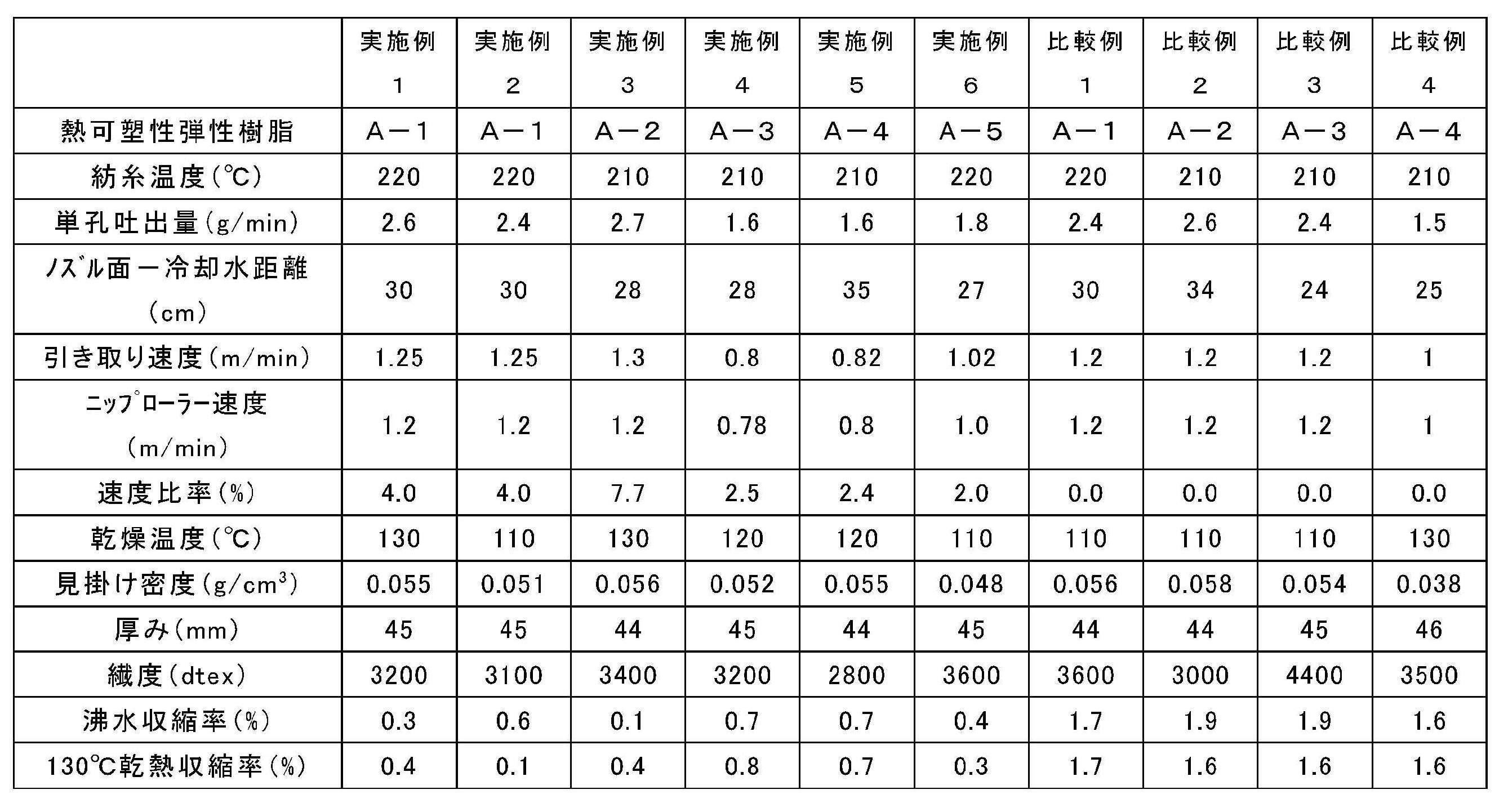
- Table 2 shows the properties of the network structure made of the obtained thermoplastic elastomer.
- the obtained network structure is formed of a linear body having a triangular cross-shaped hollow cross section, a hollow ratio of 32%, a fineness of 3200 dtex, an apparent density of 0.055 g / cm 3 , and the surface A network structure having a flattened thickness of 45 mm, a dry heat shrinkage of 130 ° C. of 0.4%, and a boiling water shrinkage of 0.3% was obtained.
- Table 2 shows the physical properties of the obtained network structure.
- Example 2 A-1 is used as the thermoplastic elastomer, spinning temperature is 220 ° C, single hole discharge rate is 2.4 g / min, nozzle surface-cooling water distance is 30 cm, take-up speed is 1.25 m / min, nip roller / min.
- Example 3 A-2 is used as a thermoplastic elastomer, spinning temperature is 210 ° C, single hole discharge rate is 2.7 g / min, nozzle surface-cooling water distance is 28 cm, take-up speed is 1.3 m / min, nip roller is min / min
- Example 4 A-3 is used as the thermoplastic elastomer, spinning temperature is 210 ° C, single hole discharge is 1.6 g / min, nozzle surface-cooling water distance is 28 cm, take-up speed is 0.8 m / min, nip roller is min / min.
- the network structure obtained in the same manner as in Example 1 except for taking up at a speed of 0.78 m, that is, at a speed ratio of 2.5%, and setting the drying temperature to 120 ° C. has a hollow section with a triangular rice cake type cross section.
- Example 5 A-4 is used as a thermoplastic elastomer, spinning temperature is 210 ° C, single hole discharge is 1.6 g / min, nozzle surface-cooling water distance is 35 cm, take-up speed is 0.82 m / min, nip roller is min / min.
- Example 6 A-5 is used as the thermoplastic elastomer, spinning temperature is 220 ° C, single hole discharge rate is 1.8 g / min, nozzle surface-cooling water distance is 27 cm, take-up speed is 1.02 m / min, nip roller is min / min.
- the network structure obtained in the same manner as in Example 1 except that the web was taken at a speed of 1.0 m, that is, a speed ratio of 2.0%, and the drying temperature was 110 ° C.
- the cross-sectional shape was a hollow cross section and the hollow ratio was 33%.
- A-1 is used as the thermoplastic elastomer, the single-hole discharge rate is 2.4 g / min, the take-off speed is 1.2 m / min, and the nip roller is 1.2 m / min, that is, the speed ratio is 0.0%.
- the network structure obtained in the same manner as in Example 1 except that the drying temperature was set to 110 ° C. was formed of a linear body having a triangular diaper-shaped hollow section with a hollow ratio of 34% and a fineness of 3600 dtex.
- Table 2 shows the physical properties of the obtained network structure.
- thermoplastic elastomer A-2 is used as the thermoplastic elastomer, the spinning temperature is 210 ° C., the nozzle surface-cooling water distance is 34 cm, the take-up speed is 1.2 m / min, and the nip roller is 1.2 m / min, that is, the speed ratio is 0.
- thermoplastic elastomer A-3 was used as the thermoplastic elastomer, the spinning temperature was 210 ° C, the single hole discharge rate was 2.4 g / min, the nozzle surface-cooling water distance was 24 cm, the take-up speed was 1.2 m / min, and the nip roller
- A-4 is used as the thermoplastic elastomer, the spinning temperature is 210 ° C, the single hole discharge rate is 1.5 g / min, the nozzle surface-cooling water distance is 25 cm, the take-up speed is 1.0 m / min, and every nip roller.
- the network structure of the present invention is an improvement of thermal dimensional stability, which has been a problem in the past, without impairing the comfortable sitting comfort and breathability of the conventional structure, and there are few dimensional changes due to washing and drying. It is possible to provide a mesh structure for a cushion that is suitably used for office chairs, furniture, bedding such as sofas and beds, and vehicle seats such as trains, automobiles, and motorcycles.
Landscapes
- Engineering & Computer Science (AREA)
- Textile Engineering (AREA)
- Nonwoven Fabrics (AREA)
- Artificial Filaments (AREA)
Abstract
本発明が解決しようとする課題は、熱収縮率が低い、熱寸法安定性に優れた網状構造体を提供することである。本発明の網状構造体は、熱可塑性エラストマーからなる繊度が100デシテックス以上60000デシテックス以下の連続線状体を曲がりくねらせランダムループを形成し、夫々のループを互いに溶融状態で接触せしめた三次元ランダムループ接合構造体であって、見掛け密度が0.005g/cm3~0.20g/cm3であり、130℃乾熱収縮率が1.5%以下である網状構造体である。
Description
本発明は、乾熱収縮率と沸水収縮率が低く、洗濯乾燥を行っても寸法変化の起こりにくいオフィスチェア、家具、ソファー、ベッドパッド、マットレス、電車・自動車・二輪車等の車両用座席に好適な網状構造体に関するものである。なかでも、洗濯耐久性の求められる介護用ベッドパッドやマットレス、車椅子用クッション等の使用に好適な網状構造体に関する。
現在、家具、ベッド等の寝具、電車・自動車等の車両用座席に用いられるクッション材として、発泡-架橋型ウレタンが広く使われている。
発泡-架橋型ウレタンはクッション材としての耐久性は良好だが、透湿透水性や通気性に劣り、蓄熱性があるため蒸れやすいという問題点がある。さらに、熱可塑性では無いためリサイクルが困難であり、そのため焼却される場合に焼却炉の損傷が大きくなったり、焼却時に発生する有毒ガス除去に経費が掛かったりするなどの問題点が指摘されている。そこで埋立処分されることが多くなるが、埋立地の地盤の安定化が困難なため埋立場所が限定され、経費も高くなる問題点もある。また、加工性は優れるが製造中に使用される薬品の公害問題やフォーム後の残留薬品やそれに伴う臭気など種々の問題が指摘されている。
発泡-架橋型ウレタンはクッション材としての耐久性は良好だが、透湿透水性や通気性に劣り、蓄熱性があるため蒸れやすいという問題点がある。さらに、熱可塑性では無いためリサイクルが困難であり、そのため焼却される場合に焼却炉の損傷が大きくなったり、焼却時に発生する有毒ガス除去に経費が掛かったりするなどの問題点が指摘されている。そこで埋立処分されることが多くなるが、埋立地の地盤の安定化が困難なため埋立場所が限定され、経費も高くなる問題点もある。また、加工性は優れるが製造中に使用される薬品の公害問題やフォーム後の残留薬品やそれに伴う臭気など種々の問題が指摘されている。
上述する問題に加えて、ポリウレタン素材を用いたベッドパッドやベッドマットを用いると、クッション性能は優れているが通気性に乏しく、長時間に渡って同じ姿勢で寝続けると褥瘡などを罹患する恐れがある。また、汚れた場合に洗濯することが困難であり、衛生上の問題を生じ易く、特に介護関連では大きな課題となっていた。
特許文献1および特許文献2には、網状構造体が開示されている。これは、上述した発泡-架橋型ウレタンに由来する諸問題を解決でき、クッション性能と通気性能にも優れているものである。しかし、熱収縮率が大きく、洗濯乾燥した際に寸法変化が起きる課題が生じていた。
本発明は、上記の従来技術の課題を背景になされたもので、熱収縮率が低い、熱寸法安定性に優れた網状構造体を提供することを課題とするものである。
本発明者らは、上記課題を解決するため鋭意研究した結果、遂に本発明を完成するに到った。すなわち、本発明は以下の通りである。
1.熱可塑性エラストマーからなる繊度が100デシテックス以上60000デシテックス以下の連続線状体を曲がりくねらせランダムループを形成し、夫々のループを互いに溶融状態で接触せしめた三次元ランダムループ接合構造体であって、130℃乾熱収縮率が1.5%以下である網状構造体。
2.網状構造体の見掛け密度が0.005g/cm3~0.20g/cm3であり、厚みが10mm以上120mm以下である上記1に記載の網状構造体。
3.熱可塑性エラストマーが、ポリエステル系熱可塑性エラストマー、ポリウレタン系熱可塑性エラストマーおよびポリアミド系熱可塑性エラストマーからなる群より選ばれた1種以上の熱可塑性エラストマーである上記1または2に記載の網状構造体。
4.上記1~3のいずれかに記載の網状構造体を用いたクッション。
1.熱可塑性エラストマーからなる繊度が100デシテックス以上60000デシテックス以下の連続線状体を曲がりくねらせランダムループを形成し、夫々のループを互いに溶融状態で接触せしめた三次元ランダムループ接合構造体であって、130℃乾熱収縮率が1.5%以下である網状構造体。
2.網状構造体の見掛け密度が0.005g/cm3~0.20g/cm3であり、厚みが10mm以上120mm以下である上記1に記載の網状構造体。
3.熱可塑性エラストマーが、ポリエステル系熱可塑性エラストマー、ポリウレタン系熱可塑性エラストマーおよびポリアミド系熱可塑性エラストマーからなる群より選ばれた1種以上の熱可塑性エラストマーである上記1または2に記載の網状構造体。
4.上記1~3のいずれかに記載の網状構造体を用いたクッション。
本発明による網状構造体は、沸水収縮率と乾熱収縮率が低い、熱寸法安定性に優れた網状構造体である。この優れた熱寸法安定性によって、オフィスチェア、家具、ソファー、ベッド等の寝具、電車・車・二輪車等の車両用座席に用いられるクッション材に好適な網状構造体を提供することが可能となった。なかでも、洗濯乾燥耐久性の要求される介護用途の種々のクッション体に好適な網状構造体を提供することが可能となった。
以下、本発明を詳細に説明する。
本発明における熱可塑性エラストマーとは、ポリエステル系熱可塑性エラストマー、ポリウレタン系熱可塑性エラストマー及びポリアミド系熱可塑性エラストマーからなる群より選ばれた1種以上の熱可塑性エラストマーをいう。本発明では、それらの熱可塑性エラストマーに各種添加剤等を必要に応じ添加したものを包含する。
本発明の網状構造体は、熱可塑性エラストマーからなる連続線状体を使用することで、後述する素材のゴム弾性と、三次元構造体全体が一体化し、後述する疑似結晶化処理による効果を付与することで高耐久性と耐熱性を実現する。さらに、適切な連続線状体の繊度と三次元構造体の単位重さあたりの接合点数を有することで、ソフトな触感と底付き感を抑制し、座り心地が良い高反発性クッションが実現できる。また、再溶融により再生が可能となるため、リサイクルも容易となる。
本発明における熱可塑性エラストマーとは、ゴム弾性を有する以下の熱可塑性弾性樹脂を言う。共重合系の樹脂では、ソフトセグメントとして数平均分子量300~5000のグリコール、ポリエステル系グリコール、ポリカーボネート系グリコールまたは長鎖の炭化水素末端をカルボン酸または水酸基にしたオレフィン系化合物等をブロック共重合したポリエステル系熱可塑性エラストマー、ポリウレタン系熱可塑性エラストマー、ポリアミド系熱可塑性エラストマーが挙げられる。
ポリエステル系熱可塑性エラストマーとしては、熱可塑性ポリエステルをハードセグメントとし、ポリアルキレンジオールをソフトセグメントとするポリエステルエーテルブロック共重合体、または、脂肪族ポリエステルをソフトセグメントとするポリエステルエステルブロック共重合体が例示できる。ポリエステルエーテルブロック共重合体のより具体的な事例としては、テレフタル酸、イソフタル酸、ナフタレン-2,6-ジカルボン酸、ナフタレン-2,7-ジカルボン酸、ジフェニル-4,4’-ジカルボン酸等の芳香族ジカルボン酸、1,4-シクロヘキサンジカルボン酸等の脂環族ジカルボン酸、琥珀酸、アジピン酸、セバシン酸ダイマー酸等の脂肪族ジカルボン酸または、これらのエステル形成性誘導体などから選ばれたジカルボン酸の少なくとも1種と、1,4-ブタンジオール、エチレングリコール、トリメチレングリコール、テトラメチレングリコール、ペンタメチレングリコール、ヘキサメチレングリコール等の脂肪族ジオール、1,1-シクロヘキサンジメタノール、1,4-シクロヘキサンジメタノール等の脂環族ジオール、またはこれらのエステル形成性誘導体などから選ばれたジオール成分の少なくとも1種、および数平均分子量が約300~5000のポリエチレングリコール、ポリプロピレングリコール、ポリテトラメチレングリコール、エチレンオキシド-プロピレンオキシド共重合体からなるグリコール等のポリアルキレンジオールのうち少なくとも1種から構成される三元ブロック共重合体である。ポリエステルエステルブロック共重合体としては、上記ジカルボン酸とジオール及び数平均分子量が約300~5000のポリラクトン等のポリエステルジオールのうち少なくとも各1種から構成される三元ブロック共重合体である。熱接着性、耐加水分解性、伸縮性、耐熱性等を考慮すると、ジカルボン酸としてはテレフタル酸、または、及びナフタレン2,6-ジカルボン酸、ジオール成分としては1,4-ブタンジオール、ポリアルキレンジオールとしてはポリテトラメチレングリコールの3元ブロック共重合体または、ポリエステルジオールとしてポリラクトンの3元ブロック共重合体が特に好ましい。特殊な例では、ポリシロキサン系のソフトセグメントを導入したものも使うことができる。また、上記エラストマーに非エラストマー成分をブレンドしたもの、共重合したもの、ポリオレフィン系成分をソフトセグメントにしたもの等も本発明の熱可塑性弾性樹脂に包含される。
ポリウレタン系熱可塑性エラストマーとしては、通常の溶媒(ジメチルホルムアミド、ジメチルアセトアミド等)の存在または非存在下に、(A)数平均分子量1000~6000の末端に水酸基を有するポリエーテル及び又はポリエステルと(B)有機ジイソシアネートを主成分とするポリイソシアネートを反応させた両末端がイソシアネート基であるプレポリマーに、(C)ジアミンを主成分とするポリアミンにより鎖延長したポリウレタンエラストマーを代表例として例示できる。(A)のポリエステル、ポリエーテル類としては、数平均分子量が約1000~6000、好ましくは1300~5000のポリブチレンアジペート共重合ポリエステルやポリエチレングリコール、ポリプロピレングリコール、ポリテトラメチレングリコール、エチレンオキシド-プロピレンオキシド共重合体からなるグリコール等のポリアルキレンジオールが好ましく、(B)のポリイソシアネートとしては、従来公知のポリイソシアネートを用いることができるが、ジフェニルメタン4,4’-ジイソシアネートを主体としたイソシアネートを用い、必要に応じ従来公知のトリイソシアネート等を微量添加使用してもよい。(C)のポリアミンとしては、エチレンジアミン、1,2-プロピレンジアミン等公知のジアミンを主体とし、必要に応じて微量のトリアミン、テトラアミンを併用してもよい。これらのポリウレタン系熱可塑性エラストマーは単独又は2種類以上混合して用いてもよい。
本発明におけるポリアミド系エラストマーとしては、ポリアミドをハードセグメントとし、ポリオールをソフトセグメントとし、両者を共重合したものなどが挙げられる。ハードセグメントのポリアミド化合物は、ラクタム化合物とジカルボン酸もしくは、ジアミンとジカルボン酸などの反応物から得られたポリアミドオリゴマーのうち少なくとも1種以上が挙げられる。ソフトセグメントは、ポリエーテルポリオールやポリエステルポリオール、ポリカーボネートポリオールなどのうち少なくとも1種以上が挙げられる。
ラクタム化合物として、γ-ブチロラクタム、ε-カプロラクタム、ω-ヘプタラクタム、ω-ウンデカラクタム、ω-ラウリルラクタムなどの炭素数5~20の脂肪族ラクタムのうち少なくとも1種以上が挙げられる。
ジカルボン酸として、シュウ酸、コハク酸、グルタル酸、アジピン酸、ピメリン酸、スベリン酸、アゼライン酸、セバシン酸、ドデカン二酸などの炭素数2~20の脂肪族ジカルボン酸、シクロヘキサンジカルボン酸などの脂環族ジカルボン酸、テレフタル酸、イソフタル酸、オルトフタル酸などの芳香族ジカルボン酸、などのジカルボン酸化合物のうち少なくとも1種以上が挙げられる。
ジアミンとして、エチレンジアミン、トリメチレンジアミン、テトラメチレンジアミン、ヘキサメチレンジアミン、ヘプタメチレンジアミン、オクタメチレンジアミン、ノナメチレンジアミン、デカメチレンジアミン、ウンデカメチレンジアミン、ドデカンメチレンジアミン、2,2,4-トリメチルヘキサメチレンジアミン、2,4,4-トリメチルヘキサメチレンジアミン、3-メチルペンタメチレンジアミンなどの脂肪族ジアミン、またはメタキシレンジアミンなどの芳香族ジアミンのうち少なくとも1種以上が挙げられる。
ポリエーテルポリオールとして、数平均分子量が約300~5000のポリエチレングリコ-ル、ポリプロピレングリコ-ル、ポリテトラメチレングリコ-ル、エチレンオキシド-プロピレンオキシド共重合体からなるグリコ-ル等のポリアルキレンジオ-ルのうち少なくとも1種以上が挙げられる。
ポリカーボネートジオールは、低分子ジオールとカーボネート化合物の反応物であり、数平均分子量が約300~5000のものが挙げられる。低分子ジオールとして、エチレングリコール、1,2-プロピレングリコール、1,3-プロピレングリコール、1,4-ブタンジオール、1,5-ペンタンジオール、3-メチルー1,5-ペンタンジオール、1,6-ヘキサンジオール、1,7-ヘプタンジオール、1,8-オクタンジオール、1,9-ノナンジオール、1,10-デカンジオールなどの脂肪族ジオール、シクロヘキサンジメタノール、シクロヘキサンジオールなどの脂環式ジオールのうち少なくとも1種以上の低分子ジオールが挙げられる。カーボネート化合物として、ジアルキルカーボネート、アルキレンカーボネート、ジアリールカーボネートなどのうち少なくとも1種以上が挙げられる。
ポリエステルポリオールとして、数平均分子量が約300~5000のポリラクトン等のポリエステルジオールのうち少なくとも1種以上が挙げられる。
上記のブロック共重合体を単独または2種類以上混合して用いてもよい。
更には、非エラストマー成分をブレンドしたもの、共重合したもの等も本発明に使用できる。
ラクタム化合物として、γ-ブチロラクタム、ε-カプロラクタム、ω-ヘプタラクタム、ω-ウンデカラクタム、ω-ラウリルラクタムなどの炭素数5~20の脂肪族ラクタムのうち少なくとも1種以上が挙げられる。
ジカルボン酸として、シュウ酸、コハク酸、グルタル酸、アジピン酸、ピメリン酸、スベリン酸、アゼライン酸、セバシン酸、ドデカン二酸などの炭素数2~20の脂肪族ジカルボン酸、シクロヘキサンジカルボン酸などの脂環族ジカルボン酸、テレフタル酸、イソフタル酸、オルトフタル酸などの芳香族ジカルボン酸、などのジカルボン酸化合物のうち少なくとも1種以上が挙げられる。
ジアミンとして、エチレンジアミン、トリメチレンジアミン、テトラメチレンジアミン、ヘキサメチレンジアミン、ヘプタメチレンジアミン、オクタメチレンジアミン、ノナメチレンジアミン、デカメチレンジアミン、ウンデカメチレンジアミン、ドデカンメチレンジアミン、2,2,4-トリメチルヘキサメチレンジアミン、2,4,4-トリメチルヘキサメチレンジアミン、3-メチルペンタメチレンジアミンなどの脂肪族ジアミン、またはメタキシレンジアミンなどの芳香族ジアミンのうち少なくとも1種以上が挙げられる。
ポリエーテルポリオールとして、数平均分子量が約300~5000のポリエチレングリコ-ル、ポリプロピレングリコ-ル、ポリテトラメチレングリコ-ル、エチレンオキシド-プロピレンオキシド共重合体からなるグリコ-ル等のポリアルキレンジオ-ルのうち少なくとも1種以上が挙げられる。
ポリカーボネートジオールは、低分子ジオールとカーボネート化合物の反応物であり、数平均分子量が約300~5000のものが挙げられる。低分子ジオールとして、エチレングリコール、1,2-プロピレングリコール、1,3-プロピレングリコール、1,4-ブタンジオール、1,5-ペンタンジオール、3-メチルー1,5-ペンタンジオール、1,6-ヘキサンジオール、1,7-ヘプタンジオール、1,8-オクタンジオール、1,9-ノナンジオール、1,10-デカンジオールなどの脂肪族ジオール、シクロヘキサンジメタノール、シクロヘキサンジオールなどの脂環式ジオールのうち少なくとも1種以上の低分子ジオールが挙げられる。カーボネート化合物として、ジアルキルカーボネート、アルキレンカーボネート、ジアリールカーボネートなどのうち少なくとも1種以上が挙げられる。
ポリエステルポリオールとして、数平均分子量が約300~5000のポリラクトン等のポリエステルジオールのうち少なくとも1種以上が挙げられる。
上記のブロック共重合体を単独または2種類以上混合して用いてもよい。
更には、非エラストマー成分をブレンドしたもの、共重合したもの等も本発明に使用できる。
なお、本発明の熱可塑性エラストマーの融点は耐熱耐久性が保持できる140℃以上が好ましく、160℃以上のものを用いると耐熱耐久性が向上するのでより好ましい。なお、必要に応じ、酸化防止剤や耐光剤等を添加して耐久性を向上させることができる。また、耐熱耐久性や耐へたり性を向上させるために、熱可塑性樹脂の分子量を上げることも効果的である。
本発明の網状構造体の高反発性を実現するために、熱可塑性エラストマーのソフトセグメント含有量は好ましくは15重量%以上、より好ましくは25重量%以上であり、さらに好ましくは30重量%以上であり、特に好ましくは40重量%以上である。硬度確保と耐熱耐へたり性からはソフトセグメント含有量は好ましくは80重量%以下、より好ましくは70重量%以下である。
本発明の熱寸法安定性に優れた網状構造体を構成する熱可塑性エラストマーからなる成分は、示差走査型熱量計にて測定した融解曲線において、融点以下に吸熱ピークを有することが好ましい。融点以下に吸熱ピークを有するものは、吸熱ピークを有しないものに比べて耐熱耐へたり性が著しく向上する。例えば、本発明の好ましいポリエステル系熱可塑性エラストマー樹脂として、ハードセグメントの酸成分に剛直性のあるテレフタル酸やナフタレン2,6-ジカルボン酸などを90モル%以上含有するもの、より好ましくはテレフタル酸やナフタレン2,6-ジカルボン酸の含有量は95モル%以上、特に好ましくは100モル%とグリコール成分をエステル交換後、必要な重合度まで重合し、次いで、ポリアルキレンジオールとして、好ましくは平均分子量が500以上5000以下、より好ましくは700以上3000以下、さらに好ましくは800以上1800以下のポリテトラメチレングリコールを15重量%以上80重量%以下、より好ましくは25重量%以上70重量%以下、さらに好ましくは30重量%以上70重量%以下、特に好ましくは40重量%以上70重量%以下を共重合量させた場合、ハードセグメントの酸成分に剛直性のあるテレフタル酸やナフタレン2,6-ジカルボン酸の含有量が多いとハードセグメントの結晶性が向上し、塑性変形しにくく、かつ、耐熱耐へたり性が向上するが、溶融熱接着後更に融点より少なくとも10℃以上低い温度でアニーリング処理するとより耐熱耐へたり性が向上する。アニーリング処理は、融点より少なくとも10℃以上低い温度でサンプルを熱処理することができれば良いが、圧縮歪みを付与することでさらに耐熱耐へたり性が向上する。このような処理をしたクッション層を示差走査型熱量計で測定した融解曲線に室温以上融点以下の温度で吸熱ピークをより明確に発現する。なおアニーリングしない場合は融解曲線に室温以上融点以下に吸熱ピークを明確に発現しない。はっきりとしたメカニズムは分かっていないが、このことから類推すると、アニーリングによってハードセグメントが再配列された準安定中間相を形成し、耐熱耐へたり性が向上しているのではないかとも考えられる(以下、この処理を疑似結晶化処理と言う)。この疑似結晶化処理は、ポリウレタン系熱可塑性エラストマーやポリアミド系熱可塑性エラストマーにおいても有効である。本発明における耐熱性向上効果の活用方法としては、ヒーターが用いられる車両用のクッションや床暖房された床の敷きマット等、比較的高温になり得る用途において、耐へたり性が良好となるため有用である。
本発明の網状構造体は、繊度が100デシテックス以上60000デシテックス以下の熱可塑性エラストマーからなる連続線状体を曲がりくねらせランダムループを形成し、夫々のループを互いに溶融状態で接触せしめた三次元ランダムループ接合構造体である。繊度はソフトな触感を得るためには重要な要素であり、繊度が小さいとクッション性に必要な硬度が保てなくなり、逆に繊度が大きすぎると硬くなり過ぎてしまうため、適正な範囲に設定する必要がある。繊度は100デシテックス未満だと細くなりすぎてしまい緻密性やソフトな触感は十分であるが必要な硬度を確保することが困難であり、100デシテックス以上が好ましく、300デシテックス以上がより好ましい。一方、繊度が60000デシテックスを超えると必要硬度は確保が容易となるが、ごわごわ感が顕著となるため60000デシテックス以下が好ましく、50000デシテックス以下がより好ましい。
本発明の網状構造体の見掛け密度は、クッション性を決める重要な要素であり、用途に応じて設計されるものであるが好ましくは0.005g/cm3~0.20g/cm3であり、より好ましくは0.01g/cm3~0.18g/cm3、さらに好ましくは0.02g/cm3~0.15g/cm3である。見掛け密度が0.005g/cm3より小さいとクッション性に必要な硬度が保てなくなり、0.20g/cm3を越えると硬くなり過ぎてしまう。
本発明の網状構造体の130℃乾熱収縮率は、1.5%以下であり、1.0%以下が好ましい。130℃乾熱収縮率が1.5%を超えると水洗いや洗濯後の乾燥や乾熱滅菌処理によって網状構造体の寸法が変化するため好ましくない。130℃乾熱収縮率の下限は特に限定されるものではないが、-0.5%以上が好ましい。
本発明の網状構造体の沸水収縮率は、1.5%以下が好ましく、1.0%以下がより好ましい。沸水収縮率が1.5%を超えるとスチームや熱湯で洗浄した際に網状構造体の寸法が変化するため好ましくない。沸水収縮率の下限は特に限定されるものではないが、-0.5%以上が好ましい。
本発明の網状構造体の厚みは、クッション性に大きく関わってくるため、10mm以上120mm以下が好ましく、20mm以上100mm以下がより好ましい。厚みが10mm未満では薄すぎて底付き感を感じ、120mmを超えるとクッション材として厚過ぎてしまい快適性を損なう。
本発明の網状構造体は、多層構造のものも包含する。例えば、表面と下層を異なった鮮度の線状体で構成することができる。例えば、表層は繊度の細い線状体でソフトにしつつ、下層は繊度の太い線状体で硬度を持たせることで、ソフトな触感と底付き感の低減を両立することができる構造体とすることも好ましい実施形態である。多層にする方法は、網状構造体同士を積み重ねて側地等で固定する方法、加熱により溶融固着する方法、接着剤で接着する方法、や縫製やバンド等で拘束する方法等が挙げられる。
本発明の網状構造体を構成する線状体は、複合線状体とすることで、熱接着繊維機能を付与して、接触する線状体間の接合強度を高めること可能である。例えば、融点の異なる同一素材を用い、シース成分に低融点成分、コア成分に高融点成分を配して吐出させ、冷却させることで単一成分のものより線状体同士の接合力を強くできるため、好ましい実施形態といえる。
線状体の断面形状は特には限定されないが、中空断面や異型断面とすることで好ましい抗圧縮性やタッチを付与することができる。抗圧縮性は繊度や用いる素材のモジュラスにより調整して繊度を細くしたり、柔らかい素材では中空率や異型度を高くしたりして初期圧縮応力の勾配を調整できるし、繊度を太くしたりできる。ややモジュラスの高い素材では中空率や異型度を低くしたり、繊度を細くしたりして適度の抗圧縮性を付与する。中空断面や異型断面の他の効果として、中空率や異型度を高くすると同一の抗圧縮性を付与した場合、軽量化が可能となり好ましい実施形態である。
本発明の製法の一例を述べる。特開平7-68061号公報等に記載された公知の方法で三次元網状構造体は得られる。例えば、複数のオリフィスを持つ多列ノズルより熱可塑性エラストマーをノズルオリフィスに分配し、該熱可塑性エラストマーの融点より20℃以上高く、120℃未満高い溶融温度で、該ノズルより下方に向け吐出させ、溶融状態で互いに接触させて融着させ3次元構造を形成しつつ、引取り装置に設置された引き取りネットで挟み込み冷却槽で冷却せしめた後、ニップローラーで挟み込むことで冷却槽から引き出し、水切り後、乾燥されて、両面又は片面が平滑化した三次元網状構造体を得る。片面のみを平滑化させる場合は、傾斜を持つ引き取ネット上に吐出させて、溶融状態で互いに接触させて融着させ3次元構造を形成しつつ引き取ネット面のみ形態を緩和させつつ冷却すると良い。
本発明の熱寸法安定性に優れた網状構造体を得るための方法の一つは、引き取りネットとその後に設置するニップローラーで速度差を生じさせることである。この速度差は、ニップローラーの速度を遅くすることで実現でき、速度比率として示す。速度比率は下記式で算出する。
速度比率(%)=(1-ニップローラー速度/引き取りネット速度)×100
速度比率(%)=(1-ニップローラー速度/引き取りネット速度)×100
速度比率が0.1%以上であることが好ましく、1.0%以上であることがより好ましく、2.0%以上であることがさらに好ましい。引き取りネットとニップローラーの速度比率は、残留歪みを解消するレベルを著しく超えてしまうと、網状構造体を真直ぐに引き取ることが困難になるため好ましくなく、20%以下が好ましく、15%以下がより好ましい。
本発明の熱寸法安定性に優れた網状構造体を得るための方法の一つは、水切り後の乾燥温度を高くすることである。乾燥温度は110℃以上が好ましく、120℃以上がより好ましく、130℃以上がさらに好ましい。乾燥温度は熱可塑性エラストマーの融点以下であることが好ましく、融点より10℃以上低いことがより好ましい。
網状構造体を構成する線状体をシースコア構造に複合化して、融点差を利用し接合強力向上を狙う場合は、シース成分とコア成分に使用する熱可塑性樹脂の融点差が20℃以上の熱可塑性樹脂を用いて、オリフィス直前でシースコア配分して吐出することで得ることができる。シース成分とコア成分に使用する熱可塑性樹脂の融点差が30℃以上であることがより好ましい。網状構造体を構成する線状体をシースコア構造に複合化する場合の紡糸温度は低融点成分の融点より、少なくとも10℃以上高い温度で行うのが好ましい。
網状構造体を構成する線状体を異形断面化する場合、例えば、中空断面化する場合は、オリフィス形状を中空形成できるオリフィスを用いることで可能である。中空断面はバラス効果が大きい場合は中空率を高くし易いが、バラス効果が小さいものは、オリフィスの中空率をできるだけ高くしないと糸の中空率は高くならないので、用いる素材により最適なオリフィス形状を選択する必要がある。
得られた網状構造体は、網状体状態でそのまま使用に供する場合は、水切り乾燥して、所望のサイズに切断して用いる。
得られた網状構造体を縁取りや各種文様等を熱成形で形成する場合は、熱成形温度は、網状構造体を構成する熱可塑性エラストマーの融点より20~50℃低い温度が好ましい。熱可塑性エラストマーの融点より20℃未満低い温度では、構造体の変形が大きくなり過ぎる場合があり好ましくない。熱可塑性エラストマーの融点より50℃を超える低い温度では外側の熱成形形状が充分形成できない場合があり好ましくない。なお、熱成形は余熱して熱プレス金型にて成形するのが好ましい。余熱は片面のみ余熱して片面は非加熱でプレス成形してもよい。この場合はプレス圧力を約10%程度高くするとプレス接合が上下加熱金型で成形したものと同等の接合状態が得られる。得られた熱成形品は所望のサイズに打ちぬき等の方法で切断して各種クッションに供する。
熱プレス成形により融点以下の温度で加熱することにより、前記の擬似結晶化処理効果を付与することができるので成形前に積極的にアニーリングを施す必要はない。疑似結晶化処理温度は、少なくとも融点より10℃以上低く、Tanδのα分散立ち上がり温度以上で行う。この処理で、融点以下に吸熱ピ-クを持ち、疑似結晶化処理しないもの(吸熱ピ-クを有しないもの)より耐へたり性が著しく向上する。
本発明の網状構造体は、性能を低下させない範囲で樹脂製造過程から成形体に加工し、製品化する任意の段階で防臭抗菌、消臭、防黴、着色、芳香、難燃、吸放湿等の機能付与を薬剤添加等の処理加工により付与することができる。
以下に、実施例を例示し、本発明を具体的に説明するが、本発明はこれらによって限定されるものではない。なお、実施例中における特性値の測定及び評価は下記のようにおこなった。
(1)繊度
試料を20cm×20cmの大きさに切断し、10か所から線状体を採集する。10か所で採集した線状体の40℃での比重を密度勾配管を用いて測定する。さらに、上記10か所で採集した線状体の断面積を顕微鏡で30倍に拡大した写真より求め、それより線状体の長さ10000m分の体積を求める。得られた比重と体積を乗じた値を繊度(線状体10000m分の重量)とする。(n=10の平均値)
(2)試料厚み及び見掛け密度
試料を30cm×30cmの大きさに切断し、無荷重で24時間放置した後、高分子計器製FD-80N型測厚器にて4か所の高さを測定して平均値を試料厚みとする。試料重さは、上記試料を電子天秤に載せて計測する。また試料厚みから体積を求め、試料の重さを体積で除した値で示す。(それぞれn=4の平均値)
(3)融点
TAインスツルメント社製 示差走査熱量計Q200を使用し、昇温速度20℃/分で測定した吸発熱曲線から吸熱ピーク(融解ピーク)温度を求める。
(4)130℃乾熱収縮率
網状構造体を縦方向30cm、横方向30cm、厚みは網状構造体の厚みに切り出す。縦方向とは網状構造体の引き取り方向を、横方向とは網状構造体の引き取り方向と直交する方向(厚み方向でない方向)とする。切り出したサンプルは、縦方向と横方向において25cmとなるようにそれぞれ2箇所を、乾熱処理によって見えにくくならないペンでマーキングし、熱風循環乾燥炉にて130℃で30分間熱処理する。処理後、乾燥炉よりサンプルを取り出し、30分間22℃の室温で冷却後に処理した網状構造体の各マーキング距離を2箇所計測し、各2箇所の平均値を取り、処理後縦長さ:a(cm)、および処理後横長さ:b(cm)を算出する。全ての長さの測定は、0.01cmまで読み取れる計測器を用いて実施する。得られた長さa、bを用い、下記式にて収縮率を算出する。
縦方向乾熱収縮率(%)=(25-a)/25×100
横方向乾熱収縮率(%)=(25-b)/25×100
上記縦方向乾熱収縮率と横方向乾熱収縮率をそれぞれ3サンプル分測定し、各サンプルの縦方向乾熱収縮率および横方向乾熱収縮率の大きい方の値を選定し、得られた3つの値の平均値を130℃乾熱収縮率の値とする。
(5)沸水収縮率
網状構造体を縦方向25cm、横方向25cm、厚みは網状構造体の厚みに切り出す。縦方向とは網状構造体の引き取り方向を、横方向とは網状構造体の引き取り方向と直交する方向(厚み方向ではない方向)とする。切り出したサンプルは、縦方向と横方向において20cmとなるようにそれぞれ2箇所を、沸水処理によって見えにくくならないペンでマーキングし、沸騰水の中に浸漬させて30分間処理する。処理後、沸騰水の中からサンプルを取り出し、サンプルを乾燥させるため24時間22℃の室温で静置する。静置乾燥後に処理した網状構造体の各マーキング距離を2箇所計測し、各2箇所の平均値を取り、処理後縦長さ:c(cm)、および処理後横長さ:d(cm)を算出する。測定は、0.01cmまで読み取れる計測器を用いて実施する。得られた長さc、dを用い、下記式にて収縮率を算出する。
縦方向沸水収縮率(%)=(20-c)/20×100
横方向沸水収縮率(%)=(20-d)/20×100
上記縦方向沸水収縮率と横方向沸水収縮率をそれぞれ3サンプル分測定し、各サンプルの縦方向沸水収縮率および横方向沸水収縮率の大きい方の値を選定し、得られた3つの値の平均値を130℃乾熱収縮率の値とする。
試料を20cm×20cmの大きさに切断し、10か所から線状体を採集する。10か所で採集した線状体の40℃での比重を密度勾配管を用いて測定する。さらに、上記10か所で採集した線状体の断面積を顕微鏡で30倍に拡大した写真より求め、それより線状体の長さ10000m分の体積を求める。得られた比重と体積を乗じた値を繊度(線状体10000m分の重量)とする。(n=10の平均値)
(2)試料厚み及び見掛け密度
試料を30cm×30cmの大きさに切断し、無荷重で24時間放置した後、高分子計器製FD-80N型測厚器にて4か所の高さを測定して平均値を試料厚みとする。試料重さは、上記試料を電子天秤に載せて計測する。また試料厚みから体積を求め、試料の重さを体積で除した値で示す。(それぞれn=4の平均値)
(3)融点
TAインスツルメント社製 示差走査熱量計Q200を使用し、昇温速度20℃/分で測定した吸発熱曲線から吸熱ピーク(融解ピーク)温度を求める。
(4)130℃乾熱収縮率
網状構造体を縦方向30cm、横方向30cm、厚みは網状構造体の厚みに切り出す。縦方向とは網状構造体の引き取り方向を、横方向とは網状構造体の引き取り方向と直交する方向(厚み方向でない方向)とする。切り出したサンプルは、縦方向と横方向において25cmとなるようにそれぞれ2箇所を、乾熱処理によって見えにくくならないペンでマーキングし、熱風循環乾燥炉にて130℃で30分間熱処理する。処理後、乾燥炉よりサンプルを取り出し、30分間22℃の室温で冷却後に処理した網状構造体の各マーキング距離を2箇所計測し、各2箇所の平均値を取り、処理後縦長さ:a(cm)、および処理後横長さ:b(cm)を算出する。全ての長さの測定は、0.01cmまで読み取れる計測器を用いて実施する。得られた長さa、bを用い、下記式にて収縮率を算出する。
縦方向乾熱収縮率(%)=(25-a)/25×100
横方向乾熱収縮率(%)=(25-b)/25×100
上記縦方向乾熱収縮率と横方向乾熱収縮率をそれぞれ3サンプル分測定し、各サンプルの縦方向乾熱収縮率および横方向乾熱収縮率の大きい方の値を選定し、得られた3つの値の平均値を130℃乾熱収縮率の値とする。
(5)沸水収縮率
網状構造体を縦方向25cm、横方向25cm、厚みは網状構造体の厚みに切り出す。縦方向とは網状構造体の引き取り方向を、横方向とは網状構造体の引き取り方向と直交する方向(厚み方向ではない方向)とする。切り出したサンプルは、縦方向と横方向において20cmとなるようにそれぞれ2箇所を、沸水処理によって見えにくくならないペンでマーキングし、沸騰水の中に浸漬させて30分間処理する。処理後、沸騰水の中からサンプルを取り出し、サンプルを乾燥させるため24時間22℃の室温で静置する。静置乾燥後に処理した網状構造体の各マーキング距離を2箇所計測し、各2箇所の平均値を取り、処理後縦長さ:c(cm)、および処理後横長さ:d(cm)を算出する。測定は、0.01cmまで読み取れる計測器を用いて実施する。得られた長さc、dを用い、下記式にて収縮率を算出する。
縦方向沸水収縮率(%)=(20-c)/20×100
横方向沸水収縮率(%)=(20-d)/20×100
上記縦方向沸水収縮率と横方向沸水収縮率をそれぞれ3サンプル分測定し、各サンプルの縦方向沸水収縮率および横方向沸水収縮率の大きい方の値を選定し、得られた3つの値の平均値を130℃乾熱収縮率の値とする。
[実施例1]
熱可塑性エラストマーA-1~A-3として、ジメチルテレフタレート(DMT)と1,4-ブタンジオール(1,4BD)を少量の触媒と仕込み、常法によりエステル交換後、ポリテトラメチレングリコール(PTMG)を添加して昇温減圧しつつ重縮合せしめポリエーテルエステルブロック共重合エラストマーを生成させ、次いで酸化防止剤2%を添加混合練込み後ペレット化し、50℃48時間真空乾燥して得られた熱可塑性ポリエステル系エラストマー原料の処方を表1に示す。
熱可塑性エラストマーA-4として、4,4’ジフェニルメタンジイソシアネ-ト(MDI)とPTMG及び鎖延長剤として1,4BDを添加して重合し次いで抗酸化剤2%を添加混合練込み後ペレット化し真空乾燥して熱可塑性ポリエーテル系ウレタンエラストマーの処方を表1に示す。
熱可塑性エラストマーA-5として、ω-ラウリルラクタム、アジピン酸を用いて公知の方法でポリアミド化合物を得た後、数平均分子量1000のPTMGを用いて公知の方法で共重合し、次いで抗酸化剤1%を添加混合練込み後ペレット化し、50℃48時間真空乾燥して得られたポリアミド系熱可塑性エラストマー原料の処方を表1に示す。
熱可塑性エラストマーA-1~A-3として、ジメチルテレフタレート(DMT)と1,4-ブタンジオール(1,4BD)を少量の触媒と仕込み、常法によりエステル交換後、ポリテトラメチレングリコール(PTMG)を添加して昇温減圧しつつ重縮合せしめポリエーテルエステルブロック共重合エラストマーを生成させ、次いで酸化防止剤2%を添加混合練込み後ペレット化し、50℃48時間真空乾燥して得られた熱可塑性ポリエステル系エラストマー原料の処方を表1に示す。
熱可塑性エラストマーA-4として、4,4’ジフェニルメタンジイソシアネ-ト(MDI)とPTMG及び鎖延長剤として1,4BDを添加して重合し次いで抗酸化剤2%を添加混合練込み後ペレット化し真空乾燥して熱可塑性ポリエーテル系ウレタンエラストマーの処方を表1に示す。
熱可塑性エラストマーA-5として、ω-ラウリルラクタム、アジピン酸を用いて公知の方法でポリアミド化合物を得た後、数平均分子量1000のPTMGを用いて公知の方法で共重合し、次いで抗酸化剤1%を添加混合練込み後ペレット化し、50℃48時間真空乾燥して得られたポリアミド系熱可塑性エラストマー原料の処方を表1に示す。
幅方向1050mm、厚み方向の幅50mmのノズル有効面にオリフィスの形状は外径2mm、内径1.6mmでトリプルブリッジの中空形成性断面としたオリフィスを孔間ピッチ5mmの千鳥配列としたノズルに、得られた熱可塑性エラストマー(A-1)を溶融温度220℃にて、単孔当たり2.6g/minの速度でノズル下方に吐出させ、ノズル面30cm下に冷却水を配し、幅150cmのステンレス製エンドレスネットを平行に開口幅45mm間隔で一対の引取りコンベアーを水面上に一部出るように配して、該溶融状態の吐出線状を曲がりくねらせループを形成して接触部分を融着させつつ3次元網状構造を形成し、該溶融状態の網状体の両面を引取りコンベアーで挟み込みつつ毎分1.25mの速度で冷却水中へ引込み固化させ両面をフラット化した後、ニップローラーで毎分1.2mの速度、すなわち速度比率4.0%で引き取り、所定の大きさに切断して130℃熱風にて15分間乾燥熱処理して、網状構造体を得た。得られた熱可塑性エラストマーからなる網状構造体の特性を表2に示す。得られた網状構造体は、断面形状が三角おむすび型の中空断面で中空率が32%、繊度が3200デシテックスの線状体で形成されており、見掛け密度が0.055g/cm3、表面は平坦化されており、厚みが45mm、130℃乾熱収縮率が0.4%、沸水収縮率が0.3%の網状構造体を得た。得られた網状構造体の物性を表2に示す。
[実施例2]
熱可塑性エラストマーとしてA-1を用い、紡糸温度220℃、単孔吐量を2.4g/min、ノズル面-冷却水距離を30cmにし、引き取り速度を毎分1.25m、ニップローラーで毎分1.2mの速度、すなわち速度比率4.0%で引き取り、乾燥温度を110℃とした以外、実施例1と同様にして得た網状構造体は、断面形状が三角おむすび型の中空断面で中空率が33%、繊度が3100デシテックスの線状体で形成されており、見掛け密度が0.051g/cm3、表面は平坦化されており、厚みが45mm、130℃乾熱収縮率が0.6%、沸水収縮率が0.1%の網状構造体を得た。得られた網状構造体の物性を表2に示す。
熱可塑性エラストマーとしてA-1を用い、紡糸温度220℃、単孔吐量を2.4g/min、ノズル面-冷却水距離を30cmにし、引き取り速度を毎分1.25m、ニップローラーで毎分1.2mの速度、すなわち速度比率4.0%で引き取り、乾燥温度を110℃とした以外、実施例1と同様にして得た網状構造体は、断面形状が三角おむすび型の中空断面で中空率が33%、繊度が3100デシテックスの線状体で形成されており、見掛け密度が0.051g/cm3、表面は平坦化されており、厚みが45mm、130℃乾熱収縮率が0.6%、沸水収縮率が0.1%の網状構造体を得た。得られた網状構造体の物性を表2に示す。
[実施例3]
熱可塑性エラストマーとしてA-2を用い、紡糸温度210℃、単孔吐量を2.7g/min、ノズル面-冷却水距離を28cmにし、引き取り速度を毎分1.3m、ニップローラーで毎分1.2mの速度、すなわち速度比率7.7%で引き取った以外、実施例1と同様にして得た網状構造体は、断面形状が三角おむすび型の中空断面で中空率が32%、繊度が3400デシテックスの線状体で形成されており、見掛け密度が0.056g/cm3、表面は平坦化されており、厚みが44mm、130℃乾熱収縮率が0.4%、沸水収縮率が0.1%の網状構造体を得た。得られた網状構造体の物性を表2に示す。
熱可塑性エラストマーとしてA-2を用い、紡糸温度210℃、単孔吐量を2.7g/min、ノズル面-冷却水距離を28cmにし、引き取り速度を毎分1.3m、ニップローラーで毎分1.2mの速度、すなわち速度比率7.7%で引き取った以外、実施例1と同様にして得た網状構造体は、断面形状が三角おむすび型の中空断面で中空率が32%、繊度が3400デシテックスの線状体で形成されており、見掛け密度が0.056g/cm3、表面は平坦化されており、厚みが44mm、130℃乾熱収縮率が0.4%、沸水収縮率が0.1%の網状構造体を得た。得られた網状構造体の物性を表2に示す。
[実施例4]
熱可塑性エラストマーとしてA-3を用い、紡糸温度210℃、単孔吐量を1.6g/min、ノズル面-冷却水距離を28cmにし、引き取り速度を毎分0.8m、ニップローラーで毎分0.78mの速度、すなわち速度比率2.5%で引き取り、乾燥温度を120℃とした以外、実施例1と同様にして得た網状構造体は、断面形状が三角おむすび型の中空断面で中空率が31%、繊度が3200デシテックスの線状体で形成されており、見掛け密度が0.052g/cm3、表面は平坦化されたおり、厚みが45mm、130℃乾熱収縮率が0.8%、沸水収縮率が0.7%の網状構造体を得た。得られた網状構造体の物性を表2に示す。
熱可塑性エラストマーとしてA-3を用い、紡糸温度210℃、単孔吐量を1.6g/min、ノズル面-冷却水距離を28cmにし、引き取り速度を毎分0.8m、ニップローラーで毎分0.78mの速度、すなわち速度比率2.5%で引き取り、乾燥温度を120℃とした以外、実施例1と同様にして得た網状構造体は、断面形状が三角おむすび型の中空断面で中空率が31%、繊度が3200デシテックスの線状体で形成されており、見掛け密度が0.052g/cm3、表面は平坦化されたおり、厚みが45mm、130℃乾熱収縮率が0.8%、沸水収縮率が0.7%の網状構造体を得た。得られた網状構造体の物性を表2に示す。
[実施例5]
熱可塑性エラストマーとしてA-4を用い、紡糸温度210℃、単孔吐量を1.6g/min、ノズル面-冷却水距離を35cmにし、引き取り速度を毎分0.82m、ニップローラーで毎分0.8mの速度、すなわち速度比率2.4%で引き取り、乾燥温度を120℃とした以外、実施例1と同様にして得た網状構造体は、断面形状が三角おむすび型の中空断面で中空率が34%、繊度が2800デシテックスの線状体で形成されており、見掛け密度が0.055g/cm3、表面は平坦化されており、厚みが44mm、130℃乾熱収縮率が0.7%、沸水収縮率が0.7%の網状構造体を得た。得られた網状構造体の物性を表2に示す。
熱可塑性エラストマーとしてA-4を用い、紡糸温度210℃、単孔吐量を1.6g/min、ノズル面-冷却水距離を35cmにし、引き取り速度を毎分0.82m、ニップローラーで毎分0.8mの速度、すなわち速度比率2.4%で引き取り、乾燥温度を120℃とした以外、実施例1と同様にして得た網状構造体は、断面形状が三角おむすび型の中空断面で中空率が34%、繊度が2800デシテックスの線状体で形成されており、見掛け密度が0.055g/cm3、表面は平坦化されており、厚みが44mm、130℃乾熱収縮率が0.7%、沸水収縮率が0.7%の網状構造体を得た。得られた網状構造体の物性を表2に示す。
[実施例6]
熱可塑性エラストマーとしてA-5を用い、紡糸温度220℃、単孔吐量を1.8g/min、ノズル面-冷却水距離を27cmにし、引き取り速度を毎分1.02m、ニップローラーで毎分1.0mの速度、すなわち速度比率2.0%で引き取り、乾燥温度を110℃とした以外、実施例1と同様にして得た網状構造体は、断面形状が中空断面で中空率が33%、繊度が3600デシテックスの線状体で形成されており、見掛け密度が0.048g/cm3、表面は平坦化されており、厚みが45mm、130℃乾熱収縮率が0.3%、沸水収縮率が0.4%の網状構造体を得た。得られた網状構造体の物性を表2に示す。
熱可塑性エラストマーとしてA-5を用い、紡糸温度220℃、単孔吐量を1.8g/min、ノズル面-冷却水距離を27cmにし、引き取り速度を毎分1.02m、ニップローラーで毎分1.0mの速度、すなわち速度比率2.0%で引き取り、乾燥温度を110℃とした以外、実施例1と同様にして得た網状構造体は、断面形状が中空断面で中空率が33%、繊度が3600デシテックスの線状体で形成されており、見掛け密度が0.048g/cm3、表面は平坦化されており、厚みが45mm、130℃乾熱収縮率が0.3%、沸水収縮率が0.4%の網状構造体を得た。得られた網状構造体の物性を表2に示す。
[比較例1]
熱可塑性エラストマーとしてA-1を用い、単孔吐量を2.4g/min、引き取り速度を毎分1.2m、ニップローラーで毎分1.2mの速度、すなわち速度比率0.0%で引き取り、乾燥温度110℃とした以外、実施例1と同様にして得た網状構造体は、断面形状が三角おむすび型の中空断面で中空率が34%、繊度が3600デシテックスの線状体で形成されており、見掛け密度が0.056g/cm3、表面は平坦化されており、厚みが44mm、130℃乾熱収縮率が1.7%、沸水収縮率が1.7%の網状構造体を得た。得られた網状構造体の物性を表2に示す。
熱可塑性エラストマーとしてA-1を用い、単孔吐量を2.4g/min、引き取り速度を毎分1.2m、ニップローラーで毎分1.2mの速度、すなわち速度比率0.0%で引き取り、乾燥温度110℃とした以外、実施例1と同様にして得た網状構造体は、断面形状が三角おむすび型の中空断面で中空率が34%、繊度が3600デシテックスの線状体で形成されており、見掛け密度が0.056g/cm3、表面は平坦化されており、厚みが44mm、130℃乾熱収縮率が1.7%、沸水収縮率が1.7%の網状構造体を得た。得られた網状構造体の物性を表2に示す。
[比較例2]
熱可塑性エラストマーとしてA-2を用い、紡糸温度を210℃、ノズル面-冷却水距離を34cmにし、引き取り速度を毎分1.2m、ニップローラーで毎分1.2mの速度、すなわち速度比率0.0%で引き取り、乾燥温度を110℃とした以外、実施例1と同様にして得た網状構造体は、断面形状が三角おむすび型の中空断面で中空率が34%、繊度が3000デシテックスの線状体で形成されており、見掛け密度が0.058g/cm3、表面は平坦化されており、厚みが44mm、130℃乾熱収縮率が1.6%、沸水収縮率が1.9%の網状構造体を得た。得られた網状構造体の物性を表2に示す。
熱可塑性エラストマーとしてA-2を用い、紡糸温度を210℃、ノズル面-冷却水距離を34cmにし、引き取り速度を毎分1.2m、ニップローラーで毎分1.2mの速度、すなわち速度比率0.0%で引き取り、乾燥温度を110℃とした以外、実施例1と同様にして得た網状構造体は、断面形状が三角おむすび型の中空断面で中空率が34%、繊度が3000デシテックスの線状体で形成されており、見掛け密度が0.058g/cm3、表面は平坦化されており、厚みが44mm、130℃乾熱収縮率が1.6%、沸水収縮率が1.9%の網状構造体を得た。得られた網状構造体の物性を表2に示す。
[比較例3]
熱可塑性エラストマーとしてA-3を用い、紡糸温度を210℃、単孔吐出量を2.4g/min、ノズル面-冷却水距離を24cmにし、引き取り速度を毎分1.2m、ニップローラーで毎分1.2mの速度、すなわち速度比率0.0%で引き取り、乾燥温度を110℃とした以外、実施例1と同様にして得た網状構造体は、断面形状が三角おむすび型の中空断面で中空率が36%、繊度が4400デシテックスの線状体で形成されており、見掛け密度が0.054g/cm3、表面は平坦化されており、厚みが45mm、130℃乾熱収縮率が1.6%、沸水収縮率が1.9%の網状構造体を得た。得られた網状構造体の物性を表2に示す。
熱可塑性エラストマーとしてA-3を用い、紡糸温度を210℃、単孔吐出量を2.4g/min、ノズル面-冷却水距離を24cmにし、引き取り速度を毎分1.2m、ニップローラーで毎分1.2mの速度、すなわち速度比率0.0%で引き取り、乾燥温度を110℃とした以外、実施例1と同様にして得た網状構造体は、断面形状が三角おむすび型の中空断面で中空率が36%、繊度が4400デシテックスの線状体で形成されており、見掛け密度が0.054g/cm3、表面は平坦化されており、厚みが45mm、130℃乾熱収縮率が1.6%、沸水収縮率が1.9%の網状構造体を得た。得られた網状構造体の物性を表2に示す。
[比較例4]
熱可塑性エラストマーとしてA-4を用い、紡糸温度を210℃、単孔吐出量を1.5g/min、ノズル面-冷却水距離を25cmにし、引き取り速度を毎分1.0m、ニップローラーで毎分1.0mの速度、すなわち速度比率0.0%で引き取った以外、実施例1と同様にして得た網状体は、断面形状が三角おむすび型の中空断面で中空率が33%、繊度が3500デシテックスの線状体で形成されており、見掛け密度が0.038g/cm3、表面は平坦化されており、厚みが46mm、130℃乾熱収縮率が1.6%、沸水収縮率が1.6%の網状構造体を得た。得られた網状構造体の物性を表2に示す。
熱可塑性エラストマーとしてA-4を用い、紡糸温度を210℃、単孔吐出量を1.5g/min、ノズル面-冷却水距離を25cmにし、引き取り速度を毎分1.0m、ニップローラーで毎分1.0mの速度、すなわち速度比率0.0%で引き取った以外、実施例1と同様にして得た網状体は、断面形状が三角おむすび型の中空断面で中空率が33%、繊度が3500デシテックスの線状体で形成されており、見掛け密度が0.038g/cm3、表面は平坦化されており、厚みが46mm、130℃乾熱収縮率が1.6%、沸水収縮率が1.6%の網状構造体を得た。得られた網状構造体の物性を表2に示す。

本発明の網状構造体は、従来から有する快適な座り心地や通気性を損なわずに、従来からの課題であった熱寸法安定性を改良したものであり、洗濯・乾燥による寸法変化が少ない、オフィスチェア、家具、ソファー、ベッド等の寝具、電車・自動車・二輪車などの車両用座席に好適に用いられるクッション用の網状構造体を提供できる。
Claims (4)
- 熱可塑性エラストマーからなる繊度が100デシテックス以上60000デシテックス以下の連続線状体を曲がりくねらせランダムループを形成し、夫々のループを互いに溶融状態で接触せしめた三次元ランダムループ接合構造体であって、130℃乾熱収縮率が1.5%以下である網状構造体。
- 網状構造体の見掛け密度が0.005g/cm3~0.20g/cm3であり、厚みが10mm以上120mm以下である請求項1に記載の網状構造体。
- 熱可塑性エラストマーが、ポリエステル系熱可塑性エラストマー、ポリウレタン系熱可塑性エラストマーおよびポリアミド系熱可塑性エラストマーからなる群より選ばれた1種以上の熱可塑性エラストマーである請求項1または2に記載の網状構造体。
- 請求項1~3のいずれかに記載の網状構造体を用いたクッション。
Applications Claiming Priority (4)
| Application Number | Priority Date | Filing Date | Title |
|---|---|---|---|
| JP2013-093363 | 2013-04-26 | ||
| JP2013093363 | 2013-04-26 | ||
| JP2013-218307 | 2013-10-21 | ||
| JP2013218307A JP5459436B1 (ja) | 2013-04-26 | 2013-10-21 | 熱寸法安定性に優れた網状構造体 |
Publications (1)
| Publication Number | Publication Date |
|---|---|
| WO2014175247A1 true WO2014175247A1 (ja) | 2014-10-30 |
Family
ID=50619281
Family Applications (1)
| Application Number | Title | Priority Date | Filing Date |
|---|---|---|---|
| PCT/JP2014/061242 Ceased WO2014175247A1 (ja) | 2013-04-26 | 2014-04-22 | 熱寸法安定性に優れた網状構造体 |
Country Status (3)
| Country | Link |
|---|---|
| JP (1) | JP5459436B1 (ja) |
| TW (1) | TWI601863B (ja) |
| WO (1) | WO2014175247A1 (ja) |
Cited By (2)
| Publication number | Priority date | Publication date | Assignee | Title |
|---|---|---|---|---|
| CN109477268A (zh) * | 2016-07-13 | 2019-03-15 | 东洋纺株式会社 | 网状结构体 |
| CN112074557A (zh) * | 2018-05-29 | 2020-12-11 | 陶氏环球技术有限责任公司 | 复合结构 |
Families Citing this family (5)
| Publication number | Priority date | Publication date | Assignee | Title |
|---|---|---|---|---|
| EP3165657A4 (en) | 2014-07-04 | 2018-01-24 | Panefri Industrial Co. Ltd. | Three-dimensional net-like fiber assembly |
| JP7218499B2 (ja) * | 2015-10-16 | 2023-02-07 | 東洋紡株式会社 | 網状構造体の製造方法 |
| JP6566900B2 (ja) * | 2016-03-28 | 2019-08-28 | 株式会社シーエンジ | 三次元桟構造体 |
| US11780523B2 (en) | 2021-12-03 | 2023-10-10 | Harley-Davidson Motor Company, Inc. | Multi-material support pad |
| CN121057857A (zh) * | 2023-05-05 | 2025-12-02 | 陶氏环球技术有限责任公司 | 三维环材料、其制造方法以及其用途 |
Citations (8)
| Publication number | Priority date | Publication date | Assignee | Title |
|---|---|---|---|---|
| JPH0768061A (ja) * | 1993-02-26 | 1995-03-14 | Toyobo Co Ltd | クッション用網状構造体及び製法 |
| JP3344511B2 (ja) * | 1993-12-21 | 2002-11-11 | 東洋紡績株式会社 | 網状構造体及びその製造法 |
| JP2004244740A (ja) * | 2003-02-12 | 2004-09-02 | Toyobo Co Ltd | 敷マット |
| JP3686691B2 (ja) * | 1994-08-23 | 2005-08-24 | 日本発条株式会社 | 座席のパッド用繊維系クッション体 |
| JP4164197B2 (ja) * | 1999-06-21 | 2008-10-08 | アイン興産株式会社 | スプリング構造樹脂成形品及びその製造方法 |
| JP2013090657A (ja) * | 2011-10-24 | 2013-05-16 | Toyobo Co Ltd | 寝具 |
| JP5339107B1 (ja) * | 2013-02-27 | 2013-11-13 | 東洋紡株式会社 | 圧縮耐久性に優れた網状構造体 |
| WO2013168699A1 (ja) * | 2012-05-07 | 2013-11-14 | 東洋紡株式会社 | 静粛性と硬さに優れた弾性網状構造体 |
Family Cites Families (1)
| Publication number | Priority date | Publication date | Assignee | Title |
|---|---|---|---|---|
| TWI411715B (zh) * | 2009-04-24 | 2013-10-11 | Freudenberg Carl Kg | 可用熱固定的布材 |
-
2013
- 2013-10-21 JP JP2013218307A patent/JP5459436B1/ja active Active
-
2014
- 2014-04-16 TW TW103113879A patent/TWI601863B/zh active
- 2014-04-22 WO PCT/JP2014/061242 patent/WO2014175247A1/ja not_active Ceased
Patent Citations (8)
| Publication number | Priority date | Publication date | Assignee | Title |
|---|---|---|---|---|
| JPH0768061A (ja) * | 1993-02-26 | 1995-03-14 | Toyobo Co Ltd | クッション用網状構造体及び製法 |
| JP3344511B2 (ja) * | 1993-12-21 | 2002-11-11 | 東洋紡績株式会社 | 網状構造体及びその製造法 |
| JP3686691B2 (ja) * | 1994-08-23 | 2005-08-24 | 日本発条株式会社 | 座席のパッド用繊維系クッション体 |
| JP4164197B2 (ja) * | 1999-06-21 | 2008-10-08 | アイン興産株式会社 | スプリング構造樹脂成形品及びその製造方法 |
| JP2004244740A (ja) * | 2003-02-12 | 2004-09-02 | Toyobo Co Ltd | 敷マット |
| JP2013090657A (ja) * | 2011-10-24 | 2013-05-16 | Toyobo Co Ltd | 寝具 |
| WO2013168699A1 (ja) * | 2012-05-07 | 2013-11-14 | 東洋紡株式会社 | 静粛性と硬さに優れた弾性網状構造体 |
| JP5339107B1 (ja) * | 2013-02-27 | 2013-11-13 | 東洋紡株式会社 | 圧縮耐久性に優れた網状構造体 |
Cited By (2)
| Publication number | Priority date | Publication date | Assignee | Title |
|---|---|---|---|---|
| CN109477268A (zh) * | 2016-07-13 | 2019-03-15 | 东洋纺株式会社 | 网状结构体 |
| CN112074557A (zh) * | 2018-05-29 | 2020-12-11 | 陶氏环球技术有限责任公司 | 复合结构 |
Also Published As
| Publication number | Publication date |
|---|---|
| JP5459436B1 (ja) | 2014-04-02 |
| TWI601863B (zh) | 2017-10-11 |
| JP2014224335A (ja) | 2014-12-04 |
| TW201500610A (zh) | 2015-01-01 |
Similar Documents
| Publication | Publication Date | Title |
|---|---|---|
| US11970802B2 (en) | Fibrous network structure having excellent compression durability | |
| JP5459436B1 (ja) | 熱寸法安定性に優れた網状構造体 | |
| US9970140B2 (en) | Network structure having excellent compression durability | |
| JP6318643B2 (ja) | 圧縮耐久性に優れた網状構造体 | |
| JP5532178B1 (ja) | 圧縮耐久性に優れた網状構造体 | |
| JP2921638B2 (ja) | クッション用網状構造体及び製法 | |
| JP5532179B1 (ja) | 圧縮耐久性に優れた網状構造体 | |
| KR102148214B1 (ko) | 압축 내구성이 우수한 망상 구조체 | |
| WO2015064557A1 (ja) | 圧縮耐久性に優れた網状構造体 | |
| WO2025057619A1 (ja) | 立体網状構造体およびその製造方法 | |
| JP6428868B2 (ja) | 網状構造体の製造方法 | |
| WO2016175294A1 (ja) | 網状構造体 | |
| CN108138409B (zh) | 耐水解性优异的网状结构体和其制造方法 | |
| JP3314839B2 (ja) | 熱接着性網状構造体及びその製法 | |
| JP6217780B2 (ja) | 網状構造体 | |
| JP6786774B2 (ja) | 成型加工性に優れた網状構造体 |
Legal Events
| Date | Code | Title | Description |
|---|---|---|---|
| 121 | Ep: the epo has been informed by wipo that ep was designated in this application |
Ref document number: 14788303 Country of ref document: EP Kind code of ref document: A1 |
|
| NENP | Non-entry into the national phase |
Ref country code: DE |
|
| 122 | Ep: pct application non-entry in european phase |
Ref document number: 14788303 Country of ref document: EP Kind code of ref document: A1 |