WO2014175199A1 - 触媒組成物、および重合体の製造方法 - Google Patents
触媒組成物、および重合体の製造方法 Download PDFInfo
- Publication number
- WO2014175199A1 WO2014175199A1 PCT/JP2014/061126 JP2014061126W WO2014175199A1 WO 2014175199 A1 WO2014175199 A1 WO 2014175199A1 JP 2014061126 W JP2014061126 W JP 2014061126W WO 2014175199 A1 WO2014175199 A1 WO 2014175199A1
- Authority
- WO
- WIPO (PCT)
- Prior art keywords
- catalyst composition
- polymerization
- vinyl
- polymer
- transition metal
- Prior art date
- Legal status (The legal status is an assumption and is not a legal conclusion. Google has not performed a legal analysis and makes no representation as to the accuracy of the status listed.)
- Ceased
Links
Classifications
-
- C—CHEMISTRY; METALLURGY
- C08—ORGANIC MACROMOLECULAR COMPOUNDS; THEIR PREPARATION OR CHEMICAL WORKING-UP; COMPOSITIONS BASED THEREON
- C08F—MACROMOLECULAR COMPOUNDS OBTAINED BY REACTIONS ONLY INVOLVING CARBON-TO-CARBON UNSATURATED BONDS
- C08F4/00—Polymerisation catalysts
- C08F4/06—Metallic compounds other than hydrides and other than metallo-organic compounds; Boron halide or aluminium halide complexes with organic compounds containing oxygen
- C08F4/12—Metallic compounds other than hydrides and other than metallo-organic compounds; Boron halide or aluminium halide complexes with organic compounds containing oxygen of boron, aluminium, gallium, indium, thallium or rare earths
-
- C—CHEMISTRY; METALLURGY
- C08—ORGANIC MACROMOLECULAR COMPOUNDS; THEIR PREPARATION OR CHEMICAL WORKING-UP; COMPOSITIONS BASED THEREON
- C08F—MACROMOLECULAR COMPOUNDS OBTAINED BY REACTIONS ONLY INVOLVING CARBON-TO-CARBON UNSATURATED BONDS
- C08F20/00—Homopolymers and copolymers of compounds having one or more unsaturated aliphatic radicals, each having only one carbon-to-carbon double bond, and only one being terminated by only one carboxyl radical or a salt, anhydride, ester, amide, imide or nitrile thereof
- C08F20/02—Monocarboxylic acids having less than ten carbon atoms, Derivatives thereof
- C08F20/42—Nitriles
- C08F20/44—Acrylonitrile
-
- C—CHEMISTRY; METALLURGY
- C08—ORGANIC MACROMOLECULAR COMPOUNDS; THEIR PREPARATION OR CHEMICAL WORKING-UP; COMPOSITIONS BASED THEREON
- C08F—MACROMOLECULAR COMPOUNDS OBTAINED BY REACTIONS ONLY INVOLVING CARBON-TO-CARBON UNSATURATED BONDS
- C08F4/00—Polymerisation catalysts
- C08F4/40—Redox systems
-
- C—CHEMISTRY; METALLURGY
- C08—ORGANIC MACROMOLECULAR COMPOUNDS; THEIR PREPARATION OR CHEMICAL WORKING-UP; COMPOSITIONS BASED THEREON
- C08F—MACROMOLECULAR COMPOUNDS OBTAINED BY REACTIONS ONLY INVOLVING CARBON-TO-CARBON UNSATURATED BONDS
- C08F4/00—Polymerisation catalysts
- C08F4/42—Metals; Metal hydrides; Metallo-organic compounds; Use thereof as catalyst precursors
- C08F4/72—Metals; Metal hydrides; Metallo-organic compounds; Use thereof as catalyst precursors selected from metals not provided for in group C08F4/44
- C08F4/80—Metals; Metal hydrides; Metallo-organic compounds; Use thereof as catalyst precursors selected from metals not provided for in group C08F4/44 selected from iron group metals or platinum group metals
Definitions
- transition metal complex (A) is a transition metal complex having iron as a central metal.
- the rare earth alkoxide (C) is an alkoxide of a rare earth element selected from the group consisting of praseodymium (Pr), neodymium (Nd), samarium (Sm), and erbium (Er) (1) to (4) The catalyst composition according to any one of the above.
- a catalyst composition capable of exhibiting sufficient living radical polymerizability is provided, and such a catalyst composition is used.
- the decomposition and deterioration of the transition metal complex are suppressed, and the molecular weight, molecular weight distribution and The molecular end can be stably controlled.
- the catalyst composition of the present invention includes a transition metal complex (component (A)), an organic halide (component (B)) as a polymerization initiator, and a rare earth alkoxide (component (C)) which is a Lewis acid as an activator. .
- the central metal constituting the transition metal complex of component (A) Group 6 to 11 elements of the periodic table such as iron, ruthenium, rhodium, nickel, copper, etc. Edition "(1993)), and iron, ruthenium and copper are more preferred.
- iron complexes have low functional group resistance and are susceptible to decomposition and degradation by nitrogen-containing vinyl monomers.
- decomposition and degradation are suppressed in the catalyst system of the present invention, and the effects of the present invention are remarkably exhibited. Therefore, it can be particularly preferably used in the present invention.
- living radical polymerization is possible even with a metal complex such as ruthenium, rhodium, nickel, copper, and is not excluded in the present invention.
- the “functional group resistance” of the complex refers to the property that the complex is not easily decomposed or deteriorated even when it comes into contact with a functional group other than a hydrocarbon group, particularly a nitrogen-containing functional group. Specifically, it is evaluated by a change in living polymerizability. Living polymerizability is evaluated by a ratio ( ⁇ Mn / ⁇ Conv.) Of change in monomer conversion ( ⁇ Conv.) And change in number average molecular weight ( ⁇ Mn) by performing living radical polymerization under predetermined conditions. The higher this value, the higher the conversion of the monomer and the increase in the molecular weight, and the higher the living polymerizability.
- transition metal complex having iron as a central metal Dicarbonylcyclopentadienyl iron dimer [(FeCp (CO) 2 ) 2 ], dicarbonylcyclopentadienyl iodoiron [FeCpI (CO) 2 ], dicarbonyl (pentamethylcyclopentadienyl) iron dimer [(FeCp * (CO) 2 ) 2 ], dicarbonyl (pentamethylcyclopentadienyl) iodoiron [FeCp * I (CO) 2 ], dicarbonylindenyliron dimer [(FeInd (CO) 2 ) 2 )] and tri Iron carbonyl complexes such as carbonyl (cyclooctatetraene) iron; Iron (II) acetate, iron (II) acetylacetonate, iron (II) phthalocyanine, 1,1'-diacetylferrocene, 1,1
- ruthenium complex examples include complexes composed of ruthenium compounds such as RuCp * Cl (PPh 3 ) 2 and RuCpCl (PPh 3 ) 2 and amines such as tributylamine.
- copper compounds such as cuprous chloride, cuprous bromide, cuprous iodide, cuprous cyanide, cuprous oxide, cuprous acetate, cuprous perchlorate, Alkylamines such as tributylamine; polyamines such as tetramethylethylenediamine, pentamethyldiethylenetriamine and hexamethyltriethylenetetraamine; amines such as 2,2′-bipyridyl and its derivatives, 1,10-phenanthroline and its derivatives A complex.
- Alkylamines such as tributylamine
- polyamines such as tetramethylethylenediamine, pentamethyldiethylenetriamine and hexamethyltriethylenetetraamine
- amines such as 2,2′-bipyridyl and its derivatives, 1,10-phenanthroline and its derivatives A complex.
- iron carbonyl complexes are preferable, and in particular, dicarbonylcyclopentadienyl iron dimer, dicarbonylcyclopentadienyl iodoiron, dicarbonyl (pentamethylcyclopentadienyl) iron dimer, dicarbonyl (pentamethylcyclopenta). Dienyl) iodoiron and dicarbonylindenyliron dimer are preferably used because the effects of the present invention are remarkably exhibited.
- These transition metal complexes can be used alone or in combination of two or more.
- Component (B) organic halide functions as a polymerization initiator.
- organic halides include organic fluorides, organic chlorides, organic bromides, organic iodides, and more specifically, products obtained by the addition reaction of hydrogen halides with alkenes, monohalogenated alkyls. , Dihalogenated alkyl, trihalogenated alkyl, halogenated acetonitrile, halogenated acetic acid, halogenated acetamide and the like.
- the product obtained by the addition reaction of hydrogen halide and alkene is a commercial product as long as it has the same chemical structure as the product other than the product obtained by adding hydrogen halide to alkene. May be used, or may be obtained by other reactions.
- Examples of the monohalogenated alkyl include iodomethane, iodoethane, iodopropane, and iodobutane.
- Examples of the dihalogenated alkyl include diiodomethane, 1,2-diiodoethane, chloroiodomethane, 1,6-diiodohexane, and the like.
- Examples of the trihalogenated alkyl include iodoform and the like, and alkyl halides obtained by substituting iodine of these iodides with fluorine, chlorine, bromine and the like.
- halogenated acetonitrile examples include iodoacetonitrile.
- halogenated acetic acid examples include iodoacetic acid, and examples of the halogenated acetamide include iodoacetamide.
- lifted examples of compounds which substituted the iodine of these iodide with fluorine, chlorine, bromine, etc. is mention
- lifted is mention
- the amount of the organic halide of the component (B) in the catalyst composition is appropriately determined according to the molecular weight of the target polymer, but if the amount of the organic halide is too small, control of the primary structure of the polymer. Since it is difficult to obtain a polymer if the amount is too large, it is preferably added in a proportion of 0.00005 to 0.2 mol per mol of vinyl monomer used for the polymerization. More preferably, it is added at a ratio of 1 mol.
- the azo compound examples include 2,2′-azobisisobutyronitrile, 2,2′-azobis-2-methylbutyronitrile, 2,2′-azobis-2,4-dimethylvaleronitrile, for example. 1,1′-azobis-1-cyclohexanecarbonitrile, dimethyl-2,2′-azobisisobutyrate, 4,4′-azobis-4-cyanovaleric acid, 2,2′-azobis- (2 -Amidinopropane) dihydrochloride, 2,2'-azobis (4-methoxy-2,4-dimethylvaleronitrile, 1-((1-cyano-1-methylethyl) azo) formamide and the like.
- organic peroxide examples include hydroperoxides such as t-butyl hydroperoxide, p-menthane hydroperoxide, cumene hydroperoxide; dicumyl peroxide, t-butylcumyl peroxide, ⁇ , ⁇ ′-bis (T-butylperoxy-m-isopropyl) benzene, di-t-butylperoxide, 2,5-dimethyl-2,5-di (t-butylperoxy) -3-hexyne, 2,5-dimethyl-2,5 Dialkyl peroxides such as di (t-butylperoxy) hexane; diacyl peroxides such as dipropionyl peroxide and benzoyl peroxide; 2,2-di (t-butylperoxy) butane, 1,1-di (t-hexylperoxy) ) Cyclohexane, 1,1-di (t-butylperoxy) Per
- nonpolar radical initiator examples include, for example, 2,3-dimethyl-2,3-diphenylbutane, 3,4-dimethyl-3,4-diphenylhexane, 1,1,2-triphenylethane, 1 1,1-triphenyl-2-phenylethane and the like. These radical generators can be used alone or in combination of two or more.
- radical generators may be contained in a proportion of 50 parts by mass or less with respect to 100 parts by mass in total of the components (A) to (C).
- a living radical polymerization of a vinyl monomer is performed in the presence of the catalyst composition.
- the polymer is used in a concept including a homopolymer, a multi-component copolymer of two or more, and includes a multi-block copolymer such as a diblock and a triblock, and a random copolymer. Further, it may be a gradient polymer in which the monomer composition continuously changes in the polymer chain, and may be a graft polymer, a star polymer, or a polymer having various special structures. Good.
- the vinyl monomer is not particularly limited as long as living radical polymerization is possible.
- the catalyst composition of the present invention uses a specific rare earth alkoxide to improve the functional group resistance of a transition metal complex, particularly an iron complex, contained in the catalyst composition, suppress decomposition and deterioration, and obtain the obtained heavy weight. Since the effect that the molecular weight, molecular weight distribution, and molecular terminal of the coalescence can be stably controlled is exhibited, it can be preferably applied to the polymerization of a vinyl monomer having a functional group that tends to impair the resistance of the transition metal complex.
- various monomers used for living radical polymerization can be used as the vinyl monomer, and it can be used in combination with the nitrogen-containing vinyl monomer.
- examples of such monomers include conjugated diene compounds, aromatic vinyl compounds, and acrylic compounds.
- conjugated diene compound examples include butadiene and isoprene.
- Aromatic vinyl compounds include styrene, ⁇ -methylstyrene, p-methylstyrene, m-methylstyrene, o-methylstyrene, p-ethylstyrene, p-isopropylstyrene, t-butylstyrene, 2,4-dimethylstyrene.
- the aromatic vinyl compound may be a naphthalene monomer such as vinyl naphthalene.
- acrylic compound examples include (meth) acrylic acid; methyl (meth) acrylate, ethyl (meth) acrylate, n-propyl (meth) acrylate, isopropyl (meth) acrylate, and n- (meth) acrylate.
- the catalyst composition of the present invention has high functional group resistance, suppresses decomposition and degradation of the transition metal complex, and maintains living radical polymerizability. Therefore, the polymerization of vinyl monomers including nitrogen-containing vinyl monomers is particularly preferred. Although it can be preferably applied to a system, even a vinyl monomer polymerization system that does not contain a nitrogen-containing vinyl monomer exhibits sufficient living radical polymerizability.
- a catalyst composition comprising a transition metal complex (component (A)), an organic halide (component (B)) as a polymerization initiator, and a rare earth alkoxide (component (C)) as an activator.
- the polymer is obtained by living radical polymerization of the vinyl monomer.
- the vinyl monomer may be added to the polymerization reaction system from the beginning, or may be added sequentially as the polymerization proceeds.
- a conventionally known method can be used, and examples thereof include a bulk polymerization method, a solution polymerization method, a suspension polymerization method, and an emulsion polymerization method.
- a solution polymerization method or a bulk polymerization method with a very high vinyl monomer concentration is preferably used.
- the vinyl monomer concentration is preferably 10% by weight or more, and more preferably 20% by weight or more.
- solvents examples include hydrocarbon solvents such as benzene and toluene; ether solvents such as diethyl ether, tetrahydrofuran, diphenyl ether, anisole, and dimethoxybenzene; methylene chloride, chloroform Halogenated hydrocarbon solvents such as chlorobenzene; ketone solvents such as acetone, methyl ethyl ketone, methyl isobutyl ketone; alcohol solvents such as methanol, ethanol, propanol, isopropanol, n-butyl alcohol, tert-butyl alcohol; acetonitrile, pro Nitrile solvents such as pionitrile and benzonitrile; Acetic ester solvents such as ethyl acetate and butyl acetate; Cyclic ester solvents such as ⁇ -butyrolactone and ⁇ -caprolactone Cyclic carbonate solvent
- cyclic ester solvents such as ⁇ -butyrolactone and ⁇ -caprolactone
- cyclic carbonate solvents such as ethylene carbonate and propylene carbonate
- a solvent can be used individually or in mixture of 2 or more types.
- a vinyl monomer In the production method of the present invention, at the start of the polymerization reaction, a vinyl monomer, a solvent, a rare earth alkoxide (component (C)), and a transition metal complex (component) in an atmosphere of an inert gas such as nitrogen. It is preferable to prepare a mixture comprising (A)) and add an organic halide (component (B)) thereto.
- the polymerization temperature is usually 10 to 120 ° C, preferably 25 to 100 ° C.
- the polymerization reaction system After completion of the polymerization, for example, the polymerization reaction system is cooled to 0 ° C. or lower, preferably about ⁇ 78 ° C., or a polymerization inhibitor is added to stop the polymerization reaction. Thereafter, the produced polymer is obtained by a conventional method. For example, if desired, the polymer solution is diluted with a solvent such as toluene and then poured into methanol, and the precipitate is washed several times and dried under reduced pressure at room temperature to obtain the desired polymer. Can do.
- a solvent such as toluene
- the carbon-halogen bond in the organic halide of component (B) is activated by the transition metal complex of component (A) and the rare earth alkoxide which is a Lewis acid of component (C), Polymerization proceeds in such a manner that a vinyl monomer is inserted during bonding.
- This type of polymerization is supported by the fact that many of the growth terminals of the polymer obtained are halogen elements. Therefore, it is possible to introduce a functional group into the starting terminal of the polymer obtained by using an organic halide having a functional group as the component (B). It is also possible to convert the halogen element at the growth end to another functional group by utilizing the reactivity of the halogen element at the growth end.
- the terminal functional group introduced into the target polymer can be used for synthesis of a macromonomer, synthesis of a block copolymer, a crosslinking point, and the like.
- the block copolymer obtained in this way exhibits novel physical properties that cannot be obtained with a homopolymer.
- a diblock copolymer is useful as a compatibilizing agent and the like
- an ABA type triblock copolymer is useful as a thermoplastic elastomer and the like.
- the weight average molecular weight (Mw), number average molecular weight (Mn), and molecular weight distribution (Mw / Mn) of the polymers in the following Examples and Comparative Examples are determined by gel permeation chromatography (GPC) measurement. It was. Tetrahydrofuran (THF) is used as an eluent, and Shodex KF400RL and KF400RH columns (polystyrene gel) manufactured by Showa Denko KK are used and are shown in terms of polystyrene.
- GPC gel permeation chromatography
- the monomer conversion rate was determined based on 1 H-NMR measurement using JNM-LA500 manufactured by JEOL as a measuring device, CDCl 3 as a solvent, and n-hexane as an internal standard substance. Calculation was performed by measuring the amount of the monomer.
- Living polymerizability was evaluated according to the following criteria.
- (Living polymerizability) The difference between Mn 9 hours after the start of the polymerization reaction and Mn in the middle of the polymerization reaction (at any time when the conversion rate is about 15% to 50%) is calculated as Conv. (%) And Conv. The value divided by the difference in (%) was used as an index of living property. A polymerization system showing 30 or more was judged to have good living polymerizability, and less than 30 was judged to have poor living polymerizability.
- Example 1 In a nitrogen atmosphere, toluene is used as a solvent in a 30 mL glass reaction vessel, an organic halide (ethyl iodide hydride) is 60 mmol / l, a transition metal complex (dicarbonylcyclopentadienyl iron dimer (manufactured by Aldrich) )) Is 10 mmol / l, rare earth alkoxide (samarium triisopropoxide (Aldrich)) is 100 mmol / l, isoprene (Wako Pure Chemical Industries) is 3 mol / l, and acrylonitrile (Wako Pure Chemical Industries) is 3 mol / l, n-hexane (made by Wako Pure Chemical Industries, Ltd.) as an internal standard substance was uniformly mixed so as to be 150 mmol / l to prepare a polymerization reaction solution, and the reaction solution was heated to 80 ° C. Polymerization was
- the polymerization solution was cooled to ⁇ 78 ° C. to stop the polymerization, and the volatile matter was distilled off under reduced pressure to obtain a random (isoprene-acrylonitrile) copolymer.
- Example 20 Under nitrogen atmosphere, 30 mL glass reaction vessel, toluene as solvent, 60 mmol / l ethyl methacrylate hydride, chloropentamethylcyclopentadienylbistriphenylphosphine ruthenium (RuCp * Cl (PPh 3 ) 2 ) (Aldrich) 10 mmol / l, Tributylamine (Tokyo Kasei Kogyo) 100 mmol / l, Samarium triisopropoxide (Aldrich) 100 mmol / l, Isoprene (Wako Pure Chemical Industries) 3 mol / l A polymerization reaction solution was prepared by uniformly mixing acrylonitrile (manufactured by Wako Pure Chemical Industries, Ltd.) at 3 mol / l and n-hexane (manufactured by Wako Pure Chemical Industries, Ltd.) as an internal standard substance at 150 mmol / l
- the polymerization solution was cooled to ⁇ 78 ° C. to stop the polymerization, and the volatile matter was distilled off under reduced pressure to obtain a random (isoprene-acrylonitrile) copolymer.
- Example 21 Under a nitrogen atmosphere, in a 30 mL glass reaction vessel, toluene was used as a solvent, ethyl methacrylate hydride was 60 mmol / l, copper (I) bromide (Aldrich) 10 mmol / l, tris (2-pyridylmethyl) ) Amine (Aldrich) 30 mmol / l, Samarium triisopropoxide (Aldrich) 100 mmol / l, Isoprene (Wako Pure Chemical Industries) 3 mol / l, Acrylonitrile (Wako Pure Chemical Industries) 3 mol / l, n-hexane (made by Wako Pure Chemical Industries, Ltd.) as an internal standard substance was uniformly mixed so as to be 150 mmol / l to prepare a polymerization reaction solution, and the reaction solution was heated to 80 ° C. Polymerization was started.
- Cp represents cyclopentadienyl
- Cp * represents pentamethylcyclopentadienyl
- Ind represents indenyl
- i Pr represents isopropyl
Landscapes
- Chemical & Material Sciences (AREA)
- Health & Medical Sciences (AREA)
- Chemical Kinetics & Catalysis (AREA)
- Medicinal Chemistry (AREA)
- Polymers & Plastics (AREA)
- Organic Chemistry (AREA)
- Engineering & Computer Science (AREA)
- Materials Engineering (AREA)
- Polymerization Catalysts (AREA)
- Addition Polymer Or Copolymer, Post-Treatments, Or Chemical Modifications (AREA)
Abstract
【課題】 アクリロニトリルなどの含窒素ビニル単量体の重合に適用した場合であっても、十分なリビングラジカル重合性を発現しうる触媒組成物を提供すること。 【解決手段】 本発明に係る触媒組成物は、(A)遷移金属錯体、(B)有機ハロゲン化物、および(C)希土類アルコキサイドを含むことを特徴としている。
Description
本発明は、触媒組成物に関し、さらに詳しくはアクリロニトリル等の含窒素ビニル単量体のリビングラジカル重合に好適に用いられる触媒組成物に関する。また、本発明は、該触媒組成物を用いた、リビングラジカル重合による重合体の製造方法に関する。
ラジカル重合を利用したビニル系重合体の製造は、ポリ酢酸ビニル等の各種重合体の製造方法として、古くから工業的規模で実施されている。従来の製造方法による場合、一連のラジカル重合反応における生長ラジカルは、再結合、不均化等の停止反応や連鎖移動などの副反応により不活性化してしまうため、得られるビニル系重合体の分子量分布が広く、また、重合体の分子量制御、重合体の分子末端の制御やブロックポリマーの合成は困難であった。
これら従来の製造方法における技術的課題を解決する方策として、リビングラジカル重合法が注目されている。リビングラジカル重合を用いれば、分子量、分子量分布および分子末端の制御等が可能になり、ブロックポリマーを得ることも可能になる。特にスチレン、(メタ)アクリレート等の単量体については多くの研究がなされており、そのポリマーの一次構造をある程度精密に制御できることが知られている。
このようなリビングラジカル重合を可能にする触媒系として、特許文献1(特開2003-137917号公報)には、遷移金属錯体、有機ハロゲン化物およびルイス酸からなる触媒系が提案されている。特許文献1においては、遷移金属錯体の具体例として、鉄カルボニウム錯体などが例示されている。また、ルイス酸の具体例として、アルミニウムアルコキサイド、チタンアルコキサイド、有機アルミニウム化合物などがあげられている。特許文献1の触媒系は、特に、酢酸ビニル等のビニルエステル系単量体の重合に好適であると紹介されている。
しかし、遷移金属錯体、特に鉄カルボニウム錯体は、官能基耐性が十分ではなく、アクリロニトリルなどの窒素原子を含む官能基を有する含窒素ビニル単量体の重合に使用すると、重合中に遷移金属錯体の分解、劣化を引き起こし、リビングラジカル重合性が損なわれ、得られる重合体の分子量、分子量分布および分子末端の制御が困難になる場合があることが本発明者らにより見い出された。
したがって、本発明は、アクリロニトリルなどの含窒素ビニル単量体の重合に適用した場合であっても、十分なリビングラジカル重合性を発現しうる触媒組成物を提供することを目的としている。
本発明者らは前記の課題を解決すべく鋭意検討した結果、官能基耐性の低い遷移金属錯体を、ルイス酸としての希土類アルコキサイドと併用することで、遷移金属錯体の分解、劣化を抑制でき、得られる重合体の特性、構造の制御を安定して行いうることを見い出し、本発明を完成するに至った。
本発明の要旨は以下のとおりである。
(1)(A)遷移金属錯体、
(B)有機ハロゲン化物、および
(C)希土類アルコキサイド
を含む触媒組成物。
(1)(A)遷移金属錯体、
(B)有機ハロゲン化物、および
(C)希土類アルコキサイド
を含む触媒組成物。
(2)前記遷移金属錯体(A)が、鉄を中心金属とする遷移金属錯体である(1)に記載の触媒組成物。
(3)鉄を中心金属とする遷移金属錯体が、ジカルボニルシクロペンタジエニルアイロンダイマー、ジカルボニルシクロペンタジエニルヨードアイロン、ジカルボニル(ペンタメチルシクロペンタジエニル)アイロンダイマー、ジカルボニル(ペンタメチルシクロペンタジエニル)ヨードアイロンおよびジカルボニルインデニルアイロンダイマーからなる群から選択される(2)に記載の触媒組成物。
(4)前記有機ハロゲン化物(B)が、有機ヨウ化物である(1)~(3)のいずれかに記載の触媒組成物。
(5)前記希土類アルコキサイド(C)が、プラセオジウム(Pr)、ネオジム(Nd)、サマリウム(Sm)およびエルビウム(Er)からなる群から選択される希土類元素のアルコキサイドである(1)~(4)のいずれかに記載の触媒組成物。
(6)前記希土類アルコキサイド(C)が、イソプロポキサイドである(1)~(5)のいずれかに記載の触媒組成物。
(7)上記(1)~(6)のいずれかに記載の触媒組成物の存在下に、ビニル単量体のリビングラジカル重合を行う、重合体の製造方法。
(8)前記ビニル単量体が、含窒素ビニル単量体を含むものである(7)に記載の重合体の製造方法。
(9)前記ビニル単量体が、共役ジエン化合物および芳香族ビニル化合物からなる群から選択される単量体を含むものである(7)または(8)に記載の重合体の製造方法。
本発明によれば、アクリロニトリルなどの含窒素ビニル単量体の重合に適用した場合であっても、十分なリビングラジカル重合性を発現しうる触媒組成物が提供され、かかる触媒組成物を用いてビニル単量体を重合することで、たとえアクリロニトリルなどの含窒素ビニル単量体を重合する場合であっても、遷移金属錯体の分解、劣化が抑制され、得られる重合体の分子量、分子量分布および分子末端を安定的に制御できる。
以下、本発明をさらに詳細に説明する。本発明の触媒組成物は、遷移金属錯体(成分(A))、重合開始剤として有機ハロゲン化物(成分(B))および活性化剤としてルイス酸である希土類アルコキサイド(成分(C))を含む。
成分(A)の遷移金属錯体を構成する中心金属としては、鉄、ルテニウム、ロジウム、ニッケル、銅等の周期律表第6~11族元素(日本化学会編「化学便覧基礎編I改訂第4版」(1993年)記載の周期律表による)が好ましく、鉄、ルテニウム、銅がさらに好ましい。これらの中でも鉄錯体は官能基耐性が低く、含窒素ビニル単量体による分解、劣化を受けやすいが、本発明の触媒系においては分解、劣化が抑制され、本発明の効果が顕著に奏されるため、本発明において特に好ましく用いることができる。ただし、ルテニウム、ロジウム、ニッケル、銅等の金属錯体であっても、リビングラジカル重合は可能であり、何ら本発明において除外されるものではない。なお、ここで、錯体の「官能基耐性」とは、炭化水素基以外の官能基、特に含窒素官能基、と接触した場合であっても、錯体が分解、劣化を受け難い性質をいい、具体的には、リビング重合性の変化により評価される。リビング重合性は、所定条件でのリビングラジカル重合を行い、単量体の転化率の変化(ΔConv.)と、数平均分子量の変化(ΔMn)との比(ΔMn/ΔConv.)により評価され、この値が高いほど、単量体の転化率と分子量の増加が相関し、リビング重合性が高いことを意味している。
鉄を中心金属とする遷移金属錯体の具体例としては、
ジカルボニルシクロペンタジエニルアイロンダイマー[(FeCp(CO)2)2]、ジカルボニルシクロペンタジエニルヨードアイロン[FeCpI(CO)2]、ジカルボニル(ペンタメチルシクロペンタジエニル)アイロンダイマー[(FeCp*(CO)2)2]、ジカルボニル(ペンタメチルシクロペンタジエニル)ヨードアイロン[FeCp*I(CO)2]、ジカルボニルインデニルアイロンダイマー[(FeInd(CO)2)2)]およびトリカルボニル(シクロオクタテトラエン)アイロンなどの鉄カルボニル錯体;
アイロン(II)アセテート、アイロン(II)アセチルアセトナート、アイロン(II)フタロシアニン、1,1′-ジアセチルフェロセン、1,1′-ジメチルフェロセン、ジシクロペンタジエニルアイロン等があげられる。なお、上記においてCpはシクロペンタジエニルを、Cp*はペンタメチルシクロペンタジエニルを、Indはインデニルを表す。
ジカルボニルシクロペンタジエニルアイロンダイマー[(FeCp(CO)2)2]、ジカルボニルシクロペンタジエニルヨードアイロン[FeCpI(CO)2]、ジカルボニル(ペンタメチルシクロペンタジエニル)アイロンダイマー[(FeCp*(CO)2)2]、ジカルボニル(ペンタメチルシクロペンタジエニル)ヨードアイロン[FeCp*I(CO)2]、ジカルボニルインデニルアイロンダイマー[(FeInd(CO)2)2)]およびトリカルボニル(シクロオクタテトラエン)アイロンなどの鉄カルボニル錯体;
アイロン(II)アセテート、アイロン(II)アセチルアセトナート、アイロン(II)フタロシアニン、1,1′-ジアセチルフェロセン、1,1′-ジメチルフェロセン、ジシクロペンタジエニルアイロン等があげられる。なお、上記においてCpはシクロペンタジエニルを、Cp*はペンタメチルシクロペンタジエニルを、Indはインデニルを表す。
ルテニウム錯体としては、RuCp*Cl(PPh3)2、RuCpCl(PPh3)2などのルテニウム化合物とトリブチルアミンなどのアミン類とからなる錯体が挙げられる。
銅錯体としては、塩化第一銅、臭化第一銅、ヨウ化第一銅、シアン化第一銅、酸化第一銅、酢酸第一銅、過塩素酸第一銅等の銅化合物と、トリブチルアミン等のアルキルアミン;テトラメチルエチレンジアミン、ペンタメチルジエチレントリアミン、ヘキサメチルトリエチレンテトラアミン等のポリアミン;2,2‘-ビピリジルおよびその誘導体、1、10-フェナントロリンおよびその誘導体等のアミン類とからなる錯体が挙げられる。
これらの中でも、鉄カルボニル錯体が好ましく、特に、ジカルボニルシクロペンタジエニルアイロンダイマー、ジカルボニルシクロペンタジエニルヨードアイロン、ジカルボニル(ペンタメチルシクロペンタジエニル)アイロンダイマー、ジカルボニル(ペンタメチルシクロペンタジエニル)ヨードアイロンおよびジカルボニルインデニルアイロンダイマーにおいて、本発明の効果が顕著に奏されるため、好ましく用いられる。
これらの遷移金属錯体は、単独で又は2種以上を併用することもできる。
これらの遷移金属錯体は、単独で又は2種以上を併用することもできる。
成分(B)の有機ハロゲン化物は重合開始剤として機能する。このような有機ハロゲン化物としては、有機フッ化物、有機塩化物、有機臭化物、有機ヨウ化物などがあげられ、さらに具体的にはハロゲン化水素とアルケンとの付加反応による生成物、モノハロゲン化アルキル、ジハロゲン化アルキル、トリハロゲン化アルキル、ハロゲン化アセトニトリル、ハロゲン化酢酸、ハロゲン化アセトアミド等があげられる。
ハロゲン化水素とアルケンとの付加反応に用いるハロゲン化水素としては、たとえばフッ化水素、塩化水素、臭化水素、ヨウ化水素などがあげられ、アルケンの具体例としては、酢酸ビニル等のビニルエステル系単量体;メタクリル酸メチル、メタクリル酸エチル等のメタクリル酸エステル系単量体;アクリル酸メチル等のアクリル酸エステル系単量体等があげられる。
本発明においては、ハロゲン化水素とアルケンとの付加反応による生成物は、アルケンにハロゲン化水素を付加させた生成物以外に、該生成物と同一の化学構造を有するものであれば、市販品を用いてもよいし、他の反応によって得られるものであってもよい。
また、臭化水素と特定のアルケンとの付加反応による生成物と同一の化学構造を有する市販品を、ヨウ化ナトリウムなどのヨウ化物塩と接触させて、該市販品中の臭素原子をヨウ素原子に配位子交換させて、ヨウ化水素と特定のアルケンとの付加反応による生成物と同一の化学構造を有する化合物を調製することもできる。
モノハロゲン化アルキルとしては、ヨードメタン、ヨードエタン、ヨードプロパン、ヨードブタンなどがあげられ、
ジハロゲン化アルキルとしては、ジヨードメタン、1,2-ジヨードエタン、クロロヨードメタン、1,6-ジヨードヘキサンなどがあげられ、
トリハロゲン化アルキルとしては、ヨードホルムなどがあげられ、またこれらヨウ化物のヨウ素を、フッ素、塩素、臭素などと置換したハロゲン化アルキルがあげられる。
ジハロゲン化アルキルとしては、ジヨードメタン、1,2-ジヨードエタン、クロロヨードメタン、1,6-ジヨードヘキサンなどがあげられ、
トリハロゲン化アルキルとしては、ヨードホルムなどがあげられ、またこれらヨウ化物のヨウ素を、フッ素、塩素、臭素などと置換したハロゲン化アルキルがあげられる。
ハロゲン化アセトニトリルとしては、ヨードアセトニトリルなどがあげられる。ハロゲン化酢酸としては、ヨード酢酸があげられ、ハロゲン化アセトアミドとしてはヨードアセトアミドなどがあげられる。またこれらヨウ化物のヨウ素を、フッ素、塩素、臭素などと置換した化合物もあげられる。
有機ハロゲン化物の中でも、リビングラジカル重合を安定して行う観点から、有機ヨウ化物が好ましく、ヨウ化水素とアルケンとの付加反応による生成物がさらに好ましく、ヨウ化水素と(メタ)アクリル酸エステルとの付加反応による生成物が特に好ましい。
これらの有機ハロゲン化物は、単独で又は2種以上を併用することもできる。
これらの有機ハロゲン化物は、単独で又は2種以上を併用することもできる。
触媒組成物における上記成分(B)の有機ハロゲン化物の量は、目的物である重合体の分子量に応じて適宜決定されるが、有機ハロゲン化物の量が少なすぎると重合体の一次構造の制御が難しくなり、多すぎると重合体が得られにくくなるため、重合に用いるビニル単量体1モルに対して0.00005~0.2モルの割合で添加することが好ましく、0.0001~0.1モルの割合で添加することがより好ましい。
成分(C)のルイス酸としての希土類アルコキサイドは活性化剤として機能する。このような希土類アルコキサイドは、希土類元素と、アルコキシ基を有する限り、特に限定はされないが、金属錯体の分解、劣化を抑制する観点から、希土類元素として、プラセオジウム(Pr)、ネオジム(Nd)、サマリウム(Sm)またはエルビウム(Er)を含むアルコキサイドが好ましく、またモノアルコキサイド、ジアルコキサイド、トリアルコキサイド、テトラアルコキサイドであってもよい。アルコキシ基における炭素数は好ましくは1~10、さらに好ましくは1~4であり、特にイソプロポキサイドが好ましく用いられる。
好ましい希土類アルコキサイドとしては、プラセオジウムトリイソプロポキサイド、ネオジムトリイソプロポキサイド、サマリウムトリイソプロポキサイドおよびエルビウムトリイソプロポキサイドがあげられる。
これらの希土類アルコキサイドは、単独で又は2種以上を併用することもできる。
これらの希土類アルコキサイドは、単独で又は2種以上を併用することもできる。
触媒組成物における各成分の含有割合については、必ずしも限定されるわけではないが、成分(B)に対する成分(A)の割合が少なすぎると重合が遅くなる傾向があり、逆に多すぎると得られる重合体の分子量分布が広くなる傾向があるので、成分(A)/成分(B)のモル比は0.05/1~3/1の範囲内であることが好ましい。また、成分(B)に対する成分(C)の割合が少なすぎると重合が遅くなる傾向にあり、逆に多すぎると得られる重合体の分子量分布が広くなる傾向にあるので、成分(B)/成分(C)のモル比は1/0.05~1/5の範囲内であることが好ましい。
触媒組成物は、通常、使用直前に成分(A)の遷移金属錯体、成分(B)の有機ハロゲン化物および成分(C)の希土類アルコキサイドを混合することにより調製することができる。また、成分(A)の遷移金属錯体、成分(B)の有機ハロゲン化物および成分(C)の希土類アルコキサイドをそれぞれ別々に保管しておき、重合反応系中にそれぞれ別々に添加し、重合反応系中で混合して触媒組成物を調製してもよい。
また、本発明の触媒組成物は、上記成分(A)~(C)に加えて、重合を加速するためにラジカル発生剤を添加しても良い。用いるラジカル発生剤としては、例えば、アゾ化合物、有機過酸化物、及び非極性ラジカル発生剤などのラジカル発生剤が挙げられる。
アゾ化合物の具体例としては、例えば、2,2’-アゾビスイソブチロニトリル、2,2’-アゾビス-2-メチルブチロニトリル、2,2’-アゾビス-2,4-ジメチルバレロニトリル、1,1’-アゾビス-1-シクロヘキサンカルボニトリル、ジメチル-2,2’-アゾビスイソブチレート、4,4’-アゾビス-4-シアノバレリックアシッド、2,2’-アゾビス-(2-アミジノプロパン)ジヒドロクロリド、2,2’-アゾビス(4-メトキシ-2,4-ジメチルバレロニトリル、1-((1-シアノ-1-メチルエチル)アゾ)ホルムアミドなどが挙げられる。
有機過酸化物の具体例としては、例えば、t-ブチルヒドロペルオキシド、p-メンタンヒドロペルオキシド、クメンヒドロペルオキシドなどのヒドロペルオキシド類;ジクミルペルオキシド、t-ブチルクミルペルオキシド、α,α’-ビス(t-ブチルペルオキシ-m-イソプロピル)ベンゼン、ジ-t-ブチルペルオキシド、2,5-ジメチル-2,5-ジ(t-ブチルペルオキシ)-3-ヘキシン、2,5-ジメチル-2,5-ジ(t-ブチルペルオキシ)ヘキサンなどのジアルキルペルオキシド類;ジプロピオニルペルオキシド、ベンゾイルペルオキシドなどのジアシルペルオキシド類;2,2-ジ(t-ブチルペルオキシ)ブタン、1,1-ジ(t-ヘキシルペルオキシ)シクロヘキサン、1,1-ジ(t-ブチルペルオキシ)-2-メチルシクロヘキサン、1,1-ジ(t-ブチルペルオキシ)シクロヘキサンなどのペルオキシケタール類;t-ブチルペルオキシアセテート、t-ブチルペルオキシベンゾエートなどのペルオキシエステル類;t-ブチルペルオキシイソプロピルカルボナート、ジ(イソプロピルペルオキシ)ジカルボナートなどのペルオキシカルボナート類;t-ブチルトリメチルシリルペルオキシドなどのアルキルシリルペルオキシド類;3,3,5,7,7-ペンタメチル-1,2,4-トリオキセパン、3,6,9-トリエチル-3,6,9-トリメチル-1,4,7-トリパーオキソナン、3,6-ジエチル-3,6-ジメチル-1,2,4,5-テトロキサンなどの環状ペルオキシド類;などが挙げられる。
非極性ラジカル開始剤の具体例としては、例えば、2,3-ジメチル-2,3-ジフェニルブタン、3,4-ジメチル-3,4-ジフェニルヘキサン、1,1,2-トリフェニルエタン、1,1,1-トリフェニル-2-フェニルエタンなどが挙げられる。これらのラジカル発生剤は、それぞれ単独で、あるいは2種以上を組み合わせて用いることができる。
これらのラジカル発生剤は、成分(A)~(C)の合計100質量部に対して、50質量部以下の割合で含まれていても良い。
本発明に係る重合体の製造方法では、上記触媒組成物の存在下に、ビニル単量体のリビングラジカル重合を行う。ここで、重合体とは、単独重合体、二元以上の多元共重合体を包含する概念で用い、また、ジブロック、トリブロックなどのマルチブロック共重合体、ランダム共重合体を包含する。また、重合体鎖中で単量体組成が連続的に変化するグラジェント重合体であってもよく、グラフト重合体や星形重合体、さらには種々の特殊構造を有する重合体であってもよい。
ビニル単量体は、リビングラジカル重合が可能な限り特に限定はされない。しかしながら、本発明の触媒組成物は、特定の希土類アルコキサイドを用いることで、触媒組成物に含まれる遷移金属錯体、特に鉄錯体の官能基耐性が向上し、分解、劣化が抑制され、得られる重合体の分子量、分子量分布および分子末端を安定的に制御できるという効果が奏されるため、遷移金属錯体の耐性を損なう傾向がある官能基を有するビニル単量体の重合に好ましく適用できる。
遷移金属錯体の耐性を損なう傾向がある官能基は、含窒素官能基である。含窒素官能基を有する含窒素ビニル単量体としては、たとえばニトリル基を有するアクリロニトリル、メタアクリロニトリルなどのニトリル基含有ビニル単量体;アミノ基を有するジメチルアミノエチルアクリレート、ジメチルアミノエチルメタアクリレート、あるいはピリジン構造を有するビニルピリジンなどのアミノ基含有ビニル単量体;などがあげられる。
また、ビニル単量体としては、上記含窒素ビニル単量体以外に、リビングラジカル重合に用いられる各種の単量体を用いることもでき、上記含窒素ビニル単量体と併用することもできる。このような単量体としては、共役ジエン化合物、芳香族ビニル化合物、アクリル系化合物などがあげられる。
共役ジエン化合物としては、たとえばブタジエン、イソプレンなどがあげられる。
芳香族ビニル化合物としては、スチレン、α-メチルスチレン、p-メチルスチレン、m-メチルスチレン、o-メチルスチレン、p-エチルスチレン、p-イソプロピルスチレン、t-ブチルスチレン、2,4-ジメチルスチレン、2,5-ジメチルスチレン、p-クロロメチルスチレン、p-(2-クロロエチル)スチレン、ビニルトルエン、ビニル安息香酸、ビニル安息香酸メチル、クロロメチルスチレン、ヒドロキシメチルスチレン、ジビニルベンゼン等のスチレン系単量体があげられる。また、芳香族ビニル化合物は、ビニルナフタレンなどのナフタレン系単量体であってもよい。
芳香族ビニル化合物としては、スチレン、α-メチルスチレン、p-メチルスチレン、m-メチルスチレン、o-メチルスチレン、p-エチルスチレン、p-イソプロピルスチレン、t-ブチルスチレン、2,4-ジメチルスチレン、2,5-ジメチルスチレン、p-クロロメチルスチレン、p-(2-クロロエチル)スチレン、ビニルトルエン、ビニル安息香酸、ビニル安息香酸メチル、クロロメチルスチレン、ヒドロキシメチルスチレン、ジビニルベンゼン等のスチレン系単量体があげられる。また、芳香族ビニル化合物は、ビニルナフタレンなどのナフタレン系単量体であってもよい。
アクリル系化合物としては、たとえば(メタ)アクリル酸;(メタ)アクリル酸メチル、(メタ)アクリル酸エチル、(メタ)アクリル酸n-プロピル、(メタ)アクリル酸イソプロピル、(メタ)アクリル酸n-ブチル、(メタ)アクリル酸イソブチル、(メタ)アクリル酸sec-ブチル、(メタ)アクリル酸tert-ブチル、(メタ)アクリル酸n-ヘキシル、(メタ)アクリル酸シクロヘキシル、(メタ)アクリル酸n-オクチル、(メタ)アクリル酸イソオクチル、(メタ)アクリル酸2-エチルヘキシル、(メタ)アクリル酸デシル、(メタ)アクリル酸ラウリル、(メタ)アクリル酸イソボルニル、(メタ)アクリル酸ベンジル、(メタ)アクリル酸フェニル、(メタ)アクリル酸ステアリル等の(メタ)アクリル酸エステル系単量体;等があげられる。なお、(メタ)アクリルとは、アクリルおよびメタアクリルの両者を包含する意味で用いる。
さらに上記の他には、酢酸ビニル、ピバル酸ビニル、蟻酸ビニル、プロピオン酸ビニル、酪酸ビニル、n-カプロン酸ビニル、イソカプロン酸ビニル、オクタン酸ビニル、ラウリル酸ビニル、パルミチン酸ビニル、ステアリン酸ビニル、トリメチル酢酸ビニル、クロロ酢酸ビニル、トリクロロ酢酸ビニル、トリフルオロ酢酸ビニルなどのビニルエステル類;メチルビニルエーテル、エチルビニルエーテル、ブチルビエルエーテル等のビニルエーテル類;メチルビニルケトン、エチルビニルケトン、ブチルビニルケトン、ヘキシルビニルケトン、イソプロペニルビニルケトンなどのビニルケトン類を用いることもできる。
これらのビニル単量体は、単独で又は2種以上を併用することもできる。
これらのビニル単量体は、単独で又は2種以上を併用することもできる。
本発明の触媒組成物は、官能基耐性が高く、遷移金属錯体の分解、劣化を抑制し、リビングラジカル重合性が維持されるため、特に含窒素ビニル単量体を含むビニル単量体の重合系に好ましく適用できるが、含窒素ビニル単量体を含まないビニル単量体の重合系であっても十分なリビングラジカル重合性を示す。
本発明においては、遷移金属錯体(成分(A))、重合開始剤として有機ハロゲン化物(成分(B))および活性化剤として希土類アルコキサイド(成分(C))からなる触媒組成物の存在下で、上記ビニル単量体をリビングラジカル重合することにより、重合体を得る。上記ビニル単量体は、重合反応系に最初から全量添加しても良く、重合の進行に伴い逐次添加してもよい。
本発明の製造方法により得られる重合体の分子量は、小さすぎると重合体としての機能が発現しにくく、大きすぎると取扱いが困難になるので、500~1000000(数平均分子量)であることが好ましく、1000~500000(数平均分子量)であることがより好ましい。ここで、重合体の分子量の調整は、ビニル単量体に対する上記触媒組成物に含有される成分(B)の有機ハロゲン化物の量を調整することにより行うことができる。具体的には、有機ハロゲン化物の使用量を増やすと重合体の分子量を小さくすることができ、逆に、有機ハロゲン化物の使用量を減らすと重合体の分子量を大きくすることができる。
本発明の製造方法で利用する重合方法としては、従来公知の方法が使用可能であり、例えば、塊状重合法、溶液重合法、懸濁重合法、乳化重合法等があげられる。中でも、連鎖移動を少なくし、重合をより精密に制御するという観点から、ビニル単量体濃度の非常に高い溶液重合法、もしくは塊状重合法が好適に用いられる。溶液重合法においては、ビニル単量体の濃度が10重量%以上であることが好ましく、20重量%以上であることがより好ましい。また、押出機を用いて連続的に重合を行っても良い。
なお、溶液重合法を採用した場合、用いられうる溶媒の例としては、ベンゼン、トルエンなどの炭化水素系溶媒;ジエチルエーテル、テトラヒドロフラン、ジフェニルエーテル、アニソール、ジメトキシベンゼンなどのエーテル系溶媒;塩化メチレン、クロロホルム、クロロベンゼンなどのハロゲン化炭化水素系溶媒;アセトン、メチルエチルケトン、メチルイソブチルケトンなどのケトン系溶媒;メタノール、エタノール、プロパノール、イソプロパノール、n-ブチルアルコール、tert-ブチルアルコールなどのアルコール系溶媒;アセトニトリル、プロピオニトリル、ベンゾニトリルなどのニトリル系溶媒;酢酸エチル、酢酸ブチルなどの酢酸エステル系溶媒;γ-ブチロラクトン、ε-カプロラクトンなどの環状エステル系溶媒;エチレンカーボネート、プロピレンカーボネートなどの環状カーボネート系溶媒;N,N-ジメチルホルムアミド、N-メチルピロリドン等のアミド系溶媒;ジメチルスルホキシド等の非プロトン性極性溶媒;などが挙げられるが、これらに限定されるものではない。
中でも、γ-ブチロラクトン、ε-カプロラクトンなどの環状エステル系溶媒;エチレンカーボネート、プロピレンカーボネートなどの環状カーボネート系溶媒;を用いると、重合反応が加速されるために好適に用いることが出来る。溶媒は、単独で、または2種以上を混合して用いることができる。
本発明の製造方法において、重合反応開始に際しては、窒素のような不活性気体の雰囲気下、反応容器内でビニル単量体、溶媒、希土類アルコキサイド(成分(C))、および遷移金属錯体(成分(A))からなる混合物を調製し、これに有機ハロゲン化物(成分(B))を加えることが好ましい。
重合温度は、通常、10~120℃、好ましくは25~100℃である。
重合温度は、通常、10~120℃、好ましくは25~100℃である。
重合終了後、例えば、重合反応系を0℃以下、好ましくは-78℃程度に冷却したり、重合禁止剤を添加したりして、重合反応を停止させる。その後、常法により、生成した重合体を取得する。例えば、重合体溶液を、所望により、トルエン等の溶媒で希釈した後、メタノール中に投入し、沈殿物を数回洗浄して室温で減圧乾燥させることにより、目的物である重合体を得ることができる。
本発明におけるリビングラジカル重合において、成分(B)の有機ハロゲン化物中の炭素-ハロゲン結合が、成分(A)の遷移金属錯体および成分(C)のルイス酸である希土類アルコキサイドにより活性化され、該結合中にビニル単量体が挿入される形で重合が進行する。このような重合の進行形式は、得られた重合体の生長末端の多くがハロゲン元素であるという事実からも支持されている。よって、成分(B)の有機ハロゲン化物として官能基を有するものを用いることにより、得られる重合体の開始末端に官能基を導入することが可能である。また、生長末端のハロゲン元素の反応性を利用して、生長末端のハロゲン元素を他の官能基へ変換することも可能である。
このように目的物である重合体に導入された末端官能基は、マクロモノマーの合成、ブロック共重合体の合成および架橋点等に利用することができる。また、このようにして得られるブロック共重合体は、単独重合体では得られないような新規な物性を示す。例えば、ジブロック共重合体は相溶化剤等に有用であり、ABA型等のトリブロック共重合体は熱可塑性エラストマー等に有用である。
以下、実施例により本発明をさらに具体的に説明するが、本発明はこれらの実施例によりなんら限定されるものではない。なお、以下の実施例および比較例において、特に断りのない限り、操作は全て乾燥窒素ガス雰囲気下で行い、試薬類は容器から注射器により採取し、反応系に添加した。また、溶媒および単量体は、蒸留により精製し、更に乾燥窒素ガスを吹き込んだものを用いた。
また、以下の実施例および比較例における重合体の重量平均分子量(Mw)、数平均分子量(Mn)、および分子量分布(Mw/Mn)は、ゲル・パーミエーション・クロマトグラフィー(GPC)測定により求めた。
テトラヒドロフラン(THF)を溶出液とし、昭和電工社製のShodex KF400RLおよびKF400RHカラム(ポリスチレンゲル)を使用し、ポリスチレン換算値で示す。
テトラヒドロフラン(THF)を溶出液とし、昭和電工社製のShodex KF400RLおよびKF400RHカラム(ポリスチレンゲル)を使用し、ポリスチレン換算値で示す。
単量体の転化率は、測定装置としてJEOL社製JNM-LA500を用い、溶媒としてCDCl3、内部標準物質としてn-ヘキサンを用い、1H-NMR測定に基づき、重合溶液中の未反応単量体の量を測定することにより、算出した。
リビング重合性は下記の基準により評価した。
(リビング重合性)
重合反応開始9時間後のMnと重合反応途中(転化率が15%~50%程度の任意の時点)でのMnの差を、重合反応9時間のConv.(%)と重合反応途中のConv.(%)の差で割った値をリビング性の指標とした。30以上を示した重合系をリビング重合性が良好であるとし、30未満をリビング重合性が不良であると判定した。
(リビング重合性)
重合反応開始9時間後のMnと重合反応途中(転化率が15%~50%程度の任意の時点)でのMnの差を、重合反応9時間のConv.(%)と重合反応途中のConv.(%)の差で割った値をリビング性の指標とした。30以上を示した重合系をリビング重合性が良好であるとし、30未満をリビング重合性が不良であると判定した。
参考例(エチルメタクリレートのヨウ化水素化物(2-ヨウ化イソ酪酸エチル)の製造)
アルゴン置換した三口フラスコに、ヨウ化ナトリウム(和光純薬工業社製)61gを秤量して投入し、十分に乾燥させた後、250mlのアセトンを投入してヨウ化ナトリウムを溶解させ、得られた溶液に、2-ブロモイソ酪酸エチル(東京化成工業社製:エチルメタクリレートの臭化水素化物と同一の化学構造を有する市販品である。)12.5mlを添加し、65℃で24時間反応させ、ハロゲン交換反応を行った。
アルゴン置換した三口フラスコに、ヨウ化ナトリウム(和光純薬工業社製)61gを秤量して投入し、十分に乾燥させた後、250mlのアセトンを投入してヨウ化ナトリウムを溶解させ、得られた溶液に、2-ブロモイソ酪酸エチル(東京化成工業社製:エチルメタクリレートの臭化水素化物と同一の化学構造を有する市販品である。)12.5mlを添加し、65℃で24時間反応させ、ハロゲン交換反応を行った。
得られた反応物をろ過した後、ろ液に蒸留水及びジエチルエーテルを添加し、分液ロートを用いて有機層のみ抽出した。得られた有機層を、チオ硫酸ナトリウム水溶液、塩化ナトリウム水溶液、蒸留水にて順次洗浄した後、有機層のみ抽出し、減圧乾燥した。得られた反応物を更に減圧蒸留にて精製した後、60℃、1.33×10³Paの条件下で減圧乾燥を行い、目的のエチルメタクリレートのヨウ化水素化物(2-ヨウ化イソ酪酸エチル)を得た。
(他の有機ハロゲン化物の製造)
上記において、ヨウ化ナトリウムに代えて塩化ナトリウムを用い、2-ブロモイソ酪酸エチルと反応させる事で、エチルメタクリレートの塩化水素化物を得た。また2-ブロモイソ酪酸エチルに代えて2-ブロモプロピオン酸メチル(和光純薬工業社製:メチルアクリレートの臭化水素化物と同一の化学構造を有する市販品である。)を用い、ヨウ化ナトリウムと反応させる事で、メチルアクリレートのヨウ化水素化物を得た。
上記において、ヨウ化ナトリウムに代えて塩化ナトリウムを用い、2-ブロモイソ酪酸エチルと反応させる事で、エチルメタクリレートの塩化水素化物を得た。また2-ブロモイソ酪酸エチルに代えて2-ブロモプロピオン酸メチル(和光純薬工業社製:メチルアクリレートの臭化水素化物と同一の化学構造を有する市販品である。)を用い、ヨウ化ナトリウムと反応させる事で、メチルアクリレートのヨウ化水素化物を得た。
(実施例1)
窒素雰囲気下、30mLのガラス反応容器に、溶媒にトルエンを用い、有機ハロゲン化物(エチルメタクリレートのヨウ化水素化物)が60mmol/l、遷移金属錯体(ジカルボニルシクロペンタジエニルアイロンダイマー(Aldrich社製))が10mmol/l、希土類アルコキサイド(サマリウムトリイソプロポキサイド(Aldrich社製))が100mmol/l、イソプレン(和光純薬工業社製)が3mol/l、アクリロニトリル(和光純薬工業社製)が3mol/l、内部標準物質としてのn-ヘキサン(和光純薬工業社製)が150mmol/lになるように均一に混合して重合反応液を調整し、その反応溶液を80℃に加熱して重合を開始させた。
窒素雰囲気下、30mLのガラス反応容器に、溶媒にトルエンを用い、有機ハロゲン化物(エチルメタクリレートのヨウ化水素化物)が60mmol/l、遷移金属錯体(ジカルボニルシクロペンタジエニルアイロンダイマー(Aldrich社製))が10mmol/l、希土類アルコキサイド(サマリウムトリイソプロポキサイド(Aldrich社製))が100mmol/l、イソプレン(和光純薬工業社製)が3mol/l、アクリロニトリル(和光純薬工業社製)が3mol/l、内部標準物質としてのn-ヘキサン(和光純薬工業社製)が150mmol/lになるように均一に混合して重合反応液を調整し、その反応溶液を80℃に加熱して重合を開始させた。
9時間反応させた後、重合溶液を-78℃に冷却して重合を停止させ、揮発分を減圧下留去し、ランダム(イソプレン-アクリロニトリル)共重合体を得た。イソプレンとアクリロニトリルの合算の転化率は、65%であり、生成した重合体は、GPC測定(ポリスチレン換算)から、Mn=9,000、Mw/Mn=1.60であった。リビング重合性は良好であった。
(実施例2~19)
表1に示す所定量のビニル単量体、有機ハロゲン化物、遷移金属錯体、希土類アルコキサイドを用い、他の溶媒、実験操作及び、実験条件は実施例1と同様の操作に従って重合を開始させ、9時間反応させた後、重合溶液を-78℃に冷却して重合を停止させた。得られた重合溶液は、実施例1と同様に処理して、ビニル単量体の合算の転化率及び、GPC(ポリスチレン換算)を測定した。これらの測定結果を表1に示す。
表1に示す所定量のビニル単量体、有機ハロゲン化物、遷移金属錯体、希土類アルコキサイドを用い、他の溶媒、実験操作及び、実験条件は実施例1と同様の操作に従って重合を開始させ、9時間反応させた後、重合溶液を-78℃に冷却して重合を停止させた。得られた重合溶液は、実施例1と同様に処理して、ビニル単量体の合算の転化率及び、GPC(ポリスチレン換算)を測定した。これらの測定結果を表1に示す。
(実施例20)
窒素雰囲気下、30mLのガラス反応容器に、溶媒にトルエンを用い、エチルメタクリレートのヨウ化水素化物が60mmol/l、クロロペンタメチルシクロペンタジエニルビストリフェニルホスフィンルテニウム(RuCp*Cl(PPh3)2)(Aldrich社製)10mmol/l、トリブチルアミン(東京化成工業社製)100mmol/l、サマリウムトリイソプロポキサイド(Aldrich社製)が100mmol/l、イソプレン(和光純薬工業社製)が3mol/l、アクリロニトリル(和光純薬工業社製)が3mol/l、内部標準物質としてのn-ヘキサン(和光純薬工業社製)が150mmol/lになるように均一に混合して重合反応液を調整し、その反応溶液を80℃に加熱して重合を開始させた。
窒素雰囲気下、30mLのガラス反応容器に、溶媒にトルエンを用い、エチルメタクリレートのヨウ化水素化物が60mmol/l、クロロペンタメチルシクロペンタジエニルビストリフェニルホスフィンルテニウム(RuCp*Cl(PPh3)2)(Aldrich社製)10mmol/l、トリブチルアミン(東京化成工業社製)100mmol/l、サマリウムトリイソプロポキサイド(Aldrich社製)が100mmol/l、イソプレン(和光純薬工業社製)が3mol/l、アクリロニトリル(和光純薬工業社製)が3mol/l、内部標準物質としてのn-ヘキサン(和光純薬工業社製)が150mmol/lになるように均一に混合して重合反応液を調整し、その反応溶液を80℃に加熱して重合を開始させた。
9時間反応させた後、重合溶液をー78℃に冷却して重合を停止させ、揮発分を減圧下留去し、ランダム(イソプレン-アクリロニトリル)共重合体を得た。イソプレンとアクリロニトリルの合算の転化率は、43%であり、生成した重合体は、GPC測定(ポリスチレン換算)から、Mn=4,100、Mw/Mn=1.52であった。リビング重合性は良好であった。
(実施例21)
窒素雰囲気下、30mLのガラス反応容器に、溶媒にトルエンを用い、エチルメタクリレートのヨウ化水素化物が60mmol/l、臭化銅(I)(Aldrich社製)10mmol/l、トリス(2-ピリジルメチル)アミン(Aldrich社製)30mmol/l、サマリウムトリイソプロポキサイド(Aldrich社製)が100mmol/l、イソプレン(和光純薬工業社製)が3mol/l、アクリロニトリル(和光純薬工業社製)が3mol/l、内部標準物質としてのn-ヘキサン(和光純薬工業社製)が150mmol/lになるように均一に混合して重合反応液を調整し、その反応溶液を80℃に加熱して重合を開始させた。
窒素雰囲気下、30mLのガラス反応容器に、溶媒にトルエンを用い、エチルメタクリレートのヨウ化水素化物が60mmol/l、臭化銅(I)(Aldrich社製)10mmol/l、トリス(2-ピリジルメチル)アミン(Aldrich社製)30mmol/l、サマリウムトリイソプロポキサイド(Aldrich社製)が100mmol/l、イソプレン(和光純薬工業社製)が3mol/l、アクリロニトリル(和光純薬工業社製)が3mol/l、内部標準物質としてのn-ヘキサン(和光純薬工業社製)が150mmol/lになるように均一に混合して重合反応液を調整し、その反応溶液を80℃に加熱して重合を開始させた。
9時間反応させた後、重合溶液をー78℃に冷却して重合を停止させ、揮発分を減圧下留去し、ランダム(イソプレン-アクリロニトリル)共重合体を得た。イソプレンとアクリロニトリルの合算の転化率は、39%であり、生成した重合体は、GPC測定(ポリスチレン換算)から、Mn=3,800、Mw/Mn=1.49であった。リビング重合性は良好であった。
(比較例1~3)
表2に示す所定量のビニル単量体、有機ハロゲン化物、遷移金属錯体、ルイス酸を用い、他の溶媒、実験操作及び、実験条件は実施例1と同様の操作に従って重合を開始させ、9時間反応させた後、重合溶液をー78℃に冷却して重合を停止させた。得られた重合溶液は、実施例1と同様に処理して、ビニル単量体の合算の転化率及び、GPC(ポリスチレン換算)を測定した。これらの測定結果を表1に示す。リビング重合性は不良であった。
表2に示す所定量のビニル単量体、有機ハロゲン化物、遷移金属錯体、ルイス酸を用い、他の溶媒、実験操作及び、実験条件は実施例1と同様の操作に従って重合を開始させ、9時間反応させた後、重合溶液をー78℃に冷却して重合を停止させた。得られた重合溶液は、実施例1と同様に処理して、ビニル単量体の合算の転化率及び、GPC(ポリスチレン換算)を測定した。これらの測定結果を表1に示す。リビング重合性は不良であった。
表1及び、表2から分かるように、ルイス酸として希土類アルコキサイドを用いた場合、同一遷移金属錯体では、ビニル単量体転化率が向上し、重合活性に向上が見られた。また、良好なリビング重合性を示した。

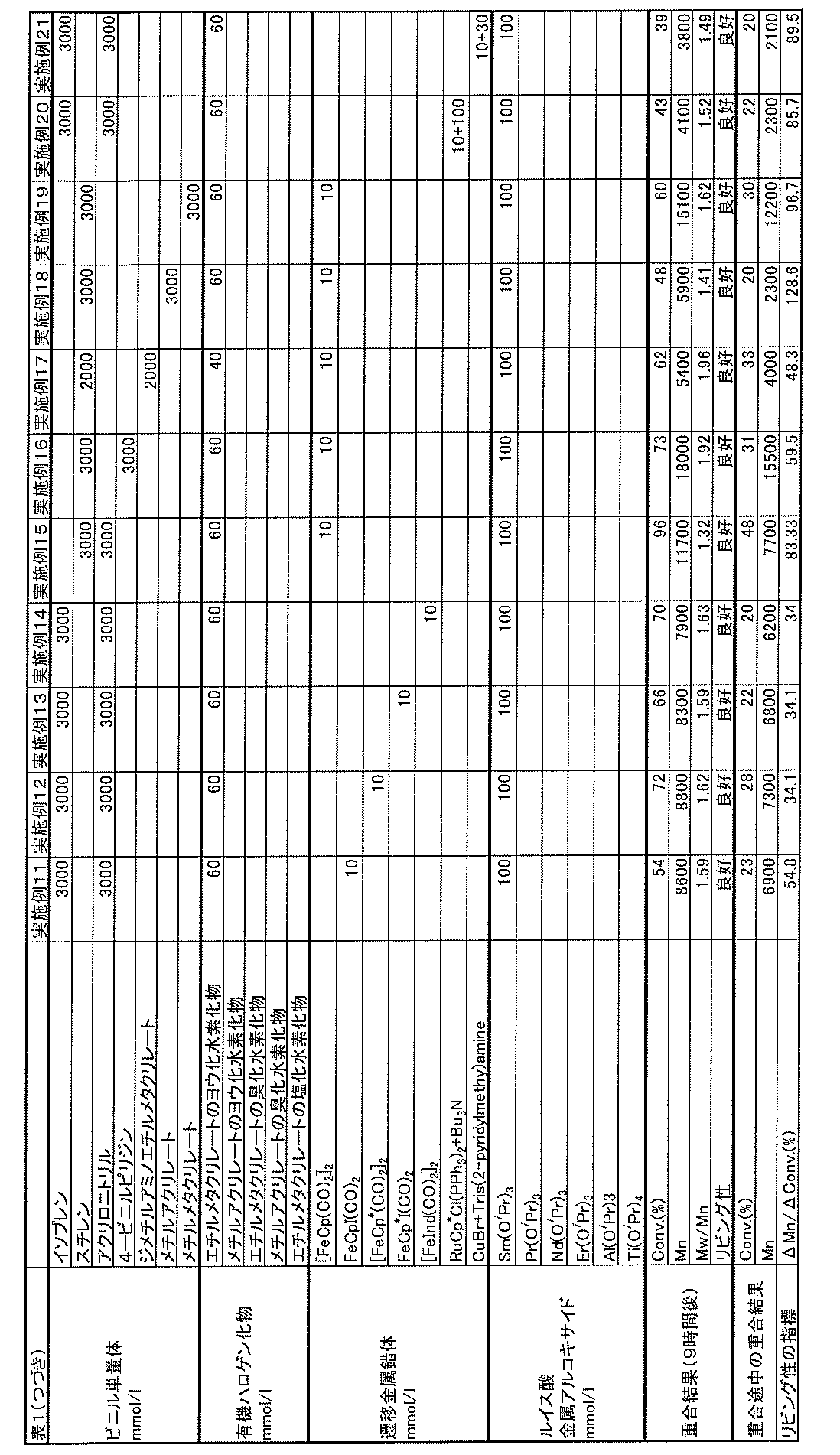
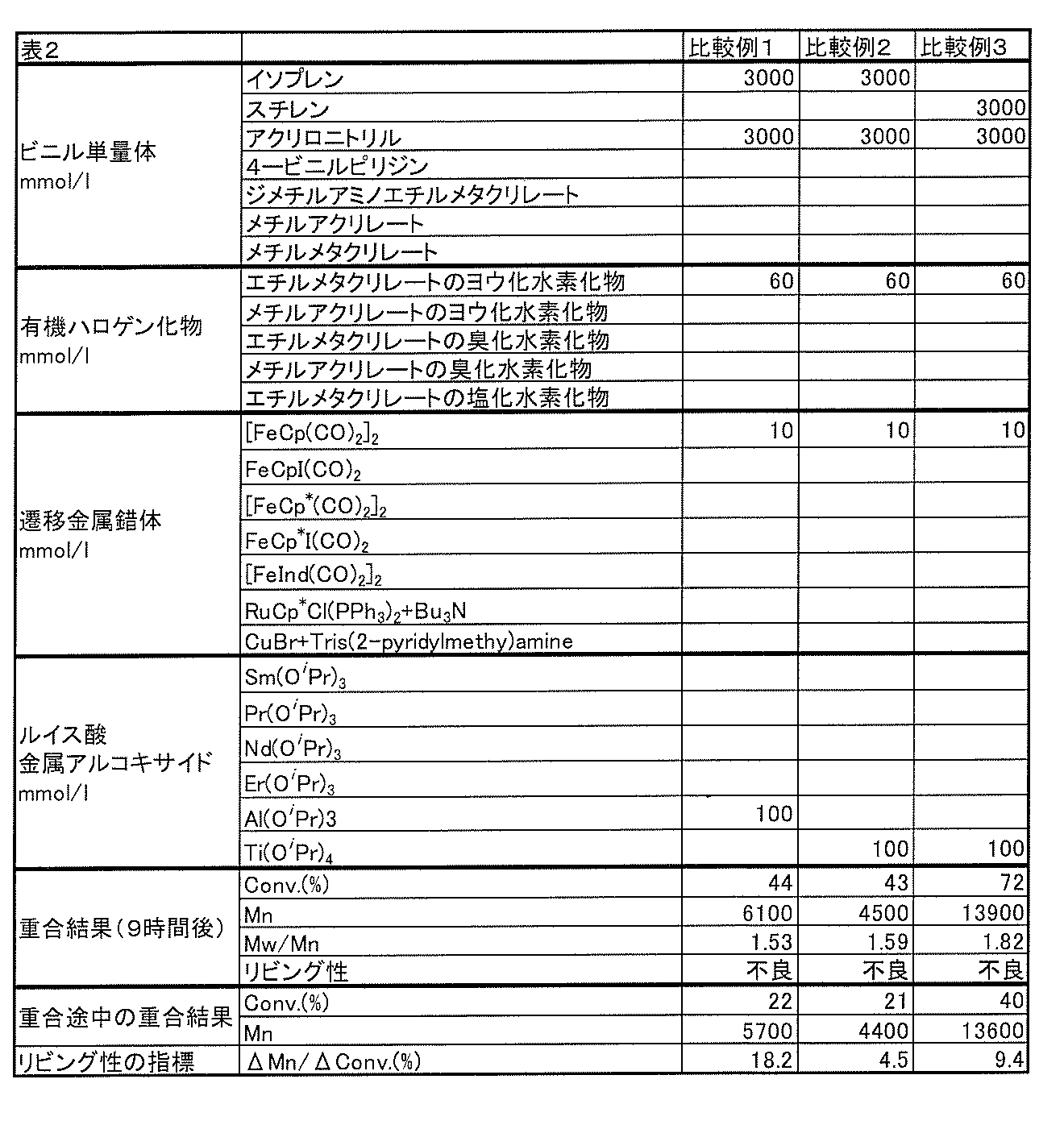
なお、上記表においてCpはシクロペンタジエニルを、Cp*はペンタメチルシクロペンタジエニルを、Indはインデニルを、iPrはイソプロピルを表す。
Claims (9)
- (A)遷移金属錯体、
(B)有機ハロゲン化物、および
(C)希土類アルコキサイド
を含む触媒組成物。 - 前記遷移金属錯体(A)が、鉄を中心金属とする遷移金属錯体である請求項1に記載の触媒組成物。
- 鉄を中心金属とする遷移金属錯体が、ジカルボニルシクロペンタジエニルアイロンダイマー、ジカルボニルシクロペンタジエニルヨードアイロン、ジカルボニル(ペンタメチルシクロペンタジエニル)アイロンダイマー、ジカルボニル(ペンタメチルシクロペンタジエニル)ヨードアイロンおよびジカルボニルインデニルアイロンダイマーからなる群から選択される請求項2に記載の触媒組成物。
- 前記有機ハロゲン化物(B)が、有機ヨウ化物である請求項1~3のいずれかに記載の触媒組成物。
- 前記希土類アルコキサイド(C)が、プラセオジウム(Pr)、ネオジム(Nd)、サマリウム(Sm)およびエルビウム(Er)からなる群から選択される希土類元素のアルコキサイドである請求項1~4のいずれかに記載の触媒組成物。
- 前記希土類アルコキサイド(C)が、イソプロポキサイドである請求項1~5のいずれかに記載の触媒組成物。
- 請求項1~6のいずれかに記載の触媒組成物の存在下に、ビニル単量体のリビングラジカル重合を行う、重合体の製造方法。
- 前記ビニル単量体が、含窒素ビニル単量体を含むものである請求項7に記載の重合体の製造方法。
- 前記ビニル単量体が、共役ジエン化合物および芳香族ビニル化合物からなる群から選択される単量体を含むものである請求項7または8に記載の重合体の製造方法。
Priority Applications (1)
| Application Number | Priority Date | Filing Date | Title |
|---|---|---|---|
| JP2015513737A JPWO2014175199A1 (ja) | 2013-04-22 | 2014-04-21 | 触媒組成物、および重合体の製造方法 |
Applications Claiming Priority (2)
| Application Number | Priority Date | Filing Date | Title |
|---|---|---|---|
| JP2013089789 | 2013-04-22 | ||
| JP2013-089789 | 2013-04-22 |
Publications (1)
| Publication Number | Publication Date |
|---|---|
| WO2014175199A1 true WO2014175199A1 (ja) | 2014-10-30 |
Family
ID=51791775
Family Applications (1)
| Application Number | Title | Priority Date | Filing Date |
|---|---|---|---|
| PCT/JP2014/061126 Ceased WO2014175199A1 (ja) | 2013-04-22 | 2014-04-21 | 触媒組成物、および重合体の製造方法 |
Country Status (2)
| Country | Link |
|---|---|
| JP (1) | JPWO2014175199A1 (ja) |
| WO (1) | WO2014175199A1 (ja) |
Cited By (2)
| Publication number | Priority date | Publication date | Assignee | Title |
|---|---|---|---|---|
| WO2016068170A1 (ja) * | 2014-10-29 | 2016-05-06 | 日本ゼオン株式会社 | 共役ジエン重合体の製造方法 |
| JP2017101150A (ja) * | 2015-12-01 | 2017-06-08 | 株式会社ブリヂストン | 共重合体の製造方法、共重合体、ゴム組成物、及びゴム製品 |
Citations (7)
| Publication number | Priority date | Publication date | Assignee | Title |
|---|---|---|---|---|
| JPS62169805A (ja) * | 1985-11-13 | 1987-07-27 | イー・アイ・デュポン・ドゥ・ヌムール・アンド・カンパニー | 2金属系触媒的連鎖移動剤 |
| JPH08134119A (ja) * | 1994-11-04 | 1996-05-28 | Daicel Chem Ind Ltd | ビニルモノマーの重合方法 |
| JP2000273111A (ja) * | 1999-03-19 | 2000-10-03 | Japan Chemical Innovation Institute | 重合開始剤系及びそれを用いた重合体の製造方法 |
| JP2001247613A (ja) * | 1999-12-27 | 2001-09-11 | Sumitomo Chem Co Ltd | 改質された粒子、それよりなる担体、それよりなるオレフィン重合用触媒成分、それを用いてなるオレフィン重合用触媒、およびオレフィン重合体の製造方法 |
| JP2004051934A (ja) * | 2002-05-27 | 2004-02-19 | Kuraray Co Ltd | 共重合体の製造方法 |
| JP2004323799A (ja) * | 2003-04-28 | 2004-11-18 | Kuraray Co Ltd | ビニルエステル系共重合体の製造方法 |
| JP2004323800A (ja) * | 2003-04-28 | 2004-11-18 | Kuraray Co Ltd | 共重合体組成物の製造方法 |
-
2014
- 2014-04-21 JP JP2015513737A patent/JPWO2014175199A1/ja active Pending
- 2014-04-21 WO PCT/JP2014/061126 patent/WO2014175199A1/ja not_active Ceased
Patent Citations (7)
| Publication number | Priority date | Publication date | Assignee | Title |
|---|---|---|---|---|
| JPS62169805A (ja) * | 1985-11-13 | 1987-07-27 | イー・アイ・デュポン・ドゥ・ヌムール・アンド・カンパニー | 2金属系触媒的連鎖移動剤 |
| JPH08134119A (ja) * | 1994-11-04 | 1996-05-28 | Daicel Chem Ind Ltd | ビニルモノマーの重合方法 |
| JP2000273111A (ja) * | 1999-03-19 | 2000-10-03 | Japan Chemical Innovation Institute | 重合開始剤系及びそれを用いた重合体の製造方法 |
| JP2001247613A (ja) * | 1999-12-27 | 2001-09-11 | Sumitomo Chem Co Ltd | 改質された粒子、それよりなる担体、それよりなるオレフィン重合用触媒成分、それを用いてなるオレフィン重合用触媒、およびオレフィン重合体の製造方法 |
| JP2004051934A (ja) * | 2002-05-27 | 2004-02-19 | Kuraray Co Ltd | 共重合体の製造方法 |
| JP2004323799A (ja) * | 2003-04-28 | 2004-11-18 | Kuraray Co Ltd | ビニルエステル系共重合体の製造方法 |
| JP2004323800A (ja) * | 2003-04-28 | 2004-11-18 | Kuraray Co Ltd | 共重合体組成物の製造方法 |
Cited By (4)
| Publication number | Priority date | Publication date | Assignee | Title |
|---|---|---|---|---|
| WO2016068170A1 (ja) * | 2014-10-29 | 2016-05-06 | 日本ゼオン株式会社 | 共役ジエン重合体の製造方法 |
| JPWO2016068170A1 (ja) * | 2014-10-29 | 2017-08-10 | 日本ゼオン株式会社 | 共役ジエン重合体の製造方法 |
| US10351650B2 (en) | 2014-10-29 | 2019-07-16 | Zeon Corporation | Method for producing conjugated diene polymer |
| JP2017101150A (ja) * | 2015-12-01 | 2017-06-08 | 株式会社ブリヂストン | 共重合体の製造方法、共重合体、ゴム組成物、及びゴム製品 |
Also Published As
| Publication number | Publication date |
|---|---|
| JPWO2014175199A1 (ja) | 2017-02-23 |
Similar Documents
| Publication | Publication Date | Title |
|---|---|---|
| Mosnácek et al. | Atom transfer radical polymerization of tulipalin A: A naturally renewable monomer | |
| Teodorescu et al. | Controlled polymerization of (meth) acrylamides by atom transfer radical polymerization | |
| CN101379091B (zh) | 在催化剂再生下的聚合方法 | |
| EP0816385B1 (en) | Process for preparing vinyl polymer | |
| CN106604940B (zh) | 氯乙烯基共聚物的制备方法以及由该制备方法制备的氯乙烯基共聚物 | |
| CN102574938B (zh) | 用于活性自由基聚合的催化剂及聚合方法 | |
| JP2018536074A5 (ja) | ||
| EP3597674B1 (en) | Method for preparing copolymer | |
| US9371474B2 (en) | (Meth)acrylate-functional polyacrylate resins with narrow but bimodal molecular weight distributions | |
| JP5252492B2 (ja) | ブロック共重合体の製造法 | |
| CN105985492A (zh) | 一种阳离子功能化氯乙烯聚合物及其制备方法 | |
| EP3296333A1 (en) | Alkenyl ether-vinyl ester copolymer | |
| WO2014175199A1 (ja) | 触媒組成物、および重合体の製造方法 | |
| Eslami et al. | Emulsion atom transfer radical block copolymerization of 2‐ethylhexyl methacrylate and methyl methacrylate | |
| JP2012122033A (ja) | 塩化ビニル重合体の製造方法 | |
| CN106046221B (zh) | 一类可逆-休眠自由基聚合的催化剂及聚合方法 | |
| US9447212B2 (en) | Production method for vinyl ether polymer | |
| JP2013227407A (ja) | 塩化ビニル重合体のチオカルボニルチオ末端を除去する方法 | |
| TW200940575A (en) | Process for preparing styrene-based (co)polymers | |
| JP4895176B2 (ja) | 分子量規制されたポリビニルエステルおよびポリビニルアルコールの製造方法 | |
| Liu et al. | Dithiobenzoic copper (II): a novel, facile, and stable mediating agent combining ATRP and RAFT features for reversible deactivation radical polymerization of methacrylates | |
| CN103946249B (zh) | 共轭二烯聚合物及其制造方法 | |
| JP2003137917A (ja) | ビニルエステル系重合体の製造方法 | |
| JP2007297617A (ja) | スチレン系ポリマーの製造方法 | |
| JP2021523267A5 (ja) |
Legal Events
| Date | Code | Title | Description |
|---|---|---|---|
| 121 | Ep: the epo has been informed by wipo that ep was designated in this application |
Ref document number: 14788471 Country of ref document: EP Kind code of ref document: A1 |
|
| ENP | Entry into the national phase |
Ref document number: 2015513737 Country of ref document: JP Kind code of ref document: A |
|
| NENP | Non-entry into the national phase |
Ref country code: DE |
|
| 122 | Ep: pct application non-entry in european phase |
Ref document number: 14788471 Country of ref document: EP Kind code of ref document: A1 |