WO2014163166A1 - アルミニウム製熱交換器の表面処理方法 - Google Patents
アルミニウム製熱交換器の表面処理方法 Download PDFInfo
- Publication number
- WO2014163166A1 WO2014163166A1 PCT/JP2014/059901 JP2014059901W WO2014163166A1 WO 2014163166 A1 WO2014163166 A1 WO 2014163166A1 JP 2014059901 W JP2014059901 W JP 2014059901W WO 2014163166 A1 WO2014163166 A1 WO 2014163166A1
- Authority
- WO
- WIPO (PCT)
- Prior art keywords
- heat exchanger
- chemical conversion
- aluminum heat
- resin
- treatment agent
- Prior art date
- Legal status (The legal status is an assumption and is not a legal conclusion. Google has not performed a legal analysis and makes no representation as to the accuracy of the status listed.)
- Ceased
Links
Classifications
-
- C—CHEMISTRY; METALLURGY
- C23—COATING METALLIC MATERIAL; COATING MATERIAL WITH METALLIC MATERIAL; CHEMICAL SURFACE TREATMENT; DIFFUSION TREATMENT OF METALLIC MATERIAL; COATING BY VACUUM EVAPORATION, BY SPUTTERING, BY ION IMPLANTATION OR BY CHEMICAL VAPOUR DEPOSITION, IN GENERAL; INHIBITING CORROSION OF METALLIC MATERIAL OR INCRUSTATION IN GENERAL
- C23C—COATING METALLIC MATERIAL; COATING MATERIAL WITH METALLIC MATERIAL; SURFACE TREATMENT OF METALLIC MATERIAL BY DIFFUSION INTO THE SURFACE, BY CHEMICAL CONVERSION OR SUBSTITUTION; COATING BY VACUUM EVAPORATION, BY SPUTTERING, BY ION IMPLANTATION OR BY CHEMICAL VAPOUR DEPOSITION, IN GENERAL
- C23C22/00—Chemical surface treatment of metallic material by reaction of the surface with a reactive liquid, leaving reaction products of surface material in the coating, e.g. conversion coatings, passivation of metals
- C23C22/05—Chemical surface treatment of metallic material by reaction of the surface with a reactive liquid, leaving reaction products of surface material in the coating, e.g. conversion coatings, passivation of metals using aqueous solutions
- C23C22/06—Chemical surface treatment of metallic material by reaction of the surface with a reactive liquid, leaving reaction products of surface material in the coating, e.g. conversion coatings, passivation of metals using aqueous solutions using aqueous acidic solutions with pH less than 6
- C23C22/40—Chemical surface treatment of metallic material by reaction of the surface with a reactive liquid, leaving reaction products of surface material in the coating, e.g. conversion coatings, passivation of metals using aqueous solutions using aqueous acidic solutions with pH less than 6 containing molybdates, tungstates or vanadates
-
- C—CHEMISTRY; METALLURGY
- C23—COATING METALLIC MATERIAL; COATING MATERIAL WITH METALLIC MATERIAL; CHEMICAL SURFACE TREATMENT; DIFFUSION TREATMENT OF METALLIC MATERIAL; COATING BY VACUUM EVAPORATION, BY SPUTTERING, BY ION IMPLANTATION OR BY CHEMICAL VAPOUR DEPOSITION, IN GENERAL; INHIBITING CORROSION OF METALLIC MATERIAL OR INCRUSTATION IN GENERAL
- C23C—COATING METALLIC MATERIAL; COATING MATERIAL WITH METALLIC MATERIAL; SURFACE TREATMENT OF METALLIC MATERIAL BY DIFFUSION INTO THE SURFACE, BY CHEMICAL CONVERSION OR SUBSTITUTION; COATING BY VACUUM EVAPORATION, BY SPUTTERING, BY ION IMPLANTATION OR BY CHEMICAL VAPOUR DEPOSITION, IN GENERAL
- C23C22/00—Chemical surface treatment of metallic material by reaction of the surface with a reactive liquid, leaving reaction products of surface material in the coating, e.g. conversion coatings, passivation of metals
- C23C22/05—Chemical surface treatment of metallic material by reaction of the surface with a reactive liquid, leaving reaction products of surface material in the coating, e.g. conversion coatings, passivation of metals using aqueous solutions
- C23C22/06—Chemical surface treatment of metallic material by reaction of the surface with a reactive liquid, leaving reaction products of surface material in the coating, e.g. conversion coatings, passivation of metals using aqueous solutions using aqueous acidic solutions with pH less than 6
- C23C22/34—Chemical surface treatment of metallic material by reaction of the surface with a reactive liquid, leaving reaction products of surface material in the coating, e.g. conversion coatings, passivation of metals using aqueous solutions using aqueous acidic solutions with pH less than 6 containing fluorides or complex fluorides
-
- C—CHEMISTRY; METALLURGY
- C09—DYES; PAINTS; POLISHES; NATURAL RESINS; ADHESIVES; COMPOSITIONS NOT OTHERWISE PROVIDED FOR; APPLICATIONS OF MATERIALS NOT OTHERWISE PROVIDED FOR
- C09D—COATING COMPOSITIONS, e.g. PAINTS, VARNISHES OR LACQUERS; FILLING PASTES; CHEMICAL PAINT OR INK REMOVERS; INKS; CORRECTING FLUIDS; WOODSTAINS; PASTES OR SOLIDS FOR COLOURING OR PRINTING; USE OF MATERIALS THEREFOR
- C09D5/00—Coating compositions, e.g. paints, varnishes or lacquers, characterised by their physical nature or the effects produced; Filling pastes
- C09D5/08—Anti-corrosive paints
- C09D5/082—Anti-corrosive paints characterised by the anti-corrosive pigment
- C09D5/084—Inorganic compounds
-
- C—CHEMISTRY; METALLURGY
- C23—COATING METALLIC MATERIAL; COATING MATERIAL WITH METALLIC MATERIAL; CHEMICAL SURFACE TREATMENT; DIFFUSION TREATMENT OF METALLIC MATERIAL; COATING BY VACUUM EVAPORATION, BY SPUTTERING, BY ION IMPLANTATION OR BY CHEMICAL VAPOUR DEPOSITION, IN GENERAL; INHIBITING CORROSION OF METALLIC MATERIAL OR INCRUSTATION IN GENERAL
- C23C—COATING METALLIC MATERIAL; COATING MATERIAL WITH METALLIC MATERIAL; SURFACE TREATMENT OF METALLIC MATERIAL BY DIFFUSION INTO THE SURFACE, BY CHEMICAL CONVERSION OR SUBSTITUTION; COATING BY VACUUM EVAPORATION, BY SPUTTERING, BY ION IMPLANTATION OR BY CHEMICAL VAPOUR DEPOSITION, IN GENERAL
- C23C22/00—Chemical surface treatment of metallic material by reaction of the surface with a reactive liquid, leaving reaction products of surface material in the coating, e.g. conversion coatings, passivation of metals
- C23C22/05—Chemical surface treatment of metallic material by reaction of the surface with a reactive liquid, leaving reaction products of surface material in the coating, e.g. conversion coatings, passivation of metals using aqueous solutions
- C23C22/06—Chemical surface treatment of metallic material by reaction of the surface with a reactive liquid, leaving reaction products of surface material in the coating, e.g. conversion coatings, passivation of metals using aqueous solutions using aqueous acidic solutions with pH less than 6
- C23C22/40—Chemical surface treatment of metallic material by reaction of the surface with a reactive liquid, leaving reaction products of surface material in the coating, e.g. conversion coatings, passivation of metals using aqueous solutions using aqueous acidic solutions with pH less than 6 containing molybdates, tungstates or vanadates
- C23C22/44—Chemical surface treatment of metallic material by reaction of the surface with a reactive liquid, leaving reaction products of surface material in the coating, e.g. conversion coatings, passivation of metals using aqueous solutions using aqueous acidic solutions with pH less than 6 containing molybdates, tungstates or vanadates containing also fluorides or complex fluorides
-
- C—CHEMISTRY; METALLURGY
- C23—COATING METALLIC MATERIAL; COATING MATERIAL WITH METALLIC MATERIAL; CHEMICAL SURFACE TREATMENT; DIFFUSION TREATMENT OF METALLIC MATERIAL; COATING BY VACUUM EVAPORATION, BY SPUTTERING, BY ION IMPLANTATION OR BY CHEMICAL VAPOUR DEPOSITION, IN GENERAL; INHIBITING CORROSION OF METALLIC MATERIAL OR INCRUSTATION IN GENERAL
- C23C—COATING METALLIC MATERIAL; COATING MATERIAL WITH METALLIC MATERIAL; SURFACE TREATMENT OF METALLIC MATERIAL BY DIFFUSION INTO THE SURFACE, BY CHEMICAL CONVERSION OR SUBSTITUTION; COATING BY VACUUM EVAPORATION, BY SPUTTERING, BY ION IMPLANTATION OR BY CHEMICAL VAPOUR DEPOSITION, IN GENERAL
- C23C22/00—Chemical surface treatment of metallic material by reaction of the surface with a reactive liquid, leaving reaction products of surface material in the coating, e.g. conversion coatings, passivation of metals
- C23C22/73—Chemical surface treatment of metallic material by reaction of the surface with a reactive liquid, leaving reaction products of surface material in the coating, e.g. conversion coatings, passivation of metals characterised by the process
- C23C22/74—Chemical surface treatment of metallic material by reaction of the surface with a reactive liquid, leaving reaction products of surface material in the coating, e.g. conversion coatings, passivation of metals characterised by the process for obtaining burned-in conversion coatings
-
- C—CHEMISTRY; METALLURGY
- C23—COATING METALLIC MATERIAL; COATING MATERIAL WITH METALLIC MATERIAL; CHEMICAL SURFACE TREATMENT; DIFFUSION TREATMENT OF METALLIC MATERIAL; COATING BY VACUUM EVAPORATION, BY SPUTTERING, BY ION IMPLANTATION OR BY CHEMICAL VAPOUR DEPOSITION, IN GENERAL; INHIBITING CORROSION OF METALLIC MATERIAL OR INCRUSTATION IN GENERAL
- C23C—COATING METALLIC MATERIAL; COATING MATERIAL WITH METALLIC MATERIAL; SURFACE TREATMENT OF METALLIC MATERIAL BY DIFFUSION INTO THE SURFACE, BY CHEMICAL CONVERSION OR SUBSTITUTION; COATING BY VACUUM EVAPORATION, BY SPUTTERING, BY ION IMPLANTATION OR BY CHEMICAL VAPOUR DEPOSITION, IN GENERAL
- C23C22/00—Chemical surface treatment of metallic material by reaction of the surface with a reactive liquid, leaving reaction products of surface material in the coating, e.g. conversion coatings, passivation of metals
- C23C22/82—After-treatment
-
- F—MECHANICAL ENGINEERING; LIGHTING; HEATING; WEAPONS; BLASTING
- F28—HEAT EXCHANGE IN GENERAL
- F28F—DETAILS OF HEAT-EXCHANGE AND HEAT-TRANSFER APPARATUS, OF GENERAL APPLICATION
- F28F19/00—Preventing the formation of deposits or corrosion, e.g. by using filters or scrapers
- F28F19/02—Preventing the formation of deposits or corrosion, e.g. by using filters or scrapers by using coatings, e.g. vitreous or enamel coatings
-
- F—MECHANICAL ENGINEERING; LIGHTING; HEATING; WEAPONS; BLASTING
- F28—HEAT EXCHANGE IN GENERAL
- F28F—DETAILS OF HEAT-EXCHANGE AND HEAT-TRANSFER APPARATUS, OF GENERAL APPLICATION
- F28F19/00—Preventing the formation of deposits or corrosion, e.g. by using filters or scrapers
- F28F19/02—Preventing the formation of deposits or corrosion, e.g. by using filters or scrapers by using coatings, e.g. vitreous or enamel coatings
- F28F19/06—Preventing the formation of deposits or corrosion, e.g. by using filters or scrapers by using coatings, e.g. vitreous or enamel coatings of metal
-
- F—MECHANICAL ENGINEERING; LIGHTING; HEATING; WEAPONS; BLASTING
- F28—HEAT EXCHANGE IN GENERAL
- F28F—DETAILS OF HEAT-EXCHANGE AND HEAT-TRANSFER APPARATUS, OF GENERAL APPLICATION
- F28F21/00—Constructions of heat-exchange apparatus characterised by the selection of particular materials
- F28F21/08—Constructions of heat-exchange apparatus characterised by the selection of particular materials of metal
- F28F21/081—Heat exchange elements made from metals or metal alloys
- F28F21/084—Heat exchange elements made from metals or metal alloys from aluminium or aluminium alloys
-
- B—PERFORMING OPERATIONS; TRANSPORTING
- B05—SPRAYING OR ATOMISING IN GENERAL; APPLYING FLUENT MATERIALS TO SURFACES, IN GENERAL
- B05D—PROCESSES FOR APPLYING FLUENT MATERIALS TO SURFACES, IN GENERAL
- B05D2202/00—Metallic substrate
- B05D2202/20—Metallic substrate based on light metals
- B05D2202/25—Metallic substrate based on light metals based on Al
-
- B—PERFORMING OPERATIONS; TRANSPORTING
- B05—SPRAYING OR ATOMISING IN GENERAL; APPLYING FLUENT MATERIALS TO SURFACES, IN GENERAL
- B05D—PROCESSES FOR APPLYING FLUENT MATERIALS TO SURFACES, IN GENERAL
- B05D3/00—Pretreatment of surfaces to which liquids or other fluent materials are to be applied; After-treatment of applied coatings, e.g. intermediate treating of an applied coating preparatory to subsequent applications of liquids or other fluent materials
- B05D3/10—Pretreatment of surfaces to which liquids or other fluent materials are to be applied; After-treatment of applied coatings, e.g. intermediate treating of an applied coating preparatory to subsequent applications of liquids or other fluent materials by other chemical means
- B05D3/102—Pretreatment of metallic substrates
-
- F—MECHANICAL ENGINEERING; LIGHTING; HEATING; WEAPONS; BLASTING
- F28—HEAT EXCHANGE IN GENERAL
- F28F—DETAILS OF HEAT-EXCHANGE AND HEAT-TRANSFER APPARATUS, OF GENERAL APPLICATION
- F28F2245/00—Coatings; Surface treatments
- F28F2245/02—Coatings; Surface treatments hydrophilic
Definitions
- the present invention relates to a surface treatment method for an aluminum heat exchanger.
- aluminum heat exchangers usually have a plurality of fins arranged at a narrow interval in order to make the surface area as large as possible, and refrigerant supply tubes are involved in these fins. Be placed.
- fins when moisture in the atmosphere adheres to the surfaces of fins and tubes (hereinafter referred to as “fins”) as condensed water, the condensed water will remain on the surfaces of the fins for a long time. May stay. In this case, as a result of locally forming an oxygen concentration cell and proceeding with a corrosion reaction, white rust is generated.
- moisture resistance improvement of blackening resistance
- the corrosion resistance index is white rust
- the moisture resistance index is blackened.
- White rust is a corrosion phenomenon that occurs due to corrosion factors such as oxygen, water, and chloride ions
- blackening is a corrosion phenomenon that occurs due to the presence of oxygen, water, and heat.
- Patent Document 1 is not sufficient in terms of corrosion resistance and moisture resistance of an aluminum heat exchanger.
- the technique of patent document 1 is not made
- Patent Document 2 and Patent Document 3 are both applied to a hydrophilic film formed on a chemical conversion film, and are mainly intended to improve the hydrophilicity of an aluminum heat exchanger. Therefore, it is greatly different from the technique of the present invention.
- the present invention has been made in view of the above, and an object of the present invention is to provide an aluminum heat exchanger surface capable of imparting excellent corrosion resistance and moisture resistance to an aluminum heat exchanger and suppressing odor. It is to provide a processing method.
- the present invention provides a surface treatment method for an aluminum heat exchanger, (A) forming a chemical conversion film on the surface of the aluminum heat exchanger by treating the surface of the aluminum heat exchanger with a chemical conversion agent; (B) a step of bringing a hydrophilic treatment agent containing a hydrophilic resin into contact with the aluminum heat exchanger having a chemical conversion film formed on the surface in the step (a); (C) forming a hydrophilized film by baking the aluminum heat exchanger brought into contact with the hydrophilizing agent in the step (b),
- the chemical conversion treatment agent is one or more metal elements (A) selected from the group consisting of zirconium, titanium and hafnium, and Vanadium element (B); Resin (C),
- the resin (C) includes a polyvinyl alcohol resin (C1) made of at least one of polyvinyl alcohol and derivatives thereof, The value (Wa / Wb) of the ratio of the total content (Wa) of the metal element (A) to the content (Wb) of the
- the resin (C) further includes one or more metal ion crosslinkable polymers (C2), Ratio of the mass-based total content (Wc2) of the metal ion-crosslinkable polymer (C2) to the mass-based total content (Wc1 + Wc2) of the polyvinyl alcohol-based resin (C1) and the metal ion-crosslinkable polymer (C2)
- the value of (Wc2 / (Wc1 + Wc2)) is preferably 0.4 or less.
- the chemical conversion treatment agent is, as the metal ion crosslinkable polymer (C2), from polyacrylic acid, phosphoric acid polymer, phosphonic acid polymer, water-soluble or water-dispersible epoxy polymer, water-soluble or water-dispersible urethane polymer, polyester. It is preferable to contain 1 type (s) or 2 or more types selected from the group which consists of.
- the concentration of the metal element (A) in the chemical conversion treatment agent is 50 to 100,000 ppm by mass
- the concentration of the vanadium element (B) is 50 to 100,000 mass ppm
- the total concentration of the resin (C) is 50 to 100,000 ppm by mass
- the pH is preferably 0.5 to 6.5.
- the average saponification degree of the polyvinyl alcohol resin (C1) is preferably 80% or more.
- the chemical conversion treatment agent preferably further contains a surfactant.
- the chemical conversion treatment agent preferably further contains one or more free fluorine sources selected from the group consisting of hydrofluoric acid, ammonium fluoride, ammonium hydrogen fluoride, and alkali metal fluorides.
- an aluminum heat exchanger treated by the surface treatment method for an aluminum heat exchanger according to the present invention is provided.
- the present invention it is possible to provide a surface treatment method for an aluminum heat exchanger that can impart superior corrosion resistance and moisture resistance to an aluminum heat exchanger as compared with conventional ones and can suppress odor.
- the surface treatment method of the aluminum heat exchanger used in this embodiment is as follows: (A) forming a chemical conversion film on the surface of the aluminum heat exchanger by treating the surface of the aluminum heat exchanger with a chemical conversion agent; (B) a step of bringing a hydrophilic treatment agent containing a hydrophilic resin into contact with the aluminum heat exchanger having a chemical conversion film formed on the surface in the step (a); (C) forming a hydrophilized film by baking the aluminum heat exchanger brought into contact with the hydrophilizing agent in the step (b),
- the chemical conversion treatment agent is one or more metal elements (A) selected from the group consisting of zirconium, titanium and hafnium, and Vanadium element (B); Resin (C),
- the resin (C) includes a polyvinyl alcohol resin (C1) made of at least one of polyvinyl alcohol and derivatives thereof, The value (Wa / Wb) of the ratio of the total content (Wa) of the metal element
- the aluminum heat exchanger treated by the surface treatment method of the aluminum heat exchanger used in the present embodiment is preferably used for automotive air conditioners.
- “made of aluminum” means made of aluminum or an aluminum alloy (hereinafter simply referred to as “aluminum”).
- a plurality of fins are arranged at a narrow interval so as to make the surface area as large as possible, and a refrigerant supply tube is involved in these fins. It is arranged with.
- the surface treatment method of the aluminum heat exchanger used in the present embodiment is as follows: (a) a chemical conversion film is formed on the surface of the aluminum heat exchanger by treating the surface of the aluminum heat exchanger with a chemical conversion treatment agent. Process. In the step (a) in the surface treatment method for an aluminum heat exchanger, a chemical conversion treatment agent is brought into contact with the surface of the aluminum heat exchanger.
- the chemical conversion treatment agent used in the step (a) is one or two selected from the group consisting of zirconium, titanium, and hafnium.
- the coating type chemical conversion treatment agent is used in a method in which the chemical conversion treatment agent is applied to a metal surface and then dried without washing the metal surface with water.
- a pickling process for removing an oxide film or the like on the surface, and a water washing process after the pickling process are required before applying a chemical conversion treatment agent to the surface of an aluminum heat exchanger in order to impart corrosion resistance.
- the chemical conversion treatment agent of the present invention has a high barrier property of the chemical conversion film, and since the chemical conversion treatment agent is applied to the surface of the aluminum heat exchanger, high corrosion resistance and moisture resistance can be obtained without removing the oxide film. Further, by using a coating type chemical conversion treatment agent, it is not necessary to provide a pickling step or a subsequent water washing step, and the number of steps can be reduced.
- the zirconium element, the titanium element, the hafnium element, and the vanadium element all exist as various ions such as complex ions. Therefore, in this specification, each content of a zirconium element, a titanium element, a hafnium element, and a vanadium element means the value of various ions in terms of a metal element.
- the chemical conversion treatment agent used in the present embodiment includes one or more compounds selected from the group consisting of a zirconium-based compound, a titanium-based compound, and a hafnium-based compound, a vanadium-based compound, and a polyvinyl alcohol-based resin (C1). Prepared by dissolving in water.
- Zirconium compounds that are the source of zirconium ions include zirconium compounds such as fluorozirconic acid and zirconium fluoride, and salts of lithium, sodium, potassium, ammonium and the like.
- zirconium compounds such as fluorozirconic acid and zirconium fluoride, and salts of lithium, sodium, potassium, ammonium and the like.
- a zirconium compound such as zirconium oxide dissolved in a fluoride such as hydrofluoric acid can be used.
- zirconium carbonate, zirconium nitrate, or organic complex zirconium can also be used.
- titanium compound which is a supply source of titanium ions examples include salts of lithium, sodium, potassium, ammonium and the like in addition to titanium compounds such as fluorotitanic acid and titanium fluoride.
- a titanium compound such as titanium oxide dissolved in a fluoride such as hydrofluoric acid can be used.
- titanium carbonate, titanium nitrate, or organic complex titanium can be used.
- hafnium-based compound that is a source of hafnium ions examples include hafnium compounds such as fluorohafnium acid and hafnium fluoride, and salts of these lithium, sodium, potassium, ammonium, and the like.
- hafnium compounds such as hafnium oxide dissolved in a fluoride such as hydrofluoric acid can be used.
- the concentration of one or more metal elements (A) selected from the group consisting of zirconium, titanium and hafnium contained in the chemical conversion treatment agent used in the present embodiment is 50 to 100,000 mass in terms of metal elements. It is preferably ppm, more preferably 400 to 12,000 ppm by mass, and even more preferably 500 to 5,000 ppm by mass.
- concentration of the metal element (A) is less than 50 ppm by mass, the corrosion resistance of the chemical conversion film tends to decrease.
- concentration of the metal element (A) exceeds 100,000 mass ppm, the liquid stability of the chemical conversion treatment agent tends to decrease.
- Vanadium ions supplied from the vanadium element (B) are components that improve the corrosion resistance of the chemical conversion film together with zirconium ions. Vanadium has the property of being insolubilized by a reduction reaction, and can effectively coat the periphery of segregated substances that can become a corrosion starting point.
- the chemical conversion treatment agent contains one or more metal ions selected from the group consisting of zirconium ions, titanium ions, and hafnium ions, and vanadium ions, and thus one type selected from the group consisting of zirconium, titanium, and hafnium.
- a chemical conversion film containing two or more metals and vanadium is formed.
- a divalent to pentavalent vanadium compound can be used as the vanadium compound which is a supply source of vanadium ions.
- a tetravalent or pentavalent vanadium compound is preferable, and specifically, vanadyl sulfate (tetravalent) and ammonium metavanadate (pentavalent) are preferably used.
- the concentration of the vanadium element (B) contained in the chemical conversion treatment agent used in the present embodiment is 50 to 100,000 ppm by mass in terms of vanadium element from the viewpoint of improving the corrosion resistance of the chemical heat-treated aluminum heat exchanger. It is preferably 400 to 9,000 mass ppm, more preferably 500 to 5000 mass ppm.
- the chemical conversion treatment agent used in the present embodiment one or more selected from the group consisting of zirconium, titanium, and hafnium with respect to the mass-based content (Wb) of the vanadium element (B).
- the ratio value (Wa / Wb) of the total content (Wa) based on mass of the metal element (A) is 0.1 to 15.
- the corrosion resistance and moisture resistance are lowered.
- the (Wa / Wb) exceeds 15, the corrosion resistance decreases.
- the value of the ratio (Wa / Wb) of the total content (Wa) of the metal element (A) based on the mass basis content (Wb) of the vanadium element (B). ) Is preferably from 0.1 to 9.5, more preferably from 0.15 to 6.5.
- the chemical conversion treatment agent used in the present embodiment contains the resin (C).
- Resin (C) is a film forming component.
- Resin (C) contains the polyvinyl alcohol-type resin (C1) which consists of at least one among polyvinyl alcohol and its derivative (s).
- a typical polyvinyl alcohol-based resin is polyvinyl alcohol (PVA) obtained by saponifying a vinyl acetate polymer.
- PVA derivatives such as those obtained by substituting a part of hydroxyl groups with alkyl groups such as propyl group or butyl group or acetoacetyl groups can also be used as polyvinyl alcohol derivatives.
- the chemical conversion treatment agent contains polyvinyl alcohol resin (C1) composed of at least one of polyvinyl alcohol and derivatives thereof, so that the hydroxyl group of polyvinyl alcohol resin (C1) is composed of zirconium, titanium and hafnium in the chemical conversion treatment agent.
- An aluminum heat exchanger is provided with excellent corrosion resistance and moisture resistance by forming a dense metal surface film.
- polyvinyl alcohol-type resin (C1) when using the derivative
- PVA having a modification degree of 20 mol% or more is used as the polyvinyl alcohol-based resin (C1), since there are few hydroxyl groups coordinated to metal ions in the chemical conversion treatment agent, an aluminum heat exchanger having a chemical conversion film formed thereon There is a tendency for the corrosion resistance and moisture resistance of the to decrease.
- Polyvinyl alcohol and its derivatives are excellent in film-forming properties due to their high crystallinity and do not have a carboxyl group or the like, so there is little odor originating from the resin and no odorous substances are adsorbed.
- the average saponification degree of the polyvinyl alcohol-based resin (C1) is preferably 80% or more, more preferably 90% or more, and further preferably 98% or more. If the degree of saponification of the polyvinyl alcohol resin (C1) is less than 80%, the crystallinity will be low and the film forming property of the chemical conversion treatment agent will be low. There is a tendency that the corrosion resistance and moisture resistance of the heat exchanger are inferior. Furthermore, when the average saponification degree of the polyvinyl alcohol resin (C1) is less than 80%, the acetic acid odor derived from vinyl acetate also tends to increase.
- polyvinyl alcohol and its derivatives include PVA-105 (polyvinyl alcohol, saponification degree: 98 to 99%, polymerization degree: 500, manufactured by Kuraray Co., Ltd.), PVA-110 (polyvinyl alcohol, saponification degree: 98 to 99).
- the average saponification degree is a value calculated by a weighted average.
- the average saponification degree of the entire resin mixture is 93.2%.
- the polymerization degree of the polyvinyl alcohol resin (C1) contained in the chemical conversion treatment agent used in the present embodiment is preferably 100 to 5,000.
- the degree of polymerization of the polyvinyl alcohol-based resin (C1) is preferably 100 to 5,000.
- the value ((Wa + Wb) / Wc1) of the mass-based total content (Wa + Wb) of the metal element (A) and the vanadium element (B) of the seeds or more is 0.25 to 15.
- Ratio value ((Wa + Wb) / Wc1) is preferably 0.25 to 10, and more preferably 0.3 to 6.
- the resin (C) contained in the chemical conversion treatment agent may further contain one or more metal ion crosslinkable polymers (C2).
- the metal ion crosslinkable polymer (C2) is a polymer that crosslinks with metal ions.
- the metal ion crosslinkable polymer (C2) polyacrylic acid, phosphoric acid polymer, phosphonic acid polymer, water-soluble or water-dispersible epoxy polymer, water-soluble or water-dispersible urethane polymer, polyester, water-soluble or water-dispersible Examples include polyolefin.
- the metal ion crosslinkable polymer (C2) is crosslinked with zirconium or vanadium metal ions in the chemical conversion film, whereby dissolution of the chemical conversion film is suppressed and corrosion resistance is improved.
- the resin (C), which is a film forming component, is preferably composed of only the polyvinyl alcohol resin (C1) and one or more metal ion crosslinkable polymers (C2).
- resins other than the polyacrylic acid listed above for example, resins such as polyethylene oxide, polyethylene glycol, polyacrylic sulfone, and polystyrene sulfonic acid have low crosslinkability with metal ions. Therefore, when a resin (polyethylene oxide or the like) other than the polyacrylic acid listed above is used as the metal ion crosslinkable polymer, the chemical conversion film is dissolved and the corrosion resistance tends to be lowered.
- the chemical conversion treatment agent is a polyacrylic acid, a phosphoric acid polymer, a phosphonic acid polymer, a water-soluble or water-dispersible epoxy polymer as a metal ion crosslinkable polymer (C2), It is preferable to contain one or more selected from the group consisting of water-soluble or water-dispersible urethane polymers and polyesters.
- the commercially available metal ion crosslinkable polymer (C2) include AC10L (polyacrylic acid, manufactured by Toa Gosei Co., Ltd.), polyphosmer (phosphoric acid polymer, manufactured by DAP Corporation), and the like.
- Ratio value (Wc2 / (Wc1 + Wc2)) is preferably 0.4 or less, more preferably 0.2 or less, and even more preferably 0.1 or less.
- the said chemical conversion treatment agent contains only a polyvinyl alcohol-type resin (C1) and a metal ion crosslinkable polymer (C2) as resin (C).
- the chemical conversion treatment agent contains only the polyvinyl alcohol resin (C1) and the metal ion crosslinkable polymer (C2) as the resin (C)
- the metal crosslinking in the chemical conversion film is strengthened, and the metal that has formed the chemical conversion film Corrosion resistance and moisture resistance of the material are further improved.
- the chemical conversion treating agent contains only the polyvinyl alcohol resin (C1) and the metal ion crosslinkable polymer (C2) as the resin (C).
- the chemical conversion treating agent contains the polyvinyl alcohol resin (C1) and the metal.
- a resin other than the ion-crosslinkable polymer (C2) is contained.
- “contains only the polyvinyl alcohol resin (C1) and the metal ion crosslinkable polymer (C2)” means other than the polyvinyl alcohol resin (C1) and the metal ion crosslinkable polymer (C2) in the chemical conversion treatment agent.
- the resin content is 5% by mass or less based on the total mass content (Wc1 + Wc2) of the polyvinyl alcohol resin (C1) and the metal ion crosslinkable polymer (C2).
- the total concentration of the resin (C) contained in the chemical conversion treatment agent is preferably 50 to 100,000 ppm by mass from the viewpoint of improving the corrosion resistance of the aluminum heat exchanger subjected to chemical conversion treatment, More preferred is 000 ppm by mass, and even more preferred is 1,000 to 20,000 ppm by mass.
- the chemical conversion treatment agent is used for the purpose of improving corrosion resistance, such as manganese, zinc, cerium, trivalent chromium, magnesium, strontium, calcium, tin, copper, iron, and silicon compounds such as phosphoric acid and condensed phosphoric acid.
- corrosion resistance such as manganese, zinc, cerium, trivalent chromium, magnesium, strontium, calcium, tin, copper, iron, and silicon compounds
- a phosphorus compound and various silane coupling agents such as aminosilane and epoxysilane for improving adhesion may be included.
- the chemical conversion treatment agent used for this embodiment may contain the aluminum ion.
- a supply source of aluminum ions include aluminum nitrates such as aluminum nitrate, aluminum sulfate, aluminum fluoride, aluminum oxide, alum, aluminum silicate and sodium aluminate, and fluoroaluminum salts such as sodium fluoroaluminate.
- the chemical conversion treatment agent used in the present embodiment is one or more free fluorine sources selected from the group consisting of hydrofluoric acid, ammonium fluoride, ammonium hydrogen fluoride, and alkali metal fluorides. Furthermore, it is preferable to contain.
- the chemical conversion treatment agent further contains these free fluorine sources, the free fluorine ion concentration of the chemical conversion treatment agent increases, and (a) the etching of the aluminum heat exchanger surface in the initial stage of the process is promoted, Corrosion resistance and moisture resistance of the aluminum heat exchanger after the treatment can be improved. More specifically, in the aluminum heat exchanger, a plurality of fins are arranged at a narrow interval as described above, and a refrigerant supply tube is arranged in the fins. It is preferable that the chemical conversion treatment agent further contains a free fluoride ion supply source in order to sufficiently etch the surface of the fins arranged at a narrow interval or the surface of the complicated tube.
- zirconium fluoride zirconium fluoride, titanium fluoride, or the like that ionizes to generate free fluorine ions
- the free fluorine ion supply source in the present embodiment is zirconium ions or titanium ions. It is not the same as the source of ions.
- the chemical conversion treatment agent used in the present embodiment contains a free fluorine ion supply source separately from the supply source of zirconium ions and titanium ions, so that the free fluorine ion concentration becomes sufficiently high, and the surface of the aluminum heat exchanger Etching is further promoted.
- alkali metal fluoride used as a source of free fluorine ions include sodium fluoride, sodium hydrofluoride, potassium fluoride, and potassium hydrofluoride.
- the concentration of the free fluorine ion supply source contained in the chemical conversion treatment agent is preferably 500 to 20,000 mass ppm in terms of fluorine element. If the concentration of the free fluorine ion supply source of the chemical conversion treatment agent is less than 500 ppm by mass in terms of elemental fluorine, the corrosion resistance and moisture resistance of the aluminum heat exchanger after the surface treatment tend to be reduced. If it is higher than 000 ppm by mass, it tends to be difficult to control the etching of the aluminum heat exchanger surface.
- the concentration of the free fluorine ion source contained in the chemical conversion treatment agent is more preferably 500 to 10,000 ppm, and even more preferably 500 to 5,000 ppm in terms of fluorine element.
- the chemical conversion treatment agent used in the present embodiment may contain a surfactant in addition to the film forming component resin (C). It is preferable that content of surfactant in a chemical conversion treatment agent is 5 mass% or less with respect to solid content in a chemical conversion treatment agent. When the chemical conversion treatment agent contains a surfactant in the above range, the wettability is improved and the chemical conversion treatment agent tends to be easily applied.
- the surfactant to be contained in the chemical conversion treatment agent may be any of a cationic surfactant, a nonionic surfactant, and an anionic surfactant. Moreover, it is preferable that it is a nonionic surfactant as surfactant contained in a chemical conversion treatment agent.
- the pH of the chemical conversion treatment agent is preferably 0.5 to 6.5, more preferably 1 to 5.
- the pH of the chemical conversion treatment agent is smaller than 0.5 or larger than 6.5, a good chemical conversion film is not formed, and the corrosion resistance and moisture resistance of the aluminum heat exchanger tend to be lowered.
- the surface treatment method for an aluminum heat exchanger according to the present embodiment can be performed.
- the chemical conversion treatment agent applied to the surface of the aluminum heat exchanger is dried (first drying step described later), and the surface A chemical conversion film is formed on the surface.
- the surface of the aluminum heat exchanger is removed for the purpose of removing dirt and the like adhering to the aluminum heat exchanger.
- hot water 40 to 90 ° C.
- the method for applying the chemical conversion treatment agent of the present embodiment to an aluminum heat exchanger is not particularly limited. Although any method such as a spray method or an immersion method may be used, as described above, since the aluminum heat exchanger has a complicated shape, it is preferable to perform the step (a) by the immersion method.
- the temperature of the chemical conversion treatment agent in step (a) is preferably 5 to 40 ° C.
- the time required for step (a) is preferably 5 to 600 seconds, and more preferably 10 to 300 seconds. If it is a chemical conversion film formed by the chemical conversion treatment process performed on the conditions which satisfy
- the chemical conversion treatment agent of this embodiment if the chemical conversion treatment agent of this embodiment is used, it is not necessary to remove the oxide film on the surface of the aluminum heat exchanger.
- the surface treatment method for an aluminum heat exchanger used in the present embodiment if the chemical conversion treatment agent described above is applied to the surface of the aluminum heat exchanger, the barrier property, corrosion resistance, and moisture resistance can be eliminated without removing the oxide film. A highly chemical conversion film can be obtained. For this reason, in the surface treatment method of the aluminum heat exchanger used in the present embodiment, it is not necessary to provide a pickling step or a subsequent water washing step, and the number of steps can be reduced.
- the amount of the solid content of the chemical conversion film formed using the chemical conversion treatment agent used in this embodiment is preferably 5 to 3,000 mg / m 2 , and preferably 30 to 1,000 mg / m 2. Is more preferable.
- the aluminum heat exchanger can have better corrosion resistance and moisture resistance. Since the chemical conversion treatment agent of the present embodiment is a coating type chemical conversion treatment agent as described above, the solid content of the chemical conversion treatment agent applied to the surface of the aluminum heat exchanger is equal to the solid content of the chemical conversion treatment film. It becomes the amount of.
- the first drying step is a step of drying the chemical conversion film formed on the surface of the aluminum heat exchanger in the chemical conversion treatment step to form a chemical conversion film on the surface.
- the first drying step by drying the chemical conversion treatment agent applied to the surface of the aluminum heat exchanger, polyvinyl alcohol or a derivative thereof and a metal such as zirconium or vanadium are cross-linked, and the metal such as zirconium is in the chemical conversion film. Can be fixed to.
- the drying temperature and drying time in the first drying step are not particularly limited, but the drying temperature is preferably 100 to 220 ° C, more preferably 120 to 220 ° C.
- the drying time is preferably 1 to 120 minutes. If the drying temperature is less than 100 ° C, the film-forming property tends to be insufficient, and if it exceeds 220 ° C, the resin tends to decompose and the coating tends to become brittle.
- metals such as zirconium and vanadium have a high specific gravity in the chemical conversion film, and therefore tend to sink to the surface of the aluminum heat exchanger. This is also one of the causes that metals such as zirconium and vanadium exist unevenly on the surface of the aluminum heat exchanger. In this way, metals such as zirconium and vanadium are present unevenly in the chemical conversion film, and the resin (C) covers the unevenly present metal, and as described above, generation of odor caused by metals such as zirconium. Can be suppressed.
- the surface treatment method for an aluminum heat exchanger used in the present embodiment includes (b) a hydrophilic treatment including a hydrophilic resin in the aluminum heat exchanger having a chemical conversion film formed on the surface in the step (a).
- the step (b) is a step of bringing the aluminum heat exchanger that has undergone the step (a) into contact with the hydrophilizing agent, and this step forms a hydrophilic film on the chemical conversion film.
- the hydrophilic treatment agent used in the hydrophilic treatment step is not particularly limited, and conventionally known ones can be used.
- the hydrophilic treatment agent preferably used in the surface treatment method of the present embodiment is one in which silica fine particles coated with a vinyl alcohol resin are dispersed in an aqueous medium.
- Silica fine particles include fumed silica and colloidal silica.
- fumed silica is produced by hydrolyzing a halosilane such as trichlorosilane or tetrachlorosilane in a gas phase at a high temperature, and is a fine particle having a large surface area.
- Colloidal silica is obtained by dispersing an acid or alkali stable silica sol in water.
- the volume average particle size of the silica fine particles is preferably 5 to 100 nm, more preferably 7 to 60 nm. When the volume average particle size is less than 5 nm, the unevenness of the treatment film is insufficient and the hydrophilicity is lowered.
- the volume average particle size exceeds 100 nm, aggregates with large particle sizes are generated when the treatment agent is used, and workability tends to deteriorate. .
- the volume average particle diameter was measured with a dynamic light scattering measuring instrument (ELS-800, manufactured by Otsuka Electronics Co., Ltd.) after diluting a part of the hydrophilizing agent with deionized water.
- a typical vinyl alcohol resin is polyvinyl alcohol (PVA) obtained by saponifying a vinyl acetate polymer.
- PVA having a high degree of saponification is preferable, and those having a saponification degree of 98% or more are particularly preferable.
- PVA derivatives such as those in which a part of the hydroxyl group is substituted with an alkyl group such as propyl group or butyl group or a polyethylene glycol group can also be used as the vinyl alcohol polymer.
- hydrophilic polymers such as hydroxyl group-containing acrylic resin, polyacrylic acid, polyvinyl sulfonic acid, polyvinyl imidazole, polyethylene oxide, polyamide, water-soluble nylon, etc. are converted into vinyl alcohol resin. On the other hand, it can be used in an amount of less than 50% by mass.
- vinyl alcohol resin (and other hydrophilic polymer as required, hereinafter simply referred to as vinyl alcohol resin) is used in an amount of 0.3 to 17 with respect to the hydrophilic treatment agent. It is dissolved or dispersed so as to be 5% by mass, preferably 0.5 to 10% by mass. Then, here, silica fine particles are added in an amount of 0.3 to 17.5% by mass, preferably 0.5 to 10% by mass with respect to the hydrophilizing agent.
- silica fine particles are dispersed in a vinyl alcohol resin aqueous solution having a solid content concentration of 5 to 70% by mass of the silica fine particles, so that the silica fine particles are previously coated with the vinyl alcohol resin, and then the vinyl alcohol is added.
- concentration may be adjusted by adding an aqueous resin solution.
- the total content of silica fine particles and vinyl alcohol resin in the hydrophilic treatment agent is preferably 0.2 to 25% by mass, more preferably 1 to 5% by mass.
- the mass ratio between the silica fine particles and the vinyl alcohol resin is preferably 30:70 to 70:30, more preferably 40:60 to 60:40. If the total amount of the silica fine particles and the vinyl alcohol resin is less than 0.2% by mass, the effects of hydrophilic sustainability and deodorization will not be obtained. On the other hand, if the total amount exceeds 25% by mass, the viscosity will increase and the coating workability will deteriorate.
- the aggregate is forcibly dispersed by an ultrasonic disperser, a fine medium disperser or the like.
- the disperser cannot disperse the agglomerates by simply stirring and dispersing such as a mixer, but it is necessary to use a milling function such as a mill or a device that has a vigorous stirring effect in a minute part such as ultrasonic waves.
- a disperser include an ultrasonic homogenizer (US series) manufactured by Nippon Seiki Seisakusho Co., Ltd. and a super mill (HM-15) manufactured by Inoue Seisakusho Co., Ltd.
- the forcibly dispersed agglomerates become coated particles having an average particle diameter of 5 to 1,000 nm in which the surface of silica fine particles is coated with a vinyl alcohol resin, and are stable as a dispersion in an aqueous medium. If the average particle size is less than 5 nm, hydrophilicity cannot be exhibited, and if it exceeds 1,000 nm, the coating workability is deteriorated.
- the hydrophilizing agent By using the above preferred hydrophilizing agent, it is possible not only to ensure the hydrophilicity of the hydrophilic film by the unevenness of the silica fine particles, but also to the coated silica even if the hydrophilic film deteriorates somewhat after long-term use. The particulates are less likely to be directly exposed or escape by condensed water. Therefore, the hydrophilic durability of the hydrophilic film is high. Further, since silica particles are coated, dust odor peculiar to silica and odor due to bacteria adsorbed on silica are hardly generated.
- the hydrophilic treatment agent used in the present embodiment is not limited to the hydrophilic treatment agent described above.
- a PVA solution, a PVA derivative solution, or a mixed solution thereof containing no silica particles can be used as the hydrophilic treatment agent of the present embodiment.
- a resin solution other than a PVA solution, a PVA derivative solution, or a mixed solution thereof can also be used as the hydrophilic treatment agent of the present embodiment.
- the resin solution other than the PVA solution, the PVA derivative solution, or the mixed solution thereof that can be used as the hydrophilic treatment agent of the present embodiment include a mixed solution of carboxymethyl cellulose (CMC) and polyacrylic acid. It is done.
- CMC carboxymethyl cellulose
- additives can be used in the hydrophilic treatment agent as necessary.
- the various additives include antibacterial agents, lubricants, surfactants, pigments, dyes, and inhibitors for imparting rust prevention properties.
- the method of bringing the hydrophilization treatment agent into contact with the chemical conversion film is not particularly limited, and as in the chemical conversion treatment step, an immersion method, a spray method, etc. can be adopted, but the heat exchanger has a complicated shape as described above.
- the dipping method is preferred because it has
- the temperature of the hydrophilic treatment agent is preferably about 10 to 50 ° C., and the treatment time is preferably about 3 seconds to 5 minutes.
- membrane can be adjusted by adjusting the adhesion amount of the hydrophilic film
- the hydrophilic film may be formed on the chemical conversion film so that the film amount of the hydrophilic film is 0.1 to 3 g / m 2 (more preferably 0.2 to 1 g / m 2 ). preferable.
- the coating amount is less than 0.1 g / m 2 , the hydrophilization performance is hardly exhibited, whereas when it exceeds 3 g / m 2 , the productivity tends to decrease.
- the surface treatment method for an aluminum heat exchanger used in the present embodiment includes (c) a hydrophilized film by baking the aluminum heat exchanger that has been brought into contact with the hydrophilizing agent in the step (b). Forming a second step (second drying step).
- the baking temperature and baking time in the second drying step are not particularly limited, but the baking temperature is preferably 100 to 220 ° C, more preferably 150 to 200 ° C.
- the baking time is preferably 10 to 60 minutes. If the baking temperature is less than 100 ° C., the film forming property tends to be insufficient, and if it exceeds 220 ° C., the hydrophilic sustainability tends to decrease.
- the evaporator was immersed in a chemical conversion treatment agent (25 ° C.) of Examples and Comparative Examples for 15 seconds to form a chemical conversion film on the surface of the evaporator.
- the adhesion amount of the chemical conversion treatment agent was adjusted so that the solid content in the chemical conversion film was 0.2 g / m 2 .
- the evaporator having the chemical conversion film formed on the surface was dried at 150 ° C. for 30 minutes. By this drying, a chemical conversion film was formed on the surface of the evaporator. Further, the evaporator on which the chemical conversion film was formed was air-cooled at room temperature (25 ° C.) for 30 minutes.
- the evaporator on which the air-cooled chemical conversion film was formed was immersed in the hydrophilization treatment agents shown in Tables 1 to 3 for 30 seconds to form a hydrophilization treatment film on the chemical conversion film, and then this was heated at 150 ° C. for 30 minutes.
- the film was dried under the above conditions to form a hydrophilic film on the chemical conversion film. In this way, evaluation samples of Examples and Comparative Examples shown in Tables 1 and 2 were obtained.
- the types of hydrophilic treatment agents shown in Tables 1 to 3 are shown below.
- ⁇ Hydrophilic treatment agent> PVA-105 (40 mass%, polyvinyl alcohol, saponification degree: 98-99%, manufactured by Kuraray Co., Ltd.), EO-PVA (20 mass%, oxyalkylene group-containing polyvinyl alcohol) and silica fine particles (40 mass%)
- B PVA-105 (30% by mass, polyvinyl alcohol, saponification degree: 98-99%, manufactured by Kuraray Co., Ltd.) and EO-PVA (70% by mass, polyvinyl alcohol containing oxyalkylene group)
- C Mixture of CMC Daicel 1120 (75% by mass, carboxymethylcellulose, manufactured by Daicel Finechem Co., Ltd.) and Jurimer AC10L (25% by mass, polyacrylic acid, manufactured by Nippon Pure Chemicals Co., Ltd.)
- the area of the white rust generating part is 10% or more and less than 20%.
- 7 The area of the white rust generation part is 20% or more and less than 30%.
- 6 The area of the white rust generating part is 30% or more and less than 40%.
- 5 The area of the white rust generating part is 40% or more and less than 50%.
- 4 The area of the white rust generating part is 50% or more and less than 60%.
- 3 The area of the white rust generating part is 60% or more and less than 70%.
- the area of the white rust generating part is 70% or more and less than 80%.
- 1 The area of the white rust generating part is 80% or more and less than 90%.
- 0 The area of the white rust generation part is 90% or more.
- the resin (C) includes a polyvinyl alcohol-based resin (C1) made of at least one of polyvinyl alcohol and derivatives thereof, and the metal element (Mb) based on the mass-based content (Wb) of the vanadium element (B).
- the ratio value (Wa / Wb) of the mass-based total content (Wa) of A) is 0.1 to 15, and is relative to the mass-based total content (Wc1) of the polyvinyl alcohol resin (C1).
- the ratio value ((Wa + Wb) / Wc1) of the total content (Wa + Wb) based on mass of the metal element (A) and the vanadium element (B) is 0.25-15.
- the aluminum heat exchanger of the present invention can be given corrosion resistance and moisture resistance superior to those of the conventional heat exchanger and can suppress odor.
- the surface treatment method for a vessel is preferably applied to the surface treatment of an aluminum heat exchanger for an air conditioner.
Landscapes
- Chemical & Material Sciences (AREA)
- Engineering & Computer Science (AREA)
- Mechanical Engineering (AREA)
- Materials Engineering (AREA)
- Organic Chemistry (AREA)
- General Chemical & Material Sciences (AREA)
- Chemical Kinetics & Catalysis (AREA)
- Metallurgy (AREA)
- Physics & Mathematics (AREA)
- Thermal Sciences (AREA)
- General Engineering & Computer Science (AREA)
- Inorganic Chemistry (AREA)
- Life Sciences & Earth Sciences (AREA)
- Wood Science & Technology (AREA)
- Chemical Treatment Of Metals (AREA)
- Application Of Or Painting With Fluid Materials (AREA)
Abstract
Description
(a)前記アルミニウム製熱交換器の表面を化成処理剤によって処理することで、前記アルミニウム製熱交換器の表面に化成皮膜を形成する工程と、
(b)前記(a)工程で表面に化成皮膜が形成された前記アルミニウム製熱交換器に、親水性樹脂を含む親水化処理剤を接触させる工程と、
(c)前記(b)工程で前記親水化処理剤を接触させた前記アルミニウム製熱交換器を焼き付け処理することで親水化皮膜を形成する工程と、を含み、
前記化成処理剤は、ジルコニウム、チタン及びハフニウムからなる群より選ばれる1種又は2種以上の金属元素(A)と、
バナジウム元素(B)と、
樹脂(C)と、を含有し、
前記樹脂(C)は、ポリビニルアルコール及びその誘導体のうち少なくとも一方からなるポリビニルアルコール系樹脂(C1)を含み、
前記バナジウム元素(B)の質量基準の含有量(Wb)に対する前記金属元素(A)の質量基準の合計含有量(Wa)の比の値(Wa/Wb)は、0.1~15であり、
前記ポリビニルアルコール系樹脂(C1)の質量基準の合計含有量(Wc1)に対する前記金属元素(A)及び前記バナジウム元素(B)の質量基準の合計含有量(Wa+Wb)の比の値((Wa+Wb)/Wc1)は、0.25~15であるアルミニウム製熱交換器の表面処理方法を提供する。
前記ポリビニルアルコール系樹脂(C1)及び前記金属イオン架橋性ポリマー(C2)の質量基準の合計含有量(Wc1+Wc2)に対する前記金属イオン架橋性ポリマー(C2)の質量基準の合計含有量(Wc2)の比の値(Wc2/(Wc1+Wc2))は、0.4以下であることが好ましい。
前記バナジウム元素(B)の濃度は、50~100,000質量ppmであり、
前記樹脂(C)の合計濃度は、50~100,000質量ppmであり、
pHは、0.5~6.5であることが好ましい。
本実施形態で用いられるアルミニウム製熱交換器の表面処理方法は、
(a)前記アルミニウム製熱交換器の表面を化成処理剤によって処理することで、前記アルミニウム製熱交換器の表面に化成皮膜を形成する工程と、
(b)前記(a)工程で表面に化成皮膜が形成された前記アルミニウム製熱交換器に、親水性樹脂を含む親水化処理剤を接触させる工程と、
(c)前記(b)工程で前記親水化処理剤を接触させた前記アルミニウム製熱交換器を焼き付け処理することで親水化皮膜を形成する工程と、を含み、
前記化成処理剤は、ジルコニウム、チタン及びハフニウムからなる群より選ばれる1種又は2種以上の金属元素(A)と、
バナジウム元素(B)と、
樹脂(C)と、を含有し、
前記樹脂(C)は、ポリビニルアルコール及びその誘導体のうち少なくとも一方からなるポリビニルアルコール系樹脂(C1)を含み、
前記バナジウム元素(B)の質量基準の含有量(Wb)に対する前記金属元素(A)の質量基準の合計含有量(Wa)の比の値(Wa/Wb)は、0.1~15であり、
前記ポリビニルアルコール系樹脂(C1)の質量基準の合計含有量(Wc1)に対する前記金属元素(A)及び前記バナジウム元素(B)の質量基準の合計含有量(Wa+Wb)の比の値((Wa+Wb)/Wc1)は、0.25~15である。
上記アルミニウム製熱交換器の表面処理方法における(a)工程では、アルミニウム製熱交換器の表面に化成処理剤を接触させる。上記(a)工程において用いられる化成処理剤(本明細書において、「本実施形態で用いられる化成処理剤」という場合がある)は、ジルコニウム、チタン及びハフニウムからなる群より選ばれる1種又は2種以上の金属元素(A)と、バナジウム元素(B)と、樹脂(C)と、を含む塗布型の化成処理剤である。塗布型の化成処理剤は、化成処理剤を金属表面に塗布した後、金属表面を水洗せずに乾燥する方法で使用される。従来、耐食性を付与するために化成処理剤をアルミニウム熱交換器の表面に塗布する前に、表面の酸化膜等を除去する酸洗工程、この酸洗工程後に水洗工程が必要とされている。しかし、本発明の化成処理剤は、化成皮膜のバリア性が高く、化成処理剤をアルミニウム熱交換器の表面に塗布するため、酸化皮膜を除去しなくても高い耐食性及び耐湿性が得られる。また、塗布型の化成処理剤を用いることで、酸洗工程やその後の水洗工程を設ける必要がなく、工程数を削減することもできる。
また、上記の効果がさらに高められる観点から、バナジウム元素(B)の質量基準の含有量(Wb)に対する金属元素(A)の質量基準の合計含有量(Wa)の比の値(Wa/Wb)は、0.1~9.5であることが好ましく、0.15~6.5であることがより好ましい。
樹脂(C)は、ポリビニルアルコール及びその誘導体のうち少なくとも一方からなるポリビニルアルコール系樹脂(C1)を含む。ポリビニルアルコール系樹脂として典型的なものは、酢酸ビニル重合体をけん化して得られるポリビニルアルコール(PVA)である。また、PVAの誘導体、例えば水酸基の一部をプロピル基、ブチル基等のアルキル基やアセトアセチル基で置換したもの等も、ポリビニルアルコールの誘導体として使用することが可能である。化成処理剤がポリビニルアルコール及びその誘導体のうち少なくとも一方からなるポリビニルアルコール系樹脂(C1)を含むことにより、ポリビニルアルコール系樹脂(C1)の水酸基が化成処理剤中のジルコニウム、チタン及びハフニウムからなる群より選ばれる1種又は2種以上の金属元素(A)並びにバナジウム元素(B)に架橋し、化成皮膜を強固にするとともに、化成皮膜内にこれらの金属を固定し、緻密な化成皮膜を形成することで化成皮膜の耐食性を高める。アルミニウム製熱交換器は、緻密な金属表面皮膜を形成することで、優れた耐食性及び耐湿性が付与される。なお、ポリビニルアルコール系樹脂(C1)として、PVAの誘導体を用いる場合には、変性度が20モル%未満のPVAを用いる。ポリビニルアルコール系樹脂(C1)として変性度が20モル%以上のPVAを用いた場合、化成処理剤中の金属イオンに配位する水酸基が少ないことから、化成皮膜の形成されたアルミニウム製熱交換器の耐食性及び耐湿性が低下する傾向にある。
なお、ポリビニルアルコール及びその誘導体は、結晶性が高いことから造膜性に優れ、カルボキシル基等を有さないので樹脂に由来する臭気も少なく、臭気物質を吸着しない。
ポリビニルアルコール及びその誘導体の市販品としては、PVA-105(ポリビニルアルコール、けん化度:98~99%、重合度:500、株式会社クラレ製)、PVA-110(ポリビニルアルコール、けん化度:98~99%、重合度:1,000、株式会社クラレ製)PVA-405(ポリビニルアルコール、けん化度:80~83%、重合度:500、株式会社クラレ製)、ゴーセファイマーZ-200(アセトアセチル基変性ポリビニルアルコール、けん化度:99%、重合度:1,100、アセトアセチル基変性度:4~5モル%、日本合成化学株式会社製)等が挙げられる。
平均けん化度とは、加重平均により算出した値である。例えば、けん化度90%のポリビニルアルコールを、けん化度が98%のポリビニルアルコールに対して、質量比6/4で混合した場合、樹脂混合物全体における平均けん化度は93.2%になる。
また、上記の効果がさらに高められる観点から、ポリビニルアルコール系樹脂(C1)の質量基準の合計含有量(Wc1)に対する金属元素(A)及びバナジウム元素(B)の質量基準の合計含有量(Wa+Wb)の比の値((Wa+Wb)/Wc1)は、0.25~10であることが好ましく、0.3~6であることがより好ましい。
なお、化成処理剤が樹脂(C)として、「ポリビニルアルコール系樹脂(C1)と金属イオン架橋性ポリマー(C2)のみを含有する」とは、化成処理剤がポリビニルアルコール系樹脂(C1)と金属イオン架橋性ポリマー(C2)以外の樹脂を若干含有する場合を排除する趣旨ではない。具体的に「ポリビニルアルコール系樹脂(C1)と金属イオン架橋性ポリマー(C2)のみを含有する」とは、化成処理剤におけるポリビニルアルコール系樹脂(C1)と金属イオン架橋性ポリマー(C2)以外の樹脂の含有量がポリビニルアルコール系樹脂(C1)及び金属イオン架橋性ポリマー(C2)の質量基準の合計含有量(Wc1+Wc2)に対して5質量%以下である場合を言う。
アルミニウムイオンの供給源としては、硝酸アルミニウム、硫酸アルミニウム、フッ化アルミニウム、酸化アルミニウム、明礬、珪酸アルミニウム及びアルミン酸ナトリウム等のアルミン酸塩や、フルオロアルミニウム酸ナトリウム等のフルオロアルミニウム塩が挙げられる。
本実施形態で用いられるアルミニウム製熱交換器の表面処理方法における(a)工程では、アルミニウム製熱交換器の表面に塗布した化成処理剤を乾燥させて(後述する第一乾燥工程)、上記表面に化成皮膜を形成する。
(b)工程は(a)工程を経たアルミニウム製熱交換器を、親水化処理剤に接触させる工程であり、この工程により、化成皮膜上に親水性皮膜が形成される。
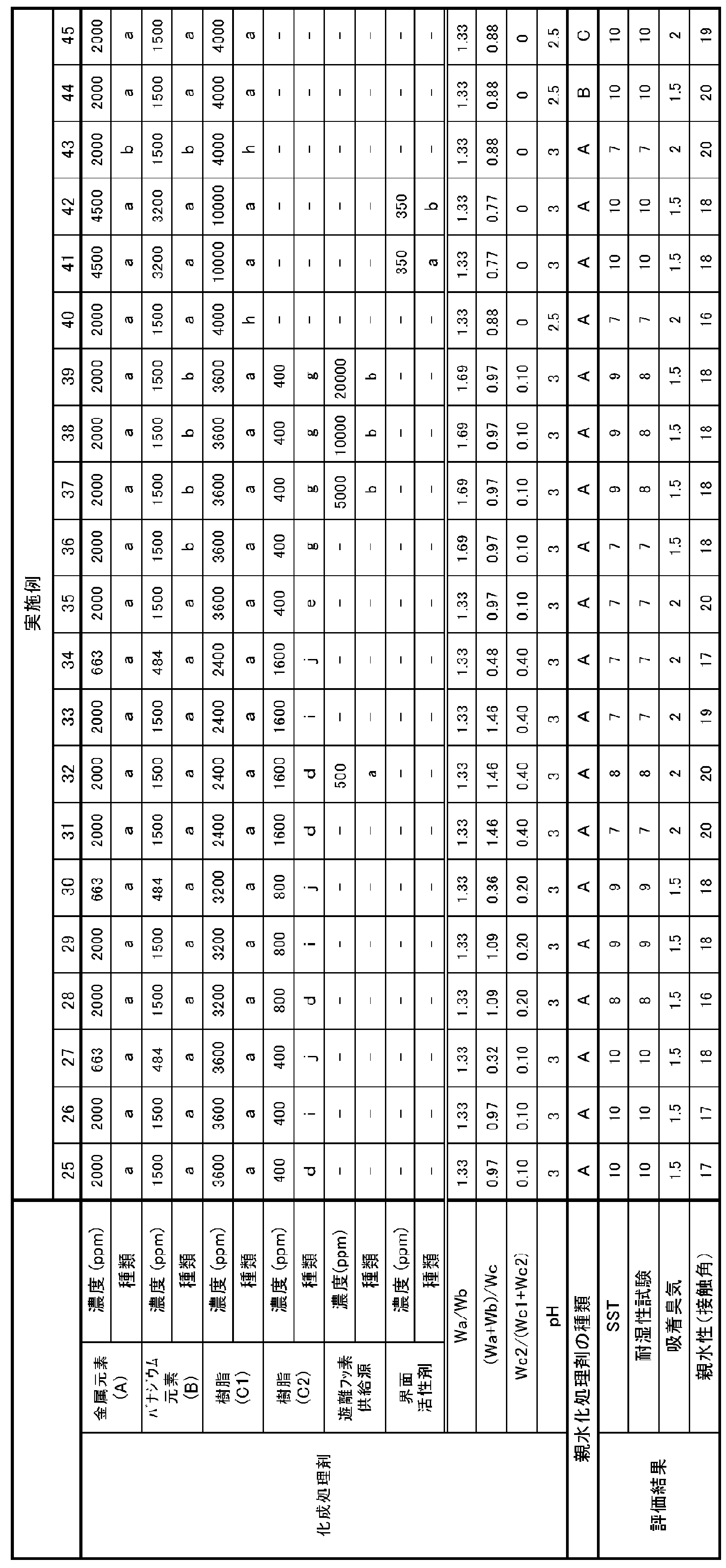
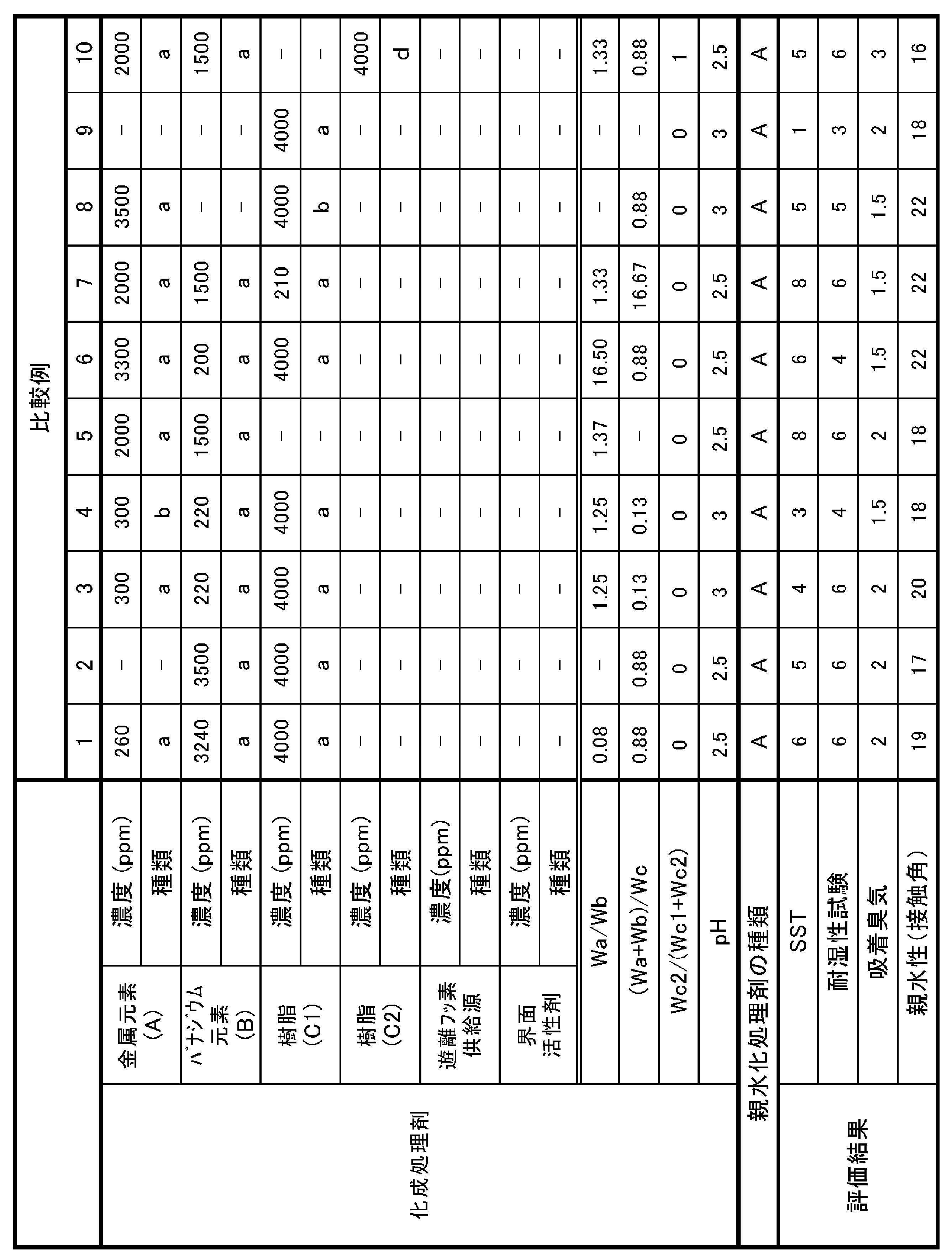
純水、ジルコニウム系化合物(又はチタン系化合物)、バナジウム系化合物、樹脂、遊離フッ素供給源及び界面活性剤を、化成処理剤中の金属元素(A)、バナジウム元素(B)、樹脂(C1)、樹脂(C2)等の質量基準の含有量が表1~表3に示す数値になるように配合して、実施例及び比較例の化成処理剤を調整した。また、化成処理剤のpHは25%アンモニア水溶液、又は、67.5%硝酸を用いて、表1~表3に示す範囲になるように調整した。表1~表3に示したジルコニウム系化合物、バナジウム系化合物、樹脂、遊離フッ素供給源及び界面活性剤の種類は、以下に示す。なお、表1~表3における遊離フッ素供給源の濃度は、フッ素元素換算での濃度である。
(a)ジルコンフッ化アンモニウム
(b)酢酸ジルコニウム
(c)テトラn-プロポキシジルコニウム
(d)チタンフッ化アンモニウム
(a)硫酸バナジル
(b)メタバナジン酸アンモニウム
(c)トリイソプロポキシオキソバナジウム
(a)PVA-110(ポリビニルアルコール、けん化度:98~99%、重合度:1,000、株式会社クラレ製)
(b)PVA-105MC(ポリビニルアルコール、けん化度:98~99%、重合度:500、株式会社クラレ製)
(c)PVA-405(ポリビニルアルコール、けん化度:80~83%、重合度:500、株式会社クラレ製)
(f)ゴーセファイマーZ-200(アセトアセチル基変性ポリビニルアルコール、けん化度:99%、重合度:1,100、アセトアセチル基変性度:4~5モル%、日本合成化学株式会社製)
(h)PVA-505(ポリビニルアルコール、けん化度:72.5~74.5%、重合度:500、株式会社クラレ製)
(d)AC10L(ポリアクリル酸、日本純薬株式会社製)
(e)ポリナスPS-1(ポリスチレンスルホン酸、東ソー有機化学株式会社製)
(g)PEO-1(ポリエチレングリコール、住友精化株式会社製)
(i)ポリビニルホスホン酸、(ポリビニルホスホン酸、シグマアルドリッチ社製)
(j)PAA-15C(ポリアリルアミン、ニットーボーメディカル株式会社製)
(a)フッ化水素酸
(b)フッ化水素アンモニウム
(a)ラウリル硫酸ナトリウム(アニオン性界面活性剤、和光純薬株式会社製)
(b)エマルゲン LS-110(ノニオン性界面活性剤、花王株式会社製)
エバポレーターを、実施例及び比較例の化成処理剤(25℃)に15秒浸漬して、エバポレーターの表面に化成皮膜を形成した。ここで、化成処理剤の付着量は、化成皮膜中の固形分量が0.2g/m2になるように調整した。表面に化成皮膜が形成されたエバポレーターを、150℃、30分の条件で乾燥させた。この乾燥によりエバポレーターの表面には化成皮膜が形成された。さらに、化成皮膜が形成されたエバポレーターを室温(25℃)にて30分間空冷した。
空冷後の化成皮膜が形成されたエバポレーターを、表1~表3に示した親水化処理剤に30秒間浸漬し、化成皮膜上に親水化処理膜を形成した後、これを150℃、30分間の条件で乾燥させ、化成皮膜上に親水性皮膜を形成した。このようにして、表1及び2に示す実施例及び比較例の評価サンプルが得られた。表1~表3に示した親水性処理剤の種類は、以下に示す。
(A)PVA-105(40質量%、ポリビニルアルコール、けん化度:98-99%、クラレ株式会社製)、EO-PVA(20質量%、オキシアルキレン基含有ポリビニルアルコール)及びシリカ微粒子(40質量%)の混合物
(B)PVA-105(30質量%、ポリビニルアルコール、けん化度:98-99%、クラレ株式会社製)及びEO-PVA(70質量%、オキシアルキレン基含有ポリビニルアルコール)の混合物
(C)CMCダイセル1120(75質量%、カルボキシメチルセルロース、ダイセルファインケム株式会社製)及びジュリマーAC10L(25質量%、ポリアクリル酸、日本純薬株式会社製)の混合物
得られた評価サンプルを塩水噴霧器に立てかけ240時間静置後、取り出し、純水にて水洗いを行った後、80℃の乾燥炉で10分間乾燥させ、表面の白錆面積を、下記の評価基準に従って目視で評価した。評価者は2人とし、2人の評価の平均値に基づいて、耐食性を評価した。評価結果は表1~表3に示した。SST試験の結果が7点以上であれば、耐食性の評価は合格レベルである。
(評価基準)
10:白錆発生無し。
9:白錆発生部の面積が10%未満。
8:白錆発生部の面積が10%以上20%未満。
7:白錆発生部の面積が20%以上30%未満。
6:白錆発生部の面積が30%以上40%未満。
5:白錆発生部の面積が40%以上50%未満。
4:白錆発生部の面積が50%以上60%未満。
3:白錆発生部の面積が60%以上70%未満。
2:白錆発生部の面積が70%以上80%未満。
1:白錆発生部の面積が80%以上90%未満。
0:白錆発生部の面積が90%以上。
得られた評価サンプルに対して、温度70℃、相対湿度98%以上の雰囲気下で500時間の耐湿試験を実施した。試験後の黒変錆発生部の面積を、下記の評価基準に従って目視で評価した。評価者は2人とし、2人の評価の平均値に基づいて、耐湿性を評価した。なお、黒変は、最終的には白錆に変化する特性を有するため、錆発生部の面積としては、黒変発生部の面積と白錆発生部の面積を合計して算出した。評価結果は表1~表3に示した。耐湿性試験の結果が7点以上であれば、耐湿性の評価は合格レベルである。
(評価基準)
10:錆発生無し。
9:錆発生部の面積が10%未満。
8:錆発生部の面積が10%以上20%未満。
7:錆発生部の面積が20%以上30%未満。
6:錆発生部の面積が30%以上40%未満。
5:錆発生部の面積が40%以上50%未満。
4:錆発生部の面積が50%以上60%未満。
3:錆発生部の面積が60%以上70%未満。
2:錆発生部の面積が70%以上80%未満。
1:錆発生部の面積が80%以上90%未満。
0:錆発生部の面積が90%以上。
評価サンプル、及び、室温で純水に1週間浸漬し、劣化させた評価サンプルに粘着テープを貼り付けて剥離した。このテープ剥離部に純水2μlをのせ、接触角を測定した。接触角の測定は、自動接触角計「CA-Z」(協和界面化学株式会社製)を用いて行った。結果を表1~表3に示した。なお、表1~表3に示した数値の単位は「°」である、親水性の評価については20°以下が合格レベルである。
評価サンプルを水に168時間浸漬し、劣化させた後、評価サンプルと1%酢酸水溶液1gを500cm3容器に入れ、30分間静置した。評価サンプルを容器から取り出した後、臭いを嗅いで6段階評価した。評価者は2人とし、2人の評価の平均値に基づいて、吸着臭気を評価した結果を表1~表3に示した。なお、臭気の評価については、2点以下が合格レベルである。
0点:無臭
1点:非常に弱い臭いを感じる
2点:弱い臭いを感じる
3点:臭いを感じる
4点:強い臭いを感じる
5点:非常に強い臭いを感じる

Claims (8)
- アルミニウム製熱交換器の表面処理方法であって、
(a)前記アルミニウム製熱交換器の表面を化成処理剤によって処理することで、前記アルミニウム製熱交換器の表面に化成皮膜を形成する工程と、
(b)前記(a)工程で表面に化成皮膜が形成された前記アルミニウム製熱交換器に、親水性樹脂を含む親水化処理剤を接触させる工程と、
(c)前記(b)工程で前記親水化処理剤を接触させた前記アルミニウム製熱交換器を焼き付け処理することで親水化皮膜を形成する工程と、を含み、
前記化成処理剤は、ジルコニウム、チタン及びハフニウムからなる群より選ばれる1種又は2種以上の金属元素(A)と、
バナジウム元素(B)と、
樹脂(C)と、を含有し、
前記樹脂(C)は、ポリビニルアルコール及びその誘導体のうち少なくとも一方からなるポリビニルアルコール系樹脂(C1)を含み、
前記バナジウム元素(B)の質量基準の含有量(Wb)に対する前記金属元素(A)の質量基準の合計含有量(Wa)の比の値(Wa/Wb)は、0.1~15であり、
前記ポリビニルアルコール系樹脂(C1)の質量基準の合計含有量(Wc1)に対する前記金属元素(A)及び前記バナジウム元素(B)の質量基準の合計含有量(Wa+Wb)の比の値((Wa+Wb)/Wc1)は、0.25~15であるアルミニウム製熱交換器の表面処理方法。 - 前記樹脂(C)は、1種又は2種以上の金属イオン架橋性ポリマー(C2)をさらに含み、
前記ポリビニルアルコール系樹脂(C1)及び前記金属イオン架橋性ポリマー(C2)の質量基準の合計含有量(Wc1+Wc2)に対する前記金属イオン架橋性ポリマー(C2)の質量基準の合計含有量(Wc2)の比の値(Wc2/(Wc1+Wc2))は、0.4以下である請求項1に記載のアルミニウム製熱交換器の表面処理方法。 - 前記化成処理剤は、前記金属イオン架橋性ポリマー(C2)として、ポリアクリル酸、リン酸ポリマー、ホスホン酸ポリマー、水溶性又は水分散性エポキシポリマー、水溶性又は水分散性ウレタン系ポリマー、ポリエステルからなる群より選ばれる1種又は2種以上を含有する請求項2に記載のアルミニウム製熱交換器の表面処理方法。
- 前記化成処理剤における、前記金属元素(A)の合計濃度は、50~100,000質量ppmであり、
前記バナジウム元素(B)の濃度は、50~100,000質量ppmであり、
前記樹脂(C)の合計濃度は、50~100,000質量ppmであり、
pHは、0.5~6.5である請求項1から3のいずれか1項に記載のアルミニウム製熱交換器の表面処理方法。 - 前記ポリビニルアルコール系樹脂(C1)の平均けん化度は、80%以上である請求項1から4のいずれか1項に記載のアルミニウム製熱交換器の表面処理方法。
- 前記化成処理剤は、界面活性剤をさらに含有する請求項1から5のいずれか1項に記載のアルミニウム製熱交換器の表面処理方法。
- 前記化成処理剤は、フッ化水素酸、フッ化アンモニウム、フッ化水素アンモニウム、アルカリ金属のフッ化物からなる群より選ばれる1種又は2種以上の遊離フッ素供給源をさらに含有する請求項1から6のいずれか1項に記載のアルミニウム製熱交換器の表面処理方法。
- 請求項1から7のいずれか1項に記載のアルミニウム製熱交換器の表面処理方法により処理されたアルミニウム製熱交換器。
Priority Applications (3)
| Application Number | Priority Date | Filing Date | Title |
|---|---|---|---|
| US14/781,856 US9896766B2 (en) | 2013-04-03 | 2014-04-03 | Surface processing method for aluminum heat exchanger |
| JP2015510144A JP6055086B2 (ja) | 2013-04-03 | 2014-04-03 | アルミニウム製熱交換器の表面処理方法 |
| CN201480019222.6A CN105143512B (zh) | 2013-04-03 | 2014-04-03 | 铝制热交换器的表面处理方法 |
Applications Claiming Priority (2)
| Application Number | Priority Date | Filing Date | Title |
|---|---|---|---|
| JP2013078004 | 2013-04-03 | ||
| JP2013-078004 | 2013-04-03 |
Publications (1)
| Publication Number | Publication Date |
|---|---|
| WO2014163166A1 true WO2014163166A1 (ja) | 2014-10-09 |
Family
ID=51658457
Family Applications (1)
| Application Number | Title | Priority Date | Filing Date |
|---|---|---|---|
| PCT/JP2014/059901 Ceased WO2014163166A1 (ja) | 2013-04-03 | 2014-04-03 | アルミニウム製熱交換器の表面処理方法 |
Country Status (4)
| Country | Link |
|---|---|
| US (1) | US9896766B2 (ja) |
| JP (1) | JP6055086B2 (ja) |
| CN (1) | CN105143512B (ja) |
| WO (1) | WO2014163166A1 (ja) |
Cited By (1)
| Publication number | Priority date | Publication date | Assignee | Title |
|---|---|---|---|---|
| CN107709451A (zh) * | 2015-06-03 | 2018-02-16 | 日涂表面处理化工有限公司 | 水性树脂分散体、水性树脂分散体的制备方法、亲水化处理剂、亲水化处理方法、金属材料及热交换器 |
Families Citing this family (8)
| Publication number | Priority date | Publication date | Assignee | Title |
|---|---|---|---|---|
| JP6146954B2 (ja) * | 2012-03-09 | 2017-06-14 | 日本ペイント・サーフケミカルズ株式会社 | 化成処理剤及び化成処理皮膜 |
| KR101715283B1 (ko) | 2013-04-03 | 2017-03-10 | 니뽄 페인트 서프 케미컬즈 컴퍼니 리미티드 | 화성처리제 및 금속표면처리방법 |
| US9915433B2 (en) | 2014-05-30 | 2018-03-13 | Amtrol Licensing Inc. | Moisture detecting air cap indicator for expansion tank failure |
| US11289700B2 (en) | 2016-06-28 | 2022-03-29 | The Research Foundation For The State University Of New York | KVOPO4 cathode for sodium ion batteries |
| DE102019209249A1 (de) * | 2019-06-26 | 2020-12-31 | Mahle International Gmbh | Verfahren zum Passivieren einer mit einem Flussmittel versehenen Aluminiumoberfläche |
| JP7362928B2 (ja) * | 2020-06-30 | 2023-10-17 | パナソニックホールディングス株式会社 | 蓄熱装置 |
| KR20250017499A (ko) * | 2023-07-27 | 2025-02-04 | 엘지전자 주식회사 | 코팅용 조성물, 코팅막, 이를 이용한 마이크로 채널 타입 열교환기 |
| CN117624975B (zh) * | 2023-11-27 | 2025-09-23 | 帕珂表面处理技术(上海)有限公司 | 含铝金属材料表面处理剂和处理含铝金属材料的方法 |
Citations (9)
| Publication number | Priority date | Publication date | Assignee | Title |
|---|---|---|---|---|
| JPH01208477A (ja) * | 1988-02-15 | 1989-08-22 | Nippon Paint Co Ltd | アルミニウム又はその合金の表面処理剤及び処理浴 |
| WO2000022188A1 (fr) * | 1998-10-15 | 2000-04-20 | Nihon Parkerizing Co., Ltd. | Agent d'hydrophilisation pour materiau metallique, fluide d'hydrophilisation, procede d'hydrophilisation, materiau metallique, et echangeur de chaleur |
| JP2000345362A (ja) * | 1999-06-04 | 2000-12-12 | Calsonic Kansei Corp | アルミニウム合金製熱交換器 |
| JP2002060699A (ja) * | 2000-08-21 | 2002-02-26 | Nippon Parkerizing Co Ltd | 下地処理剤、及び下地処理方法 |
| JP2002275650A (ja) * | 2001-03-15 | 2002-09-25 | Kansai Paint Co Ltd | 親水化処理された熱交換器アルミニウムフィン材 |
| JP2005036161A (ja) * | 2003-07-18 | 2005-02-10 | Denki Kagaku Kogyo Kk | 表面処理剤、該表面処理剤を用いたアルミニウム製熱交換器用フィン材及びその製造方法 |
| JP2009132952A (ja) * | 2007-11-29 | 2009-06-18 | Jfe Steel Corp | 表面処理溶融Zn−Al系合金めっき鋼板 |
| JP2011042842A (ja) * | 2009-08-21 | 2011-03-03 | Kansai Paint Co Ltd | アルミニウムフィン材用の下地処理剤 |
| JP2011195942A (ja) * | 2010-03-24 | 2011-10-06 | Jfe Steel Corp | 表面処理鋼板 |
Family Cites Families (28)
| Publication number | Priority date | Publication date | Assignee | Title |
|---|---|---|---|---|
| CA1333043C (en) | 1988-02-15 | 1994-11-15 | Nippon Paint Co., Ltd. | Surface treatment chemical and bath for aluminium and its alloy |
| US6361833B1 (en) | 1998-10-28 | 2002-03-26 | Henkel Corporation | Composition and process for treating metal surfaces |
| JP3992173B2 (ja) | 1998-10-28 | 2007-10-17 | 日本パーカライジング株式会社 | 金属表面処理用組成物及び表面処理液ならびに表面処理方法 |
| US6736908B2 (en) | 1999-12-27 | 2004-05-18 | Henkel Kommanditgesellschaft Auf Aktien | Composition and process for treating metal surfaces and resulting article |
| JP3860697B2 (ja) | 1999-12-27 | 2006-12-20 | 日本パーカライジング株式会社 | 金属表面処理剤、金属材料の表面処理方法及び表面処理金属材料 |
| US20030209293A1 (en) | 2000-05-11 | 2003-11-13 | Ryousuke Sako | Metal surface treatment agent |
| JP3851106B2 (ja) | 2000-05-11 | 2006-11-29 | 日本パーカライジング株式会社 | 金属表面処理剤、金属表面処理方法及び表面処理金属材料 |
| JP3474866B2 (ja) * | 2000-05-12 | 2003-12-08 | 日本ペイント株式会社 | 熱交換器の親水化処理方法および親水化処理された熱交換器 |
| US20030168127A1 (en) | 2000-08-21 | 2003-09-11 | Kazunari Hamamura | Surface preparation agent and surface preparation method |
| US20030098091A1 (en) | 2000-10-02 | 2003-05-29 | Opdycke Walter N. | Shortened process for imparting corrosion resistance to aluminum substrates |
| DE10049704A1 (de) | 2000-10-07 | 2002-04-11 | Deere & Co | Erkennung eines Fahrzeug-Nebenantriebs |
| EP1324274A3 (en) | 2001-12-28 | 2005-11-02 | Matsushita Electric Industrial Co., Ltd. | Vehicle information recording system |
| JP4176026B2 (ja) | 2003-02-17 | 2008-11-05 | 日本ペイント株式会社 | 防錆剤 |
| JP2005008975A (ja) | 2003-06-20 | 2005-01-13 | Nippon Paint Co Ltd | 金属表面処理方法、表面処理アルミニウム系金属、及び、親水処理の前処理方法 |
| JP4688602B2 (ja) | 2004-08-06 | 2011-05-25 | 日本ペイント株式会社 | フラックスろう付けされたアルミ熱交換器の表面処理方法 |
| DE602005001592T2 (de) | 2004-08-06 | 2008-04-17 | Nippon Paint Co., Ltd. | Oberflächenbehandlungsverfahren für mit Flussmittel hartgelöteten Aluminium- Wärmetauscher |
| JP5241075B2 (ja) | 2006-03-06 | 2013-07-17 | 日本パーカライジング株式会社 | 金属材料表面処理用のノンクロメート水系表面処理剤 |
| JP2008088552A (ja) | 2006-09-08 | 2008-04-17 | Nippon Paint Co Ltd | 金属基材の表面処理方法、当該表面処理方法により処理されてなる金属材料、及び当該金属材料の塗装方法。 |
| US8916006B2 (en) | 2006-09-08 | 2014-12-23 | Nippon Paint Co., Ltd. | Method of treating surface of metal base metallic material treated by the surface treatment method and method of coating the metallic material |
| TW200837156A (en) | 2007-02-22 | 2008-09-16 | Kansai Paint Co Ltd | Coating agent for forming titanium/zirconium film, method for forming titanium/zirconium film and metal substrate coated with titanium/zirconium film |
| JP5265892B2 (ja) | 2007-07-31 | 2013-08-14 | 株式会社神戸製鋼所 | アルミニウム系金属材料製フィン材の製造方法、及び当該製造方法により製造されるアルミニウム系金属材料製フィン材 |
| TWI394864B (zh) * | 2007-12-27 | 2013-05-01 | Kansai Paint Co Ltd | 金屬表面處理用組成物及從該金屬表面處理用組成物獲得之具有金屬表面處理膜的表面處理金屬材 |
| JP5563236B2 (ja) | 2009-04-30 | 2014-07-30 | 日本パーカライジング株式会社 | クロムフリー化成処理液、化成処理方法及び化成処理物品 |
| JP5794512B2 (ja) | 2009-11-30 | 2015-10-14 | 日本ペイント・サーフケミカルズ株式会社 | アルミニウム材製熱交換器の耐食処理方法 |
| JP5663174B2 (ja) | 2010-02-15 | 2015-02-04 | 日本パーカライジング株式会社 | 表面処理皮膜を有するアルミニウム又はアルミニウム合金材料及びその表面処理方法 |
| JP5537233B2 (ja) | 2010-03-31 | 2014-07-02 | 日本ペイント株式会社 | アルミニウム材熱交換器の耐食処理方法 |
| BR112012031325B1 (pt) | 2010-06-09 | 2020-11-24 | Chemetall Gmbh | agente de tratamento de superfície de metal livre de cromo inorgânico |
| JP5789401B2 (ja) * | 2011-04-15 | 2015-10-07 | 株式会社神戸製鋼所 | 熱交換器用アルミニウムフィン材 |
-
2014
- 2014-04-03 JP JP2015510144A patent/JP6055086B2/ja active Active
- 2014-04-03 WO PCT/JP2014/059901 patent/WO2014163166A1/ja not_active Ceased
- 2014-04-03 US US14/781,856 patent/US9896766B2/en active Active
- 2014-04-03 CN CN201480019222.6A patent/CN105143512B/zh active Active
Patent Citations (9)
| Publication number | Priority date | Publication date | Assignee | Title |
|---|---|---|---|---|
| JPH01208477A (ja) * | 1988-02-15 | 1989-08-22 | Nippon Paint Co Ltd | アルミニウム又はその合金の表面処理剤及び処理浴 |
| WO2000022188A1 (fr) * | 1998-10-15 | 2000-04-20 | Nihon Parkerizing Co., Ltd. | Agent d'hydrophilisation pour materiau metallique, fluide d'hydrophilisation, procede d'hydrophilisation, materiau metallique, et echangeur de chaleur |
| JP2000345362A (ja) * | 1999-06-04 | 2000-12-12 | Calsonic Kansei Corp | アルミニウム合金製熱交換器 |
| JP2002060699A (ja) * | 2000-08-21 | 2002-02-26 | Nippon Parkerizing Co Ltd | 下地処理剤、及び下地処理方法 |
| JP2002275650A (ja) * | 2001-03-15 | 2002-09-25 | Kansai Paint Co Ltd | 親水化処理された熱交換器アルミニウムフィン材 |
| JP2005036161A (ja) * | 2003-07-18 | 2005-02-10 | Denki Kagaku Kogyo Kk | 表面処理剤、該表面処理剤を用いたアルミニウム製熱交換器用フィン材及びその製造方法 |
| JP2009132952A (ja) * | 2007-11-29 | 2009-06-18 | Jfe Steel Corp | 表面処理溶融Zn−Al系合金めっき鋼板 |
| JP2011042842A (ja) * | 2009-08-21 | 2011-03-03 | Kansai Paint Co Ltd | アルミニウムフィン材用の下地処理剤 |
| JP2011195942A (ja) * | 2010-03-24 | 2011-10-06 | Jfe Steel Corp | 表面処理鋼板 |
Cited By (4)
| Publication number | Priority date | Publication date | Assignee | Title |
|---|---|---|---|---|
| CN107709451A (zh) * | 2015-06-03 | 2018-02-16 | 日涂表面处理化工有限公司 | 水性树脂分散体、水性树脂分散体的制备方法、亲水化处理剂、亲水化处理方法、金属材料及热交换器 |
| US10676632B2 (en) | 2015-06-03 | 2020-06-09 | Nippon Paint Surf Chemicals Co., Ltd. | Aqueous resin dispersion, production method for aqueous resin dispersion, hydrophilization agent, hydrophilization method, metal material, and heat exchanger |
| CN107709451B (zh) * | 2015-06-03 | 2022-11-15 | 日涂表面处理化工有限公司 | 水性树脂分散体及其制备方法、亲水化处理剂、亲水化处理方法、金属材料及热交换器 |
| US11505714B2 (en) | 2015-06-03 | 2022-11-22 | Nippon Paint Surf Chemicals Co., Ltd. | Aqueous resin dispersion, production method for aqueous resin dispersion, hydrophilization agent, hydrophilization method, metal material, and heat exchanger |
Also Published As
| Publication number | Publication date |
|---|---|
| CN105143512A (zh) | 2015-12-09 |
| JP6055086B2 (ja) | 2016-12-27 |
| CN105143512B (zh) | 2018-01-12 |
| JPWO2014163166A1 (ja) | 2017-02-16 |
| US20160060765A1 (en) | 2016-03-03 |
| US9896766B2 (en) | 2018-02-20 |
Similar Documents
| Publication | Publication Date | Title |
|---|---|---|
| JP6055086B2 (ja) | アルミニウム製熱交換器の表面処理方法 | |
| CN103917693B (zh) | 铝制热交换器的表面处理方法 | |
| JP5794512B2 (ja) | アルミニウム材製熱交換器の耐食処理方法 | |
| JP3474866B2 (ja) | 熱交換器の親水化処理方法および親水化処理された熱交換器 | |
| CN104271800A (zh) | 铝制热交换器的表面处理方法 | |
| JP5537233B2 (ja) | アルミニウム材熱交換器の耐食処理方法 | |
| CN1254658C (zh) | 亲水处理剂及其制造方法 | |
| JP5265892B2 (ja) | アルミニウム系金属材料製フィン材の製造方法、及び当該製造方法により製造されるアルミニウム系金属材料製フィン材 | |
| CN102134720B (zh) | 热交换器的表面处理方法、表面处理剂、以及铝制热交换器 | |
| JP2011153343A (ja) | 熱交換器の表面処理方法、親水化処理剤、及びアルミニウム製熱交換器 | |
| JP5616669B2 (ja) | アルミニウム基材用耐食処理剤、及びそれを用いたアルミニウム基材の耐食処理方法 | |
| JP6265579B2 (ja) | アルミニウム製熱交換器用表面処理剤及び表面処理方法 | |
| JP2003200532A (ja) | ポリアニリンを含む皮膜を表面に備える基材および基材の表面に形成された皮膜の成膜方法 | |
| JP2001158981A (ja) | 熱交換器用アルミニウム材の防錆処理システムおよび防錆処理された熱交換器用アルミニウム材 | |
| JP2015124390A (ja) | 熱交換器の表面処理方法 | |
| CN108660450A (zh) | 铝制热交换器的表面处理方法 | |
| JP2001158980A (ja) | 熱交換器用アルミニウム材の防錆処理方法および防錆処理された熱交換器用アルミニウム材 | |
| JP5436482B2 (ja) | 熱交換器及びその製造方法 |
Legal Events
| Date | Code | Title | Description |
|---|---|---|---|
| WWE | Wipo information: entry into national phase |
Ref document number: 201480019222.6 Country of ref document: CN |
|
| 121 | Ep: the epo has been informed by wipo that ep was designated in this application |
Ref document number: 14778131 Country of ref document: EP Kind code of ref document: A1 |
|
| ENP | Entry into the national phase |
Ref document number: 2015510144 Country of ref document: JP Kind code of ref document: A |
|
| WWE | Wipo information: entry into national phase |
Ref document number: 14781856 Country of ref document: US |
|
| NENP | Non-entry into the national phase |
Ref country code: DE |
|
| 122 | Ep: pct application non-entry in european phase |
Ref document number: 14778131 Country of ref document: EP Kind code of ref document: A1 |