WO2014157304A1 - 赤外線吸収性組成物、赤外線カットフィルタ、カメラモジュール及びカメラモジュールの製造方法 - Google Patents
赤外線吸収性組成物、赤外線カットフィルタ、カメラモジュール及びカメラモジュールの製造方法 Download PDFInfo
- Publication number
- WO2014157304A1 WO2014157304A1 PCT/JP2014/058456 JP2014058456W WO2014157304A1 WO 2014157304 A1 WO2014157304 A1 WO 2014157304A1 JP 2014058456 W JP2014058456 W JP 2014058456W WO 2014157304 A1 WO2014157304 A1 WO 2014157304A1
- Authority
- WO
- WIPO (PCT)
- Prior art keywords
- group
- formula
- infrared
- infrared absorbing
- absorbing composition
- Prior art date
- Legal status (The legal status is an assumption and is not a legal conclusion. Google has not performed a legal analysis and makes no representation as to the accuracy of the status listed.)
- Ceased
Links
- 0 CC(*)=C([C@]1C(c(cc2)ccc2O*)N2*)N(*)C(c(cc3)ccc3O*)=C1C2=C(*)* Chemical compound CC(*)=C([C@]1C(c(cc2)ccc2O*)N2*)N(*)C(c(cc3)ccc3O*)=C1C2=C(*)* 0.000 description 1
Images
Classifications
-
- G—PHYSICS
- G02—OPTICS
- G02B—OPTICAL ELEMENTS, SYSTEMS OR APPARATUS
- G02B5/00—Optical elements other than lenses
- G02B5/20—Filters
- G02B5/208—Filters for use with infrared or ultraviolet radiation, e.g. for separating visible light from infrared and/or ultraviolet radiation
-
- G—PHYSICS
- G02—OPTICS
- G02B—OPTICAL ELEMENTS, SYSTEMS OR APPARATUS
- G02B1/00—Optical elements characterised by the material of which they are made; Optical coatings for optical elements
- G02B1/04—Optical elements characterised by the material of which they are made; Optical coatings for optical elements made of organic materials, e.g. plastics
-
- G—PHYSICS
- G02—OPTICS
- G02B—OPTICAL ELEMENTS, SYSTEMS OR APPARATUS
- G02B5/00—Optical elements other than lenses
- G02B5/20—Filters
- G02B5/22—Absorbing filters
- G02B5/223—Absorbing filters containing organic substances, e.g. dyes, inks or pigments
-
- G—PHYSICS
- G03—PHOTOGRAPHY; CINEMATOGRAPHY; ANALOGOUS TECHNIQUES USING WAVES OTHER THAN OPTICAL WAVES; ELECTROGRAPHY; HOLOGRAPHY
- G03B—APPARATUS OR ARRANGEMENTS FOR TAKING PHOTOGRAPHS OR FOR PROJECTING OR VIEWING THEM; APPARATUS OR ARRANGEMENTS EMPLOYING ANALOGOUS TECHNIQUES USING WAVES OTHER THAN OPTICAL WAVES; ACCESSORIES THEREFOR
- G03B11/00—Filters or other obturators specially adapted for photographic purposes
-
- C—CHEMISTRY; METALLURGY
- C08—ORGANIC MACROMOLECULAR COMPOUNDS; THEIR PREPARATION OR CHEMICAL WORKING-UP; COMPOSITIONS BASED THEREON
- C08F—MACROMOLECULAR COMPOUNDS OBTAINED BY REACTIONS ONLY INVOLVING CARBON-TO-CARBON UNSATURATED BONDS
- C08F220/00—Copolymers of compounds having one or more unsaturated aliphatic radicals, each having only one carbon-to-carbon double bond, and only one being terminated by only one carboxyl radical or a salt, anhydride ester, amide, imide or nitrile thereof
- C08F220/02—Monocarboxylic acids having less than ten carbon atoms; Derivatives thereof
- C08F220/10—Esters
- C08F220/12—Esters of monohydric alcohols or phenols
- C08F220/16—Esters of monohydric alcohols or phenols of phenols or of alcohols containing two or more carbon atoms
- C08F220/18—Esters of monohydric alcohols or phenols of phenols or of alcohols containing two or more carbon atoms with acrylic or methacrylic acids
- C08F220/1807—C7-(meth)acrylate, e.g. heptyl (meth)acrylate or benzyl (meth)acrylate
-
- C—CHEMISTRY; METALLURGY
- C08—ORGANIC MACROMOLECULAR COMPOUNDS; THEIR PREPARATION OR CHEMICAL WORKING-UP; COMPOSITIONS BASED THEREON
- C08K—Use of inorganic or non-macromolecular organic substances as compounding ingredients
- C08K5/00—Use of organic ingredients
- C08K5/0008—Organic ingredients according to more than one of the "one dot" groups of C08K5/01 - C08K5/59
- C08K5/0041—Optical brightening agents, organic pigments
Definitions
- the present invention relates to an infrared absorbing composition, an infrared cut filter, a camera module, and a method for manufacturing a camera module.
- Infrared absorbing dyes which are infrared absorbing substances, are applied to various uses in a wide range of fields.
- a solid-state imaging device such as a plasma display panel (PDP) or a CCD
- an optical filter in a heat ray shielding film or as a photothermal conversion material in a write-once optical disc (CD-R) or flash fusion fixing material
- infrared Absorptive dyes are used (see, for example, Patent Document 1).
- solid-state image sensors such as CMOS and CCD mounted on the camera have high sensitivity to light in the infrared region (700 nm to 1100 nm), and it is difficult to perform color separation accurately.
- a reflection-type infrared absorption filter and an absorption-type infrared absorption filter using inorganic ions or organic dyes are usually inserted in the optical system of the camera.
- a filter is attached to the entire lens surface of the camera, it is practically impossible to turn on / off the infrared ray for each pixel. For example, an image by visible light and an image by infrared light are not possible. Cannot be used for the purpose of imaging at a time.
- An object of this invention is to provide the infrared rays absorption composition which can create the infrared absorption pattern with favorable adhesiveness with the base material to which an infrared rays absorption composition is applied.
- the above problem was solved by blending an infrared absorbing material and a polymerizable compound having a specific partial structure into the infrared absorbing composition.
- the above problem has been solved by the following means ⁇ 1>, preferably ⁇ 2> to ⁇ 16>.
- ⁇ 1> an infrared absorbing material;
- Formula (1) (In formula (1), R 1 represents a hydrogen atom or an organic group.
- each R 21 independently represents a hydrogen atom or a methyl group.
- L 21 represents a linear or branched alkylene group having 2 to 4 carbon atoms, provided that in L 21 , L 21 There is no structure in which an oxygen atom and a nitrogen atom bonded to both ends of 21 are bonded to the same carbon atom of L 21.
- L 22 represents a divalent linking group, k represents 2 or 3.
- x , Y and z each independently represents an integer of 0 to 6, and x + y + z satisfies 0 to 18.
- ⁇ 7> The infrared absorbing composition according to any one of ⁇ 1> to ⁇ 6>, wherein the infrared absorbing substance is a copper compound and / or a pyrrolopyrrole dye.
- ⁇ 8> The infrared absorbing composition according to ⁇ 6> or ⁇ 7>, wherein the infrared absorbing substance is a pyrrolopyrrole dye, and the polymerizable compound is represented by the formula (1-3).
- R 2 and R 3 may be bonded to each other to form a ring, and R 4 represents a hydrogen atom, an alkyl group, an aryl group, a heteroaryl group, a substituted boron or a metal atom, and R 1a , R 1b And at least one of R 3 may be covalently bonded or coordinated.
- R 4 represents a hydrogen atom, an alkyl group, an aryl group, a heteroaryl group, a substituted boron or a metal atom
- R 1a , R 1b And at least one of R 3 may be covalently bonded or coordinated.
- ⁇ 12> The infrared absorbing composition according to any one of ⁇ 1> to ⁇ 11>, wherein the solid content of the infrared absorbing composition is 5 to 50% by mass.
- ⁇ 13> An infrared cut filter using the infrared absorbing composition according to any one of ⁇ 1> to ⁇ 12>.
- ⁇ 14> The production of the infrared cut filter according to ⁇ 13>, including a step of applying the infrared absorbing composition to form the infrared absorption pattern, wherein the infrared absorbing composition contains water or an aqueous solvent.
- Method. ⁇ 15> A camera module having a solid-state imaging device substrate and the infrared cut filter according to ⁇ 13>.
- a method for manufacturing a camera module having a solid-state imaging device substrate and an infrared cut filter including a step of applying the infrared absorbing composition according to any one of ⁇ 1> to ⁇ 12> Module manufacturing method.
- an infrared-absorbing composition capable of creating an infrared-absorbing pattern having good adhesion to a substrate to which the infrared-absorbing composition is applied.
- the organic EL element in the present invention refers to an organic electroluminescence element.
- (meth) acrylate” represents acrylate and methacrylate
- (meth) acryl represents acryl and methacryl
- (meth) acryloyl represents acryloyl and methacryloyl.
- “monomer” and “monomer” are synonymous.
- the monomer in the present invention is distinguished from oligomers and polymers, and refers to a compound having a weight average molecular weight of 2,000 or less.
- the polymerizable compound means a compound having a polymerizable functional group, and may be a monomer or a polymer.
- the polymerizable functional group refers to a group that participates in a polymerization reaction.
- the group (atomic group) in this specification the description which does not describe substitution and unsubstituted includes what has a substituent with what does not have a substituent.
- the infrared rays are those having a maximum absorption wavelength ( ⁇ max) region of 700 to 1000 nm.
- the infrared absorbing composition of the present invention contains an infrared absorbing substance and a polymerizable compound having a partial structure represented by the following formula (1).
- R 1 represents a hydrogen atom or an organic group. * Represents a bonding site with another atom.
- ADVANTAGE OF THE INVENTION According to this invention, the infrared absorptive composition which can create the infrared absorption pattern with favorable adhesiveness with the base material to which an infrared absorptive composition is applied can be provided.
- the solid content in the composition of the present invention is preferably 5 to 50% by mass, and more preferably 10 to 30% by mass.
- the infrared absorbing substance used in the composition of the present invention is not particularly limited as long as it is a substance having a maximum absorption wavelength region of 700 to 1000 nm, preferably 800 to 900 nm.
- a copper compound and / or an organic infrared absorbing dye described later are used. It is preferable that it is a copper compound and / or a pyrrolopyrrole pigment
- the infrared absorbing material may contain only one type or two or more types.
- Infrared absorbing dyes usually have a maximum absorption wavelength region of 700 to 1000 nm, preferably 820 to 880 nm.
- the infrared-absorbing dye may be configured to selectively absorb infrared rays having a wavelength of 700 nm to 1000 nm.
- the infrared absorbing dye has a maximum absorption wavelength region of 820 to 880 nm, an infrared absorption rate of less than 820 nm and more than 880 nm, respectively, 10% or less, more preferably 7% or less, and still more preferably It is preferable that it is 5% or less.
- the molar absorption coefficient ⁇ of the infrared absorbing dye is not particularly limited, but is preferably 50,000 to 500,000, more preferably 100,000 to 300,000.
- Such an infrared absorbing dye may be either an organic infrared absorbing dye or an inorganic infrared absorbing dye.
- the organic infrared absorbing dye include pyrrolopyrrole dyes and cyanine dyes.
- the cyanine dye for example, “functional dye, Shin Okawara / Ken Matsuoka / Keijiro Kitao / Kensuke Hirashima, Kodansha Scientific”, the contents of which are incorporated herein. .
- phthalocyanine compounds described in paragraph Nos. 0013 to 0029 of the specification of Japanese Patent Application No. 2012-059737 and paragraphs of paragraphs 0010 to 0019 of the specification of Japanese Patent Application No. 2012-043917 can be referred to. Is incorporated herein.
- a pyrrolopyrrole dye is preferable, and a compound represented by the following formula (I) is preferable.
- the pyrrolopyrrole dye is used, the effect of the present invention is more effectively exhibited.
- Formula (I) (In the formula, R 1a and R 1b each independently represents an alkyl group, an aryl group or a heteroaryl group.
- R 2 and R 3 each independently represent a hydrogen atom or a substituent, and at least one of them represents an electron-withdrawing group.
- R 2 and R 3 may be bonded to each other to form a ring, and R 4 represents a hydrogen atom, an alkyl group, an aryl group, a heteroaryl group, a substituted boron or a metal atom, and R 1a , R 1b And at least one of R 3 may be covalently bonded or coordinated.
- the alkyl group represented by R 1a or R 1b is preferably an alkyl group having 1 to 30 carbon atoms, more preferably 1 to 20 carbon atoms, and particularly preferably 1 to 10 carbon atoms. is there.
- the aryl group represented by R 1a and R 1b is preferably an aryl group having 6 to 30 carbon atoms, more preferably 6 to 20 carbon atoms, and particularly preferably 6 to 12 carbon atoms.
- the heteroaryl group represented by R 1a and R 1b is preferably a heteroaryl group having 1 to 30 carbon atoms, more preferably 1 to 12 carbon atoms. Examples of the hetero atom include a nitrogen atom, an oxygen atom, and a sulfur atom.
- the groups represented by R 1a and R 1b are preferably aryl groups having an alkoxy group having a branched alkyl group.
- the alkyl group in the branched alkyl group preferably has 3 to 30 carbon atoms, and more preferably 3 to 20 carbon atoms.
- the groups represented by R 1a and R 1b for example, 4- (2-ethylhexyloxy) phenyl, 4- (2-methylbutyloxy) phenyl, and 4- (2-octyldodecyloxy) phenyl are particularly preferable.
- R 1a and R 1b in the general formula (I) may be the same or different from each other.
- R 2 and R 3 each independently represent a hydrogen atom or a substituent T, at least one of which is an electron-withdrawing group, and R 2 and R 3 may be bonded to form a ring.
- substituent T include the following. Alkyl group (preferably 1 to 30 carbon atoms), alkenyl group (preferably 2 to 30 carbon atoms), alkynyl group (preferably 2 to 30 carbon atoms), aryl group (preferably 6 to 30 carbon atoms), amino group (Preferably 0 to 30 carbon atoms), alkoxy group (preferably 1 to 30 carbon atoms), aryloxy group (preferably 6 to 30 carbon atoms), aromatic heterocyclic oxy group (preferably 1 to 30 carbon atoms)
- An acyl group preferably 1 to 30 carbon atoms), an alkoxycarbonyl group (preferably 2 to 30 carbon atoms), an aryloxycarbonyl group (preferably 7 to 30 carbon atoms), an acyloxy group (preferably 2 to 30 carbon atoms).
- Acylamino group (preferably having 2 to 30 carbon atoms), alkoxycarbonylamino group (preferably having 2 to 30 carbon atoms), aryloxycarbonylamino group Preferably 7 to 30 carbon atoms, sulfonylamino group (preferably 1 to 30 carbon atoms), sulfamoyl group (preferably 0 to 30 carbon atoms), carbamoyl group (preferably 1 to 30 carbon atoms), alkylthio group (preferably Is an arylthio group (preferably 6 to 30 carbon atoms), an aromatic heterocyclic thio group (preferably 1 to 30 carbon atoms), a sulfonyl group (preferably 1 to 30 carbon atoms), a sulfinyl group (Preferably 1 to 30 carbon atoms), ureido group (preferably 1 to 30 carbon atoms), phosphoric acid amide group (preferably 1 to 30 carbon atoms), hydroxy group, mercapto group, halogen atom, cyan
- At least one of R 2 and R 3 is an electron withdrawing group.
- a substituent having a positive Hammett ⁇ p value usually acts as an electron-withdrawing group.
- Preferred examples of the electron withdrawing group include a cyano group, an acyl group, an alkyloxycarbonyl group, an aryloxycarbonyl group, a sulfamoyl group, a sulfinyl group, a heterocyclic group, and the like, and a cyano group is more preferable. These electron withdrawing groups may be further substituted.
- a substituent having Hammett's substituent constant ⁇ p value of 0.2 or more can be exemplified as an electron withdrawing group.
- the ⁇ p value is preferably 0.25 or more, more preferably 0.3 or more, and particularly preferably 0.35 or more.
- the upper limit is not particularly limited, but is preferably 0.80. Specific examples include cyano group (0.66), carboxyl group (—COOH: 0.45), alkoxycarbonyl group (—COOMe: 0.45), aryloxycarbonyl group (—COOPh: 0.44), carbamoyl.
- a group (—CONH 2 : 0.36), an alkylcarbonyl group (—COMe: 0.50), an arylcarbonyl group (—COPh: 0.43), an alkylsulfonyl group (—SO 2 Me: 0.72), or And arylsulfonyl group (—SO 2 Ph: 0.68).
- Particularly preferred is a cyano group.
- Me represents a methyl group
- Ph represents a phenyl group.
- the Hammett's substituent constant ⁇ p value for example, paragraphs 0017 to 0018 of JP 2011-68731 A can be referred to, and the contents thereof are incorporated in the present specification.
- R 2 and R 3 are bonded to each other to form a ring, it is preferable to form a 5- to 7-membered ring (preferably a 5- or 6-membered ring).
- the ring formed is preferably a merocyanine dye that is used as an acidic nucleus, and specific examples thereof can include, for example, paragraphs 0019 to 0021 of JP 2011-68731 A, the contents of which are incorporated herein. It is.
- R 3 is particularly preferably a heterocycle.
- R 3 is preferably quinoline, benzothiazole or naphthothiazole.
- Two R 2 in the general formula (I) may be the same as or different from each other, and two R 3 may be the same as or different from each other.
- R 4 When the group represented by R 4 is an alkyl group, an aryl group, or a heteroaryl group, this group has the same meaning as described for R 1a and R 1b , and preferred groups are also the same.
- the substituent is synonymous with the substituent T described above for R 2 and R 3 , and is preferably an alkyl group, an aryl group, or a heteroaryl group.
- the group represented by R 4 is a metal atom, it is preferably a transition metal, particularly preferably a substituted boron.
- R 4 may be covalently bonded or coordinated with at least one of R 1a , R 1b and R 3 , and it is particularly preferred that R 4 is coordinated with R 3 .
- R 4 is preferably a hydrogen atom or a substituted boron (particularly diphenyl boron).
- Two R 4 in the general formula (I) may be the same or different from each other.
- each R 10 independently represents a hydrogen atom, an alkyl group, an aryl group, a heteroaryl group, a substituted boron or a metal atom, and may be covalently bonded or coordinated to R 12.
- R 11 and R 12 represent a hydrogen atom or a substituent each independently at least one is an electron withdrawing group, R 11 and R 12 combine with good .R 13 to form a ring are each independently Represents a branched alkyl group having 3 to 30 carbon atoms.)
- R 10 has the same meaning as R 4 in formula (I), and the preferred range is also the same.
- R 11 and R 12 have the same meanings as R 2 and R 3 in formula (I), and the preferred ranges are also the same.
- R 13 may be the same as or different from each other.
- R 13 is preferably an alcohol residue derived from, for example, isoeicosanol (manufactured by Nissan Chemical Co., Ltd., Fineoxocol 2000).
- the alcohol may be linear or branched, preferably an alcohol having 1 to 30 carbon atoms, more preferably an alcohol having 3 to 25 carbon atoms, and particularly preferably a branched alcohol having 3 to 25 carbon atoms. More specifically, methanol, ethanol, iso-propanol, n-butanol, tert-butanol, 1-octanol, 1-decanol, 1-hexadecanol, 2-methylbutanol, 2-ethylhexanol, 2-octyldodeca Nord, isohexadecanol (Nissan Chemical Co., Ltd., Fineoxocol 1600), isooctadecanol (Nissan Chemical Co., Ltd., Fineoxocol 180), isooctadecanol (Nissan Chemical Co., Ltd., Fineoxocol) 180N), isooctadecanol (manufactured by Nissan Chemical Co.,
- the organic infrared absorbing dye used in the present invention is more preferably a compound represented by the following formula (I-2).
- Formula (I-2) (In the formula (I-2), each R 20 independently represents a branched alkyl group having 3 to 30 carbon atoms.) In the formula (I-2), each R 20 independently represents a branched alkyl group having 3 to 30 carbon atoms. R 20 has the same meaning as R 13 in formula (I-1), and the preferred range is also the same.
- the infrared absorbing dye when the infrared absorbing dye is a pigment, the infrared absorbing dye is preferably used in the form of a fine particle dispersion.
- the infrared absorbing dye By using the infrared absorbing dye in the state of the fine particle dispersion, there is an advantage that the durability of the infrared absorbing dye is improved and the maximum absorption wavelength is increased.
- a dispersant is preferably added for the purpose of improving the dispersion stability of the fine particle dispersion of the infrared absorbing dye.
- a hydroxyl group-containing carboxylic acid ester, a salt of a long chain polyaminoamide and a high molecular weight acid ester, a salt of a high molecular weight polycarboxylic acid, a salt of a long chain polyaminoamide and a polar acid ester, a high molecular weight unsaturated ester, a polymer Copolymer, modified polyurethane, modified polyacrylate, polyether ester type anionic activator, naphthalene sulfonic acid formalin condensate salt, aromatic sulfonic acid formalin condensate, polyoxyethylene alkyl phosphate ester, polyoxyethylene nonyl phenyl ether Stearylamine acetate can be used.
- the dispersant is preferably blended in an amount of about 1 to 150 parts by mass with respect to a total of 100 parts by mass of the infrared absorbing dye and the dispersion medium.
- an infrared absorbing dye in the form of a fine particle dispersion, for example, paragraphs 0053 to 0058 of JP 2011-68731 A (corresponding US Patent Application Publication No. 2011/0070407, [0075] to [ 0080]), which is incorporated herein by reference.
- the copper in the copper compound used in the present invention is not particularly defined as long as it has absorption in the infrared region, but monovalent or divalent copper is preferable, and divalent copper is more preferable.
- the copper content in the copper compound used in the present invention is preferably 2 to 40% by mass, more preferably 5 to 40% by mass.
- the copper compound used in the present invention is not particularly limited as long as it is a copper compound having a maximum absorption wavelength within a wavelength range of 700 nm to 1000 nm.
- the copper compound used in the present invention is preferably a copper complex.
- the ligand L coordinated to copper is not particularly limited as long as it can be coordinated to a copper ion.
- phosphoric acid phosphate ester, phosphone
- examples thereof include compounds having acid, phosphonic acid ester, phosphinic acid, substituted phosphinic acid, sulfonic acid, carboxylic acid, carbonyl (ester, ketone), amine, amide, sulfonamide, urethane, urea, alcohol, thiol and the like.
- phosphoric acid, phosphoric acid ester, phosphonic acid, phosphonic acid ester, phosphinic acid, substituted phosphinic acid, and sulfonic acid are preferable, and phosphoric acid ester, phosphonic acid ester, substituted phosphinic acid, and sulfonic acid are more preferable.
- Specific examples of the copper compound used in the present invention include a phosphorus-containing copper compound, a sulfonic acid copper compound, or a copper compound represented by the following formula (A).
- Specific examples of the phosphorus-containing copper compound may include compounds described in WO 2005/030898, page 5, line 27 to page 7, line 20; Incorporated in the description.
- the copper compound used in the present invention is preferably represented by the following formula (A).
- Cu (L) n1 ⁇ (X) n2 Formula (A) L represents a ligand coordinated to copper, and X does not exist or is a halogen atom, H 2 O, NO 3 , ClO 4 , SO 4 , CN, SCN, or BF 4. , PF 6 , BPh 4 (Ph represents a phenyl group) or alcohol.
- n1 and n2 each independently represents an integer of 1 to 4.
- the ligand L has a substituent containing C, N, O, and S as atoms capable of coordinating to copper, and more preferably has a group having a lone pair such as N, O, and S It is.
- the group capable of coordinating is not limited to one type in the molecule and may include two or more types, and may be dissociated or non-dissociated.
- the preferred ligand L has the same meaning as the ligand L described above. In the case of non-dissociation, X is not present.
- the copper complex as an infrared absorbing substance is in the form of a copper complex (copper compound) in which a ligand is coordinated to copper as a central metal.
- the copper in the copper complex of the present invention is divalent copper, and can be produced, for example, by a reaction between a copper component and a ligand. Therefore, if it is an “infrared absorbing composition containing copper and a ligand”, it is predicted that a copper complex is formed in the composition.
- the copper compound used in the present invention and the compound forming the ligand L will be described in detail.
- ⁇ phosphorus-containing copper complex As the phosphorus-containing copper complex, for example, Japanese Patent Application No. 2013-030488, 0013 to 0030, can be referred to, the contents of which are incorporated herein.
- the phosphorus-containing copper complex is not particularly limited as long as it has a ligand containing a phosphorus compound as a ligand of the complex, but a copper phosphate complex, a phosphate ester copper complex, a phosphonate copper complex, a phosphone
- An acid ester copper complex, a phosphinic acid copper complex, and a substituted phosphinic acid copper complex are preferable, and a phosphate ester copper complex, a phosphonic acid ester copper complex, and a substituted phosphinic acid copper complex are more preferable.
- the phosphate ester copper complex has copper as a central metal and a phosphate ester compound as a ligand.
- a compound represented by the following formula (B) is more preferable.
- (HO) n -P ( O)-(OR 2 ) 3-n Formula (B)
- R 2 represents an organic group
- n represents 1 or 2.
- the organic group R 2 represents an alkyl group having 1 to 18 carbon atoms, an aryl group having 6 to 18 carbon atoms, an aralkyl group having 1 to 18 carbon atoms, or an alkenyl group having 1 to 18 carbon atoms, or —OR 2 is Represents a polyoxyalkyl group having 4 to 100 carbon atoms, a (meth) acryloyloxyalkyl group having 4 to 100 carbon atoms, or a (meth) acryloyl polyoxyalkyl group having 4 to 100 carbon atoms, and n represents 1 or 2 To express. When n is 1, R 2 may be the same or different.
- the compound represented by the formula (C) and a salt thereof act as a ligand coordinated to copper.
- the ligand means other atoms, ions, atomic groups, groups, neutral molecules, etc. that are three-dimensionally arranged around the copper atom in the copper complex and bonded to the copper atom.
- R 1 and R 2 each independently represents a monovalent organic group.
- the monovalent organic group an organic group having 3 or more carbon atoms is preferable, an organic group having 5 or more carbon atoms is more preferable, and an organic group having 5 to 20 carbon atoms is more preferable.
- R 1 and R 2 may be bonded to each other to form a cyclic structure.
- R 1 and R 2 are both divalent organic groups.
- the total number of carbon atoms of the group containing a bonded cyclic structure (divalent organic group) is 3 or more, preferably 5 or more, and more preferably an organic group having 5 to 20 carbons.
- Specific examples of the monovalent organic group include, but are not limited to, linear, branched or cyclic alkyl groups, aryl groups, and heteroaryl groups.
- these groups are divalent linking groups (for example, linear, branched or cyclic alkylene groups, arylene groups, heteroarylene groups, —O—, —S—, —CO—, —COO—). , —OCO—, —SO 2 —, —NR— (wherein R is a hydrogen atom or an alkyl group) and the like.
- the monovalent organic group may have a substituent.
- an alkyl group having 3 to 20 carbon atoms is preferable.
- the cyclic alkyl group may be monocyclic or polycyclic.
- a cycloalkyl group having 3 to 20 carbon atoms is preferable.
- an aryl group having 6 to 18 carbon atoms is preferable.
- the heteroaryl group is preferably a 5-membered ring or a 6-membered ring.
- the heteroaryl group is a single ring or a condensed ring, preferably a single ring or a condensed ring having 2 to 8 condensations, and more preferably a single ring or a condensed ring having 2 to 4 condensations.
- a heteroaryl group derived from a monocyclic or polycyclic aromatic ring containing at least one of nitrogen, oxygen and sulfur atoms is used.
- Examples of the linear, branched or cyclic alkylene group, arylene group, or heteroarylene group that is a divalent linking group include the linear, branched, or cyclic alkyl group, aryl group, or heteroaryl group described above. And a divalent linking group derived by removing one hydrogen atom from the above.
- Examples of the substituent that the monovalent organic group may have include an alkyl group, a polymerizable group (for example, a vinyl group, a (meth) acryloyl group, an epoxy group, and an oxetane group), a halogen atom, a carboxyl group, and a carboxyl group.
- Examples include acid ester groups (for example, —CO 2 CH 3 and the like), hydroxyl groups, amide groups, halogenated alkyl groups (for example, fluoroalkyl groups and chloroalkyl groups) and the like.
- the phosphoric acid diester copper complex of this invention contains the structure represented by a following formula (D).
- R 1 and R 2 each independently represents a monovalent organic group. “*” Represents a site that coordinates to copper.)
- R 1 and R 2 has the same meaning as R 1 and R 2 in the above formula (C), preferred ranges are also the same.
- the molecular weight of the phosphoric acid ester compound represented by the formula (C) is preferably 200 to 1000, more preferably 250 to 750, and further preferably 300 to 500.
- the phosphate ester copper complex used in the present invention may have copper as a central metal and a phosphonate ester compound as a ligand.
- the phosphonic acid ester compound that forms the ligand L is more preferably a compound represented by the following formula (E).
- R 3 and R 4 each independently represents a monovalent organic group.
- the compound represented by the formula (E) and a salt thereof act as a ligand coordinated to copper.
- R 3 and R 4 each independently represents a monovalent organic group.
- the monovalent organic group include, but are not limited to, a linear, branched, or cyclic alkyl group, alkenyl group, aryl group, and heteroaryl group.
- these groups are divalent linking groups (for example, an alkylene group, a cycloalkylene group, an arylene group, a heteroarylene group, —O—, —S—, —CO—, —COO—, —OCO). It may be a group via —, —SO 2 —, —NR— (wherein R is a hydrogen atom or an alkyl group).
- the monovalent organic group may have a substituent.
- an alkyl group having 1 to 20 carbon atoms is preferable.
- the cyclic alkyl group, aryl group and heteroaryl group have the same meanings as the cyclic alkyl group, aryl group and heteroaryl group in the formula (C), and the preferred ranges are also the same.
- the alkenyl group is preferably an alkenyl group having 2 to 10 carbon atoms. Specific examples include a vinyl group, a 1-propenyl group, and a 1-butenyl group.
- Examples of the linear, branched, or cyclic alkylene group, arylene group, or heteroarylene group that is a divalent linking group include those described in the above formula (C). Examples of the substituent that the monovalent organic group may have include those described in the formula (C).
- the phosphonic acid ester copper complex used by this invention contains the structure represented by a following formula (F).
- R 3 and R 4 each independently represents a monovalent organic group. “*” Represents a site that coordinates to copper.)
- R 3 and R 4 have the same meanings as R 3 and R 4 in the formula (E), and preferred ranges are also the same.
- the molecular weight of the phosphonic acid ester compound represented by the formula (E) is preferably 200 to 1000, more preferably 250 to 750, and still more preferably 300 to 500.
- the substituted phosphinic acid copper complex used in the present invention has copper as a central metal and a substituted phosphinic acid compound as a ligand.
- a compound represented by the following formula (G) is more preferable.
- R 5 and R 6 each independently represents a monovalent organic group.
- R 5 and R 6 each independently represents a monovalent organic group.
- the monovalent organic group include, but are not limited to, linear, branched or cyclic alkyl groups, aryl groups, and heteroaryl groups.
- these groups are divalent linking groups (for example, an alkylene group, a cycloalkylene group, an arylene group, a heteroarylene group, —O—, —S—, —CO—, —COO—, —OCO). It may be a group via —, —SO 2 —, —NR— (wherein R is a hydrogen atom or an alkyl group).
- the monovalent organic group may have a substituent.
- the linear or branched alkyl group an alkyl group having 1 to 20 carbon atoms is preferable.
- the cyclic alkyl group, aryl group, and heteroaryl group are synonymous with the cyclic alkyl group, aryl group, and heteroaryl group in the formula (C), and the preferred ranges are also the same.
- Examples of the linear, branched, or cyclic alkylene group, arylene group, or heteroarylene group that are divalent linking groups include those described in the above formula (C).
- the substituent that the monovalent organic group may have include those described in the above formula (C).
- the substituted phosphinic acid copper complex used by this invention contains the structure represented by a following formula (H).
- R 5 and R 6 each independently represents a monovalent organic group. “*” Represents a site that coordinates to copper.)
- R 5 and R 6 has the same meaning as R 5 and R 6 in the formula (G), and preferred ranges are also the same.
- the molecular weight of the substituted phosphinic acid compound represented by the formula (G) is preferably 50 to 750, more preferably 50 to 500, and still more preferably 80 to 300. Specific examples of the substituted phosphinic acid compound are shown below.
- the phosphorus-containing copper complex used in the present invention is obtained by reacting a copper component with a phosphorus-containing compound (for example, phosphate ester, phosphonate ester, substituted phosphinic acid) or a salt thereof as a ligand.
- a phosphorus-containing compound for example, phosphate ester, phosphonate ester, substituted phosphinic acid
- a salt thereof as a ligand.
- Copper salts include copper acetate, copper chloride, copper formate, copper stearate, copper benzoate, copper ethyl acetoacetate, copper pyrophosphate, copper naphthenate, copper citrate, copper nitrate, copper sulfate, copper carbonate, copper chlorate Copper (meth) acrylate and copper perchlorate are more preferable, and copper acetate, copper chloride, copper sulfate, copper benzoate, and copper (meth) acrylate are more preferable.
- the phosphorus-containing compound used in the present invention can be synthesized, for example, with reference to a known method.
- the phosphoric acid ester compound can be obtained by reacting 2-hydroxyethyl methacrylate, phenyl phosphoric acid ester, and 1,3,5-triisopropylsulfonic acid chloride in a pyridine solvent.
- a metal salt is preferable, and specific examples include sodium salt, potassium salt, magnesium salt, calcium salt, borate and the like.
- the reaction ratio when the copper component is reacted with the above-described phosphorus-containing compound or salt thereof is preferably 1: 1.5 to 1: 4 in molar ratio.
- the reaction conditions for reacting the copper component with the above-described phosphorus-containing compound or salt thereof are preferably 20 to 50 ° C. and 0.5 hours or longer, for example.
- the phosphorus-containing copper complex of the present invention has a maximum absorption wavelength ( ⁇ max ) at 700 to 2500 nm, preferably 700 to 2500 nm, more preferably 720 to 890 nm, and more preferably 730 to 880 nm. Further preferred.
- the maximum absorption wavelength can be measured using, for example, Cary 5000 UV-Vis-NIR (manufactured by Agilent Technologies, Inc.).
- the phosphorus-containing copper complex of the present invention preferably has a gram absorbance of 0.04 or more (g / mL), more preferably 0.06 or more (g / mL), and 0.08 or more ( g / mL) is more preferable.
- the Gram absorbance can be calculated using, for example, a Cary 5000 UV-Vis-NIR (Spectrophotometer manufactured by Agilent Technologies).
- the copper sulfonate complex used in the present invention has copper as a central metal and a sulfonic acid compound as a ligand.
- a compound represented by the following formula (I-0) is more preferable.
- Formula (I-0) (In formula (I-0), R 7 represents a monovalent organic group.)
- the sulfonic acid represented by the formula (I-0) and a salt thereof act as a ligand coordinated to copper.
- monovalent organic groups include, but are not limited to, linear, branched or cyclic alkyl groups, alkenyl groups, and aryl groups.
- these groups are divalent linking groups (for example, an alkylene group, a cycloalkylene group, an arylene group, —O—, —S—, —CO—, —COO—, —OCO—, —SO 2 —).
- -NR- wherein R is a hydrogen atom or an alkyl group or the like).
- the monovalent organic group may have a substituent.
- an alkyl group having 1 to 20 carbon atoms is preferable, an alkyl group having 1 to 12 carbon atoms is more preferable, and an alkyl group having 1 to 8 carbon atoms is more preferable.
- the cyclic alkyl group may be monocyclic or polycyclic.
- a cycloalkyl group having 3 to 20 carbon atoms is preferable, a cycloalkyl group having 4 to 10 carbon atoms is more preferable, and a cycloalkyl group having 6 to 10 carbon atoms is more preferable.
- the alkenyl group is preferably an alkenyl group having 2 to 10 carbon atoms, more preferably an alkenyl group having 2 to 8 carbon atoms, and further preferably an alkenyl group having 2 to 4 carbon atoms.
- an aryl group having 6 to 18 carbon atoms is preferable, an aryl group having 6 to 14 carbon atoms is more preferable, and an aryl group having 6 to 10 carbon atoms is further preferable.
- alkylene group, cycloalkylene group, and arylene group that are divalent linking groups include divalent linking groups derived by removing one hydrogen atom from the aforementioned alkyl group, cycloalkyl group, or aryl group.
- Examples of the substituent that the monovalent organic group may have include an alkyl group, a polymerizable group (for example, a vinyl group, a (meth) acryloyl group, an epoxy group, and an oxetane group), a halogen atom, a carboxyl group, and a carboxyl group.
- Examples include acid ester groups (for example, —CO 2 CH 3 and the like), hydroxyl groups, amide groups, halogenated alkyl groups (for example, fluoroalkyl groups and chloroalkyl groups) and the like.
- the sulfonate copper complex of this invention contains the structure represented by a following formula (J). (In formula (J), R 8 represents a monovalent organic group.
- R 8 has the same meaning as R 8 in the formula (I-0), and the preferred range is also the same.
- the molecular weight of the sulfonic acid compound represented by the formula (J) is preferably 80 to 750, more preferably 80 to 600, and still more preferably 80 to 450.
- the copper sulfonate complex used in the present invention can be obtained by reacting a copper component with a sulfonic acid compound or a salt thereof as a ligand.
- a copper component mentioned above it is synonymous with the phosphorus containing copper complex mentioned above, and its preferable range is also the same.
- the sulfonic acid compound used in the present invention may be a commercially available sulfonic acid, or may be synthesized with reference to a known method.
- a salt of the sulfonic acid compound used in the present invention for example, a metal salt is preferable, and specific examples thereof include a sodium salt and a potassium salt.
- the reaction ratio for reacting the copper component with the above-described sulfonic acid compound or salt thereof is preferably 1: 1.5 to 1: 4 in terms of molar ratio.
- the sulfonic acid compound or a salt thereof may be one kind or two or more kinds.
- the reaction conditions for reacting the copper component with the above-described sulfonic acid compound or salt thereof are preferably 20 to 50 ° C. and 0.5 hours or longer, for example.
- about the maximum absorption wavelength and gram light absorbency of the sulfonic-acid copper complex of this invention it is synonymous with the phosphorus containing copper complex mentioned above, and its preferable range is also the same.
- R 1 represents a monovalent organic group.
- R 1 represents a monovalent organic group. Although it does not specifically limit as a monovalent organic group, For example, it is synonymous with the monovalent organic group in Formula (C) mentioned above.
- the copper in the copper complex of the present invention is usually divalent copper.
- the copper component copper or a compound containing copper
- the compound structure which becomes a copper component and a ligand can be detected from the composition of the present invention, it can be said that a copper complex is formed in the composition of the present invention.
- an ICP emission analysis method can be mentioned, and copper and a phosphate ester compound can be detected by this method.
- the content of the infrared absorbing substance in the composition of the present invention can be adjusted as necessary, but is preferably 0.01 to 50% by mass based on the total solid content in the composition. It is more preferably 1 to 30% by mass, and further preferably 0.5 to 15% by mass. By setting it within this range, infrared absorptivity can be imparted and invisibility can be imparted simultaneously.
- the content of the infrared absorbing substance in the total solid content in the composition of the present invention is preferably 0.01 to 50% by mass, More preferably, the content is 1 to 30% by mass, and further preferably 0.5 to 15% by mass.
- the content of the infrared absorbing material in the total solid content in the composition of the present invention is preferably 0.01 to 50% by mass, The content is more preferably 0.1 to 30% by mass, and further preferably 1 to 15% by mass.
- the composition of the present invention contains a polymerizable compound having a partial structure represented by the formula (1).
- the polymerizable compound having a partial structure represented by the formula (1) exhibits water solubility and dissolves well in water-soluble organic solvents such as water and alcohol.
- the partial structure represented by the formula (1) may constitute a part of the polymerizable group. For example, the case where a polymeric group is a (meth) acrylamide group is mentioned.
- the polymerizable compound used in the present invention preferably has two or more partial structures represented by the formula (1), more preferably three or more partial structures represented by the formula (1), It is more preferable to have four or more partial structures represented by the formula (1).
- the upper limit of the partial structure represented by the formula (1) of the polymerizable compound used in the present invention is not particularly defined, but is preferably 8 or less, more preferably 6 or less, and 4 Is particularly preferred.
- the polymerizable compound having the partial structure represented by the formula (1) preferably has two or more polymerizable functional groups.
- the polymerizable functional group include a polymerizable group containing a carbon-carbon double bond, specifically (meth) acrylamide group, vinyl group, (meth) acryloyloxy group, (meth) acryloyl group, epoxy group. And aziridinyl group.
- the polymerizable compound having the partial structure represented by the formula (1) preferably includes two or more (meth) acrylamide groups, and more preferably includes three or more (meth) acrylamide groups. More preferably, it contains four (meth) acrylamide groups.
- the polymerizable compound having the partial structure represented by the formula (1) is a compound containing four (meth) acrylamide groups, the compound is preferably asymmetric.
- the polymerizable compound having a partial structure represented by the formula (1) is preferably a polymerizable compound having two or more partial structures represented by the following formula (1-1).
- Formula (1-1) (In formula (1-1), R 11 represents a hydrogen atom or a methyl group. * Represents a bonding site with another atom.)
- the polymerizable compound having the partial structure represented by the formula (1) preferably has two or more partial structures represented by the above (1-1), and is represented by the above (1-1). It is more preferable to include three or more partial structures, and it is more preferable to include four partial structures represented by the above (1-1).
- the polymerizable compound having a partial structure represented by the formula (1) is preferably represented by the following formula (1-2).
- Formula (1-2) (In the formula (1-2), A 1 represents each independently a partial structure represented by the following formula (1-1), L 1 represents a divalent linking group.)
- Formula (1-1) (In formula (1-1), R 11 represents a hydrogen atom or a methyl group. * Represents a bonding site with another atom.)
- a 1 represents a partial structure represented by formula (1-1).
- L 1 represents a divalent linking group.
- Examples of the divalent linking group include an alkylene group, —O—, —S—, —CO—, —SO 2 —, —NRa— (wherein Ra is an alkyl group having 1 to 5 carbon atoms or a hydrogen atom) And a group selected from any one of an alkenylene group, an alkynylene group and an arylene group, or a group consisting of a combination of two or more of these groups is preferable. More preferably, an alkylene group or a divalent linking group composed of a combination of an alkylene group and —O— is used.
- the number of atoms constituting the chain portion of L is preferably 1-20.
- chain refers to the longest chain of atoms bonded to A 1 in the formula (1-2).
- the atoms constituting the chain are two carbon atoms.
- the alkylene group, alkenylene group and alkynylene group may be linear, branched or cyclic, but are preferably linear or branched, and more preferably linear.
- the polymerizable compound having a partial structure represented by the formula (1) is preferably represented by the following formula (1-3).
- Formula (1-3) (In the formula (1-3), each R 21 independently represents a hydrogen atom or a methyl group.
- L 21 represents a linear or branched alkylene group having 2 to 4 carbon atoms, provided that in L 21 , L 21 There is no structure in which an oxygen atom and a nitrogen atom bonded to both ends of 21 are bonded to the same carbon atom of L 21.
- L 22 represents a divalent linking group, k represents 2 or 3.
- x , Y and z each independently represents an integer of 0 to 6, and x + y + z satisfies 0 to 18.
- the polymerizable compound represented by the formula (1-3) used in the present invention has four (meth) acrylamide groups as polymerizable groups in the molecule, and has high polymerization performance and curability. For example, it is polymerized to exhibit curability by irradiation (giving) with energy such as active energy rays such as ⁇ rays, ⁇ rays, X rays, ultraviolet rays, visible rays, infrared rays, electron beams, and heat.
- the polymerizable compound represented by the formula (1-3) is water-soluble and dissolves well in water-soluble organic solvents such as water and alcohol.
- R 21 each independently represents a hydrogen atom or a methyl group.
- the plurality of R 21 may be the same as or different from each other.
- R 21 is preferably a hydrogen atom.
- L 21 represents a linear or branched alkylene group having 2 to 4 carbon atoms.
- the plurality of L 21 may be the same as or different from each other.
- the number of carbon atoms of the alkylene group of L 21 is preferably 3 or 4, more preferably 3, and among them, a linear alkylene group having 3 carbon atoms is particularly preferable.
- the alkylene group of L 21 may further have a substituent, and examples of the substituent include an aryl group and an alkoxy group.
- L 21 does not have a structure in which an oxygen atom and a nitrogen atom bonded to both ends of L 21 are bonded to the same carbon atom of L 21 .
- L 21 is a linear or branched alkylene group linking the oxygen atom and the nitrogen atom of the (meth) acrylamide group.
- the alkylene group has a branched structure, the oxygen atom at both ends and the nitrogen of the (meth) acrylamide group
- the polymerizable compound represented by the general formula (1-3) used in the present invention does not include a compound having such a structure.
- the molecule has an —O—C—N— structure, decomposition tends to occur at the position of the carbon atom. In particular, such a compound is easily decomposed during storage, and the decomposition is accelerated in the presence of water and moisture, thereby reducing the storage stability of the cured composition.
- Examples of the divalent linking group for L 22 include an alkylene group, an arylene group, a divalent heterocyclic group, or a group composed of a combination thereof, and an alkylene group is preferable.
- the alkylene group may further include at least one group selected from —O—, —S—, and —N (Ra) —.
- Ra represents a hydrogen atom or an alkyl group having 1 to 4 carbon atoms.
- the term “-O— contained in the alkylene group” means that the alkylene group of the linking group of the linking group is linked via the above hetero atom, such as -alkylene-O-alkylene-.
- Specific examples of the alkylene group containing —O— include —C 2 H 4 —O—C 2 H 4 —, —C 3 H 6 —O—C 3 H 6 — and the like.
- L 22 contains an alkylene group
- examples of the alkylene group include methylene, ethylene, propylene, butylene, pentylene, hexylene, heptylene, octyne, nonylene and the like.
- the number of carbon atoms of the alkylene group of L 2 is preferably 1 to 6, more preferably 1 to 3, and particularly preferably 1.
- this alkylene group may further have a substituent, and examples of the substituent include an aryl group and an alkoxy group.
- L 22 contains an arylene group
- examples of the arylene group include phenylene and naphthylene.
- the carbon number of the arylene group is preferably 6 to 14, more preferably 6 to 10, and particularly preferably 6.
- the arylene group may further have a substituent, and examples of the substituent include an alkyl group and an alkoxy group.
- this heterocyclic ring is preferably a 5-membered or 6-membered ring and may be condensed. Further, it may be an aromatic heterocyclic ring or a non-aromatic heterocyclic ring.
- the heterocyclic ring of the divalent heterocyclic group includes pyridine, pyrazine, pyrimidine, pyridazine, triazine, quinoline, isoquinoline, quinazoline, cinnoline, phthalazine, quinoxaline, pyrrole, indole, furan, benzofuran, thiophene, benzothiophene, pyrazole, imidazole, Examples include benzimidazole, triazole, oxazole, benzoxazole, thiazole, benzothiazole, isothiazole, benzisothiazole, thiadiazole, isoxazole, benzisoxazole, pyrrolidine, piperidine, piperazine, imidazolidine, thiazoline and the like.
- aromatic heterocycles are preferable, and pyridine, pyrazine, pyrimidine, pyridazine, triazine, pyrazole, imidazole, benzimidazole, triazole, thiazole, benzothiazole, isothiazole, benzisothiazole, and thiadiazole are preferable.
- the position of the two bonds of the heterocycle of the divalent heterocyclic group is not particularly limited.
- substitution at the 2-position, 3-position, and 4-position is possible.
- the bond may be in any position.
- the heterocyclic ring of a bivalent heterocyclic group may further have a substituent, and examples of the substituent include an alkyl group, an aryl group, and an alkoxy group.
- C k H 2k may be a linear structure or a branched structure.
- x, y and z each independently represents an integer of 0 to 6, preferably an integer of 0 to 5, and more preferably an integer of 0 to 3.
- x + y + z satisfies 0 to 18, preferably 0 to 15, and more preferably 0 to 9.
- paragraphs 0027 to 0034 of JP2013-18846A can be referred to, and the contents thereof are incorporated in the present specification.
- the polymerizable compound having the partial structure represented by the formula (1) may be a monomer or a polymer, but is preferably a monomer.
- the molecular weight of the polymerizable compound having the partial structure represented by the formula (1) is preferably 300 to 1500, and more preferably 500 to 1000.
- composition of the present invention preferably contains 5 to 90% by mass of the polymerizable compound having a partial structure represented by the formula (1), more preferably 10 to 80% by mass, based on the total solid content. More preferably, it is contained at 70% by mass.
- One type of polymerizable compound having a partial structure represented by the formula (1) may be used, or two or more types may be used in combination.
- the composition of the present invention may contain a surfactant. Only one type of surfactant may be used, or two or more types may be combined.
- the addition amount of the surfactant is preferably 0.0001 to 2% by mass, more preferably 0.005 to 1.0% by mass in the composition of the present invention.
- various surfactants such as a fluorine-based surfactant, a nonionic surfactant, a cationic surfactant, an anionic surfactant, and a silicone-based surfactant can be used.
- the composition of the present invention contains at least one of a fluorine-based surfactant and a silicone-based surfactant, so that liquid properties (particularly fluidity) when prepared as a coating solution are further improved. Therefore, the uniformity of coating thickness and the liquid saving property can be further improved.
- fluorosurfactant examples include Megafac F171, F172, F173, F176, F176, F177, F141, F142, F143, F144, R30, F437, F479, F482, F554, F780, F781, R08 (above, manufactured by DIC Corporation), Florard FC430, FC431, FC171 (above, manufactured by Sumitomo 3M Limited), Surflon S-382, S-141, Same S-145, Same SC-101, Same SC-103, Same SC-104, Same SC-105, Same SC 1068, Same SC-381, Same SC-383, Same S393, Same KH-40 (above, Asahi Glass ( ), F-top EF301, EF303, EF351, EF352 (above, manufactured by Gemco), PF636 PF656, PF6320, PF6520, PF7002 (OMNOVA Inc.) and the like.
- nonionic surfactant examples include nonionic surfactants described in paragraph 0553 of JP2012-208494A (corresponding to [0679] of the corresponding US Patent Application Publication No. 2012/0235099). The contents of which are incorporated herein by reference.
- Specific examples of the cationic surfactant include a cationic surfactant described in paragraph 0554 of JP2012-208494A (corresponding to [0680] of the corresponding US Patent Application Publication No. 2012/0235099). The contents of which are incorporated herein by reference.
- Specific examples of the anionic surfactant include W004, W005, W017 (manufactured by Yusho Co., Ltd.) and the like.
- the composition of the present invention may contain a polymerization initiator. Only one type of polymerization initiator may be used, or two or more types may be used, and in the case of two or more types, the total amount falls within the above range.
- the addition amount of the polymerization initiator is preferably 0.01 to 30% by mass, more preferably 0.1 to 25% by mass, and particularly preferably 0.1 to 20% by mass, based on the total solid content in the composition of the present invention. preferable.
- the polymerization initiator is not particularly limited as long as it has the ability to initiate polymerization of the polymerizable compound by light or heat, or both, and can be appropriately selected according to the purpose.
- polymerization initiator that decomposes at 150 to 250 ° C. is preferable.
- the polymerization initiator that can be used in the present invention is preferably a compound having at least an aromatic group.
- an acylphosphine compound for example, an acylphosphine compound, an acetophenone compound, an ⁇ -aminoketone compound, a benzophenone compound, a benzoin ether compound, a ketal derivative Compounds, thioxanthone compounds, oxime compounds, hexaarylbiimidazole compounds, trihalomethyl compounds, azo compounds, organic peroxides, diazonium compounds, iodonium compounds, sulfonium compounds, azinium compounds, metallocene compounds and other onium salt compounds, organic boron salt compounds And disulfone compounds.
- oxime compounds from the viewpoint of sensitivity, oxime compounds, acetophenone compounds, ⁇ -aminoketone compounds, trihalomethyl compounds, hexaarylbiimidazole compounds, and thiol compounds are preferred.
- oxime compound commercially available products IRGACURE-OXE01 (manufactured by BASF) and IRGACURE-OXE02 (manufactured by BASF) can be used.
- acetophenone-based initiator commercially available products IRGACURE-907, IRGACURE-369, IRGACURE-379, IRGACURE 2959 (trade names: all manufactured by BASF Japan Ltd.) can be used.
- acylphosphine initiator commercially available products such as IRGACURE-819 and DAROCUR-TPO (trade names: both manufactured by BASF Japan) can be used.
- the composition of the present invention may contain a solvent.
- a solvent there is no restriction
- the solvent include water, ketones, esters, aromatic hydrocarbons, halogenated hydrocarbons, dimethylformamide, dimethylacetamide, dimethylsulfoxide, sulfolane and the like. These may be used alone or in a mixture of two or more. Only one type of solvent or two or more types of solvents may be used.
- the content of the solvent is preferably 25 to 90% by mass and more preferably 35 to 85% by mass with respect to the composition of the present invention.
- the composition of the present invention is also exemplified by an embodiment containing water or an aqueous solvent as a solvent. Even when such a water or aqueous solvent is contained in the composition of the present invention, the polymerizable compound having the partial structure represented by the formula (1) exhibits water solubility, so that it can be dissolved well. it can.
- the aqueous solvent include alcohols. Only one type of water or aqueous solvent may be used, or a mixture of two or more types may be used.
- the content of the solvent is preferably 10 to 45% by mass with respect to the composition of the present invention, and is 10 to 25% by mass. Is more preferable.
- the solvent used in the present invention include those described in JP 2012-208494 A, paragraph 0497 (corresponding to US Patent Application Publication No. 2012/0235099, [0609]). It is incorporated herein.
- the composition of the present invention may further contain a curable compound in addition to the polymerizable compound having the partial structure represented by the above formula (1).
- a curable compound for example, a polyfunctional (meth) acrylate compound is mentioned.
- the curable compound that can be used in the present invention include paragraphs 0466 to 0495 of JP2012-208494A (corresponding to US Patent Application Publication No. 2012/0235099, [0571] to [0606]). This content is incorporated herein by reference.
- the addition amount of the curable compound other than the compound having the structure represented by the formula (1) is 0 to 80% by mass, more preferably 0, based on the total solid content excluding the solvent. It is preferable to set it to ⁇ 50 mass%, particularly preferably 0 to 10 mass%. Only one type of polymerizable compound or two or more types may be used, and in the case of two or more types, the total amount falls within the above range.
- a binder polymer may be further contained in addition to the polymerizable compound having the partial structure represented by the above formula (1), if necessary, for the purpose of improving the film properties.
- an alkali-soluble resin is preferably used. By containing an alkali-soluble resin, it is effective in improving heat resistance and fine adjustment of coating suitability.
- the alkali-soluble resin the description in paragraphs 0558 to 0571 of JP2012-208494A (corresponding to [0685] to [0700] of the corresponding US Patent Application Publication No. 2012/0235099) can be referred to and the contents thereof can be referred to. Is incorporated herein.
- the content of the binder polymer in the present invention is preferably 0 to 80% by mass, more preferably 0 to 50% by mass, and 0 to 30% by mass with respect to the total solid content of the composition. More preferably.
- composition of the present invention in addition to the essential components and the preferred additives, other components may be appropriately selected according to the purpose as long as the effects of the present invention are not impaired.
- other components that can be used in combination include a dispersant, a sensitizer, a crosslinking agent, a curing accelerator, a filler, a thermosetting accelerator, a thermal polymerization inhibitor, and a plasticizer.
- Adhesion promoters and other auxiliaries for example, conductive particles, fillers, antifoaming agents, flame retardants, leveling agents, peeling accelerators, antioxidants, fragrances, surface tension modifiers, chain transfer agents, etc.
- these components include, for example, paragraph numbers 0183 to 0260 in JP2012-003225A, paragraph numbers 0101 to 0102 in JP2008-250074, paragraph numbers 0103 to 0104 in JP2008-250074, The description of paragraph numbers 0107 to 0109 and the like in the Japanese Unexamined Patent Publication No. 2008-250074 can be referred to, and the contents thereof are incorporated in the present specification.
- the composition of the present invention can be made liquid, for example, an infrared cut filter can be easily produced by directly applying and drying the composition of the present invention.
- the manufacturing method of the infrared cut filter of this invention includes the process of apply
- the infrared absorbing composition described above is preferably applied by dispersing it in water or an aqueous solvent.
- the infrared absorption pattern may be formed, for example, by applying a resist solution on a substrate, exposing through a predetermined mask pattern, and developing with a developer to form a negative or positive infrared absorption pattern. it can.
- the infrared absorption pattern forms a cured film using the above-described infrared absorbing composition, forms a photoresist layer on the cured film, and removes the photoresist layer in a pattern to form a resist pattern.
- the resist pattern can also be formed by etching using dry etching and removing the resist pattern remaining after the etching.
- Japanese Patent Application Laid-Open No. 2008-241744 can be referred to, and the contents thereof are incorporated in the present specification.
- the present invention provides an infrared cut filter having a step of forming a film by applying (preferably coating or printing, more preferably applying an applicator) and a drying step by applying the infrared absorbing composition of the present invention. Also related to the method. About a film thickness, laminated structure, etc., it can select suitably according to the objective.
- the support may be a transparent substrate made of glass or the like, a solid-state image sensor substrate, or another substrate (for example, a glass substrate 30 described later) provided on the light-receiving side of the solid-state image sensor substrate.
- a layer such as a flattening layer provided on the light receiving side of the solid-state imaging device substrate may be used.
- the method of applying the infrared absorbing composition (coating liquid) onto the support can be carried out by using, for example, a spin coater, a slit spin coater, a slit coater, screen printing, applicator application, or the like.
- the drying conditions of the coating film vary depending on each component, the type of solvent, the ratio of use, etc., but are usually 60 ° C. to 150 ° C. for 30 seconds to 15 minutes.
- the thickness of the film is not particularly limited and may be appropriately selected depending on the intended purpose. For example, it is preferably 1 ⁇ m to 300 ⁇ m, more preferably 1 ⁇ m to 100 ⁇ m, and particularly preferably 1 ⁇ m to 50 ⁇ m. In the present invention, infrared shielding properties can be maintained even when such a thin film is used.
- the heating temperature in the preheating step and the postheating step is usually 80 ° C. to 265 ° C., and preferably 90 ° C. to 250 ° C.
- the heating time in the preheating step and the postheating step is usually 30 seconds to 600 seconds, and preferably 60 seconds to 300 seconds.
- the curing process is a process of curing the formed film as necessary, and the mechanical strength of the infrared cut filter is improved by performing this process.
- limiting in particular as said hardening process Although it can select suitably according to the objective, For example, a whole surface exposure process, a whole surface heat processing, etc. are mentioned suitably.
- “exposure” is used to include not only light of various wavelengths but also irradiation of radiation such as electron beams and X-rays.
- the exposure is preferably performed by irradiation of radiation, and as the radiation that can be used for the exposure, ultraviolet rays such as electron beams, KrF, ArF, g rays, h rays, i rays and visible light are particularly preferably used.
- ultraviolet rays such as electron beams, KrF, ArF, g rays, h rays, i rays and visible light are particularly preferably used.
- Examples of the exposure method include stepper exposure and exposure with a high-pressure mercury lamp.
- the exposure amount is preferably 5 to 3000 mJ / cm 2 .
- Examples of the entire surface exposure processing method include a method of exposing the entire surface of the formed film.
- the infrared absorbing composition contains a polymerizable compound
- the entire surface exposure promotes curing of the polymerization component in the film formed from the composition, and the film is further cured, resulting in mechanical strength and durability.
- Improved There is no restriction
- the heating temperature in the entire surface heating is preferably 120 ° C. to 250 ° C., more preferably 120 ° C. to 250 ° C.
- the heating time in the entire surface heating is preferably 3 minutes to 180 minutes, more preferably 5 minutes to 120 minutes.
- the present invention also relates to a camera module having a solid-state imaging device substrate and an infrared cut filter, wherein the infrared cut filter is the infrared cut filter of the present invention.
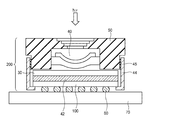
- the camera module which concerns on embodiment of this invention is demonstrated, referring FIG.1 and FIG.2, this invention is not limited by the following specific examples.
- FIGS. 1 and 2 common portions are denoted by common reference numerals. In the description, “upper”, “upper”, and “upper” refer to the side far from the silicon substrate 10, and “lower”, “lower”, and “lower” are the sides closer to the silicon substrate 10. Point to.
- FIG. 1 is a schematic cross-sectional view illustrating a configuration of a camera module including a solid-state imaging device.
- a camera module 200 shown in FIG. 1 is connected to a circuit board 70 that is a mounting board via solder balls 60 that are connection members. Specifically, the camera module 200 is provided on the first main surface side (light receiving side) of the solid-state image sensor substrate 100 and the solid-state image sensor substrate 100 provided with an image sensor section on the first main surface of the silicon substrate.
- a flattening layer (not shown in FIG. 1), an infrared cut filter 42 provided on the flattening layer, and a lens holder 50 that is disposed above the infrared cut filter 42 and has the imaging lens 40 in the internal space.
- the light-shielding and electromagnetic shield 44 is disposed so as to surround the solid-state imaging device substrate 100 and the glass substrate 30.
- the present invention is a method of manufacturing a camera module having a solid-state image pickup device substrate 100 and an infrared cut filter 42 disposed on the light-receiving side of the solid-state image pickup device substrate. It also relates to the process of forming a film by applying the infrared absorbing composition of the invention.
- the infrared cut filter 42 can be formed by forming a film on the planarizing layer by applying the infrared absorbing composition of the present invention.
- the method for applying the infrared cut filter is as described above.
- incident light h ⁇ from the outside passes through the imaging lens 40, the infrared cut filter 42, the glass substrate 30, and the planarization layer in order, and then reaches the imaging element portion of the solid-state imaging element substrate 100. ing.
- the infrared cut filter is directly provided on the flattening layer.
- the infrared cut filter may be provided directly on the microlens without the flattening layer, or the infrared cut filter may be provided on the glass substrate 30.
- a glass substrate 30 provided with a filter or an infrared cut filter may be bonded.
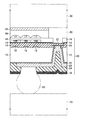
- FIG. 2 is an enlarged cross-sectional view of the solid-state imaging device substrate 100 in FIG.
- the solid-state image pickup device substrate 100 includes an image pickup device 12, an interlayer insulating film 13, a base layer 14, a color filter 15, an overcoat 16, and a microlens 17 in this order on a first main surface of a silicon substrate 10 that is a base. Yes.
- the red color filter 15R, the green color filter 15G, the blue color filter 15B (hereinafter, these may be collectively referred to as “color filter 15”) and the microlens 17 correspond to the image sensor 12, respectively. Has been placed.
- the second main surface opposite to the first main surface of the silicon substrate 10 includes a light shielding film 18, an insulating film 22, a metal electrode 23, a solder resist layer 24, an internal electrode 26, and an element surface electrode 27.
- a planarizing layer 46 and an infrared cut filter 42 are provided on the microlens 17. Instead of providing the infrared cut filter 42 on the planarizing layer 46, an infrared cut is provided on the microlens 17, between the base layer 14 and the color filter 15, or between the color filter 15 and the overcoat 16.
- the form in which a filter is provided may be sufficient. In particular, it is preferably provided at a position within 2 mm (more preferably within 1 mm) from the surface of the microlens 17.
- the step of forming the infrared cut filter can be simplified, and unnecessary infrared rays to the microlens can be sufficiently cut, so that the infrared blocking property can be further improved.
- the description of the solid-state image pickup device substrate 100 after paragraph 0245 of JP 2012-068418 A (corresponding US Patent Application Publication No. 2012/068292 specification [0407]) can be referred to. Is incorporated herein by reference.
- the said one embodiment is not restricted to the form of FIG.1 and FIG.2.
- a diketopyrrolopyrrole compound (DPP) was synthesized according to the method described in US Pat. No. 5,969,154 using 4- (2-ethylhexyloxy) benzonitrile as a raw material.
- Exemplified compound (D-10) was prepared according to Scheme 1 above. Titanium chloride (0.9 mL, 3 molar equivalents) was added to a toluene solution (1.2 M) of diphenylborinic acid 2-aminomethyl ester (1.4 g, 3 molar equivalents) and stirred for 30 minutes at an external temperature of 100 ° C. did. Next, a toluene mixed solution (0.2 M) of Exemplified Compound (D-17) (2.3 g) was added, and the mixture was further stirred under heating and refluxing conditions for 2 hours. When cooled to room temperature and methanol was added, crystals were precipitated.
- M-1 to M-3 Compound M-4: Aronix M-305 (manufactured by Toagosei Co., Ltd.)
- M-5 Aronix M-315 (manufactured by Toagosei Co., Ltd., the following compound)
- the halomethyltriazine compound (I) is the following compound.
- This flattening film resist solution was applied onto an 8-inch silicon wafer by spin coating. Subsequently, it was heat-treated on a hot plate at a surface temperature of 230 ° C. for 600 seconds to obtain an undercoat wafer.
- an i-line stepper (manufactured by Canon Inc.) is passed through a mask pattern in which 2.0 ⁇ m square pixels are respectively arranged in a 10 mm ⁇ 10 mm area on the substrate with respect to the dried coating film.
- FPA-3000i5 + was exposed at an exposure amount of 1000 mJ / cm 2 .
- the pattern-exposed coating film was subjected to paddle development for 60 seconds at room temperature using a 60% aqueous solution of an organic alkaline developer CD-2000 (Fuji Film Electronics Materials Co., Ltd.), and then spin showered for another 20 seconds. And rinsed with pure water. Thereafter, it was further washed with pure water. Thereafter, water droplets were blown with high-pressure air, the substrate was naturally dried, and post-baked with a hot plate at 230 ° C. for 300 seconds to form an infrared absorption pattern on the silicon wafer.
- CD-2000 Organic alkaline developer
- the composition ratio of the infrared absorbing substance and the polymerizable compound represents the composition ratio in the total solid content in the infrared absorbing composition.
- the infrared absorbing composition of the present invention includes the infrared absorbing material and the polymerizable compound having the partial structure represented by the formula (1), whereby the infrared absorbing composition is applied. It was found that an infrared absorption pattern having good adhesion to the substrate can be created.
- the infrared absorbing composition was applied by a spin coater (ACT-8, manufactured by Tokyo Electron) so as to form a coating film having a thickness of 2.0 ⁇ m.
- ACT-8 manufactured by Tokyo Electron
- the coating film was cured by heating at 230 ° C. for 5 minutes.
- a positive photoresist “FHi622BC” (manufactured by Fuji Film Electronics Materials) is applied onto the cured film with a spin coater (manufactured by Tokyo Electron, ACT-8) at 100 ° C. A heat treatment for 2 minutes was performed to form a photoresist layer so that the film thickness was 2.0 ⁇ m.
- the region where the cured film is to be removed is subjected to pattern exposure of 350 mJ / cm 2 using an i-line stepper (manufactured by Canon Inc., FPA3000i5 +), followed by heat treatment at 110 ° C. for 1 minute.
- etching apparatus U-621, manufactured by Hitachi High-Technologies Corporation
- RF power 800 W
- antenna bias 400 W
- wafer bias 200 W
- chamber internal pressure 4.0 Pa
- substrate temperature 50 ° C.
- the gas type and flow rate of the mixed gas were CF 4 : 200 mL / min.
- O 2 50 mL / min.
- Ar 800 mL / min.
- an etching process for 375 seconds was performed.
- the etching rate of the infrared absorbing composition under the etching conditions was 322 nm / min. Therefore, in the etching process, all of the infrared absorption film formed at the place to be removed was removed.
- a photoresist stripping solution “MS-230C” manufactured by FUJIFILM Electronics Materials Co., Ltd. was used, and stripping treatment was performed for 120 seconds to remove the photoresist.
- An infrared absorption pattern was prepared according to the above procedure.
- the composition ratio of the infrared rescue substance and the polymerizable compound represents the composition ratio in the total solid content in the infrared absorbing composition.
- the infrared absorbing composition of the present invention includes the infrared absorbing material and the polymerizable compound having the partial structure represented by the formula (1), whereby the infrared absorbing composition is applied. It was found that an infrared absorption pattern having good adhesion to the substrate can be created.
Landscapes
- Physics & Mathematics (AREA)
- General Physics & Mathematics (AREA)
- Optics & Photonics (AREA)
- Health & Medical Sciences (AREA)
- Toxicology (AREA)
- Chemical & Material Sciences (AREA)
- Optical Filters (AREA)
- Chemical Kinetics & Catalysis (AREA)
- Medicinal Chemistry (AREA)
- Polymers & Plastics (AREA)
- Organic Chemistry (AREA)
- Blocking Light For Cameras (AREA)
Abstract
Description
本発明は、赤外線吸収性組成物が適用される基材との密着性が良好な赤外吸収パターンを作成することができる赤外線吸収性組成物を提供することを目的とする。
具体的には、以下の手段<1>により、好ましくは、<2>~<16>により、上記課題は解決された。
<1>赤外線吸収物質と、
下記式(1)で示される部分構造を有する重合性化合物を含有する、赤外線吸収性組成物。
式(1)

<2>前記重合性化合物が、前記式(1)で示される部分構造を2つ以上有する、<1>に記載の赤外線吸収性組成物。
<3>前記重合性化合物が、重合性官能基を2つ以上有する、<1>又は<2>に記載の赤外線吸収性組成物。
<4>前記重合性化合物が、下記式(1-1)で表される部分構造を2つ以上有する重合性化合物である、<1>に記載の赤外線吸収性組成物。
式(1-1)

<5>前記重合性化合物が、下記式(1-2)で表される、<1>に記載の赤外線吸収性組成物。
式(1-2)

式(1-1)

<6>前記重合性化合物が、下記式(1-3)で表される、<1>に記載の赤外線吸収性組成物。
式(1-3)

<7>前記赤外線吸収物質が銅化合物及び/又はピロロピロール色素である、<1>~<6>のいずれかに記載の赤外線吸収性組成物。
<8>前記赤外線吸収物質がピロロピロール色素であり、前記重合性化合物が前記式(1-3)で表される、<6>又は<7>に記載の赤外線吸収性組成物。
<9>前記ピロロピロール色素が、下記式(I)で表される化合物である、<7>又は<8>に記載の赤外線吸収性組成物。
式(I)
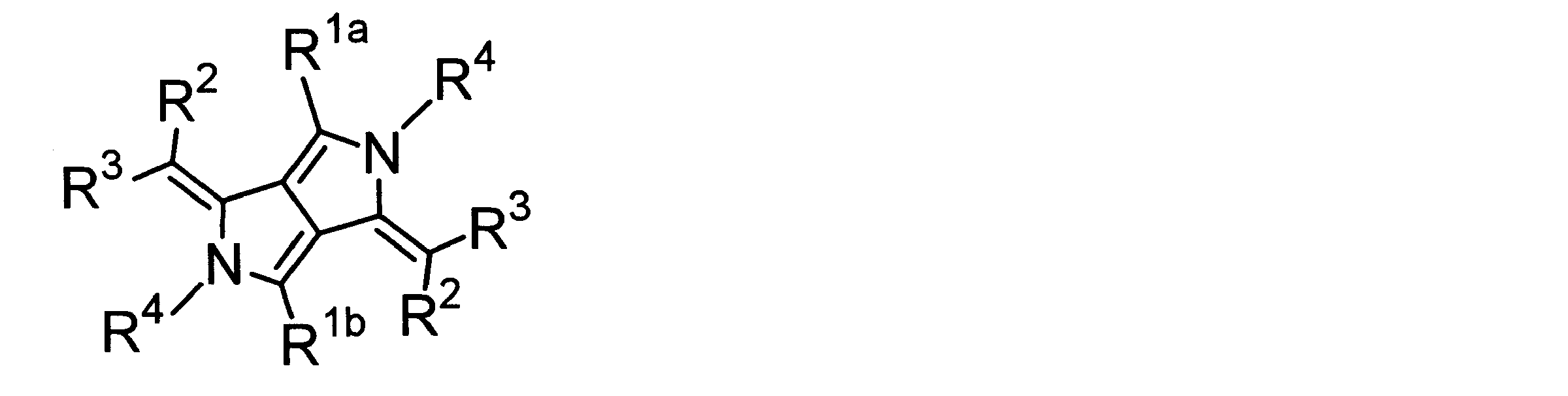
<10>前記赤外線吸収物質の極大吸収波長が820~880nmである、<1>~<9>のいずれかに記載の赤外線吸収性組成物。
<11>溶剤をさらに含有する、<1>~<10>のいずれかに記載の赤外線吸収性組成物。
<12>赤外線吸収性組成物の固形分が5~50質量%である、<1>~<11>のいずれかに記載の赤外線吸収性組成物。
<13><1>~<12>のいずれかに記載の赤外線吸収性組成物を用いてなる赤外線カットフィルタ。
<14>前記赤外線吸収性組成物を塗布して前記赤外吸収パターンを形成する工程を含み、前記赤外線吸収性組成物が水又は水系溶剤を含む、<13>に記載の赤外線カットフィルタの製造方法。
<15>固体撮像素子基板と、<13>に記載の赤外線カットフィルタとを有するカメラモジュール。
<16>固体撮像素子基板と、赤外線カットフィルタとを有するカメラモジュールの製造方法であって、<1>~<12>のいずれかに記載の赤外線吸収性組成物を塗布する工程を含む、カメラモジュールの製造方法。
本明細書中において、“(メタ)アクリレート”はアクリレート及びメタクリレートを表し、“(メタ)アクリル”はアクリル及びメタクリルを表し、“(メタ)アクリロイル”はアクリロイル及びメタクリロイルを表す。
また、本明細書中において、“単量体”と“モノマー”とは同義である。本発明における単量体は、オリゴマー及びポリマーと区別され、重量平均分子量が2,000以下の化合物をいう。
本明細書中において、重合性化合物とは、重合性官能基を有する化合物のことをいい、単量体であっても、ポリマーであってもよい。重合性官能基とは、重合反応に関与する基をいう。
本明細書における基(原子団)の表記において、置換及び無置換を記していない表記は置換基を有さないものと共に置換基を有するものをも包含するものである。
本発明における赤外線とは、極大吸収波長(λmax)領域が700~1000nmであるものをいう。
本発明の赤外線吸収性組成物は、赤外線吸収物質と、下記式(1)で示される部分構造を有する重合性化合物を含有する。

本発明によれば、赤外線吸収性組成物が適用される基材との密着性が良好な赤外吸収パターンを作成することができる赤外線吸収性組成物を提供することができる。
本発明の組成物は、本発明の組成物中の固形分が5~50質量%であることが好ましく、10~30質量%であることがより好ましい。
本発明の組成物に用いられる赤外線吸収物質は、通常、極大吸収波長領域が700~1000nm、好ましくは800~900nmの物質であれば特に限定されないが、後述する銅化合物及び/又は有機赤外線吸収色素であることが好ましく、後述する銅化合物及び/又はピロロピロール色素であることがより好ましい。
赤外線吸収物質は1種類のみを含んでいても良いし、2種類以上を含んでいても良い。
赤外線吸収色素は、通常、極大吸収波長領域が700~1000nmであり、820~880nmであることが好ましい。赤外吸収性色素は、波長700nm以上1000nm以下の赤外線を選択的に吸収する態様とすることもできる。例えば、赤外線吸収色素は、極大吸収波長領域が820~880nmであり、波長820nm未満、かつ、波長880nmを超える赤外線の吸収率が、それぞれ、10%以下、より好ましくは7%以下、さらに好ましくは5%以下であることが好ましい。
赤外吸収性色素は、モル吸光係数εは特に限定されないが、好ましくは50,000~500,000であり、より好ましくは100,000~300,000である。
式(I)
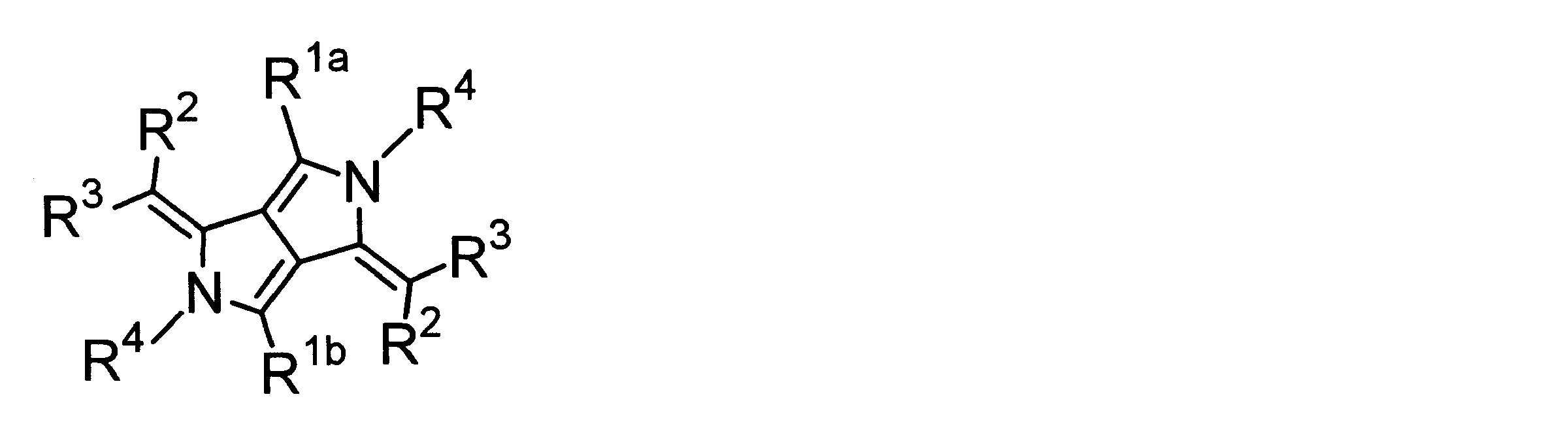
R1a、R1bで表されるアリール基としては、好ましくは炭素数6~30、より好ましくは炭素数6~20、特に好ましくは炭素数6~12のアリール基である。
R1a、R1bで表されるヘテロアリール基としては、好ましくは炭素数1~30、より好ましくは炭素数1~12のヘテロアリール基である。ヘテロ原子としては、例えば、窒素原子、酸素原子及び硫黄原子を挙げることができる。
特に、R1a、R1bで表される基としては、分岐アルキル基を有するアルコキシ基を有するアリール基であることが好ましい。分岐アルキル基におけるアルキル基としては、炭素数3~30が好ましく、3~20がより好ましい。
R1a、R1bで表される基としては、例えば、4-(2-エチルヘキシルオキシ)フェニル、4-(2-メチルブチルオキシ)フェニル、4-(2-オクチルドデシルオキシ)フェニルが特に好ましい。
一般式(I)中のR1a、R1bは、互いに同一でも異なっていてもよい。
アルキル基(好ましくは炭素数1~30)、アルケニル基(好ましくは炭素数2~30)、アルキニル基(好ましくは炭素数2~30)、アリール基(好ましくは炭素数6~30)、アミノ基(好ましくは炭素数0~30)、アルコキシ基(好ましくは炭素数1~30)、アリールオキシ基(好ましくは炭素数6~30)、芳香族ヘテロ環オキシ基(好ましくは炭素数1~30)、アシル基(好ましくは炭素数1~30)、アルコキシカルボニル基(好ましくは炭素数2~30)、アリールオキシカルボニル基(好ましくは炭素数7~30)、アシルオキシ基(好ましくは炭素数2~30)、アシルアミノ基(好ましくは炭素数2~30)、アルコキシカルボニルアミノ基(好ましくは炭素数2~30)、アリールオキシカルボニルアミノ基(好ましくは炭素数7~30)、スルホニルアミノ基(好ましくは炭素数1~30)、スルファモイル基(好ましくは炭素数0~30)、カルバモイル基(好ましくは炭素数1~30)、アルキルチオ基(好ましくは炭素数1~30)、アリールチオ基(好ましくは炭素数6~30)、芳香族ヘテロ環チオ基(好ましくは炭素数1~30)、スルホニル基(好ましくは炭素数1~30)、スルフィニル基(好ましくは炭素数1~30)、ウレイド基(好ましくは炭素数1~30)、リン酸アミド基(好ましくは炭素数1~30)、ヒドロキシ基、メルカプト基、ハロゲン原子、シアノ基、スルホ基、カルボキシル基、ニトロ基、ヒドロキサム酸基、スルフィノ基、ヒドラジノ基、イミノ基、ヘテロ環基(好ましくは炭素数1~30)
具体例としては、シアノ基(0.66)、カルボキシル基(-COOH:0.45)、アルコキシカルボニル基(-COOMe:0.45)、アリールオキシカルボニル基(-COOPh:0.44)、カルバモイル基(-CONH2:0.36)、アルキルカルボニル基(-COMe:0.50)、アリールカルボニル基(-COPh:0.43)、アルキルスルホニル基(-SO2Me:0.72)、またはアリールスルホニル基(-SO2Ph:0.68)などが挙げられる。特に好ましくは、シアノ基である。ここで、Meはメチル基を、Phはフェニル基を表す。
ハメットの置換基定数σp値については、例えば、特開2011-68731号公報の段落0017~0018を参酌でき、この内容は本願明細書に組み込まれる。
一般式(I)中の2つのR2は、互いに同一でも異なってもよく、また、2つのR3は、互いに同一でも異なってもよい。
R4で表される基が置換ホウ素であるとき、その置換基は、R2及びR3について上述した置換基Tと同義であり、好ましくはアルキル基、アリール基、ヘテロアリール基である。
また、R4で表される基が金属原子であるときは、好ましくは遷移金属、特に好ましくは、置換ホウ素である。置換ホウ素として好ましくは、ジフルオロホウ素、ジフェニルホウ素、ジブチルホウ素、ジナフチルホウ素、カテコールホウ素が挙げられる。中でもジフェニルホウ素が特に好ましい。
R4は、R1a、R1b及びR3の少なくとも1種と共有結合もしくは配位結合していてもよく、特にR4がR3と配位結合していることが好ましい。
特に、R4としては、水素原子又は置換ホウ素(特にジフェニルホウ素)であることが好ましい。
一般式(I)中の2つのR4は、互いに同じでも異なっていてもよい。
本発明で用いられる前記式(I)で表される化合物については、例えば特開2011-68731号公報の段落0024~0052(対応する米国特許出願公開第2011/0070407号明細書の[0043]~[0074])を参酌でき、この内容は本願明細書に組み込まれる。
式(I-1)

R10は、前記式(I)中のR4と同義であり、好ましい範囲も同様である。
R11及びR12は、前記式(I)中のR2及びR3と同義であり、好ましい範囲も同様である。
R13は、互いに同じでも異なっていてもよい。
また、R13は、例えばイソエイコサノール(日産化学株式会社製、ファインオキソコール2000)に由来するアルコール残基であることが好ましい。
アルコールとしては、直鎖状又は分岐状であってもよく、炭素数1~30のアルコールが好ましく、炭素数3~25のアルコールがより好ましく、炭素数3~25の分岐状アルコールが特に好ましい。より具体的には、メタノール、エタノール、iso―プロパノール、n-ブタノール、tert-ブタノール、1-オクタノール、1-デカノール、1-ヘキサデカノール、2-メチルブタノール、2-エチルヘキサノール、2-オクチルドデカノール、イソヘキサデカノール(日産化学株式会社製、ファインオキソコール1600)、イソオクタデカノール(日産化学株式会社製、ファインオキソコール180)、イソオクタデカノール(日産化学株式会社製、ファインオキソコール180N)、イソオクタデカノール(日産化学株式会社製、ファインオキソコール180T)、イソエイコサノール(日産化学株式会社製、ファインオキソコール2000)等が挙げられる。これらのアルコールは、2種以上の混合物であってもよい。
式(I-2)

式(I-2)中、R20は各々独立に炭素数3~30の分岐状のアルキル基を表す。R20は、前記式(I-1)中のR13と同義であり、好ましい範囲も同様である。
赤外線吸収色素の微粒子分散物の分散安定性を向上させる目的で、分散剤を添加することが好ましい。分散剤として、水酸基含有カルボン酸エステル、長鎖ポリアミノアマイドと高分子量酸エステルの塩、高分子量ポリカルボン酸の塩、長鎖ポリアミノアマイドと極性酸エステルとの塩、高分子量不飽和エステル、高分子共重合物、変性ポリウレタン、変性ポリアクリレート、ポリエーテルエステル型アニオン系活性剤、ナフタレンスルホン酸ホルマリン縮合物塩、芳香族スルホン酸ホルマリン縮合物、ポリオキシエチレンアルキルリン酸エステル、ポリオキシエチレンノニルフェニルエーテル、ステアリルアミンアセテートなどを用いることができる。
分散剤は、赤外線吸収色素と分散媒の合計100質量部に対して、1~150質量部程度配合することが好ましい。
赤外線吸収色素を微粒子分散物の状態で使用することについては、例えば、特開2011-68731号公報の段落0053~0058(対応する米国特許出願公開第2011/0070407号明細書の[0075]~[0080])を参酌でき、この内容は本願明細書に組み込まれる。
本発明に用いられる銅化合物における銅は、赤外線領域に吸収を持つ限り特に定めるものではないが、1価または2価の銅が好ましく、2価の銅がより好ましい。
本発明に用いられる銅化合物中の銅含有量は、好ましくは2~40質量%であり、より好ましくは5~40質量%である。
本発明で用いる銅化合物は、波長700nm~1000nmの範囲内に極大吸収波長を有する銅化合物であれば特に制限はない。
本発明で用いる銅化合物は、銅錯体であることが好ましい。
本発明で用いる銅化合物が銅錯体である場合、銅に配位する配位子Lとしては、銅イオンと配位結合可能であれば特に限定されないが、例えば、リン酸、リン酸エステル、ホスホン酸、ホスホン酸エステル、ホスフィン酸、置換ホスフィン酸、スルホン酸、カルボン酸、カルボニル(エステル、ケトン)、アミン、アミド、スルホンアミド、ウレタン、ウレア、アルコール、チオールなどを有する化合物が挙げられる。これらの中でも、リン酸、リン酸エステル、ホスホン酸、ホスホン酸エステル、ホスフィン酸、置換ホスフィン酸、スルホン酸が好ましく、リン酸エステル、ホスホン酸エステル、置換ホスフィン酸、スルホン酸がより好ましい。
本発明で用いる銅化合物の具体例としては、リン含有銅化合物、スルホン酸銅化合物または下記式(A)で表される銅化合物が挙げられる。リン含有銅化合物として具体的には、例えば、WO2005/030898号公報の第5頁第27行目~第7頁第20行目に記載された化合物を参酌することができ、これらの内容は本願明細書に組み込まれる。
Cu(L)n1・(X)n2 式(A)
上記式(A)中、Lは、銅に配位する配位子を表し、Xは、存在しないか、ハロゲン原子、H2O、NO3、ClO4、SO4、CN、SCN、BF4、PF6、BPh4(Phはフェニル基を表す)又はアルコールを表す。n1、n2は、各々独立に1~4の整数を表す。
配位子Lは、銅に配位可能な原子としてC、N、O、Sを含む置換基を有するものであり、さらに好ましくはNやO、Sなどの孤立電子対を持つ基を有するものである。配位可能な基は分子内に1種類に限定されず、2種以上を含んでも良く、解離しても非解離でも良い。好ましい配位子Lとしては、上述した配位子Lと同義である。非解離の場合、Xは存在しない。
以下、本発明で用いられる銅化合物、および配位子Lを形成する化合物について、詳細に説明する。
リン含有銅錯体としては、例えば、特願2013-030488の0013~0030を参酌することができ、この内容は本願明細書に組み込まれる。
リン含有銅錯体としては、錯体の配位子としてリン化合物を含有する配位子を有していれば、特に制限されないが、リン酸銅錯体、リン酸エステル銅錯体、ホスホン酸銅錯体、ホスホン酸エステル銅錯体、ホスフィン酸銅錯体、置換ホスフィン酸銅錯体であることが好ましく、リン酸エステル銅錯体、ホスホン酸エステル銅錯体、置換ホスフィン酸銅錯体であることがより好ましい。
リン酸エステル銅錯体は、銅を中心金属としリン酸エステル化合物を配位子とするものである。
配位子Lを形成するリン酸エステル化合物としては下記式(B)で表される化合物がより好ましい。
(HO)n-P(=O)-(OR2)3-n 式(B)
上記式(B)中、R2は有機基を示し、nは1または2を表す。有機基R2は炭素数1~18のアルキル基、炭素数6~18のアリール基、炭素数1~18のアラルキル基、または炭素数1~18のアルケニル基を表すか、-OR2が、炭素数4~100のポリオキシアルキル基、炭素数4~100の(メタ)アクリロイルオキシアルキル基、または、炭素数4~100の(メタ)アクリロイルポリオキシアルキル基を表し、nは1または2を表す。nが1のとき、R2はそれぞれ同一でもよいし、異なっていてもよい。

前記式(C)中の、R1、R2は、各々独立に1価の有機基を示す。1価の有機基としては、炭素数が3以上の有機基が好ましく、炭素数5以上の有機基がより好ましく、炭素数5~20の有機基がさらに好ましい。
また、前記式(C)において、R1およびR2同士が互いに結合して環状構造を形成していてもよい。この場合、R1、R2はいずれも2価の有機基となる。結合した環状構造を含む基(2価の有機基)の炭素原子の合計数は3以上であり、炭素数5以上が好ましく、炭素数5~20の有機基がより好ましい。
具体的な1価の有機基としては、特に限定されないが、直鎖状、分岐状または環状のアルキル基、アリール基、ヘテロアリール基を挙げることができる。ここで、これらの基は、2価の連結基(例えば、直鎖状、分岐状または環状のアルキレン基、アリーレン基、ヘテロアリーレン基、-O-、-S-、-CO-、-COO-、-OCO-、-SO2-、-NR-(Rは水素原子あるいはアルキル基)など)を介した基であってもよい。また1価の有機基は置換基を有していてもよい。
環状のアルキル基は、単環、多環のいずれであってもよい。環状のアルキル基としては、炭素数3~20のシクロアルキル基が好ましい。
アリール基としては、炭素数6~18のアリール基が好ましい。
ヘテロアリール基としては、5員環または6員環が好ましい。また、ヘテロアリール基は、単環または縮合環であり、単環または縮合数が2~8の縮合環が好ましく、単環または縮合数が2~4の縮合環がより好ましい。
具体的には、窒素、酸素、硫黄原子の少なくとも一つを含有する単環、または多環芳香族環から誘導されるヘテロアリール基が用いられる。

式(D)中、R1およびR2は、前記式(C)中におけるR1およびR2と同義であり、好ましい範囲も同様である。
前記式(C)で表されるリン酸エステル化合物の分子量は、200~1000が好ましく、250~750がより好ましく、300~500がさらに好ましい。
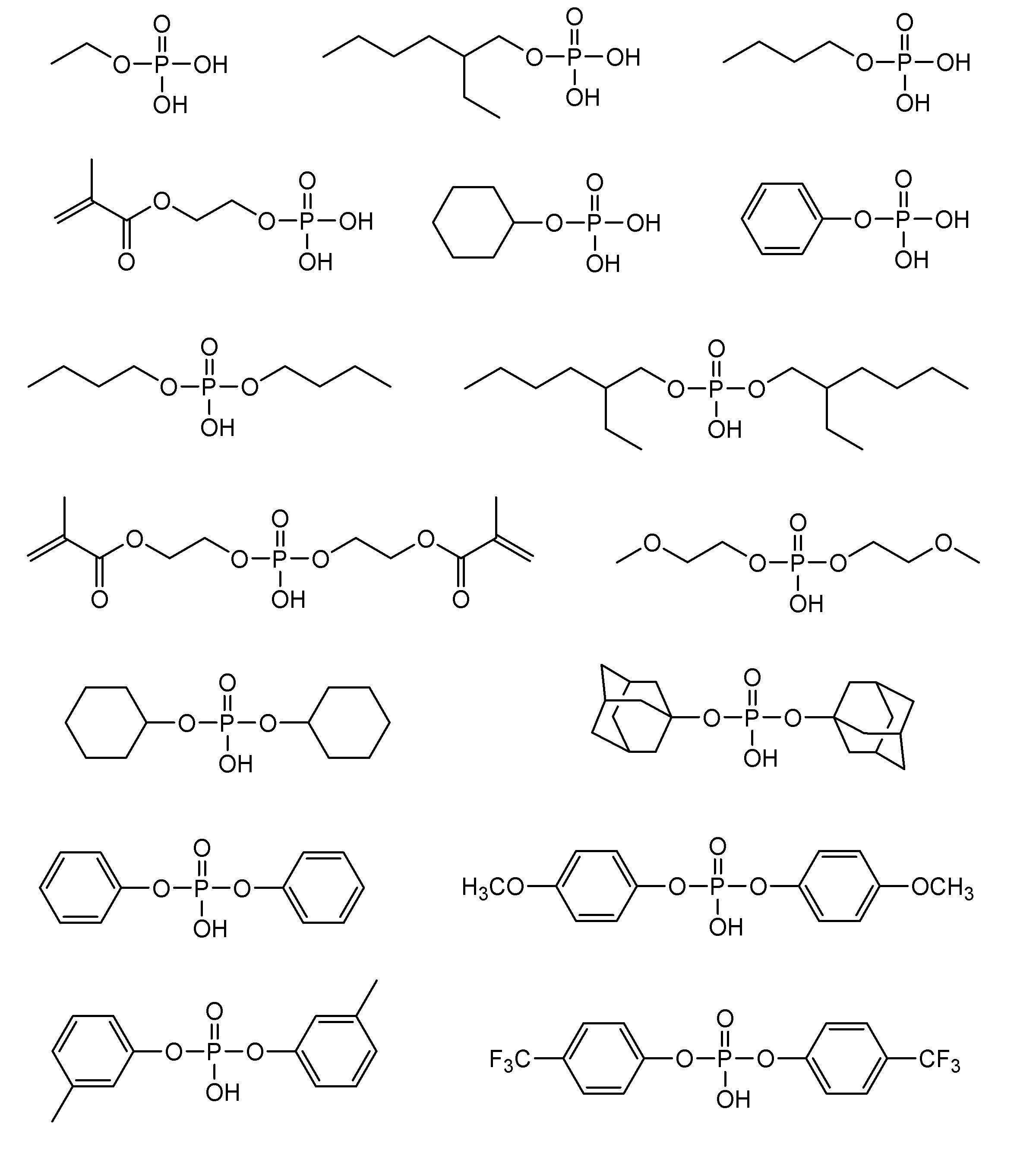
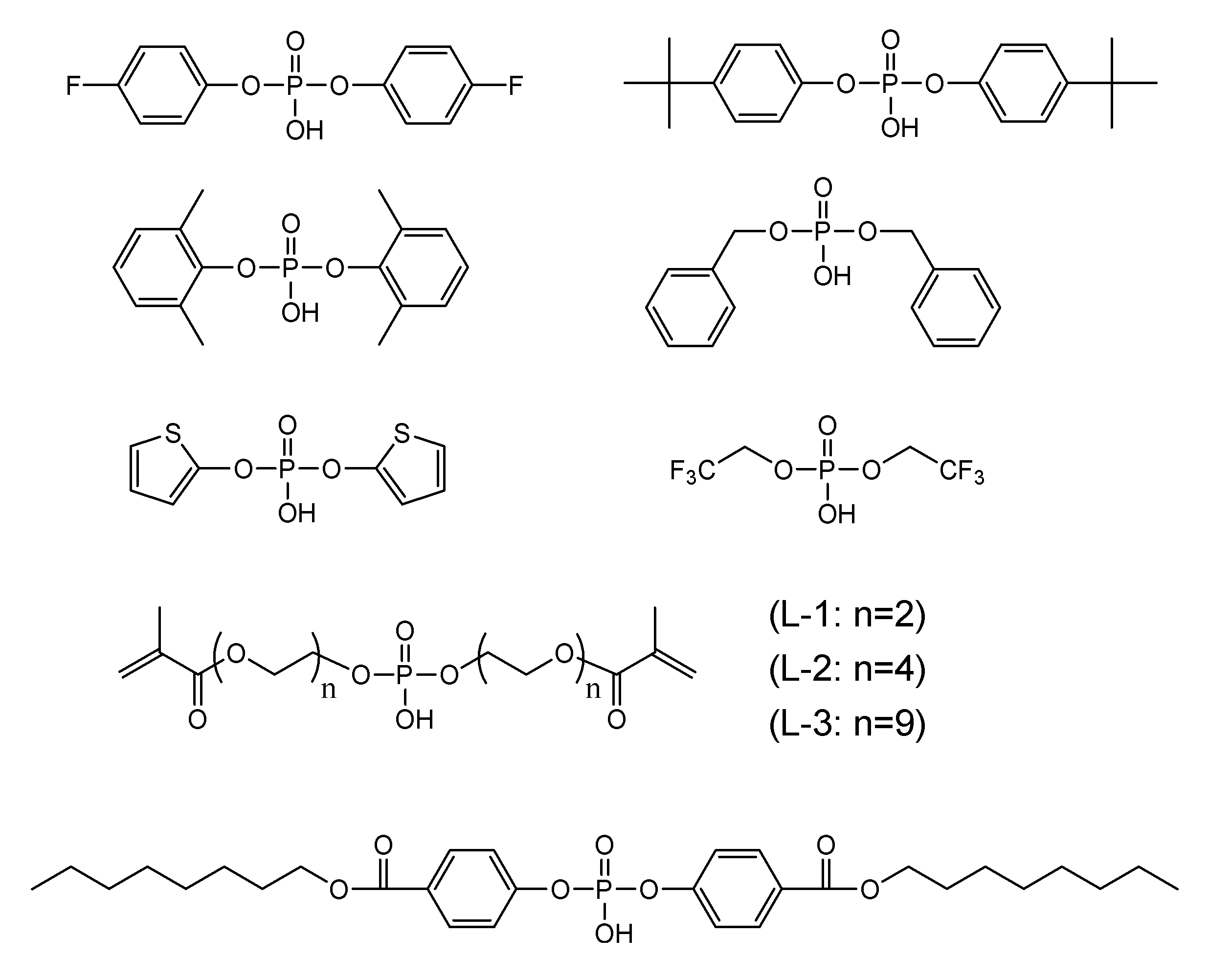

本発明で用いられるリン酸エステル銅錯体は、銅を中心金属としホスホン酸エステル化合物を配位子とするものであってもよい。
配位子Lを形成するホスホン酸エステル化合物としては下記式(E)で表される化合物がより好ましい。

式(E)で表される化合物およびその塩は、銅に配位する配位子として作用する。
直鎖状または分枝状のアルキル基としては、炭素数1~20のアルキル基が好ましい。
環状のアルキル基、アリール基、ヘテロアリール基としては、前記式(C)中の環状のアルキル基、アリール基、ヘテロアリール基と同義であり、好ましい範囲も同様である。
アルケニル基としては、炭素数2~10のアルケニル基が好ましい。具体的には、ビニル基、1-プロペニル基、1-ブテニル基などが例示される。
2価の連結基である直鎖状、分枝状または環状のアルキレン基、アリーレン基、あるいはヘテロアリーレン基としては、前記式(C)で記載したものが挙げられる。
また、1価の有機基が有していてもよい置換基としては、前記式(C)で記載したものが挙げられる。

前記式(F)中、R3およびR4は、前記式(E)中におけるR3およびR4と同義であり、好ましい範囲も同様である。
前記式(E)で表されるホスホン酸エステル化合物の分子量は、200~1000が好ましく、250~750がより好ましく、300~500がさらに好ましい。

本発明で用いられる置換ホスフィン酸銅錯体は、銅を中心金属とし置換ホスフィン酸化合物を配位子とするものである。配位子Lを形成する置換ホスフィン酸化合物としては下記式(G)で表される化合物がより好ましい。

式(G)中の、R5およびR6は、各々独立に1価の有機基を示す。具体的な1価の有機基としては、特に限定されないが、直鎖状、分岐状または環状のアルキル基、アリール基、ヘテロアリール基を挙げることができる。ここで、これらの基は、途中に2価の連結基(例えば、アルキレン基、シクロアルキレン基、アリーレン基、ヘテロアリーレン基、-O-、-S-、-CO-、-COO-、-OCO-、-SO2-、-NR-(Rは水素原子あるいはアルキル基)など)を介した基であってもよい。また1価の有機基は置換基を有していてもよい。
直鎖状または分岐状のアルキル基としては、炭素数1~20のアルキル基が好ましい。 環状のアルキル基、アリール基、ヘテロアリール基は、前記式(C)中の環状のアルキル基、アリール基、ヘテロアリール基と同義であり、好ましい範囲も同様である。
2価の連結基である直鎖状、分岐状または環状のアルキレン基、アリーレン基、あるいはヘテロアリーレン基としては、前記式(C)で記載したものが挙げられる。
1価の有機基が有していてもよい置換基としては、前記式(C)で記載したものが挙げられる。

前記式(H)中、R5およびR6は、前記式(G)中におけるR5およびR6と同義であり、好ましい範囲も同様である。
前記式(G)で表される置換ホスフィン酸化合物の分子量は、50~750が好ましく、50~500がより好ましく、80~300がさらに好ましい。
置換ホスフィン酸化合物の具体例を以下に示す。
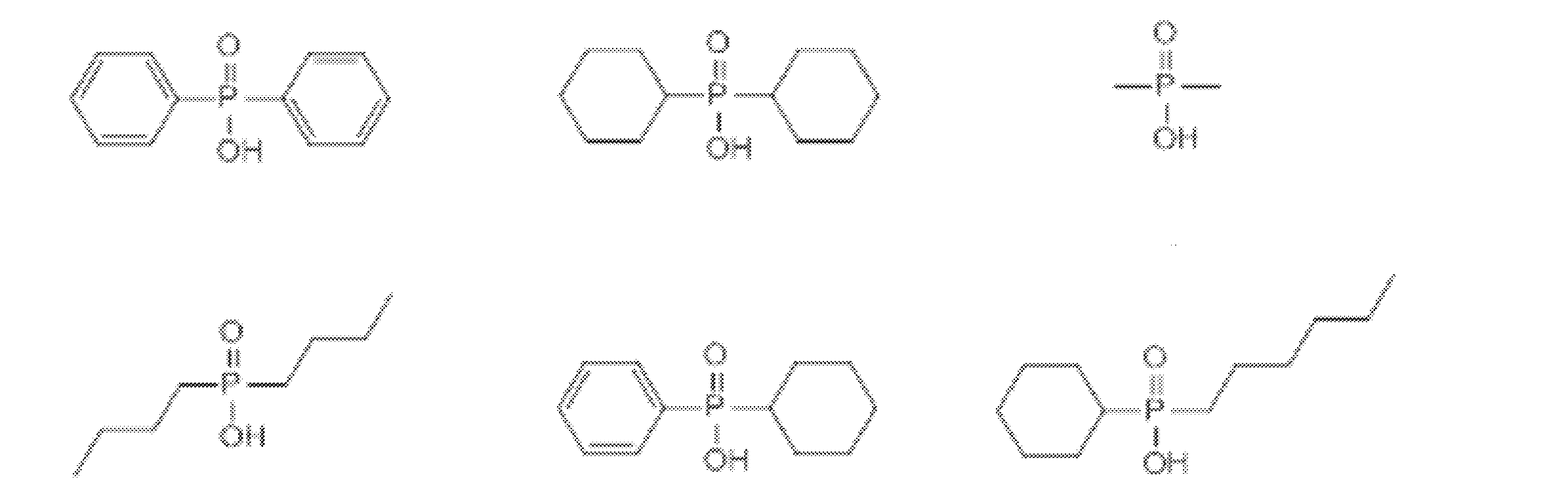
上述した銅成分としては、銅または銅を含む化合物を用いることができる。銅を含む化合物としては、例えば、酸化銅や銅塩を用いることができる。銅塩は、1価または2価の銅が好ましく、2価の銅がより好ましい。銅塩としては、酢酸銅、塩化銅、ギ酸銅、ステアリン酸銅、安息香酸銅、エチルアセト酢酸銅、ピロリン酸銅、ナフテン酸銅、クエン酸銅、硝酸銅、硫酸銅、炭酸銅、塩素酸銅、(メタ)アクリル酸銅、過塩素酸銅がより好ましく、酢酸銅、塩化銅、硫酸銅、安息香酸銅、(メタ)アクリル酸銅がさらに好ましい。
本発明に用いられるリン含有化合物は、例えば、公知の方法を参照して、合成することができる。
例えば、前記リン酸エステル化合物は、2-ヒドロキシエチルメタクリレート、フェニルリン酸エステル、1,3,5-トリイソプロピルスルホン酸クロリドとをピリジン溶媒中で反応させることにより得ることができる。
本発明で用いられるリン含有化合物の塩としては、例えば金属塩が好ましく、具体的には、ナトリウム塩、カリウム塩、マグネシウム塩、カルシウム塩、ホウ酸塩等が挙げられる。
銅成分と、上述したリン含有化合物またはその塩とを反応させる際の反応比率としては、モル比率で1:1.5~1:4とすることが好ましい。
また、銅成分と、上述したリン含有化合物またはその塩とを反応させる際の反応条件は、例えば、20~50℃で、0.5時間以上とすることが好ましい。
また、本発明のリン含有銅錯体は、グラム吸光度が0.04以上(g/mL)であることが好ましく、0.06以上(g/mL)であることがより好ましく、0.08以上(g/mL)であることがさらに好ましい。
グラム吸光度は、例えば、Cary 5000 UV-Vis-NIR(分光光度計 アジレント・テクノロジー株式会社製)装置を用いて算出することができる。
スルホン酸銅錯体としては、例えば、特願2013-030488の0031~0035を参酌することができ、この内容は本願明細書に組み込まれる。
本発明で用いられるスルホン酸銅錯体は、銅を中心金属としスルホン酸化合物を配位子とするものである。
配位子としてのスルホン酸化合物としては、下記式(I-0)で表される化合物がより好ましい。
式(I-0)

式(I-0)で表されるスルホン酸およびその塩は、銅に配位する配位子として作用する。
具体的な1価の有機基としては、特に限定されないが、直鎖状、分岐状または環状のアルキル基、アルケニル基、アリール基を挙げることができる。ここで、これらの基は、2価の連結基(例えば、アルキレン基、シクロアルキレン基、アリーレン基、-O-、-S-、-CO-、-COO-、-OCO-、-SO2-、-NR-(Rは水素原子あるいはアルキル基)など)を介した基であってもよい。また1価の有機基は置換基を有していてもよい。
直鎖状または分岐状のアルキル基としては、炭素数1~20のアルキル基が好ましく、炭素数1~12のアルキル基がより好ましく、炭素数1~8のアルキル基がさらに好ましい。
環状のアルキル基は、単環、多環のいずれであってもよい。環状のアルキル基としては、炭素数3~20のシクロアルキル基が好ましく、炭素数4~10のシクロアルキル基がより好ましく、炭素数6~10のシクロアルキル基がさらに好ましい。アルケニル基としては、炭素数2~10のアルケニル基が好ましく、炭素数2~8のアルケニル基がより好ましく、炭素数2~4のアルケニル基がさらに好ましい。
アリール基としては、炭素数6~18のアリール基が好ましく、炭素数6~14のアリール基がより好ましく、炭素数6~10のアリール基がさらに好ましい。
また、本発明のスルホン酸銅錯体は、下記式(J)で表される構造を含有する。

前記式(J)中、R8は、前記式(I-0)中におけるR8と同義であり、好ましい範囲も同様である。
前記式(J)で表されるスルホン酸化合物の分子量は、80~750が好ましく、80~600がより好ましく、80~450がさらに好ましい。


上述した銅成分としては、上述したリン含有銅錯体と同義であり、好ましい範囲も同様である。
本発明に用いられるスルホン酸化合物は、市販のスルホン酸を用いることもできるし、公知の方法を参照して、合成することもできる。
本発明で用いられるスルホン酸化合物の塩としては、例えば金属塩が好ましく、具体的には、ナトリウム塩、カリウム塩等が挙げられる。
銅成分と、上述したスルホン酸化合物またはその塩とを反応させる際の反応比率としては、モル比率で1:1.5~1:4とすることが好ましい。この際、スルホン酸化合物またはその塩は、1種類でも良いし、2種類以上を用いても良い。
また、銅成分と、上述したスルホン酸化合物またはその塩とを反応させる際の反応条件は、例えば、20~50℃で、0.5時間以上とすることが好ましい。
本発明のスルホン酸銅錯体の極大吸収波長およびグラム吸光度については、上述したリン含有銅錯体と同義であり、好ましい範囲も同様である。
本発明で用いられる銅化合物としては、上述したもの以外に、カルボン酸エステルを配位子とする銅化合物を用いてもよい。なお、本発明がこれらに限定されるものではないことは言うまでもない。例えば、下記式(K)で表される化合物が好ましい。

式(K)中、R1は1価の有機基を表す。1価の有機基としては、特に限定されないが、例えば、上述した式(C)中の1価の有機基と同義である。
例えば、赤外吸収物質として前記赤外線吸収色素を用いる場合、本発明の組成物中の全固形分中における赤外吸収物質の含有量は、0.01~50質量%とすることが好ましく、0.1~30質量%とすることがより好ましく、0.5~15質量%とすることがさらに好ましい。
また、例えば、赤外吸収物質として前記銅化合物を用いる場合、本発明の組成物中の全固形分中における赤外吸収物質の含有量は、0.01~50質量%とすることが好ましく、0.1~30質量%とすることがより好ましく、1~15質量%とすることがさらに好ましい。
本発明の組成物は、前記式(1)で示される部分構造を有する重合性化合物を含有する。式(1)で表される部分構造を有する重合性化合物は、水溶性を示し、水やアルコール等の水溶性有機溶剤に良好に溶解する。
前記式(1)で示される部分構造は、重合性基の一部を構成していてもよい。例えば、重合性基が(メタ)アクリルアミド基である場合が挙げられる。
本発明で用いられる前記重合性化合物は、前記式(1)で示される部分構造を2つ以上有することが好ましく、前記式(1)で示される部分構造を3つ以上有することがより好ましく、前記式(1)で示される部分構造を4以上有することがさらに好ましい。また、本発明で用いられる前記重合性化合物が有する前記式(1)で示される部分構造の上限は特に定めるものではないが、8つ以下であることが好ましく、6つ以下がより好ましく、4つが特に好ましい。
また、前記式(1)で示される部分構造を有する重合性化合物は、重合性官能基を2つ以上有することが好ましい。重合性官能基としては、例えば、炭素-炭素二重結合を含む重合性基、具体的には、(メタ)アクリルアミド基、ビニル基、(メタ)アクリロイルオキシ基、(メタ)アクリロイル基、エポキシ基、アジリジニル基などが挙げられる。特に、前記式(1)で示される部分構造を有する重合性化合物は、2つ以上の(メタ)アクリルアミド基を含んでいることが好ましく、(メタ)アクリルアミド基を3つ以上含むことがより好ましく、(メタ)アクリルアミド基を4つ含むことがさらに好ましい。
前記式(1)で示される部分構造を有する重合性化合物が(メタ)アクリルアミド基を4つ含む化合物の場合、該化合物は非対称であることが好ましい。
式(1-1)

特に、前記式(1)で示される部分構造を有する重合性化合物は、前記(1-1)で表される部分構造を2つ以上有することが好ましく、前記(1-1)で表される部分構造を3つ以上含むことがより好ましく、前記(1-1)で表される部分構造を4つ含むことがさらに好ましい。
式(1-2)

式(1-1)

式(1-2)中、A1は前記式(1-1)で表される部分構造を表す。
式(1-2)中、L1は2価の連結基を表す。2価の連結基としては、アルキレン基、-O-、-S-、-CO-、-SO2-、-NRa-(但し、Raは炭素原子数が1~5のアルキル基又は水素原子であり、メチル基または水素原子が好ましい)、アルケニレン基、アルキニレン基およびアリーレン基のいずれかから選択される基、または、これらの基の2つ以上の組み合わせからなる基が好ましい。より好ましくは、アルキレン基、又は、アルキレン基と-O-との組み合わせからなる二価の連結基が挙げられる。Lの鎖部分を構成する原子数は、1~20であることが好ましい。ここでの鎖とは、前記式(1-2)中のA1に結合している原子の鎖であって、最も長い鎖をいう。例えば、-CH2-CH2-(メタ)アクリルアミド基であると、鎖を構成する原子は、2つの炭素原子となる。
アルキレン基、アルケニレン基、アルキニレン基は、直鎖状、分枝状、および環状であってもよいが、直鎖状または分岐状が好ましく、直鎖状がより好ましい。
式(1-3)

ただし、L21において、L21の両端に結合する酸素原子と窒素原子とがL21の同一の炭素原子に結合した構造をとることはない。L21は酸素原子と(メタ)アクリルアミド基の窒素原子とを連結する直鎖または分岐のアルキレン基であり、該アルキレン基が分岐構造をとる場合、両端の酸素原子と(メタ)アクリルアミド基の窒素原子とがアルキレン基中の同一の炭素原子に結合した、-O-C-N-構造(ヘミアミナール構造)をとることも考えられる。しかし、本発明で用いる一般式(1-3)で表される重合性化合物は、このような構造の化合物は含まれない。分子内に-O-C-N-構造を有すると、該炭素原子の位置で分解が起こりやすい。特に、このような化合物は、保存中に分解されやすく、また水、水分の存在下で分解が促進され、硬化組成物の保存安定性を低下させる。
なお、アルキレン基中に-O-を含むとは、例えば、-アルキレン-O-アルキレン-のように、連結基の連結鎖のアルキレン基が上記ヘテロ原子を介して連結したものである。
-O-が含まれるアルキレン基の具体例としては、-C2H4-O-C2H4-、-C3H6-O-C3H6-等が挙げられる。
また、2価の複素環基の複素環は、さらに置換基を有してもよく、該置換基は、アルキル基、アリール基、アルコキシ基等が挙げられる。
前記式(1)で示される部分構造を有する重合性化合物は、例えば、特開2013-18846号公報の段落0027~0034を参酌でき、この内容は本願明細書に組み込まれる。
前記式(1)で示される部分構造を有する重合性化合物は、1種類のみ用いてもよいし、2種以上を組み合わせて使用してもよい。
本発明の組成物は、界面活性剤を含んでいてもよい。界面活性剤は、1種のみを用いてもよいし、2種類以上を組み合わせてもよい。界面活性剤の添加量は、本発明の組成物中、好ましくは0.0001~2質量%であり、より好ましくは0.005~1.0質量%である。
界面活性剤としては、フッ素系界面活性剤、ノニオン系界面活性剤、カチオン系界面活性剤、アニオン系界面活性剤、シリコーン系界面活性剤などの各種界面活性剤を使用できる。
カチオン系界面活性剤として具体的には、特開2012-208494号公報段落0554(対応する米国特許出願公開第2012/0235099号明細書の[0680])に記載のカチオン系界面活性剤が挙げられ、これらの内容は本願明細書に組み込まれる。
アニオン系界面活性剤として具体的には、W004、W005、W017(裕商(株)社製)等が挙げられる。
本発明の組成物は、重合開始剤を含んでいてもよい。重合開始剤は1種類のみでも、2種類以上でもよく、2種類以上の場合は、合計量が上記範囲となる。重合開始剤の添加量は、本発明の組成物中の全固形分あたり、0.01~30質量%が好ましく、0.1~25質量%がより好ましく、0.1~20質量%が特に好ましい。
重合開始剤としては、光、熱のいずれか或いはその双方により重合性化合物の重合を開始する能力を有する限り、特に制限はなく、目的に応じて適宜選択することができるが、光重合性化合物であることが好ましい。光で重合を開始させる場合、紫外線領域から可視の光線に対して感光性を有するものが好ましい。
また、熱で重合を開始させる場合には、150~250℃で分解する重合開始剤が好ましい。
本発明に用いうる重合開始剤としては、少なくとも芳香族基を有する化合物であることが好ましく、例えば、アシルホスフィン化合物、アセトフェノン系化合物、α-アミノケトン化合物、ベンゾフェノン系化合物、ベンゾインエーテル系化合物、ケタール誘導体化合物、チオキサントン化合物、オキシム化合物、ヘキサアリールビイミダゾール化合物、トリハロメチル化合物、アゾ化合物、有機過酸化物、ジアゾニウム化合物、ヨードニウム化合物、スルホニウム化合物、アジニウム化合物、メタロセン化合物等のオニウム塩化合物、有機硼素塩化合物、ジスルホン化合物などが挙げられる。
感度の観点から、オキシム化合物、アセトフェノン系化合物、α-アミノケトン化合物、トリハロメチル化合物、ヘキサアリールビイミダゾール化合物、および、チオール化合物が好ましい。
オキシム化合物としては、市販品であるIRGACURE-OXE01(BASF社製)、IRGACURE-OXE02(BASF社製)を用いることができる。
アセトフェノン系開始剤としては、市販品であるIRGACURE-907、IRGACURE-369、IRGACURE-379、IRGACURE 2959(商品名:いずれもBASFジャパン社製)を用いることができる。
アシルホスフィン系開始剤としては市販品であるIRGACURE-819やDAROCUR-TPO(商品名:いずれもBASFジャパン社製)を用いることができる。
本発明の組成物は、溶剤を含んでいてもよい。本発明で用いられる溶剤は、特に制限はなく、本発明の組成物の各成分を均一に溶解或いは分散しうるものであれば、目的に応じて適宜選択することができる。溶剤としては、水、ケトン類、エステル類、芳香族炭化水素類、ハロゲン化炭化水素類、およびジメチルホルムアミド、ジメチルアセトアミド、ジメチルスルホオキサイド、スルホラン等が好適に挙げられる。これらは、1種単独で使用してもよく、2種以上の混合物でもよい。
溶剤は1種類のみでも、2種類以上でもよい。溶剤の含有量は、本発明の組成物に対して、25~90質量%であることが好ましく、35~85質量%であることがより好ましい。
また、本発明の組成物は、溶剤として、水または水系溶媒を含む態様も例示される。本発明の組成物は、このような水または水系溶媒を含んだ場合にも、前記式(1)で表される部分構造を有する重合性化合物が水溶性を示すため、良好に溶解させることができる。水系溶媒としては、アルコール類などが挙げられる。水または水系溶媒は1種類のみでも、2種類以上の混合物でもよい。
本発明の組成物が溶剤として水または水系溶媒を含む場合、溶剤の含有量は、本発明の組成物に対して、10~45質量%であることが好ましく、10~25質量%であることがより好ましい。
本発明で用いられる溶剤としては、例えば、特開2012-208494号公報段落0497(対応する米国特許出願公開第2012/0235099号明細書の[0609])に記載のものが挙げられ、この内容は本願明細書に組み込まれる。
本発明の組成物は、上記式(1)で示される部分構造を有する重合性化合物以外に、硬化性化合物をさらに含んでいてもよい。例えば、多官能(メタ)アクリレート化合物が挙げられる。本発明で用いることができる硬化性化合物としては、例えば、特開2012-208494号公報段落0466~0495(対応する米国特許出願公開第2012/0235099号明細書の[0571]~[0606])を参酌でき、この内容は本願明細書に組み込まれる。
本発明の組成物中における、式(1)で表される構造を有するもの以外の硬化性化合物の添加量は、溶剤を除いた全固形分に対して0~80質量%、より好ましくは0~50質量%、特に好ましくは0~10質量%とすることが好ましい。
重合性化合物は、1種類のみでも、2種類以上でもよく、2種類以上の場合は、合計量が上記範囲となる。
本発明においては、皮膜特性向上などの目的で、必要に応じて、上記式(1)で示される部分構造を有する重合性化合物に加えて、さらにバインダーポリマーを含んでもよい。バインダーポリマーとしては、アルカリ可溶性樹脂が好ましく用いられる。アルカリ可溶性樹脂を含有することにより、耐熱性などの向上や、塗布適性の微調整に効果がある。
アルカリ可溶性樹脂としては、特開2012-208494号公報段落0558~0571(対応する米国特許出願公開第2012/0235099号明細書の[0685]~[0700])以降の記載を参酌でき、これらの内容は本願明細書に組み込まれる。
本発明におけるバインダーポリマーの含有量は、組成物の全固形分に対して、0~80質量%であることが好ましく、0~50質量%であることがより好ましく、0~30質量%であることがさらに好ましい。
本発明の組成物には、前記必須成分や前記好ましい添加剤に加え、本発明の効果を損なわない限りにおいて、目的に応じてその他の成分を適宜選択して用いてもよい。
併用可能なその他の成分としては、例えば、分散剤、増感剤、架橋剤、硬化促進剤、フィラー、熱硬化促進剤、熱重合禁止剤、可塑剤などが挙げられ、更に基材表面への密着促進剤およびその他の助剤類(例えば、導電性粒子、充填剤、消泡剤、難燃剤、レベリング剤、剥離促進剤、酸化防止剤、香料、表面張力調整剤、連鎖移動剤など)を併用してもよい。
これらの成分を適宜含有させることにより、目的とする赤外線吸収フィルタの安定性、膜物性などの性質を調整することができる。
これらの成分は、例えば、特開2012-003225号公報の段落番号0183~0260、特開2008-250074号公報の段落番号0101~0102、特開2008-250074号公報の段落番号0103~0104、特開2008-250074号公報の段落番号0107~0109等の記載を参酌でき、これらの内容は本願明細書に組み込まれる。
本発明の組成物は、液状とすることができるため、例えば、本発明の組成物を直接塗布し、乾燥させることにより赤外線カットフィルタを容易に製造できる。
本発明の赤外線カットフィルタの製造方法は、上述した赤外線吸収性組成物を塗布して赤外吸収パターンを形成する工程を含む。上述した赤外線吸収性組成物は、水又は水系溶剤に分散させたものを塗布することが好ましい。
赤外吸収パターンは、例えば、レジスト液を基板上に塗布し、所定のマスクパターンを介して露光し、現像液で現像することによって、ネガ型又はポジ型の赤外吸収パターンを形成することができる。このような赤外吸収パターンを形成する方法については、例えば、特開2011-68731号公報段落0140~0145(対応する米国特許出願公開第2011/0070407号明細書の[0204]~[0216])を参酌でき、この内容は本願明細書に組み込まれる。
また、赤外吸収パターンは、上述した赤外線吸収性組成物を用いた硬化膜を形成し、硬化膜上にフォトレジスト層を形成し、このフォトレジスト層をパターン状に除去してレジストパターンを形成し、このレジストパターンをエッチングマスクとしてドライエッチングによりエッチングし、エッチング後に残存するレジストパターンを除去することによっても形成することができる。このような赤外吸収パターンを形成する方法については、例えば、特開2008-241744号公報を参酌でき、この内容は本願明細書に組み込まれる。
赤外線吸収性組成物(塗布液)を支持体上に塗布する方法は、例えば、スピンコーター、スリットスピンコーター、スリットコーター、スクリーン印刷、アプリケータ塗布等を用いることにより実施できる。
また、塗膜の乾燥条件としては、各成分、溶剤の種類、使用割合等によっても異なるが、通常60℃~150℃の温度で30秒間~15分間程度である。
前加熱工程および後加熱工程における加熱時間は、通常、30秒~600秒であり、60秒~300秒であることが好ましい。
前記硬化処理工程としては、特に制限はなく、目的に応じて適宜選択することができるが、例えば、全面露光処理、全面加熱処理などが好適に挙げられる。ここで、本発明において「露光」とは、各種波長の光のみならず、電子線、X線などの放射線照射をも包含する意味で用いられる。
露光は放射線の照射により行うことが好ましく、露光に際して用いることができる放射線としては、特に、電子線、KrF、ArF、g線、h線、i線等の紫外線や可視光が好ましく用いられる。
露光方式としては、ステッパー露光や、高圧水銀灯による露光などが挙げられる。
露光量は5~3000mJ/cm2が好ましい。
前記全面露光を行う装置としては、特に制限はなく、目的に応じて適宜選択することができるが、例えば、超高圧水銀灯などのUV露光機が好適に挙げられる。
全面加熱における加熱温度は、120℃~250℃が好ましく、120℃~250℃がより好ましい。該加熱温度が120℃以上であれば、加熱処理によって膜強度が向上し、250℃以下であれば、前記膜中の成分の分解が生じ、膜質が弱く脆くなることを防止できる。
全面加熱における加熱時間は、3分~180分が好ましく、5分~120分がより好ましい。
全面加熱を行う装置としては、特に制限はなく、公知の装置の中から、目的に応じて適宜選択することができ、例えば、ドライオーブン、ホットプレート、IRヒーターなどが挙げられる。
以下、本発明の実施形態に係るカメラモジュールを、図1及び図2を参照しながら説明するが、本発明は以下の具体例によって限定されることはない。
なお、図1及び図2にわたり、共通する部分には共通する符号を付す。
また、説明に際し、「上」、「上方」及び「上側」は、シリコン基板10から見て遠い側を指し、「下」、「下方」及び「下側」は、はシリコン基板10に近い側を指す。
図1は、固体撮像素子を備えたカメラモジュールの構成を示す概略断面図である。
図1に示すカメラモジュール200は、実装基板である回路基板70に接続部材であるハンダボール60を介して接続されている。
詳細には、カメラモジュール200は、シリコン基板の第1の主面に撮像素子部を備えた固体撮像素子基板100と、固体撮像素子基板100の第1の主面側(受光側)に設けられた平坦化層(図1には不図示)と、平坦化層の上に設けられた赤外線カットフィルタ42と、赤外線カットフィルタ42の上方に配置され内部空間に撮像レンズ40を有するレンズホルダー50と、固体撮像素子基板100及びガラス基板30の周囲を囲うように配置された遮光兼電磁シールド44と、を備えて構成されている。なお、平坦化層の上には、ガラス基板30(光透過性基板)を設けてもよい。各部材は、接着剤20、45により接着されている。
本発明は、固体撮像素子基板100と、前記固体撮像素子基板の受光側に配置された赤外線カットフィルタ42とを有するカメラモジュールの製造方法であって、固体撮像素子基板の受光側において、上記本発明の赤外線吸収性組成物を適用することにより膜を形成する工程にも関する。本実施形態に係るカメラモジュールにおいては、例えば、平坦化層の上に、本発明の赤外線吸収性組成物を塗布することにより膜を形成して、赤外線カットフィルタ42を形成できる。赤外線カットフィルタを塗布する方法は前記した通りである。
カメラモジュール200では、外部からの入射光hνが、撮像レンズ40、赤外線カットフィルタ42、ガラス基板30、平坦化層を順次透過した後、固体撮像素子基板100の撮像素子部に到達するようになっている。
カメラモジュール200は、平坦化層上に直接赤外線カットフィルタを設けているが、平坦化層を省略しマイクロレンズ上に直接赤外線カットフィルタを設けるようにしてもよいし、ガラス基板30上に赤外線カットフィルタを設けたり、赤外線カットフィルタを設けたガラス基板30を貼り合せてもよい。
固体撮像素子基板100は、基体であるシリコン基板10の第1の主面に、撮像素子12、層間絶縁膜13、ベース層14、カラーフィルタ15、オーバーコート16、マイクロレンズ17をこの順に備えている。撮像素子12に対応するように、赤色のカラーフィルタ15R、緑色のカラーフィルタ15G、青色のカラーフィルタ15B(以下、これらをまとめて「カラーフィルタ15」ということがある)やマイクロレンズ17は、それぞれ配置されている。シリコン基板10の第1の主面と反対側の第2の主面には、遮光膜18、絶縁膜22、金属電極23、ソルダレジスト層24、内部電極26、及び素子面電極27を備えている。
マイクロレンズ17上には、平坦化層46、赤外線カットフィルタ42を備えている。平坦化層46の上に赤外線カットフィルタ42が設けられる代わりに、マイクロレンズ17の上、ベース層14とカラーフィルタ15との間、または、カラーフィルタ15とオーバーコート16との間に、赤外線カットフィルタが設けられる形態であってもよい。特に、マイクロレンズ17表面から2mm以内(より好ましくは1mm以内)の位置に設けられることが好ましい。この位置に設けると、赤外線カットフィルタを形成する工程が簡略化でき、マイクロレンズへの不要な赤外線を十分にカットすることができるので、赤外線遮断性をより高めることができる。
固体撮像素子基板100については、特開2012-068418号公報段落0245(対応する米国特許出願公開第2012/068292号明細書の[0407])以降の固体撮像素子基板100の説明を参酌でき、これらの内容は本願明細書に組み込まれる。
以上、カメラモジュールの一実施形態について図1及び図2を参照して説明したが、前記一実施形態は図1及び図2の形態に限られるものではない。
<<赤外線吸収色素IR-1の合成>>
<<<例示化合物(D-17)の調製>>>
下記スキーム1に従って、例示化合物(D-17)を調製した。

1H-NMR(CDCl3):δ0.9-1.0(m,12H),1.35-1.6(m,16H),1.8(m,2H),3.95(d,4H),7.1(d,4H),7.4-7.5(m,4H),7.7(d,4H),7.75(d,2H),8.0(d,2H)
前記のスキーム1に従い例示化合物(D-10)を調製した。
ジフェニルボリン酸2-アミノメチルエステル(1.4g、3モル当量)のトルエン溶液(1.2M)に塩化チタン(0.9mL、3モル当量)を添加し、30分間、外接温度100℃で攪拌した。次に、例示化合物(D-17)(2.3g)のトルエン混合液(0.2M)を添加し、さらに2時間加熱還流条件で攪拌した。室温まで冷やし、メタノールを加えたところ、結晶が析出したため、これをろ別し、クロロホルム/メタノールで再結晶を行い、例示化合物(D-10)を3.0g、収率93%で得た。
λmaxはクロロホルム中で779nmであった。モル吸収係数は、クロロホルム中、2.06×10⁵dm3/mol・cmであった。
1H-NMR(CDCl3):δ0.9-1.0(m,12H),1.35-1.6(m,16H),1.8(m,2H),3.85(d,4H),6.45(s,8H),7.0(d,4H),7.15(m,12H),7.2(m,2H),7.25(m,4H+4H),7.5(m,2H)
<<<例示化合物(D-141A)の調製>>>
原料を代えたこと以外は前記例示化合物(D-10)同様にして、下記例示化合物(D-141A)を調製した。

特開2002-146254号公報に記載の下記例示化合物1-2を用いた。
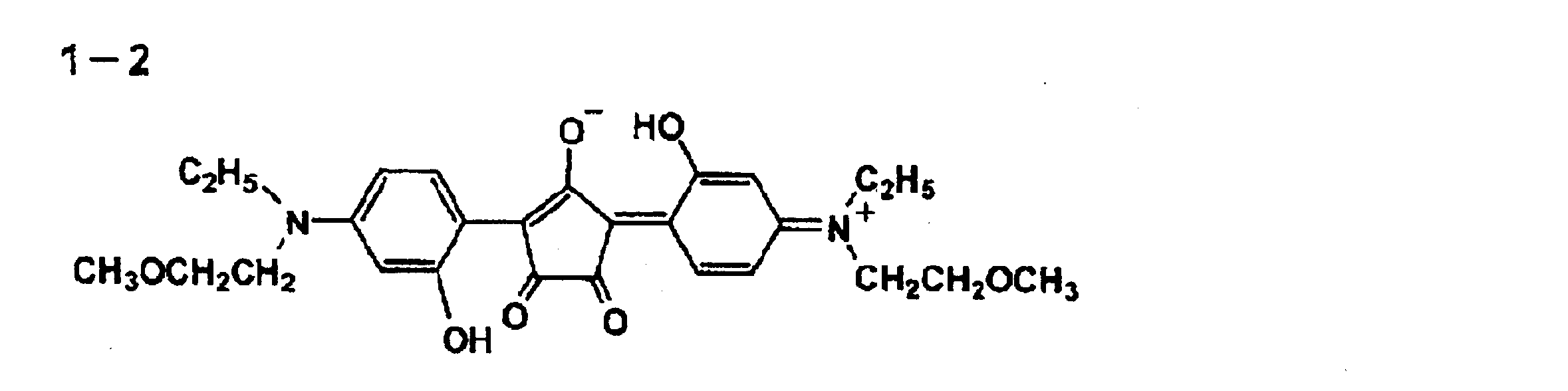
前記赤外線吸収物質(赤外線吸収色素IR-1~IR-3)のうちいずれか1種(6質量部)及び分散剤(Disperbyk191:ビックケミー社(4質量部))に、分散媒(水(90質量部))を加え100質量部とした。さらに0.1mmφのジルコニアビーズを100質量部添加し、遊星型ボールミルにて300rpmで8時間処理を行い、ビーズを濾過で分離し、微細粒子からなる分散物(分散物IR-1~分散物IR-3)をそれぞれ作製した。
下記の成分を混合して、下記表1に記載の実施例1~5及び比較例1の赤外線吸収性組成物を調製した。
・前記微粒子分散物 41.7質量部
・重合性化合物(下記M-1~M-5で表される化合物)16.2質量部
・Irgacure2959(BASF社製) 4.6質量部
・プロピレングリコールモノメチルエーテル 20.0質量部
・水 17.5質量部
M-4:アロニックスM-305(東亞合成(株)製)
M-5:アロニックスM-315(東亞合成(株)製、下記化合物)
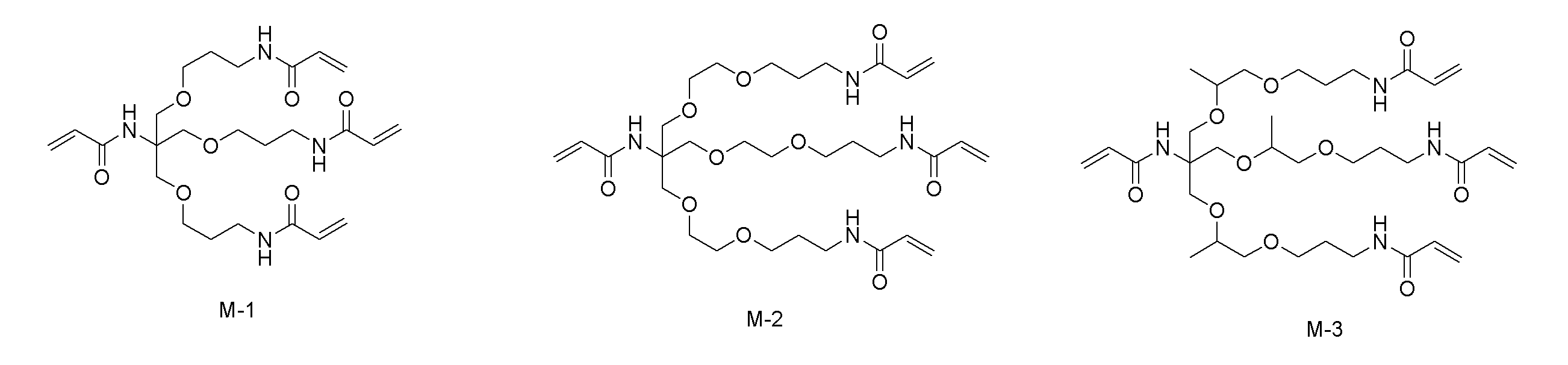
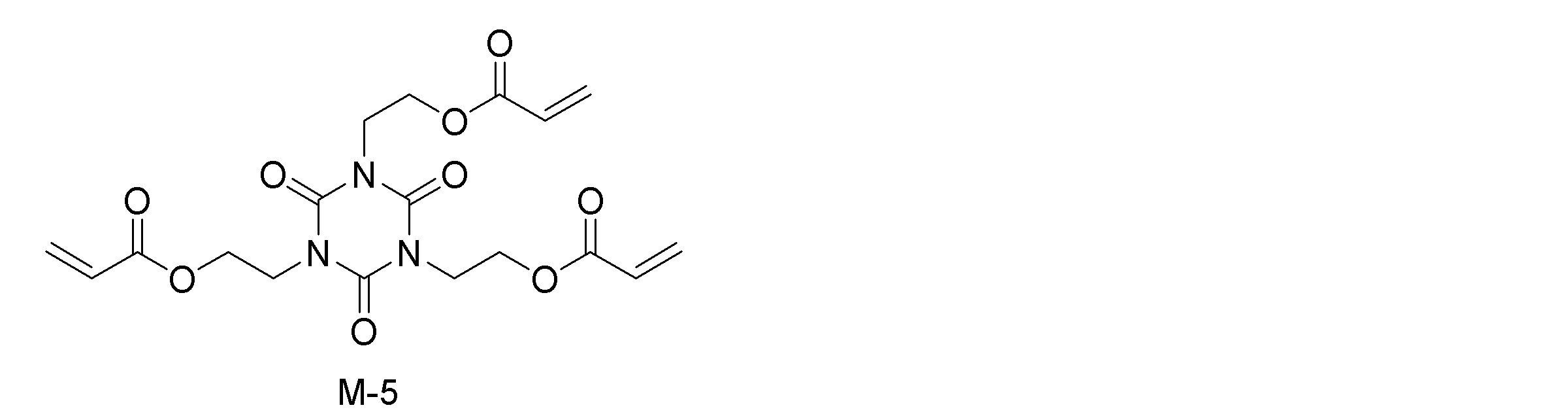
・ベンジルメタアクリレート/メタアクリル酸(=70/30[モル比])共重合体のプロピレングリコールモノメチルエーテルアセテート溶液(20%、重量平均分子量30000、藤倉化成(株)製、製品名アクリベースFF-187) ・・・22部
・ジペンタエリスリトールヘキサアクリレート ・・・6.5部
(日本化薬社製、製品名KAYARAD DPHA)
・プロピレングリコールモノメチルエーテルアセテート(ダイセル化学(株)製、製品名MMPGAC) ・・・13.8部
・エチル-3-エトキシプロピオネート(長瀬産業(株)製、製品名エチル-3-エトキシプロピオネート) ・・・12.3部
・ハロメチルトリアジン化合物(下記化合物I)(PANCHIM社製、製品名トリアジンPP) ・・・0.3部
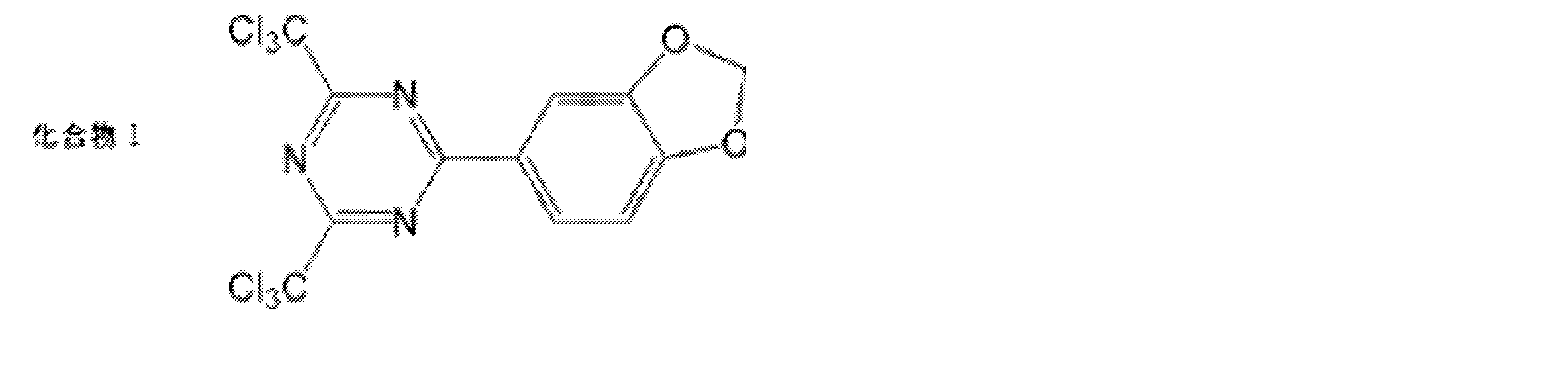
この平坦化膜用レジスト液を8インチシリコンウエハー上にスピンコートで塗布した。次いで、表面温度230℃で600秒、ホットプレート上で加熱処理し下塗りウエハーを得た。
-塗布膜の作製-
上記より得られた赤外線吸収性組成物を、前記下塗りシリコンウエハー上にスピンコートにより塗布した後、塗布膜面の表面温度100℃で120秒間、ホットプレートで加熱処理して乾燥させ、乾燥後の膜厚が約2.0μmの塗布膜を形成した。
次に、乾燥後の塗布膜に対して、2.0μmの正方ピクセルがそれぞれ基板上の10mm×10mmの領域にドット状に配列されたマスクパターンを介してi線ステッパー(キャノン(株)製のFPA-3000i5+)により、露光量1000mJ/cm2にて露光した。
上記で作製した赤外吸収パターンについて、パターン剥がれの発生数を、Applied Materials technology社製の欠陥検査装置「ComPLUS3」にて検査し、欠陥部分を検出し、これら欠陥部位より剥がれによる欠陥数を抽出した。抽出された剥がれ欠陥数に基づき、下記の評価基準により評価した。B以上が実用レベルである。なお、検査面積は、縦10mm×横10mmの領域を8インチウエハー上に200個作成し、これを評価した。
~評価基準~
A:剥がれ欠陥数が0個以上10個以下
B:剥がれ欠陥数が11個以上20個以下(実用上許容できる程度)
C:剥がれ欠陥数が21個以上
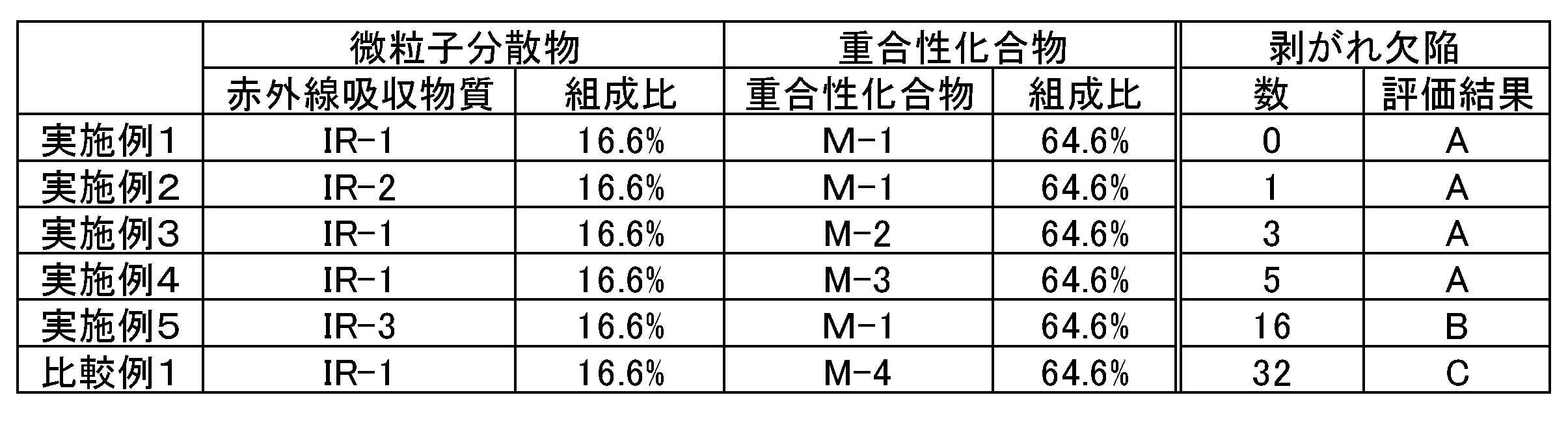
下塗りウエハー上に赤外線吸収組成物をスピンコーター(東京エレクトロン製、ACT-8)にて、膜厚が2.0μmの塗布膜となるように塗布した。ホットプレートを使用して、230℃で5分間の加熱を行い、塗布膜を硬化させた。
画像形成工程としては、硬化膜を除去したい領域を、i線ステッパー(キャノン(株)製、FPA3000i5+)にて350mJ/cm2のパターン露光を行い、110℃で1分間の加熱処理を実施した後、現像液「FHD-5」(富士フイルムエレクトロニクスマテリアルズ社製)で1分間の現像処理後、110℃で1分間のポストベーク処理を実施して、REDのフィルタアレイを形成すべき領域のフォトレジストを除去し、1.4μm×1.4μmサイズのアイランドパターンを形成した。
エッチング条件での赤外線吸収組成物のエッチングレートは322nm/minであった。したがって、エッチング工程において、除去したい場所において形成されていた赤外線吸収膜はすべて除去された。
以上の手順に従い、赤外吸収パターンを作製した。
作製した赤外吸収パターンについて、上述した<単独フォトリソグラフィー法によるパターン形成>と同様の方法でパターン剥がれを評価した。結果を下記表に示す。
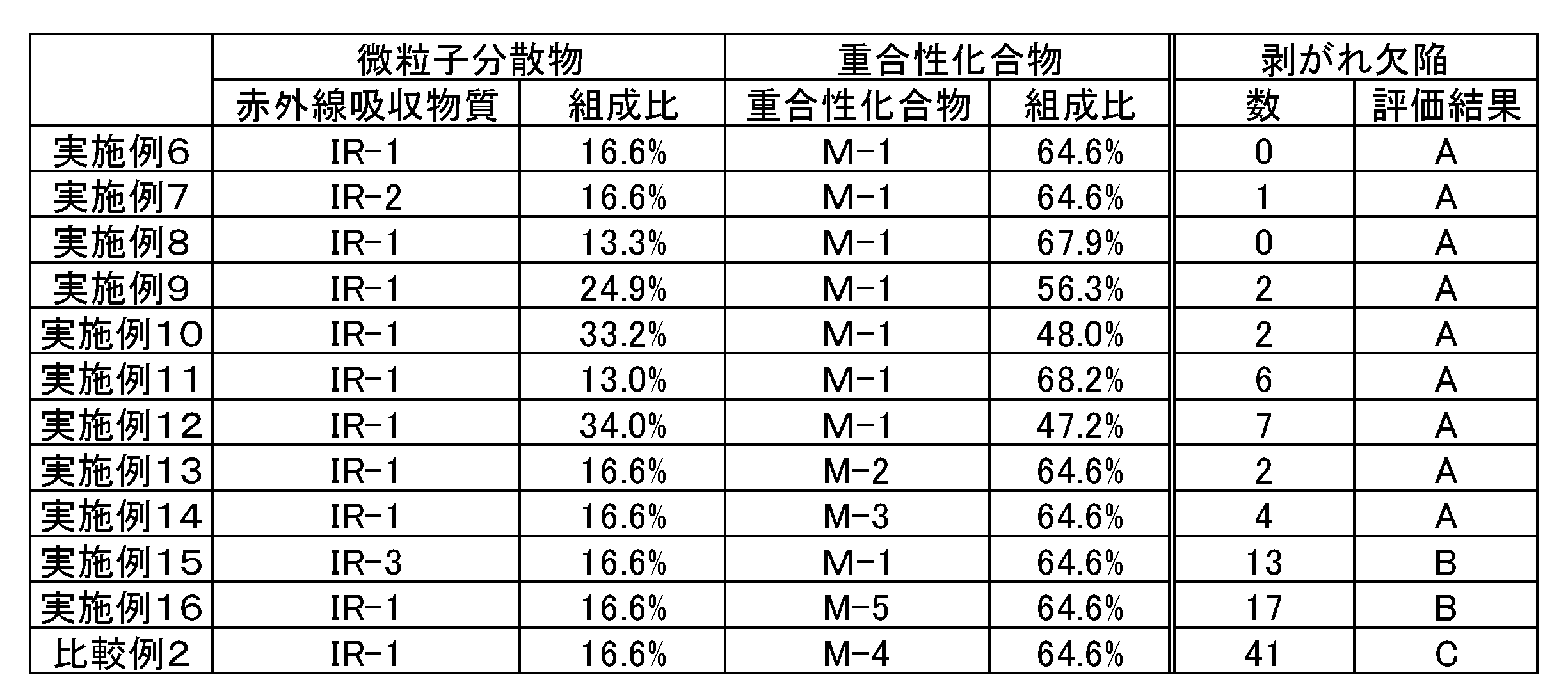
20 接着剤、22 絶縁膜、23 金属電極、24 ソルダレジスト層、26 内部電極、27 素子面電極、
30 ガラス基板、40 撮像レンズ、42 赤外線カットフィルタ、44 遮光兼電磁シールド、45 接着剤、46 平坦化層、
50 レンズホルダー、60 ハンダボール、70 回路基板、100 固体撮像素子基板
Claims (16)
- 赤外線吸収物質と、
下記式(1)で示される部分構造を有する重合性化合物を含有する、赤外線吸収性組成物。
式(1)

- 前記重合性化合物が、前記式(1)で示される部分構造を2つ以上有する、請求項1に記載の赤外線吸収性組成物。
- 前記重合性化合物が、重合性官能基を2つ以上有する、請求項1又は2に記載の赤外線吸収性組成物。
- 前記重合性化合物が、下記式(1-1)で表される部分構造を2つ以上有する重合性化合物である、請求項1に記載の赤外線吸収性組成物。
式(1-1)

- 前記重合性化合物が、下記式(1-2)で表される、請求項1に記載の赤外線吸収性組成物。
式(1-2)

式(1-1)

- 前記重合性化合物が、下記式(1-3)で表される、請求項1に記載の赤外線吸収性組成物。
式(1-3)

- 前記赤外線吸収物質が銅化合物及び/又はピロロピロール色素である、請求項1~6のいずれか1項に記載の赤外線吸収性組成物。
- 前記赤外線吸収物質がピロロピロール色素であり、前記重合性化合物が前記式(1-3)で表される、請求項6又は7に記載の赤外線吸収性組成物。
- 前記ピロロピロール色素が、下記式(I)で表される化合物である、請求項7又は8に記載の赤外線吸収性組成物。
式(I)

- 前記赤外線吸収物質の極大吸収波長が820~880nmである、請求項1~9のいずれか1項に記載の赤外線吸収性組成物。
- 溶剤をさらに含有する、請求項1~10のいずれか1項に記載の赤外線吸収性組成物。
- 赤外線吸収性組成物の固形分が5~50質量%である、請求項1~11のいずれか1項に記載の赤外線吸収性組成物。
- 請求項1~12のいずれか1項に記載の赤外線吸収性組成物を用いてなる赤外線カットフィルタ。
- 前記赤外線吸収性組成物を塗布して赤外吸収パターンを形成する工程を含み、前記赤外線吸収性組成物が水又は水系溶剤を含む、請求項13に記載の赤外線カットフィルタの製造方法。
- 固体撮像素子基板と、請求項13に記載の赤外線カットフィルタとを有するカメラモジュール。
- 固体撮像素子基板と、赤外線カットフィルタとを有するカメラモジュールの製造方法であって、請求項1~12のいずれか1項に記載の赤外線吸収性組成物を塗布する工程を含む、カメラモジュールの製造方法。
Priority Applications (3)
| Application Number | Priority Date | Filing Date | Title |
|---|---|---|---|
| CN201480017426.6A CN105051576A (zh) | 2013-03-27 | 2014-03-26 | 红外线吸收性组合物、红外线截止滤波器、照相机模块及照相机模块的制造方法 |
| KR1020157025912A KR20150121121A (ko) | 2013-03-27 | 2014-03-26 | 적외선 흡수성 조성물, 적외선 차단 필터, 카메라 모듈 및 카메라 모듈의 제조 방법 |
| US14/861,444 US20160011336A1 (en) | 2013-03-27 | 2015-09-22 | Infrared absorbing compositions, infrared cut filters, camera modules and processes for manufacturing camera modules |
Applications Claiming Priority (2)
| Application Number | Priority Date | Filing Date | Title |
|---|---|---|---|
| JP2013-066658 | 2013-03-27 | ||
| JP2013066658A JP2014191190A (ja) | 2013-03-27 | 2013-03-27 | 赤外線吸収性組成物、赤外線カットフィルタ、カメラモジュール及びカメラモジュールの製造方法 |
Related Child Applications (1)
| Application Number | Title | Priority Date | Filing Date |
|---|---|---|---|
| US14/861,444 Continuation US20160011336A1 (en) | 2013-03-27 | 2015-09-22 | Infrared absorbing compositions, infrared cut filters, camera modules and processes for manufacturing camera modules |
Publications (1)
| Publication Number | Publication Date |
|---|---|
| WO2014157304A1 true WO2014157304A1 (ja) | 2014-10-02 |
Family
ID=51624267
Family Applications (1)
| Application Number | Title | Priority Date | Filing Date |
|---|---|---|---|
| PCT/JP2014/058456 Ceased WO2014157304A1 (ja) | 2013-03-27 | 2014-03-26 | 赤外線吸収性組成物、赤外線カットフィルタ、カメラモジュール及びカメラモジュールの製造方法 |
Country Status (6)
| Country | Link |
|---|---|
| US (1) | US20160011336A1 (ja) |
| JP (1) | JP2014191190A (ja) |
| KR (1) | KR20150121121A (ja) |
| CN (1) | CN105051576A (ja) |
| TW (1) | TW201437303A (ja) |
| WO (1) | WO2014157304A1 (ja) |
Cited By (2)
| Publication number | Priority date | Publication date | Assignee | Title |
|---|---|---|---|---|
| CN104650610A (zh) * | 2015-01-28 | 2015-05-27 | 天津理工大学 | 一种不对称近红外bodipy荧光染料及其制备和应用 |
| WO2016136784A1 (ja) * | 2015-02-27 | 2016-09-01 | 富士フイルム株式会社 | 近赤外線吸収組成物、硬化膜、近赤外線吸収フィルタ、固体撮像素子および赤外線センサ |
Families Citing this family (6)
| Publication number | Priority date | Publication date | Assignee | Title |
|---|---|---|---|---|
| CN108291991B (zh) * | 2015-12-01 | 2020-10-20 | 伊士曼化工公司 | 电磁能吸收性光学产品及其制造方法 |
| TWI744286B (zh) | 2016-02-26 | 2021-11-01 | 日商富士軟片股份有限公司 | 感放射線性組成物、光學濾波器、積層體、圖案形成方法、固體攝像元件、圖像顯示裝置及紅外線感測器 |
| JP6698937B2 (ja) | 2017-03-02 | 2020-05-27 | 富士フイルム株式会社 | 組成物、膜、赤外線カットフィルタ、固体撮像素子、赤外線センサ、カメラモジュール、及び、新規な化合物 |
| JP6514840B2 (ja) * | 2017-03-22 | 2019-05-15 | 日本板硝子株式会社 | 紫外線及び赤外線吸収性組成物並びに紫外線及び赤外線吸収フィルタ |
| CN111032701A (zh) * | 2017-08-24 | 2020-04-17 | 富士胶片株式会社 | 固化性组合物、膜、近红外线截止滤光片、固体摄像元件、图像显示装置及红外线传感器 |
| JP7199835B2 (ja) * | 2018-05-25 | 2023-01-06 | キヤノン株式会社 | 波面センサ、波面計測装置、光学素子の製造方法、光学系の製造方法 |
Citations (6)
| Publication number | Priority date | Publication date | Assignee | Title |
|---|---|---|---|---|
| WO1998055885A1 (fr) * | 1997-06-03 | 1998-12-10 | Kureha Kagaku Kogyo Kabushiki Kaisha | Materiau optique constitue de resine synthetique, filtre optique, et dispositif, verre de lunette, filtre d'absorption de rayons thermiques et fibre optique pourvus dudit filtre optique |
| WO1999026951A1 (fr) * | 1997-11-21 | 1999-06-03 | Kureha Kagaku Kogyo Kabushiki Kaisha | Compose de phosphate et de cuivre, composition contenant ce compose et produit de mise en application |
| JP2005263988A (ja) * | 2004-03-18 | 2005-09-29 | Fuji Photo Film Co Ltd | 重合性組成物及びそれを用いた画像記録材料 |
| JP2007269818A (ja) * | 2004-04-07 | 2007-10-18 | Kureha Corp | 重合性組成物、重合体及び積層体 |
| JP2010106248A (ja) * | 2008-09-30 | 2010-05-13 | Fujifilm Corp | 近赤外線吸収組成物、近赤外線吸収塗布物、及び樹脂混練物 |
| JP2011068731A (ja) * | 2009-09-24 | 2011-04-07 | Fujifilm Corp | 近赤外吸収性色素を含有する硬化性組成物、インク用組成物および近赤外線吸収フィルタの製造方法 |
Family Cites Families (5)
| Publication number | Priority date | Publication date | Assignee | Title |
|---|---|---|---|---|
| JP4948022B2 (ja) * | 2006-04-13 | 2012-06-06 | 株式会社Adeka | 光学フィルター |
| US8545995B2 (en) * | 2009-12-14 | 2013-10-01 | Lawrence Livermore National Security, Llc. | Systems having optical absorption layer for mid and long wave infrared and methods for making the same |
| JP5486536B2 (ja) * | 2011-03-30 | 2014-05-07 | 富士フイルム株式会社 | 重合性化合物 |
| JP5764416B2 (ja) * | 2011-07-08 | 2015-08-19 | 富士フイルム株式会社 | インク組成物及び画像形成方法 |
| JP2014065876A (ja) * | 2012-09-27 | 2014-04-17 | Fujifilm Corp | インクセットおよびインクジェット記録方法 |
-
2013
- 2013-03-27 JP JP2013066658A patent/JP2014191190A/ja not_active Abandoned
-
2014
- 2014-03-26 CN CN201480017426.6A patent/CN105051576A/zh active Pending
- 2014-03-26 WO PCT/JP2014/058456 patent/WO2014157304A1/ja not_active Ceased
- 2014-03-26 KR KR1020157025912A patent/KR20150121121A/ko not_active Withdrawn
- 2014-03-27 TW TW103111359A patent/TW201437303A/zh unknown
-
2015
- 2015-09-22 US US14/861,444 patent/US20160011336A1/en not_active Abandoned
Patent Citations (6)
| Publication number | Priority date | Publication date | Assignee | Title |
|---|---|---|---|---|
| WO1998055885A1 (fr) * | 1997-06-03 | 1998-12-10 | Kureha Kagaku Kogyo Kabushiki Kaisha | Materiau optique constitue de resine synthetique, filtre optique, et dispositif, verre de lunette, filtre d'absorption de rayons thermiques et fibre optique pourvus dudit filtre optique |
| WO1999026951A1 (fr) * | 1997-11-21 | 1999-06-03 | Kureha Kagaku Kogyo Kabushiki Kaisha | Compose de phosphate et de cuivre, composition contenant ce compose et produit de mise en application |
| JP2005263988A (ja) * | 2004-03-18 | 2005-09-29 | Fuji Photo Film Co Ltd | 重合性組成物及びそれを用いた画像記録材料 |
| JP2007269818A (ja) * | 2004-04-07 | 2007-10-18 | Kureha Corp | 重合性組成物、重合体及び積層体 |
| JP2010106248A (ja) * | 2008-09-30 | 2010-05-13 | Fujifilm Corp | 近赤外線吸収組成物、近赤外線吸収塗布物、及び樹脂混練物 |
| JP2011068731A (ja) * | 2009-09-24 | 2011-04-07 | Fujifilm Corp | 近赤外吸収性色素を含有する硬化性組成物、インク用組成物および近赤外線吸収フィルタの製造方法 |
Cited By (6)
| Publication number | Priority date | Publication date | Assignee | Title |
|---|---|---|---|---|
| CN104650610A (zh) * | 2015-01-28 | 2015-05-27 | 天津理工大学 | 一种不对称近红外bodipy荧光染料及其制备和应用 |
| WO2016136784A1 (ja) * | 2015-02-27 | 2016-09-01 | 富士フイルム株式会社 | 近赤外線吸収組成物、硬化膜、近赤外線吸収フィルタ、固体撮像素子および赤外線センサ |
| CN107250314A (zh) * | 2015-02-27 | 2017-10-13 | 富士胶片株式会社 | 近红外线吸收组合物、固化膜、近红外线吸收滤波器、固体成像元件及红外线传感器 |
| JPWO2016136784A1 (ja) * | 2015-02-27 | 2018-01-25 | 富士フイルム株式会社 | 近赤外線吸収組成物、硬化膜、近赤外線吸収フィルタ、固体撮像素子および赤外線センサ |
| CN107250314B (zh) * | 2015-02-27 | 2019-11-12 | 富士胶片株式会社 | 近红外线吸收组合物、固化膜、近红外线吸收滤波器、固体成像元件及红外线传感器 |
| US10585221B2 (en) | 2015-02-27 | 2020-03-10 | Fujifilm Corporation | Near-infrared absorption composition, cured film, near-infrared absorption filter, solid-state imaging device, and infrared sensor |
Also Published As
| Publication number | Publication date |
|---|---|
| CN105051576A (zh) | 2015-11-11 |
| US20160011336A1 (en) | 2016-01-14 |
| JP2014191190A (ja) | 2014-10-06 |
| KR20150121121A (ko) | 2015-10-28 |
| TW201437303A (zh) | 2014-10-01 |
Similar Documents
| Publication | Publication Date | Title |
|---|---|---|
| CN108957953B (zh) | 硬化性组合物、硬化膜、近红外线截止滤波器、照相机模块及这些的制造方法 | |
| WO2014157304A1 (ja) | 赤外線吸収性組成物、赤外線カットフィルタ、カメラモジュール及びカメラモジュールの製造方法 | |
| JP6162165B2 (ja) | 着色組成物、硬化膜、カラーフィルタ、カラーフィルタの製造方法、固体撮像素子、画像表示装置、有機エレクトロルミネッセンス素子、色素および色素の製造方法 | |
| CN105940058B (zh) | 着色组合物、固化膜、彩色滤光片、彩色滤光片的制造方法、固体成像元件及图像显示装置 | |
| JP6336092B2 (ja) | 組成物、硬化膜、パターン形成方法、カラーフィルタ、カラーフィルタの製造方法、固体撮像素子および画像表示装置 | |
| JP6106638B2 (ja) | 着色感光性樹脂組成物、硬化膜、カラーフィルタ、カラーフィルタの製造方法、固体撮像素子および画像表示装置 | |
| TW201803962A (zh) | 組成物、膜、近紅外線截止濾波器、積層體、圖案形成方法、固體攝像元件、圖像顯示裝置、紅外線感測器及濾色器 | |
| KR102003241B1 (ko) | 안료 분산액, 안료 분산액의 제조 방법, 착색 조성물, 경화막, 컬러 필터, 컬러 필터의 제조 방법, 고체 촬상 소자, 화상 표시 장치 및 조성물 | |
| TWI759432B (zh) | 組成物、紅外線吸收膜、紅外線截止濾波器、固體攝像元件、紅外線感測器、照相機模組以及新穎的化合物 | |
| JP6612965B2 (ja) | 組成物、硬化性組成物、硬化膜、近赤外線カットフィルタ、赤外線透過フィルタ、固体撮像素子、赤外線センサおよびカメラモジュール | |
| TWI707922B (zh) | 著色組成物、彩色濾光片、圖案形成方法、固體攝像元件、圖像顯示裝置及色素多量體 | |
| KR20120080123A (ko) | 착색 감광성 조성물, 컬러필터의 제조방법, 컬러필터, 액정표시장치, 및 유기 el 표시장치 | |
| KR20110123668A (ko) | 착색 감광성 조성물, 컬러 필터의 제조 방법, 컬러 필터 및 액정 표시 장치 | |
| CN108603959A (zh) | 膜、膜的制造方法、滤光器、层叠体、固体摄像元件、图像显示装置及红外线传感器 | |
| JP6907312B2 (ja) | 組成物、膜、レンズ、固体撮像素子、化合物 | |
| JP6279745B2 (ja) | 着色組成物、カラーフィルタ、パターン形成方法、カラーフィルタの製造方法、固体撮像素子、画像表示装置および色素多量体の製造方法 | |
| JP6422264B2 (ja) | 組成物、硬化膜、近赤外線吸収フィルタ、固体撮像素子、赤外線センサ、色素 | |
| TWI808091B (zh) | 組成物及其製造方法、膜、濾光器、積層體、固體攝像元件、圖像顯示裝置、以及紅外線感測器 | |
| JP6400654B2 (ja) | 硬化性組成物、硬化膜、近赤外線カットフィルタ、カメラモジュールおよびカメラモジュールの製造方法 | |
| JPWO2019077913A1 (ja) | 着色組成物、膜、カラーフィルタ、固体撮像素子および画像表示装置 |
Legal Events
| Date | Code | Title | Description |
|---|---|---|---|
| WWE | Wipo information: entry into national phase |
Ref document number: 201480017426.6 Country of ref document: CN |
|
| 121 | Ep: the epo has been informed by wipo that ep was designated in this application |
Ref document number: 14774041 Country of ref document: EP Kind code of ref document: A1 |
|
| ENP | Entry into the national phase |
Ref document number: 20157025912 Country of ref document: KR Kind code of ref document: A |
|
| NENP | Non-entry into the national phase |
Ref country code: DE |
|
| 122 | Ep: pct application non-entry in european phase |
Ref document number: 14774041 Country of ref document: EP Kind code of ref document: A1 |