WO2014148189A1 - 酸化亜鉛系焼結体とその製造方法およびスパッタリングターゲットと透明導電膜 - Google Patents
酸化亜鉛系焼結体とその製造方法およびスパッタリングターゲットと透明導電膜 Download PDFInfo
- Publication number
- WO2014148189A1 WO2014148189A1 PCT/JP2014/054005 JP2014054005W WO2014148189A1 WO 2014148189 A1 WO2014148189 A1 WO 2014148189A1 JP 2014054005 W JP2014054005 W JP 2014054005W WO 2014148189 A1 WO2014148189 A1 WO 2014148189A1
- Authority
- WO
- WIPO (PCT)
- Prior art keywords
- zinc oxide
- sintered body
- based sintered
- oxide
- mass
- Prior art date
- Legal status (The legal status is an assumption and is not a legal conclusion. Google has not performed a legal analysis and makes no representation as to the accuracy of the status listed.)
- Ceased
Links
Images

Classifications
-
- C—CHEMISTRY; METALLURGY
- C04—CEMENTS; CONCRETE; ARTIFICIAL STONE; CERAMICS; REFRACTORIES
- C04B—LIME, MAGNESIA; SLAG; CEMENTS; COMPOSITIONS THEREOF, e.g. MORTARS, CONCRETE OR LIKE BUILDING MATERIALS; ARTIFICIAL STONE; CERAMICS; REFRACTORIES; TREATMENT OF NATURAL STONE
- C04B35/00—Shaped ceramic products characterised by their composition; Ceramics compositions; Processing powders of inorganic compounds preparatory to the manufacturing of ceramic products
- C04B35/01—Shaped ceramic products characterised by their composition; Ceramics compositions; Processing powders of inorganic compounds preparatory to the manufacturing of ceramic products based on oxide ceramics
- C04B35/453—Shaped ceramic products characterised by their composition; Ceramics compositions; Processing powders of inorganic compounds preparatory to the manufacturing of ceramic products based on oxide ceramics based on zinc, tin, or bismuth oxides or solid solutions thereof with other oxides, e.g. zincates, stannates or bismuthates
-
- C—CHEMISTRY; METALLURGY
- C04—CEMENTS; CONCRETE; ARTIFICIAL STONE; CERAMICS; REFRACTORIES
- C04B—LIME, MAGNESIA; SLAG; CEMENTS; COMPOSITIONS THEREOF, e.g. MORTARS, CONCRETE OR LIKE BUILDING MATERIALS; ARTIFICIAL STONE; CERAMICS; REFRACTORIES; TREATMENT OF NATURAL STONE
- C04B35/00—Shaped ceramic products characterised by their composition; Ceramics compositions; Processing powders of inorganic compounds preparatory to the manufacturing of ceramic products
- C04B35/622—Forming processes; Processing powders of inorganic compounds preparatory to the manufacturing of ceramic products
- C04B35/626—Preparing or treating the powders individually or as batches ; preparing or treating macroscopic reinforcing agents for ceramic products, e.g. fibres; mechanical aspects section B
- C04B35/62605—Treating the starting powders individually or as mixtures
- C04B35/62645—Thermal treatment of powders or mixtures thereof other than sintering
- C04B35/62655—Drying, e.g. freeze-drying, spray-drying, microwave or supercritical drying
-
- C—CHEMISTRY; METALLURGY
- C23—COATING METALLIC MATERIAL; COATING MATERIAL WITH METALLIC MATERIAL; CHEMICAL SURFACE TREATMENT; DIFFUSION TREATMENT OF METALLIC MATERIAL; COATING BY VACUUM EVAPORATION, BY SPUTTERING, BY ION IMPLANTATION OR BY CHEMICAL VAPOUR DEPOSITION, IN GENERAL; INHIBITING CORROSION OF METALLIC MATERIAL OR INCRUSTATION IN GENERAL
- C23C—COATING METALLIC MATERIAL; COATING MATERIAL WITH METALLIC MATERIAL; SURFACE TREATMENT OF METALLIC MATERIAL BY DIFFUSION INTO THE SURFACE, BY CHEMICAL CONVERSION OR SUBSTITUTION; COATING BY VACUUM EVAPORATION, BY SPUTTERING, BY ION IMPLANTATION OR BY CHEMICAL VAPOUR DEPOSITION, IN GENERAL
- C23C14/00—Coating by vacuum evaporation, by sputtering or by ion implantation of the coating forming material
- C23C14/06—Coating by vacuum evaporation, by sputtering or by ion implantation of the coating forming material characterised by the coating material
- C23C14/08—Oxides
- C23C14/086—Oxides of zinc, germanium, cadmium, indium, tin, thallium or bismuth
-
- C—CHEMISTRY; METALLURGY
- C23—COATING METALLIC MATERIAL; COATING MATERIAL WITH METALLIC MATERIAL; CHEMICAL SURFACE TREATMENT; DIFFUSION TREATMENT OF METALLIC MATERIAL; COATING BY VACUUM EVAPORATION, BY SPUTTERING, BY ION IMPLANTATION OR BY CHEMICAL VAPOUR DEPOSITION, IN GENERAL; INHIBITING CORROSION OF METALLIC MATERIAL OR INCRUSTATION IN GENERAL
- C23C—COATING METALLIC MATERIAL; COATING MATERIAL WITH METALLIC MATERIAL; SURFACE TREATMENT OF METALLIC MATERIAL BY DIFFUSION INTO THE SURFACE, BY CHEMICAL CONVERSION OR SUBSTITUTION; COATING BY VACUUM EVAPORATION, BY SPUTTERING, BY ION IMPLANTATION OR BY CHEMICAL VAPOUR DEPOSITION, IN GENERAL
- C23C14/00—Coating by vacuum evaporation, by sputtering or by ion implantation of the coating forming material
- C23C14/22—Coating by vacuum evaporation, by sputtering or by ion implantation of the coating forming material characterised by the process of coating
- C23C14/34—Sputtering
- C23C14/3407—Cathode assembly for sputtering apparatus, e.g. Target
- C23C14/3414—Metallurgical or chemical aspects of target preparation, e.g. casting, powder metallurgy
-
- C—CHEMISTRY; METALLURGY
- C04—CEMENTS; CONCRETE; ARTIFICIAL STONE; CERAMICS; REFRACTORIES
- C04B—LIME, MAGNESIA; SLAG; CEMENTS; COMPOSITIONS THEREOF, e.g. MORTARS, CONCRETE OR LIKE BUILDING MATERIALS; ARTIFICIAL STONE; CERAMICS; REFRACTORIES; TREATMENT OF NATURAL STONE
- C04B2235/00—Aspects relating to ceramic starting mixtures or sintered ceramic products
- C04B2235/02—Composition of constituents of the starting material or of secondary phases of the final product
- C04B2235/30—Constituents and secondary phases not being of a fibrous nature
- C04B2235/32—Metal oxides, mixed metal oxides, or oxide-forming salts thereof, e.g. carbonates, nitrates, (oxy)hydroxides, chlorides
- C04B2235/3205—Alkaline earth oxides or oxide forming salts thereof, e.g. beryllium oxide
- C04B2235/3206—Magnesium oxides or oxide-forming salts thereof
-
- C—CHEMISTRY; METALLURGY
- C04—CEMENTS; CONCRETE; ARTIFICIAL STONE; CERAMICS; REFRACTORIES
- C04B—LIME, MAGNESIA; SLAG; CEMENTS; COMPOSITIONS THEREOF, e.g. MORTARS, CONCRETE OR LIKE BUILDING MATERIALS; ARTIFICIAL STONE; CERAMICS; REFRACTORIES; TREATMENT OF NATURAL STONE
- C04B2235/00—Aspects relating to ceramic starting mixtures or sintered ceramic products
- C04B2235/02—Composition of constituents of the starting material or of secondary phases of the final product
- C04B2235/30—Constituents and secondary phases not being of a fibrous nature
- C04B2235/32—Metal oxides, mixed metal oxides, or oxide-forming salts thereof, e.g. carbonates, nitrates, (oxy)hydroxides, chlorides
- C04B2235/3217—Aluminum oxide or oxide forming salts thereof, e.g. bauxite, alpha-alumina
-
- C—CHEMISTRY; METALLURGY
- C04—CEMENTS; CONCRETE; ARTIFICIAL STONE; CERAMICS; REFRACTORIES
- C04B—LIME, MAGNESIA; SLAG; CEMENTS; COMPOSITIONS THEREOF, e.g. MORTARS, CONCRETE OR LIKE BUILDING MATERIALS; ARTIFICIAL STONE; CERAMICS; REFRACTORIES; TREATMENT OF NATURAL STONE
- C04B2235/00—Aspects relating to ceramic starting mixtures or sintered ceramic products
- C04B2235/02—Composition of constituents of the starting material or of secondary phases of the final product
- C04B2235/30—Constituents and secondary phases not being of a fibrous nature
- C04B2235/32—Metal oxides, mixed metal oxides, or oxide-forming salts thereof, e.g. carbonates, nitrates, (oxy)hydroxides, chlorides
- C04B2235/3231—Refractory metal oxides, their mixed metal oxides, or oxide-forming salts thereof
- C04B2235/3232—Titanium oxides or titanates, e.g. rutile or anatase
-
- C—CHEMISTRY; METALLURGY
- C04—CEMENTS; CONCRETE; ARTIFICIAL STONE; CERAMICS; REFRACTORIES
- C04B—LIME, MAGNESIA; SLAG; CEMENTS; COMPOSITIONS THEREOF, e.g. MORTARS, CONCRETE OR LIKE BUILDING MATERIALS; ARTIFICIAL STONE; CERAMICS; REFRACTORIES; TREATMENT OF NATURAL STONE
- C04B2235/00—Aspects relating to ceramic starting mixtures or sintered ceramic products
- C04B2235/02—Composition of constituents of the starting material or of secondary phases of the final product
- C04B2235/30—Constituents and secondary phases not being of a fibrous nature
- C04B2235/32—Metal oxides, mixed metal oxides, or oxide-forming salts thereof, e.g. carbonates, nitrates, (oxy)hydroxides, chlorides
- C04B2235/3286—Gallium oxides, gallates, indium oxides, indates, thallium oxides, thallates or oxide forming salts thereof, e.g. zinc gallate
-
- C—CHEMISTRY; METALLURGY
- C04—CEMENTS; CONCRETE; ARTIFICIAL STONE; CERAMICS; REFRACTORIES
- C04B—LIME, MAGNESIA; SLAG; CEMENTS; COMPOSITIONS THEREOF, e.g. MORTARS, CONCRETE OR LIKE BUILDING MATERIALS; ARTIFICIAL STONE; CERAMICS; REFRACTORIES; TREATMENT OF NATURAL STONE
- C04B2235/00—Aspects relating to ceramic starting mixtures or sintered ceramic products
- C04B2235/02—Composition of constituents of the starting material or of secondary phases of the final product
- C04B2235/30—Constituents and secondary phases not being of a fibrous nature
- C04B2235/32—Metal oxides, mixed metal oxides, or oxide-forming salts thereof, e.g. carbonates, nitrates, (oxy)hydroxides, chlorides
- C04B2235/3293—Tin oxides, stannates or oxide forming salts thereof, e.g. indium tin oxide [ITO]
-
- C—CHEMISTRY; METALLURGY
- C04—CEMENTS; CONCRETE; ARTIFICIAL STONE; CERAMICS; REFRACTORIES
- C04B—LIME, MAGNESIA; SLAG; CEMENTS; COMPOSITIONS THEREOF, e.g. MORTARS, CONCRETE OR LIKE BUILDING MATERIALS; ARTIFICIAL STONE; CERAMICS; REFRACTORIES; TREATMENT OF NATURAL STONE
- C04B2235/00—Aspects relating to ceramic starting mixtures or sintered ceramic products
- C04B2235/02—Composition of constituents of the starting material or of secondary phases of the final product
- C04B2235/30—Constituents and secondary phases not being of a fibrous nature
- C04B2235/42—Non metallic elements added as constituents or additives, e.g. sulfur, phosphor, selenium or tellurium
- C04B2235/428—Silicon
-
- C—CHEMISTRY; METALLURGY
- C04—CEMENTS; CONCRETE; ARTIFICIAL STONE; CERAMICS; REFRACTORIES
- C04B—LIME, MAGNESIA; SLAG; CEMENTS; COMPOSITIONS THEREOF, e.g. MORTARS, CONCRETE OR LIKE BUILDING MATERIALS; ARTIFICIAL STONE; CERAMICS; REFRACTORIES; TREATMENT OF NATURAL STONE
- C04B2235/00—Aspects relating to ceramic starting mixtures or sintered ceramic products
- C04B2235/02—Composition of constituents of the starting material or of secondary phases of the final product
- C04B2235/30—Constituents and secondary phases not being of a fibrous nature
- C04B2235/48—Organic compounds becoming part of a ceramic after heat treatment, e.g. carbonising phenol resins
- C04B2235/483—Si-containing organic compounds, e.g. silicone resins, (poly)silanes, (poly)siloxanes or (poly)silazanes
-
- C—CHEMISTRY; METALLURGY
- C04—CEMENTS; CONCRETE; ARTIFICIAL STONE; CERAMICS; REFRACTORIES
- C04B—LIME, MAGNESIA; SLAG; CEMENTS; COMPOSITIONS THEREOF, e.g. MORTARS, CONCRETE OR LIKE BUILDING MATERIALS; ARTIFICIAL STONE; CERAMICS; REFRACTORIES; TREATMENT OF NATURAL STONE
- C04B2235/00—Aspects relating to ceramic starting mixtures or sintered ceramic products
- C04B2235/02—Composition of constituents of the starting material or of secondary phases of the final product
- C04B2235/50—Constituents or additives of the starting mixture chosen for their shape or used because of their shape or their physical appearance
- C04B2235/54—Particle size related information
- C04B2235/5418—Particle size related information expressed by the size of the particles or aggregates thereof
- C04B2235/5445—Particle size related information expressed by the size of the particles or aggregates thereof submicron sized, i.e. from 0,1 to 1 micron
-
- C—CHEMISTRY; METALLURGY
- C04—CEMENTS; CONCRETE; ARTIFICIAL STONE; CERAMICS; REFRACTORIES
- C04B—LIME, MAGNESIA; SLAG; CEMENTS; COMPOSITIONS THEREOF, e.g. MORTARS, CONCRETE OR LIKE BUILDING MATERIALS; ARTIFICIAL STONE; CERAMICS; REFRACTORIES; TREATMENT OF NATURAL STONE
- C04B2235/00—Aspects relating to ceramic starting mixtures or sintered ceramic products
- C04B2235/65—Aspects relating to heat treatments of ceramic bodies such as green ceramics or pre-sintered ceramics, e.g. burning, sintering or melting processes
- C04B2235/656—Aspects relating to heat treatments of ceramic bodies such as green ceramics or pre-sintered ceramics, e.g. burning, sintering or melting processes characterised by specific heating conditions during heat treatment
- C04B2235/6567—Treatment time
-
- C—CHEMISTRY; METALLURGY
- C04—CEMENTS; CONCRETE; ARTIFICIAL STONE; CERAMICS; REFRACTORIES
- C04B—LIME, MAGNESIA; SLAG; CEMENTS; COMPOSITIONS THEREOF, e.g. MORTARS, CONCRETE OR LIKE BUILDING MATERIALS; ARTIFICIAL STONE; CERAMICS; REFRACTORIES; TREATMENT OF NATURAL STONE
- C04B2235/00—Aspects relating to ceramic starting mixtures or sintered ceramic products
- C04B2235/70—Aspects relating to sintered or melt-casted ceramic products
- C04B2235/72—Products characterised by the absence or the low content of specific components, e.g. alkali metal free alumina ceramics
- C04B2235/728—Silicon content
-
- C—CHEMISTRY; METALLURGY
- C04—CEMENTS; CONCRETE; ARTIFICIAL STONE; CERAMICS; REFRACTORIES
- C04B—LIME, MAGNESIA; SLAG; CEMENTS; COMPOSITIONS THEREOF, e.g. MORTARS, CONCRETE OR LIKE BUILDING MATERIALS; ARTIFICIAL STONE; CERAMICS; REFRACTORIES; TREATMENT OF NATURAL STONE
- C04B2235/00—Aspects relating to ceramic starting mixtures or sintered ceramic products
- C04B2235/70—Aspects relating to sintered or melt-casted ceramic products
- C04B2235/74—Physical characteristics
- C04B2235/78—Grain sizes and shapes, product microstructures, e.g. acicular grains, equiaxed grains, platelet-structures
- C04B2235/786—Micrometer sized grains, i.e. from 1 to 100 micron
-
- C—CHEMISTRY; METALLURGY
- C04—CEMENTS; CONCRETE; ARTIFICIAL STONE; CERAMICS; REFRACTORIES
- C04B—LIME, MAGNESIA; SLAG; CEMENTS; COMPOSITIONS THEREOF, e.g. MORTARS, CONCRETE OR LIKE BUILDING MATERIALS; ARTIFICIAL STONE; CERAMICS; REFRACTORIES; TREATMENT OF NATURAL STONE
- C04B2235/00—Aspects relating to ceramic starting mixtures or sintered ceramic products
- C04B2235/70—Aspects relating to sintered or melt-casted ceramic products
- C04B2235/80—Phases present in the sintered or melt-cast ceramic products other than the main phase
Definitions
- the present invention relates to a zinc oxide-based sintered body used for a sputtering target and a method for manufacturing the same, and in particular, abnormal discharge (arcing) occurring during sputtering film formation is suppressed, enabling continuous film formation for a long time.
- the present invention relates to a zinc oxide-based sintered body, a manufacturing method thereof, a sputtering target obtained by processing a zinc oxide-based sintered body, and a high-resistance transparent conductive film manufactured by a sputtering film forming method.
- Transparent conductive films having high conductivity and high transmittance in the visible light region are used for solar cells, liquid crystal display elements, surface elements such as organic electroluminescence and inorganic electroluminescence, and electrodes for touch panels. In addition, they are also used as various antifogging transparent heating elements such as automobile windows, architectural heat ray reflective films, antistatic films, and refrigerated showcases.
- the transparent conductive film for example, a tin oxide (SnO 2 ) -based thin film, a zinc oxide (ZnO) -based thin film, an indium oxide (In 2 O 3 ) -based thin film, and the like are known.
- tin oxide system those containing antimony as a dopant (ATO) and those containing fluorine as a dopant (FTO) are often used.
- ATO antimony as a dopant
- FTO fluorine as a dopant
- zinc oxide systems those containing aluminum as a dopant (AZO) and those containing gallium as a dopant (GZO) are often used.
- the most transparently used transparent conductive film is an indium oxide type.
- an indium oxide film containing tin as a dopant that is, an In—Sn—O-based film is called an ITO (Indium-tin-oxide) film, and is particularly widely used because a low-resistance transparent conductive film can be easily obtained. Yes.
- a sputtering method is often used as a method for producing the transparent conductive film.
- the sputtering method is an effective method when film formation of a material having a low vapor pressure or precise film thickness control is required, and is widely used industrially because the operation is very simple.
- a sputtering target is used as a raw material for the thin film.
- a substrate is used as an anode
- a sputtering target is used as a cathode
- glow discharge is generated between them to generate argon plasma
- argon cations in the plasma are converted into cathodes.
- the target component particles which are made to collide with the sputtering target and are repelled by this are deposited on the substrate to form a thin film.
- the above-described transparent conductive film has been studied to be manufactured using a vapor deposition method such as an ion plating method.
- indium oxide-based materials such as ITO are widely used industrially, but rare metal indium is expensive, and it contains components having toxicity that adversely affects the environment and human body such as indium element. Therefore, in recent years, a non-indium transparent conductive film material has been demanded.
- non-indium materials zinc oxide materials such as AZO and GZO described above and tin oxide materials such as FTO and ATO are known.
- zinc oxide-based materials are abundantly embedded as resources and are not only low-cost materials but also attracting attention as materials that are friendly to the environment and the human body.
- zinc oxide-based materials are attracting attention as materials exhibiting properties comparable to ITO.
- Patent Document 1 2 to 7 mass% of aluminum is added to zinc oxide, and the sintering conditions are adjusted to reduce the resistivity of the zinc oxide-based sintered body. A method for suppressing the occurrence of arcing is proposed.
- Patent Document 2 aluminum and gallium are added to zinc oxide, and the contents thereof are optimized to optimize the type and composition of the crystal phase generated during firing, particularly the composition of the spinel crystal phase.
- a method has been proposed in which the generation of particles is prevented by controlling the generation of the arcing.
- the buffer layer provided between the light absorption layer (power generation layer) and the transparent electrode (low-resistance transparent conductive film) of the CIGS solar cell is required to be composed of a high-resistance transparent conductive film. It is not preferable to use the zinc oxide-based sintered body having a low resistivity described in Patent Documents 1 and 2.
- the average crystal grain size of a zinc oxide-based sintered body which is usually several ⁇ m, is not relatively added without adding a metal element such as aluminum or gallium that lowers the resistivity as a dopant.
- a method of suppressing abnormal discharge (arcing) by controlling to a large value of 15 to 100 ⁇ m is proposed. Specifically, zinc oxide powder having an average primary particle size of 0.1 to 3 ⁇ m is used, the density of the molded body before firing is set to 3.0 g / cm 3 or more, and the molded body is fired at 1200 to 1500 ° C. As a result, a zinc oxide-based sintered body having an average crystal grain size of 15 to 100 ⁇ m and inevitable impurities of 0.1% by mass is obtained.
- Patent Document 3 by setting the crystal grain size of the zinc oxide-based sintered body to a relatively large value of 15 to 100 ⁇ m, the area of the grain boundary that becomes a conductive barrier is reduced, and accordingly, the conductivity is reduced. It is described that the occurrence of the abnormal discharge (arcing) is suppressed by improving.
- JP 2010-270004 A Japanese Patent No. 4231967 JP 2011-111642 A
- the present invention has been made paying attention to such problems, and the problem is that when a high-resistance transparent conductive film applied to, for example, a buffer layer of a CIGS solar cell is manufactured by a sputtering method.
- the present invention provides a zinc oxide-based sintered body that suppresses the occurrence of abnormal discharge (arcing) and enables continuous film formation for a long time and a manufacturing method thereof, and is obtained by processing the zinc oxide-based sintered body together.
- Another object of the present invention is to provide a sputtering target and a high-resistance transparent conductive film manufactured by a sputtering film forming method using the target.
- the present inventor has continued earnest research to solve the above problems, and as a result, at least one additive element selected from the group consisting of Mg, Al, Ti, Ga, In, and Sn is reduced to 0 in terms of oxide.
- the crystal grain boundaries in the sintered body can be obtained by adding 0.01 to 1% by mass and containing Si element of 20 to 200 ppm by mass and optimizing the manufacturing method of the zinc oxide sintered body. Suppression of crystal grains containing Si on the surface of the sintered body can be suppressed, the crystal grain size in the sintered body can be increased without changing the resistivity of the sintered body, and coarse pores can also be reduced. .
- the first invention is In the zinc oxide-based sintered body mainly composed of zinc oxide, Si element containing at least one additive element selected from the group consisting of Mg, Al, Ti, Ga, In and Sn in an amount of 0.01 to 1% by mass in terms of oxide and having a mass of 20 mass ppm to 200 mass ppm
- the crystal grain size of zinc oxide in the sintered body is 25 to 100 ⁇ m
- the Si element is present as crystal grains of 5 ⁇ m or less containing Si in the sintered body, and The crystal grains containing Si are not precipitated at the crystal grain boundaries of zinc oxide.
- the second invention At least one oxide powder selected from the group consisting of zinc oxide powder, Mg, Al, Ti, Ga, In, and Sn, and a silicon compound are mixed with pure water, an organic binder, and a dispersant to form a slurry.
- a silicon compound having a siloxane structure and liquid at room temperature is applied, and the firing temperature of the molded body is set to a range of 900 to 1400 ° C.
- the third invention In sputtering target, It is obtained by processing the zinc oxide-based sintered body according to the first invention,
- the fourth invention is In a transparent conductive film having a high resistance, The film is formed on the substrate by a sputtering method using the sputtering target according to the third invention.
- the zinc oxide-based sintered body according to the present invention mainly composed of zinc oxide
- the content of an additive element at least one selected from the group consisting of Mg, Al, Ti, Ga, In, and Sn
- an additive element at least one selected from the group consisting of Mg, Al, Ti, Ga, In, and Sn
- it is set in a very small range of 01 to 1% by mass, it has an effect that can be used as a sputtering target for a high resistance transparent conductive film such as a buffer layer of a CIGS solar cell.
- the crystal grain size of zinc oxide in the sintered body is set to a large value of 25 to 100 ⁇ m.
- the Si element exists as crystal grains of 5 ⁇ m or less containing Si in the sintered body and the above-mentioned crystal grains containing Si are not precipitated at the crystal grain boundary of zinc oxide in the sintered body.
- abnormal discharge which has been a problem with the ZnO target of Patent Document 3 also occurs when sputtering is performed by increasing the DC power density in order to increase production efficiency. ) Will not occur.
- the zinc oxide-based sintered body according to the present invention containing zinc oxide as a main component contains at least one additive element selected from the group consisting of Mg, Al, Ti, Ga, In and Sn.
- the sintered body contains 0.01 to 1% by mass in terms of oxide, contains 20 mass ppm or more and 200 mass ppm or less of Si element, and the crystal grain size of zinc oxide in the sintered body is 25 to 100 ⁇ m.
- the Si element is present as a crystal grain of 5 ⁇ m or less containing Si, and crystal grains containing Si such as SiO 2 or a composite oxide phase of Zn and Si are present at the crystal grain boundary of zinc oxide in the sintered body. It is characterized by not being deposited, and is applied as a sputtering target.
- the content of Si in the sintered body exceeds 200 mass ppm, the abundance ratio of the high-resistance Si-containing crystal grains present in the sintered body is high. Therefore, the conductivity of the zinc oxide-based sintered body is greatly reduced, and arcing during the sputtering film formation described above is induced. Furthermore, since crystal grains containing high-resistance Si are precipitated at the crystal grain boundaries of zinc oxide during sintering, the growth of zinc oxide crystal grains is hindered. When the average crystal grain size of zinc oxide in the sintered body is less than 25 ⁇ m, the area of the grain boundary that becomes a conductive barrier increases, and the above arcing is also induced.
- the Si content in the sintered body is less than 20 ppm by mass, the effect of adding Si element that promotes the growth of zinc oxide crystal grains is weakened, so the average crystal grain size of zinc oxide in the sintered body is It becomes less than 25 ⁇ m and induces the above arcing for the same reason.
- the average crystal grain size of zinc oxide in the sintered body exceeds 100 ⁇ m, the mechanical strength of the sintered body becomes weak, cracks occur during the production of the sintered body, and the yield is deteriorated. Even during film formation using the sintered body, cracks are likely to occur in the sintered body, which is not preferable.
- the content of at least one additive element selected from the group consisting of Mg, Al, Ti, Ga, In and Sn exceeds 1% by mass in terms of oxide, As a result, the growth of zinc oxide crystal grains is hindered and the crystal grain size in the sintered body becomes too small, so that arcing is induced for the same reason as described above.
- the content of the additive element is less than 0.01% by mass in terms of oxide, the effect of the additive element acting on the low resistivity of the zinc oxide-based sintered body (of the element having a different valence) The effect of reducing the resistivity by the addition becomes insufficient, and the resistivity of the zinc oxide-based sintered body is remarkably increased, so that arcing is also induced.
- the zinc oxide-based sintered body according to the present invention is mostly composed of a hexagonal wurtzite structure, and includes non-stoichiometric compositions with oxygen deficiency and zinc deficiency.
- the wurtzite type zinc oxide phase has a non-stoichiometric composition state, thereby generating free electrons and improving conductivity. Therefore, the wurtzite type zinc oxide phase has an effect of suppressing abnormal discharge during sputtering film formation.
- the additive element selected from the group consisting of Mg, Al, Ti, Ga, In and Sn is preferably dissolved in the wurtzite zinc oxide phase.
- the number of residual vacancies in the zinc oxide-based sintered body is small.
- the average diameter of the residual vacancies is desirably 20 ⁇ m or less.
- a raw material is mixed with pure water, an organic binder, and a dispersant, and the resulting slurry is dried and granulated.
- the “second step” in which the obtained granulated powder is pressure-molded to obtain a molded body
- the “third step” in which the obtained molded body is fired to obtain a sintered body. It is configured.
- the “granulated powder” obtained in the first step can be produced by the following two methods.
- the reason for using a silicon compound that has a siloxane structure at room temperature as the Si supply source is that the Si content in the sintered body is as small as 20 mass ppm or more and 200 mass ppm or less,
- solid silicon dioxide (SiO 2 ) it becomes difficult to uniformly disperse Si in the sintered body, which causes Si to precipitate at the grain boundaries and inhibits the growth of zinc oxide crystal grains. Because it will end up.
- the silicon compound that is liquid at room temperature is desirably water-soluble in order to uniformly disperse Si in the slurry.
- the water-soluble silicon compound having a siloxane structure include water-soluble polyether-modified silicone oils and those obtained by dispersing silicone oil in water with an emulsifier.
- the wet pulverization method is arbitrary as long as it satisfies the above conditions, and examples thereof include a ball mill and a bead mill. Then, after the pulverization, the slurry obtained by mixing and stirring for 30 minutes or more is dried and granulated to obtain “granulated powder”.
- ZnO powder and at least one oxide powder selected from the group consisting of Mg, Al, Ti, Ga, In, and Sn are used as raw materials, mixed with pure water, an organic binder, and a dispersant, and the slurry concentration is Mix to 50 to 80 wt%, preferably 60 wt%, and wet pulverize until the average particle size is 0.5 ⁇ m or less.
- the wet pulverization method is arbitrary as long as it satisfies the above conditions, and examples thereof include a ball mill and a bead mill.
- the slurry obtained by mixing and stirring for 30 minutes or more is dried and granulated, and "Si-free additive granulated powder" (granulated powder A) is obtained.
- a predetermined amount of a silicon compound having a siloxane structure at room temperature is added to the granulated powder A, followed by mixing and stirring.
- the mixing / stirring method is not particularly limited as long as the liquid silicon compound is uniformly dispersed.
- the silicon compound that is liquid at room temperature may be either water-soluble or water-insoluble.
- the water-insoluble silicon compound having a siloxane structure include dimethylpolysiloxane and methylhydrogenpolysiloxane.
- “Si-added granulated powder” (granulated powder B) is obtained by sufficiently mixing and stirring.
- the forming pressure of the cold isostatic press is preferably 100 to 300 MPa.
- the molding pressure is less than 100 MPa, the density of the molded body and the strength of the molded body are lowered, and the product yield is deteriorated.
- the molding pressure exceeds 300 MPa, the effect on the compact density and the compact strength hardly changes.
- a zinc oxide-based sintered body is obtained. Sintering is performed at a firing temperature of 900 to 1400 ° C. If the firing temperature is less than 900 ° C., the necessary sintering shrinkage cannot be obtained, resulting in a sintered body having low mechanical strength. In addition, since the sintering shrinkage is not sufficiently advanced, the density and size variation of the obtained sintered body are increased. In the region of 900 ° C. or higher, sintering proceeds and Si atoms are uniformly dispersed inside the crystal particles in the sintered body.
- the obtained sintered body is processed into a predetermined shape and size as necessary, and bonded to a predetermined backing plate to be used as a sputtering target.
- the substrate is not particularly limited depending on the material such as glass, resin, metal, ceramic, and may be transparent or non-transparent, but when used for film formation of the buffer layer in a CIGS solar cell, a transparent substrate is used. preferable. Further, when the substrate is a resin, various shapes such as a plate shape and a film can be used. However, in this case, it is desirable to perform film formation without heating.
- inactive gas such as argon
- sputtering gas for example, after evacuating to 5 ⁇ 10 ⁇ 5 Pa or less, pure Ar gas is introduced, and the gas pressure is set to 0.1 to 3.0 Pa, particularly 0.2 to 0.8 Pa, and 0.55 to 5
- Pre-sputtering can be performed by applying a DC power density (DC power / target area) of 0.0 W / cm 2 to generate DC plasma. After performing this pre-sputtering for 5 to 30 minutes, it is preferable to perform sputtering after correcting the substrate position if necessary.
- DC power density DC power / target area
- Example 1 [Production of zinc oxide-based sintered body]
- the “granulated powder” of the first step was produced by the second method.
- pure water is added to a raw material powder obtained by mixing a zinc oxide powder having an average particle size of 1 ⁇ m or less and an aluminum oxide powder having an average particle size of 1 ⁇ m or less so that the aluminum oxide content is 0.05 mass%.
- a dispersant comprising 1.1% by mass of an organic binder and 0.7% by mass of a neutralized acrylic acid / methacrylic acid copolymer is used, and a bead mill (manufactured by Ashizawa Finetech Co., Ltd .: LMZ type) is used. To prepare a slurry.
- the obtained slurry was dried and granulated using a spray dryer (Okawara Kako Co., Ltd .: ODL-20 type) under the conditions of a supply rate of 140 ml / min, a hot air temperature of 150 ° C., and a hot air amount of 8 Nm 3 / min.
- a granulated powder A composed of zinc oxide and aluminum oxide having an aluminum oxide content of 0.05% by mass was obtained.
- the granulated powder B is filled into a molding die composed of the above-described cylindrical rubber die and two plate-like rubber dies, and is 300 MPa by a cold isostatic press (manufactured by Kobe Steel Co., Ltd.). Molded to obtain a molded body having a thickness of 9.0 mm.
- the obtained molded body was put into an electric furnace (manufactured by Marusho Denki Co., Ltd.), fired in the atmosphere at a maximum firing temperature of 1340 ° C. for 20 hours, then cooled to room temperature, and a thickness of 7.8 mm A zinc oxide-based sintered body according to Example 1 was obtained.
- the end materials of the obtained zinc oxide-based sintered body were polished with a diamond grindstone, and observed with a scanning electron microscope (JEOL Ltd .: JSM-7001F) equipped with an energy dispersive X-ray fluorescence analyzer.
- the average crystal grain is determined by the “code method” by calculating the average cord length from this and setting it as the average crystal grain size.
- the average crystal grain size was 28 ⁇ m, and the average diameter of residual vacancies was 10 ⁇ m.
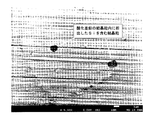
- FIG. 1 a secondary electron image of 5000 times observed with the scanning electron microscope is shown in FIG. 1.
- 1 ⁇ m spherical particles containing Si were observed in the zinc oxide-based sintered body. It was confirmed that there were no particles containing Si at the crystal grain boundaries of zinc. Note that it is confirmed by surface analysis using an energy dispersive X-ray fluorescence analyzer that the particles shown in the secondary electron image of FIG. 1 are particles containing Si.
- Example 1 The zinc oxide-based sintered body according to Example 1 was processed to have a diameter of 152.4 mm (6 inches) and a thickness of 7 mm, and was bonded to an oxygen-free copper backing plate using metallic indium. A sputtering target according to Example 1 was obtained.
- the length and width of the zinc oxide-based sintered body were measured with calipers, the thickness was measured with a micrometer, and the weight was measured with an electronic balance to calculate the density of the zinc oxide-based sintered body. Further, the resistivity of the zinc oxide sintered body was measured using a four-deep needle resistivity meter Loresta GP (manufactured by Mitsubishi Chemical Analytech Co., Ltd .: MCP-T610 type).
- the sputtering target was attached to a cathode for a non-magnetic target of a direct current magnetron sputtering apparatus (manufactured by Tokki: SPF-530K).
- a non-alkali glass substrate (Corning # 7059, thickness t is 1.1 mm) was used as the film formation substrate, and the target-substrate distance was fixed at 60 mm.
- the substrate was placed immediately above the center (non-erosion part) of the sputtering target and sputtered without heating to form a 200 nm thick transparent conductive film.
- Example 2 Except for the amount of Si in the sintered body being 20 mass ppm (Example 2), 50 mass ppm (Example 3), 150 mass ppm (Example 4), and 200 mass ppm (Example 5).
- a zinc oxide-based sintered body was obtained under the same conditions as in Example 1.
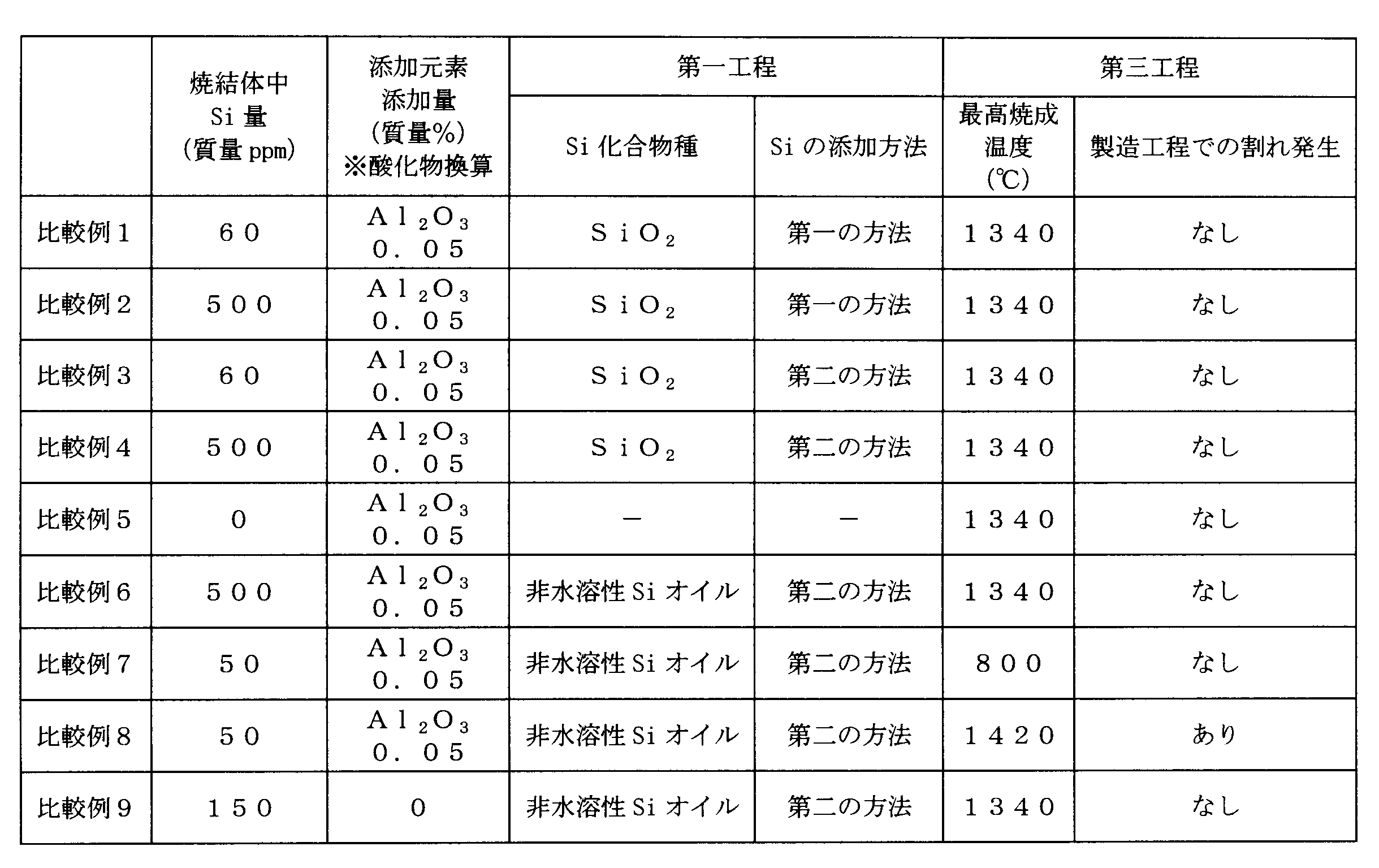
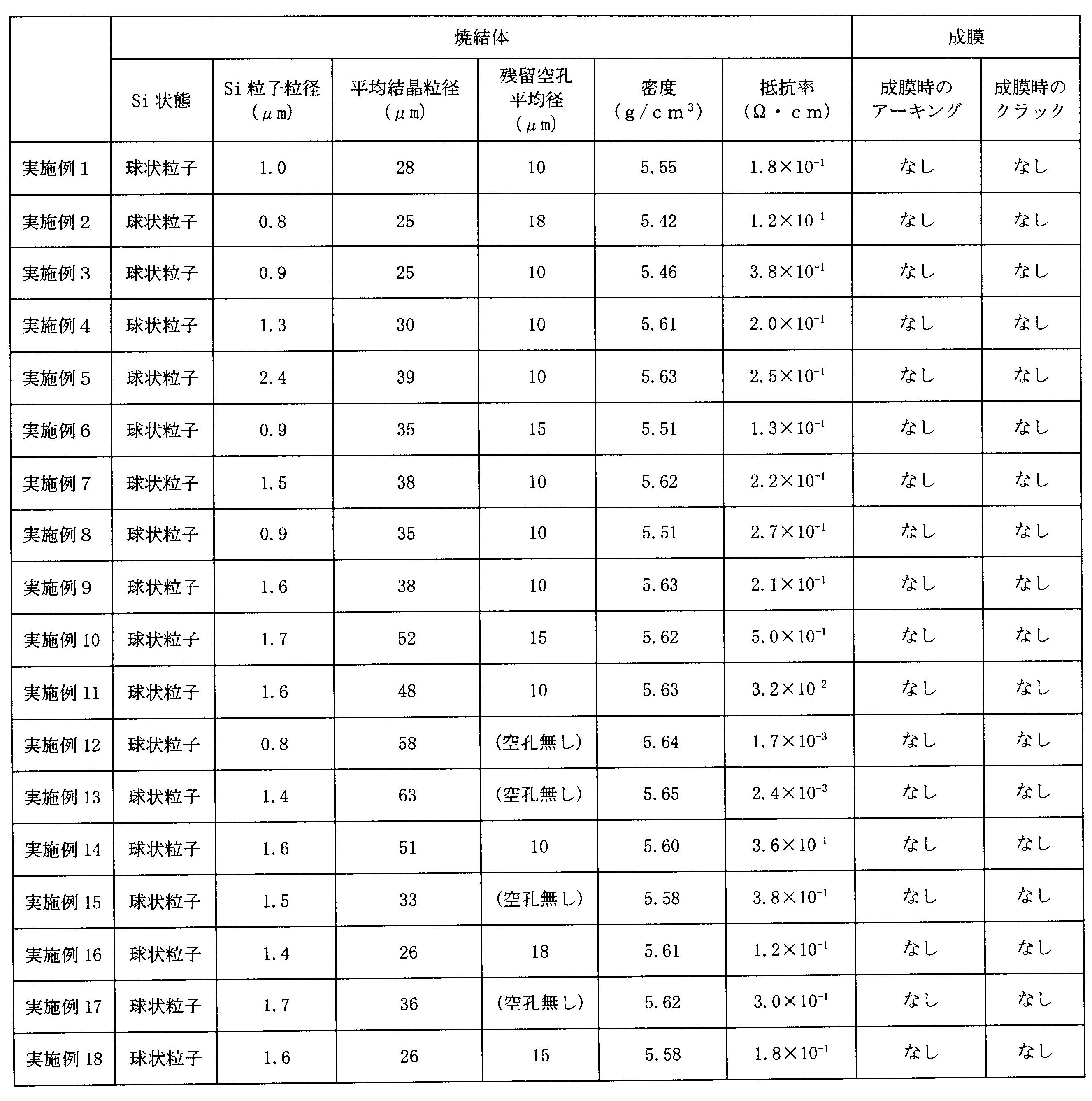
- Example 2 The production conditions of Examples 2 to 5 are shown in Table 1-1, and the results of evaluating the obtained sintered bodies in the same manner as in Example 1 are shown in Table 2-1.
- Example 6 and 7 Instead of the water-insoluble silicone oil applied in Example 1 (made by Momentive Performance Materials Japan GK: TSF484), water-soluble silicone oil compound (made by Momentive Performance Materials Japan GK: ZSA based on the same conditions as in Example 1 except that TSA750) was applied and the Si content in the sintered body was 40 ppm by mass (Example 6) and 150 ppm (Example 7). A sintered body was obtained.
- Example 6 to 7 The production conditions of Examples 6 to 7 are shown in Table 1-1, and the results of evaluating the obtained sintered bodies in the same manner as in Example 1 are shown in Table 2-1.
- pure water is added to a raw material powder obtained by mixing a zinc oxide powder having an average particle size of 1 ⁇ m or less and an aluminum oxide powder having an average particle size of 1 ⁇ m or less so that the aluminum oxide content is 0.05 mass%. , 1.1% by mass of organic binder, 0.7% by mass of acrylic acid / methacrylic acid copolymer neutralized ammonia, and a Si content in the sintered body of 40 mass ppm (practical)
- TSA750 water-soluble silicone oil compound
- Example 9 water-soluble silicone oil compound
- Example 8 to 9 The production conditions of Examples 8 to 9 are shown in Table 1-1, and the results of evaluating the obtained sintered bodies in the same manner as in Example 1 are shown in Table 2-1.
- Example 4 (the amount of Si in the sintered body was 150), except that the addition amount of aluminum oxide as an additive element was 0.01% by mass (Example 10) and 1.00% (Example 11).
- a zinc oxide-based sintered body was obtained under the same conditions as in (Mass ppm).
- Example 10 to 11 The production conditions of Examples 10 to 11 are shown in Table 1-1, and the results of evaluating the obtained sintered bodies in the same manner as in Example 1 are shown in Table 2-1.
- a dispersant composed of pure water, 1.5% by mass organic binder, 1.0% by mass acrylic acid / methacrylic acid copolymer ammonia neutralized product is added, A slurry was prepared by mixing using a bead mill (manufactured by Ashizawa Finetech Co., Ltd .: LMZ type).
- the obtained slurry was dried and granulated using a spray dryer (Okawara Kako Co., Ltd .: ODL-20 type) under the conditions of a supply rate of 140 ml / min, a hot air temperature of 150 ° C., and a hot air amount of 8 Nm 3 / min.
- a granulated powder A composed of zinc oxide, aluminum oxide and gallium oxide having an aluminum oxide and gallium oxide content of 0.50% by mass was obtained.
- the water content of the water-insoluble silicone oil (TSF484) is 50 mass ppm (Example 12) and 150 mass ppm (Example 13) in the obtained sintered body.
- the granulated powder B was obtained by adding as described above and sufficiently mixing and stirring.
- Example 12 to 13 The production conditions of Examples 12 to 13 are shown in Table 1-1, and the results of evaluating the obtained sintered bodies in the same manner as in Example 1 are shown in Table 2-1.
- Examples 14 to 18 The same conditions as in Example 9 except that the additive elements were changed to Mg (Example 14), Ti (Example 15), Ga (Example 16), In (Example 17), and Sn (Example 18). Thus, zinc oxide-based sintered bodies according to Examples 14 to 18 were obtained.
- Example 14 to 18 The production conditions of Examples 14 to 18 are shown in Table 1-1, and the results of evaluating the obtained sintered bodies in the same manner as in Example 1 are shown in Table 2-1.
- the first step “granulated powder” was produced by the first method (similar to Example 8), and the water-soluble silicone oil compound (Momentive Performance Materials Japan GK) applied in Example 8: In place of TSA750), silicon dioxide powder having an average particle size of 1 ⁇ m or less is applied, and the amount of Si in the sintered body is 60 ppm by mass (Comparative Example 1) and 500 ppm by mass (Comparative Example 2).
- a zinc oxide-based sintered body according to Comparative Examples 1 and 2 was obtained under the same conditions as in Example 8 except that.
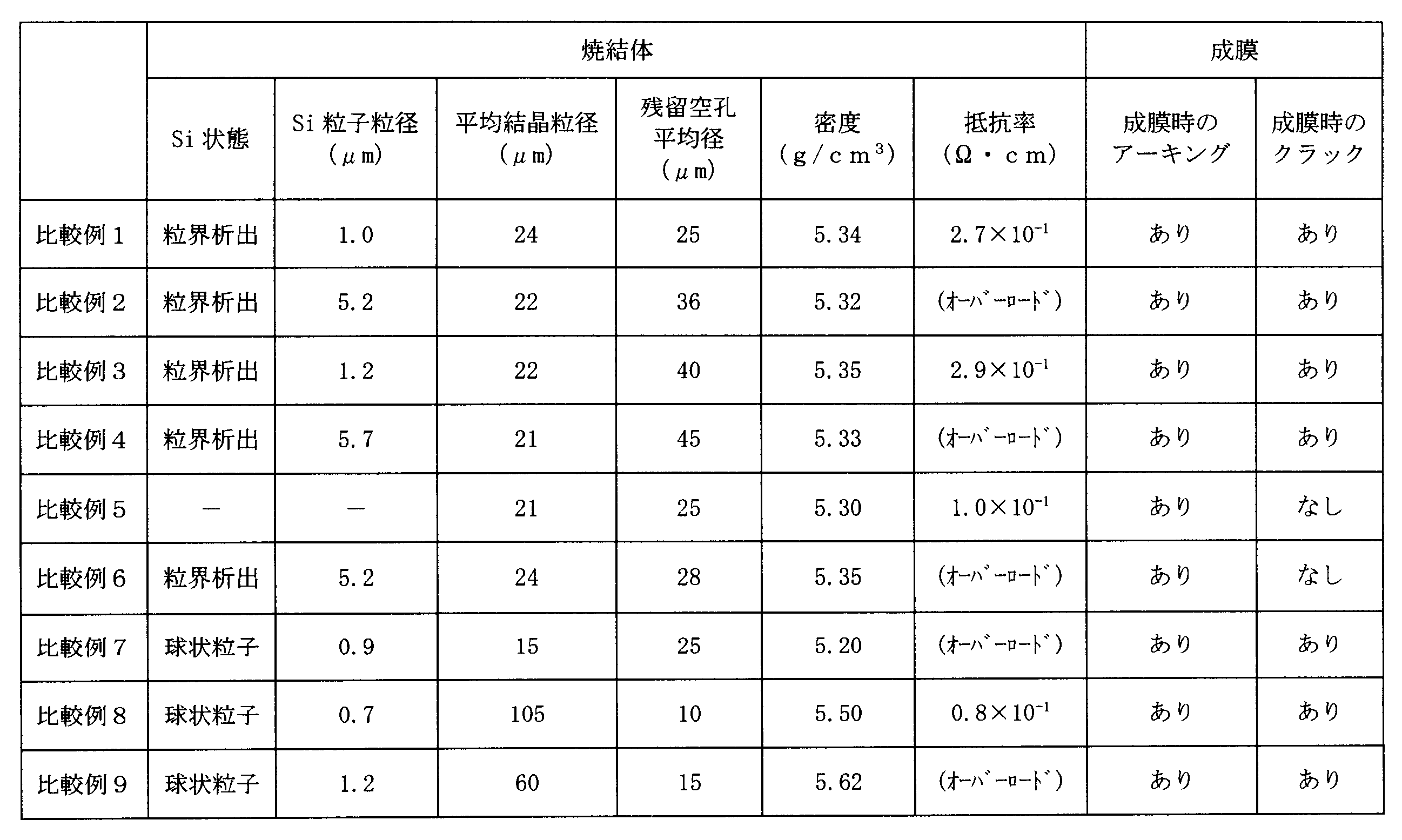
- the average crystal grain size of zinc oxide is small, the residual voids are large, and the density of the zinc oxide-based sintered body is low, so that arcing occurs during sputtering. At the same time, cracks occurred in the sputtering target.
- Example 3 The “granulated powder” of the first step was produced by the second method (same as in Example 1), and the water-insoluble silicone oil applied in Example 1 (Momentive Performance Materials Japan GK) : In place of TSF484), a silicon dioxide powder having an average particle size of 1 ⁇ m or less is applied, and the Si content in the sintered body is 60 mass ppm (Comparative Example 3) and 500 mass ppm (Comparative Example 4).
- a zinc oxide-based sintered body according to Comparative Examples 3 to 4 was obtained under the same conditions as in Example 1 except for the above.
- Comparative Example 5 A zinc oxide-based sintered body according to Comparative Example 5 was obtained under the same conditions as in Example 8 except that no silicon compound was added.
- Comparative Example 5 The production conditions of Comparative Example 5 are shown in Table 1-2, and the results of evaluating the obtained sintered body in the same manner as in Example 1 are shown in Table 2-2.
- the average crystal grain size is less than 25 ⁇ m (21 ⁇ m), and The average diameter of residual vacancies exceeded 20 ⁇ m (25 ⁇ m).
- the density of the zinc oxide sintered body was also lower than that of the example (5.30 g / cm 2 ).
- Example 6 A zinc oxide-based sintered body was obtained under the same conditions as in Example 1 except that the amount of Si in the sintered body was 500 ppm by mass.
- Comparative Example 6 The production conditions of Comparative Example 6 are shown in Table 1-2, and the results of evaluating the obtained sintered body in the same manner as in Example 1 are shown in Table 2-2.
- Comparative Example 6 since the amount of Si added was large (500 ppm by mass), the number of precipitated high-resistance Si-containing particles increased, and the resistivity of the zinc oxide-based sintered body was significantly increased.
- Comparative Example 8 since the firing temperature was too high (1420 ° C.), the zinc oxide crystal grains grew too much, and the average crystal grain size exceeded 100 ⁇ m (105 ⁇ m). Such a sintered body has weak mechanical strength, cracks are produced in the manufacturing process (processing process), and even when no cracks are generated, cracks are generated during film formation. In addition, arcing also occurred due to the occurrence of cracks during film formation.
- Comparative Example 9 A zinc oxide-based sintered body according to Comparative Example 9 was obtained under the same conditions as in Example 4 except that aluminum oxide as an additive element was not added.
- Comparative Example 9 The production conditions of Comparative Example 9 are shown in Table 1-2, and the results of evaluating the obtained sintered body in the same manner as in Example 1 are shown in Table 2-2.
- the zinc oxide-based sintered body according to the present invention when used as a sputtering target, abnormal discharge or the like is suppressed, so that a transparent conductive film having a high resistance used for a buffer layer or the like of a CIGS solar cell. It has industrial applicability used as a film forming material.
Landscapes
- Chemical & Material Sciences (AREA)
- Engineering & Computer Science (AREA)
- Ceramic Engineering (AREA)
- Organic Chemistry (AREA)
- Materials Engineering (AREA)
- Manufacturing & Machinery (AREA)
- Structural Engineering (AREA)
- Mechanical Engineering (AREA)
- Metallurgy (AREA)
- Chemical Kinetics & Catalysis (AREA)
- Physics & Mathematics (AREA)
- Thermal Sciences (AREA)
- Inorganic Chemistry (AREA)
- Compositions Of Oxide Ceramics (AREA)
- Physical Vapour Deposition (AREA)
Abstract
Description
酸化亜鉛を主成分とする酸化亜鉛系焼結体において、
Mg、Al、Ti、Ga、InおよびSnからなる群より選ばれた少なくとも1種の添加元素を酸化物換算で0.01~1質量%含有し、20質量ppm以上200質量ppm以下のSi元素を含有すると共に、焼結体中における酸化亜鉛の結晶粒径が25~100μmで、焼結体中において上記Si元素がSiを含む5μm以下の結晶粒として存在し、かつ、焼結体中における酸化亜鉛の結晶粒界にSiを含む上記結晶粒が析出していないことを特徴とする。
酸化亜鉛粉末、Mg、Al、Ti、Ga、In、Snからなる群より選ばれた少なくとも1種の酸化物粉末、および、シリコン化合物を、純水、有機バインダー、分散剤と混合してスラリーを調製し、得られたスラリーを、乾燥、造粒する第一工程と
第一工程で得られた造粒粉を加圧成形して成形体を得る第二工程と、
第二工程で得られた成形体を焼成して酸化物焼結体を得る第三工程を備え、
第一の発明に係る酸化亜鉛系焼結体を製造する方法において、
シロキサン構造を有する室温で液状のシリコン化合物を適用し、かつ、成形体の焼成温度を900~1400℃の範囲に設定することを特徴とする。
スパッタリングターゲットにおいて、
第一の発明に係る酸化亜鉛系焼結体を加工して得られていることを特徴とし、
第四の発明は、
高抵抗を有する透明導電膜において、
第三の発明に係るスパッタリングターゲットを用いたスパッタリング法により基板上に成膜されていることを特徴とする。
酸化亜鉛系焼結体の低抵抗率化に作用する添加元素(Mg、Al、Ti、Ga、InおよびSnからなる群より選ばれた少なくとも1種)の含有量が、酸化物換算で0.01~1質量%と極めて微小量な範囲に設定されているため、CIGS系太陽電池のバッファ層等高抵抗の透明導電膜用スパッタリングターゲットとして利用できる効果を有する。
酸化亜鉛を主成分とする本発明に係る酸化亜鉛系焼結体は、Mg、Al、Ti、Ga、InおよびSnからなる群より選ばれた少なくとも1種の添加元素を酸化物換算で0.01~1質量%含有し、20質量ppm以上200質量ppm以下のSi元素を含有すると共に、焼結体中における酸化亜鉛の結晶粒径が25~100μmで、焼結体中において上記Si元素がSiを含む5μm以下の結晶粒として存在し、かつ、焼結体中における酸化亜鉛の結晶粒界にSiO2やZnとSiの複合酸化物相といったSiを含む結晶粒が析出していないことを特徴とし、スパッタリングターゲットとして適用されるものである。
本発明に係る酸化亜鉛系焼結体の製造方法は、原料を、純水、有機バインダー、分散剤と混合し、得られるスラリーを、乾燥、造粒する「第一工程」と、得られた造粒粉を加圧成形して成形体を得る「第二工程」と、得られた成形体を焼成し、焼結体を得る「第三工程」とで構成されている。
第一工程で得られる「造粒粉」は、以下の2通りの方法で製造することができる。
ZnO粉末、Mg、Al、Ti、Ga、In、Snからなる群より選ばれた少なくとも1種の酸化物粉末、および、シロキサン構造を有する室温で液状のシリコン化合物を原料とし、純水、有機バインダー、分散剤と混合して、スラリー濃度が50~80wt%、好ましくは60wt%となるように混合し、かつ、平均粒径0.5μm以下となるまで湿式粉砕する。
ZnO粉末、および、Mg、Al、Ti、Ga、In、Snからなる群より選ばれた少なくとも1種の酸化物粉末を原料とし、純水、有機バインダー、分散剤と混合して、スラリー濃度が50~80wt%、好ましくは60wt%となるように混合し、かつ、平均粒径0.5μm以下となるまで湿式粉砕する。湿式粉砕の方法としては、上記条件を満たす方法であれば任意であり、例えば、ボールミルやビーズミル等の手法が挙げられる。そして、粉砕後、30分以上混合攪拌して得られたスラリーを、乾燥・造粒して「Si無添加の造粒粉」(造粒粉A)を得る。
成形体として平板状のものを得るには、例えば、特開2006-193797号に記載されているような耐久性に優れたアメゴムから成る筒状ゴム型と、成形体が食い込み難く、滑りが良いシリコンゴムから成る2枚の板状ゴム型とで構成される成形型を用い、この成形型内に、上記「造粒粉」若しくは「造粒粉B」を充填し、冷間静水圧プレスを行なって、平板状の成形体を得ることができる。
第二工程で得られた成形体を、常圧で焼成することにより、酸化亜鉛系焼結体が得られる。焼成温度900~1400℃で焼結を行う。焼成温度が900℃未満では、必要な焼結収縮が得られず、機械的強度の弱い焼結体となってしまう。また、焼結収縮が十分進んでいないため、得られる焼結体の密度や寸法のバラつきが大きくなる。900℃以上の領域では、焼結が進行しかつ焼結体中の結晶粒子の内部にSi原子が均一に分散するようになる。また、焼成温度が1400℃を超えると、酸化亜鉛(ZnO)の揮発が活発化し、所定の酸化亜鉛組成からずれるため好ましくない。更に、焼成温度が1400℃を超えると、結晶粒径が100μmより大きくなることで焼結体の割れが多発してしまい、歩留まりが悪くなってしまう。
上記酸化亜鉛系焼結体を加工して得られるスパッタリングターゲットを用い、特定の基板温度、圧力といった成膜条件を採用することで、Si元素と添加元素を含む酸化亜鉛から成る透明導電膜を基板上に形成することができる。
[酸化亜鉛系焼結体の作製]
第一工程の「造粒粉」を第二の方法で製造した。
実施例1に係る酸化亜鉛系焼結体を、直径が152.4mm(6インチ)で、厚みが7mmとなるように加工し、無酸素銅製のバッキングプレートに金属インジウムを用いてボンディングし、実施例1に係るスパッタリングターゲットを得た。
焼結体中のSi量が20質量ppm(実施例2)、50質量ppm(実施例3)、150質量ppm(実施例4)、200質量ppm(実施例5)となるようにした以外は実施例1と同様の条件にて酸化亜鉛系焼結体を得た。
実施例1において適用された非水溶性のシリコーンオイル(モメンティブ・パフォーマンス・マテリアルズ・ジャパン合同会社製:TSF484)に代えて、水溶性シリコーンオイルコンパウンド(モメンティブ・パフォーマンス・マテリアルズ・ジャパン合同会社製:TSA750)を適用し、かつ、焼結体中のSi量が40質量ppm(実施例6)、150ppm(実施例7)となるようにした以外は実施例1と同様の条件にて酸化亜鉛系焼結体を得た。
第一工程の「造粒粉」を第一の方法で製造した。
添加元素である酸化アルミニウムの添加量を0.01質量%(実施例10)、1.00%(実施例11)となるようにした以外は実施例4(焼結体中のSi量が150質量ppmとなるように設定)と同様の条件にして酸化亜鉛系焼結体を得た。
添加元素を2種(アルミニウムとガリウム)にして製造した。
添加元素を、Mg(実施例14)、Ti(実施例15)、Ga(実施例16)、In(実施例17)、Sn(実施例18)に変更した以外は実施例9と同様な条件にして実施例14~18に係る酸化亜鉛系焼結体を得た。
第一工程の「造粒粉」を第一の方法(実施例8と同様)で製造し、実施例8において適用された水溶性シリコーンオイルコンパウンド(モメンティブ・パフォーマンス・マテリアルズ・ジャパン合同会社製:TSA750)に代えて、平均粒径が1μm以下の二酸化ケイ素粉末を適用し、かつ、焼結体中のSi量が60質量ppm(比較例1)、500質量ppm(比較例2)となるようにした以外は実施例8と同様の条件にして比較例1~2に係る酸化亜鉛系焼結体を得た。
第一工程の「造粒粉」を第二の方法(実施例1と同様)で製造し、実施例1において適用された非水溶性のシリコーンオイル(モメンティブ・パフォーマンス・マテリアルズ・ジャパン合同会社製:TSF484)に代えて、平均粒径が1μm以下の二酸化ケイ素粉末を適用し、かつ、焼結体中のSi量が60質量ppm(比較例3)、500質量ppm(比較例4)となるようにした以外は実施例1と同様の条件にして比較例3~4に係る酸化亜鉛系焼結体を得た。
シリコン化合物を添加していない点を除き実施例8と同様な条件にして比較例5に係る酸化亜鉛系焼結体を得た。
焼結体中のSi量が500質量ppmとなるようにした以外は実施例1と同様の条件にして酸化亜鉛系焼結体を得た。
焼成時における最高焼成温度を800℃(比較例7)、1420℃(比較例8)とした以外は実施例3(最高焼成温度は1340℃)と同様な条件にして比較例7~8に係る酸化亜鉛系焼結体を得た。
添加元素である酸化アルミニウムを添加しなかった点を除き実施例4と同様の条件にして比較例9に係る酸化亜鉛系焼結体を得た。

Claims (7)
- 酸化亜鉛を主成分とする酸化亜鉛系焼結体において、
Mg、Al、Ti、Ga、InおよびSnからなる群より選ばれた少なくとも1種の添加元素を酸化物換算で0.01~1質量%含有し、20質量ppm以上200質量ppm以下のSi元素を含有すると共に、焼結体中における酸化亜鉛の結晶粒径が25~100μmで、焼結体中において上記Si元素がSiを含む5μm以下の結晶粒として存在し、かつ、焼結体中における酸化亜鉛の結晶粒界にSiを含む上記結晶粒が析出していないことを特徴とする酸化亜鉛系焼結体。 - 上記焼結体中における残留空孔の平均径が20μm以下であることを特徴とする請求項1に記載の酸化亜鉛系焼結体。
- Mg、Al、Ti、Ga、InおよびSnからなる群より選ばれた少なくとも1種の添加元素が、ウルツ鉱型酸化亜鉛相に固溶していることを特徴とする請求項1に記載の酸化亜鉛系焼結体。
- Mg、Al、Ti、Ga、InおよびSnからなる群より選ばれた少なくとも1種の添加元素が、ウルツ鉱型酸化亜鉛相に固溶していることを特徴とする請求項2に記載の酸化亜鉛系焼結体。
- 酸化亜鉛粉末、Mg、Al、Ti、Ga、In、Snからなる群より選ばれた少なくとも1種の酸化物粉末、および、シリコン化合物を、純水、有機バインダー、分散剤と混合してスラリーを調製し、得られたスラリーを、乾燥、造粒する第一工程と
第一工程で得られた造粒粉を加圧成形して成形体を得る第二工程と、
第二工程で得られた成形体を焼成して酸化物焼結体を得る第三工程を備え、
請求項1~4のいずれかに記載の酸化亜鉛系焼結体を製造する方法において、
シロキサン構造を有する室温で液状のシリコン化合物を適用し、かつ、成形体の焼成温度を900~1400℃の範囲に設定することを特徴とする酸化亜鉛系焼結体の製造方法。 - 請求項1~4のいずれかに記載の酸化亜鉛系焼結体を加工して得られていることを特徴とするスパッタリングターゲット。
- 請求項6に記載のスパッタリングターゲットを用いたスパッタリング法により基板上に成膜されていることを特徴とする高抵抗を有する透明導電膜。
Priority Applications (3)
| Application Number | Priority Date | Filing Date | Title |
|---|---|---|---|
| DE112014001540.7T DE112014001540T5 (de) | 2013-03-19 | 2014-02-20 | Sinterkörper auf Zinkoxid-Basis, Verfahren zu dessen Herstellung, sowie Sputtertarget und transparenter, elektrisch leitfähiger Film |
| CN201480011513.0A CN105008306B (zh) | 2013-03-19 | 2014-02-20 | 氧化锌系烧结体及其制造方法和溅射靶以及透明导电膜 |
| KR1020157020234A KR20150132827A (ko) | 2013-03-19 | 2014-02-20 | 산화 아연계 소결체와 그 제조 방법 및 스퍼터링 타깃과 투명 도전막 |
Applications Claiming Priority (2)
| Application Number | Priority Date | Filing Date | Title |
|---|---|---|---|
| JP2013056769A JP6024545B2 (ja) | 2013-03-19 | 2013-03-19 | 酸化亜鉛系焼結体とその製造方法およびスパッタリングターゲット |
| JP2013-056769 | 2013-03-19 |
Publications (1)
| Publication Number | Publication Date |
|---|---|
| WO2014148189A1 true WO2014148189A1 (ja) | 2014-09-25 |
Family
ID=51579881
Family Applications (1)
| Application Number | Title | Priority Date | Filing Date |
|---|---|---|---|
| PCT/JP2014/054005 Ceased WO2014148189A1 (ja) | 2013-03-19 | 2014-02-20 | 酸化亜鉛系焼結体とその製造方法およびスパッタリングターゲットと透明導電膜 |
Country Status (6)
| Country | Link |
|---|---|
| JP (1) | JP6024545B2 (ja) |
| KR (1) | KR20150132827A (ja) |
| CN (1) | CN105008306B (ja) |
| DE (1) | DE112014001540T5 (ja) |
| TW (1) | TWI580663B (ja) |
| WO (1) | WO2014148189A1 (ja) |
Cited By (1)
| Publication number | Priority date | Publication date | Assignee | Title |
|---|---|---|---|---|
| EP3568023B1 (en) | 2017-01-13 | 2021-07-07 | Novozymes A/S | Sterile filtered lactase preparation comprising salt with monovalent cation and preparation thereof |
Families Citing this family (4)
| Publication number | Priority date | Publication date | Assignee | Title |
|---|---|---|---|---|
| JP2015120959A (ja) * | 2013-12-24 | 2015-07-02 | 宇部マテリアルズ株式会社 | ZnOターゲット材及び透明導電膜 |
| JP6988057B2 (ja) * | 2015-09-29 | 2022-01-05 | 株式会社東京精密 | レーザー加工装置及びレーザー加工方法 |
| JP7169776B2 (ja) * | 2018-06-06 | 2022-11-11 | Koa株式会社 | 酸化亜鉛バリスタおよびその製造方法 |
| KR20220087425A (ko) * | 2019-10-23 | 2022-06-24 | 미쓰비시 마테리알 가부시키가이샤 | 산화물 스퍼터링 타깃 |
Citations (7)
| Publication number | Priority date | Publication date | Assignee | Title |
|---|---|---|---|---|
| JP4231967B2 (ja) * | 2006-10-06 | 2009-03-04 | 住友金属鉱山株式会社 | 酸化物焼結体、その製造方法、透明導電膜、およびそれを用いて得られる太陽電池 |
| JP2010202896A (ja) * | 2009-02-27 | 2010-09-16 | Taiheiyo Cement Corp | スパッタリングターゲット及びその製造方法 |
| JP2010270004A (ja) * | 2010-08-24 | 2010-12-02 | Ulvac Material Kk | 複合酸化物焼結体の製造方法及びその焼結体からなるスパッタリングターゲット |
| JP2011111642A (ja) * | 2009-11-25 | 2011-06-09 | Mitsubishi Materials Corp | ZnOターゲットおよびその製造方法 |
| WO2012077512A1 (ja) * | 2010-12-06 | 2012-06-14 | 東ソー株式会社 | 酸化亜鉛焼結体、スパッタリングターゲット及び酸化亜鉛薄膜 |
| WO2012108157A1 (ja) * | 2011-02-10 | 2012-08-16 | 三菱マテリアル株式会社 | 太陽電池用透明膜形成用スパッタリングターゲットおよびその製造方法 |
| JP2014058731A (ja) * | 2012-09-19 | 2014-04-03 | Sumitomo Metal Mining Co Ltd | 酸化亜鉛スパッタリングターゲットとその製造方法 |
Family Cites Families (4)
| Publication number | Priority date | Publication date | Assignee | Title |
|---|---|---|---|---|
| JP4067141B2 (ja) * | 1994-08-17 | 2008-03-26 | Agcセラミックス株式会社 | 透明導電膜とその製造方法およびスパッタリングターゲット |
| JPH11322332A (ja) * | 1998-05-21 | 1999-11-24 | Sumitomo Metal Mining Co Ltd | ZnO系焼結体およびその製造方法 |
| JP5760857B2 (ja) * | 2011-08-29 | 2015-08-12 | 三菱マテリアル株式会社 | スパッタリングターゲット及びその製造方法並びに該ターゲットを用いた薄膜、該薄膜を備える薄膜シート、積層シート |
| JP5747738B2 (ja) * | 2011-08-29 | 2015-07-15 | 三菱マテリアル株式会社 | スパッタリングターゲット及びその製造方法並びに該ターゲットを用いた薄膜、該薄膜を備える薄膜シート、積層シート |
-
2013
- 2013-03-19 JP JP2013056769A patent/JP6024545B2/ja not_active Expired - Fee Related
-
2014
- 2014-02-20 DE DE112014001540.7T patent/DE112014001540T5/de not_active Withdrawn
- 2014-02-20 KR KR1020157020234A patent/KR20150132827A/ko not_active Withdrawn
- 2014-02-20 WO PCT/JP2014/054005 patent/WO2014148189A1/ja not_active Ceased
- 2014-02-20 CN CN201480011513.0A patent/CN105008306B/zh not_active Expired - Fee Related
- 2014-03-19 TW TW103110204A patent/TWI580663B/zh not_active IP Right Cessation
Patent Citations (7)
| Publication number | Priority date | Publication date | Assignee | Title |
|---|---|---|---|---|
| JP4231967B2 (ja) * | 2006-10-06 | 2009-03-04 | 住友金属鉱山株式会社 | 酸化物焼結体、その製造方法、透明導電膜、およびそれを用いて得られる太陽電池 |
| JP2010202896A (ja) * | 2009-02-27 | 2010-09-16 | Taiheiyo Cement Corp | スパッタリングターゲット及びその製造方法 |
| JP2011111642A (ja) * | 2009-11-25 | 2011-06-09 | Mitsubishi Materials Corp | ZnOターゲットおよびその製造方法 |
| JP2010270004A (ja) * | 2010-08-24 | 2010-12-02 | Ulvac Material Kk | 複合酸化物焼結体の製造方法及びその焼結体からなるスパッタリングターゲット |
| WO2012077512A1 (ja) * | 2010-12-06 | 2012-06-14 | 東ソー株式会社 | 酸化亜鉛焼結体、スパッタリングターゲット及び酸化亜鉛薄膜 |
| WO2012108157A1 (ja) * | 2011-02-10 | 2012-08-16 | 三菱マテリアル株式会社 | 太陽電池用透明膜形成用スパッタリングターゲットおよびその製造方法 |
| JP2014058731A (ja) * | 2012-09-19 | 2014-04-03 | Sumitomo Metal Mining Co Ltd | 酸化亜鉛スパッタリングターゲットとその製造方法 |
Cited By (1)
| Publication number | Priority date | Publication date | Assignee | Title |
|---|---|---|---|---|
| EP3568023B1 (en) | 2017-01-13 | 2021-07-07 | Novozymes A/S | Sterile filtered lactase preparation comprising salt with monovalent cation and preparation thereof |
Also Published As
| Publication number | Publication date |
|---|---|
| JP2014181155A (ja) | 2014-09-29 |
| CN105008306A (zh) | 2015-10-28 |
| DE112014001540T5 (de) | 2015-12-03 |
| KR20150132827A (ko) | 2015-11-26 |
| JP6024545B2 (ja) | 2016-11-16 |
| TWI580663B (zh) | 2017-05-01 |
| TW201437180A (zh) | 2014-10-01 |
| CN105008306B (zh) | 2017-04-26 |
Similar Documents
| Publication | Publication Date | Title |
|---|---|---|
| JP5339100B2 (ja) | Zn−Si−O系酸化物焼結体とその製造方法およびスパッタリングターゲットと蒸着用タブレット | |
| TWI519502B (zh) | Zn-Sn-O系氧化物燒結體及其製造方法 | |
| JP5733208B2 (ja) | イオンプレーティング用タブレットとその製造方法、および透明導電膜 | |
| CN102089257B (zh) | 复合氧化物烧结体、复合氧化物烧结体的制造方法、溅射靶及薄膜的制造方法 | |
| CN108349816A (zh) | Sn-Zn-O系氧化物烧结体及其制造方法 | |
| JP6024545B2 (ja) | 酸化亜鉛系焼結体とその製造方法およびスパッタリングターゲット | |
| CN105986230A (zh) | 氧化物烧结体、溅射靶和薄膜以及氧化物烧结体的制造方法 | |
| CN107207356B (zh) | 氧化物烧结体、氧化物溅射靶和氧化物薄膜 | |
| JP6677058B2 (ja) | Sn−Zn−O系酸化物焼結体とその製造方法 | |
| WO2014021374A1 (ja) | 酸化物焼結体およびそれを加工したタブレット | |
| JP5907086B2 (ja) | 酸化インジウム系の酸化物焼結体およびその製造方法 | |
| JP5967016B2 (ja) | 蒸着用タブレットとその製造方法 | |
| WO2017149882A1 (ja) | Sn-Zn-O系酸化物焼結体とその製造方法 | |
| JP5761253B2 (ja) | Zn−Si−O系酸化物焼結体とその製造方法およびスパッタリングターゲットと蒸着用タブレット | |
| JP5809542B2 (ja) | スパッタリングターゲット材およびその製造方法 | |
| JP2013067538A (ja) | 酸化物焼結体および酸化物透明導電膜 | |
| JP2013193945A (ja) | In−Ga−Zn−O系酸化物焼結体とその製造方法およびスパッタリングターゲットと酸化物半導体膜 | |
| JP2015024927A (ja) | 酸化物焼結体及びその製造方法、並びに酸化物膜 |
Legal Events
| Date | Code | Title | Description |
|---|---|---|---|
| 121 | Ep: the epo has been informed by wipo that ep was designated in this application |
Ref document number: 14769488 Country of ref document: EP Kind code of ref document: A1 |
|
| ENP | Entry into the national phase |
Ref document number: 20157020234 Country of ref document: KR Kind code of ref document: A |
|
| WWE | Wipo information: entry into national phase |
Ref document number: 112014001540 Country of ref document: DE Ref document number: 1120140015407 Country of ref document: DE |
|
| 122 | Ep: pct application non-entry in european phase |
Ref document number: 14769488 Country of ref document: EP Kind code of ref document: A1 |