WO2014136873A1 - 大麦粉末を含む焼き菓子 - Google Patents
大麦粉末を含む焼き菓子 Download PDFInfo
- Publication number
- WO2014136873A1 WO2014136873A1 PCT/JP2014/055771 JP2014055771W WO2014136873A1 WO 2014136873 A1 WO2014136873 A1 WO 2014136873A1 JP 2014055771 W JP2014055771 W JP 2014055771W WO 2014136873 A1 WO2014136873 A1 WO 2014136873A1
- Authority
- WO
- WIPO (PCT)
- Prior art keywords
- wafer
- dough
- mass
- baked confectionery
- baking
- Prior art date
- Legal status (The legal status is an assumption and is not a legal conclusion. Google has not performed a legal analysis and makes no representation as to the accuracy of the status listed.)
- Ceased
Links
Classifications
-
- A—HUMAN NECESSITIES
- A21—BAKING; EDIBLE DOUGHS
- A21D—TREATMENT OF FLOUR OR DOUGH FOR BAKING, e.g. BY ADDITION OF MATERIALS; BAKING; BAKERY PRODUCTS
- A21D2/00—Treatment of flour or dough by adding materials thereto before or during baking
- A21D2/08—Treatment of flour or dough by adding materials thereto before or during baking by adding organic substances
- A21D2/14—Organic oxygen compounds
- A21D2/18—Carbohydrates
- A21D2/186—Starches; Derivatives thereof
-
- A—HUMAN NECESSITIES
- A21—BAKING; EDIBLE DOUGHS
- A21D—TREATMENT OF FLOUR OR DOUGH FOR BAKING, e.g. BY ADDITION OF MATERIALS; BAKING; BAKERY PRODUCTS
- A21D13/00—Finished or partly finished bakery products
- A21D13/04—Products made from materials other than rye or wheat flour
- A21D13/047—Products made from materials other than rye or wheat flour from cereals other than rye or wheat, e.g. rice
-
- A—HUMAN NECESSITIES
- A21—BAKING; EDIBLE DOUGHS
- A21D—TREATMENT OF FLOUR OR DOUGH FOR BAKING, e.g. BY ADDITION OF MATERIALS; BAKING; BAKERY PRODUCTS
- A21D13/00—Finished or partly finished bakery products
- A21D13/30—Filled, to be filled or stuffed products
- A21D13/32—Filled, to be filled or stuffed products filled or to be filled after baking, e.g. sandwiches
-
- A—HUMAN NECESSITIES
- A21—BAKING; EDIBLE DOUGHS
- A21D—TREATMENT OF FLOUR OR DOUGH FOR BAKING, e.g. BY ADDITION OF MATERIALS; BAKING; BAKERY PRODUCTS
- A21D13/00—Finished or partly finished bakery products
- A21D13/40—Products characterised by the type, form or use
- A21D13/41—Pizzas
-
- A—HUMAN NECESSITIES
- A21—BAKING; EDIBLE DOUGHS
- A21D—TREATMENT OF FLOUR OR DOUGH FOR BAKING, e.g. BY ADDITION OF MATERIALS; BAKING; BAKERY PRODUCTS
- A21D2/00—Treatment of flour or dough by adding materials thereto before or during baking
- A21D2/08—Treatment of flour or dough by adding materials thereto before or during baking by adding organic substances
- A21D2/24—Organic nitrogen compounds
- A21D2/26—Proteins
- A21D2/261—Animal proteins
-
- A—HUMAN NECESSITIES
- A23—FOODS OR FOODSTUFFS; TREATMENT THEREOF, NOT COVERED BY OTHER CLASSES
- A23G—COCOA; COCOA PRODUCTS, e.g. CHOCOLATE; SUBSTITUTES FOR COCOA OR COCOA PRODUCTS; CONFECTIONERY; CHEWING GUM; ICE-CREAM; PREPARATION THEREOF
- A23G3/00—Sweetmeats; Confectionery; Marzipan; Coated or filled products
- A23G3/34—Sweetmeats, confectionery or marzipan; Processes for the preparation thereof
- A23G3/36—Sweetmeats, confectionery or marzipan; Processes for the preparation thereof characterised by the composition containing organic or inorganic compounds
- A23G3/48—Sweetmeats, confectionery or marzipan; Processes for the preparation thereof characterised by the composition containing organic or inorganic compounds containing plants or parts thereof, e.g. fruits, seeds, extracts
-
- A—HUMAN NECESSITIES
- A23—FOODS OR FOODSTUFFS; TREATMENT THEREOF, NOT COVERED BY OTHER CLASSES
- A23L—FOODS, FOODSTUFFS OR NON-ALCOHOLIC BEVERAGES, NOT OTHERWISE PROVIDED FOR; PREPARATION OR TREATMENT THEREOF
- A23L7/00—Cereal-derived products; Malt products; Preparation or treatment thereof
- A23L7/10—Cereal-derived products
- A23L7/117—Flakes or other shapes of ready-to-eat type; Semi-finished or partly-finished products therefor
-
- A—HUMAN NECESSITIES
- A23—FOODS OR FOODSTUFFS; TREATMENT THEREOF, NOT COVERED BY OTHER CLASSES
- A23V—INDEXING SCHEME RELATING TO FOODS, FOODSTUFFS OR NON-ALCOHOLIC BEVERAGES AND LACTIC OR PROPIONIC ACID BACTERIA USED IN FOODSTUFFS OR FOOD PREPARATION
- A23V2002/00—Food compositions, function of food ingredients or processes for food or foodstuffs
Definitions
- the present invention relates to a baked confectionery containing barley powder.
- Barley has been reported to have many effective effects in preventing or ameliorating lifestyle-related diseases such as cholesterol lowering, blood glucose level elevation suppression, anti-obesity, and blood pressure lowering. These actions are thought to be largely due to the action of ⁇ -glucan contained in barley. Although barley has been ingested since ancient times, the chances of ingestion have been drastically reduced due to the fact that its taste is inferior to white rice and changes in food culture. In other words, if barley is processed into an easy-to-eat form and made into an easy-to-eat form, it is thought that it can greatly contribute to the health of modern people.
- lifestyle-related diseases such as cholesterol lowering, blood glucose level elevation suppression, anti-obesity, and blood pressure lowering.
- barley powder is added to food at a high concentration.
- barley powder is added, there is a problem that the viscosity of the food increases remarkably.
- a dough containing barley powder is prepared and baked to make a baked confectionery such as a wafer, the viscosity of the dough is remarkably increased, making it difficult to handle the dough.
- productivity of wafers and the like is lowered.
- the present invention relates to a baked confectionery such as a wafer obtained by baking a dough containing barley powder, wherein the increase in viscosity of the dough containing the barley powder is effectively suppressed, and the productivity is increased.
- the main purpose is to provide
- the present inventor has intensively studied to solve the above problems. As a result, by making the dough containing barley powder and at least one selected from egg white, milk protein, collagen, and dextrin, the increase in viscosity of the dough containing barley powder is effectively suppressed, and productivity is improved. It became clear that baked goods such as enhanced wafers could be obtained.
- the present invention has been completed as a result of further research based on such findings. That is, this invention provides invention of the following aspect.
- Item 1 Barley powder, At least one viscosity modifier selected from the group consisting of egg white, milk protein, collagen, and dextrin; Baked confectionery made by baking dough containing Item 2.
- Item 3. Item 3.
- Item 4. Item 4.
- Item 6. Item 6.
- the baked confectionery according to any one of Items 1 to 5, wherein the dough has a viscosity of 5000 mPas or less.
- Item 7. Mixing the barley powder with at least one viscosity modifier selected from egg white, milk protein, collagen, and dextrin to obtain a dough; A baking step of baking the dough on a baking plate to obtain baked confectionery, and a mold releasing step of releasing the baked baked confectionery from the baking plate; A method for producing baked confectionery.
- the present invention it is possible to provide a baked confectionery such as a wafer and a method for producing the same, in which the increase in viscosity of the dough containing barley powder is effectively suppressed and the productivity is enhanced.
- the present invention can be applied to baked confectionery in general using dough fed using a feed pump or the like, preferably liquid dough having a viscosity as described below.
- a feed pump or the like preferably liquid dough having a viscosity as described below.
- wafers can be exemplified.
- thin plate baked confectionery such as crackers, biscuits, cookies, pie, chips, rice crackers etc. General.
- These baked goods can be manufactured by applying the manufacturing method according to each baked confectionery to the manufacturing method similar to the below-mentioned wafer as needed.
- the baked confectionery of the present invention and the manufacturing method thereof will be described in detail by taking a wafer as an example.
- the baked confectionery of the present invention is not limited to a wafer, and includes thin plate-shaped baked confectionery in general.
- Wafer The wafer of the present invention is obtained by baking a dough containing barley powder and at least one viscosity modifier selected from egg white, milk protein, collagen, and dextrin.
- a wafer generally refers to a thin plate-shaped baked confectionery having a rough surface such as a lattice or a smooth surface. That is, the wafers of the present invention include not only narrowly-defined wafers having a lattice-like uneven surface, but also thin plate-like baked goods such as crackers, biscuits, cookies, pies, chips, rice crackers, etc. .
- the barley powder used in the wafer of the present invention is prepared by preparing seeds of a grass family plant, scientific name Hordeum vulgare in powder form.
- types of barley Nijo barley, Shijo barley, Rojo barley, bare barley and the like are known, and any of these may be used.
- the barley varieties are not particularly limited.
- CDC species such as CDC Alamo, CDC Fibar, CDC Kendall, salute species, BG species, beef fiber, toyonokase, mannenbosi, daishimochi, ichibamboshi, sanbonhadaka, hayatehadaka, biwairoha , Kikaihadaka, Hayadirohadaka, Shirahimehadaka, Enohahadaka, Hinodehadaka, Shirosinriki, Yamatehadaka, Shiranuihadaka, Haayaurehadaka, Minamihadaka, Hashirihadaka, Tsukubahadaka, Bandaihadaka, Rimohadaka Sayakaze, Nebarigoshi, fiber snow, etc.
- CDC species such as CDC Alamo, CDC Fibar, CDC Kendall, salute species, BG species, beef fiber, toyonokase, mannenbosi, daishimochi, ichibamboshi, sanbonhadaka,
- barley powder as a material for barley powder, one kind of barley may be used alone, or two or more kinds of barley may be mixed and used. Moreover, you may use what refined barley seeds as the material of barley powder as needed.
- the barley powder used in the present invention may be barley seed powder subjected to roasting treatment or barley seed powder subjected to pregelatinization treatment.
- the conditions for the roasting treatment can be set as appropriate based on known conditions employed in grain roasting.
- the heating method at the time of roasting may be appropriately selected from known methods, and examples thereof include a direct fire type, a hot air type, a far infrared type, and a microwave type.
- the pregelatinization treatment may be performed according to a conventionally known method, and is not particularly limited as long as the starch in the barley is pregelatinized. For example, after soaking barley seeds in water, or by heating with water and drying, It can be carried out.
- the barley powder used in the wafer of the present invention is obtained by pulverizing the barley seeds.
- the pulverization method may follow a conventionally known method, for example, mortar, stone mortar (my colloid, mas colloider), ball mill, coffee mill, power mill, pin mill, airflow type pulverizer (jet mill), shear friction pulverizer, Cutter pulverizer, impact pulverizer (hammer mill, ball mill), roll pulverizer, homogenizer, ultrasonic pulverizer, etc., dry pulverizer, liquid nitrogen freezing pulverizer, etc. Is mentioned.
- the average particle size of the barley powder used in the wafer of the present invention can be selected according to the texture or the like imparted to the wafer, and is not particularly limited, and examples thereof include a range of about 20 to 210 ⁇ m.
- the average particle diameter is a value of d (0.5) measured using a laser particle size analyzer LMS-2000e (manufactured by Seishin Co., Ltd.).
- the content of barley powder in the wafer of the present invention is not particularly limited, and can be appropriately set according to the target content value of the target barley powder, for example, 10 mass% or more, or 20 mass% or more, Furthermore, it can be 30% by mass or more, further 35% by mass or more, particularly 40% by mass or more.
- the content of barley powder in a wafer increases, the viscosity of the dough increases remarkably, making it difficult to handle the dough, and it becomes very difficult to supply the dough onto the baking plate.
- the wafer of the present invention since at least one viscosity modifier selected from egg white, milk protein, collagen, and dextrin is contained, for example, barley powder in the wafer Even when the content of 10% by mass or more, or 20% by mass or more, further 30% by mass or more, and further 35% by mass or more, particularly 40% by mass or more, the viscosity of the dough is effectively reduced and handled. Can increase the sex. Moreover, the tube feeding property of the dough can be improved, and the dropping property of the dough from the supply nozzle can also be improved. Therefore, it becomes easy to supply the dough to the baking plate, and the productivity of the wafer can be effectively increased. Furthermore, the elongation of the dough is good, and chipping and uneven baking after baking are effectively suppressed. In addition, 50 mass% is normally mentioned as an upper limit of content of the barley powder in the wafer of this invention.
- the ratio of barley powder in the total of all cereal powders is preferably 60% by mass or more, more preferably 70% by mass or more. Preferably 80 mass% or more is mentioned.
- the total amount of the cereal powder contained in the wafer of the present invention may be barley powder.
- the content of ⁇ -glucan is not particularly limited and can be appropriately set according to the target content value of ⁇ -glucan, for example, 0.2% by mass or more, or 1 0.0 mass% or more, further 2.5 mass% or more, further 5 mass% or more, further 6 mass% or more, particularly 7.5 mass% or more.
- the viscosity of the dough is particularly likely to rise, making the dough extremely difficult to handle and making it very difficult to feed the dough onto a baking plate. There is.
- the glucan content is, for example, 0.2% by mass or more, or 1.0% by mass or more, further 2.5% by mass or more, further 5% by mass or more, further 6% by mass or more, particularly 7.5% by mass or more.
- the viscosity of the dough can be effectively reduced to facilitate handling.
- the tube feeding property of the dough can be improved, and the dropping property of the dough from the supply nozzle can also be improved. Therefore, it becomes easy to supply the dough to the baking plate, and the productivity of the wafer can be effectively increased. Furthermore, the elongation of the dough is good, and chipping and uneven baking after baking are effectively suppressed.
- the upper limit of the ⁇ -glucan content in the wafer of the present invention is usually 10% by mass.
- the content of ⁇ -glucan in the wafer of the present invention can be appropriately adjusted, for example, by adjusting the amount of ⁇ -glucan in the barley powder used as a raw material.
- a method for adjusting the content of ⁇ -glucan in the barley powder for example, the type of barley seeds is selected, or the barley seeds are scoured to select a portion having a high or low ⁇ -glucan content. And the method used.
- the wafer of the present invention contains at least one viscosity modifier selected from egg white, milk protein, collagen, and dextrin in addition to the barley powder.
- the egg white when egg white is contained, the egg white functions as a viscosity modifier, and can effectively reduce the viscosity of the dough containing barley powder and improve the productivity of the wafer.
- the egg white is not particularly limited as long as it is usually used as a raw material for foods. Examples thereof include liquid egg white, frozen egg white, and dried egg white, and preferably dried egg white. Examples of the dried egg white include those obtained by drying liquid egg white by various methods such as spray drying (spray drying), stationary drying (pan drying), freeze drying (freeze drying), and vacuum drying. Egg whites may be used alone or in combination of two or more.
- the solid content of the egg white can be appropriately set according to the amount of barley powder contained in the wafer and is not particularly limited, but the dough containing barley powder From the viewpoint of effectively reducing the viscosity of the barley powder, it is preferably 10 parts by mass or more, more preferably 20 parts by mass or more, and further preferably 25 parts by mass or more with respect to 100 parts by mass of barley powder. From the same viewpoint, the upper limit value of the solid content of egg white is usually 100 parts by mass, preferably 50 parts by mass, more preferably 35 parts by mass. In addition, the content of egg white solids in the wafer of the present invention is usually about 5 to 25% by mass, preferably about 5 to 17% by mass in consideration of the texture and flavor of the wafer.
- the milk protein when milk protein is contained, the milk protein functions as a viscosity modifier, and can effectively reduce the viscosity of the dough containing barley powder and improve the productivity of the wafer.
- the milk protein is not particularly limited as long as it is usually used as a raw material for foods, and examples thereof include whey protein and casein. From the viewpoint of more effectively reducing the viscosity of the dough, Whey protein. Milk protein may be used individually by 1 type and may be used in combination of 2 or more types.
- Whey protein is also called whey protein.
- Whey is an aqueous solution obtained by removing proteins such as milk fat and casein from milk, and is obtained as a by-product separated from solids when making cheese.
- Whey protein is obtained by treating whey with ultrafiltration, reverse osmosis, chromatography, dialysis or the like, and is mainly composed of ⁇ -lactalbumin and ⁇ -lactoglobulin.
- the type of raw milk is not limited, but usually milk is used. Since it is easy to obtain and handle, a whey protein concentrate (WPC: Whey Protein Concentrate), a whey protein isolate (WPI: Whey Protein Isolate), or the like may be used as the whey protein of the present invention.
- WPC Whey Protein Concentrate
- WPI Whey Protein Isolate
- a commercially available protein can be used as the whey protein.
- Casein is a phosphoprotein that is the main component of milk protein, and is obtained as a precipitate by adding acid to milk to pH 4.6.
- casein salts can also be used.
- Specific examples of the casein salt include sodium caseinate, potassium casein, calcium casein, and magnesium caseinate.
- casein or casein salt commercially available ones can be used.
- the content of milk protein can be appropriately set according to the amount of barley powder contained in the wafer, and is not particularly limited. From the viewpoint of effectively reducing the viscosity, the amount is usually 15 parts by mass or more, preferably 20 parts by mass or more, more preferably 30 parts by mass or more, and further preferably 40 parts by mass or more with respect to 100 parts by mass of barley powder. It is done. From the same viewpoint, the upper limit of the milk protein content is usually 100 parts by mass, preferably 45 parts by mass. In addition, the milk protein content in the wafer of the present invention is usually about 5 to 25% by mass, preferably about 10 to 20% by mass, taking into account the texture and flavor of the wafer.
- the collagen when collagen is contained, the collagen functions as a viscosity modifier, and can effectively reduce the viscosity of the dough containing barley powder and improve the productivity of the wafer.
- Collagen is not particularly limited as long as it is usually used as a raw material for food.
- bones, skin, ligaments, tendons, fish scales, etc. of cattle, pigs, chickens, fish etc. are treated with acid or alkali. And those obtained by heating extraction.
- pig skin, fish scales, pork bones, and beef bones are preferred examples, and pork bones and beef bones are more preferable.
- one of these collagens may be selected and used alone, or two or more may be used in combination.
- the weight average molecular weight of the collagen used in the present invention is preferably about 2000 to 20000, more preferably about 10,000 to 20000.
- collagen peptides are preferred.
- the weight average molecular weight is a value calculated by GPC analysis.
- the content of collagen can be appropriately set according to the amount of barley powder contained in the wafer and is not particularly limited, but the viscosity of the dough containing barley powder is From the viewpoint of effectively reducing, 100 parts by mass of barley powder is preferably 10 parts by mass or more, more preferably 20 parts by mass or more, and further preferably 30 parts by mass or more. From the same viewpoint, the upper limit of the collagen content is usually 100 parts by mass, preferably 40 parts by mass. Further, the collagen content in the wafer of the present invention is usually about 5 to 25% by mass, preferably about 5 to 10% by mass in consideration of the texture and flavor of the wafer.
- the dextrin when dextrin is contained, the dextrin functions as a viscosity modifier, and can effectively reduce the viscosity of the dough containing barley powder and improve the productivity of wafers.
- the dextrin is not particularly limited as long as it is usually used as a raw material for food, and examples thereof include dextrin having DE5 or less.
- a dextrin may be used individually by 1 type and may be used in combination of 2 or more types.
- the dextrin refers to a partially hydrolyzed starch, and dextrins having various molecular weights can be produced depending on the degree of partial hydrolysis of starch.
- DE Dextrose Equivalent value is generally used as an index for understanding the degree of partial hydrolysis of starch (that is, molecular weight distribution of dextrin).
- a high DE number means a high degree of decomposition
- a low DE value means a low degree of decomposition.
- DE takes a value from 0 to 100, DE0 means undegraded, DE100 means complete decomposition to glucose.
- “DE” is a value determined by the Wilstadter-Schudel method, and is a formula of [(mass of direct reducing sugar (expressed as glucose)) / (mass of solid content)] ⁇ 100. It is calculated from.
- the dextrin used in the present invention is preferably DE5 or less, more preferably DE4 or less.
- dextrins of DE5 or lower include corn-derived dextrin of DE4 (Paindex # 100: manufactured by Matsutani Chemical Industry Co., Ltd.) and Sandeck # 30 (DE2-5: manufactured by Sanwa Starch Co., Ltd.).
- dextrin having a DE5 or lower in addition to dextrin obtained by hydrolysis, those obtained by cyclization reaction with an enzyme can also be used.
- Such dextrin is characterized by having a cyclic structure in the molecule.
- Preferable examples of dextrin having a cyclic structure include highly branched cyclic dextrin.
- Highly branched cyclic dextrin is obtained by reducing the molecular weight of starch by the action of enzymes such as 1,4- ⁇ -glucan branching enzyme (branching enzyme) and cyclodextrin glucanotransferase. It is a glucan composed of an inner branched cyclic structure portion formed by a glucoside bond and an ⁇ -1,6-glucoside bond, and an outer branched structure portion bonded to the cyclic structure portion.
- the weight average molecular weight of the highly branched cyclic dextrin is about 200,000.
- Highly branched cyclic dextrin is commercially available, and examples thereof include cluster dextrin (less than DE5; manufactured by Nippon Shokuhin Kako Co., Ltd.).
- the content of dextrin can be appropriately set according to the amount of barley powder contained in the wafer and is not particularly limited, but the viscosity of the dough containing barley powder is From the viewpoint of effectively reducing, it is usually 0.01 parts by mass or more, preferably 1 part by mass or more, more preferably 20 parts by mass or more, further preferably 30 parts by mass or more, particularly 100 parts by mass of barley powder. Preferably 40 mass parts or more are mentioned. From the same viewpoint, the upper limit of the dextrin content is usually 100 parts by mass, preferably 45 parts by mass. In addition, the dextrin content in the wafer of the present invention is usually about 0.1 to 30% by mass, preferably about 0.4 to 20% by mass in consideration of the texture and flavor of the wafer.
- the wafer of the present invention preferably contains at least two viscosity modifiers selected from the group consisting of egg white, milk protein, collagen, and dextrin from the viewpoint of effectively reducing the viscosity of the dough containing barley powder. More preferably, at least three viscosity modifiers selected from the group consisting of egg white, milk protein, collagen, and dextrin are included.
- egg white not only lowers the viscosity of the dough containing barley powder, but also has the effect of forming a dough skeleton, giving the wafer a crispy texture and giving it a fragrant flavor. .
- the wafer of the present invention preferably contains egg white, more preferably dry egg white.
- the wafer of the present invention preferably contains at least one selected from the group consisting of milk protein, collagen and dextrin, more preferably whey protein, collagen peptide, and dextrin in addition to egg white. At least one selected from the group is included.
- the milk protein is preferably contained in an amount of 30 to 300 parts by mass, more preferably 100 to 150 parts by mass with respect to 100 parts by mass of the egg white solid content.
- the collagen is preferably contained in an amount of 30 to 300 parts by mass, more preferably 100 to 150 parts by mass with respect to 100 parts by mass of the egg white solid content.
- dextrin is preferably contained in an amount of 1 to 60 parts by mass, more preferably 1 to 40 parts by mass with respect to 100 parts by mass of egg white solids.
- the wafer of the present invention further contains other components in addition to the barley powder and at least one viscosity modifier selected from the group consisting of egg white, milk protein, collagen, and dextrin. Also good. Other ingredients are not particularly limited as long as they are usually used as raw materials for foods, for example, grain powders other than barley powder, fats and oils, lecithin, carbohydrates, starches, dairy products, swelling agents, egg yolks, Examples include salts, spices, fragrances, coloring agents, emulsifiers, vegetables, fruits, seasonings and the like.
- the wafer of the present invention may contain vitamins, minerals, dietary fiber, polyphenols and the like for the purpose of nutrition enhancement.
- Cereal powder other than barley powder is not particularly limited, and examples thereof include wheat, wheat germ, wheat bran, rye, oats, oats, rice, soybeans, corn, millet, awa and acne. Grain powders other than barley powder may be used alone or in combination of two or more.
- the content of cereal powder other than barley powder is not particularly limited, and is, for example, about 2 to 40% by mass.
- the fat and oil is not particularly limited, and examples thereof include salad oil, soybean oil, corn oil, sunflower oil, rapeseed oil, safflower oil, coconut oil, rice oil, cottonseed oil, olive oil, butter, lard, margarine, shortening, and hardened oil. It is done. Fats and oils may be used alone or in combination of two or more.
- the dough containing barley powder is baked, the wafer easily adheres to the baked plate. When wafers are likely to adhere to the firing plate, it becomes necessary to apply a large force to the wafer when releasing the fired wafer from the plate, the shape of the wafer is distorted, or part of the broken wafer is fired on the firing plate. Or remain on top.
- the wafer of the present invention preferably contains oils and fats.
- the content of fats and oils is not particularly limited, but is preferably about 2 to 20% by weight, more preferably about 5 to 15% by weight.
- the wafer of the present invention preferably contains lecithin.
- the content of lecithin is not particularly limited, but is preferably about 0.5 to 5% by mass, more preferably about 1 to 4% by mass.
- Lecithin usually has an effect of increasing the viscosity of the dough. For this reason, it is generally considered that when lecithin is blended with dough containing barley powder, the viscosity of the dough increases and handling of the dough becomes difficult.
- the above-mentioned viscosity modifier is contained in the wafer of the present invention, an increase in viscosity can be suitably suppressed even when the dough contains lecithin.
- the wafer of the present invention preferably contains both fat and lecithin.
- the mass ratio of the oil and fat to lecithin is preferably about 1: 0.02 to 1: 0.4, more preferably 1: For example, about 0.1 to 1: 0.3.
- Sugar is not particularly limited, and examples thereof include sugar, glucose, fructose, trehalose, maltose, lactose, oligosaccharide, and starch syrup. Carbohydrates may be used alone or in combination of two or more.
- the wafer of the present invention contains a saccharide, the content of the saccharide is not particularly limited and is, for example, about 10 to 20% by mass.
- Starch is not particularly limited, and examples thereof include potato starch, tapioca starch, corn starch, and modified starch. One type of starch may be used alone, or two or more types may be used in combination. When the wafer of the present invention contains starch, the starch content is not particularly limited, and is, for example, about 10 to 20% by mass.
- the dairy product is not particularly limited, and examples thereof include skim milk powder, whole milk powder, condensed milk, milk, yogurt and the like.
- a dairy product may be used individually by 1 type, and may be used in combination of 2 or more types.
- the content of the dairy product is not particularly limited and is, for example, about 1 to 10% by mass.
- the content of the milk protein in the wafer of the present invention is a value including the content of the milk protein contained in the dairy product. .
- the swelling agent is not particularly limited, and examples thereof include baking powder, sodium bicarbonate, ammonium carbonate and the like.
- a swelling agent may be used individually by 1 type and may be used in combination of 2 or more types.
- the content of the swelling agent is not particularly limited and is, for example, about 1 to 3% by mass.
- the viscosity of the dough before baking is not particularly limited as long as the dough can be easily supplied onto the baking plate and the production of wafers can be increased.
- the viscosity is 5000 mPas or less, preferably 3500 mPas or less, more preferably 3200 mPas or less. Is mentioned.
- the viscosity of the dough before baking is usually 500 mPas or more.
- the viscosity of the dough is a value obtained by using a viscometer TVB-10M (manufactured by Toki Sangyo Co., Ltd.) and rotors M3 and M4 for the same viscometer and measuring the sample product temperature at 25 ° C. for 30 seconds at 30 rpm. is there.
- the viscometer rotor the rotor M3 is used when the viscosity is less than 4000 mPas, and the rotor M4 is used when the viscosity is 4000 mPas or more.
- the thickness of the wafer of the present invention is not particularly limited, but the thinner the wafer thickness, the more fragile the wafer becomes, and if it is too thick, the texture is liable to deteriorate, and usually about 1 to 10 mm, preferably about 2 to 5 mm.
- the thickness is preferably about 2.5 to 3 mm, more preferably about 2.5 to 2.9 mm, and particularly preferably about 2.6 to 2.8 mm.
- the shape of the wafer of the present invention is not particularly limited, and examples thereof include a plate shape, a cone shape, a cup shape, and a hollow bar shape.
- the wafer of the present invention can be manufactured, for example, as follows. First, the barley powder as a raw material for wafers, at least one selected from the group consisting of egg white, milk protein, collagen, and dextrin, and other ingredients as necessary, water, milk, etc. Mix with water to get a dough.
- the method of mixing these raw materials is not particularly limited as long as each raw material is uniformly dispersed in the dough. For example, a method of stirring using a mixer, a uniaxial or biaxial kneader, a high-speed disperser, an emulsifier, etc. Is mentioned.
- each raw material can be suitably mixed uniformly.
- the amount of water in the dough is not particularly limited as long as each raw material can be uniformly dispersed and the viscosity of the dough can be formed into a desired wafer shape. Usually, it may be about 120 to 140 parts by mass with respect to 100 parts by mass. Moisture may be added before mixing the raw materials or during mixing.
- the dough is formed into a desired shape and fired as necessary.
- the dough used for baking is usually formed into a plate-like shape.
- the dough is formed into a plate shape and fired.
- the dough may be formed by, for example, a rolling roller and then fired by a firing plate.
- the method for supplying the dough onto the baking plate is not particularly limited.
- a method of supplying the dough in the tank from the supply nozzle onto the baking plate using a liquid feed pump or the like can be employed.
- the dough feedability is high, and the dough dropping property from the supply nozzle is also excellent. Etc. can be used to easily supply the dough onto the baking plate.
- the baking of the dough is performed by heating the dough on the baking plate.
- the method for baking the dough is not particularly limited.
- the baking plate on which the dough is placed is heated in an oven, the dough is sandwiched between two baking plates that are opened and closed, and the two baking plates are used.
- a method of heating in an oven while sandwiching the dough is mentioned.
- the dough is formed and fired in the same process, and the wafer is continuously fired to increase the productivity of the wafer. From the viewpoint of increasing the productivity of the wafer, the two fired plates sandwiched with the dough are placed in the oven for a predetermined time.
- the method of baking by passing is preferable.
- the baking temperature of the dough is not particularly limited as long as it is a temperature at which moisture is evaporated from the dough and does not easily cause scorching, and may be about 160 to 200 ° C., for example. From the viewpoint of more effectively increasing the releasability of the wafer from the baking plate, the baking temperature of the dough is preferably about 165 to 195 ° C, more preferably about 170 to 190 ° C.
- the baking time of the dough is not particularly limited and can be appropriately set according to the baking temperature and the like, for example, about 1 to 4 minutes, preferably about 2 to 3 minutes.
- the area of the dough on the baking plate is not particularly limited, but is preferably about 100 mm ⁇ 100 mm to 500 mm ⁇ 500 mm from the viewpoint of suppressing distortion and cracking when releasing the wafer after baking.
- the material constituting the fired plate is not particularly limited, and examples thereof include metals such as iron, stainless steel, copper, and aluminum.
- the surface of the fired plate may be a flat shape or an uneven shape having a pattern such as a stitch or a lattice.
- a wafer having a smooth surface can be obtained.
- a wafer having a surface corresponding to the uneven shape can be obtained.
- the wafer of the present invention manufactured by such a manufacturing method since the increase in viscosity of the dough used for baking is effectively suppressed, the elongation of the dough is good, and chipping and uneven baking after baking are also effective. It is suppressed.
- the amount of water in the baked wafer is not particularly limited, but from the viewpoint of taste, for example, about 1 to 5% by mass can be mentioned.
- the method for releasing the wafer from the firing plate is not particularly limited.
- the firing plate is inclined and dropped from the firing plate by its own weight. Can be mentioned.
- the baking plates are tilted while the two baking plates are open, and are dropped from the baking plates by the weight of the wafer. A method is mentioned.
- the fired wafer may be naturally cooled or cooled in a refrigerator or the like.
- the wafer released from the firing plate may be commercialized as it is, or may be commercialized by cutting into an appropriate size. Further, as described above, the wafer may be reheated to be deformed into a desired shape.
- the wafer of the present invention may be eaten as it is, and sugars such as cream, ice cream, chocolate, butter, honey, caramel, jelly, jam, and beans such as fish, meat, vegetables, fruits and nuts. , Curry, cheese, bacon, coconut, maple syrup, pizza, miso, sauce, spices, etc. may be eaten as a wafer food sandwiched between a plurality of wafers of the present invention. .
- the rotor M3 is used when the viscosity is less than 4000 mPas
- the rotor M4 is used when the viscosity is 4000 mPas or more
- the viscosity exceeds 20000 mPas the rotor M4 remains as it is.
- the measurement was performed by correcting the rotation speed and the rotation time based on the measurement upper limit value table described in the instruction manual for 10M. The results are shown in Table 1.
- wheat protein G is Asa Kasei Co., Ltd. glia A
- wheat protein P is Okuno Pharmaceutical Co., Ltd. Profect P
- pea protein is Organofoodtech PP-CS
- active gluten Is Fujita-CBP manufactured by Fuji Oil Co., Ltd.
- Fujipro-CLE manufactured by Fuji Oil Co.
- New Fuji Pro-SEH Soy Protein H is Harmony A100 manufactured by Nippon Shinyaku Co., Ltd.
- Acid-soluble soy protein is Soya Sour 4000K manufactured by Fuji Oil Co., Ltd.
- Silk Protein S is Silk Medical
- Silk Protein E manufactured by Silk Medical Co., Ltd. Is edible milk manufactured by Ichimaru Falcos
- gelatin is GBL-250 fine manufactured by Nitta Gelatin.
- Powder and collagen peptide are 800F made by Nitta Gelatin
- collagen peptide H is HBC-P20 made by Nitta Gelatin
- egg white H is egg white powder HG made by Taiyo Kagaku
- egg white K is made by Kupita Tamago Egg white type K
- casein is made by Nippon Shinyaku Co., Ltd.
- Casein Na EMLV whey protein (WPC) is made by Saneigen FFI Co., Ltd. Milpro LG, whey protein (WPC M) is made by Nippon Shinyaku Co., Ltd.
- PROGEL 800 and dextrin C are cluster dextrins manufactured by Nippon Shokuhin Kako Co., Ltd.
- dextrin P is Paindex # 100 manufactured by Matsutani Chemical Co., Ltd.
- Examples 1 to 8 Each raw material and water were mixed so that the composition of the wafer after baking had the composition and viscosity shown in Table 2 to prepare a dough containing barley powder. For each of the fabrics obtained in Examples 1 to 8, the viscosity was measured in the same manner as in the above test example. The results are shown in Table 2.
- the dough obtained in Examples 1 to 8 is placed in a tank, and the dough is fed from the supply nozzle onto the lower firing plate 500 mm ⁇ 300 mm of the two firing plates to be opened and closed using a liquid feed pump. Supplied. The thickness of the dough on the firing plate was adjusted so that the thickness of the wafer after firing was about 2.7 mm.
- the baking plate was closed, and the wafer was baked by passing through an oven at 185 ° C. for 2 minutes.
- the baking plate was opened and tilted to drop the wafer by its own weight, and the wafer was taken out. The releasability when the wafer was taken out was evaluated according to the following criteria. The results are shown in Table 2.
- Example 1 A dough was prepared in the same manner as in Example 8 except that the composition of Example 8 did not contain dried egg white, whey protein, and dextrin. With respect to the fabric obtained in Comparative Example 1, the viscosity was measured in the same manner as in the above test example.
- the viscosity of the dough is a value obtained by using a viscometer TVB-10M (manufactured by Toki Sangyo Co., Ltd.) and a rotor for the viscometer M4 and measuring for 30 seconds at a sample temperature of 25 ° C. and 3 rpm. The results are shown in Table 3.
- Comparative Example 2 In the composition of Example 8, dough was prepared so that the composition of the wafer after baking became the composition of Table 3 except that wheat protein was used instead of dried egg white, whey protein, and dextrin. The dough obtained in Comparative Example 2 was measured for viscosity at a specimen product temperature of 25 ° C. using the viscometer rotor M4 in the same manner as in the above test example. Since it exceeded 2,000,000, the viscosity could not be quantified. The results are shown in Table 3.
- Comparative Example 1 which was the same as Example 8 except that the viscosity modifier in the present invention was not used, although the solid content of the dough was less than that in Example 8, Since the viscosity of the dough became very high, the dough could not be supplied onto the baking plate using a liquid feed pump. Further, in Comparative Example 2 using wheat protein instead of the viscosity modifier in the present invention, the dough containing the solid content necessary for baking the wafer had a very high viscosity of the dough. The dough could not be fed onto the firing plate using the pump.
Landscapes
- Life Sciences & Earth Sciences (AREA)
- Engineering & Computer Science (AREA)
- Food Science & Technology (AREA)
- Chemical & Material Sciences (AREA)
- Health & Medical Sciences (AREA)
- Polymers & Plastics (AREA)
- Zoology (AREA)
- Nutrition Science (AREA)
- Molecular Biology (AREA)
- Botany (AREA)
- Inorganic Chemistry (AREA)
- Bakery Products And Manufacturing Methods Therefor (AREA)
- Confectionery (AREA)
- Coloring Foods And Improving Nutritive Qualities (AREA)
Abstract
【課題】大麦粉末を含む生地を焼成して得られる焼き菓子であって、大麦粉末を含む生地の粘度上昇が効果的に抑制され、生産性の高い焼き菓子を提供する。 【解決手段】本発明の焼き菓子は、大麦粉末と、卵白、乳タンパク質、コラーゲン、及びデキストリンからなる群から選択された少なくとも1種とを含む生地を焼成してなる。
Description
本発明は、大麦粉末を含む焼き菓子に関する。
大麦には、コレステロール低下、血糖値上昇抑制、抗肥満、血圧低下等、生活習慣病の予防又は改善に有効な作用があることが、多数報告されている。これらの作用は、大麦に含まれるβ-グルカンの作用に起因するところが大きいと考えられている。大麦は、古来より摂取されてはいたものの、現在ではその食味が白飯に比べ劣ること、食文化の変化などにより、摂取の機会が激減している。つまり、大麦を食べやすい形に加工し、摂取しやすい形態にすれば、現代人の健康に大きく貢献できるものと考えられる。
そこで、大麦の効果がそれに含まれるβ-グルカンの作用によるところが大きいのであれば、大麦からβ-グルカンを抽出して純度を高めたものを食品に添加すれば、効率よく大麦による有用な作用を享受できると考えられる。しかしながら、大麦そのものを材料として食品形態に調製する方がより自然に摂取することができ、消費者にも受け入れられやすいであろう。とは言え、大麦の粒を添加すると、メニューによってはその粒感が好ましくない場合もある。従って、大麦粒そのものよりも、粉末状態にした大麦を使用する方が、より様々な加工方法の可能性が広がり、食品に添加させるという観点から望ましいと考えられる。例えば、小麦粉を用いたウェハースなどの焼き菓子が広く食されており(例えば、特許文献1を参照)、大麦粉末を用いた食品として、ウェハースなどの形態とすることが考えられる。
一方、食品中の大麦やβ-グルカンの含有目標値によっては、大麦粉末を高濃度で食品に添加することになるが、大麦粉末を添加すると食品の粘度が著しく上昇するという問題がある。例えば、大麦粉末を含む生地を調製し、これを焼成することによってウェハースなどの焼き菓子とする場合には、生地の粘度が著しく上昇して生地の取り扱いが難しくなる。その結果、焼成プレート上に生地を供給することが非常に困難となり、ウェハースなどの生産性が低下するという問題がある。
特に、自動化された食品製造工程においては、タンクなどに入れられた生地は送液ポンプなどを用いて供給ノズルから焼成プレート上に供給される。そのため、生地の粘度が高くなると、送液に必要な圧力が上昇し、ポンプによる送液が困難となったり、ポンプや配管の詰まりの原因となる。よって、生地の粘度が上昇すると、ポンプや配管を洗浄するために、製造ラインを頻繁に停止させる必要性が生じ、ウェハースなどの生産性が著しく低下する場合がある。また、仮にこのような粘度の高い生地を焼成プレート上に供給して焼成したとしても、ウェハースなどの焼き上がりが不均質となるため、ウェハースなどを製品とすることが難しくなる。
本発明は、大麦粉末を含む生地を焼成して得られるウェハースなどの焼き菓子であって、大麦粉末を含む生地の粘度上昇が効果的に抑制され、生産性が高められたウェハースなどの焼き菓子を提供することを主な目的とする。
本発明者は、上記課題を解決すべく鋭意検討を行った。その結果、大麦粉末と、卵白、乳タンパク質、コラーゲン、及びデキストリンから選択された少なくとも1種とを含む生地とすることにより、大麦粉末を含む生地の粘度上昇が効果的に抑制され、生産性の高められたウェハースなどの焼き菓子が得られることが明らかとなった。本発明は、このような知見に基づいて、さらに研究を重ねた結果、完成された発明である。即ち、本発明は、下記態様の発明を提供する。
項1. 大麦粉末と、
卵白、乳タンパク質、コラーゲン、及びデキストリンからなる群から選択された少なくとも1種の粘度調整剤と、
を含む生地を焼成してなる、焼き菓子。
項2. 前記焼き菓子中の前記大麦粉末の割合が、10質量%以上である、項1に記載の焼き菓子。
項3. 前記焼き菓子中のβ-グルカンの割合が、0.2質量%以上である、項1または2に記載の焼き菓子。
項4. 前記焼き菓子中の前記粘度調整剤の割合が、前記大麦粉末100質量部に対して、10~100質量部である、項1~3のいずれかに記載の焼き菓子。
項5. 前記焼き菓子中の前記卵白の固形分の割合が、前記大麦粉末100質量部に対して、10~100質量部である、項1~4のいずれかに記載の焼き菓子。
項6. 前記生地の粘度が、5000mPas以下である、項1~5のいずれかに記載の焼き菓子。
項7. 大麦粉末と、卵白、乳タンパク質、コラーゲン、及びデキストリンから選択された少なくとも1種の粘度調整剤とを混合して生地を得る工程、
前記生地を、焼成プレート上で焼成して焼き菓子を得る焼成工程、及び
前記焼成された焼き菓子を前記焼成プレートから離型する離型工程、
を備える、焼き菓子の製造方法。
項8. 項1~6のいずれかに記載の複数の焼き菓子の間に、クリーム、アイスクリーム、チョコレート、バター、ハチミツ、キャラメル、ゼリー、糖類、魚、肉、野菜、果物、豆類、カレー、チーズ、ベーコン、ココナッツ、メープルシロップ、ピザ、味噌、ソース、及び香辛料からなる群から選択された少なくとも1種を挟んでなる、焼き菓子。
項9. ウェハース、クラッカー、ビスケット、クッキー、パイ、チップ、またはせんべいである、項1~8に記載の焼き菓子。
項1. 大麦粉末と、
卵白、乳タンパク質、コラーゲン、及びデキストリンからなる群から選択された少なくとも1種の粘度調整剤と、
を含む生地を焼成してなる、焼き菓子。
項2. 前記焼き菓子中の前記大麦粉末の割合が、10質量%以上である、項1に記載の焼き菓子。
項3. 前記焼き菓子中のβ-グルカンの割合が、0.2質量%以上である、項1または2に記載の焼き菓子。
項4. 前記焼き菓子中の前記粘度調整剤の割合が、前記大麦粉末100質量部に対して、10~100質量部である、項1~3のいずれかに記載の焼き菓子。
項5. 前記焼き菓子中の前記卵白の固形分の割合が、前記大麦粉末100質量部に対して、10~100質量部である、項1~4のいずれかに記載の焼き菓子。
項6. 前記生地の粘度が、5000mPas以下である、項1~5のいずれかに記載の焼き菓子。
項7. 大麦粉末と、卵白、乳タンパク質、コラーゲン、及びデキストリンから選択された少なくとも1種の粘度調整剤とを混合して生地を得る工程、
前記生地を、焼成プレート上で焼成して焼き菓子を得る焼成工程、及び
前記焼成された焼き菓子を前記焼成プレートから離型する離型工程、
を備える、焼き菓子の製造方法。
項8. 項1~6のいずれかに記載の複数の焼き菓子の間に、クリーム、アイスクリーム、チョコレート、バター、ハチミツ、キャラメル、ゼリー、糖類、魚、肉、野菜、果物、豆類、カレー、チーズ、ベーコン、ココナッツ、メープルシロップ、ピザ、味噌、ソース、及び香辛料からなる群から選択された少なくとも1種を挟んでなる、焼き菓子。
項9. ウェハース、クラッカー、ビスケット、クッキー、パイ、チップ、またはせんべいである、項1~8に記載の焼き菓子。
本発明によれば、大麦粉末を含む生地の粘度上昇が効果的に抑制され、生産性が高められたウェハースなどの焼き菓子及びその製造方法を提供することができる。
本発明によれば、大麦粉末を含む生地の粘度上昇が効果的に抑制され、例えば送液ポンプなどを用いて生地を容易に送液できる。このため、本発明は、送液ポンプなどを用いて送液される生地、好ましくは後述のような粘度を有する液状生地を用いた焼き菓子全般に適用することができる。このような焼き菓子としては、ウェハースが例示でき、表面に格子状などの凹凸形状が付された狭義のウェハースの他、クラッカー、ビスケット、クッキー、パイ、チップ、せんべいなどの薄い板状の焼き菓子全般が挙げられる。これらの焼き菓子は、後述のウェハースと同様の製造方法に、必要に応じて、それぞれの焼き菓子に応じた製法を適用して製造することができる。以下、ウェハースを例にして、本発明の焼き菓子及びその製造方法について詳述するが、本発明の焼き菓子はウェハースに限定されず、薄い板状の焼き菓子全般を含む。
1.ウェハース
本発明のウェハースは、大麦粉末と、卵白、乳タンパク質、コラーゲン、及びデキストリンから選択された少なくとも1種の粘度調整剤とを含む生地を焼成してなることを特徴とする。本発明において、ウェハースとは、一般に、格子状などの凹凸形状の表面または平滑な表面を有する、薄い板状の焼き菓子全般をいう。すなわち、本発明のウェハースには、表面に格子状などの凹凸形状が付された狭義のウェハースの他、クラッカー、ビスケット、クッキー、パイ、チップ、せんべいなどの薄い板状の焼き菓子全般が含まれる。
本発明のウェハースは、大麦粉末と、卵白、乳タンパク質、コラーゲン、及びデキストリンから選択された少なくとも1種の粘度調整剤とを含む生地を焼成してなることを特徴とする。本発明において、ウェハースとは、一般に、格子状などの凹凸形状の表面または平滑な表面を有する、薄い板状の焼き菓子全般をいう。すなわち、本発明のウェハースには、表面に格子状などの凹凸形状が付された狭義のウェハースの他、クラッカー、ビスケット、クッキー、パイ、チップ、せんべいなどの薄い板状の焼き菓子全般が含まれる。
本発明のウェハースに使用される大麦粉末は、イネ科植物、学名Hordeum vulgareの種子を粉末状に調製したものである。大麦の種類としては、二条大麦、四条大麦、六条大麦、裸大麦等が知られており、これらのいずれを使用してもよい。また、大麦の品種も特に限定されないが、例えばCDC Alamo、CDC Fibar、CDC Kendall等のCDC種、サルート種、BG種、ビューファイバー、トヨノカゼ、マンネンボシ、ダイシモチ、イチバンボシ、サンシュウ、センボンハダカ、ハヤテハダカ、ビワイロハダカ、キカイハダカ、ハヤジロハダカ、シラヒメハダカ、ユウナギハダカ、ヒノデハダカ、シロシンリキ、ヤマテハダカ、シラヌイハダカ、ハヤウレハダカ、ミナミハダカ、ハシリハダカ、ツクバハダカ、バンダイハダカ、リモハダカ、ミシマハダカ、キラリモチ、シュンライ、ハルシラネ、白妙二条、トチノイブキ、ニシノホシ、カシマムギ、すずかぜ、さやかぜ、ネバリゴシ、ファイバースノー等が例示される。本発明においては大麦粉末の材料として、これらのうち1種の大麦を単独で使用してもよく、2種以上の大麦を混合して使用してもよい。また、必要に応じて大麦の種子を搗精したものを大麦粉末の材料として用いてもよい。
本発明において使用される大麦粉末は、焙煎処理に供された大麦種子の粉末、あるいはα化処理に供された大麦種子の粉末であってもよい。焙煎処理の条件は、穀物の焙煎において採用される公知の条件に基づいて適宜設定することができる。また、焙煎の際の加熱方法についても公知の方法から適宜選択すればよく、例えば直火式、熱風式、遠赤外線式、マイクロ波式等が挙げられる。α化処理は、従来公知の方法に従って行えばよく、大麦中の澱粉がα化される限り特に限定されないが、例えば大麦の種子を水に浸漬した後、又は水と共に加熱し、乾燥することにより行うことができる。
本発明のウェハースに使用される大麦粉末は、前記大麦の種子を粉砕することによって得られる。粉砕方法は従来公知の方法に従えばよいが、例えば、乳鉢、石臼(マイコロイダー、マスコロイダー)、ボールミル、コーヒーミル、パワーミル、ピンミル、気流式粉砕機(ジェットミル)、せん断摩擦式粉砕機、カッター式粉砕機、衝撃式粉砕機(ハンマーミル、ボールミル)、ロール式粉砕機、ホモジナイザー、超音波破砕機等の乾式破砕機を使用する方法、液体窒素を利用した凍結粉砕機を使用する方法等が挙げられる。
本発明のウェハースに使用される大麦粉末の平均粒子径としては、ウェハースに付与する食感等に応じて選択でき、特に限定されず、例えば20~210μm程度の範囲が挙げられる。ここで、平均粒子径は、レーザー粒度分析計LMS-2000e((株)セイシン製)を用いて測定されるd(0.5)の値である。
本発明のウェハースにおける大麦粉末の含有量は、特に制限されず、目的とする大麦粉末の含有目標値などに応じて適宜設定することができ、例えば、10質量%以上、または20質量%以上、さらに30質量%以上、またさらに35質量%以上、特に40質量%以上とすることができる。一般に、ウェハース中の大麦粉末の含有量が多くなると、生地の粘度が著しく上昇し、生地が取り扱いにくくなって、生地を焼成プレート上に供給することが非常に困難となるという問題がある。これに対して、本発明のウェハースによれば、後述の通り、卵白、乳タンパク質、コラーゲン、及びデキストリンから選択された少なくとも1種の粘度調整剤が含まれているため、例えばウェハース中の大麦粉末の含有量が10質量%以上、または20質量%以上、さらに30質量%以上、またさらに35質量%以上、特に40質量%以上である場合にも、生地の粘度を効果的に低下させ、取り扱い性を高めることができる。また、生地の送管性を高めることができ、供給ノズルからの生地の落下特性も高めることができる。従って、生地の焼成プレートへの供給が容易となり、ウェハースの生産性を効果的に高めることができる。さらに、生地の伸びが良く、焼成後欠けや焼きムラも効果的に抑制される。なお、本発明のウェハース中の大麦粉末の含有量の上限値としては、通常50質量%が挙げられる。
また、本発明のウェハース中に、大麦粉末以外の穀物粉末も含まれる場合、全穀物粉末の合計中、大麦粉末の割合としては、好ましくは60質量%以上、より好ましくは70質量%以上、さらに好ましくは80質量%以上が挙げられる。なお、本発明のウェハース中に含まれる穀物粉末の全量が大麦粉末であってもよい。
本発明のウェハースにおいて、β-グルカンの含有量は、特に制限されず、目的とするβ-グルカンの含有目標値などに応じて適宜設定することができ、例えば0.2質量%以上、または1.0質量%以上、さらに2.5質量%以上、またさらに5質量%以上、さらに6質量%以上、特に7.5質量%以上とすることができる。一般に、ウェハース中のβ-グルカンの含有量が多くなると、生地の粘度が特に上昇しやすくなり、生地が極めて取り扱いにくくなって、生地を焼成プレート上に供給することが非常に困難となるという問題がある。これに対して、本発明のウェハースによれば、後述の通り、卵白、乳タンパク質、コラーゲン、及びデキストリンから選択された少なくとも1種の粘度調整剤が含まれているため、例えばウェハース中のβ-グルカンの含有量が例えば0.2質量%以上、または1.0質量%以上、さらに2.5質量%以上、またさらに5質量%以上、さらに6質量%以上、特に7.5質量%以上である場合にも、生地の粘度を効果的に低下させ、取り扱いを容易にすることができる。また、生地の送管性を高めることができ、供給ノズルからの生地の落下特性も高めることができる。従って、生地の焼成プレートへの供給が容易となり、ウェハースの生産性を効果的に高めることができる。さらに、生地の伸びが良く、焼成後欠けや焼きムラも効果的に抑制される。なお、本発明のウェハース中のβ-グルカン含有量の上限値としては、通常10質量%が挙げられる。
本発明のウェハースにおけるβ-グルカンの含有量は、例えば、原料とする大麦粉末中のβ-グルカンの量を調整することにより、適宜調整することができる。大麦粉末中のβ-グルカンの含有量を調整する方法としては、例えば、大麦種子の種類を選択したり、大麦種子を搗精して、β-グルカンの含有量が多い部分または少ない部分を選択して用いる方法などが挙げられる。
本発明のウェハースは、上記の大麦粉末に加えて、卵白、乳タンパク質、コラーゲン、及びデキストリンから選択された少なくとも1種の粘度調整剤を含む。本発明のウェハースにおいて、卵白が含まれる場合、卵白は粘度調整剤として機能し、大麦粉末を含む生地の粘度を効果的に低下させ、ウェハースの生産性を向上させることができる。卵白としては、通常食品の原料に利用されているものであれば特に制限されず、例えば、液卵白、凍結卵白、乾燥卵白などが挙げられ、好ましくは乾燥卵白が挙げられる。乾燥卵白としては、例えば、液卵白を噴霧乾燥(スプレードライ)、静置乾燥(パンドライ)、凍結乾燥(フリーズドライ)、真空乾燥などの種々の方法で乾燥したものが挙げられる。卵白は、1種類単独で使用してもよいし、2種類以上を組み合わせて使用してもよい。
本発明のウェハースに卵白が含まれる場合、卵白の固形分の含有量は、ウェハース中に含まれる大麦粉末の量などに応じて適宜設定することができ、特に制限されないが、大麦粉末を含む生地の粘度を効果的に低下させる観点からは、大麦粉末100質量部に対して、好ましくは10質量部以上、より好ましくは20質量部以上、さらに好ましくは25質量部以上が挙げられる。同様の観点から、卵白の固形分の含有量の上限値としては、通常100質量部、好ましくは50質量部、より好ましくは35質量部が挙げられる。また、本発明のウェハースにおける卵白の固形分の含有量は、ウェハースの食感、風味などを考慮すると、通常5~25質量%程度、好ましくは5~17質量%程度が挙げられる。
本発明のウェハースにおいて、乳タンパク質が含まれる場合、乳タンパク質は粘度調整剤として機能し、大麦粉末を含む生地の粘度を効果的に低下させ、ウェハースの生産性を向上させることができる。乳タンパク質としては、通常食品の原料に利用されているものであれば特に制限されず、例えば、ホエータンパク質、カゼインなどが挙げられ、生地の粘度をより効果的に低下させる観点からは、好ましくはホエータンパク質が挙げられる。乳タンパク質は、1種類単独で使用してもよいし、2種類以上を組み合わせて使用してもよい。
ホエータンパク質は、乳清タンパク質とも呼ばれる。ホエーは、乳から乳脂肪分やカゼイン等のタンパク質を除いた水溶液であり、チーズを作る際に固形物と分離された副産物として得られる。ホエータンパク質は、ホエーを限外濾過、逆浸透法、クロマトグラフィー、透析等で処理して得られ、主にα-ラクトアルブミンとβ-ラクトグロブリンにより構成されている。原料の乳の種類は限定されないが、通常牛乳が用いられる。入手や取扱いが容易であることから、本発明のホエータンパク質として、ホエータンパク質濃縮物(WPC:Whey Protein Concentrate)、ホエータンパク質分離物(WPI:Whey Protein Isolate)等を用いてもよい。ホエータンパク質としては、商業的に入手可能なものを使用することができる。
カゼインは、乳タンパク質の主体をなすリンタンパク質であり、乳に酸を加えてpH4.6にすることによって、沈殿物として得られる。また、本発明において、カゼイン塩も同様に使用することができる。カゼイン塩として具体的には、カゼインナトリウム、カゼインカリウム、カゼインカルシウム、カゼインマグネシウム等が例示される。カゼイン又はカゼイン塩としては、商業的に入手可能なものを使用することができる。
本発明のウェハースに乳タンパク質が含まれる場合、乳タンパク質の含有量は、ウェハース中に含まれる大麦粉末の量などに応じて適宜設定することができ、特に制限されないが、大麦粉末を含む生地の粘度を効果的に低下させる観点からは、大麦粉末100質量部に対して、通常15質量部以上、好ましくは20質量部以上、より好ましくは30質量部以上、さらに好ましくは40質量部以上が挙げられる。同様の観点から、乳タンパク質の含有量の上限値としては、通常100質量部、好ましくは45質量部が挙げられる。また、本発明のウェハースにおける乳タンパク質の含有量は、ウェハースの食感、風味などを考慮すると、通常5~25質量%程度、好ましくは10~20質量%程度が挙げられる。
本発明のウェハースにおいて、コラーゲンが含まれる場合、コラーゲンは粘度調整剤として機能し、大麦粉末を含む生地の粘度を効果的に低下させ、ウェハースの生産性を向上させることができる。コラーゲンとしては、通常食品の原料に利用されているものであれば特に制限されず、例えば、牛、豚、鶏、魚等の骨、皮膚、靭帯、腱、魚鱗等を酸又はアルカリで処理し、加熱抽出して得られるものが挙げられる。これらの材料の中でも、豚皮、魚鱗、豚骨、牛骨が好ましいものとして例示され、更に好ましくは豚骨、牛骨が挙げられる。本発明においてはこれらのコラーゲンの中から1種を選択して単独で使用することもでき、2種以上を組み合わせて使用してもよい。本発明において使用されるコラーゲンの重量平均分子量としては、好ましくは2000~20000程度、より好ましくは10000~20000程度が例示される。本発明においては、コラーゲンの中でも、コラーゲンペプチドが好ましい。本明細書において、重量平均分子量は、GPC分析により算出される値である。
本発明のウェハースにコラーゲンが含まれる場合、コラーゲンの含有量は、ウェハース中に含まれる大麦粉末の量などに応じて適宜設定することができ、特に制限されないが、大麦粉末を含む生地の粘度を効果的に低下させる観点からは、大麦粉末100質量部に対して、好ましくは10質量部以上、より好ましくは20質量部以上、さらに好ましくは30質量部以上が挙げられる。同様の観点から、コラーゲンの含有量の上限値としては、通常100質量部、好ましくは40質量部が挙げられる。また、本発明のウェハースにおけるコラーゲンの含有量は、ウェハースの食感、風味などを考慮すると、通常5~25質量%程度、好ましくは5~10質量%程度が挙げられる。
本発明において、デキストリンが含まれる場合、デキストリンは粘度調整剤として機能し、大麦粉末を含む生地の粘度を効果的に低下させ、ウェハースの生産性を向上させることができる。デキストリンとしては、通常食品の原料に利用されているものであれば特に制限されず、例えば、DE5以下のデキストリンが挙げられる。デキストリンは、1種類単独で使用してもよいし、2種類以上を組み合わせて使用してもよい。なお、デキストリンとは、デンプンを部分加水分解したものを指し、デンプンの部分加水分解の程度により、さまざまな分子量を有するデキストリンが製造され得る。
デンプンの部分加水分解の程度(つまりデキストリンの分子量分布)を理解する指標に、DE(Dextrose Equivalent)値が一般的に用いられている。DEの数値が高いことは、分解程度が高いことを意味し、DE値が低いことは分解程度が低いことを意味する。DEは0~100までの値をとり、DE0は未分解であることを意味し、DE100はグルコースまでの完全分解を意味する。本発明において、「DE」とは、ウイルシュテッターシューデル法により求められる値であり、[(直接還元糖(ブドウ糖としての表示)の質量)/(固形分の質量)]×100の式より算出される。
本発明において使用されるデキストリンとしては、好ましくはDE5以下であり、より好ましくはDE4以下である。
DE5以下のデキストリンの具体例として、DE4のコーン由来デキストリン(パインデックス#100:松谷化学工業(株)製)、サンデック#30(DE2~5:三和澱粉工業(株)製)が挙げられる。
また、本発明においてはDE5以下のデキストリンとして、加水分解により得られたデキストリン以外に、酵素による環状化反応により得られたものを使用することもできる。このようなデキストリンは、分子内に環状構造を有することを特徴とする。環状構造を有するデキストリンとして好適には、例えば、高度分岐環状デキストリン等が挙げられる。
高度分岐環状デキストリンは、澱粉に1,4-α-グルカンブランチングエンザイム(枝作り酵素)やサイクロデキストリングルカノトランスフェラーゼ等の酵素を作用させて低分子化したものであり、α-1,4-グルコシド結合とα-1,6-グルコシド結合とで形成される内分岐環状構造部分と、その環状構造部分に結合した外分岐構造部分からなるグルカンである。高度分岐環状デキストリンの重量平均分子量は約20万である。高度分岐環状デキストリンは商業的に入手可能であり、例えばクラスターデキストリン(DE5未満;日本食品化工(株)製)が挙げられる。
本発明のウェハースにデキストリンが含まれる場合、デキストリンの含有量は、ウェハース中に含まれる大麦粉末の量などに応じて適宜設定することができ、特に制限されないが、大麦粉末を含む生地の粘度を効果的に低下させる観点からは、大麦粉末100質量部に対して、通常0.01質量部以上、好ましくは1質量部以上、より好ましくは20質量部以上、さらに好ましくは30質量部以上、特に好ましくは40質量部以上が挙げられる。同様の観点から、デキストリンの含有量の上限値としては、通常100質量部、好ましくは45質量部が挙げられる。また、本発明のウェハースにおけるデキストリンの含有量は、ウェハースの食感、風味などを考慮すると、通常0.1~30質量%程度、好ましくは0.4~20質量%程度が挙げられる。
本発明のウェハースにおいては、大麦粉末を含む生地の粘度を効果的に低下させる観点から、好ましくは卵白、乳タンパク質、コラーゲン、及びデキストリンからなる群から選択された少なくとも2種の粘度調整剤が含まれており、より好ましくは卵白、乳タンパク質、コラーゲン、及びデキストリンからなる群から選択された少なくとも3種の粘度調整剤が含まれる。本発明において、卵白は、大麦粉末を含む生地の粘度を低下させるだけでなく、生地の骨格を形成する作用を有し、ウェハースにサクサクとした食感を付与し、香ばしい風味を与える効果を奏する。このため、本発明のウェハースには、好ましくは卵白が含まれ、より好ましくは乾燥卵白が含まれる。また、本発明において、乳タンパク質、コラーゲン、及びデキストリンは、大麦粉末を含む生地の粘度を低下させる作用が高く、特にホエータンパク質、コラーゲンペプチド、及びデキストリンは、大麦粉末を含む生地の粘度を低下させる作用が非常に高い。よって、本発明のウェハースには、卵白に加えて、好ましくは乳タンパク質、コラーゲン、及びデキストリンからなる群から選択された少なくとも1種が含まれ、より好ましくはホエータンパク質、コラーゲンペプチド、及びデキストリンからなる群から選択された少なくとも1種が含まれる。
本発明のウェハースにおいて、卵白と乳タンパク質とが含まれる場合、卵白の固形分100質量部に対して、好ましくは乳タンパク質が30~300質量部、より好ましくは100~150質量部含まれる。また、本発明のウェハースにおいて、卵白とコラーゲンとが含まれる場合、卵白の固形分100質量部に対して、好ましくはコラーゲンが30~300質量部、より好ましくは100~150質量部含まれる。また、本発明のウェハースにおいて、卵白とデキストリンとが含まれる場合、卵白の固形分100質量部に対して、好ましくはデキストリンが1~60質量部、より好ましくは1~40質量部含まれる。
本発明のウェハースには、上記の大麦粉末と、卵白、乳タンパク質、コラーゲン、及びデキストリンからなる群から選択された少なくとも1種の粘度調整剤とに加えて、他の成分がさらに含まれていてもよい。他の成分としては、通常食品の原料に利用されているものであれば特に制限されず、例えば、大麦粉末以外の穀物粉末、油脂、レシチン、糖質、デンプン、乳製品、膨張剤、卵黄、塩、香辛料、香料、着色料、乳化剤、野菜類、果物類、調味料などが挙げられる。また、本発明のウェハースには、栄養強化などを目的として、ビタミン類、ミネラル類、食物繊維、ポリフェノールなどが含まれていてもよい。
大麦粉末以外の穀物粉末としては、特に制限されず、例えば、小麦、小麦胚芽、小麦ふすま、ライ麦、カラス麦、オーツ麦、米、大豆、とうもろこし、ひえ、あわ、きびなどの粉末が挙げられる。大麦粉末以外の穀物粉末は、1種類単独で使用してもよいし、2種類以上を組み合わせて使用してもよい。本発明のウェハースが大麦粉末以外の穀物粉末を含む場合、大麦粉末以外の穀物粉末の含有量は、特に制限されず、例えば、2~40質量%程度である。
油脂としては、特に制限されず、例えば、サラダ油、大豆油、コーン油、ヒマワリ油、菜種油、紅花油、ヤシ油、米油、綿実油、オリーブ油、バター、ラード、マーガリン、ショートニング、硬化油などが挙げられる。油脂は、1種類単独で使用してもよいし、2種類以上を組み合わせて使用してもよい。なお、大麦粉末を含む生地を焼成すると、ウェハースが焼成プレートに付着しやすくなる。焼成プレートにウェハースが付着しやすくなると、焼成後のウェハースをプレートから離型する際に、ウェハースに大きな力を加える必要性が生じ、ウェハースの形状が歪んだり、割れたウェハースの一部が焼成プレート上に残ったりする。特に、自動化された食品製造工程において、ウェハースを離型した焼成プレートは、連続的に次の生地の焼成に使用される。このため、割れたウェハースが焼成プレート上に残っている場合、そのまま生地の焼成に使用することはできない。従って、焼成プレートの上に残ったウェハースを剥離して、焼成プレートを洗浄する作業が必要となる。このため、製造ラインを頻繁に停止させる必要が生じ、ウェハースの生産性が著しく低下する場合がある。焼成プレートからのウェハースの離型性を高める観点から、本発明のウェハースには、油脂を含むことが好ましい。本発明のウェハースが油脂を含む場合、油脂の含有量としては、特に制限されないが、好ましくは2~20質量%程度、より好ましくは5~15質量%程度が挙げられる。
また、焼成プレートからのウェハースの離型性を高める観点から、本発明のウェハースは、レシチンを含むことが好ましい。本発明のウェハースがレシチンを含む場合、レシチンの含有量としては、特に制限されないが、好ましくは0.5~5質量%程度、より好ましくは1~4質量%程度が挙げられる。なお、レシチンは、通常、生地の粘度を上昇させる作用を有する。このため、通常、大麦粉末を含む生地にレシチンを配合すると、生地の粘度が上昇して、生地の取り扱いが困難になると考えられる。しかしながら、本発明のウェハースには、上記の粘度調整剤が含まれるため、生地がレシチンを含む場合にも、粘度上昇を好適に抑制することができる。
焼成プレートからのウェハースの離型性をより高める観点からは、本発明のウェハースは、油脂とレシチンとの両方を含むことが好ましい。焼成プレートからのウェハースの離型性をより高める観点からは、油脂とレシチンとの質量比(油脂:レシチン)は、好ましくは1:0.02~1:0.4程度、より好ましくは1:0.1~1:0.3程度が挙げられる。
糖質としては、特に制限されず、例えば、砂糖、グルコース、フルクトース、トレハロース、マルトース、ラクトース、オリゴ糖、水あめなどが挙げられる。糖質は、1種類単独で使用してもよいし、2種類以上を組み合わせて使用してもよい。本発明のウェハースが糖質を含む場合、糖質の含有量は、特に制限されず、例えば、10~20質量%程度である。
デンプンとしては、特に制限されず、例えば、馬鈴薯デンプン、タピオカデンプン、トウモロコシデンプン、加工デンプンなどが挙げられる。デンプンは、1種類単独で使用してもよいし、2種類以上を組み合わせて使用してもよい。本発明のウェハースがデンプンを含む場合、デンプンの含有量は、特に制限されず、例えば、10~20質量%程度である。
乳製品としては、特に制限されず、例えば、脱脂粉乳、全脂粉乳、練乳、牛乳、ヨーグルトなどが挙げられる。乳製品は、1種類単独で使用してもよいし、2種類以上を組み合わせて使用してもよい。本発明のウェハースが乳製品を含む場合、乳製品の含有量は、特に制限されず、例えば、1~10質量%程度である。なお、本発明のウェハースが、上記の乳タンパク質と乳製品との両方を含む場合、本発明のウェハースにおける乳タンパク質の含有量とは、乳製品に含まれる乳タンパク質の含有量も含む値である。
膨張剤としては、特に制限されず、例えば、ベーキングパウダー、重炭酸ソーダ、炭酸アンモニウムなどが挙げられる。膨張剤は、1種類単独で使用してもよいし、2種類以上を組み合わせて使用してもよい。本発明のウェハースが膨張剤を含む場合、膨張剤の含有量は、特に制限されず、例えば、1~3質量%程度である。
本発明のウェハースでは、焼成する前の生地の粘度上昇が抑制されているため、焼成プレート上に生地を供給することが容易であり、ウェハースの生産性が高められている。焼成する前の生地の粘度は、焼成プレート上への生地を供給が容易であり、ウェハースの生産を高めることができれば、特に制限されないが、例えば5000mPas以下、好ましくは3500mPas以下、より好ましくは3200mPas以下が挙げられる。焼成する前の生地の粘度は、通常500mPas以上である。なお、生地の粘度は、粘度計TVB-10M(東機産業製)及び同粘度計用ローターM3、M4を使用し、検体品温25℃にて30rpmで30秒測定して得られた値である。なお、粘度計用ローターについては、粘度が4000mPas未満の場合はローターM3、粘度が4000mPas以上の場合はローターM4を使用する。
本発明のウェハースの厚みは、特に制限されないが、ウェハースの厚みが薄くなるほど、ウェハースは脆くなり、厚すぎると食感が悪くなりやすいため、通常1~10mm程度、好ましくは2~5mm程度、より好ましくは2.5~3mm程度、さらに好ましくは2.5~2.9mm程度、特に好ましくは2.6~2.8mm程度である。
本発明のウェハースの形状としては、特に制限されず、例えば、板状、円錐形状、カップ形状、中空棒形状などが挙げられる。
2.ウェハースの製造方法
本発明のウェハースは、例えば、次のようにして製造することができる。まず、ウェハースの原料となる上記の大麦粉末と、卵白、乳タンパク質、コラーゲン、及びデキストリンからなる群から選択された少なくとも1種と、必要に応じて上記の他の成分とを、水や牛乳などの水分と混合して生地を得る。これらの原料を混合する方法としては、各原料が生地中において均一に分散されれば特に制限されず、例えば、ミキサー、一軸または二軸ニーダー、高速分散機、乳化機などを用いて攪拌する方法が挙げられる。本発明のウェハースにおいては、大麦粉末を含む生地の粘度上昇が効果的に抑制されているため、各原料を好適に均一混合することができる。
本発明のウェハースは、例えば、次のようにして製造することができる。まず、ウェハースの原料となる上記の大麦粉末と、卵白、乳タンパク質、コラーゲン、及びデキストリンからなる群から選択された少なくとも1種と、必要に応じて上記の他の成分とを、水や牛乳などの水分と混合して生地を得る。これらの原料を混合する方法としては、各原料が生地中において均一に分散されれば特に制限されず、例えば、ミキサー、一軸または二軸ニーダー、高速分散機、乳化機などを用いて攪拌する方法が挙げられる。本発明のウェハースにおいては、大麦粉末を含む生地の粘度上昇が効果的に抑制されているため、各原料を好適に均一混合することができる。
生地中の水分量は、各原料を均一に分散させ、且つ、生地を所望のウェハースの形状に成形できる程度の粘度とすることができれば、特に制限されないが、通常、上記の原料うち固形の原料100質量部に対して、通常120~140質量部程度とすればよい。水分は、各原料の混合前に加えてもよいし、混合中に加えてもよい。
生地は、必要に応じて、所望の形状に成形して焼成される。本発明において、焼成されたウェハースの形状は、通常、板状であるため、焼成に供される生地は、通常、板状に成形される。例えば、後述のように、開閉する2枚の焼成プレートで生地を挟持しながら焼成する場合には、生地は板状に成形されて焼成される。生地は、例えば圧延ローラーなどで成形してから焼成プレートで焼成してもよい。
次に、焼成プレート上で生地を焼成する焼成工程を行う。焼成プレート上に生地を供給する方法としては、特に制限されず、例えば、送液ポンプなどを用い、タンク中の生地を供給ノズルから焼成プレート上に供給する方法などを採用することができる。本発明のウェハースにおいては、大麦粉末を含む生地の粘度上昇が効果的に抑制されているため、生地の送管性が高く、供給ノズルからの生地の落下特性も優れているため、送液ポンプなどを用いて生地を焼成プレート上に容易に供給することができる。
生地の焼成は、焼成プレート上の生地を加熱することにより行われる。生地を焼成する方法としては、特に制限されず、例えば、生地がのせられた焼成プレートをオーブンなどで加熱する方法、開閉する2枚の焼成プレートの間に生地を挟み、2枚の焼成プレートで生地を挟持しながらオーブンなどで加熱する方法などが挙げられる。生地の成形と焼成とを同じ工程で行い、さらに連続的にウェハースを焼成して、ウェハースの生産性を高める観点からは、生地が挟持された2枚の焼成プレートを、所定時間かけてオーブン中を通過させて焼成する方法が好ましい。
生地の焼成温度は、生地から水分を蒸発させつつ、焦げを発生させにくい温度であれば特に制限されず、例えば160~200℃程度が挙げられる。焼成プレートからのウェハースの離型性をより効果的に高める観点からは、生地の焼成温度としては、好ましくは165~195℃程度、より好ましくは170~190℃程度が挙げられる。生地の焼成時間は、特に制限されず、焼成温度などに応じて適宜設定することができ、例えば1~4分間程度、好ましくは2~3分間程度が挙げられる。
焼成プレート上の生地の面積は、特に制限されないが、焼成後のウェハースを離型する際の歪み、割れなどを抑制する観点からは、好ましくは100mm×100mm~500mm×500mm程度が挙げられる。
焼成プレートを構成する素材としては、特に制限されず、例えば、鉄、ステンレス、銅、アルミニウムのなどの金属が挙げられる。
焼成プレートの表面は平面形状であってもよいし、編目や格子などの模様を有する凹凸形状であってもよい。焼成プレートの表面が平面形状である場合には、平滑な表面を有するウェハースが得られる。また、焼成プレートの表面が凹凸形状である場合には、凹凸形状に対応する表面を有するウェハースが得られる。例えばこのような製造方法によって製造される本発明のウェハースにおいては、焼成に供する生地の粘度上昇が効果的に抑制されているため、生地の伸びが良く、焼成後欠けや焼きムラも効果的に抑制されている。
焼成されたウェハース(本発明のウェハース)中の水分量としては、特に制限されないが、食味の観点からは、例えば1~5質量%程度が挙げられる。
次に、焼き上がったウェハースを焼成プレート上から離型させる離型工程を行う。ウェハースを焼成プレートから離型させる方法としては、特に制限されず、例えば1枚の焼成プレート上でウェハースを焼成した場合には、焼成プレートを傾け、ウェハースの自重により焼成プレート上から落下させる方法が挙げられる。また、開閉する2枚の焼成プレートの間に生地を挟持して焼成した場合には、2枚の焼成プレートが開いた状態で焼成プレートを傾けることにより、ウェハースの自重により焼成プレート上から落下させる方法が挙げられる。なお、ウェハースを焼成プレートから離型する際に、ウェハースに歪みや割れを発生させないことを限度として、必要に応じてヘラなどの器具を用いてもよい。
焼成したウェハースは、自然冷却してもよいし、冷蔵庫などで冷却してもよい。なお、焼成プレートから離型されたウェハースは、そのままのサイズで商品としてもよいし、適切なサイズにカットして商品化してもよい。また、上記の通り、ウェハースを再加熱して、所望の形状に変形させてもよい。
本発明のウェハースは、そのまま食されるものであってもよいし、クリーム、アイスクリーム、チョコレート、バター、ハチミツ、キャラメル、ゼリー、ジャムなどの糖類、魚、肉、野菜、果物、ナッツなどの豆類、カレー、チーズ、ベーコン、ココナッツ、メープルシロップ、ピザ、味噌、ソース、香辛料などのうち少なくとも1種を、本発明の複数のウェハースの間に挟んだウェハース食品として食されるものであってもよい。
以下、実施例等を示して本発明についてより具体的に説明するが、本発明はこれらに限定されない。
[試験例]
各種添加物を用いて、大麦粉末を含む生地の粘度上昇を抑制する効果を検証するため、大麦粉末30gと水90gを混合し、さらに表1に記載の添加物を3gまたは6g加えて生地を作製し、生地の粘度を測定した。生地の粘度の測定方法は、粘度計TVB-10M(東機産業製)及び同粘度計用ローターM3、M4を使用し、検体品温25℃にて30rpmで30秒測定して得られた値である。なお、粘度計用ローターについては、粘度が4000mPas未満の場合はローターM3、粘度が4000mPas以上の場合はローターM4を使用し、更に粘度が20000mPasを超える場合は、ローターM4のまま、粘度計TVB-10Mの取扱説明書に記載されている測定上限値表を基に回転速度と回転時間を補正して測定した。結果を表1に示す。
各種添加物を用いて、大麦粉末を含む生地の粘度上昇を抑制する効果を検証するため、大麦粉末30gと水90gを混合し、さらに表1に記載の添加物を3gまたは6g加えて生地を作製し、生地の粘度を測定した。生地の粘度の測定方法は、粘度計TVB-10M(東機産業製)及び同粘度計用ローターM3、M4を使用し、検体品温25℃にて30rpmで30秒測定して得られた値である。なお、粘度計用ローターについては、粘度が4000mPas未満の場合はローターM3、粘度が4000mPas以上の場合はローターM4を使用し、更に粘度が20000mPasを超える場合は、ローターM4のまま、粘度計TVB-10Mの取扱説明書に記載されている測定上限値表を基に回転速度と回転時間を補正して測定した。結果を表1に示す。

なお、表1中において、小麦タンパクGは、アサマ化成社製のグリアA、小麦タンパクPは、奥野製薬工業社製のプロフェクトP、エンドウタンパクは、オルガノフードテック社製のPP-CS、活性グルテンは、長田産業社製のフメリットE300、米ぬかタンパクは、TSUNO RICE FINE CHEMICALS社製のTSUNO-RBP55、大豆タンパクは、不二製油社製のフジプロ-CLE、大豆タンパクNは、不二製油社製のニューフジプロ-SEH、大豆タンパクHは、日本新薬社製のハーモニーA100、酸性可溶大豆タンパクは、不二製油社製のソヤサワー4000K、絹タンパクSは、シルクメディカル社製のシルクメディカル、絹タンパクEは、一丸ファルコス社製のエディブルミルク、ゼラチンは、新田ゼラチン社製のGBL-250微粉、コラーゲンペプチドは、新田ゼラチン社製の800F、コラーゲンペプチドHは、新田ゼラチン社製のHBC-P20、卵白Hは、太陽化学社製の卵白粉末HG、卵白Kは、キューピータマゴ社製の卵白Kタイプ、カゼインは、日本新薬社製のカゼインNa EMLV、ホエータンパク質(WPC)は、三栄源エフ・エフ・アイ社製のミルプロLG、ホエータンパク質(WPC M)は、日本新薬社製のPROGEL800、デキストリンCは、日本食品化工社製のクラスターデキストリン、デキストリンPは、松谷化学社製のパインデックス#100である。
表1に示される結果から、大麦粉末を含む生地において、小麦タンパク、エンドウタンパク、活性グルテン、米ぬかタンパク、大豆タンパク、絹タンパク、ゼラチンを用いた場合には、いずれも粘度が極めて高く、ウェハースを製造する際に生地を焼成プレート上に供給することが非常に困難であることが明らかとなった。これに対して、卵白、乳タンパク質(カゼイン、ホエータンパク質)、コラーゲン、デキストリンを用いた場合には、生地の粘度上昇を効果的に抑制でき、生地の取り扱いが容易となり、ウェハースを製造する際に生地を焼成プレート上に好適に供給することができることが明らかとなった。
[実施例1~8]
焼成後のウェハースの組成が表2の組成及び粘度となるようにして各原料及び水を混合して、大麦粉末を含む生地を作製した。実施例1~8で得られた生地それぞれについて、上記の試験例と同様にして、粘度を測定した。結果を表2に示す。
焼成後のウェハースの組成が表2の組成及び粘度となるようにして各原料及び水を混合して、大麦粉末を含む生地を作製した。実施例1~8で得られた生地それぞれについて、上記の試験例と同様にして、粘度を測定した。結果を表2に示す。
次に、実施例1~8で得られた生地をタンクに入れ、送液ポンプを用いて、開閉する2枚の焼成プレートのうち下側の焼成プレート500mm×300mm上に、供給ノズルから生地を供給した。焼成プレート上の生地の厚みは、焼成後のウェハースの厚みが2.7mm程度となるように調整した。次に、焼成プレートを閉じ、185℃のオーブンの中を2分間通過させて、ウェハースを焼き上げた。次に、焼成プレートを開いて傾けることにより、ウェハースを自重により落下させて、ウェハースを取り出した。ウェハースを取り出した時の離型性について、以下の基準により評価した。結果を表2に示す。
<ウェハースの離型性>
1点:ウェハースが離型せず、生産できない。
2点:ウェハースの離型性がかなり悪く、生産できない。
3点:ウェハースの離型性が悪く、生産が困難。
4点:ウェハースの離型性がやや悪く、生産性がやや低下する。
5点:ウェハースの離型性が若干悪く、生産性が若干低下する。
6点:ウェハースの離型性が悪くなく、生産性に影響を与えない。
7点:ウェハースの離型性が若干良く、生産性が若干向上する。
8点:ウェハースの離型性がやや良く、生産性がやや向上する。
9点:ウェハースの離型性が良く、生産性が向上する。
10点:ウェハースの離型性がかなり良く、生産性をかなり向上させる。
1点:ウェハースが離型せず、生産できない。
2点:ウェハースの離型性がかなり悪く、生産できない。
3点:ウェハースの離型性が悪く、生産が困難。
4点:ウェハースの離型性がやや悪く、生産性がやや低下する。
5点:ウェハースの離型性が若干悪く、生産性が若干低下する。
6点:ウェハースの離型性が悪くなく、生産性に影響を与えない。
7点:ウェハースの離型性が若干良く、生産性が若干向上する。
8点:ウェハースの離型性がやや良く、生産性がやや向上する。
9点:ウェハースの離型性が良く、生産性が向上する。
10点:ウェハースの離型性がかなり良く、生産性をかなり向上させる。
また、焼き上がったウェハースの風味及び食感について、それぞれ以下の基準により評価した。結果を表2に示す。
<ウェハースの食感>
1点:食感が非常に悪い。
2点:食感がかなり悪い。
3点:食感が悪い。
4点:食感がやや悪い。
5点:食感が若干悪い。
6点:食感が若干良い。
7点:食感がやや良い
8点:食感が良い。
9点:食感がかなり良い。
10点:食感が非常に良い。
1点:食感が非常に悪い。
2点:食感がかなり悪い。
3点:食感が悪い。
4点:食感がやや悪い。
5点:食感が若干悪い。
6点:食感が若干良い。
7点:食感がやや良い
8点:食感が良い。
9点:食感がかなり良い。
10点:食感が非常に良い。
<ウェハースの風味>
1点:風味が非常に悪い。
2点:風味がかなり悪い。
3点:風味が悪い。
4点:風味がやや悪い。
5点:風味が若干悪い。
6点:風味が若干良い。
7点:風味がやや良い
8点:風味が良い。
9点:風味がかなり良い。
10点:風味が非常に良い。
1点:風味が非常に悪い。
2点:風味がかなり悪い。
3点:風味が悪い。
4点:風味がやや悪い。
5点:風味が若干悪い。
6点:風味が若干良い。
7点:風味がやや良い
8点:風味が良い。
9点:風味がかなり良い。
10点:風味が非常に良い。
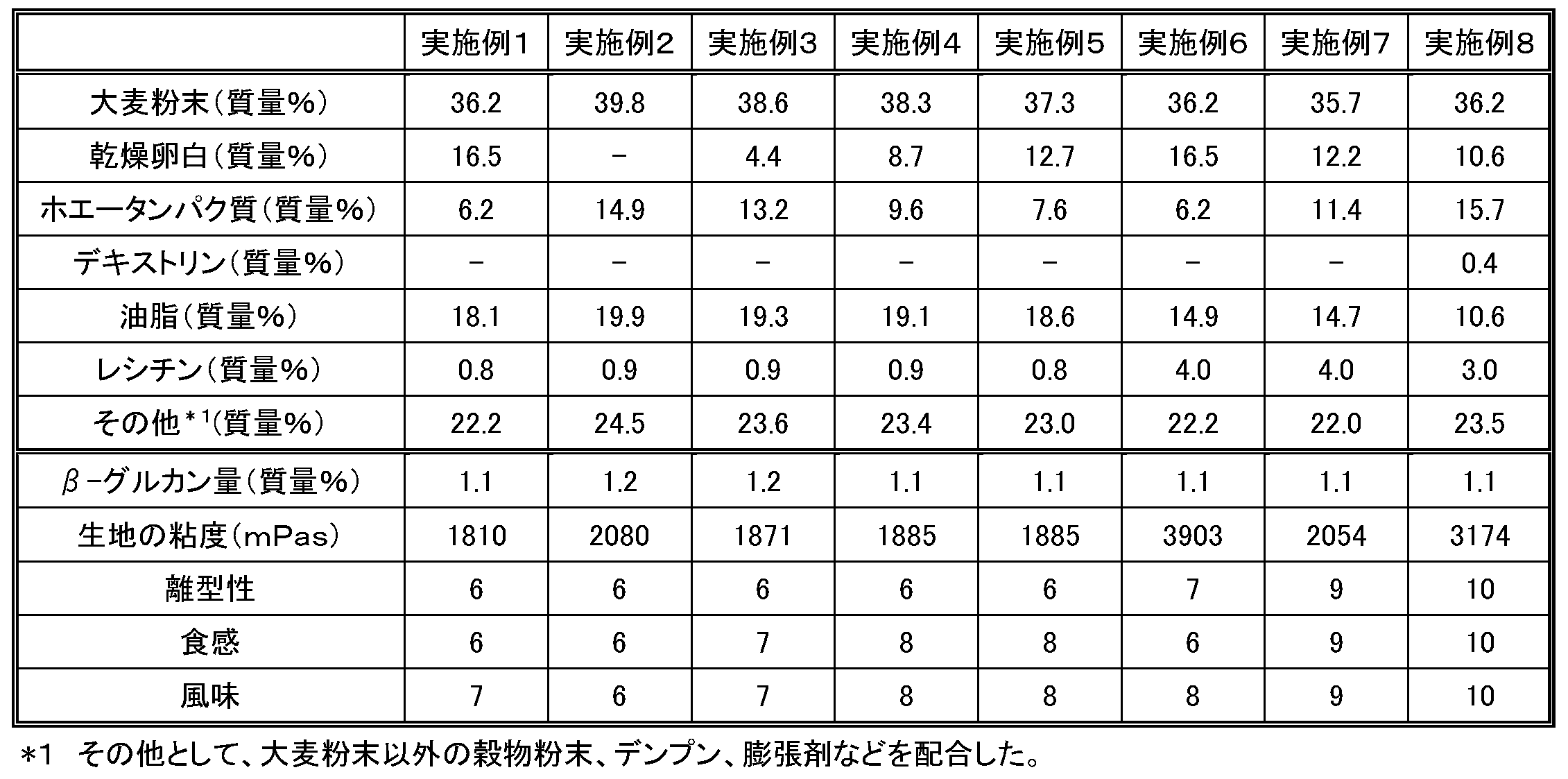
表2に示されるように、実施例1~8の結果から、卵白、乳タンパク質、デキストリンを用いた場合には、生地の粘度を適切に調整することができ、送液ポンプを用いて焼成プレート上に生地を好適に供給できることが明らかとなった。さらに、離型性、食感、風味の点でも優れていることが明らかとなった。また、焼き菓子の風味や食感を考慮すると、生地に乾燥卵白とホエータンパク質を共に含むことが望ましかった。離型性、食感、及び風味の合計が19点以上であると、クラッカーの製造に良く適合した生地といえ、22点以上がより好ましく、27点以上が特に好ましかった。
[比較例1]
実施例8の組成において、乾燥卵白、ホエータンパク質、及びデキストリンを配合しなかったこと以外は、実施例8と同様にして生地を調製した。比較例1で得られた生地について、上記の試験例と同様にして、粘度を測定した。生地の粘度は、粘度計TVB-10M(東機産業製)及び同粘度計用ローターM4を使用し、検体品温25℃にて3rpmで30秒測定して得られた値である。結果を表3に示す。
実施例8の組成において、乾燥卵白、ホエータンパク質、及びデキストリンを配合しなかったこと以外は、実施例8と同様にして生地を調製した。比較例1で得られた生地について、上記の試験例と同様にして、粘度を測定した。生地の粘度は、粘度計TVB-10M(東機産業製)及び同粘度計用ローターM4を使用し、検体品温25℃にて3rpmで30秒測定して得られた値である。結果を表3に示す。
[比較例2]
実施例8の組成において、乾燥卵白、ホエータンパク質、及びデキストリンの代わりに小麦タンパク質を用いたこと以外は、焼成後のウェハースの組成が表3の組成になるようにして生地を調製した。比較例2で得られた生地について、上記の試験例と同様にして、粘度計用ローターM4を使用し、検体品温25℃にて粘度を測定しようとしたが、粘度の測定限界値である2,000,000を超えたため、粘度を数値化できなかった。結果を表3に示す。
実施例8の組成において、乾燥卵白、ホエータンパク質、及びデキストリンの代わりに小麦タンパク質を用いたこと以外は、焼成後のウェハースの組成が表3の組成になるようにして生地を調製した。比較例2で得られた生地について、上記の試験例と同様にして、粘度計用ローターM4を使用し、検体品温25℃にて粘度を測定しようとしたが、粘度の測定限界値である2,000,000を超えたため、粘度を数値化できなかった。結果を表3に示す。
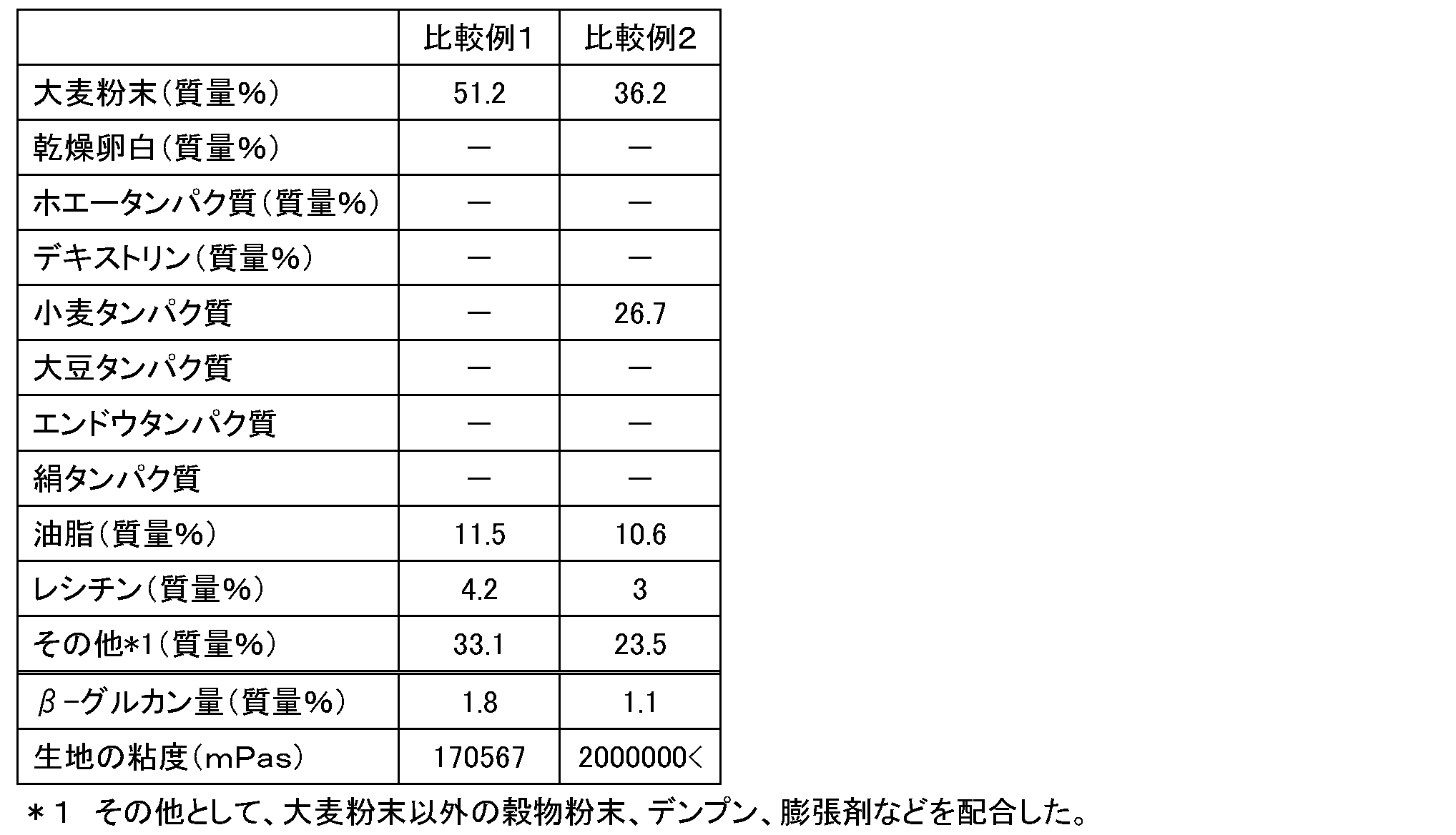
表3に示されるように、本発明における粘度調整剤を使用しなかったこと以外は実施例8と同様にした比較例1では、生地の固形分が実施例8よりも少なくなるにも拘わらず、生地の粘度が非常に高くなったため、送液ポンプを用いて焼成プレート上に生地を供給できなかった。また、本発明における粘度調整剤の代わりに小麦タンパク質を使用した比較例2においても、ウェハースを焼成するために必要な固形分を含む生地にすると、生地の粘度が非常に高くなったため、送液ポンプを用いて焼成プレート上に生地を供給できなかった。
Claims (9)
- 大麦粉末と、
卵白、乳タンパク質、コラーゲン、及びデキストリンからなる群から選択された少なくとも1種の粘度調整剤と
を含む生地を焼成してなる、焼き菓子。 - 前記焼き菓子中の前記大麦粉末の割合が、10質量%以上である、請求項1に記載の焼き菓子。
- 前記焼き菓子中のβ-グルカンの割合が、0.2質量%以上である、請求項1または2に記載の焼き菓子。
- 前記焼き菓子中の前記粘度調整剤の割合が、前記大麦粉末100質量部に対して、10~100質量部である、請求項1~3のいずれかに記載の焼き菓子。
- 前記焼き菓子中の前記卵白の固形分の割合が、前記大麦粉末100質量部に対して、10~100質量部である、請求項1~4のいずれかに記載の焼き菓子。
- 前記生地の粘度が、5000mPas以下である、請求項1~5のいずれかに記載の焼き菓子。
- 大麦粉末と、卵白、乳タンパク質、コラーゲン、及びデキストリンから選択された少なくとも1種の粘度調整剤とを混合して生地を得る工程、
前記生地を、焼成プレート上で焼成して焼き菓子を得る焼成工程、及び
前記焼成された焼き菓子を前記焼成プレートから離型する離型工程、
を備える、焼き菓子の製造方法。 - 請求項1~6のいずれかに記載の複数の焼き菓子の間に、クリーム、アイスクリーム、チョコレート、バター、ハチミツ、キャラメル、ゼリー、糖類、魚、肉、野菜、果物、豆類、カレー、チーズ、ベーコン、ココナッツ、メープルシロップ、ピザ、味噌、ソース、及び香辛料からなる群から選択された少なくとも1種を挟んでなる、焼き菓子。
- ウェハース、クラッカー、ビスケット、クッキー、パイ、チップ、またはせんべいである、請求項1~8に記載の焼き菓子。
Priority Applications (1)
| Application Number | Priority Date | Filing Date | Title |
|---|---|---|---|
| JP2015504382A JP6491088B2 (ja) | 2013-03-07 | 2014-03-06 | 大麦粉末を含む焼き菓子 |
Applications Claiming Priority (4)
| Application Number | Priority Date | Filing Date | Title |
|---|---|---|---|
| JP2013-045944 | 2013-03-07 | ||
| JP2013045944 | 2013-03-07 | ||
| JP2013-168613 | 2013-08-14 | ||
| JP2013168613 | 2013-08-14 |
Publications (1)
| Publication Number | Publication Date |
|---|---|
| WO2014136873A1 true WO2014136873A1 (ja) | 2014-09-12 |
Family
ID=51491381
Family Applications (1)
| Application Number | Title | Priority Date | Filing Date |
|---|---|---|---|
| PCT/JP2014/055771 Ceased WO2014136873A1 (ja) | 2013-03-07 | 2014-03-06 | 大麦粉末を含む焼き菓子 |
Country Status (3)
| Country | Link |
|---|---|
| JP (1) | JP6491088B2 (ja) |
| TW (1) | TW201519789A (ja) |
| WO (1) | WO2014136873A1 (ja) |
Cited By (1)
| Publication number | Priority date | Publication date | Assignee | Title |
|---|---|---|---|---|
| JP2016119856A (ja) * | 2014-12-24 | 2016-07-07 | 昭和産業株式会社 | 大麦粉含有加熱調理食品用生地を調製するための組成物、及び大麦粉含有加熱調理食品の製造方法 |
Families Citing this family (1)
| Publication number | Priority date | Publication date | Assignee | Title |
|---|---|---|---|---|
| JP7833258B2 (ja) * | 2019-12-16 | 2026-03-19 | ミヨシ油脂株式会社 | 菓子用組成物、及び菓子 |
-
2014
- 2014-03-06 JP JP2015504382A patent/JP6491088B2/ja active Active
- 2014-03-06 WO PCT/JP2014/055771 patent/WO2014136873A1/ja not_active Ceased
- 2014-03-06 TW TW103107641A patent/TW201519789A/zh unknown
Non-Patent Citations (3)
| Title |
|---|
| FROST D.J. ET AL.: "Effect of barley flour on the physical and sensory characteristics of chocolate chip cookies.", J. FOOD SCI. TECHNOL., vol. 48, no. 5, 2011, pages 569 - 576 * |
| KIKUKO TAKEDA: "Omugiko no Seika eno Oyo", TOKYO TORITSU TANKI DAIGAKU KENKYU KIYO, 1998, pages 79 - 83 * |
| TOSHIE TSUDA ET AL.: "Utilization of Barley Flour in Sweets", ANNUAL BULLETIN, 2003, pages 11 - 19 * |
Cited By (1)
| Publication number | Priority date | Publication date | Assignee | Title |
|---|---|---|---|---|
| JP2016119856A (ja) * | 2014-12-24 | 2016-07-07 | 昭和産業株式会社 | 大麦粉含有加熱調理食品用生地を調製するための組成物、及び大麦粉含有加熱調理食品の製造方法 |
Also Published As
| Publication number | Publication date |
|---|---|
| TW201519789A (zh) | 2015-06-01 |
| JPWO2014136873A1 (ja) | 2017-02-16 |
| JP6491088B2 (ja) | 2019-03-27 |
Similar Documents
| Publication | Publication Date | Title |
|---|---|---|
| US8652551B2 (en) | Method for preparing low-fat ice cream and a low-fat ice cream prepared by the method | |
| RU2565725C2 (ru) | Полое кондитерское изделие и способ его получения | |
| WO2002064714A1 (en) | PRODUCTS CONTAINING $G(b)-GLUCAN | |
| JP6130283B2 (ja) | えん麦のふすま由来の食品組成物およびその製造方法 | |
| RU2604824C1 (ru) | Способ производства выпечных изделий | |
| JP2016158608A (ja) | ベーカリー食品用組成物 | |
| JP6491088B2 (ja) | 大麦粉末を含む焼き菓子 | |
| RU2569019C1 (ru) | Способ производства заварных безглютеновых пряников | |
| KR101415261B1 (ko) | 천년초 쿠키 제조방법 | |
| JP5805477B2 (ja) | 分岐鎖アミノ酸を含有する焼菓子 | |
| KR101585314B1 (ko) | 자가유화 시스템을 이용한 블루베리 크림 및 초코파이 제조방법 | |
| WO2014083958A1 (ja) | 春巻皮の製造方法 | |
| KR100346100B1 (ko) | 마를 이용한 과자 제조방법 | |
| JP2005192566A (ja) | パン粉類似品およびそれを用いた食品 | |
| KR20190093914A (ko) | 머랭 조성물과 머랭 제조방법 그리고 머랭 과자 | |
| Lamsal | Preparation and Quality Evaluation of Oats Flour Incorporated Muffin | |
| JPWO2008093611A1 (ja) | 焼成食品の製造方法 | |
| JP5641673B2 (ja) | Gi値低減剤及びgi値が低減された食品の製造方法 | |
| Sruthi¹ et al. | Development of Wafers Incorporated with Pearl Millet Flour & Barnyard Millet Flour | |
| RU2650903C1 (ru) | Состав для производства мучных кондитерских изделий | |
| TWI856178B (zh) | 脆硬麵包的製造方法、脆硬麵包用麵包麵糰的製造方法、脆硬麵包用麵包的製造方法、脆硬麵包用碎片狀油脂組成物、脆硬麵包的口感提升方法、以及在脆硬麵包的製造方法中省略麵包乾燥步驟的方法 | |
| RU2796838C1 (ru) | Способ производства крекера из медузы | |
| JP5828620B2 (ja) | 加工米 | |
| RU2689693C1 (ru) | Способ производства крекера | |
| KR20190081116A (ko) | 옥수수 반죽 반제품의 제조방법 |
Legal Events
| Date | Code | Title | Description |
|---|---|---|---|
| 121 | Ep: the epo has been informed by wipo that ep was designated in this application |
Ref document number: 14760127 Country of ref document: EP Kind code of ref document: A1 |
|
| ENP | Entry into the national phase |
Ref document number: 2015504382 Country of ref document: JP Kind code of ref document: A |
|
| NENP | Non-entry into the national phase |
Ref country code: DE |
|
| 122 | Ep: pct application non-entry in european phase |
Ref document number: 14760127 Country of ref document: EP Kind code of ref document: A1 |