WO2014098233A1 - エネルギーデバイス電極用バインダ樹脂材料、エネルギーデバイス電極及びエネルギーデバイス - Google Patents
エネルギーデバイス電極用バインダ樹脂材料、エネルギーデバイス電極及びエネルギーデバイス Download PDFInfo
- Publication number
- WO2014098233A1 WO2014098233A1 PCT/JP2013/084317 JP2013084317W WO2014098233A1 WO 2014098233 A1 WO2014098233 A1 WO 2014098233A1 JP 2013084317 W JP2013084317 W JP 2013084317W WO 2014098233 A1 WO2014098233 A1 WO 2014098233A1
- Authority
- WO
- WIPO (PCT)
- Prior art keywords
- meth
- acrylate
- energy device
- group
- electrode
- Prior art date
- Legal status (The legal status is an assumption and is not a legal conclusion. Google has not performed a legal analysis and makes no representation as to the accuracy of the status listed.)
- Ceased
Links
Images
Classifications
-
- H—ELECTRICITY
- H01—ELECTRIC ELEMENTS
- H01M—PROCESSES OR MEANS, e.g. BATTERIES, FOR THE DIRECT CONVERSION OF CHEMICAL ENERGY INTO ELECTRICAL ENERGY
- H01M10/00—Secondary cells; Manufacture thereof
- H01M10/05—Accumulators with non-aqueous electrolyte
- H01M10/052—Li-accumulators
-
- H—ELECTRICITY
- H01—ELECTRIC ELEMENTS
- H01G—CAPACITORS; CAPACITORS, RECTIFIERS, DETECTORS, SWITCHING DEVICES, LIGHT-SENSITIVE OR TEMPERATURE-SENSITIVE DEVICES OF THE ELECTROLYTIC TYPE
- H01G11/00—Hybrid capacitors, i.e. capacitors having different positive and negative electrodes; Electric double-layer [EDL] capacitors; Processes for the manufacture thereof or of parts thereof
- H01G11/22—Electrodes
- H01G11/30—Electrodes characterised by their material
-
- H—ELECTRICITY
- H01—ELECTRIC ELEMENTS
- H01G—CAPACITORS; CAPACITORS, RECTIFIERS, DETECTORS, SWITCHING DEVICES, LIGHT-SENSITIVE OR TEMPERATURE-SENSITIVE DEVICES OF THE ELECTROLYTIC TYPE
- H01G11/00—Hybrid capacitors, i.e. capacitors having different positive and negative electrodes; Electric double-layer [EDL] capacitors; Processes for the manufacture thereof or of parts thereof
- H01G11/22—Electrodes
- H01G11/30—Electrodes characterised by their material
- H01G11/32—Carbon-based
- H01G11/38—Carbon pastes or blends; Binders or additives therein
-
- H—ELECTRICITY
- H01—ELECTRIC ELEMENTS
- H01M—PROCESSES OR MEANS, e.g. BATTERIES, FOR THE DIRECT CONVERSION OF CHEMICAL ENERGY INTO ELECTRICAL ENERGY
- H01M4/00—Electrodes
- H01M4/02—Electrodes composed of, or comprising, active material
- H01M4/62—Selection of inactive substances as ingredients for active masses, e.g. binders, fillers
- H01M4/621—Binders
- H01M4/622—Binders being polymers
-
- Y—GENERAL TAGGING OF NEW TECHNOLOGICAL DEVELOPMENTS; GENERAL TAGGING OF CROSS-SECTIONAL TECHNOLOGIES SPANNING OVER SEVERAL SECTIONS OF THE IPC; TECHNICAL SUBJECTS COVERED BY FORMER USPC CROSS-REFERENCE ART COLLECTIONS [XRACs] AND DIGESTS
- Y02—TECHNOLOGIES OR APPLICATIONS FOR MITIGATION OR ADAPTATION AGAINST CLIMATE CHANGE
- Y02E—REDUCTION OF GREENHOUSE GAS [GHG] EMISSIONS, RELATED TO ENERGY GENERATION, TRANSMISSION OR DISTRIBUTION
- Y02E60/00—Enabling technologies; Technologies with a potential or indirect contribution to GHG emissions mitigation
- Y02E60/10—Energy storage using batteries
Definitions
- the present invention relates to a binder resin material for an energy device electrode, an energy device electrode, and an energy device.
- Lithium ion secondary batteries which are energy devices with high energy density, are widely used as power sources for portable information terminals such as notebook computers, mobile phones and PDAs.
- this lithium ion secondary battery (hereinafter, also simply referred to as “lithium battery”), carbon having a multilayer structure capable of inserting and releasing lithium ions between layers (formation of a lithium intercalation compound) and release as an active material of a negative electrode Material is mainly used.
- lithium-containing metal composite oxide is mainly used as the positive electrode active material.
- An electrode of a lithium battery is usually prepared by kneading these active materials, a binder resin material and a solvent (N-methyl-2-pyrrolidone, water, etc.) to prepare an electrode mixture slurry.
- a metal foil as a current collector is applied to one or both sides of a current collector with a transfer roll or the like, the solvent is removed to form a mixture layer, and then compression molded with a roll press or the like.
- properties required for the binder resin material include adhesion between the active materials and between the active material and the current collector, swelling resistance to the electrolytic solution, electrochemical stability, flexibility, and electrode composition using the same. And the viscosity stability of the agent slurry. Furthermore, in order to increase the capacity of the lithium battery, it is required to sufficiently satisfy these characteristics even when the amount of the binder resin material added is small. However, the conventional binder resin material does not sufficiently satisfy these characteristics.
- a modified poly (meth) acrylonitrile binder obtained by copolymerizing a short-chain monomer such as a 1-olefin having 2 to 4 carbon atoms and / or an alkyl (meth) acrylate having 3 or less carbon atoms
- a binder resin material obtained by blending a resin and a rubber component having a glass transition temperature of ⁇ 80 ° C. to 0 ° C. is disclosed (for example, see Japanese Patent No. 4300239).
- the solvent used for preparing the electrode mixture slurry it is preferable to use water from the viewpoint of reducing the environmental load.
- water When water is used as a solvent, a method of dispersing a binder resin material with water is known.
- a thickener such as carboxymethyl cellulose in combination.
- a problem may occur in the adhesion, the stability of the electrode mixture slurry, and the like.
- metal-based negative electrode materials have been proposed as high-capacity negative electrode active materials.
- the metal-based negative electrode material has a high capacity, but has a large volume expansion / contraction due to charge / discharge. Therefore, in the binder resin material used conventionally, the adhesiveness of the interface between the mixture layer and the current collector and the adhesiveness between the active materials in the mixture layer are insufficient, and it is remarkable by repeating the charge / discharge cycle. The problem is that the capacity decreases. Therefore, a binder resin material having excellent adhesion that can be used in the metal-based negative electrode material as described above is required. In this regard, it has been proposed to use lithium polyacrylate as a binder for a tin-cobalt-carbon composite composite negative electrode (see, for example, Electrochimica Acta., 55 (2010), 2991-2995).
- Poly (meth) acrylonitrile is excellent in adhesion between active materials and between active materials and current collectors, but electrode mixture slurries using the same tend to easily increase in viscosity over time, and may have poor storage stability. there were.
- poly (meth) acrylonitrile tends to have a low elastic modulus in the high temperature rubber region, and the charge / discharge cycle characteristics at high temperatures are not always satisfactory.
- An object of the present invention is to provide a binder resin material for an energy device electrode capable of preparing an electrode mixture slurry excellent in storage stability and capable of forming an energy device electrode excellent in adhesion between the mixture layer and a current collector. There is to do. Moreover, the objective of this invention is comprised using the binder resin material for energy device electrodes, and is providing the energy device electrode which is excellent in the adhesiveness of a mixture layer and a collector. Furthermore, the objective of this invention is providing the energy device by which the capacity
- a binder resin material for an energy device electrode containing a copolymer containing a structural unit derived from (meth) acrylonitrile and a structural unit derived from a compound having two or more ethylenically unsaturated bonds.
- the compound having two or more ethylenically unsaturated bonds is the binder resin material for an energy device electrode according to ⁇ 1>, which is a compound represented by the following general formula (I).
- each R 1 independently represents a hydrogen atom or a methyl group.
- R 2 represents an n-valent organic group.
- N represents a number of 2 to 6.
- a copolymer comprising a current collector and a structural unit derived from (meth) acrylonitrile and a compound having two or more ethylenically unsaturated bonds, provided on at least one surface of the current collector , As well as a mixture layer containing an active material.
- An energy device comprising the energy device electrode according to ⁇ 4>, a counter electrode of the energy device electrode, and an electrolyte.
- the energy device according to ⁇ 5> which is a lithium ion secondary battery.
- the binder resin material for energy device electrodes which can form the energy device electrode which can prepare the electrode mixture slurry excellent in storage stability, and is excellent in the adhesiveness of a mixture layer and a collector is provided. can do. Moreover, it is comprised using the binder resin material for energy device electrodes, and the energy device electrode which is excellent in the adhesiveness of a mixture layer and a collector can be provided. Furthermore, the energy device in which the capacity
- the term “process” is not limited to an independent process, and is included in the term if the intended purpose of the process is achieved even when it cannot be clearly distinguished from other processes.
- the numerical range indicated by using “to” indicates a range including the numerical values described before and after “to” as the minimum value and the maximum value, respectively.
- the content of each component in the composition means the total amount of the plurality of substances present in the composition unless there is a specific notice when there are a plurality of substances corresponding to each component in the composition. .
- (Meth) acrylate means at least one of acrylate and the corresponding methacrylate
- (meth) acrylic acid means at least one of acrylic acid and methacrylic acid
- (meth) allyl means allyl and methallyl
- (meth) acrylonitrile means at least one of acrylonitrile and methacrylonitrile.
- the term “monomer” means a polymerizable compound having only one ethylenically unsaturated bond, and a crosslinkable polymerizable compound having two or more ethylenically unsaturated bonds; Means something different.
- the binder resin material for energy device electrodes of the present invention comprises a copolymer (hereinafter referred to as “specific copolymer”) containing a structural unit derived from (meth) acrylonitrile and a structural unit derived from a compound having two or more ethylenically unsaturated bonds. At least one kind of "combined”.
- the energy device electrode binder resin material may contain other components such as a solvent and a surfactant, as necessary.
- an electrode mixture slurry is constituted by having a specific copolymer having a structural unit derived from a compound having two or more ethylenically unsaturated bonds in addition to a structural unit derived from (meth) acrylonitrile, Increase in viscosity is suppressed and storage stability is excellent. Moreover, when the energy device electrode is configured using the binder resin material for the energy device electrode, the adhesion between the mixture layer and the current collector is excellent.
- the specific copolymer Since the specific copolymer has a cross-linked structural unit in addition to the highly polar structural unit, when the electrode mixture slurry is composed using this, the increase in viscosity over time is suppressed and stored. It is considered excellent in stability.
- the specific copolymer has a highly polar structural unit and the energy device electrode is configured using the binder resin material for the energy device electrode containing the specific copolymer, the adhesion between the mixture layer and the current collector It is considered excellent.
- the storage elastic modulus in the high-temperature rubber region is increased because the specific copolymer has a structure in which highly polar structural units are crosslinked. Thereby, it is thought that an energy device provided with the energy device electrode which has the mixture layer containing a specific copolymer is excellent in especially the charge / discharge cycle characteristic in high temperature.
- the electrode produced using the binder resin material for the energy device electrode has excellent adhesion between the mixture layer and the current collector, so that the electrode mixture slurry is applied to the current collector and dried. It is possible to suppress the peeling of the mixture layer from the current collector during winding in the pressed state, during slit processing, during pressing, and after pressing. Furthermore, the binder resin material for energy device electrodes of the present invention, as described above, can be used even in a small amount because a mixture layer with excellent adhesion to the current collector can be obtained, and the amount of binder resin material used Can be reduced.
- An energy device (preferably a lithium battery) including an electrode manufactured using the binder resin material for an energy device electrode has good conductivity because it easily follows expansion and contraction due to charging / discharging of an active material. The capacity reduction in the discharge cycle is suppressed.
- the specific copolymer includes a structural unit derived from a monomer (meth) acrylonitrile and a structural unit derived from a compound having two or more ethylenically unsaturated bonds (hereinafter also referred to as “crosslinking agent”). .
- the said specific copolymer may further contain the structural unit derived from other monomers other than (meth) acrylonitrile as needed.
- the specific copolymer is a monomer composition containing (meth) acrylonitrile, other monomers used as necessary, and a compound (crosslinking agent) having two or more ethylenically unsaturated bonds. It can be obtained by polymerization.
- One type of monomer constituting each structural unit may be selected and used for polymerization in each structural unit, or a plurality of types may be selected and used for polymerization. Further, one type of monomer may be selected as a monomer constituting a specific structural unit, and a plurality of types of monomers may be selected as monomers constituting other structural units.
- the specific copolymer should just contain each structural unit mentioned above, and there is no restriction
- the specific copolymer may be either a block copolymer or a random copolymer, and is preferably a random copolymer.
- the specific copolymer includes a structural unit derived from (meth) acrylonitrile. That is, the specific copolymer includes a structural unit derived from at least one selected from the group consisting of acrylonitrile and methacrylonitrile.
- the structural unit derived from (meth) acrylonitrile is preferably a structural unit derived from acrylonitrile from the viewpoint of flexibility and the like.
- the content of the structural unit derived from (meth) acrylonitrile in the specific copolymer is not particularly limited.
- the content of structural units derived from (meth) acrylonitrile is based on the total number of structural units derived from the monomer of the specific copolymer from the viewpoint of excellent adhesion between the current collector and the mixture layer in the energy device electrode. (100 mol%) is preferably 20 mol% to 70 mol%, and more preferably 30 mol% to 60 mol% from the viewpoint of excellent adhesion and storage stability of the electrode mixture slurry. More preferably, it is 35 mol% to 45 mol%.
- the compound having two or more ethylenically unsaturated bonds includes two or more functional groups containing an ethylenically unsaturated bond and an organic group that is a divalent or higher linking group that links the functional groups to each other. If it is a compound which has this, there will be no restriction
- the compound having two or more ethylenically unsaturated bonds is preferably, for example, a compound represented by the following general formula (I).
- R ⁇ 1 > shows a hydrogen atom or a methyl group each independently.
- R 2 represents an n-valent organic group.
- n represents a number of 2 to 6 and is preferably 3 to 4.
- n is an integer when the compound represented by formula (I) is a single molecular species.
- the n-valent organic group represented by R 2 is an n-valent aliphatic hydrocarbon having 2 to 20 carbon atoms formed by removing n hydrogen atoms from an aliphatic hydrocarbon having 2 to 20 carbon atoms.
- R 2 is an n-valent aliphatic hydrocarbon group having 2 to 11 carbon atoms formed by removing n hydrogen atoms from an aliphatic hydrocarbon having 2 to 11 carbon atoms and 3 to 3 carbon atoms. It is preferably at least one selected from the group consisting of n-valent organic groups formed by removing n hydroxy groups from 11 polyhydric alcohols or hydroxyalkylated products thereof, and aliphatic groups having 3 to 11 carbon atoms A trivalent to tetravalent aliphatic hydrocarbon group having 3 to 11 carbon atoms and a polyhydric alcohol having 3 to 11 carbon atoms or a hydroxyalkyl thereof having 3 to 11 carbon atoms formed by removing 3 to 4 hydrogen atoms from the hydrocarbon More preferably, it is at least one selected from the group consisting of trivalent to tetravalent organic groups formed by removing 3 to 4 hydroxy groups from the compound.
- Specific examples of compounds having two or more ethylenically unsaturated bonds include 1,4-butanediol diacrylate (manufactured by Hitachi Chemical Co., Ltd., trade name FA-124AS), nonanediol diacrylate (Hitachi Chemical Co., Ltd.).
- the compound having two or more ethylenically unsaturated bonds is preferably a trifunctional or tetrafunctional acrylate having 3 or 4 (meth) acrylic groups, and has a carbon number of 3 to 11
- a poly (meth) acrylic acid ester of a monohydric alcohol is more preferable, and pentaerythritol triacrylate or ethoxylated pentaerythritol tetraacrylate is more preferable.
- These compounds having two or more ethylenically unsaturated bonds can be used singly or in combination of two or more.
- the content of the structural unit derived from the compound having two or more ethylenically unsaturated bonds in the specific copolymer is not particularly limited.
- the content of the structural unit derived from a compound having two or more ethylenically unsaturated bonds increases the storage elastic modulus in the rubber-like region of the specific copolymer, and follows the expansion and contraction of the active material during charging and discharging of the energy device. From the viewpoint of facilitating the treatment, it is preferably 0.01 to 5.0 parts by mass, and 0.05 to 3 parts by mass with respect to 100 parts by mass of the total monomer-derived mass in the specific copolymer.
- the amount is more preferably 0 part by mass, and further preferably 0.02 part by mass to 2.0 parts by mass.
- the content rate of the structural unit derived from the compound having two or more ethylenically unsaturated bonds in the specific copolymer is specified in mol%, the total number of structural units derived from the monomer in the specific copolymer (100 mol) %) To 0.001 mol% to 1.0 mol%, more preferably 0.005 mol% to 0.5 mol%, and 0.02 mol% to 0.2 mol%. More preferably, it is mol%.
- the molar ratio of the content of the structural unit derived from the compound having two or more ethylenically unsaturated bonds to the content of the structural unit derived from (meth) acrylonitrile in the specific polymer is not particularly limited. From the viewpoint of excellent adhesion between the current collector and the mixture layer in the energy device electrode, the molar ratio is preferably 0.008 mol% to 0.8 mol%, preferably 0.03 mol% to 0.00. More preferably, it is 3 mol%.
- the specific copolymer may further include at least one structural unit derived from a monomer other than the structural unit derived from (meth) acrylonitrile, if necessary.
- the other monomer include a monomer represented by the following general formula (II), a monomer represented by the following general formula (III), and an acidic functional group-containing monomer.
- R 21 represents a hydrogen atom or a methyl group.
- R 22 represents a 2-cyanoethyl group, an alkyl group having 3 to 20 carbon atoms, or a hydroxyalkyl group having 5 to 20 carbon atoms.
- the alkyl group having 3 to 20 carbon atoms for R 22 may be a branched alkyl group or a linear alkyl group, and is preferably a linear alkyl group.
- the number of carbon atoms in the alkyl group represented by R 22 is preferably 3 to 12, and more preferably 3 to 8.
- alkyl group having 3 to 20 carbon atoms represented by R 22 include propyl group, 1-methylethyl group, butyl group, 1-methylpropyl group, 2-methylpropyl group, and 1,1-dimethylethyl.
- the alkyl group represented by R 22 is a propyl group, butyl group, pentyl group, hexyl group, heptyl group, octyl group, 2-ethylhexyl, which is an alkyl group having 3 to 12 carbon atoms.
- the alkyl group constituting the hydroxyalkyl group having 5 to 20 carbon atoms in R 22 may be a branched alkyl group or a linear alkyl group, and is preferably a linear alkyl group. .
- the number of carbon atoms of the hydroxyalkyl group represented by R 22 is preferably 5 to 12, and more preferably 5 to 8.
- hydroxyalkyl group having 5 to 20 carbon atoms represented by R 22 include 5-hydroxypentyl group, 6-hydroxyhexyl group, 7-hydroxyheptyl group, 8-hydroxyoctyl group, and 9-hydroxynonyl.
- the hydroxyalkyl group represented by R 22 is a 5-hydroxypentyl group, 6-hydroxyhexyl group, 7-hydroxyheptyl group, which is a hydroxyalkyl group having 5 to 12 carbon atoms, 8
- a 5-hydroxyoctyl group, a 9-hydroxynonyl group, a 10-hydroxydecyl group, an 11-hydroxyundecyl group, or a 12-hydroxydodecyl group is preferable, and 5-hydroxy which is a hydroxyalkyl group having 5 to 8 carbon atoms.
- a pentyl group, 6-hydroxyhexyl group, 7-hydroxyheptyl group, or 8-hydroxyoctyl group is more preferable.
- the monomer represented by the general formula (II) include 2-cyanoethyl (meth) acrylate, propyl (meth) acrylate, 1-methylethyl (meth) acrylate, butyl (meth) acrylate, and 1-methyl.
- the monomers represented by the general formula (II) are propyl (meth) acrylate, butyl (meth) acrylate, pentyl (meth) acrylate, hexyl (meth) acrylate, heptyl (meth) from the viewpoint of ease of synthesis.
- R 31 represents a hydrogen atom or a methyl group.
- X represents an alkylene group having 2 to 4 carbon atoms.
- m represents a number from 1 to 10.
- R 32 represents a hydrogen atom or an alkyl group having 1 to 5 carbon atoms.
- X is preferably an alkylene group having 2 or 3 carbon atoms.
- m is preferably a number from 1 to 6, more preferably from 1 to 4.
- m is an integer when the compound represented by the general formula (III) is a single molecular species, and is a rational number that is an average value when including a plurality of molecular species.
- the alkyl group represented by R 32 may be a branched alkyl group or a linear alkyl group, and is preferably a linear alkyl group.
- the alkyl group represented by R 32 preferably has 1 to 3 carbon atoms.
- alkyl group having 1 to 5 carbon atoms represented by R 32 include a methyl group, an ethyl group, a propyl group, a 1-methylethyl group, a butyl group, a 1-methylpropyl group, a 2-methylpropyl group, 1 , 1-dimethylethyl group, pentyl group, 1-methylbutyl group, 2-methylbutyl group, 3-methylbutyl group, 1,1-dimethylpropyl group, 1,2-dimethylpropyl group, 2,2-dimethylpropyl group, 1 -An ethylpropyl group and the like can be mentioned.
- the alkyl group represented by R 32 is preferably a methyl group, an ethyl group, or a propyl group from the viewpoint of ease of synthesis and the like.
- monomer represented by the general formula (III) examples include 2-hydroxyethyl (meth) acrylate, 3-hydroxypropyl (meth) acrylate, 4-hydroxybutyl (meth) acrylate, and diethylene glycol mono (meth).
- Acrylate triethylene glycol mono (meth) acrylate, tetraethylene glycol mono (meth) acrylate, pentaethylene glycol mono (meth) acrylate, hexaethylene glycol mono (meth) acrylate, heptaethylene glycol mono (meth) acrylate, octaethylene glycol Alkylene glycol mono (meth) acrylates such as mono (meth) acrylate, nonaethylene glycol mono (meth) acrylate, decaethylene glycol mono (meth) acrylate; Tyl monoethylene glycol (meth) acrylate, methyldiethylene glycol (meth) acrylate, methyltriethylene glycol (meth) acrylate, methyltetraethylene glycol (meth) acrylate, methylpentaethylene glycol (meth) acrylate, methylhexaethylene glycol (meth) Acrylate, methylheptaethylene glycol (meth) acrylate, methyl octaethylene
- the monomer represented by the general formula (III) includes 2-hydroxyethyl (meth) acrylate, 3-hydroxypropyl (meth) acrylate, 4-hydroxybutyl (meth) acrylate, Diethylene glycol mono (meth) acrylate, triethylene glycol mono (meth) acrylate, tetraethylene glycol mono (meth) acrylate, pentaethylene glycol mono (meth) acrylate, hexaethylene glycol mono (meth) acrylate, methyl monoethylene glycol (meth) Acrylate, methyldiethylene glycol (meth) acrylate, methyltriethylene glycol (meth) acrylate, methyltetraethylene glycol (meth) acrylate, methylpentaethylene glycol (me Acrylate), methyl hexaethylene glycol (meth) acrylate, ethyl monoethylene glycol (meth) acrylate, ethyl diethylene glycol (meth) acrylate, ethyl
- the specific copolymer is a monomer represented by the structural unit derived from the monomer represented by the general formula (II) and the monomer represented by the general formula (III) from the viewpoint of adjusting the glass transition temperature (Tg) described later. It is preferable to further include at least one structural unit selected from the group consisting of derived structural units.
- the specific copolymer includes 1 structural unit selected from the group consisting of a structural unit derived from the monomer represented by the general formula (II) and a structural unit derived from the monomer represented by the general formula (III).
- One species may be included alone, or two or more species may be combined and included.
- the specific copolymer includes at least one structural unit derived from a monomer represented by the general formula (II) and a structural unit derived from the monomer represented by the general formula (III)
- the contents of the structural unit derived from the monomer represented by the general formula (II) and the structural unit derived from the monomer represented by the general formula (III) are not particularly limited, and are appropriately selected according to the purpose and the like. be able to.
- the total content of the structural unit derived from the monomer represented by the general formula (II) and the structural unit derived from the monomer represented by the general formula (III) is the current collector and the mixture layer in the energy device electrode.
- the resin is preferably 30 to 80 mol% based on the total amount of structural units derived from monomers in the specific copolymer (100 mol%). From the viewpoint of excellent storage stability of the mixture slurry, it is more preferably 40 mol% to 70 mol%, and further preferably 55 mol% to 65 mol%.
- the specific copolymer includes both a structural unit derived from the monomer represented by the general formula (II) and a structural unit derived from the monomer represented by the general formula (III), the general formula (II).
- the content ratio of the structural unit derived from the monomer represented by) and the structural unit derived from the monomer represented by the general formula (III) is not particularly limited, and the monomer represented by the general formula (II) And can be appropriately selected according to the structure of the monomer represented by formula (III).
- the specific copolymer includes a structural unit derived from the monomer represented by the general formula (II), among the monomers represented by the general formula (II), R 22 represents a 2-cyanoethyl group.
- the content of the monomer-derived structural unit is 5 on the basis of the total structural unit amount derived from the monomer in the specific copolymer (100 mol%). It is preferably at most mol%, more preferably substantially at 0 mol%, still more preferably at 0 mol%.
- the acidic functional group-containing monomer is not particularly limited as long as it is a compound having an acidic functional group and a functional group containing an ethylenically unsaturated bond.
- the acidic functional group include a carboxy group, a sulfo group, a phosphoric acid group, a phenolic hydroxyl group, and salts thereof.
- acidic functional group-containing monomers examples include carboxylic group-containing monomers such as acrylic acid, methacrylic acid, maleic acid, crotonic acid, itaconic acid, citraconic acid, vinyl benzoic acid, and carboxyethyl acrylate; Sulfo group-containing monomers such as acid, sodium (meth) allylsulfonate, sodium (meth) allyloxybenzenesulfonate, sodium styrenesulfonate, 2-acrylamido-2-methylpropanesulfonic acid; acid phosphoxyethyl methacrylate ( Unichemical Co., Ltd., trade name: Phosmer M), acid phosphoxypolyoxyethylene glycol monomethacrylate (Unichemical Co., Ltd., trade name: Phosmer PE), 3-chloro-2-acid phosphoxypropyl methacrylate Phosphoric acid group-containing monomers such as Todo (Unichemical Co., Ltd., trade name: Phosphor
- At least one selected from the group consisting of acrylic acid, methacrylic acid, and 2-carboxyethyl acrylate is preferable from the viewpoints of ease of synthesis, adhesion between active materials, and the like.
- These acidic functional group-containing monomers can be used alone or in combination of two or more.
- the content is not particularly limited.
- the content of the structural unit derived from the acidic functional group-containing monomer can be, for example, 0.01 mol to 10 mol with respect to 1 mol of the structural unit derived from (meth) acrylonitrile. If the content of the structural unit derived from the acidic functional group-containing monomer is 0.01 mol or more, the effect of improving the adhesion between the active materials and between the mixture layer and the current collector is sufficient in the specific copolymer. Demonstrated.
- the content rate of the structural unit derived from an acidic functional group-containing monomer is 10 mol or less, the structural unit derived from the above-mentioned (meth) acrylonitrile-derived structural unit and a compound having two or more ethylenically unsaturated bonds The characteristics derived from are sufficiently exhibited in the specific copolymer.
- the specific copolymer is derived from a monomer represented by the general formula (II) or a structural unit derived from the monomer represented by the general formula (III) as a structural unit derived from another monomer.
- a structural unit derived from a monomer other than the structural unit derived from the structural unit and the acidic functional group-containing monomer may further be included.
- short chain (meth) acrylates such as methyl (meth) acrylate and ethyl (meth) acrylate, alicyclic (meth) acrylates such as cyclohexyl (meth) acrylate and isobornyl (meth) acrylate
- Vinyl halides such as acrylic ester, vinyl chloride, vinyl bromide, vinylidene chloride, maleic imide, phenylmaleimide, (meth) acrylamide, styrene, ⁇ -methylstyrene, vinyl acetate, 1,1-bis (trifluoromethyl) ) -2,2,2-trifluoroethyl acrylate, 2,2,3,3,4,4,4-heptafluorobutyl acrylate, 2,2,3,4,4,4-hexafluorobutyl acrylate, Nonafluoroisobutyl acrylate, 2,2,3,3,4,4,5,5-octafluoro Pentyl
- the content is not particularly limited.
- the content of structural units derived from other monomers can be, for example, 0.01 to 10 moles per mole of structural units derived from (meth) acrylonitrile.
- the content of the structural unit derived from another monomer is 0.01 mol or more, the characteristics derived from the other monomer are sufficiently exhibited in the specific copolymer.
- the content rate of the structural unit derived from another monomer is 10 mol or less, it is derived from the structural unit derived from the above-mentioned (meth) acrylonitrile-derived structural unit and a compound having two or more ethylenically unsaturated bonds. This characteristic is sufficiently exhibited in the specific copolymer.
- the glass transition temperature (Tg) of the specific copolymer is not particularly limited.
- the glass transition temperature of the specific copolymer is preferably 25 ° C. to 120 ° C., which is higher than the storage temperature of the electrode mixture slurry and lower than the drying temperature at the time of producing the energy device electrode, and is 30 ° C. to 80 ° C. More preferably, it is more preferably 35 ° C. to 50 ° C. If the glass transition temperature is 25 ° C. or higher, the electrode mixture slurry tends to be more excellent in storage stability. Moreover, if the glass transition temperature is 120 ° C. or lower, the adhesiveness of the energy device electrode tends to be better.
- the glass transition temperature of the specific copolymer can be measured under normal measurement conditions by dynamic viscoelasticity measurement (DMA).
- DMA dynamic viscoelasticity measurement
- the storage elastic modulus of the specific copolymer is not particularly limited and can be appropriately selected according to the purpose.
- the storage elastic modulus of the specific copolymer is preferably 1.0 MPa to 60 MPa, more preferably 1.1 MPa to 50 MPa at 60 ° C. from the viewpoint of cycle characteristics at a high temperature of the energy device.
- the storage elastic modulus of the specific copolymer can be measured by forming the specific copolymer into a film and measuring the dynamic viscoelasticity (DMA).
- the specific copolymer is a monomer (meth) acrylonitrile from the viewpoint of the storage stability of the electrode mixture slurry, the adhesion between the mixture layer and the current collector in the energy device electrode, and the adhesion between the active materials.
- the second structural unit derived from the compound (crosslinking agent) represented by the general formula (I) is added in an amount of 0.001 mol% to 1. mol based on 100 mol% of the total number of structural units derived from the monomer. An embodiment containing 0 mol% is preferable.
- the first structural unit is contained in an amount of 30 mol% to 60 mol%
- the third structural unit is contained in an amount of 40 mol% to 70 mol%
- the second structural unit is derived from a monomer.
- the structural unit is contained in an amount of 0.005 mol% to 0.5 mol% with respect to the total number of structural units of 100 mol%.
- the first structural unit is contained in an amount of 30 mol% to 60 mol%
- the third structural unit is contained in an amount of 40 mol% to 70 mol%
- the second structural unit is derived from a monomer.
- the structural unit is contained in an amount of 0.005 mol% to 0.5 mol% with respect to the total number of structural units of 100 mol%, and the glass transition temperature is 25 ° C. to 120 ° C.
- the specific copolymer in the present invention includes (meth) acrylonitrile, a compound having two or more ethylenically unsaturated bonds, and, if necessary, a monomer represented by the general formula (II), a general formula ( It is produced by polymerizing a monomer composition constituted by appropriately combining the monomer represented by III), an acidic functional group-containing monomer, and other monomers other than these monomers. be able to.
- the polymerization mode for producing the specific copolymer in the present invention is not particularly limited, and examples thereof include precipitation polymerization, bulk polymerization, suspension polymerization, emulsion polymerization, and solution polymerization. Precipitation polymerization or emulsion polymerization is preferable in terms of ease of copolymer synthesis, ease of post-treatment such as recovery and purification.
- a polymerization initiator for the polymerization of the monomer composition.
- a water-soluble polymerization initiator is preferable in view of polymerization initiation efficiency and the like.
- Water-soluble polymerization initiators include persulfates such as ammonium persulfate, potassium persulfate and sodium persulfate; water-soluble peroxides such as hydrogen peroxide; 2,2′-azobis (2-methylpropionamidine hydrochloride) Water-soluble azo compounds such as persulfates; reducing agents such as sodium hydrogen sulfite, ammonium hydrogen sulfite, sodium thiosulfate, and hydrosulfite; and polymerization accelerators such as sulfuric acid, iron sulfate, and copper sulfate.
- Redox type (redox type) etc. which used together.
- persulfate or a water-soluble azo compound is preferable from the viewpoint of ease of copolymer synthesis.
- Water-soluble means that the solubility in 100 g of pure water at 25 ° C. is 1 g or more.
- the polymerization initiator is preferably used in the range of 0.001 mol% to 5 mol% with respect to the total amount (100 mol%) of monomers used in the specific copolymer, from the viewpoint of polymerization efficiency. Is more preferably used in the range of 0.01 mol% to 2 mol%.
- a chain transfer agent can be used as necessary for the purpose of adjusting the molecular weight.
- the chain transfer agent include mercaptan compounds, thioglycol, carbon tetrachloride, ⁇ -methylstyrene dimer and the like. Of these, ⁇ -methylstyrene dimer is preferred from the viewpoint of low odor.
- the chain transfer agent is preferably used in the range of 0.001% by mass to 3% by mass with respect to the total amount (100% by mass) of monomers used in the specific copolymer, from the viewpoint of molecular weight control. More preferably, it is used in the range of 0.01% by mass to 3% by mass. When the amount of the chain transfer agent used is in the range of 0.001% to 3% by mass, it can be easily controlled to a desired molecular weight, which is preferable.
- surfactants When polymerizing the monomer composition to obtain a specific copolymer, various surfactants can be used as necessary. There is no restriction
- anionic surfactant examples include alkylbenzene sulfonates such as sodium dodecylbenzene sulfonate; alkyl sulfates such as sodium lauryl sulfate; polyoxyethylene lauryl ether sodium sulfate, polyoxyethylene polycyclic phenyl ether Oxyethylene alkyl ether sulfates; fatty acid salts such as sodium stearate soap; cellulose derivatives such as carboxymethylcellulose; and the like.
- alkylbenzene sulfonates such as sodium dodecylbenzene sulfonate
- alkyl sulfates such as sodium lauryl sulfate
- polyoxyethylene lauryl ether sodium sulfate polyoxyethylene polycyclic phenyl ether Oxyethylene alkyl ether sulfates
- fatty acid salts such as sodium stearate soap
- cellulose derivatives such as carboxymethylcellulose; and the like.
- Nonionic surfactants include polyoxyethylene polycyclic phenyl ethers such as polyoxyethylene biphenyl ether; polyoxyethylene alkyl ethers such as polyoxyethylene lauryl ether; polyoxyalkylene derivatives such as polyoxyalkylene alkyl ethers.
- Sorbitan fatty acid esters such as sorbitan monolaurate; glycerin fatty acid esters such as glycerol monostearate; polyoxyethylene fatty acid esters such as polyethylene glycol monolaurate; cellulose derivatives such as methylcellulose, ethylcellulose, and hydroxypropylcellulose; .
- examples of the cationic surfactant include alkylamine salts such as stearylamine acetate; quaternary ammonium salts such as lauryltrimethylammonium chloride; and the like.
- an anionic surfactant or a nonionic surfactant is preferable, and an anionic interface is preferable.
- An activator is more preferred.
- carboxymethylcellulose having an anionic surfactant which is frequently used as a thickener in the electrode mixture slurry preparation step in the production of energy device electrodes, which will be described in detail later, has battery characteristics. It is more preferable because it does not have an adverse effect.
- the surfactant can be used alone or in combination of two or more.
- the surfactant is preferably used in the range of 0.001% by mass to 5% by mass with respect to the total amount (100% by mass) of monomers used in the specific copolymer, and 0.01% by mass. More preferably, it is used in the range of ⁇ 1% by mass.
- the amount of the surfactant used is in the range of 0.001% by mass to 5% by mass, the particle diameter can be easily controlled, and aggregation during polymer synthesis can be suppressed, which is preferable.
- the solvent for synthesizing the specific copolymer by a polymerization reaction includes water, but depending on the purpose such as adjustment of the precipitated particle diameter and improvement of wettability when performing precipitation polymerization and emulsion polymerization or after completion of the polymerization.
- a solvent other than water can also be added.
- solvents other than water examples include amide solvents such as N-methyl-2-pyrrolidone, N, N-dimethylacetamide, and N, N-dimethylformamide; N, N-dimethylethyleneurea, N, N-dimethylpropyleneurea, tetra Urea solvents such as methyl urea; lactone solvents such as ⁇ -butyrolactone and ⁇ -caprolactone; carbonate solvents such as propylene carbonate; ketone solvents such as acetone, methyl ethyl ketone, methyl isobutyl ketone, cyclohexanone; methyl acetate, ethyl acetate, n-butyl acetate , Ester solvents such as butyl cellosolve acetate, butyl carbitol acetate, ethyl cellosolve acetate and ethyl carbitol acetate; glyme solvents such as diglyme,
- a solvent can be used individually by 1 type or in combination of 2 or more types.
- the amount of solvent used is not particularly limited.
- the amount of the solvent used is preferably in the range of 50% by mass to 2000% by mass, and in the range of 100% by mass to 1000% by mass, based on the total amount of monomers used in the specific copolymer. More preferably.
- the monomer composition is introduced into a solvent further containing a polymerization initiator, if necessary, and the polymerization temperature is 0 ° C. to 100 ° C., preferably 40 ° C. to 90 ° C.
- the polymerization time is carried out by maintaining the polymerization time at a predetermined temperature for 1 hour to 50 hours, preferably 2 hours to 12 hours. If the polymerization temperature is 0 ° C. or higher, the polymerization proceeds efficiently, and if the polymerization temperature is 100 ° C. or lower, even when water is used as a solvent, water is prevented from completely evaporating. Polymerization can be performed efficiently.
- (meth) acrylonitrile, acidic functional group-containing monomers and the like have a large polymerization heat, so the monomer composition is appropriately dropped in a solvent. However, it is preferable to proceed the polymerization.
- the polymerization mode is precipitation polymerization
- water, alcohol, hexane, ethyl acetate, toluene or the like is preferable to use water, alcohol, hexane, ethyl acetate, toluene or the like as a solvent.
- the polymerization temperature is preferably 40 ° C. to 100 ° C.
- the polymerization time is preferably 2 hours to 8 hours.
- the reaction conversion rate of the monomer after completion of dropping of the monomer composition is preferably 40% by mass to 70% by mass.
- the reaction conversion rate of the monomer after completion of dropping of the monomer composition is preferably 40% by mass to 70% by mass.
- the polymerization rate is not too high, the structural unit derived from the crosslinking agent is sufficiently introduced, and the storage elastic modulus in the rubber-like region of the film made of only the binder resin material for energy device electrodes is improved.
- the reaction conversion rate of the monomer is 40% or more, a sufficient reaction rate is obtained and the polymerization reaction tends to proceed efficiently.
- the dropping time of the monomer composition is 1 hour to 3 hours
- the reaction conversion rate of the monomer after dropping the monomer composition is 40 mass% to 70 mass%
- the total polymerization It is preferable to proceed the polymerization reaction while appropriately controlling the polymerization temperature in accordance with the synthesis scale or the like so that the time is 2 to 8 hours.
- a surfactant from the viewpoint of dispersion stability of the monomer and the copolymer to be produced, ease of control of the particle size of the copolymer, and the like.
- the details of the surfactant are as described above.
- the pH of the copolymer dispersion obtained by emulsion polymerization is preferably 3 to 10, more preferably 5 to 8, and still more preferably 6 to 8 close to neutrality.
- the pH is 3 or more, substitution of hydrogen atoms with the sodium salt of carboxymethylcellulose, a thickener that may be used when producing energy device electrodes, is suppressed, and the electrode mixture slurry due to a decrease in water solubility There is a tendency that the increase in the viscosity of the resin and the precipitation or aggregation of carboxymethylcellulose are suppressed.
- the pH is 10 or less, hydrolysis of the thickener is suppressed, and the storage stability of the electrode mixture slurry tends to be improved.
- the specific copolymer is used as a binder resin material for energy device electrodes. That is, another aspect of the present invention is the use of a copolymer containing a structural unit derived from (meth) acrylonitrile and a structural unit derived from a compound having two or more ethylenically unsaturated bonds in a binder resin material for an energy device electrode. It is.
- the binder resin material for an energy device electrode may further contain other components such as a solvent and a surfactant, if necessary, in addition to at least one of the specific copolymers. That is, one aspect of the binder resin material for energy device electrodes is a dispersion in which the specific copolymer is dispersed in a solvent.
- solvent As a suitable solvent for dispersing the specific copolymer, water is preferable. Further, in addition to water, solvents other than water such as the alcohol solvent described above, hydrocarbon solvents such as hexane and toluene, and ester solvents such as ethyl acetate can be used in combination.
- the binder resin material for energy device electrodes of the present invention can be used in a form in which the solvent used when the specific copolymer is produced is removed and dispersed or dissolved in a desired solvent.
- Suitable solvents for dispersing or dissolving the specific copolymer include amide solvents, urea solvents, lactone solvents, and mixed solvents thereof.
- amide solvents such as N-methyl-2-pyrrolidone, lactone solvents such as ⁇ -butyrolactone, or mixed solvents thereof are more preferable from the viewpoint of dispersion or solubility. These solvents are used singly or in combination of two or more.
- the amount of the solvent used is not particularly limited as long as it is more than the necessary minimum amount capable of maintaining the dispersed or dissolved state of the specific copolymer at room temperature, and is usually an electrode mixture slurry preparation step in the subsequent production of the energy device electrode. In order to adjust the viscosity while adding a solvent, it is preferable to use an arbitrary amount that is not excessively diluted.
- the amount of the solvent used is preferably an amount such that the solid content concentration of the specific copolymer in the binder resin material for energy device electrodes is 5% by mass to 60% by mass, and an amount that provides 10% by mass to 50% by mass. It is more preferable that
- the specific copolymer when the specific copolymer is obtained in a state where the specific copolymer is dispersed in a solvent, the dispersion of the specific copolymer obtained according to the method for manufacturing the specific copolymer is used as it is. It is also possible to use it as a binder resin material for an energy device electrode of the present invention.
- the binder resin material for energy device electrodes may further contain a surfactant, a thickener, other additives, etc., if necessary.
- an anionic surfactant As the surfactant, an anionic surfactant, a nonionic surfactant, a cationic surfactant, or a combination thereof can be used. Specific examples of the anionic surfactant, the nonionic surfactant and the cationic surfactant are as described above.
- the surfactants include alkylbenzene sulfonate, alkyl sulfate ester salt, polyoxyethylene lauryl ether.
- Polyoxyethylene alkyl ether sulfate such as sodium sulfate and polyoxyethylene polycyclic phenyl ether; Polyoxyalkylene derivatives such as polyoxyethylene alkyl ether; Sorbitan fatty acid ester; Glycerin fatty acid ester; Polyoxyethylene fatty acid ester; Carboxymethyl cellulose, Methyl cellulose Celluloses such as ethyl cellulose, hydroxypropyl cellulose, and ammonium salts or alkali metal salts thereof; polyacrylic acid and alkalis thereof Preferred is a genus salt; an ethylene-methacrylic acid copolymer; a polyvinyl alcohol copolymer such as polyvinyl alcohol and an ethylene-vinyl alcohol copolymer; and the like, celluloses such as carboxymethyl cellulose, and ammonium salts or alkali metal salts thereof. More preferred.
- the ratio of the surfactant in the binder resin material for energy device electrodes of the present invention is not particularly limited, and from the viewpoint of dispersion stability, the surfactant is 0.0001 parts by mass to 0 parts by mass with respect to 1 part by mass of the specific copolymer. 0.1 part by mass is preferable, 0.0001 part by mass to 0.05 part by mass is more preferable, and 0.0001 part by mass to 0.01 part by mass is still more preferable.
- the binder resin material for energy device electrodes further contains at least one thickener. Thereby, in the electrode mixture slurry preparation process in preparation of the energy device electrode explained in full detail later, it can adjust to desired viscosity easily.
- the thickener examples include celluloses such as carboxymethyl cellulose, methyl cellulose, ethyl cellulose, hydroxypropyl cellulose, and ammonium salts or alkali metal salts thereof; polyacrylic acid and alkali metal salts thereof; ethylene-methacrylic acid copolymer; polyvinyl alcohol And polyvinyl alcohol polymers such as ethylene-vinyl alcohol copolymer.
- the adhesive is preferably 0.1 to 3 parts by mass, more preferably 0.3 to 2 parts by mass, and further preferably 0.5 to 1.5 parts by mass. preferable.
- the binder resin material for the energy device electrode is a material other than the above as necessary, a conductive aid for complementing the conductivity of the electrode, a rubber component for complementing the flexibility or flexibility of the electrode, Various additives such as an anti-settling agent, an antifoaming agent and a leveling agent for further improving the electrode coatability of the electrode mixture slurry can also be contained.
- a non-aqueous electrolyte-type energy device refers to an electricity storage or power generation device (apparatus) that uses an electrolyte containing an organic solvent other than water.
- Examples of the non-aqueous electrolyte energy device include a lithium battery, an electric double layer capacitor, and a solar battery.
- the binder resin material for energy device electrodes has high resistance to swelling with respect to a non-aqueous electrolyte containing an organic solvent other than water when the energy device electrode is formed, it is preferably used particularly in the formation of electrodes for lithium batteries. .
- the binder resin material for the energy device electrode is not only the energy device electrode, but also the paint, adhesive, curing agent, printing ink, solder resist, abrasive, electronic component sealing material, semiconductor surface protective film or interlayer insulation. It can be widely used for various coating resins such as membranes, varnishes for electrical insulation and biomaterials, molding materials and fibers.
- an energy device electrode and an energy device using the electrode will be described.
- the energy device electrode of the present invention has a current collector and a mixture layer provided on at least one surface of the current collector.
- the mixture layer includes a copolymer (specific copolymer) including a structural unit derived from a compound having an active material and (meth) acrylonitrile and a compound having two or more ethylenically unsaturated bonds.
- the mixture layer contains the specific copolymer, the adhesion between the mixture layer and the current collector is excellent.
- the energy device comprised using the said energy device electrode suppresses the capacity
- the current collector may be any material having conductivity, and for example, a metal can be used.
- the material and shape of the current collector are not particularly limited. Examples of the material of the current collector include aluminum, copper, nickel, titanium, stainless steel, porous metal (foamed metal), and carbon paper. Examples of the shape of the current collector include a foil shape, a perforated foil shape, and a mesh shape. From the viewpoint of increasing the energy density of the energy device, a thin film is preferable.
- the thickness of the current collector is, for example, 5 ⁇ m to 30 ⁇ m, preferably 8 ⁇ m to 25 ⁇ m.
- the mixture layer contains at least one active material and at least one specific copolymer, and may contain other components as necessary. Details of the specific copolymer are as described above.
- the active material is not particularly limited, and is appropriately selected according to the configuration of the energy device.
- the active material include those capable of reversibly inserting and releasing lithium ions by charging and discharging the lithium battery.
- the active material used by a positive electrode and a negative electrode normally uses a different material according to each function.
- the positive electrode has a function of releasing lithium ions during charging and receiving lithium ions during discharging, while the negative electrode receives lithium ions during charging and releases lithium ions during discharging. Therefore, the active materials used for the positive electrode and the negative electrode are usually made of different materials in accordance with the respective functions.
- carbon materials such as graphite, amorphous carbon, carbon fiber, coke and activated carbon are preferable.
- a composite of such a carbon material and a metal such as silicon, tin, silver, or an oxide thereof can be preferably used. These negative electrode active materials are used alone or in combination of two or more.
- the positive electrode active material is not particularly limited, and a metal compound, metal oxide, metal sulfide, conductive polymer material, or the like that can be doped or intercalated with lithium ions may be used.
- the positive electrode active material is preferably a lithium-containing metal composite oxide containing lithium and at least one metal selected from iron, cobalt, nickel, and manganese.
- the lithium-containing metal composite oxide lithium manganese composite oxide, lithium cobalt composite oxide, lithium nickel composite oxide, or the like is used.
- These lithium-containing metal composite oxides further include at least one metal selected from Al, V, Cr, Fe, Co, Sr, Mo, W, Mn, B, and Mg, and include lithium sites, manganese, and cobalt.
- a lithium-containing metal composite in which sites such as nickel are substituted can be used.
- an active material is 40 mass parts with respect to 1 mass part of specific copolymers. Is preferably from 130 parts by weight, more preferably from 80 parts by weight to 120 parts by weight, and still more preferably from 90 parts by weight to 110 parts by weight.
- Each of these active materials may be used in combination with a conductive additive.
- the conductive assistant include graphite, carbon black, and acetylene black. These conductive aids may be used alone or in combination of two or more.
- the content of the conductive assistant in the mixture layer is preferably 0.001 to 0.1 parts by mass, and 0.01 to 0.1 parts by mass with respect to 1 part by mass of the active material. More preferably, the content is 0.01 parts by mass to 0.05 parts by mass.
- the energy device electrode is used for at least one of a positive electrode and a negative electrode of the energy device.
- the energy device electrode is preferably used as a negative electrode of the energy device.
- the energy device electrode can be manufactured using a known electrode manufacturing method without any particular limitation. For example, an electrode mixture slurry containing a binder resin material for an energy device electrode containing the specific copolymer, a solvent, an active material, etc. is applied to at least one surface of the current collector, and then at least a part of the solvent is removed. If necessary, it can be further rolled to form a mixture layer on the current collector surface.
- the mixture layer is prepared, for example, by kneading the binder resin material for an energy device electrode, an active material, and the like together with a solvent by a dispersing device such as a stirrer, a ball mill, a super sand mill, and a pressure kneader to prepare an electrode mixture slurry.
- a dispersing device such as a stirrer, a ball mill, a super sand mill, and a pressure kneader to prepare an electrode mixture slurry.
- this electrode mixture slurry is applied to the current collector, and the solvent is removed by drying.
- the solvent used for forming the mixture layer is not particularly limited as long as it can dissolve or disperse the binder resin material for energy device electrodes.
- water is preferable.
- various solvents such as an organic solvent can be used.
- the organic solvent include amide solvents such as N-methyl-2-pyrrolidone and lactone solvents such as ⁇ -butyrolactone. These solvents may be used alone or in combination of two or more.
- the viscosity of the electrode mixture slurry to be adjusted in the slurry preparation step is 500 mPa ⁇ s to 50000 mPa ⁇ s at 25 ° C. when 10% by mass of the specific copolymer is dispersed or dissolved in the total amount of the electrode mixture slurry. It is preferably s, more preferably 1000 mPa ⁇ s to 20000 mPa ⁇ s, and still more preferably 2000 mPa ⁇ s to 10000 mPa ⁇ s.
- the electrode mixture slurry to the current collector can be performed, for example, by a coating method.
- the coating method is not particularly limited, and may be appropriately selected from known coating methods.
- the coating method can be performed using a comma coater or the like.
- the coating is suitably performed so that the active material utilization rate per unit area is equal to or greater than negative electrode / positive electrode between the opposing electrodes.
- the application amount of the electrode mixture slurry is, for example, such that the dry mass of the mixture layer is 10 g / m 2 to 150 g / m 2 , preferably 40 g / m 2 to 110 g / m 2 .
- the removal of the solvent is carried out by drying at 50 ° C. to 150 ° C., preferably 80 ° C. to 120 ° C. for 1 minute to 20 minutes, preferably 3 minutes to 10 minutes.
- the rolling process is performed using, for example, a roll press.
- the mixture layer is pressed so that the bulk density of the mixture layer is, for example, 1 g / cm 3 to 2 g / cm 3 , preferably 1.2 g / cm 3 to 1.8 g / cm 3 .
- the mixture layer is pressed so that the bulk density of the mixture layer is, for example, 2 g / cm 3 to 5 g / cm 3 , and preferably 3 g / cm 3 to 4 g / cm 3 .
- vacuum drying may be performed at 100 to 150 ° C. for 1 to 20 hours.
- the energy device of the present invention includes the energy device electrode of the present invention, an electrode serving as a counter electrode of the energy device electrode, and an electrolyte.
- the energy device may have other components as necessary. Since the energy device of the present invention has a highly adherent and highly elastic energy device electrode, the capacity drop in the charge / discharge cycle is small.
- the energy device examples include a lithium battery, an electric double layer capacitor, a hybrid capacitor, and a solar battery. Among them, at least one selected from the group consisting of an electric double layer capacitor, a hybrid capacitor, and a lithium battery is preferable. Is more preferable.
- an energy device will be described by taking a lithium battery as an example. The details of the energy device electrode in the lithium battery are as described above.
- Electrode as a counter electrode for the energy device electrode When the energy device electrode of the present invention constitutes a negative electrode, the electrode serving as the counter electrode of the energy device electrode constitutes a positive electrode. On the other hand, when the energy device electrode of the present invention constitutes a positive electrode, the electrode serving as the counter electrode of the energy device electrode constitutes a negative electrode.
- the electrode which becomes a counter electrode of an energy device electrode is not specifically limited, According to an energy device electrode, it can select from a well-known electrode suitably and can be used.
- the electrolyte is not particularly limited as long as it functions as a lithium battery that is an energy device, for example.
- As the electrolyte LiClO 4, LiBF 4, LiI , LiPF 6, LiCF 3 SO 3, LiCF 3 CO 2, LiAsF 6, LiSbF 6, LiAlCl 4, LiCl, LiBr, LiB (C 2 H 5) 4, LiCH 3 SO 3 , LiC 4 F 9 SO 3 , Li (CF 3 SO 2 ) 2 N, Li [(C 2 O 4 ) 2 B] and the like.
- LiPF 6 , LiBF 4 And at least one selected from the group consisting of Li (CF 3 SO 2 ) 2 N is preferred, and LiPF 6 or LiBF 4 is more preferred.
- the electrolyte is preferably used as an electrolytic solution dissolved in a solvent other than water.
- Solvents other than water include carbonate solvents such as propylene carbonate, ethylene carbonate, butylene carbonate, dimethyl carbonate, diethyl carbonate, and methyl ethyl carbonate; lactone solvents such as ⁇ -butyrolactone; trimethoxymethane, 1,2-dimethoxyethane, diethyl Ether solvents such as ether, 2-ethoxyethane, tetrahydrofuran and 2-methyltetrahydrofuran; sulfoxide solvents such as dimethyl sulfoxide; oxolane solvents such as 1,3-dioxolane and 4-methyl-1,3-dioxolane; acetonitrile, nitromethane, N -Nitrogen-containing solvents such as methyl-2-pyrrolidone; ester solvents such as methyl formate, methyl acetate,
- an electrolytic solution obtained by dissolving LiPF 6 in carbonate solvents are preferred.
- the electrolytic solution is prepared by using, for example, the above organic solvent and an electrolyte alone or in combination of two or more. Further, the electrolytic solution may contain 0.1% by mass to 3.0% by mass of vinylene carbonate or the like as a Solid Electrolyte Interface (SEI) layer forming agent as necessary.
- SEI Solid Electrolyte Interface
- Inject the electrolyte into the obtained battery can, weld the tab terminal that was previously welded to the positive electrode current collector to the battery lid, and place the lid on the top of the battery can via the insulating gasket
- the lithium battery can be obtained by caulking and sealing the portion where the lid and the battery can are in contact.
- the form of the lithium ion secondary battery is not particularly limited, and examples thereof include lithium ion secondary batteries such as paper batteries, button batteries, coin batteries, stacked batteries, cylindrical batteries, and prismatic batteries.
- Example 1 In a 0.5 liter three-necked flask equipped with a stirrer, thermometer, condenser, and liquid feed pump, 335 g of water and 2% aqueous solution of carboxymethyl cellulose (manufactured by Daicel Finechem, trade name: CMC # 2200) as an emulsifier 21.46 g was added, and after the pressure was reduced to 2.6 kPa (20 mmHg) with an aspirator, the operation of returning to normal pressure with nitrogen was repeated three times to remove dissolved oxygen. The flask was maintained in a nitrogen atmosphere, heated to 60 ° C.
- carboxymethyl cellulose manufactured by Daicel Finechem, trade name: CMC # 2200
- Emulsion polymerization is carried out by dropping with a liquid pump over 2 hours. .
- the reaction conversion rate of the monomer after completion of dropping of the monomer composition was 51%.
- the temperature was raised to 80 ° C., and stirring was further continued for 2 hours to obtain a binder resin material for an energy device electrode as an aqueous dispersion of the specific copolymer.
- About 1 ml of the obtained aqueous dispersion was weighed in an aluminum pan, dried on a hot plate heated to 160 ° C. for 15 minutes, and the non-volatile content was calculated from the weight of the residue to find 15.3% (copolymer yield 98 %)Met.
- Example 2 168 g of water, carboxymethylcellulose (manufactured by Daicel Finechem, trade name: CMC # 2200) 2% aqueous solution 10.79 g, potassium persulfate 0.13 g, acrylonitrile (manufactured by Wako Pure Chemical Industries, Ltd.) 19.84 g (total amount) Butyl methacrylate (ratio of 40 mol% in the body mass (100 mol%)), a monomer represented by the general formula (II) (R 21 is a methyl group, R 22 is a butyl group having 4 carbon atoms) Wako Pure Chemical Industries, Ltd.) 79.76 g (60 mol% in total monomer amount (100 mol%)), compound represented by general formula (I) (R 1 is hydrogen atom, n Is ethoxylated pentaerythritol tetraacrylate (trade name: ATM-4E, manufactured by Shin-Nakamura Chemical Co., Ltd.) where
- Example 2 Example 2 % was carried out in the same manner as in Example 1 except that 0.1 mol%) was used to obtain a binder resin material for energy device electrodes.
- the reaction conversion rate of the monomer after completion of dropping of the monomer composition was 59%.
- About 1 ml of the aqueous dispersion was weighed into an aluminum pan, dried on a hot plate heated to 160 ° C. for 15 minutes, and the non-volatile content was calculated from the residue weight. As a result, it was 13.9% (copolymer yield 99%). there were.
- Example 3 Water 201 g, Carboxymethylcellulose (Daicel Finechem, trade name: CMC # 2200) 2% aqueous solution 12.89 g, Potassium persulfate 0.16 g, Acrylonitrile (Wako Pure Chemical Industries, Ltd.) 20.66 g (total amount) Butyl acrylate (a proportion of 40 mol% in the body weight (100 mol%)), a monomer represented by the general formula (II) (R 21 is a hydrogen atom, R 22 is a butyl group having 4 carbon atoms) 37.42 g (manufactured by Wako Pure Chemical Industries, Ltd.) (a proportion of 30 mol% in the total monomer amount (100 mol%)), a monomer represented by the general formula (II) (R 21 is a methyl group) , R 22 is a butyl methacrylate having 4 carbon atoms) 41.51 g (manufactured by Wako Pure Chemical Industries, Ltd
- the reaction conversion rate of the monomer after completion of dropping of the monomer composition was 51%.
- About 1 ml of the aqueous dispersion was weighed into an aluminum pan, dried on a hot plate heated to 160 ° C. for 15 minutes, and the nonvolatile content was calculated from the weight of the residue. As a result, 16.7% (99% yield of copolymer) was obtained. there were.
- Example 4 199 g of water, carboxymethyl cellulose (manufactured by Daicel Finechem, trade name: CMC # 2200) 2% aqueous solution 13.53 g, potassium persulfate 0.16 g, acrylonitrile (manufactured by Wako Pure Chemical Industries, Ltd.) 20.30 g (total amount) Butyl acrylate (a proportion of 41 mol% in the body weight (100 mol%)) and a monomer represented by the general formula (II) (R 21 is a hydrogen atom, R 22 is a butyl group having 4 carbon atoms) Wako Pure Chemical Industries, Ltd.) 47.63 g (40 mol% in total monomer amount (100 mol%)), monomer represented by general formula (II) (R 21 is hydrogen atom) , R 22 is a 2-ethylhexyl group having 8 carbon atoms) 31.83 g (manufactured by Wako Pure Chemical Industries, Ltd.)
- a binder resin material for an energy device electrode was obtained in the same manner as in Example 1 except that 24 g (ratio of 0.06 mol% with respect to the total monomer amount (100 mol%)) was used.
- the reaction conversion rate of the monomer after completion of dropping of the monomer composition was 55%.
- About 1 ml of the aqueous dispersion was weighed into an aluminum pan, dried on a hot plate heated to 160 ° C. for 15 minutes, and the non-volatile content was calculated from the residue weight. As a result, it was 17.8% (copolymer yield 97%). there were.
- ⁇ Comparative Example 1 Operation of adding 274 g of water into a 0.5 liter four-necked flask equipped with a stirrer, thermometer, condenser, and liquid feed pump, reducing the pressure to 2.6 kPa (20 mmHg) with an aspirator, and then returning to atmospheric pressure with nitrogen was repeated three times to remove dissolved oxygen.
- the flask was kept in a nitrogen atmosphere and heated to 65 ° C. with stirring in an oil bath, and then 0.13 g of potassium persulfate was dissolved in 4 g of water and added to the four-necked flask.
- 2-cyanoethyl acrylate (manufactured by Tokyo Chemical Industry Co., Ltd.), which is a monomer represented by the general formula (II) (R 21 is a hydrogen atom, R 22 is a 2-cyanoethyl group) ) 26.69 g (a proportion of 30 mol% in the total monomer amount (100 mol%)), a monomer represented by the general formula (II) (R 21 is a hydrogen atom, R 22 is a carbon number of 4 Butyl acrylate (produced by Wako Pure Chemical Industries, Ltd.) 43.81 g (a proportion of 48 mol% in the total monomer amount (100 mol%)), which is represented by the general formula (II) 29.28 g of 2-ethylhexyl acrylate (manufactured by Wako Pure Chemical Industries, Ltd.) (R 21 is hydrogen and R 22 is a 2-ethylhexyl group having 8 carbon atoms)
- the reaction conversion rate of the monomer after completion of dropping of the monomer composition was 73%.
- the temperature was raised to 80 ° C., and stirring was further continued for 2 hours to obtain a binder resin material for an energy device electrode as an aqueous dispersion of a copolymer.
- About 1 ml of the aqueous dispersion was weighed into an aluminum pan, dried on a hot plate heated to 160 ° C. for 15 minutes, and the non-volatile content was calculated from the residue weight. As a result, it was 19.2% (copolymer yield 96%). there were.
- ⁇ Comparative Example 2> In a 0.3 liter four-necked flask equipped with a stirrer, thermometer, condenser, and feed pump, 201 g of water and polyoxyethylene polycyclic phenyl ether as an emulsifier (trade name: New, manufactured by Nippon Emulsifier Co., Ltd.) The operation of adding 0.89 g of a 30% aqueous solution of Cole 707SF), reducing the pressure to 2.6 kPa (20 mmHg) with an aspirator, and then returning to normal pressure with nitrogen was repeated three times to remove dissolved oxygen. The inside of the flask was kept in a nitrogen atmosphere, heated to 65 ° C.
- Example 5 Graphite negative electrode material (trade name: MAG, manufactured by Hitachi Chemical Co., Ltd.) 98 parts by mass, binder resin material for energy device electrode obtained in Example 1 (non-volatile content: 15.3% by mass) 6.5 parts by mass ( 1 mass part in terms of non-volatile content), carboxymethylcellulose (manufactured by Daicel Finechem, trade name: CMC # 2200) 66.7 parts by mass (non-volatile content 1.5 mass%) in water (non-volatile content 1 mass part) are mixed, Further, water was added to adjust the viscosity to prepare an electrode mixture slurry (non-volatile content: 48% by mass).
- binder resin material for energy device electrode obtained in Example 1 6.5 parts by mass ( 1 mass part in terms of non-volatile content), carboxymethylcellulose (manufactured by Daicel Finechem, trade name: CMC # 2200) 66.7 parts by mass (non-volatile content 1.5 mass%) in water (non-vola
- Example 6> This was performed in the same manner as in Example 5 except that 7.2 parts by mass (1 part by mass of non-volatile content) of the binder resin material for energy device electrodes (non-volatile content of 13.9% by mass) obtained in Example 2 was used. .
- Example 7 It carried out like Example 5 except having used 6.0 mass parts (nonvolatile content conversion 1 mass part) binder resin material for energy device electrodes obtained in Example 3 (nonvolatile content 16.7 mass%). .
- Example 8 It carried out like Example 5 except having used 5.6 mass parts (nonvolatile matter conversion 1 mass part) binder resin material for energy device electrodes (nonvolatile matter 17.8 mass%) obtained in Example 4. .
- Viscosity measurement conditions The viscosity measurement conditions and the electrode mixture slurry storage conditions are shown below.
- Measuring instrument VISCONIC E [manufactured by Tokimec] Sample volume: 1 ml Rotational speed: 10 rpm (shear speed: 38.3 s ⁇ 1 ) Measurement temperature: 25 ° C (Storage conditions) Storage: Rotary mixer 40 rpm stirring Storage temperature: 25 ° C
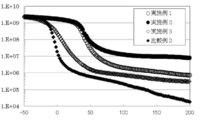
- glass transition temperature (Tg) of the obtained copolymer was measured using the above DMA measuring device RSA-III [manufactured by TA instruments]. The measurement results are shown in Table 2.
- the electrode mixture slurries of Examples 5 to 8 produced using the specific copolymers obtained in Examples 1 to 4 were produced using the copolymers obtained in Comparative Examples 1 and 2. It can be seen that the storage stability of the electrode mixture slurry is superior to the electrode mixture slurry of Comparative Examples 3 and 4. That is, the specific copolymer (Examples 1 to 4) can satisfy excellent storage stability when applied to the energy device electrode mixture slurry.
- Example 9 Obtained in Example 5 electrode mixture slurry rolled copper foil (current collector, thickness 10 [mu] m) to the mass of the dried mixture layer 99g / m 2 ⁇ 101g / m 2 to become like coating machine The gap was adjusted and uniformly coated, and then dried for 1 hour with a blow-type dryer set at 105 ° C., and further for 5 hours at 120 ° C. to produce a sheet-like energy device electrode for negative electrode.
- Example 10 The same operation as in Example 9 was carried out except that the electrode mixture slurry obtained in Example 6 was used.
- Example 11 The same operation as in Example 9 was carried out except that the electrode mixture slurry obtained in Example 7 was used.
- Example 12 The same operation as in Example 9 was performed except that the electrode mixture slurry obtained in Example 8 was used.
- ⁇ Production of lithium battery> 88 parts by mass of a positive electrode active material (LiCoO 2 ) and 6 parts by mass of a conductive additive (HS-100), 25 parts by mass of a binder resin (PVDF (polyvinylidene fluoride), 12% by mass, NMP (N-methylpyrrolidone) solution
- PVDF polyvinylidene fluoride
- NMP N-methylpyrrolidone
- the application amount of the electrode mixture layer (not including the current collector) to the current collector (aluminum foil, thickness 21 ⁇ m) is 220 g / m 2 to 226 g. / G 2 after adjusting the gap of the coating machine to be uniform and then drying with a blow-type dryer set at 100 ° C. for 1 hour and further at 120 ° C. for 1 hour, for a sheet-like positive electrode An energy device electrode was fabricated.
- Example 13 The energy device electrode for negative electrode produced in Example 9 was compression-molded with a roll press machine so that the bulk density of the mixture layer was 1.5 mg / cm 3, and then cut into a 1.6 cm diameter circle for evaluation. An electrode was obtained.
- the adhesion between the mixture layer and the current collector in the energy device electrodes of Examples 9 to 12 produced using the specific copolymers obtained in Examples 1 to 4 is a comparative example. It turns out that it is superior to the energy device electrodes of 5 and 6. It can also be seen that the specific copolymers (Examples 1 to 4) exhibit a high elastic modulus at 60 ° C., which is not obtained in Comparative Examples (7, 8). Furthermore, the 60 ° C. cycle characteristics of the lithium batteries (Examples 13 to 16) produced using the binder resin material for energy device electrodes of the present invention were superior to those of Comparative Examples (Comparative Examples 7 and 8).
- a binder resin material for an energy device electrode capable of forming an electrode mixture slurry excellent in storage stability and an energy device electrode excellent in adhesion between the current collector and the mixture layer, and the use thereof Energy device electrodes and long life energy devices can be provided.
Landscapes
- Engineering & Computer Science (AREA)
- Chemical & Material Sciences (AREA)
- Power Engineering (AREA)
- Materials Engineering (AREA)
- Microelectronics & Electronic Packaging (AREA)
- Chemical Kinetics & Catalysis (AREA)
- Electrochemistry (AREA)
- General Chemical & Material Sciences (AREA)
- Manufacturing & Machinery (AREA)
- Battery Electrode And Active Subsutance (AREA)
- Addition Polymer Or Copolymer, Post-Treatments, Or Chemical Modifications (AREA)
Abstract
本発明は、(メタ)アクリロニトリル由来の構造単位と、2以上のエチレン性不飽和結合を有する化合物由来の構造単位とを含む共重合体を含有するエネルギーデバイス電極用バインダ樹脂材料を提供する。
Description
本発明は、エネルギーデバイス電極用バインダ樹脂材料、エネルギーデバイス電極及びエネルギーデバイスに関する。
ノート型パソコン、携帯電話及びPDAといった携帯情報端末の電源として、高いエネルギー密度を有するエネルギーデバイスであるリチウムイオン二次電池が広く使われている。このリチウムイオン二次電池(以下、単に「リチウム電池」とも記す)には、負極の活物質として、リチウムイオンの層間への挿入(リチウム層間化合物の形成)及び放出が可能な多層構造を有する炭素材料が主に用いられる。また、正極の活物質としては、リチウム含有金属複合酸化物が主に用いられる。リチウム電池の電極は、通常、これらの活物質、バインダ樹脂材料及び溶媒(N-メチル-2-ピロリドン、水等)を混練して電極合剤スラリーを調製し、次いで、当該電極合剤スラリーを転写ロール等で集電体である金属箔の片面又は両面に塗布し、溶媒を除去して合剤層を形成後、ロールプレス機等で圧縮成形して作製される。
上記バインダ樹脂材料に求められる特性としては、活物質間並びに活物質及び集電体間の密着性、電解液に対する耐膨潤性、電気化学的安定性、可とう性、これを用いてなる電極合剤スラリーの粘度安定性等が挙げられる。更に、リチウム電池の高容量化のためには、バインダ樹脂材料の添加量が少ない場合でも、これらの特性を充分に満足することが求められる。しかしながら、従来のバインダ樹脂材料では、これらの特性を充分に満足するには至っていない。これらの問題の解決策として、炭素数2~4の1-オレフィン及び/又は炭素数3以下のアルキル(メタ)アクリレートといった短鎖の単量体を共重合させた変性ポリ(メタ)アクリロニトリル系バインダ樹脂、並びにこれにガラス転移温度が-80℃~0℃のゴム成分等をブレンドしたバインダ樹脂材料が開示されている(例えば、特許第4200349号公報参照)。また、アクリロニトリルと鎖長の短いメチルメタクリレートとの2元共重合体をバインダ樹脂材料として用いることが提案されている(例えば、Journal of Power Sources,109(2002),422-426.参照)。更に長鎖アクリレートを共重合させた変性ポリ(メタ)アクリロニトリル系バインダ樹脂材料が開示されている(例えば、国際公開第2006/033173号パンフレット参照)。
電極合剤スラリー作製に用いる溶媒としては環境負荷低減の観点から水を用いることが好ましいとされている。水を溶媒として用いる場合、バインダ樹脂材料を水で分散させる方法が知られている。しかし水を溶媒とした場合、バインダ樹脂材料だけでは電極合剤スラリーに所望の粘性を付与することが難しいため、カルボキシメチルセルロース等の増粘剤を併用する必要がある。この場合、バインダ樹脂材料と増粘剤との組み合わせによっては、密着性、電極合剤スラリーの安定性等に不具合を生じる場合がある。
また、近年、高容量な負極活物質として金属系負極材が提案されている。金属系負極材は高容量である反面、充放電に伴う体積の膨張収縮が大きい。そのため、従来から用いられているバインダ樹脂材料では、合剤層と集電体との界面の密着性及び合剤層中の活物質間の密着性が不足し、充放電サイクルを繰り返すことで著しい容量低下を起こすことが問題となっている。従って上記のような金属系負極材で用いることのできる密着性に優れるバインダ樹脂材料が求められている。これに関して、錫-コバルト-炭素系複合負極にバインダとしてポリアクリル酸リチウム塩を用いることが提案されている(例えば、Electrochimica Acta.,55(2010),2991-2995.参照)。
ポリ(メタ)アクリロニトリルは、活物質間並びに活物質及び集電体間の密着性に優れる反面、これを用いてなる電極合剤スラリーが経時で粘度上昇を起こしやすく、保存安定性に劣る懸念があった。また、ポリ(メタ)アクリロニトリルは、高温ゴム領域における弾性率が低下し易く、特に高温での充放電サイクル特性が必ずしも満足のいくものではなかった。
本発明の目的は、保存安定性に優れる電極合剤スラリーを調製可能で、なおかつ合剤層と集電体との密着性に優れるエネルギーデバイス電極を形成可能なエネルギーデバイス電極用バインダ樹脂材料を提供することにある。また、本発明の目的は、エネルギーデバイス電極用バインダ樹脂材料を用いて構成され、合剤層と集電体との密着性に優れるエネルギーデバイス電極を提供することにある。更に本発明の目的は、特に高温での充放電サイクルにおける容量低下が抑制されたエネルギーデバイスを提供することにある。
前記課題を解決するための具体的手段は以下の通りである。
<1> (メタ)アクリロニトリル由来の構造単位と、2以上のエチレン性不飽和結合を有する化合物由来の構造単位とを含む共重合体を含有するエネルギーデバイス電極用バインダ樹脂材料である。
<1> (メタ)アクリロニトリル由来の構造単位と、2以上のエチレン性不飽和結合を有する化合物由来の構造単位とを含む共重合体を含有するエネルギーデバイス電極用バインダ樹脂材料である。
<2> 前記2以上のエチレン性不飽和結合を有する化合物は、下記一般式(I)で表される化合物である<1>に記載のエネルギーデバイス電極用バインダ樹脂材料である。
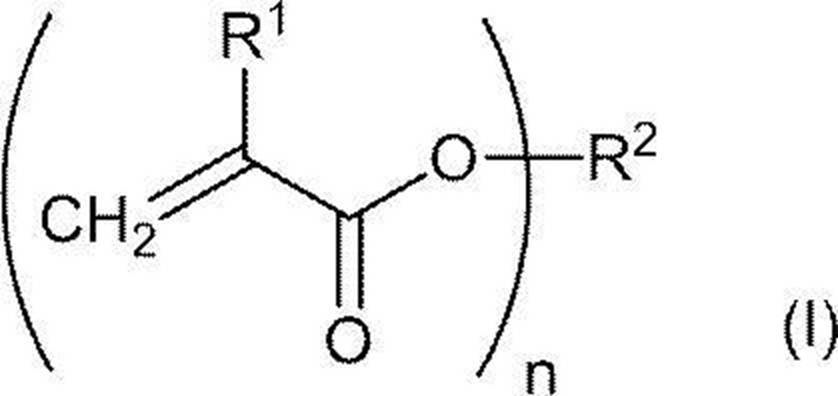
(式中、R1はそれぞれ独立に、水素原子又はメチル基を示す。R2は、n価の有機基を示す。nは2~6の数を示す。)
<3> 前記共重合体のガラス転移温度が25℃~120℃である<1>又は<2>に記載のエネルギーデバイス電極用バインダ樹脂材料である。
<4> 集電体と、前記集電体の少なくとも1面上に設けられ、 (メタ)アクリロニトリル由来の構造単位及び2以上のエチレン性不飽和結合を有する化合物由来の構造単位を含む共重合体、並びに活物質を含有する合剤層と、を有するエネルギーデバイス電極である。
<5> <4>に記載のエネルギーデバイス電極と、前記エネルギーデバイス電極の対極と、電解質と、を有するエネルギーデバイスである。
<6> リチウムイオン二次電池である<5>に記載のエネルギーデバイスである。
本発明によれば、保存安定性に優れる電極合剤スラリーを調製可能で、なおかつ合剤層と集電体との密着性に優れるエネルギーデバイス電極を形成可能なエネルギーデバイス電極用バインダ樹脂材料を提供することができる。また、エネルギーデバイス電極用バインダ樹脂材料を用いて構成され、合剤層と集電体との密着性に優れるエネルギーデバイス電極を提供することができる。更に特に高温での充放電サイクルにおける容量低下が抑制されたエネルギーデバイスを提供することができる。
本明細書において「工程」との語は、独立した工程だけではなく、他の工程と明確に区別できない場合であってもその工程の所期の目的が達成されれば、本用語に含まれる。また、「~」を用いて示された数値範囲は、「~」の前後に記載される数値をそれぞれ最小値及び最大値として含む範囲を示す。更に、組成物中の各成分の含有量は、組成物中に各成分に該当する物質が複数存在する場合、特に断らない限り、組成物中に存在する当該複数の物質の合計量を意味する。
(メタ)アクリレートとは、アクリレート及びそれに対応するメタクリレートの少なくとも一方を意味し、(メタ)アクリル酸とは、アクリル酸及びメタクリル酸の少なくとも一方を意味し、(メタ)アリルとは、アリル及びメタリルの少なくとも一方を意味し、(メタ)アクリロニトリルとは、アクリロニトリル及びメタクリロニトリルの少なくとも一方を意味する。
更に本明細書においては、「単量体」との語は、エチレン性不飽和結合を1つだけ有する重合性化合物を意味し、エチレン性不飽和結合を2以上有する架橋性の重合性化合物とは異なるものを意味する。
(メタ)アクリレートとは、アクリレート及びそれに対応するメタクリレートの少なくとも一方を意味し、(メタ)アクリル酸とは、アクリル酸及びメタクリル酸の少なくとも一方を意味し、(メタ)アリルとは、アリル及びメタリルの少なくとも一方を意味し、(メタ)アクリロニトリルとは、アクリロニトリル及びメタクリロニトリルの少なくとも一方を意味する。
更に本明細書においては、「単量体」との語は、エチレン性不飽和結合を1つだけ有する重合性化合物を意味し、エチレン性不飽和結合を2以上有する架橋性の重合性化合物とは異なるものを意味する。
<エネルギーデバイス電極用バインダ樹脂材料>
本発明のエネルギーデバイス電極用バインダ樹脂材料は、(メタ)アクリロニトリル由来の構造単位と、2以上のエチレン性不飽和結合を有する化合物由来の構造単位とを含む共重合体(以下、「特定共重合体」ともいう)の少なくとも1種を含有する。前記エネルギーデバイス電極用バインダ樹脂材料は、必要に応じて、溶媒、界面活性剤等のその他の成分を含んでいてもよい。特定共重合体が(メタ)アクリロニトリル由来の構造単位に加えて、2以上のエチレン性不飽和結合を有する化合物由来の構造単位を有することで、電極合剤スラリーを構成した場合に、経時的な粘度上昇が抑制され、保存安定性に優れる。また、エネルギーデバイス電極用バインダ樹脂材料を用いてエネルギーデバイス電極を構成した場合に、合剤層と集電体との密着性に優れる。
本発明のエネルギーデバイス電極用バインダ樹脂材料は、(メタ)アクリロニトリル由来の構造単位と、2以上のエチレン性不飽和結合を有する化合物由来の構造単位とを含む共重合体(以下、「特定共重合体」ともいう)の少なくとも1種を含有する。前記エネルギーデバイス電極用バインダ樹脂材料は、必要に応じて、溶媒、界面活性剤等のその他の成分を含んでいてもよい。特定共重合体が(メタ)アクリロニトリル由来の構造単位に加えて、2以上のエチレン性不飽和結合を有する化合物由来の構造単位を有することで、電極合剤スラリーを構成した場合に、経時的な粘度上昇が抑制され、保存安定性に優れる。また、エネルギーデバイス電極用バインダ樹脂材料を用いてエネルギーデバイス電極を構成した場合に、合剤層と集電体との密着性に優れる。
前記特定共重合体は、高極性な構造単位に加えて、これが架橋された構造単位を有するため、これを用いて電極合剤スラリーを構成した場合に、経時的な粘度上昇が抑制され、保存安定性に優れると考えられる。また、特定共重合体が高極性な構造単位を有することで、これを含むエネルギーデバイス電極用バインダ樹脂材料を用いてエネルギーデバイス電極を構成した場合に、合剤層と集電体との密着性に優れると考えられる。更に、特定共重合体が高極性な構造単位が架橋された構造を有することで、高温ゴム領域における貯蔵弾性率が高くなると考えられる。これにより、特定共重合体を含有する合剤層を有するエネルギーデバイス電極を備えるエネルギーデバイスは、特に高温での充放電サイクル特性に優れると考えられる。
前記エネルギーデバイス電極用バインダ樹脂材料を用いて作製された電極は、合剤層と集電体との密着性に優れることから、電極合剤スラリーを集電体に塗布して乾燥した後の未プレス状態での巻き取り時、スリット加工時、プレス時及びプレス後のいずれにおいても、集電体からの合剤層の剥離を抑制することができる。更に、本発明のエネルギーデバイス電極用バインダ樹脂材料は、上記のように、集電体との密着性に優れる合剤層が得られるため、少量でも充分使用可能であり、バインダ樹脂材料の使用量を低減することが可能である。また、前記エネルギーデバイス電極用バインダ樹脂材料を用いて作製された電極を備えるエネルギーデバイス(好ましくはリチウム電池)は、活物質の充放電による膨張収縮に追従し易いため導電性が良好であり、充放電サイクルにおける容量低下が抑制される。
(特定共重合体)
前記特定共重合体は、単量体である(メタ)アクリロニトリル由来の構造単位と、2以上のエチレン性不飽和結合を有する化合物(以下、「架橋剤」ともいう)由来の構造単位とを含む。前記特定共重合体は、必要に応じて(メタ)アクリロニトリル以外のその他の単量体由来の構造単位を更に含んでいてもよい。前記特定共重合体は、(メタ)アクリロニトリルと、必要に応じて用いられるその他の単量体と、2以上のエチレン性不飽和結合を有する化合物(架橋剤)とを含む単量体組成物を重合させることで得ることができる。
前記特定共重合体は、単量体である(メタ)アクリロニトリル由来の構造単位と、2以上のエチレン性不飽和結合を有する化合物(以下、「架橋剤」ともいう)由来の構造単位とを含む。前記特定共重合体は、必要に応じて(メタ)アクリロニトリル以外のその他の単量体由来の構造単位を更に含んでいてもよい。前記特定共重合体は、(メタ)アクリロニトリルと、必要に応じて用いられるその他の単量体と、2以上のエチレン性不飽和結合を有する化合物(架橋剤)とを含む単量体組成物を重合させることで得ることができる。
各構造単位を構成する単量体は、それぞれの構造単位において、1種選択されて重合に使用されてもよく、複数種が選択されて重合に使用されてもよい。また、特定の構造単位を構成する単量体には1種類を選択し、他の構造単位を構成する単量体には複数種の単量体を選択してもよい。
また、特定共重合体は、上述した各構造単位を含んでいればよく、各構造単位の結合順序については特に制限はない。特定共重合体は、ブロック共重合体及びランダム共重合体のいずれであってもよく、ランダム共重合体であることが好ましい。
また、特定共重合体は、上述した各構造単位を含んでいればよく、各構造単位の結合順序については特に制限はない。特定共重合体は、ブロック共重合体及びランダム共重合体のいずれであってもよく、ランダム共重合体であることが好ましい。
[(メタ)アクリロニトリル]
特定共重合体は、(メタ)アクリロニトリル由来の構造単位を含む。すなわち特定共重合体はアクリロニトリル及びメタクリロニトリルからなる群より選ばれる少なくとも一方に由来する構造単位を含む。(メタ)アクリロニトリル由来の構造単位は、可とう性等の観点から、アクリロニトリル由来の構造単位であることが好ましい。
特定共重合体は、(メタ)アクリロニトリル由来の構造単位を含む。すなわち特定共重合体はアクリロニトリル及びメタクリロニトリルからなる群より選ばれる少なくとも一方に由来する構造単位を含む。(メタ)アクリロニトリル由来の構造単位は、可とう性等の観点から、アクリロニトリル由来の構造単位であることが好ましい。
特定共重合体における(メタ)アクリロニトリル由来の構造単位の含有率は特に制限されない。(メタ)アクリロニトリル由来の構造単位の含有率は、エネルギーデバイス電極における集電体と合剤層との密着性に優れるという観点から、特定共重合体の単量体由来の総構造単位数を基準(100モル%)として、20モル%~70モル%であることが好ましく、密着性及び電極合剤スラリーの保存安定性に優れるという観点から、30モル%~60モル%であることがより好ましく、35モル%~45モル%であることが更に好ましい
[2以上のエチレン性不飽和結合を有する化合物]
前記2以上のエチレン性不飽和結合を有する化合物(架橋剤)は、エチレン性不飽和結合を含む2以上の官能基と、前記官能基を互いに連結する2価以上の連結基である有機基とを有する化合物であれば特に制限はない。前記2以上のエチレン性不飽和結合を有する化合物は、例えば、下記一般式(I)で表される化合物であることが好ましい。
前記2以上のエチレン性不飽和結合を有する化合物(架橋剤)は、エチレン性不飽和結合を含む2以上の官能基と、前記官能基を互いに連結する2価以上の連結基である有機基とを有する化合物であれば特に制限はない。前記2以上のエチレン性不飽和結合を有する化合物は、例えば、下記一般式(I)で表される化合物であることが好ましい。
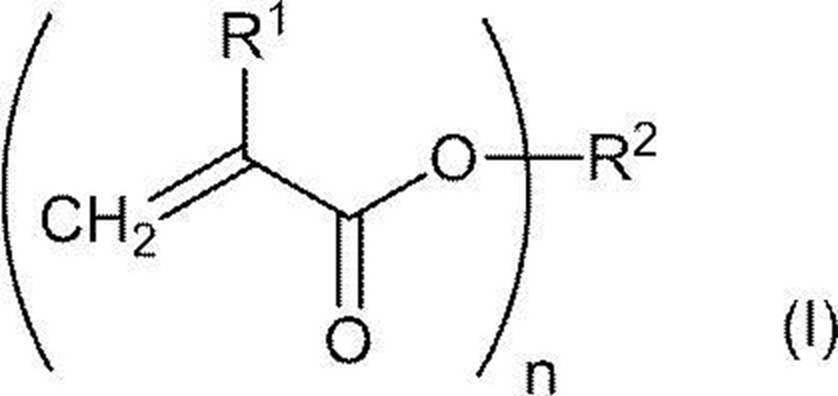
一般式(I)中、R1はそれぞれ独立に、水素原子又はメチル基を示す。R2は、n価の有機基を示す。nは2~6の数を示し、3~4であることが好ましい。nは一般式(I)で表される化合物が単一の分子種である場合、整数である。
R2で示されるn価の有機基としては、炭素数2~20の脂肪族炭化水素からn個の水素原子を取り除いて構成される炭素数が2~20であるn価の脂肪族炭化水素基;炭素数2~4のアルキレングリコールが2以上エーテル結合してなるポリアルキレングリコールの両末端からヒドロキシ基を取り除いて構成されるポリアルキレンオキシアルキレン基;グリセリン、ジグリセリン、ネオペンチルグリコール、ペンタエリスリトール、ジペンタエリスリトール、トリメチロールプロパン等の炭素数3~20の多価アルコール又はそのヒドロキシアルキル化物からn個のヒドロキシ基を取り除いて構成されるn価の有機基;イソシアヌル酸又はそのヒドロキシアルキル化物からn個のヒドロキシ基を取り除いて構成されるn価の有機基;などを挙げることができる。
これらの中でも、R2は炭素数2~11の脂肪族炭化水素からn個の水素原子を取り除いて構成される炭素数が2~11であるn価の脂肪族炭化水素基及び炭素数3~11の多価アルコール又はそのヒドロキシアルキル化物からn個のヒドロキシ基を取り除いて構成されるn価の有機基からなる群より選ばれる少なくとも1種であることが好ましく、炭素数3~11の脂肪族炭化水素から3個~4個の水素原子を取り除いて構成される炭素数が3~11である3価~4価の脂肪族炭化水素基及び炭素数3~11の多価アルコール又はそのヒドロキシアルキル化物から3個~4個のヒドロキシ基を取り除いて構成される3価~4価の有機基からなる群より選ばれる少なくとも1種であることがより好ましい。
2以上のエチレン性不飽和結合を有する化合物として具体的には、1,4-ブタンジオールジアクリレート(日立化成(株)製、商品名FA-124AS)、ノナンジオールジアクリレート(日立化成(株)製、商品名FA-129AS)、ポリエチレングリコール#400ジアクリレート(日立化成(株)製、商品名FA-240A)、ポリプロピレングリコール#400アクリレート(日立化成(株)製、商品名FA-P240A)、ポリプロピレングリコール#700アクリレート(日立化成(株)製、商品名FA-P270A)、EO変性ビスフェノールAジアクリレート(日立化成(株)製、商品名FA-321A、FA-324A)、エチレングリコールジメタクリレート(日立化成(株)製、商品名FA-121M)、1,3-ブタンジオールジメタクリレート(日立化成(株)製、商品名FA-123M)、1,4-ブタンジオールジメタクリレート(日立化成(株)製、商品名FA-124M)、ネオペンチルグリコールジメタクリレート(日立化成(株)製、商品名FA-125M)、ポリエチレングリコール#200ジメタクリレート(日立化成(株)製、商品名FA-220M)、ポリエチレングリコール#400ジメタクリレート(日立化成(株)製、商品名FA-240M)、ペンタエリスリトールトリアクリレート(日本化学工業(株)製、商品名PET-30)、エトキシ化イソシアヌル酸トリアクリレート(新中村化学工業(株)製、商品名A-9300)、トリメチロールプロパントリアクリレート(新中村化学工業(株)製、商品名A-TMPT)、トリメチロールプロパントリメタクリレート(新中村化学工業(株)製、商品名TMPT)、エトキシ化イソシアヌル酸トリアクリレート(新中村化学工業(株)製、商品名A-9300)、エトキシ化ペンタエリスリトールテトラアクリレート(新中村化学工業(株)製、商品名ATM-4E)、ジペンタエリスリトールヘキサアクリレート(新中村化学工業(株)製、商品名A-DPH)、ジペンタエリスリトールポリアクリレート(新中村化学工業(株)製、商品名A-9550)等が挙げられる。
これらの中でも、2以上のエチレン性不飽和結合を有する化合物は、3個又は4個の(メタ)アクリル基を有する3官能又は4官能のアクリレートであることが好ましく、炭素数3~11の多価アルコールのポリ(メタ)アクリル酸エステルであることがより好ましく、ペンタエリスリトールトリアクリレート又はエトキシ化ペンタエリスリトールテトラアクリレートであることが更に好ましい。
これらの2以上のエチレン性不飽和結合を有する化合物は1種単独で又は2種類以上組み合わせて用いることができる。
これらの2以上のエチレン性不飽和結合を有する化合物は1種単独で又は2種類以上組み合わせて用いることができる。
特定共重合体における2以上のエチレン性不飽和結合を有する化合物由来の構造単位の含有量は特に制限されない。2以上のエチレン性不飽和結合を有する化合物由来の構造単位の含有量は、特定共重合体のゴム状領域における貯蔵弾性率を高めて、エネルギーデバイスの充放電における活物質の膨張収縮に追従しやすくさせるという観点から、特定共重合体における単量体由来の総質量100質量部に対して、0.01質量部~5.0質量部であることが好ましく、0.05質量部~3.0質量部であることがより好ましく、0.02質量部~2.0質量部であることが更に好ましい。
また、特定共重合体における2以上のエチレン性不飽和結合を有する化合物由来の構造単位の含有率をモル%で規定した場合、特定共重合体における単量体由来の総構造単位数(100モル%)に対して、0.001モル%~1.0モル%であることが好ましく、0.005モル%~0.5モル%であることがより好ましく、0.02モル%~0.2モル%であることが更に好ましい。
更に特定重合体における(メタ)アクリロニトリル由来の構造単位の含有量に対する2以上のエチレン性不飽和結合を有する化合物由来の構造単位の含有量のモル比は特に制限されない。エネルギーデバイス電極における集電体と合剤層との密着性に優れる観点から、前記モル比は、0.008モル%~0.8モル%であることが好ましく、0.03モル%~0.3モル%であることがより好ましい。
[その他の単量体]
前記特定共重合体は、必要に応じて、(メタ)アクリロニトリル由来の構造単位以外のその他の単量体由来の構造単位の少なくとも1種を更に含むことができる。その他の単量体としては、下記一般式(II)で表される単量体、下記一般式(III)で表される単量体、酸性官能基含有単量体等を挙げることができる。
前記特定共重合体は、必要に応じて、(メタ)アクリロニトリル由来の構造単位以外のその他の単量体由来の構造単位の少なくとも1種を更に含むことができる。その他の単量体としては、下記一般式(II)で表される単量体、下記一般式(III)で表される単量体、酸性官能基含有単量体等を挙げることができる。
一般式(II)中、R21は水素原子又はメチル基を示す。R22は、2-シアノエチル基、炭素数3~20のアルキル基又は炭素数5~20のヒドロキシアルキル基を示す。
R22における炭素数3~20のアルキル基としては、分岐鎖のアルキル基であっても、直鎖のアルキル基であってもよく、直鎖のアルキル基であることが好ましい。R22で示されるアルキル基の炭素数は、3~12であることが好ましく、3~8であることがより好ましい。
R22で示される炭素数3~20のアルキル基として、具体的には、プロピル基、1-メチルエチル基、ブチル基、1-メチルプロピル基、2-メチルプロピル基、1,1-ジメチルエチル基、ペンチル基、1-メチルブチル基、2-メチルブチル基、3-メチルブチル基、 1,1-ジメチルプロピル基、1,2-ジメチルプロピル基、2,2-ジメチルプロピル基、1-エチルプロピル基、ヘキシル基、1-メチルペンチル基、2-メチルペンチル基、3-メチルペンチル基、4-メチルペンチル基、1,1-ジメチルブチル基、1,2-ジメチルブチル基、1,3-ジメチルブチル基、2,2-ジメチルブチル基、2,3-ジメチルブチル基、3,3-ジメチルブチル基、1-エチルブチル基、2-エチルブチル基、1-エチル-1-メチルプロピル基、1-エチル-2-メチルプロピル基、へプチル基、オクチル基、2-エチルヘキシル基、6-メチルヘプチル基、ノニル基、デシル基、ウンデシル基、ドデシル基、トリデシル基、テトラデシル基、ペンタデシル基、ヘキサデシル基、ヘプタデシル基、オクタデシル基、ノナデシル基、エイコシル基等が挙げられる。合成の容易性等の点から、R22で示されるアルキル基は、炭素数3~12のアルキル基であるプロピル基、ブチル基、ペンチル基、ヘキシル基、へプチル基、オクチル基、2-エチルヘキシル基、ノニル基、デシル基、ウンデシル基、又はドデシル基であることが好ましく、炭素数3~8のアルキル基であるプロピル基、ブチル基、ペンチル基、ヘキシル基、へプチル基、オクチル基、又は2-エチルヘキシル基であることがより好ましい。
R22における炭素数5~20のヒドロキシアルキル基を構成するアルキル基は、分岐鎖のアルキル基であっても、直鎖のアルキル基であってもよく、直鎖のアルキル基であることが好ましい。R22で示されるヒドロキシアルキル基の炭素数は、5~12であることが好ましく、5~8であることがより好ましい。
R22で示される炭素数5~20のヒドロキシアルキル基として、具体的には、5-ヒドロキシペンチル基、6-ヒドロキシヘキシル基、7-ヒドロキシへプチル基、8-ヒドロキシオクチル基、9-ヒドロキシノニル基、10-ヒドロキシデシル基、11-ヒドロキシウンデシル基、12-ヒドロキシドデシル基、13-ヒドロキシトリデシル基、14-ヒドロキシテトラデシル基、15-ヒドロキシペンタデシル基、16-ヒドロキシヘキサデシル基、17-ヒドロキシヘプタデシル基、18-ヒドロキシオクタデシル基、19-ヒドロキシノナデシル基、20-ヒドロキシエイコシル基等が挙げられる。
合成の容易性等の点で、R22で示されるヒドロキシアルキル基は、炭素数5~12のヒドロキシアルキル基である5-ヒドロキシペンチル基、6-ヒドロキシヘキシル基、7-ヒドロキシへプチル基、8-ヒドロキシオクチル基、9-ヒドロキシノニル基、10-ヒドロキシデシル基、11-ヒドロキシウンデシル基、又は12-ヒドロキシドデシル基であることが好ましく、炭素数5~8のヒドロキシアルキル基である5-ヒドロキシペンチル基、6-ヒドロキシヘキシル基、7-ヒドロキシへプチル基、又は8-ヒドロキシオクチル基であることがより好ましい。
合成の容易性等の点で、R22で示されるヒドロキシアルキル基は、炭素数5~12のヒドロキシアルキル基である5-ヒドロキシペンチル基、6-ヒドロキシヘキシル基、7-ヒドロキシへプチル基、8-ヒドロキシオクチル基、9-ヒドロキシノニル基、10-ヒドロキシデシル基、11-ヒドロキシウンデシル基、又は12-ヒドロキシドデシル基であることが好ましく、炭素数5~8のヒドロキシアルキル基である5-ヒドロキシペンチル基、6-ヒドロキシヘキシル基、7-ヒドロキシへプチル基、又は8-ヒドロキシオクチル基であることがより好ましい。
一般式(II)で表される単量体として具体的には、2-シアノエチル(メタ)アクリレート、プロピル(メタ)アクリレート、1-メチルエチル(メタ)アクリレート、ブチル(メタ)アクリレート、1-メチルプロピル(メタ)アクリレート、2-メチルプロピル(メタ)アクリレート、1,1-ジメチルエチル(メタ)アクリレート、ペンチル(メタ)アクリレート、1-メチルブチル(メタ)アクリレート、2-メチルブチル(メタ)アクリレート、3-メチルブチル(メタ)アクリレート、1,1-ジメチルプロピル(メタ)アクリレート、1,2-ジメチルプロピル(メタ)アクリレート、2,2-ジメチルプロピル(メタ)アクリレート、1-エチルプロピル(メタ)アクリレート、ヘキシル(メタ)アクリレート、1-メチルペンチル(メタ)アクリレート、2-メチルペンチル(メタ)アクリレート、3-メチルペンチル(メタ)アクリレート、4-メチルペンチル(メタ)アクリレート、1,1-ジメチルブチル(メタ)アクリレート、1,2-ジメチルブチル(メタ)アクリレート、1,3-ジメチルブチル(メタ)アクリレート、2,2-ジメチルブチル(メタ)アクリレート、2,3-ジメチルブチル(メタ)アクリレート、3,3-ジメチルブチル(メタ)アクリレート、1-エチルブチル(メタ)アクリレート、2-エチルブチル(メタ)アクリレート、1-エチル-1-メチルプロピル(メタ)アクリレート、1-エチル-2-メチルプロピル(メタ)アクリレート、へプチル(メタ)アクリレート、オクチル(メタ)アクリレート、2-エチルヘキシル(メタ)アクリレート、6-メチルヘプチル(メタ)アクリレート、ノニル(メタ)アクリレート、デシル(メタ)アクリレート、ウンデシル(メタ)アクリレート、ドデシル(メタ)アクリレート、トリデシル(メタ)アクリレート、テトラデシル(メタ)アクリレート、ペンタデシル(メタ)アクリレート、ヘキサデシル(メタ)アクリレート、ヘプタデシル(メタ)アクリレート、オクタデシル(メタ)アクリレート、ノナデシル(メタ)アクリレート、エイコシル(メタ)アクリレート等のアルキル(メタ)アクリレート;5-ヒドロキシペンチル(メタ)アクリレート、6-ヒドロキシヘキシル(メタ)アクリレート、7-ヒドロキシへプチル(メタ)アクリレート、8-ヒドロキシオクチル(メタ)アクリレート、9-ヒドロキシノニル(メタ)アクリレート、10-ヒドロキシデシル(メタ)アクリレート、11-ヒドロキシウンデシル(メタ)アクリレート、12-ヒドロキシドデシル(メタ)アクリレート、13-ヒドロキシトリデシル(メタ)アクリレート、14-ヒドロキシテトラデシル(メタ)アクリレート、15-ヒドロキシペンタデシル(メタ)アクリレート、16-ヒドロキシヘキサデシル(メタ)アクリレート、17-ヒドロキシヘプタデシル(メタ)アクリレート、18-ヒドロキシオクタデシル(メタ)アクリレート、19-ヒドロキシノナデシル(メタ)アクリレート、20-ヒドロキシエイコシル(メタ)アクリレート等のヒドロキシアルキル(メタ)アクリレートなどが挙げられる。
一般式(II)で表される単量体は、合成の容易性の点から、プロピル(メタ)アクリレート、ブチル(メタ)アクリレート、ペンチル(メタ)アクリレート、ヘキシル(メタ)アクリレート、へプチル(メタ)アクリレート、オクチル(メタ)アクリレート、2-エチルヘキシル(メタ)アクリレート、ノニル(メタ)アクリレート、デシル(メタ)アクリレート、ウンデシル(メタ)アクリレート、ドデシル(メタ)アクリレート、5-ヒドロキシペンチル(メタ)アクリレート、6-ヒドロキシヘキシル(メタ)アクリレート、7-ヒドロキシへプチル(メタ)アクリレート、8-ヒドロキシオクチル(メタ)アクリレート、9-ヒドロキシノニル(メタ)アクリレート、10-ヒドロキシデシル(メタ)アクリレート、11-ヒドロキシウンデシル(メタ)アクリレート及び12-ヒドロキシドデシル(メタ)アクリレートからなる群より選択される少なくとも1種であることが好ましく、プロピル(メタ)アクリレート、ブチル(メタ)アクリレート、ペンチル(メタ)アクリレート、ヘキシル(メタ)アクリレート、へプチル(メタ)アクリレート、オクチル(メタ)アクリレート、2-エチルヘキシル(メタ)アクリレート、5-ヒドロキシペンチル(メタ)アクリレート、6-ヒドロキシヘキシル(メタ)アクリレート、7-ヒドロキシへプチル(メタ)アクリレート及び8-ヒドロキシオクチル(メタ)アクリレートからなる群より選択される少なくとも1種であることがより好ましい。

一般式(III)中、R31は水素原子又はメチル基を示す。Xは炭素数2~4のアルキレン基を示す。mは1~10の数を示す。R32は水素原子又は炭素数1~5のアルキル基を示す。
Xは炭素数2又は3のアルキレン基が好ましい。mは1~6の数であることが好ましく、1~4であることがより好ましい。なお、mは一般式(III)で表される化合物が単一の分子種の場合は整数であり、複数の分子種を含む場合は平均値である有理数となる。R32で示されるアルキル基は、分岐鎖のアルキル基であっても、直鎖のアルキル基であってもよく、直鎖のアルキル基であることが好ましい。R32で示されるアルキル基の炭素数は、1~3であることが好ましい。R32で示される炭素数1~5のアルキル基として具体的には、メチル基、エチル基、プロピル基、1-メチルエチル基、ブチル基、1-メチルプロピル基、2-メチルプロピル基、1,1-ジメチルエチル基、ペンチル基、1-メチルブチル基、2-メチルブチル基、3-メチルブチル基、1,1-ジメチルプロピル基、1,2-ジメチルプロピル基、2,2-ジメチルプロピル基、1-エチルプロピル基等が挙げられる。R32で示されるアルキル基は、合成の容易性等の点から、メチル基、エチル基又はプロピル基であることが好ましい。
一般式(III)で表される単量体として具体的には、2-ヒドロキシエチル(メタ)アクリレート、3-ヒドロキシプロピル(メタ)アクリレート、4-ヒドロキシブチル(メタ)アクリレート、ジエチレングリコールモノ(メタ)アクリレート、トリエチレングリコールモノ(メタ)アクリレート、テトラエチレングリコールモノ(メタ)アクリレート、ペンタエチレングリコールモノ(メタ)アクリレート、ヘキサエチレングリコールモノ(メタ)アクリレート、ヘプタエチレングリコールモノ(メタ)アクリレート、オクタエチレングリコールモノ(メタ)アクリレート、ノナエチレングリコールモノ(メタ)アクリレート、デカエチレングリコールモノ(メタ)アクリレート等のアルキレングリコールモノ(メタ)アクリレート;メチルモノエチレングリコール(メタ)アクリレート、メチルジエチレングリコール(メタ)アクリレート、メチルトリエチレングリコール(メタ)アクリレート、メチルテトラエチレングリコール(メタ)アクリレート、メチルペンタエチレングリコール(メタ)アクリレート、メチルヘキサエチレングリコール(メタ)アクリレート、メチルヘプタエチレングリコール(メタ)アクリレート、メチルオクタエチレングリコール(メタ)アクリレート、メチルノナエチレングリコール(メタ)アクリレート、メチルデカエチレングリコール(メタ)アクリレート、エチルモノエチレングリコール(メタ)アクリレート、エチルジエチレングリコール(メタ)アクリレート、エチルトリエチレングリコール(メタ)アクリレート、エチルテトラエチレングリコール(メタ)アクリレート、エチルペンタエチレングリコール(メタ)アクリレート、エチルヘキサエチレングリコール(メタ)アクリレート、エチルヘプタエチレングリコール(メタ)アクリレート、エチルオクタエチレングリコール(メタ)アクリレート、エチルノナエチレングリコール(メタ)アクリレート、エチルデカエチレングリコール(メタ)アクリレート、プロピルモノエチレングリコール(メタ)アクリレート、1-メチルエチルモノエチレングリコール(メタ)アクリレート、ブチルモノエチレングリコール(メタ)アクリレート、1-メチルプロピルモノエチレングリコール(メタ)アクリレート、2-メチルプロピルモノエチレングリコール(メタ)アクリレート、1,1-ジメチルエチルモノエチレングリコール(メタ)アクリレート、ペンチルモノエチレングリコール(メタ)アクリレート、1-メチルブチルモノエチレングリコール(メタ)アクリレート、2-メチルブチルモノエチレングリコール(メタ)アクリレート、3-メチルブチルモノエチレングリコール(メタ)アクリレート、1,1-ジメチルプロピルモノエチレングリコール(メタ)アクリレート、1,2-ジメチルプロピルモノエチレングリコール(メタ)アクリレート、2,2-ジメチルプロピルモノエチレングリコール(メタ)アクリレート、1-エチルプロピルモノエチレングリコール(メタ)アクリレート等のモノアルキルモノアルキレングリコール(メタ)アクリレート又はモノアルキルポリアルキレングリコール(メタ)アクリレートなどが挙げられる。
一般式(III)で表される単量体は、合成の容易性等の点から、2-ヒドロキシエチル(メタ)アクリレート、3-ヒドロキシプロピル(メタ)アクリレート、4-ヒドロキシブチル(メタ)アクリレート、ジエチレングリコールモノ(メタ)アクリレート、トリエチレングリコールモノ(メタ)アクリレート、テトラエチレングリコールモノ(メタ)アクリレート、ペンタエチレングリコールモノ(メタ)アクリレート、ヘキサエチレングリコールモノ(メタ)アクリレート、メチルモノエチレングリコール(メタ)アクリレート、メチルジエチレングリコール(メタ)アクリレート、メチルトリエチレングリコール(メタ)アクリレート、メチルテトラエチレングリコール(メタ)アクリレート、メチルペンタエチレングリコール(メタ)アクリレート、メチルヘキサエチレングリコール(メタ)アクリレート、エチルモノエチレングリコール(メタ)アクリレート、エチルジエチレングリコール(メタ)アクリレート、エチルトリエチレングリコール(メタ)アクリレート、エチルテトラエチレングリコール(メタ)アクリレート、エチルペンタエチレングリコール(メタ)アクリレート及びエチルヘキサエチレングリコール(メタ)アクリレートからなる群より選択される少なくとも1種であることが好ましく、2-ヒドロキシエチル(メタ)アクリレート、3-ヒドロキシプロピル(メタ)アクリレート、4-ヒドロキシブチル(メタ)アクリレート、ジエチレングリコールモノ(メタ)アクリレート、トリエチレングリコールモノ(メタ)アクリレート、テトラエチレングリコールモノ(メタ)アクリレート、メチルモノエチレングリコール(メタ)アクリレート、メチルジエチレングリコール(メタ)アクリレート、メチルトリエチレングリコール(メタ)アクリレート、メチルテトラエチレングリコール(メタ)アクリレート、エチルモノエチレングリコール(メタ)アクリレート、エチルジエチレングリコール(メタ)アクリレート、エチルトリエチレングリコール(メタ)アクリレート及びエチルテトラエチレングリコール(メタ)アクリレートからなる群より選択される少なくとも1種がより好ましい。
前記特定共重合体は、後述するガラス転移温度(Tg)を調節する観点から、一般式(II)で表される単量体由来の構造単位及び一般式(III)で表される単量体由来の構造単位からなる群より選ばれる少なくとも1種の構造単位を更に含むことが好ましい。前記特定共重合体は、一般式(II)で表される単量体由来の構造単位及び一般式(III)で表される単量体由来の構造単位からなる群より選ばれる構造単位を1種単独で含んでいてもよく、2種以上を組み合わせて含んでいてもよい。
特定共重合体が、一般式(II)で表される単量体由来の構造単位及び一般式(III)で表される単量体由来の構造単位の少なくとも1種の構造単位を含む場合、一般式(II)で表される単量体由来の構造単位及び一般式(III)で表される単量体由来の構造単位の含有量は特に制限されず、目的等に応じて適宜選択することができる。一般式(II)で表される単量体由来の構造単位及び一般式(III)で表される単量体由来の構造単位の総含有率は、エネルギーデバイス電極における集電体と合剤層との密着性に優れるという観点から、特定共重合体における単量体由来の総構造単位量を基準(100モル%)として、30モル%~80モル%であることが好ましく、密着性及び電極合剤スラリーの保存安定性に優れるという観点から、40モル%~70モル%であることがより好ましく、55モル%~65モル%であることが更に好ましい。
また、特定共重合体が、一般式(II)で表される単量体由来の構造単位及び一般式(III)で表される単量体由来の構造単位を両方含む場合、一般式(II)で表される単量体由来の構造単位及び一般式(III)で表される単量体由来の構造単位の含有比は特に制限されず、一般式(II)で表される単量体及び一般式(III)で表される単量体の構造等に応じて適宜選択することができる。
更に前記特定共重合体が、一般式(II)で表される単量体由来の構造単位を含む場合、一般式(II)で表される単量体のうち、R22が2-シアノエチル基である単量体由来の構造単位の含有率は、電極合剤スラリーの保存安定性の観点から、特定共重合体における単量体由来の総構造単位量を基準(100モル%)として、5モル%以下であることが好ましく、実質的に0モル%であることがより好ましく、0モル%であることが更に好ましい。
酸性官能基含有単量体は、酸性官能基とエチレン性不飽和結合を含む官能基とを有する化合物であれば特に制限されない。酸性官能基としては、カルボキシ基、スルホ基、リン酸基、フェノール性水酸基等又はこれらの塩が挙げられる。このような酸性官能基含有単量体としては、アクリル酸、メタクリル酸、マレイン酸、クロトン酸、イタコン酸、シトラコン酸、ビニル安息香酸、カルボキシエチルアクリレート等のカルボキシ基含有単量体;ビニルベンゼンスルホン酸、(メタ)アリルスルホン酸ナトリウム、(メタ)アリルオキシベンゼンスルホン酸ナトリウム、スチレンスルホン酸ナトリウム、2-アクリルアミド-2-メチルプロパンスルホン酸等のスルホ基含有単量体;アシッドホスホキシエチルメタクリレート(ユニケミカル(株)製、商品名:Phosmer M)、アシッドホスホキシポリオキシエチレングリコールモノメタクリレート(ユニケミカル(株)製、商品名:Phosmer PE)、3-クロロ-2-アシッドホスホキシプロピルメタクリレート(ユニケミカル(株)製、商品名:Phosmer CL)、アシッドホスホキシポリオキシプロピレングリコールモノメタクリレート(ユニケミカル(株)製、商品名:Phosmer PP)等のリン酸基含有単量体;などが挙げられる。中でも、アクリル酸、メタクリル酸及び2-カルボキシエチルアクリレートからなる群より選ばれる少なくとも1種が、合成の容易性、活物質間の密着性等の観点から好ましい。これらの酸性官能基含有単量体は、1種単独で又は2種類以上組み合わせて用いることができる。
特定共重合体が酸性官能基含有単量体由来の構造単位を含む場合、その含有量については特に制限はない。酸性官能基含有単量体由来の構造単位の含有率は、例えば、(メタ)アクリロニトリル由来の構造単位1モルに対して0.01モル~10モルとすることができる。酸性官能基含有単量体由来の構造単位の含有率が0.01モル以上であれば、活物質間及び合剤層と集電体との密着性の向上効果が特定共重合体において充分に発揮される。また、酸性官能基含有単量体由来の構造単位の含有率が10モル以下であれば、上述した(メタ)アクリロニトリル由来の構造単位及び2以上のエチレン性不飽和結合を有する化合物由来の構造単位に由来する特性が特定共重合体において充分に発揮される。
前記特定共重合体は、その他の単量体由来の構造単位として、上記一般式(II)で表される単量体由来の構造単位、一般式(III)で表される単量体由来の構造単位及び酸性官能基含有単量体由来の構造単位以外の単量体由来の構造単位を更に含んでいてもよい。上記以外の単量体としては、メチル(メタ)アクリレート、エチル(メタ)アクリレート等の短鎖(メタ)アクリル酸エステル、シクロヘキシル(メタ)アクリレート、イソボルニル(メタ)アクリレート等の脂環式(メタ)アクリル酸エステル、塩化ビニル、臭化ビニル、塩化ビニリデン等のハロゲン化ビニル、マレイン酸イミド、フェニルマレイミド、(メタ)アクリルアミド、スチレン、α-メチルスチレン、酢酸ビニル、1,1-ビス(トリフルオロメチル)-2,2,2-トリフルオロエチルアクリレート、2,2,3,3,4,4,4-ヘプタフルオロブチルアクリレート、2,2,3,4,4,4-へキサフルオロブチルアクリレート、ノナフルオロイソブチルアクリレート、2,2,3,3,4,4,5,5-オクタフルオロペンチルアクリレート、2,2,3,3,4,4,5,5,5-ノナフルオロペンチルアクリレート、2,2,3,3,4,4,5,5,6,6,6-ウンデカフルオロヘキシルアクリレート、2,2,3,3,4,4,5,5,6,6,7,7,8,8,8-ペンタデカフルオロオクチルアクリレート、3,3,4,4,5,5,6,6,7,7,8,8,9,9,10,10,10-ヘプタデカフルオロデシルアクリレート、2,2,3,3,4,4,5,5,6,6,7,7,8,8,9,9,10,10,10-ノナデカフルオロデシルアクリレート等のフルオロアルキル基を有するアクリレート化合物、ノナフルオロ-t-ブチルメタクリレート、2,2,3,3,4,4,4-ヘプタフルオロブチルメタクリレート、2,2,3,3,4,4,5,5-オクタフルオロペンチルメタクリレート、2,2,3,3,4,4,5,5,6,6,7,7-ドデカフルオロヘプチルメタクリレート、ヘプタデカフルオロオクチルメタクリレート、2,2,3,3,4,4,5,5,6,6,7,7,8,8,8-ペンタデカフルオロオクチルメタクリレート、2,2,3,3,4,4,5,5,6,6,7,7,8,8,9,9-ヘキサデカフルオロノニルメタクリレート等のフルオロアルキル基を有するメタクリレート化合物などの(メタ)アクリル酸エステルが挙げられる。これらは1種単独で又は2種類以上組み合わせて用いることができる。
特定共重合体が上記以外のその他の単量体由来の構造単位を含む場合、その含有量については特に制限はない。その他の単量体由来の構造単位の含有率は、例えば、(メタ)アクリロニトリル由来の構造単位1モルに対して0.01モル~10モルとすることができる。その他の単量体由来の構造単位の含有率が0.01モル以上であれば、その他の単量体に由来する特性が特定共重合体において充分に発揮される。また、その他の単量体由来の構造単位の含有率が10モル以下であれば、上述した(メタ)アクリロニトリル由来の構造単位及び2以上のエチレン性不飽和結合を有する化合物由来の構造単位に由来する特性が特定共重合体において充分に発揮される。
特定共重合体のガラス転移温度(Tg)は特に制限されない。特定共重合体のガラス転移温度は、電極合剤スラリーの保存温度より高く、エネルギーデバイス電極作製時の乾燥温度より低い範囲である25℃~120℃であることが好ましく、30℃~80℃であることがより好ましく、35℃~50℃であることが更に好ましい。ガラス転移温度が25℃以上であれば、より保存安定性に優れた電極合剤スラリーとなる傾向がある。また、ガラス転移温度が120℃以下であればエネルギーデバイス電極における密着性がより良好となる傾向がある。
特定共重合体のガラス転移温度は、動的粘弾性測定(DMA)により、通常の測定条件で測定することができる。
特定共重合体の貯蔵弾性率は特に制限されず、目的等に応じて適宜選択することができる。特定共重合体の貯蔵弾性率は、エネルギーデバイスの高温でのサイクル特性の観点から、60℃において1.0MPa~60MPaであることが好ましく、1.1MPa~50MPaであることがより好ましい。特定共重合体の貯蔵弾性率は、特定共重合体をフィルム状に成形し、動的粘弾性測定(DMA)により測定することができる。
特定共重合体は、電極合剤スラリーの保存安定性、エネルギーデバイス電極における合剤層と集電体との密着性及び活物質間の密着性の観点から、単量体である(メタ)アクリロニトリル由来の第一の構造単位を20モル%~70モル%、一般式(II)又は一般式(III)で表される単量体由来の第三の構造単位を30モル%~80モル%含み、更に一般式(I)で表される化合物(架橋剤)由来の第二の構造単位を単量体由来の構造単位の総構造単位数100モル%に対して0.001モル%~1.0モル%含む態様であることが好ましい。
特定共重合体のより好ましい態様は、第一の構造単位を30モル%~60モル%、第三の構造単位を40モル%~70モル%含み、更に第二の構造単位を単量体由来の構造単位の総構造単位数100モル%に対して0.005モル%~0.5モル%含む態様である。
特定共重合体の更に好ましい態様は、第一の構造単位を30モル%~60モル%、第三の構造単位を40モル%~70モル%含み、更に第二の構造単位を単量体由来の構造単位の総構造単位数100モル%に対して0.005モル%~0.5モル%含み、ガラス転移温度が25℃~120℃である態様である。
特定共重合体のより好ましい態様は、第一の構造単位を30モル%~60モル%、第三の構造単位を40モル%~70モル%含み、更に第二の構造単位を単量体由来の構造単位の総構造単位数100モル%に対して0.005モル%~0.5モル%含む態様である。
特定共重合体の更に好ましい態様は、第一の構造単位を30モル%~60モル%、第三の構造単位を40モル%~70モル%含み、更に第二の構造単位を単量体由来の構造単位の総構造単位数100モル%に対して0.005モル%~0.5モル%含み、ガラス転移温度が25℃~120℃である態様である。
[特定共重合体の製造方法]
本発明における特定共重合体は、(メタ)アクリロニトリルと、2以上のエチレン性不飽和結合を有する化合物と、更に必要に応じて、一般式(II)で表される単量体、一般式(III)で表される単量体、酸性官能基含有単量体及びこれらの単量体以外のその他の単量体とを適宜組み合せて構成される単量体組成物を重合することで製造することができる。
本発明における特定共重合体は、(メタ)アクリロニトリルと、2以上のエチレン性不飽和結合を有する化合物と、更に必要に応じて、一般式(II)で表される単量体、一般式(III)で表される単量体、酸性官能基含有単量体及びこれらの単量体以外のその他の単量体とを適宜組み合せて構成される単量体組成物を重合することで製造することができる。
本発明における特定共重合体を製造するための重合様式としては特に制限はなく、沈殿重合、塊状重合、懸濁重合、乳化重合及び溶液重合を挙げることができる。共重合体合成の容易性、回収及び精製といった後処理の容易性等の点で、沈殿重合又は乳化重合が好ましい。
前記単量体組成物の重合には、重合開始剤を用いることが好ましい。重合開始剤としては、重合開始効率等の点で水溶性重合開始剤が好ましい。水溶性重合開始剤としては、過硫酸アンモニウム、過硫酸カリウム、過硫酸ナトリウム等の過硫酸塩;過酸化水素等の水溶性過酸化物;2,2’-アゾビス(2-メチルプロピオンアミジンハイドロクロライド)等の水溶性アゾ化合物;過硫酸塩等の酸化剤と、亜硫酸水素ナトリウム、亜硫酸水素アンモニウム、チオ硫酸ナトリウム、ハイドロサルファイト等の還元剤と、硫酸、硫酸鉄、硫酸銅等の重合促進剤とを併用した酸化還元型(レドックス型)などが挙げられる。これらの中でも、共重合体合成の容易性等の点から、過硫酸塩又は水溶性アゾ化合物が好ましい。なお、「水溶性」とは、25℃における純水100gへの溶解度が1g以上であることを意味する。
重合開始剤は、特定共重合体に使用される単量体の総量(100モル%)に対し、0.001モル%~5モル%の範囲で使用されることが好ましく、重合効率の点からは、0.01モル%~2モル%の範囲で使用されることがより好ましい。
前記単量体組成物を重合し、特定共重合体を得る際には、必要に応じて分子量調節等の目的で、連鎖移動剤を用いることができる。連鎖移動剤としては、メルカプタン化合物、チオグリコール、四塩化炭素、α-メチルスチレンダイマー等が挙げられる。これらの中では、臭気が少ない等の点で、α-メチルスチレンダイマーが好ましい。
連鎖移動剤は、特定共重合体に使用される単量体の総量(100質量%)に対し、0.001質量%~3質量%の範囲で使用されることが好ましく、分子量制御の点で、0.01質量%~3質量%の範囲で使用されることがより好ましい。連鎖移動剤の使用量を0.001質量%~3質量%の範囲とすると、所望の分子量に容易に制御することが可能であり好ましい。
前記単量体組成物を重合し、特定共重合体を得る際には、必要に応じて、各種界面活性剤を用いることができる。界面活性剤としては特に制限はなく、陰イオン性界面活性剤、非イオン性界面活性剤、陽イオン性界面活性剤等を用いることができる。
陰イオン性界面活性剤としては、ドデシルベンゼンスルホン酸ナトリウム等のアルキルベンゼンスルホン酸塩;ラウリル硫酸ナトリウム塩等のアルキル硫酸エステル塩;ポリオキシエチレンラウリルエーテル硫酸ナトリウム、ポリオキシエチレン多環フェニルエーテル等のポリオキシエチレンアルキルエーテル硫酸塩;ステアリン酸ソーダ石けん等の脂肪酸塩;カルボキシメチルセルロース等のセルロース誘導体;などが挙げられる。
また、非イオン性界面活性剤としては、ポリオキシエチレンビフェニルエーテル等のポリオキシエチレン多環フェニルエーテル;ポリオキシエチレンラウリルエーテル等のポリオキシエチレンアルキルエーテル;ポリオキシアルキレンアルキルエーテル等のポリオキシアルキレン誘導体;ソルビタンモノラウレート等のソルビタン脂肪酸エステル;グリセロールモノステアレート等のグリセリン脂肪酸エステル;ポリエチレングリコールモノラウレート等のポリオキシエチレン脂肪酸エステル;メチルセルロース、エチルセルロース、ヒドロキシプロピルセルロース等のセルロース誘導体;などが挙げられる。
また、陽イオン性界面活性剤としては、ステアリルアミンアセテート等のアルキルアミン塩;ラウリルトリメチルアンモニウムクロライド等の第四級アンモニウム塩;などが挙げられる。
重合時の単量体及び共重合体の分散安定性、共重合体の粒子径制御の容易性等の観点から、陰イオン性界面活性剤又は非イオン性界面活性剤が好ましく、陰イオン性界面活性剤がより好ましい。陰イオン性界面活性剤の中でも、後に詳述するエネルギーデバイス電極の作製における電極合剤スラリー調製工程において、増粘剤として多用されている陰イオン性界面活性作用を有するカルボキシメチルセルロースが、電池特性に悪影響を及ぼさないので更に好ましい。
これらの界面活性剤は1種単独で又は2種類以上組み合わせて用いることができる。界面活性剤は、特定共重合体に使用される単量体の総量(100質量%)に対し、0.001質量%~5質量%の範囲で使用されることが好ましく、0.01質量%~1質量%の範囲で使用されることがより好ましい。界面活性剤の使用量を0.001質量%~5質量%の範囲とすることで、粒子径の制御が容易になり、更にポリマー合成中の凝集を抑制することが可能であり好ましい。
特定共重合体を重合反応により合成する際の溶媒としては、水が挙げられるが、沈殿重合及び乳化重合を行う際、或いは重合終了後に、析出粒子径の調節、濡れ性向上等の目的に応じ、水以外の溶媒を加えることもできる。
水以外の溶媒としては、N-メチル-2-ピロリドン、N,N-ジメチルアセトアミド、N,N-ジメチルホルムアミド等のアミド溶剤;N,N-ジメチルエチレンウレア、N,N-ジメチルプロピレンウレア、テトラメチルウレア等のウレア溶剤;γ-ブチロラクトン、γ-カプロラクトン等のラクトン溶剤;プロピレンカーボネート等のカーボネート溶剤;アセトン、メチルエチルケトン、メチルイソブチルケトン、シクロヘキサノン等のケトン溶剤;酢酸メチル、酢酸エチル、酢酸n-ブチル、ブチルセロソルブアセテート、ブチルカルビトールアセテート、エチルセロソルブアセテート、エチルカルビトールアセテート等のエステル溶剤;ジグライム、トリグライム、テトラグライム等のグライム溶剤;トルエン、キシレン、シクロヘキサン等の炭化水素溶剤;ジメチルスルホキシド等のスルホキシド溶剤;スルホラン等のスルホン溶剤;メタノール、エタノール、イソプロパノール、n-ブタノール等のアルコール溶剤;などが挙げられる。
水以外の溶媒としては、N-メチル-2-ピロリドン、N,N-ジメチルアセトアミド、N,N-ジメチルホルムアミド等のアミド溶剤;N,N-ジメチルエチレンウレア、N,N-ジメチルプロピレンウレア、テトラメチルウレア等のウレア溶剤;γ-ブチロラクトン、γ-カプロラクトン等のラクトン溶剤;プロピレンカーボネート等のカーボネート溶剤;アセトン、メチルエチルケトン、メチルイソブチルケトン、シクロヘキサノン等のケトン溶剤;酢酸メチル、酢酸エチル、酢酸n-ブチル、ブチルセロソルブアセテート、ブチルカルビトールアセテート、エチルセロソルブアセテート、エチルカルビトールアセテート等のエステル溶剤;ジグライム、トリグライム、テトラグライム等のグライム溶剤;トルエン、キシレン、シクロヘキサン等の炭化水素溶剤;ジメチルスルホキシド等のスルホキシド溶剤;スルホラン等のスルホン溶剤;メタノール、エタノール、イソプロパノール、n-ブタノール等のアルコール溶剤;などが挙げられる。
溶媒は、1種単独で又は2種類以上組み合わせて用いることができる。
溶媒の使用量は特に制限されない。溶媒の使用量は、特定共重合体に使用される単量体の総量に対し、50質量%~2000質量%の範囲で使用されることが好ましく、100質量%~1000質量%の範囲で使用されることがより好ましい。
溶媒の使用量は特に制限されない。溶媒の使用量は、特定共重合体に使用される単量体の総量に対し、50質量%~2000質量%の範囲で使用されることが好ましく、100質量%~1000質量%の範囲で使用されることがより好ましい。
前記単量体組成物の重合は、例えば、単量体組成物を必要に応じて重合開始剤等を更に含む溶媒中に導入し、重合温度を0℃~100℃、好ましくは40℃~90℃として、重合時間を1時間~50時間、好ましくは2時間~12時間、所定の温度で保持することによって行われる。重合温度が0℃以上であれば、重合が効率的に進み、また、重合温度が100℃以下であれば、溶媒として水を使用したときでも、水が完全に蒸発してしまうことが抑制され、重合を効率的に行うことができる。
単量体組成物を構成する単量体のうち、(メタ)アクリロニトリル、酸性官能基含有単量体等は、放出される重合熱が大きいため、単量体組成物を適宜溶媒中に滴下しながら重合を進めることが好ましい。なお、各単量体の重合系への投入順序には特に制限はない。
重合様式が沈殿重合の場合には、溶媒として、水、アルコール、ヘキサン、酢酸エチル、トルエン等を使用することが好ましい。また、重合温度は40℃~100℃であり、重合時間は2時間~8時間であることが好ましい。
重合様式が乳化重合の場合には、溶媒として、水、アルコール等を使用することが好ましい。単量体組成物の滴下終了後の単量体の反応転化率は40質量%~70質量%が好ましい。70質量%以下であると重合速度が速すぎることがなく、架橋剤由来の構造単位が充分に導入され、エネルギーデバイス電極用バインダ樹脂材料のみからなるフィルムのゴム状領域における貯蔵弾性率が向上する傾向がある。一方、単量体の反応転化率が40%以上では反応速度が充分に得られ、重合反応が効率的に進行する傾向がある。従って、単量体組成物の滴下時間を1時間~3時間としたときに、単量体組成物の滴下後の単量体の反応転化率が40質量%~70質量%で、合計の重合時間が2時間~8時間におさまるよう、合成のスケール等に応じて重合温度を適宜制御しながら重合反応を進めることが好ましい。
また、乳化重合の際には、単量体及び生成する共重合体の分散安定性、共重合体の粒子径制御の容易性等の観点から、界面活性剤を用いることが好ましい。界面活性剤の詳細については既述の通りである。
乳化重合によって得られる共重合体の分散物のpHは3~10が好ましく、5~8がより好ましく、中性に近い6~8が更に好ましい。pHが3以上であると、エネルギーデバイス電極を作製する際に使用する場合がある増粘剤のカルボキシメチルセルロースのNa塩が水素原子に置換することが抑制され、水溶性の低下による電極合剤スラリーの粘度上昇、及びカルボキシメチルセルロースの析出又は凝集の発生が抑制される傾向にある。一方、pHが10以下であると増粘剤の加水分解が抑制され、電極合剤スラリーの保存安定性が向上する傾向がある。
前記特定共重合体は、エネルギーデバイス電極用バインダ樹脂材料に用いられる。すなわち本発明の別の態様は、(メタ)アクリロニトリル由来の構造単位と、2以上のエチレン性不飽和結合を有する化合物由来の構造単位とを含む共重合体のエネルギーデバイス電極用バインダ樹脂材料における使用である。
エネルギーデバイス電極用バインダ樹脂材料は、特定共重合体の少なくとも1種に加えて、更に必要に応じて、溶媒、界面活性剤等のその他の成分を含有してもよい。すなわち、エネルギーデバイス電極用バインダ樹脂材料の態様の1つは、特定共重合体が溶媒に分散された分散物である。
(溶媒)
特定共重合体を分散するのに適切な溶媒としては、水が好ましい。更に水に加えて既述のアルコール溶剤、ヘキサン、トルエン等の炭化水素溶剤、酢酸エチル等のエステル溶剤などの水以外の溶媒も併用することができる。
特定共重合体を分散するのに適切な溶媒としては、水が好ましい。更に水に加えて既述のアルコール溶剤、ヘキサン、トルエン等の炭化水素溶剤、酢酸エチル等のエステル溶剤などの水以外の溶媒も併用することができる。
また、本発明のエネルギーデバイス電極用バインダ樹脂材料は、特定共重合体を製造した際に用いた溶媒を除去し、所望の溶媒に分散又は溶解させた形態で使用することもできる。特定共重合体を分散又は溶解するのに適当な溶媒としては、アミド溶剤、ウレア溶剤、ラクトン溶剤、これらの混合溶媒等を挙げることができる。これらの中でも分散又は溶解性の点でN-メチル-2-ピロリドン等のアミド溶剤、γ-ブチロラクトン等のラクトン溶剤又はこれらの混合溶媒がより好ましい。これらの溶媒は、1種単独で又は2種類以上組み合わせて用いられる。
溶媒の使用量は、常温で特定共重合体が分散又は溶解状態を保てる必要最低限の量以上であれば特に制限はなく、後のエネルギーデバイス電極の作製における電極合剤スラリー調製工程で、通常、溶媒を加えながら粘度調節を行うため、必要以上に希釈し過ぎない任意の量とすることが好ましい。溶媒の使用量は、エネルギーデバイス電極用バインダ樹脂材料中の特定共重合体の固形分濃度が5質量%~60質量%となる量であることが好ましく、10質量%~50質量%となる量であることがより好ましい。
また、特定共重合体を製造した際に、特定共重合体が溶媒に分散された状態で得られる場合、前記特定共重合体の製造方法に従って得られた特定共重合体の分散物を、そのままの形態で、本発明のエネルギーデバイス電極用バインダ樹脂材料として使用することも可能である。
エネルギーデバイス電極用バインダ樹脂材料は、必要に応じて、界面活性剤、増粘剤、その他の添加物等を更に含有していてもよい。
(界面活性剤)
界面活性剤としては、陰イオン性界面活性剤、非イオン性界面活性剤、陽イオン性界面活性剤等、又はこれらの組み合わせを用いることができる。なお、陰イオン性界面活性剤、非イオン性界面活性剤及び陽イオン性界面活性剤の具体例は既述の通りである。
界面活性剤としては、陰イオン性界面活性剤、非イオン性界面活性剤、陽イオン性界面活性剤等、又はこれらの組み合わせを用いることができる。なお、陰イオン性界面活性剤、非イオン性界面活性剤及び陽イオン性界面活性剤の具体例は既述の通りである。
エネルギーデバイス電極用バインダ樹脂材料における特定共重合体の分散安定性及び電極合剤スラリーの保存安定性の観点から、界面活性剤としては、アルキルベンゼンスルホン酸塩、アルキル硫酸エステル塩、ポリオキシエチレンラウリルエーテル硫酸ナトリウム、ポリオキシエチレン多環フェニルエーテル等のポリオキシエチレンアルキルエーテル硫酸塩;ポリオキシエチレンアルキルエーテル等のポリオキシアルキレン誘導体;ソルビタン脂肪酸エステル;グリセリン脂肪酸エステル;ポリオキシエチレン脂肪酸エステル;カルボキシメチルセルロース、メチルセルロース、エチルセルロース、ヒドロキシプロピルセルロース等のセルロース類及びこれらのアンモニウム塩又はアルカリ金属塩;ポリアクリル酸及びこれらのアルカリ金属塩;エチレン-メタクリル酸共重合体;ポリビニルアルコール、エチレン-ビニルアルコール共重合体等のポリビニルアルコール系共重合体;などが好ましく、カルボキシメチルセルロース等のセルロース類及びこれらのアンモニウム塩又はアルカリ金属塩がより好ましい。
これらの界面活性剤は1種単独で又は2種類以上組み合わせて用いることができる。本発明のエネルギーデバイス電極用バインダ樹脂材料における界面活性剤の比率は特に制限されず、分散安定性の観点から、特定共重合体1質量部に対して界面活性剤が0.0001質量部~0.1質量部であることが好ましく、0.0001質量部~0.05質量部であることがより好ましく、0.0001質量部~0.01質量部であることが更に好ましい。
(増粘剤)
エネルギーデバイス電極用バインダ樹脂材料は、増粘剤の少なくとも1種を更に含有することが好ましい。これにより、後に詳述するエネルギーデバイス電極の作製における電極合剤スラリー調製工程において、所望の粘度に容易に調整することができる。
エネルギーデバイス電極用バインダ樹脂材料は、増粘剤の少なくとも1種を更に含有することが好ましい。これにより、後に詳述するエネルギーデバイス電極の作製における電極合剤スラリー調製工程において、所望の粘度に容易に調整することができる。
増粘剤としては、カルボキシメチルセルロース、メチルセルロース、エチルセルロース、ヒドロキシプロピルセルロース等のセルロース類及びこれらのアンモニウム塩又はアルカリ金属塩;ポリアクリル酸及びこれらのアルカリ金属塩;エチレン-メタクリル酸共重合体;ポリビニルアルコール、エチレン-ビニルアルコール共重合体等のポリビニルアルコール系重合体などが挙げられる。
エネルギーデバイス電極用バインダ樹脂材料における特定共重合体と増粘剤との含有比率に特に制限はなく、電極合剤スラリー調製工程における粘度調整の観点から、特定共重合体1質量部に対して増粘剤が0.1質量部~3質量部であることが好ましく、0.3質量部~2質量部であることがより好ましく、0.5質量部~1.5質量部であることが更に好ましい。
(その他の添加剤)
エネルギーデバイス電極用バインダ樹脂材料は、必要に応じて上記以外の他の材料として、電極の導電性を補完するための導電助剤、電極の柔軟性又は可とう性を補完するためのゴム成分、電極合剤スラリーの電極塗工性をより向上させるための沈降防止剤、消泡剤、レベリング剤といった各種添加剤等を含有することもできる。
エネルギーデバイス電極用バインダ樹脂材料は、必要に応じて上記以外の他の材料として、電極の導電性を補完するための導電助剤、電極の柔軟性又は可とう性を補完するためのゴム成分、電極合剤スラリーの電極塗工性をより向上させるための沈降防止剤、消泡剤、レベリング剤といった各種添加剤等を含有することもできる。
-エネルギーデバイス電極用バインダ樹脂材料の用途-
エネルギーデバイス電極用バインダ樹脂材料は、エネルギーデバイス電極形成に利用され、特に非水電解液系のエネルギーデバイス用の電極形成に好適に利用される。
非水電解液系エネルギーデバイスとは、水以外の有機溶媒を含む電解液を用いる蓄電又は発電デバイス(装置)を言う。非水電解液系エネルギーデバイスとしては、リチウム電池、電気二重層キャパシタ、太陽電池等が挙げられる。
エネルギーデバイス電極用バインダ樹脂材料は、エネルギーデバイス電極形成に利用され、特に非水電解液系のエネルギーデバイス用の電極形成に好適に利用される。
非水電解液系エネルギーデバイスとは、水以外の有機溶媒を含む電解液を用いる蓄電又は発電デバイス(装置)を言う。非水電解液系エネルギーデバイスとしては、リチウム電池、電気二重層キャパシタ、太陽電池等が挙げられる。
エネルギーデバイス電極用バインダ樹脂材料は、エネルギーデバイス電極を形成した際に、水以外の有機溶媒を含む非水電解液に対する耐膨潤性が高いため、特にリチウム電池用の電極形成において使用することが好ましい。
なお、エネルギーデバイス電極用バインダ樹脂材料は、エネルギーデバイス電極のみならず、塗料、接着剤、硬化剤、印刷インキ、ソルダレジスト、研磨剤、電子部品の封止材、半導体の表面保護膜又は層間絶縁膜、電気絶縁用ワニス、バイオマテリアル等の各種コーティングレジン、成形材料、繊維などに幅広く利用できる。
以下、エネルギーデバイス電極及びこの電極を用いたエネルギーデバイスについて説明する。
以下、エネルギーデバイス電極及びこの電極を用いたエネルギーデバイスについて説明する。
<エネルギーデバイス電極>
本発明のエネルギーデバイス電極は、集電体と、前記集電体の少なくとも1面上に設けられた合剤層とを有するものである。前記合剤層は、活物質及び(メタ)アクリロニトリル由来の構造単位と、2以上のエチレン性不飽和結合を有する化合物由来の構造単位とを含む共重合体(特定共重合体)を含む。合剤層が特定共重合体を含むことで、合剤層と集電体との密着性に優れる。また、前記エネルギーデバイス電極を用いて構成されたエネルギーデバイスは、高温においても充放電サイクルにおける容量低下が抑制される。
本発明のエネルギーデバイス電極は、集電体と、前記集電体の少なくとも1面上に設けられた合剤層とを有するものである。前記合剤層は、活物質及び(メタ)アクリロニトリル由来の構造単位と、2以上のエチレン性不飽和結合を有する化合物由来の構造単位とを含む共重合体(特定共重合体)を含む。合剤層が特定共重合体を含むことで、合剤層と集電体との密着性に優れる。また、前記エネルギーデバイス電極を用いて構成されたエネルギーデバイスは、高温においても充放電サイクルにおける容量低下が抑制される。
[集電体]
前記集電体は、導電性を有する物質であればよく、例えば、金属が使用できる。集電体の材質及び形状については特に限定されない。集電体の材質としては、例えば、アルミニウム、銅、ニッケル、チタン、ステンレス鋼、ポーラスメタル(発泡メタル)及びカーボンペーパーが挙げられる。集電体の形状としては、箔状、穴開け箔状及びメッシュ状が挙げられる。エネルギーデバイスの高エネルギー密度化という点から、薄膜状が好ましい。
集電体の厚みは、例えば、5μm~30μm、好ましくは、8μm~25μmである。
前記集電体は、導電性を有する物質であればよく、例えば、金属が使用できる。集電体の材質及び形状については特に限定されない。集電体の材質としては、例えば、アルミニウム、銅、ニッケル、チタン、ステンレス鋼、ポーラスメタル(発泡メタル)及びカーボンペーパーが挙げられる。集電体の形状としては、箔状、穴開け箔状及びメッシュ状が挙げられる。エネルギーデバイスの高エネルギー密度化という点から、薄膜状が好ましい。
集電体の厚みは、例えば、5μm~30μm、好ましくは、8μm~25μmである。
[合剤層]
合剤層は、活物質の少なくとも1種と、前記特定共重合体の少なくとも1種とを含み、必要に応じて他の成分を含んでいてもよい。特定共重合体の詳細については既述の通りである。
合剤層は、活物質の少なくとも1種と、前記特定共重合体の少なくとも1種とを含み、必要に応じて他の成分を含んでいてもよい。特定共重合体の詳細については既述の通りである。
(活物質)
活物質は特に制限されず、エネルギーデバイスの構成等に応じて適宜選択される。例えば、エネルギーデバイスがリチウム電池の場合、活物質としては、リチウム電池の充放電により可逆的にリチウムイオンを挿入及び放出できるものが挙げられる。なお、正極と負極とはそれぞれ逆の機能を有するので、正極及び負極で使用される活物質は、通常、それぞれの有する機能にあわせて、異なる材料が使用される。リチウム電池を例に挙げて説明すると、正極は、充電時にリチウムイオンを放出し、放電時にリチウムイオンを受け取るという機能を有する一方、負極は、充電時にリチウムイオンを受け取り、放電時にリチウムイオンを放出するという正極とは逆の機能を有するので、正極及び負極で使用される活物質は、通常、それぞれの有する機能にあわせて、異なる材料が使用される。
活物質は特に制限されず、エネルギーデバイスの構成等に応じて適宜選択される。例えば、エネルギーデバイスがリチウム電池の場合、活物質としては、リチウム電池の充放電により可逆的にリチウムイオンを挿入及び放出できるものが挙げられる。なお、正極と負極とはそれぞれ逆の機能を有するので、正極及び負極で使用される活物質は、通常、それぞれの有する機能にあわせて、異なる材料が使用される。リチウム電池を例に挙げて説明すると、正極は、充電時にリチウムイオンを放出し、放電時にリチウムイオンを受け取るという機能を有する一方、負極は、充電時にリチウムイオンを受け取り、放電時にリチウムイオンを放出するという正極とは逆の機能を有するので、正極及び負極で使用される活物質は、通常、それぞれの有する機能にあわせて、異なる材料が使用される。
負極活物質としては、黒鉛、非晶質炭素、炭素繊維、コークス、活性炭等の炭素材料が好ましい。このような炭素材料と、シリコン、すず、銀等の金属又はこれらの酸化物との複合物等も好ましく使用できる。これらの負極活物質は1種単独で又は2種類以上組み合わせて用いられる。
正極活物質は特に制限されず、リチウムイオンをドーピング又はインターカレーション可能な金属化合物、金属酸化物、金属硫化物、導電性高分子材料等を用いればよい。正極活物質としては、コバルト酸リチウム(LiCoO2)、ニッケル酸リチウム(LiNiO2)、マンガン酸リチウム(LiMnO2)、及びこれらの複合酸化物(LiCoxNiyMnzO2、x+y+z=1、0<x、0<y;LiNi2-xMnxO4、0<x≦2))、リチウムマンガンスピネル(LiMn2O4)、リチウムバナジウム化合物、V2O5、V6O13、VO2、MnO2、TiO2、MoV2O8、TiS2、V2S5、VS2、MoS2、MoS3、Cr3O8、Cr2O5、オリビン型LiMPO4(M:Co、Ni、Mn、Fe)、ポリアセチレン、ポリアニリン、ポリピロール、ポリチオフェン、ポリアセン等の導電性ポリマー、多孔質炭素などを、1種単独又は2種類以上組み合わせて使用することができる。
正極活物質としては、リチウムと、鉄、コバルト、ニッケル及びマンガンから選ばれる少なくとも1種類の金属とを含有するリチウム含有金属複合酸化物が好ましい。リチウム含有金属複合酸化物としては、リチウムマンガン複合酸化物、リチウムコバルト複合酸化物、リチウムニッケル複合酸化物等が用いられる。
これらのリチウム含有金属複合酸化物としては、更に、Al、V、Cr、Fe、Co、Sr、Mo、W、Mn、B及びMgから選ばれる少なくとも1種の金属で、リチウムサイト、マンガン、コバルト、ニッケル等のサイトを置換したリチウム含有金属複合体も使用することができる。これらの正極活物質は1種単独で又は2種類以上組み合わせて用いられる。
これらのリチウム含有金属複合酸化物としては、更に、Al、V、Cr、Fe、Co、Sr、Mo、W、Mn、B及びMgから選ばれる少なくとも1種の金属で、リチウムサイト、マンガン、コバルト、ニッケル等のサイトを置換したリチウム含有金属複合体も使用することができる。これらの正極活物質は1種単独で又は2種類以上組み合わせて用いられる。
合剤層における特定共重合体と活物質との比率に特に制限はないが、高容量と高密着性の両立という観点から、特定共重合体1質量部に対して、活物質が40質量部~130質量部であることが好ましく、80質量部~120質量部であることがより好ましく、90質量部~110質量部であることが更に好ましい。
これらの活物質には、それぞれ、導電助剤を組み合わせて使用してもよい。
導電助剤としては、黒鉛、カーボンブラック、アセチレンブラック等が挙げられる。これらの導電助剤は、1種単独で又は2種類以上組み合わせて使用してもよい。
合剤層における導電助剤の含有量は、活物質1質量部に対して、0.001質量部~0.1質量部であることが好ましく、0.01質量部~0.1質量部であることがより好ましく、0.01質量部~0.05質量部であることが更に好ましい。導電助剤の含有量を上記範囲とすることにより、高導電性と高容量の両立が可能であるため好ましい。
導電助剤としては、黒鉛、カーボンブラック、アセチレンブラック等が挙げられる。これらの導電助剤は、1種単独で又は2種類以上組み合わせて使用してもよい。
合剤層における導電助剤の含有量は、活物質1質量部に対して、0.001質量部~0.1質量部であることが好ましく、0.01質量部~0.1質量部であることがより好ましく、0.01質量部~0.05質量部であることが更に好ましい。導電助剤の含有量を上記範囲とすることにより、高導電性と高容量の両立が可能であるため好ましい。
前記エネルギーデバイス電極は、エネルギーデバイスの正極及び負極の少なくとも一方に用いられる。中でも前記エネルギーデバイス電極は、エネルギーデバイスの負極として用いられることが好ましい。
[エネルギーデバイス電極の製造方法]
前記エネルギーデバイス電極は、特に制限なく公知の電極の製造方法を利用して製造することができる。例えば、前記特定共重合体を含むエネルギーデバイス電極用バインダ樹脂材料、溶媒、活物質等を含む電極合剤スラリーを、集電体の少なくとも1面に付与し、次いで溶媒の少なくとも一部を除去し、必要に応じて更に圧延処理して集電体表面に合剤層を形成することにより製造することができる。
前記エネルギーデバイス電極は、特に制限なく公知の電極の製造方法を利用して製造することができる。例えば、前記特定共重合体を含むエネルギーデバイス電極用バインダ樹脂材料、溶媒、活物質等を含む電極合剤スラリーを、集電体の少なくとも1面に付与し、次いで溶媒の少なくとも一部を除去し、必要に応じて更に圧延処理して集電体表面に合剤層を形成することにより製造することができる。
(合剤層の製造方法)
合剤層は、例えば、前記エネルギーデバイス電極用バインダ樹脂材料、活物質等を、溶媒とともに撹拌機、ボールミル、スーパーサンドミル、加圧ニーダ等の分散装置により混練して、電極合剤スラリーを調製し(スラリー調製工程)、この電極合剤スラリーを前記集電体に付与し、溶媒を乾燥除去することによって得られる。
合剤層は、例えば、前記エネルギーデバイス電極用バインダ樹脂材料、活物質等を、溶媒とともに撹拌機、ボールミル、スーパーサンドミル、加圧ニーダ等の分散装置により混練して、電極合剤スラリーを調製し(スラリー調製工程)、この電極合剤スラリーを前記集電体に付与し、溶媒を乾燥除去することによって得られる。
合剤層の形成に用いられる溶媒としては、エネルギーデバイス電極用バインダ樹脂材料を溶解又は分散できる溶媒であれば、特に制限はない。
溶媒としては、水が好ましい。また、水の他にも、有機溶媒等の種々の溶媒を使用することができる。有機溶媒としては、N-メチル-2-ピロリドン等のアミド溶剤、γ-ブチロラクトン等のラクトン溶剤などが挙げられる。
これらの溶媒は、1種単独で又は2種類以上組み合わせて用いてもよい。
溶媒としては、水が好ましい。また、水の他にも、有機溶媒等の種々の溶媒を使用することができる。有機溶媒としては、N-メチル-2-ピロリドン等のアミド溶剤、γ-ブチロラクトン等のラクトン溶剤などが挙げられる。
これらの溶媒は、1種単独で又は2種類以上組み合わせて用いてもよい。
スラリー調製工程で調節されるべき電極合剤スラリーの粘度としては、電極合剤スラリーの総量中に10質量%の特定共重合体を分散又は溶解した場合、25℃において、500mPa・s~50000mPa・sであることが好ましく、1000mPa・s~20000mPa・sであることがより好ましく、2000mPa・s~10000mPa・sであることが更に好ましい。
集電体への電極合剤スラリーの付与は、例えば、塗布法により行うことができる。塗布法としては特に制限されず、公知の塗布法から適宜選択すればよい。塗布法はコンマコーター等を用いて行うことができる。
塗布は、対向する電極間において、単位面積あたりの活物質利用率が負極/正極=1以上になるように行うことが適当である。前記電極合剤スラリーの塗布量は、例えば、合剤層の乾燥質量が、10g/m2~150g/m2、好ましくは、40g/m2~110g/m2となる量である。
塗布は、対向する電極間において、単位面積あたりの活物質利用率が負極/正極=1以上になるように行うことが適当である。前記電極合剤スラリーの塗布量は、例えば、合剤層の乾燥質量が、10g/m2~150g/m2、好ましくは、40g/m2~110g/m2となる量である。
溶媒の除去は、50℃~150℃、好ましくは、80℃~120℃で、1分間~20分間、好ましくは、3分間~10分間乾燥することによって行われる。
圧延処理は、例えば、ロールプレス機を用いて行われる。負極の合剤層の場合、合剤層のかさ密度が、例えば1g/cm3~2g/cm3、好ましくは1.2g/cm3~1.8g/cm3となるようにプレスする。正極の合剤層の場合、合剤層のかさ密度が、例えば2g/cm3~5g/cm3、好ましくは3g/cm3~4g/cm3となるようにプレスする。
更に、エネルギーデバイス電極内の残留溶媒、吸着水の除去等のため、例えば、100℃~150℃で1時間~20時間真空乾燥してもよい。
圧延処理は、例えば、ロールプレス機を用いて行われる。負極の合剤層の場合、合剤層のかさ密度が、例えば1g/cm3~2g/cm3、好ましくは1.2g/cm3~1.8g/cm3となるようにプレスする。正極の合剤層の場合、合剤層のかさ密度が、例えば2g/cm3~5g/cm3、好ましくは3g/cm3~4g/cm3となるようにプレスする。
更に、エネルギーデバイス電極内の残留溶媒、吸着水の除去等のため、例えば、100℃~150℃で1時間~20時間真空乾燥してもよい。
<エネルギーデバイス>
本発明のエネルギーデバイスは、本発明のエネルギーデバイス電極と、前記エネルギーデバイス電極の対極となる電極と、電解質とを有する。エネルギーデバイスは、必要に応じてその他の構成要素を有していてもよい。本発明のエネルギーデバイスは、高密着性で高弾性のエネルギーデバイス電極を有することから、充放電サイクルにおける容量低下が小さい。
本発明のエネルギーデバイスは、本発明のエネルギーデバイス電極と、前記エネルギーデバイス電極の対極となる電極と、電解質とを有する。エネルギーデバイスは、必要に応じてその他の構成要素を有していてもよい。本発明のエネルギーデバイスは、高密着性で高弾性のエネルギーデバイス電極を有することから、充放電サイクルにおける容量低下が小さい。
エネルギーデバイスとしては、リチウム電池、電気二重層キャパシタ、ハイブリッドキャパシタ、太陽電池等が挙げられ、その中でも、電気二重層キャパシタ、ハイブリッドキャパシタ及びリチウム電池からなる群より選ばれる少なくとも1種が好ましく、リチウム電池がより好ましい。以下、リチウム電池を例に挙げて、エネルギーデバイスについて説明する。リチウム電池におけるエネルギーデバイス電極の詳細は既述の通りである。
[エネルギーデバイス電極の対極となる電極]
本発明のエネルギーデバイス電極が負極を構成する場合には、エネルギーデバイス電極の対極となる電極は正極を構成する。一方、本発明のエネルギーデバイス電極が正極を構成する場合には、エネルギーデバイス電極の対極となる電極は負極を構成する。
なお、エネルギーデバイス電極の対極となる電極は特に限定されず、エネルギーデバイス電極に応じて公知の電極から適宜選択して用いることができる。
本発明のエネルギーデバイス電極が負極を構成する場合には、エネルギーデバイス電極の対極となる電極は正極を構成する。一方、本発明のエネルギーデバイス電極が正極を構成する場合には、エネルギーデバイス電極の対極となる電極は負極を構成する。
なお、エネルギーデバイス電極の対極となる電極は特に限定されず、エネルギーデバイス電極に応じて公知の電極から適宜選択して用いることができる。
[電解質]
電解質としては、例えば、エネルギーデバイスであるリチウム電池としての機能を発揮させるものであれば特に制限はない。
電解質としては、LiClO4、LiBF4、LiI、LiPF6、LiCF3SO3、LiCF3CO2、LiAsF6、LiSbF6、LiAlCl4、LiCl、LiBr、LiB(C2H5)4、LiCH3SO3、LiC4F9SO3、Li(CF3SO2)2N、Li[(C2O4)2B]等が挙げられ、イオン伝導性及び安定性の観点より、LiPF6、LiBF4、及びLi(CF3SO2)2Nからなる群より選ばれる少なくとも1種が好ましく、LiPF6又はLiBF4がより好ましい。
電解質としては、例えば、エネルギーデバイスであるリチウム電池としての機能を発揮させるものであれば特に制限はない。
電解質としては、LiClO4、LiBF4、LiI、LiPF6、LiCF3SO3、LiCF3CO2、LiAsF6、LiSbF6、LiAlCl4、LiCl、LiBr、LiB(C2H5)4、LiCH3SO3、LiC4F9SO3、Li(CF3SO2)2N、Li[(C2O4)2B]等が挙げられ、イオン伝導性及び安定性の観点より、LiPF6、LiBF4、及びLi(CF3SO2)2Nからなる群より選ばれる少なくとも1種が好ましく、LiPF6又はLiBF4がより好ましい。
電解質は、水以外の溶媒に溶解された電解液として用いることが好ましい。水以外の溶媒としては、プロピレンカーボネート、エチレンカーボネート、ブチレンカーボネート、ジメチルカーボネート、ジエチルカーボネート、メチルエチルカーボネート等のカーボネート溶剤;γ-ブチロラクトン等のラクトン溶剤;トリメトキシメタン、1,2-ジメトキシエタン、ジエチルエーテル、2-エトキシエタン、テトラヒドロフラン、2-メチルテトラヒドロフラン等のエーテル溶剤;ジメチルスルホキシド等のスルホキシド溶剤;1,3-ジオキソラン、4-メチル-1,3-ジオキソラン等のオキソラン溶剤;アセトニトリル、ニトロメタン、N-メチル-2-ピロリドン等の含窒素溶剤;ギ酸メチル、酢酸メチル、酢酸ブチル、プロピオン酸メチル、プロピオン酸エチル、リン酸トリエステル等のエステル溶剤;ジグライム、トリグライム、テトラグライム等のグライム溶剤;アセトン、ジエチルケトン、メチルエチルケトン、メチルイソブチルケトン等のケトン溶剤;スルホラン等のスルホン溶剤;3-メチル-2-オキサゾリジノン等のオキサゾリジノン溶剤;1,3-プロパンスルトン、4-ブタンスルトン、ナフタスルトン等のスルトン溶剤などの有機溶媒が挙げられる。
これらの中では、カーボネート溶剤にLiPF6を溶解した電解液が好ましい。
電解液は、例えば、上記有機溶媒と電解質とを、それぞれ1種単独で又は2種類以上組み合わせて調製し、用いられる。
また、前記電解液には、必要に応じてSolid Electrolyte Interface (SEI)層形成剤としてビニレンカーボネート等を電解液全体の0.1質量%~3.0質量%含んでもよい。
電解液は、例えば、上記有機溶媒と電解質とを、それぞれ1種単独で又は2種類以上組み合わせて調製し、用いられる。
また、前記電解液には、必要に応じてSolid Electrolyte Interface (SEI)層形成剤としてビニレンカーボネート等を電解液全体の0.1質量%~3.0質量%含んでもよい。
[リチウム電池の製造方法]
前記リチウム電池の製造方法については特に制約はないが、いずれも公知の方法を利用できる。例えば、まず、正極と負極との2つの電極を、ポリエチレン微多孔膜からなるセパレータを介して捲回する。
得られたスパイラル状の捲回群を電池缶に挿入し、予め負極の集電体に溶接しておいたタブ端子を電池缶底に溶接する。
得られた電池缶に電解液を注入し、更に予め正極の集電体に溶接しておいたタブ端子を電池の蓋に溶接し、蓋を絶縁性のガスケットを介して電池缶の上部に配置し、蓋と電池缶とが接した部分をかしめて密閉することによってリチウム電池を得ることができる。
前記リチウム電池の製造方法については特に制約はないが、いずれも公知の方法を利用できる。例えば、まず、正極と負極との2つの電極を、ポリエチレン微多孔膜からなるセパレータを介して捲回する。
得られたスパイラル状の捲回群を電池缶に挿入し、予め負極の集電体に溶接しておいたタブ端子を電池缶底に溶接する。
得られた電池缶に電解液を注入し、更に予め正極の集電体に溶接しておいたタブ端子を電池の蓋に溶接し、蓋を絶縁性のガスケットを介して電池缶の上部に配置し、蓋と電池缶とが接した部分をかしめて密閉することによってリチウム電池を得ることができる。
リチウムイオン二次電池の形態は特に限定されず、ペーパー型電池、ボタン型電池、コイン型電池、積層型電池、円筒型電池、角型電池等のリチウムイオン二次電池が挙げられる。
以下、本発明を実施例により具体的に説明するが、本発明はこれらの実施例に限定されるものではない。なお、特に断りのない限り、「部」及び「%」は質量基準である。
<実施例1>
攪拌機、温度計、冷却管、送液ポンプを装着した0.5リットルの3つ口フラスコ内に、水335g、乳化剤としてカルボキシメチルセルロース(ダイセルファインケム社製、商品名:CMC#2200)の2%水溶液21.46gを加え、アスピレーターで2.6kPa(20mmHg)に減圧後、窒素で常圧に戻す操作を3回繰り返し、溶存酸素を除去した。フラスコ内を窒素雰囲気に保ち、攪拌しながらオイルバスで60℃に加熱後、過硫酸カリウム0.26gを水8gに溶解して3つ口フラスコに加えた。
過硫酸カリウムを加えた直後から、アクリロニトリル(和光純薬工業(株)製)19.84g(総単量体量(100モル%)中に40モル%の割合)、一般式(II)で表される単量体(R21がメチル基、R22が炭素数4のブチル基)であるブチルメタクリレート(和光純薬工業(株)製)79.76g(総単量体量(100モル%)中に60モル%の割合)、一般式(I)で表される化合物(R1が水素原子、nが4、R2がエトキシ化ペンタエリスリトール基)であるエトキシ化ペンタエリスリトールテトラアクリレート(新中村化学工業(株)製、商品名:ATM-4E)0.39g(総単量体量(100モル%)に対して0.04モル%の割合)の混合物である単量体組成物を送液ポンプで2時間掛けて滴下して乳化重合を行った。単量体組成物の滴下終了後の単量体の反応転化率は51%であった。1時間攪拌を継続した後、80℃に昇温し、更に2時間攪拌を継続して特定共重合体の水分散液として、エネルギーデバイス電極用バインダ樹脂材料を得た。得られた水分散液をアルミパンに約1ml量り取り、160℃に加熱したホットプレート上で15分間乾燥させ、残渣重量から不揮発分を算出したところ15.3%(共重合体の収率98%)であった。
攪拌機、温度計、冷却管、送液ポンプを装着した0.5リットルの3つ口フラスコ内に、水335g、乳化剤としてカルボキシメチルセルロース(ダイセルファインケム社製、商品名:CMC#2200)の2%水溶液21.46gを加え、アスピレーターで2.6kPa(20mmHg)に減圧後、窒素で常圧に戻す操作を3回繰り返し、溶存酸素を除去した。フラスコ内を窒素雰囲気に保ち、攪拌しながらオイルバスで60℃に加熱後、過硫酸カリウム0.26gを水8gに溶解して3つ口フラスコに加えた。
過硫酸カリウムを加えた直後から、アクリロニトリル(和光純薬工業(株)製)19.84g(総単量体量(100モル%)中に40モル%の割合)、一般式(II)で表される単量体(R21がメチル基、R22が炭素数4のブチル基)であるブチルメタクリレート(和光純薬工業(株)製)79.76g(総単量体量(100モル%)中に60モル%の割合)、一般式(I)で表される化合物(R1が水素原子、nが4、R2がエトキシ化ペンタエリスリトール基)であるエトキシ化ペンタエリスリトールテトラアクリレート(新中村化学工業(株)製、商品名:ATM-4E)0.39g(総単量体量(100モル%)に対して0.04モル%の割合)の混合物である単量体組成物を送液ポンプで2時間掛けて滴下して乳化重合を行った。単量体組成物の滴下終了後の単量体の反応転化率は51%であった。1時間攪拌を継続した後、80℃に昇温し、更に2時間攪拌を継続して特定共重合体の水分散液として、エネルギーデバイス電極用バインダ樹脂材料を得た。得られた水分散液をアルミパンに約1ml量り取り、160℃に加熱したホットプレート上で15分間乾燥させ、残渣重量から不揮発分を算出したところ15.3%(共重合体の収率98%)であった。
<実施例2>
水168g、カルボキシメチルセルロース(ダイセルファインケム社製、商品名:CMC#2200)2%水溶液10.79g、過硫酸カリウム0.13g、アクリロニトリル(和光純薬工業(株)製)19.84g(総単量体量(100モル%)中に40モル%の割合)、一般式(II)で表される単量体(R21がメチル基、R22が炭素数4のブチル基)であるブチルメタクリレート(和光純薬工業(株)製)79.76g(総単量体量(100モル%)中に60モル%の割合)、一般式(I)で表される化合物(R1が水素原子、nが4、R2がエトキシ化ペンタエリスリトール基)であるエトキシ化ペンタエリスリトールテトラアクリレート(新中村化学工業(株)製、商品名:ATM-4E)0.98g(総単量体量(100モル%)に対して0.1モル%の割合)を用いた以外は実施例1と同様にして行い、エネルギーデバイス電極用バインダ樹脂材料を得た。単量体組成物の滴下終了後の単量体の反応転化率は59%であった。水分散液をアルミパンに約1ml量り取り、160℃に加熱したホットプレート上で15分間乾燥させ、残渣重量から不揮発分を算出したところ13.9%(共重合体の収率99%)であった。
水168g、カルボキシメチルセルロース(ダイセルファインケム社製、商品名:CMC#2200)2%水溶液10.79g、過硫酸カリウム0.13g、アクリロニトリル(和光純薬工業(株)製)19.84g(総単量体量(100モル%)中に40モル%の割合)、一般式(II)で表される単量体(R21がメチル基、R22が炭素数4のブチル基)であるブチルメタクリレート(和光純薬工業(株)製)79.76g(総単量体量(100モル%)中に60モル%の割合)、一般式(I)で表される化合物(R1が水素原子、nが4、R2がエトキシ化ペンタエリスリトール基)であるエトキシ化ペンタエリスリトールテトラアクリレート(新中村化学工業(株)製、商品名:ATM-4E)0.98g(総単量体量(100モル%)に対して0.1モル%の割合)を用いた以外は実施例1と同様にして行い、エネルギーデバイス電極用バインダ樹脂材料を得た。単量体組成物の滴下終了後の単量体の反応転化率は59%であった。水分散液をアルミパンに約1ml量り取り、160℃に加熱したホットプレート上で15分間乾燥させ、残渣重量から不揮発分を算出したところ13.9%(共重合体の収率99%)であった。
<実施例3>
水201g、カルボキシメチルセルロース(ダイセルファインケム社製、商品名:CMC#2200)2%水溶液12.89g、過硫酸カリウム0.16g、アクリロニトリル(和光純薬工業(株)製)20.66g(総単量体量(100モル%)中に40モル%の割合)、一般式(II)で表される単量体(R21が水素原子、R22が炭素数4のブチル基)であるブチルアクリレート(和光純薬工業(株)製)37.42g(総単量体量(100モル%)中に30モル%の割合)、一般式(II)で表される単量体(R21がメチル基、R22が炭素数4のブチル基)であるブチルメタクリレート(和光純薬工業(株)製)41.51g(総単量体量(100モル%)中に30モル%の割合)、式(I)で表される化合物(R1が水素原子、nが4、R2がエトキシ化ペンタエリスリトール基)であるエトキシ化ペンタエリスリトールテトラアクリレート(新中村化学工業(株)製、商品名:ATM-4E)0.41g(総単量体量(100モル%)に対して0.04モル%の割合)を用いた以外は実施例1と同様にして行い、エネルギーデバイス電極用バインダ樹脂材料を得た。単量体組成物の滴下終了後の単量体の反応転化率は51%であった。水分散液をアルミパンに約1ml量り取り、160℃に加熱したホットプレート上で15分間乾燥させ、残渣重量から不揮発分を算出したところ16.7%(共重合体の収率99%)であった。
水201g、カルボキシメチルセルロース(ダイセルファインケム社製、商品名:CMC#2200)2%水溶液12.89g、過硫酸カリウム0.16g、アクリロニトリル(和光純薬工業(株)製)20.66g(総単量体量(100モル%)中に40モル%の割合)、一般式(II)で表される単量体(R21が水素原子、R22が炭素数4のブチル基)であるブチルアクリレート(和光純薬工業(株)製)37.42g(総単量体量(100モル%)中に30モル%の割合)、一般式(II)で表される単量体(R21がメチル基、R22が炭素数4のブチル基)であるブチルメタクリレート(和光純薬工業(株)製)41.51g(総単量体量(100モル%)中に30モル%の割合)、式(I)で表される化合物(R1が水素原子、nが4、R2がエトキシ化ペンタエリスリトール基)であるエトキシ化ペンタエリスリトールテトラアクリレート(新中村化学工業(株)製、商品名:ATM-4E)0.41g(総単量体量(100モル%)に対して0.04モル%の割合)を用いた以外は実施例1と同様にして行い、エネルギーデバイス電極用バインダ樹脂材料を得た。単量体組成物の滴下終了後の単量体の反応転化率は51%であった。水分散液をアルミパンに約1ml量り取り、160℃に加熱したホットプレート上で15分間乾燥させ、残渣重量から不揮発分を算出したところ16.7%(共重合体の収率99%)であった。
<実施例4>
水199g、カルボキシメチルセルロース(ダイセルファインケム社製、商品名:CMC#2200)2%水溶液13.53g、過硫酸カリウム0.16g、アクリロニトリル(和光純薬工業(株)製)20.30g(総単量体量(100モル%)中に41モル%の割合)、一般式(II)で表される単量体(R21が水素原子、R22が炭素数4のブチル基)であるブチルアクリレート(和光純薬工業(株)製)47.63g(総単量体量(100モル%)中に40モル%の割合)、一般式(II)で表される単量体(R21が水素原子、R22が炭素数8の2-エチルヘキシル基)である2-エチルヘキシルアクリレート(和光純薬工業(株)製)31.83g(総単量体量(100モル%)中に19モル%の割合)、一般式(I)で表される化合物(R1が水素原子、nが3、R2がエトキシ化ペンタエリスリトール基)であるエトキシ化ペンタエリスリトールトリアクリレート(日本化薬(株)製、商品名:PET-30)0.24g(総単量体量(100モル%)に対して0.06モル%の割合)を用いた以外は実施例1と同様にして行い、エネルギーデバイス電極用バインダ樹脂材料を得た。単量体組成物の滴下終了後の単量体の反応転化率は55%であった。水分散液をアルミパンに約1ml量り取り、160℃に加熱したホットプレート上で15分間乾燥させ、残渣重量から不揮発分を算出したところ17.8%(共重合体の収率97%)であった。
水199g、カルボキシメチルセルロース(ダイセルファインケム社製、商品名:CMC#2200)2%水溶液13.53g、過硫酸カリウム0.16g、アクリロニトリル(和光純薬工業(株)製)20.30g(総単量体量(100モル%)中に41モル%の割合)、一般式(II)で表される単量体(R21が水素原子、R22が炭素数4のブチル基)であるブチルアクリレート(和光純薬工業(株)製)47.63g(総単量体量(100モル%)中に40モル%の割合)、一般式(II)で表される単量体(R21が水素原子、R22が炭素数8の2-エチルヘキシル基)である2-エチルヘキシルアクリレート(和光純薬工業(株)製)31.83g(総単量体量(100モル%)中に19モル%の割合)、一般式(I)で表される化合物(R1が水素原子、nが3、R2がエトキシ化ペンタエリスリトール基)であるエトキシ化ペンタエリスリトールトリアクリレート(日本化薬(株)製、商品名:PET-30)0.24g(総単量体量(100モル%)に対して0.06モル%の割合)を用いた以外は実施例1と同様にして行い、エネルギーデバイス電極用バインダ樹脂材料を得た。単量体組成物の滴下終了後の単量体の反応転化率は55%であった。水分散液をアルミパンに約1ml量り取り、160℃に加熱したホットプレート上で15分間乾燥させ、残渣重量から不揮発分を算出したところ17.8%(共重合体の収率97%)であった。
<比較例1>
攪拌機、温度計、冷却管、送液ポンプを装着した0.5リットルの4つ口フラスコ内に、水274gを加え、アスピレーターで2.6kPa(20mmHg)に減圧後、窒素で常圧に戻す操作を3回繰り返し、溶存酸素を除去した。フラスコ内を窒素雰囲気に保ち、攪拌しながらオイルバスで65℃に加熱後、過硫酸カリウム0.13gを水4gに溶解して4つ口フラスコに加えた。過硫酸カリウムを加えた直後から、一般式(II)で表される単量体(R21が水素原子、R22が2-シアノエチル基)である2-シアノエチルアクリレート(東京化成工業(株)製)26.69g(総単量体量(100モル%)中に30モル%の割合)、一般式(II)で表される単量体(R21が水素原子、R22が炭素数4のブチル基)であるブチルアクリレート(和光純薬工業(株)製)43.81g(総単量体量(100モル%)中に48モル%の割合)、一般式(II)で表される単量体(R21が水素、R22が炭素数8の2-エチルヘキシル基)である2-エチルヘキシルアクリレート(和光純薬工業(株)製)29.28g(総単量体量(100モル%)中に22モル%の割合)の混合物である単量体組成物を送液ポンプで2時間掛けて滴下して乳化重合を行った。単量体組成物の滴下終了後の単量体の反応転化率は73%であった。1時間攪拌を継続後80℃に昇温し、更に2時間攪拌を継続して共重合体の水分散液として、エネルギーデバイス電極用バインダ樹脂材料を得た。水分散液をアルミパンに約1ml量り取り、160℃に加熱したホットプレート上で15分間乾燥させ、残渣重量から不揮発分を算出したところ19.2%(共重合体の収率96%)であった。
攪拌機、温度計、冷却管、送液ポンプを装着した0.5リットルの4つ口フラスコ内に、水274gを加え、アスピレーターで2.6kPa(20mmHg)に減圧後、窒素で常圧に戻す操作を3回繰り返し、溶存酸素を除去した。フラスコ内を窒素雰囲気に保ち、攪拌しながらオイルバスで65℃に加熱後、過硫酸カリウム0.13gを水4gに溶解して4つ口フラスコに加えた。過硫酸カリウムを加えた直後から、一般式(II)で表される単量体(R21が水素原子、R22が2-シアノエチル基)である2-シアノエチルアクリレート(東京化成工業(株)製)26.69g(総単量体量(100モル%)中に30モル%の割合)、一般式(II)で表される単量体(R21が水素原子、R22が炭素数4のブチル基)であるブチルアクリレート(和光純薬工業(株)製)43.81g(総単量体量(100モル%)中に48モル%の割合)、一般式(II)で表される単量体(R21が水素、R22が炭素数8の2-エチルヘキシル基)である2-エチルヘキシルアクリレート(和光純薬工業(株)製)29.28g(総単量体量(100モル%)中に22モル%の割合)の混合物である単量体組成物を送液ポンプで2時間掛けて滴下して乳化重合を行った。単量体組成物の滴下終了後の単量体の反応転化率は73%であった。1時間攪拌を継続後80℃に昇温し、更に2時間攪拌を継続して共重合体の水分散液として、エネルギーデバイス電極用バインダ樹脂材料を得た。水分散液をアルミパンに約1ml量り取り、160℃に加熱したホットプレート上で15分間乾燥させ、残渣重量から不揮発分を算出したところ19.2%(共重合体の収率96%)であった。
<比較例2>
攪拌機、温度計、冷却管、送液ポンプを装着した0.3リットルの4つ口フラスコ内に、水201g、乳化剤としてポリオキシエチレン多環フェニルエーテル(日本乳化剤(株)製、商品名:ニューコール707SF)の30%水溶液0.89gを加え、アスピレーターで2.6kPa(20mmHg)に減圧後、窒素で常圧に戻す操作を3回繰り返し、溶存酸素を除去した。フラスコ内を窒素雰囲気に保ち、攪拌しながらオイルバスで65℃に加熱後、過硫酸カリウム0.16gを水5gに溶解して4つ口フラスコに加えた。過硫酸カリウムを加えた直後から、アクリロニトリル(和光純薬工業(株)製)16.00g(総単量体量(100モル%)中に32モル%の割合)、一般式(II)で表される単量体(R21が水素原子、R22が炭素数4のブチル基)であるブチルアクリレート(和光純薬工業(株)製)75.00g(総単量体量(100モル%)中に63モル%の割合)、一般式(II)で表される単量体(R21が水素原子、R22が炭素数8の2-エチルヘキシル基)である2-エチルヘキシルアクリレート(和光純薬工業(株)製)9.00g(総単量体量(100モル%)中に5モル%の割合)の混合物である単量体組成物を送液ポンプで2時間掛けて滴下して乳化重合を行った。単量体組成物の滴下終了後の単量体の反応転化率は75%であった。1時間攪拌を継続後80℃に昇温し、更に2時間攪拌を継続して共重合体の水分散液として、エネルギーデバイス電極用バインダ樹脂材料を得た。水分散液をアルミパンに約1ml量り取り、160℃に加熱したホットプレート上で15分間乾燥させ、残渣重量から不揮発分を算出したところ18.9%(共重合体の収率97%)であった。
攪拌機、温度計、冷却管、送液ポンプを装着した0.3リットルの4つ口フラスコ内に、水201g、乳化剤としてポリオキシエチレン多環フェニルエーテル(日本乳化剤(株)製、商品名:ニューコール707SF)の30%水溶液0.89gを加え、アスピレーターで2.6kPa(20mmHg)に減圧後、窒素で常圧に戻す操作を3回繰り返し、溶存酸素を除去した。フラスコ内を窒素雰囲気に保ち、攪拌しながらオイルバスで65℃に加熱後、過硫酸カリウム0.16gを水5gに溶解して4つ口フラスコに加えた。過硫酸カリウムを加えた直後から、アクリロニトリル(和光純薬工業(株)製)16.00g(総単量体量(100モル%)中に32モル%の割合)、一般式(II)で表される単量体(R21が水素原子、R22が炭素数4のブチル基)であるブチルアクリレート(和光純薬工業(株)製)75.00g(総単量体量(100モル%)中に63モル%の割合)、一般式(II)で表される単量体(R21が水素原子、R22が炭素数8の2-エチルヘキシル基)である2-エチルヘキシルアクリレート(和光純薬工業(株)製)9.00g(総単量体量(100モル%)中に5モル%の割合)の混合物である単量体組成物を送液ポンプで2時間掛けて滴下して乳化重合を行った。単量体組成物の滴下終了後の単量体の反応転化率は75%であった。1時間攪拌を継続後80℃に昇温し、更に2時間攪拌を継続して共重合体の水分散液として、エネルギーデバイス電極用バインダ樹脂材料を得た。水分散液をアルミパンに約1ml量り取り、160℃に加熱したホットプレート上で15分間乾燥させ、残渣重量から不揮発分を算出したところ18.9%(共重合体の収率97%)であった。
(エネルギーデバイス電極用バインダ樹脂材料の貯蔵弾性率評価)
実施例1~4、比較例1、2で得られた共重合体の水分散液をポリプロピレンフィルム上にキャストし、風燥後、更に送風型乾燥機中で120℃、5時間乾燥して評価用バインダ樹脂フィルム(膜厚30μm)を得た。前記評価用バインダ樹脂フィルムを用い動的粘弾性測定(DMA)を行った。以下にDMA測定条件を示す。
(DMA測定条件)
測定機器:RSA-III[TA instruments社製]
試験モード:引張
測定温度:-50℃~250℃
昇温速度:10℃/min
試験周波数:1Hz
チャック間距離:25mm(初期)
実施例1~4、比較例1、2で得られた共重合体の水分散液をポリプロピレンフィルム上にキャストし、風燥後、更に送風型乾燥機中で120℃、5時間乾燥して評価用バインダ樹脂フィルム(膜厚30μm)を得た。前記評価用バインダ樹脂フィルムを用い動的粘弾性測定(DMA)を行った。以下にDMA測定条件を示す。
(DMA測定条件)
測定機器:RSA-III[TA instruments社製]
試験モード:引張
測定温度:-50℃~250℃
昇温速度:10℃/min
試験周波数:1Hz
チャック間距離:25mm(初期)
実施例1~4、比較例1及び2の単量体配合量、得られた共重合体の水分散液の不揮発分、収率、ガラス転移温度(Tg)及び60℃と150℃における貯蔵弾性率を表1にまとめて示す。更に、例として実施例1~3及び比較例2で得られた共重合体の貯蔵弾性率の温度依存性を図1に示す。
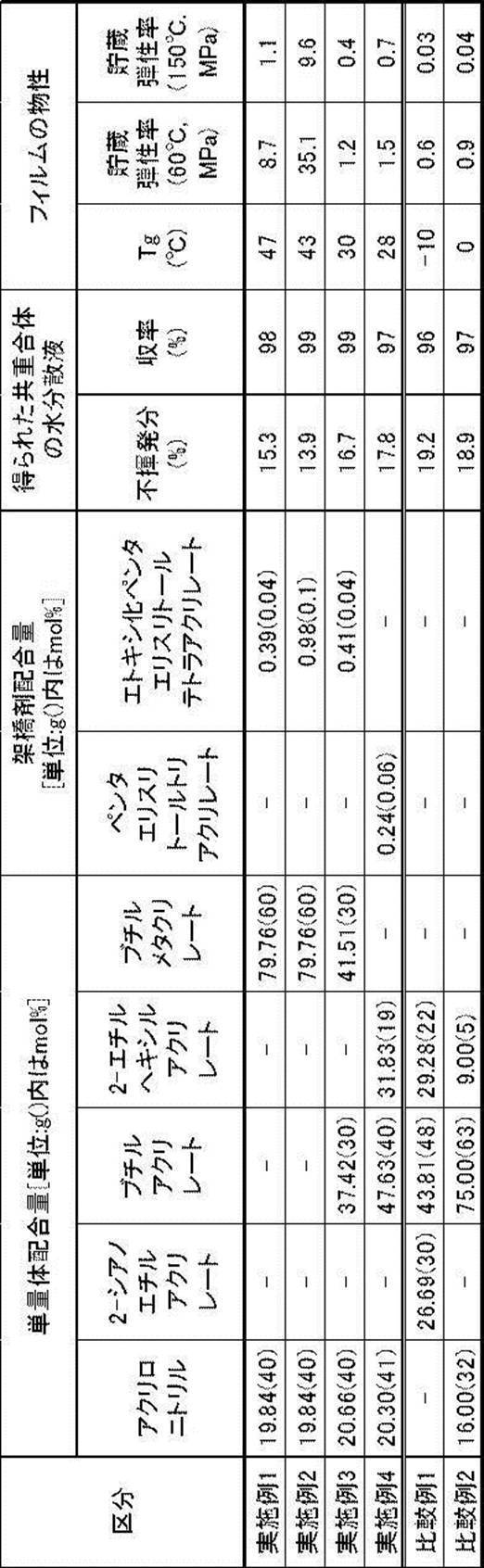
<実施例5>
黒鉛系負極材(日立化成(株)製、商品名:MAG)98質量部、実施例1で得られたエネルギーデバイス電極用バインダ樹脂材料(不揮発分15.3質量%)6.5質量部(不揮発分換算1質量部)、カルボキシメチルセルロース(ダイセルファインケム社製、商品名:CMC#2200)水溶液(不揮発分1.5質量%)66.7質量部(不揮発分換算1質量部)を混合し、更に粘度調整のために水を加えて電極合剤スラリー(不揮発分48質量%)を作製した。
黒鉛系負極材(日立化成(株)製、商品名:MAG)98質量部、実施例1で得られたエネルギーデバイス電極用バインダ樹脂材料(不揮発分15.3質量%)6.5質量部(不揮発分換算1質量部)、カルボキシメチルセルロース(ダイセルファインケム社製、商品名:CMC#2200)水溶液(不揮発分1.5質量%)66.7質量部(不揮発分換算1質量部)を混合し、更に粘度調整のために水を加えて電極合剤スラリー(不揮発分48質量%)を作製した。
<実施例6>
実施例2で得られたエネルギーデバイス電極用バインダ樹脂材料(不揮発分13.9質量%)7.2質量部(不揮発分換算1質量部)を用いた以外は実施例5と同様にして行った。
実施例2で得られたエネルギーデバイス電極用バインダ樹脂材料(不揮発分13.9質量%)7.2質量部(不揮発分換算1質量部)を用いた以外は実施例5と同様にして行った。
<実施例7>
実施例3で得られたエネルギーデバイス電極用バインダ樹脂材料(不揮発分16.7質量%)6.0質量部(不揮発分換算1質量部)を用いた以外は実施例5と同様にして行った。
実施例3で得られたエネルギーデバイス電極用バインダ樹脂材料(不揮発分16.7質量%)6.0質量部(不揮発分換算1質量部)を用いた以外は実施例5と同様にして行った。
<実施例8>
実施例4で得られたエネルギーデバイス電極用バインダ樹脂材料(不揮発分17.8質量%)5.6質量部(不揮発分換算1質量部)を用いた以外は実施例5と同様にして行った。
実施例4で得られたエネルギーデバイス電極用バインダ樹脂材料(不揮発分17.8質量%)5.6質量部(不揮発分換算1質量部)を用いた以外は実施例5と同様にして行った。
<比較例3>
実施例1で得られたエネルギーデバイス電極用バインダ樹脂材料の代わりに、比較例1で得られた共重合体の水分散液(不揮発分19.2質量%)5.2質量部(不揮発分換算1質量部)を用いた以外は実施例5と同様にして行った。
実施例1で得られたエネルギーデバイス電極用バインダ樹脂材料の代わりに、比較例1で得られた共重合体の水分散液(不揮発分19.2質量%)5.2質量部(不揮発分換算1質量部)を用いた以外は実施例5と同様にして行った。
<比較例4>
実施例1で得られたエネルギーデバイス電極用バインダ樹脂材料の代わりに、比較例2で得られた共重合体の水分散液(不揮発分18.9質量%)5.3質量部(不揮発分換算1質量部)を用いた以外は実施例5と同様にして行った。
実施例1で得られたエネルギーデバイス電極用バインダ樹脂材料の代わりに、比較例2で得られた共重合体の水分散液(不揮発分18.9質量%)5.3質量部(不揮発分換算1質量部)を用いた以外は実施例5と同様にして行った。
(電極合剤スラリーの保存安定性評価)
実施例5~8、比較例3及び4で得られた電極合剤スラリーの粘度をE型粘度計((株)トキメック社製VISCONIC E)を用いて、測定することにより電極合剤スラリーの保存安定性を評価した。電極合剤スラリーを調製した直後(1時間以内)に測定した粘度をη0とし、電極合剤スラリーを調製してから25℃で3日間保存した後に測定した粘度をη3として、下記式により、電極合剤スラリーの粘度変化率を算出した。経時で粘度変化率が小さいほど保存安定性が高いと判定した。測定結果を表2に示す。
(式) 粘度変化率(%)=(η3-η0)/η0×100
実施例5~8、比較例3及び4で得られた電極合剤スラリーの粘度をE型粘度計((株)トキメック社製VISCONIC E)を用いて、測定することにより電極合剤スラリーの保存安定性を評価した。電極合剤スラリーを調製した直後(1時間以内)に測定した粘度をη0とし、電極合剤スラリーを調製してから25℃で3日間保存した後に測定した粘度をη3として、下記式により、電極合剤スラリーの粘度変化率を算出した。経時で粘度変化率が小さいほど保存安定性が高いと判定した。測定結果を表2に示す。
(式) 粘度変化率(%)=(η3-η0)/η0×100
以下に粘度測定条件及び電極合剤スラリーの保存条件を示す。
(粘度測定条件)
測定機器:VISCONIC E[トキメック社製]
試料量:1ml
回転速度:10rpm(ずり速度:38.3s-1)
測定温度:25℃
(保存条件)
保存:ロータリーミキサー40rpm撹拌
保存温度:25℃
(粘度測定条件)
測定機器:VISCONIC E[トキメック社製]
試料量:1ml
回転速度:10rpm(ずり速度:38.3s-1)
測定温度:25℃
(保存条件)
保存:ロータリーミキサー40rpm撹拌
保存温度:25℃
また、得られた共重合体のガラス転移温度(Tg)を上記DMA測定装置RSA-III[TA instruments社製]を用いて測定した。測定結果を表2に示す。
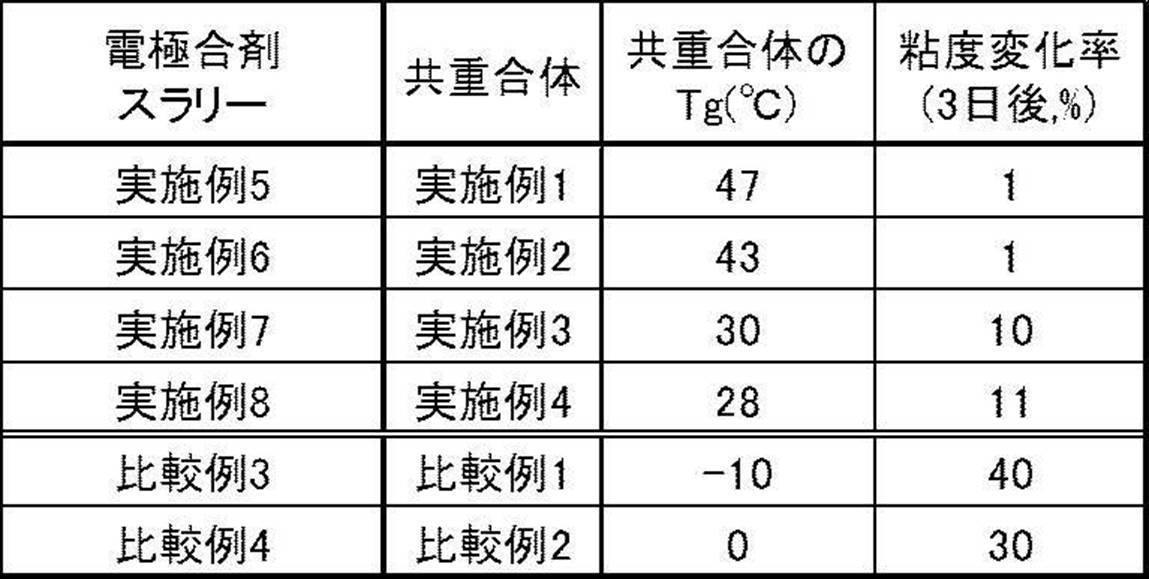
表2から、実施例1~4で得られた特定共重合体を用いて作製した実施例5~8の電極合剤スラリーは、比較例1、2で得られた共重合体を用いて作製した比較例3、4の電極合剤スラリーに比べ、電極合剤スラリーの保存安定性に優れていることが分かる。すなわち、特定共重合体(実施例1~4)は、エネルギーデバイス電極合剤スラリーに適用した場合に優れた保存安定性を満足できる。
<エネルギーデバイス電極(負極)作製>
<実施例9>
実施例5で得られた電極合剤スラリーを圧延銅箔(集電体、厚さ10μm)へ乾燥後の合剤層の質量が99g/m2~101g/m2になるように塗工機のギャップを調整し、均一に塗布したのち、105℃に設定した送風型乾燥機で1時間、更に120℃で5時間乾燥してシート状の負極用エネルギーデバイス電極を作製した。
<実施例9>
実施例5で得られた電極合剤スラリーを圧延銅箔(集電体、厚さ10μm)へ乾燥後の合剤層の質量が99g/m2~101g/m2になるように塗工機のギャップを調整し、均一に塗布したのち、105℃に設定した送風型乾燥機で1時間、更に120℃で5時間乾燥してシート状の負極用エネルギーデバイス電極を作製した。
<実施例10>
実施例6で得られた電極合剤スラリーを用いた以外は実施例9と同様にして行った。
実施例6で得られた電極合剤スラリーを用いた以外は実施例9と同様にして行った。
<実施例11>
実施例7で得られた電極合剤スラリーを用いた以外は実施例9と同様にして行った。
実施例7で得られた電極合剤スラリーを用いた以外は実施例9と同様にして行った。
<実施例12>
実施例8で得られた電極合剤スラリーを用いた以外は実施例9と同様にして行った。
実施例8で得られた電極合剤スラリーを用いた以外は実施例9と同様にして行った。
<比較例5>
比較例3で得られた電極合剤スラリーを用いた以外は実施例9と同様にして行った。
比較例3で得られた電極合剤スラリーを用いた以外は実施例9と同様にして行った。
<比較例6>
比較例4で得られた電極合剤スラリーを用いた以外は実施例9と同様にして行った。
比較例4で得られた電極合剤スラリーを用いた以外は実施例9と同様にして行った。
<評価>
(密着性評価)
実施例9~12、比較例5及び6で作製したエネルギーデバイス電極を幅10mm、長さ50mmの短冊状に切り出し、両面テープを用いてガラス板に合剤層面を被着面とし
て張り合わせ、密着試験用サンプルとした。剥離試験機((株)島津製作所製SHIMAZU EZ-S)に密着試験用サンプルを装着し、180度ピールにおけるピール強度を測定した。測定結果を表3に示す。
(密着性評価)
実施例9~12、比較例5及び6で作製したエネルギーデバイス電極を幅10mm、長さ50mmの短冊状に切り出し、両面テープを用いてガラス板に合剤層面を被着面とし
て張り合わせ、密着試験用サンプルとした。剥離試験機((株)島津製作所製SHIMAZU EZ-S)に密着試験用サンプルを装着し、180度ピールにおけるピール強度を測定した。測定結果を表3に示す。
<リチウム電池の作製>
(正極の作製)
正極活物質(LiCoO2)88質量部及び導電助剤(HS-100)6質量部に、バインダ樹脂(PVDF(ポリフッ化ビニリデン)、12質量%、NMP(N-メチルピロリドン)溶液)25質量部を加え、更に粘度調整のためにNMPを加えて混合し、正極用電極合剤スラリー(不揮発分67質量%)を作製した。これを本発明のエネルギーデバイス電極(負極)と同様の工程で、集電体(アルミ箔、厚み21μm)へ電極合剤層(集電体を含めない)の塗布量が220g/m2~226g/m2になるように塗工機のギャップを調節して均一に塗布した後、100℃に設定した送風型乾燥機で1時間、更に真空120℃で1時間乾燥してシート状の正極用エネルギーデバイス電極を作製した。
(正極の作製)
正極活物質(LiCoO2)88質量部及び導電助剤(HS-100)6質量部に、バインダ樹脂(PVDF(ポリフッ化ビニリデン)、12質量%、NMP(N-メチルピロリドン)溶液)25質量部を加え、更に粘度調整のためにNMPを加えて混合し、正極用電極合剤スラリー(不揮発分67質量%)を作製した。これを本発明のエネルギーデバイス電極(負極)と同様の工程で、集電体(アルミ箔、厚み21μm)へ電極合剤層(集電体を含めない)の塗布量が220g/m2~226g/m2になるように塗工機のギャップを調節して均一に塗布した後、100℃に設定した送風型乾燥機で1時間、更に真空120℃で1時間乾燥してシート状の正極用エネルギーデバイス電極を作製した。
(エネルギーデバイス電極評価用コイン電池の作製)
<実施例13>
実施例9で作製した負極用エネルギーデバイス電極を、ロールプレス機で合剤層のかさ密度が1.5mg/cm3となるように圧縮成形後、直径1.6cmの円形に切断し、評価用電極を得た。
直径2.0cmのステンレス製コイン外装容器に、直径1.4cmの円形に切断した正極用エネルギーデバイス電極、直径2.0cmの円形に切断した厚さ25μmのポリエチレン微多孔膜からなるセパレータ、先に直径1.6cmの円形に切断した実施例9で作製した負極用エネルギーデバイス電極、更にスペーサーとして直径1.6cmの円形に切断した厚さ200μmのステンレス板をこの順番に重ね合わせ、電解液(1MのLiPF6を含むエチレンカーボネート/メチルエチルカーボネート=3/7混合溶液(体積比)にビニレンカーボネートをエチレンカーボネート/メチルエチルカーボネート混合溶液全量に対して0.5モル%添加したもの)を溢れない程度に数滴垂らし、ポリプロピレン製のパッキンを介して、ステンレス製のキャップを被せ、コイン電池作製用のかしめ器で密封してエネルギーデバイス電極評価用電池を作製した。
<実施例13>
実施例9で作製した負極用エネルギーデバイス電極を、ロールプレス機で合剤層のかさ密度が1.5mg/cm3となるように圧縮成形後、直径1.6cmの円形に切断し、評価用電極を得た。
直径2.0cmのステンレス製コイン外装容器に、直径1.4cmの円形に切断した正極用エネルギーデバイス電極、直径2.0cmの円形に切断した厚さ25μmのポリエチレン微多孔膜からなるセパレータ、先に直径1.6cmの円形に切断した実施例9で作製した負極用エネルギーデバイス電極、更にスペーサーとして直径1.6cmの円形に切断した厚さ200μmのステンレス板をこの順番に重ね合わせ、電解液(1MのLiPF6を含むエチレンカーボネート/メチルエチルカーボネート=3/7混合溶液(体積比)にビニレンカーボネートをエチレンカーボネート/メチルエチルカーボネート混合溶液全量に対して0.5モル%添加したもの)を溢れない程度に数滴垂らし、ポリプロピレン製のパッキンを介して、ステンレス製のキャップを被せ、コイン電池作製用のかしめ器で密封してエネルギーデバイス電極評価用電池を作製した。
<実施例14~16、比較例7及び8>
実施例10~12、比較例5及び6で作製したエネルギーデバイス電極をそれぞれ使用した以外は実施例13と同様にして、エネルギーデバイス電極評価用電池をそれぞれ作製した。
実施例10~12、比較例5及び6で作製したエネルギーデバイス電極をそれぞれ使用した以外は実施例13と同様にして、エネルギーデバイス電極評価用電池をそれぞれ作製した。
(サイクル特性の評価)
60℃で1Cの容量の定電流-定電圧で充電を行ったのち、1Cの定電流で0.01Cまで放電を続けた。これを150回繰り返した後の放電容量を測定した。
この値を1サイクル目の放電容量に対する百分率で表し(放電容量維持率)、サイクル特性を評価した。値が大きいほどサイクル特性に優れることを示す。評価結果を表3に示す。
60℃で1Cの容量の定電流-定電圧で充電を行ったのち、1Cの定電流で0.01Cまで放電を続けた。これを150回繰り返した後の放電容量を測定した。
この値を1サイクル目の放電容量に対する百分率で表し(放電容量維持率)、サイクル特性を評価した。値が大きいほどサイクル特性に優れることを示す。評価結果を表3に示す。

表3に示すように、実施例1~4で得られた特定共重合体を用いて作製した実施例9~12のエネルギーデバイス電極における合剤層と集電体との密着性は、比較例5、6のエネルギーデバイス電極よりも優れていることが分かる。また、特定共重合体(実施例1~4)は、比較例(7、8)では得られない60℃での高い弾性率を示すことが分かる。更に本発明のエネルギーデバイス電極用バインダ樹脂材料を用いて製造したリチウム電池(実施例13~16)の60℃サイクル特性は、比較例(比較例7、8)と比べて何れも優れていた。
従って、本発明によれば、保存安定性に優れる電極合剤スラリー及び集電体と合剤層との密着性に優れるエネルギーデバイス電極を形成可能なエネルギーデバイス電極用バインダ樹脂材料と、これを用いたエネルギーデバイス電極及び長寿命エネルギーデバイスを提供することができる。
尚、日本出願2012-278434の開示はその全体が参照により本明細書に取り込まれる。また、本明細書に記載された全ての文献、特許出願、及び技術規格は、個々の文献、特許出願、および技術規格が参照により取り込まれることが具体的かつ個々に記された場合と同程度に、本明細書中に参照により取り込まれる。
Claims (6)
- (メタ)アクリロニトリル由来の構造単位と、2以上のエチレン性不飽和結合を有する化合物由来の構造単位とを含む共重合体を含有するエネルギーデバイス電極用バインダ樹脂材料。
- 前記2以上のエチレン性不飽和結合を有する化合物は、下記一般式(I)で表される化合物である請求項1に記載のエネルギーデバイス電極用バインダ樹脂材料。
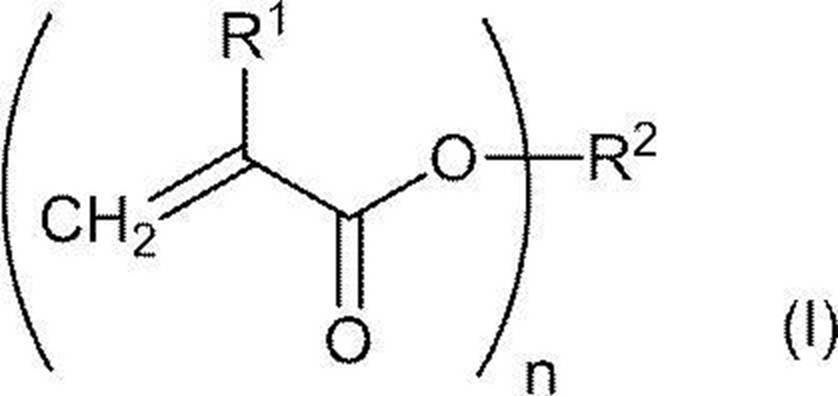
(式中、R1はそれぞれ独立に、水素原子又はメチル基を示す。R2は、n価の有機基を示す。nは2~6の数を示す。) - 前記共重合体のガラス転移温度が25℃~120℃である請求項1又は請求項2に記載のエネルギーデバイス電極用バインダ樹脂材料。
- 集電体と、前記集電体の少なくとも1面上に設けられ、(メタ)アクリロニトリル由来の構造単位及び2以上のエチレン性不飽和結合を有する化合物由来の構造単位を含む共重合体、並びに活物質を含有する合剤層と、を有するエネルギーデバイス電極。
- 請求項4に記載のエネルギーデバイス電極と、前記エネルギーデバイス電極の対極と、電解質と、を有するエネルギーデバイス。
- リチウムイオン二次電池である請求項5に記載のエネルギーデバイス。
Priority Applications (1)
| Application Number | Priority Date | Filing Date | Title |
|---|---|---|---|
| JP2014553228A JPWO2014098233A1 (ja) | 2012-12-20 | 2013-12-20 | エネルギーデバイス電極用バインダ樹脂材料、エネルギーデバイス電極及びエネルギーデバイス |
Applications Claiming Priority (2)
| Application Number | Priority Date | Filing Date | Title |
|---|---|---|---|
| JP2012-278434 | 2012-12-20 | ||
| JP2012278434 | 2012-12-20 |
Publications (1)
| Publication Number | Publication Date |
|---|---|
| WO2014098233A1 true WO2014098233A1 (ja) | 2014-06-26 |
Family
ID=50978547
Family Applications (1)
| Application Number | Title | Priority Date | Filing Date |
|---|---|---|---|
| PCT/JP2013/084317 Ceased WO2014098233A1 (ja) | 2012-12-20 | 2013-12-20 | エネルギーデバイス電極用バインダ樹脂材料、エネルギーデバイス電極及びエネルギーデバイス |
Country Status (3)
| Country | Link |
|---|---|
| JP (1) | JPWO2014098233A1 (ja) |
| TW (1) | TWI637551B (ja) |
| WO (1) | WO2014098233A1 (ja) |
Cited By (3)
| Publication number | Priority date | Publication date | Assignee | Title |
|---|---|---|---|---|
| JP2016031837A (ja) * | 2014-07-29 | 2016-03-07 | 株式会社大阪ソーダ | 電池電極用バインダー組成物、およびそれを用いた電極ならびに電池 |
| WO2016152056A1 (ja) * | 2015-03-24 | 2016-09-29 | 三洋電機株式会社 | 非水電解質二次電池 |
| CN111226328A (zh) * | 2017-10-27 | 2020-06-02 | 日本瑞翁株式会社 | 蓄电装置用粘接剂组合物、蓄电装置用功能层、蓄电装置及蓄电装置的制造方法 |
Citations (5)
| Publication number | Priority date | Publication date | Assignee | Title |
|---|---|---|---|---|
| JP2003132893A (ja) * | 2001-10-26 | 2003-05-09 | Nippon Zeon Co Ltd | 電極用スラリー組成物、電極およびリチウムイオン二次電池 |
| JP2003223895A (ja) * | 2002-01-31 | 2003-08-08 | Nippon Zeon Co Ltd | 二次電池電極用スラリー組成物、二次電池電極および二次電池 |
| JP2006040800A (ja) * | 2004-07-29 | 2006-02-09 | Hitachi Chem Co Ltd | リチウム電池電極用バインダ樹脂溶液及びこの溶液と活物質から製造される電極および電池 |
| JP2011014409A (ja) * | 2009-07-02 | 2011-01-20 | Nippon Zeon Co Ltd | リチウムイオン二次電池用電極の製造方法及び複合粒子 |
| JP2012204303A (ja) * | 2011-03-28 | 2012-10-22 | Nippon Zeon Co Ltd | 二次電池用電極、二次電池電極用バインダー、製造方法及び二次電池 |
Family Cites Families (2)
| Publication number | Priority date | Publication date | Assignee | Title |
|---|---|---|---|---|
| TW200615323A (en) * | 2004-06-21 | 2006-05-16 | Sekisui Chemical Co Ltd | Binder resin composition, paste, and green sheet |
| EP2058882A4 (en) * | 2006-08-29 | 2013-03-06 | Unitika Ltd | BINDER FOR MANUFACTURING ELECTRODE, MELT FOR ELECTRODE MANUFACTURING USING THE BINDER, ELECTRODE USING THE SLUDGE, SECONDARY BATTERY USING THE ELECTRODE AND CAPACITOR USING THE ELECTRODE |
-
2013
- 2013-12-20 JP JP2014553228A patent/JPWO2014098233A1/ja active Pending
- 2013-12-20 WO PCT/JP2013/084317 patent/WO2014098233A1/ja not_active Ceased
- 2013-12-20 TW TW102147598A patent/TWI637551B/zh not_active IP Right Cessation
Patent Citations (5)
| Publication number | Priority date | Publication date | Assignee | Title |
|---|---|---|---|---|
| JP2003132893A (ja) * | 2001-10-26 | 2003-05-09 | Nippon Zeon Co Ltd | 電極用スラリー組成物、電極およびリチウムイオン二次電池 |
| JP2003223895A (ja) * | 2002-01-31 | 2003-08-08 | Nippon Zeon Co Ltd | 二次電池電極用スラリー組成物、二次電池電極および二次電池 |
| JP2006040800A (ja) * | 2004-07-29 | 2006-02-09 | Hitachi Chem Co Ltd | リチウム電池電極用バインダ樹脂溶液及びこの溶液と活物質から製造される電極および電池 |
| JP2011014409A (ja) * | 2009-07-02 | 2011-01-20 | Nippon Zeon Co Ltd | リチウムイオン二次電池用電極の製造方法及び複合粒子 |
| JP2012204303A (ja) * | 2011-03-28 | 2012-10-22 | Nippon Zeon Co Ltd | 二次電池用電極、二次電池電極用バインダー、製造方法及び二次電池 |
Cited By (4)
| Publication number | Priority date | Publication date | Assignee | Title |
|---|---|---|---|---|
| JP2016031837A (ja) * | 2014-07-29 | 2016-03-07 | 株式会社大阪ソーダ | 電池電極用バインダー組成物、およびそれを用いた電極ならびに電池 |
| WO2016152056A1 (ja) * | 2015-03-24 | 2016-09-29 | 三洋電機株式会社 | 非水電解質二次電池 |
| JPWO2016152056A1 (ja) * | 2015-03-24 | 2018-01-11 | 三洋電機株式会社 | 非水電解質二次電池 |
| CN111226328A (zh) * | 2017-10-27 | 2020-06-02 | 日本瑞翁株式会社 | 蓄电装置用粘接剂组合物、蓄电装置用功能层、蓄电装置及蓄电装置的制造方法 |
Also Published As
| Publication number | Publication date |
|---|---|
| TW201429034A (zh) | 2014-07-16 |
| JPWO2014098233A1 (ja) | 2017-01-12 |
| TWI637551B (zh) | 2018-10-01 |
Similar Documents
| Publication | Publication Date | Title |
|---|---|---|
| CN110785879B (zh) | 非水电解质电池用粘合剂组合物 | |
| CN107710471B (zh) | 二次电池电极用粘结剂组合物、二次电池电极用浆料组合物、二次电池用电极及二次电池 | |
| CN107851802B (zh) | 锂离子二次电池正极用浆料、正极、电池及其制造方法 | |
| CN110326140B (zh) | 能量装置电极用复合树脂、能量装置电极形成用组合物、能量装置用正极以及能量装置 | |
| KR20190085918A (ko) | 전기 화학 소자용 바인더 | |
| US20230223540A1 (en) | Binder for nonaqueous secondary battery electrode and slurry for nonaqueous secondary battery electrode | |
| JP7311059B2 (ja) | 負極バインダー組成物、負極、及び二次電池 | |
| JP7771974B2 (ja) | 共重合体、非水系二次電池電極用バインダー、及び非水系二次電池電極用スラリー | |
| JP6789498B2 (ja) | エネルギーデバイス電極形成用組成物、エネルギーデバイス用正極及びエネルギーデバイス | |
| JP2015003998A (ja) | アクリルポリマー粒子の製造方法及びそれにより得られるアクリルポリマー粒子 | |
| JP5790193B2 (ja) | エネルギーデバイス電極用バインダ樹脂材料、エネルギーデバイス電極及びエネルギーデバイス | |
| JP6868751B1 (ja) | 非水系二次電池電極、電極スラリー、及び非水系二次電池 | |
| WO2018155713A1 (ja) | エネルギーデバイス電極用樹脂、エネルギーデバイス電極形成用組成物、エネルギーデバイス電極及びエネルギーデバイス | |
| JPWO2019117056A1 (ja) | 非水電解質電池用バインダー、それを用いたバインダー水溶液およびスラリー組成物、並びに非水電解質電池用電極および非水電解質電池 | |
| WO2018168520A1 (ja) | 非水電解質電池用バインダー組成物、並びにそれを用いた非水電解質電池用バインダー水溶液、非水電解質電池用スラリー組成物、非水電解質電池用電極、及び非水電解質電池 | |
| JP5760966B2 (ja) | エネルギーデバイス電極用バインダ樹脂材料、エネルギーデバイス電極及びエネルギーデバイス | |
| JP7272272B2 (ja) | 非水系電池電極用スラリーの製造方法 | |
| WO2014098233A1 (ja) | エネルギーデバイス電極用バインダ樹脂材料、エネルギーデバイス電極及びエネルギーデバイス | |
| JP2016143635A (ja) | エネルギーデバイス電極用共重合体、及びそれを用いたエネルギーデバイス | |
| WO2018087897A1 (ja) | エネルギーデバイス電極用樹脂、エネルギーデバイス電極形成用組成物、エネルギーデバイス電極及びエネルギーデバイス |
Legal Events
| Date | Code | Title | Description |
|---|---|---|---|
| 121 | Ep: the epo has been informed by wipo that ep was designated in this application |
Ref document number: 13866085 Country of ref document: EP Kind code of ref document: A1 |
|
| ENP | Entry into the national phase |
Ref document number: 2014553228 Country of ref document: JP Kind code of ref document: A |
|
| NENP | Non-entry into the national phase |
Ref country code: DE |
|
| 122 | Ep: pct application non-entry in european phase |
Ref document number: 13866085 Country of ref document: EP Kind code of ref document: A1 |