WO2014076775A1 - セラミックス繊維の製造方法及びセラミックス繊維製造用のセラミックス原料組成液 - Google Patents
セラミックス繊維の製造方法及びセラミックス繊維製造用のセラミックス原料組成液 Download PDFInfo
- Publication number
- WO2014076775A1 WO2014076775A1 PCT/JP2012/079479 JP2012079479W WO2014076775A1 WO 2014076775 A1 WO2014076775 A1 WO 2014076775A1 JP 2012079479 W JP2012079479 W JP 2012079479W WO 2014076775 A1 WO2014076775 A1 WO 2014076775A1
- Authority
- WO
- WIPO (PCT)
- Prior art keywords
- ceramic
- raw material
- fiber
- material composition
- composition liquid
- Prior art date
- Legal status (The legal status is an assumption and is not a legal conclusion. Google has not performed a legal analysis and makes no representation as to the accuracy of the status listed.)
- Ceased
Links
Images


Classifications
-
- C—CHEMISTRY; METALLURGY
- C04—CEMENTS; CONCRETE; ARTIFICIAL STONE; CERAMICS; REFRACTORIES
- C04B—LIME, MAGNESIA; SLAG; CEMENTS; COMPOSITIONS THEREOF, e.g. MORTARS, CONCRETE OR LIKE BUILDING MATERIALS; ARTIFICIAL STONE; CERAMICS; REFRACTORIES; TREATMENT OF NATURAL STONE
- C04B35/00—Shaped ceramic products characterised by their composition; Ceramics compositions; Processing powders of inorganic compounds preparatory to the manufacturing of ceramic products
- C04B35/622—Forming processes; Processing powders of inorganic compounds preparatory to the manufacturing of ceramic products
- C04B35/62227—Forming processes; Processing powders of inorganic compounds preparatory to the manufacturing of ceramic products obtaining fibres
- C04B35/62231—Forming processes; Processing powders of inorganic compounds preparatory to the manufacturing of ceramic products obtaining fibres based on oxide ceramics
- C04B35/6224—Fibres based on silica
- C04B35/62245—Fibres based on silica rich in aluminium oxide
-
- B—PERFORMING OPERATIONS; TRANSPORTING
- B28—WORKING CEMENT, CLAY, OR STONE
- B28B—SHAPING CLAY OR OTHER CERAMIC COMPOSITIONS; SHAPING SLAG; SHAPING MIXTURES CONTAINING CEMENTITIOUS MATERIAL, e.g. PLASTER
- B28B1/00—Producing shaped prefabricated articles from the material
-
- C—CHEMISTRY; METALLURGY
- C04—CEMENTS; CONCRETE; ARTIFICIAL STONE; CERAMICS; REFRACTORIES
- C04B—LIME, MAGNESIA; SLAG; CEMENTS; COMPOSITIONS THEREOF, e.g. MORTARS, CONCRETE OR LIKE BUILDING MATERIALS; ARTIFICIAL STONE; CERAMICS; REFRACTORIES; TREATMENT OF NATURAL STONE
- C04B35/00—Shaped ceramic products characterised by their composition; Ceramics compositions; Processing powders of inorganic compounds preparatory to the manufacturing of ceramic products
- C04B35/01—Shaped ceramic products characterised by their composition; Ceramics compositions; Processing powders of inorganic compounds preparatory to the manufacturing of ceramic products based on oxide ceramics
- C04B35/16—Shaped ceramic products characterised by their composition; Ceramics compositions; Processing powders of inorganic compounds preparatory to the manufacturing of ceramic products based on oxide ceramics based on silicates other than clay
- C04B35/18—Shaped ceramic products characterised by their composition; Ceramics compositions; Processing powders of inorganic compounds preparatory to the manufacturing of ceramic products based on oxide ceramics based on silicates other than clay rich in aluminium oxide
- C04B35/195—Alkaline earth aluminosilicates, e.g. cordierite or anorthite
-
- C—CHEMISTRY; METALLURGY
- C04—CEMENTS; CONCRETE; ARTIFICIAL STONE; CERAMICS; REFRACTORIES
- C04B—LIME, MAGNESIA; SLAG; CEMENTS; COMPOSITIONS THEREOF, e.g. MORTARS, CONCRETE OR LIKE BUILDING MATERIALS; ARTIFICIAL STONE; CERAMICS; REFRACTORIES; TREATMENT OF NATURAL STONE
- C04B35/00—Shaped ceramic products characterised by their composition; Ceramics compositions; Processing powders of inorganic compounds preparatory to the manufacturing of ceramic products
- C04B35/622—Forming processes; Processing powders of inorganic compounds preparatory to the manufacturing of ceramic products
- C04B35/626—Preparing or treating the powders individually or as batches ; preparing or treating macroscopic reinforcing agents for ceramic products, e.g. fibres; mechanical aspects section B
- C04B35/63—Preparing or treating the powders individually or as batches ; preparing or treating macroscopic reinforcing agents for ceramic products, e.g. fibres; mechanical aspects section B using additives specially adapted for forming the products, e.g.. binder binders
-
- C—CHEMISTRY; METALLURGY
- C04—CEMENTS; CONCRETE; ARTIFICIAL STONE; CERAMICS; REFRACTORIES
- C04B—LIME, MAGNESIA; SLAG; CEMENTS; COMPOSITIONS THEREOF, e.g. MORTARS, CONCRETE OR LIKE BUILDING MATERIALS; ARTIFICIAL STONE; CERAMICS; REFRACTORIES; TREATMENT OF NATURAL STONE
- C04B35/00—Shaped ceramic products characterised by their composition; Ceramics compositions; Processing powders of inorganic compounds preparatory to the manufacturing of ceramic products
- C04B35/622—Forming processes; Processing powders of inorganic compounds preparatory to the manufacturing of ceramic products
- C04B35/626—Preparing or treating the powders individually or as batches ; preparing or treating macroscopic reinforcing agents for ceramic products, e.g. fibres; mechanical aspects section B
- C04B35/63—Preparing or treating the powders individually or as batches ; preparing or treating macroscopic reinforcing agents for ceramic products, e.g. fibres; mechanical aspects section B using additives specially adapted for forming the products, e.g.. binder binders
- C04B35/632—Organic additives
- C04B35/634—Polymers
-
- D—TEXTILES; PAPER
- D01—NATURAL OR MAN-MADE THREADS OR FIBRES; SPINNING
- D01D—MECHANICAL METHODS OR APPARATUS IN THE MANUFACTURE OF ARTIFICIAL FILAMENTS, THREADS, FIBRES, BRISTLES OR RIBBONS
- D01D5/00—Formation of filaments, threads, or the like
- D01D5/04—Dry spinning methods
-
- C—CHEMISTRY; METALLURGY
- C04—CEMENTS; CONCRETE; ARTIFICIAL STONE; CERAMICS; REFRACTORIES
- C04B—LIME, MAGNESIA; SLAG; CEMENTS; COMPOSITIONS THEREOF, e.g. MORTARS, CONCRETE OR LIKE BUILDING MATERIALS; ARTIFICIAL STONE; CERAMICS; REFRACTORIES; TREATMENT OF NATURAL STONE
- C04B2235/00—Aspects relating to ceramic starting mixtures or sintered ceramic products
- C04B2235/02—Composition of constituents of the starting material or of secondary phases of the final product
- C04B2235/30—Constituents and secondary phases not being of a fibrous nature
- C04B2235/32—Metal oxides, mixed metal oxides, or oxide-forming salts thereof, e.g. carbonates, nitrates, (oxy)hydroxides, chlorides
- C04B2235/3205—Alkaline earth oxides or oxide forming salts thereof, e.g. beryllium oxide
- C04B2235/3208—Calcium oxide or oxide-forming salts thereof, e.g. lime
-
- C—CHEMISTRY; METALLURGY
- C04—CEMENTS; CONCRETE; ARTIFICIAL STONE; CERAMICS; REFRACTORIES
- C04B—LIME, MAGNESIA; SLAG; CEMENTS; COMPOSITIONS THEREOF, e.g. MORTARS, CONCRETE OR LIKE BUILDING MATERIALS; ARTIFICIAL STONE; CERAMICS; REFRACTORIES; TREATMENT OF NATURAL STONE
- C04B2235/00—Aspects relating to ceramic starting mixtures or sintered ceramic products
- C04B2235/02—Composition of constituents of the starting material or of secondary phases of the final product
- C04B2235/30—Constituents and secondary phases not being of a fibrous nature
- C04B2235/32—Metal oxides, mixed metal oxides, or oxide-forming salts thereof, e.g. carbonates, nitrates, (oxy)hydroxides, chlorides
- C04B2235/3217—Aluminum oxide or oxide forming salts thereof, e.g. bauxite, alpha-alumina
-
- C—CHEMISTRY; METALLURGY
- C04—CEMENTS; CONCRETE; ARTIFICIAL STONE; CERAMICS; REFRACTORIES
- C04B—LIME, MAGNESIA; SLAG; CEMENTS; COMPOSITIONS THEREOF, e.g. MORTARS, CONCRETE OR LIKE BUILDING MATERIALS; ARTIFICIAL STONE; CERAMICS; REFRACTORIES; TREATMENT OF NATURAL STONE
- C04B2235/00—Aspects relating to ceramic starting mixtures or sintered ceramic products
- C04B2235/02—Composition of constituents of the starting material or of secondary phases of the final product
- C04B2235/30—Constituents and secondary phases not being of a fibrous nature
- C04B2235/34—Non-metal oxides, non-metal mixed oxides, or salts thereof that form the non-metal oxides upon heating, e.g. carbonates, nitrates, (oxy)hydroxides, chlorides
- C04B2235/3418—Silicon oxide, silicic acids or oxide forming salts thereof, e.g. silica sol, fused silica, silica fume, cristobalite, quartz or flint
-
- C—CHEMISTRY; METALLURGY
- C04—CEMENTS; CONCRETE; ARTIFICIAL STONE; CERAMICS; REFRACTORIES
- C04B—LIME, MAGNESIA; SLAG; CEMENTS; COMPOSITIONS THEREOF, e.g. MORTARS, CONCRETE OR LIKE BUILDING MATERIALS; ARTIFICIAL STONE; CERAMICS; REFRACTORIES; TREATMENT OF NATURAL STONE
- C04B2235/00—Aspects relating to ceramic starting mixtures or sintered ceramic products
- C04B2235/02—Composition of constituents of the starting material or of secondary phases of the final product
- C04B2235/30—Constituents and secondary phases not being of a fibrous nature
- C04B2235/44—Metal salt constituents or additives chosen for the nature of the anions, e.g. hydrides or acetylacetonate
- C04B2235/449—Organic acids, e.g. EDTA, citrate, acetate, oxalate
-
- C—CHEMISTRY; METALLURGY
- C04—CEMENTS; CONCRETE; ARTIFICIAL STONE; CERAMICS; REFRACTORIES
- C04B—LIME, MAGNESIA; SLAG; CEMENTS; COMPOSITIONS THEREOF, e.g. MORTARS, CONCRETE OR LIKE BUILDING MATERIALS; ARTIFICIAL STONE; CERAMICS; REFRACTORIES; TREATMENT OF NATURAL STONE
- C04B2235/00—Aspects relating to ceramic starting mixtures or sintered ceramic products
- C04B2235/02—Composition of constituents of the starting material or of secondary phases of the final product
- C04B2235/50—Constituents or additives of the starting mixture chosen for their shape or used because of their shape or their physical appearance
- C04B2235/52—Constituents or additives characterised by their shapes
- C04B2235/5208—Fibers
- C04B2235/5264—Fibers characterised by the diameter of the fibers
Definitions
- the present invention relates to a method for producing ceramic fibers which are artificial inorganic fibers and have a small average fiber diameter, and a ceramic raw material composition liquid used for producing the ceramic fibers.
- Inorganic fibers are useful materials used in various fields such as electrical insulating materials, heat insulating materials, fillers, and filters, taking advantage of properties such as heat resistance, electrical insulation properties, low thermal conductivity, and high elasticity.
- Such inorganic fibers are usually prepared by melting the material and then blowing it with a spinner or air, etc., adjusting the inorganic fiber precursor, and blowing it with an air, spinner, rotating disk, etc. It is manufactured by a precursor method or the like that obtains inorganic fibers by calcination. And the fiber diameter of the inorganic fiber manufactured by these methods is generally several ⁇ m.
- the conventional method for producing inorganic fibers has a limit in reducing the fiber diameter.
- the melt spinning process at a high temperature near 2000 ° C. and the spinning method using the precursor method include unfibrinated granular materials called shots. In order to use it as such, a step of removing shots was required.
- Patent Document 1 as a method for obtaining inorganic fibers having a small fiber diameter, (1) a step of forming a sol solution mainly composed of inorganic components, (2) the sol solution is extruded from a nozzle, and the extruded sol solution is applied to the extruded sol solution. Forming an inorganic gel-like fine fiber by applying an electric field to form the inorganic gel-like fine fiber, and accumulating the inorganic gel-like fine fiber on a support; and (3) the accumulated inorganic gel-like fine fiber.
- a method for producing an inorganic structure is disclosed, which includes a step of drying to form an inorganic structure including inorganic dry gel-like fine fibers.
- Non-Patent Document 1 titanium tetraisopropoxide and acetic acid are mixed in a glove box, then ethanol and polyvinylpyrrolidone are added and stirred to obtain a mixed solution, and then the mixed Spinning with an electrospinning method using a liquid to obtain a spun fiber, then proceeding with the gelation reaction of the spun fiber, and then firing the spun fiber to obtain a ceramic fiber having a fiber diameter of 100 nm or less Is disclosed.
- Patent Document 1 Even with the inorganic fiber manufacturing method disclosed in Patent Document 1, there is a limit to reducing the fiber diameter, and only fibers with an average fiber diameter of up to about 150 nm can be manufactured (Patent Document 1). Example 4).
- Patent Document 1 cannot manufacture inorganic fibers having an average fiber diameter of 100 nm or less.
- Non-Patent Document 1 although a ceramic fiber having a fiber diameter of 100 nm or less is obtained, polyvinyl pyrrolidone is obtained by hydrolyzing a titanium alkoxide with acetic acid in an ethanol solvent in the presence of polyvinyl pyrrolidone. It is necessary to form a sol-gel intermediate stabilized with. That is, in Non-Patent Document 1, ceramic fibers having a fiber diameter of 100 nm or less can be obtained only with a spinning solution obtained by a special reaction system such as polyvinylpyrrolidone-titanium alkoxide-ethanol solvent. In other words, when a metal compound other than the metal alkoxide is used as the metal source, or when an aqueous solvent is used, ceramic fibers having a fiber diameter of 100 nm or less cannot be obtained.
- metal oxides, sulfates, acetates, nitrates, hydrochlorides, etc. are used as metal sources rather than unstable compounds such as metal alkoxides. It is advantageous to use a metal salt. And when using a metal oxide and a metal salt, in particular, in order to produce a ceramic fiber made of a multicomponent metal element, as a raw material, when using a plurality of metal oxides or metal salts, water is used as a solvent. Use is advantageous in that it has a low safety and environmental burden during production.
- Non-Patent Document 1 is a very special reaction system, ceramic fibers having a fiber diameter of 100 nm or less cannot be obtained by using an aqueous solvent instead of ethanol as a solvent. .
- mixing of titanium tetraisopropoxide and acetic acid is performed in a glove box in order to prevent water contamination.
- a stable sol-gel intermediate can be obtained only by a special reaction system of polyvinylpyrrolidone-titanium alkoxide-ethanol solvent.
- titanium alkoxide as a metal source, metal When an oxide or metal salt is used, or when an aqueous solvent is used as a solvent, a similar stable sol-gel intermediate cannot be obtained.
- an object of the present invention is to provide a method for producing a ceramic fiber that can obtain a ceramic fiber having an average fiber diameter of 100 nm or less by using a ceramic raw material composition liquid whose solvent is an aqueous solvent as a ceramic raw material composition liquid for spinning. Is to provide.
- the present inventors have included a surfactant in the ceramic raw material composition liquid when an aqueous solvent is used as the solvent of the ceramic raw material composition liquid.
- the surface tension is reduced, and the oxide content of the metal element (A), the total content (B) of the non-volatile content of the compound having the metal element, the fiber forming aid and the surfactant (B) and the interface
- a ceramic raw material composition liquid in which the content of the activator is adjusted to a specific range is spun by an electrospinning method, and the obtained spun fiber is fired to obtain ceramic fibers having an average fiber diameter of 100 nm or less.
- the present invention (1) includes a metal element that is a metal oxide source constituting a ceramic fiber, a fiber formation aid, and a surfactant, and the solvent is water, and the metal oxide source
- the metal element content of the metal oxide is 3.0 to 9.0% by mass in terms of metal oxide, and the total content of nonvolatile components of the compound having the metal element, the fiber-forming aid, and the surfactant is 10
- a method for producing a ceramic fiber characterized by comprising:
- this invention (2) contains the metal element used as the metal oxide source which comprises a ceramic fiber, the fiber formation adjuvant, and surfactant, a solvent is water,
- This metal oxide source The metal element content of the metal oxide is 3.0 to 9.0% by mass in terms of metal oxide, and the total content of nonvolatile components of the compound having the metal element, the fiber-forming aid, and the surfactant is 10
- a ceramic raw material composition liquid for producing ceramic fibers according to the present invention (1) characterized in that the content of the surfactant is 0.05 to 5.0% by mass. Is to provide.
- ceramic fiber having an average fiber diameter of 100 nm or less, preferably an average fiber diameter of 100 nm or less, using a ceramic raw material composition liquid whose solvent is an aqueous solvent as a ceramic raw material composition liquid for spinning.
- the manufacturing method of the ceramic fiber which can obtain the ceramic fiber in which a bead and a bulge-like lump do not exist can be provided.
- ceramic fibers comprising two or more metal elements and having an average fiber diameter of 100 nm or less, preferably ceramic fibers having an average fiber diameter of 100 nm or less and free of beads and fuzzy lumps. It is possible to provide a method for producing a ceramic fiber capable of obtaining the above.
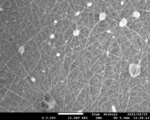
- Example 2 is a SEM photograph (10,000 times) of the ceramic fiber obtained in Example 1. It is a SEM photograph (2000 times) of the fiber containing a bead. It is a SEM photograph (10000 time) of the fiber containing a fushi.
- the method for producing a ceramic fiber according to the present invention includes a metal element that is a source of metal oxide constituting the ceramic fiber, a fiber forming aid, and a surfactant, and the solvent is water, and the metal oxide
- the content of the source metal element is 3.0 to 9.0% by mass in terms of metal oxide, and the total content of nonvolatile components of the compound having the metal element, the fiber-forming aid, and the surfactant is
- the ceramic raw material composition liquid preparation step according to the method for producing ceramic fibers of the present invention is a step of preparing a ceramic raw material composition liquid.
- the solvent is water.
- a ceramic raw material composition liquid contains the metal element used as the metal oxide source which comprises ceramic fiber, a fiber formation adjuvant, and surfactant.
- the ceramic fiber obtained by the method for producing a ceramic fiber of the present invention is obtained by forming a raw material compound of a metal oxide (that is, a compound having a metal element of a metal oxide source) into a fiber shape, and then firing the resultant. It is an inorganic fiber obtained by oxidizing a raw material oxide of a metal oxide.
- the metal element serving as the metal oxide source contained in the ceramic raw material composition liquid is a metal element serving as the metal oxide source that constitutes the ceramic fiber. It is a metal element that is converted into a constituent metal oxide.
- the ceramic raw material composition liquid contains a raw material compound that is a raw material of the metal oxide constituting the ceramic fiber, that is, a compound having a metal element that is a metal oxide source.
- the metal element used as the metal oxide source contained in the ceramic raw material composition liquid is appropriately selected depending on the composition of the ceramic fiber to be produced.
- a metal element which becomes a metal oxide source Li, Na, K, Rb, Cs, Mg, Ca, Sr, Ba, Sc, Y, Ti, Zr, Hf, V, Nb, Cr, Mo, W , Mn, Fe, Ru, Ci, Ni, Cu, Al, Si, P, B, Zn, Se, and more specifically, Li, Na, K, Mg, Ca, Sr, Ba, Y, Ti, Zr, Nb, Mn, Fe, Al, Si, P, B, Zn are mentioned.
- the ceramic raw material composition liquid can contain a metal element other than the above metal elements as a metal element to be a metal oxide source.
- the metal element used as the metal oxide source may be a single type or a combination of two or more types.
- a compound having a metal element serving as a metal oxide source constituting the ceramic fiber for example, an oxide of a metal element serving as a metal oxide source, water of an element serving as a metal oxide source
- a ceramic raw material composition containing a metal element serving as a metal oxide source by mixing a metal salt such as an oxide, hydrochloride, nitrate, carboxylate, sulfate, etc., or a sol dispersion of the oxide in an aqueous solvent.
- a metal salt such as an oxide, hydrochloride, nitrate, carboxylate, sulfate, etc.
- a combination of metal elements that are metal oxide sources contained in the ceramic raw material composition liquid Li, Na, K, Mg, Ca, Sr, Ba, Y, Ti, Zr, Mn, Fe, Al, Si,
- a combination of two or more metal elements selected from the group of P, B and Zn is preferable in that a biosoluble ceramic fiber can be obtained.
- the biosoluble ceramic fiber will be described later.
- a particularly preferred embodiment of the combination of metal elements is a combination having Al, Ca and Si as essential elements. It is done. That is, Al element, Ca element, Si element, if necessary, other metal elements, fiber forming aids, surfactants, aqueous solvents, and other components as necessary.
- the ceramic raw material composition liquid to be contained (hereinafter also referred to as a form example (1) of the ceramic raw material composition liquid) is particularly preferable in that a biosoluble ceramic fiber can be obtained.
- Other metal elements contained as necessary include one or more metal elements selected from the group of Li, Na, K, Sr, Ba, Y, Ti, Zr, Mn, Fe, P, B, and Zn. Is mentioned.
- a particularly preferred embodiment of the combination of metal elements is a combination having Al and Ca as essential elements. It is done. That is, a ceramic raw material containing Al element, Ca element, and if necessary, other metal elements, fiber forming aids, surfactants, aqueous solvents, and other components as necessary.
- a composition liquid (hereinafter also referred to as a form example (2) of the ceramic raw material composition liquid) is particularly preferable in that a biosoluble ceramic fiber can be obtained.
- Other metal elements contained as necessary include one or more metal elements selected from the group of Li, Na, K, Sr, Ba, Y, Ti, Zr, Mn, Fe, P, B, and Zn. Is mentioned.
- a ceramic raw material composition liquid containing other components (hereinafter also referred to as a form example (3) of the ceramic raw material composition liquid) is particularly preferable in that a biosoluble ceramic fiber can be obtained.
- Other metal elements contained as necessary include one or more metal elements selected from the group of Li, Na, K, Sr, Ba, Y, Ti, Zr, Mn, Fe, P, B, and Zn. Is mentioned.
- the ceramic raw material composition liquid As a particularly preferable embodiment of the combination of metal elements, a combination having Si, Ca and Mg as essential elements Is mentioned. That is, Si element, Ca element, Mg element, if necessary, other metal elements, fiber forming aids, surfactants, aqueous solvents, and other components as necessary.
- the ceramic raw material composition liquid to be contained (hereinafter also referred to as a form example (4) of the ceramic raw material composition liquid) is particularly preferable in that a biosoluble ceramic fiber can be obtained.
- Other metal elements contained as necessary include one or more metal elements selected from the group of Li, Na, K, Sr, Ba, Y, Ti, Zr, Mn, Fe, P, B, and Zn. Is mentioned.
- the combination of metal elements one or more selected from the group of Al and Si And a combination of at least one element selected from the group consisting of Ca, Mg, Sr and Ba. That is, one or more elements selected from the group of Al and Si, one or more elements selected from the group of Ca, Mg, Sr, and Ba, and other metal elements as necessary, and fiber formation aids.
- a ceramic raw material composition liquid (hereinafter also referred to as a form example (5) of the ceramic raw material composition liquid) containing an agent, a surfactant, an aqueous solvent, and, if necessary, other components is biologically dissolved.
- a conductive ceramic fiber is obtained.
- other metal elements contained as necessary include one or more metal elements selected from the group consisting of Li, Na, K, Y, Ti, Zr, Mn, Fe, P, B, and Zn.
- the ceramic raw material composition liquid is prepared by mixing an aluminum compound in a water solvent as a metal compound having a metal element serving as a metal oxide source
- the aluminum compound includes basic aluminum carboxylate, basic chloride
- basic acid aluminum such as aluminum, aluminum oxide sol, aluminum nitrate, and aluminum sulfate.
- formic acid, acetic acid, lactic acid, etc. are mentioned as carboxylic acid based on basic aluminum carboxylate.
- the calcium compound may be a water-soluble calcium compound, carbonate, nitrate, sulfate.
- Acetate, hydroxide, chloride, fluoride, borate and phosphate are preferred, and calcium acetate, calcium nitrate and calcium chloride are particularly preferred.
- the ceramic raw material composition liquid is prepared by mixing a silicon compound as a metal compound serving as a metal oxide source in an aqueous solvent
- the silicon compound may be hydrolyzed such as colloidal silica, sodium silicate, or tetraethoxysilane. Products and siloxane compounds are preferred.
- the magnesium compound includes carbonate, nitrate, sulfate, acetate, hydroxide , Chloride, fluoride, borate, phosphate and magnesium oxide sol are preferred, magnesium acetate, magnesium nitrate and magnesium chloride are preferred, and magnesium acetate and magnesium nitrate are particularly preferred.
- the fiber-forming aid contained in the ceramic raw material composition liquid is a fiber that is spouted into the shape of a fiber by the collector when the ceramic raw material composition liquid is spun in the spinning process. That is, it is used to form the non-volatile content in the ceramic raw material composition liquid into the shape of a spun fiber.
- the fiber-forming auxiliary agent is not particularly limited as long as it can impart formability to the non-volatile content when spinning in the spinning process and is burned or volatilized during firing in the firing process, but preferably Water-soluble resins, polyethylene oxide, polypropylene oxide, polyvinyl alcohol, polyvinyl ether, polyvinyl ester, polyacrylic acid ester and copolymers thereof are particularly preferable, and polyethylene oxide, polyacrylic acid ester and polyvinyl alcohol are particularly preferable.
- the surfactant contained in the ceramic raw material composition liquid has a function of reducing the surface tension of the ceramic raw material composition liquid when the ceramic raw material composition liquid is spun in the spinning process (the contact angle with the SUS430 plate is reduced). ). Therefore, since the ceramic raw material composition liquid contains a surfactant, the surface tension of the ceramic raw material composition liquid is lowered (the contact angle with respect to the SUS430 plate is reduced), so that the average fiber diameter is small and the beads are substantially made. The ceramic fiber which does not contain in is obtained.
- the surfactant is not particularly limited as long as it has the above-mentioned functions, but preferably includes a cationic surfactant, an anionic surfactant, a nonionic surfactant, and an amphoteric surfactant.
- nonionic surfactants and amphoteric surfactants are particularly preferred.
- amphoteric surfactants include betaine-based amphoteric surfactants.
- Nonionic surfactants include alkyl ether type, polyoxyethylene-polyoxypropylene block copolymer type, phenol type, ester type, amide type, polyethylene glycol and the like.
- the solvent is water.
- a compound having a metal element serving as a metal oxide source, a fiber forming aid, and a surfactant are dissolved or dispersed in an aqueous solvent.
- the content (A) of the metal element of the metal oxide source in the ceramic raw material composition liquid is 3.0 to 9.0% by mass, preferably 3.5%, as a percentage in terms of metal oxide based on the ceramic raw material composition liquid. To 8.5% by mass, particularly preferably 4.0 to 7.9% by mass.
- the percentage in terms of metal oxide means that the metal element of the metal oxide source existing in the ceramic raw material composition liquid is all metal oxide, and the mass of the ceramic raw material composition liquid of the mass of the metal oxide. It is a percentage with respect to mass.
- the content (A) of the metal element of the metal oxide source is calculated by converting each metal element to a metal oxide, It is calculated based on the total mass of those metal oxides.
- the total non-volatile content (B) of the compound having the metal element of the metal oxide source, the fiber forming aid and the surfactant in the ceramic raw material composition liquid is a percentage of the non-volatile content with respect to the ceramic raw material composition liquid. 0.0 to 21.0% by mass, preferably 12.0 to 20.0% by mass. Ceramic fibers having a small average fiber diameter because the total content (B) of the non-volatile content of the compound having a metal element of the metal oxide source, the fiber forming aid and the surfactant in the ceramic raw material composition liquid is in the above range. Is obtained.
- the non-volatile content refers to the solid content of the compound having a metal element of the metal oxide source, the fiber forming aid and the surfactant, and the compound having the metal element of the metal oxide source, the fiber forming aid and the surface activity. It is a component that does not volatilize during the spinning process in the agent.
- the nonvolatile content of each of the compound having the metal element of the metal oxide source, the fiber forming aid and the surfactant is the same as that of the compound having the metal element of the metal oxide source, the fiber forming aid or the surfactant at 105 ° C. It is grasped
- the hydrated water is not included in the nonvolatile content.
- the solvent is a non-volatile component. Is not included.
- the acid added to the ceramic raw material composition liquid described later is not included in the non-volatile content here.
- the metal oxide equivalent content of the metal element serving as the metal oxide source relative to the total nonvolatile content of the compound having the metal element of the metal oxide source, the fiber forming aid and the surfactant is preferably 0.2 to 0.35, particularly preferably 0.2 to 0.34, and further preferably 0.25 to 0.33. Ratio of metal oxide equivalent content of metal element as metal oxide source to total content (B) of non-volatile content of compound having metal element of metal oxide source, fiber forming aid and surfactant (A When / B) is in the above range, ceramic fibers having a small average fiber diameter are preferable.
- the content of the fiber forming aid in the ceramic raw material composition liquid is such that the total content (B) of the non-volatile content of the compound having the metal element of the metal oxide source, the fiber forming aid and the surfactant falls within the above range. It is appropriately selected.
- the content of the surfactant in the ceramic raw material composition liquid is 0.05 to 5.0% by mass, preferably 0.1 to 3.0% by mass, particularly preferably 0.1 to 1.0% by mass. . Since the content of the surfactant in the ceramic raw material composition liquid is in the above range, ceramic fibers having a small average fiber diameter can be obtained, and generation of beads can be suppressed.
- the contact angle of the ceramic raw material composition liquid with respect to the SUS430 plate is 30 to 54 °, preferably 34 to 50 °.
- the contact angle of the ceramic raw material composition liquid with respect to the SUS plate is in the above range, ceramic fibers having a small average fiber diameter are obtained, and the effect of suppressing the generation of beads is enhanced.
- the contact angle of the ceramic raw material composition liquid to the SUS430 plate is an index of the surface tension of the ceramic raw material composition liquid. The larger the contact angle of the ceramic raw material composition liquid to the SUS430 plate, the higher the surface tension of the ceramic raw material composition liquid. On the other hand, the smaller the contact angle of the ceramic raw material composition liquid to the SUS430 plate, Indicates that the surface tension is low.
- adjusting the contact angle of the ceramic raw material composition liquid to the SUS430 plate to be in the above range means that the ceramic fiber having a small average fiber diameter is obtained, and that the generation of beads is suppressed.
- the surface tension of the ceramic raw material composition liquid is adjusted.
- the relationship between the contact angle (measured value) of various liquids with respect to the SUS430 plate and the surface tension (value described in the chemical handbook) is as follows, and it can be seen that the surface tension correlates with the contact angle with respect to the SUS430 plate.
- the pH of the ceramic raw material composition liquid is preferably 1.0 to 7.0, particularly preferably 2.0 to 4.5, still more preferably 3.0 to 4.4, and more preferably 4.0 to 4.3. It is. It is preferable that the pH of the ceramic raw material composition liquid is in the above range from the viewpoint of enhancing the effect of suppressing the generation of fussy lumps.
- the pH of the ceramic raw material composition liquid is adjusted by adding an acid to the ceramic raw material composition liquid.
- the viscosity of the ceramic raw material composition liquid is preferably 0.05 to 1.0 Pa ⁇ s, particularly preferably 0.1 to 0.8 Pa ⁇ s, and more preferably 0.15 to 0.6 Pa ⁇ s. It is preferable that the viscosity of the ceramic raw material composition liquid is in the above range from the viewpoint of increasing the effect of reducing the fiber diameter and suppressing the generation of beads.
- the viscosity of the ceramic raw material composition liquid is adjusted by appropriately selecting the amount of the solvent used, the content of the resin that is the fiber forming aid, and the like.
- the ceramic raw material composition liquid is adjusted to the above-mentioned pH by adding nitric acid, formic acid or acetic acid to the ceramic raw material composition liquid, in that the effect of suppressing the generation of fussy-like lumps is enhanced. preferable.
- the content ratio of each metal element in the ceramic raw material composition liquid form example (1) is as follows: Al 2 O 3 is from 35.0 to 88.0 wt%, CaO is 3.0 to 45.0% by weight, preferably the content of SiO 2 is 5.0 to 40.0 wt%, Al 2 O 3 Is preferably 39.0 to 83.0 mass%, CaO is 3.0 to 42.0 mass%, SiO 2 is 8.0 to 28.0 mass%, and Al 2 O 3 is 49. mass%. More preferably, the content ratio is 0 to 66.0% by mass, CaO is 26.0 to 42.0% by mass, and SiO 2 is 8.0 to 16.0% by mass.
- the content ratio of each metal element in the ceramic raw material composition liquid form example (2) is as follows: A content ratio of Al 2 O 3 of 53.0 to 88.0% by mass and CaO of 12.0 to 47.0% by mass is preferable, Al 2 O 3 of 45.0 to 85.0% by mass, and CaO of A content ratio of 15.0 to 55.0 mass% is particularly preferable, and a content ratio of Al 2 O 3 of 60.0 to 80.0 mass% and CaO of 20.0 to 40.0 mass% is more preferable. .
- the content ratio of each metal element in the ceramic raw material composition liquid form example (3) is as follows:
- the content ratio is preferably such that Al 2 O 3 is 30.0 to 81.0% by mass, MgO is 19.0 to 65.0% by mass, and SiO 2 is 0 to 40.0, and Al 2 O 3 is 33.0%.
- MgO 22.0 to 62.0 mass%, SiO 2 content 0 to 37.0 is particularly preferred, Al 2 O 3 40.0 to 70.0 mass%,
- the content ratio in which MgO is 30.0 to 60.0% by mass and SiO 2 is 0 to 30.0 is more preferable.
- the content ratio of each metal element in the ceramic raw material composition liquid form example (4) is as follows:
- the content ratio is such that the content of SiO 2 is 30.0 to 90.0% by mass, the content of CaO is 5.0 to 60.0% by mass, and the content of MgO is 5.0 to 60.0% by mass.
- the SiO 2 content is 40.0 to 80.0% by mass
- the CaO content is 10.0 to 50.0% by mass
- the MgO content is 10.0 to 50.0% by mass.
- the ratio is particularly preferable, the content of SiO 2 is 45.0 to 70.0% by mass
- the content of CaO is 15.0 to 40.0% by mass
- the content of MgO is 15.0 to 40.0% by mass.
- the content ratio is more preferably.
- the content ratio of each metal element in the ceramic raw material composition liquid form example (5) is as follows:
- the total content of Al 2 O 3 and SiO 2 is preferably 40.0 to 90.0% by mass, and the total content of CaO, MgO, SrO and BaO is preferably 10.0 to 60.0% by mass,
- a content ratio in which the total content of Al 2 O 3 and SiO 2 is 50.0 to 85.0% by mass and the total content of CaO, MgO, SrO and BaO is 15.0 to 50.0% by mass is particularly preferable.
- the content ratio is such that the total content of Al 2 O 3 and SiO 2 is 60.0 to 80.0% by mass, and the total content of CaO, MgO, SrO and BaO is 20.0 to 40.0% by mass. preferable.
- the total content refers to the content of one kind when only one kind is contained, and refers to the total content thereof when two or more kinds are contained.
- the ceramic raw material composition liquid may contain fine particles having a function as a catalyst, if necessary.
- a metal compound having a metal element serving as a metal oxide source, a fiber forming aid, a surfactant, and a component added as necessary are added to an aqueous solvent.
- a ceramic raw material composition liquid is prepared by dissolving or dispersing the components in an aqueous solvent.
- the spinning step according to the method for producing a ceramic fiber of the present invention is a step of obtaining a spun fiber by spinning a ceramic raw material composition solution by an electrospinning method.
- the electrospinning method related to the spinning process is not particularly limited as long as it is a method in which a voltage is applied to the spinning solution and an electric field is used.
- a spinning port from which a spinning solution is extruded a storage tank to which the spinning port is attached and for supplying the spinning solution to a spinning port, and a high pressure to apply a voltage to the spinning solution at the spinning port
- a spinning device comprising a power source and a collector, a voltage is applied between the spinning port and the collector while pushing out the spinning solution from a spinning solution storage tank to the spinning port, and the spinning port applies a voltage to the spinning solution.
- the spinning solution is ejected from the spinneret toward the collector, and while the spinning solution reaches the collector from the spinneret, the volatile matter in the spinning solution is volatilized, and the spinning produced at the collector.
- a method for collecting fibers is mentioned. In such an electrospinning method, when a voltage is applied to the spinning solution at the spinning port and the electric attractive force exceeds the surface tension of the spinning solution, the spinning solution is ejected from the spinning port toward the collector, and the spinning port collects the collector. The volatile matter in the spinning solution is volatilized during the period of reaching.
- the ceramic raw material composition liquid prepared in the ceramic raw material composition liquid preparation process is used as the spinning liquid used in the electrospinning method.
- the conditions of the electrospinning method are appropriately selected.
- the voltage applied to the collector is 5.0 to 20.0 kV, preferably 7.0 to 18
- the extrusion rate of the ceramic raw material composition solution is 0.01 to 1.0 ml / hour, preferably 0.05 to 0.8 ml / hour, and the distance between the spinneret and the collector is 50 kV. It is ⁇ 300 mm, preferably 100 to 200 mm.
- the conditions for the electrospinning method are appropriately selected according to each method.
- the temperature of the atmosphere when the ceramic raw material composition liquid is spun by the electrospinning method is preferably 0 to 60 ° C., particularly preferably 10 to 40 ° C.
- the humidity (relative humidity) of the atmosphere when spinning the ceramic raw material composition solution by electrospinning is preferably 0 to 80% RH, particularly preferably 10 to 50% RH.
- the firing step according to the method for producing ceramic fibers of the present invention is a step of obtaining ceramic fibers by firing the spun fibers obtained by performing the spinning step.
- the firing temperature when firing the spun fiber is appropriately selected depending on the metal element contained in the spun fiber, and the temperature at which the metal element is converted to a metal oxide and converted into a ceramic is appropriately selected. Is from 500 to 1500 ° C., particularly preferably from 700 to 1300 ° C.
- the firing time when firing the spun fiber is appropriately selected as the time during which the metal oxide is produced and ceramicized.
- the atmosphere when firing the spun fiber is an oxidizing atmosphere such as air or an oxygen gas atmosphere.
- the spun fiber is heated and fired in an oxidizing atmosphere to oxidize the metal element contained in the spun fiber and convert it into a metal oxide, thereby obtaining a ceramic fiber.
- oxidizing atmosphere to oxidize the metal element contained in the spun fiber and convert it into a metal oxide, thereby obtaining a ceramic fiber.
- non volatile matters other than the metal oxide in a spinning fiber are burned out or volatilized by baking.
- the ceramic fiber obtained by carrying out the method for producing a ceramic fiber of the present invention has an average fiber diameter of 100 nm or less and a thin fiber diameter.
- the ceramic fiber obtained by the method for producing a ceramic fiber of the present invention is an inorganic fiber in which a metal oxide is sintered to form a fiber, and is different from a carbon fiber in which a carbide is a main component. Further, since the ceramic fiber obtained by the method for producing a ceramic fiber of the present invention is a man-made fiber produced by sintering a metal oxide, it is a man-made inorganic fiber and is a needle such as asbestos or wollastonite. Different from natural fibers such as crystalline fibers and whiskers.
- the average fiber diameter of the ceramic fibers obtained by the method for producing ceramic fibers of the present invention is 100 nm or less, preferably 30 to 80 nm.
- the ceramic fiber obtained by the method for producing a ceramic fiber of the present invention includes Li, Na, K, Rb, Cs, Mg, Ca, Sr, Ba, Sc, Y, Ti, Zr, as a metal oxide constituting the fiber.
- the ceramic fiber obtained by the method for producing a ceramic fiber of the present invention includes Li, Na, K, Mg, Ca, Sr, Ba, Y, Ti, Zr, Mn, Fe, Al, as a metal oxide constituting the fiber. It is particularly preferable to contain an oxide of two or more metal elements selected from the group consisting of Si, P, B and Zn.
- Examples of the ceramic fiber obtained by the method for producing a ceramic fiber of the present invention include an embodiment containing oxides of Al, Ca and Si as essential metal oxides (hereinafter referred to as ceramics obtained by the method for producing a ceramic fiber of the present invention). (It is also referred to as a fiber form example (1).). That is, the example (1) of the ceramic fiber obtained by the method for producing a ceramic fiber of the present invention contains Al 2 O 3 , CaO, and SiO 2 as essential metal oxides, and if necessary.
- Al 2 O 3 , CaO and SiO 2 such as oxides of one or more metal elements selected from the group consisting of Li, Na, K, Sr, Ba, Y, Ti, Zr, Mn, Fe, P, B and Zn And an average fiber diameter of 100 nm or less.
- the content of Al 2 O 3 is 35.0 to 88.0% by mass, and the content of CaO is 3.0 to 45.
- the content of 0% by mass and the content of SiO 2 is preferably 5.0 to 40.0% by mass, the content of Al 2 O 3 is 39.0 to 83.0% by mass, and the content of CaO is 3.
- the content of SiO 2 is 0 to 42.0% by mass, the content of SiO 2 is 8.0 to 28.0% by mass, the content of Al 2 O 3 is 49.0 to 66.0% by mass, More preferably, the content is 26.0 to 42.0% by mass, and the SiO 2 content is 8.0 to 16.0% by mass.
- the ceramic fiber obtained by the method for producing a ceramic fiber of the present invention includes an embodiment containing an oxide of Al and Ca as an essential metal oxide (hereinafter referred to as ceramics obtained by the method for producing a ceramic fiber of the present invention).
- ceramics obtained by the method for producing a ceramic fiber of the present invention (It is also referred to as a fiber form example (2).). That is, the example (2) of the ceramic fiber obtained by the method for producing a ceramic fiber of the present invention contains Al 2 O 3 and CaO as essential metal oxides, and, if necessary, Li, Na, Contains metal oxides other than Al 2 O 3 and CaO, such as oxides of one or more metal elements selected from the group of K, Sr, Ba, Y, Ti, Zr, Mn, Fe, P, B and Zn And the average fiber diameter is 100 nm or less.
- the content of Al 2 O 3 is 53.0-88.0% by mass, and the content of CaO is 12.0-47. is preferably 0 wt%, Al 2 O content of 3 from 45.0 to 85.0% by weight, particularly preferably that the content of CaO is 15.0 to 55.0 wt%, Al 2 More preferably, the O 3 content is 60.0 to 80.0% by mass, and the CaO content is 20.0 to 40.0% by mass.
- an embodiment containing an oxide of Al and Mg or an oxide of Al, Mg and Si as an essential metal oxide (hereinafter referred to as the present invention) (It is also referred to as a form example (3) of ceramic fibers obtained by the method for producing ceramic fibers.). That is, in the ceramic fiber form example (3) obtained by the method for producing ceramic fibers of the present invention, “Al 2 O 3 and MgO” or “Al 2 O 3 , MgO and SiO 2 ” is used as an essential metal oxide.
- Al such as an oxide of one or more metal elements selected from the group of Li, Na, K, Sr, Ba, Y, Ti, Zr, Mn, Fe, P, B and Zn, if necessary It contains a metal oxide other than 2 O 3 , MgO and SiO 2 and has an average fiber diameter of 100 nm or less.
- the content of Al 2 O 3 is 30.0 to 81.0% by mass, and the content of MgO is 19.0 to 65. It is preferable that the content of SiO 2 is 0 to 40.0%, the content of Al 2 O 3 is 33.0 to 78.0% by mass, and the content of MgO is 22.0 to 62. It is particularly preferable that the content of 0% by mass and the content of SiO 2 be 0 to 37.0, the content of Al 2 O 3 is 40.0 to 70.0% by mass, and the content of MgO is 30 to 60.0. More preferably, the content by mass and the content of SiO 2 are 0 to 30.0.
- the ceramic fiber obtained by the method for producing a ceramic fiber of the present invention includes a form example containing oxides of Si, Ca and Mg as essential metal oxides (hereinafter, obtained by the method for producing a ceramic fiber of the present invention). (It is also referred to as a form example (4) of ceramic fibers).
- the content of SiO 2 is 30.0 to 90.0% by mass, and the content of CaO is 5.0 to 60.0% by mass. %, MgO content is particularly preferably 5.0 to 60.0 mass%, SiO 2 content is 40.0 to 80.0 mass%, and CaO content is 10.0 to 50. It is particularly preferable that the content of 0% by mass and the content of MgO is 10.0 to 50.0% by mass, the content of SiO 2 is 45.0 to 70.0% by mass, and the content of CaO is 15.0 to More preferably, the content is 40.0 mass% and the MgO content is 15.0 to 40.0 mass%.
- a ceramic fiber obtained by the method for producing a ceramic fiber of the present invention an oxide of one or more elements selected from the group of Al and Si, and one type selected from the group of Ca, Mg, Sr and Ba
- the form examples (5) of ceramic fibers obtained by the method for producing ceramic fibers of the present invention are included. That is, the example (5) of the ceramic fiber obtained by the method for producing a ceramic fiber of the present invention includes at least one selected from the group of Al 2 O 3 and SiO 2 and a group of CaO, MgO, SrO, and BaO.
- the total content of Al 2 O 3 and SiO 2 is 40.0 to 90.0% by mass, CaO, MgO, SrO and BaO.
- the total content of Al is preferably 10.0 to 60.0% by mass, the total content of Al 2 O 3 and SiO 2 is 50.0 to 85.0% by mass, CaO, MgO, SrO and BaO.
- the total content is particularly preferably 15.0 to 50.0% by mass, the total content of Al 2 O 3 and SiO 2 is 60.0 to 80.0% by mass, CaO, MgO, SrO and BaO.
- the total content is more preferably 20.0 to 40.0% by mass.
- the total content refers to the content of one kind when only one kind is contained, and refers to the total content thereof when two or more kinds are contained.
- Examples (1), (2), (3), (4) and (5) of ceramic fibers obtained by the method for producing ceramic fibers of the present invention are biosoluble ceramic fibers.
- the biosoluble ceramic fiber refers to a fiber having a physiological saline dissolution rate at 37 ° C. of 1% or more.
- the physiological saline dissolution rate is a value obtained by calculating the ratio of each metal element in the biosoluble ceramic fiber to be eluted in the physiological saline for each element when measured under the measurement conditions shown below, and adding them up. .
- the biosoluble ceramic fiber is a fiber composed of oxides of Al, Ca, Si and Mg will be described as an example.
- 0.05 g of the biosoluble ceramic fiber and 50 ml of physiological saline are used. Place in an Erlenmeyer flask (300 ml) and place in a 37 ° C. incubator.
- the Erlenmeyer flask is then subjected to horizontal shaking at 120 revolutions per minute for 48 hours. After shaking, the mixture is filtered, and the concentration (mg / L) of each element is measured by ICP emission analysis for the Al element, Ca element, Si element and Mg element contained in the obtained filtrate. Then, the physiological saline dissolution rate (%) is calculated by the following formula from the concentration of each element and the content (% by mass) of each element in the biosoluble ceramic fiber before dissolution.
- the concentration of each element obtained by ICP emission analysis is as follows: Al element concentration: a1 (mg / L), Ca element concentration: a2 (mg / L), Si element concentration: a3 (mg / L) and The Mg element concentration a4 (mg / L), the content of each element in the biosoluble ceramic fiber before dissolution, the Al element content: b1 (mass%), the Ca element content: b2 (mass) %), Si element content: b3 (mass%) and Mg element content: b4 (mass%).
- Saline dissolution rate (%) ⁇ filtrate amount (L) ⁇ (a1 + a2 + a3 + a4) ⁇ 100 ⁇ / ⁇ amount of biosoluble ceramic fiber before dissolution (mg) ⁇ (b1 + b2 + b3 + b4) / 100 ⁇
- the ratio of each metal element in the biosoluble ceramic fiber to be eluted in physiological saline Obtained every time and totaled to obtain the physiological saline dissolution rate (%).
- the ceramic fiber obtained by the method for producing a ceramic fiber of the present invention preferably contains substantially no beads.
- the beads are present in continuous ceramic fibers, and are referred to as particle-like portions close to a spherical shape different from the fibrous shape. It is a lump of a particulate metal oxide as it exists in the SEM photograph of FIG.
- “being substantially free of beads” means that a SEM photograph of a ceramic fiber at a magnification of 2000 times is taken, and the diameter is 3 times or more compared to the average fiber diameter and 1 ⁇ m or more in a field of view at a magnification of 2000 times. The number of such beads is confirmed, and a case where the number of confirmed beads is 1 or less in a field of view of 2000 times magnification is defined as “substantially free of beads”.
- the ceramic fiber obtained by the method for producing a ceramic fiber of the present invention preferably has no fussy lump in the fiber.
- the fusiform lump is a spherically bulging portion present in the fiber, and is 1 from the diameter of the portion other than the fusiform lump in the vicinity of the fusiform lump as shown in the SEM photograph of FIG. It indicates the part that is thicker than 5 times. Note that the fact that fushi-like lumps are not substantially present means that an SEM photograph of a ceramic fiber with a magnification of 10000 times is taken, and in the field of view at a magnification of 10000 times, the diameter of the portion other than the fushi-like mass in the vicinity of the fushi-like lumps is taken.
- the portion that is thicker than 1.5 times is made into a fushi-like lump, the number of such fushi-like lumps is confirmed, and the fushi-like lump confirmed in the field of view with a magnification of 10,000 times
- the case where the number is 10 or less is defined as “substantially no fushi-like lump”.
- the average fiber diameter of ceramic fibers is obtained from an SEM image obtained by observation with a scanning electron microscope (SEM), and the diameters of 20 arbitrarily extracted ceramic fibers appearing in the SEM image are measured. And let the average value be an average fiber diameter of a ceramic fiber.
- SEM scanning electron microscope
- the ceramic fiber contains beads, whether or not a fushi-like lump exists in the ceramic fiber, and the thickness of the fushi-like lump and the diameter of the portion other than the fushi-like lump in the vicinity of the fushi-like lump This is confirmed by SEM images obtained by SEM observation of ceramic fibers.
- the ceramic fiber obtained by the method for producing a ceramic fiber of the present invention is suitably used as an electrical insulating material, a heat insulating material, a filter, a secondary battery separator, a filler, and the like.
- the surface tension of a ceramic raw material composition liquid using an aqueous solvent can be lowered by adding a surfactant to the ceramic raw material composition liquid. Therefore, in the method for producing ceramic fibers of the present invention, even when an aqueous solvent is used as the solvent for the ceramic raw material composition liquid, the surface tension is lowered, preferably the contact angle with respect to the SUS430 plate is 30 to 54 °, particularly preferably. Since the contact angle with respect to the SUS430 plate can be lowered to 30 to 54 °, ceramic fibers having an average fiber diameter of 100 nm or less, preferably an average fiber diameter of 100 nm or less, and beads and fussy-like lumps are formed. Ceramic fibers that do not exist can be obtained.
- an aqueous solvent can be used as a solvent for the ceramic raw material composition solution, and therefore a metal oxide or a metal salt can be used as a metal compound serving as a metal source.
- ceramic fibers composed of various metal elements particularly ceramic fibers composed of two or more metal elements and having an average fiber diameter of 100 nm or less, preferably average fibers Ceramic fibers having a diameter of 100 nm or less and free from beads and fussy lumps can be advantageously produced industrially.
- ⁇ Analysis method> (Viscosity of ceramic raw material composition liquid) Using a viscoelasticity measuring device (Physica MCR301 manufactured by Anton Paar), the liquid temperature of the ceramic raw material composition liquid was maintained at 25 ° C., and the shear viscosity at a shear rate of 10 s ⁇ 1 was measured. Viscosity of (Contact angle of ceramic raw material composition) The ceramic raw material composition liquid was maintained at 25 ° C., and 1.6 to 1.7 ⁇ L was dropped on a SUS430 plate in an atmosphere of 25 ° C. and a relative humidity of 50% RH, and the contact angle was evaluated by a direct reading method.
- a scanning electron microscope (JSM-7600F manufactured by JEOL Ltd.) was used to take an SEM photograph at a magnification of 2000 times, and in the field of view at a magnification of 2000 times, the diameter was 3 times or more compared to the average fiber diameter and 1 ⁇ m or more. Spherical ones were used as beads, and the number of such beads was confirmed. When the number of confirmed beads was 1 or less in a field of view of magnification 2000 times, it was evaluated as “no beads”, and when 2 or more, “with beads” was evaluated.
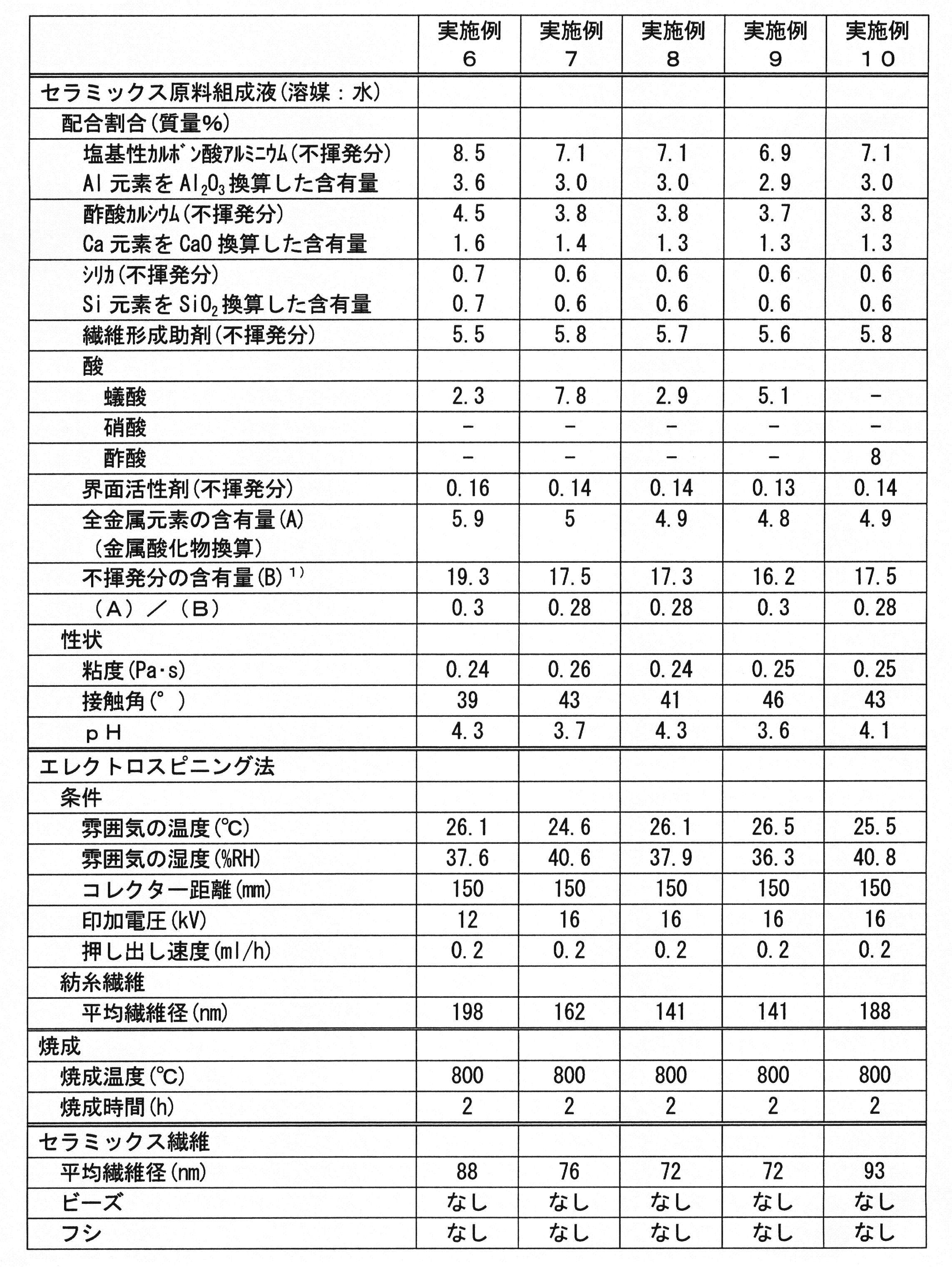
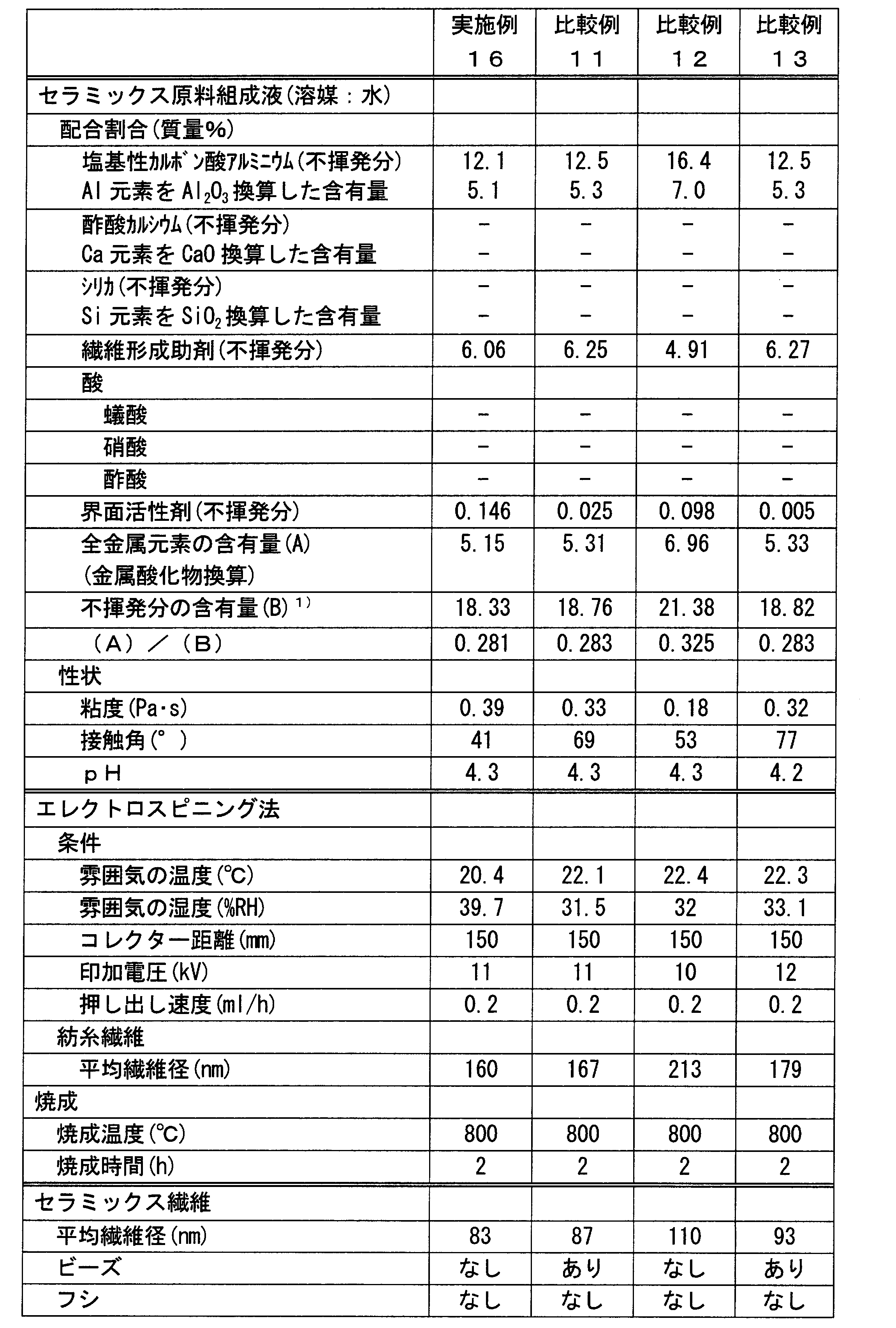
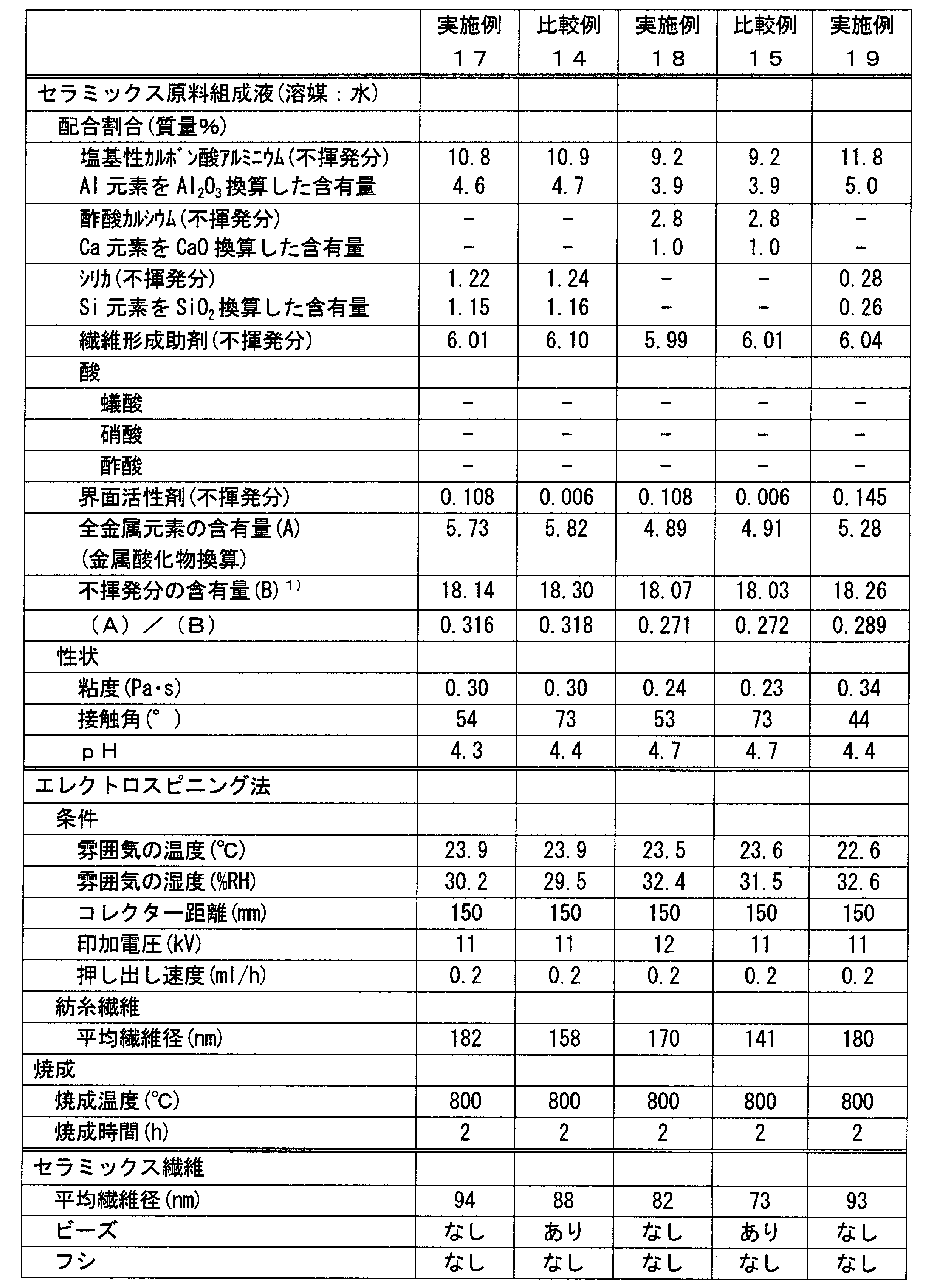
- Ceramic raw material composition liquid ⁇ Preparation of ceramic raw material composition liquid> Each composition was mixed with water at the blending ratio shown in Tables 1 to 5 and stirred to prepare a ceramic raw material composition liquid.
- nonvolatile content 24.7% by mass, oxide equivalent content 10.5% by mass
- ⁇ Ca raw material calcium acetate, nonvolatile content 20.7 mass%, oxide equivalent content 7.3 mass%
- Si raw material colloidal silica, non-volatile content 20.9 mass%, oxide equivalent content 19.6 mass%
- Fiber formation aid Polyacrylic acid ester, nonvolatile content 15.0% by mass
- Surfactant primary alcohol ethoxylate, nonvolatile content 10.0% by mass
- the obtained ceramic raw material composition liquid was spun by an electrospinning method to obtain a spun fiber.
- the spinning conditions are as shown in Tables 1 to 5.
- Example 1 a scanning electron micrograph of the fired ceramic fiber is shown in FIG.
- a ceramic fiber having an average fiber diameter of 100 nm or less and a thin fiber diameter can be provided, so that a high-performance product can be provided in various applications where high performance can be achieved by reducing the fiber diameter.
Landscapes
- Engineering & Computer Science (AREA)
- Chemical & Material Sciences (AREA)
- Ceramic Engineering (AREA)
- Manufacturing & Machinery (AREA)
- Materials Engineering (AREA)
- Structural Engineering (AREA)
- Organic Chemistry (AREA)
- Inorganic Chemistry (AREA)
- Mechanical Engineering (AREA)
- Textile Engineering (AREA)
- Inorganic Fibers (AREA)
- Spinning Methods And Devices For Manufacturing Artificial Fibers (AREA)
Abstract
Description
該セラミックス原料組成液をエレクトロスピニング法で紡糸して、紡糸繊維を得る紡糸工程と、
該紡糸繊維を焼成することにより、セラミックス化させて、セラミックス繊維を得る焼成工程と、
を有することを特徴とするセラミック繊維の製造方法を提供するものである。
該セラミックス原料組成液をエレクトロスピニング法で紡糸して、紡糸繊維を得る紡糸工程と、
該紡糸繊維を焼成することにより、セラミックス化させて、セラミックス繊維を得る焼成工程と、
を有することを特徴とするセラミック繊維の製造方法である。
・水の接触角(測定値、ミリポア社製-Simpli labによる超純水):78.9±1.3°(±は標準偏差、測定数12)
・水の表面張力(化学便覧):72~73mN/m
・酢酸の接触角(測定値、和光純薬工業社製、試薬特級):19.3±1.9°(±は標準偏差、測定数12)
・酢酸の表面張力(化学便覧):27.6mN/m
・ギ酸の接触角(測定値、和光純薬工業社製、試薬特級):36.5±2.1°(±は標準偏差、測定数4)
・ギ酸の表面張力(化学便覧):39.9mN/m
・N’-ジメチルホルムアミドの接触角(測定値、和光純薬工業社製、試薬特級):32.3±3.2°(±は標準偏差、測定数10)
・N’-ジメチルホルムアミドの表面張力(化学便覧):32.3mN/m
生理食塩水溶解率(%)={ろ液量(L)×(a1+a2+a3+a4)×100}/{溶解前の生体溶解性セラミックス繊維の量(mg)×(b1+b2+b3+b4)/100}
なお、生体溶解性セラミックス繊維ごとに、その生体溶解性セラミックス繊維に含有されている金属元素に着目して、生体溶解性セラミックス繊維中の各金属元素が、生理食塩水に溶出される割合を元素毎に求め、合計して、生理食塩水溶解率(%)を求める。
(セラミックス原料組成液の粘度)
粘弾性測定装置(AntonPaar社製 Physica MCR301)を用い、セラミックス原料組成液の液温を25℃に維持し、せん断速度10s-1の時のせん断粘度を測定し、その値を、セラミックス原料組成液の粘度とした。
(セラミックス原料組成液の接触角)
セラミックス原料組成液を25℃に維持し、25℃、相対湿度50%RHの雰囲気において、SUS430板上に1.6~1.7μL滴下し、直読法によって接触角を評価した。なお、用いたSUS板に対する水(ミリポア社製-Simpli
labによる超純水)の接触角は78.9°であった。
<接触角測定用SUS430板>
・主要成分がFe:80~84質量%、Cr:16~18質量%の組成を有するステンレス鋼
・BA処理(Blight Anneal)したもの、久宝金属社製、H334
・表面粗さ:Ra=0.3~0.6μm、レーザ顕微鏡(キーエンス社製、VK-9710)を用いて、倍率200倍の3次元のレーザ顕微鏡像を撮影し、装置付属の解析ソフトにより算出した算術平均表面粗さRa
(繊維の平均繊維径)
走査型電子顕微鏡(日本電子製JSM-7600F)で、倍率30000倍のSEM写真を撮影し、その倍率30000倍の視野から無作為に20箇所選定して繊維の幅を計測し、測定した繊維径を平均して、平均繊維径を求めた。
(ビーズ)
走査型電子顕微鏡(日本電子製 JSM-7600F)で、倍率2000倍のSEM写真を撮影し、その倍率2000倍の視野において、直径が平均繊維径に比較して3倍以上であり且つ1μm以上の球形のものをビーズとし、そのようなビーズの数を確認した。倍率2000倍の視野内に、確認されたビーズの数が1個以下の場合を「ビーズなし」と、2個以上の場合を「ビーズあり」と評価した。
(フシ状の塊)
走査型電子顕微鏡(日本電子製 JSM-7600F)で、倍率10000倍のSEM写真を撮影し、その倍率10000倍の視野において、径がその近傍の繊維径に比較して1.5倍を超えている箇所をフシ状の塊とし、そのようなフシ状の塊の数を確認した。倍率10000倍の視野内に、確認されたフシ状の塊の数が10個以下の場合を「フシなし」と、11個以上の場合を「フシあり」と評価した。
<セラミックス原料組成液の調製>
表1~5に示す配合割合で、水に、各配合物を混合し、撹拌して、セラミックス原料組成液を調製した。
・Al原料:塩基性カルボン酸アルミニウム(Al(OH)X(RCOO)3-Xで表され、RCOOはギ酸、酢酸及び乳酸のうちから選ばれるカルボン酸であり、X=1.0~2.5である。)、不揮発分含有量24.7質量%、酸化物換算の含有量10.5質量%、
・Ca原料:酢酸カルシウム、不揮発分含有量20.7質量%、酸化物換算含有量7.3質量%
・Si原料:コロイダルシリカ、不揮発分含有量20.9質量%、酸化物換算含有量19.6質量%
・繊維形成助剤:ポリアクリル酸エステル、不揮発分含有量15.0質量%
・界面活性剤:第1級アルコールエトキシレート、不揮発分含有量10.0質量%
次いで、得られたセラミックス原料組成液を、エレクトロスピニング法で紡糸して、紡糸繊維を得た。紡糸条件は、表1~5に示す通りである。
次いで、得られた紡糸繊維を、表1~5に示す焼成温度及び焼成時間にて、焼成した。



Claims (14)
- セラミックス繊維を構成する金属酸化物源となる金属元素と、繊維形成助剤と、界面活性剤と、を含有し、溶媒が水であり、該金属酸化物源の金属元素の含有量が金属酸化物換算で3.0~9.0質量%であり、該金属元素を有する化合物、該繊維形成助剤及び該界面活性剤の不揮発分の合計含有量が10.0~21.0質量%であり、該界面活性剤の含有量が0.05~5.0質量%であるセラミックス原料組成液を調製するセラミックス原料組成液調製工程と、
該セラミックス原料組成液をエレクトロスピニング法で紡糸して、紡糸繊維を得る紡糸工程と、
該紡糸繊維を焼成することにより、セラミックス化させて、セラミックス繊維を得る焼成工程と、
を有することを特徴とするセラミック繊維の製造方法。 - 前記セラミックス原料組成液のSUS430板に対する接触角が、30~54°であることを特徴とする請求項1記載のセラミックス繊維の製造方法。
- 前記セラミックス原料組成物のpHが2.0~4.5であることを特徴とする請求項1又は2いずれか1項記載のセラミックス繊維の製造方法。
- 前記セラミックス原料組成液の粘度が0.1~1.0Pa・sであることを特徴とする請求項1~3いずれか1項記載のセラミック繊維の製造方法。
- 前記セラミックス原料組成液調製工程において、前記セラミックス原料組成液に、硝酸、蟻酸又は酢酸を添加することにより、pHを2.0~4.5に調節することを特徴とする請求項1~4いずれか1項記載のセラミックス繊維の製造方法。
- 前記繊維形成助剤が水溶性高分子であることを特徴とする請求項1~5いずれか1項記載のセラミックス繊維の製造方法。
- 前記紡糸工程において、前記セラミックス原料組成液を紡糸するときの雰囲気の湿度が10~50%RHであることを特徴とする請求項1~6いずれか1項記載のセラミックス繊維の製造方法。
- 前記セラミックス原料組成液が、アルミニウム化合物と、カルシウム化合物と、珪素化合物と、を混合して得られたものであることを特徴とする請求項1~7いずれか1項記載のセラミックス繊維の製造方法。
- 前記アルミニウム化合物が塩基性酸アルミニウムであり、前記カルシウム化合物が水溶性のカルシウム化合物であり、前記珪素化合物がコロイダルシリカであることを特徴とする請求項1~8いずれか1項記載のセラミックス繊維の製造方法。
- セラミックス繊維を構成する金属酸化物源となる金属元素と、繊維形成助剤と、界面活性剤と、を含有し、溶媒が水であり、該金属酸化物源の金属元素の含有量が金属酸化物換算で3.0~9.0質量%であり、該金属元素を有する化合物、該繊維形成助剤及び該界面活性剤の不揮発分の合計含有量が10.0~21.0質量%であり、該界面活性剤の含有量が0.05~5.0質量%であることを特徴とする請求項1記載のセラミックス繊維製造用のセラミックス原料組成液。
- 前記セラミックス原料組成液のSUS430に対する接触角が、30~54°であることを特徴とする請求項10記載のセラミックス繊維製造用のセラミックス原料組成液。
- pHが2.0~4.5であることを特徴とする請求項10又は11いずれか1項記載のセラミックス原料組成液。
- 粘度が0.1~1.0Pa・sであることを特徴とする請求項10~12いずれか1項記載のセラミックス原料組成液。
- 前記繊維形成助剤が水溶性高分子であることを特徴とする請求項10~13いずれか1項記載のセラミックス原料組成液。
Priority Applications (3)
| Application Number | Priority Date | Filing Date | Title |
|---|---|---|---|
| JP2014546767A JPWO2014076775A1 (ja) | 2012-11-14 | 2012-11-14 | セラミックス繊維の製造方法及びセラミックス繊維製造用のセラミックス原料組成液 |
| CN201280002084.1A CN103958138B (zh) | 2012-11-14 | 2012-11-14 | 陶瓷纤维的制造方法和陶瓷纤维制造用的陶瓷原料组合液 |
| PCT/JP2012/079479 WO2014076775A1 (ja) | 2012-11-14 | 2012-11-14 | セラミックス繊維の製造方法及びセラミックス繊維製造用のセラミックス原料組成液 |
Applications Claiming Priority (1)
| Application Number | Priority Date | Filing Date | Title |
|---|---|---|---|
| PCT/JP2012/079479 WO2014076775A1 (ja) | 2012-11-14 | 2012-11-14 | セラミックス繊維の製造方法及びセラミックス繊維製造用のセラミックス原料組成液 |
Publications (1)
| Publication Number | Publication Date |
|---|---|
| WO2014076775A1 true WO2014076775A1 (ja) | 2014-05-22 |
Family
ID=50730717
Family Applications (1)
| Application Number | Title | Priority Date | Filing Date |
|---|---|---|---|
| PCT/JP2012/079479 Ceased WO2014076775A1 (ja) | 2012-11-14 | 2012-11-14 | セラミックス繊維の製造方法及びセラミックス繊維製造用のセラミックス原料組成液 |
Country Status (3)
| Country | Link |
|---|---|
| JP (1) | JPWO2014076775A1 (ja) |
| CN (1) | CN103958138B (ja) |
| WO (1) | WO2014076775A1 (ja) |
Cited By (4)
| Publication number | Priority date | Publication date | Assignee | Title |
|---|---|---|---|---|
| JP2016065333A (ja) * | 2014-09-24 | 2016-04-28 | 三菱樹脂株式会社 | 無機繊維、無機繊維集合体及び無機繊維成形体 |
| JP2019150740A (ja) * | 2018-02-28 | 2019-09-12 | 株式会社環境機能研究所 | 水質浄化用の多孔質樹脂成型体 |
| WO2022247346A1 (zh) * | 2021-05-26 | 2022-12-01 | 山东大学 | 一种氧化物高熵陶瓷纤维的制备方法 |
| WO2024070019A1 (ja) * | 2022-09-30 | 2024-04-04 | Jnc株式会社 | 金属酸化物多孔質繊維 |
Families Citing this family (3)
| Publication number | Priority date | Publication date | Assignee | Title |
|---|---|---|---|---|
| CN104631101A (zh) * | 2015-01-15 | 2015-05-20 | 湘潭大学 | 一种超柔性高导电纳米碳纤维和镍/碳复合纤维膜的制备方法 |
| CN105671688B (zh) * | 2016-01-22 | 2017-09-22 | 中国人民解放军国防科学技术大学 | 聚碳硅烷与金属氧化物物理共混制备超高温陶瓷纤维的方法 |
| CN108648866A (zh) * | 2018-05-07 | 2018-10-12 | 合肥羿振电力设备有限公司 | 一种智慧能源动车组用阻燃软电缆 |
Citations (4)
| Publication number | Priority date | Publication date | Assignee | Title |
|---|---|---|---|---|
| WO2006129844A1 (ja) * | 2005-05-31 | 2006-12-07 | Teijin Limited | セラミック繊維及びその製造方法 |
| JP2010189798A (ja) * | 2009-02-18 | 2010-09-02 | Teijin Ltd | ショットを含まない無機繊維及びその製造方法 |
| JP2010202983A (ja) * | 2008-07-31 | 2010-09-16 | Teijin Ltd | 無機繊維およびその製造方法 |
| WO2012153806A1 (ja) * | 2011-05-11 | 2012-11-15 | ニチアス株式会社 | セラミックス繊維の製造方法及びセラミックス繊維製造用のセラミックス原料組成液 |
Family Cites Families (3)
| Publication number | Priority date | Publication date | Assignee | Title |
|---|---|---|---|---|
| CN1091788A (zh) * | 1993-10-29 | 1994-09-07 | 刘学锋 | 陶瓷纤维复合纺织制品及其制备方法 |
| FR2818015B1 (fr) * | 2000-12-08 | 2003-09-26 | Centre Nat Rech Scient | Procede de fabrication de films minces en composite metal/ceramique |
| EP1423345A2 (en) * | 2001-07-06 | 2004-06-02 | 3M Innovative Properties Company | Inorganic fiber substrates for exhaust systems and methods of making same |
-
2012
- 2012-11-14 JP JP2014546767A patent/JPWO2014076775A1/ja active Pending
- 2012-11-14 WO PCT/JP2012/079479 patent/WO2014076775A1/ja not_active Ceased
- 2012-11-14 CN CN201280002084.1A patent/CN103958138B/zh not_active Expired - Fee Related
Patent Citations (4)
| Publication number | Priority date | Publication date | Assignee | Title |
|---|---|---|---|---|
| WO2006129844A1 (ja) * | 2005-05-31 | 2006-12-07 | Teijin Limited | セラミック繊維及びその製造方法 |
| JP2010202983A (ja) * | 2008-07-31 | 2010-09-16 | Teijin Ltd | 無機繊維およびその製造方法 |
| JP2010189798A (ja) * | 2009-02-18 | 2010-09-02 | Teijin Ltd | ショットを含まない無機繊維及びその製造方法 |
| WO2012153806A1 (ja) * | 2011-05-11 | 2012-11-15 | ニチアス株式会社 | セラミックス繊維の製造方法及びセラミックス繊維製造用のセラミックス原料組成液 |
Cited By (4)
| Publication number | Priority date | Publication date | Assignee | Title |
|---|---|---|---|---|
| JP2016065333A (ja) * | 2014-09-24 | 2016-04-28 | 三菱樹脂株式会社 | 無機繊維、無機繊維集合体及び無機繊維成形体 |
| JP2019150740A (ja) * | 2018-02-28 | 2019-09-12 | 株式会社環境機能研究所 | 水質浄化用の多孔質樹脂成型体 |
| WO2022247346A1 (zh) * | 2021-05-26 | 2022-12-01 | 山东大学 | 一种氧化物高熵陶瓷纤维的制备方法 |
| WO2024070019A1 (ja) * | 2022-09-30 | 2024-04-04 | Jnc株式会社 | 金属酸化物多孔質繊維 |
Also Published As
| Publication number | Publication date |
|---|---|
| CN103958138B (zh) | 2016-05-04 |
| JPWO2014076775A1 (ja) | 2016-09-08 |
| CN103958138A (zh) | 2014-07-30 |
Similar Documents
| Publication | Publication Date | Title |
|---|---|---|
| WO2014076775A1 (ja) | セラミックス繊維の製造方法及びセラミックス繊維製造用のセラミックス原料組成液 | |
| Li et al. | Fabrication of titania nanofibers by electrospinning | |
| CN101381225B (zh) | 一种连续氧化铝基陶瓷纤维的制备方法 | |
| US11572314B2 (en) | Preparation method for yttrium aluminum garnet continuous fiber | |
| CN101213330B (zh) | 陶瓷纤维及其制造方法 | |
| TWI474986B (zh) | 耐火物體、玻璃溢流形成塊、以及用於玻璃物體製造之方法 | |
| JP5521214B2 (ja) | 無機ナノファイバーの製造方法 | |
| Castkova et al. | Electrospinning and thermal treatment of yttria doped zirconia fibres | |
| JP2011524946A5 (ja) | ||
| JP6228461B2 (ja) | 無機繊維及びその製造方法 | |
| JP5272103B1 (ja) | 無機繊維及びそれを用いた成形体 | |
| JP5830087B2 (ja) | セラミックス繊維の製造方法及びセラミックス繊維製造用のセラミックス原料組成液 | |
| JP5944851B2 (ja) | 無機複合ナノ繊維の製造方法 | |
| CN102031586A (zh) | 掺铕氟化钇纳米纤维/高分子复合纳米纤维的制备方法 | |
| CN116752250A (zh) | 一种静电纺丝制备柔性莫来石纳米纤维的方法 | |
| JP5536353B2 (ja) | 無機繊維およびその製造方法 | |
| RU2465247C2 (ru) | Волокна из поликристаллического корунда и способ их получения | |
| JP2011068507A (ja) | 球状多成分ガラス微粒子 | |
| JPWO2003076336A1 (ja) | セリウム系複合酸化物、その焼結体及び製造法 | |
| KR20140032377A (ko) | 무기 섬유 | |
| JP2020001981A (ja) | 窒化アルミニウム組成物及びその製造方法、前記窒化アルミニウム組成物を含有する複合体 | |
| WO2012073989A1 (ja) | 無機繊維およびその製造方法 | |
| JP2017053078A (ja) | アルミナ繊維、アルミナ繊維シート、アルミナ繊維−有機樹脂複合シート、及びアルミナ繊維の製造方法 | |
| JP2018131722A (ja) | アルミナ繊維、アルミナ繊維集合体及びその製造方法 | |
| KR20100134169A (ko) | 원적외선 방출 특성을 갖는 금속 산화물 나노섬유 부직포의 제조방법 |
Legal Events
| Date | Code | Title | Description |
|---|---|---|---|
| WWE | Wipo information: entry into national phase |
Ref document number: 201280002084.1 Country of ref document: CN |
|
| 121 | Ep: the epo has been informed by wipo that ep was designated in this application |
Ref document number: 12888560 Country of ref document: EP Kind code of ref document: A1 |
|
| ENP | Entry into the national phase |
Ref document number: 2014546767 Country of ref document: JP Kind code of ref document: A |
|
| NENP | Non-entry into the national phase |
Ref country code: DE |
|
| 122 | Ep: pct application non-entry in european phase |
Ref document number: 12888560 Country of ref document: EP Kind code of ref document: A1 |