WO2014075382A1 - 苯并噻吩类衍生物及其在有机电致发光领域中的应用 - Google Patents

苯并噻吩类衍生物及其在有机电致发光领域中的应用 Download PDF

Info

Publication number
WO2014075382A1
WO2014075382A1 PCT/CN2013/001190 CN2013001190W WO2014075382A1 WO 2014075382 A1 WO2014075382 A1 WO 2014075382A1 CN 2013001190 W CN2013001190 W CN 2013001190W WO 2014075382 A1 WO2014075382 A1 WO 2014075382A1
Authority
WO
WIPO (PCT)
Prior art keywords
substituted
group
compound
benzothiophene
unsubstituted
Prior art date
Legal status (The legal status is an assumption and is not a legal conclusion. Google has not performed a legal analysis and makes no representation as to the accuracy of the status listed.)
Ceased
Application number
PCT/CN2013/001190
Other languages
English (en)
French (fr)
Inventor
邱勇
范洪涛
王星
段炼
任雪艳
Current Assignee (The listed assignees may be inaccurate. Google has not performed a legal analysis and makes no representation or warranty as to the accuracy of the list.)
Tsinghua University
Beijing Visionox Technology Co Ltd
Kunshan Visionox Display Co Ltd
Beijing Eternal Material Technology Co Ltd
Original Assignee
Tsinghua University
Beijing Visionox Technology Co Ltd
Kunshan Visionox Display Co Ltd
Beijing Eternal Material Technology Co Ltd
Priority date (The priority date is an assumption and is not a legal conclusion. Google has not performed a legal analysis and makes no representation as to the accuracy of the date listed.)
Filing date
Publication date
Application filed by Tsinghua University, Beijing Visionox Technology Co Ltd, Kunshan Visionox Display Co Ltd, Beijing Eternal Material Technology Co Ltd filed Critical Tsinghua University
Priority to JP2015533410A priority Critical patent/JP6120972B2/ja
Priority to KR1020157011386A priority patent/KR101778416B1/ko
Publication of WO2014075382A1 publication Critical patent/WO2014075382A1/zh
Anticipated expiration legal-status Critical
Ceased legal-status Critical Current

Links

Classifications

    • CCHEMISTRY; METALLURGY
    • C07ORGANIC CHEMISTRY
    • C07DHETEROCYCLIC COMPOUNDS
    • C07D333/00Heterocyclic compounds containing five-membered rings having one sulfur atom as the only ring hetero atom
    • C07D333/50Heterocyclic compounds containing five-membered rings having one sulfur atom as the only ring hetero atom condensed with carbocyclic rings or ring systems
    • C07D333/52Benzo[b]thiophenes; Hydrogenated benzo[b]thiophenes
    • C07D333/54Benzo[b]thiophenes; Hydrogenated benzo[b]thiophenes with only hydrogen atoms, hydrocarbon or substituted hydrocarbon radicals, directly attached to carbon atoms of the hetero ring
    • C07D333/58Radicals substituted by nitrogen atoms
    • CCHEMISTRY; METALLURGY
    • C07ORGANIC CHEMISTRY
    • C07DHETEROCYCLIC COMPOUNDS
    • C07D209/00Heterocyclic compounds containing five-membered rings, condensed with other rings, with one nitrogen atom as the only ring hetero atom
    • C07D209/56Ring systems containing three or more rings
    • C07D209/80[b, c]- or [b, d]-condensed
    • C07D209/82Carbazoles; Hydrogenated carbazoles
    • C07D209/86Carbazoles; Hydrogenated carbazoles with only hydrogen atoms, hydrocarbon or substituted hydrocarbon radicals, directly attached to carbon atoms of the ring system
    • CCHEMISTRY; METALLURGY
    • C07ORGANIC CHEMISTRY
    • C07DHETEROCYCLIC COMPOUNDS
    • C07D307/00Heterocyclic compounds containing five-membered rings having one oxygen atom as the only ring hetero atom
    • C07D307/77Heterocyclic compounds containing five-membered rings having one oxygen atom as the only ring hetero atom ortho- or peri-condensed with carbocyclic rings or ring systems
    • C07D307/91Dibenzofurans; Hydrogenated dibenzofurans
    • CCHEMISTRY; METALLURGY
    • C07ORGANIC CHEMISTRY
    • C07DHETEROCYCLIC COMPOUNDS
    • C07D333/00Heterocyclic compounds containing five-membered rings having one sulfur atom as the only ring hetero atom
    • C07D333/02Heterocyclic compounds containing five-membered rings having one sulfur atom as the only ring hetero atom not condensed with other rings
    • C07D333/04Heterocyclic compounds containing five-membered rings having one sulfur atom as the only ring hetero atom not condensed with other rings not substituted on the ring sulphur atom
    • C07D333/06Heterocyclic compounds containing five-membered rings having one sulfur atom as the only ring hetero atom not condensed with other rings not substituted on the ring sulphur atom with only hydrogen atoms, hydrocarbon or substituted hydrocarbon radicals, directly attached to the ring carbon atoms
    • C07D333/08Hydrogen atoms or radicals containing only hydrogen and carbon atoms
    • CCHEMISTRY; METALLURGY
    • C07ORGANIC CHEMISTRY
    • C07DHETEROCYCLIC COMPOUNDS
    • C07D333/00Heterocyclic compounds containing five-membered rings having one sulfur atom as the only ring hetero atom
    • C07D333/50Heterocyclic compounds containing five-membered rings having one sulfur atom as the only ring hetero atom condensed with carbocyclic rings or ring systems
    • C07D333/52Benzo[b]thiophenes; Hydrogenated benzo[b]thiophenes
    • C07D333/62Benzo[b]thiophenes; Hydrogenated benzo[b]thiophenes with hetero atoms or with carbon atoms having three bonds to hetero atoms with at the most one bond to halogen, e.g. ester or nitrile radicals, directly attached to carbon atoms of the hetero ring
    • CCHEMISTRY; METALLURGY
    • C07ORGANIC CHEMISTRY
    • C07DHETEROCYCLIC COMPOUNDS
    • C07D333/00Heterocyclic compounds containing five-membered rings having one sulfur atom as the only ring hetero atom
    • C07D333/50Heterocyclic compounds containing five-membered rings having one sulfur atom as the only ring hetero atom condensed with carbocyclic rings or ring systems
    • C07D333/52Benzo[b]thiophenes; Hydrogenated benzo[b]thiophenes
    • C07D333/62Benzo[b]thiophenes; Hydrogenated benzo[b]thiophenes with hetero atoms or with carbon atoms having three bonds to hetero atoms with at the most one bond to halogen, e.g. ester or nitrile radicals, directly attached to carbon atoms of the hetero ring
    • C07D333/64Oxygen atoms
    • CCHEMISTRY; METALLURGY
    • C07ORGANIC CHEMISTRY
    • C07DHETEROCYCLIC COMPOUNDS
    • C07D333/00Heterocyclic compounds containing five-membered rings having one sulfur atom as the only ring hetero atom
    • C07D333/50Heterocyclic compounds containing five-membered rings having one sulfur atom as the only ring hetero atom condensed with carbocyclic rings or ring systems
    • C07D333/52Benzo[b]thiophenes; Hydrogenated benzo[b]thiophenes
    • C07D333/62Benzo[b]thiophenes; Hydrogenated benzo[b]thiophenes with hetero atoms or with carbon atoms having three bonds to hetero atoms with at the most one bond to halogen, e.g. ester or nitrile radicals, directly attached to carbon atoms of the hetero ring
    • C07D333/66Nitrogen atoms not forming part of a nitro radical
    • CCHEMISTRY; METALLURGY
    • C07ORGANIC CHEMISTRY
    • C07DHETEROCYCLIC COMPOUNDS
    • C07D333/00Heterocyclic compounds containing five-membered rings having one sulfur atom as the only ring hetero atom
    • C07D333/50Heterocyclic compounds containing five-membered rings having one sulfur atom as the only ring hetero atom condensed with carbocyclic rings or ring systems
    • C07D333/74Naphthothiophenes
    • CCHEMISTRY; METALLURGY
    • C07ORGANIC CHEMISTRY
    • C07DHETEROCYCLIC COMPOUNDS
    • C07D333/00Heterocyclic compounds containing five-membered rings having one sulfur atom as the only ring hetero atom
    • C07D333/50Heterocyclic compounds containing five-membered rings having one sulfur atom as the only ring hetero atom condensed with carbocyclic rings or ring systems
    • C07D333/76Dibenzothiophenes
    • CCHEMISTRY; METALLURGY
    • C07ORGANIC CHEMISTRY
    • C07DHETEROCYCLIC COMPOUNDS
    • C07D409/00Heterocyclic compounds containing two or more hetero rings, at least one ring having sulfur atoms as the only ring hetero atoms
    • C07D409/14Heterocyclic compounds containing two or more hetero rings, at least one ring having sulfur atoms as the only ring hetero atoms containing three or more hetero rings
    • HELECTRICITY
    • H10SEMICONDUCTOR DEVICES; ELECTRIC SOLID-STATE DEVICES NOT OTHERWISE PROVIDED FOR
    • H10KORGANIC ELECTRIC SOLID-STATE DEVICES
    • H10K85/00Organic materials used in the body or electrodes of devices covered by this subclass
    • H10K85/60Organic compounds having low molecular weight
    • H10K85/631Amine compounds having at least two aryl rest on at least one amine-nitrogen atom, e.g. triphenylamine
    • HELECTRICITY
    • H10SEMICONDUCTOR DEVICES; ELECTRIC SOLID-STATE DEVICES NOT OTHERWISE PROVIDED FOR
    • H10KORGANIC ELECTRIC SOLID-STATE DEVICES
    • H10K85/00Organic materials used in the body or electrodes of devices covered by this subclass
    • H10K85/60Organic compounds having low molecular weight
    • H10K85/631Amine compounds having at least two aryl rest on at least one amine-nitrogen atom, e.g. triphenylamine
    • H10K85/633Amine compounds having at least two aryl rest on at least one amine-nitrogen atom, e.g. triphenylamine comprising polycyclic condensed aromatic hydrocarbons as substituents on the nitrogen atom
    • HELECTRICITY
    • H10SEMICONDUCTOR DEVICES; ELECTRIC SOLID-STATE DEVICES NOT OTHERWISE PROVIDED FOR
    • H10KORGANIC ELECTRIC SOLID-STATE DEVICES
    • H10K85/00Organic materials used in the body or electrodes of devices covered by this subclass
    • H10K85/60Organic compounds having low molecular weight
    • H10K85/649Aromatic compounds comprising a hetero atom
    • H10K85/657Polycyclic condensed heteroaromatic hydrocarbons
    • H10K85/6572Polycyclic condensed heteroaromatic hydrocarbons comprising only nitrogen in the heteroaromatic polycondensed ring system, e.g. phenanthroline or carbazole
    • HELECTRICITY
    • H10SEMICONDUCTOR DEVICES; ELECTRIC SOLID-STATE DEVICES NOT OTHERWISE PROVIDED FOR
    • H10KORGANIC ELECTRIC SOLID-STATE DEVICES
    • H10K85/00Organic materials used in the body or electrodes of devices covered by this subclass
    • H10K85/60Organic compounds having low molecular weight
    • H10K85/649Aromatic compounds comprising a hetero atom
    • H10K85/657Polycyclic condensed heteroaromatic hydrocarbons
    • H10K85/6574Polycyclic condensed heteroaromatic hydrocarbons comprising only oxygen in the heteroaromatic polycondensed ring system, e.g. cumarine dyes
    • HELECTRICITY
    • H10SEMICONDUCTOR DEVICES; ELECTRIC SOLID-STATE DEVICES NOT OTHERWISE PROVIDED FOR
    • H10KORGANIC ELECTRIC SOLID-STATE DEVICES
    • H10K85/00Organic materials used in the body or electrodes of devices covered by this subclass
    • H10K85/60Organic compounds having low molecular weight
    • H10K85/649Aromatic compounds comprising a hetero atom
    • H10K85/657Polycyclic condensed heteroaromatic hydrocarbons
    • H10K85/6576Polycyclic condensed heteroaromatic hydrocarbons comprising only sulfur in the heteroaromatic polycondensed ring system, e.g. benzothiophene
    • HELECTRICITY
    • H10SEMICONDUCTOR DEVICES; ELECTRIC SOLID-STATE DEVICES NOT OTHERWISE PROVIDED FOR
    • H10KORGANIC ELECTRIC SOLID-STATE DEVICES
    • H10K50/00Organic light-emitting devices
    • H10K50/10OLEDs or polymer light-emitting diodes [PLED]
    • H10K50/11OLEDs or polymer light-emitting diodes [PLED] characterised by the electroluminescent [EL] layers
    • HELECTRICITY
    • H10SEMICONDUCTOR DEVICES; ELECTRIC SOLID-STATE DEVICES NOT OTHERWISE PROVIDED FOR
    • H10KORGANIC ELECTRIC SOLID-STATE DEVICES
    • H10K50/00Organic light-emitting devices
    • H10K50/10OLEDs or polymer light-emitting diodes [PLED]
    • H10K50/14Carrier transporting layers
    • H10K50/15Hole transporting layers
    • HELECTRICITY
    • H10SEMICONDUCTOR DEVICES; ELECTRIC SOLID-STATE DEVICES NOT OTHERWISE PROVIDED FOR
    • H10KORGANIC ELECTRIC SOLID-STATE DEVICES
    • H10K50/00Organic light-emitting devices
    • H10K50/10OLEDs or polymer light-emitting diodes [PLED]
    • H10K50/17Carrier injection layers

Definitions

  • the present invention relates to an organic compound, and more particularly to a benzothiophene derivative for use in an organic electroluminescent device and its use in the field of organic electroluminescent display technology.
  • Scenery technology a benzothiophene derivative for use in an organic electroluminescent device and its use in the field of organic electroluminescent display technology.
  • the hole injecting and transporting materials used in organic electroluminescent devices are generally triarylamine derivatives (for example, the light-emitting patent: Publication No. CN 1152607C, published on 2004, 6, 2)
  • the general structural feature is that As the injection material, the triarylamine structural unit is at least three or more in one molecule, and the two N are separated by a benzene ring, as in the structural formula 1; as a transport material, the triarylamine structural unit is generally used in one molecule. It is two, and the two N are separated by biphenyl. In this type of material, a typical example is NPB.
  • the problem to be solved by the present invention is to provide a novel type of double hole transport group-substituted benzothiophene derivative, and apply the derivative to the organic light-emitting functional layer as a hole transporting material and/or hole injection, respectively.
  • the host material of the material and/or the organic light-emitting layer further provides an organic electroluminescent device having a low driving voltage and high luminous efficiency.
  • the materials disclosed herein regardless of the structure of the substituent, contain at least two S atoms in the molecule, ensuring that the material readily gives electrons and transports holes.
  • the benzothiophene-substituted material substituted by the two-hole transport group has a high triplet energy level, a glass transition temperature, a strong hole transporting ability, and can effectively avoid fluorescence quenching caused by molecular aggregation in a thin film state.
  • the advantages enable the series of derivatives to be applied to the organic light-emitting functional layer as a hole transporting material and/or a hole injecting material, and to have potential applications as a host material, particularly a fluorescent blue host material.
  • the present invention provides a benzothiophene derivative having a structure represented by the formula (I):
  • Ri R 2 is independently selected from a C4 to C40 substituted or unsubstituted arylamine group, a C4 to C40 substituted or unsubstituted carbazole group, a C4 to C40 substituted or unsubstituted benzothiophene group, One of a substituted or unsubstituted benzofuran group of C4 to C40;
  • L is a bridging group selected from the group consisting of a single bond, a substituted aromatic amine of C4 to C40, a substituted carbazole of C4 to C40, a substituted benzothiophene of C4 to C40, one of an oxygen atom, a nitrogen atom or a sulfur atom;
  • R 3 -R 1() are independently selected from the group consisting of H atoms, dC ⁇ aliphatic straight or branched chain hydrocarbon groups or C 6 -C 3 .
  • An aromatic group, or, two adjacent groups are joined to form a ring, forming
  • n are selected from integers of 0-3, but m plus n is greater than 0 and less than or equal to 3.
  • the two adjacent groups are joined to form a ring to form one or more ring-closing structures.
  • the structural formula of the compound is as follows:
  • the benzothiophene derivative is used as a hole injecting material and/or a hole transporting material in an organic electroluminescent device.
  • the benzothiophene derivative can also be used as an organic light-emitting material of an organic light-emitting layer in an organic electroluminescent device, and the organic light-emitting material includes a host material and a dye.
  • the benzothiophene derivative can be used. It is used as a host material in the light-emitting layer in the organic electroluminescence device.
  • the present invention also provides an organic electroluminescent device comprising a substrate, and an anode layer, an organic light-emitting functional layer and a cathode layer sequentially formed on the substrate;
  • the material for the organic light-emitting functional layer includes a hole injecting material, a hole transporting material, an organic light-emitting material, and an electron transporting material, and the material for the organic light-emitting functional layer is a compound having the formula (I):
  • Ri is independently selected from a substituted or unsubstituted arylamine group of C4 to C40, a substituted or unsubstituted carbazole group of C4 to C40, a substituted or unsubstituted benzothiophene group of C4 to C40, C4 ⁇ One of a substituted or unsubstituted benzofuran group of C40;
  • L is a bridging group selected from the group consisting of a single bond, a substituted aromatic amine of C4 to C40, a substituted carbazole of C4 to C40, a substituted benzothiophene of C4 to C40, one of an oxygen atom, a nitrogen atom or a sulfur atom;
  • n are selected from integers of 0-3, but m plus n is greater than 0 and less than or equal to 3.
  • the present invention also provides an organic electroluminescent device comprising a substrate, and an anode layer, an organic light-emitting functional layer and a cathode layer sequentially formed on the substrate;
  • the material for the organic light-emitting functional layer includes a hole injecting material, a hole transporting material, an organic light-emitting material, and an electron transporting material, the hole injecting material being a compound having the formula (I):
  • Ri is independently selected from a substituted or unsubstituted arylamine group of C4 to C40, a substituted or unsubstituted carbazole group of C4 to C40, a substituted or unsubstituted benzothiophene group of C4 to C40, C4 ⁇ One of a substituted or unsubstituted benzofuran group of C40;
  • L is a bridging group selected from the group consisting of a single bond, a substituted aromatic amine of C4 to C40, a substituted carbazole of C4 to C40, a substituted benzothiophene of C4 to C40, one of an oxygen atom, a nitrogen atom or a sulfur atom;
  • n are selected from integers of 0-3, but m plus n is greater than 0 and less than or equal to 3.
  • the present invention also provides an organic electroluminescent device comprising a substrate, and an anode layer, an organic light-emitting functional layer and a cathode layer sequentially formed on the substrate;
  • Materials for the organic light-emitting functional layer include a hole injecting material, a hole transporting material, an organic light-emitting material, and an electron transporting material, the holes
  • Ri is independently selected from a substituted or unsubstituted arylamine group of C4 to C40, a substituted or unsubstituted carbazole group of C4 to C40, a substituted or unsubstituted benzothiophene group of C4 to C40, C4 ⁇ One of a substituted or unsubstituted benzofuran group of C40;
  • L is a bridging group selected from the group consisting of a single bond, a substituted aromatic amine of C4 to C40, a substituted carbazole of C4 to C40, a substituted benzothiophene of C4 to C40, one of an oxygen atom, a nitrogen atom or a sulfur atom;
  • R 3 -R 1() are independently selected from the group consisting of H atoms, dC ⁇ aliphatic straight or branched chain hydrocarbon groups or C 6 -C 3 . Or aromatic groups, or two adjacent groups are linked to form a naphthothiophene derivative;
  • n are selected from integers of 0-3, but m plus n is greater than 0 and less than or equal to 3.
  • the present invention also provides an organic electroluminescent device comprising a substrate, and an anode layer, an organic light-emitting functional layer and a cathode layer sequentially formed on the substrate;
  • Materials for the organic light-emitting functional layer include a hole injecting material, a hole transporting material, an organic light-emitting material, and an electron transporting material, the organic
  • Ri is independently selected from a substituted or unsubstituted arylamine group of C4 to C40, a substituted or unsubstituted carbazole group of C4 to C40, a substituted or unsubstituted benzothiophene group of C4 to C40, C4 ⁇ One of a substituted or unsubstituted benzofuran group of C40;
  • L is a bridging group selected from the group consisting of a single bond, a substituted aromatic amine of C4 to C40, a substituted carbazole of C4 to C40, a substituted benzothiophene of C4 to C40, one of an oxygen atom, a nitrogen atom or a sulfur atom;
  • R 3 -R 1() are independently selected from the group consisting of H atoms, dC ⁇ aliphatic straight or branched chain hydrocarbon groups or C 6 -C 3 . Or aromatic groups, or two adjacent groups are linked to form a naphthothiophene derivative;
  • n are selected from integers of 0-3, but m plus n is greater than 0 and less than or equal to 3.
  • the benzothiophene derivative disclosed in the present invention has at least one thiophene group, and a lone pair of electrons on the S atom easily loses electrons to form a hole, thereby making the compound have a hole injecting and/or transporting material. High carrier injection and transfer capability.
  • the benzothiophene derivatives disclosed in the present invention have a high molecular weight and a large number of twig structures, and have a high glass transition temperature, so that the stability of the compound is high, and the life of the device is further improved. Big benefits.
  • the benzothiophene derivatives disclosed in the present invention can be used as a hole injecting and/or transporting material, and the luminous efficiency of the device is greatly improved due to the high carrier injection and transport ability.
  • Device Examples OLED1 to OLED80 show that by using the organic compound of the present invention as an organic light-emitting functional layer material, a device can be effectively reduced in driving voltage and improved in current efficiency.
  • the benzothiophene derivatives disclosed in the present invention can also be used as a host material of an organic light-emitting layer, particularly as a fluorescent blue host material, and the materials in the present invention can also be combined with other commonly used fluorescent blue light bodies.
  • the double body because its molecular orbital level falls within the energy level of the host material, facilitates the transmission of electrons and holes, so that the luminous efficiency of the device is greatly improved.
  • the device examples OLED 81 to OLED 134 show that the organic compound of the present invention can be used as an organic light-emitting functional layer material, and the device can effectively reduce the driving voltage and improve the current efficiency.
  • Figure 1 is a nuclear magnetic resonance spectrum (1H) of an intermediate ⁇ 4-1 of the benzothiophene derivative of the present invention
  • Figure 2 is a mass spectrum of the benzothiophene derivative 3 ⁇ 4 ⁇ of the present invention.
  • Figure 3 is a graph showing the thermogravimetric spectrum of the benzothiophene derivative M ⁇ 1 according to the present invention.
  • Figure 4 is an absorption spectrum of the benzothiophene derivative 3 ⁇ 4 ⁇ of the present invention.
  • Figure is an emission spectrum of the benzothiophene derivative 3 ⁇ 4 ⁇ of the present invention.
  • Figure ⁇ is a nuclear magnetic spectrum (13C) of the benzothiophene derivative 3 ⁇ 4 ⁇ of the present invention. detailed description
  • Benzothiophene 3-bromo-9-phenyl-oxazole, 9-(4-bromophenyl)-oxazole, 4-bromo-triphenylamine, 2-bromo-9-phenyl- used in the present invention Carbazole, 3-bromo-9-methyl-carbazole, 9-(4-bromophenyl)-3,6-dimethyl-oxazole, diphenylamine, 2-bromodibenzo(b,d) Thiophene, 2-bromodibenzo(b,d)furan, aniline, bis(4-bromophenyl)ether, bis(4-bromophenyl) sulfide, 2, 8-dibromo-dibenzo(b) , d) thiophene, 3, 7-dibromo-dibenzo (b,d) thiophene, 2, 8-dibromo-dibenzo(b,d)furan, 3,7-d
  • the compound M1 prepared in this example has the structural formula and synthetic route as follows: N COg, - ⁇ ,, "to
  • compound M5 was prepared, and its structural formula and synthetic route are as follows:
  • compound M6 was prepared, and its structural formula and synthetic route are as follows:
  • the preparation method is:
  • M7 was prepared in exactly the same manner as in Example 1, except that 2,3'-di was replaced by 2,2'-dibromo-3,3'-biphenyl(b)thiophene and 4-oxazolylbenzoic acid, respectively. Bromo-2,2'-biphenyl(b)thiophene and 9-phenyl-9/-carbazole-3-boronic acid gave M7 (yield: 6.1 g, yield 81%).
  • compound M8 was prepared, and its structural formula and synthetic route were prepared.
  • compound M9 was prepared, and its structural formula and synthetic route are as follows:
  • compound M10 was prepared, and its structural formula and synthetic route are as follows:
  • intermediate M10-1-1 was brominated by NBS to give intermediate M10-1-2, which was coupled with diphenylamine by Buchwald to give intermediate M10-1-3. Hydrogen is obtained by reacting a lithium salt with diisopropyl borate and then acidifying to obtain boric acid M10-1.
  • Intermediate M10-2 is obtained by hydrogen extraction of n-decyllithium to obtain lithium salt diisopropyl borate and acid hydrolysis to obtain boronic acid Ml 0-2-2, ⁇ j 3-bromo-N -ethylcarbazole is coupled to the intermediate M10-2-3 via Suzuki coupling, and the intermediate M10-2 is obtained by bromination with NBS.
  • compound Ml 1 was prepared, and its structural formula and synthetic route are as follows:
  • Example 12 A similar method to Example 4 was used, except that 4-carbazolylbenzoic acid and dimethyl-4-oxazole boronic acid of M were substituted for 9-tolyl-9H-indazole-3-boronic acid and 4-di. Aniline phenylboronic acid, other conditions are unchanged, the compound M l 1 is obtained (white body, yield 45%).
  • Example 12
  • compound M 12 was prepared, and its structural formula and synthetic route are as follows:
  • intermediate M12-1 2, 3-dioxabenzothiophene and 4-boronic acid triphenylamine were coupled by Suzuki to obtain intermediate M12-1-1.
  • Intermediate M12-1 was obtained by the general preparation method of boric acid.
  • intermediate M12-2 Intermediate M12-2-1 was obtained by bromination with NBS with intermediate M12-2-2, and coupled with the substrate M12-2-3 by Suzuki to give intermediate M12-2-4. , intermediate M12-2 was obtained by bromination with NBS.
  • the synthesis step is completely referred to the preparation of the compound M7 in Example 7, except that W 3-boronic acid-N-phenylcarbazole is substituted for 4-oxazolylbenzeneboronic acid, thereby obtaining a compound M13 (A color, yield 57 %)
  • compound M]5 was prepared, and its structural formula and synthetic route are as follows:
  • the compound ⁇ 16 prepared in this example has the structural formula and synthetic route as follows:
  • compound M17 was prepared, and its structural formula and synthetic route are as follows:
  • compound M18 was prepared, and its structural formula and synthetic route are as follows:
  • compound M19 was prepared, and its structural formula and synthetic route are as follows:
  • Example 20 Using a method similar to that in Example 1, a compound such as dibenzo(b,d)furan-2-boronic acid was replaced by 9-phenyl-9-indazole-3-boronic acid, and the other conditions were unchanged to obtain a compound. M19 (white body, yield 56%) Example 20
  • compound M20 was prepared, and its structural formula and synthetic route are as follows:
  • M21-1 is hydrogenated to a lithium salt by n-butyllithium. Under the action of copper chloride, hydrazine is coupled to form intermediate M21-2, which is brominated by NBS to obtain intermediate M21-3, with 4-boronic acid diphenylamine via Suzuki. Coupling gave compound M21 (white body, yield 65%).
  • compound M22 was prepared, and its structural formula and synthetic route are as follows:
  • compound M23 was prepared, and its structural formula and synthetic route are as follows:
  • Example 25 A similar method as in Example 22 was carried out, in which the diphenylamine-4-boronic acid was replaced by 9-phenyl-9 /-carbazole-3-boronic acid to obtain the compound M24 (white, yield 69%).
  • Example 25 A similar method as in Example 22 was carried out, in which the diphenylamine-4-boronic acid was replaced by 9-phenyl-9 /-carbazole-3-boronic acid to obtain the compound M24 (white, yield 69%).
  • Example 25 A similar method as in Example 22 was carried out, in which the diphenylamine-4-boronic acid was replaced by 9-phenyl-9 /-carbazole-3-boronic acid to obtain the compound M24 (white, yield 69%).
  • compound M26 was prepared, and its structural formula and synthetic route are as follows.
  • compound M28 was prepared, and its structural formula and synthetic route are as follows:
  • the first two steps of the synthesis step are the same as the compound M30 in the embodiment 30, and the third step refers to the synthesis method of the compound M30 except that one of the starting materials, 9-phenyl-9H-carbazole-3-boronic acid, is changed to 4-diphenyl. Aminophenylboronic acid, other reagents, solvents and reaction conditions were unchanged, and a white product was obtained.
  • Example 29
  • the first two steps of the synthesis step are the same as the compound M30 in the embodiment 30, and the second step is based on the synthesis method of the compound M30' except that one of the starting materials, 9-phenyl-9H-carbazole-3-boronic acid, is changed to 9-(9H- Carbazole) Phenyl-4-boronic acid, other reagents, solvents and reaction conditions are unchanged, and a white optic product is obtained.
  • the first two steps of the synthesis step are the same as the compound M30 in the embodiment 30, and the second step refers to the synthesis method of the compound M30 except that one of the starting materials, 9-phenyl-9H-carbazole-3-boronic acid, is changed to 9-phenyl- 9H-carbazole-2-boronic acid, other reagents, solvents and reaction conditions are unchanged, and an A color l*l product is obtained.
  • compound M32 was prepared, and its structural formula and synthetic route are as follows:
  • Example 30 In the first two steps of the synthesis step, the compound M30 in Example 30 is the same, and the synthesis method of the compound M30 is carried out in two steps, except that one of the starting materials, 9-phenyl-9H-carbazole-3-boronic acid, is changed to dibenzothiophene-2. - Boric acid, other reagents, solvents and reaction conditions are unchanged to give a white homologous product.
  • Example 33
  • the compound M30 in Example 30 is the same, and the second step refers to the synthesis method of the compound M30 except that one of the starting materials, 9-phenyl-9H-carbazole-3-boronic acid, is changed to dibenzofuran-2. - Boric acid, other reagents, solvents and reaction conditions are unchanged to obtain A color product.
  • the first two steps of the synthesis step are the same as the compound M30 in the embodiment 30, and the third step refers to the synthesis method of the compound M30 except that one of the starting materials, 9-phenyl-9H-carbazole-3-boronic acid, is changed to 3-phenylbenzene.
  • the thiophene-2-boronic acid, other reagents, solvent and reaction conditions are unchanged, and the A color 1 ancient 1 product is obtained.
  • the compound M35 in Example 35 is the same, and the second step refers to the synthesis method of the compound M35 except that one of the starting materials, 4-carbazolylbenzoic acid, is changed to 9-phenyl-9-carbazole-3- Boric acid, other reagents, solvents and reaction conditions are unchanged, and an A color product is obtained.
  • compound M38 was prepared, and its structural formula and synthetic route are as follows:
  • Example 39 For the synthesis procedure, refer to the compound M37 in Example 37 except that one of the starting materials, 4-diphenylaminophenylboronic acid, was changed to 9-(9H-carbazole)phenyl-4-boronic acid, and other reagents, solvents and reaction conditions were determined. No change, the A color product is obtained.
  • Example 39
  • the compound M64 is the same in the first step, and the second step is based on the synthesis method of the compound M64, except that one of the raw materials 3,3'-dibromo-2,2'-biphenyl(b)thiophene is changed. It is 2,8-dibromo-dibenzothiophene, and other reagents, solvents and reaction conditions are unchanged, and an A color ⁇ steroid product is obtained.
  • Example 41 For the synthesis step, referring to the compound ⁇ 64 in Example 64, one of the starting materials, 3-boronic acid-indole-phenylcarbazole, was changed to 4-diphenylaminophenylboronic acid, and in the second step, one of the raw materials 3, 3' -Dibromo-2,2'-biphenyl(b)thiophene is changed to 2,8-dibromo-dibenzothiophene, and other reagents, solvents and reaction conditions are unchanged, and an A color I ancient product is obtained.
  • Example 41 Example 41
  • the synthesis step refers to the compound ⁇ 35 in Example 35, and one of the raw materials 4,4'-diphenyl ether diboric acid is changed to 3,7-diboronic acid-dibenzothiophene.
  • one of the raw materials 9- (9 ⁇ -carbazole) The phenyl-4-boronic acid was changed to 4-diphenylaminophenylboronic acid, and the other reagents, solvent and reaction conditions were unchanged to obtain a white homologous product.
  • the synthesis step refers to the compound ⁇ 35 in Example 35, and one of the raw materials 4,4'-diphenyl ether diboric acid is changed to 2,8-diboronic acid-dibenzothiophene, and the second step is to use one of the raw materials 9-( 9 ⁇ -carbazole) phenyl-4-boronic acid was changed to 4-diphenylaminophenylboronic acid, and other reagents, solvents and reaction conditions were unchanged, and a white product was obtained.
  • the compound M64 is the same in the first step, and the second step is based on the synthesis method of the compound M64, except that one of the raw materials 3,3'-dibromo-2,2'-biphenyl(b)thiophene is changed. It is 3,7-dibromo-dibenzothiophene, and other reagents, solvents and reaction conditions are unchanged, and an A color W product is obtained.
  • the first step of the synthesis step is the same as the compound M64 of Example 64.
  • the second step is to refer to the synthesis method of the compound M64, except that one of the raw materials 3,3'-dibromo-2,2'-biphenyl(b)thiophene is changed to 2, 8-dibromo-benzofuran, other reagents, solvents and reaction conditions are unchanged, and a product of A color is obtained.
  • the synthesis step refers to the compound M35 in the embodiment 35, and one of the raw materials 4,4'-diphenyl ether diboric acid is changed to 2,8 diboric acid-dibenzofuran, and in the second step, one of the raw materials 9-( 9H-carbazole) phenyl-4-boronic acid was changed to 4-diphenylaminophenylboronic acid, and other reagents, solvents and reaction conditions were unchanged, and a product of A color was obtained.
  • the compound M64 is the same in the first step, and the second step refers to the synthesis method of the compound M64, except that one of the raw materials 3,3'-bromo-2,2'-biphenyl(b)thiophene is changed. It is 3,7-bromo-benzofuran, and other reagents, solvents and reaction conditions are unchanged, and an internal color M product is obtained.
  • the second step refers to the synthesis method of the compound M64, except that one of the raw materials 3,3'-bromo-2,2'-biphenyl(b)thiophene is changed. It is 3,7-bromo-benzofuran, and other reagents, solvents and reaction conditions are unchanged, and an internal color M product is obtained.
  • Example 64 In a similar manner to the method of Example 64, the same was used to replace the 3-boronic acid-N-p-tolylcarbazole and 3,6-dibromo-9-phenyl-9//-carbazole as M. -boronic acid-N-phenyloxazole and 3,3'-dibromo-2,2'-biphenyl(b)thiophene to give compound M47 (white compound, yield 56%).
  • compound M48 was prepared, and its structural formula and synthetic route are as follows:
  • the synthesis step refers to the synthesis of the compound M45 in the embodiment 45, and one of the raw materials 4,4'-diphenyl ether diboric acid is changed to the illustrated diboric acid M48-1, and the other reagents, solvent and reaction conditions are unchanged.
  • the product was obtained as a white solid with a yield of 76%.
  • compound M50 was prepared, and its structural formula and synthetic route are as follows:
  • compound M51 was prepared, and its structural formula and synthetic route are as follows:
  • reaction steps of the II body are all referred to the preparation method of the compound 51 in the example 51 except that 2-brom-N-phenylcarbazole is used instead of 3-lj acid-N-phenylcarbazole, and the other conditions are unchanged to obtain a compound.
  • M53 color 1 ancient 1 body, yield 55%).
  • compound M54 was prepared, and its structural formula and synthetic route are as follows:
  • Example 56 A similar method to Example 56 was used, except that 4-oxazolidine-boronic acid was used instead of p-diphenylaminophenylboronic acid to give Compound M57 (A color, yield 52%).
  • Example 26 A similar method as in Example 56 was used, using equimolar; lit 9-phenyl-9H-carbazole-3-boronic acid in place of p-diphenylaminophenylboronic acid to give compound M58 (white, yield 43%).
  • Example 59
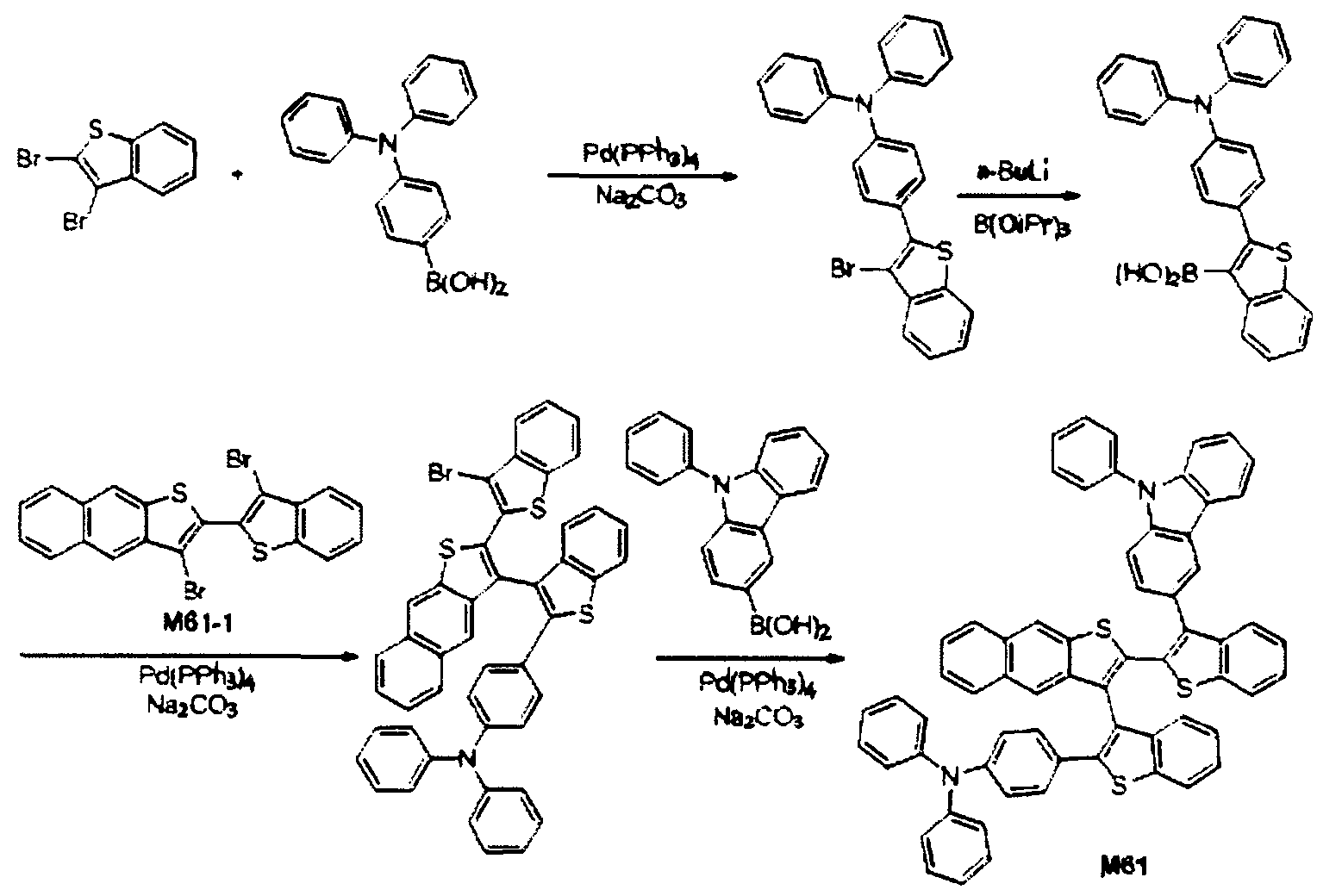
  • compound M61 was prepared, and its structural formula and synthetic route are as follows:
  • Example 62 The synthesis was similar to that of Example 60 except that in the second step, the intermediate M61-1 (refer to journal of the Chemical Society, 1942, p. 404, 412) was substituted for 3,3'-dibromo-2,2'-biphenyl. And (b) thiophene, to compound M61 (white body, yield 18%).
  • Example 62 the intermediate M61-1 (refer to journal of the Chemical Society, 1942, p. 404, 412) was substituted for 3,3'-dibromo-2,2'-biphenyl. And (b) thiophene, to compound M61 (white body, yield 18%).
  • Example 62 The synthesis was similar to that of Example 60 except that in the second step, the intermediate M61-1 (refer to journal of the Chemical Society, 1942, p. 404, 412) was substituted for 3,3'-dibromo-2,2'-biphenyl. And (b) thiophene, to compound M61 (white
  • compound M62 was prepared, and its structural formula and synthetic route are as follows:
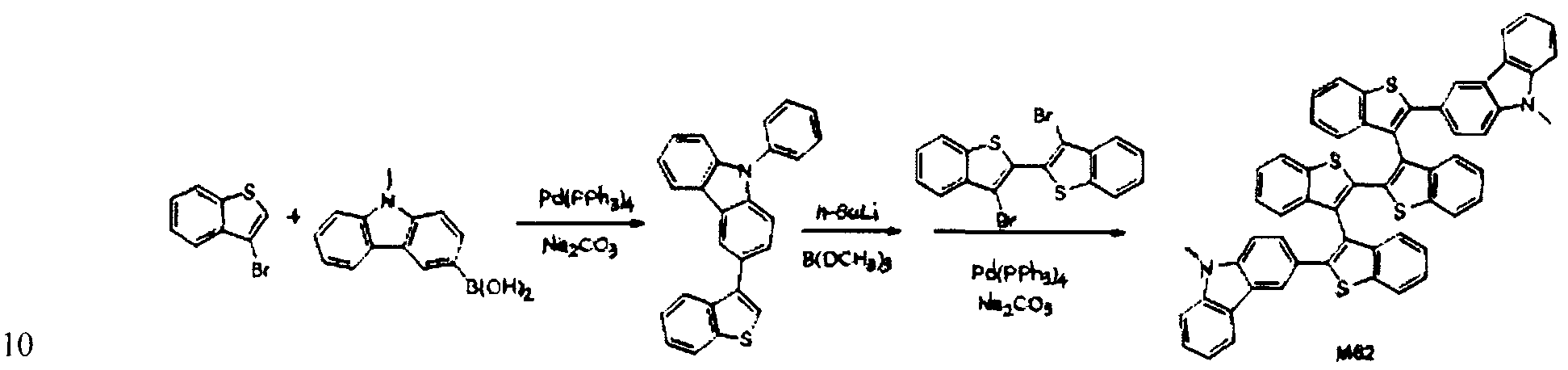
  • Example 63 In a similar manner to that of Example 64, a 3-bromo 3-boronic acid-N-methylcarbazole was substituted for 3-boronic acid-N-phenylindole-azole to obtain a compound M62 (white
  • Example 63
  • compound M63 was prepared, and its structural formula and synthetic route are as follows:
  • N 3.00%, S: 10.29%; measured values C: 82.19%, H: 4.53%, N: 3.00%, S: 10.29%.
  • a general organic electroluminescent device is composed of a substrate, an anode, an organic light-emitting functional layer and a cathode, wherein the organic light-emitting functional layer may include a hole injection layer, a hole transport layer, an organic light emitting layer, an electron transport layer, and an electron injection layer.
  • a hole injecting material is used for the hole injecting layer
  • a hole transporting material is used for the hole transporting layer
  • an organic light emitting material is used for the organic light emitting layer.
  • the organic light emitting material includes a host material and a doping dye, and the electron transporting layer is used.
  • electron transport materials the same is used for the electron injecting layer as an electron injecting material.
  • the host material of the organic light-emitting layer may be one type or a double-host material composed of two materials.
  • the comparative material of the hole injecting material uses the hole injecting layer material 2-TNATA commonly used in the prior art.
  • the comparative material of the hole transporting material uses the hole transporting material NPB commonly used in the prior art, and the TDNe is doped with ADN as the organic light emitting layer (ADN is a host material, and TBPe is a light emitting material).
  • the substrate may use a substrate in a conventional organic light-emitting device, for example : Glass or plastic.
  • a glass substrate is used, and ITO is used as an anode material.
  • the material of the present invention was used in the examples, and 2-TNATA was used in the comparative example.
  • the hole transport layer, the material of the present invention was used in the examples, and NPB was used in the comparative example.
  • the luminescent layer is blue
  • the cathode may be made of a metal or a mixture thereof, such as Mg: Ag, Ca: Ag, or the like, or may be an electron injecting layer/metal layer structure, such as a common cathode structure such as LiF/Al or Li20/Al.
  • the cathode material selected for use in the fabrication of the organic electroluminescent device of the present invention is LiF/Al.
  • the compound in the present embodiment is used as an electron transporting material in an organic electroluminescent device, and an ADN-doped blue dye TBPe is used as a light-emitting layer material, and a plurality of organic electroluminescent devices are prepared, and the device structure thereof: ITO/hole injection material (60 nm) / hole transport material (20 nm) / ADN: 5% wtTBPe (30 nm) / BPhen (20 nm) / LiF (0.5 nm) / Al (150 nm)
  • Compounds M1 to M65 were used as hole injection layers, respectively, using M1, M5, M10, M17, M20, M24, M25, M27, M29, M33, M35, M41, M48, M49, M51, M56, M60 and M65 as empty The hole transport material is proved.
  • the glass plate coated with the ITO transparent conductive layer is sonicated in a commercial cleaning agent, rinsed in deionized water, ultrasonically degreased in an acetone:ethanol mixed solvent, baked in a clean environment to completely remove water, and used ultraviolet Light and ozone cleaning, and bombard the surface with a low energy cation beam;
  • the above-mentioned glass substrate with an anode is placed in a vacuum chamber, and evacuated to lx lO_ 5 to 9 x lO_ 3 Pa ;
  • the hole injection layer is vacuum-deposited on the anode layer film, the evaporation rate is Ol nm/s, and the vapor deposition film thickness is 60 nm, and the material used for the layer is different according to the embodiment, as shown in the embodiment part;
  • the hole transport layer is vacuum-deposited on the hole injection layer film, the evaporation rate is O. l nm / s, the vapor deposition film thickness is 20 nm;
  • a double source co-evaporation method is used on the above hole transport layer, and the host material ADN and the doped luminescent material TBPe are vacuum-evaporated.
  • the evaporation rate of ADN is 0.1 nm/s, and the evaporation rate of TBPe is 0.005 nm/ s. , the total thickness of the vapor deposition is 30 nm;
  • BPhen is vacuum-deposited as an electron transport layer of an organic electro-device, and the evaporation rate is 0.1 nm/s, and the total vapor deposition thickness is 20 nm;
  • ETL electron transport layer
  • the preparation method of the comparative example was the same as the example, and only the compound as a hole injecting material or a hole transporting material was changed.
  • OLED 1 to OLED 17 respectively use the novel organic material of the present invention as the hole injecting layer material and the hole transporting layer material of the organic electroluminescent device, and can significantly reduce the turning-on voltage and improve the comparison with the comparative example 1.
  • Current efficiency; OLED18-OLED65 uses the novel organic material of the present invention as a hole injection layer material of an organic electroluminescence device, using NPB as a hole transport material, and OLED66 ⁇ OLED80 adopts the novel organic material of the present invention as organic electroluminescence
  • the hole transport layer material of the device uses 2-TNATA as a hole injecting material. Compared with Comparative Example 1, the voltage drop of these devices is lv, and the current efficiency of the device is remarkably improved.
  • the novel organic material provided by the present invention has a thiophene group, and a lone pair of electrons on the S atom easily loses electrons to form a hole, so that the compound has high carrier injection and transport capability as a hole injection and/or transport material. Therefore, the luminous efficiency of the device is greatly improved.
  • Example 68
  • HIL Hole Injection Layer
  • HTL Hole Transport Layer
  • EL Blue Luminescent Dye
  • ETL Electron Transport Layer
  • the substrate may use a substrate in a conventional organic light-emitting device such as glass or plastic.
  • a substrate is used, and ITO is used as an anode material.
  • the hole injecting material uses a hole injecting layer material 2-TNATA which is conventionally used in the prior art.
  • the hole transporting material uses the hole transporting material NPB which is conventionally used in the prior art.
  • the electron transporting material uses the electron transporting material Alq3 which is commonly used in the prior art.
  • the cathode may be made of a metal or a mixture thereof, such as Mg: Ag, Ca: Ag, or the like, or may be an electron injecting layer/metal layer structure, such as a common cathode structure such as LiF/Al, Li 2 O/Al.
  • the electron injecting material selected for use in the fabrication of the device of the present invention is LiF and the cathode material is Al.
  • the compound in this embodiment is used as a host material in an organic electroluminescent device, or one of two bodies, and a plurality of organic electroluminescent devices are prepared, the structure of which is:
  • ITO/2-TNATA 60nm) / NPB ( 20nm ) / host: blue luminescent dye ( 30nm ) I Alq3 (20nm) / LiF (0.5nm) / AL (150nm), or,
  • ITO/2-TNATA 60 nm) / NPB (20 nm) / first host: second host: blue luminescent dye (30 nm) I Alq3 (20 nm) / LiF (0.5 nm) / AL (150 nm).
  • the glass plate coated with the ITO transparent conductive layer is sonicated in a commercial cleaning agent, rinsed in deionized water, ultrasonically degreased in an acetone:ethanol mixed solvent, baked in a clean environment to completely remove water, and used ultraviolet Light and ozone cleaning, and bombard the surface with a low energy cation beam;
  • the above-mentioned glass substrate with an anode is placed in a vacuum chamber, and evacuated to lx lO_ 5 to 9 x lO_ 3 Pa ;
  • the hole transport layer is vacuum-deposited on the hole injection layer film, the evaporation rate is O. l nm / s, the vapor deposition film thickness is 20 nm;
  • the evaporation rate of the main body is 0.1%/s, and the evaporation rate of the dye is 0.005 nm/s.
  • the evaporation rate of the main body is 0.1%/s, and the evaporation rate of the dye is 0.005 nm/ s.
  • the first body, the second body and the luminescent dye are vapor-deposited at a rate of 0.1 nm/s, the second body of the second body.
  • the evaporation rate varies according to various embodiments.
  • the evaporation rate of the dye is 0.005 nm/ s , and the total thickness of the vapor deposition is 30 nm; in particular, the luminescence of OLED104-OLED 134 in the following table
  • the ratio in parentheses in the layer structure is the evaporation rate ratio of the first body and the second body;
  • Alq3 was vacuum-deposited on the above-mentioned light-emitting layer as an electron transport layer of the device, and the evaporation rate was 0.1 nm/ s , and the total vapor deposition thickness was 20
  • the LiF and A1 layers were vacuum evaporated on the electron transport layer (ETL) as the cathode of the device, with thicknesses of 0.5 nm and 150 nm, respectively.
  • ETL electron transport layer
  • the organic electroluminescent device is shown in the following table:
  • OLED81 Ml TBPe 1000 5.7 6.5
  • OLED82 M5 TBPe 1000 5.5 6.4
  • OLED83 M10 TBPe 1000 5.4 6.7
  • OLED84 M13 TBPe 1000 5.0 7.3
  • OLED85 M17 TBPe 1000 5.1 7.0
  • OLED86 M20 TBPe 1000 4.9 7.2
  • OLED88 M25 TBPe 1000 5.0 7.2
  • OLED90 M29 TBPe 1000 5.0 7.3
  • OLED122 ADN M35: TBPe (l: 0.2) 1000 4.7 7.0
  • OLED123 ADN M41: TBPe (10.2) 1000 5.1 7.4
  • OLED124 ADN M48: TBPe (10.2) 1000 5.0 7.2
  • OLED125 ADN M49: TBPe (l: 0.2) 1000 4.9 6.9
  • OLED126 ADN M51: TBPe (10.2) 1000 4.8 6.8
  • OLED127 ADN M53: TBPe (10.2) 1000 5.2 7.7
  • OLED128 ADN M56: TBPe (l: 0.2) 1000 5.3 7.9
  • OLED129 ADN M59: TBPe (l: 0.2) 1000 5.1 7.8
  • OLED134 M51 M20: TBPe (l: 0.2) 1000 5.1 6.8
  • the data in the above table shows that the material in the present invention can also be used as a fluorescent blue host material, and the material in the present invention can also be combined with other commonly used fluorescent blue body. As a dual body, compared with Comparative Example 2, the voltage of the device is reduced and the efficiency is improved.

Landscapes

  • Chemical & Material Sciences (AREA)
  • Organic Chemistry (AREA)
  • Engineering & Computer Science (AREA)
  • Materials Engineering (AREA)
  • Physics & Mathematics (AREA)
  • Spectroscopy & Molecular Physics (AREA)
  • Plural Heterocyclic Compounds (AREA)
  • Electroluminescent Light Sources (AREA)
  • Indole Compounds (AREA)

Abstract

本发明涉及一类如式(I)所示的化合物,其中:R1、R2独立地选自C4〜C30的取代或非取代的芳胺基团、C4〜C40的取代或非取代的咔唑基团、C4〜C40的取代或非取代的苯并噻吩基团、C4〜C40的取代或非取代苯并呋喃基团的其中之一;L为桥联基团,选自单键、C4〜C40的取代芳胺、C4〜C40的取代咔唑、C4〜C40的取代苯并噻吩、氧原子、氮原子或硫原子的其中之一;R3-R10独立地选自H原子、C1-C20的脂肪族直链或支链烃基或C6-C30的芳香族基团,或者,相邻两个基团连接成环,形成萘并噻吩衍生物;m、n选自0-3的整数,但m加n大于0且小于等于3。本发明还保护此类化合物在有机电致发光器件中的应用,尤其是作为OLED器件中的空穴传输材料、空穴注入材料或有机发光材料的主体材料。

Description

苯并噻吩类衍生物及其在有机电致发光镇域中的应用
本发明涉及一种有机化合物, 尤其涉及一种用于有机电致发光器件的苯并噻吩类衍生物及其在 有机电致发光显示技术领域中的应用。 皆景技术
目前, 在有机电致发光器件中使用的空穴注入和传输材料一般是三芳胺类衍生物 (例如出光专 利: 公开号 CN 1152607C, 公开日 2004, 6, 2 ) , 其一般的结构特点是, 作为注入材料, 在一个分 子中其三芳胺结构单元至少在三个以上, 且二个 N之间用一个苯环隔开, 如结构式 1 ; 作为传输材 料, 在一个分子中其三芳胺结构单元一般是二个, 且二个 N之间用联苯隔开, 在这类材料中, 典型 的例子是 NPB。
Figure imgf000003_0001
结构式 3 结构式 4
Figure imgf000003_0002
结构式 结构式 6
近年来, 这类材料的研究有了一些新的进展, 在分子中引入一个或多个噻吩基, 或者引进一个 或多个苯并噻吩基, 如结构式 3和结构式 4 (出光专利: 公开号 CN 101506191A, 公开日 2009, 8, 12) , 评测结果表明噻吩基或苯并噻吩基大大增加了材料的空穴注入能力; 作为传输材料, 当将材 料中的一个三芳胺结构单元用咔唑或二苯并呋喃取代时, 材料的传输能力都有较大幅度提高, 如结 构式 5和结构式 6 (出光专利:公开号 CN102334210 A,申请日 2012, 1 , 25;公开号: WO 2010/114017 A1, 公开日 2010,10, 7) 。
因此, 开发一种新型的稳定高效的空穴注入 /传输材料, 或有机发光层的主体材料, 从而降低起 亮电压, 提高器件效率, 延长器件寿命, 具有很重要的实际应用价值。 发明内容
本发明所要解决的问题是提供一类新型的双空穴传输基团取代的苯并噻吩类衍生物, 并将该衍 生物分别应用于有机发光功能层作为空穴传输材料和 /或空穴注入材料和 /或有机发光层的主体材 料, 进而得到一种驱动电压低、 发光效率高的有机电致发光器件。
为了解决上述技术问题, 本发明采用的技术方案如下:
在双空穴传输基团取代的苯并噻吩类材料中,不论是作为空穴注入材料还是作为空穴传输材料, 其公认的传输机理是: 在空穴的注入或传输过程中, 材料中 N的孤电子对中的一个电子给出, 形成 空穴, 因为在整个材料中, N上孤电子对的能量最高, 最容易给出。 如果在分子中有噻吩结构单元 存在, S原子上的孤电子对更易给出电子形成空穴, 即更易传输电子。 其主要原因是, 与 N相比, S 是第三周期元素, 而 N是第二周期元素, S的孤电子对处于第三层轨道, 而 N上的孤电子对处于第 二层轨道, 更靠近原子核, 相对于 S, N上的孤电子对更难给出, 而 S更易给出, 注入更易进行, 空穴更易传递。 因此, 本发明所公开的这类材料, 不论取代基结构如何, 分子中至少含有二个 S原 子, 确保材料能够容易地给出电子和传递空穴。
双空穴传输基团取代的苯并噻吩类材料具备较高三线态能级和玻璃化转变温度、 较强的空穴传 输能力, 而且可以有效避免薄膜状态下分子聚集引起的荧光猝灭, 这些优势使得该系列衍生物既能 应用于有机发光功能层作为空穴传输材料和 /或空穴注入材料, 又具备作为主体材料, 特别是荧光蓝 光主体材料的应用潜力。 本发明提供了一种苯并噻吩类衍生物, 具有如式 (I) 所示的结构:
Figure imgf000004_0001
(I) 其中: Ri R2独立地选自 C4〜C40的取代或非取代的芳胺基团、 C4〜C40的取代或非取代的咔唑基团、 C4〜C40的取代或非取代的苯并噻吩基团、 C4〜C40的取代或非取代苯并呋喃基团的其中之一;
L为桥联基团, 选自单键、 C4〜C40的取代芳胺、 C4〜C40的取代咔唑、 C4〜C40的取代苯并噻 吩、 氧原子、 氮原子或硫原子的其中之一;
R3-R1()独立地选自 H原子、 d-C^的脂肪族直链或支链烃基或 C6-C3。的芳香族基团, 或者, 相 邻两个基团连接成环, 形成
m、 n选自 0-3的整数, 但 m加 n大于 0且小于等于 3。 优选地, 所述 中相邻两个基团连接成环, 形成一个或多个关环结构。
优选地, 所述化合物结构式如下:
Figure imgf000005_0001
Figure imgf000006_0001
Figure imgf000006_0002
Figure imgf000007_0001
llOO/ClOZN3/X3d Z8CS.0/M0Z OAV
Figure imgf000008_0001
Figure imgf000008_0002
Figure imgf000009_0001
Figure imgf000010_0001
Figure imgf000010_0002
Figure imgf000011_0001
Figure imgf000012_0001
Figure imgf000013_0001
所述的苯并噻吩类衍生物在有机电致发光器件中用作空穴注入材料和 /或空穴传输材料。 所述的苯并噻吩类衍生物在有机电致发光器件中还可用作有机发光层的有机发光材料, 有机发 光材料包括主体材料和染料, 具体的, 所述的苯并噻吩类衍生物可在有机电致发光器件中的发光层 中作为主体材料。
本发明还提供了一种有机电致发光器件, 包括基板, 以及依次成型于所述基板上的阳极层、 有 机发光功能层和阴极层;
所述有机发光功能层所用材料包括空穴注入材料、 空穴传输材料、 有机发光材料以及电子传输 材料, 所述有机发光功能层所用材料为具有如下述结构式 (I) 所示的化合物:
Figure imgf000014_0001
(I) 其中:
Ri 独立地选自 C4〜C40的取代或非取代的芳胺基团、 C4〜C40的取代或非取代的咔唑基团、 C4〜C40的取代或非取代的苯并噻吩基团、 C4〜C40的取代或非取代苯并呋喃基团的其中之一;
L为桥联基团, 选自单键、 C4〜C40的取代芳胺、 C4〜C40的取代咔唑、 C4〜C40的取代苯并噻 吩、 氧原子、 氮原子或硫原子的其中之一;
。独立地选自 H原子、 d-C^的脂肪族直链或支链烃基或 C6-C3。的芳香族基团, 或者, 相 邻两个基团连接成环, 形成萘并噻吩衍生物;
m、 n选自 0-3的整数, 但 m加 n大于 0且小于等于 3。
本发明还提供了一种有机电致发光器件, 包括基板, 以及依次成型于所述基板上的阳极层、 有 机发光功能层和阴极层;
所述有机发光功能层所用材料包括空穴注入材料、 空穴传输材料、 有机发光材料以及电子传输 材料, 所述空穴注入材料为具有如下述结构式 (I) 所示的化合物:
Figure imgf000014_0002
(I) 其中:
Ri 独立地选自 C4〜C40的取代或非取代的芳胺基团、 C4〜C40的取代或非取代的咔唑基团、 C4〜C40的取代或非取代的苯并噻吩基团、 C4〜C40的取代或者非取代苯并呋喃基团的其中之一;
L为桥联基团, 选自单键、 C4〜C40的取代芳胺、 C4〜C40的取代咔唑、 C4〜C40的取代苯并噻 吩、 氧原子、 氮原子或硫原子的其中之一;
。独立地选自 H原子、 d-C^的脂肪族直链或支链烃基或 C6-C3。的芳香族基团, 或者, 相 邻两个基团连接成环, 形成萘并噻吩衍生物;
m、 n选自 0-3的整数, 但 m加 n大于 0且小于等于 3。
本发明还提供了一种有机电致发光器件, 包括基板, 以及依次成型于所述基板上的阳极层、 有 机发光功能层和阴极层;
所述有机发光功能层所用材料包括空穴注入材料、 空穴传输材料、 有机发光材料以及电子传输 材料, 所述空穴
Figure imgf000015_0001
(I) 其中:
Ri 独立地选自 C4〜C40的取代或非取代的芳胺基团、 C4〜C40的取代或非取代的咔唑基团、 C4〜C40的取代或非取代的苯并噻吩基团、 C4〜C40的取代或非取代苯并呋喃基团的其中之一;
L为桥联基团, 选自单键、 C4〜C40的取代芳胺、 C4〜C40的取代咔唑、 C4〜C40的取代苯并噻 吩、 氧原子、 氮原子或硫原子的其中之一;
R3-R1()独立地选自 H原子、 d-C^的脂肪族直链或支链烃基或 C6-C3。的芳香族基团, 或者, 相 邻两个基团连接成环, 形成萘并噻吩衍生物;
m、 n选自 0-3的整数, 但 m加 n大于 0且小于等于 3。
本发明还提供了一种有机电致发光器件, 包括基板, 以及依次成型于所述基板上的阳极层、 有 机发光功能层和阴极层; 所述有机发光功能层所用材料包括空穴注入材料、 空穴传输材料、 有机发光材料以及电子传输 材料, 所述有机
Figure imgf000016_0001
(I) 其中:
Ri 独立地选自 C4〜C40的取代或非取代的芳胺基团、 C4〜C40的取代或非取代的咔唑基团、 C4〜C40的取代或非取代的苯并噻吩基团、 C4〜C40的取代或非取代苯并呋喃基团的其中之一;
L为桥联基团, 选自单键、 C4〜C40的取代芳胺、 C4〜C40的取代咔唑、 C4〜C40的取代苯并噻 吩、 氧原子、 氮原子或硫原子的其中之一;
R3-R1()独立地选自 H原子、 d-C^的脂肪族直链或支链烃基或 C6-C3。的芳香族基团, 或者, 相 邻两个基团连接成环, 形成萘并噻吩衍生物;
m、 n选自 0-3的整数, 但 m加 n大于 0且小于等于 3。
本发明的苯并噻吩类衍生物具有以下优点:
( 1 )本发明所公开的苯并噻吩类衍生物由于具有至少一个噻吩基团, S原子上的孤电子对容易 失电子形成空穴, 因此使得该化合物作为空穴注入和 /或传输材料具有高的载流子注入和传输能力。
(2 )本发明所公开的苯并噻吩类衍生物由于具有较大的分子量以及较多的枝杈结构, 具有较高 的玻璃化温度, 因此化合物的稳定性高, 对进一步提高器件的寿命有极大的好处。
( 3 ) 本发明所公开的苯并噻吩类衍生物可用作空穴注入和 /或传输材料, 由于具有高的载流子 注入和传输能力, 使得器件的发光效率大大提高。 器件实施例 OLED1〜OLED80表明, 应用本发明 的有机化合物作为有机发光功能层材料, 制备的器件能有效地降低驱动电压, 提高电流效率。
(4 )本发明所公开的苯并噻吩类衍生物还可用作有机发光层的主体材料, 特别是作为荧光蓝光 主体材料, 本发明中的材料还可以与其它常用的荧光蓝光主体搭配来作为双主体, 由于其分子轨道 能级落在主体材料能级范围内, 利于电子和空穴的传输, 使得器件的发光效率大大提高。 器件实施 例 OLED81〜OLED134表明, 应用本发明的有机化合物作为有机发光功能层材料, 制备的器件能有 效地降低驱动电压, 提高电流效率。 附图说明
为了使本发明的内容更容易被清楚的理解, 下面根据本发明的具体实施例并结合附图, 对本发 明作进一步详细的说明, 其中
图 1是制备本发明所述的苯并噻吩类衍生物的中间体 Μς4-1的核磁谱图 (1H) ;
图 2是本发明所述的苯并噻吩类衍生物 ¾ ι的质谱图;
图 3本发明所述的苯并噻吩类衍生物 M^l的热失重谱图;
图 4是本发明所述的苯并噻吩类衍生物 ¾ ι的吸收光谱;
图 是本发明所述的苯并噻吩类衍生物 ¾ ι的发射光谱;
图 ς是本发明所述的苯并噻吩类衍生物 ¾ ι的核磁谱图 (13C ) 。 具体实施方式
本发明中所用的苯并噻吩、 3-溴 -9-苯基-咔唑、 9-(4-溴苯基) -咔唑、 4-溴-三苯胺、 2-溴 -9-苯基- 咔唑、 3-溴 -9-甲基-咔唑、 9- (4-溴苯基) -3,6-二甲基-咔唑、 二苯胺、 2-溴二苯并 (b,d) 噻吩、 2-溴 二苯并 (b,d) 呋喃、 苯胺、 二 (4-溴苯基) 醚、 二 (4-溴苯基) 硫醚、 2、 8-二溴-二苯并 (b,d) 噻 吩、 3、 7-二溴-二苯并 (b,d) 噻吩、 2、 8-二溴-二苯并 (b,d) 呋喃、 3、 7-二溴-二苯并 (b,d) 呋喃、 N,N-二 (4-溴苯基) -苯胺、 3, 6-二溴 -9-苯基-咔唑、 3, 6-二溴 -9- (4-甲苯基) -咔唑、 3, 6-二溴 -9- 乙基-咔唑、 N,N-二苯基 -联苯二胺、 三- (对溴苯基) 胺等试剂均为外购, 1-或者 2-芳基取代苯并噻 吩和萘并噻吩 (Can. J. Chem. 59, 227; 59, 1297 (1981)) 、 3-溴 -苯并 (b ) 噻吩 (河南大学 2009年博 士论文)、 2,3-二溴 -苯并(b )噻吩 (Adv. Mater., 2007, 19, 3008)、 3,3'-二溴 -2,2'-联苯并(b )噻吩 (Adv. Mater., 2007, 19, 3008)、 3-氯 -萘并(1, 2-b )并噻吩(Chemistry of Heterocyclic Compounds, 1983, 156 ), 1-氯 -萘并(2, 1-b ) 并噻吩 ( Chemistry of Heterocyclic Compounds, 1983, 156 ) , 3,3'-联苯并 (b ) 噻 吩 (河南大学 2009年博士论文) 、 2,2'-联萘并 (2,3-b ) 噻吩 (J. Mater. Chem., 2008,18,3442 ) 、 以 及所用到的硼酸衍生物均根据文献方法制备。
化合物合成实施例
实施例 1
化合物 Ml的合成
本实施例所需制备的化合物 Ml, 其结构式及合成路线如下所示: N COg 、-^、、《 to
Figure imgf000018_0001
100ml三口瓶中, 在氮气保护下, 加入 9-苯基 咔唑 -3-硼酸 6.31g (22mmol) 、 3,3'-二溴 -2,2'- 联苯并 (b ) 噻吩 4.24g ( lOmmol) , 四 (三苯基膦钯) 462mg, 甲苯 30ml、 乙醇 10ml, 碳酸钠 5.3g ( 50mmol) 和水 20ml, 反应混合物回流反应 3小时, TLC监测显示反应完全终止反应, 冷却至室 温, 分液、 水洗、 水相萃取、 有机相合并、 干燥、 旋干得到黄色油状物。 柱层析(二氯甲烧 /石油醚) 得到 5.1g白色固体, 收率 68%。
实施例 2
化合物 M2的合成
本实施例制备化合物 M2, 其结构式及合成路线 v r r
Figure imgf000018_0002
采用与实施例 1相类似的方法,使用等当量的 4- (9H-咔唑 -9-基)苯硼酸代替 9-苯基 咔唑 -3- 3酸, 其他条件不变, 得到化合物 Μ2 (白色固体, 收率 77%) 实施例 3
化合物 Μ3的合成
本实施例制备化合物 Μ3, 其结构式及合成路线如下所示:
Figure imgf000019_0001
M3
采用与实施例 1相类似的方法, 使用等当量的二苯胺 4-硼酸代替 9-苯基 -9 -咔唑 -3-硼酸, 其他 条件不变, 得到化合物 M3 (白色 ^体, 收率 65%) 实施例 4
化合物 M4的合成
Figure imgf000019_0002
(1) .100ml二口瓶中, 在氮气保护下, 加入 9-甲苯基 -9 -咔唑 -2-硼酸 3.31g (llmmol) 、 3,3'-二 溴 -2,2'-联苯并 (b) 噻吩 4.24g (lOmmol) , 四 (二苯基膦钯) 462mg, 甲苯 30ml、 乙醇 10ml, 碳 酸钠 5.3g (50mmol) 和水 20ml, 反应混合物回流反应 3小时, TLC监测显示反应完全终止反应, 冷却至室温, 分液、 水洗、 水相萃取、 有机相合并、 干燥、 旋干得到黄色油状物。 柱层析 (二氯甲 焼 /石油醚) 得到 4.1g白色固体, 收率 80%。
(2) .100ml二口瓶中,在氮气保护下,加入 4-硼酸三苯胺 2.61g(9mmol)、上述产物 4.1g(8mmol), 四 (二苯基膦钯) 462mg, 甲苯 30ml、 乙醇 10ml, 碳酸钠 5.3g ( 50mmol) 和水 20ml, 反应混合物 流反应 3小时, TLC监测显示反应完全终止反应, 冷却¾¾温, 分液、 水洗、 水相萃取、 冇机相 合并、 干燥、 旋干得到黄色汕状物。 柱/ 析 (二氯甲'烷 / 汕醚) 得到白色 体 5g, 收率 82%。 实施例 5
17
替换页 (细则第 26条) 化合物 M5的合成
本实施例制备化合物 M5, 其结构式及合成路线如下所示:
(1) .中间体 M5-2的合成: 100ml三口瓶中, 在氮气保护下, 加入 M5-1 (制备参照文献方法: J.Mater.Chem.,2008, 18,3442 ) 3.67g ( lOmmol) 50ml二氯甲垸, 反应混合物冷却到 0°C, 慢慢滴加 3.52g液溴的 10ml二氯甲垸溶液, 滴完后继续在此温度下搅拌 1小时, 再在室温下反应过夜, TLC 监测显示反应完全, 加入亚硫酸钠溶液终止反应, 分液、 水洗、 水相萃取、 有机相合并、 干燥、 旋 干得到黄色固体。 柱层析 (二氯甲烧 /石油醚) 得到 3.7g白色固体 M5-2, 收率 71%。
(2) . 100ml三口瓶中, 在氮气保护下, 加入 9-苯基 -9 -咔唑 -3-硼酸 6.32g (22mmol) 、 5.2g M5-2 ( lOmmol), 四 (三苯基膦钯) 462mg, 甲苯 30ml、 乙醇 10ml, 碳酸钠 5.3g (50mmol)和水 20ml, 反应混合物回流反应 7小时, TLC监测显示反应完全终止反应, 冷却至室温, 分液、 水洗、 水相萃 取、 有机相合并、 干燥、 旋干溶剂。 粗产品经硅胶柱层析分离 (二氯甲烧 /石油醚) 得到白色固体 6.2g, 收率 73%。 实施例 6
化合物 M6的合成
本实施例制备化合物 M6, 其结构式及合成路线如下所示:
Figure imgf000021_0001
参考 Fu的方法 U. Am. Chem. Soc, 2000, 122,4020) ,删 1-氯 -萘并(2, 1-b)并噻吩 (Chemistry of Heterocyclic Compounds, 1983, 156) 与苯基咔唑硼酸进行 Suzuki 偶联反应, 得到的化合物再进行 丁基锂拔氢、 进而无水 CuCl2氧化偶联(参考 IMateLChem., 2008, 18,3442) , 得到化合物 M6。 两步 收率 28%。 实施例 7
化合物 M7的合成
Figure imgf000021_0002
制备方法为:
(1) 在 250ml二口瓶中加入 21.3g 3-溴 -苯并 (b) 噻吩 (O.lmol) , 150ml无水乙醚, 用干冰- 丙酮浴冷却到约 -78°C, 搅拌下滴加 44ml 2.4M正丁基锂溶液 (105mmol) , 控制滴加速度使得反应 液温度不高于 -70°C, 加完后, 继续保持反应温度在 -78°C约 1 小时。 然后分批加入 16g无水氯化铜 (120mmol) , 加完后, 撤去冷浴, 缓慢升到室温, 并冋流反应 3 小时。 将反应混合液倒入 400ml 氯化铰饱和溶液中,分液,有机相洗涤、十燥,粗产品经柱分离得到白色 体 7.45g,收率 56%。 (2) 2,2'-二溴 -3, 3'-联苯并 (b) 噻吩的合成。
(2) 在 250ml三口瓶中加入 13.3g 3, 3'-联苯并 (b) 噻吩 (0.05mol) , 150ml无水乙醚, W干 冰-丙酮浴冷却到约 -78°C, 搅拌下滴加 44ml 2.4M正丁基锂溶液(105mmol) , 控制滴加速度使得反 应液温度不高丁 --701:, 加完后, 继续保持反应温度在 -78°C约 1小时。 然后分批加入 2Ug W体粉末
19
替换页 (细则第 26条) NBS ( 120mmol ) , 加完后, 撤去冷浴, 缓慢升到室温, 并在室温下反应 3 小时。 将反应混合液倒 入 400ml氯化铰饱和溶液中, 分液, 有机相洗涤、 干燥, 粗产品经柱分离得到白色同体 15.3g, 收率 72%。
( 3 ) M7的合成
采用与实施例 1完全相同的方法制备 M7, 只是分别以 2,2'-二溴 -3, 3'-联苯并 (b) 噻吩和 4-咔 唑基苯硼酸代替 3,3'-二溴 -2,2'-联苯并(b)噻吩和 9-苯基 -9/ -咔唑 -3-硼酸,得到 M7 (白色 ^体 6.1 g, 收率 81%) 。 实施例 8
化合物 M8的合成
本实施例制备化合物 M8, 其结构式及合成路线
Figure imgf000022_0001
采 实施例 7相类似的方法, 使用等当量的二苯胺 4-硼酸代替 4-咔唑基苯硼酸, 其他条件不 变, 得到化合物 M8 (白色固体, 收率 65%) 实施例 9
化合物 M9的合成
本实施例制备化合物 M9, 其结构式及合成路线如下所示:
替换页 (细则第 26条)
Figure imgf000023_0001
采用与实施例 5笫一步相类似的方法,起始原料用 M9-K制备参照文献方法: J.Mater.Chem.,2008, 18,3442 ) 代替 M5-l, 其他条件不变, 得到中间体 M9-2。
采用 实施例 4相类似的方法, 分两步进行 Suzuki偶联, 中间体 M9-2代替 M4-l, 第一次 Suzuki偶联川 3-硼酸 -N-苯基咔唑代替 9-甲苯基 -9/ -咔唑 -2-硼酸, 第二次 Suzuki偶联用 9-苯基 -9 - 咔唑 -2-硼酸代替 4-硼酸二苯胺, 其它条件不变, 得到化合物 M9 (白色 W体, 收率 50%) 。 实施例 10
化合物 M10的合成
本实施例制备化合物 M10, 其结构式及合成路线如下所示:
21
替换页 (细则第 26条)
Figure imgf000024_0001
中间体 MlO-1的制备:中间体 MlO-1-1经 NBS溴代得到中间体 M10-1-2,与二苯胺经 Buchwald 偶联得到中间体 M10-1-3, 经 ιΗ丁基锂拔氢得到锂盐与硼酸二异丙酯反应后酸解得到硼酸 M10-1。
中间体 M10-2的制备: 中间体 M10-2-1经正 Γ基锂拔氢得到锂盐 硼酸二异丙酯反应后酸解得 到硼酸 Ml 0-2-2, 丄 j 3-溴 -N-乙基咔唑经 Suzuki偶联得到中间体 Ml 0-2-3, 经 NBS溴代得到中间体 M10-2。
中间体 M10-1 Ml 0-2经 Suzuki偶联得到化合物 M10 (白色 体, 收率 30%) 实施例 11
化合物 Mil的合成
本实施例制备化合物 Ml 1 , 其结构式及合成路线如下所示:
22 替换页 (细则第 26条)
Figure imgf000025_0001
采用 实施例 4相类似的方法, 使用等当 M的 4-咔唑基苯硼酸和二甲基 -4-咔唑硼酸分别代替 9- 甲苯基 -9H-咔唑 -3-硼酸和 4-二苯胺基苯硼酸,其他条件不变,得到化合物 M l 1 (白色^体,收率 45%) 实施例 12
化合物 M12的合成
本实施例制备化合物 M 12, 其结构式及合成路线如下所示:
23
替换页 (细则第 26条)
Figure imgf000026_0001
中间体 M12-1的合成: 2, 3-二漠苯并噻吩与 4-硼酸三苯胺经 Suzuki偶联得到中间体 M12-1-1 , 参照硼酸的一般制备方法得到中间体 M12-1。
中间体 M12-2的合成: 中间体 M12-2-1经 NBS溴代得带中间体 M12-2-2 , 与巾间体 M12-2-3 经 Suzuki偶联得到中间体 M12-2-4, 经 NBS溴代得到中间体 M12-2。
中「曰」体 M 12-1 Ml 2-2经 Suzuki偶联得到化合物 M12 (白色向体, 收率 33%) 实施例 13
化合物 M 13的合成
Figure imgf000026_0002
合成步骤完全参照实施例 7中化合物 M7的制备, 只是 W 3-硼酸 -N苯基咔唑代替 4-咔唑基苯硼 酸即可, 由此制得化合物 M13(A色^体, 收率 57%)
24
替换页 (细则第 26条) 实施例 14
化合物 M14的合成
Figure imgf000027_0001
合成步骤完全参照实施例 7中化合物 M7的制备, 只是用二苯并噻吩 -2-硼酸代替 4-咔唑基苯硼 酸即可, 由此制得化合物 M14 色 体, 收率 61 %) 。 实施例 15
化合物 M15的合成
本实施例制备化合物 M】5, 其结构式及合成路线如下所示:
Figure imgf000027_0002
采 4实施例 1相类似的方法, 使用等当量的 3-苯基 -2-苯并 (b) 噻吩硼酸代替 9-苯基 -9/ -咔 唑 -3-硼酸, 其他条件不变, 得到化合物 M15 (白色 1体, 收率 78%) 实施例 16
化合物 M16的合成
本实施例制备化合物 Μ 16, 其结构式及合成路线如下所示:
替换页 (细则第 26条)
Figure imgf000028_0001
合成步骤完全参照实施例 5中化合物 M5的制备, 只是单纯的改变为相应的硼酸即可, 的化合物 M16为白色 体, 质谱及元素分析结果列在附表中。 实施例 Π
化合物 M 17的合成
本实施例制备化合物 M17, 其结构式及合成路线如下所示:
Figure imgf000028_0002
17
采 与实施例 1相类似的方法, 使用 当; ¾的二苯并 (b, d ) 噻吩 -2-硼酸代替 9-苯基 -9/ -咔唑 -3-硼酸, 其他条件不变, 得到化合物 M17 (白色 |Λ|体, 收率 78%) 实施例 18
化合物 M 18的合成
本实施例制备化合物 M18, 其结构式及合成路线如下所示:
26
替换页 (细则第 26条)
Figure imgf000029_0001
采川 实施例 l相类似的方法, 使用等当量的二苯并 (b, d) 噻吩 -3-硼酸代替 9-苯基 -9 -咔唑 -3-硼酸, 其他条件不变, 得到化合物 M18 (白色 体, 收率 67%) 实施例 19
化合物 M19的合成
本实施例制备化合物 M19, 其结构式及合成路线如下所示:
Figure imgf000029_0002
19
采用 实施例 1相类似的方法, 使 W等当 «的二苯并 (b, d) 呋喃 -2-硼酸代替 9-苯基 -9 -咔唑 -3-硼酸, 其他条件不变, 得到化合物 M19 (白色^体, 收率 56% ) 实施例 20
化合物 M20的合成
本实施例制备化合物 M20, 其结构式及合成路线如下所示:
27
替换页 (细则第 26条)
Figure imgf000030_0001
采 W与实施例 1相类似的方法, 使用等当最的二苯并 (b, d) 呋喃 -3-硼酸代替 9-苯基 -9 /-咔唑 -3-硼酸, 其他条件不变, 得到化合物 M20 (白色 |A|体, 收率 71%) 实施例 21
化合物 M21的合成
Figure imgf000030_0002
中 i'S]体 M21 -1的合成参] ¾文献 Journal of the Chemical Society, Perkin Transactions 1: Organic and Bio-Organic Chemistry (1972-1999), 1972 , p. 556— 559。
M21-1经正丁基锂拔氢成锂盐, 在氯化铜的作用下 ΰ偶联生成中间体 M21-2, 经 NBS溴代得到 中间体 M21 -3 , 与 4-硼酸二苯胺经 Suzuki偶联得到化合物 M21 (白色 体, 收率 65%) 。 实施例 22
化合物 M22的合成
本实施例制备化合物 M22, 其结构式及合成路线如下所示:
28
替换页 (细则第 26条)
Figure imgf000031_0001
22
(l).500 mL二口瓶, 氮气保护, 磁力搅拌, 将溶有苯并 (b) 噻吩 -3-酚 ( 15 g, 100 mmol,l eq) (根据 WO2011/61214A1成者 J. Am. Chem. Soc., 2007,129,2704制备) 的 150ml甲苯溶液冷却到 -20 'C, 慢慢加入 2.4M正丁基锂溶液 (42ml, llOmmol) , 滴加完后, 缓慢升到室温, 搅拌 10分钟。 然后依次加入 4.0ml二叔丁基膦 10%甲苯溶液(2mmol, 2%e.q.) , 0.58g Pd(dba)2(lmmol, l%e.q.) 以 及 21.3g3-溴 -苯并 (b)噻吩, 将反应体系加热到冋流, 并在此温度下反应 2小时, TLC显示原料反应 完全。 加水(100 mL)淬灭反应。 水相用 DCM (50 mL)萃取。 合并有机相, 饱和食盐水(100 mL) 洗涤, 无水硫酸镁干燥, 过滤。 减压旋干得棕色油状物。 DCM溶解, 硅胶拌样干法上样。 Ρϋ/EtOAc 体系柱色谱分离, 得 色 体 24g, 收率 85%。
(2) 在装有机械搅拌, 氮气保护的 500ml三口瓶中, 加入 14.1g (50mmol) M22-K 250ml干 燥 THF, 冷却至 -78°C, 滴加 2.4M正丁基锂 22ml (55mmol) , 溶液由黄棕色变成深黑色, 保持 -60 °C下反应 1小时, 冷却至 -78°C加入 I古 I体粉末 NBS 12g (60mmol) , 溶液变为黄色, 搅拌过夜。 加饱 和氯化铰水溶液淬灭, 搅拌 30min、 分液、 水相萃取、 合并有机相、 无水硫酸镁干燥、 旋干、 '油 醚^;结晶、 抽滤得淡白色 体 17g, 收率 80%。
(3) 250 mL二口瓶, ¾气保护, 室温, 磁力搅拌下向溶有 M22-2 (8.8g, 20mmol,l eq) , 9-苯基 -9 -咔唑 -3-硼酸 (12.6g, 44mmol, 2.2 eq), Na2CO3(10.6 g, 100 mmol,2.5eq)的 tolueneEtOH/H20 (50 mL/50 mL/50 mL)的悬浊液中加入 Pd(PPh3)4 (468 mg, 0.41 mmol, 2% eq)。加热升温至冋流反应 3小时 (随着冋流时间延长体系由悬浊液逐渐溶清), TLC显示原料反应完全。减压旋干溶剂, EtOAc(150 mL) 溶解, 水 (80 mL) 洗涤, 水相用 EtOAc (50 mL) 萃取。 合并有机相, 饱和食盐水 (lOOmL) 洗涤, 无水硫酸镁干燥, 过滤。 减压旋干得棕色袖状物。 DCM溶解硅胶拌样。 柱色谱分离得 A色 I古 I 体 10.5g收率 69%。
实施例 23
化合物 M23的合成
本实施例制备化合物 M23, 其结构式及合成路线如下所示:
29
替换页 (细则第 26条)
Figure imgf000032_0001
M23 采用 实施例 22相类似的方法, 使 W等当蚩的 9-苯基 -9H-咔唑 -2-硼酸代替 9-苯基 -9H-咔唑 -3- 硼酸, 得到化合物 M23 (白色 1*1体, 收率 64%)
实施例 24
化合物 M24的合成
采 实施例 22相类似的方法, 使川^当¾的二苯胺 -4-硼酸代替 9-苯基 -9 /-咔唑 -3-硼酸, 得 到化合物 M24 (白色 体, 收率 69%) 实施例 25
化合物 M25的合成
采用 实施例 22相类似的方法, 使 ffl等当量的 4-咔唑基苯硼酸代替 9-苯基 -9H-咔唑 -3-硼酸, 得到化合物 M25 (白色 I古 I体, 收率 80%) 实施例 26
化合物 M26的合成
本实施例制备化合物 M26, 其结构式及合成路线如下所示
30
替换页 (细则第 26条)
Figure imgf000033_0001
(1) 中间体 M26-1的合成:
在氮气保护下, 装有冷凝管的三口瓶中加入 21.3g 3-溴 -苯并 (b)噻吩 (l OOmmol ) , 3.8g巯基乙 酸(50mmol), 25.5g磷酸钾( 120mmol ) , 100ml甲苯和 50ml丙酮,然后加入 2.87g Pd(dba)2 ( 5mmol, 5%e.q. ) 及 3.9g dppf ( 7mmol ) , 反应混合物加热回流反应 10小时。 冷却, 加入饱和氯化铵溶液淬 灭反应, 分离冇机相, 水相用乙酸乙酯萃取两遍, 合并冇机相, 无水硫酸镁干燥, 溶剂抽干得到黄 色油状物, 此粗产品经过砘胶柱色谱分离, 得 8.3g白色^体, 收率 56%。
剩下步骤参照实施例 22, 以等当 二苯胺 -4-硼酸代替 9-苯基 -9//-咔唑 -3-硼酸,得到化合物 M26 (白色 体, 收率 75% ) 实施例 27
化合物 M27的合成
采用与实施例 26相类似的方法, 使用等当量的 4-咔唑基苯硼酸代替二苯胺 -4-硼酸, 得到化合 物 M27 (白色 I古 I体, 收率 80%) 实施例 28
化合物 M28的合成
本实施例制备化合物 M28, 其结构式及合成路线如下所示:
31
替换页 (细则第 26条)
Figure imgf000034_0001
| |2
制备方法:
合成步骤前两步与实施例 30中化合物 M30相同, 第三步参照化合物 M30的合成方法, 只是将 其中一种原料 9-苯基 -9H-咔唑 -3-硼酸改变为 4-二苯基胺基苯硼酸, 其它试剂、 溶剂和反应条件均不 变, 得到白色 休产物。 实施例 29
化合物 M29的合成
Figure imgf000034_0002
M29
制备方法:
32
替换页 (细则第 26条) 合成步骤前两步与实施例 30中化合物 M30相同, 第二步参照化合物 M30的合成方法' 只是将 其中一种原料 9-苯基 -9H-咔唑 -3-硼酸改变为 9- ( 9H-咔唑) 苯基 -4-硼酸, 其它试剂、 溶剂和反应条 件均不变, 得到白色向体产物。 实施例 30
化合物 M30的合成
Figure imgf000035_0001
M30
制备方法:
1)中间体 M30-1的合成 氮气保护下, 装有冷凝管的三口瓶中加入 21.3g 3-溴苯并噻吩(l OOmmol ) , 4.19g苯胺(45mmol) , 14.4g叔 醇钠 ( 150mmol ) 和 300ml甲苯, 然后加入 0.54g Pd(dba)2及 4ml 10% P(i-Bu)3, 反应混合 物加热冋流反应 10小时。 冷却, 加水淬灭反应, 分离有机相, 水相用乙酸乙酯萃取两遍, 合并有机 相, 无水硫酸镁干燥, 溶剂抽干得到黄色油状物, 加入 油醚并摇荡至析出 体, 过滤所生成的 I舌 1 体, 用甲醇、 油醚洗涤, 干燥得 13.2g白色固体, 收率 74%。
(2)中间体 M30-2的合成 250ml二口瓶中加入 17.9g M30-2 ( 0.05mol ) , 150ml无水乙醚, 用干冰-丙酮浴冷却到约 -78°C, 搅 拌下滴加 44ml 2.4M正丁基锂溶液 (105mmol ) , 控制滴加速度使得反应液温度不高丁 --70°C, 加完 Γί , 继续保持反应温度在 -78°C约 1小时。 然后分批加入 21.3g M体粉末 NBS ( 120mmol ) , 加完后, 撤去冷浴, 缓慢升到室温, 并在室温下反应 3小时。 将反应混合液倒入 400ml氯化铰饱和溶液中, 分液, 冇机相洗涤、 干燥, 粗产品经柱分离得到白色 M体 20.6g, 收率 80%。
33
替换页 (细则第 26条) 3)化合物 M30的合成
100ml二口瓶中, 在氮气保护下, 加入 9-苯基 -9H-咔唑 -3-硼酸 6.31g ( 22mmol ) 、 M30-2 5.15g ( lOmmol ) , 四 (二苯基膦钯) 462mg, 甲苯 30ml、 乙醇 10ml , 碳酸钠 5.3g ( 50mmol )和水 20ml, 反应混合物冋流反应 3小时, TLC监测显示反应完全终止反应, 冷却至室温, 分液、 水洗、 水相萃 取、 有机相合并、 干燥、 旋干得到黄色油状物。 柱层析 (二氯甲焼 ίΐ油醚) 得到 5.71g Α色 |*|体, 收率 68%。 实施例 31
化合物 M31的合成
Figure imgf000036_0001
M31
制备方法:
合成步骤前两步与实施例 30中化合物 M30相同, 第二步参照化合物 M30的合成方法, 只是将 其中一种原料 9-苯基 -9H-咔唑 -3-硼酸改变为 9-苯基 -9H-咔唑 -2-硼酸, 其它试剂、 溶剂和反应条件均 不变, 得到 A色 l*l体产物。 实施例 32
化合物 M32的合成
本实施例制备化合物 M32, 其结构式及合成路线如下所示:
34 替换页 (细则第 26条)
Figure imgf000037_0001
32
制备方法:
合成步骤前两步 实施例 30中化合物 M30相同, 笫二步参照化合物 M30的合成方法, 只是将 其中一种原料 9-苯基 -9H-咔唑 -3-硼酸改变为二苯并噻吩 -2-硼酸,其它试剂、溶剂和反应条件均不变, 得到白色同体产物。 实施例 33
化合物 M33的合成
Figure imgf000037_0002
M33
制备方法:
合成步骤前两步 实施例 30中化合物 M30相同, 第二步参照化合物 M30的合成方法, 只是将 其中一种原料 9-苯基 -9H-咔唑 -3-硼酸改变为二苯并呋喃- 2-硼酸,其它试剂、溶剂和反应条件均不变, 得到 A色 体产物。
35
替换页 (细则第 26条) 实施例 34
化合物 M34的合成
Figure imgf000038_0001
M34
制备方法:
合成步骤前两步与实施例 30中化合物 M30相同, 第三步参照化合物 M30的合成方法, 只是将 其中一种原料 9-苯基 -9H-咔唑 -3-硼酸改变为 3-苯基苯并噻吩 -2-硼酸, 其它试剂、 溶剂和反应条件均 不变, 得到 A色 1古1体产物。 实施例 35
化合物 M35的合成
M35 , 其结构式及合成路线如下所示:
Figure imgf000038_0002
( 1 ) M35-1的合成
36
替换页 (细则第 26条) 在装有机械搅拌、 氮气保护下的 500ml三口瓶中, 加入 4,4'-二苯醚二硼酸 3-硼酸 -N-苯基咔唑 25.8g ( lOOmmol ) 、 3-溴苯并噻吩 51g ( 220mmol ) , 四(二苯基膦钯) 3.5g, 甲苯 150ml、 乙醇 50ml, 碳酸钠 53g, 水 100ml, 冋流反应 2小时, TLC显示反应完全。 停反应, 冷却至室温, 分液、 水洗、 水相萃取、 有机相合并、 干燥、 旋干得到黄色油状物。 柱层析 (二氯甲垸 / ί油醚) 得到 27.8g Α色 体, 收率 64%。
( 2 ) M35-2的合成
在装冇机械搅拃, 氮气保护的 500ml三口瓶中, 加入 22g ( 50mmol ) M35-K 250ml干燥 THF, 冷却至 -78°C, 滴加 2.4M正丁基锂 44ml ( 105mmol ) , 溶液由黄棕色变成深黑色, 保持 -60°C下反应 1小时, 冷却至 -78°C加入问体粉末 NBS 23g ( 120mmol) , 溶液由翡翠色变为黄色, 搅拌过夜。 加 饱和氯化铰水溶液淬灭, 搅拌 30min、 分液、 水相萃取、 合并有机相、 无水硫酸镁干燥、 旋干、 油醚分散、 超声、 抽滤得淡白色 I古 I体 35.3g, 收率 60%。
(3) 化合物 M35的合成:
在 ¾气保护下的 250ml二口瓶中,加入 4-咔唑基苯硼酸 6.3g (22mmol )、 M35-2 5.9g ( 10mmol ) , 四 (二苯基膦钯) 0.5g, 甲苯 80ml、 乙醇 40ml, 碳酸钠 5.3g, 水 50ml, 冋流反应 2小时, TLC显 示反应完全。 停反应, 冷却至室温, 分液、 水洗、 水相萃取、 有机相合并、 干燥、 旋干得到黄色油 状物。 杵层析(二氯甲烷 /石油醚) 得到 5.4g白色 ^体, 收率 59%。 实施例 36
化合物 M36的合成
Figure imgf000039_0001
制备方法:
合成步骤前 W步 实施例 35中化合物 M35相同, 第二步参照化合物 M35的合成方法, 只是将 其中一种原料 4-咔唑基苯硼酸改变为 9-苯基- 9 -咔唑 -3-硼酸, 其它试剂、 溶剂和反应条件均不变, 得到 A色 体产物。
37
替换页 (细则第 26条) 实施例 37
化合物 M37的合成
Figure imgf000040_0001
制备方法:
(1) M37-1的合成
在装有机械搅拌、氮气保护下的 500ml三口瓶中,加入 4-二苯基胺基苯硼酸 43.4g(150mmol)、 3-溴苯并噻吩 25.4g (120mmol) , 四 (二苯基膦钯) 2g, 甲苯 150ml、 乙醇 50ml, 碳酸钠 35g, 水 100ml, 冋流反应 2小时, TLC显示反应完全。 停反应, 冷却至室温, 分液、 水洗、 水相萃取、 有机 相合并、 干燥、 旋干得到黄色油状物。 柱层析(二氯甲垸 / 油醚)得到 36.2g 色 体, 收率 80%。
(2) M37-2的合成
在装冇机械搅拌, 氮气保护的 500ml二口瓶中, 加入 18.9g (50mmol) M37-l、 250ml干燥 THF, 冷却至 -78°C, 滴加 2.4M正丁基锂 22ml (53mmol) , 溶液由黄棕色变成深黑色, 保持 -60Ό下反应 1 小时, 冷却至 -78°C加入 Ι Ι体粉末 NBS 11.5g (60mmol) , 溶液由翡翠色变为黄色, 搅拌过夜。 加饱 和氯化铰水溶液淬灭, 搅拌 30min、 分液、 水相萃取、 合并冇机相、 无水硫酸镁干燥、 旋干、 油 醚分散、 超声、 抽滤得类白色 ^体 15.9g, 收率 70%。
(3) 化合物 M37的合成:
在氮气保护下的 250ml二口瓶中, 加入 4,4'-二苯醚二硼酸 3-硼酸 5.7g (22mmol) 、 37-220g (44mmol) , 四 (二苯基膦钯) 2g, 甲苯 100ml、 乙醇 60ml, 碳酸钠 16g, 水 80ml, 冋流反应 2小 时, TLC显示反应完全。 停反应, 冷却至室温, 分液、 水洗、 水相萃取、 有机相合并、 干燥、 旋干 得到黄色油状物。 柱层析 (二氯甲烷 油醚) 得到 13.0g白色 体, 收率 64%。 实施例 38
化合物 M38的合成
本实施例制备化合物 M38, 其结构式及合成路线如下所示:
38
替换页 (细则第 26条)
Figure imgf000041_0001
制备方法:
合成步骤参照实施例 37中化合物 M37 ,只是将其中一种原料 4-二苯基胺基苯硼酸改变为 9-( 9H- 咔唑) 苯基 -4-硼酸, 其它试剂、 溶剂和反应条件均不变, 得到 A色^体产物。 实施例 39
化合物 M39的合成
Figure imgf000041_0002
合成步骤前两步 实施例 64中化合物 M64相同, 第二步参照化合物 M64的合成方法, 只是将 其中一种原料 3,3'-二溴 -2,2'-联苯并 (b) 噻吩改变为 2,8-二溴-二苯并噻吩, 其它试剂、 溶剂和反应 条件均不变, 得到 A色 μΐ体产物。 实施例 40
化合物 Μ40的合成
Figure imgf000041_0003
合成步骤参照实施例 64中化合物 Μ64, 将其中一种原料 3-硼酸 -Ν-苯基咔唑改变为 4-二苯基胺 基苯硼酸, 第二步中将其中一种原料 3,3'-二溴 -2,2'-联苯并 (b ) 噻吩改变为 2,8-二溴-二苯并噻吩, 其它试剂、 溶剂和反应条件均不变, 得到 A色 I古 I体产物。 实施例 41
化合物 M41的合成
39
替换页 (细则第 26条) 本实施例制备化合物 M41,
Figure imgf000042_0001
合成步骤参照实施例 35中化合物 Μ35 , 将其中一种原料 4,4'-二苯醚二硼酸改变为 3,7-二硼酸- 二苯并噻吩, 第三步中将其中一种原料 9- ( 9Η-咔唑) 苯基 -4-硼酸改变为 4-二苯基胺基苯硼酸, 其 它试剂、 溶剂和反应条件均不变, 得到白色同体产物。 实施例 42
化合物 Μ42的合成
Figure imgf000042_0002
合成步骤参照实施例 35中化合物 Μ35 , 将其中一种原料 4,4'-二苯醚二硼酸改变为 2,8二硼酸- 二苯并噻吩, 第二步屮将其中一种原料 9- ( 9Η-咔唑) 苯基 -4-硼酸改变为 4-二苯基胺基苯硼酸, 其 它试剂、 溶剂和反应条件均不变, 得到白色问体产物。 实施例 43
化合物 Μ43的合成
本实施例制备化合物 Μ43, 其结构式及合成路线如下所示:
40
替换页 (细则第 26条)
Figure imgf000043_0001
合成步骤前两步 实施例 64中化合物 M64相同, 第二步参照化合物 M64的合成方法, 只是将 其中一种原料 3,3'-二溴 -2,2'-联苯并 (b) 噻吩改变为 3, 7-二溴-二苯并噻吩, 其它试剂、 溶剂和反 应条件均不变, 得到 A色 W体产物。 实施例 44
化合物 M44的合成
Figure imgf000043_0002
合成步骤前两步 实施例 64化合物 M64相同, 第二步参照化合物 M64的合成方法, 只是将其 中一种原料 3,3'-二溴 -2,2'-联苯并 (b) 噻吩改变为 2, 8-二溴-—苯并呋喃, 其它试剂、 溶剂和反应 条件均不变, 得到 A色 W体产物。 实施例 45
化合物 M45的合成
Figure imgf000043_0003
合成步骤参照实施例 35中化合物 M35 , 将其中一种原料 4,4'-二苯醚二硼酸改变为 2,8二硼酸- 二苯并呋喃, 第二步中将其中一种原料 9- ( 9H-咔唑) 苯基 -4-硼酸改变为 4-二苯基胺基苯硼酸, 其 它试剂、 溶剂和反应条件均不变, 得到 A色^]体产物。
41
替换页 (细则第 26条) 实施例 46
化合物 M46的合成
Figure imgf000044_0001
合成步骤前两步 实施例 64中化合物 M64相同, 第二步参照化合物 M64的合成方法, 只是将 其中一种原料 3,3'-—溴 -2,2'-联苯并 (b) 噻吩改变为 3,7-—溴-—苯并呋喃, 其它试剂、 溶剂和反应 条件均不变, 得到內色 M体产物。 实施例 47
化合物 M47的合成
Figure imgf000044_0002
采川 ^实施例 64相类似的方法, 分别使 W等当 M的 3-硼酸 -N-对甲苯基咔唑和 3,6-二溴 -9-苯基 -9//-咔唑代替 3-硼酸 -N-苯基咔唑和 3,3'-二溴 -2,2'-联苯并 (b ) 噻吩, 得到化合物 M47 (白色 ^体, 收率 56% ) 实施例 48
化合物 M48的合成
本实施例制备化合物 M48, 其结构式及合成路线如下所示:
42
替换页 (细则第 26条)
Figure imgf000045_0001
合成步骤参照实施例 45中化合物 M45的合成, 将其中一种原料 4,4'-二苯醚二硼酸改变为图示 的二硼酸 M48-1, 其它试剂、 溶剂和反应条件均不变, 得到白色固体产物, 合成收率为 76%。 实施例 49
化合物 M49的合成
Figure imgf000045_0002
(1) 中间体 M49-1的合成
500ml二口瓶中, 在胬气保护下, 加入苯硼酸 12.2g (lOOmmol) 、 3,3'-二溴 -2,2'-联苯并 (b) 噻吩 42.4g (lOOmmol), 四(二苯基膦钯) 2.3mg, 甲苯 150ml、 乙醇 100ml, 碳酸钠 27g (250mmol) 和水 120ml, 反应混合物冋流反应 3小时, TLC监测显示反应完全终止反应, 冷却至室温, 分液、 水洗、 水相萃取、 有机相合并、 干燥、 旋干得到黄色油状物。 柱层析 (二氯甲烷 油醚) 得到 21g 白色 M体, 收率 50%。
43
替换页 (细则第 26条) (2) 中间体 M49-2的合成
在装有机械搅拌, 氮气保护的 1000ml二口瓶中, 加入 42g ( l OOmmol) M49- l、 500ml干燥 THF, 冷却至 -78°C , 滴加 2.4M止丁基锂 50ml ( 120mmol ) , 溶液由黄棕色变成深黑色, 保持 -78°C下反应 1小时, 然后在 -78°C下滴加硼酸二异丙酯 30g ( 159.5mmol ) , 溶液由翡翠色变为黄色, 搅拌过夜。 加如 1 : 1盐酸 100ml酸化, 有机相分离, 洗涤、 千燥, 蒸干溶剂, 加入石油醚分散、 超卢、 抽滤得 白色 体 28.8, 收率 75%, 直接投下一步反应。
(3) 化合物 M49的制备:
在¾气保护 的 250ml二口瓶中,加入 M49-2 8.5g( 22mmol )、二(对溴苯)-苯基胺 4g( 1 Ommol ) , 四 (二苯基膦钯) 0.5g, 甲苯 80ml、 乙醇 40ml, 碳酸钠 5.3g, 水 50ml, |叫流反应 4小时, TLC显 示反应完全。 停反应, 冷却至室温, 分液、 水洗、 水相萃取、 有机相合并、 干燥、 旋干得到黄色油 状物。 柱层析 (二氯甲垸 /石油醚) 得到 5.8g白色同体, 收率 63%。 实施例 50
化合物 M50的合成
本实施例制备化合物 M50, 其结构式及合成路线如下所示:
Figure imgf000046_0001
合成步骤参照实施例 48中化合物 M48的合成, 将其中第二步中的一种原料 4-二苯胺基苯硼酸 改变为图示的二苯并(b, d)噻吩 -2-硼酸, 其它试剂、 溶剂和反应条件均不变, 得到 色 |ΐ|体产物, 合成收率为 68%。 实施例 51
化合物 M51的合成
本实施例制备化合物 M51, 其结构式及合成路线如下所示:
44
替换页 (细则第 26条)
Figure imgf000047_0001
采 W 实施例 64相类似的方法, 使 W 当 ^的 3,6-二溴 -9-苯基 -9 /-咔唑代替 3,3'-二漠 -2,2'-联 苯并 ( b ) 噻吩, 得到化合物 M51 (白色 I古 I体, 收率 45%) 实施例 52
化合物 M52的合成
Figure imgf000047_0002
几体的反)、 V:歩骤均参照实施例 51中化合物 51的制备方法, 起始原料 W 3-溴^并 (2,3-b ) 噻吩 代替 3-溴苯并噻吩, 其它条件均不变, 得到化合物 M52 ( 色 M体, 收率 22%) 。 实施例 53
化合物 M53的合成
本实施例制备化合物 M53 , 其结构式及合
Figure imgf000047_0003
II体的反应步骤均参照实施例 51 中化合物 51 的制备方法, 只是用 2-硼酸 -N-苯基咔唑代替 3- lj酸 -N-苯基咔唑, 其它条件均不变, 得到化合物 M53 ( 色1古1体, 收率 55% ) 。 实施例 54
化合物 M54的合成
本实施例制备化合物 M54, 其结构式及合成路线如下所示:
45
替换页 (细则第 26条)
Figure imgf000048_0001
体的反应步骤均参照实施例 51屮化合物 51的制备方法, 起始原料用 3-溴萘并 (1,2-b) 噻吩 代替 3-溴苯并噻吩, 最后 步 W 3,6-二涣 -9-乙基 -9W-咔唑代替 3,6-」溴 -9-苯基 咔啤, 其它条件均 不变, 的到化合物 M54 ( 色^体, 收率 27%) 。
实施例 55
化合物 M55的合成
Figure imgf000048_0002
(1) 中间体 M55- 1的合成
在 气保护下, 装冇冷凝管的二口瓶中加入 21.3g 3-溴苯并噻吩 (lOOmmol) , 16.9g对氯苯硼 酸(llOmmol), 26.5g碳酸钠(250mmol), 150ml甲苯, 80ml乙醇, 100ml水,然后加入 2.3g Pd(PPh3)4, 反应混合物加热冋流反应 10小时。 冷却, 加水淬灭反应, 分离冇机相, 水相川乙酸乙酯萃取两遍, 合 有机相, 无水硫酸镁千燥, 溶剂抽干得到黄色油状物, 加入^油醚并摇荡至析出 体, 过滤所 生成的 W体, 川甲醇、 汕醚洗涤, 干燥得 20.5g Α色 体 M55-1, 收率 84%。
(2) 中间体 Μ55-2的合成
在装有机械搅拌, 氣气保护的 500ml二口瓶中, 加入 12.2g (50mmol) M55- 250ml干燥 THF, 冷却至 -78°C, 滴力 U2.4M止: 基锂 22ml (55mmol) , 溶液由黄棕色变成深黑色, 保持 -60°C下反应 1 小时, 冷却全 -78 加入 体粉末 NBS 12g (60mmol) , 溶液变为黄色, 搅拌过夜。 加饱和氯化铰水 溶液淬灭, 搅拌 30min、 分液、 水相萃取、 合并有机相、 无水硫酸镁干燥、 旋干、 油醚分散、 超 卢、 抽滤得淡 色 体 14g, 收率 83%。
46
替换页 (细则第 26条) (3) 中间体 M55-3的制备
在 ϋ气保护下的 500ml二口瓶中, 加入 M55-233.6g UOOmmol) 9-苯基 -9 -咔唑 -3-硼酸 31.6g (llOmmol) , 四 (二苯基膦钯) 2.5g, 甲苯 1500ml、 乙醇 80ml, 碳酸钠 25g, 水 100ml, 冋流反 应 4小时, TLC显示反应完全。 停反应, 冷却至室温, 分液、 水洗、 水相萃取、 有机相合并、 干燥、 旋干得到黄色油状物。 柱层析 (二氯甲院 i油醚) 得到 34.5g白色固体, 收率 71%
(4) 化合物 M55的合成
¾气保护下,装冇冷凝管的二口瓶中加入 53.5gM55-3(110mmol 16.8gN-苯基联苯二胺(50mmol) 14.4g叔丁醇钠 (150 ol) 和 300ml甲苯, 然后加入 0.54g Pd(dba)2及 4ml 10% P(i-Bu)3, 反应混合 物加热冋流反应 10小时。 冷却, 加水淬灭反应, 分离有机相, 水相用乙酸乙酯萃取两遍, 合并有机 相, 无水硫酸镁干燥, 溶剂抽干得到黄色油状物, 加入 W油醚并摇荡至析出 体, 过滤所生成的 I古 I 体, 用甲醇、 ; (ί油醚洗涤, 干燥得 42.6g白色固体化合物 Μ55, 收率 69% 实施例 56
化合物 Μ56的合成
本实
Figure imgf000049_0001
MM
(1) 中间体 M56-1的合成:
在氮气保护下, 装有冷凝管的二口瓶中加入 21.3g 3-溴苯并噻吩 (lOOmmol) 31.8g对二苯胺 基苯硼酸 (llOmmol) 26.5g碳酸钠 (250mmol) 150ml甲苯, 80ml乙醇, 100ml水, 然; ή加入 2.3g Pd(PPh3)4, 反应混合物加热冋流反应 10小时。 冷却, 加水淬灭反应, 分离有机相, 水相 W乙酸 乙酯萃取两遍, 合并有机相, 无水硫酸镁干燥, 溶剂抽干得到黄色油状物, 加入 油醚并摇荡至析 出 I古 I体, 过滤所生成的问体, 用甲醇、 石油醚洗涤, 干燥得 29.9g白色 I古 I体 M56-1, 收率 79% (2) M56的合成
A. 在装有机械搅拌, 氮气保护的 1000ml二口瓶中, 加入 38g (lOOmmol) M56-K 500ml干燥
THF, 冷却至 -78°C, 滴加 2.4M正丁基锂 50ml (120mmol) , 溶液由黄棕色变成深黑色, 保持 -60°C 卜 '反应 30min, 冷却至 -78Ό滴加硼酸二异丙酯 30g (159.5mmol) , 溶液升到室温, 搅拌过夜。 加饱
47
替换页 (细则第 26条) 和氯化铰水溶液淬灭, 搅拌 30min、 分液、 水相萃取、 合并有机相、 无水硫酸镁干燥、 旋干、 油 醚分散、 超卢、 抽滤得 A色 体, 直接投卜一步反应。
B. 在装有机械搅拌, 氮气保护的 1000ml二口瓶中, 加入如上所制的原料(lOOmmol ) 、 二(对 溴苯基) 胺 9.6g (20mmol) , 四 (三苯基膦钯) 1.2g, 甲苯 300ml、 乙醇 120ml, 碳酸钠 52g、 水 200ml, 70°C反应 60min, 溶液由黄色变为棕色, 80°C反应 60min, 搅拌时观察有 体颗粒, 停止搅 拌 I古 I体消失。 点板 (乙酸乙酯: 油醚 =1 :8 ) 停反应, 放置过夜, 分液、 水洗、 水相萃取、 有机相 合并、 干燥、 旋干, 经二氯甲烷分散得到白色 体 15g, 甲苯 /二氯甲垸重结晶得到白色同体化合物 M56 12.3g, 后两步收率 45%。 实施例 57
化合物 M57的合成
Figure imgf000050_0001
M57
采用 实施例 56相类似的方法, 使用等 的 4-咔唑苯 -硼酸代替对 -二苯胺基苯硼酸, 得到化 合物 M57 ( A色 体, 收率 52%) 实施例 58
化合物 M58的合成
Figure imgf000050_0002
48
替换页 (细则第 26条) 采 实施例 56相类似的方法,使用等当; lit的 9-苯基 -9H-咔唑- 3-硼酸代替对 -二苯胺基苯硼酸, 得到化合物 M58 (白色 体, 收率 43%) 实施例 59
化合物 M59的合成
Figure imgf000051_0001
1 )中间体 M59-1的合成
¾1气保护下, 装有冷凝管的二口瓶中加入 21.3g 3-溴苯并噻吩(lOOmmol ) , 18.3g咔唑(22mmol ) , 14.4g叔丁醇钠 ( 150mmol ) 和 300ml甲苯, 然后加入 0.54g Pd(dba)2及 4ml 10% P(i-Bu)3, 反应混合 物加热冋流反应 10小时。 冷却, 加水淬灭反应, 分离冇机相, 水相用乙酸乙酯萃取两遍, 合并冇机 相, 无水硫酸镁干燥, 溶剂抽干得到黄色油状物, 加入^ ίί油醚并摇荡至析出 I古 I体, 过滤所生成的 Iftl 体, 川甲醇、 油醚洗涤, 干燥得 19.4g ft色 体 M56-1 , 收率 65%。
(2)M59的合成
A. 在装有机械搅拌, 氮气保护的 1000ml二口瓶中, 加入 30g ( lOOmmol ) M59-K 500ml干燥 THF, 冷却至 -78°C, 滴加 2.4M i£丁基锂 50ml ( 120mmol ) , 溶液由黄棕色变成深黑色, 保持 -60°C 下反应 30min, 冷却至 -78Ό滴加硼酸二异丙酯 30g ( 159.5mmol ) , 溶液升到室温, 搅拌过夜。 加饱 和氯化铰水溶液淬灭, 搅拌 30min、 分液、 水相萃取、 合并有机相、 无水硫酸镁干燥、 旋干、 '油 醚分散、 超声、 抽滤得白色 体, 直接投下一步反应。
B. 在装有机械搅拌, 【气保护的 1000ml二口瓶中, 加入如上所制的原料(lOOmmol ) 、 二(对 溴苯基) 胺 9.6g ( 20mmol ) , 四 (三苯基膦钯) 1.2g, 甲苯 300ml、 乙醇 120ml, 碳酸钠 52g、 水 200ml , 70Ό反应 60min, 溶液由黄色变为棕色, 80 反应 60min, 搅拌时观察有 1古 I体颗粒, 停止搅 拌 I古 I体消火。 点板 (乙酸乙酯: W油醚 =1 :8 ) 停反应, 放置过夜, 分液、 水洗、 水相萃取、 有机相 合并、 干燥、 旋干, 经二氯甲烷分散得到白色同体 15g, 甲苯 /二氯甲垸重结晶得到白色 体化合物 M59 1 1.4g, 后两步收率 50%。
49
替换页 (细则第 26条) 实施例 60
化合物 M60的合成
Figure imgf000052_0001
2 , 3-二溴苯并噻吩 4-硼酸二苯胺经 Suzuki偶联得到中间体 M60-1 ,参照硼酸的一般制备方法 得到中间体 M60-2, 与 3,3'-二溴 -2,2'-联苯并 (b )噻吩经 Suzuki偶联得到中间体 M60-3 , N-苯基 咔唑 -3-硼酸经 Suzuki偶联得到化合物 M60 ( 色^体, 收率 33%) 。 实施例 61
化合物 M61的合成
本实施例制备化合物 M61 , 其结构式及合成路线如下所示:
50
替换页 (细则第 26条)
Figure imgf000053_0001
合成方法与实施例 60类似,只是第二步中用中间体 M61 -1 (参考 journal of the Chemical Society, 1942 , p. 404,412合成) 代替 3,3'-二溴 -2,2'-联苯并 (b) 噻吩, 的到化合物 M61 (白色 体, 收率 18%) 。 实施例 62
化合物 M62的合成
本实施例制备化合物 M62, 其结构式及合成路线如下所示:
Figure imgf000053_0002
采川与实施例 64相类似的方法, 使 W等当 ¾的 3-硼酸 -N-甲基咔唑代替 3-硼酸 -N-苯基咔 -唑, 得 到化合物 M62 (白色 |古|体, 收率 56%) 实施例 63
化合物 M63的合成
本实施例制备化合物 M63, 其结构式及合成路线如下所示:
51
替换页 (细则第 26条)
Figure imgf000054_0001
苯并噻吩 止丁基锂反应 ^成锂盐, 在无水氯化铜的作 MJ下 ΰ偶联生成中间体 M63-1, 经 NBS 上溴后得到单溴代物 Μ63-2, 丁基锂反应生成锂盐, 在无水氯化铜的作川下 ΰ偶联生成中间体 Μ63-3, 经 NBS上渙后得到双溴代物 Μ63-4, Lj N-甲基 -3-硼酸经 Suzuki偶联的到化合物 M63 (白 色 |,'ί|体, 收率 53%) 。 实施例 64
化合物 Μ64的合成
Figure imgf000054_0002
(1) M64-1的合成
1000ml ::U瓶, 机械搅拌。 Ar保护, 投料: 3-硼酸 -N-苯基咔唑 35g (121.91mmol) 、 3-溴苯并 嗨吩 23g, 四(. 苯基膦钯) 3.5g, 甲苯 250ml、乙醇 100ml, 碳酸钾 140g/水 200ml, 80°C反应 40min, 点板显示反应完全。 停反应, 冷却至: ¾温, 分液、 水洗、 水相萃取、 有机相合并、 干燥、 旋干得到 黄色油状物。 杵层析 (二氯甲烷 油醚) 得到 30g白色 |ΐ 体,
(2) Μ64的合成
Α. 在装有机械搅拌, 氣气保护的 1000ml二口瓶中, 加入 25g (66.65mmol) M64- 500ml千 燥 THF, 冷却至 -78°C, 滴加 2.4Μ ιϋ Γ基锂 50ml (120mmol) , 溶液由黄棕色变成深黑色, 保持 -60 °C至 -20'C, 保温反应 120min, 冷却至 -78°C滴加硼酸二异丙酯 30g ( 159.5mmol) , 溶液由翡翠色变 为 色, 搅拌过夜。 加饱和氯化铰水溶液淬灭, 搅拌 30min、 分液、 水相萃取、 合并有机相、 无水 硫酸镁干燥、 旋干、 '油醚分散、 超卢'、 抽滤得淡¾色油状物, ¾接投卜一步反应。
B.在装 W机械搅拌, 氮气保护的 1000ml二口瓶中, 加入如上所制的原料 (46.65mmol) 、 3.3·- 」溴- 2,2'-联苯并 (b) 噻吩 8.4g (20mmol) , 四 (二苯基膦钯) 1.2g, 甲苯 300ml、 乙醇 120ml, 碳 酸钠 52g、 水 200ml, 70°C反 /、V: 60min, 溶液由黄色变为棕色, 80°C反应 60min, 搅拌时观察有 体
52
替换页 (细则第 26条) 颗粒, 停 lh搅拌 体消火。 点板 (乙酸乙酯: W油醚 =1:8) 停反应, 放置过夜, 分液、 水洗、 水相 :取、 机相合并、 燥、 旋干, 经 氯甲烷分散得到白色 W体 15g, 甲苯 /二氯甲烷重结品得到 A 色 体 M39.1g, 后两步收率 45%。 实施例 65
化合物 M65的合成
Figure imgf000055_0001
(1) .500 mL ::口瓶, ¾气保护, ¾温, 磁力搅拌下向溶冇 M65-1 (5.62 g, 10 mmol,1 eq) (Tetrahedron 1986, V42(2), P763-773 )的 DCM (200 mL)的悬浊液中一次性加入 Et3N(4.04 g, 40 mmol, 2eq)o加完体系溶清。继续室温搅拌 30分钟后滴加 Tf2O(8.46g,30mmol,1.5eq, 滴加过程中体系温 皮略冇升髙。 滴加完毕继续反应 1小时, TLC显示原料反应完全。 加水 (lOOmL) 淬灭反应。 水相 川 DCM (50 mL) 萃取。 合并有机相, 饱和食盐水 (lOOmL) 洗涤, 无水硫酸镁干燥, 过滤。 减压 旋 f得棕色汕状物。 DCM溶解,硅胶拌样千法上样。 PE/EtOAc=30:l洗脱,减压旋干得白色 M体 5 g, 收率 60%。
(2). 250 mL二口瓶, ¾气保护, ¾温, 磁力搅拌下向溶冇 M65-2 (5 g, 6 mmol.l eq) , 4-二苯 胺 S苯硼酸 (2.17 g, 14.47 mmol, 1.2 eq), Na2C03(3.4 g, 32.4 mmol, 4 eq), KBr (49 mg, 0.41 mmol, 5% eq)的 toluene/EtOH/H20 (50 mL/50 mL/50 mL)的息浊液中加入 Pd(PPh3)4 (468 mg, 0.41 mmol, 5% eq)。 加热升温至冋流反应 3小时(随着冋流时间延 L;体系由悬浊液逐渐溶清), TLC显示原料反应完全。 减 旋 溶剂, EtOAc (150 mL) 溶解, 水 (80 mL) 洗涤, 水相 jjj EtOAc (50 mL) 萃取。 合并有 机相, 饱和食盐水(lOOmL)洗涤, 无水硫酸镁干燥, 过滤。 减压旋干得棕色油状物。 DCM溶解石 ί 胶扑样。 柱色谱分离得 色 W体 4.6 g收率 75%。 以卜是本发明的化合物 M1-M65的质谱和元素分析数据:
Figure imgf000055_0002
53
替换页 (细则第 26条) ' 98 Ή '%9L.6L Ό職菌 : ( 。¾ ) Ί : ( SW呦^
9\W
°%08.8I :S ' S8 Ή '%S£-LL :0 W^ :%8Z/8I :S ' 18 :H H LL Ό職菌 : (t'S^H^O) '289 : ( SW呦^
°%Zi'QZ :S ' 0S :H '%LY9L :0 M^ -%ii'QZ :S '%\ξ-£ Ή '%SV9L -3 : ( ζ¾。 ) ΌΕ9 : SW呦^
°%8S'8 :S '%£L-£ :M ' 0e :H '%6«8 :0軍(1 :%9S'8 :S '% L'i :M
£\n
' ie Ή ' 6e-e8 Ό職菌 : '8^ : ( sw呦^
°%ζζ'Ζ\ :S '%Ζ8Ί :M ' ee Ή 'o赢.18 :0 W -%ii'Z\ :S '%Ζ8Ί :M
z\n '%££'Ρ :H '%Ζ£Ί8 Ό職菌 : (¾M¾Z¾) 'L9L : ( SW呦^
° °%9Γ8 :S ' 19 :M ' 89'ΐ7 :H '%9V£^ :0軍(1 :%?Γ8 :S '%W£ :M
un ' Z.9 Ή '%Z 8 Ό職菌 :zM9¾t7¾) '9LL : ( SW呦^
°%8Γ6 :S '%W :M ' S6'l7 :H '% .18 :0軍(1 :%8Γ6 :S ' S0 :M
o\n ' 96 Ή ' 0Ζ.·Τ8 Ό職菌 : (ZSZHHLPD) '069 : ( SW呦^
°%9S'z. :s ' oe'e :M '%6i' Ή '%i8.i78 :0軍(1 :%ss'z. :s ' oe'e :M
' Ζ.Γΐ7 Ή ' Z.8 8 Ό職菌 :zM9¾09O) 8 : ( SW呦^
°%eS'8 :S '%ZL-£ :M ' 38'l7 :H '%e6 8 :0軍(1 :%3S'8 :S '%ZL'i :M ' 38 Ή ' 16 8 Ό職菌 : : ( SW呦^
°%8S'8 :S '%ZL-£ :M ' Se'l7 :H '%S«8 :0軍(1 :%9S'8 :S '% L'i :M
LYi
' ie Ή ' 6e-e8 Ό職菌 : 's^z. : ( sw呦^
°% L :S ' 6re :M :H '%06 8 :0軍(1 :%SS'Z. :S '%0ί :M
9Yi ' Ζ.Γΐ7 Ή ' Z.8 8 :0 I I-B :zM9¾09O) '818 : SW呦^
°%ss'z. :s ' oe'e :M '%z i7 :H ' /.8 8 :0軍(1 :%ss'z. :s '%οί :M
' Ζ.Γΐ7 Ή ' Z.8 8 Ό職菌 :zM9¾09O) '^8 : ( SW呦^
°%8Γ8 :S ' Ζ.9 :M ' e/. Ή '%ire8 :%8Γ8 :S '%99'e :M '%P.'P Ή '%ΙΖΤ8 Ό職菌 : 'WZ. : SW呦^
°%0S'8 :S '%\L-£ :M '% I8.I7 :H '%86 8 :0軍(1 :%3S'8 :S '%ZL'i :M
in ' 38 Ή ' 16 8 Ό職菌 :ZM9¾¾) : ( SW呦^ 0/CT0ZN3/X3d Z8CS.0/M0Z OAV S: 16.38%; 实测值 C: 79.78%, H: 3.86%, S: 16.36%。
产物 MS (m/e) : 630, 元素分析(C4QH22S4) : 理论值 C: 76.15%, H: 3.51%,
M17
S: 20.33%; 实测值 C: 76.15%, H: 4.50%, S: 20.34%。
产物 MS (m/e) : 630, 元素分析(C4QH22S4) : 理论值 C: 76.15%, H: 3.51%,
M18
S: 20.33%; 实测值 C: 76.15%, H: 3.51%, S: 20.33%。
产物 MS (m/e): 598, 元素分析 (C40H22O2S2): 理论值 C: 80.24%, H: 3.70%,
M19
0: 5.34%, S: 10.71%; 实测值 C: 80.20%, H: 3.71%, 0: 5.35%, S: 10.73%。
产物 MS (m/e): 598, 元素分析 (C40H22O2S2): 理论值 C: 80.24%, H: 3.70%,
M20
0: 5.34%, S: 10.71%; 实测值 C: 80.26%, H: 3.70%, 0: 5.33%, S: 10.70%。
产物 MS (m/e): 904, 元素分析(C64H44N2S2): 理论值 C: 84.92%, H: 4.90%,
M21
N: 3.09%, S: 7.08%; 实测值 C: 84.90%, H: 4.91%, N: 3.09%, S: 7.09%。
产物 MS (m/e): 764,元素分析(C52H32N2OS2):理论值 C: 81.65%, H: 4.22%,
M22
N: 3.66%, 0: 2.09%, S: 8.38%; 实测值 C: 81.63%, H: 4.23%, N: 3.66%, 0: 2.10%, S: 8.38%。
产物 MS (m/e): 764,元素分析(C52H32N2OS2):理论值 C: 81.65%, H: 4.22%,
M23
N: 3.66%, 0: 2.09%, S: 8.38%; 实测值 C: 81.65%, H: 4.22%, N: 3.66%, 0: 2.09%, S: 8.38%。
产物 MS (m/e): 768,元素分析(C52H36N2OS2):理论值 C: 81.22%, H: 4.72%,
M24
N: 3.64%, 0: 2.08%, S: 8.34%; 实测值 C: 81.23%, H: 4.73%, N: 3.63%, 0: 2.07%, S: 8.34%。
产物 MS (m/e): 764,元素分析(C52H32N2OS2):理论值 C: 81.65%, H: 4.22%,
M25
N: 3.66%, 0: 2.09%, S: 8.38%; 实测值 C: 81.65%, H: 4.23%, N: 3.67%, 0: 2.08%, S: 8.37%。
产物 MS (m/e): 784, 元素分析 (C52H36N2S3): 理论值 C: 79.56%, H: 4.62%,
M26
N: 3.57%, S: 12.25%; 实测值 C: 79.50%, H: 4.60%, N: 3.61%, S: 12.29%。
产物 MS (m/e): 780, 元素分析 (C52H32N2S3): 理论值 C: 79.97%, H: 4.13%,
M27
N: 3.59%, S: 12.55%; 实测值 C: 79.98%, H: 4.13%, N: 3.59%, S: 12.54%。 产物 MS (m/e): 843, 元素分析 (C58H41N3S2): 理论值 C: 82.53%, H: 4.90%,
M28
N: 4.98%, S: 7.60%; 实测值 C: 82.54%, H: 4.90%, N: 4.96%, S: 7.61%。
产物 MS (m/e): 839, 元素分析(C58H37N3S2): 理论值 C: 82.92%, H: 4.44%,
M29
N: 5.00%, S: 7.63%; 实测值 C: 82.90%, H: 4.43%, N: 5.01%, S: 7.65%„ 产物 MS (m/e): 839, 元素分析(C58H37N3S2): 理论值 C: 82.92%, H: 4.44%,
M30
N: 5.00%, S: 7.63%; 实测值 C: 82.92%, H: 4.44%, N: 5.00%, S: 7.63%。
产物 MS (m/e): 839, 元素分析(C58H37N3S2): 理论值 C: 82.92%, H: 4.44%,
M31
N: 5.00%, S: 7.63%; 实测值 C: 82.91%, H: 4.44%, N: 5.01%, S: 7.63%。
产物 MS (m/e) : 721, 元素分析(C46H27NS4): 理论值 C: 76.53%, H: 3.77%,
M32
N: 1.94%, S: 17.77%; 实测值 C: 76.50%, H: 3.78%, N: 1.95%, S: 17.78%。
产物 MS (m/e): 689,元素分析(C46H27N02S2):理论值 C: 80.09%, H: 3.95%,
M33
N: 2.03%, 0: 4.64%, S: 9.30%; 实测值 C: 80.10%, H: 3.94%, N: 2.04%, 0: 4.63%, S: 9.30%。
产物 MS (m/e) : 773, 元素分析 (C50H31NS4): 理论值 C: 77.58%, H: 4.04%,
M34
N: 1.81%, S: 16.57%; 实测值 C: 77.55%, H: 4.05%, N: 1.82%, S: 16.58%。
产物 MS (m/e): 916,元素分析(C64H4。N2OS2):理论值 C: 83.81%, H: 4.40%,
M35
N: 3.05%, 0: 1.74%, S: 6.99%; 实测值 C: 83.79%, H: 4.39%, N: 3.06%, 0: 1.75%, S: 7.00%。
产物 MS (m/e): 916,元素分析(C64H4。N2OS2):理论值 C: 83.81%, H: 4.40%,
M36
N: 3.05%, 0: 1.74%, S: 6.99%; 实测值 C: 83.81%, H: 4.40%, N: 3.05%, 0: 1.74%, S: 6.99%。
产物 MS (m/e): 920,元素分析(C64H44N2OS2):理论值 C: 83.45%, H: 4.81%,
M37
N: 3.04%, 0: 1.74%, S: 6.96%; 实测值 C: 83.46%, H: 4.81%, N: 3.04%, 0: 1.74%, S: 6.95%。
产物 MS (m/e): 916,元素分析(C64H4。N2OS2):理论值 C: 83.81%, H: 4.40%,
M38
N: 3.05%, 0: 1.74%, S: 6.99%; 实测值 C: 3.81%, H: 4.40%, N: 3.05%, , 0: 1.74%, S: 6.99%。 产物 MS (m/e): 930, 元素分析(C64H38N2S3): 理论值 C: 82.55%, H: 4.11%,
M39
N: 3.01%, S: 10.33%; 实测值 C: 82.53%, H: 4.12%, N: 3.02%, S: 10.33% 产物 MS (m/e): 934, 元素分析(C64H42N2S3): 理论值 C: 82.19%, H: 4.53%,
M40
N: 3.00%, S: 10.29%; 实测值 C: 82.17%, H: 4.52%, N: 3.04%, S: 10.32%。
产物 MS (m/e): 930, 元素分析(C64H38N2S3): 理论值 C: 82.55%, H: 4.11%,
M41
N: 3.01%, S: 10.33%; 实测值 C: 82.58%, H: 4.10%, N: 3.00%, S: 10.32%。
产物 MS (m/e): 934, 元素分析(C64H42N2S3): 理论值 C: 82.19%, H: 4.53%,
M42
N: 3.00%, S: 10.29%; 实测值 C: 82.19%, H: 4.53%, N: 3.00%, S: 10.29%。
产物 MS (m/e): 930, 元素分析(C64H38N2S3): 理论值 C: 82.55%, H: 4.11%,
M43
N: 3.01%, S: 10.33%; 实测值 C: 82.52%, H: 4.12%, N: 3.01%, S: 10.35%。
产物 MS (m/e): 914,元素分析(C64H38N2OS2):理论值 C: 84.00%, H: 4.19%,
M44
N: 3.06%, 0: 1.75%, S: 7.01%; 实测值 C: 84.03%, H: 4.19%, N: 3.06%, 0: 1.75%, S: 6.08%。
产物 MS (m/e): 918,元素分析(C64H42N2OS2):理论值 C: 83.63%, H: 4.61%,
M45
N: 3.05%, 0: 1.74%, S: 6.98%; 实测值 C: 83.60%, H: 4.61%, N: 3.05%, 0: 1.74%, S: 7.01%。
产物 MS (m/e): 914,元素分析(C64H38N2OS2):理论值 C: 84.00%, H: 4.19%,
M46
N: 3.06%, 0: 1.75%, S: 7.01%; 实测值 C: 84.00%, H: 4.19%, N: 3.06%, 0: 1.75%, S: 7.01%。
产物 MS (m/e): 1019,元素分析(C72H49N3S2):理论值 C: 84.76%, H: 4.84%,
M47
N: 4.12%, S: 6.29%; 实测值 C: 84.75%, H: 4.84%, N: 4.12%, S: 6.30%。
产物 MS (m/e): 995, 元素分析(C7。H49N3S2): 理论值 C: 84.39%, H: 4.96%,
M48
N: 4.22%, S: 6.44%; 实测值 C: 84.40%, H: 4.95%, N: 4.22%, S: 6.44%„ 产物 MS (m/e) : 925, 元素分析(C62H39NS4): 理论值 C: 80.40%, H: 4.24%,
M49
N: 1.51%, S: 13.85%; 实测值 C: 80.38%, H: 4.25%, N: 1.51%, S: 13.86%。
产物 MS (m/e) : 873, 元素分析 (C58H35NS4): 理论值 C: 79.69%, H: 4.04%,
M50
N: 1.60%, S: 14.67%; 实测值 C: 79.70%, H: 4.04%, N: 1.60%, S: 14.66%。 ' 86 Ή ' 09Ό8 Ό職菌 : ( ζΝ0¾89Ο) ^、 峯 'ΠΟΙ : ( SW呦^
Figure imgf000060_0001
°%0l7.l7l :S '%ΡΓί :Μ ' Α0'ΐ7 Ή '%8Ε'8Ζ. :0 W -%ZV :S '%5Γί :Μ
i9Yi '%80'Ρ Ή '%Ρ£'8. Ό職菌 :ΖΜ9¾0) '888 : ( SW呦^
°%£VH :S '%ΡΓί :Μ '% 80.17 :Η '%Ρί'81 Ό W -%ZV :S '%5Γί :Μ
Z9Yi '%80'Ρ Ή '%Ρ£'8. Ό職菌 :ΖΜ9¾0) '888 : ( SW呦^
°%oe'oi :s ' οο :M '%ΐί' Ή '%6ίΤ8 Ό W :%ie'oi :s '%οο :M
\9Yi
'%Ζ£'Ρ Ή '% .£Τ8 Ό職菌 :zM°¾t790) 'Ζ£6 : ( SW呦^
°%88Ό1 :S i/o 0LV£ :Μ '%££^ Ή '%39Ί8 :0 :%68Ό1 :S '%LYi :Μ
09IM '%Κ.ΐ Ή ' 09 8 Ό職菌 :ζΜ8¾09Ο) '^88 : ( SW呦^
°%ΐ7ΐ·8 :S ' e6 :Μ ' 5Γΐ7 Ή '%8e 8 :%9K8 :S ' e6 :Μ
' ?Γΐ Ή ' 9eT8 Ό職菌 : (¾¾8¾¾0) '9ΠΙ : (9/ui)
°%ZQ'L :S ' 01'l7 :M ' ei7 :H '%Wl78 :0軍(1 -%WL :S '%0ΓΡ :M
8 SIM '%£Ρ'Ρ :H '%£ - 8 Ό職菌 : (¾¾°¾960) ' : ( SW呦^
°%ZQ'L :S ' 60'l7 :M '%ZV Ή
Figure imgf000060_0002
:0軍(1 -%WL :S '%0ΓΡ :M '%£Ρ'Ρ :H '%£ - 8 Ό職菌 : (¾¾°¾960) ' : ( SW呦^
°%Ι0·Ζ· :S ' 80'ΐ7 :M ' 98'ΐ7 Ή '%W^ :D W -%WL :S ' 80 :M '%S8'P :H '%S0'P8 Ό職菌 : (£SPH"H96D) ' L£\ : ( SW呦^
°%8i's :s ' es :M ' ez. :H :D W :%6i's :S ' es :M
ςςη
'%U'P :H '%PSS8 Ό職菌 : (¾¾8¾880) : (9/ui) SIM
°%si'9 :s ' eo :M ' es :H '%srs8 :0軍(1 :%si'9 :s ' eo :M
' 15 Ή ' Ζ.Γ?8 Ό職菌 :£Mit7HK0) '漏 : ( SW呦^
°%6V9 :S :M ' 6e :H '%88.l78 :0軍(1 i0A^V9 :S '% Z- :M
ίςη '%8£'Ρ :H ' 06 8 Ό職菌 :εΜ¾0 Ο) '686 :( SW呦^
°%6V9 :S ' eri7 :M ' Z.e'l7 Ή '%16 8 :0軍(1 :%8l7.9 :S '% Ζ- :M
ζςη '%8£'Ρ Ή ' 06 8 Ό職菌 :£0iO) '686 : ( SW呦^
°%8l7.9 :S :M ' 8e :H '%06'l78 :0軍(1 -%^Υ9 :S '% Ζ- :M
\ςη '%8£'Ρ Ή ' 06 8 Ό職菌 :£0iO) '686 : ( SW呦^
061100/C10ZN3/X3d Z8CS.0/M0Z OAV N: 2.76%, S: 12.66%; 实测值 C: 80.55%, H: 3.99%, N: 2.77%, S: 12.69%。
产物 MS(m/e): 1016,元素分析(C68H44N2S4):理论值 C: 80.28%, H: 4.36%,
M65
N: 2.75%, S: 12.61%; 实测值 C: 80.27%, H: 4.36%, N: 2.75%, S: 12.62%。 本申请中, 为了便于进一步理解技术方案, 需要说明的是, 通常的有机电致发光器件由基片、 阳极、 有机发光功能层和阴极组成, 其中, 有机发光功能层可包括空穴注入层、 空穴传输层、 有机 发光层、 电子传输层和电子注入层。
空穴注入层所用的为空穴注入材料, 空穴传输层所用的为空穴传输材料, 有机发光层所用的为 有机发光材料, 有机发光材料包括主体材料和掺杂染料, 电子传输层所用的为电子传输材料, 同样 的, 电子注入层所用的为电子注入材料。 特别的, 在有机电致发光器件的应用中, 有机发光层的主 体材料可以是一种, 也可以由两种材料组成的双主体材料。
实施例 66
为本发明化合物的 ¾¾例:
为了方便比较这些空穴注入或空穴传输材料的性能,本发明设计了一系列简单的电致发光器件, 空穴注入材料的对比材料使用现有技术中常用的空穴注入层材料 2-TNATA,空穴传输材料的对比材 料使用现有技术中常用的空穴传输材料 NPB, 使用 ADN掺杂 TBPe作为有机发光层 (ADN是主体 材料, TBPe是发光材料) 。
本发明实施例中有机电致发光器件结构为:
基片 /阳极 /空穴注入层(HIL) /空穴传输层(HTL) /有机发光层(EL) /电子传输层 (ETL)/阴极, 基片可以使用传统有机发光器件中的基板, 例如: 玻璃或塑料。在本发明的有机电致发光器件 制作中选用玻璃基板, ITO作阳极材料。
空穴注入材料, 实施例中使用本发明中的材料, 对比例中使用 2-TNATA。
Figure imgf000061_0001
2-TH ATA
空穴传输层, 实施例中使用本发明中的材料, 对比例使用 NPB。
Figure imgf000062_0001
N PB
发光层采用蓝
Figure imgf000062_0002
AND TBPe 电子传输层, 使用现有技术中常用的电子传、 输材料 BPhen。
Figure imgf000062_0003
BP! en
阴极可以采用金属及其混合物结构, 如 Mg: Ag、 Ca: Ag等, 也可以是电子注入层 /金属层 结构, 如 LiF/Al、 Li20/Al等常见阴极结构。在本发明的有机电致发光器件制作中所选用的阴极材 料是 LiF/Al。
实施例 67
本实施例中的化合物作为有机电致发光器件中的电子传输材料, ADN掺杂蓝光染料 TBPe作为 发光层材料, 共制备了多个有机电致发光器件, 其器件结构: ITO/空穴注入材料(60nm) /空穴传输 材料 (20nm) /ADN:5%wtTBPe (30nm)/BPhen (20nm) /LiF ( 0.5 nm) /Al ( 150nm) )
分别使用化合物 M1〜M65作为空穴注入层, 使用 Ml、 M5、 M10、 M17、 M20、 M24、 M25、 M27、 M29、 M33、 M35、 M41、 M48、 M49、 M51、 M56、 M60和 M65作为空穴传输材料进行举证。
本实施例中有机电致发光器件制备过程如下:
将涂布了 ITO透明导电层的玻璃板在商用清洗剂中超声处理, 在去离子水中冲洗, 在丙酮: 乙 醇混合溶剂中超声除油, 在洁净环境下烘烤至完全除去水份, 用紫外光和臭氧清洗, 并用低能阳离 子束轰击表面;
把上述带有阳极的玻璃基片置于真空腔内, 抽真空至 l x lO_5〜9x lO_3Pa; 在上述阳极层膜上真空蒸镀空穴注入层, 蒸镀速率为 O.l nm/s, 蒸镀膜厚为 60 nm, 此层所用的 材料根据实施例不同而不同, 具体见实施例部分;
在上述空穴注入层膜上真空蒸镀空穴传输层, 蒸镀速率为 O. l nm/s, 蒸镀膜厚为 20 nm;
在上述空穴传输层上采用双源共蒸的方法,真空蒸镀主体材料 ADN和掺杂发光材料 TBPe,ADN 的蒸镀速率为 O.lnm/s, TBPe的蒸镀速率为 0.005nm/S, 蒸镀总膜厚为 30 nm;
在上述发光层之上真空蒸镀 BPhen作为有机电致器件的电子传输层, 其蒸镀速率为 0.1 nm/s, 蒸镀总膜厚为 20 nm;
在电子传输层 (ETL) 上真空蒸镀 0.5nm的 LiF作为电子注入层, 150 nm 的 A1作为器件的阴 极。
对比例的制备方法同实施例, 仅是改变作为空穴注入材料或空穴传输材料的化合物。
有机电致发光器件性能见下表: 要求亮度 电压 电流效 器件编号 空穴注入材料 空穴传输材料
cd/m2 V 率 cd/A 对比例 1 2-TNATA NPB 1000 5.9 6.0
0LED1 Ml M5 1000 5.3 6.8
0LED2 M2 M10 1000 5.1 6.7
0LED3 M3 M17 1000 5.0 7.0
0LED4 M4 M20 1000 5.7 7.2
0LED5 M5 M24 1000 5.4 7.1
0LED6 M6 M25 1000 5.5 7.0
0LED7 M7 M27 1000 5.2 6.9
0LED8 M8 M29 1000 5.5 6.8
0LED9 M9 M33 1000 4.9 7.3
OLED10 M10 M35 1000 5.4 7.2
0LED11 Mi l M41 1000 5.0 6.8
0LED12 M12 M48 1000 5.3 7.1
0LED13 M13 M49 1000 5.4 6.6
0LED14 M14 M51 1000 5.1 6.4
0LED15 M15 M56 1000 4.9 6.7
0LED16 M16 M60 1000 5.4 6.9
Figure imgf000064_0001
i3/:ϋ O 06noil£ δείAV
Figure imgf000065_0001
OLED77 2-TNATA M48 1000 5.2 6.6
OLED78 2-TNATA M49 1000 5.5 7.0
OLED79 2-TNATA M51 1000 5.0 6.8
OLE議 2-TNATA M56 1000 5.5 6.9
以上结果表明, OLED l〜 OLED17分别采用本发明的新型有机材料作为有机电致发光器件的空 穴注入层材料和空穴传输层材料, 与对比例 1 比较, 可以明显地降低启亮电压, 提高电流效率; OLED18- OLED65采用本发明的新型有机材料作为有机电致发光器件的空穴注入层材料,采用 NPB 作为空穴传输材料, 而 OLED66〜OLED80采用本发明的新型有机材料作为有机电致发光器件的空穴 传输层材料, 采用 2-TNATA作为空穴注入材料, 与对比例 1比较, 这些器件的电压降幅达 lv, 并 且明显地提高了器件的电流效率。 本发明所提供的新型有机材料由于具有噻吩基团, S 原子上的孤 电子对容易失电子形成空穴, 使得该化合物作为空穴注入和 /或传输材料具有高的载流子注入和传输 能力, 因此, 使得器件的发光效率大大提高。 实施例 68
为本发明化合物的应用实施例:
本发明实施例中有机电致发光器件的结构为:
基片 /阳极 /空穴注入层(HIL) /空穴传输层(HTL) /主体:蓝光发光染料(EL) /电子传输层 (ETL)/ 阴极,
或者,
基片 /阳极 /空穴注入层 (HIL) /空穴传输层 (HTL) /第一主体: 第二主体: 蓝光发光染料(EL) /电子传输层 (ETL)/阴极
基片可以使用传统有机发光器件中的基板, 例如: 玻璃或塑料。在本发明的有机电致发光器件 制作中选用玻璃基板, ITO作阳极材料。
空穴注入材料使用现有技术中常用的空穴注入层材料 2-TNATA。
空穴传输材料使用现有技术中常用的空穴传输材料 NPB。
电子传输材料使用现有技术中常用的电子传输材料 Alq3。
阴极可以采用金属及其混合物结构, 如 Mg: Ag、 Ca: Ag等, 也可以是电子注入层 /金属层结 构, 如 LiF/Al、 Li20/Al等常见阴极结构。 在本发明的器件制作中所选用的电子注入材料是 LiF, 阴 极材料是 Al。
实施例 69
本实施例中的化合物作为有机电致发光器件中的主体材料, 或者双主体中的一种, 共制备了多 个有机电致发光器件, 其结构为:
ITO/2-TNATA ( 60nm ) /NPB ( 20nm ) /主体: 蓝光发光染料 ( 30nm ) I Alq3 (20nm)/LiF(0.5nm)/AL(150nm), 或者,
ITO/2-TNATA ( 60nm) /NPB ( 20nm) /第一主体: 第二主体: 蓝光发光染料 (30nm) I Alq3 (20nm)/LiF(0.5nm)/AL(150nm)。
本实施例中有机电致发光器件制备过程如下:
将涂布了 ITO透明导电层的玻璃板在商用清洗剂中超声处理, 在去离子水中冲洗, 在丙酮: 乙 醇混合溶剂中超声除油, 在洁净环境下烘烤至完全除去水份, 用紫外光和臭氧清洗, 并用低能阳离 子束轰击表面;
把上述带有阳极的玻璃基片置于真空腔内, 抽真空至 l x lO_5〜9x lO_3Pa;
在上述阳极层膜上真空蒸镀空穴注入层, 蒸镀速率为 0.1 nm/s, 蒸镀膜厚为 60 nm;
在上述空穴注入层膜上真空蒸镀空穴传输层, 蒸镀速率为 O. l nm/s, 蒸镀膜厚为 20 nm;
在上述空穴传输层上真空蒸镀发光层, 以双源共蒸的方法, 蒸镀主体和发光染料, 主体的蒸镀 速率为 O. lnm/s, 染料的蒸镀速率为 0.005nm/S, 蒸镀总膜厚为 30 nm; 或者以三源共蒸的方法, 蒸镀 第一主体、 第二主体和发光染料, 第一主体的蒸镀速率为 O. lnm/s, 第二主体的蒸镀速率根据各个不 同的实施例而不同, 具体见实施例部分, 染料的蒸镀速率为 0.005nm/S, 蒸镀总膜厚为 30 nm; 特别的, 下表中 OLED104-OLED 134的发光层结构中括号内比值为第一主体和第二主体的蒸镀 速率比;
在上述发光层之上真空蒸镀 Alq3作为器件的电子传输层, 其蒸镀速率为 0.1 nm/S, 蒸镀总膜厚 为 20
在电子传输层 (ETL) 上真空蒸镀 LiF和 A1层作为器件的阴极, 厚度分别为 0.5nm和 150 nm。 有机电致发光器件见下表:
器件编号 发光层结构 要求亮度 电压 电流效率
cd/m2 V cd/A 对比例 2 ADN TBPe 1000 6.0 5.8
OLED81 Ml : TBPe 1000 5.7 6.5
OLED82 M5 : TBPe 1000 5.5 6.4
OLED83 M10: TBPe 1000 5.4 6.7
OLED84 M13 : TBPe 1000 5.0 7.3
OLED85 M17: TBPe 1000 5.1 7.0
OLED86 M20: TBPe 1000 4.9 7.2
OLED87 M24: TBPe 1000 4.8 7.4
OLED88 M25 : TBPe 1000 5.0 7.2
OLED89 Mil: TBPe 1000 4.9 7.5
OLED90 M29: TBPe 1000 5.0 7.3
Figure imgf000068_0001
99
llOO/CTOZN3/X3d Z8CS.0/M0Z OAV OLED121 ADN:M33:TBPe(l:0.2) 1000 4.9 7.2
OLED122 ADN:M35:TBPe(l:0.2) 1000 4.7 7.0
OLED123 ADN:M41:TBPe( 1:0.2) 1000 5.1 7.4
OLED124 ADN:M48:TBPe( 1:0.2) 1000 5.0 7.2
OLED125 ADN:M49:TBPe(l:0.2) 1000 4.9 6.9
OLED126 ADN:M51:TBPe( 1:0.2) 1000 4.8 6.8
OLED127 ADN:M53:TBPe( 1:0.2) 1000 5.2 7.7
OLED128 ADN:M56:TBPe(l:0.2) 1000 5.3 7.9
OLED129 ADN:M59:TBPe(l:0.2) 1000 5.1 7.8
OLED130 M10:M29:TBPe(l:0.2) 1000 4.8 7.6
OLED131 M17:M47:TBPe(l:0.2) 1000 4.7 7.4
OLED132 M27:M56:TBPe(l:0.2) 1000 4.6 7.0
OLED133 M41:M24:TBPe(l:0.2) 1000 5.2 6.7
OLED134 M51:M20:TBPe(l:0.2) 1000 5.1 6.8 以上表中实施例数据表明, 本发明中的材料也可以作为荧光蓝光主体材料, 而且本发明中的材 料还可以与其它常用的荧光蓝光主体搭配来作为双主体, 与对比例 2相比, 器件的电压降低, 效率 提升。
尽管结合实施例对本发明进行了说明, 但本发明并不局限于上述实施例, 应当理解, 在本发明 构思的引导下, 本领域技术人员可进行各种修改和改进, 所附权利要求概括了本发明的范围。

Claims

要求书
1.一种苯并噻吩类衍生物, 其特征在于, 具有如式 (I) 所示的结构:
Figure imgf000070_0001
(I) 其中:
Ri 独立地选自 C4〜C40的取代或非取代的芳胺基团、 C4〜C40的取代或非取代的咔唑基团、 C4〜C40的取代或非取代的苯并噻吩基团、 C4〜C40的取代或非取代苯并呋喃基团的其中之一;
L为桥联基团, 选自单键、 C4〜C40的取代芳胺、 C4〜C40的取代咔唑、 C4〜C40的取代苯并噻 吩、 氧原子、 氮原子或硫原子的其中之一;
。独立地选自 H原子、 d-C^的脂肪族直链或支链烃基或 C6-C3。的芳香族基团, 或者, 相 邻两个基团连接成环, 形成萘并噻吩衍生物;
m、 n选自 0-3的整数, 但 m加 n大于 0且小于等于 3。
2.根据权利要求 1所述的苯并噻吩类衍生物, 其特征在于, 所述 R3-R1()中相邻两个基团连接成 环, 形成一个或多个闭环结构。
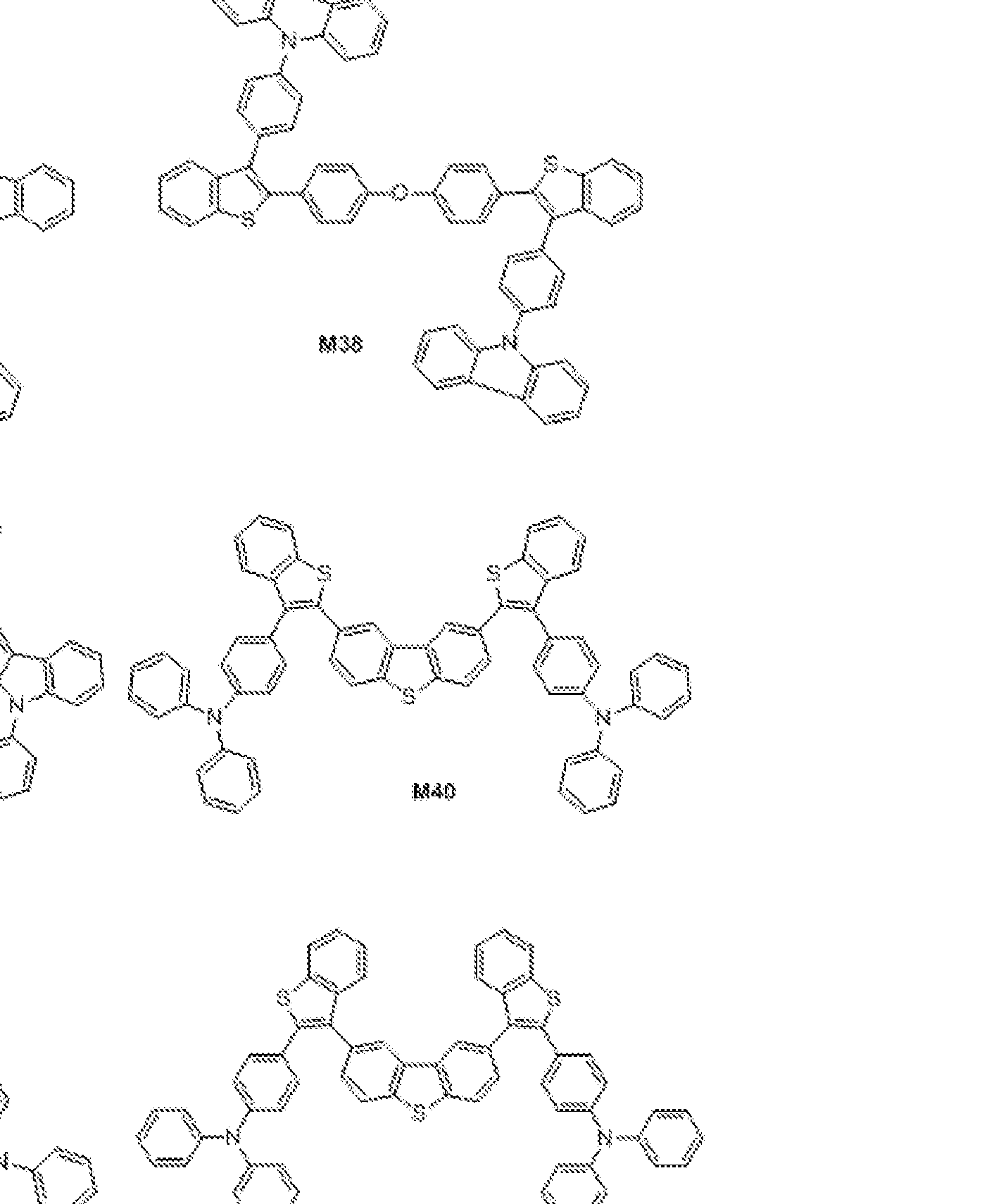
3.根据权利要求 1所述的苯并噻吩类衍生物, 其特征在于, 所述 Ri、 R2独立地选自 C4〜C40的
N-芳香基咔唑基、 咔唑基芳香基、 N-垸基咔唑基、 咔唑基、 垸基取代的咔唑基芳香基、 三芳胺基、 二芳胺基、 苯并噻吩基、 二苯并噻吩基、 芳香基取代的苯并噻吩基、 苯并呋喃基或二苯并呋喃基的 其中之一。
4.根据权利要求 1所述的苯并噻吩类衍生物, 其特征在于, 所述桥联基团 L选自单键、 N-垸基 基咔唑基、 二苯并噻吩基、 二苯并呋喃基、 三芳胺基、 N-芳香基咔唑基、 取代的二苯基醚、 取代的 二苯基硫。
5.根据权利要求 1所述的苯并噻吩类衍生物, 所述化合物结构式如下:
Figure imgf000071_0001
llOO/ClOZN3/X3d Z8CS.0/M0Z OAV
Figure imgf000072_0001
Figure imgf000072_0002
Figure imgf000073_0001
Figure imgf000073_0002
Figure imgf000074_0001
〈 c c
¾、
、¾
Figure imgf000075_0001
Figure imgf000076_0001
ϋυ/: 06πο1£
Figure imgf000077_0001
Figure imgf000078_0001
Figure imgf000079_0001
6.权利要求 1所述的苯并噻吩类衍生物在有机电致发光器件中用作空穴注入材料和 /或空穴传输 材料。
7.权利要求 1所述的苯并噻吩类衍生物在有机电致发光器件中用作有机发光材料的主体材料。
8.—种有机电致发光器件, 包括基板, 以及依次成型于所述基板上的阳极层、 有机发光功能层 和阴极层;
所述有机发光功能层所用材料包括空穴注入材料、 空穴传输材料、 有机发光材料以及电子传输 材料, 所述有机发光功能层所用材料为具有如下述结构式 (I) 所示的化合物:
Figure imgf000079_0002
(I) 其中:
Ri 独立地选自 C4〜C40的取代或非取代的芳胺基团、 C4〜C40的取代或非取代的咔唑基团、 C4〜C40的取代或非取代的苯并噻吩基团、 C4〜C40的取代或非取代苯并呋喃基团的其中之一; L为桥联基团, 选自单键、 C4〜C40的取代芳胺、 C4〜C40的取代咔唑、 C4〜C40的取代苯并噻 吩、 氧原子、 氮原子或硫原子的其中之一;
R3-R1()独立地选自 H原子、 d-C^的脂肪族直链或支链烃基或 C6-C3。的芳香族基团, 或者, 相 邻两个基团连接成环, 形成萘并噻吩衍生物;
m、 n选自 0-3的整数, 但 m加 n大于 0且小于等于 3。
9.一种有机电致发光器件, 包括基板, 以及依次成型于所述基板上的阳极层、 有机发光功能层 和阴极层;
所述有机发光功能层所用材料包括空穴注入材料、 空穴传输材料、 有机发光材料以及电子传输 材料, 所述空穴
Figure imgf000080_0001
其中:
Ri 独立地选自 C4〜C40的取代或非取代的芳胺基团、 C4〜C40的取代或非取代的咔唑基团、 C4〜C40的取代或非取代的苯并噻吩基团、 C4〜C40的取代或非取代苯并呋喃基团的其中之一;
L为桥联基团, 选自单键、 C4〜C40的取代芳胺、 C4〜C40的取代咔唑、 C4〜C40的取代苯并噻 吩、 氧原子、 氮原子或硫原子的其中之一;
R3-R1()独立地选自 H原子、 d-C^的脂肪族直链或支链烃基或 C6-C3。的芳香族基团, 或者, 相 邻两个基团连接成环, 形成萘并噻吩衍生物;
m、 n选自 0-3的整数, 但 m加 n大于 0且小于等于 3。
10.—种有机电致发光器件, 包括基板, 以及依次成型于所述基板上的阳极层、 有机发光功能层 和阴极层;
所述有机发光功能层所用材料包括空穴注入材料、 空穴传输材料、 有机发光材料以及电子传输 材料, 所述空穴传输材料为具有如下述结构式 (I) 所示的化合物:
Figure imgf000081_0001
(I) 其中:
Ri R2独立地选自 C4〜C40的取代或非取代的芳胺基团、 C4〜C40的取代或非取代的咔唑基团、 C4〜C40的取代或非取代的苯并噻吩基团、 C4〜C40的取代或非取代苯并呋喃基团的其中之一;
L为桥联基团, 选自单键、 C4〜C40的取代芳胺、 C4〜C40的取代咔唑、 C4〜C40的取代苯并噻 吩、 氧原子、 氮原子或硫原子的其中之一;
R3-R1()独立地选自 H原子、 d-C^的脂肪族直链或支链烃基或 C6-C3。的芳香族基团, 或者, 相 邻两个基团连接成环, 形成萘并噻吩衍生物;
m、 n选自 0-3的整数, 但 m加 n大于 0且小于等于 3。
11.一种有机电致发光器件, 包括基板, 以及依次成型于所述基板上的阳极层、 有机发光功能层 和阴极层;
所述有机发光功能层所用材料包括空穴注入材料、 空穴传输材料、 有机发光材料以及电子传输 材料, 所述有机
Figure imgf000081_0002
(I) 其中:
Ri 独立地选自 C4〜C40的取代或非取代的芳胺基团、 C4〜C40的取代或非取代的咔唑基团、 C4〜C40的取代或非取代的苯并噻吩基团、 C4〜C40的取代或者非取代苯并呋喃基团的其中之一;
L为桥联基团, 选自单键、 C4〜C40的取代芳胺、 C4〜C40的取代咔唑、 C4〜C40的取代苯并噻 吩、 氧原子、 氮原子或硫原子的其中之一; 。独立地选自 H原子、 d-C^的脂肪族直链或支链烃基或 C6-C3。的芳香族基团, 或者, 相 邻两个基团连接成环, 形成萘并噻吩衍生物;
m、 n选自 0-3的整数, 但 m加 n大于 0且小于等于 3。
PCT/CN2013/001190 2012-09-29 2013-09-30 苯并噻吩类衍生物及其在有机电致发光领域中的应用 Ceased WO2014075382A1 (zh)

Priority Applications (2)

Application Number Priority Date Filing Date Title
JP2015533410A JP6120972B2 (ja) 2012-09-29 2013-09-30 ベンゾチオフェン系誘導体及びその有機電界発光分野における応用
KR1020157011386A KR101778416B1 (ko) 2012-09-29 2013-09-30 벤조티오펜계 유도체 및 유기 전계 발광 분야에서의 그의 응용

Applications Claiming Priority (2)

Application Number Priority Date Filing Date Title
CN201210375135.7 2012-09-29
CN201210375135.7A CN103709153B (zh) 2012-09-29 2012-09-29 苯并噻吩类衍生物及其在有机电致发光领域中的应用

Publications (1)

Publication Number Publication Date
WO2014075382A1 true WO2014075382A1 (zh) 2014-05-22

Family

ID=50402542

Family Applications (1)

Application Number Title Priority Date Filing Date
PCT/CN2013/001190 Ceased WO2014075382A1 (zh) 2012-09-29 2013-09-30 苯并噻吩类衍生物及其在有机电致发光领域中的应用

Country Status (4)

Country Link
JP (1) JP6120972B2 (zh)
KR (1) KR101778416B1 (zh)
CN (1) CN103709153B (zh)
WO (1) WO2014075382A1 (zh)

Cited By (3)

* Cited by examiner, † Cited by third party
Publication number Priority date Publication date Assignee Title
WO2016178544A3 (ko) * 2015-05-06 2017-01-12 주식회사 동진쎄미켐 신규한 화합물 및 이를 포함하는 유기발광소자
WO2017064892A1 (ja) * 2015-10-13 2017-04-20 Jnc株式会社 ベンゾチオフェンを有する液晶性化合物、液晶組成物および液晶表示素子
CN112292767A (zh) * 2018-06-12 2021-01-29 三星Sdi株式会社 用于有机光电装置的组成物、有机光电装置及显示装置

Families Citing this family (13)

* Cited by examiner, † Cited by third party
Publication number Priority date Publication date Assignee Title
KR102227973B1 (ko) * 2014-03-19 2021-03-15 삼성전자주식회사 축합환 화합물 및 이를 포함한 유기 발광 소자
KR20150124050A (ko) * 2014-04-25 2015-11-05 삼성디스플레이 주식회사 카바졸계 화합물 및 이를 포함한 유기 발광 소자
CN121873021A (zh) * 2015-05-06 2026-04-17 东进世美肯株式会社 化合物及包含其的有机发光器件
KR102671576B1 (ko) * 2015-09-10 2024-06-05 주식회사 동진쎄미켐 신규한 화합물 및 이를 포함하는 유기발광소자
KR102062953B1 (ko) 2017-05-29 2020-01-06 주식회사 엘지화학 잉크 조성물, 이를 이용한 유기 발광 소자 및 이의 제조방법
WO2019076709A1 (en) 2017-10-19 2019-04-25 Basf Se NOVEL SUBSTITUTED BENZONAPHTHATHIOPHENES COMPOUNDS FOR ORGANIC ELECTRONIC ELEMENTS
CN109749058B (zh) * 2017-11-02 2020-12-01 中国科学院化学研究所 一种蒽并二噻吩酰亚胺聚合物及其制备方法与应用
EP3762979A1 (en) 2018-03-07 2021-01-13 Clap Co., Ltd. Patterning method for preparing top-gate, bottom-contact organic field effect transistors
CN110105262A (zh) * 2019-04-29 2019-08-09 武汉华星光电半导体显示技术有限公司 热活化延迟荧光分子材料及其合成方法、有机电致发光器件
US11613530B2 (en) 2019-04-29 2023-03-28 Wuhan China Star Optoelectronics Semiconductor Display Technology Co., Ltd. Thermally activated delayed fluorescent molecular material, method for synthesizing the same, and organic electroluminescent device
CN114213389B (zh) * 2021-12-30 2024-01-09 棓诺(苏州)新材料有限公司 苯并[b]萘并[2,3-d]噻吩的合成方法
CN116813606B (zh) * 2022-03-15 2026-03-06 江苏三月科技股份有限公司 一种含有萘并杂环基的咔唑类有机化合物及包含其的有机电致发光器件
CN119176792B (zh) * 2024-11-22 2025-03-21 棓诺(苏州)新材料有限公司 高激子关键中间体9-氯苯并[b]萘[1,2-d]噻吩的合成方法

Citations (2)

* Cited by examiner, † Cited by third party
Publication number Priority date Publication date Assignee Title
JP2001291590A (ja) * 2000-04-05 2001-10-19 Toray Ind Inc 発光素子
JP2001354668A (ja) * 2000-06-13 2001-12-25 Chisso Corp ベンゾチオフェン誘導体、及びそれを用いた有機電界発光素子

Family Cites Families (4)

* Cited by examiner, † Cited by third party
Publication number Priority date Publication date Assignee Title
CN100556899C (zh) * 2005-06-06 2009-11-04 清华大学 一种有机电致发光材料及其应用
CN100494209C (zh) * 2005-06-06 2009-06-03 清华大学 一种有机电致发光材料及其应用
CN100425599C (zh) * 2005-12-31 2008-10-15 清华大学 一种有机电致发光材料及其应用
CN101279969B (zh) * 2007-01-31 2011-03-30 北京维信诺科技有限公司 一种有机电致发光材料及其应用

Patent Citations (2)

* Cited by examiner, † Cited by third party
Publication number Priority date Publication date Assignee Title
JP2001291590A (ja) * 2000-04-05 2001-10-19 Toray Ind Inc 発光素子
JP2001354668A (ja) * 2000-06-13 2001-12-25 Chisso Corp ベンゾチオフェン誘導体、及びそれを用いた有機電界発光素子

Non-Patent Citations (1)

* Cited by examiner, † Cited by third party
Title
JAN, B. ET AL.,: "CYCLOCONDENSATION OF 3(2H)-BENZO[B]THIOPHENONE AND OXIDATION PRODUCTS OBTAINED DURING THESE REACTIONS", TETRAHEDRON, vol. 42, no. 2, 1986, pages 763 - 773 *

Cited By (6)

* Cited by examiner, † Cited by third party
Publication number Priority date Publication date Assignee Title
WO2016178544A3 (ko) * 2015-05-06 2017-01-12 주식회사 동진쎄미켐 신규한 화합물 및 이를 포함하는 유기발광소자
WO2017064892A1 (ja) * 2015-10-13 2017-04-20 Jnc株式会社 ベンゾチオフェンを有する液晶性化合物、液晶組成物および液晶表示素子
JPWO2017064892A1 (ja) * 2015-10-13 2018-09-13 Jnc株式会社 ベンゾチオフェンを有する液晶性化合物、液晶組成物および液晶表示素子
US20180290997A1 (en) * 2015-10-13 2018-10-11 Jnc Corporation Liquid crystal compound having benzothiophene, liquid crystal composition and liquid crystal display device
CN112292767A (zh) * 2018-06-12 2021-01-29 三星Sdi株式会社 用于有机光电装置的组成物、有机光电装置及显示装置
US12302751B2 (en) 2018-06-12 2025-05-13 Samsung Sdi Co., Ltd. Composition for organic optoelectronic device, organic optoelectronic device, and display device

Also Published As

Publication number Publication date
CN103709153B (zh) 2019-01-29
JP2015533118A (ja) 2015-11-19
KR20150065184A (ko) 2015-06-12
CN103709153A (zh) 2014-04-09
KR101778416B1 (ko) 2017-09-13
JP6120972B2 (ja) 2017-04-26

Similar Documents

Publication Publication Date Title
WO2014075382A1 (zh) 苯并噻吩类衍生物及其在有机电致发光领域中的应用
KR101127264B1 (ko) 새로운 유기 발광 소자 재료 및 이를 이용한 유기 발광 소자
JP5902655B2 (ja) 有機電子素子及びその化合物、端末
CN110003260B (zh) 硼杂环化合物、显示面板以及显示装置
TWI464234B (zh) 化合物、使用此化合物之有機電子元件及其電子裝置
CN103772263B (zh) 化合物和包含该化合物的有机发光装置
CN108864068A (zh) 一种化合物以及有机发光显示装置
CN103936653A (zh) 苯并咔唑类oled材料及其制备方法与应用
CN108285452A (zh) 一种嘧啶类衍生物及其应用
CN105646480B (zh) 啡啉类化合物及其用途
CN103772264A (zh) 化合物和包含该化合物的有机发光装置
CN112851700A (zh) 一种含有硼原子、氧族原子和五元芳杂环的稠环化合物及有机电致发光器件
CN104557875A (zh) 茚并吲哚环状化合物与在有机发光二极管中的应用
JP2012525378A (ja) 新規有機電界発光化合物およびこれを使用する有機電界発光素子
CN110655504A (zh) 一种以二苯并环庚烯为核心的化合物及其在有机电致发光器件上的应用
JP6860765B6 (ja) 化合物及びこれを含む有機発光素子
CN115583887A (zh) 一种有机电致发光化合物及其制备方法和应用
CN110218212A (zh) 氮杂环化合物、显示面板以及显示装置
CN105646488A (zh) 一种基于1,10-菲啰啉的主体材料及其制备方法与应用
CN111848642B (zh) 化合物、显示面板以及显示装置
CN111635420B (zh) 一种新型多杂环化合物及其应用
CN110016018B (zh) 化合物、显示面板以及显示装置
CN111995590A (zh) 一种新型有机电致发光化合物的合成及应用
TWI583682B (zh) 苯並噻吩類衍生物及其在有機電致發光領域中的應用
TWI574958B (zh) 化合物、有機發光二極體的發光層以及有機發光二極體裝置

Legal Events

Date Code Title Description
121 Ep: the epo has been informed by wipo that ep was designated in this application

Ref document number: 13854341

Country of ref document: EP

Kind code of ref document: A1

ENP Entry into the national phase

Ref document number: 2015533410

Country of ref document: JP

Kind code of ref document: A

NENP Non-entry into the national phase

Ref country code: DE

ENP Entry into the national phase

Ref document number: 20157011386

Country of ref document: KR

Kind code of ref document: A

122 Ep: pct application non-entry in european phase

Ref document number: 13854341

Country of ref document: EP

Kind code of ref document: A1