WO2014065321A1 - ガラス繊維用ガラス組成物、ガラス繊維及びガラス繊維の製造方法 - Google Patents
ガラス繊維用ガラス組成物、ガラス繊維及びガラス繊維の製造方法 Download PDFInfo
- Publication number
- WO2014065321A1 WO2014065321A1 PCT/JP2013/078698 JP2013078698W WO2014065321A1 WO 2014065321 A1 WO2014065321 A1 WO 2014065321A1 JP 2013078698 W JP2013078698 W JP 2013078698W WO 2014065321 A1 WO2014065321 A1 WO 2014065321A1
- Authority
- WO
- WIPO (PCT)
- Prior art keywords
- glass
- composition
- glass composition
- fiber
- temperature
- Prior art date
- Legal status (The legal status is an assumption and is not a legal conclusion. Google has not performed a legal analysis and makes no representation as to the accuracy of the status listed.)
- Ceased
Links
Classifications
-
- C—CHEMISTRY; METALLURGY
- C03—GLASS; MINERAL OR SLAG WOOL
- C03C—CHEMICAL COMPOSITION OF GLASSES, GLAZES OR VITREOUS ENAMELS; SURFACE TREATMENT OF GLASS; SURFACE TREATMENT OF FIBRES OR FILAMENTS MADE FROM GLASS, MINERALS OR SLAGS; JOINING GLASS TO GLASS OR OTHER MATERIALS
- C03C3/00—Glass compositions
- C03C3/04—Glass compositions containing silica
- C03C3/076—Glass compositions containing silica with 40% to 90% silica, by weight
-
- C—CHEMISTRY; METALLURGY
- C03—GLASS; MINERAL OR SLAG WOOL
- C03C—CHEMICAL COMPOSITION OF GLASSES, GLAZES OR VITREOUS ENAMELS; SURFACE TREATMENT OF GLASS; SURFACE TREATMENT OF FIBRES OR FILAMENTS MADE FROM GLASS, MINERALS OR SLAGS; JOINING GLASS TO GLASS OR OTHER MATERIALS
- C03C3/00—Glass compositions
- C03C3/04—Glass compositions containing silica
- C03C3/076—Glass compositions containing silica with 40% to 90% silica, by weight
- C03C3/083—Glass compositions containing silica with 40% to 90% silica, by weight containing aluminium oxide or an iron compound
- C03C3/085—Glass compositions containing silica with 40% to 90% silica, by weight containing aluminium oxide or an iron compound containing an oxide of a divalent metal
- C03C3/087—Glass compositions containing silica with 40% to 90% silica, by weight containing aluminium oxide or an iron compound containing an oxide of a divalent metal containing calcium oxide, e.g. common sheet or container glass
-
- C—CHEMISTRY; METALLURGY
- C03—GLASS; MINERAL OR SLAG WOOL
- C03B—MANUFACTURE, SHAPING, OR SUPPLEMENTARY PROCESSES
- C03B37/00—Manufacture or treatment of flakes, fibres, or filaments from softened glass, minerals, or slags
- C03B37/01—Manufacture of glass fibres or filaments
- C03B37/02—Manufacture of glass fibres or filaments by drawing or extruding, e.g. direct drawing of molten glass from nozzles; Cooling fins therefor
-
- C—CHEMISTRY; METALLURGY
- C03—GLASS; MINERAL OR SLAG WOOL
- C03C—CHEMICAL COMPOSITION OF GLASSES, GLAZES OR VITREOUS ENAMELS; SURFACE TREATMENT OF GLASS; SURFACE TREATMENT OF FIBRES OR FILAMENTS MADE FROM GLASS, MINERALS OR SLAGS; JOINING GLASS TO GLASS OR OTHER MATERIALS
- C03C13/00—Fibre or filament compositions
- C03C13/001—Alkali-resistant fibres
- C03C13/002—Alkali-resistant fibres containing zirconium
-
- C—CHEMISTRY; METALLURGY
- C03—GLASS; MINERAL OR SLAG WOOL
- C03C—CHEMICAL COMPOSITION OF GLASSES, GLAZES OR VITREOUS ENAMELS; SURFACE TREATMENT OF GLASS; SURFACE TREATMENT OF FIBRES OR FILAMENTS MADE FROM GLASS, MINERALS OR SLAGS; JOINING GLASS TO GLASS OR OTHER MATERIALS
- C03C3/00—Glass compositions
- C03C3/04—Glass compositions containing silica
- C03C3/076—Glass compositions containing silica with 40% to 90% silica, by weight
- C03C3/078—Glass compositions containing silica with 40% to 90% silica, by weight containing an oxide of a divalent metal, e.g. an oxide of zinc
-
- C—CHEMISTRY; METALLURGY
- C03—GLASS; MINERAL OR SLAG WOOL
- C03C—CHEMICAL COMPOSITION OF GLASSES, GLAZES OR VITREOUS ENAMELS; SURFACE TREATMENT OF GLASS; SURFACE TREATMENT OF FIBRES OR FILAMENTS MADE FROM GLASS, MINERALS OR SLAGS; JOINING GLASS TO GLASS OR OTHER MATERIALS
- C03C4/00—Compositions for glass with special properties
- C03C4/20—Compositions for glass with special properties for chemical resistant glass
Definitions
- the present invention relates to a glass composition for glass fiber having excellent corrosion resistance, glass fiber, and a method for producing glass fiber.
- a reinforcing material such as calcium silicate plate and GRC (glass fiber reinforced concrete) and as a material requiring corrosion resistance such as a battery separator and asbestos substitute
- a glass composition for glass fiber having excellent productivity particularly suitable as a reinforcing material such as calcium silicate plate and GRC (glass fiber reinforced concrete) and as a material requiring corrosion resistance such as a battery separator and asbestos substitute, and a glass composition for glass fiber having excellent productivity.
- the present invention relates to a method for producing fibers and glass fibers.
- a SiO 2 —ZrO 2 —R 2 O (R is Li, Na, K) -based ZrO 2 -containing alkali-resistant glass fiber as described in Patent Document 1 has been used. Yes.
- This glass fiber is also used as a corrosion-resistant material such as a reinforcing material for a calcium silicate plate and a battery separator.
- a molten glass is continuously formed and spun by using a noble metal bushing device to form a fiber shape.
- the bushing structure has a container shape for retaining molten glass, and a number of nozzles are arranged in the vertical direction at the bottom.
- Glass fiber is molded by drawing molten glass adjusted to a temperature around the molding temperature (also called spinning temperature, the temperature at which the viscosity of the glass is about 10 3 dPa ⁇ s) from the nozzle at the bottom of the bushing.
- the calcium silicate plate is produced in a predetermined shape by kneading glass fibers cut to a predetermined length together with Portland cement, silica powder, pulp, and the like in a mixer and then pouring them into a mold.
- an autoclave process is performed.
- alkali components such as NaOH, KOH, and Ca (OH) 2 in Portland cement are liable to deteriorate the glass fiber
- a glass fiber excellent in alkali resistance is required.
- excellent alkali resistance may be required for the purpose of suppressing the deterioration of the glass fiber.
- Patent Document 2 discloses a glass composition that maintains alkali resistance by reducing ZrO 2 and increasing the content of CaO. However, even in the invention of Patent Document 2, the spinning temperature and the liquidus temperature of the glass remain high. As described above, it has been difficult to obtain a glass composition for glass fiber having excellent alkali resistance and low glass spinning temperature and liquidus temperature and excellent productivity.
- the present invention has been made in view of the above circumstances, has excellent alkali resistance, acid resistance and water resistance, and is useful as a corrosion resistant material for composite materials such as calcium silicate plates and GRCs and battery separators.
- the glass composition for glass fiber of the present invention has a glass composition in terms of oxide mass%, SiO 2 50 to 65%, Al 2 O 3 0 to 5%, CaO 0 to 10%, Li 2 O + Na. 2 O + K 2 O 10-20%, Li 2 O 0-5%, Na 2 O 10-20%, K 2 O 0-5%, TiO 2 5-10%, ZrO 2 10-20%.
- Li 2 O + Na 2 O + K 2 O means the total content of Li 2 O, Na 2 O and K 2 O.
- the content of K 2 O is preferably less than 0.5%.
- the glass composition for glass fiber of the present invention SiO 2, Al 2 O 3 , CaO, Li 2 O, Na 2 O, K 2 O, at a content of TiO 2 and ZrO 2 is more than 98% in total Preferably there is.
- the spinning temperature of the glass composition for glass fibers of this invention is 1280 degrees C or less.
- the “spinning temperature” means a temperature at which the glass has a viscosity of 10 3 dPa ⁇ s.
- the glass composition for glass fiber of the present invention is a glass weight reduction when a glass having a specific gravity classified to a particle size of 300 to 500 ⁇ m is immersed in 100 ml of 10% by weight NaOH aqueous solution at 80 ° C. for 16 hours.
- the rate is preferably 3% or less.
- the glass composition for glass fiber of the present invention is a glass weight reduction when glass having a specific gravity classified to a particle size of 300 to 500 ⁇ m is immersed in 100 ml of a 10% by mass HCl aqueous solution at 80 ° C. for 16 hours.
- the rate is preferably 3% or less.
- the glass composition for glass fiber of the present invention preferably has an alkali elution amount of 0.40 mg or less according to JIS R3502.
- the difference between the spinning temperature and the liquidus temperature is preferably 80 ° C. or higher.
- the glass fiber of this invention consists of said glass composition for glass fibers.
- the method for producing glass fiber of the present invention has a glass composition of mass% in terms of oxides, SiO 2 50 to 65%, Al 2 O 3 0 to 5%, CaO 0 to 10%, Li 2 O + Na 2 O + K 2. It becomes a glass containing 10 to 20% of O 2 , 0 to 5% of Li 2 O, 10 to 20% of Na 2 O, 0 to 5% of K 2 O, 5 to 10% of TiO 2 , and 10 to 20% of ZrO 2
- the raw material batch prepared in the above is melted in a glass melting furnace, and the molten glass is continuously drawn from the bushing and formed into a fiber shape.
- the glass composition for glass fibers of the present invention has excellent alkali resistance, acid resistance and water resistance because it contains a large amount of TiO 2 . Therefore, the glass fiber which consists of the glass composition for glass fibers of this invention is useful as corrosion resistance materials, such as a reinforcing material of composite materials, such as a calcium silicate board and GRC, and a battery separator. And the glass composition for glass fibers of this invention is excellent in productivity from the spinning temperature and liquidus temperature of glass being low.
- the glass composition for glass fiber according to the embodiment of the present invention will be described.
- regulated the content as mentioned above are demonstrated.
- the% display indicates mass%, and the numerical range expressed using “to” includes the numerical values described before and after “to” as the lower limit value and the upper limit value. Means range.
- SiO 2 is a main component that forms a glass skeleton structure. Moreover, it is a component which improves the acid resistance of glass. On the other hand, too contains SiO 2 in a large amount together with the viscosity of the glass becomes high, thereby lowering the alkali resistance of the glass.
- the content of SiO 2 is 50 to 65%, preferably 55 to 65%, more preferably 57 to 61%. If the content of SiO 2 is less than 50%, the mechanical strength of the glass tends to decrease. Moreover, the acid resistance of glass falls. If the content of SiO 2 is more than 65%, the viscosity of the glass increases and the energy required for melting the glass increases. Further, the noble metal bushing is severely damaged, the replacement frequency is increased, and the production cost is increased. Moreover, the alkali resistance of glass falls.
- Al 2 O 3 is a component that increases the chemical durability and mechanical strength of glass.
- Al 2 O 3 is also a component that greatly increases the liquidus temperature of the glass.
- the content of Al 2 O 3 is 0 to 5%, preferably 0 to 3%, more preferably 0 to 1%. When the content of Al 2 O 3 is more than 5%, the liquidus temperature of the glass becomes productivity lowers high.
- CaO is a component that improves alkali resistance, particularly cement resistance, and lowers the viscosity of the glass.
- CaO is a component which raises the liquidus temperature of glass, when it contains too much.
- the content of CaO is 0 to 10%, preferably 0 to 7%. When there is more content of CaO than 10%, the liquidus temperature of glass will become high and productivity will fall.
- Li 2 O is an alkali metal oxide, Na 2 O, K 2 O reduces the viscosity of the glass is a component for enhancing the meltability and formability.
- the alkali metal oxide is a component that reduces the water resistance of the glass if contained in a large amount.
- the total content of Li 2 O, Na 2 O and K 2 O (Li 2 O + Na 2 O + K 2 O) is 10 to 20%, preferably 10 to 18%, more preferably 12 to 18%. If Li 2 O + Na 2 O + K 2 O is less than 10%, the viscosity of the glass increases and the energy required for melting the glass increases. Further, the noble metal bushing is severely damaged, the replacement frequency is increased, and the production cost is increased. When Li 2 O + Na 2 O + K 2 O is more than 20%, water resistance of glass decreases.
- Li 2 O is a component that lowers the viscosity of the glass and increases the meltability and moldability.
- the content of Li 2 O is 0 to 5%, preferably 0 to 3%. When the content of Li 2 O is more than 5%, crystals containing Li are easily precipitated from the molten glass. Since high Li 2 O is cost of the raw materials, the content is preferably small.
- Na 2 O is a component that improves the meltability and moldability of the glass by reducing the viscosity of the glass. On the other hand, if Na 2 O is contained in a large amount, the liquidus temperature of the glass is significantly increased or the water resistance of the glass is lowered.
- the content of Na 2 O is 10 to 20%, preferably 10 to 18%, more preferably 12 to 18%.
- the content of Na 2 O is less than 10%, the viscosity of the glass increases and the energy required for melting the glass increases. Further, the noble metal bushing is severely damaged, the replacement frequency is increased, and the production cost is increased.
- the content of Na 2 O is greater than 20%, the liquidus temperature of the glass becomes productivity lowers high. Moreover, the water resistance of the glass decreases.
- K 2 O is a component that improves the meltability and moldability of the glass by reducing the viscosity of the glass.
- the content of K 2 O is 0 to 5%, preferably 0 to 3%, more preferably 0 to 1%, still more preferably 0 to less than 0.5%.
- Note from the viewpoint of improving productivity is preferably contained as an essential component K 2 O. In that case, it is desirable to contain K 2 O in an amount of 0.1 to 5%, 0.15 to 3%, particularly 0.2 to 2%.
- TiO 2 is a component that greatly reduces the liquidus temperature of the glass by improving the water resistance and alkali resistance of the glass and lowering the spinning temperature.
- the content of TiO 2 is 5 to 10%, preferably 5 to 9%.
- the content of TiO 2 is less than 5%, the water resistance and alkali resistance of the glass are lowered.
- the spinning temperature and the liquidus temperature are increased and the productivity is lowered.
- the content of TiO 2 is more than 10%, the liquidus temperature of the glass becomes productivity lowers high.
- ZrO 2 is a component that improves the alkali resistance, acid resistance, and water resistance of the glass.
- the liquidus temperature of the glass is increased.
- the content of ZrO 2 is 10 to 20%, preferably 12 to 20%, more preferably 15 to 20%. If the content of ZrO 2 is less than 10%, the alkali resistance, acid resistance and water resistance of the glass are lowered. If the ZrO 2 content is more than 20%, the liquidus temperature of the glass becomes high and the productivity is lowered.
- the glass composition for glass fiber of the present invention may comprise the above-mentioned component (SiO 2, Al 2 O 3 , CaO, Li 2 O, Na 2 O, K 2 O, TiO 2 and ZrO 2) other than the component .
- SiO 2, Al 2 O 3 , CaO, Li 2 O, Na 2 O, K 2 O, TiO 2 and ZrO 2 other than the component .
- the reason for this is that when the total amount of these components is less than 98%, the alkali resistance, acid resistance and water resistance are lowered due to unintentional mixing of different components, and the product characteristics are lowered, or the liquidus temperature is increased. As a result, productivity may decrease.
- trace components such as H 2 , CO 2 , CO, H 2 O, He, Ne, Ar, and N 2 may be contained up to 0.1%.
- noble metal elements such as Pt, Rh, Au, to 500 ppm in glass.
- B 2 O 3 , MgO, SrO, BaO, ZnO, Fe 2 O 3 , P 2 O 5 , Cr 2 O 3 , Sb 2 O 3 , SO 3 , MnO, SnO 2 , CeO 2 , Cl 2 , La 2 O 3 , WO 3 , Nb 2 O 5 , Y 2 O 3 and the like may be contained up to 2% in total.
- the glass composition for glass fiber according to the present invention has a weight reduction rate when glass having a specific gravity classified to a particle size of 300 to 500 ⁇ m is immersed in 100 ml of 10% by weight NaOH aqueous solution at 80 ° C. for 16 hours. Is preferably 3% or less, particularly 2% or less, and more preferably 1.5% or less.
- the weight reduction rate of the glass by this alkali resistance test is higher than 3%, the alkali resistance of the glass is lowered, and the reliability as a reinforcing material of a composite material such as a calcium silicate plate or GRC may be lowered.
- the glass composition for glass fiber according to the present invention has a glass weight reduction rate when glass having a specific gravity classified to a particle size of 300 to 500 ⁇ m is immersed in 100 ml of a 10% by mass HCl aqueous solution at 80 ° C. for 16 hours. Is preferably 3% or less, particularly 2% or less, and more preferably 1.5% or less.
- the weight reduction rate of the glass by this acid resistance test is higher than 3%, the acid resistance of the glass is lowered, and the reliability as a corrosion resistant material such as a battery separator is lowered.
- the glass composition for glass fiber of the present invention preferably has an alkali elution amount of 0.40 mg or less, particularly 0.35 mg or less, more preferably 0.30 mg or less. If the alkali elution amount is more than 0.40 mg, the alkali component may be eluted from the glass during the autoclave treatment, and the glass may be easily deteriorated.
- the glass composition for glass fibers of the present invention preferably has a spinning temperature of 1280 ° C. or lower, particularly 1260 ° C. or lower. When the spinning temperature is higher than 1280 ° C., it is necessary to perform spinning at a high temperature, so that the noble metal bushing is seriously damaged, the replacement frequency is increased, and the production cost may be increased.
- the difference between the spinning temperature and the liquidus temperature is preferably 80 ° C. or higher, particularly 90 ° C. or higher. If the difference between the spinning temperature and the liquidus temperature is less than 80 ° C., the productivity may decrease.
- MM method marble melt method
- MM method marble melt method
- a glass raw material is prepared so that the glass contains Na 2 O 10 to 20%, K 2 O 0 to 5%, TiO 2 5 to 10%, and ZrO 2 10 to 20%.
- Glass cullet may be used for a part or all of the glass raw material. The reason why the content of each component is as described above is as described above, and the description is omitted here.
- the prepared glass raw material batch is put into a glass melting furnace, vitrified, melted and homogenized.
- the melting temperature is preferably about 1400 to 1600 ° C.
- molten glass is spun and formed into glass fibers. More specifically, molten glass is supplied to the bushing.
- the molten glass supplied to the bushing is continuously drawn out in filament form from a number of bushing nozzles provided on the bottom surface.
- Various processing agents are applied to the monofilaments drawn in this way, and glass fibers are obtained by focusing each monofilament.
- the glass fiber of the present invention thus formed is processed into chopped strands, yarns, rovings, etc. and used for various applications.
- the chopped strand is obtained by cutting glass fibers (strands) obtained by focusing glass monofilaments into a predetermined length.
- a yarn is a twisted strand.
- Roving is a combination of a plurality of strands wound in a cylindrical shape.
- Tables 1 to 6 show examples of the present invention (sample Nos. 1 to 23 and 25 to 30) and comparative examples (sample No. 24).
- Each sample in the table was prepared as follows. First, various glass raw materials, such as a natural raw material and a chemical raw material, were weighed and mixed so that it might become the glass composition in a table
- the molten glass obtained was poured into a refractory mold to form a plate-like glass, and then annealed in a slow cooling furnace (heated at a temperature 30 to 50 ° C. higher than the temperature at 10 13 dPa ⁇ s for 30 minutes) Then, the temperature range from the annealing point to the strain point was decreased at 1 ° C./min). About each obtained sample, alkali resistance, acid resistance, the amount of alkali elution, spinning temperature, and liquidus temperature were measured.
- the alkali resistance was measured as follows. First, the above plate glass sample is pulverized, glass having a particle size of 300 to 500 ⁇ m in diameter is precisely weighed by the specific gravity, and then immersed in 100 ml of 10 mass% NaOH solution at 80 ° C. for 16 hours. Shake on condition. Thereafter, the weight reduction rate of the glass sample was measured. The smaller this value, the better the alkali resistance.
- the acid resistance was measured as follows. First, the above plate glass sample is pulverized, glass having a particle size of 300 to 500 ⁇ m is precisely weighed by the specific gravity, and then immersed in 100 ml of a 10% by mass HCl solution at 80 ° C. for 16 hours. Shake on condition. Thereafter, the weight reduction rate of the glass sample was measured. The smaller this value, the better the acid resistance.
- the alkali elution amount was measured by a method based on JIS R3502 (1995). The smaller this value, the better the water resistance.
- the spinning temperature was measured as follows. First, a plate-like glass sample was crushed to an appropriate size and put into an alumina crucible so as to prevent air bubbles from being involved. Subsequently, the alumina crucible was heated to bring the sample into a molten state, and the viscosity of the glass at a plurality of temperatures was determined by a platinum ball pulling method. Thereafter, a viscosity curve was created from the obtained plurality of measured values, and the temperature at which 10 3 dPa ⁇ s was obtained was calculated by interpolation. The liquid phase temperature was measured as follows.
- a plate-like glass sample was pulverized, and filled in a fire-resistant container having an appropriate bulk density in a state adjusted to have a particle size in the range of 300 to 500 ⁇ m.
- the refractory container was placed in an indirect heating type temperature gradient furnace having a maximum temperature set to 1250 ° C. and left to stand for 16 hours in an air atmosphere.
- the test body was taken out from the temperature gradient furnace together with the refractory container, cooled to room temperature, and then the liquid phase temperature was specified by a polarizing microscope. The difference between the spinning temperature and the liquidus temperature was calculated from both values.
- each sample of the examples has a weight loss rate of 3% or less, an alkali elution amount of 0.40 mg or less, and a spinning temperature of 1280 ° C. or less, which are indicators of alkali resistance and acid resistance.
- the difference between the spinning temperature and the liquidus temperature was 80 ° C. or higher.
- sample no. No. 24 had a spinning temperature higher than 1280 ° C.
- the glass composition of the present invention can be suitably used as a glass fiber useful as a reinforcing material for a composite material such as a calcium silicate plate or GRC, and a corrosion-resistant material such as a battery separator.
Landscapes
- Chemical & Material Sciences (AREA)
- Engineering & Computer Science (AREA)
- General Chemical & Material Sciences (AREA)
- Life Sciences & Earth Sciences (AREA)
- Geochemistry & Mineralogy (AREA)
- Materials Engineering (AREA)
- Organic Chemistry (AREA)
- Chemical Kinetics & Catalysis (AREA)
- General Life Sciences & Earth Sciences (AREA)
- Manufacturing & Machinery (AREA)
- Glass Compositions (AREA)
Abstract
優れた耐アルカリ性、耐酸性及び耐水性を有し、ケイ酸カルシウム板やGRC等の複合材料の補強材及びバッテリーセパレータ等の耐食性材料として有用であり、ガラスの紡糸温度と液相温度が低く生産性に優れたガラス繊維用ガラス組成物を提供する。ガラス組成として、酸化物換算の質量%で、SiO2 50~65%、Al2O3 0~5%、CaO 0~10%、Li2O+Na2O+K2O 10~20%、Li2O 0~5%、Na2O 10~20%、K2O 0~5%、TiO2 5~10%、ZrO2 10~20%を含有する。
Description
本発明は、耐食性に優れたガラス繊維用ガラス組成物、ガラス繊維及びガラス繊維の製造方法に関する。特にケイ酸カルシウム板やGRC(ガラス繊維強化コンクリート)等の補強材として、またバッテリーセパレータやアスベスト代替品等の耐食性が要求される材料として適し、生産性に優れたガラス繊維用ガラス組成物、ガラス繊維及びガラス繊維の製造方法に関するものである。
従来、GRCの補強材としては、特許文献1に記載されているようなSiO2-ZrO2-R2O(RはLi、Na、K)系のZrO2含有耐アルカリ性ガラス繊維が使用されている。
またこのガラス繊維は、ケイ酸カルシウム板の補強材やバッテリーセパレータ等の耐食性材料としても使用されている。
またこのガラス繊維は、ケイ酸カルシウム板の補強材やバッテリーセパレータ等の耐食性材料としても使用されている。
前述のようなガラス繊維は、例えば、貴金属製のブッシング装置を使用して、溶融ガラスを連続的に成形、紡糸し、繊維形状にしたものが使用される。尚、ブッシングの構造は、溶融ガラスを滞留させるために容器形状を有しており、その底部には鉛直方向に多数のノズルが配設されている。ガラス繊維は、成形温度(紡糸温度とも呼ばれ、ガラスの粘度が約103dPa・sとなる温度)付近の温度に調整された溶融ガラスをブッシング底部のノズルから繊維状に引き出すことで成形される。
ケイ酸カルシウム板は、所定の長さに切断されたガラス繊維を、ポルトランドセメント、シリカ粉、パルプ等と共にミキサー中で混練した後、型枠内に流し込むことによって所定形状に作製される。ケイ酸カルシウム板を押し出し成形法によって作製する場合、オートクレーブ処理が施される。この際にポルトランドセメント中のNaOH、KOH、Ca(OH)2等のアルカリ成分がガラス繊維を劣化させやすいため、耐アルカリ性に優れたガラス繊維が必要とされている。
またGRC以外の用途においても、ガラス繊維の劣化を抑える目的で、優れた耐アルカリ性が必要とされる場合がある。
またGRC以外の用途においても、ガラス繊維の劣化を抑える目的で、優れた耐アルカリ性が必要とされる場合がある。
耐アルカリ性向上の観点からは、特許文献1に記載されているように、ガラス組成中にZrO2を多量に含有させることが有効である。しかしガラス組成中にZrO2を多量に含有させると、ガラスの紡糸温度と液相温度が高くなってしまう。
ガラスの紡糸温度や液相温度が高いと、高温でのガラス溶融を必要とするため、貴金属製のブッシング装置の損傷が激しくなる。結果としてブッシング装置の交換頻度が高くなって生産コストが高くなるという問題があった。
ガラスの紡糸温度や液相温度が高いと、高温でのガラス溶融を必要とするため、貴金属製のブッシング装置の損傷が激しくなる。結果としてブッシング装置の交換頻度が高くなって生産コストが高くなるという問題があった。
特許文献2にはZrO2を低減させ、CaOの含有量を多くすることによって耐アルカリ性を維持したガラス組成物が開示されている。しかし特許文献2の発明においても、ガラスの紡糸温度と液相温度は高いままである。
このように、優れた耐アルカリ性を有し、またガラスの紡糸温度と液相温度が低く生産性に優れたガラス繊維用ガラス組成物を得ることは困難であった。
このように、優れた耐アルカリ性を有し、またガラスの紡糸温度と液相温度が低く生産性に優れたガラス繊維用ガラス組成物を得ることは困難であった。
本発明は、上記事情に鑑みなされたものであり、優れた耐アルカリ性、耐酸性及び耐水性を有し、ケイ酸カルシウム板やGRC等の複合材料の補強材及びバッテリーセパレータ等の耐食性材料として有用であり、しかもガラスの紡糸温度と液相温度が低く生産性に優れたガラス繊維用ガラス組成物、ガラス繊維及びガラス繊維の製造方法を提供することを目的とするものである。
本発明者は鋭意検討の結果、ガラス組成を以下のように厳密に規定することによって、上記課題を解決できることを見出し、本発明として提案するものである。
即ち、本発明のガラス繊維用ガラス組成物は、ガラス組成として、酸化物換算の質量%で、SiO2 50~65%、Al2O3 0~5%、CaO 0~10%、Li2O+Na2O+K2O 10~20%、Li2O 0~5%、Na2O 10~20%、K2O 0~5%、TiO2 5~10%、ZrO2 10~20%を含有する。ここで「Li2O+Na2O+K2O」は、Li2O、Na2O及びK2Oの含有量の合量を意味している。
即ち、本発明のガラス繊維用ガラス組成物は、ガラス組成として、酸化物換算の質量%で、SiO2 50~65%、Al2O3 0~5%、CaO 0~10%、Li2O+Na2O+K2O 10~20%、Li2O 0~5%、Na2O 10~20%、K2O 0~5%、TiO2 5~10%、ZrO2 10~20%を含有する。ここで「Li2O+Na2O+K2O」は、Li2O、Na2O及びK2Oの含有量の合量を意味している。
また、本発明のガラス繊維用ガラス組成物は、K2Oの含有量が0.5%未満であることが好ましい。
また本発明のガラス繊維用ガラス組成物は、SiO2、Al2O3、CaO、Li2O、Na2O、K2O、TiO2及びZrO2の含有量が合量で98%以上であることが好ましい。
また本発明のガラス繊維用ガラス組成物は、紡糸温度が1280℃以下であることが好ましい。本発明において「紡糸温度」とは、ガラスの粘度が103dPa・sとなる温度を意味する。
また本発明のガラス繊維用ガラス組成物は、SiO2、Al2O3、CaO、Li2O、Na2O、K2O、TiO2及びZrO2の含有量が合量で98%以上であることが好ましい。
また本発明のガラス繊維用ガラス組成物は、紡糸温度が1280℃以下であることが好ましい。本発明において「紡糸温度」とは、ガラスの粘度が103dPa・sとなる温度を意味する。
また本発明のガラス繊維用ガラス組成物は、300~500μmの粒度に分級された比重分の重量のガラスを10質量%のNaOH水溶液100ml中に80℃、16時間浸漬した時のガラスの重量減少率が3%以下であることが好ましい。
本発明のガラス繊維用ガラス組成物は、300~500μmの粒度に分級された比重分の重量のガラスを、10質量%のHCl水溶液100ml中に80℃、16時間浸漬した時のガラスの重量減少率が3%以下であることが好ましい。
本発明のガラス繊維用ガラス組成物は、JIS R3502によるアルカリ溶出量が0.40mg以下であることが好ましい。
本発明のガラス繊維用ガラス組成物は、紡糸温度と液相温度の差が80℃以上であることが好ましい。
本発明のガラス繊維用ガラス組成物は、300~500μmの粒度に分級された比重分の重量のガラスを、10質量%のHCl水溶液100ml中に80℃、16時間浸漬した時のガラスの重量減少率が3%以下であることが好ましい。
本発明のガラス繊維用ガラス組成物は、JIS R3502によるアルカリ溶出量が0.40mg以下であることが好ましい。
本発明のガラス繊維用ガラス組成物は、紡糸温度と液相温度の差が80℃以上であることが好ましい。
本発明のガラス繊維は、上記のガラス繊維用ガラス組成物からなる。
本発明のガラス繊維の製造方法は、ガラス組成として、酸化物換算の質量%で、SiO2 50~65%、Al2O3 0~5%、CaO 0~10%、Li2O+Na2O+K2O 10~20%、Li2O 0~5%、Na2O 10~20%、K2O 0~5%、TiO2 5~10%、ZrO2 10~20%を含有するガラスとなるように調合した原料バッチをガラス溶融炉で溶融し、溶融ガラスをブッシングから連続的に引き出して繊維状に成形する。
本発明のガラス繊維の製造方法は、ガラス組成として、酸化物換算の質量%で、SiO2 50~65%、Al2O3 0~5%、CaO 0~10%、Li2O+Na2O+K2O 10~20%、Li2O 0~5%、Na2O 10~20%、K2O 0~5%、TiO2 5~10%、ZrO2 10~20%を含有するガラスとなるように調合した原料バッチをガラス溶融炉で溶融し、溶融ガラスをブッシングから連続的に引き出して繊維状に成形する。
本発明のガラス繊維用ガラス組成物は、TiO2を多量に含有するために優れた耐アルカリ性、耐酸性及び耐水性を有する。よって本発明のガラス繊維用ガラス組成物からなるガラス繊維は、ケイ酸カルシウム板やGRC等の複合材料の補強材及びバッテリーセパレータ等の耐食性材料として有用である。しかも本発明のガラス繊維用ガラス組成物は、ガラスの紡糸温度と液相温度が低いことから生産性に優れている。
以下、本発明の実施形態のガラス繊維用ガラス組成物について説明する。まず、本発明のガラスを構成する成分の作用と、その含有量を上記のように規定した理由を説明する。尚、各成分の含有範囲の説明において、%表示は質量%を指し、「~」を用いて表される数値範囲は、「~」の前後に記載される数値を下限値及び上限値として含む範囲を意味する。
SiO2は、ガラス骨格構造を形成する主要成分である。また、ガラスの耐酸性を向上させる成分である。一方、SiO2を多量に含有しすぎるとガラスの粘度が高くなるとともに、ガラスの耐アルカリ性を低下させる。SiO2の含有量は50~65%、好ましくは55~65%、より好ましくは57~61%である。SiO2の含有量が50%より少ないと、ガラスの機械的強度が低下し易くなる。また、ガラスの耐酸性が低下する。SiO2の含有量が65%より多いと、ガラスの粘度が高くなってガラスの溶融に必要なエネルギーが増大する。また貴金属製ブッシングの損傷が激しくなって交換頻度が高くなり、生産コストが高くなる。また、ガラスの耐アルカリ性が低下する。
Al2O3は、ガラスの化学的耐久性や機械的強度を高める成分である。一方、Al2O3は、ガラスの液相温度を大幅に高める成分でもある。Al2O3の含有量は0~5%、好ましくは0~3%、より好ましくは0~1%である。Al2O3の含有量が5%よりも多いと、ガラスの液相温度が高くなって生産性が低下する。
CaOは、耐アルカリ性、特に耐セメント性を向上させるとともに、ガラスの粘度を低下させる成分である。一方、CaOは、多量に含有しすぎるとガラスの液相温度を高める成分である。CaOの含有量は0~10%、好ましくは0~7%である。CaOの含有量が10%より多いと、ガラスの液相温度が高くなって生産性が低下する。
CaOは、耐アルカリ性、特に耐セメント性を向上させるとともに、ガラスの粘度を低下させる成分である。一方、CaOは、多量に含有しすぎるとガラスの液相温度を高める成分である。CaOの含有量は0~10%、好ましくは0~7%である。CaOの含有量が10%より多いと、ガラスの液相温度が高くなって生産性が低下する。
アルカリ金属酸化物であるLi2O、Na2O、K2Oはガラスの粘度を低下させ、溶融性や成形性を高める成分である。一方、アルカリ金属酸化物は、多量に含有しすぎるとガラスの耐水性を低下させてしまう成分である。Li2O、Na2O及びK2Oの含有量の合量(Li2O+Na2O+K2O)は10~20%、好ましくは10~18%、より好ましくは12~18%である。Li2O+Na2O+K2Oが10%より少ないと、ガラスの粘度が高くなってガラスの溶融に必要なエネルギーが増大する。また貴金属製ブッシングの損傷が激しくなって交換頻度が高くなり、生産コストが高くなる。Li2O+Na2O+K2Oが20%より多いと、ガラスの耐水性が低下する。
Li2Oはガラスの粘度を低下させ、溶融性や成形性を高める成分である。Li2Oの含有量は0~5%、好ましくは0~3%である。Li2Oの含有量が5%よりも多いと、溶融ガラスからLiを含む結晶が析出し易くなる。尚、Li2Oは原料のコストが高いため、含有量は少ない方が好ましい。
Na2Oはガラスの粘度を低下させることによって、ガラスの溶融性や成形性を高める成分である。一方、Na2Oは、多量に含有しすぎるとガラスの液相温度を大幅に高めたり、ガラスの耐水性を低下させてしまう。Na2Oの含有量は10~20%、好ましくは10~18%、より好ましくは12~18%である。Na2Oの含有量が10%より少ないと、ガラスの粘度が高くなってガラスの溶融に必要なエネルギーが増大する。また貴金属製ブッシングの損傷が激しくなって交換頻度が高くなり、生産コストが高くなる。Na2Oの含有量が20%より多いと、ガラスの液相温度が高くなって生産性が低下する。また、ガラスの耐水性が低下する。
Na2Oはガラスの粘度を低下させることによって、ガラスの溶融性や成形性を高める成分である。一方、Na2Oは、多量に含有しすぎるとガラスの液相温度を大幅に高めたり、ガラスの耐水性を低下させてしまう。Na2Oの含有量は10~20%、好ましくは10~18%、より好ましくは12~18%である。Na2Oの含有量が10%より少ないと、ガラスの粘度が高くなってガラスの溶融に必要なエネルギーが増大する。また貴金属製ブッシングの損傷が激しくなって交換頻度が高くなり、生産コストが高くなる。Na2Oの含有量が20%より多いと、ガラスの液相温度が高くなって生産性が低下する。また、ガラスの耐水性が低下する。
K2Oはガラスの粘度を低下させることによって、ガラスの溶融性や成形性を高める成分である。一方、K2Oは、多量に含有しすぎるとガラスの液相温度を高めてしまう。K2Oの含有量は0~5%、好ましくは0~3%、より好ましくは0~1%、さらに好ましくは0~0.5%未満である。なお生産性向上の観点からはK2Oを必須成分として含有させることが好ましい。その場合、K2Oは0.1~5%、0.15~3%、特に0.2~2%含有させることが望ましい。
TiO2は、ガラスの耐水性と耐アルカリ性を向上させると共に、紡糸温度を低下させることによって、ガラスの液相温度を大幅に低下させる成分である。一方、TiO2は、多量に含有しすぎるとガラスの液相温度を大幅に高めてしまう。TiO2の含有量は、5~10%、好ましくは5~9%である。TiO2の含有量が5%より少ないと、ガラスの耐水性と耐アルカリ性が低下する。また、紡糸温度と液相温度が高くなって生産性が低下する。TiO2の含有量が10%より多いと、ガラスの液相温度が高くなって生産性が低下する。
ZrO2は、ガラスの耐アルカリ性、耐酸性及び耐水性を向上させる成分である。一方、ZrO2は、多量に含有しすぎるとガラスの液相温度を高めてしまう。ZrO2の含有量は10~20%、好ましくは12~20%、より好ましくは15~20%である。ZrO2の含有量が10%より少ないと、ガラスの耐アルカリ性、耐酸性及び耐水性が低下する。ZrO2の含有量が20%より多いと、ガラスの液相温度が高くなって生産性が低下する。
ZrO2は、ガラスの耐アルカリ性、耐酸性及び耐水性を向上させる成分である。一方、ZrO2は、多量に含有しすぎるとガラスの液相温度を高めてしまう。ZrO2の含有量は10~20%、好ましくは12~20%、より好ましくは15~20%である。ZrO2の含有量が10%より少ないと、ガラスの耐アルカリ性、耐酸性及び耐水性が低下する。ZrO2の含有量が20%より多いと、ガラスの液相温度が高くなって生産性が低下する。
また本発明のガラス繊維用ガラス組成物は、上記した成分(SiO2、Al2O3、CaO、Li2O、Na2O、K2O、TiO2及びZrO2)以外の成分を含みうる。ただし上記した成分の含有量が合量で98%以上、特に99%以上となるように組成を調節することが望ましい。その理由は、これらの成分の合量が98%未満の場合、意図しない異種成分の混入によって耐アルカリ性、耐酸性、耐水性が低下して製品としての特性が低下したり、液相温度が上昇して生産性が低下したりする等が生じることがある。
上記した成分以外の成分として、例えばH2、CO2、CO、H2O、He、Ne、Ar、N2等の微量成分をそれぞれ0.1%まで含有してもよい。また、ガラス中にPt、Rh、Au等の貴金属元素を500ppmまで添加してもよい。
さらに耐アルカリ性、耐酸性、耐水性、液相温度の改善のために、B2O3、MgO、SrO、BaO、ZnO、Fe2O3、P2O5、Cr2O3、Sb2O3、SO3、MnO、SnO2、CeO2、Cl2、La2O3、WO3、Nb2O5、Y2O3等を合量で2%まで含有してもよい。
上記した成分以外の成分として、例えばH2、CO2、CO、H2O、He、Ne、Ar、N2等の微量成分をそれぞれ0.1%まで含有してもよい。また、ガラス中にPt、Rh、Au等の貴金属元素を500ppmまで添加してもよい。
さらに耐アルカリ性、耐酸性、耐水性、液相温度の改善のために、B2O3、MgO、SrO、BaO、ZnO、Fe2O3、P2O5、Cr2O3、Sb2O3、SO3、MnO、SnO2、CeO2、Cl2、La2O3、WO3、Nb2O5、Y2O3等を合量で2%まで含有してもよい。
本発明のガラス繊維用ガラス組成物は、300~500μmの粒度に分級された比重分の重量のガラスを10質量%のNaOH水溶液100ml中に80℃、16時間浸漬した時のガラスの重量減少率が3%以下、特に2%以下、さらには1.5%以下であることが好ましい。この耐アルカリ性試験によるガラスの重量減少率が3%よりも高いと、ガラスの耐アルカリ性が低下し、ケイ酸カルシウム板やGRC等の複合材料の補強材としての信頼性が低くなることがある。
本発明のガラス繊維用ガラス組成物は、300~500μmの粒度に分級された比重分の重量のガラスを10質量%のHCl水溶液100ml中に80℃、16時間浸漬した時のガラスの重量減少率が3%以下、特に2%以下、さらには1.5%以下であることが好ましい。この耐酸性試験によるガラスの重量減少率が3%よりも高いと、ガラスの耐酸性が低下し、バッテリーセパレータ等の耐食性材料としての信頼性が低下する。
本発明のガラス繊維用ガラス組成物は、300~500μmの粒度に分級された比重分の重量のガラスを10質量%のHCl水溶液100ml中に80℃、16時間浸漬した時のガラスの重量減少率が3%以下、特に2%以下、さらには1.5%以下であることが好ましい。この耐酸性試験によるガラスの重量減少率が3%よりも高いと、ガラスの耐酸性が低下し、バッテリーセパレータ等の耐食性材料としての信頼性が低下する。
本発明のガラス繊維用ガラス組成物は、アルカリ溶出量が0.40mg以下、特に0.35mg以下、さらには0.30mg以下であることが好ましい。アルカリ溶出量が0.40mgよりも多いと、オートクレーブ処理中にガラスからアルカリ成分が溶出して、ガラスが劣化しやすくなることがある。
本発明のガラス繊維用ガラス組成物は、紡糸温度が1280℃以下、特に1260℃以下であることが好ましい。紡糸温度が1280℃より高いと、高温で紡糸を行う必要があることから、貴金属製ブッシングの損傷が激しくなり、交換頻度が高くなって生産コストが高くなることがある。
本発明のガラス繊維用ガラス組成物は、紡糸温度と液相温度の差が80℃以上、特に90℃以上であることが好ましい。紡糸温度と液相温度の差が80℃よりも小さいと、生産性が低下することがある。
本発明のガラス繊維用ガラス組成物は、紡糸温度が1280℃以下、特に1260℃以下であることが好ましい。紡糸温度が1280℃より高いと、高温で紡糸を行う必要があることから、貴金属製ブッシングの損傷が激しくなり、交換頻度が高くなって生産コストが高くなることがある。
本発明のガラス繊維用ガラス組成物は、紡糸温度と液相温度の差が80℃以上、特に90℃以上であることが好ましい。紡糸温度と液相温度の差が80℃よりも小さいと、生産性が低下することがある。
次に本発明のガラス繊維を製造する方法を、ダイレクトメルト法(DM法)を例にして説明する。なお本発明は下記の方法に制限されるものではなく、例えばマーブル状に成形した繊維用ガラス材料をブッシング装置で再溶融し紡糸する、いわゆる間接成形法(MM法:マーブルメルト法)を採用することもできる。この方法は少量多品種生産に向いている。
まず酸化物換算の質量%で、SiO2 50~65%、Al2O3 0~5%、CaO 0~10%、Li2O+Na2O+K2O 10~20%、Li2O 0~5%、Na2O 10~20%、K2O 0~5%、TiO2 5~10%、ZrO2 10~20%を含有するガラスとなるようにガラス原料を調合する。なおガラス原料の一部又は全部にガラスカレットを使用してもよい。各成分の含有量を上記の通りとした理由は既述の通りであり、ここでは説明を省略する。
まず酸化物換算の質量%で、SiO2 50~65%、Al2O3 0~5%、CaO 0~10%、Li2O+Na2O+K2O 10~20%、Li2O 0~5%、Na2O 10~20%、K2O 0~5%、TiO2 5~10%、ZrO2 10~20%を含有するガラスとなるようにガラス原料を調合する。なおガラス原料の一部又は全部にガラスカレットを使用してもよい。各成分の含有量を上記の通りとした理由は既述の通りであり、ここでは説明を省略する。
次いで、調合したガラス原料バッチをガラス溶融炉に投入し、ガラス化し、溶融、均質化する。溶融温度は1400~1600℃程度が好適である。
続いて溶融ガラスを紡糸してガラス繊維に成形する。詳述すると、溶融ガラスをブッシングに供給する。ブッシングに供給された溶融ガラスは、その底面に設けられた多数のブッシングノズルからフィラメント状に連続的に引き出される。このようにして引き出されたモノフィラメントに各種処理剤を塗布し、所定本数毎に集束することによってガラス繊維を得る。
このようにして成形された本発明のガラス繊維は、チョップドストランド、ヤーン、ロービング等に加工され、種々の用途に供される。
なおチョップドストランドとは、ガラスモノフィラメントを集束したガラス繊維(ストランド)を所定長の長さに切断したものである。ヤーンとは、ストランドに撚りをかけたものである。ロービングとは、ストランドを複数本合糸し、円筒状に巻き取ったものである。
続いて溶融ガラスを紡糸してガラス繊維に成形する。詳述すると、溶融ガラスをブッシングに供給する。ブッシングに供給された溶融ガラスは、その底面に設けられた多数のブッシングノズルからフィラメント状に連続的に引き出される。このようにして引き出されたモノフィラメントに各種処理剤を塗布し、所定本数毎に集束することによってガラス繊維を得る。
このようにして成形された本発明のガラス繊維は、チョップドストランド、ヤーン、ロービング等に加工され、種々の用途に供される。
なおチョップドストランドとは、ガラスモノフィラメントを集束したガラス繊維(ストランド)を所定長の長さに切断したものである。ヤーンとは、ストランドに撚りをかけたものである。ロービングとは、ストランドを複数本合糸し、円筒状に巻き取ったものである。
以下、実施例に基づいて、本発明を詳細に説明する。
表1~表6は、本発明の実施例(試料No.1~23、25~30)及び比較例(試料No.24)を示している。
表1~表6は、本発明の実施例(試料No.1~23、25~30)及び比較例(試料No.24)を示している。

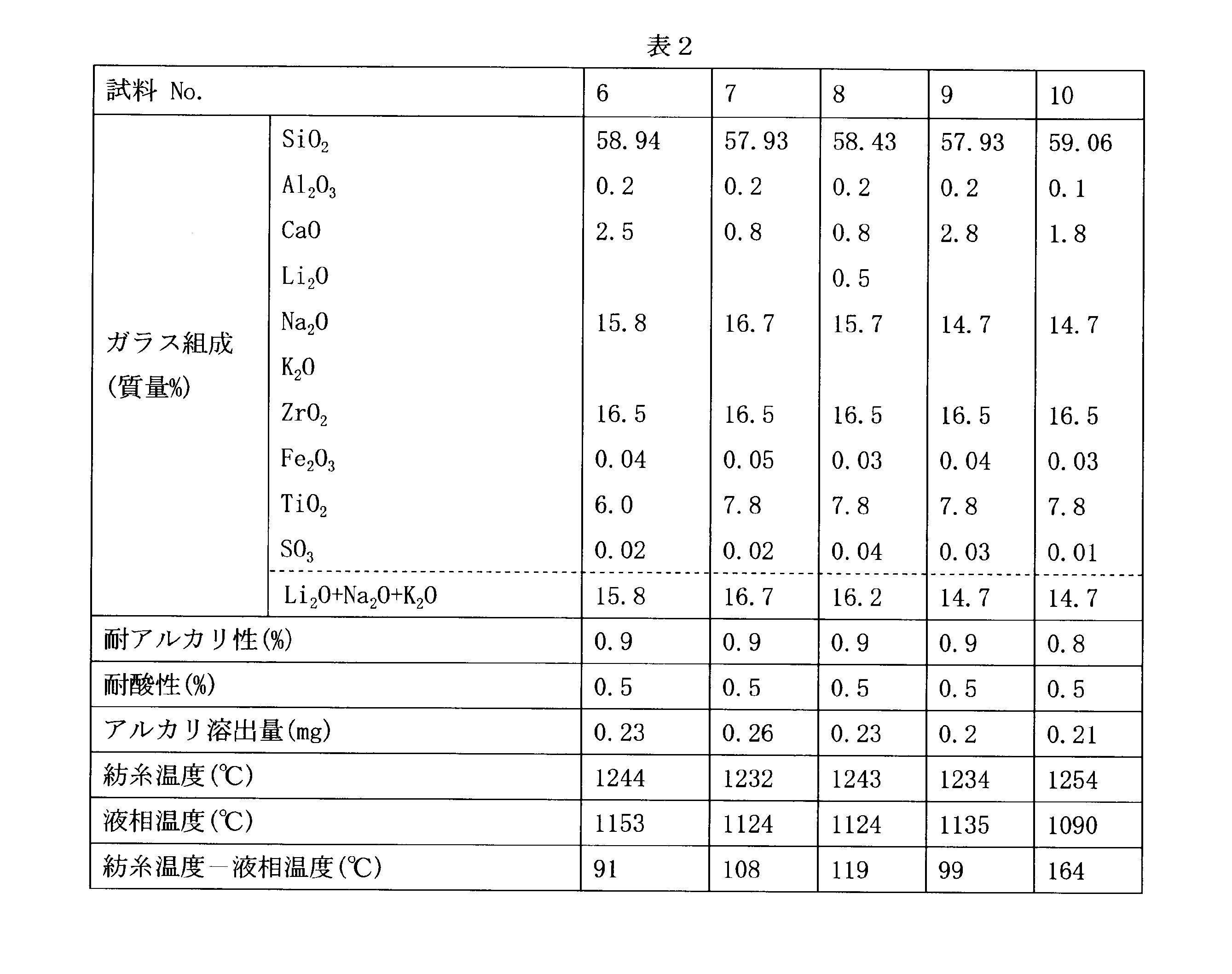
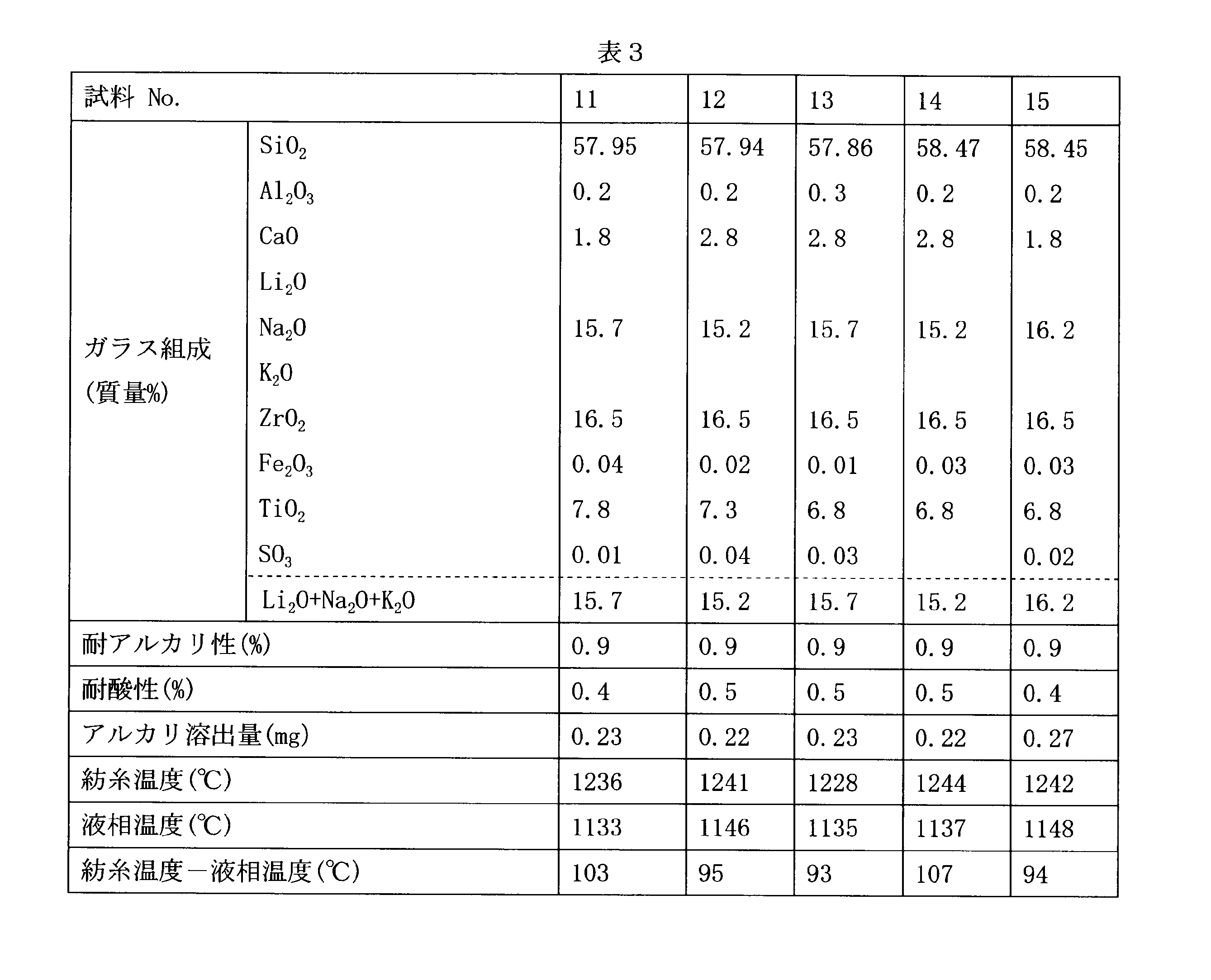
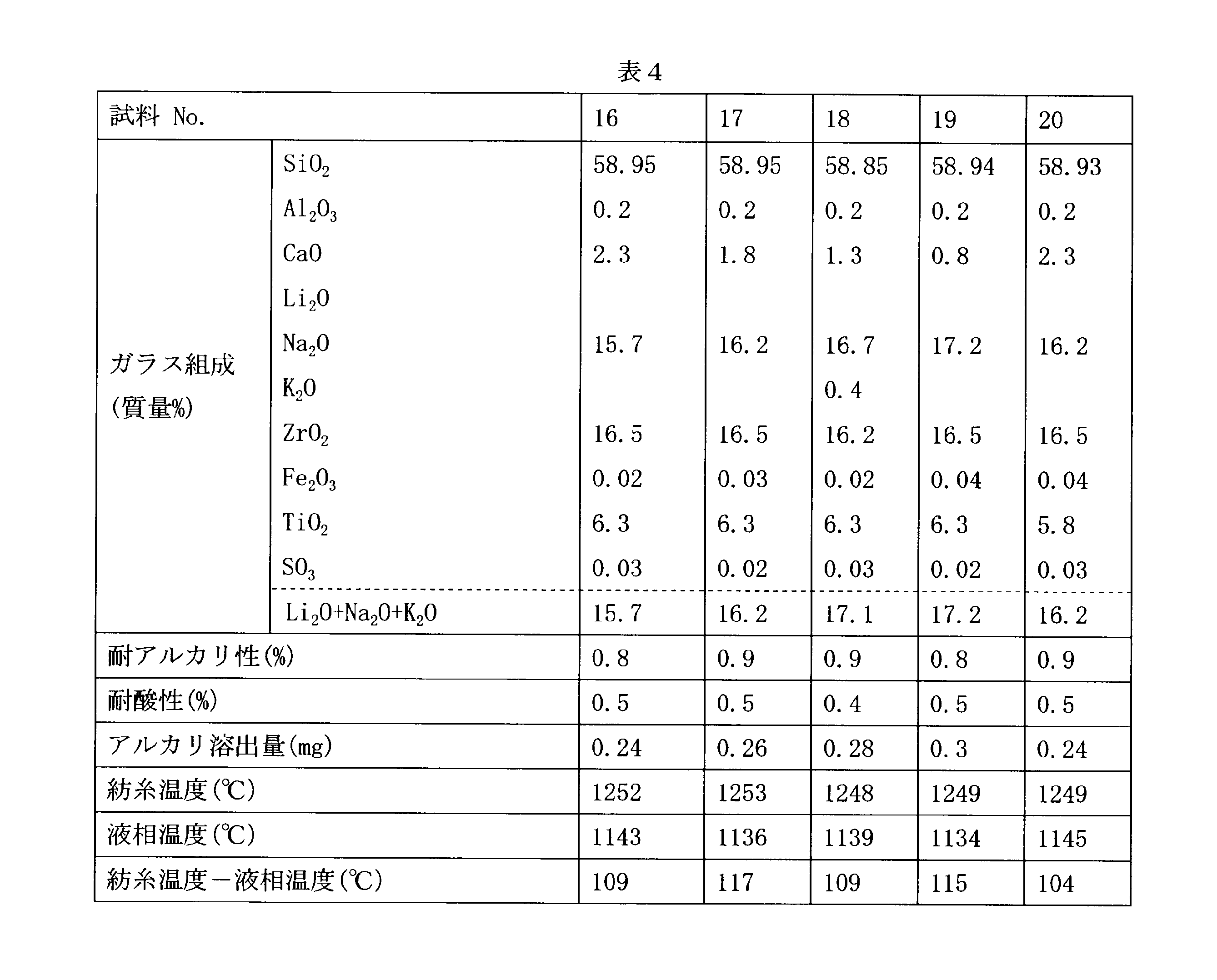


表の各試料は、次のようにして調製した。
まず、表中のガラス組成になるように、天然原料、化成原料等の各種ガラス原料を秤量、混合して、ガラスバッチを作製した。次に、このガラスバッチを白金ロジウム合金製坩堝に投入した後、間接加熱電気炉内で1550℃、5時間加熱して、溶融ガラスを得た。尚、均質な溶融ガラスを得るために、加熱時に、耐熱性撹拌棒を用いて、溶融ガラスを複数回攪拌した。続いて、得られた溶融ガラスを耐火性鋳型内に流し出し、板状のガラスを成形した後、徐冷炉内でアニール処理(1013dPa・sにおける温度より30~50℃高い温度で30分間加熱した後、徐冷点~歪点の温度域を1℃/分で降温)を行った。得られた各試料につき、耐アルカリ性、耐酸性、アルカリ溶出量、紡糸温度、液相温度を測定した。
まず、表中のガラス組成になるように、天然原料、化成原料等の各種ガラス原料を秤量、混合して、ガラスバッチを作製した。次に、このガラスバッチを白金ロジウム合金製坩堝に投入した後、間接加熱電気炉内で1550℃、5時間加熱して、溶融ガラスを得た。尚、均質な溶融ガラスを得るために、加熱時に、耐熱性撹拌棒を用いて、溶融ガラスを複数回攪拌した。続いて、得られた溶融ガラスを耐火性鋳型内に流し出し、板状のガラスを成形した後、徐冷炉内でアニール処理(1013dPa・sにおける温度より30~50℃高い温度で30分間加熱した後、徐冷点~歪点の温度域を1℃/分で降温)を行った。得られた各試料につき、耐アルカリ性、耐酸性、アルカリ溶出量、紡糸温度、液相温度を測定した。
耐アルカリ性は次のようにして測定した。まず、上記した板状ガラス試料を粉砕し、直径300~500μmの粒度のガラスを比重分の重量だけ精秤し、続いて10質量%NaOH溶液100ml中に浸漬して、80℃、16時間の条件で振とうした。その後、ガラス試料の重量減少率を測定した。この値が小さいほど耐アルカリ性に優れていることになる。
耐酸性は次のようにして測定した。まず、上記した板状ガラス試料を粉砕し、直径300~500μmの粒度のガラスを比重分の重量だけ精秤し、続いて10質量%HCl溶液100ml中に浸漬して、80℃、16時間の条件で振とうした。その後、ガラス試料の重量減少率を測定した。この値が小さいほど耐酸性に優れていることになる。
アルカリ溶出量は、JIS R3502(1995)に準拠した方法で測定した。この値が小さいほど耐水性に優れていることになる。
耐酸性は次のようにして測定した。まず、上記した板状ガラス試料を粉砕し、直径300~500μmの粒度のガラスを比重分の重量だけ精秤し、続いて10質量%HCl溶液100ml中に浸漬して、80℃、16時間の条件で振とうした。その後、ガラス試料の重量減少率を測定した。この値が小さいほど耐酸性に優れていることになる。
アルカリ溶出量は、JIS R3502(1995)に準拠した方法で測定した。この値が小さいほど耐水性に優れていることになる。
紡糸温度の測定は次のようにして行った。まず、板状のガラス試料を適正な寸法に破砕し、なるべく気泡が巻き込まれないようにアルミナ製坩堝に投入した。続いてアルミナ坩堝を加熱して、試料を融液状態とし、白金球引き上げ法によって複数の温度におけるガラスの粘度を求めた。その後、得られた複数の計測値から粘度曲線を作成し、その内挿によって103dPa・sとなる温度を算出した。
液相温度の測定は次のようにして行った。まず、板状のガラス試料を粉砕し、300~500μmの範囲の粒度となるように調整した状態で耐火性の容器に適切な嵩密度を有する状態に充填した。続いてこの耐火性容器を、最高温度を1250℃に設定した間接加熱型の温度勾配炉内に入れて静置し、16時間大気雰囲気中で加熱操作を行った。その後、温度勾配炉から、耐火性容器ごと試験体を取り出し、室温まで冷却後、偏光顕微鏡によって液相温度を特定した。
紡糸温度と液相温度の差は両者の値から算出した。
液相温度の測定は次のようにして行った。まず、板状のガラス試料を粉砕し、300~500μmの範囲の粒度となるように調整した状態で耐火性の容器に適切な嵩密度を有する状態に充填した。続いてこの耐火性容器を、最高温度を1250℃に設定した間接加熱型の温度勾配炉内に入れて静置し、16時間大気雰囲気中で加熱操作を行った。その後、温度勾配炉から、耐火性容器ごと試験体を取り出し、室温まで冷却後、偏光顕微鏡によって液相温度を特定した。
紡糸温度と液相温度の差は両者の値から算出した。
表1~6から明らかなように、実施例の各試料は、耐アルカリ性や耐酸性の指標となる重量減少率が共に3%以下、アルカリ溶出量が0.40mg以下、紡糸温度が1280℃以下、紡糸温度と液相温度の差が80℃以上であった。
これに対し、試料No.24は、紡糸温度が1280℃よりも高かった。
これに対し、試料No.24は、紡糸温度が1280℃よりも高かった。
本発明を詳細にまた特定の実施態様を参照して説明したが、本発明の精神と範囲を逸脱することなく様々な変更や修正を加えることができることは当業者にとって明らかである。
本出願は、2012年10月25日出願の日本国特許出願(特願2012-235269)に基づくものであり、その内容はここに参照として取り込まれる。
本出願は、2012年10月25日出願の日本国特許出願(特願2012-235269)に基づくものであり、その内容はここに参照として取り込まれる。
本発明のガラス組成物は、ケイ酸カルシウム板やGRC等の複合材料の補強材及びバッテリーセパレータ等の耐食性材料として有用なガラス繊維として好適に用いることができる
Claims (10)
- ガラス組成として、酸化物換算の質量%で、SiO2 50~65%、Al2O3 0~5%、CaO 0~10%、Li2O+Na2O+K2O 10~20%、Li2O 0~5%、Na2O 10~20%、K2O 0~5%、TiO2 5~10%、ZrO2 10~20%を含有するガラス繊維用ガラス組成物。
- K2Oの含有量が0.5%未満である請求項1に記載のガラス繊維用ガラス組成物。
- SiO2、Al2O3、CaO、Li2O、Na2O、K2O、TiO2及びZrO2の含有量が合量で98%以上である請求項1又は2に記載のガラス繊維用ガラス組成物。
- 紡糸温度が1280℃以下である請求項1又は2に記載のガラス繊維用ガラス組成物。
- 300~500μmの粒度に分級された比重分の重量のガラスを10質量%のNaOH水溶液100ml中に80℃、16時間浸漬した時のガラスの重量減少率が3%以下である請求項1又は2に記載のガラス繊維用ガラス組成物。
- 300~500μmの粒度に分級された比重分の重量のガラスを10質量%のHCl水溶液100ml中に80℃、16時間浸漬した時のガラスの重量減少率が3%以下である請求項1又は2に記載のガラス繊維用ガラス組成物。
- JIS R3502によるアルカリ溶出量が0.40mg以下である請求項1又は2に記載のガラス繊維用ガラス組成物。
- 紡糸温度と液相温度の差が80℃以上である請求項1又は2に記載のガラス繊維用ガラス組成物。
- 請求項1又は2のガラス繊維用ガラス組成物からなるガラス繊維。
- ガラス組成として、酸化物換算の質量%で、SiO2 50~65%、Al2O3 0~5%、CaO 0~10%、Li2O+Na2O+K2O 10~20%、Li2O 0~5%、Na2O 10~20%、K2O 0~5%、TiO2 5~10%、ZrO2 10~20%を含有するガラスとなるように調合した原料バッチをガラス溶融炉で溶融し、溶融ガラスをブッシングから連続的に引き出して繊維状に成形するガラス繊維の製造方法。
Priority Applications (2)
| Application Number | Priority Date | Filing Date | Title |
|---|---|---|---|
| CN201380055176.0A CN104736494A (zh) | 2012-10-25 | 2013-10-23 | 玻璃纤维用玻璃组合物、玻璃纤维和玻璃纤维的制造方法 |
| US14/434,421 US9643881B2 (en) | 2012-10-25 | 2013-10-23 | Glass composition for glass fiber, glass fiber, and method for producing glass fiber |
Applications Claiming Priority (2)
| Application Number | Priority Date | Filing Date | Title |
|---|---|---|---|
| JP2012-235269 | 2012-10-25 | ||
| JP2012235269 | 2012-10-25 |
Publications (1)
| Publication Number | Publication Date |
|---|---|
| WO2014065321A1 true WO2014065321A1 (ja) | 2014-05-01 |
Family
ID=50544696
Family Applications (1)
| Application Number | Title | Priority Date | Filing Date |
|---|---|---|---|
| PCT/JP2013/078698 Ceased WO2014065321A1 (ja) | 2012-10-25 | 2013-10-23 | ガラス繊維用ガラス組成物、ガラス繊維及びガラス繊維の製造方法 |
Country Status (4)
| Country | Link |
|---|---|
| US (1) | US9643881B2 (ja) |
| JP (1) | JP6202318B2 (ja) |
| CN (1) | CN104736494A (ja) |
| WO (1) | WO2014065321A1 (ja) |
Cited By (2)
| Publication number | Priority date | Publication date | Assignee | Title |
|---|---|---|---|---|
| US11577990B2 (en) | 2017-12-05 | 2023-02-14 | Nippon Electric Glass Co., Ltd. | Glass fiber and method for producing same |
| WO2023106048A1 (ja) | 2021-12-07 | 2023-06-15 | 日本電気硝子株式会社 | ガラス繊維、ガラス繊維の製造方法及びガラス |
Families Citing this family (12)
| Publication number | Priority date | Publication date | Assignee | Title |
|---|---|---|---|---|
| JP6959563B2 (ja) * | 2016-12-27 | 2021-11-02 | 日本電気硝子株式会社 | ガラス繊維用ガラス組成物、ガラス繊維及びガラス繊維の製造方法 |
| CN114180828A (zh) * | 2016-12-29 | 2022-03-15 | 广东东阳光药业有限公司 | 高耐化学性的硼硅酸盐玻璃及其应用 |
| CN108570725B (zh) * | 2017-03-08 | 2019-08-20 | 中国科学院化学研究所 | 一种氧化铝连续纤维的熔融纺丝原料、其制备方法及制得的氧化铝连续纤维 |
| CZ309338B6 (cs) | 2017-12-29 | 2022-09-07 | ŠKODA AUTO a.s. | Sekundární bateriový článek pro elektromobily, obsahující pevné amorfní skelné materiály a nano/mikro materiály |
| KR20200112855A (ko) * | 2018-02-01 | 2020-10-05 | 써멀 세라믹스 유케이 리미티드 | 에너지 저장 디바이스 및 이에 사용하기 위한 이온 전도성 조성물 |
| CN109052933B (zh) * | 2018-09-07 | 2020-09-08 | 中国建筑材料科学研究总院有限公司 | 一种耐碱玻璃及其制备方法 |
| JP7409316B2 (ja) * | 2018-11-14 | 2024-01-09 | Agc株式会社 | 高周波デバイス用ガラス基板、液晶アンテナ及び高周波デバイス |
| JP7303486B2 (ja) * | 2019-05-10 | 2023-07-05 | 日本電気硝子株式会社 | ガラス繊維用ガラス組成物 |
| CN110577366A (zh) * | 2019-10-31 | 2019-12-17 | 南通市辉鑫玻璃纤维有限公司 | 一种高性能的耐碱玻璃纤维及其制备方法 |
| CN112142335A (zh) * | 2020-10-06 | 2020-12-29 | 青岛蓝创科信新能源科技有限公司 | 高性能玻璃纤维配料及其制备的玻璃纤维 |
| CN112125529A (zh) * | 2020-10-06 | 2020-12-25 | 青岛蓝创科信新能源科技有限公司 | 玻璃纤维配料及其制备的玻璃纤维 |
| CN116354608A (zh) * | 2023-02-14 | 2023-06-30 | 华润水泥技术研发有限公司 | 一种多矿物组合的耐碱玄武岩纤维原料配方及制备方法 |
Citations (4)
| Publication number | Priority date | Publication date | Assignee | Title |
|---|---|---|---|---|
| JPS49113805A (ja) * | 1973-02-14 | 1974-10-30 | ||
| JPS56134534A (en) * | 1980-02-27 | 1981-10-21 | Pilkington Brothers Ltd | Alkali-resistant glass fiber and cement product reinforced with said glass fiber |
| JPS58167444A (ja) * | 1982-03-29 | 1983-10-03 | Nichias Corp | 耐アルカリ性ガラス繊維 |
| JPH09156957A (ja) * | 1995-12-08 | 1997-06-17 | Nippon Electric Glass Co Ltd | 耐蝕性ガラス繊維 |
Family Cites Families (10)
| Publication number | Priority date | Publication date | Assignee | Title |
|---|---|---|---|---|
| GB1290528A (ja) | 1969-07-28 | 1972-09-27 | ||
| SE360848B (ja) | 1969-07-28 | 1973-10-08 | Pilkington Brothers Ltd | |
| US3840379A (en) * | 1972-07-27 | 1974-10-08 | Owens Corning Fiberglass Corp | Glass compositions |
| USRE29388E (en) | 1973-02-14 | 1977-09-06 | Turner & Newall Limited | Glass compositions and fibers made therefrom |
| US4015994A (en) * | 1974-11-13 | 1977-04-05 | Owens-Corning Fiberglas Corporation | Coated glass fibers |
| US4105492A (en) * | 1976-07-26 | 1978-08-08 | Owens-Corning Fiberglas Corporation | Treated glass fibers |
| JPH06157072A (ja) * | 1992-11-20 | 1994-06-03 | Nippon Electric Glass Co Ltd | 耐蝕性ガラス繊維 |
| JP3864438B2 (ja) * | 1995-10-25 | 2006-12-27 | 日本板硝子株式会社 | 耐アルカリ性フレーク状ガラス並びにこのフレーク状ガラスで補強された熱可塑性樹脂組成物及び熱硬化性樹脂組成物 |
| FR2892716B1 (fr) | 2005-10-28 | 2008-04-18 | Saint Gobain Vetrotex | Composition de verre resistant aux alcalis et aux acides pour la fabrication de fils de verre |
| JP2008255002A (ja) * | 2007-03-15 | 2008-10-23 | Nippon Electric Glass Co Ltd | ガラス繊維用ガラス組成物、ガラス繊維、ガラス繊維の製造方法及び複合材 |
-
2013
- 2013-10-23 WO PCT/JP2013/078698 patent/WO2014065321A1/ja not_active Ceased
- 2013-10-23 US US14/434,421 patent/US9643881B2/en active Active
- 2013-10-23 CN CN201380055176.0A patent/CN104736494A/zh active Pending
- 2013-10-24 JP JP2013221339A patent/JP6202318B2/ja active Active
Patent Citations (5)
| Publication number | Priority date | Publication date | Assignee | Title |
|---|---|---|---|---|
| JPS49113805A (ja) * | 1973-02-14 | 1974-10-30 | ||
| JPS5046712A (ja) * | 1973-02-14 | 1975-04-25 | ||
| JPS56134534A (en) * | 1980-02-27 | 1981-10-21 | Pilkington Brothers Ltd | Alkali-resistant glass fiber and cement product reinforced with said glass fiber |
| JPS58167444A (ja) * | 1982-03-29 | 1983-10-03 | Nichias Corp | 耐アルカリ性ガラス繊維 |
| JPH09156957A (ja) * | 1995-12-08 | 1997-06-17 | Nippon Electric Glass Co Ltd | 耐蝕性ガラス繊維 |
Cited By (3)
| Publication number | Priority date | Publication date | Assignee | Title |
|---|---|---|---|---|
| US11577990B2 (en) | 2017-12-05 | 2023-02-14 | Nippon Electric Glass Co., Ltd. | Glass fiber and method for producing same |
| WO2023106048A1 (ja) | 2021-12-07 | 2023-06-15 | 日本電気硝子株式会社 | ガラス繊維、ガラス繊維の製造方法及びガラス |
| EP4446291A4 (en) * | 2021-12-07 | 2025-12-24 | Nippon Electric Glass Co | GLASS FIBERS, GLASS FIBERS AND GLASS MANUFACTURING PROCESS |
Also Published As
| Publication number | Publication date |
|---|---|
| JP2014101270A (ja) | 2014-06-05 |
| CN104736494A (zh) | 2015-06-24 |
| US20150266769A1 (en) | 2015-09-24 |
| US9643881B2 (en) | 2017-05-09 |
| JP6202318B2 (ja) | 2017-09-27 |
Similar Documents
| Publication | Publication Date | Title |
|---|---|---|
| JP6202318B2 (ja) | ガラス繊維用ガラス組成物、ガラス繊維及びガラス繊維の製造方法 | |
| JP6959563B2 (ja) | ガラス繊維用ガラス組成物、ガラス繊維及びガラス繊維の製造方法 | |
| JP7303486B2 (ja) | ガラス繊維用ガラス組成物 | |
| CN111433166B (zh) | 玻璃纤维及其制造方法 | |
| JP2012531373A (ja) | 高強度高弾性ガラス繊維 | |
| JP2022507967A (ja) | 改善された比弾性率を有する高性能ガラス繊維組成物 | |
| RU2732764C9 (ru) | Композиция стекловолокна и стекловолокно и композиционный материал на его основе | |
| JP2022511737A (ja) | 改善された弾性率を有する高性能ガラス繊維組成物 | |
| JP6376326B2 (ja) | ガラス繊維組成物、ガラス繊維及びガラス繊維の製造方法 | |
| JP2019112246A (ja) | ガラス繊維及びその製造方法 | |
| US20250034032A1 (en) | Glass fiber, glass fiber manufacturing method, and glass | |
| WO2016093212A1 (ja) | ガラス繊維用ガラス組成物、ガラス繊維及びガラス繊維の製造方法 | |
| CN112125528B (zh) | 耐碱性优异的高模量玻璃纤维及其制备方法 | |
| WO2017221637A1 (ja) | ガラス繊維の製造方法 | |
| WO2024172055A1 (ja) | ガラス繊維用組成物、ガラス繊維及びガラス繊維の製造方法 | |
| CN108609859A (zh) | 一种新型高模量玻璃纤维组合物以及玻璃纤维 | |
| JP2016117627A (ja) | ガラス繊維の製造方法 | |
| JPH06157072A (ja) | 耐蝕性ガラス繊維 | |
| JP2016113349A (ja) | ガラス繊維ガラス組成物、ガラス繊維及びガラス繊維の製造方法 | |
| JPH11157876A (ja) | 耐蝕性ガラス繊維 | |
| JP2016113339A (ja) | ガラス繊維ガラス組成物、ガラス繊維及びガラス繊維の製造方法 | |
| JPS6257580B2 (ja) | ||
| JPH11157875A (ja) | 耐蝕性ガラス繊維 | |
| WO2017212625A1 (ja) | ガラス繊維の製造方法 |
Legal Events
| Date | Code | Title | Description |
|---|---|---|---|
| 121 | Ep: the epo has been informed by wipo that ep was designated in this application |
Ref document number: 13848305 Country of ref document: EP Kind code of ref document: A1 |
|
| WWE | Wipo information: entry into national phase |
Ref document number: 14434421 Country of ref document: US |
|
| NENP | Non-entry into the national phase |
Ref country code: DE |
|
| 122 | Ep: pct application non-entry in european phase |
Ref document number: 13848305 Country of ref document: EP Kind code of ref document: A1 |