WO2014064790A1 - 包括的2次元クロマトグラフ用データ処理装置 - Google Patents
包括的2次元クロマトグラフ用データ処理装置 Download PDFInfo
- Publication number
- WO2014064790A1 WO2014064790A1 PCT/JP2012/077540 JP2012077540W WO2014064790A1 WO 2014064790 A1 WO2014064790 A1 WO 2014064790A1 JP 2012077540 W JP2012077540 W JP 2012077540W WO 2014064790 A1 WO2014064790 A1 WO 2014064790A1
- Authority
- WO
- WIPO (PCT)
- Prior art keywords
- dimensional
- time
- chromatogram
- comprehensive
- modulation
- Prior art date
- Legal status (The legal status is an assumption and is not a legal conclusion. Google has not performed a legal analysis and makes no representation as to the accuracy of the status listed.)
- Ceased
Links
Images


Classifications
-
- G—PHYSICS
- G01—MEASURING; TESTING
- G01N—INVESTIGATING OR ANALYSING MATERIALS BY DETERMINING THEIR CHEMICAL OR PHYSICAL PROPERTIES
- G01N30/00—Investigating or analysing materials by separation into components using adsorption, absorption or similar phenomena or using ion-exchange, e.g. chromatography or field flow fractionation
- G01N30/02—Column chromatography
- G01N30/86—Signal analysis
- G01N30/8651—Recording, data aquisition, archiving and storage
-
- G—PHYSICS
- G01—MEASURING; TESTING
- G01N—INVESTIGATING OR ANALYSING MATERIALS BY DETERMINING THEIR CHEMICAL OR PHYSICAL PROPERTIES
- G01N30/00—Investigating or analysing materials by separation into components using adsorption, absorption or similar phenomena or using ion-exchange, e.g. chromatography or field flow fractionation
- G01N30/02—Column chromatography
- G01N30/26—Conditioning of the fluid carrier; Flow patterns
- G01N30/38—Flow patterns
- G01N30/46—Flow patterns using more than one column
- G01N30/461—Flow patterns using more than one column with serial coupling of separation columns
- G01N30/463—Flow patterns using more than one column with serial coupling of separation columns for multidimensional chromatography
-
- G—PHYSICS
- G01—MEASURING; TESTING
- G01N—INVESTIGATING OR ANALYSING MATERIALS BY DETERMINING THEIR CHEMICAL OR PHYSICAL PROPERTIES
- G01N30/00—Investigating or analysing materials by separation into components using adsorption, absorption or similar phenomena or using ion-exchange, e.g. chromatography or field flow fractionation
- G01N30/02—Column chromatography
- G01N30/86—Signal analysis
- G01N30/8675—Evaluation, i.e. decoding of the signal into analytical information
-
- G—PHYSICS
- G01—MEASURING; TESTING
- G01N—INVESTIGATING OR ANALYSING MATERIALS BY DETERMINING THEIR CHEMICAL OR PHYSICAL PROPERTIES
- G01N30/00—Investigating or analysing materials by separation into components using adsorption, absorption or similar phenomena or using ion-exchange, e.g. chromatography or field flow fractionation
- G01N30/02—Column chromatography
- G01N30/88—Integrated analysis systems specially adapted therefor, not covered by a single one of the groups G01N30/04 - G01N30/86
- G01N2030/8809—Integrated analysis systems specially adapted therefor, not covered by a single one of the groups G01N30/04 - G01N30/86 analysis specially adapted for the sample
- G01N2030/884—Integrated analysis systems specially adapted therefor, not covered by a single one of the groups G01N30/04 - G01N30/86 analysis specially adapted for the sample organic compounds
- G01N2030/8854—Integrated analysis systems specially adapted therefor, not covered by a single one of the groups G01N30/04 - G01N30/86 analysis specially adapted for the sample organic compounds involving hydrocarbons
Definitions
- the present invention relates to a comprehensive two-dimensional chromatographic data processing apparatus for processing data collected by a comprehensive two-dimensional gas chromatograph (GC) or a comprehensive two-dimensional liquid chromatograph (LC).
- GC gas chromatograph
- LC liquid chromatograph
- a method called comprehensive two-dimensional GC As a GC analysis method, a method called comprehensive two-dimensional GC (also referred to as “GC ⁇ GC”) is known (see Patent Document 1).
- a first-dimensional column hereinafter referred to as “primary column”
- the modulator collects the introduced components at regular time intervals (usually several seconds to several tens of seconds; this time is usually referred to as “modulation time”), and then leaves it with a very narrow time bandwidth.
- modulation time usually several seconds to several tens of seconds; this time is usually referred to as “modulation time”
- the component separation is performed under the same separation conditions as those for normal GC or slightly slower elution than normal GC.
- the secondary column a column having a polarity different from that of the primary column and having a short inner diameter is used, and the component separation is performed under such a condition that the elution is completed within a specified modulation time.
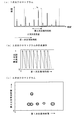
- a detection signal is acquired by a single detector connected to the outlet of the secondary column. Therefore, although the component separation by the column is in two stages, the data output from the detector is data of one system in time series order. Therefore, by plotting the data thus obtained in the order of generation, it is possible to create a chromatogram similar to normal GC, that is, a chromatogram having the horizontal axis as the time axis and the vertical axis as the signal intensity axis.
- FIG. 2A is an example of the one-dimensional chromatogram created in this way.
- FIG. 2B is an explanatory diagram of data arrangement when creating a two-dimensional chromatogram from the one-dimensional chromatogram data as shown in FIG.
- the range of the vertical axis of this graph is the modulation time, and the one-dimensional chromatogram data is plotted sequentially from the lower end (0) to the upper direction along the vertical axis (solid arrow in the figure), reaching the modulation time. Then, the operation of moving in the right direction along the horizontal axis and returning to the lower end of the vertical axis (broken line in the figure) and plotting in the upward direction along the vertical axis again are repeated.
- a two-dimensional chromatogram two-dimensional contour chromatogram
- the horizontal axis represents the boiling point order and the vertical axis represents the polarity order. Therefore, according to this two-dimensional chromatogram, it is easy to understand the properties of each compound, and many compounds Even if it is contained, it is possible to easily grasp what kind of compound is contained.
- data obtained by analyzing a sample in a comprehensive two-dimensional GC is temporarily stored in a storage device such as a hard disk, and then the data is read out from the storage device at an appropriate time, and dedicated data as described above.
- a storage device such as a hard disk
- the process of collecting data from a comprehensive two-dimensional GC and storing the collected data in a storage device is not for a comprehensive two-dimensional GC, but using ordinary GC or GC / MS software. Done.
- the collected chromatogram data does not include data (parameter information) indicating the modulation time, which is one of the analysis conditions.
- GC Image GCxGC Software [online], GC Image LLC, USA, [October 17, 2012] GC Image LLC, USA, Internet ⁇ URL: http://www.gcimage.com/gcxgc/index .html> “GC Image (GCxGC Edition) Users Guide File Input and Output”, [online], US GC Image LLC, [October 17, 2012 search], Internet ⁇ URL: http://www.gcimage.com /gcxgc/usersguide/io.html>
- the present invention has been made in view of the above problems, and its object is to perform processing in data processing such as two-dimensional chromatogram creation based on chromatogram data obtained by a comprehensive two-dimensional chromatograph. It is an object of the present invention to provide a comprehensive two-dimensional chromatographic data processing apparatus that can eliminate the need for inputting necessary modulation time information.
- a comprehensive two-dimensional chromatogram for processing chromatogram data collected by a comprehensive two-dimensional chromatograph including a primary column, a modulator, a secondary column, and a detector.
- a data processing device for graphs a) a one-dimensional chromatogram creation unit for creating a one-dimensional chromatogram showing the relationship between time and signal intensity by arranging chromatogram data obtained by a comprehensive two-dimensional chromatograph in time series; b) Estimating the modulation time in the modulator based on the regularity of the appearance time of one peak on the one-dimensional chromatogram and one or more peaks appearing at different times from the same compound as the peak
- a modulation time estimator It is characterized by having.
- the comprehensive two-dimensional chromatograph may be either a comprehensive two-dimensional GC or a comprehensive two-dimensional LC.
- the modulation time estimation unit estimates the modulation time using the regularity of the appearance of peaks derived from the same compound on the above-described one-dimensional chromatogram. .
- the modulation time estimation unit examines the correlation between the one-dimensional chromatogram and the time-shifted one-dimensional chromatogram obtained by shifting the time axis of the one-dimensional chromatogram, and changes the shift time.
- the shift time that maximizes the correlation is estimated to be the modulation time. More specifically, for example, the product of the signal intensity at each time is calculated for the one-dimensional chromatogram and the time-shifted one-dimensional chromatogram, and the product values are integrated over the entire measurement time range. Then, a change in the integrated value when the shift time is changed is obtained, a shift time at which the integrated value shows a maximum is found, and it is estimated that the shift time is the modulation time.
- the modulation time can be estimated by repeating a simple calculation, the load on the hardware is small and the modulation time can be estimated in a short time.
- the comprehensive two-dimensional chromatograph data processing apparatus uses the retention time in the primary column and the retention time in the secondary column as axes based on the modulation time obtained by the modulation time estimation unit. It is preferable to further include a two-dimensional chromatogram creation unit that creates a two-dimensional chromatogram.
- the modulation time is automatically obtained based on the one-dimensional chromatogram data collected by the comprehensive two-dimensional GC or the comprehensive two-dimensional LC.
- data processing unique to a comprehensive two-dimensional chromatograph such as creation of a two-dimensional chromatogram using the modulation time information
- the schematic block diagram of one Example of the comprehensive two-dimensional GC system provided with the data processing apparatus for comprehensive two-dimensional chromatographs concerning this invention An example of a one-dimensional chromatogram created based on data collected by a comprehensive two-dimensional GC (a) An explanatory diagram (b) of a procedure for creating a two-dimensional chromatogram based on one-dimensional chromatogram data, and creation (C) which shows an example of the two-dimensional chromatogram made. Explanatory drawing of the modulation time estimation process in the comprehensive two-dimensional GC system of a present Example.
- FIG. 1 is a schematic configuration diagram of a comprehensive two-dimensional GC system according to this embodiment.
- the analysis unit 1 supplies a component (compound) eluted from the sample introduction unit 11 and the primary column 12 including a primary column 12 and a sample vaporization chamber for introducing a sample gas into the primary column 12 for a predetermined time.
- a modulator 13 that collects at (modulation time tm) intervals, compresses it in time, and pumps it out; a secondary column 14 capable of high-speed separation having different separation characteristics (typically different polarities) from the primary column 12, and
- a detector 15 that detects each compound separated in the two-stage columns 12 and 14 and outputs an intensity signal corresponding to the amount (concentration) is provided.
- the detector 15 may be of any type (detection method) as long as it can be generally used as a GC detector.
- the total ion chromatogram data obtained by repeatedly performing scan measurement in a predetermined mass-to-charge ratio range and integrating ion intensity data obtained for each scan. May be output from the detector 15.
- the data processing unit 2 includes a data collection unit 21 that collects chromatogram data sequentially output from the detector 15 over time, a data storage unit 22 that stores the collected chromatogram data, and a data storage unit.
- a GC ⁇ GC data processing unit 23 that reads and processes the data stored in the unit 22, and the GC ⁇ GC data processing unit 23 estimates the modulation time tm based on the read data.
- a two-dimensional chromatogram creation unit 25 that creates a two-dimensional chromatogram based on the estimated modulation time tm.
- the operation of each unit included in the analysis unit 1 is controlled by the analysis control unit 3.
- the main control unit 4 is connected with an operation unit 5 and a display unit 6 as a user interface, and controls the entire system.
- the main control unit 4, the analysis control unit 3, and the data processing unit 2 are realized by using a personal computer as a hardware resource and executing dedicated control / processing software installed in the personal computer in advance. can do.
- functions other than the modulation time estimation unit 24 in the GC ⁇ GC data processing unit 23 can be realized using software described in Non-Patent Documents 1 and 2.
- the sample introduction unit 11 introduces a sample to be analyzed into a carrier gas sent to the primary column 12 at a substantially constant flow rate in response to an instruction from the analysis control unit 3.
- this sample contains a large number of compounds.
- Various compounds contained in the sample are separated while passing through the primary column 12 that has been temperature-controlled according to a predetermined temperature raising program, and are eluted with a time lag. At this time, not all the compounds are sufficiently separated, and the compounds whose retention times in the primary column 12 are close to each other are eluted (in a mixed state).
- the modulator 13 collects all the compounds eluted from the primary column 12 over a modulation time tm (usually several seconds to several tens of seconds), compresses them in time, and sends them to the secondary column 14 with a very narrow bandwidth. Repeat the operation. Therefore, the compound eluted from the primary column 12 is sent to the secondary column 14 without leakage.
- a plurality of compounds sent at every modulation time tm are separated and eluted in the time direction with high resolution when passing through the secondary column 14, and are introduced into the detector 15 in the order of elution.
- a mass spectrometer is used as the detector 15 as described above, by performing scan measurement at intervals shorter than the time width during which one compound is eluted from the secondary column 14, The compound can be detected without leakage.
- the detection signal from the detector 15 is converted into digital data by a built-in A / D converter at a predetermined sampling period and output.
- the data collection unit 21 collects the chromatogram data sequentially obtained with the passage of time in this way and stores it in the data storage unit 22. Usually, a series of chromatogram data obtained by performing comprehensive two-dimensional GC analysis on one sample is stored together in one data file.
- the GC ⁇ GC data processing unit 23 is a dedicated data processing unit that processes data obtained by comprehensive two-dimensional GC analysis as described above.
- the GC ⁇ GC data processing unit has a function of creating a two-dimensional chromatogram with the horizontal axis as the first dimension holding time and the vertical axis as the second dimension holding time.
- the GC ⁇ GC data processing unit in this embodiment 23 includes a characteristic modulation time estimation unit 24 in addition to a two-dimensional chromatogram creation unit 25.
- FIG. 3 is an explanatory diagram of the modulation time estimation process in the modulation time estimation unit 24.
- the GC ⁇ GC data processing unit 23 is controlled based on the control from the main control unit 4.
- the designated data is read from the data storage unit 22.
- the modulation time estimation unit 24 creates a one-dimensional chromatogram as shown in FIG. 3A by arranging the read chromatogram data according to the passage of time. Next, the entire curve of the created one-dimensional chromatogram is shifted in the positive direction of the time axis (rightward in FIG. 3) by a predetermined shift time ⁇ (see FIG. 3B), and the shift time ⁇ is gradually increased. While changing (increasing the shift time), the original (that is, not shifted at all) one-dimensional chromatogram and the shifted one-dimensional chromatogram (hereinafter referred to as “time-shifted one-dimensional chromatogram”) Compare
- the gas eluted from the primary column 12 contains the same compound over a plurality of modulation time tm ranges. For this reason, in a one-dimensional chromatogram, a peak derived from a certain compound hardly appears only in one modulation time tm range, and in many cases, the same compound is present in a plurality of continuous modulation time tm ranges. A sharp peak of origin appears.
- a compound compressed at a modulation time tm is introduced from the modulator 13 to the secondary column 14, and the same compound should have the same retention time in the secondary column 14.
- the intervals between peaks derived from the same compound appearing in adjacent modulation time tm ranges have regularity, and the intervals should coincide with the modulation time tm. Therefore, when the shift time ⁇ matches the modulation time tm, the positions of the peaks derived from the same compound in the time shift one-dimensional chromatogram and the original one-dimensional chromatogram (see FIG. 3C). Therefore, the modulation time estimation unit 24 estimates the modulation time tm by obtaining the shift time ⁇ when the peak positions match in this way.
- the regularity of peaks derived from the same compound on the one-dimensional chromatogram can be evaluated by the following method.
- the evaluation function of equation (1) shows a very large value with a peak coincident when the shift time ⁇ is an integral multiple of the modulation time tm.
- the modulation time tm is set within a range of about 1 second to several tens of seconds, so that the evaluation range of the shift time ⁇ is preferably set to 0 second to at least about 20 seconds to about 1 minute.
- the evaluation range of the shift time ⁇ can be narrower than the above range. Note that the integration calculation in equation (1) can be replaced with the sum of sampling intervals.
- the evaluation value F ( ⁇ ) based on the equation (1) is calculated while changing the shift time ⁇ with a predetermined step width over the evaluation range of the shift time ⁇ as described above. Thereby, the relationship between the shift time ⁇ and the evaluation value F (t) is obtained.
- F ( ⁇ ) increases when the shift time ⁇ is 2 times, 3 times,..., The modulation time tm, so in the relationship between the shift time ⁇ and the evaluation value F (t),
- a predetermined number of shift times ⁇ i at which F ( ⁇ ) is maximized are selected in descending order of F ( ⁇ ).
- ⁇ 1 ⁇ 1 ⁇ 0, and if m ⁇ 1 exists in ⁇ 2 to ⁇ n, ⁇ 1 may be set as the modulation time tm. If the peak derived from one compound eluted from the primary column 12 extends over four continuous modulation time tm ranges (generally, the resolution in the primary column 12 is set to this level), m The value may be any integer from 2 to 4.
- ⁇ 2 ⁇ 2 ⁇ 0, and it is determined whether m ⁇ 2 exists in ⁇ 3 to ⁇ n. If m ⁇ 2 exists in ⁇ 3 to ⁇ n, ⁇ 2 is set as the modulation time tm. If m ⁇ 2 does not exist in ⁇ 3 to ⁇ n, m ⁇ i is obtained for a larger ⁇ i and the same process may be repeated.
- the two-dimensional chromatogram creation unit 25 arranges the chromatogram data two-dimensionally in accordance with the obtained modulation time tm, and a two-dimensional chromatogram as shown in FIG. Create As a result, even if the modulation time tm is not given from the outside, that is, operation input by the operation unit 5 or reading of control data from the analysis control unit 3, the modulation time tm automatically estimated. It is possible to create a two-dimensional chromatogram based on the above.
- the method for estimating the modulation time is not limited to the method described above as long as it is a method that can detect the regularity and periodicity of the appearance times of a plurality of peaks that can be assumed to be derived from the same compound on a one-dimensional chromatogram. .
- a general method capable of calculating the correlation coefficient can be used.
- the data processing apparatus according to the present invention can be applied not only to data obtained by comprehensive two-dimensional GC but also to processing of data obtained by comprehensive two-dimensional LC.
Landscapes
- Physics & Mathematics (AREA)
- Health & Medical Sciences (AREA)
- Life Sciences & Earth Sciences (AREA)
- Chemical & Material Sciences (AREA)
- Analytical Chemistry (AREA)
- Biochemistry (AREA)
- General Health & Medical Sciences (AREA)
- General Physics & Mathematics (AREA)
- Immunology (AREA)
- Pathology (AREA)
- Engineering & Computer Science (AREA)
- Library & Information Science (AREA)
- Other Investigation Or Analysis Of Materials By Electrical Means (AREA)
- Sampling And Sample Adjustment (AREA)
Abstract
Description
昇温分析であれば、横軸は沸点順を表し、縦軸は極性順を表しているため、この2次元クロマトグラムによれば、各化合物の性質の理解が容易であるとともに、多数の化合物が含まれる場合であってもどのような化合物が含まれているのかを容易に把握することができる。
a)包括的2次元クロマトグラフで得られたクロマトグラムデータを時系列順に並べることで、時間と信号強度との関係を示す1次元クロマトグラムを作成する1次元クロマトグラム作成部と、
b)前記1次元クロマトグラム上の或る一つのピークと該ピークと同じ化合物由来で別の時間に現れる1又は複数のピークとの出現時間の規則性に基づいて、前記モジュレータにおけるモジュレーション時間を推定するモジュレーション時間推定部と、
を備えることを特徴としている。
分析部1において、試料導入部11は分析制御部3からの指示に応じて、1次カラム12に略一定流量で送られるキャリアガス中に分析対象である試料を導入する。通常、この試料には多数の化合物が含まれる。該試料に含まれる各種化合物は、所定の昇温プログラムに従って温調された1次カラム12を通過する間に分離されて時間的にずれて溶出する。この時点では全ての化合物が充分に分離されるとは限らず、1次カラム12での保持時間が近い化合物は重なって(混じった状態で)溶出する。
F(τ)=∫f(t)・f(t-τ)dt …(1)
この評価関数は、元の1次元クロマトグラムと時間シフト1次元クロマトグラムとにおいて同じ位置(時間位置)の信号強度の積を時間方向に積分したものである。
11…試料導入部
12…1次カラム
13…モジュレータ
14…2次カラム
15…検出器
2…データ処理部
21…データ収集部
22…データ記憶部
23…GC×GCデータ処理部
24…モジュレーション時間推定部
25…2次元クロマトグラム作成部
3…分析制御部
4…主制御部
5…操作部
6…表示部
Claims (3)
- 1次カラム、モジュレータ、2次カラム、及び検出器を具備する包括的2次元クロマトグラフで収集されたクロマトグラムデータを処理する包括的2次元クロマトグラフ用データ処理装置であって、
a)前記検出器で得られた時系列順に前記クロマトグラムデータを並べることで、時間と信号強度の関係を示す1次元クロマトグラムを作成する1次元クロマトグラム作成部と、
b)前記1次元クロマトグラム上の或る一つのピークと該ピークと同じ成分由来で別の時間に現れる1又は複数のピークとの出現時間の規則性に基づいて、前記モジュレータにおけるモジュレーション時間を推定するモジュレーション時間推定部と、
を備えることを特徴とする包括的2次元クロマトグラフ用データ処理装置。 - 請求項1に記載の包括的2次元クロマトグラフ用データ処理装置であって、
前記モジュレーション時間推定部は、前記1次元クロマトグラムと該1次元クロマトグラムの時間軸をシフトさせた時間シフト1次元クロマトグラムとの相関性を調べ、シフト時間を変化させたときに相関性が最大となるシフト時間がモジュレーション時間であると推定することを特徴とする包括的2次元クロマトグラフ用データ処理装置。 - 請求項1又は2に記載の包括的2次元クロマトグラフ用データ処理装置であって、
前記モジュレーション時間推定部により得られたモジュレーション時間に基づいて、1次カラムにおける保持時間と2次カラムにおける保持時間をそれぞれ軸とする2次元クロマトグラムを作成する2次元クロマトグラム作成部、をさらに備えることを特徴とする包括的2次元クロマトグラフ用データ処理装置。
Priority Applications (4)
| Application Number | Priority Date | Filing Date | Title |
|---|---|---|---|
| US14/438,259 US10352913B2 (en) | 2012-10-25 | 2012-10-25 | Data processing device for comprehensive two-dimensional chromatograph |
| CN201280076616.6A CN104755922B (zh) | 2012-10-25 | 2012-10-25 | 全二维色谱仪用数据处理装置 |
| PCT/JP2012/077540 WO2014064790A1 (ja) | 2012-10-25 | 2012-10-25 | 包括的2次元クロマトグラフ用データ処理装置 |
| JP2014543066A JP6036838B2 (ja) | 2012-10-25 | 2012-10-25 | 包括的2次元クロマトグラフ用データ処理装置 |
Applications Claiming Priority (1)
| Application Number | Priority Date | Filing Date | Title |
|---|---|---|---|
| PCT/JP2012/077540 WO2014064790A1 (ja) | 2012-10-25 | 2012-10-25 | 包括的2次元クロマトグラフ用データ処理装置 |
Publications (1)
| Publication Number | Publication Date |
|---|---|
| WO2014064790A1 true WO2014064790A1 (ja) | 2014-05-01 |
Family
ID=50544188
Family Applications (1)
| Application Number | Title | Priority Date | Filing Date |
|---|---|---|---|
| PCT/JP2012/077540 Ceased WO2014064790A1 (ja) | 2012-10-25 | 2012-10-25 | 包括的2次元クロマトグラフ用データ処理装置 |
Country Status (4)
| Country | Link |
|---|---|
| US (1) | US10352913B2 (ja) |
| JP (1) | JP6036838B2 (ja) |
| CN (1) | CN104755922B (ja) |
| WO (1) | WO2014064790A1 (ja) |
Cited By (5)
| Publication number | Priority date | Publication date | Assignee | Title |
|---|---|---|---|---|
| CN103983712A (zh) * | 2014-05-28 | 2014-08-13 | 天津出入境检验检疫局动植物与食品检测中心 | 应用在线固相微萃取和全二维气相色谱-四级杆质谱法检测橙汁中酮类组分的方法 |
| WO2015198385A1 (ja) * | 2014-06-24 | 2015-12-30 | 株式会社島津製作所 | 包括的2次元クロマトグラフ用データ処理装置 |
| WO2016103388A1 (ja) * | 2014-12-25 | 2016-06-30 | 株式会社島津製作所 | 分析装置 |
| CN105891397A (zh) * | 2015-01-26 | 2016-08-24 | 大连达硕信息技术有限公司 | 一种全二维色谱分离的峰检测方法 |
| JP2023540394A (ja) * | 2020-10-12 | 2023-09-22 | レコ コーポレイション | 2次元ガスクロマトグラフィーでの収集されたデータの分離できない複雑な混合物の分離 |
Families Citing this family (2)
| Publication number | Priority date | Publication date | Assignee | Title |
|---|---|---|---|---|
| WO2020150547A1 (en) * | 2019-01-17 | 2020-07-23 | Leco Corporation | Multi-dimensional chromatography modulator with variable modulation period |
| WO2020261405A1 (ja) * | 2019-06-26 | 2020-12-30 | 株式会社島津製作所 | バイナリポンプ及び液体クロマトグラフ |
Citations (5)
| Publication number | Priority date | Publication date | Assignee | Title |
|---|---|---|---|---|
| WO2003067250A1 (en) * | 2002-02-04 | 2003-08-14 | Thermo Finnigan Italia S.P.A. | Method and device for comprehensive two-dimensional gas chromatography |
| JP2004309250A (ja) * | 2003-04-04 | 2004-11-04 | Shimadzu Corp | クロマトグラフ用データ処理装置 |
| JP2008185586A (ja) * | 2007-01-30 | 2008-08-14 | Ifp | 二次元ガスクロマトグラフィーによって分子化合物混合物の定量分析を行うための方法 |
| JP2009508107A (ja) * | 2005-09-12 | 2009-02-26 | エクソンモービル リサーチ アンド エンジニアリング カンパニー | 定量データ分析を可能にするために包括的2(多)次元クロマトグラフィー(分離)システムにおいてデータ取り込みおよびモジュレーションを同期させるシステムおよび方法 |
| JP2011122822A (ja) * | 2009-12-08 | 2011-06-23 | Shimadzu Corp | クロマトグラフ質量分析装置 |
Family Cites Families (2)
| Publication number | Priority date | Publication date | Assignee | Title |
|---|---|---|---|---|
| JP2010048732A (ja) * | 2008-08-25 | 2010-03-04 | Shimadzu Corp | ガスクロマトグラフ装置 |
| FR2937198B1 (fr) * | 2008-10-13 | 2010-10-22 | St Microelectronics Grenoble | Procede et dispositif d'estimation de parametres d'un systeme d'etalement du spectre d'un signal d'horloge. |
-
2012
- 2012-10-25 JP JP2014543066A patent/JP6036838B2/ja not_active Expired - Fee Related
- 2012-10-25 WO PCT/JP2012/077540 patent/WO2014064790A1/ja not_active Ceased
- 2012-10-25 US US14/438,259 patent/US10352913B2/en active Active
- 2012-10-25 CN CN201280076616.6A patent/CN104755922B/zh not_active Expired - Fee Related
Patent Citations (5)
| Publication number | Priority date | Publication date | Assignee | Title |
|---|---|---|---|---|
| WO2003067250A1 (en) * | 2002-02-04 | 2003-08-14 | Thermo Finnigan Italia S.P.A. | Method and device for comprehensive two-dimensional gas chromatography |
| JP2004309250A (ja) * | 2003-04-04 | 2004-11-04 | Shimadzu Corp | クロマトグラフ用データ処理装置 |
| JP2009508107A (ja) * | 2005-09-12 | 2009-02-26 | エクソンモービル リサーチ アンド エンジニアリング カンパニー | 定量データ分析を可能にするために包括的2(多)次元クロマトグラフィー(分離)システムにおいてデータ取り込みおよびモジュレーションを同期させるシステムおよび方法 |
| JP2008185586A (ja) * | 2007-01-30 | 2008-08-14 | Ifp | 二次元ガスクロマトグラフィーによって分子化合物混合物の定量分析を行うための方法 |
| JP2011122822A (ja) * | 2009-12-08 | 2011-06-23 | Shimadzu Corp | クロマトグラフ質量分析装置 |
Cited By (11)
| Publication number | Priority date | Publication date | Assignee | Title |
|---|---|---|---|---|
| CN103983712A (zh) * | 2014-05-28 | 2014-08-13 | 天津出入境检验检疫局动植物与食品检测中心 | 应用在线固相微萃取和全二维气相色谱-四级杆质谱法检测橙汁中酮类组分的方法 |
| CN103983712B (zh) * | 2014-05-28 | 2016-11-09 | 天津出入境检验检疫局动植物与食品检测中心 | 应用在线固相微萃取和全二维气相色谱-四级杆质谱法检测橙汁中酮类组分的方法 |
| WO2015198385A1 (ja) * | 2014-06-24 | 2015-12-30 | 株式会社島津製作所 | 包括的2次元クロマトグラフ用データ処理装置 |
| CN106574914A (zh) * | 2014-06-24 | 2017-04-19 | 株式会社岛津制作所 | 全二维色谱用数据处理装置 |
| JPWO2015198385A1 (ja) * | 2014-06-24 | 2017-04-20 | 株式会社島津製作所 | 包括的2次元クロマトグラフ用データ処理装置 |
| CN106574914B (zh) * | 2014-06-24 | 2018-09-11 | 株式会社岛津制作所 | 全二维色谱用数据处理装置 |
| WO2016103388A1 (ja) * | 2014-12-25 | 2016-06-30 | 株式会社島津製作所 | 分析装置 |
| JPWO2016103388A1 (ja) * | 2014-12-25 | 2017-09-07 | 株式会社島津製作所 | 分析装置 |
| CN105891397A (zh) * | 2015-01-26 | 2016-08-24 | 大连达硕信息技术有限公司 | 一种全二维色谱分离的峰检测方法 |
| JP2023540394A (ja) * | 2020-10-12 | 2023-09-22 | レコ コーポレイション | 2次元ガスクロマトグラフィーでの収集されたデータの分離できない複雑な混合物の分離 |
| JP7449449B2 (ja) | 2020-10-12 | 2024-03-13 | レコ コーポレイション | 2次元ガスクロマトグラフィーでの収集されたデータの分離できない複雑な混合物の分離 |
Also Published As
| Publication number | Publication date |
|---|---|
| CN104755922A (zh) | 2015-07-01 |
| US10352913B2 (en) | 2019-07-16 |
| JP6036838B2 (ja) | 2016-11-30 |
| US20150346171A1 (en) | 2015-12-03 |
| CN104755922B (zh) | 2016-10-05 |
| JPWO2014064790A1 (ja) | 2016-09-05 |
Similar Documents
| Publication | Publication Date | Title |
|---|---|---|
| JP6036838B2 (ja) | 包括的2次元クロマトグラフ用データ処理装置 | |
| EP2728350B1 (en) | Method and system for processing analysis data | |
| US10429365B2 (en) | Chromatogram data processing system | |
| JP5327388B2 (ja) | 分析データ処理方法及び装置 | |
| JP6573028B2 (ja) | データ処理装置 | |
| JP6048590B2 (ja) | 包括的2次元クロマトグラフ用データ処理装置 | |
| WO2018087824A1 (ja) | クロマトグラフ質量分析用データ解析装置 | |
| JP2011122822A (ja) | クロマトグラフ質量分析装置 | |
| JP6132073B2 (ja) | 包括的2次元クロマトグラフ用データ処理装置 | |
| JP6439878B2 (ja) | 分析データ解析装置及び分析データ解析用プログラム | |
| WO2018134998A1 (ja) | クロマトグラムデータ処理装置 | |
| JP4046061B2 (ja) | クロマトグラフ分析装置 | |
| JP6237510B2 (ja) | クロマトグラフ用データ処理装置及びデータ処理方法並びにクロマトグラフ分析システム | |
| JP6123300B2 (ja) | クロマトグラフ用データ処理装置 | |
| JP4826579B2 (ja) | クロマトグラフ用データ処理装置 | |
| JP5206544B2 (ja) | クロマトグラフ用データ処理装置 | |
| JP2006292652A (ja) | ガスクロマトグラフ装置 | |
| JP2015108599A (ja) | ガスクロマトグラフ及びガスクロマトグラフ用中間処理装置 |
Legal Events
| Date | Code | Title | Description |
|---|---|---|---|
| 121 | Ep: the epo has been informed by wipo that ep was designated in this application |
Ref document number: 12887104 Country of ref document: EP Kind code of ref document: A1 |
|
| ENP | Entry into the national phase |
Ref document number: 2014543066 Country of ref document: JP Kind code of ref document: A |
|
| NENP | Non-entry into the national phase |
Ref country code: DE |
|
| WWE | Wipo information: entry into national phase |
Ref document number: 14438259 Country of ref document: US |
|
| 122 | Ep: pct application non-entry in european phase |
Ref document number: 12887104 Country of ref document: EP Kind code of ref document: A1 |