WO2014021142A1 - ホウケイ酸ガラス - Google Patents
ホウケイ酸ガラス Download PDFInfo
- Publication number
- WO2014021142A1 WO2014021142A1 PCT/JP2013/069927 JP2013069927W WO2014021142A1 WO 2014021142 A1 WO2014021142 A1 WO 2014021142A1 JP 2013069927 W JP2013069927 W JP 2013069927W WO 2014021142 A1 WO2014021142 A1 WO 2014021142A1
- Authority
- WO
- WIPO (PCT)
- Prior art keywords
- glass
- borosilicate glass
- radiation
- content
- glass according
- Prior art date
- Legal status (The legal status is an assumption and is not a legal conclusion. Google has not performed a legal analysis and makes no representation as to the accuracy of the status listed.)
- Ceased
Links
Classifications
-
- A—HUMAN NECESSITIES
- A61—MEDICAL OR VETERINARY SCIENCE; HYGIENE
- A61J—CONTAINERS SPECIALLY ADAPTED FOR MEDICAL OR PHARMACEUTICAL PURPOSES; DEVICES OR METHODS SPECIALLY ADAPTED FOR BRINGING PHARMACEUTICAL PRODUCTS INTO PARTICULAR PHYSICAL OR ADMINISTERING FORMS; DEVICES FOR ADMINISTERING FOOD OR MEDICINES ORALLY; BABY COMFORTERS; DEVICES FOR RECEIVING SPITTLE
- A61J1/00—Containers specially adapted for medical or pharmaceutical purposes
- A61J1/05—Containers specially adapted for medical or pharmaceutical purposes for collecting, storing or administering blood, plasma or medical fluids ; Infusion or perfusion containers
-
- C—CHEMISTRY; METALLURGY
- C03—GLASS; MINERAL OR SLAG WOOL
- C03C—CHEMICAL COMPOSITION OF GLASSES, GLAZES OR VITREOUS ENAMELS; SURFACE TREATMENT OF GLASS; SURFACE TREATMENT OF FIBRES OR FILAMENTS MADE FROM GLASS, MINERALS OR SLAGS; JOINING GLASS TO GLASS OR OTHER MATERIALS
- C03C3/00—Glass compositions
- C03C3/04—Glass compositions containing silica
- C03C3/076—Glass compositions containing silica with 40% to 90% silica, by weight
- C03C3/095—Glass compositions containing silica with 40% to 90% silica, by weight containing rare earths
-
- A—HUMAN NECESSITIES
- A61—MEDICAL OR VETERINARY SCIENCE; HYGIENE
- A61J—CONTAINERS SPECIALLY ADAPTED FOR MEDICAL OR PHARMACEUTICAL PURPOSES; DEVICES OR METHODS SPECIALLY ADAPTED FOR BRINGING PHARMACEUTICAL PRODUCTS INTO PARTICULAR PHYSICAL OR ADMINISTERING FORMS; DEVICES FOR ADMINISTERING FOOD OR MEDICINES ORALLY; BABY COMFORTERS; DEVICES FOR RECEIVING SPITTLE
- A61J1/00—Containers specially adapted for medical or pharmaceutical purposes
- A61J1/14—Details; Accessories therefor
- A61J1/1468—Containers characterised by specific material properties
-
- A—HUMAN NECESSITIES
- A61—MEDICAL OR VETERINARY SCIENCE; HYGIENE
- A61L—METHODS OR APPARATUS FOR STERILISING MATERIALS OR OBJECTS IN GENERAL; DISINFECTION, STERILISATION OR DEODORISATION OF AIR; CHEMICAL ASPECTS OF BANDAGES, DRESSINGS, ABSORBENT PADS OR SURGICAL ARTICLES; MATERIALS FOR BANDAGES, DRESSINGS, ABSORBENT PADS OR SURGICAL ARTICLES
- A61L2/00—Disinfection or sterilisation of materials or objects, in general; Accessories therefor
- A61L2/02—Disinfection or sterilisation of materials or objects, in general; Accessories therefor using physical processes
- A61L2/08—Radiation
- A61L2/081—Gamma radiation
-
- A—HUMAN NECESSITIES
- A61—MEDICAL OR VETERINARY SCIENCE; HYGIENE
- A61L—METHODS OR APPARATUS FOR STERILISING MATERIALS OR OBJECTS IN GENERAL; DISINFECTION, STERILISATION OR DEODORISATION OF AIR; CHEMICAL ASPECTS OF BANDAGES, DRESSINGS, ABSORBENT PADS OR SURGICAL ARTICLES; MATERIALS FOR BANDAGES, DRESSINGS, ABSORBENT PADS OR SURGICAL ARTICLES
- A61L2/00—Disinfection or sterilisation of materials or objects, in general; Accessories therefor
- A61L2/02—Disinfection or sterilisation of materials or objects, in general; Accessories therefor using physical processes
- A61L2/08—Radiation
- A61L2/087—Particle radiation, e.g. electron-beam, alpha or beta radiation
-
- A—HUMAN NECESSITIES
- A61—MEDICAL OR VETERINARY SCIENCE; HYGIENE
- A61L—METHODS OR APPARATUS FOR STERILISING MATERIALS OR OBJECTS IN GENERAL; DISINFECTION, STERILISATION OR DEODORISATION OF AIR; CHEMICAL ASPECTS OF BANDAGES, DRESSINGS, ABSORBENT PADS OR SURGICAL ARTICLES; MATERIALS FOR BANDAGES, DRESSINGS, ABSORBENT PADS OR SURGICAL ARTICLES
- A61L2103/00—Materials or objects being the target of disinfection or sterilisation
- A61L2103/05—Living organisms or biological materials
Definitions
- the present invention relates to a borosilicate glass, and more specifically to a medical borosilicate glass with little coloring after irradiation.
- gas sterilization and high-pressure steam sterilization have problems in that they require skill in controlling and managing gas and sterilization atmosphere, and the sterilization process tends to be insufficient due to a long sterilization time.
- a chemical solution filling operation in an aseptic environment is necessary to prevent contamination of fungi at the time of drug filling.
- the filling of the chemical solution under such an aseptic environment requires a dedicated facility environment, which causes an increase in the manufacturing cost of the pharmaceutical product.
- radiation sterilization instead of gas sterilization and high-pressure steam sterilization, radiation sterilization is proposed in which radiation is sterilized.
- radiation sterilization radiation such as electron beams and ⁇ rays is generally used, and a large amount of objects can be efficiently sterilized in a shorter time than gas sterilization.
- radiation such as electron beams and ⁇ rays penetrates the container, the inside of the container can be sterilized after filling the container with the medicine. That is, it is not necessary to fill the medicine in an aseptic environment, and the manufacturing cost of the medicine can be reduced.
- the medical container has little coloring of the container itself for the purpose of inspecting the mixing of foreign substances into the container.
- the energy of radiation since the energy of radiation is high, there is a problem that a medical container irradiated with radiation is discolored (colored), and visual inspection in the container after sterilization becomes difficult.
- Patent Document 1 glass with reduced coloring due to radiation has been developed (for example, Patent Document 1).
- the radiation irradiation discoloration prevention glass disclosed in Patent Document 1 contains 0.1 to 3% of CeO 2 , so that coloring due to radiation irradiation is suppressed.
- CeO 2 exists in the state of Ce 3+ ions or Ce 4+ ions in the glass.
- the Ce 4+ ions in the glass have the property of coloring the glass yellowish brown. That is, when CeO 2 is contained as a glass composition, the glass is colored (before irradiation with radiation) at the time when the glass is molded, and the visible light transmittance may be reduced. The initial coloration of the glass due to such composition components remains in the glass even after irradiation. Therefore, even if CeO 2 is added and discoloration due to radiation irradiation can be suppressed, if the initial coloring is strong, the final glass is strongly colored. That is, in the conventional glass containing CeO 2 , it may be difficult to perform inspection after radiation sterilization.
- the coloring of the glass caused by Ce 4+ is referred to as initial coloring
- the coloring of the glass caused by radiation irradiation is referred to as radiation coloring.
- the present invention has been made in consideration of such circumstances, and provides a glass that is highly transparent before radiation irradiation, is difficult to be colored after radiation irradiation, and is suitable for medical containers. This is the issue.
- the borosilicate glass of the present invention has a glass composition of mass% in terms of the following oxides: SiO 2 65 to 78%, B 2 O 3 8 to 18%, Li 2 O + Na 2 O + K 2 O 1 to 18%, CeO 2 It is characterized by containing 0.1 to 5.0% and SnO 2 0.1 to 2.0%.
- the borosilicate glass of the present invention has a glass composition in mass% in terms of the following oxides: SiO 2 65 to 75%, B 2 O 3 8 to 18%, Li 2 O + Na 2 O + K 2 O 1 to 10%, CeO 2 0.1 to 5.0%, SnO 2 0.1 to 2.0%, Al 2 O 3 0 to 10%, CaO 0 to 7%, BaO 0 to 5%, Li 2 O 0 to 5% Na 2 O 0 to 10% and K 2 O 0 to 5% are preferably contained.
- the CeO 2 content is more preferably 1.1 to 5.0%.
- the borosilicate glass of the present invention preferably has an absorbance before irradiation of 0.15 or less.
- the borosilicate glass of the present invention preferably has an absorbance of 0.30 or less after irradiation with radiation at an absorbed dose of 25 kGy.
- the borosilicate glass of the present invention is preferably used for a medical container that is sterilized by radiation.
- the medical container refers to a medical container filled with a medicine and a medical use container such as a vacuum blood collection tube not filled with the medicine.
- the borosilicate glass of the present invention is preferably used for a vacuum blood collection tube that is sterilized by ⁇ rays or electron beams.
- the borosilicate glass of the present invention is preferably used in a pharmaceutical container that is sterilized by ⁇ rays or electron beams.
- the pharmaceutical container refers to a container filled with a medicine such as a vial bottle or an ampoule tube.
- the medical container of the present invention uses the borosilicate glass of the present invention.
- the borosilicate glass of the present invention is formed into a tubular shape, and the glass formed into a tubular shape is cut and processed.
- the borosilicate glass of the present invention by containing CeO 2 , while suppressing coloring due to radiation irradiation, it contains other components in a well-balanced manner before radiation irradiation due to Ce 4+ ions and the like. Coloring of the glass can also be suppressed.
- the borosilicate glass of the present invention since the borosilicate glass of the present invention has a basic composition of borosilicate glass with a small amount of alkali elution, it is possible to suppress deterioration of the filled medicine when used as a pharmaceutical container. Therefore, the borosilicate glass of the present invention is suitable as a medical container, and the inside of the container can be easily inspected even after the radiation sterilization treatment.
- SiO 2 is a main component that forms a glass skeleton structure.
- the content of SiO 2 is 65 to 78%, preferably 67 to 75%, more preferably 67 to 73%.
- the content of SiO 2 is less than 65%, the mechanical strength of the glass tends to decrease.
- the content of SiO 2 is more than 78%, the viscosity of the glass becomes high, and the meltability and moldability tend to be lowered.
- Al 2 O 3 is a component that increases the chemical durability and mechanical strength of the glass, and is a component that increases the devitrification resistance of the glass.
- the content of Al 2 O 3 is preferably 0 to 10%, more preferably 3 to 10%, still more preferably 5 to 9%, 5 to 8%, and 6.5 to 8%. When the content of Al 2 O 3 is more than 10%, meltability and formability viscosity of the glass becomes high may become liable to lower.
- B 2 O 3 is a component that forms a glass skeleton structure like SiO 2 , but is a component that lowers the viscosity of glass unlike SiO 2 .
- the content of B 2 O 3 is 8 to 18%, preferably 8 to 15%, more preferably 8 to 13%.
- the content of B 2 O 3 is more than 18%, the glass is likely to undergo phase separation. When phase separation occurs in the glass, the chemical durability of the glass tends to decrease. Further, when the content of B 2 O 3 is more than 18%, increasing the amount of evaporation of B 2 O 3 from the molten glass, liable to lower the homogeneity of the glass is easy to heterogeneous layer formed on the molten glass surface Become.
- the content of B 2 O 3 is less than 8%, the viscosity of the glass becomes high, and the meltability and moldability tend to decrease.
- Li 2 O is an alkali metal oxide, Na 2 O, K 2 O reduces the viscosity of the glass is a component for enhancing the meltability and formability.
- the content of Li 2 O + Na 2 O + K 2 O is 1 to 18%, preferably 1 to 10%, more preferably 5 to 10%, 5 to 9%, and 5 to 8%.
- Li 2 O + Na 2 O + K 2 O is less than 1%, the viscosity of the glass increases, and the meltability and moldability deteriorate. If the Li 2 O + Na 2 O + K 2 O content is more than 18%, the chemical durability of the glass decreases, the amount of alkali elution from the glass increases, and precipitates are likely to be generated on the glass surface.
- Li 2 O is a component that lowers the viscosity of the glass and improves meltability and moldability.
- the content of Li 2 O is preferably 0 to 5%, more preferably 0 to 4%. When the content of Li 2 O is more than 5%, crystals containing Li may easily precipitate from the molten glass. Since high Li 2 O is cost of the raw materials, the content is preferably small.
- Na 2 O is a component that lowers the viscosity of the glass and improves the meltability and moldability.
- the content of Na 2 O is preferably 0-10%, more preferably 3-8%, 5-8%. When the content of Na 2 O is more than 10%, the amount of alkali elution from the glass with reduced chemical durability of the glass is increased.
- K 2 O is a component that lowers the viscosity of the glass and improves the meltability and moldability.
- the content of K 2 O is preferably 0 to 5%, more preferably 0 to 4%, and 0 to 3%. When the content of K 2 O is more than 5%, the chemical durability of the glass tends to decrease.
- CaO and BaO which are alkaline earth metal oxides, are components that lower the viscosity of the glass and increase the meltability and moldability.
- the content of CaO + BaO is preferably 0.5 to 10%, more preferably 1 to 5%, and 1 to 3%. When CaO + BaO is less than 0.5%, the viscosity of the glass increases, and the meltability and moldability may easily deteriorate. If the content of CaO + BaO is more than 10%, crystals containing Ca or Ba may easily precipitate on the glass.
- CaO is a component that lowers the viscosity of glass and improves meltability and moldability.
- the content of CaO is preferably 0 to 7%, more preferably 0 to 5%, 0 to 3%, and 0 to 2%. If the content of CaO is more than 7%, the acid resistance of the glass tends to decrease. Moreover, the crystal
- BaO is a component that lowers the viscosity of the glass and improves devitrification resistance.
- the content of BaO is preferably 0 to 5%, more preferably 0 to 3%, and still more preferably 0 to 2%.
- the strain point of the glass may be lowered and the heat resistance may be easily deteriorated.
- crystals containing Ba may easily precipitate from the glass.
- CeO 2 is a component that enhances the radiation resistance of glass.
- the CeO 2 content is 0.1 to 5.0%, preferably 0.1 to 2.0%, more preferably 0.5 to 2.0%, and still more preferably 1.1 to 2.0%. is there. If the content of CeO 2 is less than 0.1%, the radiation resistance coloring property of the glass is lowered, and the glass is markedly colored by irradiation with radiation. When the content of CeO 2 is more than 5.0%, the coloring of the glass before radiation irradiation becomes strong.
- Ce ions usually coexist in the state of Ce 3+ and Ce 4+ in glass. Ce 3+ has a sharp absorption band centered at a wavelength of 314 nm.
- Ce 4+ is centered on a wavelength of 240 nm and has a broad absorption band in the visible range. As the CeO 2 content increases, the absolute amount of Ce 4+ in the glass also increases, so that the color of the glass before radiation irradiation tends to increase.
- SnO 2 is a component that suppresses the initial coloration of the glass due to Ce 4+ and the like.
- Sn ions usually coexist in the glass in the state of Sn 2+ and Sn 4+ .
- SnO 2 coexists with CeO 2
- Sn ions are oxidized by the oxidizing power of Ce ions, and the ratio of Sn 4+ increases.
- Ce ions themselves are reduced, and the ratio of Ce 4+ decreases.
- the SnO 2 content is 0.1-2.0%, preferably 0.1-1.5%, more preferably 0.1-1.0%.
- the content of SnO 2 is more than 2.0%, the coloring of the glass with Sn ions is strengthened, and the glass is easily blackened during the heat processing.
- the content of SnO 2 is less than 0.1%, the ratio of Ce 4+ in the glass is difficult to decrease, and thus it is difficult to suppress initial coloring.
- other components may be added to the borosilicate glass of the present invention within a range where the coloration of the glass before and after radiation irradiation does not increase.
- Nb 2 O 5 , Y 2 O 3 or the like may be added.
- the total amount of these components added is preferably 5% or less.
- Fe 2 O 3 is a component mixed from the glass raw material and the glass manufacturing process. Fe 2 O 3 has a function of protecting the medicine filled in the container from ultraviolet rays by combining with TiO 2 . However, if the content of Fe 2 O 3 is too large, the glass may be colored. Therefore, the content of Fe 2 O 3 is preferably 0.001% to 0.5%, more preferably 0.001% to 0.2%, 0.001% to 0.1%, 0.001% to 0.05%.
- TiO 2 is a component that blocks ultraviolet rays and prevents deterioration of the filled medicine. Moreover, it is a component which reduces the high temperature viscosity of glass and improves a moldability. However, if the content of TiO 2 is too large, the glass may be colored or devitrified easily. Therefore, the content of TiO 2 is preferably 0 to 2%, more preferably 0 to 1%, 0 to 0.5%, 0 to 0.3%, 0 to 0.1%, 0.001. ⁇ 0.05%.
- Cl 2 is a component that improves the clarity during glass production, and the Cl 2 content is preferably 0 to 1%. When the content of Cl 2 exceeds 1%, Cl 2 evaporated during the production of glass may react with moisture to erode the metal of the production facility.
- the Cl 2 content is preferably 0 to 0.5%, more preferably 0 to 0.3%, and still more preferably 0.01 to 0.3%.
- Sb 2 O 3 is a component that improves the clarity of the molten glass. Meanwhile, Sb 2 O 3 are the high environmental load component, the content thereof is preferably less than 1%.
- ZrO 2 is a component that improves the chemical resistance of glass, particularly the acid resistance, and lowers the high-temperature viscosity to improve the meltability.
- the ZrO 2 content is preferably 0 to 1%, more preferably 0 to 0.5%, and 0.01 to 0.3%. If it exceeds 1%, the devitrification temperature rises, and devitrified foreign matter may easily precipitate.
- borosilicate glass of the present invention H 2, CO 2, CO, H 2 O, He, Ne, Ar, minor components such as N 2 may contain up to 0.1%.
- the absorbance of light having a wavelength of 500 nm at a thickness of 5 mm before radiation irradiation is preferably 0.15 or less, more preferably 0.12 or less, and further preferably 0.10 or less. If the absorbance of light having a wavelength of 500 nm at a thickness of 5 mm before irradiation is higher than 0.15, the glass will remain strongly colored even after irradiation, and inspection after radiation sterilization may become difficult.
- the absorbance of light having a wavelength of 500 nm at a wall thickness of 5 mm after irradiation with radiation at an absorbed dose of 25 kGy is preferably 0.30 or less, more preferably 0.28 or less, and even more preferably 0.25. It is as follows. If the absorbance of light with a wavelength of 500 nm at a wall thickness of 5 mm after irradiation with radiation at an absorbed dose of 25 kGy is higher than 0.30, the glass after irradiation is strongly colored, which may make inspection after radiation sterilization difficult. is there.
- the borosilicate glass of the present invention is preferably used for medical containers such as pharmaceutical containers and vacuum blood collection tubes that are sterilized by radiation such as gamma rays and electron beams.
- medical containers can be manufactured, for example, by cutting and processing the borosilicate glass of the present invention formed into a tubular shape.
- These medical containers are more preferably subjected to sterilization treatment with ⁇ rays or electron beams. Since ⁇ rays have high energy, sterilization ability is high, and a large amount of containers can be sterilized in a short time.
- the electron beam has a low environmental load and is easy to manage the sterilization apparatus and process.
- the said use is an example and the use of the borosilicate glass of this invention is not restricted to these, It is applicable to arbitrary uses and arbitrary shapes.
- the radiation used for the sterilization treatment of these medical containers is not limited to ⁇ rays and electron beams, and radiation of any kind and intensity may be used.
- Tables 1 to 3 show examples of the present invention (sample Nos. 1 to 12) and comparative examples (samples No. 13 and 14).
- Each sample was prepared as follows. First, glass raw materials were weighed and mixed so as to have the glass composition in the table to prepare a glass batch. Next, this glass batch was melted in a platinum crucible at 1650 ° C. for 5 hours and then poured out to prepare a glass ingot. Next, the glass ingot was cut into a size of 25 mm ⁇ 30 mm and polished to obtain plate-like glass samples having a thickness of 5.0 mm and 1.5 mm. And the following characteristics were evaluated before and after radiation irradiation of each obtained sample.
- the absorbance at a wavelength of 500 nm was calculated based on the spectral transmittance measured by measuring the spectral transmittance at a wavelength of 500 nm.
- the spectral transmittance at a wavelength of 500 nm was read at a wavelength of 500 nm using a UV-3100PC spectrophotometer manufactured by SHIMADZU. The smaller the absorbance, the more transparent the glass.
- ⁇ rays and electron beams were irradiated at an absorbed dose of 25 kGy, respectively.
- the ⁇ -ray irradiation was performed using a cobalt 60 radiation source.
- Electron beam irradiation was performed using an electron accelerator with an output of 5 MeV.
- the absorbed dose was measured with a glass dosimeter.
- sample No. Nos. 1 to 12 had a thickness of 5.0 mm before irradiation and an absorbance value of 0.15 or less at a wavelength of 500 nm. Moreover, the light absorbency of the light of wavelength 500nm in thickness 5.0mm after irradiating only radiation dose 25kGy was 0.30 or less.
- the borosilicate glass of the present invention is useful as a material for medical containers.
Landscapes
- Health & Medical Sciences (AREA)
- Life Sciences & Earth Sciences (AREA)
- Chemical & Material Sciences (AREA)
- General Chemical & Material Sciences (AREA)
- Pharmacology & Pharmacy (AREA)
- Geochemistry & Mineralogy (AREA)
- Materials Engineering (AREA)
- Organic Chemistry (AREA)
- Engineering & Computer Science (AREA)
- Hematology (AREA)
- Chemical Kinetics & Catalysis (AREA)
- Animal Behavior & Ethology (AREA)
- General Health & Medical Sciences (AREA)
- Public Health (AREA)
- Veterinary Medicine (AREA)
- Glass Compositions (AREA)
- Medical Preparation Storing Or Oral Administration Devices (AREA)
Abstract
ガラス組成として下記酸化物換算の質量%で、SiO2 65~78%、B2O3 8~18%、Li2O+Na2O+K2O 1~18%、CeO2 0.1~5.0%、SnO2 0.1~2.0%を含有し、好ましくは、Li2O+Na2O+K2O 1~10%で、さらに、Al2O3 0~10%、CaO 0~7%、BaO 0~5%、Li2O 0~5%、Na2O 0~10%、K2O 0~5%を含有するホウケイ酸ガラスである。
Description
本発明は、ホウケイ酸ガラスに関し、より具体的には放射線照射後の着色が少ない医療用ホウケイ酸ガラスに関する。
従来、バイアル瓶、アンプル管、真空採血管等の医療用容器は、安全衛生のため、薬品充填前後等にガス滅菌や高圧蒸気滅菌が行われていた。
しかしながら、ガス滅菌や高圧蒸気滅菌は、ガスや滅菌雰囲気の制御管理に熟練を要し、滅菌時間が長い上に滅菌処理が不十分になりやすいという問題があった。また、容器を封止した後に内部を滅菌することができないため、薬剤充填時の菌類の混入を防ぐべく、無菌環境下での薬液充填作業が必要であった。このような無菌環境下での薬液充填には専用の設備環境が必要になるため、医薬品の製造コストが増加する原因となっていた。
このような事情から、ガス滅菌、高圧蒸気滅菌に代わり、放射線を照射して滅菌する放射線滅菌が提案されている。放射線滅菌では、一般的に電子線やγ線等の放射線が用いられており、ガス滅菌等に比べ短時間で大量の対象物を効率良く滅菌処理できる。また、電子線やγ線等の放射線は容器を透過するため、薬剤を容器に充填した後で容器内部の滅菌を行うことが可能である。すなわち、薬剤の充填を無菌環境下で行わずに済み、医薬品の製造コストを抑えることができる。
ところで、医療用容器は、容器内への異物の混入を検査する等の目的で、容器自体の着色が少ないことが好ましい。しかしながら、放射線滅菌では、放射線のエネルギーが高いために、放射線が照射された医療用容器が変色(着色)し、滅菌後の容器内の視認検査等が困難になってしまうという問題があった。
このような問題を解決すべく、放射線による着色を低減したガラスが開発されている(例えば、特許文献1)。特許文献1に開示される放射線照射変色防止ガラスは、CeO2を0.1~3%含有するため、放射線の照射による着色が抑制されている。
CeO2は、ガラス中においてCe3+イオンまたはCe4+イオンの状態で存在する。そして、ガラス中のCe4+イオンはガラスを黄褐色に着色する性質を有する。つまり、ガラス組成としてCeO2を含有すると、ガラスを成形した時点で(放射線を照射する以前に)ガラスが着色してしまい、可視光透過率が低下する場合がある。このような組成成分に起因するガラスの初期着色は、放射線照射後もガラスに残る。そのため、たとえCeO2を添加して放射線照射に起因する変色を抑制できたとしても、初期着色が強い場合、最終的なガラスは強く着色したものになる。すなわち、CeO2を含有する従来のガラスでは、放射線滅菌後の検査等が困難になるおそれがあった。なお、以下ではCe4+に起因するガラスの着色を初期着色と呼称し、放射線照射に起因するガラスの着色を放射線着色と呼称する。
本発明は、このような事情を考慮して成されたものであり、放射線照射前において透明性が高く、尚且つ放射線を照射後も着色し難く、さらに医療用容器に適したガラスを提供することを課題とする。
本発明者は鋭意検討の結果、ガラス組成を以下のように厳密に規定することによって、上記課題を解決することを見出し、本発明として提案するものである。
本発明のホウケイ酸ガラスは、ガラス組成として下記酸化物換算の質量%で、SiO2 65~78%、B2O3 8~18%、Li2O+Na2O+K2O 1~18%、CeO2 0.1~5.0%、SnO2 0.1~2.0%を含有することを特徴とする。
また、本発明のホウケイ酸ガラスは、ガラス組成として下記酸化物換算の質量%で、SiO2 65~75%、B2O3 8~18%、Li2O+Na2O+K2O 1~10%、CeO2 0.1~5.0%、SnO2 0.1~2.0%、Al2O3 0~10%、CaO 0~7%、BaO 0~5%、Li2O 0~5%、Na2O 0~10%、K2O 0~5%を含有することが好ましい。
また、本発明のホウケイ酸ガラスは、CeO2の含有量が1.1~5.0%であることがさらに好ましい。
また、本発明のホウケイ酸ガラスは、放射線照射前の吸光度が0.15以下であることが好ましい。なお、「吸光度」とは以下の式で表される値である。
A=Log(1/T500)
A:吸光度
T500:肉厚5.0mm、波長500nmにおける分光透過率
A=Log(1/T500)
A:吸光度
T500:肉厚5.0mm、波長500nmにおける分光透過率
本発明のホウケイ酸ガラスは、放射線を吸収線量25kGy照射した後の吸光度が0.30以下であることが好ましい。
本発明のホウケイ酸ガラスは、放射線により滅菌処理される医療用容器に用いられることが好ましい。医療用容器とは、薬剤が充填される医薬容器、および真空採血管等の薬剤が充填されない医療用途の容器のことを指す。
本発明のホウケイ酸ガラスは、γ線または電子線により滅菌処理される真空採血管に用いられることが好ましい。
本発明のホウケイ酸ガラスは、γ線または電子線により滅菌処理される医薬容器に用いられることが好ましい。医薬容器は、例えば、バイアル瓶、アンプル管等の薬剤が充填される容器のことを指す。
本発明の医療用容器は、本発明のホウケイ酸ガラスを用いたものである。
本発明の医療用容器の製造方法は、本発明のホウケイ酸ガラスを管状に成形し、管状に成形した該ガラスを切断および加工する。
本発明の医療用容器の製造方法は、本発明のホウケイ酸ガラスを管状に成形し、管状に成形した該ガラスを切断および加工する。
本発明のホウケイ酸ガラスによれば、CeO2を含有することによって放射線照射に起因する着色を抑制しつつ、他の成分をバランス良く含有することによってCe4+イオン等に起因する放射線照射前のガラスの着色も抑制することができる。また、本発明のホウケイ酸ガラスは、アルカリ溶出量が少ないホウケイ酸ガラスを基本組成とするため、医薬容器として用いた場合に、充填された薬剤の変質を抑制することができる。したがって、本発明のホウケイ酸ガラスは、医療用容器として好適であり、放射線滅菌処理後も容器内の検査を容易に行うことができる。
以下、本発明の実施形態のホウケイ酸ガラスについて説明する。先ず、本発明のガラスを構成する成分の作用と、その含有量を上記のように規定した理由を説明する。なお、各成分の含有範囲の説明において、%表示は質量%を指し、「~」を用いて表される数値範囲は、「~」の前後に記載される数値を下限値及び上限値として含む範囲を意味する。
SiO2は、ガラス骨格構造を形成する主要成分である。SiO2の含有量は、65~78%、好ましくは67~75%、より好ましくは67~73%である。SiO2の含有量が65%より少ないと、ガラスの機械的強度が低下し易くなる。SiO2の含有量が78%より多いと、ガラスの粘度が高くなって溶融性や成形性が低下し易くなる。
Al2O3は、ガラスの化学的耐久性や機械的強度を高める成分であり、またガラスの耐失透性を高める成分である。Al2O3の含有量は、0~10%が好ましく、より好ましくは3~10%、さらに好ましくは5~9%、5~8%、6.5~8%である。Al2O3の含有量が10%より多いと、ガラスの粘度が高くなって溶融性や成形性が低下し易くなることがある。
B2O3は、SiO2と同様にガラス骨格構造を形成する成分であるが、SiO2と異なりガラスの粘度を低下させる成分である。B2O3の含有量は、8~18%、好ましくは8~15%、より好ましくは8~13%である。B2O3の含有量が18%より多いと、ガラスが分相し易くなる。ガラスに分相が生じると、ガラスの化学的耐久性が低下し易くなる。また、B2O3の含有量が18%より多いと、溶融ガラスからのB2O3の蒸発量が増え、溶融ガラス表面に異質層が形成されやすくなってガラスの均質性が低下し易くなる。B2O3の含有量が8%より少ないと、ガラスの粘度が高くなって溶融性や成形性が低下し易くなる。
アルカリ金属酸化物であるLi2O、Na2O、K2Oはガラスの粘度を低下させ、溶融性や成形性を高める成分である。Li2O+Na2O+K2Oの含有量は、1~18%、好ましくは1~10%、より好ましくは5~10%、5~9%、5~8%である。Li2O+Na2O+K2Oが1%より少ないとガラスの粘度が高くなり、溶融性や成形性が悪化する。Li2O+Na2O+K2Oが18%より多いとガラスの化学的耐久性が低下するとともに、ガラスからのアルカリ溶出量が増加し、ガラス表面に析出物が発生し易くなる。
Li2Oは、ガラスの粘度を低下させて、溶融性や成形性を高める成分である。Li2Oの含有量は好ましくは0~5%、より好ましくは0~4%である。Li2Oの含有量が5%よりも多いと、溶融ガラスからLiを含む結晶が析出し易くなることがある。尚、Li2Oは原料のコストが高いため、含有量は少ない方が好ましい。
Na2Oは、ガラスの粘度を低下させて、溶融性や成形性を高める成分である。Na2Oの含有量は好ましくは0~10%、より好ましくは3~8%、5~8%である。Na2Oの含有量が10%より多いと、ガラスの化学的耐久性が低下するとともにガラスからのアルカリ溶出量が増加することがある。
K2Oは、ガラスの粘度を低下させて、溶融性や成形性を高める成分である。K2Oの含有量は、好ましくは0~5%、より好ましくは0~4%、0~3%である。K2Oの含有量が5%より多いと、ガラスの化学的耐久性が低下し易くなることがある。
アルカリ土類金属酸化物である、CaO、BaOは、ガラスの粘度を低下させて、溶融性や成形性を高める成分である。CaO+BaOの含有量は、好ましくは0.5~10%、より好ましくは1~5%、1~3%である。CaO+BaOが0.5%より少ないとガラスの粘度が高くなり、溶融性や成形性が悪化し易くなることがある。CaO+BaOが10%より多いとガラスにCaあるいはBaを含む結晶が析出し易くなることがある。
CaOは、ガラスの粘度を低下させて、溶融性や成形性を高める成分である。CaOの含有量は、好ましくは0~7%、より好ましくは0~5%、0~3%、0~2%である。CaOの含有量が7%よりも多いと、ガラスの耐酸性が低下し易くなることがある。また、ガラスからCaを含む結晶が析出し易くなることがある。
BaOは、ガラスの粘度を低下させるとともに、耐失透性を向上する成分である。BaOの含有量は、好ましくは0~5%、より好ましくは0~3%、さらに好ましくは0~2%である。BaOの含有量が5%よりも多いと、ガラスの歪点が低下して耐熱性が悪化し易くなることがある。また、ガラスからBaを含む結晶が析出し易くなることがある。
CeO2は、ガラスの耐放射線着色性を高める成分である。CeO2の含有量は0.1~5.0%、好ましくは0.1~2.0%、より好ましくは0.5~2.0%、さらに好ましくは1.1~2.0%である。CeO2の含有量が0.1%より少ないと、ガラスの耐放射線着色性が低くなり、放射線照射によりガラスが著しく着色してしまう。CeO2の含有量が5.0%より多いと、放射線照射前のガラスの着色が強くなる。Ceイオンは、通常ガラス中ではCe3+とCe4+の状態で共存する。Ce3+は波長314nmを中心とするシャープな吸収帯を持つ。Ce4+は波長240nmを中心とし、可視域にかかるブロードな吸収帯を持つ。CeO2の含有量が多くなるほどガラス中のCe4+の絶対量も多くなるため、放射線照射前のガラスの着色が強くなり易い。
SnO2はCe4+等に起因するガラスの初期着色を抑制する成分である。Snイオンは、通常、ガラス中ではSn2+とSn4+の状態で共存する。SnO2がCeO2と共存した場合、SnイオンはCeイオンの酸化力によって酸化され、Sn4+の割合が増加する。同時に、Ceイオン自身は還元されるためCe4+の割合が減少する。このように、Ce4+の割合が減少すると、ガラスの初期着色が低減する。SnO2の含有量は0.1~2.0%、好ましくは0.1~1.5%、より好ましくは0.1~1.0%である。SnO2の含有量が2.0%より多いと、Snイオンによるガラスの着色が強まるとともに、熱加工時にガラスが黒化し易くなる。SnO2の含有量が0.1%より少ないと、ガラス中のCe4+の割合が減少し難くなるため、初期着色を抑制し難くなる。
本発明のホウケイ酸ガラスは上記成分以外にも、放射線照射前後のガラスの着色が強まらない範囲において、他の成分を添加してもよい。例えば、ガラスの粘度、清澄性等の改良のためにMgO、SrO、ZnO、ZrO2、P2O5、Cr2O3、SO2、PbO、La2O3、WO3、Co3O4、Nb2O5、Y2O3等を添加してもよい。なお、これらの成分の添加量は合量で5%以下が好ましい。
Fe2O3は、ガラス原料やガラス製造工程から混入する成分である。Fe2O3は、TiO2と組み合わせることによって容器の内部に充填された薬剤を紫外線から守る働きがある。しかし、Fe2O3の含有量が多過ぎると、ガラスが着色することがある。よって、Fe2O3の含有量は好ましくは0.001%~0.5%、より好ましくは0.001%~0.2%、0.001%~0.1%、0.001%~0.05%である。
TiO2は、紫外線を遮断し、充填された医薬品の変質を防止する成分である。また、ガラスの高温粘度を低下させ、成形性を向上する成分である。しかし、TiO2の含有量が多過ぎると、ガラスが着色したり、失透し易くなることがある。よって、TiO2の含有量は、好ましくは0~2%であり、より好ましくは0~1%、0~0.5%、0~0.3%、0~0.1%、0.001~0.05%である。
Cl2は、ガラス製造時の清澄性を向上する成分であり、Cl2の含有量は好ましくは0~1%である。Cl2の含有量が1%より多くなると、ガラスの生産時に蒸発したCl2が水分と反応して、生産設備の金属を侵食することがある。Cl2の含有量は、好ましくは0~0.5%、より好ましくは0~0.3%、さらに好ましくは0.01~0.3%である。
Sb2O3は、溶融ガラスの清澄性を向上させる成分である。一方で、Sb2O3は、環境負荷の高い成分であるため、その含有量は1%未満であることが好ましい。
ZrO2は、ガラスの耐薬品性、特に耐酸性を改善すると共に、高温粘性を下げて溶融性を向上させる成分である。ZrO2の含有量は、好ましくは0~1%、より好ましくは0~0.5%、0.01~0.3%である。1%より多いと、失透温度が上昇し、失透異物が析出しやすくなることがある。
また、本発明のホウケイ酸ガラスはH2、CO2、CO、H2O、He、Ne、Ar、N2等の微量成分を0.1%まで含んでもよい。また、ガラス中にPt、Rh等の貴金属元素を500ppmまで添加してもよい。
本発明のホウケイ酸ガラスは、放射線照射前の肉厚5mmにおける波長500nmの光の吸光度が好ましくは0.15以下、より好ましくは0.12以下、さらに好ましくは0.10以下である。放射線照射前の肉厚5mmにおける波長500nmの光の吸光度が0.15より高いと、放射線照射後もガラスの着色が強く残り、放射線滅菌後の検査等が困難になることがある。
本発明のホウケイ酸ガラスは、放射線を吸収線量25kGyで照射した後の肉厚5mmにおける波長500nmの光の吸光度が好ましくは0.30以下、より好ましくは0.28以下、さらに好ましくは0.25以下である。放射線を吸収線量25kGyで照射した後の肉厚5mmにおける波長500nmの光の吸光度が0.30より高いと、放射線照射後のガラスの着色が強く、放射線滅菌後の検査等が困難になることがある。
本発明のホウケイ酸ガラスはγ線や電子線等の放射線により滅菌処理される医薬容器や真空採血管等の医療用容器に用いられることが好ましい。これらの医療用容器は、例えば、管状に成形した本発明のホウケイ酸ガラスを切断および加工することによって製造できる。これらの医療用容器は、γ線または電子線による滅菌処理に供されることが、より好ましい。γ線は高いエネルギーを有するため、滅菌能力が高く、短時間で大量の容器を滅菌処理することができる。また、電子線は、環境負荷が少なく、滅菌装置および工程の管理が容易である。
なお、上記用途は一例であり、本発明のホウケイ酸ガラスの用途はこれらに限らず、任意用途、任意形状に適用可能である。また、これらの医療用容器の滅菌処理に用いる放射線はγ線および電子線に限らず、任意の種類および強度の放射線を用いて良い。
以下、実施例に基づいて、本発明を詳細に説明する。
表1~3は、本発明の実施例(試料No.1~12)及び比較例(試料No.13、14)を示している。
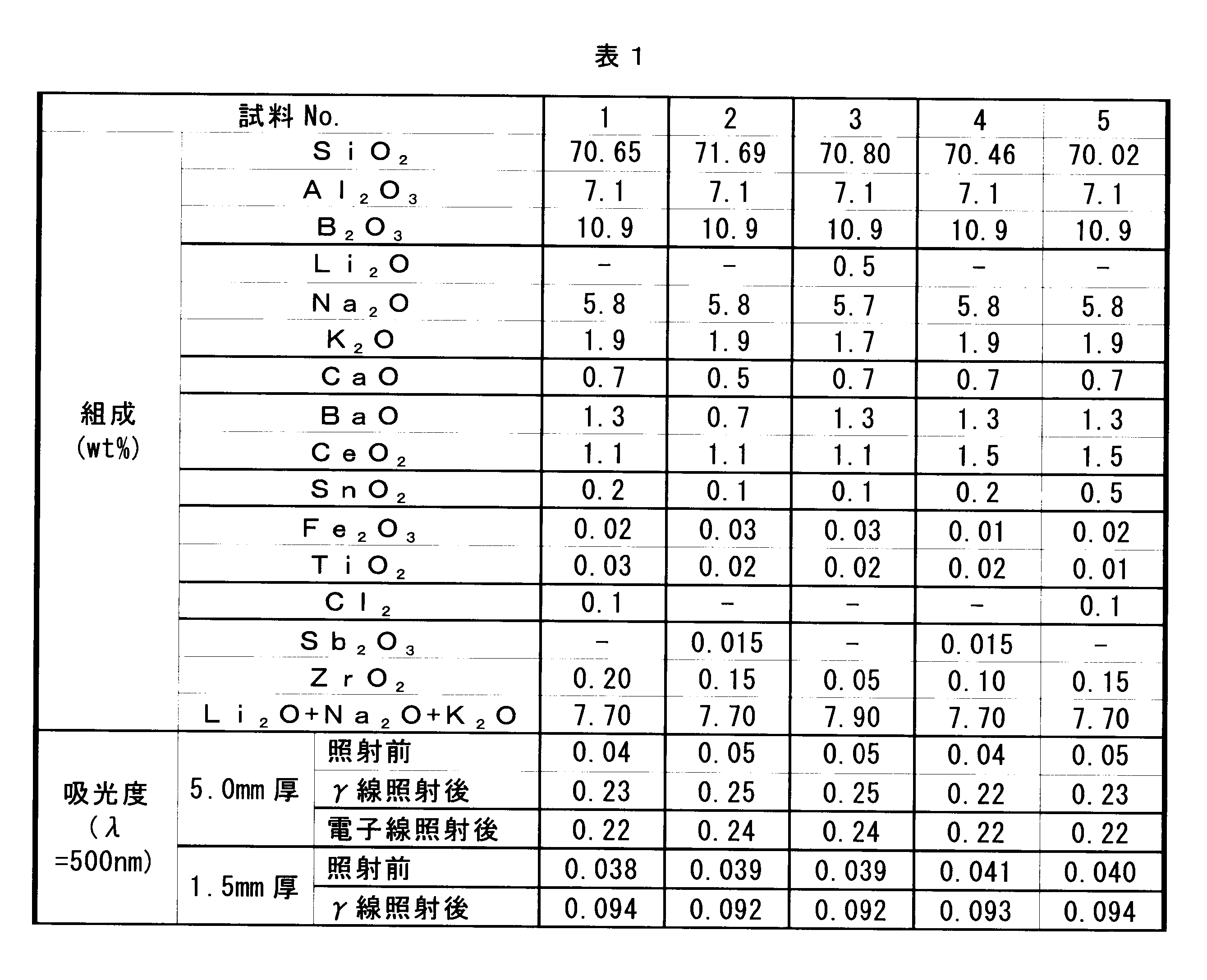
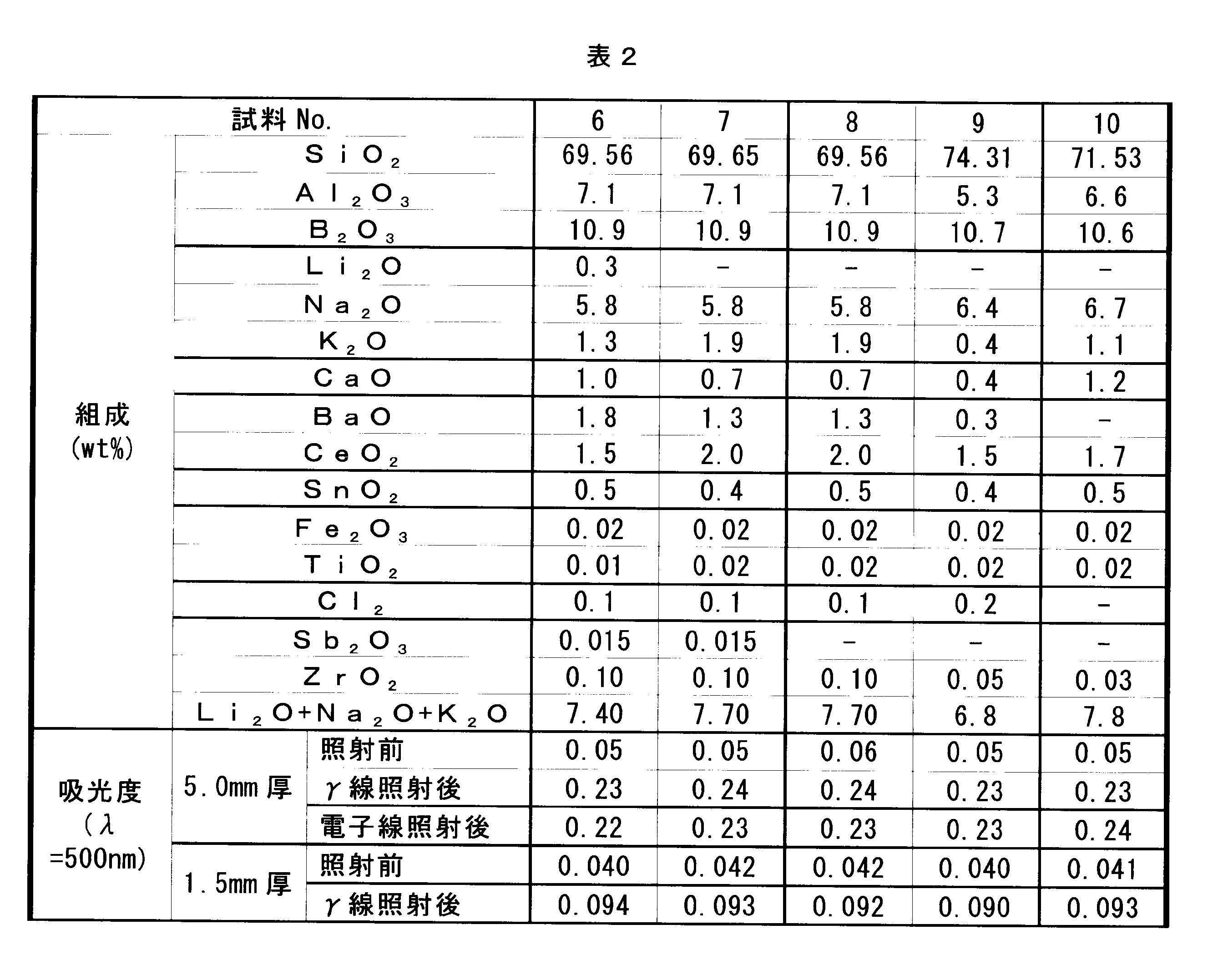

以下のようにして、各試料を調製した。まず、表中のガラス組成になるように、ガラス原料を秤量、混合して、ガラスバッチを作製した。次に、このガラスバッチを白金坩堝で1650℃、5時間溶融した後、流し出してガラスインゴットを作製した。次に、ガラスインゴットを25mm×30mmの寸法に切断、研磨して肉厚5.0mmおよび1.5mmの板状ガラス試料を得た。そして、得られた各試料の放射線照射前後において、以下の特性を評価した。
波長500nmにおける吸光度は、波長500nmにおける分光透過率を測定し、当該分光透過率に基づいて算出した。波長500nmにおける分光透過率は、SHIMADZU製 UV-3100PC分光光度計を用いて波長500nmの値を読み取った。吸光度が小さいほど、透明性が高いガラスである。
放射線としては、γ線および電子線を吸収線量25kGyでそれぞれ照射した。γ線照射は、コバルト60の線源を用いて行った。また、電子線照射は、出力が5MeVの電子加速器を用いて行った。吸収線量は、ガラス製の線量計により測定した。
表1~3から明らかなように、試料No.1~12は、放射線照射前の肉厚5.0mm、波長500nmにおける吸光度の値が0.15以下であった。また、放射線を吸収線量25kGyだけ照射した後の肉厚5.0mmにおける波長500nmの光の吸光度が0.30以下であった。
一方、試料No.13、14は、SnO2を含有していないため、放射線照射前の肉厚5.0mm、波長500nmにおける吸光度の値が0.15を超えていた。また、放射線を吸収線量25kGyだけ照射した後の肉厚5.0mmにおける波長500nmの光の吸光度が0.30を超えていた。すなわち、試料No.13、14は、本発明の実施例に比べ、放射線照射前後の透明性が劣っていた。
本発明を詳細にまた特定の実施態様を参照して説明したが、本発明の精神と範囲を逸脱することなく様々な変更や修正を加えることができることは当業者にとって明らかである。
本出願は、2012年7月30日出願の日本国特許出願(特願2012-168000)に基づくものであり、その内容はここに参照として取り込まれる。
本出願は、2012年7月30日出願の日本国特許出願(特願2012-168000)に基づくものであり、その内容はここに参照として取り込まれる。
本発明のホウケイ酸ガラスは、医療用容器の材料等として有用である。
Claims (10)
- ガラス組成として下記酸化物換算の質量%で、SiO2 65~78%、B2O3 8~18%、Li2O+Na2O+K2O 1~18%、CeO2 0.1~5.0%、SnO2 0.1~2.0%を含有するホウケイ酸ガラス。
- ガラス組成として下記酸化物換算の質量%で、SiO2 65~75%、B2O3 8~18%、Li2O+Na2O+K2O 1~10%、CeO2 0.1~5.0%、SnO2 0.1~2.0%、Al2O3 0~10%、CaO 0~7%、BaO 0~5%、Li2O 0~5%、Na2O 0~10%、K2O 0~5%を含有する請求項1に記載のホウケイ酸ガラス。
- CeO2の含有量が1.1~5.0%である請求項1または2に記載のホウケイ酸ガラス。
- 放射線照射前の肉厚5.0mmにおける波長500nmの光の吸光度が0.15以下である請求項1~3の何れかに記載のホウケイ酸ガラス。
- 放射線を吸収線量25kGyで照射した後の肉厚5.0mmにおける波長500nmの光の吸光度が0.30以下である請求項1~4の何れかに記載のホウケイ酸ガラス。
- 放射線により滅菌処理される医療用容器に用いられる請求項1~5の何れかに記載のホウケイ酸ガラス。
- γ線または電子線により滅菌処理される真空採血管に用いられる請求項1~5の何れかに記載のホウケイ酸ガラス。
- γ線または電子線により滅菌処理される医薬容器に用いられる請求項1~5の何れかに記載のホウケイ酸ガラス。
- 請求項1~6の何れかに記載のホウケイ酸ガラスを用いた医療用容器。
- 請求項1~6の何れかに記載のホウケイ酸ガラスを管状に成形し、管状に成形した該ガラスを切断および加工する医療用容器の製造方法。
Applications Claiming Priority (2)
| Application Number | Priority Date | Filing Date | Title |
|---|---|---|---|
| JP2012-168000 | 2012-07-30 | ||
| JP2012168000A JP5971615B2 (ja) | 2012-07-30 | 2012-07-30 | ホウケイ酸ガラス |
Publications (1)
| Publication Number | Publication Date |
|---|---|
| WO2014021142A1 true WO2014021142A1 (ja) | 2014-02-06 |
Family
ID=50027822
Family Applications (1)
| Application Number | Title | Priority Date | Filing Date |
|---|---|---|---|
| PCT/JP2013/069927 Ceased WO2014021142A1 (ja) | 2012-07-30 | 2013-07-23 | ホウケイ酸ガラス |
Country Status (2)
| Country | Link |
|---|---|
| JP (1) | JP5971615B2 (ja) |
| WO (1) | WO2014021142A1 (ja) |
Cited By (3)
| Publication number | Priority date | Publication date | Assignee | Title |
|---|---|---|---|---|
| WO2016035619A1 (ja) * | 2014-09-05 | 2016-03-10 | 日本電気硝子株式会社 | 医薬容器用ホウケイ酸ガラス及び医薬容器用ガラス管 |
| JPWO2017014066A1 (ja) * | 2015-07-17 | 2018-04-26 | 日本電気硝子株式会社 | 医薬容器用ホウケイ酸ガラス |
| CN112777932A (zh) * | 2019-11-08 | 2021-05-11 | 肖特股份有限公司 | 具有高的耐水解性和低的色泽的可钢化玻璃 |
Families Citing this family (6)
| Publication number | Priority date | Publication date | Assignee | Title |
|---|---|---|---|---|
| JP6508507B2 (ja) * | 2013-09-02 | 2019-05-08 | 日本電気硝子株式会社 | 医薬容器用ホウケイ酸ガラス |
| CN110573466B (zh) * | 2017-04-28 | 2022-06-24 | Agc株式会社 | 玻璃板和窗 |
| EP3636611A4 (en) | 2017-06-06 | 2021-02-24 | Nippon Electric Glass Co., Ltd. | PROCESS FOR THE PRODUCTION OF COLORED GLASS FOR PHARMACEUTICAL CONTAINERS AND COLORED GLASS FOR PHARMACEUTICAL CONTAINERS |
| JP7148896B2 (ja) * | 2017-10-20 | 2022-10-06 | 日本電気硝子株式会社 | 医薬品容器用ガラス及び医薬品容器用ガラス管 |
| CN111977972B (zh) * | 2020-09-01 | 2022-11-08 | 湖南旗滨医药材料科技有限公司 | 硼硅酸盐玻璃及其制备方法 |
| JP7133658B2 (ja) * | 2021-01-22 | 2022-09-08 | 株式会社オハラ | 光学ガラス |
Citations (3)
| Publication number | Priority date | Publication date | Assignee | Title |
|---|---|---|---|---|
| JPH04219343A (ja) * | 1990-12-18 | 1992-08-10 | Nippon Electric Glass Co Ltd | 医療用紫外線吸収性ガラス |
| JP2007210851A (ja) * | 2006-02-10 | 2007-08-23 | Asahi Techno Glass Corp | 蛍光ランプ用ガラス管 |
| JP2007314409A (ja) * | 2006-04-24 | 2007-12-06 | Nippon Electric Glass Co Ltd | 照明用ガラス |
-
2012
- 2012-07-30 JP JP2012168000A patent/JP5971615B2/ja active Active
-
2013
- 2013-07-23 WO PCT/JP2013/069927 patent/WO2014021142A1/ja not_active Ceased
Patent Citations (3)
| Publication number | Priority date | Publication date | Assignee | Title |
|---|---|---|---|---|
| JPH04219343A (ja) * | 1990-12-18 | 1992-08-10 | Nippon Electric Glass Co Ltd | 医療用紫外線吸収性ガラス |
| JP2007210851A (ja) * | 2006-02-10 | 2007-08-23 | Asahi Techno Glass Corp | 蛍光ランプ用ガラス管 |
| JP2007314409A (ja) * | 2006-04-24 | 2007-12-06 | Nippon Electric Glass Co Ltd | 照明用ガラス |
Cited By (12)
| Publication number | Priority date | Publication date | Assignee | Title |
|---|---|---|---|---|
| WO2016035619A1 (ja) * | 2014-09-05 | 2016-03-10 | 日本電気硝子株式会社 | 医薬容器用ホウケイ酸ガラス及び医薬容器用ガラス管 |
| CN106687422A (zh) * | 2014-09-05 | 2017-05-17 | 日本电气硝子株式会社 | 医药容器用硼硅酸盐玻璃及医药容器用玻璃管 |
| JPWO2016035619A1 (ja) * | 2014-09-05 | 2017-06-15 | 日本電気硝子株式会社 | 医薬容器用ホウケイ酸ガラス及び医薬容器用ガラス管 |
| US10099956B2 (en) | 2014-09-05 | 2018-10-16 | Nippon Electric Glass Co., Ltd. | Borosilicate glass for pharmaceutical container and glass tube for pharmaceutical container |
| CN106687422B (zh) * | 2014-09-05 | 2020-11-13 | 日本电气硝子株式会社 | 医药容器用硼硅酸盐玻璃及医药容器用玻璃管 |
| JPWO2017014066A1 (ja) * | 2015-07-17 | 2018-04-26 | 日本電気硝子株式会社 | 医薬容器用ホウケイ酸ガラス |
| US10710925B2 (en) | 2015-07-17 | 2020-07-14 | Nippon Electric Glass Co., Ltd. | Borosilicate glass for pharmaceutical container |
| CN112777932A (zh) * | 2019-11-08 | 2021-05-11 | 肖特股份有限公司 | 具有高的耐水解性和低的色泽的可钢化玻璃 |
| EP3819268A1 (en) * | 2019-11-08 | 2021-05-12 | Schott AG | Toughenable glass with high hydrolytic resistance and reduced color tinge |
| EP3819269A1 (en) * | 2019-11-08 | 2021-05-12 | Schott AG | Toughenable glass with high hydrolytic resistance and reduced color tinge |
| US11427497B2 (en) | 2019-11-08 | 2022-08-30 | Schott Ag | Toughenable glass with high hydrolytic resistance and reduced color tinge |
| CN112777932B (zh) * | 2019-11-08 | 2024-03-08 | 肖特股份有限公司 | 具有高的耐水解性和低的色泽的可钢化玻璃 |
Also Published As
| Publication number | Publication date |
|---|---|
| JP2014024731A (ja) | 2014-02-06 |
| JP5971615B2 (ja) | 2016-08-17 |
Similar Documents
| Publication | Publication Date | Title |
|---|---|---|
| JP5971615B2 (ja) | ホウケイ酸ガラス | |
| US11807575B2 (en) | Glass for medicine container and glass tube for medicine container | |
| CN104118989A (zh) | 优选用于医药领域的具有改良的抗水解性的硼硅玻璃 | |
| CN106477878B (zh) | 一种耐电离辐照和抗紫外线透明包装玻璃 | |
| EP3190096B1 (en) | Borosilicate glass for pharmaceutical container and glass tube for pharmaceutical container | |
| EP3098206A1 (en) | Crystal glass | |
| CN115180826A (zh) | 一种抗光敏药用中性硼硅玻璃及其制备方法 | |
| JP6829548B2 (ja) | 光学ガラス | |
| JP3079579B2 (ja) | 医療用紫外線吸収性ガラス | |
| JP6075600B2 (ja) | 医薬品容器用ガラス及びこれを用いたガラス管 | |
| JP2015093819A (ja) | 医療容器用ガラス | |
| JP2014055092A (ja) | 医療容器用ガラス | |
| CN1286757C (zh) | 具有高水解稳定性的硼硅酸盐玻璃 | |
| JP2015093820A (ja) | 医療容器用ガラス | |
| JP2015151313A (ja) | 医療容器用ガラス | |
| JP2015151314A (ja) | 医療容器用ガラス | |
| US3359125A (en) | Radiation indicating glass | |
| RU2844297C2 (ru) | Экранирующее излучение стекло, характеризующееся цинково-бариево-боросиликатной композицией | |
| JPH09295828A (ja) | 放射線照射変色防止ガラス | |
| JP7133658B2 (ja) | 光学ガラス | |
| JPH03252330A (ja) | 採血管用ガラス | |
| JP2687249B2 (ja) | 採血管用ガラス | |
| JP2023019914A (ja) | 光学ガラス | |
| JP2007292558A (ja) | ガラス組成物 | |
| TW200904770A (en) | Low melting point, deep UV penetrating glass |
Legal Events
| Date | Code | Title | Description |
|---|---|---|---|
| 121 | Ep: the epo has been informed by wipo that ep was designated in this application |
Ref document number: 13824814 Country of ref document: EP Kind code of ref document: A1 |
|
| NENP | Non-entry into the national phase |
Ref country code: DE |
|
| 122 | Ep: pct application non-entry in european phase |
Ref document number: 13824814 Country of ref document: EP Kind code of ref document: A1 |