WO2014017578A1 - 帯電防止性剥離フィルム - Google Patents
帯電防止性剥離フィルム Download PDFInfo
- Publication number
- WO2014017578A1 WO2014017578A1 PCT/JP2013/070152 JP2013070152W WO2014017578A1 WO 2014017578 A1 WO2014017578 A1 WO 2014017578A1 JP 2013070152 W JP2013070152 W JP 2013070152W WO 2014017578 A1 WO2014017578 A1 WO 2014017578A1
- Authority
- WO
- WIPO (PCT)
- Prior art keywords
- antistatic
- release film
- group
- film according
- mass
- Prior art date
- Legal status (The legal status is an assumption and is not a legal conclusion. Google has not performed a legal analysis and makes no representation as to the accuracy of the status listed.)
- Ceased
Links
Images
Classifications
-
- B—PERFORMING OPERATIONS; TRANSPORTING
- B32—LAYERED PRODUCTS
- B32B—LAYERED PRODUCTS, i.e. PRODUCTS BUILT-UP OF STRATA OF FLAT OR NON-FLAT, e.g. CELLULAR OR HONEYCOMB, FORM
- B32B7/00—Layered products characterised by the relation between layers; Layered products characterised by the relative orientation of features between layers, or by the relative values of a measurable parameter between layers, i.e. products comprising layers having different physical, chemical or physicochemical properties; Layered products characterised by the interconnection of layers
- B32B7/04—Interconnection of layers
- B32B7/06—Interconnection of layers permitting easy separation
-
- B—PERFORMING OPERATIONS; TRANSPORTING
- B32—LAYERED PRODUCTS
- B32B—LAYERED PRODUCTS, i.e. PRODUCTS BUILT-UP OF STRATA OF FLAT OR NON-FLAT, e.g. CELLULAR OR HONEYCOMB, FORM
- B32B27/00—Layered products comprising a layer of synthetic resin
-
- C—CHEMISTRY; METALLURGY
- C09—DYES; PAINTS; POLISHES; NATURAL RESINS; ADHESIVES; COMPOSITIONS NOT OTHERWISE PROVIDED FOR; APPLICATIONS OF MATERIALS NOT OTHERWISE PROVIDED FOR
- C09J—ADHESIVES; NON-MECHANICAL ASPECTS OF ADHESIVE PROCESSES IN GENERAL; ADHESIVE PROCESSES NOT PROVIDED FOR ELSEWHERE; USE OF MATERIALS AS ADHESIVES
- C09J7/00—Adhesives in the form of films or foils
- C09J7/40—Adhesives in the form of films or foils characterised by release liners
- C09J7/405—Adhesives in the form of films or foils characterised by release liners characterised by the substrate of the release liner
-
- B—PERFORMING OPERATIONS; TRANSPORTING
- B32—LAYERED PRODUCTS
- B32B—LAYERED PRODUCTS, i.e. PRODUCTS BUILT-UP OF STRATA OF FLAT OR NON-FLAT, e.g. CELLULAR OR HONEYCOMB, FORM
- B32B27/00—Layered products comprising a layer of synthetic resin
- B32B27/06—Layered products comprising a layer of synthetic resin as the main or only constituent of a layer, which is next to another layer of the same or of a different material
- B32B27/08—Layered products comprising a layer of synthetic resin as the main or only constituent of a layer, which is next to another layer of the same or of a different material of synthetic resin
-
- B—PERFORMING OPERATIONS; TRANSPORTING
- B32—LAYERED PRODUCTS
- B32B—LAYERED PRODUCTS, i.e. PRODUCTS BUILT-UP OF STRATA OF FLAT OR NON-FLAT, e.g. CELLULAR OR HONEYCOMB, FORM
- B32B27/00—Layered products comprising a layer of synthetic resin
- B32B27/28—Layered products comprising a layer of synthetic resin comprising synthetic resins not wholly covered by any one of the sub-groups B32B27/30 - B32B27/42
- B32B27/283—Layered products comprising a layer of synthetic resin comprising synthetic resins not wholly covered by any one of the sub-groups B32B27/30 - B32B27/42 comprising polysiloxanes
-
- B—PERFORMING OPERATIONS; TRANSPORTING
- B32—LAYERED PRODUCTS
- B32B—LAYERED PRODUCTS, i.e. PRODUCTS BUILT-UP OF STRATA OF FLAT OR NON-FLAT, e.g. CELLULAR OR HONEYCOMB, FORM
- B32B27/00—Layered products comprising a layer of synthetic resin
- B32B27/36—Layered products comprising a layer of synthetic resin comprising polyesters
-
- B—PERFORMING OPERATIONS; TRANSPORTING
- B32—LAYERED PRODUCTS
- B32B—LAYERED PRODUCTS, i.e. PRODUCTS BUILT-UP OF STRATA OF FLAT OR NON-FLAT, e.g. CELLULAR OR HONEYCOMB, FORM
- B32B9/00—Layered products comprising a layer of a particular substance not covered by groups B32B11/00 - B32B29/00
-
- C—CHEMISTRY; METALLURGY
- C09—DYES; PAINTS; POLISHES; NATURAL RESINS; ADHESIVES; COMPOSITIONS NOT OTHERWISE PROVIDED FOR; APPLICATIONS OF MATERIALS NOT OTHERWISE PROVIDED FOR
- C09J—ADHESIVES; NON-MECHANICAL ASPECTS OF ADHESIVE PROCESSES IN GENERAL; ADHESIVE PROCESSES NOT PROVIDED FOR ELSEWHERE; USE OF MATERIALS AS ADHESIVES
- C09J7/00—Adhesives in the form of films or foils
- C09J7/20—Adhesives in the form of films or foils characterised by their carriers
-
- B—PERFORMING OPERATIONS; TRANSPORTING
- B32—LAYERED PRODUCTS
- B32B—LAYERED PRODUCTS, i.e. PRODUCTS BUILT-UP OF STRATA OF FLAT OR NON-FLAT, e.g. CELLULAR OR HONEYCOMB, FORM
- B32B2307/00—Properties of the layers or laminate
- B32B2307/20—Properties of the layers or laminate having particular electrical or magnetic properties, e.g. piezoelectric
- B32B2307/21—Anti-static
-
- B—PERFORMING OPERATIONS; TRANSPORTING
- B32—LAYERED PRODUCTS
- B32B—LAYERED PRODUCTS, i.e. PRODUCTS BUILT-UP OF STRATA OF FLAT OR NON-FLAT, e.g. CELLULAR OR HONEYCOMB, FORM
- B32B2307/00—Properties of the layers or laminate
- B32B2307/70—Other properties
- B32B2307/748—Releasability
-
- B—PERFORMING OPERATIONS; TRANSPORTING
- B32—LAYERED PRODUCTS
- B32B—LAYERED PRODUCTS, i.e. PRODUCTS BUILT-UP OF STRATA OF FLAT OR NON-FLAT, e.g. CELLULAR OR HONEYCOMB, FORM
- B32B2405/00—Adhesive articles, e.g. adhesive tapes
-
- C—CHEMISTRY; METALLURGY
- C09—DYES; PAINTS; POLISHES; NATURAL RESINS; ADHESIVES; COMPOSITIONS NOT OTHERWISE PROVIDED FOR; APPLICATIONS OF MATERIALS NOT OTHERWISE PROVIDED FOR
- C09J—ADHESIVES; NON-MECHANICAL ASPECTS OF ADHESIVE PROCESSES IN GENERAL; ADHESIVE PROCESSES NOT PROVIDED FOR ELSEWHERE; USE OF MATERIALS AS ADHESIVES
- C09J2467/00—Presence of polyester
- C09J2467/001—Presence of polyester in the barrier layer
-
- C—CHEMISTRY; METALLURGY
- C09—DYES; PAINTS; POLISHES; NATURAL RESINS; ADHESIVES; COMPOSITIONS NOT OTHERWISE PROVIDED FOR; APPLICATIONS OF MATERIALS NOT OTHERWISE PROVIDED FOR
- C09J—ADHESIVES; NON-MECHANICAL ASPECTS OF ADHESIVE PROCESSES IN GENERAL; ADHESIVE PROCESSES NOT PROVIDED FOR ELSEWHERE; USE OF MATERIALS AS ADHESIVES
- C09J2481/00—Presence of sulfur containing polymers
- C09J2481/006—Presence of sulfur containing polymers in the substrate
-
- C—CHEMISTRY; METALLURGY
- C09—DYES; PAINTS; POLISHES; NATURAL RESINS; ADHESIVES; COMPOSITIONS NOT OTHERWISE PROVIDED FOR; APPLICATIONS OF MATERIALS NOT OTHERWISE PROVIDED FOR
- C09J—ADHESIVES; NON-MECHANICAL ASPECTS OF ADHESIVE PROCESSES IN GENERAL; ADHESIVE PROCESSES NOT PROVIDED FOR ELSEWHERE; USE OF MATERIALS AS ADHESIVES
- C09J2483/00—Presence of polysiloxane
- C09J2483/005—Presence of polysiloxane in the release coating
-
- C—CHEMISTRY; METALLURGY
- C09—DYES; PAINTS; POLISHES; NATURAL RESINS; ADHESIVES; COMPOSITIONS NOT OTHERWISE PROVIDED FOR; APPLICATIONS OF MATERIALS NOT OTHERWISE PROVIDED FOR
- C09J—ADHESIVES; NON-MECHANICAL ASPECTS OF ADHESIVE PROCESSES IN GENERAL; ADHESIVE PROCESSES NOT PROVIDED FOR ELSEWHERE; USE OF MATERIALS AS ADHESIVES
- C09J2483/00—Presence of polysiloxane
- C09J2483/006—Presence of polysiloxane in the substrate
-
- Y—GENERAL TAGGING OF NEW TECHNOLOGICAL DEVELOPMENTS; GENERAL TAGGING OF CROSS-SECTIONAL TECHNOLOGIES SPANNING OVER SEVERAL SECTIONS OF THE IPC; TECHNICAL SUBJECTS COVERED BY FORMER USPC CROSS-REFERENCE ART COLLECTIONS [XRACs] AND DIGESTS
- Y10—TECHNICAL SUBJECTS COVERED BY FORMER USPC
- Y10T—TECHNICAL SUBJECTS COVERED BY FORMER US CLASSIFICATION
- Y10T428/00—Stock material or miscellaneous articles
- Y10T428/14—Layer or component removable to expose adhesive
- Y10T428/1476—Release layer
-
- Y—GENERAL TAGGING OF NEW TECHNOLOGICAL DEVELOPMENTS; GENERAL TAGGING OF CROSS-SECTIONAL TECHNOLOGIES SPANNING OVER SEVERAL SECTIONS OF THE IPC; TECHNICAL SUBJECTS COVERED BY FORMER USPC CROSS-REFERENCE ART COLLECTIONS [XRACs] AND DIGESTS
- Y10—TECHNICAL SUBJECTS COVERED BY FORMER USPC
- Y10T—TECHNICAL SUBJECTS COVERED BY FORMER US CLASSIFICATION
- Y10T428/00—Stock material or miscellaneous articles
- Y10T428/31504—Composite [nonstructural laminate]
- Y10T428/31652—Of asbestos
- Y10T428/31663—As siloxane, silicone or silane
Definitions
- the present invention relates to an antistatic release film in which an antistatic layer is formed on one side of a base film, and a silicone release layer is further formed on the antistatic layer.
- a release film a base film such as a polyester film, a reaction product of an isocyanate and an alkylacetylenediol generally used as a surfactant, and antistatic An antistatic layer containing a conductive polymer as an agent is provided, and a silicone release layer is further provided on the antistatic layer (Patent Document 1).
- An object of the present invention is to solve the above-described conventional problems, in which an antistatic layer is formed on one side of a base film, and a silicone release layer is further formed on the antistatic layer.
- the preventive release film while exhibiting satisfactory peel force and surface resistance, the adhesion between the antistatic layer and the silicone release layer is at a good level even when left in a high temperature and high humidity environment. It is to be.
- the present inventor makes the antistatic layer contain the above-mentioned condensation reaction product obtained by subjecting an alkylsilicate hydrolyzate and a coupling agent to a condensation reaction, a water-soluble film forming resin, and an antistatic agent.
- the present inventors have found that the above problems can be solved and have completed the present invention.
- the present invention provides an antistatic release film in which an antistatic layer is formed on one surface of a base film and a silicone release layer is further formed on the antistatic layer.
- the present invention also provides an adhesive tape with a release film in which a double-sided adhesive film is laminated on the antistatic release film.
- the antistatic layer is a hydrolyzed alkyl silicate.
- a condensation reaction product obtained by subjecting a product and a coupling agent to a condensation reaction.
- the antistatic layer ensures good adhesion to a substrate film such as a polyester film, and also adheres well to a silicone release layer even when left in a high temperature and high humidity environment. Sex can be secured.
- the water-soluble film-forming resin can be uniformly mixed in an aqueous medium together with the condensation reaction product and the antistatic agent, and an antistatic layer-forming coating composition having excellent handleability can be provided.
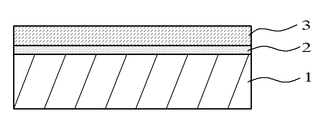
- FIG. 1 is a schematic cross-sectional view of the antistatic release film of the present invention.
- the antistatic release film of the present invention has a structure in which an antistatic layer 2 is formed on one surface of a base film 1 and a silicone release layer 3 is further formed on the antistatic layer 2.
- Base film 1 a base film of a conventional release film can be applied, and a polyethylene terephthalate film, a polyamide film, a polyimide film or the like having a thickness of usually 10 to 200 ⁇ m can be used.
- the antistatic layer 2 is usually a layer having a thickness of 0.05 to 0.5 ⁇ m and containing the following components (a) to (c).
- A a condensation reaction product obtained by a condensation reaction of a hydrolyzate of an alkyl silicate and a coupling agent
- B a water-soluble film-forming resin
- an antistatic agent an antistatic agent
- Component (a) is a condensation reaction product obtained by a condensation reaction of a hydrolyzate of alkyl silicate and a coupling agent.
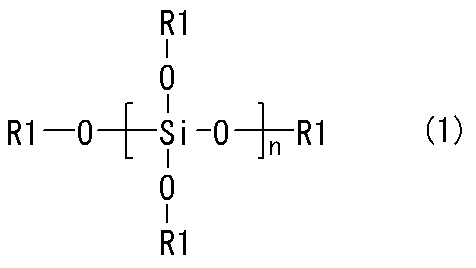
- the alkyl silicate is a silicate ester having an alkoxy group bonded to a silicon atom as a hydrolyzable group capable of undergoing hydrolysis, specifically a compound having a structure represented by the formula (1).
- a commercially available product can be used.
- R1 is an alkyl group, preferably an alkyl group having 1 to 3 carbon atoms from the viewpoint of boiling point and reactivity, particularly preferably a methyl group from the viewpoint of high reactivity or an ethyl group from the viewpoint of low environmental impact.
- N represents the number of repeating siloxane units (degree of polymerization), and represents an integer of 1 or more, preferably 3 to 8, particularly preferably 5, from the viewpoint of reactivity.
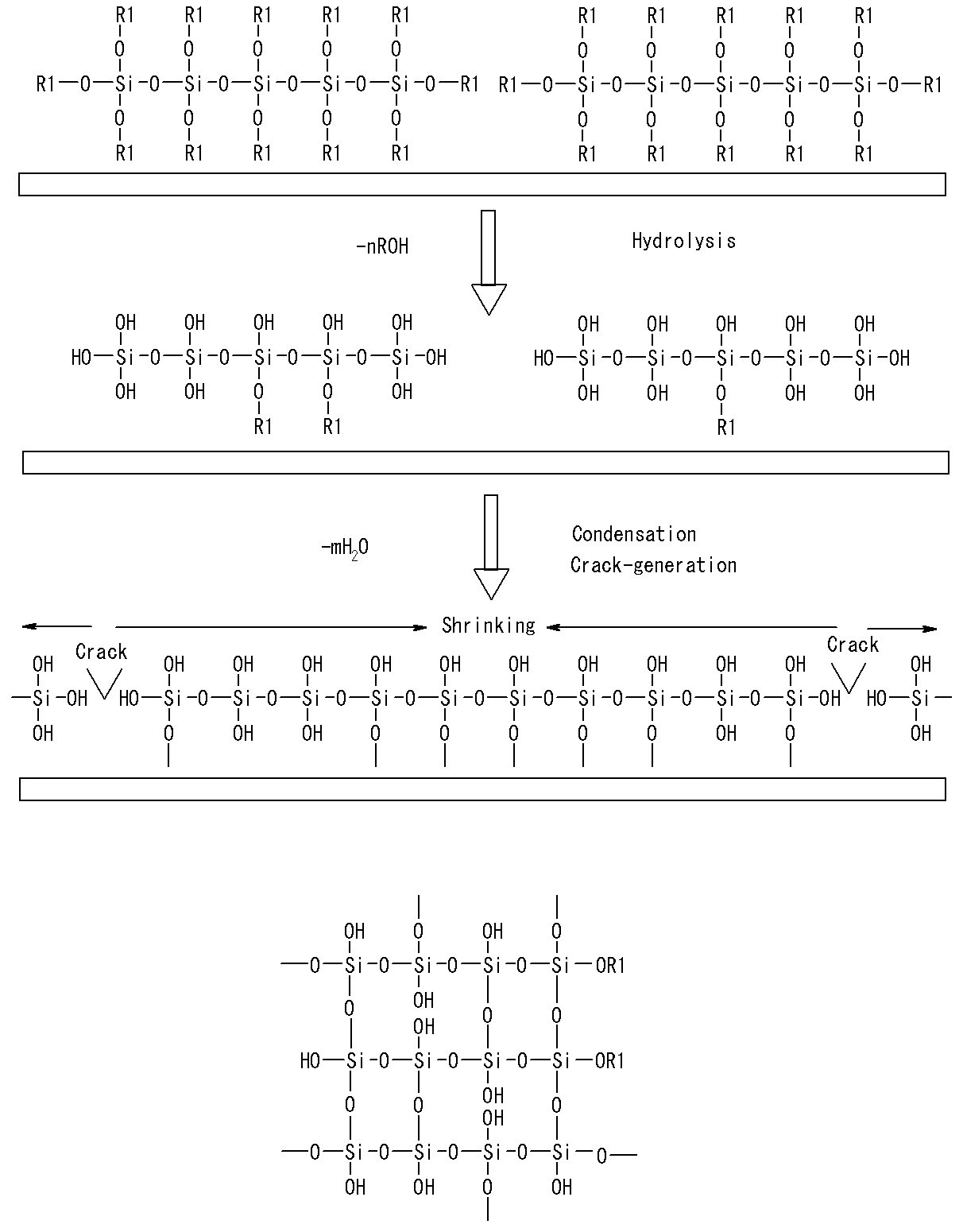
- the alkyl silicate is dissolved in an excess amount of water in the presence of an acid catalyst such as hydrochloric acid or toluenesulfonic acid, or water and ethanol. It can be carried out by dissolving in a mixed solvent with a water-miscible solvent and reacting at a temperature of room temperature to 80 ° C.
- an acid catalyst such as hydrochloric acid or toluenesulfonic acid, or water and ethanol. It can be carried out by dissolving in a mixed solvent with a water-miscible solvent and reacting at a temperature of room temperature to 80 ° C.
- the number average molecular weight of the hydrolyzate of such an alkyl silicate tends to be insufficient in membrane properties if it is too small, and the solubility tends to decrease if it is too large, so it is preferably 200 to 500, more preferably 300 to 400.
- the degree of hydrolysis of the hydrolyzate of alkyl silicate described above is too small, the reactivity with the coupling agent decreases, so that it is preferably 50% or more, more preferably 80% of the total number of “OR1” groups. This is the degree to which hydroxyl groups are obtained by hydrolysis.
- a coupling agent that undergoes a condensation reaction with the hydrolyzate of an alkyl silicate as described above has a hydrolyzable group that can generate a hydroxyl group by hydrolysis, such as an alkoxy group, an acyloxy group, a ketoximate group, and the like.
- a compound having an affinity group or reactive group for the surface of the inorganic substance and having an affinity group or reactive group for the inorganic surface and a known coupling agent, preferably a silane coupling agent, a titanium coupling agent such as tetraalkoxytitanium Etc. can be used.
- a silane coupling agent can be preferably used from a hydrolysable point.
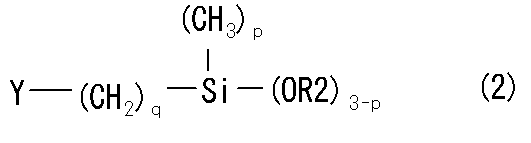
- Formula (2) can be used preferably.
- R2 represents an alkyl group having 1 to 3 carbon atoms (an alkyl group having 1 to 3 carbon atoms) or an acyloxy group which may be substituted with an alkoxy group (preferably an alkoxy group having 1 to 3 carbon atoms).
- Y is a glycidyloxy group, epoxy group, amino group, vinyl group, allyl group, (meth) acryloyloxy group, mercapto group, isocyanate group or ureido group, alkylthio group having 1 to 3 carbon atoms
- p is Q is an integer from 0 to 2
- q is an integer from 0 to 3.
- silane coupling agent of the formula (2) there can be mentioned one in which R2 is a methyl group, Y is a glycidyloxy group, p is 0, and q is 3.
- the condensation reaction product of component (a) is a product obtained by condensation reaction of the above-described alkyl silicate hydrolyzate and silane coupling agent, but the alkyl silicate hydrolyzate is 100 parts by weight (however, water or water and water When the amount of the coupling agent is too small, the reactivity tends to decrease compared to the miscible solvent (ethanol, methanol, acetone, etc.), and the affinity is poor. Therefore, preferably 100 to 500 parts by mass, more preferably 200 to 300 parts by mass are subjected to a condensation reaction.
- Such a condensation reaction product of component (a) is usually dissolved in water or a mixed solvent of water and a water-miscible solvent (ethanol, methanol, acetone, etc.) at a theoretical solid content of 0.5 to 5% by mass. Exists in the state.
- examples of the condensation reaction conditions include a condition of stirring at room temperature for 24 hours.
- Component (b) is a water-soluble film-forming resin and needs to be water-soluble in order to mix with the condensation reaction product of component (a).
- water-soluble means a property of dissolving at least 10 g in 100 g of water at 20 ° C.
- water-soluble film-forming resins include polyester resins, polyvinyl alcohol resins, carboxymethylol resins, and polyvinylpyrrolidone resins.
- water-soluble polyester resins particularly those in which the acid component is phthalic acid or a derivative thereof and the alcohol component is ethylene glycol can be preferably used.
- the component (c) is an antistatic agent, and a known antistatic agent can be applied.
- a known conductive polymer can be preferably applied from the viewpoint of surface resistance.
- Specific examples of such a conductive polymer preferably include those represented by the following formula (3) or (4).
- m is the number of repeating units, preferably each independently an integer of 20 to 80.
- the content of the condensation reaction product of component (a) in the antistatic layer 2 (theoretical solid content conversion) is too small, there is a tendency for adhesion failure to occur, and when it is too large, the film tends to become hard, so preferably 30 It is ⁇ 80 mass%, more preferably 45 to 65 mass%.
- the content of the water-soluble film-forming resin of component (b) in the antistatic layer 2 is too small, the film tends to become hard, and if it is too large, the adhesion tends to be insufficient.
- % By mass more preferably 10 to 30% by mass.
- the content of the antistatic agent of component (c) in the antistatic layer 2 is too small, the antistatic performance tends to be insufficient, and if it is too large, the surface resistance tends to be too small.
- -40% by mass more preferably 20-30% by mass.
- the content ratio of the condensation reaction product of component (a) (in terms of theoretical solid content) and the water-soluble film-forming resin of component (b) in the antistatic layer 2 is preferably 100: 200 to 300. is there.
- the content of the water-soluble film-forming resin of the component (b) is significantly below this range, the film tends to be hard, and conversely when it is greatly above, the adhesion tends to be insufficient.
- the antistatic layer 2 described above is obtained by adding a coupling agent to an alkyl silicate hydrolyzate (hydroalcohol solution) and stirring to obtain a hydroalcohol solution of a condensation reaction product.
- a water-soluble film forming resin and an antistatic agent are uniformly mixed to prepare a composition for forming an antistatic layer, and the composition is applied onto the base film 1 by a conventional method and dried to form a film. can do.
- Silicone-based release layer 3 a silicone release layer of a conventional release film can be applied, and the thickness thereof is usually 0.05 to 0.5 ⁇ m.
- a silicone release layer can usually be formed by depositing a known release paper silicone on the antistatic layer 2 by a known method.
- Known silicones for release paper include condensation type silicones such as those obtained by condensing hydroxypolydimethylsiloxane and hydrogen polydimethylsiloxane, and addition reaction type silicones such as glycidyl polydimethylsiloxane by addition reaction with a curing agent. And the like.
- the antistatic release film of the present invention can be used as a release film for a known double-sided adhesive film.
- a pressure-sensitive adhesive tape with a release film wound up in a roll shape is obtained.
- an anisotropic conductive film can be applied as a preferable double-sided pressure-sensitive adhesive film.
- a known anisotropic conductive film can be employed as the anisotropic conductive film.
- the antistatic performance of the antistatic release film of the present invention can be appropriately set according to the purpose of use of the antistatic release film.
- the surface resistance value is 1 ⁇ 10 11 ⁇ / ⁇ or less, More preferably, it is 1 ⁇ 10 10 ⁇ / ⁇ or less.
- the surface resistance is preferably 1 ⁇ 10 6 ⁇ / ⁇ or more.
- the peeling performance of the antistatic release film of the present invention can be appropriately set according to the purpose of use of the antistatic release film, it is evaluated by the peel strength of the adhesive film attached to the silicone release layer. be able to.
- an acrylic adhesive film (T4090, Dexerials Co., Ltd.) is bonded to a silicone release layer at a temperature of 70 ° C. and a pressure of 25 g / cm 2 , and after 16 hours, a release tester (Tensilon Universal Test)
- the peel strength is preferably 0.6 N / 5 cm or less, more preferably 0.4 N / 5 cm or less, when the peel force is measured by a machine, Orientec Co., Ltd.
- the peeling force is preferably 0.05 N / 5 cm or more, more preferably Is 0.1 N / 5 cm or more.
- Reference Example 2 (Preparation of condensation reaction product) Into a reaction vessel equipped with a stirrer, 25 parts by mass (theoretical-form 2% by mass) of an isopropyl alcohol solution of the partial hydrolyzate of methyl silicate prepared in Reference Example 1 was added. 5 parts by mass of an agent (A-187, Momentive Performance Materials Japan GK) was gradually added to obtain a condensation reaction product as an isopropyl alcohol solution.
- an agent A-187, Momentive Performance Materials Japan GK
- Reference Example 3 Preparation of water-soluble polyester resin
- the temperature was raised to 210 ° C., and a dehydration condensation reaction was performed while removing water generated by esterification azeotropically.
- 10 parts by mass of 5-sodiosulfoisophthalic acid is added to the reaction vessel, and the dehydration condensation reaction is continued.
- the glass transition temperature Tg is A water-soluble polyester resin at 68 ° C. was obtained.
- Example 1 (Preparation of antistatic layer forming composition)
- 11 parts by mass of ion-exchanged water and 1 part by mass of the water-soluble polyester resin of Reference Example 3 were stirred and mixed, and further 26 parts by mass of ethanol was added and uniformly stirred and mixed.
- 20 parts by mass of an antistatic agent polyethylene dioxythiophene polystyrene sulfonate; Clevios P, HC Starck Co., Ltd.
- 42 parts by mass of the isopropyl alcohol solution of the condensation reaction product of Reference Example 2 was added to the obtained mixture, and the mixture was further stirred and mixed uniformly to obtain a composition for forming an antistatic layer.
- a composition for forming an antistatic layer is applied to one side of a 50 ⁇ m thick polyester base film (Tetron U2, Teijin Limited) so that the dry thickness is 0.1 ⁇ m, and dried at 160 ° C. for 1 minute. Thus, an antistatic layer was formed.
- the silicone release layer-forming composition was applied to a dry thickness of 0.3 ⁇ m and dried at 160 ° C. for 1 minute to form a silicone release layer. Thereby, an antistatic release film was obtained.
- Example 2 Antistatic as in Example 1 except that another curable silicone solution (LTCF750A, SRX212, Toray Dow Corning) was used instead of the curable silicone solution (KS847, Shin-Etsu Chemical Co., Ltd.) A release film was prepared.
- LTCF750A SRX212, Toray Dow Corning
- KS847 Shin-Etsu Chemical Co., Ltd.
- Comparative Example 1 In the preparation of the composition for forming an antistatic layer, Examples were used except that 42 parts by mass of the water-soluble polyester resin of Reference Example 3 was used instead of 42 parts by mass of the isopropyl alcohol solution of the condensation reaction product of Reference Example 2. As in Example 1, an antistatic release film was prepared.
- Comparative Example 2 An antistatic release film was prepared in the same manner as in Example 1 except that 1 part by mass of the water-soluble polyester resin of Reference Example 3 was not used when preparing the composition for forming an antistatic layer.
- Comparative Example 3 An antistatic release film was prepared in the same manner as in Example 1 except that 42 parts by mass of the isopropyl alcohol solution of the condensation reaction product of Reference Example 2 was not used in the preparation of the antistatic layer forming composition.
- Comparative Example 4 In preparing the composition for forming an antistatic layer, instead of 42 parts by mass of the isopropyl alcohol solution of the condensation reaction product of Reference Example 2, isopropyl alcohol of a partial hydrolyzate of methyl silicate having a number average molecular weight of 350 of Reference Example 1 An antistatic release film was prepared in the same manner as in Example 1 except that 42 parts by mass of the solution was used.
- the surface of the polyester adhesive tape contacted with the Teflon (registered trademark) film was similarly bonded to a polyethylene terephthalate base film (Lumirror S10, Toray Industries, Inc.) that was not peeled, and the peel strength after 16 hours. was measured (peel strength B). And the peeling strength A and the peeling strength B were substituted into the following formula
- the residual adhesive strength is desirably 80% or more.
- the surface resistance [ ⁇ / ⁇ ] of the surface of the antistatic release film on the silicone release layer side was measured using an electric resistance measuring device (Hirester, Mitsubishi Chemical Analytech Co., Ltd.).
- the surface resistance value is desirably 1 ⁇ 10 11 ⁇ / ⁇ or more.
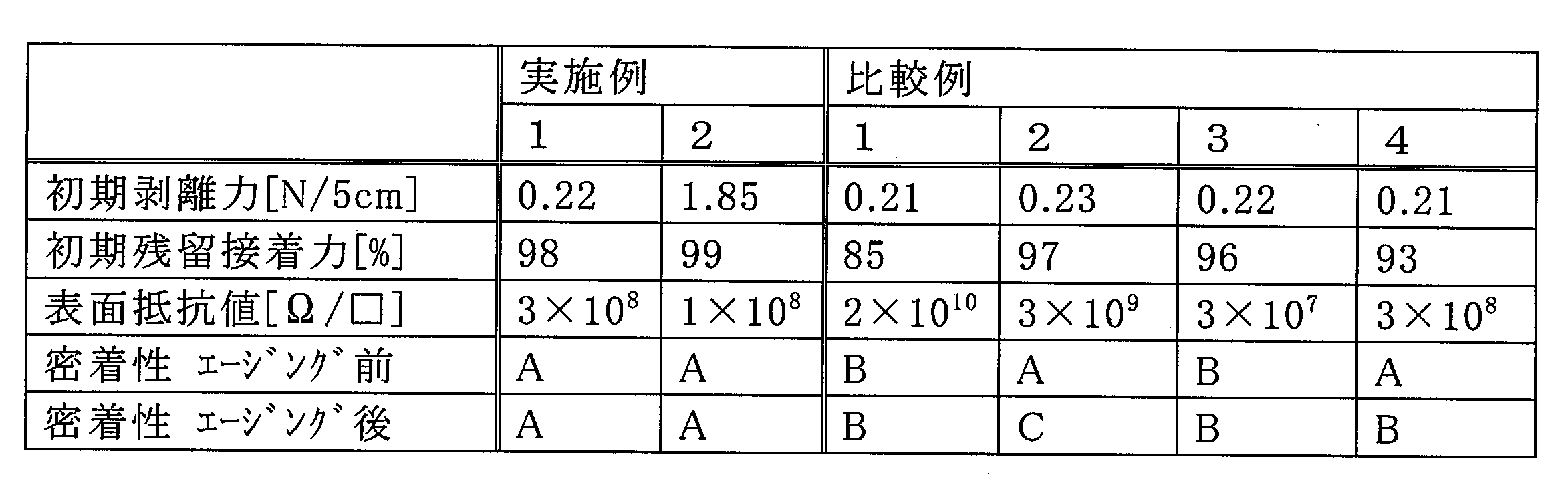
- the antistatic release films of Examples 1 and 2 are preferable results with respect to the initial peel force, initial residual adhesive force, and surface resistance value, and the adhesive strength before and after aging is both evaluated as A. Met.
- the antistatic release film of Comparative Example 1 was obtained by subjecting an alkylsilicate hydrolyzate and a coupling agent to a condensation reaction, although a large amount of water-soluble film-forming resin was used for the antistatic layer. Since no condensation reaction product was used, the initial residual adhesive force was very low and the surface resistance value was high compared to the examples. Moreover, the adhesiveness before and after aging was also B evaluation.
- the antistatic release film of Comparative Example 2 uses a condensation reaction product obtained by a condensation reaction of a hydrolyzate of an alkyl silicate and a coupling agent in the antistatic layer, but a water-soluble film-forming resin.
- a condensation reaction product obtained by a condensation reaction of a hydrolyzate of an alkyl silicate and a coupling agent in the antistatic layer, but a water-soluble film-forming resin.
- the adhesion before aging was A evaluation
- the adhesion after aging was C evaluation.
- the antistatic release film of Comparative Example 3 uses a small amount of a water-soluble film-forming resin for the antistatic layer, it is a condensation product obtained by subjecting an alkyl silicate hydrolyzate and a coupling agent to a condensation reaction. Since no reactant was used, the surface resistance value was higher than that of the Examples, and the adhesion before and after aging was evaluated as B.
- the antistatic release film of Comparative Example 4 uses a condensation product of an alkyl silicate hydrolyzate and a coupling agent, although an alkyl silicate hydrolyzate is used for the antistatic layer.
- an alkyl silicate hydrolyzate was used for the antistatic layer.
- the initial residual adhesive force was lower than that of the example.
- the adhesiveness after aging was also B evaluation.
- the antistatic layer contains a condensation reaction product obtained by a condensation reaction of a hydrolyzate of alkyl silicate and a coupling agent. For this reason, the antistatic layer ensures good adhesion to a substrate film such as a polyester film, and also adheres well to a silicone release layer even when left in a high temperature and high humidity environment. Sex can be secured. Therefore, it is useful as a release film for an anisotropic conductive film.
Landscapes
- Chemical & Material Sciences (AREA)
- Organic Chemistry (AREA)
- Laminated Bodies (AREA)
- Adhesive Tapes (AREA)
Description
(a)アルキルシリケートの加水分解物と、カップリング剤とを縮合反応させて得た縮合反応物;
(b)水溶性成膜用樹脂;及び
(c)帯電防止剤
を含有する帯電防止性剥離フィルムを提供する。
基材フィルム1は、従来の剥離フィルムの基材フィルムを適用することができ、通常厚さ10~200μmのポリエチレンテレフタレートフィルム、ポリアミドフィルム、ポリイミドフィルム等を使用することができる。
帯電防止層2は、通常、厚さ0.05~0.5μmの、以下の成分(a)~(c)を含有する層である。
(b)水溶性成膜用樹脂;及び
(c)帯電防止剤。
成分(a)は、アルキルシリケートの加水分解物と、カップリング剤とを縮合反応させて得た縮合反応物である。
成分(b)は水溶性成膜用樹脂であり、成分(a)の縮合反応物と混和するために水溶性であることが必要である。ここで、“水溶性”とは、20℃の水100gに対し少なくとも10g溶解する性質を意味する。このような水溶性成膜用樹脂としては、ポリエステル樹脂、ポリビニルアルコール樹脂、カルボキシメチロール樹脂、ポリビニルピロリドン樹脂等を挙げることができる。中でも、水溶性ポリエステル樹脂、特に、酸成分がフタル酸又はその誘導体であって、アルコール成分がエチレングリコールであるものを好ましく使用することができる。
成分(c)は、帯電防止剤であって、公知の帯電防止剤を適用することができる。中でも、表面抵抗の点から公知の導電性高分子を好ましく適用することができる。このような導電性高分子の具体例としては、以下の式(3)又は(4)に示すものを好ましく挙げることができる。

シリコーン系剥離層3としては、従来の剥離フィルムのシリコーン系剥離層を適用することができ、通常、その厚みは0.05~0.5μmである。このようなシリコーン系剥離層は、通常、公知の剥離紙用シリコーンを帯電防止層2上に公知の手法により成膜することで形成することができる。公知の剥離紙用シリコーンとしては、縮合型シリコーン、例えばヒドロキシポリジメチルシロキサンとハイドロジェンポリジメチルシロキサンとを縮合させたものや、付加反応型シリコーン、例えば、グリシジルポリジメチルシロキサンを硬化剤により付加反応させたもの等が挙げられる。
窒素導入管、温度計及び撹拌機を備えた反応容器に、メチルシリケート(メチルシリケート51、コルコート(株))100質量部に、エタノール15質量部、及び0.01質量%の硫酸を投入し、投入完了後更に1時間撹拌を続けた。撹拌終了後、エバポレーターを使用して反応物から、加水分解により生じたメタノール並びに投入したエタノールを留去した。得られた留去残渣を陽イオン交換樹脂カラムに通過させて過剰の硫酸を除去した。得られた部分加水分解物にイソプロピルアルコール100質量部を少しずつ添加しながら、撹拌を10時間続けた。これにより、数平均分子量350のメチルシリケートの部分加水分解物をイソプロピルアルコール溶液として得た。
撹拌機を備えた反応容器に、参考例1で調製したメチルシリケートの部分加水分解物のイソプロピルアルコール溶液25質量部(理論-形分2質量%)を投入し、撹拌しながら、更にシランカップリング剤(A-187、モメンティブ・パフォーマンス・マテリアルズ・ジャパン合同会社)5質量部を徐々に添加し、縮合反応物をイソプロピルアルコール溶液として得た。
ディーンスターク装置、窒素導入管、温度計、撹拌機を備えた反応容器に、テレフタル酸40質量部、イソフタル酸40質量部、エチレングリコール150質量部、及び酢酸亜鉛10質量部を仕込み、撹拌しながら210℃に昇温し、エステル化により生じた水を共沸除去しながら脱水縮合反応を行った。実際に留出した水が理論全留出量の75%に達した時点で、反応容器に5-ソジオスルホイソフタル酸10質量部を投入し、更に脱水縮合反応を続け、ガラス転移温度Tgが68℃の水溶性ポリエステル樹脂を得た。
(帯電防止層形成用組成物の調製)
反応容器中で、イオン交換水11質量部と参考例3の水溶性ポリエステル樹脂1質量部とを撹拌混合し、更にエタノール26質量部を投入し、均一に撹拌混合した。この混合物に、更に帯電防止剤(ポリエチレンジオキシチオフェンポリスチレンスルフォネート;クレビオスP、HCスタルク(株))20質量部を添加し、更に均一に撹拌混合した。得られた混合物に、更に参考例2の縮合反応物のイソプロピルアルコール溶液42質量部を投入し、更に均一に撹拌混合することにより、帯電防止層形成用組成物を得た。
反応容器中で、硬化型シリコーン溶液(KS847、信越化学工業(株))10質量部と、白金系硬化剤(CAT-PL50T、信越化学工業(株))0.1質量部と、トルエン90質量部とを撹拌混合することによりシリコーン系剥離層形成用組成物を得た。
厚さ50μmのポリエステル基材フィルム(テトロンU2、帝人(株))の片面に、帯電防止層形成用組成物を、乾燥厚が0.1μmとなるように塗布し、160℃で1分間乾燥することにより帯電防止層を形成した。
硬化型シリコーン溶液(KS847、信越化学工業(株))に代えて、別の硬化型シリコーン溶液(LTCF750A、SRX212、東レダウコーニング(株))を使用すること以外、実施例1と同様に帯電防止性剥離フィルムを作成した。
帯電防止層形成用組成物の調製の際に、参考例2の縮合反応物のイソプロピルアルコール溶液42質量部に代えて、参考例3の水溶性ポリエステル樹脂42質量部を使用すること以外、実施例1と同様に帯電防止性剥離フィルムを作成した。
帯電防止層形成用組成物の調製の際に、参考例3の水溶性ポリエステル樹脂1質量部を使用しないこと以外、実施例1と同様に帯電防止性剥離フィルムを作成した。
帯電防止層形成用組成物の調製の際に、参考例2の縮合反応物のイソプロピルアルコール溶液42質量部を使用しないこと以外、実施例1と同様に帯電防止性剥離フィルムを作成した。
帯電防止層形成用組成物の調製の際に、参考例2の縮合反応物のイソプロピルアルコール溶液42質量部に代えて、参考例1の数平均分子量350のメチルシリケートの部分加水分解物のイソプロピルアルコール溶液42質量部を使用すること以外、実施例1と同様に帯電防止性剥離フィルムを作成した。
<<評価>>
得られた実施例1及び2並びに比較例1~4の帯電防止性剥離フィルムについて、以下に説明するように初期「剥離力」、初期「残留接着力」、「表面抵抗値」、エージング前後の「密着力」を評価した。得られた結果を表1に示す。
帯電防止性剥離フィルムのシリコーン系剥離層面に、アクリル系粘着フィルム(T4090、デクセリアルズ(株))を70℃の温度下で25g/cm2の圧力で貼り合わせ、16時間経過後、剥離試験器(テンシロン万能試験機、(株)オリエンテック)で剥離力を測定した。剥離力は、実用上、2N/5cm以下、好ましくは0.6N/5cm以下であることが望まれる。
市販のポリエステル系粘着テープ(31B、日東電工(株))の帯電防止性剥離フィルムに対する「剥離力」の評価を上述のように行った後、シリコーン系剥離層と接触したポリエステル系粘着テープ面を、剥離処理されていないポリエチレンテレフタレート基材フィルム(ルミラーS10、東レ(株))に対し、同様に貼り合わせ、16時間経過後に剥離強度を測定した(剥離強度A)。これとは別に、テフロン(登録商標)フィルム上に、剥離力の評価を行っていない市販のポリエステル系粘着テープ(31B、日東電工(株))を、同様に貼り合わせ、20時間経過後に剥離し、テフロン(登録商標)フィルムを接触したポリエステル系粘着テープ面を、剥離処理されていないポリエチレンテレフタレート基材フィルム(ルミラーS10、東レ(株))に対し、同様に貼り合わせ、16時間経過後に剥離強度を測定した(剥離強度B)。そして剥離強度Aと剥離強度Bとを、以下の式(1)に代入して残留接着力を求めた。残留接着力は80%以上であることが望まれる。

帯電防止性剥離フィルムのシリコーン系剥離層側表面の表面抵抗[Ω/□]を、電気抵抗測定機(ハイレスター、(株)三菱化学アナリテック)を用いて測定した。表面抵抗値は1×1011Ω/□以上であることが望まれる。
40℃で湿度95%の環境下に1ヶ月放置というエージングテストの前後における帯電防止性剥離フィルムのシリコーン系剥離層側表面を指で10往復擦り、剥離層が剥がれ落ちるか否かを、目視観察し、以下の基準に従って評価した。
A: 剥がれの発生が観察されない場合
B: 基材フィルムと帯電防止層との間で剥がれの発生が観察される場合
C: 帯電防止層と剥離層との間で剥がれの発生が観察される場合
2 帯電防止層
3 シリコーン系剥離層
Claims (15)
- 基材フィルムの片面に帯電防止層が形成され、その帯電防止層上に更にシリコーン系剥離層が形成されてなる帯電防止性剥離フィルムにおいて、該帯電防止層が、以下の成分(a)~(c):
(a)アルキルシリケートの加水分解物と、カップリング剤とを縮合反応させて得た縮合反応物;
(b)水溶性成膜用樹脂;及び
(c)帯電防止剤
を含有する帯電防止性剥離フィルム。 - アルキルシリケートが、式(1)
(式(1)中、R1はアルキル基であり、nは1以上の整数である。)
で表される化合物である請求項1記載の帯電防止性剥離フィルム。 - アルキルシリケートの加水分解物の数平均分子量が、200~500である請求項1又は2記載の帯電防止性剥離フィルム。
- R1が炭素数1~3のアルキル基であり、nが3~8の整数である請求項2記載の帯電防止性剥離フィルム。
- R1がメチル基であり、nが5である請求項4記載の帯電防止性剥離フィルム。
- アルキルシリケートの加水分解の程度が、全OR1基の数の50%以上が加水分解を受けて水酸基となる程度である請求項1~5のいずれかに記載の帯電防止性剥離フィルム。
- カップリング剤が、式(2)
(式(2)中、R2はアルコキシ基で置換されてもよいアルキル基又はアシルオキシ基であり、Yはグリシジルオキシ基、エポキシ基、アミノ基、ビニル基、アリル基、(メタ)アクリロイルオキシ基、メルカプト基、イソシアネート基又はウレイド基、炭素数1~3のアルキルチオ基であり、pは0~2の整数であり、qは0~3の整数である。)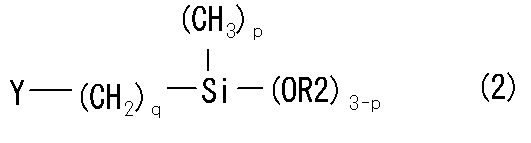
で表される化合物である請求項1~6のいずれかに記載の帯電防止性剥離フィルム。 - R2がメチル基であり、Yがグリシジルオキシ基であり、pが0であり、qが3である請求項7記載の帯電防止性剥離フィルム。
- 縮合反応物が、アルキルシリケートの加水分解物100質量部に対し、カップリング剤200~300質量部を縮合反応させたものである請求項1~8のいずれかに記載の帯電防止性剥離フィルム。
- 水溶性成膜用樹脂が、20℃の水100gに対し、少なくとも10g溶解するポリエステル樹脂である請求項1~9のいずれかに記載の帯電防止性剥離フィルム。
- 成分(c)の帯電防止剤が、導電性高分子である請求項1~10のいずれかに記載の帯電防止性剥離フィルム。
- 導電性高分子が、以下の式(3)又は(4)
(式中、mは繰り返し単位数である。)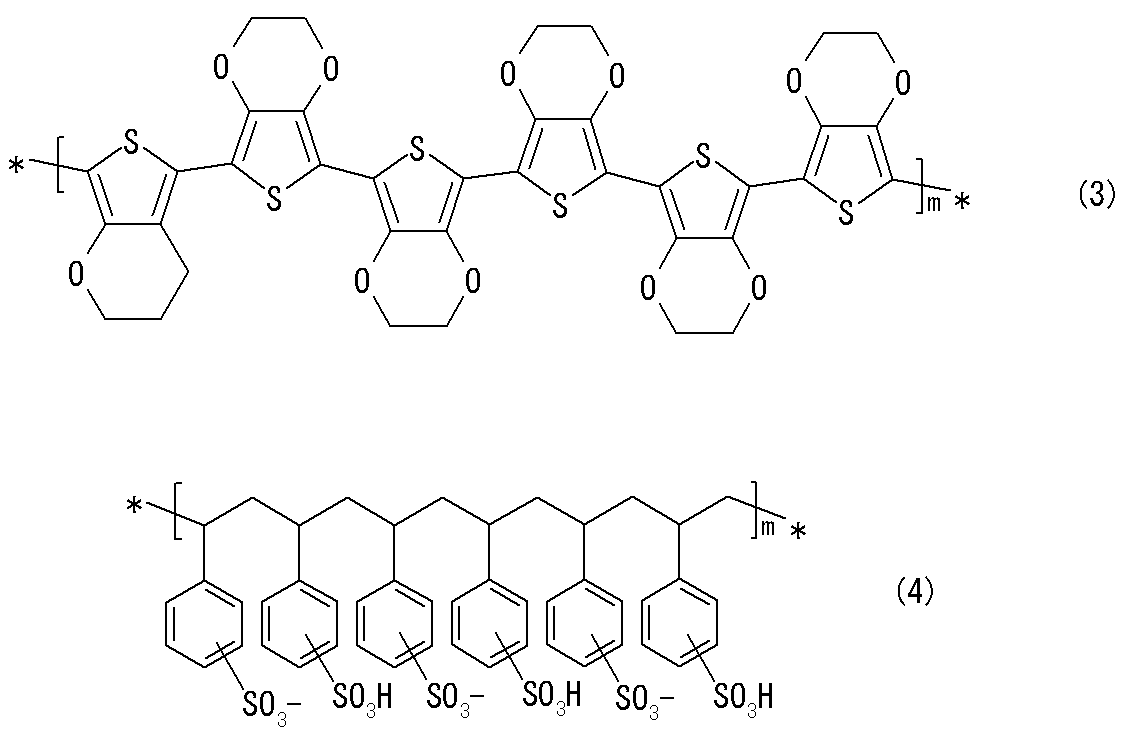
で表される構造を有する請求項11記載の帯電防止性剥離フィルム。 - 帯電防止層が、成分(a)の縮合反応物を45~65質量%、成分(b)の水溶性成膜用樹脂を10~30質量%、成分(c)の帯電防止剤を20~30質量%含有し、成分(a)と成分(b)との質量基準の含有割合が100:200~300である請求項1~12のいずれかに記載の帯電防止性剥離フィルム。
- 請求項1~13のいずれかに記載の帯電防止性剥離フィルムに、両面粘着フィルムが積層されている剥離フィルム付き粘着テープ。
- 両面粘着フィルムが、異方性導電フィルムである請求項14記載の剥離フィルム付き粘着テープ。
Priority Applications (4)
| Application Number | Priority Date | Filing Date | Title |
|---|---|---|---|
| CN201380039382.2A CN104507671B (zh) | 2012-07-25 | 2013-07-25 | 抗静电性剥离薄膜 |
| KR20147035904A KR20150037760A (ko) | 2012-07-25 | 2013-07-25 | 대전 방지성 박리 필름 |
| HK15109816.6A HK1209085A1 (en) | 2012-07-25 | 2013-07-25 | Antistatic peelable film |
| US14/412,248 US20150152295A1 (en) | 2012-07-25 | 2013-07-25 | Antistatic release film |
Applications Claiming Priority (2)
| Application Number | Priority Date | Filing Date | Title |
|---|---|---|---|
| JP2012-164389 | 2012-07-25 | ||
| JP2012164389A JP5874561B2 (ja) | 2012-07-25 | 2012-07-25 | 帯電防止性剥離フィルム |
Publications (1)
| Publication Number | Publication Date |
|---|---|
| WO2014017578A1 true WO2014017578A1 (ja) | 2014-01-30 |
Family
ID=49997387
Family Applications (1)
| Application Number | Title | Priority Date | Filing Date |
|---|---|---|---|
| PCT/JP2013/070152 Ceased WO2014017578A1 (ja) | 2012-07-25 | 2013-07-25 | 帯電防止性剥離フィルム |
Country Status (7)
| Country | Link |
|---|---|
| US (1) | US20150152295A1 (ja) |
| JP (1) | JP5874561B2 (ja) |
| KR (1) | KR20150037760A (ja) |
| CN (1) | CN104507671B (ja) |
| HK (1) | HK1209085A1 (ja) |
| TW (1) | TW201422443A (ja) |
| WO (1) | WO2014017578A1 (ja) |
Families Citing this family (13)
| Publication number | Priority date | Publication date | Assignee | Title |
|---|---|---|---|---|
| KR101768745B1 (ko) * | 2014-05-13 | 2017-08-17 | 주식회사 엘지화학 | 터치스크린패널용 비경화성 고무계 점착제 조성물 및 이를 이용한 터치스크린패널용 비경화성 고무계 점착필름 |
| JP6434437B2 (ja) * | 2016-03-24 | 2018-12-05 | 藤森工業株式会社 | 剥離性に優れた離型フィルム |
| JP6703597B2 (ja) * | 2016-03-31 | 2020-06-03 | 三井化学東セロ株式会社 | 半導体装置の製造方法 |
| KR102162905B1 (ko) * | 2016-03-31 | 2020-10-07 | 미쓰이 가가쿠 토세로 가부시키가이샤 | 반도체 웨이퍼 가공용 점착성 필름 |
| KR102126686B1 (ko) | 2016-11-04 | 2020-06-25 | 주식회사 엘지화학 | 코팅 조성물 |
| CN108034064A (zh) * | 2017-12-21 | 2018-05-15 | 苏州星火丰盈环保包装有限公司 | 一种用于制作抗静电气泡袋的方法 |
| CN107987299A (zh) * | 2017-12-21 | 2018-05-04 | 苏州星火丰盈环保包装有限公司 | 一种用于抗静电气泡袋的材料 |
| KR102378701B1 (ko) * | 2019-04-22 | 2022-03-24 | 삼성에스디아이 주식회사 | 실리콘계 점착성 보호 필름 및 이를 포함하는 광학 부재 |
| JP7465284B2 (ja) | 2019-04-25 | 2024-04-10 | サムスン エスディアイ カンパニー,リミテッド | シリコン系粘着性保護フィルム及びそれを含む光学部材 |
| KR102486716B1 (ko) * | 2021-06-02 | 2023-01-09 | 도레이첨단소재 주식회사 | 대전방지 이형필름 |
| JP7081715B1 (ja) * | 2021-12-03 | 2022-06-07 | 東洋インキScホールディングス株式会社 | フレキシブルディスプレイ用粘着シート、ならびに積層体およびフレキシブルディスプレイの製造方法 |
| EP4368681A1 (en) * | 2022-11-08 | 2024-05-15 | UPM Raflatac Oy | A release liner and a label laminate |
| KR20250075360A (ko) * | 2023-11-21 | 2025-05-28 | 도레이첨단소재 주식회사 | 폴리에스테르 필름 및 이를 포함하는 부품 |
Citations (5)
| Publication number | Priority date | Publication date | Assignee | Title |
|---|---|---|---|---|
| JPH10147750A (ja) * | 1996-11-20 | 1998-06-02 | Colcoat Kk | アルキルシリケート部分縮合体の製法 |
| JP2000108241A (ja) * | 1998-10-02 | 2000-04-18 | Kanegafuchi Chem Ind Co Ltd | 透明導電フィルム及びその製造方法 |
| JP2011001396A (ja) * | 2009-06-16 | 2011-01-06 | Shin Etsu Polymer Co Ltd | 導電性高分子溶液およびその製造方法、帯電防止性シート |
| JP2011020118A (ja) * | 2002-03-11 | 2011-02-03 | Battelle Memorial Inst | 温度制御付きのマイクロチャンネル反応器 |
| JP2012099265A (ja) * | 2010-10-29 | 2012-05-24 | Iwatsu Electric Co Ltd | 導電膜用塗料の製造方法および透明導電性フィルム |
Family Cites Families (5)
| Publication number | Priority date | Publication date | Assignee | Title |
|---|---|---|---|---|
| JPH118A (ja) * | 1997-06-13 | 1999-01-06 | Yanmar Agricult Equip Co Ltd | 側条施肥機の排出肥料受け具 |
| JP4555759B2 (ja) * | 2005-09-22 | 2010-10-06 | ソニーケミカル&インフォメーションデバイス株式会社 | 剥離フィルム、接着フィルム及び剥離フィルムの製造方法 |
| JP5154834B2 (ja) * | 2007-05-07 | 2013-02-27 | デクセリアルズ株式会社 | 異方導電性接着剤フィルム及び異方導電性接着剤フィルムの製造方法 |
| JP5519361B2 (ja) * | 2010-03-25 | 2014-06-11 | 帝人デュポンフィルム株式会社 | 離型フィルム |
| JP5740925B2 (ja) * | 2010-11-15 | 2015-07-01 | ナガセケムテックス株式会社 | 導電性コーティング組成物及び積層体 |
-
2012
- 2012-07-25 JP JP2012164389A patent/JP5874561B2/ja active Active
-
2013
- 2013-07-25 CN CN201380039382.2A patent/CN104507671B/zh active Active
- 2013-07-25 TW TW102126845A patent/TW201422443A/zh unknown
- 2013-07-25 WO PCT/JP2013/070152 patent/WO2014017578A1/ja not_active Ceased
- 2013-07-25 US US14/412,248 patent/US20150152295A1/en not_active Abandoned
- 2013-07-25 HK HK15109816.6A patent/HK1209085A1/xx unknown
- 2013-07-25 KR KR20147035904A patent/KR20150037760A/ko not_active Withdrawn
Patent Citations (5)
| Publication number | Priority date | Publication date | Assignee | Title |
|---|---|---|---|---|
| JPH10147750A (ja) * | 1996-11-20 | 1998-06-02 | Colcoat Kk | アルキルシリケート部分縮合体の製法 |
| JP2000108241A (ja) * | 1998-10-02 | 2000-04-18 | Kanegafuchi Chem Ind Co Ltd | 透明導電フィルム及びその製造方法 |
| JP2011020118A (ja) * | 2002-03-11 | 2011-02-03 | Battelle Memorial Inst | 温度制御付きのマイクロチャンネル反応器 |
| JP2011001396A (ja) * | 2009-06-16 | 2011-01-06 | Shin Etsu Polymer Co Ltd | 導電性高分子溶液およびその製造方法、帯電防止性シート |
| JP2012099265A (ja) * | 2010-10-29 | 2012-05-24 | Iwatsu Electric Co Ltd | 導電膜用塗料の製造方法および透明導電性フィルム |
Also Published As
| Publication number | Publication date |
|---|---|
| US20150152295A1 (en) | 2015-06-04 |
| CN104507671A (zh) | 2015-04-08 |
| CN104507671B (zh) | 2017-06-09 |
| KR20150037760A (ko) | 2015-04-08 |
| HK1209085A1 (en) | 2016-03-24 |
| JP2014024206A (ja) | 2014-02-06 |
| JP5874561B2 (ja) | 2016-03-02 |
| TW201422443A (zh) | 2014-06-16 |
Similar Documents
| Publication | Publication Date | Title |
|---|---|---|
| JP5874561B2 (ja) | 帯電防止性剥離フィルム | |
| JP4876289B2 (ja) | 帯電防止シリコン離型フィルム | |
| CN107225831B (zh) | 剥离性优异的脱模膜 | |
| JP7489513B2 (ja) | 帯電防止表面保護フィルム | |
| JP3628303B2 (ja) | 帯電防止能を有する剥離フィルム | |
| TW201120175A (en) | Addition reaction-curing silicone adhesive composition and adhesive tape | |
| CN114269875B (zh) | 压敏粘接层形成性聚有机硅氧烷组合物及其使用 | |
| JP7688495B2 (ja) | 帯電防止表面保護フィルムの製造方法、及び帯電防止表面保護フィルム | |
| CN107636108A (zh) | 剥离纸或剥离膜用有机硅组合物、剥离纸和剥离膜 | |
| WO2019087759A1 (ja) | シリコーン粘着剤組成物、粘着テープ、粘着シート、及び両面粘着シート | |
| JP6200298B2 (ja) | 粘着シートおよび積層体 | |
| JP5833498B2 (ja) | 耐ブリスター用粘着シート | |
| JP3628263B2 (ja) | 帯電防止能を有する剥離剤組成物 | |
| CN113956837A (zh) | 一种无停顿印、高锚固性有机硅压敏胶,制备方法及其应用 | |
| JP5328005B2 (ja) | 粘着テープ用剥離剤組成物及び剥離ライナー | |
| CN111465639A (zh) | 层叠薄膜、脱模薄膜和层叠体 | |
| JP4555759B2 (ja) | 剥離フィルム、接着フィルム及び剥離フィルムの製造方法 | |
| TW201520305A (zh) | 兩面黏著片及兩面黏著片之製造方法 | |
| JPWO2015079904A1 (ja) | 電子部品の仮固定用粘着シートおよび電子部品の仮固定用粘着シートの使用方法 | |
| JP2011132309A (ja) | 帯電防止離型組成物 | |
| JP2008156498A (ja) | 粘着テープ用剥離剤組成物及び剥離ライナー | |
| TWI871432B (zh) | 用於製造剝離紙或剝離薄膜之矽氧組成物,及剝離紙或剝離薄膜 | |
| JP5339135B2 (ja) | ポリエステル樹脂組成物およびその硬化物 | |
| JP2016185674A (ja) | 離型フィルム | |
| JP2019018583A (ja) | 積層フィルム |
Legal Events
| Date | Code | Title | Description |
|---|---|---|---|
| 121 | Ep: the epo has been informed by wipo that ep was designated in this application |
Ref document number: 13822198 Country of ref document: EP Kind code of ref document: A1 |
|
| ENP | Entry into the national phase |
Ref document number: 20147035904 Country of ref document: KR Kind code of ref document: A |
|
| WWE | Wipo information: entry into national phase |
Ref document number: 14412248 Country of ref document: US |
|
| NENP | Non-entry into the national phase |
Ref country code: DE |
|
| 122 | Ep: pct application non-entry in european phase |
Ref document number: 13822198 Country of ref document: EP Kind code of ref document: A1 |