WO2014017464A1 - 非水二次電池用電解液及び二次電池 - Google Patents
非水二次電池用電解液及び二次電池 Download PDFInfo
- Publication number
- WO2014017464A1 WO2014017464A1 PCT/JP2013/069866 JP2013069866W WO2014017464A1 WO 2014017464 A1 WO2014017464 A1 WO 2014017464A1 JP 2013069866 W JP2013069866 W JP 2013069866W WO 2014017464 A1 WO2014017464 A1 WO 2014017464A1
- Authority
- WO
- WIPO (PCT)
- Prior art keywords
- group
- compound
- secondary battery
- electrolyte
- organic group
- Prior art date
- Legal status (The legal status is an assumption and is not a legal conclusion. Google has not performed a legal analysis and makes no representation as to the accuracy of the status listed.)
- Ceased
Links
Images

Classifications
-
- H—ELECTRICITY
- H01—ELECTRIC ELEMENTS
- H01M—PROCESSES OR MEANS, e.g. BATTERIES, FOR THE DIRECT CONVERSION OF CHEMICAL ENERGY INTO ELECTRICAL ENERGY
- H01M10/00—Secondary cells; Manufacture thereof
- H01M10/05—Accumulators with non-aqueous electrolyte
- H01M10/056—Accumulators with non-aqueous electrolyte characterised by the materials used as electrolytes, e.g. mixed inorganic/organic electrolytes
- H01M10/0564—Accumulators with non-aqueous electrolyte characterised by the materials used as electrolytes, e.g. mixed inorganic/organic electrolytes the electrolyte being constituted of organic materials only
- H01M10/0566—Liquid materials
- H01M10/0567—Liquid materials characterised by the additives
-
- H—ELECTRICITY
- H01—ELECTRIC ELEMENTS
- H01M—PROCESSES OR MEANS, e.g. BATTERIES, FOR THE DIRECT CONVERSION OF CHEMICAL ENERGY INTO ELECTRICAL ENERGY
- H01M10/00—Secondary cells; Manufacture thereof
- H01M10/05—Accumulators with non-aqueous electrolyte
- H01M10/052—Li-accumulators
- H01M10/0525—Rocking-chair batteries, i.e. batteries with lithium insertion or intercalation in both electrodes; Lithium-ion batteries
-
- H—ELECTRICITY
- H01—ELECTRIC ELEMENTS
- H01M—PROCESSES OR MEANS, e.g. BATTERIES, FOR THE DIRECT CONVERSION OF CHEMICAL ENERGY INTO ELECTRICAL ENERGY
- H01M4/00—Electrodes
- H01M4/02—Electrodes composed of, or comprising, active material
- H01M4/13—Electrodes for accumulators with non-aqueous electrolyte, e.g. for lithium-accumulators; Processes of manufacture thereof
- H01M4/131—Electrodes based on mixed oxides or hydroxides, or on mixtures of oxides or hydroxides, e.g. LiCoOx
-
- H—ELECTRICITY
- H01—ELECTRIC ELEMENTS
- H01M—PROCESSES OR MEANS, e.g. BATTERIES, FOR THE DIRECT CONVERSION OF CHEMICAL ENERGY INTO ELECTRICAL ENERGY
- H01M4/00—Electrodes
- H01M4/02—Electrodes composed of, or comprising, active material
- H01M4/13—Electrodes for accumulators with non-aqueous electrolyte, e.g. for lithium-accumulators; Processes of manufacture thereof
- H01M4/133—Electrodes based on carbonaceous material, e.g. graphite-intercalation compounds or CFx
-
- H—ELECTRICITY
- H01—ELECTRIC ELEMENTS
- H01M—PROCESSES OR MEANS, e.g. BATTERIES, FOR THE DIRECT CONVERSION OF CHEMICAL ENERGY INTO ELECTRICAL ENERGY
- H01M4/00—Electrodes
- H01M4/02—Electrodes composed of, or comprising, active material
- H01M4/36—Selection of substances as active materials, active masses, active liquids
- H01M4/48—Selection of substances as active materials, active masses, active liquids of inorganic oxides or hydroxides
- H01M4/485—Selection of substances as active materials, active masses, active liquids of inorganic oxides or hydroxides of mixed oxides or hydroxides for inserting or intercalating light metals, e.g. LiTi2O4 or LiTi2OxFy
-
- H—ELECTRICITY
- H01—ELECTRIC ELEMENTS
- H01M—PROCESSES OR MEANS, e.g. BATTERIES, FOR THE DIRECT CONVERSION OF CHEMICAL ENERGY INTO ELECTRICAL ENERGY
- H01M4/00—Electrodes
- H01M4/02—Electrodes composed of, or comprising, active material
- H01M4/36—Selection of substances as active materials, active masses, active liquids
- H01M4/48—Selection of substances as active materials, active masses, active liquids of inorganic oxides or hydroxides
- H01M4/50—Selection of substances as active materials, active masses, active liquids of inorganic oxides or hydroxides of manganese
- H01M4/505—Selection of substances as active materials, active masses, active liquids of inorganic oxides or hydroxides of manganese of mixed oxides or hydroxides containing manganese for inserting or intercalating light metals, e.g. LiMn2O4 or LiMn2OxFy
-
- H—ELECTRICITY
- H01—ELECTRIC ELEMENTS
- H01M—PROCESSES OR MEANS, e.g. BATTERIES, FOR THE DIRECT CONVERSION OF CHEMICAL ENERGY INTO ELECTRICAL ENERGY
- H01M4/00—Electrodes
- H01M4/02—Electrodes composed of, or comprising, active material
- H01M4/36—Selection of substances as active materials, active masses, active liquids
- H01M4/48—Selection of substances as active materials, active masses, active liquids of inorganic oxides or hydroxides
- H01M4/52—Selection of substances as active materials, active masses, active liquids of inorganic oxides or hydroxides of nickel, cobalt or iron
- H01M4/525—Selection of substances as active materials, active masses, active liquids of inorganic oxides or hydroxides of nickel, cobalt or iron of mixed oxides or hydroxides containing iron, cobalt or nickel for inserting or intercalating light metals, e.g. LiNiO2, LiCoO2 or LiCoOxFy
-
- H—ELECTRICITY
- H01—ELECTRIC ELEMENTS
- H01M—PROCESSES OR MEANS, e.g. BATTERIES, FOR THE DIRECT CONVERSION OF CHEMICAL ENERGY INTO ELECTRICAL ENERGY
- H01M4/00—Electrodes
- H01M4/02—Electrodes composed of, or comprising, active material
- H01M4/36—Selection of substances as active materials, active masses, active liquids
- H01M4/58—Selection of substances as active materials, active masses, active liquids of inorganic compounds other than oxides or hydroxides, e.g. sulfides, selenides, tellurides, halogenides or LiCoFy; of polyanionic structures, e.g. phosphates, silicates or borates
- H01M4/583—Carbonaceous material, e.g. graphite-intercalation compounds or CFx
- H01M4/587—Carbonaceous material, e.g. graphite-intercalation compounds or CFx for inserting or intercalating light metals
-
- H—ELECTRICITY
- H01—ELECTRIC ELEMENTS
- H01M—PROCESSES OR MEANS, e.g. BATTERIES, FOR THE DIRECT CONVERSION OF CHEMICAL ENERGY INTO ELECTRICAL ENERGY
- H01M4/00—Electrodes
- H01M4/02—Electrodes composed of, or comprising, active material
- H01M2004/026—Electrodes composed of, or comprising, active material characterised by the polarity
- H01M2004/027—Negative electrodes
-
- H—ELECTRICITY
- H01—ELECTRIC ELEMENTS
- H01M—PROCESSES OR MEANS, e.g. BATTERIES, FOR THE DIRECT CONVERSION OF CHEMICAL ENERGY INTO ELECTRICAL ENERGY
- H01M4/00—Electrodes
- H01M4/02—Electrodes composed of, or comprising, active material
- H01M2004/026—Electrodes composed of, or comprising, active material characterised by the polarity
- H01M2004/028—Positive electrodes
-
- H—ELECTRICITY
- H01—ELECTRIC ELEMENTS
- H01M—PROCESSES OR MEANS, e.g. BATTERIES, FOR THE DIRECT CONVERSION OF CHEMICAL ENERGY INTO ELECTRICAL ENERGY
- H01M2300/00—Electrolytes
- H01M2300/0017—Non-aqueous electrolytes
- H01M2300/0025—Organic electrolyte
-
- Y—GENERAL TAGGING OF NEW TECHNOLOGICAL DEVELOPMENTS; GENERAL TAGGING OF CROSS-SECTIONAL TECHNOLOGIES SPANNING OVER SEVERAL SECTIONS OF THE IPC; TECHNICAL SUBJECTS COVERED BY FORMER USPC CROSS-REFERENCE ART COLLECTIONS [XRACs] AND DIGESTS
- Y02—TECHNOLOGIES OR APPLICATIONS FOR MITIGATION OR ADAPTATION AGAINST CLIMATE CHANGE
- Y02E—REDUCTION OF GREENHOUSE GAS [GHG] EMISSIONS, RELATED TO ENERGY GENERATION, TRANSMISSION OR DISTRIBUTION
- Y02E60/00—Enabling technologies; Technologies with a potential or indirect contribution to GHG emissions mitigation
- Y02E60/10—Energy storage using batteries
Definitions
- the present invention relates to an electrolyte for a non-aqueous secondary battery containing an organic solvent, and a secondary battery using the same.
- lithium ion batteries secondary batteries
- lithium metal secondary batteries secondary batteries
- These can obtain a large energy density as compared with lead batteries and nickel cadmium batteries.
- VTR video tape recorder
- portable electronic devices such as a camera-integrated VTR (video tape recorder), a mobile phone, or a notebook computer.
- VTR video tape recorder
- portable electronic devices such as a camera-integrated VTR (video tape recorder), a mobile phone, or a notebook computer.
- VTR video tape recorder
- a mobile phone a notebook computer.
- lithium ion secondary batteries that are lightweight and can obtain high energy density are being developed as power sources for portable electronic devices.
- durability, long life, and safety are strongly demanded, including power supply applications for automobiles.
- lithium secondary battery As an electrolytic solution of a lithium ion secondary battery or a lithium metal secondary battery (hereinafter, these may be simply referred to as a lithium secondary battery), the conductivity is high and the potential is stable.
- a combination of a carbonate ester solvent such as propylene or diethyl carbonate and an electrolyte salt such as lithium hexafluorophosphate is widely used.
- Patent Document 1 attempts to improve battery performance by adding ethyl cyanoacrylate or the like.
- the present invention has been made in view of the above points, and an object of the present invention is to provide a secondary battery that is small in capacity deterioration even when stored at a high temperature and excellent in high-rate discharge characteristics, and a non-aqueous secondary battery used therefor. It is to provide an electrolytic solution.
- An electrolyte for a non-aqueous secondary battery containing an electrolyte and a compound (A) represented by any one of the following formulas (I-1) to (I-3) in an organic solvent (In Formula (I-1), X 1 represents an alkyl group substituted with a halogen atom. Y 1 represents a hydrogen atom or an organic group. Ma represents an integer of 1 to 6.) (In Formula (I-2), X 2 represents a group having an oxygen atom. Y 2 represents a hydrogen atom or an organic group.
- Mb represents an integer of 1 to 6.
- Y 3 represents an organic group having 4 or more carbon atoms, or an organic group having an oxygen atom or a nitrogen atom.
- Mc represents an integer of 1 to 6.
- the method further comprises a compound (B) that releases an active species that reacts with the compound (A) represented by any of (I-1) to (I-3) by oxidation or reduction.
- Electrolyte for non-aqueous secondary battery [3] The electrolyte solution for a non-aqueous secondary battery according to [1] or [2], wherein the content of the compound (A) is 0.001 to 10% by mass with respect to the total amount of the electrolyte solution.
- the aromatic ketone compound is an acetophenone compound, a benzophenone compound, a 9-fluorenone compound, an anthrone compound, a xanthone compound, a dibenzosuberone compound, a dibenzosuberone compound, an anthraquinone compound, a biantronyl compound, a biantron compound, and a dibenzoyl compound.
- the electrolyte solution for nonaqueous secondary batteries according to [10] comprising at least one compound selected from the group consisting of: [12]
- a nonaqueous electrolyte secondary battery comprising the positive electrode, the negative electrode, and the electrolyte for a nonaqueous secondary battery according to any one of [1] to [11].
- Y 1 represents a hydrogen atom or an organic group.
- Ma represents an integer of 1 to 6.
- X 2 represents a group having an oxygen atom.
- Y 2 represents a hydrogen atom or an organic group.
- Mb represents an integer of 1 to 6.
- Y 3 represents an organic group having 4 or more carbon atoms, or an organic group having an oxygen atom or a nitrogen atom.
- Mc represents an integer of 1 to 6.
- Y 1 represents a hydrogen atom or an organic group.
- Ma represents an integer of 1 to 6.
- X 2 represents a group having an oxygen atom.
- Y 2 represents a hydrogen atom or an organic group.
- Mb represents an integer of 1 to 6.
- Y 3 represents an organic group having 4 or more carbon atoms, or an organic group having an oxygen atom or a nitrogen atom.
- Mc represents an integer of 1 to 6.
- the non-aqueous electrolyte and non-aqueous secondary battery of the present invention have little deterioration in capacity even when stored at high temperatures, and are excellent in high rate discharge characteristics.
- the electrolyte solution for a non-aqueous secondary battery of the present invention contains at least one compound (A) represented by any one of the following formulas (I-1) to (I-3).
- each substituent has the following meaning.
- X 1 is an alkyl group substituted with a halogen atom, preferably an alkyl group substituted with a fluorine atom.
- An alkyl group substituted with a halogen atom having 1 to 4 carbon atoms (preferably a fluorine atom) is preferred, and a trifluoromethyl group is more preferred.
- X 2 is a group having an oxygen atom, preferably an alkoxy group (preferably having 1 to 10 carbon atoms), an alkoxyalkyl group (preferably having 2 to 10 carbon atoms, more preferably an alkoxymethyl group having the same carbon number), An acyloxy group (preferably having 2 to 10 carbon atoms) and an acyloxyalkyl group (preferably having 3 to 11 carbon atoms, more preferably an acyloxymethyl group having the same carbon number).
- ⁇ Ma, mb, mc ma, mb, and mc each represents an integer of 1 to 6, preferably 1 to 4, and more preferably 1 or 2.
- Y 1 , Y 2 Y 1 and Y 2 are each independently a hydrogen atom or an organic group, and the organic group is preferably an organic group having 3 or more carbon atoms.
- the organic group has a structure having a substituent having a ma or mb valence or higher, and is preferably a ma or mb valent group. This is also synonymous in relation to the later Y 3 and mc.
- Y 1 and Y 2 are preferably a divalent or higher valent organic group, or a monovalent organic group having at least one of an oxygen atom, a nitrogen atom, or a fluorine atom.
- the monovalent organic group is preferably a halogenated alkyl group (preferably having 1 to 6 carbon atoms) or a chain or chain hydrocarbon group having a cyano group (preferably having a total carbon number of 1 to 20). It is done.
- a group having a chain or cyclic carbonate group preferably having 2 to 4 carbon atoms
- a group having a chain or cyclic ether group preferably having 3 to 6 carbon atoms
- a chain or cyclic ester group preferably carbon
- a monovalent group having a group having 3 to 6 a group having a chain or cyclic amide group (preferably having 3 to 6 carbon atoms), a group having a chain or cyclic carbamate group (preferably having 3 to 6 carbon atoms)
- Organic groups preferably having a total carbon number of 2 to 10).
- the monovalent organic group is more preferably a carbonate group, an ether group, an ester group, a lactone group, an amide group, a carbamate group, a nitrile group, or a group having a combination thereof (preferably having 1 to 20 carbon atoms).
- the divalent or higher valent organic group is preferably a chain hydrocarbon group, an aromatic group, or a divalent to tetravalent linking group (preferably having 1 to 20 carbon atoms) in combination thereof.
- the hydrocarbon group may contain a linking group having an oxygen atom and / or a nitrogen atom in the chain.
- Y 1 and Y 2 contain an oxygen atom or a nitrogen atom, the number is not particularly limited, but it is preferably 1 to 10 respectively.
- the divalent or higher linking group is preferably an alkylene group (preferably having 2 to 12 carbon atoms, specifically ethylene group, propylene group, butylene group, hexylene group, neopentylene group, octylene group), polyoxyalkylene group (preferably Has an oxyalkylene structure of 2 to 20. Specifically, polyoxyethylene group, polyoxypropylene group), arylene group (specifically, o, m, p-phenylene group, 2,2′-biphenylene group, 4 , 4′-biphenylene group) aralkylene group (specifically, o, m, p-xylylene group, 4,4′-biphenylmethylene group).
- alkylene group preferably having 2 to 12 carbon atoms, specifically ethylene group, propylene group, butylene group, hexylene group, neopentylene group, octylene group
- polyoxyalkylene group preferably Has an oxy
- Y 1 and Y 2 preferably further have a structure represented by any of the following formulas (Ex-1) to (Ex-5).
- L 1 is a single bond or a linking group, and the linking group is preferably an alkylene group (preferably having 1 to 6 carbon atoms) which may have a substituent T.
- L 1 may be a linking group extending from X a.
- R a R a is an optional substituent (for example, substituent T described later), an alkyl group (preferably having 1 to 6 carbon atoms), a halogen atom (preferably a fluorine atom), a fluorinated alkyl group (preferably having a carbon number of 1 to 6). 6) is preferable.
- ⁇ X a X a represents an oxygen atom or a methylene group (—CR 2 —).
- R examples include a hydrogen atom or a substituent T described later, and when it is a substituent, the alkyl group is particularly preferable.
- ⁇ Na na is an integer of 0-2.
- Nb is a number determined corresponding to ma, mb, and mc in formulas (I-1) to (I-3), and represents an integer of 1 to 3.
- R b is a monovalent or divalent or more (monovalent to hexavalent, preferably monovalent to tetravalent, more preferably monovalent or divalent) organic group, a halogenated alkyl group ( Preferably, it is a chain or cyclic hydrocarbon group having 1 to 6 carbon atoms or a cyano group (preferably having a total carbon number of 1 to 20). At this time, in the chain of the hydrocarbon group, an oxygen atom (preferably 1 to 100), an ester linking group (—COO—) (preferably 1 to 10), or a carbonate linking group (—OCOO—) (preferably 1 to 10) may be interposed. Also, R b may have a branched structure in the middle, the structure having L 1 at its distal end may be interposed.
- ⁇ Y 3 Y 3 is an organic group having 4 or more carbon atoms, or an organic group having an oxygen atom or a nitrogen atom.
- the organic group having 4 or more carbon atoms include hydrocarbon groups having 4 to 20 carbon atoms (preferably chain hydrocarbon groups).
- This hydrocarbon group may have a substituent, and examples of the substituent include a halogen atom, a halogenated alkyl group (preferably having 1 to 6 carbon atoms), and a cyano group.
- the monovalent organic group is preferably a group having a chain or cyclic carbonate group (preferably having 2 to 4 carbon atoms), a chain or cyclic ether group (preferably having a carbon number).
- a group having 3 to 6 a chain or cyclic ester group (preferably having 3 to 6 carbon atoms), a group having a chain or cyclic amide group (preferably having 3 to 6 carbon atoms), a chain or cyclic
- monovalent organic groups preferably having a total carbon number of 2 to 10 having a group having a carbamate group (preferably having a carbon number of 3 to 6).
- the monovalent organic group is more preferably a carbonate group, an ether group, an ester group, a lactone group, an amide group, a carbamate group, a nitrile group, or a group having a combination thereof (preferably having 1 to 20 carbon atoms).
- the divalent or higher linking group includes a hydrocarbon group having 4 or more carbon atoms (preferably 4 to 20 carbon atoms), an aromatic group (preferably 6 to 24 carbon atoms), or a divalent to tetravalent linking group thereof. It is preferably a group.
- the hydrocarbon group may contain a linking group having an oxygen atom and / or a nitrogen atom in the chain. When Y 3 contains an oxygen atom or a nitrogen atom, the number is not particularly limited, but it is preferably 1 to 10 each.
- Y 3 is preferably a structure represented by any one of the above formulas (Ex-1) to (Ex-5). However, in the formula (Ex-5), R b is read as R b ′ below.
- R b ′ is a monovalent or divalent organic group and is a chain or cyclic hydrocarbon group (preferably having a halogenated alkyl group (preferably having 1 to 6 carbon atoms) or a cyano group. Has 4 to 20 carbon atoms. At this time, in the chain of the hydrocarbon group, an oxygen atom (preferably 1 to 100), an ester linking group (—COO—) (preferably 1 to 10), or a carbonate linking group (—OCOO—) (preferably 1 to 10) may be interposed.
- R b ′ may have a structure branched in the middle, or may have a structure having L 1 at the terminal.
- the compound (A) is preferably a compound represented by the formula (I-1).
- the amount of the compound (A) represented by any one of the formulas (I-1) to (I-3) is preferably 0.001% by mass or more, more preferably 0.003% by mass or more with respect to the total electrolytic solution. Preferably, 0.005 mass% or more is more preferable. As an upper limit, 10 mass% or less is preferable, 1 mass% or less is more preferable, and 0.5 mass% or less is especially preferable. By making this addition amount into the above range, it is preferable that good discharge performance can be maintained and desired high-temperature capacity maintenance and high rate characteristics can be achieved at a high level.
- the electrolyte solution for non-aqueous secondary battery of the present invention further comprises a compound that releases active species that react with the compound (A) represented by any one of formulas (I-1) to (I-3) by oxidation or reduction ( B) is preferably contained.
- the said compound (A) functions more efficiently, and battery performance improves, suppressing generation
- the active species that the compound (B) releases by oxidation or reduction are preferably radicals, anions or cations, more preferably radicals and / or anions.
- a compound that is reduced at the negative electrode to generate an anion radical, or a compound that is reduced at the negative electrode to generate an anion radical and further decomposes to generate an anion and / or a radical is preferable.
- Such a compound is preferably a ketone compound, an oxime ester compound, an oxime ether compound, a sulfonium salt, or an iodonium salt, and more preferably an aromatic ketone compound. More preferably, they are an acetophenone compound, a benzophenone compound, a 9-fluorenone compound, an anthrone compound, a xanthone compound, a dibenzosuberone compound, a dibenzosuberone compound, an anthraquinone compound, a biantronyl compound, a biantron compound, and a dibenzoyl compound, and these have a substituent. You may have.
- Preferred examples of the substituent include an alkyl group, an alkoxy group, an acyl group, an acyloxy group, a cyano group, an alkoxycarbonyl group, a halogen atom, an aryl group, and an aralkyl group.
- the amount of the compound (B) added is preferably 0.0001% by mass or more, more preferably 0.0005% by mass or more, and still more preferably 0.001% by mass or more with respect to the total electrolyte solution.
- As an upper limit 10 mass% or less is preferable, 1 mass% or less is more preferable, and 0.1 mass% or less is especially preferable.
- the addition ratio (A / B) of the compound (A) and the compound (B) is preferably 100/1 or less, and more preferably 50/1 or less in terms of mass ratio.
- the lower limit is preferably 1/10 or more, more preferably 1/1 or more, and particularly preferably 5/1 or more.
- substituent T examples include the following.
- An alkyl group preferably an alkyl group having 1 to 20 carbon atoms, such as methyl, ethyl, isopropyl, t-butyl, pentyl, heptyl, 1-ethylpentyl, benzyl, 2-ethoxyethyl, 1-carboxymethyl, etc.
- alkenyl A group preferably an alkenyl group having 2 to 20 carbon atoms such as vinyl, allyl, oleyl and the like
- an alkynyl group preferably an alkynyl group having 2 to 20 carbon atoms such as ethynyl, butadiynyl, phenylethynyl and the like
- a cycloalkyl group preferably a cycloalkyl group having 3 to 20 carbon atoms, such as cyclopropyl, cyclopentyl, cyclohexyl, 4-methylcyclohex
- the compound or substituent / linking group contains an alkyl group / alkylene group, alkenyl group / alkenylene group, etc.
- these may be cyclic or chain-like, and may be linear or branched, and substituted as described above. It may be substituted or unsubstituted.
- an aryl group, a heterocyclic group, etc. may be monocyclic or condensed and may be similarly substituted or unsubstituted.
- organic solvent examples include cyclic carbonates such as ethylene carbonate, propylene carbonate, and butylene carbonate, chain carbonates such as dimethyl carbonate, diethyl carbonate, ethyl methyl carbonate, and methylpropyl carbonate, ⁇ -butyrolactone, cyclic esters such as ⁇ -valerolactone, chain ethers such as 1,2-dimethoxyethane, diethylene glycol dimethyl ether, tetrahydrofuran, 2-methyltetrahydrofuran, tetrahydropyran, 1,3-dioxolane, 4-methyl-1,3-dioxolane, Chain ethers such as cyclic ethers such as 1,3-dioxane and 1,4-dioxane, methyl acetate, ethyl acetate, methyl propionate, ethyl propionate, methyl butyrate, methyl isobuty
- cyclic carbonates preferably ethylene carbonate, propylene carbonate
- chain carbonate esters preferably dimethyl carbonate, diethyl carbonate and ethyl methyl carbonate
- cyclic esters preferably ⁇ -butyrolactone
- a viscosity (high dielectric constant) solvent for example, relative dielectric constant ⁇ ⁇ 30
- a low viscosity solvent for example, viscosity ⁇ 1 mPa ⁇ s
- the organic solvent (nonaqueous solvent) used in the present invention is not limited to the above examples.
- Examples of the electrolyte that can be used in the electrolytic solution of the present invention include metal ions or salts thereof, and metal ions or salts thereof belonging to Group 1 or Group 2 of the periodic table are preferred. It is appropriately selected depending on the intended use of the electrolyte. For example, lithium salt, potassium salt, sodium salt, calcium salt, magnesium salt and the like can be mentioned. When used in a secondary battery or the like, lithium salt is preferable from the viewpoint of output.
- a lithium salt may be selected as a metal ion salt.
- the lithium salt is preferably a lithium salt usually used for an electrolyte of a non-aqueous electrolyte solution for a lithium secondary battery, and for example, those described below are preferable.
- Inorganic lithium salts inorganic fluoride salts such as LiPF 6 , LiBF 4 , LiAsF 6 , LiSbF 6 ; perhalogenates such as LiClO 4 , LiBrO 4 , LiIO 4 ; inorganic chloride salts such as LiAlCl 4 etc.
- (L-3) Oxalatoborate salt lithium bis (oxalato) borate, lithium difluorooxalatoborate and the like.
- LiPF 6 , LiBF 4 , LiAsF 6 , LiSbF 6 , LiClO 4 , Li (Rf 1 SO 3 ), LiN (Rf 1 SO 2 ) 2 , LiN (FSO 2 ) 2 , and LiN (Rf 1 SO 2 ) (Rf 2 SO 2 ) 2 is preferred, such as LiPF 6 , LiBF 4 , LiN (Rf 1 SO 2 ) 2 , LiN (FSO 2 ) 2 , and LiN (Rf 1 SO 2 ) (Rf 2 SO 2 ) 2
- the lithium imide salt is more preferable.
- Rf 1 and Rf 2 each represent a perfluoroalkyl group.
- the lithium salt used for electrolyte solution may be used individually by 1 type, or may combine 2 or more types arbitrarily.
- the content of the metal ions belonging to Group 1 or Group 2 of the periodic table or the metal salt thereof in the electrolytic solution is added in such an amount that a preferable salt concentration described below in the method for preparing the electrolytic solution is obtained.
- the salt concentration is appropriately selected depending on the intended use of the electrolytic solution, but is generally 10% to 50% by mass, more preferably 15% to 30% by mass, based on the total mass of the electrolytic solution.
- concentration when evaluating as an ion density
- additives In order to improve the performance, safety and durability of the battery, various additives can be used in the electrolytic solution according to the present invention as long as the effects of the present invention are not impaired.
- a functional additive such as an overcharge inhibitor, a negative electrode film forming agent, a positive electrode protective agent, a flame retardant, and the like may be used.
- carbonate compounds such as vinylene carbonate, vinyl ethylene carbonate, fluoroethylene carbonate, difluoroethylene carbonate, sulfur-containing compounds such as ethylene sulfite, propane sultone, sulfonic acid ester, biphenyl, cyclohexylbenzene, t-amyl Aromatic compounds such as benzene and phosphorus compounds such as phosphate esters can be mentioned.
- the content ratio of these other additives in the non-aqueous electrolyte solution is not particularly limited, but is preferably 0.01% by mass or more, particularly preferably 0.1% by mass with respect to the total organic components of the non-aqueous electrolyte solution.
- % Or more more preferably 0.2% by mass or more, and the upper limit is preferably 5% by mass or less, particularly preferably 3% by mass or less, and further preferably 2% by mass or less.
- the electrolyte solution for a non-aqueous secondary battery of the present invention is prepared by a conventional method by dissolving each of the above components in the non-aqueous electrolyte solvent, including an example in which a lithium salt is used as a metal ion salt.
- non-water means substantially not containing water, and may contain a small amount of water as long as the effect of the invention is not hindered.
- the water content is preferably 200 ppm or less, and more preferably 100 ppm or less. Although there is no particular lower limit, it is practical that it is 10 ppm or more considering inevitable mixing.
- the viscosity of the electrolytic solution of the present invention is not particularly limited, but it is preferably 10 to 0.1 mPa ⁇ s, more preferably 5 to 0.5 mPa ⁇ s at 25 ° C.
- the lithium ion secondary battery 10 of this embodiment includes the electrolyte solution 5 for a non-aqueous secondary battery of the present invention and a positive electrode C capable of inserting and releasing lithium ions (a positive electrode current collector 1 and a positive electrode active material layer 2). And a negative electrode A (negative electrode current collector 3, negative electrode active material layer 4) capable of inserting and releasing lithium ions or dissolving and depositing lithium ions.
- a separator 9 disposed between the positive electrode and the negative electrode, a current collecting terminal (not shown), an outer case, etc. (Not shown).
- a protective element may be attached to at least one of the inside of the battery and the outside of the battery.
- the battery shape to which the lithium secondary battery of the present embodiment is applied is not particularly limited, and examples thereof include a bottomed cylindrical shape, a bottomed square shape, a thin shape, a sheet shape, and a paper shape. Any of these may be used. Further, it may be of a different shape such as a horseshoe shape or a comb shape considering the shape of the system or device to be incorporated. Among them, from the viewpoint of efficiently releasing the heat inside the battery to the outside, a square shape such as a bottomed square shape or a thin shape having at least one surface that is relatively flat and has a large area is preferable.
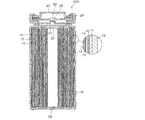
- FIG. 2 is an example of a bottomed cylindrical lithium secondary battery 100.
- This battery is a bottomed cylindrical lithium secondary battery 100 in which a positive electrode sheet 14 and a negative electrode sheet 16 overlapped with a separator 12 are wound and accommodated in an outer can 18.
- the 2S / T value is preferably 100 or more, and more preferably 200 or more.
- the lithium secondary battery according to the present embodiment is configured to include the electrolytic solution 5, the positive electrode and negative electrode electrode mixtures C and A, and the separator basic member 9, based on FIG. 1.
- the nonaqueous secondary battery of the present invention includes at least the electrolyte solution for a nonaqueous battery of the present invention as an electrolytic solution.
- the electrode mixture is obtained by applying a dispersion of an active material and a conductive agent, a binder, a filler, etc. on a current collector (electrode substrate).
- the active material is a positive electrode active material. It is preferable to use a negative electrode mixture in which the positive electrode mixture and the active material are a negative electrode active material.
- each component in the dispersion (electrode composition) constituting the electrode mixture will be described.
- a particulate positive electrode active material for a positive electrode active material.
- a transition metal oxide capable of reversibly inserting and releasing lithium ions can be used, but a lithium-containing transition metal oxide is preferably used.
- Preferred examples of the lithium-containing transition metal oxide preferably used as the positive electrode active material include oxides containing lithium-containing Ti, V, Cr, Mn, Fe, Co, Ni, Cu, Mo, and W.
- Alkali metals other than lithium (elements of Group 1 (Ia) and Group 2 (IIa) of the periodic table) and / or Al, Ga, In, Ge, Sn, Pb, Sb, Bi, Si, P , B, etc. may be mixed.
- the mixing amount is preferably 0 to 30 mol% with respect to the transition metal.
- lithium-containing transition metal oxides preferably used as the positive electrode active material
- a lithium compound / transition metal compound (wherein the transition metal is selected from Ti, V, Cr, Mn, Fe, Co, Ni, Mo, W) And a mixture synthesized so that the total molar ratio is 0.3 to 2.2 is more preferable.
- Li g M3O 2 (M3 represents one or more elements selected from Co, Ni, Fe, and Mn. G represents 0 to 1.2. ) Or a material having a spinel structure represented by Li h M4 2 O (M4 represents Mn, h represents 0 to 2).
- M3 and M4 Al, Ga, In, Ge, Sn, Pb, Sb, Bi, Si, P, and B may be mixed in addition to the transition metal.
- the mixing amount is preferably 0 to 30 mol% with respect to the transition metal.
- the Li g M3O material containing is particularly preferable.
- an electrode containing Ni is more preferable from the viewpoint of high capacity and high output.
- the g value and the h value are values before the start of charge / discharge, and are values that increase / decrease due to charge / discharge.
- transition metal of the lithium-containing transition metal phosphate compound V, Ti, Cr, Mn, Fe, Co, Ni, Cu and the like are preferable, and specific examples include, for example, LiFePO 4 , Li 3 Fe 2 (PO 4 ). 3 , iron phosphates such as LiFeP 2 O 7 , cobalt phosphates such as LiCoPO 4 , and some of the transition metal atoms that are the main components of these lithium transition metal phosphate compounds are Al, Ti, V, Cr, Mn , Fe, Co, Li, Ni, Cu, Zn, Mg, Ga, Zr, Nb, Si and the like substituted with other metals.
- the average particle size of the positive electrode active material used is not particularly limited, but is preferably 0.1 ⁇ m to 50 ⁇ m.
- the specific surface area is not particularly limited, but is preferably 0.01 m 2 / g to 50 m 2 / g by the BET method.
- the pH of the supernatant when 5 g of the positive electrode active material is dissolved in 100 ml of distilled water is preferably 7 or more and 12 or less.
- a well-known pulverizer or classifier is used to make the positive electrode active substance have a predetermined particle size.
- a mortar, a ball mill, a vibration ball mill, a vibration mill, a satellite ball mill, a planetary ball mill, a swirling air flow type jet mill, a sieve, or the like is used.
- the positive electrode active material obtained by the firing method may be used after being washed with water, an acidic aqueous solution, an alkaline aqueous solution, or an organic solvent.
- the following can be used as the positive electrode active material having the specific charging region.
- a solid solution positive electrode material for example, Li 2 MnO 3 -LiMO 2 (M: metal such as Ni, Co, Mn) having a high potential close to 5 V and a very high specific capacity exceeding 250 mAh / g is the next generation lithium. It has attracted much attention as a positive electrode material for ion batteries, and the electrolytic solution of the present invention is preferably combined with these solid solution positive electrode materials.
- Negative electrode active material is preferably a material capable of reversibly inserting and releasing lithium ions, and is not particularly limited.
- the metal composite oxide is preferably capable of occluding and releasing lithium, but preferably contains titanium and / or lithium as a constituent component from the viewpoint of high current density charge / discharge characteristics.
- the carbonaceous material used as the negative electrode active material is a material substantially made of carbon.
- Examples thereof include carbonaceous materials obtained by baking various synthetic resins such as artificial pitches such as petroleum pitch, natural graphite, and vapor-grown graphite, and PAN-based resins and furfuryl alcohol resins.
- various carbon fibers such as PAN-based carbon fiber, cellulose-based carbon fiber, pitch-based carbon fiber, vapor-grown carbon fiber, dehydrated PVA-based carbon fiber, lignin carbon fiber, glassy carbon fiber, activated carbon fiber, mesophase micro
- Examples thereof include spheres, graphite whiskers, and flat graphite.
- carbonaceous materials can be divided into non-graphitizable carbon materials and graphite-based carbon materials depending on the degree of graphitization.
- the carbonaceous material preferably has a face spacing, density, and crystallite size described in JP-A-62-222066, JP-A-2-6856, and 3-45473.
- the carbonaceous material does not have to be a single material, and a mixture of natural graphite and artificial graphite described in JP-A-5-90844, graphite having a coating layer described in JP-A-6-4516, or the like is used. You can also.
- the metal oxide and the metal composite oxide which are the negative electrode active materials used in the nonaqueous secondary battery of the present invention, contain at least one of them.
- amorphous oxide is particularly preferable, and chalcogenite, which is a reaction product of a metal element and an element of Group 16 of the periodic table, is also preferably used.
- chalcogenite which is a reaction product of a metal element and an element of Group 16 of the periodic table.
- amorphous as used herein means an X-ray diffraction method using CuK ⁇ rays, which has a broad scattering band having a peak in the region of 20 ° to 40 ° in terms of 2 ⁇ , and is a crystalline diffraction line. You may have.
- the strongest intensity of crystalline diffraction lines seen from 2 ° to 40 ° to 70 ° is 100 times the diffraction line intensity at the peak of the broad scattering band seen from 2 ° to 20 °. It is preferable that it is 5 times or less, and it is particularly preferable not to have a crystalline diffraction line.
- an amorphous oxide of a semi-metal element and a chalcogenide are more preferable, and elements of Groups 13 (IIIB) to 15 (VB) of the periodic table, Particularly preferred are oxides and chalcogenides composed of one kind of Al, Ga, Si, Sn, Ge, Pb, Sb, Bi or a combination of two or more kinds thereof.
- preferable amorphous oxides and chalcogenides include, for example, Ga 2 O 3 , SiO, GeO, SnO, SnO 2 , PbO, PbO 2 , Pb 2 O 3 , Pb 2 O 4 , Pb 3 O 4 , Sb 2 O 3 , Sb 2 O 4 , Sb 2 O 5 , Bi 2 O 3 , Bi 2 O 4 , SnSiO 3 , GeS, SnS, SnS 2 , PbS, PbS 2 , Sb 2 S 3 , Sb 2 S 5 , such as SnSiS 3 may preferably be mentioned. Moreover, these may be a complex oxide with lithium oxide, for example, Li 2 SnO 2 .
- the average particle size of the negative electrode active material used is preferably 0.1 ⁇ m to 60 ⁇ m.
- a well-known pulverizer or classifier is used.
- a mortar, a ball mill, a sand mill, a vibrating ball mill, a satellite ball mill, a planetary ball mill, a swirling air flow type jet mill or a sieve is preferably used.
- wet pulverization in the presence of water or an organic solvent such as methanol can be performed as necessary.
- classification is preferably performed.
- the classification method is not particularly limited, and a sieve, an air classifier, or the like can be used as necessary. Classification can be used both dry and wet.
- the chemical formula of the compound obtained by the firing method can be calculated from an inductively coupled plasma (ICP) emission spectroscopic analysis method as a measurement method and a mass difference between powders before and after firing as a simple method.
- ICP inductively coupled plasma
- the negative electrode active material that can be used in combination with the amorphous oxide negative electrode active material centering on Sn, Si, Ge, a carbon material capable of inserting and extracting lithium ions or lithium metal, lithium
- Preferred examples include lithium alloys and metals that can be alloyed with lithium.
- the electrolyte solution of the present invention is preferably combined with a high potential negative electrode (preferably lithium-titanium oxide, a potential of 1.55 V vs. Li metal) and a low potential negative electrode (preferably a carbon material, potential of about 0.1 V vs. Li). Excellent properties are exhibited in any combination with (metal). Further, metal or metal oxide negative electrodes (preferably Si, Si oxide, Si / Si oxide, Sn, Sn oxide, SnB x P y O z , Cu, which can be alloyed with lithium, which are being developed for higher capacity) / Sn and a plurality of these composites), and a battery using a composite of these metals or metal oxides and a carbon material as a negative electrode.
- a high potential negative electrode preferably lithium-titanium oxide, a potential of 1.55 V vs. Li metal
- a low potential negative electrode preferably a carbon material, potential of about 0.1 V vs. Li
- excellent properties are exhibited in any combination with
- lithium titanate more specifically, lithium-titanium oxide (Li [Li 1/3 Ti 5/3 ] O 4 )
- the negative electrode active material By using this as the negative electrode active material, the effects of the compounds represented by the formulas (I-1) to (I-3) or the combination thereof with the compound (B) are further enhanced, and further excellent battery performance can be obtained. It can be demonstrated.
- a conductive material is an electron conductive material which does not cause a chemical change in the comprised secondary battery, and a well-known conductive material can be used arbitrarily.
- natural graphite scale-like graphite, scale-like graphite, earth-like graphite, etc.
- artificial graphite carbon black, acetylene black, ketjen black, carbon fiber and metal powder (copper, nickel, aluminum, silver (Japanese Patent Laid-Open No. Sho 63-63)) 148, 554), etc.
- conductive fibers such as metal fibers or polyphenylene derivatives (described in JP-A-59-20971) can be included as a single kind or a mixture thereof.
- the addition amount of the conductive agent is preferably 1 to 50% by mass, and more preferably 2 to 30% by mass. In the case of carbon or graphite, 2 to 15% by mass is particularly preferable.
- the binder for hold
- the binder include polysaccharides, thermoplastic resins, and polymers having rubber elasticity. Among them, for example, starch, carboxymethylcellulose, cellulose, diacetylcellulose, methylcellulose, hydroxyethylcellulose, hydroxypropylcellulose, sodium alginate, Polyacrylic acid, sodium polyacrylate, polyvinyl phenol, polyvinyl methyl ether, polyvinyl alcohol, polyvinyl pyrrolidone, polyacrylonitrile, polyacrylamide, polyhydroxy (meth) acrylate, water-soluble polymers such as styrene-maleic acid copolymer, polyvinyl chloride , Polytetrafluoroethylene, polyvinylidene fluoride, tetrafluoroethylene-hexafluoropropylene copolymer, vinylidene fluoride Ride-tetrafluoroethylene-he
- Binders can be used alone or in combination of two or more.
- the amount of the binder added is small, the holding power and cohesive force of the electrode mixture are weakened. If the amount is too large, the electrode volume increases and the capacity per electrode unit volume or unit mass decreases. For this reason, the addition amount of the binder is preferably 1 to 30% by mass, and more preferably 2 to 10% by mass.
- the electrode compound material may contain the filler.
- the material forming the filler is preferably a fibrous material that does not cause a chemical change in the secondary battery of the present invention.
- fibrous fillers made of materials such as olefin polymers such as polypropylene and polyethylene, glass, and carbon are used.
- the addition amount of the filler is not particularly limited, but is preferably 0 to 30% by mass in the dispersion.
- the positive / negative electrode current collector an electron conductor that does not cause a chemical change in the nonaqueous electrolyte secondary battery of the present invention is used.
- the current collector of the positive electrode in addition to aluminum, stainless steel, nickel, titanium, etc., the surface of aluminum or stainless steel is preferably treated with carbon, nickel, titanium, or silver. Among them, aluminum and aluminum alloys are preferable. More preferred.
- the negative electrode current collector aluminum, copper, stainless steel, nickel and titanium are preferable, and aluminum, copper and copper alloy are more preferable.
- a film sheet shape is usually used, but a net, a punched material, a lath body, a porous body, a foamed body, a molded body of a fiber group, and the like can also be used.
- the thickness of the current collector is not particularly limited, but is preferably 1 ⁇ m to 500 ⁇ m.
- the current collector surface is roughened by surface treatment.
- An electrode mixture of the lithium secondary battery is formed by a member appropriately selected from these materials.
- the separator used in the non-aqueous secondary battery of the present invention is a material that mechanically insulates the positive electrode and the negative electrode, has ion permeability, and is resistant to oxidation / reduction at the contact surface between the positive electrode and the negative electrode.
- a porous polymer material, an inorganic material, an organic-inorganic hybrid material, glass fiber, or the like is used.
- These separators preferably have a shutdown function for ensuring safety, that is, a function of closing the gap at 80 ° C. or higher to increase resistance and blocking current, and the closing temperature is 90 ° C. or higher and 180 ° C. or lower. It is preferable.
- the shape of the holes of the separator is usually circular or elliptical, and the size is 0.05 ⁇ m to 30 ⁇ m, preferably 0.1 ⁇ m to 20 ⁇ m. Furthermore, it may be a rod-like or irregular-shaped hole as in the case of making by a stretching method or a phase separation method.
- the ratio of these gaps, that is, the porosity, is 20% to 90%, preferably 35% to 80%.
- the polymer material may be a single material such as a cellulose nonwoven fabric, polyethylene, or polypropylene, or may be a material using two or more composite materials. What laminated
- oxides such as alumina and silicon dioxide, nitrides such as aluminum nitride and silicon nitride, and sulfates such as barium sulfate and calcium sulfate are used, and those having a particle shape or fiber shape are used.
- a thin film shape such as a non-woven fabric, a woven fabric, or a microporous film is used.
- the thin film shape those having a pore diameter of 0.01 ⁇ m to 1 ⁇ m and a thickness of 5 ⁇ m to 50 ⁇ m are preferably used.
- a separator formed by forming a composite porous layer containing the inorganic particles on the surface layer of the positive electrode and / or the negative electrode using a resin binder can be used.
- alumina particles having a 90% particle diameter of less than 1 ⁇ m are formed on both surfaces of the positive electrode as a porous layer using a fluororesin binder.
- the shape of the nonaqueous secondary battery of the present invention can be applied to any shape such as a sheet shape, a square shape, and a cylinder shape.
- a positive electrode active material or a mixture of negative electrode active materials is mainly used after being applied (coated), dried and compressed on a current collector.
- FIG. 2 shows an example of a bottomed cylindrical lithium secondary battery 100.
- This battery is a bottomed cylindrical lithium secondary battery 100 in which a positive electrode sheet 14 and a negative electrode sheet 16 overlapped with a separator 12 are wound and accommodated in an outer can 18.
- 20 is an insulating plate
- 22 is a sealing plate
- 24 is a positive current collector
- 26 is a gasket
- 28 is a pressure-sensitive valve element
- 30 is a current interruption element.
- each member corresponds to the whole drawing by reference numerals.
- a negative electrode active material is mixed with a binder or filler used as desired in an organic solvent to prepare a slurry or paste negative electrode mixture.
- the obtained negative electrode mixture is uniformly applied over the entire surface of both surfaces of the metal core as a current collector, and then the organic solvent is removed to form a negative electrode mixture layer.
- the laminate of the current collector and the negative electrode composite material layer is rolled with a roll press or the like to prepare a predetermined thickness to obtain a negative electrode sheet (electrode sheet).
- the coating method of each agent, the drying of the coated material, and the method of forming the positive and negative electrodes may be in accordance with conventional methods.
- a cylindrical battery is taken as an example, but the present invention is not limited to this, for example, after the positive and negative electrode sheets produced by the above method are overlapped via a separator, After processing into a sheet battery as it is, or inserting it into a rectangular can after being folded and electrically connecting the can and the sheet, injecting an electrolyte and sealing the opening using a sealing plate A square battery may be formed.
- the safety valve can be used as a sealing plate for sealing the opening.
- the sealing member may be provided with various conventionally known safety elements.
- a fuse, bimetal, PTC element, or the like is preferably used as the overcurrent prevention element.
- a method of cutting the battery can a method of cracking the gasket, a method of cracking the sealing plate, or a method of cutting the lead plate can be used.
- the charger may be provided with a protection circuit incorporating measures against overcharge and overdischarge, or may be connected independently.
- a metal or alloy having electrical conductivity can be used.
- metals such as iron, nickel, titanium, chromium, molybdenum, copper, and aluminum, or alloys thereof are preferably used.
- a known method eg, direct current or alternating current electric welding, laser welding, ultrasonic welding
- a welding method for the cap, can, sheet, and lead plate can be used as a welding method for the cap, can, sheet, and lead plate.
- the sealing agent for sealing a conventionally known compound or mixture such as asphalt can be used.
- the nonaqueous secondary battery of the present invention can produce a secondary battery with good cycle performance, it is applied to various applications.
- the application mode for example, when installed in an electronic device, a notebook computer, a pen input personal computer, a mobile personal computer, an electronic book player, a mobile phone, a cordless phone, a pager, a handy terminal, a mobile fax machine, a mobile phone Copy, portable printer, headphone stereo, video movie, LCD TV, handy cleaner, portable CD, minidisc, electric shaver, transceiver, electronic notebook, calculator, memory card, portable tape recorder, radio, backup power supply, memory card, etc. It is done.
- Other consumer products include automobiles, electric vehicles, motors, lighting equipment, toys, game equipment, road conditioners, watches, strobes, cameras, medical equipment (such as pacemakers, hearing aids, and shoulder grinders). Furthermore, it can be used for various military use and space use. Moreover, it can also combine with a solar cell.
- the application mode of the electrolyte solution for a non-aqueous secondary battery of the present invention is not limited, but may be applied to applications that are expected to be used at high temperatures, particularly from the viewpoint of exhibiting the advantages of high-temperature storage stability and high-rate discharge characteristics. preferable.
- an electric vehicle or the like is exposed to a high temperature outdoors in a charged state.
- an electric vehicle needs to be discharged at a high rate when starting and accelerating, and it is important that the high-rate discharge capacity does not deteriorate even when stored at a high temperature.
- Example 1 and Comparative Example 1 Preparation of Electrolyte Solution 1M LiBF 4 ethylene carbonate / ⁇ -butyrolactone volume ratio 3 to 7
- the components shown in Table 1 were added in the amounts shown in the table.
- An electrolyte solution was prepared. All the prepared electrolyte solutions had a viscosity at 25 ° C. of 5 mPa ⁇ s or less.
- the positive electrode is made of active material: nickel manganese lithium cobaltate (LiNi 1/3 Mn 1/3 Co 1/3 O 2 ) 85% by mass, conductive auxiliary agent: carbon black 7% by mass, binder: PVDF 8% by mass,
- the negative electrode was prepared with 94% by mass of active material: lithium titanate (Li 4 Ti 5 O 12 ), conductive auxiliary agent: 3% by mass of carbon black, and binder: 3% by mass of PVDF.
- the separator is made of cellulose and has a thickness of 50 ⁇ m.
- Discharge capacity retention ratio after storage at high temperature ⁇ 1C discharge capacity retention ratio [1C discharge]> The battery was charged at a constant current of 0.1 C until the battery voltage reached 2.75 V in a thermostat at 30 ° C., and then charged at a constant voltage of 2.75 V at 0.12 mA, or charged for 2 hours. Next, 1C constant current discharge was performed in a thermostat at 30 ° C. until the battery voltage became 1.2V, and the initial 1C discharge capacity was measured. After charging again under the above-mentioned conditions, this battery is stored in a constant temperature bath at 60 ° C. for 10 days, and then in a constant temperature bath at 30 ° C., 1C constant current discharge is performed until the battery voltage reaches 1.2 V, and stored.
- 1C discharge capacity maintenance rate ⁇ (1C discharge capacity after storage) / (initial 1C discharge capacity) ⁇ ⁇ 100
- ⁇ 4C discharge capacity maintenance rate [4C discharge]> The initial 4C discharge capacity and the 4C discharge capacity after storage were measured in the same manner as the 1C discharge capacity retention rate except that constant current discharge was performed at 4C.
- Test No. A sample starting with c is a comparative example, and other than the examples of the present invention.
- Comp An example number of a compound (see the following chemical formula)
- Conc Concentration with respect to the total amount of electrolyte
- Example 2 and Comparative Example 2> -Preparation of electrolyte solution The components shown in Table 2 were added to 1M LiPF 6 ethylene carbonate / methyl ethyl carbonate volume ratio 1: 2 electrolyte solution in the amounts shown in the table, and each test no. An electrolyte solution corresponding to was prepared. All the prepared electrolyte solutions had a viscosity at 25 ° C. of 5 mPa ⁇ s or less.
- each test No. With respect to the electrolyte solution, a 2032 type coin battery was prepared, and the following items were evaluated. The results are shown in Table 2.
- the compounds (X1, X2) found in known examples are used. It can be seen that it exhibits superior performance in capacity retention and storage at a high rate after storage at high temperatures, compared to those using the above).
- a metal or metal oxide negative electrode preferably Si, Si oxide, Si / Si oxide, Sn, Sn oxide, SnB x P y O z , Cu / Sn, and the like
- a metal or metal oxide negative electrode preferably Si, Si oxide, Si / Si oxide, Sn, Sn oxide, SnB x P y O z , Cu / Sn, and the like
Landscapes
- Chemical & Material Sciences (AREA)
- General Chemical & Material Sciences (AREA)
- Chemical Kinetics & Catalysis (AREA)
- Electrochemistry (AREA)
- Inorganic Chemistry (AREA)
- Engineering & Computer Science (AREA)
- Materials Engineering (AREA)
- Manufacturing & Machinery (AREA)
- General Physics & Mathematics (AREA)
- Condensed Matter Physics & Semiconductors (AREA)
- Physics & Mathematics (AREA)
- Secondary Cells (AREA)
- Battery Electrode And Active Subsutance (AREA)
Description
本発明は、有機溶媒を含む非水二次電池用電解液、およびそれを用いた二次電池に関する。
昨今、注目を集めているリチウムイオン電池と呼ばれる二次電池は、充放電反応にリチウムの吸蔵および放出を利用する二次電池(いわゆるリチウムイオン二次電池)と、リチウムの析出および溶解を利用する二次電池(いわゆるリチウム金属二次電池)とに大別される。これらは、鉛電池やニッケルカドミウム電池と比較して大きなエネルギー密度が得られる。この特性を利用して、近年、カメラ一体型VTR(video tape recorder)、携帯電話あるいはノートパソコンなどのポータブル電子機器用の電源として広く普及している。アプリケーションの一層の拡充に伴い、ポータブル電子機器の電源として、軽量で高エネルギー密度が得られるリチウムイオン二次電池の開発が進められている。さらに昨今では、自動車用の電源用途を含め、耐久性、長寿命、安全性も強く求められている。
リチウムイオン二次電池やリチウム金属二次電池(以下、これらを総称して単にリチウム二次電池ということがある。)の電解液としては、導電率が高く電位的にも安定であるため、炭酸プロピレンあるいは炭酸ジエチルなどの炭酸エステル系の溶媒と、六フッ化リン酸リチウムなどの電解質塩との組み合わせが広く用いられている。
一方、電解液の添加成分に関して、サイクル特性などの改善を目的として、電解液中に各種添加剤を含有させる技術が提案されている。例えば、特許文献1においては、シアノアクリル酸エチルなどを添加することにより、電池性能の改善が試みられている。
しかしながら、自動車用途への拡大も含め、その要求は益々高性能化および多機能化へと向かっている。とくに二次電池の充放電・保管が様々な温度領域で行われる傾向にあり、そのような環境下でも高性能を実現することが望まれる。そこで、本発明者は満充電状態で高温保存を行うときの電池容量の維持性や、高温保存後の高レート放電特性に着目した。一般に、そうした問題に対しては未だその改善のための取り組みが不十分である。
本発明はかかる点に鑑みてなされたもので、その目的は、高温で保存しても容量の劣化が小さく、かつ高レート放電特性に優れる二次電池およびこれに用いられる非水二次電池用電解液を提供することにある。
すなわち上記の課題は以下の手段により解決された。
〔1〕電解質と、下式(I-1)~(I-3)のいずれかで表される化合物(A)とを有機溶媒中に含有する非水二次電池用電解液。
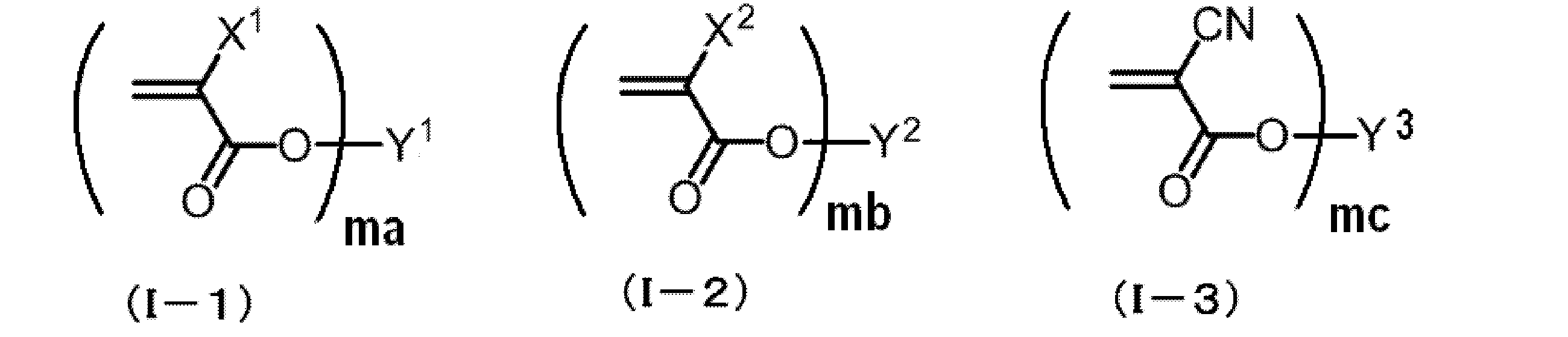
(式(I-1)において、X1は、ハロゲン原子で置換されたアルキル基を表す。Y1は、水素原子または有機基を表す。maは1~6の整数を表す。)
(式(I-2)において、X2は、酸素原子を有する基を表す。Y2は、水素原子または有機基を表す。mbは、1~6の整数を表す。)
(式(I-3)において、Y3は、炭素数4以上の有機基、または酸素原子もしくは窒素原子を有する有機基を表す。mcは1~6の整数を表す。)
〔2〕更に、酸化または還元により(I-1)~(I-3)のいずれかで表される化合物(A)と反応する活性種を放出する化合物(B)を含有する〔1〕記載の非水二次電池用電解液。
〔3〕化合物(A)の含有率が電解液全量に対して0.001~10質量%である〔1〕または〔2〕に記載の非水二次電池用電解液。
〔4〕化合物(B)の含有率が電解液全量に対して0.0001~10質量%である〔2〕または〔3〕に記載の非水二次電池用電解液。
〔5〕化合物(A)と化合物(B)との添加量の比率(A/B)が、100/1~1/10である〔2〕~〔4〕のいずれか1項に記載の非水二次電池用電解液。
〔6〕X1が、フッ素原子で置換されたアルキル基である〔1〕~〔5〕のいずれか1項に記載の非水二次電池用電解液。
〔7〕X2が、アルコキシ基、アルコキシメチル基、アシルオキシ基、またはアシルオキシメチル基である〔1〕~〔5〕のいずれか1項に記載の非水二次電池用電解液。
〔8〕Y1、Y2、Y3が、それぞれ独立に、2価以上の有機基、あるいは酸素原子、窒素原子またはフッ素原子の少なくとも1つを有する1価の有機基である〔1〕~〔7〕のいずれか1項に記載の非水二次電池用電解液。
〔9〕化合物(B)が、ケトン化合物である〔2〕~〔8〕のいずれか1項に記載の非水二次電池用電解液。
〔10〕ケトン化合物が、芳香族ケトン化合物である〔9〕に記載の非水二次電池用電解液。
〔11〕芳香族ケトン化合物が、アセトフェノン化合物、ベンゾフェノン化合物、9-フルオレノン化合物、アントロン化合物、キサントン化合物、ジベンゾスベロン化合物、ジベンゾスベレロン化合物、アントラキノン化合物、ビアントロニル化合物、ビアントロン化合物、およびジベンゾイル化合物からなる群から選ばれる少なくとも一種の化合物からなる〔10〕に記載の非水二次電池用電解液。
〔12〕正極、負極、および〔1〕~〔11〕のいずれか1項に記載の非水二次電池用電解液を具備する非水電解液二次電池。
〔13〕ニッケル、コバルトもしくはマンガンのうち少なくとも1種を有する化合物を正極の活物質として用いた〔12〕に記載の非水電解液二次電池。
〔14〕チタン酸リチウム(LTO)または炭素材料を負極の活物質として用いた〔12〕または〔13〕に記載の非水電解液二次電池。
〔15〕下式(I-1)~(I-3)のいずれかで表される化合物を含む薬剤と、電解質を含む薬剤とを組み合わせた非水二次電池電解液用キット。

(式(I-1)において、X1は、ハロゲン原子で置換されたアルキル基を表す。Y1は、水素原子または有機基を表す。maは1~6の整数を表す。)
(式(I-2)において、X2は、酸素原子を有する基を表す。Y2は、水素原子または有機基を表す。mbは、1~6の整数を表す。)
(式(I-3)において、Y3は、炭素数4以上の有機基、または酸素原子もしくは窒素原子を有する有機基を表す。mcは1~6の整数を表す。)
〔16〕下式(I-1)~(I-3)のいずれかで表される化合物からなる非水二次電池電解液用添加剤。

(式(I-1)において、X1は、ハロゲン原子で置換されたアルキル基を表す。Y1は、水素原子または有機基を表す。maは1~6の整数を表す。)
(式(I-2)において、X2は、酸素原子を有する基を表す。Y2は、水素原子または有機基を表す。mbは、1~6の整数を表す。)
(式(I-3)において、Y3は、炭素数4以上の有機基、または酸素原子もしくは窒素原子を有する有機基を表す。mcは1~6の整数を表す。)
本明細書において、特定の符号で表示された置換基や連結基が複数あるとき、あるいは複数の置換基等(置換基数の規定も同様)を同時もしくは択一的に規定するときには、それぞれの置換基等は互いに同一でも異なっていてもよい。また、複数の置換基等が近接するときにはそれらが互いに結合したり縮合したりして環を形成していてもよい。
〔1〕電解質と、下式(I-1)~(I-3)のいずれかで表される化合物(A)とを有機溶媒中に含有する非水二次電池用電解液。
(式(I-2)において、X2は、酸素原子を有する基を表す。Y2は、水素原子または有機基を表す。mbは、1~6の整数を表す。)
(式(I-3)において、Y3は、炭素数4以上の有機基、または酸素原子もしくは窒素原子を有する有機基を表す。mcは1~6の整数を表す。)
〔2〕更に、酸化または還元により(I-1)~(I-3)のいずれかで表される化合物(A)と反応する活性種を放出する化合物(B)を含有する〔1〕記載の非水二次電池用電解液。
〔3〕化合物(A)の含有率が電解液全量に対して0.001~10質量%である〔1〕または〔2〕に記載の非水二次電池用電解液。
〔4〕化合物(B)の含有率が電解液全量に対して0.0001~10質量%である〔2〕または〔3〕に記載の非水二次電池用電解液。
〔5〕化合物(A)と化合物(B)との添加量の比率(A/B)が、100/1~1/10である〔2〕~〔4〕のいずれか1項に記載の非水二次電池用電解液。
〔6〕X1が、フッ素原子で置換されたアルキル基である〔1〕~〔5〕のいずれか1項に記載の非水二次電池用電解液。
〔7〕X2が、アルコキシ基、アルコキシメチル基、アシルオキシ基、またはアシルオキシメチル基である〔1〕~〔5〕のいずれか1項に記載の非水二次電池用電解液。
〔8〕Y1、Y2、Y3が、それぞれ独立に、2価以上の有機基、あるいは酸素原子、窒素原子またはフッ素原子の少なくとも1つを有する1価の有機基である〔1〕~〔7〕のいずれか1項に記載の非水二次電池用電解液。
〔9〕化合物(B)が、ケトン化合物である〔2〕~〔8〕のいずれか1項に記載の非水二次電池用電解液。
〔10〕ケトン化合物が、芳香族ケトン化合物である〔9〕に記載の非水二次電池用電解液。
〔11〕芳香族ケトン化合物が、アセトフェノン化合物、ベンゾフェノン化合物、9-フルオレノン化合物、アントロン化合物、キサントン化合物、ジベンゾスベロン化合物、ジベンゾスベレロン化合物、アントラキノン化合物、ビアントロニル化合物、ビアントロン化合物、およびジベンゾイル化合物からなる群から選ばれる少なくとも一種の化合物からなる〔10〕に記載の非水二次電池用電解液。
〔12〕正極、負極、および〔1〕~〔11〕のいずれか1項に記載の非水二次電池用電解液を具備する非水電解液二次電池。
〔13〕ニッケル、コバルトもしくはマンガンのうち少なくとも1種を有する化合物を正極の活物質として用いた〔12〕に記載の非水電解液二次電池。
〔14〕チタン酸リチウム(LTO)または炭素材料を負極の活物質として用いた〔12〕または〔13〕に記載の非水電解液二次電池。
〔15〕下式(I-1)~(I-3)のいずれかで表される化合物を含む薬剤と、電解質を含む薬剤とを組み合わせた非水二次電池電解液用キット。
(式(I-2)において、X2は、酸素原子を有する基を表す。Y2は、水素原子または有機基を表す。mbは、1~6の整数を表す。)
(式(I-3)において、Y3は、炭素数4以上の有機基、または酸素原子もしくは窒素原子を有する有機基を表す。mcは1~6の整数を表す。)
〔16〕下式(I-1)~(I-3)のいずれかで表される化合物からなる非水二次電池電解液用添加剤。
(式(I-2)において、X2は、酸素原子を有する基を表す。Y2は、水素原子または有機基を表す。mbは、1~6の整数を表す。)
(式(I-3)において、Y3は、炭素数4以上の有機基、または酸素原子もしくは窒素原子を有する有機基を表す。mcは1~6の整数を表す。)
本明細書において、特定の符号で表示された置換基や連結基が複数あるとき、あるいは複数の置換基等(置換基数の規定も同様)を同時もしくは択一的に規定するときには、それぞれの置換基等は互いに同一でも異なっていてもよい。また、複数の置換基等が近接するときにはそれらが互いに結合したり縮合したりして環を形成していてもよい。
本発明の非水電解液および非水二次電池は、高温で保存しても容量の劣化が小さく、かつ高レート放電特性に優れる。
本発明の上記及び他の特徴及び利点は、適宜添付の図面を参照して、下記の記載からより明らかになるであろう。
本発明の上記及び他の特徴及び利点は、適宜添付の図面を参照して、下記の記載からより明らかになるであろう。
以下、本発明の実施の形態について詳細に説明するが、本発明の構成が、この内容により限定して解釈されるものではない。
[非水二次電池用電解液]
(化合物(A))
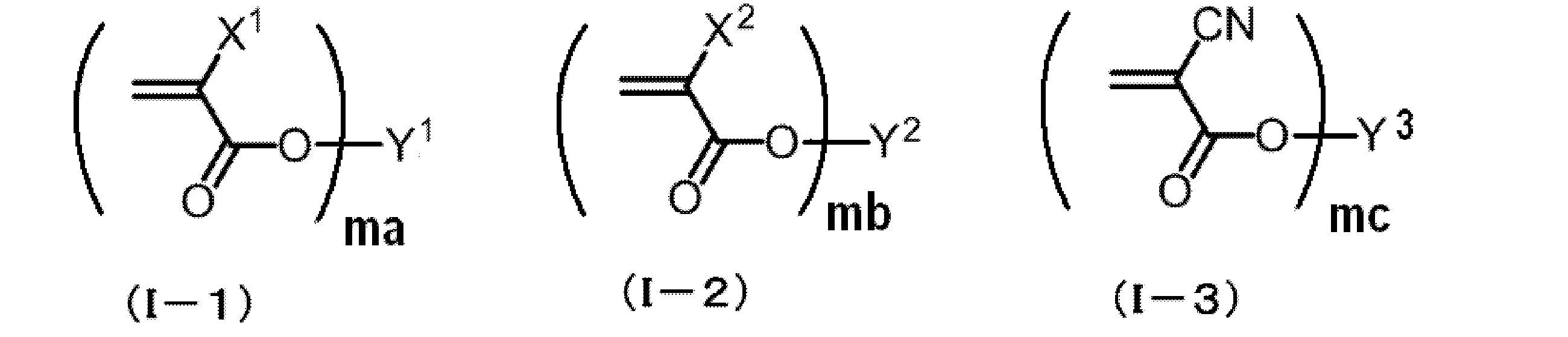
本発明の非水二次電池用電解液は下式(I-1)~(I-3)のいずれかで表される化合物(A)を少なくとも1種含有する。
(化合物(A))
本発明の非水二次電池用電解液は下式(I-1)~(I-3)のいずれかで表される化合物(A)を少なくとも1種含有する。
各式において各置換基は下記の意味である。
・X1
X1は、ハロゲン原子で置換されたアルキル基であり、フッ素原子で置換されたアルキル基が好ましい。好ましくは炭素数1~4のハロゲン原子(好ましくはフッ素原子)で置換されたアルキル基であり、更に好ましくはトリフロロメチル基である。
X1は、ハロゲン原子で置換されたアルキル基であり、フッ素原子で置換されたアルキル基が好ましい。好ましくは炭素数1~4のハロゲン原子(好ましくはフッ素原子)で置換されたアルキル基であり、更に好ましくはトリフロロメチル基である。
・X2
X2は、酸素原子を有する基であり、好ましくはアルコキシ基(好ましくは炭素数1~10)、アルコキシアルキル基(好ましくは炭素数2~10、より好ましくは同炭素数のアルコキシメチル基)、アシルオキシ基(好ましくは炭素数2~10)、アシルオキシアルキル基(好ましくは炭素数3~11、より好ましくは同炭素数のアシルオキシメチル基)である。
X2は、酸素原子を有する基であり、好ましくはアルコキシ基(好ましくは炭素数1~10)、アルコキシアルキル基(好ましくは炭素数2~10、より好ましくは同炭素数のアルコキシメチル基)、アシルオキシ基(好ましくは炭素数2~10)、アシルオキシアルキル基(好ましくは炭素数3~11、より好ましくは同炭素数のアシルオキシメチル基)である。
・ma、mb、mc
ma、mb、およびmcはそれぞれ1~6の整数を表し、好ましくは1~4、更に好ましくは1又は2である。
ma、mb、およびmcはそれぞれ1~6の整数を表し、好ましくは1~4、更に好ましくは1又は2である。
・Y1,Y2
Y1およびY2は、それぞれ独立に、水素原子または有機基であり、有機基として好ましくは炭素数3以上の有機基である。当該有機基は、ma,mb価以上の置換基をとる構造であり、ma,mb価の基であることが好ましい。このことは後記Y3とmcとの関係においても同義である。
Y1およびY2は、なかでも、2価以上の有機基、あるいは酸素原子、窒素原子またはフッ素原子の少なくとも1つを有する1価の有機基であることが好ましい。
Y1およびY2は、それぞれ独立に、水素原子または有機基であり、有機基として好ましくは炭素数3以上の有機基である。当該有機基は、ma,mb価以上の置換基をとる構造であり、ma,mb価の基であることが好ましい。このことは後記Y3とmcとの関係においても同義である。
Y1およびY2は、なかでも、2価以上の有機基、あるいは酸素原子、窒素原子またはフッ素原子の少なくとも1つを有する1価の有機基であることが好ましい。
1価の有機基として好ましくは、ハロゲン化アルキル基(好ましくは炭素数1~6)もしくはシアノ基を有することのある鎖状もしくは鎖状炭化水素基(好ましくは総炭素数1~20)が挙げられる。あるいは、鎖状または環状カーボネート基(好ましくは炭素数2~4)を有する基、鎖状または環状エーテル基(好ましくは炭素数3~6)を有する基、鎖状または環状エステル基(好ましくは炭素数3~6)を有する基、鎖状または環状アミド基(好ましくは炭素数3~6)を有する基、鎖状または環状カーバメート基(好ましくは炭素数3~6)を有する基を有する1価の有機基(好ましくは総炭素数2~10)が挙げられる。1価の有機基としてより好ましくは、カーボネート基、エーテル基、エステル基、ラクトン基、アミド基、カーバメート基、ニトリル基、またはこれらを組合せて有する基(好ましくは炭素数1~20)である。
2価以上の有機基としては、鎖状炭化水素基、芳香族基またはこれらを組み合わせた2~4価の連結基(好ましくは炭素数1~20)であることが好ましい。炭化水素基については、その鎖中に酸素原子および/または窒素原子を有する連結基を含んでいてもよい。Y1,Y2の中に、酸素原子もしくは窒素原子を含むときその数は特に限定されないが、それぞれ、1~10個であることが好ましい。2価以上の連結基として好ましくはアルキレン基(好ましくは炭素数2~12、具体的にはエチレン基、プロピレン基、ブチレン基、ヘキシレン基、ネオペンチレン基、オクチレン基、)、ポリオキシアルキレン基(好ましくはオキシアルキレン構造を2~20有する。具体的にはポリオキシエチレン基、ポリオキシプロピレン基)、アリーレン基(具体的にはo,m,p-フェニレン基、2,2’-ビフェニレン基、4,4’-ビフェニレン基)アラルキレン基(具体的にはo,m,p-キシリレン基、4,4’-ビフェニルメチレン基)が挙げられる。
Y1,Y2は、さらに、下記式(Ex-1)~(Ex-5)のいずれかで表される構造であることが好ましい。

・L1
式中、L1は単結合または連結基であり、連結基としては、置換基Tを有していてもよいアルキレン基(炭素数1~6が好ましい)であることが好ましい。式Ex-3中、L1はXaから延びる連結基であってもよい。
式中、L1は単結合または連結基であり、連結基としては、置換基Tを有していてもよいアルキレン基(炭素数1~6が好ましい)であることが好ましい。式Ex-3中、L1はXaから延びる連結基であってもよい。
・Ra
Raは、任意の置換基(例えば後記置換基T)であり、アルキル基(好ましくは炭素数1~6)、ハロゲン原子(好ましくはフッ素原子)、フッ化アルキル基(好ましくは炭素数1~6)であることが好ましい。
Raは、任意の置換基(例えば後記置換基T)であり、アルキル基(好ましくは炭素数1~6)、ハロゲン原子(好ましくはフッ素原子)、フッ化アルキル基(好ましくは炭素数1~6)であることが好ましい。
・Xa
Xaは、酸素原子もしくはメチレン基(-CR2-)を表す。このとき、Rは水素原子もしくは後述の置換基Tの例が挙げられ、置換基のときは、なかでもそのアルキル基が好ましい。
Xaは、酸素原子もしくはメチレン基(-CR2-)を表す。このとき、Rは水素原子もしくは後述の置換基Tの例が挙げられ、置換基のときは、なかでもそのアルキル基が好ましい。
・na
naは0~2の整数である。
naは0~2の整数である。
・nbは式(I-1)~(I-3)のma、mb、mcに対応して定まる数であり、1~3の整数を表す。
・Rb
式中、Rbは、1価もしくは2価以上(1価~6価が好ましく、1価~4価がより好ましく、1価又は2価さらに好ましい)の有機基であり、ハロゲン化アルキル基(好ましくは炭素数1~6)もしくはシアノ基を有することのある鎖状もしくは環状炭化水素基(好ましくは総炭素数1~20)である。このとき、炭化水素基の鎖中に、酸素原子(好ましくは1~100個)、エステル連結基(-COO-)(好ましくは1~10個)、もしくはカーボネート連結基(-OCOO-)(好ましくは1~10個)を介在していてもよい。また、Rbは途中で分岐した構造を有していてもよく、その末端にL1を有する構造が介在していてもよい。
式中、Rbは、1価もしくは2価以上(1価~6価が好ましく、1価~4価がより好ましく、1価又は2価さらに好ましい)の有機基であり、ハロゲン化アルキル基(好ましくは炭素数1~6)もしくはシアノ基を有することのある鎖状もしくは環状炭化水素基(好ましくは総炭素数1~20)である。このとき、炭化水素基の鎖中に、酸素原子(好ましくは1~100個)、エステル連結基(-COO-)(好ましくは1~10個)、もしくはカーボネート連結基(-OCOO-)(好ましくは1~10個)を介在していてもよい。また、Rbは途中で分岐した構造を有していてもよく、その末端にL1を有する構造が介在していてもよい。
・Y3
Y3は、炭素数4以上の有機基、または、酸素原子もしくは窒素原子を有する有機基である。
炭素数4以上の有機基としては、炭素数4~20の炭化水素基(好ましくは鎖状炭化水素基)が挙げられる。この炭化水素基は置換基を有していてもよく、当該置換基としてはハロゲン原子、ハロゲン化アルキル基(好ましくは炭素数1~6)、もしくはシアノ基が挙げられる。
Y3は、炭素数4以上の有機基、または、酸素原子もしくは窒素原子を有する有機基である。
炭素数4以上の有機基としては、炭素数4~20の炭化水素基(好ましくは鎖状炭化水素基)が挙げられる。この炭化水素基は置換基を有していてもよく、当該置換基としてはハロゲン原子、ハロゲン化アルキル基(好ましくは炭素数1~6)、もしくはシアノ基が挙げられる。
酸素原子もしくは窒素原子を有する有機基において、1価の有機基として好ましくは、鎖状または環状カーボネート基(好ましくは炭素数2~4)を有する基、鎖状または環状エーテル基(好ましくは炭素数3~6)を有する基、鎖状または環状エステル基(好ましくは炭素数3~6)を有する基、鎖状または環状アミド基(好ましくは炭素数3~6)を有する基、鎖状または環状カーバメート基(好ましくは炭素数3~6)を有する基を有する1価の有機基(好ましくは総炭素数2~10)が挙げられる。1価の有機基としてより好ましくは、カーボネート基、エーテル基、エステル基、ラクトン基、アミド基、カーバメート基、ニトリル基、またはこれらを組合せて有する基(好ましくは炭素数1~20)である。
2価以上の連結基としては、炭素数4以上の炭化水素基(好ましくは炭素数4~20)、芳香族基(好ましくは炭素数6~24)またはこれらを組み合わせた2~4価の連結基であることが好ましい。炭化水素基については、その鎖中に酸素原子および/または窒素原子を有する連結基を含んでいてもよい。Y3の中に、酸素原子もしくは窒素原子を含むときその数は特に限定されないが、それぞれ、1~10個であることが好ましい。
Y3は、さらに、上記式(Ex-1)~(Ex-5)のいずれかで表される構造であることが好ましい。ただし、式(Ex-5)においてRbは下記のRb’と読み替える。
・Rb’
式中、Rb’は、1価もしくは2価以上の有機基であり、ハロゲン化アルキル基(好ましくは炭素数1~6)もしくはシアノ基を有することのある鎖状もしくは環状炭化水素基(好ましくは炭素数4~20)である。このとき、炭化水素基の鎖中に、酸素原子(好ましくは1~100個)、エステル連結基(-COO-)(好ましくは1~10個)、もしくはカーボネート連結基(-OCOO-)(好ましくは1~10個)を介在していてもよい。また、Rb’は途中で分岐した構造を有していてもよく、その末端にL1を有する構造をとっていてもよい。
式中、Rb’は、1価もしくは2価以上の有機基であり、ハロゲン化アルキル基(好ましくは炭素数1~6)もしくはシアノ基を有することのある鎖状もしくは環状炭化水素基(好ましくは炭素数4~20)である。このとき、炭化水素基の鎖中に、酸素原子(好ましくは1~100個)、エステル連結基(-COO-)(好ましくは1~10個)、もしくはカーボネート連結基(-OCOO-)(好ましくは1~10個)を介在していてもよい。また、Rb’は途中で分岐した構造を有していてもよく、その末端にL1を有する構造をとっていてもよい。
式(I-1)で表される化合物の具体例を以下に示すが、本発明がこれにより限定して解釈されるものではない。
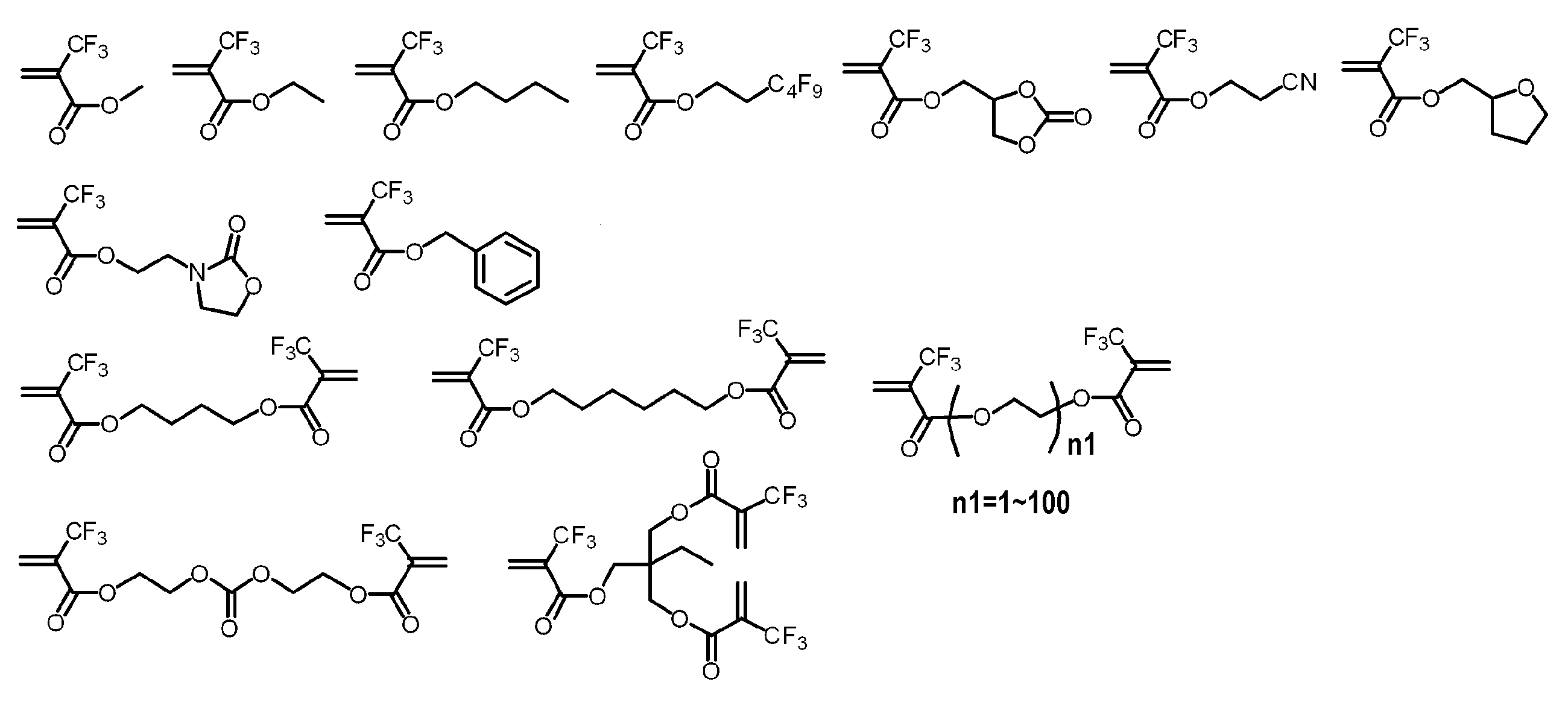
式(I-2)で表される化合物の具体例を以下に示すが、本発明がこれにより限定して解釈されるものではない。
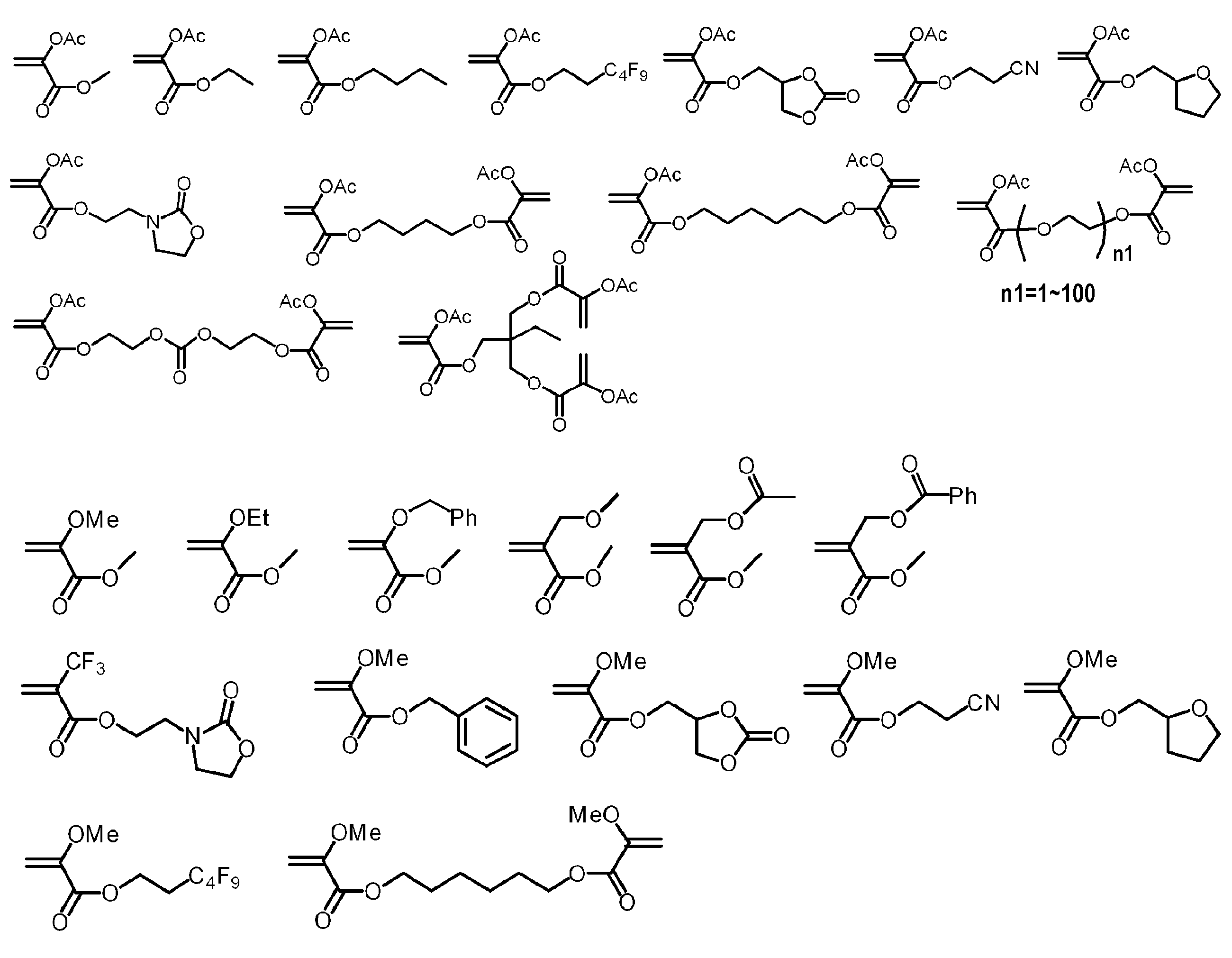
Me:メチル基
Ac:アセチル基
Ph:フェニル基
Ac:アセチル基
Ph:フェニル基
式(I-3)で表される化合物の具体例を以下に示すが、本発明がこれにより限定して解釈されるものではない。
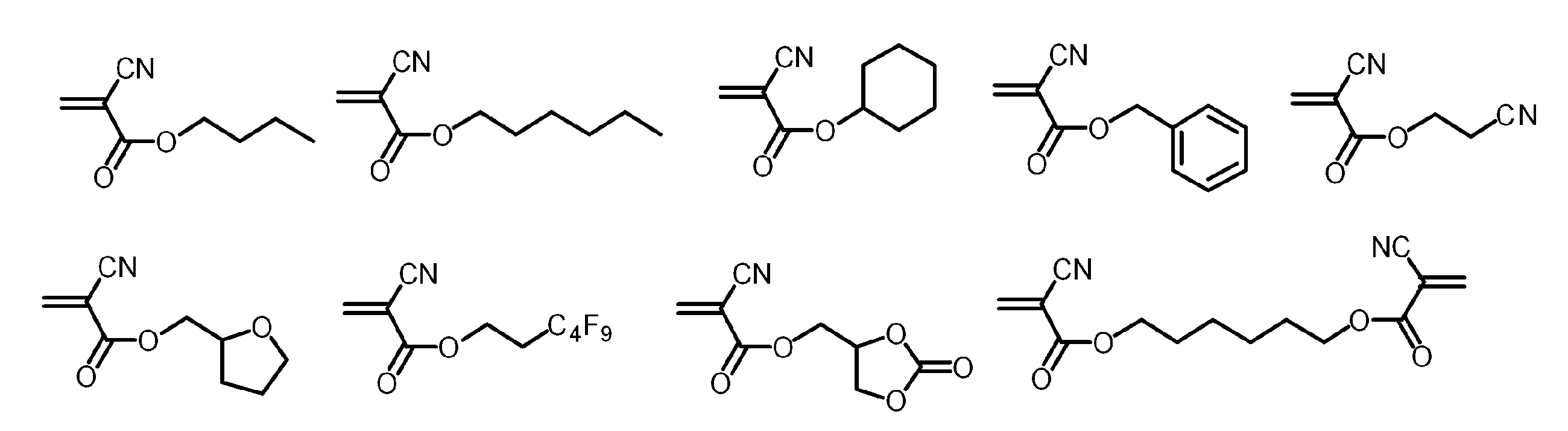
本発明の電解液において、化合物(A)としては、なかでも式(I-1)で表される化合物が好ましい。
式(I-1)~(I-3)のいずれかで表される化合物(A)の添加量は全電解液に対し、0.001質量%以上が好ましく、0.003質量%以上がより好ましく、0.005質量%以上が更に好ましい。上限としては、10質量%以下が好ましく、1質量%以下がより好ましく、0.5質量%以下が特に好ましい。この添加量を上記の範囲とすることで、良好な放電性能を維持して、所望の高温容量維持性および高レート特性を高いレベルで達成することができ好ましい。
(化合物(B))
本発明の非水二次電池用電解液は更に酸化または還元により式(I-1)~(I-3)のいずれかで表される化合物(A)と反応する活性種を放出する化合物(B)を含有していることが好ましい。これにより、前記化合物(A)がより効率的に機能し、少量の添加で不可逆容量の発生を抑制しつつ電池性能が向上する。化合物(B)が酸化または還元により放出する活性種としてはラジカル、アニオンまたはカチオンが好ましく、ラジカル及び/またはアニオンがより好ましい。特に負極で還元されてアニオンラジカルを生成する化合物、または負極で還元されてアニオンラジカルを生成し、更に分解してアニオン及び/又はラジカルを生成する化合物が好ましい。
本発明の非水二次電池用電解液は更に酸化または還元により式(I-1)~(I-3)のいずれかで表される化合物(A)と反応する活性種を放出する化合物(B)を含有していることが好ましい。これにより、前記化合物(A)がより効率的に機能し、少量の添加で不可逆容量の発生を抑制しつつ電池性能が向上する。化合物(B)が酸化または還元により放出する活性種としてはラジカル、アニオンまたはカチオンが好ましく、ラジカル及び/またはアニオンがより好ましい。特に負極で還元されてアニオンラジカルを生成する化合物、または負極で還元されてアニオンラジカルを生成し、更に分解してアニオン及び/又はラジカルを生成する化合物が好ましい。
このような化合物としてはケトン化合物、オキシムエステル化合物、オキシムエーテル化合物、スルホニウム塩、ヨードニウム塩が好ましく、芳香族ケトン化合物がより好ましい。より好ましくはアセトフェノン化合物、ベンゾフェノン化合物、9-フルオレノン化合物、アントロン化合物、キサントン化合物、ジベンゾスベロン化合物、ジベンゾスベレロン化合物、アントラキノン化合物、ビアントロニル化合物、ビアントロン化合物、ジベンゾイル化合物であり、これらは置換基を有していてもよい。好ましい置換基としてはアルキル基、アルコキシ基、アシル基、アシルオキシ基、シアノ基、アルコキシカルボニル基、ハロゲン原子、アリール基、アラルキル基があげられる。
前記化合物(B)の添加量は全電解液に対し、0.0001質量%以上が好ましく、0.0005質量%以上がより好ましく、0.001質量%以上が更に好ましい。上限としては、10質量%以下が好ましく、1質量%以下がより好ましく、0.1質量%以下が特に好ましい。
前記化合物(A)と化合物(B)の添加量比率(A/B)は質量比で100/1以下が好ましく、50/1以下が更に好ましい。下限としては、1/10以上が好ましく、1/1以上がより好ましく、5/1以上が特に好ましい。
前記化合物(A)と化合物(B)の添加量比率(A/B)は質量比で100/1以下が好ましく、50/1以下が更に好ましい。下限としては、1/10以上が好ましく、1/1以上がより好ましく、5/1以上が特に好ましい。
なお、本明細書において化合物の表示(例えば、化合物と末尾に付して呼ぶとき)については、当該化合物そのもののほか、その塩、そのイオンを含む意味に用いる。また、所望の効果を奏する範囲で、置換基を導入するなど一部を変化させた誘導体を含む意味である。
本明細書において置換・無置換を明記していない置換基(連結基についても同様)については、その基に任意の置換基を有していてもよい意味である。これは置換・無置換を明記していない化合物についても同義である。好ましい置換基としては、下記置換基Tが挙げられる。
本明細書において置換・無置換を明記していない置換基(連結基についても同様)については、その基に任意の置換基を有していてもよい意味である。これは置換・無置換を明記していない化合物についても同義である。好ましい置換基としては、下記置換基Tが挙げられる。
置換基Tとしては、下記のものが挙げられる。
アルキル基(好ましくは炭素原子数1~20のアルキル基、例えばメチル、エチル、イソプロピル、t-ブチル、ペンチル、ヘプチル、1-エチルペンチル、ベンジル、2-エトキシエチル、1-カルボキシメチル等)、アルケニル基(好ましくは炭素原子数2~20のアルケニル基、例えば、ビニル、アリル、オレイル等)、アルキニル基(好ましくは炭素原子数2~20のアルキニル基、例えば、エチニル、ブタジイニル、フェニルエチニル等)、シクロアルキル基(好ましくは炭素原子数3~20のシクロアルキル基、例えば、シクロプロピル、シクロペンチル、シクロヘキシル、4-メチルシクロヘキシル等)、アリール基(好ましくは炭素原子数6~26のアリール基、例えば、フェニル、1-ナフチル、4-メトキシフェニル、2-クロロフェニル、3-メチルフェニル等)、ヘテロ環基(好ましくは炭素原子数2~20のヘテロ環基、好ましくは、少なくとも1つの酸素原子、硫黄原子、窒素原子を有する5または6員環のヘテロ環基が好ましく、例えば、2-ピリジル、4-ピリジル、2-イミダゾリル、2-ベンゾイミダゾリル、2-チアゾリル、2-オキサゾリル等)、アルコキシ基(好ましくは炭素原子数1~20のアルコキシ基、例えば、メトキシ、エトキシ、イソプロピルオキシ、ベンジルオキシ等)、アリールオキシ基(好ましくは炭素原子数6~26のアリールオキシ基、例えば、フェノキシ、1-ナフチルオキシ、3-メチルフェノキシ、4-メトキシフェノキシ等)、アルコキシカルボニル基(好ましくは炭素原子数2~20のアルコキシカルボニル基、例えば、エトキシカルボニル、2-エチルヘキシルオキシカルボニル等)、アミノ基(好ましくは炭素原子数0~20のアミノ基、アルキルアミノ基、アリールアミノ基を含み、例えば、アミノ、N,N-ジメチルアミノ、N,N-ジエチルアミノ、N-エチルアミノ、アニリノ等)、スルファモイル基(好ましくは炭素原子数0~20のスルホンアミド基、例えば、N,N-ジメチルスルファモイル、N-フェニルスルファモイル等)、アシル基(好ましくは炭素原子数1~20のアシル基、例えば、アセチル、プロピオニル、ブチリル、ベンゾイル等)、アシルオキシ基(好ましくは炭素原子数1~20のアシルオキシ基、例えば、アセチルオキシ、ベンゾイルオキシ等)、カルバモイル基(好ましくは炭素原子数1~20のカルバモイル基、例えば、N,N-ジメチルカルバモイル、N-フェニルカルバモイル等)、アシルアミノ基(好ましくは炭素原子数1~20のアシルアミノ基、例えば、アセチルアミノ、ベンゾイルアミノ等)、スルホンアミド基((好ましくは炭素原子数0~20のスルファモイル基、例えば、メタンスルホンアミド、ベンゼンスルホンアミド、N-メチルメタンスルホンアミド、N-エチルベンゼンスルホンアミド等)、アルキルチオ基(好ましくは炭素原子数1~20のアルキルチオ基、例えば、メチルチオ、エチルチオ、イソプロピルチオ、ベンジルチオ等)、アリールチオ基(好ましくは炭素原子数6~26のアリールチオ基、例えば、フェニルチオ、1-ナフチルチオ、3-メチルフェニルチオ、4-メトキシフェニルチオ等)、アルキルもしくはアリールスルホニル基(好ましくは炭素原子数1~20のアルキルもしくはアリールスルホニル基、例えば、メチルスルホニル、エチルスルホニル、ベンゼンスルホニル等)、ヒドロキシル基、シアノ基、ハロゲン原子(例えばフッ素原子、塩素原子、臭素原子、ヨウ素原子等)であり、より好ましくはアルキル基、アルケニル基、アリール基、ヘテロ環基、アルコキシ基、アリールオキシ基、アルコキシカルボニル基、アミノ基、アシルアミノ基、ヒドロキシル基またはハロゲン原子であり、特に好ましくはアルキル基、アルケニル基、ヘテロ環基、アルコキシ基、アルコキシカルボニル基、アミノ基、アシルアミノ基またはヒドロキシル基である。
また、これらの置換基Tで挙げた各基は、上記の置換基Tがさらに置換していてもよい。
アルキル基(好ましくは炭素原子数1~20のアルキル基、例えばメチル、エチル、イソプロピル、t-ブチル、ペンチル、ヘプチル、1-エチルペンチル、ベンジル、2-エトキシエチル、1-カルボキシメチル等)、アルケニル基(好ましくは炭素原子数2~20のアルケニル基、例えば、ビニル、アリル、オレイル等)、アルキニル基(好ましくは炭素原子数2~20のアルキニル基、例えば、エチニル、ブタジイニル、フェニルエチニル等)、シクロアルキル基(好ましくは炭素原子数3~20のシクロアルキル基、例えば、シクロプロピル、シクロペンチル、シクロヘキシル、4-メチルシクロヘキシル等)、アリール基(好ましくは炭素原子数6~26のアリール基、例えば、フェニル、1-ナフチル、4-メトキシフェニル、2-クロロフェニル、3-メチルフェニル等)、ヘテロ環基(好ましくは炭素原子数2~20のヘテロ環基、好ましくは、少なくとも1つの酸素原子、硫黄原子、窒素原子を有する5または6員環のヘテロ環基が好ましく、例えば、2-ピリジル、4-ピリジル、2-イミダゾリル、2-ベンゾイミダゾリル、2-チアゾリル、2-オキサゾリル等)、アルコキシ基(好ましくは炭素原子数1~20のアルコキシ基、例えば、メトキシ、エトキシ、イソプロピルオキシ、ベンジルオキシ等)、アリールオキシ基(好ましくは炭素原子数6~26のアリールオキシ基、例えば、フェノキシ、1-ナフチルオキシ、3-メチルフェノキシ、4-メトキシフェノキシ等)、アルコキシカルボニル基(好ましくは炭素原子数2~20のアルコキシカルボニル基、例えば、エトキシカルボニル、2-エチルヘキシルオキシカルボニル等)、アミノ基(好ましくは炭素原子数0~20のアミノ基、アルキルアミノ基、アリールアミノ基を含み、例えば、アミノ、N,N-ジメチルアミノ、N,N-ジエチルアミノ、N-エチルアミノ、アニリノ等)、スルファモイル基(好ましくは炭素原子数0~20のスルホンアミド基、例えば、N,N-ジメチルスルファモイル、N-フェニルスルファモイル等)、アシル基(好ましくは炭素原子数1~20のアシル基、例えば、アセチル、プロピオニル、ブチリル、ベンゾイル等)、アシルオキシ基(好ましくは炭素原子数1~20のアシルオキシ基、例えば、アセチルオキシ、ベンゾイルオキシ等)、カルバモイル基(好ましくは炭素原子数1~20のカルバモイル基、例えば、N,N-ジメチルカルバモイル、N-フェニルカルバモイル等)、アシルアミノ基(好ましくは炭素原子数1~20のアシルアミノ基、例えば、アセチルアミノ、ベンゾイルアミノ等)、スルホンアミド基((好ましくは炭素原子数0~20のスルファモイル基、例えば、メタンスルホンアミド、ベンゼンスルホンアミド、N-メチルメタンスルホンアミド、N-エチルベンゼンスルホンアミド等)、アルキルチオ基(好ましくは炭素原子数1~20のアルキルチオ基、例えば、メチルチオ、エチルチオ、イソプロピルチオ、ベンジルチオ等)、アリールチオ基(好ましくは炭素原子数6~26のアリールチオ基、例えば、フェニルチオ、1-ナフチルチオ、3-メチルフェニルチオ、4-メトキシフェニルチオ等)、アルキルもしくはアリールスルホニル基(好ましくは炭素原子数1~20のアルキルもしくはアリールスルホニル基、例えば、メチルスルホニル、エチルスルホニル、ベンゼンスルホニル等)、ヒドロキシル基、シアノ基、ハロゲン原子(例えばフッ素原子、塩素原子、臭素原子、ヨウ素原子等)であり、より好ましくはアルキル基、アルケニル基、アリール基、ヘテロ環基、アルコキシ基、アリールオキシ基、アルコキシカルボニル基、アミノ基、アシルアミノ基、ヒドロキシル基またはハロゲン原子であり、特に好ましくはアルキル基、アルケニル基、ヘテロ環基、アルコキシ基、アルコキシカルボニル基、アミノ基、アシルアミノ基またはヒドロキシル基である。
また、これらの置換基Tで挙げた各基は、上記の置換基Tがさらに置換していてもよい。
化合物ないし置換基・連結基等がアルキル基・アルキレン基、アルケニル基・アルケニレン基等を含むとき、これらは環状でも鎖状でもよく、また直鎖でも分岐していてもよく、上記のように置換されていても無置換でもよい。またアリール基、ヘテロ環基等を含むとき、それらは単環でも縮環でもよく、同様に置換されていても無置換でもよい。
(有機溶媒)
本発明に用いられる有機溶媒としては、例えば、炭酸エチレン、炭酸プロピレン、炭酸ブチレンなどの環状炭酸エステル、炭酸ジメチル、炭酸ジエチル、炭酸エチルメチル、炭酸メチルプロピルなどの鎖状炭酸エステル、γ-ブチロラクトン、γ-バレロラクトンなどの環状エステル、1,2-ジメトキシエタン、ジエチレングリコールジメチルエーテルなどの鎖状エーテル、テトラヒドロフラン、2-メチルテトラヒドロフラン、テトラヒドロピラン、1,3-ジオキソラン、4-メチル-1,3-ジオキソラン、1,3-ジオキサン、1,4-ジオキサンなどの環状エーテル、酢酸メチル、酢酸エチル、プロピオン酸メチル、プロピオン酸エチル、酪酸メチル、イソ酪酸メチル、トリメチル酢酸メチル、トリメチル酢酸エチルなどの鎖状エステル、アセトニトリル、グルタロニトリル、アジポニトリル、メトキシアセトニトリル、3-メトキシプロピオニトリルなどのニトリル化合物、N,N-ジメチルホルムアミド、N-メチルピロリジノン、N-メチルオキサゾリジノン、N,N’-ジメチルイミダゾリジノン、ニトロメタン、ニトロエタン、スルホラン、燐酸トリメチル、ジメチルスルホキシドあるいはジメチルスルホキシド燐酸などが挙げられる。これらは、一種単独で用いても2種以上を併用してもよい。中でも、環状炭酸エステル(好ましくは炭酸エチレン、炭酸プロピレン)、鎖状炭酸エステル(好ましくは炭酸ジメチル、炭酸ジエチルおよび炭酸エチルメチル)、環状エステル(好ましくはγ-ブチロラクトン)からなる群のうちの少なくとも1種を含有していることが好ましく、より好ましくは環状炭酸エステルと鎖状炭酸エステルを含む溶剤、または環状炭酸エステルと環状エステルを含む溶剤であり、特に好ましくは、炭酸エチレンあるいは炭酸プロピレンなどの高粘度(高誘電率)溶媒(例えば、比誘電率ε≧30)と炭酸ジメチル、炭酸エチルメチルあるいは炭酸ジエチル、γ-ブチロラクトンなどの低粘度溶媒(例えば、粘度≦1mPa・s)との組み合わせである。電解質塩の解離性およびイオンの移動度が向上するからである。
しかしながら、本発明に用いられる有機溶媒(非水溶媒)は、上記例示によって限定されるものではない。
本発明に用いられる有機溶媒としては、例えば、炭酸エチレン、炭酸プロピレン、炭酸ブチレンなどの環状炭酸エステル、炭酸ジメチル、炭酸ジエチル、炭酸エチルメチル、炭酸メチルプロピルなどの鎖状炭酸エステル、γ-ブチロラクトン、γ-バレロラクトンなどの環状エステル、1,2-ジメトキシエタン、ジエチレングリコールジメチルエーテルなどの鎖状エーテル、テトラヒドロフラン、2-メチルテトラヒドロフラン、テトラヒドロピラン、1,3-ジオキソラン、4-メチル-1,3-ジオキソラン、1,3-ジオキサン、1,4-ジオキサンなどの環状エーテル、酢酸メチル、酢酸エチル、プロピオン酸メチル、プロピオン酸エチル、酪酸メチル、イソ酪酸メチル、トリメチル酢酸メチル、トリメチル酢酸エチルなどの鎖状エステル、アセトニトリル、グルタロニトリル、アジポニトリル、メトキシアセトニトリル、3-メトキシプロピオニトリルなどのニトリル化合物、N,N-ジメチルホルムアミド、N-メチルピロリジノン、N-メチルオキサゾリジノン、N,N’-ジメチルイミダゾリジノン、ニトロメタン、ニトロエタン、スルホラン、燐酸トリメチル、ジメチルスルホキシドあるいはジメチルスルホキシド燐酸などが挙げられる。これらは、一種単独で用いても2種以上を併用してもよい。中でも、環状炭酸エステル(好ましくは炭酸エチレン、炭酸プロピレン)、鎖状炭酸エステル(好ましくは炭酸ジメチル、炭酸ジエチルおよび炭酸エチルメチル)、環状エステル(好ましくはγ-ブチロラクトン)からなる群のうちの少なくとも1種を含有していることが好ましく、より好ましくは環状炭酸エステルと鎖状炭酸エステルを含む溶剤、または環状炭酸エステルと環状エステルを含む溶剤であり、特に好ましくは、炭酸エチレンあるいは炭酸プロピレンなどの高粘度(高誘電率)溶媒(例えば、比誘電率ε≧30)と炭酸ジメチル、炭酸エチルメチルあるいは炭酸ジエチル、γ-ブチロラクトンなどの低粘度溶媒(例えば、粘度≦1mPa・s)との組み合わせである。電解質塩の解離性およびイオンの移動度が向上するからである。
しかしながら、本発明に用いられる有機溶媒(非水溶媒)は、上記例示によって限定されるものではない。
(電解質)
本発明の電解液に用いることができる電解質としては金属イオンもしくはその塩が挙げられ、周期律表第一族又は第二族に属する金属イオンもしくはその塩が好ましい。電解液の使用目的により適宜選択される。例えば、リチウム塩、カリウム塩、ナトリウム塩、カルシウム塩、マグネシウム塩などが挙げられ、二次電池などに使用される場合には、出力の観点からリチウム塩が好ましい。本発明の電解液をリチウム二次電池用非水系電解液の電解質として用いる場合には、金属イオンの塩としてリチウム塩を選択すればよい。リチウム塩としては、リチウム二次電池用非水系電解液の電解質に通常用いられるリチウム塩であることが好ましいが、例えば、以下に述べるものが好ましい。
本発明の電解液に用いることができる電解質としては金属イオンもしくはその塩が挙げられ、周期律表第一族又は第二族に属する金属イオンもしくはその塩が好ましい。電解液の使用目的により適宜選択される。例えば、リチウム塩、カリウム塩、ナトリウム塩、カルシウム塩、マグネシウム塩などが挙げられ、二次電池などに使用される場合には、出力の観点からリチウム塩が好ましい。本発明の電解液をリチウム二次電池用非水系電解液の電解質として用いる場合には、金属イオンの塩としてリチウム塩を選択すればよい。リチウム塩としては、リチウム二次電池用非水系電解液の電解質に通常用いられるリチウム塩であることが好ましいが、例えば、以下に述べるものが好ましい。
(L-1)無機リチウム塩:LiPF6、LiBF4、LiAsF6、LiSbF6等の無機フッ化物塩;LiClO4、LiBrO4、LiIO4等の過ハロゲン酸塩;LiAlCl4等の無機塩化物塩等。
(L-2)含フッ素有機リチウム塩:LiCF3SO3等のパーフルオロアルカンスルホン酸塩;LiN(CF3SO2)2、LiN(CF3CF2SO2)2、LiN(FSO2)2、LiN(CF3SO2)(C4F9SO2)等のパーフルオロアルカンスルホニルイミド塩;LiC(CF3SO2)3等のパーフルオロアルカンスルホニルメチド塩;Li[PF5(CF2CF2CF3)]、Li[PF4(CF2CF2CF3)2]、Li[PF3(CF2CF2CF3)3]、Li[PF5(CF2CF2CF2CF3)]、Li[PF4(CF2CF2CF2CF3)2]、Li[PF3(CF2CF2CF2CF3)3]等のフルオロアルキルフッ化リン酸塩等。
(L-3)オキサラトボレート塩:リチウムビス(オキサラト)ボレート、リチウムジフルオロオキサラトボレート等。
これらのなかで、LiPF6、LiBF4、LiAsF6、LiSbF6、LiClO4、Li(Rf1SO3)、LiN(Rf1SO2)2、LiN(FSO2)2、及びLiN(Rf1SO2)(Rf2SO2)2が好ましく、LiPF6、LiBF4、LiN(Rf1SO2)2、LiN(FSO2)2、及びLiN(Rf1SO2)(Rf2SO2)2などのリチウムイミド塩がさらに好ましい。ここで、Rf1、Rf2はそれぞれパーフルオロアルキル基を示す。
なお、電解液に用いるリチウム塩は、1種を単独で使用しても、2種以上を任意に組み合わせてもよい。
電解液における周期律表第一族又は第二族に属する金属のイオンもしくはその金属塩の含有量は、以下に電解液の調製法で述べる好ましい塩濃度となるような量で添加される。塩濃度は電解液の使用目的により適宜選択されるが、一般的には電解液全質量中10質量%~50質量%であり、さらに好ましくは15質量%~30質量%である。なお、イオンの濃度として評価するときには、その好適に適用される金属との塩換算で算定されればよい。
(その他成分)
本発明による電解液には、電池の性能や安全性、耐久性を向上させるため、本発明の効果を損なわない限りにおいて、目的に応じて各種の添加剤を用いることができる。このような添加剤として、過充電防止剤、負極被膜形成剤、正極保護剤、難燃剤等のような機能性添加剤を用いてもよい。
具体的には、ビニレンカーボネート、ビニルエチレンカーボネート、フロロエチレンカーボネート、ジフロロエチレンカーボネートなどのカーボネート化合物、エチレンサルファイト、プロパンサルトン、スルホン酸エステルなどの含硫黄化合物、ビフェニル、シクロヘキシルベンゼン、t-アミルベンゼンなどの芳香族化合物、リン酸エステルなどのリン化合物が挙げられる。非水系電解液中におけるこれらその他の添加剤の含有割合は特に限定はないが、非水系電解液の有機成分全体に対し、それぞれ、0.01質量%以上が好ましく、特に好ましくは0.1質量%以上、更に好ましくは0.2質量%以上であり、上限は、5質量%以下が好ましく、特に好ましくは3質量%以下、更に好ましくは2質量%以下である。これらの化合物を添加することにより、過充電による異常時に電池の破裂・発火を抑制したり、高温保存後の容量維持特性やサイクル特性を向上させたりすることができる。
これらのなかで、LiPF6、LiBF4、LiAsF6、LiSbF6、LiClO4、Li(Rf1SO3)、LiN(Rf1SO2)2、LiN(FSO2)2、及びLiN(Rf1SO2)(Rf2SO2)2が好ましく、LiPF6、LiBF4、LiN(Rf1SO2)2、LiN(FSO2)2、及びLiN(Rf1SO2)(Rf2SO2)2などのリチウムイミド塩がさらに好ましい。ここで、Rf1、Rf2はそれぞれパーフルオロアルキル基を示す。
なお、電解液に用いるリチウム塩は、1種を単独で使用しても、2種以上を任意に組み合わせてもよい。
電解液における周期律表第一族又は第二族に属する金属のイオンもしくはその金属塩の含有量は、以下に電解液の調製法で述べる好ましい塩濃度となるような量で添加される。塩濃度は電解液の使用目的により適宜選択されるが、一般的には電解液全質量中10質量%~50質量%であり、さらに好ましくは15質量%~30質量%である。なお、イオンの濃度として評価するときには、その好適に適用される金属との塩換算で算定されればよい。
(その他成分)
本発明による電解液には、電池の性能や安全性、耐久性を向上させるため、本発明の効果を損なわない限りにおいて、目的に応じて各種の添加剤を用いることができる。このような添加剤として、過充電防止剤、負極被膜形成剤、正極保護剤、難燃剤等のような機能性添加剤を用いてもよい。
具体的には、ビニレンカーボネート、ビニルエチレンカーボネート、フロロエチレンカーボネート、ジフロロエチレンカーボネートなどのカーボネート化合物、エチレンサルファイト、プロパンサルトン、スルホン酸エステルなどの含硫黄化合物、ビフェニル、シクロヘキシルベンゼン、t-アミルベンゼンなどの芳香族化合物、リン酸エステルなどのリン化合物が挙げられる。非水系電解液中におけるこれらその他の添加剤の含有割合は特に限定はないが、非水系電解液の有機成分全体に対し、それぞれ、0.01質量%以上が好ましく、特に好ましくは0.1質量%以上、更に好ましくは0.2質量%以上であり、上限は、5質量%以下が好ましく、特に好ましくは3質量%以下、更に好ましくは2質量%以下である。これらの化合物を添加することにより、過充電による異常時に電池の破裂・発火を抑制したり、高温保存後の容量維持特性やサイクル特性を向上させたりすることができる。
[電解液の調製方法等]
本発明の非水二次電池用電解液は、金属イオンの塩としてリチウム塩を用いた例を含め、前記各成分を前記非水電解液溶媒に溶解して、常法により調製される。
本発明の非水二次電池用電解液は、金属イオンの塩としてリチウム塩を用いた例を含め、前記各成分を前記非水電解液溶媒に溶解して、常法により調製される。
本発明において、「非水」とは水を実質的に含まないことをいい、発明の効果を妨げない範囲で微量の水を含んでいてもよい。良好な特性を得ることを考慮して言うと、水の含有量が200ppm以下であることが好ましく、100ppm以下であることがより好ましい。下限値は特にないが、不可避的な混入を考慮すると、10ppm以上であることが実際的である。本発明の電解液の粘度は特に限定されないが、25℃において、10~0.1mPa・sであることが好ましく、5~0.5mPa・sであることがより好ましい。
[二次電池]
本発明においては前記非水電解液を含有する非水二次電池とすることが好ましい。好ましい実施形態として、リチウムイオン二次電池についてその機構を模式化して示した図1を参照して説明する。本実施形態のリチウムイオン二次電池10は、上記本発明の非水二次電池用電解液5と、リチウムイオンの挿入放出が可能な正極C(正極集電体1,正極活物質層2)と、リチウムイオンの挿入放出又は溶解析出が可能な負極A(負極集電体3,負極活物質層4)とを備える。これら必須の部材に加え、電池が使用される目的、電位の形状などを考慮し、正極と負極の間に配設されるセパレータ9、集電端子(図示せず)、及び外装ケース等(図示せず)を含んで構成されてもよい。必要に応じて、電池の内部及び電池の外部の少なくともいずれかに保護素子を装着してもよい。このような構造とすることにより、電解液5内でリチウムイオンの授受a,bが生じ、充電α、放電βを行うことができ、回路配線7を介して動作機構6を介して運転あるいは蓄電を行うことができる。以下、本発明の好ましい実施形態であるリチウム二次電池の構成について、さらに詳細に説明する。
本発明においては前記非水電解液を含有する非水二次電池とすることが好ましい。好ましい実施形態として、リチウムイオン二次電池についてその機構を模式化して示した図1を参照して説明する。本実施形態のリチウムイオン二次電池10は、上記本発明の非水二次電池用電解液5と、リチウムイオンの挿入放出が可能な正極C(正極集電体1,正極活物質層2)と、リチウムイオンの挿入放出又は溶解析出が可能な負極A(負極集電体3,負極活物質層4)とを備える。これら必須の部材に加え、電池が使用される目的、電位の形状などを考慮し、正極と負極の間に配設されるセパレータ9、集電端子(図示せず)、及び外装ケース等(図示せず)を含んで構成されてもよい。必要に応じて、電池の内部及び電池の外部の少なくともいずれかに保護素子を装着してもよい。このような構造とすることにより、電解液5内でリチウムイオンの授受a,bが生じ、充電α、放電βを行うことができ、回路配線7を介して動作機構6を介して運転あるいは蓄電を行うことができる。以下、本発明の好ましい実施形態であるリチウム二次電池の構成について、さらに詳細に説明する。
(電池形状)
本実施形態のリチウム二次電池が適用される電池形状には、特に制限はなく、例えば、有底筒型形状、有底角型形状、薄型形状、シート形状、及び、ペーパー形状などが挙げられ、これらのいずれであってもよい。また、組み込まれるシステムや機器の形を考慮した馬蹄形や櫛型形状等の異型のものであってもよい。なかもで、電池内部の熱を効率よく外部に放出する観点から、比較的平らで大面積の面を少なくとも一つを有する有底角型形状や薄型形状などの角型形状が好ましい。
本実施形態のリチウム二次電池が適用される電池形状には、特に制限はなく、例えば、有底筒型形状、有底角型形状、薄型形状、シート形状、及び、ペーパー形状などが挙げられ、これらのいずれであってもよい。また、組み込まれるシステムや機器の形を考慮した馬蹄形や櫛型形状等の異型のものであってもよい。なかもで、電池内部の熱を効率よく外部に放出する観点から、比較的平らで大面積の面を少なくとも一つを有する有底角型形状や薄型形状などの角型形状が好ましい。
有底筒型形状の電池では、充填される発電素子に対する外表面積が小さくなるので、充電や放電時に内部抵抗による発生するジュール発熱を効率よく外部に逃げる設計にすることが好ましい。また、熱伝導性の高い物質の充填比率を高め、内部での温度分布が小さくなるように設計することが好ましい。図2は、有底筒型形状リチウム二次電池100の例である。この電池は、セパレータ12を介して重ね合わせた正極シート14、負極シート16を巻回して外装缶18内に収納した有底筒型リチウム二次電池100となっている。
有底角型形状では、一番大きい面の面積S(端子部を除く外形寸法の幅と高さとの積、単位cm2)の2倍と電池外形の厚さT(単位cm)との比率2S/Tの値が100以上であることが好ましく、200以上であることが更に好適である。最大面を大きくすることにより高出力かつ大容量の電池であってもサイクル性や高温保存等の特性を向上させるとともに、異常発熱時の放熱効率を上げることができ、後述する「弁作動」や「破裂」という危険な状態になることを抑制することができる。
(電池を構成する部材)
本実施形態のリチウム二次電池は、図1に基づいて言うと、電解液5、正極及び負極の電極合剤C,A、セパレータの基本部材9を具備して構成される。以下、これらの各部材について述べる。本発明の非水二次電池は、電解液として、少なくとも前記本発明の非水電池用電解液を含む。
(電極合材)
電極合材は、集電体(電極基材)上に活物質と導電剤、結着剤、フィラーなどの分散物を塗布したものであり、リチウム電池においては、活物質が正極活物質である正極合材と活物質が負極活物質である負極合材が使用されることが好ましい。次に、電極合材を構成する分散物(電極用組成物)中の各成分等について説明する。
本実施形態のリチウム二次電池は、図1に基づいて言うと、電解液5、正極及び負極の電極合剤C,A、セパレータの基本部材9を具備して構成される。以下、これらの各部材について述べる。本発明の非水二次電池は、電解液として、少なくとも前記本発明の非水電池用電解液を含む。
(電極合材)
電極合材は、集電体(電極基材)上に活物質と導電剤、結着剤、フィラーなどの分散物を塗布したものであり、リチウム電池においては、活物質が正極活物質である正極合材と活物質が負極活物質である負極合材が使用されることが好ましい。次に、電極合材を構成する分散物(電極用組成物)中の各成分等について説明する。
・正極活物質
正極活物質には、粒子状の正極活性物質を用いてもよい。具体的に、可逆的にリチウムイオンを挿入・放出できる遷移金属酸化物を用いることができるが、リチウム含有遷移金属酸化物を用いるのが好ましい。正極活物質として好ましく用いられるリチウム含有遷移金属酸化物としては、リチウム含有Ti、V、Cr、Mn、Fe、Co、Ni、Cu、Mo、Wを含む酸化物等が好適に挙げられる。またリチウム以外のアルカリ金属(周期律表の第1(Ia)族、第2(IIa)族の元素)、及び/又はAl、Ga、In、Ge、Sn、Pb、Sb、Bi、Si、P、Bなどを混合してもよい。混合量としては、遷移金属に対して0~30mol%が好ましい。
正極活物質には、粒子状の正極活性物質を用いてもよい。具体的に、可逆的にリチウムイオンを挿入・放出できる遷移金属酸化物を用いることができるが、リチウム含有遷移金属酸化物を用いるのが好ましい。正極活物質として好ましく用いられるリチウム含有遷移金属酸化物としては、リチウム含有Ti、V、Cr、Mn、Fe、Co、Ni、Cu、Mo、Wを含む酸化物等が好適に挙げられる。またリチウム以外のアルカリ金属(周期律表の第1(Ia)族、第2(IIa)族の元素)、及び/又はAl、Ga、In、Ge、Sn、Pb、Sb、Bi、Si、P、Bなどを混合してもよい。混合量としては、遷移金属に対して0~30mol%が好ましい。
前記正極活物質として好ましく用いられるリチウム含有遷移金属酸化物の中でも、リチウム化合物/遷移金属化合物(ここで遷移金属とは、Ti、V、Cr、Mn、Fe、Co、Ni、Mo、Wから選ばれる少なくとも1種のことをいう。)の合計のモル比が0.3~2.2になるように混合して合成されたものが、より好ましい。
さらに、前記リチウム化合物/遷移金属化合物の中でも、LigM3O2(M3はCo、Ni、Fe、及びMnから選択される1種以上の元素を表す。gは、0~1.2を表す。)を含む材料、又はLihM42O(M4はMnを表す。hは、0~2を表す。)で表されるスピネル構造を有する材料が特に好ましい。前記M3、M4としては、遷移金属以外にAl、Ga、In、Ge、Sn、Pb、Sb、Bi、Si、P、Bなどを混合してもよい。混合量は遷移金属に対して0~30mol%が好ましい。
前記LigM3O2を含む材料、LihM42Oで表されるスピネル構造を有する材料の中でも、LigCoO2、LigNiO2、LigMnO2、LigCojNi1-jO2、LihMn2O4、LiNijMn1-jO2、LiCojNihAl1-j-hO2、LiCojNihMn1-j-hO2、LiMnhAl2-hO4、LiMnhNi2-hO4(ここでgは0.02~1.2を表す。jは0.1~0.9を表す。hは0~2を表す。)が特に好ましく、もっとも好ましくはLigCoO2、LiMn2O4、LiNi0.85Co0.01Al0.05O2、及びLiNi0.33Co0.33Mn0.33O2である。高容量、高出力の観点で上記のうちNiを含む電極が更に好ましい。ここで、前記g値及びh値は、充放電開始前の値であり、充放電により増減する値である。具体的には、
LiCoO2、LiNi0.5Mn0.5O2、LiNi0.85Co0.01Al0.05O2、
LiNi0.33Co0.33Mn0.33O2、LiMn1.8Al0.2O4、
LiMn1.5Ni0.5O4等が挙げられる。
LiCoO2、LiNi0.5Mn0.5O2、LiNi0.85Co0.01Al0.05O2、
LiNi0.33Co0.33Mn0.33O2、LiMn1.8Al0.2O4、
LiMn1.5Ni0.5O4等が挙げられる。
リチウム含有遷移金属リン酸化合物の遷移金属としては、V、Ti、Cr、Mn、Fe、Co、Ni、Cu等が好ましく、具体例としては、例えば、LiFePO4、Li3Fe2(PO4)3、LiFeP2O7等のリン酸鉄類、LiCoPO4等のリン酸コバルト類、これらのリチウム遷移金属リン酸化合物の主体となる遷移金属原子の一部をAl、Ti、V、Cr、Mn、Fe、Co、Li、Ni、Cu、Zn、Mg、Ga、Zr、Nb、Si等の他の金属で置換したもの等が挙げられる。
本発明の非水二次電池において、用いられる前記正極活物質の平均粒子サイズは特に限定されないが、0.1μm~50μmが好ましい。比表面積としては特に限定されないが、BET法で0.01m2/g~50m2/gであるのが好ましい。また、正極活物質5gを蒸留水100mlに溶かした時の上澄み液のpHとしては、7以上12以下が好ましい。
前記正極活性物質を所定の粒子サイズにするには、良く知られた粉砕機や分級機が用いられる。例えば、乳鉢、ボールミル、振動ボールミル、振動ミル、衛星ボールミル、遊星ボールミル、旋回気流型ジェットミルや篩などが用いられる。前記焼成法によって得られた正極活物質は、水、酸性水溶液、アルカリ性水溶液、有機溶剤にて洗浄した後使用してもよい。
本発明において、正極活物質には4.25V以上の充電領域を有する材料を用いることが好ましい。
前記特定の充電領域を有する正極活物質としては下記のものが挙げられる。
(i)LiNixMnyCozO2(x>0.2,y>0.2,z≧0,x+y+z=1)、
代表的なもの:
LiNi1/3Mn1/3Co1/3O2(LiNi0.33Mn0.33Co0.33O2とも記載)
LiNi1/2Mn1/2O2(LiNi0.5Mn0.5O2とも記載)
(ii)LiNixCoyAlzO2(x>0.7,y>0.1,0.1>z>0.05,x+y+z=1)
代表的なもの:
LiNi0.8Co0.15Al0.05O2
前記特定の充電領域を有する正極活物質として下記のものを用いることもできる。
(a) LiCoMnO4
(b) Li2FeMn3O8
(c) Li2CuMn3O8
(d) Li2CrMn3O8
(e) Li2NiMn3O8
更に、5V近い高電位と250mAh/gを超える非常に高い比容量を示す固溶体系正極材料(例えばLi2MnO3‐LiMO2(M:Ni,Co,Mnなどの金属)が,次世代のリチウムイオン電池の正極材料として大きな注目を集めている。本発明の電解液はこれら固溶体系正極材料と組合せることも好ましい。
前記特定の充電領域を有する正極活物質としては下記のものが挙げられる。
(i)LiNixMnyCozO2(x>0.2,y>0.2,z≧0,x+y+z=1)、
代表的なもの:
LiNi1/3Mn1/3Co1/3O2(LiNi0.33Mn0.33Co0.33O2とも記載)
LiNi1/2Mn1/2O2(LiNi0.5Mn0.5O2とも記載)
(ii)LiNixCoyAlzO2(x>0.7,y>0.1,0.1>z>0.05,x+y+z=1)
代表的なもの:
LiNi0.8Co0.15Al0.05O2
前記特定の充電領域を有する正極活物質として下記のものを用いることもできる。
(a) LiCoMnO4
(b) Li2FeMn3O8
(c) Li2CuMn3O8
(d) Li2CrMn3O8
(e) Li2NiMn3O8
更に、5V近い高電位と250mAh/gを超える非常に高い比容量を示す固溶体系正極材料(例えばLi2MnO3‐LiMO2(M:Ni,Co,Mnなどの金属)が,次世代のリチウムイオン電池の正極材料として大きな注目を集めている。本発明の電解液はこれら固溶体系正極材料と組合せることも好ましい。
・負極活物質
負極活物質としては、可逆的にリチウムイオンを挿入・放出できるものであることが好ましく、特に制限はなく、炭素質材料、酸化錫や酸化ケイ素等の金属酸化物、金属複合酸化物、リチウム単体やリチウムアルミニウム合金等のリチウム合金、及び、SnやSi等のリチウムと合金形成可能な金属等が挙げられる。
これらは、1種を単独で用いても、2種以上を任意の組み合わせ及び比率で併用しても良い。なかでも炭素質材料又はリチウム複合酸化物が安全性の点から好ましく用いられる。
また、金属複合酸化物としては、リチウムを吸蔵、放出可能であることが好ましいが、構成成分としてチタン及び/又はリチウムを含有していることが、高電流密度充放電特性の観点で好ましい。
負極活物質としては、可逆的にリチウムイオンを挿入・放出できるものであることが好ましく、特に制限はなく、炭素質材料、酸化錫や酸化ケイ素等の金属酸化物、金属複合酸化物、リチウム単体やリチウムアルミニウム合金等のリチウム合金、及び、SnやSi等のリチウムと合金形成可能な金属等が挙げられる。
これらは、1種を単独で用いても、2種以上を任意の組み合わせ及び比率で併用しても良い。なかでも炭素質材料又はリチウム複合酸化物が安全性の点から好ましく用いられる。
また、金属複合酸化物としては、リチウムを吸蔵、放出可能であることが好ましいが、構成成分としてチタン及び/又はリチウムを含有していることが、高電流密度充放電特性の観点で好ましい。
負極活物質として用いられる炭素質材料とは、実質的に炭素からなる材料である。例えば、石油ピッチ、天然黒鉛、気相成長黒鉛等の人造黒鉛、及びPAN系の樹脂やフルフリルアルコール樹脂等の各種の合成樹脂を焼成した炭素質材料を挙げることができる。さらに、PAN系炭素繊維、セルロース系炭素繊維、ピッチ系炭素繊維、気相成長炭素繊維、脱水PVA系炭素繊維、リグニン炭素繊維、ガラス状炭素繊維、活性炭素繊維等の各種炭素繊維類、メソフェーズ微小球体、グラファイトウィスカー、平板状の黒鉛等を挙げることもできる。
これらの炭素質材料は、黒鉛化の程度により難黒鉛化炭素材料と黒鉛系炭素材料に分けることもできる。また炭素質材料は、特開昭62-22066号公報、特開平2-6856号公報、同3-45473号公報に記載される面間隔や密度、結晶子の大きさを有することが好ましい。炭素質材料は、単一の材料である必要はなく、特開平5-90844号公報記載の天然黒鉛と人造黒鉛の混合物、特開平6-4516号公報記載の被覆層を有する黒鉛等を用いることもできる。
本発明の非水二次電池において用いられる負極活物質である金属酸化物及び金属複合酸化物は、これらの少なくとも1種を含んでいることが好ましい。金属酸化物及び金属複合酸化物としては、特に非晶質酸化物が好ましく、さらに金属元素と周期律表第16族の元素との反応生成物であるカルコゲナイトも好ましく用いられる。ここでいう非晶質とは、CuKα線を用いたX線回折法で、2θ値で20°~40°の領域に頂点を有するブロードな散乱帯を有するものを意味し、結晶性の回折線を有してもよい。2θ値で40°以上70°以下に見られる結晶性の回折線の内最も強い強度が、2θ値で20°以上40°以下に見られるブロードな散乱帯の頂点の回折線強度の100倍以下であるのが好ましく、5倍以下であるのがより好ましく、結晶性の回折線を有さないことが特に好ましい。
前記非晶質酸化物及びカルコゲナイドからなる化合物群のなかでも、半金属元素の非晶質酸化物、及びカルコゲナイドがより好ましく、周期律表第13(IIIB)族~15(VB)族の元素、Al、Ga、Si、Sn、Ge、Pb、Sb、Biの一種単独あるいはそれらの2種以上の組み合わせからなる酸化物、及びカルコゲナイドが特に好ましい。好ましい非晶質酸化物及びカルコゲナイドの具体例としては、例えば、Ga2O3、SiO、GeO、SnO、SnO2、PbO、PbO2、Pb2O3、Pb2O4、Pb3O4、Sb2O3、Sb2O4、Sb2O5、Bi2O3、Bi2O4、SnSiO3、GeS、SnS、SnS2、PbS、PbS2、Sb2S3、Sb2S5、SnSiS3などが好ましく挙げられる。また、これらは、酸化リチウムとの複合酸化物、例えば、Li2SnO2であってもよい。
本発明の非水二次電池において、用いられる前記負極活物質の平均粒子サイズは、0.1μm~60μmが好ましい。所定の粒子サイズにするには、よく知られた粉砕機や分級機が用いられる。例えば、乳鉢、ボールミル、サンドミル、振動ボールミル、衛星ボールミル、遊星ボールミル、旋回気流型ジェットミルや篩などが好適に用いられる。粉砕時には水、あるいはメタノール等の有機溶媒を共存させた湿式粉砕も必要に応じて行うことができる。所望の粒径とするためには分級を行うことが好ましい。分級方法としては特に限定はなく、篩、風力分級機などを必要に応じて用いることができる。分級は乾式、湿式ともに用いることができる。
前記焼成法により得られた化合物の化学式は、測定方法として誘導結合プラズマ(ICP)発光分光分析法、簡便法として、焼成前後の粉体の質量差から算出できる。
本発明において、Sn、Si、Geを中心とする非晶質酸化物負極活物質に併せて用いることができる負極活物質としては、リチウムイオン又はリチウム金属を吸蔵・放出できる炭素材料や、リチウム、リチウム合金、リチウムと合金可能な金属が好適に挙げられる。
本発明の電解液は好ましい様態として高電位負極(好ましくはリチウム・チタン酸化物、電位1.55V対Li金属)との組合せ、及び低電位負極(好ましくは炭素材料、電位約0.1V対Li金属)との組合せのいずれにおいても優れた特性を発現する。更に高容量化に向けて開発が進んでいるリチウムと合金形成可能な金属または金属酸化物負極(好ましくはSi、酸化Si、Si/酸化Si、Sn、酸化Sn、SnBxPyOz、Cu/Snおよびこれらのうち複数の複合体)、及びこれらの金属または金属酸化物と炭素材料の複合体を負極とする電池においても好ましく用いることが出来る。
本発明においては、チタン酸リチウム、より具体的にはリチウム・チタン酸化物(Li[Li1/3Ti5/3]O4)を負極の活物質として用いることも好ましい。これを負極活物質として用いることにより、前記式(I-1)~(I-3)で表される化合物ないしこれと化合物(B)との組合せによる効果が一段と高まり、一層優れた電池性能を発揮させることができる。
・導電材
導電材は、構成された二次電池において、化学変化を起こさない電子伝導性材料であることが好ましく、公知の導電材を任意に用いることができる。通常、天然黒鉛(鱗状黒鉛、鱗片状黒鉛、土状黒鉛など)、人工黒鉛、カーボンブラック、アセチレンブラック、ケッチェンブラック、炭素繊維や金属粉(銅、ニッケル、アルミニウム、銀(特開昭63-148,554号に記載)等)、金属繊維あるいはポリフェニレン誘導体(特開昭59-20,971号に記載)などの導電性材料を1種又はこれらの混合物として含ませることができる。その中でも、黒鉛とアセチレンブラックの併用がとくに好ましい。前記導電剤の添加量としては、1~50質量%が好ましく、2~30質量%がより好ましい。カーボンや黒鉛の場合は、2~15質量%が特に好ましい。
導電材は、構成された二次電池において、化学変化を起こさない電子伝導性材料であることが好ましく、公知の導電材を任意に用いることができる。通常、天然黒鉛(鱗状黒鉛、鱗片状黒鉛、土状黒鉛など)、人工黒鉛、カーボンブラック、アセチレンブラック、ケッチェンブラック、炭素繊維や金属粉(銅、ニッケル、アルミニウム、銀(特開昭63-148,554号に記載)等)、金属繊維あるいはポリフェニレン誘導体(特開昭59-20,971号に記載)などの導電性材料を1種又はこれらの混合物として含ませることができる。その中でも、黒鉛とアセチレンブラックの併用がとくに好ましい。前記導電剤の添加量としては、1~50質量%が好ましく、2~30質量%がより好ましい。カーボンや黒鉛の場合は、2~15質量%が特に好ましい。
・結着剤
本発明では、前記電極合材を保持するための結着剤を用いることが好ましい。
結着剤としては、多糖類、熱可塑性樹脂及びゴム弾性を有するポリマーなどが挙げられ、その中でも、例えば、でんぷん、カルボキシメチルセルロース、セルロース、ジアセチルセルロース、メチルセルロース、ヒドロキシエチルセルロース、ヒドロキシプロピルセルロース、アルギン酸ナトリウム、ポリアクリル酸、ポリアクリル酸ナトリウム、ポリビニルフェノール、ポリビニルメチルエーテル、ポリビニルアルコール、ポリビニルピロリドン、ポリアクリロニトリル、ポリアクリルアミド、ポリヒドロキシ(メタ)アクリレート、スチレン-マレイン酸共重合体等の水溶性ポリマー、ポリビニルクロリド、ポリテトラフルオロエチレン、ポリフッ化ビニリデン、テトラフロロエチレン-ヘキサフロロプロピレン共重合体、ビニリデンフロライド-テトラフロロエチレン-ヘキサフロロプロピレン共重合体、ポリエチレン、ポリプロピレン、エチレン-プロピレン-ジエンターポリマー(EPDM)、スルホン化EPDM、ポリビニルアセタール樹脂、メチルメタアクリレート、2-エチルヘキシルアクリレート等の(メタ)アクリル酸エステルを含有する(メタ)アクリル酸エステル共重合体、(メタ)アクリル酸エステル-アクリロニトリル共重合体、ビニルアセテート等のビニルエステルを含有するポリビニルエステル共重合体、スチレン-ブタジエン共重合体、アクリロニトリル-ブタジエン共重合体、ポリブタジエン、ネオプレンゴム、フッ素ゴム、ポリエチレンオキシド、ポリエステルポリウレタン樹脂、ポリエーテルポリウレタン樹脂、ポリカーボネートポリウレタン樹脂、ポリエステル樹脂、フェノール樹脂、エポキシ樹脂等のエマルジョン(ラテックス)あるいはサスペンジョンが好ましく、ポリアクリル酸エステル系のラテックス、カルボキシメチルセルロース、ポリテトラフロロエチレン、ポリフッ化ビニリデンが、より好ましい。
本発明では、前記電極合材を保持するための結着剤を用いることが好ましい。
結着剤としては、多糖類、熱可塑性樹脂及びゴム弾性を有するポリマーなどが挙げられ、その中でも、例えば、でんぷん、カルボキシメチルセルロース、セルロース、ジアセチルセルロース、メチルセルロース、ヒドロキシエチルセルロース、ヒドロキシプロピルセルロース、アルギン酸ナトリウム、ポリアクリル酸、ポリアクリル酸ナトリウム、ポリビニルフェノール、ポリビニルメチルエーテル、ポリビニルアルコール、ポリビニルピロリドン、ポリアクリロニトリル、ポリアクリルアミド、ポリヒドロキシ(メタ)アクリレート、スチレン-マレイン酸共重合体等の水溶性ポリマー、ポリビニルクロリド、ポリテトラフルオロエチレン、ポリフッ化ビニリデン、テトラフロロエチレン-ヘキサフロロプロピレン共重合体、ビニリデンフロライド-テトラフロロエチレン-ヘキサフロロプロピレン共重合体、ポリエチレン、ポリプロピレン、エチレン-プロピレン-ジエンターポリマー(EPDM)、スルホン化EPDM、ポリビニルアセタール樹脂、メチルメタアクリレート、2-エチルヘキシルアクリレート等の(メタ)アクリル酸エステルを含有する(メタ)アクリル酸エステル共重合体、(メタ)アクリル酸エステル-アクリロニトリル共重合体、ビニルアセテート等のビニルエステルを含有するポリビニルエステル共重合体、スチレン-ブタジエン共重合体、アクリロニトリル-ブタジエン共重合体、ポリブタジエン、ネオプレンゴム、フッ素ゴム、ポリエチレンオキシド、ポリエステルポリウレタン樹脂、ポリエーテルポリウレタン樹脂、ポリカーボネートポリウレタン樹脂、ポリエステル樹脂、フェノール樹脂、エポキシ樹脂等のエマルジョン(ラテックス)あるいはサスペンジョンが好ましく、ポリアクリル酸エステル系のラテックス、カルボキシメチルセルロース、ポリテトラフロロエチレン、ポリフッ化ビニリデンが、より好ましい。
結着剤は、一種単独又は二種以上を混合して用いることができる。結着剤の添加量が少ないと、電極合剤の保持力・凝集力が弱くなる。多すぎると電極体積が増加し電極単位体積あるいは単位質量あたりの容量が減少する。このような理由で結着剤の添加量は1~30質量%が好ましく、2~10質量%がより好ましい。
・フィラー
電極合材は、フィラーを含んでいてもよい。フィラーを形成する材料は、本発明の二次電池において、化学変化を起こさない繊維状材料であることが好ましい。通常、ポリプロピレン、ポリエチレンなどのオレフィン系ポリマー、ガラス、炭素などの材料からなる繊維状のフィラーが用いられる。フィラーの添加量は特に限定されないが、分散物中、0~30質量%が好ましい。
電極合材は、フィラーを含んでいてもよい。フィラーを形成する材料は、本発明の二次電池において、化学変化を起こさない繊維状材料であることが好ましい。通常、ポリプロピレン、ポリエチレンなどのオレフィン系ポリマー、ガラス、炭素などの材料からなる繊維状のフィラーが用いられる。フィラーの添加量は特に限定されないが、分散物中、0~30質量%が好ましい。
・集電体
正・負極の集電体としては、本発明の非水電解質二次電池において化学変化を起こさない電子伝導体が用いられる。正極の集電体としては、アルミニウム、ステンレス鋼、ニッケル、チタンなどの他にアルミニウムやステンレス鋼の表面にカーボン、ニッケル、チタンあるいは銀を処理させたものが好ましく、その中でも、アルミニウム、アルミニウム合金がより好ましい。
正・負極の集電体としては、本発明の非水電解質二次電池において化学変化を起こさない電子伝導体が用いられる。正極の集電体としては、アルミニウム、ステンレス鋼、ニッケル、チタンなどの他にアルミニウムやステンレス鋼の表面にカーボン、ニッケル、チタンあるいは銀を処理させたものが好ましく、その中でも、アルミニウム、アルミニウム合金がより好ましい。
負極の集電体としては、アルミニウム、銅、ステンレス鋼、ニッケル、チタンが好ましく、アルミニウム、銅、銅合金がより好ましい。
前記集電体の形状としては、通常フィルムシート状のものが使用されるが、ネット、パンチされたもの、ラス体、多孔質体、発泡体、繊維群の成形体なども用いることができる。前記集電体の厚みとしては、特に限定されないが、1μm~500μmが好ましい。また、集電体表面は、表面処理により凹凸を付けることも好ましい。
これらの材料から適宜選択した部材によりリチウム二次電池の電極合材が形成される。
これらの材料から適宜選択した部材によりリチウム二次電池の電極合材が形成される。
(セパレータ)
本発明の非水二次電池に用いられるセパレータは、正極と負極を電子的に絶縁する機械的強度、イオン透過性、及び正極と負極の接触面で酸化・還元耐性のある材料であることが好ましい。このような材料として多孔質のポリマー材料や無機材料、有機無機ハイブリッド材料、あるいはガラス繊維などが用いられる。これらセパレータは安全性確保のためのシャットダウン機能、すなわち、80℃以上で隙間を閉塞して抵抗を上げ、電流を遮断する機能を持つことが好ましく、閉塞温度は90℃以上、180℃以下であることが好ましい。
本発明の非水二次電池に用いられるセパレータは、正極と負極を電子的に絶縁する機械的強度、イオン透過性、及び正極と負極の接触面で酸化・還元耐性のある材料であることが好ましい。このような材料として多孔質のポリマー材料や無機材料、有機無機ハイブリッド材料、あるいはガラス繊維などが用いられる。これらセパレータは安全性確保のためのシャットダウン機能、すなわち、80℃以上で隙間を閉塞して抵抗を上げ、電流を遮断する機能を持つことが好ましく、閉塞温度は90℃以上、180℃以下であることが好ましい。
前記セパレータの孔の形状は、通常は円形や楕円形で、大きさは0.05μm~30μmであり、0.1μm~20μmが好ましい。さらに延伸法、相分離法で作った場合のように、棒状や不定形の孔であってもよい。これらの隙間の占める比率すなわち気孔率は、20%~90%であり、35%~80%が好ましい。
前記ポリマー材料としては、セルロース不織布、ポリエチレン、ポリプロピレンなどの単一の材料を用いたものでも、2種以上の複合化材料を用いたものであってもよい。孔径、気孔率や孔の閉塞温度などを変えた2種以上の微多孔フィルムを積層したものが、好ましい。
前記無機物としては、アルミナや二酸化珪素等の酸化物類、窒化アルミや窒化珪素等の窒化物類、硫酸バリウムや硫酸カルシウム等の硫酸塩類が用いられ、粒子形状もしくは繊維形状のものが用いられる。形態としては、不織布、織布、微多孔性フィルム等の薄膜形状のものが用いられる。薄膜形状では、孔径が0.01μm~1μm、厚さが5μm~50μmのものが好適に用いられる。前記の独立した薄膜形状以外に、前記無機物の粒子を含有する複合多孔層を樹脂製の結着剤を用いて正極及び/又は負極の表層に形成させてなるセパレータを用いることができる。例えば、正極の両面に90%粒径が1μm未満のアルミナ粒子をフッ素樹脂の結着剤を用いて多孔層として形成させることが挙げられる。
(非水二次電池の作製)
本発明の非水二次電池の形状としては、既述のように、シート状、角型、シリンダー状などいずれの形にも適用できる。正極活物質や負極活物質の合剤は、集電体の上に、塗布(コート)、乾燥、圧縮されて、主に用いられる。
本発明の非水二次電池の形状としては、既述のように、シート状、角型、シリンダー状などいずれの形にも適用できる。正極活物質や負極活物質の合剤は、集電体の上に、塗布(コート)、乾燥、圧縮されて、主に用いられる。
以下、図2により、有底筒型形状リチウム二次電池100を例に挙げて、その構成及び作製方法について説明する。有底筒型形状の電池では、充填される発電素子に対する外表面積が小さくなるので、充電や放電時に内部抵抗による発生するジュール発熱を効率よく外部に逃げる設計にすることが好ましい。また、熱伝導性の高い物質の充填比率を高め、内部での温度分布が小さくなるように設計することが好ましい。図2は、有底筒型形状リチウム二次電池100を例である。この電池は、セパレータ12を介して重ね合わせた正極シート14、負極シート16を巻回して外装缶18内に収納した有底筒型リチウム二次電池100となっている。その他、図中の20が絶縁板、22が封口板、24が正極集電、26がガスケット、28が圧力感応弁体、30が電流遮断素子である。なお、拡大した円内の図示は視認性を考慮しハッチングを変えているが、各部材は符号により全体図と対応している。
まず、負極活物質と、所望により用いられる結着剤やフィラーなどを有機溶剤に溶解したものを混合して、スラリー状あるいはペースト状の負極合剤を調製する。得られた負極合剤を集電体としての金属芯体の両面の全面にわたって均一に塗布し、その後、有機溶剤を除去して負極合材層を形成する。さらに、集電体と負極合材層との積層体をロールプレス機等により圧延して、所定の厚みに調製して負極シート(電極シート)を得る。このとき、各剤の塗布方法や塗布物の乾燥、正・負極の電極の形成方法は定法によればよい。
本実施形態では、円筒形の電池を例に挙げたが、本発明はこれに制限されず、例えば、前記方法で作製された正・負の電極シートを、セパレータを介して重ね合わせた後、そのままシート状電池に加工するか、或いは、折りまげた後角形缶に挿入して、缶とシートを電気的に接続した後、電解質を注入し、封口板を用いて開口部を封止して角形電池を形成してもよい。
いずれの実施形態においても、安全弁を開口部を封止するための封口板として用いることができる。また、封口部材には、安全弁の他、従来知られている種々の安全素子を備えつけてもよい。例えば、過電流防止素子として、ヒューズ、バイメタル、PTC素子などが好適に用いられる。
また、前記安全弁のほかに電池缶の内圧上昇の対策として、電池缶に切込を入れる方法、ガスケット亀裂方法あるいは封口板亀裂方法あるいはリード板との切断方法を利用することができる。また、充電器に過充電や過放電対策を組み込んだ保護回路を具備させるか、あるいは独立に接続させてもよい。
缶やリード板は、電気伝導性をもつ金属や合金を用いることができる。例えば、鉄、ニッケル、チタン、クロム、モリブデン、銅、アルミニウムなどの金属あるいはそれらの合金が好適に用いられる。
キャップ、缶、シート、リード板の溶接法は、公知の方法(例、直流又は交流の電気溶接、レーザー溶接、超音波溶接)を用いることができる。封口用シール剤は、アスファルトなどの従来知られている化合物や混合物を用いることができる。
[非水二次電池の用途]
本発明の非水二次電池はサイクル性良好な二次電池を作製することができるため、種々の用途に適用される。
適用態様には特に限定はないが、例えば、電子機器に搭載する場合、ノートパソコン、ペン入力パソコン、モバイルパソコン、電子ブックプレーヤー、携帯電話、コードレスフォン子機、ページャー、ハンディーターミナル、携帯ファックス、携帯コピー、携帯プリンター、ヘッドフォンステレオ、ビデオムービー、液晶テレビ、ハンディークリーナー、ポータブルCD、ミニディスク、電気シェーバー、トランシーバー、電子手帳、電卓、メモリーカード、携帯テープレコーダー、ラジオ、バックアップ電源、メモリーカードなどが挙げられる。その他民生用として、自動車、電動車両、モーター、照明器具、玩具、ゲーム機器、ロードコンディショナー、時計、ストロボ、カメラ、医療機器(ペースメーカー、補聴器、肩もみ機など)などが挙げられる。更に、各種軍需用、宇宙用として用いることができる。また、太陽電池と組み合わせることもできる。
本発明の非水二次電池はサイクル性良好な二次電池を作製することができるため、種々の用途に適用される。
適用態様には特に限定はないが、例えば、電子機器に搭載する場合、ノートパソコン、ペン入力パソコン、モバイルパソコン、電子ブックプレーヤー、携帯電話、コードレスフォン子機、ページャー、ハンディーターミナル、携帯ファックス、携帯コピー、携帯プリンター、ヘッドフォンステレオ、ビデオムービー、液晶テレビ、ハンディークリーナー、ポータブルCD、ミニディスク、電気シェーバー、トランシーバー、電子手帳、電卓、メモリーカード、携帯テープレコーダー、ラジオ、バックアップ電源、メモリーカードなどが挙げられる。その他民生用として、自動車、電動車両、モーター、照明器具、玩具、ゲーム機器、ロードコンディショナー、時計、ストロボ、カメラ、医療機器(ペースメーカー、補聴器、肩もみ機など)などが挙げられる。更に、各種軍需用、宇宙用として用いることができる。また、太陽電池と組み合わせることもできる。
本発明の非水二次電池用電解液の適用態様は限定されないが、特にその高温保存性および高レート放電特性の利点を発揮する観点から、高温使用が想定されるアプリケーションに適用されることが好ましい。例えば電気自動車などは充電された状態で屋外で高温下にさらされることが想定される。また、電気自動車は発進、加速時には高レートでの放電が必要であり、高温で保存しても高レート放電容量が劣化しないことが重要になる。本発明によれば、このような使用形態に好適に対応してその優れた効果を発揮することができる。
以下、本発明の実施例を説明するが、本発明はこれらの実施例によって、何ら限定されるものではない。
<実施例1・比較例1>
電解液の調整
1M LiBF4の炭酸エチレン/γ-ブチロラクトンの体積比3対7電解液に、表1に示した成分を、表中に記載の量で加え実施例用電解液、及び比較例用電解液を調製した。調製した電解液の25℃における粘度は全て5mPa・s以下であった。
<電池(1)の作製>
正極は活物質:ニッケルマンガンコバルト酸リチウム(LiNi1/3Mn1/3Co1/3O2) 85質量%、導電助剤:カーボンブラック 7質量%、バインダー:PVDF 8質量%で作製し、負極は活物質:チタン酸リチウム(Li4Ti5O12) 94質量%、導電助剤:カーボンブラック 3質量%、バインダー:PVDF 3質量%で作製した。セパレータはセルロース製50μm厚である。上記の正負極、セパレータを使用し、各試験用電解液について、2032形コイン電池を作製し、下記項目の評価を行った。結果を表1に示している。
<実施例1・比較例1>
電解液の調整
1M LiBF4の炭酸エチレン/γ-ブチロラクトンの体積比3対7電解液に、表1に示した成分を、表中に記載の量で加え実施例用電解液、及び比較例用電解液を調製した。調製した電解液の25℃における粘度は全て5mPa・s以下であった。
<電池(1)の作製>
正極は活物質:ニッケルマンガンコバルト酸リチウム(LiNi1/3Mn1/3Co1/3O2) 85質量%、導電助剤:カーボンブラック 7質量%、バインダー:PVDF 8質量%で作製し、負極は活物質:チタン酸リチウム(Li4Ti5O12) 94質量%、導電助剤:カーボンブラック 3質量%、バインダー:PVDF 3質量%で作製した。セパレータはセルロース製50μm厚である。上記の正負極、セパレータを使用し、各試験用電解液について、2032形コイン電池を作製し、下記項目の評価を行った。結果を表1に示している。
高温保存後の放電容量維持率
<1C放電容量維持率[1C放電]>
30℃の恒温槽中電池電圧が2.75Vになるまで0.1C定電流充電した後、2.75V定電圧において電流値が0.12mAになる、または2時間充電を行った。次に30℃の恒温槽中、電池電圧が1.2Vになるまで1C定電流放電を行い、初期1C放電容量を測定した。再度前述の条件で充電を行った後、この電池を60℃の恒温槽中10日間保管し、その後30℃の恒温槽中、電池電圧が1.2Vになるまで1C定電流放電を行い、保存後1C放電容量を測定した。下記式にて1C放電容量維持率を算出した。値が大きいほど高温保存しても容量劣化が小さく良好である。
1C放電容量維持率(%)
={(保存後1C放電容量)/(初期1C放電容量)}×100
<1C放電容量維持率[1C放電]>
30℃の恒温槽中電池電圧が2.75Vになるまで0.1C定電流充電した後、2.75V定電圧において電流値が0.12mAになる、または2時間充電を行った。次に30℃の恒温槽中、電池電圧が1.2Vになるまで1C定電流放電を行い、初期1C放電容量を測定した。再度前述の条件で充電を行った後、この電池を60℃の恒温槽中10日間保管し、その後30℃の恒温槽中、電池電圧が1.2Vになるまで1C定電流放電を行い、保存後1C放電容量を測定した。下記式にて1C放電容量維持率を算出した。値が大きいほど高温保存しても容量劣化が小さく良好である。
1C放電容量維持率(%)
={(保存後1C放電容量)/(初期1C放電容量)}×100
<4C放電容量維持率[4C放電]>
定電流放電を4Cで行った以外は1C放電容量維持率と同様の方法にて初期4C放電容量と保存後4C放電容量を測定した。下記式にて4C放電容量維持率を算出した。
4C放電容量維持率(%)
={(保存後4C放電容量)/(初期4C放電容量)}×100
定電流放電を4Cで行った以外は1C放電容量維持率と同様の方法にて初期4C放電容量と保存後4C放電容量を測定した。下記式にて4C放電容量維持率を算出した。
4C放電容量維持率(%)
={(保存後4C放電容量)/(初期4C放電容量)}×100

<表の注記>
試験No.:cで始まるものは比較例、それ以外は本発明例
Comp:化合物の例示番号(下記化学式参照)
Conc.:電解液全量に対する濃度
試験No.:cで始まるものは比較例、それ以外は本発明例
Comp:化合物の例示番号(下記化学式参照)
Conc.:電解液全量に対する濃度
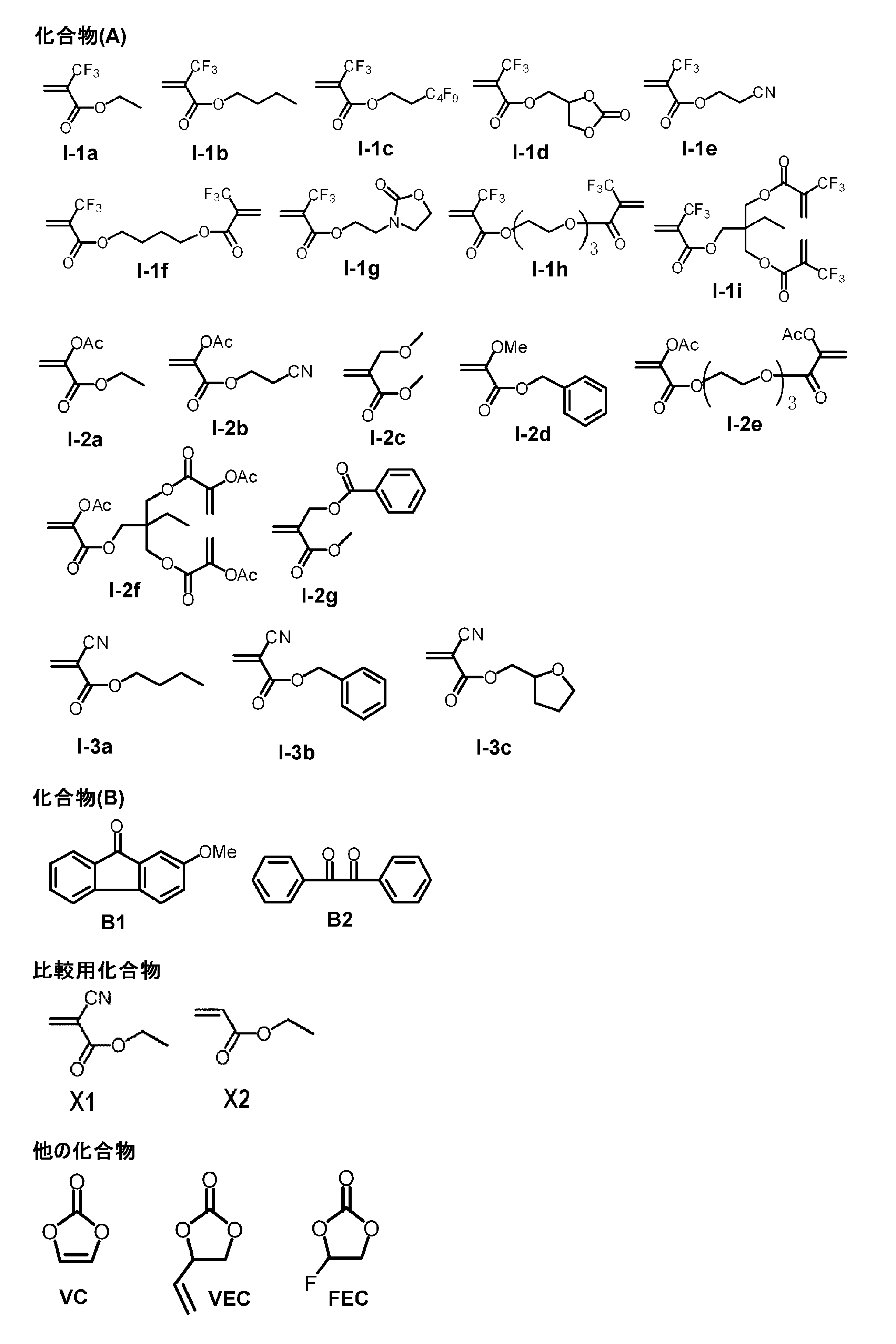
Ac:アセチル基
上記の結果より、本発明の非水二次電池用電解液によれば、公知例に見られる化合物(X1,X2)を利用したものに比べ、高温保存後の容量維持性および高レート放電特性において優れた性能を発揮することが分かる。
<実施例2・比較例2>
・電解液の調製
1M LiPF6の炭酸エチレン/炭酸メチルエチルの体積比1対2電解液に、表2に示した成分を、表中に記載の量で加え各試験No.に対応した電解液を調製した。調製した電解液の25℃における粘度は全て5mPa・s以下であった。
・電解液の調製
1M LiPF6の炭酸エチレン/炭酸メチルエチルの体積比1対2電解液に、表2に示した成分を、表中に記載の量で加え各試験No.に対応した電解液を調製した。調製した電解液の25℃における粘度は全て5mPa・s以下であった。
・電池(2)の作製
前記電池(1)の正極活物質を、コバルト酸リチウム(LiCoO2)に代えた。負極については、活物質:黒鉛 86質量%、導電助剤:カーボンブラック 6質量%、バインダー:PVDF 8質量%で作製した。セパレータはポリプロピレン製25μm厚に代えた。上記の正負極、セパレータを使用し、各試験No.の電解液について、2032形コイン電池を作製し、下記項目の評価を行った。結果を表2に示している。
前記電池(1)の正極活物質を、コバルト酸リチウム(LiCoO2)に代えた。負極については、活物質:黒鉛 86質量%、導電助剤:カーボンブラック 6質量%、バインダー:PVDF 8質量%で作製した。セパレータはポリプロピレン製25μm厚に代えた。上記の正負極、セパレータを使用し、各試験No.の電解液について、2032形コイン電池を作製し、下記項目の評価を行った。結果を表2に示している。
<1C放電容量維持率>
充電後の電圧を2.75Vから4.2Vに変更し、定電流放電時の電圧を1.2Vから2.75Vにした以外、前記と同様にして試験を行った。容量維持率(%)の算定式も同様である。
充電後の電圧を2.75Vから4.2Vに変更し、定電流放電時の電圧を1.2Vから2.75Vにした以外、前記と同様にして試験を行った。容量維持率(%)の算定式も同様である。
<4C放電容量維持率>
これも、上記1C放電容量維持率と同様に実施例1から変更し、測定を行った。その結果を下表に示す。
これも、上記1C放電容量維持率と同様に実施例1から変更し、測定を行った。その結果を下表に示す。
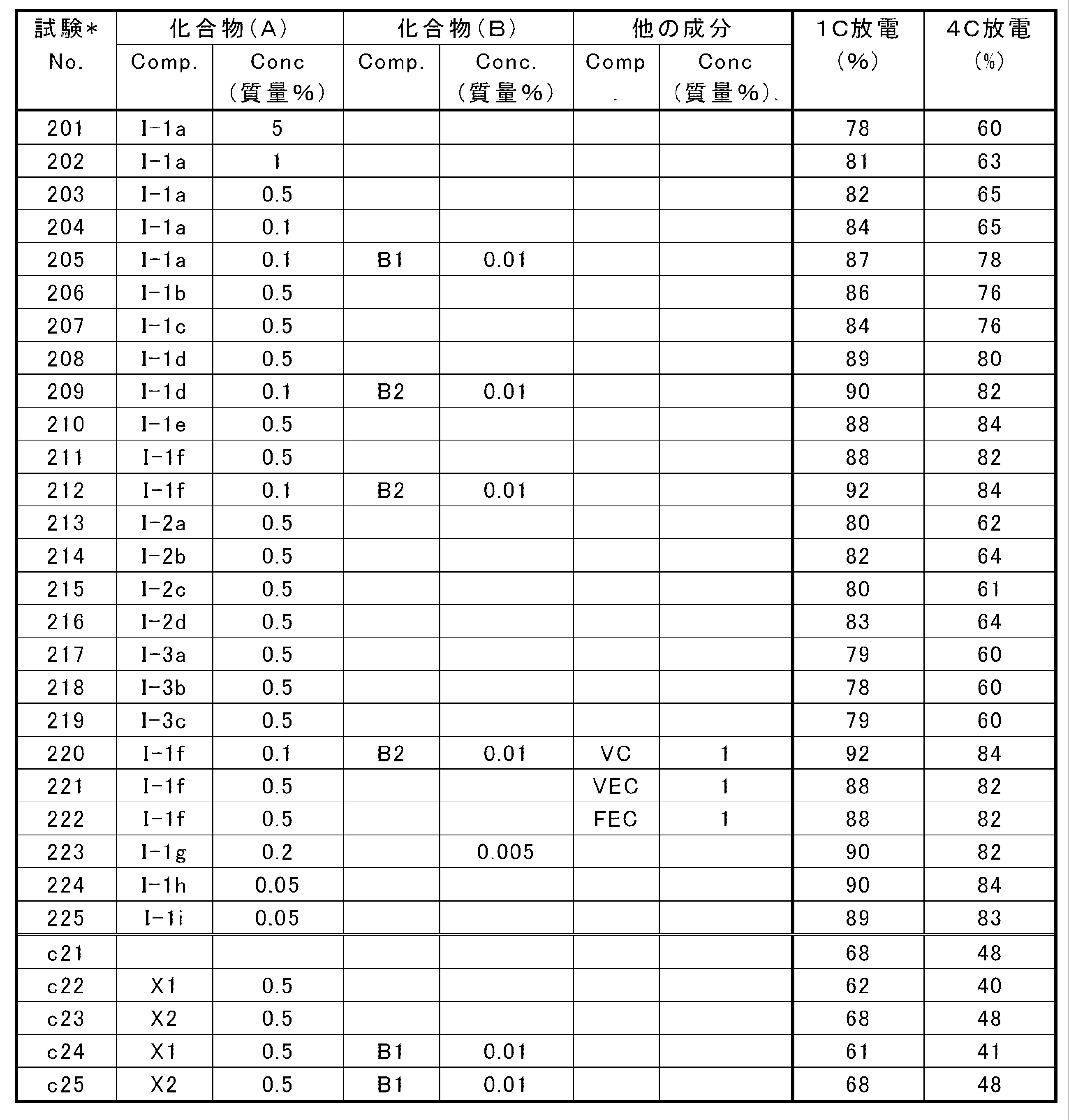
上記の結果より、本発明の非水二次電池用電解液によれば、作動電位がより低電位でより厳しい条件となる炭素系負極を用いても、公知例に見られる化合物(X1,X2)を利用したものに比べ、高温保存後の容量維持性および高レート放電特性において優れた性能を発揮することが分かる。
上記実施例において本発明の電解液をリチウム・チタン酸化物負極あるいは炭素材料負極と組み合わせて用いた電池において優れた特性を発現することを示したが、本発明の電解液は高容量化に向けて開発が進んでいるリチウムと合金形成可能な金属または金属酸化物負極(好ましくはSi、酸化Si、Si/酸化Si、Sn、酸化Sn、SnBxPyOz、Cu/Snおよびこれらのうち複数の複合体)、及びこれらの金属または金属酸化物と炭素材料の複合体を負極とする電池においても同様の優れた効果を発現するものと推測できる。
本発明をその実施態様とともに説明したが、我々は特に指定しない限り我々の発明を説明のどの細部においても限定しようとするものではなく、添付の請求の範囲に示した発明の精神と範囲に反することなく幅広く解釈されるべきであると考える。
本願は、2012年7月27日に日本国で特許出願された特願2012-167705に基づく優先権を主張するものであり、これらはここに参照してその内容を本明細書の記載の一部として取り込む。
1 正極導電材
2 正極活物質
3 負極導電材
4 負極活物質
5 電解液
6 動作手段
7 配線
9 セパレータ
10 リチウムイオン二次電池
12 セパレータ
14 正極シート
16 負極シート
18 負極を兼ねる外装缶
20 絶縁板
22 封口板
24 正極集電
26 ガスケット
28 圧力感応弁体
30 電流遮断素子
100 有底筒型形状リチウム二次電池
2 正極活物質
3 負極導電材
4 負極活物質
5 電解液
6 動作手段
7 配線
9 セパレータ
10 リチウムイオン二次電池
12 セパレータ
14 正極シート
16 負極シート
18 負極を兼ねる外装缶
20 絶縁板
22 封口板
24 正極集電
26 ガスケット
28 圧力感応弁体
30 電流遮断素子
100 有底筒型形状リチウム二次電池
Claims (16)
- 電解質と、下式(I-1)~(I-3)のいずれかで表される化合物(A)とを有機溶媒中に含有する非水二次電池用電解液。

(式(I-2)において、X2は、酸素原子を有する基を表す。Y2は、水素原子または有機基を表す。mbは、1~6の整数を表す。)
(式(I-3)において、Y3は、炭素数4以上の有機基、または酸素原子もしくは窒素原子を有する有機基を表す。mcは1~6の整数を表す。) - 更に、酸化または還元により(I-1)~(I-3)のいずれかで表される化合物(A)と反応する活性種を放出する化合物(B)を含有する請求項1記載の非水二次電池用電解液。
- 前記化合物(A)の含有率が電解液全量に対して0.001~10質量%である請求項1または2に記載の非水二次電池用電解液。
- 前記化合物(B)の含有率が電解液全量に対して0.0001~10質量%である請求項2または3に記載の非水二次電池用電解液。
- 前記化合物(A)と化合物(B)との添加量の比率(A/B)が、100/1~1/10である請求項2~4のいずれか1項に記載の非水二次電池用電解液。
- 前記X1が、フッ素原子で置換されたアルキル基である請求項1~5のいずれか1項に記載の非水二次電池用電解液。
- 前記X2が、アルコキシ基、アルコキシメチル基、アシルオキシ基、またはアシルオキシメチル基である請求項1~5のいずれか1項に記載の非水二次電池用電解液。
- 前記Y1、Y2、Y3が、それぞれ独立に、2価以上の有機基、あるいは酸素原子、窒素原子またはフッ素原子の少なくとも1つを有する1価の有機基である請求項1~7のいずれか1項に記載の非水二次電池用電解液。
- 前記化合物(B)が、ケトン化合物である請求項2~8のいずれか1項に記載の非水二次電池用電解液。
- 前記ケトン化合物が、芳香族ケトン化合物である請求項9に記載の非水二次電池用電解液。
- 前記芳香族ケトン化合物が、アセトフェノン化合物、ベンゾフェノン化合物、9-フルオレノン化合物、アントロン化合物、キサントン化合物、ジベンゾスベロン化合物、ジベンゾスベレロン化合物、アントラキノン化合物、ビアントロニル化合物、ビアントロン化合物、およびジベンゾイル化合物からなる群から選ばれる少なくとも一種の化合物からなる請求項10に記載の非水二次電池用電解液。
- 正極、負極、および請求項1~11のいずれか1項に記載の非水二次電池用電解液を具備する非水電解液二次電池。
- ニッケル、コバルトもしくはマンガンのうち少なくとも1種を有する化合物を前記正極の活物質として用いた請求項12に記載の非水電解液二次電池。
- チタン酸リチウム(LTO)または炭素材料を前記負極の活物質として用いた請求項12または13に記載の非水電解液二次電池。
- 下式(I-1)~(I-3)のいずれかで表される化合物を含む薬剤と、電解質を含む薬剤とを組み合わせた非水二次電池電解液用キット。
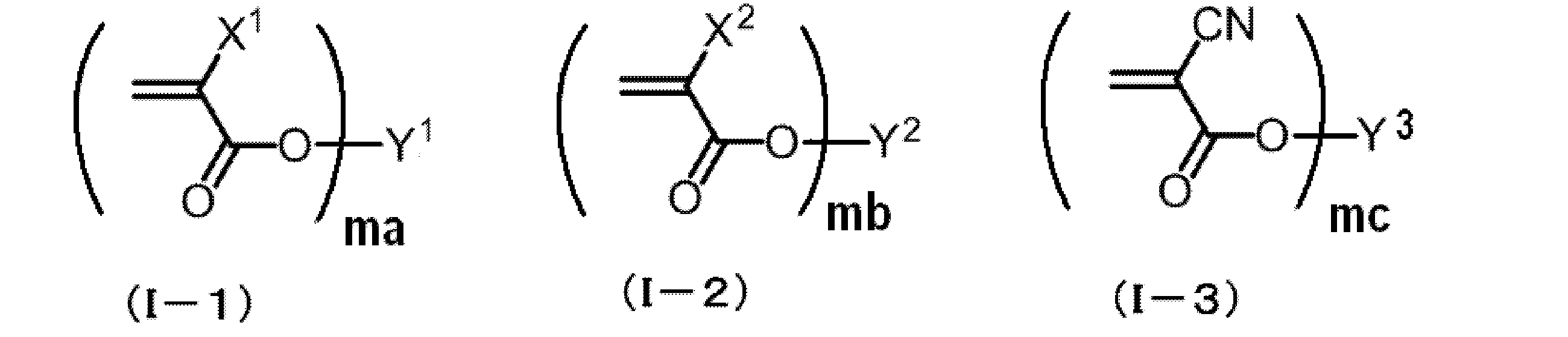
(式(I-2)において、X2は、酸素原子を有する基を表す。Y2は、水素原子または有機基を表す。mbは、1~6の整数を表す。)
(式(I-3)において、Y3は、炭素数4以上の有機基、または酸素原子もしくは窒素原子を有する有機基を表す。mcは1~6の整数を表す。) - 下式(I-1)~(I-3)のいずれかで表される化合物からなる非水二次電池電解液用添加剤。
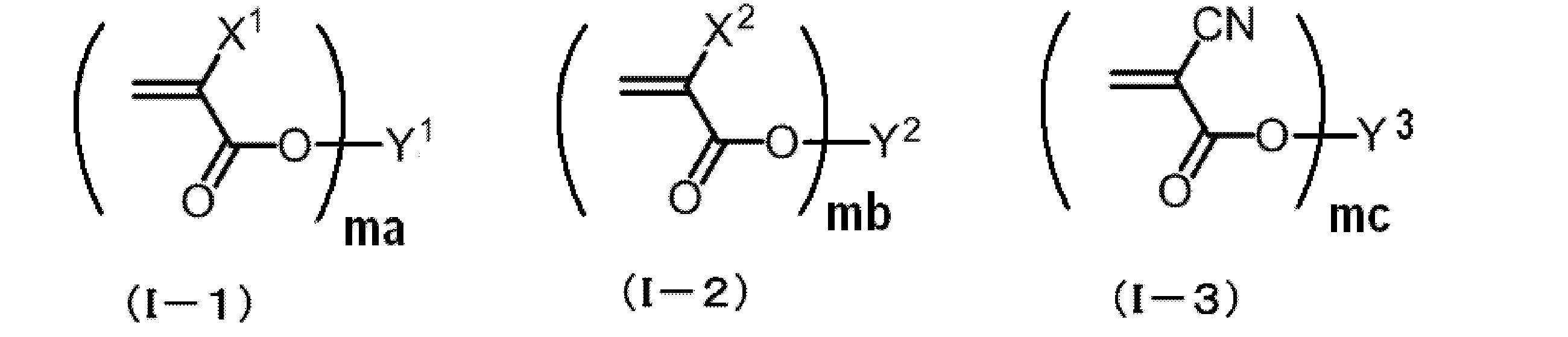
(式(I-2)において、X2は、酸素原子を有する基を表す。Y2は、水素原子または有機基を表す。mbは、1~6の整数を表す。)
(式(I-3)において、Y3は、炭素数4以上の有機基、または酸素原子もしくは窒素原子を有する有機基を表す。mcは1~6の整数を表す。)
Priority Applications (1)
| Application Number | Priority Date | Filing Date | Title |
|---|---|---|---|
| US14/601,321 US10312546B2 (en) | 2012-07-27 | 2015-01-21 | Non-aqueous liquid electrolyte for secondary battery and secondary battery |
Applications Claiming Priority (2)
| Application Number | Priority Date | Filing Date | Title |
|---|---|---|---|
| JP2012167705A JP5921982B2 (ja) | 2012-07-27 | 2012-07-27 | 非水二次電池用電解液及び二次電池 |
| JP2012-167705 | 2012-07-27 |
Related Child Applications (1)
| Application Number | Title | Priority Date | Filing Date |
|---|---|---|---|
| US14/601,321 Continuation US10312546B2 (en) | 2012-07-27 | 2015-01-21 | Non-aqueous liquid electrolyte for secondary battery and secondary battery |
Publications (1)
| Publication Number | Publication Date |
|---|---|
| WO2014017464A1 true WO2014017464A1 (ja) | 2014-01-30 |
Family
ID=49997274
Family Applications (1)
| Application Number | Title | Priority Date | Filing Date |
|---|---|---|---|
| PCT/JP2013/069866 Ceased WO2014017464A1 (ja) | 2012-07-27 | 2013-07-23 | 非水二次電池用電解液及び二次電池 |
Country Status (3)
| Country | Link |
|---|---|
| US (1) | US10312546B2 (ja) |
| JP (1) | JP5921982B2 (ja) |
| WO (1) | WO2014017464A1 (ja) |
Cited By (1)
| Publication number | Priority date | Publication date | Assignee | Title |
|---|---|---|---|---|
| EP2980888A1 (en) * | 2014-07-31 | 2016-02-03 | Kabushiki Kaisha Toshiba | Nonaqueous electrolyte battery and battery pack |
Families Citing this family (11)
| Publication number | Priority date | Publication date | Assignee | Title |
|---|---|---|---|---|
| EP2945211B1 (en) * | 2014-05-15 | 2018-11-21 | Saft Groupe S.A. | Lithium titanate oxide as negative electrode in li-ion cells |
| JP6839702B2 (ja) | 2015-09-23 | 2021-03-10 | ゴーション,インコーポレイテッド | Liイオンバッテリ電解質のための添加剤としてのフッ素化されたアクリレート |
| KR102396617B1 (ko) * | 2016-11-08 | 2022-05-10 | 삼성에스디아이 주식회사 | 리튬 이차 전지용 전해질 및 이를 포함하는 리튬 이차 전지 |
| WO2019113527A1 (en) * | 2017-12-07 | 2019-06-13 | Enevate Corporation | Silicon-based energy storage devices with cyclic carbonate containing electrolyte additives |
| CN114556658B (zh) * | 2019-10-07 | 2024-05-28 | 三菱化学株式会社 | 非水电解液及非水电解质二次电池 |
| CN116783752A (zh) * | 2021-01-27 | 2023-09-19 | 株式会社村田制作所 | 二次电池用电解液以及二次电池 |
| US20220255133A1 (en) * | 2021-02-03 | 2022-08-11 | Kabushiki Kaisha Toshiba | Nonaqueous electrolyte, secondary battery, battery pack, vehicle, and stationary power supply |
| US12278337B2 (en) | 2021-07-15 | 2025-04-15 | Lg Energy Solution, Ltd. | Electrolyte composition, gel polymer electrolyte and lithium secondary battery including the same |
| HUE072151T2 (hu) * | 2021-07-29 | 2025-10-28 | Lg Energy Solution Ltd | Gélpolimer elektrolit és ezt tartalmazó lítium másodlagos akkumulátor |
| CA3214267A1 (en) | 2021-09-10 | 2023-03-16 | Lg Energy Solution, Ltd. | Non-aqueous electrolyte solution for lithium secondary battery and lithium secondary battery including the same |
| JP7804148B2 (ja) * | 2022-08-04 | 2026-01-21 | エルジー エナジー ソリューション リミテッド | 二次電池用電解質およびそれを含むリチウム二次電池 |
Citations (3)
| Publication number | Priority date | Publication date | Assignee | Title |
|---|---|---|---|---|
| JP2003086248A (ja) * | 2001-09-14 | 2003-03-20 | Mitsubishi Chemicals Corp | 非水系電解液二次電池及び電解液 |
| JP2009123499A (ja) * | 2007-11-14 | 2009-06-04 | Sony Corp | 非水電解液二次電池および非水電解液組成物 |
| JP2013122901A (ja) * | 2011-05-24 | 2013-06-20 | Fujifilm Corp | 非水二次電池用電解液及び二次電池 |
Family Cites Families (5)
| Publication number | Priority date | Publication date | Assignee | Title |
|---|---|---|---|---|
| US5853917A (en) * | 1997-03-06 | 1998-12-29 | Mitsubishi Chemical Corporation | Electrolytic cell having a controlled electrode surface interface |
| US7026074B2 (en) * | 2002-02-15 | 2006-04-11 | The University Of Chicago | Lithium ion battery with improved safety |
| KR100713622B1 (ko) * | 2006-01-09 | 2007-05-02 | 제일모직주식회사 | 디페닐에테르계 화합물을 포함하는 비수성 전해액 및 이를포함하는 리튬 2차 전지 |
| CN101981749B (zh) * | 2008-04-02 | 2014-09-10 | 宇部兴产株式会社 | 锂电池用非水电解液以及使用了该非水电解液的锂电池 |
| JP5636338B2 (ja) * | 2011-06-28 | 2014-12-03 | シャープ株式会社 | 非水系二次電池及びその難燃剤 |
-
2012
- 2012-07-27 JP JP2012167705A patent/JP5921982B2/ja not_active Expired - Fee Related
-
2013
- 2013-07-23 WO PCT/JP2013/069866 patent/WO2014017464A1/ja not_active Ceased
-
2015
- 2015-01-21 US US14/601,321 patent/US10312546B2/en not_active Expired - Fee Related
Patent Citations (3)
| Publication number | Priority date | Publication date | Assignee | Title |
|---|---|---|---|---|
| JP2003086248A (ja) * | 2001-09-14 | 2003-03-20 | Mitsubishi Chemicals Corp | 非水系電解液二次電池及び電解液 |
| JP2009123499A (ja) * | 2007-11-14 | 2009-06-04 | Sony Corp | 非水電解液二次電池および非水電解液組成物 |
| JP2013122901A (ja) * | 2011-05-24 | 2013-06-20 | Fujifilm Corp | 非水二次電池用電解液及び二次電池 |
Cited By (2)
| Publication number | Priority date | Publication date | Assignee | Title |
|---|---|---|---|---|
| EP2980888A1 (en) * | 2014-07-31 | 2016-02-03 | Kabushiki Kaisha Toshiba | Nonaqueous electrolyte battery and battery pack |
| US9620757B2 (en) | 2014-07-31 | 2017-04-11 | Kabushiki Kaisha Toshiba | Nonaqueous electrolyte battery and battery pack |
Also Published As
| Publication number | Publication date |
|---|---|
| JP2014026885A (ja) | 2014-02-06 |
| US10312546B2 (en) | 2019-06-04 |
| JP5921982B2 (ja) | 2016-05-24 |
| US20150132639A1 (en) | 2015-05-14 |
Similar Documents
| Publication | Publication Date | Title |
|---|---|---|
| JP5798954B2 (ja) | 非水二次電池用電解液及び二次電池 | |
| JP5921982B2 (ja) | 非水二次電池用電解液及び二次電池 | |
| JP5992345B2 (ja) | 非水二次電池および非水二次電池用電解液 | |
| JP6485956B2 (ja) | 非水電解液および非水二次電池 | |
| JP6130637B2 (ja) | 非水二次電池用電解液及び二次電池 | |
| JP5902034B2 (ja) | 非水二次電池用電解液および非水二次電池 | |
| JP2014127354A (ja) | 非水二次電池用電解液および非水二次電池、電解液用添加剤 | |
| WO2014057887A1 (ja) | 非水電解液二次電池 | |
| JP5764526B2 (ja) | 非水二次電池用電解液及び二次電池 | |
| JP2015026589A (ja) | 非水二次電池用電解液および非水二次電池 | |
| WO2015016188A1 (ja) | 非水電解液および非水二次電池 | |
| JP2014013719A (ja) | 非水二次電池用電解液及び二次電池 | |
| JP2014235986A (ja) | 非水二次電池用電解液および非水二次電池 | |
| JPWO2014046283A1 (ja) | 非水二次電池用電解液および非水二次電池 | |
| WO2013183673A1 (ja) | 非水電解液二次電池および非水電解液 | |
| JP5886160B2 (ja) | 非水二次電池用電解液、非水二次電池電解液用キット及び非水電解液二次電池 | |
| JP5810014B2 (ja) | 非水二次電池用電解液及び二次電池 | |
| JP2014063668A (ja) | 非水二次電池用電解液及び二次電池 | |
| JP5756771B2 (ja) | 非水二次電池用電解液、二次電池及び機能性添加剤 | |
| JP6150987B2 (ja) | 非水二次電池用電解液及び二次電池 | |
| JP6391028B2 (ja) | 電解液、リチウムイオン電池およびリチウムイオンキャパシタ | |
| JP2015026587A (ja) | 非水二次電池用電解液、非水二次電池電解液用添加剤及び非水二次電池 |
Legal Events
| Date | Code | Title | Description |
|---|---|---|---|
| 121 | Ep: the epo has been informed by wipo that ep was designated in this application |
Ref document number: 13822442 Country of ref document: EP Kind code of ref document: A1 |
|
| NENP | Non-entry into the national phase |
Ref country code: DE |
|
| 122 | Ep: pct application non-entry in european phase |
Ref document number: 13822442 Country of ref document: EP Kind code of ref document: A1 |