WO2014017257A1 - 逆波長分散フィルム用樹脂組成物並びにこれからなる逆波長分散フィルム及び逆波長分散シート - Google Patents
逆波長分散フィルム用樹脂組成物並びにこれからなる逆波長分散フィルム及び逆波長分散シート Download PDFInfo
- Publication number
- WO2014017257A1 WO2014017257A1 PCT/JP2013/068011 JP2013068011W WO2014017257A1 WO 2014017257 A1 WO2014017257 A1 WO 2014017257A1 JP 2013068011 W JP2013068011 W JP 2013068011W WO 2014017257 A1 WO2014017257 A1 WO 2014017257A1
- Authority
- WO
- WIPO (PCT)
- Prior art keywords
- group
- wavelength dispersion
- reverse wavelength
- polysaccharide
- resin composition
- Prior art date
- Legal status (The legal status is an assumption and is not a legal conclusion. Google has not performed a legal analysis and makes no representation as to the accuracy of the status listed.)
- Ceased
Links
Classifications
-
- C—CHEMISTRY; METALLURGY
- C08—ORGANIC MACROMOLECULAR COMPOUNDS; THEIR PREPARATION OR CHEMICAL WORKING-UP; COMPOSITIONS BASED THEREON
- C08L—COMPOSITIONS OF MACROMOLECULAR COMPOUNDS
- C08L1/00—Compositions of cellulose, modified cellulose or cellulose derivatives
- C08L1/02—Cellulose; Modified cellulose
-
- C—CHEMISTRY; METALLURGY
- C08—ORGANIC MACROMOLECULAR COMPOUNDS; THEIR PREPARATION OR CHEMICAL WORKING-UP; COMPOSITIONS BASED THEREON
- C08L—COMPOSITIONS OF MACROMOLECULAR COMPOUNDS
- C08L1/00—Compositions of cellulose, modified cellulose or cellulose derivatives
- C08L1/08—Cellulose derivatives
-
- C—CHEMISTRY; METALLURGY
- C08—ORGANIC MACROMOLECULAR COMPOUNDS; THEIR PREPARATION OR CHEMICAL WORKING-UP; COMPOSITIONS BASED THEREON
- C08B—POLYSACCHARIDES; DERIVATIVES THEREOF
- C08B11/00—Preparation of cellulose ethers
- C08B11/02—Alkyl or cycloalkyl ethers
- C08B11/04—Alkyl or cycloalkyl ethers with substituted hydrocarbon radicals
- C08B11/14—Alkyl or cycloalkyl ethers with substituted hydrocarbon radicals with nitrogen-containing groups
-
- C—CHEMISTRY; METALLURGY
- C08—ORGANIC MACROMOLECULAR COMPOUNDS; THEIR PREPARATION OR CHEMICAL WORKING-UP; COMPOSITIONS BASED THEREON
- C08B—POLYSACCHARIDES; DERIVATIVES THEREOF
- C08B31/00—Preparation of derivatives of starch
- C08B31/08—Ethers
- C08B31/12—Ethers having alkyl or cycloalkyl radicals substituted by heteroatoms, e.g. hydroxyalkyl or carboxyalkyl starch
- C08B31/125—Ethers having alkyl or cycloalkyl radicals substituted by heteroatoms, e.g. hydroxyalkyl or carboxyalkyl starch having a substituent containing at least one nitrogen atom, e.g. cationic starch
-
- C—CHEMISTRY; METALLURGY
- C08—ORGANIC MACROMOLECULAR COMPOUNDS; THEIR PREPARATION OR CHEMICAL WORKING-UP; COMPOSITIONS BASED THEREON
- C08B—POLYSACCHARIDES; DERIVATIVES THEREOF
- C08B33/00—Preparation of derivatives of amylose
- C08B33/02—Esters
-
- C—CHEMISTRY; METALLURGY
- C08—ORGANIC MACROMOLECULAR COMPOUNDS; THEIR PREPARATION OR CHEMICAL WORKING-UP; COMPOSITIONS BASED THEREON
- C08B—POLYSACCHARIDES; DERIVATIVES THEREOF
- C08B35/00—Preparation of derivatives of amylopectin
- C08B35/02—Esters
-
- C—CHEMISTRY; METALLURGY
- C08—ORGANIC MACROMOLECULAR COMPOUNDS; THEIR PREPARATION OR CHEMICAL WORKING-UP; COMPOSITIONS BASED THEREON
- C08B—POLYSACCHARIDES; DERIVATIVES THEREOF
- C08B37/00—Preparation of polysaccharides not provided for in groups C08B1/00 - C08B35/00; Derivatives thereof
-
- C—CHEMISTRY; METALLURGY
- C08—ORGANIC MACROMOLECULAR COMPOUNDS; THEIR PREPARATION OR CHEMICAL WORKING-UP; COMPOSITIONS BASED THEREON
- C08B—POLYSACCHARIDES; DERIVATIVES THEREOF
- C08B37/00—Preparation of polysaccharides not provided for in groups C08B1/00 - C08B35/00; Derivatives thereof
- C08B37/0006—Homoglycans, i.e. polysaccharides having a main chain consisting of one single sugar, e.g. colominic acid
- C08B37/0024—Homoglycans, i.e. polysaccharides having a main chain consisting of one single sugar, e.g. colominic acid beta-D-Glucans; (beta-1,3)-D-Glucans, e.g. paramylon, coriolan, sclerotan, pachyman, callose, scleroglucan, schizophyllan, laminaran, lentinan or curdlan; (beta-1,6)-D-Glucans, e.g. pustulan; (beta-1,4)-D-Glucans; (beta-1,3)(beta-1,4)-D-Glucans, e.g. lichenan; Derivatives thereof
- C08B37/0027—2-Acetamido-2-deoxy-beta-glucans; Derivatives thereof
- C08B37/003—Chitin, i.e. 2-acetamido-2-deoxy-(beta-1,4)-D-glucan or N-acetyl-beta-1,4-D-glucosamine; Chitosan, i.e. deacetylated product of chitin or (beta-1,4)-D-glucosamine; Derivatives thereof
-
- C—CHEMISTRY; METALLURGY
- C08—ORGANIC MACROMOLECULAR COMPOUNDS; THEIR PREPARATION OR CHEMICAL WORKING-UP; COMPOSITIONS BASED THEREON
- C08B—POLYSACCHARIDES; DERIVATIVES THEREOF
- C08B37/00—Preparation of polysaccharides not provided for in groups C08B1/00 - C08B35/00; Derivatives thereof
- C08B37/0006—Homoglycans, i.e. polysaccharides having a main chain consisting of one single sugar, e.g. colominic acid
- C08B37/0036—Galactans; Derivatives thereof
- C08B37/0039—Agar; Agarose, i.e. D-galactose, 3,6-anhydro-D-galactose, methylated, sulfated, e.g. from the red algae Gelidium and Gracilaria; Agaropectin; Derivatives thereof, e.g. Sepharose, i.e. crosslinked agarose
-
- C—CHEMISTRY; METALLURGY
- C08—ORGANIC MACROMOLECULAR COMPOUNDS; THEIR PREPARATION OR CHEMICAL WORKING-UP; COMPOSITIONS BASED THEREON
- C08B—POLYSACCHARIDES; DERIVATIVES THEREOF
- C08B37/00—Preparation of polysaccharides not provided for in groups C08B1/00 - C08B35/00; Derivatives thereof
- C08B37/0006—Homoglycans, i.e. polysaccharides having a main chain consisting of one single sugar, e.g. colominic acid
- C08B37/0036—Galactans; Derivatives thereof
- C08B37/0042—Carragenan or carragen, i.e. D-galactose and 3,6-anhydro-D-galactose, both partially sulfated, e.g. from red algae Chondrus crispus or Gigantia stellata; kappa-Carragenan; iota-Carragenan; lambda-Carragenan; Derivatives thereof
-
- C—CHEMISTRY; METALLURGY
- C08—ORGANIC MACROMOLECULAR COMPOUNDS; THEIR PREPARATION OR CHEMICAL WORKING-UP; COMPOSITIONS BASED THEREON
- C08B—POLYSACCHARIDES; DERIVATIVES THEREOF
- C08B37/00—Preparation of polysaccharides not provided for in groups C08B1/00 - C08B35/00; Derivatives thereof
- C08B37/0006—Homoglycans, i.e. polysaccharides having a main chain consisting of one single sugar, e.g. colominic acid
- C08B37/0045—Homoglycans, i.e. polysaccharides having a main chain consisting of one single sugar, e.g. colominic acid alpha-D-Galacturonans, e.g. methyl ester of (alpha-1,4)-linked D-galacturonic acid units, i.e. pectin, or hydrolysis product of methyl ester of alpha-1,4-linked D-galacturonic acid units, i.e. pectinic acid; Derivatives thereof
-
- C—CHEMISTRY; METALLURGY
- C08—ORGANIC MACROMOLECULAR COMPOUNDS; THEIR PREPARATION OR CHEMICAL WORKING-UP; COMPOSITIONS BASED THEREON
- C08B—POLYSACCHARIDES; DERIVATIVES THEREOF
- C08B37/00—Preparation of polysaccharides not provided for in groups C08B1/00 - C08B35/00; Derivatives thereof
- C08B37/006—Heteroglycans, i.e. polysaccharides having more than one sugar residue in the main chain in either alternating or less regular sequence; Gellans; Succinoglycans; Arabinogalactans; Tragacanth or gum tragacanth or traganth from Astragalus; Gum Karaya from Sterculia urens; Gum Ghatti from Anogeissus latifolia; Derivatives thereof
- C08B37/0063—Glycosaminoglycans or mucopolysaccharides, e.g. keratan sulfate; Derivatives thereof, e.g. fucoidan
- C08B37/0072—Hyaluronic acid, i.e. HA or hyaluronan; Derivatives thereof, e.g. crosslinked hyaluronic acid (hylan) or hyaluronates
-
- C—CHEMISTRY; METALLURGY
- C08—ORGANIC MACROMOLECULAR COMPOUNDS; THEIR PREPARATION OR CHEMICAL WORKING-UP; COMPOSITIONS BASED THEREON
- C08B—POLYSACCHARIDES; DERIVATIVES THEREOF
- C08B37/00—Preparation of polysaccharides not provided for in groups C08B1/00 - C08B35/00; Derivatives thereof
- C08B37/006—Heteroglycans, i.e. polysaccharides having more than one sugar residue in the main chain in either alternating or less regular sequence; Gellans; Succinoglycans; Arabinogalactans; Tragacanth or gum tragacanth or traganth from Astragalus; Gum Karaya from Sterculia urens; Gum Ghatti from Anogeissus latifolia; Derivatives thereof
- C08B37/0063—Glycosaminoglycans or mucopolysaccharides, e.g. keratan sulfate; Derivatives thereof, e.g. fucoidan
- C08B37/0075—Heparin; Heparan sulfate; Derivatives thereof, e.g. heparosan; Purification or extraction methods thereof
-
- C—CHEMISTRY; METALLURGY
- C08—ORGANIC MACROMOLECULAR COMPOUNDS; THEIR PREPARATION OR CHEMICAL WORKING-UP; COMPOSITIONS BASED THEREON
- C08J—WORKING-UP; GENERAL PROCESSES OF COMPOUNDING; AFTER-TREATMENT NOT COVERED BY SUBCLASSES C08B, C08C, C08F, C08G or C08H
- C08J5/00—Manufacture of articles or shaped materials containing macromolecular substances
- C08J5/18—Manufacture of films or sheets
-
- C—CHEMISTRY; METALLURGY
- C08—ORGANIC MACROMOLECULAR COMPOUNDS; THEIR PREPARATION OR CHEMICAL WORKING-UP; COMPOSITIONS BASED THEREON
- C08L—COMPOSITIONS OF MACROMOLECULAR COMPOUNDS
- C08L1/00—Compositions of cellulose, modified cellulose or cellulose derivatives
- C08L1/08—Cellulose derivatives
- C08L1/10—Esters of organic acids, i.e. acylates
- C08L1/12—Cellulose acetate
-
- C—CHEMISTRY; METALLURGY
- C08—ORGANIC MACROMOLECULAR COMPOUNDS; THEIR PREPARATION OR CHEMICAL WORKING-UP; COMPOSITIONS BASED THEREON
- C08L—COMPOSITIONS OF MACROMOLECULAR COMPOUNDS
- C08L1/00—Compositions of cellulose, modified cellulose or cellulose derivatives
- C08L1/08—Cellulose derivatives
- C08L1/10—Esters of organic acids, i.e. acylates
- C08L1/14—Mixed esters, e.g. cellulose acetate-butyrate
-
- C—CHEMISTRY; METALLURGY
- C08—ORGANIC MACROMOLECULAR COMPOUNDS; THEIR PREPARATION OR CHEMICAL WORKING-UP; COMPOSITIONS BASED THEREON
- C08L—COMPOSITIONS OF MACROMOLECULAR COMPOUNDS
- C08L1/00—Compositions of cellulose, modified cellulose or cellulose derivatives
- C08L1/08—Cellulose derivatives
- C08L1/26—Cellulose ethers
-
- C—CHEMISTRY; METALLURGY
- C08—ORGANIC MACROMOLECULAR COMPOUNDS; THEIR PREPARATION OR CHEMICAL WORKING-UP; COMPOSITIONS BASED THEREON
- C08L—COMPOSITIONS OF MACROMOLECULAR COMPOUNDS
- C08L1/00—Compositions of cellulose, modified cellulose or cellulose derivatives
- C08L1/08—Cellulose derivatives
- C08L1/26—Cellulose ethers
- C08L1/28—Alkyl ethers
-
- C—CHEMISTRY; METALLURGY
- C08—ORGANIC MACROMOLECULAR COMPOUNDS; THEIR PREPARATION OR CHEMICAL WORKING-UP; COMPOSITIONS BASED THEREON
- C08L—COMPOSITIONS OF MACROMOLECULAR COMPOUNDS
- C08L1/00—Compositions of cellulose, modified cellulose or cellulose derivatives
- C08L1/08—Cellulose derivatives
- C08L1/26—Cellulose ethers
- C08L1/28—Alkyl ethers
- C08L1/284—Alkyl ethers with hydroxylated hydrocarbon radicals
-
- C—CHEMISTRY; METALLURGY
- C08—ORGANIC MACROMOLECULAR COMPOUNDS; THEIR PREPARATION OR CHEMICAL WORKING-UP; COMPOSITIONS BASED THEREON
- C08L—COMPOSITIONS OF MACROMOLECULAR COMPOUNDS
- C08L1/00—Compositions of cellulose, modified cellulose or cellulose derivatives
- C08L1/08—Cellulose derivatives
- C08L1/26—Cellulose ethers
- C08L1/28—Alkyl ethers
- C08L1/286—Alkyl ethers substituted with acid radicals, e.g. carboxymethyl cellulose [CMC]
-
- C—CHEMISTRY; METALLURGY
- C08—ORGANIC MACROMOLECULAR COMPOUNDS; THEIR PREPARATION OR CHEMICAL WORKING-UP; COMPOSITIONS BASED THEREON
- C08L—COMPOSITIONS OF MACROMOLECULAR COMPOUNDS
- C08L3/00—Compositions of starch, amylose or amylopectin or of their derivatives or degradation products
- C08L3/02—Starch; Degradation products thereof, e.g. dextrin
-
- C—CHEMISTRY; METALLURGY
- C08—ORGANIC MACROMOLECULAR COMPOUNDS; THEIR PREPARATION OR CHEMICAL WORKING-UP; COMPOSITIONS BASED THEREON
- C08L—COMPOSITIONS OF MACROMOLECULAR COMPOUNDS
- C08L3/00—Compositions of starch, amylose or amylopectin or of their derivatives or degradation products
- C08L3/12—Amylose; Amylopectin; Degradation products thereof
-
- C—CHEMISTRY; METALLURGY
- C08—ORGANIC MACROMOLECULAR COMPOUNDS; THEIR PREPARATION OR CHEMICAL WORKING-UP; COMPOSITIONS BASED THEREON
- C08L—COMPOSITIONS OF MACROMOLECULAR COMPOUNDS
- C08L5/00—Compositions of polysaccharides or of their derivatives not provided for in groups C08L1/00 or C08L3/00
-
- C—CHEMISTRY; METALLURGY
- C08—ORGANIC MACROMOLECULAR COMPOUNDS; THEIR PREPARATION OR CHEMICAL WORKING-UP; COMPOSITIONS BASED THEREON
- C08L—COMPOSITIONS OF MACROMOLECULAR COMPOUNDS
- C08L5/00—Compositions of polysaccharides or of their derivatives not provided for in groups C08L1/00 or C08L3/00
- C08L5/02—Dextran; Derivatives thereof
-
- C—CHEMISTRY; METALLURGY
- C08—ORGANIC MACROMOLECULAR COMPOUNDS; THEIR PREPARATION OR CHEMICAL WORKING-UP; COMPOSITIONS BASED THEREON
- C08L—COMPOSITIONS OF MACROMOLECULAR COMPOUNDS
- C08L5/00—Compositions of polysaccharides or of their derivatives not provided for in groups C08L1/00 or C08L3/00
- C08L5/06—Pectin; Derivatives thereof
-
- C—CHEMISTRY; METALLURGY
- C08—ORGANIC MACROMOLECULAR COMPOUNDS; THEIR PREPARATION OR CHEMICAL WORKING-UP; COMPOSITIONS BASED THEREON
- C08L—COMPOSITIONS OF MACROMOLECULAR COMPOUNDS
- C08L5/00—Compositions of polysaccharides or of their derivatives not provided for in groups C08L1/00 or C08L3/00
- C08L5/08—Chitin; Chondroitin sulfate; Hyaluronic acid; Derivatives thereof
-
- C—CHEMISTRY; METALLURGY
- C08—ORGANIC MACROMOLECULAR COMPOUNDS; THEIR PREPARATION OR CHEMICAL WORKING-UP; COMPOSITIONS BASED THEREON
- C08L—COMPOSITIONS OF MACROMOLECULAR COMPOUNDS
- C08L5/00—Compositions of polysaccharides or of their derivatives not provided for in groups C08L1/00 or C08L3/00
- C08L5/10—Heparin; Derivatives thereof
-
- C—CHEMISTRY; METALLURGY
- C08—ORGANIC MACROMOLECULAR COMPOUNDS; THEIR PREPARATION OR CHEMICAL WORKING-UP; COMPOSITIONS BASED THEREON
- C08L—COMPOSITIONS OF MACROMOLECULAR COMPOUNDS
- C08L5/00—Compositions of polysaccharides or of their derivatives not provided for in groups C08L1/00 or C08L3/00
- C08L5/12—Agar or agar-agar, i.e. mixture of agarose and agaropectin; Derivatives thereof
-
- C—CHEMISTRY; METALLURGY
- C08—ORGANIC MACROMOLECULAR COMPOUNDS; THEIR PREPARATION OR CHEMICAL WORKING-UP; COMPOSITIONS BASED THEREON
- C08L—COMPOSITIONS OF MACROMOLECULAR COMPOUNDS
- C08L51/00—Compositions of graft polymers in which the grafted component is obtained by reactions only involving carbon-to-carbon unsaturated bonds; Compositions of derivatives of such polymers
- C08L51/02—Compositions of graft polymers in which the grafted component is obtained by reactions only involving carbon-to-carbon unsaturated bonds; Compositions of derivatives of such polymers grafted on to polysaccharides
-
- G—PHYSICS
- G02—OPTICS
- G02B—OPTICAL ELEMENTS, SYSTEMS OR APPARATUS
- G02B5/00—Optical elements other than lenses
- G02B5/30—Polarising elements
- G02B5/3083—Birefringent or phase retarding elements
-
- G—PHYSICS
- G02—OPTICS
- G02B—OPTICAL ELEMENTS, SYSTEMS OR APPARATUS
- G02B5/00—Optical elements other than lenses
- G02B5/32—Holograms used as optical elements
-
- C—CHEMISTRY; METALLURGY
- C08—ORGANIC MACROMOLECULAR COMPOUNDS; THEIR PREPARATION OR CHEMICAL WORKING-UP; COMPOSITIONS BASED THEREON
- C08J—WORKING-UP; GENERAL PROCESSES OF COMPOUNDING; AFTER-TREATMENT NOT COVERED BY SUBCLASSES C08B, C08C, C08F, C08G or C08H
- C08J2305/00—Characterised by the use of polysaccharides or of their derivatives not provided for in groups C08J2301/00 or C08J2303/00
Definitions
- the present invention relates to a resin composition for a reverse wavelength dispersion film, a reverse wavelength dispersion film and a reverse wavelength dispersion sheet comprising the same.
- Acetyl cellulose is excellent in nonflammability, transparency, surface appearance, electrical insulation, and the like, and thus is used in various fields.
- a reverse wavelength dispersion film that is one of the uses of an acetylcellulose film, a resin that simultaneously satisfies positive birefringence and reverse wavelength dispersion is required, and the degree of acetyl group substitution is 2.5. Less than acetylcellulose is used.
- An object of the present invention is to provide a novel resin composition for a reverse wavelength dispersion film which is excellent in saponification resistance, transparency, positive birefringence and reverse wavelength dispersion.
- At least one functional group selected from the group consisting of a hydroxyl group, a carboxyl group and an amino group of the polysaccharide is selected from the group consisting of an ether group, a urethane group, a urea group, an amide group and an imide group.
- the molecular dispersion is 0.50 to 20.0, and the absolute value of the reflection chromaticity b * obtained in accordance with JIS-Z8729 of a film obtained by molding the resin composition for a reverse wavelength dispersion film to a thickness of 80 ⁇ m is 0.
- the film and sheet formed from the resin composition for reverse wavelength dispersion film of the present invention are excellent in transparency, saponification resistance, positive birefringence and reverse wavelength dispersion.
- At least one functional group selected from the group consisting of a hydroxyl group, a carboxyl group, and an amino group of a polysaccharide is an ether group, a urethane group, a urea group, an amide group, and
- a resin composition for a reverse wavelength dispersion film comprising a modified polysaccharide (A) chemically modified with at least one functional group selected from the group consisting of imide groups, and constituting the modified polysaccharide (A)
- the average molecular dispersion of all monosaccharide units is 0.50 to 20.0, and the reflection color required in accordance with JIS-Z8729 of a film obtained by molding the resin composition for reverse wavelength dispersion film to a film thickness of 80 ⁇ m
- the reverse wavelength dispersion film is a film having a function of increasing the phase difference as the wavelength becomes longer.
- the ether group is preferably an ⁇ or ⁇ -hydroxy ether group from the viewpoints of saponification resistance, transparency, positive birefringence and reverse wavelength dispersion.
- the modified polysaccharide (A) is one in which the average molecular dispersion of all monosaccharide units constituting the modified polysaccharide (A) is 0.50 to 20.0.
- the molecular dispersion of the monosaccharide unit is a numerical value obtained by adding the values of atomic dispersion described in “Advanceds in Physical Organic Chemistry, 3, 1, 1965” to each bond in the monosaccharide unit as shown in the following formula 1.
- the modified polysaccharide (A) is obtained by chemically modifying the polysaccharide (a) with at least one compound selected from the group consisting of (y1) to (y5) described later, the average molecular dispersion of monosaccharide units Uses the modification rate of the modified polysaccharide (A) determined by 1 H-NMR, and the value calculated by the following Equation 3 is the average molecular dispersion of monosaccharide units.
- Average molecular dispersion of monosaccharide units ⁇ molecular dispersion of skeleton of monosaccharide units ⁇ + [ ⁇ i ⁇ molecular dispersion of functional group introduced by chemical modification at (yi) ⁇ ⁇ ⁇ modification rate at (yi) ⁇ ]-[ ⁇ Molecular dispersion of hydroxyl group (OH) ⁇ ⁇ ⁇ Modification rate of hydroxyl group ⁇ ]-[ ⁇ Molecular dispersion of carboxyl group (C ( ⁇ O) —OH) ⁇ ⁇ ⁇ Modification of carboxyl group Rate ⁇ ]-[ ⁇ molecular dispersion of amino group (NH 2 ) ⁇ ⁇ ⁇ modification rate of amino group ⁇ ] (Formula 3) In Equation 3, (yi) represents (y1) to (y5).
- the substitution rate (DS) provided by each raw material manufacturer is used to express a simple substance according to the following formula.
- Molecular dispersion of skeleton of monosaccharide unit ⁇ Molecular dispersion of skeleton of monosaccharide unit constituting polysaccharide before substitution ⁇ + [(Molecular dispersion of functional group introduced by substitution) ⁇ DS] ⁇ [(Chemical modification by substitution) Molecular dispersion of functional groups before being applied) ⁇ DS]
- the modification rate of (y1) to (y5) of the hydroxyl group, carboxyl group and amino group is determined by the following measurement. ⁇ Method for measuring the modification rate of hydroxyl group, carboxyl group and amino group at (y1) to (y5)> 1 H-NMR of the modified polysaccharide (A) is measured under the following conditions, and chemically modified by the reaction of the polysaccharide (a) and (y1) to (y5) charged when the modified polysaccharide (A) is prepared. From the peak integral value derived from the functional group introduced in this step, and the peak integral values derived from the hydroxyl group, carboxyl group and amino group in the polysaccharide (a), the modification rate in (y1) to (y5) is calculated. calculate.
- the modification rate is calculated by the following formula.
- Modification rate (integrated value of hydrogen atom of urethane group) / ⁇ (integrated value of hydrogen atom of urethane group) + (integrated value of hydrogen atom derived from hydroxyl group in cellulose) / 3 ⁇
- (A) is one in which the average molecular dispersion of all monosaccharide units constituting (A) is 0.50 to 20.0. 5 to 15.0 is preferable, more preferably 0.5 to 10.0, and still more preferably 0.5 to 2.0.
- the average molecular dispersion of all monosaccharide units constituting (A) is lowered by introducing a substituent having a bond with a small absorption maximum wavelength, and introducing a substituent having a bond with a large absorption maximum wavelength. Will be higher.
- the absolute value of the reflection chromaticity b * obtained in accordance with JIS-Z8729 of a film obtained by molding the resin composition for reverse wavelength dispersion film to a thickness of 80 ⁇ m is 0 to 1.0. From the viewpoint of transparency, 0 to 0.5 is preferable, 0 to 0.25 is more preferable, and 0 to 0.2 is particularly preferable.
- the absolute value of the reflection chromaticity b * is lowered by reducing the amount of aromatic isocyanate (aromatic polyisocyanate and aromatic monoisocyanate) used in the production of (A) described later, and the amount of aromatic isocyanate used is reduced. Increased by increasing.
- aromatic polyisocyanate and aromatic monoisocyanate it is also possible to reduce the reflection chromaticity b * by introducing a hydrocarbon group between the isocyanate group and the aromatic ring.
- molded the resin composition for reverse wavelength dispersion films in the film thickness of 80 micrometers is obtained with the following method from the resin composition for reverse wavelength dispersion films.
- the resin composition for reverse wavelength dispersion film is dissolved in 1,3-dioxolane as an organic solvent so that the solid content is about 10%.
- a resin composition for reverse wavelength dispersion film dissolved in an organic solvent a surface-treated PET (polyethylene terephthalate) film [for example, “Cosmo Shine” manufactured by Toyobo Co., Ltd.] using an applicator It is applied to a thickness of 80 ⁇ m. The coating is dried at 80 ° C. for 2 hours. After drying, it is peeled off from the PET film and used for measurement of reflection chromaticity b *.
- At least one functional group selected from the group consisting of a hydroxyl group, a carboxyl group and an amino group of the polysaccharide is an ether group, a urethane group, a urea group, an amide group and an imide group.
- a modified polysaccharide obtained by chemically modifying at least one functional group selected from the group consisting of The modified polysaccharide (A) preferably has no (meth) acryloyl group from the viewpoint of reverse wavelength dispersion.
- the polysaccharide includes conventionally known polysaccharides and can be used without any particular limitation. Specifically, the following polysaccharide (a) is included. Examples of the polysaccharide (a) include starch (including amylose and amylopectin), glycogen, cellulose, chitin, chitosan, agarose, carrageenan, heparin, hyaluronic acid, pectin, xyloglucan and xanthan gum, and a functional group having these urethane group, urea In addition to the group and the amide group, at least one polysaccharide selected from the group consisting of substituted polysaccharides is included. As a polysaccharide, 1 type may be used independently and 2 or more types may be used together.
- Substituted polysaccharides include known substituted polysaccharides.
- the substituted polysaccharide is preferably a substituted known cellulose from the viewpoints of birefringence, reverse wavelength dispersion and water resistance.
- As the substituted known cellulose acylated cellulose (a1), etherified cellulose (a2) and etherified acylated cellulose (a3) are included.
- Acylated cellulose (a1) includes acylated cellulose substituted with an acyl group having 2 to 19 carbon atoms, which may be partially substituted with a hydroxyl group.
- carboxylic acid include those having 2 to 19 carbon atoms such as acetic acid, butyric acid, 2-ethylhexanoic acid, n-octylic acid, neodecanoic acid, dodecanoic acid, stearic acid, oleic acid, linoleic acid, and linolenic acid.
- Benzoic acid and phthalic acid include those having 2 to 19 carbon atoms such as acetic acid, butyric acid, 2-ethylhexanoic acid, n-octylic acid, neodecanoic acid, dodecanoic acid, stearic acid, oleic acid, linoleic acid, and linolenic acid.
- the carboxylic acid may be an acid halide such as acid chloride ⁇ as halogen, for example, F, Cl, Br, etc. ⁇ . Moreover, these may use 1 type and may use 2 or more types.
- Lactones include those having 2 to 19 carbon atoms, such as ⁇ -lactone ( ⁇ -propiolactone, etc.), ⁇ -lactone ( ⁇ -butyrolactone, etc.), ⁇ -lactone ( ⁇ -valerolactone, etc.), ⁇ - Examples include lactones (such as ⁇ -caprolactone), macrocyclic lactones (such as enanthlactone, undecanolactone, dodecalactone) and aromatic lactones (3,4-dihydrocoumarin).
- acyl group having 2 to 19 carbon atoms which may be partially substituted with a hydroxyl group include, for example, an acetyl group, a propionyl group, a butyryl group, a valeryl group, a benzoyl group, a 6-hydroxyhexanoyl group (HO—C 5 H 10 -CO-) and 3- (2-hydroxyphenyl) propionyl group.
- Specific examples of (a1) include triacetyl cellulose, diacetyl cellulose, acetyl butyryl cellulose, acetyl propionyl cellulose, and acetyl 3- (2-hydroxyphenyl) propionyl cellulose.
- acylated cellulose substituted with an acyl group having 2 to 19 carbon atoms which may be partially substituted with a hydroxyl group
- is preferred more preferably an acetyl group, a propionyl group, At least one functional group selected from the group consisting of a butyryl group, a valeryl group, a benzoyl group, a 6-hydroxyhexanoyl group (HO—C 5 H 10 —CO—) and a 3- (2-hydroxyphenyl) propionyl group;
- diacetyl cellulose, acetyl 6-hydroxyhexanoyl cellulose and acetyl 3- (2-hydroxyphenyl) propionyl cellulose most preferably diacetyl cellulose, acetyl benzoyl cellulose, acetyl 6- Hydroxyhexanoyl cellulose And acetyl 3- (2-hydroxyphenyl) propionylcellulose.
- the etherified cellulose (a2) includes etherified cellulose substituted with an alkyl ether group having 1 to 18 carbon atoms, which may be partially substituted with a hydroxyl group or a carboxyl group.
- alkyl ether group include alkyl ether groups having 1 to 18 carbon atoms which may be partially substituted with a hydroxyl group or a carboxyl group, such as a methoxy group, an ethoxy group, a propoxy group, a hydroxymethoxyl group, Those having at least one functional group selected from the group consisting of hydroxyethoxyl group, 1-phenylethoxy group, 2-phenylethoxy group and carboxymethoxyl group are included.
- the alkyl ether group is preferably an alkyl ether group having 1 to 18 carbon atoms which may be partially substituted with a hydroxyl group or a carboxyl group, more preferably a methoxy group, an ethoxy group, or a propoxy group. And at least one functional group selected from the group consisting of a group, a hydroxymethoxyl group, a 1-phenylethoxy group, a 2-phenylethoxy group, and a hydroxyethoxyl group.
- (a2) examples include methylcellulose, ethylcellulose, hydroxyethylcellulose, hydroxypropylcellulose, hydroxypropylmethylcellulose, hydroxyethylmethylcellulose, 1-phenylethylcellulose, 2-phenylethylcellulose and carboxymethylcellulose.
- alkyl etherified cellulose having 1 to 18 alkyl carbon atoms and oxyalkyl etherified cellulose having 1 to 18 alkyl carbon atoms are preferred, and ethyl cellulose, (1-phenylethyl) ethylcellulose, (2-phenylethyl) ethylcellulose and methylcellulose are preferred, and ethylcellulose, (1-phenylethyl) ethylcellulose and (2-phenylethyl) ethylcellulose are most preferred.
- the etherified acylated cellulose (a3) has an alkyl ether group having 1 to 18 carbon atoms which may be partially substituted with a hydroxyl group or a carboxyl group and a carbon number which may be partially substituted with a hydroxyl group.
- Examples include cellulose having 2 to 19 acyl groups, and specific examples include hydroxypropylmethylcellulose hexahydrophthalate, hydroxypropylmethylcellulose acetate phthalate, and hydroxypropylmethylcellulose acetate succinate.
- the preferred ether group and acyl group are the same as those in (a1) and (a2).
- the polysaccharide (a) is preferred, more preferably cellulose and substituted cellulose, and still more preferably cellulose.
- At least one functional group selected from the group consisting of a hydroxyl group, a carboxyl group and an amino group which the polysaccharide has is a group consisting of an ether group, a urethane group, a urea group, an amide group and an imide group.
- at least one monosaccharide unit consists of a hydroxyl group, a carboxyl group and an amino group of the monosaccharide unit.
- At least one functional group selected from the group is selected from the group consisting of an isocyanate compound (y1), an amino compound (y2), an acid halogen compound (y3), an acid anhydride (y4), and an epoxy compound (y5). Those chemically modified with at least one selected compound are included.
- the isocyanate compound (y1) includes a polyisocyanate compound (y11) having two or more isocyanate groups in one compound molecule and a monoisocyanate compound (y12) having one isocyanate group in one compound molecule.
- (Y11) includes organic polyisocyanates generally used for the production of urethane resins. For example, aromatic polyisocyanates, chain aliphatic polyisocyanates, alicyclic polyisocyanates, araliphatic polyisocyanates, and modified products thereof. (Urethane group, carbodiimide group, allophanate group, urea group, burette group, isocyanurate group and oxazolidone group-containing modified product). (Y11) may be used alone or in combination of two or more.
- Aromatic polyisocyanates include aromatic diisocyanates having 6 to 16 carbon atoms (excluding carbons in NCO groups; the following polyisocyanates are the same), aromatic triisocyanates having 6 to 20 carbon atoms, and crude products of these isocyanates. Thing etc. are mentioned. Specific examples include 1,3- or 1,4-phenylene diisocyanate, 2,4- or 2,6-tolylene diisocyanate (TDI), crude TDI, 2,4'-diphenylmethane diisocyanate, 4,4'-diphenylmethane.
- MDI diisocyanate
- CAde MDI polymethylene polyphenylene polyisocyanate
- naphthylene-1,5-diisocyanate examples thereof include triphenylmethane-4,4 ′, 4 ′′ -triisocyanate.
- chain aliphatic polyisocyanate examples include a chain aliphatic diisocyanate having 1 to 10 carbon atoms of an aliphatic group (such as 1,6-hexamethylene diisocyanate, 2,2,4-trimethylhexamethylene diisocyanate, and lysine diisocyanate). Can be mentioned.
- alicyclic polyisocyanates examples include alicyclic diisocyanates having 6 to 16 carbon atoms (isophorone diisocyanate, 4,4′-dicyclohexylmethane diisocyanate, 1,4-cyclohexane diisocyanate, norbornane diisocyanate and bis (2-isocyanatoethyl)- 4-cyclohexene-1,2-dicarboxylate and the like.
- araliphatic polyisocyanate examples include araliphatic diisocyanates having 8 to 12 carbon atoms (such as xylylene diisocyanate and ⁇ , ⁇ , ⁇ ′, ⁇ ′-tetramethylxylylene diisocyanate).
- modified polyisocyanate examples include carbodiimide-modified MDI.
- chain aliphatic polyisocyanates are preferable from the viewpoints of saponification resistance, transparency, positive birefringence and reverse wavelength dispersion.
- a compound (z) having at least one active hydrogen group may be used.
- (Z) includes a compound having at least one active hydrogen group having 4 to 100 carbon atoms. Examples of the active hydrogen group include a hydroxyl group, an amino group, a carboxyl group, a thiol group, and a phosphate group.
- (z) include those having a hydroxyl group ⁇ methanol, ethanol, n-propanol, n-butanol, n-octanol, phenol, etc. ⁇ , those having an amino group ⁇ ethylamine, etc. ⁇ , having a carboxyl group Things ⁇ formic acid, acetic acid, propionic acid, butyric acid, isobutyric acid, valeric acid, caproic acid, enanthic acid, caprylic acid, pelargonic acid, lauric acid, myristic acid, stearic acid and behenic acid ⁇ , those having a thiol group ⁇ octane Thiol and the like ⁇ and those having a phosphoric acid group ⁇ reaction products of the above-mentioned hydroxyl group (such as methanol) and phosphoric anhydride ⁇ and the like.
- (Z) may be used alone or in combination of two or more.
- (z) from the viewpoint of surface hardness, resin strength, elongation at break, flexibility and positive birefringence, a compound having a hydroxyl group having 4 to 100 carbon atoms is preferable, and more preferably 4 to 10 carbon atoms. It is a compound having a hydroxyl group.
- Examples of (y12) include aromatic monoisocyanates, alkyl monoisocyanates, alicyclic monoisocyanates, and reaction products having a molar ratio of 1: 1 between a diisocyanate compound and a compound having one active hydrogen group.
- Aromatic monoisocyanates include aromatic monoisocyanates having 6 to 20 carbon atoms (excluding carbon in the NCO group, the same shall apply hereinafter), specifically phenyl isocyanate, tolylene isocyanate, xylylene isocyanate, Examples include ⁇ , ⁇ , ⁇ ′, ⁇ ′-tetramethylxylylene isocyanate and naphthylene isocyanate.
- Alkyl monoisocyanates include alkyl (straight chain or branched) monoisocyanates having 1 to 100 carbon atoms, specifically those having 1 to 18 carbon atoms ⁇ methyl isocyanate, ethyl isocyanate, n-propyl isocyanate, n -Butyl isocyanate, sec-butyl isocyanate, t-butyl isocyanate, n-hexyl isocyanate, 2-ethylhexyl isocyanate, n-octyl isocyanate, n-dodecyl isocyanate, n-stearyl isocyanate, etc. ⁇ .
- alkyl monoisocyanate those having 1 to 18 carbon atoms are preferable from the viewpoints of transparency, saponification resistance, positive birefringence and reverse wavelength dispersion.
- alicyclic monoisocyanate include alicyclic monoisocyanates having 4 to 15 carbon atoms, and specifically include cyclobutyl isocyanate, cyclohexyl isocyanate, cyclooctyl isocyanate, cyclodecyl isocyanate, cyclododecyl isocyanate, and cyclotetradecyl.
- Examples include isocyanate, cyclotetradecyl isocyanate, isophorone isocyanate, dicyclohexylmethane-4-isocyanate, cyclohexyl isocyanate, methylcyclohexyl isocyanate and norbornane isocyanate.
- the diisocyanate compound includes a diisocyanate compound having two isocyanate groups in the above (y11), specifically, , Aromatic diisocyanates ⁇ 1,3- or 1,4-phenylene diisocyanate, 2,4- or 2,6-tolylene diisocyanate (TDI), crude TDI, 2,4'-diphenylmethane diisocyanate, 4,4'-diphenylmethane Diisocyanate (MDI) and naphthylene-1,5-diisocyanate, etc. ⁇ , alkyl (linear or branched) diisocyanate ⁇ 1,6-hexamethylene diisocyanate, 2,2,4-trimethylhexamethylene diisocyanate, lysine diisocyanate, etc. ⁇ , alicyclic ring Formula Socynate ⁇ isophorone diiso
- Examples of the compound having one active hydrogen group include compounds having one active hydrogen group among the above compounds (z), specifically, monoalcohols having 1 to 100 carbon atoms ⁇ methanol, Ethanol, n-propanol, n-butanol, n-octanol, phenol, etc., preferably from the viewpoints of surface hardness, resin strength, elongation at break, flexibility and positive birefringence ⁇ C1-C100 monoamine ⁇ ethylamine, etc.], C1-C100 monovalent carboxylic acid ⁇ formic acid, acetic acid, propionic acid, butyric acid, isobutyric acid, valeric acid, caproic acid, enanthic acid, caprylic acid, pelargonic acid , Lauric acid, myristic acid, stearic acid, behenic acid and the like ⁇ .
- monoalcohols having 1 to 100 carbon atoms ⁇ methanol, Ethanol, n-propanol,
- alkyl monoisocyanates and alicyclic monoisocyanates are preferred, and more preferred.
- alkyl monoisocyanates having 1 to 18 carbon atoms and alicyclic monoisocyanates having 4 to 15 carbon atoms particularly preferably methyl isocyanate, ethyl isocyanate, n-propyl isocyanate, n-butyl isocyanate, sec-butyl.
- Isocyanates t-butyl isocyanate, n-hexyl isocyanate, cyclohexyl isocyanate, 2-ethylhexyl isocyanate, n-octyl isocyanate, n-dodecyl isocyanate and n-stearyl isocyanate.
- (Y1) may be used alone or in combination of two or more.
- the monoisocyanate compound (y12) is preferable, and more preferably alkylmono Isocyanates and alicyclic monoisocyanates, more preferably alkyl monoisocyanates having 1 to 18 carbon atoms and alicyclic monoisocyanates having 4 to 15 carbon atoms, particularly preferably methyl isocyanate, ethyl isocyanate, n-propyl isocyanate, n-butyl isocyanate, sec-butyl isocyanate, t-butyl isocyanate, n-hexyl isocyanate, cyclohexyl isocyanate, 2-ethylhexyl isocyanate, n-octyl isocyanate, n-dodecy
- Amino compounds (y2) include ammonia, primary amines and secondary amines.
- Primary amines include monoamines having 1 to 20 carbon atoms ⁇ alkyl (linear or branched) monoamines, alicyclic monoamines, araliphatic monoamines, aromatic monoamines and alkanolamines ⁇ and polyamines having 1 to 20 carbon atoms ⁇ Diamine, triamine and the like ⁇ .
- Monoamines include, for example, alkyl monoamines ⁇ monoalkyl (alkyl having 1 to 20 carbon atoms) amine (such as methylamine, ethylamine, n-butylamine and octylamine) ⁇ , alicyclic monoamines ⁇ such as cyclohexylamine ⁇ , Araliphatic amines ⁇ such as benzylamine ⁇ , aromatic amines ⁇ such as aniline, toluidine and naphthylamine) and alkanolamines ⁇ including monoalkanolamines (hydroxyalkyl groups having 1 to 20 carbon atoms such as ethanolamine) Etc.) etc. ⁇ .
- alkyl monoamines ⁇ monoalkyl (alkyl having 1 to 20 carbon atoms) amine (such as methylamine, ethylamine, n-butylamine and octylamine) ⁇
- alicyclic monoamines such as cyclohexyl
- the secondary amine includes an amine having a hydrocarbon group having 1 to 20 carbon atoms and / or a hydroxyalkyl group having 1 to 20 carbon atoms.
- Hydrocarbon groups include alkyl groups (straight or branched) (such as methyl, ethyl and propyl groups), alicyclic groups (such as cyclohexyl groups), and aromatic hydrocarbons (such as phenyl and naphthyl groups).
- Specific examples of the secondary amine include dimethylamine, diethylamine, ethylmethylamine, and diethanolamine.
- (Y2) may be used alone or in combination of two or more.
- (y2) alkyl monoamines and alicyclic monoamines are preferable from the viewpoints of saponification resistance, transparency, surface hardness, resin strength, elongation at break, flexibility, and positive birefringence.
- the acid halogen compound (y3) includes a carboxylic acid halide (acyl halide) having 1 to 20 carbon atoms, and specific examples of the carboxylic acid include aliphatic monocarboxylic acids (formic acid) having 1 to 20 carbon atoms.
- aromatic polycarboxylic acids having 8 to 20 carbon atoms phthalic acid, isophthalic acid, terephthalic acid, trimellitic acid, pyromellitic acid, etc.
- halide include fluoride, chloride, bromide and iodide.
- (Y3) may be used alone or in combination of two or more.
- (y3) from the viewpoint of saponification resistance, transparency, surface hardness, resin strength, elongation at break, flexibility and positive birefringence, aliphatic monocarboxylic acid halides having 1 to 20 carbon atoms are preferable.
- Examples of the acid anhydride (y4) include a compound having 3 to 20 carbon atoms having a 1,3-dioxo-2-oxaalkylene group, and a dicarboxylic acid ⁇ aliphatic dicarboxylic acid (succinic acid, adipic acid, azelaic acid, Sebacic acid and maleic acid etc.) and aromatic dicarboxylic acids (phthalic acid etc.) ⁇ acid anhydrides and the like.
- (Y4) may be used alone or in combination of two or more.
- aliphatic dicarboxylic acid acid anhydrides are preferred.
- the epoxy compound (y5) includes an aromatic compound (y51) having an epoxy group and other epoxy compounds (y52).
- the epoxy compound (y5) is bonded to the polysaccharide (a) with an ⁇ or ⁇ -hydroxy ether bond, and the side chains are aligned by the influence of the hydroxyl group.
- the modified polysaccharide such as (a2) to (a3) described above
- the positive birefringence and the reverse wavelength dispersion are extremely excellent, and the saponification resistance and transparency are also excellent.
- the average molecular dispersion of monosaccharide units cannot be within the above range with ordinary etherified polysaccharides (the above (a2) to (a3) etc.), but they are bonded with ⁇ or ⁇ -hydroxy ether bonds. By making it, the average molecular dispersion of a monosaccharide unit can be made into the said range.
- (Y51) includes the following aromatic compound (B). When the following aromatic compound (B) is used, the side chains are regularly aligned due to the interaction of the aromatic rings of the side chains, and therefore, it is further excellent in positive birefringence and reverse wavelength dispersion.
- Aromatic compound (B) aromatic compound (b1) in which one hydrogen atom in the aromatic ring is substituted by an epoxy group, epoxy alkyl having 3 to 8 carbon atoms in which one hydrogen atom in the aromatic ring is alkyl A functional group in which at least one carbon atom of alkyl is replaced by an oxygen atom in an aromatic compound (b2) substituted with a group and an epoxyalkyl group in which one hydrogen atom in the aromatic ring is alkyl having 3 to 8 carbon atoms At least one compound selected from the group consisting of aromatic compounds (b3) substituted with
- aromatic compound (B) as the aromatic ring, a ring structure composed of only carbon ⁇ benzene ring, naphthalene ring, etc. ⁇ and a heterocyclic ring containing an element other than carbon in the ring structure ⁇ furan, thiophene, pyrrole, and Imidazole, etc. ⁇ .
- aromatic rings from the viewpoint of birefringence, reverse wavelength dispersion and water resistance, an aromatic ring having a ring structure composed only of carbon is preferable, and a benzene ring is more preferable.
- one hydrogen atom in the aromatic ring is replaced with an epoxy group or the like ⁇ epoxy group, epoxyalkyl group having 3 to 8 carbon atoms in alkyl and epoxyalkylether group having 3 to 8 carbon atoms ⁇ .
- the other hydrogen atom may be substituted with another functional group (x) other than an epoxy group or the like.
- Other functional groups (x) include halogeno groups (F, Cl, Br, I, etc.), hydroxyl groups, amino groups, oxyalkyl groups having 1 to 8 carbon atoms, or alkyl groups having 1 to 8 carbon atoms. Examples thereof include an alkylamino group.
- a plurality of aromatic rings may be bonded to the epoxy group, the epoxyalkyl group, or the like.
- aromatic compound (b1) in which one hydrogen atom in the aromatic ring is substituted with an epoxy group examples include styrene oxide, 2- (4-chlorophenyl) oxirane, 2- (4-fluorophenyl) oxirane, Examples include 2- (4-bromophenyl) oxirane and 2,3-diphenyloxirane.
- aromatic compound (b2) in which one hydrogen atom in the aromatic ring is substituted with an epoxyalkyl group having 3 to 8 carbon atoms in alkyl include 2-benzyloxirane and the like.
- an aromatic compound (b3) in which at least one carbon atom of alkyl is substituted with a functional group in which an alkyl atom is substituted in an epoxyalkyl group having 1 to 6 carbon atoms in alkyl specifically, benzylglycidyl ether, Glycidyl trityl ether, glycidyl-4-methoxyphenyl ether, 1-naphthyl-2-oxiranyl methyl ether, 2-[(2-naphthyloxy) methyl] oxirane, 4-chlorophenyl-2-oxiranyl methyl ether, 2 -[(4-ethylphenoxy) methyl] oxirane, 2-[(3-methylphenoxy) methyl] oxirane, 2-[(2-methylphenoxy) methyl] oxirane, 2- ⁇ [4- (benzyloxy) phenoxy] methyl ⁇ Oxirane, 2-[(4-nonylphenoxy) methyl] methyl
- (Y51) is preferably an aromatic compound (B) from the viewpoints of transparency, saponification resistance, positive birefringence and reverse wavelength dispersion, and more preferably one hydrogen atom in the aromatic ring is an epoxy.
- (Y52) includes an epoxy compound having an epoxy group and having no aromatic ring and having 2 to 20 carbon atoms, and specifically includes ethylene oxide and an acyclic aliphatic epoxy compound having 3 to 20 carbon atoms ⁇ 1,2-propylene oxide and 1,2-butylene oxide ⁇ , alicyclic epoxy compounds ⁇ limonene dioxide, di (3,4-epoxycyclohexyl) adipate, (3,4-epoxycyclohexyl) methyl-3 ′, 4′-epoxycyclohexanecarboxylate, (3,4-epoxy-6-methylcyclohexyl) methyl-3 ′, 4′-epoxy-6-methylcyclohexanecarboxylate and ethylene-1,2-di (3,4-epoxy Cyclohexanecarboxylic acid) ester, etc. ⁇ .
- an aromatic compound (y51) having an epoxy group is preferable from the viewpoint of transparency, saponification resistance, positive birefringence and reverse wavelength dispersion, and more preferably an aromatic compound ( B), and more preferably an aromatic compound (b1) in which one hydrogen atom in the aromatic ring is substituted with an epoxy group, particularly preferably styrene oxide.
- the modified polysaccharide (A) is selected from the group consisting of the polysaccharide (a) and an isocyanate compound (y1), an amino compound (y2), an acid halogen compound (y3), an acid anhydride (y4), and an epoxy compound (y5). Can be produced by using at least one kind of compound.
- a compound having at least one selected from the group consisting of a hydroxyl group, a carboxyl group and an amino group and an isocyanate compound are used.
- a known method for reacting can be used.
- a modified polysaccharide (A) using a polysaccharide (a) and an amino compound (y2) using the well-known method of making the compound which has a carboxyl group, and an amino compound react, and obtaining an amide compound.
- a known method for obtaining an imide compound by reacting a compound having an amino group with an acid halogen compound can be used.
- modified polysaccharide (A) using polysaccharide (a) and acid anhydride (y4) the compound which has an amino group, and acid anhydride are made to react, and an amide compound and / or an imide compound are made. Any known method can be used.
- modified polysaccharide (A) using polysaccharide (a) and an epoxy compound (y5) the compound which has a hydroxyl group, and an epoxy compound are made to react, and it has (alpha) and / or (beta) hydroxy ether group.
- a known method for obtaining a compound can be used.
- the polysaccharide is the polysaccharide (a), and the monosaccharide unit constituting the polysaccharide A modified polysaccharide (A1) having at least one structure selected from the group consisting of the following general formulas (1) to (6) and containing at least one substituent represented by the following general formula (7)
- the polysaccharide is the said polysaccharide (a) and the modified polysaccharide (A2) formed by chemically modifying at least 1 hydroxyl group in (a) with the said aromatic compound (B) which has an epoxy group is preferable.
- X 1 to X 13 are each independently a hydrogen atom or a substituent represented by the following general formula (7); at least one of X 1 to X 3 is the following general formula (7) And at least one of X 4 to X 6 is a substituent represented by the following general formula (7); at least one of X 7 and X 8 is represented by the following general formula ( 7); at least one of X 10 and X 11 is a substituent represented by the following general formula (7); at least one of X 12 and X 13 is the following general group A substituent represented by formula (7); Y is an oxygen atom or NH group, and Z is a hydroxyl group or a substituent represented by (8).
- R 1 is a hydrogen atom or a monovalent hydrocarbon group having 1 to 18 carbon atoms
- * is a substituent represented by the general formula (7) by a bond to which R 1 is attached; In the general formulas (1) to (6), this represents bonding to X and an adjacent oxygen atom and / or nitrogen atom.
- R 2 represents a monovalent hydrocarbon group having 1 to 18 carbon atoms or an alkylpolyoxyalkylene group
- * represents a substituent represented by the general formula (8) by a bond to which R 2 is attached. Represents bonding to Z in the general formula (5) and an adjacent carbon atom.
- the general formula (1) or (6) is preferable from the viewpoint of surface hardness, adhesion, and flexibility, and more preferable.
- preferred R 1 and R 2 are hydrocarbon groups having 1 to 18 carbon atoms, and particularly preferred R 1 and R 2.
- n-stearyl group is independently methyl, ethyl, n-propyl, n-butyl, sec-butyl, t-butyl, n-hexyl, cyclohexyl, 2-ethylhexyl, n-octyl, n -Dodecyl group and n-stearyl group.
- the modified polysaccharide (A1) is a urethane group, a urea group, an amide group, and the like determined by the following formula (1) from the viewpoints of colorability, transparency, saponification resistance, positive birefringence and reverse wavelength dispersion.
- the polysaccharide is preferably a polysaccharide having a total introduction rate of imide groups of 0.01 to 3, more preferably 0.04 to 3, further preferably 0.06 to 2, and particularly preferably 0.8. 11 to 1.4.
- T ′ NMR integral value of the hydrogen atom directly bonded to the 4-position carbon atom of the monosaccharide unit constituting the modified polysaccharide (A1) ⁇ the total introduction rate of urethane group, urea group, amide group and imide group Measuring method>
- Solvent Deuterated dimethyl sulfoxide Device: AVANCE300 (manufactured by Nippon Bruker Co., Ltd.) Frequency: 300MHz When the introduction ratio is greater than 0.01, transparency, saponification resistance, and reverse wavelength dispersion are further improved, and when the introduction ratio is 3 or less, positive birefringence is further improved. .
- the modified polysaccharide (A2) is a polysaccharide in which the polysaccharide (a) is chemically modified, and is chemically modified with the following aromatic compound (B) in which at least one hydroxyl group in (a) has an epoxy group. Is a modified polysaccharide.
- Aromatic compound (B) an aromatic compound (b1) in which one hydrogen atom in the aromatic ring is substituted with an epoxy group, an aromatic compound in which an alkyl group having 3 to 8 carbon atoms is substituted ( b2) and at least one selected from the group consisting of aromatic compounds (b3) in which at least one carbon atom of alkyl is substituted with a functional group in which an oxygen atom is substituted in an alkyl group having 3 to 8 carbon atoms in alkyl Species compound.
- aromatic compound (B) is as described above.
- the ratio of the functional group chemically modified with the aromatic compound (B) among the hydroxyl groups in the polysaccharide (a) is based on the number of hydroxyl groups in the polysaccharide (a). From the viewpoint of reverse wavelength dispersion and water resistance, 30 to 100% is preferable, and 60 to 100% is more preferable.
- the proportion of the chemically modified functional group can be determined by 1 H-NMR. Specifically, it is measured by the following measurement method. ⁇ Measurement method of ratio of functional group chemically modified in (B)> 1 H-NMR of the polysaccharide (a) and the modified polysaccharide (A2) before modification is measured.
- Ratio of functional group modified with (B) ⁇ (TS) / T ⁇ ⁇ 100 (3)
- S Integral value of hydrogen atom of hydroxyl group of modified polysaccharide (A2)
- T Integral value of hydrogen atom of hydroxyl group of polysaccharide (a)
- the aromatic ring concentration in the modified polysaccharide (A2) is preferably 20 to 80% by weight, more preferably 25 to 70% by weight, from the viewpoints of colorability, high birefringence and reverse wavelength dispersion. Next, it is more preferably 30 to 65% by weight.
- the aromatic ring concentration is measured by the following measurement method. ⁇ Measurement of aromatic ring concentration> 1 H-NMR of the polysaccharide (a) and the modified polysaccharide (A2) before modification is measured. By applying the following integrated value obtained from each measurement result to the following mathematical formula (4), the aromatic ring concentration (% by weight) of the modified polysaccharide (A2) is calculated.
- U (integral value of one hydrogen atom in the structure of the aromatic compound (B)) ⁇ (number of aromatic rings in the aromatic compound (B)) ⁇ 5 / (single constituting the modified polysaccharide (A2)) Sum of integral values of hydrogen atoms bonded to 1st to 5th carbons in sugar)
- V molecular weight of the monosaccharide constituting the polysaccharide (a)
- W molecular weight of the aromatic compound (B)
- the molecular weight of the modified polysaccharide (A) is from the viewpoint of the solvent solubility of (A), the heat resistance and adhesion of the reverse wavelength dispersion film and sheet. It is preferably 3000 to 7 million, more preferably 3500 to 6 million, and particularly preferably 4000 to 5 million.
- the number average molecular weight (Mn) in the present invention is measured under the following conditions. Apparatus: Gel permeation chromatography Solvent: N, N-dimethylformamide Reference substance: Polystyrene Sample concentration: 3 mg / ml Column stationary phase: PLgel MIXED-B Column temperature: 40 ° C
- the resin composition for a reverse wavelength dispersion film of the present invention can contain esterified cellulose (C). Since the modified polysaccharide (A) has very high reverse wavelength dispersibility, the reverse wavelength dispersibility can be appropriately adjusted by containing (C) having low reverse wavelength dispersibility.
- the esterified cellulose (C) in the present invention includes known esterified cellulose, and examples thereof include alkyl esterified cellulose (alkyl having 1 to 18 carbon atoms). Examples of the alkyl ester group include an acetate group. , Propionate group, butyrate group and the like. (C) may be used individually by 1 type, and may use 2 or more types together.
- the esterification rate of esterified cellulose (C) (average number of hydroxyl groups directly bonded to cellulose per monosaccharide unit substituted with ester groups) is transparency, saponification resistance, positive birefringence and From the viewpoint of reverse wavelength dispersion, 0.1 to 3 is preferable.
- the esterification rate of esterified cellulose is determined by NMR.
- the Mn of the esterified cellulose (C) is preferably from 3 to 10 million, more preferably from 5 to 8 million, from the viewpoints of transparency, saponification resistance, positive birefringence and reverse wavelength dispersion.
- alkyl esterified cellulose having 1 to 18 carbon atoms is preferable from the viewpoint of reverse wavelength dispersion, and more preferably at least one selected from the group consisting of acetate group, propionate group and butyrate group.
- Esterified cellulose having an ester group and more preferably cellulose acetate, cellulose butyrate, cellulose propionate, cellulose acetate propionate, and cellulose acetate butyrate.
- the content of the modified polysaccharide (A) in the resin composition for reverse wavelength dispersion film is transparency, saponification resistance. From the viewpoint of processability, positive birefringence and reverse wavelength dispersion, it is preferably 1 to 99.9% by weight, more preferably 3 to 95% by weight, based on the total weight of (A) and (C). is there.
- the content of esterified cellulose (C) in the resin composition for reverse wavelength dispersion film is (A) and ( From the viewpoint of transparency, saponification resistance, positive birefringence and reverse wavelength dispersion, 0.1 to 99% by weight is preferable, and more preferably 5 to 97% by weight, based on the total weight of C). is there.
- An organic solvent, a leveling agent, and the like can be added to the resin composition for a reverse wavelength dispersion film of the present invention as necessary.
- organic solvent examples include glycol ether (ethylene glycol monoalkyl ether and propylene glycol monoalkyl ether), ketone (acetone, methyl ethyl ketone, methyl isobutyl ketone, cyclohexanone, etc.), ester (ethyl acetate, butyl acetate, ethylene glycol alkyl ether acetate, Methyl lactate and propylene glycol alkyl ether acetate, etc.), aromatic hydrocarbons (toluene, xylene, mesitylene, etc.), alcohols (methanol, ethanol, normal propanol, isopropanol, butanol, geraniol, linalool, citronellol, etc.), amides (N, N -Dimethylacetamide and N, N-dimethylformamide), sulfoxide (dimethylsulfoxy) ) And ether (tetrahydrofuran, 1,
- the addition amount of the organic solvent is preferably 0 to 400% by weight, more preferably from the weight of the resin composition for reverse wavelength dispersion film. Is 3 to 350% by weight, particularly preferably 5 to 300% by weight.
- leveling agent examples include fluorine-based leveling agents (perfluoroalkylethylene oxide adducts and the like) and silicone-based leveling agents (amino polyether-modified silicone, methoxy-modified silicone, polyether-modified silicone, and the like).
- the addition amount of the leveling agent is preferably 0 to 20% by weight, more preferably 0.05 to 10% by weight, particularly preferably from the viewpoint of the effect of addition and transparency with respect to the weight of the resin composition for reverse wavelength dispersion film. Is 0.1 to 5% by weight.
- the resin composition for a reverse wavelength dispersion film of the present invention further comprises inorganic fine particles, a dispersant, an antifoaming agent, a thixotropic agent, a slip agent, a flame retardant, an antistatic agent, an antioxidant, Known additives that can be added to the reverse wavelength dispersion film composition, such as an ultraviolet absorber, can be added. Specific examples include those described in publicly known documents (JP 2012-088408, etc.).
- the resin composition for a reverse wavelength dispersion film of the present invention includes a modified polysaccharide (A) having at least one selected from the group consisting of an ether group, a urethane group, a urea group, an amide group and an imide group, and, if necessary, an ester. It can be obtained by mixing the modified cellulose (C), the organic solvent and other components with a disperser or the like.
- the mixing temperature is usually 10 ° C. to 40 ° C., preferably 20 ° C. to 30 ° C.
- the pigment composition conventionally used for paints and inks can be added to the resin composition for reverse wavelength dispersion film of the present invention.
- the addition amount of the pigment is preferably 0 to 300% by weight, more preferably 0 to 200% by weight, from the viewpoint of concealment, with respect to the weight of the resin composition for reverse wavelength dispersion film.
- pigment examples include yellow lead, zinc yellow, bitumen, barium sulfate, cadmium red, titanium oxide, zinc white, bengara, alumina, calcium carbonate, ultramarine blue, carbon black, graphite, and titanium black.
- a pigment dispersant can be added to improve the dispersibility and the storage stability of the resin composition for reverse wavelength dispersion film.
- the pigment dispersant include pigment dispersants manufactured by Big Chemie (Anti-Terra-U, Disperbyk-101, 103, 106, 110, 161, 162, 164, 166, 167, 168, 170, 174, 182, 184 and 2020). Etc.), Ajinomoto Fine Techno Co., Ltd.
- pigment dispersants (Ajisper PB711, PB821, PB814, PN411, PA111, etc.), Lubrizol Corporation pigment dispersants (Solspers 5000, 12000, 32000, 33000, 39000, etc.). These pigment dispersants may be used alone or in combination of two or more.
- the addition amount of the pigment dispersant is preferably 0 to 20% by weight, more preferably 0 to 10% by weight, from the viewpoint of concealment, with respect to the weight of the resin composition for reverse wavelength dispersion film.
- the coating method on the substrate includes known coating methods such as spin coating, roll coating and spray coating, lithographic printing, carton printing, metal Known printing methods such as printing, offset printing, screen printing, and gravure printing can be applied.
- ink-jet coating that continuously discharges fine droplets can also be applied.
- the coating film thickness after drying is preferably 0.5 to 300 ⁇ m, more preferably 1 to 250 ⁇ m from the viewpoints of drying property, abrasion resistance, solvent resistance and stain resistance.
- the resin composition for a reverse wavelength dispersion film of the present invention contains an organic solvent, it is preferably dried after coating.
- the drying method include hot air drying (such as a dryer).
- the drying temperature is usually 10 to 200 ° C., the upper limit is preferably 150 ° C. from the viewpoint of the smoothness and appearance of the coating film, and the lower limit is preferably 30 ° C. from the viewpoint of the drying speed.
- the resin composition for reverse wavelength dispersion film does not contain an organic solvent, it may be melt-mixed.
- film and sheet molding methods include injection molding, compression molding, calendar molding, slush molding, rotational molding, extrusion molding, blow molding, film molding (casting method, tenter method, inflation method, etc.) and the like. it can.
- the reverse wavelength dispersion film and sheet of the present invention are preferably transparent.
- the haze value of the reverse wavelength dispersion film and the sheet is preferably 3% or less from the viewpoint of transparency.
- the total light transmittance of the retardation film and the sheet is preferably 85% or more from the viewpoint of colorability and transparency.
- the retardation film and sheet of the present invention can be produced by molding a film or sheet made of the above-described resin composition for reverse wavelength dispersion film, or stretching (orienting) after molding.
- the above-described method is used as a method for forming the film and the sheet.
- the retardation film and sheet of the present invention are preferably transparent.
- the haze value of the retardation film and sheet is preferably 3% or less from the viewpoint of transparency.
- the total light transmittance of the retardation film and the sheet is preferably 85% or more from the viewpoint of colorability and transparency.
- the circularly polarizing film and sheet of the present invention can be produced by a known melt film formation method or cast film formation method.
- the circularly polarizing film and sheet of the present invention are preferably transparent.
- the haze value of the circularly polarizing film and the sheet is preferably 3% or less from the viewpoint of transparency.
- the total light transmittance of the circularly polarizing film and the sheet is preferably 85% or more from the viewpoint of colorability and transparency.
- reaction solution is cooled to 0 ° C.
- 100 parts of pyridine, compound (y1) or (y) ′ as shown in Tables 1 to 5 or Tables 7 to 9 are added to the reaction solution, and the temperature is kept at 0 ⁇ 5 ° C. Stir for hours.
- the reaction solution is added to 2000 parts of water, and the precipitate is collected by filtration, washed with 2000 parts of water, and dried under reduced pressure at 100 ° C. for 20 hours to give modified polysaccharides (see Tables 1 to 5 or Tables 7 to 9).
- A-1) to (A-51) and comparative modified polysaccharides (A′-1) to (A′-32) were obtained.
- ⁇ Production Example 64> [Reaction product of styrene and acetyl cellulose (a′3) ⁇ 1-phenylethyl cellulose acetate and 2-phenylethyl cellulose acetate ⁇ ] 5 parts of acetylcellulose (“Cellulose Acetate L-20” manufactured by Daicel Corporation) was added to 100 parts of toluene, and the mixture was stirred at 80 ° C. under nitrogen reflux for 1 hour. After adding 0.02 part of azobisisobutyronitrile (AIBN) to the reaction solution, 5 parts of styrene was added dropwise over 3 hours and stirred for 12 hours while maintaining at 80 ° C. ⁇ 10 ° C.
- AIBN azobisisobutyronitrile
- reaction product (a′3) of styrene and acetylcellulose was obtained by drying under reduced pressure at 60 ° C. for 3 hours.
- ⁇ Production Example 68> [Reaction product of ⁇ -caprolactone and acetyl cellulose (a′7) ⁇ acetyl 6-hydroxyhexanoyl cellulose ⁇ ] 5 parts of acetyl cellulose (“Cellulose Acetate L-20” manufactured by Daicel Corporation) was added to 100 parts of toluene, and dehydration was performed in the reaction system at 110 ° C. under reflux of toluene for 3 hours. After dehydration, 4 parts of ⁇ -caprolactone (“C0702” manufactured by Tokyo Chemical Industry Co., Ltd.) and 0.02 part of tin (II) 2-ethylhexanoate were added and reacted for 12 hours while maintaining at 80 ° C.
- ⁇ -caprolactone (“C0702” manufactured by Tokyo Chemical Industry Co., Ltd.)
- tin (II) 2-ethylhexanoate were added and reacted for 12 hours while maintaining at 80 ° C.
- reaction solution was cooled to 25 ° C., and the reaction solution was added to 500 parts of acetone, so that the precipitated white solid reaction product was collected by filtration and washed with 1000 parts of acetone.
- a reaction product (a′7) of ⁇ -caprolactone and acetylcellulose was obtained.
- (y1) used was produced in the following Production Examples 70 to 74.
- ⁇ Production Example 70> [Monoisocyanate compound (y141) which is a reaction product of 1,6-hexamethylene diisocyanate and methanol]
- 32 parts of methanol [manufactured by Tokyo Chemical Industry Co., Ltd.]
- 168 parts of hexamethylene diisocyanate [trade name: Duranate HDI, produced by Asahi Kasei Chemicals]]
- 1 part of bismuth tri (2-ethylhexanoate) (2-ethylhexanoic acid 50% solution) was charged as a catalyst and reacted at 70 ° C. for 5 hours to obtain a urethanized product (y141).
- Carboxymethyl ethyl cellulose Sanyo Chemical Industries, “CMEC” Cellulose acetate phthalate: hydroxypropyl methylcellulose phthalate manufactured by Wako Pure Chemical Industries, Ltd., Shin-Etsu Chemical Co., Ltd., “HPMCP HP-50” Hydroxypropyl methylcellulose hexahydrophthalate: “HPMCHP” manufactured by Shin-Etsu Chemical Co., Ltd. Hydroxypropyl methylcellulose acetate phthalate: “HPMCAP” manufactured by Shin-Etsu Chemical Co., Ltd. Hydroxypropyl methylcellulose acetate succinate: “AQOAT AS-MG” manufactured by Shin-Etsu Chemical Co., Ltd.
- Hydroxyethylcellulose-1 “HEC-SP900” manufactured by Daicel Corporation Hydroxyethyl cellulose-2: “HEC AX-15” manufactured by Sumitomo Seika Co., Ltd. Hydroxypropyl cellulose: Nippon Soda Co., Ltd., “NISOO HPC” Low-substituted hydroxypropyl cellulose: “LH-31” manufactured by Shin-Etsu Chemical Co., Ltd. Methylcellulose-1: “METOLOSE SM-8000” manufactured by Shin-Etsu Chemical Co., Ltd. Methylcellulose-2: “Malpolose M-4000” manufactured by Matsumoto Yushi Seiyaku Co., Ltd.
- Ethyl cellulose-1 “Etocel” manufactured by Dow Chemical Co., Ltd.
- Ethylcellulose-2 “Ethylcellulose 45CP” manufactured by Kanto Chemical Co., Inc.
- Hydroxypropyl methylcellulose-1 “METOLOSE 90SH-4000” manufactured by Shin-Etsu Chemical Co., Ltd.
- Hydroxypropyl methylcellulose-2 Matsumoto Yushi Seiyaku Co., Ltd.
- Starch “Corn Starch White” manufactured by Nippon Corn Starch Co., Ltd.
- Amylose “Amyrose EX-I” manufactured by Hayashibara Co., Ltd. Amylopectin: manufactured by Wako Pure Chemical Industries, Ltd. Glycogen: manufactured by Wako Pure Chemical Industries, Ltd., "Glycogen (derived from oysters)” Chitin: Wako Pure Chemical Industries, Ltd. Chitosan: Wako Pure Chemical Industries, Ltd., "Chitosan 1000" Agarose: “Agarose 1600” manufactured by Wako Pure Chemical Industries, Ltd. Carrageenan: “Irish Moss (carrageenan)” manufactured by Wako Pure Chemical Industries, Ltd.
- Heparin Wako Pure Chemical Industries, “Heparin sodium” Hyaluronic acid: “HA-F” manufactured by Kewpie Co., Ltd.
- Pectin Wako Pure Chemical Industries, Ltd., xyloglucan: Dainippon Sumitomo Pharma Co., Ltd., "Glorid 6C” Xanthan gum: Wako Pure Chemical Industries, Ltd.
- P NMR integrated value (P 1 ) of the hydrogen atom of the urethane group in which the hydroxyl group, carboxyl group and amino group of the monosaccharide unit constituting the modified polysaccharide (A) are chemically modified, NMR of the hydrogen atom of the urea group
- the total integral value P obtained by applying the integral value (P 2 ), the NMR integral value (P 3 ) of the hydrogen atom of the amide group, and the NMR integral value (P 4 ) of the hydrogen atom of the imide group to the following formula (2) P 1 + P 2/2 + P 3 + P 4 (2)
- the ratio of the functional group chemically modified with (B) in (A) was determined by the following measurement method. ⁇ Measurement method of ratio of functional group chemically modified in (B)> 1 H-NMR of the polysaccharide (a) and the modified polysaccharide (A) before modification is measured. By applying the following integrated value obtained from each measurement result to the following mathematical formula (3), the ratio (%) of the functional group modified with (B) was calculated.
- Ratio of functional group modified with (B) (%) ⁇ (TS) / T ⁇ ⁇ 100 (3)
- S [(integral value of hydrogen atom of hydroxyl group of modified polysaccharide (A)) + ⁇ (integral value of hydrogen atom of amino group of modified polysaccharide (A)) / 2 ⁇ ]
- T [(integral value of hydrogen atom of hydroxyl group of polysaccharide (a)) + ⁇ (integral value of hydrogen atom of amino group of polysaccharide (a)) / 2 ⁇ ]
- Solvent Deuterated dimethyl sulfoxide Device: AVANCE300 (manufactured by Nippon Bruker Co., Ltd.) Frequency: 300MHz
- the aromatic ring concentration of (A) was determined by the following measurement method. ⁇ Measurement of aromatic ring concentration> By measuring 1 H-NMR of the polysaccharide (a) and the modified polysaccharide (A) before modification, and applying the following integrated value obtained from each measurement result to the following formula (4), the modified polysaccharide (A ) Aromatic ring concentration (% by weight) was calculated.
- U (integral value of one hydrogen atom in the structure of the aromatic compound (B)) ⁇ (number of aromatic rings in the aromatic compound (B)) ⁇ 5 / (single constituting the modified polysaccharide (A)) Sum of integral values of hydrogen atoms bonded to 1st to 5th carbons in sugar)
- V molecular weight of the monosaccharide constituting the polysaccharide (a)
- W molecular weight of the aromatic compound (B)
- Mn of the modified polysaccharide (A) was measured under the following conditions. Apparatus: Gel permeation chromatography ["Alliance GPC V2000", manufactured by Waters Co., Ltd.] Solvent: N, N-dimethylformamide Reference substance: Polystyrene Sample concentration: 3 mg / ml Column stationary phase: PLgel MIXED-B [Made by Polymer Laboratories, Inc.] Column temperature: 40 ° C
- Examples 1 to 61 and Comparative Examples 1 to 32 100 parts of each of (A-1) to (A-61) produced in Production Examples 1 to 61 and (A′-1) to (A′-32) produced in Comparative Production Examples 1 to 32 were used as an organic solvent. 1,1000 parts of 1,3-dioxolane were mixed together and mixed and stirred uniformly with a disperser to prepare resin compositions for reverse wavelength dispersion films of Examples 1 to 61 and Comparative Examples 1 to 32.
- a reflective chromaticity b * measurement film was produced by the following production method, and the reflective chromaticity b * was measured in accordance with JIS-Z8729.
- ⁇ Method for producing film for reflection chromaticity b * measurement> The resin composition for reverse wavelength dispersion film is applied to a 120 ⁇ m thick PET (polyethylene terephthalate) film [“Cosmo Shine” manufactured by Toyobo Co., Ltd.] using an applicator so that the film thickness becomes 80 ⁇ m. did.
- the coated material was dried at 80 ° C. for 2 hours. After drying, the film was peeled from the PET film to obtain a reflection chromaticity b * measurement film.
- the resin compositions for reverse wavelength dispersion films of Examples 1 to 61 of the present invention have both saponification resistance, transparency, positive birefringence and reverse wavelength dispersion at the same time. I understand that. This shows that it is excellent as a composition for films and sheets.
- the resin composition for a reverse wavelength dispersion film of the present invention is excellent in saponification resistance, transparency, positive birefringence and reverse wavelength dispersion, it is particularly a reverse wavelength dispersion film or sheet, a retardation film or sheet. It is useful as a circularly polarizing film or a circularly polarizing sheet.
Landscapes
- Chemical & Material Sciences (AREA)
- Health & Medical Sciences (AREA)
- Life Sciences & Earth Sciences (AREA)
- Organic Chemistry (AREA)
- Polymers & Plastics (AREA)
- Medicinal Chemistry (AREA)
- Chemical Kinetics & Catalysis (AREA)
- Engineering & Computer Science (AREA)
- Materials Engineering (AREA)
- Biochemistry (AREA)
- General Health & Medical Sciences (AREA)
- Molecular Biology (AREA)
- Physics & Mathematics (AREA)
- Optics & Photonics (AREA)
- General Physics & Mathematics (AREA)
- Manufacturing & Machinery (AREA)
- Manufacture Of Macromolecular Shaped Articles (AREA)
- Polarising Elements (AREA)
- Compositions Of Macromolecular Compounds (AREA)
- Polysaccharides And Polysaccharide Derivatives (AREA)
Description
本発明は、逆波長分散フィルム用樹脂組成物並びにこれからなる逆波長分散フィルム及び逆波長分散シートに関する。
アセチルセルロースは、不燃性、透明性、表面外観及び電気絶縁性などに優れるので、様々な分野で用いられている。
アセチルセルロースフィルムの用途の一つである逆波長分散フィルム(位相差フィルム)としては、正の複屈折性と逆波長分散性を同時に満足する樹脂が求められており、アセチル基置換度2.5未満のアセチルセルロースが用いられている。ただし、アセチル基置換度2.5未満のアセチルセルロースは密着性を高める為のけん化処理にて、溶出するという課題があり、アセチル基置換度2.5未満のアセチルセルロースの表面を、アセチル基置換度2.5以上のアセチルセルロースで覆う等の提案がされている(例えば特許文献1)。しかし、逆波長分散フィルムの膜厚には限度があり、完全に耐けん化処理性を付与できるほど覆うのは困難である。上記課題の解決策として、アセチルセルロース以外の正の複屈折性を有する樹脂が求められている。また、逆波長分散性は、他の樹脂とのコンパウンドで達成できるが、透明性(相溶性)の観点からその選択は困難を極める。
アセチルセルロースフィルムの用途の一つである逆波長分散フィルム(位相差フィルム)としては、正の複屈折性と逆波長分散性を同時に満足する樹脂が求められており、アセチル基置換度2.5未満のアセチルセルロースが用いられている。ただし、アセチル基置換度2.5未満のアセチルセルロースは密着性を高める為のけん化処理にて、溶出するという課題があり、アセチル基置換度2.5未満のアセチルセルロースの表面を、アセチル基置換度2.5以上のアセチルセルロースで覆う等の提案がされている(例えば特許文献1)。しかし、逆波長分散フィルムの膜厚には限度があり、完全に耐けん化処理性を付与できるほど覆うのは困難である。上記課題の解決策として、アセチルセルロース以外の正の複屈折性を有する樹脂が求められている。また、逆波長分散性は、他の樹脂とのコンパウンドで達成できるが、透明性(相溶性)の観点からその選択は困難を極める。
本発明の目的は、耐けん化処理性、透明性、正の複屈折性及び逆波長分散性に優れた、新規な逆波長分散フィルム用樹脂組成物を提供することにある。
本発明者らは、上記目的を達成すべく鋭意検討を行った結果、本発明に到達した。即ち本発明は、多糖が有するヒドロキシル基、カルボキシル基及びアミノ基からなる群より選ばれる少なくとも1個の官能基が、エーテル基、ウレタン基、ウレア基、アミド基及びイミド基からなる群より選ばれる少なくとも1種の官能基に化学修飾されてなる修飾多糖類(A)を含有する逆波長分散フィルム用樹脂組成物であって、修飾多糖類(A)を構成する全ての単糖ユニットの平均の分子分散が0.50~20.0であり、逆波長分散フィルム用樹脂組成物を80μmの膜厚に成形したフィルムのJIS-Z8729に準拠して求められる反射色度b*の絶対値が0~1.0である逆波長分散フィルム用樹脂組成物;この逆波長分散フィルム用樹脂組成物から形成される逆波長分散フィルム又は逆波長分散シート;この逆波長分散フィルム用樹脂組成物から形成される位相差フィルム又は位相差シート;この逆波長分散フィルム用樹脂組成物から形成される円偏光フィルム又は円偏光シートである。
本発明の逆波長分散フィルム用樹脂組成物から形成されるフィルム及びシートは、透明性、耐けん化処理性、正の複屈折性及び逆波長分散性に優れる。
本発明の逆波長分散フィルム用樹脂組成物は、多糖が有するヒドロキシル基、カルボキシル基及びアミノ基からなる群より選ばれる少なくとも1個の官能基が、エーテル基、ウレタン基、ウレア基、アミド基及びイミド基からなる群より選ばれる少なくとも1種の官能基に化学修飾されてなる修飾多糖類(A)を含有する逆波長分散フィルム用樹脂組成物であって、修飾多糖類(A)を構成する全ての単糖ユニットの平均の分子分散が0.50~20.0であり、逆波長分散フィルム用樹脂組成物を80μmの膜厚に成形したフィルムのJIS-Z8729に準拠して求められる反射色度b*の絶対値(透明性を表す物性)が0~1.0である逆波長分散フィルム用樹脂組成物である。
逆波長分散フィルムとは、長波長になるほど位相差が大きくなる機能を持っているフィルムである。
また、上記エーテル基は、耐けん化処理性、透明性、正の複屈折性及び逆波長分散性の観点から、α又はβ-ヒドロキシエーテル基であることが好ましい。
逆波長分散フィルムとは、長波長になるほど位相差が大きくなる機能を持っているフィルムである。
また、上記エーテル基は、耐けん化処理性、透明性、正の複屈折性及び逆波長分散性の観点から、α又はβ-ヒドロキシエーテル基であることが好ましい。
本発明において、修飾多糖類(A)は、修飾多糖類(A)を構成する全ての単糖ユニットの平均の分子分散が0.50~20.0であるものである。
単糖ユニットの分子分散は、単糖ユニット中の各結合に対し、「Advances in Physical Organic Chemistry,3,1,1965」記載の原子分散の値を下記数式1の通り足し合わせた数値である。
単糖ユニットの分子分散=Σi(i番目の結合の原子分散) (数式1)
また、単糖ユニットの平均の分子分散は、下記数式2で表されるように、修飾多糖類(A)を構成する単糖ユニットの分子分散の値を全て足し合わせ、修飾多糖類(A)を構成する単糖ユニットの数で割って平均とした値である。
単糖ユニットの平均の分子分散={Σn(n番目の単糖ユニットの分子分散)}/((A)中の単糖ユニットの数) (数式2)
単糖ユニットの分子分散は、単糖ユニット中の各結合に対し、「Advances in Physical Organic Chemistry,3,1,1965」記載の原子分散の値を下記数式1の通り足し合わせた数値である。
単糖ユニットの分子分散=Σi(i番目の結合の原子分散) (数式1)
また、単糖ユニットの平均の分子分散は、下記数式2で表されるように、修飾多糖類(A)を構成する単糖ユニットの分子分散の値を全て足し合わせ、修飾多糖類(A)を構成する単糖ユニットの数で割って平均とした値である。
単糖ユニットの平均の分子分散={Σn(n番目の単糖ユニットの分子分散)}/((A)中の単糖ユニットの数) (数式2)
修飾多糖類(A)が、多糖(a)を後述する(y1)~(y5)からなる群より選ばれる少なくとも1種の化合物で化学修飾したものである場合、単糖ユニットの平均の分子分散は、1H-NMRによって求めた修飾多糖類(A)の修飾率を用いて下記数式3により算出した値を単糖ユニットの平均の分子分散とする。
単糖ユニットの平均の分子分散={単糖ユニットの骨格の分子分散}+[Σi{(yi)で化学修飾されて導入された官能基の分子分散}×{(yi)での修飾率}]-[{ヒドロキシル基(O-H)の分子分散}×{ヒドロキシル基の修飾率}]-[{カルボキシル基(C(=O)-O-H)の分子分散}×{カルボキシル基の修飾率}]-[{アミノ基(NH2)の分子分散}×{アミノ基の修飾率}] (数式3)
数式3において、(yi)は(y1)~(y5)を示す。
単糖ユニットの平均の分子分散={単糖ユニットの骨格の分子分散}+[Σi{(yi)で化学修飾されて導入された官能基の分子分散}×{(yi)での修飾率}]-[{ヒドロキシル基(O-H)の分子分散}×{ヒドロキシル基の修飾率}]-[{カルボキシル基(C(=O)-O-H)の分子分散}×{カルボキシル基の修飾率}]-[{アミノ基(NH2)の分子分散}×{アミノ基の修飾率}] (数式3)
数式3において、(yi)は(y1)~(y5)を示す。
ここで、多糖(a)が置換された多糖(例えば、後述する(a1)~(a3))である場合、各原料メーカーが提示する置換基導入率(DS)を用いて、下記式により単糖ユニットの骨格の分子分散を算出する。
単糖ユニットの骨格の分子分散={置換前の多糖を構成する単糖ユニットの骨格の分子分散}+[(置換により導入された官能基の分子分散)×DS]-[(置換により化学修飾される前の官能基の分子分散)×DS]
単糖ユニットの骨格の分子分散={置換前の多糖を構成する単糖ユニットの骨格の分子分散}+[(置換により導入された官能基の分子分散)×DS]-[(置換により化学修飾される前の官能基の分子分散)×DS]
ヒドロキシル基、カルボキシル基及びアミノ基の(y1)~(y5)での修飾率は、下記測定により求める。
<ヒドロキシル基、カルボキシル基及びアミノ基の(y1)~(y5)での修飾率の測定方法>
下記条件で修飾多糖類(A)の1H-NMRを測定し、修飾多糖類(A)を作成する際に仕込んだ多糖(a)と(y1)~(y5)との反応により化学修飾されて導入される官能基に由来するピーク積分値、並びに、多糖(a)中のヒドロキシル基、カルボキシル基及びアミノ基それぞれに由来するピーク積分値から、(y1)~(y5)での修飾率を算出する。
例えば、多糖(a)としてセルロースを用いて、(y1)としてメチルイソシアネートを反応させた場合、セルロース中のヒドロキシル基(-OH)が化学修飾されて導入される官能基は(-O-CO-NH-CH3)である。修飾多糖類(A)中のウレタン基の水素原子の積分値及びセルロース中のヒドロキシル基に由来する水素原子の積分値(単糖ユニット当たり3H)から、下記式により修飾率を算出する。
修飾率=(ウレタン基の水素原子の積分値)/{(ウレタン基の水素原子の積分値)+(セルロース中のヒドロキシル基に由来する水素原子の積分値)/3}
溶媒:重水素化ジメチルスルホキシド
装置:AVANCE300(日本ブルカー株式会社製)
周波数:300MHz
<ヒドロキシル基、カルボキシル基及びアミノ基の(y1)~(y5)での修飾率の測定方法>
下記条件で修飾多糖類(A)の1H-NMRを測定し、修飾多糖類(A)を作成する際に仕込んだ多糖(a)と(y1)~(y5)との反応により化学修飾されて導入される官能基に由来するピーク積分値、並びに、多糖(a)中のヒドロキシル基、カルボキシル基及びアミノ基それぞれに由来するピーク積分値から、(y1)~(y5)での修飾率を算出する。
例えば、多糖(a)としてセルロースを用いて、(y1)としてメチルイソシアネートを反応させた場合、セルロース中のヒドロキシル基(-OH)が化学修飾されて導入される官能基は(-O-CO-NH-CH3)である。修飾多糖類(A)中のウレタン基の水素原子の積分値及びセルロース中のヒドロキシル基に由来する水素原子の積分値(単糖ユニット当たり3H)から、下記式により修飾率を算出する。
修飾率=(ウレタン基の水素原子の積分値)/{(ウレタン基の水素原子の積分値)+(セルロース中のヒドロキシル基に由来する水素原子の積分値)/3}
溶媒:重水素化ジメチルスルホキシド
装置:AVANCE300(日本ブルカー株式会社製)
周波数:300MHz
本発明において、(A)は、(A)を構成する全ての単糖ユニットの平均の分子分散が0.50~20.0であるものであるが、逆波長分散性の観点から、0.5~15.0が好ましく、さらに好ましくは0.5~10.0であり、次にさらに好ましくは0.5~2.0である。
(A)を構成する全ての単糖ユニットの平均の分子分散は、吸収極大波長が小さい結合を有する置換基を導入することによって低くなり、吸収極大波長が大きい結合を有する置換基を導入することによって高くなる。
(A)を構成する全ての単糖ユニットの平均の分子分散は、吸収極大波長が小さい結合を有する置換基を導入することによって低くなり、吸収極大波長が大きい結合を有する置換基を導入することによって高くなる。
本発明において、逆波長分散フィルム用樹脂組成物を80μmの膜厚に成形したフィルムのJIS-Z8729に準拠して求められる反射色度b*の絶対値は、0~1.0であるが、透明性の観点から、0~0.5が好ましく、さらに好ましくは0~0.25であり、特に好ましくは0~0.2である。
反射色度b*の絶対値は、後述する(A)の製造において、芳香族イソシアネート(芳香族ポリイソシアネート及び芳香族モノイソシアネート)の使用量を減らすことによって低くなり、芳香族イソシアネートの使用量を増やすことによって高くなる。また、芳香族ポリイソシアネート及び芳香族モノイソシアネートにおいて、イソシアネート基と芳香環との間に炭化水素基を導入することで反射色度b*を低減することも可能である。
反射色度b*の絶対値は、後述する(A)の製造において、芳香族イソシアネート(芳香族ポリイソシアネート及び芳香族モノイソシアネート)の使用量を減らすことによって低くなり、芳香族イソシアネートの使用量を増やすことによって高くなる。また、芳香族ポリイソシアネート及び芳香族モノイソシアネートにおいて、イソシアネート基と芳香環との間に炭化水素基を導入することで反射色度b*を低減することも可能である。
逆波長分散フィルム用樹脂組成物を80μmの膜厚に成形したフィルムは、逆波長分散フィルム用樹脂組成物から下記方法により得る。
まず、逆波長分散フィルム用樹脂組成物を固形分が約10%となるように有機溶剤として1,3-ジオキソランに溶解する。有機溶剤に溶解した逆波長分散フィルム用樹脂組成物を、表面処理を施した厚さ120μmのPET(ポリエチレンテレフタレート)フィルム[例えば、東洋紡(株)製「コスモシャイン」]に、アプリケーターを用いて膜厚80μmとなるように塗布する。塗布物を、80℃で2時間乾燥する。乾燥後、PETフィルムから剥離して反射色度b*測定に用いる。
まず、逆波長分散フィルム用樹脂組成物を固形分が約10%となるように有機溶剤として1,3-ジオキソランに溶解する。有機溶剤に溶解した逆波長分散フィルム用樹脂組成物を、表面処理を施した厚さ120μmのPET(ポリエチレンテレフタレート)フィルム[例えば、東洋紡(株)製「コスモシャイン」]に、アプリケーターを用いて膜厚80μmとなるように塗布する。塗布物を、80℃で2時間乾燥する。乾燥後、PETフィルムから剥離して反射色度b*測定に用いる。
本発明における修飾多糖類(A)は、多糖が有するヒドロキシル基、カルボキシル基及びアミノ基からなる群より選ばれる少なくとも1個の官能基が、エーテル基、ウレタン基、ウレア基、アミド基及びイミド基からなる群より選ばれる少なくとも1種の官能基に化学修飾されてなる修飾多糖類である。
修飾多糖類(A)は、逆波長分散性の観点から、(メタ)アクリロイル基を有していないことが好ましい。
修飾多糖類(A)は、逆波長分散性の観点から、(メタ)アクリロイル基を有していないことが好ましい。
多糖としては、従来知られている多糖が含まれ、特に制限はなく使用できる。具体的には下記多糖(a)が含まれる。
多糖(a)としては、デンプン(アミロース及びアミロペクチンを含む)、グリコーゲン、セルロース、キチン、キトサン、アガロース、カラギーナン、ヘパリン、ヒアルロン酸、ペクチン、キシログルカン及びキサンタンガム並びにこれらの有する官能基をウレタン基、ウレア基及びアミド基以外に置換した多糖からなる群より選ばれる少なくとも1種の多糖が含まれる。
多糖としては、1種を単独で用いてもよく、2種以上を併用してもよい。
多糖(a)としては、デンプン(アミロース及びアミロペクチンを含む)、グリコーゲン、セルロース、キチン、キトサン、アガロース、カラギーナン、ヘパリン、ヒアルロン酸、ペクチン、キシログルカン及びキサンタンガム並びにこれらの有する官能基をウレタン基、ウレア基及びアミド基以外に置換した多糖からなる群より選ばれる少なくとも1種の多糖が含まれる。
多糖としては、1種を単独で用いてもよく、2種以上を併用してもよい。
置換した多糖としては、置換した公知の多糖が含まれる。置換した多糖として、複屈折性、逆波長分散性及び耐水性の観点から、置換した公知のセルロースが好ましい。置換した公知のセルロースとしては、アシル化セルロース(a1)、エーテル化セルロース(a2)及びエーテル化アシル化セルロース(a3)が含まれる。
アシル化セルロース(a1)としては、水酸基で一部置換されていてもよい炭素数が2~19のアシル基で置換されたアシル化セルロースが含まれ、例えば、セルロースとカルボン酸又はラクトンとの反応物が挙げられる。
カルボン酸としては、炭素数2~19のものが含まれ、例えば、酢酸、酪酸、2-エチルヘキサン酸、n-オクチル酸、ネオデカン酸、ドデカン酸、ステアリン酸、オレイン酸、リノール酸、リノレン酸、安息香酸及びフタル酸等が挙げられる。カルボン酸は、酸クロライド等の酸ハロゲン化物{ハロゲンとしては、例えば、F、Cl及びBr等}であってもよい。また、これらは、1種を用いてもよく、2種以上を用いてもよい。
ラクトンとしては、炭素数2~19のものが含まれ、β-ラクトン(β-プロピオラクトン等)、γ-ラクトン(γ-ブチロラクトン等)、δ-ラクトン(δ-バレロラクトン等)、ε-ラクトン(ε-カプロラクトン等)、大環状ラクトン(エナントラクトン、ウンデカノラクトン、ドデカラクトン等)及び芳香族ラクトン(3,4-ジヒドロクマリン)等が挙げられる。これらは、1種を用いてもよく、2種以上を用いてもよい。
水酸基で一部置換されていてもよい炭素数が2~19のアシル基としては、例えば、アセチル基、プロピオニル基、ブチリル基、バレリル基、ベンゾイル基、6-ヒドロキシヘキサノイル基(HO-C5H10-CO-)及び3-(2-ヒドロキシフェニル)プロピオニル基等が挙げられる。
(a1)として、具体的には、トリアセチルセルロース、ジアセチルセルロース、アセチルブチリルセルロース、アセチルプロピオニルセルロース及びアセチル3-(2-ヒドロキシフェニル)プロピオニルセルロース等が挙げられる。
(a1)のうち、耐水性の観点から、水酸基で一部置換されていてもよい炭素数が2~19のアシル基で置換されたアシル化セルロースが好ましく、さらに好ましくはアセチル基、プロピオニル基、ブチリル基、バレリル基、ベンゾイル基、6-ヒドロキシヘキサノイル基(HO-C5H10-CO-)及び3-(2-ヒドロキシフェニル)プロピオニル基からなる群より選ばれる少なくとも1種の官能基を有するアシル化セルロースであり、次にさらに好ましくはジアセチルセルロース、アセチル6-ヒドロキシヘキサノイルセルロース及びアセチル3-(2-ヒドロキシフェニル)プロピオニルセルロースであり、最も好ましくはジアセチルセルロース、アセチルベンゾイルセルロース、アセチル6-ヒドロキシヘキサノイルセルロース及びアセチル3-(2-ヒドロキシフェニル)プロピオニルセルロースである。
カルボン酸としては、炭素数2~19のものが含まれ、例えば、酢酸、酪酸、2-エチルヘキサン酸、n-オクチル酸、ネオデカン酸、ドデカン酸、ステアリン酸、オレイン酸、リノール酸、リノレン酸、安息香酸及びフタル酸等が挙げられる。カルボン酸は、酸クロライド等の酸ハロゲン化物{ハロゲンとしては、例えば、F、Cl及びBr等}であってもよい。また、これらは、1種を用いてもよく、2種以上を用いてもよい。
ラクトンとしては、炭素数2~19のものが含まれ、β-ラクトン(β-プロピオラクトン等)、γ-ラクトン(γ-ブチロラクトン等)、δ-ラクトン(δ-バレロラクトン等)、ε-ラクトン(ε-カプロラクトン等)、大環状ラクトン(エナントラクトン、ウンデカノラクトン、ドデカラクトン等)及び芳香族ラクトン(3,4-ジヒドロクマリン)等が挙げられる。これらは、1種を用いてもよく、2種以上を用いてもよい。
水酸基で一部置換されていてもよい炭素数が2~19のアシル基としては、例えば、アセチル基、プロピオニル基、ブチリル基、バレリル基、ベンゾイル基、6-ヒドロキシヘキサノイル基(HO-C5H10-CO-)及び3-(2-ヒドロキシフェニル)プロピオニル基等が挙げられる。
(a1)として、具体的には、トリアセチルセルロース、ジアセチルセルロース、アセチルブチリルセルロース、アセチルプロピオニルセルロース及びアセチル3-(2-ヒドロキシフェニル)プロピオニルセルロース等が挙げられる。
(a1)のうち、耐水性の観点から、水酸基で一部置換されていてもよい炭素数が2~19のアシル基で置換されたアシル化セルロースが好ましく、さらに好ましくはアセチル基、プロピオニル基、ブチリル基、バレリル基、ベンゾイル基、6-ヒドロキシヘキサノイル基(HO-C5H10-CO-)及び3-(2-ヒドロキシフェニル)プロピオニル基からなる群より選ばれる少なくとも1種の官能基を有するアシル化セルロースであり、次にさらに好ましくはジアセチルセルロース、アセチル6-ヒドロキシヘキサノイルセルロース及びアセチル3-(2-ヒドロキシフェニル)プロピオニルセルロースであり、最も好ましくはジアセチルセルロース、アセチルベンゾイルセルロース、アセチル6-ヒドロキシヘキサノイルセルロース及びアセチル3-(2-ヒドロキシフェニル)プロピオニルセルロースである。
エーテル化セルロース(a2)としては、水酸基又はカルボキシル基で一部置換されていてもよいアルキルの炭素数が1~18のアルキルエーテル基で置換されたエーテル化セルロースが含まれる。
アルキルエーテル基としては、水酸基又はカルボキシル基で一部置換されていてもよいアルキルの炭素数が1~18のアルキルエーテル基が含まれ、例えば、メトキシ基、エトキシ基、プロポキシ基、ヒドロキシメトキシル基、ヒドロキシエトキシル基、1-フェニルエトキシ基、2-フェニルエトキシ基及びカルボキシメトキシル基からなる群より選ばれる少なくとも1種の官能基を有するものが含まれる。
アルキルエーテル基としては、耐水性の観点から、水酸基又はカルボキシル基で一部置換されていてもよいアルキルの炭素数が1~18のアルキルエーテル基が好ましく、さらに好ましくはメトキシ基、エトキシ基、プロポキシ基、ヒドロキシメトキシル基、1-フェニルエトキシ基、2-フェニルエトキシ基及びヒドロキシエトキシル基からなる群より選ばれる少なくとも1種の官能基である。
(a2)として、具体的には、メチルセルロース、エチルセルロース、ヒドロキシエチルセルロース、ヒドロキシプロピルセルロース、ヒドロキシプロピルメチルセルロース、ヒドロキシエチルメチルセルロース、1-フェニルエチルセルロース、2-フェニルエチルセルロース及びカルボキシメチルセルロース等が挙げられる。
(a2)のうち、耐水性の観点から、アルキルの炭素数が1~18のアルキルエーテル化セルロース及びアルキルの炭素数が1~18のオキシアルキルエーテル化セルロースが好ましく、次にさらに好ましくはエチルセルロース、(1-フェニルエチル)エチルセルロース、(2-フェニルエチル)エチルセルロース及びメチルセルロースであり、最も好ましくはエチルセルロース、(1-フェニルエチル)エチルセルロース及び(2-フェニルエチル)エチルセルロースである。
アルキルエーテル基としては、水酸基又はカルボキシル基で一部置換されていてもよいアルキルの炭素数が1~18のアルキルエーテル基が含まれ、例えば、メトキシ基、エトキシ基、プロポキシ基、ヒドロキシメトキシル基、ヒドロキシエトキシル基、1-フェニルエトキシ基、2-フェニルエトキシ基及びカルボキシメトキシル基からなる群より選ばれる少なくとも1種の官能基を有するものが含まれる。
アルキルエーテル基としては、耐水性の観点から、水酸基又はカルボキシル基で一部置換されていてもよいアルキルの炭素数が1~18のアルキルエーテル基が好ましく、さらに好ましくはメトキシ基、エトキシ基、プロポキシ基、ヒドロキシメトキシル基、1-フェニルエトキシ基、2-フェニルエトキシ基及びヒドロキシエトキシル基からなる群より選ばれる少なくとも1種の官能基である。
(a2)として、具体的には、メチルセルロース、エチルセルロース、ヒドロキシエチルセルロース、ヒドロキシプロピルセルロース、ヒドロキシプロピルメチルセルロース、ヒドロキシエチルメチルセルロース、1-フェニルエチルセルロース、2-フェニルエチルセルロース及びカルボキシメチルセルロース等が挙げられる。
(a2)のうち、耐水性の観点から、アルキルの炭素数が1~18のアルキルエーテル化セルロース及びアルキルの炭素数が1~18のオキシアルキルエーテル化セルロースが好ましく、次にさらに好ましくはエチルセルロース、(1-フェニルエチル)エチルセルロース、(2-フェニルエチル)エチルセルロース及びメチルセルロースであり、最も好ましくはエチルセルロース、(1-フェニルエチル)エチルセルロース及び(2-フェニルエチル)エチルセルロースである。
エーテル化アシル化セルロース(a3)としては、水酸基又はカルボキシル基で一部置換されていてもよいアルキルの炭素数が1~18のアルキルエーテル基及び水酸基で一部置換されていてもよい炭素数が2~19のアシル基を有するセルロースが含まれ、具体的には、ヒドロキシプロピルメチルセルロースヘキサヒドロフタレート、ヒドロキシプロピルメチルセルロースアセテートフタレート及びヒドロキシプロピルメチルセルロースアセテートサクシネート等が挙げられる。
エーテル基及びアシル基として好ましいものは、(a1)及び(a2)と同様である。
(a3)のうち、耐水性の観点から、1-フェニルエチルセルロースアセテート、2-フェニルエチルセルロースアセテート、エチルセルロースベンゾエート、エチルセルロース6-ヒドロキシヘキサノエート及びエチルセルロース3-(2-ヒドロキシフェニル)プロピオネートが好ましい。
エーテル基及びアシル基として好ましいものは、(a1)及び(a2)と同様である。
(a3)のうち、耐水性の観点から、1-フェニルエチルセルロースアセテート、2-フェニルエチルセルロースアセテート、エチルセルロースベンゾエート、エチルセルロース6-ヒドロキシヘキサノエート及びエチルセルロース3-(2-ヒドロキシフェニル)プロピオネートが好ましい。
多糖のうち、透明性、耐けん化処理性、正の複屈折性及び逆波長分散性の観点から、多糖(a)が好ましく、さらに好ましくはセルロース及び置換したセルロースであり、次にさらに好ましくはセルロース、アシル化セルロース(a1)、エーテル化セルロース(a2)及びエーテル化アシル化セルロース(a3)である。
修飾多糖類(A)において、多糖が有するヒドロキシル基、カルボキシル基及びアミノ基からなる群より選ばれる少なくとも1個の官能基を、エーテル基、ウレタン基、ウレア基、アミド基及びイミド基からなる群より選ばれる少なくとも1種の官能基に化学修飾するには、多糖を構成する単糖ユニットのうち、少なくとも1個の単糖ユニットにおいて、単糖ユニットの有するヒドロキシル基、カルボキシル基及びアミノ基からなる群より選ばれる少なくとも1種の少なくとも1つの官能基を、イソシアネート化合物(y1)、アミノ化合物(y2)、酸ハロゲン化合物(y3)、酸無水物(y4)及びエポキシ化合物(y5)からなる群より選ばれる少なくとも1種の化合物で化学修飾したものが含まれる。
イソシアネート化合物(y1)としては、化合物1分子中にイソシアネート基を2つ以上有するポリイソシアネート化合物(y11)及び化合物1分子中にイソシアネート基を1つ有するモノイソシアネート化合物(y12)が含まれる。
(y11)としては、一般にウレタン樹脂の製造に用いられる有機ポリイソシアネートが含まれ、例えば芳香族ポリイソシアネート、鎖状脂肪族ポリイソシアネート、脂環式ポリイソシアネート、芳香脂肪族ポリイソシアネート及びこれらの変性物(ウレタン基、カルボジイミド基、アロファネート基、ウレア基、ビューレット基、イソシアヌレート基及びオキサゾリドン基含有変性物等)が挙げられる。(y11)は1種を単独で用いても、2種以上を併用してもよい。
(y11)としては、一般にウレタン樹脂の製造に用いられる有機ポリイソシアネートが含まれ、例えば芳香族ポリイソシアネート、鎖状脂肪族ポリイソシアネート、脂環式ポリイソシアネート、芳香脂肪族ポリイソシアネート及びこれらの変性物(ウレタン基、カルボジイミド基、アロファネート基、ウレア基、ビューレット基、イソシアヌレート基及びオキサゾリドン基含有変性物等)が挙げられる。(y11)は1種を単独で用いても、2種以上を併用してもよい。
芳香族ポリイソシアネートとしては、炭素数(NCO基中の炭素を除く;以下のポリイソシアネートも同様)が6~16の芳香族ジイソシアネート、炭素数6~20の芳香族トリイソシアネート及びこれらのイソシアネートの粗製物等が挙げられる。具体例としては、1,3-又は1,4-フェニレンジイソシアネート、2,4-又は2,6-トリレンジイソシアネート(TDI)、粗製TDI、2,4’-ジフェニルメタンジイソシアネート、4,4’-ジフェニルメタンジイソシアネート(MDI)、ポリメチレンポリフェニレンポリイソシアネート(粗製MDI)、ナフチレン-1,5-ジイソシアネート及びトリフェニルメタン-4,4’,4’’-トリイソシアネート等が挙げられる。
鎖状脂肪族ポリイソシアネートとしては、脂肪族基の炭素数1~10の鎖状脂肪族ジイソシアネート(1,6-ヘキサメチレンジイソシアネート、2,2,4-トリメチルヘキサメチレンジイソシアネート及びリジンジイソシアネート等)等が挙げられる。
脂環式ポリイソシアネートとしては、炭素数6~16の脂環式ジイソシアネート(イソホロンジイソシアネート、4,4’-ジシクロヘキシルメタンジイソシアネート、1,4-シクロヘキサンジイソシアネート、ノルボルナンジイソシアネート及びビス(2-イソシアナトエチル)-4-シクロヘキセン-1,2-ジカルボキシレート等)等が挙げられる。
芳香脂肪族ポリイソシアネートとしては、炭素数8~12の芳香脂肪族ジイソシアネート(キシリレンジイソシアネート及びα,α,α’,α’-テトラメチルキシリレンジイソシアネート等)等が挙げられる。
変性ポリイソシアネートの具体例としては、カルボジイミド変性MDI等が挙げられる。
(y11)のうち、耐けん化処理性、透明性、正の複屈折性及び逆波長分散性の観点から、鎖状脂肪族ポリイソシアネートが好ましい。
(y11)を用いて修飾多糖類(A)を作成する場合、活性水素基を少なくとも1つ有する化合物(z)を用いてもよい。
(z)としては、炭素数4~100の活性水素基を少なくとも1つ有する化合物が含まれる。
活性水素基としては、ヒドロキシル基、アミノ基、カルボキシル基、チオール基及びリン酸基等が含まれる。
(z)として、具体的には、ヒドロキシル基を有するもの{メタノール、エタノール、n-プロパノール、n-ブタノール、n-オクタノール及びフェノール等}、アミノ基を有するもの{エチルアミン等}、カルボキシル基を有するもの{ギ酸、酢酸、プロピオン酸、酪酸、イソ酪酸、吉草酸、カプロン酸、エナント酸、カプリル酸、ペラルゴン酸、ラウリル酸、ミリスチン酸、ステアリン酸及びベヘン酸等}、チオール基を有するもの{オクタンチオール等}及びリン酸基を有するもの{上記ヒドロキシル基を有するもの(メタノール等)と無水リン酸との反応生成物等}等が挙げられる。
(z)は1種を単独で用いても、2種以上を併用してもよい。
(z)のうち、表面硬度、樹脂強度、破断伸び、可とう性及び正の複屈折性の観点から、炭素数4~100のヒドロキシル基を有する化合物が好ましく、さらに好ましくは炭素数4~10のヒドロキシル基を有する化合物である。
(z)としては、炭素数4~100の活性水素基を少なくとも1つ有する化合物が含まれる。
活性水素基としては、ヒドロキシル基、アミノ基、カルボキシル基、チオール基及びリン酸基等が含まれる。
(z)として、具体的には、ヒドロキシル基を有するもの{メタノール、エタノール、n-プロパノール、n-ブタノール、n-オクタノール及びフェノール等}、アミノ基を有するもの{エチルアミン等}、カルボキシル基を有するもの{ギ酸、酢酸、プロピオン酸、酪酸、イソ酪酸、吉草酸、カプロン酸、エナント酸、カプリル酸、ペラルゴン酸、ラウリル酸、ミリスチン酸、ステアリン酸及びベヘン酸等}、チオール基を有するもの{オクタンチオール等}及びリン酸基を有するもの{上記ヒドロキシル基を有するもの(メタノール等)と無水リン酸との反応生成物等}等が挙げられる。
(z)は1種を単独で用いても、2種以上を併用してもよい。
(z)のうち、表面硬度、樹脂強度、破断伸び、可とう性及び正の複屈折性の観点から、炭素数4~100のヒドロキシル基を有する化合物が好ましく、さらに好ましくは炭素数4~10のヒドロキシル基を有する化合物である。
(y12)としては、芳香族モノイソシアネート、アルキルモノイソシアネート、脂環式モノイソシアネート及びジイソシアネート化合物と活性水素基を1つ有する化合物とのモル比1:1の反応生成物等が挙げられる。
芳香族モノイソシアネートとしては、炭素数(NCO基中の炭素を除く、以下同様。)6~20の芳香族モノイソシアネートが含まれ、具体的には、フェニルイソシアネート、トリレンイソシアネート、キシリレンイソシアネート、α,α,α’,α’-テトラメチルキシリレンイソシアネート及びナフチレンイソシアネート等が挙げられる。
アルキルモノイソシアネートとしては、炭素数1~100のアルキル(直鎖又は分岐)モノイソシアネートが含まれ、具体的には、炭素数1~18のもの{メチルイソシアネート、エチルイソシアネート、n-プロピルイソシアネート、n-ブチルイソシアネート、sec-ブチルイソシアネート、t-ブチルイソシアネート、n-ヘキシルイソシアネート、2-エチルヘキシルイソシアネート、n-オクチルイソシアネート、n-ドデシルイソシアネート、n-ステアリルイソシアネート等}等が挙げられる。アルキルモノイソシアネートとしては、透明性、耐けん化処理性、正の複屈折性及び逆波長分散性の観点から、炭素数1~18のものが好ましい。
脂環式モノイソシアネートとしては、炭素数4~15の脂環式モノイソシアネートが含まれ、具体的には、シクロブチルイソシアネート、シクロヘキシルイソシアネート、シクロオクチルイソシアネート、シクロデシルイソシアネート、シクロドデシルイソシアネート、シクロテトラデシルイソシアネート、シクロテトラデシルイソシアネート、イソホロンイソシアネート、ジシクロヘキシルメタン-4-イソシアネート、シクロヘキシルイソシアネート、メチルシクロヘキシルイソシアネート及びノルボルナンイソシアネート等が挙げられる。
芳香族モノイソシアネートとしては、炭素数(NCO基中の炭素を除く、以下同様。)6~20の芳香族モノイソシアネートが含まれ、具体的には、フェニルイソシアネート、トリレンイソシアネート、キシリレンイソシアネート、α,α,α’,α’-テトラメチルキシリレンイソシアネート及びナフチレンイソシアネート等が挙げられる。
アルキルモノイソシアネートとしては、炭素数1~100のアルキル(直鎖又は分岐)モノイソシアネートが含まれ、具体的には、炭素数1~18のもの{メチルイソシアネート、エチルイソシアネート、n-プロピルイソシアネート、n-ブチルイソシアネート、sec-ブチルイソシアネート、t-ブチルイソシアネート、n-ヘキシルイソシアネート、2-エチルヘキシルイソシアネート、n-オクチルイソシアネート、n-ドデシルイソシアネート、n-ステアリルイソシアネート等}等が挙げられる。アルキルモノイソシアネートとしては、透明性、耐けん化処理性、正の複屈折性及び逆波長分散性の観点から、炭素数1~18のものが好ましい。
脂環式モノイソシアネートとしては、炭素数4~15の脂環式モノイソシアネートが含まれ、具体的には、シクロブチルイソシアネート、シクロヘキシルイソシアネート、シクロオクチルイソシアネート、シクロデシルイソシアネート、シクロドデシルイソシアネート、シクロテトラデシルイソシアネート、シクロテトラデシルイソシアネート、イソホロンイソシアネート、ジシクロヘキシルメタン-4-イソシアネート、シクロヘキシルイソシアネート、メチルシクロヘキシルイソシアネート及びノルボルナンイソシアネート等が挙げられる。
ジイソシアネート化合物と活性水素基を1つ有する化合物とのモル比1:1の反応生成物において、ジイソシアネート化合物としては上記(y11)のうちイソシアネート基を2個有するジイソシアネート化合物が含まれ、具体的には、芳香族ジイソシアネート{1,3-又は1,4-フェニレンジイソシアネート、2,4-又は2,6-トリレンジイソシアネート(TDI)、粗製TDI、2,4’-ジフェニルメタンジイソシアネート、4,4’-ジフェニルメタンジイソシアネート(MDI)及びナフチレン-1,5-ジイソシアネート等}、アルキル(直鎖又は分岐)ジイソシアネート{1,6-ヘキサメチレンジイソシアネート、2,2,4-トリメチルヘキサメチレンジイソシアネート及びリジンジイソシアネート等}、脂環式ジイソシアネート{イソホロンジイソシアネート、4,4’-ジシクロヘキシルメタンジイソシアネート、1,4-シクロヘキサンジイソシアネート及びノルボルナンジイソシアネート等}及び芳香脂肪族ジイソシアネート{キシリレンジイソシアネート及びα,α,α’,α’-テトラメチルキシリレンジイソシアネート等}等が挙げられる。
また、活性水素基を1つ有する化合物としては、上記化合物(z)のうち、活性水素基を1つ有するもの等が挙げられ、具体的には、炭素数1~100のモノアルコール{メタノール、エタノール、n-プロパノール、n-ブタノール、n-オクタノール及びフェノール等、表面硬度、樹脂強度、破断伸び、可とう性及び正の複屈折性の観点から好ましくは炭素数1~10のモノアルコール}、炭素数1~100のモノアミン{エチルアミン等}、炭素数1~100の1価のカルボン酸{ギ酸、酢酸、プロピオン酸、酪酸、イソ酪酸、吉草酸、カプロン酸、エナント酸、カプリル酸、ペラルゴン酸、ラウリル酸、ミリスチン酸、ステアリン酸及びベヘン酸等}等が挙げられる。
また、活性水素基を1つ有する化合物としては、上記化合物(z)のうち、活性水素基を1つ有するもの等が挙げられ、具体的には、炭素数1~100のモノアルコール{メタノール、エタノール、n-プロパノール、n-ブタノール、n-オクタノール及びフェノール等、表面硬度、樹脂強度、破断伸び、可とう性及び正の複屈折性の観点から好ましくは炭素数1~10のモノアルコール}、炭素数1~100のモノアミン{エチルアミン等}、炭素数1~100の1価のカルボン酸{ギ酸、酢酸、プロピオン酸、酪酸、イソ酪酸、吉草酸、カプロン酸、エナント酸、カプリル酸、ペラルゴン酸、ラウリル酸、ミリスチン酸、ステアリン酸及びベヘン酸等}等が挙げられる。
(y12)のうち、耐けん化処理性、透明性、表面硬度、樹脂強度、破断伸び、可とう性及び正の複屈折性の観点から、アルキルモノイソシアネート及び脂環式モノイソシアネートが好ましく、さらに好ましくは、アルキルの炭素数1~18のアルキルモノイソシアネート及び炭素数4~15の脂環式モノイソシアネートであり、特に好ましくはメチルイソシアネート、エチルイソシアネート、n-プロピルイソシアネート、n-ブチルイソシアネート、sec-ブチルイソシアネート、t-ブチルイソシアネート、n-ヘキシルイソシアネート、シクロヘキシルイソシアネート、2-エチルヘキシルイソシアネート、n-オクチルイソシアネート、n-ドデシルイソシアネート及びn-ステアリルイソシアネートである。
(y1)は1種を単独で用いても、2種以上を併用してもよい。
(y1)のうち、耐けん化処理性、透明性、表面硬度、樹脂強度、破断伸び、可とう性及び正の複屈折性の観点から、モノイソシアネート化合物(y12)が好ましく、さらに好ましくはアルキルモノイソシアネート及び脂環式モノイソシアネートであり、次にさらに好ましくはアルキルの炭素数1~18のアルキルモノイソシアネート及び炭素数4~15の脂環式モノイソシアネートであり、特に好ましくはメチルイソシアネート、エチルイソシアネート、n-プロピルイソシアネート、n-ブチルイソシアネート、sec-ブチルイソシアネート、t-ブチルイソシアネート、n-ヘキシルイソシアネート、シクロヘキシルイソシアネート、2-エチルヘキシルイソシアネート、n-オクチルイソシアネート、n-ドデシルイソシアネート及びn-ステアリルイソシアネートである。
(y1)のうち、耐けん化処理性、透明性、表面硬度、樹脂強度、破断伸び、可とう性及び正の複屈折性の観点から、モノイソシアネート化合物(y12)が好ましく、さらに好ましくはアルキルモノイソシアネート及び脂環式モノイソシアネートであり、次にさらに好ましくはアルキルの炭素数1~18のアルキルモノイソシアネート及び炭素数4~15の脂環式モノイソシアネートであり、特に好ましくはメチルイソシアネート、エチルイソシアネート、n-プロピルイソシアネート、n-ブチルイソシアネート、sec-ブチルイソシアネート、t-ブチルイソシアネート、n-ヘキシルイソシアネート、シクロヘキシルイソシアネート、2-エチルヘキシルイソシアネート、n-オクチルイソシアネート、n-ドデシルイソシアネート及びn-ステアリルイソシアネートである。
アミノ化合物(y2)としては、アンモニア、第1級アミン及び第2級アミンが含まれる。
第1級アミンとしては、炭素数1~20のモノアミン{アルキル(直鎖又は分岐)モノアミン、脂環式モノアミン、芳香脂肪族モノアミン、芳香族モノアミン及びアルカノールアミン}及び炭素数1~20のポリアミン{ジアミン及びトリアミン等}が含まれる。
モノアミンとしては、例えば、アルキルモノアミン{モノアルキル(アルキルの炭素数1~20)アミン(例えばメチルアミン、エチルアミン、n-ブチルアミン及びオクチルアミン等)等}、脂環式モノアミン{例えばシクロヘキシルアミン等}、芳香脂肪族アミン{例えばベンジルアミン等}、芳香族アミン{例えばアニリン、トルイジン及びナフチルアミン等)及びアルカノールアミン{モノアルカノールアミン(ヒドロキシアルキル基の炭素数1~20のものが含まれ、例えば、エタノールアミン等)等}等が挙げられる。
第1級アミンとしては、炭素数1~20のモノアミン{アルキル(直鎖又は分岐)モノアミン、脂環式モノアミン、芳香脂肪族モノアミン、芳香族モノアミン及びアルカノールアミン}及び炭素数1~20のポリアミン{ジアミン及びトリアミン等}が含まれる。
モノアミンとしては、例えば、アルキルモノアミン{モノアルキル(アルキルの炭素数1~20)アミン(例えばメチルアミン、エチルアミン、n-ブチルアミン及びオクチルアミン等)等}、脂環式モノアミン{例えばシクロヘキシルアミン等}、芳香脂肪族アミン{例えばベンジルアミン等}、芳香族アミン{例えばアニリン、トルイジン及びナフチルアミン等)及びアルカノールアミン{モノアルカノールアミン(ヒドロキシアルキル基の炭素数1~20のものが含まれ、例えば、エタノールアミン等)等}等が挙げられる。
第2級アミンとしては、炭素数1~20の炭化水素基及び/又は炭素数1~20のヒドロキシアルキル基を有するアミンが含まれる。
炭化水素基としては、アルキル基(直鎖又は分岐)(メチル基、エチル基及びプロピル基等)、脂環式基(シクロへキシル基等)及び芳香族炭化水素(フェニル基及びナフチル基等)等が挙げられる。
第2級アミンとして、具体的には、ジメチルアミン、ジエチルアミン、エチルメチルアミン及びジエタノールアミン等が含まれる。
炭化水素基としては、アルキル基(直鎖又は分岐)(メチル基、エチル基及びプロピル基等)、脂環式基(シクロへキシル基等)及び芳香族炭化水素(フェニル基及びナフチル基等)等が挙げられる。
第2級アミンとして、具体的には、ジメチルアミン、ジエチルアミン、エチルメチルアミン及びジエタノールアミン等が含まれる。
(y2)は1種を単独で用いても、2種以上を併用してもよい。
(y2)のうち、耐けん化処理性、透明性、表面硬度、樹脂強度、破断伸び、可とう性及び正の複屈折性の観点から、アルキルモノアミン及び脂環式モノアミンが好ましい。
(y2)のうち、耐けん化処理性、透明性、表面硬度、樹脂強度、破断伸び、可とう性及び正の複屈折性の観点から、アルキルモノアミン及び脂環式モノアミンが好ましい。
酸ハロゲン化合物(y3)としては、炭素数1~20のカルボン酸のハロゲン化物(ハロゲン化アシル)が含まれ、カルボン酸として具体的には、炭素数1~20の脂肪族モノカルボン酸(ギ酸、酢酸、プロピオン酸、酪酸、イソ酪酸、吉草酸、カプロン酸、エナント酸、カプリル酸、ペラルゴン酸、ラウリル酸、ミリスチン酸及びステアリン酸等)、炭素数7~20の芳香族モノカルボン酸(安息香酸、ケイ皮酸及びナフトエ酸等)、炭素数3~20の脂肪族ポリカルボン酸(シュウ酸、マロン酸、コハク酸、グルタル酸、アジピン酸、ピメリン酸、スベリン酸、アゼライン酸及びセバシン酸等)並びに炭素数8~20の芳香族ポリカルボン酸(フタル酸、イソフタル酸、テレフタル酸、トリメリット酸及びピロメリット酸等)等が挙げられる。
ハロゲン化物としては、フッ化物、塩化物、臭化物及びヨウ化物等が挙げられる。
ハロゲン化物としては、フッ化物、塩化物、臭化物及びヨウ化物等が挙げられる。
(y3)は1種を単独で用いても、2種以上を併用してもよい。
(y3)のうち、耐けん化処理性、透明性、表面硬度、樹脂強度、破断伸び、可とう性及び正の複屈折性の観点から、炭素数1~20の脂肪族モノカルボン酸ハロゲン化物が好ましい。
(y3)のうち、耐けん化処理性、透明性、表面硬度、樹脂強度、破断伸び、可とう性及び正の複屈折性の観点から、炭素数1~20の脂肪族モノカルボン酸ハロゲン化物が好ましい。
酸無水物(y4)としては、1,3-ジオキソ-2-オキサアルキレン基を有する炭素数3~20の化合物が含まれ、ジカルボン酸{脂肪族ジカルボン酸(コハク酸、アジピン酸、アゼライン酸、セバチン酸及びマレイン酸等)及び芳香族ジカルボン酸(フタル酸等)等}の酸無水物等が含まれる。
(y4)は1種を単独で用いても、2種以上を併用してもよい。
(y4)のうち、耐けん化処理性、透明性、表面硬度、樹脂強度、破断伸び、可とう性及び正の複屈折性の観点から、脂肪族ジカルボン酸の酸無水物が好ましい。
(y4)は1種を単独で用いても、2種以上を併用してもよい。
(y4)のうち、耐けん化処理性、透明性、表面硬度、樹脂強度、破断伸び、可とう性及び正の複屈折性の観点から、脂肪族ジカルボン酸の酸無水物が好ましい。
エポキシ化合物(y5)としては、エポキシ基を有する芳香族化合物(y51)及びその他のエポキシ化合物(y52)が含まれる。
エポキシ化合物(y5)で化学修飾することにより、エポキシ化合物(y5)が多糖(a)にα又はβ-ヒドロキシエーテル結合で結合し、ヒドロキシル基の影響により、側鎖が整列するため、通常のエーテル化された多糖(上述の(a2)~(a3)等)と比較して、正の複屈折性及び逆波長分散性に極めて優れ、耐けん化処理性及び透明性も優れる。また、通常のエーテル化された多糖(上述の(a2)~(a3)等)では単糖ユニットの平均の分子分散を上記範囲内とすることができないが、α又はβ-ヒドロキシエーテル結合で結合させることにより、単糖ユニットの平均の分子分散を上記範囲内とすることができる。
(y51)としては、下記芳香族化合物(B)が含まれる。下記芳香族化合物(B)を用いると、側鎖の芳香環の相互作用により、側鎖が規則正しく整列するため、さらに正の複屈折性及び逆波長分散性に優れる。
芳香族化合物(B):芳香環中の1つの水素原子が、エポキシ基で置換された芳香族化合物(b1)、芳香環中の1つの水素原子がアルキルの炭素数が3~8のエポキシアルキル基で置換された芳香族化合物(b2)及び芳香環中の1つの水素原子がアルキルの炭素数が3~8のエポキシアルキル基において、アルキルの少なくとも1つの炭素原子が酸素原子に置き換わった官能基で置換された芳香族化合物(b3)からなる群より選ばれる少なくとも1種の化合物。
エポキシ化合物(y5)で化学修飾することにより、エポキシ化合物(y5)が多糖(a)にα又はβ-ヒドロキシエーテル結合で結合し、ヒドロキシル基の影響により、側鎖が整列するため、通常のエーテル化された多糖(上述の(a2)~(a3)等)と比較して、正の複屈折性及び逆波長分散性に極めて優れ、耐けん化処理性及び透明性も優れる。また、通常のエーテル化された多糖(上述の(a2)~(a3)等)では単糖ユニットの平均の分子分散を上記範囲内とすることができないが、α又はβ-ヒドロキシエーテル結合で結合させることにより、単糖ユニットの平均の分子分散を上記範囲内とすることができる。
(y51)としては、下記芳香族化合物(B)が含まれる。下記芳香族化合物(B)を用いると、側鎖の芳香環の相互作用により、側鎖が規則正しく整列するため、さらに正の複屈折性及び逆波長分散性に優れる。
芳香族化合物(B):芳香環中の1つの水素原子が、エポキシ基で置換された芳香族化合物(b1)、芳香環中の1つの水素原子がアルキルの炭素数が3~8のエポキシアルキル基で置換された芳香族化合物(b2)及び芳香環中の1つの水素原子がアルキルの炭素数が3~8のエポキシアルキル基において、アルキルの少なくとも1つの炭素原子が酸素原子に置き換わった官能基で置換された芳香族化合物(b3)からなる群より選ばれる少なくとも1種の化合物。
芳香族化合物(B)において、芳香環としては、環構造が炭素のみで構成されたもの{ベンゼン環及びナフタレン環等}及び環構造に炭素以外の元素を含む複素環{フラン、チオフェン、ピロール及びイミダゾール等}が含まれる。
芳香環のうち、複屈折性、逆波長分散性及び耐水性の観点から、環構造が炭素のみで構成された芳香環が好ましく、さらに好ましくはベンゼン環である。
芳香環のうち、複屈折性、逆波長分散性及び耐水性の観点から、環構造が炭素のみで構成された芳香環が好ましく、さらに好ましくはベンゼン環である。
また、(B)において、芳香環中の1つの水素原子がエポキシ基等{エポキシ基、アルキルの炭素数が3~8のエポキシアルキル基及び炭素数が3~8のエポキシアルキルエーテル基}で置換されていればよく、その他の水素原子は、エポキシ基等以外のその他の官能基(x)で置換されていてもよい。
その他の官能基(x)としては、ハロゲノ基(F、Cl、Br及びI等)、ヒドロキシル基、アミノ基、アルキルの炭素数が1~8のオキシアルキル基又はアルキルの炭素数が1~8アルキルアミノ基等が挙げられる。
その他の官能基(x)としては、ハロゲノ基(F、Cl、Br及びI等)、ヒドロキシル基、アミノ基、アルキルの炭素数が1~8のオキシアルキル基又はアルキルの炭素数が1~8アルキルアミノ基等が挙げられる。
また、(B)において、エポキシ基及びエポキシアルキル基等には、複数の芳香環が結合していてもよい。
芳香環中の1つの水素原子がエポキシ基で置換された芳香族化合物(b1)として、具体的には、スチレンオキサイド、2-(4-クロロフェニル)オキシラン、2-(4-フルオロフェニル)オキシラン、2-(4-ブロモフェニル)オキシラン及び2,3-ジフェニルオキシラン等が挙げられる。
芳香環中の1つの水素原子が、アルキルの炭素数が3~8のエポキシアルキル基で置換された芳香族化合物(b2)として、具体的には、2-ベンジルオキシラン等が挙げられる。
アルキルの炭素数が1~6のエポキシアルキル基において、アルキルの少なくとも1つの炭素原子が酸素原子に置き換わった官能基で置換された芳香族化合物(b3)として、具体的には、ベンジルグリシジルエーテル、グリシジルトリチルエーテル、グリシジル-4-メトキシフェニルエーテル、1-ナフチル-2-オキシラニルメチルエーテル、2-[(2-ナフチルオキシ)メチル]オキシラン、4-クロロフェニル-2-オキシラニルメチルエーテル、2-[(4-エチルフェノキシ)メチル]オキシラン、2-[(3-メチルフェノキシ)メチル]オキシラン、2-[(2-メチルフェノキシ)メチル]オキシラン、2-{[4-(ベンジロキシ)フェノキシ]メチル}オキシラン、2-[(4-ノニルフェノキシ)メチル]オキシラン、2-[(4-ブロモフェオノキシ)メチル]オキシラン、4-クロロ-3-メチルフェニル-2-オキシラニルメチルエーテル、2-(2-オキシラニルメトキシ)ベンゾニトリル及び2-[(ベンジロキシ)メチル]オキシラン等が挙げられる。
(y51)としては、透明性、耐けん化処理性、正の複屈折性及び逆波長分散性の観点から、芳香族化合物(B)が好ましく、さらに好ましくは芳香環中の1つの水素原子がエポキシ基で置換された芳香族化合物(b1)であり、特に好ましくはスチレンオキサイドである。
(y52)としては、エポキシ基を有し、芳香環を有しない炭素数2~20のエポキシ化合物が含まれ、具体的には、エチレンオキサイド、炭素数3~20の非環状脂肪族エポキシ化合物{1,2-プロピレンオキサイド及び1,2-ブチレンオキサイド等}、脂環式エポキシ化合物{リモネンジオキサイド、ジ(3,4-エポキシシクロヘキシル)アジペート、(3,4-エポキシシクロヘキシル)メチル-3’,4’-エポキシシクロヘキサンカルボキシレート、(3,4-エポキシ-6-メチルシクロヘキシル)メチル-3’,4’-エポキシ-6-メチルシクロヘキサンカルボキシレート及びエチレン-1,2-ジ(3,4-エポキシシクロヘキサンカルボン酸)エステル等}等が挙げられる。
(y5)は1種を単独で用いても、2種以上を併用してもよい。
エポキシ化合物(y5)のうち、透明性、耐けん化処理性、正の複屈折性及び逆波長分散性の観点から、エポキシ基を有する芳香族化合物(y51)が好ましく、さらに好ましくは芳香族化合物(B)であり、次にさらに好ましくは芳香環中の1つの水素原子がエポキシ基で置換された芳香族化合物(b1)であり、特に好ましくはスチレンオキサイドである。
エポキシ化合物(y5)のうち、透明性、耐けん化処理性、正の複屈折性及び逆波長分散性の観点から、エポキシ基を有する芳香族化合物(y51)が好ましく、さらに好ましくは芳香族化合物(B)であり、次にさらに好ましくは芳香環中の1つの水素原子がエポキシ基で置換された芳香族化合物(b1)であり、特に好ましくはスチレンオキサイドである。
修飾多糖類(A)は、上記多糖(a)とイソシアネート化合物(y1)、アミノ化合物(y2)、酸ハロゲン化合物(y3)、酸無水物(y4)及びエポキシ化合物(y5)からなる群より選ばれる少なくとも1種の化合物を用いることにより製造することができる。
多糖(a)とイソシアネート化合物(y1)とを用いて修飾多糖類(A)を製造する場合、ヒドロキシル基、カルボキシル基及びアミノ基からなる群より選ばれる少なくとも1種を有する化合物とイソシアネート化合物とを反応させる公知の方法を用いることができる。
また、多糖(a)とアミノ化合物(y2)とを用いて修飾多糖類(A)を製造する場合、カルボキシル基を有する化合物とアミノ化合物とを反応させてアミド化合物を得る公知の方法を用いることができる。
また、多糖(a)と酸ハロゲン化合物(y3)とを用いて修飾多糖類(A)を製造する場合、アミノ基を有する化合物と酸ハロゲン化合物とを反応させてイミド化合物を得る公知の方法を用いることができる。
また、多糖(a)と酸無水物(y4)とを用いて修飾多糖類(A)を製造する場合、アミノ基を有する化合物と酸無水物とを反応させてアミド化合物及び/又はイミド化合物を得る公知の方法を用いることができる。
また、多糖(a)とエポキシ化合物(y5)とを用いて修飾多糖類(A)を製造する場合、ヒドロキシル基を有する化合物とエポキシ化合物とを反応させてα及び/又はβヒドロキシエーテル基を有する化合物を得る公知の方法を用いることができる。
多糖(a)とイソシアネート化合物(y1)とを用いて修飾多糖類(A)を製造する場合、ヒドロキシル基、カルボキシル基及びアミノ基からなる群より選ばれる少なくとも1種を有する化合物とイソシアネート化合物とを反応させる公知の方法を用いることができる。
また、多糖(a)とアミノ化合物(y2)とを用いて修飾多糖類(A)を製造する場合、カルボキシル基を有する化合物とアミノ化合物とを反応させてアミド化合物を得る公知の方法を用いることができる。
また、多糖(a)と酸ハロゲン化合物(y3)とを用いて修飾多糖類(A)を製造する場合、アミノ基を有する化合物と酸ハロゲン化合物とを反応させてイミド化合物を得る公知の方法を用いることができる。
また、多糖(a)と酸無水物(y4)とを用いて修飾多糖類(A)を製造する場合、アミノ基を有する化合物と酸無水物とを反応させてアミド化合物及び/又はイミド化合物を得る公知の方法を用いることができる。
また、多糖(a)とエポキシ化合物(y5)とを用いて修飾多糖類(A)を製造する場合、ヒドロキシル基を有する化合物とエポキシ化合物とを反応させてα及び/又はβヒドロキシエーテル基を有する化合物を得る公知の方法を用いることができる。
修飾多糖類(A)のうち、透明性、耐けん化処理性、正の複屈折性及び逆波長分散性の観点から、多糖が上記多糖(a)であり、多糖類を構成する単糖ユニットの少なくとも1つが下記一般式(1)~(6)からなる群より選ばれる少なくとも1つの構造であり、下記一般式(7)で表される置換基を少なくとも1つ含有する修飾多糖類(A1)、及び、多糖が上記多糖(a)であり、(a)中の少なくとも1つのヒドロキシル基がエポキシ基を有する上記芳香族化合物(B)で化学修飾されてなる修飾多糖類(A2)が好ましい。

上記式中、X1~X13はそれぞれ独立に、水素原子又は下記一般式(7)で表される置換基であり;X1~X3の内、少なくとも1つが下記一般式(7)で表される置換基であり;X4~X6の内、少なくとも1つが下記一般式(7)で表される置換基であり;X7及びX8の内、少なくとも1つは下記一般式(7)で表される置換基であり;X10及びX11の内、少なくとも1つが下記一般式(7)で表される置換基であり;X12及びX13の内、少なくとも1つが下記一般式(7)で表される置換基であり;Yは酸素原子又はNH基であり、Zはヒドロキシル基又は(8)で表される置換基である。

上記式中、R1は、水素原子又は炭素数1~18の1価の炭化水素基であり;*は、それが付された結合により一般式(7)で表される置換基が、前記一般式(1)~(6)におけるXと隣接する酸素原子及び/又は窒素原子と結合することを表す。

上記式中、R2は、炭素数1~18の1価の炭化水素基又はアルキルポリオキシアルキレン基であり;*は、それが付された結合により一般式(8)で表される置換基が、前記一般式(5)におけるZと隣接する炭素原子と結合することを表す。
(A1)において、一般式(1)~(6)の構造のうち、表面硬度、密着性及び可とう性の観点から、好ましいのは一般式(1)又は(6)であり、更に好ましいのは一般式(1)である。
一般式(7)及び(8)において、表面硬度、密着性及び可とう性の観点から、好ましいR1及びR2は炭素数1~18の炭化水素基であり、特に好ましいR1及びR2は、それぞれ独立にメチル基、エチル基、n-プロピル基、n-ブチル基、sec-ブチル基、t-ブチル基、n-ヘキシル基、シクロヘキシル基、2-エチルヘキシル基、n-オクチル基、n-ドデシル基及びn-ステアリル基である。
一般式(7)及び(8)において、表面硬度、密着性及び可とう性の観点から、好ましいR1及びR2は炭素数1~18の炭化水素基であり、特に好ましいR1及びR2は、それぞれ独立にメチル基、エチル基、n-プロピル基、n-ブチル基、sec-ブチル基、t-ブチル基、n-ヘキシル基、シクロヘキシル基、2-エチルヘキシル基、n-オクチル基、n-ドデシル基及びn-ステアリル基である。
修飾多糖類(A1)は、着色性、透明性、耐けん化処理性、正の複屈折性及び逆波長分散性の観点から、下記数式(1)により求められるウレタン基、ウレア基、アミド基及びイミド基の合計導入率が0.01~3の多糖類であることが好ましく、さらに好ましくは0.04~3であり、次にさらに好ましくは0.06~2であり、特に好ましくは0.11~1.4である。
ウレタン基、ウレア基、アミド基及びイミド基の合計導入率=P/T’ (1)
P:修飾多糖類(A1)を構成する単糖ユニットの有するヒドロキシル基、カルボキシル基及びアミノ基が化学修飾されたウレタン基の水素原子のNMR積分値(P1)、ウレア基の水素原子のNMR積分値(P2)、アミド基の水素原子のNMR積分値(P3)及びイミド基の水素原子のNMR積分値(P4)を下記数式(2)に当てはめて得た合計積分値
P=P1+P2/2+P3+P4(2)
なお、アミド基が{-C(=O)-NH-R(Rは水素原子以外)}でなく(-C(=O)-NH2)である場合は、P3をP3/2とする。
T’:修飾多糖類(A1)を構成する単糖ユニットの4位の炭素原子に直接結合している水素原子のNMR積分値
<ウレタン基、ウレア基、アミド基及びイミド基の合計導入率の測定方法>
溶媒:重水素化ジメチルスルホキシド
装置:AVANCE300(日本ブルカー株式会社製)
周波数:300MHz
上記導入率が0.01よりも大きいと、透明性、耐けん化処理性、及び逆波長分散性がさらに良好であり、上記導入率が3以下であると正の複屈折性がさらに良好である。
ウレタン基、ウレア基、アミド基及びイミド基の合計導入率=P/T’ (1)
P:修飾多糖類(A1)を構成する単糖ユニットの有するヒドロキシル基、カルボキシル基及びアミノ基が化学修飾されたウレタン基の水素原子のNMR積分値(P1)、ウレア基の水素原子のNMR積分値(P2)、アミド基の水素原子のNMR積分値(P3)及びイミド基の水素原子のNMR積分値(P4)を下記数式(2)に当てはめて得た合計積分値
P=P1+P2/2+P3+P4(2)
なお、アミド基が{-C(=O)-NH-R(Rは水素原子以外)}でなく(-C(=O)-NH2)である場合は、P3をP3/2とする。
T’:修飾多糖類(A1)を構成する単糖ユニットの4位の炭素原子に直接結合している水素原子のNMR積分値
<ウレタン基、ウレア基、アミド基及びイミド基の合計導入率の測定方法>
溶媒:重水素化ジメチルスルホキシド
装置:AVANCE300(日本ブルカー株式会社製)
周波数:300MHz
上記導入率が0.01よりも大きいと、透明性、耐けん化処理性、及び逆波長分散性がさらに良好であり、上記導入率が3以下であると正の複屈折性がさらに良好である。
修飾多糖類(A2)は、上記多糖(a)が化学修飾された多糖類であって、(a)中の少なくとも1つのヒドロキシル基がエポキシ基を有する下記芳香族化合物(B)で化学修飾されてなる修飾多糖類である。
芳香族化合物(B):芳香環中の1つの水素原子が、エポキシ基で置換された芳香族化合物(b1)、アルキルの炭素数が3~8のエポキシアルキル基で置換された芳香族化合物(b2)及びアルキルの炭素数が3~8のエポキシアルキル基において、アルキルの少なくとも1つの炭素原子が酸素原子に置き換わった官能基で置換された芳香族化合物(b3)からなる群より選ばれる少なくとも1種の化合物。
芳香族化合物(B)として好ましいものは上述の通りである。
芳香族化合物(B):芳香環中の1つの水素原子が、エポキシ基で置換された芳香族化合物(b1)、アルキルの炭素数が3~8のエポキシアルキル基で置換された芳香族化合物(b2)及びアルキルの炭素数が3~8のエポキシアルキル基において、アルキルの少なくとも1つの炭素原子が酸素原子に置き換わった官能基で置換された芳香族化合物(b3)からなる群より選ばれる少なくとも1種の化合物。
芳香族化合物(B)として好ましいものは上述の通りである。
修飾多糖類(A2)において、多糖(a)中のヒドロキシル基のうち、芳香族化合物(B)で化学修飾された官能基の割合は、多糖(a)中のヒドロキシル基の数を基準として、逆波長分散性及び耐水性の観点から、30~100%が好ましく、さらに好ましくは60~100%である。
化学修飾された官能基の割合は、1H-NMRによって求めることができる。具体的には、下記測定法によって測定する。
<(B)で化学修飾された官能基の割合の測定方法>
修飾前の多糖(a)及び修飾多糖類(A2)の1H-NMRを測定する。それぞれの測定結果で得られた下記積分値を下記数式(3)に当てはめることにより、(B)で修飾された官能基の割合(%)を算出する。
(B)で修飾された官能基の割合(%)={(T-S)/T}×100 (3)
S=修飾多糖類(A2)のヒドロキシル基の水素原子の積分値
T=多糖(a)のヒドロキシル基の水素原子の積分値
溶媒:重水素化ジメチルスルホキシド
装置:AVANCE300(日本ブルカー株式会社製)
周波数:300MHz
化学修飾された官能基の割合は、1H-NMRによって求めることができる。具体的には、下記測定法によって測定する。
<(B)で化学修飾された官能基の割合の測定方法>
修飾前の多糖(a)及び修飾多糖類(A2)の1H-NMRを測定する。それぞれの測定結果で得られた下記積分値を下記数式(3)に当てはめることにより、(B)で修飾された官能基の割合(%)を算出する。
(B)で修飾された官能基の割合(%)={(T-S)/T}×100 (3)
S=修飾多糖類(A2)のヒドロキシル基の水素原子の積分値
T=多糖(a)のヒドロキシル基の水素原子の積分値
溶媒:重水素化ジメチルスルホキシド
装置:AVANCE300(日本ブルカー株式会社製)
周波数:300MHz
また、修飾多糖類(A2)中の芳香環濃度は、着色性、高複屈折性及び逆波長分散性の観点から、20~80重量%が好ましく、さらに好ましくは25~70重量%であり、次にさらに好ましくは30~65重量%である。
芳香環濃度は、下記測定法によって測定する。
<芳香環濃度の測定>
修飾前の多糖(a)及び修飾多糖類(A2)の1H-NMRを測定する。それぞれの測定結果で得られた下記積分値を下記数式(4)に当てはめることにより、修飾多糖類(A2)の芳香環濃度(重量%)を算出する。
芳香環濃度(重量%)={U×W/(U×W+V)}×100 (4)
U=(芳香族化合物(B)の構造中の1つの水素原子の積分値)×(芳香族化合物(B)中の芳香環の数)×5/(修飾多糖類(A2)を構成する単糖において、1位~5位の炭素に結合した水素原子の積分値の合計)
V=多糖(a)を構成する単糖の分子量
W=芳香族化合物(B)の分子量
溶媒:重水素化ジメチルスルホキシド
装置:AVANCE300(日本ブルカー株式会社製)
周波数:300MHz
芳香環濃度は、下記測定法によって測定する。
<芳香環濃度の測定>
修飾前の多糖(a)及び修飾多糖類(A2)の1H-NMRを測定する。それぞれの測定結果で得られた下記積分値を下記数式(4)に当てはめることにより、修飾多糖類(A2)の芳香環濃度(重量%)を算出する。
芳香環濃度(重量%)={U×W/(U×W+V)}×100 (4)
U=(芳香族化合物(B)の構造中の1つの水素原子の積分値)×(芳香族化合物(B)中の芳香環の数)×5/(修飾多糖類(A2)を構成する単糖において、1位~5位の炭素に結合した水素原子の積分値の合計)
V=多糖(a)を構成する単糖の分子量
W=芳香族化合物(B)の分子量
溶媒:重水素化ジメチルスルホキシド
装置:AVANCE300(日本ブルカー株式会社製)
周波数:300MHz
修飾多糖類(A)の分子量(数平均分子量(Mn)、単一の化合物の場合は分子量)は、(A)の溶剤溶解性、逆波長分散フィルム及びシートの耐熱性及び密着性の観点から、好ましくは3000~700万、更に好ましくは3500~600万、特に好ましくは4000~500万である。
本発明における数平均分子量(Mn)とは、下記条件にて測定されるものである。
装置 :ゲルパーミエイションクロマトグラフィー
溶媒 :N,N-ジメチルホルムアミド
基準物質 :ポリスチレン
サンプル濃度:3mg/ml
カラム固定相:PLgel MIXED-B
カラム温度 :40℃
装置 :ゲルパーミエイションクロマトグラフィー
溶媒 :N,N-ジメチルホルムアミド
基準物質 :ポリスチレン
サンプル濃度:3mg/ml
カラム固定相:PLgel MIXED-B
カラム温度 :40℃
本発明の逆波長分散フィルム用樹脂組成物は、エステル化セルロース(C)を含有することができる。修飾多糖類(A)は、逆波長分散性が非常に高いので、逆波長分散性の低い(C)を含有することにより、逆波長分散性を適宜調整することができる。
本発明におけるエステル化セルロース(C)としては、公知のエステル化セルロースが含まれ、例えば、アルキルエステル化セルロース(アルキルの炭素数1~18)等が挙げられ、アルキルエステル基としては、例えばアセテート基、プロピオネート基及びブチレート基等が挙げられる。(C)は1種を単独で用いてもよいし、2種以上を併用してもよい。
エステル化セルロース(C)のエステル化率(単糖ユニットあたりのセルロースに直接結合する水酸基の内、エステル基で置換された平均個数)は、透明性、耐けん化処理性、正の複屈折性及び逆波長分散性の観点から、0.1~3が好ましい。
エステル化セルロースのエステル化率は、NMRによって求める。
エステル化セルロースのエステル化率は、NMRによって求める。
エステル化セルロース(C)のMnは、透明性、耐けん化処理性、正の複屈折性及び逆波長分散性の観点から、300~1000万が好ましく、さらに好ましくは500~800万である。
これらの(C)の内、逆波長分散性の観点から、炭素数1~18のアルキルエステル化セルロースが好ましく、さらに好ましくはアセテート基、プロピオネート基及びブチレート基からなる群より選ばれる少なくとも1種のエステル基を有するエステル化セルロースであり、次にさらに好ましくはセルロースアセテート、セルロースブチレート、セルロースプロピオネート、セルロースアセテートプロピオネート及びセルロースアセテートブチレートである。
本発明の逆波長分散フィルム用樹脂組成物において、エステル化セルロース(C)を含有する場合、逆波長分散フィルム用樹脂組成物中の修飾多糖類(A)の含有量は、透明性、耐けん化処理性、正の複屈折性及び逆波長分散性の観点から、(A)及び(C)の合計重量を基準として、1~99.9重量%が好ましく、さらに好ましくは3~95重量%である。
本発明の逆波長分散フィルム用樹脂組成物において、エステル化セルロース(C)を含有する場合、逆波長分散フィルム用樹脂組成物中のエステル化セルロース(C)の含有量は、(A)及び(C)の合計重量を基準として、透明性、耐けん化処理性、正の複屈折性及び逆波長分散性の観点から、0.1~99重量%が好ましく、さらに好ましくは5~97重量%である。
本発明の逆波長分散フィルム用樹脂組成物において、エステル化セルロース(C)を含有する場合、逆波長分散フィルム用樹脂組成物中のエステル化セルロース(C)の含有量は、(A)及び(C)の合計重量を基準として、透明性、耐けん化処理性、正の複屈折性及び逆波長分散性の観点から、0.1~99重量%が好ましく、さらに好ましくは5~97重量%である。
本発明の逆波長分散フィルム用樹脂組成物は、必要により有機溶剤及びレベリング剤等を添加することができる。
有機溶剤としては、グリコールエーテル(エチレングリコールモノアルキルエーテル及びプロピレングリコールモノアルキルエーテル等)、ケトン(アセトン、メチルエチルケトン、メチルイソブチルケトン及びシクロヘキサノン等)、エステル(エチルアセテート、ブチルアセテート、エチレングリコールアルキルエーテルアセテート、乳酸メチル及びプロピレングリコールアルキルエーテルアセテート等)、芳香族炭化水素(トルエン、キシレン及びメシチレン等)、アルコール(メタノール、エタノール、ノルマルプロパノール、イソプロパノール、ブタノール、ゲラニオール、リナロール及びシトロネロール等)、アミド(N、N-ジメチルアセトアミド及びN、N-ジメチルホルムアミド等)、スルホキシド(ジメチルスルホキシド)及びエーテル(テトラヒドロフラン、1,3-ジオキサン、1,4-ジオキサン、1,3-ジオキソラン及び1,8-シネオール等)等が挙げられる。これらは、1種を単独で使用しても2種以上を併用してもよい。
有機溶剤の添加量は、逆波長分散フィルム用樹脂組成物の成形性及び粘度の観点から、逆波長分散フィルム用樹脂組成物の重量に対して0~400重量%であることが好ましく、更に好ましくは3~350重量%、特に好ましくは5~300重量%である。
有機溶剤の添加量は、逆波長分散フィルム用樹脂組成物の成形性及び粘度の観点から、逆波長分散フィルム用樹脂組成物の重量に対して0~400重量%であることが好ましく、更に好ましくは3~350重量%、特に好ましくは5~300重量%である。
レベリング剤としては、フッ素系のレベリング剤(パーフルオロアルキルエチレンオキシド付加物等)、シリコーン系のレベリング剤(アミノポリエーテル変性シリコーン、メトキシ変性シリコーン及びポリエーテル変性シリコーン等)が挙げられる。レベリング剤の添加量は、逆波長分散フィルム用樹脂組成物の重量に対して、添加効果及び透明性の観点から好ましくは0~20重量%、更に好ましくは0.05~10重量%、特に好ましくは0.1~5重量%である。
本発明の逆波長分散フィルム用樹脂組成物は、更に、使用目的に合わせて、無機微粒子、分散剤、消泡剤、チクソトロピー性付与剤、スリップ剤、難燃剤、帯電防止剤、酸化防止剤及び紫外線吸収剤等、逆波長分散フィルム組成物に添加可能な公知の添加剤を添加することができる。具体的には、公知文献(特開2012-088408等)等に記載のものが挙げられる。
本発明の逆波長分散フィルム用樹脂組成物は、エーテル基、ウレタン基、ウレア基、アミド基及びイミド基からなる群より選ばれる少なくとも1種を有する修飾多糖類(A)、並びに必要により、エステル化セルロース(C)及び有機溶剤その他の成分等を、ディスパーサー等で混合することで得られる。混合温度は通常10℃~40℃、好ましくは20℃~30℃である。
本発明の逆波長分散フィルム用樹脂組成物は、塗料及びインキ等に従来使用されている顔料を添加できる。顔料の添加量は、逆波長分散フィルム用樹脂組成物の重量に対して、隠蔽性の観点から、好ましくは0~300重量%、更に好ましくは0~200重量%である。
顔料としては、黄鉛、亜鉛黄、紺青、硫酸バリウム、カドミウムレッド、酸化チタン、亜鉛華、ベンガラ、アルミナ、炭酸カルシウム、群青、カーボンブラック、グラファイト及びチタンブラック等が挙げられる。
本発明の逆波長分散フィルム用樹脂組成物は、顔料を用いる場合その分散性及び逆波長分散フィルム用樹脂組成物の保存安定性を向上させるために、顔料分散剤を添加できる。
顔料分散剤としては、ビックケミー社製顔料分散剤(Anti-Terra-U、Disperbyk-101、103、106、110、161、162、164、166、167、168、170、174、182、184及び2020等)、味の素ファインテクノ社製顔料分散剤(アジスパーPB711、PB821、PB814、PN411及びPA111等)、ルーブリゾール社製顔料分散剤(ソルスパーズ5000、12000、32000、33000及び39000等)が挙げられる。
これらの顔料分散剤は1種を単独で用いても2種以上を併用してもよい。
顔料分散剤の添加量は、逆波長分散フィルム用樹脂組成物の重量に対して、隠蔽性の観点から好ましくは0~20重量%、更に好ましくは0~10重量%である。
顔料分散剤としては、ビックケミー社製顔料分散剤(Anti-Terra-U、Disperbyk-101、103、106、110、161、162、164、166、167、168、170、174、182、184及び2020等)、味の素ファインテクノ社製顔料分散剤(アジスパーPB711、PB821、PB814、PN411及びPA111等)、ルーブリゾール社製顔料分散剤(ソルスパーズ5000、12000、32000、33000及び39000等)が挙げられる。
これらの顔料分散剤は1種を単独で用いても2種以上を併用してもよい。
顔料分散剤の添加量は、逆波長分散フィルム用樹脂組成物の重量に対して、隠蔽性の観点から好ましくは0~20重量%、更に好ましくは0~10重量%である。
本発明の逆波長分散フィルム用樹脂組成物が有機溶剤を含有する場合の基材への塗布方法としては、スピンコート、ロールコート及びスプレーコート等の公知のコーティング法並びに平版印刷、カルトン印刷、金属印刷、オフセット印刷、スクリーン印刷及びグラビア印刷といった公知の印刷法を適用できる。また、微細液滴を連続して吐出するインクジェット方式の塗布も適用できる。
塗工膜厚は、乾燥後の膜厚として、乾燥性、耐摩耗性、耐溶剤性及び耐汚染性の観点から、0.5~300μmが好ましく、さらに好ましくは1~250μmである。
塗工膜厚は、乾燥後の膜厚として、乾燥性、耐摩耗性、耐溶剤性及び耐汚染性の観点から、0.5~300μmが好ましく、さらに好ましくは1~250μmである。
本発明の逆波長分散フィルム用樹脂組成物が有機溶剤を含有する場合は、塗工後に乾燥することが好ましい。乾燥方法としては、例えば熱風乾燥(ドライヤー等)が挙げられる。乾燥温度は、通常10~200℃、塗膜の平滑性及び外観の観点から好ましい上限は150℃、乾燥速度の観点から好ましい下限は30℃である。
また、逆波長分散フィルム用樹脂組成物が有機溶剤を含まない場合は、溶融混合しても良い。また、フィルム及びシートの成形方法としては、射出成形、圧縮成形、カレンダ成形、スラッシュ成形、回転成形、押出成形、ブロー成形、フィルム成形(キャスト法、テンター法及びインフレーション法等)等が挙げられ成形できる。
本発明の逆波長分散フィルム及びシートは透明であることが好ましい。
逆波長分散フィルム及びシートのへーズ値は透明性の観点から、3%以下であることが好ましい。
位相差フィルム及びシートの全光線透過率は着色性及び透明性の観点から、85%以上であることが好ましい。
逆波長分散フィルム及びシートのへーズ値は透明性の観点から、3%以下であることが好ましい。
位相差フィルム及びシートの全光線透過率は着色性及び透明性の観点から、85%以上であることが好ましい。
本発明の位相差フィルム及びシートは、前記した逆波長分散フィルム用樹脂組成物からなるフィルム又はシートを成形し、または成形後に延伸(配向)することによって製造することができる。フィルム及びシートの成形法としては上述の方法が用いられる。
本発明の位相差フィルム及びシートは透明であることが好ましい。
位相差フィルム及びシートのへーズ値は透明性の観点から、3%以下であることが好ましい。
位相差フィルム及びシートの全光線透過率は着色性及び透明性の観点から、85%以上であることが好ましい。
位相差フィルム及びシートのへーズ値は透明性の観点から、3%以下であることが好ましい。
位相差フィルム及びシートの全光線透過率は着色性及び透明性の観点から、85%以上であることが好ましい。
本発明の円偏光フィルム及びシートは、公知の溶融成膜法又はキャスト成膜法によって製造することができる。
本発明の円偏光フィルム及びシートは透明であることが好ましい。
円偏光フィルム及びシートのへーズ値は透明性の観点から、3%以下であることが好ましい。
円偏光フィルム及びシートの全光線透過率は着色性及び透明性の観点から、85%以上であることが好ましい。
円偏光フィルム及びシートのへーズ値は透明性の観点から、3%以下であることが好ましい。
円偏光フィルム及びシートの全光線透過率は着色性及び透明性の観点から、85%以上であることが好ましい。
以下、実施例により本発明を更に説明するが、本発明はこれらに限定されるものではない。以下、特に規定しない限り、%は重量%、部は重量部を示す。
<製造例1~51及び比較製造例1~32>
[修飾多糖類(A)の合成]
撹拌装置、加熱冷却装置、温度計を備えた反応容器に、表1~5又は表7~9に記載の多糖及びジメチルアセトアミド150部を入れ、150℃で1時間撹拌した。100℃まで冷却し、反応溶液にリチウムクロライド15部、ジブチルスズラウリレート0.1部を加え、温度を100±20℃に保ちながら24時間撹拌した。その後、0℃まで冷却し、反応溶液にピリジン100部、表1~5又は表7~9に記載の通り化合物(y1)又は(y)’を加え、温度を0±5℃に保ちながら2時間撹拌した。反応溶液を水2000部に加え、析出物を濾取し、水2000部で洗浄し、100℃で20時間、減圧乾燥することで表1~5又は表7~9に記載の修飾多糖類(A-1)~(A-51)及び比較用修飾多糖類(A’-1)~(A’-32)を得た。
[修飾多糖類(A)の合成]
撹拌装置、加熱冷却装置、温度計を備えた反応容器に、表1~5又は表7~9に記載の多糖及びジメチルアセトアミド150部を入れ、150℃で1時間撹拌した。100℃まで冷却し、反応溶液にリチウムクロライド15部、ジブチルスズラウリレート0.1部を加え、温度を100±20℃に保ちながら24時間撹拌した。その後、0℃まで冷却し、反応溶液にピリジン100部、表1~5又は表7~9に記載の通り化合物(y1)又は(y)’を加え、温度を0±5℃に保ちながら2時間撹拌した。反応溶液を水2000部に加え、析出物を濾取し、水2000部で洗浄し、100℃で20時間、減圧乾燥することで表1~5又は表7~9に記載の修飾多糖類(A-1)~(A-51)及び比較用修飾多糖類(A’-1)~(A’-32)を得た。
<製造例52~61>
[修飾多糖類(A)の合成]
多糖(a)及び芳香族化合物(B)を表6に記載の量、水150部に加え、80℃で2時間撹拌した。その後、水酸化ナトリウム15部を加え、温度を80±10℃に保ちながら12時間撹拌した。得られた反応溶液に酢酸20部を加えて中和した後、白色析出物を濾取(ろ紙:ADVANTEC社製;No.5)した上で、トルエン200部で3回洗浄を行なった。100℃で3時間、減圧乾燥することで表6に記載の修飾多糖類(A-52)~(A-61)を得た。
[修飾多糖類(A)の合成]
多糖(a)及び芳香族化合物(B)を表6に記載の量、水150部に加え、80℃で2時間撹拌した。その後、水酸化ナトリウム15部を加え、温度を80±10℃に保ちながら12時間撹拌した。得られた反応溶液に酢酸20部を加えて中和した後、白色析出物を濾取(ろ紙:ADVANTEC社製;No.5)した上で、トルエン200部で3回洗浄を行なった。100℃で3時間、減圧乾燥することで表6に記載の修飾多糖類(A-52)~(A-61)を得た。
表5中、(a’1)~(a’8)は下記製造例62~69で製造したものを用いた。
<製造例62>
[安息香酸クロライドとアセチルセルロースとの反応物(a’1){アセチルベンゾイルセルロース}]
アセチルセルロース((株)ダイセル製「酢酸セルロースL-20」)5部をトルエン100部に加え80℃で1時間撹拌した。25℃まで冷却後、反応溶液に安息香酸クロライド(東京化成工業(株)製「B0105」)3部およびトリエチルアミン0.02部加え、温度を80±10℃に保ちながら5時間撹拌した。その後、25℃まで冷却し、反応溶液をアセトン500部に加える事で、析出した白色固体である反応物を濾取し、アセトン1000部にて洗浄した。40℃、3時間、減圧乾燥することで安息香酸クロライドとアセチルセルロースとの反応物(a’1)を得た。
<製造例62>
[安息香酸クロライドとアセチルセルロースとの反応物(a’1){アセチルベンゾイルセルロース}]
アセチルセルロース((株)ダイセル製「酢酸セルロースL-20」)5部をトルエン100部に加え80℃で1時間撹拌した。25℃まで冷却後、反応溶液に安息香酸クロライド(東京化成工業(株)製「B0105」)3部およびトリエチルアミン0.02部加え、温度を80±10℃に保ちながら5時間撹拌した。その後、25℃まで冷却し、反応溶液をアセトン500部に加える事で、析出した白色固体である反応物を濾取し、アセトン1000部にて洗浄した。40℃、3時間、減圧乾燥することで安息香酸クロライドとアセチルセルロースとの反応物(a’1)を得た。
<製造例63>
[安息香酸クロライドとエチルセルロースとの反応物(a’2){エチルセルロースベンゾエート}]
上記製造例61において、「アセチルセルロース((株)ダイセル製「酢酸セルロースL-20」)5部」を「エチルセルロース(ダウケミカル(株)製「エトセル10cps」)3.5部」に変更した以外は同様の方法にて、安息香酸クロライドとエチルセルロースの反応物(a’2)を得た。
[安息香酸クロライドとエチルセルロースとの反応物(a’2){エチルセルロースベンゾエート}]
上記製造例61において、「アセチルセルロース((株)ダイセル製「酢酸セルロースL-20」)5部」を「エチルセルロース(ダウケミカル(株)製「エトセル10cps」)3.5部」に変更した以外は同様の方法にて、安息香酸クロライドとエチルセルロースの反応物(a’2)を得た。
<製造例64>
[スチレンとアセチルセルロースとの反応物(a’3){1-フェニルエチルセルロースアセテート及び2-フェニルエチルセルロースアセテート}]
アセチルセルロース((株)ダイセル製「酢酸セルロースL-20」)5部をトルエン100部に加え80℃、窒素還流下にて1時間撹拌した。反応溶液にアゾビスイソブチロニトリル(AIBN)0.02部を添加後、スチレン5部を3時間かけて滴下し、80℃±10℃に保ちながら12時間撹拌した。その後、反応溶液をヘキサン500部に加えることで白色析出物を濾取し、ヘキサン1000部にて洗浄した。60℃、3時間、減圧乾燥することでスチレンとアセチルセルロースとの反応物(a’3)を得た。
[スチレンとアセチルセルロースとの反応物(a’3){1-フェニルエチルセルロースアセテート及び2-フェニルエチルセルロースアセテート}]
アセチルセルロース((株)ダイセル製「酢酸セルロースL-20」)5部をトルエン100部に加え80℃、窒素還流下にて1時間撹拌した。反応溶液にアゾビスイソブチロニトリル(AIBN)0.02部を添加後、スチレン5部を3時間かけて滴下し、80℃±10℃に保ちながら12時間撹拌した。その後、反応溶液をヘキサン500部に加えることで白色析出物を濾取し、ヘキサン1000部にて洗浄した。60℃、3時間、減圧乾燥することでスチレンとアセチルセルロースとの反応物(a’3)を得た。
<製造例65>
[スチレンとエチルセルロースとの反応物(a’4){(1-フェニルエチル)エチルセルロース、(2-フェニルエチル)エチルセルロース}]
上記製造例63において、「アセチルセルロース((株)ダイセル製「酢酸セルロースL-20」)5部」を「エチルセルロース(ダウケミカル(株)製「エトセル(10cps)」)3.5部」に変更した以外は同様の方法にて、スチレンとエチルセルロースとの反応物(a’4)を得た。
[スチレンとエチルセルロースとの反応物(a’4){(1-フェニルエチル)エチルセルロース、(2-フェニルエチル)エチルセルロース}]
上記製造例63において、「アセチルセルロース((株)ダイセル製「酢酸セルロースL-20」)5部」を「エチルセルロース(ダウケミカル(株)製「エトセル(10cps)」)3.5部」に変更した以外は同様の方法にて、スチレンとエチルセルロースとの反応物(a’4)を得た。
<製造例66>
[3,4-ジヒドロクマリンとアセチルセルロースとの反応物(a’5){アセチル3-(2-ヒドロキシフェニル)プロピオニルセルロース}]
アセチルセルロース((株)ダイセル製「酢酸セルロースL-20」)5部をトルエン100部に加え、110℃、トルエン還流下にて3時間、反応系中の脱水を行った。脱水後、3,4-ジヒドロクマリン(東京化成工業(株)製「D1223」)を4部と2-エチルへキサン酸スズ(II)0.02部加え、80℃±10℃に保ちながら12時間反応を行った。その後、25℃まで冷却し、反応溶液をアセトン500部に加える事で、析出した白色固体である反応物を濾取し、アセトン1000部にて洗浄した。40℃、3時間、減圧乾燥することで3,4-ジヒドロクマリンとアセチルセルロースとの反応物(a’5)を得た。
[3,4-ジヒドロクマリンとアセチルセルロースとの反応物(a’5){アセチル3-(2-ヒドロキシフェニル)プロピオニルセルロース}]
アセチルセルロース((株)ダイセル製「酢酸セルロースL-20」)5部をトルエン100部に加え、110℃、トルエン還流下にて3時間、反応系中の脱水を行った。脱水後、3,4-ジヒドロクマリン(東京化成工業(株)製「D1223」)を4部と2-エチルへキサン酸スズ(II)0.02部加え、80℃±10℃に保ちながら12時間反応を行った。その後、25℃まで冷却し、反応溶液をアセトン500部に加える事で、析出した白色固体である反応物を濾取し、アセトン1000部にて洗浄した。40℃、3時間、減圧乾燥することで3,4-ジヒドロクマリンとアセチルセルロースとの反応物(a’5)を得た。
<製造例67>
[3,4-ジヒドロクマリンとエチルセルロースとの反応物(a’6){エチルセルロース3-(2-ヒドロキシフェニル)プロピオネート}]
上記製造例65において、「アセチルセルロース((株)ダイセル製「酢酸セルロースL-20」)5部」を「エチルセルロース(ダウケミカル(株)製「エトセル(10cps)」)3.5部」に変更した以外は同様の方法にて、3,4-ジヒドロクマリンとエチルセルロースとの反応物(a’6)を得た。
[3,4-ジヒドロクマリンとエチルセルロースとの反応物(a’6){エチルセルロース3-(2-ヒドロキシフェニル)プロピオネート}]
上記製造例65において、「アセチルセルロース((株)ダイセル製「酢酸セルロースL-20」)5部」を「エチルセルロース(ダウケミカル(株)製「エトセル(10cps)」)3.5部」に変更した以外は同様の方法にて、3,4-ジヒドロクマリンとエチルセルロースとの反応物(a’6)を得た。
<製造例68>
[ε-カプロラクトンとアセチルセルロースとの反応物(a’7){アセチル6-ヒドロキシヘキサノイルセルロース}]
アセチルセルロース((株)ダイセル製「酢酸セルロースL-20」)5部をトルエン100部に加え、110℃、トルエン還流下にて3時間、反応系中の脱水を行った。脱水後、ε-カプロラクトン(東京化成工業(株)製「C0702」)を4部と2-エチルへキサン酸スズ(II)0.02部加え、80℃±10℃に保ちながら12時間反応を行った。その後、25℃まで冷却し、反応溶液をアセトン500部に加える事で、析出した白色固体である反応物を濾取し、アセトン1000部にて洗浄した。40℃、3時間、減圧乾燥することでε-カプロラクトンとアセチルセルロースとの反応物(a’7)を得た。
[ε-カプロラクトンとアセチルセルロースとの反応物(a’7){アセチル6-ヒドロキシヘキサノイルセルロース}]
アセチルセルロース((株)ダイセル製「酢酸セルロースL-20」)5部をトルエン100部に加え、110℃、トルエン還流下にて3時間、反応系中の脱水を行った。脱水後、ε-カプロラクトン(東京化成工業(株)製「C0702」)を4部と2-エチルへキサン酸スズ(II)0.02部加え、80℃±10℃に保ちながら12時間反応を行った。その後、25℃まで冷却し、反応溶液をアセトン500部に加える事で、析出した白色固体である反応物を濾取し、アセトン1000部にて洗浄した。40℃、3時間、減圧乾燥することでε-カプロラクトンとアセチルセルロースとの反応物(a’7)を得た。
<製造例69>
[ε-カプロラクトンとエチルセルロースとの反応物(a’8){エチルセルロース6-ヒドロキシヘキサノエート}]
上記製造例67において、「アセチルセルロース((株)ダイセル製「酢酸セルロースL-20」)5部」を「エチルセルロース(ダウケミカル(株)製「エトセル(10cps)」)3.5部」に変更した以外は同様の方法にて、ε-カプロラクトンとエチルセルロースとの反応物(a’8)を得た。
[ε-カプロラクトンとエチルセルロースとの反応物(a’8){エチルセルロース6-ヒドロキシヘキサノエート}]
上記製造例67において、「アセチルセルロース((株)ダイセル製「酢酸セルロースL-20」)5部」を「エチルセルロース(ダウケミカル(株)製「エトセル(10cps)」)3.5部」に変更した以外は同様の方法にて、ε-カプロラクトンとエチルセルロースとの反応物(a’8)を得た。
表2中、(y1)は、下記製造例70~74で製造したものを用いた。
<製造例70>
[1,6-ヘキサメチレンジイソシアネートとメタノールとの反応生成物であるモノイソシアネート化合物(y141)]
撹拌機、冷却管および温度計を備えた反応容器に、メタノール[東京化成工業(株)製]を32部、ヘキサメチレンジイソシアネート[[商品名:デュラネートHDI、旭化成ケミカルズ(株)製]を168部、触媒としてビスマストリ(2-エチルヘキサノエート)(2-エチルヘキサン酸50%溶液)1部を仕込み、70℃で5時間反応させ、ウレタン化物(y141)を得た。
<製造例70>
[1,6-ヘキサメチレンジイソシアネートとメタノールとの反応生成物であるモノイソシアネート化合物(y141)]
撹拌機、冷却管および温度計を備えた反応容器に、メタノール[東京化成工業(株)製]を32部、ヘキサメチレンジイソシアネート[[商品名:デュラネートHDI、旭化成ケミカルズ(株)製]を168部、触媒としてビスマストリ(2-エチルヘキサノエート)(2-エチルヘキサン酸50%溶液)1部を仕込み、70℃で5時間反応させ、ウレタン化物(y141)を得た。
<製造例71>
[イソホロンジイソシアネートとエタノールとの反応生成物であるモノイソシアネート化合物(y142)]
製造例70において、「メタノール32部」に代えて「エタノール[東京化成工業(株)製]46部」、「ヘキサメチレンジイソシアネート168部」に代えて「イソホロンジイソシアネート[商品名:デスモジュールI、住化バイエルウレタン製]222部」を用いる以外は同様にしてモノイソシアネート化合物(y142)を得た。
[イソホロンジイソシアネートとエタノールとの反応生成物であるモノイソシアネート化合物(y142)]
製造例70において、「メタノール32部」に代えて「エタノール[東京化成工業(株)製]46部」、「ヘキサメチレンジイソシアネート168部」に代えて「イソホロンジイソシアネート[商品名:デスモジュールI、住化バイエルウレタン製]222部」を用いる以外は同様にしてモノイソシアネート化合物(y142)を得た。
<製造例72>
[4,4’-ジシクロヘキシルメタンジイソシアネートとn-ブタノールとの反応生成物であるモノイソシアネート化合物(y143)]
製造例70において、「メタノール32部」に代えて「n-ブタノール[東京化成工業(株)製]74部」、「ヘキサメチレンジイソシアネート168部」に代えて「ジシクロヘキシルメタン-4,4’-ジイソシアネート[商品名:デスモジュールW、住化バイエルウレタン製]262部」を用いる以外は同様にしてモノイソシアネート化合物(y143)を得た。
[4,4’-ジシクロヘキシルメタンジイソシアネートとn-ブタノールとの反応生成物であるモノイソシアネート化合物(y143)]
製造例70において、「メタノール32部」に代えて「n-ブタノール[東京化成工業(株)製]74部」、「ヘキサメチレンジイソシアネート168部」に代えて「ジシクロヘキシルメタン-4,4’-ジイソシアネート[商品名:デスモジュールW、住化バイエルウレタン製]262部」を用いる以外は同様にしてモノイソシアネート化合物(y143)を得た。
<製造例73>
[トリレンジイソシアネートとn-オクタノールとの反応生成物であるモノイソシアネート化合物(y144)]
製造例70において、「メタノール32部」に代えて「オクタノール[東京化成工業(株)製]130部」を用いて、「ヘキサメチレンジイソシアネート168部」に代えて「トリレンジイソシアネート[商品名:スミジュールT-80、住化バイエルウレタン製]174部」を用いる以外は同様にしてモノイソシアネート化合物(y144)を得た。
[トリレンジイソシアネートとn-オクタノールとの反応生成物であるモノイソシアネート化合物(y144)]
製造例70において、「メタノール32部」に代えて「オクタノール[東京化成工業(株)製]130部」を用いて、「ヘキサメチレンジイソシアネート168部」に代えて「トリレンジイソシアネート[商品名:スミジュールT-80、住化バイエルウレタン製]174部」を用いる以外は同様にしてモノイソシアネート化合物(y144)を得た。
<製造例74>
[キシリレンジイソシアネートとフェノールとの反応生成物であるモノイソシアネート化合物(y145)]
製造例70において、「メタノール32部」に代えて「フェノール[東京化成工業(株)製]94部」、「ヘキサメチレンジイソシアネート168部」に代えて「キシリレンジイソシアネート[商品名:デスモジュール15、住化バイエルウレタン製]118部」を用いる以外は同様にしてモノイソシアネート化合物(y145)を得た。
[キシリレンジイソシアネートとフェノールとの反応生成物であるモノイソシアネート化合物(y145)]
製造例70において、「メタノール32部」に代えて「フェノール[東京化成工業(株)製]94部」、「ヘキサメチレンジイソシアネート168部」に代えて「キシリレンジイソシアネート[商品名:デスモジュール15、住化バイエルウレタン製]118部」を用いる以外は同様にしてモノイソシアネート化合物(y145)を得た。


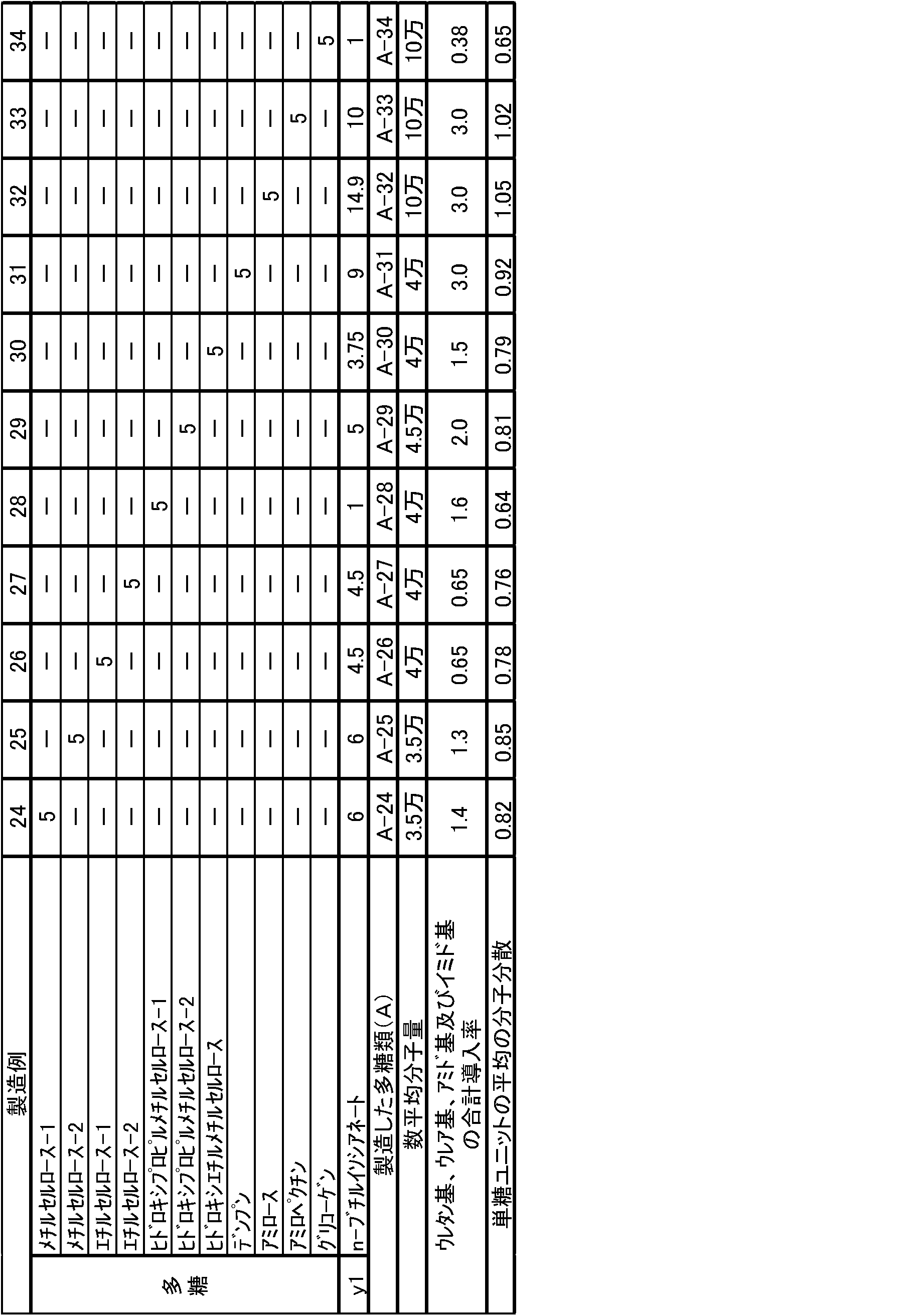
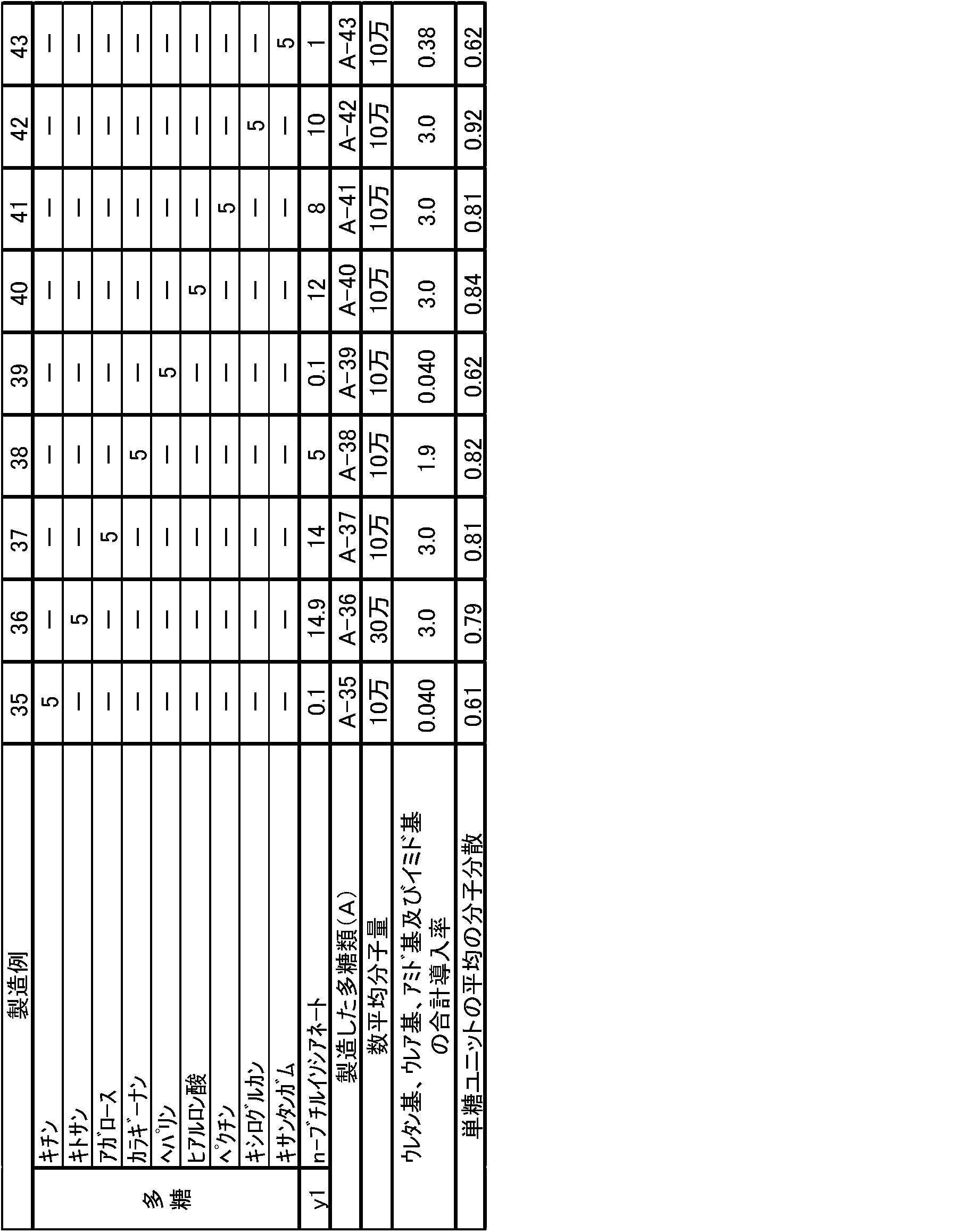
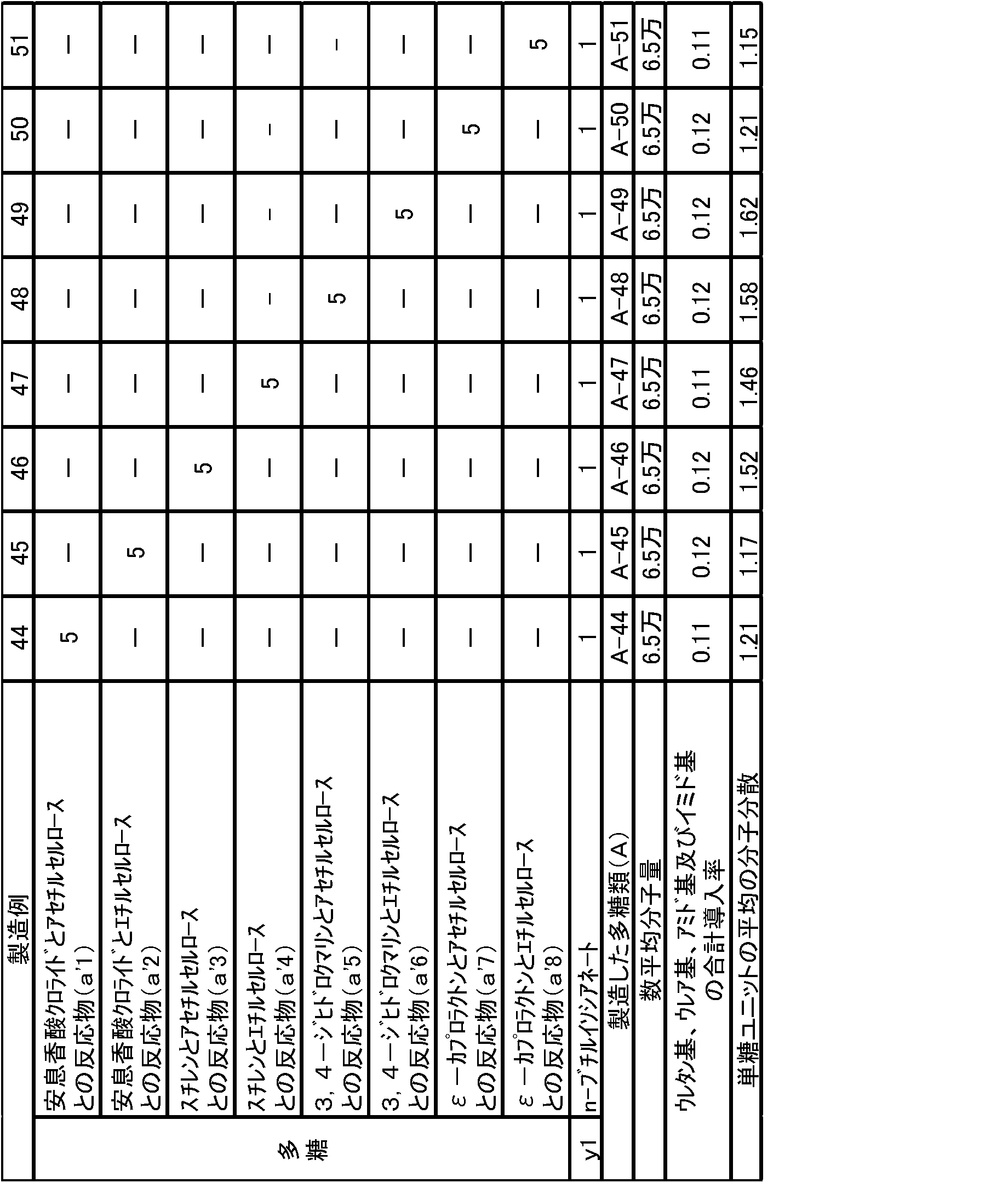
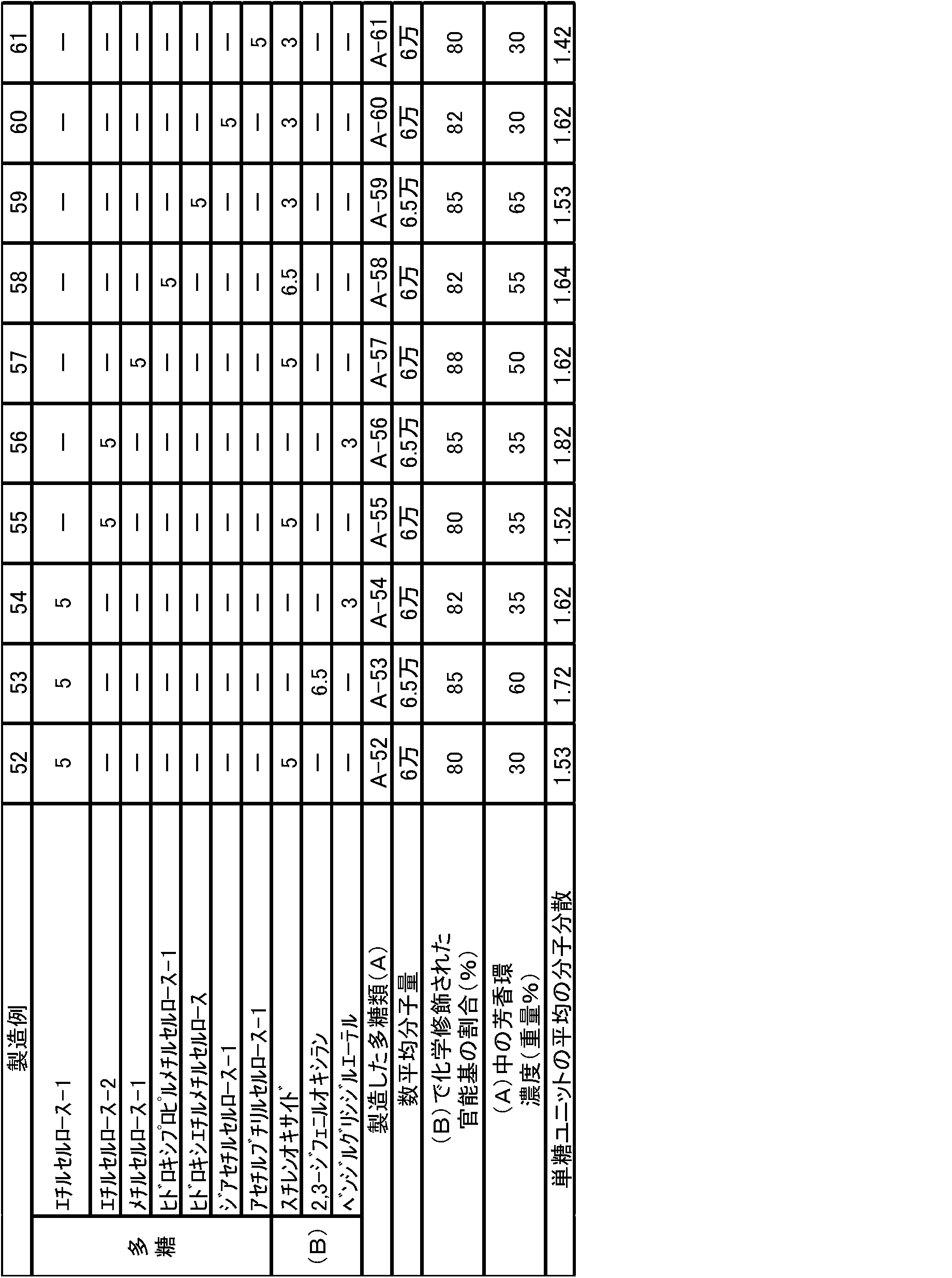
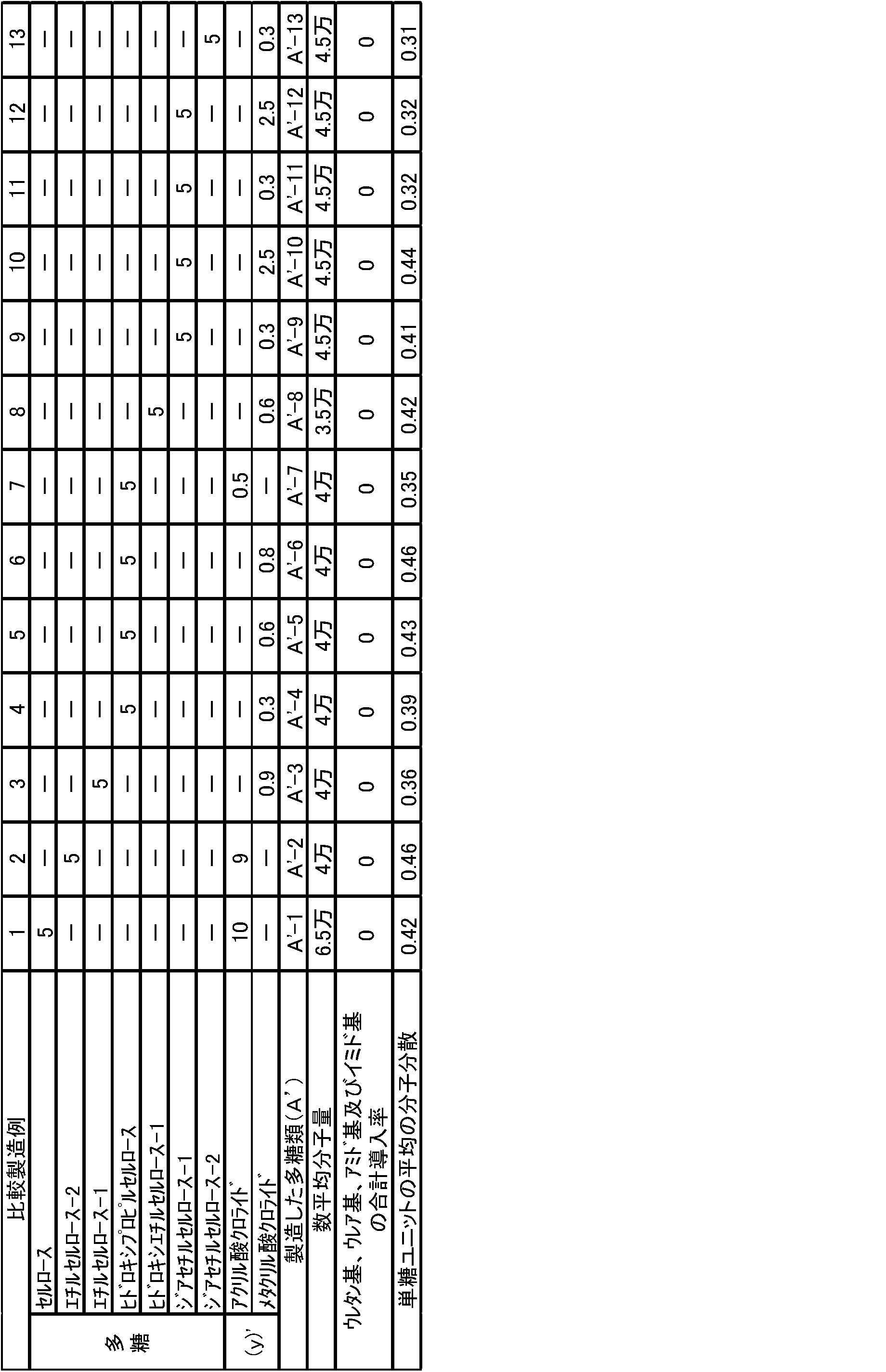

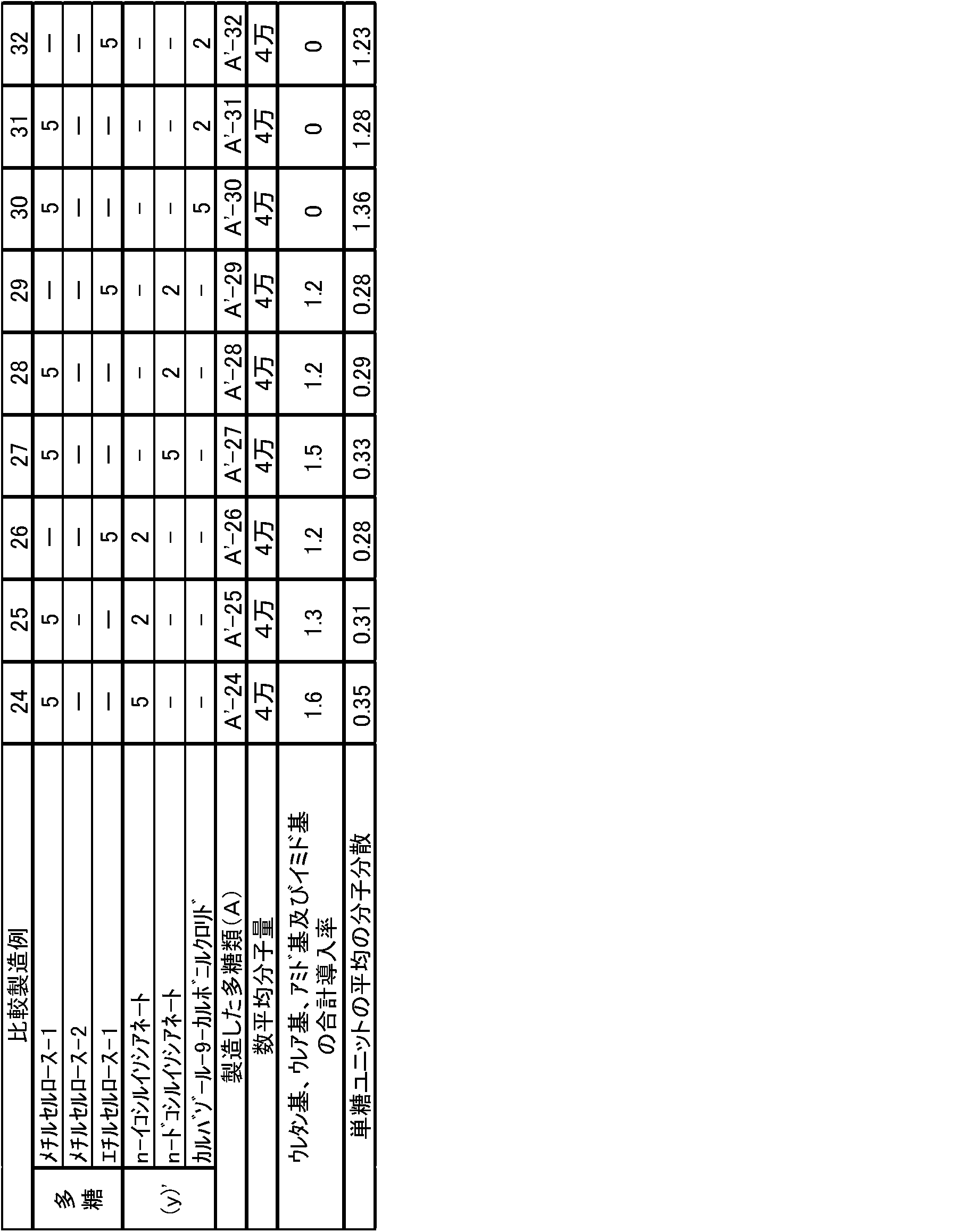
なお、表1~9の各成分は下記を用いた。
○多糖
セルロース:日本製紙ケミカル(株)製、「KCフロックW-50GK」
ジアセチルセルロース-1:(株)ダイセル製、「酢酸セルロースL-20」
ジアセチルセルロース-2:(株)ダイセル製、「酢酸セルロースL-50」
ジアセチルセルロース-3:イーストマンケミカル製、「CA-394」
アセチルブチリルセルロース-1:イーストマンケミカル製、「CAB551-0.2」
アセチルブチリルセルロース-2:イーストマンケミカル製、「CAB381-0.5」
アセチルプロピオニルセルロース-1:イーストマンケミカル製、「CAP482-0.5」
アセチルプロピオニルセルロース-2:イーストマンケミカル製、「CAP482-2.0」
カルボキシメチルセルロース:日本製紙ケミカル(株)製、「サンローズF1400MC」
カルボキシメチルエチルセルロース:三洋化成工業(株)製、「CMEC」
セルロースアセテートフタレート:和光純薬工業(株)製
ヒドロキシプロピルメチルセルロースフタレート:信越化学(株)製、「HPMCP HP-50」
ヒドロキシプロピルメチルセルロースヘキサヒドロフタレート:信越化学(株)製、「HPMCHHP」
ヒドロキシプロピルメチルセルロースアセテートフタレート:信越化学(株)製、「HPMCAP」
ヒドロキシプロピルメチルセルロースアセテートサクシネート:信越化学(株)製、「AQOAT AS-MG」
ヒドロキシエチルセルロース-1:(株)ダイセル製、「HEC-SP900」
ヒドロキシエチルセルロース-2:住友精化(株)製、「HEC AX-15」
ヒドロキシプロピルセルロース:日本曹達(株)製、「NISOO HPC」
低置換ヒドロキシプロピルセルロース:信越化学(株)製、「LH-31」
メチルセルロース-1:信越化学(株)製、「METOLOSE SM-8000」
メチルセルロース-2:松本油脂製薬(株)製、「マーポローズM-4000」
エチルセルロース-1:ダウケミカル(株)製、「エトセル」
エチルセルロース-2:関東化学(株)製、「エチルセルロース45CP」
ヒドロキシプロピルメチルセルロース-1:信越化学(株)製、「METOLOSE 90SH-4000」
ヒドロキシプロピルメチルセルロース-2:松本油脂製薬(株)製、「マーポローズ60MP-4000」
ヒドロキシエチルメチルセルロース:信越化学(株)製、「METOLOSE SNB60T」
デンプン:日本コーンスターチ(株)製、「コーンスターチホワイト」
アミロース:(株)林原製、「アミロースEX-I」
アミロペクチン:和光純薬(株)製
グリコーゲン:和光純薬(株)製、「グリコーゲン(カキ由来)」
キチン:和光純薬(株)製
キトサン:和光純薬(株)製、「キトサン1000」
アガロース:和光純薬(株)製、「アガロース1600」
カラギーナン:和光純薬(株)製、「アイリッシュモス(カラギーナン)」
ヘパリン:和光純薬(株)製、「ヘパリンナトリウム」
ヒアルロン酸:キューピー(株)製、「HA-F」
ペクチン:和光純薬(株)製
キシログルカン:大日本住友製薬(株)製、「グロリード6C」
キサンタンガム:和光純薬(株)製
○多糖
セルロース:日本製紙ケミカル(株)製、「KCフロックW-50GK」
ジアセチルセルロース-1:(株)ダイセル製、「酢酸セルロースL-20」
ジアセチルセルロース-2:(株)ダイセル製、「酢酸セルロースL-50」
ジアセチルセルロース-3:イーストマンケミカル製、「CA-394」
アセチルブチリルセルロース-1:イーストマンケミカル製、「CAB551-0.2」
アセチルブチリルセルロース-2:イーストマンケミカル製、「CAB381-0.5」
アセチルプロピオニルセルロース-1:イーストマンケミカル製、「CAP482-0.5」
アセチルプロピオニルセルロース-2:イーストマンケミカル製、「CAP482-2.0」
カルボキシメチルセルロース:日本製紙ケミカル(株)製、「サンローズF1400MC」
カルボキシメチルエチルセルロース:三洋化成工業(株)製、「CMEC」
セルロースアセテートフタレート:和光純薬工業(株)製
ヒドロキシプロピルメチルセルロースフタレート:信越化学(株)製、「HPMCP HP-50」
ヒドロキシプロピルメチルセルロースヘキサヒドロフタレート:信越化学(株)製、「HPMCHHP」
ヒドロキシプロピルメチルセルロースアセテートフタレート:信越化学(株)製、「HPMCAP」
ヒドロキシプロピルメチルセルロースアセテートサクシネート:信越化学(株)製、「AQOAT AS-MG」
ヒドロキシエチルセルロース-1:(株)ダイセル製、「HEC-SP900」
ヒドロキシエチルセルロース-2:住友精化(株)製、「HEC AX-15」
ヒドロキシプロピルセルロース:日本曹達(株)製、「NISOO HPC」
低置換ヒドロキシプロピルセルロース:信越化学(株)製、「LH-31」
メチルセルロース-1:信越化学(株)製、「METOLOSE SM-8000」
メチルセルロース-2:松本油脂製薬(株)製、「マーポローズM-4000」
エチルセルロース-1:ダウケミカル(株)製、「エトセル」
エチルセルロース-2:関東化学(株)製、「エチルセルロース45CP」
ヒドロキシプロピルメチルセルロース-1:信越化学(株)製、「METOLOSE 90SH-4000」
ヒドロキシプロピルメチルセルロース-2:松本油脂製薬(株)製、「マーポローズ60MP-4000」
ヒドロキシエチルメチルセルロース:信越化学(株)製、「METOLOSE SNB60T」
デンプン:日本コーンスターチ(株)製、「コーンスターチホワイト」
アミロース:(株)林原製、「アミロースEX-I」
アミロペクチン:和光純薬(株)製
グリコーゲン:和光純薬(株)製、「グリコーゲン(カキ由来)」
キチン:和光純薬(株)製
キトサン:和光純薬(株)製、「キトサン1000」
アガロース:和光純薬(株)製、「アガロース1600」
カラギーナン:和光純薬(株)製、「アイリッシュモス(カラギーナン)」
ヘパリン:和光純薬(株)製、「ヘパリンナトリウム」
ヒアルロン酸:キューピー(株)製、「HA-F」
ペクチン:和光純薬(株)製
キシログルカン:大日本住友製薬(株)製、「グロリード6C」
キサンタンガム:和光純薬(株)製
また、表1~5及び7~9中のウレタン基、ウレア基、アミド基及びイミド基の合計導入率は下記により求めた。
<ウレタン基、ウレア基、アミド基及びイミド基の合計導入率の算出方法>
ウレタン基、ウレア基、アミド基及びイミド基の合計導入率=P/T’ (1)
P:修飾多糖類(A)を構成する単糖ユニットの有するヒドロキシル基、カルボキシル基及びアミノ基が化学修飾されたウレタン基の水素原子のNMR積分値(P1)、ウレア基の水素原子のNMR積分値(P2)、アミド基の水素原子のNMR積分値(P3)及びイミド基の水素原子のNMR積分値(P4)を下記数式(2)に当てはめて得た合計積分値
P=P1+P2/2+P3+P4(2)
T’:修飾多糖類(A)を構成する単糖ユニットの4位の炭素原子に直接結合している水素原子のNMR積分値
<ウレタン基、ウレア基、アミド基及びイミド基の合計導入率の測定方法>
溶媒:重水素化ジメチルスルホキシド
装置:AVANCE300(日本ブルカー株式会社製)
周波数:300MHz
<ウレタン基、ウレア基、アミド基及びイミド基の合計導入率の算出方法>
ウレタン基、ウレア基、アミド基及びイミド基の合計導入率=P/T’ (1)
P:修飾多糖類(A)を構成する単糖ユニットの有するヒドロキシル基、カルボキシル基及びアミノ基が化学修飾されたウレタン基の水素原子のNMR積分値(P1)、ウレア基の水素原子のNMR積分値(P2)、アミド基の水素原子のNMR積分値(P3)及びイミド基の水素原子のNMR積分値(P4)を下記数式(2)に当てはめて得た合計積分値
P=P1+P2/2+P3+P4(2)
T’:修飾多糖類(A)を構成する単糖ユニットの4位の炭素原子に直接結合している水素原子のNMR積分値
<ウレタン基、ウレア基、アミド基及びイミド基の合計導入率の測定方法>
溶媒:重水素化ジメチルスルホキシド
装置:AVANCE300(日本ブルカー株式会社製)
周波数:300MHz
表6中、(A)中の(B)で化学修飾された官能基の割合は、下記測定法により求めた。
<(B)で化学修飾された官能基の割合の測定方法>
修飾前の多糖(a)及び修飾多糖類(A)の1H-NMRを測定する。それぞれの測定結果で得られた下記積分値を下記数式(3)に当てはめることにより、(B)で修飾された官能基の割合(%)を算出した。
(B)で修飾された官能基の割合(%)={(T-S)/T}×100 (3)
S=[(修飾多糖類(A)のヒドロキシル基の水素原子の積分値)+{(修飾多糖類(A)のアミノ基の水素原子の積分値)/2}]
T=[(多糖(a)のヒドロキシル基の水素原子の積分値)+{(多糖(a)のアミノ基の水素原子の積分値)/2}]
溶媒:重水素化ジメチルスルホキシド
装置:AVANCE300(日本ブルカー株式会社製)
周波数:300MHz
<(B)で化学修飾された官能基の割合の測定方法>
修飾前の多糖(a)及び修飾多糖類(A)の1H-NMRを測定する。それぞれの測定結果で得られた下記積分値を下記数式(3)に当てはめることにより、(B)で修飾された官能基の割合(%)を算出した。
(B)で修飾された官能基の割合(%)={(T-S)/T}×100 (3)
S=[(修飾多糖類(A)のヒドロキシル基の水素原子の積分値)+{(修飾多糖類(A)のアミノ基の水素原子の積分値)/2}]
T=[(多糖(a)のヒドロキシル基の水素原子の積分値)+{(多糖(a)のアミノ基の水素原子の積分値)/2}]
溶媒:重水素化ジメチルスルホキシド
装置:AVANCE300(日本ブルカー株式会社製)
周波数:300MHz
表6中、(A)の芳香環濃度は、下記測定法により求めた。
<芳香環濃度の測定>
修飾前の多糖(a)及び修飾多糖類(A)の1H-NMRを測定し、それぞれの測定結果で得られた下記積分値を下記数式(4)に当てはめることにより、修飾多糖類(A)の芳香環濃度(重量%)を算出した。
芳香環濃度(重量%)={U×W/(U×W+V)}×100 (4)
U=(芳香族化合物(B)の構造中の1つの水素原子の積分値)×(芳香族化合物(B)中の芳香環の数)×5/(修飾多糖類(A)を構成する単糖において、1位~5位の炭素に結合した水素原子の積分値の合計)
V=多糖(a)を構成する単糖の分子量
W=芳香族化合物(B)の分子量
溶媒:重水素化ジメチルスルホキシド
装置:AVANCE300(日本ブルカー株式会社製)
周波数:300MHz
<芳香環濃度の測定>
修飾前の多糖(a)及び修飾多糖類(A)の1H-NMRを測定し、それぞれの測定結果で得られた下記積分値を下記数式(4)に当てはめることにより、修飾多糖類(A)の芳香環濃度(重量%)を算出した。
芳香環濃度(重量%)={U×W/(U×W+V)}×100 (4)
U=(芳香族化合物(B)の構造中の1つの水素原子の積分値)×(芳香族化合物(B)中の芳香環の数)×5/(修飾多糖類(A)を構成する単糖において、1位~5位の炭素に結合した水素原子の積分値の合計)
V=多糖(a)を構成する単糖の分子量
W=芳香族化合物(B)の分子量
溶媒:重水素化ジメチルスルホキシド
装置:AVANCE300(日本ブルカー株式会社製)
周波数:300MHz
表1~9中、修飾多糖類(A)のMnは、下記条件にて測定した。
装置 :ゲルパーミエイションクロマトグラフィー
[「Alliance GPC V2000」、Waters(株)製]
溶媒 :N,N-ジメチルホルムアミド
基準物質 :ポリスチレン
サンプル濃度:3mg/ml
カラム固定相:PLgel MIXED-B
[ポリマーラボラトリーズ(株)製]
カラム温度 :40℃
装置 :ゲルパーミエイションクロマトグラフィー
[「Alliance GPC V2000」、Waters(株)製]
溶媒 :N,N-ジメチルホルムアミド
基準物質 :ポリスチレン
サンプル濃度:3mg/ml
カラム固定相:PLgel MIXED-B
[ポリマーラボラトリーズ(株)製]
カラム温度 :40℃
実施例1~61及び比較例1~32
製造例1~61で製造した(A-1)~(A-61)及び比較製造例1~32で製造した(A’-1)~(A’-32)をそれぞれ100部と、有機溶剤として1,3-ジオキソラン1000部とをそれぞれ一括で配合し、ディスパーサーで均一に混合撹拌し、実施例1~61及び比較例1~32の逆波長分散フィルム用樹脂組成物を作製した。
製造例1~61で製造した(A-1)~(A-61)及び比較製造例1~32で製造した(A’-1)~(A’-32)をそれぞれ100部と、有機溶剤として1,3-ジオキソラン1000部とをそれぞれ一括で配合し、ディスパーサーで均一に混合撹拌し、実施例1~61及び比較例1~32の逆波長分散フィルム用樹脂組成物を作製した。
[逆波長分散フィルムの作成]
実施例1~61及び比較例1~32で得た各逆波長分散フィルム用樹脂組成物を、表面処理を施した厚さ120μmのPET(ポリエチレンテレフタレート)フィルム[東洋紡(株)製「コスモシャイン」]に、アプリケーターを用いて膜厚80μmとなるように塗布して、80℃で2時間乾燥した。乾燥後、PETフィルムから剥離することで、逆波長分散フィルムを得た。
実施例1~61及び比較例1~32で得た各逆波長分散フィルム用樹脂組成物を、表面処理を施した厚さ120μmのPET(ポリエチレンテレフタレート)フィルム[東洋紡(株)製「コスモシャイン」]に、アプリケーターを用いて膜厚80μmとなるように塗布して、80℃で2時間乾燥した。乾燥後、PETフィルムから剥離することで、逆波長分散フィルムを得た。
[フィルムの性能評価]
作成したフィルムを用いて、下記(1)および(2)の評価を行った。結果を表10及び11に示す。
(1)透過率及びヘイズ(透明性)
JIS-K7136に準拠し、全光線透過率測定装置[商品名「haze-garddual」BYK gardner製]を用いて透過率及びヘイズを測定した。透過率及びヘイズは、いずれも単位は%である。
作成したフィルムを用いて、下記(1)および(2)の評価を行った。結果を表10及び11に示す。
(1)透過率及びヘイズ(透明性)
JIS-K7136に準拠し、全光線透過率測定装置[商品名「haze-garddual」BYK gardner製]を用いて透過率及びヘイズを測定した。透過率及びヘイズは、いずれも単位は%である。
(2)正の複屈折性及び逆波長分散性
大塚電子(株)製「RETS-100」にて波長450nm、590nm及び630nmの光に対する面内リタデーション(Re)を測定した。
正の複屈折性としては、波長590nmでのリタデーション値をフィルム膜厚で割った値を示す。なお、この値が大きいほど、正の複屈折性が高いことを示す。
逆波長分散性としては、Re(450)/Re(590)及びRe(630)/Re(590)の値を示す。なお、Re(450)、Re(590)及びRe(630)はそれぞれ波長450nm、550nm及び630nmでの面内リタデーションを指す。Re(450)/Re(590)=0.88±0.03かつRe(630)/Re(590)=1.06±0.03であるものが、逆波長分散性が特に良好であるものであり、Re(450)/Re(590)の値とRe(630)/Re(590)の値との差が大きいものが、逆波長分散性がさらに特に良好であるものである。
大塚電子(株)製「RETS-100」にて波長450nm、590nm及び630nmの光に対する面内リタデーション(Re)を測定した。
正の複屈折性としては、波長590nmでのリタデーション値をフィルム膜厚で割った値を示す。なお、この値が大きいほど、正の複屈折性が高いことを示す。
逆波長分散性としては、Re(450)/Re(590)及びRe(630)/Re(590)の値を示す。なお、Re(450)、Re(590)及びRe(630)はそれぞれ波長450nm、550nm及び630nmでの面内リタデーションを指す。Re(450)/Re(590)=0.88±0.03かつRe(630)/Re(590)=1.06±0.03であるものが、逆波長分散性が特に良好であるものであり、Re(450)/Re(590)の値とRe(630)/Re(590)の値との差が大きいものが、逆波長分散性がさらに特に良好であるものである。
下記製造方法により反射色度b*測定用フィルムを製造し、JIS-Z8729に準拠して反射色度b*を測定した。
<反射色度b*測定用フィルムの製造方法>
逆波長分散フィルム用樹脂組成物を、表面処理を施した厚さ120μmのPET(ポリエチレンテレフタレート)フィルム[東洋紡(株)製「コスモシャイン」]に、アプリケーターを用いて膜厚80μmとなるように塗布した。塗布物を、80℃で2時間乾燥した。乾燥後、PETフィルムから剥離して反射色度b*測定用フィルムとした。
<反射色度b*測定用フィルムの製造方法>
逆波長分散フィルム用樹脂組成物を、表面処理を施した厚さ120μmのPET(ポリエチレンテレフタレート)フィルム[東洋紡(株)製「コスモシャイン」]に、アプリケーターを用いて膜厚80μmとなるように塗布した。塗布物を、80℃で2時間乾燥した。乾燥後、PETフィルムから剥離して反射色度b*測定用フィルムとした。
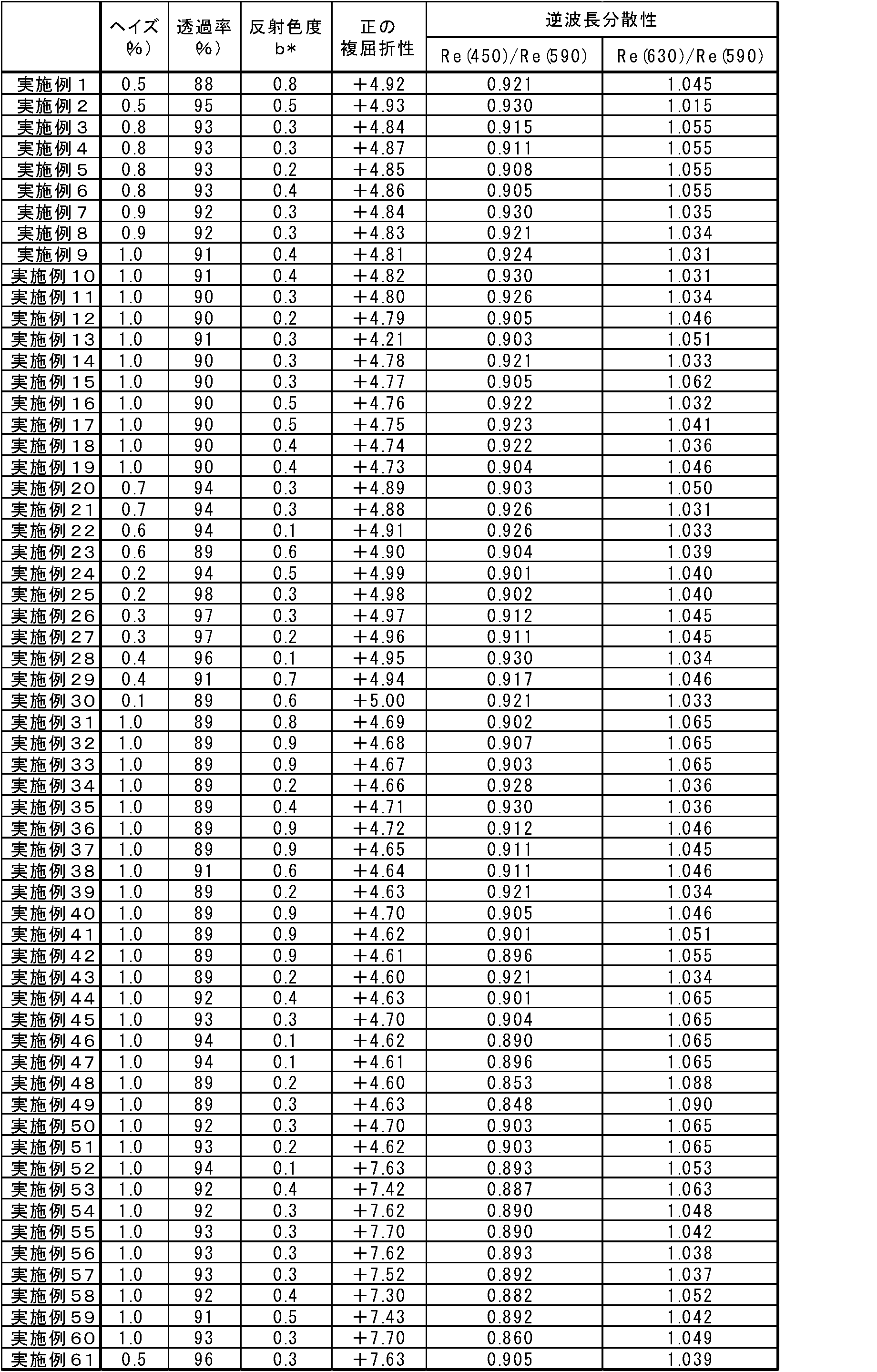
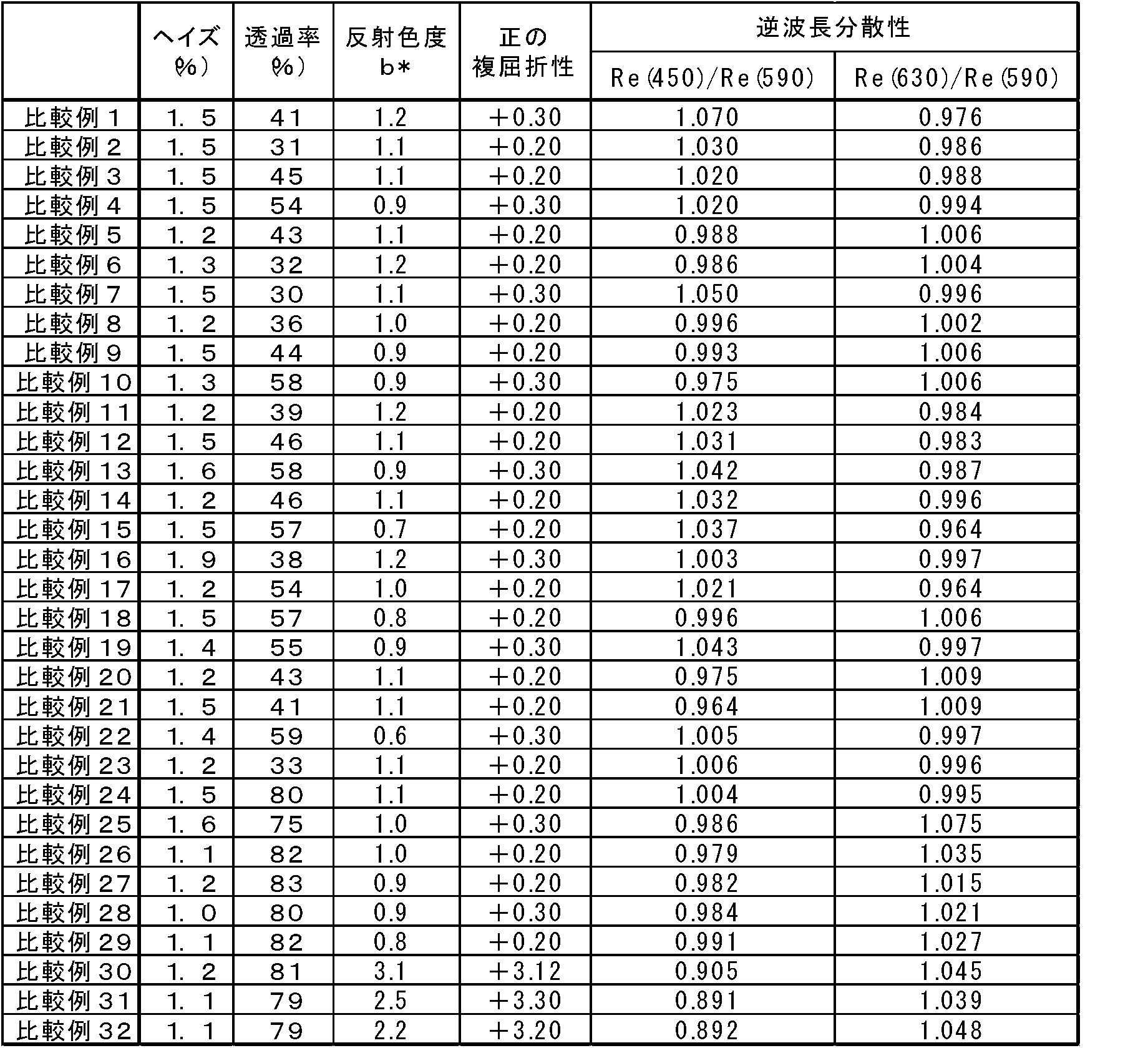
表10、11の結果から、本発明の実施例1~61の逆波長分散フィルム用樹脂組成物は、耐けん化処理性、透明性、正の複屈折性及び逆波長分散性を同時に兼ね備えていることが分かる。このことから、フィルム用及びシート用の組成物として優れていることが分かる。
本発明の逆波長分散フィルム用樹脂組成物は、耐けん化処理性、透明性、正の複屈折性及び逆波長分散性に優れているため、特に逆波長分散フィルム又はシート、位相差フィルム又はシート及び円偏光フィルム又は円偏光シートとして有用である。
Claims (12)
- 多糖が有するヒドロキシル基、カルボキシル基及びアミノ基からなる群より選ばれる少なくとも1個の官能基が、エーテル基、ウレタン基、ウレア基、アミド基及びイミド基からなる群より選ばれる少なくとも1種の官能基に化学修飾されてなる修飾多糖類(A)を含有する逆波長分散フィルム用樹脂組成物であって、修飾多糖類(A)を構成する全ての単糖ユニットの平均の分子分散が0.50~20.0であり、逆波長分散フィルム用樹脂組成物を80μmの膜厚に成形したフィルムのJIS-Z8729に準拠して求められる反射色度b*の絶対値が0~1.0である逆波長分散フィルム用樹脂組成物。
- 修飾多糖類(A)が、下記多糖(a)が化学修飾された多糖類であって、この修飾多糖類(A)を構成する単糖ユニットの少なくとも1つが下記一般式(1)~(6)からなる群より選ばれる少なくとも1つの構造である請求項1に記載の逆波長分散フィルム用樹脂組成物。
多糖(a):デンプン、グリコーゲン、セルロース、キチン、キトサン、アガロース、カラギーナン、ヘパリン、ヒアルロン酸、ペクチン、キシログルカン及びキサンタンガム並びにこれらの有する官能基をウレタン基、ウレア基、アミド基及びイミド基以外に置換した多糖からなる群より選ばれる少なくとも1種の多糖。



- 一般式(7)中のR1がメチル基、エチル基、n-プロピル基、n-ブチル基、sec-ブチル基、t-ブチル基、n-ヘキシル基、シクロヘキシル基、2-エチルヘキシル基、n-オクチル基、n-ドデシル基及びn-ステアリル基からなる群より選ばれる少なくとも1種の置換基である請求項2に記載の逆波長分散フィルム用樹脂組成物。
- 修飾多糖類(A)が、下記多糖(a)が化学修飾された多糖類であって、(a)中の少なくとも1つのヒドロキシル基がエポキシ基を有する下記芳香族化合物(B)で化学修飾されてなる修飾多糖類である請求項1に記載の逆波長分散フィルム用樹脂組成物。
多糖(a):デンプン、グリコーゲン、セルロース、キチン、キトサン、アガロース、カラギーナン、ヘパリン、ヒアルロン酸、ペクチン、キシログルカン及びキサンタンガム並びにこれらの有する官能基をウレタン基、ウレア基、アミド基及びイミド基以外に置換した多糖からなる群より選ばれる少なくとも1種の多糖。
芳香族化合物(B):芳香環中の1つの水素原子が、エポキシ基で置換された芳香族化合物(b1)、アルキルの炭素数が3~8のエポキシアルキル基で置換された芳香族化合物(b2)及びアルキルの炭素数が3~8のエポキシアルキル基において、アルキルの少なくとも1つの炭素原子が酸素原子に置き換わった官能基で置換された芳香族化合物(b3)からなる群より選ばれる少なくとも1種の化合物。 - 多糖(a)が、セルロース、アシル化セルロース(a1)、エーテル化セルロース(a2)及びエーテル化アシル化セルロース(a3)からなる群より選ばれる少なくとも1種である請求項2~4のいずれかに記載の逆波長分散フィルム用樹脂組成物。
- エステル化セルロース(C)を含有する請求項1~5のいずれかに記載の逆波長分散フィルム用樹脂組成物。
- エステル化セルロース(C)が、アルキルエステル化セルロースであって、アルキルの炭素数が1~18である請求項6に記載の逆波長分散フィルム用樹脂組成物。
- エステル化セルロース(C)が、アセテート基、プロピオネート基及びブチレート基からなる群より選ばれる少なくとも1種のエステル基を有するエステル化セルロースである請求項6又は7に記載の逆波長分散フィルム用樹脂組成物。
- 逆波長分散フィルム用樹脂組成物の重量を基準として、修飾多糖類(A)の含有量が1~99.9重量%、エステル化セルロース(C)の含有量が0.1~99重量%である請求項6~8のいずれかに記載の逆波長分散フィルム用樹脂組成物。
- 請求項1~9のいずれかに記載の逆波長分散フィルム用樹脂組成物から形成される逆波長分散フィルム又は逆波長分散シート。
- 請求項1~9のいずれかに記載の逆波長分散フィルム用樹脂組成物から形成される位相差フィルム又は位相差シート。
- 請求項1~9のいずれかに記載の逆波長分散フィルム用樹脂組成物から形成される円偏光フィルム又は円偏光シート。
Priority Applications (2)
| Application Number | Priority Date | Filing Date | Title |
|---|---|---|---|
| CN201380038428.9A CN104471450B (zh) | 2012-07-26 | 2013-07-01 | 逆波长分散膜用树脂组合物以及由其形成的逆波长分散膜和逆波长分散片 |
| KR1020157000920A KR101650751B1 (ko) | 2012-07-26 | 2013-07-01 | 역파장 분산 필름용 수지 조성물 및 이것을 포함하는 역파장 분산 필름 및 역파장 분산 시트 |
Applications Claiming Priority (4)
| Application Number | Priority Date | Filing Date | Title |
|---|---|---|---|
| JP2012-165648 | 2012-07-26 | ||
| JP2012165648 | 2012-07-26 | ||
| JP2013063584A JP6291715B2 (ja) | 2013-03-26 | 2013-03-26 | 逆波長分散フィルム用樹脂組成物及びこれからなる逆波長分散フィルム |
| JP2013-063584 | 2013-03-26 |
Publications (1)
| Publication Number | Publication Date |
|---|---|
| WO2014017257A1 true WO2014017257A1 (ja) | 2014-01-30 |
Family
ID=49997073
Family Applications (1)
| Application Number | Title | Priority Date | Filing Date |
|---|---|---|---|
| PCT/JP2013/068011 Ceased WO2014017257A1 (ja) | 2012-07-26 | 2013-07-01 | 逆波長分散フィルム用樹脂組成物並びにこれからなる逆波長分散フィルム及び逆波長分散シート |
Country Status (4)
| Country | Link |
|---|---|
| KR (1) | KR101650751B1 (ja) |
| CN (1) | CN104471450B (ja) |
| TW (1) | TWI576380B (ja) |
| WO (1) | WO2014017257A1 (ja) |
Cited By (1)
| Publication number | Priority date | Publication date | Assignee | Title |
|---|---|---|---|---|
| JPWO2016060144A1 (ja) * | 2014-10-17 | 2017-07-27 | コニカミノルタ株式会社 | 高分子組成物、光学フィルム、円偏光板及び表示装置 |
Families Citing this family (5)
| Publication number | Priority date | Publication date | Assignee | Title |
|---|---|---|---|---|
| US9605086B2 (en) * | 2015-03-26 | 2017-03-28 | Fuji Xerox Co., Ltd. | Resin composition and resin molded article |
| CN110028591A (zh) * | 2019-04-02 | 2019-07-19 | 贵州大学 | 一种3-(2-羟苯基)丙酸纤维素酯的制备方法 |
| JP2021143239A (ja) * | 2020-03-11 | 2021-09-24 | 大王製紙株式会社 | 繊維状セルロース、繊維状セルロース複合樹脂及び繊維状セルロースの製造方法 |
| CN112323492B (zh) * | 2020-10-30 | 2022-12-30 | 苏州棠华纳米科技有限公司 | 一种纺织品的后整理方法 |
| CN112358554B (zh) * | 2020-10-30 | 2022-09-09 | 苏州棠华纳米科技有限公司 | 一种拒水拒油整理用交联剂及其制备方法和应用 |
Citations (3)
| Publication number | Priority date | Publication date | Assignee | Title |
|---|---|---|---|---|
| WO2002093213A1 (en) * | 2001-05-10 | 2002-11-21 | Nippon Kayaku Kabushiki Kaisha | Liquid crystalline compound and phase difference film using the same |
| JP2009139526A (ja) * | 2007-12-05 | 2009-06-25 | Nitto Denko Corp | 偏光板、及び液晶表示装置 |
| JP2010195858A (ja) * | 2009-02-23 | 2010-09-09 | Fujifilm Corp | セルロースアシレートフィルム、偏光板及び液晶表示装置 |
Family Cites Families (3)
| Publication number | Priority date | Publication date | Assignee | Title |
|---|---|---|---|---|
| JP5252611B2 (ja) * | 2006-09-15 | 2013-07-31 | 日東電工株式会社 | 位相差フィルム、光学積層体、液晶パネル、及び液晶表示装置 |
| JP5606110B2 (ja) * | 2009-09-30 | 2014-10-15 | 富士フイルム株式会社 | セルロースアシレートフィルム、位相差フィルム、偏光板および液晶表示装置 |
| JP5699519B2 (ja) | 2010-10-16 | 2015-04-15 | コニカミノルタ株式会社 | 位相差フィルム、位相差フィルムの製造方法、偏光板及び液晶表示装置 |
-
2013
- 2013-07-01 CN CN201380038428.9A patent/CN104471450B/zh active Active
- 2013-07-01 KR KR1020157000920A patent/KR101650751B1/ko active Active
- 2013-07-01 WO PCT/JP2013/068011 patent/WO2014017257A1/ja not_active Ceased
- 2013-07-04 TW TW102123912A patent/TWI576380B/zh active
Patent Citations (3)
| Publication number | Priority date | Publication date | Assignee | Title |
|---|---|---|---|---|
| WO2002093213A1 (en) * | 2001-05-10 | 2002-11-21 | Nippon Kayaku Kabushiki Kaisha | Liquid crystalline compound and phase difference film using the same |
| JP2009139526A (ja) * | 2007-12-05 | 2009-06-25 | Nitto Denko Corp | 偏光板、及び液晶表示装置 |
| JP2010195858A (ja) * | 2009-02-23 | 2010-09-09 | Fujifilm Corp | セルロースアシレートフィルム、偏光板及び液晶表示装置 |
Cited By (1)
| Publication number | Priority date | Publication date | Assignee | Title |
|---|---|---|---|---|
| JPWO2016060144A1 (ja) * | 2014-10-17 | 2017-07-27 | コニカミノルタ株式会社 | 高分子組成物、光学フィルム、円偏光板及び表示装置 |
Also Published As
| Publication number | Publication date |
|---|---|
| TWI576380B (zh) | 2017-04-01 |
| KR20150023751A (ko) | 2015-03-05 |
| KR101650751B1 (ko) | 2016-08-25 |
| CN104471450B (zh) | 2017-03-01 |
| TW201406843A (zh) | 2014-02-16 |
| CN104471450A (zh) | 2015-03-25 |
Similar Documents
| Publication | Publication Date | Title |
|---|---|---|
| CN104471450B (zh) | 逆波长分散膜用树脂组合物以及由其形成的逆波长分散膜和逆波长分散片 | |
| US11434350B2 (en) | Cellulose resin composition, molded body and product using same, and a method for producing cellulose resin composition | |
| Wang et al. | Superior performance of polyurethane based on natural melanin nanoparticles | |
| US7838592B2 (en) | Starch-based coating composition | |
| EP3660097B1 (en) | Polylactic acid composite material and application thereof | |
| BRPI0904856A2 (pt) | soluções de poliuretanureia | |
| CN108137712B (zh) | 聚合物材料、膜、圆偏光片、图像显示装置以及膜的制造方法 | |
| US8642694B2 (en) | Bio-based coating composition and its coated article | |
| US20180291117A1 (en) | Cellulose derivative and use thereof | |
| WO2016067662A1 (ja) | セルロース誘導体及び成形用樹脂組成物 | |
| CN107683308A (zh) | 聚酰亚胺系清漆、使用其的聚酰亚胺系膜的制造方法、及聚酰亚胺系膜 | |
| JP5254699B2 (ja) | 位相差フィルムおよびこの位相差フィルムを用いた偏光板 | |
| US9671544B2 (en) | Retardation film, and optical compensation layer, optical compensation polarizing plate, liquid crystal display device and organic EL display device each using said retardation film | |
| US20200025989A1 (en) | Retardation film | |
| JP6205990B2 (ja) | 逆波長分散フィルム用樹脂組成物及びこれからなる逆波長分散フィルム | |
| JP2014041347A (ja) | 逆波長分散フィルム用樹脂組成物並びにこれからなる逆波長分散フィルム及び逆波長分散シート | |
| JP6939782B2 (ja) | セルロース系樹脂組成物、成形体及びこれを用いた製品 | |
| Zhang et al. | Thermal, crystalline, and mechanical properties of octa (3‐chloropropylsilsesquioxane)/poly (L‐lactic acid) hybrid films | |
| US20150203596A1 (en) | Method for preparing acetylated cellulose ethers having improved anti-fouling properties, and acetylated cellulose ethers prepared by same | |
| JP6257977B2 (ja) | 偏光板用樹脂組成物及びこれからなる偏光板 | |
| CN114058044B (zh) | 聚酰亚胺基膜及包括其的柔性显示面板 | |
| CN101205315A (zh) | 一种全生物降解淀粉基材料及其制备方法 | |
| JPWO2017217502A1 (ja) | セルロース誘導体、セルロース系樹脂組成物、成形体及びこれを用いた製品 | |
| JP5161000B2 (ja) | 位相差フィルムおよびこの位相差フィルムを用いた偏光板 | |
| JP4840475B2 (ja) | セルロースエステルフィルム及びその製造方法、並びに偏光板用保護フィルム |
Legal Events
| Date | Code | Title | Description |
|---|---|---|---|
| 121 | Ep: the epo has been informed by wipo that ep was designated in this application |
Ref document number: 13822437 Country of ref document: EP Kind code of ref document: A1 |
|
| ENP | Entry into the national phase |
Ref document number: 20157000920 Country of ref document: KR Kind code of ref document: A |
|
| NENP | Non-entry into the national phase |
Ref country code: DE |
|
| 122 | Ep: pct application non-entry in european phase |
Ref document number: 13822437 Country of ref document: EP Kind code of ref document: A1 |