WO2014010512A1 - 酸性ガス分離用複合体及びその製造方法並びに酸性ガス分離モジュール - Google Patents
酸性ガス分離用複合体及びその製造方法並びに酸性ガス分離モジュール Download PDFInfo
- Publication number
- WO2014010512A1 WO2014010512A1 PCT/JP2013/068421 JP2013068421W WO2014010512A1 WO 2014010512 A1 WO2014010512 A1 WO 2014010512A1 JP 2013068421 W JP2013068421 W JP 2013068421W WO 2014010512 A1 WO2014010512 A1 WO 2014010512A1
- Authority
- WO
- WIPO (PCT)
- Prior art keywords
- gas separation
- acidic gas
- compound
- alkyl group
- mass
- Prior art date
- Legal status (The legal status is an assumption and is not a legal conclusion. Google has not performed a legal analysis and makes no representation as to the accuracy of the status listed.)
- Ceased
Links
Images


Classifications
-
- B—PERFORMING OPERATIONS; TRANSPORTING
- B01—PHYSICAL OR CHEMICAL PROCESSES OR APPARATUS IN GENERAL
- B01D—SEPARATION
- B01D53/00—Separation of gases or vapours; Recovering vapours of volatile solvents from gases; Chemical or biological purification of waste gases, e.g. engine exhaust gases, smoke, fumes, flue gases, aerosols
- B01D53/22—Separation of gases or vapours; Recovering vapours of volatile solvents from gases; Chemical or biological purification of waste gases, e.g. engine exhaust gases, smoke, fumes, flue gases, aerosols by diffusion
- B01D53/228—Separation of gases or vapours; Recovering vapours of volatile solvents from gases; Chemical or biological purification of waste gases, e.g. engine exhaust gases, smoke, fumes, flue gases, aerosols by diffusion characterised by specific membranes
-
- B—PERFORMING OPERATIONS; TRANSPORTING
- B01—PHYSICAL OR CHEMICAL PROCESSES OR APPARATUS IN GENERAL
- B01D—SEPARATION
- B01D71/00—Semi-permeable membranes for separation processes or apparatus characterised by the material; Manufacturing processes specially adapted therefor
- B01D71/06—Organic material
- B01D71/38—Polyalkenylalcohols; Polyalkenylesters; Polyalkenylethers; Polyalkenylaldehydes; Polyalkenylketones; Polyalkenylacetals; Polyalkenylketals
- B01D71/381—Polyvinylalcohol
-
- B—PERFORMING OPERATIONS; TRANSPORTING
- B01—PHYSICAL OR CHEMICAL PROCESSES OR APPARATUS IN GENERAL
- B01D—SEPARATION
- B01D71/00—Semi-permeable membranes for separation processes or apparatus characterised by the material; Manufacturing processes specially adapted therefor
- B01D71/06—Organic material
- B01D71/40—Polymers of unsaturated acids or derivatives thereof, e.g. salts, amides, imides, nitriles, anhydrides, esters
- B01D71/401—Polymers based on the polymerisation of acrylic acid, e.g. polyacrylate
- B01D71/4011—Polymethylmethacrylate
-
- B—PERFORMING OPERATIONS; TRANSPORTING
- B01—PHYSICAL OR CHEMICAL PROCESSES OR APPARATUS IN GENERAL
- B01D—SEPARATION
- B01D71/00—Semi-permeable membranes for separation processes or apparatus characterised by the material; Manufacturing processes specially adapted therefor
- B01D71/06—Organic material
- B01D71/76—Macromolecular material not specifically provided for in a single one of groups B01D71/08 - B01D71/74
- B01D71/80—Block polymers
-
- B—PERFORMING OPERATIONS; TRANSPORTING
- B01—PHYSICAL OR CHEMICAL PROCESSES OR APPARATUS IN GENERAL
- B01D—SEPARATION
- B01D2257/00—Components to be removed
- B01D2257/50—Carbon oxides
- B01D2257/504—Carbon dioxide
-
- B—PERFORMING OPERATIONS; TRANSPORTING
- B01—PHYSICAL OR CHEMICAL PROCESSES OR APPARATUS IN GENERAL
- B01D—SEPARATION
- B01D2323/00—Details relating to membrane preparation
- B01D2323/42—Details of membrane preparation apparatus
-
- Y—GENERAL TAGGING OF NEW TECHNOLOGICAL DEVELOPMENTS; GENERAL TAGGING OF CROSS-SECTIONAL TECHNOLOGIES SPANNING OVER SEVERAL SECTIONS OF THE IPC; TECHNICAL SUBJECTS COVERED BY FORMER USPC CROSS-REFERENCE ART COLLECTIONS [XRACs] AND DIGESTS
- Y02—TECHNOLOGIES OR APPLICATIONS FOR MITIGATION OR ADAPTATION AGAINST CLIMATE CHANGE
- Y02C—CAPTURE, STORAGE, SEQUESTRATION OR DISPOSAL OF GREENHOUSE GASES [GHG]
- Y02C20/00—Capture or disposal of greenhouse gases
- Y02C20/40—Capture or disposal of greenhouse gases of CO2
Definitions
- the present invention relates to a complex for acidic gas separation, a method for producing the same, and an acidic gas separation module.
- Gas separation membranes that selectively separate gases such as carbon dioxide are broadly classified into facilitated transport membranes and dissolved diffusion membranes.
- separation is performed by utilizing the difference between the solubility of the separation gas and the substance to be separated in the membrane and the diffusivity in the membrane.
- the degree of separation by the membrane is uniquely determined when the material and physical properties of the membrane are determined.
- the facilitated transport membrane contains a carrier in the membrane and transports the separation gas to the opposite side of the membrane by this carrier. In this case, since the carrier is contained in the film, the solubility of carbon dioxide and the like is remarkably increased, and transport can be performed satisfactorily.
- a CO 2 facilitated transport film having a CO 2 / H 2 selective performance by supporting a gel layer containing cesium carbonate or the like in a moisture-containing gel on a hydrophilic porous film. It is disclosed that it can be applied to a CO 2 permeable membrane reactor (see, for example, Japanese Patent No. 4621295).
- the present invention has been made in view of the above, and a method for producing a complex for acidic gas separation that is stably produced while suppressing the occurrence of blocking of the acidic gas separation layer while maintaining high acid gas separation ability,
- An object of the present invention is to provide a complex for acidic gas separation and an acidic gas separation module that have high acid gas separation performance and excellent productivity, and to achieve the object.
- ⁇ 1> (1) a compound selected from the group consisting of an alkyl group having 3 to 20 carbon atoms or a fluorinated alkyl group having 3 to 20 carbon atoms and a hydrophilic group; and (2) a compound having a siloxane structure; (3) At least one selected from polymer particles having an average particle diameter of 0.01 ⁇ m to 1000 ⁇ m and a specific gravity of 0.5 g / cm 3 to 1.3 g / cm 3 , a water absorbing polymer, and an alkali metal salt.
- a coating solution preparing step of preparing a coating solution for forming an acidic gas separation layer containing a carbon dioxide carrier a coating step of coating the coating solution for forming an acidic gas separation layer on a long porous support
- To acid gas Delamination is a manufacturing method for acid gas separation composite to produce acid gases separation complex with.
- ⁇ 2> The total content of the compound having a C 3-20 alkyl group or a C 3-20 fluorinated alkyl group and a hydrophilic group, and the compound having a siloxane structure in the acidic gas separation layer.
- the content of the compound having a C 3-20 alkyl group or a C 3-20 fluorinated alkyl group and a hydrophilic group in the acidic gas separation layer is such that the total content of the acidic gas separation layer
- the content of the compound having a siloxane structure in the acidic gas separation layer is 0.01% by mass to 10% by mass with respect to the total solid content of the acidic gas separation layer. It is a manufacturing method of the complex for acidic gas separation as described in any one of ⁇ 3>.
- ⁇ 5> The composite for acidic gas separation according to any one of ⁇ 1> to ⁇ 4>, wherein the area occupied by the polymer particles on the surface of the acidic gas separation layer is 0.1% to 60% It is a manufacturing method of a body.
- ⁇ 6> The compound having an alkyl group having 3 to 20 carbon atoms or a fluorinated alkyl group having 3 to 20 carbon atoms and a hydrophilic group has a molecular weight of 60 to 2,000. It is a manufacturing method of the complex for acidic gas separation as described in any one.
- At least one selected from polymer particles having a specific gravity of 0.5 g / cm 3 to 1.3 g / cm 3 having a specific gravity of 0.5 to 1.3 g / cm 3 is a compound having an alkyl group having 3 to 20 carbon atoms and a hydrophilic group ⁇ 1> to ⁇ 3> and the method for producing a complex for acidic gas separation according to any one of ⁇ 6>.
- At least one selected from polymer particles having a specific gravity of 0.5 g / cm 3 to 1.3 g / cm 3 having a specific gravity of 0.5 to 1.3 g / cm 3 is a compound having a fluorinated alkyl group having 3 to 20 carbon atoms and a hydrophilic group.
- the method for producing a complex for acidic gas separation according to any one of the above.
- a polymer particle of 1.3 g / cm 3 ⁇ 1> or the item ⁇ 5> is a method for producing the acid gas separation composite according to.
- ⁇ 12> comprising two kinds of the alkali metal salts, wherein one of the two kinds is selected from the group consisting of a rubidium salt and a cesium salt, and the other alkali metal salt is selected from a potassium salt.
- complex for acidic gas separation which suppresses generation
- a complex for acidic gas separation and an acidic gas separation module having high acid gas separation ability and excellent productivity.
- the present invention is suitable for continuous film formation on a long porous support to roll it, and in this case, the effect of inhibiting blocking of the acidic gas separation layer is further exhibited.
- FIG. 1 It is a block diagram which shows the example of the manufacturing apparatus of the complex for acidic gas separation which concerns on embodiment of this invention. It is a schematic block diagram which shows an example of the acidic gas separation module which concerns on embodiment of this invention. It is a perspective view showing the cross section of the acidic gas separation module of FIG.
- the method for producing a complex for acidic gas separation of the present invention comprises (1) a compound having an alkyl group having 3 to 20 carbon atoms or a fluorinated alkyl group having 3 to 20 carbon atoms and a hydrophilic group, and (2) a siloxane structure And (3) at least one selected from polymer particles having an average particle diameter of 0.01 ⁇ m to 1000 ⁇ m and a specific gravity of 0.5 g / cm 3 to 1.3 g / cm 3 ;
- a film containing a carrier such as an alkali metal salt such as cesium carbonate and transmitting carbon dioxide by this carrier is known.
- a carrier such as an alkali metal salt such as cesium carbonate and transmitting carbon dioxide by this carrier
- such membranes often have high deliquescence, and condensation tends to occur on the membrane surface.
- a continuous film is formed by the roll-to-roll process, blocking occurs, and the film peels off.
- a surfactant or a polymer component generally used as a lubricant a certain degree of blocking deterrent effect can be expected, but simply including a surfactant or polymer, The material permeability of the membrane is deteriorated, and the gas separation function inherent to the membrane is impaired.
- the acidic gas separation layer contains specific compounds or polymer particles, and these compounds and particles are unevenly distributed on the surface of the membrane, so that the carbon dioxide gas separation function is maintained well and blocking is suppressed. An effect is given. Since peeling of the film is prevented by blocking inhibition, the production stability in the case of continuous film formation is improved, and as a result, the productivity can be dramatically improved.
- the “acid gas” in the present invention includes a gas containing carbon dioxide, hydrogen sulfide and the like.
- a coating liquid for forming an acidic gas separation layer is prepared.
- the coating solution for forming an acidic gas separation layer in the present invention comprises (A) a compound having an alkyl group having 3 to 20 carbon atoms or a fluorinated alkyl group having 3 to 20 carbon atoms and a hydrophilic group that is a hydrophilic portion as a hydrophobic portion.
- a compound selected from the group consisting of compounds having a siloxane structure (hereinafter also referred to as “specific compound”) and / or an average particle size of 0.01 ⁇ m to 1000 ⁇ m and a specific gravity of 0.5 g / cm 3 to It comprises 1.3 g / cm 3 polymer particles, (B) a water-absorbing polymer, and (C) a carbon dioxide carrier selected from alkali metal salts.
- the acidic gas separation layer forming coating solution preferably has a composition containing water, and may further contain other components such as (D) an additive such as a gelling agent, if necessary.
- Preparation of the coating solution for forming an acidic gas separation layer in the present invention is carried out by adding a specific compound and / or polymer particles, a water-absorbing polymer, a carbon dioxide carrier, and, if necessary, an additive such as a gelling agent in an appropriate amount.
- a specific compound and / or polymer particles, a water-absorbing polymer, a carbon dioxide carrier, and, if necessary, an additive such as a gelling agent in an appropriate amount. This can be achieved by adding to (normal temperature water or warm water) and thoroughly stirring (heating with stirring if necessary) to promote dissolution.
- the specific compound and / or polymer particles, the water-absorbing polymer, the carbon dioxide carrier, and, if necessary, the gelling agent may be separately added to water, or may be added in advance. .
- a specific compound and / or polymer particles, a water-absorbing polymer, and a carbon dioxide carrier are gradually added and stirred to precipitate a water-absorbing polymer (salt). Analysis) can be prevented.
- the coating solution for forming an acidic gas separation layer according to the present invention comprises (1) an alkyl group having 3 to 20 carbon atoms or a fluorinated alkyl group having 3 to 20 carbon atoms and a hydrophilic portion as a hydrophobic portion.
- a compound having a certain hydrophilic group (2) a compound having a siloxane structure, and (3) a polymer particle having an average particle diameter of 0.01 ⁇ m to 1000 ⁇ m and a specific gravity of 0.5 g / cm 3 to 1.3 g / cm 3 1 type or 2 types or more selected from the group which consists of three.
- the specific compound and / or polymer particles are not simply present in the acidic gas separation layer. Is unevenly distributed in the vicinity of the film surface as if the film is formed at first glance. At this time, it is unevenly distributed so that carbon dioxide can permeate. By doing in this way, generation
- the acidic gas separation layer-forming coating solution contains or does not contain the polymer particles described later, and a compound having an alkyl group having 3 to 20 carbon atoms or a fluorinated alkyl group having 3 to 20 carbon atoms and a hydrophilic group, And one or more compounds selected from the group consisting of compounds having a siloxane structure (specific compounds).
- the content of the specific compound in the coating solution is preferably from 0.0001 to 1% by mass, more preferably from 0.0003 to 0.8% by mass, and more preferably from 0.001 to 0.8%, based on the total mass of the coating solution. 1% by mass is more preferable.
- the content of the specific compound is 0.0001% by mass or more, the effect of inhibiting the occurrence of blocking is excellent.
- the content of the specific compound is 1% by mass or less, the separability of acidic gas such as carbon dioxide is kept good.
- the compound having an alkyl group having 3 to 20 carbon atoms or a fluorinated alkyl group having 3 to 20 carbon atoms and a hydrophilic group tends to be unevenly distributed so as to cover the surface of the film when a coating film is formed by coating, It is effective in preventing the occurrence of blocking.
- a surfactant having an alkyl group or a fluorinated alkyl group is hydrophobic in the step of preparing an acid gas separation layer forming coating solution containing the alkyl group and fluorinated alkyl group to form the acid gas separation layer by coating and drying.
- the compound is oriented on the film surface due to the highly functional alkyl group or fluoroalkyl group, and blocking is effectively prevented by reducing the surface energy of the film surface. Therefore, it is preferable that the compound has a higher hydrophobicity, that is, an alkyl group or fluoroalkyl group having a long carbon chain.
- a compound having a hydrophobic part and a hydrophilic part which contains an alkyl group having 3 to 20 carbon atoms or a fluorinated alkyl group having 3 to 20 carbon atoms, can be used.
- Specific examples include surfactants having an alkyl group having 3 to 20 carbon atoms or a fluorinated alkyl group having 3 to 20 carbon atoms in the hydrophobic portion.
- alkyl group having 3 to 20 carbon atoms examples include groups such as propyl, butyl, pentyl, hexyl, octyl, decyl, dodecyl, and eicosyl. Of these, a long-chain alkyl group is preferable because it is easily distributed on the film surface. Specifically, an alkyl group having 5 to 20 carbon atoms is more preferable, and more preferably 6 to 20 carbon atoms. It is an alkyl group. Among them, the case of having hexyl, octyl, decyl, dodecyl, and eicosyl is particularly preferable as the alkyl group.
- Examples of the fluorinated alkyl group having 3 to 20 carbon atoms include groups such as fluoropropyl, perfluorobutyl, perfluorohexyl, perfluorooctyl, and perfluorodecyl. Among them, it is preferable to have a fluoroalkyl group having a long carbon chain from the viewpoint of being easily distributed on the film surface, and specifically, a fluorinated alkyl group having 4 to 20 carbon atoms is preferable, more preferably carbon. A fluorinated alkyl group having 5 to 20 carbon atoms, more preferably a fluorinated alkyl group having 6 to 20 carbon atoms. Among them, it is preferable that the fluoroalkyl group has perfluorohexyl, perfluorooctyl, or perfluorodecyl.
- an alkyl group having no fluorine atom is preferred to a fluorinated alkyl group from the viewpoint of achieving a high level of compatibility between blocking inhibition and excellent acid gas separation.
- hydrophilic groups include hydroxyl groups, carboxylic acid groups, sulfonic acid groups, phosphoric acid groups, alkyleneoxy groups, amino groups, and quaternary amino groups.
- Examples of the surfactant having an alkyl group having 3 to 20 carbon atoms or a fluorinated alkyl group having 3 to 20 carbon atoms include the following compounds.
- Cationic surfactant- Quaternary ammonium salt type
- Chloride dodecyl dimethyl benzyl ammonium C 12 H 25 N + ( CH 3) 2 CH 2 C 6 H 5 Cl) ⁇ Octyltrimethylammonium chloride (C 8 H 17 N + (CH 3 ) 3 Cl) Decyltrimethylammonium chloride (C 10 H 21 N + (CH 3 ) 3 Cl) ⁇ Dodecyltrimethylammonium chloride (C 12 H 25 N + (CH 3 ) 3 Cl) ⁇ Tetradecyltrimethylammonium chloride (C 14 H 29 N + (CH 3 ) 3 Cl) Cetyltrimethylammonium chloride (CTAC) (C 16 H 33 N + (CH 3 ) 3 Cl) ⁇ Stearyltrimethylammonium chloride (C 18 H 37 N + (CH 3 ) 3 Cl) - hexadecyltrimethylammonium bromide (CTAB) (C 16 H 33 N +
- Nonionic surfactant (Ester type) Lauric glyceryl (C 11 H 23 COOCH 2 CH (OH) CH 2 OH, w: Glyceryl laurate) ⁇ Glycerol monostearate (C 17 H 35 COOCH 2 CH (OH) CH 2 OH) ⁇ Sorbitan fatty acid ester (RCOOCH 2 CH (CHOH) 3 CH 2 O [R: alkyl having 3 to 20 carbon atoms]) ⁇ Sucrose fatty acid ester (RCOOC 12 H 21 O 10 [R: alkyl having 3 to 20 carbon atoms]) (Ether type) ⁇ Polyoxyethylene alkyl ether (RO (CH 2 CH 2 O) n H [R: alkyl having 3 to 20 carbon atoms]) ⁇ Pentaethylene glycol monododecyl ether (C 12 H 25 O (CH 2 CH 2 O) 5 H, w: Pentaethylene glycol monododecyl ether) -Oct
- Amphoteric surfactant (Alkyl betaine type) Lauryl betaine (C 12 H 25 N + ( CH 3) 2 CH 2 COO -) Stearyl betaine (C 18 H 37 N + ( CH 3) 2 CH 2 COO -) Dodecyl amino methyl dimethyl sulfopropyl betaine (C 12 H 25 N + ( CH 3) 2 (CH 2) 3 SO 3 -) - octadecyl amino methyl dimethyl sulfopropyl betaine (C 18 H 37 N + ( CH 3) 2 (CH 2) 3 SO 3 -) (Fatty acid amide propyl betaine type) - cocamidopropyl betaine (C 11 H 23 CONH (CH 2) 3 N + (CH 3) 2 CH 2 COO -, w: Cocamidopropyl betaine) ⁇ Cocamidopropyl hydroxysultain (C 11 H 23 CONH (CH 2 ) 3 N + (CH 3 ) 2 CH 2 CHOH
- the molecular weight of the surfactant having an alkyl group having 3 to 20 carbon atoms or a fluorinated alkyl group having 3 to 20 carbon atoms is preferably in the range of 60 to 2000, and more preferably in the range of 80 to 1500.
- the molecular weight is 60 or more, it is advantageous in that blocking can be suppressed uniformly as a film surface.
- the molecular weight is 2000 or less, it is possible to ensure acid gas separation while suppressing blocking.
- the acidic gas separation layer forming coating solution contains “a surfactant having an alkyl group having 3 to 20 carbon atoms or a fluorinated alkyl group having 3 to 20 carbon atoms”, and an acidic gas separation layer containing the surfactant is provided.
- the content of the surfactant is preferably 0.01% by mass to 10% by mass, and more preferably 0.01% by mass to 3% by mass with respect to the total solid content of the acidic gas separation layer. It is preferable that When the content of the “surfactant having an alkyl group having 3 to 20 carbon atoms or a fluorinated alkyl group having 3 to 20 carbon atoms” is 0.01% by mass or more, the effect of inhibiting the occurrence of blocking is excellent. Further, when the content of the surfactant is 10% by mass or less, the separability of acidic gas such as carbon dioxide is kept good.
- a compound having a siloxane structure is likely to be unevenly distributed so as to cover the surface of the film when a coating film is formed by coating, and is effective in inhibiting the occurrence of blocking.
- the siloxane structure is not particularly limited as long as it has a siloxane skeleton represented by “—Si—O—Si—” as a partial structure.
- a compound containing a structural unit having a siloxane structure in the side chain is preferable from the viewpoint of enhancing surface segregation when a coating film is formed by application of a coating solution.
- Siloxane compounds useful for introducing a siloxane structure into the molecule can be obtained from commercially available products such as X-22-173DX and X-22-173BX manufactured by Shin-Etsu Chemical Co., Ltd.
- One terminal reactive silicone is mentioned.
- Such a compound can be synthesized by reacting a siloxane having a reactive end with a compound having a cationic polymerizable group.
- a compound having a hydroxyl group at one end such as Chisso's Silaplane series FM-0411, FM-0421, FM-0425, etc., and epichlorohydrin, or in JP-A-11-80315. It can be synthesized by the method described.
- Examples of the skeleton structure forming a siloxane structure include the following structures. However, the present invention is not limited to these.
- the molecular weight of the compound having a siloxane structure is preferably in the range of 200 to 200,000, more preferably in the range of 200 to 150,000, as a weight average molecular weight measured by GPC method.
- the molecular weight is 200 or more, it is advantageous in that blocking can be uniformly suppressed as a film surface.
- the molecular weight is 200,000 or less, acid gas separability can be secured while blocking is suppressed.
- the weight average molecular weight is measured using gel permeation chromatography (GPC) under the following conditions. ⁇ Condition> ⁇ GPC: Alliance (Made by Waters) -Mobile phase solvent: Toluene-Standard sample: Standard polystyrene-Flow rate: 1.0 ml / min -Column temperature: 40 ° C
- the acidic gas separation layer forming coating solution contains a compound having a siloxane structure and forms an acidic gas separation layer containing a compound having a siloxane structure
- the content of the compound having a siloxane structure is It is preferably 0.01% by mass to 10% by mass and more preferably 0.01% by mass to 3% by mass with respect to the total solid content.
- the content of the compound having a siloxane structure is 0.01% by mass or more, the effect of inhibiting the occurrence of blocking is excellent.
- the content of the specific compound is 10% by mass or less, the separability of an acidic gas such as carbon dioxide is kept good.
- Polymer particles for example, particles of polyolefin (eg, polyethylene, polypropylene, polymethylpentene, etc.), polymethyl methacrylate, polystyrene, thermoplastic elastomer, silicone, etc. are preferably mentioned. Among these, polyolefin particles are preferable in that blocking can be uniformly suppressed.
- polyolefin eg, polyethylene, polypropylene, polymethylpentene, etc.
- polymethyl methacrylate e.g., polystyrene, thermoplastic elastomer, silicone, etc.
- polyolefin particles are preferable in that blocking can be uniformly suppressed.
- the average particle size of the polymer particles is in the range of 0.01 ⁇ m to 1000 ⁇ m.
- the particle diameter of the polymer particles is less than 0.01 ⁇ m, the particles are too densely packed, and thus the area occupied on the film surface when the coating film is formed cannot be ensured without reducing the separation performance.
- the average particle diameter of the polymer particles exceeds 1000 ⁇ m, too much polymer is present on the film surface when the coating film is formed, and the carbon dioxide permeability is lowered and the polymer particles may fall off.
- the average particle diameter of the polymer particles is more preferably in the range of 0.02 ⁇ m to 750 ⁇ m, still more preferably in the range of 0.03 ⁇ m to 500 ⁇ m, and particularly preferably in the range of 0.1 ⁇ m to 50 ⁇ m.
- the particle diameter of the polymer particles is a value measured using FPAR1000 manufactured by Otsuka Electronics Co., Ltd.
- the specific gravity of the polymer particles is in the range of 0.5 g / cm 3 to 1.3 g / cm 3 . If the specific gravity of the polymer particles is less than 0.5 g / cm 3 and is too small, the membrane surface tends to be clogged, and rather the carbon dioxide permeability is impaired. In addition, when the specific gravity of the polymer particles exceeds 1.3 g / cm 3 , it becomes easy to settle in the coating solution, and it becomes difficult for the polymer to exist on the film surface when the coating film is formed, so that the blocking inhibition effect is lowered. . Among these, as the specific gravity of the polymer particles, more preferably in the range of 0.52g / cm 3 ⁇ 1.28g / cm 3, more preferably in the range of from 0.55g / cm 3 ⁇ 1.27g / cm 3.
- the polymer particles can be used, for example, in the form of an emulsion (emulsion) in which a polymer is dispersed in a liquid state in an aqueous medium and a dispersion (suspension) in which a polymer is dispersed in a solid state in an aqueous medium. .
- polystyrene resin particles As the polymer particles, commercially available products may be used. For example, Chemipearl w-308, w-400, w-100, wp-100, and A-100 manufactured by Mitsui Chemicals, Inc. may be used. Can be used.
- the total content of the polymer particles in the coating liquid is such that the area occupied by the polymer particles on the surface of the acidic gas separation layer is 0.1% to 60%.
- An amount is preferred.
- the occupied area by the polymer particles is 0.1% or more, the effect of inhibiting the occurrence of blocking is excellent. Further, when the area occupied by the polymer particles is 60% or less, the acid gas separability can be kept good while blocking is suppressed.
- the occupied area of the polymer particles is more preferably 0.5% to 30%, further preferably 1% to 10%.
- the occupied area is determined by image analysis of the particle coverage per unit area using a scanning electron microscope (JSM6610, manufactured by JEOL).
- the polymer particles When an acidic gas separation layer is formed by coating with polymer particles, the polymer particles have a low specific gravity. Therefore, in the process of forming a coating film using a coating liquid containing polymer particles and drying, the polymer particles are formed on the coating film surface. It is unevenly distributed. Thereby, the polymer particles are unevenly distributed on the surface to prevent blocking without performing a special treatment such as applying only to the surface.
- the acidic gas separation layer is prepared by preparing a first coating solution containing polymer particles and the specific compound, and a second coating solution containing no polymer particles and the specific compound, respectively, on the porous support.
- the polymer particles and the specific compound can be formed as a layer unevenly distributed on the film surface. Since these compounds and polymer particles are not compatible with other components constituting the separation layer, they do not impair the separation ability inherent in the separation layer.
- the coating solution for forming an acidic gas separation layer in the invention contains at least one water-absorbing polymer.
- the water-absorbing polymer functions as a binder, and retains moisture and exerts a function of separating a gas such as carbon dioxide by a carrier.
- the water-absorbing polymer is preferably one having high water absorption from the viewpoint of being able to dissolve in water to form a coating solution and imparting high water absorption (moisturizing property) to the acidic gas separation layer.
- the physiological saline preferably has a water absorption of 0.5 g / g or more, more preferably 1 g / g or more, and more preferably 5 g / g or more.
- the water absorption is preferably 10 g / g or more, more preferably 20 g / g or more, and most preferably 20 g / g or more.
- water-absorbing polymer conventionally known hydrophilic polymers can be used. From the viewpoint of water absorption, film-forming property, strength, etc., for example, polyvinyl alcohols, polyacrylic acids, polyethylene oxides, water-soluble celluloses. , Starches, alginic acids, chitins, polysulfonic acids, polyhydroxymethacrylates, polyvinylpyrrolidones, polyNvinylacetamides, polyacrylamides, polyethyleneimines, polyallylamines, polyvinylamines and the like are preferred. Moreover, these copolymers are also suitable as a water absorbing polymer.
- polyvinyl alcohol and polyvinyl alcohol-polyacrylic acid copolymer are particularly preferable.
- Polyvinyl alcohol-polyacrylic acid copolymer has a high water absorption capacity and a high strength of hydrogel even at high water absorption.
- the content of polyacrylate in the polyvinyl alcohol-polyacrylic acid copolymer is, for example, 1 mol% to 95 mol%, preferably 2 mol% to 70 mol%, more preferably 3 mol% to 60 mol%, particularly Preferably, it is 5 mol% to 50 mol%.
- the polyacrylic acid may form a salt. Examples of the polyacrylate include ammonium salts and organic ammonium salts in addition to alkali metal salts such as sodium salts and potassium salts.
- polyvinyl alcohol-polyacrylate copolymer sodium salt
- a commercially available product may be used.
- the commercially available product include Clastomer AP20 (trade name, manufactured by Kuraray Co., Ltd.).
- polyvinyl alcohol include PVA117 (trade name, manufactured by Kuraray Co., Ltd.).
- a water absorbing polymer may be used individually by 1 type, and may mix and use 2 or more types.
- the content of the water-absorbing polymer in the coating liquid depends on the type, but from the viewpoint of forming a film as a binder and allowing the acid gas separation layer to retain sufficient moisture,
- the content is preferably 0.5% by mass to 60% by mass, more preferably 0.75% by mass to 55% by mass, and still more preferably 1% by mass to 50% by mass.
- the coating solution for forming an acidic gas separation layer in the present invention contains one or more alkali metal salts as a carbon dioxide carrier.
- the carbon dioxide carrier functions as a carbon dioxide carrier in the membrane in the separation of carbon dioxide.
- the number of types of alkali metal salts is determined by the type of alkali metal, and even if the counter ions are different, they are not counted as different types. That is, even if potassium carbonate and potassium hydroxide are used in combination, it is counted as one type.
- the alkali metal salt is preferably one having an affinity for carbon dioxide and exhibiting water solubility, and a known one can be used.
- the carrier is a substance having an affinity for carbon dioxide, and various water-soluble inorganic and organic substances showing basicity are used.
- a complex compound added with a polydentate ligand that forms a complex with each other ammonia, ammonium salts, various linear and cyclic amines, amine salts, ammonium salts, and the like.
- These water-soluble derivatives can also be preferably used.
- amine-containing compounds that are difficult to evaporate such as amino acids and betaines, can be used.
- an alkali metal carbonate is preferable.
- the alkali metal salt is preferably a salt selected from the group consisting of a rubidium salt, a cesium salt, and a potassium salt in terms of high solubility in water, and among them, a rubidium carbonate and a cesium carbonate are more preferable.
- Examples of the alkali metal carbonate include lithium carbonate, sodium carbonate, potassium carbonate, rubidium carbonate, and cesium carbonate.
- Examples of the alkali metal bicarbonate include lithium hydrogen carbonate, sodium hydrogen carbonate, potassium hydrogen carbonate, rubidium hydrogen carbonate, and cesium hydrogen carbonate.
- Examples of the alkali metal hydroxide include lithium hydroxide, sodium hydroxide, potassium hydroxide, cesium hydroxide, and rubidium hydroxide.
- the content of the alkali metal salt in the coating solution depends on the type of the coating solution. However, in order to prevent salting out before coating and to ensure that the separation gas is separated, the content of the alkali metal salt is 0 0.1 mass% to 30 mass% is preferable, 0.2 mass% to 25 mass% is more preferable, and 0.3 mass% to 20 mass% is particularly preferable.
- one of the two alkali metal salts is preferably selected from the group consisting of a rubidium salt and a cesium salt, and the other is preferably selected from a potassium salt.
- the content of the alkali metal salt is shown in relation to the total mass of the solid content including the water-absorbing polymer as the main component of the film and two or more alkali metal salts, the total of the two or more alkali metal salts
- the mass ratio is preferably 25% by mass or more and 85% by mass or less, and more preferably 30% by mass or more and 80% by mass or less. By setting this amount within the above range, the acid gas separation function can be sufficiently exhibited.
- one of the two types of alkali metal salts is the total mass of solids containing the water-absorbing polymer and two or more types of alkali metal salts (typically the total mass of the acid gas separation layer after drying) ) To 0.01% by mass or more, and more preferably 0.02% by mass or more. Although there is no upper limit in particular, it is preferable that it is 10 mass% or less, and it is more preferable that it is 7.5 mass% or less. When the amount is in the above range, it is advantageous for preventing blocking, and when the amount is not too much, it is advantageous for maintaining good handling.
- two or more alkali metal salts are preferably used from the viewpoint of inhibiting the occurrence of blocking, and a combination of two alkali metal salts is preferred.
- combinations of alkali metal salts the following # 1 to # 3 are preferable.
- an alkali metal salt is indicated by the name of an alkali metal, but this means that the salt or ion of the metal may be used.
- the ratio of both in the case of containing two kinds of alkali metal salts is not particularly limited, but it is preferable that the other is 50 parts by mass or more with respect to 100 parts by mass of one of the two kinds of alkali metal salts. More preferably, it is at least part by mass. As an upper limit, 100,000 mass parts or less are preferable, and 80,000 mass parts or less are more preferable.
- the coating liquid for acidic gas separation layer formation in this invention may be comprised using other components, such as a crosslinking agent and surfactant.
- Crosslinking of the water-absorbing polymer can be carried out by a conventionally known method such as thermal crosslinking, ultraviolet crosslinking, electron beam crosslinking, or radiation crosslinking. It is preferable that the coating solution for forming an acidic gas separation layer (or a single dioxide separation layer) in the present invention contains a crosslinking agent. In particular, it contains a polyvinyl alcohol-polyacrylate copolymer as a water-absorbing polymer, and a crosslinking agent having two or more functional groups that can be thermally crosslinked by reacting with the polyvinyl alcohol-polyacrylate copolymer. Are preferred.
- crosslinking agent examples include polyvalent glycidyl ether, polyhydric alcohol, polyvalent isocyanate, polyvalent aziridine, haloepoxy compound, polyvalent aldehyde (for example, glutaraldehyde), polyvalent amine and the like.
- the coating solution for forming an acidic gas separation layer (or a single dioxide separation layer) in the present invention is a specific compound and / or polymer particles, a water-absorbing polymer as long as it does not adversely affect the film forming property (coating property) and the acidic gas separation property.
- other components such as additives in addition to alkali metal salts and the like. Examples of other components include, in addition to a crosslinking agent, for example, surfactants other than those described above, catalysts, moisturizing (water absorbing) agents, auxiliary solvents, film strength adjusting agents, and defect detecting agents.
- FIG. 1 shows the overall configuration of a production apparatus for producing an acid gas separation composite.
- the acidic gas separation complex manufacturing apparatus 110 includes a delivery roller 114 that is an example of a conveying unit that feeds a long porous support 112 in a fixed direction, and a porous support 112.
- a drying unit 120 which is an example of a drying apparatus that is dried in contact state to form an acidic gas separation layer, and is disposed downstream of the drying unit 120 in the support conveyance direction, and is separated on the support 112.
- the delivery roller 114 is provided with an axis 114A around which the support 112 is wound, and the support 112 is delivered by rotating the shaft 114A in the direction of the arrow. Then, with the back surface side of the support body 112 wound around a plurality of back surface support rollers 124, the support body 112 is conveyed in a certain direction and sequentially sent to the coating device 116, the cooling unit 118, and the drying unit 120. ing.
- the acidic gas separating composite 140 manufactured via these is wound around the winding roller 122.
- the take-up roller 122 is provided with a shaft core 122A for winding the acid gas separating composite 140, and the acid gas separating composite 140 is rotated by rotating the shaft 122A in the direction of the arrow by a motor (not shown). Is wound around the shaft core 122A at a predetermined speed.
- the acidic gas separation layer forming coating solution as described above is used, and this is applied to the porous support by the roll-to-roll processing as shown in FIG. Blocking at the time of producing the composite for acidic gas separation by continuously forming the separation layer is effectively prevented. Therefore, the yield due to film peeling that is likely to occur particularly in the manufacturing process by the roll-to-roll method can be suppressed. Therefore, the production method of the present invention is highly suitable for producing a complex for acid gas separation.
- the acidic gas separation layer forming coating solution prepared in the coating solution preparing step is applied onto the long porous support.
- the long porous support 112 is sent out from the feed roller 114, transported to a coating position by the coating die 136 of the coating device 116, and placed on the porous support 112.
- a coating film is formed by applying the coating liquid.
- the coating device 116 includes a storage part 116A in which the acidic gas separation layer forming coating liquid is stored, and a coating die 136 through which the coating liquid stored in the storage part 116A flows.
- the coating die 136 can freely adjust the flow rate of the coating solution and the gap width between the porous support 112 and can be applied to various thicknesses of the support.
- the reservoir 116A is provided with a heater (not shown) for adjusting the temperature of the coating liquid and a stirring device for stirring the coating liquid.
- the temperature of the coating solution in the coating process decreases, the viscosity may increase, or the water-absorbing polymer may precipitate (salt out), making it difficult to apply to the porous support, and the film thickness variation may increase. . Therefore, it is preferable to keep the temperature so that gelation or salting-out does not occur after the coating solution is prepared and before it is applied.
- the temperature of the coating solution in the coating process may be set so that gelation or salting-out does not occur depending on the composition and concentration, but if the temperature is too high, the composition concentration changes due to the evaporation of water from the coating solution.
- the gelation may proceed locally, so that the temperature is usually 50 ° C. or higher, preferably about 60 to 85 ° C.
- the coating device 116 is not limited to the above configuration, and examples thereof include a curtain flow coater, an extrusion die coater, an air doctor coater, a blade coater, a rod coater, a knife coater, a squeeze coater, a reverse roll coater, and a bar coater. Can be mentioned.
- an extrusion die coater is preferable from the viewpoint of film thickness uniformity, coating amount, and the like.
- the coating amount of the coating solution depends on the composition and concentration of the coating solution, but if the coating amount per unit area is too small, pores may be formed in the membrane during the drying step (or cooling step), or as an acidic gas separation layer The strength may be insufficient. On the other hand, if the coating amount is too large, the variation in film thickness becomes large, or the thickness of the resulting acidic gas separation layer becomes too large, which may reduce the carbon dioxide permeability. From the above viewpoint, the coating amount is preferably adjusted so that the thickness of the acidic gas separation layer obtained through the drying step is 1 ⁇ m to 100 ⁇ m, more preferably 2 ⁇ m to 90 ⁇ m, and particularly preferably 3 ⁇ m to 80 ⁇ m. .
- porous support From the viewpoint of continuous film formation by a roll-to-roll method, a long support is used as the porous support (hereinafter also simply referred to as a support).
- the material for the porous support is not particularly limited, but is preferably a porous material that supports the acidic gas separation layer and has good carbon dioxide permeability.
- the porous support is preferably one that can form an acidic gas separation layer in a desired form by applying a coating solution.
- Suitable materials for the porous support include paper, fine paper, coated paper, cast coated paper, synthetic paper, and cellulose, polyester, polyolefin, polyamide, polyimide, polysulfone aramid, polycarbonate, metal, glass, ceramics, etc. It is. More specifically, resin materials such as polypropylene, polyethylene, polystyrene, polyphenyl sulfide, polyether imide, polyether ether ketone, polysulfone, polyether sulfone, polyethylene terephthalate, polytetrafluoroethylene, and polyvinylidene fluoride are preferable. It is mentioned in. Among these, polyolefin and its fluoride are particularly preferable from the viewpoint of stability over time.
- a woven fabric, a non-woven fabric, a porous membrane or the like can be adopted.
- a support having a high self-supporting property and a high porosity can be suitably used.
- Expanded porous membranes of polypropylene, polyethylene, polytetrafluoroethylene, and polyvinylidene fluoride, and phase separation membranes of polysulfone and polyacrylonitrile have high porosity, low diffusion inhibition of separation gases such as carbon dioxide, strength, and suitability for production. From the viewpoint of Among these, a stretched film of polytetrafluoroethylene (PTFE) is particularly preferable.
- PTFE polytetrafluoroethylene
- an inorganic material or an organic-inorganic hybrid material may be used.
- the inorganic support include a porous substrate mainly composed of ceramics. By using ceramics as a main component, it is excellent in heat resistance, corrosion resistance, etc., and mechanical strength can be increased.
- the type of ceramic is not particularly limited, and any commonly used ceramic can be employed. Examples thereof include alumina, silica, silica-alumina, mullite, cordierite, zirconia and the like. Moreover, you may adjust by compounding 2 or more types of ceramics, or ceramics and a metal, or compounding ceramics and an organic compound.
- the thickness of the support is preferably 30 ⁇ m to 500 ⁇ m, more preferably 50 ⁇ m to 400 ⁇ m, and particularly preferably 50 ⁇ m to 350 ⁇ m.
- the strength of the porous support is 10 N so that the support is not distorted or broken in the roll-to-roll method. / 10 mm or more (tensile speed 10 mm / min) is preferable.
- the coating film formed by coating in the coating step is dried to form an acidic gas separation layer, thereby obtaining a complex for acidic gas separation.
- the drying unit 120 provided in the support conveyance path the gel film on the support 112 that has been gelled by the cooling unit 118 is dried and thermally cross-linked to produce an acidic gas. A separation layer is obtained.
- hot air dry air
- the film after the cooling process described later is immobilized in a gel form, it is dried without collapsing even when directly applied with a drying wind.
- the wind speed of the drying air can be set so that the coating film (or the gel film when the cooling process is performed) can be dried quickly and the coating film (or the gel film) does not collapse, for example, 1 m / min to 80 m / min. More preferably, it is 2 to 70 m / min, more preferably 3 to 40 m / min. In this embodiment, the wind speed is 30 m / min.
- the temperature of the drying air is preferably set to 20 ° C. to 80 ° C. from the viewpoint that the porous support is not deformed and the coating film (the gel film when the cooling process is performed) is quickly dried. It is more preferably 25 ° C. to 70 ° C., further preferably 30 ° C. to 60 ° C. In this embodiment, the temperature of the drying air is about 40 ° C.
- Drying and cross-linking in the drying step may be performed simultaneously or separately.
- a drying means such as an infrared heater, or may be cross-linked with hot air by drying.
- Thermal crosslinking can be performed by heating to about 100 to 150 ° C., for example.
- the drying unit 120 of the present embodiment includes a housing 120A into which the support body 112 is carried in and out, a plurality of hot air heaters 132 arranged in the housing 120A and drying the gel film on the surface of the support body 112, and a plurality of hot air heaters 132 And a halogen heater 134.
- the hot air heater 132 is disposed at a predetermined interval with respect to the surface of the support 112, and blows hot air on the surface of the support 112 to dry the gel film on the support 112.
- the halogen heater 134 is disposed at a predetermined interval with respect to the surface of the support 112, and dries the gel film on the support 112 with heat.
- a plurality of hot air heaters 132 and halogen heaters 134 are alternately arranged.
- the gel film on the surface of the support 112 is dried and thermally crosslinked by these hot air heaters 132 and halogen heaters 134 to be acidic.
- a gas separation layer is obtained.
- a plurality of hot air heaters 132 and halogen heaters 134 are alternately arranged.
- the present invention is not limited to this configuration. For example, a configuration including only a plurality of hot air heaters 132 may be used.
- a coating device and a drying device for forming a carrier elution preventing layer may be provided on the separation layer.
- a cooling process for cooling the coating film formed by coating to obtain a gel film may be provided.
- a drying step is provided after the cooling step for obtaining the gel film.
- the gel film obtained from the coating film is dried to form an acid gas separation layer, thereby obtaining a complex for acid gas separation.
- the coating liquid in the case of providing a cooling step is preferably prepared to have a composition such that the liquid film is gelled within 120 seconds when left at 12 ° C. with a thickness of 1 mm or less, and the liquid does not fall due to gravity.
- a cooling step the suitability for producing a complex for acidic gas separation can be achieved by sequentially carrying out the coating step, the cooling step, and the drying step while conveying the porous support in a certain direction. Can be further improved.
- the gel film obtained has a thickness of 30 ⁇ m or more, more preferably 50 ⁇ m or more, and particularly preferably 100 ⁇ m or more.
- the complex for acidic gas separation of the present invention is provided with a porous support, the porous support, and (1) an alkyl group having 3 to 20 carbon atoms or a fluorinated alkyl group and a hydrophilic group. And (2) a compound selected from the group consisting of compounds having a siloxane structure (specific compound) and (3) an average particle size of 0.01 ⁇ m to 1000 ⁇ m and a specific gravity of 0.5 g / cm 3 to 1.3 g /
- An acidic gas separation layer including at least one selected from polymer particles of cm 3 , a water-absorbing polymer, and a carbon dioxide carrier selected from an alkali metal salt is provided.
- the thickness of the acidic gas separation layer constituting the complex for acidic gas separation is preferably 5 ⁇ m to 50 ⁇ m, more preferably 10 ⁇ m to 40 ⁇ m, and particularly preferably 15 ⁇ m to 30 ⁇ m. When the thickness is 50 ⁇ m or less, the acid gas separation property is more excellent. When the thickness is 5 ⁇ m or more, the mechanical strength as the separation membrane can be maintained.
- porous support constituting the acidic gas separation composite Details of the porous support constituting the acidic gas separation composite, the specific compound constituting the acidic gas separation layer, the water-absorbing polymer, the alkali metal salt (carbon dioxide carrier), etc. are as described above. The preferred embodiments are also the same.
- the content of the specific compound in the acidic gas separation layer is preferably 0.01% by mass to 10% by mass and more preferably 0.02% by mass to 8% by mass with respect to the total solid content. It is excellent in the blocking inhibitory effect because content of a specific compound is 0.01 mass% or more. Moreover, when content of a specific compound is 10 mass% or less, it is preferable when making blocking suppression and a carbon dioxide permeability improvement compatible. Further, the content of the polymer particles in the acidic gas separation layer is preferably adjusted so that the occupied area of the polymer particles on the surface of the acidic gas separation layer is in the range described above.
- the content of the water-absorbing polymer in the acidic gas separation layer is preferably 0.5% by mass to 60% by mass, more preferably 0.75% by mass to 55% by mass, and more preferably, based on the total solid content. Is more preferably 1% by mass to 50% by mass.
- content of the water-absorbing polymer is 0.5% by mass or more, it is suitable for securing the strength as a separation membrane.
- content of a water absorbing polymer is 60 mass% or less, it is advantageous at the point of separation performance.
- the content of the alkali metal salt in the acidic gas separation layer is preferably 25% by mass to 85% by mass and more preferably 30% by mass to 80% by mass with respect to the total solid content.
- the content of the alkali metal salt is 25% by mass or more, carbon dioxide permeability can be favorably maintained. Further, when the content of the alkali metal salt is 85% by mass or less, it is advantageous in that the film strength is maintained.
- the composite for acidic gas separation of the present invention may be manufactured by any method as long as it is produced in the above-described configuration, but is most preferably manufactured by the method for manufacturing the composite for acidic gas separation of the present invention described above. Is done.
- the acid gas separation module of the present invention is provided with the acid gas separation complex produced by the method for producing the acid gas separation complex of the present invention described above or the acid gas separation complex of the present invention described above. Configured.
- the acidic gas separation complex of the present invention in which a porous support and an acidic gas separation layer are laminated may be installed as a flat membrane, a spiral type known as a reverse osmosis membrane module, For example, it can be used after being processed into a pleated mold having the shape described in JP2010-279885A.
- a reverse osmosis membrane module for example, it can be used after being processed into a pleated mold having the shape described in JP2010-279885A.
- an acidic gas separation module incorporating the acidic gas separation layer of the present invention as a spiral type will be described as an example.
- FIG. 2 is a schematic configuration diagram showing one embodiment of the acidic gas separation module 10 according to the present invention, with a partial cutout
- FIG. 3 is a perspective view showing a cross section thereof.
- the spiral type acidic gas separation module 10 has, as its basic structure, an acidic gas separation member 14 which is an example of a complex for acidic gas separation and is adjacent to the porous hollow central tube 12. A single layer or a plurality of laminated bodies made of the flow path members 16 are wound. The periphery of the carbon dioxide separation region formed by the acid gas separation member 14 and the flow path member 16 is covered with a coating layer 18 formed of a material capable of blocking a fluid such as a gas passing through the module. Yes.
- the acidic gas separation member 14 is a complex for acidic gas separation according to the present invention, which is a laminate in which an acidic gas separation layer and a porous support are laminated.
- the flow path member 16 used in the acid gas separation module 10 promotes turbulent flow (surface update of the membrane surface) of the supplied fluid to increase the membrane permeation rate of carbon dioxide in the supply fluid, and supply It is preferable to have a function of reducing the pressure loss on the side as much as possible.
- a net-like channel material 16 is preferably used since it has a function as a spacer and preferably generates a turbulent flow in the fluid. Since the flow path of the fluid changes depending on the shape of the net, the shape of the unit cell of the net is selected from shapes such as a rhombus and a parallelogram according to the purpose.
- the material of the flow path member 16 is not limited in any way, but since the acidic gas separation member 14 of the present invention is used under a temperature condition of 100 ° C. or higher, a heat resistant material is preferable.
- the materials mentioned as the material for the porous membrane are also preferably used as the material for the flow path material 16.
- the acidic gas separation module 10 is a laminate of a polymer compound layer and a porous membrane around the perforated hollow central tube 12 for recovering the separated carbon dioxide.
- a region for separating carbon dioxide formed by winding the (acid gas separation member) 14 and the net-like flow path member 16 is provided, and the periphery thereof is covered with a fluid-impermeable coating layer 18.
- the gas containing carbon dioxide is supplied from the end portion 20 of the acidic gas separation member, and passes through a region for separating carbon dioxide provided with the acidic gas separation member 14 of the present invention, which is partitioned by the coating layer 18.
- Carbon dioxide separated through the molecular compound layer 14 is collected in the hollow central tube 12 and collected from the opening 22 connected to the hollow central tube 12.
- the remaining gas from which carbon dioxide has been separated that has passed through the voids of the porous membrane and the flow path material 16 in the acidic gas separation member 14 is, in the acidic gas separation module 10, an opening 22 for carbon dioxide recovery. Is discharged from the end 24 of the acid gas separation member.
- a carrier gas selected from an inert gas or the like may be supplied to the hollow central tube 12 for carbon dioxide recovery.
- Example 1 Clastomer AP-20 (manufactured by Kuraray Co., Ltd .; polyvinyl alcohol-polyacrylate copolymer (absorbing polymer)) 2.4 mass% and 25 mass% glutaraldehyde aqueous solution (manufactured by Wako; cross-linking agent) 0.01 mass 1M hydrochloric acid was added to an aqueous solution containing 1% until the pH reached 1, and crosslinking was performed. Thereafter, an aqueous solution of 40% by mass of cesium carbonate (manufactured by Rare Products Metals; alkali metal salt) was added so that the cesium carbonate concentration was 6.0% by mass.
- cesium carbonate manufactured by Rare Products Metals; alkali metal salt
- potassium carbonate (Wako company make; alkali metal salt) aqueous solution was added so that potassium carbonate concentration might be 0.61 mass%.
- a PTFE / PP nonwoven fabric manufactured by GE
- a porous support Apply the coating solution obtained on this nonwoven fabric, and dry it to form a separation membrane (1) that functions as an acidic gas separation layer.
- the content of the surfactant was 0.05% by mass with respect to the total solid content of the separation membrane (1).
- Example 2 In Example 1, 0.003% by mass of 1% by mass of Lapisol A-90 (manufactured by NOF Corp .; specific compound) was added to 1% by mass of Zonyl 7950 (manufactured by Aldrich; fluorinated alkyl group having 3 or more carbon atoms and an ester group.
- a separation membrane (2) functioning as an acidic gas separation layer was produced in the same manner as in Example 1 except that the amount of the surfactant (specific compound) was changed to 0.003% by mass.
- Example 3 In Example 1, 0.003% by mass of 1% by mass of Lapisol A-90 (manufactured by NOF Corp .; specific compound), 1% by mass of Surflon S231 (manufactured by AGC Seimi Chemical Co., Ltd .; fluorinated alkyl group having 3 or more carbon atoms) A separation membrane (3) functioning as an acidic gas separation layer was produced in the same manner as in Example 1 except that the surfactant (specific compound) was changed to 0.003% by mass.
- Example 5 In Example 1, 0.003% by mass of 1% by mass of Lapisol A-90 (manufactured by NOF Corp .; specific compound) was added to 1% by mass of Chemipearl w-308 (manufactured by Mitsui Chemicals, Inc., average particle size: 7 ⁇ m, specific gravity). : 0.97 g / cm 3 , true spherical polyethylene particles (polymer particles)) Separation membrane (5) functioning as an acidic gas separation layer in the same manner as in Example 1 except that it was changed to 0.003% by mass. Was made. The occupied area (covered area) by the polyethylene particles in the produced separation membrane was 8.2%. The occupied area was determined by image analysis of the particle coverage per unit area using a scanning electron microscope (JSM6610, manufactured by JEOL).
- Example 6 In Example 1, 0.003% by mass of 1% by mass of Lapisol A-90 (manufactured by NOF Corp .; specific compound) is converted into X-22-170BX (manufactured by Shin-Etsu Chemical Co., Ltd .; compound having a siloxane structure (specific compound)). A separation membrane (6) functioning as an acidic gas separation layer was produced in the same manner as in Example 1 except that the amount was changed to 0.003 mass%.
- Example 7 In Example 1, the addition amount of 1% by mass of Lapisol A-90 (manufactured by NOF Corporation; specific compound) was changed from 0.003% by mass to 0.1 (Example 7), 0.01 (Example 8). Separation membranes (7) to (8) functioning as an acidic gas separation layer were produced in the same manner as in Example 1 except that the change was made.
- the surfactant content was 1.4% by mass (Example 7) and 0.14% by mass (Example 8) based on the total solid content of the separation membrane (1).
- Example 9 In Example 5, 0.003% by mass of 1% by mass of Chemipearl w-308 (polyethylene particles; polymer particles) was changed to 1% by mass of Chemipearl wp-100 (Mitsui Chemicals, average particle size: 1.0 ⁇ m, specific gravity: 0). .9 g / cm 3 , polypropylene particles (polymer particles)) A separation membrane (9) functioning as an acidic gas separation layer was produced in the same manner as in Example 5 except that the amount was changed to 0.003% by mass.
- Example 2 (Comparative Example 2) In Example 5, 0.003% by mass of 1% by mass Chemipearl w-308 (polyethylene particles; polymer particles) was added to KE-S50 (manufactured by Nippon Shokubai Co., Ltd., average particle size: 0.5 ⁇ m, specific gravity: 2.0 g / cm). 3 and silica particles) A separation membrane (11) functioning as an acidic gas separation layer was produced in the same manner as in Example 5 except that the amount was changed to 0.003% by mass.
Landscapes
- Chemical & Material Sciences (AREA)
- Chemical Kinetics & Catalysis (AREA)
- Engineering & Computer Science (AREA)
- Analytical Chemistry (AREA)
- General Chemical & Material Sciences (AREA)
- Oil, Petroleum & Natural Gas (AREA)
- Separation Using Semi-Permeable Membranes (AREA)
Description
本発明は、酸性ガス分離用複合体及びその製造方法並びに酸性ガス分離モジュールに関する。
近年、混合ガス中の二酸化炭素を選択的に分離する技術が広く検討されている。二酸化炭素の分離技術としては、例えば、地球温暖化対策として、エンジン等の内燃機関から排出される排ガス中の二酸化炭素を回収して濃縮する技術がある。また、燃料電池用等のガスを得る技術として、水蒸気改質により炭化水素を水素と一酸化炭素(CO)に改質し、更に一酸化炭素と水蒸気を反応させて二酸化炭素と水素を生成し、二酸化炭素を選択的に透過する膜を通して二酸化炭素を除くことで、水素が主成分の水素含有ガスを得る技術がある。
二酸化炭素等のガスを選択的に分離するガス分離膜は、大別すると、促進輸送膜と溶解拡散膜とに区分される。溶解拡散膜では、膜に対する分離ガスと分離対象物質の溶解性、及び膜中の拡散性の差を利用して分離を行なう。このとき、膜による分離度合いは、膜の材質及び物性が決まると一義的に決定される。これに対し、促進輸送膜は、膜中にキャリアを含有し、このキャリアによって分離ガスを膜の反対側に輸送する。この場合、キャリアが膜中に含まれていることで、二酸化炭素等の溶解度が飛躍的に増大し輸送が良好に行なえる。
二酸化炭素の促進輸送膜の例として、炭酸セシウム等を水分を含むゲル中に含むゲル層を親水性の多孔質膜に担持させて、CO2/H2選択性能を有するCO2促進輸送膜が開示されており、CO2透過型メンブレンリアクターに適用可能であるとされている(例えば、特許第4621295号参照)。
上記した先行技術のうち、CO2/H2選択性能を有するCO2促進輸送膜では、膜中に存在する炭酸セシウム等のアルカリ金属が水と反応し、OH-を放出し、このOH-がCO2と反応することで、膜中に選択的にCO2を取り込むことが可能である。しかしながら、この膜は、潮解性が強く、膜表面が結露しやすいため、ロールツーロール法(Roll-to-roll processing)で連続製膜してロール状に巻き取る過程でブロッキングが起きやすく、ブロッキング部位では膜剥がれが発生しやすいという課題がある。また、このCO2促進輸送膜は、分離モジュールを作製する際のハンドリング性に劣る。そのため、従来のCO2促進輸送膜は、ロールツーロール法で連続製膜することに対する製造適性に乏しい。
上記のCO2促進輸送膜に対して、単に滑材として一般に用いられている界面活性剤やポリマーなどを添加してブロッキングの発生防止を図ろうとすると、界面活性剤等の添加によりブロッキング耐性こそ発現するものの、本来有すべき機能である二酸化炭素の分離効率が損なわれる。
本発明は、上記に鑑みなされたものであり、高い酸性ガス分離能を保持しつつ、酸性ガス分離層のブロッキングの発生を抑えて安定的に製造される酸性ガス分離用複合体の製造方法、並びに酸性ガス分離能が高く生産性に優れた酸性ガス分離用複合体及び酸性ガス分離モジュールを提供することを目的とし、該目的を達成することを課題とする。
前記課題を達成するための具体的手段は以下の通りである。
<1> (1)炭素数3~20のアルキル基又は炭素数3~20のフッ化アルキル基と親水性基とを有する化合物及び(2)シロキサン構造を有する化合物からなる群より選ばれる化合物並びに(3)平均粒子径が0.01μm~1000μmでかつ比重が0.5g/cm3~1.3g/cm3のポリマー粒子から選ばれる少なくとも一種と、吸水性ポリマーと、アルカリ金属塩から選ばれる二酸化炭素キャリアとを含む酸性ガス分離層形成用塗布液を調製する塗布液調製工程と、長尺状の多孔質支持体上に前記酸性ガス分離層形成用塗布液を塗布する塗布工程と、前記塗布により形成された塗布膜を乾燥させて酸性ガス分離層とする乾燥工程と、を有し、多孔質支持体を一定方向に搬送しながら酸性ガス分離層を連続形成し、多孔質支持体上に酸性ガス分離層を有する酸性ガス分離用複合体を製造する酸性ガス分離用複合体の製造方法である。
<1> (1)炭素数3~20のアルキル基又は炭素数3~20のフッ化アルキル基と親水性基とを有する化合物及び(2)シロキサン構造を有する化合物からなる群より選ばれる化合物並びに(3)平均粒子径が0.01μm~1000μmでかつ比重が0.5g/cm3~1.3g/cm3のポリマー粒子から選ばれる少なくとも一種と、吸水性ポリマーと、アルカリ金属塩から選ばれる二酸化炭素キャリアとを含む酸性ガス分離層形成用塗布液を調製する塗布液調製工程と、長尺状の多孔質支持体上に前記酸性ガス分離層形成用塗布液を塗布する塗布工程と、前記塗布により形成された塗布膜を乾燥させて酸性ガス分離層とする乾燥工程と、を有し、多孔質支持体を一定方向に搬送しながら酸性ガス分離層を連続形成し、多孔質支持体上に酸性ガス分離層を有する酸性ガス分離用複合体を製造する酸性ガス分離用複合体の製造方法である。
<2> 前記酸性ガス分離層中における、前記炭素数3~20のアルキル基又は炭素数3~20のフッ化アルキル基と親水性基とを有する化合物、及び前記シロキサン構造を有する化合物の総含有量が、酸性ガス分離層の全固形分に対して、0.01質量%~10質量%である前記<1>に記載の酸性ガス分離用複合体の製造方法である。
<3> 前記酸性ガス分離層中における、前記炭素数3~20のアルキル基又は炭素数3~20のフッ化アルキル基と親水性基とを有する化合物の含有量が、酸性ガス分離層の全固形分に対して、0.01質量%~10質量%である前記<1>又は前記<2>に記載の酸性ガス分離用複合体の製造方法である。
<4> 前記酸性ガス分離層中における、シロキサン構造を有する化合物の含有量が、酸性ガス分離層の全固形分に対して、0.01質量%~10質量%である前記<1>~前記<3>のいずれか1つに記載の酸性ガス分離用複合体の製造方法である。
<3> 前記酸性ガス分離層中における、前記炭素数3~20のアルキル基又は炭素数3~20のフッ化アルキル基と親水性基とを有する化合物の含有量が、酸性ガス分離層の全固形分に対して、0.01質量%~10質量%である前記<1>又は前記<2>に記載の酸性ガス分離用複合体の製造方法である。
<4> 前記酸性ガス分離層中における、シロキサン構造を有する化合物の含有量が、酸性ガス分離層の全固形分に対して、0.01質量%~10質量%である前記<1>~前記<3>のいずれか1つに記載の酸性ガス分離用複合体の製造方法である。
<5> 前記酸性ガス分離層の表面における前記ポリマー粒子の占有面積が、0.1%~60%である前記<1>~前記<4>のいずれか1つに記載の酸性ガス分離用複合体の製造方法である。
<6> 前記炭素数3~20のアルキル基又は炭素数3~20のフッ化アルキル基と親水性基とを有する化合物は、分子量が60~2000である前記<1>~前記<5>のいずれか1つに記載の酸性ガス分離用複合体の製造方法である。
<7> 炭素数3~20のアルキル基又は炭素数3~20のフッ化アルキル基と親水性基とを有する化合物及びシロキサン構造を有する化合物からなる群より選ばれる化合物並びに平均粒子径が0.01μm~1000μmでかつ比重が0.5g/cm3~1.3g/cm3のポリマー粒子から選ばれる少なくとも一種が、炭素数3~20のアルキル基と親水性基とを有する化合物である前記<1>~前記<3>及び前記<6>のいずれか1つに記載の酸性ガス分離用複合体の製造方法である。
<8> 炭素数3~20のアルキル基又は炭素数3~20のフッ化アルキル基と親水性基とを有する化合物及びシロキサン構造を有する化合物からなる群より選ばれる化合物並びに平均粒子径が0.01μm~1000μmでかつ比重が0.5g/cm3~1.3g/cm3のポリマー粒子から選ばれる少なくとも一種が、炭素数3~20のフッ化アルキル基と親水性基とを有する化合物である前記<1>~前記<3>及び前記<6>のいずれか1つに記載の酸性ガス分離用複合体の製造方法である。
<6> 前記炭素数3~20のアルキル基又は炭素数3~20のフッ化アルキル基と親水性基とを有する化合物は、分子量が60~2000である前記<1>~前記<5>のいずれか1つに記載の酸性ガス分離用複合体の製造方法である。
<7> 炭素数3~20のアルキル基又は炭素数3~20のフッ化アルキル基と親水性基とを有する化合物及びシロキサン構造を有する化合物からなる群より選ばれる化合物並びに平均粒子径が0.01μm~1000μmでかつ比重が0.5g/cm3~1.3g/cm3のポリマー粒子から選ばれる少なくとも一種が、炭素数3~20のアルキル基と親水性基とを有する化合物である前記<1>~前記<3>及び前記<6>のいずれか1つに記載の酸性ガス分離用複合体の製造方法である。
<8> 炭素数3~20のアルキル基又は炭素数3~20のフッ化アルキル基と親水性基とを有する化合物及びシロキサン構造を有する化合物からなる群より選ばれる化合物並びに平均粒子径が0.01μm~1000μmでかつ比重が0.5g/cm3~1.3g/cm3のポリマー粒子から選ばれる少なくとも一種が、炭素数3~20のフッ化アルキル基と親水性基とを有する化合物である前記<1>~前記<3>及び前記<6>のいずれか1つに記載の酸性ガス分離用複合体の製造方法である。
<9> 炭素数3~20のアルキル基又は炭素数3~20のフッ化アルキル基と親水性基とを有する化合物及びシロキサン構造を有する化合物からなる群より選ばれる化合物並びに平均粒子径が0.01μm~1000μmでかつ比重が0.5g/cm3~1.3g/cm3のポリマー粒子から選ばれる少なくとも一種が、シロキサン構造を有する化合物である前記<1>、前記<2>及び前記<4>のいずれか1つに記載の酸性ガス分離用複合体の製造方法である。
<10> 炭素数3~20のアルキル基又は炭素数3~20のフッ化アルキル基と親水性基とを有する化合物及びシロキサン構造を有する化合物からなる群より選ばれる化合物並びに平均粒子径が0.01μm~1000μmでかつ比重が0.5g/cm3~1.3g/cm3のポリマー粒子から選ばれる少なくとも一種が、平均粒子径が0.01μm~1000μmでかつ比重が0.5g/cm3~1.3g/cm3のポリマー粒子である前記<1>又は前記<5>に記載の酸性ガス分離用複合体の製造方法である。
<11> 前記アルカリ金属塩は、ルビジウム塩及びセシウム塩からなる群より選択される前記<1>~前記<10>のいずれか1つに記載の酸性ガス分離用複合体の製造方法である。
<12> 2種の前記アルカリ金属塩を含み、前記2種のうちの一方のアルカリ金属塩はルビジウム塩及びセシウム塩からなる群より選択され、他方のアルカリ金属塩はカリウム塩から選択される前記<1>~前記<11>のいずれか1つに記載の酸性ガス分離用複合体の製造方法である。
<10> 炭素数3~20のアルキル基又は炭素数3~20のフッ化アルキル基と親水性基とを有する化合物及びシロキサン構造を有する化合物からなる群より選ばれる化合物並びに平均粒子径が0.01μm~1000μmでかつ比重が0.5g/cm3~1.3g/cm3のポリマー粒子から選ばれる少なくとも一種が、平均粒子径が0.01μm~1000μmでかつ比重が0.5g/cm3~1.3g/cm3のポリマー粒子である前記<1>又は前記<5>に記載の酸性ガス分離用複合体の製造方法である。
<11> 前記アルカリ金属塩は、ルビジウム塩及びセシウム塩からなる群より選択される前記<1>~前記<10>のいずれか1つに記載の酸性ガス分離用複合体の製造方法である。
<12> 2種の前記アルカリ金属塩を含み、前記2種のうちの一方のアルカリ金属塩はルビジウム塩及びセシウム塩からなる群より選択され、他方のアルカリ金属塩はカリウム塩から選択される前記<1>~前記<11>のいずれか1つに記載の酸性ガス分離用複合体の製造方法である。
<13> 多孔質支持体上に、炭素数3~20のアルキル基又は炭素数3~20のフッ化アルキル基と親水性基とを有する化合物及びシロキサン構造を有する化合物からなる群より選ばれる化合物、並びに平均粒子径が0.01μm~1000μmでかつ比重が0.5g/cm3~1.3g/cm3のポリマー粒子から選ばれる少なくとも一種と、吸水性ポリマーと、アルカリ金属塩から選ばれる二酸化炭素キャリアとを含む酸性ガス分離層を有する酸性ガス分離用複合体である。
<14> 前記<1>~前記<12>のいずれか1つに記載の酸性ガス分離用複合体の製造方法により製造された酸性ガス分離用複合体、又は前記<13>に記載の酸性ガス分離用複合体を備えた酸性ガス分離モジュールである。
<14> 前記<1>~前記<12>のいずれか1つに記載の酸性ガス分離用複合体の製造方法により製造された酸性ガス分離用複合体、又は前記<13>に記載の酸性ガス分離用複合体を備えた酸性ガス分離モジュールである。
本発明によれば、高い酸性ガス分離能を保持しつつ、酸性ガス分離層のブロッキングの発生を抑えて安定的に製造される酸性ガス分離用複合体の製造方法が提供される。
また、本発明によれば、酸性ガス分離能が高く生産性に優れた酸性ガス分離用複合体及び酸性ガス分離モジュールが提供される。
また、本発明によれば、酸性ガス分離能が高く生産性に優れた酸性ガス分離用複合体及び酸性ガス分離モジュールが提供される。
本発明においては、長尺状の多孔質支持体に対して連続製膜してロール化する場合に好適であり、この場合に酸性ガス分離層のブロッキングの抑止効果がより奏される。
以下、本発明の酸性ガス分離用複合体の製造方法について説明すると共に、本発明の酸性ガス分離用複合体、及びこれを用いた本発明の酸性ガス分離モジュールについても詳述する。
<酸性ガス分離用複合体の製造方法>
本発明の酸性ガス分離用複合体の製造方法は、(1)炭素数3~20のアルキル基又は炭素数3~20のフッ化アルキル基と親水性基とを有する化合物及び(2)シロキサン構造を有する化合物からなる群より選ばれる化合物並びに(3)平均粒子径が0.01μm~1000μmでかつ比重が0.5g/cm3~1.3g/cm3のポリマー粒子から選ばれる少なくとも一種と、吸水性ポリマーと、アルカリ金属塩から選ばれる二酸化炭素キャリアとを含む酸性ガス分離層形成用塗布液を調製する塗布液調製工程と、長尺状の多孔質支持体上に酸性ガス分離層形成用塗布液を塗布する塗布工程と、塗布により形成された塗布膜を乾燥させて酸性ガス分離層とする乾燥工程とを少なくとも有し、多孔質支持体を一定方向に搬送しながら塗布及び乾燥を行ない、酸性ガス分離層が連続形成されるように構成したものである。
本発明の酸性ガス分離用複合体の製造方法は、更に、必要に応じて、塗布膜を冷却する冷却工程などの他の工程を有していてもよい。
本発明の酸性ガス分離用複合体の製造方法は、(1)炭素数3~20のアルキル基又は炭素数3~20のフッ化アルキル基と親水性基とを有する化合物及び(2)シロキサン構造を有する化合物からなる群より選ばれる化合物並びに(3)平均粒子径が0.01μm~1000μmでかつ比重が0.5g/cm3~1.3g/cm3のポリマー粒子から選ばれる少なくとも一種と、吸水性ポリマーと、アルカリ金属塩から選ばれる二酸化炭素キャリアとを含む酸性ガス分離層形成用塗布液を調製する塗布液調製工程と、長尺状の多孔質支持体上に酸性ガス分離層形成用塗布液を塗布する塗布工程と、塗布により形成された塗布膜を乾燥させて酸性ガス分離層とする乾燥工程とを少なくとも有し、多孔質支持体を一定方向に搬送しながら塗布及び乾燥を行ない、酸性ガス分離層が連続形成されるように構成したものである。
本発明の酸性ガス分離用複合体の製造方法は、更に、必要に応じて、塗布膜を冷却する冷却工程などの他の工程を有していてもよい。
従来から、炭酸セシウム等のアルカリ金属塩などのキャリアを含み、このキャリアによって二酸化炭素を透過する膜が知られている。ところが、このような膜は潮解性が強い場合が多く、膜表面に結露が生じやすく、例えばロールツーロール法(Roll-to-roll processing)で連続製膜しようとするとブロッキングを起こし、ひいては膜剥がれを招く。このようなブロッキングの発生を防ぐため、例えば滑剤として一般に使用される界面活性剤やポリマー成分などを使用すると、ある程度のブロッキング抑止効果が期待できるものの、単に界面活性剤やポリマーなどを含めるのみでは、膜の物質透過性の悪化を招き、膜が本来有すべきガス分離機能が損なわれる。そのため、本発明においては、酸性ガス分離層に特定の化合物又はポリマー粒子を含有し、これらの化合物や粒子を膜表面に偏在させることで、炭酸ガスの分離機能を良好に維持しながら、ブロッキング抑止効果が付与される。ブロッキング抑止により膜剥がれが防止されるので、連続製膜する場合の製造安定性が向上し、ひいては生産性を飛躍的に向上させることができる。
本発明おける「酸性ガス」には、二酸化炭素、硫化水素などを含む気体が含まれる。
以下、本発明の酸性ガス分離用複合体の製造方法を構成する各工程について、具体的に説明する。
-塗布液調製工程-
本発明における塗布液調製工程では、酸性ガス分離層形成用塗布液を調製する。本発明における酸性ガス分離層形成用塗布液は、(A)疎水部として炭素数3~20のアルキル基又は炭素数3~20のフッ化アルキル基と親水部である親水性基とを有する化合物、及びシロキサン構造を有する化合物からなる群より選ばれる化合物(以下、「特定化合物」ともいう。)、並びに/又は、平均粒子径が0.01μm~1000μmでかつ比重が0.5g/cm3~1.3g/cm3のポリマー粒子と、(B)吸水性ポリマーと、(C)アルカリ金属塩から選ばれる二酸化炭素キャリアとを含んで構成されている。また、この酸性ガス分離層形成用塗布液は、水を含む組成が好ましく、必要に応じて、(D)ゲル化剤等の添加剤などの他の成分を更に含んでいてもよい。
本発明における塗布液調製工程では、酸性ガス分離層形成用塗布液を調製する。本発明における酸性ガス分離層形成用塗布液は、(A)疎水部として炭素数3~20のアルキル基又は炭素数3~20のフッ化アルキル基と親水部である親水性基とを有する化合物、及びシロキサン構造を有する化合物からなる群より選ばれる化合物(以下、「特定化合物」ともいう。)、並びに/又は、平均粒子径が0.01μm~1000μmでかつ比重が0.5g/cm3~1.3g/cm3のポリマー粒子と、(B)吸水性ポリマーと、(C)アルカリ金属塩から選ばれる二酸化炭素キャリアとを含んで構成されている。また、この酸性ガス分離層形成用塗布液は、水を含む組成が好ましく、必要に応じて、(D)ゲル化剤等の添加剤などの他の成分を更に含んでいてもよい。
本発明における酸性ガス分離層形成用塗布液の調製は、特定化合物及び/又はポリマー粒子、吸水性ポリマー、二酸化炭素キャリア、並びに必要に応じてゲル化剤等の添加剤を、それぞれの適量を水(常温水又は加温水)に添加して充分に攪拌(必要に応じて攪拌しながら加熱)することで溶解を促進させることにより行なえる。このとき、特定化合物及び/又はポリマー粒子、吸水性ポリマー、二酸化炭素キャリア、及び必要によりゲル化剤等は、別々に水に添加されてもよいし、予め混ぜ合わせたものを添加してもよい。例えば、ゲル化剤を水に加えて溶解させた後、これに特定化合物及び/又はポリマー粒子、吸水性ポリマー、二酸化炭素キャリアを徐々に加えて攪拌することで、吸水性ポリマーなどの析出(塩析)を防ぐことができる。
(A)特定化合物及びポリマー粒子
本発明における酸性ガス分離層形成用塗布液は、(1)疎水部として炭素数3~20のアルキル基又は炭素数3~20のフッ化アルキル基と親水部である親水性基とを有する化合物、(2)シロキサン構造を有する化合物、(3)平均粒子径が0.01μm~1000μmでかつ比重が0.5g/cm3~1.3g/cm3のポリマー粒子の3つからなる群より選択された一種又は二種以上を含有する。
これらの1種又は二種以上を含有する塗布液を用いて酸性ガス分離層を塗設した場合に、酸性ガス分離層に特定化合物及び/又はポリマー粒子を単に存在させるのではなく、本発明においては、一見成膜しているかのように膜面近傍に偏在させるようにする。このとき、二酸化炭素が透過可能なように偏在させる。このようにすることで、酸性ガス分離性を良好に維持しながら、連続製膜する際のブロッキングの発生が効果的に抑えられる。ひいては、膜剥がれの発生抑止による生産性を向上させることができる。これは、特にロールツーロールで連続製膜する場合に特に有効である。
本発明における酸性ガス分離層形成用塗布液は、(1)疎水部として炭素数3~20のアルキル基又は炭素数3~20のフッ化アルキル基と親水部である親水性基とを有する化合物、(2)シロキサン構造を有する化合物、(3)平均粒子径が0.01μm~1000μmでかつ比重が0.5g/cm3~1.3g/cm3のポリマー粒子の3つからなる群より選択された一種又は二種以上を含有する。
これらの1種又は二種以上を含有する塗布液を用いて酸性ガス分離層を塗設した場合に、酸性ガス分離層に特定化合物及び/又はポリマー粒子を単に存在させるのではなく、本発明においては、一見成膜しているかのように膜面近傍に偏在させるようにする。このとき、二酸化炭素が透過可能なように偏在させる。このようにすることで、酸性ガス分離性を良好に維持しながら、連続製膜する際のブロッキングの発生が効果的に抑えられる。ひいては、膜剥がれの発生抑止による生産性を向上させることができる。これは、特にロールツーロールで連続製膜する場合に特に有効である。
(特定化合物)
酸性ガス分離層形成用塗布液は、後述のポリマー粒子を含まずに又は含むと共に、炭素数3~20のアルキル基又は炭素数3~20のフッ化アルキル基と親水性基とを有する化合物、及びシロキサン構造を有する化合物からなる群より選ばれる化合物(特定化合物)を一種又は二種以上含有している。
酸性ガス分離層形成用塗布液は、後述のポリマー粒子を含まずに又は含むと共に、炭素数3~20のアルキル基又は炭素数3~20のフッ化アルキル基と親水性基とを有する化合物、及びシロキサン構造を有する化合物からなる群より選ばれる化合物(特定化合物)を一種又は二種以上含有している。
特定化合物の塗布液中における含有量としては、塗布液の総質量に対して、0.0001~1質量%が好ましく、0.0003~0.8質量%がより好ましく、0.001~0.1質量%が更に好ましい。特定化合物の含有量が0.0001質量%以上であると、ブロッキングの発生抑止の効果により優れる。また、特定化合物の含有量が1質量%以下であると、二酸化炭素等の酸性ガスの分離性が良好に保たれる。
炭素数3~20のアルキル基又は炭素数3~20のフッ化アルキル基と親水性基とを有する化合物は、塗布により塗膜形成した際の膜表面に該表面を覆うように偏在しやすく、ブロッキングの発生抑止に効果がある。具体的には、アルキル基、フッ化アルキル基を有する界面活性剤は、これを含有する酸性ガス分離層形成用塗布液を調製、塗布、乾燥させて酸性ガス分離層を形成する工程において、疎水性の高いアルキル基又はフルオロアルキル基に起因して化合物が膜面に配向し、その膜面の表面エネルギーを低下させることでブロッキングを効果的に防止する。そのため、化合物がより疎水性の高い、つまり炭素鎖の長いアルキル基又はフルオロアルキル基を有していることが好ましい。
この化合物としては、疎水部と親水部とを有し、該疎水部として炭素数3~20のアルキル基又は炭素数3~20のフッ化アルキル基を含むものを用いることができる。具体的な例として、炭素数3~20のアルキル基又は炭素数3~20のフッ化アルキル基を疎水部に有する界面活性剤が挙げられる。
炭素数が3~20のアルキル基としては、例えば、プロピル、ブチル、ペンチル、ヘキシル、オクチル、デシル、ドデシル、エイコシルなどの基が挙げられる。中でも、膜表面に偏在させやすい点で、長鎖アルキル基を有していることが好ましく、具体的には、炭素数5~20のアルキル基がより好ましく、更に好ましくは炭素数6~20のアルキル基である。中でも、アルキル基として、特にヘキシル、オクチル、デシル、ドデシル、エイコシルを有している場合が好ましい。
炭素数が3~20のフッ化アルキル基としては、例えば、フルオロプロピル、パーフルオロブチル、パーフルオロヘキシル、パーフルオロオクチル、パーフルオロデシルなどの基が挙げられる。中でも、膜表面に偏在させやすい点で、長炭素鎖を持つフルオロアルキル基を有していることが好ましく、具体的には、炭素数4~20のフッ化アルキル基が好ましく、より好ましくは炭素数5~20のフッ化アルキル基であり、更に好ましくは炭素数6~20のフッ化アルキル基である。中でも、フッ化アルキル基として、特にパーフルオロヘキシル、パーフルオロオクチル、パーフルオロデシルを有していることが好ましい。
上記のアルキル基及びフッ化アルキル基のうち、ブロッキング抑止と優れた酸性ガス分離性との両立を高い水準で達成する観点から、フッ化アルキル基よりもフッ素原子を有しないアルキル基の方が好ましい。
親水性基としては、水酸基、カルボン酸基、スルホン酸基、リン酸基、アルキレンオキシ基、アミノ基、4級アミノ基などが挙げられる。
炭素数3~20のアルキル基又は炭素数3~20のフッ化アルキル基を有する界面活性剤の例としては、下記の化合物を挙げることができる。
[界面活性剤]
-1.陰イオン系界面活性剤-
(カルボン酸型)
・オクタン酸ナトリウム (C7H15COONa)
・デカン酸ナトリウム (C9H19COONa)
・ラウリン酸ナトリウム (C11H23COONa)
・ミリスチン酸ナトリウム (C13H27COONa)
・パルミチン酸ナトリウム (C15H31COONa)
・ステアリン酸ナトリウム (C17H35COONa、w:Sodium stearate)
・PFOA(C7F15COOH)
・ペルフルオロノナン酸(C8F17COOH、w:Perfluorononanoic acid)
・N-ラウロイルサルコシンナトリウム (C11H23CON(CH3)CH2COONa、w:Sodium lauroyl sarcosinate)
・ココイルグルタミン酸ナトリウム(HOOCCH2CH2CH(NHCOR)COONa〔R:炭素数11~17のアルキル〕)
・アルファスルホ脂肪酸メチルエステル塩(CH3(CH2)nCH(SO3Na)COOCH3〔n=1~19〕)
(スルホン酸型)
・1-ヘキサンスルホン酸ナトリウム(C6H13SO3Na)
・1-オクタンスルホン酸ナトリウム(C8H17SO3Na)
・1-デカンスルホン酸ナトリウム(C10H21SO3Na)
・1-ドデカンスルホン酸ナトリウム(C12H25SO3Na)
・ペルフルオロブタンスルホン酸 (C4F9SO3H、w:Perfluorobutanesulfonic acid)
・直鎖アルキルベンゼンスルホン酸ナトリウム(RC6H4SO3Na〔R:炭素数3~20のアルキル〕)
・トルエンスルホン酸ナトリウム(CH3C6H4SO3Na)
・クメンスルホン酸ナトリウム(C3H7C6H4SO3Na)
・オクチルベンゼンスルホン酸ナトリウム(C8H17C6H4SO3Na)
・ドデシルベンゼンスルホン酸ナトリウム(DBS;C12H25C6H4SO3Na)
・ナフタレンスルホン酸ナトリウム(C10H7SO3Na)
・ナフタレンジスルホン酸二ナトリウム(C10H6(SO3Na)2)
・ナフタレントリスルホン酸三ナトリウム(C10H5(SO3Na)3)
・ブチルナフタレンスルホン酸ナトリウム(C4H9C10H6SO3Na)
・ジ(2-エチルヘキシル)スルホこはく酸ナトリウム(下記化合物;ラピゾールA-90、日油社製)
-1.陰イオン系界面活性剤-
(カルボン酸型)
・オクタン酸ナトリウム (C7H15COONa)
・デカン酸ナトリウム (C9H19COONa)
・ラウリン酸ナトリウム (C11H23COONa)
・ミリスチン酸ナトリウム (C13H27COONa)
・パルミチン酸ナトリウム (C15H31COONa)
・ステアリン酸ナトリウム (C17H35COONa、w:Sodium stearate)
・PFOA(C7F15COOH)
・ペルフルオロノナン酸(C8F17COOH、w:Perfluorononanoic acid)
・N-ラウロイルサルコシンナトリウム (C11H23CON(CH3)CH2COONa、w:Sodium lauroyl sarcosinate)
・ココイルグルタミン酸ナトリウム(HOOCCH2CH2CH(NHCOR)COONa〔R:炭素数11~17のアルキル〕)
・アルファスルホ脂肪酸メチルエステル塩(CH3(CH2)nCH(SO3Na)COOCH3〔n=1~19〕)
(スルホン酸型)
・1-ヘキサンスルホン酸ナトリウム(C6H13SO3Na)
・1-オクタンスルホン酸ナトリウム(C8H17SO3Na)
・1-デカンスルホン酸ナトリウム(C10H21SO3Na)
・1-ドデカンスルホン酸ナトリウム(C12H25SO3Na)
・ペルフルオロブタンスルホン酸 (C4F9SO3H、w:Perfluorobutanesulfonic acid)
・直鎖アルキルベンゼンスルホン酸ナトリウム(RC6H4SO3Na〔R:炭素数3~20のアルキル〕)
・トルエンスルホン酸ナトリウム(CH3C6H4SO3Na)
・クメンスルホン酸ナトリウム(C3H7C6H4SO3Na)
・オクチルベンゼンスルホン酸ナトリウム(C8H17C6H4SO3Na)
・ドデシルベンゼンスルホン酸ナトリウム(DBS;C12H25C6H4SO3Na)
・ナフタレンスルホン酸ナトリウム(C10H7SO3Na)
・ナフタレンジスルホン酸二ナトリウム(C10H6(SO3Na)2)
・ナフタレントリスルホン酸三ナトリウム(C10H5(SO3Na)3)
・ブチルナフタレンスルホン酸ナトリウム(C4H9C10H6SO3Na)
・ジ(2-エチルヘキシル)スルホこはく酸ナトリウム(下記化合物;ラピゾールA-90、日油社製)

(硫酸エステル型)
・ラウリル硫酸ナトリウム(C12H25OSO3Na)
・ミリスチル硫酸ナトリウム(C14H29OSO3Na)
・ラウレス硫酸ナトリウム(C12H25(CH2CH2O)nOSO3Na、w:Sodium laureth sulfate)
・ポリオキシエチレンアルキルフェノールスルホン酸ナトリウム(C8H17C6H4O[CH2CH2O]3SO3Na)
・ラウリル硫酸アンモニウム(C12H25OSO3NH4、w:Ammonium lauryl sulfate)
(リン酸エステル型)
・ラウリルリン酸(C12H25OPO(OH)2)
・ラウリルリン酸ナトリウム(C12H25OPOOHONa)
・ラウリルリン酸カリウム(C12H25OPOOHOK)
・ラウリル硫酸ナトリウム(C12H25OSO3Na)
・ミリスチル硫酸ナトリウム(C14H29OSO3Na)
・ラウレス硫酸ナトリウム(C12H25(CH2CH2O)nOSO3Na、w:Sodium laureth sulfate)
・ポリオキシエチレンアルキルフェノールスルホン酸ナトリウム(C8H17C6H4O[CH2CH2O]3SO3Na)
・ラウリル硫酸アンモニウム(C12H25OSO3NH4、w:Ammonium lauryl sulfate)
(リン酸エステル型)
・ラウリルリン酸(C12H25OPO(OH)2)
・ラウリルリン酸ナトリウム(C12H25OPOOHONa)
・ラウリルリン酸カリウム(C12H25OPOOHOK)
-2.陽イオン系界面活性剤-
(第4級アンモニウム塩型)
・塩化ドデシルジメチルベンジルアンモニウム(C12H25N+(CH3)2CH2C6H5Cl)
・塩化オクチルトリメチルアンモニウム(C8H17N+(CH3)3Cl)
・塩化デシルトリメチルアンモニウム(C10H21N+(CH3)3Cl)
・塩化ドデシルトリメチルアンモニウム(C12H25N+(CH3)3Cl)
・塩化テトラデシルトリメチルアンモニウム(C14H29N+(CH3)3Cl)
・塩化セチルトリメチルアンモニウム (CTAC)(C16H33N+(CH3)3Cl)
・塩化ステアリルトリメチルアンモニウム(C18H37N+(CH3)3Cl)
・臭化ヘキサデシルトリメチルアンモニウム (CTAB)(C16H33N+(CH3)3Br)
・塩化ベンジルトリメチルアンモニウム(C6H5CH2N+(CH3)3Cl)
・塩化ベンジルトリエチルアンモニウム(C6H5CH2N+(C2H5)3Cl)
・塩化ベンザルコニウム(C6H5CH2N+(CH3)2RCl〔R:炭素数8~17のアルキル〕)
・臭化ベンザルコニウム(C6H5CH2N+(CH3)2RBr〔R:炭素数8~17のアルキル〕)
・塩化ベンゼトニウム(C6H5CH2N+(CH3)2(CH2CH2O)2C6H4C8H17Cl)
・塩化ジアルキルジメチルアンモニウム(RN+R(CH3)2Cl〔R:炭素数3~20のアルキル〕)
・塩化ジデシルジメチルアンモニウム(C10H21N+C10H21(CH3)2Cl)
・塩化ジステアリルジメチルアンモニウム(C18H37N+C18H37(CH3)2Cl、w:Dimethyldioctadecylammonium chloride)
(アルキルアミン塩型)
・モノメチルアミン塩酸塩(CH3NH2・HCl)
・ジメチルアミン塩酸塩((CH3)2NH・HCl)
・トリメチルアミン塩酸塩((CH3)3N・HCl)
(ピリジン環を有する物質)
・塩化ブチルピリジニウム(C5H5N+C4H9Cl)
・塩化ドデシルピリジニウム(C5H5N+C12H25Cl)
・塩化セチルピリジニウム(C5H5N+C16H33Cl)
(第4級アンモニウム塩型)
・塩化ドデシルジメチルベンジルアンモニウム(C12H25N+(CH3)2CH2C6H5Cl)
・塩化オクチルトリメチルアンモニウム(C8H17N+(CH3)3Cl)
・塩化デシルトリメチルアンモニウム(C10H21N+(CH3)3Cl)
・塩化ドデシルトリメチルアンモニウム(C12H25N+(CH3)3Cl)
・塩化テトラデシルトリメチルアンモニウム(C14H29N+(CH3)3Cl)
・塩化セチルトリメチルアンモニウム (CTAC)(C16H33N+(CH3)3Cl)
・塩化ステアリルトリメチルアンモニウム(C18H37N+(CH3)3Cl)
・臭化ヘキサデシルトリメチルアンモニウム (CTAB)(C16H33N+(CH3)3Br)
・塩化ベンジルトリメチルアンモニウム(C6H5CH2N+(CH3)3Cl)
・塩化ベンジルトリエチルアンモニウム(C6H5CH2N+(C2H5)3Cl)
・塩化ベンザルコニウム(C6H5CH2N+(CH3)2RCl〔R:炭素数8~17のアルキル〕)
・臭化ベンザルコニウム(C6H5CH2N+(CH3)2RBr〔R:炭素数8~17のアルキル〕)
・塩化ベンゼトニウム(C6H5CH2N+(CH3)2(CH2CH2O)2C6H4C8H17Cl)
・塩化ジアルキルジメチルアンモニウム(RN+R(CH3)2Cl〔R:炭素数3~20のアルキル〕)
・塩化ジデシルジメチルアンモニウム(C10H21N+C10H21(CH3)2Cl)
・塩化ジステアリルジメチルアンモニウム(C18H37N+C18H37(CH3)2Cl、w:Dimethyldioctadecylammonium chloride)
(アルキルアミン塩型)
・モノメチルアミン塩酸塩(CH3NH2・HCl)
・ジメチルアミン塩酸塩((CH3)2NH・HCl)
・トリメチルアミン塩酸塩((CH3)3N・HCl)
(ピリジン環を有する物質)
・塩化ブチルピリジニウム(C5H5N+C4H9Cl)
・塩化ドデシルピリジニウム(C5H5N+C12H25Cl)
・塩化セチルピリジニウム(C5H5N+C16H33Cl)
-3.非イオン系界面活性剤-
(エステル型)
・ラウリン酸グリセリン(C11H23COOCH2CH(OH)CH2OH、w:Glyceryl laurate)
・モノステアリン酸グリセリン(C17H35COOCH2 CH(OH)CH2OH)
・ソルビタン脂肪酸エステル(RCOOCH2CH(CHOH)3CH2O〔R:炭素数3~20のアルキル〕)
・ショ糖脂肪酸エステル(RCOOC12H21O10〔R:炭素数3~20のアルキル〕)
(エーテル型)
・ポリオキシエチレンアルキルエーテル(RO(CH2CH2O)nH〔R:炭素数3~20のアルキル〕)
・ペンタエチレングリコールモノドデシルエーテル(C12H25O(CH2CH2O)5H、w:Pentaethylene glycol monododecyl ether)
・オクタエチレングリコールモノドデシルエーテル(C12H25O(CH2CH2O)8H、w:Octaethylene glycol monododecyl ether)
・ポリオキシエチレンアルキルフェニルエーテル(RC6H4O(CH2CH2O)nH〔R:炭素数3~20のアルキル〕)
・ノノキシノール(C9H19C6H4O(CH2CH2O)nH、w:Nonoxynols)
・ノノキシノール-9(C9H19C6H4O(CH2CH2O)9H、w:Nonoxynol-9)
・ポリオキシエチレンポリオキシプロピレングリコール(H(OCH2CH2)l(OC3H6)m(OCH2CH2)nOH)
(エステルエーテル型)
・ポリオキシエチレンソルビタン脂肪酸エステル
・ポリオキシエチレンヘキシタン脂肪酸エステル
・ソルビタン脂肪酸エステルポリエチレングリコール
(アルカノールアミド型)
・ラウリン酸ジエタノールアミド(C11H23CON(C2H4OH)2)
・オレイン酸ジエタノールアミド(C17H33CON(C2H4OH)2)
・ステアリン酸ジエタノールアミド(C17H35CON(C2H4OH)2)
・コカミドDEA (CH3(CH2)nCON(C2H4OH)2、w:Cocamide DEA)
(アルキルグリコシド)
・オクチルグルコシド(C8H17C6H11O6)
・デシルグルコシド(C10H21C6H11O6、w:Decyl glucoside)
・ラウリルグルコシド(C12H25C6H11O6、w:Lauryl glucoside)
(高級アルコール)
・セタノール(C16H33OH、w:Cetyl alcohol)
・ステアリルアルコール(C18H37OH、w:Stearyl alcohol)
・オレイルアルコール(CH3(CH2)7CH=CH(CH2)8OH、w:Oleyl alcohol)
(エステル型)
・ラウリン酸グリセリン(C11H23COOCH2CH(OH)CH2OH、w:Glyceryl laurate)
・モノステアリン酸グリセリン(C17H35COOCH2 CH(OH)CH2OH)
・ソルビタン脂肪酸エステル(RCOOCH2CH(CHOH)3CH2O〔R:炭素数3~20のアルキル〕)
・ショ糖脂肪酸エステル(RCOOC12H21O10〔R:炭素数3~20のアルキル〕)
(エーテル型)
・ポリオキシエチレンアルキルエーテル(RO(CH2CH2O)nH〔R:炭素数3~20のアルキル〕)
・ペンタエチレングリコールモノドデシルエーテル(C12H25O(CH2CH2O)5H、w:Pentaethylene glycol monododecyl ether)
・オクタエチレングリコールモノドデシルエーテル(C12H25O(CH2CH2O)8H、w:Octaethylene glycol monododecyl ether)
・ポリオキシエチレンアルキルフェニルエーテル(RC6H4O(CH2CH2O)nH〔R:炭素数3~20のアルキル〕)
・ノノキシノール(C9H19C6H4O(CH2CH2O)nH、w:Nonoxynols)
・ノノキシノール-9(C9H19C6H4O(CH2CH2O)9H、w:Nonoxynol-9)
・ポリオキシエチレンポリオキシプロピレングリコール(H(OCH2CH2)l(OC3H6)m(OCH2CH2)nOH)
(エステルエーテル型)
・ポリオキシエチレンソルビタン脂肪酸エステル
・ポリオキシエチレンヘキシタン脂肪酸エステル
・ソルビタン脂肪酸エステルポリエチレングリコール
(アルカノールアミド型)
・ラウリン酸ジエタノールアミド(C11H23CON(C2H4OH)2)
・オレイン酸ジエタノールアミド(C17H33CON(C2H4OH)2)
・ステアリン酸ジエタノールアミド(C17H35CON(C2H4OH)2)
・コカミドDEA (CH3(CH2)nCON(C2H4OH)2、w:Cocamide DEA)
(アルキルグリコシド)
・オクチルグルコシド(C8H17C6H11O6)
・デシルグルコシド(C10H21C6H11O6、w:Decyl glucoside)
・ラウリルグルコシド(C12H25C6H11O6、w:Lauryl glucoside)
(高級アルコール)
・セタノール(C16H33OH、w:Cetyl alcohol)
・ステアリルアルコール(C18H37OH、w:Stearyl alcohol)
・オレイルアルコール(CH3(CH2)7CH=CH(CH2)8OH、w:Oleyl alcohol)
-4.両性界面活性剤-
(アルキルベタイン型)
・ラウリルジメチルアミノ酢酸ベタイン(C12H25N+(CH3)2CH2COO-)
・ステアリルジメチルアミノ酢酸ベタイン(C18H37N+(CH3)2CH2COO-)
・ドデシルアミノメチルジメチルスルホプロピルベタイン(C12H25N+(CH3)2(CH2)3SO3 -)
・オクタデシルアミノメチルジメチルスルホプロピルベタイン(C18H37N+(CH3)2(CH2)3SO3 -)
(脂肪酸アミドプロピルベタイン型)
・コカミドプロピルベタイン(C11H23CONH(CH2)3N+(CH3)2CH2COO-、w:Cocamidopropyl betaine)
・コカミドプロピルヒドロキシスルタイン(C11H23CONH(CH2)3N+(CH3)2CH2CHOHCH2SO3 -)
(アルキルイミダゾール型)
・2-アルキル-N-カルボキシメチル-N-ヒドロキシエチルイミダゾリニウムベタイン(RC3H4N2(C2H4OH)CH2COO-〔R:炭素数3~20のアルキル〕)
(アミノ酸型)
・ラウロイルグルタミン酸ナトリウム(C11H23CON(C2H4COOH)HCHCOONa)
・ラウロイルグルタミン酸カリウム(C11H23CON(C2H4COOH)HCHCOOK)
・ラウロイルメチル-β-アラニン(C11H23CONH(C2H4COOCH3)
(アミンオキシド型)
・ラウリルジメチルアミン-N-オキシド(C12H25N+(CH3)2O-)
・オレイルジメチルアミン-N-オキシド(C18H37N+(CH3)2O-)
(アルキルベタイン型)
・ラウリルジメチルアミノ酢酸ベタイン(C12H25N+(CH3)2CH2COO-)
・ステアリルジメチルアミノ酢酸ベタイン(C18H37N+(CH3)2CH2COO-)
・ドデシルアミノメチルジメチルスルホプロピルベタイン(C12H25N+(CH3)2(CH2)3SO3 -)
・オクタデシルアミノメチルジメチルスルホプロピルベタイン(C18H37N+(CH3)2(CH2)3SO3 -)
(脂肪酸アミドプロピルベタイン型)
・コカミドプロピルベタイン(C11H23CONH(CH2)3N+(CH3)2CH2COO-、w:Cocamidopropyl betaine)
・コカミドプロピルヒドロキシスルタイン(C11H23CONH(CH2)3N+(CH3)2CH2CHOHCH2SO3 -)
(アルキルイミダゾール型)
・2-アルキル-N-カルボキシメチル-N-ヒドロキシエチルイミダゾリニウムベタイン(RC3H4N2(C2H4OH)CH2COO-〔R:炭素数3~20のアルキル〕)
(アミノ酸型)
・ラウロイルグルタミン酸ナトリウム(C11H23CON(C2H4COOH)HCHCOONa)
・ラウロイルグルタミン酸カリウム(C11H23CON(C2H4COOH)HCHCOOK)
・ラウロイルメチル-β-アラニン(C11H23CONH(C2H4COOCH3)
(アミンオキシド型)
・ラウリルジメチルアミン-N-オキシド(C12H25N+(CH3)2O-)
・オレイルジメチルアミン-N-オキシド(C18H37N+(CH3)2O-)
炭素数3~20のアルキル基又は炭素数3~20のフッ化アルキル基を有する界面活性剤の分子量としては、60~2000の範囲が好ましく、80~1500の範囲がより好ましい。分子量が60以上であると、膜面として均一にブロッキング抑制できる点で有利である。分子量が2000以下であることで、ブロッキングを抑制しつつ、酸性ガス分離性をも確保することができる。
酸性ガス分離層形成用塗布液が「炭素数3~20のアルキル基又は炭素数3~20のフッ化アルキル基を有する界面活性剤」を含有し、該界面活性剤を含む酸性ガス分離層を形成する場合、該界面活性剤の含有量としては、酸性ガス分離層の全固形分に対して、0.01質量%~10質量%であることが好ましく、更には0.01~3質量%であることが好ましい。「炭素数3~20のアルキル基又は炭素数3~20のフッ化アルキル基を有する界面活性剤」の含有量が0.01質量%以上であることで、ブロッキングの発生抑止の効果により優れる。また、該界面活性剤の含有量が10質量%以下であると、二酸化炭素等の酸性ガスの分離性が良好に保たれる。
[シロキサン構造を有する化合物]
シロキサン構造を有する化合物は、塗布により塗膜形成した際の膜表面に該表面を覆うように偏在しやすく、ブロッキングの発生抑止に効果がある。シロキサン構造とは、「-Si-O-Si-」で示されるシロキサン骨格を部分構造として有していれば、特に制限はない。
シロキサン構造を有する化合物は、塗布により塗膜形成した際の膜表面に該表面を覆うように偏在しやすく、ブロッキングの発生抑止に効果がある。シロキサン構造とは、「-Si-O-Si-」で示されるシロキサン骨格を部分構造として有していれば、特に制限はない。
シロキサン構造を有する化合物としては、塗布液の塗布により塗膜形成したときの表面偏析性を高める観点から、側鎖にシロキサン構造を有する構造単位を含む化合物が好ましい。
分子内にシロキサン構造を導入する際に有用なシロキサン化合物は、上市されている市販品より入手することができ、例えば、信越化学工業社製のX-22-173DX、X-22-173BXなどの片末端反応性シリコーンが挙げられる。
また、このような化合物は、反応性末端を有するシロキサンとカチオン重合性基を持つ化合物を反応させることで合成することができる。例えば、チッソ社製のサイラプレーンシリーズFM-0411,同FM-0421,同FM-0425等の片末端水酸基を持つ化合物とエピクロロヒドリンとから合成することや、特開平11-80315号公報に記載の方法にて合成することができる。
また、このような化合物は、反応性末端を有するシロキサンとカチオン重合性基を持つ化合物を反応させることで合成することができる。例えば、チッソ社製のサイラプレーンシリーズFM-0411,同FM-0421,同FM-0425等の片末端水酸基を持つ化合物とエピクロロヒドリンとから合成することや、特開平11-80315号公報に記載の方法にて合成することができる。
シロキサン構造をなす骨格構造としては、下記構造が挙げられる。但し、本発明においては、これらに制限されるものではない。
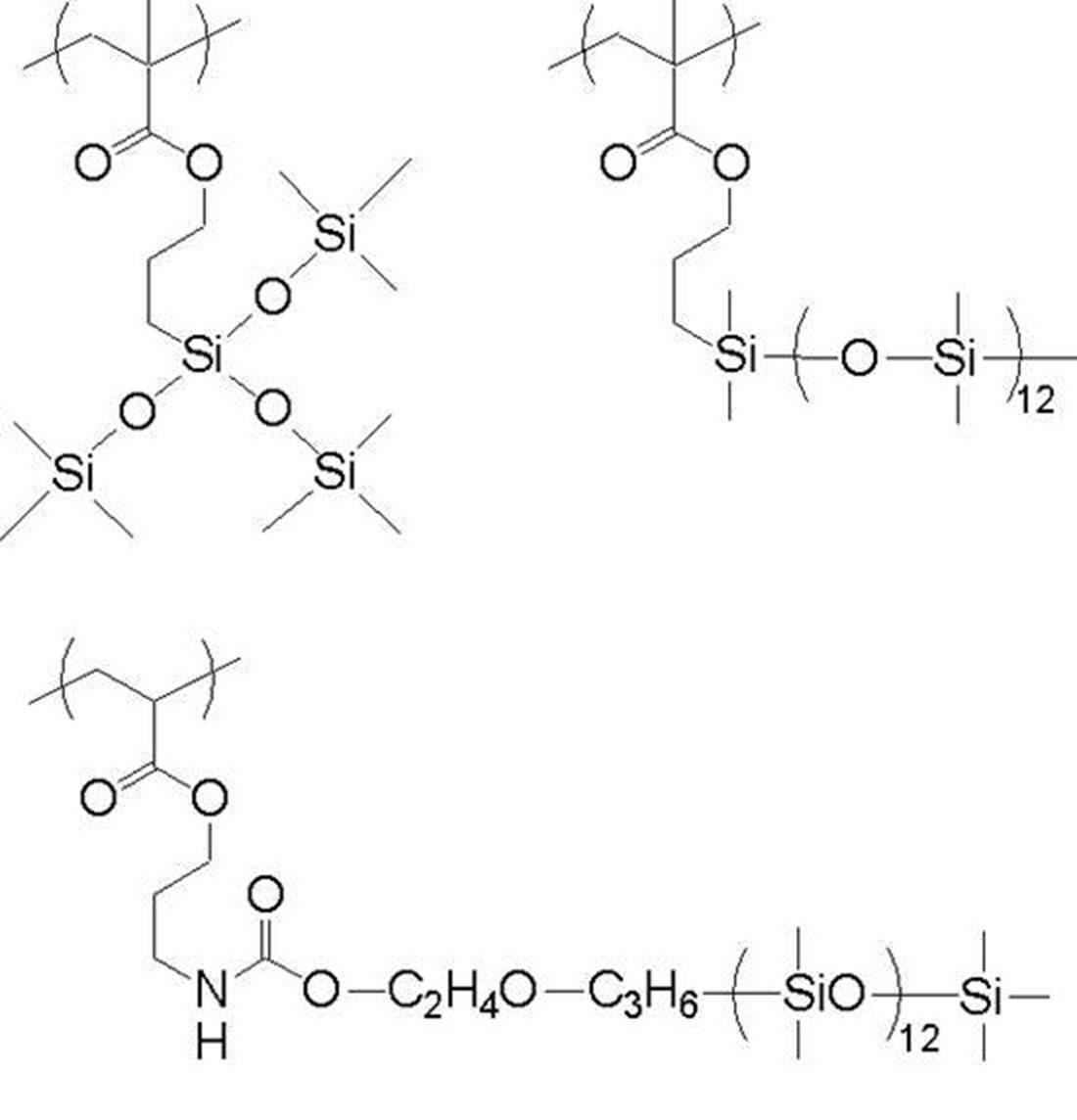
以下、シロキサン構造を有する化合物の具体例を示す。但し、本発明においては、これら化合物に制限されるものではない。
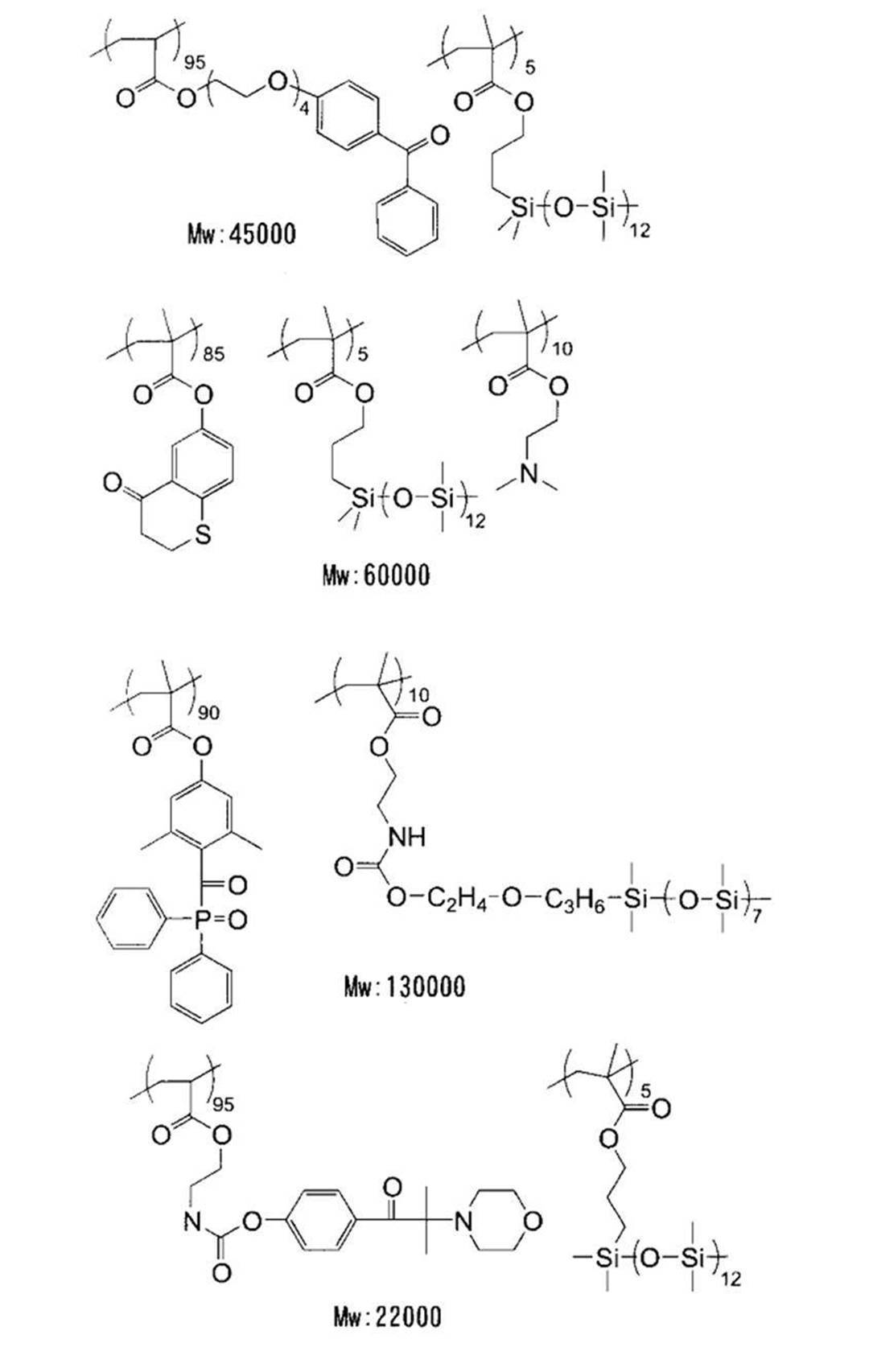


シロキサン構造を有する化合物の分子量としては、GPC法により測定した重量平均分子量で、200~200000の範囲が好ましく、200~150000の範囲がより好ましい。分子量が200以上であると、膜面として均一にブロッキング抑止できる点で有利である。分子量が200000以下であることで、ブロッキングを抑制しつつ、酸性ガス分離性をも確保することができる。
重量平均分子量は、下記条件にて、ゲルパーミエーションクロマトグラフィー(GPC)を用いて測定したものである。
<条件>
・GPC:アライアンス〔ウォーターズ社製〕
・移動相溶媒:トルエン
・標準試料 :標準ポリスチレン
・流速 :1.0ml/min
・カラム温度:40℃
<条件>
・GPC:アライアンス〔ウォーターズ社製〕
・移動相溶媒:トルエン
・標準試料 :標準ポリスチレン
・流速 :1.0ml/min
・カラム温度:40℃
酸性ガス分離層形成用塗布液がシロキサン構造を有する化合物を含有し、シロキサン構造を有する化合物を含む酸性ガス分離層を形成する場合、シロキサン構造を有する化合物の含有量としては、酸性ガス分離層の全固形分に対して、0.01質量%~10質量%であることが好ましく、更には0.01~3質量%であることが好ましい。シロキサン構造を有する化合物の含有量が0.01質量%以上であることで、ブロッキングの発生抑止の効果により優れる。また、特定化合物の含有量が10質量%以下であると、二酸化炭素等の酸性ガスの分離性が良好に保たれる。
(ポリマー粒子)
ポリマー粒子としては、例えば、ポリオレフィン(例:ポリエチレン、ポリプロピレン、ポリメチルペンテンなど)、ポリメタクリル酸メチル、ポリスチレン、熱可塑性エラストマー、シリコーンなどの粒子が好適に挙げられる。中でも、均一にブロッキング抑止できる点で、ポリオレフィンの粒子が好ましい。
ポリマー粒子としては、例えば、ポリオレフィン(例:ポリエチレン、ポリプロピレン、ポリメチルペンテンなど)、ポリメタクリル酸メチル、ポリスチレン、熱可塑性エラストマー、シリコーンなどの粒子が好適に挙げられる。中でも、均一にブロッキング抑止できる点で、ポリオレフィンの粒子が好ましい。
ポリマー粒子の平均粒子径は、0.01μm~1000μmの範囲とする。ポリマー粒子の粒子径が0.01μm未満であると、粒子が密に詰まりすぎるために、塗膜形成したときの膜表面に占める面積を分離性能を下げずに確保することができない。また、ポリマー粒子の平均粒子径が1000μmを超えると、塗膜形成したときの膜表面にポリマーが多く存在し過ぎて、二酸化炭素透過性が低下するとともに、ポリマー粒子が脱落するおそれがある。中でも、ポリマー粒子の平均粒子径としては、0.02μm~750μmの範囲がより好ましく、更に好ましくは0.03μm~500μmの範囲であり、特に好ましくは0.1μm~50μmの範囲である。
ポリマー粒子の粒子径は、大塚電子社製のFPAR1000を用いて測定される値である。
ポリマー粒子の粒子径は、大塚電子社製のFPAR1000を用いて測定される値である。
ポリマー粒子の比重は、0.5g/cm3~1.3g/cm3の範囲とする。ポリマー粒子の比重が0.5g/cm3未満で小さすぎると、膜表面を閉塞しやすく、むしろ二酸化炭素の透過性が損なわれる。また、ポリマー粒子の比重が1.3g/cm3を超えると、塗布液中に沈降しやすくなり、塗膜形成したときの膜表面にポリマーが存在し難くなることで、ブロッキング抑止効果が低下する。中でも、ポリマー粒子の比重としては、0.52g/cm3~1.28g/cm3の範囲がより好ましく、更に好ましくは0.55g/cm3~1.27g/cm3の範囲である。
ポリマー粒子は、例えば、水性媒体中にポリマーが液体状態で分散された乳化物(エマルション)、及び水性媒体中にポリマーが固体状態で分散された分散物(サスペンション)の形態で使用することができる。
ポリマー粒子は、上市されている市販品を用いてもよく、例えば、三井化学工業社製のケミパールw-308、同w-400、同w-100、同wp-100、同A-100などを使用することができる。
酸性ガス分離層形成用塗布液がポリマー粒子を含有する場合、ポリマー粒子の塗布液中における総含有量は、酸性ガス分離層の表面におけるポリマー粒子の占有面積が0.1%~60%となる量が好ましい。ポリマー粒子による占有面積が0.1%以上であることで、ブロッキングの発生抑止の効果により優れる。また、ポリマー粒子による占有面積が60%以下であると、ブロッキングが抑止しつつも、酸性ガス分離性を良好に保つことができる。ポリマー粒子の占有面積としては、0.5%~30%であるのがより好ましく、1%~10%であるのが更に好ましい。
占有面積は、走査型電子顕微鏡(JSM6610、JEOL社製)を用い、単位面積あたりの粒子被覆率を画像解析することにより求められる。
占有面積は、走査型電子顕微鏡(JSM6610、JEOL社製)を用い、単位面積あたりの粒子被覆率を画像解析することにより求められる。
ポリマー粒子を用いて酸性ガス分離層を塗布形成する場合、ポリマー粒子は比重が低いため、ポリマー粒子を含有する塗布液を用いて塗布膜を形成し乾燥する過程において、塗膜表面にポリマー粒子が偏在する。これにより、表面のみに付与するといった特段の処理を行なわなくとも、ポリマー粒子が表面に偏在してブロッキングを防止する。
また、酸性ガス分離層は、ポリマー粒子や上記の特定化合物を含有する第1の塗布液と、ポリマー粒子や特定化合物を含有しない第2の塗布液とをそれぞれ調製し、多孔質支持上に第2の塗布液、第1の塗布液の重層順になるように重層塗布することによって、ポリマー粒子や特定化合物を膜面に偏在させてなる層として形成することができる。
これらの化合物やポリマー粒子は、いずれも分離層を構成する他の成分と相溶しないために、分離層が本来有する分離能を損なうことはない。
また、酸性ガス分離層は、ポリマー粒子や上記の特定化合物を含有する第1の塗布液と、ポリマー粒子や特定化合物を含有しない第2の塗布液とをそれぞれ調製し、多孔質支持上に第2の塗布液、第1の塗布液の重層順になるように重層塗布することによって、ポリマー粒子や特定化合物を膜面に偏在させてなる層として形成することができる。
これらの化合物やポリマー粒子は、いずれも分離層を構成する他の成分と相溶しないために、分離層が本来有する分離能を損なうことはない。
(B)吸水性ポリマー
本発明における酸性ガス分離層形成用塗布液は、吸水性ポリマーの少なくとも一種を含有する。
本発明における酸性ガス分離層形成用塗布液は、吸水性ポリマーの少なくとも一種を含有する。
吸水性ポリマーは、バインダーとして機能し、水分を保持してキャリアによる二酸化炭素等のガスの分離機能を発揮させる。吸水性ポリマーは、水に溶けて塗布液を形成することができるとともに、酸性ガス分離層に高い吸水性(保湿性)を持たせる観点から、吸水性が高いものが好ましい。具体的には、生理食塩液の吸水量が0.5g/g以上である吸水性を有することが好ましく、更には1g/g以上の吸水性を有することがより好ましく、さらには5g/g以上の吸水性を有することが好ましく、さらには10g/g以上の吸水性を有することが特に好ましく、さらには20g/g以上の吸水性を有することが最も好ましい。
吸水性ポリマーとしては、従来公知の親水性高分子を用いることができるが、吸水性、製膜性、強度などの観点から、例えば、ポリビニルアルコール類、ポリアクリル酸類、ポリエチレンオキサイド類、水溶性セルロース類、デンプン類、アルギン酸類、キチン類、ポリスルホン酸類、ポリヒドロキシメタクリレート類、ポリビニルピロリドン類、ポリNビニルアセトアミド類、ポリアクリルアミド類、ポリエチレンイミン類、ポリアリルアミン類、ポリビニルアミン類などが好ましい。また、これらの共重合体も、吸水性ポリマーとして好適である。
吸水性ポリマーの中でも、特にポリビニルアルコール、ポリビニルアルコール-ポリアクリル酸共重合体が好ましい。ポリビニルアルコール-ポリアクリル酸共重合体は、吸水能が高い上、高吸水時においてもハイドロゲルの強度が大きい。ポリビニルアルコール-ポリアクリル酸共重合体におけるポリアクリル酸塩の含有率は、例えば1モル%~95モル%、好ましくは2モル%~70モル%、より好ましくは3モル%~60モル%、特に好ましくは5モル%~50モル%である。また、ポリアクリル酸は、塩を形成していてもよい。ポリアクリル酸塩としては、ナトリウム塩、カリウム塩等のアルカリ金属塩のほか、アンモニウム塩や有機アンモニウム塩等が挙げられる。
ポリビニルアルコール-ポリアクリル酸塩共重合体(ナトリウム塩)は、上市されている市販品を用いてもよく、該市販品の例として、クラストマーAP20(商品名、クラレ社製)が挙げられる。
ポリビニルアルコールとしては、PVA117(商品名、クラレ社製)が挙げられる。
また、吸水性ポリマーは、一種単独で用いるほか、二種以上を混合して用いてもよい。
ポリビニルアルコールとしては、PVA117(商品名、クラレ社製)が挙げられる。
また、吸水性ポリマーは、一種単独で用いるほか、二種以上を混合して用いてもよい。
塗布液中の吸水性ポリマーの含有量としては、その種類にもよるが、バインダーとして膜を形成し、酸性ガス分離層が水分を十分保持できるようにする観点から、塗布液全固形分に対して、0.5質量%~60質量%が好ましく、さらには0.75質量%~55質量%がより好ましく、更には1質量%~50質量%が特に好ましい。
(C)二酸化炭素キャリア
本発明における酸性ガス分離層形成用塗布液は、二酸化炭素キャリアとして、アルカリ金属塩の一種又は二種以上を含有する。二酸化炭素キャリアとは、二酸化炭素の分離において、膜中で二酸化炭素のキャリアとして機能する。
本発明における酸性ガス分離層形成用塗布液は、二酸化炭素キャリアとして、アルカリ金属塩の一種又は二種以上を含有する。二酸化炭素キャリアとは、二酸化炭素の分離において、膜中で二酸化炭素のキャリアとして機能する。
なお、本明細書において、アルカリ金属塩の種類数は、アルカリ金属の種類によって定まるものとし、対イオンが異なっていても異種とは数えないこととする。つまり、炭酸カリウムと水酸化カリウムとを併用しても1種と数えることとなる。
アルカリ金属塩は、二酸化炭素と親和性を有し、かつ水溶性を示すものが好ましく、公知のものを使用可能である。キャリアは、二酸化炭素と親和性を有する物質であり、塩基性を示す各種の水溶性の無機及び有機物質が用いられる。例えば、アルカリ金属炭酸塩及び/又はアルカリ金属重炭酸塩及び/又はアルカリ金属水酸化物、アルカリ金属炭酸塩及び/又はアルカリ金属重炭酸塩及び/又はアルカリ金属水酸化物を含む水溶液にアルカリ金属イオンと錯体を形成する多座配位子を添加した錯化合物、アンモニア、アンモニウム塩、各種直鎖状、及び環状のアミン、アミン塩、アンモニウム塩等が挙げられる。これら水溶性誘導体も好ましく用いることができる。膜中に長期間保持できるキャリアが有用である観点からは、アミノ酸やベタインなどの蒸発し難いアミン含有化合物を用いることができる。
アルカリ金属塩としては、アルカリ金属炭酸塩が好ましい。
また、アルカリ金属塩は、水に対する溶解度の高い点で、ルビジウム塩、セシウム塩、及びカリウム塩からなる群より選択される塩が好ましく、中でも、ルビジウム炭酸塩及びセシウム炭酸塩がより好ましい。
アルカリ金属炭酸塩としては、例えば、炭酸リチウム、炭酸ナトリウム、炭酸カリウム、炭酸ルビジウム、炭酸セシウムが挙げられる。アルカリ金属重炭酸塩としては、例えば、炭酸水素リチウム、炭酸水素ナトリウム、炭酸水素カリウム、炭酸水素ルビジウム、炭酸水素セシウムが挙げられる。アルカリ金属水酸化物としては、例えば、水酸化リチウム、水酸化ナトリウム、水酸化カリウム、水酸化セシウム、水酸化ルビジウムなどが挙げられる。
また、アルカリ金属塩は、水に対する溶解度の高い点で、ルビジウム塩、セシウム塩、及びカリウム塩からなる群より選択される塩が好ましく、中でも、ルビジウム炭酸塩及びセシウム炭酸塩がより好ましい。
アルカリ金属炭酸塩としては、例えば、炭酸リチウム、炭酸ナトリウム、炭酸カリウム、炭酸ルビジウム、炭酸セシウムが挙げられる。アルカリ金属重炭酸塩としては、例えば、炭酸水素リチウム、炭酸水素ナトリウム、炭酸水素カリウム、炭酸水素ルビジウム、炭酸水素セシウムが挙げられる。アルカリ金属水酸化物としては、例えば、水酸化リチウム、水酸化ナトリウム、水酸化カリウム、水酸化セシウム、水酸化ルビジウムなどが挙げられる。
塗布液中のアルカリ金属塩の含有量としては、その種類にもよるが、塗布前の塩析を防ぐとともに、分離ガスの分離機能を確実に発揮させるため、塗布液全質量に対して、0.1質量%~30質量%が好ましく、0.2質量%~25質量%がより好ましく、0.3質量%~20質量%が特に好ましい。
アルカリ金属塩は、ブロッキング抑止の点で、膜中に二種以上含む態様が好ましい。二種以上のアルカリ金属塩を含有する場合、二種のアルカリ金属塩のうちの一方は、ルビジウム塩及びセシウム塩からなる群より選択され、他方はカリウム塩から選ばれることが好ましい。
アルカリ金属塩の含有量を、膜の主成分である吸水性ポリマー及び2種以上のアルカリ金属塩等を含む固形分の合計質量との関係で示すと、2種以上のアルカリ金属塩の合計の質量比率が25質量%以上85質量%以下であることが好ましく、30質量%以上80質量%以下であることがより好ましい。この量を上記の範囲とすることで、酸性ガス分離機能を十分に発揮させることができる。
上記のうち、二種のアルカリ金属塩のうちの一方は、吸水性ポリマー及び2種以上のアルカリ金属塩等を含む固形分の合計質量(典型的には乾燥後の酸性ガス分離層の総質量)に対して、0.01質量%以上であることが好ましく、0.02質量%以上であることがより好ましい。上限は特にないが、10質量%以下であることが好ましく、7.5質量%以下であることがより好ましい。この量が上記範囲であると、ブロッキングの防止に有利であり、多すぎない範囲であるとハンドリングを良好に保つ上で有利である。
本発明においては、ブロッキングの発生抑止の観点から、2種以上のアルカリ金属塩を用いることが好ましく、2種のアルカリ金属塩の併用が好ましい。アルカリ金属塩の組み合わせとしては、下記の#1~#3が好ましい。なお、下記表では、アルカリ金属の名称でアルカリ金属塩を示しているが、これはその金属の塩やイオンであってもよい意味である。
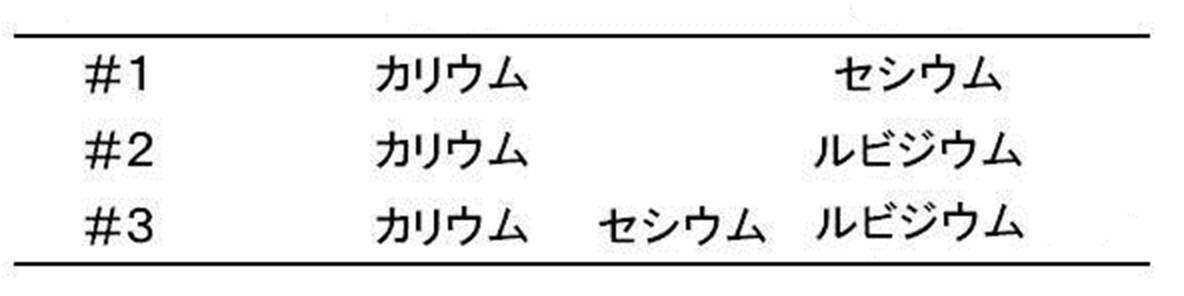
2種のアルカリ金属塩を含む場合の両者の比率は、特に制限されないが、二種のアルカリ金属塩のうちの一方100質量部に対して、他方が50質量部以上であるのが好ましく、100質量部以上であるのがより好ましい。上限値としては、100,000質量部以下が好ましく、80,000質量部以下がより好ましい。2種のアルカリ金属塩の両者の含有比率を上記範囲に調整することにより、ブロッキング性とハンドリング性とを高い水準で両立することができる。
(D)他の成分
本発明における酸性ガス分離層形成用塗布液は、上記成分に加え、架橋剤や、界面活性剤などの他の成分を用いて構成されてもよい。
本発明における酸性ガス分離層形成用塗布液は、上記成分に加え、架橋剤や、界面活性剤などの他の成分を用いて構成されてもよい。
(架橋剤)
吸水性ポリマーの架橋は熱架橋、紫外線架橋、電子線架橋、放射線架橋など従来公知の手法にて実施することができる。本発明における酸性ガス分離層形成用塗布液(又は二酸化単層分離層)は、架橋剤を含むことが好ましい。特に、吸水性ポリマーとしてポリビニルアルコール-ポリアクリル酸塩共重合体を含有し、このポリビニルアルコール-ポリアクリル酸塩共重合体と反応して熱架橋し得る官能基を2以上有する架橋剤を含有している態様が好ましい。このような架橋剤の例としては、多価グリシジルエーテル、多価アルコール、多価イソシアネート、多価アジリジン、ハロエポキシ化合物、多価アルデヒド(例えばグルタルアルデヒド)、多価アミン等が挙げられる。
吸水性ポリマーの架橋は熱架橋、紫外線架橋、電子線架橋、放射線架橋など従来公知の手法にて実施することができる。本発明における酸性ガス分離層形成用塗布液(又は二酸化単層分離層)は、架橋剤を含むことが好ましい。特に、吸水性ポリマーとしてポリビニルアルコール-ポリアクリル酸塩共重合体を含有し、このポリビニルアルコール-ポリアクリル酸塩共重合体と反応して熱架橋し得る官能基を2以上有する架橋剤を含有している態様が好ましい。このような架橋剤の例としては、多価グリシジルエーテル、多価アルコール、多価イソシアネート、多価アジリジン、ハロエポキシ化合物、多価アルデヒド(例えばグルタルアルデヒド)、多価アミン等が挙げられる。
(その他の成分)
本発明における酸性ガス分離層形成用塗布液(又は二酸化単層分離層)は、製膜性(塗布性)や酸性ガス分離性に悪影響しない範囲で、特定化合物及び/又はポリマー粒子、吸水性ポリマー、及びアルカリ金属塩等に加え、添加剤などの他の成分を含むことができる。
他の成分の例としては、架橋剤のほか、例えば、上記以外の界面活性剤、触媒、保湿(吸水)剤、補助溶剤、膜強度調整剤、欠陥検出剤が挙げられる。
本発明における酸性ガス分離層形成用塗布液(又は二酸化単層分離層)は、製膜性(塗布性)や酸性ガス分離性に悪影響しない範囲で、特定化合物及び/又はポリマー粒子、吸水性ポリマー、及びアルカリ金属塩等に加え、添加剤などの他の成分を含むことができる。
他の成分の例としては、架橋剤のほか、例えば、上記以外の界面活性剤、触媒、保湿(吸水)剤、補助溶剤、膜強度調整剤、欠陥検出剤が挙げられる。
続いて、本発明の酸性ガス分離用複合体の製造方法において、上記の塗布液調製工程後に行なう塗布工程及び乾燥工程、並びに冷却工程等の他の工程について、図1を参照しながら説明する。
図1は、酸性ガス分離用複合体を製造する製造装置の全体構成を示している。
図1に示されるように、酸性ガス分離用複合体の製造装置110は、長尺状の多孔質支持体112を一定方向に送り出す搬送手段の例である送り出しローラ114と、多孔質支持体112を支持する複数の裏面支持ローラ126と、送り出しローラ114から送り出された支持体112の搬送方向に沿ってその上流側から下流側に順に、支持体112の表面に酸性ガス分離層形成用塗布液を塗布する塗布装置116と、支持体112上に塗布された塗布膜を非接触状態で冷却してゲル膜を得る冷却装置の例である冷却ユニット118と、支持体112上のゲル膜を非接触状態で乾燥させ、酸性ガス分離層とする乾燥装置の例である乾燥ユニット120と、乾燥ユニット120の支持体搬送方向下流に配置され、支持体112上に酸性ガス分離層が塗設された酸性ガス分離用複合体140を巻き取る搬送手段の例である巻き取りローラ122とを備えている。
図1に示されるように、酸性ガス分離用複合体の製造装置110は、長尺状の多孔質支持体112を一定方向に送り出す搬送手段の例である送り出しローラ114と、多孔質支持体112を支持する複数の裏面支持ローラ126と、送り出しローラ114から送り出された支持体112の搬送方向に沿ってその上流側から下流側に順に、支持体112の表面に酸性ガス分離層形成用塗布液を塗布する塗布装置116と、支持体112上に塗布された塗布膜を非接触状態で冷却してゲル膜を得る冷却装置の例である冷却ユニット118と、支持体112上のゲル膜を非接触状態で乾燥させ、酸性ガス分離層とする乾燥装置の例である乾燥ユニット120と、乾燥ユニット120の支持体搬送方向下流に配置され、支持体112上に酸性ガス分離層が塗設された酸性ガス分離用複合体140を巻き取る搬送手段の例である巻き取りローラ122とを備えている。
送り出しローラ114には、支持体112が巻回される軸芯114Aが配設されており、軸芯114Aが矢印方向に回転することで支持体112が送り出される。そして、支持体112の裏面側が複数の裏面支持ローラ124に巻き掛けられた状態で、支持体112が一定方向に搬送され、塗布装置116、冷却ユニット118、乾燥ユニット120に順次送られるようになっている。これらを経由して製造された酸性ガス分離用複合体140は、巻き取りローラ122に巻き取られる。巻き取りローラ122には、酸性ガス分離用複合体140を巻き取る軸芯122Aが配設されており、図示しないモータにより軸芯122Aを矢印方向に回転させることで、酸性ガス分離用複合体140が所定の速度で軸芯122Aに巻き回されるようになっている。
本発明においては、既述のような酸性ガス分離層形成用塗布液を用い、これを図1に示されるようにロールツーロール法(Roll-to-roll processing)によって多孔質支持体に酸性ガス分離層を連続製膜し、酸性ガス分離用複合体を製造する際のブロッキングが効果的に防止される。そのため、特にロールツーロール法での製造過程で生じやすい膜剥がれによる歩留まりが抑えられる。よって、本発明の製造方法は、酸性ガス分離用複合体の製造適性が高い。
本発明においては、既述のような酸性ガス分離層形成用塗布液を用い、これを図1に示されるようにロールツーロール法(Roll-to-roll processing)によって多孔質支持体に酸性ガス分離層を連続製膜し、酸性ガス分離用複合体を製造する際のブロッキングが効果的に防止される。そのため、特にロールツーロール法での製造過程で生じやすい膜剥がれによる歩留まりが抑えられる。よって、本発明の製造方法は、酸性ガス分離用複合体の製造適性が高い。
-塗布工程-
本発明における塗布工程では、長尺状の多孔質支持体上に、塗布液調製工程で調製した酸性ガス分離層形成用塗布液を塗布する。例えば図1に示す製造装置を用い、送り出しローラ114から長尺状の多孔質支持体112を送り出し、これを塗布装置116の塗布ダイ136による塗布位置に搬送し、この多孔質支持体112上に塗布液を塗布することで塗布膜が形成される。
本発明における塗布工程では、長尺状の多孔質支持体上に、塗布液調製工程で調製した酸性ガス分離層形成用塗布液を塗布する。例えば図1に示す製造装置を用い、送り出しローラ114から長尺状の多孔質支持体112を送り出し、これを塗布装置116の塗布ダイ136による塗布位置に搬送し、この多孔質支持体112上に塗布液を塗布することで塗布膜が形成される。
塗布装置116は、酸性ガス分離層形成用塗布液が貯留される貯留部116Aと、貯留部116Aに貯留された塗布液が流れる塗布ダイ136とを備えている。塗布ダイ136は、塗布液の流量と、多孔質支持体112との隙間幅を自由に調節可能であり、様々な厚みの支持体に対して様々な厚みで塗布可能である。貯留部116Aには、図示しないが、塗布液の温度を調節するためのヒータ、及び塗布液を攪拌する攪拌装置が配設されている。
塗布工程における塗布液の温度が低下すると、粘度が上昇したり、吸水性ポリマーが析出(塩析)して多孔質支持体への塗布が困難となったり、膜厚バラツキが大きくなるおそれがある。そのため、塗布液を調製後、塗布するまでの間はゲル化や塩析が生じないように保温することが好ましい。塗布工程における塗布液の温度は、組成や濃度に応じてゲル化や塩析が生じないように設定されればよいが、温度が高すぎると塗布液から水が蒸発して組成濃度が変化したり、局所的にゲル化が進行する恐れがあるので、通常は50℃以上であり、60~85℃程度が好ましい。
塗布装置116は、上記構成に限定されるものではなく、例えば、カーテンフローコーター、エクストルージョンダイコーター、エアードクターコーター、ブレードコーター、ロッドコーター、ナイフコーター、スクイズコーター、リバースロールコーター、バーコーター等が挙げられる。特に、膜厚均一性、塗布量などの観点から、エクストルージョンダイコーターが好ましい。
塗布液の塗布量は、塗布液の組成、濃度などによるが、単位面積あたりの塗布量が少なすぎると、乾燥工程(又は冷却工程)で膜に孔が形成されたり、酸性ガス分離層としての強度が不充分となるおそれがある。一方、塗布量が多すぎると、膜厚バラツキが大きくなったり、得られる酸性ガス分離層の厚みが大きくなり過ぎて二酸化炭素の透過性が低下するおそれがある。
以上の観点から、塗布量は、乾燥工程を経て得られた酸性ガス分離層の厚みが1μm~100μm、より好ましくは2μm~90μm、特に好ましくは3μm~80μmとなるように調整されるのが好ましい。
以上の観点から、塗布量は、乾燥工程を経て得られた酸性ガス分離層の厚みが1μm~100μm、より好ましくは2μm~90μm、特に好ましくは3μm~80μmとなるように調整されるのが好ましい。
(多孔質支持体)
多孔質支持体(以下、単に支持体ともいう。)は、ロールツーロール法で連続製膜する観点から、長尺状のものが用いられる。多孔質支持体の材料については、特に制限されないが、酸性ガス分離層を支持すると共に、良好な二酸化炭素透過性を有する多孔質であるものが好ましい。多孔質支持体には、塗布液の塗布により酸性ガス分離層を所望の形態で形成し得るものが好ましい。
多孔質支持体(以下、単に支持体ともいう。)は、ロールツーロール法で連続製膜する観点から、長尺状のものが用いられる。多孔質支持体の材料については、特に制限されないが、酸性ガス分離層を支持すると共に、良好な二酸化炭素透過性を有する多孔質であるものが好ましい。多孔質支持体には、塗布液の塗布により酸性ガス分離層を所望の形態で形成し得るものが好ましい。
多孔質支持体の材質としては、紙、上質紙、コート紙、キャストコート紙、合成紙、さらに、セルロース、ポリエステル、ポリオレフィン、ポリアミド、ポリイミド、ポリスルフォンアラミド、ポリカーボネート、金属、ガラス、セラミックスなどが好適である。より具体的には、ポリプロピレン、ポリエチレン、ポリスチレン、ポリフェニルサルファイド、ポリエーテルイミド、ポリエーテルエーテルケトン、ポリスルフォン、ポリエーテルサルフォン、ポリエチレンテレフタレート、ポリテトラフルオロエチレン、ポリフッ化ビニリデンなどの樹脂材料が好適に挙げられる。
中でも、経時安定性の観点から、ポリオレフィン及びそのフッ化物が特に好ましい。
中でも、経時安定性の観点から、ポリオレフィン及びそのフッ化物が特に好ましい。
支持体の形態としては織布、不織布、多孔質膜等を採用することができる。一般的には自己支持性が高く、空隙率が高い支持体が好適に使用できる。ポリプロピレン、ポリエチレン、ポリテトラフルオロエチレン、ポリフッ化ビニリデンの延伸多孔膜や、ポリスルフォン、ポリアクリロニトリルの相分離膜は空隙率が高く、二酸化炭素等の分離ガスの拡散阻害が小さく、強度、製造適性などの観点から好ましい。この中でも特にポリテトラフルオロエチレン(PTFE)の延伸膜が好ましい。
これらの支持体を単独に用いることもできるが、補強用の支持体と一体化した複合膜も好適に使用できる。
これらの支持体を単独に用いることもできるが、補強用の支持体と一体化した複合膜も好適に使用できる。
支持体としては、上述した有機系の材料以外にも、無機系の材料あるいは有機-無機ハイブリッド材料を用いてもよい。無機系の支持体としては、セラミックスを主成分とする多孔質基体が挙げられる。セラミックスを主成分とすることにより、耐熱性、耐食性等に優れ、機械的強度を高めることができる。セラミックスの種類としては特に限定されるものではなく、一般的に使用されるセラミックスのいずれも採用することができる。例えば、アルミナ、シリカ、シリカ-アルミナ、ムライト、コージェライト、ジルコニア等が挙げられる。また、2種類以上のセラミックス、又はセラミックスと金属とを複合化する、あるいはセラミックスと有機化合物とを複合化することによって調整してもよい。
多孔質支持体は、厚過ぎると二酸化炭素透過性が低下し、薄過ぎると強度が低下する傾向がある。したがって、支持体の厚みは、30μm~500μmが好ましく、さらには50μm~400μmがより好ましく、特に好ましくは50μm~350μmである。
また、後述するシートを利用した連続工程を採用する場合、Roll-to-Roll法での製造において、支持体の歪みや断裂が発生することのないよう、例えば多孔質支持体の強度は、10N/10mm以上(引張速度10mm/min)であることが好ましい。
また、後述するシートを利用した連続工程を採用する場合、Roll-to-Roll法での製造において、支持体の歪みや断裂が発生することのないよう、例えば多孔質支持体の強度は、10N/10mm以上(引張速度10mm/min)であることが好ましい。
-乾燥工程-
本発明における乾燥工程は、塗布工程での塗布により形成された塗布膜を乾燥させて酸性ガス分離層とし、酸性ガス分離用複合体を得る。例えば図1に示す製造装置を用いる場合、支持体搬送路に設けられた乾燥ユニット120において、冷却ユニット118によりゲル化された支持体112上のゲル膜を乾燥させるとともに、熱架橋させて酸性ガス分離層を得る。
本発明における乾燥工程は、塗布工程での塗布により形成された塗布膜を乾燥させて酸性ガス分離層とし、酸性ガス分離用複合体を得る。例えば図1に示す製造装置を用いる場合、支持体搬送路に設けられた乾燥ユニット120において、冷却ユニット118によりゲル化された支持体112上のゲル膜を乾燥させるとともに、熱架橋させて酸性ガス分離層を得る。
例えば、乾燥ユニット120に搬送された多孔質支持体112上のゲル膜に温風(乾燥風)を当てて乾燥させると共に、架橋させる。後述する冷却工程後の膜は、ゲル状に固定化されているため、乾燥用の風が直接当たっても崩れずに乾燥する。
乾燥風の風速は、塗布膜(冷却工程を経たときはゲル膜)を迅速に乾燥させることができる共に、塗布膜(又はゲル膜)が崩れない速度、例えば1m/分~80m/分に設定することが好ましく、さらには2~70m/分がより好ましく、さらには3~40m/分が特に好ましい。本実施形態では、風速は30m/分としている。
乾燥風の温度は、多孔質支持体の変形などが生じず、かつ塗布膜(冷却工程を経たときはゲル膜)を迅速に乾燥させる観点から、20℃~80℃に設定することが好ましく、25℃~70℃がより好ましく、更には30℃~60℃が特に好ましい。本実施形態では、乾燥風の温度は約40℃としている。
乾燥風の温度は、多孔質支持体の変形などが生じず、かつ塗布膜(冷却工程を経たときはゲル膜)を迅速に乾燥させる観点から、20℃~80℃に設定することが好ましく、25℃~70℃がより好ましく、更には30℃~60℃が特に好ましい。本実施形態では、乾燥風の温度は約40℃としている。
乾燥工程における乾燥と架橋とは、同時に行なってもよいし、別々に行なってもよい。例えば、ゲル膜に温風を当てて乾燥させた後、赤外線ヒータなどの乾燥手段によって架橋させてもよいし、温風によって乾燥とともに架橋させてもよい。熱架橋は、例えば100~150℃程度に加熱することによって行うことができる。
本実施形態の乾燥ユニット120は、支持体112が搬入及び搬出されるハウジング120Aと、このハウジング120A内に配置されて支持体112の表面のゲル膜を乾燥させる複数の温風器132及び複数のハロゲンヒータ134とを備えている。温風器132は、支持体112の表面に対して所定の間隔をおいて配置されており、支持体112の表面に温風を吹き付けることによって、支持体112上のゲル膜を乾燥させる。
ハロゲンヒータ134は、支持体112の表面に対して所定の間隔をおいて配置されており、熱によって支持体112上のゲル膜を乾燥させるものである。本実施形態では、温風器132とハロゲンヒータ134が交互に複数配置されており、これらの温風器132とハロゲンヒータ134によって支持体112の表面のゲル膜を乾燥すると共に熱架橋して酸性ガス分離層を得る。本実施形態では、温風器132とハロゲンヒータ134が交互に複数配置されているが、この構成に限定されず、例えば複数の温風器132のみを備えた構成でもよい。
上記のほか、酸性ガス分離用複合体の製造装置では、必要に応じて、乾燥ユニット120よりも多孔質支持体112の搬送方向下流側に、多孔質支持体112の表面に形成された酸性ガス分離層の上にキャリア溶出防止層を形成するための塗布装置及び乾燥装置などを設けてもよい。
-その他の工程-
本発明においては、上記の各工程に加えて、冷却工程などの他の工程が設けられてもよい。
本発明においては、上記の各工程に加えて、冷却工程などの他の工程が設けられてもよい。
塗布工程と乾燥工程の間には、図1のように、塗布により形成された塗布膜を冷却してゲル膜を得る冷却工程を設けてもよい。この場合、ゲル膜を得る冷却工程の後に乾燥工程が設けられる。乾燥工程は、塗布膜から得たゲル膜を乾燥させて酸性ガス分離層とすることで、酸性ガス分離用複合体を得る。
冷却工程を設ける場合の塗布液は、液膜の厚みを1mm以下として12℃で放置したときに120秒以内でゲル化し、液が重力により落下しないような性質の組成に調製されるのが好ましい。また、冷却工程が設けられる場合、多孔質支持体を一定方向に搬送しながら、上記の塗布工程、冷却工程、及び乾燥工程を順次連続して行なうことによって、酸性ガス分離用複合体の製造適性をより向上させることができる。
冷却工程を設けた場合、得られるゲル膜の厚さは、30μm以上、より好ましくは50μm以上、特に好ましくは100μm以上である。
<酸性ガス分離用複合体>
本発明の酸性ガス分離用複合体は、多孔質支持体と、該多孔質支持体上に設けられ、(1)炭素数が3~20のアルキル基又はフッ化アルキル基と親水性基とを有する化合物及び(2)シロキサン構造を有する化合物からなる群より選ばれる化合物(特定化合物)並びに(3)平均粒子径が0.01μm~1000μmでかつ比重が0.5g/cm3~1.3g/cm3のポリマー粒子から選ばれる少なくとも一種と、吸水性ポリマーと、アルカリ金属塩から選ばれる二酸化炭素キャリアとを含む酸性ガス分離層とを設けて構成されている。
本発明の酸性ガス分離用複合体は、多孔質支持体と、該多孔質支持体上に設けられ、(1)炭素数が3~20のアルキル基又はフッ化アルキル基と親水性基とを有する化合物及び(2)シロキサン構造を有する化合物からなる群より選ばれる化合物(特定化合物)並びに(3)平均粒子径が0.01μm~1000μmでかつ比重が0.5g/cm3~1.3g/cm3のポリマー粒子から選ばれる少なくとも一種と、吸水性ポリマーと、アルカリ金属塩から選ばれる二酸化炭素キャリアとを含む酸性ガス分離層とを設けて構成されている。
酸性ガス分離用複合体を構成する酸性ガス分離層の厚みは、5μm~50μmが好ましく、より好ましくは10μm~40μmであり、特に好ましくは15μm~30μmである。厚みが50μm以下であることで、酸性ガス分離性により優れる。厚みが5μm以上であることで、分離膜としての機械的強度を保つことができる。
酸性ガス分離用複合体を構成する多孔質支持体、並びに酸性ガス分離層を構成する特定化合物、吸水性ポリマー、アルカリ金属塩(二酸化炭素キャリア)等の詳細については既述の通りであり、各々の好ましい態様も同様である。
特定化合物の酸性ガス分離層中における含有量としては、全固形分に対して、0.01質量%~10質量%が好ましく、0.02質量%~8質量%がより好ましい。特定化合物の含有量が0.01質量%以上であることで、ブロッキングの抑止効果に優れる。また、特定化合物の含有量が10質量%以下であると、ブロッキング抑止と二酸化炭素透過性の向上とを両立する上で好ましい。
また、ポリマー粒子の酸性ガス分離層中における含有量は、ポリマー粒子の酸性ガス分離層の表面における占有面積が既述した範囲となるように調節されていることが好ましい。
また、ポリマー粒子の酸性ガス分離層中における含有量は、ポリマー粒子の酸性ガス分離層の表面における占有面積が既述した範囲となるように調節されていることが好ましい。
吸水性ポリマーの酸性ガス分離層中における含有量としては、全固形分に対して、0.5質量%~60質量%が好ましく、さらには0.75質量%~55質量%がより好ましく、更には1質量%~50質量%がより好ましい。吸水性ポリマーの含有量が0.5質量%以上であることで、分離膜としての強度を確保するのに適している。また、吸水性ポリマーの含有量が60質量%以下であると、分離性能の点で有利である。
また、アルカリ金属塩の酸性ガス分離層中における含有量としては、全固形分に対して、25質量%~85質量%が好ましく、30質量%~80質量%がより好ましい。アルカリ金属塩の含有量が25質量%以上であることで、二酸化炭素透過性を良好に維持することができる。また、アルカリ金属塩の含有量が85質量%以下であると、膜強度を保つ点で有利である。
本発明の酸性ガス分離用複合体は、上記の構成に作製されればいずれの方法で製造されてもよいが、既述の本発明の酸性ガス分離用複合体の製造方法によって最も好適に製造される。
<酸性ガス分離モジュール>
本発明の酸性ガス分離モジュールは、既述の本発明の酸性ガス分離用複合体の製造方法により製造された酸性ガス分離用複合体、又は既述の本発明の酸性ガス分離用複合体を設けて構成されている。
本発明の酸性ガス分離モジュールは、既述の本発明の酸性ガス分離用複合体の製造方法により製造された酸性ガス分離用複合体、又は既述の本発明の酸性ガス分離用複合体を設けて構成されている。
酸性ガス分離モジュールは、多孔質支持体と酸性ガス分離層とが積層された本発明の酸性ガス分離用複合体を平膜として設置してもよいし、逆浸透膜モジュールとして知られるスパイラル型や、例えば特開2010-279885号公報に記載される形状を有するプリーツ型などに加工して利用することもできる。
以下、本発明の酸性ガス分離層をスパイラル型として組み込んだ酸性ガス分離モジュールを例に挙げて説明する。
以下、本発明の酸性ガス分離層をスパイラル型として組み込んだ酸性ガス分離モジュールを例に挙げて説明する。
図2は、本発明の酸性ガス分離モジュール10の一実施形態を示す、一部切り欠きを設けて示した概略構成図であり、図3は、その断面を表す斜視図である。
スパイラル型の酸性ガス分離モジュール10は、その基本構造として、有孔の中空状中心管12の回りに、酸性ガス分離用複合体の例である酸性ガス分離部材14とこれに隣接して設けられた流路材16とからなる積層体を単数あるいは複数を巻き回して構成される。酸性ガス分離部材14と流路材16とにより形成された二酸化炭素を分離する領域の周辺は、モジュール内を通過する気体などの流体を遮断しうる材料で形成された被覆層18で被覆されている。
酸性ガス分離部材14は、酸性ガス分離層と多孔質支持体とを積層した積層体である本発明の酸性ガス分離用複合体である。
スパイラル型の酸性ガス分離モジュール10は、その基本構造として、有孔の中空状中心管12の回りに、酸性ガス分離用複合体の例である酸性ガス分離部材14とこれに隣接して設けられた流路材16とからなる積層体を単数あるいは複数を巻き回して構成される。酸性ガス分離部材14と流路材16とにより形成された二酸化炭素を分離する領域の周辺は、モジュール内を通過する気体などの流体を遮断しうる材料で形成された被覆層18で被覆されている。
酸性ガス分離部材14は、酸性ガス分離層と多孔質支持体とを積層した積層体である本発明の酸性ガス分離用複合体である。
酸性ガス分離モジュール10に使用される流路材16は、供給される流体の乱流(膜面の表面更新)を促進して供給流体中の二酸化炭素の膜透過速度を増加させる機能と、供給側の圧損をできるだけ小さくする機能とが備わっていることが好ましい。
流路材16としては、スペーサーとしての機能を有し、且つ、流体に乱流を生じさせることが好ましいことから、ネット状の流路材16が好ましく用いられる。ネットの形状により流体の流路が変わることから、ネットの単位格子の形状は、目的に応じて、例えば、菱形、平行四辺形などの形状から選択して用いられる。流路材16の材質としては、何ら限定されるものではないが、本発明の酸性ガス分離部材14が100℃以上の温度条件下で使用されることから、耐熱性の材料が好ましく、先に多孔膜の素材として挙げた材料が流路材16の材料として同様に好ましく用いられる。
既述のように、本実施形態では、酸性ガス分離モジュール10は、分離された二酸化炭素を回収するための有孔の中空状中心管12の周辺に、高分子化合物層及び多孔膜の積層体(酸性ガス分離部材)14とネット状流路材16とを巻き付けることで形成された二酸化炭素を分離する領域を備え、その周辺が流体不透過性の被覆層18で被覆されている。
二酸化炭素を含む気体は、酸性ガス分離部材端部20から供給され、前記被覆層18により区画された、本発明の酸性ガス分離部材14を備える二酸化炭素を分離する領域を透過する際に、高分子化合物層14を透過して分離された二酸化炭素が中空状中心管12に集積され、該中空状中心管12に接続された開口部22より回収される。また、酸性ガス分離部材14における多孔質膜の空隙や流路材16の空隙を通過した、二酸化炭素が分離された残余の気体は、酸性ガス分離モジュール10において、二酸化炭素回収用の開口部22が設けされた側の、酸性ガス分離部材の端部24より排出される。
二酸化炭素回収用の中空状中心管12には不活性ガス等から選ばれるキャリアガスが供給されてもよい。
二酸化炭素回収用の中空状中心管12には不活性ガス等から選ばれるキャリアガスが供給されてもよい。
以下、本発明を実施例により更に具体的に説明するが、本発明はその主旨を越えない限り、以下の実施例に限定されるものではない。なお、特に断りのない限り、「部」は質量基準である。
(実施例1)
クラストマーAP-20(クラレ社製;ポリビニルアルコール-ポリアクリル酸塩共重合体(吸収性ポリマー))2.4質量%、及び25質量%グルタルアルデヒド水溶液(Wako社製;架橋剤)0.01質量%を含む水溶液に、1M塩酸をpH1になるまで添加し、架橋した。その後、これに40質量%炭酸セシウム(稀産金属社製;アルカリ金属塩)水溶液を、炭酸セシウム濃度が6.0質量%になるように添加した。次いで、40質量%炭酸カリウム(Wako社製;アルカリ金属塩)水溶液を、炭酸カリウム濃度が0.61質量%になるように添加した。これに更に、1質量%ラピゾールA-90〔日油社製;下記構造式で表される界面活性剤(ジ(2-エチルヘキシル)スルホこはく酸ナトリウム、分子量=445;特定化合物)〕を、濃度0.003質量%になるように添加し、昇温した。その後、別に調液しておいた寒天水溶液をこれに加え、塗布液(酸性ガス分離層形成用塗布液)とした。
多孔質支持体としてPTFE/PP不織布(GE社製)を用意し、この不織布の上に得られた塗布液を塗布し、乾燥させることで、酸性ガス分離層として機能する分離膜(1)を作製した。界面活性剤の含有量は、分離膜(1)の全固形分に対して0.05質量%であった。
クラストマーAP-20(クラレ社製;ポリビニルアルコール-ポリアクリル酸塩共重合体(吸収性ポリマー))2.4質量%、及び25質量%グルタルアルデヒド水溶液(Wako社製;架橋剤)0.01質量%を含む水溶液に、1M塩酸をpH1になるまで添加し、架橋した。その後、これに40質量%炭酸セシウム(稀産金属社製;アルカリ金属塩)水溶液を、炭酸セシウム濃度が6.0質量%になるように添加した。次いで、40質量%炭酸カリウム(Wako社製;アルカリ金属塩)水溶液を、炭酸カリウム濃度が0.61質量%になるように添加した。これに更に、1質量%ラピゾールA-90〔日油社製;下記構造式で表される界面活性剤(ジ(2-エチルヘキシル)スルホこはく酸ナトリウム、分子量=445;特定化合物)〕を、濃度0.003質量%になるように添加し、昇温した。その後、別に調液しておいた寒天水溶液をこれに加え、塗布液(酸性ガス分離層形成用塗布液)とした。
多孔質支持体としてPTFE/PP不織布(GE社製)を用意し、この不織布の上に得られた塗布液を塗布し、乾燥させることで、酸性ガス分離層として機能する分離膜(1)を作製した。界面活性剤の含有量は、分離膜(1)の全固形分に対して0.05質量%であった。
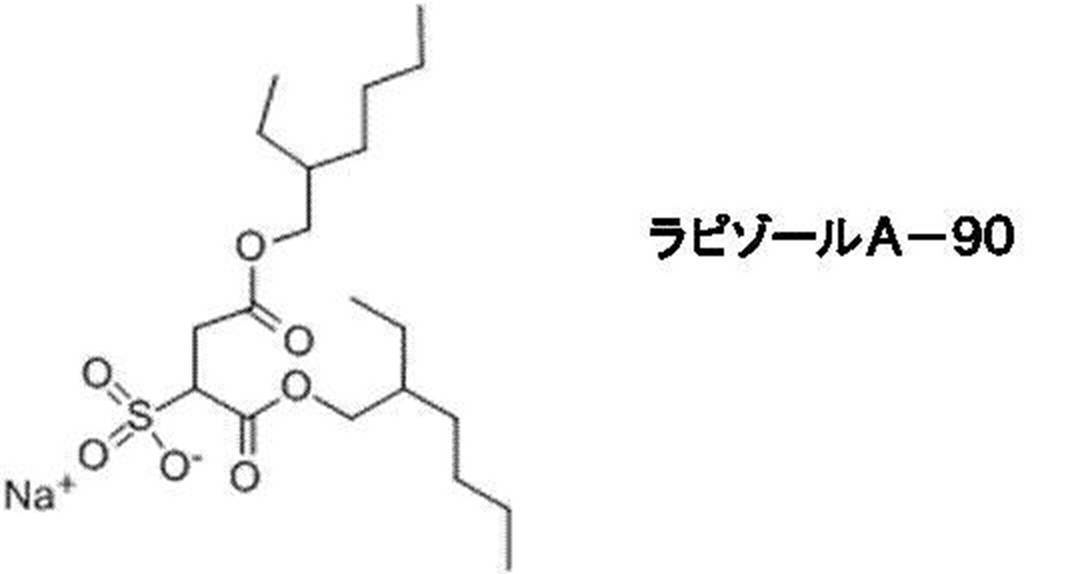
(実施例2)
実施例1において、1質量%ラピゾールA-90(日油社製;特定化合物)0.003質量%を、1質量%Zonyl 7950(aldrich社製;炭素数3以上のフッ化アルキル基とエステル基を有する界面活性剤(特定化合物))0.003質量%に代えたこと以外は、実施例1と同様にして、酸性ガス分離層として機能する分離膜(2)を作製した。
実施例1において、1質量%ラピゾールA-90(日油社製;特定化合物)0.003質量%を、1質量%Zonyl 7950(aldrich社製;炭素数3以上のフッ化アルキル基とエステル基を有する界面活性剤(特定化合物))0.003質量%に代えたこと以外は、実施例1と同様にして、酸性ガス分離層として機能する分離膜(2)を作製した。
(実施例3)
実施例1において、1質量%ラピゾールA-90(日油社製;特定化合物)0.003質量%を、1質量%サーフロンS231(AGCセイミケミカル社製;炭素数3以上のフッ化アルキル基を有する界面活性剤(特定化合物))0.003質量%に代えたこと以外は、実施例1と同様にして、酸性ガス分離層として機能する分離膜(3)を作製した。
実施例1において、1質量%ラピゾールA-90(日油社製;特定化合物)0.003質量%を、1質量%サーフロンS231(AGCセイミケミカル社製;炭素数3以上のフッ化アルキル基を有する界面活性剤(特定化合物))0.003質量%に代えたこと以外は、実施例1と同様にして、酸性ガス分離層として機能する分離膜(3)を作製した。
(実施例4)
実施例1において、1質量%ラピゾールA-90(日油社製;特定化合物)0.003質量%を、1質量%スリパックスL(日本化成社製;下記構造で表される界面活性剤、分子量=425(特定化合物))0.003質量%に代えたこと以外は、実施例1と同様にして、酸性ガス分離層として機能する分離膜(4)を作製した。
実施例1において、1質量%ラピゾールA-90(日油社製;特定化合物)0.003質量%を、1質量%スリパックスL(日本化成社製;下記構造で表される界面活性剤、分子量=425(特定化合物))0.003質量%に代えたこと以外は、実施例1と同様にして、酸性ガス分離層として機能する分離膜(4)を作製した。

(実施例5)
実施例1において、1質量%ラピゾールA-90(日油社製;特定化合物)0.003質量%を、1質量%ケミパールw-308(三井化学(株)製、平均粒子径:7μm、比重:0.97g/cm3、真球のポリエチレン粒子(ポリマー粒子))0.003質量%に代えたこと以外は、実施例1と同様にして、酸性ガス分離層として機能する分離膜(5)を作製した。
作製した分離膜におけるポリエチレン粒子による占有面積(被覆面積)は、8.2%であった。占有面積は、走査型電子顕微鏡(JSM6610、JEOL社製)を用い、単位面積あたりの粒子被覆率を画像解析することにより求めた。
実施例1において、1質量%ラピゾールA-90(日油社製;特定化合物)0.003質量%を、1質量%ケミパールw-308(三井化学(株)製、平均粒子径:7μm、比重:0.97g/cm3、真球のポリエチレン粒子(ポリマー粒子))0.003質量%に代えたこと以外は、実施例1と同様にして、酸性ガス分離層として機能する分離膜(5)を作製した。
作製した分離膜におけるポリエチレン粒子による占有面積(被覆面積)は、8.2%であった。占有面積は、走査型電子顕微鏡(JSM6610、JEOL社製)を用い、単位面積あたりの粒子被覆率を画像解析することにより求めた。
(実施例6)
実施例1において、1質量%ラピゾールA-90(日油社製;特定化合物)0.003質量%を、X-22-170BX(信越化学工業社製;シロキサン構造を有する化合物(特定化合物))0.003質量%に代えたこと以外は、実施例1と同様にして、酸性ガス分離層として機能する分離膜(6)を作製した。
実施例1において、1質量%ラピゾールA-90(日油社製;特定化合物)0.003質量%を、X-22-170BX(信越化学工業社製;シロキサン構造を有する化合物(特定化合物))0.003質量%に代えたこと以外は、実施例1と同様にして、酸性ガス分離層として機能する分離膜(6)を作製した。
(実施例7~8)
実施例1において、1質量%ラピゾールA-90(日油社製;特定化合物)の添加量を、0.003質量%から、0.1(実施例7)、0.01(実施例8)に変更したこと以外は、実施例1と同様にして、酸性ガス分離層として機能する分離膜(7)~(8)を作製した。界面活性剤の含有量は、分離膜(1)の全固形分に対して、1.4質量%(実施例7)、0.14質量%(実施例8)であった。
実施例1において、1質量%ラピゾールA-90(日油社製;特定化合物)の添加量を、0.003質量%から、0.1(実施例7)、0.01(実施例8)に変更したこと以外は、実施例1と同様にして、酸性ガス分離層として機能する分離膜(7)~(8)を作製した。界面活性剤の含有量は、分離膜(1)の全固形分に対して、1.4質量%(実施例7)、0.14質量%(実施例8)であった。
(実施例9)
実施例5において、1質量%ケミパールw-308(ポリエチレン粒子;ポリマー粒子)0.003質量%を、1質量%ケミパールwp-100(三井化学社製、平均粒子径:1.0μm、比重:0.9g/cm3、ポリプロピレン粒子(ポリマー粒子))0.003質量%に代えたこと以外は、実施例5と同様にして、酸性ガス分離層として機能する分離膜(9)を作製した。
実施例5において、1質量%ケミパールw-308(ポリエチレン粒子;ポリマー粒子)0.003質量%を、1質量%ケミパールwp-100(三井化学社製、平均粒子径:1.0μm、比重:0.9g/cm3、ポリプロピレン粒子(ポリマー粒子))0.003質量%に代えたこと以外は、実施例5と同様にして、酸性ガス分離層として機能する分離膜(9)を作製した。
(比較例1)
クラストマーAP-20(クラレ社製;ポリビニルアルコール-ポリアクリル酸塩共重合体(吸収性ポリマー))2.4質量%、及び25質量%グルタルアルデヒド水溶液(Wako社製;架橋剤)0.01質量%を含む水溶液に、1M塩酸をpH1になるまで添加し、架橋した。その後、これに40質量%炭酸セシウム(稀産金属社製;アルカリ金属塩)水溶液を、炭酸セシウム濃度が6.0質量%になるように添加し、塗布液とした。
多孔質支持体としてPTFE/PP不織布(GE社製)を用意し、この不織布の上に得られた塗布液を塗布し、乾燥させることで、分離膜(10)を作製した。
クラストマーAP-20(クラレ社製;ポリビニルアルコール-ポリアクリル酸塩共重合体(吸収性ポリマー))2.4質量%、及び25質量%グルタルアルデヒド水溶液(Wako社製;架橋剤)0.01質量%を含む水溶液に、1M塩酸をpH1になるまで添加し、架橋した。その後、これに40質量%炭酸セシウム(稀産金属社製;アルカリ金属塩)水溶液を、炭酸セシウム濃度が6.0質量%になるように添加し、塗布液とした。
多孔質支持体としてPTFE/PP不織布(GE社製)を用意し、この不織布の上に得られた塗布液を塗布し、乾燥させることで、分離膜(10)を作製した。
(比較例2)
実施例5において、1質量%ケミパールw-308(ポリエチレン粒子;ポリマー粒子)0.003質量%を、KE-S50(日本触媒社製、平均粒子径:0.5μm、比重:2.0g/cm3、シリカ粒子)0.003質量%に代えたこと以外は、実施例5と同様にして、酸性ガス分離層として機能する分離膜(11)を作製した。
実施例5において、1質量%ケミパールw-308(ポリエチレン粒子;ポリマー粒子)0.003質量%を、KE-S50(日本触媒社製、平均粒子径:0.5μm、比重:2.0g/cm3、シリカ粒子)0.003質量%に代えたこと以外は、実施例5と同様にして、酸性ガス分離層として機能する分離膜(11)を作製した。
(評価)
実施例1~9、比較例1~2において作製した分離膜を用い、二酸化炭素ガスの分離性能及びブロッキング性能について、以下の評価を行なった。評価結果は、下記表2に示す。
実施例1~9、比較例1~2において作製した分離膜を用い、二酸化炭素ガスの分離性能及びブロッキング性能について、以下の評価を行なった。評価結果は、下記表2に示す。
-1.酸性ガス分離性能-
支持体ごと直径47mmのサイズに切り取り、切り取った試料片をPTFEメンブレンフィルターの間に挟み、透過試験サンプルを作製した。
テストガスとしてCO2/H2=10/90(容積比)の混合ガスを相対湿度70%、流量500ml/分、温度130℃、全圧301.3kPaの条件にて、各透過試験サンプル(有効面積:2.40cm2)の一方の側から供給し、他方の側にArガス(流量:90ml/分)をフローさせた。分離膜を透過してきたテストガスを、ガスクロマトグラフで分析し、CO2透過速度(P(CO2))と分離係数(α)を算出した。初期値を下記表2に示す。
支持体ごと直径47mmのサイズに切り取り、切り取った試料片をPTFEメンブレンフィルターの間に挟み、透過試験サンプルを作製した。
テストガスとしてCO2/H2=10/90(容積比)の混合ガスを相対湿度70%、流量500ml/分、温度130℃、全圧301.3kPaの条件にて、各透過試験サンプル(有効面積:2.40cm2)の一方の側から供給し、他方の側にArガス(流量:90ml/分)をフローさせた。分離膜を透過してきたテストガスを、ガスクロマトグラフで分析し、CO2透過速度(P(CO2))と分離係数(α)を算出した。初期値を下記表2に示す。
-2.ブロッキング耐性-
各分離膜について、2枚の分離膜をそれぞれの塗布面と支持体面とが接触するように重ね、下記の条件にて放置した後、界面を剥離して塗布面における接着剥離の有無を下記評価基準にしたがって評価した。
<条件>
・放置環境 :温度25℃、相対湿度50%
・放置時の加圧:0.1MPa
・放置時間 :24時間
<評価基準>
A:剥離は認められなかった。
B:クッツキはみられたが、剥離は認められなかった。
C:著しい剥離が認められた。
各分離膜について、2枚の分離膜をそれぞれの塗布面と支持体面とが接触するように重ね、下記の条件にて放置した後、界面を剥離して塗布面における接着剥離の有無を下記評価基準にしたがって評価した。
<条件>
・放置環境 :温度25℃、相対湿度50%
・放置時の加圧:0.1MPa
・放置時間 :24時間
<評価基準>
A:剥離は認められなかった。
B:クッツキはみられたが、剥離は認められなかった。
C:著しい剥離が認められた。

前記表2に示すように、実施例では、二酸化炭素の分離性を良好に維持したまま、ブロッキングの発生が抑制された。これに対し、特定のアルキル基又はフッ化アルキル基と親水性基とを有する化合物もしくはシロキサン構造を有する化合物、又はポリマー粒子を加えなかった比較例では、分離膜表面が結露ないし湿った状態になり、ブロッキングの発生を抑えることができなかった。
2012年7月11日に出願された、日本国特許出願2012-155923の開示はその全体が参照により本明細書に取り込まれる。本明細書に記載された全ての文献、特許出願、および技術規格は、個々の文献、特許出願、および技術規格が参照により取り込まれることが具体的かつ個々に記された場合と同程度に、本明細書中に参照により取り込まれる。本発明の例示的実施形態についての以上の記載は例示および説明の目的でされたものであり、網羅的であることあるいは発明を開示されている形態そのものに限定することを意図するものではない。明らかなことではあるが、多くの改変あるいは変更が当業者には自明である。上記実施形態は発明の原理及び実用的応用を最もうまく説明し、想定される特定の用途に適するような種々の実施形態や種々の改変と共に他の当業者が発明を理解できるようにするために選択され、記載された。本発明の範囲の範囲は以下の請求項およびその均等物によって規定されることが意図されている。
Claims (14)
- 炭素数3~20のアルキル基又は炭素数3~20のフッ化アルキル基と親水性基とを有する化合物及びシロキサン構造を有する化合物からなる群より選ばれる化合物並びに平均粒子径が0.01μm~1000μmでかつ比重が0.5g/cm3~1.3g/cm3のポリマー粒子から選ばれる少なくとも一種と、吸水性ポリマーと、アルカリ金属塩から選ばれる二酸化炭素キャリアとを含む酸性ガス分離層形成用塗布液を調製する塗布液調製工程と、
長尺状の多孔質支持体上に前記酸性ガス分離層形成用塗布液を塗布する塗布工程と、
前記塗布により形成された塗布膜を乾燥させて酸性ガス分離層とする乾燥工程と、
を有し、多孔質支持体を一定方向に搬送しながら酸性ガス分離層を連続形成し、多孔質支持体上に酸性ガス分離層を有する酸性ガス分離用複合体を製造する酸性ガス分離用複合体の製造方法。 - 前記酸性ガス分離層中における、前記炭素数3~20のアルキル基又は炭素数3~20のフッ化アルキル基と親水性基とを有する化合物、及び前記シロキサン構造を有する化合物の総含有量が、酸性ガス分離層の全固形分に対して、0.01質量%~10質量%である請求項1に記載の酸性ガス分離用複合体の製造方法。
- 前記酸性ガス分離層中における、前記炭素数3~20のアルキル基又は炭素数3~20のフッ化アルキル基と親水性基とを有する化合物の含有量が、酸性ガス分離層の全固形分に対して、0.01質量%~10質量%である請求項1又は2に記載の酸性ガス分離用複合体の製造方法。
- 前記酸性ガス分離層中における、シロキサン構造を有する化合物の含有量が、酸性ガス分離層の全固形分に対して、0.01質量%~10質量%である請求項1~請求項3のいずれか1項に記載の酸性ガス分離用複合体の製造方法。
- 前記酸性ガス分離層の表面における前記ポリマー粒子の占有面積が、0.1%~60%である請求項1~請求項4のいずれか1項に記載の酸性ガス分離用複合体の製造方法。
- 前記炭素数3~20のアルキル基又は炭素数3~20のフッ化アルキル基と親水性基とを有する化合物は、分子量が60~2000である請求項1~請求項5のいずれか1項に記載の酸性ガス分離用複合体の製造方法。
- 炭素数3~20のアルキル基又は炭素数3~20のフッ化アルキル基と親水性基とを有する化合物及びシロキサン構造を有する化合物からなる群より選ばれる化合物並びに平均粒子径が0.01μm~1000μmでかつ比重が0.5g/cm3~1.3g/cm3のポリマー粒子から選ばれる少なくとも一種が、炭素数3~20のアルキル基と親水性基とを有する化合物である請求項1~請求項3及び請求項6のいずれか1項に記載の酸性ガス分離用複合体の製造方法。
- 炭素数3~20のアルキル基又は炭素数3~20のフッ化アルキル基と親水性基とを有する化合物及びシロキサン構造を有する化合物からなる群より選ばれる化合物並びに平均粒子径が0.01μm~1000μmでかつ比重が0.5g/cm3~1.3g/cm3のポリマー粒子から選ばれる少なくとも一種が、炭素数3~20のフッ化アルキル基と親水性基とを有する化合物である請求項1~請求項3及び請求項6のいずれか1項に記載の酸性ガス分離用複合体の製造方法。
- 炭素数3~20のアルキル基又は炭素数3~20のフッ化アルキル基と親水性基とを有する化合物及びシロキサン構造を有する化合物からなる群より選ばれる化合物並びに平均粒子径が0.01μm~1000μmでかつ比重が0.5g/cm3~1.3g/cm3のポリマー粒子から選ばれる少なくとも一種が、シロキサン構造を有する化合物である請求項1、請求項2及び請求項4のいずれか1項に記載の酸性ガス分離用複合体の製造方法。
- 炭素数3~20のアルキル基又は炭素数3~20のフッ化アルキル基と親水性基とを有する化合物及びシロキサン構造を有する化合物からなる群より選ばれる化合物並びに平均粒子径が0.01μm~1000μmでかつ比重が0.5g/cm3~1.3g/cm3のポリマー粒子から選ばれる少なくとも一種が、平均粒子径が0.01μm~1000μmでかつ比重が0.5g/cm3~1.3g/cm3のポリマー粒子である請求項1又は請求項5に記載の酸性ガス分離用複合体の製造方法。
- 前記アルカリ金属塩は、ルビジウム塩及びセシウム塩からなる群より選択される請求項1~請求項10のいずれか1項に記載の酸性ガス分離用複合体の製造方法。
- 2種の前記アルカリ金属塩を含み、前記2種のうちの一方のアルカリ金属塩はルビジウム塩及びセシウム塩からなる群より選択され、他方のアルカリ金属塩はカリウム塩から選択される請求項1~請求項11のいずれか1項に記載の酸性ガス分離用複合体の製造方法。
- 多孔質支持体上に、炭素数3~20のアルキル基又は炭素数3~20のフッ化アルキル基と親水性基とを有する化合物及びシロキサン構造を有する化合物からなる群より選ばれる化合物並びに平均粒子径が0.01μm~1000μmでかつ比重が0.5g/cm3~1.3g/cm3のポリマー粒子から選ばれる少なくとも一種と、吸水性ポリマーと、アルカリ金属塩から選ばれる二酸化炭素キャリアとを含む酸性ガス分離層を有する酸性ガス分離用複合体。
- 請求項1~請求項12のいずれか1項に記載の酸性ガス分離用複合体の製造方法により製造された酸性ガス分離用複合体、又は請求項13に記載の酸性ガス分離用複合体を備えた酸性ガス分離モジュール。
Applications Claiming Priority (2)
| Application Number | Priority Date | Filing Date | Title |
|---|---|---|---|
| JP2012-155923 | 2012-07-11 | ||
| JP2012155923A JP2014014806A (ja) | 2012-07-11 | 2012-07-11 | 酸性ガス分離用複合体及びその製造方法並びに酸性ガス分離モジュール |
Publications (1)
| Publication Number | Publication Date |
|---|---|
| WO2014010512A1 true WO2014010512A1 (ja) | 2014-01-16 |
Family
ID=49915969
Family Applications (1)
| Application Number | Title | Priority Date | Filing Date |
|---|---|---|---|
| PCT/JP2013/068421 Ceased WO2014010512A1 (ja) | 2012-07-11 | 2013-07-04 | 酸性ガス分離用複合体及びその製造方法並びに酸性ガス分離モジュール |
Country Status (2)
| Country | Link |
|---|---|
| JP (1) | JP2014014806A (ja) |
| WO (1) | WO2014010512A1 (ja) |
Cited By (11)
| Publication number | Priority date | Publication date | Assignee | Title |
|---|---|---|---|---|
| US9956541B2 (en) | 2014-12-12 | 2018-05-01 | Exxonmobil Research And Engineering Company | Methods of separating aromatic compounds from lube base stocks |
| US10022700B2 (en) | 2014-12-12 | 2018-07-17 | Exxonmobil Research And Engineering Company | Organosilica materials and uses thereof |
| US10022701B2 (en) | 2014-12-12 | 2018-07-17 | Exxonmobil Research And Engineering Company | Coating methods using organosilica materials and uses thereof |
| US10047304B2 (en) | 2014-12-12 | 2018-08-14 | Exxonmobil Research And Engineering Company | Aromatic hydrogenation catalysts and uses thereof |
| US10183272B2 (en) | 2014-12-12 | 2019-01-22 | Exxonmobil Research And Engineering Company | Adsorbent for heteroatom species removal and uses thereof |
| US10207249B2 (en) | 2014-12-12 | 2019-02-19 | Exxonmobil Research And Engineering Company | Organosilica materials and uses thereof |
| US10435514B2 (en) | 2016-06-10 | 2019-10-08 | Exxonmobil Research And Engineering Company | Organosilica materials, methods of making, and uses thereof |
| US10544239B2 (en) | 2014-12-12 | 2020-01-28 | Exxonmobile Research And Engineering Company | Organosilica materials and uses thereof |
| US10576453B2 (en) | 2014-12-12 | 2020-03-03 | Exxonmobil Research And Engineering Company | Membrane fabrication methods using organosilica materials and uses thereof |
| US10765993B2 (en) | 2017-03-31 | 2020-09-08 | Sumitomo Chemical Company, Limited | Gel including condensation product of organic silicon compound |
| US11111352B2 (en) | 2017-12-21 | 2021-09-07 | Exxonmobil Research And Engineering Company | Methods of producing organosilica materials and uses thereof |
Citations (4)
| Publication number | Priority date | Publication date | Assignee | Title |
|---|---|---|---|---|
| WO2009093666A1 (ja) * | 2008-01-24 | 2009-07-30 | Renaissance Energy Research Corporation | Co2促進輸送膜及びその製造方法 |
| WO2011099587A1 (ja) * | 2010-02-10 | 2011-08-18 | 富士フイルム株式会社 | ガス分離膜、その製造方法、並びにそれを用いたガス分離方法、モジュール及び分離装置 |
| WO2011122581A1 (ja) * | 2010-03-29 | 2011-10-06 | 富士フイルム株式会社 | ガス分離膜その製造方法、それらを用いたガス混合物の分離方法、ガス分離膜モジュール、気体分離装置 |
| JP2013027841A (ja) * | 2011-07-29 | 2013-02-07 | Fujifilm Corp | 二酸化炭素分離部材、その製造方法及び二酸化炭素分離モジュール |
-
2012
- 2012-07-11 JP JP2012155923A patent/JP2014014806A/ja active Pending
-
2013
- 2013-07-04 WO PCT/JP2013/068421 patent/WO2014010512A1/ja not_active Ceased
Patent Citations (4)
| Publication number | Priority date | Publication date | Assignee | Title |
|---|---|---|---|---|
| WO2009093666A1 (ja) * | 2008-01-24 | 2009-07-30 | Renaissance Energy Research Corporation | Co2促進輸送膜及びその製造方法 |
| WO2011099587A1 (ja) * | 2010-02-10 | 2011-08-18 | 富士フイルム株式会社 | ガス分離膜、その製造方法、並びにそれを用いたガス分離方法、モジュール及び分離装置 |
| WO2011122581A1 (ja) * | 2010-03-29 | 2011-10-06 | 富士フイルム株式会社 | ガス分離膜その製造方法、それらを用いたガス混合物の分離方法、ガス分離膜モジュール、気体分離装置 |
| JP2013027841A (ja) * | 2011-07-29 | 2013-02-07 | Fujifilm Corp | 二酸化炭素分離部材、その製造方法及び二酸化炭素分離モジュール |
Cited By (12)
| Publication number | Priority date | Publication date | Assignee | Title |
|---|---|---|---|---|
| US9956541B2 (en) | 2014-12-12 | 2018-05-01 | Exxonmobil Research And Engineering Company | Methods of separating aromatic compounds from lube base stocks |
| US10022700B2 (en) | 2014-12-12 | 2018-07-17 | Exxonmobil Research And Engineering Company | Organosilica materials and uses thereof |
| US10022701B2 (en) | 2014-12-12 | 2018-07-17 | Exxonmobil Research And Engineering Company | Coating methods using organosilica materials and uses thereof |
| US10047304B2 (en) | 2014-12-12 | 2018-08-14 | Exxonmobil Research And Engineering Company | Aromatic hydrogenation catalysts and uses thereof |
| US10183272B2 (en) | 2014-12-12 | 2019-01-22 | Exxonmobil Research And Engineering Company | Adsorbent for heteroatom species removal and uses thereof |
| US10207249B2 (en) | 2014-12-12 | 2019-02-19 | Exxonmobil Research And Engineering Company | Organosilica materials and uses thereof |
| US10544239B2 (en) | 2014-12-12 | 2020-01-28 | Exxonmobile Research And Engineering Company | Organosilica materials and uses thereof |
| US10576453B2 (en) | 2014-12-12 | 2020-03-03 | Exxonmobil Research And Engineering Company | Membrane fabrication methods using organosilica materials and uses thereof |
| US10661262B2 (en) | 2014-12-12 | 2020-05-26 | Exxonmobil Research & Engineering Company | Aromatic hydrogenation catalysts and uses thereof |
| US10435514B2 (en) | 2016-06-10 | 2019-10-08 | Exxonmobil Research And Engineering Company | Organosilica materials, methods of making, and uses thereof |
| US10765993B2 (en) | 2017-03-31 | 2020-09-08 | Sumitomo Chemical Company, Limited | Gel including condensation product of organic silicon compound |
| US11111352B2 (en) | 2017-12-21 | 2021-09-07 | Exxonmobil Research And Engineering Company | Methods of producing organosilica materials and uses thereof |
Also Published As
| Publication number | Publication date |
|---|---|
| JP2014014806A (ja) | 2014-01-30 |
Similar Documents
| Publication | Publication Date | Title |
|---|---|---|
| WO2014010512A1 (ja) | 酸性ガス分離用複合体及びその製造方法並びに酸性ガス分離モジュール | |
| TWI614059B (zh) | 氣體分離模組與氣體分離系統 | |
| US9266066B2 (en) | Membrane with localized asymmetries | |
| EP2365869B1 (en) | Method for forming a microporous membrane | |
| KR102066315B1 (ko) | 다층 중합체의 혼합 매트릭스 막 제조를 위한 신규 기법 및 막 증류용 장치 | |
| JP6156837B2 (ja) | 酸性ガス分離用複合体の製造方法 | |
| TWI716574B (zh) | 酸性氣體分離膜及使用該分離膜之酸性氣體分離方法,以及酸性氣體分離模組及酸性氣體分離裝置 | |
| WO2012096055A1 (ja) | 二酸化炭素分離膜形成用組成物、二酸化炭素分離膜及びその製造方法、並びに二酸化炭素分離装置 | |
| CN105102107A (zh) | 酸性气体分离复合膜的制造方法和酸性气体分离膜组件 | |
| WO2011136865A1 (en) | Polyamide membrane with a coating comprising polyalkylene oxide and triazine compounds | |
| CN108136339A (zh) | 用于提高通过tfc膜的水通量的方法 | |
| WO2014010336A1 (ja) | 二酸化炭素分離用複合体の製造方法、二酸化炭素分離用複合体及び二酸化炭素分離用モジュール | |
| JP5845513B2 (ja) | 孔が大きいポリマー膜 | |
| ES2881098T3 (es) | Membrana semipermeable compuesta | |
| JP5840574B2 (ja) | 二酸化炭素分離用複合体の製造方法、二酸化炭素分離用複合体、及び二酸化炭素分離用モジュール | |
| US20150367288A1 (en) | Composite polyamide membrane including dissolvable polymer coating | |
| EP1778388B1 (en) | Membrane gaz seperation | |
| KR20220038162A (ko) | 기계적으로 안정한 한외 여과 막과 이를 제조하기 위한 방법 | |
| CN112261990B (zh) | 亲水性多孔膜及亲水性多孔膜的制造方法 | |
| JP2014039901A (ja) | 二酸化炭素分離用複合体の製造方法、二酸化炭素分離用複合体、及びそれを用いた二酸化炭素分離用モジュールの製造方法、並びに二酸化炭素分離用モジュール | |
| JP6145349B2 (ja) | 酸性ガス分離モジュール | |
| WO2023276483A1 (ja) | 正浸透膜、及びそれを含む正浸透膜モジュール | |
| JP2014014809A (ja) | 二酸化炭素分離用複合体の製造方法、二酸化炭素分離用複合体、二酸化炭素分離モジュール、二酸化炭素分離装置、及び二酸化炭素分離システム | |
| JP7127201B2 (ja) | 親水性多孔質膜および親水性多孔質膜の製造方法 | |
| JP7177016B2 (ja) | 多孔質膜およびフィルターカートリッジ |
Legal Events
| Date | Code | Title | Description |
|---|---|---|---|
| 121 | Ep: the epo has been informed by wipo that ep was designated in this application |
Ref document number: 13816673 Country of ref document: EP Kind code of ref document: A1 |
|
| NENP | Non-entry into the national phase |
Ref country code: DE |
|
| 122 | Ep: pct application non-entry in european phase |
Ref document number: 13816673 Country of ref document: EP Kind code of ref document: A1 |