WO2014007144A1 - 脂環式n-オキシル化合物の製造方法 - Google Patents
脂環式n-オキシル化合物の製造方法 Download PDFInfo
- Publication number
- WO2014007144A1 WO2014007144A1 PCT/JP2013/067699 JP2013067699W WO2014007144A1 WO 2014007144 A1 WO2014007144 A1 WO 2014007144A1 JP 2013067699 W JP2013067699 W JP 2013067699W WO 2014007144 A1 WO2014007144 A1 WO 2014007144A1
- Authority
- WO
- WIPO (PCT)
- Prior art keywords
- alicyclic
- secondary amine
- compound
- solid
- amine compound
- Prior art date
- Legal status (The legal status is an assumption and is not a legal conclusion. Google has not performed a legal analysis and makes no representation as to the accuracy of the status listed.)
- Ceased
Links
- UFLXKQBCEYNCDU-UHFFFAOYSA-N CC(C)(C1)NC(C)(C)CC1OC(C(C)=C)=O Chemical compound CC(C)(C1)NC(C)(C)CC1OC(C(C)=C)=O UFLXKQBCEYNCDU-UHFFFAOYSA-N 0.000 description 1
- 0 CC(C)(CC(CC1(C)*)OC(C(C)=C)=O)N1O Chemical compound CC(C)(CC(CC1(C)*)OC(C(C)=C)=O)N1O 0.000 description 1
Classifications
-
- C—CHEMISTRY; METALLURGY
- C07—ORGANIC CHEMISTRY
- C07D—HETEROCYCLIC COMPOUNDS
- C07D211/00—Heterocyclic compounds containing hydrogenated pyridine rings, not condensed with other rings
- C07D211/92—Heterocyclic compounds containing hydrogenated pyridine rings, not condensed with other rings with a hetero atom directly attached to the ring nitrogen atom
-
- C—CHEMISTRY; METALLURGY
- C07—ORGANIC CHEMISTRY
- C07D—HETEROCYCLIC COMPOUNDS
- C07D451/00—Heterocyclic compounds containing 8-azabicyclo [3.2.1] octane, 9-azabicyclo [3.3.1] nonane, or 3-oxa-9-azatricyclo [3.3.1.0<2,4>] nonane ring systems, e.g. tropane or granatane alkaloids, scopolamine; Cyclic acetals thereof
- C07D451/14—Heterocyclic compounds containing 8-azabicyclo [3.2.1] octane, 9-azabicyclo [3.3.1] nonane, or 3-oxa-9-azatricyclo [3.3.1.0<2,4>] nonane ring systems, e.g. tropane or granatane alkaloids, scopolamine; Cyclic acetals thereof containing 9-azabicyclo [3.3.1] nonane ring systems, e.g. granatane, 2-aza-adamantane; Cyclic acetals thereof
-
- Y—GENERAL TAGGING OF NEW TECHNOLOGICAL DEVELOPMENTS; GENERAL TAGGING OF CROSS-SECTIONAL TECHNOLOGIES SPANNING OVER SEVERAL SECTIONS OF THE IPC; TECHNICAL SUBJECTS COVERED BY FORMER USPC CROSS-REFERENCE ART COLLECTIONS [XRACs] AND DIGESTS
- Y02—TECHNOLOGIES OR APPLICATIONS FOR MITIGATION OR ADAPTATION AGAINST CLIMATE CHANGE
- Y02P—CLIMATE CHANGE MITIGATION TECHNOLOGIES IN THE PRODUCTION OR PROCESSING OF GOODS
- Y02P20/00—Technologies relating to chemical industry
- Y02P20/50—Improvements relating to the production of bulk chemicals
- Y02P20/584—Recycling of catalysts
Definitions
- the present invention relates to a method for producing an alicyclic N-oxyl compound characterized by oxidizing an alicyclic secondary amine compound in a solid dispersed phase.
- N-oxyl compounds such as 2,2,6,6-tetramethylpiperidine-N-oxyl (hereinafter referred to as “TEMPO”) are unsaturated radical polymerization inhibitors, light stabilizers, and co-oxidation of oxidation reactions. It is an organic nitroxy radical compound used as an agent.
- TEMPO 2,2,6,6-tetramethylpiperidine-N-oxyl
- various N-oxyl compounds have been developed in recent years and are expected as functional materials. This N-oxyl compound can be produced by oxidizing a secondary amine compound with hydrogen peroxide or the like, and various production methods are known.
- Patent Document 1 discloses a method of reacting a secondary amine and hydrogen peroxide in the presence of a tungsten oxide catalyst.
- Patent Document 2 discloses a method of reacting a secondary amine and hydrogen peroxide in a non-reactive catalyst system.
- Patent Document 3 discloses that 2-azaadamantane is oxidized with urea-hydrogen peroxide complex (UHP) in methanol and methylene chloride using sodium tungstate dihydrate as a catalyst.
- UHP urea-hydrogen peroxide complex
- the present invention solves the above-mentioned problems of the prior art, and is a method for producing an alicyclic N-oxyl compound by oxidizing an alicyclic secondary amine with an oxidizing agent, wherein the oxidation reaction It is an object of the present invention to provide a method that can be carried out without using a catalyst that is difficult to regenerate and reuse in a dispersed phase, and that can provide a higher conversion rate and selectivity.
- the present inventor has used hydrotalcite as a solid dispersed phase, and in this solid dispersed phase, an alicyclic secondary amine is oxidized with an oxidizing agent, so that a catalyst is not used.
- the present inventors have found that an alicyclic N-oxyl compound can be obtained with high conversion and selectivity. That is, said subject is solved by the invention which consists of a structure shown below.
- the invention according to claim 1 is a mixture of an alicyclic secondary amine compound and an oxidizing agent in a solid dispersed phase comprising hydrotalcite, and the alicyclic secondary amine compound is mixed in the solid dispersed phase. It is a method for producing an alicyclic N-oxyl compound characterized by being oxidized at
- the production method of the present invention oxidizes an alicyclic secondary amine compound in a state where an alicyclic secondary amine compound and an oxidizing agent are dispersed in a solid dispersion phase, that is, a solid phase system or a state close to a solid phase system.
- a solid phase system refers to a system having fluidity that can be stirred but also having self-retaining properties, that is, a system having a shape that does not collapse due to its own weight.
- the state close to a solid phase system does not have a self-retaining property, but the weight of the liquid component (including the oxidant solvent) contained in the system is twice the weight of the solid dispersed phase.
- an alicyclic N-oxyl compound can be obtained from an alicyclic secondary amine with high conversion and selectivity. That is, high conversion and selectivity can be achieved without using a catalyst (for example, the polyacid catalyst described in Patent Document 3).
- the inventor of the present invention as for the oxidation of the alicyclic secondary amine compound, by selecting a specific one from the conventionally known solid dispersed phase, that is, hydrotalcite, as the solid dispersed phase, The present invention has been completed by discovering that even in a solid phase system, an N-oxyl compound can be produced by oxidizing with an oxidizing agent without using a catalyst, and that a high conversion rate and selectivity can be achieved.
- the present invention is characterized by using hydrotalcite as a solid dispersed phase.
- the hydrotalcite used in the method of the present invention is the formula (M 2+ ) 1-x (M 3+ ) x (OH) 2 (A n ⁇ ) x / n ⁇ aH 2 O (wherein M 2+ is a divalent metal ion, M 3+ is a trivalent metal ion, a n-represents an n-valent anion, and x and a respectively 0 ⁇ x ⁇ 0.5,0 ⁇ a ⁇ 1 range At least one of the compounds represented by
- Hydrotalcite is a kind of naturally occurring clay mineral, but it precipitates the target product by adjusting the pH to an appropriate value by adding an alkali metal such as sodium hydroxide to an aqueous solution of a predetermined metal salt such as metal nitrate.
- Hydrotalcite prepared by a method (hydrothermal method) using a so-called “hydrothermal synthesis reaction” in which a predetermined metal oxide is heated to about 500 ° C. in water (hydrothermal method) is also suitable in the present invention.
- synthetic hydrotalcite synthesized from MgO / Al 2 O 3 and used as an antacid or the like can also be used as a solid dispersed phase in the present invention.
- magnesium oxide, alumina, apatite, etc. can be used as a solid dispersion phase in addition to hydrotalcite.
- magnesium oxide, alumina, apatite or the like when magnesium oxide, alumina, apatite or the like is used, the intended effect, that is, high conversion and selectivity cannot be achieved.
- Examples of the alicyclic secondary amine compound used as a raw material in the present invention include compounds represented by the following formula (1).
- R1, R2, R3 and R4 represent hydrogen or an alkyl or alkenyl group having about 1 to 10 carbon atoms.
- the present invention can be suitably applied when R1, R2, R3, or R4 represents hydrogen or a lower alkyl group such as methyl, ethyl, propyl, or butyl.
- R1 and R3 may combine to form a ring, or
- R5 may be an alkyl group (alkylene group) and R1, R3, and R5 may combine to form a ring.
- the present invention can be preferably applied.
- R5 represents a monovalent group, and specific examples thereof include an alkyl group such as a hydroxyl group, an amino group, and a methyl group, and an alkenyl group such as a carbonyl group, a nitro group, a sulfone group, and a vinyl group. Further, as described above, R1 and R3 and R5 may be bonded to form a ring.
- the present invention is characterized in that an oxidizing agent is dispersed in a solid dispersed phase composed of hydrotalcite together with an alicyclic secondary amine compound as a raw material compound, and an oxidation reaction is performed in a solid phase system or a state close to a solid phase system.
- an oxidizing agent is dispersed in a solid dispersed phase composed of hydrotalcite together with an alicyclic secondary amine compound as a raw material compound, and an oxidation reaction is performed in a solid phase system or a state close to a solid phase system.
- the range of the addition amount is a range in which a solid phase system or a state close to a solid phase system is maintained.
- the invention according to claim 2 is the method for producing an alicyclic N-oxyl compound according to claim 1, wherein the alicyclic secondary amine compound is a compound having a 2-azaadamantane skeleton. is there.
- the invention according to claim 3 is the production of the alicyclic N-oxyl compound according to claim 1, wherein the alicyclic secondary amine compound is tetramethylpiperidine or hydroxytetramethylpiperidine. Is the method.
- Examples of the alicyclic secondary amine compound represented by the formula (1) include an aliphatic secondary amine having a 6-membered ring structure such as a compound having an azaadamantane skeleton or a compound having a piperidine skeleton. it can. More specifically, 2-azaadamantane represented by the formula (2), tetramethylpiperidine represented by the formula (3) or hydroxytetramethylpiperidine represented by the formula (4) can be mentioned, The present invention is suitably applied to the alicyclic secondary amine compound.
- an aliphatic 2 having a 5-membered ring structure such as a compound having a pyrrolidine skeleton or a pyrroline skeleton.
- a class amine etc. can also be mentioned. It may be an alicyclic compound having two or more secondary amine groups, such as a compound having an imidazolidine skeleton. A compound having an oxazolidine skeleton may also be used.
- the invention according to claim 4 is characterized in that the oxidizing agent is selected from the group consisting of percarbonate, hydrogen peroxide solution and urea-hydrogen peroxide complex.
- the oxidizing agent is selected from the group consisting of percarbonate, hydrogen peroxide solution and urea-hydrogen peroxide complex.
- Examples of the oxidizing agent used in the present invention include aqueous hydrogen peroxide, sodium percarbonate, urea-hydrogen peroxide complex, and sodium perborate powder.
- Hydrogen peroxide is used as hydrogen peroxide, but has the advantage that only water is produced as its high oxygen content and by-product.
- concentration of the hydrogen peroxide solution is high, there is a danger in handling, while when the concentration of the hydrogen peroxide solution is low, it is necessary to add a large amount of the hydrogen peroxide solution, and the solid phase system or solid solution is required. It may not be possible to maintain a state close to a phase system.
- a hydrogen peroxide solution with a concentration of 25% or more is preferable, and a hydrogen peroxide solution with a concentration of 25 to 45% is preferably used in consideration of handling safety. .
- the urea-hydrogen peroxide complex is used as a powder, and has the advantage that it is easy to handle and highly safe during the reaction as compared with aqueous hydrogen peroxide.
- the invention according to claim 5 is the method for producing an alicyclic N-oxyl compound according to claim 4, wherein the oxidizing agent is sodium percarbonate.
- Sodium percarbonate is an adduct of sodium carbonate and hydrogen peroxide (sodium carbonate added with 1.5 moles of hydrogen peroxide), which is easily dissolved in water and dissolved in water. It becomes an aqueous solution of sodium carbonate. It is mainly used as a mild non-chlorine bleach and is also included in commercial household detergents, making it highly safe. Like the urea-hydrogen peroxide complex, it is used as a powder and has the advantages that it is easy to handle during the reaction and has higher safety than the hydrogen peroxide solution. Furthermore, it is preferable to use sodium percarbonate as an oxidizing agent because the conversion rate and selectivity can be further increased.
- Sodium percarbonate and urea-hydrogen peroxide complex are solid powders, safe as long as they are sealed and stored at room temperature, are much easier to handle than hydrogen peroxide, and are subject to transportation restrictions. There is also an advantage of not. Furthermore, it is also preferable in that it is easy to maintain a solid phase system of an oxidation reaction system or a state close to a solid phase system.
- the particle size of the solid powder of sodium percarbonate or urea-hydrogen peroxide complex is not particularly limited, and commercially available particles with a particle size of about 1 ⁇ m to 1000 ⁇ m can be used, and granulated products can also be used. it can. From the viewpoint of improving the reaction rate, those having a small particle size are preferred.
- the amount of the oxidizing agent added is 2 to 10 times mol of the alicyclic secondary amine compound in terms of the amount of hydrogen peroxide contained in the oxidizing agent.
- the amount of the oxidizing agent added is suitably in the range of 2 to 10 moles per mole of the alicyclic secondary amine compound in terms of the amount of hydrogen peroxide contained in the oxidizing agent.
- the oxidizing agent is hydrogen peroxide solution
- the number of moles of hydrogen peroxide contained in the hydrogen peroxide solution is “the amount of oxidizing agent converted to the amount of hydrogen peroxide contained in the oxidizing agent.
- the number of moles of hydrogen peroxide constituting the percarbonate or urea-hydrogen peroxide complex is contained in the oxidizing agent.
- the amount of oxidant added in terms of the amount of hydrogen peroxide ”.
- 1 mole of sodium percarbonate contains 1.5 moles of hydrogen peroxide, so that 1.5 times the amount of sodium percarbonate added (number of moles) is the amount of oxidizing agent added (moles) converted to the amount of hydrogen peroxide. Number).
- the addition amount of the oxidizing agent is less than 2 moles with respect to 1 mole of the alicyclic secondary amine compound in terms of the amount of hydrogen peroxide contained in the oxidizing agent, high conversion and selectivity are obtained. It becomes difficult.
- the amount exceeds 10 moles the reaction volume increases, so that the reaction rate does not increase and the treatment cost of unreacted hydrogen peroxide increases.
- the oxidizing agent is hydrogen peroxide solution and the amount added exceeds 10 moles, if the concentration of hydrogen peroxide solution is low, the reaction system in a solid phase system or a state close to a solid phase system is maintained. If the concentration is increased, the safety of handling is impaired.
- the invention according to claim 7 is characterized in that the addition amount of the solid dispersed phase is 0.4 to 2.0 g per 1 mmol of the alicyclic secondary amine compound.
- the amount of the solid dispersed phase added is less than 0.4 g with respect to 1 mmol of the alicyclic secondary amine compound, the reaction is slow, while if it exceeds 2 g, the productivity tends to decrease.
- the optimum amount is selected.
- the invention according to claim 8 is a mixture of an alicyclic secondary amine compound and an oxidizing agent in a solid dispersion phase comprising hydrotalcite, and the alicyclic secondary amine compound is mixed in the solid dispersion phase.
- Oxidation step A step of extracting the solid dispersed phase with an organic solvent that dissolves the alicyclic N-oxyl compound after the oxidation; A step of recovering the alicyclic N-oxyl compound from the extract with the organic solvent, a step of washing the solid dispersion phase after extraction, and an alicyclic secondary amine compound and oxidation in the solid dispersion phase after washing with water.
- This production method is carried out after the production method of the alicyclic N-oxyl compound according to the invention of the above-mentioned claim,
- the reaction product, the alicyclic N-oxyl compound is extracted and recovered from the solid dispersed phase with an organic solvent,
- the solid dispersion phase after extraction with the organic solvent is washed with water to remove the decomposition product of the oxidant remaining in the solid dispersion phase (or sodium carbonate if the oxidizer is sodium percarbonate)
- an alicyclic secondary amine compound and an oxidizing agent are newly added, and an alicyclic N-oxyl compound is formed by oxidation of the alicyclic secondary amine compound.
- the manufacturing system is characterized by repetition.
- the alicyclic N-oxyl compound produced by the oxidation reaction in the solid dispersed phase can be recovered by extraction with an organic solvent. Specifically, by extracting the solid dispersion phase with an organic solvent, separating the solid dispersion phase and the extract with the organic solvent by filtration, and removing the organic solvent from the extract by distillation or the like, highly selective N -The oxyl compound can be obtained in high yield.
- the solid dispersed phase (hydrotalcite powder) is reused. That is, when the N-oxyl compound is extracted with an organic solvent, the unreacted alicyclic secondary amine compound (raw material) is also extracted with the organic solvent. Therefore, the solid dispersed phase after extraction contains an oxidizing agent, And a decomposition product of the oxidizing agent (when the oxidizing agent uses sodium percarbonate, sodium carbonate, hydrogen peroxide, water). Then, reaction by-products (such as sodium carbonate when sodium percarbonate is used as the oxidizing agent) and unreacted oxidizing agents (such as sodium percarbonate) can be easily removed by washing with water. Therefore, if the solid dispersion phase washed with water is dried, it can be set as the hydrotalcite powder which does not contain by-products, such as sodium carbonate, and can be reused as a solid dispersion phase.
- this alicyclic N-oxyl compound production system a series of simple operations of “reaction” — “product extraction / filtration” — “water washing / drying of a solid dispersed phase” can be used to make an alicyclic
- the N-oxyl compound can be produced with high yield and high selectivity, and the solid dispersed phase can be reused, and the production of the alicyclic N-oxyl compound is repeated by adding a raw material compound to the solid dispersed phase. Can do.
- a reaction vessel with temperature control, filtration, and drying functions, a powder reaction system capable of producing an N-oxyl compound by repeating the above series of operations can be obtained.
- sodium percarbonate is produced from the collected sodium carbonate and hydrogen peroxide, it is possible to reduce or reduce the amount of sodium percarbonate to be newly added.
- newly added sodium percarbonate is not required, the production of the alicyclic N-oxyl compound can be repeated using only the alicyclic secondary amine compound and hydrogen peroxide. System.
- a solid phase system using a solid dispersed phase or a state close to a solid phase system, preferably a solvent-free solid phase system, and without using a catalyst.
- An alicyclic secondary amine compound can be oxidized to produce an alicyclic N-oxyl compound.
- an alicyclic N-oxyl compound can be obtained with high conversion and selectivity. Since the reaction is carried out in a solid phase system or a state close to a solid phase system, the burden of processing a solvent such as water remaining after the step of separating the product and the reaction is small. Further, since no catalyst is used, there is no need to regenerate or reuse the catalyst. Further, the solid dispersed phase can be reused, and a more efficient production method of the alicyclic N-oxyl compound can be achieved.
- the reaction in the present invention can be carried out by adding hydrotalcite powder to a reaction vessel and further adding a powder of an alicyclic secondary amine compound and an oxidizing agent as substrates and dispersing in the hydrotalcite powder.
- a powder of an alicyclic secondary amine compound and an oxidizing agent as substrates and dispersing in the hydrotalcite powder.
- the alicyclic secondary amine compound When the alicyclic secondary amine compound is solid, it may be mixed with the solid dispersed phase as a solid powder. Alternatively, a solid alicyclic secondary amine compound may be dissolved in a small amount of solvent and then mixed.
- the alicyclic secondary amine compound is a large particle or massive solid, the compound is pulverized and added to the reaction vessel.
- a compound having a large particle size and a hydrotalcite having a large particle size may be mixed outside the reaction vessel and pulverized, and then added to the reaction vessel.
- the reaction vessel After adding hydrotalcite powder, alicyclic secondary amine compound and oxidizing agent to the reaction vessel, the alicyclic secondary amine compound and oxidizing agent are uniformly dispersed in the hydrotalcite powder, ensuring that each other You may stir and mix these so that it may contact. However, after stirring and mixing, the reaction may be carried out in a state where the mixture is allowed to stand, and it is not necessary to perform mixing or stirring.
- stirring and mixing method a normal mixing method used for mixing powder (solid) can be adopted.
- the order of adding the alicyclic secondary amine compound and the oxidizing agent to the reaction vessel is not particularly limited.
- the reaction temperature is usually in the range of 30 ° C to 100 ° C, preferably 45 ° C to 70 ° C. If the reaction temperature is too low, the reaction rate tends to decrease. On the other hand, if the reaction temperature is too high, the decomposition of the oxidizing agent proceeds and the oxidation reaction may not sufficiently proceed.
- the reaction time varies depending on the relationship between the type and amount of the reaction raw material to be used and the reaction temperature, but is usually several minutes or more, and preferably 50 hours or less from the viewpoint of productivity.
- the obtained compound after completion of the reaction, can be isolated by extraction with a solvent, and the solvent can be isolated by distilling off the solvent. it can.
- a solvent ethyl acetate or a hydrocarbon solvent with a low environmental load can be used. Further, only the target product can be taken out directly from the reaction mixture by heating under reduced pressure.
- the alicyclic secondary amine compound and the oxidizing agent are added again to the hydrotalcite powder in the reaction vessel.
- the synthesis reaction of the alicyclic N-oxyl compound can be performed again.
- Example 1 [Synthesis of 4-hydroxy-2,2,6,6-tetramethylpiperidine-N-oxyl (hereinafter referred to as “HTEMPO”)] Hydrotalcite powder (KYOWARD 500SNG, manufactured by Kyowa Chemical Industry Co., Ltd., MgO / Al 2 O 3 ratio: 6.0) 2.00 g and alicyclic secondary amine compound (solid substrate) 4-hydroxy-2, 0.314 g (2.00 mmol) of 2,6,6-tetramethylpiperidine powder (compound represented by the above formula (4), hereinafter referred to as “HTEMPR”) was added to a screw-cap test tube.
- HTEMPO Hydrotalcite powder
- KYOWARD 500SNG manufactured by Kyowa Chemical Industry Co., Ltd., MgO / Al 2 O 3 ratio: 6.0
- solid substrate 4-hydroxy-2, 0.314 g (2.00 mmol) of 2,6,6-tetramethylpiperidine powder (compound represented by the above formula (4), hereinafter referred to
- Example 2 [Synthesis of 4-methacryloxy-2,2,6,6-tetramethylpiperidine-N-oxyl (hereinafter referred to as “MTEMPO”)] Hydrotalcite powder (KYOWARD 500SNG) 2.00g and alicyclic secondary amine compound (solid substrate) 4-methacryloxy-2,2,6,6-tetramethylpiperidine powder (represented by the following formula (6)) Compound (hereinafter referred to as “MTEMPR”) 0.451 g (2.00 mmol) was added to the screw cap test tube. Thereafter, 0.943 g (6.0 mmol, containing 9.0 mmol of H 2 O 2 ) of sodium percarbonate (SPC-G) was further added to obtain a powdery reaction mixture.
- MTEMPO 4-methacryloxy-2,2,6,6-tetramethylpiperidine-N-oxyl
- the test tube was shaken and stirred, and then allowed to stand in a thermostat set to 50 ° C. After 25 hours, the powder reaction mixture was extracted with ethyl acetate and filtered. The solvent was distilled off to obtain 0.453 g (crude yield: 94.2%) of a reddish orange solid.
- GC analysis and IR analysis of this solid confirmed that it was MTEMPO represented by the following formula (7), and GC conversion and selectivity (4 of MTEMPO and by-products in the product) were confirmed by the following method. -The ratio of MTEMPO to the total of methacryloxy-2,2,6,6-tetramethylpiperidine-N-hydroxyl) was measured, and the conversion was 96% and the selectivity was 93%.
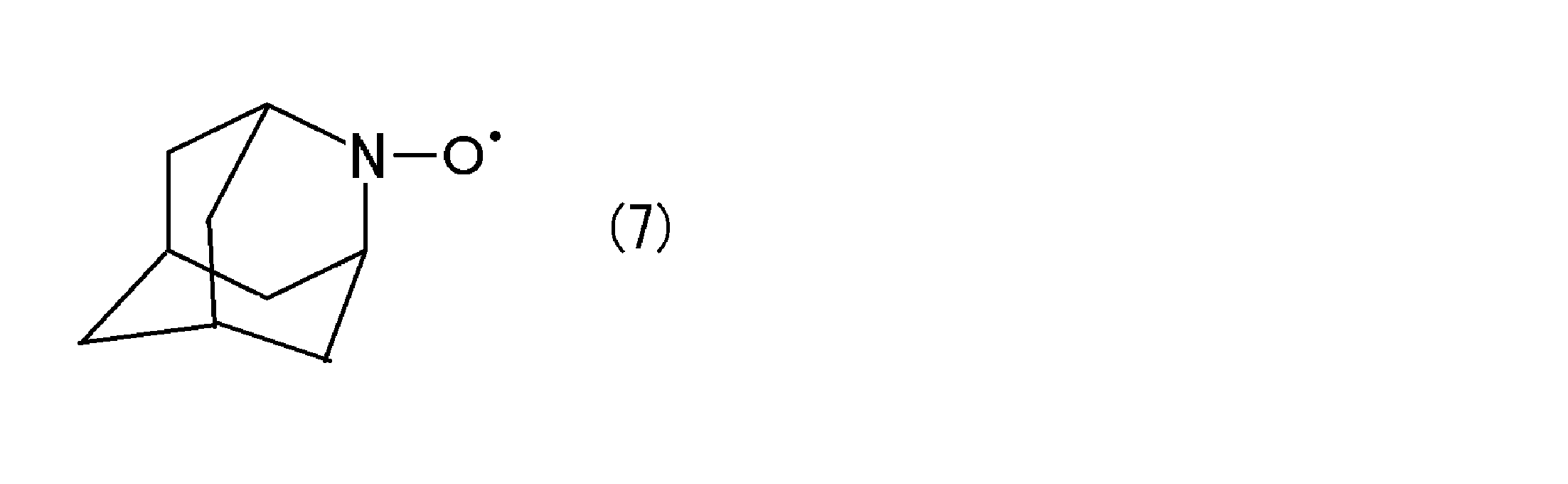
- Example 3 [Synthesis of 2-azaadamantane-N-oxyl (hereinafter referred to as “AZADO”)] Hydrotalcite powder (Kyoward 500 SNG) 1.50 g and alicyclic secondary amine compound (solid substrate) 2-azaadamantane (compound represented by the above formula (2), hereinafter referred to as “AZAD”) 0 .133 g (0.969 mmol) of the mixture was ground in a mortar and added to the screw cap test tube. Thereafter, 0.630 g (4.00 mmol, containing 6.0 mmol of H 2 O 2 ) of sodium percarbonate (SPC-G) was further added to form a reaction mixture in a powder state.
- SPC-G sodium percarbonate
- the test tube was shaken and stirred, and then allowed to stand in a thermostat set to 50 ° C. After 24 hours, the powder reaction mixture was extracted with ethyl acetate and filtered. The solvent was distilled off to obtain 0.125 g (crude yield: 84.8%) of a reddish orange solid. When this solid was compared with a standard product by GC analysis and IR analysis, it was confirmed to be AZADO represented by the following formula (8). When the GC conversion was measured by the following method, the conversion was 100% (by-product 2-azaadamantane-N-hydroxyl 3%. Therefore, the selectivity was 97%).
- the GC measurement is performed, and the relative molar yield of the raw material, the target product, and the by-product is converted from the measurement result (the peak area ratio of the chromatogram) and the relative molar sensitivity. 3.
- the amount of hydrotalcite added is 0.5 g with respect to 1 mmol of HTEMPR (Example 4), excellent conversion and selectivity are obtained.
- the amount of hydrotalcite added is 1.0 g or more, a higher conversion rate and selectivity are obtained, but in the case of 2.0 g compared to the case of 1.5 g (Example 6) (implementation) In the case of Example 7), the conversion rate is lowered. From this result, it is considered that the amount of hydrotalcite added is preferably in the range of 0.4 to 2 g with respect to 1 mmol of HTEMPR.
- Examples 8 to 12 [Production of HTEMPO] The reaction was carried out in the same manner and under the same conditions as in Example 5 except that the amount of sodium percarbonate was changed as shown in Table 2. After 24 hours of reaction (standing) and 48 hours of reaction (standing) (optional) The conversion rate and selectivity of HTEMPO after 48 hours reaction (standing) were measured. The results are shown in Table 2.
- the addition amount of the oxidizing agent is preferably 2 times mol or more with respect to the alicyclic secondary amine compound in terms of the amount of hydrogen peroxide contained therein.
- hydrotalcite As shown in Table 4, excellent conversion was obtained only when hydrotalcite was used as the solid dispersed phase, and excellent conversion was obtained when alumina, magnesia, and hydroxyapatite were used. It is not done. Therefore, it is considered necessary to use hydrotalcite as the solid dispersed phase in order to achieve the effects of the present invention. Further, in the hydrotalcite, when the ratio of MgO / Al 2 O 3 is 2.5 (Example 19), a high conversion rate is not obtained. From this result, it is considered that hydrotalcite having a MgO / Al 2 O 3 ratio of 3 or more is preferable.
- Example 20 [Production of HTEMPO] Hydrotalcite powder (Kyoward 500 SNG) 0.75 g and HTEMPR 0.0788 g (0.5 mmol) powder were added to the screw-cap test tube. Thereafter, 0.314 g (2.0 mmol, containing 3.0 mmol of H 2 O 2 ) of sodium percarbonate (SPC-G) was further added to obtain a reaction mixture in a powder state. The test tube was shaken and stirred, and then allowed to stand in a thermostat set to 50 ° C. After 48 hours, the powder reaction mixture was extracted with ethyl acetate and filtered. The production
- SPC-G sodium percarbonate
- Example 21 [Production of HTEMPO] Except that 3.0 mmol of sodium perborate was used instead of 2.0 mmol of sodium percarbonate, the reaction was carried out in the same manner and under the same conditions as in Example 20, and the GC conversion rate of HTEMPO was measured to be 29%. .
- Example 21 The results of Example 21 indicate that the present invention can be implemented even when sodium perborate is used as the oxidizing agent instead of sodium percarbonate. However, the comparison between Examples 20 and 21 shows that the conversion rate when sodium perborate is used is lower than that when sodium percarbonate is used, and sodium percarbonate is preferable among the solid oxidizing agents. Has been.
- Example 22 [Production of HTEMPO] A mixture of 0.25 g of hydrotalcite powder (Kyoward 500 SNG) and 0.25 mmol of HTEMPR was pulverized in a mortar and added to a screw cap test tube. Thereafter, 0.833 mmol of sodium percarbonate (SPC-G) (containing 1.25 mmol of H 2 O 2 ) was further added to obtain a powdery reaction mixture. The test tube was shaken and stirred, and then allowed to stand in a thermostat set to 50 ° C. After 48 hours, the powder reaction mixture was extracted with ethyl acetate and filtered. The production of HTEMPO was confirmed in the same manner as in Example 1, and the conversion rate (Conversion) was measured. As a result, it was 97% and the selectivity was 99%.
- SPC-G sodium percarbonate
- Comparative Examples 5 and 6 are methods using a catalyst (tungstic acid). As shown in the above examples, according to the present invention, HTEMPO can be obtained without using a catalyst (tungstic acid).
- Example 23 [Production of TEMPO] Hydrotalcite powder (KYOWARD 500SNG) (1.00 g) was added to a screw-cap test tube, and alicyclic secondary amine compound 2,2,6,6-tetramethylpiperidine (expressed by the above formula (3)) was added thereto. 0.157 g (1.1 mmol), which is referred to as “TEMPR” hereinafter, was impregnated. Thereafter, 0.350 g (2.2 mmol, containing 3.3 mmol of H 2 O 2 ) of sodium percarbonate (SPC-G) was further added to obtain a powdery reaction mixture. The test tube was shaken and stirred, and then allowed to stand in a thermostat set at 50 ° C. for 17 hours.
- TEMPR sodium percarbonate
- Example 24 [Production of TEMPO] Except that the standing time in the incubator set at 50 ° C. was changed to 10 hours, the same reaction as in Example 23 was performed, and it was confirmed that TEMPO was obtained, and the GC conversion rate was The GC selectivity was 99%.
- Example 25 [Production of TEMPO] The standing time in the incubator set at 50 ° C. was changed to 10 hours, and the amount of sodium percarbonate (SPC-G) was changed from 2.0 mmol to 3.3 mmol (containing 5.0 mmol of H 2 O 2 ). Except for this change, the same reaction as in Example 23 was carried out. As a result, it was confirmed that TEMPO was obtained, the GC conversion was 98%, and the GC selectivity was 99%.
- SPC-G sodium percarbonate
- Examples 24 and 25 indicate that TEMPO (solid) can also be produced from TEMPR (liquid) according to the present invention, as in the case of producing HTEMPO (solid) from the above HTEMPR (solid). Further, by comparing Examples 24 and 25 with Comparative Example 7, according to the method of the present invention, conversion superior to the method conventionally applied to the oxidation of other organic compounds (Comparative Example 7: so-called nonhalite method). It has been shown that rate and selectivity can be obtained.
- Examples 26 to 28 [Production of TEMPO] 1.0 mmol of TEMPR was soaked in 1.0 g of hydrotalcite powder (Kyoward 500 SNG). Thereafter, the oxidizing agent shown in Table 5 was further added in the amount shown in Table 5 (in each case, 3.0 mmol in terms of hydrogen peroxide) to obtain a powdery reaction mixture. The test tube was shaken and stirred, and then allowed to stand in a thermostat set to 50 ° C. A portion of the powder reaction mixture was taken at predetermined time intervals and extracted with ethyl acetate. Thereafter, the GC conversion was measured in the same manner as in Example 23. Table 5 shows the measurement results.
- Comparative Example 8 [Production of AZADO] 0.25 g of hydroxyapatite (HAp) and 0.25 mmol of AZAD powder were added to the screw test tube and mixed. Thereafter, a catalyst (tungstic acid [H 2 WO 4 ] 0.025 mmol: 10 mol% with respect to AZAD) was further added to form a reaction mixture in a powder state. Further, 35% hydrogen peroxide (1.00 mmol) was added, and the test tube was shaken and stirred well, and then allowed to stand at 25 ° C. After standing for 3 hours, the product was isolated in the same manner as in Example 29 and confirmed to be AZADO. When the GC conversion rate and GC selectivity were measured by the same method as in the above Example, the GC conversion rate was 81% and the GC selectivity was 93%.
- Comparative Example 9 [Production of AZADO] Except that the addition amount of 35% hydrogen peroxide water was changed from 1.00 mmol to 0.75 mmol and the standing time was changed from 3 hours to 12 hours, the same reaction as in Comparative Example 8 was performed. The GC selectivity was 96%.
- Example 34 [Synthesis of HTEMPO] Hydrotalcite powder (KYOWARD 500SNG, manufactured by Kyowa Chemical Industry Co., Ltd., MgO / Al 2 O 3 ratio: 6.0) 2.01 g and alicyclic secondary amine compound 4-hydroxy-2,2,6,6 -0.313 g (2.00 mmol) of tetramethylpiperidine (HTEMPR) powder was added to the screw test tube. Thereafter, sodium percarbonate (manufactured by Mitsubishi Gas Chemical Company, Inc .: SPC-G (powder)) 1.047 g (6.67 mmol, containing 10.0 mmol of H 2 O 2 ) was added, and the reaction mixture in a powder state was added. did.
- Hydrotalcite powder KYOWARD 500SNG, manufactured by Kyowa Chemical Industry Co., Ltd., MgO / Al 2 O 3 ratio: 6.0
- HTEMPR tetramethylpiperidine
- the test tube was shaken and stirred, and then allowed to stand in a thermostat set to 70 ° C. After 10 hours, the powder reaction mixture was extracted with ethyl acetate and filtered. The solvent was distilled off to obtain 0.300 g of a reddish orange solid (crude yield: 87.9%). The GC conversion was 95% (4% was a raw material), and the selectivity was 99% or more.
- Example 35 [First reuse of hydrotalcite] From the solid powder remaining after the ethyl acetate extraction in Example 34, the sodium percarbonate oxidizing agent and sodium carbonate derived therefrom were removed by washing with water. Drying was performed at 100 ° C. for several hours to obtain 1.940 g of hydrotalcite powder. Using this recovered hydrotalcite powder, HTEMPO was again synthesized by a powder reaction in the same manner. That is, 0.315 g (2.00 mmol) of HTEMPR and 1.048 g of sodium percarbonate (6.67 mmol, containing 10.0 mmol of H 2 O 2 ) were added to this powder to obtain a reaction mixture in a powder state. . It left still at 70 degreeC for 10 hours. The same operation as above was performed to obtain 0.327 g (crude yield: 94.7%) of a reddish orange solid. The GC conversion was 86% (13% was the raw material), and the selectivity was 99% or more.
- Example 36 [Second reuse of hydrotalcite] In the same manner as in Example 35, 1.792 g of hydrotalcite powder was recovered from the solid powder remaining after extraction. To this, 0.283 g (1.80 mmol) of HTEMPR and 0.939 g of sodium percarbonate (6.00 mmol, containing 9.0 mmol of H 2 O 2 ) were added to obtain a reaction mixture in a powder state. It left still at 70 degreeC for 10 hours. The same operation was performed to obtain 0.292 g (crude yield: 94.3%) of a reddish orange solid. The GC conversion was 91% (9% was the raw material), and the selectivity was 99% or more.
Landscapes
- Chemical & Material Sciences (AREA)
- Organic Chemistry (AREA)
- Hydrogenated Pyridines (AREA)
- Nitrogen Condensed Heterocyclic Rings (AREA)
- Organic Low-Molecular-Weight Compounds And Preparation Thereof (AREA)
Abstract
脂環式2級アミンを酸化剤により酸化して脂環式N-オキシル化合物を製造する方法であって、ハイドロタルサイトからなる固体分散相中に、脂環式2級アミン化合物及び過炭酸ナトリウム等の酸化剤を混合して、前記脂環式2級アミン化合物を、前記固体分散相中で酸化することを特徴とし、酸化反応を、固体分散相中で、かつ再生や再使用が困難な触媒を使用せずに行うことができ、さらに高い転化率や選択性が得られ、さらに固体分散相のリユースもできる。
Description
本発明は、脂環式2級アミン化合物を、固体分散相中で酸化することを特徴とする脂環式N-オキシル化合物の製造方法に関する。
2,2,6,6-テトラメチルピペリジン-N-オキシル(以下「TEMPO」と表示する)等のN-オキシル化合物は、不飽和化合物のラジカル重合禁止剤、光安定剤、酸化反応の共酸化剤等として用いられている有機ニトロキシラジカル化合物である。TEMPO以外にも、近年、種々のN-オキシル化合物が開発され機能性材料として期待されている。このN-オキシル化合物は、2級アミン化合物を過酸化水素等により酸化して製造することができ、種々の製造方法が知られている。
例えば、特許文献1には、2級アミンと過酸化水素をタングステン酸化物の触媒の存在下に反応させる方法が開示されている。又、特許文献2には、2級アミンと過酸化水素を非反応触媒系にて反応させる方法が開示されている。さらに特許文献3には、2-アザアダマンタンを、タングステン酸ナトリウム二水和物を触媒として用い、メタノール及び塩化メチレン中で尿素-過酸化水素複合体(UHP)により酸化して2-アザアダマンタン-N-オキシルを製造する方法が開示されている。
しかし、これらは、溶媒を使用する方法又は過酸化水素水を多量に使用する方法であり、いずれも酸化反応を溶媒や過酸化水素水等を主体とした液相系で行う方法である。そこで、反応後、生成物を液相から分離する工程が必要となる。反応後に残る水や溶媒の処理の問題もある。又、上記特許文献1や3に記載されている方法は触媒を使用する方法であるが、この触媒の再生や再使用は困難であり触媒を使用しない方法が望まれている。さらに従来の方法では、N-ヒドロキシル体が副生しやすくN-オキシル化合物の転化率や選択性が低くなる問題もあった。
本発明は、上記の従来技術の問題を解決するものであり、酸化剤により脂環式2級アミンを酸化して脂環式N-オキシル化合物を製造する方法であって、酸化反応を、固体分散相中で、かつ再生や再使用が困難な触媒を使用せずに行うことができ、さらに高い転化率や選択性が得られる方法を提供することを課題とする。
本発明者は、鋭意研究の結果、ハイドロタルサイトを固体分散相として用い、この固体分散相中で、脂環式2級アミンを、酸化剤により酸化することにより、触媒を使用しなくても高い転化率及び選択性で脂環式N-オキシル化合物が得られることを見出し、本発明を完成した。即ち上記の課題は、以下に示す構成からなる発明により解決される。
請求項1に記載の発明は、ハイドロタルサイトからなる固体分散相中に、脂環式2級アミン化合物及び酸化剤を混合して、前記脂環式2級アミン化合物を、前記固体分散相中で酸化することを特徴とする脂環式N-オキシル化合物の製造方法である。
本発明の製造方法は、脂環式2級アミン化合物及び酸化剤を固体分散相中に分散させた状態、すなわち固相系又は固相系に近い状態で、脂環式2級アミン化合物を酸化することを特徴とする。ここで、固相系とは、撹拌が可能な流動性を有しながらも自己保形性も有する系、すなわち自重による形崩れが起きない形状を有する系を言う。又、固相系に近い状態とは、自己保形性は有しないが、系中に含まれる液体成分(酸化剤の溶媒も含む)の重量が、固体分散相の重量に対して2重量倍以下である場合を言う。固相系又は固相系に近い状態で反応を行うことにより、反応後の生成物の分離が容易になり又反応後の溶媒の処理の負担が低減する。この効果は、固相系又は固相系に近い状態の中でも、固相系の場合又は系中に含まれる液体成分(酸化剤の溶媒も含む)の重量が固体分散相の重量に対して1重量倍以下である場合が好ましく、反応後の生成物の分離がより容易になり又反応後の溶媒の処理の負担がより低減する。
又、この製造方法では、触媒を使用しないので、触媒の再生や再使用の工程は不要である。従ってこの製造方法の環境への負荷は低い。さらに、この製造方法によれば、高い転化率及び選択性で脂環式2級アミンより脂環式N-オキシル化合物が得られる。すなわち、触媒(例えば特許文献3に記載されているポリ酸触媒)を用いなくても高い転化率や選択性が達成される。
有機化合物を酸化剤により酸化する反応を、液相系ではなく固相系で行う方法は、すでに種々提案されている。例えば、特開2010-265332号公報には、粉末状のポリマーを、過酸化水素水、尿素-過酸化水素又は過炭酸塩との酸化剤、及びタングステン酸等の水溶性の固体触媒と混合して固相系の反応相を形成し、その反応相中に静置して酸化する方法が開示されている。又、国際公開WO/2008/093711号公報には、アパタイト等の粉末の固体分散相中に、有機化合物、ポリ酸触媒等の固体触媒及び過酸化水素水を分散させて、該有機化合物を酸化する方法(ノンハライト(登録商標)を使用する方法)が開示されている。しかし、上記の方法は、いずれもタングステン酸やそのポリ酸等の固体触媒を使用する方法であった。
本発明者は、検討の結果、脂環式2級アミン化合物の酸化については、従来知られている固体分散相中から特定のものすなわちハイドロタルサイトを選択して固体分散相として用いることにより、固相系でも触媒を使用することなく酸化剤による酸化を行いN-オキシル化合物を製造できること、しかも高い転化率や選択性が達成できることを見出して、本発明を完成したのである。
本発明は、固体分散相としてハイドロタルサイトを用いることを特徴とする。本発明の方法において使用されるハイドロタルサイトとは、式(M2+)1-x(M3+)x(OH)2(An-)x/n・aH2O(式中、M2+は2価金属イオンを示し、M3+は3価金属イオンを示し、An-はn価のアニオンを示し、そしてxおよびaはそれぞれ0<x<0.5、0≦a<1の範囲を示す)で表される化合物の少なくとも一種である。
ハイドロタルサイトは、天然に産出する粘土鉱物の一種であるが、金属硝酸塩等の所定金属塩の水溶液に水酸化ナトリウムなどのアルカリ金属を加えてpHを適当な値に調整して目的物を沈殿させる方法(金属塩法)、所定の金属酸化物を水中で500℃付近に加熱させるいわゆる「水熱合成反応」を用いる方法(水熱法)等により調製されたハイドロタルサイトも本発明において好適に使用される。例えば、MgO/Al2O3から合成され制酸剤等として使用されている合成ハイドロタルサイトも、本発明において固体分散相として用いることができる。
ハイドロタルサイトが、MgOとAl2O3から合成される場合は、合成の際に使用されるMgO/Al2O3が3~8程度の範囲のものを使用すると、より優れた転化率が得られるので好ましい。従来の有機化合物の固相系での酸化反応では、固体分散相として、ハイドロタルサイトの他に酸化マグネシウム、アルミナ、アパタイト等も使用することができた。しかし、本発明では、酸化マグネシウム、アルミナ、アパタイト等を使用した場合は、目的とする効果、すなわち高い転化率や選択性を達成することはできない。
本発明で原料として使用される脂環式2級アミン化合物としては、下記の式(1)で表される化合物を挙げることができる。

式(1)中、R1、R2、R3及びR4は、水素又は炭素数1~10程度のアルキル基又はアルケニル基を表す。特に、R1、R2、R3又はR4が、水素、又はメチル、エチル、プロピル、ブチル等の低級アルキル基を表す場合に本発明は好適に適用できる。又、R1とR3が結合して環を形成してもよく、又は、R5がアルキル基(アルキレン基)であってR1、R3及びR5が結合して環を形成してもよく、この場合にも本発明は好適に適用できる。
R5は一価の基を表すが、その具体例としては、水酸基、アミノ基、メチル基等のアルキル基、カルボニル基、ニトロ基、スルホン基、ビニル基等のアルケニル基等を挙げることができる。又前記のようにR1及びR3とR5が結合して環を形成してもよい。
本発明は、原料化合物である脂環式2級アミン化合物とともに酸化剤をハイドロタルサイトからなる固体分散相中に分散し、固相系又は固相系に近い状態で酸化反応を行うことを特徴とする。水やその他の液体媒体、他の溶媒を反応系に少量添加することは可能であるが、その添加量の範囲は、固相系又は固相系に近い状態が保たれる範囲である。酸化剤として過酸化水素水等の溶液を用いる場合も同様であり、水等の溶媒の量が固相系又は固相系に近い状態が保たれる範囲内となるように、酸化剤の添加量や溶液の濃度を調整する必要がある。水その他の液体媒体の添加量が多く反応原料や固体分散相が液相に分散する状態になる場合は、本発明の目的は達成されない。又、反応後の後処理を容易にするためにも環境負荷を低減するためにも、反応系に有機溶剤を添加しない方が好ましく、又固相系で反応を行うことが好ましい。
請求項2に記載の発明は、脂環式2級アミン化合物が、2-アザアダマンタン骨格を有する化合物であることを特徴とする請求項1に記載の脂環式N-オキシル化合物の製造方法である。又、請求項3に記載の発明は、脂環式2級アミン化合物が、テトラメチルピペリジン又はヒドロキシテトラメチルピペリジンであることを特徴とする請求項1に記載の脂環式N-オキシル化合物の製造方法である。
前記の式(1)で表される脂環式2級アミン化合物としては、例えば、アザアダマンタン骨格を有する化合物、ピペリジン骨格を有する化合物等の6員環構造の脂肪族2級アミンを挙げることができる。より具体的には、式(2)で表される2-アザアダマンタン、式(3)で表されるテトラメチルピペリジン又は式(4)で表されるヒドロキシテトラメチルピペリジンを挙げることができ、これらの脂環式2級アミン化合物に本発明が好適に適用される。
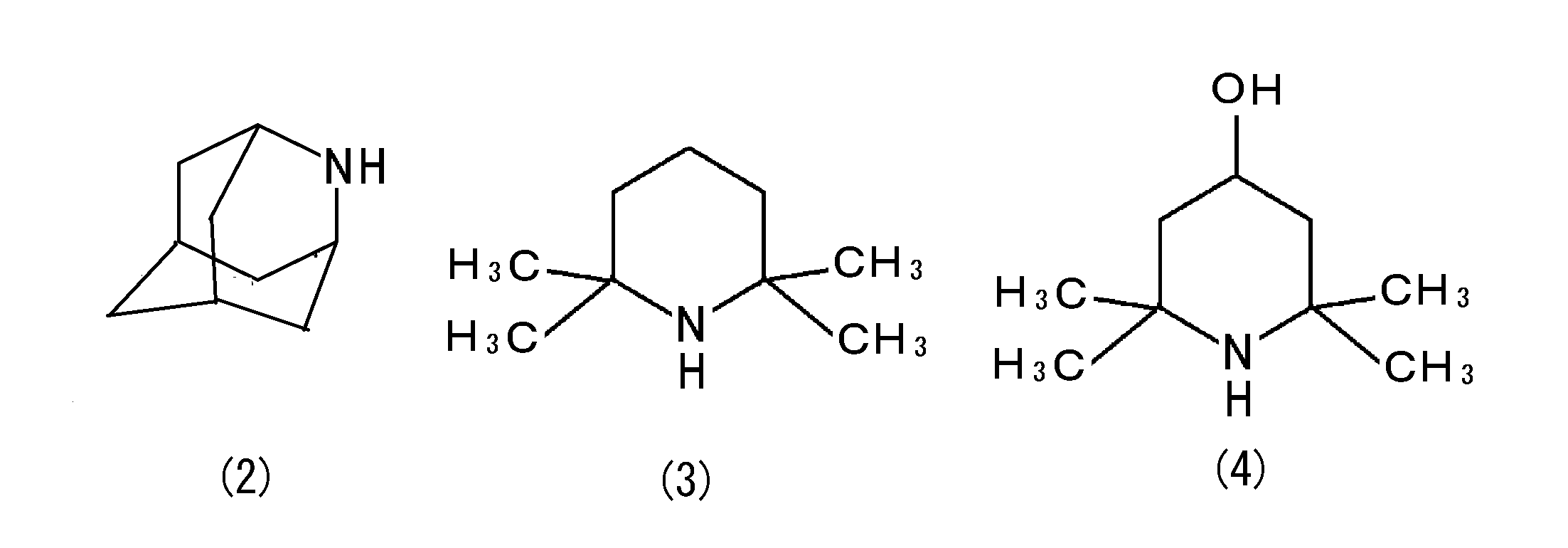
本発明で原料として使用される脂環式2級アミン化合物としては、式(1)で表される化合物の他にも、ピロリジン骨格やピロリン骨格を有する化合物等の5員環構造の脂肪族2級アミン等も挙げることができる。イミダゾリジン骨格を有する化合物等2級アミン基を2以上有する脂環式化合物でもよい。又オキサゾリジン骨格を有する化合物でも良い。
請求項4に記載の発明は、前記酸化剤が、過炭酸塩、過酸化水素水及び尿素-過酸化水素複合体からなる群より選ばれることを特徴とする請求項1ないし請求項3のいずれか1項に記載の脂環式N-オキシル化合物の製造方法である。
本発明において使用される酸化剤としては、過酸化水素水や、過炭酸ナトリウム、尿素-過酸化水素複合体、過ホウ酸ナトリウムの粉末等を挙げることができる。過酸化水素は、過酸化水素水として用いられるが、その高い酸素含有量や副生成物として水のみが生じるとの利点を有する。しかし、過酸化水素水の濃度が高い場合は、取扱上の危険性があり、一方過酸化水素水の濃度が低い場合は、多量の過酸化水素水を添加する必要が生じ固相系又は固相系に近い状態を維持できなくなる場合がある。固相系又は固相系に近い状態を維持するためには濃度25%以上の過酸化水素水が好ましく、さらに取扱の安全性を考慮すると濃度25~45%の過酸化水素水が好ましく用いられる。
尿素-過酸化水素複合体は、粉末として使用され、過酸化水素水と比べて、反応に際しての取り扱いが容易で安全性が高いとの利点を有する。
請求項5に記載の発明は、前記酸化剤が過炭酸ナトリウムであることを特徴とする請求項4に記載の脂環式N-オキシル化合物の製造方法である。
過炭酸ナトリウムは、炭酸ナトリウムと過酸化水素の付加物(炭酸ナトリウムに1.5モル倍の過酸化水素を付加したもの)であって、水に溶解しやすく水に溶解して過酸化水素と炭酸ナトリウムの水溶液となる。主に穏やかな非塩素系漂白剤として利用されており、市販の家庭用洗剤にも含まれており、安全性の高いものである。そして、尿素-過酸化水素複合体と同様に、粉末として使用され、過酸化水素水と比べて、反応に際しての取り扱いが容易で、安全性が高いとの利点を有する。さらに、過炭酸ナトリウムを酸化剤として用いることにより、転化率や選択性をさらに高くすることができるので好ましい。
なお、過炭酸ナトリウム及び尿素-過酸化水素複合体は固形粉末であり、密閉して常温で保存する限り安全であり、過酸化水素水に比べ遥かに取り扱いが容易で、輸送手段の制約も受けないとの利点もある。さらに、酸化反応系の固相系又は固相系に近い状態を維持することが容易である点でも好ましい。
過炭酸ナトリウムや尿素-過酸化水素複合体は固形粉末の粒子サイズは、特に限定されず、市販されている1μm~1000μm程度の粒子サイズのものを用いることができ、造粒品も用いることができる。反応速度を向上させる観点からは、粒子サイズの小さいものが好ましい。
請求項6に記載の発明は、前記酸化剤の添加量が、酸化剤中に含まれている過酸化水素の量に換算して、脂環式2級アミン化合物に対して2~10倍モルであることを特徴とする請求項4又は請求項5に記載の脂環式N-オキシル化合物の製造方法である。
酸化剤の添加量は、酸化剤中に含まれている過酸化水素の量に換算して、脂環式2級アミン化合物1モルに対して2~10モルの範囲が適当である。ここで、酸化剤が過酸化水素水の場合は、過酸化水素水に含まれている過酸化水素のモル数が「酸化剤中に含まれている過酸化水素の量に換算した酸化剤の添加量」となり、過炭酸塩や尿素-過酸化水素複合体の場合は、過炭酸塩や尿素-過酸化水素複合体を構成する過酸化水素のモル数が「酸化剤中に含まれている過酸化水素の量に換算した酸化剤の添加量」となる。例えば過炭酸ナトリウム1モルは、過酸化水素1.5モルを含むので、過炭酸ナトリウムの添加量(モル数)の1.5倍が過酸化水素の量に換算した酸化剤の添加量(モル数)となる。
酸化剤の添加量が、酸化剤中に含まれている過酸化水素の量に換算して、脂環式2級アミン化合物1モルに対して2モル未満では、高い転化率や選択性を得ることが困難になる。一方、10モルを超える場合は、反応容積が増えるため反応速度は上がらない、未反応過酸化水素の処理コストがかかる等の問題があるので、好ましくない。又、酸化剤が過酸化水素水であって、その添加量が10倍モルを超えるような場合、過酸化水素水の濃度が低いと固相系又は固相系に近い状態の反応系を維持することが困難になり、濃度を上げると、取扱いの安全性を損なう問題を生じる。
請求項7に記載の発明は、固体分散相の添加量が、脂環式2級アミン化合物1ミリモルに対して0.4~2.0gであることを特徴とする請求項4ないし請求項6のいずれか1項に記載の脂環式N-オキシル化合物の製造方法である。
固体分散相の添加量が、脂環式2級アミン化合物1ミリモルに対して0.4g未満では反応が遅くなり、一方2gを超える場合は、生産性が低下する傾向があるので、これらを考慮して最適の量が選択される。
請求項8に記載の発明は、ハイドロタルサイトからなる固体分散相中に、脂環式2級アミン化合物及び酸化剤を混合して、前記脂環式2級アミン化合物を前記固体分散相中で酸化する工程、
前記酸化後、脂環式N-オキシル化合物を溶解する有機溶媒により固体分散相の抽出を行う工程、
前記有機溶媒による抽出液より脂環式N-オキシル化合物を回収する工程、及び
前記抽出後の固体分散相を水洗する工程、及び
前記水洗後の固体分散相に脂環式2級アミン化合物及び酸化剤を混合して、前記脂環式2級アミン化合物を、前記固体分散相中で酸化する工程、を有することを特徴とする脂環式N-オキシル化合物の製造方法である。
前記酸化後、脂環式N-オキシル化合物を溶解する有機溶媒により固体分散相の抽出を行う工程、
前記有機溶媒による抽出液より脂環式N-オキシル化合物を回収する工程、及び
前記抽出後の固体分散相を水洗する工程、及び
前記水洗後の固体分散相に脂環式2級アミン化合物及び酸化剤を混合して、前記脂環式2級アミン化合物を、前記固体分散相中で酸化する工程、を有することを特徴とする脂環式N-オキシル化合物の製造方法である。
この製造方法は、前記の請求項の発明である脂環式N-オキシル化合物の製造方法を行った後、
反応生成物である脂環式N-オキシル化合物を、固体分散相中より有機溶媒により抽出して回収するとともに、
有機溶媒による抽出後の固体分散相を水洗して、固体分散相中に残存している酸化剤の分解物(酸化剤が過炭酸ナトリウムの場合は、炭酸ナトリウム)を取り除き、
水洗(及び乾燥)後の固体分散相中に、新たに脂環式2級アミン化合物及び酸化剤を添加して脂環式2級アミン化合物の酸化による脂環式N-オキシル化合物の生成反応を繰り返すことを特徴とする製造システムである。
反応生成物である脂環式N-オキシル化合物を、固体分散相中より有機溶媒により抽出して回収するとともに、
有機溶媒による抽出後の固体分散相を水洗して、固体分散相中に残存している酸化剤の分解物(酸化剤が過炭酸ナトリウムの場合は、炭酸ナトリウム)を取り除き、
水洗(及び乾燥)後の固体分散相中に、新たに脂環式2級アミン化合物及び酸化剤を添加して脂環式2級アミン化合物の酸化による脂環式N-オキシル化合物の生成反応を繰り返すことを特徴とする製造システムである。
固体分散相中での酸化反応により生成した脂環式N-オキシル化合物は、有機溶媒による抽出により回収することができる。具体的には、固体分散相を有機溶媒により抽出し、濾過により固体分散相と有機溶媒による抽出液を分離し、その抽出液より留去等により有機溶媒を取り除くだけで、高選択性のN-オキシル化合物を高い収率で得ることができる。従来の液相系反応では、後処理操作において、水相と有機相との二相分離が困難である場合が多く、分離後の有機相からは、過酸化水素の除去、水洗、乾燥を経て、有機溶媒の留去が必要であった。従って、本発明の製造方法によれば、原料の脂環式2級アミン化合物と過炭酸ナトリウム等の酸化剤からN-オキシル化合物を、従来の液相系反応より効率良く得ることができる。
又、この製造システムでは、固体分散相(ハイドロタルサイト粉末)はリユースされる。すなわち、有機溶媒によりN-オキシル化合物を抽出すると、未反応の脂環式2級アミン化合物(原料)も有機溶媒により抽出されるので、抽出後の固体分散相に含まれるのは、酸化剤、及び酸化剤の分解物(酸化剤が過炭酸ナトリウムを用いる場合は、炭酸ナトリウム、過酸化水素、水)である。そして、反応の副生成物(酸化剤として過炭酸ナトリウムを用いる場合での炭酸ナトリウム等)および未反応の酸化剤(過炭酸ナトリウム等)を、水洗により簡単に取り除くことができる。従って、水洗された固体分散相を乾燥すれば、炭酸ナトリウム等の副生成物を含まないハイドロタルサイト粉末とすることができ、固体分散相としてリユースすることができる。
すなわち、この脂環式N-オキシル化合物の製造システムによれば、「反応」-「生成物の抽出・ろ過」-「固体分散相の水洗・乾燥」の一連の簡便な操作により、脂環式N-オキシル化合物を高い収率、高い選択性で製造できるとともに、固体分散相をリユースでき、この固体分散相に原料化合物等を添加して脂環式N-オキシル化合物の製造を繰り返して行うことができる。そして、温度調節、濾過、乾燥機能付きの反応容器を使用することにより、上記一連の操作を繰り返し行いN-オキシル化合物を製造できる粉体反応システムとすることができる。
さらに過炭酸ナトリウムを、回収した炭酸ナトリウムと過酸化水素から製造すれば、新たに追加する過炭酸ナトリウムが不要になるかその量を減らすことができる。新たに追加する過炭酸ナトリウムが不要の場合は、脂環式2級アミン化合物と過酸化水素のみを使用して脂環式N-オキシル化合物の製造を繰り返すことができるので、より効率の高い反応システムとなる。
本発明の脂環式N-オキシル化合物の製造方法によれば、固体分散相を用いた固相系又は固相系に近い状態、好ましくはソルベントフリーの固相系で、かつ触媒を使用せずに脂環式2級アミン化合物を酸化して脂環式N-オキシル化合物を製造することができる。そして、触媒を使用しないにもかかわらず、高い転化率や選択性で脂環式N-オキシル化合物を得ることができる。反応は固相系又は固相系に近い状態で行われるので、生成物を分離する工程や反応後に残る水等の溶媒の処理の負担も小さい。又、触媒を使用しないので、触媒の再生や再使用の工程も不要である。さらに、固体分散相をリユースすることもでき、脂環式N-オキシル化合物のより効率の高い製造方法とすることができる。
以下、本発明の実施の形態について説明する。なお、本発明は、以下の実施の形態に限定されるものではない。本発明の趣旨を損ねない範囲内において種々の変更を加えることが可能である。
本発明における反応は、反応容器に、ハイドロタルサイトの粉末を加え、さらに基質である脂環式2級アミン化合物及び酸化剤の粉末を加えてハイドロタルサイト粉末内に分散させて行うことができる。脂環式2級アミン化合物が固体の場合、固体粉末のまま固体分散相に混合してもよい。又は、固体の脂環式2級アミン化合物を少量の溶媒に溶かしてから混合してもよい。脂環式2級アミン化合物が粒度の大きい又は塊状の固体の場合は、この化合物を粉砕して反応容器に加えられる。粒度の大きい化合物と粒度の大きいハイドロタルサイトを反応容器外で混合し粉砕した後反応容器に加えてもよい。
反応容器に、ハイドロタルサイトの粉末、脂環式2級アミン化合物及び酸化剤を加えた後、脂環式2級アミン化合物及び酸化剤がハイドロタルサイト粉末内に均一に分散し、互いに確実に接触するように、これらを攪拌混合してもよい。しかし、攪拌混合した後は、この混合物を静置した状態で反応を行ってもよく混合や撹拌を行う必要はない。
攪拌混合方法は、粉体(固体)の混合に使用される通常の混合方法を採用することができる。反応容器への、脂環式2級アミン化合物及び酸化剤の添加順序は、特に制限されない。
反応温度は30℃~100℃の範囲で通常行われ、好ましくは45℃~70℃である。反応温度が低すぎると反応速度が低下する傾向にある。一方反応温度が高すぎると酸化剤の分解が進み、酸化反応が十分進まない場合がある。反応時間は、使用する反応原料の種類と量、及び反応温度の関係で変動するが、通常数分以上であり、生産性の観点から50時間以下が好ましい。
本発明の脂環式N-オキシル化合物の製造方法では、反応の終了後、得られた化合物は、溶剤にて抽出分離し、抽出分離した溶液から溶剤を留去することにより単離することができる。溶剤としては、酢酸エチルや環境負荷の少ない炭化水素系溶剤を用いることができる。また減圧下加熱により、反応混合物から直接目的物だけを取り出すこともできる。
反応が終了し、得られた脂環式N-オキシル化合物を前記のようにして単離した後、反応容器内にあるハイドロタルサイト粉末に脂環式2級アミン化合物及び酸化剤を再び添加し、攪拌混合することにより、脂環式N-オキシル化合物の合成反応を再び行うことができる。
以下、本発明を実施するための最良の形態について実施例に基づき説明する。なお、本発明は、以下の実施例に限定されるものではなく、本発明と同一および均等の範囲において種々の変更を加えることが可能である。
実施例1[4-ヒドロキシ-2,2,6,6-テトラメチルピペリジン-N-オキシル(以下「HTEMPO」と表示する)の合成]
ハイドロタルサイト粉末(キョーワード500SNG、協和化学工業社製、MgO/Al2O3の比:6.0)2.00gと脂環式2級アミン化合物(固体基質)の4-ヒドロキシ-2,2,6,6-テトラメチルピペリジン粉末(前記の式(4)で表される化合物。以下「HTEMPR」と表示する)0.314g(2.00mmol)をねじ口試験管に加えた。その後、さらに過炭酸ナトリウム(三菱ガス化学社製:SPC-G(粉体))1.047g(6.67mmol、H2O2を10.0mmol含む)を加えて、粉体状態の反応混合物とした。試験管を振って攪拌した後、50℃に設定した恒温器の中に静置した。48時間後、粉体反応混合物を酢酸エチルで抽出しろ過を行った。溶媒を留去して赤橙色の固体0.320g(粗収率:92.8%)を得た。この固体をGC分析およびIR分析で市販品HTEMPOと比較分析したところ、下記式(5)で表されるHTEMPOであることが確認され、下記の方法によりGC転化率(Conversion)及びGC選択性(生成物中の、HTEMPOと副生成物の4-ヒドロキシ-2,2,6,6-テトラメチルピペリジン-N-ヒドロキシルの合計に対するHTEMPOの比)を測定したところ、転化率は97%であり(3%は原料)、選択性は99%以上であった。
ハイドロタルサイト粉末(キョーワード500SNG、協和化学工業社製、MgO/Al2O3の比:6.0)2.00gと脂環式2級アミン化合物(固体基質)の4-ヒドロキシ-2,2,6,6-テトラメチルピペリジン粉末(前記の式(4)で表される化合物。以下「HTEMPR」と表示する)0.314g(2.00mmol)をねじ口試験管に加えた。その後、さらに過炭酸ナトリウム(三菱ガス化学社製:SPC-G(粉体))1.047g(6.67mmol、H2O2を10.0mmol含む)を加えて、粉体状態の反応混合物とした。試験管を振って攪拌した後、50℃に設定した恒温器の中に静置した。48時間後、粉体反応混合物を酢酸エチルで抽出しろ過を行った。溶媒を留去して赤橙色の固体0.320g(粗収率:92.8%)を得た。この固体をGC分析およびIR分析で市販品HTEMPOと比較分析したところ、下記式(5)で表されるHTEMPOであることが確認され、下記の方法によりGC転化率(Conversion)及びGC選択性(生成物中の、HTEMPOと副生成物の4-ヒドロキシ-2,2,6,6-テトラメチルピペリジン-N-ヒドロキシルの合計に対するHTEMPOの比)を測定したところ、転化率は97%であり(3%は原料)、選択性は99%以上であった。

実施例2 [4-メタアクリロキシ-2,2,6,6-テトラメチルピペリジン-N-オキシル(以下「MTEMPO」と表示する)の合成]
ハイドロタルサイト粉末(キョーワード500SNG)2.00g及び脂環式2級アミン化合物(固体基質)の4-メタアクリロキシ-2,2,6,6-テトラメチルピペリジン粉末(下記の式(6)で表される化合物。以下「MTEMPR」と表示する)0.451g(2.00mmol)を、ねじ口試験管に加えた。その後、さらに過炭酸ナトリウム(SPC-G)0.943g(6.0mmol、H2O2を9.0mmol含む)を加えて、粉体状態の反応混合物とした。試験管を振って攪拌した後、50℃に設定した恒温器の中に静置した。25時間後、粉体反応混合物を酢酸エチルで抽出しろ過を行った。溶媒を留去して赤橙色の固体0.453g(粗収率:94.2%)を得た。この固体のGC分析およびIR分析により、下記式(7)で表されるMTEMPOであることが確認され、下記の方法によりGC転化率及び選択性(生成物中の、MTEMPOと副生成物の4-メタアクリロキシ-2,2,6,6-テトラメチルピペリジン-N-ヒドロキシルの合計に対するMTEMPOの比)を測定したところ、転化率は96%であり、又選択性は93%であった。
ハイドロタルサイト粉末(キョーワード500SNG)2.00g及び脂環式2級アミン化合物(固体基質)の4-メタアクリロキシ-2,2,6,6-テトラメチルピペリジン粉末(下記の式(6)で表される化合物。以下「MTEMPR」と表示する)0.451g(2.00mmol)を、ねじ口試験管に加えた。その後、さらに過炭酸ナトリウム(SPC-G)0.943g(6.0mmol、H2O2を9.0mmol含む)を加えて、粉体状態の反応混合物とした。試験管を振って攪拌した後、50℃に設定した恒温器の中に静置した。25時間後、粉体反応混合物を酢酸エチルで抽出しろ過を行った。溶媒を留去して赤橙色の固体0.453g(粗収率:94.2%)を得た。この固体のGC分析およびIR分析により、下記式(7)で表されるMTEMPOであることが確認され、下記の方法によりGC転化率及び選択性(生成物中の、MTEMPOと副生成物の4-メタアクリロキシ-2,2,6,6-テトラメチルピペリジン-N-ヒドロキシルの合計に対するMTEMPOの比)を測定したところ、転化率は96%であり、又選択性は93%であった。
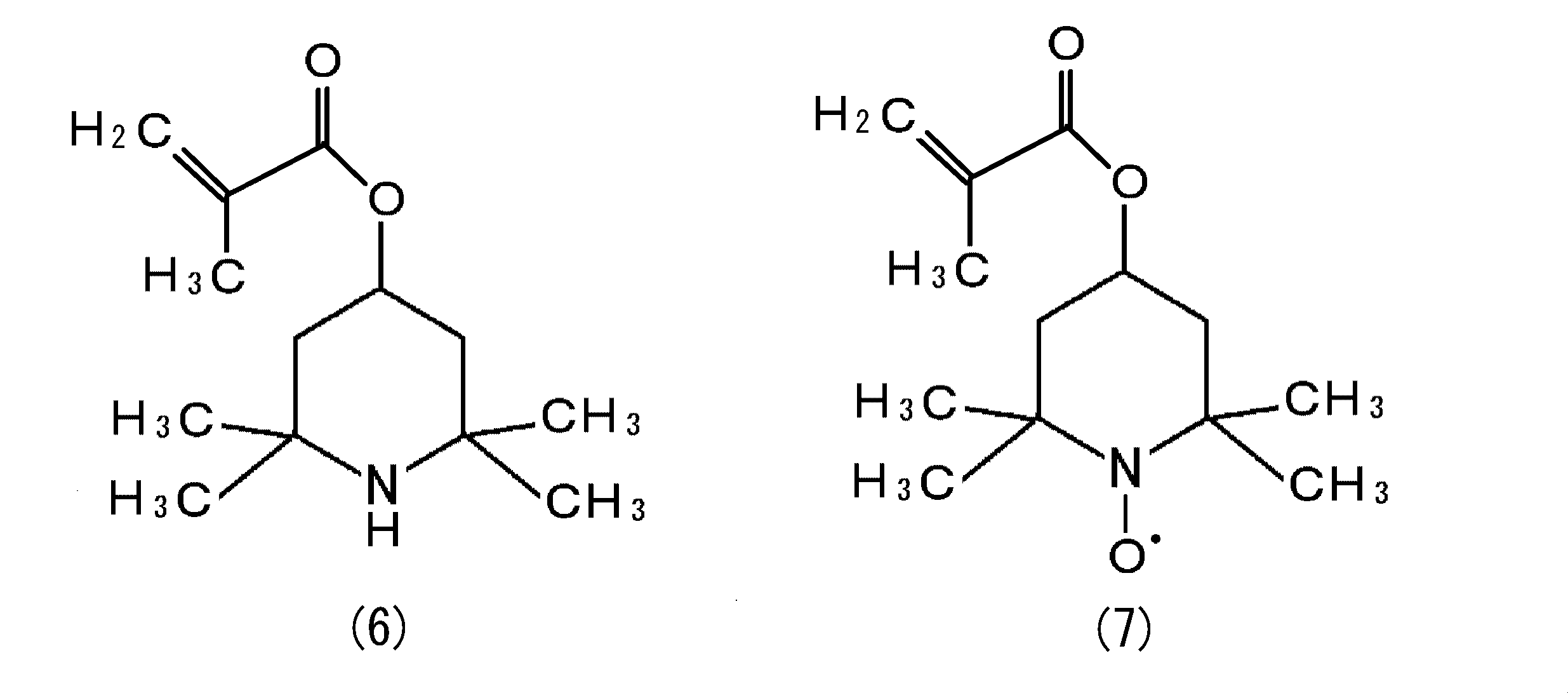
実施例3[2-アザアダマンタン-N-オキシル(以下「AZADO」と表示する)の合成]
ハイドロタルサイト粉末(キョーワード500SNG)1.50gと脂環式2級アミン化合物(固体基質)の2-アザアダマンタン(前記式(2)で表される化合物。以下「AZAD」と表示する)0.133g(0.969mmol)の混合物を乳鉢で粉砕し、ねじ口試験管に加えた。その後、さらに過炭酸ナトリウム(SPC-G)0.630g(4.00mmol、H2O2を6.0mmol含む)を加えて、粉体状態の反応混合物とした。試験管を振って攪拌した後、50℃に設定した恒温器の中に静置した。24時間後、粉体反応混合物を酢酸エチルで抽出し、ろ過を行った。溶媒を留去して赤橙色の固体0.125g(粗収率:84.8%)を得た。この固体をGC分析およびIR分析で標準品と比較分析したところ、下記式(8)で表されるAZADOであることが確認された。下記の方法によりGC転化率を測定したところ転化率100%(副生成物の2-アザアダマンタン-N-ヒドロキシル3%。従って、選択性は97%)であった。
ハイドロタルサイト粉末(キョーワード500SNG)1.50gと脂環式2級アミン化合物(固体基質)の2-アザアダマンタン(前記式(2)で表される化合物。以下「AZAD」と表示する)0.133g(0.969mmol)の混合物を乳鉢で粉砕し、ねじ口試験管に加えた。その後、さらに過炭酸ナトリウム(SPC-G)0.630g(4.00mmol、H2O2を6.0mmol含む)を加えて、粉体状態の反応混合物とした。試験管を振って攪拌した後、50℃に設定した恒温器の中に静置した。24時間後、粉体反応混合物を酢酸エチルで抽出し、ろ過を行った。溶媒を留去して赤橙色の固体0.125g(粗収率:84.8%)を得た。この固体をGC分析およびIR分析で標準品と比較分析したところ、下記式(8)で表されるAZADOであることが確認された。下記の方法によりGC転化率を測定したところ転化率100%(副生成物の2-アザアダマンタン-N-ヒドロキシル3%。従って、選択性は97%)であった。
[GC転化率及びGC選択性の測定]
反応混合物を有機溶媒で抽出した溶液、又はその溶液を溶媒留去して得られた粗生成物を、以下に示す手順でGC分析して、GC転化率及び選択性を求めた。GC測定には、島津FIDガスクロマトグラフ(キャピラリーカラムInert Cap 5 (0.25mmI.D. x 15m, df=0.25μm))を用いた。
(GC分析の手順)
1.GC測定を行う条件における原料と目的生成物との相対モル感度を求める。そのほかの副生成物類はすべて目的生成物と同じ相対モル感度とみなす。
2.GC測定を行い、その測定結果(クロマトグラムのピーク面積比)及び前記の相対モル感度から、原料、目的生成物、副生成物の相対モル収率を換算する。
3.以下に示す式によりGC転化率及びGC選択性を計算する。
GC転化率=[(目的生成物及び副生成物の相対モル収率の合計)/(原料、目的生成物及び副生成物の相対モル収率の合計)]×100
GC選択性=[目的生成物の相対モル収率/(目的生成物及び副生成物の相対モル収率の合計)]×100
反応混合物を有機溶媒で抽出した溶液、又はその溶液を溶媒留去して得られた粗生成物を、以下に示す手順でGC分析して、GC転化率及び選択性を求めた。GC測定には、島津FIDガスクロマトグラフ(キャピラリーカラムInert Cap 5 (0.25mmI.D. x 15m, df=0.25μm))を用いた。
(GC分析の手順)
1.GC測定を行う条件における原料と目的生成物との相対モル感度を求める。そのほかの副生成物類はすべて目的生成物と同じ相対モル感度とみなす。
2.GC測定を行い、その測定結果(クロマトグラムのピーク面積比)及び前記の相対モル感度から、原料、目的生成物、副生成物の相対モル収率を換算する。
3.以下に示す式によりGC転化率及びGC選択性を計算する。
GC転化率=[(目的生成物及び副生成物の相対モル収率の合計)/(原料、目的生成物及び副生成物の相対モル収率の合計)]×100
GC選択性=[目的生成物の相対モル収率/(目的生成物及び副生成物の相対モル収率の合計)]×100
実施例4~7、比較例 1 [HTEMPOの製造]
ハイドロタルサイト粉末の量を表1に示すように変え、かつHTEMPRを0.5mmol、過炭酸ナトリウムの量を1.0mmol(HTEMPRに対して2倍モル、H2O2を1.5mmol含む)とした以外は実施例1と同様の方法、条件で反応を行い、24時間反応(静置)後及び48時間反応(静置)後のHTEMPOの転化率、選択性を測定した。その結果を表1に示す。
ハイドロタルサイト粉末の量を表1に示すように変え、かつHTEMPRを0.5mmol、過炭酸ナトリウムの量を1.0mmol(HTEMPRに対して2倍モル、H2O2を1.5mmol含む)とした以外は実施例1と同様の方法、条件で反応を行い、24時間反応(静置)後及び48時間反応(静置)後のHTEMPOの転化率、選択性を測定した。その結果を表1に示す。
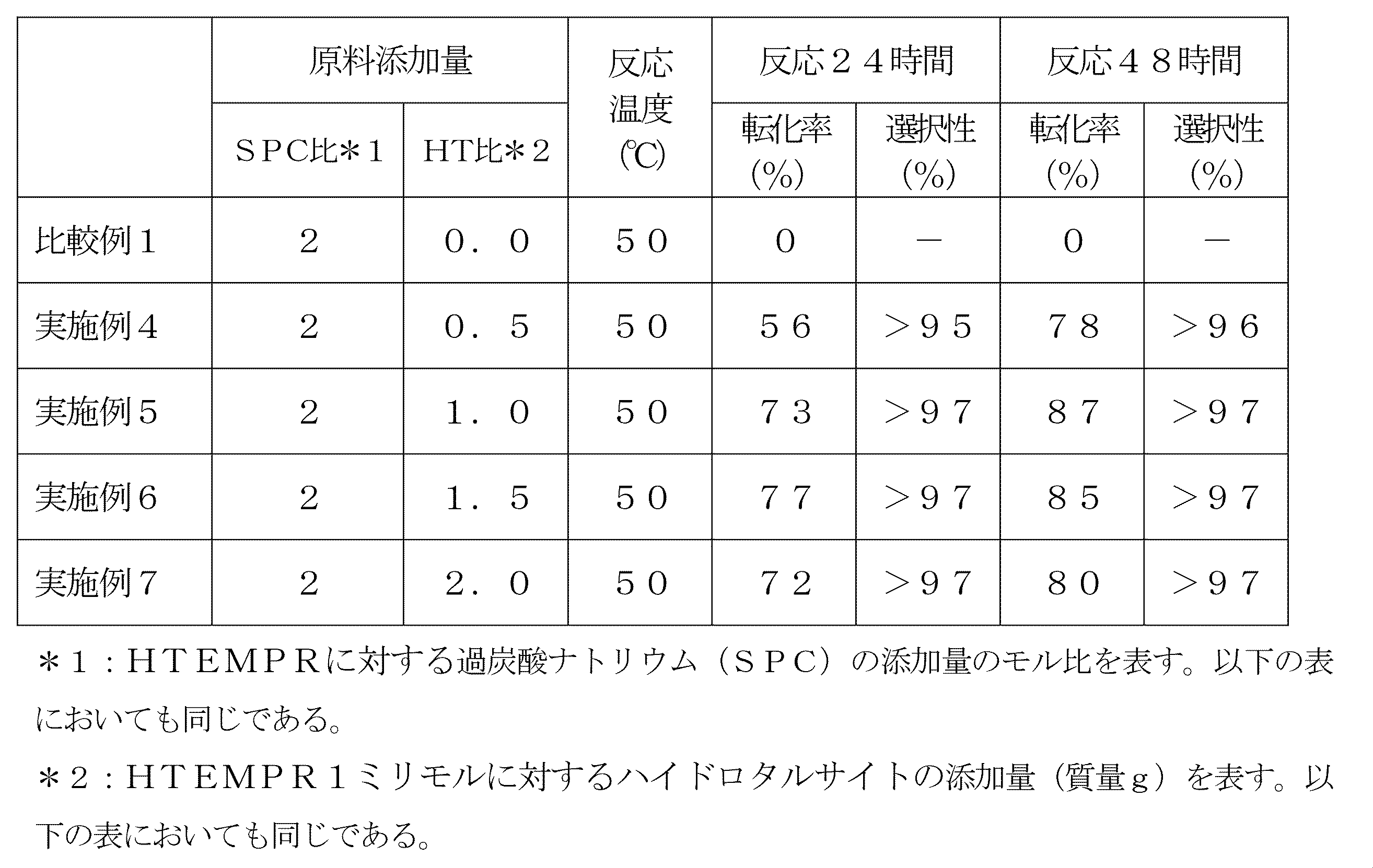
表1に示されているように、ハイドロタルサイトの添加量が、HTEMPR1ミリモルに対して0.5gの場合(実施例4)、優れた転化率及び選択性が得られている。特に、ハイドロタルサイトの添加量が1.0g以上の場合はより高い転化率及び選択性が得られているが、1.5gの場合(実施例6)に比べて2.0gの場合(実施例7)の場合は転化率が低下している。この結果より、ハイドロタルサイトの添加量は、HTEMPR1ミリモルに対して0.4~2gの範囲が好ましいと考えられる。
実施例8~12 [HTEMPOの製造]
過炭酸ナトリウムの量を表2に示すように変えた以外は実施例5と同様の方法、条件で反応を行い、24時間反応(静置)後及び48時間反応(静置)後(場合により48時間反応(静置)後)のHTEMPOの転化率、選択性を測定した。その結果を表2に示す。
過炭酸ナトリウムの量を表2に示すように変えた以外は実施例5と同様の方法、条件で反応を行い、24時間反応(静置)後及び48時間反応(静置)後(場合により48時間反応(静置)後)のHTEMPOの転化率、選択性を測定した。その結果を表2に示す。
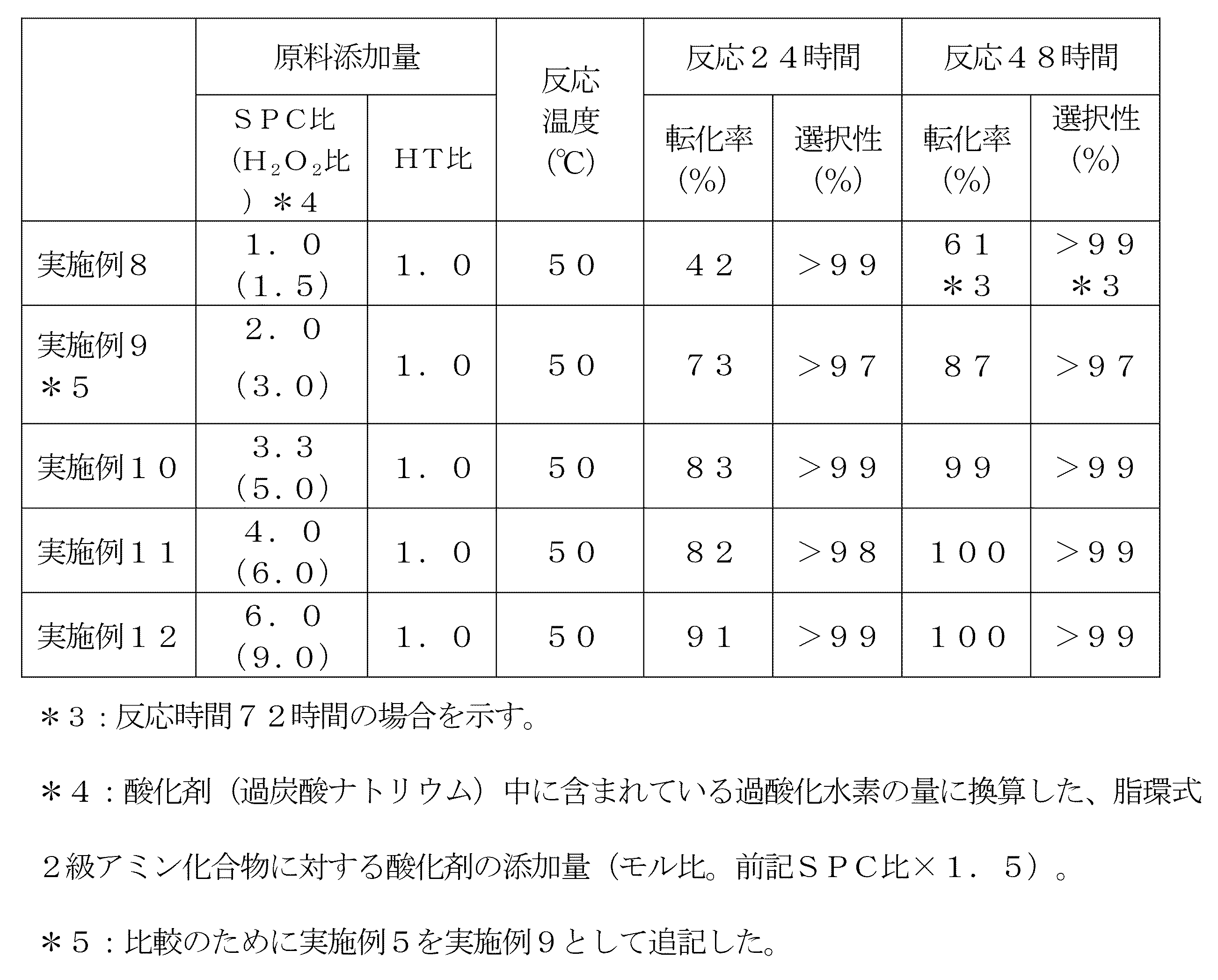
表2に示されているように、過炭酸ナトリウムの添加量が、含まれている過酸化水素の量に換算して脂環式2級アミン化合物に対して1.5倍モルの場合(実施例8)、50℃の反応では、24時間で転化率は42%であり、72時間でも転化率は61%である。一方、過炭酸ナトリウムの添加量が3倍モルを超える場合は、高い転化率が得られている。この結果より、酸化剤の添加量は、その中に含まれている過酸化水素の量に換算して脂環式2級アミン化合物に対して2倍モル以上が好ましいと考えられる。
実施例13~16 [HTEMPOの製造]
反応温度を表3に示すように変え、過炭酸ナトリウムの量を2.0mmol(HTEMPRに対して4モル倍、H2O2を3.0mmol含む)とした以外は実施例5と同様の方法、条件で反応を行い、HTEMPOの転化率、選択性を測定した。その結果を表3に示す。
反応温度を表3に示すように変え、過炭酸ナトリウムの量を2.0mmol(HTEMPRに対して4モル倍、H2O2を3.0mmol含む)とした以外は実施例5と同様の方法、条件で反応を行い、HTEMPOの転化率、選択性を測定した。その結果を表3に示す。
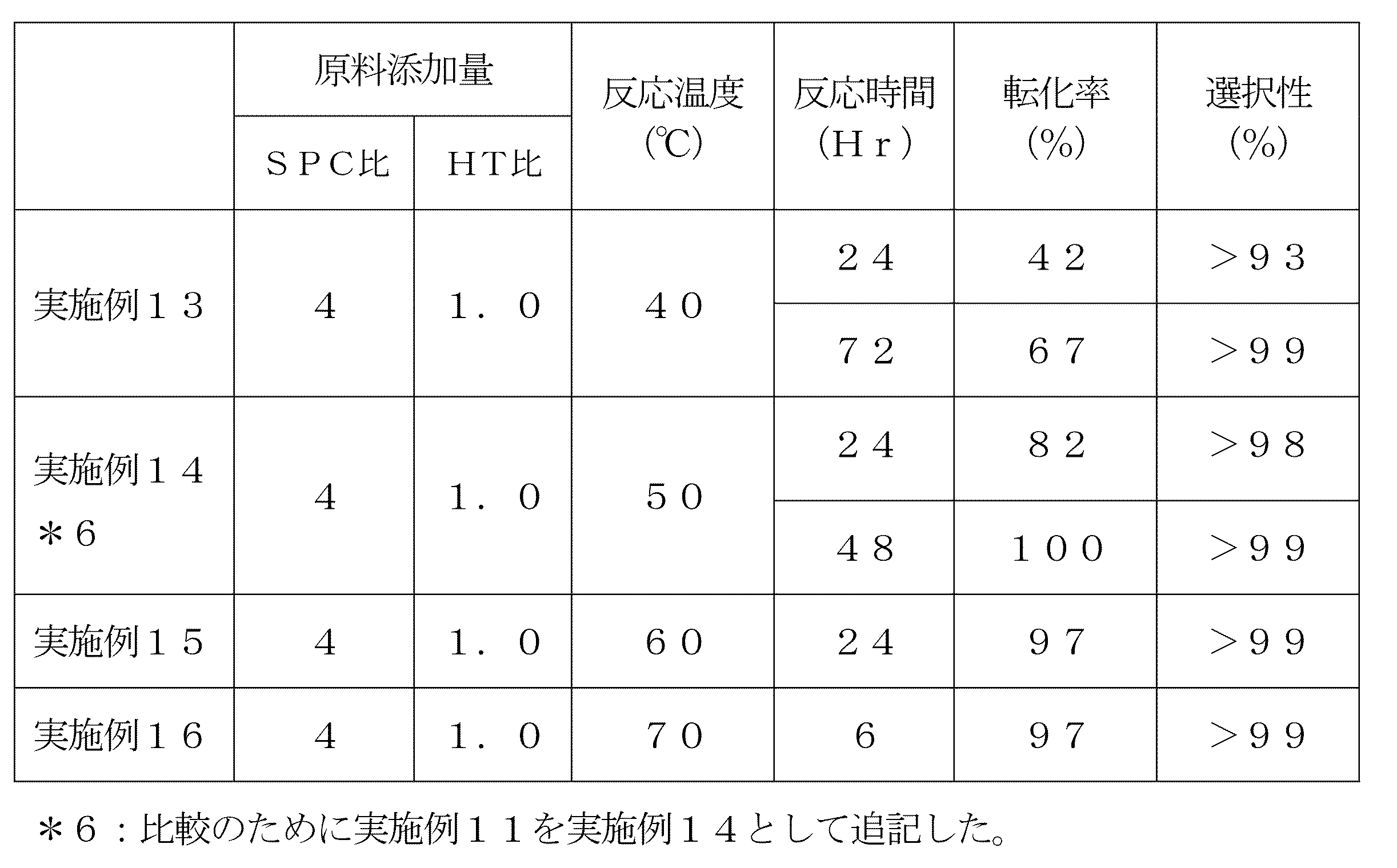
表3に示されているように、40℃の反応では、HT比が1.0でSPC比が4(過酸化水素の量に換算すると6)の条件であっても、24時間での転化率は42%であり72時間でも転化率は67%である。一方、反応温度を50℃とすると、24時間でも転化率は80%を超えている。この結果より、反応温度は45℃以上が好ましいと考えられる。
実施例17~19、比較例2~4 [HTEMPOの製造]
固体分散相として以下に示すものを用いた以外は実施例5と同様の方法、条件で反応を行い、HTEMPOの転化率、選択性を測定した。その結果を表4に示す。
固体分散相として以下に示すものを用いた以外は実施例5と同様の方法、条件で反応を行い、HTEMPOの転化率、選択性を測定した。その結果を表4に示す。
[使用した固体分散相]
1)ハイドロタルサイト:MgO/Al2O3=6.0(キョーワード500SNG:表4中ではHT1と表す)
2)ハイドロタルサイト:MgO/Al2O3=4.6(表4中ではHT2と表す)
3)ハイドロタルサイト:MgO/Al2O3=2.5(表4中ではHT3と表す)
4)アルミナ(Al2O3):Merck社製、アルミナ90(比表面積(BET法):110m2/g)
5)マグネシア(MgO):協和化学工業社製、キョーワマグ150(比表面積(BET法):140m2/g)
6)ヒドロキシアパタイト:積水化成社製、アパミクロン(比表面積(BET法):74m2/g)
1)ハイドロタルサイト:MgO/Al2O3=6.0(キョーワード500SNG:表4中ではHT1と表す)
2)ハイドロタルサイト:MgO/Al2O3=4.6(表4中ではHT2と表す)
3)ハイドロタルサイト:MgO/Al2O3=2.5(表4中ではHT3と表す)
4)アルミナ(Al2O3):Merck社製、アルミナ90(比表面積(BET法):110m2/g)
5)マグネシア(MgO):協和化学工業社製、キョーワマグ150(比表面積(BET法):140m2/g)
6)ヒドロキシアパタイト:積水化成社製、アパミクロン(比表面積(BET法):74m2/g)
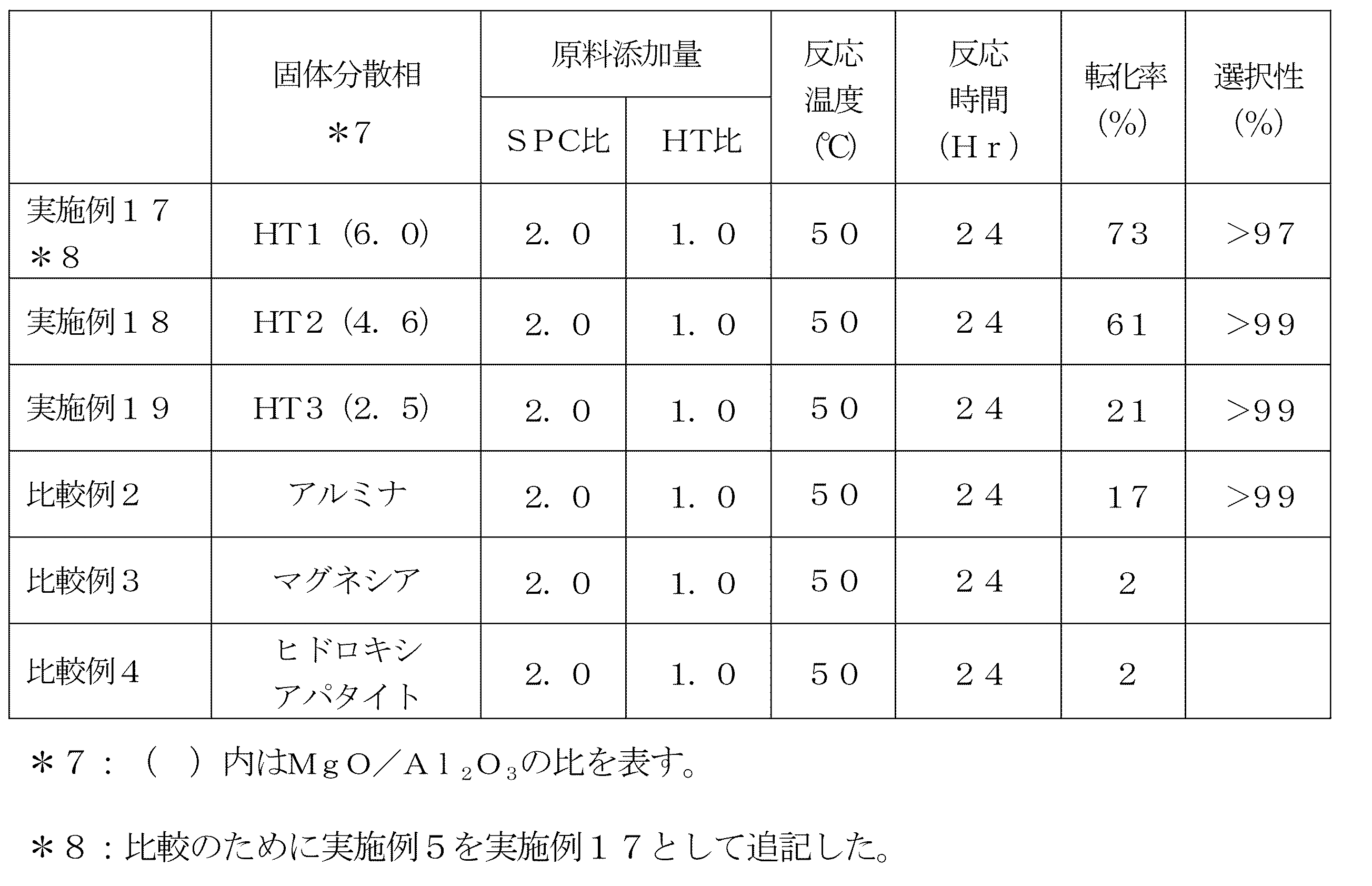
表4に示されているように、固体分散相としてハイドロタルサイトを用いた場合のみ、優れた転化率が得られており、アルミナ、マグネシア、ヒドロキシアパタイトを用いた場合では優れた転化率は得られていない。従って、本発明の効果を達成するためには固体分散相としてハイドロタルサイトを用いる必要があると考えられる。又、ハイドロタルサイトの中ではMgO/Al2O3の比が2.5の場合(実施例19)では高い転化率は得られていない。この結果よりMgO/Al2O3の比が3以上のハイドロタルサイトが好ましいと考えられる。
実施例20 [HTEMPOの製造]
ハイドロタルサイト粉末(キョーワード500SNG)0.75gとHTEMPR 0.0788g(0.5mmol)粉末をねじ口試験管に加えた。その後、さらに過炭酸ナトリウム(SPC-G)0.314g(2.0mmol、H2O2を3.0mmol含む)を加えて、粉体状態の反応混合物とした。試験管を振って攪拌した後、50℃に設定した恒温器の中に静置した。48時間後、粉体反応混合物を酢酸エチルで抽出しろ過を行った。実施例1と同様にしてHTEMPOの生成を確認し、そのGC転化率を測定したところ99%であった。
ハイドロタルサイト粉末(キョーワード500SNG)0.75gとHTEMPR 0.0788g(0.5mmol)粉末をねじ口試験管に加えた。その後、さらに過炭酸ナトリウム(SPC-G)0.314g(2.0mmol、H2O2を3.0mmol含む)を加えて、粉体状態の反応混合物とした。試験管を振って攪拌した後、50℃に設定した恒温器の中に静置した。48時間後、粉体反応混合物を酢酸エチルで抽出しろ過を行った。実施例1と同様にしてHTEMPOの生成を確認し、そのGC転化率を測定したところ99%であった。
実施例21 [HTEMPOの製造]
過炭酸ナトリウム2.0mmolの代わりに過ホウ酸ナトリウム3.0mmolを用いた以外は、実施例20と同様の方法、条件で反応を行い、HTEMPOのGC転化率を測定したところ29%であった。
過炭酸ナトリウム2.0mmolの代わりに過ホウ酸ナトリウム3.0mmolを用いた以外は、実施例20と同様の方法、条件で反応を行い、HTEMPOのGC転化率を測定したところ29%であった。
実施例21の結果は、酸化剤として、過炭酸ナトリウムの代わりに過ホウ酸ナトリウムを用いた場合でも本発明を実施できることを示している。ただし、実施例20と21の比較より、過炭酸ナトリウムを用いた場合に比べて過ホウ酸ナトリウムを用いた場合の転化率は低く、固体酸化剤の中では、過炭酸ナトリウムが好ましいことが示されている。
実施例22 [HTEMPOの製造]
ハイドロタルサイト粉末(キョーワード500SNG)0.25gとHTEMPR0.25mmolの混合物を乳鉢で粉砕し、ねじ口試験管に加えた。その後、さらに過炭酸ナトリウム(SPC-G)0.833mmol(H2O2を1.25mmol含む)を加えて、粉体状態の反応混合物とした。試験管を振って攪拌した後、50℃に設定した恒温器の中に静置した。48時間後粉体反応混合物を酢酸エチルで抽出しろ過を行った。実施例1と同様にしてHTEMPOの生成を確認し、その転化率(Conversion)を測定したところ97%であり、選択性は99%であった。
ハイドロタルサイト粉末(キョーワード500SNG)0.25gとHTEMPR0.25mmolの混合物を乳鉢で粉砕し、ねじ口試験管に加えた。その後、さらに過炭酸ナトリウム(SPC-G)0.833mmol(H2O2を1.25mmol含む)を加えて、粉体状態の反応混合物とした。試験管を振って攪拌した後、50℃に設定した恒温器の中に静置した。48時間後粉体反応混合物を酢酸エチルで抽出しろ過を行った。実施例1と同様にしてHTEMPOの生成を確認し、その転化率(Conversion)を測定したところ97%であり、選択性は99%であった。
比較例5 [HTEMPOの製造]
ヒドロキシアパタイト(HAp)0.50gとHTEMPR(0.50mmol)粉末をねじ口試験管に加えた。その後、さらに触媒(タングステン酸[H2WO4]0.05mmol:HTEMPRに対して10モル%)を加えて、粉体状態の反応混合物とした。さらに35%過酸化水素水(1.50 mmol)を加えて、試験管を振ってよく攪拌した後、25℃で静置した。24時間静置後、実施例1と同様にして溶媒による抽出を行い、GC分析を行ったところ、HTEMPOが転化率97%、選択率99%で生成していることが確認された。
ヒドロキシアパタイト(HAp)0.50gとHTEMPR(0.50mmol)粉末をねじ口試験管に加えた。その後、さらに触媒(タングステン酸[H2WO4]0.05mmol:HTEMPRに対して10モル%)を加えて、粉体状態の反応混合物とした。さらに35%過酸化水素水(1.50 mmol)を加えて、試験管を振ってよく攪拌した後、25℃で静置した。24時間静置後、実施例1と同様にして溶媒による抽出を行い、GC分析を行ったところ、HTEMPOが転化率97%、選択率99%で生成していることが確認された。
比較例6 [HTEMPOの製造]
炭酸カルシウム(CaCO3:試薬)0.50gとHTEMPR(0.50mmol)粉末をねじ口試験管に加えた。その後、さらに触媒(タングステン酸[H2WO4]0.05mmol:HTEMPRに対して10モル%)を加えて、粉体状態の反応混合物とした。さらに尿素-過酸化水素複合体(1.50mmol、Aldrich社製)を加えて、試験管を振ってよく攪拌した後、35℃で静置した。8時間静置後、実施例1と同様にして溶媒による抽出を行い、GC分析を行ったところ、HTEMPOが転化率95%、選択率98%で生成していることが確認された。
炭酸カルシウム(CaCO3:試薬)0.50gとHTEMPR(0.50mmol)粉末をねじ口試験管に加えた。その後、さらに触媒(タングステン酸[H2WO4]0.05mmol:HTEMPRに対して10モル%)を加えて、粉体状態の反応混合物とした。さらに尿素-過酸化水素複合体(1.50mmol、Aldrich社製)を加えて、試験管を振ってよく攪拌した後、35℃で静置した。8時間静置後、実施例1と同様にして溶媒による抽出を行い、GC分析を行ったところ、HTEMPOが転化率95%、選択率98%で生成していることが確認された。
比較例5、6は、触媒(タングステン酸)を用いる方法である。前記の実施例が示すように本発明によれば、触媒(タングステン酸)を用いなくてもHTEMPOを得ることができる。
実施例23 [TEMPOの製造]
ハイドロタルサイト粉末(キョーワード500SNG)1.00gをねじ口試験管に加え、これに脂環式2級アミン化合物の2,2,6,6-テトラメチルピペリジン(前記の式(3)で表される化合物。以下「TEMPR」と表示する)0.157g(1.1mmol)を染みこませた。その後、さらに過炭酸ナトリウム(SPC-G)0.350g(2.2mmol、H2O2を3.3mmol含む)を加えて、粉体状態の反応混合物とした。試験管を振って攪拌した後、50℃に設定した恒温器の中に17時間静置した。その後粉体反応混合物を酢酸エチルで抽出しろ過を行った。溶媒留去により赤褐色固体0.137g(粗収率81.6%)が得られた。GC分析およびIR分析で市販品TEMPOと比較分析したところ、TEMPOであることが確認され、前記の実施例と同様な方法によりそのGC転化率及びGC選択性を測定したところ、GC転化率は100%であり、GC選択性は99%以上であった。
ハイドロタルサイト粉末(キョーワード500SNG)1.00gをねじ口試験管に加え、これに脂環式2級アミン化合物の2,2,6,6-テトラメチルピペリジン(前記の式(3)で表される化合物。以下「TEMPR」と表示する)0.157g(1.1mmol)を染みこませた。その後、さらに過炭酸ナトリウム(SPC-G)0.350g(2.2mmol、H2O2を3.3mmol含む)を加えて、粉体状態の反応混合物とした。試験管を振って攪拌した後、50℃に設定した恒温器の中に17時間静置した。その後粉体反応混合物を酢酸エチルで抽出しろ過を行った。溶媒留去により赤褐色固体0.137g(粗収率81.6%)が得られた。GC分析およびIR分析で市販品TEMPOと比較分析したところ、TEMPOであることが確認され、前記の実施例と同様な方法によりそのGC転化率及びGC選択性を測定したところ、GC転化率は100%であり、GC選択性は99%以上であった。
実施例24 [TEMPOの製造]
50℃に設定した恒温器の中の静置時間を10時間に変更した以外は、実施例23と同様の反応を行ったところ、TEMPOが得られていることが確認され、そのGC転化率は93%であり、GC選択性は99%であった。
50℃に設定した恒温器の中の静置時間を10時間に変更した以外は、実施例23と同様の反応を行ったところ、TEMPOが得られていることが確認され、そのGC転化率は93%であり、GC選択性は99%であった。
実施例25 [TEMPOの製造]
50℃に設定した恒温器の中の静置時間を10時間に変更し、過炭酸ナトリウム(SPC-G)の量を2.0mmolから3.3mmol(H2O2を5.0mmol含む)に変更した以外は、実施例23と同様の反応を行ったところ、TEMPOが得られていることが確認され、そのGC転化率は98%であり、GC選択性は99%であった。
50℃に設定した恒温器の中の静置時間を10時間に変更し、過炭酸ナトリウム(SPC-G)の量を2.0mmolから3.3mmol(H2O2を5.0mmol含む)に変更した以外は、実施例23と同様の反応を行ったところ、TEMPOが得られていることが確認され、そのGC転化率は98%であり、GC選択性は99%であった。
比較例7 [TEMPOの製造]
ヒドロキシアパタイト(HAp)と触媒(CetylPy)3[PW12O40]0.061g(0.020mmol)からなる固体混合物(ノンハライト(登録商標)-WP)1.0gとTEMPR(1.0mmol)、及び35%過酸化水素水(3.0mmol)を加えて、試験管を振ってよく攪拌した後、50℃で静置した。10時間静置後、実施例23と同様にしてそのGC転化率及びGC選択性を測定したところ、GC転化率は85%であり、GC選択性は94%であった。
ヒドロキシアパタイト(HAp)と触媒(CetylPy)3[PW12O40]0.061g(0.020mmol)からなる固体混合物(ノンハライト(登録商標)-WP)1.0gとTEMPR(1.0mmol)、及び35%過酸化水素水(3.0mmol)を加えて、試験管を振ってよく攪拌した後、50℃で静置した。10時間静置後、実施例23と同様にしてそのGC転化率及びGC選択性を測定したところ、GC転化率は85%であり、GC選択性は94%であった。
実施例24、25の結果より、前記のHTEMPR(固体)からHTEMPO(固体)の製造の場合と同様に、TEMPO(固体)も、本発明によりTEMPR(液体)から製造できることが示されている。又、実施例24、25と比較例7との比較により、本発明の方法によれば、他の有機化合物の酸化に従来適用されていた方法(比較例7:所謂ノンハライト法)より優れた転化率及び選択性が得られることが示されている。
実施例26~28 [TEMPOの製造]
ハイドロタルサイト粉末(キョーワード500SNG)1.0gにTEMPR1.0mmolをしみこませた。その後、さらに表5に示す酸化剤を表5に示す量(いずれの場合も過酸化水素換算で3.0mmol)加えて、粉体状態の反応混合物とした。試験管を振って攪拌した後、50℃に設定した恒温器の中に静置した。所定の時間ごとに粉体反応混合物の一部を取って酢酸エチルで抽出した。その後実施例23と同様にしてGC転化率を測定した。測定結果を表5に示す。
ハイドロタルサイト粉末(キョーワード500SNG)1.0gにTEMPR1.0mmolをしみこませた。その後、さらに表5に示す酸化剤を表5に示す量(いずれの場合も過酸化水素換算で3.0mmol)加えて、粉体状態の反応混合物とした。試験管を振って攪拌した後、50℃に設定した恒温器の中に静置した。所定の時間ごとに粉体反応混合物の一部を取って酢酸エチルで抽出した。その後実施例23と同様にしてGC転化率を測定した。測定結果を表5に示す。

実施例26~28の結果より、酸化剤としては、過炭酸塩の他に、過酸化水素水や尿素-過酸化水素複合体も用いられることが示されている。ただし、過炭酸ナトリウムを用いた場合の方が、他の酸化剤を用いた場合より、高い転化率が得られているので、酸化剤としては、過炭酸塩が好ましいと考えられる。
実施例29~33 [AZADOの製造]
表6に示す量のハイドロタルサイト粉末(キョーワード500SNG)と脂環式2級アミン化合物(固体基質)のAZAD粉末0.25mmolとを混合し、ねじ口試験管に加えた。その後、さらに過炭酸ナトリウム(SPC-G)を表6に示す量加えて、粉体状態の反応混合物とした。試験管を振って攪拌した後、50℃に設定した恒温器の中に表6に示す時間静置した。所定の時間ごとに粉体反応混合物の一部を取って酢酸エチルで抽出した。抽出液をGCにより標準品と比較分析したところ、AZADOであることが確認された。前記の実施例と同様な方法によりそのGC転化率及びGC選択性を測定した。その結果を表6に示す。
表6に示す量のハイドロタルサイト粉末(キョーワード500SNG)と脂環式2級アミン化合物(固体基質)のAZAD粉末0.25mmolとを混合し、ねじ口試験管に加えた。その後、さらに過炭酸ナトリウム(SPC-G)を表6に示す量加えて、粉体状態の反応混合物とした。試験管を振って攪拌した後、50℃に設定した恒温器の中に表6に示す時間静置した。所定の時間ごとに粉体反応混合物の一部を取って酢酸エチルで抽出した。抽出液をGCにより標準品と比較分析したところ、AZADOであることが確認された。前記の実施例と同様な方法によりそのGC転化率及びGC選択性を測定した。その結果を表6に示す。

比較例8 [AZADOの製造]
ヒドロキシアパタイト(HAp)0.25gとAZAD 粉末0.25mmolをねじ口試験管に加えて、混合した。その後、さらに触媒(タングステン酸[H2WO4]0.025mmol:AZADに対して10モル%)を加えて、粉体状態の反応混合物とした。さらに35%過酸化水素水(1.00 mmol)を加えて、試験管を振ってよく攪拌した後、25℃で静置した。3時間静置後、実施例29と同様にして生成物の単離を行い、AZADOであることを確認した。前記の実施例と同様な方法によりそのGC転化率及びGC選択性を測定したところ、GC転化率は81%、GC選択率は93%であった。
ヒドロキシアパタイト(HAp)0.25gとAZAD 粉末0.25mmolをねじ口試験管に加えて、混合した。その後、さらに触媒(タングステン酸[H2WO4]0.025mmol:AZADに対して10モル%)を加えて、粉体状態の反応混合物とした。さらに35%過酸化水素水(1.00 mmol)を加えて、試験管を振ってよく攪拌した後、25℃で静置した。3時間静置後、実施例29と同様にして生成物の単離を行い、AZADOであることを確認した。前記の実施例と同様な方法によりそのGC転化率及びGC選択性を測定したところ、GC転化率は81%、GC選択率は93%であった。
比較例9 [AZADOの製造]
35%過酸化水素水の添加量を1.00mmolから0.75mmolとし、静置時間を3時間から12時間に変更した以外は、比較例8と同様の反応を行ったところ、GC転化率は79%であり、GC選択性は96%であった。
35%過酸化水素水の添加量を1.00mmolから0.75mmolとし、静置時間を3時間から12時間に変更した以外は、比較例8と同様の反応を行ったところ、GC転化率は79%であり、GC選択性は96%であった。
実施例29~33の結果より、前記のHTEMPRからHTEMPOの製造の場合と同様に、AZADOも、本発明によりAZADから製造できることが示されている。又、比較例8、9の結果より、有機化合物の酸化に従来適用されていた方法では、GC転化率は80%程度しか得られないことが示されているが、 実施例29~33の結果より、本発明の方法によれば、100%近い優れた転化率が得られることが示されている。
実施例34 [HTEMPOの合成]
ハイドロタルサイト粉末(キョーワード500SNG、協和化学工業社製、MgO/Al2O3の比:6.0)2.01gと脂環式2級アミン化合物4-ヒドロキシ-2,2,6,6-テトラメチルピペリジン(HTEMPR)粉末0.313g(2.00mmol)をねじ口試験管に加えた。その後、さらに過炭酸ナトリウム(三菱ガス化学社製:SPC-G(粉体))1.047g(6.67mmol、H2O2を10.0mmol含む)を加えて、粉体状態の反応混合物とした。試験管を振って攪拌した後、70℃に設定した恒温器の中に静置した。10時間後、粉体反応混合物を酢酸エチルで抽出しろ過を行った。溶媒を留去して赤橙色固体0.300g(粗収率:87.9%)を得た。GC転化率は95%であり(4%は原料)、選択性は99%以上であった。
ハイドロタルサイト粉末(キョーワード500SNG、協和化学工業社製、MgO/Al2O3の比:6.0)2.01gと脂環式2級アミン化合物4-ヒドロキシ-2,2,6,6-テトラメチルピペリジン(HTEMPR)粉末0.313g(2.00mmol)をねじ口試験管に加えた。その後、さらに過炭酸ナトリウム(三菱ガス化学社製:SPC-G(粉体))1.047g(6.67mmol、H2O2を10.0mmol含む)を加えて、粉体状態の反応混合物とした。試験管を振って攪拌した後、70℃に設定した恒温器の中に静置した。10時間後、粉体反応混合物を酢酸エチルで抽出しろ過を行った。溶媒を留去して赤橙色固体0.300g(粗収率:87.9%)を得た。GC転化率は95%であり(4%は原料)、選択性は99%以上であった。
実施例35 [ハイドロタルサイトのリユース1回目]
実施例34における酢酸エチル抽出後に残った固体粉末から、過炭酸ナトリウム酸化剤およびそれに由来する炭酸ナトリウムを水洗して取り除いた。100℃で数時間乾燥を行い、ハイドロタルサイト粉末1.940gを得た。この回収したハイドロタルサイト粉末を用いて、再度同様に粉体反応によるHTEMPOの合成を行った。すなわち、この粉体に、HTEMPR 0.315g(2.00mmol)および過炭酸ナトリウム1.048g(6.67mmol、H2O2を10.0mmol含む)を加えて、粉体状態の反応混合物とした。70℃で10時間静置した。上記と同様の操作を行って、赤橙色固体0.327g(粗収率:94.7%)を得た。GC転化率は86%(13%は原料)、選択性は99%以上であった。
実施例34における酢酸エチル抽出後に残った固体粉末から、過炭酸ナトリウム酸化剤およびそれに由来する炭酸ナトリウムを水洗して取り除いた。100℃で数時間乾燥を行い、ハイドロタルサイト粉末1.940gを得た。この回収したハイドロタルサイト粉末を用いて、再度同様に粉体反応によるHTEMPOの合成を行った。すなわち、この粉体に、HTEMPR 0.315g(2.00mmol)および過炭酸ナトリウム1.048g(6.67mmol、H2O2を10.0mmol含む)を加えて、粉体状態の反応混合物とした。70℃で10時間静置した。上記と同様の操作を行って、赤橙色固体0.327g(粗収率:94.7%)を得た。GC転化率は86%(13%は原料)、選択性は99%以上であった。
実施例36 [ハイドロタルサイトのリユース2回目]
実施例35において抽出後に残った固体粉末から同様の操作でハイドロタルサイト粉末1.792gを回収した。これに、HTEMPR 0.283g(1.80mmol)および過炭酸ナトリウム0.939g(6.00mmol、H2O2を9.0mmol含む)を加えて、粉体状態の反応混合物とした。70℃で10時間静置した。同様の操作を行って、赤橙色固体0.292g(粗収率:94.3%)を得た。GC転化率は91%(9%は原料)、選択性は99%以上であった。
実施例35において抽出後に残った固体粉末から同様の操作でハイドロタルサイト粉末1.792gを回収した。これに、HTEMPR 0.283g(1.80mmol)および過炭酸ナトリウム0.939g(6.00mmol、H2O2を9.0mmol含む)を加えて、粉体状態の反応混合物とした。70℃で10時間静置した。同様の操作を行って、赤橙色固体0.292g(粗収率:94.3%)を得た。GC転化率は91%(9%は原料)、選択性は99%以上であった。
Claims (8)
- ハイドロタルサイトからなる固体分散相中に、脂環式2級アミン化合物及び酸化剤を混合して、前記脂環式2級アミン化合物を、前記固体分散相中で酸化することを特徴とする脂環式N-オキシル化合物の製造方法。
- 脂環式2級アミン化合物が、2-アザアダマンタン骨格を有する化合物であることを特徴とする請求項1に記載の脂環式N-オキシル化合物の製造方法。
- 脂環式2級アミン化合物が、テトラメチルピペリジン又はヒドロキシテトラメチルピペリジンであることを特徴とする請求項1に記載の脂環式N-オキシル化合物の製造方法。
- 前記酸化剤が、過炭酸塩、過酸化水素水及び尿素-過酸化水素複合体からなる群より選ばれることを特徴とする請求項1ないし請求項3のいずれか1項に記載の脂環式N-オキシル化合物の製造方法。
- 前記酸化剤が過炭酸ナトリウムであることを特徴とする請求項4に記載の脂環式N-オキシル化合物の製造方法。
- 前記酸化剤の添加量が、酸化剤中に含まれている過酸化水素の量に換算して、脂環式2級アミン化合物に対して2~10倍モルであることを特徴とする請求項4又は請求項5に記載の脂環式N-オキシル化合物の製造方法。
- 固体分散相の添加量が、脂環式2級アミン化合物1ミリモルに対して0.4~2.0gであることを特徴とする請求項4ないし請求項6のいずれか1項に記載の脂環式N-オキシル化合物の製造方法。
- ハイドロタルサイトからなる固体分散相中に、脂環式2級アミン化合物及び酸化剤を混合して、前記脂環式2級アミン化合物を、前記固体分散相中で酸化する工程、
前記酸化後、脂環式N-オキシル化合物を溶解する有機溶媒により固体分散相の抽出を行う工程、
抽出液より脂環式N-オキシル化合物を回収する工程、及び
前記抽出後の固体分散相を水洗する工程、及び
前記水洗後の固体分散相に脂環式2級アミン化合物及び酸化剤を混合して、前記脂環式2級アミン化合物を、前記固体分散相中で酸化する工程、を有することを特徴とする脂環式N-オキシル化合物の製造方法。
Priority Applications (1)
| Application Number | Priority Date | Filing Date | Title |
|---|---|---|---|
| JP2014523703A JP6188028B2 (ja) | 2012-07-02 | 2013-06-27 | 脂環式n−オキシル化合物の製造方法 |
Applications Claiming Priority (2)
| Application Number | Priority Date | Filing Date | Title |
|---|---|---|---|
| JP2012148302 | 2012-07-02 | ||
| JP2012-148302 | 2012-07-02 |
Publications (1)
| Publication Number | Publication Date |
|---|---|
| WO2014007144A1 true WO2014007144A1 (ja) | 2014-01-09 |
Family
ID=49881901
Family Applications (1)
| Application Number | Title | Priority Date | Filing Date |
|---|---|---|---|
| PCT/JP2013/067699 Ceased WO2014007144A1 (ja) | 2012-07-02 | 2013-06-27 | 脂環式n-オキシル化合物の製造方法 |
Country Status (2)
| Country | Link |
|---|---|
| JP (1) | JP6188028B2 (ja) |
| WO (1) | WO2014007144A1 (ja) |
Citations (6)
| Publication number | Priority date | Publication date | Assignee | Title |
|---|---|---|---|---|
| JP2002234867A (ja) * | 2000-11-22 | 2002-08-23 | Council Scient Ind Res | アミンオキシドの製造方法 |
| JP2003300949A (ja) * | 2002-03-28 | 2003-10-21 | Council Scient Ind Res | アミンオキシドの製造方法 |
| JP2004149513A (ja) * | 2002-09-02 | 2004-05-27 | Sumitomo Chem Co Ltd | N−オキシル化合物の製造方法 |
| CN1683414A (zh) * | 2005-03-17 | 2005-10-19 | 华东师范大学 | 一种以类水滑石为催化剂制备立体受阻胺氮氧自由基的方法 |
| WO2008093711A1 (ja) * | 2007-01-31 | 2008-08-07 | Osaka University | 固相系酸化反応システム |
| WO2011125437A1 (ja) * | 2010-04-06 | 2011-10-13 | 第一工業製薬株式会社 | N-オキシル化合物の製法 |
Family Cites Families (3)
| Publication number | Priority date | Publication date | Assignee | Title |
|---|---|---|---|---|
| CN102470346B (zh) * | 2009-07-02 | 2015-07-08 | 巴斯夫欧洲公司 | 用于氧化脱氢或环氧化的负载型含贵金属催化剂 |
| JP5932656B2 (ja) * | 2010-10-22 | 2016-06-08 | 株式会社クラレ | ニトリルの製造方法 |
| JP5577226B2 (ja) * | 2010-12-01 | 2014-08-20 | 株式会社ダイセル | エポキシ化合物の脱酸素によるアルケンの製造方法 |
-
2013
- 2013-06-27 JP JP2014523703A patent/JP6188028B2/ja not_active Expired - Fee Related
- 2013-06-27 WO PCT/JP2013/067699 patent/WO2014007144A1/ja not_active Ceased
Patent Citations (6)
| Publication number | Priority date | Publication date | Assignee | Title |
|---|---|---|---|---|
| JP2002234867A (ja) * | 2000-11-22 | 2002-08-23 | Council Scient Ind Res | アミンオキシドの製造方法 |
| JP2003300949A (ja) * | 2002-03-28 | 2003-10-21 | Council Scient Ind Res | アミンオキシドの製造方法 |
| JP2004149513A (ja) * | 2002-09-02 | 2004-05-27 | Sumitomo Chem Co Ltd | N−オキシル化合物の製造方法 |
| CN1683414A (zh) * | 2005-03-17 | 2005-10-19 | 华东师范大学 | 一种以类水滑石为催化剂制备立体受阻胺氮氧自由基的方法 |
| WO2008093711A1 (ja) * | 2007-01-31 | 2008-08-07 | Osaka University | 固相系酸化反応システム |
| WO2011125437A1 (ja) * | 2010-04-06 | 2011-10-13 | 第一工業製薬株式会社 | N-オキシル化合物の製法 |
Also Published As
| Publication number | Publication date |
|---|---|
| JP6188028B2 (ja) | 2017-08-30 |
| JPWO2014007144A1 (ja) | 2016-06-02 |
Similar Documents
| Publication | Publication Date | Title |
|---|---|---|
| JP5376505B2 (ja) | 固相系酸化反応用混合物 | |
| CN107148415A (zh) | 制备甘油酸碳酸酯的方法 | |
| Narkhede et al. | Mono lacunary phosphomolybdate supported on MCM-41: Synthesis, characterization and solvent free aerobic oxidation of alkenes and alcohols | |
| TW201509930A (zh) | 環狀碳酸酯之連續製造方法 | |
| EP3476834A1 (en) | Method for producing aromatic nitrile compound and method for producing ester carbonate | |
| TW201714864A (zh) | 一種對苯二酚及其衍生物之製備方法 | |
| JPH0687830A (ja) | 2,2,6,6−テトラメチルピペリジンのn−オキシル誘導体およびその製法 | |
| Mistri et al. | Copper ion substituted hercynite (Cu0. 03Fe0. 97Al2O4): A highly active catalyst for liquid phase oxidation of cyclohexane | |
| CN106631729A (zh) | 苯乙酮的合成方法 | |
| Pillai et al. | Epoxidation of olefins and α, β-unsaturated ketones over sonochemically prepared hydroxyapatites using hydrogen peroxide | |
| JP6188028B2 (ja) | 脂環式n−オキシル化合物の製造方法 | |
| AU2022321753A1 (en) | Method for producing fatty aldehydes and derivatives thereof | |
| JP5709180B2 (ja) | エポキシ化方法 | |
| TWI466875B (zh) | Method for making epoxides | |
| EP3560912A1 (en) | Method for producing aromatic nitrile compound and method for producing carbonic acid ester | |
| JP5386146B2 (ja) | グリシドールの製造方法 | |
| WO2004091784A1 (ja) | 金属触媒およびその用途 | |
| Zolfigol et al. | H5IO6/KI: A new combination reagent for iodination of aromatic amines, and trimethylsilylation of alcohols and phenols through in situ generation of iodine under mild conditions | |
| JP5506074B2 (ja) | エポキシ化合物の製造方法 | |
| JP2024513428A (ja) | ポルフィリン組成物及びポルフィリン組成物を生成する方法 | |
| JP4035611B2 (ja) | シクロオクテンオキサイドの製造方法 | |
| Zhu et al. | Controlling the selectivity of styrene oxidation over Aun superatoms with electron-rich core and electron-deficient shell | |
| JP2003055347A (ja) | 2,2,6,6−テトラメチルピペリジン−n−オキシル化合物の製造方法 | |
| PL228752B1 (pl) | Sposób utleniania limonenu na węglach aktywnych | |
| JP6532055B2 (ja) | 金属粒子担持触媒、触媒組成物、および、ヒドロキシ脂肪酸の製造方法 |
Legal Events
| Date | Code | Title | Description |
|---|---|---|---|
| 121 | Ep: the epo has been informed by wipo that ep was designated in this application |
Ref document number: 13812954 Country of ref document: EP Kind code of ref document: A1 |
|
| DPE2 | Request for preliminary examination filed before expiration of 19th month from priority date (pct application filed from 20040101) | ||
| ENP | Entry into the national phase |
Ref document number: 2014523703 Country of ref document: JP Kind code of ref document: A |
|
| NENP | Non-entry into the national phase |
Ref country code: DE |
|
| 122 | Ep: pct application non-entry in european phase |
Ref document number: 13812954 Country of ref document: EP Kind code of ref document: A1 |