WO2014002990A1 - 粘性組成物 - Google Patents
粘性組成物 Download PDFInfo
- Publication number
- WO2014002990A1 WO2014002990A1 PCT/JP2013/067343 JP2013067343W WO2014002990A1 WO 2014002990 A1 WO2014002990 A1 WO 2014002990A1 JP 2013067343 W JP2013067343 W JP 2013067343W WO 2014002990 A1 WO2014002990 A1 WO 2014002990A1
- Authority
- WO
- WIPO (PCT)
- Prior art keywords
- dispersion medium
- silicone
- viscous composition
- torque value
- composite particles
- Prior art date
- Legal status (The legal status is an assumption and is not a legal conclusion. Google has not performed a legal analysis and makes no representation as to the accuracy of the status listed.)
- Ceased
Links
Images
Classifications
-
- C—CHEMISTRY; METALLURGY
- C10—PETROLEUM, GAS OR COKE INDUSTRIES; TECHNICAL GASES CONTAINING CARBON MONOXIDE; FUELS; LUBRICANTS; PEAT
- C10M—LUBRICATING COMPOSITIONS; USE OF CHEMICAL SUBSTANCES EITHER ALONE OR AS LUBRICATING INGREDIENTS IN A LUBRICATING COMPOSITION
- C10M169/00—Lubricating compositions characterised by containing as components a mixture of at least two types of ingredient selected from base-materials, thickeners or additives, covered by the preceding groups, each of these compounds being essential
- C10M169/02—Mixtures of base-materials and thickeners
-
- C—CHEMISTRY; METALLURGY
- C08—ORGANIC MACROMOLECULAR COMPOUNDS; THEIR PREPARATION OR CHEMICAL WORKING-UP; COMPOSITIONS BASED THEREON
- C08J—WORKING-UP; GENERAL PROCESSES OF COMPOUNDING; AFTER-TREATMENT NOT COVERED BY SUBCLASSES C08B, C08C, C08F, C08G or C08H
- C08J3/00—Processes of treating or compounding macromolecular substances
- C08J3/12—Powdering or granulating
- C08J3/126—Polymer particles coated by polymer, e.g. core shell structures
-
- C—CHEMISTRY; METALLURGY
- C08—ORGANIC MACROMOLECULAR COMPOUNDS; THEIR PREPARATION OR CHEMICAL WORKING-UP; COMPOSITIONS BASED THEREON
- C08L—COMPOSITIONS OF MACROMOLECULAR COMPOUNDS
- C08L23/00—Compositions of homopolymers or copolymers of unsaturated aliphatic hydrocarbons having only one carbon-to-carbon double bond; Compositions of derivatives of such polymers
- C08L23/02—Compositions of homopolymers or copolymers of unsaturated aliphatic hydrocarbons having only one carbon-to-carbon double bond; Compositions of derivatives of such polymers not modified by chemical after-treatment
- C08L23/18—Homopolymers or copolymers of hydrocarbons having four or more carbon atoms
- C08L23/20—Homopolymers or copolymers of hydrocarbons having four or more carbon atoms having four to nine carbon atoms
- C08L23/22—Copolymers of isobutene; Butyl rubber; Homopolymers or copolymers of other iso-olefins
-
- C—CHEMISTRY; METALLURGY
- C10—PETROLEUM, GAS OR COKE INDUSTRIES; TECHNICAL GASES CONTAINING CARBON MONOXIDE; FUELS; LUBRICANTS; PEAT
- C10M—LUBRICATING COMPOSITIONS; USE OF CHEMICAL SUBSTANCES EITHER ALONE OR AS LUBRICATING INGREDIENTS IN A LUBRICATING COMPOSITION
- C10M169/00—Lubricating compositions characterised by containing as components a mixture of at least two types of ingredient selected from base-materials, thickeners or additives, covered by the preceding groups, each of these compounds being essential
- C10M169/04—Mixtures of base-materials and additives
-
- C—CHEMISTRY; METALLURGY
- C08—ORGANIC MACROMOLECULAR COMPOUNDS; THEIR PREPARATION OR CHEMICAL WORKING-UP; COMPOSITIONS BASED THEREON
- C08J—WORKING-UP; GENERAL PROCESSES OF COMPOUNDING; AFTER-TREATMENT NOT COVERED BY SUBCLASSES C08B, C08C, C08F, C08G or C08H
- C08J2383/00—Characterised by the use of macromolecular compounds obtained by reactions forming in the main chain of the macromolecule a linkage containing silicon with or without sulfur, nitrogen, oxygen, or carbon only; Derivatives of such polymers
- C08J2383/04—Polysiloxanes
-
- C—CHEMISTRY; METALLURGY
- C08—ORGANIC MACROMOLECULAR COMPOUNDS; THEIR PREPARATION OR CHEMICAL WORKING-UP; COMPOSITIONS BASED THEREON
- C08J—WORKING-UP; GENERAL PROCESSES OF COMPOUNDING; AFTER-TREATMENT NOT COVERED BY SUBCLASSES C08B, C08C, C08F, C08G or C08H
- C08J2483/00—Characterised by the use of macromolecular compounds obtained by reactions forming in the main chain of the macromolecule a linkage containing silicon with or without sulfur, nitrogen, oxygen, or carbon only; Derivatives of such polymers
- C08J2483/04—Polysiloxanes
-
- C—CHEMISTRY; METALLURGY
- C10—PETROLEUM, GAS OR COKE INDUSTRIES; TECHNICAL GASES CONTAINING CARBON MONOXIDE; FUELS; LUBRICANTS; PEAT
- C10M—LUBRICATING COMPOSITIONS; USE OF CHEMICAL SUBSTANCES EITHER ALONE OR AS LUBRICATING INGREDIENTS IN A LUBRICATING COMPOSITION
- C10M2205/00—Organic macromolecular hydrocarbon compounds or fractions, whether or not modified by oxidation as ingredients in lubricant compositions
- C10M2205/02—Organic macromolecular hydrocarbon compounds or fractions, whether or not modified by oxidation as ingredients in lubricant compositions containing acyclic monomers
- C10M2205/026—Butene
- C10M2205/0265—Butene used as base material
-
- C—CHEMISTRY; METALLURGY
- C10—PETROLEUM, GAS OR COKE INDUSTRIES; TECHNICAL GASES CONTAINING CARBON MONOXIDE; FUELS; LUBRICANTS; PEAT
- C10M—LUBRICATING COMPOSITIONS; USE OF CHEMICAL SUBSTANCES EITHER ALONE OR AS LUBRICATING INGREDIENTS IN A LUBRICATING COMPOSITION
- C10M2229/00—Organic macromolecular compounds containing atoms of elements not provided for in groups C10M2205/00, C10M2209/00, C10M2213/00, C10M2217/00, C10M2221/00 or C10M2225/00 as ingredients in lubricant compositions
- C10M2229/02—Unspecified siloxanes; Silicones
-
- C—CHEMISTRY; METALLURGY
- C10—PETROLEUM, GAS OR COKE INDUSTRIES; TECHNICAL GASES CONTAINING CARBON MONOXIDE; FUELS; LUBRICANTS; PEAT
- C10M—LUBRICATING COMPOSITIONS; USE OF CHEMICAL SUBSTANCES EITHER ALONE OR AS LUBRICATING INGREDIENTS IN A LUBRICATING COMPOSITION
- C10M2229/00—Organic macromolecular compounds containing atoms of elements not provided for in groups C10M2205/00, C10M2209/00, C10M2213/00, C10M2217/00, C10M2221/00 or C10M2225/00 as ingredients in lubricant compositions
- C10M2229/02—Unspecified siloxanes; Silicones
- C10M2229/025—Unspecified siloxanes; Silicones used as base material
-
- C—CHEMISTRY; METALLURGY
- C10—PETROLEUM, GAS OR COKE INDUSTRIES; TECHNICAL GASES CONTAINING CARBON MONOXIDE; FUELS; LUBRICANTS; PEAT
- C10N—INDEXING SCHEME ASSOCIATED WITH SUBCLASS C10M RELATING TO LUBRICATING COMPOSITIONS
- C10N2020/00—Specified physical or chemical properties or characteristics, i.e. function, of component of lubricating compositions
- C10N2020/01—Physico-chemical properties
- C10N2020/02—Viscosity; Viscosity index
-
- C—CHEMISTRY; METALLURGY
- C10—PETROLEUM, GAS OR COKE INDUSTRIES; TECHNICAL GASES CONTAINING CARBON MONOXIDE; FUELS; LUBRICANTS; PEAT
- C10N—INDEXING SCHEME ASSOCIATED WITH SUBCLASS C10M RELATING TO LUBRICATING COMPOSITIONS
- C10N2020/00—Specified physical or chemical properties or characteristics, i.e. function, of component of lubricating compositions
- C10N2020/01—Physico-chemical properties
- C10N2020/055—Particles related characteristics
- C10N2020/06—Particles of special shape or size
-
- C—CHEMISTRY; METALLURGY
- C10—PETROLEUM, GAS OR COKE INDUSTRIES; TECHNICAL GASES CONTAINING CARBON MONOXIDE; FUELS; LUBRICANTS; PEAT
- C10N—INDEXING SCHEME ASSOCIATED WITH SUBCLASS C10M RELATING TO LUBRICATING COMPOSITIONS
- C10N2030/00—Specified physical or chemical properties which is improved by the additive characterising the lubricating composition, e.g. multifunctional additives
- C10N2030/02—Pour-point; Viscosity index
-
- C—CHEMISTRY; METALLURGY
- C10—PETROLEUM, GAS OR COKE INDUSTRIES; TECHNICAL GASES CONTAINING CARBON MONOXIDE; FUELS; LUBRICANTS; PEAT
- C10N—INDEXING SCHEME ASSOCIATED WITH SUBCLASS C10M RELATING TO LUBRICATING COMPOSITIONS
- C10N2030/00—Specified physical or chemical properties which is improved by the additive characterising the lubricating composition, e.g. multifunctional additives
- C10N2030/06—Oiliness; Film-strength; Anti-wear; Resistance to extreme pressure
-
- C—CHEMISTRY; METALLURGY
- C10—PETROLEUM, GAS OR COKE INDUSTRIES; TECHNICAL GASES CONTAINING CARBON MONOXIDE; FUELS; LUBRICANTS; PEAT
- C10N—INDEXING SCHEME ASSOCIATED WITH SUBCLASS C10M RELATING TO LUBRICATING COMPOSITIONS
- C10N2040/00—Specified use or application for which the lubricating composition is intended
- C10N2040/08—Hydraulic fluids, e.g. brake-fluids
-
- C—CHEMISTRY; METALLURGY
- C10—PETROLEUM, GAS OR COKE INDUSTRIES; TECHNICAL GASES CONTAINING CARBON MONOXIDE; FUELS; LUBRICANTS; PEAT
- C10N—INDEXING SCHEME ASSOCIATED WITH SUBCLASS C10M RELATING TO LUBRICATING COMPOSITIONS
- C10N2050/00—Form in which the lubricant is applied to the material being lubricated
- C10N2050/015—Dispersions of solid lubricants
-
- C—CHEMISTRY; METALLURGY
- C10—PETROLEUM, GAS OR COKE INDUSTRIES; TECHNICAL GASES CONTAINING CARBON MONOXIDE; FUELS; LUBRICANTS; PEAT
- C10N—INDEXING SCHEME ASSOCIATED WITH SUBCLASS C10M RELATING TO LUBRICATING COMPOSITIONS
- C10N2050/00—Form in which the lubricant is applied to the material being lubricated
- C10N2050/10—Form in which the lubricant is applied to the material being lubricated semi-solid; greasy
Definitions
- the present invention relates to a viscous composition.
- a rotary damper having a mechanism using a viscous fluid is known as a damper that is used in various opening / closing mechanisms and applies torque to the opening / closing operation of the opening / closing member.
- a viscous fluid used in the rotary damper of this mechanism for example, Japanese Patent Application Laid-Open No. 2010-281425 discloses a liquid in which solid particles are dispersed in a liquid such as silicone oil.
- the viscosity of the viscous fluid changes depending on the temperature. Therefore, the torque tends to increase in the low temperature region and decrease in the high temperature region. Accordingly, there is a problem that the damper function also varies depending on the temperature.
- JP 2009-133372 A discloses a rotary damper having an annular ring portion made of an elastomer or soft rubber and a sliding portion that slides along the circumferential direction thereof.
- JP-A-2001-187933 discloses a rotary damper using a viscous solid made of silicon gel.
- Japanese Patent Laid-Open No. 2005-68849 discloses a magnetorheological fluid in which magnetic particles are dispersed in a liquid such as silicone oil, and a rotary damper that is filled with the magnetorheological fluid and can be adjusted in viscosity by applying a magnetic field.
- Japanese Patent Application Laid-Open No. 2007-211070 discloses an adhesive grease composition in which an inorganic filler is added to a silicone oil having a specific molecular structure.
- the present invention was made under the above situation.
- the problem to be solved by the present invention is to provide a viscous composition that exhibits a practically desired torque value at room temperature and has a small change in torque value due to temperature in a low temperature region.
- a viscous composition comprising a dispersion medium and a composite particle having a core that absorbs the dispersion medium and a coating layer that covers the core, and has a consistency at 25 ° C. of 90 to 410.
- the composite particle is a particle in which the core includes silicone rubber, and the coating layer is a layer including a polyorganosilsesquioxane resin.
- the composite particles have an average particle size of 0.5 ⁇ m or more and 50 ⁇ m or less.
- ⁇ 4> The viscous composition according to any one of ⁇ 1> to ⁇ 3>, wherein the dispersion medium is silicone oil.
- ⁇ 5> The viscous composition according to any one of ⁇ 1> to ⁇ 4>, wherein the dispersion medium has a kinematic viscosity at 25 ° C. of 10,000 cSt or less.
- a viscous composition that exhibits a practically desired torque value at room temperature and has a small change in torque value due to temperature in a low temperature region is provided.
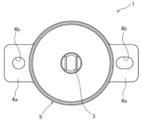
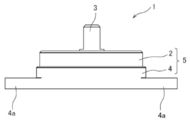
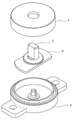
- FIG. 1 It is a top view which shows an example of the rotary damper with which the viscous composition of this invention is filled. It is a side view of the rotary damper shown in FIG. It is a disassembled perspective view of the rotary damper shown in FIG.
- the viscous composition of the present invention includes a dispersion medium, and a composite particle having a core that absorbs the dispersion medium and a coating layer that covers the core, and has a consistency of 90 to 410 at 25 ° C.
- the consistency is a value measured under non-mixing conditions with a 1/4 consistency meter according to JIS K2220: 2003.
- the viscous composition having such a configuration exhibits a practically desired torque value at room temperature (for example, 23 ° C. to 25 ° C.), and the change in torque value due to temperature is small in a low temperature region.
- the viscous composition of the present invention is used for a torque generating mechanism such as a rotary damper.
- the viscous composition of the present invention has a consistency at 25 ° C. of 90 or more and 410 or less. In the viscous composition of the present invention in this consistency range, most of the dispersion medium is present in the state of being absorbed by the core of the composite particle, and part of the dispersion medium is present on the surface of the composite particle without being absorbed. It is considered that the slipperiness between the composite particles is improved while dispersing the composite particles. If this torque composition is filled in the torque generating mechanism, a practically desired torque value can be generated at room temperature. In general, the viscosity of the dispersion medium for the torque generating mechanism varies depending on the temperature, and the rate of increase in viscosity increases as the temperature decreases.
- the viscous composition of the present invention most of the dispersion medium is present in a state absorbed by the core of the composite particle, and a part of the dispersion medium is present on the surface of the composite particle.
- the dispersion medium hardly exhibits temperature-dependent viscosity fluctuations.
- a low temperature region eg, ⁇ 30 ° C. or more and 0 ° C. or less
- the change in torque value due to temperature is small. it is conceivable that.
- the viscosity of the viscous composition is less than 90, the composite particles are in a state close to powder, and it is difficult to obtain a practically desired torque value at any temperature.
- the viscosity of the viscous composition is more than 410, it is considered that the dispersion medium that is not absorbed by the composite particles is excessively present around the composite particles, and the dispersion medium exhibits temperature-dependent viscosity fluctuations. It is difficult to obtain a torque value desired in practice.
- the composite particles absorb most of the dispersion medium and the consistency at 25 ° C. is 90 or more and 410 or less, the sedimentation of the particles due to the specific gravity difference between the dispersion medium and the particles, Of the dispersion state, aggregation between particles, and leakage of the dispersion medium can be suppressed.
- the type of the dispersion medium contained in the viscous composition of the present invention is not particularly limited, but a liquid exhibiting fluidity in a wide temperature range (for example, ⁇ 30 ° C. to 80 ° C.) is desirable.
- a composition for a rotary damper is used.
- the liquid conventionally used is mentioned. Specific examples include silicone oil, polybutene, poly- ⁇ -olefin, alkylbenzene, polyalkylene glycol, and polyol ester. These may be used alone or in combination of two or more.
- silicone oil examples include dimethyl silicone, cyclic dimethyl silicone, methylphenyl silicone, phenyl silicone, methyl hydrogen silicone, fluorine-modified silicone, polyether-modified silicone, polyglycerin-modified silicone, amino-reactive silicone, and epoxy-reactive.
- examples include silicone, mercapto reactive silicone, carbinol reactive silicone, carboxyl reactive silicone, methacrylic silicone, alkyl nonreactive silicone, aralkyl reactive silicone, and the like.
- non-reactive silicone is preferable from the viewpoint of long-term stability and low hygroscopicity.
- the molecular weight of the silicone constituting the silicone oil is preferably 500 or more and 50000 or less.
- Polybutene (including hydrogenated polybutene) is preferably one having a molecular weight of 5000 or less from the viewpoint of viscosity.
- poly- ⁇ -olefin examples include poly (1-hexene), poly (1-octene), poly (1-decene) and the like. These are preferably those having a molecular weight of 5000 or less from the viewpoint of viscosity.
- alkylbenzene examples include those having 1 to 6 linear or branched alkyl groups having 6 to 16 carbon atoms. Even an alkylbenzene having a melting point of more than ⁇ 30 ° C. (solid alkylbenzene at temperatures below ⁇ 30 ° C.) exhibits fluidity at a temperature of ⁇ 30 ° C. when mixed with other types of alkylbenzene. If present, it can be used as a dispersion medium.
- polyalkylene glycol examples include so-called pluronic nonionic surfactants synthesized by addition polymerization of alkylene oxides (ethylene oxide, propylene oxide, butylene oxide, etc.) to alcohols.
- alkylene oxides ethylene oxide, propylene oxide, butylene oxide, etc.
- polyol ester examples include dioctyl adipate; dioctyl sebacate; trimethylolpropane trifatty acid esters such as trimethylolpropane trioleate; pentaerythritol tetraheptanoate;
- silicone oil polybutene, alkylbenzene, and polyol ester are preferable, and silicone oil and polybutene are more preferable.
- silicone oils that are excellent in heat resistance, cold resistance, low volatility, and chemical stability are particularly preferable.
- the dispersion medium has a kinematic viscosity (cSt, centistokes) at 25 ° C. of 10,000 cSt or less, the effect of the configuration of the present invention is remarkable.
- a dispersion medium with a kinematic viscosity in the above range is applied alone to a torque generating mechanism (for example, a rotary damper), the required torque value cannot be achieved for each application at room temperature (for example, 23 ° C to 25 ° C). There is.
- a dispersion medium can realize a torque value required for various applications at room temperature by using the configuration of the present invention, and a change in torque value due to temperature is small in a low temperature region.
- the dispersion medium has a kinematic viscosity at 25 ° C. of 10,000 cSt or less because it is easily absorbed by the composite particles.
- the dispersion medium preferably has a kinematic viscosity at 25 ° C. of 20 cSt or more in that it is difficult to volatilize.
- the kinematic viscosity of the dispersion medium is measured with a viscoelasticity measuring apparatus (manufactured by Anton Paar) under the condition of 2 Hz using a parallel plate as a measuring jig.
- the silicone oil as the dispersion medium has a kinematic viscosity at 25 ° C. of preferably 10,000 cSt or less, more preferably 5000 cSt or less, from the viewpoint of easy absorption by the composite particles. Since the silicone oil as the dispersion medium tends to be absorbed by the composite particles as the kinematic viscosity is lower, the lower limit value of the kinematic viscosity at 25 ° C. is not particularly limited.
- silicone oils include silicone oils having a kinematic viscosity (25 ° C.) of 100 cSt, 10 cSt, 1 cSt, and the like, and silicone oils having a relatively low kinematic viscosity (25 ° C.) can be used in the present invention.
- the silicone oil preferably has a kinematic viscosity at 25 ° C. of 20 cSt or more.
- composite particles particles having a nucleus and a coating layer covering the nucleus are referred to as composite particles.
- the composite particles contained in the viscous composition of the present invention are configured so that the core contains a substance that can absorb the dispersion medium.
- the coating layer may be configured to include a substance that can absorb the dispersion medium, or may be configured to include no substance that can absorb the dispersion medium.
- the shape of the composite particles is arbitrary and may be spherical, elliptical, rod-shaped, plate-shaped, or indefinite.
- the composite particles are preferably spherical from the viewpoint of keeping the torque value within a good range.
- the composite particles only need to cover at least a part of the surface of the nucleus with the coating layer, and may cover the entire surface of the nucleus.
- the composite particles preferably have a path through which the dispersion medium passes in the coating layer so that the core absorbs the dispersion medium.
- the coating layer covers the entire surface of the nucleus, it is preferable that the coating layer includes a substance that can absorb the dispersion medium or that the coating layer has a hole through which the dispersion medium passes.
- the composite particle is preferably composed of both the nucleus and the coating layer.
- the resin contained in the core and the resin contained in the coating layer may be a natural product or a synthetic product, and are preferably resins that do not react with or dissolve in the dispersion medium.
- the coating layer is preferably harder than the core from the viewpoint of the shape stability of the composite particles. If the coating layer is harder than the core, for example, even if there is a temperature drop or increase that causes the volume of the dispersion medium absorbed by the core or the core itself, the composite particles will undergo a temperature-dependent shape change. Hateful. And when a composite particle is excellent in shape stability, the viscous composition of this invention will have a smaller change of the torque value by temperature.
- the crosslinking density of the resin contained in the coating layer is made higher than the crosslinking density of the resin contained in the core.
- the surface of the composite particles may be subjected to surface treatment (for example, hydrophobization treatment or hydrophilization treatment) for the purpose of increasing the affinity with the dispersion medium or for improving the dispersibility in the dispersion medium. .
- surface treatment for example, hydrophobization treatment or hydrophilization treatment
- the average particle size of the composite particles depends on the application to which the viscous composition of the present invention is applied and the size of the apparatus, but is preferably 0.5 ⁇ m or more and 50 ⁇ m or less. When it is 0.5 ⁇ m or more, the absorbability of the dispersion medium is good, and when it is 50 ⁇ m or less, the dispersibility with respect to the dispersion medium is good. From the above viewpoint, the average particle diameter of the composite particles is more preferably 1 ⁇ m or more and 40 ⁇ m or less, still more preferably 2 ⁇ m or more and 30 ⁇ m or less, still more preferably 3 ⁇ m or more and 20 ⁇ m or less, and particularly preferably 4 ⁇ m or more and 15 ⁇ m or less.
- the average particle diameter of the composite particles means a 50% diameter (center diameter) when a cumulative curve is obtained with the total volume of a group of particles as 100%, and is measured by a particle size analyzer.
- the composite particles may be used alone or in combination of two or more.
- the nucleus absorbs the dispersion medium.
- the nucleus includes, for example, a resin having a low crosslinking density.
- the core is formed using, for example, rubber hardness as an index.
- the rubber hardness of the core is in the range of 20 or more and 90 or less, the dispersion medium absorbability desirable as the core of the composite particle is easily developed.
- the rubber hardness is a value measured according to JIS K6253: 2006.
- the resin contained in the core include natural rubber, silicone rubber, styrene butadiene rubber, butadiene rubber, isoprene rubber, chloroprene rubber, ethylene propylene rubber, urethane rubber, fluorine rubber, nitrile rubber, acrylic rubber, and butyl rubber. , Epichlorohydrin rubber, chlorosulfonated polyethylene rubber and the like.
- the molecular species and crosslinking density of the resin may be selected from the viewpoints of affinity with the dispersion medium and absorbability of the dispersion medium.
- silicone rubber particles are most preferable from the standpoints of absorption of the dispersion medium, heat resistance, cold resistance and the like.
- nucleus absorbs the dispersion medium is performed, for example, by the following method. After immersing the nuclei in the dispersion medium, the nuclei are taken out from the dispersion medium, the mass is measured, and the nuclei absorb the dispersion medium by increasing the mass of the nuclei before immersion, which was measured in advance. Make sure you do.
- the composite particle has a coating layer covering the nucleus.
- the coating means a state in which the coating layer covers at least a part of the surface of the nucleus.
- the coverage (the ratio of the surface covered by the coating layer to the entire surface of the nucleus) is not particularly limited. From the viewpoint of the shape stability, wear resistance, smoothness of the composite particles, and slipperiness with the contacting member (for example, the rotor inside the rotary damper), the coverage is preferably 1% or more and 100% or less, preferably 10%. It is more preferably 95% or less and further preferably 30% or more and 90% or less.
- the covering layer includes, for example, a resin.
- the resin contained in the coating layer include polyorganosilsesquioxane resin, polyurethane, epoxy resin, polytetrafluoroethylene, polyvinylidene fluoride, polyvinyl fluoride, polymethyl acrylate, and polymethyl methacrylate. And methyl methacrylate-styrene copolymer, polystyrene, polyester, polyamide, polyimide and the like.
- the resin contained in the coating layer preferably has a higher crosslinking density than the resin contained in the core. Due to the high crosslinking density of the resin contained in the coating layer, the composite particles are excellent in shape stability. As a result, the viscosity composition of the present invention has a smaller change in torque value due to temperature.
- a resin having more crosslinking points than the resin contained in the core may be selected as the resin contained in the coating layer.
- the coating layer is most preferably a layer composed of a polyorganosilsesquioxane resin in terms of shape stability, wear resistance, smoothness, slipperiness with a contacting member, and the like.
- the composite particles have a core containing any of silicone rubber, urethane rubber, nitrile rubber, and acrylic rubber, and a coating layer is made of polyorganosilsesquioxane resin, polymethyl methacrylate, methyl methacrylate-styrene copolymer, It is preferable to contain either polystyrene or polyamide.
- the composite particles include particles containing silicone rubber in terms of excellent dispersion medium absorbability, shape stability, heat resistance, cold resistance, wear resistance, smoothness, slipperiness with contacting members, etc. ( Particles (referred to as “silicone composite particles”) in which the coating layer is a layer containing a polyorganosilsesquioxane resin are suitable.
- the silicone rubber particles are preferably made of a silicone cured product having a linear organopolysiloxane block represented by the following formula (1) in the molecular structure, and preferably have a crosslinked structure from the stability of the shape.
- R 1 represents an alkyl group such as a methyl group, an ethyl group, a propyl group or a butyl group; an aryl group such as a phenyl group or a tolyl group; an alkenyl group such as a vinyl group or an allyl group; Group, aralkyl group such as ⁇ -phenylpropyl group; monovalent halogenated hydrocarbon group such as chloromethyl group, 3,3,3-trifluoropropyl; epoxy group, amino group, mercapto group, acryloxy group, methacryloxy group, etc.
- n is an integer of 5 to 5000, preferably an integer of 10 to 1000.
- n is 5 or more, the characteristics of the linear organopolysiloxane are sufficiently exhibited, and when n is 5000 or less, the production of silicone rubber particles is easy.
- the shape of the silicone rubber particles is not particularly limited, but is, for example, spherical.
- the silicone rubber particles may contain organosilane, inorganic particles, and organic particles within a range that does not impair the effects of the present invention.
- the polyorganosilsesquioxane resin is a resinous polymer having an organosilsesquioxane unit represented by the following formula (2) as a constituent unit, and has a crosslinked structure from the stability of its shape. preferable. Equation (2): R 2 SiO 3/2
- R 2 represents an alkyl group such as a methyl group, an ethyl group, a propyl group or a butyl group; an aryl group such as a phenyl group or a tolyl group; an alkenyl group such as a vinyl group or an allyl group; ⁇ -phenylethyl Group, aralkyl group such as ⁇ -phenylpropyl group; monovalent halogenated hydrocarbon group such as chloromethyl group, 3,3,3-trifluoropropyl; epoxy group, amino group, mercapto group, acryloxy group, methacryloxy group, etc. It is preferable that the monovalent organic group having 1 to 20 carbon atoms, which is selected from one or two or more kinds selected from the group consisting of reactive groups, is a methyl group.
- the polyorganosilsesquioxane resin may contain R 2 2 SiO 2/2 units, R 2 3 SiO 1/2 units, and SiO 2 units as long as the coverage of the silicone rubber particles is not impaired.
- the polyorganosilsesquioxane resin covers at least a part of the surface of the silicone rubber particles.
- polyorganosilsesquioxane resin is the entire surface of the silicone rubber particles. It is preferable to coat.
- the amount of the polyorganosilsesquioxane resin is 100 masses of silicone rubber particles from the viewpoint of the shape stability, heat resistance, cold resistance, wear resistance, smoothness, slipperiness with the contacting member, etc. of the silicone composite particles. 0.5 parts by mass to 500 parts by mass is preferable with respect to parts. More preferably, it is 0.5 to 100 parts by mass.
- the average particle size of the silicone composite particles is preferably 0.5 ⁇ m or more and 50 ⁇ m or less in terms of excellent absorbability of the dispersion medium, dispersibility in the dispersion medium, and the like. More preferably, they are 1 micrometer or more and 40 micrometers or less, More preferably, they are 2 micrometers or more and 30 micrometers or less, More preferably, they are 3 micrometers or more and 20 micrometers or less, Especially preferably, they are 4 micrometers or more and 15 micrometers or less, Most preferably, they are 5 micrometers or more and 12 micrometers or less .
- Silicone composite particles can be produced, for example, by the following method. That is, an alkaline substance or an aqueous alkali solution and an organotrialkoxysilane are added to an aqueous dispersion of silicone rubber particles having an average particle size of, for example, 0.5 ⁇ m or more and 50 ⁇ m or less, and hydrolysis and condensation reactions are performed in the presence of a catalyst or the like. Let After completion of the reaction, the aqueous dispersion is concentrated by a method such as heat dehydration, filtration, and centrifugation, and then washed with water as necessary to remove moisture by heating and drying to obtain silicone composite particles as a powder. .
- the obtained powder When the obtained powder has agglomeration, it may be pulverized by a pulverizer such as a jet mill or a ball mill, and further classified by a sieve or the like as necessary to adjust the particle size distribution.
- a pulverizer such as a jet mill or a ball mill
- a sieve or the like For details of the production method, the method described in JP-A-7-196815 may be employed.
- silicone composite particles include commercially available products such as KMP-600, KMP-601, KMP-602, KMP-605 and X-52-7030 manufactured by Shin-Etsu Chemical Co., Ltd.
- the viscous composition of the present invention is preferably a combination in which the dispersion medium is silicone oil and the composite particles are silicone composite particles. Viscous composition using silicone oil and silicone composite particles has low torque fluctuation rate in a wide temperature range, and also has low volatility, chemical stability, heat resistance, cold resistance, abrasion resistance, Excellent slipperiness with contacting members.
- the mixing ratio of the dispersion medium and the composite particles is not particularly limited, and the consistency at 25 ° C. is 90 or more and 410 or less for each combination of the type of dispersion medium and the type of composite particles.
- the mixing ratio of the dispersion medium and the composite particles may be selected so that a desired torque value is obtained for each torque generating mechanism at room temperature (for example, 23 ° C. to 25 ° C.).
- the ratio of the composite particles in the total amount of the dispersion medium and the composite particles is, for example, 80% by mass or less for achieving a consistency of 90 or more, and for example, 20% by mass or more for achieving a consistency of 410 or less.
- the proportion of the composite particles may be adjusted to 75 mass% or less, 70 mass% or less, or 65 mass% or less, or 25 mass% or more, 30 mass% or more, 35 depending on the combination of the type of dispersion medium and the type of composite particles. Adjust to more than mass%.
- the viscous composition of the present invention has a consistency at 25 ° C. of 90 or more and 410 or less. You may adjust the said consistency within the said range for every various uses.
- the lower limit of the consistency at 25 ° C. is from the viewpoint of easily realizing a practically desired torque value at room temperature and further suppressing a change in torque value due to temperature.
- 100 or more is preferred, 110 or more is more preferred, 120 or more is more preferred, 150 or more is even more preferred, and the upper limit of the consistency at 25 ° C. is preferably 400 or less, more preferably 350 or less, even more preferably 320 or less, 300 The following are even more preferred:
- the viscous composition of the present invention may contain various additives as long as the use and effect of the present invention are not impaired.
- the additive include an antioxidant, an antigelling agent, a dye, a pigment, a thickener, a thickener, a metal deactivator, and a surfactant.
- the additive may be selected in accordance with the purpose, for example, from those conventionally used in a rotary damper composition.
- the viscous composition of the present invention is obtained by mixing a dispersion medium, composite particles, and an additive to be added as necessary.
- the mixing means is not particularly limited, and for example, a mixing means in which a gas such as air is difficult to mix into the viscous composition or a mixing means capable of degassing a mixed gas such as air is desirable.
- a stirring kneader equipped with a deaeration device is suitable as the mixing means.
- the rotary damper will be described as an example of a torque generation mechanism to which the viscous composition of the present invention is applied.
- the rotary damper includes at least a housing filled with the viscous composition of the present invention, a shaft body rotatably accommodated in the housing, and a torque plate (rotor) to which a rotational force is transmitted from the outside.
- the rotary damper having such a configuration has a small variation in torque value due to temperature in a low temperature region, and has a high temperature stability of the damper function.
- the rotary damper is used in various door opening and closing mechanisms, various cover opening and closing mechanisms, hooks, holders and shelf rotating mechanisms, and provides torque to the opening and closing operations of the opening and closing members and the rotating operations of the rotating members. Demonstrate the damper function.
- FIG. 1 to 3 are schematic views showing an example of a rotary damper filled with the viscous composition of the present invention.
- FIG. 1 is a plan view of the rotary damper
- FIG. 2 is a side view of the rotary damper
- FIG. FIG. 3 is an exploded perspective view of a rotary damper.
- the rotary damper 1 includes a housing 5 in which a housing main body 4 and a cover 2 are integrated, a shaft body 3 rotatably accommodated in the housing 5, and a shaft body 3 provided in the housing 5.
- the brake plate (rotor) 6 accommodated is provided.
- the shaft body 3 is attached to a portion protruding from the housing 5 with a gear, a cam or the like (not shown) for braking the movable portion (driven portion) of the opening / closing mechanism.
- the housing body 4 includes a mounting portion 4a.
- a mounting hole 4b is formed in the mounting portion 4a, and a screw or the like is fitted into the mounting hole 4b, so that the housing body 4 is attached to a fixing portion or the like in the opening / closing mechanism.
- Fixed The housing 5 is filled with the viscous composition of the present invention.
- the rotary damper 1 When the shaft body 3 is rotated with respect to the housing 5, the rotary damper 1 causes friction between the brake plate 6 and the rotary damper composition inside the housing 5, thereby causing torque to the shaft body 3. Occurs, and the damper function is demonstrated.
- the rotary damper having the configuration illustrated in FIGS. 1 to 3 is used, for example, in an opening / closing mechanism of a lid of a cup holder that is provided in a room of a vehicle such as an automobile and holds a container such as a cup or can.
- the torque value at 23 ° C. is, for example, in the range of 1.5 mN ⁇ m to 23 mN ⁇ m (preferably 2.5 mN ⁇ m to 23 mN ⁇ m).
- the rotary damper filled with the viscous composition of the present invention can also be used to open and close an accessory case and an ashtray provided in the interior of a vehicle such as an automobile; an assist grip for an automobile; an electronic and electrical device such as a printer or a DVD deck; Can be used for mechanism.
- the viscous composition of the present invention is suitable as a composition for a torque generating mechanism that is used by being filled in the torque generating mechanism.
- the torque generating mechanism include a piston damper, a free stop hinge, a liquid seal damper and the like in addition to the rotary damper.
- the viscous composition of this invention for uses other than a torque generation mechanism.
- Applications other than the torque generating mechanism include, for example, an encapsulating material; a sealing material; a cushion material; a seismic isolation material;
- the composite particles absorb most of the dispersion medium, and the consistency at 25 ° C. is in the range of 90 to 410. Therefore, the viscous composition is excellent in resilience even when pressurization and depressurization are repeated. Therefore, it is suitable for the above application.
- the encapsulant is used by being encapsulated in various devices.
- Examples of such devices include limited slip differentials and viscous couplings mounted on vehicles such as automobiles; traction drives and clutches in vehicles such as automobiles and other power transmission mechanisms.
- the encapsulating material substitution of silicone rubber in a device such as a push-type button mounted on a vehicle such as an automobile or various devices can be given.
- the sealing material is used by being sealed or applied between various devices and building members, and specifically includes, for example, a dust seal and a soundproof seal.
- a cushioning material or a seismic isolation material it is used by being enclosed or applied between various devices and building members.
- -Dispersion medium- Silicone oil (1): KF-96 manufactured by Shin-Etsu Chemical Co., Ltd., kinematic viscosity (25 ° C.) 200 cSt. Silicone oil (2): KF-96 manufactured by Shin-Etsu Chemical Co., Ltd., kinematic viscosity (25 ° C.) 1000 cSt. Silicone oil (3): KF-96 manufactured by Shin-Etsu Chemical Co., Ltd., kinematic viscosity (25 ° C.) 5000 cSt. Silicone oil (4): KF-96 manufactured by Shin-Etsu Chemical Co., Ltd., kinematic viscosity (25 ° C.) 300000 cSt.
- -Hydrogenated polyisobutene (1) Pearl Oil 6 manufactured by NOF Corporation, kinematic viscosity (25 ° C.) 35 cSt.
- Hydrogenated polyisobutene (2) Pearl Ream 18 manufactured by NOF Corporation, kinematic viscosity (25 ° C.) 30000 cSt.
- Silicone composite particles (A): KMP-600 manufactured by Shin-Etsu Chemical Co., Ltd., average particle size 5 ⁇ m, specific gravity 0.99. Composite particles in which the core is a silicone rubber particle and the coating layer is a layer made of a polyorganosilsesquioxane resin. Silicone composite particles (B): KMP-601 manufactured by Shin-Etsu Chemical Co., Ltd., average particle size 12 ⁇ m, specific gravity 0.98. Composite particles in which the core is a silicone rubber particle and the coating layer is a layer made of a polyorganosilsesquioxane resin.
- Silicone composite particles (A) and silicone composite particles (B) were each immersed in silicone oil (2) for 2 hours, then taken out from the oil and measured for mass. It was confirmed that the silicone composite particles (A) and the silicone composite particles (B) absorbed the silicone oil (2) by increasing the mass of the composite particles before immersion, which had been measured in advance. Moreover, it confirmed that a silicone rubber particle absorbed the silicone oil (2) similarly to the above about the silicone rubber particle of the same material as the core of the silicone composite particle (A) and the silicone composite particle (B).
- Table 1 shows the materials and composition ratios used in Examples 1 to 4 and Comparative Examples 1 to 3.
- Example 3 600 mg of silicone oil (2) and 150 mg of silicone composite particles (A) were placed in a 10 cc glass sample tube and stirred (1550 rpm, 10 minutes), followed by silicone composite particles (A ) was added in an amount of 150 mg each and stirred (1550 rpm, 10 minutes) was repeated 5 times.
- the produced rotary damper was rotated at room temperature at a rotation speed of 120 rpm for 5 seconds, and then allowed to stand for 2 hours in an environment of ambient temperature of 80 ° C., 23 ° C., or ⁇ 30 ° C. After that, the rotating damper is rotated at a rotation speed of 20 rpm under the ambient temperature at the time of standing, and the torque value is measured using a torque measuring device (manufactured by Nifco), and the torque value between 6 seconds and 9 seconds from the start of rotation. The average value of was obtained. And the ratio of the torque value between each temperature was calculated
- Reference Example 1 shows the torque value at 23 ° C. of the silicone oil (2) itself used in Example 1 and the like.
- the silicone oil (2) alone does not satisfy the torque value at 23 ° C. of 1.5 mN ⁇ m to 23 mN ⁇ m.
- silicone oil (4) having a kinematic viscosity of 300,000 cSt, which has been conventionally used for a rotary damper as shown in FIGS. 1 to 3, is used alone.
- the silicone oil (4) has a torque value at 23 ° C. in the range of 1.5 mN ⁇ m to 23 mN ⁇ m, and the ratio of the torque value at ⁇ 30 ° C. to the torque value at 23 ° C. ( ⁇ 30 ° C./23° C.) is 1.8.
- the torque value at 23 ° C. is in the range of 1.5 mN ⁇ m to 23 mN ⁇ m, and a torque value of ⁇ 30 ° C. and a torque value of 23 ° C.
- the ratio ( ⁇ 30 ° C./23° C.) was closer to 1 than in Reference Example 2, Comparative Example 2 and Comparative Example 3. From this, it can be seen that the viscous composition of the present invention shows a practically desired torque value at room temperature and a small change in torque value due to temperature in a low temperature region. Note that Comparative Example 1 did not show a practically desired torque value at room temperature.
- a viscous composition that exhibits a practically desired torque value at room temperature and has a small change in torque value due to temperature in a low temperature region is provided.
- a torque generating mechanism that exhibits a practically desired torque value at room temperature and has a small change in torque value due to temperature in a low temperature region is provided.
- Examples 5 to 8 Except for changing the materials and mixing ratio as shown in Table 2, compositions of Examples 5 to 8 were obtained in the same manner as in Example 3, and the consistency and torque values were measured in the same manner as described above. The results are shown in Table 2. Table 2 shows the consistency and torque values of Example 3.
- the torque value at 23 ° C. is in the range of 1.5 mN ⁇ m to 23 mN ⁇ m, and the torque value of ⁇ 30 ° C. and the torque value of 23 ° C.
- the ratio ( ⁇ 30 ° C./23° C.) was closer to 1 than in Reference Example 2, Comparative Example 2 and Comparative Example 3. From this, it can be seen that the viscous composition of the present invention shows a practically desired torque value at room temperature and a small change in torque value due to temperature in a low temperature region.
- a viscous composition that exhibits a practically desired torque value at room temperature and has a small change in torque value due to temperature in a low temperature region is provided.
- a torque generating mechanism that exhibits a practically desired torque value at room temperature and has a small change in torque value due to temperature in a low temperature region is provided.
- Example 9 A composition of Example 9 was obtained in the same manner as in Example 3 except that the materials and the mixing ratio were changed as shown in Table 3, and the consistency and torque values were measured in the same manner as described above. However, the torque value was measured at an ambient temperature of 80 ° C., 23 ° C., and 0 ° C. The results are shown in Table 3.
- the hydrogenated polyisobutene (2) has a torque value at 23 ° C. in the range of 1.5 mN ⁇ m to 23 mN ⁇ m, and the ratio of the torque value at 0 ° C. to the torque value at 23 ° C. ( 0 ° C / 23 ° C) is 3.2.
- the torque value at 23 ° C. is in the range of 1.5 mN ⁇ m to 23 mN ⁇ m, and the ratio between the torque value at 0 ° C. and the torque value at 23 ° C. (0 (° C./23° C.) was closer to 1 than in Reference Example 3. From this, it can be seen that the viscous composition of the present invention shows a practically desired torque value at room temperature and a small change in torque value due to temperature in a low temperature region. Therefore, according to the viscous composition of the present invention, a viscous composition that exhibits a practically desired torque value at room temperature and has a small change in torque value due to temperature in a low temperature region is provided. In addition, by using the viscous composition of the present invention, a torque generating mechanism that exhibits a practically desired torque value at room temperature and has a small change in torque value due to temperature in a low temperature region is provided.
Landscapes
- Chemical & Material Sciences (AREA)
- Chemical Kinetics & Catalysis (AREA)
- Organic Chemistry (AREA)
- Health & Medical Sciences (AREA)
- Medicinal Chemistry (AREA)
- Polymers & Plastics (AREA)
- General Chemical & Material Sciences (AREA)
- Oil, Petroleum & Natural Gas (AREA)
- Crystallography & Structural Chemistry (AREA)
- Lubricants (AREA)
- Compositions Of Macromolecular Compounds (AREA)
Description
本発明は、粘性組成物に関する。
各種の開閉機構に用いられて、開閉部材の開閉動作に対してトルクを付与するダンパーとして、粘性流体を用いる機構の回転式ダンパーが知られている。この機構の回転式ダンパーに用いられる粘性流体として、例えば、特開2010-281425号公報に、シリコーンオイル等の液体に固体粒子を分散したものが開示されている。
しかしながら、粘性流体を用いる機構の回転式ダンパーは、粘性流体の粘度が温度に依存して変化するため、低温領域ほどトルクが大きくなり高温領域ほどトルクが小さくなる傾向がある。したがって、ダンパー機能も温度に依存して変動するという問題があった。
しかしながら、粘性流体を用いる機構の回転式ダンパーは、粘性流体の粘度が温度に依存して変化するため、低温領域ほどトルクが大きくなり高温領域ほどトルクが小さくなる傾向がある。したがって、ダンパー機能も温度に依存して変動するという問題があった。
上記の問題点を解決するために、粘性流体を用いない機構の回転式ダンパーが提案されている。例えば、特開2009-133372号公報には、エラストマー又は軟質ゴムからなる円環状のリング部とこれの円周方向に沿って摺動する摺動部とを備えた回転式ダンパーが開示されており、特開2001-187933号公報には、シリコンゲルからなる粘性固体を用いた回転式ダンパーが開示されている。
また、上記の問題点の別の解決手段として、粘性流体の改良が試みられている。例えば、特開2005-68849号公報には、シリコーンオイル等の液体に磁性粒子を分散させた磁気粘性流体と、この磁気粘性流体を充填し磁場印加により粘度調整が可能な回転式ダンパーが開示されている。また、例えば、特開2007-211070号公報には、特定の分子構造を有するシリコーンオイルに無機充填剤を添加した粘着性グリース組成物が開示されている。
上記のように各種の回転式ダンパーが提案されているが、室温において実用上望まれるトルク値を示し、且つ、低温領域においてトルクの変動を抑制し得る技術は、粘性流体を用いない機構の回転式ダンパーでも、粘性流体を用いた機構の回転式ダンパーでも、未だ得られていないのが現状である。
本発明は、上記状況のもとになされた。本発明が解決しようとする課題は、室温において実用上望まれるトルク値を示し、低温領域において温度によるトルク値の変化が小さい粘性組成物を提供することである。
前記課題を解決するための具体的手段は、以下のとおりである。
<1> 分散媒と、前記分散媒を吸収する核及び前記核を被覆する被覆層を有する複合粒子と、を含み、25℃における稠度が90以上410以下である、粘性組成物。
<2> 前記複合粒子は、前記核がシリコーンゴムを含む粒子であり、前記被覆層がポリオルガノシルセスキオキサン樹脂を含む層である、前記<1>に記載の粘性組成物。
<3> 前記複合粒子は、平均粒径が0.5μm以上50μm以下である、前記<1>又は<2>に記載の粘性組成物。
<4> 前記分散媒がシリコーンオイルである、前記<1>~<3>のいずれか1項に記載の粘性組成物。
<5> 前記分散媒は、25℃における動粘度が10000cSt以下である、前記<1>~<4>のいずれか1項に記載の粘性組成物。
<1> 分散媒と、前記分散媒を吸収する核及び前記核を被覆する被覆層を有する複合粒子と、を含み、25℃における稠度が90以上410以下である、粘性組成物。
<2> 前記複合粒子は、前記核がシリコーンゴムを含む粒子であり、前記被覆層がポリオルガノシルセスキオキサン樹脂を含む層である、前記<1>に記載の粘性組成物。
<3> 前記複合粒子は、平均粒径が0.5μm以上50μm以下である、前記<1>又は<2>に記載の粘性組成物。
<4> 前記分散媒がシリコーンオイルである、前記<1>~<3>のいずれか1項に記載の粘性組成物。
<5> 前記分散媒は、25℃における動粘度が10000cSt以下である、前記<1>~<4>のいずれか1項に記載の粘性組成物。
本発明によれば、室温において実用上望まれるトルク値を示し、低温領域において温度によるトルク値の変化が小さい粘性組成物が提供される。
以下に、本発明の実施の形態について説明するが、これらの説明および実施例は本発明を例示するものであり、本発明の範囲を制限するものではない。
本明細書において「~」を用いて示された数値範囲は、「~」の前後に記載される数値をそれぞれ最小値及び最大値として含む範囲を示す。
本明細書において「~」を用いて示された数値範囲は、「~」の前後に記載される数値をそれぞれ最小値及び最大値として含む範囲を示す。
<粘性組成物>
本発明の粘性組成物は、分散媒と、当該分散媒を吸収する核及び当該核を被覆する被覆層を有する複合粒子と、を含み、25℃における稠度が90以上410以下である。ここで稠度は、JIS K2220:2003に従い1/4稠度計にて不混和条件で測定した値である。
かかる構成の粘性組成物は、室温(例えば23℃~25℃)において実用上望まれるトルク値を示し、低温領域において温度によるトルク値の変化が小さい。
本発明の粘性組成物は、例えば回転式ダンパー等のトルク発生機構に用いられる。
本発明の粘性組成物は、分散媒と、当該分散媒を吸収する核及び当該核を被覆する被覆層を有する複合粒子と、を含み、25℃における稠度が90以上410以下である。ここで稠度は、JIS K2220:2003に従い1/4稠度計にて不混和条件で測定した値である。
かかる構成の粘性組成物は、室温(例えば23℃~25℃)において実用上望まれるトルク値を示し、低温領域において温度によるトルク値の変化が小さい。
本発明の粘性組成物は、例えば回転式ダンパー等のトルク発生機構に用いられる。
本発明の粘性組成物は、25℃における稠度が90以上410以下である。この稠度範囲にある本発明の粘性組成物において、分散媒は、その大部分が複合粒子の核に吸収された状態で存在し、その一部が吸収されずに複合粒子の表面に存在して、複合粒子を分散させつつ、複合粒子どうしの滑り性を向上させていると考えられる。この粘性組成物をトルク発生機構に充填すれば、室温において実用上望まれるトルク値を発生させ得る。
一般に、トルク発生機構用の分散媒は、温度依存的に粘度が変動し、温度が低いほど粘度の上昇率が大きい。これに対し、本発明の粘性組成物においては、分散媒の大部分が複合粒子の核に吸収された状態で存在し、分散媒の一部が複合粒子の表面に存在しているために、分散媒が温度依存的な粘度の変動を示しにくく、その結果、本発明の粘性組成物は、低温領域(例えば-30℃以上0℃以下)で用いても、温度によるトルク値の変化が小さいと考えられる。
粘性組成物の稠度が90未満であると、複合粒子が粉体に近い状態にあり、いずれの温度においても実用上望まれるトルク値を得るのが難しい。
一方、粘性組成物の稠度が410超であると、複合粒子に吸収されない分散媒が複合粒子の周囲に過剰に存在すると考えられ、分散媒が温度依存的な粘度の変動を示すので、室温において実用上望まれるトルク値を得るのが難しい。
一般に、トルク発生機構用の分散媒は、温度依存的に粘度が変動し、温度が低いほど粘度の上昇率が大きい。これに対し、本発明の粘性組成物においては、分散媒の大部分が複合粒子の核に吸収された状態で存在し、分散媒の一部が複合粒子の表面に存在しているために、分散媒が温度依存的な粘度の変動を示しにくく、その結果、本発明の粘性組成物は、低温領域(例えば-30℃以上0℃以下)で用いても、温度によるトルク値の変化が小さいと考えられる。
粘性組成物の稠度が90未満であると、複合粒子が粉体に近い状態にあり、いずれの温度においても実用上望まれるトルク値を得るのが難しい。
一方、粘性組成物の稠度が410超であると、複合粒子に吸収されない分散媒が複合粒子の周囲に過剰に存在すると考えられ、分散媒が温度依存的な粘度の変動を示すので、室温において実用上望まれるトルク値を得るのが難しい。
さらに、本発明の粘性組成物は、複合粒子が分散媒の大部分を吸収し、25℃における稠度が90以上410以下の状態であるので、分散媒と粒子の比重差による粒子の沈降、粒子の分散状態の不均一化、粒子間の凝集、及び、分散媒の漏出を抑制し得る。
[分散媒]
本発明の粘性組成物に含まれる分散媒は、その種類は特に制限されないが、広い温度範囲(例えば-30℃~80℃)で流動性を示す液体が望ましく、例えば回転式ダンパー用組成物に従来用いられてきた液体が挙げられる。具体的には、例えば、シリコーンオイル、ポリブテン、ポリ-α-オレフィン、アルキルベンゼン、ポリアルキレングリコール、ポリオールエステル等が挙げられる。これらは、1種を単独で用いてもよく、2種以上を併用してもよい。
本発明の粘性組成物に含まれる分散媒は、その種類は特に制限されないが、広い温度範囲(例えば-30℃~80℃)で流動性を示す液体が望ましく、例えば回転式ダンパー用組成物に従来用いられてきた液体が挙げられる。具体的には、例えば、シリコーンオイル、ポリブテン、ポリ-α-オレフィン、アルキルベンゼン、ポリアルキレングリコール、ポリオールエステル等が挙げられる。これらは、1種を単独で用いてもよく、2種以上を併用してもよい。
シリコーンオイルとしては、例えば、ジメチルシリコーン、環状ジメチルシリコーン、メチルフェニルシリコーン、フェニルシリコーン、メチルハイドロジェンシリコーン、フッ素変性シリコーン、ポリエーテル変性シリコーン、ポリグリセリン変性シリコーン、アミノ系反応性シリコーン、エポキシ系反応性シリコーン、メルカプト系反応性シリコーン、カルビノール系反応性シリコーン、カルボキシル系反応性シリコーン、メタクリル系シリコーン、アルキル系非反応性シリコーン、アラルキル反応性シリコーン等が挙げられる。
上記の中でも、長期安定性や低吸湿性の観点から、非反応性のシリコーンが好ましい。
シリコーンオイルを構成するシリコーンの分子量は、500以上50000以下が好ましい。
上記の中でも、長期安定性や低吸湿性の観点から、非反応性のシリコーンが好ましい。
シリコーンオイルを構成するシリコーンの分子量は、500以上50000以下が好ましい。
ポリブテン(水添ポリブテンを含む。)としては、粘性の観点から、分子量が5000以下のものが好ましい。
ポリ-α-オレフィンとしては、例えば、ポリ(1-ヘキセン)、ポリ(1-オクテン)、ポリ(1-デセン)等が挙げられる。これらは粘性の観点から、分子量が5000以下のものが好ましい。
アルキルベンゼンとしては、例えば、直鎖状又は分岐鎖状の炭素数6~16のアルキル基を1個~6個有するものが挙げられる。
融点が-30℃超であるアルキルベンゼン(-30℃以下の温度下では固体のアルキルベンゼン)であっても、他の種類のアルキルベンゼンと混合することによって-30℃の温度下で流動性を示すものであれば、分散媒として使用できる。
融点が-30℃超であるアルキルベンゼン(-30℃以下の温度下では固体のアルキルベンゼン)であっても、他の種類のアルキルベンゼンと混合することによって-30℃の温度下で流動性を示すものであれば、分散媒として使用できる。
ポリアルキレングリコールとしては、例えば、アルコール類にアルキレンオキサイド(エチレンオキサイド、プロピレンオキサイド、ブチレンオキサイド等)を付加重合して合成した、所謂プルロニック型非イオン界面活性剤が挙げられる。
ポリオールエステルとしては、例えば、ジオクチルアジペート;ジオクチルセバケート;トリメチロールプロパントリオレート等のトリメチロールプロパントリ脂肪酸エステル類;ペンタエリスリトールテトラヘプタノエート;等が挙げられる。
分散媒としては、シリコーンオイル、ポリブテン、アルキルベンゼン、ポリオールエステルが好ましく、シリコーンオイル及びポリブテンがより好ましい。中でも、耐熱性、耐寒性、低揮発性、化学的安定性に優れるシリコーンオイルが特に好ましい。
分散媒は、25℃における動粘度(cSt、センチストークス)が10000cSt以下である場合に、本発明の構成とすることの効果が顕著である。動粘度が上記範囲の分散媒は、単独でトルク発生機構(例えば回転式ダンパー)に適用したとき、室温(例えば23℃~25℃)において、各種の用途ごとに必要なトルク値を実現できない場合がある。このような分散媒は、本発明の構成とすることにより、室温において各種の用途ごとに必要なトルク値を実現でき、且つ、低温領域において温度によるトルク値の変化が小さい。
また、分散媒は、25℃における動粘度が10000cSt以下であると、複合粒子に吸収されやすく、好適である。
分散媒は、揮発しにくい点では、25℃における動粘度が20cSt以上であることが好ましい。
本発明において分散媒の動粘度は、粘弾性測定装置(Anton Paar社製)にて、測定治具としてパラレルプレートを用いて2Hzの条件で測定する。
また、分散媒は、25℃における動粘度が10000cSt以下であると、複合粒子に吸収されやすく、好適である。
分散媒は、揮発しにくい点では、25℃における動粘度が20cSt以上であることが好ましい。
本発明において分散媒の動粘度は、粘弾性測定装置(Anton Paar社製)にて、測定治具としてパラレルプレートを用いて2Hzの条件で測定する。
分散媒としてのシリコーンオイルは、複合粒子への吸収されやすさの点で、25℃における動粘度が10000cSt以下であることが好ましく、5000cSt以下がより好ましい。
分散媒としてのシリコーンオイルは、動粘度が低いほど複合粒子に吸収されやすい傾向があるので、25℃における動粘度の下限値は特に制限されない。例えば市販品のシリコーンオイルには動粘度(25℃)が100cSt、10cSt、1cSt等のシリコーンオイルがあり、このように動粘度(25℃)の比較的低いシリコーンオイルも本発明に用い得る。揮発しにくい点では、シリコーンオイルは、25℃における動粘度が20cSt以上であることが好ましい。
分散媒としてのシリコーンオイルは、動粘度が低いほど複合粒子に吸収されやすい傾向があるので、25℃における動粘度の下限値は特に制限されない。例えば市販品のシリコーンオイルには動粘度(25℃)が100cSt、10cSt、1cSt等のシリコーンオイルがあり、このように動粘度(25℃)の比較的低いシリコーンオイルも本発明に用い得る。揮発しにくい点では、シリコーンオイルは、25℃における動粘度が20cSt以上であることが好ましい。
[複合粒子]
本発明において、核と、当該核を被覆する被覆層と、を有する粒子を、複合粒子と呼ぶ。本発明の粘性組成物に含まれる複合粒子は、核が、分散媒を吸収し得る物質を含んで構成される。被覆層は、分散媒を吸収し得る物質を含んで構成されていてもよく、分散媒を吸収し得る物質を含まずに構成されていてもよい。
本発明において、核と、当該核を被覆する被覆層と、を有する粒子を、複合粒子と呼ぶ。本発明の粘性組成物に含まれる複合粒子は、核が、分散媒を吸収し得る物質を含んで構成される。被覆層は、分散媒を吸収し得る物質を含んで構成されていてもよく、分散媒を吸収し得る物質を含まずに構成されていてもよい。
複合粒子の形状は任意であり、球形、楕円形、棒状、板状、不定形のいずれでもよい。複合粒子は、トルク値を良好な範囲に保つ観点から、球形が好ましい。
複合粒子は、被覆層によって核の表面の少なくとも一部が覆われていればよく、核の表面の全体が覆われていてもよい。
複合粒子は、核に分散媒を吸収させるため、被覆層に分散媒が通過する経路があることが好ましい。被覆層が核の表面の全体を覆っている場合は、被覆層が分散媒を吸収し得る物質を含んで構成されているか、被覆層に分散媒が通過する孔があることが好ましい。被覆層が核の表面の一部を覆っている場合は、被覆層が核を被覆していない隙間から核に分散媒が吸収され得る。
複合粒子は、核に分散媒を吸収させるため、被覆層に分散媒が通過する経路があることが好ましい。被覆層が核の表面の全体を覆っている場合は、被覆層が分散媒を吸収し得る物質を含んで構成されているか、被覆層に分散媒が通過する孔があることが好ましい。被覆層が核の表面の一部を覆っている場合は、被覆層が核を被覆していない隙間から核に分散媒が吸収され得る。
複合粒子は、核の分散媒吸収性、及び、被覆層の分散媒通過性の観点から、核、被覆層ともに、樹脂を含んで構成されたものが好ましい。
核に含まれる樹脂、及び、被覆層に含まれる樹脂は、天然物でも合成物でもよく、分散媒と反応したり分散媒に溶解したりしない樹脂が好ましい。
核に含まれる樹脂、及び、被覆層に含まれる樹脂は、天然物でも合成物でもよく、分散媒と反応したり分散媒に溶解したりしない樹脂が好ましい。
複合粒子は、複合粒子の形状安定性の観点から、被覆層が核よりも硬いことが好ましい。被覆層が核よりも硬いと、例えば、核に吸収された分散媒や核自体の体積変動を引き起こすような温度の下降や上昇があっても、複合粒子は、温度依存的な形状変化を起こしにくい。そして、複合粒子が形状安定性に優れると、本発明の粘性組成物は、温度によるトルク値の変化がより小さくなる。
被覆層を核よりも硬くする方法としては、例えば、核に含まれる樹脂の架橋密度よりも、被覆層に含まれる樹脂の架橋密度を高くすることが挙げられる。
被覆層を核よりも硬くする方法としては、例えば、核に含まれる樹脂の架橋密度よりも、被覆層に含まれる樹脂の架橋密度を高くすることが挙げられる。
複合粒子は、分散媒との親和性を高める目的や、分散媒中での分散性を高める目的で、その表面に表面処理(例えば、疎水化処理、親水化処理)が施されていてもよい。
複合粒子の平均粒径は、本発明の粘性組成物を適用する用途や装置の大きさにもよるが、0.5μm以上50μm以下であることが好ましい。0.5μm以上であると、分散媒の吸収性がよく、50μm以下であると、分散媒に対する分散性がよい。
複合粒子の平均粒径は、上記の観点から、より好ましくは1μm以上40μm以下であり、更に好ましくは2μm以上30μm以下であり、更により好ましくは3μm以上20μm以下であり、特に好ましくは4μm以上15μm以下であり、最も好ましくは5μm以上12μm以下である。
複合粒子の平均粒径は、粒体の集団の全体積を100%として累積カーブを求めたときの50%径(中心径)を意味し、粒度分析計により測定する。
複合粒子の平均粒径は、上記の観点から、より好ましくは1μm以上40μm以下であり、更に好ましくは2μm以上30μm以下であり、更により好ましくは3μm以上20μm以下であり、特に好ましくは4μm以上15μm以下であり、最も好ましくは5μm以上12μm以下である。
複合粒子の平均粒径は、粒体の集団の全体積を100%として累積カーブを求めたときの50%径(中心径)を意味し、粒度分析計により測定する。
複合粒子は、1種を単独で用いてもよく、2種以上を併用してもよい。
-核-
本発明の粘性組成物に含まれる複合粒子は、核が分散媒を吸収する。分散媒を吸収するという性質を得るため、核は、例えば、架橋密度の低い樹脂を含んで構成される。
核に架橋密度の低い樹脂を適用するとき、例えばゴム硬度を指標にして核を構成する。核のゴム硬度が、20以上90以下の範囲であると、複合粒子の核として望ましい分散媒吸収性を発現し易い。ここで、ゴム硬度はJIS K6253:2006に従って測定した値である。
本発明の粘性組成物に含まれる複合粒子は、核が分散媒を吸収する。分散媒を吸収するという性質を得るため、核は、例えば、架橋密度の低い樹脂を含んで構成される。
核に架橋密度の低い樹脂を適用するとき、例えばゴム硬度を指標にして核を構成する。核のゴム硬度が、20以上90以下の範囲であると、複合粒子の核として望ましい分散媒吸収性を発現し易い。ここで、ゴム硬度はJIS K6253:2006に従って測定した値である。
核に含まれる樹脂としては、具体的には例えば、天然ゴム、シリコーンゴム、スチレンブタジエンゴム、ブタジエンゴム、イソプレンゴム、クロロプレンゴム、エチレンプロピレンゴム、ウレタンゴム、フッ素ゴム、ニトリルゴム、アクリルゴム、ブチルゴム、エピクロロヒドリンゴム、クロロスルフォン化ポリエチレンゴム等が挙げられる。
樹脂の分子種及び架橋密度は、分散媒との親和性や分散媒の吸収性の観点で選択すればよい。
樹脂の分子種及び架橋密度は、分散媒との親和性や分散媒の吸収性の観点で選択すればよい。
核としては、分散媒の吸収性、耐熱性、耐寒性等の点で、シリコーンゴムを含む粒子(「シリコーンゴム粒子」と称する。)が最も好ましい。
核が分散媒を吸収することの確認は、例えば、下記の方法で行う。
核を分散媒に浸漬させた後、分散媒から核を取り出し、質量を計測して、予め計測しておいた浸漬前の核の質量よりも増加していることにより、核が分散媒を吸収することを確認する。
核を分散媒に浸漬させた後、分散媒から核を取り出し、質量を計測して、予め計測しておいた浸漬前の核の質量よりも増加していることにより、核が分散媒を吸収することを確認する。
-被覆層-
複合粒子は、核を被覆する被覆層を有する。ここで、被覆とは、被覆層が核の表面の少なくとも一部を覆っている状態を意味する。被覆率(核の表面全体に占める被覆層によって被覆された表面の割合)は、特に制限されない。複合粒子の形状安定性、耐磨耗性、平滑性、接触する部材(例えば回転式ダンパー内部のローター)との滑り性等の観点から、被覆率は1%以上100%以下が好ましく、10%以上95%以下がより好ましく、30%以上90%以下が更に好ましい。
複合粒子は、核を被覆する被覆層を有する。ここで、被覆とは、被覆層が核の表面の少なくとも一部を覆っている状態を意味する。被覆率(核の表面全体に占める被覆層によって被覆された表面の割合)は、特に制限されない。複合粒子の形状安定性、耐磨耗性、平滑性、接触する部材(例えば回転式ダンパー内部のローター)との滑り性等の観点から、被覆率は1%以上100%以下が好ましく、10%以上95%以下がより好ましく、30%以上90%以下が更に好ましい。
被覆層は、例えば、樹脂を含んで構成される。被覆層に含まれる樹脂としては、具体的には例えば、ポリオルガノシルセスキオキサン樹脂、ポリウレタン、エポキシ樹脂、ポリテトラフルオロエチレン、ポリフッ化ビニリデン、ポリフッ化ビニル、ポリアクリル酸メチル、ポリメタクリル酸メチル、メタクリル酸メチル-スチレン共重合体、ポリスチレン、ポリエステル、ポリアミド、ポリイミド等が挙げられる。
被覆層に含まれる樹脂は、核に含まれる樹脂よりも架橋密度が高いことが好ましい。被覆層に含まれる樹脂の架橋密度が高いことにより、複合粒子は形状安定性に優れ、その結果、本発明の粘性組成物は、温度によるトルク値の変化がより小さくなる。
上記を実現するためには、被覆層に含まれる樹脂として、核に含まれる樹脂よりも架橋点の多い樹脂を選択すればよい。
上記を実現するためには、被覆層に含まれる樹脂として、核に含まれる樹脂よりも架橋点の多い樹脂を選択すればよい。
被覆層としては、形状安定性、耐磨耗性、平滑性、接触する部材との滑り性等の点で、ポリオルガノシルセスキオキサン樹脂を含んで構成された層が最も好ましい。
複合粒子は、核が、シリコーンゴム、ウレタンゴム、ニトリルゴム及びアクリルゴムのいずれかを含み、被覆層が、ポリオルガノシルセスキオキサン樹脂、ポリメタクリル酸メチル、メタクリル酸メチル-スチレン共重合体、ポリスチレン及びポリアミドのいずれかを含むことが好ましい。
-シリコーン複合粒子-
複合粒子としては、分散媒の吸収性、形状安定性、耐熱性、耐寒性、耐磨耗性、平滑性、接触する部材との滑り性等に優れる点で、核がシリコーンゴムを含む粒子(シリコーンゴム粒子)であり、被覆層がポリオルガノシルセスキオキサン樹脂を含む層である粒子(「シリコーン複合粒子」と称する。)が好適である。
複合粒子としては、分散媒の吸収性、形状安定性、耐熱性、耐寒性、耐磨耗性、平滑性、接触する部材との滑り性等に優れる点で、核がシリコーンゴムを含む粒子(シリコーンゴム粒子)であり、被覆層がポリオルガノシルセスキオキサン樹脂を含む層である粒子(「シリコーン複合粒子」と称する。)が好適である。
シリコーンゴム粒子は、下記の式(1)で表される線状オルガノポリシロキサンブロックを分子構造中に有するシリコーン硬化物からなり、その形状の安定性から架橋構造を有することが好ましい。
式(1):-(R1 2SiO)n-
式(1):-(R1 2SiO)n-
式(1)中、R1は、メチル基、エチル基、プロピル基、ブチル基等のアルキル基;フェニル基、トリル基等のアリール基;ビニル基、アリル基等のアルケニル基;β-フェニルエチル基、β-フェニルプロピル基等のアラルキル基;クロロメチル基、3,3,3-トリフルオロプロピル等の1価ハロゲン化炭化水素基;エポキシ基、アミノ基、メルカプト基、アクリロキシ基、メタクリロキシ基等の反応性基含有の有機基;から選択される1種又は2種以上からなる炭素数1~20の1価の有機基であり、その90モル%以上がメチル基であることが好ましい。
式(1)中、nは、5~5000の整数であり、好ましくは10~1000の整数である。nが5以上であると線状オルガノポリシロキサンの特性が十分に発現され、nが5000以下であるとシリコーンゴム粒子の製造が容易である。
式(1)中、nは、5~5000の整数であり、好ましくは10~1000の整数である。nが5以上であると線状オルガノポリシロキサンの特性が十分に発現され、nが5000以下であるとシリコーンゴム粒子の製造が容易である。
シリコーンゴム粒子の形状は、特に制限されないが、例えば球形である。
シリコーンゴム粒子は、その粒子中に、本発明の効果を損なわない範囲で、オルガノシラン、無機系の粒子、有機系の粒子を含有してもよい。
シリコーンゴム粒子は、その粒子中に、本発明の効果を損なわない範囲で、オルガノシラン、無機系の粒子、有機系の粒子を含有してもよい。
ポリオルガノシルセスキオキサン樹脂は、下記の式(2)で表されるオルガノシルセスキオキサン単位を構成単位とする樹脂状の重合物であり、その形状の安定性から架橋構造を有することが好ましい。
式(2):R2SiO3/2
式(2):R2SiO3/2
式(2)中、R2は、メチル基、エチル基、プロピル基、ブチル基等のアルキル基;フェニル基、トリル基等のアリール基;ビニル基、アリル基等のアルケニル基;β-フェニルエチル基、β-フェニルプロピル基等のアラルキル基;クロロメチル基、3,3,3-トリフルオロプロピル等の1価ハロゲン化炭化水素基;エポキシ基、アミノ基、メルカプト基、アクリロキシ基、メタクリロキシ基等の反応性基含有の有機基;から選択される1種又は2種以上からなる炭素数1~20の1価の有機基であり、その50モル%以上がメチル基であることが好ましい。
ポリオルガノシルセスキオキサン樹脂は、シリコーンゴム粒子の被覆性を損なわない範囲で、R2
2SiO2/2単位、R2
3SiO1/2単位、及びSiO2単位を含んでいてもよい。
シリコーン複合粒子において、ポリオルガノシルセスキオキサン樹脂は、シリコーンゴム粒子の表面の少なくとも一部を被覆する。シリコーン複合粒子の形状安定性、耐熱性、耐寒性、耐磨耗性、平滑性、接触する部材との滑り性等の観点から、ポリオルガノシルセスキオキサン樹脂は、シリコーンゴム粒子の表面の全面を被覆することが好ましい。
ポリオルガノシルセスキオキサン樹脂の量は、シリコーン複合粒子の形状安定性、耐熱性、耐寒性、耐磨耗性、平滑性、接触する部材との滑り性等の観点から、シリコーンゴム粒子100質量部に対して、0.5質量部~500質量部が好ましい。より好ましくは0.5質量部~100質量部である。
シリコーン複合粒子の平均粒径は、分散媒体の吸収性、分散媒への分散性等に優れる点で、0.5μm以上50μm以下であることが好ましい。より好ましくは1μm以上40μm以下であり、更に好ましくは2μm以上30μm以下であり、更により好ましくは3μm以上20μm以下であり、特に好ましくは4μm以上15μm以下であり、最も好ましくは5μm以上12μm以下である。
シリコーン複合粒子は、例えば次の方法で製造できる。
即ち、平均粒径が例えば0.5μm以上50μm以下のシリコーンゴム粒子の水分散液に、アルカリ性物質又はアルカリ水溶液と、オルガノトリアルコキシシランとを添加し、触媒等の存在下、加水分解及び縮合反応をさせる。その反応終了後、加熱脱水、濾過、遠心分離等の方法により水分散液を濃縮した後、必要に応じて水洗を行い、加熱乾燥等によって水分を除去することにより、粉末としてシリコーン複合粒子を得る。得られた粉末に凝集がある場合はジェットミル、ボールミル等の粉砕機で解砕し、更に必要に応じて篩等により分級し粒径分布を調整してもよい。製造方法の詳細は、特開平7-196815号公報に記載の方法を採用してよい。
即ち、平均粒径が例えば0.5μm以上50μm以下のシリコーンゴム粒子の水分散液に、アルカリ性物質又はアルカリ水溶液と、オルガノトリアルコキシシランとを添加し、触媒等の存在下、加水分解及び縮合反応をさせる。その反応終了後、加熱脱水、濾過、遠心分離等の方法により水分散液を濃縮した後、必要に応じて水洗を行い、加熱乾燥等によって水分を除去することにより、粉末としてシリコーン複合粒子を得る。得られた粉末に凝集がある場合はジェットミル、ボールミル等の粉砕機で解砕し、更に必要に応じて篩等により分級し粒径分布を調整してもよい。製造方法の詳細は、特開平7-196815号公報に記載の方法を採用してよい。
シリコーン複合粒子の具体例としては、信越化学工業(株)製のKMP-600、KMP-601、KMP-602、KMP-605、X-52-7030等の市販品が挙げられる。
本発明の粘性組成物は、分散媒がシリコーンオイルで、複合粒子がシリコーン複合粒子である組合せが好ましい。シリコーンオイルとシリコーン複合粒子とを用いた粘性組成物は、広い範囲の温度領域においてトルクの変動率が小さく、さらに、低揮発性、化学的安定性、耐熱性、耐寒性、耐磨耗性、接触する部材との滑り性等に優れる。
本発明の粘性組成物において、分散媒と複合粒子との混合比は特に制限されず、分散媒の種類と複合粒子の種類との組み合せごとに、25℃における稠度が90以上410以下となるように混合すればよい。そして、トルク発生機構用であれば、室温(例えば23℃~25℃)において各種のトルク発生機構ごとに望ましいトルク値になるように、分散媒と複合粒子との混合比を選択すればよい。
分散媒と複合粒子の合計量に占める複合粒子の割合は、稠度90以上を実現する点で、例えば80質量%以下とし、稠度410以下を実現する点で、例えば20質量%以上とする。複合粒子の割合は、分散媒の種類と複合粒子の種類の組み合せによっては、75質量%以下、70質量%以下、65質量%以下に調整したり、25質量%以上、30質量%以上、35質量%以上に調整したりする。
分散媒と複合粒子の合計量に占める複合粒子の割合は、稠度90以上を実現する点で、例えば80質量%以下とし、稠度410以下を実現する点で、例えば20質量%以上とする。複合粒子の割合は、分散媒の種類と複合粒子の種類の組み合せによっては、75質量%以下、70質量%以下、65質量%以下に調整したり、25質量%以上、30質量%以上、35質量%以上に調整したりする。
本発明の粘性組成物は、25℃における稠度が90以上410以下である。前記稠度は、各種の用途ごとに前記範囲内で調整してよい。
本発明の粘性組成物をトルク発生機構に適用する場合は、室温において実用上望まれるトルク値を実現しやすく且つ温度によるトルク値の変化をより抑制する観点から、25℃における稠度の下限は、100以上が好ましく、110以上がより好ましく、120以上が更に好ましく、150以上が更により好ましく、25℃における稠度の上限は、400以下が好ましく、350以下がより好ましく、320以下が更に好ましく、300以下が更により好ましい。
本発明の粘性組成物をトルク発生機構に適用する場合は、室温において実用上望まれるトルク値を実現しやすく且つ温度によるトルク値の変化をより抑制する観点から、25℃における稠度の下限は、100以上が好ましく、110以上がより好ましく、120以上が更に好ましく、150以上が更により好ましく、25℃における稠度の上限は、400以下が好ましく、350以下がより好ましく、320以下が更に好ましく、300以下が更により好ましい。
[その他の成分]
本発明の粘性組成物は、本発明の用途と効果を阻害しない限り、各種の添加剤を含有してよい。添加剤としては、酸化防止剤、ゲル化防止剤、染料、顔料、減粘剤、増粘剤、金属不活性化剤、界面活性剤などが挙げられる。添加剤は、例えば回転式ダンパー用組成物に従来用いられてきた物のなかから、目的に合わせて選択すればよい。
本発明の粘性組成物は、本発明の用途と効果を阻害しない限り、各種の添加剤を含有してよい。添加剤としては、酸化防止剤、ゲル化防止剤、染料、顔料、減粘剤、増粘剤、金属不活性化剤、界面活性剤などが挙げられる。添加剤は、例えば回転式ダンパー用組成物に従来用いられてきた物のなかから、目的に合わせて選択すればよい。
[粘性組成物の製造方法]
本発明の粘性組成物は、分散媒と複合粒子と、必要に応じて添加させる添加剤とを混合して得られる。その混合手段は特に限定されるものではなく、例えば、粘性組成物に空気などの気体が混入しにくい混合手段、または混入した空気などの気体を脱気し得る混合手段が望ましい。例えば、脱気装置を備えた撹拌混練機が、混合手段として好適である。
本発明の粘性組成物は、分散媒と複合粒子と、必要に応じて添加させる添加剤とを混合して得られる。その混合手段は特に限定されるものではなく、例えば、粘性組成物に空気などの気体が混入しにくい混合手段、または混入した空気などの気体を脱気し得る混合手段が望ましい。例えば、脱気装置を備えた撹拌混練機が、混合手段として好適である。
<回転式ダンパー>
本発明の粘性組成物を適用したトルク発生機構の例として、回転式ダンパーを説明する。
回転式ダンパーは、少なくとも、本発明の粘性組成物が充填されたハウジングと、当該ハウジング内に回転可能に収容され外部から回転力が伝達される軸体及び制動板(ローター)とを備える。かかる構成の回転式ダンパーは、低温領域において温度によるトルク値の変動が小さく、ダンパー機能の温度安定性が高い。
前記回転式ダンパーは、各種ドアーの開閉機構、各種カバーの開閉機構、フック、ホルダー及び棚の回転機構などに用いられて、開閉部材の開閉動作および回転部材の回転動作に対してトルクを付与し、ダンパー機能を発揮する。
本発明の粘性組成物を適用したトルク発生機構の例として、回転式ダンパーを説明する。
回転式ダンパーは、少なくとも、本発明の粘性組成物が充填されたハウジングと、当該ハウジング内に回転可能に収容され外部から回転力が伝達される軸体及び制動板(ローター)とを備える。かかる構成の回転式ダンパーは、低温領域において温度によるトルク値の変動が小さく、ダンパー機能の温度安定性が高い。
前記回転式ダンパーは、各種ドアーの開閉機構、各種カバーの開閉機構、フック、ホルダー及び棚の回転機構などに用いられて、開閉部材の開閉動作および回転部材の回転動作に対してトルクを付与し、ダンパー機能を発揮する。
図1~3は、本発明の粘性組成物が充填される回転式ダンパーの一例を示す概略図であり、図1は回転式ダンパーの平面図、図2は回転式ダンパーの側面図、図3は回転式ダンパーの分解斜視図である。
回転式ダンパー1は、ハウジング本体4とカバー2とが一体化してなるハウジング5、ハウジング5の内部に回動可能に収容された軸体3、及び軸体3に設けられ且つハウジング5の内部に収容された制動板(ローター)6を備える。
軸体3は、ハウジング5から突出した部分に、開閉機構の可動部(従動部)を制動するためのギアーやカムなど(いずれも不図示)が取り付けられる。ハウジング本体4は、取付部4aを備え、取付部4aには取付孔4bが形成されており、取付孔4bに螺子等が嵌め込まれることにより、ハウジング本体4は、開閉機構における固定部などに取り付け固定される。ハウジング5は、その内部に本発明の粘性組成物が充填される。
回転式ダンパー1は、ハウジング本体4とカバー2とが一体化してなるハウジング5、ハウジング5の内部に回動可能に収容された軸体3、及び軸体3に設けられ且つハウジング5の内部に収容された制動板(ローター)6を備える。
軸体3は、ハウジング5から突出した部分に、開閉機構の可動部(従動部)を制動するためのギアーやカムなど(いずれも不図示)が取り付けられる。ハウジング本体4は、取付部4aを備え、取付部4aには取付孔4bが形成されており、取付孔4bに螺子等が嵌め込まれることにより、ハウジング本体4は、開閉機構における固定部などに取り付け固定される。ハウジング5は、その内部に本発明の粘性組成物が充填される。
回転式ダンパー1は、ハウジング5に対して軸体3を回動させると、ハウジング5の内部において制動板6と回転式ダンパー用組成物との間に摩擦を生じ、これによって軸体3にトルクが発生し、ダンパー機能を発揮する。
図1~3に例示される構成の回転式ダンパーは、例えば、自動車等の車両の室内に設けられカップや缶等の容器を保持するカップホルダーの蓋の開閉機構に用いられる。この用途の場合、23℃におけるトルク値が、例えば1.5mN・m~23mN・m(好ましくは2.5mN・m~23mN・m)の範囲にあることが望ましい。
本発明の粘性組成物が充填される回転式ダンパーは、ほかに、自動車等の車両の室内に設けられる小物入れ及び灰皿;自動車のアシストグリップ;プリンター、DVDデッキ等の電子電気機器;等の開閉機構に用いることができる。
図1~3に例示される構成の回転式ダンパーは、例えば、自動車等の車両の室内に設けられカップや缶等の容器を保持するカップホルダーの蓋の開閉機構に用いられる。この用途の場合、23℃におけるトルク値が、例えば1.5mN・m~23mN・m(好ましくは2.5mN・m~23mN・m)の範囲にあることが望ましい。
本発明の粘性組成物が充填される回転式ダンパーは、ほかに、自動車等の車両の室内に設けられる小物入れ及び灰皿;自動車のアシストグリップ;プリンター、DVDデッキ等の電子電気機器;等の開閉機構に用いることができる。
<用途>
本発明の粘性組成物は、トルク発生機構に充填して用いられる、トルク発生機構用の組成物として好適である。
トルク発生機構としては、回転式ダンパーのほかに、ピストンダンパー、フリーストップヒンジ、液封ダンパー等が挙げられる。
本発明の粘性組成物は、トルク発生機構に充填して用いられる、トルク発生機構用の組成物として好適である。
トルク発生機構としては、回転式ダンパーのほかに、ピストンダンパー、フリーストップヒンジ、液封ダンパー等が挙げられる。
本発明の粘性組成物は、トルク発生機構以外の用途に適用してもよい。トルク発生機構以外の用途としては、例えば、封入材;シール材;クッション材;免震材;等が挙げられる。本発明の粘性組成物は、複合粒子が分散媒の大部分を吸収し、25℃における稠度が90以上410以下の状態であるので、加圧と除圧が繰り返されても復元性に優れる。したがって、上記の用途に好適である。
封入材としては、各種の装置に封入して使用される。該装置としては、例えば、自動車等の車両に搭載されるリミテッドスリップデファレンシャル、ビスカスカップリング;自動車等の車両やその他の動力伝達機構におけるトラクションドライブ、クラッチ;が挙げられる。また、封入材としては、自動車等の車両や各種の機器に搭載されるプッシュ式ボタン等の装置におけるシリコーンゴムの代用が挙げられる。
シール材としては、各種の装置や建築物の部材間に封入または塗布して使用され、具体的には例えば、ダストシール、防音シールが挙げられる。
クッション材や免震材としては、各種の装置や建築物の部材間に封入または塗布して使用される。
封入材としては、各種の装置に封入して使用される。該装置としては、例えば、自動車等の車両に搭載されるリミテッドスリップデファレンシャル、ビスカスカップリング;自動車等の車両やその他の動力伝達機構におけるトラクションドライブ、クラッチ;が挙げられる。また、封入材としては、自動車等の車両や各種の機器に搭載されるプッシュ式ボタン等の装置におけるシリコーンゴムの代用が挙げられる。
シール材としては、各種の装置や建築物の部材間に封入または塗布して使用され、具体的には例えば、ダストシール、防音シールが挙げられる。
クッション材や免震材としては、各種の装置や建築物の部材間に封入または塗布して使用される。
以下に実施例を挙げて、本発明をさらに具体的に説明する。以下の実施例に示す材料、使用量、割合、処理手順等は、本発明の趣旨を逸脱しない限り適宜変更することができる。したがって、本発明の範囲は以下に示す具体例により限定的に解釈されるべきものではない。
[材料の用意]
実施例、比較例、及び参考例で使用した分散媒および樹脂粒子は、下記のとおりである。
実施例、比較例、及び参考例で使用した分散媒および樹脂粒子は、下記のとおりである。
-分散媒-
・シリコーンオイル(1):信越化学工業(株)製KF-96、動粘度(25℃)200cSt。
・シリコーンオイル(2):信越化学工業(株)製KF-96、動粘度(25℃)1000cSt。
・シリコーンオイル(3):信越化学工業(株)製KF-96、動粘度(25℃)5000cSt。
・シリコーンオイル(4):信越化学工業(株)製KF-96、動粘度(25℃)300000cSt。
・水添ポリイソブテン(1):日油(株)製パールリーム6、動粘度(25℃)35cSt。
・水添ポリイソブテン(2):日油(株)製パールリーム18、動粘度(25℃)30000cSt。
・シリコーンオイル(1):信越化学工業(株)製KF-96、動粘度(25℃)200cSt。
・シリコーンオイル(2):信越化学工業(株)製KF-96、動粘度(25℃)1000cSt。
・シリコーンオイル(3):信越化学工業(株)製KF-96、動粘度(25℃)5000cSt。
・シリコーンオイル(4):信越化学工業(株)製KF-96、動粘度(25℃)300000cSt。
・水添ポリイソブテン(1):日油(株)製パールリーム6、動粘度(25℃)35cSt。
・水添ポリイソブテン(2):日油(株)製パールリーム18、動粘度(25℃)30000cSt。
-樹脂粒子-
・シリコーン複合粒子(A):信越化学工業(株)製KMP-600、平均粒径5μm、比重0.99。核がシリコーンゴム粒子で、被覆層がポリオルガノシルセスキオキサン樹脂からなる層である、複合粒子。
・シリコーン複合粒子(B):信越化学工業(株)製KMP-601、平均粒径12μm、比重0.98。核がシリコーンゴム粒子で、被覆層がポリオルガノシルセスキオキサン樹脂からなる層である、複合粒子。
・シリコーンゴム粒子(C):信越化学工業(株)製KMP-597、平均粒径5μm、比重0.97。
・シリコーンレジン粒子(D):信越化学工業(株)製X52-1621、平均粒径5μm、比重1.30。
・シリコーン複合粒子(A):信越化学工業(株)製KMP-600、平均粒径5μm、比重0.99。核がシリコーンゴム粒子で、被覆層がポリオルガノシルセスキオキサン樹脂からなる層である、複合粒子。
・シリコーン複合粒子(B):信越化学工業(株)製KMP-601、平均粒径12μm、比重0.98。核がシリコーンゴム粒子で、被覆層がポリオルガノシルセスキオキサン樹脂からなる層である、複合粒子。
・シリコーンゴム粒子(C):信越化学工業(株)製KMP-597、平均粒径5μm、比重0.97。
・シリコーンレジン粒子(D):信越化学工業(株)製X52-1621、平均粒径5μm、比重1.30。
シリコーン複合粒子(A)、シリコーン複合粒子(B)をそれぞれシリコーンオイル(2)に2時間浸漬させた後、当該オイルから取り出し、質量を計測した。予め計測しておいた浸漬前の複合粒子の質量よりも増加していることにより、シリコーン複合粒子(A)、シリコーン複合粒子(B)がシリコーンオイル(2)を吸収することを確認した。
また、シリコーン複合粒子(A)、シリコーン複合粒子(B)の核と同じ素材のシリコーンゴム粒子についても上記と同様にして、シリコーンゴム粒子がシリコーンオイル(2)を吸収することを確認した。
また、シリコーン複合粒子(A)、シリコーン複合粒子(B)の核と同じ素材のシリコーンゴム粒子についても上記と同様にして、シリコーンゴム粒子がシリコーンオイル(2)を吸収することを確認した。
<実施例1~4、比較例1~3、参考例1、2>
[組成物の調製]
実施例1~4、比較例1~3に用いた材料とその組成比は、表1に示すとおりである。下記の操作により、シリコーンオイルと樹脂粒子とを所定量で含有する組成物を得た。
シリコーンオイルに樹脂粒子を複数回に分けて添加し、添加する度に真空撹拌・脱泡ミキサー(EME社製V-mini300)を用いて撹拌した。例えば、実施例3では、10ccガラス製サンプル管に600mgのシリコーンオイル(2)と150mgのシリコーン複合粒子(A)とを入れて撹拌(1550rpm、10分)し、続いて、シリコーン複合粒子(A)を150mgずつ加えて撹拌(1550rpm、10分)する操作を5回繰り返した。
[組成物の調製]
実施例1~4、比較例1~3に用いた材料とその組成比は、表1に示すとおりである。下記の操作により、シリコーンオイルと樹脂粒子とを所定量で含有する組成物を得た。
シリコーンオイルに樹脂粒子を複数回に分けて添加し、添加する度に真空撹拌・脱泡ミキサー(EME社製V-mini300)を用いて撹拌した。例えば、実施例3では、10ccガラス製サンプル管に600mgのシリコーンオイル(2)と150mgのシリコーン複合粒子(A)とを入れて撹拌(1550rpm、10分)し、続いて、シリコーン複合粒子(A)を150mgずつ加えて撹拌(1550rpm、10分)する操作を5回繰り返した。
[稠度の測定]
実施例1~4及び比較例1の組成物の温度を25℃に調整し、JIS K2220:2003に従い、1/4稠度計にて不混和条件で稠度を測定した。その結果を表1に示す。
比較例1は、粉体に近い状態であり、即ち稠度が90未満の状態であり、実際には稠度が測定できなかった。
実施例1~4及び比較例1の組成物の温度を25℃に調整し、JIS K2220:2003に従い、1/4稠度計にて不混和条件で稠度を測定した。その結果を表1に示す。
比較例1は、粉体に近い状態であり、即ち稠度が90未満の状態であり、実際には稠度が測定できなかった。
[トルク値の測定]
上記で得た各組成物を用いて、図1~3に図示するような回転式ダンパー(ローター素材:ポリアセタール、ローター直径:11.2mm、クリアランス:200μm)を作製し、これを組成物のトルク値の測定に供した。
上記回転式ダンパーは、例えば、自動車等の車両の室内に設けられカップや缶等の容器を保持するカップホルダーの蓋の開閉機構に用いられる場合、23℃におけるトルク値が、1.5mN・m~23mN・mの範囲にあることが望ましい。
上記で得た各組成物を用いて、図1~3に図示するような回転式ダンパー(ローター素材:ポリアセタール、ローター直径:11.2mm、クリアランス:200μm)を作製し、これを組成物のトルク値の測定に供した。
上記回転式ダンパーは、例えば、自動車等の車両の室内に設けられカップや缶等の容器を保持するカップホルダーの蓋の開閉機構に用いられる場合、23℃におけるトルク値が、1.5mN・m~23mN・mの範囲にあることが望ましい。
作製した回転式ダンパーを室温下、回転速度120rpmで5秒間回転させ、続いて、周囲温度80℃、23℃、-30℃のいずれかの環境下で2時間放置した。
その後、放置時の環境温度下、回転式ダンパーを回転速度20rpmで回転させ、トルク測定装置(ニフコ社製)を用いてトルク値を測定し、回転開始から6秒~9秒の間のトルク値の平均値を求めた。そして、各温度間のトルク値の比を求めた。その結果を表1に示す。
その後、放置時の環境温度下、回転式ダンパーを回転速度20rpmで回転させ、トルク測定装置(ニフコ社製)を用いてトルク値を測定し、回転開始から6秒~9秒の間のトルク値の平均値を求めた。そして、各温度間のトルク値の比を求めた。その結果を表1に示す。
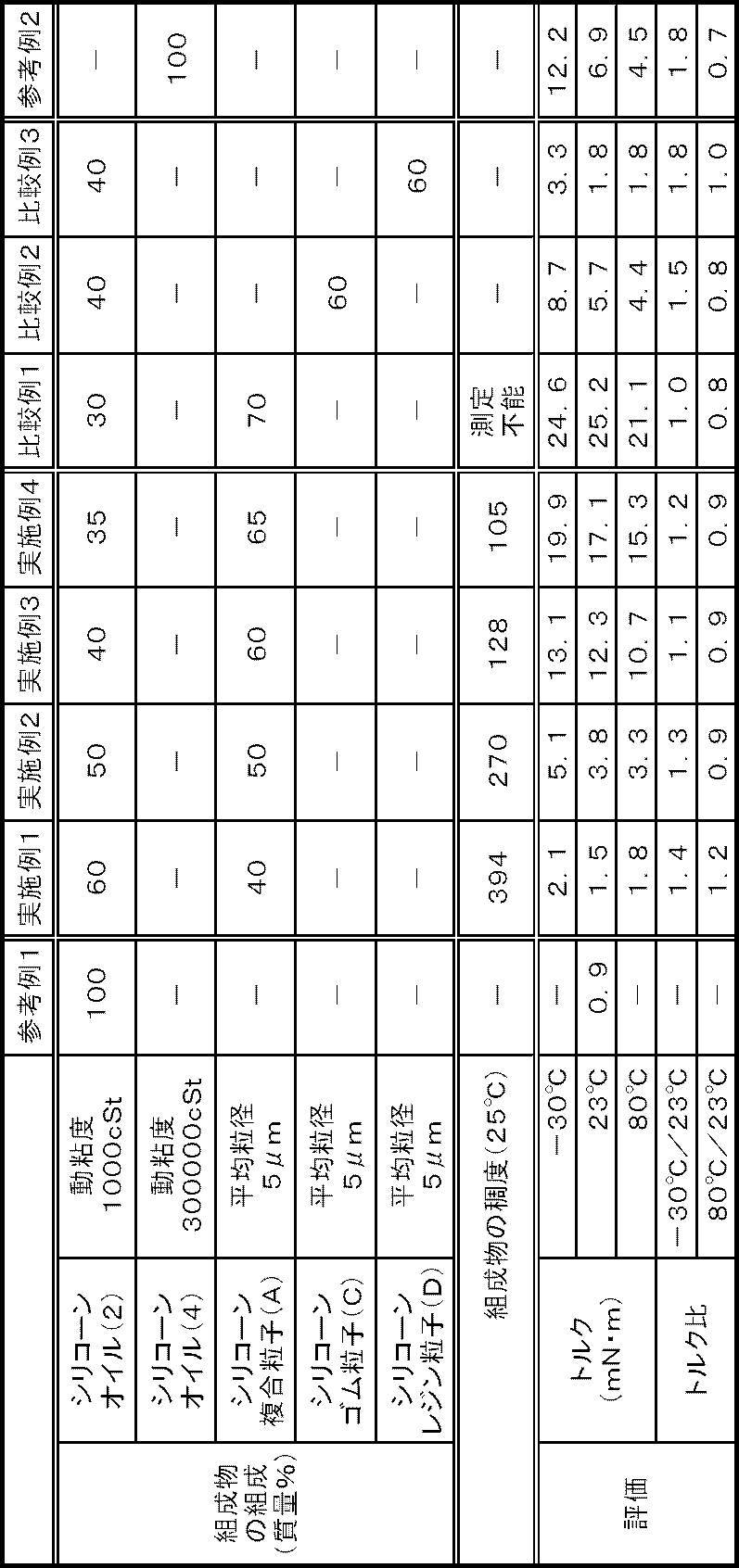
参考例1は、実施例1等に用いたシリコーンオイル(2)自体の23℃におけるトルク値を示したものである。シリコーンオイル(2)単独では、23℃におけるトルク値が1.5mN・m~23mN・mを満足しない。
参考例2は、図1~3に図示するような回転式ダンパーに従来用いられてきた動粘度300000cStのシリコーンオイル(4)を単独で用いたものである。シリコーンオイル(4)は、表1に示すとおり、23℃におけるトルク値が1.5mN・m~23mN・mの範囲内であり、-30℃のトルク値と23℃のトルク値との比(-30℃/23℃)が1.8である。
参考例2は、図1~3に図示するような回転式ダンパーに従来用いられてきた動粘度300000cStのシリコーンオイル(4)を単独で用いたものである。シリコーンオイル(4)は、表1に示すとおり、23℃におけるトルク値が1.5mN・m~23mN・mの範囲内であり、-30℃のトルク値と23℃のトルク値との比(-30℃/23℃)が1.8である。
表1から分かるとおり、実施例1~4は、23℃におけるトルク値が1.5mN・m~23mN・mの範囲内であり、且つ、-30℃のトルク値と23℃のトルク値との比(-30℃/23℃)が参考例2、比較例2及び比較例3よりも1に近かった。このことから、本発明の粘性組成物は、室温において実用上望まれるトルク値を示し、且つ、低温領域において温度によるトルク値の変化が小さいことがわかる。なお、比較例1は、室温において実用上望まれるトルク値を示さなかった。
したがって、本発明の粘性組成物によれば、室温において実用上望まれるトルク値を示し、低温領域において温度によるトルク値の変化が小さい粘性組成物が提供される。また、本発明の粘性組成物を用いることで、室温において実用上望まれるトルク値を示し、低温領域において温度によるトルク値の変化が小さいトルク発生機構が提供される。
したがって、本発明の粘性組成物によれば、室温において実用上望まれるトルク値を示し、低温領域において温度によるトルク値の変化が小さい粘性組成物が提供される。また、本発明の粘性組成物を用いることで、室温において実用上望まれるトルク値を示し、低温領域において温度によるトルク値の変化が小さいトルク発生機構が提供される。
<実施例5~8>
材料及び混合比を表2に示すとおりに変更した以外は、実施例3と同様にして実施例5~8の組成物を得て、前記と同じ方法で稠度及びトルク値を測定した。その結果を表2に示す。表2には、実施例3の稠度及びトルク値を併記する。
材料及び混合比を表2に示すとおりに変更した以外は、実施例3と同様にして実施例5~8の組成物を得て、前記と同じ方法で稠度及びトルク値を測定した。その結果を表2に示す。表2には、実施例3の稠度及びトルク値を併記する。
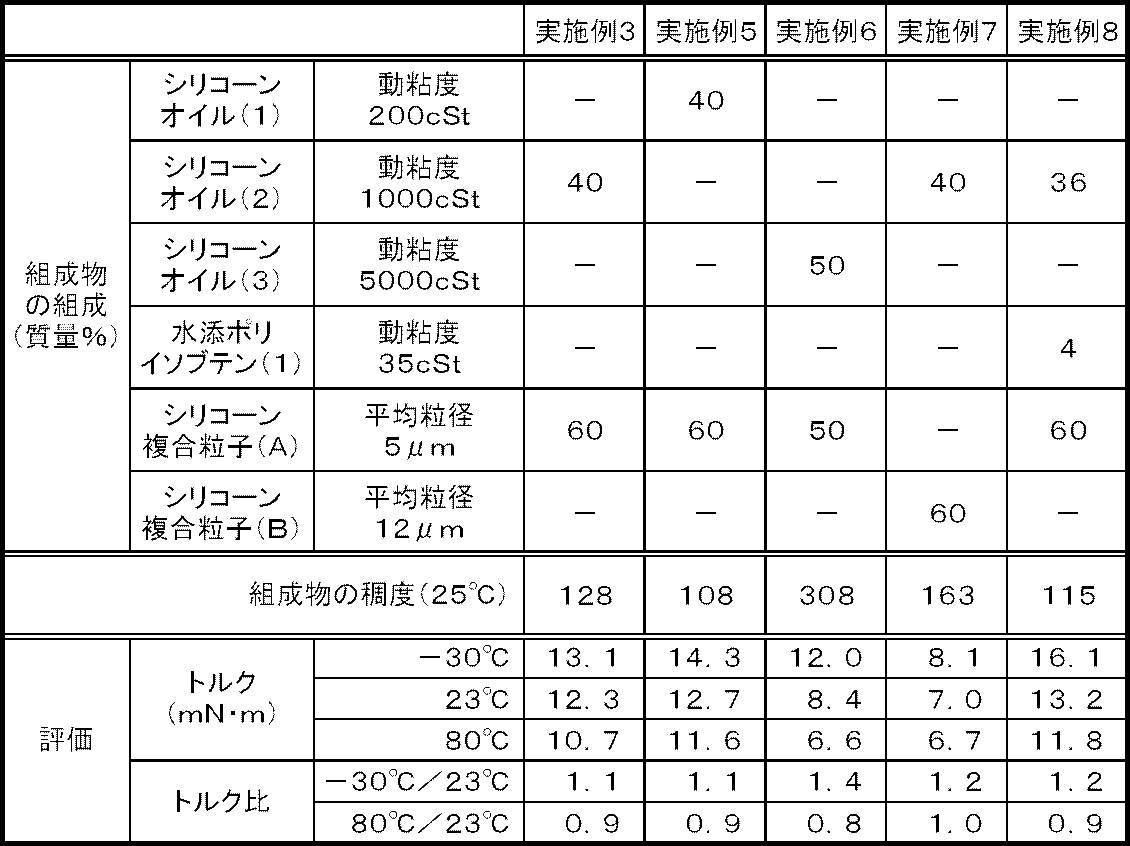
表2から分かるとおり、実施例5~8は、23℃におけるトルク値が1.5mN・m~23mN・mの範囲内であり、且つ、-30℃のトルク値と23℃のトルク値との比(-30℃/23℃)が前記の参考例2、比較例2及び比較例3よりも1に近かった。このことから、本発明の粘性組成物は、室温において実用上望まれるトルク値を示し、且つ、低温領域において温度によるトルク値の変化が小さいことがわかる。
したがって、本発明の粘性組成物によれば、室温において実用上望まれるトルク値を示し、低温領域において温度によるトルク値の変化が小さい粘性組成物が提供される。また、本発明の粘性組成物を用いることで、室温において実用上望まれるトルク値を示し、低温領域において温度によるトルク値の変化が小さいトルク発生機構が提供される。
したがって、本発明の粘性組成物によれば、室温において実用上望まれるトルク値を示し、低温領域において温度によるトルク値の変化が小さい粘性組成物が提供される。また、本発明の粘性組成物を用いることで、室温において実用上望まれるトルク値を示し、低温領域において温度によるトルク値の変化が小さいトルク発生機構が提供される。
<実施例9、参考例3>
材料及び混合比を表3に示すとおりに変更した以外は、実施例3と同様にして実施例9の組成物を得て、前記と同じ方法で稠度及びトルク値を測定した。ただし、トルク値の測定は、周囲温度80℃、23℃、0℃で行った。その結果を表3に示す。
材料及び混合比を表3に示すとおりに変更した以外は、実施例3と同様にして実施例9の組成物を得て、前記と同じ方法で稠度及びトルク値を測定した。ただし、トルク値の測定は、周囲温度80℃、23℃、0℃で行った。その結果を表3に示す。
参考例3は、図1~3に図示するような回転式ダンパーに従来用いられてきた動粘度30000cStの水添ポリイソブテン(2)を単独で用いたものである。水添ポリイソブテン(2)は、表3に示すとおり、23℃におけるトルク値が1.5mN・m~23mN・mの範囲内であり、0℃のトルク値と23℃のトルク値との比(0℃/23℃)が3.2である。
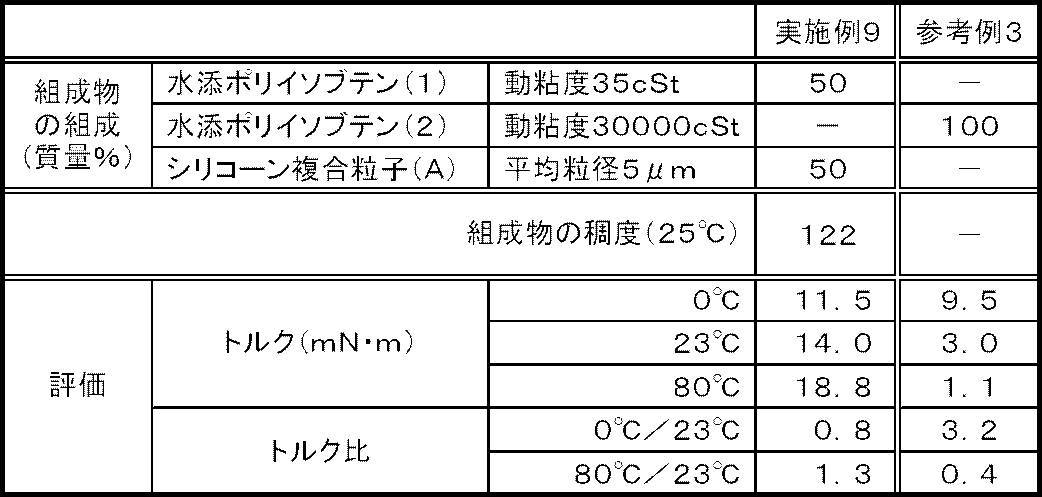
表3から分かるとおり、実施例9は、23℃におけるトルク値が1.5mN・m~23mN・mの範囲内であり、且つ、0℃のトルク値と23℃のトルク値との比(0℃/23℃)が参考例3よりも1に近かった。このことから、本発明の粘性組成物は、室温において実用上望まれるトルク値を示し、且つ、低温領域において温度によるトルク値の変化が小さいことがわかる。
したがって、本発明の粘性組成物によれば、室温において実用上望まれるトルク値を示し、低温領域において温度によるトルク値の変化が小さい粘性組成物が提供される。また、本発明の粘性組成物を用いることで、室温において実用上望まれるトルク値を示し、低温領域において温度によるトルク値の変化が小さいトルク発生機構が提供される。
したがって、本発明の粘性組成物によれば、室温において実用上望まれるトルク値を示し、低温領域において温度によるトルク値の変化が小さい粘性組成物が提供される。また、本発明の粘性組成物を用いることで、室温において実用上望まれるトルク値を示し、低温領域において温度によるトルク値の変化が小さいトルク発生機構が提供される。
2012年6月25日に出願の日本国出願番号第2012-142164号及び2012年9月20日に出願の日本国出願番号第2012-207444号の開示はその全体が参照により本明細書に取り込まれる。
本明細書に記載された全ての文献、特許出願、及び技術規格は、個々の文献、特許出願、及び技術規格が参照により取り込まれることが具体的かつ個々に記された場合と同程度に、本明細書中に参照により取り込まれる。
本明細書に記載された全ての文献、特許出願、及び技術規格は、個々の文献、特許出願、及び技術規格が参照により取り込まれることが具体的かつ個々に記された場合と同程度に、本明細書中に参照により取り込まれる。
Claims (5)
- 分散媒と、前記分散媒を吸収する核及び前記核を被覆する被覆層を有する複合粒子と、を含み、25℃における稠度が90以上410以下である、粘性組成物。
- 前記複合粒子は、前記核がシリコーンゴムを含む粒子であり、前記被覆層がポリオルガノシルセスキオキサン樹脂を含む層である、請求項1に記載の粘性組成物。
- 前記複合粒子は、平均粒径が0.5μm以上50μm以下である、請求項1又は請求項2に記載の粘性組成物。
- 前記分散媒がシリコーンオイルである、請求項1~請求項3のいずれか1項に記載の粘性組成物。
- 前記分散媒は、25℃における動粘度が10000cSt以下である、請求項1~請求項4のいずれか1項に記載の粘性組成物。
Applications Claiming Priority (4)
| Application Number | Priority Date | Filing Date | Title |
|---|---|---|---|
| JP2012142164 | 2012-06-25 | ||
| JP2012-142164 | 2012-06-25 | ||
| JP2012207444A JP6027831B2 (ja) | 2012-06-25 | 2012-09-20 | トルク発生機構用の粘性組成物 |
| JP2012-207444 | 2012-09-20 |
Publications (1)
| Publication Number | Publication Date |
|---|---|
| WO2014002990A1 true WO2014002990A1 (ja) | 2014-01-03 |
Family
ID=49783136
Family Applications (1)
| Application Number | Title | Priority Date | Filing Date |
|---|---|---|---|
| PCT/JP2013/067343 Ceased WO2014002990A1 (ja) | 2012-06-25 | 2013-06-25 | 粘性組成物 |
Country Status (2)
| Country | Link |
|---|---|
| JP (1) | JP6027831B2 (ja) |
| WO (1) | WO2014002990A1 (ja) |
Cited By (4)
| Publication number | Priority date | Publication date | Assignee | Title |
|---|---|---|---|---|
| JP2016102155A (ja) * | 2014-11-28 | 2016-06-02 | 株式会社Adeka | グリース用添加剤及びそれを含有するグリース組成物 |
| WO2017184769A1 (en) * | 2016-04-20 | 2017-10-26 | Fathhome, Inc. | Vacuum-based method and apparatus for cleaning soiled articles |
| CN109620756A (zh) * | 2018-12-10 | 2019-04-16 | 广州市晶硅新材料有限公司 | 一种化妆品用有机硅复合粉末及其制备方法 |
| JP2021046563A (ja) * | 2017-05-11 | 2021-03-25 | クリューバー リュブリケーション ミュンヘン ソシエタス ヨーロピア ウント コンパニー コマンディートゲゼルシャフトKlueber Lubrication Muenchen SE & Co.KG | 潤滑剤組成物 |
Citations (5)
| Publication number | Priority date | Publication date | Assignee | Title |
|---|---|---|---|---|
| JPH10120903A (ja) * | 1996-10-14 | 1998-05-12 | Shin Etsu Chem Co Ltd | シリコーン組成物 |
| JPH10251517A (ja) * | 1997-03-14 | 1998-09-22 | Toray Dow Corning Silicone Co Ltd | 防振性組成物 |
| JP2002105316A (ja) * | 2000-09-27 | 2002-04-10 | Dow Corning Toray Silicone Co Ltd | 防振性シリコーン組成物 |
| JP2003055134A (ja) * | 2001-08-10 | 2003-02-26 | Shiseido Co Ltd | 外用組成物 |
| JP2006206885A (ja) * | 2004-12-27 | 2006-08-10 | Dow Corning Toray Co Ltd | 防振性シリコーンコンパウンド |
Family Cites Families (1)
| Publication number | Priority date | Publication date | Assignee | Title |
|---|---|---|---|---|
| JP4687036B2 (ja) * | 2004-08-31 | 2011-05-25 | パナソニック株式会社 | クリック部用グリース |
-
2012
- 2012-09-20 JP JP2012207444A patent/JP6027831B2/ja not_active Expired - Fee Related
-
2013
- 2013-06-25 WO PCT/JP2013/067343 patent/WO2014002990A1/ja not_active Ceased
Patent Citations (5)
| Publication number | Priority date | Publication date | Assignee | Title |
|---|---|---|---|---|
| JPH10120903A (ja) * | 1996-10-14 | 1998-05-12 | Shin Etsu Chem Co Ltd | シリコーン組成物 |
| JPH10251517A (ja) * | 1997-03-14 | 1998-09-22 | Toray Dow Corning Silicone Co Ltd | 防振性組成物 |
| JP2002105316A (ja) * | 2000-09-27 | 2002-04-10 | Dow Corning Toray Silicone Co Ltd | 防振性シリコーン組成物 |
| JP2003055134A (ja) * | 2001-08-10 | 2003-02-26 | Shiseido Co Ltd | 外用組成物 |
| JP2006206885A (ja) * | 2004-12-27 | 2006-08-10 | Dow Corning Toray Co Ltd | 防振性シリコーンコンパウンド |
Cited By (8)
| Publication number | Priority date | Publication date | Assignee | Title |
|---|---|---|---|---|
| JP2016102155A (ja) * | 2014-11-28 | 2016-06-02 | 株式会社Adeka | グリース用添加剤及びそれを含有するグリース組成物 |
| WO2017184769A1 (en) * | 2016-04-20 | 2017-10-26 | Fathhome, Inc. | Vacuum-based method and apparatus for cleaning soiled articles |
| US10772477B2 (en) | 2016-04-20 | 2020-09-15 | Fathhome, Inc. | Vacuum-based method and apparatus for cleaning soiled articles |
| US11564540B2 (en) | 2016-04-20 | 2023-01-31 | Fathhome, Inc. | Vacuum-based method and apparatus for cleaning soiled articles |
| JP2021046563A (ja) * | 2017-05-11 | 2021-03-25 | クリューバー リュブリケーション ミュンヘン ソシエタス ヨーロピア ウント コンパニー コマンディートゲゼルシャフトKlueber Lubrication Muenchen SE & Co.KG | 潤滑剤組成物 |
| JP7038794B2 (ja) | 2017-05-11 | 2022-03-18 | クリューバー リュブリケーション ミュンヘン ソシエタス ヨーロピア ウント コンパニー コマンディートゲゼルシャフト | 潤滑剤組成物 |
| CN109620756A (zh) * | 2018-12-10 | 2019-04-16 | 广州市晶硅新材料有限公司 | 一种化妆品用有机硅复合粉末及其制备方法 |
| CN109620756B (zh) * | 2018-12-10 | 2021-12-17 | 广州市晶硅新材料有限公司 | 一种化妆品用有机硅复合粉末及其制备方法 |
Also Published As
| Publication number | Publication date |
|---|---|
| JP2014028909A (ja) | 2014-02-13 |
| JP6027831B2 (ja) | 2016-11-16 |
Similar Documents
| Publication | Publication Date | Title |
|---|---|---|
| JP6323398B2 (ja) | 熱伝導性シリコーンパテ組成物 | |
| JP6027831B2 (ja) | トルク発生機構用の粘性組成物 | |
| JP6727471B1 (ja) | 二液硬化型組成物セット、熱伝導性硬化物及び電子機器 | |
| JP4809518B2 (ja) | 防振性シリコーン組成物 | |
| CN1273541C (zh) | 振动阻尼硅氧烷组合物 | |
| US20250320341A1 (en) | Filled silicone foam layer, compositions and methods for their manufacture, and articles including the filled silicone foam layer | |
| CN103453067B (zh) | 密封有粘性流体的阻尼器以及抗振性组合物 | |
| JP2013127013A (ja) | 回転式ダンパー用粘性流体 | |
| EP0990816B1 (en) | Vibration damping composition | |
| US6498211B2 (en) | Vibration damping silicone composition | |
| JP4477764B2 (ja) | 防振性シリコーン組成物 | |
| JP3167954B2 (ja) | 防振性組成物 | |
| JP3867898B2 (ja) | ダイラタンシー性液体 | |
| US20030191216A1 (en) | Viscous liquid vibration damping composition | |
| JP4394214B2 (ja) | 防振性組成物 | |
| JP3904310B2 (ja) | 小型防振装置 | |
| JP2002069299A (ja) | 防振性シリコーンコンパウンド | |
| JP2005068316A (ja) | 潤滑剤、樹脂潤滑用グリース組成物及び電動パワーステアリング装置 | |
| WO2006070674A1 (en) | Vibration-damping silicone composition | |
| JP2013237775A (ja) | 防振性シリコーン組成物 | |
| WO2021084787A1 (ja) | 熱伝導性グリース及びその製造方法 | |
| JP2021155685A (ja) | ダイラタント組成物 | |
| JP2006206885A (ja) | 防振性シリコーンコンパウンド | |
| JP2006002027A (ja) | ダイラタンシー性流体組成物 | |
| JP2000345038A (ja) | 防振性組成物 |
Legal Events
| Date | Code | Title | Description |
|---|---|---|---|
| 121 | Ep: the epo has been informed by wipo that ep was designated in this application |
Ref document number: 13808432 Country of ref document: EP Kind code of ref document: A1 |
|
| NENP | Non-entry into the national phase |
Ref country code: DE |
|
| 122 | Ep: pct application non-entry in european phase |
Ref document number: 13808432 Country of ref document: EP Kind code of ref document: A1 |