WO2013172297A1 - 6,7-不飽和-7-カルバモイルモルヒナン誘導体含有製剤 - Google Patents
6,7-不飽和-7-カルバモイルモルヒナン誘導体含有製剤 Download PDFInfo
- Publication number
- WO2013172297A1 WO2013172297A1 PCT/JP2013/063278 JP2013063278W WO2013172297A1 WO 2013172297 A1 WO2013172297 A1 WO 2013172297A1 JP 2013063278 W JP2013063278 W JP 2013063278W WO 2013172297 A1 WO2013172297 A1 WO 2013172297A1
- Authority
- WO
- WIPO (PCT)
- Prior art keywords
- weight
- solid preparation
- compound
- iron oxide
- formula
- Prior art date
- Legal status (The legal status is an assumption and is not a legal conclusion. Google has not performed a legal analysis and makes no representation as to the accuracy of the status listed.)
- Ceased
Links
Images


Classifications
-
- A—HUMAN NECESSITIES
- A61—MEDICAL OR VETERINARY SCIENCE; HYGIENE
- A61K—PREPARATIONS FOR MEDICAL, DENTAL OR TOILETRY PURPOSES
- A61K9/00—Medicinal preparations characterised by special physical form
- A61K9/20—Pills, tablets, discs, rods
- A61K9/2004—Excipients; Inactive ingredients
- A61K9/2022—Organic macromolecular compounds
- A61K9/205—Polysaccharides, e.g. alginate, gums; Cyclodextrin
- A61K9/2054—Cellulose; Cellulose derivatives, e.g. hydroxypropyl methylcellulose
-
- A—HUMAN NECESSITIES
- A61—MEDICAL OR VETERINARY SCIENCE; HYGIENE
- A61K—PREPARATIONS FOR MEDICAL, DENTAL OR TOILETRY PURPOSES
- A61K31/00—Medicinal preparations containing organic active ingredients
- A61K31/33—Heterocyclic compounds
- A61K31/395—Heterocyclic compounds having nitrogen as a ring hetero atom, e.g. guanethidine or rifamycins
- A61K31/435—Heterocyclic compounds having nitrogen as a ring hetero atom, e.g. guanethidine or rifamycins having six-membered rings with one nitrogen as the only ring hetero atom
- A61K31/47—Quinolines; Isoquinolines
- A61K31/485—Morphinan derivatives, e.g. morphine, codeine
-
- A—HUMAN NECESSITIES
- A61—MEDICAL OR VETERINARY SCIENCE; HYGIENE
- A61K—PREPARATIONS FOR MEDICAL, DENTAL OR TOILETRY PURPOSES
- A61K9/00—Medicinal preparations characterised by special physical form
- A61K9/20—Pills, tablets, discs, rods
- A61K9/2004—Excipients; Inactive ingredients
- A61K9/2009—Inorganic compounds
-
- A—HUMAN NECESSITIES
- A61—MEDICAL OR VETERINARY SCIENCE; HYGIENE
- A61K—PREPARATIONS FOR MEDICAL, DENTAL OR TOILETRY PURPOSES
- A61K9/00—Medicinal preparations characterised by special physical form
- A61K9/20—Pills, tablets, discs, rods
- A61K9/2004—Excipients; Inactive ingredients
- A61K9/2013—Organic compounds, e.g. phospholipids, fats
-
- A—HUMAN NECESSITIES
- A61—MEDICAL OR VETERINARY SCIENCE; HYGIENE
- A61K—PREPARATIONS FOR MEDICAL, DENTAL OR TOILETRY PURPOSES
- A61K9/00—Medicinal preparations characterised by special physical form
- A61K9/20—Pills, tablets, discs, rods
- A61K9/2004—Excipients; Inactive ingredients
- A61K9/2013—Organic compounds, e.g. phospholipids, fats
- A61K9/2018—Sugars, or sugar alcohols, e.g. lactose, mannitol; Derivatives thereof, e.g. polysorbates
-
- A—HUMAN NECESSITIES
- A61—MEDICAL OR VETERINARY SCIENCE; HYGIENE
- A61K—PREPARATIONS FOR MEDICAL, DENTAL OR TOILETRY PURPOSES
- A61K9/00—Medicinal preparations characterised by special physical form
- A61K9/20—Pills, tablets, discs, rods
- A61K9/2004—Excipients; Inactive ingredients
- A61K9/2022—Organic macromolecular compounds
- A61K9/2027—Organic macromolecular compounds obtained by reactions only involving carbon-to-carbon unsaturated bonds, e.g. polyvinyl pyrrolidone, poly(meth)acrylates
-
- A—HUMAN NECESSITIES
- A61—MEDICAL OR VETERINARY SCIENCE; HYGIENE
- A61K—PREPARATIONS FOR MEDICAL, DENTAL OR TOILETRY PURPOSES
- A61K9/00—Medicinal preparations characterised by special physical form
- A61K9/20—Pills, tablets, discs, rods
- A61K9/2004—Excipients; Inactive ingredients
- A61K9/2022—Organic macromolecular compounds
- A61K9/205—Polysaccharides, e.g. alginate, gums; Cyclodextrin
- A61K9/2059—Starch, including chemically or physically modified derivatives; Amylose; Amylopectin; Dextrin
-
- A—HUMAN NECESSITIES
- A61—MEDICAL OR VETERINARY SCIENCE; HYGIENE
- A61K—PREPARATIONS FOR MEDICAL, DENTAL OR TOILETRY PURPOSES
- A61K9/00—Medicinal preparations characterised by special physical form
- A61K9/20—Pills, tablets, discs, rods
- A61K9/28—Dragees; Coated pills or tablets, e.g. with film or compression coating
- A61K9/2806—Coating materials
- A61K9/2833—Organic macromolecular compounds
- A61K9/286—Polysaccharides, e.g. gums; Cyclodextrin
- A61K9/2866—Cellulose; Cellulose derivatives, e.g. hydroxypropyl methylcellulose
-
- A—HUMAN NECESSITIES
- A61—MEDICAL OR VETERINARY SCIENCE; HYGIENE
- A61P—SPECIFIC THERAPEUTIC ACTIVITY OF CHEMICAL COMPOUNDS OR MEDICINAL PREPARATIONS
- A61P1/00—Drugs for disorders of the alimentary tract or the digestive system
- A61P1/08—Drugs for disorders of the alimentary tract or the digestive system for nausea, cinetosis or vertigo; Antiemetics
-
- A—HUMAN NECESSITIES
- A61—MEDICAL OR VETERINARY SCIENCE; HYGIENE
- A61P—SPECIFIC THERAPEUTIC ACTIVITY OF CHEMICAL COMPOUNDS OR MEDICINAL PREPARATIONS
- A61P1/00—Drugs for disorders of the alimentary tract or the digestive system
- A61P1/10—Laxatives
-
- A—HUMAN NECESSITIES
- A61—MEDICAL OR VETERINARY SCIENCE; HYGIENE
- A61P—SPECIFIC THERAPEUTIC ACTIVITY OF CHEMICAL COMPOUNDS OR MEDICINAL PREPARATIONS
- A61P25/00—Drugs for disorders of the nervous system
- A61P25/04—Centrally acting analgesics, e.g. opioids
-
- A—HUMAN NECESSITIES
- A61—MEDICAL OR VETERINARY SCIENCE; HYGIENE
- A61P—SPECIFIC THERAPEUTIC ACTIVITY OF CHEMICAL COMPOUNDS OR MEDICINAL PREPARATIONS
- A61P43/00—Drugs for specific purposes, not provided for in groups A61P1/00-A61P41/00
Definitions
- the present invention relates to a preparation containing a 6,7-unsaturated-7-carbamoylmorphinan derivative, particularly 17- (cyclopropylmethyl) -6,7-didehydro-4,5 ⁇ -epoxy-3,6,14-trihydroxy-N- [
- the present invention relates to a preparation with improved dissolution and stability of 2- (3-phenyl-1,2,4-oxadiazol-5-yl) propan-2-yl] morphinan-7-carboxamide 4-methylbenzenesulfonic acid.
- Opioid receptor agonists such as morphine are used as very effective analgesics for cancer pain patients, but induce side effects such as strong nausea, nausea, vomiting, constipation, urinary retention and itchiness.
- Various antiemetics and anti-constipation drugs have been used clinically, but none of them are sufficiently effective, and an excellent side effect reducing agent is required for improving the patient's hemorrhoid quality of life.
- Patent Document 1 discloses a 6,7-unsaturated-7-carbamoylmorphinan derivative (hereinafter sometimes referred to as “the present derivative”). Among these derivatives, 17- (cyclopropyl methyl) -6,7-didehydro-4,5 ⁇ -epoxy-3,6,14-trihydroxy-N- [2- (3-phenyl-1,2,4-oxadiazol-5-yl) propan-2-yl ]
- compound A hereinafter sometimes referred to as “this compound”
- this compound depending on the additive to be added, the dissolution property, especially the initial stage after the start of dissolution test If the elution rate of is low, the drug efficacy may be reduced.
- the present inventors have found an optimal additive and completed the present invention. That is, if croscarmellose sodium or crospovidone is used as a disintegrant, titanium oxide is not used as a dye, and dyes such as iron oxide, tar dye, and natural dye are used, the dissolution and stability are remarkably increased. Thus, it is possible to produce a preparation having distinctiveness.
- the present invention (1) Formula (IA) as an active ingredient: A solid preparation containing a pharmaceutically acceptable salt of the compound represented by or a solvate of the compound or the salt, (2) a solid preparation according to the above (1), which contains a pharmaceutically acceptable salt of the compound represented by the formula (IA) or a solvate of the compound or the salt as an active ingredient, and a disintegrant; (3) A compound represented by the formula (IA) as an active ingredient, a pharmaceutically acceptable salt thereof or a solvate of the compound or the salt, and a dissolution test method second method stipulated in the 15th revised Japanese Pharmacopoeia A solid preparation containing a disintegrant with an elution rate of the compound represented by the formula (IA) 15 minutes after the start of the test in the (paddle method) being 85% or more, (4) A compound represented by the formula (IA) as an active ingredient, a pharmaceutically acceptable salt thereof or a solvate of the compound or the salt, and a formula (IA) stored
- the elution rate of the compound represented by the formula (IA) is 85% or more, and the amount of the analog of the compound represented by the formula (IA) is less than 0.2% when stored at 40 ° C. and 75% relative humidity for 1 month.
- the active ingredient is p-toluenesulfonate, acetate or hydrochloride of the compound represented by the formula (IA) or a solvate of the salt according to any one of (1) to (5) above Solid formulations, (7)
- the preparation containing the 6,7-unsaturated-7-carbamoylmorphinan derivative of the present invention contains croscarmellose sodium or crospovidone in the preparation, thereby reducing the initial dissolution, particularly 15 minutes after the start of the dissolution test (
- the elution rate of the compound represented by IA) can be 85% or more.
- iron oxide, tar dye, and natural dye without using titanium oxide as a dye it is possible to produce a distinguishable preparation having excellent temporal stability and light stability.
- Dissolution behavior of this compound when the type of disintegrant is changed Dissolution behavior of this compound when the content (0.1 mg) of this compound is changed
- the side effect reducing agent of the opioid receptor agonist which is an active ingredient used in the present invention is usually a 6,7-unsaturated-7-carbamoylmorphinan derivative, preferably a compound represented by the above formula (IA) (compound A ), A pharmaceutically acceptable salt thereof, or the compound or a solvate of the salt. More preferably, it is a pharmaceutically acceptable salt of the compound represented by the formula (IA) or a solvate of the compound or the salt.
- an alkali metal for example, lithium, sodium, potassium, etc.
- an alkaline earth metal for example, Calcium, barium, etc.
- magnesium transition metals (eg, zinc, iron, etc.), ammonia, organic bases (eg, trimethylamine, triethylamine, dicyclohexylamine, ethanolamine, diethanolamine, triethanolamine, meglumine, diethanolamine, ethylenediamine, pyridine, Picolin, quinoline etc.) and salts with amino acids, or inorganic acids (eg hydrochloric acid, sulfuric acid, nitric acid, carbonic acid, hydrobromic acid, phosphoric acid, hydroiodic acid etc.) and organic acids (eg formic acid, acetic acid, Propionic acid, trifluoroacetic acid, citric acid, milk , Tartaric acid, oxalic acid, maleic acid
- organic bases eg, trimethylamine, triethylamine, dicyclohexylamine, ethanolamine
- salts with hydrochloric acid, sulfuric acid, phosphoric acid, tartaric acid, methanesulfonic acid and the like can be mentioned.
- it is a salt with an acid.
- These salts can be formed by a commonly performed method.
- Particularly preferred is a p-toluenesulfonate, acetate or hydrochloride of the compound represented by the formula (IA), or a solvate of the compound or the salt, and more preferred is the formula (IA). Crystals of p-toluenesulfonic acid salt of the indicated compound or solvates of the salt.
- This compound is a p-toluenesulfonate salt of the compound represented by the formula (IA), ie, 17- (cyclopropylmethyl) -6,7-didehydro-4,5 ⁇ -epoxy-3,6,14-trihydroxy-N
- the water solubility of-[2- (3-phenyl-1,2,4-oxadiazol-5-yl) propan-2-yl] morphinan-7-carboxamide 4-methylbenzenesulfonic ⁇ acid at pH 1 or 4 is 1000 ⁇ g / mL or more However, the water solubility at pH 7 is lower than at pH 1 or 4.
- the p-toluenesulfonic acid salt, acetate salt or hydrochloride salt of the compound represented by the formula (IA) which is the present derivative in the present preparation, or the solvate of the compound or the salt, particularly the content of the present compound, has a medicinal effect.
- Such an amount is sufficient. For example, it is 0.01 to 20% by weight, preferably 0.025 to 17.5% by weight, more preferably 0.05 to 15% by weight, based on the total amount of the preparation. If the blending amount is larger than these, a tablet may not be formed. If the blending amount is smaller, the decomposition amount of the active ingredient may be increased.
- This preparation may contain a disintegrating agent, and disintegrating agents listed in the Japanese Pharmacopoeia, the Japanese Pharmacopoeia Standards for Drugs, the Standards for Pharmaceutical Additives, and the Food Additives Standard can be used.
- a disintegrating agent for example, there are cellulosic disintegrants, starch disintegrants, and vinyl disintegrants.
- cellulose-based disintegrants include croscarmellose sodium, carmellose sodium, carmellose calcium, carmellose, crystalline cellulose, crystalline cellulose / carmellose sodium, low-substituted hydroxypropylcellulose, hydroxyethylmethylcellulose, hydroxypropylcellulose, hydroxypropyl Examples include methylcellulose.
- starch disintegrant examples include sodium carboxymethyl starch, hydroxypropyl starch, corn starch, wheat starch, potato starch, pregelatinized starch, and partially pregelatinized starch.
- vinyl disintegrants include polyvinylpyrrolidone and crospovidone.
- cellulose-based disintegrants and vinyl-based disintegrants are preferred.
- sodium salts such as croscarmellose sodium, carmellose sodium, crystalline cellulose / carmellose sodium, and carboxymethyl starch sodium. is there. More preferred are croscarmellose sodium and crospovidone, and particularly preferred is croscarmellose sodium.
- the content of the disintegrant is such that the disintegrant is present per 1 part by weight of p-toluenesulfonate, acetate or hydrochloride of the compound represented by the formula (IA), or the solvate of the compound or the salt.
- the amount is 0.25 to 250 parts by weight, preferably 0.375 to 225 parts by weight, more preferably 0.5 to 200 parts by weight. It is usually 1 to 30% by weight, preferably 2.5 to 25% by weight, more preferably 5 to 20% by weight, based on the total amount of the preparation. If the content is higher than these, the preparation itself may be increased in size, and if it is less, the disintegration and dissolution properties of the preparation may not be sufficiently obtained.
- the dissolution property of the preparation generally affects the absorbability of the drug, it is preferable that the dissolution property is high at the beginning of the dissolution test.
- the dissolution properties of this preparation at the beginning of the dissolution test are greatly affected by the disintegrant.
- the dissolution rate of the compound represented by the formula (IA) 15 minutes after the dissolution test is usually 85% or more, preferably 87.5% or more, more preferably 90% or more.
- the dissolution rate of the compound represented by IA) is usually 60% or more, preferably 62.5% or more, more preferably 65% or more, and the dissolution rate of the compound represented by formula (IA) after 15 minutes of dissolution test is It is usually 85% or more, preferably 87.5% or more, more preferably 90% or more. 3)
- the dissolution rate of the compound represented by the formula (IA) after 5 minutes of dissolution test is usually 60% or more, preferably 62 .5% or more, more preferably 6
- the dissolution rate of the compound represented by the formula (IA) after 15 minutes of dissolution test is usually 85% or more, preferably 87.5% or more, more preferably 90% or more, and 30 minutes after dissolution test.
- the dissolution rate of the compound represented by the formula (IA) is usually 90% or more, preferably 92.5% or more, more preferably 95% or more. 4)
- the dissolution rate is represented by the formula (IA) 15 minutes after the dissolution test.
- the elution rate of the compound is usually 85% or more, preferably 87.5% or more, more preferably 90% or more, and the elution rate of the compound represented by the formula (IA) after 30 minutes of the elution test is usually 90% or more, Preferably it is 92.5% or more, more preferably 95% or more.
- the disintegrability in the preparation of the present invention is greatly affected by the disintegrant, and any disintegration that is suitable for the compound to be efficiently absorbed in vivo can be used.
- the disintegration time is usually 120 seconds or shorter, preferably 115 seconds or shorter, more preferably 110 seconds or shorter.
- the analog of the present compound in the preparation of the present invention is greatly affected by the disintegrant.
- the main analog is a hydroxide of the compound represented by the formula (IA).
- total analogs a hydroxide of the compound represented by the formula (IA).
- This preparation may contain excipients and uses the excipients listed in the Japanese Pharmacopoeia, the Japanese Pharmacopoeia Standards for Drugs, the Standards for Pharmaceutical Additives, and the Food Additives Standards However, any excipient that can be tableted by the direct compression method is preferable.
- D-mannitol powdered reduced maltose starch syrup, glucose, fructose, lactose, erythritol, maltitol, trehalose, sorbitol, sucrose, sucrose, fructooligosaccharides, palatinose, maltose (maltose), reduced maltose, flour, starch syrup, fructose , Lactulose, reduced lactose lactitol, honey sugar, D-sorbitol, xylitol, corn starch, potato starch, wheat starch, rice starch, crystalline cellulose, anhydrous silicic acid, anhydrous calcium phosphate, precipitated calcium carbonate, calcium silicate and the like.
- D-mannitol is used.
- the content of the excipient is usually 50 to 95% by weight, preferably 60 to 92.5% by weight, more preferably 70 to 90% by weight, based on the total amount of the preparation. If the content is higher than these contents, the preparation itself may be increased in size, and if it is less, tablets may not be formed.
- This preparation may contain a lubricant, and the lubricants listed in the Japanese Pharmacopoeia, the Japanese Pharmacopoeia Pharmaceutical Standards, the Pharmaceutical Additives Standard, and the Food Additives Standard can be used.
- a lubricant listed in the Japanese Pharmacopoeia, the Japanese Pharmacopoeia Pharmaceutical Standards, the Pharmaceutical Additives Standard, and the Food Additives Standard can be used.
- stearic acid metal salt sucrose fatty acid ester, talc, hydrous silicon dioxide and the like can be mentioned, and stearic acid metal salt is preferable.
- the metal stearate include magnesium stearate and calcium stearate, and magnesium stearate is preferable.
- the content of the lubricant is usually 0.05 to 10% by weight, preferably 0.075 to 7.5% by weight, more preferably 0.1 to 5% by weight, based on the total amount of the preparation. If the content is higher than these, the dissolution property may be lowered, and if the content is lower, the tablet may not be produced.
- This preparation may contain pigments or colorants, and may use pigments and colorants listed in the Japanese Pharmacopoeia, the Japanese Pharmacopoeia Standards for Drugs, the Standards for Pharmaceutical Additives, and the Food Additives Standards. it can.
- iron oxide, tar pigment, natural pigment, and the like can be mentioned.
- the iron oxide include iron sesquioxide, yellow iron oxide, yellow sesquioxide, and black iron oxide.
- tar pigments edible yellow No. 4 aluminum rake, edible blue No. 1 aluminum rake, edible red No. 3 aluminum rake, edible blue No. 1 edible, edible blue No. 2, edible yellow No. 4, edible yellow No. 5, edible red No. 102 Edible red 2 and edible red 3 etc.
- Examples of natural pigments include turmeric extract, ⁇ ⁇ ⁇ -carotene, carotene solution, copper chlorophyllin sodium, copper chlorophyll, green leaf extract, naked wheat green leaf juice dry powder, and naked wheat leaf extract.
- this compound particularly p-toluenesulfonate, acetate or hydrochloride of the formula (IA) or a solvate of the compound or the acid addition salt does not contain a dye that decomposes under storage over time or under light irradiation. It is desirable. For example, when a preparation containing the present compound and titanium oxide is irradiated with light, the amount of the related compound increases. Therefore, it is desirable that the preparation contains substantially no titanium oxide. “Substantially no titanium oxide” means that the amount of titanium oxide is less than 0.001% by weight based on the total amount of the preparation.
- Titanium oxide generally used as a pigment generates free radicals in the presence of water and oxygen when irradiated with ultraviolet rays.
- This free radical has a strong oxidizing power, and depending on the compound, an oxidant may be generated. Since this compound is also presumed to be related compounds increased by this free radical, a dye that does not generate free radicals was selected.
- the content of the coloring matter or coloring agent is the coloring matter or coloring amount with respect to 1 part by weight of the present compound, particularly p-toluenesulfonate, acetate or hydrochloride of the formula (IA) or solvate of the compound or acid addition salt.
- the agent is usually 0.001 to 1 part by weight, preferably 0.0025 to 0.75 part by weight, more preferably 0.05 to 0.5 part by weight.
- the total amount of the preparation is usually 0.001 to 2% by weight, preferably 0% to the total amount of the preparation. 0025 to 1.5% by weight, more preferably 0%. 005 to 1% by weight.
- This preparation may be coated on the surface of the preparation, and coating agents listed in the Japanese Pharmacopoeia, the Japanese Pharmacopoeia Standards for Drugs, the Standards for Pharmaceutical Additives, and the Food Additives Standard can be used.
- hypromellose hydroxypropylmethylcellulose
- polyvinyl alcohol ethylcellulose, carboxymethylethylcellulose, carmellose, carmellose sodium, hydroxyethylcellulose, hydroxyethylmethylcellulose, hydroxypropylcellulose, PVA copolymer, ethyl acrylate / methyl methacrylate copolymer dispersion, amino Alkyl methacrylate copolymer, Opadry, carnauba wax, carboxyvinyl polymer, dry methacrylic acid copolymer, dimethylaminoethyl methacrylate / methyl methacrylate copolymer, stearyl alcohol, shellac, cetanol, hydroxypropyl methylcellulose a
- the content of the coating agent is usually 0.1 to 10% by weight, preferably 0.25 to 7.5% by weight, more preferably 0.5 to 5% by weight, based on the total amount of the preparation. If the content is higher than these, the dissolution rate of the drug may be reduced, and if it is less, the coating film may be damaged.
- the pigment or colorant may be contained in the solid preparation, but may be contained in the solid preparation and / or the coating layer in the coated solid preparation.
- the coating agent may contain a plasticizer or an anti-aggregation agent, and it is listed in the Japanese Pharmacopoeia, the Japanese Pharmacopoeia Standards for Drugs, the Standards for Pharmaceutical Additives, and the Food Additives Standards.
- a plasticizer or an anti-aggregation agent for example, macrogol 1000 (macrogol 1500, macrogol 1540, macrogol 4000, macrogol 6000, macrogol 8000, macrogol 20000, macrogol 35000, etc., macrogol (polyethylene glycol having an average molecular weight of 1000 to 35000), glycerin fatty acid Examples thereof include esters, sucrose fatty acid esters, castor oil, and talc.
- this derivative especially p-toluenesulfonate, acetate or hydrochloride of formula IA, or a solvate of the compound or acid addition salt, particularly a plasticizer or an anti-aggregation agent that decomposes the compound Is desirable.
- the preparation contains substantially no triethyl citrate. “Substantially free of triethyl citrate” means that the amount of triethyl citrate is less than 0.001% by weight based on the total amount of the preparation.
- this preparation may contain additives other than those mentioned above.
- Additives listed in the Japanese Pharmacopoeia, the Japanese Pharmacopoeia Pharmaceutical Standards, the Pharmaceutical Additives Standard, and the Food Additives Official Standard Can be used.
- the content of these additives may be an arbitrary ratio.
- additives other than those described above include binders, fragrances, fluidizing agents, and flavoring agents.
- binders for example, hydroxypropylcellulose, corn starch, pregelatinized starch, partially pregelatinized starch, gum arabic, gum arabic powder, gelatin, agar, dextrin, pullulan, polyvinylpyrrolidone, polyvinyl alcohol, crystalline cellulose, methylcellulose, ethylcellulose, Examples thereof include carboxymethyl ethyl cellulose, carmellose, carmellose sodium, hydroxyethyl cellulose, hydroxyethyl methyl cellulose, hydroxypropyl cellulose, hypromellose and the like.
- perfumes for example, orange essence, orange oil, caramel, camphor, cinnamon oil, spearmint oil, strawberry essence, chocolate essence, cherry flavor, spruce oil, pine oil, peppermint oil, vanilla flavor, bitter essence, fruit flavor, peppermint essence , Mixed flavor, mint flavor, menthol, lemon powder, lemon oil, rose oil and the like.
- the fluidizing agent include hydrous silicon dioxide, light anhydrous silicic acid, crystalline cellulose, synthetic aluminum silicate, talc and the like.
- corrigent for example, aspartame, sucralose, glycine, sodium chloride, magnesium chloride, hydrochloric acid, dilute hydrochloric acid, citric acid and its salt, anhydrous citric acid, L-glutamic acid and its salt, succinic acid and its salt, acetic acid, tartaric acid and its Salt, sodium hydrogen carbonate, fumaric acid and its salt, malic acid and its salt, glacial acetic acid, disodium inosinate, honey and the like.
- aspartame sucralose, glycine, sodium chloride, magnesium chloride, hydrochloric acid, dilute hydrochloric acid, citric acid and its salt, anhydrous citric acid, L-glutamic acid and its salt, succinic acid and its salt, acetic acid, tartaric acid and its Salt, sodium hydrogen carbonate, fumaric acid and its salt, malic acid and its salt, glacial acetic acid, disodium inosinate, honey and the like.
- the above active ingredients and additives can usually be used alone or in admixture, as long as the dissolution and stability of the active ingredient are not reduced.
- the preferred active ingredient and additive combinations are: 1) the compound / croscarmellose sodium or crospovidone, 2) the compound / croscarmellose sodium or crospovidone / iron oxide, 3) the compound / croscalme Sodium or crospovidone / iron oxide / mannitol, 4) the present compound / croscarvidone sodium or crospovidone / iron oxide / mannitol / magnesium stearate, 5) the present compound / croscarmellose sodium or crospovidone / mannitol, 6) This compound / croscarmellose sodium or crospovidone / mannitol / magnesium stearate, and any combination does not contain titanium oxide.
- the combination of the active ingredient and the additive is the above-mentioned
- croscarmellose sodium or crospovidone 0.25 to 250 parts by weight of croscarmellose or crospovidone, preferably 0.375 to 225 parts by weight, More preferred is 0.5 to 200 parts by weight.
- the content of each of the total amount of the preparation is usually 0.01 to 20% by weight of the present compound, 1 to 30% by weight of croscarmellose sodium or crospovidone, and preferably 0.025 to 17.5% of the present compound.
- % By weight, croscarmellose sodium or crospovidone 2.5 to 25% by weight, more preferably 0.05 to 15% by weight of the derivative, croscarmellose sodium or crospovidone 5 to 20% by weight, It contains substantially no titanium oxide.
- the solid preparation is a combination of the present compound / croscarmellose sodium or crospovidone / iron oxide, 0.25 to 250 parts by weight of croscarmellose sodium or crospovidone, preferably 0.375 to 225 parts by weight, more preferably 0.5 to 200 parts by weight, and iron oxide is usually 0.001 to 1 part by weight, preferably 0.0025 to 0.75 parts by weight, and more preferably 0.05 to 0 parts by weight. .5 parts by weight.
- each compound relative to the total amount of the preparation is usually 0.01 to 20% by weight of the present compound, 1 to 30% by weight of croscarmellose sodium or crospovidone, and 0.001 to 2% by weight of iron oxide, preferably Is 0.025 to 17.5% by weight of the present compound, croscarmellose sodium or crospovidone is 2.5 to 25% by weight, and iron oxide is 0%.
- iron oxide is 0%.
- 0025-1.5% by weight more preferably 0.05-15% by weight of the present compound, 5-20% by weight of croscarmellose sodium or crospovidone, and 0% by weight of iron oxide.
- the preparation contains substantially no titanium oxide.
- the content of croscarmellose sodium, crospovidone, or iron oxide relative to 1 part by weight of the present compound is as described above.
- the content of each of the total preparation is usually 0.01 to 20% by weight of the present compound, 1 to 30% by weight of croscarmellose sodium or crospovidone, 0.001 to 2% by weight of iron oxide, mannitol Is 50 to 95% by weight, preferably 0.025 to 17.5% by weight of the present compound, croscarmellose sodium or crospovidone is 2.5 to 25% by weight, and iron oxide is 0%.
- mannitol is 60 to 92.5% by weight, more preferably the present compound is 0.05 to 15% by weight, croscarmellose sodium or crospovidone is 5 to 20% by weight, and iron oxide is 0% . 005 to 1% by weight, mannitol is 70 to 90% by weight, and the preparation contains substantially no titanium oxide.
- the solid preparation is a combination of the present compound / croscarmellose sodium or crospovidone / iron oxide / mannitol / magnesium stearate
- the content of croscarmellose sodium or crospovidone and iron oxide per 1 part by weight of the compound is as described above. is there.
- each of the total preparation is usually 0.01 to 20% by weight of the present compound, 1 to 30% by weight of croscarmellose sodium or crospovidone, 0.001 to 2% by weight of iron oxide, mannitol 50 to 95% by weight, magnesium stearate 0.05 to 10% by weight, preferably 0.025 to 17.5% by weight of the present compound, croscarmellose sodium or crospovidone 2.5 to 25% by weight, Iron oxide is 0%.
- mannitol is 70 to 90% by weight
- magnesium stearate is 0.1 to 5% by weight
- titanium oxide is not substantially contained in the preparation.
- croscarmellose sodium or crospovidone The content of croscarmellose sodium or crospovidone with respect to 1 part by weight of this compound in the combination of the solid preparation of this compound / croscarmellose sodium or crospovidone and the coating layer covering the surface of the solid preparation of hypromellose. Is as described above.
- each compound relative to the total amount of the preparation is usually 0.01 to 20% by weight of the present compound, 1 to 30% by weight of croscarmellose sodium or crospovidone, and 0.1 to 10% by weight of hypromellose, preferably 0.025 to 17.5% by weight of the present compound, 2.5 to 25% by weight of croscarmellose sodium or crospovidone, 0.25 to 7.5% by weight of hypromellose, more preferably 0.05% of the present compound -15% by weight, croscarmellose sodium or crospovidone 5-20% by weight, hypromellose 0.5-5% by weight, and substantially free of titanium oxide in the formulation.
- the croscarmellose sodium or crospovidone with respect to 1 part by weight of the compound
- the iron oxide content is as described above.
- the content of each compound relative to the total amount of the preparation is usually 0.01 to 20% by weight of the present compound, 1 to 30% by weight of croscarmellose sodium or crospovidone, 0.001 to 2% by weight of iron oxide, and hypromellose.
- 0.1 to 10% by weight preferably 0.025 to 17.5% by weight of the present compound, 2.5 to 25% by weight of croscarmellose sodium or crospovidone, and 0 to 0.1% of iron oxide.
- each of the total preparation is usually 0.01 to 20% by weight of the present compound, 1 to 30% by weight of croscarmellose sodium or crospovidone, 0.001 to 2% by weight of iron oxide, mannitol Is 50 to 95% by weight, hypromellose is 0.1 to 10% by weight, preferably 0.025 to 17.5% by weight of the present compound, croscarmellose sodium or crospovidone is 2.5 to 25% by weight, iron oxide Is 0.
- each of the total preparation is usually 0.01 to 20% by weight of the present compound, 1 to 30% by weight of croscarmellose sodium or crospovidone, 0.001 to 2% by weight of iron oxide, mannitol 50 to 95% by weight, magnesium stearate 0.05 to 10% by weight, hypromellose 0.1 to 10% by weight, preferably 0.025 to 17.5% by weight of the present compound, croscarmellose sodium or cloth Povidone is 2.5 to 25% by weight, iron oxide is 0%.
- croscarmellose sodium or crospovidone with respect to 1 part by weight of the present compound
- the iron oxide content is as described above.
- the content of each compound with respect to the total amount of the preparation is usually 0.01 to 20% by weight of the present compound, 1 to 30% by weight of croscarmellose sodium or crospovidone, 0.1 to 10% by weight of hypromellose, and iron oxide.
- iron oxide is 0%. 0025-1.5% by weight, more preferably 0.05-15% by weight of the present compound, 5-20% by weight of croscarmellose sodium or crospovidone, 0.5-5% by weight of hypromellose, 0% of iron oxide 0.005 to 1% by weight and substantially free of titanium oxide in the preparation.
- the contents of crospovidone and iron oxide are as described above.
- the content of each compound relative to the total amount of the preparation is usually 0.01 to 20% by weight of the present compound, 1 to 30% by weight of croscarmellose sodium or crospovidone, 0.001 to 2% by weight of iron oxide, and hypromellose.
- 0.1 to 10% by weight preferably 0.025 to 17.5% by weight of the present compound, 2.5 to 25% by weight of croscarmellose sodium or crospovidone, and 0 to 0.1% of iron oxide.
- each of the total preparation is usually 0.01 to 20% by weight of the present compound, 1 to 30% by weight of croscarmellose sodium or crospovidone, 0.001 to 2% by weight of iron oxide, mannitol Is 50 to 95% by weight, hypromellose is 0.1 to 10% by weight, preferably 0.025 to 17.5% by weight of the present compound, croscarmellose sodium or crospovidone is 2.5 to 25% by weight, iron oxide Is 0.
- each of the total preparation is usually 0.01 to 20% by weight of the present compound, 1 to 30% by weight of croscarmellose sodium or crospovidone, 0.001 to 2% by weight of iron oxide, mannitol 50 to 95% by weight, magnesium stearate 0.05 to 10% by weight, hypromellose 0.1 to 10% by weight, preferably 0.025 to 17.5% by weight of the present compound, croscarmellose sodium or cloth Povidone is 2.5 to 25% by weight, iron oxide is 0%.
- mannitol is 70 to 90% by weight
- magnesium stearate is 0.1 to 5% by weight
- hypromellose is 0.5 to 5% by weight
- the preparation contains substantially no titanium oxide.
- croscarmellose sodium or 1 part by weight of the compound The contents of crospovidone and iron oxide are as described above.
- the content of the compound relative to the total amount of the preparation is usually 0.01 to 20% by weight of the present compound, 1 to 30% by weight of croscarmellose sodium or crospovidone, 50 to 95% by weight of mannitol, and 0.0% of hypromellose.
- the iron oxide is usually 0.001 to 1 part by weight, preferably 0.0025 to 0.75 part by weight, more preferably 0.001 part by weight per 1 part by weight of the present compound. 05 to 0.5 parts by weight.
- the content of each of the total amount of the preparation is usually 0.01 to 20% by weight of the present compound, 0.001 to 2% by weight of iron oxide, preferably 0.025 to 17.5% by weight of the present compound, Iron oxide is 0%. 0025 to 1.5% by weight, more preferably 0.05 to 15% by weight of the present compound and 0% by weight of iron oxide. 005 to 1% by weight, and the preparation contains substantially no titanium oxide.
- the content of iron oxide relative to 1 part by weight of the present compound is as described above.
- the content of each compound relative to the total amount of the preparation is usually 0.01 to 20% by weight of the present compound, 0.001 to 2% by weight of iron oxide, 50 to 95% by weight of mannitol, preferably 0.2% by weight of the present compound.
- 025 to 17.5% by weight 0% iron oxide.
- mannitol 60 to 92.5% by weight more preferably 0.05 to 15% by weight of the present compound, and iron oxide 0%.
- 005 to 1% by weight, mannitol is 70 to 90% by weight, and the preparation contains substantially no titanium oxide.
- the content of iron oxide relative to 1 part by weight of the present compound is as described above.
- the content of each of the total preparation is usually 0.01 to 20% by weight of the present compound, 0.001 to 2% by weight of iron oxide, 50 to 95% by weight of mannitol, 0.05% of magnesium stearate.
- mannitol is 70 to 90% by weight
- magnesium stearate is 0.1 to 5% by weight
- titanium oxide is not substantially contained in the preparation.
- the content of iron oxide relative to 1 part by weight of the compound is as described above.
- the content of each of the total amount of the preparation is usually 0.01 to 20% by weight of the present compound, 0.001 to 2% by weight of iron oxide, and 0.1 to 10% by weight of hypromellose, preferably the present compound 0.025 to 17.5% by weight, iron oxide is 0%. 0025 to 1.5% by weight, hypromellose 0.25 to 7.5% by weight, more preferably 0.05 to 15% by weight of the present compound, and iron oxide 0%.
- 005 to 1% by weight, hypromellose is 0.5 to 5% by weight, and the preparation contains substantially no titanium oxide.
- the content of iron oxide with respect to 1 part by weight of the compound is as described above.
- the content of each of the total amount of the preparation is usually 0.01 to 20% by weight of the present compound, 0.001 to 2% by weight of iron oxide, 50 to 95% by weight of mannitol, and 0.1 to 10 of hypromellose.
- % By weight, preferably 0.025 to 17.5% by weight of the present compound, 0% iron oxide.
- mannitol 60 to 92.5% by weight a mannitol 60 to 92.5% by weight, hypromellose 0.25 to 7.5% by weight, more preferably the present compound 0.05 to 15% by weight, and iron oxide 0%.
- mannitol is 70 to 90% by weight
- hypromellose is 0.5 to 5% by weight
- the preparation contains substantially no titanium oxide.
- the content of iron oxide relative to 1 part by weight of this compound is as described above. It is.
- the content of each of the total preparation is usually 0.01 to 20% by weight of the present compound, 0.001 to 2% by weight of iron oxide, 50 to 95% by weight of mannitol, 0.05% of magnesium stearate.
- hypromellose to 0.1 to 10% by weight, preferably 0.025 to 17.5% by weight of the present compound, and iron oxide to 0%.
- the preparation is substantially free of titanium oxide.
- the content of iron oxide relative to 1 part by weight of the present compound is as described above.
- the content of each of the total amount of the preparation is usually 0.01 to 20% by weight of the present compound, 0.1 to 10% by weight of hypromellose and 0.001 to 2% by weight of iron oxide, preferably the present compound 0.025 to 17.5% by weight, hypromellose 0.25 to 7.5% by weight, iron oxide 0%. 0025 to 1.5% by weight, more preferably 0.05 to 15% by weight of the present compound, 0.5 to 5% by weight of hypromellose, and 0.005 to 1% by weight of iron oxide. Is not substantially contained.
- the content of iron oxide with respect to 1 part by weight of the present compound is as described above.
- the content of each of the total amount of the preparation is usually 0.01 to 20% by weight of the present compound, 0.001 to 2% by weight of iron oxide, and 0.1 to 10% by weight of hypromellose, preferably the present compound 0.025 to 17.5% by weight, iron oxide is 0%. 0025 to 1.5% by weight, hypromellose 0.25 to 7.5% by weight, more preferably 0.05 to 15% by weight of the present compound, and iron oxide 0%. 005 to 1% by weight, hypromellose is 0.5 to 5% by weight, and the preparation contains substantially no titanium oxide.
- the content of iron oxide relative to 1 part by weight of this compound is as described above. is there.
- the content of each of the total amount of the preparation is usually 0.01 to 20% by weight of the present compound, 0.001 to 2% by weight of iron oxide, 50 to 95% by weight of mannitol, and 0.1 to 10 of hypromellose.
- % By weight, preferably 0.025 to 17.5% by weight of the present compound, 0% iron oxide.
- mannitol 60 to 92.5% by weight a mannitol 60 to 92.5% by weight, hypromellose 0.25 to 7.5% by weight, more preferably the present compound 0.05 to 15% by weight, and iron oxide 0%.
- mannitol is 70 to 90% by weight
- hypromellose is 0.5 to 5% by weight
- the preparation contains substantially no titanium oxide.
- the content of iron oxide relative to 1 part by weight of the compound is As described above.
- the content of each of the total preparation is usually 0.01 to 20% by weight of the present compound, 0.001 to 2% by weight of iron oxide, 50 to 95% by weight of mannitol, 0.05% of magnesium stearate.
- hypromellose to 0.1 to 10% by weight, preferably 0.025 to 17.5% by weight of the present compound, and iron oxide to 0%.
- the preparation is substantially free of titanium oxide.
- the content of iron oxide relative to 1 part by weight of the compound is as described above.
- the content of each of the total amount of the preparation is usually 0.01 to 20% by weight of the present compound, 50 to 95% by weight of mannitol, 0.1 to 10% by weight of hypromellose, and 0.001 to 2 of iron oxide.
- % By weight, preferably 0.025-17.5% by weight of the present compound, 60-92.5% by weight of mannitol, 0.25-7.5% by weight of hypromellose, 0% iron oxide.
- 0025-1.5% by weight more preferably 0.05-15% by weight of the present compound, 70-90% by weight of mannitol, 0.5-5% by weight of hypromellose, 0% by weight of iron oxide.
- 005 to 1% by weight and the preparation contains substantially no titanium oxide.
- the content of iron oxide with respect to 1 part by weight of the present compound is as described above. It is.
- the content of each of the total amount of the preparation is usually 0.01 to 20% by weight of the present compound, 50 to 95% by weight of mannitol, 0.05 to 10% by weight of magnesium stearate, 0.1 to 0.1% of hypromellose.
- the dosage form of the preparation of the present invention may be a solid preparation usually prescribed in the Japanese Pharmacopoeia, but is preferably a tablet.
- the tablets include regular tablets, sustained-release tablets that suppress dissolution of drugs, chewable tablets chewable in the oral cavity, and orally disintegrating tablets that disintegrate in the oral cavity.
- the preparation of the present invention is stable against light.
- the main analog is the ketocarboxylic acid form of the compound represented by the formula (IA).
- the amount of increase of the analog after the light irradiation is usually less than 0.4%, preferably 0. It is less than 35%, more preferably less than 0.3%.
- the preparation of the present invention may be a solid preparation.
- granules, tablets, fine granules, pills and the like may be used, but granules or tablets are preferable.
- the method for producing a granule is not particularly limited as long as it is a method in which the present compound has high elution and can reduce an analog, and for example, it can be produced by the following method. That is, it is a method in which additives such as the present compound, a disintegrant, and an excipient are mixed to produce a mixed powder, and then the mixed powder is granulated.
- a granule When obtaining a granule, it may be granulated with any of an organic solvent (ethanol, acetone, ethyl alcohol, propyl alcohol, etc.) and a mixed solvent of water and an organic solvent in addition to water. Moreover, a granule can also be coat
- an organic solvent ethanol, acetone, ethyl alcohol, propyl alcohol, etc.
- a granule can also be coat
- the tablet production method is not particularly limited as long as it is a method in which the present compound has a high dissolution property and can reduce analogs.
- the tablet can be produced by the following method. That is, 1) a method of mixing additives such as the present compound, a disintegrant, and an excipient, granulating the mixed powder to obtain a granulated product, and then tableting the granulated product with a tableting machine, 2) A method in which additives such as the present compound, a disintegrant and an excipient are mixed to produce a mixed powder, and then the mixed powder is tableted with a tableting machine.
- a single-shot tableting machine, a rotary tableting machine or the like can be used.
- the tablet surface may be coated with a coating agent to form a coating layer.
- a coating agent there is a method of coating a tablet with a coating pan.
- any shape can be adopted, for example, a tablet having a round shape, an oval shape, a spherical shape, a rod shape, or a donut shape.
- a laminated tablet, a dry-coated tablet, etc. may be sufficient, Preferably the monolayer tablet with a simple manufacturing method is preferable.
- marks for improving discrimination marks such as characters, and dividing lines for division may be provided.
- Disintegrants include croscarmellose sodium (actisol, manufactured by FMC), low-substituted hydroxypropylcellulose (L-HPC, manufactured by Shin-Etsu Chemical), crospovidone (Collidon CL-M, manufactured by BASF) and carmellose calcium (CMC Ca, manufactured by Gotoku Pharmaceutical Co., Ltd.) was used.
- this compound is p-toluenesulfonate, and the amount of the compound represented by the formula (IA) is 10.00 mg. b.
- Dissolution Test Method Japanese Pharmacopoeia Fifteenth Revised General Test Method Dissolution rate of the compound of formula (IA) was measured by dissolution test method (dissolution test 2nd solution, pH 6.8, paddle method). Moreover, the density
- the disintegrant when the disintegrant was croscarmellose sodium (Example 1), the total analog amount was the smallest.
- the disintegrant when the disintegrant is croscarmellose sodium or crospovidone, the dissolution rate after 15 minutes from the start of the dissolution test is 85% or more, and particularly when croscarmellose sodium is used, dissolution after 5 minutes from the start of the dissolution test. The rate is 60% or more, and the dissolution rate 15 minutes after the start of the dissolution test is 85% or more.
- Example 3 Influence of the amount of drug contained in the preparation (Example 3)
- Table 2 shows the amounts of this compound, croscarmellose sodium (actisol, manufactured by FMC), D-mannitol and magnesium stearate. The amount of this compound was 0.1% by weight.
- the tablet manufacturing method is the same as described above.
- This compound is p-toluenesulfonic acid salt, and the amount of the compound represented by the formula (IA) is 0.1 mg.
- Dissolution rate measurement method The same as described above.
- Titanium oxide manufactured by Freund Sangyo Co., Ltd.
- iron sesquioxide manufactured by Kasei Kasei Co., Ltd.
- This compound is p-toluenesulfonic acid salt, and the amount of the compound represented by the formula (IA) is 0.1 mg.
- Analogue Measuring Method The manufactured tablets were irradiated with 1.2 million lux of light, and then the increased amount of analogues in the tablets (mainly the ketocarboxylic acid form of the compound represented by the formula (IA)) was measured.
- Example 5 As the pigment, iron sesquioxide (manufactured by Kasei Chemical Co., Ltd.) was used. This compound is p-toluenesulfonate, and the amount of the compound represented by the formula (IA) is 0.2 mg.
- b. Dissolution rate measurement method The same as described above.
Landscapes
- Health & Medical Sciences (AREA)
- Life Sciences & Earth Sciences (AREA)
- Chemical & Material Sciences (AREA)
- Animal Behavior & Ethology (AREA)
- Public Health (AREA)
- Pharmacology & Pharmacy (AREA)
- Medicinal Chemistry (AREA)
- Veterinary Medicine (AREA)
- General Health & Medical Sciences (AREA)
- Epidemiology (AREA)
- Bioinformatics & Cheminformatics (AREA)
- Engineering & Computer Science (AREA)
- Organic Chemistry (AREA)
- Chemical Kinetics & Catalysis (AREA)
- General Chemical & Material Sciences (AREA)
- Nuclear Medicine, Radiotherapy & Molecular Imaging (AREA)
- Biophysics (AREA)
- Molecular Biology (AREA)
- Emergency Medicine (AREA)
- Inorganic Chemistry (AREA)
- Pain & Pain Management (AREA)
- Biomedical Technology (AREA)
- Neurology (AREA)
- Neurosurgery (AREA)
- Hospice & Palliative Care (AREA)
- Otolaryngology (AREA)
- Medicinal Preparation (AREA)
- Pharmaceuticals Containing Other Organic And Inorganic Compounds (AREA)
Abstract
Description
methyl)-6,7-didehydro-4,5α-epoxy-3,6,14-trihydroxy-N-[2-(3-phenyl-1,2,4-oxadiazol-5-yl)propan-2-yl]morphinan-7-carboxamide 4-methylbenzenesulfonic acid(化合物A、以下、「本化合物」と言う場合がある。)を含有する固形製剤に関し、配合する添加剤によっては、溶出性、特に溶出試験開始後初期の溶出率が低い場合、薬効が低下する可能性がある。また、製剤を識別する際、色素を添加する必要があるが、本化合物は、色素によっても経時安定性や光安定性が低減する恐れがある。本誘導体以外の化合物を含有する製剤において、溶出性が改善されたこと(特許文献2~6)や化合物の安定性が改善されたこと(特許文献7~12)が開示されている。しかし、当該文献中の化合物と6,7-不飽和-7-カルバモイルモルヒナン誘導体の化学構造は大きく異なり、必ずしも溶出性や安定性が改善されるとは限らない。
(1)有効成分として式(IA):
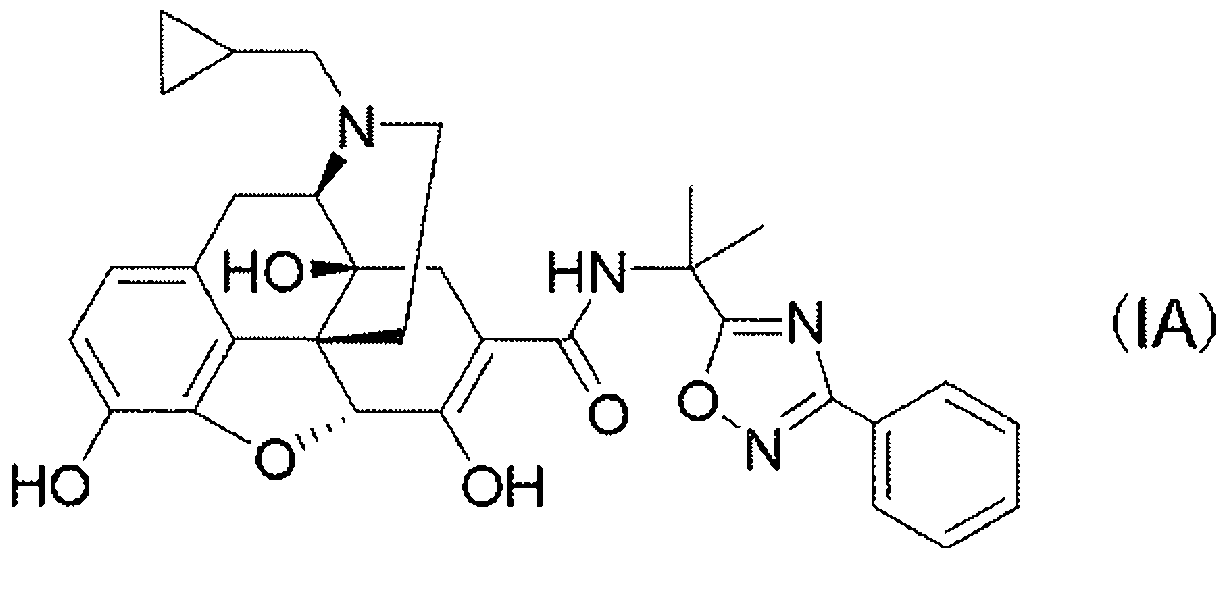
で示される化合物の製薬上許容される塩または当該化合物若しくは当該塩の溶媒和物を含有する固形製剤、
(2)有効成分として式(IA)で示される化合物の製薬上許容される塩または当該化合物若しくは当該塩の溶媒和物、および崩壊剤を含有する上記(1)記載の固形製剤、
(3)有効成分として式(IA)で示される化合物、その製薬上許容される塩または当該化合物若しくは当該塩の溶媒和物、および第15改正日本薬局方に規定された溶出試験法第2法(パドル法)における試験開始15分後の式(IA)で示される化合物の溶出率を85%以上とする崩壊剤を含有する固形製剤、
(4)有効成分として式(IA)で示される化合物、その製薬上許容される塩または当該化合物若しくは当該塩の溶媒和物、および40℃、相対湿度75%で1ヶ月保存下における式(IA)で示される化合物の類縁体量が0.2%未満とする崩壊剤を含有する固形製剤、
(5)有効成分として式(IA)で示される化合物、その製薬上許容される塩または当該化合物若しくは当該塩の溶媒和物、および日本薬局方溶出試験法第2液における試験開始15分後の式(IA)で示される化合物の溶出率を85%以上とし、40℃、相対湿度75%で1ヶ月保存下における式(IA)で示される化合物の類縁体量が0.2%未満とする崩壊剤を含有する上記(3)または(4)記載の固形製剤、
(6)有効成分が式(IA)で示される化合物のp-トルエンスルホン酸塩、酢酸塩若しくは塩酸塩または当該塩の溶媒和物である上記(1)から(5)のいずれかに記載の固形製剤、
(7)崩壊剤がセルロース系崩壊剤、デンプン系崩壊剤およびビニル系崩壊剤から選択される1以上である上記(1)から(6)のいずれかに記載の固形製剤、
(8)崩壊剤がセルロース系崩壊剤である上記(7)記載の固形製剤、
(9)セルロース系崩壊剤がナトリウム塩である上記(8)記載の固形製剤、
(10)セルロース系崩壊剤がクロスカルメロースナトリウムである上記(8)記載の固形製剤、
(11)崩壊剤がビニル系崩壊剤である上記(7)記載の固形製剤、
(12)ビニル系崩壊剤がクロスポビドンである上記(11)記載の固形製剤、
(13)式(IA)で示される化合物のp-トルエンスルホン酸塩、酢酸塩若しくは塩酸塩または当該塩の溶媒和物1重量部に対し、崩壊剤を0.25~250重量部含有する上記(6)から(12)のいずれかに記載の固形製剤、
(14)酸化鉄、タール色素および天然色素から選択される1以上を含有し、実質的に酸化チタンを含有しない上記(1)から(13)のいずれかに記載の固形製剤、
(15)酸化鉄を含有し、実質的に酸化チタンを含有しない上記(1)から(13)のいずれかに記載の固形製剤、
(16)上記(1)から(15)のいずれかに記載の固形製剤の表面に、被覆層を設けた被覆固形製剤、
(17)被覆層中に、酸化鉄、タール色素および天然色素から選択される1以上を含有し、実質的に酸化チタンを含有しない上記(16)記載の被覆固形製剤、
(18)被覆層中に、酸化鉄を含有し、実質的に酸化チタンを含有しない上記(16)記載の被覆固形製剤、
(19)式(IA)で示される化合物のp-トルエンスルホン酸塩、酢酸塩若しくは塩酸塩または当該塩の溶媒和物およびクロスカルメロースナトリウムを含有する固形製剤の表面に、被覆層を設け、当該被覆層中に酸化鉄を含有し、実質的に酸化チタンを含有しない上記(18)記載の被覆固形製剤、
(20)式(IA)で示される化合物のp-トルエンスルホン酸塩、酢酸塩若しくは塩酸塩または当該塩の溶媒和物、ならびに酸化鉄、タール色素および天然色素から選択される1以上を含有し、実質的に酸化チタンを含有しない固形製剤、
(21)式(IA)で示される化合物のp-トルエンスルホン酸塩、酢酸塩若しくは塩酸塩または当該塩の溶媒和物を含有した固形製剤の表面に、被覆層を設け、当該被覆層中に酸化鉄、タール色素および天然色素から選択される1以上を含有し、実質的に酸化チタンを含有しない被覆固形製剤、
(22)酸化鉄が三二酸化鉄および/または黄色三二酸化鉄である上記(14)から(21)のいずれかに記載の固形製剤または被覆固形製剤、
(23)固形製剤または被覆固形製剤が錠剤または顆粒剤である上記(1)から(22)のいずれかに記載の固形製剤、
に関する。
式(IA)で示される化合物の製薬上許容される塩としては、例えば、式(IA)で示される化合物と、アルカリ金属(例えば、リチウム、ナトリウム、カリウム等)、アルカリ土類金属(例えば、カルシウム、バリウム等)、マグネシウム、遷移金属(例えば、亜鉛、鉄等)、アンモニア、有機塩基(例えば、トリメチルアミン、トリエチルアミン、ジシクロヘキシルアミン、エタノールアミン、ジエタノールアミン、トリエタノールアミン、メグルミン、ジエタノールアミン、エチレンジアミン、ピリジン、ピコリン、キノリン等)およびアミノ酸との塩、または無機酸(例えば、塩酸、硫酸、硝酸、炭酸、臭化水素酸、リン酸、ヨウ化水素酸等)、および有機酸(例えば、ギ酸、酢酸、プロピオン酸、トリフルオロ酢酸、クエン酸、乳酸、酒石酸、シュウ酸、マレイン酸、フマル酸、マンデル酸、グルタル酸、リンゴ酸、安息香酸、フタル酸、アスコルビン酸、ベンゼンスルホン酸、p-トルエンスルホン酸、メタンスルホン酸、エタンスルホン酸等)との塩が挙げられる。特に塩酸、硫酸、リン酸、酒石酸、メタンスルホン酸との塩等が挙げられる。好ましくは、酸との塩である。これらの塩は、通常行われる方法によって形成させることができる。
特に好ましくは、前記式(IA)で示される化合物のp-トルエンスルホン酸塩、酢酸塩若しくは塩酸塩、または当該化合物若しくは当該塩の溶媒和物であり、さらに好ましくは、前記式(IA)ので示される化合物のp-トルエンスルホン酸塩の結晶、または当該塩の溶媒和物の結晶である。特に好ましくは、17-(cyclopropylmethyl)-6,7-didehydro-4,5α-epoxy-3,6,14-trihydroxy-N-[2-(3-phenyl-1,2,4-oxadiazol-5-yl)propan-2-yl]morphinan-7-carboxamide 4-methylbenzenesulfonic acidである。
前記式(IA)で示される化合物(化合物A)のp-トルエンスルホン酸の結晶は、吸湿性がなく、安定性も優れており、固形製剤中では、当該結晶状態で存在する。なお、当該化合物、化合物結晶の製造方法、物性等はWO2006/126637の国際公開パンフレット、WO2012/063933の国際公開パンフレットの請求の範囲、明細書に記載されている。
結合剤として、例えば、ヒドロキシプロピルセルロース、トウモロコシデンプン、アルファー化デンプン、部分アルファー化デンプン、アラビアゴム、アラビアゴム末、ゼラチン、カンテン、デキストリン、プルラン、ポリビニルピロリドン、ポリビニルアルコール、結晶セルロース、メチルセルロース、エチルセルロース、カルボキシメチルエチルセルロース、カルメロース、カルメロースナトリウム、ヒドロキシエチルセルロース、ヒドロキシエチルメチルセルロース、ヒドロキシプロピルセルロース、ヒプロメロース等が挙げられる。
香料として、例えば、オレンジエッセンス、オレンジ油、カラメル、カンフル、ケイヒ油、スペアミント油、ストロベリーエッセンス、チョコレートエッセンス、チェリーフレーバー、トウヒ油、パインオイル、ハッカ油、バニラフレーバー、ビターエッセンス、フルーツフレーバー、ペパーミントエッセンス、ミックスフレーバー、ミントフレーバー、メントール、レモンパウダー、レモン油、ローズ油等が挙げられる。
流動化剤として、例えば、含水二酸化ケイ素、軽質無水ケイ酸、結晶セルロース、合成ケイ酸アルミニウム、タルク等が挙げられる。
矯味剤として、例えば、アスパルテーム、スクラロース、グリシン、塩化ナトリウム、塩化マグネシウム、塩酸、希塩酸、クエン酸およびその塩、無水クエン酸、L-グルタミン酸およびその塩、コハク酸およびその塩、酢酸、酒石酸およびその塩、炭酸水素ナトリウム、フマル酸およびその塩、リンゴ酸およびその塩、氷酢酸、イノシン酸二ナトリウム、ハチミツ等が挙げられる。
(1)崩壊剤の影響(実施例1、2、比較例1、2)
本化合物を含有する製剤における崩壊剤の影響を調べるために、崩壊剤を変更した表1記載の製剤を製造し、1)溶出性、2)類縁体量を測定した。
a.錠剤製造法
表1に示す量の本化合物、D-マンニトール、崩壊剤およびステアリン酸マグネシウムを篩過、混合し、混合末を得た。この混合末を単発打錠機によって打錠した。崩壊剤としては、クロスカルメロースナトリウム(アクチゾル、FMC社製)、低置換度ヒドロキシプロピルセルロース(L-HPC、信越化学社製)、クロスポビドン(コリドンCL-M、BASF社製)およびカルメロースカルシウム(CMC Ca、五徳薬品社製)を使用した。なお、本化合物は、p-トルエンスルホン酸塩であり、式(IA)で示される化合物の量としては、10.00mgである。
b.溶出性試験法
日本薬局方第15改正一般試験法 溶出試験法(溶出試験第2液、pH6.8、パドル法)にて、式(IA)の化合物の溶出率を測定した。また、式(IA)の化合物の濃度は、紫外可視吸光度計(8453型、アジレント社製、波長220nm)によって測定した。
c.類縁体測定法
製造した錠剤を40℃、75%相対湿度下、1ヶ月保存し、経時保存後の錠剤中の総類縁体量(主に式(IA)で示される化合物の水酸化体)を測定した。総類縁体量の測定法は、HPLC法(波長:240nm、カラム:L-column ODS(充填剤5μm、4.6×250mm、化学物質評価研究機構製)、カラム温度:45℃、移動相:A)pH5.5の20mmol/Lリン酸塩緩衝液/HPLC用アセトニトリル混液=9:1、B)HPLC用アセトニトリル/HPLC用メタノール混液=1:1のグラジエント法、流量:1.0mL/分)によって測定した。
d.結果
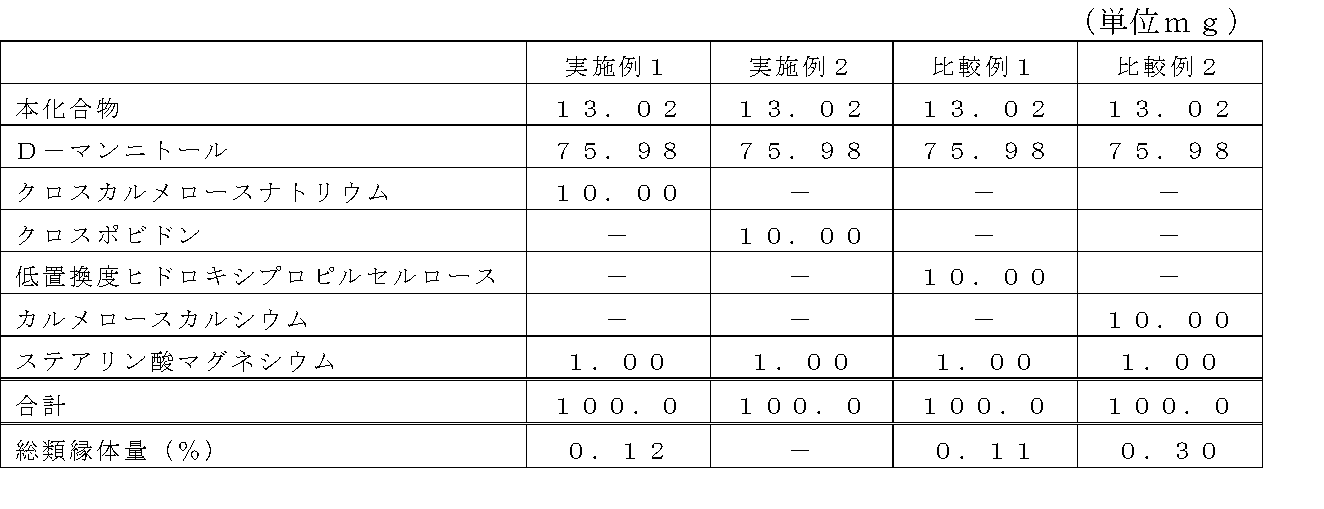
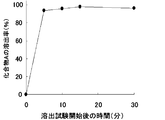
式(IA)化合物の総類縁体量を表1に示す。また、溶出試験開始後の溶出挙動を図1に示す。その結果、崩壊剤がクロスカルメロースナトリウムである場合(実施例1)、総類縁体量が最も少なかった。また、崩壊剤がクロスカルメロースナトリウム、クロスポビドンである場合、溶出試験開始15分後の溶出率は、85%以上であり、特にクロスカルメロースナトリウムである場合、溶出試験開始5分後の溶出率は、60%以上であり、溶出試験開始15分後の溶出率は、85%以上である。
製剤中の薬物含有量の影響を調べるために、表2記載の錠剤を製造し、溶出率を測定した。
a.錠剤製造法
本化合物、クロスカルメロースナトリウム(アクチゾル、FMC社製)、D-マンニトールおよびステアリン酸マグネシウムの量を表2に示す。本化合物の量は、0.1重量%とした。錠剤製造法は、前述と同様である。なお、本化合物は、p-トルエンスルホン酸塩であり、式(IA)で示される化合物の量としては、0.1mgである。

b.溶出率測定法
前述と同様である。
c.結果
実施例3の溶出挙動を図2に示す。実施例3製剤の溶出試験開始5分後の溶出率は、ともに60%以上であり、15分後の溶出率は85%以上であり、実施例1の製剤の溶出挙動とほぼ同じであった。
製剤中の色素の影響を調べるために、表3記載の錠剤を製造し、類縁体量を測定した。
a.錠剤製造法
表3に示す量の本化合物、D-マンニトール、クロスカルメロースナトリウムおよびステアリン酸マグネシウムを篩過、混合し、混合末を得た。この混合末を単発打錠機によって打錠し、素錠を製造した。その後、コーティングパン(48型ハイコーター、フロイント社製)によって、素錠にヒプロメロース(ヒドロキシプロピルメチルセルロース)、タルクおよび色素を含有したコーティング液によって被覆した。色素は、酸化チタン(フロイント産業社製)、三二酸化鉄(癸巳化成社製)を使用した。なお、本化合物は、p-トルエンスルホン酸塩であり、式(IA)で示される化合物の量としては、0.1mgである。
b.類縁体測定法
製造した錠剤に120万ルクスの光を照射し、その後錠剤中の類縁体増加量(主に式(IA)で示される化合物のケトカルボン酸体)を測定した。総類縁体量の測定法は、HPLC法(波長:240nm、カラム:L-column ODS(充填剤5μm、4.6×250mm、化学物質評価研究機構製)、カラム温度:45℃、移動相:A)pH5.5の20mmol/Lリン酸塩緩衝液/HPLC用アセトニトリル混液=9:1、B)HPLC用アセトニトリル/HPLC用メタノール混液=1:1のグラジエント法、流量:1.0mL/分)によって測定した。なお、光照射前の類縁体量は0.08%であった。
c.結果
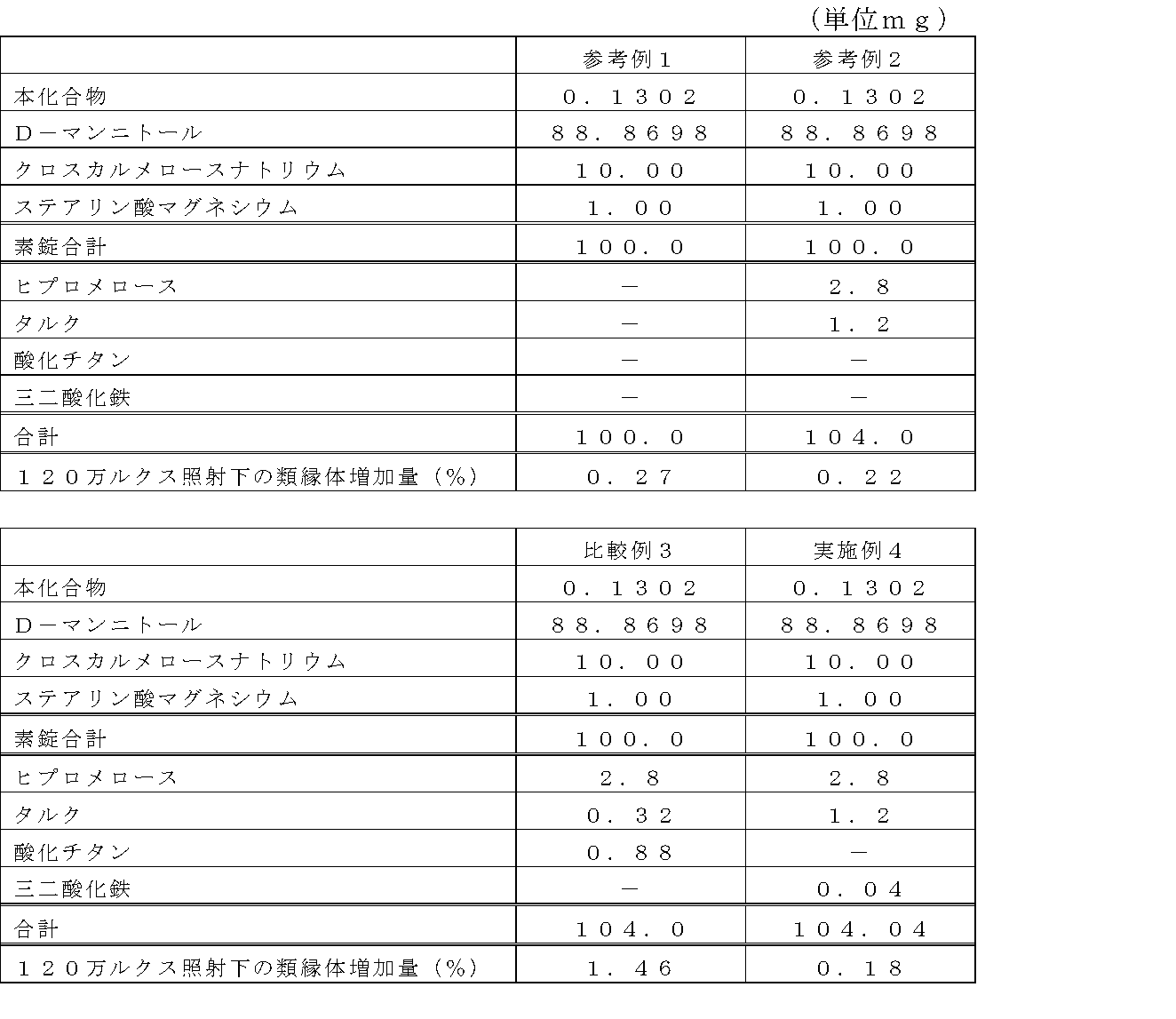
表3に示す通り、色素を添加せずヒプロメロースおよびタルクを被覆した参考例2は、被覆層を有しない参考例1と比較し、類縁体増加量はほとんど変わらなかった。しかし、ヒプロメロース、タルクおよび色素として酸化チタンを被覆した比較例3は、類縁体量が著しく増加した。一方、色素として三二酸化鉄を被覆した実施例4の場合、類縁体量は、比較例3、被覆層を有しない参考例1、色素を含有しない参考例2よりも低減した。
製剤中の薬物含有量の影響を調べるために、表4記載の錠剤を製造し、溶出率を測定した。
a.錠剤製造法
表4に示す量の本化合物、D-マンニトール、クロスカルメロースナトリウムおよびステアリン酸マグネシウムを篩過、混合し、混合末を得た。この混合末を単発打錠機によって打錠し、素錠を製造した。その後、コーティングパン(48型ハイコーター、フロイント社製)によって、素錠にヒプロメロース(ヒドロキシプロピルメチルセルロース)、タルクおよび色素を含有したコーティング液によって被覆した。色素は、三二酸化鉄(癸巳化成社製)を使用した。なお、本化合物は、p-トルエンスルホン酸塩であり、式(IA)で示される化合物の量としては、0.2mgである。

b.溶出率測定法
前述と同様である。
c.結果
実施例5の溶出挙動を図3に示す。実施例5製剤の溶出試験開始5分後の溶出率は、ともに60%以上であり、15分後の溶出率は85%以上であり、実施例1の製剤の溶出挙動とほぼ同じであった。
Claims (23)
- 有効成分として式(IA):
化1

で示される化合物の製薬上許容される塩または当該化合物若しくは当該塩の溶媒和物を含有する固形製剤。 - 有効成分として式(IA)で示される化合物の製薬上許容される塩または当該化合物若しくは当該塩の溶媒和物、および崩壊剤を含有する請求項1記載の固形製剤。
- 有効成分として式(IA)で示される化合物、その製薬上許容される塩または当該化合物若しくは当該塩の溶媒和物、および第15改正日本薬局方に規定された溶出試験法第2法(パドル法)における試験開始15分後の式(IA)で示される化合物の溶出率を85%以上とする崩壊剤を含有する固形製剤。
- 有効成分として式(IA)で示される化合物、その製薬上許容される塩または当該化合物若しくは当該塩の溶媒和物、および40℃、相対湿度75%で1ヶ月保存下における式(IA)で示される化合物の類縁体量が0.2%未満とする崩壊剤を含有する固形製剤。
- 有効成分として式(IA)で示される化合物、その製薬上許容される塩または当該化合物若しくは当該塩の溶媒和物、および日本薬局方溶出試験法第2液における試験開始15分後の式(IA)で示される化合物の溶出率を85%以上とし、40℃、相対湿度75%で1ヶ月保存下における式(IA)で示される化合物の類縁体量が0.2%未満とする崩壊剤を含有する請求項3または4記載の固形製剤。
- 有効成分として式(IA)で示される化合物のp-トルエンスルホン酸塩、酢酸塩若しくは塩酸塩または当該塩の溶媒和物である請求項1~5のいずれかに記載の固形製剤。
- 崩壊剤がセルロース系崩壊剤、デンプン系崩壊剤およびビニル系崩壊剤から選択される1以上である請求項1~6のいずれかに記載の固形製剤。
- 崩壊剤がセルロース系崩壊剤である請求項7記載の固形製剤。
- セルロース系崩壊剤がナトリウム塩である請求項8記載の固形製剤。
- セルロース系崩壊剤がクロスカルメロースナトリウムである請求項8記載の固形製剤。
- 崩壊剤がビニル系崩壊剤である請求項7記載の固形製剤。
- ビニル系崩壊剤がクロスポビドンである請求項11記載の固形製剤。
- 式(IA)で示される化合物のp-トルエンスルホン酸塩、酢酸塩若しくは塩酸塩または当該塩の溶媒和物1重量部に対し、崩壊剤を0.25~250重量部含有する請求項6~12のいずれかに記載の固形製剤。
- 酸化鉄、タール色素および天然色素から選択される1以上を含有し、実質的に酸化チタンを含有しない請求項1~13のいずれかに記載の固形製剤。
- 酸化鉄を含有し、実質的に酸化チタンを含有しない請求項1~13のいずれかに記載の固形製剤。
- 請求項1~15のいずれかに記載の固形製剤の表面に、被覆層を設けた被覆固形製剤。
- 被覆層中に、酸化鉄、タール色素および天然色素から選択される1以上を含有し、実質的に酸化チタンを含有しない請求項16記載の被覆固形製剤。
- 被覆層中に、酸化鉄を含有し、実質的に酸化チタンを含有しない請求項16記載の被覆固形製剤。
- 式(IA)で示される化合物のp-トルエンスルホン酸塩、酢酸塩若しくは塩酸塩または当該塩の溶媒和物およびクロスカルメロースナトリウムを含有する固形製剤の表面に、被覆層を設け、当該被覆層中に酸化鉄を含有し、実質的に酸化チタンを含有しない請求項18記載の被覆固形製剤。
- 式(IA)で示される化合物のp-トルエンスルホン酸塩、酢酸塩若しくは塩酸塩または当該塩の溶媒和物、ならびに酸化鉄、タール色素および天然色素から選択される1以上を含有し、実質的に酸化チタンを含有しない固形製剤。
- 式(IA)で示される化合物のp-トルエンスルホン酸塩、酢酸塩若しくは塩酸塩または当該塩の溶媒和物を含有した固形製剤の表面に、被覆層を設け、当該被覆層中に酸化鉄、タール色素および天然色素から選択される1以上を含有し、実質的に酸化チタンを含有しない被覆固形製剤。
- 酸化鉄が三二酸化鉄および/または黄色三二酸化鉄である請求項14~21のいずれかに記載の固形製剤または被覆固形製剤。
- 固形製剤または被覆固形製剤が錠剤または顆粒剤である請求項1~22のいずれかに記載の固形製剤。
Priority Applications (9)
| Application Number | Priority Date | Filing Date | Title |
|---|---|---|---|
| PL13790955T PL2851075T3 (pl) | 2012-05-14 | 2013-05-13 | Preparat zawierający pochodną 6,7-nienasyconego-7-karbamoilomorfinanu |
| ES13790955T ES2903149T3 (es) | 2012-05-14 | 2013-05-13 | Preparación que contiene derivado de 7-carbamoilmorfinano 6,7-insaturado |
| US14/401,388 US10952968B2 (en) | 2012-05-14 | 2013-05-13 | Preparation containing 6,7-unsaturated-7-carbamoyl morphinan derivatives |
| EP13790955.2A EP2851075B1 (en) | 2012-05-14 | 2013-05-13 | Preparation containing 6,7-unsaturated-7-carbamoylmorphinan derivative |
| DK13790955.2T DK2851075T3 (da) | 2012-05-14 | 2013-05-13 | Præparat, der indeholder 6,7-umættet -7-carbamoylmorphinanderivat |
| CA2873961A CA2873961C (en) | 2012-05-14 | 2013-05-13 | Preparation containing 6,7-unsaturated-7-carbamoyl morphinan derivatives |
| JP2014515611A JP5818219B2 (ja) | 2012-05-14 | 2013-05-13 | 6,7−不飽和−7−カルバモイルモルヒナン誘導体含有製剤 |
| US16/158,786 US11116727B2 (en) | 2012-05-14 | 2018-10-12 | Preparation containing 6,7-unsaturated-7-carbamoyl morphinan derivatives |
| US17/156,892 US12350377B2 (en) | 2012-05-14 | 2021-01-25 | Preparation containing 6,7-unsaturated-7-carbamoyl morphinan derivatives |
Applications Claiming Priority (2)
| Application Number | Priority Date | Filing Date | Title |
|---|---|---|---|
| JP2012-110417 | 2012-05-14 | ||
| JP2012110417 | 2012-05-14 |
Related Child Applications (3)
| Application Number | Title | Priority Date | Filing Date |
|---|---|---|---|
| US14/401,388 A-371-Of-International US10952968B2 (en) | 2012-05-14 | 2013-05-13 | Preparation containing 6,7-unsaturated-7-carbamoyl morphinan derivatives |
| US16/158,786 Continuation US11116727B2 (en) | 2012-05-14 | 2018-10-12 | Preparation containing 6,7-unsaturated-7-carbamoyl morphinan derivatives |
| US17/156,892 Continuation US12350377B2 (en) | 2012-05-14 | 2021-01-25 | Preparation containing 6,7-unsaturated-7-carbamoyl morphinan derivatives |
Publications (1)
| Publication Number | Publication Date |
|---|---|
| WO2013172297A1 true WO2013172297A1 (ja) | 2013-11-21 |
Family
ID=49583702
Family Applications (1)
| Application Number | Title | Priority Date | Filing Date |
|---|---|---|---|
| PCT/JP2013/063278 Ceased WO2013172297A1 (ja) | 2012-05-14 | 2013-05-13 | 6,7-不飽和-7-カルバモイルモルヒナン誘導体含有製剤 |
Country Status (9)
| Country | Link |
|---|---|
| US (3) | US10952968B2 (ja) |
| EP (1) | EP2851075B1 (ja) |
| JP (1) | JP5818219B2 (ja) |
| CA (1) | CA2873961C (ja) |
| DK (1) | DK2851075T3 (ja) |
| ES (1) | ES2903149T3 (ja) |
| PL (1) | PL2851075T3 (ja) |
| TW (1) | TW201350120A (ja) |
| WO (1) | WO2013172297A1 (ja) |
Cited By (4)
| Publication number | Priority date | Publication date | Assignee | Title |
|---|---|---|---|---|
| WO2018124062A1 (ja) | 2016-12-26 | 2018-07-05 | 塩野義製薬株式会社 | 含量均一性を改善した製剤の製造方法 |
| JP2018108945A (ja) * | 2016-12-28 | 2018-07-12 | 森下仁丹株式会社 | 4,5−エポキシモルヒナン誘導体含有製剤 |
| JPWO2021100728A1 (ja) * | 2019-11-20 | 2021-05-27 | ||
| WO2021172462A1 (ja) * | 2020-02-28 | 2021-09-02 | 塩野義製薬株式会社 | 術後の消化管の回復促進のための医薬組成物および方法 |
Citations (15)
| Publication number | Priority date | Publication date | Assignee | Title |
|---|---|---|---|---|
| JPH08333253A (ja) | 1995-06-07 | 1996-12-17 | Bristol Myers Squibb Co | イルベサルタン含有医薬組成物 |
| JP2004521146A (ja) | 2000-12-20 | 2004-07-15 | デュシェネ インク | 速効性処方剤 |
| JP2005520785A (ja) | 2001-08-31 | 2005-07-14 | ノバルティス アクチエンゲゼルシャフト | ルミラコキシブ含有医薬組成物 |
| JP2005535671A (ja) | 2002-07-10 | 2005-11-24 | ファイザー・プロダクツ・インク | ラソフォキシフェン錠剤およびそのコーティング |
| WO2006038661A1 (ja) | 2004-10-06 | 2006-04-13 | Eisai R & D Management Co., Ltd. | 医薬組成物及びその製造方法、並びに医薬組成物におけるジヒドロピリジン系化合物の安定化方法 |
| JP2006306754A (ja) | 2005-04-27 | 2006-11-09 | Dainippon Sumitomo Pharma Co Ltd | 光安定性の向上した組成物 |
| WO2006126637A1 (ja) | 2005-05-25 | 2006-11-30 | Shionogi & Co., Ltd. | 6,7-不飽和-7-カルバモイル置換モルヒナン誘導体 |
| WO2008133330A1 (ja) * | 2007-04-26 | 2008-11-06 | Toray Industries, Inc. | 4,5-エポキシモルヒナン誘導体を含有する安定な固形製剤 |
| WO2008143240A1 (ja) * | 2007-05-21 | 2008-11-27 | Toray Industries, Inc. | 特定の有機酸を含有する経口製剤並びに経口製剤の溶出性及び化学的安定性の改善方法 |
| JP2009501694A (ja) | 2003-07-11 | 2009-01-22 | エフ.ホフマン−ラ ロシュ アーゲー | メシル酸サキナビル経口投与剤型 |
| WO2009101940A1 (ja) | 2008-02-11 | 2009-08-20 | Dainippon Sumitomo Pharma Co., Ltd. | 溶出性の改善された錠剤 |
| WO2010047381A1 (ja) * | 2008-10-24 | 2010-04-29 | 東レ株式会社 | 4,5-エポキシモルヒナン誘導体を含有する安定な錠剤 |
| JP2010229075A (ja) | 2009-03-27 | 2010-10-14 | Kyorin Pharmaceut Co Ltd | イミダフェナシンを含有する口腔内崩壊錠 |
| JP2011105694A (ja) | 2009-11-12 | 2011-06-02 | Takada Seiyaku Kk | オロパタジン経口固形組成物 |
| WO2012063933A1 (ja) | 2010-11-12 | 2012-05-18 | 塩野義製薬株式会社 | 6,7-不飽和-7-カルバモイルモルヒナン誘導体の結晶およびその製造方法 |
Family Cites Families (25)
| Publication number | Priority date | Publication date | Assignee | Title |
|---|---|---|---|---|
| US4365060A (en) * | 1979-04-28 | 1982-12-21 | Shin-Etsu Chemical Co. Ltd. | Enterosoluble capsules |
| US4931286A (en) * | 1989-04-19 | 1990-06-05 | Aqualon Company | High gloss cellulose tablet coating |
| US5225201A (en) * | 1991-08-23 | 1993-07-06 | Minnesota Mining And Manufacturing Company | Salsalate tablet |
| US5395627A (en) * | 1992-09-04 | 1995-03-07 | Akzo N.V. | Pharmaceutical granulate |
| WO2000071117A1 (en) * | 1999-05-21 | 2000-11-30 | Kissei Pharmaceutical Co., Ltd. | Immediate release medicinal compositions for oral use |
| CA2374760A1 (en) * | 1999-06-18 | 2000-12-28 | Takeda Chemical Industries, Ltd. | Quickly disintegrating solid preparations |
| GB0001621D0 (en) * | 2000-01-26 | 2000-03-15 | Astrazeneca Ab | Pharmaceutical compositions |
| US20030185882A1 (en) * | 2001-11-06 | 2003-10-02 | Vergez Juan A. | Pharmaceutical compositions containing oxybutynin |
| CA2509620A1 (en) * | 2002-12-17 | 2004-07-01 | Wakunaga Pharmaceutical Co., Ltd. | Light-shielding agent and film-forming composition |
| KR101192722B1 (ko) * | 2003-04-24 | 2012-10-18 | 자고텍 아게 | 정해진 핵 위치를 가지는 서방성 정제 |
| US20070148229A1 (en) * | 2003-04-24 | 2007-06-28 | Jagotec Ag | Tablet with coloured core |
| US20060280789A1 (en) * | 2004-12-27 | 2006-12-14 | Eisai Research Institute | Sustained release formulations |
| US20070077300A1 (en) * | 2005-09-30 | 2007-04-05 | Wynn David W | Oral compositions containing a salivation inducing agent |
| US8637078B2 (en) * | 2005-11-24 | 2014-01-28 | Boehringer Ingelheim International Gmbh | Bilayer tablet comprising telmisartan and diuretic |
| EP1964549A1 (en) * | 2005-12-20 | 2008-09-03 | Eisai R&D Management Co., Ltd. | Orally disintegrating tablet comprising fat-soluble substance |
| JP5432720B2 (ja) * | 2007-03-13 | 2014-03-05 | 武田薬品工業株式会社 | 2−[[6−[(3r)−3−アミノ−1−ピペリジニル]−3,4−ジヒドロ−3−メチル−2,4−ジオキソ−1(2h)−ピリミジニル]メチル]−4−フルオロベンゾニトリルを含む固形製剤 |
| EP2167050A1 (en) * | 2007-06-13 | 2010-03-31 | Meditor Pharmaceuticals Ltd. | Taste masked pharmaceutical compositions of s-alkylisothiouronium derivatives |
| CL2008003230A1 (es) * | 2007-11-01 | 2009-11-27 | Sanofi Aventis Healthcare Pty Ltd | Composicion de recubrimiento de tableta que comprende polimero celulosico, plastificante, edulcorante y composicion de sabor en polvo la que comprende saborizante asociado con portador solido; fluido de recubrimiento de tableta que comprende dicha composicion; tableta farmaceutica; proceso de preparacion de dicha tableta. |
| US20100285119A1 (en) * | 2008-01-11 | 2010-11-11 | Jubilant Organosys Ltd. | Multiparticulate Extended Release Pharmaceutical Composition Of Carbamazepine And Process For Manufacturing The Same |
| UY32126A (es) * | 2008-09-25 | 2010-04-30 | Takeda Pharmaceutical | Composición farmacéutica sólida |
| CN102438617A (zh) * | 2009-03-27 | 2012-05-02 | 杏林制药株式会社 | 含有碱性添加剂的基质型缓释制剂 |
| JP5644167B2 (ja) | 2009-04-21 | 2014-12-24 | 大正製薬株式会社 | 溶出改善されたケトチフェン又はその塩を含有する固形製剤 |
| US20110135739A1 (en) * | 2009-11-06 | 2011-06-09 | Bennett Carter | Oral Formulations of a Hedgehog Pathway Inhibitor |
| US20110150993A1 (en) * | 2009-12-22 | 2011-06-23 | Fmc Corporation | Fine Particle Croscarmellose and Uses Thereof |
| US20150299516A1 (en) * | 2012-11-26 | 2015-10-22 | Progel Pty Ltd | Coating composition |
-
2013
- 2013-05-13 DK DK13790955.2T patent/DK2851075T3/da active
- 2013-05-13 CA CA2873961A patent/CA2873961C/en active Active
- 2013-05-13 JP JP2014515611A patent/JP5818219B2/ja active Active
- 2013-05-13 ES ES13790955T patent/ES2903149T3/es active Active
- 2013-05-13 EP EP13790955.2A patent/EP2851075B1/en active Active
- 2013-05-13 PL PL13790955T patent/PL2851075T3/pl unknown
- 2013-05-13 US US14/401,388 patent/US10952968B2/en active Active
- 2013-05-13 WO PCT/JP2013/063278 patent/WO2013172297A1/ja not_active Ceased
- 2013-05-14 TW TW102117071A patent/TW201350120A/zh unknown
-
2018
- 2018-10-12 US US16/158,786 patent/US11116727B2/en active Active
-
2021
- 2021-01-25 US US17/156,892 patent/US12350377B2/en active Active
Patent Citations (15)
| Publication number | Priority date | Publication date | Assignee | Title |
|---|---|---|---|---|
| JPH08333253A (ja) | 1995-06-07 | 1996-12-17 | Bristol Myers Squibb Co | イルベサルタン含有医薬組成物 |
| JP2004521146A (ja) | 2000-12-20 | 2004-07-15 | デュシェネ インク | 速効性処方剤 |
| JP2005520785A (ja) | 2001-08-31 | 2005-07-14 | ノバルティス アクチエンゲゼルシャフト | ルミラコキシブ含有医薬組成物 |
| JP2005535671A (ja) | 2002-07-10 | 2005-11-24 | ファイザー・プロダクツ・インク | ラソフォキシフェン錠剤およびそのコーティング |
| JP2009501694A (ja) | 2003-07-11 | 2009-01-22 | エフ.ホフマン−ラ ロシュ アーゲー | メシル酸サキナビル経口投与剤型 |
| WO2006038661A1 (ja) | 2004-10-06 | 2006-04-13 | Eisai R & D Management Co., Ltd. | 医薬組成物及びその製造方法、並びに医薬組成物におけるジヒドロピリジン系化合物の安定化方法 |
| JP2006306754A (ja) | 2005-04-27 | 2006-11-09 | Dainippon Sumitomo Pharma Co Ltd | 光安定性の向上した組成物 |
| WO2006126637A1 (ja) | 2005-05-25 | 2006-11-30 | Shionogi & Co., Ltd. | 6,7-不飽和-7-カルバモイル置換モルヒナン誘導体 |
| WO2008133330A1 (ja) * | 2007-04-26 | 2008-11-06 | Toray Industries, Inc. | 4,5-エポキシモルヒナン誘導体を含有する安定な固形製剤 |
| WO2008143240A1 (ja) * | 2007-05-21 | 2008-11-27 | Toray Industries, Inc. | 特定の有機酸を含有する経口製剤並びに経口製剤の溶出性及び化学的安定性の改善方法 |
| WO2009101940A1 (ja) | 2008-02-11 | 2009-08-20 | Dainippon Sumitomo Pharma Co., Ltd. | 溶出性の改善された錠剤 |
| WO2010047381A1 (ja) * | 2008-10-24 | 2010-04-29 | 東レ株式会社 | 4,5-エポキシモルヒナン誘導体を含有する安定な錠剤 |
| JP2010229075A (ja) | 2009-03-27 | 2010-10-14 | Kyorin Pharmaceut Co Ltd | イミダフェナシンを含有する口腔内崩壊錠 |
| JP2011105694A (ja) | 2009-11-12 | 2011-06-02 | Takada Seiyaku Kk | オロパタジン経口固形組成物 |
| WO2012063933A1 (ja) | 2010-11-12 | 2012-05-18 | 塩野義製薬株式会社 | 6,7-不飽和-7-カルバモイルモルヒナン誘導体の結晶およびその製造方法 |
Non-Patent Citations (1)
| Title |
|---|
| See also references of EP2851075A4 |
Cited By (11)
| Publication number | Priority date | Publication date | Assignee | Title |
|---|---|---|---|---|
| WO2018124062A1 (ja) | 2016-12-26 | 2018-07-05 | 塩野義製薬株式会社 | 含量均一性を改善した製剤の製造方法 |
| JPWO2018124062A1 (ja) * | 2016-12-26 | 2019-10-31 | 塩野義製薬株式会社 | 含量均一性を改善した製剤の製造方法 |
| JP7076171B2 (ja) | 2016-12-26 | 2022-05-27 | 塩野義製薬株式会社 | 含量均一性を改善した製剤の製造方法 |
| JP2022082720A (ja) * | 2016-12-26 | 2022-06-02 | 塩野義製薬株式会社 | 含量均一性を改善した製剤の製造方法 |
| JP7272738B2 (ja) | 2016-12-26 | 2023-05-12 | 塩野義製薬株式会社 | 含量均一性を改善した製剤の製造方法 |
| JP2018108945A (ja) * | 2016-12-28 | 2018-07-12 | 森下仁丹株式会社 | 4,5−エポキシモルヒナン誘導体含有製剤 |
| JPWO2021100728A1 (ja) * | 2019-11-20 | 2021-05-27 | ||
| WO2021100728A1 (ja) | 2019-11-20 | 2021-05-27 | 塩野義製薬株式会社 | 6,7-不飽和-7-カルバモイルモルヒナン誘導体含有固形製剤 |
| EP4062973A4 (en) * | 2019-11-20 | 2023-11-29 | Shionogi & Co., Ltd | SOLID FORMULATION CONTAINING 6,7-UNSATURATED-7-CARBAMOYL MORPHINAND DERIVATIVE |
| JP7582961B2 (ja) | 2019-11-20 | 2024-11-13 | 塩野義製薬株式会社 | 6,7-不飽和-7-カルバモイルモルヒナン誘導体含有固形製剤 |
| WO2021172462A1 (ja) * | 2020-02-28 | 2021-09-02 | 塩野義製薬株式会社 | 術後の消化管の回復促進のための医薬組成物および方法 |
Also Published As
| Publication number | Publication date |
|---|---|
| US20150216804A1 (en) | 2015-08-06 |
| ES2903149T3 (es) | 2022-03-31 |
| US20210145753A1 (en) | 2021-05-20 |
| DK2851075T3 (da) | 2022-01-31 |
| CA2873961C (en) | 2017-09-26 |
| PL2851075T3 (pl) | 2022-02-21 |
| TW201350120A (zh) | 2013-12-16 |
| US11116727B2 (en) | 2021-09-14 |
| US20190046452A1 (en) | 2019-02-14 |
| EP2851075B1 (en) | 2021-12-01 |
| CA2873961A1 (en) | 2013-11-21 |
| JP5818219B2 (ja) | 2015-11-18 |
| EP2851075A4 (en) | 2015-10-21 |
| JPWO2013172297A1 (ja) | 2016-01-12 |
| US10952968B2 (en) | 2021-03-23 |
| EP2851075A1 (en) | 2015-03-25 |
| US12350377B2 (en) | 2025-07-08 |
Similar Documents
| Publication | Publication Date | Title |
|---|---|---|
| US8715730B2 (en) | Therapeutic or prophylactic agent for dyskinesia | |
| JP6730978B2 (ja) | 固形製剤 | |
| US20050163858A1 (en) | Ziprasidone formulations | |
| JP6288158B2 (ja) | 品質が向上した経口製剤 | |
| WO2011019043A1 (ja) | 2種以上の粒子を含有する口腔内速崩壊錠 | |
| JP6521874B2 (ja) | フィルムコーティングされた口腔内崩壊錠 | |
| US12350377B2 (en) | Preparation containing 6,7-unsaturated-7-carbamoyl morphinan derivatives | |
| JP2019534887A (ja) | レナリドミドの経口用錠剤組成物 | |
| JP2010248106A (ja) | フィルムコーティング錠 | |
| WO2013125617A1 (ja) | 1-(3-(2-(1-ベンゾチオフェン-5-イル)エトキシ)プロピル)アゼチジン-3-オールまたはその塩を含有する固形医薬組成物 | |
| ES2901598T3 (es) | Comprimido recubierto con película que tiene una alta estabilidad química del ingrediente activo | |
| JP4549609B2 (ja) | 被覆固形催眠製剤 | |
| JP2015054851A (ja) | 被覆経口固形製剤 | |
| WO2020111089A1 (ja) | 医薬組成物 | |
| KR101387839B1 (ko) | Ph-의존성 용해도를 갖는 활성 성분의 연장 방출형 제제 | |
| EP3251669B1 (en) | Solid composition of pyrrole carboxamide | |
| JP6673798B2 (ja) | カペシタビンを有効成分とするフィルムコート医薬製剤 | |
| JP2025075898A (ja) | ボスチニブ医薬錠剤の製造方法 | |
| HK1247826B (en) | Solid composition of pyrrole carboxamide | |
| JP2014172854A (ja) | 口腔内速崩壊性錠剤 | |
| HK1185801A (en) | Oral pharmaceutical composition |
Legal Events
| Date | Code | Title | Description |
|---|---|---|---|
| 121 | Ep: the epo has been informed by wipo that ep was designated in this application |
Ref document number: 13790955 Country of ref document: EP Kind code of ref document: A1 |
|
| ENP | Entry into the national phase |
Ref document number: 2014515611 Country of ref document: JP Kind code of ref document: A |
|
| ENP | Entry into the national phase |
Ref document number: 2873961 Country of ref document: CA |
|
| NENP | Non-entry into the national phase |
Ref country code: DE |
|
| WWE | Wipo information: entry into national phase |
Ref document number: 14401388 Country of ref document: US |
|
| WWE | Wipo information: entry into national phase |
Ref document number: 2013790955 Country of ref document: EP |