WO2013147171A1 - (メタ)アクリル酸系共重合体およびその製造方法 - Google Patents
(メタ)アクリル酸系共重合体およびその製造方法 Download PDFInfo
- Publication number
- WO2013147171A1 WO2013147171A1 PCT/JP2013/059558 JP2013059558W WO2013147171A1 WO 2013147171 A1 WO2013147171 A1 WO 2013147171A1 JP 2013059558 W JP2013059558 W JP 2013059558W WO 2013147171 A1 WO2013147171 A1 WO 2013147171A1
- Authority
- WO
- WIPO (PCT)
- Prior art keywords
- copolymer
- salt
- mol
- monomer
- acid
- Prior art date
- Legal status (The legal status is an assumption and is not a legal conclusion. Google has not performed a legal analysis and makes no representation as to the accuracy of the status listed.)
- Ceased
Links
Images

Classifications
-
- C—CHEMISTRY; METALLURGY
- C02—TREATMENT OF WATER, WASTE WATER, SEWAGE, OR SLUDGE
- C02F—TREATMENT OF WATER, WASTE WATER, SEWAGE, OR SLUDGE
- C02F5/00—Softening water; Preventing scale; Adding scale preventatives or scale removers to water, e.g. adding sequestering agents
- C02F5/08—Treatment of water with complexing chemicals or other solubilising agents for softening, scale prevention or scale removal, e.g. adding sequestering agents
- C02F5/10—Treatment of water with complexing chemicals or other solubilising agents for softening, scale prevention or scale removal, e.g. adding sequestering agents using organic substances
-
- C—CHEMISTRY; METALLURGY
- C08—ORGANIC MACROMOLECULAR COMPOUNDS; THEIR PREPARATION OR CHEMICAL WORKING-UP; COMPOSITIONS BASED THEREON
- C08F—MACROMOLECULAR COMPOUNDS OBTAINED BY REACTIONS ONLY INVOLVING CARBON-TO-CARBON UNSATURATED BONDS
- C08F220/00—Copolymers of compounds having one or more unsaturated aliphatic radicals, each having only one carbon-to-carbon double bond, and only one being terminated by only one carboxyl radical or a salt, anhydride ester, amide, imide or nitrile thereof
- C08F220/02—Monocarboxylic acids having less than ten carbon atoms; Derivatives thereof
- C08F220/04—Acids; Metal salts or ammonium salts thereof
- C08F220/06—Acrylic acid; Methacrylic acid; Metal salts or ammonium salts thereof
-
- C—CHEMISTRY; METALLURGY
- C23—COATING METALLIC MATERIAL; COATING MATERIAL WITH METALLIC MATERIAL; CHEMICAL SURFACE TREATMENT; DIFFUSION TREATMENT OF METALLIC MATERIAL; COATING BY VACUUM EVAPORATION, BY SPUTTERING, BY ION IMPLANTATION OR BY CHEMICAL VAPOUR DEPOSITION, IN GENERAL; INHIBITING CORROSION OF METALLIC MATERIAL OR INCRUSTATION IN GENERAL
- C23F—NON-MECHANICAL REMOVAL OF METALLIC MATERIAL FROM SURFACE; INHIBITING CORROSION OF METALLIC MATERIAL OR INCRUSTATION IN GENERAL; MULTI-STEP PROCESSES FOR SURFACE TREATMENT OF METALLIC MATERIAL INVOLVING AT LEAST ONE PROCESS PROVIDED FOR IN CLASS C23 AND AT LEAST ONE PROCESS COVERED BY SUBCLASS C21D OR C22F OR CLASS C25
- C23F11/00—Inhibiting corrosion of metallic material by applying inhibitors to the surface in danger of corrosion or adding them to the corrosive agent
- C23F11/08—Inhibiting corrosion of metallic material by applying inhibitors to the surface in danger of corrosion or adding them to the corrosive agent in other liquids
- C23F11/10—Inhibiting corrosion of metallic material by applying inhibitors to the surface in danger of corrosion or adding them to the corrosive agent in other liquids using organic inhibitors
- C23F11/173—Macromolecular compounds
-
- C—CHEMISTRY; METALLURGY
- C23—COATING METALLIC MATERIAL; COATING MATERIAL WITH METALLIC MATERIAL; CHEMICAL SURFACE TREATMENT; DIFFUSION TREATMENT OF METALLIC MATERIAL; COATING BY VACUUM EVAPORATION, BY SPUTTERING, BY ION IMPLANTATION OR BY CHEMICAL VAPOUR DEPOSITION, IN GENERAL; INHIBITING CORROSION OF METALLIC MATERIAL OR INCRUSTATION IN GENERAL
- C23F—NON-MECHANICAL REMOVAL OF METALLIC MATERIAL FROM SURFACE; INHIBITING CORROSION OF METALLIC MATERIAL OR INCRUSTATION IN GENERAL; MULTI-STEP PROCESSES FOR SURFACE TREATMENT OF METALLIC MATERIAL INVOLVING AT LEAST ONE PROCESS PROVIDED FOR IN CLASS C23 AND AT LEAST ONE PROCESS COVERED BY SUBCLASS C21D OR C22F OR CLASS C25
- C23F14/00—Inhibiting incrustation in apparatus for heating liquids for physical or chemical purposes
- C23F14/02—Inhibiting incrustation in apparatus for heating liquids for physical or chemical purposes by chemical means
-
- C—CHEMISTRY; METALLURGY
- C08—ORGANIC MACROMOLECULAR COMPOUNDS; THEIR PREPARATION OR CHEMICAL WORKING-UP; COMPOSITIONS BASED THEREON
- C08F—MACROMOLECULAR COMPOUNDS OBTAINED BY REACTIONS ONLY INVOLVING CARBON-TO-CARBON UNSATURATED BONDS
- C08F216/00—Copolymers of compounds having one or more unsaturated aliphatic radicals, each having only one carbon-to-carbon double bond, and at least one being terminated by an alcohol, ether, aldehydo, ketonic, acetal or ketal radical
- C08F216/12—Copolymers of compounds having one or more unsaturated aliphatic radicals, each having only one carbon-to-carbon double bond, and at least one being terminated by an alcohol, ether, aldehydo, ketonic, acetal or ketal radical by an ether radical
- C08F216/14—Monomers containing only one unsaturated aliphatic radical
-
- C—CHEMISTRY; METALLURGY
- C08—ORGANIC MACROMOLECULAR COMPOUNDS; THEIR PREPARATION OR CHEMICAL WORKING-UP; COMPOSITIONS BASED THEREON
- C08F—MACROMOLECULAR COMPOUNDS OBTAINED BY REACTIONS ONLY INVOLVING CARBON-TO-CARBON UNSATURATED BONDS
- C08F216/00—Copolymers of compounds having one or more unsaturated aliphatic radicals, each having only one carbon-to-carbon double bond, and at least one being terminated by an alcohol, ether, aldehydo, ketonic, acetal or ketal radical
- C08F216/12—Copolymers of compounds having one or more unsaturated aliphatic radicals, each having only one carbon-to-carbon double bond, and at least one being terminated by an alcohol, ether, aldehydo, ketonic, acetal or ketal radical by an ether radical
- C08F216/14—Monomers containing only one unsaturated aliphatic radical
- C08F216/1466—Monomers containing sulfur
- C08F216/1475—Monomers containing sulfur and oxygen
Definitions
- the present invention relates to a (meth) acrylic acid copolymer suitably used for, for example, a scale inhibitor, a dispersant and the like, and a method for producing the same.
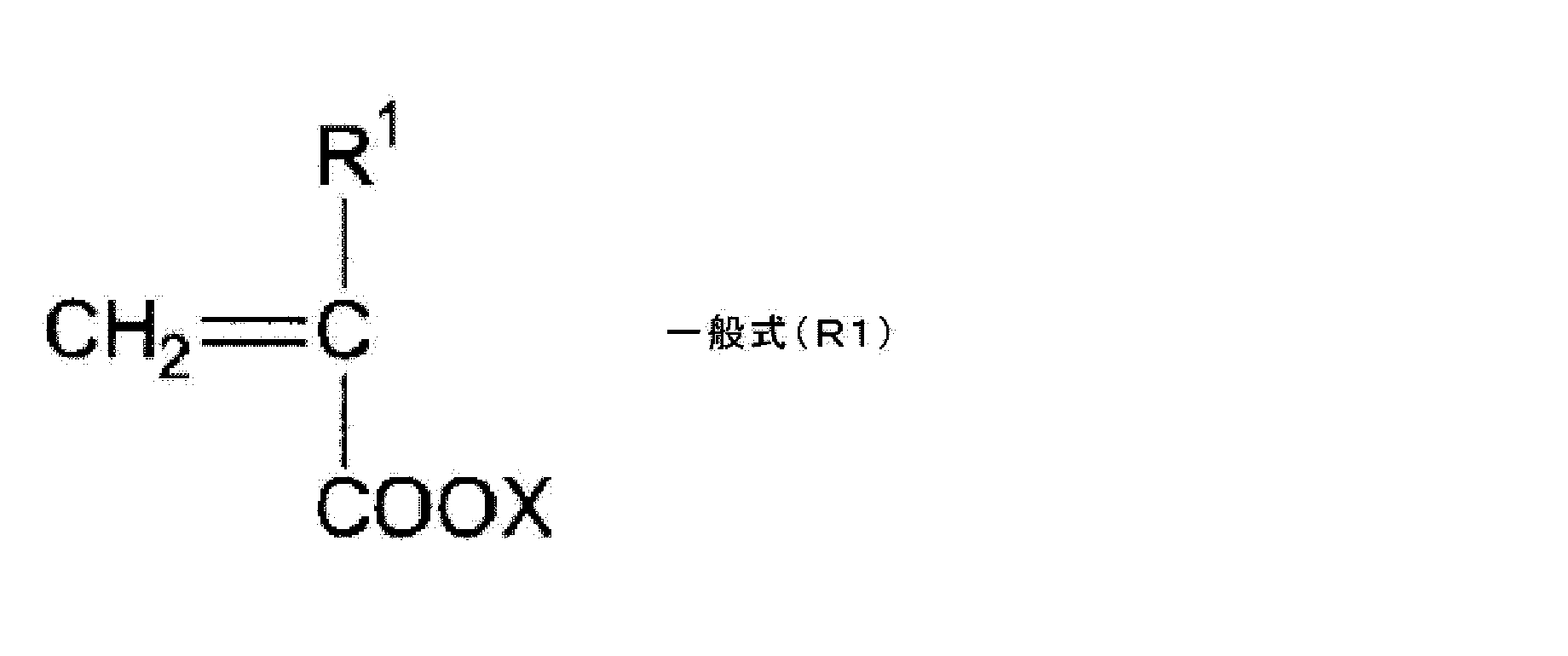
- Patent Document 1 discloses a structural unit derived from a (meth) acrylic acid monomer represented by the following general formula (R1) and a monoethylenically unsaturated monomer copolymerizable with the (meth) acrylic acid monomer. And a sulfonic acid group at least at one end of the main chain (provided that the sulfonic acid group is an ammonium salt, an alkali metal salt, or a salt of an organic amine group).
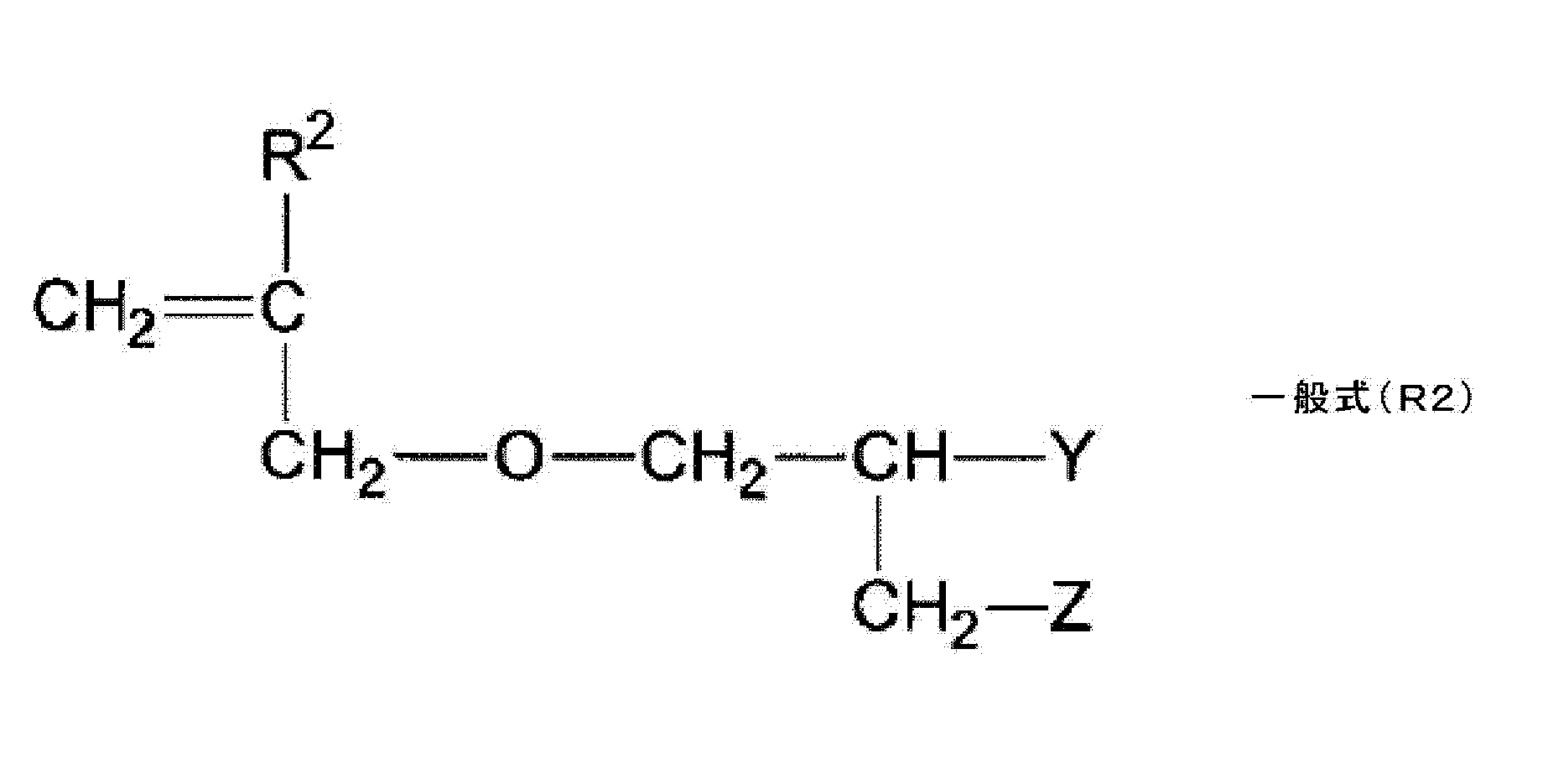
- (Meth) acrylic acid-based copolymer having a structural unit derived from a monoethylenically unsaturated monomer represented by the following general formula (R2) It contains at least a structural unit derived from an ether monomer, and the mutual proportion of the structural unit derived from a (meth) acrylic acid monomer and the structural unit derived from a (meth) allyl ether monomer is (meth)
- Constituent units derived from acrylic acid monomers 70 to 95 mol%, 5 to 30 mol% of a structural unit derived from a (meth) allyl ether monomer, and a gelation resistance in a gelation test in an aqueous system containing calcium ions is 100 to 1500
- a (meth) acrylic acid copolymer is disclosed.
- R 1 represents a hydrogen atom or a methyl group
- X represents a hydrogen atom, a metal atom, an ammonium group, or an organic amine group.
- R 2 represents a hydrogen atom or a methyl group
- Y and Z each independently represent a hydroxyl group or a sulfonic acid group (provided that the monovalent metal salt, divalent metal salt, ammonium salt, or organic group) It may be a salt of an amine group).
- the copolymer is a synergistic effect of a sulfonic acid group in a side chain, which is a structural unit derived from the (meth) allyl ether monomer, and a sulfonic acid group introduced at the end of the main chain.
- a sulfonic acid group in a side chain which is a structural unit derived from the (meth) allyl ether monomer, and a sulfonic acid group introduced at the end of the main chain.
- the present invention provides a copolymer having improved gel resistance and a high calcium ion chelating ability when used in the above-mentioned aqueous applications, and a method for producing the same. Objective.
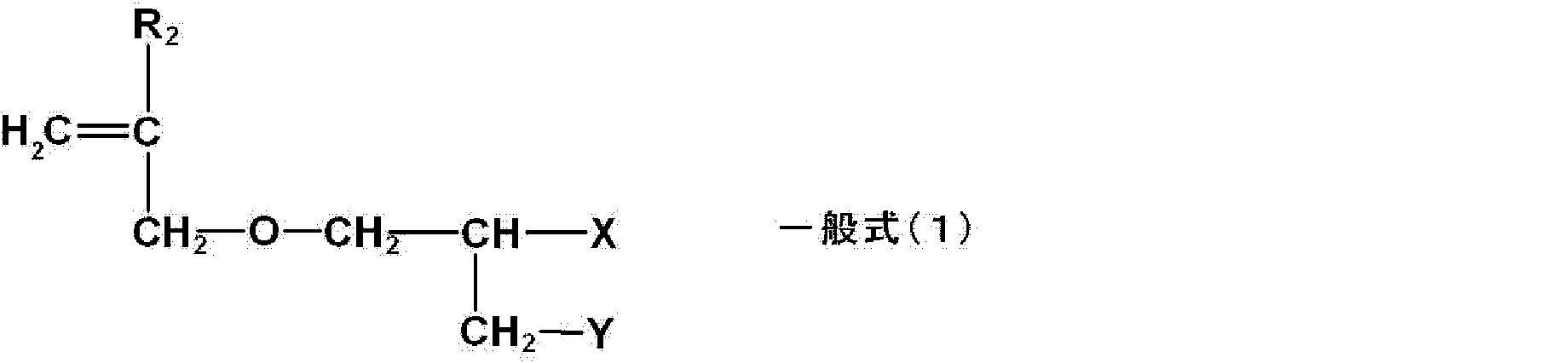
- the copolymer of the present invention is derived from a monomer represented by the following general formula (1) of 16 mol% or more and 24 mol% or less with respect to 100 mol% of structural units derived from all monomers.
- R 2 represents a hydrogen atom or a methyl group
- X and Y each independently represent a hydroxyl group or a sulfonic acid (salt) group (provided that at least one of X and Y is a sulfonic acid) (Salt) group).
- the copolymer of the present invention exhibits excellent gel resistance under very high hardness conditions and sufficient chelating ability, it can be suitably used for water treatment agents (especially scale inhibitors). .
- Example 1 is a 1 HNMR chart of a polymer (1) obtained in Example 1.
- copolymer of the present invention has a structural unit (a) derived from a monomer represented by the following general formula (1) (hereinafter also referred to as “monomer (A)”) at a specific ratio. Is mandatory.
- R 2 represents a hydrogen atom or a methyl group
- X and Y each independently represent a hydroxyl group or a sulfonic acid (salt) group (provided that at least one of X and Y is a sulfonic acid) (Salt) group).
- a sulfonic acid (salt) refers to a sulfonic acid or a sulfonate.
- the salt in the sulfonate is a metal salt, an ammonium salt, or an organic amine salt.
- alkali metal salts such as sodium salt, lithium salt and potassium salt; alkaline earth metal salts such as magnesium salt and calcium salt; transition metal salts such as iron salt; monoethanolamine salt, diethanolamine salt, Examples include alkanolamine salts such as ethanolamine salts; alkylamine salts such as monoethylamine salts, diethylamine salts, and triethylamine salts; salts of organic amines such as polyamines such as ethylenediamine salts and triethylenediamine salts.
- sodium salt or potassium salt of sulfonic acid is particularly preferable.
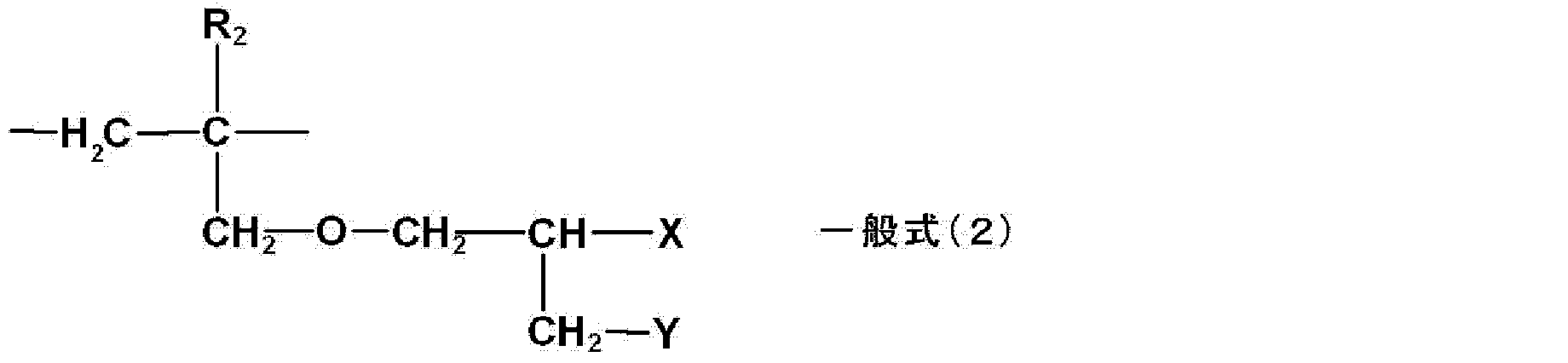
- the structural unit (a) derived from the monomer (A) represented by the general formula (1) is specifically represented by the following general formula (2).
- R 2 represents a hydrogen atom or a methyl group
- X and Y each independently represent a hydroxyl group or a sulfonic acid (salt) group (provided that at least one of X and Y is sulfonic acid) (Salt) group).
- the copolymer of the present invention has “the structural unit (a) derived from the monomer (A) represented by the general formula (1)” means that the finally obtained copolymer has the above general structure. It means that the structural unit represented by Formula (2) is included.
- the copolymer of the present invention has a predetermined amount of the structural unit (a) derived from the monomer (A) represented by the general formula (1), the gel resistance is remarkably improved.
- the structural unit (a) derived from the monomer (A) represented by the general formula (1) does not contain an ester group or an amide group, the production process of the copolymer of the present invention, Since the stability is high even under conditions in the production process of various products including coalescence, it is possible to efficiently improve the gel resistance.
- the copolymer of the present invention comprises 16 mol% of structural unit (a) derived from monomer (A) represented by general formula (1) with respect to 100 mol% of structural units derived from all monomers. The content is 24 mol% or less.
- the structural unit derived from all monomers is derived from the structural unit (a) derived from the monomer (A) represented by the general formula (1) and (meth) acrylic acid (salt).
- the structural unit (b) and the structural unit (c) derived from other monomers If the proportion of the structural unit (a) derived from the monomer (A) represented by the general formula (1) is within the above range, the gel resistance and chelating ability of the copolymer of the present invention are good. Tend to be.
- the structural unit (b) derived from (meth) acrylic acid (salt) contains a carboxyl group to some extent efficiently, it also exhibits good chelating ability.
- the proportion of the structural unit (a) derived from the monomer (A) represented by the general formula (1) with respect to 100 mol% of the structural units derived from all monomers is more preferably 17 mol% or more and 22 mol. %, More preferably 17 mol% or more and 21 mol% or less, and particularly preferably 18 mol% or more and 20 mol% or less.
- the copolymer of the present invention essentially has a specific proportion of structural units (b) derived from (meth) acrylic acid (salt) (hereinafter also referred to as “monomer (B)”).
- (Meth) acrylic acid (salt) refers to acrylic acid, acrylate, methacrylic acid or methacrylate.
- Examples of the salt in (meth) acrylate include the same salts as those in the sulfonate.
- a sodium salt or potassium salt of (meth) acrylic acid is particularly preferable.
- the structural unit (b) derived from (meth) acrylic acid (salt) is a structure in which the unsaturated double bond of (meth) acrylic acid (salt) is a single bond.
- (meth) acrylic acid When the salt is sodium acrylate, the structural unit (b) can be represented by —CH 2 —CH (COONa) —.
- the copolymer of the present invention has “structural unit (b) derived from (meth) acrylic acid (salt)” means that the finally obtained copolymer is (meth) acrylic acid (salt). It is meant to include structural units in which unsaturated double bonds are replaced with single bonds.
- the structural unit (b) derived from (meth) acrylic acid (salt) is 76 mol% or more and 84 mol% or less with respect to 100 mol% of the structural units derived from all monomers. It is essential to have a percentage.
- the structural unit derived from all monomers is, as described above, the structural unit (a) derived from the monomer (A) represented by the general formula (1), (meth) acrylic acid ( The structural unit (b) derived from a salt) and the structural unit (c) derived from another monomer.
- the ratio of the structural unit (b) derived from (meth) acrylic acid (salt) to 100 mol% structural units derived from all monomers is preferably 78 mol% or more and 83 mol% or less, more preferably 79. It is more than mol% and 83 mol% or less, Especially preferably, they are 80 mol% or more and 82 mol% or less.
- the proportion of the structural unit (b) derived from (meth) acrylic acid (salt) is lower than 76 mol%, the chelating ability of the copolymer tends to be lowered.
- the copolymer of the present invention comprises a structural unit (a) derived from the monomer (A) represented by the general formula (1) and a structural unit (b) derived from (meth) acrylic acid (salt). In addition, it may have a structural unit (c) derived from another monomer (hereinafter also referred to as “monomer (C)”).
- the other monomer (C) is preferably a monomer copolymerizable with the monomer (A) and / or (meth) acrylic acid (salt) represented by the general formula (1).
- the other monomer (C) may be a salt, and examples of the salt in that case include the same salt as the salt in the sulfonate.
- a sodium salt or a potassium salt is particularly preferable.
- the structural unit (c) derived from the other monomer (C) is a structure in which the unsaturated double bond of the other monomer is a single bond.
- the monomer (C) is acrylic acid.
- the structural unit (c) derived from the other monomer (C) can be represented by —CH 2 —CH (COOCH 3 ) —.
- the copolymer of the present invention has “structural unit (c) derived from other monomer (C)” means that the finally obtained copolymer of the present invention has other monomer ( It means that it contains a structural unit in which the unsaturated double bond used in the copolymerization reaction of C) is replaced with a single bond.
- the structural unit (c) derived from the other monomer (C) is from 0 mol% to 8 mol% with respect to 100 mol% of the structural units derived from all monomers. You may have in a ratio.
- the structural unit derived from all monomers is as described above. When the proportion of the structural unit (c) derived from the other monomer (C) exceeds the above range, the gel resistance and chelating ability tend to decrease, which is not preferable.
- the proportion of the structural unit (c) with respect to 100 mol% of structural units derived from all monomers is preferably 0 mol% or more and 6 mol% or less, more preferably 0 mol% or more and 4 mol% or less, Especially preferably, it is 0 mol% or more and 2 mol% or less.
- monomers (C) are not particularly limited, and are appropriately selected depending on the desired effect. Specifically, unsaturated monocarboxylic acids other than the monomer (B) and salts thereof such as crotonic acid, ⁇ -hydroxyacrylic acid, ⁇ -hydroxymethylacrylic acid and derivatives thereof; itaconic acid, fumaric acid, etc.
- Acids maleic acids, unsaturated dicarboxylic acids such as 2-methyleneglutaric acid and their salts; vinylsulfonic acid, 1-acrylamide-1-propanesulfonic acid, 2-acrylamido-2-propanesulfonic acid, 2- (meth) Acrylamide-2-methyl-1-propanesulfonic acid, (meth) allyloxybenzenesulfonic acid, styrenesulfonic acid, sulfoethyl (meth) acrylate, sulfopropyl (meth) acrylate, (meth) allylsulfonic acid, isoprenesulfonic acid, and Sulfonic acid group-containing monomers other than these monomers (A) such as salts A monomer having alkylene oxide added to (meth) allyl alcohol or isoprenol, a polyalkylene glycol chain-containing monomer such as (meth) acrylic acid ester of alkoxyalkylene glycol; N-viny
- the copolymer of the present invention is characterized by having a sulfonic acid (salt) group at at least one main chain terminal of the copolymer.
- the main chain refers to a part of a chain formed by polymerization of unsaturated bonds in the monomer.
- it is a chain portion formed by polymerization of the double bond of the monomer (A) represented by the general formula (1) and the double bond of (meth) acrylic acid (salt).
- Having a sulfonic acid (salt) group at at least one main chain terminal means having a sulfonic acid (salt) group at one or more main chain terminals.
- the copolymer of the present invention is produced using bisulfite (salts) in the preferred production examples described below.
- one main chain terminal has a sulfonic acid (salt) group.
- the copolymer of the present invention is not limited to this.
- it may have a sulfonic acid (salt) group at the end of the main chain of 2 and branched. If it is a copolymer molecule in the shape, it may have a sulfonic acid (salt) group at three or more main chain terminals.
- a copolymer having a sulfonic acid (salt) group at one or more main chain terminals may be mixed, and at least one main chain terminal has a sulfonic acid (salt).
- a copolymer having a group and a copolymer having no sulfonic acid (salt) group at the end of the main chain may be mixed.
- the proportion (% by mass) of the sulfonic acid (salt) group at the main chain end of the copolymer of the present invention is 0.01% by mass or more and 5% by mass with respect to 100% by mass of the total mass of the copolymer of the present invention.
- This ratio varies depending on the mode in which the sulfonic acid (salt) group is bonded to the end of the main chain of the copolymer as described above, and the weight average molecular weight. Is a suitable range.
- it shall calculate in acid conversion.
- monomers (A) and (B) are converted into bisulfites (salts) (sulfurous acid, bisulfite, sulfurous acid). It is preferable to carry out the copolymerization in the presence of dithionic acid, metabisulfite, and salts thereof.
- the bisulfurous acid (salt) acts as a chain transfer agent or the like, whereby the sulfonic acid (salt) group is incorporated into the copolymer molecule.
- the sulfonic acid (salt) group at the end of the main chain of the copolymer can be measured, for example, by 1 HNMR.
- the copolymer of the present invention has a weight average molecular weight (Mw) of 1000 to 18000.
- the preferred weight average molecular weight of the copolymer of the present invention is 5000-15000, more preferably 7000-12000. If the weight average molecular weight is within this range, the copolymer of the present invention tends to improve the gel resistance under high hardness conditions. Therefore, it can be used more suitably for applications such as scale inhibitors.
- the weight average molecular weight of the copolymer is less than 1000, the proportion of the copolymer having no structural unit (a) derived from the monomer (A) represented by the general formula (1) increases. Due to this, the gel resistance tends to decrease. Further, from the viewpoint of significantly improving the calcium ion scavenging ability, the weight average molecular weight of the copolymer of the present invention is more preferably 7000 or more.
- the degree of dispersion (weight average molecular weight (Mw) / number average molecular weight (Mn)) of the copolymer of the present invention is preferably 1.5 to 10.0, more preferably 1.8 to 8.0, The preferred range is 2.0 to 6.0.
- the degree of dispersion is less than 1.5, the synthesis becomes complicated.
- the dispersity exceeds 10.0, components effective in performance decrease and performance tends to deteriorate.
- weight average molecular weight (Mw) and number average molecular weight (Mn) can be measured by the method of using the gel permeation chromatography described in the below-mentioned Example.
- the gel resistance in the present invention is evaluated by the following gel resistance test.
- Gel resistance test In a 300 mL tall beaker, pure water, boric acid-sodium borate pH buffer solution, aqueous copolymer solution and calcium chloride solution were added in that order, and the copolymer contained 100 mg / L in solid content concentration.
- the test solution was put into a quartz cell having an optical path length of 5 cm, and a UV wavelength of 380 nm was used using a spectrophotometer (U-2800A type, manufactured by Hitachi, Ltd.).
- the absorbance (a) at is measured.
- a test solution obtained by removing the calcium chloride solution from the above test solution is prepared, the same operation is performed to measure the absorbance (b), and the degree of gelation is obtained from the following formula.
- Gelation degree (a) ⁇ (b) It can be said that the smaller the numerical value of the degree of gelation, the higher the gel resistance.
- the gelation degree is preferably less than 0.040. By being in the above range, it can be preferably used as an additive such as a water treatment agent even under high hardness conditions. More preferably, it is less than 0.030.
- the copolymer of the present invention expresses good calcium ion scavenging ability.
- the calcium ion scavenging ability (mgCaCO 3 / g) is defined as the number of mg obtained by converting the calcium ion captured by 1 g of the water-soluble polymer into the amount of calcium carbonate, and how much the water-soluble polymer has the calcium ion in the water. It is an index indicating whether to capture.
- the calcium ion scavenging ability is a value measured by the method described below.
- Method for measuring calcium ion scavenging ability In a beaker with a capacity of 100 cc, 50 g of 0.001 mol / L calcium chloride aqueous solution is collected, and 10 mg of a water-soluble polymer is added in terms of solid content.
- the pH of the aqueous solution is adjusted to 9 to 11 with dilute sodium hydroxide. Then, 1 ml of 4 mol / L potassium chloride aqueous solution is added as a calcium ion electrode stabilizer under stirring. Using an ion analyzer (EA920, manufactured by Orion) and a calcium ion electrode (93-20, manufactured by Orion), free calcium ions were measured, and the amount of calcium carbonate converted to calcium carbonate per gram of water-soluble polymer. Whether calcium ions are chelated (calcium ion capturing ability, which is one type of chelating ability) is calculated. The unit of calcium ion scavenging ability is “mgCaCO 3 / g”.
- the calcium ion scavenging ability of the copolymer of the present invention is preferably 170 mgCaCO 3 / g or more. By being the said range, it can use preferably as additives, such as a water treatment agent. More preferably 190mgCaCO 3 / g or more, further preferably 200mgCaCO 3 / g or more. There is no particular limitation on the upper limit of the calcium ion trapping ability, is, for example 500mgCaCO 3 / g or less.
- the method for producing the (meth) acrylic acid copolymer of the present invention includes a monomer represented by the following general formula (1) and a monomer component containing (meth) acrylic acid (salt).
- a production method is preferred in which a sulfonic acid (salt) group is bonded to the main chain terminal of the copolymer.
- a monomer represented by the following general formula (1) of 16 mol% or more and 24 mol% or less with respect to 100 mol% of all monomers, 76 mol % Or more and 84 mol% or less of (meth) acrylic acid (salt) is essential, and a production method in which copolymerization is carried out in the presence of bisulfurous acid (salt) can be mentioned.
- R 2 represents a hydrogen atom or a methyl group
- X and Y each independently represent a hydroxyl group or a sulfonic acid (salt) group (provided that at least one of X and Y is a sulfonic acid) (Salt) group).
- ⁇ Monomer composition> In the method for producing a copolymer of the present invention, 16 mol% or more and 24 mol per 100 mol% of the total amount of monomers used (total of monomers (A), (B) and (C)). % Of the (meth) acrylic acid (76 mol% or more and 84 mol% or less of the monomer (A) represented by the general formula (1) and 100 mol% of the total monomer used ( Salt) (monomer (B)) as an essential component. When the proportion of the monomer (A) is 24 mol% or less, the amount of the monomer (A) remaining after completion of the copolymerization can be reduced.
- the gel resistance of the copolymer composition containing the copolymer of the present invention described later can be improved.
- the monomer (A) and the monomer (B) may be used alone or in combination of two or more.
- the other monomer (C) in addition to the monomer (A) and the monomer (B), the other monomer (C) may be further copolymerized as necessary.
- the proportion of the monomer (C) used is 100 mol% of the total amount of the monomers (total of monomers (A), (B) and (C)).
- the copolymer of the present invention is produced from the viewpoint that the obtained copolymer of the present invention exhibits more preferable gel resistance and calcium ion scavenging ability.
- the composition ratio of each monomer used is such that the monomer (A) is 17 mol% or more and 22 mol% or less, and the monomer (B) is used with respect to 100 mol% of all monomers used.
- the monomer (C) is 0 to 6 mol%. More preferably, the monomer (A) is from 17 mol% to 21 mol%, the monomer (B) is from 79 mol% to 83 mol%, and the monomer (C) is from 0 to 4 mol%, particularly preferably, the monomer (A) is 18 mol% or more and 20 mol% or less, the monomer (B) is 80 mol% or more and 82 mol% or less, The monomer (C) is 0 to 2 mol%. The total amount of the monomers (A), (B) and (C) is 100 mol%.
- a copolymer of the present invention it is essential to copolymerize the monomers (A) and (B) in the presence of bisulfite (salt).
- bisulfite (salts) When the monomers (A) and (B) are copolymerized in the presence of bisulfurous acid (salts), sulfonic acids (salts) can be introduced at the ends of the main chain of the resulting copolymer.
- Bisulfite (salts) usually act as chain transfer agents.
- Bisulfite (salts) are, for example, sulfurous acid, bisulfite, dithionite, metabisulfite, and salts thereof, and specifically sodium bisulfite, potassium bisulfite, sodium dithionite.
- the proportion of bisulfite (salt) used is preferably the monomers (A) and (B), and the monomer (C 1) to 20 g, more preferably 2 to 15 g, based on 1 mol of the total monomer. Furthermore, when bisulfite (salt) is used, the color tone of the obtained copolymer (composition) can be improved.
- the monomers (A), (B) and (C) are copolymerized in the presence of an initiator. Is preferred.
- initiators can be used, for example, hydrogen peroxide; persulfates such as sodium persulfate, potassium persulfate, ammonium persulfate; 2,2′-azobis (isobutyronitrile) Azo compounds such as 2,2′-azobis (2-methylpropionamidine) dihydrochloride; organic peroxides such as benzoyl peroxide, lauroyl peroxide, peracetic acid, di-t-butyl peroxide, cumene hydroperoxide An oxide or the like is preferable.
- persulfates such as sodium persulfate, potassium persulfate, ammonium persulfate
- 2,2′-azobis (isobutyronitrile) Azo compounds such as 2,2′-azobis (2-methylpropionamidine) dihydrochloride
- organic peroxides such as benzoyl peroxide, lauroyl peroxide, peracetic acid, di-t-butyl peroxide, cumen
- the amount of the initiator used is not particularly limited as long as it is an amount capable of initiating copolymerization of the monomers (A) and (B) and, if necessary, other monomers (C). Except for cases, 15 g or less, more preferably 1 to less than 1 mol of the total amount of monomers (A), (B) and, if necessary, the other monomer (C) used. It is preferable that it is 12g.
- a chain transfer agent other than bisulfite (salt) is used as a molecular weight regulator of the copolymer within the range that does not adversely affect the copolymerization, if necessary.
- chain transfer agent also referred to as “chain transfer agent”).
- chain transfer agents include thiol chain transfer agents such as mercaptoethanol and 3-mercaptopropionic acid; halides such as carbon tetrachloride, methylene chloride, bromoform, and bromotrichloroethane; isopropanol and glycerin.
- Chain transfer agents such as phosphorous acid, hypophosphorous acid, and salts thereof (sodium hypophosphite, potassium hypophosphite, etc.) and the like, and lower oxides and salts thereof.
- chain transfer agents when there is no particular need to distinguish bisulfite (salts) from other chain transfer agents, these are collectively referred to as chain transfer agents.
- chain transfer agent when there is no particular need to distinguish bisulfite (salts) from other chain transfer agents, these are collectively referred to as chain transfer agents.
- a chain transfer agent there is an advantage that a copolymer having a low weight average molecular weight can be efficiently produced by suppressing an unnecessarily increased weight average molecular weight of the produced copolymer.
- the amount of chain transfer agent used is such that the monomers (A) and (B) and, if necessary, other monomers (C) are copolymerized satisfactorily.
- the usage amount of the monomer (A), (B), and, if necessary, the other monomer (C) is 1 mol, unless otherwise specified.
- the total amount of bisulfite (salts) and other chain transfer agents is preferably 1 to 20 g, more preferably 2 to 15 g.
- ⁇ Preferred initiator and bisulfite (salt) combination (also referred to as initiator system)>
- a sulfonic acid (salt) group can be efficiently introduced into the main chain terminal of the copolymer, and a copolymer having a low weight average molecular weight excellent in gel resistance in addition to dispersibility and chelating ability can be obtained. And the effects of the present invention can be effectively expressed.
- the persulfate in the initiator system sodium persulfate, potassium persulfate, ammonium persulfate and the like can be suitably used.
- the bisulfite (salt) in the initiator system sodium bisulfite, potassium bisulfite, ammonium bisulfite and the like can be suitably used.
- the use ratio of bisulfite (salt) is preferably 0.1 to 5 parts by weight, more preferably 1 part by weight of persulfate. Is in the range of 0.2 to 3 parts by mass, more preferably 0.2 to 2 parts by mass.
- Bisulfite (salts) tend to be supplied excessively (consumed wastefully). For this reason, excess bisulfite (salt) is decomposed in the copolymerization reaction system, and a large amount of sulfurous acid gas (SO 2 gas) is generated. In addition, many impurities are generated in the copolymer, and the performance of the resulting copolymer tends to be lowered. In addition, impurities tend to precipitate during holding at a low temperature.
- the total amount of persulfate and bisulfurous acid (salt) is preferably 2 with respect to 1 mol of the total monomer used when using the above-mentioned persulfate and bisulfurous acid (salt). -20 g, more preferably 2-15 g, still more preferably 3-10 g, particularly preferably 4-9 g.
- the amount of the persulfate and bisulfite (salt) used is less than 2 g, the weight average molecular weight of the resulting copolymer tends to increase.
- the amount of sulfonic acid (salt) group introduced into the main chain terminal of the resulting copolymer tends to decrease.
- the persulfate may be used in the form of a persulfate solution (preferably an aqueous solution) after being dissolved in a solvent described later, preferably water.
- concentration of the persulfate solution preferably an aqueous solution
- the concentration of the persulfate solution is preferably 1 to 35% by mass, more preferably 5 to 35% by mass, and still more preferably 10 to 30% by mass.
- concentration of the persulfate solution is less than 1% by mass, the concentration of the obtained copolymer is lowered, and transportation and storage become complicated.
- concentration of the persulfate solution exceeds 35% by mass, handling becomes difficult.
- the bisulfurous acid (salt) may be used in the form of a solution (preferably an aqueous solution) of bisulfurous acid (salt) by dissolving in a solvent described later, preferably water.
- concentration of the bisulfite (salt) solution preferably an aqueous solution
- concentration of the bisulfite (salt) solution is preferably 10 to 42% by mass, more preferably 20 to 42% by mass, and still more preferably 32 to 42% by mass.
- concentration of the bisulfurous acid (salt) solution is less than 10% by mass, the concentration of the obtained copolymer is lowered, and transportation and storage become complicated.
- concentration of the bisulfite (salt) solution exceeds 42% by mass, handling becomes difficult.
- ⁇ Other additives> In the method for producing a copolymer of the present invention, as an additive other than an initiator and a chain transfer agent that can be used in a copolymerization reaction system when the monomer is copolymerized in an aqueous solution, the present invention An appropriate amount of an appropriate additive can be used within a range that does not affect the function and effect of the copolymer.
- an appropriate amount of an appropriate additive can be used within a range that does not affect the function and effect of the copolymer.
- heavy metal concentration adjusting agents for example, heavy metal concentration adjusting agents, pH adjusting agents and the like can be used.
- the heavy metal concentration adjusting agent is not particularly limited, and a polyvalent metal compound or a simple substance can be used. Specific examples include polyvalent metal oxides such as vanadyl sulfate, copper (II) hydroxide, and ferric ammonium sulfate; copper powder and iron powder.
- the heavy metal ion concentration of the solution containing the obtained copolymer is preferably 0.05 to 10 ppm, an appropriate amount of the above heavy metal concentration adjusting agent is required as necessary. It is preferred to use.
- the above monomers are usually copolymerized in a solvent.
- the solvent used in the copolymerization reaction system is water, alcohol, glycol, glycerin, An aqueous solvent such as polyethylene glycol is preferable, and water is particularly preferable. These may be used alone or in combination of two or more.
- an organic solvent may be appropriately used as long as it does not adversely affect the copolymerization of each monomer.
- the organic solvent may be used by appropriately selecting one or more kinds from lower alcohols such as methanol and ethanol; amides such as dimethylformaldehyde; ethers such as diethyl ether and dioxane. .
- the amount of the solvent used is preferably 40 to 200% by mass, more preferably 45 to 180% by mass, and still more preferably 50 to 150% by mass with respect to 100% by mass of the monomer.
- the usage-amount of this solvent is less than 40 mass%, the weight average molecular weight of the copolymer obtained will become high.
- the solvent may be charged into the reaction vessel at the initial stage of copolymerization.
- a part of the solvent may be appropriately added (dropped) to the reaction system alone during the copolymerization.
- the monomers, bisulfite (salts), initiators and other additives are dissolved in a solvent in advance, and these components are added (dropped) appropriately to the reaction system during copolymerization. May be.
- the copolymerization temperature in the copolymerization of the monomer is not particularly limited.
- the copolymerization temperature is preferably 50 ° C. or higher and more preferably 70 ° C. or higher because the copolymer can be produced efficiently.
- the copolymerization temperature is preferably 99 ° C. or lower, more preferably 95 ° C. or lower, and further preferably 90 ° C. or lower.
- the copolymerization temperature is less than 50 ° C., the weight average molecular weight of the resulting copolymer increases and impurities increase. In addition, since the copolymerization time is too long, productivity is lowered.
- the copolymerization temperature is 99 ° C.
- the copolymerization temperature here means the reaction solution temperature in the reaction system.
- the copolymerization temperature is 50 ° C. or higher and 99 ° C. or lower, unreacted (meth) allyl ether monomers tend to be reduced.
- room temperature starting method for example, when copolymerization is performed in 180 minutes per batch (180 minute formulation), preferably within 70 minutes,
- the temperature is preferably set within 50 minutes, more preferably within 30 minutes (within the copolymerization temperature range defined above, preferably 70 to 90 ° C, more preferably about 80 to 90 ° C). To reach. Thereafter, it is preferable to maintain the set temperature until the end of the copolymerization.
- the temperature rising time is out of the above range, the weight average molecular weight of the resulting copolymer may increase.
- the temperature rise time is set so that the ratio of the temperature rise time to the copolymerization time is the same. It is preferable to set.
- the pressure in the reaction system is not particularly limited.
- the pressure may be any of normal pressure (atmospheric pressure), reduced pressure, and increased pressure.
- it is preferably sealed at normal pressure or in the reaction system However, it is good to carry out under pressure.
- it is not necessary to provide a pressurizing device or a decompressing device, and it is not necessary to use a pressure-resistant reaction vessel or piping.
- the atmosphere in the reaction system may be maintained in an air atmosphere, but an inert atmosphere is preferable.
- an inert gas such as nitrogen before the start of copolymerization.
- the copolymerization reaction of the monomer is preferably performed under acidic conditions.
- acidic conditions By carrying out the reaction under acidic conditions, it is possible to suppress the increase in the viscosity of the aqueous solution of the copolymerization reaction system and to satisfactorily produce a copolymer having a low weight average molecular weight.
- the copolymerization reaction can proceed under higher concentration conditions than in the prior art, the production efficiency can be significantly increased.
- the effect of preventing the initiator from being deactivated and reduced can be synergistically increased.
- the reduction effect can be remarkably improved.
- the pH of the reaction solution during copolymerization at 25 ° C. is 1 to 6, preferably 1 to 5, and more preferably 1 to 4. If the pH is less than 1, sulfurous acid gas is generated from bisulfite (salts), which may cause corrosion of the apparatus. On the other hand, when pH exceeds 6, the effect of bisulfurous acid (salt) will fall and the weight average molecular weight of the copolymer obtained will increase.
- pH adjusters for adjusting the pH of the reaction solution during the copolymerization include alkali metal hydroxides such as sodium hydroxide and potassium hydroxide; alkaline earth metals such as calcium hydroxide and magnesium hydroxide.
- hydroxides include organic amine salts such as ammonia, monoethanolamine, and triethanolamine. These may be used alone or in combination of two or more. Among these, alkali metal hydroxides such as sodium hydroxide and potassium hydroxide are preferable, and sodium hydroxide is particularly preferable. In the method for producing a copolymer of the present invention, these may be simply referred to as “pH adjusting agent” or “neutralizing agent”.
- the degree of neutralization of the carboxylic acid during the copolymerization is preferably 0 to 25 mol%, more preferably 1 to 15 mol%, still more preferably 2 to 10 mol%. If the degree of neutralization of the carboxylic acid during copolymerization is within this range, it is possible to copolymerize best, reduce impurities, and produce a copolymer with good gel resistance become. Moreover, the viscosity of the aqueous solution of the copolymerization reaction system does not increase, and a copolymer having a low weight average molecular weight can be produced satisfactorily. In addition, since the copolymerization reaction can proceed under higher concentration conditions than in the prior art, the production efficiency can be significantly increased.
- the degree of neutralization of the carboxylic acid during copolymerization exceeds 25 mol%, the chain transfer efficiency of bisulfurous acid (salts) may be reduced, and the weight average molecular weight of the resulting copolymer may be increased. is there.
- the viscosity of the aqueous solution of the copolymerization reaction system increases significantly.
- the weight average molecular weight of the obtained copolymer increases more than necessary, and a copolymer having a low weight average molecular weight cannot be obtained.
- the effect of reducing the degree of neutralization cannot be sufficiently exhibited, and it may be difficult to significantly reduce impurities.
- the method for neutralizing the carboxylic acid here is not particularly limited.
- a salt of (meth) acrylic acid such as sodium (meth) acrylate may be used as a part of the raw material, and an alkali metal hydroxide such as sodium hydroxide is used as a neutralizing agent.
- the carboxylic acid may be neutralized during the copolymerization, or these may be used in combination.
- the neutralizing agent may be added in the form of a neutralizing agent, or an aqueous solution dissolved in an appropriate solvent, preferably water.
- the concentration of the aqueous solution is preferably 10 to 60% by mass, more preferably 20 to 55% by mass, and further preferably 30 to 50% by mass.
- the concentration of the aqueous solution is less than 10% by mass, the concentration of the obtained copolymer is lowered, and transportation and storage become complicated. On the other hand, when it exceeds 60 mass%, there exists a possibility of precipitation, and since a viscosity also becomes high, liquid feeding becomes complicated.
- the monomer, initiator, chain transfer agent, and other additives are dissolved in an appropriate solvent (preferably the same type of solvent as the liquid to be dripped) in advance.
- an appropriate solvent preferably the same type of solvent as the liquid to be dripped
- an initiator solution, a chain transfer agent solution, and other additive solutions each (aqueous) solvent charged in the reaction vessel (adjusted to a predetermined temperature if necessary)
- it is preferable to carry out the copolymerization while continuously dropping over a predetermined dropping time.
- a part of the aqueous solvent may be added dropwise later, separately from the initially charged solvent prepared in advance in a container in the reaction system.
- the method for producing the copolymer of the present invention is not limited thereto.
- the dropping method it may be dropped continuously or may be dropped in several portions intermittently.
- One or two or more of each monomer may be initially charged in part or in whole (that is, it can be considered that all or part of the monomer is added dropwise at the start of copolymerization).
- one or two or more dropping speeds (dropping amounts) of each monomer may be dropped constantly (constant amount) from the start to the end of dropping, or depending on the copolymerization temperature or the like. The dropping speed (dropping amount) may be changed over time.
- the method for producing the copolymer of the present invention can be appropriately changed within a range not impairing the function and effect of the present invention.
- the weight average molecular weight of the copolymer at the initial stage of copolymerization greatly affects the final weight average molecular weight. Therefore, in order to lower the initial weight average molecular weight, 5 to 20% by mass of bisulfite (salt) or a solution thereof is added within 60 minutes, preferably within 30 minutes, more preferably within 10 minutes from the start of copolymerization. (Drip) is preferred. In particular, as will be described later, this is effective when copolymerization is started from room temperature.
- the dropping time of the bisulfurous acid (salt) or the solution thereof is 1 to 30 minutes, preferably 1 to 20 minutes, more preferably 1 to 15 from the end of dropping of the monomers (A) and (B). It is preferable to expedite the completion of the minute dropping. Thereby, the amount of bisulfurous acid (salt) remaining after the completion of copolymerization can be reduced, and generation of sulfurous acid gas and formation of impurities by the bisulfurous acid (salt) can be effectively and effectively suppressed. Therefore, after completion of the copolymerization, impurities formed by dissolving the sulfurous acid gas in the gas phase portion in the liquid phase can be significantly reduced.
- the dropping end time of the bisulfurous acid (salt) (solution) can be advanced by less than 1 minute than the dropping end time of the monomers (A) and (B)
- Bisulfite (salts) may remain.
- the end of dropping of the bisulfite (salt) or its solution and the end of dropping of the monomers (A) and (B) are simultaneous, or the bisulfite (salt) (solution)
- the end of dropping is later than the end of dropping of the monomers (A) and (B) is included.
- the persulfate (solution) dropping end time is delayed by 1 to 30 minutes, preferably 1 to 25 minutes, more preferably 1 to 20 minutes from the dropping end time of the monomers (A) and (B). It is preferable. Thereby, the amount of each monomer remaining after the completion of copolymerization can be reduced, and impurities caused by the remaining monomer can be significantly reduced.
- the dropping end time of the persulfate (solution) can be delayed by less than 1 minute from the dropping end time of the monomers (A) and (B)
- the monomer after completion of the copolymerization Ingredients may remain.
- the end of dropping of the persulfate (solution) and the end of dropping of the monomers (A) and (B) are simultaneous, or the end of dropping of the persulfate (solution) is simpler.
- the case where it is earlier than the end of dropping of the monomers (A) and (B) is included. In such a case, it tends to be difficult to effectively and effectively suppress the formation of impurities.
- the dropping end time of the persulfate (solution) is more than 30 minutes later than the dropping end times of the monomers (A) and (B), the persulfate or the decomposition product thereof after completion of the copolymerization May remain and may form impurities.
- the total dropping time during the copolymerization is preferably 150 to 600 minutes, more preferably 160 to 450 minutes, and further preferably 180 to 300 minutes.
- the total dropping time is less than 150 minutes, the effects of the persulfate solution and the bisulfite (salt) solution used as the initiator system tend to decrease. Therefore, the amount of sulfur-containing groups such as sulfonic acid (salt) groups introduced into the main chain ends of the resulting copolymer tends to decrease.
- the weight average molecular weight of the copolymer tends to increase.
- bisulfite (salt) is excessively present by being dropped into the reaction system in a short time.
- such excessive bisulfite (salt) may be decomposed to generate sulfurous acid gas, which may be released out of the system or may form impurities.
- it tends to be improved by carrying out the copolymerization temperature and the amount of the initiator used in a low specific range.
- the total dropping time exceeds 600 minutes, the generation of sulfurous acid gas is suppressed, so that the performance of the obtained copolymer is good.
- the total dropping time here means the time from the start of dropping the first dropping component (not necessarily one component) to the completion of dropping the last dropping component (not necessarily one component).
- the solid content concentration in the aqueous solution (that is, the copolymer solid content concentration of the monomer) at the time when dropping of the total amount of the monomer, initiator, and chain transfer agent is completed is preferably 35% by mass or more.
- the amount is preferably 40 to 70% by mass, more preferably 45 to 65% by mass.
- the copolymerization can be carried out at a high concentration and in one step. Therefore, a copolymer having a low weight average molecular weight can be obtained efficiently.
- the concentration step that was necessary in some cases in the conventional manufacturing method can be omitted. Therefore, the manufacturing efficiency can be greatly increased. As a result, the productivity of the resulting copolymer is greatly improved, and an increase in manufacturing cost can be suppressed.
- the productivity of the obtained copolymer may not be significantly improved. For example, it becomes difficult to omit the concentration step.
- an aging step may be provided for the purpose of increasing the copolymerization rate of the monomer after the addition of all the raw materials used is completed.
- the aging time is preferably 1 to 120 minutes, more preferably 5 to 90 minutes, and still more preferably 10 to 60 minutes. If the aging time is less than 1 minute, the monomer may remain due to insufficient aging, and impurities due to the residual monomer may be formed, resulting in performance degradation. On the other hand, when the aging time exceeds 120 minutes, the copolymer solution may be colored.
- the temperature of the preferable copolymer solution in an aging process is the same range as the said copolymerization temperature. Therefore, the temperature here may also be maintained at a constant temperature (preferably the temperature at the time when the dropping is completed), or the temperature may be changed over time during aging.
- the copolymerization is preferably performed under acidic conditions as described above. Therefore, the degree of neutralization (carboxylic acid final neutralization degree) of the carboxylic acid of the obtained copolymer is determined by appropriately adding an appropriate alkaline component as a post-treatment as necessary after the completion of the copolymerization. It may be set within the range.
- the final neutralization degree is not particularly limited because it varies depending on the intended use.
- the degree of final neutralization of the carboxylic acid is preferably 0 to 75 mol%, more preferably 0 to 70 mol%.
- the final neutralization degree of the carboxylic acid is preferably 75 to 100 mol%, more preferably 85 to 99 mol%.
- the aqueous copolymer solution may be colored.
- alkaline component examples include alkali metal hydroxides such as sodium hydroxide and potassium hydroxide; alkaline earth metal hydroxides such as calcium hydroxide and magnesium hydroxide; ammonia, monoethanolamine, diethanolamine, Examples thereof include those represented by organic amines such as triethanolamine. Only one type of alkali component may be used, or a mixture of two or more types may be used.
- the reaction system when the acid system is used without being neutralized, the reaction system is acidic, so that toxic sulfurous acid gas may remain in the reaction system and its atmosphere. is there. In such cases, or when the copolymer is used under acidic conditions, it must be decomposed by adding a peroxide such as hydrogen peroxide, or expelled by introducing (blowing) air or nitrogen gas. Is preferred.
- the amount of hydrogen peroxide used is preferably 0.5 to 20% by mass with respect to 100% by mass of bisulfite (salts) (acid conversion value).
- the copolymer of the present invention may be manufactured batchwise or continuously.
- copolymer composition contains the copolymer of the present invention as an essential component, and contains only the copolymer of the present invention. In addition, it may contain one or more selected from an initiator residue, a bisulfite (salt) residue, a residual monomer, a by-product during copolymerization, and moisture.
- the copolymer composition preferably contains 1 to 100% by mass of the copolymer of the present invention with respect to 100% by mass of the copolymer composition.
- One of the preferred forms of the copolymer composition is a form containing 40 to 60% by mass of the copolymer of the present invention and 40 to 60% by mass of water. Since the copolymer composition tends to improve the gel resistance of the copolymer composition under high hardness conditions, the content of the monomer (A) represented by the general formula (1) ( Usually, the content of the remaining monomer (A) represented by the general formula (1)) is preferably 10000 ppm or less, more preferably 5000 ppm or less, based on the copolymer composition.
- the copolymer (or copolymer composition) of the present invention comprises a water treatment agent (scale inhibitor, anticorrosive agent, etc.), fiber treatment agent, dispersant, metal ion sealant, thickener, various binders, and emulsifier. , Skin care agents, hair care agents and the like.
- the copolymer (or copolymer composition) of the present invention can be used as a water treatment agent.
- a water treatment agent if necessary, polymerized phosphate, phosphonate, anticorrosive, slime control agent, chelating agent and the like may be used as other compounding agents.
- the water treatment agent is useful for scale prevention in a cooling water circulation system, a boiler water circulation system, a seawater desalination apparatus, a reverse osmosis membrane treatment apparatus, a pulp digester, a black liquor concentration tank, and the like. Further, any appropriate water-soluble polymer may be included as long as it does not affect the performance and effects.
- the copolymer (or copolymer composition) of the present invention can be used as a fiber treatment agent.
- the fiber treatment agent includes at least one selected from the group consisting of a dye, a peroxide, and a surfactant, and the copolymer (or copolymer composition) of the present invention.
- the content of the copolymer of the present invention in the fiber treatment agent is preferably 1 to 100% by mass, more preferably 5 to 100% by mass, based on the entire fiber treatment agent. Further, any appropriate water-soluble polymer may be included as long as the performance and effects are not affected.
- This fiber treatment agent can be used in the steps of refining, dyeing, bleaching and soaping in fiber treatment.
- dyeing agents, peroxides and surfactants include those usually used for fiber treatment agents.
- the blending ratio of the copolymer of the present invention and at least one selected from the group consisting of a dye, a peroxide, and a surfactant is, for example, for improving the whiteness, color unevenness, and dyeing tempering degree of fibers. Includes 0.1 to 100 masses of at least one selected from the group consisting of a staining agent, a peroxide and a surfactant with respect to 1 mass part of the copolymer of the present invention in terms of a pure amount of the fiber treatment agent. It is preferable to use a composition blended at a ratio of parts as a fiber treatment agent.
- Arbitrary appropriate fiber can be employ
- cellulosic fibers such as cotton and hemp, chemical fibers such as nylon and polyester, animal fibers such as wool and silk, semi-synthetic fibers such as human silk, and woven fabrics and blended products thereof.
- the fiber treatment agent When the fiber treatment agent is applied to the refining process, it is preferable to blend the copolymer of the present invention with an alkali agent and a surfactant.
- a peroxide When applied to the bleaching step, it is preferable to blend the copolymer of the present invention, a peroxide, and a silicic acid-based agent such as sodium silicate as a decomposition inhibitor for the alkaline bleaching agent.
- the copolymer (or copolymer composition) of the present invention can be used as an inorganic pigment dispersant.
- the content of the copolymer of the present invention in the inorganic pigment dispersant is preferably 5 to 100% by mass with respect to the whole inorganic pigment dispersant.
- the inorganic pigment dispersant may contain any appropriate water-soluble polymer such as polyvinyl alcohol, condensed phosphoric acid and its salt, phosphonic acid and its salt, etc. as other compounding agents as required.
- the inorganic pigment dispersant may contain a solvent such as water.
- the inorganic pigment dispersant can exhibit good performance as a dispersant for heavy or light calcium carbonate or clay inorganic pigment used in paper coating. For example, by adding a small amount of an inorganic pigment dispersant to an inorganic pigment and dispersing it in water, high concentration calcium carbonate having low viscosity and high fluidity and good aging stability of their performance. High concentration inorganic pigment slurries such as slurries can be produced.
- the amount of the inorganic pigment dispersant used is preferably 0.05 to 2.0 parts by mass with respect to 100 parts by mass of the inorganic pigment.
- the amount of the inorganic pigment dispersant used is within the above range, a sufficient dispersion effect can be obtained, and an effect commensurate with the amount used can be obtained, which can be economically advantageous.
- AA acrylic acid
- HAPS sodium 3-allyloxy-2-hydroxy-1-propanesulfonate
- NaPS sodium persulfate
- SBS sodium bisulfite
- HP Hydrogen peroxide
- SA sodium acrylate
- ⁇ Monomer determination method> The measurement of the content of monomers and the like was performed using liquid chromatography under the following conditions. Apparatus: L-7000 series detector manufactured by Hitachi, Ltd. UV detector L-7400 manufactured by Hitachi, Ltd. Column: Shodex RSpak DE-413L manufactured by Showa Denko KK Flow rate: 1.0 ml / min Column temperature: 40 ° C Mobile phase: 0.1% phosphoric acid aqueous solution
- Example 1 In a 2.5 L SUS316 separable flask equipped with a thermometer, reflux condenser and stirrer, 260.7 g of pure water and 0.033 g of molle salt (the mass of iron (II) with respect to the total charged amount (here The total charge means the amount of all input substances including the neutralization step after completion of the copolymerization, and the same shall apply hereinafter.) 3 ppm), and the temperature was raised to 87 ° C. with stirring. (Initial preparation).
- 618.0 g (1.14 mol), 15 wt% NaPS aqueous solution (hereinafter referred to as “15% NaPS”) 168.0 g, 35 wt% SBS aqueous solution (hereinafter referred to as “35% SBS”) ) 59.4 g and 4.5 g of a 35 mass% HP aqueous solution (hereinafter referred to as “35% HP”) were dropped from separate dropping nozzles.
- Each dropping time was 180 minutes for 80% AA, 140 minutes for 40% HAPS, 170 minutes for 35% SBS, 200 minutes for 15% NaPS, and 5 minutes for 35% HP.
- dripping start time was started simultaneously except 35% HP.
- a copolymer composition (1) of this example having a solid content concentration of 46% by mass was obtained (the copolymer contained is referred to as polymer (1)).
- the obtained copolymer composition (1) was adjusted to pH 1 with sulfuric acid, dried under reduced pressure at room temperature to distill off water, and then subjected to 1 HNMR measurement using heavy water as a solvent. A peak derived from the introduction of a sulfonic acid (salt) group at the end of the polymer main chain was confirmed.
- Example 2 In Example 1, 255.0 g of pure water, 90.0 g of 35% SBS, 154.5 g of 40% HAPS were added in 0-20 minutes, and the remaining 463.5 g of 40% HAPS was added in 20-140 minutes. A copolymer composition (2) was obtained in the same manner as in Example 1 except that the content of the copolymer was changed to (polymer (2)).
- Example 3 A copolymer composition (3) was obtained in the same manner as in Example 2 except that pure water was changed to 258.3 g and 35% SBS was changed to 72.0 g in Example 2. A polymer (3)).
- Example 4 In Example 3, 239.5 g of pure water, 442.8 g (4.92 mol) of 80% AA, 670.4 g (1.23 mol) of 40% HAPS, and 164.0 g of 15% NaPS, 35% SBS to 79.1 g, 35% HP to 4.4 g, 40% HAPS 167.6 g added in 0-20 minutes, the remaining 40% HAPS 502.8 g added in 20-140 minutes, 15%
- a copolymer composition (4) was obtained in the same manner as in Example 3, except that the dropwise addition of 77.9 g of NaPS was changed to 0 to 130 minutes and the remaining 86.1 g of NaPS was changed to 130 to 200 minutes. (The copolymer contained is referred to as polymer (4)).
- Example 5 In Example 4, 243.6 g of pure water, 390.3 g (4.34 mol) of 80% AA, 519.1 g (0.95 mol) of 40% HAPS, 138.9 g of 15% NaPS, 35% SBS was added to 120.9 g, 35% HP was not added, 40% HAPS was dropped for 120 minutes, 129.8 g of 40% HAPS was dropped to 0-20 minutes, and the remaining 409.3 HAPS 389.3 g The copolymer composition was the same as in Example 4 except that the dropping was changed to 20-120 minutes, 15% NaPS 65.7 g dropping was changed to 0-130 minutes, and the remaining 73.2 g dropping was changed to 130-200 minutes. The product (5) was obtained (the copolymer contained is referred to as polymer (5)).
- the obtained comparative copolymer composition (1) was adjusted to pH 1 with sulfuric acid, dried under reduced pressure at room temperature, and water was distilled off, followed by 1 HNMR measurement using heavy water as a solvent, and 2.7 ppm. In addition, a peak derived from the introduction of a sulfonic acid (salt) group at the end of the main chain of the copolymer was confirmed.
- Comparative example 2 In Comparative Example 1, 228.0 g of pure water, 114.5 g (0.21 mol) of 40% HAPS for initial charge, no addition of Mole salt, and 482.0 g (5.36 mol) of 80% AA In addition, 40% HAPS for dropping was changed to 400.5 g (0.73 mol), 35% SBS was changed to 140.4 g, and the dropping time of 35% SBS was changed to 180 minutes. A comparative copolymer composition (2) was obtained (the copolymer contained is referred to as comparative polymer (2)).
- a comparative copolymer composition (3) having a solid content concentration of 27% by mass was obtained (the contained copolymer is referred to as a comparative polymer (3)).
- the obtained comparative copolymer composition (3) was adjusted to pH 1 with sulfuric acid, dried under reduced pressure at room temperature to distill off water, and then subjected to 1 HNMR measurement using heavy water as a solvent. No peak derived from the introduction of a sulfonic acid (salt) group at the end of the main chain was confirmed.
- Comparative Example 4 In Comparative Example 3, 424.5 g of pure water, 25% HAPS for the initial charge was not added, 25% HAPS for the drop was 691.3 g (0.79 mol), and 35% HP was 12.1 g.
- a comparative copolymer composition (4) was obtained in the same manner as in Comparative Example 3 except that the content was changed (the copolymer contained is referred to as a comparative polymer (4)).
- % NaPS % NaPS
- 37% SBS 37 mass% SBS aqueous solution
- the obtained comparative copolymer composition (5) was adjusted to pH 1 with sulfuric acid, dried under reduced pressure at room temperature, and water was distilled off, followed by 1 HNMR measurement using heavy water as a solvent, and 2.7 ppm. In addition, a peak derived from the introduction of a sulfonic acid (salt) group at the end of the main chain of the copolymer was confirmed.
- Comparative Example 6 179.8 g of demineralized water, 214.2 g (2.98 mol) of 100% AA, 286.1 g (0.52 mol) of 40% HAPS, 91.9 g of 20% NaPS and 15% NaPS67 Comparative copolymer composition (6) was prepared in the same manner as in Comparative Example 5 except that the dripping time of 40% HAPS was changed to 90 minutes and the dripping time of 15% NaPS was changed to 140 minutes. Obtained (the copolymer contained is referred to as comparative polymer (6)). The proportion of the structural unit (a) in the polymer contained in the comparative copolymer composition (6) was 15.0 mol%, and the weight average molecular weight was 7300.
- the residual HAPS amount (composition) contained in the comparative copolymer composition (6) was 15600 ppm, and the residual AA amount (composition) was 1670 ppm.
- the obtained comparative copolymer composition (6) was adjusted to pH 1 with sulfuric acid, dried under reduced pressure at room temperature to distill off water, and then subjected to 1 HNMR measurement using heavy water as a solvent to find 2.7 ppm.
- a peak derived from the introduction of a sulfonic acid (salt) group at the end of the main chain of the copolymer was confirmed.
- the copolymers of Examples 1 to 5 are superior in gel resistance under high hardness conditions as compared with the copolymers of Comparative Examples 1 to 4, and have a suitable chelating ability (calcium ion). (Capture ability).
- the copolymer of the present invention has high gel resistance and chelating ability. Therefore, when it uses for additives, such as a water treatment agent (especially scale inhibitor) and a dispersing agent, the outstanding performance can be exhibited.
Landscapes
- Chemical & Material Sciences (AREA)
- Organic Chemistry (AREA)
- Chemical Kinetics & Catalysis (AREA)
- Engineering & Computer Science (AREA)
- Materials Engineering (AREA)
- Metallurgy (AREA)
- Mechanical Engineering (AREA)
- General Chemical & Material Sciences (AREA)
- Polymers & Plastics (AREA)
- Health & Medical Sciences (AREA)
- Medicinal Chemistry (AREA)
- Life Sciences & Earth Sciences (AREA)
- Hydrology & Water Resources (AREA)
- Environmental & Geological Engineering (AREA)
- Water Supply & Treatment (AREA)
- Addition Polymer Or Copolymer, Post-Treatments, Or Chemical Modifications (AREA)
Description
そこで、本発明は、上記水系用途に用いられた場合に従来より一層改善された耐ゲル性を有し、かつ高いカルシウムイオンのキレート能を有する共重合体、およびその製造方法を提供することを目的とする。
すなわち、本発明の共重合体は、全単量体由来の構造単位100モル%に対して、16モル%以上、24モル%以下の下記一般式(1)で表される単量体に由来する構造単位(a)、76モル%以上、84モル%以下の(メタ)アクリル酸(塩)由来の構造単位(b)、を必須構造単位として有する共重合体であって、少なくとも一つの主鎖末端にスルホン酸(塩)基を有し、重量平均分子量が1000~18000であることを特徴とする(メタ)アクリル酸系共重合体である。
本発明の共重合体は、下記一般式(1)で表される単量体(以下、「単量体(A)」ともいう)に由来する構造単位(a)を特定の割合で有することを必須としている。

スルホン酸(塩)とは、スルホン酸またはスルホン酸塩をいう。
スルホン酸塩における塩とは、金属塩、アンモニウム塩、有機アミン塩である。具体的には、ナトリウム塩、リチウム塩、カリウム塩等のアルカリ金属塩;マグネシウム塩、カルシウム塩等のアルカリ土類金属塩;鉄の塩等の遷移金属塩;モノエタノールアミン塩、ジエタノールアミン塩、トリエタノールアミン塩等のアルカノールアミン塩;モノエチルアミン塩、ジエチルアミン塩、トリエチルアミン塩等のアルキルアミン塩;エチレンジアミン塩、トリエチレンジアミン塩等のポリアミン等の有機アミンの塩等が挙げられる。この中では、スルホン酸のナトリウム塩またはカリウム塩が特に好ましい。
一般式(1)中、XおよびYのうちいずれか一方がスルホン酸(塩)基であることが好ましい。
本発明の共重合体が「一般式(1)で表される単量体(A)に由来する構造単位(a)」を有するとは、最終的に得られた共重合体が、上記一般式(2)で表される構造単位を含むことを意味する。
本発明の共重合体が一般式(1)で表される単量体(A)に由来する構造単位(a)を所定量有することにより、耐ゲル性が顕著に向上する。一般式(1)で表される単量体(A)に由来する構造単位(a)はエステル基やアミド基を含まないため、本発明の共重合体の製造工程や、本発明の共重合体を含む諸製品の製造工程における条件下においても安定性が高いことから、効率よく耐ゲル性を向上することが可能である。
本発明の共重合体は、(メタ)アクリル酸(塩)(以下、「単量体(B)」ともいう)に由来する構造単位(b)を特定の割合で有することを必須としている。
(メタ)アクリル酸(塩)とは、アクリル酸、アクリル酸塩、メタクリル酸またはメタクリル酸塩をいう。(メタ)アクリル酸塩における塩とは、上記スルホン酸塩における塩と同様の塩が挙げられる。(メタ)アクリル酸塩としては、(メタ)アクリル酸のナトリウム塩またはカリウム塩が特に好ましい。
(メタ)アクリル酸(塩)に由来する構造単位(b)の割合が上記範囲内であれば、本発明の共重合体の耐ゲル性やキレート能が優れたものとなる傾向にある。全単量体由来の構造単位100モル%に対する(メタ)アクリル酸(塩)に由来する構造単位(b)の割合は、好ましくは78モル%以上、83モル%以下であり、さらに好ましくは79モル%以上、83モル%以下であり、特に好ましくは80モル%以上、82モル%以下である。(メタ)アクリル酸(塩)に由来する構造単位(b)の割合が76モル%より低いと、共重合体のキレート能が低下する傾向にある。
本発明の共重合体は、上記一般式(1)で表される単量体(A)に由来する構造単位(a)、(メタ)アクリル酸(塩)に由来する構造単位(b)に加え、その他の単量体(以下、「単量体(C)」ともいう)に由来する構造単位(c)を有していても良い。
その他の単量体(C)は、上記一般式(1)で表される単量体(A)および/または(メタ)アクリル酸(塩)と共重合可能な単量体であることが好ましい。
その他の単量体(C)は塩であっても良く、その場合の塩は、上記スルホン酸塩における塩と同様の塩が挙げられる。その他の単量体(C)の塩としては、ナトリウム塩またはカリウム塩が特に好ましい。
本発明の共重合体が「その他の単量体(C)に由来する構造単位(c)」を有するとは、最終的に得られた本発明の共重合体が、その他の単量体(C)の共重合反応に供する不飽和二重結合を単結合に置き換えた構造単位を含むことを意味する。
また、上記他の単量体(C)は、1種単独であってもよく、2種以上であってもよい。
本発明の共重合体は、共重合体の少なくとも一つの主鎖末端にスルホン酸(塩)基を有することを特徴としている。本発明の共重合体において主鎖とは、単量体における不飽和結合が重合して形成された鎖の部分をいう。例えば、上記一般式(1)で示される単量体(A)の二重結合、および(メタ)アクリル酸(塩)の二重結合が重合して形成された鎖の部分のことである。少なくとも一つの主鎖末端にスルホン酸(塩)基を有するとは、1または2以上の主鎖末端にスルホン酸(塩)基を有することをいう。本発明の共重合体は、後述する好適な製造例では、重亜硫酸(塩)類を用いて製造される。このような形態においては、一つの主鎖末端にスルホン酸(塩)基を有することになる。本発明の共重合体は、これに限定されるものではなく、例えば直鎖状の共重合体分子であれば2の主鎖末端にスルホン酸(塩)基を有していてもよく、分岐状の共重合体分子であれば、3以上の主鎖末端にスルホン酸(塩)基を有していてもよい。また、本発明の共重合体には、1または2以上の主鎖末端にスルホン酸(塩)基を有する共重合体が混在していてもよく、少なくとも一つの主鎖末端にスルホン酸(塩)基を有する共重合体と、主鎖末端にスルホン酸(塩)基を有さない共重合体が混在していてもよい。共重合体の少なくとも一つの主鎖末端にスルホン酸(塩)基を有することにより、本発明の共重合体の耐ゲル性が向上する。本発明の共重合体の主鎖末端のスルホン酸(塩)基の割合(質量%)は、本発明の共重合体の全質量100質量%に対し、0.01質量%以上、5質量%以下であることが好ましい。この割合は、上記のように共重合体の主鎖末端にスルホン酸(塩)基が結合する態様や、重量平均分子量によって変動するが、特に後述する好ましい重量平均分子量の範囲においては、上記範囲が好適な範囲となる。
なお、本発明の共重合体の全質量に対する、主鎖末端のスルホン酸(塩)基の質量%を計算する場合は、酸換算で計算するものとする。
共重合体の主鎖末端のスルホン酸(塩)基は例えば1HNMR等により測定することができる。
本発明の共重合体の重量平均分子量(Mw)は、1000~18000である。本発明の共重合体の好ましい重量平均分子量は、5000~15000であり、より好ましくは7000~12000である。重量平均分子量がこの範囲内であれば、本発明の共重合体は、高硬度条件下の耐ゲル性が向上する傾向にある。そのため、スケール防止剤等の用途に、より一層好適に用いることができる。共重合体の重量平均分子量が1000未満の場合には、上記一般式(1)で表される単量体(A)に由来する構造単位(a)を有しない共重合体の割合が増加すること等に起因して耐ゲル性が低下する傾向にある。また、カルシウムイオン捕捉能が顕著に向上する観点から、本発明の共重合体の重量平均分子量は7000以上であることがより好ましい。
本発明における耐ゲル性とは、以下の耐ゲル性試験により評価される。
耐ゲル性試験:300mLのトールビーカーに、純水とほう酸-ほう酸ナトリウムpH緩衝液と共重合体水溶液と塩化カルシウム溶液とを順に加え、共重合体を固形分濃度で100mg/L含み、カルシウム濃度が10000mgCaCO3/L、pH8.5の試験液を各々調製し、ポリ塩化ビニリデンフィルムでシールして90℃の恒温槽に1時間静置し、沈殿の発生有無により耐ゲル性を評価するものである。沈殿が生じた場合、耐ゲル性は著しく低いと言える。また、沈殿が生じなかった場合については、撹拌してから、試験液を光路長5cmの石英セルに入れ、分光光度計(U-2800A型、株式会社日立製作所製)を用いて、UV波長380nmでの吸光度(a)を測定する。ブランクとして、上記の試験液から塩化カルシウム溶液を除いた試験液を用意し、同様の操作を行って吸光度(b)を測定し、下記の式よりゲル化度を求める。
ゲル化度=(a)-(b)
ゲル化度の数値が小さいほど耐ゲル性が高いと言える。
本発明の共重合体の耐ゲル性としては、ゲル化度が0.040未満であることが好ましい。上記範囲であることにより、高硬度な条件下においても、水処理剤等の添加剤として好ましく使用することができる。より好ましくは0.030未満である。
本発明の共重合体は、良好なカルシウムイオン捕捉能を発現するものである。
カルシウムイオン捕捉能(mgCaCO3/g)とは、水溶性重合体1gが捕捉するカルシウムイオンを炭酸カルシウムの量で換算したmg数として定義され、水溶性重合体が水中のカルシウムイオンをどれだけ多く捕捉するかを示す指標である。例えば、カルシウムイオン捕捉能が高い水溶性重合体を、水処理剤に添加したときに、水中のカルシウムイオンを捕捉し、スケールの元となる結晶核に吸着することによりスケールの生成や成長を抑制することが可能となる。
本発明において、カルシウムイオン捕捉能は、以下に記載する方法で測定される値である。
カルシウムイオン捕捉能の測定方法:容量100ccのビーカーに、0.001mol/Lの塩化カルシウム水溶液50gを採取し、水溶性重合体を固形分換算で10mg添加する。次に、この水溶液のpHを希水酸化ナトリウムで9~11に調整する。その後、撹拌下、カルシウムイオン電極安定剤として、4mol/Lの塩化カリウム水溶液1mlを添加する。イオンアナライザー(EA920型、オリオン社製)およびカルシウムイオン電極(93-20型、オリオン社製)を用いて、遊離のカルシウムイオンを測定し、水溶性重合体1g当たり、炭酸カルシウム換算で何mgのカルシウムイオンがキレートされたか(キレート能の1種であるカルシウムイオン捕捉能)を計算で求める。カルシウムイオン捕捉能の単位は「mgCaCO3/g」である。
本発明の(メタ)アクリル酸系共重合体を製造する方法としては、下記一般式(1)で表される単量体、(メタ)アクリル酸(塩)を含む単量体成分を、共重合するのに際し、共重合体の主鎖末端にスルホン酸(塩)基が結合するように製造する方法が好ましい。このような製造方法の好ましい実施形態としては、全単量体100モル%に対して、16モル%以上、24モル%以下の下記一般式(1)で表される単量体と、76モル%以上、84モル%以下の(メタ)アクリル酸(塩)とを必須として、重亜硫酸(塩)類の存在下で共重合する製造方法が挙げられる。

本発明の共重合体の製造方法では、全単量体(単量体(A)、(B)および(C)の合計)の使用量100モル%に対して、16モル%以上、24モル%以下の一般式(1)で表される単量体(A)、および全単量体の使用量100モル%に対して、76モル%以上、84モル%以下の(メタ)アクリル酸(塩)(単量体(B))を必須として共重合する。
単量体(A)の割合が24モル%以下であると、共重合終了後に残存する単量体(A)の量を低減することができる。そのため、後述する本発明の共重合体を含む共重合体組成物の耐ゲル性を向上することができる。
本発明の共重合体の製造方法においては、上記単量体(A)および単量体(B)は、それぞれ1種を用いても、2種以上を用いてもよい。本発明の共重合体の製造方法においては、上記単量体(A)および単量体(B)以外に、必要に応じ、上記その他の単量体(C)を更に共重合させてもよい。
本発明の共重合体の製造方法における単量体(C)の使用割合は、全単量体(単量体(A)、(B)および(C)の合計)の使用量100モル%に対して、0モル%以上、8モル%以下とすることが好ましい。上記任意成分である単量体(C)を使用する場合は、1種を使用しても2種を使用しても良い。
本発明の共重合体の製造方法では、得られる本発明の共重合体がより好ましい耐ゲル性や、カルシウムイオン捕捉能を発現するという観点から、上記本発明の共重合体を製造する際に用いる各単量体の組成比は、全単量体の使用量100モル%に対して、上記単量体(A)を17モル%以上、22モル%以下、上記単量体(B)を78モル%以上、83モル%以下、上記単量体(C)を、0~6モル%とすることがより好ましい。さらに好ましくは、上記単量体(A)を17モル%以上、21モル%以下、上記単量体(B)を79モル%以上、83モル%以下、上記単量体(C)を0~4モル%とすることであり、特に好ましくは、上記単量体(A)を18モル%以上、20モル%以下、上記単量体(B)を80モル%以上、82モル%以下、上記単量体(C)を0~2モル%とすることである。なお、上記単量体(A)、(B)および(C)の合計量は100モル%となる。
上記単量体(A)および(B)を重亜硫酸(塩)類の存在下で共重合すると、得られた共重合体の主鎖末端にスルホン酸(塩)類を導入することができる。
重亜硫酸(塩)類は、通常、連鎖移動剤として作用するものである。重亜硫酸(塩)類とは、例えば、亜硫酸、重亜硫酸、亜二チオン酸、メタ重亜硫酸、およびその塩等であり、具体的には、重亜硫酸ナトリウム、重亜硫酸カリウム、亜二チオン酸ナトリウム、亜二チオン酸カリウム、メタ重亜硫酸ナトリウム、メタ重亜硫酸カリウム、重亜硫酸アンモニウム等が挙げられる。共重合体の主鎖末端にスルホン酸(塩)類が導入されていると、後述する本発明の共重合体を含む共重合体組成物の耐ゲル性が向上する。
また、本発明の共重合体の製造方法の好ましい実施形態における重亜硫酸(塩)類の使用割合は、好ましくは単量体(A)、(B)、ならびに必要であれば単量体(C)からなる全単量体の使用量1モルに対して1~20g、より好ましくは2~15gである。
さらに、重亜硫酸(塩)類を用いると、得られた共重合体(組成物)の色調を改善することができる。
本発明の共重合体の製造方法では、上記単量体(A)、(B)および(C)(以下、「単量体組成物」ともいう)を開始剤の存在下で共重合することが好ましい。
上記開始剤としては、公知のものを使用することができ、例えば、過酸化水素;過硫酸ナトリウム、過硫酸カリウム、過硫酸アンモニウム等の過硫酸塩;2,2’-アゾビス(イソブチロニトリル)、2,2’-アゾビス(2-メチルプロピオンアミジン)二塩酸塩等のアゾ系化合物;過酸化ベンゾイル、過酸化ラウロイル、過酢酸、ジ-t-ブチルパーオキサイド、クメンヒドロパーオキサイド等の有機過酸化物等が好適である。これらの開始剤のうち、得られる共重合体の耐ゲル性が向上する傾向にあることから、後述する通り、過硫酸塩を使用することが好ましい。
開始剤の使用量は、単量体(A)、(B)ならびに必要であれば他の単量体(C)の共重合を開始できる量であれば特に制限されないが、以下に特に記載する場合を除き、単量体(A)、(B)ならびに必要であれば他の単量体(C)からなる全単量体の使用量1モルに対して、15g以下、より好ましくは1~12gであることが好ましい。
本発明の共重合体の製造方法では、必要に応じ、共重合に悪影響を及ぼさない範囲内で、共重合体の分子量調整剤として重亜硫酸(塩)類以外の連鎖移動剤(以下、「その他の連鎖移動剤」ともいう)を用いても良い。その他の連鎖移動剤としては、具体的には、メルカプトエタノール、3-メルカプトプロピオン酸等の、チオール系連鎖移動剤;四塩化炭素、塩化メチレン、ブロモホルム、ブロモトリクロロエタン等の、ハロゲン化物;イソプロパノール、グリセリン等の、第2級アルコール;亜リン酸、次亜リン酸、およびその塩(次亜リン酸ナトリウム、次亜リン酸カリウム等)等の、低級酸化物およびその塩等が挙げられる。上記その他の連鎖移動剤は、1種を単独で使用してもあるいは、2種以上の混合物の形態で使用してもよい。なお以下の記載において、重亜硫酸(塩)類と、その他の連鎖移動剤とを特に区別する必要が無い場合は、これらを合わせて連鎖移動剤と記載する。
連鎖移動剤を使用すると、製造される共重合体の重量平均分子量が必要以上に増加することを抑制し、重量平均分子量が低い共重合体を効率よく製造することができるという利点がある。
本発明の共重合体の製造方法において、連鎖移動剤の使用量は、単量体(A)、(B)ならびに必要であれば他の単量体(C)が良好に共重合する量であれば制限されないが、以下に特に記載する場合を除き、単量体(A)、(B)、ならびに必要であれば他の単量体(C)からなる全単量体の使用量1モルに対して、重亜硫酸(塩)類と、その他の連鎖移動剤との合計量が1~20gとなることが好ましく、2~15gとなることがより好ましい。
本発明の共重合体の製造方法では、開始剤系として、過硫酸塩および重亜硫酸(塩)類をそれぞれ1種類以上組み合わせて用いることが好ましい。これにより、共重合体の主鎖末端にスルホン酸(塩)基を効率よく導入でき、分散能やキレート能に加えて耐ゲル性にも優れた重量平均分子量の低い共重合体を得ることができ、本発明の作用効果を有効に発現させることができる。
また、開始剤系における重亜硫酸(塩)類としては、重亜硫酸ナトリウム、重亜硫酸カリウム、重亜硫酸アンモニウム等を好適に用いることができる。
上記過硫酸塩および重亜硫酸(塩)類を併用する場合の使用比率は、過硫酸塩1質量部に対して、重亜硫酸(塩)類は、好ましくは0.1~5質量部、より好ましくは0.2~3質量部、さらに好ましくは0.2~2質量部の範囲内である。過硫酸塩1質量部に対して重亜硫酸(塩)類が0.1質量部未満であると、重亜硫酸(塩)類による効果が少なくなる傾向にある。そのため、共重合体の主鎖末端のスルホン酸(塩)基の導入量が低下し、共重合体の耐ゲル性が低下する傾向にある。また、共重合体の重量平均分子量も高くなる傾向にある。一方、過硫酸塩1質量部に対して重亜硫酸(塩)類が5質量部を超えると、重亜硫酸(塩)類による効果が使用比率に伴うほど得られない状態で、共重合反応系において重亜硫酸(塩)類が過剰に供給され(無駄に消費され)る傾向にある。このため、過剰な重亜硫酸(塩)類が共重合反応系で分解され、亜硫酸ガス(SO2ガス)が多量に発生する。そのほか、共重合体中に不純物が多く生成し、得られる共重合体の性能が低下する傾向にある。また、低温保持時の不純物が析出しやすくなる傾向にある。
本発明の共重合体の製造方法において、上記単量体を水溶液中で共重合する際に共重合反応系に用いることのできる開始剤や連鎖移動剤以外の他の添加剤としては、本発明の共重合体の作用効果に影響を与えない範囲で適当な添加剤を適量使用することができる。その他の添加剤としては、例えば、重金属濃度調整剤、pH調整剤等を用いることができる。
上記重金属濃度調整剤は、特に制限されるべきものではなく、多価金属化合物または単体が利用できる。具体的には、硫酸バナジル、水酸化銅(II)、硫酸第二鉄アンモニウム等の多価金属酸化物;銅粉末、鉄粉末等を挙げることができる。
本発明の共重合体の製造方法では、通常は上記単量体を溶媒中で共重合することになるが、その際に共重合反応系に用いられる溶媒は、水、アルコール、グリコール、グリセリン、ポリエチレングリコール類等の水性の溶媒であることが好ましく、特に好ましくは水である。これらは1種単独で用いてもよいし2種以上を併用してもよい。また、上記単量体の溶媒への溶解性を向上させるために、各単量体の共重合に悪影響を及ぼさない範囲で有機溶媒を適宜使用してもよい。
上記有機溶媒は、具体的には、メタノール、エタノール等の低級アルコール;ジメチルホルムアルデヒド等のアミド類;ジエチルエーテル、ジオキサン等のエーテル類等から、1種類または2種類以上を適宜選択して用いられうる。
上記溶媒の使用量は、単量体100質量%に対して好ましくは40~200質量%、より好ましくは45~180質量%、さらに好ましくは50~150質量%の範囲である。該溶媒の使用量が40質量%未満の場合には、得られる共重合体の重量平均分子量が高くなってしまう。一方、該溶媒の使用量が200質量%を超える場合には、得られる共重合体の濃度が低くなり、場合によっては溶媒除去が必要となる。なお、該溶媒の多くまたは全量は、共重合初期に反応容器内に仕込んでおけばよいが、例えば溶媒の一部を、単独で共重合中に反応系内に適当に添加(滴下)されてもよく、単量体や重亜硫酸(塩)類や開始剤やその他の添加剤を予め溶媒に溶解させた形で、これらの成分と共に共重合中に反応系内に適当に添加(滴下)されてもよい。
上記単量体の共重合における共重合温度は、特に限定はされない。効率よく共重合体を製造できることから、共重合温度は50℃以上であることが好ましく、70℃以上であることがより好ましい。また共重合温度は99℃以下であることが好ましく、95℃以下であることがより好ましく、90℃以下であることがさらに好ましい。共重合温度が50℃未満の場合には、得られる共重合体の重量平均分子量が増加し、不純物が増加する。そのほか、共重合時間が長くかかりすぎるため、生産性が低下する。一方、共重合温度が99℃以下の場合には、重亜硫酸(塩)が分解して亜硫酸ガスが多量に発生することを抑制することができる。ここでの共重合温度とは、反応系内の反応溶液温度をいう。共重合温度が50℃以上、99℃以下であることにより、未反応の(メタ)アリルエーテル系単量体が低減する傾向にある。
上記単量体の共重合に際して、反応系内の圧力は、特に限定されない。常圧(大気圧)下、減圧下、加圧下の何れの圧力下であってもよい。また、共重合中に重亜硫酸(塩)類からの亜硫酸ガスの放出を防ぎ、得られる共重合体の重量平均分子量の低下を可能にするため、好ましくは、常圧または、反応系内を密閉し、加圧下で行うのがよい。また、常圧(大気圧)下で共重合を行うと、加圧装置や減圧装置を併設する必要がなく、また耐圧製の反応容器や配管を用いる必要がない。このため、製造コストの観点からは、常圧(大気圧)が好ましい。すなわち、得られる共重合体の使用目的によって、適宜最適な圧力条件を設定すればよい。
反応系内の雰囲気は、空気雰囲気のままで行ってもよいが、不活性雰囲気とするのがよい。例えば、共重合開始前に系内を窒素等の不活性ガスで置換することが好ましい。これにより、反応系内の雰囲気ガス(例えば、酸素ガス等)が液相内に溶解し、重合禁止剤として作用することが防止できる。その結果、開始剤(過硫酸塩等)が失活して低減するのが防止され、共重合体の重量平均分子量をより低下させることが可能となる。
本発明の共重合体の製造方法では、上記単量体の共重合反応は、酸性条件下で行うのが好ましい。酸性条件下で行うことによって、共重合反応系の水溶液の粘度の上昇を抑制し、重量平均分子量が低い共重合体を良好に製造することができる。しかも、従来よりも高濃度の条件下で共重合反応を進行させることができるため、製造効率を大幅に上昇させることができる。特に、共重合中のカルボン酸の中和度を0~25モル%と低くすることで、上記開始剤が失活して低減することを防止する効果を相乗的に高めることができ、不純物の低減効果を格段に向上させることができる。さらに共重合中の反応溶液の25℃でのpHが1~6となるように調整するのが好ましい。このような酸性条件下で共重合反応を行うことにより、高濃度かつ一段で共重合を行うことができる。そのため、従来の製造方法では場合によっては必要であった濃縮工程を省略することも可能である。それゆえ、得られる共重合体の生産性が大幅に向上し、製造コストの上昇も抑制しうる。
共重合に際しては、上記単量体、開始剤、連鎖移動剤、および、その他の添加剤は、これらを予め適当な溶媒(好ましくは被滴下液用の溶媒と同種の溶媒)に溶解し、単量体溶液、開始剤溶液、連鎖移動剤溶液、および、その他の添加剤溶液として、それぞれを反応容器内に仕込んだ(水性の)溶媒(必要があれば所定の温度に調節したもの)に対して、所定の滴下時間に渡って連続的に滴下しながら共重合することが好ましい。さらに水性の溶媒の一部についても、反応系内の容器に予め仕込んでなる初期仕込みの溶媒とは別に、後から滴下してもよい。ただし、本発明の共重合体の製造方法は、これらに制限されない。例えば、滴下方法に関しては、連続的に滴下しても、断続的に何度かに小分けして滴下してもよい。各単量体の1種または2種以上を、一部または全量を初期仕込みしてもよい(すなわち、共重合開始時に一時に全量ないしその一部を滴下したものと見なすこともできる)。また、各単量体の1種または2種以上の滴下速度(滴下量)も、滴下の開始から終了まで常に一定(一定量)として滴下してもよいし、あるいは共重合温度等に応じて経時的に滴下速度(滴下量)を変化させてもよい。また、すべての滴下成分を同じように滴下せずとも、滴下成分ごとに開始時や終了時をずらしたり、滴下時間を短縮させたり延長させてもよい。このように、本発明の共重合体の製造方法は、本発明の作用効果を損なわない範囲で適当に変更可能である。また、溶液の形態で各成分を滴下する場合には、反応系内の共重合温度と同程度まで滴下溶液を加温しておいてもよい。こうしておくと、共重合温度を一定に保持する場合に、温度変動が少なく温度調整が容易である。
共重合に際しては、共重合温度を低くして重亜硫酸(塩)類からの亜硫酸ガスの発生を抑え、不純物の形成を防止することがより重要である。このため、共重合の際の総滴下時間は、好ましくは150~600分、より好ましくは160~450分、さらに好ましくは180~300分と長くすることが好ましい。総滴下時間が150分未満の場合には、開始剤系として使用する過硫酸塩溶液および重亜硫酸(塩)類溶液による効果が低下する傾向にある。そのため、得られる共重合体の主鎖末端に導入されるスルホン酸(塩)基等の硫黄含有基の量が低下する傾向にある。その結果、該共重合体の重量平均分子量が増加する傾向にある。また、反応系内に短期間に滴下されることで過剰に重亜硫酸(塩)類が存在することが起こり得る。このため、こうした過剰な重亜硫酸(塩)類が分解して亜硫酸ガスが発生し、系外に放出されたり、不純物を形成したりすることがある。ただし、共重合温度および開始剤の使用量を低い特定の範囲で実施することにより改善する傾向にある。一方、総滴下時間が600分を越える場合には、亜硫酸ガスの発生が抑えられるため、得られる共重合体の性能は良好である。しかし、得られる共重合体の生産性が低下し、使用用途が制限される場合がある。ここでいう総滴下時間とは、最初の滴下成分(1成分とは限らない)の滴下開始時から最後の滴下成分(1成分とは限らない)を滴下完了するまでの時間をいう。
上記単量体、開始剤、および連鎖移動剤の全量の滴下が終了した時点での水溶液中の固形分濃度(すなわち単量体の共重合固形分濃度)は、好ましくは35質量%以上、より好ましくは40~70質量%、更に好ましくは45~65質量%である。このように共重合反応終了時の固形分濃度が35質量%以上であれば、高濃度かつ一段で共重合を行うことができる。そのため、効率よく重量平均分子量が低い共重合体を得ることができる。例えば、従来の製造方法では場合によっては必要であった濃縮工程を省略することができる。それゆえ、その製造効率を大幅に上昇させたものとすることができる。その結果、得られる共重合体の生産性が大幅に向上し、製造コストの上昇も抑制することが可能となる。
本発明の共重合体の製造方法では、全ての使用原料の添加が終了した以後に、単量体の共重合率を上げること等を目的として熟成工程を設けても良い。熟成時間は、好ましくは1~120分間、より好ましくは5~90分間、さらに好ましくは10~60分間である。熟成時間が1分間未満の場合には、熟成不充分につき単量体が残ることがあり、残存単量体に起因する不純物を形成し性能低下等を招くおそれがある。一方、熟成時間が120分間を超える場合には、共重合体溶液の着色の恐れがある。
本発明の共重合体の製造方法では、共重合は、上記の通り酸性条件下で行われることが好ましい。そのため、得られる共重合体のカルボン酸の中和度(カルボン酸最終中和度)は、共重合が終了した後に、必要に応じて、後処理として適当なアルカリ成分を適宜添加することによって所定の範囲に設定されても良い。
特に酸性の共重合体として使用する場合のカルボン酸最終中和度は、好ましくは0~75モル%、より好ましくは0~70モル%である。中性ないしアルカリ性の共重合体として使用する場合のカルボン酸最終中和度は、好ましくは75~100モル%、より好ましくは85~99モル%である。また、中性ないしアルカリ性の共重合体として使用する場合の最終中和度が99モル%を超える場合には共重合体水溶液が着色する恐れがある。
こうした場合や、共重合体を酸性条件下で使用する場合等には、過酸化水素等の過酸化物を入れて分解するか、あるいは空気や窒素ガスを導入(ブロー)して追い出しておくのが好ましい。
過酸化水素の使用量としては、重亜硫酸(塩)類(酸換算値)の使用量100質量%に対して、0.5~20質量%使用することが好ましい。
本発明の共重合体は、バッチ式で製造されてもよいし、連続式で製造されてもよい。
本発明の共重合体を含む共重合体組成物(以下「共重合体組成物」ともいう)は、本発明の共重合体を必須として含有し、本発明の共重合体のみを含んでいても良いが、その他に、開始剤残渣、重亜硫酸(塩)類残渣、残存単量体、共重合時の副生成物、水分から選ばれる1以上を含有してもよい。共重合体組成物は、共重合体組成物100質量%に対し、本発明の共重合体を1~100質量%含有することが好ましい。好ましい共重合体組成物の形態の一つは、本発明の共重合体を40~60質量%含有し、水を40~60質量%含有する形態である。
共重合体組成物は、共重合体組成物の高硬度条件下での耐ゲル性が向上する傾向にあることから、上記一般式(1)で表わされる単量体(A)の含有量(通常は残存した上記一般式(1)で表わされる単量体(A)の含有量)が、共重合体組成物に対して10000ppm以下であることが好ましく、5000ppm以下であることがより好ましい。
本発明の共重合体(または共重合体組成物)は、水処理剤(スケール防止剤、防食剤等)、繊維処理剤、分散剤、金属イオン封止剤、増粘剤、各種バインダー、乳化剤、スキンケア剤、ヘアケア剤等として用いられうる。
本発明の共重合体(または共重合体組成物)は、水処理剤に用いることができる。該水処理剤には、必要に応じて、他の配合剤として、重合リン酸塩、ホスホン酸塩、防食剤、スライムコントロール剤、キレート剤等を用いても良い。
本発明の共重合体(または共重合体組成物)は、繊維処理剤に用いることができる。該繊維処理剤は、染色剤、過酸化物および界面活性剤からなる群より選ばれる少なくとも1つと、本発明の共重合体(または共重合体組成物)を含む。
上記繊維処理剤における本発明の共重合体の含有量は、繊維処理剤全体に対して、好ましくは1~100質量%であり、より好ましくは5~100質量%である。また、性能、効果に影響しない範囲で、任意の適切な水溶性重合体を含んでいてもよい。
本発明の共重合体(または共重合体組成物)は、無機顔料分散剤に用いることができる。上記無機顔料分散剤中における、本発明の共重合体の含有量は、無機顔料分散剤全体に対して、好ましくは5~100質量%である。
上記無機顔料分散剤は、必要に応じて他の配合剤として、ポリビニルアルコール等の任意の適切な水溶性重合体、縮合リン酸およびその塩、ホスホン酸およびその塩等を含んでいてもよい。上記無機顔料分散剤は、水等の溶剤を含んでいても良い。
これら水溶液の濃度について、例えば、80質量%アクリル酸水溶液であれば80%AA、40質量%3-アリルオキシ-2-ヒドロキシ-1-プロパンスルホン酸ナトリウム水溶液であれば40%HAPSのように表記する。
なお、誤認を避けるため、「AA」を「100%AA」と表記することがある。
単量体等の含有量の測定は、下記条件で、液体クロマトグラフィーを用いて行なった。
装置:株式会社日立製作所製 L-7000シリーズ
検出器:株式会社日立製作所製 UV検出器 L-7400
カラム:昭和電工株式会社製 Shodex RSpak DE-413L
流量:1.0ml/min
カラム温度:40℃
移動相:0.1%リン酸水溶液
共重合体の重量平均分子量および数平均分子量の測定は、ゲルパーミエーションクロマトグラフィーを用い、以下の条件で測定した。
装置:東ソー株式会社製HLC-8320GPC
検出器:RI
カラム:昭和電工株式会社製 Shodex Asahipak GF-310-HQ, GF-710-HQ, GF-1G
カラム温度:40℃
流速:0.5ml/min
検量線:創和科学株式会社製 POLYACRYLIC ACID STANDARD
溶離液:0.1N酢酸ナトリウム水溶液
pHを1に調整した共重合体(水溶液)を室温で減圧乾燥して水を留去した後、重水を溶媒に用いて1HNMR測定を行い、共重合体の主鎖末端にスルホン酸基が導入されたことに由来する2.7ppmのピークの有無により確認した。
120℃に加熱したオーブンで共重合体(共重合体組成物1.2gに水2.0gを加えたもの)を2時間放置して乾燥処理した。乾燥前後の質量変化から、固形分(%)と、揮発成分(%)を算出した。
前述の耐ゲル性試験により、測定した。
前述のカルシウムイオン捕捉能の測定方法により、測定した。
温度計、還流冷却器および攪拌機を備えた容量2.5LのSUS316製のセパラブルフラスコに、純水260.7gと、モール塩0.033g(総仕込み量に対する鉄(II)の質量(ここで、総仕込み量とは、共重合完結後の中和工程を含む、全ての投入物質量をいう。以下同様とする。)に換算すると3ppm)とを仕込み、攪拌下、87℃に昇温した(初期仕込み)。
次いで攪拌下、87℃一定状態の共重合反応系中に80質量%AA水溶液(以下、「80%AA」と称す)464.9g(5.17mol)、40質量%HAPS水溶液(以下、「40%HAPS」と称す)618.0g(1.14mol)、15質量%NaPS水溶液(以下、「15%NaPS」と称す)168.0g、35質量%SBS水溶液(以下、「35%SBS」と称す)59.4gおよび35質量%HP水溶液(以下、「35%HP」と称す)4.5gをそれぞれ別個の滴下ノズルより滴下した。それぞれの滴下時間は、80%AAを180分間、40%HAPSを140分間、35%SBSを170分間、15%NaPSを200分間、および35%HPを5分間とした。また、滴下開始時間に関しては35%HP以外はすべて同時に滴下を開始した。35%HPは他の原料の滴下開始185分後に滴下を開始した。40%HAPSは154.5gを0-15分に一定の滴下速度で連続的に滴下し、残り463.5gを15-140分に一定の滴下速度で連続的に滴下した。15%NaPSは79.8gを0-130分に一定の滴下速度で連続的に滴下し、残り88.2gを130-200分に一定の滴下速度で連続的に滴下した。80%AAと35%SBSはそれぞれの滴下時間の間、滴下速度は一定とし、連続的に滴下した。
滴下終了後、さらに60分間に渡って反応溶液を87℃に保持して熟成し共重合を完結せしめた。このようにして、固形分濃度が46質量%の本実施例の共重合体組成物(1)を得た(含まれる共重合体を重合体(1)とする)。
得られた共重合体組成物(1)を硫酸を用いてpH1に調整し、室温で減圧乾燥して水を留去した後、重水を溶媒に用いて1HNMR測定したところ、2.7ppmに、ポリマー主鎖末端にスルホン酸(塩)基が導入されたことに由来するピークが確認された。
実施例1において、純水を255.0gに、35%SBSを90.0gに、40%HAPS154.5gの滴下を0-20分に、残りの40%HAPS463.5gの滴下を20-140分に変更した以外は実施例1と同様にして、共重合体組成物(2)を得た(含まれる共重合体を重合体(2)とする)。
実施例2において、純水を258.3gに、35%SBSを72.0gに変更した以外は実施例2と同様にして、共重合体組成物(3)を得た(含まれる共重合体を重合体(3)とする)。
実施例3において、純水を239.5gに、80%AAを442.8g(4.92mol)に、40%HAPSを670.4g(1.23mol)に、15%NaPSを164.0gに、35%SBSを79.1gに、35%HPを4.4gに、40%HAPS167.6gの滴下を0-20分に、残りの40%HAPS502.8gの滴下を20-140分に、15%NaPS77.9gの滴下を0-130分に、残りの15%NaPS86.1gの滴下を130-200分に変更した以外は実施例3と同様にして、共重合体組成物(4)を得た(含まれる共重合体を重合体(4)とする)。
実施例4において、純水を243.6gに、80%AAを390.3g(4.34mol)に、40%HAPSを519.1g(0.95mol)に、15%NaPSを138.9gに、35%SBSを120.9gに、35%HPを未添加に、40%HAPSの滴下時間を120分間に、40%HAPS129.8gの滴下を0-20分に、残りの40%HAPS389.3gの滴下を20-120分に、15%NaPS65.7gの滴下を0-130分に、残り73.2gの滴下を130-200分に変更した以外は実施例4と同様にして、共重合体組成物(5)を得た(含まれる共重合体を重合体(5)とする)。
温度計、還流冷却器、および攪拌機を備えた容量2.5LのSUS316製のセパラブルフラスコに、純水267.5gと、40%HAPS100.0g(0.18mol)と、モール塩0.033g(総仕込み量に対する鉄(II)の質量に換算すると3ppm)とを仕込み、攪拌下、沸点還流状態まで昇温した(初期仕込み)。
次いで攪拌下、沸点還流状態に保たれた共重合反応系中に80%AA464.9g(5.17mol)、40%HAPS518.3g(0.95mol)、15%NaPS165.5g、および35%SBS56.2g、をそれぞれ別個の滴下ノズルより滴下した。それぞれの滴下時間は、80%AAを180分間、40%HAPSを130分間、35%SBSを170分間、15%NaPSを200分間とした。また、滴下開始時間に関しては各滴下液はすべて同時に滴下を開始した。15%NaPSは78.3gを0-130分に一定の滴下速度で連続的に滴下し、残り87.2gを130-200分に一定の滴下速度で連続的に滴下した。80%AAと40%HAPSと35%SBSとはそれぞれの滴下時間の間、滴下速度は一定とし、連続的に滴下した。
滴下終了後、さらに30分間に渡って反応溶液を沸点還流状態に保持して熟成し共重合を完結せしめた。このようにして、固形分濃度が46質量%の比較共重合体組成物(1)を得た(含まれる共重合体を比較重合体(1)とする)。
得られた比較共重合体組成物(1)を硫酸を用いてpH1に調整し、室温で減圧乾燥して水を留去した後、重水を溶媒に用いて1HNMR測定したところ、2.7ppmに、共重合体の主鎖末端にスルホン酸(塩)基が導入されたことに由来するピークが確認された。
比較例1において、純水を228.0gに、初期仕込み用の40%HAPSを114.5g(0.21mol)に、モール塩を未添加に、80%AAを482.0g(5.36mol)に、滴下用の40%HAPSを400.5g(0.73mol)に、35%SBSを140.4gに、35%SBSの滴下時間を180分間に変更した以外は比較例1と同様にして、比較共重合体組成物(2)を得た(含まれる共重合体を比較重合体(2)とする)。
温度計、還流冷却器、および攪拌機を備えた容量2.5LのSUS316製のセパラブルフラスコに、純水427.0gと、25質量%HAPS水溶液(以下、「25%HAPS」と称す)137.9g(0.16mol)を仕込み、攪拌下、沸点還流状態になるまで昇温した(初期仕込み)。
次いで攪拌下、沸点還流状態の共重合反応系中に80%AA35.7g(0.40mol)、37質量%SA水溶液(以下、「37%SA」と称す)775.1g(3.0mol)、25%HAPS553.4g(0.63mol)、15%NaPS85.8g、および35%HP18.2g、をそれぞれ別個の滴下ノズルより滴下した。それぞれの滴下時間は、80%AAと37%SAを120分間、25%HAPSを90分間、15%NaPSを140分間、35%HPを120分間とした。また、滴下開始時間に関しては各滴下液はすべて同時に滴下を開始した。各滴下液はそれぞれの滴下時間の間、滴下速度は一定とし、連続的に滴下した。
滴下終了後、さらに30分間に渡って反応溶液を沸点還流状態に保持して熟成し共重合を完結せしめた。このようにして、固形分濃度が27質量%の比較共重合体組成物(3)を得た(含まれる共重合体を比較重合体(3)とする)。
得られた比較共重合体組成物(3)を硫酸を用いてpH1に調整し、室温で減圧乾燥して水を留去した後、重水を溶媒に用いて1HNMR測定したところ、共重合体の主鎖末端にスルホン酸(塩)基が導入されたことに由来するピークは確認されなかった。
比較例3において、純水を424.5gに、初期仕込分の25%HAPSを未添加に、滴下分の25%HAPSを691.3g(0.79mol)に、35%HPを12.1gに変更した以外は比較例3と同様にして、比較共重合体組成物(4)を得た(含まれる共重合体を比較重合体(4)とする)。
温度計、還流冷却器、および攪拌機を備えた容量2.5LのSUS316製のセパラブルフラスコに、脱塩水166.4gを仕込み、攪拌下、沸点還流状態まで昇温した(初期仕込み)。
次いで攪拌下、沸点還流状態に保たれた共重合反応系中に100%AA189.0g(2.63mol)、40%HAPS476.9g(0.88mol)、および20質量%NaPS水溶液(以下、「20%NaPS」と称す)91.9g、37質量%SBS水溶液(以下、「37%SBS」と称す)73.8g、をそれぞれ別個の滴下ノズルより滴下した。それぞれの滴下時間は、100%AAを120分間、40%HAPSを100分間、37%SBSを120分間、および20%NaPSを140分間とした。また、滴下開始時間に関しては各滴下液はすべて同時に滴下を開始した。滴下終了後、さらに30分間に渡って反応溶液を沸点還流状態に保持して熟成し共重合を完結せしめた。このようにして、固形分濃度が46質量%の比較共重合体組成物(5)を得た(含まれる共重合体を比較重合体(5)とする)。
得られた比較共重合体組成物(5)を硫酸を用いてpH1に調整し、室温で減圧乾燥して水を留去した後、重水を溶媒に用いて1HNMR測定したところ、2.7ppmに、共重合体の主鎖末端にスルホン酸(塩)基が導入されたことに由来するピークが確認された。
比較例5において、脱塩水を179.8gに、100%AAを214.2g(2.98mol)に、40%HAPSを286.1g(0.52mol)に、20%NaPS91.9gを15%NaPS67.7gに、該40%HAPSの滴下時間を90分に、該15%NaPSの滴下時間を140分に変更した以外は、比較例5と同様にして、比較共重合体組成物(6)を得た(含まれる共重合体を比較重合体(6)とする)。
比較共重合体組成物(6)に含まれる重合体の、構造単位(a)の割合は、15.0mol%であり、重量平均分子量は7300であった。また、比較共重合体組成物(6)に含まれる残存HAPS量(対組成物)は、15600ppmであり、残存AA量(対組成物)は1670ppmであった。
得られた比較共重合体組成物(6)を硫酸を用いてpH1に調整し、室温で減圧乾燥して水を留去した後、重水を溶媒に用いて1HNMR測定したところ、2.7ppmに、共重合体の主鎖末端にスルホン酸(塩)基が導入されたことに由来するピークが確認された。
各重合体組成物(1)~(5)、および各比較重合体組成物(1)~(5)について残存HAPS量(対組成物)および残存AA量(対組成物)を調べた。結果を以下の表2に示す。
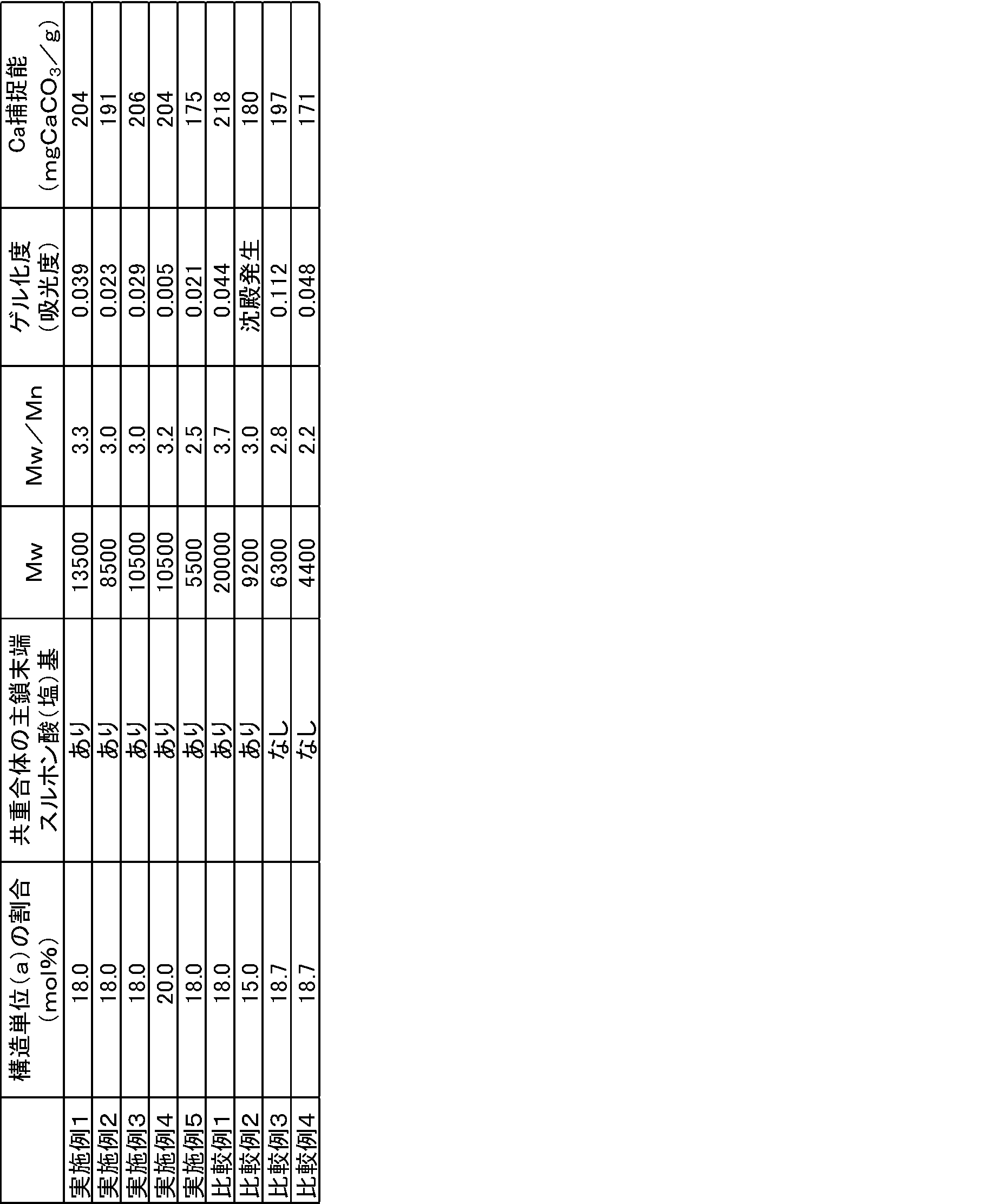

Claims (2)
- 全単量体由来の構造単位100モル%に対して、16モル%以上、24モル%以下の下記一般式(1)で表される単量体に由来する構造単位(a)、76モル%以上、84モル%以下の(メタ)アクリル酸(塩)由来の構造単位(b)、を必須構造単位として有する共重合体であって、少なくとも一つの主鎖末端にスルホン酸(塩)基を有し、重量平均分子量が1000~18000であることを特徴とする(メタ)アクリル酸系共重合体。

- 全単量体100モル%に対して、16モル%以上、24モル%以下の下記一般式(1)で表される単量体と、76モル%以上、84モル%以下の(メタ)アクリル酸(塩)とを必須として、重亜硫酸(塩)類の存在下で共重合することを特徴とする請求項1に記載の(メタ)アクリル酸系共重合体の製造方法。

Priority Applications (2)
| Application Number | Priority Date | Filing Date | Title |
|---|---|---|---|
| JP2014508099A JP5916843B2 (ja) | 2012-03-30 | 2013-03-29 | (メタ)アクリル酸系共重合体およびその製造方法 |
| US14/388,166 US9994660B2 (en) | 2012-03-30 | 2013-03-29 | (Meth) acrylic acid copolymer and method for manufacturing same |
Applications Claiming Priority (2)
| Application Number | Priority Date | Filing Date | Title |
|---|---|---|---|
| JP2012078894 | 2012-03-30 | ||
| JP2012-078894 | 2012-03-30 |
Publications (1)
| Publication Number | Publication Date |
|---|---|
| WO2013147171A1 true WO2013147171A1 (ja) | 2013-10-03 |
Family
ID=49260412
Family Applications (1)
| Application Number | Title | Priority Date | Filing Date |
|---|---|---|---|
| PCT/JP2013/059558 Ceased WO2013147171A1 (ja) | 2012-03-30 | 2013-03-29 | (メタ)アクリル酸系共重合体およびその製造方法 |
Country Status (3)
| Country | Link |
|---|---|
| US (1) | US9994660B2 (ja) |
| JP (1) | JP5916843B2 (ja) |
| WO (1) | WO2013147171A1 (ja) |
Cited By (1)
| Publication number | Priority date | Publication date | Assignee | Title |
|---|---|---|---|---|
| JP2015189814A (ja) * | 2014-03-27 | 2015-11-02 | 株式会社日本触媒 | (メタ)アクリル酸系重合体の製造方法 |
Families Citing this family (4)
| Publication number | Priority date | Publication date | Assignee | Title |
|---|---|---|---|---|
| EP3319711A2 (de) * | 2015-07-23 | 2018-05-16 | VPC GmbH | Verfahren zur abscheidung von quecksilber in verbrennungsabgasen |
| US9972451B2 (en) * | 2015-11-30 | 2018-05-15 | City University Of Hong Kong | Polyelectrolyte and a method for manufacturing an energy storage device |
| EP3430106A4 (en) * | 2016-03-18 | 2019-11-13 | General Electric Company | METHOD AND COMPOSITIONS FOR PREVENTING FOULING IN KAUSTIC TOWERS |
| KR20250050258A (ko) * | 2023-10-06 | 2025-04-15 | 삼성에스디아이 주식회사 | 리튬 이차 전지의 음극용 바인더, 이를 포함하는 리튬 이차 전지용 음극 및 이를 포함하는 리튬 이차 전지 |
Citations (3)
| Publication number | Priority date | Publication date | Assignee | Title |
|---|---|---|---|---|
| JP2004307588A (ja) * | 2003-04-03 | 2004-11-04 | Nippon Shokubai Co Ltd | (メタ)アクリル酸系共重合体の製造方法 |
| JP2005264190A (ja) * | 2004-03-16 | 2005-09-29 | Kurita Water Ind Ltd | 腐食抑制剤 |
| JP2012188586A (ja) * | 2011-03-11 | 2012-10-04 | Nippon Shokubai Co Ltd | (メタ)アクリル酸系共重合体およびその製造方法 |
Family Cites Families (4)
| Publication number | Priority date | Publication date | Assignee | Title |
|---|---|---|---|---|
| DE69917106T2 (de) * | 1998-03-06 | 2005-05-19 | Nippon Shokubai Co. Ltd. | (Meth)acrylsäurepolymer und Verfahren zu seiner Herstellung |
| JP3650724B2 (ja) | 2000-06-23 | 2005-05-25 | 株式会社日本触媒 | (メタ)アクリル酸系共重合体およびその製造方法 |
| JP2006347784A (ja) * | 2005-06-13 | 2006-12-28 | Nippon Shokubai Co Ltd | ソイルセメント流動化剤及び固結体の構築方法 |
| ATE459655T1 (de) * | 2005-08-31 | 2010-03-15 | Nippon Catalytic Chem Ind | Kontinuierliches herstellungsverfahren für wasserlösliches polymer und wasserlösliches polymer |
-
2013
- 2013-03-29 JP JP2014508099A patent/JP5916843B2/ja active Active
- 2013-03-29 WO PCT/JP2013/059558 patent/WO2013147171A1/ja not_active Ceased
- 2013-03-29 US US14/388,166 patent/US9994660B2/en active Active
Patent Citations (3)
| Publication number | Priority date | Publication date | Assignee | Title |
|---|---|---|---|---|
| JP2004307588A (ja) * | 2003-04-03 | 2004-11-04 | Nippon Shokubai Co Ltd | (メタ)アクリル酸系共重合体の製造方法 |
| JP2005264190A (ja) * | 2004-03-16 | 2005-09-29 | Kurita Water Ind Ltd | 腐食抑制剤 |
| JP2012188586A (ja) * | 2011-03-11 | 2012-10-04 | Nippon Shokubai Co Ltd | (メタ)アクリル酸系共重合体およびその製造方法 |
Cited By (1)
| Publication number | Priority date | Publication date | Assignee | Title |
|---|---|---|---|---|
| JP2015189814A (ja) * | 2014-03-27 | 2015-11-02 | 株式会社日本触媒 | (メタ)アクリル酸系重合体の製造方法 |
Also Published As
| Publication number | Publication date |
|---|---|
| JP5916843B2 (ja) | 2016-05-11 |
| US20150051363A1 (en) | 2015-02-19 |
| JPWO2013147171A1 (ja) | 2015-12-14 |
| US9994660B2 (en) | 2018-06-12 |
Similar Documents
| Publication | Publication Date | Title |
|---|---|---|
| JP5656702B2 (ja) | (メタ)アクリル酸系共重合体およびその製造方法 | |
| JP5916843B2 (ja) | (メタ)アクリル酸系共重合体およびその製造方法 | |
| JP2012224680A (ja) | (メタ)アクリル酸系共重合体、およびその製造方法、およびその用途 | |
| WO2011126059A1 (ja) | ポリ(メタ)アクリル酸系重合体水溶液およびその製造方法 | |
| WO2015045883A1 (ja) | (メタ)アクリル酸系共重合体とその製造方法 | |
| JP2004075977A (ja) | (メタ)アクリル酸系単量体と不飽和ポリアルキレングリコール系単量体の共重合体組成物およびその製造方法 | |
| JP6054981B2 (ja) | (メタ)アクリル酸系共重合体およびその製造方法 | |
| JP4332415B2 (ja) | (メタ)アクリル酸系共重合体の製造方法 | |
| JP5506616B2 (ja) | ポリアルキレングリコール系重合体及びその製造方法 | |
| JP5930736B2 (ja) | アクリル酸系共重合体およびその製造方法 | |
| JP6014372B2 (ja) | ポリカルボン酸系重合体およびその製造方法 | |
| JP6195461B2 (ja) | マレイン酸系共重合体組成物およびその製造方法およびその用途 | |
| JP2011241350A (ja) | (メタ)アクリル酸系共重合体およびその製造方法 | |
| JP5562166B2 (ja) | アクリル酸系共重合体およびその製造方法 | |
| JP2011111583A (ja) | アミノ基含有共重合体およびその製造方法 | |
| JP5982145B2 (ja) | ポリカルボン酸系重合体組成物およびその製造方法 | |
| JP7728090B2 (ja) | カルボン酸系重合体 | |
| JP2004143402A (ja) | 硫黄含有不飽和カルボン酸重合体、その用途および製造方法 | |
| JP6397633B2 (ja) | ポリ(メタ)アクリル酸系重合体およびその製造方法 | |
| JP5756167B2 (ja) | カチオン性基含有共重合体およびその製造方法 | |
| JP6173736B2 (ja) | アクリル酸(塩)−マレイン酸(塩)系重合体組成物およびその製造方法 | |
| WO2011118728A1 (ja) | 新規共重合体およびその製造方法 | |
| JP5661741B2 (ja) | 2−メチレングルタル酸系共重合体およびその製造方法 | |
| JP6087690B2 (ja) | (メタ)アクリル酸(塩)−ジカルボン酸(塩)系共重合体およびその製造方法 | |
| JP2014208830A (ja) | アミノ基含有共重合体およびその製造方法 |
Legal Events
| Date | Code | Title | Description |
|---|---|---|---|
| 121 | Ep: the epo has been informed by wipo that ep was designated in this application |
Ref document number: 13767733 Country of ref document: EP Kind code of ref document: A1 |
|
| ENP | Entry into the national phase |
Ref document number: 2014508099 Country of ref document: JP Kind code of ref document: A |
|
| WWE | Wipo information: entry into national phase |
Ref document number: 14388166 Country of ref document: US |
|
| 122 | Ep: pct application non-entry in european phase |
Ref document number: 13767733 Country of ref document: EP Kind code of ref document: A1 |
|
| NENP | Non-entry into the national phase |
Ref country code: DE |