WO2013147102A1 - 太陽電池モジュール用の封止材シート - Google Patents
太陽電池モジュール用の封止材シート Download PDFInfo
- Publication number
- WO2013147102A1 WO2013147102A1 PCT/JP2013/059414 JP2013059414W WO2013147102A1 WO 2013147102 A1 WO2013147102 A1 WO 2013147102A1 JP 2013059414 W JP2013059414 W JP 2013059414W WO 2013147102 A1 WO2013147102 A1 WO 2013147102A1
- Authority
- WO
- WIPO (PCT)
- Prior art keywords
- sealing material
- solar cell
- sheet
- mass
- cell module
- Prior art date
- Legal status (The legal status is an assumption and is not a legal conclusion. Google has not performed a legal analysis and makes no representation as to the accuracy of the status listed.)
- Ceased
Links
Images

Classifications
-
- H—ELECTRICITY
- H10—SEMICONDUCTOR DEVICES; ELECTRIC SOLID-STATE DEVICES NOT OTHERWISE PROVIDED FOR
- H10F—INORGANIC SEMICONDUCTOR DEVICES SENSITIVE TO INFRARED RADIATION, LIGHT, ELECTROMAGNETIC RADIATION OF SHORTER WAVELENGTH OR CORPUSCULAR RADIATION
- H10F19/00—Integrated devices, or assemblies of multiple devices, comprising at least one photovoltaic cell covered by group H10F10/00, e.g. photovoltaic modules
- H10F19/80—Encapsulations or containers for integrated devices, or assemblies of multiple devices, having photovoltaic cells
- H10F19/804—Materials of encapsulations
-
- B—PERFORMING OPERATIONS; TRANSPORTING
- B29—WORKING OF PLASTICS; WORKING OF SUBSTANCES IN A PLASTIC STATE IN GENERAL
- B29C—SHAPING OR JOINING OF PLASTICS; SHAPING OF MATERIAL IN A PLASTIC STATE, NOT OTHERWISE PROVIDED FOR; AFTER-TREATMENT OF THE SHAPED PRODUCTS, e.g. REPAIRING
- B29C48/00—Extrusion moulding, i.e. expressing the moulding material through a die or nozzle which imparts the desired form; Apparatus therefor
- B29C48/03—Extrusion moulding, i.e. expressing the moulding material through a die or nozzle which imparts the desired form; Apparatus therefor characterised by the shape of the extruded material at extrusion
- B29C48/07—Flat, e.g. panels
- B29C48/08—Flat, e.g. panels flexible, e.g. films
-
- B—PERFORMING OPERATIONS; TRANSPORTING
- B29—WORKING OF PLASTICS; WORKING OF SUBSTANCES IN A PLASTIC STATE IN GENERAL
- B29C—SHAPING OR JOINING OF PLASTICS; SHAPING OF MATERIAL IN A PLASTIC STATE, NOT OTHERWISE PROVIDED FOR; AFTER-TREATMENT OF THE SHAPED PRODUCTS, e.g. REPAIRING
- B29C48/00—Extrusion moulding, i.e. expressing the moulding material through a die or nozzle which imparts the desired form; Apparatus therefor
- B29C48/16—Articles comprising two or more components, e.g. co-extruded layers
-
- B—PERFORMING OPERATIONS; TRANSPORTING
- B29—WORKING OF PLASTICS; WORKING OF SUBSTANCES IN A PLASTIC STATE IN GENERAL
- B29C—SHAPING OR JOINING OF PLASTICS; SHAPING OF MATERIAL IN A PLASTIC STATE, NOT OTHERWISE PROVIDED FOR; AFTER-TREATMENT OF THE SHAPED PRODUCTS, e.g. REPAIRING
- B29C48/00—Extrusion moulding, i.e. expressing the moulding material through a die or nozzle which imparts the desired form; Apparatus therefor
- B29C48/25—Component parts, details or accessories; Auxiliary operations
- B29C48/30—Extrusion nozzles or dies
-
- B—PERFORMING OPERATIONS; TRANSPORTING
- B29—WORKING OF PLASTICS; WORKING OF SUBSTANCES IN A PLASTIC STATE IN GENERAL
- B29C—SHAPING OR JOINING OF PLASTICS; SHAPING OF MATERIAL IN A PLASTIC STATE, NOT OTHERWISE PROVIDED FOR; AFTER-TREATMENT OF THE SHAPED PRODUCTS, e.g. REPAIRING
- B29C48/00—Extrusion moulding, i.e. expressing the moulding material through a die or nozzle which imparts the desired form; Apparatus therefor
- B29C48/25—Component parts, details or accessories; Auxiliary operations
- B29C48/30—Extrusion nozzles or dies
- B29C48/305—Extrusion nozzles or dies having a wide opening, e.g. for forming sheets
-
- B—PERFORMING OPERATIONS; TRANSPORTING
- B32—LAYERED PRODUCTS
- B32B—LAYERED PRODUCTS, i.e. PRODUCTS BUILT-UP OF STRATA OF FLAT OR NON-FLAT, e.g. CELLULAR OR HONEYCOMB, FORM
- B32B17/00—Layered products essentially comprising sheet glass, or glass, slag, or like fibres
- B32B17/06—Layered products essentially comprising sheet glass, or glass, slag, or like fibres comprising glass as the main or only constituent of a layer, next to another layer of a specific material
- B32B17/10—Layered products essentially comprising sheet glass, or glass, slag, or like fibres comprising glass as the main or only constituent of a layer, next to another layer of a specific material of synthetic resin
- B32B17/10005—Layered products essentially comprising sheet glass, or glass, slag, or like fibres comprising glass as the main or only constituent of a layer, next to another layer of a specific material of synthetic resin laminated safety glass or glazing
- B32B17/10009—Layered products essentially comprising sheet glass, or glass, slag, or like fibres comprising glass as the main or only constituent of a layer, next to another layer of a specific material of synthetic resin laminated safety glass or glazing characterized by the number, the constitution or treatment of glass sheets
- B32B17/10018—Layered products essentially comprising sheet glass, or glass, slag, or like fibres comprising glass as the main or only constituent of a layer, next to another layer of a specific material of synthetic resin laminated safety glass or glazing characterized by the number, the constitution or treatment of glass sheets comprising only one glass sheet
-
- B—PERFORMING OPERATIONS; TRANSPORTING
- B32—LAYERED PRODUCTS
- B32B—LAYERED PRODUCTS, i.e. PRODUCTS BUILT-UP OF STRATA OF FLAT OR NON-FLAT, e.g. CELLULAR OR HONEYCOMB, FORM
- B32B17/00—Layered products essentially comprising sheet glass, or glass, slag, or like fibres
- B32B17/06—Layered products essentially comprising sheet glass, or glass, slag, or like fibres comprising glass as the main or only constituent of a layer, next to another layer of a specific material
- B32B17/10—Layered products essentially comprising sheet glass, or glass, slag, or like fibres comprising glass as the main or only constituent of a layer, next to another layer of a specific material of synthetic resin
- B32B17/10005—Layered products essentially comprising sheet glass, or glass, slag, or like fibres comprising glass as the main or only constituent of a layer, next to another layer of a specific material of synthetic resin laminated safety glass or glazing
- B32B17/1055—Layered products essentially comprising sheet glass, or glass, slag, or like fibres comprising glass as the main or only constituent of a layer, next to another layer of a specific material of synthetic resin laminated safety glass or glazing characterized by the resin layer, i.e. interlayer
-
- B—PERFORMING OPERATIONS; TRANSPORTING
- B32—LAYERED PRODUCTS
- B32B—LAYERED PRODUCTS, i.e. PRODUCTS BUILT-UP OF STRATA OF FLAT OR NON-FLAT, e.g. CELLULAR OR HONEYCOMB, FORM
- B32B17/00—Layered products essentially comprising sheet glass, or glass, slag, or like fibres
- B32B17/06—Layered products essentially comprising sheet glass, or glass, slag, or like fibres comprising glass as the main or only constituent of a layer, next to another layer of a specific material
- B32B17/10—Layered products essentially comprising sheet glass, or glass, slag, or like fibres comprising glass as the main or only constituent of a layer, next to another layer of a specific material of synthetic resin
- B32B17/10005—Layered products essentially comprising sheet glass, or glass, slag, or like fibres comprising glass as the main or only constituent of a layer, next to another layer of a specific material of synthetic resin laminated safety glass or glazing
- B32B17/1055—Layered products essentially comprising sheet glass, or glass, slag, or like fibres comprising glass as the main or only constituent of a layer, next to another layer of a specific material of synthetic resin laminated safety glass or glazing characterized by the resin layer, i.e. interlayer
- B32B17/10697—Layered products essentially comprising sheet glass, or glass, slag, or like fibres comprising glass as the main or only constituent of a layer, next to another layer of a specific material of synthetic resin laminated safety glass or glazing characterized by the resin layer, i.e. interlayer being cross-linked
-
- B—PERFORMING OPERATIONS; TRANSPORTING
- B32—LAYERED PRODUCTS
- B32B—LAYERED PRODUCTS, i.e. PRODUCTS BUILT-UP OF STRATA OF FLAT OR NON-FLAT, e.g. CELLULAR OR HONEYCOMB, FORM
- B32B27/00—Layered products comprising a layer of synthetic resin
- B32B27/06—Layered products comprising a layer of synthetic resin as the main or only constituent of a layer, which is next to another layer of the same or of a different material
- B32B27/08—Layered products comprising a layer of synthetic resin as the main or only constituent of a layer, which is next to another layer of the same or of a different material of synthetic resin
-
- B—PERFORMING OPERATIONS; TRANSPORTING
- B32—LAYERED PRODUCTS
- B32B—LAYERED PRODUCTS, i.e. PRODUCTS BUILT-UP OF STRATA OF FLAT OR NON-FLAT, e.g. CELLULAR OR HONEYCOMB, FORM
- B32B27/00—Layered products comprising a layer of synthetic resin
- B32B27/18—Layered products comprising a layer of synthetic resin characterised by the use of special additives
-
- B—PERFORMING OPERATIONS; TRANSPORTING
- B32—LAYERED PRODUCTS
- B32B—LAYERED PRODUCTS, i.e. PRODUCTS BUILT-UP OF STRATA OF FLAT OR NON-FLAT, e.g. CELLULAR OR HONEYCOMB, FORM
- B32B27/00—Layered products comprising a layer of synthetic resin
- B32B27/32—Layered products comprising a layer of synthetic resin comprising polyolefins
-
- B—PERFORMING OPERATIONS; TRANSPORTING
- B32—LAYERED PRODUCTS
- B32B—LAYERED PRODUCTS, i.e. PRODUCTS BUILT-UP OF STRATA OF FLAT OR NON-FLAT, e.g. CELLULAR OR HONEYCOMB, FORM
- B32B27/00—Layered products comprising a layer of synthetic resin
- B32B27/32—Layered products comprising a layer of synthetic resin comprising polyolefins
- B32B27/327—Layered products comprising a layer of synthetic resin comprising polyolefins comprising polyolefins obtained by a metallocene or single-site catalyst
-
- C—CHEMISTRY; METALLURGY
- C08—ORGANIC MACROMOLECULAR COMPOUNDS; THEIR PREPARATION OR CHEMICAL WORKING-UP; COMPOSITIONS BASED THEREON
- C08J—WORKING-UP; GENERAL PROCESSES OF COMPOUNDING; AFTER-TREATMENT NOT COVERED BY SUBCLASSES C08B, C08C, C08F, C08G or C08H
- C08J5/00—Manufacture of articles or shaped materials containing macromolecular substances
- C08J5/18—Manufacture of films or sheets
-
- C—CHEMISTRY; METALLURGY
- C08—ORGANIC MACROMOLECULAR COMPOUNDS; THEIR PREPARATION OR CHEMICAL WORKING-UP; COMPOSITIONS BASED THEREON
- C08L—COMPOSITIONS OF MACROMOLECULAR COMPOUNDS
- C08L23/00—Compositions of homopolymers or copolymers of unsaturated aliphatic hydrocarbons having only one carbon-to-carbon double bond; Compositions of derivatives of such polymers
- C08L23/02—Compositions of homopolymers or copolymers of unsaturated aliphatic hydrocarbons having only one carbon-to-carbon double bond; Compositions of derivatives of such polymers not modified by chemical after-treatment
- C08L23/04—Homopolymers or copolymers of ethene
-
- C—CHEMISTRY; METALLURGY
- C09—DYES; PAINTS; POLISHES; NATURAL RESINS; ADHESIVES; COMPOSITIONS NOT OTHERWISE PROVIDED FOR; APPLICATIONS OF MATERIALS NOT OTHERWISE PROVIDED FOR
- C09J—ADHESIVES; NON-MECHANICAL ASPECTS OF ADHESIVE PROCESSES IN GENERAL; ADHESIVE PROCESSES NOT PROVIDED FOR ELSEWHERE; USE OF MATERIALS AS ADHESIVES
- C09J123/00—Adhesives based on homopolymers or copolymers of unsaturated aliphatic hydrocarbons having only one carbon-to-carbon double bond; Adhesives based on derivatives of such polymers
- C09J123/02—Adhesives based on homopolymers or copolymers of unsaturated aliphatic hydrocarbons having only one carbon-to-carbon double bond; Adhesives based on derivatives of such polymers not modified by chemical after-treatment
- C09J123/04—Homopolymers or copolymers of ethene
-
- C—CHEMISTRY; METALLURGY
- C09—DYES; PAINTS; POLISHES; NATURAL RESINS; ADHESIVES; COMPOSITIONS NOT OTHERWISE PROVIDED FOR; APPLICATIONS OF MATERIALS NOT OTHERWISE PROVIDED FOR
- C09J—ADHESIVES; NON-MECHANICAL ASPECTS OF ADHESIVE PROCESSES IN GENERAL; ADHESIVE PROCESSES NOT PROVIDED FOR ELSEWHERE; USE OF MATERIALS AS ADHESIVES
- C09J4/00—Adhesives based on organic non-macromolecular compounds having at least one polymerisable carbon-to-carbon unsaturated bond ; adhesives, based on monomers of macromolecular compounds of groups C09J183/00 - C09J183/16
- C09J4/06—Organic non-macromolecular compounds having at least one polymerisable carbon-to-carbon unsaturated bond in combination with a macromolecular compound other than an unsaturated polymer of groups C09J159/00 - C09J187/00
-
- H—ELECTRICITY
- H10—SEMICONDUCTOR DEVICES; ELECTRIC SOLID-STATE DEVICES NOT OTHERWISE PROVIDED FOR
- H10F—INORGANIC SEMICONDUCTOR DEVICES SENSITIVE TO INFRARED RADIATION, LIGHT, ELECTROMAGNETIC RADIATION OF SHORTER WAVELENGTH OR CORPUSCULAR RADIATION
- H10F71/00—Manufacture or treatment of devices covered by this subclass
- H10F71/134—Irradiation with electromagnetic or particle radiation
-
- B—PERFORMING OPERATIONS; TRANSPORTING
- B32—LAYERED PRODUCTS
- B32B—LAYERED PRODUCTS, i.e. PRODUCTS BUILT-UP OF STRATA OF FLAT OR NON-FLAT, e.g. CELLULAR OR HONEYCOMB, FORM
- B32B2250/00—Layers arrangement
- B32B2250/24—All layers being polymeric
- B32B2250/242—All polymers belonging to those covered by group B32B27/32
-
- B—PERFORMING OPERATIONS; TRANSPORTING
- B32—LAYERED PRODUCTS
- B32B—LAYERED PRODUCTS, i.e. PRODUCTS BUILT-UP OF STRATA OF FLAT OR NON-FLAT, e.g. CELLULAR OR HONEYCOMB, FORM
- B32B2307/00—Properties of the layers or laminate
- B32B2307/30—Properties of the layers or laminate having particular thermal properties
- B32B2307/306—Resistant to heat
-
- B—PERFORMING OPERATIONS; TRANSPORTING
- B32—LAYERED PRODUCTS
- B32B—LAYERED PRODUCTS, i.e. PRODUCTS BUILT-UP OF STRATA OF FLAT OR NON-FLAT, e.g. CELLULAR OR HONEYCOMB, FORM
- B32B2307/00—Properties of the layers or laminate
- B32B2307/50—Properties of the layers or laminate having particular mechanical properties
-
- B—PERFORMING OPERATIONS; TRANSPORTING
- B32—LAYERED PRODUCTS
- B32B—LAYERED PRODUCTS, i.e. PRODUCTS BUILT-UP OF STRATA OF FLAT OR NON-FLAT, e.g. CELLULAR OR HONEYCOMB, FORM
- B32B2307/00—Properties of the layers or laminate
- B32B2307/70—Other properties
- B32B2307/72—Density
-
- B—PERFORMING OPERATIONS; TRANSPORTING
- B32—LAYERED PRODUCTS
- B32B—LAYERED PRODUCTS, i.e. PRODUCTS BUILT-UP OF STRATA OF FLAT OR NON-FLAT, e.g. CELLULAR OR HONEYCOMB, FORM
- B32B2457/00—Electrical equipment
- B32B2457/12—Photovoltaic modules
-
- C—CHEMISTRY; METALLURGY
- C08—ORGANIC MACROMOLECULAR COMPOUNDS; THEIR PREPARATION OR CHEMICAL WORKING-UP; COMPOSITIONS BASED THEREON
- C08J—WORKING-UP; GENERAL PROCESSES OF COMPOUNDING; AFTER-TREATMENT NOT COVERED BY SUBCLASSES C08B, C08C, C08F, C08G or C08H
- C08J2323/00—Characterised by the use of homopolymers or copolymers of unsaturated aliphatic hydrocarbons having only one carbon-to-carbon double bond; Derivatives of such polymers
- C08J2323/02—Characterised by the use of homopolymers or copolymers of unsaturated aliphatic hydrocarbons having only one carbon-to-carbon double bond; Derivatives of such polymers not modified by chemical after treatment
- C08J2323/04—Homopolymers or copolymers of ethene
- C08J2323/08—Copolymers of ethene
-
- C—CHEMISTRY; METALLURGY
- C08—ORGANIC MACROMOLECULAR COMPOUNDS; THEIR PREPARATION OR CHEMICAL WORKING-UP; COMPOSITIONS BASED THEREON
- C08J—WORKING-UP; GENERAL PROCESSES OF COMPOUNDING; AFTER-TREATMENT NOT COVERED BY SUBCLASSES C08B, C08C, C08F, C08G or C08H
- C08J2323/00—Characterised by the use of homopolymers or copolymers of unsaturated aliphatic hydrocarbons having only one carbon-to-carbon double bond; Derivatives of such polymers
- C08J2323/26—Characterised by the use of homopolymers or copolymers of unsaturated aliphatic hydrocarbons having only one carbon-to-carbon double bond; Derivatives of such polymers modified by chemical after-treatment
- C08J2323/36—Characterised by the use of homopolymers or copolymers of unsaturated aliphatic hydrocarbons having only one carbon-to-carbon double bond; Derivatives of such polymers modified by chemical after-treatment by reaction with nitrogen-containing compounds, e.g. by nitration
-
- C—CHEMISTRY; METALLURGY
- C08—ORGANIC MACROMOLECULAR COMPOUNDS; THEIR PREPARATION OR CHEMICAL WORKING-UP; COMPOSITIONS BASED THEREON
- C08K—Use of inorganic or non-macromolecular organic substances as compounding ingredients
- C08K5/00—Use of organic ingredients
- C08K5/04—Oxygen-containing compounds
- C08K5/15—Heterocyclic compounds having oxygen in the ring
- C08K5/151—Heterocyclic compounds having oxygen in the ring having one oxygen atom in the ring
- C08K5/1515—Three-membered rings
-
- C—CHEMISTRY; METALLURGY
- C08—ORGANIC MACROMOLECULAR COMPOUNDS; THEIR PREPARATION OR CHEMICAL WORKING-UP; COMPOSITIONS BASED THEREON
- C08K—Use of inorganic or non-macromolecular organic substances as compounding ingredients
- C08K5/00—Use of organic ingredients
- C08K5/16—Nitrogen-containing compounds
- C08K5/34—Heterocyclic compounds having nitrogen in the ring
- C08K5/3467—Heterocyclic compounds having nitrogen in the ring having more than two nitrogen atoms in the ring
- C08K5/3477—Six-membered rings
- C08K5/3492—Triazines
- C08K5/34924—Triazines containing cyanurate groups; Tautomers thereof
-
- Y—GENERAL TAGGING OF NEW TECHNOLOGICAL DEVELOPMENTS; GENERAL TAGGING OF CROSS-SECTIONAL TECHNOLOGIES SPANNING OVER SEVERAL SECTIONS OF THE IPC; TECHNICAL SUBJECTS COVERED BY FORMER USPC CROSS-REFERENCE ART COLLECTIONS [XRACs] AND DIGESTS
- Y02—TECHNOLOGIES OR APPLICATIONS FOR MITIGATION OR ADAPTATION AGAINST CLIMATE CHANGE
- Y02E—REDUCTION OF GREENHOUSE GAS [GHG] EMISSIONS, RELATED TO ENERGY GENERATION, TRANSMISSION OR DISTRIBUTION
- Y02E10/00—Energy generation through renewable energy sources
- Y02E10/50—Photovoltaic [PV] energy
-
- Y—GENERAL TAGGING OF NEW TECHNOLOGICAL DEVELOPMENTS; GENERAL TAGGING OF CROSS-SECTIONAL TECHNOLOGIES SPANNING OVER SEVERAL SECTIONS OF THE IPC; TECHNICAL SUBJECTS COVERED BY FORMER USPC CROSS-REFERENCE ART COLLECTIONS [XRACs] AND DIGESTS
- Y02—TECHNOLOGIES OR APPLICATIONS FOR MITIGATION OR ADAPTATION AGAINST CLIMATE CHANGE
- Y02E—REDUCTION OF GREENHOUSE GAS [GHG] EMISSIONS, RELATED TO ENERGY GENERATION, TRANSMISSION OR DISTRIBUTION
- Y02E10/00—Energy generation through renewable energy sources
- Y02E10/50—Photovoltaic [PV] energy
- Y02E10/52—PV systems with concentrators
Definitions
- the present invention relates to a sealing material composition for a solar cell module, a sealing material sheet for a solar cell module, and a solar cell module using them. More specifically, the present invention relates to a sealing material composition for a solar cell module using glycidyl methacrylate (GMA) as an adhesion improver, a sealing material sheet, and a solar cell module using the same.
- GMA glycidyl methacrylate
- a solar cell module has a configuration in which a transparent front substrate, a solar cell element, and a back surface protection sheet are laminated via a sealing material.
- An ethylene-vinyl acetate copolymer is used as a sealing material that is filled in a solar cell module, protects the solar cell element from external impacts, and prevents moisture from entering the solar cell module.
- Resin EVA
- EVA resin has been used as the most common.
- EVA resin has a tendency to gradually decompose with long-term use, and deteriorates inside the solar cell module to decrease its strength or generate acetic acid gas that affects the solar cell element. there is a possibility.
- a solar cell module sealing material using a polyethylene resin instead of EVA resin has been proposed (see Patent Document 1).
- a polyethylene-based sealing material sheet for example, a sealing material made of a modified ethylene-based resin containing alkoxysilane as a copolymerization component is also known. Moreover, the sealing material sheet
- Such a polyethylene-based sealing material can be preferably used as a sealing material for a solar cell module as having a weather resistance and durability equal to or higher than those of an EVA resin sealing material.
- the solar cell module sealing material is also required to have high adhesion with other members stacked vertically in the solar cell module.
- the polyethylene-based sealing material has room for further improvement, particularly in terms of adhesion to the electrodes of solar cell elements made of zinc oxide or the like.
- a sealing material for a solar cell module using a resin to which an ethylene copolymer containing glycidyl methacrylate (GMA) is added as an adhesion improver has been proposed (patent) Reference 3).
- GMA contributes to the improvement of metal adhesion, it is extremely easy to react with a radical polymerization initiator and has a strong tendency to inhibit the progress of necessary crosslinking in the process of producing a sealing material. Therefore, when GMA is added to the encapsulant composition requiring the crosslinking treatment as disclosed in Patent Document 3, there is a problem that the heat resistance is not sufficiently improved by the crosslinking treatment.
- the objective is the polyethylene-type sealing material sheet which was excellent also in the heat resistance which performed the crosslinking process, and is equipped with high metal adhesiveness. It aims at providing the sealing material sheet for solar cell modules.
- the present inventors have used a composition obtained by adding GMA and triallyl isocyanurate (TAIC) to a low-density polyethylene-based resin, thereby providing a sealing material for a solar cell module. It has been found that a sealing material sheet for a solar cell module having sufficiently high metal adhesion can be produced while having the heat resistance required for the sheet, and the present invention has been completed. More specifically, the present invention provides the following.
- a sealing material composition for a solar cell module comprising a polyethylene resin having a density of 0.900 g / cm 3 or less, glycidyl methacrylate, a radical polymerization initiator, and triallyl isocyanurate,
- the content of the glycidyl methacrylate in the sealing material composition is 0.15% by mass or more and 3.0% by mass or less
- the content of the triallyl isocyanurate in the sealing material composition is 0.
- the content of the radical polymerization initiator in the sealing material composition is 0.01% by mass or more and 2.5% by mass or less.
- the polyethylene-based resin contains a silane copolymer obtained by copolymerizing at least an ⁇ -olefin and an ethylenically unsaturated silane compound as a comonomer.
- the sealing material composition for solar cell modules in any one of these.
- the sealing material sheet is a single layer
- the sealing material sheet is a single-layer
- the single-layer sealing material sheet is the adhesion reinforcing layer
- the sealing material sheet is a multilayer co-extrusion layer
- a method for producing a sealing material sheet comprising a step of melt-molding the sealing material composition according to any one of (1) to (4), wherein the glycidyl methacrylate is separated from other components.
- a method for producing a sealing material sheet for a solar cell module wherein the sealing material composition is adjusted by mixing with the polyethylene-based resin in a single state.
- a solar cell module sealing material sheet having preferable heat resistance required for a solar cell module sealing material sheet and also having adhesion to a metal.
- the solar cell module 1 has a configuration in which a glass substrate 2, a front sealing material layer 3, a solar cell element 4, a back sealing material layer 5, and a back surface protection sheet 6 are sequentially laminated from the daylighting side. .
- the sealing material layer composed of the front sealing material layer 3 and the back sealing material layer 5 (hereinafter also referred to as “sealing material layer”) is the glass substrate 2, respectively. It is in contact with the solar cell element 4 and the back surface protective sheet 6. Therefore, the sealing material sheet which comprises a sealing material layer is requested
- the encapsulant sheet of the present invention uses low-density polyethylene as a base resin on the premise that crosslinking is performed by heating in any of the subsequent steps until integration as the solar cell module 1.
- glycidyl methacrylate (GMA) is added as an adhesion improver for the purpose of improving metal adhesion
- TAIC triallyl isocyanurate
- the sealing material sheet of the present invention with improved heat resistance and metal adhesion due to such a unique composition can be very preferably used as the sealing material layer of the solar cell module 1.
- sealing material composition for solar cell modules according to the present invention
- sealing material sheet for solar cell modules
- the sealing material composition contains a polyethylene resin having a density of 0.900 g / cm 3 or less, glycidyl methacrylate (GMA), a radical polymerization initiator, and triallyl isocyanurate (TAIC) as essential components. .
- GMA glycidyl methacrylate
- TAIC triallyl isocyanurate
- Low density polyethylene In the present invention, low density polyethylene (LDPE) having a density of 0.900 g / cm 3 or less, preferably linear low density polyethylene (LLDPE) is used.
- the linear low density polyethylene is a copolymer of ethylene and ⁇ -olefin, and in the present invention, the density is within a range of 0.900 g / cm 3 or less, more preferably 0.870 to 0.890 g / cm. 3 range. If it is this range, the adhesiveness of a sealing material sheet, glass, and a metal will increase.
- metallocene linear low density polyethylene is synthesized using a metallocene catalyst which is a single site catalyst.
- metallocene catalyst which is a single site catalyst.
- Such polyethylene has few side chain branches and a uniform comonomer distribution. For this reason, molecular weight distribution is narrow, it is possible to make it the above ultra-low density, and a softness
- linear low density polyethylene has a narrow crystal distribution and a uniform crystal size, not only a large crystal size does not exist, but also low crystallinity due to low density. For this reason, linear low density polyethylene is excellent in transparency when processed into a sheet. Therefore, even if the sealing material sheet which consists of a sealing material composition of this invention is arrange
- the ⁇ -olefin of the linear low density polyethylene an ⁇ -olefin having no branch is preferably used.
- 1-octene is particularly preferably used.
- the solar cell module sealing material can be provided with good flexibility and good strength. As a result, the adhesiveness between the solar cell module sealing material and the transparent front substrate such as glass is further increased, and the intrusion of moisture can be suppressed.
- the melt mass flow rate (MFR) of the low density polyethylene is MFR at 190 ° C. and a load of 2.16 kg measured in accordance with JIS-K6922-2 (in the present specification, the measurement value under these measurement conditions is hereinafter referred to as “MFR”).
- MFR melt mass flow rate
- the content of the low density polyethylene having a density of 0.900 g / cm 3 or less contained in the encapsulant composition is preferably 10% by mass to 99% by mass of all resin components in the encapsulant composition, More preferably, it is 50 mass% or more and 99 mass% or less, More preferably, it is 90 mass% or more and 99 mass% or less.
- Other resin may be included as long as the melting point of the sealing material composition is within a range of less than 80 ° C. These may be used, for example, as an additive resin, or may be used for masterbatching other components described later.
- glycidyl methacrylate Glycidyl methacrylate (GMA)
- Glycidyl methacrylate Glycidyl methacrylate
- a silane coupling agent having a glycidyl group can be used, but the silane coupling agent having a glycidyl group is bonded to the base resin main chain. There is a problem that it is difficult to achieve durability.
- GMA has a methacrylic group, unlike a silane coupling agent having a glycidyl group, so it can be directly bonded to the base resin main chain, and has a more preferable adhesiveness, especially a more preferable durable adhesive. Can be granted.
- a sealing material composition in which a polymer containing GMA is used as an adhesion component and added to EVA or the like is conventionally known.
- the glycidyl group of GMA is highly reactive with the metal surface, it can be polymerized with other components. Even if it adds and mixes with the sealing material composition in the isolate
- the sealing material composition of this invention can improve the metal adhesiveness of a sealing material sheet by adding GMA alone. Therefore, according to the sealing material composition of the present invention, it is possible to omit the process for prepolymerizing GMA with the resin component, and to improve the manufacturing efficiency of the sealing material sheet by simplifying the process. Can do.
- the sealing material composition of the present invention employs low density polyethylene as a base resin, an appropriate amount of a radical polymerization initiator is added thereto, and further, GMA as an adhesion improver. And triallyl isocyanurate (TAIC) as a crosslinking aid was used in combination at a predetermined blending ratio.
- TAIC triallyl isocyanurate
- the content of GMA in the sealing material composition may be from 0.15% by mass to 3.0% by mass, and preferably from 0.2% by mass to 0.5% by mass.
- the content of GMA in the sealing material composition is less than 0.15% by mass, the effect of improving metal adhesion is not sufficiently exhibited.
- the content of GMA exceeds 3.0% by mass, it is not preferable because GMA bleed-out and excessive crosslinking inhibition result in insufficient heat resistance.
- TAIC triallyl isocyanurate
- crosslinking aid is added as a crosslinking aid in order to prevent inhibition of the progress of crosslinking of GMA.
- crosslinking can be appropriately advanced to increase the heat resistance of the encapsulant sheet.
- TAIC triallyl isocyanurate
- a state in which the molecular weight is increased by weakening the degree of crosslinking hereinafter, also referred to as “weak crosslinking” can be newly formed.
- the weak crosslinking reaction can be allowed to proceed while maintaining. By performing such weak crosslinking treatment, the transparency and durability of the encapsulant sheet for a solar cell module can be sufficiently improved.
- the heat resistance of the encapsulant sheet can be sufficiently improved by promoting crosslinking after molding the encapsulant composition with the TAIC that is a trifunctional monomer.
- These functional groups are capable of generating radically active species upon irradiation with energy such as light and heat.
- the radical active species generated from the functional group can be graft-reacted with the polyethylene resin as a base resin to crosslink the polyethylene resin. Since the functional monomer has at least 2 or 3 functional groups such as acrylate group, methacrylate group, aryl group, etc., a plurality of radical active species are generated, and this radical active species crosslinks a plurality of polyethylene resins. can do. As a result, the molecular weight of the polyethylene resin as the base resin can be increased.
- the content of TAIC is 0.15% by mass or more and 3.0% by mass or less, preferably 0.2% by mass or more and 1.5% by mass or less in the sealing material composition for solar cell module.
- a crosslinking reaction with a polyethylene-based resin is necessary and sufficient, and heat resistance at a high temperature can be imparted, and when it is 3.0% by mass or less, a weak crosslinking reaction is caused. It progresses moderately and can impart good film-forming properties to the encapsulant sheet even in a low temperature range.
- radical polymerization initiator crosslinking agent
- the sealing material composition of the present invention contains a known radical polymerization initiator as a crosslinking agent.
- radical polymerization initiators include hydroperoxides such as diisopropylbenzene hydroperoxide and 2,5-dimethyl-2,5-di (hydroperoxy) hexane; di-t-butyl peroxide, t-butyl Cumyl peroxide, dicumyl peroxide, 2,5-dimethyl-2,5-di (t-butylperoxy) hexane, 2,5-dimethyl-2,5-di (t-peroxy) hexyne-3, etc.
- Dialkyl peroxides such as bis-3,5,5-trimethylhexanoyl peroxide, octanoyl peroxide, benzoyl peroxide, o-methylbenzoyl peroxide, 2,4-dichlorobenzoyl peroxide; t-butyl peroxyacetate, t-butyl pero Ci-2-ethylhexanoate, t-butyl peroxypivalate, t-butyl peroxyoctoate, t-butyl peroxyisopropyl carbonate, t-butyl peroxybenzoate, di-t-butyl peroxyphthalate, 2 , 5-dimethyl-2,5-di (benzoylperoxy) hexane, 2,5-dimethyl-2,5-di (benzoylperoxy) hexyne-3, t-butylperoxy-2-ethylhexyl carbonate
- Oxyesters organic peroxides such as methyl peroxides such as methyl ethyl ketone peroxide and cyclohexanone peroxide, or azo compounds such as azobisisobutyronitrile and azobis (2,4-dimethylvaleronitrile), dibutyltin Diacetate, dibutyltin dilaurate It can be mentioned dibutyltin dioctoate, dioctyltin dilaurate, dicumyl peroxide, such a silanol condensation catalyst.
- the content of the radical polymerization initiator is 0.01% by mass or more and 2.5% by mass or less, preferably 0.015% by mass or more and 1.0% by mass in the encapsulant composition for solar cell modules. Hereinafter, it is more preferably in the range of 0.02% by mass or more and 0.5% by mass or less. If it is less than 0.01%, even if TAIC is added, the radicals are quenched by GMA, and the polyethylene resin does not progress to the extent that crosslinking is required, and the heat resistance as a sealing material sheet is insufficient. On the other hand, if it exceeds 2.5%, a gel is generated during molding and the film forming property is lowered, and the transparency is also lowered.
- a weak degree of crosslinking can be achieved by adding a smaller amount of polymerization initiator than in the case of conventional general crosslinking treatment.
- this weak cross-linking reaction proceeds while maintaining the film-forming property, thereby balancing the flexibility, heat resistance, transparency, and adhesion.
- the content of the radical polymerization initiator in the encapsulant composition is 0.02% by mass or more and 0.5% by mass or less, but even in a process in which such a fine adjustment of the progress of crosslinking is required,
- the sealing material composition of the present invention can be used very preferably.
- t-butylperoxy 2-ethylhexyl carbonate, 2,5-dimethyl-2,5-di (t-butylperoxide) are used.
- Oxy) hexane or the like can be preferably used.
- These have a high amount of active oxygen as high as 5% or more, and the polymerization initiator has a one-minute half-life temperature of 160 to 190 ° C., which is consumed at the time of molding and remains after molding to suppress the progress of extra postcrosslinking. Therefore, it is preferable.
- a half-life temperature of less than 160 ° C. for 1 minute is not preferable because it is difficult to allow the crosslinking reaction to proceed after sufficiently dispersing the polymerization initiator during molding.
- the sealing material composition of the present invention is based on low-density polyethylene as a base resin, and by adjusting the content of all three components GMA, TAIC, and radical polymerization initiator to the optimum range, It is a combination of heat resistance and sufficient metal adhesion that was difficult to achieve with polyethylene-based sealing materials.
- silane coupling agents In addition, a known silane coupling agent may be used in combination as another adhesion improver.
- the silane coupling agent is not particularly limited.
- vinyl-based silane coupling agents such as vinyltrichlorosilane, vinyltrimethoxysilane, and vinyltriethoxysilane, 3-methacryloxypropyltrimethoxysilane, and 3-methacryloxypropyldiethoxy.
- a methacryloxy-based silane coupling agent such as silane or 3-methacryloxypropyltriethoxysilane can be preferably used.
- these can also be used individually or in mixture of 2 or more types.
- a methacryloxy silane coupling agent can be particularly preferably used.
- the content thereof is 0.1% by mass or more and 10.0% by mass or less with respect to all components of the sealing material composition, and the upper limit is preferably It is 5.0 mass% or less.
- Adhesion is more preferable when the content of the silane coupling agent is in the above range and the polyethylene resin constituting the sealing material composition contains the predetermined amount of the radical polymerization initiator and TAIC. Improve to range. In addition, when this range is exceeded, the film-forming property is deteriorated, and the so-called bleed-out in which the silane coupling agent aggregates and solidifies with time and is pulverized on the surface of the sealing material sheet is not preferable.
- the degree of cross-linking can be adjusted by using the above-mentioned cross-linking agent as a radical polymerization initiator in combination with the radical absorbent for quenching it.
- radical absorbents include hindered phenol-based antioxidants, hindered amine-based weather resistance stabilization, and the like.
- a hindered phenol-based radical absorbent having a high radical absorbing ability near the crosslinking temperature is preferred.
- the amount of the radical absorbent used is preferably 0.01 to 3% by mass, more preferably 0.05 to 2.0% by mass in the composition. If it is within the range of 0.01% by mass to 3% by mass, the crosslinking reaction can be moderately suppressed, and the adhesion between the transparent substrate and the sealing material can be improved.
- the solar cell module sealing material may further contain other components.
- components such as a weather resistance masterbatch for imparting weather resistance to a sealing material produced from the sealing material composition of the present invention, various fillers, a light stabilizer, an ultraviolet absorber, and a heat stabilizer are exemplified. Is done. These contents vary depending on the particle shape, density and the like, but are preferably in the range of 0.001% by mass to 5% by mass in the sealing material composition. By including these additives, it is possible to impart a mechanical strength that is stable over a long period of time, an effect of preventing yellowing, cracking, and the like to the encapsulant composition.
- a weatherproof masterbatch is obtained by dispersing a light stabilizer, an ultraviolet absorber, a heat stabilizer and the above-mentioned antioxidant in a resin such as polyethylene, and adding this to a sealing material composition.
- a resin such as polyethylene
- the weatherproof masterbatch may be prepared and used as appropriate, or a commercially available product may be used.
- the resin used in the weatherproof masterbatch may be a linear low density polyethylene used in the present invention, or other resins described above.
- light stabilizers ultraviolet absorbers, heat stabilizers and antioxidants can be used alone or in combination of two or more.
- an adhesion improver As other components used in the sealing material composition of the present invention, an adhesion improver, a nucleating agent, a dispersing agent, a leveling agent, a plasticizer, an antifoaming agent, a flame retardant, and the like can be mentioned. .
- the sealing material composition is formed into a sheet by various molding methods such as injection molding, extrusion molding, hollow molding, compression molding, and rotational molding, which are usually used in ordinary thermoplastic resins.
- the molding temperature is preferably the melting point of the above-mentioned polyethylene resin + 50 ° C or higher. Specifically, a high temperature of 150 ° C. to 250 ° C. is preferable, and a range of 190 ° C. to 230 ° C. is more preferable.
- the sealing material sheet of the present invention may be a sheet of a single layer formed from the above-described sealing material composition of the present invention by the above production method.
- Such a single-layer encapsulant sheet is preferable in that both surfaces have high adhesion to glass, metal, and PET, and can be flexibly adapted to various layer configurations.
- the encapsulant sheet of the present invention may be a sheet of multilayer coextruded layer using the above encapsulant composition of the present invention as a composition for forming an adhesion reinforcing layer.
- the encapsulant sheet of this multi-layer co-extrusion layer may be one in which the encapsulant sheet (film) has a two-layer structure, one is a core layer, and the other one is an adhesion reinforcing layer. It is possible to use a structure having three or more layers with a contact reinforcement layer disposed on at least one outermost layer. Moreover, it is the structure of 3 or more layers, and you may arrange
- the sealing material sheet of the multilayer coextruded layer is not particularly limited with respect to the components contained in the core layer.
- the content (mass%) of GMA in the whole encapsulant sheet of the multilayer coextruded layer is outside the predetermined range of the present invention defined above, the content of GMA in the film constituting the adhesion reinforcing layer If the (mass%) is within the above predetermined range, such a multilayer coextruded sealing material sheet is naturally within the scope of the present invention.
- the adhesion to the metal or the like was improved by making the concentration of GMA unevenly distributed in the vicinity of the laminated surface by some other means and having substantially the same composition as the above-mentioned multilayer coextruded layer sealing material sheet.
- the sealing material sheet is also within the scope of the present invention regardless of whether it is a single layer or a multilayer.
- the total thickness of the encapsulant sheet is preferably 100 ⁇ m or more and 800 ⁇ m or less regardless of the single layer or multilayer structure. If it is less than 100 ⁇ m, the impact cannot be sufficiently mitigated, and if it exceeds 800 ⁇ m, no further effect can be obtained, and the light transmittance is lowered and the power generation efficiency is lowered.
- the MFR of the sealing material sheet is preferably 0.1 g / 10 min or more and less than 1.0 g / 10 min. By making MFR into this range, the sealing material sheet can be provided with preferable heat resistance.
- the MFR of the low density polyethylene used as the base resin of the encapsulant composition is preferably 0.5 g / 10 min or more and 40 g / 10 min or less. Is the one in which heat resistance is sufficiently improved by appropriate cross-linking progress while using the above-mentioned encapsulant composition within the range of MFR that can be molded.
- the encapsulant sheet of the multilayer coextruded layer it is more preferable to use an encapsulant sheet having a different MFR for each layer.
- the encapsulant sheet is generally used with one surface in close contact with the electrode surface of the solar cell element. In that case, the encapsulant sheet is required to have high adhesion regardless of the unevenness of the electrode surface.
- the encapsulant sheet of the present invention is a single-layer encapsulant sheet, the encapsulant sheet has preferable transparency, flexibility and heat resistance, but the surface which is in close contact with the electrode surface of the solar cell element. Furthermore, it is more preferable that such molding characteristics are excellent.
- the sealing material sheet of the present invention which is a multilayer co-extrusion layer having different MFRs for each layer, is disposed on the outermost layer on the side to be used in close contact with the electrode surface of the solar cell element. While maintaining the above-described preferable transparency and heat resistance as a sheet, it is possible to further enhance the molding characteristics on the contact surface with the solar cell element.
- the thickness of the outermost layer is 30 ⁇ m or more and 120 ⁇ m or less, and the intermediate layer consisting of all layers other than the outermost layer and the outermost layer.
- the sealing material composition is formed into a sheet by various molding methods such as injection molding, extrusion molding, hollow molding, compression molding, and rotational molding, which are usually used in ordinary thermoplastic resins.
- the molding temperature is preferably the melting point of the polyethylene resin + 50 ° C. or more. Specifically, a high temperature of 150 ° C. to 250 ° C. is preferable, and a range of 190 ° C. to 230 ° C. is more preferable.
- the sealing material sheet of the present invention subjected to a very weak cross-linking treatment in an appropriate range is said to have sufficient film-forming properties from the viewpoint of its physical properties while maintaining low density while improving heat resistance.
- the density of the sealing material sheet of the present invention does not increase at 0.900 g / cm 3 or less, which is almost the same as the density of the raw material polyethylene resin, and the density difference of the resin composition before and after melt molding is 0.05 g / cm. It is within 3 . For this reason, the sealing material sheet of the present invention subjected to a very weak crosslinking treatment in an appropriate range still maintains transparency.
- About MFR of the sealing material sheet of this invention it is as above-mentioned, and heat resistance is improved to the preferable range.
- the ionizing radiation cross-linking process for performing a cross-linking process with ionizing radiation on the encapsulating material sheet formed into a sheet by the above method is performed after the sheet forming process and before the integration process as a solar cell module.
- the sealing material sheet of this invention can be made still more preferable.
- the ionizing radiation crosslinking treatment step may be performed continuously in-line following the sheet forming step, or may be performed off-line.
- the individual crosslinking conditions are not particularly limited, and may be set as appropriate so that the gel fraction is in a range of 20% or less as a total treatment result.
- the acceleration voltage in electron beam irradiation is determined by the thickness of the sheet that is the object to be irradiated, and the thicker the sheet, the larger the acceleration voltage is required. For example, a 0.5 mm-thick sheet is irradiated with 100 kV or more, preferably 200 kV or more. If the acceleration voltage is lower than this, the crosslinking is not sufficiently performed.
- the irradiation dose is in the range of 5 kGy to 1000 kGy, preferably 5 kGy to 300 kGy.
- the irradiation dose is less than 5 kGy, sufficient crosslinking is not performed, and when it exceeds 1000 kGy, there is a concern about deformation or coloring of the sheet due to generated heat.
- the sealing material sheet of this invention can be made further excellent in heat resistance, maintaining sufficient metal adhesiveness.
- the gel fraction of the cross-linked encapsulant sheet by irradiation with ionizing radiation is preferably 20% or less, and more preferably 5% or less.
- the gel fraction is 20% or more, it is difficult to use because it is not well embedded in the unevenness in the modularization process. That is, if the gel fraction is within the above range, the sealing property to the unevenness can be maintained well while suppressing excessive flow.
- the gel fraction (%) in the present specification refers to 0.1 g of a sealing material sheet placed in a resin mesh, extracted with 60 ° C. toluene for 4 hours, taken out together with the resin mesh, weighed after drying, Mass comparison before and after extraction is performed to measure the mass% of the remaining insoluble matter, and this is used as the gel fraction.
- the solar cell module 1 of the present invention has a single-layer encapsulant sheet of the present invention or a multilayer co-extrusion of the present invention on at least one of the front encapsulant layer 3 and the back encapsulant layer 5 which are encapsulant layers.
- a layer sealing material sheet (hereinafter, both are also referred to as “the sealing material sheet of the present invention”) is used.
- the solar cell module using the encapsulant sheet of the present invention can be particularly preferably used as one having improved adhesion between all members made of glass, metal or the like.
- the solar cell module 1 of the present invention conventionally known materials can be used for the transparent front substrate 2, the solar cell element 4, and the back surface protective sheet 6 without limitation.
- the solar cell module 1 of this invention may also contain members other than the said member.
- the sealing material sheet of this invention can be preferably used not only for a single crystal type but for all other solar cell modules.
- the layer configuration of the solar cell module of the present invention is not limited to that according to the above embodiment. Since the sealing material sheet of the present invention has adhesion to both glass and metal, taking advantage of its characteristics, it is widely used for solar cell modules of various configurations including glass substrates and metallic solar cell modules. Can be used. For example, in a solar cell module, even if one surface of the encapsulant sheet is configured to face both glass and metal, the encapsulant sheet of the present invention can be suitably used.
- the solar cell module 1 is, for example, vacuum suction after sequentially laminating members composed of the transparent front substrate 2, the front sealing material layer 3, the solar cell element 4, the back sealing material layer 5, and the back surface protection sheet 6. Then, the above-mentioned members can be manufactured by thermocompression molding as an integrally molded body by a molding method such as a lamination method.
- the glycidyl group of GMA in the encapsulant sheet is ring-opened at the time of thermocompression molding, and it is considered that the adhesion between the encapsulant sheet and other constituent members is increased by bonding to the adherend substrate.
- sealing material sheet A sealing material composition having the composition shown in Table 1 below was mixed to obtain a blend for a single layer. Using the above blend, a ⁇ 30 mm extruder, and a film forming machine having a 200 mm wide T-die, a single layer solar cell module encapsulant with an extrusion temperature of 210 ° C. and a take-off speed of 1.1 m / min and a total thickness of 400 ⁇ m is produced. (Examples 1 to 3, Comparative Examples 1 to 3).
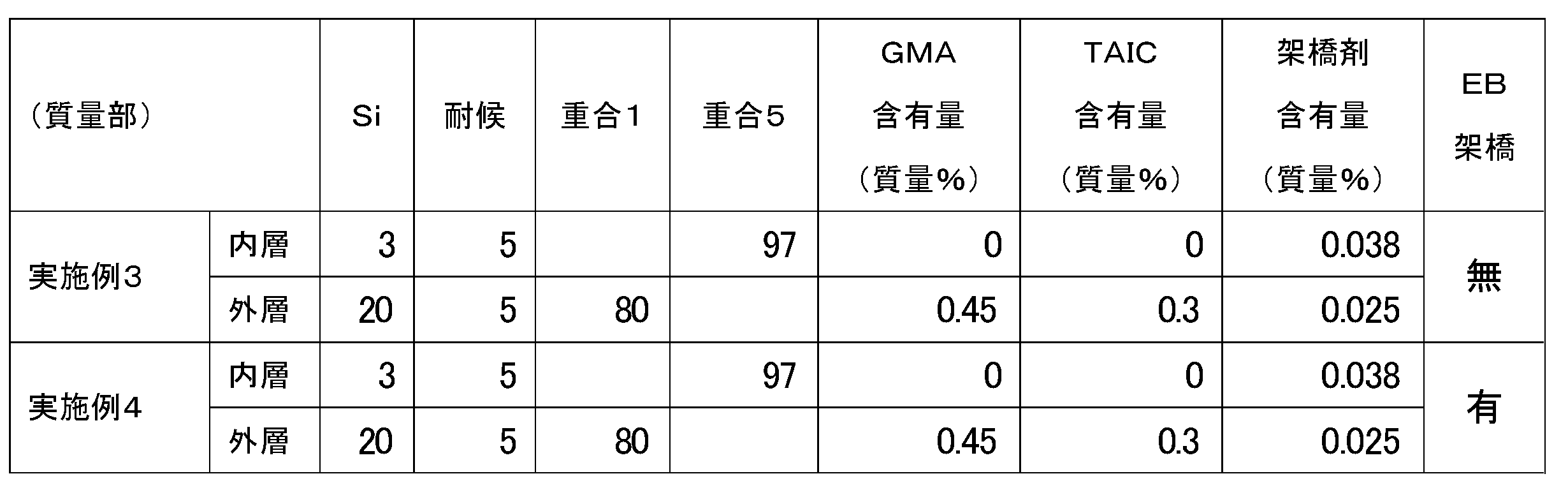
- a sealing material composition having the composition shown in Table 2 below was mixed to obtain a blend for an inner layer and an outer layer for molding a sheet of a three-layer multilayer coextruded layer.
- Each of the above blends was formed into a film using an extrusion machine having a diameter of 30 mm and a film forming machine having a T die having a width of 200 mm at an extrusion temperature of 210 ° C. and a take-off speed of 1.1 m / min.
- a sealing material sheet of a multilayer coextruded layer sheet was produced.
- the layer thickness of this encapsulant sheet the total thickness was 400 ⁇ m, and the ratio of outer layer: inner layer: outer layer thickness was 1: 5: 1. (Example 4, comparative example 4).
- Silane-modified transparent resin (indicated as “Si” in Tables 1 and 2): Metallocene linear low-density polyethylene (M ⁇ ) having a density of 0.881 g / cm 3 and an MFR at 190 ° C. of 2 g / 10 min. LLDPE) 2 parts by mass of vinyltrimethoxysilane and 0.1 parts by mass of dicumyl peroxide as a radical generator (reaction catalyst) are mixed with 98 parts by mass, melted and kneaded at 200 ° C., density A silane-modified transparent resin having an MFR of 1.8 g / 10 min at 0.884 g / cm 3 and 190 ° C.
- M ⁇ Metallocene linear low-density polyethylene
- Weatherproof masterbatch 100 parts by mass of powder obtained by pulverizing Ziegler linear low density polyethylene having a density of 0.880 g / cm 3 , benzophenol-based UV absorber 3 .8 parts by mass, 5 parts by mass of a hindered amine light stabilizer, and 0.5 parts by mass of a phosphorous heat stabilizer were mixed, melted, processed, and a pelletized master batch was obtained.
- Polymerization initiator compound resin 1 (indicated as “polymerization 1” in Tables 1 and 2): with respect to 100 parts by mass of M-LLDPE pellets having a density of 0.880 g / cm 3 and an MFR at 190 ° C.
- polymerization initiator A 2,5-dimethyl-2,5-di (t-butylperoxy) hexane
- polymerization initiator A 2,5-dimethyl-2,5-di (t-butylperoxy) hexane
- the contents (mass%) of the polymerization initiator (crosslinking agent) in the encapsulant composition are shown in Table 1 and Table 2, respectively.
- Polymerization initiator compound resin 2 (indicated as “polymerization 2” in Tables 1 and 2): with respect to 100 parts by mass of M-LLDPE pellets having a density of 0.880 g / cm 3 and an MFR at 190 ° C.
- polymerization initiator A 2,5-dimethyl-2,5-di (t-butylperoxy) hexane
- the contents (mass%) of the crosslinking agent in the encapsulant composition are shown in Tables 1 and 2, respectively.
- Polymerization initiator compound resin 3 (indicated as “polymerization 3” in Tables 1 and 2): with respect to 100 parts by mass of M-LLDPE pellets having a density of 0.880 g / cm 3 and MFR at 190 ° C.
- polymerization initiator B t-amyl-peroxy-2-ethylhexyl carbonate
- the contents (mass%) of the crosslinking agent in the encapsulant composition are shown in Tables 1 and 2, respectively.
- Polymerization initiator compound resin 4 (indicated as “polymerization 4” in Tables 1 and 2): with respect to 100 parts by mass of M-LLDPE pellets having a density of 0.880 g / cm 3 and an MFR of 190 g at 3.1 ° C.
- Polymerization initiator A 2,5-dimethyl-2,5-di (t-butylperoxy) hexane
- Polymerization initiator A 0.66 parts by mass of 2,5-dimethyl-2,5-di (t-butylperoxy) hexane (polymerization initiator A) was impregnated to obtain a compound pellet.
- the contents (mass%) of the crosslinking agent in the encapsulant composition are shown in Tables 1 and 2, respectively.
- Polymerization initiator compound resin 5 (denoted as “polymerization 5” in Tables 1 and 2): based on 100 parts by mass of M-LLDPE pellets having a density of 0.880 g / cm 3 and an MFR at 190 ° C. of 3.5 g / 10 min.
- M-LLDPE Metallocene linear low density polyethylene GMA having a density of 0.901 g / cm 3 and an MFR at 190 ° C.
- Example 1 and Example 3 prepared as described above were subjected to EB crosslinking treatment under the following crosslinking conditions to obtain an EB crosslinked sealing material sheet.
- the EB cross-linked encapsulant sheet was used as the encapsulant sheet of Example 2 and Example 4.
- the irradiation intensity of ionizing radiation was 15 kGy, and the acceleration voltage was 200 kV.
- the examples and comparative examples could be molded as usual.
- the content of the polymerization initiator in the encapsulant composition was 0.5% by mass
- an example similar to Example 1 was used as Comparative Example 5, but the MFR increased and the gel increased. Occurred and film formation was impossible.
- the sealing material sheets of Examples 1 to 4 have excellent heat resistance and have sufficiently preferable adhesion to a metal (zinc oxide). It turns out that it is a preferable thing as the sealing material sheet which comprises. Further, from the test results of Comparative Example 4, when GMA is added, the problem of insufficient heat resistance improvement due to crosslinking treatment cannot be solved by simply increasing the amount of crosslinking agent. It can be seen that the problem can be solved only by the composition of the present invention in which the addition amount of the crosslinking agent is optimized.
Landscapes
- Chemical & Material Sciences (AREA)
- Engineering & Computer Science (AREA)
- Organic Chemistry (AREA)
- Manufacturing & Machinery (AREA)
- Chemical Kinetics & Catalysis (AREA)
- Mechanical Engineering (AREA)
- Polymers & Plastics (AREA)
- Medicinal Chemistry (AREA)
- Health & Medical Sciences (AREA)
- Materials Engineering (AREA)
- Photovoltaic Devices (AREA)
- Sealing Material Composition (AREA)
- Extrusion Moulding Of Plastics Or The Like (AREA)
- Compositions Of Macromolecular Compounds (AREA)
Abstract
Description
まず、図1を参照しながら、本発明の一実施形態である太陽電池モジュール1を例として、本発明に係る封止材シートを用いた太陽電池モジュールの全体構成について簡単に説明する。
封止材組成物は、密度が0.900g/cm3以下のポリエチレン系樹脂と、グリシジルメタクリレート(GMA)と、ラジカル重合開始剤と、トリアリルイソシアヌレート(TAIC)と、を必須成分として含有する。以下、これらの必須成分について説明した後、その他の樹脂、その他の成分について説明する。
本発明においては密度が0.900g/cm3以下の低密度ポリエチレン(LDPE)、好ましくは直鎖低密度ポリエチレン(LLDPE)を用いる。直鎖低密度ポリエチレンはエチレンとα-オレフィンとの共重合体であり、本発明においては、その密度が0.900g/cm3以下の範囲内、より好ましくは0.870~0.890g/cm3の範囲である。この範囲であれば、封止材シートと、ガラス、金属との密着性が高まる。
本発明の封止材組成物には、金属密着性を向上させるための密着性向上剤としてグリシジルメタクリレート(GMA)を用いる。ここで、金属密着性を向上させるための密着性向上剤としては、グリシジル基を持つシランカップリング剤を用いることもできるが、グリシジル基を持つシランカップリング剤は、ベース樹脂主鎖と結合することが難しく耐久性が出にくいという問題がある。その点、GMAは、グリシジル基を持つシランカップリング剤と異なり、メタクリル基を持つのでベース樹脂主鎖に直接結合することができ、より好ましい密着性、とりわけ、より好ましい耐久密着性を封止材に付与することができる。
本発明においては、GMAの架橋進行の阻害を防ぐために架橋助剤としてTAICを添加する。TAICを充分に添加することによって、架橋を適度に進行させて封止材シートの耐熱性を高めることができる。又、TAICの添加量の調整により、架橋の程度を弱めで分子量を増加した状態(以後、いわゆる「弱架橋」とも言う)を新規に形成でき、更に、成形中の加熱によって、製膜性を維持しながらこの弱架橋反応を進行させることもできる。そのような弱架橋処理を行うことにより、太陽電池モジュール用の封止材シートの透明性と耐久性を十分に向上させることができる。
本発明の封止材組成物は、公知のラジカル重合開始剤を架橋剤として含有する。ラジカル重合開始剤としては、例えば、ジイソプロピルベンゼンヒドロパーオキサイド、2,5‐ジメチル‐2,5‐ジ(ヒドロパーオキシ)ヘキサン等のヒドロパーオキサイド類;ジ‐t‐ブチルパーオキサイド、t‐ブチルクミルパーオキサイド、ジクミルパーオキサイド、2,5‐ジメチル‐2,5‐ジ(t‐ブチルパーオキシ)ヘキサン、2,5‐ジメチル‐2,5‐ジ(t‐パーオキシ)ヘキシン‐3等のジアルキルパーオキサイド類;ビス‐3,5,5‐トリメチルヘキサノイルパーオキサイド、オクタノイルパーオキサイド、ベンゾイルパーオキサイド、o‐メチルベンゾイルパーオキサイド、2,4‐ジクロロベンゾイルパーオキサイド等のジアシルパーオキサイド類;t‐ブチルパーオキシアセテート、t‐ブチルパーオキシ‐2‐エチルヘキサノエート、t‐ブチルパーオキシピバレート、t‐ブチルパーオキシオクトエート、t‐ブチルパーオキシイソプロピルカーボネート、t‐ブチルパーオキシベンゾエート、ジ‐t‐ブチルパーオキシフタレート、2,5‐ジメチル‐2,5‐ジ(ベンゾイルパーオキシ)ヘキサン、2,5‐ジメチル‐2,5‐ジ(ベンゾイルパーオキシ)ヘキシン‐3、t‐ブチルパーオキシ-2-エチルヘキシルカーボネート等のパーオキシエステル類;メチルエチルケトンパーオキサイド、シクロヘキサノンパーオキサイド等のケトンパーオキサイド類等の有機過酸化物、又は、アゾビスイソブチロニトリル、アゾビス(2,4‐ジメチルバレロニトリル)等のアゾ化合物、ジブチル錫ジアセテート、ジブチル錫ジラウレート、ジブチル錫ジオクテート、ジオクチル錫ジラウレート、ジクミルパーオキサイド、といったシラノール縮合触媒等を挙げることができる。
その他の密着性向上剤として、他に更に、公知のシランカップリング剤を併用してもよい。シランカップリング剤は特に限定されないが、例えば、ビニルトリクロルシラン、ビニルトリメトキシシラン、ビニルトリエトキシシラン等のビニル系シランカップリング剤、3-メタクリロキシプロピルトリメトキシシラン、3-メタクリロキシプロピルジエトキシシラン、3-メタクリロキシプロピルトリエトキシシラン等のメタクリロキシ系シランカップリング剤等を好ましく用いることができる。尚、これらは単独で又は2種以上を混合して使用することもできる。これらのうちでも、メタクリロキシ系シランカップリング剤を特に好ましく用いることができる。
本発明の封止材組成物においては、ラジカル重合開始剤となる上記の架橋剤と、それをクエンチするラジカル吸収剤とを併用することにより、架橋の程度を調整することができる。このようなラジカル吸収剤としては、ヒンダードフェノール系等の酸化防止剤や、ヒンダードアミン系の耐候安定化等が例示できる。架橋温度付近でのラジカル吸収能力が高い、ヒンダードフェノール系のラジカル吸収剤が好ましい。ラジカル吸収剤の使用量は、組成物中に0.01質量%~3質量%含まれることが好ましく、より好ましくは0.05質量%~2.0質量%の範囲である。0.01質量%~3質量%の範囲内であれば適度に架橋反応を抑制し、透明基板と封止材の密着性を向上させることができる。
太陽電池モジュール用封止材には、更にその他の成分を含有させることができる。例えば、本発明の封止材組成物から作製された封止材に耐候性を付与するための耐候性マスターバッチ、各種フィラー、光安定化剤、紫外線吸収剤、熱安定剤等の成分が例示される。これらの含有量は、その粒子形状、密度等により異なるものではあるが、それぞれ封止材組成物中に0.001質量%~5質量%の範囲内であることが好ましい。これらの添加剤を含むことにより、封止材組成物に対して、長期に亘って安定した機械強度や、黄変やひび割れ等の防止効果等を付与することができる。
上記封止材組成物のシート化は、通常の熱可塑性樹脂において通常用いられる成形法、即ち、射出成形、押出成形、中空成形、圧縮成形、回転成形等の各種成形法により行われる。成形温度は上述のポリエチレン系樹脂の融点+50℃以上が好ましい。具体的には150℃から250℃の高温とすることが好ましく、より好ましくは190℃から230℃の範囲である。
上記封止材組成物のシート化は、通常の熱可塑性樹脂において通常用いられる成形法、即ち、射出成形、押出成形、中空成形、圧縮成形、回転成形等の各種成形法により行われる。但し、成形中に弱架橋反応を適切に促進させるためには、成形温度は前記ポリエチレン系樹脂の融点+50℃以上が好ましい。具体的には150℃から250℃の高温とすることが好ましく、より好ましくは190℃から230℃の範囲である。
上記方法でシート化した後の封止材シートに対して、電離放射線による架橋処理を施す電離放射線架橋処理工程を、シート化の工程後、且つ、太陽電池モジュールとしての一体化の工程前に行うことによって、本発明の封止材シートを更に好ましいものとすることができる。電離放射線架橋処理工程はシート化の工程に続いて連続的にインラインで行われてもよく、オフラインで行われてもよい。
本発明の太陽電池モジュール1は、封止材層である前面封止材層3及び背面封止材層5の少なくとも一方に本発明の単層の封止材シート又は本発明の多層共押し出しの層の封止材シート(以下、両者を併せて「本発明の封止材シート」とも言う。)を使用するものである。
太陽電池モジュール1は、例えば、上記の透明前面基板2、前面封止材層3、太陽電池素子4、背面封止材層5、及び裏面保護シート6からなる部材を順次積層してから真空吸引等により一体化し、その後、ラミネーション法等の成形法により、上記の部材を一体成形体として加熱圧着成形して製造することができる。この加熱圧着成形時に封止材シート中のGMAのグリシジル基が開環し、被密着基材と結合することにより、封止材シートと他の構成部材との密着性が高まるものと考えられる。
(単層のシート)
下記表1の組成の封止材組成物を混合し単層用のブレンドとした。上記ブレンドをφ30mm押出し機、200mm幅のTダイスを有するフィルム成形機を用いて、押出し温度210℃、引き取り速度1.1m/minで総厚400μmの単層の太陽電池モジュール用封止材を作製した(実施例1~3、比較例1~3)。
又、下記表2の組成の封止材組成物を混合し3層の多層共押し出し層のシートを成型するための内層用及び外層用のブレンドとした。上記ブレンドを、それぞれ、φ30mm押出し機、200mm幅のTダイスを有するフィルム成形機を用いて、押出し温度210℃、引き取り速度1.1m/minでフィルム成型し、それらを積層して、3層の多層共押し出し層のシートの封止材シートを作製した。この封止材シートの層厚は、総厚を400μmとし、外層:内層:外層の厚さの比を1:5:1とした。(実施例4、比較例4)。
シラン変性透明樹脂(表1及び2において「Si」と表記):密度0.881g/cm3であり、190℃でのMFRが2g/10分であるメタロセン系直鎖状低密度ポリエチレン(M-LLDPE)98質量部に対して、ビニルトリメトキシシラン2質量部と、ラジカル発生剤(反応触媒)としてのジクミルパーオキサイド0.1質量部とを混合し、200℃で溶融、混練し、密度0.884g/cm3、190℃でのMFRが1.8g/10分であるシラン変性透明樹脂を得た。
耐候性マスターバッチ(表1及び2において「耐候」と表記):密度0.880g/cm3のチーグラー直鎖状低密度ポリエチレンを粉砕したパウダー100質量部に対して、ベンゾフェノール系紫外線吸収剤3.8質量部とヒンダードアミン系光安定化剤5質量部と、リン系熱安定化剤0.5質量部とを混合して溶融、加工し、ペレット化したマスターバッチを得た。
重合開始剤コンパウンド樹脂1(表1及び2において「重合1」と表記):密度0.880g/cm3、190℃でのMFRが3.1g/10分のM-LLDPEペレット100質量部に対して、2,5‐ジメチル‐2,5‐ジ(t‐ブチルパーオキシ)ヘキサン(重合開始剤A)0.033質量部を含浸させコンパウンドペレットを得た。尚、封止材組成物中の重合開始剤(架橋剤)の含有量(質量%)を表1及び表2中にそれぞれ示した。
重合開始剤コンパウンド樹脂2(表1及び2において「重合2」と表記):密度0.880g/cm3、190℃でのMFRが3.1g/10分のM-LLDPEペレット100質量部に対して、2,5‐ジメチル‐2,5‐ジ(t‐ブチルパーオキシ)ヘキサン(重合開始剤A)0.066質量部を含浸させコンパウンドペレットを得た。尚、封止材組成物中の架橋剤の含有量(質量%)を表1及び表2中にそれぞれ示した。
重合開始剤コンパウンド樹脂3(表1及び2において「重合3」と表記):密度0.880g/cm3、190℃でのMFRが3.1g/10分のM-LLDPEペレット100質量部に対して、t-アミル-パーオキシ-2-エチルヘキシルカーボネート(重合開始剤B)0.33質量部を含浸させコンパウンドペレットを得た。尚、封止材組成物中の架橋剤の含有量(質量%)を表1及び表2中にそれぞれ示した。
重合開始剤コンパウンド樹脂4(表1及び2において「重合4」と表記):密度0.880g/cm3、190℃でのMFRが3.1g/10分のM-LLDPEペレット100質量部に対して、2,5‐ジメチル‐2,5‐ジ(t‐ブチルパーオキシ)ヘキサン(重合開始剤A)0.66質量部を含浸させコンパウンドペレットを得た。尚、封止材組成物中の架橋剤の含有量(質量%)を表1及び表2中にそれぞれ示した。
重合開始剤コンパウンド樹脂5(表1及び2において「重合5」と表記):密度0.880g/cm3、190℃でのMFRが3.5g/10分のM-LLDPEペレット100質量部に対して、2,5‐ジメチル‐2,5‐ジ(t‐ブチルパーオキシ)ヘキサン(重合開始剤A)0.041質量部を含浸させコンパウンドペレットを得た。
M-LLDPE(表1及び2において「ML」と表記):密度0.901g/cm3、190℃でのMFRが2.0g/10分のメタロセン系直鎖状低密度ポリエチレン
GMA(表1及び2において「GMA」と表記):グリシジルメタクリレート(GMA)(三菱ガス化学株式会社製、商品名メタクリル酸グリシジル)を、封止材組成物中の含有量(質量%)が表1及び2に記載の含有量となるように添加量を調整した。
TAIC(表1及び2において「TAIC」と表記):トリアリルイソシアヌレート(TAIC)(Statomer社製、商品名SR533)を、封止材組成物中の含有量(質量%)が表1及び2に記載の含有量となるように添加量を調整した。
(電離放射線の照射による架橋処理)
電離放射線の照射強度は15kGy、加速電圧200kVで実施例1及び実施例3の封止材シートの両面に行った。

15mm幅にカットした実施例1~4、比較例1~4の封止材シートを、それぞれ酸化亜鉛板(75mm×50mm×0.1mm)上に密着させて、下記の熱ラミネート条件(a)~(d)により、真空加熱ラミネータ処理を行い、それぞれの実施例、比較例について太陽電池モジュール密着性評価用サンプルを得た。これらの太陽電池モジュール密着性評価用サンプルについて、下記の試験条件における密着強度を測定して金属密着性を評価した。結果は表3に示す通りとなった。
[熱ラミネート条件]
(a)真空引き:5.0分
(b)加圧(0kPa~100kPa):1.5分
(c)圧力保持(100kPa):8.0分
(d)温度150℃
[金属密着強度(N/15mm)の試験方法]
上記の太陽電池モジュール密着性評価用サンプルにおいて、酸化亜鉛板上に密着している封止材シートを、剥離試験機(テンシロン万能試験機 RTF-1150-H)にて垂直剥離(50mm/min)試験を行い金属密着強度を測定した。本試験においては、密着強度が10N/15mm以上であるものを好ましい金属密着性を備える封止材シートとして評価した。
250mm角の半強化ガラス上に上記実施例及び比較例の封止材シートを75mm×50mmの大きさにカットしたものを2枚、75mm×50mmの半強化ガラス1枚を順に積層した上で、上記熱ラミネート条件(a)~(d)と同条件により、真空加熱ラミネータ処理を行い、それぞれの実施例、比較例について太陽電池モジュール耐熱性評価用サンプルを得た。これらの太陽電池モジュール耐熱性評価用サンプルについて、下記の試験条件における耐熱強度を測定して耐熱性を評価した。結果は表3に示す通りとなった。
[耐熱強度の試験方法]
上記の太陽電池モジュール耐熱性評価用サンプルを45度に傾けた状態で120℃のオーブン中で12時間静置し、半強化ガラスのズレた距離を以って耐熱性の評価を実施した。本試験においては、ガラスのズレた距離密着強度が10mm以下であるものを好ましい耐熱性を備える封止材シートとして評価した。

2 透明前面基板
3 前面封止材層
4 太陽電池素子
5 背面封止材層
6 裏面保護シート
Claims (8)
- 密度0.900g/cm3以下のポリエチレン系樹脂と、
グリシジルメタクリレートと、
ラジカル重合開始剤と、
トリアリルイソシアヌレートと、を含有する太陽電池モジュール用の封止材組成物であって、
前記グリシジルメタクリレートの前記封止材組成物中の含有量が、0.15質量%以上3.0質量%以下であり、
前記トリアリルイソシアヌレートの前記封止材組成物中の含有量が、0.15質量%以上3.0質量%以下であり、
前記ラジカル重合開始剤の前記封止材組成物中の含有量が、0.01質量%以上2.5質量%以下である太陽電池モジュール用の封止材組成物。 - 前記ラジカル重合開始剤の前記封止材組成物中の含有量が、0.01質量%以上0.5質量%以下である請求項1に記載の太陽電池モジュール用の封止材組成物。
- 前記ポリエチレン系樹脂がメタロセン系直鎖状低密度ポリエチレンである請求項1又は2に記載の太陽電池モジュール用の封止材組成物。
- 前記ポリエチレン系樹脂は、少なくともα-オレフィンとエチレン性不飽和シラン化合物とをコモノマーとして共重合してなるシラン共重合体を含有することを特徴とする請求項1から3のいずれかに記載の太陽電池モジュール用の封止材組成物。
- 密着強化層を備える、単層又は多層共押し出し層の太陽電池モジュール用の封止材シートであって、
前記密着強化層は、請求項1から4のいずれかに記載の封止材組成物からなり、
前記封止材シートが単層である場合には、前記単層の封止材シートは前記密着強化層からなり、
前記封止材シートが多層共押し出し層である場合には、前記密着強化層が、少なくともいずれか一方の最外層に配置されていることを特徴とする太陽電池モジュール用の封止材シート。 - 請求項1から4のいずれかに記載の封止材組成物を熔融成形する工程を備える封止材シートの製造方法であって、
前記グリシジルメタクリレートを、他の成分とは分離されている単体の状態で、前記ポリエチレン系樹脂と混合することによって、前記封止材組成物を調整することを特徴とする太陽電池モジュール用の封止材シートの製造方法。 - 請求項5に記載の封止材シートに、電離放射線の照射によって更に架橋処理を行い、電離放射線に照射による架橋済みの封止材シートを得る電離放射線架橋処理工程を備える太陽電池モジュール用の封止材シートの製造方法。
- 請求項5に記載の封止材シートと、
金属製の電極を備える太陽電池素子と、を備え、
前記封止材シートと、前記太陽電池素子とが、密着して積層されている太陽電池モジュール。
Priority Applications (2)
| Application Number | Priority Date | Filing Date | Title |
|---|---|---|---|
| US14/388,587 US9147784B2 (en) | 2012-03-29 | 2013-03-28 | Sealing material sheet for solar-cell module |
| KR1020147029933A KR101689069B1 (ko) | 2012-03-29 | 2013-03-28 | 태양 전지 모듈용 밀봉재 시트 |
Applications Claiming Priority (2)
| Application Number | Priority Date | Filing Date | Title |
|---|---|---|---|
| JP2012-075670 | 2012-03-29 | ||
| JP2012075670A JP6078967B2 (ja) | 2012-03-29 | 2012-03-29 | 太陽電池モジュール用封止材シート |
Publications (1)
| Publication Number | Publication Date |
|---|---|
| WO2013147102A1 true WO2013147102A1 (ja) | 2013-10-03 |
Family
ID=49260345
Family Applications (1)
| Application Number | Title | Priority Date | Filing Date |
|---|---|---|---|
| PCT/JP2013/059414 Ceased WO2013147102A1 (ja) | 2012-03-29 | 2013-03-28 | 太陽電池モジュール用の封止材シート |
Country Status (4)
| Country | Link |
|---|---|
| US (1) | US9147784B2 (ja) |
| JP (1) | JP6078967B2 (ja) |
| KR (1) | KR101689069B1 (ja) |
| WO (1) | WO2013147102A1 (ja) |
Cited By (3)
| Publication number | Priority date | Publication date | Assignee | Title |
|---|---|---|---|---|
| EP2863443A1 (de) * | 2013-10-17 | 2015-04-22 | DAS Energy GmbH | Photovoltaik-Paneel und Verfahren zu dessen Herstellung |
| JP2016143746A (ja) * | 2015-01-30 | 2016-08-08 | 大日本印刷株式会社 | 太陽電池モジュール用の封止材シート及び太陽電池モジュール |
| JP2016143747A (ja) * | 2015-01-30 | 2016-08-08 | 大日本印刷株式会社 | 太陽電池モジュール |
Families Citing this family (11)
| Publication number | Priority date | Publication date | Assignee | Title |
|---|---|---|---|---|
| JP6287158B2 (ja) * | 2013-12-16 | 2018-03-07 | 大日本印刷株式会社 | 太陽電池モジュール封止材の製造方法及び太陽電池モジュール封止材 |
| JP6364882B2 (ja) * | 2014-03-31 | 2018-08-01 | 大日本印刷株式会社 | 太陽電池モジュール封止材及びその製造方法 |
| EP3034529B1 (de) * | 2014-12-19 | 2017-06-14 | Evonik Degussa GmbH | Covernetzersysteme für verkapselungsfolien umfassend (meth)acrylamidverbindungen |
| JP2017085033A (ja) * | 2015-10-30 | 2017-05-18 | 日油株式会社 | 太陽電池用封止材 |
| RU2766574C2 (ru) | 2016-11-02 | 2022-03-15 | Дау Глоубл Текнолоджиз Ллк | Композиция концентрата добавок на основе полукристаллического полиолефина |
| RU2768478C2 (ru) | 2016-11-02 | 2022-03-24 | Дау Глоубл Текнолоджиз Ллк | Полукристаллическая композиция суперконцентрата добавки на основе полиолефина |
| WO2019000311A1 (en) | 2017-06-29 | 2019-01-03 | Dow Global Technologies Llc | POLYOLEFIN COMPOSITION |
| CN111886289B (zh) | 2018-02-01 | 2024-12-06 | 陶氏环球技术有限责任公司 | 具有半结晶聚烯烃载体树脂的母料 |
| EP3746502A4 (en) | 2018-02-01 | 2021-08-18 | Dow Global Technologies LLC | MASTER BLEND CONTAINING A SEMI-CRYSTALLINE POLYOLEFINIC BASE RESIN |
| JP6460269B2 (ja) * | 2018-02-02 | 2019-01-30 | 大日本印刷株式会社 | 太陽電池モジュール封止材の製造方法及び太陽電池モジュール封止材 |
| JP7119112B2 (ja) | 2018-04-16 | 2022-08-16 | ボレアリス エージー | 多層要素 |
Citations (5)
| Publication number | Priority date | Publication date | Assignee | Title |
|---|---|---|---|---|
| WO2010131716A1 (ja) * | 2009-05-13 | 2010-11-18 | 三井・デュポンポリケミカル株式会社 | 太陽電池封止材用シート及び太陽電池モジュール |
| JP2011077358A (ja) * | 2009-09-30 | 2011-04-14 | Asahi Kasei E-Materials Corp | 樹脂封止シート、これを用いた太陽電池モジュール及び複合材 |
| JP2011171338A (ja) * | 2010-02-16 | 2011-09-01 | Toppan Printing Co Ltd | 太陽電池用封止材及び太陽電池モジュール |
| JP2011210798A (ja) * | 2010-03-29 | 2011-10-20 | Dainippon Printing Co Ltd | 太陽電池モジュール用充填材組成物及び太陽電池モジュール用充填材 |
| JP2012054521A (ja) * | 2010-08-02 | 2012-03-15 | Dainippon Printing Co Ltd | 太陽電池モジュール用封止材組成物及び太陽電池モジュール用封止材 |
Family Cites Families (3)
| Publication number | Priority date | Publication date | Assignee | Title |
|---|---|---|---|---|
| JP2000091611A (ja) | 1998-09-17 | 2000-03-31 | Dainippon Printing Co Ltd | 太陽電池のカバーフィルムおよびその製造方法、およびそのカバーフィルムを用いた太陽電池モジュール |
| US7744803B2 (en) * | 2006-08-02 | 2010-06-29 | Shawcor Ltd. | Photo-crosslinkable polyolefin compositions |
| JP5272339B2 (ja) | 2007-06-29 | 2013-08-28 | 大日本印刷株式会社 | 太陽電池モジュール |
-
2012
- 2012-03-29 JP JP2012075670A patent/JP6078967B2/ja active Active
-
2013
- 2013-03-28 KR KR1020147029933A patent/KR101689069B1/ko active Active
- 2013-03-28 US US14/388,587 patent/US9147784B2/en active Active
- 2013-03-28 WO PCT/JP2013/059414 patent/WO2013147102A1/ja not_active Ceased
Patent Citations (5)
| Publication number | Priority date | Publication date | Assignee | Title |
|---|---|---|---|---|
| WO2010131716A1 (ja) * | 2009-05-13 | 2010-11-18 | 三井・デュポンポリケミカル株式会社 | 太陽電池封止材用シート及び太陽電池モジュール |
| JP2011077358A (ja) * | 2009-09-30 | 2011-04-14 | Asahi Kasei E-Materials Corp | 樹脂封止シート、これを用いた太陽電池モジュール及び複合材 |
| JP2011171338A (ja) * | 2010-02-16 | 2011-09-01 | Toppan Printing Co Ltd | 太陽電池用封止材及び太陽電池モジュール |
| JP2011210798A (ja) * | 2010-03-29 | 2011-10-20 | Dainippon Printing Co Ltd | 太陽電池モジュール用充填材組成物及び太陽電池モジュール用充填材 |
| JP2012054521A (ja) * | 2010-08-02 | 2012-03-15 | Dainippon Printing Co Ltd | 太陽電池モジュール用封止材組成物及び太陽電池モジュール用封止材 |
Cited By (6)
| Publication number | Priority date | Publication date | Assignee | Title |
|---|---|---|---|---|
| EP2863443A1 (de) * | 2013-10-17 | 2015-04-22 | DAS Energy GmbH | Photovoltaik-Paneel und Verfahren zu dessen Herstellung |
| WO2015055750A1 (de) * | 2013-10-17 | 2015-04-23 | Das Energy Gmbh | Photovoltaik-paneel und verfahren zu dessen herstellung |
| CN105637653A (zh) * | 2013-10-17 | 2016-06-01 | Das能源有限公司 | 光伏板以及用于制造光伏板的方法 |
| CN105637653B (zh) * | 2013-10-17 | 2018-02-02 | Das能源有限公司 | 光伏板以及用于制造光伏板的方法 |
| JP2016143746A (ja) * | 2015-01-30 | 2016-08-08 | 大日本印刷株式会社 | 太陽電池モジュール用の封止材シート及び太陽電池モジュール |
| JP2016143747A (ja) * | 2015-01-30 | 2016-08-08 | 大日本印刷株式会社 | 太陽電池モジュール |
Also Published As
| Publication number | Publication date |
|---|---|
| US9147784B2 (en) | 2015-09-29 |
| US20150083207A1 (en) | 2015-03-26 |
| KR101689069B1 (ko) | 2016-12-22 |
| KR20140146627A (ko) | 2014-12-26 |
| JP6078967B2 (ja) | 2017-02-15 |
| JP2013207137A (ja) | 2013-10-07 |
Similar Documents
| Publication | Publication Date | Title |
|---|---|---|
| JP6078967B2 (ja) | 太陽電池モジュール用封止材シート | |
| JP6255669B2 (ja) | 封止材シート | |
| JP6155590B2 (ja) | 封止材シート | |
| JP5866857B2 (ja) | 太陽電池モジュール用封止材組成物、太陽電池モジュール用封止材シート | |
| JP5891745B2 (ja) | 太陽電池モジュール用封止材シート及びそれを用いた太陽電池モジュール | |
| JP5556934B1 (ja) | 太陽電池モジュール用の封止材シートの製造方法 | |
| JP5900511B2 (ja) | 太陽電池モジュール用封止材シート | |
| JP6303371B2 (ja) | 太陽電池モジュール用の封止材シートの製造方法 | |
| JP6303365B2 (ja) | 太陽電池モジュール用の封止材シートの製造方法 | |
| JP2012195561A (ja) | 太陽電池モジュール用封止材シート | |
| JP6248669B2 (ja) | 太陽電池モジュール用の封止材シート | |
| JP5967115B2 (ja) | 太陽電池モジュール用の封止材組成物の組合せセット、封止材シート、及び封止材シートの製造方法 | |
| JP2016032008A (ja) | 太陽電池モジュール用の封止材シート及びその製造方法 | |
| JP2013115212A (ja) | 太陽電池モジュール用封止材シートの製造方法及びそれを用いた太陽電池モジュールの製造方法 | |
| JP6106945B2 (ja) | 太陽電池モジュール用の封止材シートの製造方法 | |
| JP6045126B2 (ja) | 多層保護シート及びそれを用いた太陽電池モジュール | |
| JP2014072456A (ja) | 封止材シート | |
| JP5866858B2 (ja) | 太陽電池モジュールの製造方法 | |
| JP6287006B2 (ja) | 太陽電池モジュール用の封止材シートの製造方法 | |
| JP2014053427A (ja) | 太陽電池モジュール用封止材シートの製造方法 | |
| JP6286986B2 (ja) | 太陽電池モジュール用の封止材マスターバッチ及びその製造方法 | |
| JP2013207136A (ja) | 太陽電池モジュール用封止材シート及びそれを用いた太陽電池モジュール | |
| JP6123420B2 (ja) | 太陽電池モジュール用の封止材マスターバッチの製造方法 | |
| JP6102155B2 (ja) | 太陽電池モジュール用の封止材シートの製造方法 | |
| JP6089569B2 (ja) | 太陽電池モジュール用の封止材シート及び太陽電池モジュール |
Legal Events
| Date | Code | Title | Description |
|---|---|---|---|
| 121 | Ep: the epo has been informed by wipo that ep was designated in this application |
Ref document number: 13769849 Country of ref document: EP Kind code of ref document: A1 |
|
| WWE | Wipo information: entry into national phase |
Ref document number: 14388587 Country of ref document: US |
|
| NENP | Non-entry into the national phase |
Ref country code: DE |
|
| ENP | Entry into the national phase |
Ref document number: 20147029933 Country of ref document: KR Kind code of ref document: A |
|
| 122 | Ep: pct application non-entry in european phase |
Ref document number: 13769849 Country of ref document: EP Kind code of ref document: A1 |