WO2013146253A1 - ビニル系重合体の製造方法 - Google Patents
ビニル系重合体の製造方法 Download PDFInfo
- Publication number
- WO2013146253A1 WO2013146253A1 PCT/JP2013/056960 JP2013056960W WO2013146253A1 WO 2013146253 A1 WO2013146253 A1 WO 2013146253A1 JP 2013056960 W JP2013056960 W JP 2013056960W WO 2013146253 A1 WO2013146253 A1 WO 2013146253A1
- Authority
- WO
- WIPO (PCT)
- Prior art keywords
- anionic polymerization
- vinyl
- mmol
- vinyl polymer
- molecular weight
- Prior art date
- Legal status (The legal status is an assumption and is not a legal conclusion. Google has not performed a legal analysis and makes no representation as to the accuracy of the status listed.)
- Ceased
Links
- 0 CC(C)(C)c1c(*)c(*)c(*)c(*)c1* Chemical compound CC(C)(C)c1c(*)c(*)c(*)c(*)c1* 0.000 description 1
Classifications
-
- C—CHEMISTRY; METALLURGY
- C08—ORGANIC MACROMOLECULAR COMPOUNDS; THEIR PREPARATION OR CHEMICAL WORKING-UP; COMPOSITIONS BASED THEREON
- C08F—MACROMOLECULAR COMPOUNDS OBTAINED BY REACTIONS ONLY INVOLVING CARBON-TO-CARBON UNSATURATED BONDS
- C08F236/00—Copolymers of compounds having one or more unsaturated aliphatic radicals, at least one having two or more carbon-to-carbon double bonds
- C08F236/02—Copolymers of compounds having one or more unsaturated aliphatic radicals, at least one having two or more carbon-to-carbon double bonds the radical having only two carbon-to-carbon double bonds
- C08F236/04—Copolymers of compounds having one or more unsaturated aliphatic radicals, at least one having two or more carbon-to-carbon double bonds the radical having only two carbon-to-carbon double bonds conjugated
- C08F236/10—Copolymers of compounds having one or more unsaturated aliphatic radicals, at least one having two or more carbon-to-carbon double bonds the radical having only two carbon-to-carbon double bonds conjugated with vinyl-aromatic monomers
Definitions
- the present invention relates to a method for producing a vinyl polymer selected from a conjugated diene monomer and a vinyl aromatic monomer.
- anionic polymerization of vinyl monomers typified by butadiene, isoprene and styrene for example, when alkyl lithium is used as an anionic polymerization initiator, chain transfer reaction and termination reaction of polymerization growth terminal anions are suppressed, so-called Since living anionic polymerization proceeds, the molecular weight can be easily controlled, and a unimodal vinyl polymer having a narrow molecular weight distribution (for example, less than 2) can be obtained.
- a block copolymer or a terminal-modified vinyl polymer can be produced by further reacting various monomers or reactants with the polymerization growth terminal anion.
- one molecule of vinyl polymer is generated from one molecule of anionic polymerization initiator, and the amount ratio (molar ratio) of vinyl monomer to be used and anionic polymerization initiator is adjusted. By doing so, the molecular weight of the obtained vinyl polymer can be controlled. For this reason, when producing a vinyl polymer having a desired molecular weight, the number of moles of the necessary anionic polymerization initiator is uniquely determined. Therefore, in living anionic polymerization of vinyl monomers, cost reduction of anionic polymerization initiators is required.
- anionic polymerization of a vinyl monomer is performed in the presence of a specific aromatic ring-containing compound and a specific amine, the anionic polymerization initiator and the polymerization growth terminal anion extract protons from the aromatic ring-containing compound, and anionic polymerization is performed. It is known that a new anion derived from an aromatic ring-containing compound is generated while it is stopped, and then anion polymerization is started from the anion. According to this method, the amount of anionic polymerization initiator used and the cost of raw materials can be expected to be reduced.
- TEDA N, N, N ′, N′-tetramethylethylenediamine
- the anion polymerization initiated from the anion polymerization initiator and the anion polymerization initiated from the anion derived from the aromatic ring-containing compound have different polymerization rates, and therefore the anion derived from the aromatic ring-containing compound.
- the anionic polymerization initiated from 1 does not proceed substantially, or the molecular weight distribution of the resulting vinyl polymer becomes wide.
- Non-patent Document 2 A method of restarting anionic polymerization by adding a vinyl monomer is known (Non-patent Document 2). According to this method, a vinyl polymer having a narrow molecular weight distribution can be obtained while reducing the amount of the anionic polymerization initiator used and the raw material cost. However, in order to extract protons from the specific aromatic ring-containing compound in a short time, it is necessary to use a large amount of the amine, which is not preferable from the viewpoint of reducing raw material costs. In addition, when conjugated dienes are used as vinyl monomers, anionic polymerization using a large amount of amine reduces the 1,4-addition rate, making it unsuitable for applications such as pressure-sensitive adhesives.
- an object of the present invention is to provide a method for producing a vinyl polymer having a desired molecular weight that is unimodal and has a narrow molecular weight distribution while reducing the amount of anionic polymerization initiator and amine used.
- the above object is A first step of anionic polymerization of one or more vinyl monomers selected from a conjugated diene monomer and a vinyl aromatic monomer in the presence of an anionic polymerization initiator (A);
- the compound (B) represented by the following general formula (1) is added to the polymerized system, and a tertiary amine (C) having three or more nitrogen atoms is converted into the anionic polymerization initiator (A) 1
- a vinyl polymer comprising: a third step of conducting anionic polymerization by adding one or more vinyl monomers selected from the body; and a fourth step of terminating the anionic polymerization after completion of the third step; Achieved by providing a manufacturing method That.
- n 2 or 3
- R 1 to R 5 each represents a hydrogen atom or a hydrocarbon group having 1 to 8 carbon atoms.
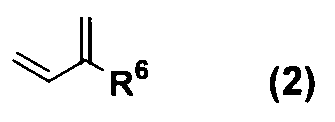
- the vinyl monomer is preferably a conjugated diene monomer represented by the following general formula (2).
- R 6 represents a hydrogen atom or a hydrocarbon group having 1 to 11 carbon atoms.
- the tertiary amine (C) is N, N, N ′, N ′′, N ′′ -pentamethyldiethylenetriamine or N, N, N ′, N ′′, N ′ ′′, N ′ ′′.
- -It is preferably hexamethyltriethylenetetramine.
- the polymerization is performed by anionic polymerization in the presence of a specific compound.
- the growth terminal anion draws a proton from the compound (B), and the newly generated carbon anion restarts the polymerization of the vinyl monomer to give a vinyl polymer having a controlled molecular weight.
- the production method of the present invention by setting the value obtained by dividing the mass (g) of the vinyl monomer used in the first step by the number of moles (mol) of the anionic polymerization initiator (A) to be used as a target molecular weight, The molecular weight of the resulting vinyl polymer can be controlled.
- the number average molecular weight of the obtained vinyl polymer can be controlled within an error range of usually 20% or less with respect to the target molecular weight.
- the number average molecular weight of the vinyl polymer obtained by the production method of the present invention is not particularly limited, but is usually 2,000 or more and 100,000 or less, and the effect of reducing the use amount of the anionic polymerization initiator (A) is obtained.
- the number average molecular weight is preferably 20,000 or less, and more preferably 10,000 or less from the viewpoint of becoming prominent.
- a vinyl polymer having a single peak and a narrow molecular weight distribution can be obtained.
- the molecular weight distribution of the obtained vinyl polymer is usually less than 2, preferably less than 1.8, and more preferably less than 1.6.
- Each step of the production method of the present invention is desirably performed under dry conditions in an atmosphere of an inert gas such as nitrogen or argon.
- Each step of the production method of the present invention is preferably carried out in an organic solvent from the viewpoints of controlling the polymerization temperature, homogenizing the polymerization system, anionic polymerization, facilitating the termination reaction, and the like.
- the organic solvent that can be used is preferably an organic solvent that does not participate in anionic polymerization and can dissolve the obtained vinyl polymer.
- an aliphatic saturated hydrocarbon compound or aromatic Aromatic hydrocarbon compounds are preferred, aliphatic saturated hydrocarbon compounds are more preferably hexane, heptane, nonane, decane, cyclohexane, methylcyclohexane, and aromatic hydrocarbon compounds are benzene, toluene, ethylbenzene, toluene, isopropylbenzene, Xylene and the like are more preferable.
- These aliphatic saturated hydrocarbon compounds or aromatic hydrocarbon compounds may contain ethers such as tetrahydrofuran, dioxane, and trioxane within the range not exceeding the object of the present invention.
- the amount of the organic solvent used is preferably in the range of 20 to 400 parts by mass, more preferably in the range of 30 to 300 parts by mass, with respect to 100 parts by mass of the total amount of vinyl monomers used.
- first step In the first step, one or more vinyl monomers selected from a conjugated diene monomer and a vinyl aromatic monomer are subjected to anionic polymerization in the presence of an anionic polymerization initiator (A). .
- the vinyl monomer used in the first step is selected from a conjugated diene monomer and a vinyl aromatic monomer, and may be used alone or in combination of two or more.
- conjugated diene monomer examples include butadiene, isoprene, pentadiene, 7-methyl-3-methylene-1,6-octadiene, and the like.
- vinyl aromatic monomer examples include styrene, ⁇ -alkyl-substituted styrene, nuclear alkyl-substituted styrene, and nuclear halogen-substituted styrene.
- ⁇ -methylstyrene, ⁇ -methyl-4-methylstyrene, 4-methylstyrene, 3-methylstyrene, 2-methylstyrene, 4-ethylstyrene, 2,4-dimethylstyrene, 2,5-dimethylstyrene, 4-isopropylstyrene, 2,4,6-trimethylstyrene, 4- Chlorostyrene and the like are preferable, and styrene, ⁇ -methylstyrene and 4-methylstyrene are more preferable.
- the conjugated diene monomer represented by the general formula (2) is preferable, and butadiene and isoprene are more preferable because of the high proton abstraction rate from the compound (B).
- anionic polymerization initiator (A) examples include organic alkali metals, organic alkaline earth metals, alkali metals, organic zinc, and organic aluminum.
- organic alkali metal examples include methyl lithium, n-butyl lithium, sec-butyl lithium, t-butyl lithium, isopropyl lithium, n-propyl lithium, isopropyl lithium phenyl lithium, benzyl lithium, hexyl lithium, butyl sodium, and butyl potassium. Can be mentioned.
- Examples of the organic alkaline earth metal include methylmagnesium chloride, methylmagnesium bromide, methylmagnesium iodide, ethylmagnesium bromide, propylmagnesium bromide, phenylmagnesium chloride, phenylmagnesium bromide, dibutylmagnesium and the like.
- Examples of the alkali metal include lithium, sodium, and potassium.
- Examples of the organic zinc include diethyl zinc, dibutyl zinc, ethyl butyl zinc and the like.
- organic aluminum examples include trimethylaluminum, triethylaluminum, methylbisphenoxyaluminum, isopropylbisphenoxyaluminum, bis (2,6-di-t-butylphenoxy) methylaluminum, bis (2,6-di-t-butyl-4) -Methylphenoxy) methylaluminum and the like. These may be used alone or in combination of two or more.
- an anionic polymerization initiator (A) is usually added to an organic solvent adjusted to the polymerization temperature, and then a vinyl monomer is added.
- a block copolymer can be obtained by adding another type of vinyl monomer. Random copolymerization can also be performed by adding a mixture of two or more vinyl monomers at once.
- the anionic polymerization in the first step is preferably performed until all of the added vinyl monomer is consumed and the anionic polymerization is completed. The completion of anionic polymerization can be confirmed by, for example, sampling from a polymerization reaction solution during anionic polymerization and measuring the molecular weight of the vinyl polymer in the system.
- the temperature of the anionic polymerization in the first step is preferably in the range of ⁇ 20 to 150 ° C., more preferably in the range of 0 to 120 ° C., and further preferably in the range of 0 to 100 ° C.
- this temperature is lower than ⁇ 20 ° C., the rate of anionic polymerization is slow, which is not preferable from the viewpoint of industrial productivity.
- the temperature exceeds 150 ° C., side reactions such as termination reaction frequently occur, and it may be difficult to control the molecular weight, or the obtained vinyl polymer may be colored.
- the temperature of the anionic polymerization in the first step need not be constant.
- a compound (B) represented by the following general formula (1) is added to the system subjected to anionic polymerization, and a tertiary amine (C) having three or more nitrogen atoms is converted into an anionic polymerization initiator.
- a proton abstraction reaction is performed in the range of 0.5 to 15 moles per mole.
- n 2 or 3
- R 1 to R 5 each represents a hydrogen atom or a hydrocarbon group having 1 to 8 carbon atoms.
- Examples of the hydrocarbon group having 1 to 8 carbon atoms represented by R 1 to R 5 in the general formula (1) include methyl group, ethyl group, propyl group, isopropyl group, allyl group, methallyl group, n-butyl group, sec- Examples include butyl group, t-butyl group, amyl group, hexyl group, octyl group, phenyl group, tolyl group, benzyl group, mesityl group and the like.
- R 1 to R 5 are preferably hydrogen atoms from the viewpoint of availability.
- the compound (B) include diphenylmethane, di (2-methylphenyl) methane, di (3-methylphenyl) methane, di (4-methylphenyl) methane, 1,3-dibenzyltoluene, 5-methyl 1,3-dibenzyltoluene, triphenylmethane, tri (2-methylphenyl) methane, tri (3-methylphenyl) methane, tri (4-methylphenyl) methane, etc., among which diphenylmethane and triphenyl Methane is preferred.
- These compounds (B) may be used alone or in combination of two or more.
- Compound (B) has a structure in which an aromatic ring is bonded to methylene carbon or methine carbon, and protons on methylene carbon or methine carbon are easily extracted to the polymerization growth terminal anion by the effect of the aromatic ring.
- the amount of the compound (B) used is in the range of 0.95 to 1.05 moles per mole of the anionic polymerization initiator (A) from the viewpoint of producing a vinyl polymer having a narrow molecular weight distribution.
- the anion polymerization initiator (A) and the compound (B) are used in equal amounts.
- tertiary amine (C) having three or more nitrogen atoms all nitrogen atoms existing in the molecular structure are three or more amines.
- the tertiary amine (C) preferably has a linear and / or cyclic hydrocarbon group.
- tertiary amine (C) for example, N, N, N ′, N ′′, N ′′ -pentamethyldiethylenetriamine, 2,6,10-trimethyl-2,6,10-triazaundecane, N, N , N ', N' ', N' ', N '' '-hexamethyltriethylenetetramine, N, N, N, N', N '', N '' ', N' '' ', N' '' ', N' '' '-Heptamethyltetramethylenepentamine, tris [2- (N, N-dimethylamino) ethyl] amine, 1,3,5-trimethylhexahydro-1,3,5-triazine, 1,4,7-trimethyl -1,4,7-triazacyclononane, 1,5,9-trimethyl-1,5,9-triazacyclodecane, 1,4,8,11-tetramethyl-1,4,8,11- Te
- the tertiary amine (C) may be present in the system at least in the second step, and the addition method is not limited.
- the conjugated diene monomer is anionically polymerized in the first step, it is preferably added together with the compound (B) at the start of the second step in order to increase the 1,4-addition rate. In order to lower it, it is preferable to add at the start of the first step.
- the amount of the tertiary amine (C) used is in the range of 0.5 to 15 moles per mole of the anionic polymerization initiator (A), and more preferably in the range of 0.75 to 10 moles.
- the 1,4-addition rate in the case of anionic polymerization of a conjugated diene monomer, it is more preferably 7.5 mol times or less.
- the amount of the tertiary amine (C) used is less than 0.5 mol times based on 1 mol of the anionic polymerization initiator (A) with respect to the polymerization growth terminal anion, protons are rapidly extracted from the compound (B). Don't go on.
- the 1,4-addition rate tends to decrease when anionic polymerization of a conjugated diene monomer is performed. Become.
- the second step is performed after the anionic polymerization of the first step. Moreover, you may perform a 2nd process further, after performing the anionic polymerization of the 3rd process mentioned later.
- the second step is performed after the first step, the second step, and the third step in order, the tertiary amine (C) is already present in the system, so the tertiary amine (C) is added. There is no need.
- the second step is preferably performed in a state where the vinyl monomer in the system is consumed.
- the method for adding the compound (B) is not particularly limited.
- the reaction temperature of the proton abstraction reaction in the second step is preferably in the range of 0 ° C. to 150 ° C., more preferably in the range of 0 ° C. to 120 ° C., and still more preferably in the range of 0 ° C. to 100 ° C.
- the polymerization temperature in the first step and the third step and the reaction temperature in the second step may be the same.
- the reaction time in the second step is not particularly limited, but is usually preferably in the range of 10 to 120 minutes, more preferably in the range of 20 to 60 minutes.
- the vinyl monomer that can be used in the third step is the same as in the first step. If the vinyl monomers used in the first step and the third step are the same species, the resulting vinyl polymer is a single species, and if different, the mixture is a mixture of different vinyl polymers.
- the molecular weight distribution of the vinyl polymer obtained can be controlled by adjusting the ratio of the amount of vinyl monomer used in the first step and the third step. By using it, a vinyl polymer having a narrow molecular weight distribution can be obtained.
- the method for adding the vinyl monomer in the third step is not particularly limited, and is the same as in the first step. That is, batch addition or sequential addition may be performed.
- block copolymerization can be performed by adding another vinyl monomer.
- Random copolymerization can also be performed by adding a mixture of two or more kinds of vinyl monomers.
- the anionic polymerization in the third step is preferably performed until all of the added vinyl monomer is consumed and the anionic polymerization is completed. The completion of anionic polymerization can be confirmed by, for example, sampling from a polymerization reaction solution during anionic polymerization and measuring the molecular weight of the vinyl polymer in the system.
- the temperature of the anionic polymerization in the third step is the same as that in the first step and does not need to be constant.
- the second step and the third step can be repeated a plurality of times before the fourth step is performed.
- the anionic polymerization is stopped after the third step.
- a well-known method is applicable. For example, a method of adding a terminator such as water, alcohols such as methanol, ethanol, 2-propanol; proton acids such as carboxylic acids such as acetic acid; Moreover, after adding terminal modifiers, such as ethylene oxide and a carbon dioxide, the method of adding terminators, such as a proton acid, is also applicable.
- the method for isolating the vinyl polymer after the fourth step there is no particular limitation on the method for isolating the vinyl polymer after the fourth step.
- the vinyl polymer solution after finishing the fourth step is added to an organic solvent (poor solvent) having a low solubility of the vinyl polymer to precipitate the vinyl polymer, and then is simply filtered.
- cleans and removes a water-soluble component, and distills an organic solvent etc. is mentioned.
- ⁇ -Methylstyrene manufactured by Wako Pure Chemical Industries, Ltd., molecular sieves were added to a special grade reagent and dried. Activated alumina was added and the polymerization inhibitor was adsorbed and removed, followed by deaeration with argon.
- 4-Methylstyrene manufactured by Wako Pure Chemical Industries, Ltd., molecular sieves were added to a special grade reagent, dried, activated alumina was added and the polymerization inhibitor was adsorbed and removed, and then degassed with argon.
- n-Butyllithium (n-BuLi) manufactured by Kanto Chemical Co., Ltd., 1.6M n-hexane solution sec-Butyllithium (sec-BuLi): manufactured by Kanto Chemical Co., Ltd., 1.0M cyclohexane solution t-Butyllithium (T-BuLi): 1.6M pentane solution [compound (B)] manufactured by Kanto Chemical Co., Inc.
- Diphenylmethane manufactured by Wako Pure Chemical Industries, Ltd., molecular sieves were placed in a special grade reagent, and degassed with argon.
- Triphenylmethane manufactured by Tokyo Chemical Industry Co., Ltd. was used as it was.
- PMDETA Tertiary amine
- Molecular sieves were added to a special grade reagent and degassed with argon.
- Example 1 Hexane (20 mL), n-BuLi (hexane solution, 2.0 mmol), and butadiene (16 mL, 184 mmol) were fed into a 100 mL autoclave. After stirring at 70 ° C. for 30 minutes, diphenylmethane (0.33 mL, 2.0 mmol) was added followed by PMDETA (0.31 mL, 1.5 mmol). After stirring at 70 ° C. for 30 minutes, butadiene (16 mL, 184 mmol) was fed and further stirred at 70 ° C. for 1 hour. After returning to room temperature, 0.5 mL of methanol was added to stop anionic polymerization.
- Example 2 Polybutadiene was obtained in the same manner as in Example 1 except that HMTETA (0.41 mL, 1.5 mmol) was added instead of PMDETA (0.31 mL, 1.5 mmol). Mn of the obtained polybutadiene was 5,100, Mw / Mn was 1.30, and 1,4-addition rate was 76%.
- Example 3 Hexane (20 mL), n-BuLi (hexane solution, 2.0 mmol) and butadiene (16 mL, 184 mmol) were fed into a 100 mL autoclave, stirred at 70 ° C. for 30 minutes, then diphenylmethane (0.33 mL, 2.0 mmol), then PMDETA (0.31 mL, 1.5 mmol) was added. After stirring at 70 ° C. for 30 minutes, butadiene (16 mL, 184 mmol) was fed and further stirred at 70 ° C. for 1 hour. Then, diphenylmethane (0.33 mL, 2.0 mmol) was added, and the mixture was stirred at 70 ° C.
- Example 4 A polybutadiene was obtained in the same manner as in Example 1 except that triphenylmethane (489 mg, 2.0 mmol) was added instead of diphenylmethane (0.33 mL, 2.0 mmol). Mn of the obtained polybutadiene was 5,100, Mw / Mn was 1.20, and 1,4-addition rate was 77%.
- Example 5 Hexane (20 mL), n-BuLi (hexane solution, 2.0 mmol) and isoprene (14.6 mL, 146 mmol) were fed into a 100 mL autoclave, stirred at 70 ° C. for 1 hour, diphenylmethane (0.33 mL, 2.0 mmol), then PMDETA ( 0.62 mL, 3.0 mmol) was added. After stirring at 70 ° C. for 30 minutes, isoprene (14.6 mL, 146 mmol) was fed, and further stirred at 70 ° C. for 1 hour. After returning to room temperature, 0.5 mL of methanol was added to stop the polymerization.
- the obtained polyisoprene solution was dropped into methanol (500 mL) to precipitate a solid content, and then the supernatant was removed, followed by drying at 30 Pa and 50 ° C. for 6 hours to obtain polyisoprene.
- the obtained polyisoprene had Mn of 5,800, Mw / Mn of 1.55, and 1,4-addition rate of 71%.
- Example 6 Cyclohexane (20 mL), t-BuLi (pentane solution, 2.0 mmol), and styrene (11 mL, 96 mmol) were fed into a 100 mL autoclave. After stirring at 50 ° C. for 45 minutes, diphenylmethane (0.33 mL, 2.0 mmol) was added followed by HMTETA (2.7 mL, 10 mmol). After stirring at 70 ° C. for 30 minutes, styrene (11 mL, 96 mmol) was fed, and further stirred at 70 ° C. for 1 hour. After returning to room temperature, 0.5 mL of methanol was added to stop the polymerization.
- the obtained polystyrene solution was dropped into methanol (500 mL) to precipitate a solid content, and then the supernatant was removed, followed by drying at 30 Pa and 50 ° C. for 6 hours to obtain polystyrene.
- Mn of the obtained polystyrene was 5,100, and Mw / Mn was 1.20.
- Example 7 Cyclohexane (20 mL), sec-BuLi (cyclohexane solution, 2.0 mmol), butadiene (8.0 mL, 92 mmol), and styrene (5.5 mL, 48 mmol) were fed into a 100 mL autoclave. After stirring at 70 ° C. for 30 minutes, diphenylmethane (0.33 mL, 2.0 mmol) was added followed by HMTETA (0.54 mL, 2.0 mmol). After stirring at 70 ° C for 30 minutes, butadiene (8.0 mL, 92 mmol) and styrene (5.5 mL, 48 mmol) are fed, and further stirred at 70 ° C for 1 hour.
- the obtained butadiene-styrene copolymer solution was dropped into methanol (500 mL) to precipitate a solid content, and then the supernatant was removed, followed by drying at 30 Pa and 50 ° C. for 6 hours. A polymer was obtained.
- the obtained butadiene-styrene copolymer had an Mn of 5,500, an Mw / Mn of 1.30, and a 1,4-addition rate of 76%.
- Example 8 Methylcyclohexane (20 mL), sec-BuLi (cyclohexane solution, 2.0 mmol) and ⁇ -methylstyrene (11.2 mL, 85 mmol) were fed into a 100 mL autoclave. After stirring at 0 ° C. for 50 minutes, diphenylmethane (0.33 mL, 2.0 mmol) was added followed by HMTETA (2.7 mL, 10 mmol). After stirring at 40 ° C. for 45 minutes, ⁇ -methylstyrene (11.2 mL, 85 mmol) was fed and further stirred at 0 ° C. for 1 hour.
- the obtained poly ( ⁇ -methylstyrene) had Mn of 4,800 and Mw / Mn of 1.40.
- Example 9 Cyclohexane (20 mL), sec-BuLi (cyclohexane solution, 2.0 mmol) and 4-methylstyrene (11.1 mL, 85 mmol) were fed to a 100 mL autoclave. After stirring at 60 ° C. for 45 minutes, diphenylmethane (0.33 mL, 2.0 mmol) was added followed by HMTETA (2.7 mL, 10 mmol). After stirring at 70 ° C. for 30 minutes, 4-methylstyrene (11.1 mL, 85 mmol) was fed, and further stirred at 60 ° C. for 1 hour. After returning to room temperature, 0.5 mL of methanol was added to stop the polymerization.
- the obtained poly (4-methylstyrene) solution was dropped into methanol (500 mL) to precipitate a solid content, and then the supernatant was removed, followed by drying at 30 Pa and 50 ° C. for 6 hours. Methyl styrene) was obtained. Mn of the obtained poly (4-methylstyrene) was 5,300, and Mw / Mn was 1.35.
- Example 1 Polybutadiene was obtained in the same manner as in Example 1 except that TMEDA (0.23 mL, 1.5 mmol) was added instead of PMDETA (0.31 mL, 1.5 mmol). Mn of the obtained polybutadiene was 7,600, and Mw / Mn was 2.25. The GPC chromatogram was bimodal. In Example 1 using a tertiary amine having three nitrogen atoms (PMDETA), it is close to the target molecular weight (number of moles of butadiene used in the first step ⁇ molecular weight of butadiene / number of moles of n-BuLi used ⁇ 5,000).
- TMEDA 0.23 mL, 1.5 mmol
- PMDETA tertiary amine having three nitrogen atoms
- Mn polybutadiene was obtained, Mn of polybutadiene obtained in this comparative example using a tertiary amine having two nitrogen atoms (TMEDA) deviated significantly from the above target molecular weight. Is also wide. This is considered because the proton abstraction reaction in this comparative example is extremely slow.
- TEDA tertiary amine having two nitrogen atoms
- Example 2 Polystyrene was obtained in the same manner as in Example 6 except that TMEDA (1.51 mL, 10 mmol) was added instead of HMTETA (2.7 mL, 10 mmol). Mn of the obtained polystyrene was 8,900, and Mw / Mn was 2.34. The GPC chromatogram was bimodal. In Example 6 using a tertiary amine (HMTETA) having four nitrogen atoms, the Mn was close to the target molecular weight (number of moles of styrene used in the first step ⁇ molecular weight of styrene / number of moles of t-BuLi ⁇ 5,000).
- HMTETA tertiary amine
- Mn of polystyrene obtained in this comparative example using a tertiary amine having two nitrogen atoms (TMEDA) deviated greatly from the target molecular weight, and the molecular weight distribution was wide. This is presumably because the proton pull-out reaction in this comparative example is extremely slow.
- the obtained polybutadiene solution was dropped into methanol (500 mL) to precipitate a solid content, and then the supernatant was removed, followed by drying at 30 Pa and 50 ° C. for 6 hours to obtain polybutadiene.
- the polymer solution was put into methanol (500 mL).
- Mn of the obtained polybutadiene was 5,200
- Mw / Mn was 1.22
- 1,4-addition rate was 52%.
- the amount of PMDETA used was 20 mol times that of n-BuLi
- polybutadiene having a 1,4-addition rate lower than that in Example 1 in which the amount used was 0.75 mol times was obtained.
- Comparative Example 4 Polybutadiene was obtained in the same manner as in Example 2 except that TMEDA (0.46 mL, 3.0 mmol) was added instead of HMTETA (0.41 mL, 1.5 mmol). Mn of the obtained polybutadiene was 6,800, Mw / Mn was 2.01, and 1,4-addition rate was 68%. The GPC chromatogram was bimodal. When Example 2 and Comparative Example 4 are compared, the number of moles of nitrogen atoms in the tertiary amine used is equal to 6.0 mmol.
- Example 2 using a tertiary amine having four nitrogen atoms HMTETA
- a polybutadiene having a molecular weight distribution (Mw / Mn) close to 1 was obtained, whereas a tertiary having two nitrogen atoms was obtained.
- the molecular weight distribution of the polybutadiene obtained in this comparative example using amine (TMEDA) is wide. This is presumably because the proton abstraction reaction is extremely slow in this comparative example using a tertiary amine having two nitrogen atoms.
- Table 1 shows the polymerization conditions and results of the above Examples and Comparative Examples.
- the vinyl polymer obtained by the production method of the present invention can be used for applications such as molding materials, plasticizers, pressure-sensitive adhesives, and adhesives.
Landscapes
- Chemical & Material Sciences (AREA)
- Health & Medical Sciences (AREA)
- Chemical Kinetics & Catalysis (AREA)
- Medicinal Chemistry (AREA)
- Polymers & Plastics (AREA)
- Organic Chemistry (AREA)
- Addition Polymer Or Copolymer, Post-Treatments, Or Chemical Modifications (AREA)
- Polymerisation Methods In General (AREA)
Abstract
【課題】アニオン重合開始剤の使用量を抑制しつつ、分子量の制御が容易で、単峰性で分子量分布が狭いビニル系重合体を製造する方法を提供すること。 【解決手段】共役ジエン系単量体及びビニル芳香族系単量体から選ばれる1種または2種以上のビニル系単量体をアニオン重合開始剤(A)の存在下にアニオン重合を行う第1工程;アニオン重合を行った系内に一般式(1)で示される化合物(B)を添加し、前記アニオン重合開始剤(A)1モルに対して0.5~15モル倍の3つ以上の窒素原子を有する3級アミン(C)の存在下にプロトン引き抜き反応を行う第2工程;プロトン引き抜き反応を行った系内に前記ビニル系単量体を添加してアニオン重合を行う第3工程;および第3工程終了後にアニオン重合を停止する第4工程;を含むビニル系重合体の製造方法。 [式中、nは2または3であり、R1~R5は水素原子または炭素数1~8の炭化水素基を表す]
Description
本発明は、共役ジエン系単量体およびビニル芳香族系単量体から選ばれるビニル系重合体の製造方法に関する。
ブタジエン、イソプレン、スチレンに代表されるビニル系単量体のアニオン重合において、例えば、アルキルリチウムをアニオン重合開始剤に用いた場合、重合成長末端アニオンの連鎖移動反応及び停止反応が抑制された、いわゆるリビングアニオン重合が進行するので、分子量の制御が容易になり、単峰性で分子量分布の狭い(例えば2未満)ビニル系重合体が得られる。また、重合成長末端アニオンにさらに様々な単量体や反応剤を反応させることで、ブロック共重合体や末端修飾されたビニル系重合体を製造することもできる。
ビニル系単量体のリビングアニオン重合では、アニオン重合開始剤1分子からビニル系重合体1分子が生成し、使用するビニル系単量体とアニオン重合開始剤の使用量比(モル比)を調節することによって、得られるビニル系重合体の分子量が制御できる。このため、所望の分子量のビニル系重合体を製造する場合、必要なアニオン重合開始剤のモル数が一義的に決定される。したがって、ビニル系単量体のリビングアニオン重合では、アニオン重合開始剤のコスト削減が求められている。
特定の芳香環含有化合物および特定のアミンの存在下にビニル系単量体のアニオン重合を行うと、アニオン重合開始剤および重合成長末端アニオンが、前記芳香環含有化合物からプロトンを引き抜き、アニオン重合を停止するとともに芳香環含有化合物に由来する新たなアニオンが生成すること、さらについで該アニオンを起点としてアニオン重合を開始することが知られている。この方法によれば、アニオン重合開始剤の使用量および原料コストの削減が期待できる。
例えば、アニオン重合開始剤としてブチルリチウムを用い、芳香環含有化合物としてトルエンまたはジフェニルメタンを用い、アミンとしてN,N,N’,N’-テトラメチルエチレンジアミン(TMEDA)を用いた、ブタジエンのアニオン重合が知られている(非特許文献1)。しかしながらこの方法では、アニオン重合開始剤から開始されるアニオン重合と、前記芳香環含有化合物に由来するアニオンから開始されるアニオン重合との重合速度が異なることから、前記芳香環含有化合物に由来するアニオンから開始されるアニオン重合が実質的に進行しなかったり、得られるビニル系重合体の分子量分布が広くなったりする。
例えば、アニオン重合開始剤としてブチルリチウムを用い、芳香環含有化合物としてトルエンまたはジフェニルメタンを用い、アミンとしてN,N,N’,N’-テトラメチルエチレンジアミン(TMEDA)を用いた、ブタジエンのアニオン重合が知られている(非特許文献1)。しかしながらこの方法では、アニオン重合開始剤から開始されるアニオン重合と、前記芳香環含有化合物に由来するアニオンから開始されるアニオン重合との重合速度が異なることから、前記芳香環含有化合物に由来するアニオンから開始されるアニオン重合が実質的に進行しなかったり、得られるビニル系重合体の分子量分布が広くなったりする。
一方、ビニル系単量体のアニオン重合を完了させた系内に、特定の芳香環含有化合物および特定のアミンを添加し、同様に芳香環含有化合物に由来する新たなアニオンを生成させ、ついで新たなビニル系単量体を添加してアニオン重合を再開始する方法が知られている(非特許文献2)。この方法によれば、アニオン重合開始剤の使用量および原料コストを削減しつつ、分子量分布の狭いビニル系重合体が得られる。しかし、前記特定の芳香環含有化合物からのプロトンの引き抜きを短時間で行うには、前記アミンを大量に用いる必要があり、原料コストの削減の観点から好ましくない。また、ビニル系単量体として共役ジエンを用いた場合、アミンを大量に用いてアニオン重合すると1,4-付加率が低下し、粘着剤などの用途に不向きなものとなる。
ポリマー(Polymer) 第26巻, 1265-1267頁 (1985年)
マクロモレキュラー・シンポジア(Macromolecular Symposia) 第107巻, 199-208 頁 (1996年)
しかして本発明の目的は、アニオン重合開始剤およびアミンの使用量を削減しつつ、単峰性で分子量分布の狭い所望の分子量のビニル系重合体の製造方法を提供することにある。
本発明によれば、上記の目的は、
共役ジエン系単量体及びビニル芳香族系単量体から選ばれる1種または2種以上のビニル系単量体をアニオン重合開始剤(A)の存在下でアニオン重合を行う第1工程;アニオン重合を行った系内に、下記一般式(1)で示される化合物(B)を添加し、かつ3つ以上の窒素原子を有する3級アミン(C)を前記アニオン重合開始剤(A)1モルに対して0.5~15モル倍の範囲で存在させて、プロトン引き抜き反応を行う第2工程;プロトン引き抜き反応を行った系内に、共役ジエン系単量体及びビニル芳香族系単量体から選ばれる1種または2種以上のビニル系単量体を添加してアニオン重合を行う第3工程;および第3工程終了後にアニオン重合を停止する第4工程;を含むビニル系重合体の製造方法を提供することによって達成される。
共役ジエン系単量体及びビニル芳香族系単量体から選ばれる1種または2種以上のビニル系単量体をアニオン重合開始剤(A)の存在下でアニオン重合を行う第1工程;アニオン重合を行った系内に、下記一般式(1)で示される化合物(B)を添加し、かつ3つ以上の窒素原子を有する3級アミン(C)を前記アニオン重合開始剤(A)1モルに対して0.5~15モル倍の範囲で存在させて、プロトン引き抜き反応を行う第2工程;プロトン引き抜き反応を行った系内に、共役ジエン系単量体及びビニル芳香族系単量体から選ばれる1種または2種以上のビニル系単量体を添加してアニオン重合を行う第3工程;および第3工程終了後にアニオン重合を停止する第4工程;を含むビニル系重合体の製造方法を提供することによって達成される。
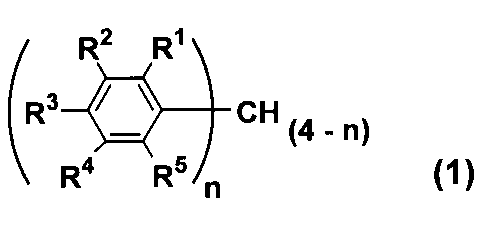
[式中、nは2または3であり、R1~R5は水素原子または炭素数1~8の炭化水素基を表す。]
前記ビニル系単量体は、下記一般式(2)で示される共役ジエン系単量体であることが好ましい。
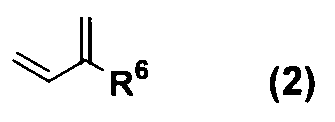
[式中、R6は水素原子または炭素数1~11の炭化水素基を表す。]
また、前記3級アミン(C)は、N,N,N’,N’’,N’’-ペンタメチルジエチレントリアミンまたはN,N,N’,N’’,N’’’,N’’’-ヘキサメチルトリエチレンテトラミンであることが好ましい。
本発明の製造方法によれば、共役ジエン系単量体およびビニル芳香族系単量体から選ばれるビニル系単量体のアニオン重合において、特定の化合物の存在下でアニオン重合することで、重合成長末端アニオンが化合物(B)からプロトンを引き抜き、新たに生成した炭素アニオンがビニル系単量体の重合を再開始し、分子量が制御されたビニル系重合体を与える。このことによって、アニオン重合開始剤の使用量を抑制しつつ、分子量の制御が容易であり、単峰性で分子量分布の狭いビニル系重合体を製造することができる。
本発明の製造方法では、第1工程で用いるビニル系単量体の質量(g)を、用いるアニオン重合開始剤(A)のモル数(mol)で除した値を目標分子量として定めることで、得られるビニル系重合体の分子量を制御できる。得られるビニル系重合体の数平均分子量は目標分子量に対して通常20%以内の誤差範囲で制御できる。
本発明の製造方法で得られるビニル系重合体の数平均分子量に特に制限はないが、通常、2,000以上100,000以下であり、アニオン重合開始剤(A)の使用量低減の効果が顕著となる観点から数平均分子量20,000以下が好ましく、10,000以下がより好ましい。本発明の製造方法では単峰性で分子量分布の狭いビニル系重合体を得ることができる。得られるビニル系重合体の分子量分布は通常2未満であり、1.8未満であることが好ましく、1.6未満であることがより好ましい。
本発明の製造方法の各工程は、窒素、アルゴンなどの不活性ガス雰囲気下で、乾燥条件下に行うことが望ましい。
本発明の製造方法の各工程は、重合温度の制御、重合系内の均一化、アニオン重合、停止反応の円滑化等の観点から、有機溶媒中で行うことが好ましい。用いることのできる有機溶媒としては、アニオン重合に関与せず、かつ得られるビニル系重合体を溶解できる有機溶媒が好ましく、連鎖移動反応および停止反応を抑制する観点から脂肪族飽和炭化水素化合物または芳香族系炭化水素化合物が好ましく、脂肪族飽和炭化水素化合物としてはヘキサン、ヘプタン、ノナン、デカン、シクロヘキサン、メチルシクロヘキサンがより好ましく、芳香族炭化水素化合物としてはベンゼン、トルエン、エチルベンゼン、トルエン、イソプロピルベンゼン、キシレン等がより好ましい。これらの脂肪族飽和炭化水素化合物または芳香族系炭化水素化合物に本発明の目的を超えない範囲で、テトラヒドロフラン、ジオキサン、トリオキサン等のエーテルを含有させてもよい。
有機溶媒の使用量は、用いるビニル系単量体の総量100質量部に対して、20~400質量部の範囲が好ましく、30~300質量部の範囲がより好ましい。
以下、各工程について詳細に説明する。
[第1工程]
第1工程では、共役ジエン系単量体及びビニル芳香族系単量体から選ばれる1種または2種以上のビニル系単量体をアニオン重合開始剤(A)の存在下でアニオン重合を行う。
第1工程では、共役ジエン系単量体及びビニル芳香族系単量体から選ばれる1種または2種以上のビニル系単量体をアニオン重合開始剤(A)の存在下でアニオン重合を行う。
第1工程で用いられるビニル系単量体は、共役ジエン系単量体およびビニル芳香族系単量体から選ばれ、1種類を単独で用いても、2種類以上を併用してもよい。
上記共役ジエン系単量体としては、ブタジエン、イソプレン、ペンタジエン、7-メチル-3-メチレン-1,6-オクタジエン等が挙げられる。
上記ビニル芳香族系単量体としては、スチレン、α-アルキル置換スチレン、核アルキル置換スチレン、核ハロゲン置換スチレン等が挙げられ、このうち、α-メチルスチレン、α-メチル-4-メチルスチレン、4-メチルスチレン、3-メチルスチレン、2-メチルスチレン、4-エチルスチレン、2,4-ジメチルスチレン、2,5-ジメチルスチレン、4-イソプロピルスチレン、2,4,6-トリメチルスチレン、4-クロロスチレン等が好ましく、スチレン、α-メチルスチレンおよび4-メチルスチレンがより好ましい。
これらビニル系単量体のうち、化合物(B)からのプロトン引き抜き速度の高さから、上記一般式(2)で示される共役ジエン系単量体が好ましく、ブタジエンおよびイソプレンがより好ましい。
アニオン重合開始剤(A)としては、有機アルカリ金属、有機アルカリ土類金属、アルカリ金属、有機亜鉛、有機アルミニウムが挙げられる。
有機アルカリ金属としては、メチルリチウム、n-ブチルリチウム、sec-ブチルリチウム、t-ブチルリチウム、イソプロピルリチウム、n-プロピルリチウム、イソプロピルリチウムフェニルリチウム、ベンジルリチウム、ヘキシルリチウム、ブチルナトリウム、ブチルカリウム等が挙げられる。
有機アルカリ土類金属としては、メチルマグネシウムクロリド、メチルマグネシウムブロミド、メチルマグネシウムヨージド、エチルマグネシウムブロミド、プロピルマグネシウムブロミド、フェニルマグネシウムクロリド、フェニルマグネシウムブロミド、ジブチルマグネシウム等が挙げられる。
アルカリ金属としては、リチウム、ナトリウム、カリウム等が挙げられる。
有機亜鉛としては、ジエチル亜鉛、ジブチル亜鉛、エチルブチル亜鉛等が挙げられる。
有機アルミニウムとしては、トリメチルアルミニウム、トリエチルアルミニウム、メチルビスフェノキシアルミニウム、イソプロピルビスフェノキシアルミニウム、ビス(2,6-ジ-t-ブチルフェノキシ)メチルアルミニウム、ビス(2,6-ジ-t-ブチル-4-メチルフェノキシ)メチルアルミニウム等が挙げられる。
これらは1種類を単独で用いても、2種類以上を併用してもよい。
有機アルカリ金属としては、メチルリチウム、n-ブチルリチウム、sec-ブチルリチウム、t-ブチルリチウム、イソプロピルリチウム、n-プロピルリチウム、イソプロピルリチウムフェニルリチウム、ベンジルリチウム、ヘキシルリチウム、ブチルナトリウム、ブチルカリウム等が挙げられる。
有機アルカリ土類金属としては、メチルマグネシウムクロリド、メチルマグネシウムブロミド、メチルマグネシウムヨージド、エチルマグネシウムブロミド、プロピルマグネシウムブロミド、フェニルマグネシウムクロリド、フェニルマグネシウムブロミド、ジブチルマグネシウム等が挙げられる。
アルカリ金属としては、リチウム、ナトリウム、カリウム等が挙げられる。
有機亜鉛としては、ジエチル亜鉛、ジブチル亜鉛、エチルブチル亜鉛等が挙げられる。
有機アルミニウムとしては、トリメチルアルミニウム、トリエチルアルミニウム、メチルビスフェノキシアルミニウム、イソプロピルビスフェノキシアルミニウム、ビス(2,6-ジ-t-ブチルフェノキシ)メチルアルミニウム、ビス(2,6-ジ-t-ブチル-4-メチルフェノキシ)メチルアルミニウム等が挙げられる。
これらは1種類を単独で用いても、2種類以上を併用してもよい。
第1工程では、通常、重合温度に調整した有機溶媒中に、アニオン重合開始剤(A)を添加し、次いでビニル系単量体を添加する。
ビニル系単量体の添加方法に特に制限はなく、一括添加でも逐次添加でもよい。例えばビニル系単量体のアニオン重合の終了を確認後、別の種類のビニル系単量体を添加することでブロック共重合体を得ることができる。また、2種以上のビニル系単量体の混合物を一括して添加することでランダム共重合することもできる。第1工程におけるアニオン重合は、添加したビニル系単量体がすべて消費されてアニオン重合が終了するまで行うことが好ましい。アニオン重合の終了は、例えば、アニオン重合中の重合反応液からサンプリングして系内のビニル系重合体の分子量を測定することによって確認できる。
第1工程におけるアニオン重合の温度は-20~150℃の範囲が好ましく、0~120℃の範囲がより好ましく、0~100℃の範囲がさらに好ましい。この温度が、-20℃より低いと、アニオン重合の速度が遅く、工業生産性の観点から好ましくない場合がある。またこの温度が、150℃を超えると、停止反応等の副反応が頻繁に起こり、分子量の制御が困難となったり、得られたビニル系重合体が着色する場合がある。かかる第1工程におけるアニオン重合の温度は、一定である必要はない。
[第2工程]
第2工程では、アニオン重合を行った系内に下記一般式(1)で示される化合物(B)を添加し、かつ3つ以上の窒素原子を有する3級アミン(C)をアニオン重合開始剤(A)1モルに対して0.5~15モル倍の範囲で存在させて、プロトン引き抜き反応を行う。
第2工程では、アニオン重合を行った系内に下記一般式(1)で示される化合物(B)を添加し、かつ3つ以上の窒素原子を有する3級アミン(C)をアニオン重合開始剤(A)1モルに対して0.5~15モル倍の範囲で存在させて、プロトン引き抜き反応を行う。
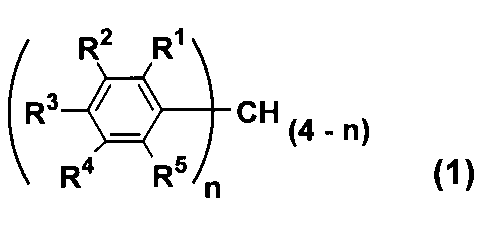
一般式(1)におけるR1~R5が表す炭素数1~8の炭化水素基としては、メチル基、エチル基、プロピル基、イソプロピル基、アリル基、メタリル基、n-ブチル基、sec-ブチル基、t-ブチル基、アミル基、ヘキシル基、オクチル基、フェニル基、トリル基、ベンジル基、メシチル基等が挙げられる。R1~R5は入手容易性の観点から、水素原子であることが好ましい。
化合物(B)の具体例としては、ジフェニルメタン、ジ(2-メチルフェニル)メタン、ジ(3-メチルフェニル)メタン、ジ(4-メチルフェニル)メタン、1,3-ジベンジルトルエン、5-メチル-1,3-ジベンジルトルエン、トリフェニルメタン、トリ(2-メチルフェニル)メタン、トリ(3-メチルフェニル)メタン、トリ(4-メチルフェニル)メタン等が挙げられ、このうちジフェニルメタンおよびトリフェニルメタンが好ましい。これら化合物(B)は、1種類を単独で用いても、2種類以上を併用してもよい。
化合物(B)はメチレン炭素もしくはメチン炭素に芳香環が結合した構造を有しており、芳香環の効果により、メチレン炭素もしくはメチン炭素上のプロトンが重合成長末端アニオンに引き抜かれやすい。
化合物(B)の使用量は、分子量分布の狭いビニル系重合体を製造する観点から、アニオン重合開始剤(A)1モルに対して0.95~1.05モル倍の範囲であることが好ましく、アニオン重合開始剤(A)と化合物(B)の使用量が等量であることが最も好ましい。
3つ以上の窒素原子を有する3級アミン(C)は、分子構造内に3つ以上存在するすべての窒素原子が3級アミンである。分子構造内に3つ以上の3級アミンを有することで、重合成長末端アニオンによる化合物(B)からのプロトンの引き抜きが迅速に進む。3級アミン(C)は、鎖状および/または環状の炭化水素基を有することが好ましい。3級アミン(C)としては、例えばN,N,N’,N’’,N’’-ペンタメチルジエチレントリアミン、2,6,10-トリメチル‐2,6,10-トリアザウンデカン、N,N,N’,N’’,N’’’,N’’’-ヘキサメチルトリエチレンテトラミン、N,N,N’,N’’,N’’’,N’’’’,N’’’’-ヘプタメチルテトラメチレンペンタミン、トリス[2-(N,N-ジメチルアミノ)エチル]アミン、1,3,5-トリメチルヘキサヒドロ-1,3,5-トリアジン、1,4,7-トリメチル-1,4,7-トリアザシクロノナン、1,5,9-トリメチル-1,5,9-トリアザシクロデカン、1,4,8,11-テトラメチル-1,4,8,11-テトラアザシクロテトラデカン、2,4,6-トリス(ジメチルアミノメチル)ベンゼン等が挙げられ、このうちN,N,N’,N’’,N’’-ペンタメチルジエチレントリアミン、N,N,N’,N’’,N’’’,N’’’-ヘキサメチルトリエチレンテトラミン、N,N,N’,N’’,N’’’,N’’’’,N’’’’-ヘプタメチルテトラメチレンペンタミンが好ましく、N,N,N’,N’’,N’’-ペンタメチルジエチレントリアミンおよびN,N,N’,N’’,N’’’,N’’’-ヘキサメチルトリエチレンテトラミンがより好ましい。
3級アミン(C)は少なくとも第2工程において系内に存在すればよく、添加方法に制限はない。第1工程で共役ジエン系単量体をアニオン重合する場合、1,4-付加率を高めるためには第2工程開始時に化合物(B)とともに添加することが好ましく、1,4-付加率を下げるためには第1工程開始時に添加することが好ましい。3級アミン(C)の使用量はアニオン重合開始剤(A)1モルに対して0.5~15モル倍の範囲であり、0.75~10モル倍の範囲であることがより好ましく、共役ジエン系単量体をアニオン重合する場合の1,4-付加率を高める上では7.5モル倍以下とすることがさらに好ましい。重合成長末端アニオンに対して、3級アミン(C)の使用量がアニオン重合開始剤(A)1モルに対して0.5モル倍よりも少ないと化合物(B)からのプロトンの引き抜きが迅速に進まない。また、アニオン重合開始剤(A)の使用量に対する3級アミン(C)の使用量を増やすにしたがって、共役ジエン系単量体をアニオン重合する場合の1,4-付加率が低下する傾向となる。
第2工程は第1工程のアニオン重合を行った後に行う。また、後述する第3工程のアニオン重合を行った後にさらに第2工程を行ってもよい。第1工程、第2工程、第3工程を順に行った後でさらに第2工程を行う場合は、既に系内に3級アミン(C)が存在するので、3級アミン(C)を添加する必要はない。
狭い分子量分布のビニル系重合体を得る観点から、第2工程は系内のビニル系単量体が消費された状態で行うことが好ましい。第2工程において、化合物(B)の添加方法に特に制限はない。第2工程のプロトン引き抜き反応の反応温度は0℃以上150℃以下の範囲が好ましく、0℃以上120℃以下の範囲がより好ましく、0℃以上100℃以下の範囲がさらに好ましい。第1工程および第3工程の重合温度ならびに第2工程の反応温度を同じにしてもよい。第2工程の反応時間に特に制限はないが、通常10~120分の範囲が好ましく、20~60分の範囲がさらに好ましい。
[第3工程]
第3工程では、プロトン引き抜き反応を行った系内に共役ジエン系単量体及びビニル芳香族系単量体から選ばれる1種または2種以上のビニル系単量体を添加してアニオン重合する。
第3工程では、プロトン引き抜き反応を行った系内に共役ジエン系単量体及びビニル芳香族系単量体から選ばれる1種または2種以上のビニル系単量体を添加してアニオン重合する。
第3工程で用いることができるビニル系単量体は、第1工程と同様である。第1工程および第3工程で用いられるビニル系単量体が同一種であれば、得られるビニル系重合体は単一種となり、異種であれば、異なるビニル系重合体の混合物となる。第1工程および第3工程で用いられるビニル系単量体の使用量の比率を調整することで得られるビニル系重合体の分子量分布を制御でき、同一種かつ同量のビニル系単量体を用いることで分子量分布の狭いビニル系重合体が得られる。
第3工程におけるビニル系単量体の添加方法に特に制限はなく、第1工程と同様である。すなわち、一括添加でも逐次添加でもよく、例えばビニル系単量体のアニオン重合の終了を確認後、別のビニル系単量体を添加することでブロック共重合することができる。また、2種以上のビニル系単量体の混合物を添加することでランダム共重合することもできる。第3工程におけるアニオン重合は、添加したビニル系単量体がすべて消費されてアニオン重合が終了するまで行うことが好ましい。アニオン重合の終了は、例えば、アニオン重合中の重合反応液からサンプリングして系内のビニル系重合体の分子量を測定することによって確認できる。
第3工程におけるアニオン重合の温度は第1工程と同様であり、一定である必要もない。第3工程の終了後、第4工程を実施する前に、第2工程および第3工程を複数回繰り返すことが可能である。
[第4工程]
第4工程では、第3工程終了後にアニオン重合を停止する。アニオン重合の停止方法に特に制限はなく、公知の方法を適用できる。例えば、第3工程を終えた系内に、水、メタノール、エタノール、2-プロパノール等のアルコール;酢酸等のカルボン酸等のプロトン酸;等の停止剤を添加する方法が挙げられる。また、エチレンオキシド、二酸化炭素等の末端修飾剤を添加した後に、プロトン酸等の停止剤を添加する方法も適用できる。第4工程を実施する温度に特に制限はなく、第4工程直前の第3工程終了時の温度でも、温度を変更してもよいが、末端修飾剤および停止剤の沸点以下であることが好ましい。
第4工程では、第3工程終了後にアニオン重合を停止する。アニオン重合の停止方法に特に制限はなく、公知の方法を適用できる。例えば、第3工程を終えた系内に、水、メタノール、エタノール、2-プロパノール等のアルコール;酢酸等のカルボン酸等のプロトン酸;等の停止剤を添加する方法が挙げられる。また、エチレンオキシド、二酸化炭素等の末端修飾剤を添加した後に、プロトン酸等の停止剤を添加する方法も適用できる。第4工程を実施する温度に特に制限はなく、第4工程直前の第3工程終了時の温度でも、温度を変更してもよいが、末端修飾剤および停止剤の沸点以下であることが好ましい。
[単離工程]
第4工程終了後に、ビニル系重合体を単離する方法に特に制限はない。例えば、第4工程を終えたビニル系重合体溶液を、ビニル系重合体の溶解性が低い有機溶媒(貧溶媒)中に添加することでビニル系重合体を析出させたのち、ろ過等によって単離する方法;第4工程を終えたビニル系重合体溶液に水を加え、水溶性成分を洗浄除去したのち、有機溶媒を留去する方法などが挙げられる。
第4工程終了後に、ビニル系重合体を単離する方法に特に制限はない。例えば、第4工程を終えたビニル系重合体溶液を、ビニル系重合体の溶解性が低い有機溶媒(貧溶媒)中に添加することでビニル系重合体を析出させたのち、ろ過等によって単離する方法;第4工程を終えたビニル系重合体溶液に水を加え、水溶性成分を洗浄除去したのち、有機溶媒を留去する方法などが挙げられる。
以下、本発明を実施例及び比較例により詳細に説明するが、本発明はこれら実施例により限定されない。
本実施例等に用いた原料の入手方法および精製方法を以下に示す。
[ビニル系単量体]
ブタジエン:JSR(株)製、モレキュラーシーブス3A(以下、単に「モレキュラーシーブス」と記載する)を入れて乾燥した。
イソプレン:(株)クラレ製、モレキュラーシーブスを入れて乾燥した。
スチレン:和光純薬工業(株)製、特級試薬にモレキュラーシーブスを入れて乾燥し、活性アルミナを入れて重合禁止剤を吸着除去後、アルゴンで脱気処理を行った。
α-メチルスチレン:和光純薬工業(株)製、特級試薬にモレキュラーシーブスを入れて乾燥し、活性アルミナを入れて重合禁止剤を吸着除去後、アルゴンで脱気処理を行った。
4-メチルスチレン:和光純薬工業(株)製、特級試薬にモレキュラーシーブスを入れて乾燥し、活性アルミナを入れて重合禁止剤を吸着除去後、アルゴンで脱気処理を行った。
[アニオン重合開始剤(A)]
n-ブチルリチウム(n-BuLi):関東化学(株)製、1.6Mのn-ヘキサン溶液
sec-ブチルリチウム(sec-BuLi):関東化学(株)製、1.0Mのシクロヘキサン溶液
t-ブチルリチウム(t-BuLi):関東化学(株)製、1.6Mのペンタン溶液
[化合物(B)]
ジフェニルメタン:和光純薬工業(株)製、特級試薬にモレキュラーシーブスを入れ、アルゴンで脱気処理を行った。
トリフェニルメタン:東京化成工業(株)製をそのまま用いた。
[三級アミン(C)]
N,N,N’,N’’,N’’-ペンタメチルジエチレントリアミン(PMDETA):東京化成工業(株)製、特級試薬にモレキュラーシーブスを入れ、アルゴンで脱気処理を行った。
N,N,N’,N’’,N’’’,N’’’-ヘキサメチルトリエチレンテトラミン(HMTETA):広栄化学工業(株)製、特級試薬にモレキュラーシーブスを入れ、アルゴンで脱気処理を行った。
[有機溶媒]
ヘキサン:和光純薬工業(株)製、特級試薬にモレキュラーシーブスを入れ、アルゴンで脱気処理を行った。
シクロヘキサン:和光純薬工業(株)製、特級試薬にモレキュラーシーブスを入れ、アルゴンで脱気処理を行った。
メチルシクロヘキサン:和光純薬工業(株)製、特級試薬にモレキュラーシーブスを入れ、アルゴンで脱気処理を行った。
メタノール:(株)クラレ製、モレキュラーシーブスを入れ、アルゴンで脱気処理を行った。
[ビニル系単量体]
ブタジエン:JSR(株)製、モレキュラーシーブス3A(以下、単に「モレキュラーシーブス」と記載する)を入れて乾燥した。
イソプレン:(株)クラレ製、モレキュラーシーブスを入れて乾燥した。
スチレン:和光純薬工業(株)製、特級試薬にモレキュラーシーブスを入れて乾燥し、活性アルミナを入れて重合禁止剤を吸着除去後、アルゴンで脱気処理を行った。
α-メチルスチレン:和光純薬工業(株)製、特級試薬にモレキュラーシーブスを入れて乾燥し、活性アルミナを入れて重合禁止剤を吸着除去後、アルゴンで脱気処理を行った。
4-メチルスチレン:和光純薬工業(株)製、特級試薬にモレキュラーシーブスを入れて乾燥し、活性アルミナを入れて重合禁止剤を吸着除去後、アルゴンで脱気処理を行った。
[アニオン重合開始剤(A)]
n-ブチルリチウム(n-BuLi):関東化学(株)製、1.6Mのn-ヘキサン溶液
sec-ブチルリチウム(sec-BuLi):関東化学(株)製、1.0Mのシクロヘキサン溶液
t-ブチルリチウム(t-BuLi):関東化学(株)製、1.6Mのペンタン溶液
[化合物(B)]
ジフェニルメタン:和光純薬工業(株)製、特級試薬にモレキュラーシーブスを入れ、アルゴンで脱気処理を行った。
トリフェニルメタン:東京化成工業(株)製をそのまま用いた。
[三級アミン(C)]
N,N,N’,N’’,N’’-ペンタメチルジエチレントリアミン(PMDETA):東京化成工業(株)製、特級試薬にモレキュラーシーブスを入れ、アルゴンで脱気処理を行った。
N,N,N’,N’’,N’’’,N’’’-ヘキサメチルトリエチレンテトラミン(HMTETA):広栄化学工業(株)製、特級試薬にモレキュラーシーブスを入れ、アルゴンで脱気処理を行った。
[有機溶媒]
ヘキサン:和光純薬工業(株)製、特級試薬にモレキュラーシーブスを入れ、アルゴンで脱気処理を行った。
シクロヘキサン:和光純薬工業(株)製、特級試薬にモレキュラーシーブスを入れ、アルゴンで脱気処理を行った。
メチルシクロヘキサン:和光純薬工業(株)製、特級試薬にモレキュラーシーブスを入れ、アルゴンで脱気処理を行った。
メタノール:(株)クラレ製、モレキュラーシーブスを入れ、アルゴンで脱気処理を行った。
[数平均分子量および分子量分布の測定]
ビニル系重合体の数平均分子量(Mn)および分子量分布(Mw/Mn)は、ゲルパーミエーションクロマトグラフィー(GPC)を用いて以下の条件により測定した。
測定器:東ソー(株)製、HLC-8220
カラム:東ソー(株)製、TSKgel-HZ-M (2本)を使用した。
温度:40℃
溶媒:テトラヒドロフラン(THF)
サンプル濃度:0.1wt/vol%(THF)
測定した保持時間を、ジーエルサイエンス(株)製、標準ポリスチレン(Mp=900,000;271,800; 132,900;72,450; 29,510;10,110;3,070;575)を用いて較正した。
ポリスチレン(実施例6、比較例2)以外のビニル系重合体については、GPC測定で得られたポリスチレン換算の数平均分子量の値に単量体の分子量を乗じ、104で除した値をその重合体の数平均分子量とした。例えばポリブタジエンの場合、GPC測定で得られた数平均分子量がMn(St)ならば、Mn= Mn(St)×54/104である。
ビニル系重合体の数平均分子量(Mn)および分子量分布(Mw/Mn)は、ゲルパーミエーションクロマトグラフィー(GPC)を用いて以下の条件により測定した。
測定器:東ソー(株)製、HLC-8220
カラム:東ソー(株)製、TSKgel-HZ-M (2本)を使用した。
温度:40℃
溶媒:テトラヒドロフラン(THF)
サンプル濃度:0.1wt/vol%(THF)
測定した保持時間を、ジーエルサイエンス(株)製、標準ポリスチレン(Mp=900,000;271,800; 132,900;72,450; 29,510;10,110;3,070;575)を用いて較正した。
ポリスチレン(実施例6、比較例2)以外のビニル系重合体については、GPC測定で得られたポリスチレン換算の数平均分子量の値に単量体の分子量を乗じ、104で除した値をその重合体の数平均分子量とした。例えばポリブタジエンの場合、GPC測定で得られた数平均分子量がMn(St)ならば、Mn= Mn(St)×54/104である。
[ビニル系重合体の構造解析]
得られたビニル系重合体の1,4-付加率を核磁器共鳴装置(NMR)を以下の条件で測定して解析した。
測定器:日本電子JNM-ECX-400
観測核:1H
温度:25℃
溶媒:重クロロホルム
ポリブタジエンのミクロ構造は、ビニル位のプロトンの積分値:IA [-CH=(1,2), δ5.6], IB [-CH=(1,4), δ5.4], IC [CH2=(1,2), δ4.9]から1,4-付加の割合を式:100(1- IC/( IA + IB + (1/2)IC))[%]を用いて計算した。また、ポリイソプレンのミクロ構造は、ビニル位のプロトンの積分値:IA [-CH=(1,2), δ5.3], IB [CH2=(1,2), δ5.0], IC [CH2=(3,4), δ4.8]から1,4-付加の割合を式:100(IA/( IA + (1/2)IB + (1/2)IC))[%]を用いて計算した。
得られたビニル系重合体の1,4-付加率を核磁器共鳴装置(NMR)を以下の条件で測定して解析した。
測定器:日本電子JNM-ECX-400
観測核:1H
温度:25℃
溶媒:重クロロホルム
ポリブタジエンのミクロ構造は、ビニル位のプロトンの積分値:IA [-CH=(1,2), δ5.6], IB [-CH=(1,4), δ5.4], IC [CH2=(1,2), δ4.9]から1,4-付加の割合を式:100(1- IC/( IA + IB + (1/2)IC))[%]を用いて計算した。また、ポリイソプレンのミクロ構造は、ビニル位のプロトンの積分値:IA [-CH=(1,2), δ5.3], IB [CH2=(1,2), δ5.0], IC [CH2=(3,4), δ4.8]から1,4-付加の割合を式:100(IA/( IA + (1/2)IB + (1/2)IC))[%]を用いて計算した。
実施例1
100mLオートクレーブにヘキサン(20mL)、n-BuLi(ヘキサン溶液、2.0mmol)、ブタジエン(16mL、184mmol)をフィードした。70℃で30分撹拌後、ジフェニルメタン(0.33mL、2.0mmol)、ついでPMDETA(0.31mL、1.5mmol)を添加した。70℃で30分撹拌後、ブタジエン(16mL、184mmol)をフィードし、さらに70℃で1時間撹拌し、室温に戻した後にメタノール0.5mLを加えてアニオン重合を停止させた。
ついで、得られたポリブタジエン溶液を、攪拌しているメタノール(500mL)中に滴下することで固形分を析出させた後に、上澄みを除き、30Pa、50℃にて6時間乾燥し、ポリブタジエンを得た。
得られたポリブタジエンのMnは5,200、Mw/Mnは1.25、1,4-付加率は78%であった。
100mLオートクレーブにヘキサン(20mL)、n-BuLi(ヘキサン溶液、2.0mmol)、ブタジエン(16mL、184mmol)をフィードした。70℃で30分撹拌後、ジフェニルメタン(0.33mL、2.0mmol)、ついでPMDETA(0.31mL、1.5mmol)を添加した。70℃で30分撹拌後、ブタジエン(16mL、184mmol)をフィードし、さらに70℃で1時間撹拌し、室温に戻した後にメタノール0.5mLを加えてアニオン重合を停止させた。
ついで、得られたポリブタジエン溶液を、攪拌しているメタノール(500mL)中に滴下することで固形分を析出させた後に、上澄みを除き、30Pa、50℃にて6時間乾燥し、ポリブタジエンを得た。
得られたポリブタジエンのMnは5,200、Mw/Mnは1.25、1,4-付加率は78%であった。
実施例2
PMDETA(0.31mL、1.5mmol)の代わりに、HMTETA(0.41mL、1.5mmol)を添加した以外は、実施例1と同様の操作を行い、ポリブタジエンを得た。
得られたポリブタジエンのMnは5,100、Mw/Mnは1.30、1,4-付加率は76%であった。
PMDETA(0.31mL、1.5mmol)の代わりに、HMTETA(0.41mL、1.5mmol)を添加した以外は、実施例1と同様の操作を行い、ポリブタジエンを得た。
得られたポリブタジエンのMnは5,100、Mw/Mnは1.30、1,4-付加率は76%であった。
実施例3
100mLオートクレーブにヘキサン(20mL)、n-BuLi(ヘキサン溶液、2.0mmol)、ブタジエン(16mL、184mmol)をフィードした、70℃で30分撹拌後、ジフェニルメタン(0.33mL、2.0mmol)、ついでPMDETA(0.31mL、1.5mmol)を添加した。70℃で30分撹拌後、ブタジエン(16mL、184mmol)をフィードし、さらに70℃で1時間撹拌した。ついでジフェニルメタン(0.33mL、2.0mmol)加え、70℃で30分撹拌後、ブタジエン(16mL、184mmol)をフィードし、さらに70℃で1時間撹拌した。室温に戻した後にメタノール0.5mLを加えて重合を停止させた。ついで、得られたポリブタジエン溶液をメタノール(500mL)中に滴下することで固形分を析出させた後に、上澄みを除き、30Pa、50℃にて6時間乾燥し、ポリブタジエンを得た。
得られたポリブタジエンのMnは5,300、Mw/Mnは1.35、1,4-付加率は70%であった。
100mLオートクレーブにヘキサン(20mL)、n-BuLi(ヘキサン溶液、2.0mmol)、ブタジエン(16mL、184mmol)をフィードした、70℃で30分撹拌後、ジフェニルメタン(0.33mL、2.0mmol)、ついでPMDETA(0.31mL、1.5mmol)を添加した。70℃で30分撹拌後、ブタジエン(16mL、184mmol)をフィードし、さらに70℃で1時間撹拌した。ついでジフェニルメタン(0.33mL、2.0mmol)加え、70℃で30分撹拌後、ブタジエン(16mL、184mmol)をフィードし、さらに70℃で1時間撹拌した。室温に戻した後にメタノール0.5mLを加えて重合を停止させた。ついで、得られたポリブタジエン溶液をメタノール(500mL)中に滴下することで固形分を析出させた後に、上澄みを除き、30Pa、50℃にて6時間乾燥し、ポリブタジエンを得た。
得られたポリブタジエンのMnは5,300、Mw/Mnは1.35、1,4-付加率は70%であった。
実施例4
ジフェニルメタン(0.33mL、2.0mmol)の代わりに、トリフェニルメタン(489mg、2.0mmol)を添加した以外は実施例1と同様の操作を行い、ポリブタジエンを得た。
得られたポリブタジエンのMnは5,100、Mw/Mnは1.20、1,4-付加率は77%であった。
ジフェニルメタン(0.33mL、2.0mmol)の代わりに、トリフェニルメタン(489mg、2.0mmol)を添加した以外は実施例1と同様の操作を行い、ポリブタジエンを得た。
得られたポリブタジエンのMnは5,100、Mw/Mnは1.20、1,4-付加率は77%であった。
実施例5
100mLオートクレーブにヘキサン(20mL)、n-BuLi(ヘキサン溶液、2.0mmol)、イソプレン(14.6mL、146mmol)をフィードした、70℃で1時間撹拌後、ジフェニルメタン(0.33mL、2.0mmol)、ついでPMDETA(0.62mL、3.0mmol)を添加した。70℃で30分撹拌後、イソプレン(14.6mL、146mmol)をフィードし、さらに70℃で1時間撹拌し、室温に戻した後にメタノール0.5mLを加えて重合を停止させた。ついで、得られたポリイソプレン溶液をメタノール(500mL)中に滴下することで固形分を析出させた後に、上澄みを除き、30Pa、50℃にて6時間乾燥し、ポリイソプレンを得た。
得られたポリイソプレンのMnは5,800、Mw/Mnは1.55、1,4-付加率は71%であった。
100mLオートクレーブにヘキサン(20mL)、n-BuLi(ヘキサン溶液、2.0mmol)、イソプレン(14.6mL、146mmol)をフィードした、70℃で1時間撹拌後、ジフェニルメタン(0.33mL、2.0mmol)、ついでPMDETA(0.62mL、3.0mmol)を添加した。70℃で30分撹拌後、イソプレン(14.6mL、146mmol)をフィードし、さらに70℃で1時間撹拌し、室温に戻した後にメタノール0.5mLを加えて重合を停止させた。ついで、得られたポリイソプレン溶液をメタノール(500mL)中に滴下することで固形分を析出させた後に、上澄みを除き、30Pa、50℃にて6時間乾燥し、ポリイソプレンを得た。
得られたポリイソプレンのMnは5,800、Mw/Mnは1.55、1,4-付加率は71%であった。
実施例6
100mLオートクレーブにシクロヘキサン(20mL)、t-BuLi(ペンタン溶液、2.0mmol)、スチレン(11mL、96mmol)をフィードした。50℃で45分撹拌後、ジフェニルメタン(0.33mL、2.0mmol)、ついでHMTETA(2.7mL、10mmol)を添加した。70℃で30分撹拌後、スチレン(11mL、96mmol)をフィードし、さらに70℃で1時間撹拌し、室温に戻した後にメタノール0.5mLを加えて重合を停止させた。ついで、得られたポリスチレン溶液をメタノール(500mL)中に滴下することで固形分を析出させた後に、上澄みを除き、30Pa、50℃にて6時間乾燥し、ポリスチレンを得た。
得られたポリスチレンのMnは5,100、Mw/Mnは1.20であった。
100mLオートクレーブにシクロヘキサン(20mL)、t-BuLi(ペンタン溶液、2.0mmol)、スチレン(11mL、96mmol)をフィードした。50℃で45分撹拌後、ジフェニルメタン(0.33mL、2.0mmol)、ついでHMTETA(2.7mL、10mmol)を添加した。70℃で30分撹拌後、スチレン(11mL、96mmol)をフィードし、さらに70℃で1時間撹拌し、室温に戻した後にメタノール0.5mLを加えて重合を停止させた。ついで、得られたポリスチレン溶液をメタノール(500mL)中に滴下することで固形分を析出させた後に、上澄みを除き、30Pa、50℃にて6時間乾燥し、ポリスチレンを得た。
得られたポリスチレンのMnは5,100、Mw/Mnは1.20であった。
実施例7
100mLオートクレーブにシクロヘキサン(20mL)、sec-BuLi(シクロヘキサン溶液、2.0mmol)、ブタジエン(8.0mL、92mmol)、スチレン(5.5mL、48mmol)をフィードした。70℃で30分撹拌後、ジフェニルメタン(0.33mL、2.0mmol)、ついでHMTETA(0.54mL、2.0mmol)を添加した。70℃で30分撹拌後、ブタジエン(8.0mL、92mmol)、スチレン(5.5mL、48mmol)をフィードし、さらに70℃で1時間撹拌し、室温に戻した後にメタノール0.5mLを加えて重合を停止させた。ついで、得られたブタジエン-スチレン共重合体溶液をメタノール(500mL)中に滴下することで固形分を析出させた後に、上澄みを除き、30Pa、50℃にて6時間乾燥し、ブタジエン-スチレン共重合体を得た。
得られたブタジエン-スチレン共重合体のMnは5,500、Mw/Mnは1.30、1,4-付加率は76%であった。
100mLオートクレーブにシクロヘキサン(20mL)、sec-BuLi(シクロヘキサン溶液、2.0mmol)、ブタジエン(8.0mL、92mmol)、スチレン(5.5mL、48mmol)をフィードした。70℃で30分撹拌後、ジフェニルメタン(0.33mL、2.0mmol)、ついでHMTETA(0.54mL、2.0mmol)を添加した。70℃で30分撹拌後、ブタジエン(8.0mL、92mmol)、スチレン(5.5mL、48mmol)をフィードし、さらに70℃で1時間撹拌し、室温に戻した後にメタノール0.5mLを加えて重合を停止させた。ついで、得られたブタジエン-スチレン共重合体溶液をメタノール(500mL)中に滴下することで固形分を析出させた後に、上澄みを除き、30Pa、50℃にて6時間乾燥し、ブタジエン-スチレン共重合体を得た。
得られたブタジエン-スチレン共重合体のMnは5,500、Mw/Mnは1.30、1,4-付加率は76%であった。
実施例8
100mLオートクレーブにメチルシクロヘキサン(20mL)、sec-BuLi(シクロヘキサン溶液、2.0mmol)、α-メチルスチレン(11.2mL、85mmol)をフィードした。0℃で50分撹拌後、ジフェニルメタン(0.33mL、2.0mmol)、ついでHMTETA(2.7mL、10mmol)を添加した。40℃で45分撹拌後、α-メチルスチレン(11.2mL、85mmol)をフィードし、さらに0℃で1時間撹拌し、室温に戻した後にメタノール0.5mLを加えて重合を停止させた。ついで、得られたポリ(α-メチルスチレン)溶液をメタノール(500mL)中に滴下することで固形分を析出させた後に、上澄みを除き、30Pa、50℃にて6時間乾燥し、ポリ(α-メチルスチレン)を得た。
得られたポリ(α-メチルスチレン)のMnは4,800、Mw/Mnは1.40であった。
100mLオートクレーブにメチルシクロヘキサン(20mL)、sec-BuLi(シクロヘキサン溶液、2.0mmol)、α-メチルスチレン(11.2mL、85mmol)をフィードした。0℃で50分撹拌後、ジフェニルメタン(0.33mL、2.0mmol)、ついでHMTETA(2.7mL、10mmol)を添加した。40℃で45分撹拌後、α-メチルスチレン(11.2mL、85mmol)をフィードし、さらに0℃で1時間撹拌し、室温に戻した後にメタノール0.5mLを加えて重合を停止させた。ついで、得られたポリ(α-メチルスチレン)溶液をメタノール(500mL)中に滴下することで固形分を析出させた後に、上澄みを除き、30Pa、50℃にて6時間乾燥し、ポリ(α-メチルスチレン)を得た。
得られたポリ(α-メチルスチレン)のMnは4,800、Mw/Mnは1.40であった。
実施例9
100mLオートクレーブにシクロヘキサン(20mL)、sec-BuLi(シクロヘキサン溶液、2.0mmol)、4-メチルスチレン(11.1mL、85mmol)をフィードした。60℃で45分撹拌後、ジフェニルメタン(0.33mL、2.0mmol)、ついでHMTETA(2.7mL、10mmol)を添加した。70℃で30分撹拌後、4-メチルスチレン(11.1mL、85mmol)をフィードし、さらに60℃で1時間撹拌し、室温に戻した後にメタノール0.5mLを加えて重合を停止させた。ついで、得られたポリ(4-メチルスチレン)溶液をメタノール(500mL)中に滴下すること固形分を析出させた後に、上澄みを除き、30Pa、50℃にて6時間乾燥し、ポリ(4-メチルスチレン)を得た。
得られたポリ(4-メチルスチレン)のMnは5,300、Mw/Mnは1.35であった。
100mLオートクレーブにシクロヘキサン(20mL)、sec-BuLi(シクロヘキサン溶液、2.0mmol)、4-メチルスチレン(11.1mL、85mmol)をフィードした。60℃で45分撹拌後、ジフェニルメタン(0.33mL、2.0mmol)、ついでHMTETA(2.7mL、10mmol)を添加した。70℃で30分撹拌後、4-メチルスチレン(11.1mL、85mmol)をフィードし、さらに60℃で1時間撹拌し、室温に戻した後にメタノール0.5mLを加えて重合を停止させた。ついで、得られたポリ(4-メチルスチレン)溶液をメタノール(500mL)中に滴下すること固形分を析出させた後に、上澄みを除き、30Pa、50℃にて6時間乾燥し、ポリ(4-メチルスチレン)を得た。
得られたポリ(4-メチルスチレン)のMnは5,300、Mw/Mnは1.35であった。
比較例1
PMDETA(0.31mL、1.5mmol)の代わりに、TMEDA(0.23mL、1.5mmol)を添加した以外は、実施例1と同様の操作を行い、ポリブタジエンを得た。
得られたポリブタジエンのMnは7,600、Mw/Mnは2.25であった。GPCクロマトグラムは2峰性を示した。
3つの窒素原子を有する3級アミン(PMDETA)を用いた実施例1では目標分子量(第1工程で用いたブタジエンのモル数×ブタジエンの分子量/用いたn-BuLiのモル数≒5,000)に近いMnのポリブタジエンが得られたのに対して、2つの窒素原子を有する3級アミン(TMEDA)を用いた本比較例で得られたポリブタジエンのMnは、上記目標分子量から大きくずれており、分子量分布も広い。これは、本比較例におけるプロトン引き抜き反応が著しく遅いためと考えられる。
PMDETA(0.31mL、1.5mmol)の代わりに、TMEDA(0.23mL、1.5mmol)を添加した以外は、実施例1と同様の操作を行い、ポリブタジエンを得た。
得られたポリブタジエンのMnは7,600、Mw/Mnは2.25であった。GPCクロマトグラムは2峰性を示した。
3つの窒素原子を有する3級アミン(PMDETA)を用いた実施例1では目標分子量(第1工程で用いたブタジエンのモル数×ブタジエンの分子量/用いたn-BuLiのモル数≒5,000)に近いMnのポリブタジエンが得られたのに対して、2つの窒素原子を有する3級アミン(TMEDA)を用いた本比較例で得られたポリブタジエンのMnは、上記目標分子量から大きくずれており、分子量分布も広い。これは、本比較例におけるプロトン引き抜き反応が著しく遅いためと考えられる。
比較例2
HMTETA(2.7mL、10mmol)の代わりに、TMEDA(1.51mL、10mmol)を添加した以外は、実施例6と同様の操作を行い、ポリスチレンを得た。
得られたポリスチレンのMnは8,900、Mw/Mnは2.34であった。GPCクロマトグラムは2峰性を示した。
4つの窒素原子を有する3級アミン(HMTETA)を用いた実施例6では目標分子量(第1工程で用いたスチレンのモル数×スチレンの分子量/t-BuLiのモル数≒5,000)に近いMnのポリスチレンが得られたのに対して、2つの窒素原子を有する3級アミン(TMEDA)を用いた本比較例で得られたポリスチレンのMnは、目標分子量から大きくずれており、分子量分布も広い。これは、本比較例におけるプロトン引きぬき反応が著しく遅いためと考えられる。
HMTETA(2.7mL、10mmol)の代わりに、TMEDA(1.51mL、10mmol)を添加した以外は、実施例6と同様の操作を行い、ポリスチレンを得た。
得られたポリスチレンのMnは8,900、Mw/Mnは2.34であった。GPCクロマトグラムは2峰性を示した。
4つの窒素原子を有する3級アミン(HMTETA)を用いた実施例6では目標分子量(第1工程で用いたスチレンのモル数×スチレンの分子量/t-BuLiのモル数≒5,000)に近いMnのポリスチレンが得られたのに対して、2つの窒素原子を有する3級アミン(TMEDA)を用いた本比較例で得られたポリスチレンのMnは、目標分子量から大きくずれており、分子量分布も広い。これは、本比較例におけるプロトン引きぬき反応が著しく遅いためと考えられる。
比較例3
100mLオートクレーブにヘキサン(20mL)、n-BuLi(ヘキサン溶液、2.0mmol)、ブタジエン(16mL、184mmol)をフィードした、70℃で30分撹拌後、ジフェニルメタン(0.33mL、2.0mmol)、ついでPMDETA(8.4mL、40mmol)を添加した。70℃で30分撹拌後、ブタジエン(16mL、184mmol)をフィードし、さらに70℃で1時間撹拌し、室温に戻した後にメタノール0.5mLを加えて重合を停止させた。ついで、得られたポリブタジエン溶液をメタノール(500mL)中に滴下することで固形分を析出させた後に、上澄みを除き、30Pa、50℃にて6時間乾燥し、ポリブタジエンを得た。重合体溶液をメタノール(500mL)中に投入した。
得られたポリブタジエンのMnは5,200、Mw/Mnは1.22、1,4-付加率は52%であった。
このようにPMDETAの使用量をn-BuLiの20モル倍とすると、同使用量を0.75モル倍とした実施例1と比べて1,4-付加率が低いポリブタジエンが得られた。
100mLオートクレーブにヘキサン(20mL)、n-BuLi(ヘキサン溶液、2.0mmol)、ブタジエン(16mL、184mmol)をフィードした、70℃で30分撹拌後、ジフェニルメタン(0.33mL、2.0mmol)、ついでPMDETA(8.4mL、40mmol)を添加した。70℃で30分撹拌後、ブタジエン(16mL、184mmol)をフィードし、さらに70℃で1時間撹拌し、室温に戻した後にメタノール0.5mLを加えて重合を停止させた。ついで、得られたポリブタジエン溶液をメタノール(500mL)中に滴下することで固形分を析出させた後に、上澄みを除き、30Pa、50℃にて6時間乾燥し、ポリブタジエンを得た。重合体溶液をメタノール(500mL)中に投入した。
得られたポリブタジエンのMnは5,200、Mw/Mnは1.22、1,4-付加率は52%であった。
このようにPMDETAの使用量をn-BuLiの20モル倍とすると、同使用量を0.75モル倍とした実施例1と比べて1,4-付加率が低いポリブタジエンが得られた。
比較例4
HMTETA(0.41mL、1.5mmol)の代わりに、TMEDA(0.46mL、3.0mmol)を添加した以外は、実施例2と同様の操作を行い、ポリブタジエンを得た。
得られたポリブタジエンのMnは6,800、Mw/Mnは2.01、1,4-付加率は68%であった。GPCクロマトグラムは2峰性を示した。
実施例2と比較例4を比較すると、用いた3級アミン中の窒素原子のモル数はいずれも6.0mmolと等しい。しかしながら、4つの窒素原子を有する3級アミン(HMTETA)を用いた実施例2では分子量分布(Mw/Mn)が1に近いポリブタジエンが得られたのに対して、2つの窒素原子を有する3級アミン(TMEDA)を用いた本比較例で得られたポリブタジエンの分子量分布は広い。これは、2つの窒素原子を有する3級アミンを用いた本比較例においてはプロトン引き抜き反応が著しく遅いためと考えられる。
HMTETA(0.41mL、1.5mmol)の代わりに、TMEDA(0.46mL、3.0mmol)を添加した以外は、実施例2と同様の操作を行い、ポリブタジエンを得た。
得られたポリブタジエンのMnは6,800、Mw/Mnは2.01、1,4-付加率は68%であった。GPCクロマトグラムは2峰性を示した。
実施例2と比較例4を比較すると、用いた3級アミン中の窒素原子のモル数はいずれも6.0mmolと等しい。しかしながら、4つの窒素原子を有する3級アミン(HMTETA)を用いた実施例2では分子量分布(Mw/Mn)が1に近いポリブタジエンが得られたのに対して、2つの窒素原子を有する3級アミン(TMEDA)を用いた本比較例で得られたポリブタジエンの分子量分布は広い。これは、2つの窒素原子を有する3級アミンを用いた本比較例においてはプロトン引き抜き反応が著しく遅いためと考えられる。
以上の実施例、比較例の重合条件と結果を表1に示す。

本発明の製造方法で得られるビニル系重合体は、成形材料、可塑剤、粘着剤、接着剤などの用途に利用できる。
Claims (3)
- 共役ジエン系単量体及びビニル芳香族系単量体から選ばれる1種または2種以上のビニル系単量体をアニオン重合開始剤(A)の存在下でアニオン重合を行う第1工程;アニオン重合を行った系内に、下記一般式(1)で示される化合物(B)を添加し、かつ3つ以上の窒素原子を有する3級アミン(C)を前記アニオン重合開始剤(A)1モルに対して0.5~15モル倍の範囲で存在させて、プロトン引き抜き反応を行う第2工程;プロトン引き抜き反応を行った系内に共役ジエン系単量体及びビニル芳香族系単量体から選ばれる1種または2種以上のビニル系単量体を添加してアニオン重合を行う第3工程;および第3工程終了後にアニオン重合を停止する第4工程;を含むビニル系重合体の製造方法。

[式中、nは2または3であり、R1~R5は水素原子または炭素数1~8の炭化水素基を表す] - 前記ビニル系単量体が、下記一般式(2)で示される共役ジエン系単量体である、請求項1に記載のビニル系重合体の製造方法。
- 前記3級アミン(C)がN,N,N’,N’’,N’’-ペンタメチルジエチレントリアミンまたはN,N,N’,N’’,N’’’,N’’’-ヘキサメチルトリエチレンテトラミンである、請求項1または2に記載のビニル系重合体の製造方法。
Priority Applications (1)
| Application Number | Priority Date | Filing Date | Title |
|---|---|---|---|
| JP2014507639A JP6033845B2 (ja) | 2012-03-27 | 2013-03-13 | ビニル系重合体の製造方法 |
Applications Claiming Priority (2)
| Application Number | Priority Date | Filing Date | Title |
|---|---|---|---|
| JP2012-070664 | 2012-03-27 | ||
| JP2012070664 | 2012-03-27 |
Publications (1)
| Publication Number | Publication Date |
|---|---|
| WO2013146253A1 true WO2013146253A1 (ja) | 2013-10-03 |
Family
ID=49259519
Family Applications (1)
| Application Number | Title | Priority Date | Filing Date |
|---|---|---|---|
| PCT/JP2013/056960 Ceased WO2013146253A1 (ja) | 2012-03-27 | 2013-03-13 | ビニル系重合体の製造方法 |
Country Status (2)
| Country | Link |
|---|---|
| JP (1) | JP6033845B2 (ja) |
| WO (1) | WO2013146253A1 (ja) |
Cited By (3)
| Publication number | Priority date | Publication date | Assignee | Title |
|---|---|---|---|---|
| WO2014087924A1 (ja) * | 2012-12-07 | 2014-06-12 | 株式会社クラレ | 多官能性アニオン重合開始剤およびその製造方法 |
| WO2016158084A1 (ja) * | 2015-03-30 | 2016-10-06 | 宇部興産株式会社 | ジエン系ポリマーの製造方法 |
| JP2022551285A (ja) * | 2020-02-14 | 2022-12-08 | エルジー・ケム・リミテッド | アニオン重合開始剤、アニオン重合開始剤組成物およびその製造方法 |
Citations (2)
| Publication number | Priority date | Publication date | Assignee | Title |
|---|---|---|---|---|
| JPS61231014A (ja) * | 1985-04-04 | 1986-10-15 | Japan Synthetic Rubber Co Ltd | 共役ジエン系共重合体の製造方法 |
| WO2006016639A1 (ja) * | 2004-08-13 | 2006-02-16 | Kuraray Co., Ltd. | (メタ)アクリル酸エステル重合体または共重合体の連続的製造方法 |
-
2013
- 2013-03-13 WO PCT/JP2013/056960 patent/WO2013146253A1/ja not_active Ceased
- 2013-03-13 JP JP2014507639A patent/JP6033845B2/ja active Active
Patent Citations (2)
| Publication number | Priority date | Publication date | Assignee | Title |
|---|---|---|---|---|
| JPS61231014A (ja) * | 1985-04-04 | 1986-10-15 | Japan Synthetic Rubber Co Ltd | 共役ジエン系共重合体の製造方法 |
| WO2006016639A1 (ja) * | 2004-08-13 | 2006-02-16 | Kuraray Co., Ltd. | (メタ)アクリル酸エステル重合体または共重合体の連続的製造方法 |
Non-Patent Citations (1)
| Title |
|---|
| RODERIC P. QUIRK: "Anionic synthesis of well- defined polymer blends by controlled chain-transfer reactions", MACROMOLECULAR SYMPOSIA, vol. 107, 1996, pages 199 - 208, XP000625145 * |
Cited By (9)
| Publication number | Priority date | Publication date | Assignee | Title |
|---|---|---|---|---|
| WO2014087924A1 (ja) * | 2012-12-07 | 2014-06-12 | 株式会社クラレ | 多官能性アニオン重合開始剤およびその製造方法 |
| WO2016158084A1 (ja) * | 2015-03-30 | 2016-10-06 | 宇部興産株式会社 | ジエン系ポリマーの製造方法 |
| JPWO2016158084A1 (ja) * | 2015-03-30 | 2017-04-27 | 宇部興産株式会社 | ジエン系ポリマーの製造方法 |
| JP2017088905A (ja) * | 2015-03-30 | 2017-05-25 | 宇部興産株式会社 | ジエン系ポリマーの製造方法 |
| KR20170124434A (ko) * | 2015-03-30 | 2017-11-10 | 우베 고산 가부시키가이샤 | 디엔계 중합체의 제조 방법 |
| KR101855605B1 (ko) * | 2015-03-30 | 2018-06-08 | 우베 고산 가부시키가이샤 | 디엔계 중합체의 제조 방법 |
| JP2022551285A (ja) * | 2020-02-14 | 2022-12-08 | エルジー・ケム・リミテッド | アニオン重合開始剤、アニオン重合開始剤組成物およびその製造方法 |
| JP7479748B2 (ja) | 2020-02-14 | 2024-05-09 | エルジー・ケム・リミテッド | アニオン重合開始剤、アニオン重合開始剤組成物およびその製造方法 |
| US12479950B2 (en) | 2020-02-14 | 2025-11-25 | Lg Chem, Ltd. | Anionic polymerization initiator, anionic polymerization initiator composition, and production method therefor |
Also Published As
| Publication number | Publication date |
|---|---|
| JP6033845B2 (ja) | 2016-11-30 |
| JPWO2013146253A1 (ja) | 2015-12-10 |
Similar Documents
| Publication | Publication Date | Title |
|---|---|---|
| JP6357549B2 (ja) | 新規陰イオン重合開始剤およびこれを用いた共役ジエン系共重合体の製造方法 | |
| JP2005509066A (ja) | 線状のブロック共重合体及びその製造方法 | |
| JP6033845B2 (ja) | ビニル系重合体の製造方法 | |
| JP6604961B2 (ja) | 新規陰イオン重合開始剤およびこれを用いた共役ジエン系共重合体の製造方法 | |
| US20140088276A1 (en) | Manufacturing method for multidimensional polymer, and multidimensional polymer | |
| CN100478362C (zh) | 阴离子聚合物的制造方法 | |
| EP1780222A1 (en) | Process for continuously producing (meth)acrylic ester polymer or copolymer | |
| JPWO2010052916A1 (ja) | 官能基を有する重合体の製造方法及びそれにより得られるスターポリマー | |
| KR100696930B1 (ko) | 중합체의 제조방법 | |
| JP2007217557A (ja) | 重合溶媒の精製方法および重合方法 | |
| US11180596B2 (en) | Process for preparing a statistical copolymer based on acyclic diene monomers and cyclic diene monomers, copolymers and compositions containing same | |
| JP5189746B2 (ja) | スチレン系重合体の製造方法 | |
| US9487629B2 (en) | Method for preparing a statistical copolymer based on diene monomers and cyclic carbosilane monomers | |
| JP2002206003A (ja) | アニオン重合体の製造方法 | |
| JP6192317B2 (ja) | ブロック共重合体およびその製造方法 | |
| JP2007297617A (ja) | スチレン系ポリマーの製造方法 | |
| JP2016117868A (ja) | 重合体の製造方法 | |
| JP6843860B2 (ja) | ヒドロキシル化ポリオレフィンの製造方法 | |
| JP5550519B6 (ja) | アニオン重合体の製造方法 | |
| JP5550519B2 (ja) | アニオン重合体の製造方法 | |
| JP2003238618A (ja) | N−置換(メタ)アクリルアミド重合体の製造方法 |
Legal Events
| Date | Code | Title | Description |
|---|---|---|---|
| 121 | Ep: the epo has been informed by wipo that ep was designated in this application |
Ref document number: 13769257 Country of ref document: EP Kind code of ref document: A1 |
|
| ENP | Entry into the national phase |
Ref document number: 2014507639 Country of ref document: JP Kind code of ref document: A |
|
| NENP | Non-entry into the national phase |
Ref country code: DE |
|
| 122 | Ep: pct application non-entry in european phase |
Ref document number: 13769257 Country of ref document: EP Kind code of ref document: A1 |