WO2013125184A1 - リンク機構および車両用空調装置 - Google Patents
リンク機構および車両用空調装置 Download PDFInfo
- Publication number
- WO2013125184A1 WO2013125184A1 PCT/JP2013/000792 JP2013000792W WO2013125184A1 WO 2013125184 A1 WO2013125184 A1 WO 2013125184A1 JP 2013000792 W JP2013000792 W JP 2013000792W WO 2013125184 A1 WO2013125184 A1 WO 2013125184A1
- Authority
- WO
- WIPO (PCT)
- Prior art keywords
- groove
- lever
- pin
- side lever
- driven
- Prior art date
- Legal status (The legal status is an assumption and is not a legal conclusion. Google has not performed a legal analysis and makes no representation as to the accuracy of the status listed.)
- Ceased
Links
Images






Classifications
-
- B—PERFORMING OPERATIONS; TRANSPORTING
- B60—VEHICLES IN GENERAL
- B60H—ARRANGEMENTS OF HEATING, COOLING, VENTILATING OR OTHER AIR-TREATING DEVICES SPECIALLY ADAPTED FOR PASSENGER OR GOODS SPACES OF VEHICLES
- B60H1/00—Heating, cooling or ventilating devices
- B60H1/00642—Control systems or circuits; Control members or indication devices for heating, cooling or ventilating devices
- B60H1/00814—Control systems or circuits characterised by their output, for controlling particular components of the heating, cooling or ventilating installation
- B60H1/00821—Control systems or circuits characterised by their output, for controlling particular components of the heating, cooling or ventilating installation the components being ventilating, air admitting or air distributing devices
- B60H1/00835—Damper doors, e.g. position control
- B60H1/00857—Damper doors, e.g. position control characterised by the means connecting the initiating means, e.g. control lever, to the damper door
-
- B—PERFORMING OPERATIONS; TRANSPORTING
- B60—VEHICLES IN GENERAL
- B60H—ARRANGEMENTS OF HEATING, COOLING, VENTILATING OR OTHER AIR-TREATING DEVICES SPECIALLY ADAPTED FOR PASSENGER OR GOODS SPACES OF VEHICLES
- B60H1/00—Heating, cooling or ventilating devices
- B60H1/00507—Details, e.g. mounting arrangements, desaeration devices
- B60H1/00557—Details of ducts or cables
- B60H1/00578—Details of ducts or cables of bowden wires
Definitions
- the present disclosure relates to a link mechanism that transmits a driving force from a driving side lever to a driven side lever to rotate the driven side lever, and a vehicle air conditioner using the link mechanism.
- Patent Document 1 A vehicle air conditioner using such a link mechanism is described in Patent Document 1.
- a pin is provided on a driving lever that is rotated by a driving force from a driving device, a groove is formed on the driven lever, and a pin is inserted into the groove.
- a door that opens and closes the air passage is coupled to the rotation shaft of the driven lever. As the drive side lever rotates, the pin slides in the groove, so that the driven side lever and the door rotate.
- the operating force can be reduced by increasing the distance between the pin of the driving lever and the rotation axis of the driven lever, but in this case, the driving lever becomes larger because the driven lever becomes larger.
- the link mechanism may interfere with other parts of the air conditioner.
- the operating force does not increase in the entire rotation range of the link mechanism, but the operating force increases only in a region where the influence of wind pressure is large, so the operating force in that region is reduced. I can do it.
- a drive side lever that has a first groove and a second groove and is rotatable, and a first pin and a second pin that are inserted into the first groove and slide.
- a driven lever that is rotatable and has a second pin that is inserted into the groove and slides, and the distance from the rotation center of the driven lever to the first pin is the second pin from the rotation center of the driven lever.
- the driving force is transmitted from the driving lever to the driven lever by sliding between the first groove and the first pin in the first rotation region of the driving lever and the driven lever.
- the driven lever is rotated, and in the second rotation region of the drive side lever and the driven side lever, the driving force is transmitted from the drive side lever to the driven side lever by sliding between the second pin and the second groove, and the driven side lever. Is rotated.
- the force (operating force) required to rotate the driven lever can be reduced.
- the driven lever has a first pin with a long distance from the center of rotation, the driven lever can be enlarged, but the drive lever can be prevented from being enlarged. Therefore, it is possible to reduce the operating force in a specific region while suppressing an increase in the size of the link mechanism.
- the vehicle air conditioner includes a link mechanism, a case that forms an air passage through which air flows toward the vehicle interior, and a door that is disposed in the case and opens and closes the air passage as it rotates.
- the door may have a rotating shaft coupled to the driven lever, and the door may rotate in conjunction with the rotation of the driven lever.
- the operation force in the region where the influence of the wind pressure is large can be reduced by setting the region where the influence of the wind pressure is large as the first rotation region. Moreover, since the enlargement of a link mechanism can be suppressed, interference with a link mechanism and other components of an air conditioner can be avoided.
- FIG. 8 is a cross-sectional view taken along the line AA of FIG. It is a B arrow view of the knob main body 61 single-piece
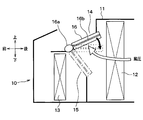
- FIG. 1 A first embodiment of the present disclosure will be described. As shown in FIG. 1, the indoor air conditioning unit 10 in the vehicle air conditioner is mounted in an instrument panel (instrument panel) in the front of the vehicle interior. Note that the up / down and front / rear arrows in FIG. 1 indicate the vehicle up / down direction and the vehicle front / rear direction of the indoor air conditioning unit 10 in a state of being mounted on the vehicle.
- the indoor air conditioning unit 10 has a case 11 made of resin, and an air passage through which air flows into the vehicle interior is provided in the case 11.
- a blower (not shown) that generates an air flow is disposed in an upstream portion of the air passage in the air flow.
- the evaporator 12 which makes the heat exchanger for cooling is arrange
- the evaporator 12 cools the blown air by introducing a refrigerant fluid decompressed by a decompression unit of an air conditioning refrigeration cycle (not shown) and absorbing and evaporating the refrigerant fluid from the blown air.
- a heater core 13 serving as a heat exchanger for heating is disposed on the downstream side of the air flow of the evaporator 12.
- the heater core 13 is for heating engine air (hot water) through the inside and heating the air using the engine coolant as a heat source.
- bypass passage 14 through which the blown air that has passed through the evaporator 12 flows bypassing the heater core 13
- heater core introduction passage 15 through which the blown air that has passed through the evaporator 12 is introduced into the heater core 13.
- an air mix door 16 that opens and closes the bypass passage 14 and the heater core introduction passage 15 is disposed. Then, the air volume ratio between the air passing through the heater core 13 (warm air) and the air passing through the bypass passage 14 (cold air) is adjusted by the air mix door 16 to adjust the temperature of the air blown into the vehicle interior. Yes.
- the air mix door 16 rotates around the air mix door rotation shaft 16a. More specifically, the air mix door 16 is a cantilever door in which the rotation shaft 16a is integrally disposed at one end of a flat door substrate portion 16b. .
- One end portion of the rotating shaft 16a penetrates the wall surface of the case 11 and protrudes to the outside of the case 11, and the protruding end portion is connected to an air mix door operation mechanism via a link mechanism 30 described later.
- a manual operation mechanism (not shown) in which an operation force is given by a passenger's manual operation is used in this example.
- a servo motor may be used as the air mix door operation mechanism instead of the manual operation mechanism.
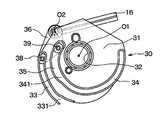
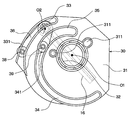
- the link mechanism 30 includes a drive side lever 31 that is driven to rotate by a manual operation mechanism, and a driven side lever 36 that is connected to the rotary shaft 16a and is driven to rotate by the drive side lever 31. And.
- the drive side lever 31 is formed in a substantially disc shape with resin.
- a shaft hole 32 is provided in the vicinity of the center portion of the drive side lever 31, and the output shaft of the manual operation mechanism is fitted into the shaft hole 32 so that the drive side lever 31 rotates integrally with the output shaft of the manual operation mechanism. It is supposed to be. 2 and FIGS. 4 to 6 indicate the center of rotation of the drive side lever 31.
- the drive side lever 31 is provided with a first groove 33 in which a first pin 38 described later slides.
- the first groove 33 is located in the vicinity of the outer edge portion of the drive side lever 31 and at a radially outer portion of the escape groove 35 described later, and extends elongated along the rotation direction (substantially circumferential direction) of the drive side lever 31. ing.
- One end of the first groove 33 constitutes an open end 331 that is open to the outside of the drive lever 31.
- the open end 331 gradually increases in width from the inside of the first groove 33 toward the outside of the driving lever 31.
- the driving lever 31 is provided with a second groove 34 in which a second pin 39 described later slides, and an escape groove 35 in which the second pin 39 does not slide.
- the second groove 34 and the relief groove 35 communicate with each other along the rotation direction of the drive side lever 31.
- the second groove 34 is located in the vicinity of the outer edge of the drive side lever 31 and is disposed at a position shifted in the rotation direction of the drive side lever 31 with respect to the first groove 33, and along the rotation direction of the drive side lever 31. Elongate.
- the escape groove 35 is located approximately between the first groove 33 and the shaft hole 32 and extends elongated along the rotation direction of the drive side lever 31.
- the width of the escape groove 35 is set larger than the width of the second groove 34. In other words, the dimension in the radial direction of the drive side lever 31 is set so that the escape groove 35 is larger than the second groove 34.
- the width of the escape groove 35 is set sufficiently larger than the outer diameter of the second pin 39 so that the second pin 39 does not slide.
- connection portion 341 between the second groove 34 and the escape groove 35 gradually increases from the second groove 34 toward the escape groove 35.
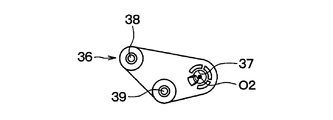
- the driven lever 36 is formed in a substantially triangular plate shape with resin.
- the driven lever 36 is provided with a shaft hole 37, and the rotary shaft 16a of the air mix door 16 is fitted into the shaft hole 37 so that the driven lever 36 rotates integrally with the rotary shaft 16a. Yes.
- a point O2 in FIGS. 3 to 6 indicates the center of rotation of the driven lever 36.
- the driven lever 36 is provided with a first pin 38 inserted and slid into the first groove 33 and a second pin 39 inserted and slid into the second groove 34.
- the shaft hole 37, the first pin 38, and the second pin 39 are arranged near the three corners of the driven lever 36.
- the first pin 38 and the second pin 39 are arranged so as to be shifted in the rotation direction of the driven lever 36. Further, the distance from the rotation center O2 of the driven lever 36 to the first pin 38 is longer than the distance from the rotation center O2 of the driven lever 36 to the second pin 39.
- the drive side lever 31 and the driven side lever 36 are stacked in the axial direction of the first pin 38 and the second pin 39 (perpendicular to the plane of FIG. 4 to FIG. 6).
- the driven lever 36 is disposed adjacent to the outer surface of the case 11, and the drive lever 31 is disposed on the opposite side of the driven lever 36 from the outer surface of the case 11.
- the driven lever 36 is disposed between the outer surface of the case 11 and the driving lever 31.
- the first groove 33, the second groove 34, and the relief groove 35 of the drive side lever 31 are formed so that the distance from the rotation center O1 of the drive side lever 31 changes along the rotation direction of the drive side lever 31. ing.
- the first groove 33, the second groove 34, and the escape groove 35 extend in a direction gradually away from the rotation center O1 of the drive side lever 31. Therefore, when the driving lever 31 rotates, the driving force is transmitted from the first groove 33 and the second groove 34 to the first pin 38 and the second pin 39, and the driven lever 36 also rotates.
- FIG. 4 shows a state in which the first pin 38 is located in the vicinity of the end opposite to the open end 331 in the first groove 33.
- the second pin 39 is positioned in the vicinity of the end portion on the side opposite to the connection portion 341 in the escape groove 35.
- a rotational region where the driving force is transmitted from the first groove 33 to the first pin 38 and the driven lever 36 performs a rotational motion that is, a rotational region between the state of FIG. 4 and the state of FIG.
- a rotation region where the driving force is transmitted from the second groove 34 to the second pin 39 and the driven lever 36 performs a rotational movement that is, a rotation region between the state of FIG. 5 and the state of FIG. This is referred to as a second rotation region.
- the second pin 39 using the second pin 39 having a short distance from the rotation center O2 of the driven lever 36 is used.
- the moment acting on the driven lever 36 is greater than in the rotation region.
- the air mix door 16 In the indoor air conditioning unit 10, when the link mechanism 30 is in the state of FIG. 4, the air mix door 16 is in a position indicated by a solid line in FIG. 1 and the bypass passage 14 is fully closed. When the link mechanism 30 is in the state shown in FIG. 5, the air mix door 16 is in the position indicated by the broken line in FIG. 1, and both the bypass passage 14 and the heater core introduction passage 15 are open. When the link mechanism 30 is in the state shown in FIG. 6, the air mix door 16 is in the position indicated by the one-dot chain line in FIG. 1 and the heater core introduction passage 15 is fully closed.
- this operation region of the air mix door 16 is a first rotation region in which the moment acting on the driven lever 36 increases, the force (operating force) required to drive the link mechanism 30 is reduced. Can do.
- the driven lever 36 has a first pin 38 having a long distance from the rotation center O2
- the driving lever 31 is enlarged in size, but the driving lever 31 is located in the vicinity of the outer edge and on the radially outer side of the escape groove 35.
- the first groove 33 By disposing the first groove 33 on the upper side, an increase in size can be avoided. Accordingly, interference between the link mechanism 30 and other components of the indoor air conditioning unit 10 can be avoided.
- the vehicle air conditioner includes a control panel 50 for an occupant to set a desired operating state of the vehicle air conditioner.
- the control panel 50 is disposed on the surface of the instrument panel in the front part of the vehicle interior.
- the control panel 50 includes a panel case 51, a knob 60 for adjusting the temperature of the blown air, and the like.
- the control panel 50 and a transmission mechanism 70 described later may be used as an example of the manual operation mechanism described in the first embodiment.
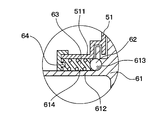
- the panel case 51 includes a cylindrical panel case tube portion 511 that protrudes to the back surface side of the panel case 51.
- the knob 60 includes a knob body 61, a ball 62, a spring 63, and a cap 64 that are rotated by an occupant.
- the knob body 61 includes a disk-shaped operation plate portion 611 protruding to the front surface side of the panel case 51, a cylindrical knob body tube protruding to the back surface side of the panel case 51 and disposed inside the panel case tube portion 511. A portion 612 and a hemispherical recess 613 are provided.
- a cylindrical space 614 is formed by the panel case tube portion 511 and the knob body tube portion 612. And the recessed part 613 is formed in the surface which faces the space 614 in the operation board part 611, and many (16 pieces in this example) are arrange
- the cap 64 has a disk shape with a through hole provided in the center, and is joined to the end of the panel case cylinder 511 by press-fitting to close the open end of the space 614.
- the ball 62 and the spring 63 are disposed in the space 614.
- One end of the spring 63 is held by the cap 64 and urges the ball 62 toward the recess 613.
- the knob 60 When the knob 60 is operated (that is, when the knob main body 61 is rotated), the ball 62 enters the recess 613 when the positions of the ball 62 and the recess 613 coincide.
- the knob 60 When the knob 60 is operated from this state, the ball 62 is pushed out from the recess 613 against the spring force of the spring 63, so that the force required to operate the knob 60 increases, and the moderation is reduced when the knob 60 is operated. A feeling is given.
- the position where the ball 62 enters the recess 613 in the operation range of the knob 60 is referred to as a moderation point.
- the ball 62, the spring 63, and the recess 613 may be used as an example of a moderation imparting mechanism.
- the moderation imparting mechanism of the present embodiment has 16 moderation imparting points set.
- the vehicle air conditioner includes a transmission mechanism 70 that transmits the rotational displacement of the knob body 61 to the drive side lever 31 (see FIG. 13).
- the transmission mechanism 70 is disposed in the instrument panel.
- the transmission mechanism 70 is coupled to the knob main body 61 and rotates integrally with the knob main body 61, the driven pulley 72 coupled to the driving side lever 31 and rotated integrally with the driving side lever 31, and the driving pulley 71. And a driven pulley 72, a wire 73 that transmits rotational displacement of the drive pulley 71 to the driven pulley 72, a wire cover 74 that covers a part of the wire 73, a drive side holder 75 that holds one end of the wire cover 74, A driven side holder 76 that holds the other end side of the wire cover 74 is provided.
- the wire 73 is wound around the outer peripheral portion of the driving pulley 71 and at the outer peripheral portion of the driven pulley 72.
- the wire 73 on the drive pulley 71 side is indicated by a thick broken line for the sake of convenience in order to clarify the handling of the wire 73 on the drive pulley 71 side.
- the drive pulley 71 is provided with a drive pulley hole 711 at the center of rotation. And the front end side of the knob main body cylinder part 612 is press-fitted in this drive pulley hole 711, and the drive pulley 71 and the knob main body 61 are combined.
- the driven pulley 72 includes two driven pulley pins 721 extending in the rotation axis direction.
- the driven pulley pin 721 is inserted into two driving side lever holes 311 (see FIG. 13, which will be described later in detail) provided in the driving side lever 31, and the driven pulley 72 and the driving side lever 31 are coupled. .
- the drive side lever hole 311 is arranged on the outer peripheral side of the shaft hole 32 and at a position shifted along the circumferential direction of the shaft hole 32.
- the first pin 38 and the first groove 33 abut and When the state in which the 2-pin 39 and the second groove 34 are in contact with each other occurs, the driving lever 31 and the driven lever 36 are locked, and the driving lever 31 and the driven lever 36 may not be able to rotate. .
- the first pin 38 and the first groove 33 do not contact each other and the second pin 39 and the second groove 34 contact each other between the first rotation region and the second rotation region.
- a transition rotation region is provided so as to avoid locking of the drive side lever 31 and the driven side lever 36.
- FIG. 14 shows the positions of the first pin 38 and the second pin 39 when shifting from the first rotation region to the second rotation region, or conversely when shifting from the second rotation region to the first rotation region. Show.
- the position of the 1st pin 38 and the 2nd pin 39 which are shown as a continuous line in Drawing 14 is a position just before changing to a transition rotation field in the 1st rotation field.
- the first pin 38 and the first groove 33 are in contact with each other, and the second pin 39 is located in the escape groove 35 and is not in contact with the second groove 34.
- positions of the first pin 38 and the second pin 39 indicated by thick broken lines in FIG. 14 are positions immediately before the transition to the transition rotation area in the second rotation area. At this time, the first pin 38 is located in the open end 331 and is not in contact with the first groove 33, and the second pin 39 is in contact with the second groove 34.
- the positions of the first pin 38 and the second pin 39 indicated by thin chain lines in FIG. 14 are the positions of the transition rotation region.
- the first pin 38 is located in the open end 331 and is not in contact with the first groove 33
- the second pin 39 is located in the connection part 341 and is not in contact with the second groove 34. .
- the first pin 38 rattles in the range of the gap with the open end 331, and the first pin 38 and the open end. A collision sound with the part 331 is generated, and the second pin 39 is rattled in a range of a gap with the connection part 341, so that a collision sound between the second pin 39 and the connection part 341 may be generated.
- the driving side lever 31 and the driven side lever 36 do not stop in the transition rotation region so as to avoid the occurrence of the collision sound. ing.
- the operation range of the knob 60 includes a first operation range corresponding to the transition rotation region (transition rotation region operation range) and a second operation range corresponding to the first rotation region and the second rotation region (non-transition rotation region operation). Mode), and the moderation giving point is set only in the second operation range among the first operation range and the second operation range.
- a moderation point is set in an area immediately before the transition from the second operation range to the first operation range in the second operation range. Specifically, the moderation point is set at the operation position of the knob 60 immediately before shifting to the transition rotation area in the first rotation area and the operation position of the knob 60 immediately before shifting to the transition rotation area in the second rotation area. is doing.
- the moderation applying mechanism including the ball 62, the spring 63, and the recess 613 is provided in the knob 60.
- the moderation providing mechanism may be provided in the drive pulley 71 of the transmission mechanism 70.
- the present disclosure is applied to an air mix door operation link mechanism in a vehicle air conditioner.
- the present disclosure can be applied to various door operation link mechanisms such as a blow mode door and an inside / outside air switching door. It is.
- the link mechanism of the present disclosure is applied to a vehicle air conditioner.
- the link mechanism of the present disclosure can be applied to other uses.
Landscapes
- Physics & Mathematics (AREA)
- Thermal Sciences (AREA)
- Engineering & Computer Science (AREA)
- Mechanical Engineering (AREA)
- Air-Conditioning For Vehicles (AREA)
Priority Applications (2)
| Application Number | Priority Date | Filing Date | Title |
|---|---|---|---|
| DE112013001065.8T DE112013001065T5 (de) | 2012-02-21 | 2013-02-14 | Verbindungsmechanismus und Fahrzeugklimaanlage |
| BR112014019859A BR112014019859A8 (pt) | 2012-02-21 | 2013-02-14 | Mecanismo de ligação, e, condicionador de ar veicular |
Applications Claiming Priority (4)
| Application Number | Priority Date | Filing Date | Title |
|---|---|---|---|
| JP2012-035259 | 2012-02-21 | ||
| JP2012035259 | 2012-02-21 | ||
| JP2013-004617 | 2013-01-15 | ||
| JP2013004617A JP2013199265A (ja) | 2012-02-21 | 2013-01-15 | リンク機構および車両用空調装置 |
Publications (1)
| Publication Number | Publication Date |
|---|---|
| WO2013125184A1 true WO2013125184A1 (ja) | 2013-08-29 |
Family
ID=49005383
Family Applications (1)
| Application Number | Title | Priority Date | Filing Date |
|---|---|---|---|
| PCT/JP2013/000792 Ceased WO2013125184A1 (ja) | 2012-02-21 | 2013-02-14 | リンク機構および車両用空調装置 |
Country Status (4)
| Country | Link |
|---|---|
| JP (1) | JP2013199265A (https=) |
| BR (1) | BR112014019859A8 (https=) |
| DE (1) | DE112013001065T5 (https=) |
| WO (1) | WO2013125184A1 (https=) |
Cited By (3)
| Publication number | Priority date | Publication date | Assignee | Title |
|---|---|---|---|---|
| US11220156B2 (en) * | 2017-09-25 | 2022-01-11 | Hanon Systems | Air conditioner for vehicle |
| CN117103952A (zh) * | 2023-08-21 | 2023-11-24 | 重庆臻风科技有限公司 | 一种车载空调多变风口结构 |
| CN118882200A (zh) * | 2024-09-11 | 2024-11-01 | 青岛海尔空调器有限总公司 | 用于空调导风板的驱动机构、空调 |
Families Citing this family (3)
| Publication number | Priority date | Publication date | Assignee | Title |
|---|---|---|---|---|
| JP7014011B2 (ja) * | 2018-03-30 | 2022-02-01 | 株式会社アイシン | サンルーフ装置 |
| DE102021209195A1 (de) | 2021-08-20 | 2023-02-23 | Mahle International Gmbh | Steuereinrichtung |
| JP7616021B2 (ja) | 2021-11-05 | 2025-01-17 | 株式会社デンソー | リンク機構 |
Citations (5)
| Publication number | Priority date | Publication date | Assignee | Title |
|---|---|---|---|---|
| JP2004218779A (ja) * | 2003-01-16 | 2004-08-05 | Denso Corp | リンク装置 |
| JP2004218819A (ja) * | 2003-01-17 | 2004-08-05 | Denso Corp | リンク装置 |
| JP2004268906A (ja) * | 2003-02-20 | 2004-09-30 | Denso Corp | 空調装置 |
| JP2006088810A (ja) * | 2004-09-22 | 2006-04-06 | Denso Corp | 車両用空調装置のダンパ用リンク構造 |
| JP2010001901A (ja) * | 2008-06-18 | 2010-01-07 | Denso Corp | リンク機構 |
-
2013
- 2013-01-15 JP JP2013004617A patent/JP2013199265A/ja active Pending
- 2013-02-14 WO PCT/JP2013/000792 patent/WO2013125184A1/ja not_active Ceased
- 2013-02-14 DE DE112013001065.8T patent/DE112013001065T5/de not_active Withdrawn
- 2013-02-14 BR BR112014019859A patent/BR112014019859A8/pt not_active IP Right Cessation
Patent Citations (5)
| Publication number | Priority date | Publication date | Assignee | Title |
|---|---|---|---|---|
| JP2004218779A (ja) * | 2003-01-16 | 2004-08-05 | Denso Corp | リンク装置 |
| JP2004218819A (ja) * | 2003-01-17 | 2004-08-05 | Denso Corp | リンク装置 |
| JP2004268906A (ja) * | 2003-02-20 | 2004-09-30 | Denso Corp | 空調装置 |
| JP2006088810A (ja) * | 2004-09-22 | 2006-04-06 | Denso Corp | 車両用空調装置のダンパ用リンク構造 |
| JP2010001901A (ja) * | 2008-06-18 | 2010-01-07 | Denso Corp | リンク機構 |
Cited By (3)
| Publication number | Priority date | Publication date | Assignee | Title |
|---|---|---|---|---|
| US11220156B2 (en) * | 2017-09-25 | 2022-01-11 | Hanon Systems | Air conditioner for vehicle |
| CN117103952A (zh) * | 2023-08-21 | 2023-11-24 | 重庆臻风科技有限公司 | 一种车载空调多变风口结构 |
| CN118882200A (zh) * | 2024-09-11 | 2024-11-01 | 青岛海尔空调器有限总公司 | 用于空调导风板的驱动机构、空调 |
Also Published As
| Publication number | Publication date |
|---|---|
| BR112014019859A2 (https=) | 2017-06-20 |
| JP2013199265A (ja) | 2013-10-03 |
| DE112013001065T5 (de) | 2014-11-20 |
| BR112014019859A8 (pt) | 2017-07-11 |
Similar Documents
| Publication | Publication Date | Title |
|---|---|---|
| WO2013125184A1 (ja) | リンク機構および車両用空調装置 | |
| JP6119466B2 (ja) | 電気式膨張弁 | |
| US20220186840A1 (en) | Valve device and fluid circulation circuit | |
| JP6399229B2 (ja) | 電動式流量制御弁、アクチュエータ | |
| JP6737380B1 (ja) | バルブ装置 | |
| CN104002637B (zh) | 车辆用空调装置 | |
| US20080176502A1 (en) | Air conditioning apparatus and passage control device with slide resistance generating part | |
| JP5471710B2 (ja) | 空気通路調節装置 | |
| JP4380450B2 (ja) | 空気通路開閉装置および車両用空調装置 | |
| CA3029214C (en) | Link mechanism for a vehicle air conditioner | |
| JP2015160581A (ja) | 圧縮機および車両用空調装置 | |
| CN118339038A (zh) | 连杆机构 | |
| WO2016111337A1 (ja) | 同軸構造ドア装置および同軸構造ドア装置の製造方法 | |
| JP4978572B2 (ja) | リンク機構 | |
| JP4434072B2 (ja) | リンク装置および車両用空調装置 | |
| WO2015151476A1 (ja) | ブロワユニット | |
| JP4396431B2 (ja) | 空気通路切替え装置および車両用空調装置 | |
| JP2008018886A (ja) | 車両用空調装置のリンク機構 | |
| WO2023171324A1 (ja) | ロータリドアおよび空調装置 | |
| JP2013071484A (ja) | 車両用空調装置に用いられるリンク構造 | |
| JP2008207700A (ja) | 車両用空調装置 | |
| JP2007145213A (ja) | リンク装置及び車両用空調装置 | |
| JP2005262990A (ja) | 車両用空調装置 |
Legal Events
| Date | Code | Title | Description |
|---|---|---|---|
| 121 | Ep: the epo has been informed by wipo that ep was designated in this application |
Ref document number: 13752268 Country of ref document: EP Kind code of ref document: A1 |
|
| WWE | Wipo information: entry into national phase |
Ref document number: 1120130010658 Country of ref document: DE Ref document number: 112013001065 Country of ref document: DE |
|
| REG | Reference to national code |
Ref country code: BR Ref legal event code: B01A Ref document number: 112014019859 Country of ref document: BR |
|
| 122 | Ep: pct application non-entry in european phase |
Ref document number: 13752268 Country of ref document: EP Kind code of ref document: A1 |
|
| ENP | Entry into the national phase |
Ref document number: 112014019859 Country of ref document: BR Kind code of ref document: A2 Effective date: 20140811 |