WO2013111835A1 - 積層体形成用シート製造用組成物、その製造方法、及び積層体形成用シート - Google Patents
積層体形成用シート製造用組成物、その製造方法、及び積層体形成用シート Download PDFInfo
- Publication number
- WO2013111835A1 WO2013111835A1 PCT/JP2013/051506 JP2013051506W WO2013111835A1 WO 2013111835 A1 WO2013111835 A1 WO 2013111835A1 JP 2013051506 W JP2013051506 W JP 2013051506W WO 2013111835 A1 WO2013111835 A1 WO 2013111835A1
- Authority
- WO
- WIPO (PCT)
- Prior art keywords
- eva
- composition
- polyethylene
- viscosity
- ethylene
- Prior art date
- Legal status (The legal status is an assumption and is not a legal conclusion. Google has not performed a legal analysis and makes no representation as to the accuracy of the status listed.)
- Ceased
Links
Images

Classifications
-
- C—CHEMISTRY; METALLURGY
- C08—ORGANIC MACROMOLECULAR COMPOUNDS; THEIR PREPARATION OR CHEMICAL WORKING-UP; COMPOSITIONS BASED THEREON
- C08J—WORKING-UP; GENERAL PROCESSES OF COMPOUNDING; AFTER-TREATMENT NOT COVERED BY SUBCLASSES C08B, C08C, C08F, C08G or C08H
- C08J5/00—Manufacture of articles or shaped materials containing macromolecular substances
- C08J5/18—Manufacture of films or sheets
-
- B—PERFORMING OPERATIONS; TRANSPORTING
- B32—LAYERED PRODUCTS
- B32B—LAYERED PRODUCTS, i.e. PRODUCTS BUILT-UP OF STRATA OF FLAT OR NON-FLAT, e.g. CELLULAR OR HONEYCOMB, FORM
- B32B17/00—Layered products essentially comprising sheet glass, or glass, slag, or like fibres
- B32B17/06—Layered products essentially comprising sheet glass, or glass, slag, or like fibres comprising glass as the main or only constituent of a layer, next to another layer of a specific material
- B32B17/10—Layered products essentially comprising sheet glass, or glass, slag, or like fibres comprising glass as the main or only constituent of a layer, next to another layer of a specific material of synthetic resin
- B32B17/10005—Layered products essentially comprising sheet glass, or glass, slag, or like fibres comprising glass as the main or only constituent of a layer, next to another layer of a specific material of synthetic resin laminated safety glass or glazing
- B32B17/1055—Layered products essentially comprising sheet glass, or glass, slag, or like fibres comprising glass as the main or only constituent of a layer, next to another layer of a specific material of synthetic resin laminated safety glass or glazing characterized by the resin layer, i.e. interlayer
- B32B17/10788—Layered products essentially comprising sheet glass, or glass, slag, or like fibres comprising glass as the main or only constituent of a layer, next to another layer of a specific material of synthetic resin laminated safety glass or glazing characterized by the resin layer, i.e. interlayer containing ethylene vinylacetate
-
- C—CHEMISTRY; METALLURGY
- C08—ORGANIC MACROMOLECULAR COMPOUNDS; THEIR PREPARATION OR CHEMICAL WORKING-UP; COMPOSITIONS BASED THEREON
- C08L—COMPOSITIONS OF MACROMOLECULAR COMPOUNDS
- C08L23/00—Compositions of homopolymers or copolymers of unsaturated aliphatic hydrocarbons having only one carbon-to-carbon double bond; Compositions of derivatives of such polymers
- C08L23/02—Compositions of homopolymers or copolymers of unsaturated aliphatic hydrocarbons having only one carbon-to-carbon double bond; Compositions of derivatives of such polymers not modified by chemical after-treatment
- C08L23/04—Homopolymers or copolymers of ethene
-
- C—CHEMISTRY; METALLURGY
- C08—ORGANIC MACROMOLECULAR COMPOUNDS; THEIR PREPARATION OR CHEMICAL WORKING-UP; COMPOSITIONS BASED THEREON
- C08L—COMPOSITIONS OF MACROMOLECULAR COMPOUNDS
- C08L23/00—Compositions of homopolymers or copolymers of unsaturated aliphatic hydrocarbons having only one carbon-to-carbon double bond; Compositions of derivatives of such polymers
- C08L23/02—Compositions of homopolymers or copolymers of unsaturated aliphatic hydrocarbons having only one carbon-to-carbon double bond; Compositions of derivatives of such polymers not modified by chemical after-treatment
- C08L23/04—Homopolymers or copolymers of ethene
- C08L23/06—Polyethylene
-
- C—CHEMISTRY; METALLURGY
- C08—ORGANIC MACROMOLECULAR COMPOUNDS; THEIR PREPARATION OR CHEMICAL WORKING-UP; COMPOSITIONS BASED THEREON
- C08L—COMPOSITIONS OF MACROMOLECULAR COMPOUNDS
- C08L23/00—Compositions of homopolymers or copolymers of unsaturated aliphatic hydrocarbons having only one carbon-to-carbon double bond; Compositions of derivatives of such polymers
- C08L23/02—Compositions of homopolymers or copolymers of unsaturated aliphatic hydrocarbons having only one carbon-to-carbon double bond; Compositions of derivatives of such polymers not modified by chemical after-treatment
- C08L23/04—Homopolymers or copolymers of ethene
- C08L23/08—Copolymers of ethene
-
- C—CHEMISTRY; METALLURGY
- C08—ORGANIC MACROMOLECULAR COMPOUNDS; THEIR PREPARATION OR CHEMICAL WORKING-UP; COMPOSITIONS BASED THEREON
- C08L—COMPOSITIONS OF MACROMOLECULAR COMPOUNDS
- C08L23/00—Compositions of homopolymers or copolymers of unsaturated aliphatic hydrocarbons having only one carbon-to-carbon double bond; Compositions of derivatives of such polymers
- C08L23/02—Compositions of homopolymers or copolymers of unsaturated aliphatic hydrocarbons having only one carbon-to-carbon double bond; Compositions of derivatives of such polymers not modified by chemical after-treatment
- C08L23/04—Homopolymers or copolymers of ethene
- C08L23/08—Copolymers of ethene
- C08L23/0807—Copolymers of ethene with unsaturated hydrocarbons only containing four or more carbon atoms
- C08L23/0815—Copolymers of ethene with unsaturated hydrocarbons only containing four or more carbon atoms with aliphatic 1-olefins containing one carbon-to-carbon double bond
-
- C—CHEMISTRY; METALLURGY
- C08—ORGANIC MACROMOLECULAR COMPOUNDS; THEIR PREPARATION OR CHEMICAL WORKING-UP; COMPOSITIONS BASED THEREON
- C08L—COMPOSITIONS OF MACROMOLECULAR COMPOUNDS
- C08L23/00—Compositions of homopolymers or copolymers of unsaturated aliphatic hydrocarbons having only one carbon-to-carbon double bond; Compositions of derivatives of such polymers
- C08L23/02—Compositions of homopolymers or copolymers of unsaturated aliphatic hydrocarbons having only one carbon-to-carbon double bond; Compositions of derivatives of such polymers not modified by chemical after-treatment
- C08L23/04—Homopolymers or copolymers of ethene
- C08L23/08—Copolymers of ethene
- C08L23/0846—Copolymers of ethene with unsaturated hydrocarbons containing atoms other than carbon or hydrogen
- C08L23/0853—Ethylene vinyl acetate copolymers
-
- C—CHEMISTRY; METALLURGY
- C08—ORGANIC MACROMOLECULAR COMPOUNDS; THEIR PREPARATION OR CHEMICAL WORKING-UP; COMPOSITIONS BASED THEREON
- C08L—COMPOSITIONS OF MACROMOLECULAR COMPOUNDS
- C08L31/00—Compositions of homopolymers or copolymers of compounds having one or more unsaturated aliphatic radicals, each having only one carbon-to-carbon double bond, and at least one being terminated by an acyloxy radical of a saturated carboxylic acid, of carbonic acid or of a haloformic acid; Compositions of derivatives of such polymers
- C08L31/02—Homopolymers or copolymers of esters of monocarboxylic acids
- C08L31/04—Homopolymers or copolymers of vinyl acetate
-
- H—ELECTRICITY
- H10—SEMICONDUCTOR DEVICES; ELECTRIC SOLID-STATE DEVICES NOT OTHERWISE PROVIDED FOR
- H10F—INORGANIC SEMICONDUCTOR DEVICES SENSITIVE TO INFRARED RADIATION, LIGHT, ELECTROMAGNETIC RADIATION OF SHORTER WAVELENGTH OR CORPUSCULAR RADIATION
- H10F19/00—Integrated devices, or assemblies of multiple devices, comprising at least one photovoltaic cell covered by group H10F10/00, e.g. photovoltaic modules
- H10F19/80—Encapsulations or containers for integrated devices, or assemblies of multiple devices, having photovoltaic cells
- H10F19/804—Materials of encapsulations
-
- C—CHEMISTRY; METALLURGY
- C08—ORGANIC MACROMOLECULAR COMPOUNDS; THEIR PREPARATION OR CHEMICAL WORKING-UP; COMPOSITIONS BASED THEREON
- C08J—WORKING-UP; GENERAL PROCESSES OF COMPOUNDING; AFTER-TREATMENT NOT COVERED BY SUBCLASSES C08B, C08C, C08F, C08G or C08H
- C08J2323/00—Characterised by the use of homopolymers or copolymers of unsaturated aliphatic hydrocarbons having only one carbon-to-carbon double bond; Derivatives of such polymers
- C08J2323/02—Characterised by the use of homopolymers or copolymers of unsaturated aliphatic hydrocarbons having only one carbon-to-carbon double bond; Derivatives of such polymers not modified by chemical after treatment
- C08J2323/04—Homopolymers or copolymers of ethene
- C08J2323/06—Polyethene
-
- C—CHEMISTRY; METALLURGY
- C08—ORGANIC MACROMOLECULAR COMPOUNDS; THEIR PREPARATION OR CHEMICAL WORKING-UP; COMPOSITIONS BASED THEREON
- C08J—WORKING-UP; GENERAL PROCESSES OF COMPOUNDING; AFTER-TREATMENT NOT COVERED BY SUBCLASSES C08B, C08C, C08F, C08G or C08H
- C08J2331/00—Characterised by the use of copolymers of compounds having one or more unsaturated aliphatic radicals, each having only one carbon-to-carbon double bond, and at least one being terminated by an acyloxy radical of a saturated carboxylic acid, or carbonic acid, or of a haloformic acid
- C08J2331/02—Characterised by the use of omopolymers or copolymers of esters of monocarboxylic acids
- C08J2331/04—Homopolymers or copolymers of vinyl acetate
-
- C—CHEMISTRY; METALLURGY
- C08—ORGANIC MACROMOLECULAR COMPOUNDS; THEIR PREPARATION OR CHEMICAL WORKING-UP; COMPOSITIONS BASED THEREON
- C08J—WORKING-UP; GENERAL PROCESSES OF COMPOUNDING; AFTER-TREATMENT NOT COVERED BY SUBCLASSES C08B, C08C, C08F, C08G or C08H
- C08J2423/00—Characterised by the use of homopolymers or copolymers of unsaturated aliphatic hydrocarbons having only one carbon-to-carbon double bond; Derivatives of such polymers
- C08J2423/02—Characterised by the use of homopolymers or copolymers of unsaturated aliphatic hydrocarbons having only one carbon-to-carbon double bond; Derivatives of such polymers not modified by chemical after treatment
- C08J2423/04—Homopolymers or copolymers of ethene
- C08J2423/06—Polyethene
-
- C—CHEMISTRY; METALLURGY
- C08—ORGANIC MACROMOLECULAR COMPOUNDS; THEIR PREPARATION OR CHEMICAL WORKING-UP; COMPOSITIONS BASED THEREON
- C08J—WORKING-UP; GENERAL PROCESSES OF COMPOUNDING; AFTER-TREATMENT NOT COVERED BY SUBCLASSES C08B, C08C, C08F, C08G or C08H
- C08J2431/00—Characterised by the use of copolymers of compounds having one or more unsaturated aliphatic radicals, each having only one carbon-to-carbon double bond, and at least one being terminated by an acyloxy radical of a saturated carboxylic acid, or carbonic acid, or of a haloformic acid
- C08J2431/02—Characterised by the use of omopolymers or copolymers of esters of monocarboxylic acids
- C08J2431/04—Homopolymers or copolymers of vinyl acetate
-
- C—CHEMISTRY; METALLURGY
- C08—ORGANIC MACROMOLECULAR COMPOUNDS; THEIR PREPARATION OR CHEMICAL WORKING-UP; COMPOSITIONS BASED THEREON
- C08L—COMPOSITIONS OF MACROMOLECULAR COMPOUNDS
- C08L2203/00—Applications
- C08L2203/16—Applications used for films
- C08L2203/162—Applications used for films sealable films
-
- C—CHEMISTRY; METALLURGY
- C08—ORGANIC MACROMOLECULAR COMPOUNDS; THEIR PREPARATION OR CHEMICAL WORKING-UP; COMPOSITIONS BASED THEREON
- C08L—COMPOSITIONS OF MACROMOLECULAR COMPOUNDS
- C08L2203/00—Applications
- C08L2203/20—Applications use in electrical or conductive gadgets
- C08L2203/204—Applications use in electrical or conductive gadgets use in solar cells
-
- C—CHEMISTRY; METALLURGY
- C08—ORGANIC MACROMOLECULAR COMPOUNDS; THEIR PREPARATION OR CHEMICAL WORKING-UP; COMPOSITIONS BASED THEREON
- C08L—COMPOSITIONS OF MACROMOLECULAR COMPOUNDS
- C08L2205/00—Polymer mixtures characterised by other features
- C08L2205/02—Polymer mixtures characterised by other features containing two or more polymers of the same C08L -group
-
- C—CHEMISTRY; METALLURGY
- C08—ORGANIC MACROMOLECULAR COMPOUNDS; THEIR PREPARATION OR CHEMICAL WORKING-UP; COMPOSITIONS BASED THEREON
- C08L—COMPOSITIONS OF MACROMOLECULAR COMPOUNDS
- C08L2207/00—Properties characterising the ingredient of the composition
- C08L2207/06—Properties of polyethylene
- C08L2207/066—LDPE (radical process)
-
- Y—GENERAL TAGGING OF NEW TECHNOLOGICAL DEVELOPMENTS; GENERAL TAGGING OF CROSS-SECTIONAL TECHNOLOGIES SPANNING OVER SEVERAL SECTIONS OF THE IPC; TECHNICAL SUBJECTS COVERED BY FORMER USPC CROSS-REFERENCE ART COLLECTIONS [XRACs] AND DIGESTS
- Y02—TECHNOLOGIES OR APPLICATIONS FOR MITIGATION OR ADAPTATION AGAINST CLIMATE CHANGE
- Y02E—REDUCTION OF GREENHOUSE GAS [GHG] EMISSIONS, RELATED TO ENERGY GENERATION, TRANSMISSION OR DISTRIBUTION
- Y02E10/00—Energy generation through renewable energy sources
- Y02E10/50—Photovoltaic [PV] energy
Definitions
- the present invention relates to a composition for producing a sheet containing an ethylene-vinyl acetate copolymer and polyethylene used for forming a laminate such as a sealing film for solar cells and an intermediate film for laminated glass, and more particularly, film formation
- the present invention relates to a composition excellent in processing characteristics such as properties.
- a sheet (EVA sheet) made of a composition containing an ethylene-vinyl acetate copolymer (hereinafter also referred to as EVA) as a main component is inexpensive and has high transparency.
- EVA ethylene-vinyl acetate copolymer
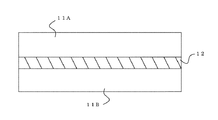
- the interlayer film for laminated glass is sandwiched between glass plates 11A and 11B and exhibits functions such as penetration resistance and prevention of scattering of broken glass.
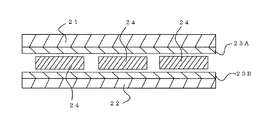
- the solar cell sealing film is formed between the solar cell 24 and the front surface side transparent protective member 21 made of a glass substrate or the like, and the solar cell 24 and the back surface side protective member (back). It is arranged between the cover) 22 and exhibits functions such as ensuring insulation and ensuring mechanical durability.
- Patent Documents 1 and 2 A composition or a sealing sheet has been developed (Patent Documents 1 and 2).
- composition in which EVA and polyethylene as described in Patent Document 1 or 2 are mixed is a sheet as compared with a composition containing EVA as a main component (EVA composition).
- EVA composition a composition in which EVA and polyethylene as described in Patent Document 1 or 2 are mixed
- the processing characteristics at the time of manufacture may deteriorate.
- the materials are first mixed by a primary kneading step, and then, if necessary, secondary kneading such as roll kneading is performed, and the film is formed by calendar molding or the like.
- the viscosity of the resin composition in the film-forming process after the primary kneading process after the primary kneading process greatly affects the processing characteristics such as film-forming properties. It is necessary to adjust to a viscosity range). Since the viscosity of the resin composition generally changes according to the temperature, the viscosity can be adjusted by adjusting the temperature of the resin composition.
- the viscosity gradually changes with a change in temperature in the vicinity of the temperature at which the workable viscosity range can be obtained. Therefore, the width of the temperature range in which the workable viscosity range can be obtained (also referred to as the workable temperature range). ) Is large.
- a viscosity change occurs abruptly as the temperature changes, and the processable temperature The width may be smaller.
- the temperature at which a workable viscosity range is obtained tends to be higher than that of the EVA composition, and the energy cost increases.
- an existing film forming apparatus for processing an EVA composition for example, a calendar molding apparatus using water as a temperature adjusting solvent, cannot be processed beyond the temperature adjustment range. There is also a fear.
- an object of the present invention is a composition for producing a laminate-forming sheet comprising an ethylene-vinyl acetate copolymer and polyethylene, in the range of the temperature range where the above processable viscosity range can be obtained.
- the object is to provide a composition with improved problems and excellent processing characteristics such as film-forming properties during sheet production.
- an object of the present invention is to provide a method for producing the composition for producing a laminate-forming sheet.
- the objective of this invention is providing the sheet
- the object is a composition for producing a laminate-forming sheet comprising an ethylene-vinyl acetate copolymer and polyethylene, wherein the ethylene-vinyl acetate copolymer is a sea phase and the polyethylene is an island phase.
- This is achieved by a composition characterized by having a sea-island structure.
- Preferred embodiments of the laminate-forming sheet manufacturing composition of the present invention are as follows.
- the volume ratio (EVA: PE) of the ethylene-vinyl acetate copolymer (EVA) and the polyethylene (PE) is in the range of 90:10 to 30:70. When the blending ratio is within this range, an effect of improving heat resistance and the like by blending PE can be obtained, and a composition excellent in processing characteristics by having the sea-island structure can be obtained.
- the sea-island structure is such that the ethylene-vinyl acetate copolymer (EVA) and the polyethylene (PE) have a viscosity V PE [Pa ⁇ s] of PE with respect to the viscosity V EVA [Pa ⁇ s] of EVA .
- the sea-island structure is obtained by kneading the ethylene-vinyl acetate copolymer and the polyethylene under conditions of a shear rate of 10 to 1500 s ⁇ 1 .
- the average diameter ((average major axis (l) + average minor axis (d)) / 2) of the island phase made of polyethylene is 40 ⁇ m or less. Thereby, the processing characteristics of the resin composition can be further improved.
- the blending ratio of PE can be further increased by making the island phase dense.
- the average diameter ((average major axis (l) + average minor axis (d)) / 2) of the island phase made of PE is preferably 5 to 25 ⁇ m.
- the average aspect ratio (average major axis (l) / average minor axis (d)) of the island phase made of polyethylene is 40 or less. Thereby, the blending ratio of PE can be further increased.
- the temperature at which the viscosity of the composition is 30000 Pa ⁇ s is 70 to 100 ° C., and the width of the temperature range in which the viscosity of the composition is 20000 to 50000 Pa ⁇ s is 5.0 ° C. or more.
- the polyethylene is composed of one or more kinds of polyethylene selected from low density polyethylene and / or linear low density polyethylene. These polyethylenes are preferred because of their relatively low melting points and low crystallinity.
- the polyethylene is composed of two or more kinds of polyethylene.
- the polyethylene is composed of one or more types of low-density polyethylene and one or more types of linear low-density polyethylene. By using low density polyethylene and linear low density polyethylene in combination, a composition having excellent tensile strength and a relatively low melting point can be obtained.
- the ethylene-vinyl acetate copolymer has a melt flow rate defined by JIS K7210 of 1.0 to 50 g / 10 min.
- the vinyl acetate content of the ethylene-vinyl acetate copolymer is 20 to 40% by mass.
- Another object of the present invention is a method for producing a laminate-forming sheet-producing composition of the present invention, wherein the ethylene-vinyl acetate copolymer (EVA) and the polyethylene (PE) are mixed with a viscosity V
- EVA ethylene-vinyl acetate copolymer
- PE polyethylene
- the kneading step is preferably a step of kneading under conditions of a shear rate of 10 to 1500 s ⁇ 1 .
- the kneading step is preferably a step of kneading under a temperature condition of 70 to 130 ° C.
- the object of the present invention is achieved by a laminate-forming sheet characterized in that the composition of the present invention is formed into a sheet. Since the laminate-forming sheet of the present invention is manufactured using the composition of the present invention, by including PE, heat resistance and the like are imparted and obtained under the same conditions as the EVA composition, This is a high-quality and low-cost sheet for forming a laminate.
- the laminate-forming sheet of the present invention is preferably an interlayer film for laminated glass or a sealing film for solar cells.
- the composition for producing a laminated body forming sheet such as an interlayer film for laminated glass and a sealing film for solar cell, in which heat resistance and the like are improved by blending PE with EVA
- a composition having excellent processing characteristics, such as having a processable temperature range in the same range as the composition can be obtained. Therefore, the composition of the present invention can produce a laminate-forming sheet under the same conditions as the EVA composition, and the laminate-forming sheet thus obtained can be said to be of high quality and low cost.
- FIG. 1 is a schematic cross-sectional view for explaining the sea-island structure of the laminate-forming sheet-producing composition of the present invention
- FIG. 1 (a) shows a state where EVA and PE are co-continuous structures
- FIG. 1 (b) shows a state in which the island is a sea-island structure in which EVA is the sea phase (continuous phase) and PE is the island phase.
- the EVA component and the PE component generally have a co-continuous structure as shown in FIG.
- the composition for producing a laminate-forming sheet of the present invention includes EVA and PE, and has a sea-island structure in which the EVA component is a sea phase and the PE component is an island phase, as shown in FIG. It is characterized by that.
- a primary kneading step of mixing each material is performed using a biaxial kneader or the like, and then as necessary.
- Secondary kneading such as roll kneading is performed to form a film by calender molding, extrusion molding, or the like.
- the viscosity of the resin composition in the film-forming process after the primary kneading process greatly affects the processing characteristics such as film-forming properties, the viscosity of the resin composition is adjusted to a certain range (processable viscosity range). It becomes necessary to do.
- the viscosity of the resin composition in the film forming process is preferably 5000 to 100,000 Pa ⁇ s, and more preferably 20000 to 50000 Pa ⁇ s. .
- the viscosity of the resin composition generally varies depending on the temperature
- the viscosity can be adjusted by adjusting the temperature of the resin composition. Since the change in the viscosity accompanying the temperature change varies depending on the resin composition, the width of the temperature range (processable temperature width) where the processable viscosity range is obtained varies depending on the resin composition. Usually, it is difficult to adjust the temperature of the resin composition with high accuracy in a film forming process and the like, and it becomes difficult to process. Therefore, the processable temperature range of the resin composition is preferably large, and generally 5 ° C. or more is preferable. .
- the temperature at which the workable viscosity range can be obtained also increases the energy cost when the temperature becomes high.
- the temperature adjusting range is set. There is a risk that it will be impossible to process beyond that. Therefore, the temperature at which the workable viscosity range is obtained is preferably 95 ° C. or lower.
- the viscosity gradually changes with the change of temperature near the temperature at which the above processable viscosity range is obtained, so a processable temperature range of 5 ° C. or more is obtained, and the processable viscosity range Is obtained at a temperature of 90 ° C. or lower.
- the state of the resin composition is such that the EVA component and PE component as shown in FIG.
- a change in viscosity suddenly occurs with a change in temperature near the temperature at which a workable viscosity range can be obtained.
- the temperature at which can be obtained may also exceed 95 ° C.
- the state of the resin composition is the sea island where the EVA component as shown in FIG. 1B is the sea phase and the PE component is the island phase.
- a processable temperature range in the same range as that of the EVA composition can be obtained, and the temperature at which the processable viscosity range can be obtained can be brought close to the EVA composition, and the processing characteristics can be improved.
- the blending ratio of EVA and PE is not particularly limited, but effects such as improvement of heat resistance, creep resistance, and water vapor permeation resistance by blending PE can be sufficiently obtained, and
- the volume ratio of EVA to PE (EVA: PE) is preferably in the range of 90:10 to 30:70 so that the above-mentioned sea-island structure can be sufficiently obtained and the composition has excellent processing characteristics. Since the effect of the present invention is exhibited particularly when the blending ratio of PE is high, EVA: PE is more preferably 60:40 to 30:70, and particularly preferably 50:50 to 30:70.
- the above-mentioned sea-island structure may be obtained under any conditions.
- a composition having a higher blending ratio of PE it is difficult to form a sea-island structure, so it is preferable to adjust the kneading conditions.
- EVA and PE it is obtained by kneading under conditions where the PE viscosity V PE [Pa ⁇ s] is 0.1 to 20 times the EVA viscosity V EVA [Pa ⁇ s]. It is preferred that When EVA and PE are kneaded under these conditions, a composition having a sea-island structure with a higher blending ratio of PE can be obtained.
- the viscosity V PE [Pa ⁇ s] of PE with respect to the viscosity V EVA [Pa ⁇ s] of EVA is further larger than 1 time under the above kneading conditions. It is preferably 20 times or less, more preferably 2 to 15 times, and particularly preferably 4 to 13 times.
- the EVA component flows better than the PE component, so that even with a small amount of EVA blended, the EVA component flows easily, and only EVA makes it easy to form a continuous phase. Thereby, it can be set as the composition which has a sea island structure where the compounding ratio of PE is still higher.
- the EVA viscosity V EVA is preferably 1000 to 50000 Pa ⁇ s, more preferably 2000 to 20000 Pa ⁇ s.
- the viscosity V PE of PE is preferably 20000 to 120,000 Pa ⁇ s, more preferably 30000 to 50000 Pa ⁇ s.
- the viscosity of these resins can be measured using, for example, a capillary rheometer, a shear rate of 6.1 s ⁇ 1 , and a temperature at an actual processing temperature. The viscosity ratio can be calculated from this viscosity.
- the shear rate when kneading EVA and PE is preferably 10 to 1500 s ⁇ 1 .
- the island phase of PE can be formed more densely, and it can be set as the composition which has a sea island structure with the further high compounding ratio of PE.
- the shear rate is more preferably 100 ⁇ 1000 s -1, particularly preferably 200 ⁇ 800s -1.
- the temperature at which the viscosity of the composition becomes 30000 Pa ⁇ s (the central processing in the composition of the present invention)
- the possible temperature is preferably 70 to 100 ° C., more preferably 80 to 95 ° C.
- the width of the temperature range in which the viscosity of the composition is 20000 to 50000 Pa ⁇ s (the processable temperature range of the composition of the present invention) is preferably 5.0 ° C. or more.
- the relationship between the viscosity and temperature of these resin compositions can be determined, for example, by using a capillary rheometer and measuring the viscosity by raising the temperature at a shear rate of 6.1 s ⁇ 1 .
- the form (shape, size, etc.) of the island phase composed of PE constituting the sea-island structure is not particularly limited.
- the shape of the island phase include a cross-sectional shape such as a circle, an ellipse, a polygon such as a rectangle, a rounded polygon such as a rounded rectangle, or a combination of these.
- the size of the island phase for example, in FIG.
- the cross-sectional shape is shown as a circle or an ellipse, but the average value of the average major axis (l) and the average minor axis (d) of the island phase is In the case of the average diameter, it is preferable that the average diameter ((average major axis (l) + average minor axis (d)) / 2) of the island phase made of PE is 40 ⁇ m or less. Thereby, the processing characteristics of the resin composition can be further improved. Moreover, the blending ratio of PE can be further increased by making the island phase dense.
- the average diameter of the island phase is more preferably 2 to 30 ⁇ m, particularly preferably 5 to 25 ⁇ m. If the size of the island phase is too large, a property close to a co-continuous structure may occur, and if it is too small, the viscosity may increase.
- the average diameter of the island phase is the average major axis (l) where the longest maximum distance in the longitudinal direction is the major axis and the maximum distance in the width direction is the minor axis when the island phase has a polygonal shape or a rounded polygon. And the average minor axis (d) is calculated.
- the average aspect ratio (average major axis (l) / average minor axis (d)) of the island phase made of PE is too large, it becomes easy to form a co-continuous structure by coalescence of the island phases, and is 40 or less. It is preferable. Thereby, the blending ratio of PE can be further increased.
- the average aspect ratio of the island phase is more preferably 1 to 30, and particularly preferably 1 to 10.
- polyethylene is a polymer mainly composed of ethylene, and is a homopolymer of ethylene, ethylene and an ⁇ -olefin having 5 or less mol% of 3 or more carbon atoms such as butene. -1, copolymer of hexene-1, 4-methylpentene-1, octene-1, etc., ethylene and 1 mol% or less non-olefin monomer having only functional groups such as carbon, oxygen, and hydrogen Copolymers are included (see JISK6922-1: 1997 annex).
- PE is generally classified by its density, high density polyethylene (HDPE (or PE-HD)), low density polyethylene (LDPE (or PE-LD)), linear low density polyethylene (LLDPE (or PE-LLD)). Any PE may be used, but one or more kinds of polyethylene selected from low density polyethylene and / or linear low density polyethylene having a relatively low melting point and low crystallinity. It is preferable to become.
- HDPE high density polyethylene
- LDPE low density polyethylene
- LLDPE linear low density polyethylene
- LDPE generally has a long chain branch obtained by polymerizing ethylene in the presence of a radical generator such as an organic peroxide under a high pressure of 100 to 350 MPa, and its density is generally 0.910 g / cm 3 or more and less than 0.930 g / cm 3 .
- LLDPE is generally obtained by copolymerizing ethylene and an ⁇ -olefin in the presence of a transition metal catalyst such as a Ziegler type catalyst, a Phillips catalyst, or a metallocene type catalyst, and its density (according to JIS K 7112). Is generally 0.910 to 0.940 g / cm 3 , preferably 0.910 to 0.930 g / cm 3 . These can use a commercially available thing suitably.
- two or more PEs are mixed.
- one or more types of LDPE and one or more types of LLDPE are mixed.
- LLDPE a composition excellent in tensile strength can be obtained.
- LLDPE tends to have a higher melting point than LDPE. For this reason, when LDPE is also used, the tensile strength is excellent and the melting point can be relatively low, and the temperature at which the composition can be processed centrally can be kept low.
- the content of vinyl acetate in the ethylene-vinyl acetate copolymer (EVA) is usually 20 to 45% by mass with respect to the mass of EVA. There exists a tendency for the composition obtained to become hard, so that the content of the vinyl acetate unit of EVA is low. If the vinyl acetate content is less than 20% by mass, the laminate-formed sheet obtained by using the composition of the present invention may be crosslinked and cured at a high temperature, whereby the transparency of the sheet after crosslinking and curing may not be sufficient. is there.
- the vinyl acetate content in EVA is preferably 20 to 40% by mass, and more preferably 22 to 35% by mass, in order to impart moderate flexibility to the crosslinked and cured sheet.
- the EVA melt flow rate (according to JIS-K7210) is preferably 1.0 g / 10 min or more.
- the MFR is more preferably 1.0 to 50.0 g / 10 minutes, and particularly preferably 4.0 to 30.0 g / 10 minutes.
- MFR is measured on condition of 190 degreeC and load 21.18N.
- an ethylene-unsaturated carboxylic acid copolymer such as an ethylene-acrylic acid copolymer and an ethylene-methacrylic acid copolymer, the ethylene -Ionomer, ethylene-methyl acrylate copolymer, ethylene-ethyl acrylate copolymer, ethylene-methyl methacrylate copolymer, wherein some or all of the carboxyl groups of the unsaturated carboxylic acid copolymer are neutralized with the above metals.
- Polyvinyl acetal resins for example, polyvinyl formal, polyvinyl butyral (PVB resin), modified PVB
- vinyl chloride resin may be used as secondary materials.
- composition of the present invention may contain a cross-linking agent, a cross-linking aid, an adhesion improver, a plasticizer and the like as necessary.
- the crosslinking agent can form an EVA crosslinked structure, and can improve the strength, adhesion and durability of the laminate-forming sheet obtained using the composition of the present invention.
- an organic peroxide or a photopolymerization initiator is preferably used.
- an organic peroxide since the sheet
- Any organic peroxide may be used as long as it decomposes at a temperature of 100 ° C. or higher to generate radicals.
- the organic peroxide is generally selected in consideration of the film formation temperature, the adjustment conditions of the composition, the curing temperature, the heat resistance of the adherend, and the storage stability. In particular, the one having a decomposition temperature of 70 ° C. or more with a half-life of 10 hours is preferable.
- organic peroxide examples include, from the viewpoint of processing temperature and storage stability of the resin, for example, benzoyl peroxide curing agent, tert-hexyl peroxypivalate, tert-butyl peroxypivalate, 3, 5, 5- Trimethylhexanoyl peroxide, di-n-octanoyl peroxide, lauroyl peroxide, stearoyl peroxide, 1,1,3,3-tetramethylbutylperoxy-2-ethylhexanoate, succinic acid peroxide, 2,5-dimethyl-2,5-di (tert-butylperoxy) hexane, 2,5-dimethyl-2,5-di (2-ethylhexanoylperoxy) hexane, 1-cyclohexyl-1-methylethyl Peroxy-2-ethylhexanoate, tert-hexylpa Oxy-2-ethylhexano
- benzoyl peroxide-based curing agent any can be used as long as it decomposes at a temperature of 70 ° C. or higher to generate radicals, and those having a decomposition temperature of 50 hours or higher with a half-life of 10 hours are preferable, It can be appropriately selected in consideration of preparation conditions, film formation temperature, curing (bonding) temperature, heat resistance of the adherend, and storage stability.
- Usable benzoyl peroxide curing agents include, for example, benzoyl peroxide, 2,5-dimethylhexyl-2,5-bisperoxybenzoate, p-chlorobenzoyl peroxide, m-toluoyl peroxide, 2, Examples include 4-dichlorobenzoyl peroxide and t-butyl peroxybenzoate.
- the benzoyl peroxide curing agent may be used alone or in combination of two or more.
- organic peroxides in particular 2,5-dimethyl-2,5di (tert-butylperoxy) hexane, 1,1-bis (tert-hexylperoxy) -3,3,5-trimethylcyclohexane, tert -Butylperoxy-2-ethylhexyl monocarbonate is preferred.
- a laminate-forming sheet having excellent insulating properties can be obtained.
- Such a sheet is effective when used as a solar cell sealing film.
- the content of the organic peroxide is not particularly limited, but is preferably 0.1 to 5 parts by mass, more preferably 0.2 to 3 parts by mass with respect to 100 parts by mass of the EVA and PE mixture. Is preferred.
- photopolymerization initiator any known photopolymerization initiator can be used, but a photopolymerization initiator having good storage stability after blending is desirable.
- photopolymerization initiators include 2-hydroxy-2-methyl-1-phenylpropan-1-one, 1-hydroxycyclohexyl phenyl ketone, and 2-methyl-1- (4- (methylthio) phenyl).
- Acetophenone series such as -2-morpholinopropane-1, benzoin series such as benzyldimethyl ketal, benzophenone series such as benzophenone, 4-phenylbenzophenone, hydroxybenzophenone, thioxanthone series such as isopropylthioxanthone, 2-4-diethylthioxanthone, Methylphenylglyoxylate can be used.
- photopolymerization initiators may be optionally selected from one or more known photopolymerization accelerators such as a benzoic acid type such as 4-dimethylaminobenzoic acid or a tertiary amine type. It can be used by mixing at a ratio. Moreover, it can be used individually by 1 type of only a photoinitiator, or 2 or more types of mixture.
- a photopolymerization accelerator such as a benzoic acid type such as 4-dimethylaminobenzoic acid or a tertiary amine type. It can be used by mixing at a ratio. Moreover, it can be used individually by 1 type of only a photoinitiator, or 2 or more types of mixture.
- the content of the photopolymerization initiator is preferably 0.5 to 5.0 parts by mass with respect to 100 parts by mass of the mixture of EVA and PE.
- the crosslinking aid can improve the gel fraction of EVA and improve the adhesion and durability of the laminate-forming sheet obtained using the composition of the present invention.
- the content of the crosslinking aid is generally 10 parts by mass or less, preferably 0.1 to 5 parts by mass, more preferably 0.1 to 2.5 parts by mass with respect to 100 parts by mass of the mixture of EVA and PE. used. Thereby, the laminated body formation sheet which is further excellent in adhesiveness is obtained.
- crosslinking aid compound having a radical polymerizable group as a functional group
- examples of the crosslinking aid include trifunctional crosslinking aids such as triallyl cyanurate and triallyl isocyanurate, and (meth) acrylic esters (eg, NK ester) ) Monofunctional or bifunctional crosslinking aids.
- trifunctional crosslinking aids such as triallyl cyanurate and triallyl isocyanurate, and (meth) acrylic esters (eg, NK ester) ) Monofunctional or bifunctional crosslinking aids.
- triallyl cyanurate and triallyl isocyanurate are preferable, and triallyl isocyanurate is particularly preferable.
- Adhesion improver As the adhesion improver, a silane coupling agent can be used. Thereby, the adhesive force of the obtained sheet
- the silane coupling agent include ⁇ -chloropropyltrimethoxysilane, vinyltriethoxysilane, vinyltris ( ⁇ -methoxyethoxy) silane, ⁇ -methacryloxypropyltrimethoxysilane, vinyltriacetoxysilane, and ⁇ -glycidoxypropyl.
- the content of the silane coupling agent is preferably 0.1 to 0.7 parts by mass, particularly 0.3 to 0.65 parts by mass with respect to 100 parts by mass of the mixture of EVA and PE.
- plasticizers include phosphites such as trisisodecyl phosphite and trisnonylphenyl phosphite, and phosphorus-containing compounds such as phosphate esters, adipic acid ether esters, trimellitate n-octyl, dioctyl phthalate, dihexyl adipate, sebacic acid Esters of polybasic acids such as dibutyl, 2,2,4-trimethyl-1,3-pentanediol disobutyrate, triethylene glycol-di-2-ethylbutyrate, tetraethylene glycol diheptanoate, triethylene glycol Polyesters such as dipelargonate, epoxidized fatty acid alkyl esters and the like can be used.
- phosphites such as trisisodecyl phosphite and trisnonylphenyl phosphite
- phosphorus-containing compounds such
- composition according to the present invention may use other additives other than the above materials depending on the use of the resulting laminate-forming sheet.
- additives when used as an interlayer film for laminated glass or a sealing film for solar cells, various physical properties (such as mechanical properties, optical properties such as adhesion, transparency, heat resistance, light resistance, crosslinking speed, etc.)
- various additives such as an acryloxy group-containing compound, a methacryloxy group-containing compound, an epoxy group-containing compound, an ultraviolet absorber, a light stabilizer, and / or an anti-aging agent may be added as necessary for adjustment. .
- the manufacturing method of the composition for manufacturing a laminate-forming sheet of the present invention is not particularly limited as long as the above-described sea-island structure is formed.
- the composition having a high blending ratio of PE it is difficult to form a sea-island structure. That is, when EVA and PE are used under conditions in which the PE viscosity V PE [Pa ⁇ s] is 0.1 to 20 times the EVA viscosity V EVA [Pa ⁇ s], the blend ratio of PE is particularly EVA.
- a kneading step of kneading under the conditions of preferably more than 1 time and 20 times or less, more preferably 2 to 15 times, particularly preferably 4 to 13 times.
- the kneading step is preferably a step of kneading under conditions of a shear rate of 10 to 1500 s ⁇ 1 , more preferably 100 to 1000 s ⁇ 1 , particularly preferably 200 to 800 s ⁇ 1 .
- the temperature condition of the kneading step can be appropriately adjusted depending on the type of EVA and PE.
- the temperature is preferably such that the crosslinking agent does not react or hardly reacts.
- the temperature condition is preferably 70 to 130 ° C, more preferably 80 to 120 ° C.
- the kneading process may be performed with any apparatus.
- EVA and PE and, if necessary, each of the above materials are put into a super mixer (high speed fluid mixer), a twin screw kneader, a planetary gear kneader, a single screw extruder, etc. Knead under.
- the composition of the present invention is usually produced as an intermediate in the production process of the laminate-forming sheet, and then used in a film-forming process (including secondary kneading as necessary)
- the manufacturing process of the composition of the present invention and the subsequent film-forming process do not need to be temporally and spatially continuous processes. From the viewpoint of energy cost and quality, it is preferable that the composition of the present invention is produced and continuously used in the film forming process.
- the laminate forming sheet of the present invention is obtained by forming the laminate forming sheet manufacturing composition of the present invention into a sheet.
- the laminate-forming sheet of the present invention is formed by subjecting the composition of the present invention to secondary extrusion such as roll kneading, if necessary, and then by ordinary extrusion molding or calendar molding (calendering). It can be manufactured by a method for obtaining a sheet-like material.
- the heating temperature during film formation is preferably a temperature at which the crosslinking agent does not react or hardly reacts, particularly when a crosslinking agent is blended.
- the temperature is preferably 50 to 90 ° C, particularly 40 to 80 ° C.
- the thickness of the laminate forming sheet is not particularly limited and can be appropriately set depending on the application. Generally, it is in the range of 50 ⁇ m to 2 mm.
- the laminate-forming sheet of the present invention is manufactured using the composition of the present invention, by including PE, heat resistance and the like are imparted and obtained under the same conditions as the EVA composition, This is a high-quality and low-cost sheet for forming a laminate. Moreover, since it can be used similarly to the sheet
- a laminated glass When used as an interlayer film for laminated glass, a laminated glass is usually produced by interposing the laminate-forming sheet (intermediate film) of the present invention between two transparent substrates and integrating them.
- the laminated glass is produced by sandwiching the intermediate film 12 between the two transparent substrates 11A and 11B, degassing the obtained laminate, and then heating.
- a pressing method or the like is used. These processes are performed using, for example, a vacuum bag method, a nip roll method, or the like.
- the intermediate film 12 is cured, and the intermediate film 12 and the transparent substrates 11A and 11B can be bonded and integrated.
- the EVA is crosslinked by pre-pressing the laminate at a temperature of 80 to 120 ° C. and heat-treating at 100 to 150 ° C. (especially around 130 ° C.) for 10 minutes to 1 hour. Further, the heat treatment may be performed under pressure.
- the laminate is pressed while being pressurized at a pressure of 1.0 ⁇ 10 3 Pa to 5.0 ⁇ 10 7 Pa. Cooling after crosslinking is generally performed at room temperature, and in particular, the faster the cooling, the better.
- the transparent substrate may be a glass film such as a silicate glass, an inorganic glass plate, an uncolored transparent glass plate, or a plastic film.
- the plastic film include a polyethylene terephthalate (PET) film, a polyethylene aphthalate (PEN) film, and a polyethylene butyrate film, and a PET film is preferred.
- PET polyethylene terephthalate
- PEN polyethylene aphthalate
- the thickness of the transparent substrate is generally about 0.05 to 20 mm.
- seat (sealing film) of this invention is interposed between the surface side transparent protection member and the back surface side protection member, and it is bridge-integrated.
- the solar cell is sealed.
- the front side transparent protective member, the front side sealing film, the solar cell, the back side sealing film and the back side protective member are laminated in that order, After pre-pressing under reduced pressure and degassing the air remaining in each layer, the sealing film may be crosslinked and cured by heating and pressurization.
- the side (light-receiving surface side) where the light of the solar cell is irradiated is referred to as “front surface side”, and the surface opposite to the light-receiving surface of the solar cell is referred to as “back surface side”.
- the solar cell is manufactured by laminating the front surface side transparent protective member 21, the front surface side sealing film 23 ⁇ / b> A, the solar cell 24, the back surface side sealing film 23 ⁇ / b> B, and the back surface side protective member 22.
- the sealing films 23A and 23B may be cross-linked and cured according to a conventional method such as heat and pressure.
- the laminate is heated with a vacuum laminator at a temperature of 135 to 180 ° C., further 140 to 180 ° C., particularly 155 to 180 ° C., a degassing time of 0.1 to 5 minutes, and a press pressure of 0.1.
- Heat pressing may be performed at a pressure of ⁇ 1.5 kg / cm 2 and a press time of 5 to 15 minutes.
- the EVA contained in the front surface side sealing film 23A and the rear surface side sealing film 23B is cross-linked, whereby the front surface side transparent film is protected via the front surface side sealing film 23A and the back surface side sealing film 23B.
- the member 21, the back surface side protection member 22, and the solar cell 24 can be integrated to seal the solar cell 24.
- the laminate forming sheet (sealing film) of the present invention is not limited to a solar battery using a single crystal or polycrystalline silicon crystal solar battery cell as shown in FIG. It can also be used for sealing films of thin film solar cells such as thin film amorphous silicon solar cells and copper indium selenide (CIS) solar cells.
- the back side sealing is performed on the thin film solar cell element layer formed by chemical vapor deposition on the surface of the front side transparent protective member such as a glass substrate, a polyimide substrate, or a fluororesin transparent substrate.
- a structure in which a film and a back surface side protective member are laminated and bonded and integrated, a surface side sealing film and a surface side transparent protective member are laminated and bonded on a solar cell element formed on the surface of the back surface side protective member An integrated structure, or a structure in which a surface-side transparent protective member, a surface-side sealing film, a thin-film solar cell element, a back-side sealing film, and a back-side protective member are laminated in this order and bonded and integrated. Can be mentioned.
- the surface-side transparent protective member 21 used in the present invention is usually a glass substrate such as silicate glass.
- the thickness of the glass substrate is generally from 0.1 to 10 mm, and preferably from 0.3 to 5 mm.
- the glass substrate may generally be chemically or thermally strengthened.
- the back side protective member 22 used in the present invention is preferably a plastic film such as polyethylene terephthalate (PET). Further, a film obtained by laminating a fluorinated polyethylene film, particularly a fluorinated polyethylene film / Al / fluorinated polyethylene film in this order in consideration of heat resistance and wet heat resistance may be used.
- PET polyethylene terephthalate
- EVA and PE having the physical properties shown in Tables 1 and 2 were kneaded under the respective blending amounts and kneading conditions to prepare EVA and PE mixed compositions.
- the viscosity of PE and the viscosity of PE were measured using a capillograph (manufactured by Toyo Seiki Co., Ltd.) with a shear rate of 6.1 s ⁇ 1 and a temperature of 120 ° C. which is the kneading temperature The viscosity of was measured and calculated.
- the viscosity of each resin composition obtained was measured using a capillograph (manufactured by Toyo Seiki Co., Ltd.) with the temperature raised at a shear rate of 6.1 s ⁇ 1 .
- the width of the temperature range in which the viscosity of the composition is 20000 to 50000 Pa ⁇ s was defined as the workable temperature range, and the temperature at which the viscosity was 30000 Pa ⁇ s was determined as the central workable temperature.
- the processable temperature range is ⁇ when the temperature is 5 ° C. or higher, and ⁇ when the temperature is less than 5 ° C., and the center processable temperature is ⁇ when the temperature is 70 ° C. or higher and 95 ° C. or lower, higher than 95 ° C. and 100 ° C.
- ⁇ and in the case of higher than 100 ° C., ⁇ .
- a cross-section is made using a microtome (manufactured by Leica), and the cross-section is subjected to elastic modulus mapping by AFM (Atomic Force Microscope) (manufactured by Toyo Technica Co., Ltd.).
- AFM Anamic Force Microscope
- binarized image processing (calculated by excluding the island phase having a major axis of 1.2 ⁇ m or less from the viewpoint of resolution is determined as noise) is performed for those in which PE island phases are recognized.
- 2500 [mu] m 2 in the case of atomic force microscopy) image in the case of an optical microscope image were measured major axis and the minor axis of the island phase existing in 4900Myuemu 2, the average diameter of the average value ((average major axis (l) + mean The minor axis (d)) / 2) and the average aspect ratio (average major axis (l) / average minor axis (d)) were determined.
- the evaluation results are shown in Tables 1 and 2.
- the compositions of Examples 1 to 14 having a sea-island structure in which EVA is the sea phase and PE is the island phase have a workable temperature range of 5 ° C.
- the possible temperature was 95 ° C. or less, and it was confirmed that the composition had excellent processing characteristics such as film-forming properties during sheet production.
- the average diameter of the PE island phase in these examples was 40 ⁇ m or less, and the average aspect ratio was 40 or less.
- the above-described sea-island structure was observed, but the average diameter of the PE island phase of Example 15 was larger than 40 ⁇ m, and the average aspect ratio of the PE island phase of Example 16 was larger than 40.
- the processable temperature range was small compared to other examples, the center processable temperature was also higher than 95 and not higher than 100 ° C., and it was somewhat difficult to process. This is thought to be due to the fact that when the average diameter of the island phase is too large or the average aspect ratio is too large, it exhibits properties close to a co-continuous structure.
- the viscosity ratio of PE / EVA is 0.1.
- the shear rate was 100 s ⁇ 1 or more
- the shear rate is less than 0.1 and / or the shear rate is less than 100 s ⁇ 1 as in Examples 15 and 16
- the island phase is as described above. There is a tendency that the average diameter and the average aspect ratio of the film become too large.
- the sea-island structure may not be obtained even at a high shear rate. Even when the viscosity ratio of PE / EVA was as high as 11 and the shear rate was as low as 10 s ⁇ 1 , the above sea-island structure could not be obtained.
- the composition that does not have a sufficient sea-island structure has a small workable temperature width of less than 5 ° C., a central workable temperature that is higher than 100 ° C., and is difficult to process.
- Example 1 Compared to Example 4 using only LLDPE, by using LDPE together as in Example 1, it is possible to further reduce the center processable temperature.
- a laminated glass with high transparency and a solar cell with high power generation efficiency can be easily provided.
Landscapes
- Chemical & Material Sciences (AREA)
- Health & Medical Sciences (AREA)
- Chemical Kinetics & Catalysis (AREA)
- Medicinal Chemistry (AREA)
- Polymers & Plastics (AREA)
- Organic Chemistry (AREA)
- Engineering & Computer Science (AREA)
- Manufacturing & Machinery (AREA)
- Materials Engineering (AREA)
- Compositions Of Macromolecular Compounds (AREA)
- Photovoltaic Devices (AREA)
- Manufacture Of Macromolecular Shaped Articles (AREA)
Priority Applications (3)
| Application Number | Priority Date | Filing Date | Title |
|---|---|---|---|
| CN201380007001.2A CN104080855B (zh) | 2012-01-27 | 2013-01-24 | 层压体形成用片材制造用组合物、其制造方法和层压体形成用片材 |
| EP13740493.5A EP2808360A4 (en) | 2012-01-27 | 2013-01-24 | COMPOSITION FOR PREPARING A LAMINATE FILM, PRODUCTION METHOD AND LAMINATE FORMING FILM |
| US14/374,930 US20150038646A1 (en) | 2012-01-27 | 2013-01-24 | Composition for producing sheet for forming laminate, process for producing the same, and sheet for forming laminate |
Applications Claiming Priority (4)
| Application Number | Priority Date | Filing Date | Title |
|---|---|---|---|
| JP2012-015235 | 2012-01-27 | ||
| JP2012015235 | 2012-01-27 | ||
| JP2012163453A JP6073590B2 (ja) | 2012-01-27 | 2012-07-24 | 積層体形成用シート製造用組成物、その製造方法、及び積層体形成用シート |
| JP2012-163453 | 2012-07-24 |
Publications (1)
| Publication Number | Publication Date |
|---|---|
| WO2013111835A1 true WO2013111835A1 (ja) | 2013-08-01 |
Family
ID=48873547
Family Applications (1)
| Application Number | Title | Priority Date | Filing Date |
|---|---|---|---|
| PCT/JP2013/051506 Ceased WO2013111835A1 (ja) | 2012-01-27 | 2013-01-24 | 積層体形成用シート製造用組成物、その製造方法、及び積層体形成用シート |
Country Status (5)
| Country | Link |
|---|---|
| US (1) | US20150038646A1 (https=) |
| EP (1) | EP2808360A4 (https=) |
| JP (1) | JP6073590B2 (https=) |
| CN (1) | CN104080855B (https=) |
| WO (1) | WO2013111835A1 (https=) |
Cited By (3)
| Publication number | Priority date | Publication date | Assignee | Title |
|---|---|---|---|---|
| JP2014220349A (ja) * | 2013-05-08 | 2014-11-20 | 株式会社ブリヂストン | 太陽電池用封止膜の製造方法及び太陽電池用封止膜 |
| JPWO2016052670A1 (ja) * | 2014-09-30 | 2017-07-13 | 積水化学工業株式会社 | 合わせガラス用中間膜及び合わせガラス |
| RU2666563C2 (ru) * | 2014-02-20 | 2018-09-11 | Секисуй Кемикал Ко., Лтд. | Промежуточный слой для многослойного стекла и многослойное стекло |
Families Citing this family (5)
| Publication number | Priority date | Publication date | Assignee | Title |
|---|---|---|---|---|
| EP2808906B1 (en) * | 2012-01-27 | 2017-01-11 | Bridgestone Corporation | Sealing film for solar cells, and solar cell using same |
| JPWO2014061669A1 (ja) * | 2012-10-17 | 2016-09-05 | 株式会社ブリヂストン | 硬化シート、それを有する積層体、及びその積層体の製造方法 |
| KR101944448B1 (ko) * | 2014-10-15 | 2019-01-31 | 듀폰-미츠이 폴리케미칼 가부시키가이샤 | 접합 유리 및 접합 유리용 중간막 |
| WO2019181986A1 (ja) * | 2018-03-19 | 2019-09-26 | 三井・ダウ ポリケミカル株式会社 | 農業用フィルム |
| KR20240117136A (ko) * | 2021-12-16 | 2024-07-31 | 다우 글로벌 테크놀로지스 엘엘씨 | 다층 필름 |
Citations (7)
| Publication number | Priority date | Publication date | Assignee | Title |
|---|---|---|---|---|
| JP2001332750A (ja) | 2000-05-23 | 2001-11-30 | Canon Inc | 太陽電池封止用組成物およびそれを用いた太陽電池モジュール、建材一体型太陽電池モジュール |
| JP2005309227A (ja) * | 2004-04-23 | 2005-11-04 | Yuka Denshi Co Ltd | 画像形成装置用ベルト及び画像形成装置 |
| JP2009242519A (ja) * | 2008-03-31 | 2009-10-22 | Dainippon Printing Co Ltd | 粘着フィルム |
| JP2009248499A (ja) * | 2008-04-09 | 2009-10-29 | Asahi Kasei E-Materials Corp | 樹脂封止シート |
| JP2010059277A (ja) | 2008-09-02 | 2010-03-18 | Asahi Kasei E-Materials Corp | 封止用樹脂シート及びこれを用いた太陽電池 |
| JP2011025665A (ja) * | 2009-07-03 | 2011-02-10 | Nitto Denko Corp | 積層フィルムおよび粘着テープ |
| JP2011186035A (ja) * | 2010-03-05 | 2011-09-22 | Ricoh Co Ltd | シームレスベルト及び画像形成装置 |
Family Cites Families (9)
| Publication number | Priority date | Publication date | Assignee | Title |
|---|---|---|---|---|
| US4107380A (en) * | 1976-11-12 | 1978-08-15 | American Can Company | Non-blocking coating composition |
| JPS5628252A (en) * | 1979-08-16 | 1981-03-19 | Kuraray Co Ltd | Water-dispersed vibration damping paint |
| WO2009125685A1 (ja) * | 2008-04-09 | 2009-10-15 | 旭化成イーマテリアルズ株式会社 | 樹脂封止シート |
| WO2010095603A1 (ja) * | 2009-02-17 | 2010-08-26 | 三井・デュポンポリケミカル株式会社 | 太陽電池封止材用シート及び太陽電池モジュール |
| KR20110003283A (ko) * | 2009-07-03 | 2011-01-11 | 닛토덴코 가부시키가이샤 | 적층 필름 및 점착 테이프 |
| KR20110003282A (ko) * | 2009-07-03 | 2011-01-11 | 닛토덴코 가부시키가이샤 | 적층 필름 및 점착 테이프 |
| EP2808906B1 (en) * | 2012-01-27 | 2017-01-11 | Bridgestone Corporation | Sealing film for solar cells, and solar cell using same |
| US9293616B2 (en) * | 2012-01-27 | 2016-03-22 | Bridgestone Corporation | Solar cell sealing film and solar cell using the same |
| JPWO2014061669A1 (ja) * | 2012-10-17 | 2016-09-05 | 株式会社ブリヂストン | 硬化シート、それを有する積層体、及びその積層体の製造方法 |
-
2012
- 2012-07-24 JP JP2012163453A patent/JP6073590B2/ja not_active Expired - Fee Related
-
2013
- 2013-01-24 CN CN201380007001.2A patent/CN104080855B/zh not_active Expired - Fee Related
- 2013-01-24 WO PCT/JP2013/051506 patent/WO2013111835A1/ja not_active Ceased
- 2013-01-24 EP EP13740493.5A patent/EP2808360A4/en not_active Withdrawn
- 2013-01-24 US US14/374,930 patent/US20150038646A1/en not_active Abandoned
Patent Citations (7)
| Publication number | Priority date | Publication date | Assignee | Title |
|---|---|---|---|---|
| JP2001332750A (ja) | 2000-05-23 | 2001-11-30 | Canon Inc | 太陽電池封止用組成物およびそれを用いた太陽電池モジュール、建材一体型太陽電池モジュール |
| JP2005309227A (ja) * | 2004-04-23 | 2005-11-04 | Yuka Denshi Co Ltd | 画像形成装置用ベルト及び画像形成装置 |
| JP2009242519A (ja) * | 2008-03-31 | 2009-10-22 | Dainippon Printing Co Ltd | 粘着フィルム |
| JP2009248499A (ja) * | 2008-04-09 | 2009-10-29 | Asahi Kasei E-Materials Corp | 樹脂封止シート |
| JP2010059277A (ja) | 2008-09-02 | 2010-03-18 | Asahi Kasei E-Materials Corp | 封止用樹脂シート及びこれを用いた太陽電池 |
| JP2011025665A (ja) * | 2009-07-03 | 2011-02-10 | Nitto Denko Corp | 積層フィルムおよび粘着テープ |
| JP2011186035A (ja) * | 2010-03-05 | 2011-09-22 | Ricoh Co Ltd | シームレスベルト及び画像形成装置 |
Non-Patent Citations (1)
| Title |
|---|
| See also references of EP2808360A4 |
Cited By (3)
| Publication number | Priority date | Publication date | Assignee | Title |
|---|---|---|---|---|
| JP2014220349A (ja) * | 2013-05-08 | 2014-11-20 | 株式会社ブリヂストン | 太陽電池用封止膜の製造方法及び太陽電池用封止膜 |
| RU2666563C2 (ru) * | 2014-02-20 | 2018-09-11 | Секисуй Кемикал Ко., Лтд. | Промежуточный слой для многослойного стекла и многослойное стекло |
| JPWO2016052670A1 (ja) * | 2014-09-30 | 2017-07-13 | 積水化学工業株式会社 | 合わせガラス用中間膜及び合わせガラス |
Also Published As
| Publication number | Publication date |
|---|---|
| CN104080855A (zh) | 2014-10-01 |
| JP6073590B2 (ja) | 2017-02-01 |
| EP2808360A4 (en) | 2015-09-23 |
| JP2013173908A (ja) | 2013-09-05 |
| US20150038646A1 (en) | 2015-02-05 |
| EP2808360A1 (en) | 2014-12-03 |
| CN104080855B (zh) | 2016-10-26 |
Similar Documents
| Publication | Publication Date | Title |
|---|---|---|
| JP6073590B2 (ja) | 積層体形成用シート製造用組成物、その製造方法、及び積層体形成用シート | |
| JP5572232B2 (ja) | 太陽電池用封止膜及びこれを用いた太陽電池 | |
| WO2014061669A1 (ja) | 硬化シート、それを有する積層体、及びその積層体の製造方法 | |
| JP5334253B2 (ja) | 樹脂封止シート、これを用いた太陽電池モジュール及び複合材 | |
| WO2016194606A1 (ja) | 太陽電池用封止膜及び太陽電池モジュール | |
| JP2011077360A (ja) | 樹脂封止シート及びこれを用いた太陽電池モジュール | |
| JP2014234481A (ja) | 積層体形成用シート製造用組成物、その製造方法、及び積層体形成用シート | |
| JP5788712B2 (ja) | エチレン−極性モノマー共重合体シート、並びにこれを用いた合わせガラス用中間膜、合わせガラス、太陽電池用封止膜及び太陽電池 | |
| JP2010226046A (ja) | 樹脂封止シート | |
| JP2010222541A (ja) | 樹脂封止シート | |
| JP2014214211A (ja) | 積層体形成用シート製造用組成物、その製造方法、及び積層体形成用シート | |
| JP5219293B2 (ja) | 樹脂封止シート | |
| JP2011077358A (ja) | 樹脂封止シート、これを用いた太陽電池モジュール及び複合材 | |
| JP5215496B1 (ja) | 太陽電池用封止膜製造用組成物、その製造方法、及び太陽電池用封止膜 | |
| JP5909101B2 (ja) | 太陽電池用封止膜形成用組成物 | |
| JP2011152686A (ja) | エチレン−酢酸ビニル共重合体シート、その製造方法、並びにそれを用いた合わせガラス及び太陽電池 | |
| JP5879299B2 (ja) | 太陽電池用封止膜の製造方法及び太陽電池の製造方法 | |
| JP2015192001A (ja) | 太陽電池用封止膜の製造方法 | |
| JP2016213401A (ja) | 太陽電池用封止材製造用組成物 | |
| JP5869211B2 (ja) | 太陽電池用封止膜及びこれを用いた太陽電池 | |
| JP2017222753A (ja) | 太陽電池用封止材製造用組成物及び太陽電池用封止材 | |
| WO2017094354A1 (ja) | 太陽電池用封止材の製造方法及び太陽電池用封止材製造用組成物 | |
| JP5865293B2 (ja) | 太陽電池用封止膜の製造方法及び太陽電池用封止膜 | |
| JP5443031B2 (ja) | 樹脂封止シート | |
| JP2010226050A (ja) | 樹脂封止シート |
Legal Events
| Date | Code | Title | Description |
|---|---|---|---|
| 121 | Ep: the epo has been informed by wipo that ep was designated in this application |
Ref document number: 13740493 Country of ref document: EP Kind code of ref document: A1 |
|
| NENP | Non-entry into the national phase |
Ref country code: DE |
|
| WWE | Wipo information: entry into national phase |
Ref document number: 14374930 Country of ref document: US |
|
| WWE | Wipo information: entry into national phase |
Ref document number: 2013740493 Country of ref document: EP |