WO2013061671A1 - 油脂組成物 - Google Patents
油脂組成物 Download PDFInfo
- Publication number
- WO2013061671A1 WO2013061671A1 PCT/JP2012/070722 JP2012070722W WO2013061671A1 WO 2013061671 A1 WO2013061671 A1 WO 2013061671A1 JP 2012070722 W JP2012070722 W JP 2012070722W WO 2013061671 A1 WO2013061671 A1 WO 2013061671A1
- Authority
- WO
- WIPO (PCT)
- Prior art keywords
- oil
- palm
- fat composition
- stearin
- fat
- Prior art date
- Legal status (The legal status is an assumption and is not a legal conclusion. Google has not performed a legal analysis and makes no representation as to the accuracy of the status listed.)
- Ceased
Links
Classifications
-
- A—HUMAN NECESSITIES
- A23—FOODS OR FOODSTUFFS; TREATMENT THEREOF, NOT COVERED BY OTHER CLASSES
- A23D—EDIBLE OILS OR FATS, e.g. MARGARINES, SHORTENINGS OR COOKING OILS
- A23D9/00—Other edible oils or fats, e.g. shortenings or cooking oils
-
- A—HUMAN NECESSITIES
- A23—FOODS OR FOODSTUFFS; TREATMENT THEREOF, NOT COVERED BY OTHER CLASSES
- A23D—EDIBLE OILS OR FATS, e.g. MARGARINES, SHORTENINGS OR COOKING OILS
- A23D9/00—Other edible oils or fats, e.g. shortenings or cooking oils
- A23D9/02—Other edible oils or fats, e.g. shortenings or cooking oils characterised by the production or working-up
-
- C—CHEMISTRY; METALLURGY
- C11—ANIMAL OR VEGETABLE OILS, FATS, FATTY SUBSTANCES OR WAXES; FATTY ACIDS THEREFROM; DETERGENTS; CANDLES
- C11B—PRODUCING, e.g. BY PRESSING RAW MATERIALS OR BY EXTRACTION FROM WASTE MATERIALS, REFINING OR PRESERVING FATS, FATTY SUBSTANCES, e.g. LANOLIN, FATTY OILS OR WAXES; ESSENTIAL OILS; PERFUMES
- C11B7/00—Separation of mixtures of fats or fatty oils into their constituents, e.g. saturated oils from unsaturated oils
- C11B7/0075—Separation of mixtures of fats or fatty oils into their constituents, e.g. saturated oils from unsaturated oils by differences of melting or solidifying points
Definitions
- the present invention relates to an oil / fat composition, and particularly to an oil / fat composition suitable as an oil / fat blended in an instant cooked food.
- the instant cooked food in the present invention refers to food that is heated and eaten by adding ingredients such as meat and vegetables, if necessary, and boiling.
- Instant cooked foods such as stew are often provided in the form of granules or flakes. When granules and flakes are exposed to high temperatures in summer (40 to 45 ° C.) to a temperature of about 25 ° C., the granules and flakes are adversely affected.
- an oil / fat composition that does not cause such a defect is an oil / fat having a high SFC in a temperature range of about 40 to 45 ° C. It is important to control the crystallization speed of fats and oils and SFC within an appropriate range in order to bring out the characteristics of instant cooked foods.
- fats and oils used for instant or cooked foods in the form of granules or flakes fats and oils having a high SFC of 40 to 45 ° C and slow crystallization around 40 ° C are desired. Such fats and oils are less bound to granulated or flaky instant cooked foods during storage, and can make stews and soups with a smooth texture without sacrificing texture when made into stews or soups. .
- Patent Document 1 discloses that the SFC at 25 ° C. is 70% or more, the difference between the SFC at 45 ° C. and the SFC at 25 ° C. is 60% or less, and the initial temperature is 60%.
- an instant cooked food characterized in that it contains vegetable oils and fats that have a solid content of 10% or less after being left at 40 ° C. for 20 minutes in an atmosphere of 40 ° C.
- instant cooking that has a good mouthfeel and a smooth texture is prevented when the instant cooked food is prevented from binding during storage or the like and is dissolved in hot water as a stew or soup. Food is obtained.
- fats and oils of 70% SFC at 25 ° C. and 15% SFC at 45 ° C. are softened at 45 ° C., and there remains a problem regarding binding properties.
- the object of the present invention is the same as in Patent Document 1, the binding property is low even when exposed to a temperature change of 45 ° C. ⁇ 25 ° C., and the crystallization of fats and oils even when the temperature of stew and soup falls to 40 ° C. Is to provide a slow oil composition.
- the present invention relates to (A) a palm fraction oil obtained by decolorizing a palm fraction oil having an iodine value of 18 or less at a temperature of less than 100 ° C. once or twice or more at a temperature of 100 ° C. or more.
- an oil and fat composition containing 30% by weight or more of transesterified oil having a saturated fatty acid content of 20 to 35% by weight and having a carbon number of 12 or less.
- the component (B) is preferably a transesterified oil having a rising melting point of 40 to 50 ° C.
- the oil and fat composition of the present invention is useful as a raw material for instant cooked food, for example.
- the form of the oil and fat composition of the present invention is, for example, in the form of granules, powder or flakes.
- the present invention also provides an instant cooked food containing the above fat composition.
- the properties required as an instant soup oil and fat composition having a form of powder, granule, etc. are required to be temporarily exposed to high temperatures in summer and then to have no binding even at room temperature thereafter.
- the oil-and-fat composition can significantly prevent binding even when exposed to a temperature change of about 45 ° C. ⁇ 25 ° C.
- Instant cooked foods to which the oil and fat composition of the present invention is added can also prevent binding due to long-term storage.
- the oils and fats are less crystallized at the temperature at the time of eating and drinking so as not to feel bad when they are put into stews or soups, or to feel a rough texture. Even if the oil and fat composition of the present invention is exposed to a temperature drop of 60 ° C. ⁇ 40 ° C., crystallization can be significantly suppressed. Specifically, the initial temperature is set to 60 ° C., and the solid content of the fat after being left at 40 ° C. for 20 minutes is 8% or less. As described above, it is important to manage the SFC and the amount of crystals of fats and oils within an appropriate range in order to obtain the characteristics of instant cooked foods. This appears in improving the texture when stew or soup is made using the oil and fat composition of the present invention.
- the component (A) of the oil and fat composition of the present invention is a palm fraction obtained by decolorizing a palm fraction oil having an iodine value of 18 or less at a temperature of less than 100 ° C. once or twice or more at a temperature of 100 ° C. or more. Oil.
- the fractionated palm oil means fats and oils obtained by fractionating refined and unrefined palm oil at least once.
- a known method for example, a solvent fractionation method using a solvent such as hexane or acetone, or a dry fractionation method without using a solvent can be used without any particular limitation.
- Specific examples of the palm fractionated oil include palm olein, palm stearin, palm double olein, palm double stearin, palm triple stearin, palm stearin olein stearin and the like. Among these, palm stearin, palm double stearin, and palm triple stearin are preferable in terms of yield.
- palm double stearin is more preferable in terms of yield, processing cost and utilization of by-products.
- the by-product of palm double stearin requires further fractionation processing, but a palm mid fraction used as a part of chocolate substitute with high added value is obtained.
- the palm fractionated oil needs to have an iodine value of 18 or less, preferably 11 to 16. If the iodine value exceeds 18, the binding property of the oil and fat composition at 45 ° C. ⁇ 25 ° C. may deteriorate.
- the palm fractionated oil as a raw material for the oil and fat composition of the present invention, it is essential to subject the palm fractionated oil to further decolorization operations such as white clay treatment and activated carbon treatment.
- white clay treatment white clay such as activated white clay and acidic white clay known in the art can be used.
- the amount of clay added is not particularly limited, but is usually 0.03 to 5.0% by weight of the fractionated palm oil.
- the decolorization operation is performed once or more at a temperature of less than 100 ° C., preferably 65 to 100 ° C., or twice or more at a temperature of 100 ° C. or more, preferably 100 to 180 ° C. If the decolorization operation is insufficient at a temperature of 100 ° C. or higher, the crystallization from 60 ° C. to 40 ° C. becomes faster, which causes a feeling of roughness when the oil and fat composition is mixed into the instantly cooked food.
- the pressure of the decoloring operation is normal pressure or reduced pressure, preferably 5 to 150 torr, more preferably 5 to 100 torr.
- Decolorization time is determined by the efficiency of decolorization. Specifically, the time required for one decoloring operation is usually 10 to 90 minutes, preferably 20 to 60 minutes.
- the filtration temperature after decolorization with activated clay is preferably 60 to 80 ° C. because the lower the temperature, the lower the crystallization rate of the oil and fat composition.
- the component (A) of the oil and fat composition of the present invention may also be an olein portion obtained by separating palm stearin, palm double stearin, palm triple stearin and the like. These may be used alone or in combination of two or more.
- the above-described solvent fractionation method or dry fractionation method may be employed.
- the crystallization tank used for crystallization is not particularly limited as long as the oil temperature can be controlled.
- the use of the stearin portion and the olein portion separately is not particularly limited, and a commonly used filter press, belt press type, and centrifugal separation type can be used.
- the temperature for filtration is preferably 50 to 65 ° C.
- the iodine value of the olein portion obtained by separating palm stearin, palm double stearin, palm triple stearin, etc. is preferably 18 or less, more preferably 11-16.
- the oil / fat composition of the present invention may be a mixture of the above-decolored palm fractionated oil and the fractionated olein part.
- the content of the component (A) is 50 to 65% by weight, preferably 55 to 65% by weight.
- the content of the component (A) is less than 50% by weight, the binding property at 45 ° C. ⁇ 25 ° C. is deteriorated.
- it exceeds 65% by weight it may cause a feeling of roughness when a stew or the like is prepared.
- (B) component of the oil-fat composition of this invention is transesterification oil.
- raw fats and oils (oil types) for random transesterified oils include palm oil, palm kernel oil, rapeseed oil, rapeseed oil, coconut oil, coconut oil, soybean oil, soybean oil, milk fat, corn oil Corn hardened oil, sunflower oil, sunflower hardened oil, cottonseed oil, hardened cottonseed oil, animal fat, animal hardened fat and the like.
- palm hardened oil, palm kernel hardened oil, and hardened palm oil are preferable.
- a known method can be used, and examples thereof include chemical transesterification using an alkali catalyst and enzymatic transesterification using an enzyme such as lipase.
- the reaction conditions for chemical transesterification are usually a reaction temperature of 100 to 180 ° C., a reaction pressure of 15 torr or less, and a reaction time of 20 to 120 minutes.
- the lipase used for the enzymatic transesterification reaction may have a positional specificity or may not have a positional specificity.
- Examples of the lipase used in the present invention include lipases obtained from Alkaligenes, Rhizopus, Aspergillus, Mucor, Penicillium, and Canrida.
- the reaction conditions for the transesterification reaction using lipase are not particularly limited, but the reaction temperature is preferably 50 to 90 ° C, more preferably 60 to 85 ° C. If the reaction temperature is too high, the enzyme activity tends to decrease. Moreover, when too low, fats and oils may solidify during reaction.
- the reaction may be either a column type continuous reaction or a batch type reaction.
- An enzyme such as lipase may be immobilized on an inorganic carrier such as silica, diatomaceous earth, alumina, glass, activated carbon or ion exchange resin.
- the transesterified oil used in the oil and fat composition of the present invention has a saturated fatty acid content of 90% by weight or more.
- the saturated fatty acid content having 12 or less carbon atoms is 20 to 35% by weight, preferably 22 to 30% by weight.
- crystallization at 60 ° C. ⁇ 40 ° C. becomes fast, and the taste of foods such as stew and soup becomes worse.
- the rising melting point (that is, the temperature at which softening starts to flow) of the (B) component transesterified oil is preferably in the range of 40 to 50 ° C.
- the measuring method of the rising melting point is based on “Standard Analysis Method for Oils and Fats” (2.2.4.2) edited by Japan Oil Chemists' Association.
- the content of the component (B) is 30% by weight or more.
- the component (B) is less than 30% by weight, crystallization at 60 ° C. ⁇ 40 ° C. becomes fast, and the taste of foods such as stew and soup becomes worse.
- the oil / fat composition of the present invention in addition to the components (A) and (B), the oil / fat composition of the present invention, as appropriate, (C) other fats and oils added to shortening etc. as other components, and auxiliary agents added to instant cooked foods Can be added within a range that does not impair the effects of the present invention.
- specific examples of such fats and oils include palm oil, soybean oil, peanut oil, cottonseed oil, safflower oil, sunflower oil, rapeseed oil, hay rapeseed oil, corn oil, rice oil, olive oil, sesame oil, coconut oil, palm kernel oil. , Beef tallow, pork tallow, milk fat, fractionated oil of these fats, hardened oil, transesterified oil.
- the content of these fats and oils is specifically 0 to 20% by weight, preferably 0 to 10% by weight of the composition.
- the raw material comprising the component (A), the component (B), and the appropriate component (C) is usually heated at a temperature of 50 to 100 ° C., preferably 60 to 90 ° C. Mix with.
- the components (A) to (C) may be mixed at once, or may be mixed in an appropriate order. After mixing, it may be cooled and granulated. You may deodorize after mixing.
- a known granulator such as a twin screw extruder or a mixing kneader can be used.
- composition having been lowered to room temperature may be further processed into a powder, granule, flake shape, block shape or the like by processing such as grinding, cutting, tableting, or molding.
- the oil and fat composition of the present invention is suitable for oils and fats for instant cooking foods such as stew, soup, sauces, curry, and palm.
- the instantly cooked food includes flour, dairy products, carbohydrates, starches, sugars, vitamins, spices, seasonings, emulsifiers, gums, extracts, salt, Vegetable powder, etc. are blended.
- the amount of the oil / fat composition of the present invention added to the instantly cooked food is appropriately determined depending on its use.
- the product of the present invention can also be used as a raw material for confectionery such as shortening, margarine, refined lard, chocolate, powder seasonings, retort food, stew, curry, roasted palm, instant noodles, instant soup, frozen foods, and the like.
- the shape of the oil and fat composition of the present invention added to these foods is granules, powders, flakes, blocks, dissolved liquids, and the like.
- the particle size of the powder or granules is usually 0.3 to 3 mm, preferably 0.5 to 2 mm.
- the thickness of the flakes is usually 0.2 to 3 mm, preferably 0.5 to 2 mm.
- the Separa flask was decompressed, and the contents were suction filtered using a Kiriyama funnel heated in a thermostat set at 80 ° C. in advance. At that time, 2 g of pearlite and 50 g of decolorized oil containing white clay were taken in a 100 ml beaker, mixed with a glass rod, pre-coated on a Kiriyama funnel, and then filtered at a temperature of 75 ° C.
- the filter paper is Kiriyama filter paper no. 5A / retained particle 7 ⁇ m was used.
- Transesterified oil A (manufactured by J-Oil Mills Co., Ltd.), which is a chemical transesterified oil, was used.
- This transesterified oil A has a saturated fatty acid content of 95.2%, a saturated fatty acid content of 12 or less carbon atoms of 24.8%, and a rising melting point of 47.2 ° C.
- the solidified oil / fat composition was made into a flake shape by hand, and it was piled up and stored in a thermostat at 45 ° C. for 48 hours. Furthermore, after storing at 25 ° C. for 1 hour, the binding property was examined according to the following evaluation criteria. The results are shown in Table 2. Evaluation criteria for binding property ⁇ : No binding observed ⁇ : Partially bound, but peeled ⁇ : Partially bound, some parts not peeled ⁇ : Bound, not peeled
- the oil composition was used in a granular roux. Further, the smoothness of the stew (stew temperature of about 40 ° C.) after 20 minutes from 60 ° C. when it was mixed with hot water and milk was subjected to sensory evaluation according to the following procedure.
- Table 1 shows the composition of granular roux.
- the wheat flour and the fat composition were mixed while heating to 120 ° C., cooled to 85 ° C., mixed with the meat extract and the emulsifier, and then other powder raw materials were added while maintaining the temperature at 85 ° C. Thereafter, the mixture was cooled with a blast chiller to a temperature of 10 ° C., and pulverized with a food cutter to prepare a granular roux. 40.0 g of granular roux was gradually added to 320.0 g of warm water at 90 ° C. placed in a 1 L stainless steel beaker, and dissolved over about 15 minutes. After the oil and fat composition was completely dissolved, 80.0 g of milk was added.
- the fire was turned off and the stew temperature was brought to 60 ° C.
- the time point when the temperature reached 60 ° C. was defined as 0 minute, and a stew sensory test (feeling of roughness) 20 minutes later (stew temperature of about 40 ° C.) was performed according to the following evaluation criteria.
- Table 2 shows the average score of 4 to 6 panelists.
- Evaluation criteria 3 Smooth to the touch, smooth 2: Slightly rough 1: Slightly rough 0: Rough
- Comparative Example 2 in which the iodine value did not satisfy the present invention, the binding property was inferior. Further, in Comparative Example 3 in which the decolorization operation was not performed, the amount of crystals at 40 ° C. for 20 minutes was high, and the result of feeling the roughness remarkably even in the stew sensory evaluation was obtained.
- Example 9 An Example is shown below about the oil-fat composition which changed the separation conditions of the component.
- PDSOL iodine value of the olein part
- Example 10 An Example is shown below about the oil-fat composition which changed the separation conditions of the component.
- Component Preparation of olein part obtained by fractionating palm double stearin Fractionation was performed using palm double stearin (iodine value 14.7) using Lab Pilot Fractionation Unit (manufactured by De Smet). The crystallization temperature was set to 58 ° C., and filtration was performed with a Lab Filter (manufactured by De Smet) when the amount of crystals was 1.5%. The yields of stearin part and olein part by the crystallization were 4% and 96%, respectively. The iodine value of the obtained PDSOL was measured and found to be 15.0.
- Examples 9 to 10 using the oil of the olein portion obtained by separating palm double stearin showed good results in binding properties, solid content, and stew sensory test.
- Transesterified oil B Transesterified oil B (manufactured by J-Oil Mills Co., Ltd.), which is a chemical transesterified oil, was used.
- This transesterified oil B has a saturated fatty acid content of 95.0%, a saturated fatty acid content of 12 or less carbon atoms of 35.0%, and an ascending melting point of 40.1 ° C.
- a random transesterified oil having a low melting point (Comparative Example 6), a transesterified oil having a low saturated fatty acid content (Comparative Example 7), and an oil and fat not subjected to transesterification (Comparative Example 8) were prepared.
- Table 4 shows the saturated fatty acid content, the saturated fatty acid content having 12 or less carbon atoms, and the rising melting point.
- Example 12 Component: Preparation of transesterified oil having different fatty acid composition Chemical random transesterification of transesterified oil A and rapeseed oil (9: 1) was carried out. The fat and oil had a saturated fatty acid content of 90.1%, a saturated fatty acid content of 12 or less carbon atoms of 22.3%, and an ascending melting point of 43.0 ° C.
- the rising melting point of the transesterified oil was in the range of 40 to 50 ° C., which contributed to good results.
- the amount of crystals increased from 60 ° C. to 40 ° C. for 20 minutes.
Landscapes
- Chemical & Material Sciences (AREA)
- Life Sciences & Earth Sciences (AREA)
- Engineering & Computer Science (AREA)
- Oil, Petroleum & Natural Gas (AREA)
- Food Science & Technology (AREA)
- Polymers & Plastics (AREA)
- Chemical Kinetics & Catalysis (AREA)
- Wood Science & Technology (AREA)
- Organic Chemistry (AREA)
- Edible Oils And Fats (AREA)
- Seeds, Soups, And Other Foods (AREA)
Abstract
【課題】即席調理食品に配合される油脂として好適な油脂組成物を提供する。 【解決手段】(A)ヨウ素価18以下のパーム分別油を100℃未満の温度で1回以上、あるいは100℃以上の温度で2回以上脱色することにより得られるパーム分別油、パームステアリンを分別したオレイン部、パームダブルステアリンを分別したオレイン部、及びパームトリプルステアリンを分別したオレイン部からなる群から選ばれる少なくとも一種の油脂を50~65重量%、並びに(B)飽和脂肪酸含量が90重量%以上、かつ炭素数12以下の飽和脂肪酸含量が20~35重量%であるエステル交換油を30重量%以上含む油脂組成物。
Description
本発明は、油脂組成物に関し、特に即席調理食品に配合される油脂として好適な油脂組成物に関する。
近年、様々な顆粒状、フレーク状の即席調理食品がある。シチュールーソース等の即席調理食品に配合される油脂の特性は、主に油脂のSFC(固体脂含量)と結晶化の速度で決まる。また、加熱調理した食品を60~80℃の高温から口内温度である40℃付近に下げてもざらつき感の少ない食品が望ましい。そのためには、時間の経過により口内温度である40℃付近にまで冷却されても結晶化が遅い油脂を使用することが望まれる。
本発明における即席調理食品とは、加水し、必要により肉、野菜等の具材を加えて煮込むなどの加熱をして食するための食品をいう。シチュールーをはじめとする即席調理食品は、顆粒やフレーク状で提供されることが多い。顆粒やフレークは、夏場の高い温度(40~45℃)から25℃程度の温度へ晒されると顆粒やフレークが結着する弊害に見舞われる。このような欠点の生じない油脂組成物は、40~45℃付近の温度帯で高いSFCをもつような油脂であることが知られている。油脂の結晶化速度とSFCを適正範囲に管理することが、即席調理食品の特徴を出す上で重要である。つまり、顆粒状若しくはフレーク状の即席調理食品に使用する油脂として、40~45℃のSFCは高く、40℃付近での結晶化が遅いような油脂が望まれる。そのような油脂は、保管中の顆粒或いはフレーク状の即席調理食品の結着が少なく、シチューやスープ等にしたとき食感を損なわなず、滑らかな食感のシチューやスープをつくることができる。
上記の課題を解決する手段として、特許文献1に、25℃におけるSFCが70%以上であり、45℃におけるSFCと25℃におけるSFCとの差が60%以下であり、かつ、初期温度を60℃に設定し、40℃の雰囲気下で20分間放置した後の油脂の固形分が10%以下である植物性油脂を含むことを特徴とする即席調理食品が開示されている。この発明によれば、保管時等における即席調理食品同士の結着を防止し、かつ、熱水に溶かしシチューやスープ等にして食しているときに良好な口当たり、滑らかな食感を有する即席調理食品が得られる。しかし、例えば、25℃でSFC70%、45℃でSFC15%の油脂などは、45℃で軟化してしまい、結着性に関して課題が残るものであった。
本発明の目的は、特許文献1と同様に、45℃→25℃の温度変化に晒されても結着性が低く、シチュー、スープの温度が、40℃に低下しても油脂の結晶化が遅い油脂組成物を提供することである。
本発明者らは、上記課題を鋭意検討した結果、二種類の特定の油脂を組み合わせた油脂組成物により上記課題を解決できることを見いだした。すなわち、本発明は、(A)ヨウ素価18以下のパーム分別油を100℃未満の温度で1回以上、あるいは100℃以上の温度で2回以上脱色することにより得られるパーム分別油、パームステアリンを分別したオレイン部、パームダブルステアリンを分別したオレイン部、及びパームトリプルステアリンを分別したオレイン部からなる群から選ばれる少なくとも一種の油脂を50~65重量%、並びに(B)飽和脂肪酸含量が90重量%以上、かつ炭素数12以下の飽和脂肪酸含量が20~35重量%であるエステル交換油を30重量%以上含む油脂組成物を提供する。
前記(B)成分は、上昇融点40~50℃を有するエステル交換油であることが好ましい。
本発明の油脂組成物は、例えば即席調理食品用原料として有用である。
本発明の油脂組成物の形態は、例えば顆粒、粉末又はフレーク状である。
本発明は、また、上記油脂組成物を含む即席調理食品を提供する。
粉末、顆粒等の形態を有する即席用スープ用油脂組成物として求められる性状としては、夏場に一時的に高温に晒され、その後常温になっても結着が無いことが求められるところ、本発明の油脂組成物は、45℃→25℃前後の温度変化に晒されても、結着性を有意に防止することができる。本発明の油脂組成物を添加した即席調理食品もまた、長期保管による結着を防止することができる。
油脂組成物をシチューやスープに入れた際に、口当たりが悪く感じたり、また、食感にざらつきが感じられたりしないよう、溶解後に飲食時の温度で油脂の結晶化の少ないものが望まれる。本発明の油脂組成物は、60℃→40℃の温度降下に晒されても、結晶化を有意に抑えることができる。具体的には、初期温度を60℃に設定し、40℃で20分間放置した後の油脂の固形分が8%以下とする。このように、油脂のSFCや結晶量を適正範囲に管理することが、即席調理食品の特徴を出す上で重要である。これは、本発明の油脂組成物を用いてシチューやスープを作った際に、食感の向上に現れる。
以下に、本発明の油脂組成物の成分の一実施の態様をより詳細に説明する。本発明の油脂組成物の(A)成分は、ヨウ素価18以下のパーム分別油を100℃未満の温度で1回以上、あるいは100℃以上の温度で2回以上脱色することにより得られるパーム分別油である。
本発明において、パーム分別油とは、精製および未精製のパーム油を一回以上分別して得られた油脂を意味する。分別方法は、公知の方法、例えばヘキサン、アセトン等の溶剤を用いた溶剤分別法、又は溶剤を用いないドライ分別法を特に制限なく使用することができる。パーム分別油の具体例には、パームオレイン、パームステアリン、パームダブルオレイン、パームダブルステアリン、パームトリプルステアリン、パームステアリンオレインステアリン等である。これらの中でも、パームステアリン、パームダブルステアリン、パームトリプルステアリンが、収率の点で好ましい。更に、パームダブルステアリンは、収率、加工コスト及び副産物の利用の点でより好ましい。パームダブルステアリンの副産物は、更に分別加工が必要であるが、付加価値が高いチョコレート代替の1部に使用されるパームミッドフラクションが得られる。
本発明において、パーム分別油は、ヨウ素価が18以下であることが必要であり、好ましくは11~16である。ヨウ素価が18を超えると、油脂組成物の45℃→25℃での結着性が悪化する場合がある
上記パーム分別油を本発明の油脂組成物の原料として使用するためには、パーム分別油をさらに白土処理、活性炭処理等の脱色操作にかけることが必須である。白土処理には、当業分野で公知の活性白土、酸性白土等の白土を使用可能である。白土の添加量は、特に制限がないが、通常、パーム分別油の0.03~5.0重量%である。
脱色操作は、100℃未満、好ましくは65~100℃未満の温度で1回以上、あるいは100℃以上、好ましくは100~180℃の温度で2回以上行う。100℃以上の温度で脱色操作が足らないと、60℃→40℃の結晶化が速くなり、油脂組成物を即席調理食品に混入させたときにざらつき感の原因となる。脱色操作の圧力は、常圧又は減圧であり、好ましくは5~150torr、さらに好ましくは5~100torrである。
脱色時間は、脱色の効率によって決まる。具体的には、1回の脱色操作に要する時間が、通常、10~90分であり、好ましくは20~60分である。
活性白土で脱色した後のろ過温度は、その温度が低いほど油脂組成物の結晶化速度が低下するので、60~80℃が好ましい。
本発明の油脂組成物の(A)成分は、また、パームステアリン、パームダブルステアリン、パームトリプルステアリン等を分別したオレイン部でもよい。これらは、一種単独でもよく、あるいは二種以上併用してもよい。分別は、上記した溶剤分別法又はドライ分別法を採用し得る。晶析に用いる晶析槽は特別限定されるものでは無く、油脂温度を制御できるものであれば良い。ステアリン部とオレイン部とのろ別に使用されるのも、特別限定するものではなく、通常用いられるフィルタープレス、ベルトプレス式、遠心分離方式を使用できる。ろ別の温度は、50~65℃が好ましい。
パームステアリン、パームダブルステアリン、パームトリプルステアリン等を分別したオレイン部のヨウ素価は、好ましくは18以下であり、より好ましくは11~16である。
本発明の油脂組成物は、上記で脱色したパーム分別油と上記分別したオレイン部との混合物でもよい。
本発明の油脂組成物において、(A)成分の含有量は、50~65重量%であり、好ましくは55~65重量%である。(A)成分の含有量が50重量%未満であると、45℃→25℃での結着性が悪化する。逆に、65重量%を超えると、シチュー等を調製したときにざらつき感の原因となる。
本発明の油脂組成物の(B)成分は、エステル交換油である。ランダムエステル交換油の原料油脂(油種)の例には、パーム硬化油、パーム核硬化油、菜種油、菜種硬化油、ヤシ油、ヤシ硬化油、大豆硬化油、大豆油、乳脂肪、コーン油、コーン硬化油、ヒマワリ油、ヒマワリ硬化油、綿実油、綿実硬化油、動物脂、動物硬化脂等が挙げられる。これらの中で、好ましくは、パーム硬化油、パーム核硬化油、ヤシ硬化油である。
ランダムエステル交換は、公知の方法を使用でき、例えばアルカリ触媒を用いる化学的エステル交換反応、リパーゼ等の酵素を用いる酵素的エステル交換反応等が挙げられる。
化学的エステル交換の反応条件は、通常、反応温度が100~180℃、反応圧力が15torr以下、及び反応時間が20~120分である。
酵素的エステル交換の反応に用いるリパーゼ等は、位置特異性を有するものでも位置特異性を有さないものでも良い。本発明で用いるリパーゼとして、例えばアルカリゲネス属、リゾプス属、アスペルギルス属、ムコール属、ペニシリウム属、キャンリダ属から得られるリパーゼが挙げられる。リパーゼを用いたエステル交換反応の反応条件に特に制限はないが、反応温度として、50~90℃が好ましく、より好ましくは60~85℃である。反応温度が高すぎると酵素活性が低下しやすい。また、低すぎると反応中に油脂が固化する場合がある。反応はカラム式の連続反応、バッチ式反応のどちらでも良い。リパ-ゼ等の酵素を、シリカ、珪藻土、アルミナ、ガラス、活性炭、イオン交換樹脂等の無機系担体に固定してもよい。
本発明の油脂組成物に使用するエステル交換油は、飽和脂肪酸含量が90重量%以上である。飽和脂肪酸含量が90重量%未満であると、高温に晒されると、結着しやすくなる。そして、炭素数12以下の飽和脂肪酸含量が20~35重量%、好ましくは22~30重量%である。また、炭素数12以下の飽和脂肪酸含量が20重量%未満であると、60℃→40℃での結晶化が速くなりシチューやスープ等の食品の口あたりを悪くする。
(B)成分のエステル交換油の上昇融点(すなわち、軟化して流動し始める温度)は、40~50℃の範囲にあることが好ましい。上昇融点の測定法は、社団法人日本油化学協会編「基準油脂分析試験法」(2.2.4.2)に基づく。
本発明の油脂組成物において、(B)成分の含有量は、30重量%以上である。(B)成分が30重量%未満であると、60℃→40℃での結晶化が速くなりシチューやスープ等の食品の口あたりを悪くする。
本発明の油脂組成物は、(A)成分及び(B)成分以外に、適宜、(C)その他の成分として、ショートニング等に添加されるその他の油脂や、即席調理食品に添加される助剤を本発明の効果を阻害しない範囲内で添加することができる。そのような油脂の具体例としては、パーム油、大豆油、落花生油、綿実油、サフラワー油、ヒマワリ油、菜種油、ハイエルシン酸菜種油、コーン油、米油、オリーブ油、ゴマ油、ヤシ油、パーム核油、牛脂、豚脂、乳脂、これらの油脂の分別油、硬化油、エステル交換油が挙げられる。これらの油脂の含有量は、具体的には、組成物の0~20重量%、好ましくは0~10重量%である。
本発明の油脂組成物を製造するのに、上記(A)成分、(B)成分、さらに適宜の(C)成分からなる原料を、通常、50~100℃、好ましくは60~90℃の温度で混合する。それは、(A)~(C)成分を一度に混合、あるいは適宜の順序で混合してもよい。混合後、冷却し造粒してもよい。混合後に脱臭しても良い。造粒には、二軸エクストルーダー、混合ニーダー等の公知の造粒機を使用することができる。
常温まで下がった組成物をさらに、粉砕、切削、打錠、成型等の加工により粉末、顆粒、フレーク状、ブロック状等の形態に仕上げてもよい。
本発明の油脂組成物の用途を挙げれば、シチュー、スープ、ソース類、カレー、ハヤシ等の即席調理食品用油脂に好適である。即席調理食品には、本発明の油脂組成物の他に、その目的に基づいて、小麦粉、乳製品、炭水化物、澱粉、糖類、ビタミン、香辛料、調味料、乳化剤、ガム質、エキス類、塩分、野菜パウダー、等が配合される。本発明の油脂組成物の即席調理食品への添加量は、その用途に応じて適宜決まる。
また、本発明品はショートニング、マーガリン、精製ラード、チョコレート等の菓子類、粉末調味料、レトルト食品、シチュー、カレー、ハヤシ等のルー、即席麺、即席スープ、冷凍食品等の原料ともなる。
これらの食品に添加される本発明の油脂組成物の形状は、顆粒、粉末、フレーク状、ブロック、あるいは溶解した液状等である。顆粒、粉末又はフレーク状で添加する場合、粉末や顆粒の粒径は、通常、0.3~3mmであり、好ましくは0.5~2mmである。また、フレーク状物の厚みは、通常、0.2~3mmであり、好ましくは0.5~2mmである。
以下に、実施例を用いて本発明をより詳細に説明する。ただし、本発明は以下の実施例に限定されるものではない。また、以下の記載において「部」及び「%」は、それぞれ「重量部」及び「重量%」を意味する。
〔実施例1~8、比較例1~3〕
1.(A)成分:脱色条件を変えたパーム分別油の調製
1.1 ヨウ素価の測定
パーム分別油の一種であるパームダブルステアリン(三井物産株式会社より入手、以下、PDSと略記する)のヨウ素価(IV)を、下記の手順で測定した。まず、マヨネーズ瓶に表2に示す原料油脂を約0.2g計り入れ、シクロヘキサン10mlで溶解し、それにウィス液25mlを加え、暗所で30分保管した。その後、10w/v%ヨウ化カリウム溶液20ml、及び水100mlを加えた。この溶液のヨウ素価を、電位差測定装置(製品名736 GP Titrino、メトノーム社製)と滴定液を0.1mol/Lチオ硫酸Na標準液を用いて測定した。結果を表2に示す。
1.(A)成分:脱色条件を変えたパーム分別油の調製
1.1 ヨウ素価の測定
パーム分別油の一種であるパームダブルステアリン(三井物産株式会社より入手、以下、PDSと略記する)のヨウ素価(IV)を、下記の手順で測定した。まず、マヨネーズ瓶に表2に示す原料油脂を約0.2g計り入れ、シクロヘキサン10mlで溶解し、それにウィス液25mlを加え、暗所で30分保管した。その後、10w/v%ヨウ化カリウム溶液20ml、及び水100mlを加えた。この溶液のヨウ素価を、電位差測定装置(製品名736 GP Titrino、メトノーム社製)と滴定液を0.1mol/Lチオ硫酸Na標準液を用いて測定した。結果を表2に示す。
1.2 脱色操作
各例において、上記PDS200gを1Lセパラフラスコに入れ、アスピレータで30torrに減圧しながら、表2に示す脱色温度まで昇温した。脱色温度に達した後、活性白土(商品名SA90、日本活性白土(株))を油脂に対して1.5%投入し、20分間の脱色操作を行った。
各例において、上記PDS200gを1Lセパラフラスコに入れ、アスピレータで30torrに減圧しながら、表2に示す脱色温度まで昇温した。脱色温度に達した後、活性白土(商品名SA90、日本活性白土(株))を油脂に対して1.5%投入し、20分間の脱色操作を行った。
セパラフラスコを解圧し、内容物を予め80℃に設定した恒温槽にて加温した桐山漏斗を使用して吸引ろ過した。その際、100mlビーカーにパーライト2g、白土入りの脱色油を50gとり、ガラス棒で混合し、桐山漏斗上にプレコートした後、75℃の温度でろ過した。ろ紙は桐山ろ紙No.5A/保留粒子7μmを使用した。
実施例3及び5については、それぞれ、表2に示す脱色温度で、二回目の脱色操作を行った。
2.(B)成分:エステル交換油A
化学的エステル交換油であるエステル交換油A((株)J-オイルミルズ社製)を使用した。このエステル交換油Aの飽和脂肪酸含量は95.2%、炭素数12以下の飽和脂肪酸含量は24.8%、そして、上昇融点は47.2℃である。
化学的エステル交換油であるエステル交換油A((株)J-オイルミルズ社製)を使用した。このエステル交換油Aの飽和脂肪酸含量は95.2%、炭素数12以下の飽和脂肪酸含量は24.8%、そして、上昇融点は47.2℃である。
3.油脂組成物の調製
上記の(A)成分と(B)成分とを60:40の重量比で、温度70℃で配合することにより油脂組成物を得た。また、比較のために、(A)成分のPDSの脱色条件が本発明を満たさない比較例1、PDSのヨウ素価が本発明を満たさない比較例2、及びPDSの脱色操作を行っていない比較例3を用意した。
上記の(A)成分と(B)成分とを60:40の重量比で、温度70℃で配合することにより油脂組成物を得た。また、比較のために、(A)成分のPDSの脱色条件が本発明を満たさない比較例1、PDSのヨウ素価が本発明を満たさない比較例2、及びPDSの脱色操作を行っていない比較例3を用意した。
4.油脂組成物の評価
上記で得られた油脂組成物について、結着性、40℃20分の結晶量及びシチュー官能性試験の3種類の評価を行った。
(結着性試験)
油脂組成物を45℃で48時間放置後、25℃での結着性を以下の手順で測定した。まず、70℃に完全に溶解させた油脂組成物1.5gを、シャ-レ(48mmΦ)に取り分け、急速冷却機(製品名ブラストチラー、福島工業株式会社製)を用いて10℃で冷却固化させた。固化した油脂組成物を手でフレ-ク状にし、それを重ねて、45℃の恒温槽内で48時間保管した。さらに25℃で1時間保管した後、結着性を以下の評価基準で調査した。結果を表2に示す。
結着性の評価基準
◎: 結着が全くみられない
○: 一部で若干結着するが、剥がれる
△: 部分的に結着し、剥がれない箇所がある
×: 結着し、剥がれない
上記で得られた油脂組成物について、結着性、40℃20分の結晶量及びシチュー官能性試験の3種類の評価を行った。
(結着性試験)
油脂組成物を45℃で48時間放置後、25℃での結着性を以下の手順で測定した。まず、70℃に完全に溶解させた油脂組成物1.5gを、シャ-レ(48mmΦ)に取り分け、急速冷却機(製品名ブラストチラー、福島工業株式会社製)を用いて10℃で冷却固化させた。固化した油脂組成物を手でフレ-ク状にし、それを重ねて、45℃の恒温槽内で48時間保管した。さらに25℃で1時間保管した後、結着性を以下の評価基準で調査した。結果を表2に示す。
結着性の評価基準
◎: 結着が全くみられない
○: 一部で若干結着するが、剥がれる
△: 部分的に結着し、剥がれない箇所がある
×: 結着し、剥がれない
(40℃20分の結晶量(%)の測定)
油脂を完全に溶解後、初期温度を60℃に設定し、その後40℃の恒温水槽で20分間放置した後の油脂の結晶量を以下の手順で測定した。まず、ガラス容器に80℃の油脂組成物2mlを入れ、100℃で完全に溶解させた後、60℃の恒温水槽で60分保持した。さらに、40℃の恒温水槽で20分放置後、析出した結晶の量をNMRアナライザー(BRUKER社 NMS120 minispec)を用いて測定した。
油脂を完全に溶解後、初期温度を60℃に設定し、その後40℃の恒温水槽で20分間放置した後の油脂の結晶量を以下の手順で測定した。まず、ガラス容器に80℃の油脂組成物2mlを入れ、100℃で完全に溶解させた後、60℃の恒温水槽で60分保持した。さらに、40℃の恒温水槽で20分放置後、析出した結晶の量をNMRアナライザー(BRUKER社 NMS120 minispec)を用いて測定した。
(シチューの官能評価)
上記油脂組成物を顆粒状のルーに使用した。また、それに湯、牛乳を配合してシチューにしたときの60℃から20分後のシチュー(シチュー温度約40℃)の滑らかさを、以下の手順で官能評価した。
上記油脂組成物を顆粒状のルーに使用した。また、それに湯、牛乳を配合してシチューにしたときの60℃から20分後のシチュー(シチュー温度約40℃)の滑らかさを、以下の手順で官能評価した。
顆粒状のルーの配合を表1に示す。小麦粉と油脂組成物を120℃になるまで加熱しながら混合し、85℃まで冷却し、肉エキス、乳化剤を混合後、85℃の温度を保ちつつ他の粉末原料を添加した。その後、ブラストチラーで冷却し、温度を10℃にした後、フードカッターで粉砕して顆粒状のルーを調製した。1Lステンビーカーに入れた90℃の温水320.0gに、顆粒状のルー40.0gを少しずつ投入しながら、約15分かけて溶解させた。油脂組成物が完全に溶解した後、牛乳80.0gを入れた。火を切って、シチュー温度を60℃にした。60℃になった時点を0分として、20分後(シチュー温度約40℃)のシチュー官能検査(ざらつき感)を以下の評価基準で実施した。パネラー4~6名の平均点を表2に示す。

評価基準
3: 舌触りよく、なめらか
2: 僅かにざらつきあり
1: ざらつきがやや感じられる
0: ざらついている
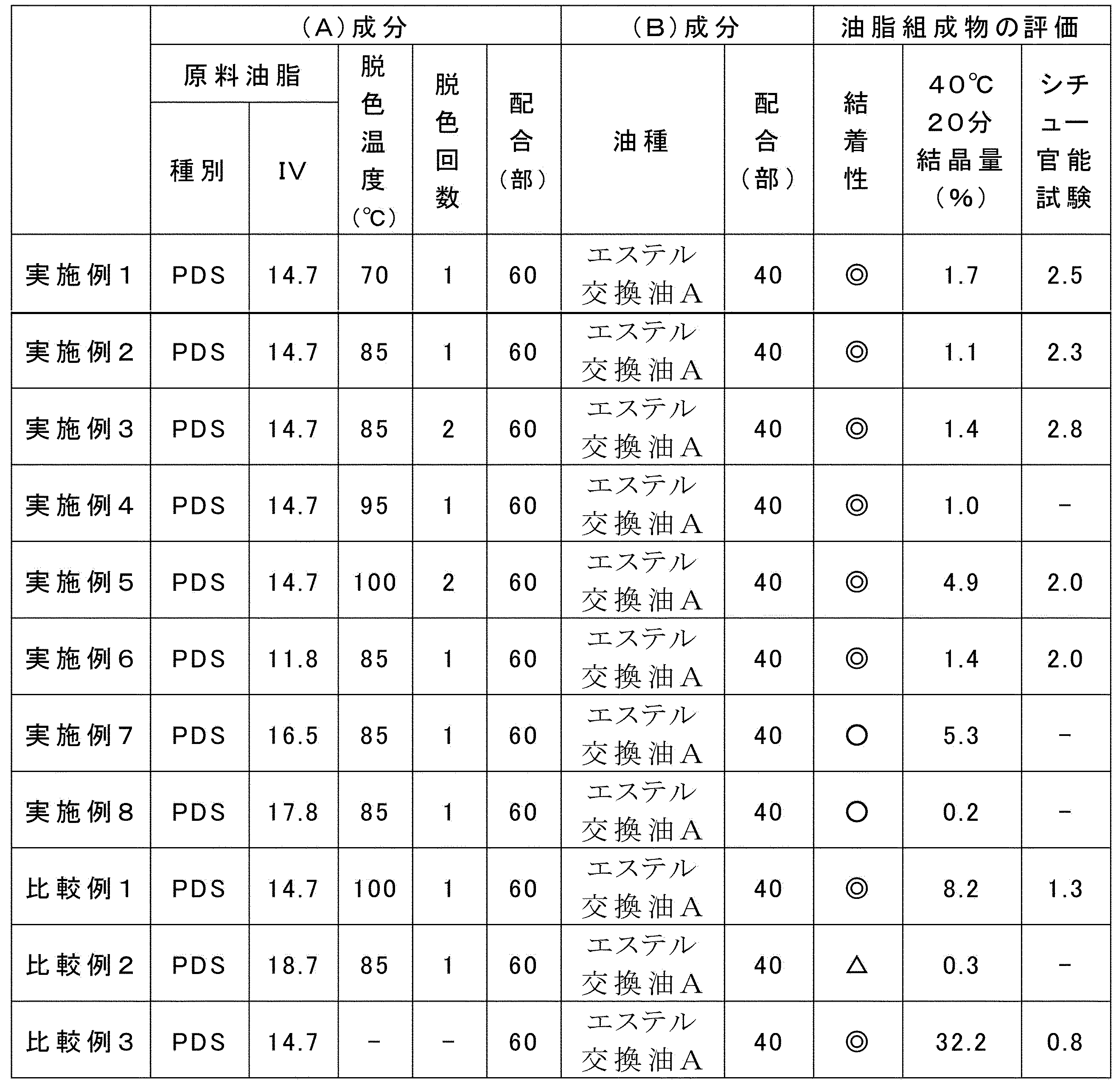
ヨウ素価が本発明を満たすパーム分別油をさらに本発明の脱色条件で脱色した実施例1~8では、45℃→25℃での結着性が低く、60℃→40℃での結晶量(%)も低かった。さらに、実施例1~8の油脂組成物を用いてシチューを作製し、40℃での官能評価を行った結果、平均点2点以上という良好な成績を得た。一方、脱色条件が本発明を満たさない比較例1では、結着性が良好であったものの、固形分がやや多く、シチュー官能評価ではややざらつきを感じた。ヨウ素価が本発明を満たさない比較例2では、結着性に劣った。また、脱色操作を行わなかった比較例3では、40℃20分の結晶量が高く、シチュー官能評価でもざらつきを顕著に感じる結果となった。
〔実施例9〕
(A)成分の分別条件を変えた油脂組成物について、以下に実施例を示す。
1.(A)成分:パームダブルステアリンの分別によるオレイン部の調製
パームダブルステアリン(ヨウ素価12.0)をLab Pilot Fractionation Unit(De Smet社製)使用して分別を実施した。晶析温度を60℃に設定し、結晶量が2%の時点でLab Filter(De Smet社製)でろ過を実施した。上記晶析によるステアリン部及びオレイン部の収率は、それぞれ、5%及び95%であった。得られたパームダブルステアリンを分別したオレイン部(以下、PDSOLと略記する)のヨウ素価を測定したところ12.3であった。
(A)成分の分別条件を変えた油脂組成物について、以下に実施例を示す。
1.(A)成分:パームダブルステアリンの分別によるオレイン部の調製
パームダブルステアリン(ヨウ素価12.0)をLab Pilot Fractionation Unit(De Smet社製)使用して分別を実施した。晶析温度を60℃に設定し、結晶量が2%の時点でLab Filter(De Smet社製)でろ過を実施した。上記晶析によるステアリン部及びオレイン部の収率は、それぞれ、5%及び95%であった。得られたパームダブルステアリンを分別したオレイン部(以下、PDSOLと略記する)のヨウ素価を測定したところ12.3であった。
2.油脂組成物の調製
実施例1において、脱色したPDSに替えて、上記で得たPDSOLを用いた以外は、実施例1と同様の操作で油脂組成物を得た。
実施例1において、脱色したPDSに替えて、上記で得たPDSOLを用いた以外は、実施例1と同様の操作で油脂組成物を得た。
3.油脂組成物の評価
得られた組成物について、実施例1と同様の油脂組成物の結着性、固形分及びシチュー官能試験を実施した。結果を、PDSの脱色操作を行っていない比較例3とともに表3に示す。
得られた組成物について、実施例1と同様の油脂組成物の結着性、固形分及びシチュー官能試験を実施した。結果を、PDSの脱色操作を行っていない比較例3とともに表3に示す。
〔実施例10〕
(A)成分の分別条件を変えた油脂組成物について、以下に実施例を示す。
1.(A)成分:パームダブルステアリンを分別したオレイン部の調製
パームダブルステアリン(ヨウ素価14.7)をLab Pilot Fractionation Unit(De Smet社製)使用して分別を実施した。晶析温度を58℃に設定し、結晶量が1.5%の時点でLab Filter(De Smet社製)でろ過を実施した。上記晶析によるステアリン部及びオレイン部の収率は、それぞれ、4%及び96%であった。得られたPDSOLのヨウ素価を測定したところ15.0であった。
(A)成分の分別条件を変えた油脂組成物について、以下に実施例を示す。
1.(A)成分:パームダブルステアリンを分別したオレイン部の調製
パームダブルステアリン(ヨウ素価14.7)をLab Pilot Fractionation Unit(De Smet社製)使用して分別を実施した。晶析温度を58℃に設定し、結晶量が1.5%の時点でLab Filter(De Smet社製)でろ過を実施した。上記晶析によるステアリン部及びオレイン部の収率は、それぞれ、4%及び96%であった。得られたPDSOLのヨウ素価を測定したところ15.0であった。
2.油脂組成物の調製
実施例1において、脱色したPDSに替えて、上記で得たPDSOLを用いた以外は、実施例1と同様の操作で油脂組成物を得た。
実施例1において、脱色したPDSに替えて、上記で得たPDSOLを用いた以外は、実施例1と同様の操作で油脂組成物を得た。
3.油脂組成物の評価
得られた組成物について、実施例1と同様の油脂組成物の結着性、固形分及びシチュー官能試験を実施した。結果を表3に示す。
得られた組成物について、実施例1と同様の油脂組成物の結着性、固形分及びシチュー官能試験を実施した。結果を表3に示す。

パームダブルステアリンを分別したオレイン部の油脂を使用した実施例9~10は、結着性、固形分、シチュー官能試験とも良好な成績となった。
〔実施例11、比較例4~8〕
1.(B)成分: エステル交換油B
化学的エステル交換油であるエステル交換油B((株)J-オイルミルズ社製)を使用した。このエステル交換油Bの飽和脂肪酸含量は95.0%、炭素数12以下の飽和脂肪酸含量は35.0%、そして、上昇融点は40.1℃である。
1.(B)成分: エステル交換油B
化学的エステル交換油であるエステル交換油B((株)J-オイルミルズ社製)を使用した。このエステル交換油Bの飽和脂肪酸含量は95.0%、炭素数12以下の飽和脂肪酸含量は35.0%、そして、上昇融点は40.1℃である。
(B)成分の比較のために、エステル交換油A:パームオレイン=7:3からなる混合油のランダムエステル交換油(比較例4)とパーム硬化油(比較例5)と飽和脂肪酸量が少なく融点が低いランダムエステル交換油(比較例6)と飽和脂肪酸量が低いエステル交換油(比較例7)とエステル交換してない油脂(比較例8)を用意した。これらの飽和脂肪酸含量、炭素数12以下の飽和脂肪酸含量及び上昇融点を表4に示す。
2.油脂組成物の調製
実施例3の(B)成分を上記エステル交換油に替えた以外は同様の手順で油脂組成物を得た。
実施例3の(B)成分を上記エステル交換油に替えた以外は同様の手順で油脂組成物を得た。
3.油脂組成物の評価
上記で得られた油脂組成物について、結着性及び固形分の評価を行った。結果を表4に示す。
上記で得られた油脂組成物について、結着性及び固形分の評価を行った。結果を表4に示す。
〔実施例12〕
1.(B)成分:脂肪酸組成を変えたエステル交換油の調製
エステル交換油Aと菜種油(9:1)の化学的ランダムエステル交換を実施した。その油脂の飽和脂肪酸含量は90.1%、炭素数12以下の飽和脂肪酸含量は22.3%、そして、上昇融点は43.0℃であった。
1.(B)成分:脂肪酸組成を変えたエステル交換油の調製
エステル交換油Aと菜種油(9:1)の化学的ランダムエステル交換を実施した。その油脂の飽和脂肪酸含量は90.1%、炭素数12以下の飽和脂肪酸含量は22.3%、そして、上昇融点は43.0℃であった。
2.油脂組成物の調製
実施例3において、(B)成分を上記エステル交換油に替えた以外は同様の手順で油脂組成物を得た。
実施例3において、(B)成分を上記エステル交換油に替えた以外は同様の手順で油脂組成物を得た。
3.油脂組成物の評価
上記で得られた油脂組成物について、結着性及び固形分の評価を行った。結果を表4に示す。
上記で得られた油脂組成物について、結着性及び固形分の評価を行った。結果を表4に示す。
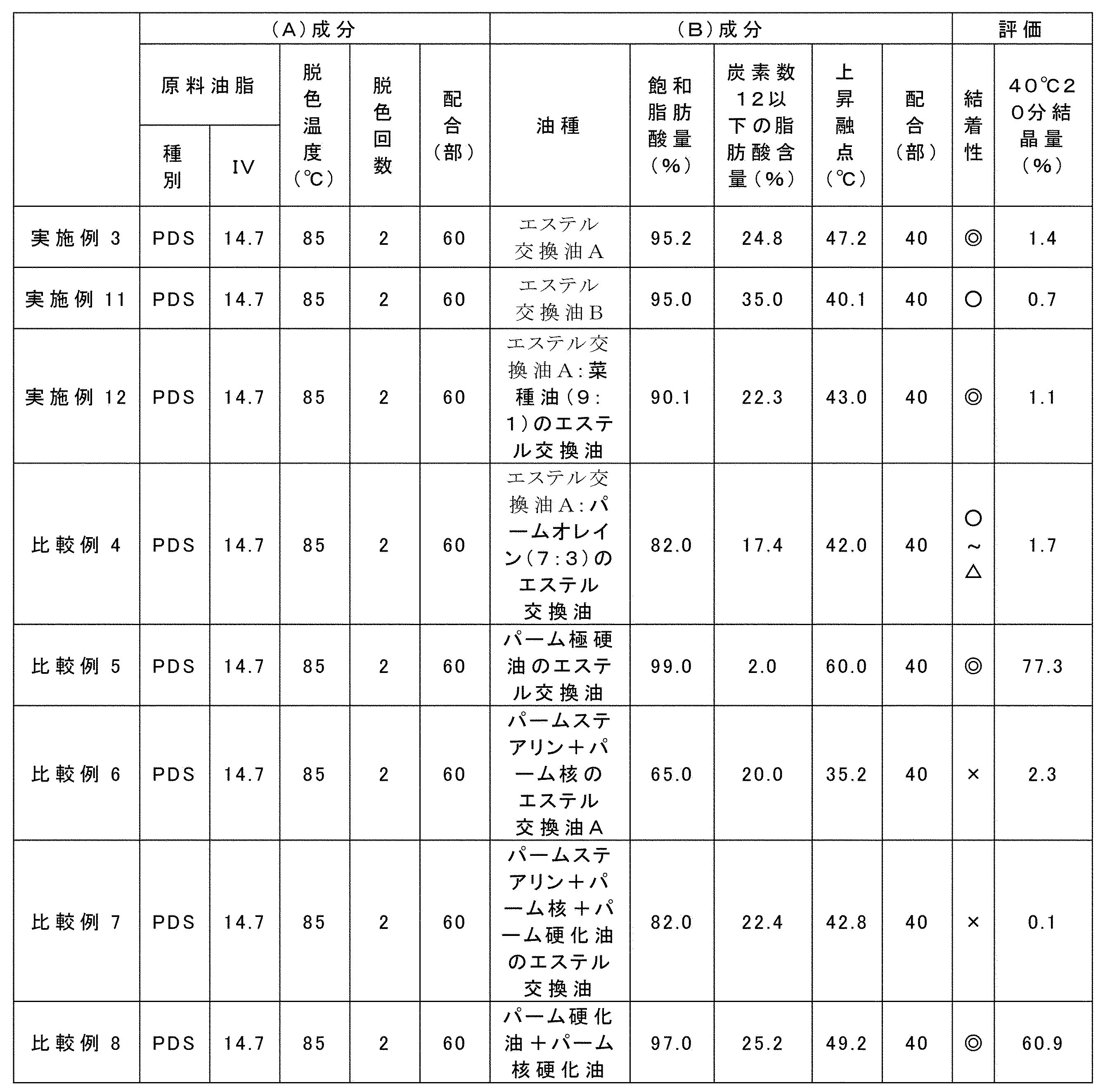
飽和脂肪酸総含量及び炭素数12以下の脂肪酸含量が本発明の条件を満たす成分(B)を用いた実施例11及び12では、結着性及び固形分ともに良好な成績となった。一方、飽和脂肪酸総含量及び炭素数12以下の脂肪酸含量が本発明の条件を満たさない比較例4では、結着性に劣った。炭素数12以下の脂肪酸含量の顕著に低い比較例5では、固形分が大量に析出した。飽和脂肪酸含量の低すぎる比較例6及び7では、結着性が悪化した。また、比較例との対比から、エステル交換油の上昇融点が40~50℃の範囲にあることも、良好な成績の一因となった。また、エステル交換しない油脂(比較例8)では、60℃→40℃20分の結晶量が多くなった。
〔実施例13~19、比較例9~14〕
1.配合を変えた油脂組成物の調製
(A)成分として実施例3で使用した脱色済みPDS及び、実施例10で使用したPDSOL、(B)成分として実施例3で使用したエステル交換油、そして(C)成分としてパーム油を表4に示す配合で混合し、油脂組成物を調整した。さらに、比較のために、本発明の配合組成を満たさない比較例9~14を用意した。
1.配合を変えた油脂組成物の調製
(A)成分として実施例3で使用した脱色済みPDS及び、実施例10で使用したPDSOL、(B)成分として実施例3で使用したエステル交換油、そして(C)成分としてパーム油を表4に示す配合で混合し、油脂組成物を調整した。さらに、比較のために、本発明の配合組成を満たさない比較例9~14を用意した。
2.油脂組成物の評価
上記で得られた油脂組成物について、結着性及び固形分の評価を行った。結果を表5に示す。
上記で得られた油脂組成物について、結着性及び固形分の評価を行った。結果を表5に示す。
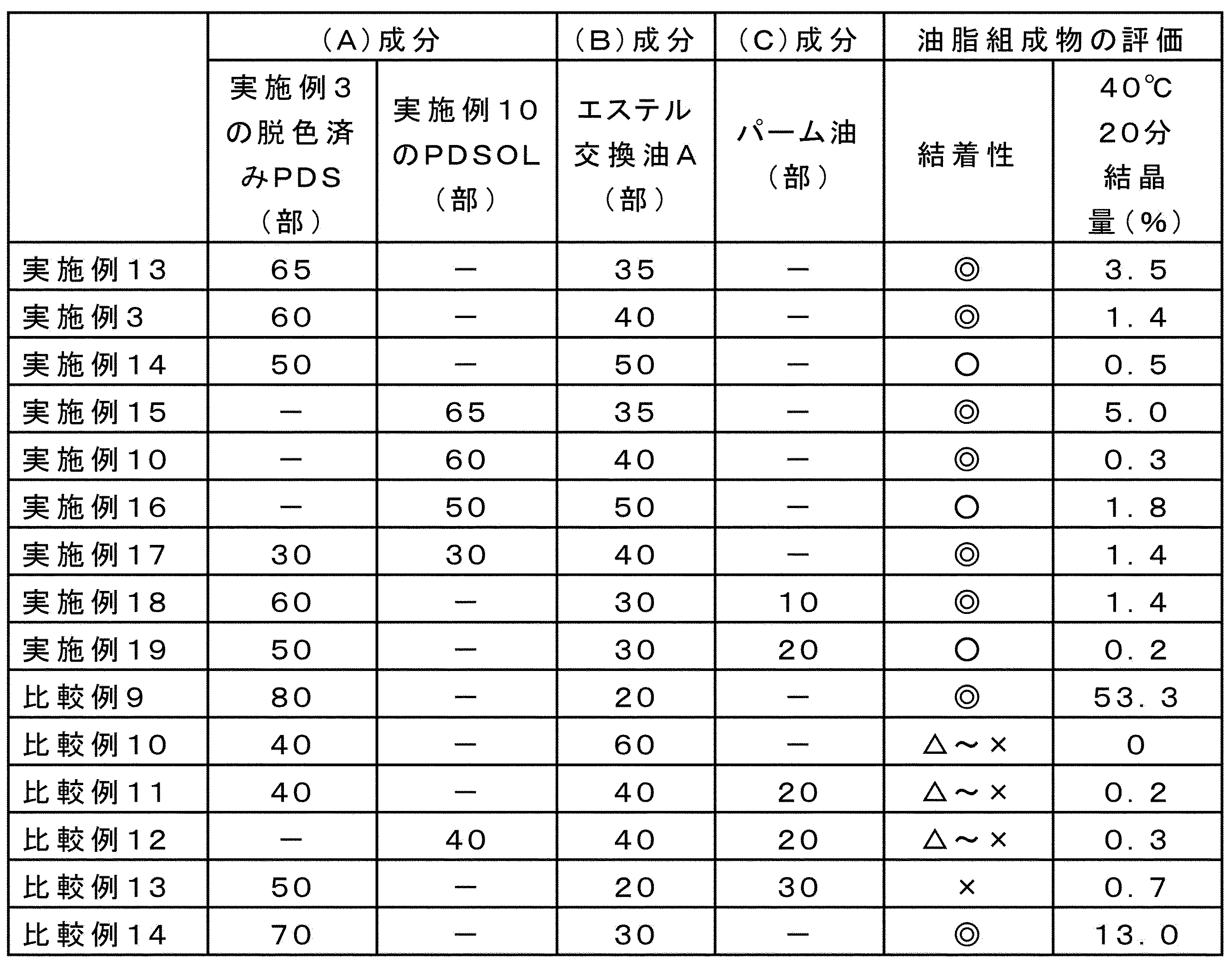
(A)成分及び(B)成分の配合量を変えた結果、本発明の配合量に臨界的な意義が確認された。
Claims (5)
- (A)ヨウ素価18以下のパーム分別油を100℃未満の温度で1回以上、あるいは100℃以上の温度で2回以上脱色することにより得られるパーム分別油、パームステアリンを分別したオレイン部、パームダブルステアリンを分別したオレイン部、及びパームトリプルステアリンを分別したオレイン部からなる群から選ばれる少なくとも一種の油脂を50~65重量%、
並びに、
(B)飽和脂肪酸含量が90重量%以上、かつ炭素数12以下の飽和脂肪酸含量が20~35重量%であるエステル交換油を30重量%以上、
含む油脂組成物。 - 前記(B)成分は、上昇融点40~50℃のエステル交換油であることを特徴とする、請求項1に記載の油脂組成物。
- 即席調理食品用原料である、請求項1に記載の油脂組成物。
- 形態が顆粒、粉末又はフレーク状である、請求項1に記載の油脂組成物。
- 請求項1に記載の油脂組成物を含む即席調理食品。
Priority Applications (1)
| Application Number | Priority Date | Filing Date | Title |
|---|---|---|---|
| JP2012548300A JP5184722B1 (ja) | 2011-10-25 | 2012-08-15 | 油脂組成物 |
Applications Claiming Priority (2)
| Application Number | Priority Date | Filing Date | Title |
|---|---|---|---|
| JP2011-233512 | 2011-10-25 | ||
| JP2011233512 | 2011-10-25 |
Publications (1)
| Publication Number | Publication Date |
|---|---|
| WO2013061671A1 true WO2013061671A1 (ja) | 2013-05-02 |
Family
ID=48167514
Family Applications (1)
| Application Number | Title | Priority Date | Filing Date |
|---|---|---|---|
| PCT/JP2012/070722 Ceased WO2013061671A1 (ja) | 2011-10-25 | 2012-08-15 | 油脂組成物 |
Country Status (2)
| Country | Link |
|---|---|
| JP (1) | JP5184722B1 (ja) |
| WO (1) | WO2013061671A1 (ja) |
Cited By (5)
| Publication number | Priority date | Publication date | Assignee | Title |
|---|---|---|---|---|
| JP2015136328A (ja) * | 2014-01-22 | 2015-07-30 | ミヨシ油脂株式会社 | 即席調理食品用油脂組成物とそれを用いた即席調理食品 |
| JP2018113991A (ja) * | 2018-04-27 | 2018-07-26 | ミヨシ油脂株式会社 | 即席調理食品用油脂組成物とそれを用いた即席調理食品 |
| WO2019111711A1 (ja) * | 2017-12-08 | 2019-06-13 | 森下仁丹株式会社 | 非水素添加油脂で構成された三層構造カプセルおよびその製造方法 |
| JPWO2020189383A1 (ja) * | 2019-03-20 | 2020-09-24 | ||
| JP2025110949A (ja) * | 2024-01-17 | 2025-07-30 | ミヨシ油脂株式会社 | 粉末油脂及びそれを配合した飲食品 |
Citations (7)
| Publication number | Priority date | Publication date | Assignee | Title |
|---|---|---|---|---|
| JPH051297A (ja) * | 1991-06-25 | 1993-01-08 | Fuji Oil Co Ltd | 脂肪組成物の製造法 |
| JP2003204774A (ja) * | 2002-01-15 | 2003-07-22 | House Foods Corp | 即席調理食品及びその製造方法。 |
| JP2006197884A (ja) * | 2005-01-24 | 2006-08-03 | House Foods Corp | 即席調理食品 |
| JP2008131922A (ja) * | 2006-11-29 | 2008-06-12 | Adeka Corp | 固形ルウ用油脂組成物 |
| JP2008289404A (ja) * | 2007-05-23 | 2008-12-04 | Nisshin Oillio Group Ltd | ルウ用油脂組成物 |
| WO2010064592A1 (ja) * | 2008-12-02 | 2010-06-10 | 日清オイリオグループ株式会社 | ルウ用油脂組成物及びルウ |
| JP2010130919A (ja) * | 2008-12-02 | 2010-06-17 | Nisshin Oillio Group Ltd | 油脂組成物 |
-
2012
- 2012-08-15 WO PCT/JP2012/070722 patent/WO2013061671A1/ja not_active Ceased
- 2012-08-15 JP JP2012548300A patent/JP5184722B1/ja active Active
Patent Citations (7)
| Publication number | Priority date | Publication date | Assignee | Title |
|---|---|---|---|---|
| JPH051297A (ja) * | 1991-06-25 | 1993-01-08 | Fuji Oil Co Ltd | 脂肪組成物の製造法 |
| JP2003204774A (ja) * | 2002-01-15 | 2003-07-22 | House Foods Corp | 即席調理食品及びその製造方法。 |
| JP2006197884A (ja) * | 2005-01-24 | 2006-08-03 | House Foods Corp | 即席調理食品 |
| JP2008131922A (ja) * | 2006-11-29 | 2008-06-12 | Adeka Corp | 固形ルウ用油脂組成物 |
| JP2008289404A (ja) * | 2007-05-23 | 2008-12-04 | Nisshin Oillio Group Ltd | ルウ用油脂組成物 |
| WO2010064592A1 (ja) * | 2008-12-02 | 2010-06-10 | 日清オイリオグループ株式会社 | ルウ用油脂組成物及びルウ |
| JP2010130919A (ja) * | 2008-12-02 | 2010-06-17 | Nisshin Oillio Group Ltd | 油脂組成物 |
Cited By (12)
| Publication number | Priority date | Publication date | Assignee | Title |
|---|---|---|---|---|
| JP2015136328A (ja) * | 2014-01-22 | 2015-07-30 | ミヨシ油脂株式会社 | 即席調理食品用油脂組成物とそれを用いた即席調理食品 |
| WO2019111711A1 (ja) * | 2017-12-08 | 2019-06-13 | 森下仁丹株式会社 | 非水素添加油脂で構成された三層構造カプセルおよびその製造方法 |
| WO2019111398A1 (ja) * | 2017-12-08 | 2019-06-13 | 森下仁丹株式会社 | 非水素添加油脂で構成された三層構造カプセルおよびその製造方法 |
| KR20200096202A (ko) * | 2017-12-08 | 2020-08-11 | 모리시타 진탄 가부시키가이샤 | 비수소첨가 유지로 구성된 3층 구조 캡슐 및 그의 제조 방법 |
| KR102763771B1 (ko) * | 2017-12-08 | 2025-02-05 | 모리시타 진탄 가부시키가이샤 | 비수소첨가 유지로 구성된 3층 구조 캡슐 및 그의 제조 방법 |
| US12302935B2 (en) | 2017-12-08 | 2025-05-20 | Morishita Jintan Co., Ltd. | Three-layered capsule constructed with non-hydrogenated oil and production thereof |
| JP2018113991A (ja) * | 2018-04-27 | 2018-07-26 | ミヨシ油脂株式会社 | 即席調理食品用油脂組成物とそれを用いた即席調理食品 |
| JPWO2020189383A1 (ja) * | 2019-03-20 | 2020-09-24 | ||
| KR20210142619A (ko) | 2019-03-20 | 2021-11-25 | 아지노모토 가부시키가이샤 | 과립상 인스턴트 식품 및 그 제조 방법 |
| JP7474742B2 (ja) | 2019-03-20 | 2024-04-25 | 味の素株式会社 | 顆粒状インスタント食品及びその製造方法 |
| KR102776797B1 (ko) | 2019-03-20 | 2025-03-10 | 아지노모토 가부시키가이샤 | 과립상 인스턴트 식품 및 그 제조 방법 |
| JP2025110949A (ja) * | 2024-01-17 | 2025-07-30 | ミヨシ油脂株式会社 | 粉末油脂及びそれを配合した飲食品 |
Also Published As
| Publication number | Publication date |
|---|---|
| JPWO2013061671A1 (ja) | 2015-04-02 |
| JP5184722B1 (ja) | 2013-04-17 |
Similar Documents
| Publication | Publication Date | Title |
|---|---|---|
| WO2012121010A1 (ja) | 油脂組成物及び該油脂組成物を用いたバタークリーム | |
| JP5184722B1 (ja) | 油脂組成物 | |
| JP4767215B2 (ja) | ルウ用油脂組成物 | |
| JP5107094B2 (ja) | 固形ルウ用油脂組成物 | |
| JP4517043B1 (ja) | ルウ用油脂組成物及びルウ | |
| JP5209453B2 (ja) | 油脂組成物 | |
| JP5917262B2 (ja) | 油脂組成物 | |
| JP4895784B2 (ja) | 固形ルウ用油脂組成物 | |
| JP6204074B2 (ja) | アイシング用油脂組成物 | |
| JP5901136B2 (ja) | ルウ用油脂及びそれを用いたルウ | |
| CN103442578B (zh) | 水产品加工食品用油脂组成物及使用其的水产品加工食品 | |
| JP2018171057A (ja) | フィリング用油脂組成物 | |
| JP6717570B2 (ja) | 即席調理食品用油脂組成物とそれを用いた即席調理食品 | |
| JP6466063B2 (ja) | 水産加工食品用油脂組成物とそれを用いた可塑性油脂組成物及び水産加工食品 | |
| JP6324064B2 (ja) | 即席調理食品用油脂組成物とそれを用いた即席調理食品 | |
| JP5684763B2 (ja) | 即席ルー用油脂組成物及びこれを使用した即席ルー | |
| JPH09224570A (ja) | パームステアリンを利用した食用油 | |
| JP6382588B2 (ja) | 水産加工食品用油脂組成物とそれを用いた可塑性油脂組成物及び水産加工食品 | |
| JP6512811B2 (ja) | 分離液状調味料 | |
| JP7474742B2 (ja) | 顆粒状インスタント食品及びその製造方法 | |
| JP6334926B2 (ja) | 即席調理食品用油脂組成物とそれを用いた即席調理食品 | |
| JP6630396B2 (ja) | 即席調理食品用油脂組成物とそれを用いた即席調理食品 | |
| JP5796143B1 (ja) | 固形ルウ用油脂組成物及びそれを含有する固形ルウ |
Legal Events
| Date | Code | Title | Description |
|---|---|---|---|
| ENP | Entry into the national phase |
Ref document number: 2012548300 Country of ref document: JP Kind code of ref document: A |
|
| 121 | Ep: the epo has been informed by wipo that ep was designated in this application |
Ref document number: 12843492 Country of ref document: EP Kind code of ref document: A1 |
|
| NENP | Non-entry into the national phase |
Ref country code: DE |
|
| 122 | Ep: pct application non-entry in european phase |
Ref document number: 12843492 Country of ref document: EP Kind code of ref document: A1 |