WO2013058358A1 - 管継手 - Google Patents
管継手 Download PDFInfo
- Publication number
- WO2013058358A1 WO2013058358A1 PCT/JP2012/077088 JP2012077088W WO2013058358A1 WO 2013058358 A1 WO2013058358 A1 WO 2013058358A1 JP 2012077088 W JP2012077088 W JP 2012077088W WO 2013058358 A1 WO2013058358 A1 WO 2013058358A1
- Authority
- WO
- WIPO (PCT)
- Prior art keywords
- inclined surface
- sleeve
- tube
- tubular body
- diameter
- Prior art date
- Legal status (The legal status is an assumption and is not a legal conclusion. Google has not performed a legal analysis and makes no representation as to the accuracy of the status listed.)
- Ceased
Links
Images



Classifications
-
- F—MECHANICAL ENGINEERING; LIGHTING; HEATING; WEAPONS; BLASTING
- F16—ENGINEERING ELEMENTS AND UNITS; GENERAL MEASURES FOR PRODUCING AND MAINTAINING EFFECTIVE FUNCTIONING OF MACHINES OR INSTALLATIONS; THERMAL INSULATION IN GENERAL
- F16L—PIPES; JOINTS OR FITTINGS FOR PIPES; SUPPORTS FOR PIPES, CABLES OR PROTECTIVE TUBING; MEANS FOR THERMAL INSULATION IN GENERAL
- F16L19/00—Joints in which sealing surfaces are pressed together by means of a member, e.g. a swivel nut, screwed on, or into, one of the joint parts
- F16L19/08—Joints in which sealing surfaces are pressed together by means of a member, e.g. a swivel nut, screwed on, or into, one of the joint parts with metal rings which bite into the wall of the pipe
- F16L19/083—Joints in which sealing surfaces are pressed together by means of a member, e.g. a swivel nut, screwed on, or into, one of the joint parts with metal rings which bite into the wall of the pipe the longitudinal cross-section of the ring not being modified during clamping
- F16L19/086—Joints in which sealing surfaces are pressed together by means of a member, e.g. a swivel nut, screwed on, or into, one of the joint parts with metal rings which bite into the wall of the pipe the longitudinal cross-section of the ring not being modified during clamping with additional sealing means
-
- F—MECHANICAL ENGINEERING; LIGHTING; HEATING; WEAPONS; BLASTING
- F16—ENGINEERING ELEMENTS AND UNITS; GENERAL MEASURES FOR PRODUCING AND MAINTAINING EFFECTIVE FUNCTIONING OF MACHINES OR INSTALLATIONS; THERMAL INSULATION IN GENERAL
- F16L—PIPES; JOINTS OR FITTINGS FOR PIPES; SUPPORTS FOR PIPES, CABLES OR PROTECTIVE TUBING; MEANS FOR THERMAL INSULATION IN GENERAL
- F16L33/00—Arrangements for connecting hoses to rigid members; Rigid hose-connectors, i.e. single members engaging both hoses
- F16L33/22—Arrangements for connecting hoses to rigid members; Rigid hose-connectors, i.e. single members engaging both hoses with means not mentioned in the preceding groups for gripping the hose between inner and outer parts
- F16L33/223—Arrangements for connecting hoses to rigid members; Rigid hose-connectors, i.e. single members engaging both hoses with means not mentioned in the preceding groups for gripping the hose between inner and outer parts the sealing surfaces being pressed together by means of a member, e.g. a swivel nut, screwed on or into one of the joint parts
- F16L33/224—Arrangements for connecting hoses to rigid members; Rigid hose-connectors, i.e. single members engaging both hoses with means not mentioned in the preceding groups for gripping the hose between inner and outer parts the sealing surfaces being pressed together by means of a member, e.g. a swivel nut, screwed on or into one of the joint parts a clamping ring being arranged between the threaded member and the connecting member
-
- F—MECHANICAL ENGINEERING; LIGHTING; HEATING; WEAPONS; BLASTING
- F16—ENGINEERING ELEMENTS AND UNITS; GENERAL MEASURES FOR PRODUCING AND MAINTAINING EFFECTIVE FUNCTIONING OF MACHINES OR INSTALLATIONS; THERMAL INSULATION IN GENERAL
- F16L—PIPES; JOINTS OR FITTINGS FOR PIPES; SUPPORTS FOR PIPES, CABLES OR PROTECTIVE TUBING; MEANS FOR THERMAL INSULATION IN GENERAL
- F16L47/00—Connecting arrangements or other fittings specially adapted to be made of plastics or to be used with pipes made of plastics
- F16L47/04—Connecting arrangements or other fittings specially adapted to be made of plastics or to be used with pipes made of plastics with a swivel nut or collar engaging the pipe
-
- F—MECHANICAL ENGINEERING; LIGHTING; HEATING; WEAPONS; BLASTING
- F16—ENGINEERING ELEMENTS AND UNITS; GENERAL MEASURES FOR PRODUCING AND MAINTAINING EFFECTIVE FUNCTIONING OF MACHINES OR INSTALLATIONS; THERMAL INSULATION IN GENERAL
- F16L—PIPES; JOINTS OR FITTINGS FOR PIPES; SUPPORTS FOR PIPES, CABLES OR PROTECTIVE TUBING; MEANS FOR THERMAL INSULATION IN GENERAL
- F16L2201/00—Special arrangements for pipe couplings
- F16L2201/10—Indicators for correct coupling
Definitions
- the present invention relates to a pipe joint used for connecting a flexible deformable hose or tube such as a tube formed of a soft material such as synthetic resin or rubber.
- a concave ring groove into which the end of the connecting pipe can be fitted is provided on one side, and the end surface of the outer wall of the concave ring groove is an inward inclined surface, while the inner wall side is extended.
- the wedge ring is reduced in diameter by the close movement of the opposed inclined surfaces, and the inner peripheral surface of the wedge ring is pressed against the outer peripheral surface of the connecting pipe.
- the connecting pipe is a hose or tube made of synthetic resin, for example, and the creep (permanent strain) phenomenon occurs in the pressure contact portion with the wedge ring due to the change over time, the thickness of the pressure contact portion becomes thin.
- an annular seal member that can be elastically deformed is provided on the outer peripheral surface of the inner cylinder facing the inner peripheral surface of the connection pipe so that the tip thereof bites into the inner peripheral surface of the connection pipe.
- the wall thickness of the inner cylinder is increased by the thickness of the seal member, which not only reduces the flow rate through the inner cylinder, but also occurs between the inner cylinder and the inner peripheral surface of the connecting pipe.
- soot and the like accumulated on the level difference and caused contamination.
- the present invention provides a nipple provided along an insertion space of a flexible tubular body, and a radial direction across the outer peripheral surface of the nipple and the insertion space of the tubular body.
- a cylindrical member having a first inclined surface provided so as to be opposed and formed so that an inner diameter gradually decreases in an insertion direction of the tubular body, the outer peripheral surface of the nipple, and the tubular body Opposing in the radial direction across the insertion space, facing the first inclined surface and the insertion direction of the tube, and reciprocating in the insertion direction of the tube relative to the first inclined surface
- a tightening member having a second inclined surface formed so that an inner diameter gradually decreases in a direction opposite to the insertion direction of the tube body, the outer peripheral surface of the nipple, and the tube body Opposing in the radial direction across the insertion space
- the first inclined surface and the second inclined surface are provided between the first inclined surface and the second inclined surface so as to be reciprocally
- a sleeve formed so as to be reduced in diameter with a relative approach movement of the surface, and on the back side in the insertion direction of the tubular body than the sleeve, the step of the tubular body via a step portion
- An annular recess is provided so as to communicate with the insertion space in a radial direction so as to communicate with each other, and the annular recess is larger in diameter than the inner diameter of the sleeve when the diameter is reduced, and the tube is deformed as the sleeve is deformed.
- the outer peripheral portion of the tip of the body is formed to bulge and deform into an annular shape and fit into the annular recess.
- the first inclined surface and the second inclined surface move relatively close to each other in a state where the tubular body is inserted into the insertion space of the tubular body formed along the outer peripheral surface of the nipple.
- the outer surface of the tubular body is partially compressed and deformed on the inner circumferential surface of the sleeve, and at the same time, this compressed and deformed capacity is expanded from the outer peripheral portion of the distal end of the tubular body toward the annular recess.
- the tube body deformed and deformed is inserted, and the outer peripheral portion of the tip of the bulging and deformed tube body is caught by the stepped portion, and the entire tube body is held immovably in the insertion direction N and the reverse direction U. Therefore, even if a creep phenomenon occurs in the tubular body, the pull-out strength can be maintained high. As a result, the wedge ring is reduced in diameter due to the approaching movement of the inclined surfaces facing each other and the inner peripheral surface of the wedge ring is pressed against the outer peripheral surface of the connecting pipe, so that the tube body has a longer period of time regardless of the creep phenomenon. It is possible to prevent the tubular body from coming off and improve safety.
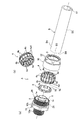
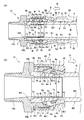
- a pipe joint A includes a nipple 1 provided along an insertion space S of a flexible tube B, an outer peripheral surface 1a of the nipple 1, A cylindrical member 20 provided so as to face the radial direction across the insertion space S of the tubular body B, the first circumferentially opposed surface 1a of the nipple 1 and the insertion space S of the tubular body B, and the first A clamping member 30 provided so as to be reciprocally movable in the axial direction of the nipple 1 relative to the inclined surface 2, and between the first inclined surface 2 and the second inclined surface 3 facing the outer peripheral surface 1 a of the nipple 1 in the radial direction.
- the sleeve 4 is provided as a main component so as to be reciprocally movable in the axial direction of the nipple 1 and elastically deformable in the radial direction.
- the cylindrical member 20 has the 1st inclined surface 2 formed so that an internal diameter may become small gradually toward the axial direction of the nipple 1.
- the fastening member 30 has a second inclined surface 3 formed so that the inner diameter gradually decreases in the opposite direction to the first inclined surface 2.
- a connection end Ba arranged at one end of the tube B is inserted toward the insertion space S of the tube B formed in a cylindrical shape along the line 1a.
- the sleeve 4 is moved by moving the first inclined surface 2 of the tubular member 20 and the second inclined surface 3 of the fastening member 30 so that they are relatively close to each other. Is sandwiched between the first inclined surface 2 and the second inclined surface 3 to undergo a diameter reduction deformation.
- the inner peripheral surface of the sleeve 4 is pressed against the outer surface B2 of the connection end Ba of the tube B inserted into the insertion space S of the tube B, and is partially compressed and deformed.
- the distal end outer peripheral portion B3 at the connection end Ba is swelled and deformed so that it cannot be pulled out in the direction U opposite to the insertion direction N of the tube B.
- the nipple 1 is made of a hard material such as a metal such as brass or a hard synthetic resin, for example, and is formed in a cylindrical shape having an outer diameter that is substantially the same as, slightly larger than, or slightly smaller than the inner diameter of the tube body B described later.
- a plate material made of a deformable rigid material such as stainless steel is subjected to press processing or other forming processing, so that the outer diameter is approximately the same as or slightly larger than or slightly smaller than the inner diameter of the tube B. It is formed in a thin cylindrical shape.
- an unevenness portion 1 b for preventing slippage that opposes the inner surface B1 of the connection end portion Ba of the tube B, which will be described later, and an insertion direction N (hereinafter “tube insertion direction”) It is preferable to form an abutting portion 1c facing the tip end surface B4 of the connection end Ba near the back end of N).
- the concave and convex portion 1b for retaining is formed in the shape of a bamboo slab in which annular concave portions and annular convex portions are alternately continuous at the axially intermediate position of the outer peripheral surface 1a of the nipple 1.
- the outer peripheral surface 1a of the nipple 1 can be formed as a smooth surface.
- the cylindrical member 20 is formed in a cylindrical shape having an inner diameter larger than the outer diameter of the tube B to be described later, and is integrally formed outside the nipple 1 so as to form a double cylinder, thereby moving in the tube insertion direction N.
- the cylindrical member 20 By disposing the cylinder member 20 so as not to move, or by inserting the cylindrical member 20 formed separately from the nipple 1 so as to form a double cylinder outside the nipple 1, it becomes impossible to move in the tube insertion direction N.
- a first inclined surface 2 whose inner diameter gradually decreases in the tube insertion direction N is formed so as to face the outer peripheral surface 1 a of the nipple 1.
- the fastening member 30 is made of, for example, a metal material that is not easily rusted such as stainless steel or other rigid material, and is formed in a substantially cylindrical shape having an inner diameter larger than an outer diameter of a sleeve 4 to be described later, on the nipple 1 side. On the other hand, it is arranged so as to be able to reciprocate in the tube insertion direction N and the tube removal direction U via the slide means 31.
- the slide means 31 is formed across the fastening member 30 and the nipple 1 or the tubular member 20 and supports the fastening member 30 so as to be able to reciprocate in the tube insertion direction N and the tube withdrawal direction U with respect to the nipple 1.
- the inner peripheral surface of the fastening member 30 is opposed to the first inclined surface 2 and the direction U opposite to the tube insertion direction N (hereinafter referred to as “tube removal direction U”), and the inner diameter gradually increases in the tube removal direction U.
- the smaller second inclined surface 3 is formed so as to face the outer peripheral surface 1 a of the nipple 1, or the second inclined surface 3 is integrated with the inner peripheral surface of another member inserted into the inner peripheral surface of the fastening member 30. It is formed.
- the inclination angle of the second inclined surface 3 is the same as that of the first inclined surface 2 so that the second inclined surface 3 is symmetrical with the first inclined surface 2 formed on the inner peripheral surface of the tubular member 20 in the tube insertion direction N.
- the inclination angle of the first inclined surface 2 can be made looser than the inclination angle of the second inclined surface 3 so as to be substantially parallel to the outer peripheral surface 1 a of the nipple 1.
- a tool engaging portion 32 for rotating operation for example, a plurality of flat portions engaged with a tool or the like as shown in the illustrated example are formed at appropriate intervals in the circumferential direction. It is preferable to form an uneven portion such as.
- the sleeve 4 is formed in a substantially cylindrical shape by an elastically deformable material such as a polyacetal resin or a synthetic resin having excellent slipperiness and heat resistance on the other surface, and is inserted into the outer peripheral surface 1a of the nipple 1 and the tube B. While facing the radial direction across the space S, it is sandwiched between the first inclined surface 2 and the second inclined surface 3 so as to reciprocate in the tube insertion direction N and the tube withdrawal direction U. Furthermore, the sleeve 4 has an elastically deformable portion 4a that elastically expands and contracts in the radial direction, and the inner diameter thereof is substantially the same as the outer diameter of the tubular body B described later at the time of expanding the diameter.
- an elastically deformable material such as a polyacetal resin or a synthetic resin having excellent slipperiness and heat resistance on the other surface
- the outer peripheral surface of the sleeve 4 is opposed to the first inclined surface 2 substantially parallel to the first tapered surface 4b, which gradually decreases in diameter in the tube insertion direction N, and the second inclined surface 3 is opposed substantially parallel to the tube. It has the 2nd taper surface 4c which becomes a small diameter gradually toward the removal direction U. As shown in FIG.
- the first taper surface 4b and the second taper surface 4c have the same length and inclination angle in the tube insertion direction N on the first taper surface 4b and the length and inclination angle in the tube removal direction U on the second taper surface 4c.
- the whole sleeve 4 symmetrical in the tube insertion direction N and the tube removal direction U.
- the inclination angle of the first taper surface 4b is made smaller than the inclination angle of the second taper surface 4c so that the entire sleeve 4 is asymmetrically formed in the tube insertion direction N and the tube removal direction U. It is also possible.
- the elastic deformation portion 4a can be elastically expanded or contracted in the radial direction to smoothly expand the diameter or
- the first inclined surface 2 and the second inclined surface are configured such that the tapered surface 4b is in contact with the first inclined surface 2 and the reverse tapered surface 4c is in contact with the second inclined surface 3 at the same time. 3, the taper surface 4 b and the reverse taper surface 4 c slide along the first inclined surface 2 and the second inclined surface 3, respectively, and the entire sleeve 4 is reduced in diameter. ing.
- a plurality of slits extending linearly in the axial direction from both axial ends of the sleeve 4 are formed in a zigzag-like circumferential direction so that the overall axial length of the sleeve 4 is smoothly expanded.
- the diameter and the diameter can be deformed.
- a plurality of slits extending in the axial direction from one end of the sleeve 4 in the axial direction are formed in the circumferential direction, or one slit is formed along the entire axial length of the sleeve 4. It is also possible to form a non-linearly extending slot such as a curve.
- a protrusion 4 d that protrudes toward the outer peripheral surface 1 a of the nipple 1 and the insertion space S of the tube B in a state of being annular or close to an annular shape in the circumferential direction, and inside the tip of the protrusion 4 d.
- An annular seal member 6 having a peripheral end 6a protruding toward the outer peripheral surface 1a of the nipple 1 and the insertion space S of the tube body B is provided. Accordingly, it is preferable to cause the protrusion 4d and the seal member 6 to bite into the outer surface B2 of the tubular body B as the sleeve 4 is reduced in diameter.
- the sleeve 4 is deformed to reduce the diameter, and the protruding portion 4d and the seal member 6 are connected to the tube. It is configured to be pushed into the outer surface B ⁇ b> 2 of the body B so as to be bitten. It is preferable that a plurality of the protruding portions 4d are formed to protrude in the tube insertion direction N and the tube pull-out direction U at intervals.
- the plurality of protrusions 4d are partially pressed against the outer surface B2 of the tubular body B to compress and deform, thereby expanding the outer surface B2 of the tubular body B. Even if the protruding and deformed portion is sandwiched between the protrusions 4d and a creep (permanent strain) phenomenon occurs in the tube body B, the press contact portion with the sleeve 4 is held, and the sealing performance can be maintained high. . As shown in FIG.
- the seal member 6 is formed in an annular shape from a material that can be compressed and deformed, such as rubber, and an outer peripheral portion of the seal member 6 is formed on the inner peripheral surface of the sleeve 4.
- the inner peripheral end 6a of the sealing member 6 is positioned so as to protrude toward the outer surface B2 of the tubular body B by being disposed so as to be immovable by fitting or the like.
- the inner peripheral surface of the seal member 6 is curved and formed in a substantially arc shape in cross section, and a concave groove portion 6b into which a bulging deformed portion enters when the seal member 6 is compressed and deformed is formed on the surface. preferable.
- a plurality of protrusions 4d are provided in the axial direction on the inner peripheral surface of the sleeve 4, and an annular mounting recess 4e is formed at an intermediate position in the axial direction, and the annular mounting recess 4e is formed.
- an elastically deformable seal member 6 such as an O-ring is fitted and held so as not to move in the axial direction.
- a part or all of the axial direction on the inner peripheral surface of the sleeve 4 is provided on the inner peripheral surface of the sleeve 4 without providing either or both of the protrusion 4d and the seal member 6 on the inner peripheral surface of the sleeve 4. It is also possible to form it smoothly.
- an annular recess 5 is provided so as to communicate with the insertion space S of the tube body B in a radial direction via the stepped portion 5a.
- a stepped portion 5 a is provided at the back end in the tube insertion direction N of the sleeve 4, and an annular recess is formed between the sleeve 4 and the first inclined surface 2 disposed on the back side in the tube insertion direction N.
- 5 or a step portion 5a and an annular recess 5 are continuously formed in the tube insertion direction N at the back end in the tube insertion direction N on the first inclined surface 2.
- the annular recess 5 is opposed to the inner surface of the nipple 1 in the radial direction across the insertion space S of the tube body B and the rear side portion in the tube insertion direction N rather than the position facing the sleeve 4 via the stepped portion 5a. And is formed so as to communicate with the insertion space S of the tubular body B.
- the annular recess 5 is the maximum inner diameter of the inner peripheral surface at the time of the diameter reduction of the sleeve 4 or larger than the minimum inner diameter of the first inclined surface 2, and the inner side surface in the tube removal direction U is defined as a stepped portion 5 a. It is formed so as to be substantially perpendicular to the inner bottom surface of the annular recess 5.
- annular recess 5 is connected to the tubular body B, which will be described later, along with the diameter-reducing deformation of the sleeve 4 due to the relative close movement of the first inclined surface 2 of the cylindrical member 20 and the second inclined surface 3 of the fastening member 30.
- the distal end outer peripheral portion B3 at the end portion Ba is configured to bulge and deform into an annular shape and fit into the annular recess 5.
- the tube B is, for example, a hose or a tube formed of a soft synthetic resin such as vinyl chloride, or a soft material such as silicone rubber or other rubber, and the inner surface B1 and the outer surface B2 are flat. Is preferred.
- a hose having a single layer structure is used in the illustrated example.
- a plurality or a single synthetic resin blade is embedded in a spiral as an intermediate layer between the transparent or opaque outer layer and inner layer.
- Laminated hose (blade hose), and a spiral reinforcing hose (four) which is formed by spirally winding a strip-shaped reinforcing material such as a synthetic resin or metal cross section and a linear reinforcing material such as a circular section as a middle layer. It is also possible to use various types of tubular bodies having different structures such as a run hose), a spiral reinforcing hose in which a metal wire or a hard synthetic resin wire is embedded in a spiral shape.
- a pipe is directed toward the insertion space S of the pipe body B formed along the outer peripheral surface 1 a of the nipple 1.
- the connection end Ba of the body B is inserted, and the tip end surface B4 at the connection end Ba reaches the back side in the tube insertion direction N with respect to the first inclined surface 2 as shown in FIG.
- the sleeve 4 is moved along them.
- the taper surface 4b and the reverse taper surface 4c slide, the entire sleeve 4 is gradually reduced in diameter.
- the inner peripheral surface of the sleeve 4 is pressed against the outer surface B2 of the tube B, and the outer surface B2 of the tube B is partially compressed and deformed, so that the inner peripheral surface of the sleeve 4 is the outer surface of the tube B.
- this compressed and deformed volume is swelled and fitted from the outer peripheral portion B3 of the tube B toward the annular recess 5, and this bulged and deformed tip outer peripheral portion B3 enters the step portion 5a.
- the entire tubular body B is held immovable in the tube removal direction U by being caught in the tube removal direction U.
- the annular sealing member 6 is provided on the inner peripheral surface of the sleeve 4 so that the inner peripheral end 6a protrudes toward the insertion space S of the tube B, the first inclined surface 2 and the second inclined surface 2 are provided.
- the inner peripheral end 6 a of the seal member 6 protruding from the inner peripheral surface of the sleeve 4 bites into and adheres to the outer surface B 2 of the tube body B. Therefore, even if a creep phenomenon occurs in the tube body B and the thickness dimension of the pressure contact portion with the sleeve 4 becomes thin, the sealing performance can be maintained high.
- the tube B has a longer period regardless of the creep phenomenon. It can be hermetically held over a further time, and further improvement in safety can be achieved. Furthermore, the wall thickness of the nipple 1 can be reduced compared with the case where an annular seal member is embedded in the outer peripheral surface 1a of the nipple 1 facing the inner surface B1 of the tube B, and the flow rate through the nipple 1 is thereby reduced.
- a creep (permanent strain) phenomenon occurs in the tubular body B. Even so, the pressure contact portion with the sleeve 4 is maintained. Therefore, even if a creep phenomenon occurs in the tube body B, it is possible to maintain a high pull-out strength and sealing performance. As a result, the tubular body B can be prevented from coming off for a longer period of time regardless of the creep phenomenon, and the high sealing performance can be maintained, thereby further improving the safety.
- first tapered surface 4b facing the first inclined surface 2 and the second tapered surface 4c facing the second inclined surface 3 are arranged on the outer peripheral surface of the sleeve 4 in the insertion direction of the tube B (the tube insertion direction).
- the sleeve 4 is placed between the first inclined surface 2 of the tubular member 20 and the second inclined surface 3 of the fastening member 30.
- This Example 1 shows the case where the annular recessed part 5 is formed through the step part 5a in the back
- the sleeve 4 is configured to bulge and deform to a larger diameter than the maximum inner diameter of the inner peripheral surface of the sleeve 4 when the diameter is reduced.
- the fastening member 30 that forms the second inclined surface 3 is a nut in which an internal thread portion is engraved as the sliding means 31, and the internal thread portion is By being screwed into a male screw portion 21 engraved on the outer peripheral surface of the cylindrical member 20, the cylindrical member 20 is attached to the nipple 1 side so as to be capable of reciprocating in the axial direction.
- the first tapered surface 4b and the second tapered surface 4c of the sleeve 4 are substantially the same.
- the diameter is uniformly reduced.
- either one of the female screw portion and the male screw portion is made of a non-metal or the like so that frictional heat is not generated at the screwed portion during tightening.
- the cylindrical member 20 having the first inclined surface 2 is integrally formed on the outer side of the nipple 1 so as to be opposed to each other in the radial direction with the insertion space S of the tube body B interposed therebetween. ing.
- a protruding portion that slightly protrudes from the outer peripheral surface 1a of the nipple 1 is formed as an abutting portion 1c that faces the distal end surface B4 of the tubular body B. Further, on the outer side, the distal end surface B4 of the tubular body B forms a space that can be expanded and deformed.
- the abutting portion 1c it is possible to form the abutting portion 1c so as to project vertically from the outer peripheral surface 1a of the nipple 1 so that the entire distal end surface B4 abuts by insertion of the tube body B. is there.
- an attachment recess 4e for attaching the seal member 6 is integrally formed on the inner peripheral surface of the sleeve 4 in the center of the tube insertion direction N and the tube withdrawal direction U, and the tube is inserted across the attachment recess 4e.
- the entire sleeve 4 is configured to be symmetrical in the tube insertion direction N and the tube removal direction U. ing.
- a joint body 10 is formed on the back side in the tube insertion direction N in the nipple 1.
- a screw portion 10a for connecting the pipe joint A to a pipe connection port (not shown) of another device and a tool (not shown) such as a spanner or a wrench.
- Tool engaging portions 10b that engage with each other are formed integrally with the nipple 1, and can be attached to and detached from other devices by screwing the screw portion 10a to a screw portion (not shown) formed in another pipe line. Connected to. ing.
- the threaded portion 10a is engraved with the corresponding external thread.
- an external screw is engraved on the outer peripheral surface of the pipe connection port in another device, an internal screw corresponding to this is engraved.
- an external screw is engraved as the screw portion 10a.
- the tool engaging portion 10b a hexagon nut having a diameter larger than that of the hexagon nut partially formed as the tool engaging portion 32 for rotating operation is formed at one end in the axial direction on the outer peripheral surface of the fastening member 30.
- FIGS. 1 (a) and 1 (b) and FIG. When the sleeve 4 is reduced in diameter by being moved in a tightening direction N and moved closer to the second inclined surface 3 toward the first inclined surface 2, the inner peripheral surface of the sleeve 4 (protrusion 4d or seal member). 6) is pressed against the outer surface B2 of the tubular body B, and the outer surface B2 of the tubular body B is partially compressed and deformed, and at the same time, this compressed and deformed capacity is transferred to the annular recess 5 along the stepped portion 5a.
- the sleeve 4 bulges and deforms to a larger diameter than the maximum inner diameter of the inner peripheral surface when the diameter of the sleeve 4 is reduced.
- the distal end outer peripheral portion B3 bulging and deforming in the tube body B is hooked in the tube removal direction U with respect to the stepped portion 5a, so that the entire tube body B is held immovably in the tube removal direction U. Accordingly, there is an advantage that the pull-out strength can be maintained high in accordance with the creep phenomenon of the tube B while having a simple structure.
- the diameter of the sleeve 4 is reduced. Accordingly, when the inner peripheral surface bites into the outer surface B2 of the tubular body B, the distal end surface B4 of the tubular body B is inflated and deformed to the back side in the tube insertion direction N rather than the convex portion that becomes the abutting portion 1c. There is also an advantage that the inner peripheral surface of the sleeve 4 can be further tightened with respect to the outer surface B2 of the tubular body B and can be deeply digged.
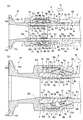
- the annular recess 5 is formed in the tubular member 20 at the back end in the tube insertion direction N of the first inclined surface 2 via the step portion 5a. 1 is different from the first embodiment shown in FIGS. 1A, 1B, and 2, and other configurations are the same as those in the first embodiment shown in FIGS. 1A, 1B, and 2. It is. More specifically, a stepped portion 5a and an annular recess 5 are formed in the tubular member 20 so as to be continuous with the rear side end of the first inclined surface 2, and the inner peripheral surface of the sleeve 4 is piped as the sleeve 4 is reduced in diameter.
- the outer surface B2 of the body B By pressing the outer surface B2 of the body B against the outer surface B2, the outer surface B2 of the tube body B that has been compressed and deformed is along the stepped portion 5a that is the back side end of the first inclined surface 2, and the minimum inner diameter of the first inclined surface 2 It is configured to bulge and deform to a larger diameter.
- the cylindrical member 22 formed separately from the cylindrical member 20 formed integrally with the outside of the nipple 1 is fitted so as not to move in the tube insertion direction N.
- the first inclined surface 2 formed on the inner peripheral surface of the cylindrical member 22 is arranged so as to face the radial direction across the outer peripheral surface 1a of the nipple 1 and the insertion space S of the tubular body B. Yes.
- the fastening member 30 is screwed to become the slide means 31 in the pipe insertion direction N.
- the sleeve 4 is reduced in diameter by being moved by tightening and moving the second inclined surface 3 toward the first inclined surface 2, the inner peripheral surface (the protruding portion 4 d and the seal member 6) of the sleeve 4 is moved.
- the outer surface B2 of the tube body B is partially compressed and deformed by being pressed against and bitten on the outer surface B2 of the tube body B, and at the same time, this compressed and deformed capacity is directed toward the annular recess 5 along the stepped portion 5a.
- the first inclined surface 2 bulges and deforms to a larger diameter than the minimum inner diameter.
- the tip outer peripheral portion B3 bulging and deforming in the tube B is hooked in the tube pull-out direction U with respect to the stepped portion 5a, so that the entire tube B is held immovably in the tube pull-out direction U. Therefore, as compared with the first embodiment shown in FIGS.
- the third embodiment has a structure in which the first inclined surface 2 and the second inclined surface 3 move relative to the first inclined surface 2 in the sleeve 4.
- a stopper 2a with which the rear side end 4f of the tube body B insertion direction (tube insertion direction) N abuts is provided, and along with the relative approaching movement of the first inclined surface 2 and the second inclined surface 3 by the fastening member 30,
- a configuration in which the stopper 2a of the first inclined surface 2 and the back end 4f of the sleeve 4 are brought into contact with each other, and the second tapered surface 4c opposed to the second inclined surface 3 in the sleeve 4 is deformed to the smallest diameter is shown in FIG.
- FIGS. 1 (a), (b) and FIG. 2 and Example 2 shown in FIGS. 3 (a) and (b) other configurations are shown in FIGS. 1 (a), (b) and FIG. It is the same as Example 1 shown and Example 2 shown to Fig.3 (a) (b). More specifically, a stopper 2a facing the back side end 4f of the sleeve 4 in the tube insertion direction N is formed in a concave shape near the back side end of the first inclined surface 2 in the tube insertion direction N.
- the sleeve 4 first moves in the tube insertion direction N while being deformed in a reduced diameter, and the rear end 4f in the tube insertion direction N Comes into contact with the stopper 2a. Thereafter, the second inclined surface 3 is changed to the first inclined surface 2 of the tubular member 20 by further operation of the fastening member 30 in a state where the inner end 4f of the sleeve 4 in the tube insertion direction N is in contact with the stopper 2a.
- the second inclined surface 3 is configured so that the second tapered surface 4c of the sleeve 4 is mainly deformed in the most reduced diameter by moving toward and away from it.
- a sleeve 4 is used in which the first tapered surface 4b and the second tapered surface 4c are symmetrically formed in the tube insertion direction N and the tube removal direction U. Yes.
- the rear end 4f in the tube insertion direction N comes into contact with the stopper 2a and the rear end in the tube insertion direction N of the sleeve 4 comes into contact with the stopper 2a.
- the second inclined surface 3 causes the sleeve 4 to not only the second tapered surface 4 c but also the first one.
- the substantially entire outer peripheral surface of the elastically deforming portion 4 a excluding the tapered surface 4 b is pressed so as to incline in a straight line along the second inclined surface 3. That is, in the sleeve 4, the second inclined surface 3 is reduced in diameter than the first tapered surface 4b, and the inner peripheral portion of the second tapered surface 4c and the annular seal member 6 are most reduced in diameter. .
- the inner peripheral portion of the second tapered surface 4c is pressed most into the outer surface B2 of the tube B, and the inner peripheral portion of the second tapered surface 4c and the annular seal member 6 are cut into the outer surface B2 of the tube B.
- the parts that come into contact with each other are concentrated and partially tightened.
- the inclination angle of the first inclined surface 2 is made smaller than the inclination angle of the second inclined surface 3 so as to be substantially parallel to the outer peripheral surface 1a of the nipple 1, and the first taper.
- a see-through window 2b is provided at a location in the tubular member 20 that faces the abutting portion 1c formed on the outer peripheral surface 1a of the nipple 1 in the radial direction.
- an uneven portion 1b for retaining is arranged at a position facing the inner peripheral portion of the second tapered surface 4c and the annular seal member 6 in the nipple 1. ing.
- the uneven portion 1b for retaining is arranged at a position facing the inner peripheral portion of the second tapered surface 4c and the annular seal member 6 in the nipple 1. In this case, there is an advantage that the sealing effect and the retaining effect are excellent.
- the inner peripheral surface of the sleeve 4 is smooth along the insertion space S of the tube B and does not protrude beyond the protrusion 4d.
- a configuration in which a surface pressure portion 4g is provided and the surface pressure portion 4g is disposed so as to face the opening end 1d of the nipple 1 when the sleeve 4 is deformed is shown in FIGS.
- other configurations are the same as those shown in FIGS. )
- Example 2 shown in FIG. 2 Example 2 shown in FIGS. 3 (a) and 3 (b), and Example 3 shown in FIGS. 4 (a) and 4 (b).
- an attachment recess 4 e for attaching the seal member 6 is integrally formed on the inner peripheral surface of the sleeve 4 in the center in the tube insertion direction N and the tube removal direction U.
- the projection 4d is arranged one by one on the tube insertion direction N side and the tube removal direction U side across the mounting recess 4e, and the smooth portion 2g is integrally formed at both ends, so that the entire sleeve 4 is formed. It is configured to have a symmetrical shape in the tube insertion direction N and the tube removal direction U.
- a plurality of recessed portions 4 h are formed in the circumferential direction in the tapered surface 4 b and the reverse tapered surface 4 c of the sleeve 4, respectively, so that the first inclined surface 2 of the tubular member 20 and the fastening member 30 are formed.
- the entire sleeve 4 is smoothly reduced in diameter as the first inclined surface 2 and the second inclined surface 3 move relative to each other. It is composed.
- the tapered portion 4 h and the reverse tapered surface 4 c of the sleeve 4 are not formed with the recess 4 h, and as shown in the first, second, and third embodiments, a smooth circle is provided. It is also possible to form on the peripheral surface.
- a flange portion 10 c is integrally formed as a joint body 10 on the back side in the tube insertion direction N of the nipple 1.
- the flange portion 10c is joined to a flange portion (not shown) having the same shape formed in another device (not shown) connected to the pipe joint A, and an annular coupling member (not shown) is stretched over these flange portions. ) Is detachably connected to other devices.
- an annular groove 10d into which an annular sealing material (not shown) such as an O-ring is fitted is provided in the connection end face of the flange portion 10c.
- the entire surface of the sleeve 4 due to the relative close movement of the first inclined surface 2 and the second inclined surface 3 is reduced, and the smooth surface pressure is reduced.
- the portion 4g faces the outer surface B2 of the tube B so as to face the opening end 1d of the nipple 1, so that the tube B
- the inner surface B1 does not bulge and deform inside the inner peripheral surface 1e of the nipple 1. Therefore, the fluid passing through the inside of the tube B and the nipple 1 can pass smoothly without resistance. As a result, there is an advantage that pressure loss due to a decrease in fluid passing through the tube B and the nipple 1 can be prevented.
- the screw portion 10a and the tool engaging portion 10b are formed as the joint body 10 on the back side in the tube insertion direction N of the nipple 1 is shown.
- the flange portion 10c may be formed as the joint body 10 as in the fourth embodiment, instead of the screw portion 10a and the tool engaging portion 10b.
- the fourth embodiment the case where the flange portion 10c is formed as the joint body 10 on the back side in the tube insertion direction N of the nipple 1 is shown, but the present invention is not limited thereto, and the flange portion 10c is not limited thereto.
- the screw portion 10a and the tool engagement portion 10b may be formed as in the first embodiment.
- the female screw part 21 and the male screw part 21 that are screwed together are formed as the slide means 31 that moves the fastening member 30 in the axial direction with respect to the nipple 1.
- a structure other than a screw may be used.
- the hose of the single layer structure was used as the pipe body B and it changed to a laminated hose, a spiral reinforcement hose, etc. besides that was demonstrated, it is not limited to this, A tube etc. may be used instead of a hose.
Landscapes
- Engineering & Computer Science (AREA)
- General Engineering & Computer Science (AREA)
- Mechanical Engineering (AREA)
- Joints That Cut Off Fluids, And Hose Joints (AREA)
- Joints With Pressure Members (AREA)
- Branch Pipes, Bends, And The Like (AREA)
- Quick-Acting Or Multi-Walled Pipe Joints (AREA)
- Joints Allowing Movement (AREA)
- Non-Disconnectible Joints And Screw-Threaded Joints (AREA)
Priority Applications (4)
| Application Number | Priority Date | Filing Date | Title |
|---|---|---|---|
| HK14109718.6A HK1196418B (en) | 2011-10-20 | 2012-10-19 | Pipe joint |
| IN3672CHN2014 IN2014CN03672A (https=) | 2011-10-20 | 2012-10-19 | |
| JP2013539699A JP5557221B2 (ja) | 2011-10-20 | 2012-10-19 | 管継手 |
| CN201280051223.XA CN103917816B (zh) | 2011-10-20 | 2012-10-19 | 管连接器 |
Applications Claiming Priority (2)
| Application Number | Priority Date | Filing Date | Title |
|---|---|---|---|
| JP2011231049 | 2011-10-20 | ||
| JP2011-231049 | 2011-10-20 |
Publications (1)
| Publication Number | Publication Date |
|---|---|
| WO2013058358A1 true WO2013058358A1 (ja) | 2013-04-25 |
Family
ID=48141001
Family Applications (1)
| Application Number | Title | Priority Date | Filing Date |
|---|---|---|---|
| PCT/JP2012/077088 Ceased WO2013058358A1 (ja) | 2011-10-20 | 2012-10-19 | 管継手 |
Country Status (5)
| Country | Link |
|---|---|
| JP (1) | JP5557221B2 (https=) |
| CN (1) | CN103917816B (https=) |
| IN (1) | IN2014CN03672A (https=) |
| MY (1) | MY167445A (https=) |
| WO (1) | WO2013058358A1 (https=) |
Cited By (15)
| Publication number | Priority date | Publication date | Assignee | Title |
|---|---|---|---|---|
| CN105813603A (zh) * | 2013-12-27 | 2016-07-27 | 株式会社太阳医疗技术研究所 | 人工血管连接件及人工血管单元 |
| EP3018396A4 (en) * | 2013-07-05 | 2017-03-01 | Junkosha Inc. | Pipe joint |
| JP2018155268A (ja) * | 2017-03-15 | 2018-10-04 | 株式会社ブリヂストン | 管継手 |
| JP2020510164A (ja) * | 2017-03-20 | 2020-04-02 | キム,ブライアン,ビー. | 可撓菅及び継手本体の組立体及びその方法 |
| JP2020148236A (ja) * | 2019-03-12 | 2020-09-17 | 株式会社トヨックス | 管継手用スリーブ |
| JP2021050770A (ja) * | 2019-09-25 | 2021-04-01 | 株式会社日邦バルブ | 樹脂管用管継手 |
| CN112780852A (zh) * | 2021-02-02 | 2021-05-11 | 浙江识品实业有限公司 | 一种快速压接管件 |
| JP2021095979A (ja) * | 2019-12-19 | 2021-06-24 | 株式会社タブチ | 管継手及びインナーコア |
| CN113301283A (zh) * | 2021-05-20 | 2021-08-24 | Tcl通讯(宁波)有限公司 | 一种侧键结构及电视机盒 |
| WO2021220457A1 (ja) * | 2020-04-30 | 2021-11-04 | 株式会社トヨックス | 管継手用スリーブ及び該管継手用スリーブを備えた管継手 |
| AT17446U1 (de) * | 2021-04-28 | 2022-04-15 | Ke Kelit Gmbh | Vorrichtung zur Verwendung in einer Druckprüfung für Rohre |
| US11333283B2 (en) * | 2018-08-17 | 2022-05-17 | Keeney Holdings Llc | No-crimp valve assembly |
| CN116557668A (zh) * | 2023-05-19 | 2023-08-08 | 建湖县博奥液压机械制造有限公司 | 一种管道快换接头组件及其安装方法 |
| WO2023199769A1 (ja) * | 2022-04-15 | 2023-10-19 | 株式会社トヨックス | 管継手及び管継手に用いられるスリーブ |
| WO2023219611A1 (en) * | 2022-05-11 | 2023-11-16 | Chevron U.S.A. Inc. | Compact end fitting assembly for composite pipe |
Families Citing this family (16)
| Publication number | Priority date | Publication date | Assignee | Title |
|---|---|---|---|---|
| KR102022440B1 (ko) * | 2015-05-29 | 2019-09-18 | 가부시키가이샤 후지킨 | 유체 제어 기기의 제조 방법 및 유체 제어 기기 및 조인트용 보호구 |
| WO2016205208A1 (en) * | 2015-06-15 | 2016-12-22 | S.P.M. Flow Control, Inc. | Full-root-radius-threaded wing nut having increased wall thickness |
| WO2019032386A1 (en) * | 2017-08-08 | 2019-02-14 | Swagelok Company | VIROLE ARRANGEMENTS FOR A DUCT CONNECTION |
| CN107448714A (zh) * | 2017-09-13 | 2017-12-08 | 卡川尔流体科技(上海)有限公司 | 一种管接头 |
| JP6969964B2 (ja) * | 2017-10-12 | 2021-11-24 | トヨタ自動車株式会社 | 配管部結合構造 |
| JP6798713B2 (ja) * | 2019-02-12 | 2020-12-09 | 株式会社トヨックス | 管継手 |
| EP3935231A1 (en) * | 2019-03-05 | 2022-01-12 | Bettiol S.r.l. | Valve device |
| CN109915676B (zh) * | 2019-04-19 | 2024-05-24 | 杭州温格科技有限公司 | 管道连接结构 |
| EP4286725B1 (en) * | 2019-06-28 | 2025-04-09 | Higashio Mech Co., Ltd. | Pipe joint |
| CN110726016B (zh) * | 2019-10-22 | 2021-06-15 | 湖北瑞合轨道交通发展有限公司 | 弹性密封卡套 |
| CN114909531A (zh) * | 2020-01-13 | 2022-08-16 | 怀化沃普环保科技有限公司 | 管道接口重叠区内外分层密封技术 |
| TWI809270B (zh) * | 2020-04-29 | 2023-07-21 | 日商東洋克斯股份有限公司 | 管接頭用套筒 |
| CN112325011A (zh) * | 2020-10-28 | 2021-02-05 | 深圳市锐克科技有限公司 | 一种管道冷连接快速连接装置及其与管道的装配方法 |
| KR102455136B1 (ko) * | 2021-11-24 | 2022-10-17 | (주)에트마 | 배관 연결 장치 |
| CN114382969B (zh) * | 2022-02-08 | 2023-07-21 | 西安保力强液压传动有限公司 | 基于流通软管的波纹接头 |
| GB2638673A (en) * | 2024-02-21 | 2025-09-03 | FlexiGas UKC Ltd | Deformable adapter sleeve, kit comprising the same, and method of use thereof |
Citations (7)
| Publication number | Priority date | Publication date | Assignee | Title |
|---|---|---|---|---|
| CH571678A5 (en) * | 1974-09-09 | 1976-01-15 | Meury Kurt | Pipe or hose union - has clamping ring distorted into truncated cone on pulling up |
| JPS60126788U (ja) * | 1984-02-04 | 1985-08-26 | 御器谷 俊雄 | ホ−ス取付装置 |
| JPS6438385U (https=) * | 1987-09-01 | 1989-03-07 | ||
| JP2001193881A (ja) * | 2000-01-07 | 2001-07-17 | Nippon Flex Kk | ホースコネクター |
| JP2001193876A (ja) * | 2000-01-12 | 2001-07-17 | Nippon Flex Kk | ホースコネクタ |
| JP2010281411A (ja) * | 2009-06-05 | 2010-12-16 | Tabuchi Corp | 樹脂管継手 |
| JP2011058609A (ja) * | 2009-09-14 | 2011-03-24 | Bridgestone Corp | 配管用継手 |
Family Cites Families (3)
| Publication number | Priority date | Publication date | Assignee | Title |
|---|---|---|---|---|
| US20090224536A1 (en) * | 2005-07-04 | 2009-09-10 | Nippon Flex Co., Ltd. | Connector for Connecting Hoses |
| ITRN20050057A1 (it) * | 2005-09-08 | 2007-03-09 | Bucchi S R L | Dispositivo per il collegamento di tubi flessibili |
| JP3901207B1 (ja) * | 2005-11-29 | 2007-04-04 | ダイキン工業株式会社 | 管継手 |
-
2012
- 2012-10-19 IN IN3672CHN2014 patent/IN2014CN03672A/en unknown
- 2012-10-19 CN CN201280051223.XA patent/CN103917816B/zh active Active
- 2012-10-19 JP JP2013539699A patent/JP5557221B2/ja active Active
- 2012-10-19 MY MYPI2014700941A patent/MY167445A/en unknown
- 2012-10-19 WO PCT/JP2012/077088 patent/WO2013058358A1/ja not_active Ceased
Patent Citations (7)
| Publication number | Priority date | Publication date | Assignee | Title |
|---|---|---|---|---|
| CH571678A5 (en) * | 1974-09-09 | 1976-01-15 | Meury Kurt | Pipe or hose union - has clamping ring distorted into truncated cone on pulling up |
| JPS60126788U (ja) * | 1984-02-04 | 1985-08-26 | 御器谷 俊雄 | ホ−ス取付装置 |
| JPS6438385U (https=) * | 1987-09-01 | 1989-03-07 | ||
| JP2001193881A (ja) * | 2000-01-07 | 2001-07-17 | Nippon Flex Kk | ホースコネクター |
| JP2001193876A (ja) * | 2000-01-12 | 2001-07-17 | Nippon Flex Kk | ホースコネクタ |
| JP2010281411A (ja) * | 2009-06-05 | 2010-12-16 | Tabuchi Corp | 樹脂管継手 |
| JP2011058609A (ja) * | 2009-09-14 | 2011-03-24 | Bridgestone Corp | 配管用継手 |
Cited By (25)
| Publication number | Priority date | Publication date | Assignee | Title |
|---|---|---|---|---|
| EP3018396A4 (en) * | 2013-07-05 | 2017-03-01 | Junkosha Inc. | Pipe joint |
| US10006570B2 (en) | 2013-07-05 | 2018-06-26 | Junkosha Inc. | Pipe joint |
| CN105813603B (zh) * | 2013-12-27 | 2017-09-08 | 株式会社太阳医疗技术研究所 | 人工血管连接件及人工血管单元 |
| CN105813603A (zh) * | 2013-12-27 | 2016-07-27 | 株式会社太阳医疗技术研究所 | 人工血管连接件及人工血管单元 |
| JP2018155268A (ja) * | 2017-03-15 | 2018-10-04 | 株式会社ブリヂストン | 管継手 |
| JP2021152415A (ja) * | 2017-03-20 | 2021-09-30 | キム,ブライアン,ビー. | 可撓菅及び継手本体の組立体及びその方法 |
| JP2020510164A (ja) * | 2017-03-20 | 2020-04-02 | キム,ブライアン,ビー. | 可撓菅及び継手本体の組立体及びその方法 |
| EP3601863A4 (en) * | 2017-03-20 | 2020-12-02 | Kim, Brian, B. | FLEXIBLE TUBE AND CONNECTOR BODY ASSEMBLY AND ITS PROCESS |
| US11333283B2 (en) * | 2018-08-17 | 2022-05-17 | Keeney Holdings Llc | No-crimp valve assembly |
| JP2020148236A (ja) * | 2019-03-12 | 2020-09-17 | 株式会社トヨックス | 管継手用スリーブ |
| JP2021050770A (ja) * | 2019-09-25 | 2021-04-01 | 株式会社日邦バルブ | 樹脂管用管継手 |
| JP7370571B2 (ja) | 2019-09-25 | 2023-10-30 | 株式会社日邦バルブ | 樹脂管用管継手 |
| JP7588805B2 (ja) | 2019-12-19 | 2024-11-25 | 株式会社タブチ | 管継手 |
| JP2021095979A (ja) * | 2019-12-19 | 2021-06-24 | 株式会社タブチ | 管継手及びインナーコア |
| WO2021220457A1 (ja) * | 2020-04-30 | 2021-11-04 | 株式会社トヨックス | 管継手用スリーブ及び該管継手用スリーブを備えた管継手 |
| US12590659B2 (en) | 2020-04-30 | 2026-03-31 | Toyox Co., Ltd. | Hose joint sleeve and hose joint with the same |
| CN112780852A (zh) * | 2021-02-02 | 2021-05-11 | 浙江识品实业有限公司 | 一种快速压接管件 |
| AT17446U1 (de) * | 2021-04-28 | 2022-04-15 | Ke Kelit Gmbh | Vorrichtung zur Verwendung in einer Druckprüfung für Rohre |
| CN113301283A (zh) * | 2021-05-20 | 2021-08-24 | Tcl通讯(宁波)有限公司 | 一种侧键结构及电视机盒 |
| WO2023199769A1 (ja) * | 2022-04-15 | 2023-10-19 | 株式会社トヨックス | 管継手及び管継手に用いられるスリーブ |
| JP2023157450A (ja) * | 2022-04-15 | 2023-10-26 | 株式会社トヨックス | 管継手及び管継手に用いられるスリーブ |
| JP7491595B2 (ja) | 2022-04-15 | 2024-05-28 | 株式会社トヨックス | 管継手及び管継手に用いられるスリーブ |
| EP4509747A4 (en) * | 2022-04-15 | 2026-04-08 | Toyox Kk | Hose fitting and sleeve intended for use in a hose connection |
| WO2023219611A1 (en) * | 2022-05-11 | 2023-11-16 | Chevron U.S.A. Inc. | Compact end fitting assembly for composite pipe |
| CN116557668A (zh) * | 2023-05-19 | 2023-08-08 | 建湖县博奥液压机械制造有限公司 | 一种管道快换接头组件及其安装方法 |
Also Published As
| Publication number | Publication date |
|---|---|
| MY167445A (en) | 2018-08-28 |
| HK1196418A1 (zh) | 2014-12-12 |
| JP5557221B2 (ja) | 2014-07-23 |
| IN2014CN03672A (https=) | 2015-07-03 |
| JPWO2013058358A1 (ja) | 2015-04-02 |
| CN103917816B (zh) | 2016-01-20 |
| CN103917816A (zh) | 2014-07-09 |
Similar Documents
| Publication | Publication Date | Title |
|---|---|---|
| JP5557221B2 (ja) | 管継手 | |
| WO2013115044A1 (ja) | 管継手 | |
| JP6798713B2 (ja) | 管継手 | |
| JP2020133640A5 (https=) | ||
| JP2013040645A (ja) | 管継手 | |
| WO2021220457A1 (ja) | 管継手用スリーブ及び該管継手用スリーブを備えた管継手 | |
| JP5953586B2 (ja) | 管継手 | |
| JP2008286259A (ja) | 管継手 | |
| JP2015203439A5 (https=) | ||
| WO2011058877A1 (ja) | ホース継手 | |
| JP2013029193A (ja) | 管継手 | |
| JP6765729B2 (ja) | 管継手用スリーブ | |
| JP5849261B2 (ja) | 管継手 | |
| JP5268100B2 (ja) | 管継手 | |
| JP4963688B2 (ja) | 樹脂管継手 | |
| JP2007170658A (ja) | 管継手 | |
| JP5775911B2 (ja) | 管継手 | |
| JP2010038265A (ja) | 樹脂管継手 | |
| JP7491596B2 (ja) | 管継手 | |
| JPH07248081A (ja) | 管接続装置 | |
| JP7100850B2 (ja) | 管継手 | |
| HK1196418B (en) | Pipe joint | |
| WO2023199769A1 (ja) | 管継手及び管継手に用いられるスリーブ | |
| TW202140951A (zh) | 管接頭用套筒 | |
| WO2015072379A1 (ja) | 管継手 |
Legal Events
| Date | Code | Title | Description |
|---|---|---|---|
| 121 | Ep: the epo has been informed by wipo that ep was designated in this application |
Ref document number: 12840972 Country of ref document: EP Kind code of ref document: A1 |
|
| ENP | Entry into the national phase |
Ref document number: 2013539699 Country of ref document: JP Kind code of ref document: A |
|
| NENP | Non-entry into the national phase |
Ref country code: DE |
|
| 122 | Ep: pct application non-entry in european phase |
Ref document number: 12840972 Country of ref document: EP Kind code of ref document: A1 |