WO2012176830A1 - 1,2-ビス(ジアルキルホスフィノ)-4,5-(メチレンジオキシ)ベンゼン誘導体、その製造方法及び該1,2-ビス(ジアルキルホスフィノ)-4,5-(メチレンジオキシ)ベンゼン誘導体を配位子とする金属錯体並びに不斉水素化方法 - Google Patents
1,2-ビス(ジアルキルホスフィノ)-4,5-(メチレンジオキシ)ベンゼン誘導体、その製造方法及び該1,2-ビス(ジアルキルホスフィノ)-4,5-(メチレンジオキシ)ベンゼン誘導体を配位子とする金属錯体並びに不斉水素化方法 Download PDFInfo
- Publication number
- WO2012176830A1 WO2012176830A1 PCT/JP2012/065831 JP2012065831W WO2012176830A1 WO 2012176830 A1 WO2012176830 A1 WO 2012176830A1 JP 2012065831 W JP2012065831 W JP 2012065831W WO 2012176830 A1 WO2012176830 A1 WO 2012176830A1
- Authority
- WO
- WIPO (PCT)
- Prior art keywords
- bis
- methylenedioxy
- dialkylphosphino
- general formula
- borane
- Prior art date
- Legal status (The legal status is an assumption and is not a legal conclusion. Google has not performed a legal analysis and makes no representation as to the accuracy of the status listed.)
- Ceased
Links
- 0 CP(*)(*)c(cc1OCOc1c1)c1P(*)* Chemical compound CP(*)(*)c(cc1OCOc1c1)c1P(*)* 0.000 description 3
- FTNJQNQLEGKTGD-UHFFFAOYSA-N C1Oc(cccc2)c2O1 Chemical compound C1Oc(cccc2)c2O1 FTNJQNQLEGKTGD-UHFFFAOYSA-N 0.000 description 1
- BXUOIEPSOIEXIN-UHFFFAOYSA-N Ic(c(I)c1)cc2c1OCO2 Chemical compound Ic(c(I)c1)cc2c1OCO2 BXUOIEPSOIEXIN-UHFFFAOYSA-N 0.000 description 1
Classifications
-
- C—CHEMISTRY; METALLURGY
- C07—ORGANIC CHEMISTRY
- C07F—ACYCLIC, CARBOCYCLIC OR HETEROCYCLIC COMPOUNDS CONTAINING ELEMENTS OTHER THAN CARBON, HYDROGEN, HALOGEN, OXYGEN, NITROGEN, SULFUR, SELENIUM OR TELLURIUM
- C07F9/00—Compounds containing elements of Groups 5 or 15 of the Periodic Table
- C07F9/02—Phosphorus compounds
- C07F9/28—Phosphorus compounds with one or more P—C bonds
-
- C—CHEMISTRY; METALLURGY
- C07—ORGANIC CHEMISTRY
- C07B—GENERAL METHODS OF ORGANIC CHEMISTRY; APPARATUS THEREFOR
- C07B53/00—Asymmetric syntheses
-
- C—CHEMISTRY; METALLURGY
- C07—ORGANIC CHEMISTRY
- C07C—ACYCLIC OR CARBOCYCLIC COMPOUNDS
- C07C231/00—Preparation of carboxylic acid amides
- C07C231/16—Preparation of optical isomers
- C07C231/18—Preparation of optical isomers by stereospecific synthesis
-
- C—CHEMISTRY; METALLURGY
- C07—ORGANIC CHEMISTRY
- C07F—ACYCLIC, CARBOCYCLIC OR HETEROCYCLIC COMPOUNDS CONTAINING ELEMENTS OTHER THAN CARBON, HYDROGEN, HALOGEN, OXYGEN, NITROGEN, SULFUR, SELENIUM OR TELLURIUM
- C07F15/00—Compounds containing elements of Groups 8, 9, 10 or 18 of the Periodic Table
- C07F15/0006—Compounds containing elements of Groups 8, 9, 10 or 18 of the Periodic Table compounds of the platinum group
- C07F15/0073—Rhodium compounds
-
- C—CHEMISTRY; METALLURGY
- C07—ORGANIC CHEMISTRY
- C07F—ACYCLIC, CARBOCYCLIC OR HETEROCYCLIC COMPOUNDS CONTAINING ELEMENTS OTHER THAN CARBON, HYDROGEN, HALOGEN, OXYGEN, NITROGEN, SULFUR, SELENIUM OR TELLURIUM
- C07F9/00—Compounds containing elements of Groups 5 or 15 of the Periodic Table
- C07F9/02—Phosphorus compounds
- C07F9/547—Heterocyclic compounds, e.g. containing phosphorus as a ring hetero atom
- C07F9/655—Heterocyclic compounds, e.g. containing phosphorus as a ring hetero atom having oxygen atoms, with or without sulfur, selenium, or tellurium atoms, as the only ring hetero atoms
- C07F9/65515—Heterocyclic compounds, e.g. containing phosphorus as a ring hetero atom having oxygen atoms, with or without sulfur, selenium, or tellurium atoms, as the only ring hetero atoms the oxygen atom being part of a five-membered ring
- C07F9/65517—Heterocyclic compounds, e.g. containing phosphorus as a ring hetero atom having oxygen atoms, with or without sulfur, selenium, or tellurium atoms, as the only ring hetero atoms the oxygen atom being part of a five-membered ring condensed with carbocyclic rings or carbocyclic ring systems
Definitions
- the present invention relates to a novel 1,2-bis (dialkylphosphino) -4,5- (methylenedioxy) benzene derivative and a method for producing the same.
- the 1,2-bis (dialkylphosphino) -4,5- (methylenedioxy) benzene derivative can be used as a ligand for asymmetric synthesis catalysts.
- the present invention also relates to a metal complex having the 1,2-bis (dialkylphosphino) -4,5- (methylenedioxy) benzene derivative as a ligand and an asymmetric hydrogenation method using the metal complex. .
- Patent Document 1 proposes a 1,2-bis (dialkylphosphino) benzene derivative.
- Patent Document 2 proposes a 2,3-bis (dialkylphosphino) pyrazine derivative.
- This pyrazine derivative is derived from the pyrazine skeleton and has a very high electron withdrawing property, and the electron density of the phosphorus atom in the phosphine moiety is thereby lowered. It is effective to use a metal complex having this pyrazine derivative as a ligand as a catalyst for a reaction in which such characteristics are utilized.
- an object of the present invention is to provide a novel 1,2-bis (dialkylphosphino) -4,5- (methylenedi (di)) which forms a metal complex having high asymmetric induction ability and catalytic activity, particularly for ⁇ -dehydroamino acids.
- Oxy) benzene derivative process for producing the same, metal complex having the 1,2-bis (dialkylphosphino) -4,5- (methylenedioxy) benzene derivative as a ligand, and asymmetric hydrogen using the metal complex It is to provide a conversion method.
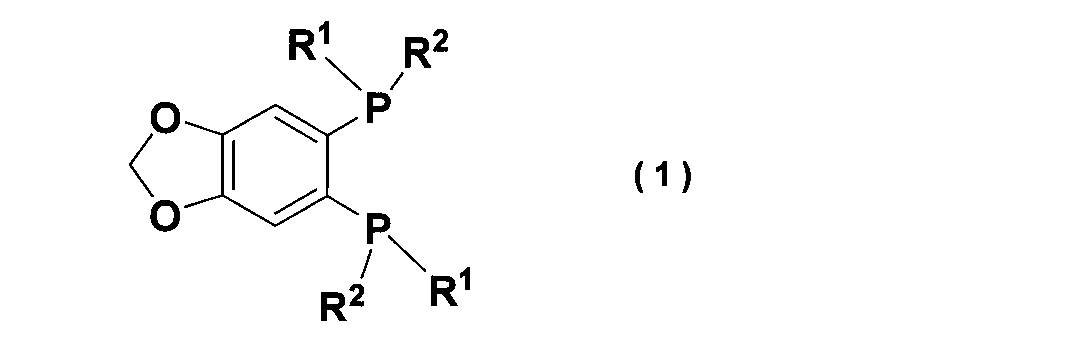
- the first invention to be provided by the present invention is to provide a 1,2-bis (dialkylphosphino) -4,5- (methylenedioxy) benzene derivative represented by the following general formula (1).
- R 1 and R 2 represent an alkyl group having 1 to 10 carbon atoms, and R 1 and R 2 have different carbon numbers.
- the second invention to be provided by the present invention is a process for producing a 1,2-bis (dialkylphosphino) -4,5- (methylenedioxy) benzene derivative of the first invention,
- a phosphine-borane compound represented by the following general formula (2) is deboraneated and then reacted with a halogenated alkylmagnesium compound.
- the third invention to be provided by the present invention uses the 1,2-bis (dialkylphosphino) -4,5- (methylenedioxy) benzene derivative of the first invention as a ligand. It is a metal complex characterized by these.
- the fourth invention to be provided by the present invention is the use of the 1,2-bis (dialkylphosphino) -4,5- (methylenedioxy) benzene derivative of the third invention as a ligand.
- a novel 1,2-bis (dialkylphosphino) -4,5- (methylenedioxy) benzene derivative capable of forming a metal complex useful as a catalyst for an asymmetric synthesis reaction. It can. Further, according to the production method of the present invention, the 1,2-bis (dialkylphosphino) -4,5- (methylenedioxy) benzene derivative can be easily produced. Further, the metal complex having the ligand of 1,2-bis (dialkylphosphino) -4,5- (methylenedioxy) benzene derivative has high enantioselectivity when used as a catalyst for asymmetric synthesis reaction.
- a metal complex having the ligand of the novel 1,2-bis (dialkylphosphino) -4,5- (methylenedioxy) benzene derivative of the present invention is a ⁇ -dehydroamino acid.
- it has high asymmetric induction ability and catalytic activity.
- R 1 and R 2 in the formula each have 1 to 10 carbon atoms. Represents an alkyl group, and R 1 and R 2 have different carbon numbers.
- Two R 1 in the general formula (1) may be the same or different from each other.
- two R 2 may be the same or different from each other.
- Examples of the alkyl group for R 1 and R 2 include an acyclic alkyl group and an alicyclic alkyl group.
- Acyclic alkyl groups include linear alkyl groups and branched alkyl groups.
- Examples of the linear alkyl group include those having 1 to 10 carbon atoms such as methyl group, ethyl group, n-propyl group, n-butyl group, n-pentyl group, n-hexyl group and n-heptyl group.
- Examples of the branched alkyl group include those having 3 to 10 carbon atoms such as isopropyl group, isobutyl group, sec-butyl group, tert-butyl group, isoheptyl group, isohexyl group, 1,1,3,3-tetramethylbutyl group Is mentioned.
- Alicyclic alkyl groups include monocyclic alkyl groups and bicyclic alkyl groups.
- Examples of the monocyclic alkyl group include those having 3 to 10 carbon atoms such as a cyclopropyl group, a cyclobutyl group, a cyclopentyl group, and a cyclohexyl group.
- Examples of the bicyclic alkyl group include those having 4 to 10 carbon atoms such as an adamantyl group.
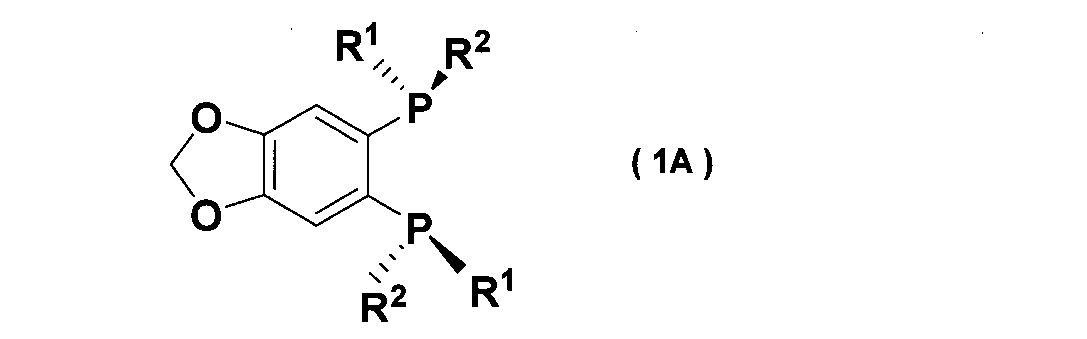
- the 1,2-bis (dialkylphosphino) -4,5- (methylenedioxy) benzene derivative of the present invention represented by the general formula (1) includes a phosphorus atom represented by the following general formula (1A)
- R 1 and R 2 are different but are not racemic because they are racemic.
- R 1 and R 2 represent an alkyl group having 1 to 10 carbon atoms, and R 1 and R 2 have different carbon numbers.
- the number of carbon atoms of R 1 and R 2 needs to be at least 1.
- the group having more carbon atoms in R 1 and R 2 is a bulky substituent having steric hindrance.
- the group having more carbon atoms out of R 1 and R 2 is preferably a secondary alkyl group rather than a primary alkyl group, and more preferably a tertiary alkyl group than a secondary alkyl group.
- a preferred alkyl group is a tert-butyl group.
- a 1,2-bis (dialkylphosphino) -4,5- (methylenedioxy) benzene derivative represented by the general formula (1A) was used as a ligand of a metal complex for an asymmetric synthesis catalyst.
- R 1 and R 2 it is preferable that there is a large difference in steric hindrance between R 1 and R 2 in consideration of the formation of a highly asymmetric space. That is, it is preferable that one of R1 and R2 is a bulky substituent having steric hindrance, that is, a maximal group, while the other is a minimal group. Therefore, R 1 and R 2 are more preferable as the difference in carbon number is larger.
- the difference in carbon number between R 1 and R 2 is preferably 2 or more, particularly 3 or more, particularly 4 or more.
- the alicyclic alkyl group and the acyclic alkyl group having the same carbon number are the ones of the acyclic alkyl group. Is preferred.
- a linear alkyl group is preferable to a branched alkyl group.
- the most preferred group as the group having the smaller number of carbon atoms among R 1 and R 2 is a methyl group.
- 1,2-bis (dialkylphosphino) -4,5- (methylenedioxy) benzene derivative represented by the general formula (1) include the following compounds.
- a phosphine-borane compound represented by the following general formula (2) is prepared.
- a 1,2-bis (dialkylphosphino) -4 represented by the corresponding general formula (1) is used by using a phosphine-borane compound represented by the following general formula (2) as a starting material.
- 5- (methylenedioxy) benzene derivatives can be obtained.
- the general formula is used as a starting material.
- the compound of general formula (2) which is a starting material can be synthesized, for example, according to the following reaction formula (1).
- R 1 and R 2 are the same as above.
- reaction formula (1) first, s-BuLi is added to a starting material dialkylphosphine-borane (3) in an argon atmosphere at ⁇ 80 ° C. to form a phosphide anion, and then 4,5- (methylenedioxy
- the target phosphine-borane compound represented by the general formula (2) can be obtained by reacting with 1,2-diiodobenzene (Organic Letters 2010 Vol. 12, No. 19, 4400-4403).
- the reaction according to the reaction formula (1) is performed using the optically active substance of dialkylphosphine-borane (3).
- the dialkylphosphine-borane (3) and its optically active substance can be prepared by a known method such as the method described in JP-A-2001-253889 or JP-A-2007-70310.
- the dialkylphosphine-borane is an S isomer. Use one.
- the carbon number of R 2 is larger than the carbon number of R 1 (when the phosphine-borane compound is S-form)
- the dialkylphosphine-borane is used in the R form.
- Deboraneation of the dialkylphosphine-borane compound of the general formula (2) which is the first step of the production method of the present invention, is represented by the following reaction formula (2).
- R 1 and R 2 are the same as above.
- Deboraneation of the dialkylphosphine-borane compound according to the reaction formula (2) can be performed according to a conventionally known method.
- a base such as 1,4-diazabicyclo [2.2.2] octane (DABCO), N-methylmorpholine, triethylamine, pyrrolidine, or diethylamine in an organic solvent such as THF, hexane, toluene, or dimethoxyethane. It can be carried out.
- DABCO 1,4-diazabicyclo [2.2.2] octane
- N-methylmorpholine triethylamine
- pyrrolidine pyrrolidine
- diethylamine diethylamine
- the amount of the base used is preferably 1 to 3 moles per mole of the phosphine-borane compound represented by the general formula (2).
- the reaction time can be 0.5 to 5 hours.
- the reaction temperature can be up to 20-110 ° C.
- a metal-halogen exchange reaction with a halogenated alkylmagnesium compound is performed as a second step.
- the halogenated alkylmagnesium compound is represented by the general formula RMgX (wherein R represents a linear or branched alkyl group having 1 to 5 carbon atoms, and X represents a halogen atom).
- the reaction with the halogenated alkylmagnesium compound is represented by the following reaction formula (3). (Wherein R 1 , R 2 , R and X are the same as above)
- the reaction with the halogenated alkylmagnesium compound is performed in an organic solvent such as THF, hexane, toluene, dimethoxyethane and the like.
- halogenated alkylmagnesium compounds include methylmagnesium chloride, methylmagnesium bromide, ethylmagnesium chloride, ethylmagnesium bromide, n-propylmagnesium chloride, n-propylmagnesium bromide, iso-propylmagnesium chloride, and iso-propyl bromide.
- examples include magnesium, n-butylmagnesium chloride, sec-butylmagnesium chloride, and tert-butylmagnesium chloride. Of these, iso-propylmagnesium chloride is preferred.
- the amount of the halogenated alkylmagnesium compound used is preferably 0.7 to 2.0 moles per mole of the phosphine-borane compound represented by the general formula (2) used in the first step. 1.5 mol is particularly preferred.
- the reaction can be carried out more efficiently by carrying out the reaction in the presence of a reaction aid such as lithium chloride, lithium bromide, lithium iodide, lithium tetrafluoroborate or lithium perchlorate. Can be advanced.
- the addition amount of this reaction aid is 0.2 to 4.0, preferably 1.0 to 1.5, in molar ratio to the halogenated alkylmagnesium compound.
- the reaction time can be 10 minutes to 8 hours, preferably 20 minutes to 2 hours.
- the reaction temperature can be ⁇ 80 to 80 ° C.
- the reaction product (4) of the second step is converted into the general formula R a PX ′ 2 (R a is one of R 1 and R 2 in the general formula (1), and X ′ Is a halogen atom) and is reacted with an alkyl dihalogenophosphine.
- R a is preferably a group having a larger number of carbon atoms out of R 1 and R 2 .
- Examples of the halogen atom represented by X ′ include fluorine, chlorine, bromine and iodine, with chlorine being preferred.
- the alkyl dihalogenophosphine represented by the general formula R a PX ′ 2 is available as a commercial product.
- reaction in the third step is represented by the following reaction formula (4).
- R 1 , R 2 , X and X ′ are the same as described above.
- the reaction in the third step can be performed, for example, in an organic solvent such as THF, hexane, toluene, dimethoxyethane and the like.
- the amount of the alkyl dihalogenophosphine represented by the general formula R a PX ′ 2 is 1.0 to 2.0 with respect to 1 mol of the phosphine-borane compound represented by the general formula (2) used in the first step.
- a molar ratio is preferred.
- the reaction time can be 0.5 to 24 hours.
- the reaction temperature can be ⁇ 100 to 80 ° C.
- the reaction product (5) of the third step is converted into the general formula R b MgX ′′
- R b is one of R 1 and R 2 in the general formula (1)
- X ′′ is (Represents a halogen atom).
- R b is a group different from R a among R 1 and R 2 in the general formula (1).
- the halogen atom represented by X ′′ include fluorine, chlorine, bromine, iodine, etc., and chlorine and bromine are preferable.
- the reaction in the fourth step is represented by the following reaction formula ( 5). (Wherein R 1 , R 2 and X ′′ are the same as above)
- the reaction in the fourth step can be performed according to a conventionally known Grignard reaction.
- it can be carried out in an organic solvent such as THF, hexane, toluene, dimethoxyethane and the like.
- the amount of the Grignard reagent represented by the general formula R b MgX ′′ is 1.0 to 2.0 mol relative to 1 mol of the phosphine-borane compound represented by the general formula (2) used in the first step.
- the reaction time can be 0.5 to 24 hours
- the reaction temperature can be 0 to 100 ° C.
- the reaction in the above first to fourth steps is inert. It is preferable to carry out under gas.
- the 1,2-bis (dialkylphosphino) -4,5- (methylenedioxy) benzene derivative represented by the general formula (1) as the target product or the general formula (1) 1A) an optically active 1,2-bis (dialkylphosphino) -4,5- (methylenedioxy) benzene derivative can be obtained. If necessary, purification can be performed according to a conventional method. Can be obtained with high purity.
- the bis (dialkylphosphino) -4,5- (methylenedioxy) benzene derivative is an (R, R) isomer or (S, S) isomer, and as a component other than the target product after the first to fourth steps ( In some cases, an (R, S) isomer or a (S, R) isomer, for example, a mixture containing a meso isomer is obtained.
- the target product is an (R, R) isomer
- two R 1 are the same alkyl group and two R 2 are the same alkyl group
- a mixture of the (R, R) isomer and the meso isomer May be obtained. Therefore, if the (R, R) isomer or (S, S) isomer that is the target product of the present invention is separated from the mixture by performing purification (a) as necessary, the target product can be obtained with high purity.
- This separation may be performed by an ordinary purification method, and recrystallization is usually sufficient. Separation can also be performed by column separation as necessary.
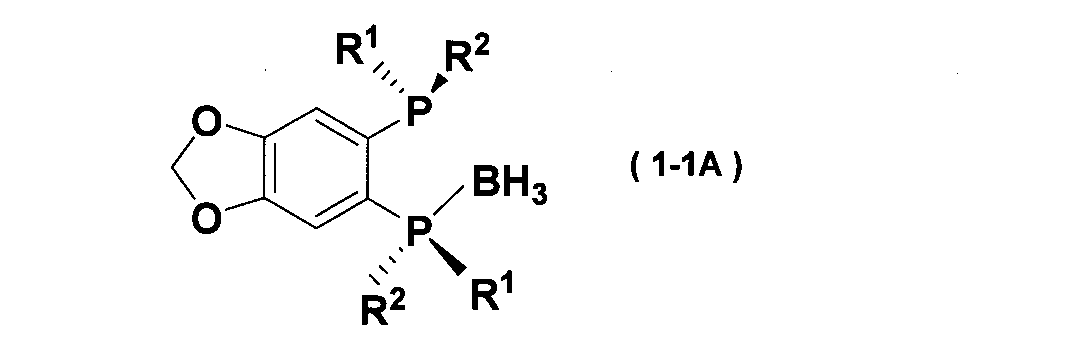
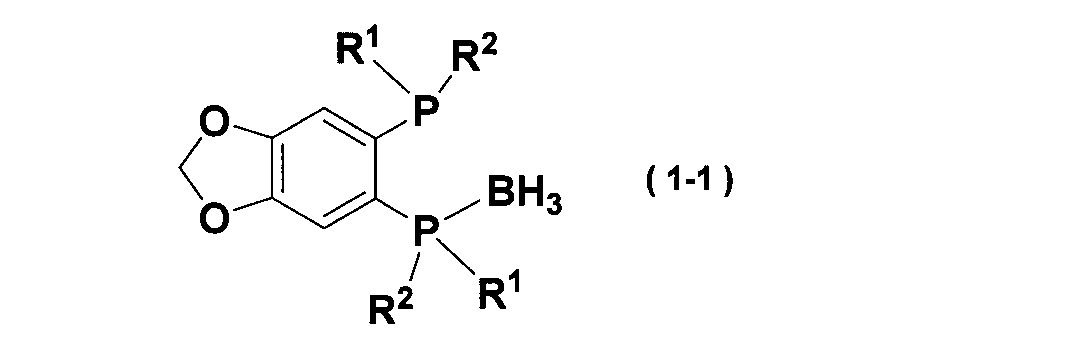
- the 1,2-bis (dialkylphosphino) -4,5- (methylenedioxy) benzene derivative may be In order to suppress oxidation during the purification operation, the first to fourth steps are followed by the fifth step which will be described later, and a 1,2-bis (dialkylphosphino) -4,5- (methylenedioxy) benzene derivative Is derivatized to the corresponding 1,2-bis (dialkylphosphino) -4,5- (methylenedioxy) benzene-borane derivative represented by the following general formula (1-1) or (1-1A) It is preferable to carry out purification. (In the formula, R 1 and R 2 are the same as above.)
- the reaction in the fifth step can be performed in accordance with a conventionally known borane reaction.
- a borane-THF complex, an alkali metal borohydride salt, or a borane-amine complex can be used as a borane agent used in borane formation.
- the alkali metal borohydride is represented by a chemical formula of MBH 4 (wherein M represents an alkali metal atom), preferably lithium borohydride (LiBH 4 ), sodium borohydride (NaBH 4 ), Potassium borohydride (KBH 4 ).
- borane-amine complex examples include borane-ammonia complex, borane-tert-butylamine complex, borane-dimethylamine complex, borane-triethylamine complex, borane-trimethylamine complex, borane-4-ethylmorpholine complex, borane -2,6-lutidine complex, borane-morpholine complex, borane-4-methylmorpholine complex, borane-4-phenylmorpholine complex, borane-piperazine complex, borane-pyridine complex, borane-N, N-diethylaniline complex, borane -N, N-diisopropylaniline complex and the like.
- the reaction according to the fifth step can be performed, for example, in an organic solvent such as THF, hexane, toluene, dimethoxyethane and the like.
- the amount of the borane agent used is preferably 1.0 to 3.0 moles per mole of the phosphine-borane compound represented by formula (2) or formula (2A) used in the first step.
- the reaction time can be 0.5 to 5.0 hours.
- the reaction temperature can be ⁇ 50 to 50 ° C.
- the reaction in the fifth step is preferably performed under an inert gas.
- the desired purification is performed, and the 1,2-bis (dialkylphosphino) -4,5- (methylenedioxy) benzene-borane derivative after the purification treatment is deboraneated and again the above-mentioned A 1,2-bis (dialkylphosphino) -4,5- (methylenedioxy) benzene derivative represented by the general formula (1) or the general formula (1A) is obtained.
- This deboranation can be performed according to a conventionally known method.
- a base such as 1,4-diazabicyclo [2.2.2] octane (DABCO), N-methylmorpholine, triethylamine, pyrrolidine, or diethylamine in an organic solvent such as THF, hexane, toluene, or dimethoxyethane. It can be carried out.
- DABCO is preferably used as the base.
- the amount of the base used is 1,2-bis (dialkylphosphino) -4,5- (methylenedioxy) benzene-borane derivative 1 represented by the general formula (1-1) or the general formula (1-1A). A ratio of 1 to 3 moles per mole is preferred.
- the reaction time can be 0.5 to 5 hours.
- the reaction temperature can be up to 20-110 ° C.
- the phosphine-borane compound represented by the general formula (2) used as a starting material in the production method of the present invention has one —PR 1 R 2 BH 3 group, and is obtained by deboraneating the compound.
- the compound represented by the general formula (B) has one —PR 1 R 2 group.
- this production method by performing a metal-halogen exchange reaction using an alkylmagnesium halide compound (RMgX), the site where the iodine group was bonded on the benzene ring becomes a carbon anion, and then an alkyldihalogenophosphine is added. This makes it possible to introduce the -PR 1 R 2 group at the site where the iodine group was originally bound.
- RMgX alkylmagnesium halide compound
- an alkyl group R 1 having a large number of carbon atoms together with a phosphorus atom is introduced into the compound represented by the general formula (B) having one —PR 1 R 2 group, and then, carbon Another alkyl group R 2 having a small number is introduced.
- the first to fourth steps, and further the first to fifth steps can be carried out continuously, so that the objective 1,2-bis (dialkylphosphine) is industrially advantageous.
- Fino) -4,5- (methylenedioxy) benzene derivative has the advantage that it can be obtained.
- the 1,2-bis (dialkylphosphino) -4,5- (methylenedioxy) benzene derivative represented by the general formula (1) and the general formula (1A) obtained by the production method of the present invention is a compound.
- a complex can be formed with a transition metal.
- a metal complex having an optically active 1,2-bis (dialkylphosphino) -4,5- (methylenedioxy) benzene derivative represented by the general formula (1A) as a ligand is an asymmetric synthesis catalyst. Useful as.
- transition metal that can form a complex examples include rhodium, ruthenium, iridium, palladium, nickel, iron, and copper, and rhodium metal is preferable.
- Method of forming a complex with rhodium metal using 1,2-bis (dialkylphosphino) -4,5- (methylenedioxy) benzene derivative represented by general formula (1) and general formula (1A) as a ligand For example, the method described in Experimental Chemistry Course 4th edition (edited by the Chemical Society of Japan, published by Maruzen Co., Ltd., Volume 18, pages 327-353) may be used, for example, represented by the general formula (1).
- a rhodium complex can be produced by reacting with 5-diene) rhodium tetrafluoroborate or the like.
- rhodium complex examples include [Rh ((S, S)-(A)) (cod)] Cl, [Rh ((S, S)-(A)) (cod)] Br, [ Rh ((S, S)-(A)) (cod)] I, [Rh ((R, R)-(A)) (cod)] Cl, [Rh ((R, R)-(A)) (cod)] Br, [Rh ((R, R)-(A)) (cod)] I, [Rh ((S, S)-(A)) (cod)] SbF 6 , [Rh ((S , S)-(A)) (cod)] BF 4 , [Rh ((S, S)-(A)) (cod)] ClO 4 , [Rh ((S, S)-(A)) (cod )] PF 6 , [Rh ((S, S)-(A)) (cod) (cod)
- (A) is a 1,2-bis (dialkylphosphino) -4,5- (methylenedioxy) benzene derivative represented by the general formula (1) or (1A) , Cod represents 1,5-cyclooctadiene, nbd represents norbornadiene, and Ph represents phenyl.
- a transition metal complex having the optically active 1,2-bis (dialkylphosphino) -4,5- (methylenedioxy) benzene derivative represented by the general formula (1A) as a ligand (hereinafter referred to as the present invention) (Also referred to as a transition metal complex) is useful as an asymmetric synthesis catalyst.
- the asymmetric synthesis reaction include an asymmetric hydrogenation reaction, an asymmetric hydrosilylation reaction, an asymmetric Michael addition reaction, and the like. These asymmetric synthesis reactions can be performed as usual except that the transition metal complex according to the present invention is used.
- the transition metal complex according to the present invention is particularly suitable as a catalyst in an asymmetric hydrogenation reaction.
- the compound used as a substrate in the asymmetric hydrogenation reaction include compounds having a C ⁇ C double bond, a C ⁇ O double bond or a C ⁇ N double bond containing a prochiral carbon atom.
- the compound include ⁇ dehydroamino acid, ⁇ dehydroamino acid, itaconic acid, enamide, ⁇ -keto ester, enol ester, ⁇ , ⁇ unsaturated carboxylic acid, ⁇ , ⁇ unsaturated carboxylic acid, imine and the like.
- the transition metal complex according to the present invention is characterized in that it exhibits high asymmetric induction ability and catalytic activity for ⁇ -dehydroamino acid.
- the molar ratio (substrate / catalyst) between the substrate and the transition metal complex according to the present invention, which is a catalyst is usually preferably 100 or more.
- the 1,2-bis (dialkylphosphino) -4,5- (methylenedioxy) benzene derivative of the present invention represented by the general formula (1) or the general formula (1A) is used as a ligand
- a metal complex formed with a transition metal atom (preferably gold) selected from the group consisting of gold, silver and copper is a 2,3-bis (dialkylphosphino) pyrazine described in JP-A-2007-320909. Use as an anticancer agent can be expected as well as derivatives.
- This metal complex is represented by [ML 2 ] + X ⁇ when the 1,2-bis (dialkylphosphino) -4,5- (methylenedioxy) benzene derivative of the present invention is represented by L.
- reaction solution was poured into diethyl ether (100 mL) and ice water (100 mL) with vigorous stirring. Na 2 SO 3 was added to the dark red solution, and the brown organic layer was separated. After diethyl ether (100 mL twice) was added to the water bath for liquid separation, the obtained organic layer was washed with brine (50 mL) and dried over Na 2 SO 4 . The pale yellow crystals precipitated after concentration of the solvent were filtered and washed with methanol to obtain 1,2-diiodo-4,5- (methylenedioxy) benzene (9.95 g, 0.027 mol) as white crystals in a yield of 46 Obtained in%.
- Example 4 Asymmetric hydrogenation reaction Reaction substrate ⁇ -dehydroamino acid 2- (N-acetylamino) -3-phenyl-2-propenoicacid methyl ester 438.5 mg (2.00 mmol), asymmetric hydrogenation catalyst ((R, R) -1,2-bis (tert-butylmethylphosphino) -4,5- (methylenedioxy) benzene) (1,5 -Cyclooctadiene) Rhodium (1+) hexafluoroantimonate 1.55 mg (2.00 x 10 -3 mmol) was charged, hydrogen was substituted five times, and 5 mL of degassed dehydrated methanol was added in advance.
- asymmetric hydrogenation catalyst ((R, R) -1,2-bis (tert-butylmethylphosphino) -4,5- (methylenedioxy) benzene) (1,5 -Cyclooctadiene) Rhodium (1+) hexafluoroantimonate
- a novel 1,2-bis (dialkylphosphino) -4,5- (methylenedioxy) benzene derivative capable of forming a metal complex useful as a catalyst for an asymmetric synthesis reaction. It can. Further, according to the production method of the present invention, the 1,2-bis (dialkylphosphino) -4,5- (methylenedioxy) benzene derivative can be easily produced. Further, the metal complex having the ligand of 1,2-bis (dialkylphosphino) -4,5- (methylenedioxy) benzene derivative has high enantioselectivity when used as a catalyst for asymmetric synthesis reaction.
- a metal complex having the ligand of the novel 1,2-bis (dialkylphosphino) -4,5- (methylenedioxy) benzene derivative of the present invention is a ⁇ -dehydroamino acid.
- it has high asymmetric induction ability and catalytic activity.
Landscapes
- Chemical & Material Sciences (AREA)
- Organic Chemistry (AREA)
- Health & Medical Sciences (AREA)
- Life Sciences & Earth Sciences (AREA)
- Biochemistry (AREA)
- General Health & Medical Sciences (AREA)
- Molecular Biology (AREA)
- Organic Low-Molecular-Weight Compounds And Preparation Thereof (AREA)
Abstract
特にβデヒドロアミノ酸に対して高い不斉誘起能と触媒活性を有する金属錯体を形成する新規な1,2-ビス(ジアルキルホスフィノ)-4,5-(メチレンジオキシ)ベンゼン誘導体、その製造方法であり、該1,2-ビス(ジアルキルホスフィノ)-4,5-(メチレンジオキシ)ベンゼン誘導体を配位子とする金属錯体及び該金属錯体を用いた不斉水素化方法を提供する。 下記一般式(1)で表されることを特徴とする1,2-ビス(ジアルキルホスフィノ)-4,5-(メチレンジオキシ)ベンゼン誘導体。 (式中、R1及びR2は、炭素数1~10のアルキル基を示し、R1とR2とでは炭素数が異なる。)
Description
本発明は、新規な1,2-ビス(ジアルキルホスフィノ)-4,5-(メチレンジオキシ)ベンゼン誘導体及びその製造方法に関する。該1,2-ビス(ジアルキルホスフィノ)-4,5-(メチレンジオキシ)ベンゼン誘導体は、不斉合成触媒の配位子として使用することができる。また、本発明は、該1,2-ビス(ジアルキルホスフィノ)-4,5-(メチレンジオキシ)ベンゼン誘導体を配位子とする金属錯体及びその金属錯体を用いた不斉水素化方法に関する。
リン原子上に不斉中心を有する光学活性なホスフィン配位子は、遷移金属錯体を用いる触媒的不斉合成反応において重要な役割を果たしている。リン原子上に不斉中心を有する光学活性なホスフィン配位子としては、特許文献1に、1,2-ビス(ジアルキルホスフィノ)ベンゼン誘導体が提案されている。
特許文献2には、2,3-ビス(ジアルキルホスフィノ)ピラジン誘導体が提案されている。このピラジン誘導体は、ピラジン骨格に由来して電子求引性が極めて高く、またそれによってホスフィン部位のリン原子の電子密度が低くなっているという特徴を有する。このピラジン誘導体を配位子とした金属錯体は、このような特徴が活かされる反応の触媒として用いるのが効果的である。
一般的にβデヒドロアミノ酸からβアミノ酸への
ロジウム
触媒を用いた不斉
水素添加
反応は広く知られているが、βデヒドロアミノ酸におけるE体、Z体の両異性体に対して1,2-ビス(ジアルキルホスフィノ)ベンゼン誘導体や2,3-ビス(ジアルキルホスフィノ)ピラジン誘導体を用いたもの以外に高い不斉誘起能と触媒活性を示すものは、あまり知られていない。
ロジウム
触媒を用いた不斉
水素添加
反応は広く知られているが、βデヒドロアミノ酸におけるE体、Z体の両異性体に対して1,2-ビス(ジアルキルホスフィノ)ベンゼン誘導体や2,3-ビス(ジアルキルホスフィノ)ピラジン誘導体を用いたもの以外に高い不斉誘起能と触媒活性を示すものは、あまり知られていない。
本発明者らは、リン原子上に不斉中心を有する光学活性なホスフィン配位子の研究を進める中で、特にβデヒドロアミノ酸に対して高い不斉誘起能と触媒活性を有する新規な1,2-ビス(ジアルキルホスフィノ)-4,5-(メチレンジオキシ)ベンゼン誘導体を見出し本発明を完成するに到った。
従って、本発明の目的は、特にβデヒドロアミノ酸に対して高い不斉誘起能と触媒活性を有する金属錯体を形成する新規な1,2-ビス(ジアルキルホスフィノ)-4,5-(メチレンジオキシ)ベンゼン誘導体、その製造方法、該1,2-ビス(ジアルキルホスフィノ)-4,5-(メチレンジオキシ)ベンゼン誘導体を配位子とする金属錯体及び該金属錯体を用いた不斉水素化方法を提供することにある。
本発明が提供しようする第1の発明は、下記一般式(1)で表される1,2-ビス(ジアルキルホスフィノ)-4,5-(メチレンジオキシ)ベンゼン誘導体を提供するものである。

(式中、R1及びR2は、炭素数1~10のアルキル基を示し、R1とR2とでは炭素数が異なる。)
また、本発明が提供しようとする第2の発明は、前記第1の発明の1,2-ビス(ジアルキルホスフィノ)-4,5-(メチレンジオキシ)ベンゼン誘導体の製造方法であって、下記一般式(2)で表されるホスフィン-ボラン化合物を脱ボラン化した後、ハロゲン化アルキルマグネシウム化合物との反応を行い、次いで、その生成物を、
一般式;RaPX’2(Raは前記一般式(1)におけるR1及びR2の一方であり、X’はハロゲン原子を示す)で表されるアルキルジハロゲノホスフィンと反応させた後、
一般式RbMgX”(Rbは前記一般式(1)におけるR1及びR2の一方であり、X”はハロゲン原子を示す。)で表されるグリニャ-ル試薬と反応させる工程を含むことを特徴とする1,2-ビス(ジアルキルホスフィノ)-4,5-(メチレンジオキシ)ベンゼン誘導体の製造方法である。

(式中、R1及びR2は、炭素数1~10のアルキル基を示し、R1とR2とでは炭素数が異なる。)
一般式;RaPX’2(Raは前記一般式(1)におけるR1及びR2の一方であり、X’はハロゲン原子を示す)で表されるアルキルジハロゲノホスフィンと反応させた後、
一般式RbMgX”(Rbは前記一般式(1)におけるR1及びR2の一方であり、X”はハロゲン原子を示す。)で表されるグリニャ-ル試薬と反応させる工程を含むことを特徴とする1,2-ビス(ジアルキルホスフィノ)-4,5-(メチレンジオキシ)ベンゼン誘導体の製造方法である。
また、本発明が提供しようとする第3の発明は、前記第1の発明の1,2-ビス(ジアルキルホスフィノ)-4,5-(メチレンジオキシ)ベンゼン誘導体を配位子とすることを特徴とする金属錯体である。
また、本発明が提供しようとする第4の発明は、前記第3の発明の1,2-ビス(ジアルキルホスフィノ)-4,5-(メチレンジオキシ)ベンゼン誘導体を配位子とすることを特徴とする金属錯体を用いた不斉水素化方法である。
本発明によれば、不斉合成反応の触媒として有用な金属錯体を形成し得る新規な1,2-ビス(ジアルキルホスフィノ)-4,5-(メチレンジオキシ)ベンゼン誘導体を提供することができる。また、本発明の製造方法によれば、この1,2-ビス(ジアルキルホスフィノ)-4,5-(メチレンジオキシ)ベンゼン誘導体を容易に製造することができる。さらに、この1,2-ビス(ジアルキルホスフィノ)-4,5-(メチレンジオキシ)ベンゼン誘導体を配位子とする金属錯体は、不斉合成反応の触媒として用いた場合に高いエナンチオ選択性及び反応活性を有し、特に、本発明の新規な1,2-ビス(ジアルキルホスフィノ)-4,5-(メチレンジオキシ)ベンゼン誘導体を配位子とする金属錯体は、βデヒドロアミノ酸に対して高い不斉誘起能と触媒活性を有する。
前記一般式(1)で表される1,2-ビス(ジアルキルホスフィノ)-4,5-(メチレンジオキシ)ベンゼン誘導体において、式中のR1及びR2は、炭素数1~10のアルキル基を示し、R1とR2とでは炭素数が異なる。一般式(1)における2つのR1は、お互いに同一でもよく或いは異なっていてもよい。2つのR2も同様に、お互いに同一でもよく或いは異なっていてもよい。R1及びR2のアルキル基としては、非環式アルキル基と脂環式アルキル基が挙げられる。
非環式アルキル基には、直鎖状アルキル基と分岐状アルキル基がある。直鎖状アルキル基としては、メチル基、エチル基、n-プロピル基、n-ブチル基、n-ペンチル基、n-ヘキシル基、n-ヘプチル基等の炭素数1~10のものが挙げられる。分岐状アルキル基としては、イソプロピル基、イソブチル基、sec-ブチル基、tert-ブチル基、イソヘプチル基、イソヘキシル基、1,1,3,3-テトラメチルブチル基等の炭素数3~10のものが挙げられる。
脂環式アルキル基には、単環式アルキル基と複環式アルキル基がある。単環式アルキル基としては、シクロプロピル基、シクロブチル基、シクロペンチル基、シクロヘキシル基等の炭素数3~10のものが挙げられる。複環式アルキル基としては、アダマンチル基等の炭素数4~10のものが挙げられる。
前記一般式(1)で表される本発明の1,2-ビス(ジアルキルホスフィノ)-4,5-(メチレンジオキシ)ベンゼン誘導体には、下記一般式(1A)で表されるリン原子上に不斉中心を有し光学活性を示すものが含まれるほか、R1とR2とが異なるがラセミ体であるため見かけ上は光学活性を示さないものも含まれる。中でも、下記一般式(1A)で表されるものは、不斉合成触媒用の金属錯体の配位子として優れた性能を発揮する。
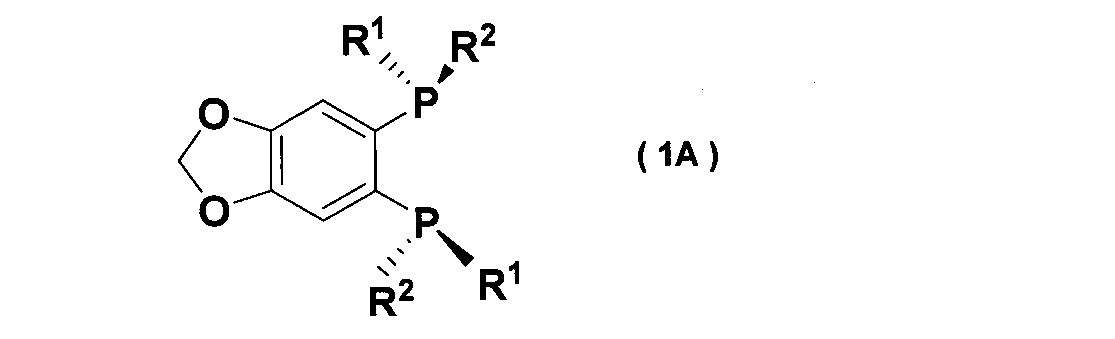
(式中、R1及びR2は、炭素数1~10のアルキル基を示し、R1とR2とでは炭素数が異なる。)
一般式(1A)において、R1の方が炭素数が多い場合は、一般式(1A)で表される光学活性な1,2-ビス(ジアルキルホスフィノ)-4,5-(メチレンジオキシ)ベンゼン誘導体は(R,R)体であり、一方、R2の炭素数が多い場合は、(S,S)体である。
一般式(1A)において、R1及びR2の炭素数は少なくとも1であることが必要である。一般式(1A)において、R1及びR2のうち炭素数が多い方の基は、立体障害性を有する嵩高い置換基であることが好ましい。この観点から、R1及びR2のうち炭素数が多い方の基は、一級アルキル基よりも二級アルキル基が好ましく、二級アルキル基より三級アルキル基が好ましい。また、脂環式のアルキル基であることも好ましい。好ましいアルキル基としてはtert-ブチル基が挙げられる。
ここで、一般式(1A)で表される1,2-ビス(ジアルキルホスフィノ)-4,5-(メチレンジオキシ)ベンゼン誘導体を、不斉合成触媒用金属錯体の配位子として用いた場合、高度な不斉空間が形成されることを考慮すると、R1とR2の立体障害性に大きな差があることが好ましい。つまり、R1とR2の一方が立体障害性を有する嵩高い置換基、つまり極大基であるのに対して、他方は極小基であることが好ましい。従ってR1とR2は炭素数の差は大きいほど好ましい。具体的には、R1とR2の炭素数の差は2以上、特に3以上、とりわけ4以上であることが好ましい。R1及びR2のうち、炭素数が少ない方の基は、極小基であることに鑑みれば、同じ炭素数の脂環式アルキル基と非環式アルキル基では、非環式アルキル基の方が好ましい。さらに、同じ炭素数の非環式アルキル基の中では、分岐状アルキル基より直鎖状アルキル基の方が好ましい。最終的には、R1及びR2のうち炭素数が少ない方の基として最も好ましい基はメチル基であると言える。しかし、一般的には、炭素数が少ない方の基として用いる基は、炭素数が多い方の基との関係で相対的に決定される。R1とR2の好ましい組み合わせとしては、例えばR1=tert-ブチル基、R2=メチル基の組み合わせ、R1=メチル基、R2=tert-ブチル基の組み合わせが挙げられる。
一般式(1)で表される1,2-ビス(ジアルキルホスフィノ)-4,5-(メチレンジオキシ)ベンゼン誘導体の特に好ましい具体例としては、以下の化合物が挙げられる。(R,R)-1,2-ビス(tert-ブチルメチルホスフィノ)-4,5-(メチレンジオキシ)ベンゼン、(S,S)-1,2-ビス(tert-ブチルメチルホスフィノ)-4,5-(メチレンジオキシ)ベンゼン、(R,R)-1,2-ビス(アダマンチルメチルホスフィノ)-4,5-(メチレンジオキシ)ベンゼン、(S,S)-1,2-ビス(アダマンチルメチルホスフィノ)-4,5-(メチレンジオキシ)ベンゼン、(R,R)-1,2-ビス(イソプロピルメチルホスフィノ)-4,5-(メチレンジオキシ)ベンゼン、(S,S)-1,2-ビス(イソプロピルメチルホスフィノ)-4,5-(メチレンジオキシ)ベンゼン、(R,R)-1,2-ビス(1,1,3,3-テトラメチルブチルメチルホスフィノ)-4,5-(メチレンジオキシ)ベンゼン、(S,S)-1,2-ビス(1,1,3,3-テトラメチルブチルメチルホスフィノ)-4,5-(メチレンジオキシ)ベンゼン。
一般式(1)で表される本発明の1,2-ビス(ジアルキルホスフィノ)-4,5-(メチレンジオキシ)ベンゼン誘導体の好ましい製造方法について以下に説明する。
本発明の製造方法において、先ず、下記一般式(2)で表されるホスフィン-ボラン化合物を用意する。本製造方法では、出発原料として下記一般式(2)で表されるホスフィン-ボラン化合物を用いることにより、対応する一般式(1)で表される1,2-ビス(ジアルキルホスフィノ)-4,5-(メチレンジオキシ)ベンゼン誘導体を得ることができる。なお、その光学活性体である一般式(1A)で表される1,2-ビス(ジアルキルホスフィノ)-4,5-(メチレンジオキシ)ベンゼン誘導体を製造するには、出発原料として一般式(2)で表されるホスフィン-ボラン化合物に代えて、該ホスフィン-ボラン化合物の光学活性体である下記一般式(2A)で表されるホスフィン-ボラン化合物を用いて後述する第1~第4工程の反応を行えばよい。

(式中、R1及びR2は前記一般式(1)と同じ。)
出発原料である一般式(2)の化合物は、例えば下記反応式(1)に従って、合成することができる。
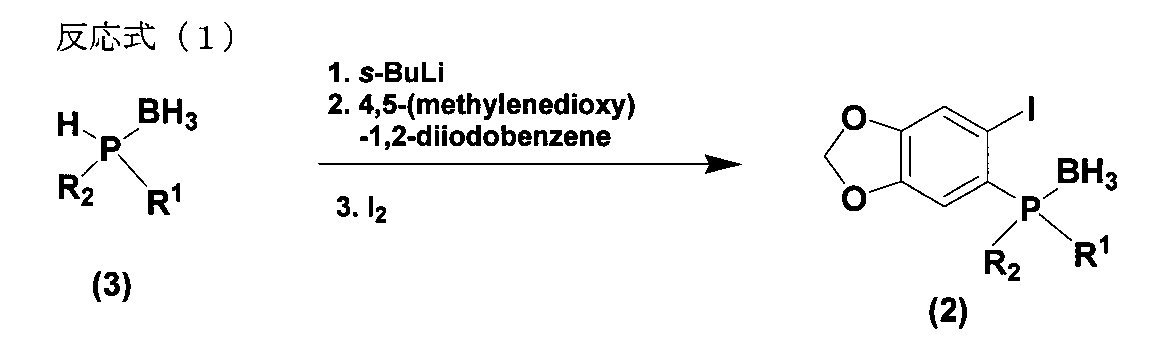
(式中、R1及びR2は前記と同じ。)
前記反応式(1)においては、先ず出発原料であるジアルキルホスフィン-ボラン(3)にアルゴン雰囲気下、-80℃においてs-BuLiを加え、ホスフィドアニオンとし、次いで4,5-(メチレンジオキシ)-1,2-ジヨードベンゼンと反応させることにより目的とする一般式(2)で表されるホスフィン-ボラン化合物を得ることができる(Organic Letters 2010年 12巻 19号 4400-4403)。なお、前記一般式(2A)で表される光学活性なホスフィン-ボラン化合物を得るには、反応式(1)に係る反応において、ジアルキルホスフィン-ボラン(3)の光学活性体を用いて反応を行えばよい。
ジアルキルホスフィン-ボラン(3)及びその光学活性体は、特開2001-253889号公報又は特開2007-70310号公報に記載の方法等の公知の方法によって調製することができる。
前記反応式(1)においては、先ず出発原料であるジアルキルホスフィン-ボラン(3)にアルゴン雰囲気下、-80℃においてs-BuLiを加え、ホスフィドアニオンとし、次いで4,5-(メチレンジオキシ)-1,2-ジヨードベンゼンと反応させることにより目的とする一般式(2)で表されるホスフィン-ボラン化合物を得ることができる(Organic Letters 2010年 12巻 19号 4400-4403)。なお、前記一般式(2A)で表される光学活性なホスフィン-ボラン化合物を得るには、反応式(1)に係る反応において、ジアルキルホスフィン-ボラン(3)の光学活性体を用いて反応を行えばよい。
ジアルキルホスフィン-ボラン(3)及びその光学活性体は、特開2001-253889号公報又は特開2007-70310号公報に記載の方法等の公知の方法によって調製することができる。
一般式(2A)で表されるホスフィン-ボラン化合物において、R1の炭素数をR2の炭素数より多くする場合(該ホスフィン-ボランがR体の場合)、ジアルキルホスフィン-ボランとしてはS体のものを用いる。これとは逆に、一般式(2A)で表されるホスフィン-ボラン化合物においては、R2の炭素数をR1の炭素数より多くする場合(該ホスフィン-ボラン化合物がS体の場合)、ジアルキルホスフィン-ボランとしてR体のものを用いる。
本発明の製造方法の第1工程である一般式(2)のジアルキルホスフィン-ボラン化合物の脱ボラン化は、以下の反応式(2)で表される。

(式中、R1及びR2は前記と同じ。)
反応式(2)に係るジアルキルホスフィン-ボラン化合物の脱ボラン化は、従来公知の方法に準じて行うことができる。例えば、THF、ヘキサン、トルエン、ジメトキシエタン等の有機溶媒中、1,4-ジアザビシクロ[2.2.2]オクタン(DABCO)、N-メチルモルホリン、トリエチルアミン、ピロリジン、ジエチルアミン等の塩基の存在下で行うことができる。塩基としては、これらの中でもDABCOを用いることが好ましい。塩基の使用量は、一般式(2)で表されるホスフィン-ボラン化合物1モルに対し1~3モルの割合が好ましい。また、反応時間は0.5~5時間とすることができる。反応温度は20~110℃までとすることができる。
反応式(2)に係るジアルキルホスフィン-ボラン化合物の脱ボラン化は、従来公知の方法に準じて行うことができる。例えば、THF、ヘキサン、トルエン、ジメトキシエタン等の有機溶媒中、1,4-ジアザビシクロ[2.2.2]オクタン(DABCO)、N-メチルモルホリン、トリエチルアミン、ピロリジン、ジエチルアミン等の塩基の存在下で行うことができる。塩基としては、これらの中でもDABCOを用いることが好ましい。塩基の使用量は、一般式(2)で表されるホスフィン-ボラン化合物1モルに対し1~3モルの割合が好ましい。また、反応時間は0.5~5時間とすることができる。反応温度は20~110℃までとすることができる。
次に、第2工程としてハロゲン化アルキルマグネシウム化合物との金属―ハロゲン交換反応を行う。ハロゲン化アルキルマグネシウム化合物は、一般式RMgX(式中、Rは炭素数1~5の直鎖状又は分岐状のアルキル基、Xはハロゲン原子を示す。)で表される。ハロゲン化アルキルマグネシウム化合物との反応は、以下の反応式(3)で表される。

(式中、R1、R2、R及びXは前記と同じ。)
ハロゲン化アルキルマグネシウム化合物との反応は、例えば、THF、ヘキサン、トルエン、ジメトキシエタン等の有機溶媒中で行われる。ハロゲン化アルキルマグネシウム化合物としては、塩化メチルマグネシウム、臭化メチルマグネシウム、塩化エチルマグネシウム、臭化エチルマグネシウム、塩化n-プロピルマグネシウム、臭化n-プロピルマグネシウム、塩化iso-プロピルマグネシウム、臭化iso-プロピルマグネシウム、塩化n-ブチルマグネシウム、塩化sec-ブチルマグネシウム及び塩化tert-ブチルマグネシウム等が挙げられる。これらの中でも塩化iso-プロピルマグネシウムが好ましい。ハロゲン化アルキルマグネシウム化合物の使用量は、第1工程で使用した一般式(2)で表されるホスフィン-ボラン化合物1モルに対し0.7~2.0モルの割合が好ましく、1.0~1.5モルが特に好ましい。なお、この第2工程では、必要により塩化リチウム、臭化リチウム、ヨウ化リチウム、テトラフルオロホウ酸リチウム、過塩素酸リチウム等の反応助剤を共存させて反応を行うことによりいっそう反応を効率よく進行させることができる。この反応助剤の添加量はハロゲン化アルキルマグネシウム化合物に対するモル比で0.2~4.0、好ましくは1.0~1.5である。
また、反応時間は10分~8時間とすることができ、好ましくは20分~2時間である。反応温度は-80~80℃とすることができる。
ハロゲン化アルキルマグネシウム化合物との反応は、例えば、THF、ヘキサン、トルエン、ジメトキシエタン等の有機溶媒中で行われる。ハロゲン化アルキルマグネシウム化合物としては、塩化メチルマグネシウム、臭化メチルマグネシウム、塩化エチルマグネシウム、臭化エチルマグネシウム、塩化n-プロピルマグネシウム、臭化n-プロピルマグネシウム、塩化iso-プロピルマグネシウム、臭化iso-プロピルマグネシウム、塩化n-ブチルマグネシウム、塩化sec-ブチルマグネシウム及び塩化tert-ブチルマグネシウム等が挙げられる。これらの中でも塩化iso-プロピルマグネシウムが好ましい。ハロゲン化アルキルマグネシウム化合物の使用量は、第1工程で使用した一般式(2)で表されるホスフィン-ボラン化合物1モルに対し0.7~2.0モルの割合が好ましく、1.0~1.5モルが特に好ましい。なお、この第2工程では、必要により塩化リチウム、臭化リチウム、ヨウ化リチウム、テトラフルオロホウ酸リチウム、過塩素酸リチウム等の反応助剤を共存させて反応を行うことによりいっそう反応を効率よく進行させることができる。この反応助剤の添加量はハロゲン化アルキルマグネシウム化合物に対するモル比で0.2~4.0、好ましくは1.0~1.5である。
また、反応時間は10分~8時間とすることができ、好ましくは20分~2時間である。反応温度は-80~80℃とすることができる。
次に、第3工程として、第2工程の反応生成物(4)を、一般式RaPX’2(Raは前記一般式(1)におけるR1及びR2の一方であり、X’はハロゲン原子を示す)で表されるアルキルジハロゲノホスフィンと反応させる。Raは、R1及びR2のうちの炭素数が多い方の基であることが好ましい。X’で表されるハロゲン原子としては、フッ素、塩素、臭素、ヨウ素等が挙げられ、塩素が好ましい。一般式RaPX’2で表されるアルキルジハロゲノホスフィンは、市販品として入手可能である。また、工業的にも安価に製造可能である(例えば、特開2002-255983号公報、特開2001-354683号公報等参照。)。例えばRaがR1である場合、第3工程の反応は以下の反応式(4)で表される。
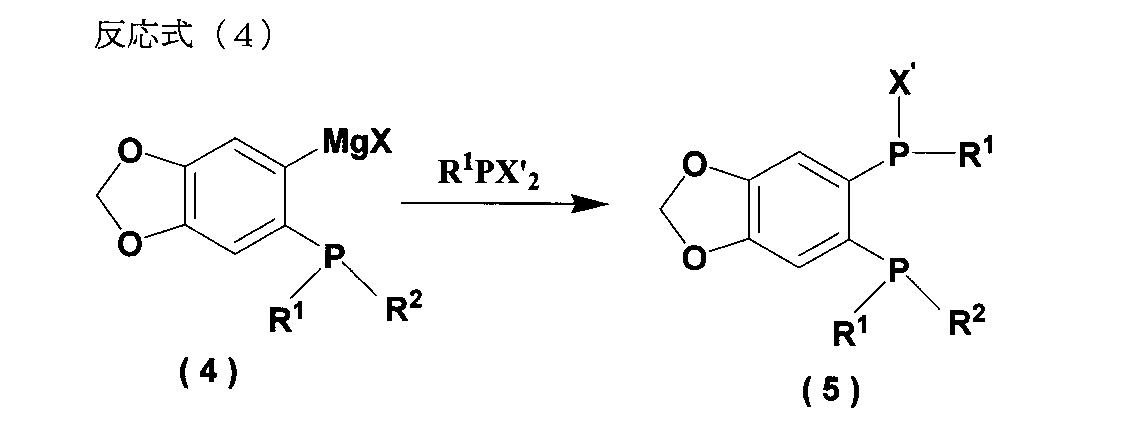
(式中、R1、R2、X及びX’は前記と同じ。)
第3工程の反応は、例えば、THF、ヘキサン、トルエン、ジメトキシエタン等の有機溶媒中で行うことができる。一般式RaPX’2で表されるアルキルジハロゲノホスフィンの使用量は、第1工程で使用した一般式(2)で表されるホスフィン-ボラン化合物1モルに対し1.0~2.0モルの割合が好ましい。また、反応時間は0.5~24時間とすることができる。反応温度は-100~80℃とすることができる。
次に、第4工程として、第3工程の反応生成物(5)を、一般式RbMgX”(Rbは前記一般式(1)におけるR1及びR2の一方であり、X”はハロゲン原子を示す)で表されるグリニャ-ル試薬と反応させる。なお、Rbは一般式(1)におけるR1及びR2のうち、Raとは異なる基である。
X”で表されるハロゲン原子としては、フッ素、塩素、臭素、ヨウ素等が挙げられ、塩素、臭素が好ましい。例えばRbがR2である場合、第4工程の反応は以下の反応式(5)で表される。
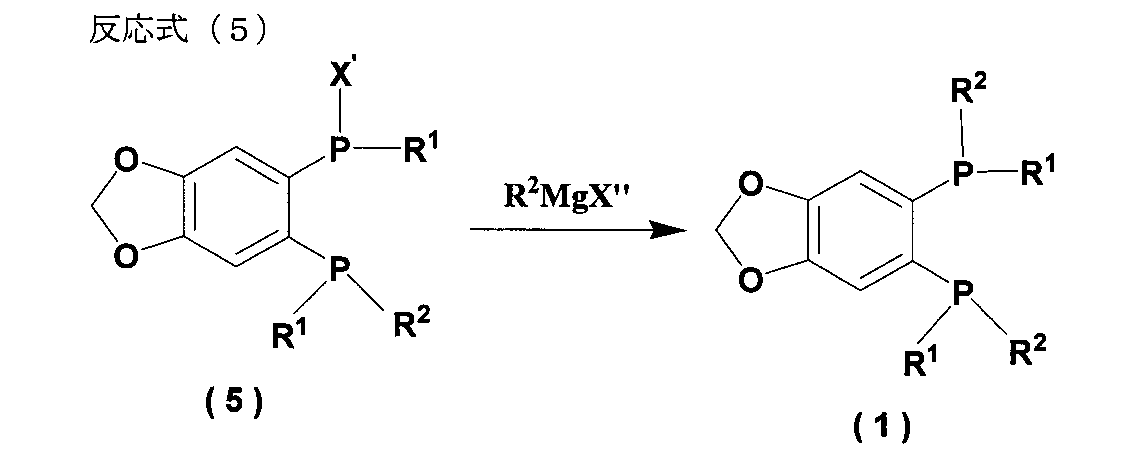
(式中、R1、R2及びX”は前記と同じ。)
X”で表されるハロゲン原子としては、フッ素、塩素、臭素、ヨウ素等が挙げられ、塩素、臭素が好ましい。例えばRbがR2である場合、第4工程の反応は以下の反応式(5)で表される。
第4工程の反応は、従来公知のグリニャ-ル反応に準じて行うことができる。例えば、THF、ヘキサン、トルエン、ジメトキシエタン等の有機溶媒中で行うことができる。一般式RbMgX”で表されるグリニャ-ル試薬の使用量は、第1工程で使用した一般式(2)で表されるホスフィン-ボラン化合物1モルに対し1.0~2.0モルの割合が好ましい。また、反応時間は0.5~24時間とすることができる。反応温度は0~100℃とすることができる。尚、以上の第1~4工程の反応は、不活性ガス下で行うことが好ましい。
以上の第1~4工程により、目的物である前記一般式(1)で表される1,2-ビス(ジアルキルホスフィノ)-4,5-(メチレンジオキシ)ベンゼン誘導体又は前記一般式(1A)で表される光学活性な1,2-ビス(ジアルキルホスフィノ)-4,5-(メチレンジオキシ)ベンゼン誘導体が得られるが、必要により常法に従った精製を行うことで目的物を純度よく得ることができる。
また、前記一般式(1A)で表される光学活性な1,2-ビス(ジアルキルホスフィノ)-4,5-(メチレンジオキシ)ベンゼン誘導体を得る場合、目的物である該1,2-ビス(ジアルキルホスフィノ)-4,5-(メチレンジオキシ)ベンゼン誘導体は(R,R)体又は(S,S)体であるところ、第1~4工程後には目的物以外の成分として(R,S)体又は(S,R)体、例えばメソ体が含有された混合物が得られる場合がある。例えば目的物が(R,R)体であり、二つのR1が同一のアルキル基で且つ二つのR2が同一のアルキル基である場合には、(R,R)体とメソ体の混合物が得られる場合がある。そのため、必要により精製(a)を行うことにより、該混合物から本発明の目的物である(R,R)体又は(S,S)体を分離すると、目的物を純度よく得ることができる。この分離は、通常の精製方法により行えばよく、通常は再結晶で十分である。また、分離は、必要に応じてカラム分離により行うこともできる。また、精製(a)を行うに当たって、適宜、脱溶媒、洗浄、カラム分離等の精製方法により、精製(a’)を行っておくことが好ましい。
なお、カラム分離等の精製工程において、目的物が酸化されやすく、精製が困難な場合には、必要により1,2-ビス(ジアルキルホスフィノ)-4,5-(メチレンジオキシ)ベンゼン誘導体の精製操作の際の酸化を抑制するため、前記第1~4工程に次いで、後述する第5工程を実施し1,2-ビス(ジアルキルホスフィノ)-4,5-(メチレンジオキシ)ベンゼン誘導体をボラン化して対応する下記一般式(1-1)又は(1-1A)で表される1,2-ビス(ジアルキルホスフィノ)-4,5-(メチレンジオキシ)ベンゼン-ボラン誘導体に誘導して精製を行うことが好ましい。

(式中、R1及びR2は前記と同じ。)
第5工程の反応は、従来公知のボラン化の反応に準じて行うことができる。ボラン化で用いるボラン化剤は、ボラン-THF錯体、水素化ホウ素アルカリ金属塩、ボラン-アミン錯体を用いることができる。
前記水素化ホウ素アルカリ金属塩は、MBH4の化学式(式中、Mはアルカリ金属原子を示す。)で表され、好ましくは水素化ホウ素リチウム(LiBH4)、水素化ホウ素ナトリウム(NaBH4)、水素化ホウ素カリウム(KBH4)である。
前記ボラン-アミン錯体は、BH3・R3 nH(3-n)Nの化学式(式中、R3は、アルキル基、シクロアルキル基、アリール基、シクロアリール基を示し、同一の基であっても異なる基であってもよく、nが2以上のときは2つのR3で環を形成していてもよく、nは、0~3の整数である。)で表される錯体、すなわち、ボラン(BH3)と、アンモニア、第一級アミン、第二級アミン又は第三級アミンとの錯体である。該ボラン-アミン錯体としては、具体的には、ボラン-アンモニア錯体、ボラン-tert-ブチルアミン錯体、ボラン-ジメチルアミン錯体、ボラン-トリエチルアミン錯体、ボラン-トリメチルアミン錯体、ボラン-4-エチルモルホリン錯体、ボラン-2,6-ルチジン錯体、ボラン-モルホリン錯体、ボラン-4-メチルモルホリン錯体、ボラン-4-フェニルモルホリン錯体、ボラン-ピペラジン錯体、ボラン-ピリジン錯体、ボラン-N,N-ジエチルアニリン錯体、ボラン-N,N-ジイソプロピルアニリン錯体等が挙げられる。
第5工程に係る反応は、例えば、THF、ヘキサン、トルエン、ジメトキシエタン等の有機溶媒中で行うことができる。
ボラン化剤の使用量は、第1工程で使用した一般式(2)又は一般式(2A)で表されるホスフィン-ボラン化合物1モルに対し1.0~3.0モルの割合が好ましい。また、反応時間は0.5~5.0時間とすることができる。反応温度は-50~50℃とすることができる。尚、第5工程の反応は、不活性ガス下で行うことが好ましい。
前記水素化ホウ素アルカリ金属塩は、MBH4の化学式(式中、Mはアルカリ金属原子を示す。)で表され、好ましくは水素化ホウ素リチウム(LiBH4)、水素化ホウ素ナトリウム(NaBH4)、水素化ホウ素カリウム(KBH4)である。
前記ボラン-アミン錯体は、BH3・R3 nH(3-n)Nの化学式(式中、R3は、アルキル基、シクロアルキル基、アリール基、シクロアリール基を示し、同一の基であっても異なる基であってもよく、nが2以上のときは2つのR3で環を形成していてもよく、nは、0~3の整数である。)で表される錯体、すなわち、ボラン(BH3)と、アンモニア、第一級アミン、第二級アミン又は第三級アミンとの錯体である。該ボラン-アミン錯体としては、具体的には、ボラン-アンモニア錯体、ボラン-tert-ブチルアミン錯体、ボラン-ジメチルアミン錯体、ボラン-トリエチルアミン錯体、ボラン-トリメチルアミン錯体、ボラン-4-エチルモルホリン錯体、ボラン-2,6-ルチジン錯体、ボラン-モルホリン錯体、ボラン-4-メチルモルホリン錯体、ボラン-4-フェニルモルホリン錯体、ボラン-ピペラジン錯体、ボラン-ピリジン錯体、ボラン-N,N-ジエチルアニリン錯体、ボラン-N,N-ジイソプロピルアニリン錯体等が挙げられる。
第5工程に係る反応は、例えば、THF、ヘキサン、トルエン、ジメトキシエタン等の有機溶媒中で行うことができる。
ボラン化剤の使用量は、第1工程で使用した一般式(2)又は一般式(2A)で表されるホスフィン-ボラン化合物1モルに対し1.0~3.0モルの割合が好ましい。また、反応時間は0.5~5.0時間とすることができる。反応温度は-50~50℃とすることができる。尚、第5工程の反応は、不活性ガス下で行うことが好ましい。
第5工程終了後は、所望の精製を行った後、精製処理後の1,2-ビス(ジアルキルホスフィノ)-4,5-(メチレンジオキシ)ベンゼン-ボラン誘導体を脱ボラン化し、再度前記一般式(1)又は一般式(1A)で表される1,2-ビス(ジアルキルホスフィノ)-4,5-(メチレンジオキシ)ベンゼン誘導体を得る。
この脱ボラン化は、従来公知の方法に準じて行うことができる。例えば、THF、ヘキサン、トルエン、ジメトキシエタン等の有機溶媒中、1,4-ジアザビシクロ[2.2.2]オクタン(DABCO)、N-メチルモルホリン、トリエチルアミン、ピロリジン、ジエチルアミン等の塩基の存在下で行うことができる。塩基としては、これらの中でもDABCOを用いることが好ましい。塩基の使用量は、一般式(1-1)又は一般式(1-1A)で表される1,2-ビス(ジアルキルホスフィノ)-4,5-(メチレンジオキシ)ベンゼン-ボラン誘導体1モルに対し1~3モルの割合が好ましい。また、反応時間は0.5~5時間とすることができる。反応温度は20~110℃までとすることができる。
この脱ボラン化は、従来公知の方法に準じて行うことができる。例えば、THF、ヘキサン、トルエン、ジメトキシエタン等の有機溶媒中、1,4-ジアザビシクロ[2.2.2]オクタン(DABCO)、N-メチルモルホリン、トリエチルアミン、ピロリジン、ジエチルアミン等の塩基の存在下で行うことができる。塩基としては、これらの中でもDABCOを用いることが好ましい。塩基の使用量は、一般式(1-1)又は一般式(1-1A)で表される1,2-ビス(ジアルキルホスフィノ)-4,5-(メチレンジオキシ)ベンゼン-ボラン誘導体1モルに対し1~3モルの割合が好ましい。また、反応時間は0.5~5時間とすることができる。反応温度は20~110℃までとすることができる。
本発明の製造方法において出発物質として用いる前記一般式(2)で表されるホスフィン-ボラン化合物は、-PR1R2BH3基を一つ有しており、該化合物を脱ボラン化してなる前記一般式(B)で表される化合物は-PR1R2基を一つ有している。本製造方法では、ハロゲン化アルキルマグネシウム化合物(RMgX)を用いて金属―ハロゲン交換反応をおこなうことで、ベンゼン環上にヨウ素基が結合していた部位が炭素アニオンとなり、次いでアルキルジハロゲノホスフィンを加えることにより、元来ヨウ素基が結合していた部位に-PR1R2基を導入することが可能になる。
また、化合物のMgXの部位上に、さらにもう一つの-PR1R2基を直接導入することは、-PR1R2基の嵩高さに起因する立体障害のために困難である場合がある。そこで、本発明では、先ず、-PR1R2基を一つ有する一般式(B)で表される化合物に対し、リン原子と共に炭素数の多いアルキル基R1を導入し、次に、炭素数の少ないもう一つのアルキル基R2を導入する。このような段階的な工程を経ることによって、-PR1R2基が嵩高いものであっても、容易に導入することが可能となる。
また、化合物のMgXの部位上に、さらにもう一つの-PR1R2基を直接導入することは、-PR1R2基の嵩高さに起因する立体障害のために困難である場合がある。そこで、本発明では、先ず、-PR1R2基を一つ有する一般式(B)で表される化合物に対し、リン原子と共に炭素数の多いアルキル基R1を導入し、次に、炭素数の少ないもう一つのアルキル基R2を導入する。このような段階的な工程を経ることによって、-PR1R2基が嵩高いものであっても、容易に導入することが可能となる。
また、本発明の製造方法によれば、第1~4工程、更には第1~5工程を連続的に行うことができるので、工業的に有利に目的とする1,2-ビス(ジアルキルホスフィノ)-4,5-(メチレンジオキシ)ベンゼン誘導体を得ることができるという利点を有する。
本発明の製造方法により得られた前記一般式(1)及び一般式(1A)で表される1,2-ビス(ジアルキルホスフィノ)-4,5-(メチレンジオキシ)ベンゼン誘導体は、配位子として、遷移金属と共に錯体を形成することができる。特に前記一般式(1A)で表される光学活性な1,2-ビス(ジアルキルホスフィノ)-4,5-(メチレンジオキシ)ベンゼン誘導体を配位子とした金属錯体は、不斉合成触媒として有用である。
錯体を形成することができる遷移金属としては、例えば、ロジウム、ルテニウム、イリジウム、パラジウム、ニッケル、鉄、銅等が挙げられ、好ましくはロジウム金属である。一般式(1)及び一般式(1A)で表される1,2-ビス(ジアルキルホスフィノ)-4,5-(メチレンジオキシ)ベンゼン誘導体を配位子としてロジウム金属と共に錯体を形成させる方法としては、例えば、実験化学講座第4版(日本化学会編、丸善株式会社発行
第18巻 327~353頁)に記載されている方法に従えばよく、例えば、一般式(1)で表される1,2-ビス(ジアルキルホスフィノ)-4,5-(メチレンジオキシ)ベンゼン誘導体と、ビス(シクロオクタン-1,5-ジエン)ロジウムヘキサフルオロアンチモン酸塩、ビス(シクロオクタン-1,5-ジエン)ロジウムテトラフルオロホウ酸塩等と反応させることにより、ロジウム錯体を製造することができる。
第18巻 327~353頁)に記載されている方法に従えばよく、例えば、一般式(1)で表される1,2-ビス(ジアルキルホスフィノ)-4,5-(メチレンジオキシ)ベンゼン誘導体と、ビス(シクロオクタン-1,5-ジエン)ロジウムヘキサフルオロアンチモン酸塩、ビス(シクロオクタン-1,5-ジエン)ロジウムテトラフルオロホウ酸塩等と反応させることにより、ロジウム錯体を製造することができる。
得られるロジウム錯体を具体的に例示すると、[Rh((S,S)-(A))(cod)]Cl、[Rh((S,S)-(A))(cod)]Br、[Rh((S,S)-(A))(cod)]I、[Rh((R,R)-(A))(cod)]Cl、[Rh((R,R)-(A))(cod)]Br、[Rh((R,R)-(A))(cod)]I、[Rh((S,S)-(A))(cod)]SbF6、[Rh((S,S)-(A))(cod)] BF4、[Rh((S,S)-(A))(cod)] ClO4、[Rh((S,S)-(A))(cod)]PF6、[Rh((S,S)-(A))(cod)]BPh4、[Rh((R,R)-(A))(cod)]SbF6、[Rh((R,R)-(A))(cod)] BF4、[Rh((R,R)-(A))(cod)] ClO4、[Rh((R,R)-(A))(cod)]PF6、[Rh((R,R)-(A))(cod)]BPh4、[Rh((R,R)-(A))(cod)]SbF6、[Rh((S,S)-(A))(nbd )]PF6、[Rh((S,S)-(A))(nbd)]SbF6、[Rh((S,S)-(A))(nbd)] BF4、[Rh((S,S)-(A))(nbd)] ClO4、[Rh((S,S)-(A))(nbd)]BPh4、[Rh((R,R)-(A))(nbd )]PF6、[Rh((R,R)-(A))(nbd)]SbF6、[Rh((R,R)-(A))(nbd)] BF4、[Rh((R,R)-(A))(nbd)] ClO4、[Rh((R,R)-(A))(nbd)]BPh4等が挙げられ、本発明では[Rh((S,S)-(A))(cod)]SbF6、[Rh((R,R)-(A))(cod)]SbF6、[Rh((S,S)-(A))(nbd)]SbF6、[Rh((R,R)-(A))(nbd)]SbF6が好ましい。尚、上記のロジウム錯体中の(A)は、一般式(1)又は一般式(1A)で表される1,2-ビス(ジアルキルホスフィノ)-4,5-(メチレンジオキシ)ベンゼン誘導体、codは、1,5-シクロオクタジエン、nbdは、ノルボルナジエン、Phはフェニルを示す。
一般式(1A)で表される光学活性な1,2-ビス(ジアルキルホスフィノ)-4,5-(メチレンジオキシ)ベンゼン誘導体を配位子とした遷移金属錯体(以下、本発明に係る遷移金属錯体ともいう)は、不斉合成触媒として有用なものである。不斉合成反応としては、例えば不斉水素化反応、不斉ヒドロシリル化反応、不斉マイケル付加反応等が挙げられる。これらの不斉合成反応は、本発明に係る遷移金属錯体を用いる点以外は、通常と同様に行うことができる。
本発明に係る遷移金属錯体は、特に不斉水素化反応における触媒として好適である。不斉水素化反応において基質として用いられる化合物としては、例えば、プロキラル炭素原子を含むC=C二重結合、C=O二重結合又はC=N二重結合を有する化合物が挙げられる。該化合物としては、例えば、αデヒドロアミノ酸、βデヒドロアミノ酸、イタコン酸、エナミド、β-ケトエステル、エノ-ルエステル、α,β不飽和カルボン酸、β、γ不飽和カルボン酸、イミン等が挙げられ、特に本発明に係る遷移金属錯体は、βデヒドロアミノ酸に対して高い不斉誘起能と触媒活性を示すことに特徴を有するものである。また、不斉水素化反応において、基質と触媒である本発明に係る遷移金属錯体とのモル比(基質/触媒)は、通常は100以上であることが好ましい。
また、前記一般式(1)又は前記一般式(1A)で表される本発明の1,2-ビス(ジアルキルホスフィノ)-4,5-(メチレンジオキシ)ベンゼン誘導体を配位子とし、金、銀及び銅からなる群から選ばれる遷移金属原子(好ましくは金)と共に形成された金属錯体は、特開2007-320909号公報に記載されている2,3-ビス(ジアルキルホスフィノ)ピラジン誘導体と同様に抗癌剤としての用途も期待できる。この金属錯体は、本発明の1,2-ビス(ジアルキルホスフィノ)-4,5-(メチレンジオキシ)ベンゼン誘導体をLで表したとき、〔ML2〕+X-で表される。
以下、本発明を実施例により詳細に説明するが、本発明はこれらの実施例に限定されるものではない。
(合成例1)
1,2-ジヨード-4,5-(メチレンジオキシ)ベンゼンの合成

0℃に冷却した1,2-(メチレンジオキシ)ベンゼン
(7.50 g, 0.06mol) の酢酸溶液(30 mL)に塩化ヨウ素 (25.00 g, 0.15 mol)の酢酸溶液(15 mL)を15分かけて滴下し、次いで60 ℃へ昇温し2時間反応させた。その後、激しく撹拌しながらジエチルエーテル(100mL)と氷水(100 mL)へ反応液を注いだ。暗赤色の溶液へNa2SO3を加え、茶色の有機層を分液した。水槽にジエチルエーテル(100 mL 2回)を加えて分液した後、得られた有機層を食塩水(50 mL)で洗浄し、Na2SO4で乾燥させた。溶媒を濃縮した後に析出した淡黄色の結晶をろ過し、メタノールで洗浄し、白色結晶の1,2-ジヨード-4,5-(メチレンジオキシ)ベンゼン(9.95 g, 0.027 mol)を収率46 %で得た。
(1,2-ジヨード-4,5-(メチレンジオキシ)ベンゼンの同定データ)
1H NMR (500 MHz,CDCl3):δ 7.30 (s, 2H), 5.97 (s, 2H).
(合成例2)
(R) -2-(ボラナト-tert-ブチルメチルホスフィノ)-1-ヨード-4,5-(メチレンジオキシ)ベンゼンの合成
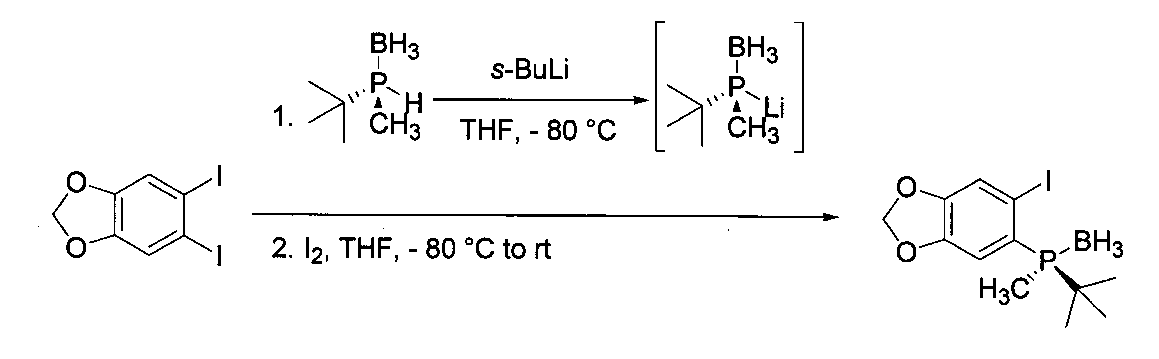
-80℃に冷却した(S)-tert-ブチルメチルホスフィンボラン (0.48 g, 4.0 mmol)のTHF溶液(15 mL)にs-BuLi(1.07
M シクロヘキサン/n-ヘキサン)(11.2 mL, 12.0
mmol)を加え、30分撹拌した。ここに1,2-ジヨード-4,5-(メチレンジオキシ)ベンゼン (1.95 g, 5.2 mmol)のTHF溶液(5 mL)を10分間かけてゆっくりと加えた。次いで、ヨウ素(1.52 g, 6.0mmol)のTHF溶液(1.5 mL)を加え、室温まで昇温した。溶媒を濃縮し、酢酸エチル(30 mL × 2)で抽出した。得られた有機層を食塩水(20 mL)で洗浄し、Na2SO4で乾燥させた。溶媒を濃縮し得られた黄色の油状物をシリカゲルカラムで精製することにより白色結晶の(R) -2-(ボラナト-tert-ブチルメチルホスフィノ)-1-ヨード-4,5-(メチレンジオキシ)ベンゼン (0.85 g, 2.3mmol)を収率58 %で得た。
((R) -2-(ボラナト-tert-ブチルメチルホスフィノ)-1-ヨード-4,5-(メチレンジオキシ)ベンゼンの同定データ)
Mp.= 123-135 ℃, [α]D 27 = -20 (c 0.5, EtOAc).
1HNMR (500 MHz, CDCl3): δ 7.54 (d, J= 12.3 Hz, 1H), 7.42
(d, J = 1.7Hz, 1H), 6.03 (dd, J = 4.3 Hz, 1.2Hz, 2H), 1.91 (d, J = 10.0 Hz,
3H),1.20 (d, J = 14.4 Hz, 9H).
31PNMR (202 MHz, CDCl3): δ 39.9 (br).
13CNMR (126 MHz, CDCl3): δ 150.7, 148.0 (d, J = 16.8 Hz),
124.2 (d, J =48.1 Hz), 122.6 (d, J = 7.2 Hz),188.2 (d, J = 19.2 Hz), 102.5,
88.7,31.9 (d, J = 31.2 Hz), 26.4 (d, J = 2.4 Hz), 9.7 (d, J = 37.3 Hz).
(合成例1)
1,2-ジヨード-4,5-(メチレンジオキシ)ベンゼンの合成
(7.50 g, 0.06mol) の酢酸溶液(30 mL)に塩化ヨウ素 (25.00 g, 0.15 mol)の酢酸溶液(15 mL)を15分かけて滴下し、次いで60 ℃へ昇温し2時間反応させた。その後、激しく撹拌しながらジエチルエーテル(100mL)と氷水(100 mL)へ反応液を注いだ。暗赤色の溶液へNa2SO3を加え、茶色の有機層を分液した。水槽にジエチルエーテル(100 mL 2回)を加えて分液した後、得られた有機層を食塩水(50 mL)で洗浄し、Na2SO4で乾燥させた。溶媒を濃縮した後に析出した淡黄色の結晶をろ過し、メタノールで洗浄し、白色結晶の1,2-ジヨード-4,5-(メチレンジオキシ)ベンゼン(9.95 g, 0.027 mol)を収率46 %で得た。
(1,2-ジヨード-4,5-(メチレンジオキシ)ベンゼンの同定データ)
1H NMR (500 MHz,CDCl3):δ 7.30 (s, 2H), 5.97 (s, 2H).
(合成例2)
(R) -2-(ボラナト-tert-ブチルメチルホスフィノ)-1-ヨード-4,5-(メチレンジオキシ)ベンゼンの合成
M シクロヘキサン/n-ヘキサン)(11.2 mL, 12.0
mmol)を加え、30分撹拌した。ここに1,2-ジヨード-4,5-(メチレンジオキシ)ベンゼン (1.95 g, 5.2 mmol)のTHF溶液(5 mL)を10分間かけてゆっくりと加えた。次いで、ヨウ素(1.52 g, 6.0mmol)のTHF溶液(1.5 mL)を加え、室温まで昇温した。溶媒を濃縮し、酢酸エチル(30 mL × 2)で抽出した。得られた有機層を食塩水(20 mL)で洗浄し、Na2SO4で乾燥させた。溶媒を濃縮し得られた黄色の油状物をシリカゲルカラムで精製することにより白色結晶の(R) -2-(ボラナト-tert-ブチルメチルホスフィノ)-1-ヨード-4,5-(メチレンジオキシ)ベンゼン (0.85 g, 2.3mmol)を収率58 %で得た。
((R) -2-(ボラナト-tert-ブチルメチルホスフィノ)-1-ヨード-4,5-(メチレンジオキシ)ベンゼンの同定データ)
Mp.= 123-135 ℃, [α]D 27 = -20 (c 0.5, EtOAc).
1HNMR (500 MHz, CDCl3): δ 7.54 (d, J= 12.3 Hz, 1H), 7.42
(d, J = 1.7Hz, 1H), 6.03 (dd, J = 4.3 Hz, 1.2Hz, 2H), 1.91 (d, J = 10.0 Hz,
3H),1.20 (d, J = 14.4 Hz, 9H).
31PNMR (202 MHz, CDCl3): δ 39.9 (br).
13CNMR (126 MHz, CDCl3): δ 150.7, 148.0 (d, J = 16.8 Hz),
124.2 (d, J =48.1 Hz), 122.6 (d, J = 7.2 Hz),188.2 (d, J = 19.2 Hz), 102.5,
88.7,31.9 (d, J = 31.2 Hz), 26.4 (d, J = 2.4 Hz), 9.7 (d, J = 37.3 Hz).
{実施例1}
(R,R)-1-(tert-ブチルメチルホスフィノ)-2-(ボラナト-tert-ブチルメチルホスフィノ)-4,5-(メチレンジオキシ)ベンゼン(化合物1C)の合成
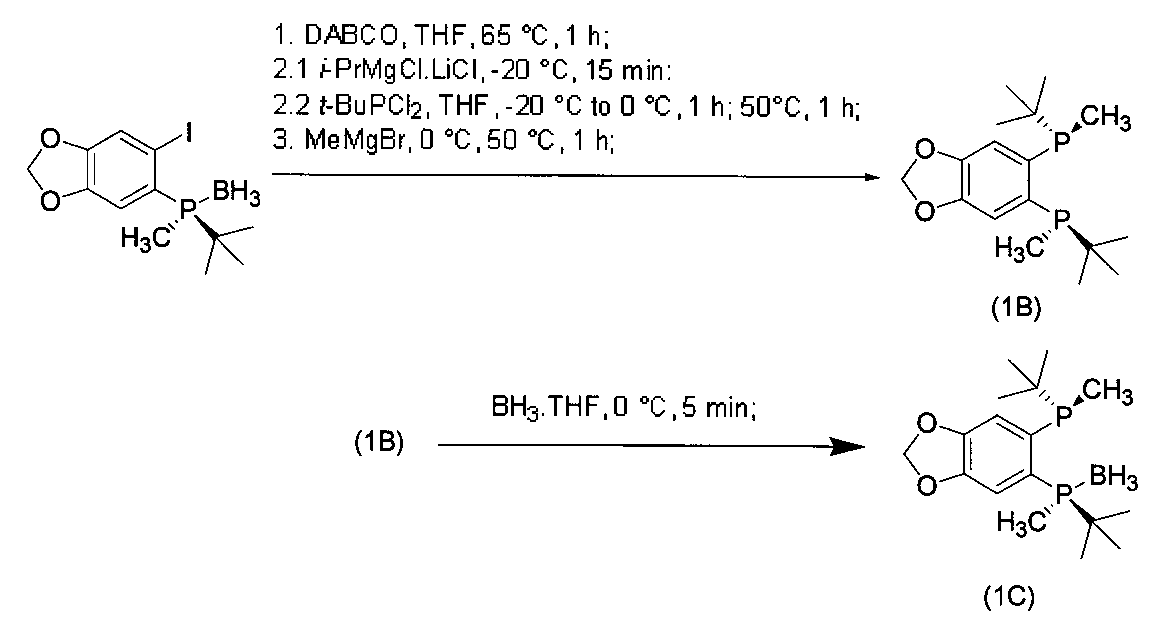
アルゴン雰囲気の下、(R) -2-(ボラナト-tert-ブチルメチルホスフィノ)-1-ヨード-4,5-(メチレンジオキシ)ベンゼン(182 mg, 0.50mmol)と1,4-diazabicyclo[2.2.2]octane (62 mg, 0.55 mmol)のTHF(1.5 mL)溶液を穏やかに1時間加熱還流させた。次いで-20 ℃へ冷却した後、1.3 M のi-PrMgCl.LiClのTHF溶液(0.42mL, 0.55 mmol)を加え、10分後、t-BuPCl2(119 mg, 0.75 mmol)のTHF溶液(1.0 mL)をゆっくりと加えた。0℃へ昇温した後、1時間撹拌をおこない、さらに50℃へ昇温して1時間撹拌をおこなった。次いで0℃へ冷却した後、1.12 M の MeMgBrのTHF溶液(1.34 mL, 1.5 mmol)を加え、50℃へ昇温した後に1時間撹拌下に反応をおこなった。反応液をLC-MS (APCI)で分析したところ、 327 [M+H]+の分子イオンピークを検出したことから、反応液には(R,R)-1,2-ビス(tert-ブチルメチルホスフィノ)-4,5-(メチレンジオキシ)ベンゼン(化合物1B)が含有されていることが確認できた。
次いで0℃へ冷却した後、1.06 Mの BH3.THF錯体のTHF溶液(1.88 mL, 2.0 mmol)を加えた。その後、水を加えて反応を停止させ、酢酸エチル(15 mL × 2)を加えて有機層を分液した。得られた有機層を食塩水で洗浄し、Na2SO4で乾燥させた。溶媒を濃縮し得られた粗生成物をシリカゲルカラムで精製することにより白色結晶の(R,R)-1-(tert-ブチルメチルホスフィノ)-2-(ボラナト-tert-ブチルメチルホスフィノ)-4,5-(メチレンジオキシ)ベンゼン(化合物1C)(50 mg, 0.15 mmol) を収率29 %で得た。
(化合物1Cの同定データ)
Mp.= 131-132 ℃, [α]D 27 = -24 (c 0.5, EtOAc).
1HNMR (500 MHz, CDCl3): δ 7.37 (dd, J = 10.9 Hz, 1.8 Hz,
1H), 7.23 (d, J = 2.3 Hz, 1H), 6.25 (dd, J= 4.0 Hz, 0.9 Hz, 2H), 1.81 (d, J =
9.2Hz, 3H), 1.19 (d, J = 13.8 Hz, 9H),1.18 (s, 3H), 1.09 (d, J = 12.6 Hz,9H).
31PNMR (202 MHz, CDCl3): δ 34.2 (br), -20.0.
13CNMR (126 MHz, CDCl3): δ 149.3, 148.2 (d, J = 15.6 Hz),
140.4 (dd, J = 32.5Hz, 9.8 Hz), 129.0 (dd, J = 46.9 Hz,39.7 Hz), 115.5 (t, J =
13.2 Hz), 113.0(d, J = 10.8 Hz), 101.9, 30.2 (d, J = 57.7 Hz), 30.2 (d, J = 9.6
Hz), 28.5 (d, J = 14.4 Hz), 26.8 (d, J = 2.4 Hz), 11.8 (dd, J = 37.3 Hz, 21.6
Hz), 9.7 (d, J = 22.8 Hz).
(R,R)-1-(tert-ブチルメチルホスフィノ)-2-(ボラナト-tert-ブチルメチルホスフィノ)-4,5-(メチレンジオキシ)ベンゼン(化合物1C)の合成
次いで0℃へ冷却した後、1.06 Mの BH3.THF錯体のTHF溶液(1.88 mL, 2.0 mmol)を加えた。その後、水を加えて反応を停止させ、酢酸エチル(15 mL × 2)を加えて有機層を分液した。得られた有機層を食塩水で洗浄し、Na2SO4で乾燥させた。溶媒を濃縮し得られた粗生成物をシリカゲルカラムで精製することにより白色結晶の(R,R)-1-(tert-ブチルメチルホスフィノ)-2-(ボラナト-tert-ブチルメチルホスフィノ)-4,5-(メチレンジオキシ)ベンゼン(化合物1C)(50 mg, 0.15 mmol) を収率29 %で得た。
(化合物1Cの同定データ)
Mp.= 131-132 ℃, [α]D 27 = -24 (c 0.5, EtOAc).
1HNMR (500 MHz, CDCl3): δ 7.37 (dd, J = 10.9 Hz, 1.8 Hz,
1H), 7.23 (d, J = 2.3 Hz, 1H), 6.25 (dd, J= 4.0 Hz, 0.9 Hz, 2H), 1.81 (d, J =
9.2Hz, 3H), 1.19 (d, J = 13.8 Hz, 9H),1.18 (s, 3H), 1.09 (d, J = 12.6 Hz,9H).
31PNMR (202 MHz, CDCl3): δ 34.2 (br), -20.0.
13CNMR (126 MHz, CDCl3): δ 149.3, 148.2 (d, J = 15.6 Hz),
140.4 (dd, J = 32.5Hz, 9.8 Hz), 129.0 (dd, J = 46.9 Hz,39.7 Hz), 115.5 (t, J =
13.2 Hz), 113.0(d, J = 10.8 Hz), 101.9, 30.2 (d, J = 57.7 Hz), 30.2 (d, J = 9.6
Hz), 28.5 (d, J = 14.4 Hz), 26.8 (d, J = 2.4 Hz), 11.8 (dd, J = 37.3 Hz, 21.6
Hz), 9.7 (d, J = 22.8 Hz).
{実施例2}
(R,R)-1,2-ビス(tert-ブチルメチルホスフィノ)-4,5-(メチレンジオキシ)ベンゼン(化合物1B)の合成

アルゴン雰囲気の下、(R,R)-1-(tert-ブチルメチルホスフィノ)-2-(ボラナト-tert-ブチルメチルホスフィノ)-4,5-(メチレンジオキシ)ベンゼン(化合物1C) (0.15 g, 0.44 mmol) と1,4-diazabicyclo[2.2.2]octane
(0.12 g, 0.55 mmol)のTHF溶液(5 mL)を穏やかに1時間加熱還流させた。溶媒を留去した後、脱気したヘキサン(5mL)をシリンジで加え、スラリーをろ過して固体を取り除いた。ヘキサン溶液を濃縮し、得られた淡黄色の粘ちょう物にメタノールを加えると白色結晶が得られた。さらにメタノールから再結晶をおこなうことにより白色結晶の(R,R)-1,2-ビス(tert-ブチルメチルホスフィノ)-4,5-(メチレンジオキシ)ベンゼン(化合物1B) (0.10 mg, 0.31mmol)が収率70%で得られた。
(化合物1Bの同定データ)
Mp.=146-148, [α]D 25 = +63.3.
1H NMR (500 MHz, CDCl3): δ 7.00-6.95 (m, 2H), 5.98 (s,
2H), 1.18(t, J = 3.4 Hz, 6H), 0.96 (t, J = 6.0 Hz, 18H).
31P NMR (202 MHz, CDCl3): δ -24.9(s).
13C NMR (126 MHz, CDCl3): δ 147.8, 138.7(t, J = 7.2 Hz),
111.1, 101.1, 30.5(t, J = 7.8 Hz), 27.3 (t, J = 7.8 Hz), 6.2 (t, J = 5.4 Hz)
(R,R)-1,2-ビス(tert-ブチルメチルホスフィノ)-4,5-(メチレンジオキシ)ベンゼン(化合物1B)の合成
(0.12 g, 0.55 mmol)のTHF溶液(5 mL)を穏やかに1時間加熱還流させた。溶媒を留去した後、脱気したヘキサン(5mL)をシリンジで加え、スラリーをろ過して固体を取り除いた。ヘキサン溶液を濃縮し、得られた淡黄色の粘ちょう物にメタノールを加えると白色結晶が得られた。さらにメタノールから再結晶をおこなうことにより白色結晶の(R,R)-1,2-ビス(tert-ブチルメチルホスフィノ)-4,5-(メチレンジオキシ)ベンゼン(化合物1B) (0.10 mg, 0.31mmol)が収率70%で得られた。
(化合物1Bの同定データ)
Mp.=146-148, [α]D 25 = +63.3.
1H NMR (500 MHz, CDCl3): δ 7.00-6.95 (m, 2H), 5.98 (s,
2H), 1.18(t, J = 3.4 Hz, 6H), 0.96 (t, J = 6.0 Hz, 18H).
31P NMR (202 MHz, CDCl3): δ -24.9(s).
13C NMR (126 MHz, CDCl3): δ 147.8, 138.7(t, J = 7.2 Hz),
111.1, 101.1, 30.5(t, J = 7.8 Hz), 27.3 (t, J = 7.8 Hz), 6.2 (t, J = 5.4 Hz)
{実施例3}
((R,R)-1,2-ビス(tert-ブチルメチルホスフィノ)-4,5-(メチレンジオキシ)ベンゼン) (1,5-シクロオクタジエン) ロジウム
(1+) ヘキサフルオロアンチモン酸塩(化合物1D)の合成
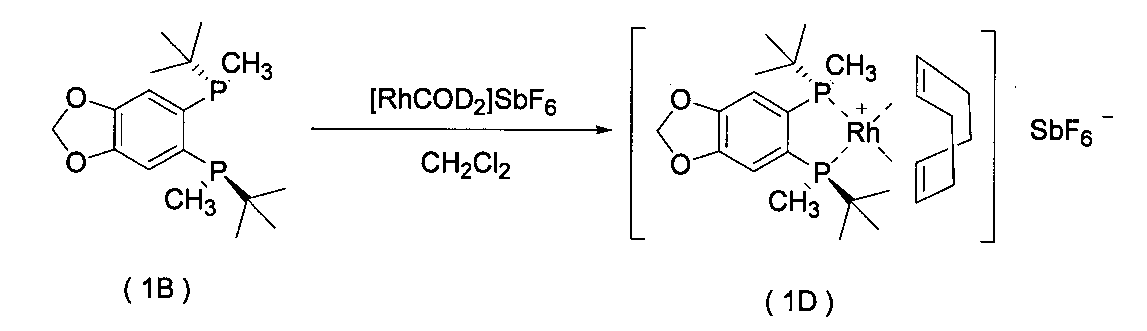
アルゴン雰囲気の下、0℃に冷却した[Rh(cod)2]SbF6(66
mg, 0.12 mmol)のジクロロメタン溶液(2 mL)へ(R,R)-1,2-ビス(tert-ブチルメチルホスフィノ)-4,5-(メチレンジオキシ)ベンゼン(化合物1B) (50 mg, 0.15 mmol)のジクロロメタン溶液(3 mL)を滴下した。室温で30分撹拌した後、大部分の溶媒を濃縮し、ジエチルエーテルを加えると結晶が析出した。得られた結晶をろ過し、ジエチルエーテルで洗浄した後に乾燥をおこなうとオレンジ色の微細結晶の((R,R)-1,2-ビス(tert-ブチルメチルホスフィノ)-4,5-(メチレンジオキシ)ベンゼン)
(1,5-シクロオクタジエン)ロジウム (1+) ヘキサフルオロアンチモン酸塩(化合物1D)(66 mg, 0.09 mmol)が収率71%で得られた。
(化合物1Dの同定データ)
1H NMR (500 MHz, CDCl3): δ 7.02 (m, 2H), 6.20 (s, 2H),
5.96 (t, J = 7.2 Hz, 2H), 4.83 (m, 2H), 2.70-2.57(m, 2H), 2.57-2.45 (m, 2H),
2.27-2.14 (m, 4H), 1.65 (d, J = 8.6 Hz, 6H), 1.09 (d, J= 14.9 Hz, 18H).
31P NMR (202 MHz, CDCl3): δ 55.8 (d, J = 158 Hz).
((R,R)-1,2-ビス(tert-ブチルメチルホスフィノ)-4,5-(メチレンジオキシ)ベンゼン) (1,5-シクロオクタジエン) ロジウム
(1+) ヘキサフルオロアンチモン酸塩(化合物1D)の合成
mg, 0.12 mmol)のジクロロメタン溶液(2 mL)へ(R,R)-1,2-ビス(tert-ブチルメチルホスフィノ)-4,5-(メチレンジオキシ)ベンゼン(化合物1B) (50 mg, 0.15 mmol)のジクロロメタン溶液(3 mL)を滴下した。室温で30分撹拌した後、大部分の溶媒を濃縮し、ジエチルエーテルを加えると結晶が析出した。得られた結晶をろ過し、ジエチルエーテルで洗浄した後に乾燥をおこなうとオレンジ色の微細結晶の((R,R)-1,2-ビス(tert-ブチルメチルホスフィノ)-4,5-(メチレンジオキシ)ベンゼン)
(1,5-シクロオクタジエン)ロジウム (1+) ヘキサフルオロアンチモン酸塩(化合物1D)(66 mg, 0.09 mmol)が収率71%で得られた。
(化合物1Dの同定データ)
1H NMR (500 MHz, CDCl3): δ 7.02 (m, 2H), 6.20 (s, 2H),
5.96 (t, J = 7.2 Hz, 2H), 4.83 (m, 2H), 2.70-2.57(m, 2H), 2.57-2.45 (m, 2H),
2.27-2.14 (m, 4H), 1.65 (d, J = 8.6 Hz, 6H), 1.09 (d, J= 14.9 Hz, 18H).
31P NMR (202 MHz, CDCl3): δ 55.8 (d, J = 158 Hz).
{実施例4} 不斉水素化反応

反応基質のαデヒドロアミノ酸2-(N-acetylamino)-3-phenyl-2-propenoicacid
methyl ester 438.5 mg (2.00 mmol)、不斉水添触媒((R,R)-1,2-ビス(tert-ブチルメチルホスフィノ)-4,5-(メチレンジオキシ)ベンゼン) (1,5-シクロオクタジエン) ロジウム (1+) ヘキサフルオロアンチモン酸塩1.55 mg (2.00 x 10⁻³mmol)を仕込み、水素で5回置換をおこない、予め脱気した脱水メタノール5 mLを加えた。次いで、水素圧を3気圧として反応を開始した。室温で30分間攪拌をおこなったところ、容器内の水素の消費が停止したため反応終了とした。反応液を濃縮した後、残存した白色結晶を酢酸エチルに溶解して、シリカゲルカラムに通した。得られた溶出液をHPLCにて分析をしたところ、(R)-2-(N-acetylamino)-3-phenylpropanoicacid
methyl esterが99.9 %の鏡像異性体過剰率(ee)で得られた。また、1H NMRによって分析をおこなったところ、化学収率は99 %以上であった(表1中のNo.1)。
なお、HPLC条件は以下のとおりである。
HPLC:Daicel Chiralcel OJ, 1.0
mL / min, ヘキサン:2-フ゜ロハ゜ノール = 9:1
各エナンチオマーの保持時間 (R)t1 = 13.3min, (S)t2 =
19.3 min
methyl ester 438.5 mg (2.00 mmol)、不斉水添触媒((R,R)-1,2-ビス(tert-ブチルメチルホスフィノ)-4,5-(メチレンジオキシ)ベンゼン) (1,5-シクロオクタジエン) ロジウム (1+) ヘキサフルオロアンチモン酸塩1.55 mg (2.00 x 10⁻³mmol)を仕込み、水素で5回置換をおこない、予め脱気した脱水メタノール5 mLを加えた。次いで、水素圧を3気圧として反応を開始した。室温で30分間攪拌をおこなったところ、容器内の水素の消費が停止したため反応終了とした。反応液を濃縮した後、残存した白色結晶を酢酸エチルに溶解して、シリカゲルカラムに通した。得られた溶出液をHPLCにて分析をしたところ、(R)-2-(N-acetylamino)-3-phenylpropanoicacid
methyl esterが99.9 %の鏡像異性体過剰率(ee)で得られた。また、1H NMRによって分析をおこなったところ、化学収率は99 %以上であった(表1中のNo.1)。
なお、HPLC条件は以下のとおりである。
HPLC:Daicel Chiralcel OJ, 1.0
mL / min, ヘキサン:2-フ゜ロハ゜ノール = 9:1
各エナンチオマーの保持時間 (R)t1 = 13.3min, (S)t2 =
19.3 min
以下、反応基質の種類及び反応条件を表1に示すように代えた以外は上記と同じ条件で不斉水素化反応を行い、その結果を表1に併記した。

{実施例5} 不斉水素化反応
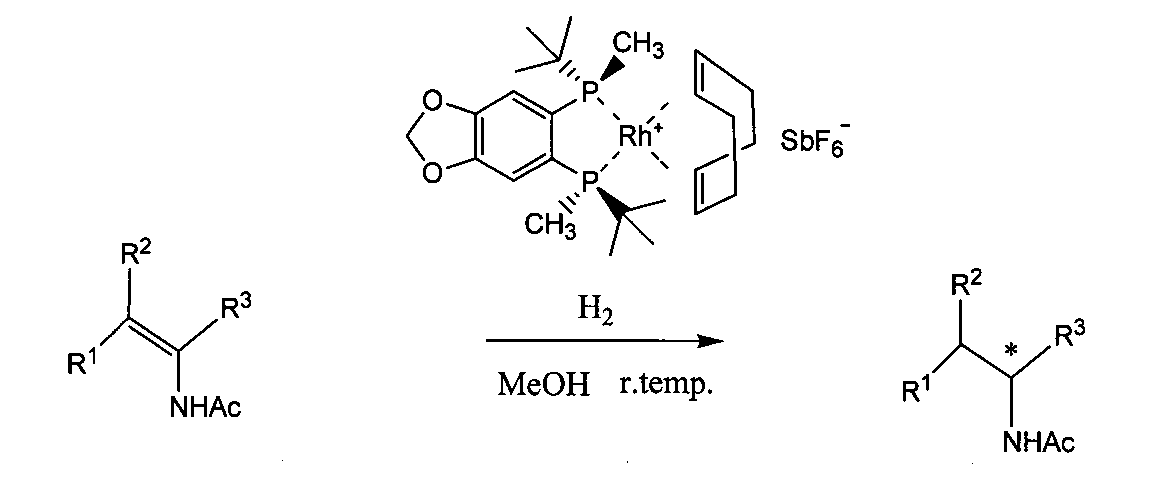
50 mLガラス製オートクレーブにβデヒドロアミノ酸 (E)-methyl 3-acetamido-2-butenoate 314.3mg (2.00 mmol) 、不斉水添触媒((R,R)-1,2-ビス(tert-ブチルメチルホスフィノ)-4,5-(メチレンジオキシ)ベンゼン)
(1,5-シクロオクタジエン) ロジウム (1+) ヘキサフルオロアンチモン酸塩1.55 mg (2.00 x 10⁻³mmol)を仕込み、水素で5回置換をおこない、予め脱気した脱水メタノール5 mLを加えた。次いで、水素圧を3気圧として反応を開始した。室温で40分間攪拌をおこなったところ、容器内の水素の消費が停止したため反応終了とした。反応液を濃縮した後、残存した白色結晶を酢酸エチルに溶解して、シリカゲルカラムに通した。得られた溶出液をGCにて分析をしたところ、(R)-3-acetamidobutanoic acid
methyl esterが99.5%の鏡像異性体過剰率(ee)で得られた。また、1H NMRによって分析をおこなったところ、化学収率は99 %以上であった(表2中のNo.1)。
なお、GCの分析条件は以下のとおりである。
GC: DEX CB, 135 ℃
各エナンチオマーの保持時間 (S)t1 = 7.6min, (R)t2 =
8.1 min.
(1,5-シクロオクタジエン) ロジウム (1+) ヘキサフルオロアンチモン酸塩1.55 mg (2.00 x 10⁻³mmol)を仕込み、水素で5回置換をおこない、予め脱気した脱水メタノール5 mLを加えた。次いで、水素圧を3気圧として反応を開始した。室温で40分間攪拌をおこなったところ、容器内の水素の消費が停止したため反応終了とした。反応液を濃縮した後、残存した白色結晶を酢酸エチルに溶解して、シリカゲルカラムに通した。得られた溶出液をGCにて分析をしたところ、(R)-3-acetamidobutanoic acid
methyl esterが99.5%の鏡像異性体過剰率(ee)で得られた。また、1H NMRによって分析をおこなったところ、化学収率は99 %以上であった(表2中のNo.1)。
なお、GCの分析条件は以下のとおりである。
GC: DEX CB, 135 ℃
各エナンチオマーの保持時間 (S)t1 = 7.6min, (R)t2 =
8.1 min.
以下、反応基質の種類及び反応条件を表2に示すように代えた以外は上記と同じ条件で不斉水素化反応を行い、その結果を表2に併記した。

本発明によれば、不斉合成反応の触媒として有用な金属錯体を形成し得る新規な1,2-ビス(ジアルキルホスフィノ)-4,5-(メチレンジオキシ)ベンゼン誘導体を提供することができる。また、本発明の製造方法によれば、この1,2-ビス(ジアルキルホスフィノ)-4,5-(メチレンジオキシ)ベンゼン誘導体を容易に製造することができる。さらに、この1,2-ビス(ジアルキルホスフィノ)-4,5-(メチレンジオキシ)ベンゼン誘導体を配位子とする金属錯体は、不斉合成反応の触媒として用いた場合に高いエナンチオ選択性及び反応活性を有し、特に、本発明の新規な1,2-ビス(ジアルキルホスフィノ)-4,5-(メチレンジオキシ)ベンゼン誘導体を配位子とする金属錯体は、βデヒドロアミノ酸に対して高い不斉誘起能と触媒活性を有する。
Claims (12)
- 下記一般式(1)で表されることを特徴とする1,2-ビス(ジアルキルホスフィノ)-4,5-(メチレンジオキシ)ベンゼン誘導体。
- 下記一般式(1A)で表されることを特徴とする請求項1記載の1,2-ビス(ジアルキルホスフィノ)-4,5-(メチレンジオキシ)ベンゼン誘導体の光学活性体。
- R1がt-ブチル基であり、R2がメチル基、あるいは、R1がメチル基であり、R2がt-ブチル基である請求項1又は2記載の1,2-ビス(ジアルキルホスフィノ)-4,5-(メチレンジオキシ)ベンゼン誘導体。
- 請求項1記載の1,2-ビス(ジアルキルホスフィノ)-4,5-(メチレンジオキシ)ベンゼン誘導体の製造方法であって、下記一般式(2)で表されるホスフィン-ボラン化合物を脱ボラン化した後、ハロゲン化アルキルマグネシウム化合物との反応を行い、次いで、その生成物を、
一般式;RaPX’2(Raは前記一般式(1)におけるR1及びR2の一方であり、X’はハロゲン原子を示す)で表されるアルキルジハロゲノホスフィンと反応させた後、
一般式RbMgX”(Rbは前記一般式(1)におけるR1及びR2の一方であり、X”はハロゲン原子を示す。)で表されるグリニャ-ル試薬と反応させる工程を含むことを特徴とする1,2-ビス(ジアルキルホスフィノ)-4,5-(メチレンジオキシ)ベンゼン誘導体の製造方法。

- 請求項2記載の光学活性な1,2-ビス(ジアルキルホスフィノ)-4,5-(メチレンジオキシ)ベンゼン誘導体の製造方法であって、下記一般式(2A)で表される光学活性なホスフィン-ボラン化合物を脱ボラン化した後、ハロゲン化アルキルマグネシウム化合物との反応を行い、次いで、その生成物を、
一般式;RaPX’2(Raは前記一般式(1A)におけるR1及びR2の一方であり、X’はハロゲン原子を示す)で表されるアルキルジハロゲノホスフィンと反応させた後、
一般式RbMgX”(Rbは前記一般式(1A)におけるR1及びR2の一方であり、X”はハロゲン原子を示す。)で表されるグリニャ-ル試薬と反応させる工程を含むことを特徴とする光学活性な1,2-ビス(ジアルキルホスフィノ)-4,5-(メチレンジオキシ)ベンゼン誘導体の製造方法。

- 下記一般式(1-1)で表されることを特徴とする1,2-ビス(ジアルキルホスフィノ)-4,5-(メチレンジオキシ)ベンゼン-ボラン誘導体。

- 下記一般式(1-1A)で表されることを特徴とする光学活性な1,2-ビス(ジアルキルホスフィノ)-4,5-(メチレンジオキシ)ベンゼン-ボラン誘導体。
- 前記一般式(1)で表される1,2-ビス(ジアルキルホスフィノ)-4,5-(メチレンジオキシ)ベンゼン誘導体と、ボラン-THF錯体、水素化ホウ素アルカリ金属塩及びボラン-アミン錯体から選ばれるボラン化剤とを反応させることを特徴とする下記一般式(1-1)で表される1,2-ビス(ジアルキルホスフィノ)-4,5-(メチレンジオキシ)ベンゼン-ボラン誘導体の製造方法。
- 前記一般式(1A)で表される光学活性な1,2-ビス(ジアルキルホスフィノ)-4,5-(メチレンジオキシ)ベンゼン誘導体と、水素化ホウ素アルカリ金属塩及びボラン-アミン錯体から選ばれるボラン化剤とを反応させることを特徴とする下記一般式(1-1A)で表される光学活性な1,2-ビス(ジアルキルホスフィノ)-4,5-(メチレンジオキシ)ベンゼン-ボラン誘導体の製造方法。

- 請求項1記載の1,2-ビス(ジアルキルホスフィノ)-4,5-(メチレンジオキシ)ベンゼン誘導体を配位子とすることを特徴とする金属錯体。
- 前記1,2-ビス(ジアルキルホスフィノ)-4,5-(メチレンジオキシ)ベンゼン誘導体が、請求項2記載の光学活性な1,2-ビス(ジアルキルホスフィノ)-4,5-(メチレンジオキシ)ベンゼン誘導体であり、不斉合成触媒として用いられることを特徴とする請求項10記載の金属錯体。
- 請求項11記載の1,2-ビス(ジアルキルホスフィノ)-4,5-(メチレンジオキシ)ベンゼン誘導体の金属錯体を触媒として用いたことを特徴とする不斉水素化方法。
Priority Applications (1)
| Application Number | Priority Date | Filing Date | Title |
|---|---|---|---|
| US14/126,683 US9029571B2 (en) | 2011-06-23 | 2012-06-21 | Device and method for evaluating organic material for organic solar cell |
Applications Claiming Priority (2)
| Application Number | Priority Date | Filing Date | Title |
|---|---|---|---|
| JP2011-139947 | 2011-06-23 | ||
| JP2011139947A JP5507499B2 (ja) | 2011-06-23 | 2011-06-23 | 1,2−ビス(ジアルキルホスフィノ)−4,5−(メチレンジオキシ)ベンゼン誘導体、その製造方法及び該1,2−ビス(ジアルキルホスフィノ)−4,5−(メチレンジオキシ)ベンゼン誘導体を配位子とする金属錯体並びに不斉水素化方法 |
Publications (1)
| Publication Number | Publication Date |
|---|---|
| WO2012176830A1 true WO2012176830A1 (ja) | 2012-12-27 |
Family
ID=47422661
Family Applications (1)
| Application Number | Title | Priority Date | Filing Date |
|---|---|---|---|
| PCT/JP2012/065831 Ceased WO2012176830A1 (ja) | 2011-06-23 | 2012-06-21 | 1,2-ビス(ジアルキルホスフィノ)-4,5-(メチレンジオキシ)ベンゼン誘導体、その製造方法及び該1,2-ビス(ジアルキルホスフィノ)-4,5-(メチレンジオキシ)ベンゼン誘導体を配位子とする金属錯体並びに不斉水素化方法 |
Country Status (3)
| Country | Link |
|---|---|
| US (1) | US9029571B2 (ja) |
| JP (1) | JP5507499B2 (ja) |
| WO (1) | WO2012176830A1 (ja) |
Families Citing this family (1)
| Publication number | Priority date | Publication date | Assignee | Title |
|---|---|---|---|---|
| JP6835801B2 (ja) * | 2018-05-29 | 2021-02-24 | 日本化学工業株式会社 | ホスフィノベンゼンボラン誘導体の製造方法、1,2−ビス(ジアルキルホスフィノ)ベンゼン誘導体の製造方法及び遷移金属錯体 |
Citations (6)
| Publication number | Priority date | Publication date | Assignee | Title |
|---|---|---|---|---|
| JP2000319288A (ja) * | 1999-05-10 | 2000-11-21 | Nippon Chem Ind Co Ltd | 光学活性な1,2−ビス(ジアルキルホスフィノ)ベンゼン誘導体及びその製造方法、並びに該化合物を配位子とするロジウム金属錯体 |
| JP2007056007A (ja) * | 2005-07-25 | 2007-03-08 | Chiba Univ | 2,3−ビス(ジアルキルホスフィノ)ピラジン誘導体及びその製造方法、並びに該誘導体を配位子とする金属錯体 |
| JP2011503220A (ja) * | 2007-11-20 | 2011-01-27 | ソルヴィーアス アクチェンゲゼルシャフト | 不斉付加反応に使用する二座第二級ホスフィンオキシドキラル配位子 |
| JP2011503221A (ja) * | 2007-11-20 | 2011-01-27 | ソルヴィーアス アクチェンゲゼルシャフト | 触媒的不斉付加反応に使用する二座キラル配位子 |
| WO2011126045A1 (ja) * | 2010-04-09 | 2011-10-13 | 日本化学工業株式会社 | ピラジン誘導体の製造方法 |
| WO2012005200A1 (ja) * | 2010-07-08 | 2012-01-12 | 日本化学工業株式会社 | 光学活性な1,2-ビス(ジアルキルホスフィノ)ベンゼン誘導体の製造方法 |
Family Cites Families (1)
| Publication number | Priority date | Publication date | Assignee | Title |
|---|---|---|---|---|
| US7608709B2 (en) | 2005-07-25 | 2009-10-27 | National University Corporation Chiba University | 2, 3-bis(dialkylphosphino)pyrazine derivative, process of producing the same, and metal complex having the same as ligand |
-
2011
- 2011-06-23 JP JP2011139947A patent/JP5507499B2/ja active Active
-
2012
- 2012-06-21 WO PCT/JP2012/065831 patent/WO2012176830A1/ja not_active Ceased
- 2012-06-21 US US14/126,683 patent/US9029571B2/en active Active
Patent Citations (6)
| Publication number | Priority date | Publication date | Assignee | Title |
|---|---|---|---|---|
| JP2000319288A (ja) * | 1999-05-10 | 2000-11-21 | Nippon Chem Ind Co Ltd | 光学活性な1,2−ビス(ジアルキルホスフィノ)ベンゼン誘導体及びその製造方法、並びに該化合物を配位子とするロジウム金属錯体 |
| JP2007056007A (ja) * | 2005-07-25 | 2007-03-08 | Chiba Univ | 2,3−ビス(ジアルキルホスフィノ)ピラジン誘導体及びその製造方法、並びに該誘導体を配位子とする金属錯体 |
| JP2011503220A (ja) * | 2007-11-20 | 2011-01-27 | ソルヴィーアス アクチェンゲゼルシャフト | 不斉付加反応に使用する二座第二級ホスフィンオキシドキラル配位子 |
| JP2011503221A (ja) * | 2007-11-20 | 2011-01-27 | ソルヴィーアス アクチェンゲゼルシャフト | 触媒的不斉付加反応に使用する二座キラル配位子 |
| WO2011126045A1 (ja) * | 2010-04-09 | 2011-10-13 | 日本化学工業株式会社 | ピラジン誘導体の製造方法 |
| WO2012005200A1 (ja) * | 2010-07-08 | 2012-01-12 | 日本化学工業株式会社 | 光学活性な1,2-ビス(ジアルキルホスフィノ)ベンゼン誘導体の製造方法 |
Non-Patent Citations (2)
| Title |
|---|
| TSUNEO IMAMOTO ET AL.: "Improved synthetic routes to methylene-bridged P-chiral diphosphine ligands via secondary phosphine-boranes", TETRAHEDRON: ASYMMETRY, vol. 21, 2010, pages 1522 - 1528 * |
| TSUNEO IMAMOTO ET AL.: "Rigid P-Chiral Phosphine Ligands with tert-Butylmethylphosphino Groups for Rhodium-Catalyzed Asymmetric Hydrogenation of Functionalized Alkenes", JOURNAL OF THE AMERICAN CHEMICAL SOCIETY, vol. 134, 14 December 2011 (2011-12-14), pages 1754 - 1769 * |
Also Published As
| Publication number | Publication date |
|---|---|
| JP5507499B2 (ja) | 2014-05-28 |
| JP2013006787A (ja) | 2013-01-10 |
| US20140213800A1 (en) | 2014-07-31 |
| US9029571B2 (en) | 2015-05-12 |
Similar Documents
| Publication | Publication Date | Title |
|---|---|---|
| JP3369558B2 (ja) | 燐化合物 | |
| JP4500289B2 (ja) | 2,3−ビス(ジアルキルホスフィノ)ピラジン誘導体及びその製造方法、並びに該誘導体を配位子とする金属錯体 | |
| TWI517899B (zh) | 雙芳基二膦配位子化合物及其中間物和製法以及金屬複合物 | |
| JP4290265B2 (ja) | 新規な不斉配位子 | |
| JP2010053049A (ja) | ジホスフィン化合物、その遷移金属錯体およびその遷移金属錯体を含む触媒並びにホスフィンオキシド化合物及びジホスフィンオキシド化合物 | |
| JPWO2017057642A1 (ja) | 光学活性な2−(2−フルオロビフェニル−4−イル)プロパン酸の製造法 | |
| JP4201916B2 (ja) | 光学活性な1,2−ビス(ジアルキルホスフィノ)ベンゼン誘導体及びその製造方法、並びに該化合物を配位子とするロジウム金属錯体 | |
| US7094907B2 (en) | Ligands for asymmetric reactions | |
| JP5599664B2 (ja) | 光学活性な1,2−ビス(ジアルキルホスフィノ)ベンゼン誘導体の製造方法 | |
| JP5507499B2 (ja) | 1,2−ビス(ジアルキルホスフィノ)−4,5−(メチレンジオキシ)ベンゼン誘導体、その製造方法及び該1,2−ビス(ジアルキルホスフィノ)−4,5−(メチレンジオキシ)ベンゼン誘導体を配位子とする金属錯体並びに不斉水素化方法 | |
| JP4028625B2 (ja) | ホスフィン化合物およびそれを配位子とするロジウム錯体 | |
| JP5546781B2 (ja) | 2,2’−ビス(ジアルキルホスフィノ)ビフェニル化合物及びその製造方法並びに該化合物を配位子とする金属錯体 | |
| JP4195231B2 (ja) | 光学活性第2級ホスフィンボラン誘導体及びその中間体の製造方法 | |
| WO2019230479A1 (ja) | ホスフィノベンゼンボラン誘導体の製造方法、1,2-ビス(ジアルキルホスフィノ)ベンゼン誘導体の製造方法及び遷移金属錯体 | |
| JP7014882B2 (ja) | ホスフィノベンゼンボラン誘導体の製造方法、1,2-ビス(ジアルキルホスフィノ)ベンゼン誘導体の製造方法及び遷移金属錯体 | |
| JP2005041847A (ja) | フェロセンを置換基に有する光学活性リンキラルジホスフィン化合物、該化合物の中間体、該化合物の製造方法及び該化合物を用いる不斉合成反応、並びに該化合物を配位子として有する金属錯体触媒及び該金属錯体触媒を用いる不斉合成反応をする方法 | |
| JP5378837B2 (ja) | 光学活性ビスホスフィノメタンの製造方法 | |
| JP4373933B2 (ja) | (1s,2s)−または(1r,2r)−シス−1−アリールホスホラン−2−カルボン酸・ボラン錯体とその製造方法 | |
| US11021500B2 (en) | Process for preparing optically active 2,3-bisphosphino-substituted quinoxalines | |
| EP0984972B1 (en) | Chiral phosphorus-based ligands | |
| JP2005281311A (ja) | トルテロジンおよびその中間体の調製方法 | |
| JP2020105127A (ja) | ビスホスフィノヘキサフルオロシクロペンテン誘導体、その製造方法、遷移金属錯体及びそれを用いた有機化合物の製造方法 | |
| JP4625741B2 (ja) | 第二級ホスフィン−ボラン錯体の製造方法 | |
| JP2008110920A (ja) | 光学活性ホスフィン化合物及びそれを用いた不斉反応 |
Legal Events
| Date | Code | Title | Description |
|---|---|---|---|
| 121 | Ep: the epo has been informed by wipo that ep was designated in this application |
Ref document number: 12803254 Country of ref document: EP Kind code of ref document: A1 |
|
| NENP | Non-entry into the national phase |
Ref country code: DE |
|
| WWE | Wipo information: entry into national phase |
Ref document number: 14126683 Country of ref document: US |
|
| 122 | Ep: pct application non-entry in european phase |
Ref document number: 12803254 Country of ref document: EP Kind code of ref document: A1 |