WO2012165272A1 - 混和蒸留酒およびその製造方法 - Google Patents
混和蒸留酒およびその製造方法 Download PDFInfo
- Publication number
- WO2012165272A1 WO2012165272A1 PCT/JP2012/063263 JP2012063263W WO2012165272A1 WO 2012165272 A1 WO2012165272 A1 WO 2012165272A1 JP 2012063263 W JP2012063263 W JP 2012063263W WO 2012165272 A1 WO2012165272 A1 WO 2012165272A1
- Authority
- WO
- WIPO (PCT)
- Prior art keywords
- distilled liquor
- ethyl
- mixed
- alcohol
- shochu
- Prior art date
- Legal status (The legal status is an assumption and is not a legal conclusion. Google has not performed a legal analysis and makes no representation as to the accuracy of the status listed.)
- Ceased
Links
Classifications
-
- C—CHEMISTRY; METALLURGY
- C12—BIOCHEMISTRY; BEER; SPIRITS; WINE; VINEGAR; MICROBIOLOGY; ENZYMOLOGY; MUTATION OR GENETIC ENGINEERING
- C12G—WINE; PREPARATION THEREOF; ALCOHOLIC BEVERAGES; PREPARATION OF ALCOHOLIC BEVERAGES NOT PROVIDED FOR IN SUBCLASSES C12C OR C12H
- C12G3/00—Preparation of other alcoholic beverages
- C12G3/04—Preparation of other alcoholic beverages by mixing, e.g. for preparation of liqueurs
- C12G3/06—Preparation of other alcoholic beverages by mixing, e.g. for preparation of liqueurs with flavouring ingredients
-
- C—CHEMISTRY; METALLURGY
- C12—BIOCHEMISTRY; BEER; SPIRITS; WINE; VINEGAR; MICROBIOLOGY; ENZYMOLOGY; MUTATION OR GENETIC ENGINEERING
- C12G—WINE; PREPARATION THEREOF; ALCOHOLIC BEVERAGES; PREPARATION OF ALCOHOLIC BEVERAGES NOT PROVIDED FOR IN SUBCLASSES C12C OR C12H
- C12G3/00—Preparation of other alcoholic beverages
- C12G3/02—Preparation of other alcoholic beverages by fermentation
- C12G3/021—Preparation of other alcoholic beverages by fermentation of botanical family Poaceae, e.g. wheat, millet, sorghum, barley, rye, or corn
-
- C—CHEMISTRY; METALLURGY
- C12—BIOCHEMISTRY; BEER; SPIRITS; WINE; VINEGAR; MICROBIOLOGY; ENZYMOLOGY; MUTATION OR GENETIC ENGINEERING
- C12H—PASTEURISATION, STERILISATION, PRESERVATION, PURIFICATION, CLARIFICATION OR AGEING OF ALCOHOLIC BEVERAGES; METHODS FOR ALTERING THE ALCOHOL CONTENT OF FERMENTED SOLUTIONS OR ALCOHOLIC BEVERAGES
- C12H1/00—Pasteurisation, sterilisation, preservation, purification, clarification, or ageing of alcoholic beverages
- C12H1/02—Pasteurisation, sterilisation, preservation, purification, clarification, or ageing of alcoholic beverages combined with removal of precipitate or added materials, e.g. adsorption material
- C12H1/06—Precipitation by physical means, e.g. by irradiation, vibrations
- C12H1/061—Separation by centrifugation
-
- C—CHEMISTRY; METALLURGY
- C12—BIOCHEMISTRY; BEER; SPIRITS; WINE; VINEGAR; MICROBIOLOGY; ENZYMOLOGY; MUTATION OR GENETIC ENGINEERING
- C12H—PASTEURISATION, STERILISATION, PRESERVATION, PURIFICATION, CLARIFICATION OR AGEING OF ALCOHOLIC BEVERAGES; METHODS FOR ALTERING THE ALCOHOL CONTENT OF FERMENTED SOLUTIONS OR ALCOHOLIC BEVERAGES
- C12H1/00—Pasteurisation, sterilisation, preservation, purification, clarification, or ageing of alcoholic beverages
- C12H1/02—Pasteurisation, sterilisation, preservation, purification, clarification, or ageing of alcoholic beverages combined with removal of precipitate or added materials, e.g. adsorption material
- C12H1/06—Precipitation by physical means, e.g. by irradiation, vibrations
- C12H1/063—Separation by filtration
Definitions
- the present invention relates to a mixed distilled liquor obtained by mixing a single distilled liquor and a continuous distilled liquor, and a method for producing the same. Specifically, the present invention relates to a mixed distilled liquor containing a higher fatty acid ester and having enhanced aroma and umami, and a method for producing a mixed distilled liquor including a step of adding an oil component containing a higher fatty acid ester.
- Distilled liquor is produced by distilling brewed liquor, and can be broadly divided into single-distilled liquor made with a single (batch type) distiller and continuous distilled liquor made with a continuous distiller.
- Non-patent Document 1 Single distilled liquor has a flavor derived from raw materials compared to continuous distilled liquor.
- the simple distilled liquor contains higher fatty acid esters such as ethyl palmitate and ethyl linoleate, and thus has a richness in taste.
- higher fatty acid esters such as ethyl palmitate and ethyl linoleate
- the content of these higher fatty acid esters is too large, they have the problem that they float and are oxidized by air, and further decompose to generate an oily off-flavor.
- Patent Document 1 a technique for precipitating and removing oily substances by cooling (Patent Document 1), and a higher fatty acid ester that is a flavor component in shochu can be obtained by dispersing a higher fatty acid ester with ultrasound to stabilize the cloudy state.
- Patent Documents 2 and 3 A method for producing a single distillation shochu containing a fatty acid ester at a high concentration has been reported (Patent Documents 2 and 3).
- the present invention has an excellent flavor, has a sharpness derived from continuous distilled liquor, has no irritation of alcohol, and efficiently produces a target liquor quality product. It is an object of the present invention to provide a mixed distilled liquor that can be produced in the same manner, and to provide a method for producing such a mixed distilled liquor.
- the present inventors surprisingly added an oily component containing a higher fatty acid ester separated and recovered from a single-type distilled liquor to a mixed distilled liquor, I found that the taste and mellowness increased. Moreover, it discovered that a remarkable effect was acquired by making the density
- the present invention includes, but is not limited to: [1] A mixed distilled liquor comprising at least one component selected from the group consisting of ethyl palmitate, ethyl linolenate, ethyl oleate and ethyl stearate, and the total concentration of these components is 0.1 ppm or more. [2] The mixed distilled liquor according to [1], wherein the concentration of ethyl palmitate is 0.03 ppm or more. [3] The mixed distilled liquor according to [1] or [2], wherein the mixed distilled liquor is barley shochu and the concentration of ethyl palmitate is 0.04 ppm or more.
- a flavoring agent comprising an oily component obtained from an alcohol-containing material, wherein the oily component is at least one selected from the group consisting of ethyl palmitate, ethyl linolenate, ethyl oleate and ethyl stearate
- the said flavor imparting agent which is one and the sum total of content of those components is 10 weight% or more in an oil-based component.
- the oil component comprises at least one component selected from the group consisting of ethyl palmitate, ethyl linolenate, ethyl oleate and ethyl stearate.
- the oil component addition step the recovered oil component is dissolved in an alcohol-containing solution and then added to the mixed distilled liquor.
- the recovery step includes a step of separating the oil component by centrifugation, filtration, or stationary separation.
- a mixed distilled liquor that reduces the tingling irritation characteristic of continuous distilled liquor, has a high fragrance like a single distilled liquor, and has a mellowness and profound feeling. Moreover, the manufacturing method of the mixed distilled liquor which has such a characteristic is provided.
- the present invention relates to a mixed distilled liquor, a flavoring agent, and a method for producing a mixed distilled liquor.
- the mixed distilled liquor of the present invention contains a higher fatty acid ester, which reduces the tingling and irritation characteristic of continuous distilled liquor, and is fragrant, mellow and heavy like a single distilled liquor. Has an excellent effect of being imparted.
- "Mixed distilled liquor" In this specification, the mixed distilled liquor refers to a mixture of a single distilled liquor and a continuous distilled liquor, and one single each of the single distilled liquor and the continuous distilled liquor can be mixed. Also, one type of single-distilled liquor and a plurality of continuous distillates can be mixed, and vice versa.
- a plurality of single-distilled spirits and a plurality of continuous distilled spirits can be mixed.
- the mixing ratio can also be arbitrarily selected.
- shochu mixed liquor mixed distilled liquor in which Koi shochu, which is a continuous distilled liquor, and Otsuchi shochu, which is a single-distilled liquor, is blended with 50% or more and less than 95% of Otsu.
- “Short-mixed shochu” is a mixture of 5% or more and less than 50% of “B”.
- single distillation generally has a low processing capacity, whereas continuous distillation is suitable for a large amount of processing, so if the mixing ratio of continuous distilled liquor can be increased, mixed distilled liquor can be efficiently used. Can be manufactured.
- the mixed distilled liquor of the present invention since the flavor is imparted by the higher fatty acid ester, it is possible to keep the mixing ratio of the single-type distilled liquor low, and to efficiently produce the target liquor product Can do.
- “single distilled liquor” and “continuous distilled liquor” Distilled liquor obtained by single distillation is called single distilled liquor, and distilled liquor obtained by continuous distillation is called continuous distilled liquor.
- the distilled liquor obtained by repeating a single distillation is called continuous distillation liquor here.
- distilled liquor refers to alcohols obtained by distilling koji made from alcoholic fermentation of raw materials such as cereals, and includes all distilled liquors produced through a distillation process.
- Examples of distilled liquor include shochu (Awamori), whiskey, brandy, raw alcohol, spirits (gin, vodka, rum, etc.), aquabit, alac, alhi, spirits, okolehao, cachassa, colun, schnapps, soju, paichu , Mao Thai, Cognac, Armagnac, Calvados, Grappa, Singani, Pisco, Mescal, Tequila, Lac and the like.
- liquors are classified into four types: sparkling liquors, brewed liquors, distilled liquors and mixed liquors.
- Distilled liquors are continuous distillers (former class A) and single distillers. Yu (formerly maiden), whiskey, brandy, alcohol for raw materials, spirits are included, but the distilled liquor of the present invention is not necessarily limited to classification under the liquor tax law.
- the primary ingredients of distilled spirits include grains such as rice, wheat, sweet potato, buckwheat, potato, corn, awa, hie, acne, corn, fruits such as dates, grapes, dates, agave, Examples include, but are not limited to, sugars, molasses, honey, and sugar-containing substances such as fructose.
- Flavor component in blended distilled liquor The mixed distilled liquor of the present invention is characterized by containing a higher fatty acid ester.
- “Higher fatty acid ester” means a fatty acid ester having a large number of carbon atoms, generally having 12 or more carbon atoms, and examples thereof include ethyl palmitate, ethyl linolenate, ethyl oleate, and ethyl stearate.
- the higher fatty acid ester may be added with a higher fatty acid ester contained in an oily substance derived from distilled raw sake, or may be added with a commercially available or synthetic higher fatty acid ester.
- the content of the higher fatty acid ester in the mixed distilled liquor is 0.01 ppm or more, preferably 0.1 ppm or more, more preferably 1.0 ppm or more. By containing 1.5 ppm or more, the sweetness and aroma peculiar to single-type distilled liquor can be strengthened.
- Each content of higher fatty acid esters such as ethyl palmitate and ethyl linoleate is not particularly limited, but if ethyl palmitate is included, ethyl palmitate is 0.003 ppm or more, preferably 0.1 ppm. As mentioned above, it is more preferable to contain 0.5 ppm or more.
- the content of the higher fatty acid ester is preferably adjusted as appropriate depending on the liquor of the distilled liquor and the raw material, for example, 0.1 ppm or more, preferably 0.3 ppm or more, and more preferably 1.0 ppm or more for wheat shochu.
- shochu it is 1.0 ppm or more, preferably 2.0 ppm or more, more preferably 5.0 ppm or more.
- ethyl palmitate it is 0.04 ppm or more, preferably 0.1 ppm or more, more preferably 0.5 ppm or more for wheat shochu, 0.3 ppm or more, preferably 0.5 ppm or more, more preferably for shochu shochu.
- 1.0 ppm or more is preferable.
- the analysis of the higher fatty acid ester contained in the mixed distilled liquor can be performed qualitative and quantitative analysis by a method known to those skilled in the art, for example, by performing gas chromatographic measurement after extracting flavor components.
- the blended distilled liquor of the present invention may contain, in addition to the above-mentioned flavor components, known components that can be generally added to distilled liquor, such as additives such as fragrances, sweeteners, pigments, preservatives, etc. In addition, known flavor components including fruit juice and the like can be added separately.
- known components that can be generally added to distilled liquor, such as additives such as fragrances, sweeteners, pigments, preservatives, etc.
- known flavor components including fruit juice and the like can be added separately.
- Production of blended distilled liquor The blended distilled liquor of the present invention can be produced by adding an oil component containing a higher fatty acid ester separated and recovered from an alcohol-containing material, particularly a single-type distilled liquor, to the mixed distilled liquor. .
- the oil component is, for example, an oil component obtained in a single-distilled liquor manufacturing process, and may be either an oil component separated in a filtration step or an oil component separated by floating or precipitation during storage, It can be recovered by scooping or filtration.
- a method of separating the oily component from the distillate before the recovery there is a method of allowing to stand and separating by a gravity difference, but a pressure levitation separation method or a natural levitation separation method may be employed, It can also be recovered after further precipitating the oily component by cooling or the like.
- the recovered oily component can be used for addition as it is, but by increasing the concentration of higher fatty acid esters by methods such as centrifugation, filtration, and stationary separation, a flavoring effect can be achieved with a smaller amount of use. Is done.
- a distillate containing abundant oil components can be prepared by appropriately setting the distillation conditions for single distillation, and can be used without separating the oil components from the distillate.
- the oil component may be obtained from the distillate after single distillation by the above method, but after performing distillation such that most of the higher fatty acid ester remains by appropriately setting the conditions during distillation, The higher fatty acid ester can also be separated from the residual liquid.
- the oily component thus obtained can be added as it is to the continuous distilled liquor.
- an alcohol-containing solution such as raw alcohol or continuous distilled liquor
- the composition analysis is performed, and then the higher fatty acid ester finally contained in the mixed distilled liquor becomes an appropriate amount.
- the alcohol-containing solution to be used is not particularly limited and can be appropriately adjusted depending on the higher fatty acid ester contained in the oil component and the alcohol used. In order to increase the solubility of the higher fatty acid ester, ultrasonic treatment, heat treatment, or the like may be appropriately performed.
- flavor imparting agent refers to the aroma and taste of food and drink. Therefore, the “flavor imparting agent” of the present invention has an effect of imparting a scent or umami of food or drink.
- the active ingredient of the flavor imparting agent of the present invention is a higher fatty acid ester, for example, containing at least one higher fatty acid ester such as ethyl palmitate, ethyl linolenate, ethyl oleate, and ethyl stearate, and exhibits a flavor imparting effect To do.
- the total content of higher fatty acid esters such as ethyl palmitate, ethyl linolenate, ethyl oleate and ethyl stearate blended in the flavoring agent is not particularly limited, but the total content of these components is oily It is 10 weight% or more in a component, 30 weight% or more is preferable and 50 weight% or more is more preferable. Further, ethyl palmitate is not necessarily contained, but a typical content is 1% by weight or more in the oil component, preferably 5% by weight or more, and more preferably 15% by weight or more.
- the amount added to the food and drink can be adjusted as appropriate within a range where flavor can be imparted, and is preferably blended so as to have the total content of the higher fatty acid esters shown above.
- the manufacturing method of the flavor imparting agent of the present invention is not particularly limited as long as it contains an oily component derived from an alcohol-containing substance as a main component and the above higher fatty acid ester.
- the flavoring agent may be an oily component itself obtained by collecting and separating in the above-mentioned distilled liquor production process, or diluted by adding water, alcohol, additives, etc. to the obtained oily component. It can also be manufactured.
- the oil component may be uniformly dispersed by adding an emulsifier, ultrasonic treatment or the like.
- the alcohol-containing material is not particularly limited as long as it is an alcohol-containing liquid obtained in the process of producing alcoholic beverages.
- the method for producing a mixed distilled liquor of the present invention includes a step of recovering an oily component from an alcohol-containing material, and a step of adding the recovered oily component to the distilled liquor.
- the mixed distilled liquor produced by the production method of the present invention has a reduced tingling sensation characteristic of continuous distilled liquor, and has a fragrant, mellowness and profound feeling like a single distilled liquor.
- the “recovery step” of the oil component is a step of separating and recovering the oil component from the alcohol-containing material containing the oil component.
- the “alcohol-containing material” to be used is not particularly limited as long as it is an alcohol-containing liquid obtained in the process of producing distilled liquor.
- a distillate or residual liquid obtained after the distillation process of single-distilled liquor is used.
- the primary ingredients of alcohol-containing materials include grains such as rice, wheat, sweet potato, buckwheat, potato, corn, awa, hie, acne, corn, dates, grapes, dates, agave, etc.
- Fruits, sugar, molasses, honey, fructose and other sugar-containing substances but not limited to this.
- Recovery of the oil component from the alcohol-containing material can be performed, for example, by a scooping method or a filtration method.
- Specific examples include a method for recovering the oily component separated by the filtration step in the single-distilled liquor manufacturing process, and a method for recovering the oily component separated by floating or precipitation during storage.
- a method of separating the oily component from the distillate before the recovery there is a method of allowing to stand and separating by a gravity difference, but a pressure levitation separation method or a natural levitation separation method may be employed, It can also be recovered after further separating the oily component by cooling or the like.
- a distillate containing abundant oil components can be prepared by appropriately setting the distillation conditions for single distillation, and can be used without separating the oil components from the distillate.
- the oil component recovered from the alcohol-containing material in the present invention means the distillate itself.
- the oil component may be obtained from the distillate after single distillation by the above method, but after performing distillation such that most of the higher fatty acid ester remains by appropriately setting the conditions during distillation, The higher fatty acid ester can also be separated from the residual liquid.
- the recovered oily component includes higher fatty acid esters such as ethyl palmitate, ethyl linolenate, ethyl oleate and ethyl stearate.
- the content of these higher fatty acid esters is not particularly limited, but the total content of these components is 10% by weight or more, preferably 30% by weight or more, and more preferably 50% by weight or more in the oil component.
- ethyl palmitate is not necessarily contained, but a typical content is 1% by weight or more in the oil component, preferably 5% by weight or more, and more preferably 15% by weight or more.
- the recovered oily component can be used for addition as it is, but by increasing the concentration of higher fatty acid esters by methods such as centrifugation, filtration, and stationary separation, a flavoring effect can be achieved with a smaller amount of use. Is done.
- the step of recovering the oily component from the alcohol-containing material is preferably performed under conditions of low oxygen concentration, such as under a nitrogen atmosphere, in order to prevent oxidation of the component contained in the oily component.
- "Addition process” The “adding step” in the method of the present invention is a step of adding the oily component obtained in the recovery step to the mixed distilled liquor.
- the oily component recovered from the alcohol-containing material can be added to the distilled liquor as it is, or after being diluted with an alcohol-containing solution or the like.
- ultrasonic treatment, heat treatment, or the like may be appropriately performed.
- the recovered oily component is completely dissolved in an alcohol-containing solution such as raw alcohol or continuous distilled liquor, and the solution is analyzed to determine the component identification and the amount of the component. It can also be added so that the higher fatty acid ester contained is in an appropriate amount.
- the oil component is added so that the content of the higher fatty acid ester in the mixed distilled liquor is 0.01 ppm or more, preferably 0.1 ppm or more, more preferably 1.0 ppm or more. Moreover, it adds so that the density
- the content of the higher fatty acid ester in the mixed distilled liquor by addition of the oil component can be appropriately adjusted depending on the liquor and raw materials of the distilled liquor, for example, 0.1 ppm or more, preferably 0.3 ppm or more for barley shochu. More preferably, it is 1.0 ppm or more, and in the case of shochu shochu, it is 1.0 ppm or more, preferably 2.0 ppm or more, more preferably 5.0 ppm or more.
- ethyl palmitate when focusing on ethyl palmitate, it is 0.04 ppm or more, preferably 0.1 ppm or more, more preferably 0.5 ppm or more for wheat shochu, 0.3 ppm or more, preferably 0.5 ppm or more, more preferably for shochu shochu. 1.0 ppm or more.
- the analysis of the higher fatty acid ester contained in the mixed distilled liquor can be performed qualitatively and quantitatively by a method known to those skilled in the art, for example, by performing gas chromatographic measurement after extracting a flavor component.
- Examples of “mixed distilled liquor” include shochu (Awamori), whiskey, brandy, raw alcohol, spirits (gin, vodka, rum, etc.), aquabit, alac, alhi, spirits, okorehao, cachassa, colun, schnapps, Examples include, but are not limited to, Soju, Paichu, Mao Thai, Cognac, Armagnac, Calvados, Grappa, Singani, Pisco, Mescal, Tequila, and Lak.
- known components that can be generally added to distilled liquor may be added to the resulting mixed distilled liquor.
- additives such as fragrances, sweeteners, pigments, preservatives, and fruit juice It is also possible to add a known flavor component containing the above.
- the mixed distilled liquor obtained by the above production method contains a higher fatty acid ester, which reduces the tingling and irritation characteristic of continuous distilled liquor, and is fragrant, mellow and heavy like a single distilled liquor. Has an excellent effect of being imparted.
- Example 1 Manufacture of single-type distilled liquor
- wheat shochu and shochu shochu were manufactured according to a conventional method. That is, 200 g of black koji mold was added to 200 kg of steamed barley, and barley koji was produced by a koji making machine. After mixing with 240 L of pumped water, 1 L of sake mother was added and fermented to produce primary mash. Subsequently, after adding 400 kg of steamed wheat as a hanging raw material, 600 L of pumped water was added and fermented at 20 degrees for 8 days to obtain secondary moromi. The obtained moromi was distilled in a single manner to obtain 500 L of barley shochu.
- Example 2 Recovery and analysis of oil component
- the barley shochu and shochu obtained in Example 1 were stored at room temperature in a sealed container for 30 days, the oil component separated and floated on the liquid surface. This was scooped and left in a container, and the separated shochu portion was removed with a dropper to recover 10 ml of an oily component.
- the oily component contained a very large amount of ethyl palmitate.
- Example 3 Analysis of commercially available liquor For shochu, in order to improve the taste of the former kaisho shochu, Koto bonsai is mixed with the former oisho shochu. Therefore, the concentration of higher fatty acid esters in commercially available Ko-Oto-bake was measured, and it was confirmed whether taste was imparted by ethyl palmitate or the like. Commercially available liquors were sampled at each store at random (each alcohol level was 25%).
- Table 2 shows the measurement results of Ko-O-blended wheat shochu
- Table 3 shows the measurement results of Ko-O-mixed shochu.
- the oil component was analyzed according to the method of Example 2.
- Ko-Otsumi shochu has not only aroma but also taste, but it was found that the taste is likely due to components other than higher fatty acid esters.
- Example 4 Sensory threshold value measurement of oily components
- the oily components obtained from each of barley shochu and shochu shochu were respectively mixed with barley shochu (former otoshochu shochu 15%, higher fatty acid ester not detected, alcohol degree 25%), A sample was prepared by adding 0.01 ppm to 1 ppm to Ko-Omi-mixed shochu (former Otsuchi shochu 16%, higher fatty acid ester not detected, alcohol level 25%), and the sensory threshold was measured by a three-point discrimination method. Specifically, samples in which 0.01, 0.05, 0.1, 0.25, 0.5, and 1 ppm of the oil component obtained from each were added were prepared for sensory evaluation.
- the sensory evaluation of the mixed distilled liquor was carried out by seven expert panelists using the following three-point method with mellowness as an index. 1 point: strong discrimination; 2 points: distinguishable; 3 points: Almost indistinguishable.
- Example 5 Addition test in Kai-Otaku mixed wheat shochu The oily component obtained in Example 2 was diluted 1000 times with 95% ethanol (raw alcohol), and further diluted with Ko-Otaku mixed wheat shochu for addition. Using. Table 4 shows the results of preparing samples with different amounts of oily components and measuring the higher fatty acid ester concentration, and Table 5 shows the results of sensory evaluation tests.
- the sensory evaluation of the mixed distilled liquor was performed by the following five-point method by seven expert panelists. 1 point: very good; 2 points: excellent; 3 points: good; 4 points: Slightly inferior; 5 points: Inferior.
- the panel scores were averaged and those with an average score of 3 or less were determined to be suitable, and those with a score of 2.5 or less were determined to be particularly suitable.
- Example 6 Addition test in Kai-to-Oji blended shochu shochu Samples were prepared in the same manner as in Example 5, the results of measuring the higher fatty acid ester concentration are shown in Table 6, and the results of the sensory evaluation test are shown in Table 7.
- the present invention has an excellent flavor, has a sharpness derived from continuous distilled liquor, has no irritation of alcohol, and can efficiently produce a target liquor quality product.
- Mixed spirits can be provided.
Landscapes
- Chemical & Material Sciences (AREA)
- Organic Chemistry (AREA)
- Engineering & Computer Science (AREA)
- Health & Medical Sciences (AREA)
- Biochemistry (AREA)
- Bioinformatics & Cheminformatics (AREA)
- General Engineering & Computer Science (AREA)
- General Health & Medical Sciences (AREA)
- Genetics & Genomics (AREA)
- Life Sciences & Earth Sciences (AREA)
- Wood Science & Technology (AREA)
- Zoology (AREA)
- Toxicology (AREA)
- Food Science & Technology (AREA)
- Alcoholic Beverages (AREA)
Abstract
香味の付与された混和蒸留酒を提供すること、および香味の付与された混和蒸留酒の製造方法を提供すること。 混和蒸留酒に、単式蒸留原酒の製造過程で通常除去される油性成分を添加することにより、香りや旨味が増強された混和蒸留酒を製造することが可能となる。
Description
本発明は、単式蒸留酒と連続式蒸留酒を混和した混和蒸留酒、およびその製造方法に関する。詳しくは、高級脂肪酸エステルを含有し香りや旨味が増強された混和蒸留酒、および高級脂肪酸エステルを含有する油性成分を添加する工程を含む混和蒸留酒の製造方法に関する。
蒸留酒は醸造酒を蒸留することにより製造され、単式(回分式)蒸留器で造られる単式蒸留酒と、連続式蒸留器で造られる連続式蒸留酒に大きく分けられる。
単式蒸留酒は、連続式蒸留酒に比べて原料由来の香味を有している(非特許文献1)。単式蒸留酒は、パルミチン酸エチル、リノール酸エチルなどの高級脂肪酸エステルを含んでいるため、その味わいに濃醇さが付与されている。しかし、これら高級脂肪酸エステルの含有量が多過ぎると浮上して空気酸化され、さらに分解して油様の異臭を発生するという問題を有している。また気温が低下すると溶解度が低下するため、オリとなって析出し、商品価値が著しく低下することが知られている。そのため、広く普及している単式蒸留酒は、濾過等の処理をして上記成分を除去した後に出荷されている(非特許文献2)。
また、冷却することで油性物質を析出させて除去する技術や(特許文献1)、高級脂肪酸エステルを超音波で分散させて濁った状態を安定化させることにより、焼酎中の香味成分である高級脂肪酸エステルを高濃度で含有する単式蒸留焼酎の製造方法が報告されている(特許文献2および3)。
一方、連続式蒸留酒は、多段の蒸留により大部分の不純物は除かれるため、得られる蒸留酒はほぼ純粋なエタノール溶液となり、単式蒸留酒に含まれる香り成分や呈味成分はほとんど含まれていない。そのため、アルコールの刺激感が強く、味わいが少ないという問題がある。この問題に対処するため、連続式蒸留酒に単式蒸留酒を混和して味わいを付与した混和蒸留酒とすることで、コクを求める消費者の要望を満たすものが提供されている。
絵とき蒸留技術基礎のきそ 大江修造著
本格焼酎製造技術 (財)日本醸造協会
上記したように、連続式蒸留酒を単式蒸留酒と混和することにより香味が付与された混和蒸留酒が提供されているが、蒸留酒の香味を高める目的で単式蒸留酒の混合比率を高めると、連続式蒸留酒の有するキレが失われてしまうという問題がある。
本発明は、上記問題点に鑑みて、優れた香味を有し、連続式蒸留酒由来のキレを有し、かつアルコールの刺激感もなく、その上、狙いとする酒質の製品を効率的に製造することができる混和蒸留酒を提供すること、およびそのような混和蒸留酒の製造方法を提供することを目的とする。
本発明者らは、上記課題を解決すべく鋭意検討を行った結果、驚くべきことに、単式蒸留酒から分離・回収した高級脂肪酸エステルを含有する油性成分を混和蒸留酒に添加することにより、味わいとまろやかさが増すことを見出した。また、添加する高級脂肪酸エステルの濃度を特定範囲とすることで顕著な効果が得られることを見出し、本発明を完成するに至った。
すなわち、本発明は、限定的ではないが以下を含むものである。
[1]パルミチン酸エチル、リノレン酸エチル、オレイン酸エチルおよびステアリン酸エチルからなる群から選択される成分の少なくとも1つを含み、これら成分の合計濃度が0.1ppm以上である、混和蒸留酒。
[2]パルミチン酸エチルの濃度が0.03ppm以上である、[1]に記載の混和蒸留酒。
[3]前記混和蒸留酒が麦焼酎であり、パルミチン酸エチルの濃度が0.04ppm以上である、[1]または[2]に記載の混和蒸留酒。
[4]前記混和蒸留酒が芋焼酎であり、パルミチン酸エチルの濃度が0.3ppm以上である、[1]または[2]に記載の混和蒸留酒。
[5]アルコール含有物から得られる油性成分を含む香味付与剤であって、該油性成分がパルミチン酸エチル、リノレン酸エチル、オレイン酸エチルおよびステアリン酸エチルからなる群から選択される成分の少なくとも1つであり、それらの成分の含有量の合計が油性成分中10重量%以上である、前記香味付与剤。
[6]パルミチン酸エチルの含有量が油性成分中1重量%以上である、[5]に記載の香味付与剤。
[7]前記アルコール含有物が、酒類を単式蒸留することにより得られる蒸留液または残留液である、[5]または[6]に記載の香味付与剤。
[8]前記アルコール含有物の発酵原料が米、麦、サツマイモ、そば、ジャガイモ、とうもろこし、あわ、ひえ、きびおよびこうりゃんからなる群から選択される穀類;ナツメヤシ、ブドウ、デーツおよびアガベからなる群から選択される果実;砂糖、糖蜜、蜂蜜および果糖からなる群から選択される含糖質物;およびこれらの組み合わせからなる群から選択される、[5]~[7]のいずれかに記載の香味付与剤。
[9][5]~[8]のいずれかに記載の香味付与剤を含む、焼酎、ウイスキー、ブランデー、原料用アルコール、スピリッツ、アクアビット、アラック、アルヒ、スピリタス、オコレハオ、カシャッサ、コルン、シュナップス、ソジュ、パイチュウ、マオタイ酒、コニャック、アルマニャック、カルヴァドス、グラッパ、シンガニ、ピスコ、メスカル、テキーラおよびラクから選択される、混和蒸留酒。
[10]混和蒸留酒の製造方法であって、
アルコール含有物から油性成分を回収する工程、および
回収された油性成分を混和蒸留酒に添加する工程、
を含む、前記製造方法。
[11]油性成分が、パルミチン酸エチル、リノレン酸エチル、オレイン酸エチルおよびステアリン酸エチルからなる群から選択される成分の少なくとも1つを含む、[10]記載の製造方法。
[12]油性成分の添加工程において、回収された油性成分をアルコール含有溶液に溶解させた後に混和蒸留酒に添加する、[10]または[11]記載の製造方法。
[13]回収工程が、遠心分離、濾過または静置分離により前記油性成分を分離させる工程を含む、[10]~[12]のいずれかに記載の製造方法。
[14]アルコール含有物が、単式蒸留酒の蒸留工程後に得られる蒸留液または残留液である、[10]~[13]のいずれかに記載の製造方法。
[15]アルコール含有物の原料が、米、麦、サツマイモ、そば、ジャガイモ、とうもろこし、あわ、ひえ、きびおよびこうりゃんからなる群から選択される穀類;ナツメヤシ、ブドウ、デーツおよびアガベからなる群から選択される果実;砂糖、糖蜜、蜂蜜および果糖からなる群から選択される含糖質物;およびこれらの組み合わせからなる群から選択される、[10]~[14]のいずれかに記載の製造方法。
[16]混和蒸留酒が、焼酎、ウイスキー、ブランデー、原料用アルコール、スピリッツ、アクアビット、アラック、アルヒ、スピリタス、オコレハオ、カシャッサ、コルン、シュナップス、ソジュ、パイチュウ、マオタイ酒、コニャック、アルマニャック、カルヴァドス、グラッパ、シンガニ、ピスコ、メスカル、テキーラまたはラクである、[10]~[15]のいずれかに記載の製造方法。
[1]パルミチン酸エチル、リノレン酸エチル、オレイン酸エチルおよびステアリン酸エチルからなる群から選択される成分の少なくとも1つを含み、これら成分の合計濃度が0.1ppm以上である、混和蒸留酒。
[2]パルミチン酸エチルの濃度が0.03ppm以上である、[1]に記載の混和蒸留酒。
[3]前記混和蒸留酒が麦焼酎であり、パルミチン酸エチルの濃度が0.04ppm以上である、[1]または[2]に記載の混和蒸留酒。
[4]前記混和蒸留酒が芋焼酎であり、パルミチン酸エチルの濃度が0.3ppm以上である、[1]または[2]に記載の混和蒸留酒。
[5]アルコール含有物から得られる油性成分を含む香味付与剤であって、該油性成分がパルミチン酸エチル、リノレン酸エチル、オレイン酸エチルおよびステアリン酸エチルからなる群から選択される成分の少なくとも1つであり、それらの成分の含有量の合計が油性成分中10重量%以上である、前記香味付与剤。
[6]パルミチン酸エチルの含有量が油性成分中1重量%以上である、[5]に記載の香味付与剤。
[7]前記アルコール含有物が、酒類を単式蒸留することにより得られる蒸留液または残留液である、[5]または[6]に記載の香味付与剤。
[8]前記アルコール含有物の発酵原料が米、麦、サツマイモ、そば、ジャガイモ、とうもろこし、あわ、ひえ、きびおよびこうりゃんからなる群から選択される穀類;ナツメヤシ、ブドウ、デーツおよびアガベからなる群から選択される果実;砂糖、糖蜜、蜂蜜および果糖からなる群から選択される含糖質物;およびこれらの組み合わせからなる群から選択される、[5]~[7]のいずれかに記載の香味付与剤。
[9][5]~[8]のいずれかに記載の香味付与剤を含む、焼酎、ウイスキー、ブランデー、原料用アルコール、スピリッツ、アクアビット、アラック、アルヒ、スピリタス、オコレハオ、カシャッサ、コルン、シュナップス、ソジュ、パイチュウ、マオタイ酒、コニャック、アルマニャック、カルヴァドス、グラッパ、シンガニ、ピスコ、メスカル、テキーラおよびラクから選択される、混和蒸留酒。
[10]混和蒸留酒の製造方法であって、
アルコール含有物から油性成分を回収する工程、および
回収された油性成分を混和蒸留酒に添加する工程、
を含む、前記製造方法。
[11]油性成分が、パルミチン酸エチル、リノレン酸エチル、オレイン酸エチルおよびステアリン酸エチルからなる群から選択される成分の少なくとも1つを含む、[10]記載の製造方法。
[12]油性成分の添加工程において、回収された油性成分をアルコール含有溶液に溶解させた後に混和蒸留酒に添加する、[10]または[11]記載の製造方法。
[13]回収工程が、遠心分離、濾過または静置分離により前記油性成分を分離させる工程を含む、[10]~[12]のいずれかに記載の製造方法。
[14]アルコール含有物が、単式蒸留酒の蒸留工程後に得られる蒸留液または残留液である、[10]~[13]のいずれかに記載の製造方法。
[15]アルコール含有物の原料が、米、麦、サツマイモ、そば、ジャガイモ、とうもろこし、あわ、ひえ、きびおよびこうりゃんからなる群から選択される穀類;ナツメヤシ、ブドウ、デーツおよびアガベからなる群から選択される果実;砂糖、糖蜜、蜂蜜および果糖からなる群から選択される含糖質物;およびこれらの組み合わせからなる群から選択される、[10]~[14]のいずれかに記載の製造方法。
[16]混和蒸留酒が、焼酎、ウイスキー、ブランデー、原料用アルコール、スピリッツ、アクアビット、アラック、アルヒ、スピリタス、オコレハオ、カシャッサ、コルン、シュナップス、ソジュ、パイチュウ、マオタイ酒、コニャック、アルマニャック、カルヴァドス、グラッパ、シンガニ、ピスコ、メスカル、テキーラまたはラクである、[10]~[15]のいずれかに記載の製造方法。
本発明により、連続式蒸留酒に特徴的なピリピリとした刺激感が減少し、単式蒸留酒のように香り高く、まろやかさや重厚感が付与された混和蒸留酒が提供される。また、そのような特性を有する混和蒸留酒の製造方法が提供される。
上記の通り、本発明は、混和蒸留酒、香味付与剤、および混和蒸留酒の製造方法に関する。
1.混和蒸留酒
本発明の混和蒸留酒は、高級脂肪酸エステルを含有することにより、連続式蒸留酒に特徴的なピリピリとした刺激感が減少し、単式蒸留酒のように香り高く、まろやかさや重厚感が付与されるという優れた効果を有する。
i)「混和蒸留酒」
本明細書において混和蒸留酒とは、単式蒸留酒と連続式蒸留酒を混合したものをいい、単式蒸留酒、連続式蒸留酒ともにそれぞれ1種類ずつを混和することができる。また、1種類の単式蒸留酒と複数の連続式蒸留酒を混和することもできるし、その逆も可能である。さらには、複数の単式蒸留酒と複数の連続式蒸留酒を混和することもできる。混合割合も任意に選択することができる。尚、焼酎の混和酒の場合、連続式蒸留酒である甲類焼酎と単式蒸留酒である乙類焼酎を混和した混和蒸留酒は、乙類を50%以上95%未満混和したものを「乙甲混和焼酎」、乙類を5%以上50%未満混和したものを「甲乙混和焼酎」という。
1.混和蒸留酒
本発明の混和蒸留酒は、高級脂肪酸エステルを含有することにより、連続式蒸留酒に特徴的なピリピリとした刺激感が減少し、単式蒸留酒のように香り高く、まろやかさや重厚感が付与されるという優れた効果を有する。
i)「混和蒸留酒」
本明細書において混和蒸留酒とは、単式蒸留酒と連続式蒸留酒を混合したものをいい、単式蒸留酒、連続式蒸留酒ともにそれぞれ1種類ずつを混和することができる。また、1種類の単式蒸留酒と複数の連続式蒸留酒を混和することもできるし、その逆も可能である。さらには、複数の単式蒸留酒と複数の連続式蒸留酒を混和することもできる。混合割合も任意に選択することができる。尚、焼酎の混和酒の場合、連続式蒸留酒である甲類焼酎と単式蒸留酒である乙類焼酎を混和した混和蒸留酒は、乙類を50%以上95%未満混和したものを「乙甲混和焼酎」、乙類を5%以上50%未満混和したものを「甲乙混和焼酎」という。
ここで、単式蒸留は一般的に処理能力が低いのに対し、連続式蒸留は大量の処理に適していることから、連続式蒸留酒の混合割合を高めることができれば混和蒸留酒を効率的に製造できる。その点、本発明の混和蒸留酒では、高級脂肪酸エステルにより香味が付与されるため単式蒸留酒の混合割合を低く抑えることが可能であり、狙いとする酒質の製品を効率的に製造することができる。
ii)「単式蒸留酒」と「連続式蒸留酒」
単式蒸留によって得られる蒸留酒を単式蒸留酒といい、連続式蒸留によって得られる蒸留酒を連続式蒸留酒という。なお、単式蒸留を繰り返すことによって得られる蒸留酒はここでは連続式蒸留酒という。
ii)「単式蒸留酒」と「連続式蒸留酒」
単式蒸留によって得られる蒸留酒を単式蒸留酒といい、連続式蒸留によって得られる蒸留酒を連続式蒸留酒という。なお、単式蒸留を繰り返すことによって得られる蒸留酒はここでは連続式蒸留酒という。
本明細書において「蒸留酒」とは、穀類などの原料をアルコール発酵させた醪を蒸留して得られるアルコール類のことをいい、蒸留工程を経て製造されるすべての蒸留酒を含む。蒸留酒の例としては、焼酎(泡盛)、ウイスキー、ブランデー、原料用アルコール、スピリッツ(ジン、ウォッカ、ラムなど)、アクアビット、アラック、アルヒ、スピリタス、オコレハオ、カシャッサ、コルン、シュナップス、ソジュ、パイチュウ、マオタイ酒、コニャック、アルマニャック、カルヴァドス、グラッパ、シンガニ、ピスコ、メスカル、テキーラ、ラクなどが挙げられるがこれらに限定されない。なお、酒税法においては、酒類は、発泡性酒類、醸造酒類、蒸留酒類及び混成酒類の4種類に分類され、蒸留酒類としては、連続式蒸留しようちゆう(旧甲類)、単式蒸留しようちゆう(旧乙類)、ウイスキー、ブランデー、原料用アルコール、スピリッツが含まれるが、本発明の蒸留酒は酒税法上の分類等に必ずしも制限されない。
蒸留酒の一次原料(糖質としての原料)としては、米、麦、サツマイモ、そば、ジャガイモ、とうもろこし、あわ、ひえ、きび、こうりゃんなどの穀類、ナツメヤシ、ブドウ、デーツ、アガベなどの果実、砂糖、糖蜜、蜂蜜、果糖などの含糖質物などが挙げられるがこの限りでない。
iii)混和蒸留酒中の香味成分
本発明の混和蒸留酒は、高級脂肪酸エステルを含有することを特徴とする。「高級脂肪酸エステル」とは、炭素数が多い脂肪酸エステル、一般には炭素数が12以上のものをいい、例えば、パルミチン酸エチル、リノレン酸エチル、オレイン酸エチルおよびステアリン酸エチルが挙げられる。
iii)混和蒸留酒中の香味成分
本発明の混和蒸留酒は、高級脂肪酸エステルを含有することを特徴とする。「高級脂肪酸エステル」とは、炭素数が多い脂肪酸エステル、一般には炭素数が12以上のものをいい、例えば、パルミチン酸エチル、リノレン酸エチル、オレイン酸エチルおよびステアリン酸エチルが挙げられる。
また、高級脂肪酸エステルは、蒸留原酒由来の油性物質に含まれている高級脂肪酸エステルを添加してもよく、また市販品または合成品の高級脂肪酸エステルを添加してもよい。
混和蒸留酒中の高級脂肪酸エステルの含有量は、0.01ppm以上、好ましくは0.1ppm以上、さらに好ましくは1.0ppm以上である。1.5ppm以上含有させることにより、単式蒸留酒に特有の甘みや香りを強化することができる。なお、パルミチン酸エチル、リノール酸エチルなどの高級脂肪酸エステルの各含量は特に限定されないが、パルミチン酸エチルが含まれている場合であれば、パルミチン酸エチルを0.003ppm以上、好ましくは0.1ppm以上、さらに好ましくは0.5ppm以上含むことが好ましい。
また、高級脂肪酸エステルの含有量は、蒸留酒の酒類、原料によって適宜調節することが好ましく、例えば、麦焼酎では0.1ppm以上、好ましくは0.3ppm以上、さらに好ましくは1.0ppm以上であり、芋焼酎では1.0ppm以上、好ましくは2.0ppm以上、さらに好ましくは5.0ppm以上が好ましい。さらに、パルミチン酸エチルに着目すると、麦焼酎では0.04ppm以上、好ましくは0.1ppm以上、さらに好ましくは0.5ppm以上、芋焼酎では0.3ppm以上、好ましくは0.5ppm以上、さらに好ましくは1.0ppm以上が好ましい。
混和蒸留酒に含まれる高級脂肪酸エステルの分析は、当業者に知られた方法、例えば香味成分を抽出後にガスクロマトグラフ測定を行うことにより、定性・定量分析を行うことができる。
本発明の混和蒸留酒には、上記香味成分のほか、蒸留酒に一般的に添加できる公知の成分を含有していてもよく、例えば、香料、甘味料、色素、保存料などの添加物や、果汁などを含んだ公知の香味成分を別途添加することもできる。
iv)混和蒸留酒の製造
本発明の混和蒸留酒は、アルコール含有物、特に単式蒸留酒から分離・回収した高級脂肪酸エステルを含有する油性成分を混和蒸留酒に添加することにより製造することができる。
iv)混和蒸留酒の製造
本発明の混和蒸留酒は、アルコール含有物、特に単式蒸留酒から分離・回収した高級脂肪酸エステルを含有する油性成分を混和蒸留酒に添加することにより製造することができる。
上記油性成分は、例えば単式蒸留酒製造工程で得られる油性成分であって、濾過工程で分離される油性成分、貯蔵中に浮上もしくは沈殿して分離された油性成分のいずれであってもよく、すくい取り法や濾過法により回収することができる。ここで、回収前に油性成分を蒸留液と分離させる方法としては、静置させて重力差により分離する方法があるが、加圧浮上分離法または自然浮上分離法等を採用してもよく、冷却等により油性成分をさらに析出させた後に回収することもできる。回収した油性成分は、そのまま添加用に使用することもできるが、さらに遠心分離、濾過、静置分離などの方法により高級脂肪酸エステルの濃度を高めることで、より少量の使用で香味付与効果が発揮される。
あるいは単式蒸留の蒸留条件を適宜設定することで油性成分を豊富に含む蒸留液を調製し、蒸留液から油性成分を分離することなく使用することもできる。
また、油性成分は単式蒸留後の蒸留液から上記の方法により得られたものでも良いが、蒸留時の条件を適宜設定することによって高級脂肪酸エステルの多くが残留するような蒸留を行った後、残留液から高級脂肪酸エステルを分離することもできる。
このようにして得られた油性成分は、そのまま連続式蒸留酒に添加することができる。また、回収した油性成分をアルコール含有溶液、例えば原料アルコールや連続式蒸留酒で完全に溶解させたのち、組成分析を行った後に、混和蒸留酒に最終的に含まれる高級脂肪酸エステルが適量となるように連続式蒸留酒に添加することもできる。使用するアルコール含有溶液の量は特に限定されず、油性成分に含まれる高級脂肪酸エステルや使用する酒類により適宜調整することができる。高級脂肪酸エステルの溶解度を高めるために、超音波処理、加熱処理などを適宜行ってもよい。
また、これらの操作は、油性成分中に含まれる成分の酸化を予防するため、窒素雰囲気下など、酸素濃度の低い条件で行うことが好ましい。
2.香味付与剤
本発明でいう「香味」とは飲食物の香りと味をいう。したがって、本発明の「香味付与剤」は、飲食物の香りや旨味を付与する作用を有する。本発明の香味付与剤の有効成分は高級脂肪酸エステルであり、例えば、パルミチン酸エチル、リノレン酸エチル、オレイン酸エチルおよびステアリン酸エチルなどの高級脂肪酸エステルを少なくとも1つ含有し、香味付与効果を発揮する。
2.香味付与剤
本発明でいう「香味」とは飲食物の香りと味をいう。したがって、本発明の「香味付与剤」は、飲食物の香りや旨味を付与する作用を有する。本発明の香味付与剤の有効成分は高級脂肪酸エステルであり、例えば、パルミチン酸エチル、リノレン酸エチル、オレイン酸エチルおよびステアリン酸エチルなどの高級脂肪酸エステルを少なくとも1つ含有し、香味付与効果を発揮する。
ここで、香味付与剤に配合されるパルミチン酸エチル、リノレン酸エチル、オレイン酸エチルおよびステアリン酸エチルなどの高級脂肪酸エステルの合計含有量は特に限定されないが、これらの成分の合計含有量は、油性成分中10重量%以上であり、30重量%以上が好ましく、50重量%以上がさらに好ましい。また、パルミチン酸エチルは必ずしも含まれている必要はないが、典型的な含有量は油性成分中1重量%以上であり、5重量%以上が好ましく、15重量%以上がさらに好ましい。
飲食品への添加量は、香味を付与できる範囲で適宜調整することができ、上記に示した高級脂肪酸エステルの合計含有量となるように配合することが好ましい。
本発明の香味付与剤の製造方法は特に限定されず、アルコール含有物由来の油性成分を主成分とし、上記の高級脂肪酸エステルを含有していればよい。例えば、香味付与剤は上記蒸留酒の製造過程で回収・分離して得られる油性成分そのものであってもよく、また得られた油性成分に水、アルコール、添加物などを加えることにより希釈して製造することもできる。また、香味付与剤の製造過程において、乳化剤の添加や超音波処理などを行うことにより、油性成分を均一に分散させてもよい。ここで、アルコール含有物は、酒類の製造過程で得られるアルコール含有液であれば特に限定されないが、例えば、単式蒸留酒の蒸留工程後に得られる蒸留液や残留液を使用することができる。
3.混和蒸留酒の製造方法
本発明の混和蒸留酒の製造方法は、アルコール含有物から油性成分を回収する工程、および回収された油性成分を蒸留酒に添加する工程を含む。本発明の製造方法により製造される混和蒸留酒は、連続式蒸留酒に特徴的なピリピリとした刺激感が減少し、単式蒸留酒のように香り高く、まろやかさや重厚感が付与される。
3.混和蒸留酒の製造方法
本発明の混和蒸留酒の製造方法は、アルコール含有物から油性成分を回収する工程、および回収された油性成分を蒸留酒に添加する工程を含む。本発明の製造方法により製造される混和蒸留酒は、連続式蒸留酒に特徴的なピリピリとした刺激感が減少し、単式蒸留酒のように香り高く、まろやかさや重厚感が付与される。
以下に本発明の混和蒸留酒の各製造工程について説明する。
i)「回収工程」
油性成分の「回収工程」は、油性成分を含有するアルコール含有物から油性成分を分離・回収する工程である。
i)「回収工程」
油性成分の「回収工程」は、油性成分を含有するアルコール含有物から油性成分を分離・回収する工程である。
使用する「アルコール含有物」は、蒸留酒の製造過程で得られるアルコール含有液であれば特に限定されないが、例えば、単式蒸留酒の蒸留工程後に得られる蒸留液や残留液を用いる。また、アルコール含有物の一次原料(糖質としての原料)としては、米、麦、サツマイモ、そば、ジャガイモ、とうもろこし、あわ、ひえ、きび、こうりゃんなどの穀類、ナツメヤシ、ブドウ、デーツ、アガベなどの果実、砂糖、糖蜜、蜂蜜、果糖などの含糖質物などが挙げられるがこの限りでない。
アルコール含有物からの油性成分の回収は、例えばすくい取り法や濾過法により行うことができる。具体的には、単式蒸留酒製造工程で濾過工程により分離された油性成分を回収する方法、貯蔵中に浮上もしくは沈殿して分離された油性成分を回収する方法などが挙げられる。ここで、回収前に油性成分を蒸留液と分離させる方法としては、静置させて重力差により分離する方法があるが、加圧浮上分離法または自然浮上分離法等を採用してもよく、冷却等により油性成分をさらに分離させた後に回収することもできる。
あるいは単式蒸留の蒸留条件を適宜設定することで油性成分を豊富に含む蒸留液を調製し、蒸留液から油性成分を分離することなく使用することもできる。この場合、本発明でいうアルコール含有物から回収された油性成分とは、蒸留液そのものを意味する。
また、油性成分は単式蒸留後の蒸留液から上記の方法により得られたものでも良いが、蒸留時の条件を適宜設定することによって高級脂肪酸エステルの多くが残留するような蒸留を行った後、残留液から高級脂肪酸エステルを分離することもできる。
回収された油性成分には、パルミチン酸エチル、リノレン酸エチル、オレイン酸エチルおよびステアリン酸エチルなどの高級脂肪酸エステルが含まれる。それら高級脂肪酸エステルの含有量は特に制限されないが、これらの成分の合計含有量は、油性成分中10重量%以上であり、30重量%以上が好ましく、50重量%以上がさらに好ましい。また、パルミチン酸エチルは必ずしも含まれている必要はないが、典型的な含有量は油性成分中1重量%以上であり、5重量%以上が好ましく、15重量%以上がさらに好ましい。
回収した油性成分は、そのまま添加用に使用することもできるが、さらに遠心分離、濾過、静置分離などの方法により高級脂肪酸エステルの濃度を高めることで、より少量の使用で香味付与効果が発揮される。
アルコール含有物からの油性成分の回収工程は、油性成分中に含まれる成分の酸化を予防するため、窒素雰囲気下などの酸素濃度の低い条件で行うのが好ましい。
ii)「添加工程」
本発明方法における「添加工程」は、回収工程で得られた油性成分を混和蒸留酒に添加する工程である。
ii)「添加工程」
本発明方法における「添加工程」は、回収工程で得られた油性成分を混和蒸留酒に添加する工程である。
アルコール含有物から回収された油性成分はそのまま蒸留酒に添加することができるし、アルコール含有溶液などで希釈した後に添加してもよい。高級脂肪酸エステルの溶解度を高めるために、超音波処理、加熱処理などを適宜行ってもよい。
例えば、回収した油性成分をアルコール含有溶液、例えば原料アルコールや連続式蒸留酒で完全に溶解させ、溶解液の分析を行うことによって成分の特定や成分量を把握し、混和蒸留酒に最終的に含まれる高級脂肪酸エステルが適量となるように添加することもできる。
油性成分の添加量は、混和蒸留酒中の高級脂肪酸エステルの含有量が、0.01ppm以上、好ましくは0.1ppm以上、さらに好ましくは1.0ppm以上となるように添加する。また、パルミチン酸エチルの濃度が0.003ppm以上、好ましくは0.1ppm以上、さらに好ましくは0.5ppm以上となるように添加する。
また、油性成分の添加による混和蒸留酒中の高級脂肪酸エステルの含有量は、蒸留酒の酒類、原料によって適宜調節することができ、例えば、麦焼酎では0.1ppm以上、好ましくは0.3ppm以上、さらに好ましくは1.0ppm以上であり、芋焼酎では1.0ppm以上、好ましくは2.0ppm以上、さらに好ましくは5.0ppm以上である。さらに、パルミチン酸エチルに着目すると、麦焼酎では0.04ppm以上、好ましくは0.1ppm以上、さらに好ましくは0.5ppm以上、芋焼酎では0.3ppm以上、好ましくは0.5ppm以上、さらに好ましくは1.0ppm以上である。
ここで、混和蒸留酒に含まれる高級脂肪酸エステルの分析は、当業者に知られた方法、例えば香味成分を抽出後にガスクロマトグラフ測定を行うことにより、定性・定量分析を行うことができる。
「混和蒸留酒」の例としては、焼酎(泡盛)、ウイスキー、ブランデー、原料用アルコール、スピリッツ(ジン、ウォッカ、ラムなど)、アクアビット、アラック、アルヒ、スピリタス、オコレハオ、カシャッサ、コルン、シュナップス、ソジュ、パイチュウ、マオタイ酒、コニャック、アルマニャック、カルヴァドス、グラッパ、シンガニ、ピスコ、メスカル、テキーラ、ラクなどが挙げられるがこれらに限定されない。
得られる混和蒸留酒には、上記香味成分のほか、蒸留酒に一般的に添加できる公知の成分を添加してもよく、例えば、香料、甘味料、色素、保存料などの添加物や、果汁などを含んだ公知の香味成分を別途添加することもできる。
上記製造方法により得られる混和蒸留酒は、高級脂肪酸エステルを含有することにより、連続式蒸留酒に特徴的なピリピリとした刺激感が減少し、単式蒸留酒のように香り高く、まろやかさや重厚感が付与されるという優れた効果を有する。
以下、本発明を実施例に基づいて説明するが、本発明はこれらの実施例に限定されるものではない。
<実施例1> 単式蒸留酒の製造
油性成分を回収するため、麦焼酎、芋焼酎の製造を定法に従って行った。すなわち、蒸麦200kgに黒麹菌の種麹200gを添加し、製麹機によって麦麹を製造した後、汲水240Lと混和した後に酒母1Lを添加して発酵させ、一次もろみを製造した。つづいて、掛け原料として蒸した麦400kgを添加したのち、汲水600Lを添加し、20度で8日間発酵させて二次もろみを得た。得られたもろみを単式蒸留し、麦焼酎500Lを得た。
油性成分を回収するため、麦焼酎、芋焼酎の製造を定法に従って行った。すなわち、蒸麦200kgに黒麹菌の種麹200gを添加し、製麹機によって麦麹を製造した後、汲水240Lと混和した後に酒母1Lを添加して発酵させ、一次もろみを製造した。つづいて、掛け原料として蒸した麦400kgを添加したのち、汲水600Lを添加し、20度で8日間発酵させて二次もろみを得た。得られたもろみを単式蒸留し、麦焼酎500Lを得た。
また、蒸米200kgに黒麹菌の種麹200gを添加し、製麹機によって米麹を製造した後、汲水240Lと混和した後に酒母1Lを添加して発酵させ、一次もろみを製造した。続いて、掛け原料として蒸した芋(サツマイモ)1000kgを添加したのち、汲水760Lを添加し、35度で10日間発酵させて二次もろみを得た。得られたもろみを単式蒸留し、芋焼酎700Lを得た。
<実施例2> 油性成分の回収・分析
実施例1で得られた麦焼酎、芋焼酎を密閉容器にて30日間室温保管したところ、液表面に油性成分が分離浮上した。これをひしゃくですくいとった後容器中で静置し、分離した焼酎部分をスポイトで除去して油性成分10mlを回収した。
<実施例2> 油性成分の回収・分析
実施例1で得られた麦焼酎、芋焼酎を密閉容器にて30日間室温保管したところ、液表面に油性成分が分離浮上した。これをひしゃくですくいとった後容器中で静置し、分離した焼酎部分をスポイトで除去して油性成分10mlを回収した。
メスシリンダーにて容量を測定した後、油性成分1mlに9倍容量の95%エタノール(原料アルコール)を添加して完全に溶解させた。その後、順次10倍希釈系列を作成し、1万倍に希釈したものをガスクロマトグラフィーで測定し、高級脂肪酸エステルの定量を行った結果を表1に示す。
なお、ガスクロマトグラフィーの分析条件は下記のとおりである。
使用機器:アジレント・テクノロジー社 GC:6890N
使用カラム:HP-ULTRA2(J&W社製) 内径0.32mm、長さ50m、膜厚0.52μm
キャリアガス:ヘリウムガス
流速:3.2ml/min
注入口温度:250℃
カラム温度:40℃(9分間保持)~230℃(10分間保持)、昇温速度10℃/min
注入方法:スプリット法(スプリット比15:1)
注入量:2.0μL
検出器:FID
検出温度:260℃
使用カラム:HP-ULTRA2(J&W社製) 内径0.32mm、長さ50m、膜厚0.52μm
キャリアガス:ヘリウムガス
流速:3.2ml/min
注入口温度:250℃
カラム温度:40℃(9分間保持)~230℃(10分間保持)、昇温速度10℃/min
注入方法:スプリット法(スプリット比15:1)
注入量:2.0μL
検出器:FID
検出温度:260℃

<実施例3> 市販酒の分析
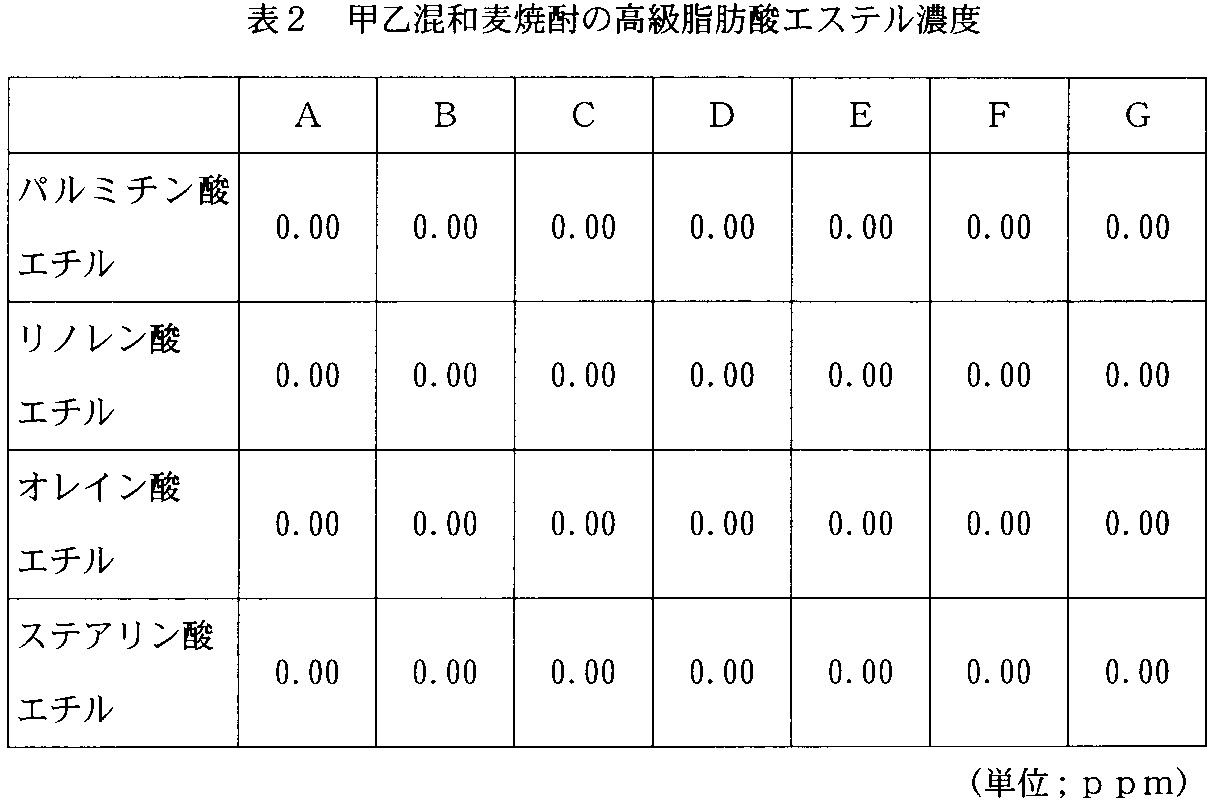
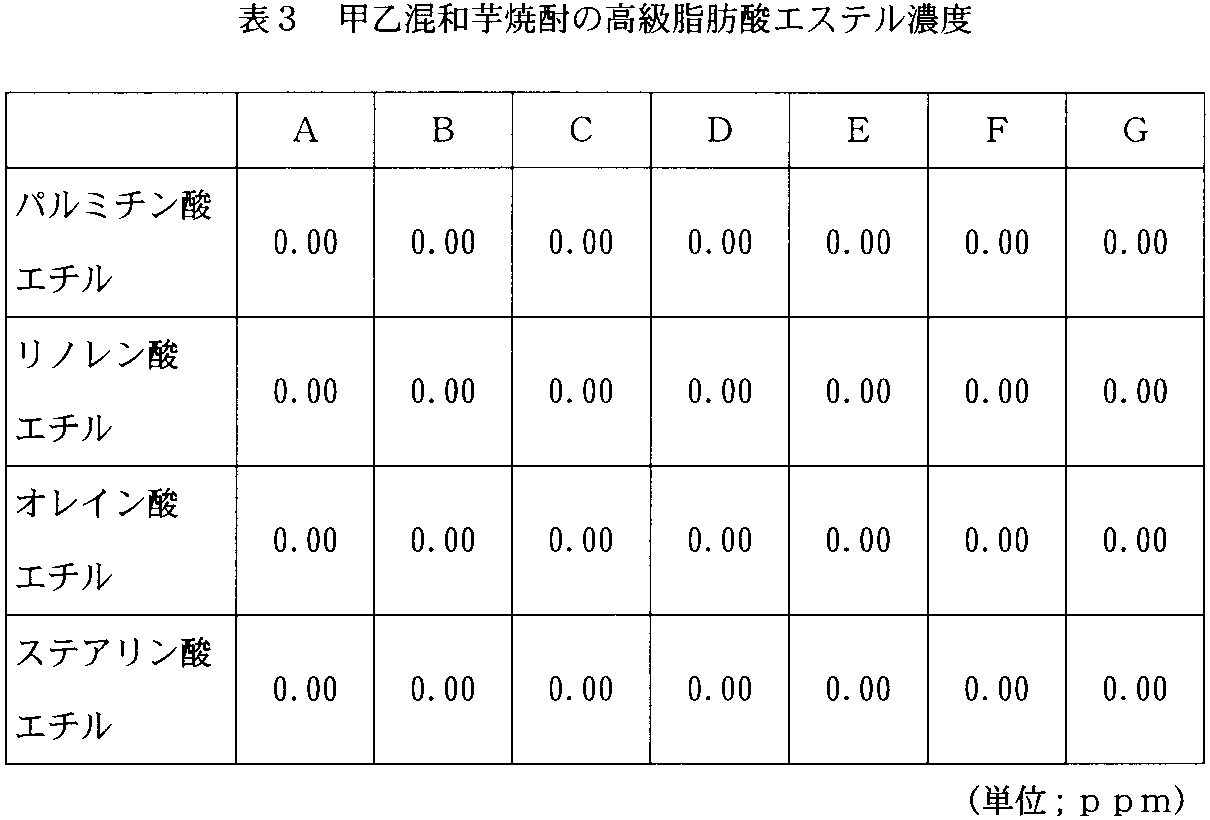
焼酎においては、旧甲類焼酎の味わいの少なさを改善するために旧乙類焼酎と混和した甲乙混和酒などが提供されている。そこで、市販甲乙混和酒の高級脂肪酸エステル濃度を測定し、パルミチン酸エチルなどによって味わいが付与されているかを確認した。市販酒は店頭にて各社製品を無作為にサンプリングした(いずれもアルコール度25%)。
甲乙混和麦焼酎の測定結果を表2に、甲乙混和芋焼酎の測定結果を表3に示す。油性成分の分析は、実施例2の方法に従って行った。
その結果、全く意外なことに市販の甲乙混和焼酎ではパルミチン酸エチルをはじめとする高級脂肪酸は検出されなかった。その原因として、混和に使用する旧乙類焼酎は、混和前の段階ですでに高級脂肪酸エステルが分離または濾過されるなどしてほとんど除去されていることが考えられる。
一般的に甲乙混和焼酎では香りだけでなく味わいも付与されているが、その味わいは高級脂肪酸エステル以外の成分によるものである可能性が高いことが分かった。
麦焼酎、芋焼酎それぞれから得られた油性成分を、それぞれ甲乙混和麦焼酎(旧乙類焼酎15%、高級脂肪酸エステル非検出、アルコール度25%)、甲乙混和芋焼酎(旧乙類焼酎16%、高級脂肪酸エステル非検出、アルコール度25%)に0.01ppm~1ppm添加したサンプルを作成し、三点識別法により官能閾値の測定を行った。具体的には、それぞれから得られた油性成分を0.01、0.05、0.1、0.25、0.5、1ppm添加したサンプルを作成し、官能評価に供した。
混和蒸留酒の官能評価は、7名の専門パネラーにより、まろやかさを指標に、次の3点法で行った。
1点:強く識別できる;
2点:識別できる;
3点:ほとんど識別できない。
1点:強く識別できる;
2点:識別できる;
3点:ほとんど識別できない。
その結果、麦焼酎では油性成分をサンプル中の最終濃度が0.1ppmとなるように添加すると識別可能であり、芋焼酎では1ppmとなるように添加すると識別可能であった。油性成分に含まれる高級脂肪酸エステルのうち、最も多く含まれているパルミチン酸エチルに着目すると、パルミチン酸エチルとして麦焼酎では0.048ppm、芋焼酎では0.37ppm存在すると官能的に影響を与えることが示唆された。
<実施例5> 甲乙混和麦焼酎における添加試験
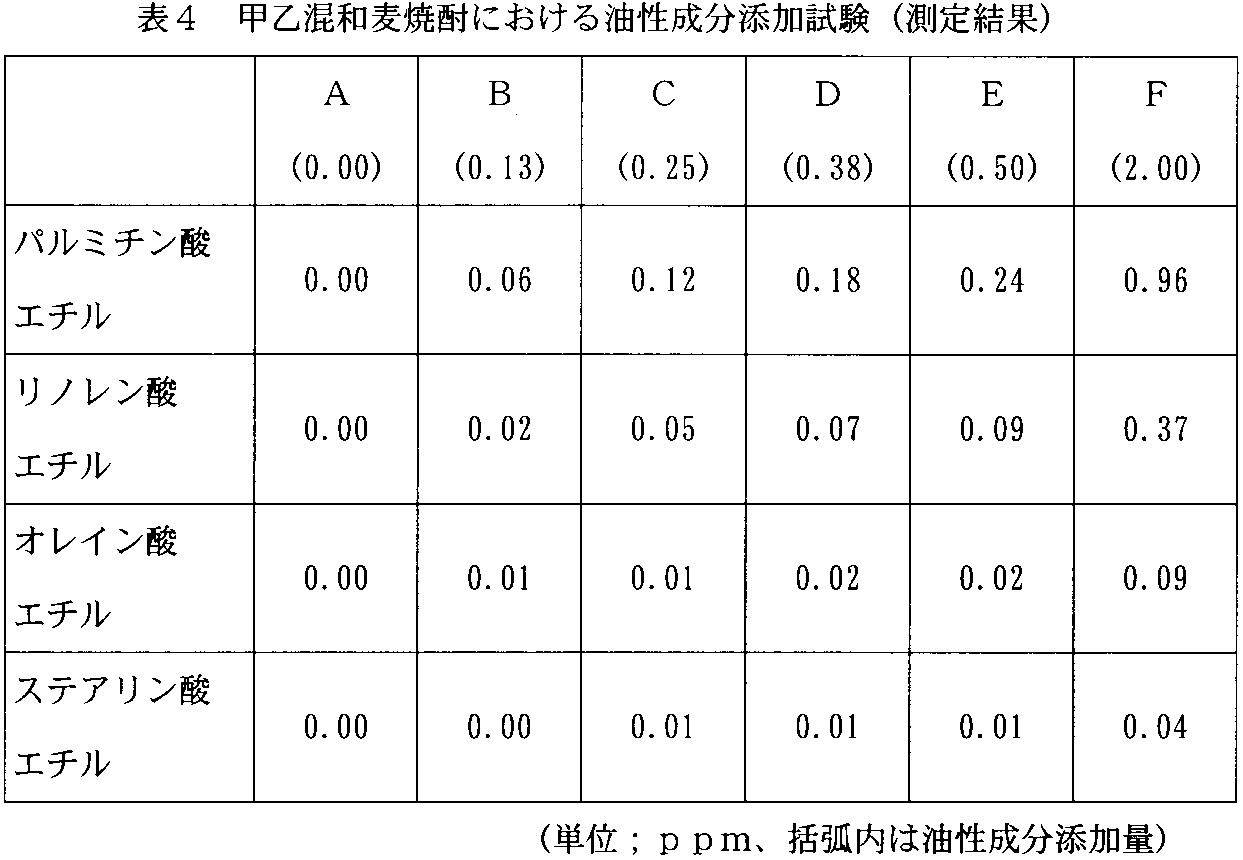
実施例2で得られた油性成分を95%エタノール(原料アルコール)で1000倍希釈したものを、さらに甲乙混和麦焼酎で希釈したものを添加用に用いた。油性成分の添加量を変えたサンプルを作成し、高級脂肪酸エステル濃度を測定した結果を表4に、官能評価試験を行った結果を表5に示す。
<実施例5> 甲乙混和麦焼酎における添加試験
実施例2で得られた油性成分を95%エタノール(原料アルコール)で1000倍希釈したものを、さらに甲乙混和麦焼酎で希釈したものを添加用に用いた。油性成分の添加量を変えたサンプルを作成し、高級脂肪酸エステル濃度を測定した結果を表4に、官能評価試験を行った結果を表5に示す。
混和蒸留酒の官能評価は、7名の専門パネラーにより、次の5点法で行った。1点:非常に優れている;
2点:優れている;
3点:良い;
4点:やや劣る;
5点:劣る。
2点:優れている;
3点:良い;
4点:やや劣る;
5点:劣る。
パネラーの点数を平均し、平均点が3以下のものを好適、2.5以下のものを特に好適であると判定した。

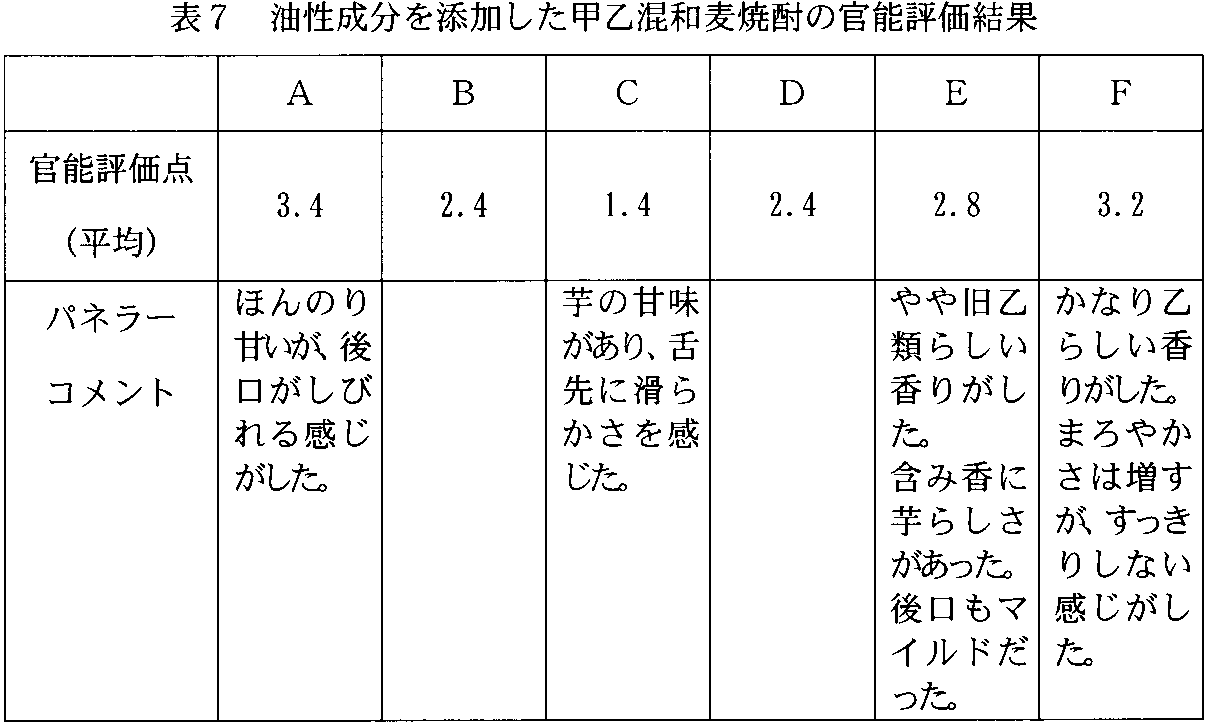
実施例5と同様にしてサンプルを作成し、高級脂肪酸エステル濃度を測定した結果を表6に、官能評価試験を行った結果を表7に示す。

本発明によれば、優れた香味を有し、連続式蒸留酒由来のキレを有し、かつアルコールの刺激感もなく、その上狙いとする酒質の製品を効率的に製造することができる混和蒸留酒を提供することができる。
Claims (16)
- パルミチン酸エチル、リノレン酸エチル、オレイン酸エチルおよびステアリン酸エチルからなる群から選択される成分の少なくとも1つを含有し、これらの成分の合計濃度が0.1ppm以上である、混和蒸留酒。
- パルミチン酸エチルの濃度が0.03ppm以上である、請求項1記載の混和蒸留酒。
- 前記混和蒸留酒が麦焼酎であり、パルミチン酸エチルの濃度が0.04ppm以上である、請求項1または2記載の混和蒸留酒。
- 前記混和蒸留酒が芋焼酎であり、パルミチン酸エチルの濃度が0.3ppm以上である、請求項1または2記載の混和蒸留酒。
- アルコール含有物から得られる油性成分を含む香味付与剤であって、該油性成分がパルミチン酸エチル、リノレン酸エチル、オレイン酸エチルおよびステアリン酸エチルからなる群から選択される成分の少なくとも1つであり、それらの成分の含有量の合計が油性成分中10重量%以上である、前記香味付与剤。
- パルミチン酸エチルの含有量が油性成分中1重量%以上である、請求項5記載の香味付与剤。
- 前記アルコール含有物が、酒類を単式蒸留することにより得られる蒸留液または残留液である、請求項5または6記載の香味付与剤。
- 前記アルコール含有物の発酵原料が、米、麦、サツマイモ、そば、ジャガイモ、とうもろこし、あわ、ひえ、きびおよびこうりゃんからなる群から選択される穀類;ナツメヤシ、ブドウ、デーツおよびアガベからなる群から選択される果実;砂糖、糖蜜、蜂蜜および果糖からなる群から選択される含糖質物;およびこれらの組み合わせからなる群から選択される、請求項5~7のいずれかに記載の香味付与剤。
- 請求項5~8のいずれかに記載の香味付与剤を含む、焼酎、ウイスキー、ブランデー、原料用アルコール、スピリッツ、アクアビット、アラック、アルヒ、スピリタス、オコレハオ、カシャッサ、コルン、シュナップス、ソジュ、パイチュウ、マオタイ酒、コニャック、アルマニャック、カルヴァドス、グラッパ、シンガニ、ピスコ、メスカル、テキーラおよびラクから選択される、混和蒸留酒。
- 混和蒸留酒の製造方法であって、
アルコール含有物から油性成分を回収する工程、および
回収された油性成分を混和蒸留酒に添加する工程、
を含む、前記製造方法。 - 油性成分が、パルミチン酸エチル、リノレン酸エチル、オレイン酸エチルおよびステアリン酸エチルからなる群から選択される成分の少なくとも1つを含む、請求項10記載の製造方法。
- 油性成分の添加工程において、回収された油性成分をアルコール含有溶液に溶解させた後に蒸留酒に添加する、請求項10または11記載の製造方法。
- 回収工程が、遠心分離、濾過または静置分離により前記油性成分を分離させる工程を含む、請求項10~12のいずれかに記載の製造方法。
- アルコール含有物が、単式蒸留酒の蒸留工程後に得られる蒸留液または残留液である、請求項10~13のいずれかに記載の製造方法。
- アルコール含有物の原料が、米、麦、サツマイモ、そば、ジャガイモ、とうもろこし、あわ、ひえ、きびおよびこうりゃんからなる群から選択される穀類;ナツメヤシ、ブドウ、デーツおよびアガベからなる群から選択される果実;砂糖、糖蜜、蜂蜜および果糖からなる群から選択される含糖質物;およびこれらの組み合わせからなる群から選択される、請求項10~14のいずれかに記載の製造方法。
- 混和蒸留酒が、焼酎、ウイスキー、ブランデー、原料用アルコール、スピリッツ、アクアビット、アラック、アルヒ、スピリタス、オコレハオ、カシャッサ、コルン、シュナップス、ソジュ、パイチュウ、マオタイ酒、コニャック、アルマニャック、カルヴァドス、グラッパ、シンガニ、ピスコ、メスカル、テキーラまたはラクである、請求項10~15のいずれかに記載の製造方法。
Priority Applications (2)
| Application Number | Priority Date | Filing Date | Title |
|---|---|---|---|
| KR1020137033968A KR101965918B1 (ko) | 2011-06-03 | 2012-05-24 | 혼화 증류주 및 그 제조 방법 |
| CN201280025049.1A CN103562372A (zh) | 2011-06-03 | 2012-05-24 | 混合蒸馏酒及其制造方法 |
Applications Claiming Priority (4)
| Application Number | Priority Date | Filing Date | Title |
|---|---|---|---|
| JP2011-125302 | 2011-06-03 | ||
| JP2011-125312 | 2011-06-03 | ||
| JP2011125302A JP5878306B2 (ja) | 2011-06-03 | 2011-06-03 | 混和蒸留酒 |
| JP2011125312A JP5819104B2 (ja) | 2011-06-03 | 2011-06-03 | 混和蒸留酒の製造方法 |
Publications (1)
| Publication Number | Publication Date |
|---|---|
| WO2012165272A1 true WO2012165272A1 (ja) | 2012-12-06 |
Family
ID=47259129
Family Applications (1)
| Application Number | Title | Priority Date | Filing Date |
|---|---|---|---|
| PCT/JP2012/063263 Ceased WO2012165272A1 (ja) | 2011-06-03 | 2012-05-24 | 混和蒸留酒およびその製造方法 |
Country Status (4)
| Country | Link |
|---|---|
| KR (1) | KR101965918B1 (ja) |
| CN (1) | CN103562372A (ja) |
| TW (1) | TWI567188B (ja) |
| WO (1) | WO2012165272A1 (ja) |
Cited By (2)
| Publication number | Priority date | Publication date | Assignee | Title |
|---|---|---|---|---|
| CN110616132A (zh) * | 2019-10-22 | 2019-12-27 | 烟台吉斯波尔酿酒有限公司 | 一种苹果威士忌及其制备方法 |
| CN117368429A (zh) * | 2023-10-27 | 2024-01-09 | 安徽绩溪胡氏宴酒业有限公司 | 一种白酒酒精度检测方法 |
Families Citing this family (4)
| Publication number | Priority date | Publication date | Assignee | Title |
|---|---|---|---|---|
| CN106520453A (zh) * | 2016-12-27 | 2017-03-22 | 泸州九曲河酿酒有限公司 | 松子酒及其制作方法 |
| CN107987994A (zh) * | 2017-12-06 | 2018-05-04 | 山东省葡萄研究院 | 一种vs白兰地香料配方及其制备方法 |
| CN108841553A (zh) * | 2018-07-30 | 2018-11-20 | 大连国利企业服务有限公司 | 一种养生酒的制备方法 |
| JP7158264B2 (ja) * | 2018-11-30 | 2022-10-21 | サッポロビール株式会社 | 混和芋焼酎 |
Citations (3)
| Publication number | Priority date | Publication date | Assignee | Title |
|---|---|---|---|---|
| JPS58158174A (ja) * | 1982-03-16 | 1983-09-20 | Tax Adm Agency | しようちゆう乙類の熟成促進法 |
| JPH11196851A (ja) * | 1989-09-21 | 1999-07-27 | Satsuma Shuzo Kk | 濁り焼酎の製造方法 |
| JP2002065237A (ja) * | 2000-02-08 | 2002-03-05 | Takara Shuzo Co Ltd | 酒類及びその製造方法 |
Family Cites Families (6)
| Publication number | Priority date | Publication date | Assignee | Title |
|---|---|---|---|---|
| JP3100142B2 (ja) | 1989-09-21 | 2000-10-16 | 薩摩酒造株式会社 | 濁り焼酎の製造法 |
| JPH11127841A (ja) | 1997-08-27 | 1999-05-18 | Kojika Shuzo Kyogyo Kumiai | 焼酎の油性物質の除去方法 |
| WO1999011752A1 (fr) * | 1997-09-04 | 1999-03-11 | Kyowa Hakko Kogyo Co., Ltd. | Procedes de preparation de liqueur distillee |
| KR100373985B1 (ko) * | 2002-04-09 | 2003-02-26 | 대한민국 | 주정을 이용한 방향성과 감미로운 맛을 갖는 주류의 제조방법 |
| JP2009153506A (ja) * | 2007-12-28 | 2009-07-16 | Suntory Holdings Ltd | 蒸留酒の製造方法 |
| CN101921689B (zh) * | 2010-08-06 | 2012-02-08 | 泸州老窖股份有限公司 | 浓香型白酒丢糟二次发酵酿造白酒的方法及其酿造的白酒 |
-
2012
- 2012-05-24 WO PCT/JP2012/063263 patent/WO2012165272A1/ja not_active Ceased
- 2012-05-24 CN CN201280025049.1A patent/CN103562372A/zh active Pending
- 2012-05-24 KR KR1020137033968A patent/KR101965918B1/ko not_active Expired - Fee Related
- 2012-06-01 TW TW101119748A patent/TWI567188B/zh not_active IP Right Cessation
Patent Citations (3)
| Publication number | Priority date | Publication date | Assignee | Title |
|---|---|---|---|---|
| JPS58158174A (ja) * | 1982-03-16 | 1983-09-20 | Tax Adm Agency | しようちゆう乙類の熟成促進法 |
| JPH11196851A (ja) * | 1989-09-21 | 1999-07-27 | Satsuma Shuzo Kk | 濁り焼酎の製造方法 |
| JP2002065237A (ja) * | 2000-02-08 | 2002-03-05 | Takara Shuzo Co Ltd | 酒類及びその製造方法 |
Non-Patent Citations (5)
| Title |
|---|
| HIROSHI SAKAIDA ET AL.: "Retronasal Aroma and Orthonasal Aroma of Cereal Shochu Using Retronasal Aroma Simulator (RAS)", JOURNAL OF THE JAPANESE SOCIETY FOR FOOD SCIENCE AND TECHNOLOGY, vol. 52, no. 1, January 2005 (2005-01-01), pages 19 - 26 * |
| KIYOSHI YOSHIZAWA ET AL.: "Effects of Addition of Flavor Components in Sake on Sake Flavor and Taste", J. BREW. SOC. JAPAN., vol. 92, no. 3, 1997, pages 217 - 223 * |
| NORIMITSU MAKI ET AL.: "Honkaku Shochu to Awamori Oyobi White Spirits no Komi Seibun ni yoru Ruibetsu (Dai 2 Ho) Joryushu no Komi Seibun ni yoru Ruibetsu Oyobi 'Ajiwai' Shihyochi no Bunpu", THE BREWING SOCIETY OF JAPAN TAIKAI KOEN YOSHISHU, vol. 2002, 9 August 2002 (2002-08-09), pages 20 * |
| TAIRIKU OMORI ET AL.: "Shihan Shochu no Kagaku Bunseki to Kanno Kensa no Kekka", J. BREW. SOC. JAPAN, vol. 80, no. 6, 1985, pages 415 - 417 * |
| YUICHI AKIYAMA ET AL.: "The secrets of blending", CHEMICAL ENGINEERING OF JAPAN, vol. 50, no. 12, 1986, pages 859 - 861 * |
Cited By (2)
| Publication number | Priority date | Publication date | Assignee | Title |
|---|---|---|---|---|
| CN110616132A (zh) * | 2019-10-22 | 2019-12-27 | 烟台吉斯波尔酿酒有限公司 | 一种苹果威士忌及其制备方法 |
| CN117368429A (zh) * | 2023-10-27 | 2024-01-09 | 安徽绩溪胡氏宴酒业有限公司 | 一种白酒酒精度检测方法 |
Also Published As
| Publication number | Publication date |
|---|---|
| KR101965918B1 (ko) | 2019-04-04 |
| KR20140036253A (ko) | 2014-03-25 |
| CN103562372A (zh) | 2014-02-05 |
| TWI567188B (zh) | 2017-01-21 |
| TW201303008A (zh) | 2013-01-16 |
Similar Documents
| Publication | Publication Date | Title |
|---|---|---|
| JP5878306B2 (ja) | 混和蒸留酒 | |
| Feng et al. | Comparative study of aromatic compounds in fruit wines from raspberry, strawberry, and mulberry in central Shaanxi area | |
| US6846503B2 (en) | Method and apparatus for production of an alcoholic beverage | |
| KR101965918B1 (ko) | 혼화 증류주 및 그 제조 방법 | |
| Ribeiro et al. | Fermented sugarcane and pineapple beverage produced using Saccharomyces cerevisiae and non‐Saccharomyces yeast | |
| CN109266479A (zh) | 一种白兰地的酿造工艺 | |
| Dachery et al. | Volatile and sensory profile of sparkling wines produced by faster and alternative methods (Ancestral and Single Tank Fermentation) compared to the usual methods (Charmat and Traditional) | |
| Mrvčić et al. | Chemical and sensorial characteristics of traditional fruit spirits from Southeast Europe | |
| Bortoletto | Rum and cachaça | |
| JP5819104B2 (ja) | 混和蒸留酒の製造方法 | |
| JP7044543B2 (ja) | 芋焼酎、芋焼酎含有炭酸飲料、芋焼酎の製造方法、及び、芋焼酎の香味向上方法 | |
| JP6591839B2 (ja) | 果汁を含有するアルコール炭酸飲料 | |
| JP2018183124A (ja) | ビール様発泡性飲料及びその製造方法 | |
| JP7044544B2 (ja) | 芋焼酎、芋焼酎含有炭酸飲料、芋焼酎の製造方法、及び、芋焼酎の香味向上方法 | |
| CN116925864A (zh) | 一种配伍可食花白兰地的酿制方法及可食花白兰地 | |
| JP2023100067A (ja) | 柑橘類の香気を有する水性エタノール液体組成物 | |
| JP2015139399A (ja) | 焼酎およびその製造方法 | |
| JP2015112050A (ja) | 焼酎およびその製造方法 | |
| Stoica et al. | Comparative behavior of volatile and aromatic compounds of Tamaioasa romaneasca and Muscat Ottonel grape marcs fermented during traditional still distillation. | |
| JP2021106526A (ja) | 発酵感を有するワイン風味飲料 | |
| Xiao et al. | Comparative analysis of volatile aroma components in different sweet potato wine | |
| KR20100060131A (ko) | 에스테르 성분이 강화된 증류주 및 이의 제조방법 | |
| Terpou et al. | Current trends in balsamic/aged vinegar production and research | |
| RU2524427C1 (ru) | Способ производства яблочного бренди | |
| JP2019154454A (ja) | 焼酎およびその製造方法 |
Legal Events
| Date | Code | Title | Description |
|---|---|---|---|
| 121 | Ep: the epo has been informed by wipo that ep was designated in this application |
Ref document number: 12792466 Country of ref document: EP Kind code of ref document: A1 |
|
| NENP | Non-entry into the national phase |
Ref country code: DE |
|
| ENP | Entry into the national phase |
Ref document number: 20137033968 Country of ref document: KR Kind code of ref document: A |
|
| 122 | Ep: pct application non-entry in european phase |
Ref document number: 12792466 Country of ref document: EP Kind code of ref document: A1 |