WO2012147508A1 - 合成皮革用ポリウレタン樹脂に用いられる強伸度向上剤並びにこれを用いたポリオール組成物及びポリウレタン樹脂 - Google Patents
合成皮革用ポリウレタン樹脂に用いられる強伸度向上剤並びにこれを用いたポリオール組成物及びポリウレタン樹脂 Download PDFInfo
- Publication number
- WO2012147508A1 WO2012147508A1 PCT/JP2012/059765 JP2012059765W WO2012147508A1 WO 2012147508 A1 WO2012147508 A1 WO 2012147508A1 JP 2012059765 W JP2012059765 W JP 2012059765W WO 2012147508 A1 WO2012147508 A1 WO 2012147508A1
- Authority
- WO
- WIPO (PCT)
- Prior art keywords
- polyol
- polyurethane resin
- strong elongation
- elongation improver
- carbon atoms
- Prior art date
- Legal status (The legal status is an assumption and is not a legal conclusion. Google has not performed a legal analysis and makes no representation as to the accuracy of the status listed.)
- Ceased
Links
Classifications
-
- C—CHEMISTRY; METALLURGY
- C08—ORGANIC MACROMOLECULAR COMPOUNDS; THEIR PREPARATION OR CHEMICAL WORKING-UP; COMPOSITIONS BASED THEREON
- C08G—MACROMOLECULAR COMPOUNDS OBTAINED OTHERWISE THAN BY REACTIONS ONLY INVOLVING UNSATURATED CARBON-TO-CARBON BONDS
- C08G18/00—Polymeric products of isocyanates or isothiocyanates
-
- C—CHEMISTRY; METALLURGY
- C08—ORGANIC MACROMOLECULAR COMPOUNDS; THEIR PREPARATION OR CHEMICAL WORKING-UP; COMPOSITIONS BASED THEREON
- C08G—MACROMOLECULAR COMPOUNDS OBTAINED OTHERWISE THAN BY REACTIONS ONLY INVOLVING UNSATURATED CARBON-TO-CARBON BONDS
- C08G18/00—Polymeric products of isocyanates or isothiocyanates
- C08G18/06—Polymeric products of isocyanates or isothiocyanates with compounds having active hydrogen
- C08G18/28—Polymeric products of isocyanates or isothiocyanates with compounds having active hydrogen characterised by the compounds used containing active hydrogen
- C08G18/40—High-molecular-weight compounds
- C08G18/48—Polyethers
- C08G18/4833—Polyethers containing oxyethylene units
- C08G18/4837—Polyethers containing oxyethylene units and other oxyalkylene units
-
- C—CHEMISTRY; METALLURGY
- C08—ORGANIC MACROMOLECULAR COMPOUNDS; THEIR PREPARATION OR CHEMICAL WORKING-UP; COMPOSITIONS BASED THEREON
- C08K—Use of inorganic or non-macromolecular organic substances as compounding ingredients
- C08K5/00—Use of organic ingredients
- C08K5/04—Oxygen-containing compounds
- C08K5/07—Aldehydes; Ketones
-
- C—CHEMISTRY; METALLURGY
- C08—ORGANIC MACROMOLECULAR COMPOUNDS; THEIR PREPARATION OR CHEMICAL WORKING-UP; COMPOSITIONS BASED THEREON
- C08K—Use of inorganic or non-macromolecular organic substances as compounding ingredients
- C08K5/00—Use of organic ingredients
- C08K5/04—Oxygen-containing compounds
- C08K5/09—Carboxylic acids; Metal salts thereof; Anhydrides thereof
-
- C—CHEMISTRY; METALLURGY
- C08—ORGANIC MACROMOLECULAR COMPOUNDS; THEIR PREPARATION OR CHEMICAL WORKING-UP; COMPOSITIONS BASED THEREON
- C08L—COMPOSITIONS OF MACROMOLECULAR COMPOUNDS
- C08L75/00—Compositions of polyureas or polyurethanes; Compositions of derivatives of such polymers
- C08L75/04—Polyurethanes
-
- D—TEXTILES; PAPER
- D06—TREATMENT OF TEXTILES OR THE LIKE; LAUNDERING; FLEXIBLE MATERIALS NOT OTHERWISE PROVIDED FOR
- D06N—WALL, FLOOR, OR LIKE COVERING MATERIALS, e.g. LINOLEUM, OILCLOTH, ARTIFICIAL LEATHER, ROOFING FELT, CONSISTING OF A FIBROUS WEB COATED WITH A LAYER OF MACROMOLECULAR MATERIAL; FLEXIBLE SHEET MATERIAL NOT OTHERWISE PROVIDED FOR
- D06N3/00—Artificial leather, oilcloth or other material obtained by covering fibrous webs with macromolecular material, e.g. resins, rubber or derivatives thereof
- D06N3/12—Artificial leather, oilcloth or other material obtained by covering fibrous webs with macromolecular material, e.g. resins, rubber or derivatives thereof with macromolecular compounds obtained otherwise than by reactions only involving carbon-to-carbon unsaturated bonds, e.g. gelatine proteins
- D06N3/14—Artificial leather, oilcloth or other material obtained by covering fibrous webs with macromolecular material, e.g. resins, rubber or derivatives thereof with macromolecular compounds obtained otherwise than by reactions only involving carbon-to-carbon unsaturated bonds, e.g. gelatine proteins with polyurethanes
Definitions
- the present invention relates to a strong elongation improver used for a polyurethane resin for synthetic leather, a polyol composition and a polyurethane resin using the same.
- a polyurethane resin is a resin having a urethane bond that uses a polyol component and an organic polyisocyanate component as raw materials, and is generally an elastic resin rich in stretchability. used. Physical property items indicating the characteristics of polyurethane resin include elongation at break when the resin is stretched until it breaks, and breaking strength that represents the stress at break, and the higher these values, the greater the elongation. It can be said that it is a tough resin that is easy to break. The elongation at break and the strength at break are adjusted by changing the molecular weight or the number of functional groups of the polyol as a raw material, but the elongation at break and the strength at break are generally conflicting items (see, for example, Non-Patent Document 1).
- the resulting resin becomes rigid and the elongation at break decreases, resulting in a final product.
- the texture of will be damaged. If the elongation at break can be improved while improving the breaking strength of the resin, a resin excellent in texture and durability of the final product can be obtained and the application range is expanded. Therefore, a polyurethane resin capable of achieving both high breaking strength and high breaking elongation is desired. Yes.
- An object of the present invention is to provide a polyurethane resin for synthetic leather having high mechanical properties (strong elongation: breaking strength and elongation at break) and a strong elongation improver capable of producing the same.
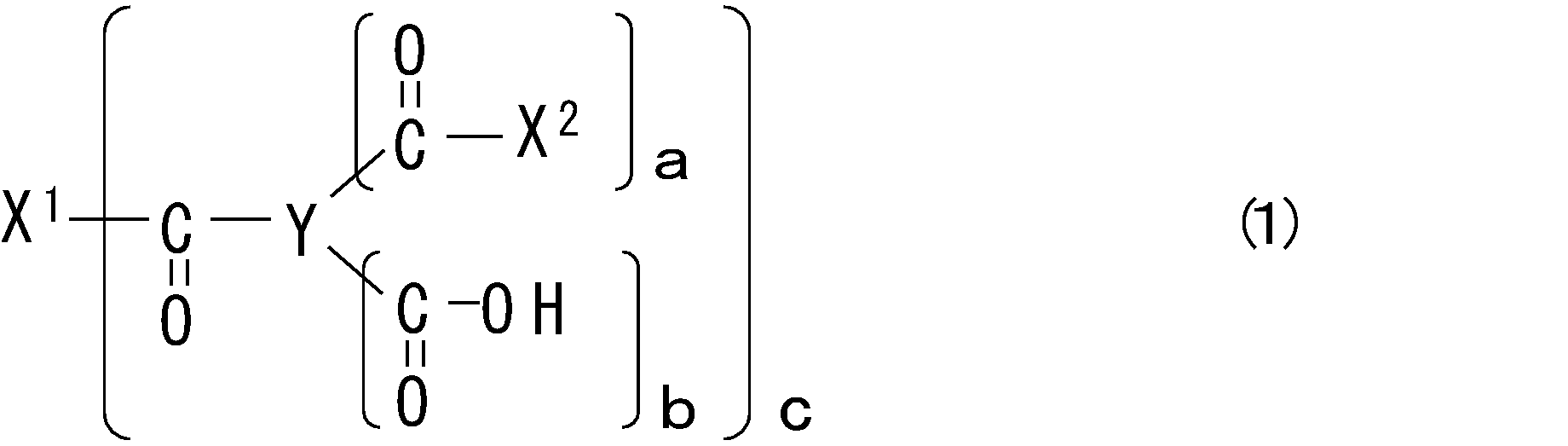
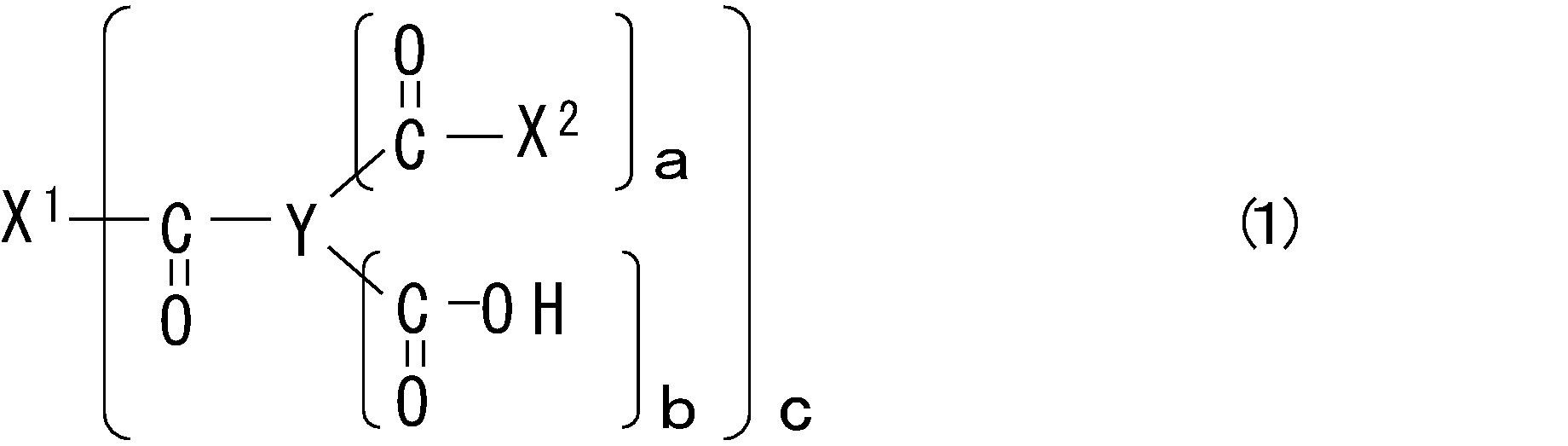
- the present inventors can obtain a polyurethane resin having high mechanical properties (breaking strength and breaking elongation) by using a strong elongation improver having a specific structure. And reached the present invention. That is, the present invention relates to a strong elongation improver (S) used for a synthetic leather polyurethane resin represented by the general formula (1); the strong elongation improver (S); and a hydroxyl value of 20 to 2000 mgKOH / g.
- S strong elongation improver
- a polyol composition (A) for use in a polyurethane resin for synthetic leather which contains a polyol (a1) other than the strong elongation improver (S) having a molar average functional group number of 2 to 8;
- the high elongation improver (S) is a strong elongation improver (S1) having at least one active hydrogen
- synthetic leather containing the strong elongation improver (S) and the polyurethane resin Use polyurethane resin composition; a.
- a group and / or a halogen atom may be bonded, but at least one carbon atom is not bonded to a substituent; a represents an integer of 1 or more, b represents an integer of 0 or more, and 2 ⁇ a + b ⁇ d ⁇ 2 is satisfied; d is the aromatic polycarboxylic acid The number of hydrogen atoms bonded to a carbon atom constituting an aromatic ring in the case of replacing all the substituents containing a carboxyl group to a hydrogen atom, i.e. represents the number of substitutable positions on the aromatic ring. ]
- the strong elongation improver (S) represented by the general formula (1) By introducing the strong elongation improver (S) represented by the general formula (1) into the polyurethane resin skeleton, a polyurethane resin for synthetic leather having excellent mechanical properties such as elongation at break and strength at break can be obtained. Moreover, the polyurethane resin composition for synthetic leather excellent in mechanical properties, such as breaking elongation and breaking strength, is obtained by adding the strong elongation improver (S) represented by the general formula (1) to the polyurethane resin. Can do.
- the strong elongation improving agent (S) of the present invention is represented by the general formula (1), and includes a strong elongation improving agent (S1) having at least one active hydrogen and a strong elongation improving agent (S2) having no active hydrogen. It consists of.
- the polyol composition (A) used for the polyurethane resin for synthetic leather of the present invention contains a strong elongation improver (S) represented by the general formula (1) and a polyol (a1) other than (S). Then, the polyurethane resin for synthetic leather of the present invention is obtained by reacting the active hydrogen component (H) containing this polyol composition (A) with the organic polyisocyanate component (I).
- the strong elongation improver (S1) When the strong elongation improver (S1) is used in the polyol composition (A), the predetermined effect is obtained by incorporating the strong elongation improver (S1) into the molecular skeleton of the polyurethane resin using (A). Play.
- a strong elongation improver (S2) when a strong elongation improver (S2) is used in (A), when (A) is used to produce a polyurethane resin, (S2) is not incorporated into the molecular skeleton of the polyurethane resin, and the polyurethane resin and the strong elongation increase.
- a polyurethane resin composition of the present invention containing the agent (S2) is obtained.
- the polyurethane resin composition for synthetic leather of the present invention contains a polyurethane resin and a strong elongation improver (S) represented by the general formula (1).
- Both the strong elongation improver (S1) and the strong elongation improver (S2) can be used in the polyurethane resin composition for synthetic leather of the present invention.
- One of the strong elongation improvers (S1) and (S2) may be used alone, or two or more thereof may be used in combination.
- the strong elongation improver (S) represented by the general formula (1) will be described, the composition and numerical values described as a preferred range as the strong elongation improver (S) are incorporated in the polyurethane resin.
- the case of the strong elongation improver (S1) having at least one active hydrogen and the case of the strong elongation improver (S) used in the polyurethane resin composition are the same unless otherwise specified.
- the strong elongation improver (S) is represented by the general formula (1).
- the strong elongation improver (S) one type may be used alone, or two or more types may be used in combination.
- X 1 in the general formula (1) represents a residue obtained by removing c active hydrogens from an m-valent active hydrogen-containing compound.
- Examples of the active hydrogen-containing compound include a hydroxyl group-containing compound, ammonia, an amino group-containing compound, and a thiol group-containing compound.
- An active hydrogen containing compound may be used individually by 1 type, or may use 2 or more types together.
- hydroxyl group-containing compound examples include monohydric alcohols having 1 to 20 carbon atoms, polyhydric alcohols having 2 to 20 carbon atoms and phenols; adducts of these alkylene oxides (hereinafter abbreviated as AO); ammonia and amino group-containing compounds. And AO adducts of thiol group-containing compounds.
- Examples of the monohydric alcohol having 1 to 20 carbon atoms include alkanols having 1 to 20 carbon atoms (methanol, ethanol, butanol, octanol, decanol, dodecyl alcohol, myristyl alcohol, cetyl alcohol and stearyl alcohol), and those having 2 to 20 carbon atoms.
- alkanols having 1 to 20 carbon atoms methanol, ethanol, butanol, octanol, decanol, dodecyl alcohol, myristyl alcohol, cetyl alcohol and stearyl alcohol
- alkenols oleyl alcohol, linoleyl alcohol, etc.
- aromatic aliphatic alcohols having 7 to 20 carbon atoms (benzyl alcohol, naphthyl ethanol, etc.).
- polyhydric alcohol having 2 to 20 carbon atoms examples include dihydric alcohols having 2 to 20 carbon atoms [aliphatic diols (ethylene glycol, propylene glycol, 1,3- or 1,4-butanediol, 1,6-hexanediol).
- aliphatic triols such as glycerin and trimethylolpropane
- phenols examples include monovalent phenols (phenol, 1-hydroxynaphthalene, anthrol, 1-hydroxypyrene, etc.) and polyhydric phenols (phloroglucin, pyrogallol, catechol, hydroquinone, bisphenol A, bisphenol F, bisphenol S, 1 , 3,6,8-tetrahydroxynaphthalene, 1,4,5,8-tetrahydroxyanthracene, a condensate of phenol and formaldehyde (novolak) and polyphenols described in US Pat. No. 3,265,641], etc. .
- amino group-containing compounds include monohydrocarbylamines having 1 to 20 carbon atoms [alkylamines (such as butylamine), benzylamine and aniline], aliphatic polyamines having 2 to 20 carbon atoms (such as ethylenediamine, hexamethylenediamine and diethylenetriamine).
- Alicyclic polyamines having 6 to 20 carbon atoms such as diaminocyclohexane, dicyclohexylmethanediamine and isophoronediamine), aromatic polyamines having 2 to 20 carbon atoms (such as phenylenediamine, tolylenediamine and diphenylmethanediamine), and 2 carbon atoms ⁇ 20 heterocyclic polyamines (such as piperazine and N-aminoethylpiperazine), alkanolamines (such as monoethanolamine, diethanolamine and triethanolamine), dicarboxylic acid and excess polyamine
- Polyamide polyamine polyether polyamine, hydrazine (such as hydrazine and monoalkyl hydrazine), dihydrazide (such as succinic acid dihydrazide and terephthalic acid dihydrazide), guanidine (such as butyl guanidine and 1-cyanoguanidine) and dicyandiamide obtained by condensation of It is done.
- thiol group-containing compound examples include monovalent thiol compounds having 1 to 20 carbon atoms (alkyl thiol such as ethyl thiol, phenyl thiol and benzyl thiol) and polyvalent thiol compounds (such as ethylene dithiol and 1,6-hexanedithiol). Etc.
- AO used for the hydroxyl group-containing compound examples include AO having 2 to 4 carbon atoms, such as ethylene oxide (hereinafter abbreviated as EO), 1,2-propylene oxide (hereinafter abbreviated as PO), 1,3-propylene. And oxide, 1,2-, 1,3- or 2,3-butylene oxide and tetrahydrofuran (hereinafter abbreviated as THF). Of these, EO, PO and THF are preferred from the viewpoint of breaking strength.
- AO may be used alone or in combination of two or more.
- block addition or random addition may be used. It may be used in combination.
- the number of added moles of AO is preferably 8 to 100, more preferably 10 to 80, from the viewpoint of breaking strength.
- the hydroxyl value of the AO adduct is preferably 18 to 360 mgKOH / g. In the present invention, the hydroxyl value is measured according to JIS K 1557-1.
- active hydrogen-containing compound a compound having two or more active hydrogen-containing functional groups (hydroxyl group, amino group, thiol group, etc.) in the molecule can also be used.
- the active hydrogen-containing compound for introducing X 1 to strength and elongation improver (S) preferred from the standpoint of breaking strength and elongation at break of the polyurethane resin, hydroxyl group-containing compounds, amino group-containing compounds and their AO adduct More preferred are polyhydric alcohols having 2 to 20 carbon atoms, polyether polyols obtained by adding AO to polyhydric alcohols having 2 to 20 carbon atoms and aliphatic polyamines having 2 to 20 carbon atoms, particularly preferred Is a polyether polyol in which AO is added to a polyhydric alcohol having 2 to 20 carbon atoms and a polyhydric alcohol having 2 to 20 carbon atoms, most preferably a polyether polyol in which AO is added to a polyhydric alcohol having 2 to 20 carbon atoms. It is.
- the valence m of the active hydrogen-containing compound is usually 1 to 20, preferably 1 to 8, more preferably 1 to 4, particularly preferably 2 from the viewpoint of the breaking strength and breaking elongation of the polyurethane resin.
- C in the general formula (1) represents an integer satisfying 1 to 20 and 1 ⁇ c ⁇ m, and preferably 1 to 8, more preferably 1 to 4, from the viewpoint of breaking strength and breaking elongation of the polyurethane resin. Particularly preferred is 2.
- X 2 in the general formula (1) represents the residue obtained by removing one active hydrogen from 1-20 monovalent active hydrogen-containing compound, may be different in each of the plurality of X 2 are the same.
- the active hydrogen-containing compound used to constitute X 2 include the same compounds as the active hydrogen-containing compound represented by X 1 described above, and X 2 and X 1 may be the same or different.
- X 1 and at least one X 2 are preferably different groups.
- the valence of X 2 is usually 1 to 20, preferably 1 to 8, more preferably 1 to 4, particularly preferably 1 to 2, and most preferably from the viewpoint of the breaking strength and elongation at break of the polyurethane resin. 2.
- X 1 and X 2 can be introduced into the strong elongation improver (S) by reacting the active hydrogen-containing compound with a trivalent or higher polycarboxylic acid used to constitute Y described later.
- the active hydrogen-containing compound is particularly a diol having 2 to 4 carbon atoms or a polyether polyol having 2 to 4 carbon atoms in the repeating unit
- the AO having 2 to 4 carbon atoms is added to the carboxyl group of the polycarboxylic acid.
- the equivalent compound can also be obtained.
- the active hydrogen-containing compound is ethylene glycol
- a residue obtained by removing one active hydrogen from ethylene glycol can be introduced by reacting 1 mol of EO with a carboxyl group of a polycarboxylic acid.
- Y in the general formula (1) represents a residue obtained by removing all carboxyl groups from a trivalent or higher aromatic polycarboxylic acid.
- the aromatic ring of Y is composed of carbon atoms, and a substituent other than a carboxyl group and / or a halogen atom may be bonded to the carbon atom, but at least one carbon atom is not bonded to a substituent. Must be bonded to a hydrogen atom.
- substituents other than carboxyl groups include alkyl groups, vinyl groups, allyl groups, cycloalkyl groups, amino groups, hydroxyl groups, hydroxyamino groups, nitro groups, thiol groups, aryl groups, and cyano groups.
- Examples of the trivalent or higher valent aromatic polycarboxylic acid used for constituting Y include aromatic polycarboxylic acids having 9 to 30 carbon atoms such as trimellitic acid, 1,2,3-benzenetricarboxylic acid, trimesic acid, Hemicitic acid, 1,2,4-, 1,3,6- or 2,3,6-naphthalenetricarboxylic acid and tricarboxylic acids such as 2,3,6-anthracentricarboxylic acid; pyromellitic acid, 3,3 ′, 4,4′-benzophenone tetracarboxylic acid, 2,2 ′, 3,3′-benzophenone tetracarboxylic acid, 2,3,3 ′, 4′-benzophenone tetracarboxylic acid, 3,3 ′, 4,4′- Biphenyltetracarboxylic acid, 2,2 ′, 3,3′-biphenyltetracarboxylic acid, 2,3,3 ′, 4′-bi
- Aromatic polycarboxylic acid may be used individually by 1 type, and may use 2 or more types together.
- these ester-forming derivatives [acid anhydrides, lower alkyl (carbon number 1 to 4) esters (methyl esters, ethyl esters, isopropyl esters, etc.) and acid halides] (Such as acid chloride) can also be used.
- two carboxyl groups are adjacent to a carbon atom constituting an aromatic ring and not having a substituent bonded thereto.
- Those having a structure bonded to two carbon atoms each forming an aromatic ring are preferred, and more preferably, at least one of carbon atoms adjacent to the carbon atom to which the carboxyl group is bonded has one more carboxyl group. It has a combined structure.
- monocyclic compounds are particularly preferred as the aromatic polycarboxylic acid used for constituting Y, and trimellitic acid and pyromellitic acid are most preferred.
- a represents an integer of 1 or more
- b represents an integer of 0 or more
- 2 ⁇ a + b ⁇ d ⁇ 2 is satisfied
- d includes all carboxyl groups of the aromatic polycarboxylic acid.
- a + b can take a value of 2 to 4
- a + b can take a value of 2-6
- a + b is preferably 2 or 3 from the viewpoint of the breaking strength and breaking elongation of the polyurethane resin.
- b is preferably 1 ⁇ 2 or less of a, and particularly preferably 0.
- the hydroxyl value of the strong elongation improver (S) in the present invention is preferably 0 or 70 to 500 mg KOH / g from the viewpoint of breaking strength and breaking elongation of the polyurethane resin, and more preferably when (S) has a hydroxyl group. 75-350 mg KOH / g.
- (S) has a hydroxyl group if the hydroxyl value is less than 70 mgKOH / g, the breaking strength of the polyurethane resin tends to decrease, and if it exceeds 500 mgKOH / g, the elongation at break of the polyurethane resin tends to decrease.
- the hydroxyl value of the strong elongation improver (S) being 0 means that X 1 , X 2 and Y in the general formula (1) all have no hydroxyl group.
- the concentration of Y in the strong elongation improver (S) means the number of millimoles of the residue Y in 1 g of the strong elongation improver (S), and is preferably 1 from the viewpoint of breaking strength and breaking elongation of the polyurethane resin. 0.0 to 3.5 mmol / g, more preferably 1.1 to 3.4 mmol / g, and particularly preferably 1.2 to 3.3 mmol / g.
- concentration of Y is less than 1.0 mmol / g, the breaking strength of the polyurethane resin tends to decrease, and when it exceeds 3.5 mmol / g, the elongation at break of the polyurethane resin tends to decrease.
- the carbonyl group concentration of the strength improvement agent (S) is preferably 3.0 to 10.0 mmol / g, more preferably 3.0 to 9.7 mmol / g, from the viewpoint of the breaking strength and elongation at break of the polyurethane resin. Particularly preferred is 3.0 to 9.5 mmol / g.
- the breaking strength of the polyurethane resin tends to decrease
- the carbonyl group concentration exceeds 10.0 mmol / g, the elongation at break tends to decrease.
- the carbonyl group at the carbonyl group concentration in the present invention is a carbonyl group bonded to Y in the general formula (1), that is, a carboxyl group of a trivalent or higher valent aromatic polycarboxylic acid used for introducing Y, and derived therefrom.
- a carbonyl group in a functional group such as an ester group, a thioester group and an amide group.
- the molar average functional group number of the strong elongation improver (S) is preferably 2 to 8, more preferably 2 to 6, and particularly preferably 2 to 4.
- the number of mole average functional groups in the present invention is a value obtained by dividing the sum of values obtained by multiplying the number of functional groups having active hydrogen of each component in the composition by the number of moles of each component by the sum of the number of moles of each component.
- the number of moles of each component is a value obtained by dividing the weight of each component by the molecular weight of each component.
- the chemical formula weight is used when the molecular weight is not distributed as in the case of a low molecular compound, and the number average molecular weight (hereinafter abbreviated as Mn) is used when the molecular weight is distributed.
- Mn number average molecular weight
- the Mn of the strong elongation improver (S) and polyol in the present invention is measured by gel permeation chromatography using THF as a solvent and polyoxypropylene glycol as a standard substance.
- the sample concentration may be 0.25% by weight
- the column stationary phase may be TSKgel SuperH2000, TSKgel SuperH3000, TSKgel SuperH4000 (both manufactured by Tosoh Corporation), and the column temperature may be 40 ° C.
- the strong elongation improving agent (S1) having at least one active hydrogen is a compound in which at least one of X 1 , X 2 and Y in the general formula (1) has an active hydrogen. More specifically, at least the valences m and c of X 1 satisfy m> c, or Y is substituted with a substituent having an active hydrogen such as an amino group, a hydroxyl group, a hydroxyamino group and a thiol group, When the active hydrogen-containing compound constituting X 2 is divalent or higher, or b is 1 or higher, the strong elongation improver (S1) has at least one active hydrogen.
- the polyol composition (A) of the present invention comprises a strong elongation improver (S), a polyol other than the above (S) having a hydroxyl value of 20 to 2000 mgKOH / g and a molar average functional group number of 2 to 8. a1) and used for polyurethane resin for synthetic leather.
- S strong elongation improver
- S polyol other than the above (S) having a hydroxyl value of 20 to 2000 mgKOH / g and a molar average functional group number of 2 to 8. a1) and used for polyurethane resin for synthetic leather.
- the polyol (a1) contained in the polyol composition (A) is a polyhydric alcohol having 2 to 20 carbon atoms having a hydroxyl value of 20 to 2000 mgKOH / g and a molar average functional group number of 2 to 8, Examples include polyether polyols obtained by adding AO having 2 to 4 carbon atoms to polyhydric alcohols having 2 to 20 carbon atoms, polyester polyols other than (S), and other polyols.
- a polyol (a1) may be used individually by 1 type, or may use 2 or more types together.
- AO is preferably EO, PO, 1,2-butylene oxide and / or THF from the viewpoint of breaking strength.
- polyester polyol examples include the polyhydric alcohol having 2 to 20 carbon atoms and / or the polyether polyol, the divalent to tetravalent aromatic polycarboxylic acid and / or the aliphatic polycarboxylic acid, and anhydrides or lower alkyls thereof ( An alkyl group having 1 to 4 carbon atoms) and a condensation reaction product with an ester-forming derivative such as an ester other than the above-described strong elongation improver (S); these AO adducts; a polylactone polyol [for example, Obtained by ring-opening polymerization of a lactone ( ⁇ -caprolactone or the like) using the polyhydric alcohol having 2 to 20 carbon atoms as an initiator]; and a polycarbonate polyol (for example, the polyhydric alcohol having 2 to 20 carbon atoms and alkylene) A reaction product with carbonate); and the like.
- an alkyl group having 1 to 4 carbon atoms An alkyl group having
- Divalent to tetravalent aromatic polycarboxylic acids include terephthalic acid, isophthalic acid, phthalic acid, 2,3-naphthalenedicarboxylic acid, 2,6-naphthalenedicarboxylic acid, 1,4-naphthalenedicarboxylic acid, 1,8- Naphthalenedicarboxylic acid, anthracene dicarboxylic acid, 4,4′-benzophenone dicarboxylic acid, 3,3′-biphenyl dicarboxylic acid, 4,4′-biphenyl dicarboxylic acid, 3,3′-biphenyl ether dicarboxylic acid, 4,4′- Examples thereof include aromatic dicarboxylic acids having 8 to 30 carbon atoms such as biphenyl ether dicarboxylic acid and 4,4′-binaphthyl dicarboxylic acid, and the above trivalent or tetravalent aromatic polycarboxylic acids.
- divalent to tetravalent aliphatic polycarboxylic acids examples include oxalic acid, succinic acid, malonic acid, adipic acid, suberic acid, azelaic acid, sebacic acid, dodecanedicarboxylic acid, maleic acid, fumaric acid, itaconic acid, tricarbaryl.
- divalent to tetravalent aliphatic polycarboxylic acids examples include oxalic acid, succinic acid, malonic acid, adipic acid, suberic acid, azelaic acid, sebacic acid, dodecanedicarboxylic acid, maleic acid, fumaric acid, itaconic acid, tricarbaryl.
- examples thereof include aliphatic polycarboxylic acids having 2 to 30 carbon atoms such as acid and hexanetricarboxylic acid.
- Examples of other polyols include monocyclic polyhydric phenols (pyrogallol, hydroquinone, phloroglucin, etc.) or bisphenols (bisphenol A, bisphenol F, bisphenol S, etc.), a polyol in which 1 mole of AO is added per hydroxyl group, a silicone polyol, Examples thereof include polymer polyols, polydiene polyols (such as polybutadiene polyols), hydrogenated products of polydiene polyols, acrylic polyols, natural oil-based polyols (such as castor oil), and modified products of natural oil-based polyols.
- polydiene polyols such as polybutadiene polyols
- hydrogenated products of polydiene polyols acrylic polyols
- natural oil-based polyols such as castor oil
- modified products of natural oil-based polyols such as castor oil
- the hydroxyl value of the polyol (a1) is usually 20 to 2000 mgKOH / g, preferably 25 to 1900 mgKOH / g, from the viewpoint of the breaking strength and elongation at break of the polyurethane resin.
- the hydroxyl value is less than 20 mgKOH / g, the breaking strength of the polyurethane resin decreases, and when it exceeds 2000 mgKOH / g, the elongation at break of the polyurethane resin deteriorates.
- the number of mole average functional groups of the polyol (a1) is preferably 2 to 8, more preferably 2 to 6, particularly preferably 2 to 4, and most preferably 2 from the viewpoint of elongation at break of the polyurethane resin.
- the content of the strength improver (S) is preferably 0.01 to 10% by weight, more preferably from the viewpoint of the breaking strength and breaking elongation of the polyurethane resin, based on the weight of the polyol composition (A). It is 0.015 to 8% by weight, particularly preferably 0.02 to 6% by weight, particularly preferably 0.025 to 3% by weight, and most preferably 0.03 to 1.5% by weight.
- the content of the polyol (a1) is preferably 90 to 99.99% by weight, more preferably 92 to 99.985% by weight, from the viewpoint of elongation at break of the polyurethane resin based on the weight of the polyol composition (A). Particularly preferred is 94 to 99.98% by weight.
- the polyurethane resin for synthetic leather of the present invention is obtained by reacting the active hydrogen component (H) containing the polyol composition (A) with the organic polyisocyanate component (I), and the general formula in (A) Since the strong elongation improver (S) represented by (1) is a strong elongation improver (S1) having at least one active hydrogen, the strong elongation improver (S1) is a molecular skeleton of a polyurethane resin. Incorporated into.
- the active hydrogen component (H) can contain a chain extender, a reaction terminator and the like in addition to the polyol composition (A).
- chain extenders examples include water, diamines having 2 to 10 carbon atoms (for example, ethylenediamine, propylenediamine, hexamethylenediamine, isophoronediamine, toluenediamine and piperazine), polyalkylenepolyamines (for example, diethylenetriamine and triethylenetetramine), and hydrazine. Or derivatives thereof (for example, dibasic acid dihydrazides such as adipic acid dihydrazide) and amino alcohols having 2 to 10 carbon atoms (for example, ethanolamine, diethanolamine, 2-amino-2-methylpropanol, and triethanolamine). .
- a chain extender may be used individually by 1 type, or may use 2 or more types together.
- the polyhydric alcohol having 2 to 20 carbon atoms in the polyol (a1) also functions as a chain extender.
- reaction terminator monoalcohols having 1 to 8 carbon atoms (methanol, ethanol, isopropanol, cellosolves, carbitols, etc.) and monoamines having 1 to 10 carbon atoms (monomethylamine, monoethylamine, monobutylamine, dioxygen) Mono- or dialkylamines such as butylamine and monooctylamine; mono- or dialkanolamines such as monoethanolamine, diethanolamine and diisopropanolamine).
- a reaction terminator may be used individually by 1 type, or may use 2 or more types together.
- organic polyisocyanate component (I) all organic polyisocyanates generally used in the production of polyurethane resins can be used.
- the organic polyisocyanate component (I) may be used alone or in combination of two or more.
- Aromatic polyisocyanates include aromatic diisocyanates having 6 to 16 carbon atoms (excluding carbons in NCO groups; the following organic polyisocyanates), aromatic triisocyanates having 6 to 20 carbon atoms, and those isocyanates. Examples include crude products.
- 1,3- or 1,4-phenylene diisocyanate 2,4- or 2,6-tolylene diisocyanate (TDI)
- TDI 2,4- or 2,6-tolylene diisocyanate
- MDI 2,4′- or 4,4′-diphenylmethane diisocyanate
- CAde MDI polymethylene polyphenylene polyisocyanate
- naphthylene-1,5-diisocyanate and triphenylmethane-4,4 ′, 4 ′′ -triisocyanate.
- aliphatic polyisocyanate examples include aliphatic diisocyanates having 6 to 10 carbon atoms (such as 1,6-hexamethylene diisocyanate, 2,2,4-trimethylhexamethylene diisocyanate, and lysine diisocyanate).
- alicyclic polyisocyanate examples include alicyclic diisocyanates having 6 to 16 carbon atoms (such as isophorone diisocyanate, 4,4'-dicyclohexylmethane diisocyanate, 1,4-cyclohexane diisocyanate, and norbornane diisocyanate).
- araliphatic isocyanate examples include araliphatic diisocyanates having 8 to 12 carbon atoms (such as xylylene diisocyanate and ⁇ , ⁇ , ⁇ ′, ⁇ ′-tetramethylxylylene diisocyanate).
- modified polyisocyanate examples include carbodiimide-modified MDI.
- aromatic polyisocyanates are preferable from the viewpoint of breaking strength, and TDI, crude TDI, MDI, crude MDI and modified products of these isocyanates are more preferable, and MDI is particularly preferable.
- the total content of crude MDI and modified products thereof is 10% by weight or more (especially 15 to 80% by weight), and the content of TDI, crude TDI and modified products thereof (especially TDI) is 90% by weight or less (especially 20 to 85% by weight).
- the isocyanate group content (NCO%) of the isocyanate component (I) as a whole is preferably 25 to 45% by weight.
- the polyurethane resin for synthetic leather of the present invention can be used after being dissolved in an organic solvent, if necessary, and can be used by adding an additive.
- Organic solvents include solvents that do not contain active hydrogen groups. Specific examples include amide solvents (N, N-dimethylformamide, N, N-dimethylacetamide, N-methylpyrrolidone, etc.), sulfoxide solvents (dimethyl sulfoxide, etc.), ketone solvents (methyl ethyl ketone, methyl isobutyl ketone, etc.) Ether solvents (dioxane, THF, etc.), ester solvents (methyl acetate, ethyl acetate, butyl acetate, etc.), aromatic solvents (toluene, xylene, etc.) and the like.
- An organic solvent may be used individually by 1 type, and may use 2 or more types together.
- Additives include plasticizers (phthalates and adipates, etc.), fillers (calcium carbonate, etc.), colorants (dyes and pigments), flame retardants (phosphate esters and halogenated phosphate esters, etc.), anti-aging Well-known auxiliary components such as agents (such as triazole and benzophenone) and antioxidants (such as hindered phenol and hindered amine) can be used.
- plasticizers phthalates and adipates, etc.
- fillers calcium carbonate, etc.
- colorants dye and pigments
- flame retardants phosphate esters and halogenated phosphate esters, etc.
- anti-aging such as agents (such as triazole and benzophenone) and antioxidants (such as hindered phenol and hindered amine) can be used.
- the isocyanate index (index) [(equivalent of NCO group / equivalent of active hydrogen atom-containing group) ⁇ 100] in the production of the polyurethane resin for synthetic leather of the present invention is 70 from the viewpoint of breaking strength and breaking elongation of the polyurethane resin. To 135, more preferably 75 to 130, and particularly preferably 80 to 125.
- the content of the polyol composition (A) as a structural unit in the polyurethane resin for synthetic leather of the present invention is such that the content of the strong elongation improver (S1) is the weight of the polyurethane resin from the viewpoint of breaking strength and breaking elongation.
- the amount is preferably 0.005 to 7% by weight as a standard, more preferably 0.007 to 5.5% by weight, and particularly preferably 0.01 to 4% by weight.
- the method for producing the polyurethane resin for synthetic leather of the present invention is not particularly limited, and can be produced by a known method or the like.
- the active hydrogen component (H), the organic polyisocyanate component (I), the organic solvent and, if necessary, the additives may be charged and reacted together, or the active hydrogen component (H) and the organic polyisocyanate component (I )
- an elongation reaction may be performed using a chain extender.
- a kneader or the like as the reaction apparatus, the above reaction can be performed in the absence of a solvent.
- the polyurethane resin composition for synthetic leather of the present invention contains a polyurethane resin and a strong elongation improver (S) represented by the general formula (1).
- the polyurethane resin used in the polyurethane resin composition of the present invention is not particularly limited, and may or may not have the strong elongation improver (S1) as a component of the molecule. It is obtained by reacting the active hydrogen component (H2) containing the polyol (a1) and, if necessary, the chain extender, the reaction terminator and the strong elongation improver (S1) with the organic polyisocyanate component (I).
- the addition amount is preferably 0.005 to 7% by weight based on the weight of the polyurethane resin from the viewpoint of breaking strength and breaking elongation.
- the amount is preferably 0.007 to 5.5% by weight, particularly preferably 0.01 to 4% by weight.
- the addition time of the strong elongation improver (S) to the polyurethane resin in producing the polyurethane resin composition is not particularly limited, and may be mixed with the strong elongation improver (S) after producing the polyurethane resin.
- the strong elongation improver (S) is a strong elongation improver (S2) having no active hydrogen
- the polyurethane resin may be produced in the presence of (S2).
- the strong elongation improver (S) in the polyol composition (A) of the present invention is (S2)
- producing a polyurethane resin using this polyol composition (A) is the presence of (S2). This means that a polyurethane resin is produced.
- the polyurethane resin composition of the present invention can further contain the organic solvent and the additive.
- Example 1 [Production of strong elongation improver (S1-1)]
- propylene glycol PO / EO block adduct (“Sanix PL-910” manufactured by Sanyo Chemical Industries, Ltd .; Mn900, hydroxyl value 124.7) 900.0 parts
- Half esterification of acid anhydride group part by charging 384.0 parts of trimellitic anhydride and 2.0 parts of alkali catalyst (N-ethylmorpholine) and reacting under nitrogen atmosphere at 0.20 MPa and 130 ⁇ 10 ° C for 5 hours
- the ester compound obtained by reacting 2 moles of trimellitic anhydride with 1 mole of the propylene glycol PO / EO block adduct was obtained.
- Example 2 [Production of strong elongation improver (S1-2)] The same as Example 1 except that 900.0 parts of propylene glycol PO / EO block adduct is changed to 1000.0 parts of polytetramethylene ether glycol ("PTMG1000" manufactured by Mitsubishi Chemical Corporation; Mn1000, hydroxyl value 112.2). Thus, a strong elongation improver (S1-2) was obtained.
- PTMG1000 polytetramethylene ether glycol
- Example 3 [Production of strong elongation improver (S1-3)] 900.0 parts of PO / EO block adduct of propylene glycol is added to 1500.0 parts of polyoxypropylene triol (“Sanix GP-1500” manufactured by Sanyo Chemical Industries, Ltd .; Mn 1500, hydroxyl value 112.2), and trimellit anhydride A strong elongation improver (S1-3) was obtained in the same manner as in Example 1 except that the amount of acid charged was changed to 576.0 parts and the amount of EO charged was changed to 297.0 parts.
- polyoxypropylene triol (“Sanix GP-1500” manufactured by Sanyo Chemical Industries, Ltd .; Mn 1500, hydroxyl value 112.2)
- trimellit anhydride A strong elongation improver (S1-3) was obtained in the same manner as in Example 1 except that the amount of acid charged was changed to 576.0 parts and the amount of EO charged was changed to 297.0 parts.
- Example 4 [Production of Strong Elongation Improvement Agent (S1-4)] Add 900.0 parts of PO / EO block adduct of propylene glycol to 1000.0 parts of polypropylene glycol (Sanix PP-1000, manufactured by Sanyo Chemical Industries, Ltd .; Mn1000, hydroxyl value 112.2), and charge EO A strong elongation improver (S1-4) was obtained in the same manner as in Example 1 except that the amount was changed to 101.2 parts.
- Example 5 [Production of Strong Elongation Improvement Agent (S1-5)] In a stainless steel autoclave equipped with a stirrer and a temperature controller, 324.0 parts of diethylene glycol monobutyl ether, 218.0 parts of pyromellitic anhydride, 542.0 parts of dimethylformamide as a solvent, and an alkali catalyst (N-ethylmorpholine) 2 0.02 parts, reacted in a nitrogen atmosphere at 0.20 MPa at 25 ⁇ 10 ° C. for 5 hours to half-esterify the acid anhydride group part, and ester obtained by reacting 1 mol of pyromellitic anhydride with 2 mol of diethylene glycol monobutyl ether A compound was obtained.
- S1-5 Strong Elongation Improvement Agent
- Example 6 [Production of Strong Elongation Improvement Agent (S1-6)] A stainless steel autoclave equipped with a stirrer and temperature controller was charged with 60.0 parts of ethylenediamine, 384.0 parts of trimellitic anhydride, 1.0 part of alkali catalyst (N-ethylmorpholine) and 219 parts of THF as a solvent. Under an atmosphere, the reaction was carried out at 80 ⁇ 10 ° C. for 2 hours to half-amidize the acid anhydride group portion, and an amide compound in which 2 mol of trimellitic anhydride was reacted with 1 mol of ethylenediamine was obtained. Subsequently, 198.0 parts of EO was added dropwise over 5 hours while controlling the pressure at 80 ⁇ 10 ° C.
- S1-6 Strong Elongation Improvement Agent
- the strong elongation improver (S1-6) in which EO was added to the carboxyl group of the amide compound was obtained by distilling off the solvent.
- Example 7 [Production of strong elongation improver (S2-1)]
- propylene glycol PO / EO block adduct (“Sanix PL-910” manufactured by Sanyo Chemical Industries, Ltd .; Mn900, hydroxyl value 124.7) 900.0 parts, 384.0 parts of trimellitic anhydride, 1.0 part of alkali catalyst (N-ethylmorpholine) and 460 parts of toluene were charged and reacted in a nitrogen atmosphere at 0.20 MPa at 130 ⁇ 10 ° C. for 5 hours to obtain an acid anhydride group part.
- the ester compound obtained by reacting 2 moles of trimellitic anhydride with 1 mole of the PO / EO block adduct of propylene glycol was obtained. Subsequently, 432.0 parts of benzyl alcohol was added and controlled to be 95 ⁇ 5 ° C. and 0.06 MPa or less. Volatilized toluene and water were condensed in a cooler, and the toluene separated by the trap was continuously added to the reaction vessel. The reaction was allowed to proceed for 6 hours. After the reaction, the solvent was distilled off at 80 ⁇ 10 ° C. and 10 kPa to obtain a strong elongation improver (S2-1) in which the carboxyl group of the ester compound was a benzyloxycarbonyl group.
- S2-1 strong elongation improver
- Example 8 [Production of strong elongation improver (S2-2)] A strong elongation improver (S2-2) was obtained in the same manner as in Example 7 except that 432.0 parts of benzyl alcohol was changed to 428.0 parts of benzylamine.
- Example 9 [Production of strong elongation improver (S2-3)] A strong elongation improver (S2-3) was obtained in the same manner as in Example 7 except that 432.0 parts of benzyl alcohol was changed to 496.0 parts of benzylthiol.
- Example 10 [Production of strong elongation improver (S2-4)] A stainless steel autoclave equipped with a stirrer and temperature controller was charged with 60.0 parts of ethylenediamine, 384 parts of trimellitic anhydride, 1.0 part of an alkali catalyst (N-ethylmorpholine) and 460 parts of toluene as a solvent, and a nitrogen atmosphere Then, the reaction was carried out at 80 ⁇ 10 ° C. for 2 hours to half-amidize the acid anhydride group, and an amide compound in which 2 mol of trimellitic anhydride was reacted with 1 mol of ethylenediamine was obtained.
- S2-4 strong elongation improver
- Comparative Example 1 [Production of Strong Elongation Improvement Agent (S1′-1) for Comparison] 900.0 parts of PO / EO block adduct of propylene glycol was added to 3200.0 parts of polyoxypropylene triol (“Sanix GP-3000” manufactured by Sanyo Chemical Industries, Ltd .; Mn 3200, hydroxyl value 52.6), and trimellit anhydride.
- a comparative high elongation improver (S1′-2) was obtained in the same manner as in Example 1 except that 384.0 parts of acid was changed to 444 parts of phthalic anhydride and the amount of EO charged was changed to 149.0 parts. It was.
- Comparative Example 2 [Production of Comparative Strength Improvement Agent (S1′-2)] A comparative high elongation improver (S1′-2) in the same manner as in Example 1 except that 384.0 parts of trimellitic anhydride was changed to 296 parts of phthalic anhydride and the charge amount of EO was changed to 99.0 parts. )
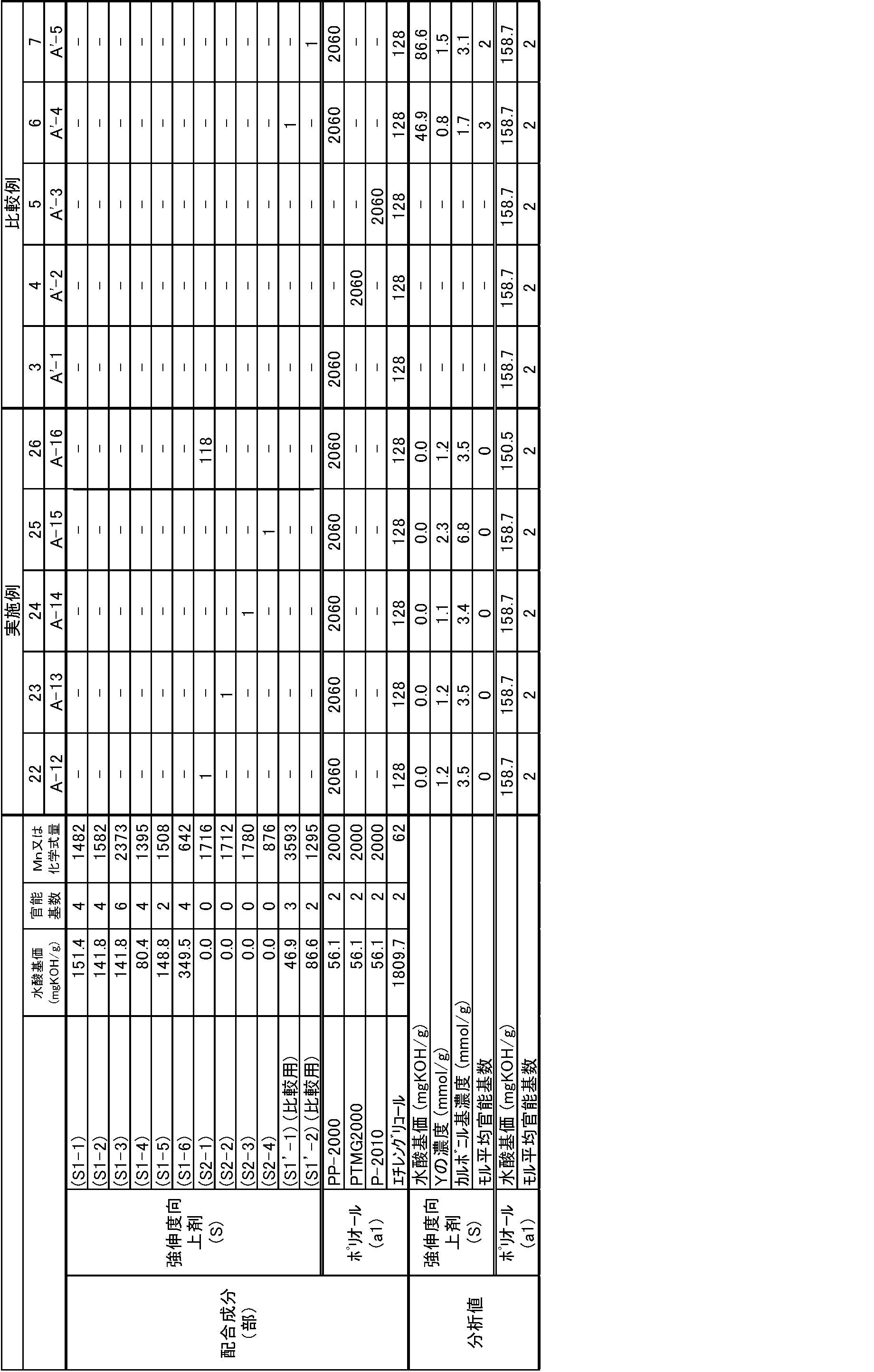
- Table 1 shows the analysis results of the compounds obtained in Examples 1 to 10 and Comparative Examples 1 and 2.
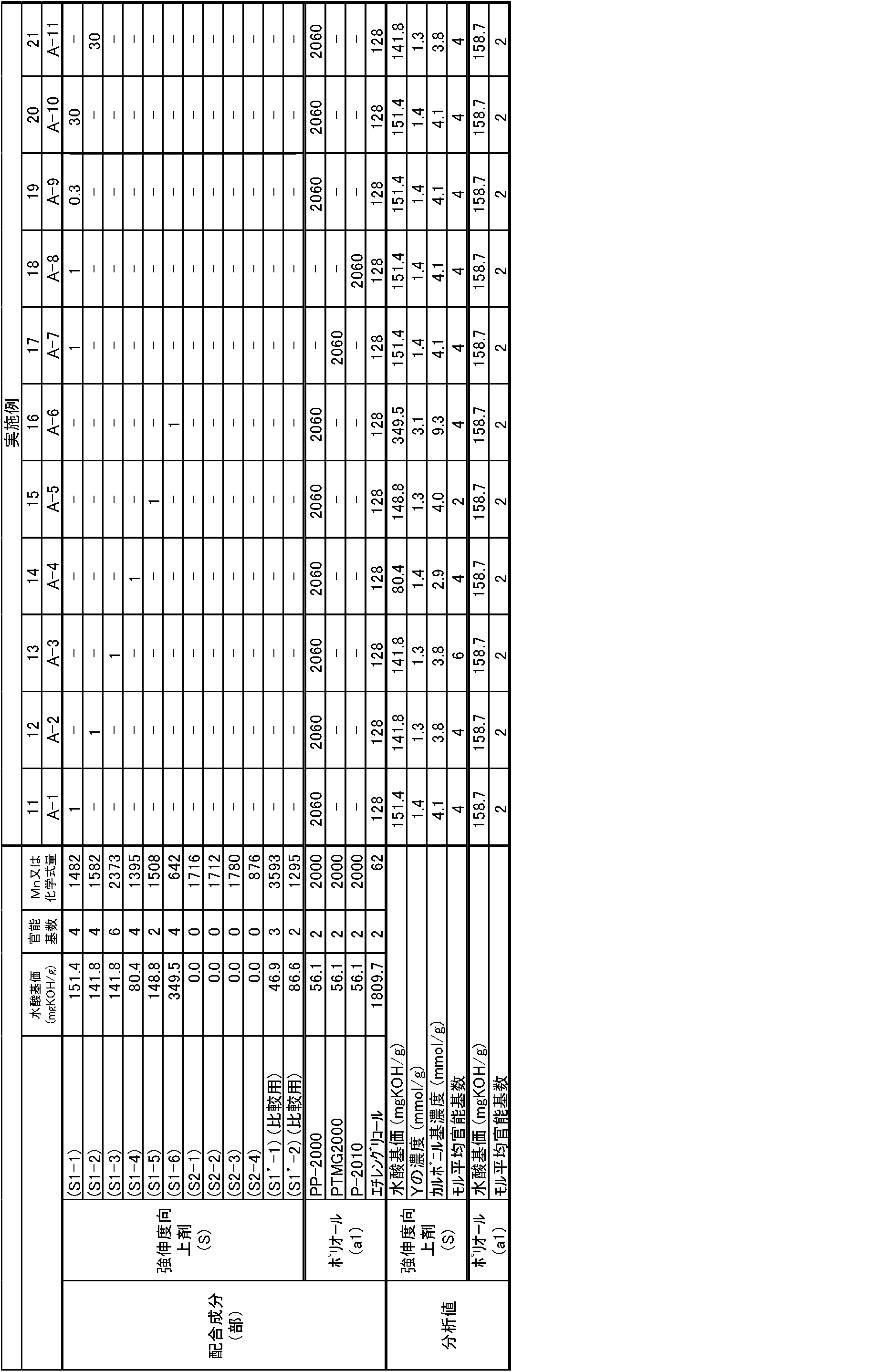
- compositions of PP-2000, PTMG2000 and P-2010 in Table 2-1 and Table 2-2 are as follows.
- PP-2000 Polyoxypropylene polyol having a molar average functional group number of 2.0 and a hydroxyl value of 56.1 obtained by adding PO to propylene glycol (“SANNICS PP-2000” manufactured by Sanyo Chemical Industries, Ltd.)
- PTMG2000 polytetramethylene ether glycol, molar average functional group number 2.0, hydroxyl value 56.1
- P-2010 Polyester polyol, molar average functional group number 2.0, hydroxyl value 56.1 (“Kuraray Polyol P-2010” manufactured by Kuraray Co., Ltd.)
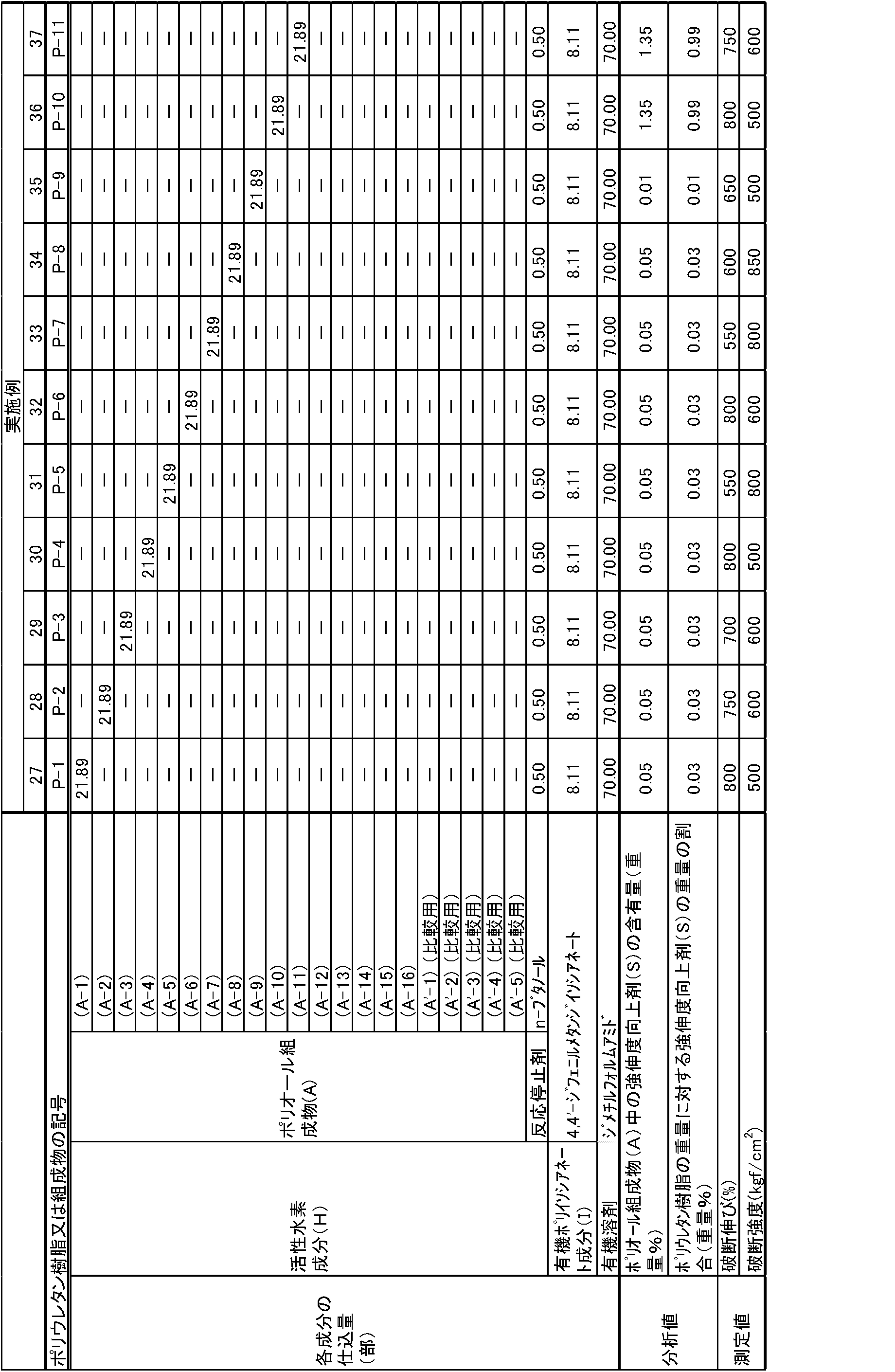
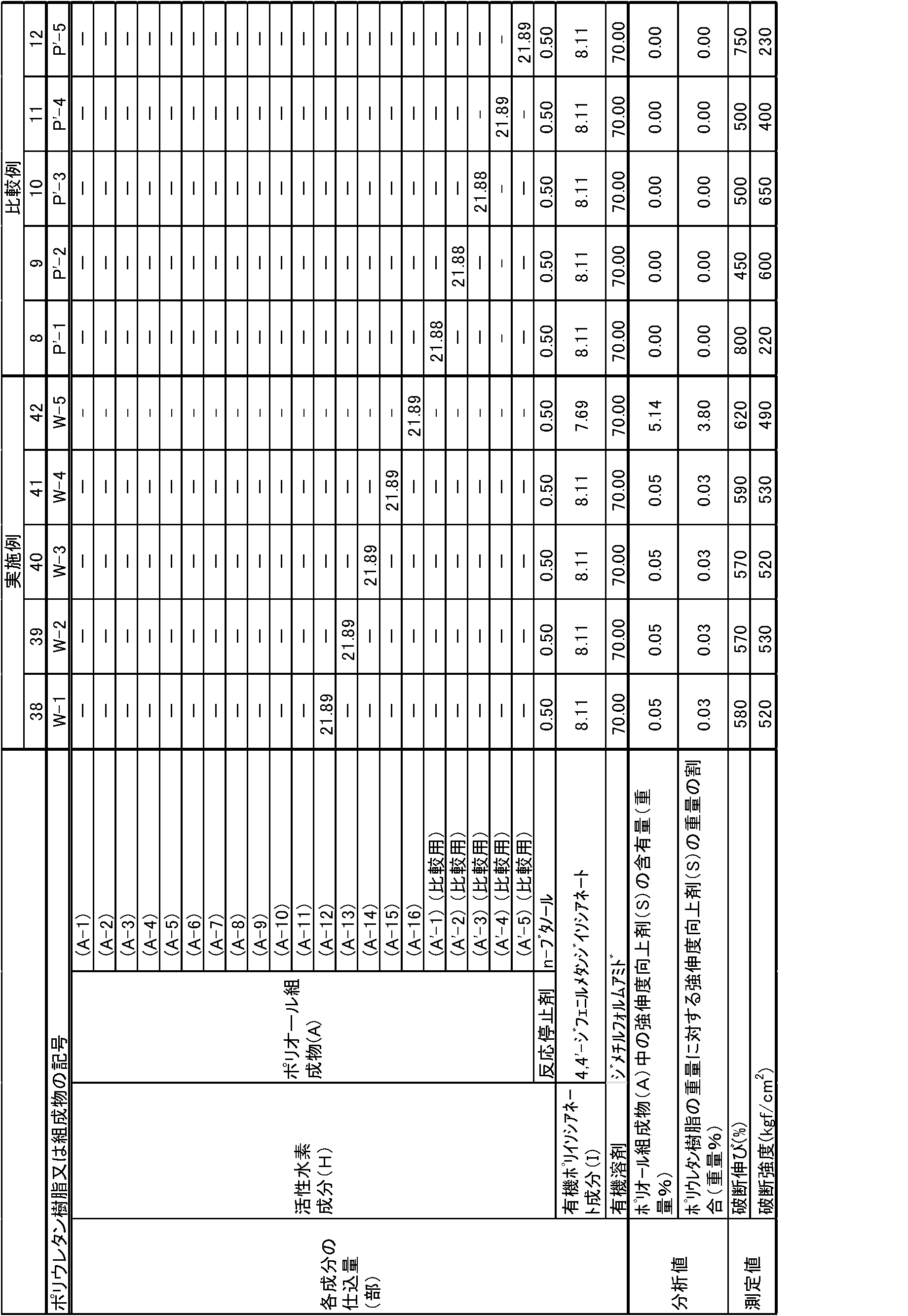
- Examples 27 to 42 and Comparative Examples 8 to 12 In a reaction vessel equipped with a stirrer and a thermometer, the polyol composition (A), the organic polyisocyanate component (I) and the organic component of the active hydrogen component (H) in the number of parts shown in Table 3-1 and Table 3-2
- a solution of the polyurethane resins (P-1) to (P-11) of the present invention is prepared by adding a solvent and reacting at 70 ° C. in a dry nitrogen atmosphere for 12 hours, and then adding a reaction terminator and carrying out a terminal termination reaction for 1 hour. Then, solutions of polyurethane resin compositions (W-1) to (W-5) and comparative polyurethane resins (P′-1) to (P′-5) were obtained.
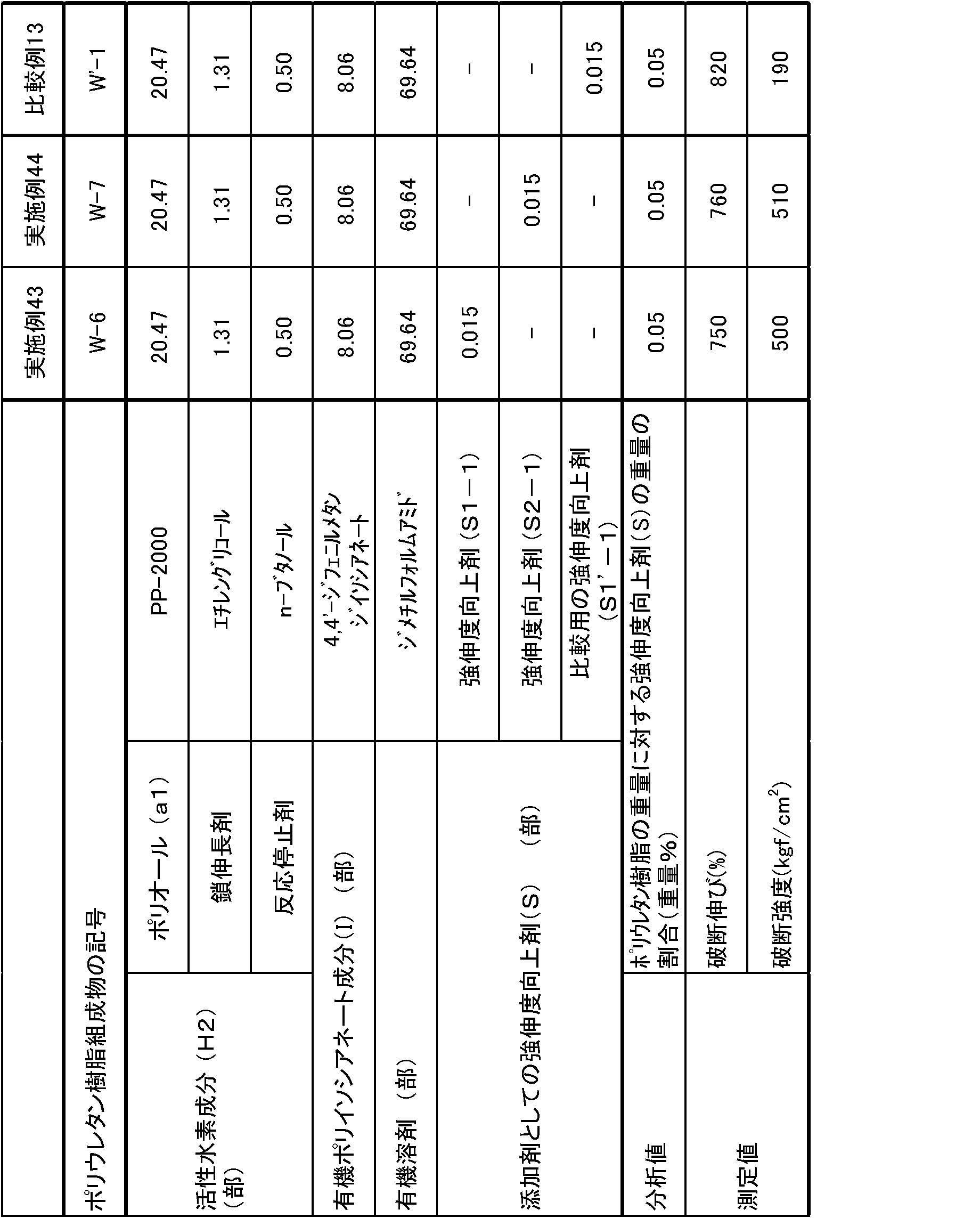
- Examples 43 to 44 and Comparative Example 13 A reaction vessel equipped with a stirrer and a thermometer is charged with the polyol (a1), the chain extender, the organic polyisocyanate component (I) and the organic solvent in the number of active hydrogen components (H2) shown in Table 4 and dried. After reacting at 70 ° C. for 10 hours in a nitrogen atmosphere, a reaction terminator was added to conduct a terminal termination reaction for 1 hour. Thereafter, a strong elongation improver (S) as an additive shown in Table 4 was added to the polyurethane resin compositions (W-6) to (W-7) and a comparative polyurethane resin composition (W′- 1) was obtained.
- S strong elongation improver
- the polyurethane resin solution and polyurethane resin composition obtained above were cast on a glass plate so that the film thickness after drying was 200 ⁇ m, dried by circulating air at 60 ° C. for 3 hours, and further at 60 ° C., gauge After drying under reduced pressure at a pressure of about ⁇ 0.1 MPa for 3 hours, the resin was allowed to stand overnight in a constant temperature and humidity chamber at 25 ° C. and 50% humidity, and the breaking strength and breaking elongation of the resin were measured according to JIS K 7311.
- the measurement results were obtained by comparing the content of the strong elongation improver (S) in the polyol composition (A) and the weight of the strong elongation improver (S) with respect to the weight of the polyurethane resin [the strong elongation improver for comparison (S Table 3-1, Table 3-2 and Table 4 show the ratio (% by weight)] excluding the weight of ').
- the polyurethane resin and polyurethane resin composition using the strong elongation improver (S) of the present invention are superior in strength and elongation (breaking strength and breaking elongation) compared to conventional ones. Therefore, it is particularly useful for synthetic leather used in the manufacture of bags and shoes.
Landscapes
- Chemical & Material Sciences (AREA)
- Chemical Kinetics & Catalysis (AREA)
- Health & Medical Sciences (AREA)
- Medicinal Chemistry (AREA)
- Polymers & Plastics (AREA)
- Organic Chemistry (AREA)
- Polyurethanes Or Polyureas (AREA)
- Dispersion Chemistry (AREA)
- Engineering & Computer Science (AREA)
- Textile Engineering (AREA)
- Synthetic Leather, Interior Materials Or Flexible Sheet Materials (AREA)
Abstract
Description
また、一般式(1)で表される強伸度向上剤(S)をポリウレタン樹脂に添加することにより、破断伸度及び破断強度等の機械物性に優れる合成皮革用ポリウレタン樹脂組成物を得ることができる。
X2を構成するために用いられる活性水素含有化合物としては、上述のX1で示した活性水素含有化合物と同様の物が挙げられ、X2とX1はそれぞれ同一でも異なっていてもよいが、ポリウレタン樹脂の破断強度及び破断伸びの観点から、X1と少なくとも1つのX2とは異なる基であることが好ましい。
また、X2の価数はポリウレタン樹脂の破断強度及び破断伸びの観点から、通常1~20であり、好ましくは1~8、更に好ましくは1~4、特に好ましくは1~2、最も好ましくは2である。
尚、強伸度向上剤(S)の製造に当たっては、これらのエステル形成性誘導体[酸無水物、低級アルキル(炭素数1~4)エステル(メチルエステル、エチルエステル及びイソプロピルエステル等)及び酸ハライド(酸のクロライド等)]を用いることもできる。
尚、強伸度向上剤(S)の水酸基価が0とは、一般式(1)におけるX1、X2及びYが全て水酸基を有しないことを意味する。
本発明におけるモル平均官能基数は、組成物中の各成分の活性水素を有する官能基の数に各成分のモル数を乗じた値の総和を各成分のモル数の総和で除した値であり、各成分のモル数は各成分の重量を各成分の分子量で除した値である。計算に用いる分子量としては、低分子化合物の様に分子量に分布がない場合は化学式量を、分子量に分布がある場合は数平均分子量(以下、Mnと略記)を用いる。本発明における強伸度向上剤(S)及びポリオールのMnは、THFを溶剤として用い、ポリオキシプロピレングリコールを標準物質としてゲルパーミエーションクロマトグラフィーにより測定される。サンプル濃度は0.25重量%、カラム固定相はTSKgel SuperH2000、TSKgel SuperH3000、TSKgel SuperH4000(いずれも東ソー株式会社製)を各1本連結したもの、カラム温度は40℃とすればよい。
尚、上記ポリオール(a1)における炭素数2~20の多価アルコール等も鎖伸長剤として機能する。
変性ポリイソシアネートの具体例としては、カルボジイミド変性MDI等が挙げられる。
撹拌装置、温度制御装置付きのステンレス製オートクレーブに、プロピレングリコールのPO/EOブロック付加物(三洋化成工業株式会社製「サンニックスPL-910」;Mn900、水酸基価124.7)900.0部、無水トリメリット酸384.0部及びアルカリ触媒(N-エチルモルホリン)2.0部を仕込み、窒素雰囲気下、0.20MPa、130±10℃で5時間反応させ酸無水物基部分のハーフエステル化を行い、プロピレングリコールのPO/EOブロック付加物1モルに無水トリメリット酸が2モル反応したエステル化合物を得た。続いてEO198.0部を100±10℃で、圧力が0.50MPa以下となるよう制御しながら、5時間かけて滴下した後、100±10℃で1時間熟成して、前記エステル化合物のカルボキシル基にEOを付加させた強伸度向上剤(S1-1)を得た。
プロピレングリコールPO/EOブロック付加物900.0部をポリテトラメチレンエーテルグリコール(三菱化学株式会社製「PTMG1000」;Mn1000、水酸基価112.2)1000.0部に変更する以外は実施例1と同様にして強伸度向上剤(S1-2)を得た。
プロピレングリコールのPO/EOブロック付加物900.0部をポリオキシプロピレントリオール(三洋化成工業株式会社製「サンニックスGP-1500」;Mn1500、水酸基価112.2)1500.0部に、無水トリメリット酸の仕込量を576.0部に、EOの仕込み量を297.0部に変更する以外は実施例1と同様にして強伸度向上剤(S1-3)を得た。
プロピレングリコールのPO/EOブロック付加物900.0部をポリプロピレングリコール(三洋化成工業株式会社製「サンニックスPP-1000」;Mn1000、水酸基価112.2)1000.0部に、EOの仕込み量を101.2部に変更する以外は実施例1と同様にして強伸度向上剤(S1-4)を得た。
撹拌装置、温度制御装置付きのステンレス製オートクレーブに、ジエチレングリコールモノブチルエーテル324.0部、無水ピロメリット酸218.0部、溶媒としてのジメチルホルムアミド542.0部、及びアルカリ触媒(N-エチルモルホリン)2.0部を仕込み、窒素雰囲気下、0.20MPa、25±10℃で5時間反応させ酸無水物基部分のハーフエステル化を行い無水ピロメリット酸1モルにジエチレングリコールモノブチルエーテルが2モル反応したエステル化合物を得た。続いてEO198.0部を50±10℃で、圧力が0.50MPa以下となるよう制御しながら、5時間かけて滴下した後、50±10℃で1時間熟成し、ジメチルホルムアミドを、100℃±10℃で、圧力が-0.1MPaとなるように制御しながら5時間かけて除去して、前記エステル化合物のカルボキシル基にEOを付加させた強伸度向上剤(S1-5)を得た。
撹拌装置、温度制御装置付きのステンレス製オートクレーブに、エチレンジアミン60.0部、無水トリメリット酸384.0部、アルカリ触媒(N-エチルモルホリン)1.0部及び溶媒としてのTHF219部を仕込み、窒素雰囲気下、80±10℃で2時間反応させ酸無水物基部分のハーフアミド化を行い、エチレンジアミン1モルに無水トリメリット酸が2モル反応したアミド化合物を得た。続いてEO198.0部を80±10℃で、圧力が0.50MPa以下となるよう制御しながら、5時間かけて滴下した後、80±10℃で1時間熟成し、80±10℃、10kPaで溶媒を留去することにより、前記アミド化合物のカルボキシル基にEOを付加させた強伸度向上剤(S1-6)を得た。
撹拌装置、温度制御装置付きのステンレス製オートクレーブに、プロピレングリコールのPO/EOブロック付加物(三洋化成工業株式会社製「サンニックスPL-910」;Mn900、水酸基価124.7)900.0部、無水トリメリット酸384.0部、アルカリ触媒(N-エチルモルホリン)1.0部及びトルエン460部を仕込み、窒素雰囲気下、0.20MPa、130±10℃で5時間反応させ酸無水物基部分のハーフエステル化を行い、プロピレングリコールのPO/EOブロック付加物1モルに無水トリメリット酸が2モル反応したエステル化合物を得た。続いてベンジルアルコール432.0部を加え、95±5℃、0.06MPa以下となるように制御し、揮発するトルエンと水を冷却器で凝縮させ、トラップで分離したトルエンを反応容器に連続的に戻しながら6時間反応させた。反応後、80±10℃、10kPaで溶媒を留去することにより、前記エステル化合物のカルボキシル基をベンジルオキシカルボニル基とした強伸度向上剤(S2-1)を得た。
ベンジルアルコール432.0部を、ベンジルアミン428.0部に変更する以外は実施例7と同様にして強伸度向上剤(S2-2)を得た。
ベンジルアルコール432.0部を、ベンジルチオール496.0部に変更する以外は実施例7と同様にして強伸度向上剤(S2-3)を得た。
撹拌装置、温度制御装置付きのステンレス製オートクレーブに、エチレンジアミン60.0部、無水トリメリット酸384部、アルカリ触媒(N-エチルモルホリン)1.0部及び溶媒としてのトルエン460部を仕込み、窒素雰囲気下、80±10℃で2時間反応させ酸無水物基部分のハーフアミド化を行い、エチレンジアミン1モルに無水トリメリット酸が2モル反応したアミド化合物を得た。続いてベンジルアルコール432.0部を加え、95±5℃、0.06MPa以下となるように制御し、揮発するトルエンと水を冷却器で凝縮させ、トラップで分離したトルエンを反応容器に連続的に戻しながら6時間反応させた。反応後、80±10℃、10kPaで溶媒を留去することにより、前記アミド化合物のカルボキシル基をベンジルオキシカルボニル基とした強伸度向上剤(S2-4)を得た。
プロピレングリコールのPO/EOブロック付加物900.0部をポリオキシプロピレントリオール(三洋化成工業株式会社製「サンニックスGP-3000」;Mn3200、水酸基価52.6)3200.0部に、無水トリメリット酸384.0部を無水フタル酸444部に、EOの仕込み量を149.0部に変更する以外は実施例1と同様にして比較用の強伸度向上剤(S1’-2)を得た。
無水トリメリット酸384.0部を無水フタル酸296部に、EOの仕込み量を99.0部に変更する以外は実施例1と同様にして比較用の強伸度向上剤(S1’-2)を得た。
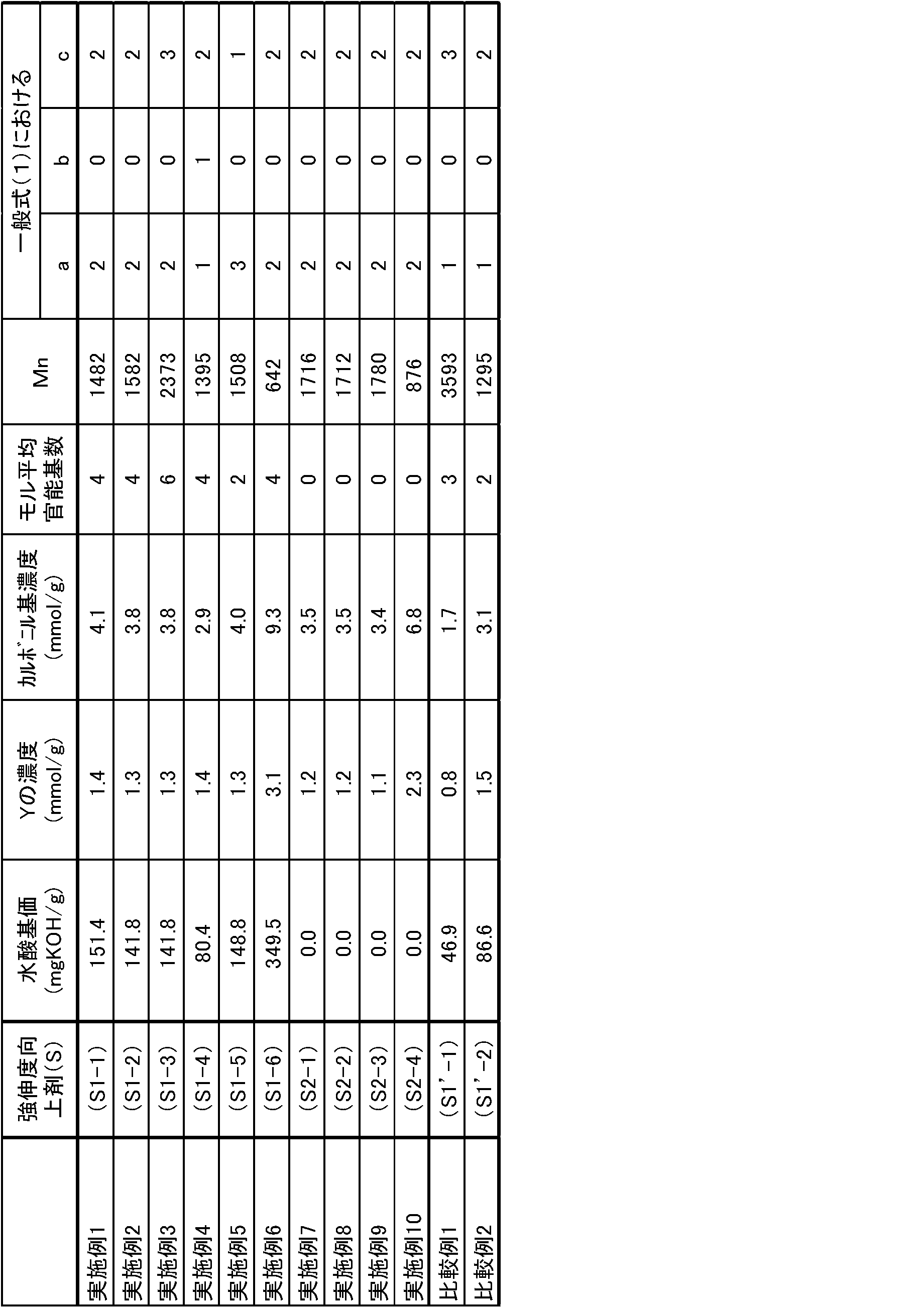
表2-1及び表2-2に示す配合処方に従って、強伸度向上剤(S)とポリオール(a1)を容器に仕込み、60℃で15分攪拌して、本発明のポリオール組成物(A-1)~(A-16)及び比較用のポリオール組成物(A’-1)~(A’-5)を得た。強伸度向上剤(S)とポリオール(a1)の分析値を表2-1及び表2-2に示す。
・PP-2000:プロピレングリコールにPOを付加させて得られたモル平均官能基数2.0、水酸基価56.1のポリオキシプロピレンポリオール(三洋化成工業株式会社製「サンニックスPP-2000」)
・PTMG2000:ポリテトラメチレンエーテルグリコール、モル平均官能基数2.0、水酸基価56.1(三菱化学株式会社製「PTMG2000」)
・P-2010:ポリエステルポリオール、モル平均官能基数2.0、水酸基価56.1(株式会社クラレ製「クラレポリオールP-2010」)
撹拌機及び温度計を備えた反応容器に、表3-1及び表3-2に示す部数の活性水素成分(H)の内のポリオール組成物(A)、有機ポリイソシアネート成分(I)及び有機溶剤を仕込み、乾燥窒素雰囲気下、70℃で12時間反応後、反応停止剤を仕込んで1時間末端停止反応を行うことにより本発明のポリウレタン樹脂(P-1)~(P-11)の溶液、ポリウレタン樹脂組成物(W-1)~(W-5)及び比較用のポリウレタン樹脂(P’-1)~(P’-5)の溶液を得た。
撹拌機及び温度計を備えた反応容器に、表4に示す部数の活性水素成分(H2)の内のポリオール(a1)、鎖伸長剤、有機ポリイソシアネート成分(I)及び有機溶剤を仕込み、乾燥窒素雰囲気下、70℃で10時間反応後、反応停止剤を仕込んで1時間末端停止反応を行った。その後、表4に示す添加剤としての強伸度向上剤(S)を添加して、ポリウレタン樹脂組成物(W-6)~(W-7)及び比較用のポリウレタン樹脂組成物(W’-1)を得た。
Claims (14)
- 一般式(1)で表される合成皮革用ポリウレタン樹脂に用いられる強伸度向上剤(S)。

- 前記3価以上の芳香族ポリカルボン酸が、前記芳香環を構成し置換基が結合していない炭素原子に隣接する2個の炭素原子にカルボキシル基が結合した構造を有する請求項1記載の強伸度向上剤。
- 前記カルボキシル基が結合した炭素原子に隣接する炭素原子の少なくとも一方に更にカルボキシル基が結合した構造を有する請求項2記載の強伸度向上剤。
- 前記3価以上の芳香族ポリカルボン酸が、トリメリット酸及び/又はピロメリット酸である請求項1記載の強伸度向上剤。
- 前記一般式(1)におけるcが2である請求項1~4のいずれか記載の強伸度向上剤。
- 水酸基価が0又は70~500mgKOH/gである請求項1~5のいずれか記載の強伸度向上剤。
- 前記強伸度向上剤(S)におけるYの濃度が、1.0~3.5mmol/gである請求項1~6のいずれか記載の強伸度向上剤。
- 前記強伸度向上剤(S)のカルボニル基濃度が、2.0~10.0mmol/gである請求項1~7のいずれか記載の強伸度向上剤。
- 請求項1~8のいずれか記載の強伸度向上剤(S)と、水酸基価が20~2000mgKOH/gであり、モル平均官能基数が2~8である前記強伸度向上剤(S)以外のポリオール(a1)とを含有することを特徴とする合成皮革用ポリウレタン樹脂に用いられるポリオール組成物(A)。
- 前記強伸度向上剤(S)の含有量が、前記ポリオール組成物(A)の重量を基準として0.01~10重量%である請求項9記載のポリオール組成物。
- 前記ポリオール(a1)が、炭素数2~20の多価アルコール、単環多価フェノール又はビスフェノールの水酸基に炭素数2~4のアルキレンオキサイドが水酸基1個当たり1モル付加したポリオール、ポリエーテルポリオール、ポリエステルポリオール、シリコンポリオール、重合体ポリオール、ポリジエンポリオール、ポリジエンポリオールの水添物、アクリル系ポリオール、天然油系ポリオール及び天然油系ポリオールの変性物からなる群から選ばれる少なくとも1種類のポリオールである請求項9又は10記載のポリオール組成物。
- 前記ポリオール(a1)のモル平均官能基数が2である請求項9~11のいずれか記載のポリオール組成物。
- 請求項9~12のいずれか記載のポリオール組成物を含有する活性水素成分(H)と有機ポリイソシアネート成分(I)とを反応させて得られるポリウレタン樹脂であって、前記ポリオール組成物中の前記一般式(1)で表される強伸度向上剤(S)が少なくとも一つの活性水素を有する強伸度向上剤(S1)である合成皮革用ポリウレタン樹脂。
- 請求項1~8のいずれか記載の強伸度向上剤(S)とポリウレタン樹脂とを含有する合成皮革用ポリウレタン樹脂組成物。
Priority Applications (3)
| Application Number | Priority Date | Filing Date | Title |
|---|---|---|---|
| JP2013511996A JP5650839B2 (ja) | 2011-04-27 | 2012-04-10 | 合成皮革用ポリウレタン樹脂に用いられる強伸度向上剤並びにこれを用いたポリオール組成物及びポリウレタン樹脂 |
| KR1020137030431A KR101538257B1 (ko) | 2011-04-27 | 2012-04-10 | 합성 피혁용 폴리우레탄 수지에 사용되는 강신도 향상제 그리고 이것을 사용한 폴리올 조성물 및 폴리우레탄 수지 |
| CN201280018732.2A CN103534286B (zh) | 2011-04-27 | 2012-04-10 | 合成皮革用聚氨酯树脂中所用的强伸度提高剂以及使用其的多元醇组合物和聚氨酯树脂 |
Applications Claiming Priority (4)
| Application Number | Priority Date | Filing Date | Title |
|---|---|---|---|
| JP2011-099606 | 2011-04-27 | ||
| JP2011099606 | 2011-04-27 | ||
| JP2011182065 | 2011-08-23 | ||
| JP2011-182065 | 2011-08-23 |
Publications (1)
| Publication Number | Publication Date |
|---|---|
| WO2012147508A1 true WO2012147508A1 (ja) | 2012-11-01 |
Family
ID=47072031
Family Applications (1)
| Application Number | Title | Priority Date | Filing Date |
|---|---|---|---|
| PCT/JP2012/059765 Ceased WO2012147508A1 (ja) | 2011-04-27 | 2012-04-10 | 合成皮革用ポリウレタン樹脂に用いられる強伸度向上剤並びにこれを用いたポリオール組成物及びポリウレタン樹脂 |
Country Status (5)
| Country | Link |
|---|---|
| JP (1) | JP5650839B2 (ja) |
| KR (1) | KR101538257B1 (ja) |
| CN (1) | CN103534286B (ja) |
| TW (1) | TWI486499B (ja) |
| WO (1) | WO2012147508A1 (ja) |
Cited By (1)
| Publication number | Priority date | Publication date | Assignee | Title |
|---|---|---|---|---|
| JP2013060582A (ja) * | 2011-08-23 | 2013-04-04 | Sanyo Chem Ind Ltd | ポリウレタン樹脂水分散体 |
Citations (3)
| Publication number | Priority date | Publication date | Assignee | Title |
|---|---|---|---|---|
| JPS5131747A (ja) * | 1974-09-12 | 1976-03-18 | Toray Industries | |
| JPH07165860A (ja) * | 1991-12-09 | 1995-06-27 | Basf Ag | ポリウレタン含有水性分散液および該分散液で被覆された物体 |
| WO2011105028A1 (ja) * | 2010-02-23 | 2011-09-01 | 三洋化成工業株式会社 | ポリウレタンフォーム製造用強度向上剤 |
Family Cites Families (6)
| Publication number | Priority date | Publication date | Assignee | Title |
|---|---|---|---|---|
| JPS6131747A (ja) * | 1984-07-24 | 1986-02-14 | Toyota Motor Corp | 車両用自動変速機の変速制御方法 |
| JPH07166860A (ja) * | 1993-12-15 | 1995-06-27 | Nippondenso Co Ltd | 車両用冷却装置 |
| JPH08311183A (ja) * | 1995-05-17 | 1996-11-26 | Mitsui Toatsu Chem Inc | エステルポリオールおよびその製造方法 |
| CA2471252A1 (en) * | 2001-12-18 | 2003-06-26 | Henkel Kommanditgesellschaft Auf Aktien | Method for producing polyurethane prepolymers having a low content of monomers |
| CN101641384B (zh) * | 2007-03-19 | 2013-09-11 | 巴斯夫欧洲公司 | 制备聚氨酯夹层部件的聚氨酯体系 |
| US9452688B2 (en) * | 2009-02-27 | 2016-09-27 | Mark A. Williams | Magnetic rail bond |
-
2012
- 2012-04-10 JP JP2013511996A patent/JP5650839B2/ja not_active Expired - Fee Related
- 2012-04-10 CN CN201280018732.2A patent/CN103534286B/zh not_active Expired - Fee Related
- 2012-04-10 WO PCT/JP2012/059765 patent/WO2012147508A1/ja not_active Ceased
- 2012-04-10 KR KR1020137030431A patent/KR101538257B1/ko not_active Expired - Fee Related
- 2012-04-26 TW TW101114821A patent/TWI486499B/zh not_active IP Right Cessation
Patent Citations (3)
| Publication number | Priority date | Publication date | Assignee | Title |
|---|---|---|---|---|
| JPS5131747A (ja) * | 1974-09-12 | 1976-03-18 | Toray Industries | |
| JPH07165860A (ja) * | 1991-12-09 | 1995-06-27 | Basf Ag | ポリウレタン含有水性分散液および該分散液で被覆された物体 |
| WO2011105028A1 (ja) * | 2010-02-23 | 2011-09-01 | 三洋化成工業株式会社 | ポリウレタンフォーム製造用強度向上剤 |
Cited By (1)
| Publication number | Priority date | Publication date | Assignee | Title |
|---|---|---|---|---|
| JP2013060582A (ja) * | 2011-08-23 | 2013-04-04 | Sanyo Chem Ind Ltd | ポリウレタン樹脂水分散体 |
Also Published As
| Publication number | Publication date |
|---|---|
| TW201245540A (en) | 2012-11-16 |
| JP5650839B2 (ja) | 2015-01-07 |
| CN103534286A (zh) | 2014-01-22 |
| KR20140002060A (ko) | 2014-01-07 |
| JPWO2012147508A1 (ja) | 2014-07-28 |
| KR101538257B1 (ko) | 2015-07-20 |
| TWI486499B (zh) | 2015-06-01 |
| CN103534286B (zh) | 2015-05-20 |
Similar Documents
| Publication | Publication Date | Title |
|---|---|---|
| JP5663478B2 (ja) | 芳香族ポリエステル、それを含むポリオールブレンド、及びそれから得られる製品 | |
| JP5689482B2 (ja) | 透湿防水素材用ポリウレタン樹脂及びポリウレタン樹脂組成物 | |
| KR20130028069A (ko) | 폴리옥시알킬렌알코올 및 폴리우레탄 수지 및 이를 함유하는 코팅제 | |
| JP6582363B2 (ja) | 接着剤組成物及びその製造方法 | |
| JP5753836B2 (ja) | ポリウレタンフォーム製造用強度向上剤 | |
| JP2013147614A (ja) | ポリウレタン樹脂 | |
| JP2013018845A (ja) | ポリウレタンフォームの製造方法 | |
| JP5723710B2 (ja) | ポリウレタンフォーム製造用ポリオール組成物 | |
| JP5650839B2 (ja) | 合成皮革用ポリウレタン樹脂に用いられる強伸度向上剤並びにこれを用いたポリオール組成物及びポリウレタン樹脂 | |
| JP5723706B2 (ja) | 半硬質ポリウレタンフォームの製造方法 | |
| JP5394545B2 (ja) | ポリウレタン系シーラント及びそれに用いられるポリオール組成物 | |
| JP6601029B2 (ja) | 接着剤組成物 | |
| JP6419546B2 (ja) | 軟質ポリウレタンスラブフォームの製造方法 | |
| JP5463231B2 (ja) | 軟質ポリウレタンスラブフォームの製造方法 | |
| JP2013133392A (ja) | ポリウレタン樹脂 | |
| JP2013036033A (ja) | ポリウレタンフォーム製造用ポリオール組成物 | |
| CN110804382A (zh) | 热固化型涂覆剂、固化物以及膜 | |
| JP5475065B2 (ja) | ポリウレタンフォーム製造用強度向上剤 | |
| JP2013028721A (ja) | 軟質ポリウレタンスラブフォーム | |
| JP2012214784A (ja) | ポリウレタンフォーム製造用ポリオール組成物 | |
| JP2013023682A (ja) | 硬質ポリウレタンフォーム | |
| JP3344798B2 (ja) | 末端イソシアナートプレポリマーの製造方法 | |
| JP2013087261A (ja) | ポリウレタンフォーム製造用ポリオール組成物及びこれを用いたポリウレタンフォームの製造方法 | |
| JPH11228662A (ja) | 硬質スプレーフォーム用ポリイソシアネート | |
| JP2000026568A (ja) | 硬質スプレーフォーム用ポリイソシアネート |
Legal Events
| Date | Code | Title | Description |
|---|---|---|---|
| 121 | Ep: the epo has been informed by wipo that ep was designated in this application |
Ref document number: 12776697 Country of ref document: EP Kind code of ref document: A1 |
|
| ENP | Entry into the national phase |
Ref document number: 2013511996 Country of ref document: JP Kind code of ref document: A |
|
| NENP | Non-entry into the national phase |
Ref country code: DE |
|
| ENP | Entry into the national phase |
Ref document number: 20137030431 Country of ref document: KR Kind code of ref document: A |
|
| 122 | Ep: pct application non-entry in european phase |
Ref document number: 12776697 Country of ref document: EP Kind code of ref document: A1 |