WO2012133108A1 - 2-アルケニルエーテル化合物の製造方法 - Google Patents
2-アルケニルエーテル化合物の製造方法 Download PDFInfo
- Publication number
- WO2012133108A1 WO2012133108A1 PCT/JP2012/057338 JP2012057338W WO2012133108A1 WO 2012133108 A1 WO2012133108 A1 WO 2012133108A1 JP 2012057338 W JP2012057338 W JP 2012057338W WO 2012133108 A1 WO2012133108 A1 WO 2012133108A1
- Authority
- WO
- WIPO (PCT)
- Prior art keywords
- group
- compound
- carbon atoms
- acetate
- transition metal
- Prior art date
- Legal status (The legal status is an assumption and is not a legal conclusion. Google has not performed a legal analysis and makes no representation as to the accuracy of the status listed.)
- Ceased
Links
Classifications
-
- C—CHEMISTRY; METALLURGY
- C07—ORGANIC CHEMISTRY
- C07C—ACYCLIC OR CARBOCYCLIC COMPOUNDS
- C07C41/00—Preparation of ethers; Preparation of compounds having groups, groups or groups
- C07C41/01—Preparation of ethers
- C07C41/16—Preparation of ethers by reaction of esters of mineral or organic acids with hydroxy or O-metal groups
-
- C—CHEMISTRY; METALLURGY
- C07—ORGANIC CHEMISTRY
- C07C—ACYCLIC OR CARBOCYCLIC COMPOUNDS
- C07C2601/00—Systems containing only non-condensed rings
- C07C2601/12—Systems containing only non-condensed rings with a six-membered ring
- C07C2601/14—The ring being saturated
Definitions
- the present invention relates to a method for producing a 2-alkenyl ether compound typified by allyl ether. More specifically, a 2-alkenyl ether compound can be obtained with high efficiency by reacting a compound having a hydroxyl group and a compound having a 2-alkenyl group with a specific transition metal complex in the presence of a ligand. Regarding the method.
- Glycidyl ether compounds known as raw materials for epoxy resins are industrially produced on a large scale and are widely used in various fields.
- Non-Patent Document 1 As a conventional reaction example of allylation of alcohol or phenols, as an example using a palladium catalyst, a method of allylating phenol, which is an active hydrogen-containing compound, with allyl acetate, which is an allylating agent, is disclosed in Non-Patent Document 1, for example.
- Patent Document 1 US Pat. No. 4,507,492
- Non-Patent Document 2 S. Sivaram et al., Macromolecular Reports, A32 (Suppl. 7), pp.
- Non-Patent Document 3 (A. Mortreux et al., J. Chem. Soc., Chem. Commun., Pp. 1863-1864 (1995)) describes acetic acid as an allylating agent.
- a method of allylating phenol, which is an active hydrogen-containing compound, with allyl is described.
- the stoichiometric amount relative to the allylating agent is generally used for the purpose of capturing by-products derived from the allylating agent. Since a basic compound more than the stoichiometric amount is required, the production cost is increased. Moreover, it is necessary to remove these basic compounds from the target allyl ether compound.
- the allylating agent is converted into a salt with a basic compound, for example, when allyl acetate is used as the allylating agent, the by-product acetate salt is returned to acetic acid and the allyl acetate recycling step is performed. Circulation takes time and is industrially disadvantageous.
- Patent Document 2 Japanese Patent Publication No. 2006-501209
- Non-Patent Document 4 F. Ozawa et al., J. Am. Chem. Soc., 124, pp. 10968-10969 (2002)
- the former is non-uniform.
- An example of allylation using a transition metal complex salt (palladium salt) and a phosphorus ligand as a catalyst is disclosed, but the stability of the phosphorus ligand itself to an oxidizing agent is low.
- triphenylphosphine which is a typical example of a phosphorus-based ligand
- phosphorus-based ligands have complicated synthesis routes and are difficult to industrialize.
- Patent Document 3 Japanese Patent Application Laid-Open No. 2004-107339 discloses a method for producing allyl ethers in the presence of a Group 8-10 transition metal complex having a multidentate chelate-type phosphite ligand.
- allyl alcohol and alcohol can be dehydrated and condensed and converted directly to allyl ether, but diallyl ether formation by homocoupling of allyl alcohols and isomerization of allyl alcohol are easy to proceed. It cannot be used effectively in the reaction system.
- the Claisen rearrangement is caused in the produced allyl ether compound, the by-product formation of a C-allylic compound different from the target product is a cause of yield reduction.
- Non-Patent Document 5 (Y. Ishii et al., J. Org. Chem., 69, pp. 3474-3477 (2004)) uses a carboxylic acid allyl ester as an allylating agent and a cationic iridium complex for alcohol. Discloses a method for producing allyl ethers. By this method, allyl ether can be obtained from carboxylic acid allyl ester and alcohol accompanied by elimination of carboxylic acid, but transesterification reaction between carboxylic acid allyl ester and alcohol, formation of aldehyde by Openauer oxidation of alcohol, And the Tishchenko reaction for the resulting aldehyde also competes, so the yield of the target is generally low. Attempts have been made to increase the allylation efficiency by using an excessive amount of an allylating agent, but it is necessary to add more than 10 times the amount of alcohol, which is inefficient and desirable from the environmental aspect. I can't say that.
- Patent Document 4 Japanese Patent Laid-Open No. 2005-289977 discloses a method for producing allyl ethers in the presence of a cyclopentadienyl ruthenium complex having an ⁇ -imino acid type ligand or an ⁇ -amino acid type ligand. is doing. According to this method, allyl ether can be produced dehydratingly from allyl alcohol and alcohol without using any additive. The co-product is only water and is a very efficient method in harmony with the environment. However, allyl alcohol, which is an allylating agent, is highly toxic and it is not preferable to use it in a large amount in view of industrial reasons. Moreover, depending on the type of alcohol, the yield of allyl ether, which is the target product, is low because of the low detachability of the water that is the coproduct.
- An object of the present invention is to provide a method for efficiently producing a corresponding 2-alkenyl ether compound using a compound having a hydroxyl group and a 2-alkenylating agent other than allyl alcohol as starting materials.
- the present inventors have obtained a compound having a hydroxyl group from a complexing agent and a monovalent anionic 5-membered substance using a specific 2-alkenylating agent. It has been found that 2-alkenyl ether compounds can be efficiently obtained by 2-alkenylation in the presence of a catalyst (transition metal complex) comprising a transition metal precursor stabilized by a ring conjugated diene compound. It came to complete.
- a catalyst transition metal complex
- X represents any substituent selected from the group consisting of NO 2 —, RO—, RS (O) 2 O—, RCOO—, and ROCOO— (where R is an organic group having 1 to 30 carbon atoms).
- the catalyst arranges a complexing agent having a nitrogen coordination part-oxygen coordination part that is bidentate to a transition metal atom in the molecule and a monovalent anionic five-membered ring conjugated diene in the molecule.
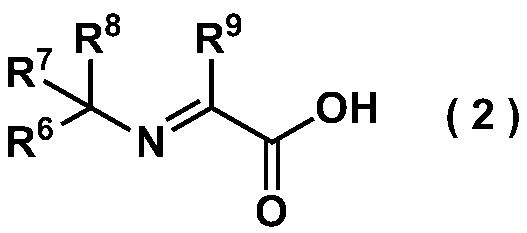
- the complexing agent is represented by the general formula (2): ⁇ Wherein R 6 to R 9 are each independently a hydrogen atom, an alkyl group having 1 to 10 carbon atoms, a cycloalkyl group having 3 to 12 carbon atoms, an aryl group having 6 to 10 carbon atoms, or a substituent.
- R 6 and R 7 , R 7 and R 8 , R 8 and R 9 , R 6 and R 8 , R 6 and R 9 , R 7 and R 9 are bonded to each other to form a saturated or unsaturated 4- An 8-membered ring may be formed.
- the transition metal precursor contains at least one transition metal atom selected from the group consisting of transition metals belonging to Groups 8 and 9 of the periodic table
- the manufacturing method of 2-alkenyl ether compound of description [4]
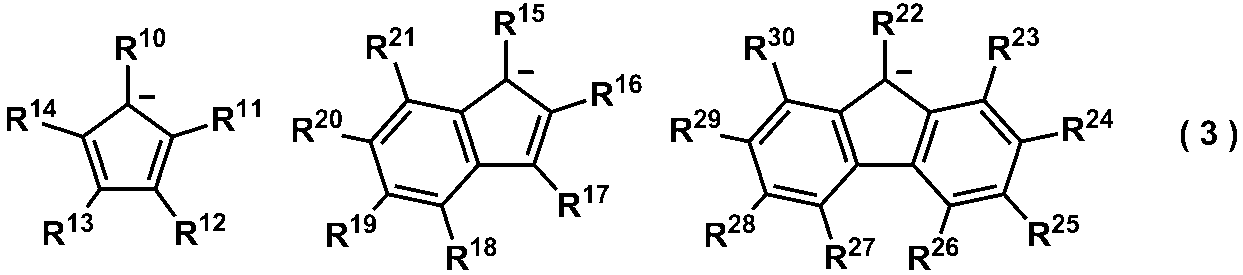
- the monovalent anionic 5-membered ring conjugated diene is represented by the general formula (3): ⁇ Wherein R 10 to R 30 are each independently a hydrogen atom, an alkyl group having 1 to 10 carbon atoms, a cycloalkyl group having 3 to 12 carbon atoms, an aryl group having 6 to 10 carbon atoms, or a substituent. Represents an alkyl-substituted alkyl group having 1 to 30 carbon atoms in total or an aryl-substituted silyl group having 6 to 30 carbon atoms in total, and groups bonded to two adjacent carbon atoms on the ring are bonded to each other.
- a saturated or unsaturated 4- to 8-membered ring may be formed with the two adjacent carbon atoms.
- the conjugated monovalent anion structure ⁇ wherein the anion is present conjugated to the bonding carbon of R 10 to R 30 .
- the compound represented by the general formula (1) is allyl acetate, 2-methyl-2-propenyl acetate, 2-hexenyl acetate, 2,4-hexadienyl acetate, prenyl acetate (3-methyl-2-acetate).
- Butenyl geranyl acetate, farnesyl acetate, cinnamyl acetate, linalyl acetate, 3-buten-2-yl acetate, 2-cyclopentenyl acetate, 2-trimethylsilylmethyl-2-propenyl acetate, 2-methyl-2-cyclohexenyl acetate, 1-phenyl-1-buten-3-yl propionate, 1-cyclohexyl-2-butene butyrate, 4-cyclopentene-1,3-diol-1-acetate, and 1,4-diacetoxybutene-2,3- Carboxylic acid ester selected from the group consisting of acetoxy-4-hydroxybutene-1 or allyl methyl carbonate 4-acetoxy-2-Buarticuluechiru carbonate, Nerirumechiru carbonate, and method for producing 2-alkenyl ether compound according to any one of a carbonic ester [1] to [5], which is selected from the group consisting of
- the compound having a hydroxyl group is a saturated aliphatic alcohol having 1 to 30 carbon atoms having one or two hydroxyl groups in the molecule, and the number of carbons having one or two hydroxyl groups in the molecule. Any one of [1] to [7], wherein is selected from the group consisting of a saturated alicyclic alcohol having 3 to 30 and an aryl compound having 1 to 10 hydroxyl groups in the molecule and having 6 to 30 carbon atoms A process for producing a 2-alkenyl ether compound as described in 1. above. [9] The method for producing a 2-alkenyl ether compound according to [8], wherein the hydroxyl group-containing compound is a primary saturated aliphatic alcohol or alicyclic alcohol.
- the transition metal complex is added to 1 mol of the sum of the compound having a hydroxyl group and the compound having a 2-alkenyl group (molar amount of the compound having hydroxyl group + molar amount of the compound having 2-alkenyl group).
- the method for producing a 2-alkenyl ether compound according to any one of [1] to [9], wherein 0.000001 to 10 mol is used.
- a step of producing a transition metal precursor having a monovalent anionic 5-membered ring conjugated diene as a ligand in the molecule by reacting a compound having a monovalent anionic 5-membered ring conjugated diene skeleton with a transition metal compound.
- an alcoholic or phenolic hydroxyl group can be formed by a compound having a 2-alkenyl group without using an additive other than a solvent that does not directly contribute to the 2-alkenylation reaction.
- 2-alkenyl ether can be produced with a high reaction rate. Since an allylating agent (2-alkenylating agent) such as conventional allyl acetate and a salt such as palladium acetate are used as a catalyst, an additive such as a by-product neutralizing agent is not required.
- a highly productive and environmentally harmonious method can be provided.
- the reaction can be carried out without using a solvent.
- the allylating agent which is a representative example of the 2-alkenylating agent, can use a carboxylic acid allyl ester that can be supplied in large quantities and is inexpensive, has higher reactivity as a 2-alkenylating agent than allylic alcohol, and is toxic. Therefore, the method for producing a 2-alkenyl ether compound according to the present invention is very useful from the viewpoint of productivity and operability.
- the obtained 2-alkenyl ether compound can be converted into a corresponding glycidyl ether compound by an epoxidation reaction. Therefore, it is possible to produce a low chlorine content epoxy resin that is useful in various fields such as the chemical industry as a raw material for various materials such as electronic materials, adhesives, paint resins, etc. Useful for.
- a compound having a hydroxyl group is used as a compound having a specific 2-alkenyl group, and a complexing agent and a monovalent anionic 5-membered ring conjugated diene are contained in the molecule. It is characterized by 2-alkenylation using a transition metal complex, which is a reaction product with a transition metal precursor having a ligand, as a catalyst.
- the compound having a hydroxyl group used in the present invention may be a compound having one hydroxyl group or a compound having two or more hydroxyl groups, and is not particularly limited.
- Examples of the compound having a hydroxyl group include a saturated aliphatic alcohol having 1 to 30 carbon atoms or an unsaturated aliphatic alcohol having 2 to 30 carbon atoms having one hydroxyl group in the molecule, and one hydroxyl group in the molecule.
- the compound having a hydroxyl group may contain a substituent such as a halogen atom.
- saturated aliphatic alcohol having 1 to 30 carbon atoms or the unsaturated aliphatic alcohol having 2 to 30 carbon atoms having one hydroxyl group in the molecule include methyl alcohol, ethyl alcohol, n-propyl alcohol, i -Propyl alcohol, n-butyl alcohol, neopentyl alcohol, 2-ethylhexanol, n-octanol, allyl alcohol, crotyl alcohol, saturated or unsaturated having 3 to 30 carbon atoms with one hydroxyl group in the molecule
- Specific examples of the alicyclic alcohol include 2-methylcyclopentanol, 4-cyclohexenol, cholesterol and the like.
- saturated aliphatic diol or polyhydric alcohol having 1 to 30 carbon atoms and having 2 or more hydroxyl groups in the molecule, or the unsaturated aliphatic diol or polyhydric alcohol having 2 to 30 carbon atoms include 1 , 2-ethanediol, 1,3-propanediol, 1,4-butanediol, 2-butene-1,4-diol, 2-chloro-1,3-propanediol, glycerin, pentaerythritol, hydroxyl in the molecule
- saturated or unsaturated alicyclic diol or polyhydric alcohol having 3 to 30 carbon atoms having two or more groups include 1,2-cyclopentanediol, 1,4-cyclohexanedimethanol and the like. It is done.
- the monohydroxyaryl compound having 6 to 30 carbon atoms having one hydroxyl group in the molecule include phenol, cresol, 4-nitrophenol, 2,4-di-t-butylphenol, 2,4-di -Tert-butyl-6-methylphenol, 1-naphthol, 2-naphthol, 3-tert-butyl-2-naphthol, benzyl alcohol, 2-phenylethanol and the like.
- polyhydroxyaryl compounds having 2 to 10 hydroxyl groups in the molecule and having 6 to 30 carbon atoms include catechol, resorcinol, hydroquinone, 2,4-dihydroxyphenyl ethyl ketone, and 4-n-hexylresorcinol. 1,8-dihydroxynaphthalene, 1,2-dihydroxynaphthalene, 1-methyl-2,3-dihydroxynaphthalene, 1,2,4-benzenetriol and the like.
- saturated fatty alcohols having 1 to 30 carbon atoms having one or two hydroxyl groups in the molecule and saturated fats having 3 to 30 carbon atoms having one or two hydroxyl groups in the molecule. It is more preferably a cyclic alcohol or an aryl compound having 1 to 10 hydroxy groups in the molecule and having 6 to 30 carbon atoms, and is preferably a primary saturated aliphatic alcohol or alicyclic alcohol. More preferable in terms of high properties.
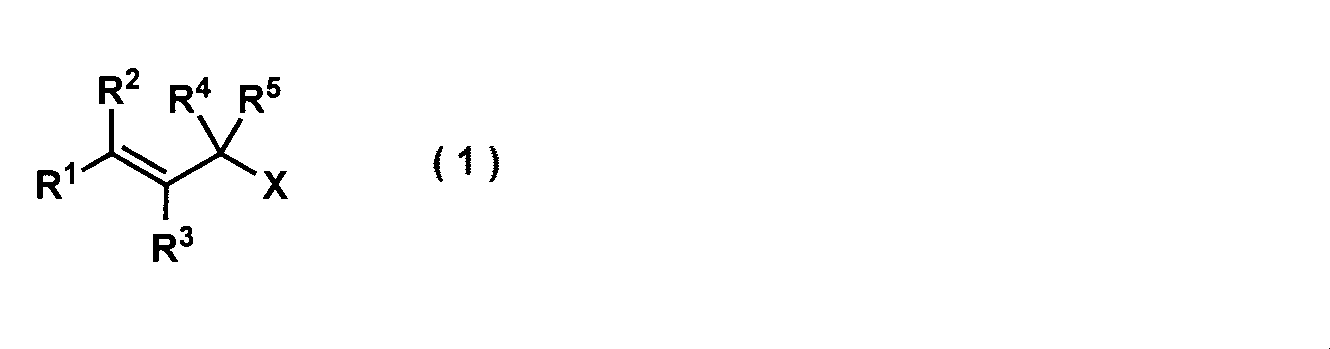
- the compound having a 2-alkenyl group used in the present invention is represented by the following general formula (1) capable of reacting with a hydroxyl group of a compound having a hydroxyl group to produce a 2-alkenyl ether.
- R 1 , R 2 , R 3 , R 4 , and R 5 each independently represent a hydrogen atom, an alkyl group having 1 to 10 carbon atoms, an alkenyl group having 2 to 10 carbon atoms, or 1 carbon atom.
- X represents any substituent selected from the group consisting of NO 2 —, RO—, RS (O) 2 O—, RCOO—, and ROCOO— (where R is an organic group having 1 to 30 carbon atoms). ⁇ . These Xs are easily desorbed as compared to HO— that allyl alcohol has.
- R 1 , R 2 , R 3 , R 4 , and R 5 are each independently preferably a hydrogen atom, an alkyl group having 1 to 10 carbon atoms, or an alkenyl group having 2 to 10 carbon atoms, and R is A hydrogen atom, an alkyl group having 1 to 10 carbon atoms, or an aryl group having 6 to 10 carbon atoms is preferable. More preferably, R 1 , R 2 , R 3 , R 4 , and R 5 are all hydrogen atoms.
- Specific examples of the compound having a 2-alkenyl group in which X is NO 2 — include 1-nitro-2-butene, 1-nitro-1,3-diphenyl-2-propene, and 3-nitro-3-methoxypropene.
- Specific examples of the compound having a 2-alkenyl group in which X is RO— include methyl allyl ether, ethyl allyl ether, diallyl ether, allyl phenyl ether and the like.
- Specific examples of the compound having a 2-alkenyl group in which X is RS (O) 2 O— include allyl benzenesulfonate and allyl p-toluenesulfonate.
- Specific examples of the compound having a 2-alkenyl group in which X is RCOO— include allyl acetate, 2-methyl-2-propenyl acetate, 2-hexenyl acetate, 2,4-hexadienyl acetate, prenyl acetate (3-methyl acetate -2-butenyl), geranyl acetate, farnesyl acetate, cinnamyl acetate, linalyl acetate, 3-buten-2-yl acetate, 2-cyclopentenyl acetate, 2-trimethylsilylmethyl-2-propenyl acetate, 2-methyl-2-acetate Cyclohexenyl, 1-phenyl-1-buten-3-yl propionate, 1-cyclohexyl-2-butene butyrate, 4-cyclopentene-1,3-diol-1-acetate, 1,4-diacetoxybutene-2, 3-acetoxy-4-hydroxybutene-1 and the like.
- the compound having a 2-alkenyl group in which X is ROCOO— include allylmethyl carbonate, 4-acetoxy-2-butenylethyl carbonate, nerylmethyl carbonate, diallyl carbonate and the like. These compounds having a 2-alkenyl group can be used alone or in any combination of two or more thereof. Most preferred compounds having a 2-alkenyl group for use in the present invention are carboxylic acid esters in which X is RCOO- and X is ROCOO- because the elimination products have high stability and are easily available. It is a carbonate ester.
- the amount of the compound having a 2-alkenyl group used relative to the compound having a hydroxyl group is such that the compound having a 2-alkenyl group is 0.1 to 500 equivalents, preferably 0.5 to 1 equivalent per hydroxyl group equivalent of the hydroxyl group-containing compound. 50 equivalents, more preferably 1 to 20 equivalents. If the equivalent of the compound having 2-alkenyl groups per equivalent of hydroxyl group of the compound having hydroxyl groups is significantly greater than 1 (equivalent ratio is 1), the compound having excess 2-alkenyl groups is In addition to being used as an agent, it is also used as a solvent.
- the conversion to the target product may be extremely low. It becomes remarkable when the equivalent ratio is less than 0.1. If the equivalent ratio is less than 1, the compound having an excess of hydroxyl groups can be recovered as needed and recycled to this process. Since the 2-alkenylation reaction is preferably carried out in a homogeneous system, it is preferable to use a combination of a compound having a hydroxyl group and a compound having a 2-alkenyl group which are mixed to form a uniform liquid.
- a complexing agent described in detail below reacts with a transition metal precursor obtained by complexing a transition metal compound and a monovalent anionic five-membered ring conjugated diene compound. It is a complex obtained.
- a nitrogen coordination part-oxygen coordination part that is bidentate to the transition metal atom in the molecule. It preferably has a general formula (2): ⁇ Wherein R 6 to R 9 are each independently a hydrogen atom, an alkyl group having 1 to 10 carbon atoms, a cycloalkyl group having 3 to 12 carbon atoms, an aryl group having 6 to 10 carbon atoms, or a substituent. Represents an alkyl-substituted alkyl group having 1 to 30 carbon atoms in total or an aryl-substituted silyl group having 6 to 30 carbon atoms in total.
- R 6 and R 7 , R 7 and R 8 , R 8 and R 9 , R 6 and R 8 , R 6 and R 9 , R 7 and R 9 are bonded to each other to form a saturated or unsaturated 4- An 8-membered ring may be formed.
- the ⁇ -imino acid type ligand compound is preferably used in the present invention because it exhibits high activity for the 2-alkenylation reaction. These can be used alone or in any combination.
- the transition metal compound used in the production of the transition metal precursor useful for forming the transition metal complex used in the present invention is at least one selected from the group consisting of transition metals belonging to Groups 8 and 9 of the periodic table. A compound containing a transition metal atom is used.
- iron compounds such as iron (III) chloride, iron (III) bromide, iron (III) nitrate, ruthenium (III) chloride, ruthenium (III) bromide, ruthenium (III) nitrate, hexaammineruthenium (II), ruthenium compounds such as hexaaquathenium (III), osmium compounds such as osmium chloride (III) and osmium oxide (VI), cobalt compounds such as cobalt chloride (III), and rhodium compounds such as rhodium chloride (III) Iridium compounds such as iridium chloride (III) and iridium acetate (II), etc., among which ruthenium compounds, rhodium compounds, and iridium compounds are preferable, and ruthenium compounds are particularly high in activity of 2-alkenylation reaction and relatively inexpensive. Therefore, it is preferable.
- the monovalent anionic 5-membered ring conjugated diene reacts with the transition metal compound to form a complex, thereby forming a transition metal precursor in which the transition metal atom is stabilized.
- the monovalent anionic 5-membered ring conjugated diene compound refers to a monovalent anion having a cyclopentadienyl skeleton in the molecule, and can be conjugated 1 represented by the following general formula (3).
- a compound having a valent anion structure is preferred.
- R 10 to R 30 are each independently a hydrogen atom, an alkyl group having 1 to 10 carbon atoms, a cycloalkyl group having 3 to 12 carbon atoms, an aryl group having 6 to 10 carbon atoms, or a substituent.
- a saturated or unsaturated 4- to 8-membered ring may be formed with the two adjacent carbon atoms.
- the anion is present conjugated to the bonded carbon of R 10 to R 30 .
- the monovalent anionic 5-membered ring conjugated diene useful in the present invention include, for example, ⁇ 5 -cyclopentadienyl anion, ⁇ 5 -methylcyclopentadienyl anion, ⁇ 5 -dimethylcyclopentadienyl anion, ⁇ 5 -trimethylcyclopentadienyl anion, ⁇ 5 -tetramethylcyclopentadienyl anion, ⁇ 5 -pentamethylcyclopentadienyl anion, ⁇ 5 -ethylcyclopentadienyl anion, ⁇ 5 -n-propylcyclopenta dienyl anion, eta 5 - isopropyl cyclopentadienyl anion, eta 5-n-butyl cyclopentadienyl anion, eta 5-sec-butylcyclopentadienyl anion, eta 5-tert-
- the transition metal precursor can be synthesized by a known method, and is preferably obtained by reacting the monovalent anionic 5-membered ring conjugated diene compound with a transition metal halide or the like.
- suitable preparation methods are described, for example, in Adv. Synth. Catal, 346, pp. 901-904 (2004) and Japanese translations of PCT publication No. 2003-507387.
- ruthenium (III) chloride with sodium ⁇ 5 -cyclopentadienyl to obtain a di ( ⁇ 5 -cyclopentadienyl) ruthenium complex
- Adv. Synth. Catal, 346, pp. 901-904 (2004) can be converted to a cyclopentadienyl ruthenium triacetonitrile complex (transition metal precursor).
- a catalyst composed of a transition metal complex can be obtained by dissolving the complexing agent and the transition metal precursor in a reaction solvent and reacting them.
- the mixing ratio of the complexing agent and the transition metal precursor is 0.8 to 1.5, more preferably 0.9 to 1. 1. It can be obtained by mixing at a reaction temperature of 0 to 100 ° C., more preferably 20 to 50 ° C. Both of them are dissolved in a solvent and react quickly after mixing to form a transition metal complex. Therefore, they can be used immediately after being dissolved and mixed in the solvent, or after aging for a while after mixing.
- the reaction time is preferably 0.01 to 10 hours, more preferably 0.2 to 1 hour.
- the 2-alkenylation reaction is preferably carried out in a homogeneous system, and the transition metal complex is preferably dissolved in the compound having a hydroxyl group and the compound having a 2-alkenyl group.
- the transition metal complex is dissolved in a compound having a hydroxyl group and a compound having a 2-alkenyl group
- the transition metal complex, the compound having a hydroxyl group, and the compound having a 2-alkenyl group are simultaneously charged into a reaction vessel and used.
- the amount of catalyst used can be adjusted as appropriate according to a number of factors, for example, the form of the catalyst, the type of reaction (batch reaction, continuous fixed bed reaction, continuous fluidized bed reaction), the amount of solvent used, and the like. It is.
- the amount of the transition metal complex used is the sum of the compound having a hydroxyl group and the compound having a 2-alkenyl group (when the hydroxyl group is used) when used as a homogeneous catalyst (using the catalyst dissolved in the reaction system).
- the molar amount of the compound having + the molar amount of the compound having 2-alkenyl group) is 0.000001 to 10 mol with respect to 1 mol.
- the compound having a hydroxyl group and the compound having a 2-alkenyl group Is 0.000001 to 0.5 mol with respect to 1 mol in total.
- a complexing agent bound to a carrier polystyrene or the like
- a transition metal precursor can be reacted to be used as a supported catalyst (heterogeneous catalyst).
- a supported catalyst heterogeneous catalyst
- the amount of transition metal complex used is 0 with respect to 1 mol of the total of the compound having a hydroxyl group and the compound having a 2-alkenyl group. 0.0001 to 0.5 mole.
- a solvent can be used as necessary for the purpose of homogenizing the reaction solution and adjusting the viscosity.
- Solvents that can be used include water, aliphatic, alicyclic and aromatic hydrocarbons, aliphatic, alicyclic and aromatic halogenated hydrocarbons, nitroalkanes, and oxygen containing ethers, glycol ethers, esters, ketones, etc. A hydrocarbon is mentioned.
- preferable solvents include hexane, octane as examples of aliphatic hydrocarbons, cyclohexane as examples of alicyclic hydrocarbons, toluene, xylene as examples of aromatic hydrocarbons, and examples of aliphatic halogenated hydrocarbons.
- dichloromethane 1,2-dichloroethane, chlorobenzene as an example of aromatic halogenated hydrocarbon
- nitromethane as an example of nitroalkane
- tetrahydrofuran as an example of ether
- dimethoxyethane as an example of glycol ether
- ethyl acetate as an example of ester
- ketone examples of the solvent include acetone and methyl ethyl ketone.
- Cyclohexane, dichloromethane, toluene, and dimethoxyethane are particularly preferable in terms of reactivity, solubility, cost, and the like. These solvents can be used alone or in any combination.
- the solvent is used in an amount of 1000 parts by mass or less, preferably 0.5 to 500 parts by mass, more preferably 1 to 100 parts by mass with respect to 100 parts by mass of the compound having a hydroxyl group.
- the 2-alkenylation reaction is carried out at a temperature of 10 to 200 ° C., preferably 50 to 150 ° C., more preferably 60 to 90 ° C. for a time sufficient for the reaction to be essentially complete, usually 0.1 to 72 hours. , Preferably 0.1 to 48 hours, more preferably 0.1 to 24 hours.
- the optimum 2-alkenylation reaction temperature and time for a compound having an individual hydroxyl group depends on the reactivity of the compound having a hydroxyl group used, the solvent and the catalyst.
- the reaction is preferably carried out in the liquid phase, and therefore it is preferred to carry out the reaction under a pressure atmosphere in which the reaction system is kept in the liquid phase. For example, a pressure of about 5 to about 2000 kPa can be used.
- Solvents added include aliphatic, alicyclic and aromatic hydrocarbons, aliphatic, alicyclic and aromatic halogenated hydrocarbons, nitroalkanes, and oxygen-containing hydrocarbons such as ethers, glycol ethers, esters and ketones. It is preferable to include at least one organic solvent selected from the group.
- An organic solvent is mentioned.
- release product resulting from X of General formula (1) is water-soluble
- a strong acid such as sulfuric acid
- the separation residue (separated aqueous layer) is washed again with the same solvent as the added solvent, and the trace amount contained in the aqueous layer is 2-
- the product recovery rate can be increased. Washing, fractional distillation, extractive distillation, liquid-liquid extraction, solid-liquid extraction and crystallization or any combination of these methods can be used to separate and recover the 2-alkenylation reaction product from the reaction liquid.
- a solvent and an unreacted 2-alkenylating agent are removed from the reaction mixture by distillation or evaporation.
- the carboxylic acid byproduct can then be recovered by distillation or extraction, and the desired 2-alkenyl derivative product can be recovered as the bottom product.
- the reaction liquid containing the 2-alkenyl ether product from which unnecessary components have been separated by the above method can be directly used as a reaction liquid in a process such as epoxidation.
- Example 1 In a 10 mL Schlenk type reaction tube with a Youngcock, under a stream of argon, quinaldic acid (17 mg, 0.10 mmol; manufactured by Tokyo Chemical Industry Co., Ltd.) as a complexing agent, [CpRu (CH 3 CN) 3 as a transition metal precursor ] PF 6 (43mg, 0.10mmol; Aldrich Co.): was added (Cp cyclopentadienyl complexes).
- 1,4-cyclohexanedimethanol (1.4 g, 10 mmol) and allyl acetate (3.0 g, 30 mmol) (R 1 , R 2 , R in the general formula (1)) were subjected to freeze-dry operation three times.
- 3 , R 4 , and R 5 are all hydrogen atoms, and X is CH 3 COO—), and quinaldic acid and [CpRu (CH 3 CN) 3 ] PF 6 are dissolved and mixed. Stir at 80 ° C. for 6 hours.
- Example 2 In Example 1, except that only the catalyst was changed to 1/10 (quinaldic acid (1.7 mg, 0.010 mmol), [CpRu (CH 3 CN) 3 ] PF 6 (4.3 mg, 0.010 mmol)). 2-Alkenylation was carried out under exactly the same conditions as in Example 1. As a result of analyzing the solution after the reaction, a 2-alkenylated product was obtained with a conversion rate of 1,4-cyclohexanedimethanol> 98% and a total yield of 2-alkenylation of 95%. 23% of mono (2-alkenyl) compound (monoallyl ether) and 72% of di (2-alkenyl) compound (diallyl ether) were produced.
- Example 3 In Example 1, 2-alkenylation was performed under exactly the same conditions as in Example 1 except that the complexing agent was changed to picolinic acid (12 mg, 0.10 mmol); manufactured by Kanto Chemical Co., Inc. As a result of analyzing the solution after the reaction, a 2-alkenylated product was obtained with a conversion rate of 99% and a total yield of 2-alkenylation of 99%. 22% of mono (2-alkenyl) compound (monoallyl ether) and 77% of di (2-alkenyl) compound (diallyl ether) were produced. When quinaldic acid is used as the complexing agent rather than picolinic acid, the yield of di (2-alkenyl) compound (diallyl ether) is increased.
- Example 4 Exactly the same as Example 1, except that the compound having a hydroxyl group instead of 1,4-cyclohexanedimethanol was changed to benzyl alcohol (1.1 g, 10 mmol); manufactured by Tokyo Chemical Industry Co., Ltd. Under conditions, 2-alkenylation occurred. As a result of analyzing the solution after the reaction, a 2-alkenylated product was obtained with a conversion rate of 90% and a 2-alkenylation yield of 90%.
- Example 5 In Example 1, 2-alkenylation was performed under exactly the same conditions as in Example 1 except that the substrate was changed to phenol (0.94 g, 10 mmol) instead of 1,4-cyclohexanedimethanol. As a result of analyzing the solution after the reaction, a 2-alkenylated product was obtained with a conversion of 50% and a 2-alkenylation yield of 50%.
- Example 6 In Example 1, allyl acetate as a 2-alkenylating agent was diallyl carbonate (4.2 g, 30 mmol); manufactured by Kanto Chemical Co., Ltd. (R 1 , R 2 , R 3 , R 4 in the general formula (1)) , And R 5 are all hydrogen atoms, and X is H 2 C ⁇ CH—CH 2 OCOO—.
- 2- Alkenylation was performed under the same conditions as in Example 1. As a result of analyzing the solution after the reaction, a 2-alkenylated product was obtained with a conversion rate of 1,4-cyclohexanedimethanol of 99% and a 2-alkenylation total yield of 99%. 8.6% of mono (2-alkenyl) compound (monoallyl ether) and 91% of di (2-alkenyl) compound (diallyl ether) were produced.
- Example 7 In Example 1, the transition metal precursor was changed to [Cp * Ru (CH 3 CN) 3 ] PF 6 (50.4 mg, 0.10 mmol); manufactured by Aldrich) (Cp * : pentamethylcyclopentadienyl complex). Except that, 2-alkenylation was carried out under exactly the same conditions as in Example 1. As a result of analyzing the solution after the reaction, a 2-alkenylated product was obtained with a conversion rate of 1,4-cyclohexanedimethanol of 95% and a total 2-alkenylation yield of 95%. 35% of mono (2-alkenyl) compound (monoallyl ether) and 60% of di (2-alkenyl) compound (diallyl ether) were produced.
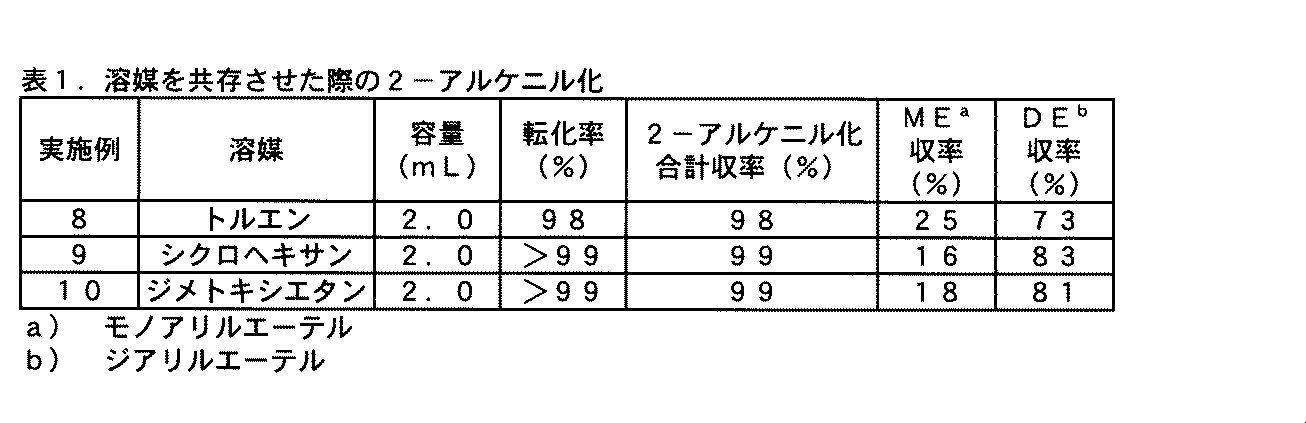
- Example 8 2-alkenylation was carried out under the same conditions as in Example 1 except that each solvent (2.0 mL) shown in Table 1 below was allowed to coexist and the amount of catalyst was changed to 1/5.
- Table 1 The results of analyzing the solution after the reaction are summarized in Table 1.
- Example 11 In Example 1, 2-alkenylation was carried out under exactly the same conditions as in Example 1 except that allyl acetate was changed to a double amount (6.0 g, 60 mmol). As a result of analyzing the solution after the reaction, a 2-alkenylated product was obtained with a conversion rate of 1,4-cyclohexanedimethanol> 99% and a total yield of 2-alkenylation> 99%. 7% of mono (2-alkenyl) compound (monoallyl ether) and 93% of di (2-alkenyl) compound (diallyl ether) were produced.
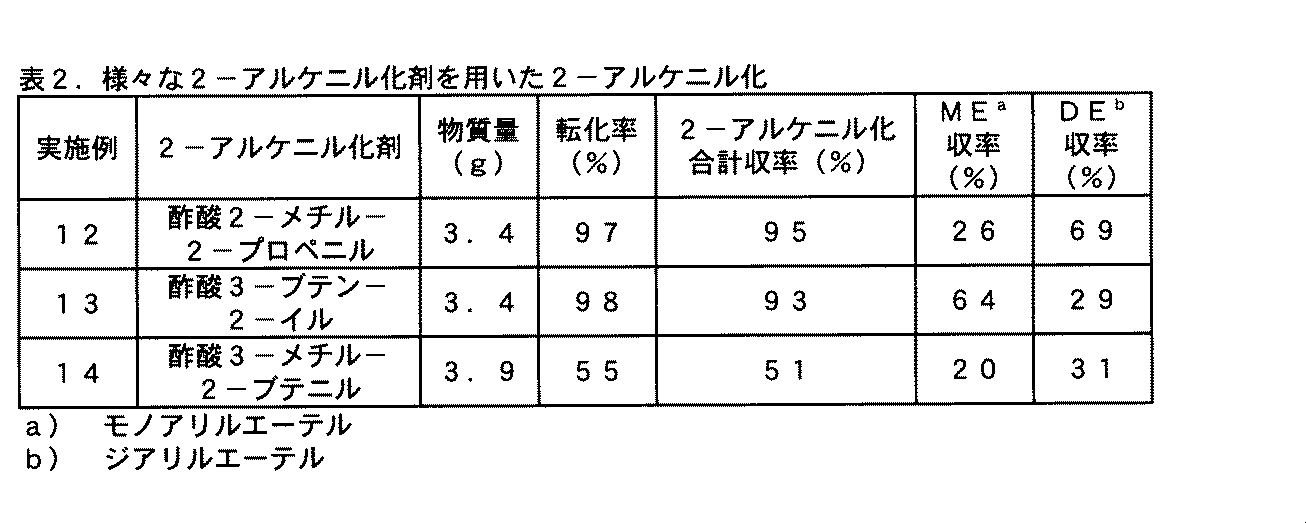
- Example 12 2-alkenylation was carried out under the same conditions as in Example 1, except that allyl acetate was changed to each 2-alkenylating agent (30 mmol) shown in Table 1 below.
- the results of analyzing the solution after the reaction are summarized in Table 2. It was confirmed that 2-alkenyl ether compounds can be obtained in the same manner, although the reactivity is lower than when allyl acetate is used.
- Example 4 2-alkenylation was performed under exactly the same conditions as in Example 1 except that the transition metal precursor was changed to palladium acetate (22 mg, 0.10 mmol). As a result of analyzing the solution after the reaction, the 2-alkenylation reaction hardly proceeded at the conversion rate ⁇ 1% and the total yield of 2-alkenylation ⁇ 1%, and the desired product was not obtained at all.
- an alcoholic or phenolic hydroxyl group is formed by a 2-alkenylating agent without using an additive other than a solvent that does not directly contribute to the 2-alkenylation reaction.
- 2-alkenyl ether can be produced with a high reaction rate.
- the 2-alkenylating agent carboxylic acid allyl ester that can be supplied in large quantities and inexpensive can be used, and has higher reactivity and lower toxicity as 2-alkenylating agent than allyl alcohol, so it is safe during industrialization. This method is also highly useful and is very beneficial from the viewpoint of productivity and operability.
- the obtained allyl ether compound can be converted into a corresponding glycidyl ether compound by an epoxidation reaction. Therefore, it is possible to produce useful low chlorine content epoxy resins widely used in various industrial fields including chemical industry as raw materials for various materials such as electronic materials, adhesives, paint resins, etc. Useful for.
Landscapes
- Chemical & Material Sciences (AREA)
- Organic Chemistry (AREA)
- Chemical Kinetics & Catalysis (AREA)
- Organic Low-Molecular-Weight Compounds And Preparation Thereof (AREA)
Abstract
ヒドロキシル基を有する化合物及びアリルアルコール以外の2-アルケニル基を有する化合物を出発原料として、効率よく低コストで対応する2-アルケニルエーテル化合物を製造する方法を提供する。ヒドロキシル基を有する化合物を、特定の2-アルケニル基を有する化合物を用いて、錯化剤と1価アニオン性5員環共役ジエンにより安定化された遷移金属錯体からなる触媒の存在下で2-アルケニル化することにより2-アルケニルエーテルを製造する。
Description
本発明は、アリルエーテルに代表される2-アルケニルエーテル化合物の製造方法に関する。さらに詳しくは、ヒドロキシル基を有する化合物と2-アルケニル基を有する化合物を特定の遷移金属錯体と配位子の存在下で反応させることにより、2-アルケニルエーテル化合物を高効率で得ることができる製造方法に関する。
エポキシ樹脂の原料として知られるグリシジルエーテル化合物は、工業的に大規模に生産されており、様々な分野で広く使用されている。
従来知られているグリシジルエーテル化合物の製造方法としては、対応するアルコール又はフェノールを触媒の存在下、又は不在下に塩基性条件下でエピクロロヒドリンと反応させて、グリシジルエーテル化合物を得る方法がある。この方法では有機塩素化合物がグリシジルエーテル化合物中に必ず残存してしまい、幾つかの用途、例えばエレクトロニクス用途で使用するには、絶縁特性が低くなるという欠点があるため好ましくない。
そこで、ハロゲン化合物であるエピクロロヒドリンを用いないグリシジルエーテル化合物の合成法として、原料のアルコール又はフェノールをアリル化(第一の工程)した後に、得られたアリルエーテル化合物のアリル基の炭素-炭素二重結合を酸化剤を利用して酸化することにより直接グリシジルエーテル化(第二の工程)することが検討されている。
従来のアルコール又はフェノール類のアリル化の反応例としては、パラジウム触媒を用いた例として、アリル化剤である酢酸アリルにより活性水素含有化合物であるフェノールをアリル化する方法が、例えば非特許文献1(J. Muzartら, J. Organomet. Chem., 326, pp. C23-C28 (1987))に報告されている。特許文献1(米国特許第4507492号公報)及び非特許文献2(S. Sivaramら, Macromolecular Reports, A32 (Suppl. 7), pp. 1053-1060 (1995))には、アリル化剤であるアリルメチルカーボネートにより活性水素含有化合物であるビスフェノールAをアリル化する方法が記載されている。また、ニッケル触媒を用いた例として、非特許文献3(A. Mortreuxら, J. Chem. Soc., Chem. Commun., pp. 1863-1864 (1995))には、アリル化剤である酢酸アリルにより、活性水素含有化合物であるフェノールをアリル化する方法が記載されている。
しかしながら、上記方法などの、酢酸パラジウム等の塩を用いる均一系触媒系でのフェノール化合物のアリル化方法では、一般にアリル化剤由来の副生物を捕捉する目的で、アリル化剤に対して化学量論量以上の塩基性化合物を必要とするため、製造コストが高くなる。また、目的物であるアリルエーテル化合物からこれら塩基性化合物を除去することが必要となる。さらに、アリル化剤は塩基性化合物との塩へと変換されるため、例えば酢酸アリルをアリル化剤として用いた際には、副生物の酢酸塩を酢酸に戻して酢酸アリル再利用工程へと循環させるには手間がかかり工業的に不利となる。
特許文献2(特表2006-501209号公報)及び非特許文献4(F. Ozawaら,J. Am. Chem. Soc., 124, pp. 10968-10969 (2002))には、前者は不均一系、後者は均一系で、遷移金属錯体塩(パラジウム塩)とリン配位子を触媒として用いるアリル化の例が開示されているが、リン系配位子自体の酸化剤に対する安定性は低く、例えばリン系配位子の代表例であるトリフェニルホスフィンを用いた際には、アリル化反応中、徐々に空気中の酸素により配位子の酸化が起こり、触媒が失活することが知られている。また、リン系配位子は、合成経路も煩雑で、工業化には困難を伴うといえる。
特許文献3(特開2004-107339号公報)は、多座キレート型ホスファイト配位子を有する第8~10族遷移金属錯体存在下における、アリルエーテル類の製造方法を開示している。この方法によりアリルアルコールとアルコールを脱水縮合してアリルエーテルに直接変換することができるが、アリルアルコール同士のホモカップリングによるジアリルエーテル形成や、アリルアルコールの異性化が進行しやすく、アリル化剤を効果的に反応系に利用することができない。さらには、生成したアリルエーテル化合物においてClaisen転位が引き起こされるため、目的物とは異なるC-アリル化体が副生することが収率低下の要因となっている。
非特許文献5(Y. Ishiiら, J. Org. Chem., 69, pp. 3474-3477 (2004))は、アルコールに対し、カルボン酸アリルエステルをアリル化剤とし、カチオン性イリジウム錯体を用いる、アリルエーテル類の製造方法を開示している。この方法によりカルボン酸アリルエステルとアルコールからカルボン酸の脱離を伴ってアリルエーテルを得ることができるが、カルボン酸アリルエステルとアルコールとの間のエステル交換反応、アルコールのOppenauer酸化によるアルデヒドの生成、及び生じたアルデヒドに対するTishchenko反応も競合するため、目的物の収率は総じて低い。アリル化剤を過剰に用いることでアリル化効率を高める試みもなされているが、アルコールに対して10倍量以上も添加しなければならず、非効率であり、環境側面からも望ましい方法とはいえない。
特許文献4(特開2005-289977号公報)は、α-イミノ酸型配位子又はα-アミノ酸型配位子を有するシクロペンタジエニルルテニウム錯体存在下における、アリルエーテル類の製造方法を開示している。この方法によればいかなる添加剤も使用することなくアリルアルコールとアルコールから脱水的にアリルエーテルを製造することができる。共生成物は水のみであり、環境に調和した非常に効率的な方法であるが、アリル化剤であるアリルアルコールの毒性が高く、大量に用いることは、工業的に鑑みて好ましくない。また、共生成物である水の脱離性の低さからか、アルコールの種類によっては、目的物であるアリルエーテルの収率が低くなる。
J.Muzartら, J. Organomet. Chem., 326, pp. C23-C28 (1987).
S. Sivaramら, Macromolecular Reports, A32 (Suppl. 7), pp. 1053-1060 (1995).
A. Mortreuxら, J. Chem. Soc., Chem. Commun., pp. 1863-1864 (1995).
F. Ozawaら, J. Am. Chem. Soc., 124, pp. 10968-10969 (2002).
Y. Ishiiら, J. Org. Chem., 69, pp. 3474-3477 (2004).
本発明は、ヒドロキシル基を有する化合物及びアリルアルコール以外の2-アルケニル化剤を出発原料として、効率よく対応する2-アルケニルエーテル化合物を製造する方法を提供することを課題とするものである。
本発明者らは、前記課題を解決すべく鋭意研究し実験を重ねた結果、ヒドロキシル基を有する化合物を、特定の2-アルケニル化剤を用いて、錯化剤と、1価アニオン性5員環共役ジエン化合物により安定化された遷移金属前駆体とからなる触媒(遷移金属錯体)の存在下で2-アルケニル化することで、効率よく2-アルケニルエーテル化合物が得られることを見出し、本願発明を完成するに至った。
すなわち、本発明は以下のとおりのものである。
[1]ヒドロキシル基を有する化合物と以下の一般式(1)で表される2-アルケニル基を有する化合物を触媒存在下で反応させる2-アルケニルエーテル化合物の製造方法であって、
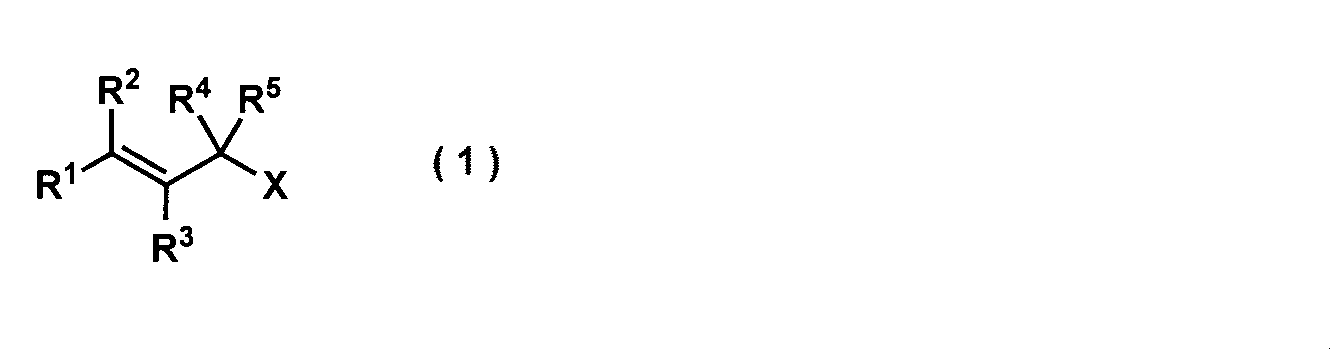
{式中、R1、R2、R3、R4、及びR5は、各々独立して、水素原子、炭素数1~10のアルキル基、炭素数2~10のアルケニル基、炭素数1~10のアルコキシ基、炭素数3~12のシクロアルキル基、炭素数3~12のシクロアルケニル基、アセトキシ基又は炭素数6~10のアリール基を表す。XはNO2-、RO-、RS(O)2O-、RCOO-及びROCOO-(Rは炭素数1~30の有機基)からなる群より選ばれるいずれかの置換基を表す。}、前記触媒が、分子内に遷移金属原子に対して二座配位する窒素配位部-酸素配位部を有する錯化剤と、1価アニオン性5員環共役ジエンを分子内に配位子として有する遷移金属前駆体との反応生成物である遷移金属錯体であることを特徴とする2-アルケニルエーテル化合物の製造方法。
[2]前記錯化剤が、一般式(2):
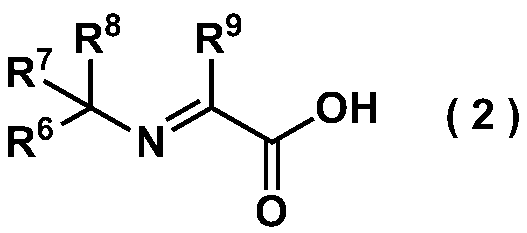
{式中、R6~R9は、各々独立して、水素原子、炭素数1~10のアルキル基、炭素数3~12のシクロアルキル基、炭素数6~10のアリール基、又は置換基の炭素数の合計が1~30のアルキル置換若しくは置換基の炭素数の合計が6~30のアリール置換シリル基を表す。但し、R6とR7、R7とR8、R8とR9、R6とR8、R6とR9、R7とR9は各々互いに結合して飽和又は不飽和の4~8員環を形成してもよい。}で表されるα-イミノ酸型配位子化合物である前記[1]に記載の2-アルケニルエーテル化合物の製造方法。
[3]前記遷移金属前駆体が、周期表の第8族及び第9族に属する遷移金属からなる群より選ばれる少なくとも一種の遷移金属原子を含む前記[1]又は[2]のいずれかに記載の2-アルケニルエーテル化合物の製造方法。
[4]前記遷移金属原子がルテニウム、ロジウム、及びイリジウムからなる群より選ばれる前記[3]に記載の2-アルケニルエーテル化合物の製造方法。
[5]前記1価アニオン性5員環共役ジエンが一般式(3):
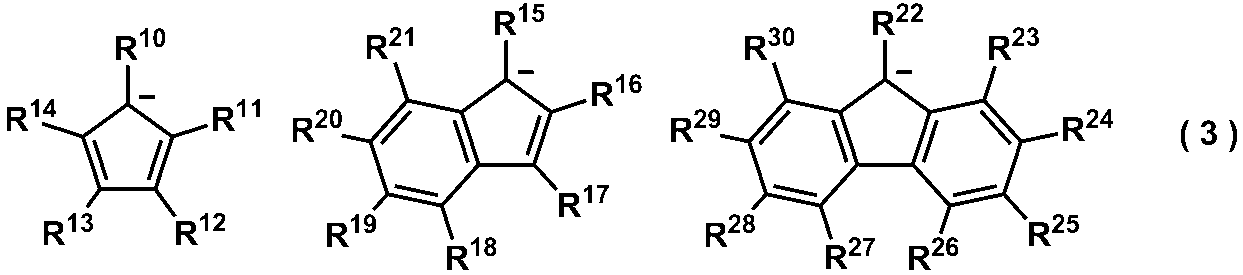
{式中、R10~R30は、各々独立して、水素原子、炭素数1~10のアルキル基、炭素数3~12のシクロアルキル基、炭素数6~10のアリール基、又は置換基の炭素数の合計が1~30のアルキル置換若しくは置換基の炭素数の合計が6~30のアリール置換シリル基を表し、環上の隣接する2つの炭素原子に結合する基が互いに結合して、前記隣接する2つの炭素原子とともに飽和又は不飽和の4~8員環を形成してもよい。}のいずれかで表される共役可能な1価アニオン構造{式中、アニオンはR10~R30の結合炭素に共役して存在する。}を有する前記[1]~[4]のいずれかに記載の2-アルケニルエーテル化合物の製造方法。
[6]前記一般式(1)中、R1、R2、R3、R4、及びR5が全て水素原子である前記[1]~[5]のいずれかに記載の2-アルケニルエーテル化合物の製造方法。
[7]前記一般式(1)で表される化合物が、酢酸アリル、酢酸2-メチル-2-プロペニル、酢酸2-ヘキセニル、酢酸2,4-ヘキサジエニル、酢酸プレニル(酢酸3-メチル-2-ブテニル)、酢酸ゲラニル、酢酸ファルネシル、酢酸シンナミル、酢酸リナリル、酢酸3-ブテン-2-イル、酢酸2-シクロペンテニル、酢酸2-トリメチルシリルメチル-2-プロペニル、酢酸2-メチル-2-シクロヘキセニル、プロピオン酸1-フェニル-1-ブテン-3-イル、酪酸1-シクロヘキシル-2-ブテン、4-シクロペンテン-1,3-ジオール-1-アセテート、及び1,4-ジアセトキシブテン-2,3-アセトキシ-4-ヒドロキシブテン-1からなる群より選ばれるカルボン酸エステル、またはアリルメチル炭酸エステル、4-アセトキシ-2-ブテニルエチル炭酸エステル、ネリルメチル炭酸エステル、及び炭酸ジアリルからなる群より選ばれる炭酸エステルである[1]~[5]のいずれかに記載の2-アルケニルエーテル化合物の製造方法。
[8]前記ヒドロキシル基を有する化合物が、分子内にヒドロキシル基を1つ又は2つ有する炭素数が1~30の飽和の脂肪族アルコール、分子内にヒドロキシル基を1つ又は2つ有する炭素数が3~30の飽和の脂環式アルコール、及び分子内にヒドロキシル基を1~10個有する炭素数が6~30のアリール化合物からなる群より選ばれる前記[1]~[7]のいずれかに記載の2-アルケニルエーテル化合物の製造方法。
[9]前記ヒドロキシル基を有する化合物が、1級の飽和の脂肪族アルコール又は脂環式アルコールである前記[8]に記載の2-アルケニルエーテル化合物の製造方法。
[10]前記遷移金属錯体を、ヒドロキシル基を有する化合物と2-アルケニル基を有する化合物との総和(ヒドロキシル基を有する化合物のモル量+2-アルケニル基を有する化合物のモル量)1モルに対して0.000001~10モル用いる前記[1]~[9]のいずれかに記載の2-アルケニルエーテル化合物の製造方法。
[11]1価アニオン性5員環共役ジエン骨格を有する化合物と遷移金属化合物とを反応させ1価アニオン性5員環共役ジエンを分子内に配位子として有する遷移金属前駆体を製造する工程と、
前記遷移金属前駆体と錯化剤とを混合し遷移金属錯体を製造する工程と、
前記遷移金属錯体と、ヒドロキシル基を有する化合物と、2-アルケニル基を有する化合物を混合し反応させて2-アルケニルエーテル化合物を製造する工程と、
を有する前記[1]~[10]のいずれかに記載の2-アルケニルエーテル化合物の製造方法。
[1]ヒドロキシル基を有する化合物と以下の一般式(1)で表される2-アルケニル基を有する化合物を触媒存在下で反応させる2-アルケニルエーテル化合物の製造方法であって、
[2]前記錯化剤が、一般式(2):
[3]前記遷移金属前駆体が、周期表の第8族及び第9族に属する遷移金属からなる群より選ばれる少なくとも一種の遷移金属原子を含む前記[1]又は[2]のいずれかに記載の2-アルケニルエーテル化合物の製造方法。
[4]前記遷移金属原子がルテニウム、ロジウム、及びイリジウムからなる群より選ばれる前記[3]に記載の2-アルケニルエーテル化合物の製造方法。
[5]前記1価アニオン性5員環共役ジエンが一般式(3):
[6]前記一般式(1)中、R1、R2、R3、R4、及びR5が全て水素原子である前記[1]~[5]のいずれかに記載の2-アルケニルエーテル化合物の製造方法。
[7]前記一般式(1)で表される化合物が、酢酸アリル、酢酸2-メチル-2-プロペニル、酢酸2-ヘキセニル、酢酸2,4-ヘキサジエニル、酢酸プレニル(酢酸3-メチル-2-ブテニル)、酢酸ゲラニル、酢酸ファルネシル、酢酸シンナミル、酢酸リナリル、酢酸3-ブテン-2-イル、酢酸2-シクロペンテニル、酢酸2-トリメチルシリルメチル-2-プロペニル、酢酸2-メチル-2-シクロヘキセニル、プロピオン酸1-フェニル-1-ブテン-3-イル、酪酸1-シクロヘキシル-2-ブテン、4-シクロペンテン-1,3-ジオール-1-アセテート、及び1,4-ジアセトキシブテン-2,3-アセトキシ-4-ヒドロキシブテン-1からなる群より選ばれるカルボン酸エステル、またはアリルメチル炭酸エステル、4-アセトキシ-2-ブテニルエチル炭酸エステル、ネリルメチル炭酸エステル、及び炭酸ジアリルからなる群より選ばれる炭酸エステルである[1]~[5]のいずれかに記載の2-アルケニルエーテル化合物の製造方法。
[8]前記ヒドロキシル基を有する化合物が、分子内にヒドロキシル基を1つ又は2つ有する炭素数が1~30の飽和の脂肪族アルコール、分子内にヒドロキシル基を1つ又は2つ有する炭素数が3~30の飽和の脂環式アルコール、及び分子内にヒドロキシル基を1~10個有する炭素数が6~30のアリール化合物からなる群より選ばれる前記[1]~[7]のいずれかに記載の2-アルケニルエーテル化合物の製造方法。
[9]前記ヒドロキシル基を有する化合物が、1級の飽和の脂肪族アルコール又は脂環式アルコールである前記[8]に記載の2-アルケニルエーテル化合物の製造方法。
[10]前記遷移金属錯体を、ヒドロキシル基を有する化合物と2-アルケニル基を有する化合物との総和(ヒドロキシル基を有する化合物のモル量+2-アルケニル基を有する化合物のモル量)1モルに対して0.000001~10モル用いる前記[1]~[9]のいずれかに記載の2-アルケニルエーテル化合物の製造方法。
[11]1価アニオン性5員環共役ジエン骨格を有する化合物と遷移金属化合物とを反応させ1価アニオン性5員環共役ジエンを分子内に配位子として有する遷移金属前駆体を製造する工程と、
前記遷移金属前駆体と錯化剤とを混合し遷移金属錯体を製造する工程と、
前記遷移金属錯体と、ヒドロキシル基を有する化合物と、2-アルケニル基を有する化合物を混合し反応させて2-アルケニルエーテル化合物を製造する工程と、
を有する前記[1]~[10]のいずれかに記載の2-アルケニルエーテル化合物の製造方法。
本発明の2-アルケニルエーテル化合物の製造方法によれば、2-アルケニル化反応に直接寄与しない溶媒以外の添加剤を使用することなく、2-アルケニル基を有する化合物によりアルコール性又はフェノール性のヒドロキシル基を選択的に2-アルケニル化させることにより2-アルケニルエーテルを高反応率で製造することができる。従来の酢酸アリルのようなアリル化剤(2-アルケニル化剤)と酢酸パラジウムのような塩を触媒として使用する場合に生成する副生物の中和剤のような添加剤を必要としないため、生産性が高く、環境にも調和した方法を提供することができる。アルコール又はフェノールの溶解性や反応性によっては溶媒を使用することなく反応を行うことができる。2-アルケニル化剤の代表例であるアリル化剤には、大量に供給可能で安価なカルボン酸アリルエステルを用いることができ、アリルアルコールに比べ2-アルケニル化剤としての反応性が高く、毒性も低いことから工業化時の安全性も高い手法であるため、本発明による2-アルケニルエーテル化合物の製造方法は、生産性、操作性の観点から非常に有益である。得られた2-アルケニルエーテル化合物はエポキシ化反応により、対応するグリシジルエーテル化合物に変換することができる。そのため電子材料分野や、接着剤、塗料樹脂といった各種ポリマーの原料として化学工業をはじめとする様々な産業分野で幅広く用いられる有用な低塩素含有量のエポキシ樹脂を、低コストで製造でき、工業的に有用である。
以下、本発明を詳細に説明する。
本発明の2-アルケニルエーテル化合物の製造方法は、ヒドロキシル基を有する化合物を、特定の2-アルケニル基を有する化合物を用い、錯化剤と、1価アニオン性5員環共役ジエンを分子内に配位子として有する遷移金属前駆体との反応生成物である遷移金属錯体を触媒として用いて2-アルケニル化することを特徴とする。
本発明の2-アルケニルエーテル化合物の製造方法は、ヒドロキシル基を有する化合物を、特定の2-アルケニル基を有する化合物を用い、錯化剤と、1価アニオン性5員環共役ジエンを分子内に配位子として有する遷移金属前駆体との反応生成物である遷移金属錯体を触媒として用いて2-アルケニル化することを特徴とする。
本発明において用いられるヒドロキシル基を有する化合物としては、ヒドロキシル基を1個有する化合物でも、ヒドロキシル基を2個以上有する化合物でもよく、特に制限はない。
ヒドロキシル基を有する化合物としては、例えば分子内にヒドロキシル基を1つ有する炭素数が1~30の飽和脂肪族アルコール又は炭素数2~30の不飽和脂肪族アルコール、分子内にヒドロキシル基を1つ有する炭素数が3~30の飽和又は不飽和の脂環式アルコール、分子内にヒドロキシル基を2つ以上有する炭素数が1~30の飽和の脂肪族ジオール若しくは多価アルコール又は炭素数2~30の不飽和の脂肪族ジオール若しくは多価アルコール、分子内にヒドロキシル基を2つ以上有する炭素数が3~30の飽和又は不飽和の脂環式ジオール又は多価アルコール、分子内にヒドロキシル基を1つ有する炭素数が6~30のモノヒドロキシアリール化合物、分子内にヒドロキシル基を2~10個有する炭素数が6~30のポリヒドロキシアリール化合物等が挙げられる。ヒドロキシル基を有する化合物はハロゲン原子等の置換基を含んでもよい。
分子内にヒドロキシル基を1つ有する炭素数が1~30の飽和脂肪族アルコール又は炭素数2~30の不飽和脂肪族アルコールの具体例としては、メチルアルコール、エチルアルコール、n-プロピルアルコール、i-プロピルアルコール、n-ブチルアルコール、ネオペンチルアルコール、2-エチルヘキサノール、n-オクタノール、アリルアルコール、クロチルアルコール、分子内にヒドロキシル基を1つ有する炭素数が3~30の飽和又は不飽和の脂環式アルコールの具体例としては、2-メチルシクロペンタノール、4-シクロヘキセノール、コレステロール等が挙げられる。分子内にヒドロキシル基を2つ以上有する炭素数が1~30の飽和の脂肪族ジオール若しくは多価アルコール又は炭素数2~30の不飽和の脂肪族ジオール若しくは多価アルコールの具体例としては、1,2-エタンジオール、1,3-プロパンジオール、1,4-ブタンジオール、2-ブテン-1,4-ジオール、2-クロロ-1,3-プロパンジオール、グリセリン、ペンタエリトリトール、分子内にヒドロキシル基を2つ以上有する炭素数が3~30の飽和又は不飽和の脂環式ジオール又は多価アルコールの具体例としては、1,2-シクロペンタンジオール、1,4-シクロヘキサンジメタノール等が挙げられる。
分子内にヒドロキシル基を1つ有する炭素数が6~30のモノヒドロキシアリール化合物の具体例としては、フェノール、クレゾール、4-ニトロフェノール、2,4-ジ-t-ブチルフェノール、2,4-ジ-tert-ブチル-6-メチルフェノール、1-ナフトール、2-ナフトール、3-tert-ブチル-2-ナフトール、ベンジルアルコール、2-フェニルエタノール等が挙げられる。分子内にヒドロキシル基を2~10個有する炭素数が6~30のポリヒドロキシアリール化合物の具体例としては、カテコール、レゾルシノール、ヒドロキノン、2,4-ジヒドロキシフェニルエチルケトン、4-n-へキシルレゾルシノール、1,8-ジヒドロキシナフタレン、1,2-ジヒドロキシナフタレン、1-メチル-2,3-ジヒドロキシナフタレン、及び1,2,4-ベンゼントリオール等が挙げられる。
これらのうち分子内にヒドロキシル基を1つ又は2つ有する炭素数が1~30の飽和の脂肪族アルコール、分子内にヒドロキシル基を1つ又は2つ有する炭素数が3~30の飽和の脂環式アルコール、又は分子内にヒドロキシ基を1~10個有する炭素数が6~30のアリール化合物であることがより好ましく、1級の飽和の脂肪族アルコール又は脂環式アルコールであることが反応性が高い点でさらに好ましい。
本発明において用いられる2-アルケニル基を有する化合物は、ヒドロキシル基を有する化合物のヒドロキシル基と反応し2-アルケニルエーテルを生成することができる以下の一般式(1)で表されるものである。
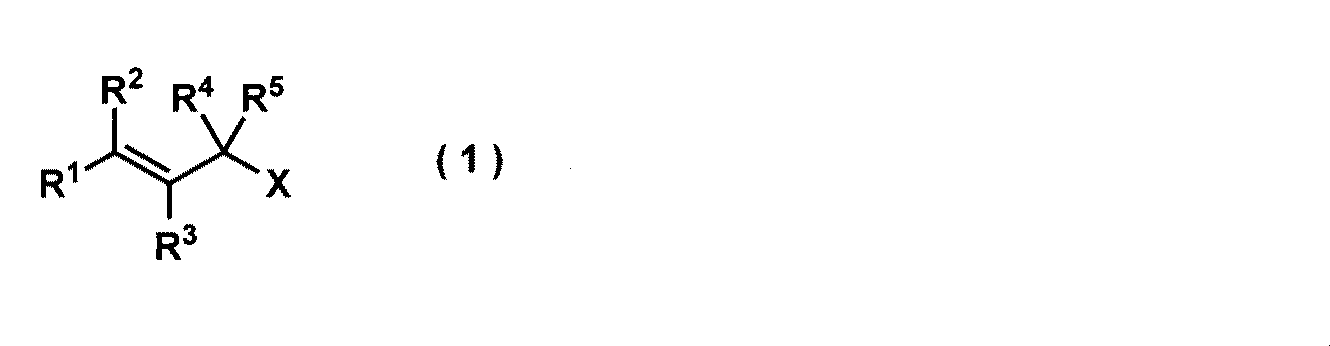
{式中、R1、R2、R3、R4、及びR5は、各々独立して、水素原子、炭素数1~10のアルキル基、炭素数2~10のアルケニル基、炭素数1~10のアルコキシ基、炭素数3~12のシクロアルキル基、炭素数3~12のシクロアルケニル基、アセトキシ基又は炭素数6~10のアリール基を表す。XはNO2-、RO-、RS(O)2O-、RCOO-及びROCOO-(Rは炭素数1~30の有機基)からなる群より選ばれるいずれかの置換基を表す。}。これらのXはアリルアルコールの有するHO-に比べて脱離しやすい。R1、R2、R3、R4、及びR5は、各々独立して、好ましくは水素原子、炭素数1~10のアルキル基、または炭素数2~10のアルケニル基であり、Rは好ましくは水素原子、炭素数1~10のアルキル基、又は炭素数6~10のアリール基である。R1、R2、R3、R4、及びR5が全て水素原子であることがより好ましい。
XがNO2-である2-アルケニル基を有する化合物の具体例としては、1-ニトロ-2-ブテン、1-ニトロ-1,3-ジフェニル-2-プロペン、3-ニトロ-3-メトキシプロペン等が挙げられる。XがRO-である2-アルケニル基を有する化合物の具体例としては、メチルアリルエーテル、エチルアリルエーテル、ジアリルエーテル、アリルフェニルエーテル等が挙げられる。XがRS(O)2O-である2-アルケニル基を有する化合物の具体例としては、ベンゼンスルホン酸アリル、p-トルエンスルホン酸アリル等が挙げられる。XがRCOO-である2-アルケニル基を有する化合物の具体例としては、酢酸アリル、酢酸2-メチル-2-プロペニル、酢酸2-ヘキセニル、酢酸2,4-ヘキサジエニル、酢酸プレニル(酢酸3-メチル-2-ブテニル)、酢酸ゲラニル、酢酸ファルネシル、酢酸シンナミル、酢酸リナリル、酢酸3-ブテン-2-イル、酢酸2-シクロペンテニル、酢酸2-トリメチルシリルメチル-2-プロペニル、酢酸2-メチル-2-シクロヘキセニル、プロピオン酸1-フェニル-1-ブテン-3-イル、酪酸1-シクロヘキシル-2-ブテン、4-シクロペンテン-1,3-ジオール-1-アセテート、1,4-ジアセトキシブテン-2,3-アセトキシ-4-ヒドロキシブテン-1等が挙げられる。XがROCOO-である2-アルケニル基を有する化合物の具体例としては、アリルメチル炭酸エステル、4-アセトキシ-2-ブテニルエチル炭酸エステル、ネリルメチル炭酸エステル、炭酸ジアリル等が挙げられる。これらの2-アルケニル基を有する化合物は単独で用いることもできるし、それらを複数任意に組み合わせて使用することもできる。本発明において使用する2-アルケニル基を有する化合物として最も好ましいものは脱離生成物の安定性が高く、また入手が容易である点からXがRCOO-であるカルボン酸エステル及びXがROCOO-である炭酸エステルである。
ヒドロキシル基を有する化合物に対する2-アルケニル基を有する化合物の使用量は、ヒドロキシル基を有する化合物のヒドロキシル基1当量当たり2-アルケニル基を有する化合物が0.1~500当量、好ましくは0.5~50当量、より好ましくは1~20当量である。ヒドロキシル基を有する化合物のヒドロキシル基1当量当たり2-アルケニル基を有する化合物の当量が1(当量比が1)より著しく大きい場合には、過剰の2-アルケニル基を有する化合物は、2-アルケニル化剤として使用されるだけでなく、溶媒としても使用される。ヒドロキシル基を複数個有する化合物のヒドロキシル基1当量当たり2-アルケニル基を有する化合物の当量が1(当量比が1)未満の場合には、目的生成物への転化が極めて低くなる場合があり、当量比が0.1未満の場合顕著となる。なお、当量比が1未満の場合は、過剰のヒドロキシル基を有する化合物を必要に応じて回収して、このプロセスに再循環することができる。2-アルケニル化反応は均一系で実施することが好ましいので、ヒドロキシル基を有する化合物及び2-アルケニル基を有する化合物は混合されて均一な液状となるものを組み合わせて用いることが好ましい。
本発明において用いられる遷移金属錯体は、以下に詳述する錯化剤と、遷移金属化合物及び1価アニオン性5員環共役ジエン化合物が錯形成することにより得られる遷移金属前駆体とが反応して得られる錯体である。
本発明において用いられる遷移金属錯体の形成に有用な錯化剤としては、分子内に遷移金属原子に対して二座配位する窒素配位部-酸素配位部(窒素原子及び酸素原子)を有するものが好ましく、一般式(2):

{式中、R6~R9は、各々独立して、水素原子、炭素数1~10のアルキル基、炭素数3~12のシクロアルキル基、炭素数6~10のアリール基、又は置換基の炭素数の合計が1~30のアルキル置換若しくは置換基の炭素数の合計が6~30のアリール置換シリル基を表す。但し、R6とR7、R7とR8、R8とR9、R6とR8、R6とR9、R7とR9は各々互いに結合して飽和又は不飽和の4~8員環を形成してもよい。}で表されるα-イミノ酸型配位子化合物が例示される。α-イミノ酸型配位子化合物の具体例としては、キナルジン酸、ピコリン酸を挙げることができるが、これらに限定されない。α-イミノ酸型配位子化合物は2-アルケニル化反応に対する高い活性を示すため、本発明において好適に用いられる。これらは単独で用いることもできるし、任意に組み合わせて使用することもできる。
本発明において用いられる遷移金属錯体の形成に有用な遷移金属前駆体の製造に用いられる遷移金属化合物としては、周期表の第8族及び第9族に属する遷移金属からなる群より選ばれる少なくとも一種の遷移金属原子を含む化合物が使用される。具体的には、塩化鉄(III)、臭化鉄(III)、硝酸鉄(III)等の鉄化合物、塩化ルテニウム(III)、臭化ルテニウム(III)、硝酸ルテニウム(III)、ヘキサアンミンルテニウム(II)、ヘキサアクアルテニウム(III)等のルテニウム化合物、塩化オスミニウム(III)、酸化オスミニウム(VI)等のオスミウム化合物、塩化コバルト(III)等のコバルト化合物、塩化ロジウム(III)等のロジウム化合物、塩化イリジウム(III)、酢酸イリジウム(II)等のイリジウム化合物等が挙げられるが、中でもルテニウム化合物、ロジウム化合物、イリジウム化合物が好ましく、特にルテニウム化合物が2-アルケニル化反応の活性が高く比較的安価であるため好ましい。
本発明において1価アニオン性5員環共役ジエンは上記遷移金属化合物と反応して錯形成することにより遷移金属原子が安定化された遷移金属前駆体を形成する。本明細書において、1価アニオン性5員環共役ジエン化合物とは、シクロペンタジエニル骨格を分子内に有する1価のアニオンを指し、以下の一般式(3)で表される共役可能な1価アニオン構造を有する化合物であることが好ましい。
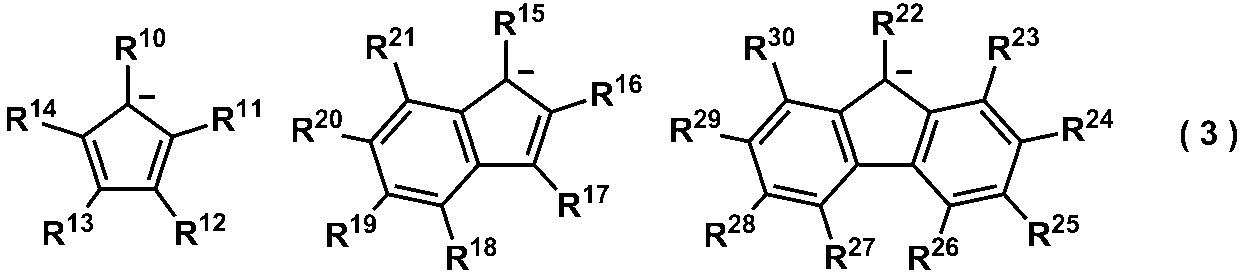
{式中、R10~R30は、各々独立して、水素原子、炭素数1~10のアルキル基、炭素数3~12のシクロアルキル基、炭素数6~10のアリール基、又は置換基の炭素数の合計が1~30のアルキル置換若しくは置換基の炭素数の合計が6~30のアリール置換シリル基を表し、環上の隣接する2つの炭素原子に結合する基が互いに結合して、前記隣接する2つの炭素原子とともに飽和又は不飽和の4~8員環を形成してもよい。式中、アニオンはR10~R30の結合炭素に共役して存在する。}
本発明において有用な1価アニオン性5員環共役ジエンの具体例としては、例えばη5-シクロペンタジエニルアニオン、η5-メチルシクロペンタジエニルアニオン、η5-ジメチルシクロペンタジエニルアニオン、η5-トリメチルシクロペンタジエニルアニオン、η5-テトラメチルシクロペンタジエニルアニオン、η5-ペンタメチルシクロペンタジエニルアニオン、η5-エチルシクロペンタジエニルアニオン、η5-n-プロピルシクロペンタジエニルアニオン、η5-イソプロピルシクロペンタジエニルアニオン、η5-n-ブチルシクロペンタジエニルアニオン、η5-sec-ブチルシクロペンタジエニルアニオン、η5-tert-ブチルシクロペンタジエニルアニオン、η5-n-ペンチルシクロペンタジエニルアニオン、η5-ネオペンチルシクロペンタジエニルアニオン、η5-n-ヘキシルシクロペンタジエニルアニオン、η5-n-オクチルシクロペンタジエニルアニオン、η5-フェニルシクロペンタジエニルアニオン、η5-ナフチルシクロペンタジエニルアニオン、η5-トリメチルシリルシクロペンタジエニルアニオン、η5-トリエチルシリルシクロペンタジエニルアニオン、η5-tert-ブチルジメチルシリルシクロペンタジエニルアニオン、η5-インデニルアニオン、η5-メチルインデニルアニオン、η5-ジメチルインデニルアニオン、η5-エチルインデニルアニオン、η5-n-プロピルインデニルアニオン、η5-イソプロピルインデニルアニオン、η5-n-ブチルインデニルアニオン、η5-sec-ブチルインデニルアニオン、η5-tert-ブチルインデニルアニオン、η5-n-ペンチルインデニルアニオン、η5-ネオペンチルインデニルアニオン、η5-n-ヘキシルインデニルアニオン、η5-n-オクチルインデニルアニオン、η5-n-デシルインデニルアニオン、η5-フェニルインデニルアニオン、η5-メチルフェニルインデニルアニオン、η5-ナフチルインデニルアニオン、η5-トリメチルシリルインデニルアニオン、η5-トリエチルシリルインデニルアニオン、η5-tert-ブチルジメチルシリルインデニルアニオン、η5-テトラヒドロインデニルアニオン、η5-フルオレニルアニオン、η5-メチルフルオレニルアニオン、η5-ジメチルフルオレニルアニオン、η5-エチルフルオレニルアニオン、η5-ジエチルフルオレニルアニオン、η5-n-プロピルフルオレニルアニオン、η5-ジ-n-プロピルフルオレニルアニオン、η5-イソプロピルフルオレニルアニオン、η5-ジイソプロピルフルオレニルアニオン、η5-n-ブチルフルオレニルアニオン、η5-sec-ブチルフルオレニルアニオン、η5-tert-ブチルフルオレニルアニオン、η5-ジ-n-ブチルフルオレニルアニオン、η5-ジ-sec-ブチルフルオレニルアニオン、η5-ジ-tert-ブチルフルオレニルアニオン、η5-n-ペンチルフルオレニルアニオン、η5-ネオペンチルフルオレニルアニオン、η5-n-ヘキシルフルオレニルアニオン、η5-n-オクチルフルオレニルアニオン、η5-n-デシルフルオレニルアニオン、η5-n-ドデシルフルオレニルアニオン、η5-フェニルフルオレニルアニオン、η5-ジ-フェニルフルオレニルアニオン、η5-メチルフェニルフルオレニルアニオン、η5-ナフチルフルオレニルアニオン、η5-トリメチルシリルフルオレニルアニオン、η5-ビス-トリメチルシリルフルオレニルアニオン、η5-トリエチルシリルフルオレニルアニオン、η5-tert-ブチルジメチルシリルフルオレニルアニオンなどを有する化合物が挙げられ、好ましくはη5-シクロペンタジエニルアニオン、η5-テトラメチルシクロペンタジエニルアニオン、η5-ペンタメチルシクロペンタジエニルアニオン、η5-インデニルアニオン、又はη5-フルオレニルアニオンである。これらの1価アニオン性5員環共役ジエン源としては、例えばカリウム、ナトリウム、リチウム等を対イオン(カウンターカチオン)として有する化合物が用いられる。
上記遷移金属前駆体の合成は、公知の方法によって行うことができ、好ましくは、上記1価アニオン性5員環共役ジエン化合物を、遷移金属のハロゲン化物等と反応させることにより得られる。適当な調製法の例は、例えば、Adv. Synth. Catal, 346, pp. 901-904 (2004)や特表2003-507387号公報に記載されている。例えば、塩化ルテニウム(III)と、ナトリウムη5-シクロペンタジエニルを反応させて、ジ(η5-シクロペンタジエニル)ルテニウム錯体を得た後、Adv. Synth. Catal, 346, pp. 901-904 (2004)に記載の方法で、シクロペンタジエニルルテニウムトリアセトニトリル錯体(遷移金属前駆体)に変換することができる。
上記錯化剤と遷移金属前駆体とを反応溶媒に溶解して反応させることにより、遷移金属錯体よりなる触媒が得られる。遷移金属錯体は、錯化剤と遷移金属前駆体とを両者の混合比(錯化剤/遷移金属前駆体(モル比))が0.8~1.5、より好ましくは0.9~1.1、反応温度0~100℃、より好ましくは20~50℃で混合することにより得られる。両者は溶媒に溶解、混合後速やかに反応し遷移金属錯体を形成するので、溶媒に溶解、混合直後に使用することもできるが、混合後暫くエイジングしてから用いることもできる。反応時間は好ましくは0.01~10時間、より好ましくは0.2~1時間である。
2-アルケニル化反応は均一系で実施することが好ましく、遷移金属錯体もヒドロキシル基を有する化合物及び2-アルケニル基を有する化合物に溶解することが好ましい。遷移金属錯体がヒドロキシル基を有する化合物及び2-アルケニル基を有する化合物に溶解する場合は、遷移金属錯体、ヒドロキシル基を有する化合物及び2-アルケニル基を有する化合物を同時に反応容器に仕込んで使用することができる。触媒の使用量は、多数の要因、例えば触媒の形態、反応の種類(回分反応、連続式の固定床反応、連続式の流動床反応)、後述する溶媒の使用量などに応じて適宜調節可能である。一般に、遷移金属錯体の使用量は、均一系触媒として使用する(反応系に触媒を溶解させて使用する)場合、ヒドロキシル基を有する化合物と2-アルケニル基を有する化合物との総和(ヒドロキシル基を有する化合物のモル量+2-アルケニル基を有する化合物のモル量)1モルに対して、0.000001~10モルであり、回分反応においては、ヒドロキシル基を有する化合物と2-アルケニル基を有する化合物との総和1モルに対して、0.000001~0.5モルである。また、担体(ポリスチレン等)に結合された錯化剤と遷移金属前駆体とを反応させて担持触媒(不均一系触媒)として使用することもできる。そのような担持触媒を用いる連続式の固定床又は流動床反応においては、遷移金属錯体の使用量は、ヒドロキシル基を有する化合物と2-アルケニル基を有する化合物との総和1モルに対して、0.0001~0.5モルである。
反応工程において反応液の均一化、粘度調整等の目的のため必要に応じて溶媒を使用することができる。使用できる溶媒としては、水、脂肪族、脂環式及び芳香族炭化水素、脂肪族、脂環式及び芳香族ハロゲン化炭化水素、ニトロアルカン、並びにエーテル、グリコールエーテル、エステル、ケトン等の酸素含有炭化水素が挙げられる。これらの中で好ましい溶媒としては、脂肪族炭化水素の例としてヘキサン、オクタン、脂環式炭化水素の例としてシクロヘキサン、芳香族炭化水素の例としてトルエン、キシレン、脂肪族ハロゲン化炭化水素の例としてジクロロメタン、1,2-ジクロロエタン、芳香族ハロゲン化炭化水素の例としてクロロベンゼン、ニトロアルカンの例としてニトロメタン、エーテルの例としてテトラヒドロフラン、グリコールエーテルの例としてジメトキシエタン、エステルの例として酢酸エチル、ケトンの例としてアセトン、メチルエチルケトンが挙げられ、特に反応性、溶解性、コスト等の点で好ましい溶媒はシクロヘキサン、ジクロロメタン、トルエン及びジメトキシエタンである。これらの溶媒は単独又は任意に組み合わせて使用できる。
上記溶媒は、ヒドロキシル基を有する化合物100質量部に対して、1000質量部以内、好ましくは0.5~500質量部、より好ましくは1~100質量部の量で使用する。
2-アルケニル化反応は10~200℃、好ましくは50~150℃、より好ましくは60~90℃の温度において、反応を本質的に完了させるのに充分な時間、通常は0.1~72時間、好ましくは0.1~48時間、より好ましくは0.1~24時間実施することができる。個々のヒドロキシル基を有する化合物に対して最適な2-アルケニル化反応温度及び時間は、使用するヒドロキシル基を有する化合物の反応性、溶媒及び触媒によって異なる。反応は液相で実施することが好ましく、したがって反応系が液相に保たれる圧力雰囲気下で実施することが好ましい。例えば約5~約2000kPaの圧力を使用できる。
上記工程で所望の転化率まで2-アルケニル化反応を実施後、任意の適当な方法又は手段を用いて、反応液から不要な成分を除去することができる。例えば均一系触媒を用いる場合、均一系触媒及びその合成に用いた余剰の錯化剤や反応副生物が反応混合物中に均一相として存在するため、反応液を洗浄する又は反応液を吸着剤処理することによりこれら不純物を分離することができる。反応液から上記不要な成分を除去するには、これら後処理前に、溶媒を添加することが好ましい。溶媒を添加することにより2-アルケニル化反応生成物を含む反応液の粘度を低下させることができ、その結果除去効率を向上させることができる。添加する溶媒は脂肪族、脂環式及び芳香族炭化水素、脂肪族、脂環式及び芳香族ハロゲン化炭化水素、ニトロアルカン、並びにエーテル、グリコールエーテル、エステル、ケトン等の酸素含有炭化水素からなる群から選択される少なくとも一種の有機溶媒を含むことが好ましい。具体的には、脂肪族炭化水素であるヘキサン、オクタン、脂環式炭化水素であるシクロヘキサン、芳香族炭化水素であるトルエン、キシレン、脂肪族ハロゲン化炭化水素であるジクロロメタン、1,2-ジクロロエタン、芳香族ハロゲン化炭化水素であるクロロベンゼン、ニトロアルカンであるニトロメタン、エーテルであるテトラヒドロフラン、グリコールエーテルであるジメトキシエタン、エステルである酢酸エチル、ケトンであるアセトン、メチルエチルケトンからなる群より選択される少なくとも一種の有機溶媒が挙げられる。また、一般式(1)のXに基因する脱離生成物が水溶性である場合には、洗浄時の抽出効率を高めるため、水を同時に添加することが好ましい。但し、この場合は非水溶性の有機溶媒を用いる必要がある。反応液は2-アルケニルエーテル生成物を含む有機層と触媒由来の無機塩や水溶性の脱離生成物を含む水層に分離するので、不要な水層は分離、除去する。水の添加とあわせて硫酸等の強酸をあわせて添加することにより触媒残渣の水層への移動が促進される。
上記の通り均一系触媒を2-アルケニル化反応液から分離した後、分離残渣(分離した水層)を再び前記添加溶媒と同様の溶媒で洗浄し、水層中に微量含まれている2-アルケニルエーテル生成物を洗浄液中に抽出し、その洗浄液を反応液と混合することで、生成物の回収率を高めることができる。洗浄、分別蒸留、抽出蒸留、液液抽出、固液抽出及び結晶化又はこれらの方法の任意の組合せを用いて、反応液から2-アルケニル化反応生成物を分離及び回収することができる。一例としてカルボン酸アリルエステルを2-アルケニル化剤(アリル化剤)として用いた場合の生成物分離方式としては、蒸留又は蒸発によって反応混合物から溶媒及び未反応2-アルケニル化剤(アリル化剤)のような揮発分を除去し、次いで蒸留又は抽出によってカルボン酸副生成物を回収して、目的とする2-アルケニル誘導体生成物を底部生成物として回収することができる。上記方法により不要な成分が分離された2-アルケニルエーテル生成物を含む反応液は、エポキシ化等の工程の反応液として直接使用することができる。
以下、実施例により本発明を具体的に説明するが、本発明は以下の実施例に制限されるものではない。
[実施例1]
10mLのヤングコック付きシュレンク型反応管に、アルゴン気流下、錯化剤としてキナルジン酸(17mg,0.10mmol;東京化成工業(株)製)、遷移金属前駆体として[CpRu(CH3CN)3]PF6(43mg,0.10mmol;Aldrich社製)(Cp:シクロペンタジエニル錯体)を加えた。ここに3回凍結-乾燥操作を施した、1,4-シクロヘキサンジメタノール(1.4g,10mmol)と酢酸アリル(3.0g,30mmol)(一般式(1)のR1、R2、R3、R4、及びR5は全て水素原子であり、XはCH3COO-である。)の混合液を加え、キナルジン酸と[CpRu(CH3CN)3]PF6を溶解、混合し80℃において6時間撹拌した。ガスクロマトグラフィー(GC)分析の結果、1,4-シクロヘキサンジメタノールのジ(2-アルケニル)化体(ジアリルエーテル)を82%、1,4-シクロヘキサンジメタノールのモノ(2-アルケニル)化体(モノアリルエーテル)を15%の収率で得た(1,4-シクロヘキサンジメタノールの転化率>99%、2-アルケニル化合計収率97%)。なお、ガスクロマトグラフィー分析は他の実施例、比較例を含めて以下の条件で実施した。
ガスクロマトグラフィー(GC)測定条件
Agilent 6850(Agilent社製)
キャピラリーカラム、Agilent HP-1(0.25mm x 30m)
カラム温度 60-300℃;昇温速度,20℃/分;検出温度,300℃
キャリアガス:ヘリウム、カラム圧:81.4kPa
スプリット比,30:1
[実施例1]
10mLのヤングコック付きシュレンク型反応管に、アルゴン気流下、錯化剤としてキナルジン酸(17mg,0.10mmol;東京化成工業(株)製)、遷移金属前駆体として[CpRu(CH3CN)3]PF6(43mg,0.10mmol;Aldrich社製)(Cp:シクロペンタジエニル錯体)を加えた。ここに3回凍結-乾燥操作を施した、1,4-シクロヘキサンジメタノール(1.4g,10mmol)と酢酸アリル(3.0g,30mmol)(一般式(1)のR1、R2、R3、R4、及びR5は全て水素原子であり、XはCH3COO-である。)の混合液を加え、キナルジン酸と[CpRu(CH3CN)3]PF6を溶解、混合し80℃において6時間撹拌した。ガスクロマトグラフィー(GC)分析の結果、1,4-シクロヘキサンジメタノールのジ(2-アルケニル)化体(ジアリルエーテル)を82%、1,4-シクロヘキサンジメタノールのモノ(2-アルケニル)化体(モノアリルエーテル)を15%の収率で得た(1,4-シクロヘキサンジメタノールの転化率>99%、2-アルケニル化合計収率97%)。なお、ガスクロマトグラフィー分析は他の実施例、比較例を含めて以下の条件で実施した。
ガスクロマトグラフィー(GC)測定条件
Agilent 6850(Agilent社製)
キャピラリーカラム、Agilent HP-1(0.25mm x 30m)
カラム温度 60-300℃;昇温速度,20℃/分;検出温度,300℃
キャリアガス:ヘリウム、カラム圧:81.4kPa
スプリット比,30:1
[実施例2]
実施例1において、触媒のみ10分の1(キナルジン酸(1.7mg,0.010mmol)、[CpRu(CH3CN)3]PF6(4.3mg,0.010mmol))に変更した以外は実施例1と全く同じ条件下、2-アルケニル化した。反応後の溶液を分析した結果、1,4-シクロヘキサンジメタノールの転化率>98%、2-アルケニル化合計収率95%で2-アルケニル化体を得た。モノ(2-アルケニル)化体(モノアリルエーテル)が23%、ジ(2-アルケニル)化体(ジアリルエーテル)が72%生成した。
実施例1において、触媒のみ10分の1(キナルジン酸(1.7mg,0.010mmol)、[CpRu(CH3CN)3]PF6(4.3mg,0.010mmol))に変更した以外は実施例1と全く同じ条件下、2-アルケニル化した。反応後の溶液を分析した結果、1,4-シクロヘキサンジメタノールの転化率>98%、2-アルケニル化合計収率95%で2-アルケニル化体を得た。モノ(2-アルケニル)化体(モノアリルエーテル)が23%、ジ(2-アルケニル)化体(ジアリルエーテル)が72%生成した。
[実施例3]
実施例1において、錯化剤をピコリン酸(12mg,0.10mmol);関東化学社製)に変更した以外は実施例1と全く同じ条件下、2-アルケニル化した。反応後の溶液を分析した結果、転化率99%、2-アルケニル化合計収率99%で2-アルケニル化体を得た。モノ(2-アルケニル)化体(モノアリルエーテル)が22%、ジ(2-アルケニル)化体(ジアリルエーテル)が77%生成した。錯化剤にはピコリン酸よりもキナルジン酸を用いた場合の方が、ジ(2-アルケニル)化体(ジアリルエーテル)の収率は高まる。
実施例1において、錯化剤をピコリン酸(12mg,0.10mmol);関東化学社製)に変更した以外は実施例1と全く同じ条件下、2-アルケニル化した。反応後の溶液を分析した結果、転化率99%、2-アルケニル化合計収率99%で2-アルケニル化体を得た。モノ(2-アルケニル)化体(モノアリルエーテル)が22%、ジ(2-アルケニル)化体(ジアリルエーテル)が77%生成した。錯化剤にはピコリン酸よりもキナルジン酸を用いた場合の方が、ジ(2-アルケニル)化体(ジアリルエーテル)の収率は高まる。
[実施例4]
実施例1において、1,4-シクロヘキサンジメタノールの代わりにヒドロキシル基を有する化合物をベンジルアルコール(1.1g,10mmol);東京化成工業(株)製)に変更した以外は実施例1と全く同じ条件下、2-アルケニル化した。反応後の溶液を分析した結果、転化率90%、2-アルケニル化収率90%で2-アルケニル化体を得た。
実施例1において、1,4-シクロヘキサンジメタノールの代わりにヒドロキシル基を有する化合物をベンジルアルコール(1.1g,10mmol);東京化成工業(株)製)に変更した以外は実施例1と全く同じ条件下、2-アルケニル化した。反応後の溶液を分析した結果、転化率90%、2-アルケニル化収率90%で2-アルケニル化体を得た。
[実施例5]
実施例1において、1,4-シクロヘキサンジメタノールの代わりに基質をフェノール(0.94g,10mmol)に変更した以外は実施例1と全く同じ条件下、2-アルケニル化した。反応後の溶液を分析した結果、転化率50%、2-アルケニル化収率50%で2-アルケニル化体を得た。
実施例1において、1,4-シクロヘキサンジメタノールの代わりに基質をフェノール(0.94g,10mmol)に変更した以外は実施例1と全く同じ条件下、2-アルケニル化した。反応後の溶液を分析した結果、転化率50%、2-アルケニル化収率50%で2-アルケニル化体を得た。
[実施例6]
実施例1において、2-アルケニル化剤である酢酸アリルを炭酸ジアリル(4.2g,30mmol);関東化学(株)製)(一般式(1)のR1、R2、R3、R4、及びR5は全て水素原子であり、XはH2C=CH-CH2OCOO-である。)に変更した以外は実施例1と全く同じ条件下、2-アルケニル化した。反応後の溶液を分析した結果、1,4-シクロヘキサンジメタノールの転化率99%、2-アルケニル化合計収率99%で2-アルケニル化体を得た。モノ(2-アルケニル)化体(モノアリルエーテル)が8.6%、ジ(2-アルケニル)化体(ジアリルエーテル)が91%生成した。
実施例1において、2-アルケニル化剤である酢酸アリルを炭酸ジアリル(4.2g,30mmol);関東化学(株)製)(一般式(1)のR1、R2、R3、R4、及びR5は全て水素原子であり、XはH2C=CH-CH2OCOO-である。)に変更した以外は実施例1と全く同じ条件下、2-アルケニル化した。反応後の溶液を分析した結果、1,4-シクロヘキサンジメタノールの転化率99%、2-アルケニル化合計収率99%で2-アルケニル化体を得た。モノ(2-アルケニル)化体(モノアリルエーテル)が8.6%、ジ(2-アルケニル)化体(ジアリルエーテル)が91%生成した。
[実施例7]
実施例1において、遷移金属前駆体を[Cp*Ru(CH3CN)3]PF6(50.4mg,0.10mmol);Aldrich製)(Cp*:ペンタメチルシクロペンタジエニル錯体)に変更した以外は実施例1と全く同じ条件下、2-アルケニル化した。反応後の溶液を分析した結果、1,4-シクロヘキサンジメタノールの転化率95%、2-アルケニル化合計収率95%で2-アルケニル化体を得た。モノ(2-アルケニル)化体(モノアリルエーテル)が35%、ジ(2-アルケニル)化体(ジアリルエーテル)が60%生成した。
実施例1において、遷移金属前駆体を[Cp*Ru(CH3CN)3]PF6(50.4mg,0.10mmol);Aldrich製)(Cp*:ペンタメチルシクロペンタジエニル錯体)に変更した以外は実施例1と全く同じ条件下、2-アルケニル化した。反応後の溶液を分析した結果、1,4-シクロヘキサンジメタノールの転化率95%、2-アルケニル化合計収率95%で2-アルケニル化体を得た。モノ(2-アルケニル)化体(モノアリルエーテル)が35%、ジ(2-アルケニル)化体(ジアリルエーテル)が60%生成した。
[実施例8~10]
実施例1において、以下の表1に記載の各溶媒(2.0mL)を共存させ、触媒量を5分の1に変更した以外は実施例1と同じ条件下、2-アルケニル化した。反応後の溶液を分析した結果を表1にまとめた。
実施例1において、以下の表1に記載の各溶媒(2.0mL)を共存させ、触媒量を5分の1に変更した以外は実施例1と同じ条件下、2-アルケニル化した。反応後の溶液を分析した結果を表1にまとめた。
[実施例11]
実施例1において、酢酸アリルを倍量(6.0g,60mmol)に変更した以外は実施例1と全く同じ条件下、2-アルケニル化した。反応後の溶液を分析した結果、1,4-シクロヘキサンジメタノールの転化率>99%、2-アルケニル化合計収率>99%で2-アルケニル化体を得た。モノ(2-アルケニル)化体(モノアリルエーテル)が7%、ジ(2-アルケニル)化体(ジアリルエーテル)が93%生成した。
実施例1において、酢酸アリルを倍量(6.0g,60mmol)に変更した以外は実施例1と全く同じ条件下、2-アルケニル化した。反応後の溶液を分析した結果、1,4-シクロヘキサンジメタノールの転化率>99%、2-アルケニル化合計収率>99%で2-アルケニル化体を得た。モノ(2-アルケニル)化体(モノアリルエーテル)が7%、ジ(2-アルケニル)化体(ジアリルエーテル)が93%生成した。
[実施例12~14]
実施例1において、酢酸アリルを以下の表1に記載の各2-アルケニル化剤(30mmol)に変更した以外は実施例1と同じ条件下、2-アルケニル化した。反応後の溶液を分析した結果を表2にまとめた。酢酸アリルを用いた場合に比べると反応性は低いが同様に2-アルケニルエーテル化合物を得ることができることが確認された。
実施例1において、酢酸アリルを以下の表1に記載の各2-アルケニル化剤(30mmol)に変更した以外は実施例1と同じ条件下、2-アルケニル化した。反応後の溶液を分析した結果を表2にまとめた。酢酸アリルを用いた場合に比べると反応性は低いが同様に2-アルケニルエーテル化合物を得ることができることが確認された。
[比較例1~3]
α-イミノ酸型配位子とは異なる錯化剤を用いた際の結果:実施例1において錯化剤として用いたキナルジン酸を以下の表3に記載した錯化剤に変更した以外は実施例1と全く同じ条件下2-アルケニル化した。表3に、錯化剤、物質量(mg)、モル量(mmol)、1,4-シクロヘキサンジメタノールの転化率(%)、2-アルケニル化合計収率(%)、モノアリルエーテル(ME)収率(%)、ジアリルエーテル(DE)収率(%)の順に結果をまとめた。
α-イミノ酸型配位子とは異なる錯化剤を用いた際の結果:実施例1において錯化剤として用いたキナルジン酸を以下の表3に記載した錯化剤に変更した以外は実施例1と全く同じ条件下2-アルケニル化した。表3に、錯化剤、物質量(mg)、モル量(mmol)、1,4-シクロヘキサンジメタノールの転化率(%)、2-アルケニル化合計収率(%)、モノアリルエーテル(ME)収率(%)、ジアリルエーテル(DE)収率(%)の順に結果をまとめた。

リン系配位子であるトリフェニルホスフィンを用いた場合は、2-アルケニル化体の収率は低く、副反応(エステル交換反応)が主反応として優先する。p-トルエンスルホン酸を用いると、2-アルケニル化反応は進行するものの、触媒量を減らすと、2-アルケニル化体の収率は大幅に低下する。
[比較例4]
実施例1において、遷移金属前駆体を酢酸パラジウム(22mg,0.10mmol)に変更した以外は実施例1と全く同じ条件下、2-アルケニル化した。反応後の溶液を分析した結果、転化率<1%、2-アルケニル化合計収率<1%で2-アルケニル化反応は殆ど進行せず目的物は全く得られなかった。
実施例1において、遷移金属前駆体を酢酸パラジウム(22mg,0.10mmol)に変更した以外は実施例1と全く同じ条件下、2-アルケニル化した。反応後の溶液を分析した結果、転化率<1%、2-アルケニル化合計収率<1%で2-アルケニル化反応は殆ど進行せず目的物は全く得られなかった。
[比較例5-10]
比較例5-7及び9-10は、実施例1において、2-アルケニル基を有する化合物をアリルアルコール(1.7g,30mmol)(一般式(1)のR1、R2、R3、R4、及びR5は全て水素原子であり、XはHO-である。)に変更し、遷移金属前駆体と錯化剤とを以下の表4に記載したものを各々記載の濃度で使用した以外は同じ条件下2-アルケニル化した。比較例8はさらに反応時間を48時間に変更した。表4に、遷移金属前駆体、錯化剤、モル量(mmol)、転化率(%)、2-アルケニル化合計収率(%)、モノアリルエーテル収率(%)、ジアリルエーテル収率(%)の順に結果をまとめた。
比較例5-7及び9-10は、実施例1において、2-アルケニル基を有する化合物をアリルアルコール(1.7g,30mmol)(一般式(1)のR1、R2、R3、R4、及びR5は全て水素原子であり、XはHO-である。)に変更し、遷移金属前駆体と錯化剤とを以下の表4に記載したものを各々記載の濃度で使用した以外は同じ条件下2-アルケニル化した。比較例8はさらに反応時間を48時間に変更した。表4に、遷移金属前駆体、錯化剤、モル量(mmol)、転化率(%)、2-アルケニル化合計収率(%)、モノアリルエーテル収率(%)、ジアリルエーテル収率(%)の順に結果をまとめた。

CpRu-ピコリン酸/キナルジン酸系触媒においては、アリルアルコールを用いても反応は進行するが、最も活性の高いキナルジン酸系の触媒量を10分の1とすると、目的のジアリルエーテルの収率は32%まで低下している(比較例7)。反応時間を延長しても、収率は40%程度までしか向上していない(比較例8)。その他の錯化剤を用いた場合は、2-アルケニル化反応性が著しく低下し、目的物を効率的に得ることは困難である。アリルアルコールに比べ、酢酸アリルを用いると2-アルケニル化反応性が向上する。
本発明の2-アルケニルエーテル化合物の製造方法によれば、2-アルケニル化反応に直接寄与しない溶媒以外の添加剤を使用することなく、2-アルケニル化剤によりアルコール性又はフェノール性のヒドロキシル基を選択的に2-アルケニル化させることにより2-アルケニルエーテルを高反応率で製造することができる。2-アルケニル化剤には、大量に供給可能で安価なカルボン酸アリルエステルを用いることができ、アリルアルコールに比べ2-アルケニル化剤としての反応性が高く、毒性も低いことから工業化時の安全性も高い手法であり、生産性、操作性の観点から非常に有益である。得られたアリルエーテル化合物はエポキシ化反応により、対応するグリシジルエーテル化合物に変換することができる。そのため電子材料分野や、接着剤、塗料樹脂といった各種ポリマーの原料として化学工業をはじめとする様々な産業分野で幅広く用いられる有用な低塩素含有量のエポキシ樹脂を、低コストで製造でき、工業的に有用である。
Claims (11)
- ヒドロキシル基を有する化合物と以下の一般式(1)で表される2-アルケニル基を有する化合物を触媒存在下で反応させる2-アルケニルエーテル化合物の製造方法であって、
- 前記錯化剤が、一般式(2):
- 前記遷移金属前駆体が、周期表の第8族及び第9族に属する遷移金属からなる群より選ばれる少なくとも一種の遷移金属原子を含む請求項1又は2のいずれかに記載の2-アルケニルエーテル化合物の製造方法。
- 前記遷移金属原子がルテニウム、ロジウム、及びイリジウムからなる群より選ばれる請求項3に記載の2-アルケニルエーテル化合物の製造方法。
- 前記1価アニオン性5員環共役ジエンが一般式(3):
- 前記一般式(1)中、R1、R2、R3、R4、及びR5が全て水素原子である請求項1~5のいずれか一項に記載の2-アルケニルエーテル化合物の製造方法。
- 前記一般式(1)で表される化合物が、酢酸アリル、酢酸2-メチル-2-プロペニル、酢酸2-ヘキセニル、酢酸2,4-ヘキサジエニル、酢酸プレニル(酢酸3-メチル-2-ブテニル)、酢酸ゲラニル、酢酸ファルネシル、酢酸シンナミル、酢酸リナリル、酢酸3-ブテン-2-イル、酢酸2-シクロペンテニル、酢酸2-トリメチルシリルメチル-2-プロペニル、酢酸2-メチル-2-シクロヘキセニル、プロピオン酸1-フェニル-1-ブテン-3-イル、酪酸1-シクロヘキシル-2-ブテン、4-シクロペンテン-1,3-ジオール-1-アセテート、及び1,4-ジアセトキシブテン-2,3-アセトキシ-4-ヒドロキシブテン-1からなる群より選ばれるカルボン酸エステル、またはアリルメチル炭酸エステル、4-アセトキシ-2-ブテニルエチル炭酸エステル、ネリルメチル炭酸エステル、及び炭酸ジアリルからなる群より選ばれる炭酸エステルである請求項1~5のいずれか一項に記載の2-アルケニルエーテル化合物の製造方法。
- 前記ヒドロキシル基を有する化合物が、分子内にヒドロキシル基を1つ又は2つ有する炭素数が1~30の飽和の脂肪族アルコール、分子内にヒドロキシル基を1つ又は2つ有する炭素数が3~30の飽和の脂環式アルコール、及び分子内にヒドロキシル基を1~10個有する炭素数が6~30のアリール化合物からなる群より選ばれる請求項1~7のいずれか一項に記載の2-アルケニルエーテル化合物の製造方法。
- 前記ヒドロキシル基を有する化合物が、1級の飽和の脂肪族アルコール又は脂環式アルコールである請求項8に記載の2-アルケニルエーテル化合物の製造方法。
- 前記遷移金属錯体を、ヒドロキシル基を有する化合物と2-アルケニル基を有する化合物との総和(ヒドロキシル基を有する化合物のモル量+2-アルケニル基を有する化合物のモル量)1モルに対して0.000001~10モル用いる請求項1~9のいずれか一項に記載の2-アルケニルエーテル化合物の製造方法。
- 1価アニオン性5員環共役ジエン骨格を有する化合物と遷移金属化合物とを反応させ1価アニオン性5員環共役ジエンを分子内に配位子として有する遷移金属前駆体を製造する工程と、
前記遷移金属前駆体と錯化剤とを混合し遷移金属錯体を製造する工程と、
前記遷移金属錯体と、ヒドロキシル基を有する化合物と、2-アルケニル基を有する化合物を混合し反応させて2-アルケニルエーテル化合物を製造する工程と、
を有する請求項1~10のいずれか一項に記載の2-アルケニルエーテル化合物の製造方法。
Applications Claiming Priority (2)
| Application Number | Priority Date | Filing Date | Title |
|---|---|---|---|
| JP2011072338 | 2011-03-29 | ||
| JP2011-072338 | 2011-03-29 |
Publications (1)
| Publication Number | Publication Date |
|---|---|
| WO2012133108A1 true WO2012133108A1 (ja) | 2012-10-04 |
Family
ID=46930836
Family Applications (1)
| Application Number | Title | Priority Date | Filing Date |
|---|---|---|---|
| PCT/JP2012/057338 Ceased WO2012133108A1 (ja) | 2011-03-29 | 2012-03-22 | 2-アルケニルエーテル化合物の製造方法 |
Country Status (2)
| Country | Link |
|---|---|
| TW (1) | TW201302693A (ja) |
| WO (1) | WO2012133108A1 (ja) |
Cited By (1)
| Publication number | Priority date | Publication date | Assignee | Title |
|---|---|---|---|---|
| JP2016028129A (ja) * | 2014-07-08 | 2016-02-25 | 昭和電工株式会社 | ポリアルケニルフェノール化合物の製造方法 |
Families Citing this family (1)
| Publication number | Priority date | Publication date | Assignee | Title |
|---|---|---|---|---|
| CN111960921B (zh) * | 2020-09-09 | 2023-01-13 | 江苏扬农化工集团有限公司 | 一种从双氧水法环氧氯丙烷工艺水层中回收氯丙烯与甲醇的方法及装置 |
Citations (4)
| Publication number | Priority date | Publication date | Assignee | Title |
|---|---|---|---|---|
| JPH10511721A (ja) * | 1994-12-23 | 1998-11-10 | ザ ダウ ケミカル カンパニー | アリルエーテル、チオエーテル及びアミン化合物の製造方法 |
| JP2004262779A (ja) * | 2003-02-28 | 2004-09-24 | Daicel Chem Ind Ltd | アリル基含有化合物の製造法 |
| JP2005289977A (ja) * | 2004-03-10 | 2005-10-20 | Univ Nagoya | 新規なルテニウム錯体を用いたアリル系保護基の除去方法及びアリルエーテル類の製造方法 |
| JP2011026253A (ja) * | 2009-07-27 | 2011-02-10 | Showa Denko Kk | アリルエーテルの製造方法 |
-
2012
- 2012-03-22 WO PCT/JP2012/057338 patent/WO2012133108A1/ja not_active Ceased
- 2012-03-28 TW TW101110831A patent/TW201302693A/zh unknown
Patent Citations (4)
| Publication number | Priority date | Publication date | Assignee | Title |
|---|---|---|---|---|
| JPH10511721A (ja) * | 1994-12-23 | 1998-11-10 | ザ ダウ ケミカル カンパニー | アリルエーテル、チオエーテル及びアミン化合物の製造方法 |
| JP2004262779A (ja) * | 2003-02-28 | 2004-09-24 | Daicel Chem Ind Ltd | アリル基含有化合物の製造法 |
| JP2005289977A (ja) * | 2004-03-10 | 2005-10-20 | Univ Nagoya | 新規なルテニウム錯体を用いたアリル系保護基の除去方法及びアリルエーテル類の製造方法 |
| JP2011026253A (ja) * | 2009-07-27 | 2011-02-10 | Showa Denko Kk | アリルエーテルの製造方法 |
Non-Patent Citations (3)
| Title |
|---|
| HIRAKAWA, T. ET AL.: "A magnetically separable heterogeneous deallylation catalyst: [CpRu(eta3- C3H5)(2-pyridinecarboxylato)]PF6 complex supported on a ferromagnetic microsize particle Fe304@Si02", EUROPEAN JOURNAL OF ORGANIC CHEMISTRY, 2009, pages 789 - 792, XP055011332, DOI: doi:10.1002/ejoc.200801166 * |
| TANAKA, S. ET AL.: "A new synthetic route to oligoribonucleotides based on CpRu-catalyzed deallylation", TETRAHEDRON LETTERS, vol. 48, 2007, pages 7320 - 7322, XP022244721, DOI: doi:10.1016/j.tetlet.2007.08.032 * |
| ZHANG, H.J. ET AL.: "Ruthenium-catalyzed nucleophilic allylic substitution reactions from beta-silylated allylic carbonates", ORGANOMETALLICS, vol. 28, 2009, pages 5173 - 5182, XP002737029, DOI: doi:10.1021/om900437m * |
Cited By (1)
| Publication number | Priority date | Publication date | Assignee | Title |
|---|---|---|---|---|
| JP2016028129A (ja) * | 2014-07-08 | 2016-02-25 | 昭和電工株式会社 | ポリアルケニルフェノール化合物の製造方法 |
Also Published As
| Publication number | Publication date |
|---|---|
| TW201302693A (zh) | 2013-01-16 |
Similar Documents
| Publication | Publication Date | Title |
|---|---|---|
| EP2850050B1 (en) | Process for the chemoselective reduction of terminally saturated carboxylic esters | |
| CN101270113B (zh) | 多手性催化剂制备及在高光学活性环碳酸酯合成的应用 | |
| US10106477B2 (en) | Process for preparing 1,4-bis(ethoxymethyl)cyclohexane | |
| CN109651115B (zh) | 一种制备l-薄荷酮的方法 | |
| JP7291142B2 (ja) | 1-アシルオキシ-2-メチル-2-プロペンの製造方法 | |
| JP2014001154A (ja) | 2−アルケニルエーテル化合物の製造方法 | |
| WO2015146294A1 (ja) | 鉄触媒によるエステル交換反応 | |
| CN110734376B (zh) | 一种2-甲基-4-乙酰氧基-2-丁烯醛的制备方法 | |
| JP6219884B2 (ja) | (z)−3−メチル−2−シクロペンタデセノンの製造方法および(r)−(−)−3−メチルシクロペンタデカノンの製造方法 | |
| CN109553633B (zh) | 一种苯乙酸类型芳炔的制备方法 | |
| CN107954962A (zh) | 一种4,4-二卤代四氢吡喃制备方法 | |
| EP1828087B1 (en) | Cyclopropanation process | |
| TW201302693A (zh) | 2-烯基醚化合物之製造方法 | |
| KR20110137771A (ko) | 촉매적 알릴화에 의한 알릴 알킬 에테르의 제조방법 | |
| Urbala | Solvent-free [Ru]-catalyzed isomerization of allyl glycidyl ether: The scope, effectiveness and recycling of catalysts, and exothermal effect | |
| JP6684708B2 (ja) | 4−イソプロピル−3−メチルフェノールの製造方法 | |
| CN1232492C (zh) | 生产二元醇丁醚的方法 | |
| US9199900B2 (en) | Method for converting farnesol to nerolidol in the presence of alpha-bisabolol | |
| JP2003335727A (ja) | エステル化合物の製造方法 | |
| JP5762288B2 (ja) | アリルアミンの製造方法 | |
| JP4494092B2 (ja) | エーテル類の製造方法 | |
| CN116867762A (zh) | 环己烯酮化合物的制造方法 | |
| JP6468536B2 (ja) | 3−メチル−2−シクロペンタデセノン組成物の製造方法および(r)−ムスコン組成物の製造方法 | |
| JP2019517558A (ja) | アルファ,ベータ−不飽和アルデヒドおよびケトンからのアルコールの調製のための方法 | |
| Forth et al. | Synthesis of Long Chain ω-Aralkylbromides |
Legal Events
| Date | Code | Title | Description |
|---|---|---|---|
| 121 | Ep: the epo has been informed by wipo that ep was designated in this application |
Ref document number: 12764876 Country of ref document: EP Kind code of ref document: A1 |
|
| NENP | Non-entry into the national phase |
Ref country code: DE |
|
| 122 | Ep: pct application non-entry in european phase |
Ref document number: 12764876 Country of ref document: EP Kind code of ref document: A1 |
|
| NENP | Non-entry into the national phase |
Ref country code: JP |