WO2012131914A1 - ハニカム構造体及び排ガス浄化装置 - Google Patents
ハニカム構造体及び排ガス浄化装置 Download PDFInfo
- Publication number
- WO2012131914A1 WO2012131914A1 PCT/JP2011/057855 JP2011057855W WO2012131914A1 WO 2012131914 A1 WO2012131914 A1 WO 2012131914A1 JP 2011057855 W JP2011057855 W JP 2011057855W WO 2012131914 A1 WO2012131914 A1 WO 2012131914A1
- Authority
- WO
- WIPO (PCT)
- Prior art keywords
- zeolite
- honeycomb structure
- honeycomb
- phosphate
- honeycomb unit
- Prior art date
- Legal status (The legal status is an assumption and is not a legal conclusion. Google has not performed a legal analysis and makes no representation as to the accuracy of the status listed.)
- Ceased
Links
Images

Classifications
-
- B—PERFORMING OPERATIONS; TRANSPORTING
- B01—PHYSICAL OR CHEMICAL PROCESSES OR APPARATUS IN GENERAL
- B01D—SEPARATION
- B01D53/00—Separation of gases or vapours; Recovering vapours of volatile solvents from gases; Chemical or biological purification of waste gases, e.g. engine exhaust gases, smoke, fumes, flue gases, aerosols
- B01D53/34—Chemical or biological purification of waste gases
- B01D53/92—Chemical or biological purification of waste gases of engine exhaust gases
- B01D53/94—Chemical or biological purification of waste gases of engine exhaust gases by catalytic processes
- B01D53/9404—Removing only nitrogen compounds
- B01D53/9409—Nitrogen oxides
- B01D53/9413—Processes characterised by a specific catalyst
- B01D53/9418—Processes characterised by a specific catalyst for removing nitrogen oxides by selective catalytic reduction [SCR] using a reducing agent in a lean exhaust gas
-
- B—PERFORMING OPERATIONS; TRANSPORTING
- B01—PHYSICAL OR CHEMICAL PROCESSES OR APPARATUS IN GENERAL
- B01D—SEPARATION
- B01D53/00—Separation of gases or vapours; Recovering vapours of volatile solvents from gases; Chemical or biological purification of waste gases, e.g. engine exhaust gases, smoke, fumes, flue gases, aerosols
- B01D53/34—Chemical or biological purification of waste gases
- B01D53/74—General processes for purification of waste gases; Apparatus or devices specially adapted therefor
- B01D53/86—Catalytic processes
- B01D53/8621—Removing nitrogen compounds
- B01D53/8625—Nitrogen oxides
- B01D53/8628—Processes characterised by a specific catalyst
-
- C—CHEMISTRY; METALLURGY
- C04—CEMENTS; CONCRETE; ARTIFICIAL STONE; CERAMICS; REFRACTORIES
- C04B—LIME, MAGNESIA; SLAG; CEMENTS; COMPOSITIONS THEREOF, e.g. MORTARS, CONCRETE OR LIKE BUILDING MATERIALS; ARTIFICIAL STONE; CERAMICS; REFRACTORIES; TREATMENT OF NATURAL STONE
- C04B28/00—Compositions of mortars, concrete or artificial stone, containing inorganic binders or the reaction product of an inorganic and an organic binder, e.g. polycarboxylate cements
- C04B28/24—Compositions of mortars, concrete or artificial stone, containing inorganic binders or the reaction product of an inorganic and an organic binder, e.g. polycarboxylate cements containing alkyl, ammonium or metal silicates; containing silica sols
- C04B28/26—Silicates of the alkali metals
-
- C—CHEMISTRY; METALLURGY
- C04—CEMENTS; CONCRETE; ARTIFICIAL STONE; CERAMICS; REFRACTORIES
- C04B—LIME, MAGNESIA; SLAG; CEMENTS; COMPOSITIONS THEREOF, e.g. MORTARS, CONCRETE OR LIKE BUILDING MATERIALS; ARTIFICIAL STONE; CERAMICS; REFRACTORIES; TREATMENT OF NATURAL STONE
- C04B35/00—Shaped ceramic products characterised by their composition; Ceramics compositions; Processing powders of inorganic compounds preparatory to the manufacturing of ceramic products
- C04B35/01—Shaped ceramic products characterised by their composition; Ceramics compositions; Processing powders of inorganic compounds preparatory to the manufacturing of ceramic products based on oxide ceramics
- C04B35/16—Shaped ceramic products characterised by their composition; Ceramics compositions; Processing powders of inorganic compounds preparatory to the manufacturing of ceramic products based on oxide ceramics based on silicates other than clay
- C04B35/18—Shaped ceramic products characterised by their composition; Ceramics compositions; Processing powders of inorganic compounds preparatory to the manufacturing of ceramic products based on oxide ceramics based on silicates other than clay rich in aluminium oxide
-
- C—CHEMISTRY; METALLURGY
- C04—CEMENTS; CONCRETE; ARTIFICIAL STONE; CERAMICS; REFRACTORIES
- C04B—LIME, MAGNESIA; SLAG; CEMENTS; COMPOSITIONS THEREOF, e.g. MORTARS, CONCRETE OR LIKE BUILDING MATERIALS; ARTIFICIAL STONE; CERAMICS; REFRACTORIES; TREATMENT OF NATURAL STONE
- C04B38/00—Porous mortars, concrete, artificial stone or ceramic ware; Preparation thereof
- C04B38/0006—Honeycomb structures
-
- B—PERFORMING OPERATIONS; TRANSPORTING
- B01—PHYSICAL OR CHEMICAL PROCESSES OR APPARATUS IN GENERAL
- B01D—SEPARATION
- B01D2251/00—Reactants
- B01D2251/20—Reductants
- B01D2251/206—Ammonium compounds
- B01D2251/2067—Urea
-
- B—PERFORMING OPERATIONS; TRANSPORTING
- B01—PHYSICAL OR CHEMICAL PROCESSES OR APPARATUS IN GENERAL
- B01D—SEPARATION
- B01D2255/00—Catalysts
- B01D2255/20—Metals or compounds thereof
- B01D2255/207—Transition metals
- B01D2255/20738—Iron
-
- B—PERFORMING OPERATIONS; TRANSPORTING
- B01—PHYSICAL OR CHEMICAL PROCESSES OR APPARATUS IN GENERAL
- B01D—SEPARATION
- B01D2255/00—Catalysts
- B01D2255/20—Metals or compounds thereof
- B01D2255/207—Transition metals
- B01D2255/20761—Copper
-
- B—PERFORMING OPERATIONS; TRANSPORTING
- B01—PHYSICAL OR CHEMICAL PROCESSES OR APPARATUS IN GENERAL
- B01D—SEPARATION
- B01D2255/00—Catalysts
- B01D2255/50—Zeolites
-
- B—PERFORMING OPERATIONS; TRANSPORTING
- B01—PHYSICAL OR CHEMICAL PROCESSES OR APPARATUS IN GENERAL
- B01D—SEPARATION
- B01D2255/00—Catalysts
- B01D2255/50—Zeolites
- B01D2255/502—Beta zeolites
-
- C—CHEMISTRY; METALLURGY
- C04—CEMENTS; CONCRETE; ARTIFICIAL STONE; CERAMICS; REFRACTORIES
- C04B—LIME, MAGNESIA; SLAG; CEMENTS; COMPOSITIONS THEREOF, e.g. MORTARS, CONCRETE OR LIKE BUILDING MATERIALS; ARTIFICIAL STONE; CERAMICS; REFRACTORIES; TREATMENT OF NATURAL STONE
- C04B2235/00—Aspects relating to ceramic starting mixtures or sintered ceramic products
- C04B2235/02—Composition of constituents of the starting material or of secondary phases of the final product
- C04B2235/30—Constituents and secondary phases not being of a fibrous nature
- C04B2235/32—Metal oxides, mixed metal oxides, or oxide-forming salts thereof, e.g. carbonates, nitrates, (oxy)hydroxides, chlorides
- C04B2235/3217—Aluminum oxide or oxide forming salts thereof, e.g. bauxite, alpha-alumina
- C04B2235/3218—Aluminium (oxy)hydroxides, e.g. boehmite, gibbsite, alumina sol
-
- C—CHEMISTRY; METALLURGY
- C04—CEMENTS; CONCRETE; ARTIFICIAL STONE; CERAMICS; REFRACTORIES
- C04B—LIME, MAGNESIA; SLAG; CEMENTS; COMPOSITIONS THEREOF, e.g. MORTARS, CONCRETE OR LIKE BUILDING MATERIALS; ARTIFICIAL STONE; CERAMICS; REFRACTORIES; TREATMENT OF NATURAL STONE
- C04B2235/00—Aspects relating to ceramic starting mixtures or sintered ceramic products
- C04B2235/02—Composition of constituents of the starting material or of secondary phases of the final product
- C04B2235/30—Constituents and secondary phases not being of a fibrous nature
- C04B2235/34—Non-metal oxides, non-metal mixed oxides, or salts thereof that form the non-metal oxides upon heating, e.g. carbonates, nitrates, (oxy)hydroxides, chlorides
- C04B2235/3427—Silicates other than clay, e.g. water glass
- C04B2235/3463—Alumino-silicates other than clay, e.g. mullite
-
- C—CHEMISTRY; METALLURGY
- C04—CEMENTS; CONCRETE; ARTIFICIAL STONE; CERAMICS; REFRACTORIES
- C04B—LIME, MAGNESIA; SLAG; CEMENTS; COMPOSITIONS THEREOF, e.g. MORTARS, CONCRETE OR LIKE BUILDING MATERIALS; ARTIFICIAL STONE; CERAMICS; REFRACTORIES; TREATMENT OF NATURAL STONE
- C04B2235/00—Aspects relating to ceramic starting mixtures or sintered ceramic products
- C04B2235/02—Composition of constituents of the starting material or of secondary phases of the final product
- C04B2235/30—Constituents and secondary phases not being of a fibrous nature
- C04B2235/44—Metal salt constituents or additives chosen for the nature of the anions, e.g. hydrides or acetylacetonate
- C04B2235/447—Phosphates or phosphites, e.g. orthophosphate or hypophosphite
-
- C—CHEMISTRY; METALLURGY
- C04—CEMENTS; CONCRETE; ARTIFICIAL STONE; CERAMICS; REFRACTORIES
- C04B—LIME, MAGNESIA; SLAG; CEMENTS; COMPOSITIONS THEREOF, e.g. MORTARS, CONCRETE OR LIKE BUILDING MATERIALS; ARTIFICIAL STONE; CERAMICS; REFRACTORIES; TREATMENT OF NATURAL STONE
- C04B2235/00—Aspects relating to ceramic starting mixtures or sintered ceramic products
- C04B2235/02—Composition of constituents of the starting material or of secondary phases of the final product
- C04B2235/50—Constituents or additives of the starting mixture chosen for their shape or used because of their shape or their physical appearance
- C04B2235/52—Constituents or additives characterised by their shapes
- C04B2235/5208—Fibers
- C04B2235/5216—Inorganic
- C04B2235/522—Oxidic
- C04B2235/5224—Alumina or aluminates
Definitions
- the present invention relates to a honeycomb structure and an exhaust gas purification device.
- an SCR Selective Catalytic Reduction system that uses ammonia to reduce NOx to nitrogen and water has been known as one of systems for purifying automobile exhaust gas.
- zeolite is known as a material that adsorbs ammonia in the SCR system.
- Patent Document 1 discloses a honeycomb structure having a honeycomb unit including zeolite, inorganic fibers and / or whiskers, and an inorganic binder.
- SAPO has a characteristic that the lattice constant changes and contracts or expands when water adsorbed or desorbed. For this reason, when water is adsorbed on the honeycomb unit containing SAPO or water adsorbed on the honeycomb unit is desorbed, the honeycomb unit tends to contract or expand and easily break.
- the present invention has excellent NOx purification performance, and even if water is adsorbed to the honeycomb unit or water adsorbed to the honeycomb unit is desorbed, the honeycomb unit is damaged or contracted or expanded.
- An object of the present invention is to provide a honeycomb structure capable of suppressing the above and an exhaust gas purification device having the honeycomb structure.
- a honeycomb structure of the present invention is a honeycomb structure having a honeycomb unit including a ⁇ -type zeolite, a phosphate-based zeolite, and an inorganic binder, and a plurality of through holes arranged in parallel in the longitudinal direction with a partition wall therebetween.
- the ⁇ -type zeolite has an average secondary particle size of 0.5 ⁇ m to 5 ⁇ m
- the phosphate zeolite has an average primary particle size of 0.5 ⁇ m to 5 ⁇ m
- the ratio of the mass of the phosphate zeolite to the total mass of the type zeolite and the phosphate zeolite is 5% or more and 35% or less.
- the ratio of the average particle size of the primary particles of the phosphate zeolite to the average particle size of the secondary particles of the ⁇ -type zeolite is preferably 0.25 or more and 4.0 or less.
- the phosphate zeolite is preferably SAPO. *
- the SAPO is preferably SAPO-34. *
- At least one of the ⁇ -type zeolite and the phosphate zeolite is ion-exchanged with copper ions and / or iron ions.
- the inorganic binder is preferably a solid content contained in one or more selected from the group consisting of alumina sol, silica sol, titania sol, water glass, sepiolite, attapulgite and boehmite. *
- the honeycomb unit preferably further includes one or more selected from the group consisting of inorganic fibers, scale-like substances, tetrapot-like substances, and three-dimensional needle-like substances.
- the inorganic fiber is at least one selected from the group consisting of alumina, silica, silicon carbide, silica alumina, glass, potassium titanate, and aluminum borate, and the scaly substance includes glass, muscovite, alumina, and silica.
- the tetrapot-like substance is zinc oxide
- the three-dimensional needle-like substance is alumina, silica, silicon carbide, silica alumina, glass, potassium titanate, boric acid. It is desirable to be at least one selected from the group consisting of aluminum and boehmite. *
- the honeycomb structure of the present invention preferably has a plurality of the honeycomb units.
- the exhaust gas purification apparatus of the present invention has the honeycomb structure of the present invention.
- a structure and an exhaust gas purification apparatus having the honeycomb structure can be provided.
- Fig. 4 is a perspective view showing a honeycomb unit constituting the honeycomb structure of Fig. 3.
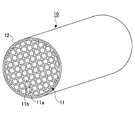
- FIG. 1 shows an example of the honeycomb structure of the present invention.
- the honeycomb structure 10 includes a single honeycomb unit 11 that includes ⁇ -type zeolite, phosphate-based zeolite, and an inorganic binder, and in which a plurality of through holes 11a are arranged in parallel in the longitudinal direction with a partition wall 11b interposed therebetween. Further, the outer peripheral coat layer 12 is formed on the outer peripheral surface excluding both end surfaces of the honeycomb unit 11.
- ⁇ -type zeolite has an average secondary particle size of 0.5 to 5 ⁇ m.
- the average particle size of the secondary particles of ⁇ -type zeolite is less than 0.5 ⁇ m, the exhaust gas does not easily enter into the partition walls 11b of the honeycomb unit 11, and the ⁇ -type zeolite and phosphate-based zeolite purify NOx. Will not be used effectively.
- the average particle size of the secondary particles of ⁇ -type zeolite exceeds 5 ⁇ m, the number of pores in the honeycomb unit 11 decreases, so that the exhaust gas does not easily enter the partition walls 11b of the honeycomb unit 11, and ⁇ -type zeolite Zeolite and phosphate-based zeolite are not effectively used for NOx purification.
- the average particle diameter of primary particles of ⁇ -type zeolite is preferably 0.01 to 0.1 ⁇ m.
- the phosphate zeolite is not particularly limited, but SAPO (silicoaluminophosphate) such as SAPO-5, SAPO-11, and SAPO-34; MeAPO (metalloaluminophosphate); MeAPSO (metal skeleton-substituted silicoaluminophosphate) and the like And two or more of them may be used in combination.
- SAPO sicoaluminophosphate
- MeAPO metaloaluminophosphate
- MeAPSO metal skeleton-substituted silicoaluminophosphate
- the average particle diameter of primary particles of phosphate zeolite is 0.5 to 5 ⁇ m.
- the exhaust gas hardly enters the partition walls 11b of the honeycomb unit 11, and the ⁇ -type zeolite and the phosphate zeolite are NOx. It will not be used effectively for purification.
- the average particle size of the primary particles of the phosphate-based zeolite exceeds 5 ⁇ m, the number of pores in the honeycomb unit 11 decreases, so that the exhaust gas does not easily enter the partition walls 11b of the honeycomb unit 11, and ⁇ Type zeolite and phosphate-based zeolite are not effectively used for NOx purification.
- the ratio of the mass of phosphate zeolite to the total mass of ⁇ -type zeolite and phosphate zeolite is 5 to 35%, preferably 15 to 25%.
- the ratio of the mass of the phosphate zeolite to the total mass of the ⁇ -type zeolite and the phosphate zeolite is less than 5%, the NOx purification performance decreases.
- the ratio of the mass of phosphate zeolite to the total mass of ⁇ -type zeolite and phosphate zeolite exceeds 35%, water adsorbs on the honeycomb unit 11 or desorbs water adsorbed on the honeycomb unit 11.
- the honeycomb unit 11 is easily damaged by contraction or expansion.
- ⁇ -type zeolite is present around the phosphate-based zeolite. Therefore, even if water is adsorbed on the honeycomb unit 11 or desorbed on the honeycomb unit 11, the honeycomb unit 11 contracts or expands. It is possible to suppress damage due to the above. Specifically, when water adsorbs on the honeycomb unit 11 or water adsorbed on the honeycomb unit 11 desorbs, the phosphate zeolite contracts or expands. However, since ⁇ -type zeolite exists, the phosphate zeolite Can be reduced. Since ⁇ -type zeolite also has NOx purification performance, the honeycomb structure 10 can maintain NOx purification performance even if the honeycomb unit 11 contains ⁇ -type zeolite.
- the ratio of the average particle size of the primary particles of the phosphate zeolite to the average particle size of the secondary particles of the ⁇ -type zeolite is preferably 0.25 to 4.0, more preferably 0.8 to 1.2. preferable.
- the ratio of the average particle diameter of the primary particles of the phosphate zeolite to the average particle diameter of the secondary particles of the ⁇ -type zeolite is less than 0.25 or exceeds 4.0, water is adsorbed on the honeycomb unit 11 Alternatively, when water adsorbed on the honeycomb unit 11 is desorbed, the effect of suppressing breakage due to the shrinkage or expansion of the honeycomb unit 11 is reduced.
- ⁇ -type zeolite is preferably ion-exchanged with copper ions and / or iron ions in order to improve NOx purification performance.
- the ⁇ -type zeolite ion-exchanged with copper ions and / or iron ions preferably has an ion exchange amount of 1.0 to 5.0% by mass.
- a metal ion which ion-exchanges beta-type zeolite it is not limited to a copper ion and / or an iron ion, The transition metal ion etc. which can improve the purification
- the phosphate zeolite is preferably ion-exchanged with copper ions and / or iron ions in order to improve NOx purification performance.
- the phosphate zeolite ion-exchanged with copper ions and / or iron ions preferably has an ion exchange amount of 1.0 to 5.0% by mass.
- a metal ion which ion-exchanges a phosphate-type zeolite it is not limited to a copper ion and / or an iron ion, The transition metal ion etc. which can improve the purification
- the honeycomb unit 11 preferably has a content of ⁇ -type zeolite and phosphate-based zeolite per apparent volume of 230 to 400 g / L.
- a content of ⁇ -type zeolite and phosphate-based zeolite per apparent volume of 230 to 400 g / L is less than 230 g / L, it is necessary to increase the apparent volume of the honeycomb unit 11 in order to improve the NOx purification performance. There is.
- the content of ⁇ -type zeolite and phosphate zeolite per apparent volume of the honeycomb unit 11 exceeds 400 g / L, the strength of the honeycomb unit 11 becomes insufficient, or the aperture ratio of the honeycomb unit 11 increases. It gets smaller.
- the inorganic binder contained in the honeycomb unit 11 is not particularly limited, and examples thereof include solids contained in alumina sol, silica sol, titania sol, water glass, sepiolite, attapulgite, boehmite and the like, and two or more kinds may be used in combination.
- the content of the inorganic binder in the honeycomb unit 11 is preferably 5 to 30% by mass, and more preferably 10 to 20% by mass.
- the content of the inorganic binder in the honeycomb unit 11 is less than 5% by mass, the strength of the honeycomb unit 11 is lowered.
- the content of the inorganic binder in the honeycomb unit 11 exceeds 30% by mass, it becomes difficult to extrude the honeycomb unit 11.
- the honeycomb unit 11 preferably further includes at least one selected from the group consisting of inorganic fibers, scale-like substances, tetrapot-like substances, and three-dimensional needle-like substances in order to improve the strength.
- the material constituting the inorganic fiber contained in the honeycomb unit 11 is not particularly limited, and examples thereof include alumina, silica, silicon carbide, silica alumina, glass, potassium titanate, and aluminum borate. Also good.
- the aspect ratio of the inorganic fibers contained in the honeycomb unit 11 is preferably 2 to 1000, more preferably 5 to 800, and even more preferably 10 to 500.
- the aspect ratio of the inorganic fibers contained in the honeycomb unit 11 is less than 2, the effect of improving the strength of the honeycomb unit 11 is reduced.
- the aspect ratio of the inorganic fibers contained in the honeycomb unit 11 exceeds 1000, the mold is clogged when the honeycomb unit 11 is extruded, or the inorganic fibers break and the strength of the honeycomb unit 11 is increased. The effect of improving the quality is reduced.
- the scaly substance means a flat substance, preferably having a thickness of 0.2 to 5.0 ⁇ m, preferably having a maximum length of 10 to 160 ⁇ m, and a ratio of the maximum length to the thickness of 3 It is preferable that it is -250.
- the material constituting the scaly substance contained in the honeycomb unit 11 is not particularly limited, and examples thereof include glass, muscovite, alumina, silica and the like, and two or more kinds may be used in combination.
- the tetrapot-like substance means a substance in which the needle-like portion extends three-dimensionally.
- the average needle-like length of the needle-like portion is preferably 5 to 30 ⁇ m, and the average diameter of the needle-like portion is 0.5. It is preferable that the thickness is ⁇ 5.0 ⁇ m.
- the three-dimensional acicular substance means a substance in which the acicular parts are bonded by an inorganic compound such as glass near the center of each acicular part, and the average acicular length of the acicular parts is 5 to 30 ⁇ m. It is preferable that the average diameter of the needle-shaped part is 0.5 to 5.0 ⁇ m.
- the three-dimensional acicular substance may have a plurality of acicular portions that are three-dimensionally connected, and preferably has a needle-like diameter of 0.1 to 5.0 ⁇ m and a length of 0.3 to It is preferably 30.0 ⁇ m, and the ratio of length to diameter is preferably 1.4 to 50.0.
- the material constituting the three-dimensional acicular substance contained in the honeycomb unit 11 is not particularly limited, and examples thereof include alumina, silica, silicon carbide, silica alumina, glass, potassium titanate, aluminum borate, boehmite, and the like. Two or more species may be used in combination.
- the content of inorganic fiber, scale-like substance, tetrapot-like substance and three-dimensional needle-like substance in the honeycomb unit 11 is preferably 3 to 50% by mass, more preferably 3 to 30% by mass. More preferred is mass%.
- the content of the inorganic fiber, scale-like substance, tetrapot-like substance and three-dimensional needle-like substance in the honeycomb unit 11 is less than 3% by mass, the effect of improving the strength of the honeycomb unit 11 becomes small.
- the honeycomb unit 11 preferably has a porosity of 20 to 50%.
- the porosity of the honeycomb unit 11 is less than 20%, the exhaust gas does not easily enter the partition walls 11b of the honeycomb unit 11, and ⁇ -type zeolite and phosphate-based zeolite are not effectively used for NOx purification. .
- the porosity of the honeycomb unit 11 exceeds 50%, the strength of the honeycomb unit 11 becomes insufficient.
- the porosity of the honeycomb unit 11 can be measured using a mercury intrusion method.
- the honeycomb unit 11 preferably has an opening ratio of a cross section perpendicular to the longitudinal direction of 50 to 75%. If the opening ratio of the cross section perpendicular to the longitudinal direction of the honeycomb unit 11 is less than 50%, the ⁇ -type zeolite and the phosphate-based zeolite are not effectively used for NOx purification. On the other hand, if the opening ratio of the cross section perpendicular to the longitudinal direction of the honeycomb unit 11 exceeds 75%, the strength of the honeycomb unit 11 becomes insufficient.
- the density of the through holes 11a having a cross section perpendicular to the longitudinal direction is preferably 31 to 155 / cm 2 .
- the density of the through-holes 11a having a cross section perpendicular to the longitudinal direction of the honeycomb unit 11 is less than 31 / cm 2 , the ⁇ -type zeolite and the phosphate-based zeolite are difficult to come into contact with the exhaust gas, and the NOx purification performance is improved. descend.
- the density of the through holes 11a having a cross section perpendicular to the longitudinal direction of the honeycomb unit 11 exceeds 155 / cm 2 , the pressure loss of the honeycomb structure 10 increases.
- the thickness of the partition wall 11b of the honeycomb unit 11 is preferably 0.1 to 0.4 mm, and more preferably 0.1 to 0.3 mm.
- the thickness of the partition wall 11b of the honeycomb unit 11 is less than 0.1 mm, the strength of the honeycomb unit 11 decreases.
- the thickness of the partition wall 11b of the honeycomb unit 11 exceeds 0.4 mm, the exhaust gas does not easily enter the partition wall 11b of the honeycomb unit 11, and the ⁇ -type zeolite and the phosphate-based zeolite are used for NOx purification. It will not be used effectively.
- the outer peripheral coat layer 12 preferably has a thickness of 0.1 to 2.0 mm.
- the thickness of the outer peripheral coat layer 12 is less than 0.1 mm, the effect of improving the strength of the honeycomb structure 10 becomes insufficient.
- the thickness of the outer peripheral coat layer 12 exceeds 2.0 mm, the content of ⁇ -type zeolite and phosphate-based zeolite per unit volume of the honeycomb structure 10 is lowered, and the NOx purification performance is lowered.
- the shape of the honeycomb structure 10 is not limited to a cylindrical shape, and examples thereof include a prismatic shape, an elliptical cylindrical shape, a long cylindrical shape, and a rounded chamfered prismatic shape (for example, a rounded chamfered triangular prism shape).
- the shape of the through hole 11a is not limited to a quadrangular prism shape, but may be a triangular prism shape, a hexagonal prism shape, or the like.
- honeycomb structure 10 Next, an example of a method for manufacturing the honeycomb structure 10 will be described.
- ⁇ -type zeolite, phosphate-based zeolite and an inorganic binder and if necessary, one or more selected from the group consisting of inorganic fibers, scale-like substances, tetrapot-like substances and three-dimensional needle-like substances
- a columnar honeycomb formed body in which a plurality of through holes are arranged in parallel in the longitudinal direction with a partition wall therebetween is manufactured by using the raw material paste that is included.
- the inorganic binder contained in the raw material paste is not particularly limited, but is added as alumina sol, silica sol, titania sol, water glass, sepiolite, attapulgite, boehmite, etc., and two or more kinds may be used in combination.
- an organic binder, a dispersion medium, a molding aid and the like may be appropriately added to the raw material paste as necessary.
- the organic binder is not particularly limited, and examples thereof include methyl cellulose, carboxymethyl cellulose, hydroxyethyl cellulose, polyethylene glycol, phenol resin, and epoxy resin, and two or more kinds may be used in combination.
- the added amount of the organic binder is 1 to 10% with respect to the total mass of ⁇ -type zeolite, phosphate-based zeolite, inorganic binder, inorganic fiber, scale-like substance, tetrapot-like substance and three-dimensional acicular substance. It is preferable that
- the dispersion medium is not particularly limited, and examples thereof include water, organic solvents such as benzene, alcohols such as methanol, and the like.
- the molding aid is not particularly limited, and examples thereof include ethylene glycol, dextrin, fatty acid, fatty acid soap, polyalcohol and the like, and two or more kinds may be used in combination.
- the raw material paste it is preferable to mix and knead, and it may be mixed using a mixer, an attritor or the like, or may be kneaded using a kneader or the like.
- the honeycomb formed body is dried by using a dryer such as a microwave dryer, a hot air dryer, a dielectric dryer, a vacuum dryer, a vacuum dryer, a freeze dryer or the like to prepare a honeycomb dried body.
- a dryer such as a microwave dryer, a hot air dryer, a dielectric dryer, a vacuum dryer, a vacuum dryer, a freeze dryer or the like to prepare a honeycomb dried body.
- honeycomb dried body is degreased to produce a honeycomb degreased body.
- the degreasing conditions can be appropriately selected depending on the type and amount of the organic substance contained in the dried honeycomb body, but it is preferably 2 hours at 400 ° C.
- the honeycomb degreased body is fired to produce a cylindrical honeycomb unit 11.
- the firing temperature is preferably 600 to 1200 ° C, and more preferably 600 to 1000 ° C.
- the firing temperature is less than 600 ° C.
- the sintering does not proceed and the strength of the honeycomb unit 11 is lowered.
- the firing temperature exceeds 1200 ° C.
- the sintering proceeds too much, and the reaction sites of ⁇ -type zeolite and phosphate zeolite decrease.
- the outer peripheral coat layer paste is applied to the outer peripheral surface excluding both end surfaces of the cylindrical honeycomb unit 11.
- the inorganic binder contained in the outer periphery coating layer paste is not particularly limited, but is added as silica sol, alumina sol or the like, and two or more kinds may be used in combination. Among these, it is preferable to add as silica sol.
- the material constituting the inorganic particles contained in the outer peripheral coat layer paste is not particularly limited, but examples thereof include carbides such as silicon carbide, nitrides such as silicon nitride and boron nitride, and two or more kinds may be used in combination. . Of these, silicon carbide is preferred because of its excellent thermal conductivity.
- a silica alumina, a mullite, an alumina, a silica etc. are mentioned, You may use 2 or more types together. Of these, alumina is preferable.
- the outer periphery coating layer paste may further contain an organic binder.
- the outer peripheral coat layer paste may further contain balloons, pore formers, and the like, which are fine hollow spheres of oxide ceramics.
- the balloon contained in the outer periphery coating layer paste is not particularly limited, and examples thereof include alumina balloons, glass micro balloons, shirasu balloons, fly ash balloons, mullite balloons, and the like, and two or more kinds may be used in combination. Among these, an alumina balloon is preferable.
- a spherical acrylic particle, a graphite, etc. are mentioned, You may use 2 or more types together.
- the honeycomb unit 11 to which the outer peripheral coat layer paste has been applied is dried and solidified to produce a columnar honeycomb structure 10.
- the outer peripheral coat layer paste contains an organic binder, it is preferably degreased.
- the degreasing conditions can be appropriately selected depending on the kind and amount of the organic matter, but it is preferably 20 minutes at 700 ° C.
- the ⁇ -type zeolite and the phosphate-based zeolite may be ion-exchanged by immersing the honeycomb unit 11 or the honeycomb structure 10 in an aqueous solution containing copper ions and / or iron ions.
- a raw material paste containing at least one of ⁇ -type zeolite ion-exchanged with copper ions and / or iron ions and phosphate-based zeolite ion-exchanged with copper ions and / or iron ions may be used. .
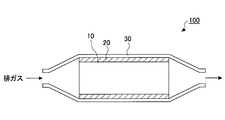
- FIG. 2 shows an example of the exhaust gas purifying apparatus of the present invention.
- the exhaust gas purification apparatus 100 can be manufactured by canning the metal container (shell) 30 in a state where the holding sealing material 20 is disposed on the outer peripheral portion of the honeycomb structure 10. Further, the exhaust gas purification apparatus 100 includes an injection nozzle that injects ammonia or a compound that decomposes to generate ammonia into a pipe (not shown) on the upstream side of the honeycomb structure 10 with respect to the direction in which the exhaust gas flows. Injecting means (not shown) is provided. As a result, ammonia is added to the exhaust gas flowing through the pipe, so that the NOx contained in the exhaust gas is reduced by the ⁇ -type zeolite and phosphate-based zeolite contained in the honeycomb unit 11.
- the compound that decomposes to generate ammonia is not particularly limited as long as it can be heated by exhaust gas in the pipe and generate ammonia, but urea water is preferable because of excellent storage stability.
- the urea water is heated by the exhaust gas in the pipe and hydrolyzes to generate ammonia.
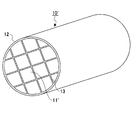
- FIG. 3 shows another example of the honeycomb structure of the present invention.
- a plurality of honeycomb units 11 ′ in which a plurality of through holes 11 a are arranged in parallel in the longitudinal direction with a partition wall 11 b interposed therebetween are bonded via an adhesive layer 13.
- the configuration is the same as that of the honeycomb structure 10.
- the honeycomb unit 11 ′ preferably has a cross-sectional area of 10 to 200 cm 2 in a cross section perpendicular to the longitudinal direction.
- the cross-sectional area of the cross section perpendicular to the longitudinal direction of the honeycomb unit 11 ′ is less than 10 cm 2 , the pressure loss of the honeycomb structure 10 ′ increases.
- the cross-sectional area of the cross section perpendicular to the longitudinal direction of the honeycomb unit 11 ′ exceeds 200 cm 2 , the strength against the thermal stress generated in the honeycomb unit 11 ′ becomes insufficient.
- the honeycomb unit 11 ′ has the same configuration as the honeycomb unit 11 except for the cross-sectional area of the cross section perpendicular to the longitudinal direction.
- the adhesive layer 13 preferably has a thickness of 0.5 to 2.0 mm.
- the thickness of the adhesive layer 13 is less than 0.5 mm, the adhesive strength of the honeycomb unit 11 ′ becomes insufficient.
- the thickness of the adhesive layer 13 exceeds 2.0 mm, the pressure loss of the honeycomb structure 10 ′ increases.
- honeycomb structure 10 Next, an example of a method for manufacturing the honeycomb structure 10 'will be described. First, in the same manner as the honeycomb structure 10, a quadrangular columnar honeycomb unit 11 'is manufactured. Next, an adhesive layer paste is applied to the outer peripheral surface excluding both end faces of the honeycomb unit 11 ′, and the honeycomb units 11 ′ are sequentially bonded and dried and solidified to produce an aggregate of the honeycomb units 11 ′.
- the adhesive layer paste is not particularly limited, and examples thereof include a mixture of inorganic binder and inorganic particles, a mixture of inorganic binder and inorganic fibers, a mixture of inorganic binder, inorganic particles, and inorganic fibers.
- the inorganic binder contained in the adhesive layer paste is not particularly limited, but is added as silica sol, alumina sol or the like, and two or more kinds may be used in combination. Among these, it is preferable to add as silica sol.
- the material constituting the inorganic particles contained in the adhesive layer paste is not particularly limited, but examples thereof include carbides such as silicon carbide, nitrides such as silicon nitride and boron nitride, and two or more kinds may be used in combination. Of these, silicon carbide is preferred because of its excellent thermal conductivity.
- the material constituting the inorganic fiber contained in the adhesive layer paste is not particularly limited, and examples thereof include silica alumina, mullite, alumina, silica and the like, and two or more kinds may be used in combination. Of these, alumina is preferable.
- the adhesive layer paste may contain an organic binder.
- the organic binder contained in the adhesive layer paste is not particularly limited, and examples thereof include polyvinyl alcohol, methyl cellulose, ethyl cellulose, carboxymethyl cellulose and the like, and two or more kinds may be used in combination.
- the adhesive layer paste may further contain balloons that are fine hollow spheres of oxide ceramics, a pore-forming agent, and the like.
- the balloon contained in the adhesive layer paste is not particularly limited, and examples thereof include an alumina balloon, a glass microballoon, a shirasu balloon, a fly ash balloon, and a mullite balloon, and two or more kinds may be used in combination. Among these, an alumina balloon is preferable.
- the pore former contained in the adhesive layer paste is not particularly limited, and examples thereof include spherical acrylic particles and graphite, and two or more kinds may be used in combination.
- the aggregate of the honeycomb units 11 ′ is cut into a cylindrical shape, the aggregate of the cylindrical honeycomb units 11 ′ is manufactured by polishing as necessary.
- the honeycomb unit 11 ′ whose cross section perpendicular to the longitudinal direction is formed into a predetermined shape is bonded to the columnar honeycomb unit 11 ′. You may produce the aggregate
- the shape of the cross section perpendicular to the longitudinal direction of the honeycomb unit 11 ′ is preferably a sector shape with a central angle of 90 °.
- the outer peripheral coat layer paste is applied to the outer peripheral surface excluding both end surfaces of the aggregate of the cylindrical honeycomb units 11 ′.
- the outer periphery coat layer paste may be the same as or different from the adhesive layer paste.
- a columnar honeycomb structure 10 ′ is manufactured by drying and solidifying the aggregate of columnar honeycomb units 11 ′ coated with the outer periphery coating layer paste.
- an organic binder is contained in the adhesive layer paste and / or the outer peripheral coat layer paste, it is preferable to degrease.
- the degreasing conditions can be appropriately selected depending on the kind and amount of the organic matter, but it is preferably 20 minutes at 700 ° C.
- outer peripheral coat layer 12 may not be formed in the honeycomb structures 10 and 10 ′.
- part means “part by mass”.
- Example 1 2400 parts of ⁇ -type zeolite with an average secondary particle diameter of 3 ⁇ m, 600 parts of SAPO-34 with an average primary particle diameter of 3 ⁇ m, 840 parts of boehmite, an average fiber diameter of 6 ⁇ m and an average fiber length of 100 ⁇ m
- a raw material paste 1 was prepared by mixing and kneading 650 parts of alumina fiber, 330 parts of methylcellulose, 330 parts of oleic acid, and 1800 parts of ion-exchanged water.
- the raw material paste 1 was extrusion-molded using an extruder to produce a regular quadrangular prism-shaped honeycomb formed body. Then, the honeycomb formed body was dried at 110 ° C. for 10 minutes using a microwave dryer and a hot air dryer, and then degreased at 400 ° C. for 5 hours. Next, the honeycomb fired body was fired at 700 ° C. for 2 hours. Further, by immersing the honeycomb fired body in an aqueous copper nitrate solution, ⁇ -type zeolite and SAPO-34 were ion-exchanged with copper ions to produce a honeycomb unit 11 ′.
- the ion exchange amount of the zeolite was measured by ICP emission analysis using ICPS-8100 (manufactured by Shimadzu Corporation), and it was 2.7% by mass.
- the honeycomb unit 11 ′ was a regular square column having a side of 38 mm and a length of 150 mm, the density of the through holes 11a was 62 / cm 2 , and the thickness of the partition walls 11b was 0.28 mm.
- alumina fiber having an average fiber diameter of 0.5 ⁇ m and an average fiber length of 15 ⁇ m 767 parts of alumina fiber having an average fiber diameter of 0.5 ⁇ m and an average fiber length of 15 ⁇ m, 2500 parts of silica glass, 17 parts of carboxymethylcellulose, 600 parts of silica sol having a solid content of 30% by mass, and 167 parts of polyvinyl alcohol Part, 167 parts of surfactant and 17 parts of alumina balloon were mixed and kneaded to prepare an adhesive layer paste.
- the adhesive layer paste was applied to the outer peripheral surface excluding both ends of the honeycomb unit 11 ′ so that the thickness of the adhesive layer 13 was 2.0 mm, and 16 honeycomb units 11 ′ were adhered to each other at 150 ° C. Solidified for a minute. Next, a diamond cutter was used to cut into a cylindrical shape so that the cross section perpendicular to the longitudinal direction was substantially point-symmetric, and an aggregate of honeycomb units 11 ′ was produced.
- the microwave dryer and the hot air dryer are applied. Then, the adhesive layer paste was dried and solidified at 150 ° C. for 10 minutes and degreased at 400 ° C. for 2 hours to prepare a cylindrical honeycomb structure 10 ′ having a diameter of 160 mm and a length of 150 mm.
- Example 2 A honeycomb structure 10 ′ was produced in the same manner as in Example 1 except that the addition amounts of ⁇ -type zeolite and SAPO-34 were changed to 2700 parts and 300 parts, respectively.
- Example 3 A honeycomb structure 10 ′ was produced in the same manner as in Example 1 except that the addition amounts of ⁇ -type zeolite and SAPO-34 were changed to 2100 parts and 900 parts, respectively.
- Example 4 A honeycomb structure 10 ′ was produced in the same manner as in Example 1 except that the addition amounts of ⁇ -type zeolite and SAPO-34 were changed to 2850 parts and 150 parts, respectively.
- Example 5 A honeycomb structure 10 ′ was produced in the same manner as in Example 1 except that the addition amounts of ⁇ -type zeolite and SAPO-34 were changed to 1950 parts and 1050 parts, respectively.
- Example 6 Instead of ⁇ -zeolite with an average secondary particle size of 3 ⁇ m and SAPO-34 with an average primary particle size of 3 ⁇ m, ⁇ -type zeolite with an average secondary particle size of 0.5 ⁇ m and primary particles of A honeycomb structure 10 ′ was produced in the same manner as in Example 1 except that SAPO-34 having an average particle diameter of 2 ⁇ m was used.
- Example 7 Instead of ⁇ -zeolite with an average secondary particle size of 3 ⁇ m and SAPO-34 with an average primary particle size of 3 ⁇ m, ⁇ -type zeolite with an average secondary particle size of 1 ⁇ m and an average particle of primary particles A honeycomb structure 10 ′ was produced in the same manner as in Example 1 except that SAPO-34 having a diameter of 4 ⁇ m was used.
- Example 1 A honeycomb structure was manufactured in the same manner as in Example 1 except that the addition amounts of ⁇ -type zeolite and SAPO-34 were changed to 3000 parts and 0 parts, respectively.
- Example 2 A honeycomb structure was manufactured in the same manner as in Example 1 except that the addition amounts of ⁇ -type zeolite and SAPO-34 were changed to 1500 parts and 1500 parts, respectively.
- the NOx purification rate [%] expressed by The constituent components of the simulated gas are 175 ppm of nitric oxide, 175 ppm of nitrogen dioxide, 350 ppm of ammonia, 14% of oxygen, 10% of water, and nitrogen (balance).
- Table 1 shows the evaluation results of the purification rate of cracks in the honeycomb unit and NOx in the sample.
- the sample cut out from the honeycomb unit of Comparative Example 2 has a NOx purification rate of 85%.
- cracks are generated. Occurred. This is presumably because cracks were generated due to contraction and expansion of the honeycomb unit because the ratio of the mass of SAPO-34 to the total mass of ⁇ -type zeolite and SAPO-34 contained in the honeycomb unit was large.
Landscapes
- Chemical & Material Sciences (AREA)
- Engineering & Computer Science (AREA)
- Ceramic Engineering (AREA)
- Chemical Kinetics & Catalysis (AREA)
- Materials Engineering (AREA)
- Structural Engineering (AREA)
- Organic Chemistry (AREA)
- Environmental & Geological Engineering (AREA)
- Health & Medical Sciences (AREA)
- Biomedical Technology (AREA)
- Analytical Chemistry (AREA)
- General Chemical & Material Sciences (AREA)
- Oil, Petroleum & Natural Gas (AREA)
- Combustion & Propulsion (AREA)
- Manufacturing & Machinery (AREA)
- Inorganic Chemistry (AREA)
- Catalysts (AREA)
- Exhaust Gas Treatment By Means Of Catalyst (AREA)
- Exhaust Gas After Treatment (AREA)
Abstract
本発明のハニカム構造体は、β型ゼオライト、リン酸塩系ゼオライト及び無機バインダを含み、複数の貫通孔が隔壁を隔てて長手方向に並設されているハニカムユニットを有するハニカム構造体であって、前記β型ゼオライトは、二次粒子の平均粒径が0.5μm以上5μm以下であり、前記リン酸塩系ゼオライトは、一次粒子の平均粒径が0.5μm以上5μm以下であり、前記β型ゼオライト及び前記リン酸塩系ゼオライトの総質量に対する前記リン酸塩系ゼオライトの質量の比が5%以上35%以下である。
Description
本発明は、ハニカム構造体及び排ガス浄化装置に関する。
従来、自動車の排ガスを浄化するシステムの一つとして、アンモニアを用いて、NOxを窒素と水に還元するSCR(選択触媒還元)システムが知られている。
また、SCRシステムにおいて、アンモニアを吸着する材料として、ゼオライトが知られている。
特許文献1には、ゼオライトと、無機繊維及び/又はウィスカと、無機バインダを含むハニカムユニットを有するハニカム構造体が開示されている。
しかしながら、特許文献1に開示されているハニカム構造体よりもNOxの浄化性能がさらに優れるハニカム構造体が求められている。このため、ハニカム構造体を構成するハニカムユニットの材料として、NOxの浄化性能に優れるSAPO(シリコアルミノホスフェート)等のリン酸塩系ゼオライトを用いることが考えられる。
SAPOは、水が吸着又は吸着した水が脱離することにより、格子定数が変化して収縮又は膨張するという特性を有する。このため、SAPOを含むハニカムユニットに水が吸着又はハニカムユニットに吸着した水が脱離すると、ハニカムユニットが収縮又は膨張して破損しやすいという問題がある。
本発明は、上記の従来技術が有する問題に鑑み、NOxの浄化性能に優れ、ハニカムユニットに水が吸着又はハニカムユニットに吸着した水が脱離しても、ハニカムユニットが収縮又は膨張することによる破損を抑制することが可能なハニカム構造体及び該ハニカム構造体を有する排ガス浄化装置を提供することを目的とする。
本発明のハニカム構造体は、β型ゼオライト、リン酸塩系ゼオライト及び無機バインダを含み、複数の貫通孔が隔壁を隔てて長手方向に並設されているハニカムユニットを有するハニカム構造体であって、前記β型ゼオライトは、二次粒子の平均粒径が0.5μm以上5μm以下であり、前記リン酸塩系ゼオライトは、一次粒子の平均粒径が0.5μm以上5μm以下であり、前記β型ゼオライト及び前記リン酸塩系ゼオライトの総質量に対する前記リン酸塩系ゼオライトの質量の比が5%以上35%以下である。
前記β型ゼオライトの二次粒子の平均粒径に対する前記リン酸塩系ゼオライトの一次粒子の平均粒径の比が0.25以上4.0以下であることが望ましい。
前記リン酸塩系ゼオライトは、SAPOであることが望ましい。
前記SAPOは、SAPO-34であることが望ましい。
前記β型ゼオライト及び前記リン酸塩系ゼオライトの少なくとも一方は、銅イオン及び/又は鉄イオンによりイオン交換されていることが望ましい。
前記無機バインダは、アルミナゾル、シリカゾル、チタニアゾル、水ガラス、セピオライト、アタパルジャイト及びベーマイトからなる群より選択される一種以上に含まれる固形分であることが望ましい。
前記ハニカムユニットは、無機繊維、鱗片状物質、テトラポット状物質及び三次元針状物質からなる群より選択される一種以上をさらに含むことが望ましい。
前記無機繊維は、アルミナ、シリカ、炭化ケイ素、シリカアルミナ、ガラス、チタン酸カリウム及びホウ酸アルミニウムからなる群より選択される一種以上であり、前記鱗片状物質は、ガラス、白雲母、アルミナ及びシリカからなる群より選択される一種以上であり、前記テトラポット状物質は、酸化亜鉛であり、前記三次元針状物質は、アルミナ、シリカ、炭化ケイ素、シリカアルミナ、ガラス、チタン酸カリウム、ホウ酸アルミニウム及びベーマイトからなる群より選択される一種以上であることが望ましい。
本発明のハニカム構造体は、複数の前記ハニカムユニットを有することが望ましい。
本発明の排ガス浄化装置は、本発明のハニカム構造体を有する。
本発明によれば、NOxの浄化性能に優れ、ハニカムユニットに水が吸着又はハニカムユニットに吸着した水が脱離しても、ハニカムユニットが収縮又は膨張することによる破損を抑制することが可能なハニカム構造体及び該ハニカム構造体を有する排ガス浄化装置を提供することができる。
次に、本発明を実施するための形態を図面と共に説明する。
図1に、本発明のハニカム構造体の一例を示す。ハニカム構造体10は、β型ゼオライト、リン酸塩系ゼオライト及び無機バインダを含み、複数の貫通孔11aが隔壁11bを隔てて長手方向に並設されている単一のハニカムユニット11を有する。また、ハニカムユニット11の両端面を除く外周面に外周コート層12が形成されている。
β型ゼオライトは、二次粒子の平均粒径が0.5~5μmである。β型ゼオライトの二次粒子の平均粒径が0.5μm未満であると、ハニカムユニット11の隔壁11bの内部まで排ガスが侵入しにくくなって、β型ゼオライト、リン酸塩系ゼオライトがNOxの浄化に有効に利用されなくなる。一方、β型ゼオライトの二次粒子の平均粒径が5μmを超えると、ハニカムユニット11中の気孔の数が少なくなるため、ハニカムユニット11の隔壁11bの内部まで排ガスが侵入しにくくなり、β型ゼオライト、リン酸塩系ゼオライトがNOxの浄化に有効に利用されなくなる。
β型ゼオライトの一次粒子の平均粒径は、0.01~0.1μmであることが好ましい。
リン酸塩系ゼオライトとしては、特に限定されないが、SAPO-5、SAPO-11、SAPO-34等のSAPO(シリコアルミノホスフェート);MeAPO(メタロアルミノホスフェート);MeAPSO(金属骨格置換シリコアルミノホスフェート)等が挙げられ、二種以上併用してもよい。中でも、NOxの浄化性能に優れるため、SAPOが好ましく、SAPO-34がより好ましい。
リン酸塩系ゼオライトの一次粒子の平均粒径は、0.5~5μmである。リン酸塩系ゼオライトの一次粒子の平均粒径が0.5μm未満であると、ハニカムユニット11の隔壁11bの内部まで排ガスが侵入しにくくなって、β型ゼオライト、リン酸塩系ゼオライトがNOxの浄化に有効に利用されなくなる。一方、リン酸塩系ゼオライトの一次粒子の平均粒径が5μmを超えると、ハニカムユニット11中の気孔の数が少なくなるため、ハニカムユニット11の隔壁11bの内部まで排ガスが侵入しにくくなり、β型ゼオライト、リン酸塩系ゼオライトがNOxの浄化に有効に利用されなくなる。
β型ゼオライト及びリン酸塩系ゼオライトの総質量に対するリン酸塩系ゼオライトの質量の比は、5~35%であり、15~25%が好ましい。β型ゼオライト及びリン酸塩系ゼオライトの総質量に対するリン酸塩系ゼオライトの質量の比が5%未満であると、NOxの浄化性能が低下する。一方、β型ゼオライト及びリン酸塩系ゼオライトの総質量に対するリン酸塩系ゼオライトの質量の比が35%を超えると、ハニカムユニット11に水が吸着又はハニカムユニット11に吸着した水が脱離すると、ハニカムユニット11が収縮又は膨張することにより破損しやすくなる。
ハニカムユニット11は、リン酸塩系ゼオライトの周囲にβ型ゼオライトが存在するため、ハニカムユニット11に水が吸着又はハニカムユニット11に吸着した水が脱離しても、ハニカムユニット11が収縮又は膨張することによる破損を抑制することができる。具体的には、ハニカムユニット11に水が吸着又はハニカムユニット11に吸着した水が脱離すると、リン酸塩系ゼオライトが収縮又は膨張するが、β型ゼオライトが存在するため、リン酸塩系ゼオライトの収縮又は膨張を緩和することができる。また、β型ゼオライトもNOxの浄化性能を有するため、ハニカムユニット11がβ型ゼオライトを含んでも、ハニカム構造体10は、NOxの浄化性能を維持することができる。
β型ゼオライトの二次粒子の平均粒径に対するリン酸塩系ゼオライトの一次粒子の平均粒径の比は、0.25~4.0であることが好ましく、0.8~1.2がより好ましい。β型ゼオライトの二次粒子の平均粒径に対するリン酸塩系ゼオライトの一次粒子の平均粒径の比が0.25未満である場合又は4.0を超える場合は、ハニカムユニット11に水が吸着又はハニカムユニット11に吸着した水が脱離した場合に、ハニカムユニット11が収縮又は膨張することによる破損を抑制する効果が低下する。
β型ゼオライトは、NOxの浄化性能が向上するため、銅イオン及び/又は鉄イオンによりイオン交換されていることが好ましい。
銅イオン及び/又は鉄イオンによりイオン交換されているβ型ゼオライトは、イオン交換量が1.0~5.0質量%であることが好ましい。
なお、β型ゼオライトをイオン交換する金属イオンとしては、銅イオン及び/又は鉄イオンに限定されず、NOxの浄化性能を向上させることが可能な遷移金属イオン等が挙げられる。
リン酸塩系ゼオライトは、NOxの浄化性能が向上するため、銅イオン及び/又は鉄イオンによりイオン交換されていることが好ましい。
銅イオン及び/又は鉄イオンによりイオン交換されているリン酸塩系ゼオライトは、イオン交換量が1.0~5.0質量%であることが好ましい。
なお、リン酸塩系ゼオライトをイオン交換する金属イオンとしては、銅イオン及び/又は鉄イオンに限定されず、NOxの浄化性能を向上させることが可能な遷移金属イオン等が挙げられる。
ハニカムユニット11は、見掛けの体積当たりのβ型ゼオライト及びリン酸塩系ゼオライトの含有量が230~400g/Lであることが好ましい。ハニカムユニット11の見掛けの体積当たりのβ型ゼオライト及びリン酸塩系ゼオライトの含有量が230g/L未満であると、NOxの浄化性能を向上させるためにハニカムユニット11の見掛けの体積を大きくする必要がある。一方、ハニカムユニット11の見掛けの体積当たりのβ型ゼオライト及びリン酸塩系ゼオライトの含有量が400g/Lを超えると、ハニカムユニット11の強度が不十分になったり、ハニカムユニット11の開口率が小さくなったりする。
ハニカムユニット11に含まれる無機バインダとしては、特に限定されないが、アルミナゾル、シリカゾル、チタニアゾル、水ガラス、セピオライト、アタパルジャイト、ベーマイト等に含まれる固形分が挙げられ、二種以上併用してもよい。
ハニカムユニット11中の無機バインダの含有量は、5~30質量%であることが好ましく、10~20質量%がより好ましい。ハニカムユニット11中の無機バインダの含有量が5質量%未満であると、ハニカムユニット11の強度が低下する。一方、ハニカムユニット11中の無機バインダの含有量が30質量%を超えると、ハニカムユニット11を押出成形することが困難になる。
ハニカムユニット11は、強度を向上させるために、無機繊維、鱗片状物質、テトラポット状物質及び三次元針状物質からなる群より選択される一種以上をさらに含むことが好ましい。
ハニカムユニット11に含まれる無機繊維を構成する材料としては、特に限定されないが、アルミナ、シリカ、炭化ケイ素、シリカアルミナ、ガラス、チタン酸カリウム、ホウ酸アルミニウム等が挙げられ、二種以上併用してもよい。
ハニカムユニット11に含まれる無機繊維のアスペクト比は、2~1000であることが好ましく、5~800がより好ましく、10~500がさらに好ましい。ハニカムユニット11に含まれる無機繊維のアスペクト比が2未満であると、ハニカムユニット11の強度を向上させる効果が小さくなる。一方、ハニカムユニット11に含まれる無機繊維のアスペクト比が1000を超えると、ハニカムユニット11を押出成形する際に金型に目詰まり等が発生したり、無機繊維が折れて、ハニカムユニット11の強度を向上させる効果が小さくなったりする。
鱗片状物質は、平たい物質を意味し、厚さが0.2~5.0μmであることが好ましく、最大長さが10~160μmであることが好ましく、厚さに対する最大長さの比が3~250であることが好ましい。
ハニカムユニット11に含まれる鱗片状物質を構成する材料としては、特に限定されないが、ガラス、白雲母、アルミナ、シリカ等が挙げられ、二種以上併用してもよい。
テトラポット状物質は、針状部が三次元に延びている物質を意味し、針状部の平均針状長さが5~30μmであることが好ましく、針状部の平均径が0.5~5.0μmであることが好ましい。
ハニカムユニット11に含まれるテトラポット状物質を構成する材料としては、特に限定されないが、酸化亜鉛等が挙げられ、二種以上併用してもよい。
三次元針状物質は、針状部同士がそれぞれの針状部の中央付近でガラス等の無機化合物により結合されている物質を意味し、針状部の平均針状長さが5~30μmであることが好ましく、針状部の平均径が0.5~5.0μmであることが好ましい。
また、三次元針状物質は、複数の針状部が三次元に連なっていてもよく、針状部の直径が0.1~5.0μmであることが好ましく、長さが0.3~30.0μmであることが好ましく、直径に対する長さの比が1.4~50.0であることが好ましい。
ハニカムユニット11に含まれる三次元針状物質を構成する材料としては、特に限定されないが、アルミナ、シリカ、炭化ケイ素、シリカアルミナ、ガラス、チタン酸カリウム、ホウ酸アルミニウム、ベーマイト等が挙げられ、二種以上併用してもよい。
ハニカムユニット11中の無機繊維、鱗片状物質、テトラポット状物質及び三次元針状物質の含有量は、3~50質量%であることが好ましく、3~30質量%がより好ましく、5~20質量%がさらに好ましい。ハニカムユニット11中の無機繊維、鱗片状物質、テトラポット状物質及び三次元針状物質の含有量が3質量%未満であると、ハニカムユニット11の強度を向上させる効果が小さくなる。一方、ハニカムユニット11中の無機繊維、鱗片状物質、テトラポット状物質及び三次元針状物質の含有量が50質量%を超えると、ハニカムユニット11中のβ型ゼオライト及びリン酸塩系ゼオライトの含有量が低下して、NOxの浄化性能が低下する。
ハニカムユニット11は、気孔率が20~50%であることが好ましい。ハニカムユニット11の気孔率が20%未満であると、ハニカムユニット11の隔壁11bの内部まで排ガスが侵入しにくくなって、β型ゼオライト及びリン酸塩系ゼオライトがNOxの浄化に有効に利用されなくなる。一方、ハニカムユニット11の気孔率が50%を超えると、ハニカムユニット11の強度が不十分となる。
なお、ハニカムユニット11の気孔率は、水銀圧入法を用いて測定することができる。
ハニカムユニット11は、長手方向に垂直な断面の開口率が50~75%であることが好ましい。ハニカムユニット11の長手方向に垂直な断面の開口率が50%未満であると、β型ゼオライト及びリン酸塩系ゼオライトがNOxの浄化に有効に利用されなくなる。一方、ハニカムユニット11の長手方向に垂直な断面の開口率が75%を超えると、ハニカムユニット11の強度が不十分となる。
ハニカムユニット11は、長手方向に垂直な断面の貫通孔11aの密度が31~155個/cm2であることが好ましい。ハニカムユニット11の長手方向に垂直な断面の貫通孔11aの密度が31個/cm2未満であると、β型ゼオライト及びリン酸塩系ゼオライトと排ガスが接触しにくくなって、NOxの浄化性能が低下する。一方、ハニカムユニット11の長手方向に垂直な断面の貫通孔11aの密度が155個/cm2を超えると、ハニカム構造体10の圧力損失が増大する。
ハニカムユニット11の隔壁11bの厚さは、0.1~0.4mmであることが好ましく、0.1~0.3mmがより好ましい。ハニカムユニット11の隔壁11bの厚さが0.1mm未満であると、ハニカムユニット11の強度が低下する。一方、ハニカムユニット11の隔壁11bの厚さが0.4mmを超えると、ハニカムユニット11の隔壁11bの内部まで排ガスが侵入しにくくなって、β型ゼオライト及びリン酸塩系ゼオライトがNOxの浄化に有効に利用されなくなる。
外周コート層12は、厚さが0.1~2.0mmであることが好ましい。外周コート層12の厚さが0.1mm未満であると、ハニカム構造体10の強度を向上させる効果が不十分になる。一方、外周コート層12の厚さが2.0mmを超えると、ハニカム構造体10の単位体積当たりのβ型ゼオライト及びリン酸塩系ゼオライトの含有量が低下して、NOxの浄化性能が低下する。
ハニカム構造体10の形状としては、円柱状に限定されず、角柱状、楕円柱状、長円柱状、丸面取りされている角柱状(例えば、丸面取りされている三角柱状)等が挙げられる。
貫通孔11aの形状としては、四角柱状に限定されず、三角柱状、六角柱状等が挙げられる。
次に、ハニカム構造体10の製造方法の一例について説明する。まず、β型ゼオライト、リン酸塩系ゼオライト及び無機バインダを含み、必要に応じて、無機繊維、鱗片状物質、テトラポット状物質及び三次元針状物質からなる群より選択される一種以上をさらに含む原料ペーストを用いて押出成形し、複数の貫通孔が隔壁を隔てて長手方向に並設されている円柱状のハニカム成形体を作製する。
原料ペーストに含まれる無機バインダは、特に限定されないが、アルミナゾル、シリカゾル、チタニアゾル、水ガラス、セピオライト、アタパルジャイト、ベーマイト等として添加されており、二種以上併用してもよい。
また、原料ペーストには、有機バインダ、分散媒、成形助剤等を、必要に応じて、適宜添加してもよい。
有機バインダとしては、特に限定されないが、メチルセルロース、カルボキシメチルセルロース、ヒドロキシエチルセルロース、ポリエチレングリコール、フェノール樹脂、エポキシ樹脂等が挙げられ、二種以上併用してもよい。なお、有機バインダの添加量は、β型ゼオライト、リン酸塩系ゼオライト、無機バインダ、無機繊維、鱗片状物質、テトラポット状物質及び三次元針状物質の総質量に対して、1~10%であることが好ましい。
分散媒としては、特に限定されないが、水、ベンゼン等の有機溶媒、メタノール等のアルコール等が挙げられ、二種以上併用してもよい。
成形助剤としては、特に限定されないが、エチレングリコール、デキストリン、脂肪酸、脂肪酸石鹸、ポリアルコール等が挙げられ、二種以上併用してもよい。
原料ペーストを調製する際には、混合混練することが好ましく、ミキサー、アトライタ等を用いて混合してもよく、ニーダー等を用いて混練してもよい。
次に、マイクロ波乾燥機、熱風乾燥機、誘電乾燥機、減圧乾燥機、真空乾燥機、凍結乾燥機等の乾燥機を用いて、ハニカム成形体を乾燥してハニカム乾燥体を作製する。
さらに、ハニカム乾燥体を脱脂してハニカム脱脂体を作製する。脱脂条件は、ハニカム乾燥体に含まれる有機物の種類や量によって適宜選択することができるが、400℃で2時間であることが好ましい。
次に、ハニカム脱脂体を焼成することにより、円柱状のハニカムユニット11を作製する。焼成温度は、600~1200℃であることが好ましく、600~1000℃がより好ましい。焼成温度が600℃未満であると、焼結が進行せず、ハニカムユニット11の強度が低くなる。一方、焼成温度が1200℃を超えると、焼結が進行しすぎて、β型ゼオライト及びリン酸塩系ゼオライトの反応サイトが減少する。
次に、円柱状のハニカムユニット11の両端面を除く外周面に外周コート層用ペーストを塗布する。
外周コート層用ペーストとしては、特に限定されないが、無機バインダ及び無機粒子の混合物、無機バインダ及び無機繊維の混合物、無機バインダ、無機粒子及び無機繊維の混合物等が挙げられる。
外周コート層用ペーストに含まれる無機バインダは、特に限定されないが、シリカゾル、アルミナゾル等として添加されており、二種以上併用してもよい。中でも、シリカゾルとして添加されていることが好ましい。
外周コート層用ペーストに含まれる無機粒子を構成する材料としては、特に限定されないが、炭化ケイ素等の炭化物、窒化ケイ素、窒化ホウ素等の窒化物等が挙げられ、二種以上併用してもよい。中でも、熱伝導性に優れることから、炭化ケイ素が好ましい。
外周コート層用ペーストに含まれる無機繊維を構成する材料としては、特に限定されないが、シリカアルミナ、ムライト、アルミナ、シリカ等が挙げられ、二種以上併用してもよい。中でも、アルミナが好ましい。
外周コート層用ペーストは、有機バインダをさらに含んでいてもよい。
外周コート層用ペーストに含まれる有機バインダとしては、特に限定されないが、ポリビニルアルコール、メチルセルロース、エチルセルロース、カルボキシメチルセルロース等が挙げられ、二種以上併用してもよい。
外周コート層用ペーストは、酸化物系セラミックスの微小中空球体であるバルーン、造孔剤等をさらに含んでいてもよい。
外周コート層用ペーストに含まれるバルーンとしては、特に限定されないが、アルミナバルーン、ガラスマイクロバルーン、シラスバルーン、フライアッシュバルーン、ムライトバルーン等が挙げられ、二種以上併用してもよい。中でも、アルミナバルーンが好ましい。
外周コート層用ペーストに含まれる造孔剤としては、特に限定されないが、球状アクリル粒子、グラファイト等が挙げられ、二種以上併用してもよい。
次に、外周コート層用ペーストが塗布されたハニカムユニット11を乾燥固化し、円柱状のハニカム構造体10を作製する。このとき、外周コート層用ペーストに有機バインダが含まれている場合は、脱脂することが好ましい。脱脂条件は、有機物の種類や量によって適宜選択することができるが、700℃で20分間であることが好ましい。
なお、ハニカムユニット11又はハニカム構造体10を銅イオン及び/又は鉄イオンを含む水溶液中に浸漬することにより、β型ゼオライト及びリン酸塩系ゼオライトをイオン交換してもよい。また、銅イオン及び/又は鉄イオンによりイオン交換されているβ型ゼオライトと、銅イオン及び/又は鉄イオンによりイオン交換されているリン酸塩系ゼオライトの少なくとも一方を含む原料ペーストを用いてもよい。
図2に、本発明の排ガス浄化装置の一例を示す。排ガス浄化装置100は、ハニカム構造体10の外周部に保持シール材20を配置した状態で、金属容器(シェル)30にキャニングすることにより作製することができる。また、排ガス浄化装置100には、排ガスが流れる方向に対して、ハニカム構造体10の上流側の配管(不図示)内に、アンモニア又は分解してアンモニアを発生させる化合物を噴射する噴射ノズル等の噴射手段(不図示)が設けられている。これにより、配管を流れる排ガス中にアンモニアが添加されるため、ハニカムユニット11に含まれるβ型ゼオライト及びリン酸塩系ゼオライトにより、排ガス中に含まれるNOxが還元される。
分解してアンモニアを発生させる化合物としては、配管内で排ガスにより加熱されて、アンモニアを発生させることが可能であれば、特に限定されないが、貯蔵安定性に優れるため、尿素水が好ましい。
尿素水は、配管内で排ガスにより加熱されて、加水分解し、アンモニアが発生する。
図3に、本発明のハニカム構造体の他の例を示す。なお、ハニカム構造体10’は、複数の貫通孔11aが隔壁11bを隔てて長手方向に並設されているハニカムユニット11’(図4参照)が接着層13を介して複数個接着されている以外は、ハニカム構造体10と同一の構成である。
ハニカムユニット11’は、長手方向に垂直な断面の断面積が10~200cm2であることが好ましい。ハニカムユニット11’の長手方向に垂直な断面の断面積が10cm2未満であると、ハニカム構造体10’の圧力損失が増大する。一方、ハニカムユニット11’の長手方向に垂直な断面の断面積が200cm2を超えると、ハニカムユニット11’に発生する熱応力に対する強度が不十分になる。
なお、ハニカムユニット11’は、長手方向に垂直な断面の断面積以外は、ハニカムユニット11と同一の構成である。
接着層13は、厚さが0.5~2.0mmであることが好ましい。接着層13の厚さが0.5mm未満であると、ハニカムユニット11’の接着強度が不十分になる。一方、接着層13の厚さが2.0mmを超えると、ハニカム構造体10’の圧力損失が増大する。
次に、ハニカム構造体10’の製造方法の一例について説明する。まず、ハニカム構造体10と同様にして、四角柱状のハニカムユニット11’を作製する。次に、ハニカムユニット11’の両端面を除く外周面に接着層用ペーストを塗布して、ハニカムユニット11’を順次接着させ、乾燥固化することにより、ハニカムユニット11’の集合体を作製する。
接着層用ペーストとしては、特に限定されないが、無機バインダ及び無機粒子の混合物、無機バインダ及び無機繊維の混合物、無機バインダ、無機粒子及び無機繊維の混合物等が挙げられる。
接着層用ペーストに含まれる無機バインダは、特に限定されないが、シリカゾル、アルミナゾル等として添加されており、二種以上併用してもよい。中でも、シリカゾルとして添加されていることが好ましい。
接着層用ペーストに含まれる無機粒子を構成する材料としては、特に限定されないが、炭化ケイ素等の炭化物、窒化ケイ素、窒化ホウ素等の窒化物等が挙げられ、二種以上併用してもよい。中でも、熱伝導性に優れることから、炭化ケイ素が好ましい。
接着層用ペーストに含まれる無機繊維を構成する材料としては、特に限定されないが、シリカアルミナ、ムライト、アルミナ、シリカ等が挙げられ、二種以上併用してもよい。中でも、アルミナが好ましい。
また、接着層用ペーストは、有機バインダを含んでいてもよい。
接着層用ペーストに含まれる有機バインダとしては、特に限定されないが、ポリビニルアルコール、メチルセルロース、エチルセルロース、カルボキシメチルセルロース等が挙げられ、二種以上併用してもよい。
接着層用ペーストは、酸化物系セラミックスの微小中空球体であるバルーン、造孔剤等をさらに含んでいてもよい。
接着層用ペーストに含まれるバルーンとしては、特に限定されないが、アルミナバルーン、ガラスマイクロバルーン、シラスバルーン、フライアッシュバルーン、ムライトバルーン等が挙げられ、二種以上併用してもよい。中でも、アルミナバルーンが好ましい。
接着層用ペーストに含まれる造孔剤としては、特に限定されないが、球状アクリル粒子、グラファイト等が挙げられ、二種以上併用してもよい。
次に、ハニカムユニット11’の集合体を円柱状に切削加工した後、必要に応じて、研磨することにより、円柱状のハニカムユニット11’の集合体を作製する。
なお、ハニカムユニット11’の集合体を円柱状に切削加工する代わりに、長手方向に垂直な断面が所定の形状に成形されているハニカムユニット11’を接着させて、円柱状のハニカムユニット11’の集合体を作製してもよい。このとき、ハニカムユニット11’の長手方向に垂直な断面の形状は、中心角が90°の扇形であることが好ましい。
次に、円柱状のハニカムユニット11’の集合体の両端面を除く外周面に外周コート層用ペーストを塗布する。
外周コート層用ペーストは、接着層用ペーストと同一であってもよいし、異なっていてもよい。
次に、外周コート層用ペーストが塗布された円柱状のハニカムユニット11’の集合体を乾燥固化することにより、円柱状のハニカム構造体10’を作製する。このとき、接着層用ペースト及び/又は外周コート層用ペーストに有機バインダが含まれている場合は、脱脂することが好ましい。脱脂条件は、有機物の種類や量によって適宜選択することができるが、700℃で20分間であることが好ましい。
なお、ハニカム構造体10及び10’は、外周コート層12が形成されていなくてもよい。
本実施例において、部は質量部を意味する。
[実施例1]
二次粒子の平均粒径が3μmのβ型ゼオライトを2400部、一次粒子の平均粒径が3μmのSAPO-34を600部、ベーマイトを840部、平均繊維径が6μm、平均繊維長が100μmのアルミナ繊維を650部、メチルセルロースを330部、オレイン酸を330部及びイオン交換水を1800部、混合混練して、原料ペースト1を作製した。
二次粒子の平均粒径が3μmのβ型ゼオライトを2400部、一次粒子の平均粒径が3μmのSAPO-34を600部、ベーマイトを840部、平均繊維径が6μm、平均繊維長が100μmのアルミナ繊維を650部、メチルセルロースを330部、オレイン酸を330部及びイオン交換水を1800部、混合混練して、原料ペースト1を作製した。
次に、押出成形機を用いて、原料ペースト1を押出成形して、正四角柱状のハニカム成形体を作製した。そして、マイクロ波乾燥機及び熱風乾燥機を用いて、ハニカム成形体を110℃で10分間乾燥させた後、400℃で5時間脱脂した。次に、700℃で2時間焼成して、ハニカム焼成体を作製した。さらに、ハニカム焼成体を硝酸銅水溶液中に浸漬することにより、β型ゼオライト及びSAPO-34を銅イオンでイオン交換して、ハニカムユニット11’を作製した。ICPS-8100(島津製作所社製)を用いて、ICP発光分析することによりゼオライトのイオン交換量を測定したところ、2.7質量%であった。ハニカムユニット11’は、一辺が38mm、長さが150mmの正四角柱状であり、貫通孔11aの密度が62個/cm2、隔壁11bの厚さが0.28mmであった。
次に、平均繊維径が0.5μm、平均繊維長が15μmのアルミナ繊維を767部、シリカガラスを2500部、カルボキシメチルセルロースを17部、固形分30質量%のシリカゾルを600部、ポリビニルアルコールを167部、界面活性剤を167部及びアルミナバルーンを17部、混合混練して、接着層用ペーストを作製した。
ハニカムユニット11’の両端部を除く外周面に、接着層13の厚さが2.0mmになるように接着層用ペーストを塗布して、ハニカムユニット11’を16個接着させ、150℃で10分間乾燥固化した。次に、ダイヤモンドカッターを用いて、長手方向に垂直な断面が略点対称になるように円柱状に切削加工して、ハニカムユニット11’の集合体を作製した。
さらに、ハニカムユニット11’の集合体の両端部を除く外周面に、外周コート層12の厚さが1.0mmになるように接着層用ペーストを塗布した後、マイクロ波乾燥機及び熱風乾燥機を用いて、接着層用ペーストを150℃で10分間乾燥固化し、400℃で2時間脱脂して、直径が160mm、長さが150mmの円柱状のハニカム構造体10’を作製した。
[実施例2]
β型ゼオライト及びSAPO-34の添加量を、それぞれ2700部及び300部に変更した以外は、実施例1と同様にして、ハニカム構造体10’を作製した。
β型ゼオライト及びSAPO-34の添加量を、それぞれ2700部及び300部に変更した以外は、実施例1と同様にして、ハニカム構造体10’を作製した。
[実施例3]
β型ゼオライト及びSAPO-34の添加量を、それぞれ2100部及び900部に変更した以外は、実施例1と同様にして、ハニカム構造体10’を作製した。
β型ゼオライト及びSAPO-34の添加量を、それぞれ2100部及び900部に変更した以外は、実施例1と同様にして、ハニカム構造体10’を作製した。
[実施例4]
β型ゼオライト及びSAPO-34の添加量を、それぞれ2850部及び150部に変更した以外は、実施例1と同様にして、ハニカム構造体10’を作製した。
β型ゼオライト及びSAPO-34の添加量を、それぞれ2850部及び150部に変更した以外は、実施例1と同様にして、ハニカム構造体10’を作製した。
[実施例5]
β型ゼオライト及びSAPO-34の添加量を、それぞれ1950部及び1050部に変更した以外は、実施例1と同様にして、ハニカム構造体10’を作製した。
β型ゼオライト及びSAPO-34の添加量を、それぞれ1950部及び1050部に変更した以外は、実施例1と同様にして、ハニカム構造体10’を作製した。
[実施例6]
二次粒子の平均粒径が3μmのβ型ゼオライト及び一次粒子の平均粒径が3μmのSAPO-34の代わりに、それぞれ二次粒子の平均粒径が0.5μmのβ型ゼオライト及び一次粒子の平均粒径が2μmのSAPO-34を用いた以外は、実施例1と同様にして、ハニカム構造体10’を作製した。
二次粒子の平均粒径が3μmのβ型ゼオライト及び一次粒子の平均粒径が3μmのSAPO-34の代わりに、それぞれ二次粒子の平均粒径が0.5μmのβ型ゼオライト及び一次粒子の平均粒径が2μmのSAPO-34を用いた以外は、実施例1と同様にして、ハニカム構造体10’を作製した。
[実施例7]
二次粒子の平均粒径が3μmのβ型ゼオライト及び一次粒子の平均粒径が3μmのSAPO-34の代わりに、それぞれ二次粒子の平均粒径が1μmのβ型ゼオライト及び一次粒子の平均粒径が4μmのSAPO-34を用いた以外は、実施例1と同様にして、ハニカム構造体10’を作製した。
二次粒子の平均粒径が3μmのβ型ゼオライト及び一次粒子の平均粒径が3μmのSAPO-34の代わりに、それぞれ二次粒子の平均粒径が1μmのβ型ゼオライト及び一次粒子の平均粒径が4μmのSAPO-34を用いた以外は、実施例1と同様にして、ハニカム構造体10’を作製した。
[比較例1]
β型ゼオライト及びSAPO-34の添加量を、それぞれ3000部及び0部に変更した以外は、実施例1と同様にして、ハニカム構造体を作製した。
β型ゼオライト及びSAPO-34の添加量を、それぞれ3000部及び0部に変更した以外は、実施例1と同様にして、ハニカム構造体を作製した。
[比較例2]
β型ゼオライト及びSAPO-34の添加量を、それぞれ1500部及び1500部に変更した以外は、実施例1と同様にして、ハニカム構造体を作製した。
β型ゼオライト及びSAPO-34の添加量を、それぞれ1500部及び1500部に変更した以外は、実施例1と同様にして、ハニカム構造体を作製した。
[クラックの評価]
実施例1~7及び比較例1、2のハニカムユニットに対して、20質量%の水を吸着させる操作及び吸着した水を100℃で脱離させる操作を5回繰り返し、ハニカムユニットのクラックの発生の有無を目視で評価した。なお、ハニカムユニットにクラックが発生していない場合を○、クラックが発生している場合を×として、判定した。
実施例1~7及び比較例1、2のハニカムユニットに対して、20質量%の水を吸着させる操作及び吸着した水を100℃で脱離させる操作を5回繰り返し、ハニカムユニットのクラックの発生の有無を目視で評価した。なお、ハニカムユニットにクラックが発生していない場合を○、クラックが発生している場合を×として、判定した。
[NOxの浄化率の評価]
実施例1~7及び比較例1、2で作製したハニカムユニットから、ダイヤモンドカッターを用いて、一辺が30mm、長さが40mmの正四角柱状の試料を切り出した。
実施例1~7及び比較例1、2で作製したハニカムユニットから、ダイヤモンドカッターを用いて、一辺が30mm、長さが40mmの正四角柱状の試料を切り出した。
試料に、200℃の模擬ガスを空間速度(SV)35000/hで流しながら、触媒評価装置SIGU(堀場製作所社製)を用いて、試料から流出するNOxの流出量を測定し、式
(NOxの流入量-NOxの流出量)/(NOxの流入量)×100
で表されるNOxの浄化率[%]を算出した。なお、模擬ガスの構成成分は、一酸化窒素175ppm、二酸化窒素175ppm、アンモニア350ppm、酸素14%、水10%、窒素(balance)である。
(NOxの流入量-NOxの流出量)/(NOxの流入量)×100
で表されるNOxの浄化率[%]を算出した。なお、模擬ガスの構成成分は、一酸化窒素175ppm、二酸化窒素175ppm、アンモニア350ppm、酸素14%、水10%、窒素(balance)である。
表1に、ハニカムユニットのクラック及び試料のNOxの浄化率の評価結果を示す。

表1より、実施例1~7のハニカムユニット11’に水が吸着及びハニカムユニット11’に吸着した水が脱離しても、クラックが発生しないことがわかる。また、実施例1~7のハニカムユニット11’から切り出された試料は、NOxの浄化率が71~82%であることがわかる。
一方、比較例1のハニカムユニットに水が吸着及びハニカムユニットに吸着した水が脱離しても、クラックが発生しないが、比較例1のハニカムユニットから切り出された試料は、NOxの浄化率が65%に低下した。これは、ハニカムユニットに含まれるβ型ゼオライト及びSAPO-34の総質量に対するSAPO-34の質量の比が小さいため、NOxの浄化性能が低下したと考えられる。
また、比較例2のハニカムユニットから切り出された試料は、NOxの浄化率が85%であるが、比較例2のハニカムユニットに水が吸着及びハニカムユニットに吸着した水が脱離すると、クラックが発生した。これは、ハニカムユニットに含まれるβ型ゼオライト及びSAPO-34の総質量に対するSAPO-34の質量の比が大きいため、ハニカムユニットが収縮及び膨張してクラックが発生したと考えられる。
10、10’ ハニカム構造体
11、11’ ハニカムユニット
11a 貫通孔
11b 隔壁
12 外周コート層
13 接着層
20 保持シール材
30 金属容器
100 排ガス浄化装置
11、11’ ハニカムユニット
11a 貫通孔
11b 隔壁
12 外周コート層
13 接着層
20 保持シール材
30 金属容器
100 排ガス浄化装置
Claims (10)
- β型ゼオライト、リン酸塩系ゼオライト及び無機バインダを含み、複数の貫通孔が隔壁を隔てて長手方向に並設されているハニカムユニットを有するハニカム構造体であって、
前記β型ゼオライトは、二次粒子の平均粒径が0.5μm以上5μm以下であり、
前記リン酸塩系ゼオライトは、一次粒子の平均粒径が0.5μm以上5μm以下であり、
前記β型ゼオライト及び前記リン酸塩系ゼオライトの総質量に対する前記リン酸塩系ゼオライトの質量の比が5%以上35%以下であることを特徴とするハニカム構造体。 - 前記β型ゼオライトの二次粒子の平均粒径に対する前記リン酸塩系ゼオライトの一次粒子の平均粒径の比が0.25以上4.0以下であることを特徴とする請求項1に記載のハニカム構造体。
- 前記リン酸塩系ゼオライトは、SAPOであることを特徴とする請求項1又は2に記載のハニカム構造体。
- 前記SAPOは、SAPO-34であることを特徴とする請求項3に記載のハニカム構造体。
- 前記β型ゼオライト及び前記リン酸塩系ゼオライトの少なくとも一方は、銅イオン及び/又は鉄イオンによりイオン交換されていることを特徴とする請求項1乃至4のいずれか一項に記載のハニカム構造体。
- 前記無機バインダは、アルミナゾル、シリカゾル、チタニアゾル、水ガラス、セピオライト、アタパルジャイト及びベーマイトからなる群より選択される一種以上に含まれる固形分であることを特徴とする請求項1乃至5のいずれか一項に記載のハニカム構造体。
- 前記ハニカムユニットは、無機繊維、鱗片状物質、テトラポット状物質及び三次元針状物質からなる群より選択される一種以上をさらに含むことを特徴とする請求項1乃至6のいずれか一項に記載のハニカム構造体。
- 前記無機繊維は、アルミナ、シリカ、炭化ケイ素、シリカアルミナ、ガラス、チタン酸カリウム及びホウ酸アルミニウムからなる群より選択される一種以上であり、 前記鱗片状物質は、ガラス、白雲母、アルミナ及びシリカからなる群より選択される一種以上であり、 前記テトラポット状物質は、酸化亜鉛であり、 前記三次元針状物質は、アルミナ、シリカ、炭化ケイ素、シリカアルミナ、ガラス、チタン酸カリウム、ホウ酸アルミニウム及びベーマイトからなる群より選択される一種以上であることを特徴とする請求項7に記載のハニカム構造体。
- 複数の前記ハニカムユニットを有することを特徴とする請求項1乃至8のいずれか一項に記載のハニカム構造体。
- 請求項1乃至9のいずれか一項に記載のハニカム構造体を有することを特徴とする排ガス浄化装置。
Priority Applications (3)
| Application Number | Priority Date | Filing Date | Title |
|---|---|---|---|
| PCT/JP2011/057855 WO2012131914A1 (ja) | 2011-03-29 | 2011-03-29 | ハニカム構造体及び排ガス浄化装置 |
| EP11187264A EP2505250A1 (en) | 2011-03-29 | 2011-10-31 | Honeycomb structural body and exhaust gas conversion apparatus |
| US13/306,902 US8685331B2 (en) | 2011-03-29 | 2011-11-29 | Honeycomb structural body and exhaust gas conversion apparatus |
Applications Claiming Priority (1)
| Application Number | Priority Date | Filing Date | Title |
|---|---|---|---|
| PCT/JP2011/057855 WO2012131914A1 (ja) | 2011-03-29 | 2011-03-29 | ハニカム構造体及び排ガス浄化装置 |
Publications (1)
| Publication Number | Publication Date |
|---|---|
| WO2012131914A1 true WO2012131914A1 (ja) | 2012-10-04 |
Family
ID=45065679
Family Applications (1)
| Application Number | Title | Priority Date | Filing Date |
|---|---|---|---|
| PCT/JP2011/057855 Ceased WO2012131914A1 (ja) | 2011-03-29 | 2011-03-29 | ハニカム構造体及び排ガス浄化装置 |
Country Status (3)
| Country | Link |
|---|---|
| US (1) | US8685331B2 (ja) |
| EP (1) | EP2505250A1 (ja) |
| WO (1) | WO2012131914A1 (ja) |
Families Citing this family (3)
| Publication number | Priority date | Publication date | Assignee | Title |
|---|---|---|---|---|
| CN104383917A (zh) * | 2014-05-13 | 2015-03-04 | 四川材料与工艺研究所 | 一种用于含氚空气除氚的催化剂的制备方法 |
| RU2018131407A (ru) * | 2016-02-03 | 2020-03-03 | Басф Корпорейшн | Шабазитный катализатор, совместно обмененный на медь и железо |
| DE102017208418A1 (de) * | 2017-05-18 | 2018-11-22 | Robert Bosch Gmbh | Verfahren zum Herstellen einer nanokristallinen, gassensitiven Schichtstruktur, entsprechende nanokristalline, gassensitive Schichtstruktur, und Gassensor mit einer entsprechenden nanokristallinen, gassensitiven Schichtstruktur |
Citations (5)
| Publication number | Priority date | Publication date | Assignee | Title |
|---|---|---|---|---|
| JPH078754A (ja) * | 1993-06-11 | 1995-01-13 | Tosoh Corp | 排ガス浄化方法 |
| JPH08310810A (ja) * | 1995-05-17 | 1996-11-26 | Nippon Kayaku Co Ltd | 高純度結晶質シリコアルミノリン酸塩の製造方法 |
| WO2006040874A1 (ja) * | 2004-10-08 | 2006-04-20 | Ibiden Co., Ltd. | ハニカム構造体及びその製法 |
| WO2009141874A1 (ja) * | 2008-05-20 | 2009-11-26 | イビデン株式会社 | ハニカム構造体 |
| JP2011506237A (ja) * | 2007-11-30 | 2011-03-03 | コーニング インコーポレイテッド | ゼオライト系ハニカム体 |
Family Cites Families (6)
| Publication number | Priority date | Publication date | Assignee | Title |
|---|---|---|---|---|
| JP3842862B2 (ja) * | 1997-03-26 | 2006-11-08 | 日本碍子株式会社 | 排ガス浄化システム |
| KR100719074B1 (ko) * | 2002-11-18 | 2007-05-16 | 아이씨티 코., 엘티디. | 배기가스 정화용 촉매 및 배기가스의 정화 방법 |
| WO2006137149A1 (ja) | 2005-06-24 | 2006-12-28 | Ibiden Co., Ltd. | ハニカム構造体 |
| EP2095866B1 (en) * | 2008-02-25 | 2014-10-29 | JGC Catalysts and Chemicals Ltd. | Exhaust gas treatment apparatus |
| DE102010056428B4 (de) * | 2009-12-28 | 2013-01-31 | Süd-Chemie Ip Gmbh & Co. Kg | Geträgerte Übergangsmetallkatalysatoren |
| FR2960231B1 (fr) * | 2010-05-19 | 2012-07-20 | Rhodia Operations | Composition a base de cerium, de zirconium et de tungstene, procede de preparation et utilisation en catalyse, notamment pour le traitement des gaz d'echappement |
-
2011
- 2011-03-29 WO PCT/JP2011/057855 patent/WO2012131914A1/ja not_active Ceased
- 2011-10-31 EP EP11187264A patent/EP2505250A1/en not_active Withdrawn
- 2011-11-29 US US13/306,902 patent/US8685331B2/en not_active Expired - Fee Related
Patent Citations (5)
| Publication number | Priority date | Publication date | Assignee | Title |
|---|---|---|---|---|
| JPH078754A (ja) * | 1993-06-11 | 1995-01-13 | Tosoh Corp | 排ガス浄化方法 |
| JPH08310810A (ja) * | 1995-05-17 | 1996-11-26 | Nippon Kayaku Co Ltd | 高純度結晶質シリコアルミノリン酸塩の製造方法 |
| WO2006040874A1 (ja) * | 2004-10-08 | 2006-04-20 | Ibiden Co., Ltd. | ハニカム構造体及びその製法 |
| JP2011506237A (ja) * | 2007-11-30 | 2011-03-03 | コーニング インコーポレイテッド | ゼオライト系ハニカム体 |
| WO2009141874A1 (ja) * | 2008-05-20 | 2009-11-26 | イビデン株式会社 | ハニカム構造体 |
Also Published As
| Publication number | Publication date |
|---|---|
| US8685331B2 (en) | 2014-04-01 |
| US20120251400A1 (en) | 2012-10-04 |
| EP2505250A1 (en) | 2012-10-03 |
Similar Documents
| Publication | Publication Date | Title |
|---|---|---|
| JP5560158B2 (ja) | ハニカム構造体及び排ガス浄化装置 | |
| WO2011061836A1 (ja) | ハニカム構造体及び排ガス浄化装置 | |
| JP5837408B2 (ja) | ハニカム構造体及び排ガス浄化装置 | |
| JP5317959B2 (ja) | ハニカム構造体 | |
| JP5746061B2 (ja) | ハニカム構造体及びハニカム構造体の製造方法 | |
| JP2011125849A (ja) | ハニカム構造体及び排ガス浄化装置 | |
| JPWO2009141895A1 (ja) | 排ガス浄化装置 | |
| JP6204751B2 (ja) | ハニカム触媒及び排ガス浄化装置 | |
| JP5873562B2 (ja) | ハニカム構造体 | |
| WO2009141886A1 (ja) | ハニカム構造体 | |
| WO2011061835A1 (ja) | ハニカム構造体及び排ガス浄化装置 | |
| JP6245896B2 (ja) | ハニカム触媒及び排ガス浄化装置 | |
| WO2009141898A1 (ja) | ハニカム構造体 | |
| WO2011061839A1 (ja) | ハニカム構造体及び排ガス浄化装置 | |
| JP6245895B2 (ja) | ハニカム触媒及び排ガス浄化装置 | |
| WO2013024545A1 (ja) | 複合粒子、ハニカム構造体及びその製造方法並びに排ガス浄化装置 | |
| WO2013024548A1 (ja) | ハニカム構造体及びその製造方法、排ガス浄化装置並びにシリコアルミノホスフェート粒子 | |
| JP2012215166A (ja) | 排ガス浄化システム及び排ガス浄化方法 | |
| WO2012131914A1 (ja) | ハニカム構造体及び排ガス浄化装置 | |
| WO2013024547A1 (ja) | ハニカム構造体及びその製造方法、排ガス浄化装置並びにシリコアルミノホスフェート粒子 | |
| JP5563952B2 (ja) | ハニカム構造体及び排ガス浄化装置 | |
| JP5934220B2 (ja) | ハニカム構造体および排ガス浄化装置 | |
| WO2012131913A1 (ja) | 排ガス浄化システム及び排ガス浄化方法 | |
| WO2011061837A1 (ja) | ハニカム構造体の製造方法及び排ガス浄化装置の製造方法 | |
| WO2012131915A1 (ja) | 排ガス浄化システム及び排ガス浄化方法 |
Legal Events
| Date | Code | Title | Description |
|---|---|---|---|
| 121 | Ep: the epo has been informed by wipo that ep was designated in this application |
Ref document number: 11862793 Country of ref document: EP Kind code of ref document: A1 |
|
| NENP | Non-entry into the national phase |
Ref country code: DE |
|
| 122 | Ep: pct application non-entry in european phase |
Ref document number: 11862793 Country of ref document: EP Kind code of ref document: A1 |