WO2012118224A1 - 機能性積層複合材料及びその製造方法 - Google Patents
機能性積層複合材料及びその製造方法 Download PDFInfo
- Publication number
- WO2012118224A1 WO2012118224A1 PCT/JP2012/055593 JP2012055593W WO2012118224A1 WO 2012118224 A1 WO2012118224 A1 WO 2012118224A1 JP 2012055593 W JP2012055593 W JP 2012055593W WO 2012118224 A1 WO2012118224 A1 WO 2012118224A1
- Authority
- WO
- WIPO (PCT)
- Prior art keywords
- oxide film
- composite material
- aluminum plate
- prepreg sheet
- functional
- Prior art date
- Legal status (The legal status is an assumption and is not a legal conclusion. Google has not performed a legal analysis and makes no representation as to the accuracy of the status listed.)
- Ceased
Links
Images


Classifications
-
- B—PERFORMING OPERATIONS; TRANSPORTING
- B32—LAYERED PRODUCTS
- B32B—LAYERED PRODUCTS, i.e. PRODUCTS BUILT-UP OF STRATA OF FLAT OR NON-FLAT, e.g. CELLULAR OR HONEYCOMB, FORM
- B32B15/00—Layered products comprising a layer of metal
- B32B15/14—Layered products comprising a layer of metal next to a fibrous or filamentary layer
-
- B—PERFORMING OPERATIONS; TRANSPORTING
- B32—LAYERED PRODUCTS
- B32B—LAYERED PRODUCTS, i.e. PRODUCTS BUILT-UP OF STRATA OF FLAT OR NON-FLAT, e.g. CELLULAR OR HONEYCOMB, FORM
- B32B15/00—Layered products comprising a layer of metal
- B32B15/04—Layered products comprising a layer of metal comprising metal as the main or only constituent of a layer, which is next to another layer of the same or of a different material
- B32B15/08—Layered products comprising a layer of metal comprising metal as the main or only constituent of a layer, which is next to another layer of the same or of a different material of synthetic resin
-
- B—PERFORMING OPERATIONS; TRANSPORTING
- B32—LAYERED PRODUCTS
- B32B—LAYERED PRODUCTS, i.e. PRODUCTS BUILT-UP OF STRATA OF FLAT OR NON-FLAT, e.g. CELLULAR OR HONEYCOMB, FORM
- B32B15/00—Layered products comprising a layer of metal
- B32B15/16—Layered products comprising a layer of metal next to a particulate layer
Definitions
- the present invention relates to a functional laminated composite material and a manufacturing method thereof. More specifically, the present invention relates to a functional laminated composite material in which an aluminum plate and a prepreg sheet are combined.
- Materials used for machines and devices can be broadly divided into structural materials and functional materials.
- a structural material is a material used to ensure the shape and structure of a machine or device over a long period of time
- a functional material is a material that has a function such as a sensor in the material.
- the material itself is a function of the device or machine. It is possible to exhibit at least part of the above.
- Patent Document 1 discloses a functional laminated composite material in which a prepreg sheet and a metal plate are hot-pressed through an insulating layer, and a method for producing the same.
- the insulating layer relaxes the difference in thermal expansion coefficient between the metal plate and the prepreg sheet, so that it can be used as a sensor or an actuator. There is a problem that the functions of can not be fully utilized.
- the insulating layer is removed as it is, not only will the prepreg sheet and the metal plate become conductive and the function of the actuator due to the flow of current will be significantly reduced, but the metal plate will be corroded by the prepreg sheet. There is also a risk.
- an object of the present invention is to provide a functional laminated composite material having higher adhesive strength and higher functionality and a method for producing the same.
- the functional laminated composite material according to the first aspect for solving the above-mentioned problems is fixed to the oxide film formed by oxidizing the aluminum plate and the surface of the aluminum plate of 0.02 ⁇ m or more and 3 ⁇ m or less, and the oxide film. And a prepreg sheet.
- the manufacturing method of the functional composite material which concerns on the 2nd viewpoint which solves the said subject forms the oxide film of the range of 0.02 micrometer or more and 3 micrometer or less on the surface of an aluminum plate, and contacts an oxide film and a prepreg sheet
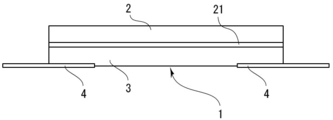
- FIG. 1 is a diagram showing an outline of a cross section of a functional composite material according to the present embodiment (hereinafter referred to as “the present composite material”).
- the composite material 1 includes an aluminum plate 2, an oxide film 21 formed by oxidizing the surface of an aluminum plate 2 having a thickness of 0.02 ⁇ m to 3 ⁇ m, and a prepreg fixed to the oxide film 21.
- a sheet 3 and an electrode 4 fixed to the prepreg sheet 3 are provided.
- the aluminum plate 2 is a plate made of aluminum.
- the length and width of the aluminum plate can be appropriately adjusted and are not limited, but the thickness is preferably formed to be thin to some extent so as to ensure the function as a sensor or actuator.
- thickness is not necessarily limited, For example, it is a preferable example that it is 0.1 mm or more and 3 mm or less.
- the aluminum plate is not limited as long as it can form an oxide film, and may contain unavoidable impurities, but the Al purity is preferably 99% or more, and other materials such as Fe and Cu may be used. Even when it contains an element, it is preferable that it is less than 50 ppm.
- the oxide film 21 is formed by oxidizing the surface of the aluminum plate as described above.
- the aluminum plate without using a completely different insulating layer such as glass fiber reinforced resin prepreg, aramid fiber reinforced resin prepreg, etc., the aluminum plate itself is oxidized to form an oxide film on the surface. It is possible to improve and further secure a strong adhesive strength.
- the thickness of the oxide film 21 is not less than 0.02 ⁇ m and not more than 3 ⁇ m, preferably not more than 1.2 ⁇ m.
- an aluminum plate is oxidized in the air to form an oxide film, but its thickness is very thin (about 2 nm) and has an insulating performance for ensuring the function of the functional composite material. It is not. Therefore, the minimum necessary insulating property as a functional composite material is ensured as 0.02 ⁇ m or more, while the decrease in adhesive strength due to the oxide film becoming brittle is prevented by setting it as 3 ⁇ m or less. Further, by setting the thickness to 1.04 ⁇ m or less, there is an effect that the adhesive strength is improved as compared with the case where the oxide film 21 is not formed.
- the structure of the aluminum oxide film is not limited, and may be a barrier film or a porous film.
- an aluminum oxide film includes (1) a dense barrier film having a withstand voltage (containing a large amount of ⁇ -Al 2 O 3 ) and (2) a porous film having no withstand voltage (non-crystalline). ).
- the details of the anodizing treatment will be described later.
- a neutral salt aqueous solution such as ammonium adipate, ammonium dihydrogen phosphate, or boric acid aqueous solution is used as the aqueous solution used for anodization, and the temperature is relatively high (40 ° C.
- the aluminum elution can be reduced and a dense barrier film can be formed.
- care must be taken to generate defects such as vacancies and cracks in the film due to volume shrinkage.
- an acidic solution such as sulfuric acid or oxalic acid is used as the aqueous solution for anodization and anodization is performed at a bath temperature of relatively low temperature (40 ° C or lower)
- aluminum is eluted more and a porous film is formed. can do. Since this porous film is non-crystalline, there are few defects, but there is an advantage that a thick film can be formed even with the same bath voltage as that for forming the barrier film.
- the method for forming the oxide film 21 of the present embodiment is not particularly limited, but is preferably performed by an anodic oxidation treatment. By adopting this treatment, there is an effect that the thickness of the oxide film can be controlled uniformly and accurately. *
- the prepreg sheet 3 according to the present embodiment is a sheet made of plastic reinforced by including fibers, and the fibers are oriented in a predetermined direction.
- the fiber is not limited, but preferably includes at least one of carbon fiber, boron fiber, glass fiber, silicon carbide fiber, or aramid fiber. Since the prepreg sheet 3 according to this embodiment includes fibers as described above, it has anisotropy in expansion due to heat. Since this anisotropy has a difference from the isotropic expansion of the aluminum plate 2, deformation with directionality is possible. In particular, when carbon fiber, silicon carbide fiber, boron fiber or the like is used as the fiber, there is an advantage that the function as a heater can be secured.
- the material of the prepreg sheet 3 is not limited as long as the material can be fixed to the oxide film 21 of the aluminum plate 2 and can stably hold the fiber.
- a resin such as an epoxy resin or a polyester resin can be used. Can be suitably used.
- the electrodes 4 of the present embodiment are fixed to the prepreg sheet 3 as a pair and used to supply current to the prepreg sheet 3.
- the material of the electrode 4 is not limited, but, for example, a metal such as copper can be used.
- the electrode 4 is a thin plate and is fixed to the ends of the aluminum plate 2 and the prepreg sheet 3. Preferably it is.
- the electrode 4 is preferably fixed to the surface of the prepreg sheet 3 opposite to the surface in contact with the aluminum plate 2. It is preferable to provide an electrode, but it is not always necessary to use an ambient temperature change.
- this composite material has higher adhesive strength and can ensure higher functionality. More specifically, this composite material generates heat between a pair of electrodes by causing a current to flow between the pair of electrodes, and generates an amount of expansion between an anisotropically expanded prepreg sheet and an isotropically expanded aluminum plate. And can be deformed by using the stress generated during this time. Furthermore, since the oxide film of the aluminum plate is directly used as the insulating layer, there is no need to provide a separate insulating layer on the sheet, and the effect that the thickness can be reduced and the amount of change in curvature is increased. Furthermore, the oxide film and the prepreg There is an effect that the adhesive strength with the sheet can be improved.
- the manufacturing method a manufacturing method of the composite material (hereinafter referred to as “the manufacturing method”) will be described.
- the manufacturing method (1) an oxide film having a range of 0.02 ⁇ m to 3 ⁇ m is formed on the surface of an aluminum plate, and (2) the oxide film and a prepreg sheet are brought into contact with each other and hot pressed.
- the step of forming an oxide film in the range of 0.02 ⁇ m or more and 3 ⁇ m or less on the surface of the aluminum plate is not limited, but is preferably an anodic oxidation treatment as described above.
- the method of anodizing treatment is not particularly limited.
- an aluminum plate is used as an anode, and a stainless steel plate is used as a cathode.
- a solution such as an aqueous boric acid solution and increasing the pressure to a predetermined voltage (20 V to 800 V) at a current density of several mA / cm 2 to several A / cm 2 within a liquid temperature range of 10 ° C. to 99 ° C.
- the anodic oxide film can be formed by holding for a certain time.
- the sealing treatment can be realized by forming a porous oxide film and then immersing it in boiling water for a certain period of time to fill the pores of the porous film with hydrated oxide.
- the step of hot pressing the oxide film and the prepreg sheet in contact is a step of pressing the aluminum plate on which the oxide film is formed and the prepreg sheet at high pressure and high temperature, and is limited as long as the pressing can be performed.
- the temperature is not limited as long as it can be sufficiently pressure-bonded.
- positioning the electrode 4 it is preferable to carry out simultaneously with this process.
- the pressure of this hot press it is preferable that it is the range of 0.1 MPa or more and 1 MPa or less.
- the hot pressing temperature is preferably in the vicinity of the curing temperature of the resin.
- the hot pressing time is not limited, but it is preferably in the range of 1 hour to 10 hours, for example.
- an aluminum plate having a width of 40 mm, a length of 80 mm, and a thickness of 0.2 mm and having a purity of 99.99% was prepared, and each of the aluminum plates was subjected to anodizing treatment to obtain 0.02 ⁇ m, 0.2 ⁇ m, 0.4 ⁇ m, Five types of aluminum plates having different oxide film thicknesses of 0.78 ⁇ m and 1.04 ⁇ m were prepared.
- anodizing treatment was degreased by immersing the aluminum plate in an aqueous solution of sodium hydroxide, and neutralized by dipping in a dilute aqueous solution of nitric acid, with 8% aqueous boric acid solution, a current density of 20 mA / cm 2 at 85 ° C.
- the voltage was raised to a predetermined voltage (20V, 150V, 300V, 600V, 800V) and held for 20 minutes.
- CFRP epoxy resin
- the above aluminum plate, prepreg sheet and two electrodes were laminated and then hot pressed to produce five types of laminated composite materials.
- the hot pressing conditions were a temperature of 453 K, 0.1 MPa, and 1.8 ks.
- maintained 453K and 28.8ks.
- FIG. 5 shows an outline of the test piece used in this test.
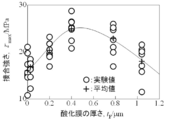
- the laminated material according to this example increased in bonding strength as the oxide film increased, peaked at around 0.5 ⁇ m, and then gradually decreased.
- the thickness was 1.2 ⁇ m or less, it was confirmed that the strength could be improved as compared with the case where CFRP and aluminum were directly joined.
- a voltage was applied between the electrodes of the produced laminated materials to generate heat, the amount of bending was measured, and the amount of curvature per unit temperature change was evaluated.
- a voltage is applied between the electrodes of the produced laminated material and heated from 40 ° C. to 180 ° C., and during that time, held at every 10 ° C., the shape is measured, and the curvature and the change in curvature per unit temperature change are measured. The amount was evaluated.
- the applied voltage is about 4 V when heated at 180 ° C., and the current at that time is about 7 A.
- the shape was measured while measuring the sample temperature with a K thermocouple fixed at the center of the CFRP side.
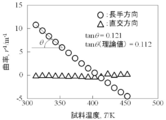
- FIG. 3 shows a change in curvature with respect to a temperature change
- FIG. 4 shows a curvature change amount per unit temperature change.
- the amount of change in curvature per unit temperature change was about 0.11, but in the laminated material according to the present example, about 0.12. It can be confirmed that the amount of change in curvature is significantly larger than in the past. In other words, it was possible to reduce the thickness, and it was confirmed that it was possible to maintain a large curvature because there was no need to provide an insulating layer of another material.
- the present invention has industrial applicability as a functional laminated composite material and a manufacturing method thereof.
Landscapes
- Laminated Bodies (AREA)
Abstract
より接着強度が高く、より高い機能性を確保することのできる機能性積層複合材料及びその製造方法を提供する。 そのため本発明の一観点に係る機能性複合材料は、アルミニウム板と、0.02μm以上3μm以下の前記アルミニウム板の表面を酸化させることにより形成した酸化膜と、酸化膜に固着されたプリプレグシートとを有する。また、本発明の他の一観点に係る機能性複合材料の製造方法は、アルミニウム板の表面に0.02μm以上3μm以下の範囲の酸化膜を形成し、酸化膜とプレグシートとを接触させてホットプレスする。
Description
本発明は、機能性積層複合材料及びその製造方法に関する。より具体的には、アルミニウム板とプリプレグシートとを組み合わせた機能性積層複合材料に関する。
機械や装置等に使用される材料は、大きく構造材料と機能性材料に分けることができる。構造材料は、機械や装置の形状や構造を長期間にわたり確保するために用いられる材料であり、機能性材料は、材料にセンサ等の機能を有する材料であり、材料そのものが装置や機械の機能の少なくとも一部を発揮することができるものである。
機能性材料の公知な技術として、例えば、下記特許文献1に、プリプレグシートと金属板を、絶縁層を介してホットプレスした機能性積層複合材料及びその製造方法が開示されている。
しかしながら、上記特許文献1に記載の技術では、金属板、プリプレグシート及び絶縁層をそれぞれ全く異なる3つの材料を用い、これらを互いにホットプレスで固着させるため、2つの接触面の強度が十分な強度を確保できるよう材料を選択しなければならず、その強度においても改善の余地が残る。
また、上記技術では、0.04~0.15mm程度の比較的厚い絶縁層を配置しているため、絶縁層が金属板とプリプレグシートの熱膨張率差を緩和してしまい、センサやアクチュエータとしての機能を十分に生かしきれないといった課題がある。
なお、そのまま絶縁層を除去してしまうと、プリプレグシートと金属板が導通してしまいそもそも電流を流すことによるアクチュエータの機能を著しく低下させてしまうだけでなく、プリプレグシートによって金属板が腐食してしまうおそれもある。
そこで、本発明は上記課題を鑑み、より接着強度が高く、より高い機能性を確保することのできる機能性積層複合材料及びその製造方法を提供することを目的とする。
上記課題を解決する第一の観点に係る機能性積層複合材料は、アルミニウム板と0.02μm以上3μm以下の前記アルミニウム板の表面を酸化させることにより形成した酸化膜と、酸化膜に固着されたプリプレグシートと、を有する。
また、上記課題を解決する第二の観点に係る機能性複合材料の製造方法は、アルミニウム板の表面に0.02μm以上3μm以下の範囲の酸化膜を形成し、酸化膜とプリプレグシートとを接触させてホットプレスする。
以上、本発明によって、より接着強度が高く、より高い機能性を確保することのできる機能性積層複合材料及びその製造方法を提供することができる。
以下、本発明の実施形態について図面を参照しつつ説明する。ただし、本発明は多くの異なる態様で実施することが可能であり、以下に示す実施形態に限定されるものではない。
図1は、本実施形態に係る機能性複合材料(以下「本複合材料」という。)の断面の概略を示す図である。
本図で示すように、本複合材料1は、アルミニウム板2と、0.02μm以上3μm以下のアルミニウム板2の表面を酸化させることにより形成した酸化膜21と、酸化膜21に固着されたプリプレグシート3と、プリプレグシート3に固着された電極4と、を有している。
本実施形態において、アルミニウム板2は、アルミニウムからなる板である。アルミニウム板の長さ、幅は適宜調整可能であり限定されるわけではないが、厚さは、センサやアクチュエータとしての機能を確保できるよう、ある程度薄く形成されていることが好ましい。厚さは限定されるわけではないが、例えば0.1mm以上3mm以下であることは好ましい一例である。アルミニウム板は、酸化膜を形成することができるものであれば限定されず、不可避の不純物を含んでも良いが、Al純度としては、99%以上であることが好ましく、Fe、Cu等の他の元素を含む場合でも50ppm未満であることが好ましい。
また本実施形態において、酸化膜21は、上記の通り、アルミニウム板の表面を酸化させることにより形成したものである。本実施形態では、ガラス繊維強化樹脂プリプレグ、アラミド繊維強化樹脂プリプレグ等全く異なる絶縁層を用いることなく、アルミニウム板そのものを酸化させることで表面に酸化膜を形成し、薄膜化、薄膜化による曲げ率向上、更には強い接着強度を確保することができる。
また本実施形態において、酸化膜21の厚さは、0.02μm以上3μm以下であり、好ましくは1.2μm以下である。一般に、アルミニウム板は、空気中において酸化し、酸化膜が形成されてはいるが、その厚さは非常に薄く(2nm程度)、機能性複合材料の機能確保のための絶縁性能を有しているものではない。そこで、0.02μm以上として機性複合材料としての必要最小限の絶縁性を確保する一方、3μm以下とすることで酸化膜が脆くなることによる接着強度の低下を防止する。また1.04μm以下にすることで、上記の酸化膜21を形成しなかった場合に比べても、接着強度が向上するといった効果がある。
なお、アルミニウムの酸化膜の構造は限定されず、バリア性皮膜であってもよく、またポーラス皮膜であっても良い。一般にアルミニウムの酸化膜は、(1)緻密で耐電圧を有するバリア性皮膜(γ-Al2O3を多く含む)と、(2)多孔質で耐電圧をもたないポーラス皮膜(非結晶性)に大別することができる。陽極酸化処理の詳細については後述するが、例えば、陽極酸化に用いる水溶液にアジピン酸アンモニウム、リン酸二水素アンモニウム、又は、ほう酸水溶液等の中性塩水溶液を用い、比較的高温(40℃以上)の浴温で陽極酸化処理を施すと、アルミ二ウムの溶出を少なくすることができ、緻密なバリア皮膜を形成することができる。ただし、結晶化によりγ-Al2O3の形成が顕著となるため、体積収縮による皮膜中の空孔、ひび割れ等の欠陥部の発生には注意が必要である。一方、陽極酸化に用いる水溶液に硫酸、シュウ酸等の酸性溶液を用い、比較的低温(40℃以下)の浴温で陽極酸化処理を施すと、アルミニウムの溶出を多くし、多孔質皮膜を形成することができる。この多孔質皮膜は非結晶性であるため、欠陥部が少ない反面、上記バリア性皮膜を形成する場合と同じ浴電圧でも厚い皮膜を形成することができるといった利点がある。
また本実施形態の酸化膜21の形成方法は、特に限定されるわけではないが、陽極酸化処理によって行われることが好ましい。この処理を採用することで、酸化皮膜の厚みを均一にかつ正確に制御できるといった効果がある。
また本実施形態に係るプリプレグシート3は、繊維を含むことによって強化されたプラスチックからなるシートであって、この繊維は、所定の方向に配向している。繊維としては限定されるわけではないが、炭素繊維、ホウ素繊維、ガラス繊維、炭化珪素繊維又はアラミド繊維の少なくともいずれかを含むことが好ましい。本実施形態に係るプリプレグシート3は、上記の通り、繊維を含むものであるため、熱による膨張に異方性を有する。この異方性は上記アルミニウム板2の等方的な膨張と差異を有することとなるため、方向性をもった変形が可能となる。なお特に、繊維として炭素繊維、炭化ケイ素繊維、ホウ素繊維等を用いる場合、ヒーターとしての機能を確保することができるといった利点もある。
またプリプレグシート3の材料としては、アルミニウム板2の酸化膜21と固着でき、上記繊維を安定的に保持することができる限りにおいて限定されるわけではないが、例えばエポキシ樹脂、ポリエステル樹脂等の樹脂を好適に用いることができる。
また本実施形態の電極4は、プリプレグシート3に一対で固着され、プリプレグシート3に電流を供給するために用いられる。電極4の材質としては、限定されるわけではないが、例えば銅等の金属を用いることができ、電極4は薄い板状であって、アルミニウム板2及びプリプレグシート3の端部に固着されていることが好ましい。なお電極4は、プリプレグシート3のアルミニウム板2に接している面と反対の面に固着されていることが好ましい。なお電極は設けておくことが好ましいが、周囲の温度変化を利用する場合は必ずしも設けなくて良い。
以上、本複合材料は、より接着強度が高く、より高い機能性を確保することができる。具体的に説明すると、本複合材料は、一対の電極の間に電流を流すことでプリプレグシートを発熱させ、異方的に膨張するプリプレグシートと等方的に膨張するアルミニウム板の間に発生する膨張量の差異を発生させ、この間に発する応力を用いて変形することができる。そして更に、アルミニウム板の酸化膜を絶縁層として直接用いているため、別途シートの絶縁層を設ける必要がなく、薄膜化が可能となり曲率変化量が大きくなるといった効果、更には、酸化膜とプリプレグシートとの接着強度を向上させることができるといった効果がある。
(製造方法)
ここで、本複合材料の製造方法(以下「本製造方法」という。)について説明する。本方法は、(1)アルミニウム板の表面に0.02μm以上3μm以下の範囲の酸化膜を形成し、(2)酸化膜とプリプレグシートとを接触させてホットプレスする。
ここで、本複合材料の製造方法(以下「本製造方法」という。)について説明する。本方法は、(1)アルミニウム板の表面に0.02μm以上3μm以下の範囲の酸化膜を形成し、(2)酸化膜とプリプレグシートとを接触させてホットプレスする。
(1)アルミニウム板の表面に0.02μm以上3μm以下の範囲の酸化膜を形成する工程は、限定されるわけではないが、上記のように、陽極酸化処理であることは好ましい。陽極酸化処理の方法としては、特に限定されるわけではないが、例えば、アルミニウム板を陽極、ステンレス板を陰極として、これら板を数%~数十%の濃度のアジピン酸アンモニウム、リン酸アンモニウム水溶液、又はホウ酸水溶液等の溶液に浸し、液温10℃~99℃の範囲内で、電流密度数mA/cm2~数A/cm2にて、所定の電圧(20V~800V)まで昇圧後、一定時間保持することにより陽極酸化皮膜を形成することができる。
また、この陽極酸化処理後、封孔処理を施して耐食性を向上させておくことは好ましい一例である。なお封孔処理を行う場合は、多孔質の酸化膜を形成した後、沸騰水中に一定時間浸漬し、多孔質皮膜の微細孔を水和酸化物により埋めることで実現できる。
また(2)酸化膜とプリプレグシートとを接触させてホットプレスする工程は、酸化膜が形成されたアルミニウム板とプリプレグシートとを高圧高温で圧着する工程であり、圧着することができる限りにおいて限定されず、温度についても十分に圧着させることができる限りにおいて限定されない。なお、電極4を配置する場合、この工程と同時に行なっておくことが好ましい。なおこのホットプレスの圧力に関しては、限定されるわけではないが、0.1MPa以上1MPa以下の範囲であることが好ましい。またホットプレスの温度としては、樹脂の硬化温度近傍であることが好ましく、例えばエポキシ樹脂である場合は、120℃近傍又は180℃近傍であることが好ましい。またホットプレスの時間も限定されるわけではないが、例えば1時間以上10時間以下の範囲内であることが好ましい。
以上、本方法によって、より接着強度が高く、より高い機能性を確保することのできる機能性積層複合材料を製造することができる。
ここで、上記実施形態に係る機能性複合材料の効果につき、実際に機能性材料を作製し、その効果を確認した。以下に示す。
まず、幅40mm、長さ80mm、厚さ0.2mmの純度99.99%のアルミニウム板を準備し、このアルミニウム板それぞれに陽極酸化処理を施し、0.02μm、0.2μm、0.4μm、0.78μm、1.04μmと、異なる酸化膜の厚さをもつ5種類のアルミニウム板を準備した。なお、陽極酸化処理は、上記アルミニウム板を水酸化ナトリウム水溶液に浸漬して脱脂した後、希薄硝酸水溶液に浸漬して中和し、8%ほう酸水溶液、85℃にて電流密度20mA/cm2で所定の電圧(20V、150V、300V、600V、800V)まで昇圧し、20間保持した。
次に、幅40mm、長さ80mm、厚さ0.1mmの長手方向に炭素繊維で強化されたエポキシ樹脂(CFRP)プリプレグシート(炭素繊維の体積率が60%)を複数準備し、更に、幅40mm、長さ50mmに切り出した銅箔を電極として一対当たり2枚配置できるよう準備した。
そして、上記アルミニウム板、プリプレグシート及び2枚の電極を積層後ホットプレスして5種類の積層複合材料を作製した。なおホットプレスの条件は、温度453K、0.1MPa、1.8ksとした。なおアフターキュアとして、除荷し、453K、28.8ks保持した。
なお本実施例では、比較のため、上記アルミニウム板に酸化膜を形成させず、40μmのガラス繊維で強化した樹脂のプリプレグシートをアルミニウム板とCFRPの間に配置した積層複合材料(比較例1)も作製した。なおホットプレスの条件は、上記と同様とした。
更に本実施例では、比較のため、上記アルミニウム板に酸化膜を形成させずCFRPと直接ホットプレスした積層複合材料(比較例2)についても作製した。なおホットプレスの条件については、上記積層材料と同様とした。
まず、酸化膜厚さに対する接合強さについて測定した。この結果を図2に示す。なお、この測定は、アルミニウムとCFRPを部分的に接合した接合強さ評価表試験片を作製し、その試験片を用いて引張せん断試験を行い、得られた破断荷重を接合部の面積で除した値を接合強さとして評価した。なお図5に、本試験にて用いた試験片の概略を示しておく。
本図で示すように、本実施例に係る積層材料は、酸化膜が増加するに従い接合強さが増加し、0.5μm近傍でピークとなり、その後緩やかに減少していくことが確認できた。特に1.2μm以下であれば、CFRPとアルミニウムを直接接合した場合よりも強度を向上させることができるのを確認した。
また、これら作製した積層材料の電極間に、電圧を加え発熱させ、その曲げ量を測定し、曲率、単位温度変化あたりの曲率変化量を評価した。なおこの測定は、これら作製した積層材料の電極間に、電圧を印加し40℃から180℃まで加熱し、その間10℃ごとに保持しその形状を測定し、曲率、単位温度変化あたりの曲率変化量を評価した。ここで、印加電圧は180℃加熱時で約4V程度、そのときの電流は約7A程度である。なお、CFRP側の中央部に固定したK熱電対により試料温度を測定しながら形状を測定した。
ここで、図3に、温度変化に対する曲率の変化を、図4に、単位温度変化あたりの曲率変化量をそれぞれ示しておく。
図3で示されるように、本材料では、試料長手方向では、試料温度が高くなるほど曲率が減少し、温度が低くなるほど曲率が増加していくことが確認できた一方、試料長手方向に直交する方向では、殆ど曲率に変化がないことが確認できた。この結果、温度変化に伴い一方向に曲がることのできるアクチュエータ、センサとして機能していることが確認できた。
また、図4で示される結果によると、上記比較例1では、単位温度変化あたりの曲率変化量が0.11程度であったが、本実施例に係る積層材料では、0.12程度と、従来よりも大幅に曲率変化量が大きくなっていることが確認できる。すなわち、薄膜化を図ることが可能となり、更に別材料の絶縁層を設ける必要がなくなったため、大きな曲率を維持することが可能となったことが確認できた。
以上、本発明の効果を確認することができた。
本発明は、機能性積層複合材料およびその製造方法として産業上の利用可能性がある。
1…機能性複合材料、2…アルミニウム板、3…プリプレグシート、4…電極、21…酸化膜
Claims (5)
- アルミニウム板と、0.02μm以上3μm以下の前記アルミニウム板の表面を酸化させることにより形成した酸化膜と、前記酸化膜に固着されたプリプレグシートと、を有する機能性積層複合材料。
- 前記プリプレグシートに固着された電極と、を有する請求項1記載の機能性積層複合材料。
- 前記酸化膜は、1.2μm以下である請求項1記載の機能性積層複合材料。
- アルミニウム板の表面に0.02μm以上3μm以下の範囲の酸化膜を形成し、
前記酸化膜とプリプレグシートとを接触させてホットプレスする機能性積層複合材料の製造方法。 - 前記酸化膜の形成は、陽極酸化処理によっておこなう請求項4記載の機能性積層材料の製造方法。
Applications Claiming Priority (2)
| Application Number | Priority Date | Filing Date | Title |
|---|---|---|---|
| JP2011-047030 | 2011-03-03 | ||
| JP2011047030A JP5835792B2 (ja) | 2011-03-03 | 2011-03-03 | 機能性積層複合材料及びその製造方法 |
Publications (1)
| Publication Number | Publication Date |
|---|---|
| WO2012118224A1 true WO2012118224A1 (ja) | 2012-09-07 |
Family
ID=46758144
Family Applications (1)
| Application Number | Title | Priority Date | Filing Date |
|---|---|---|---|
| PCT/JP2012/055593 Ceased WO2012118224A1 (ja) | 2011-03-03 | 2012-03-05 | 機能性積層複合材料及びその製造方法 |
Country Status (2)
| Country | Link |
|---|---|
| JP (1) | JP5835792B2 (ja) |
| WO (1) | WO2012118224A1 (ja) |
Citations (3)
| Publication number | Priority date | Publication date | Assignee | Title |
|---|---|---|---|---|
| JPS63168072A (ja) * | 1986-12-27 | 1988-07-12 | 住友ベークライト株式会社 | 金属ベ−ス印刷回路用基板 |
| JPH03239390A (ja) * | 1990-02-16 | 1991-10-24 | Mitsubishi Electric Corp | 金属芯基板およびその製法 |
| JP2005343126A (ja) * | 2004-06-07 | 2005-12-15 | Risho Kogyo Co Ltd | フレキシブルプリント配線板用基板 |
Family Cites Families (2)
| Publication number | Priority date | Publication date | Assignee | Title |
|---|---|---|---|---|
| JPH10135593A (ja) * | 1996-10-31 | 1998-05-22 | Shirai Denshi Kogyo Kk | プリント回路用基板 |
| JP5574322B2 (ja) * | 2008-01-28 | 2014-08-20 | 国立大学法人 千葉大学 | 積層複合材料 |
-
2011
- 2011-03-03 JP JP2011047030A patent/JP5835792B2/ja active Active
-
2012
- 2012-03-05 WO PCT/JP2012/055593 patent/WO2012118224A1/ja not_active Ceased
Patent Citations (3)
| Publication number | Priority date | Publication date | Assignee | Title |
|---|---|---|---|---|
| JPS63168072A (ja) * | 1986-12-27 | 1988-07-12 | 住友ベークライト株式会社 | 金属ベ−ス印刷回路用基板 |
| JPH03239390A (ja) * | 1990-02-16 | 1991-10-24 | Mitsubishi Electric Corp | 金属芯基板およびその製法 |
| JP2005343126A (ja) * | 2004-06-07 | 2005-12-15 | Risho Kogyo Co Ltd | フレキシブルプリント配線板用基板 |
Also Published As
| Publication number | Publication date |
|---|---|
| JP5835792B2 (ja) | 2015-12-24 |
| JP2012183678A (ja) | 2012-09-27 |
Similar Documents
| Publication | Publication Date | Title |
|---|---|---|
| EP3224042B1 (en) | Fiber-metal laminate and its manufacturing method | |
| JP7338683B2 (ja) | アルミニウム化成箔の製造方法 | |
| US20170368795A1 (en) | Heat transport structure and manufacturing method thereof | |
| JP2023052730A (ja) | 軟磁性合金薄帯の積層体 | |
| CN107848246A (zh) | 用于电气电路的基底和用于制造这种基底的方法 | |
| EP3214220B1 (en) | Process for producing carbon-fiber resin tape, and carbon-fiber resin tape | |
| US20140041196A1 (en) | Method for manufacturing aluminum roof molding using porous oxide layer | |
| JP5835792B2 (ja) | 機能性積層複合材料及びその製造方法 | |
| CN111868861B (zh) | 铝电解电容器用电极的制造方法 | |
| JP5574322B2 (ja) | 積層複合材料 | |
| CN111020685A (zh) | 一种提高层间强度的纤维金属层合板制备方法 | |
| JP5284926B2 (ja) | 金属と炭素繊維強化樹脂との積層体とその製造方法 | |
| JP2012179767A (ja) | 機能性積層複合材料及びその製造方法 | |
| JP2011148164A (ja) | クラッド材及びその製造方法 | |
| JP7181358B2 (ja) | アルミニウム電解コンデンサ用電極 | |
| JP2013168329A (ja) | フィルム、電解質膜補強部材、補強部材付き電解質膜および燃料電池 | |
| JP6131973B2 (ja) | 補強型電解質膜の製造方法、膜電極接合体の製造方法、及び、膜電極接合体 | |
| KR20170032215A (ko) | 표면 처리 알루미늄재 및 그 제조 방법, 및, 당해 표면 처리 알루미늄재/수지층의 접합체 | |
| JP2010232451A (ja) | アルミニウム電解コンデンサ用の電極 | |
| JPWO2007094433A1 (ja) | 積層複合材料を用いるアクチュエータ | |
| CN110268492B (zh) | 电极夹具和铝电解电容器用电极的制造方法 | |
| JP2019026924A (ja) | 表面処理アルミニウム合金材及びその製造方法 | |
| CN106835232A (zh) | 用于1064mm激光驱动飞片系统的飞片结构及制备方法 | |
| JP7753857B2 (ja) | 板体補強用積層体 | |
| CN121506592A (zh) | 一种高可靠性层状复合软铜排及其制造方法 |
Legal Events
| Date | Code | Title | Description |
|---|---|---|---|
| 121 | Ep: the epo has been informed by wipo that ep was designated in this application |
Ref document number: 12751807 Country of ref document: EP Kind code of ref document: A1 |
|
| NENP | Non-entry into the national phase |
Ref country code: DE |
|
| 122 | Ep: pct application non-entry in european phase |
Ref document number: 12751807 Country of ref document: EP Kind code of ref document: A1 |