WO2012118193A1 - ヒアルロン酸またはその塩を含む水溶液 - Google Patents
ヒアルロン酸またはその塩を含む水溶液 Download PDFInfo
- Publication number
- WO2012118193A1 WO2012118193A1 PCT/JP2012/055426 JP2012055426W WO2012118193A1 WO 2012118193 A1 WO2012118193 A1 WO 2012118193A1 JP 2012055426 W JP2012055426 W JP 2012055426W WO 2012118193 A1 WO2012118193 A1 WO 2012118193A1
- Authority
- WO
- WIPO (PCT)
- Prior art keywords
- aqueous solution
- hyaluronic acid
- salt
- zinc
- solution containing
- Prior art date
- Legal status (The legal status is an assumption and is not a legal conclusion. Google has not performed a legal analysis and makes no representation as to the accuracy of the status listed.)
- Ceased
Links
Images

Classifications
-
- A—HUMAN NECESSITIES
- A61—MEDICAL OR VETERINARY SCIENCE; HYGIENE
- A61K—PREPARATIONS FOR MEDICAL, DENTAL OR TOILETRY PURPOSES
- A61K31/00—Medicinal preparations containing organic active ingredients
- A61K31/70—Carbohydrates; Sugars; Derivatives thereof
- A61K31/715—Polysaccharides, i.e. having more than five saccharide radicals attached to each other by glycosidic linkages; Derivatives thereof, e.g. ethers, esters
- A61K31/726—Glycosaminoglycans, i.e. mucopolysaccharides
- A61K31/728—Hyaluronic acid
-
- A—HUMAN NECESSITIES
- A61—MEDICAL OR VETERINARY SCIENCE; HYGIENE
- A61K—PREPARATIONS FOR MEDICAL, DENTAL OR TOILETRY PURPOSES
- A61K31/00—Medicinal preparations containing organic active ingredients
- A61K31/28—Compounds containing heavy metals
- A61K31/315—Zinc compounds
-
- A—HUMAN NECESSITIES
- A61—MEDICAL OR VETERINARY SCIENCE; HYGIENE
- A61K—PREPARATIONS FOR MEDICAL, DENTAL OR TOILETRY PURPOSES
- A61K33/00—Medicinal preparations containing inorganic active ingredients
- A61K33/24—Heavy metals; Compounds thereof
- A61K33/26—Iron; Compounds thereof
-
- A—HUMAN NECESSITIES
- A61—MEDICAL OR VETERINARY SCIENCE; HYGIENE
- A61K—PREPARATIONS FOR MEDICAL, DENTAL OR TOILETRY PURPOSES
- A61K33/00—Medicinal preparations containing inorganic active ingredients
- A61K33/24—Heavy metals; Compounds thereof
- A61K33/30—Zinc; Compounds thereof
-
- A—HUMAN NECESSITIES
- A61—MEDICAL OR VETERINARY SCIENCE; HYGIENE
- A61K—PREPARATIONS FOR MEDICAL, DENTAL OR TOILETRY PURPOSES
- A61K47/00—Medicinal preparations characterised by the non-active ingredients used, e.g. carriers or inert additives; Targeting or modifying agents chemically bound to the active ingredient
- A61K47/02—Inorganic compounds
-
- A—HUMAN NECESSITIES
- A61—MEDICAL OR VETERINARY SCIENCE; HYGIENE
- A61K—PREPARATIONS FOR MEDICAL, DENTAL OR TOILETRY PURPOSES
- A61K47/00—Medicinal preparations characterised by the non-active ingredients used, e.g. carriers or inert additives; Targeting or modifying agents chemically bound to the active ingredient
- A61K47/30—Macromolecular organic or inorganic compounds, e.g. inorganic polyphosphates
- A61K47/36—Polysaccharides; Derivatives thereof, e.g. gums, starch, alginate, dextrin, hyaluronic acid, chitosan, inulin, agar or pectin
-
- A—HUMAN NECESSITIES
- A61—MEDICAL OR VETERINARY SCIENCE; HYGIENE
- A61K—PREPARATIONS FOR MEDICAL, DENTAL OR TOILETRY PURPOSES
- A61K8/00—Cosmetics or similar toiletry preparations
- A61K8/18—Cosmetics or similar toiletry preparations characterised by the composition
- A61K8/19—Cosmetics or similar toiletry preparations characterised by the composition containing inorganic ingredients
- A61K8/27—Zinc; Compounds thereof
-
- A—HUMAN NECESSITIES
- A61—MEDICAL OR VETERINARY SCIENCE; HYGIENE
- A61K—PREPARATIONS FOR MEDICAL, DENTAL OR TOILETRY PURPOSES
- A61K8/00—Cosmetics or similar toiletry preparations
- A61K8/18—Cosmetics or similar toiletry preparations characterised by the composition
- A61K8/72—Cosmetics or similar toiletry preparations characterised by the composition containing organic macromolecular compounds
- A61K8/73—Polysaccharides
- A61K8/735—Mucopolysaccharides, e.g. hyaluronic acid; Derivatives thereof
-
- A—HUMAN NECESSITIES
- A61—MEDICAL OR VETERINARY SCIENCE; HYGIENE
- A61K—PREPARATIONS FOR MEDICAL, DENTAL OR TOILETRY PURPOSES
- A61K9/00—Medicinal preparations characterised by special physical form
- A61K9/0012—Galenical forms characterised by the site of application
- A61K9/0019—Injectable compositions; Intramuscular, intravenous, arterial, subcutaneous administration; Compositions to be administered through the skin in an invasive manner
-
- A—HUMAN NECESSITIES
- A61—MEDICAL OR VETERINARY SCIENCE; HYGIENE
- A61K—PREPARATIONS FOR MEDICAL, DENTAL OR TOILETRY PURPOSES
- A61K9/00—Medicinal preparations characterised by special physical form
- A61K9/08—Solutions
-
- A—HUMAN NECESSITIES
- A61—MEDICAL OR VETERINARY SCIENCE; HYGIENE
- A61P—SPECIFIC THERAPEUTIC ACTIVITY OF CHEMICAL COMPOUNDS OR MEDICINAL PREPARATIONS
- A61P19/00—Drugs for skeletal disorders
- A61P19/02—Drugs for skeletal disorders for joint disorders, e.g. arthritis, arthrosis
-
- A—HUMAN NECESSITIES
- A61—MEDICAL OR VETERINARY SCIENCE; HYGIENE
- A61P—SPECIFIC THERAPEUTIC ACTIVITY OF CHEMICAL COMPOUNDS OR MEDICINAL PREPARATIONS
- A61P9/00—Drugs for disorders of the cardiovascular system
- A61P9/02—Non-specific cardiovascular stimulants, e.g. drugs for syncope, antihypotensives
-
- A—HUMAN NECESSITIES
- A61—MEDICAL OR VETERINARY SCIENCE; HYGIENE
- A61Q—SPECIFIC USE OF COSMETICS OR SIMILAR TOILETRY PREPARATIONS
- A61Q19/00—Preparations for care of the skin
-
- A—HUMAN NECESSITIES
- A61—MEDICAL OR VETERINARY SCIENCE; HYGIENE
- A61K—PREPARATIONS FOR MEDICAL, DENTAL OR TOILETRY PURPOSES
- A61K2800/00—Properties of cosmetic compositions or active ingredients thereof or formulation aids used therein and process related aspects
- A61K2800/20—Chemical, physico-chemical or functional or structural properties of the composition as a whole
- A61K2800/30—Characterized by the absence of a particular group of ingredients
Definitions
- the present invention relates to an aqueous solution containing hyaluronic acid or a salt thereof containing a zinc compound with a low content of divalent soluble iron.
- Hyaluronic acid is known as a polysaccharide composed of linked disaccharide units of N-acetylglucosamine and glucuronic acid.
- Hyaluronic acid is generally used as a raw material for pharmaceuticals, cosmetics, foods and the like.
- As a production method of hyaluronic acid there are a method of producing with an extract from a chicken crown or the like, and a method of producing by a fermentation method using a microorganism.
- Patent Document 1 describes that hyaluronic acid was produced by fermentation using Streptococcus tin-epidemicus.
- the yield and molecular weight of hyaluronic acid are higher when ferrous sulfate is added to a concentration of 3 times during the culture (Example 3) than when not added (Example 1). It is described that it has increased.
- Patent Document 2 describes that hyaluronic acid powder was produced by fermentation using Streptococcus equi (ATCC9527).
- Patent Document 3 describes experimental data indicating that sodium hyaluronate crystals produced based on the method of Patent Document 2 contain a large amount of calcium, magnesium, and iron.
- Patent Document 3 discloses a sodium hyaluronate crystal in which the content of calcium, magnesium, and iron is reduced to less than 10 ppm by further contacting a chelate resin with the hyaluronic acid-containing liquid obtained based on the method of Patent Document 2. It is described that obtained.
- the hyaluronic acid powder contained a lot of calcium, magnesium, and iron, and the purity of sodium hyaluronate was low.
- Patent Document 3 Thirdly, in the production method of Patent Document 3, it is described that the content of calcium, magnesium, and iron in the sodium hyaluronate crystal is reduced to less than 10 ppm, but what was the specific content? Is unknown. The analysis results are in the order of ppm and lack precision. Furthermore, it is not described what specific effects can be obtained by reducing the contents of calcium, magnesium, and iron.
- the present invention has been made in view of the above circumstances, and provides an aqueous solution containing hyaluronic acid or a salt thereof having high stability because the content of divalent soluble iron is 5 ppb or less and contains a zinc compound.
- the purpose is to do.
- the present inventors have found that the higher the content of divalent soluble iron mixed in the hyaluronate aqueous solution, the higher the hyaluronic acid molecule It was found for the first time that the stability of was reduced. In addition, the inventors surprisingly found that the stability of hyaluronic acid molecules does not decrease even when the content of trivalent soluble iron is large, and the content of divalent soluble iron is large. We have also found that the stability of hyaluronic acid molecules is reduced.
- the present inventors reduced the content of divalent soluble iron mixed in an aqueous solution containing hyaluronic acid or a salt thereof, and improved the stability of hyaluronic acid molecules by divalent soluble iron.
- a decrease in the stability of hyaluronic acid molecules due to divalent soluble iron can be suppressed by adding a zinc compound.
- the inventors have also surprisingly added glycine, L-aspartate Na, Na bromide, Na hydrogen sulfite, Na sulfide, Na thioglycolate, glucose, purified white sugar, or ascorbic acid. Found that the decrease in the stability of hyaluronic acid molecules due to divalent soluble iron was not suppressed, and that the addition of the divalent soluble iron often resulted in a decrease in stability, and thus completed the present invention.
- an aqueous solution containing hyaluronic acid or a salt thereof containing a zinc compound having a divalent soluble iron content of 5 ppb or less is provided.
- the aqueous solution containing this hyaluronic acid or a salt thereof has been demonstrated in Examples to be described later that the intrinsic viscosity remaining rate after storage is good. Therefore, it is suitable for raw materials such as pharmaceuticals, cosmetics and foods.
- a pharmaceutical composition comprising an aqueous solution containing the above hyaluronic acid or a salt thereof.
- This pharmaceutical composition contains an aqueous solution containing hyaluronic acid or a salt thereof having a good residual intrinsic viscosity after storage. For this reason, it is difficult for a decrease in viscosity or a decrease in quality to occur over time.
- an injection for treating arthritis comprising an aqueous solution containing the above hyaluronic acid or a salt thereof.
- This injection for treatment of arthropathy includes an aqueous solution containing hyaluronic acid or a salt thereof having a good residual intrinsic viscosity after storage. Therefore, good retention is obtained when administered in or around the joint.
- a cosmetic composition comprising an aqueous solution containing the hyaluronic acid or a salt thereof.
- This cosmetic composition contains an aqueous solution containing hyaluronic acid or a salt thereof having an excellent residual viscosity after storage. For this reason, it is difficult for a decrease in viscosity or a decrease in quality to occur over time.
- the method further comprises a step of dissolving a composition containing hyaluronic acid or a salt thereof and divalent soluble iron and a zinc compound in an aqueous solution, wherein the composition comprises hyaluronic acid or a salt thereof.
- the According to this production method it is possible to produce hyaluronic acid or a salt thereof having an excellent residual residual viscosity after storage.
- the method further comprises a step of dissolving a composition containing hyaluronic acid or a salt thereof and divalent soluble iron and a zinc compound in an aqueous solution, wherein the composition comprises hyaluronic acid or a salt thereof.
- a method for promoting stabilization of an aqueous solution containing hyaluronic acid or a salt thereof, wherein the content of divalent soluble iron in the aqueous solution is 5 ppb or less when dissolved in an aqueous solution so that the salt concentration is 10 mg / mL Provided.
- a stabilizer for stabilizing an aqueous solution containing a hyaluronic acid or a salt thereof containing a zinc compound and having a divalent soluble iron content of 5 ppb or less examples in which the zinc compound is contained in an aqueous solution containing hyaluronic acid or a salt thereof having a content of divalent soluble iron of 5 ppb or less remarkably increases after storage. Has been proven. Therefore, if this stabilizer is added to an aqueous solution containing hyaluronic acid or a salt thereof having a divalent soluble iron content of 5 ppb or less, the stabilizer can be remarkably stabilized.
- the content of divalent soluble iron is 5 ppb or less and contains a zinc compound, an aqueous solution containing hyaluronic acid or a salt thereof having high stability can be obtained.
- FIG. 1 is a graph showing a change in intrinsic viscosity residual rate when sodium hyaluronate powder is added to an aqueous solution containing divalent soluble iron and zinc chloride.
- One embodiment of the present invention is an aqueous solution containing hyaluronic acid or a salt thereof containing a zinc compound having a divalent soluble iron content of 5 ppb or less.
- An aqueous solution containing hyaluronic acid or a salt thereof having such a composition has a high residual residual viscosity after storage and is excellent in physical stability, as demonstrated in Examples described later. In addition, the viscosity and quality are hardly lowered even after long-term storage or after a long period of time, and it is suitable for raw materials such as pharmaceuticals, cosmetics and foods.
- Examples of the zinc compound include zinc salicylate, zinc phosphate, zinc sulfate, zinc nitrate, zinc iodide, zinc fluoride, zinc chloride, zinc bromide, zinc carbonate, zinc pt-butylbenzoate, and zinc thiocyanate.
- Zinc lactate, zinc acetate, or zinc oxide may be used. It can also be used as a complex such as a salt of zincate ion.
- zinc acetate, zinc sulfate, zinc chloride, or zinc oxide is preferred.
- zinc acetate or zinc chloride is preferred.
- one having a reduced endotoxin concentration is used.
- the above 5 ppb or less may be, for example, 0.001, 0.01, 0.1, 0.5, 1, 2, 4, or 5 ppb.
- the content may be equal to or less than the value exemplified here, or may be in the range of any two values. This content is preferably smaller from the viewpoint of improving the stability of an aqueous solution containing hyaluronic acid or a salt thereof.
- the content of the zinc compound contained in the aqueous solution containing hyaluronic acid or a salt thereof of the present embodiment is, for example, 0.005, 0.01, 0.1, 0.5, 0.8, 1, 1.5, 2, 5, 10, 50, or 100 ⁇ g. May be / mL. Moreover, this content rate may be in the range of any two values exemplified here.
- the content is preferably 0.01 ⁇ g / mL or more, more preferably 0.5 ⁇ g / mL or more from the viewpoint of further improving the stability of the aqueous solution containing hyaluronic acid or a salt thereof.
- the content is preferably 10 ⁇ g / mL or less, more preferably 2 ⁇ g / mL or less from the viewpoint of reducing production costs or improving operability.
- the average molecular weight of sodium hyaluronate or a salt thereof contained in the aqueous solution containing hyaluronic acid or a salt thereof of the present embodiment is, for example, 500,000, 800,000, 1,000,000, 1.5 million, 1.8 million, 2 million, 2.5 million, 300 May be 5 million, 5 million, or 8 million. This average molecular weight may be within the range of any two values exemplified here. From the viewpoint of further improving the viscosity of an aqueous solution containing hyaluronic acid or a salt thereof, it is preferably 1 million or more, more preferably 1.5 million or more.
- An aqueous solution containing high-viscosity hyaluronic acid or a salt thereof is excellent in retention in the affected area when used as an injection for the treatment of arthropathy.
- the average molecular weight of hyaluronic acid or a salt thereof contained in an aqueous solution containing hyaluronic acid or a salt thereof is calculated by measuring Laurent's formula (LAURENT et al., Biochim Biophys Acta. 1960 Aug 26; 42: 476-485 .).
- the content of hyaluronic acid or a salt thereof contained in the aqueous solution containing hyaluronic acid or a salt thereof according to the present embodiment is, for example, 0.1, 1, 5, 8, 9, 10, 11, 12, 15, or 20 mg / mL. It may be. This content may be within the range of any two values exemplified here. From the viewpoint of therapeutic effect or operability when used for injections and the like, it is preferably in the range of 5 and 15 mg / mL, more preferably in the range of 8 and 12 mg / mL.
- the pH of the aqueous solution containing hyaluronic acid or a salt thereof according to this embodiment may be, for example, 5.5, 6, 6.5, 6.8, 7, 7.8, 8, 8.5, or 9. This pH may be within the range of any two values exemplified herein.
- the pH is preferably in the range of 6.5 and 8 from the viewpoint of stability, and more preferably in the range of 6.8 and 7.8.
- the aqueous solution containing hyaluronic acid or a salt thereof includes, for example, a step of dissolving a composition containing hyaluronic acid or a salt thereof and divalent soluble iron and a zinc compound in the aqueous solution.
- the composition comprises hyaluronic acid or a salt thereof, in which the content of divalent soluble iron in the aqueous solution is 5 ppb or less when dissolved in the aqueous solution so that the concentration of hyaluronic acid or a salt thereof is 10 mg / mL. It can obtain by the production method of the aqueous solution containing. This production method does not necessarily require complicated steps, and is excellent in productivity or cost.
- hyaluronic acid salt may be, for example, sodium hyaluronate, potassium hyaluronate, zinc hyaluronate, calcium hyaluronate, magnesium hyaluronate, or ammonium hyaluronate.
- sodium hyaluronate is preferable from the viewpoint that a desired viscosity or a therapeutic effect on arthropathy can be expected.
- the chemical name of sodium hyaluronate is, for example, [ ⁇ 3) -2-acetamido-2-deoxy- ⁇ -D-glucopyranosyl- (1 ⁇ 4) - ⁇ -D-sodium glucopyranosyluronate- (1 ⁇ ] n (IUPAC) Can be represented.
- divalent soluble iron is iron in a soluble state and is divalent. It can also be expressed as Fe 2+ or divalent iron.
- the aqueous solution containing hyaluronic acid or a salt thereof according to this embodiment can be used as a raw material of a pharmaceutical composition.
- the pharmaceutical composition contains an aqueous solution containing hyaluronic acid or a salt thereof excellent in stability, the viscosity and quality are hardly lowered even after long-term storage. Further, for example, when it is administered in or around the joint, it can stay in the affected area for a long time or a desired time.
- the dosage form of this pharmaceutical composition is not particularly limited, but an injection is preferable from the viewpoint that it can be directly administered to an affected area such as a joint.
- a syringe, a vial, or an ampoule can be used as the container for the injection.
- it can be administered alone, but can be mixed with one or more pharmacologically acceptable carriers or excipients and any well known in the pharmaceutical arts. It is preferably provided as a pharmaceutical preparation produced by the method.
- This pharmaceutical composition is prepared according to the dosage form by using a buffer (eg, phosphate buffer, sodium acetate buffer), a soothing agent (eg, lidocaine hydrochloride, procaine hydrochloride, etc.), a stabilizer (eg, human serum albumin).
- a buffer eg, phosphate buffer, sodium acetate buffer
- a soothing agent eg, lidocaine hydrochloride, procaine hydrochloride, etc.
- a stabilizer eg, human serum albumin
- the pharmaceutical composition may also contain sodium hydrogen phosphate, crystalline sodium dihydrogen phosphate, and sodium chloride as additives.
- the adjusted pharmaceutical composition can be administered to, for example, humans and mammals (eg, rats, mice, rabbits, dogs, monkeys, sheep, pigs, cows, cats, etc.).
- the pharmaceutical composition includes a composition used for the purpose of prevention.
- the administration method of this pharmaceutical composition can be appropriately selected depending on the age, symptoms, affected area, etc. of the subject.
- 2.5 mL of an adult can be administered into the knee joint cavity 5 times continuously every week.
- it can be administered at intervals of 2 to 4 weeks.
- 2.5 mL of an adult once a week for 5 consecutive shoulder joints (shoulder joint cavity, subacromial bursa, or biceps long head tendon) can be administered within the tendon sheath).
- 2.5 mL of an adult can be administered into the knee joint cavity 5 times continuously every week. It may also be administered in combination with an appropriate chemotherapeutic agent.
- Examples of the pharmacological action of this pharmaceutical composition include: a) viscoelasticity or lubrication action by hyaluronate binding to the cartilage tissue and covering the surface, b) cartilage matrix stabilization action (degeneration suppression) C) analgesic action by covering the surface of inflammatory cells and synovial cells, or by suppressing the production of analgesic substances, or d) close to arthritis with synovial and cartilage degeneration Examples thereof include inflammatory effects expressed by affecting synovial cells, chondrocytes, or inflammatory cells such as neutrophils and macrophages. By these actions, for example, reduction of pain, improvement of daily life activities and joint range of motion are expected.
- the aqueous solution containing hyaluronic acid or a salt thereof according to this embodiment can be used as a raw material for a cosmetic composition.
- the cosmetic composition includes an aqueous solution containing hyaluronic acid or a salt thereof excellent in stability, the viscosity and quality are not easily lowered even after long-term storage.
- the moisturizing effect tends to be sustained.
- Another embodiment includes dissolving a composition containing hyaluronic acid or a salt thereof and divalent soluble iron and a zinc compound in an aqueous solution, wherein the composition comprises hyaluronic acid or a salt thereof.
- This is a method for promoting the stabilization of an aqueous solution containing hyaluronic acid or a salt thereof, in which the content of divalent soluble iron in the aqueous solution is 5 ppb or less when dissolved in the aqueous solution so as to have a concentration of 10 mg / mL.
- this method an aqueous solution containing hyaluronic acid or a salt thereof having high physical stability can be obtained. Further, this method does not necessarily require a complicated process and is excellent in convenience.
- the zinc compound can be used as a raw material for an aqueous solution stabilizer containing hyaluronic acid or a salt thereof. If this stabilizer is used, the physical stability of an aqueous solution containing hyaluronic acid or a salt thereof having a divalent soluble iron content of 5 ppb or less can be improved.
- This stabilizer may be in powder or liquid form. In the case of liquid, a buffer may be included.
- a sodium hyaluronate aqueous solution was prepared by the following procedure. First, 1 liter of a medium consisting of 5% glucose, 0.2% monopotassium phosphate, 1.0% polypeptone, and 0.5% yeast extract was heat sterilized and then Streptococcus equi FM-100 No. 9027). The culture was carried out for 20 hours at 200 rpm with stirring, at a temperature of 33 ° C., and at pH 8.5 (control by automatic dropping of 20% sodium hydroxide) while aeration of air at 1 vvm. This solution was filtered with a cell filtration device and dialyzed against water for 12 hours to recover the hyaluronic acid solution in the dialysis membrane.
- the collection container used was an inner surface made of glass in order to prevent iron contamination.
- Sodium chloride was added to 2.5% here, and ethanol was added twice as much as the hyaluronic acid solution to precipitate sodium hyaluronate.
- the precipitate was washed 5 times with ethanol, and the impurities were thoroughly washed out and then air-dried at 40 ° C. for 10 hours to obtain Na hyaluronic acid powder.
- the obtained sodium hyaluronate powder was dissolved in an aqueous solution containing 2 mM phosphate buffer and 0.9% sodium chloride, and sodium hyaluronate containing 5, 8, 10, 12, 15 mg / mL of hyaluronic acid Na, respectively.
- An aqueous solution was obtained.
- the intrinsic viscosity was measured, and the molecular weight of Na hyaluronate was calculated using Laurent's formula.
- Streptococcus equi FM-100 was cultured according to the procedure described in Example 1, and an aqueous sodium hyaluronate solution was purified by the same procedure as that described in Example 1 of Patent Document 3 (Japanese Patent Laid-Open No. 2008-280430). Specifically, first, 1 liter of a medium consisting of 5% glucose, 0.2% potassium phosphate, 1.0% polypeptone, and 0.5% yeast extract is heat-sterilized, and then Streptococcus ex FM-100 is added. Vaccinated.
- the culture was carried out for 20 hours at 200 rpm with stirring, at a temperature of 33 ° C., and at pH 8.5 (control by automatic dropping of 20% sodium hydroxide) while aeration of air at 1 vvm.
- the culture solution is diluted 10 times with ion-exchanged water, and 5 g of activated carbon (Shirakaba RW50-T manufactured by Takeda Pharmaceutical Co., Ltd.) and pearlite (LocaHelp # 409, Mitsui Mining & Smelting Co., Ltd.) are added to the 2.5 L aqueous solution. 30 g was added, treated for 1 hour, and filtered using Nutsche.
- the obtained sodium hyaluronate powder was dissolved in an aqueous solution containing 2 mM phosphate buffer and 0.9% sodium chloride, and sodium hyaluronate containing 5, 8, 10, 12, 15 mg / mL of hyaluronic acid Na, respectively.
- An aqueous solution was obtained.
- the intrinsic viscosity was measured, and the molecular weight of Na hyaluronate was determined using the Laurent equation.
- Example 1 (1) Analysis of soluble iron
- the hyaluronic acid Na powder prepared in Example 1 and Comparative Example 1 was dissolved in an aqueous solution containing 2 mM phosphate buffer and 0.9% sodium chloride, and the hyaluronic acid Na was dissolved in 5, 8
- An aqueous sodium hyaluronate solution containing 10, 12, or 15 mg / mL was prepared (No. 1 to 10), respectively.
- the amount of divalent soluble iron, the amount of divalent and trivalent soluble iron, and the total amount of iron were measured by the following procedures (1-1) to (1-3). did.
- the total iron amount includes soluble and insoluble iron amounts.
- the detection limit of the bivalent soluble iron amount, the bivalent and trivalent soluble iron amount, and the total iron amount was 5 ppb.
- Example 1 From the above results, 1) that the method described in Example 1 can be used, it is possible to prepare an aqueous solution of sodium hyaluronate having a mixed amount of divalent soluble iron of 5 ppb or less. It was found that the intrinsic viscosity after storage of the aqueous acid Na solution was lowered, and 3) trivalent soluble iron did not affect the intrinsic viscosity after storage of the aqueous hyaluronate solution.
- Example 2 Various additives were dissolved in an aqueous solution containing 2 mM phosphate buffer and 0.9% sodium chloride as shown in Table 5 (Nos. 23 to 36). Next, the sodium hyaluronate powder prepared in Example 1 was dissolved in each aqueous solution so as to have a concentration of 10 mg / mL. Furthermore, after storing at 80 ° C. for 24 hours, the intrinsic viscosity and the intrinsic viscosity residual ratio (%) were measured.
- Additives include zinc chloride, zinc salicylate, zinc iodide, zinc acetate, glycine, sodium L-aspartate, sodium bromide, sodium hydrogen sulfite, sodium sulfide, sodium thioglycolate, glucose, purified white sugar, and ascorbic acid It was used.
- the stability of the aqueous sodium hyaluronate solution is improved. I understood it. Further, when Na bromide, Na hydrogen sulfite, Na sulfide, Na thioglycolate, glucose, or ascorbic acid was added, the stability was rather lowered.
- Example 3 Various additives were dissolved in an aqueous solution containing 2 mM phosphate buffer and 0.9% sodium chloride as shown in Table 6 (Nos. 37 to 43). Further, 11.3 ppb (5 ppb as divalent soluble iron) was added to each aqueous solution. Next, the sodium hyaluronate powder prepared in Example 1 was dissolved in each aqueous solution so as to have a concentration of 10 mg / mL. Then, after storing for 24 hours at 80 ° C., the intrinsic viscosity and the intrinsic viscosity residual ratio (%) were measured.
- the aqueous solution in which the sodium hyaluronate powder prepared in Example 1 was dissolved contained 5 ppb of divalent soluble iron, and the stability of the aqueous hyaluronate solution was lowered. Furthermore, it was found that the decrease in stability was significantly suppressed by zinc chloride or zinc acetate.
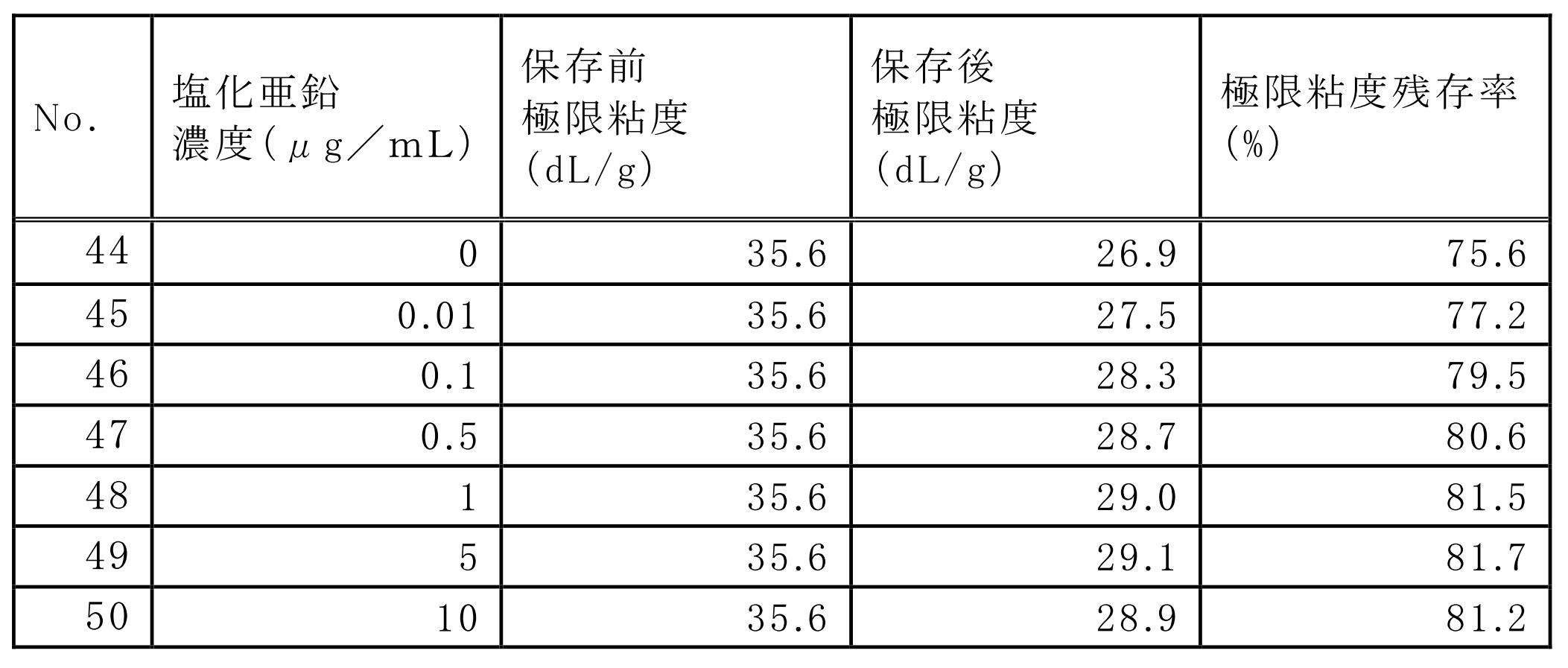
- Example 3 Zinc chloride was dissolved in an aqueous solution containing 2 mM phosphate buffer and 0.9% sodium chloride at concentrations shown in Table 7 (No. 44 to 50). Next, the sodium hyaluronate powder prepared in Example 1 was dissolved in each aqueous solution so as to have a concentration of 10 mg / mL. Furthermore, after storing at 80 ° C. for 24 hours, the intrinsic viscosity and the intrinsic viscosity residual ratio (%) were measured.
- the aqueous solution in which the sodium hyaluronate powder prepared in Example 1 was dissolved contained 0.01 ⁇ g / mL or more of zinc chloride, so that the stability of the aqueous hyaluronate solution was improved. . Moreover, the improvement of the stability became moderate when 1 ⁇ g / mL of zinc chloride was contained.
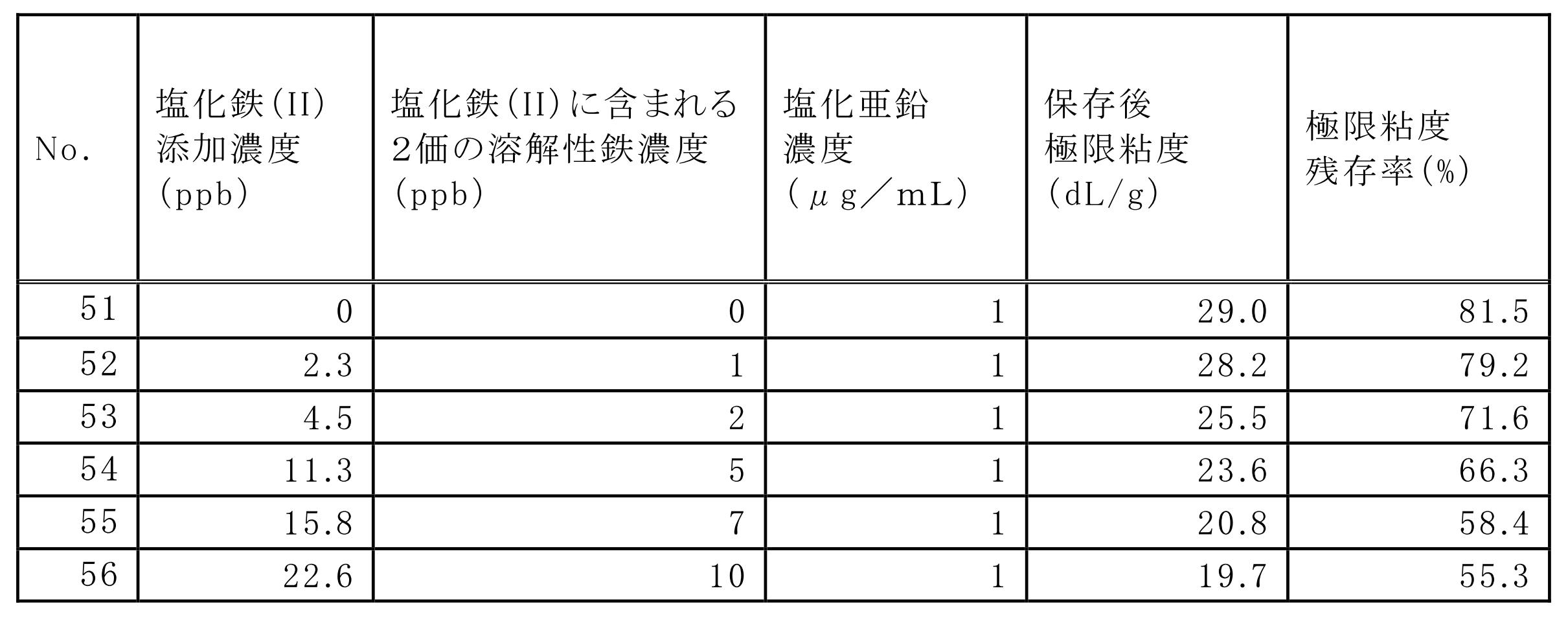
- Zinc chloride was dissolved in an aqueous solution containing 2 mM phosphate buffer and 0.9% sodium chloride so as to have a concentration of 1 ⁇ g / mL. Furthermore, iron chloride (II) having a concentration shown in Table 8 was added to each aqueous solution (No. 51 to 56). Next, the sodium hyaluronate powder prepared in Example 1 was dissolved in each aqueous solution so as to have a concentration of 10 mg / mL. Then, after storing for 24 hours at 80 ° C., the intrinsic viscosity and the intrinsic viscosity residual ratio (%) were measured.
- Fig. 1 shows the results of Table 8 and Table 3 as a graph. From FIG. 1, it can be seen that when 1 ⁇ g / mL of zinc chloride is contained in a hyaluronic solution containing a low concentration of divalent soluble iron, the stability of the aqueous sodium hyaluronate solution is improved. This stabilizing effect was particularly remarkable when the divalent soluble iron concentration was 5 ppb or less.
- the aqueous solution of sodium hyaluronate having a low content of divalent soluble iron had an improved residual intrinsic viscosity after storage. Furthermore, when zinc chloride was contained in the aqueous hyaluronate solution, the intrinsic viscosity remaining rate was further improved.
- This aqueous sodium hyaluronate solution has high stability and is less likely to cause a decrease in viscosity or quality even after long-term storage. Moreover, since it is suitable for long-term storage, the cost can be reduced.
Landscapes
- Health & Medical Sciences (AREA)
- Life Sciences & Earth Sciences (AREA)
- Public Health (AREA)
- Animal Behavior & Ethology (AREA)
- Chemical & Material Sciences (AREA)
- General Health & Medical Sciences (AREA)
- Veterinary Medicine (AREA)
- Pharmacology & Pharmacy (AREA)
- Epidemiology (AREA)
- Medicinal Chemistry (AREA)
- Inorganic Chemistry (AREA)
- Dermatology (AREA)
- Bioinformatics & Cheminformatics (AREA)
- Engineering & Computer Science (AREA)
- General Chemical & Material Sciences (AREA)
- Molecular Biology (AREA)
- Nuclear Medicine, Radiotherapy & Molecular Imaging (AREA)
- Chemical Kinetics & Catalysis (AREA)
- Heart & Thoracic Surgery (AREA)
- Birds (AREA)
- Cardiology (AREA)
- Organic Chemistry (AREA)
- Immunology (AREA)
- Orthopedic Medicine & Surgery (AREA)
- Rheumatology (AREA)
- Physical Education & Sports Medicine (AREA)
- Pharmaceuticals Containing Other Organic And Inorganic Compounds (AREA)
- Cosmetics (AREA)
- Medicinal Preparation (AREA)
Abstract
Description
第一に特許文献1の生産方法では、硫酸第一鉄(硫酸鉄(II)、FeSO4)を大量に培地に添加しているため、精製後のヒアルロン酸含有溶液に鉄が混入しやすいと考えられる。また、硫酸第一鉄を大量に含む培地から鉄を取り除くには、通常よりも多くのコストが必要になる。
本発明の一実施形態は、2価の溶解性鉄の含有率が5ppb以下であり、亜鉛化合物を含む、ヒアルロン酸またはその塩を含む水溶液である。このような組成からなるヒアルロン酸またはその塩を含む水溶液は、後述する実施例で実証されているように、保存後の極限粘度残存率が高く、物理的な安定性に優れている。また、長期保存後または長期時間経過後にも粘度や品質の低下が生じにくく、例えば医薬品・化粧品・食品等の原材料に好適である。
本実施形態のヒアルロン酸またはその塩を含む水溶液は、医薬組成物の原材料として使用できる。この場合、上記医薬組成物は安定性に優れたヒアルロン酸またはその塩を含む水溶液を含むため、長期保存後にも粘度や品質の低下が生じにくい。また、例えば関節内またはその周辺に投与した場合に、患部に長時間または所望の時間滞留することができる。この医薬組成物の剤形は特に限定されないが、関節等の患部へ直接投与することができるという観点からは注射剤が好ましい。注射剤の容器としては、例えばシリンジ、バイアル、またはアンプルを使用できる。投与に際しては、単独で投与することも可能ではあるが、薬理学的に許容される1つまたはそれ以上の担体もしくは賦形剤と一緒に混合し、製剤学の技術分野においてよく知られる任意の方法により製造した医薬製剤として提供することが好ましい。この医薬組成物は投与形態に合わせて、緩衝剤(例えば、リン酸塩緩衝液、酢酸ナトリウム緩衝液)、無痛化剤(例えば、塩酸リドカイン、塩酸プロカインなど)、安定剤(例えば、ヒト血清アルブミン、ポリエチレングリコールなど)、保存剤(例えば、ベンジルアルコール、フェノールなど)、酸化防止剤などと配合してもよい。またこの医薬組成物は、添加剤としてリン酸水素ナトリウム、結晶リン酸二水素ナトリウム、塩化ナトリウムを含んでいてもよい。調整された医薬組成物は、例えばヒトや哺乳動物(例えばラット、マウス、ウサギ、イヌ、サル、ヒツジ、ブタ、ウシ、ネコなど)に対して投与することができる。なお医薬組成物には、予防を目的として使用される組成物を含む。
他の実施形態は、ヒアルロン酸またはその塩、および2価の溶解性鉄を含有する組成物と、亜鉛化合物と、を水溶液に溶解させる工程を含み、上記組成物は、ヒアルロン酸またはその塩の濃度が10mg/mLとなるように水溶液に溶解した時の、水溶液中の2価の溶解性鉄の含有率が5ppb以下である、ヒアルロン酸またはその塩を含む水溶液の安定化促進方法である。この方法によれば、物理的な安定性が高い、ヒアルロン酸またはその塩を含む水溶液を得ることができる。またこの方法は、複雑な工程を必ずしも必要とせず、利便性に優れている。
以下の手順で、ヒアルロン酸Na水溶液を調整した。まず、グルコース5%、リン酸第1カリウム0.2%、ポリペプトン1.0%、酵母エキス0.5%からなる培地1リットルを加熱殺菌後、ストレプトコッカス・エキFM-100(微工研条寄第9027号)を接種した。空気を1vvmで通気しながら、撹拌200回転/分、温度33℃、pH8.5(20%水酸化ナトリウムの自動滴下によるコントロール)で20時間培養した。この液を菌体ろ過装置によりろ過し、水に対して12時間透析して透析膜内のヒアルロン酸溶液を回収した。回収容器は、鉄の混入を防ぐため、内表面がガラス製のものを用いた。ここに塩化ナトリウムを2.5%となるように添加し、エタノールをヒアルロン酸溶液の2倍量加えてヒアルロン酸Naを沈殿させた。沈殿をエタノールで5回洗浄し、不純物を十分に洗い流してから40℃で10時間風乾し、ヒアルロン酸Naの粉末を得た。
実施例1に記載の手順でストレプトコッカス・エキFM-100を培養し、特許文献3(特開2008-280430)の実施例1に記載の手順と同様の手順で、ヒアルロン酸Na水溶液を精製した。具体的には、まず、グルコース5%、リン酸第1カリウム0.2%、ポリペプトン1.0%、酵母エキス0.5%からなる培地1リットルを加熱殺菌後、ストレプトコッカス・エキFM-100を接種した。空気を1vvmで通気しながら、撹拌200回転/分、温度33℃、pH8.5(20%水酸化ナトリウムの自動滴下によるコントロール)で20時間培養した。培養液を、イオン交換水を用いて10倍に希釈し、その2.5L水溶液に活性炭(武田薬品社製の白鷺RW50-T)を5g、パーライト(三井金属鉱業株式会社のロカヘルプ♯409)を30g添加して1時間処理し、ヌッチェを用いて濾過した。この操作を2回繰り返して培地中の有機成分を除去し、ヒアルロン酸Na含有液を調整した。次に、内径15mm、高さ300mmのクロマトカラムに三菱化学社製ダイヤイオンCR11を68ml充填し、樹脂を再生した。このクロマトカラムに上記ヒアルロン酸Na含有液2.5Lを、SV=18(1200ml/hr)で通液した。クロマトカラム通過液1Lに食塩2gを溶解し、pH7に調整後、2-プロパノールで析出を行い、40℃で真空乾燥し、ヒアルロン酸Naの粉末を得た。
(1)溶解性鉄の分析
実施例1および比較例1で調製したヒアルロン酸Naの粉末を、2mMリン酸バッファーおよび0.9%塩化ナトリウムを含む水溶液に溶解し、ヒアルロン酸Naを5、8、10、12、または15mg/mL含有するヒアルロン酸Na水溶液をそれぞれ調製した(No.1~10)。次に、それぞれの水溶液について、鉄量2価の溶解性鉄量、2価および3価の溶解性鉄量、および全鉄量を下記(1-1)~(1-3)の手順で測定した。全鉄量には溶解性および不溶解性の鉄量を含む。鉄量2価の溶解性鉄量、2価および3価の溶解性鉄量、および全鉄量の検出限界は、5ppbであった。
a)ヒアルロン酸Na水溶液2.75gをサンプル瓶に分取する。
b)チオシアン酸カリウム溶液0.1mL、1,10-フェナントロリン溶液0.05mLを添加して混合する。
c)約10mLに希釈した後、約10分間放置する。
d)クロロホルム5mLを加えた後、密栓する。5分間振り混ぜ、抽出する。
e)静置後、クロロホルム相を4mL分取し、別のサンプル瓶に移す。
f)ホットプレート上で蒸発乾固した後、濃硝酸0.5mLを加え酸分解する。
g)希硝酸(1+100)2mLを加え、残分を溶解する。
h)ICP発光分析でFeを定量する。
a)ヒアルロン酸Na水溶液2.75gをサンプル瓶に分取する。
b)塩酸ヒドロキシルアミン溶液0.2mLを添加する。
c)1,10-フェナントロリン溶液0.2mL、チオシアン酸カリウム溶液0.5mLを添加する。
d)約10mLに希釈した後、約10分間放置する。
e)4-メチル-2-ペンタノン5mLを加えた後、密栓する。1分間振り混ぜ、抽出する。
f)静置後、4-メチル-2-ペンタノン相を4mL分取し、別のサンプル瓶に移す。
g)ホットプレート上で蒸発乾固した後、濃硝酸0.5mLを加え酸分解する。
h)希硝酸(1+100)2mLを加え、残分を溶解する。
i)ICP発光分析でFeを定量する。
a)ヒアルロン酸Na水溶液2.75gをサンプル瓶に分取する。
b)HCl(1+1)0.1mLを加えホットプレートで加熱する。
c)上記(1-2)2価および3価の溶解性鉄の分析方法溶解性鉄の分析のb)以降の操作を行う。
上記(1-1)~(1-3)の分析結果を表1に示す。

2mMリン酸バッファーおよび0.9%塩化ナトリウムを含む水溶液に対して、実施例1または比較例1で調製したヒアルロン酸Naの粉末を、ヒアルロン酸Na濃度が10mg/mLとなるようにそれぞれ溶解した(No. 11~12)。さらに、80°Cで24時間保存した後、極限粘度および極限粘度残存率(%)を測定した結果を表2に示す。なお極限粘度は第十五改正日本薬局方第二追補「精製ヒアルロン酸ナトリウム」の粘度の項の記載に従い測定した。その結果を表2に示す。

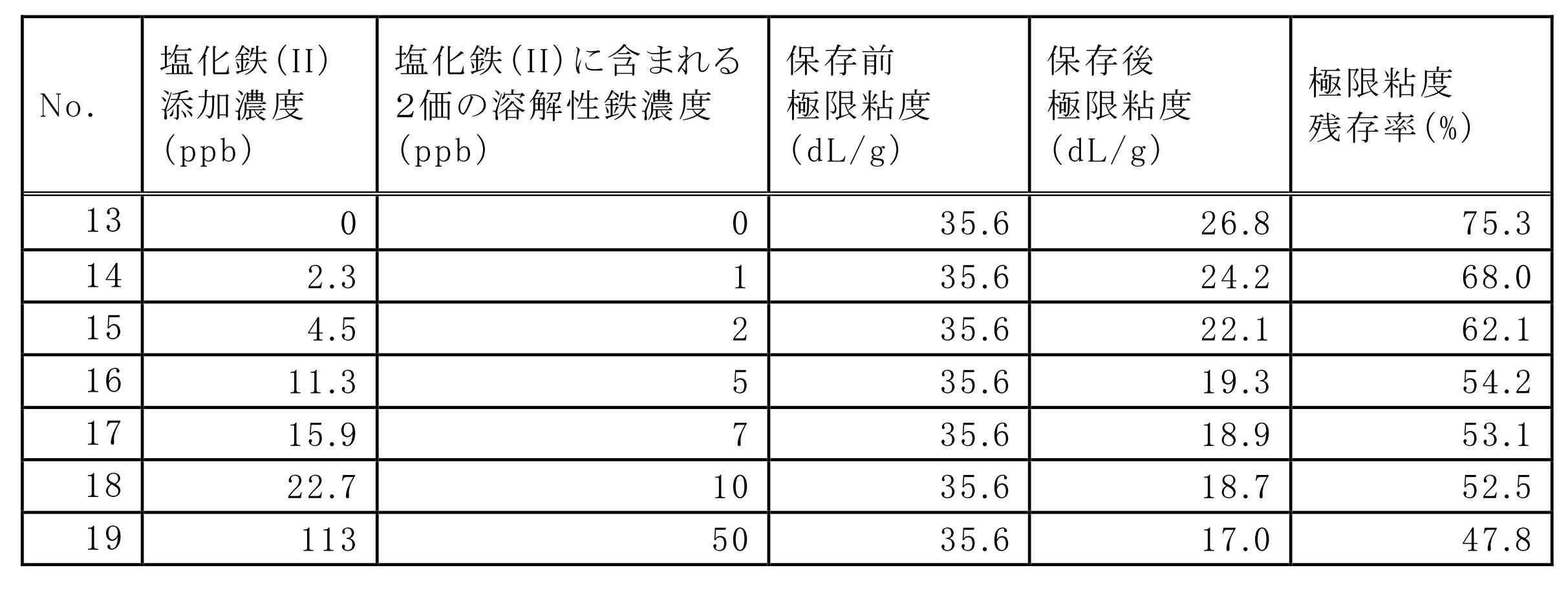
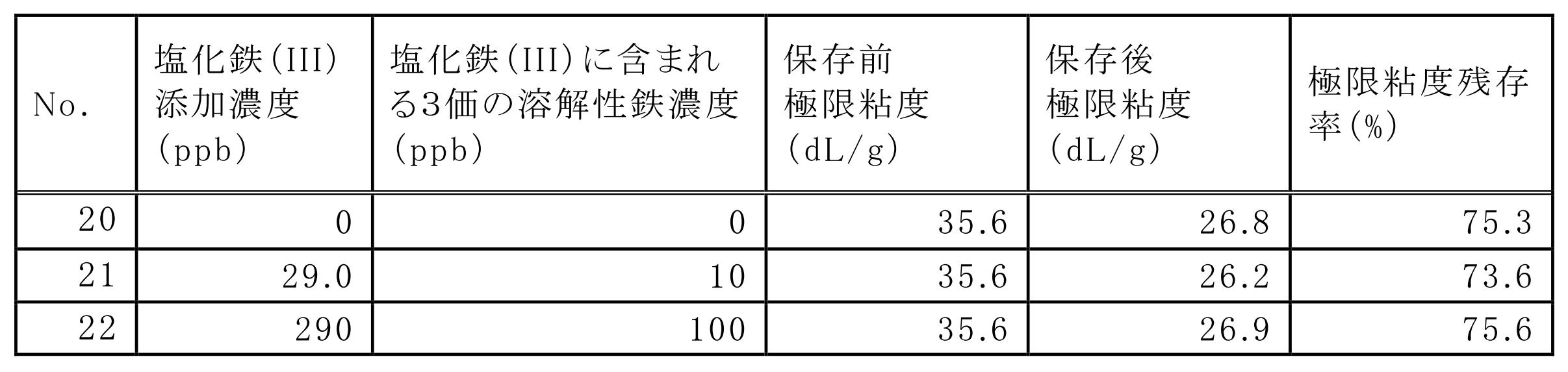
2mMリン酸バッファーおよび0.9%塩化ナトリウムを含む水溶液に対して、表5に示すように各種添加物を溶解した(No.23~36)。次に、それぞれの水溶液に実施例1で調製したヒアルロン酸Naの粉末を、濃度が10mg/mLとなるように溶解した。さらに、80°Cで24時間保存した後、極限粘度および極限粘度残存率(%)を測定した。添加物としては、塩化亜鉛、サリチル酸亜鉛、ヨウ化亜鉛、酢酸亜鉛、グリシン、L-アスパラギン酸Na、臭化Na、亜硫酸水素Na、硫化Na、チオグリコール酸Na、ブドウ糖、精製白糖、およびアスコルビン酸を使用した。

塩化亜鉛:和光純薬社、263-00271
サリチル酸亜鉛:和光純薬社、269-00692
ヨウ化亜鉛:和光純薬社、268-01061
酢酸亜鉛:和光純薬社、263-00232
グリシン:和光純薬社、036435
L-アスパラギン酸Na:和光純薬社、193-01262
臭化Na:和光純薬社、193-01505
亜硫酸水素Na:和光純薬社、190-01375
硫化Na:和光純薬社、197-03362
チオグリコール酸Na:和光純薬社、590-11762
ブドウ糖:和光純薬社、076-05705
精製白糖(ショ糖):和光純薬社、196-13705
アスコルビン酸Na:和光純薬社、196-01252
2mMリン酸バッファーおよび0.9%塩化ナトリウムを含む水溶液に対して、表6に示すように各種添加物を溶解した(No.37~43)。さらに、それぞれの水溶液に塩化鉄(II)を11.3ppb(2価の溶解性鉄として5ppb)添加した。次に、それぞれの水溶液に実施例1で調製したヒアルロン酸Naの粉末を、濃度が10mg/mLとなるように溶解した。その後、80°Cで24時間保存した後、極限粘度および極限粘度残存率(%)を測定した。

2mMリン酸バッファーおよび0.9%塩化ナトリウムを含む水溶液に対して、表7に示す濃度で塩化亜鉛を溶解した(No.44~50)。次に、それぞれの水溶液に実施例1で調製したヒアルロン酸Naの粉末を、濃度が10mg/mLとなるように溶解した。さらに、80°Cで24時間保存した後、極限粘度および極限粘度残存率(%)を測定した。
2mMリン酸バッファーおよび0.9%塩化ナトリウムを含む水溶液に対して、塩化亜鉛を、濃度が1μg/mLとなるように溶解した。さらに、それぞれの水溶液に表8に示す濃度の塩化鉄(II)を添加した(No.51~56)。次に、それぞれの水溶液に実施例1で調製したヒアルロン酸Naの粉末を、濃度が10mg/mLとなるように溶解した。その後、80°Cで24時間保存した後、極限粘度および極限粘度残存率(%)を測定した。
Claims (12)
- 2価の溶解性鉄の含有率が5ppb以下であり、亜鉛化合物を含有する、ヒアルロン酸またはその塩を含む水溶液。
- 前記ヒアルロン酸またはその塩の濃度が、5~15mg/mLである、請求項1に記載のヒアルロン酸またはその塩を含む水溶液。
- 前記亜鉛化合物が、サリチル酸亜鉛、リン酸亜鉛、硫酸亜鉛、硝酸亜鉛、ヨウ化亜鉛、フッ化亜鉛、塩化亜鉛、臭化亜鉛、炭酸亜鉛、p-t-ブチル安息香酸亜鉛、チオシアン酸亜鉛、乳酸亜鉛、酢酸亜鉛、および酸化亜鉛からなる群から選ばれる1種以上の亜鉛化合物である、請求項1または2に記載のヒアルロン酸またはその塩を含む水溶液。
- 前記亜鉛化合物の含有量が0.01~100μg/mLである、請求項1~3いずれかに記載のヒアルロン酸またはその塩を含む水溶液。
- 前記ヒアルロン酸またはその塩の平均分子量が100万以上である、請求項1~4いずれかに記載のヒアルロン酸またはその塩を含む水溶液。
- 前記ヒアルロン酸の前記塩が、ヒアルロン酸ナトリウムである、請求項1~5いずれかに記載のヒアルロン酸またはその塩を含む水溶液。
- 請求項1~6いずれかに記載のヒアルロン酸またはその塩を含む水溶液を含む、医薬組成物。
- 請求項1~6いずれかに記載のヒアルロン酸またはその塩を含む水溶液を含む、関節症治療用注射剤。
- 請求項1~6いずれかに記載のヒアルロン酸またはその塩を含む水溶液を含む、化粧料組成物。
- ヒアルロン酸またはその塩、および2価の溶解性鉄を含有する組成物と、
亜鉛化合物と、
を水溶液に溶解させる工程を含み、
前記組成物は、ヒアルロン酸またはその塩の濃度が10mg/mLとなるように水溶液に溶解した時の、水溶液中の2価の溶解性鉄の含有率が5ppb以下である、
ヒアルロン酸またはその塩を含む水溶液の生産方法。 - ヒアルロン酸またはその塩、および2価の溶解性鉄を含有する組成物と、
亜鉛化合物と、
を水溶液に溶解させる工程を含み、
前記組成物は、ヒアルロン酸またはその塩の濃度が10mg/mLとなるように水溶液に溶解した時の、水溶液中の2価の溶解性鉄の含有率が5ppb以下である、
ヒアルロン酸またはその塩を含む水溶液の安定化促進方法。 - 亜鉛化合物を含む、
2価の溶解性鉄の含有率が5ppb以下のヒアルロン酸またはその塩を含む水溶液を安定化するための、安定化剤。
Priority Applications (3)
| Application Number | Priority Date | Filing Date | Title |
|---|---|---|---|
| KR1020137026036A KR20140050593A (ko) | 2011-03-02 | 2012-03-02 | 히알루론산 또는 히알루론산염을 포함하는 수용액 |
| CN2012800110617A CN103442720A (zh) | 2011-03-02 | 2012-03-02 | 含透明质酸或透明质酸盐的水溶液 |
| JP2013502424A JP5957441B2 (ja) | 2011-03-02 | 2012-03-02 | ヒアルロン酸またはその塩を含む水溶液 |
Applications Claiming Priority (2)
| Application Number | Priority Date | Filing Date | Title |
|---|---|---|---|
| JP2011-045772 | 2011-03-02 | ||
| JP2011045772 | 2011-03-02 |
Publications (1)
| Publication Number | Publication Date |
|---|---|
| WO2012118193A1 true WO2012118193A1 (ja) | 2012-09-07 |
Family
ID=46758118
Family Applications (1)
| Application Number | Title | Priority Date | Filing Date |
|---|---|---|---|
| PCT/JP2012/055426 Ceased WO2012118193A1 (ja) | 2011-03-02 | 2012-03-02 | ヒアルロン酸またはその塩を含む水溶液 |
Country Status (4)
| Country | Link |
|---|---|
| JP (1) | JP5957441B2 (ja) |
| KR (1) | KR20140050593A (ja) |
| CN (1) | CN103442720A (ja) |
| WO (1) | WO2012118193A1 (ja) |
Families Citing this family (1)
| Publication number | Priority date | Publication date | Assignee | Title |
|---|---|---|---|---|
| CN114366692B (zh) * | 2022-01-26 | 2023-08-25 | 山东福瑞达生物股份有限公司 | 一种控油祛痘组合物及其应用 |
Citations (1)
| Publication number | Priority date | Publication date | Assignee | Title |
|---|---|---|---|---|
| JP2003160464A (ja) * | 2001-11-28 | 2003-06-03 | Denki Kagaku Kogyo Kk | ヒアルロン酸及び/又はその塩の水溶液の安定化組成物 |
Family Cites Families (4)
| Publication number | Priority date | Publication date | Assignee | Title |
|---|---|---|---|---|
| IT1247175B (it) * | 1991-04-19 | 1994-12-12 | Fidia Spa | Procedimento per la purificazione di acido ialuronico e frazione di acido ialuronico puro per uso oftalmico. |
| JP2006104461A (ja) * | 2004-09-10 | 2006-04-20 | Seikagaku Kogyo Co Ltd | グリコサミノグリカン画分中の不純物の除去方法 |
| WO2007142285A1 (ja) * | 2006-06-07 | 2007-12-13 | Kyowa Hakko Bio Co., Ltd. | ヒアルロン酸塩の精製方法 |
| JP2009011315A (ja) * | 2007-06-05 | 2009-01-22 | Mitsubishi Rayon Co Ltd | ヒアルロン酸の製造方法 |
-
2012
- 2012-03-02 CN CN2012800110617A patent/CN103442720A/zh active Pending
- 2012-03-02 WO PCT/JP2012/055426 patent/WO2012118193A1/ja not_active Ceased
- 2012-03-02 JP JP2013502424A patent/JP5957441B2/ja not_active Expired - Fee Related
- 2012-03-02 KR KR1020137026036A patent/KR20140050593A/ko not_active Ceased
Patent Citations (1)
| Publication number | Priority date | Publication date | Assignee | Title |
|---|---|---|---|---|
| JP2003160464A (ja) * | 2001-11-28 | 2003-06-03 | Denki Kagaku Kogyo Kk | ヒアルロン酸及び/又はその塩の水溶液の安定化組成物 |
Non-Patent Citations (3)
| Title |
|---|
| HERP,A. ET AL.: "Correlation between the autoxidation of ferrous ions or of L-ascorbic acid and the depolymerization of hyaluronate", CARBOHYDRATE RESEARCH, vol. 16, no. 2, 1971, pages 395 - 407 * |
| PIGMAN,W. ET AL.: "Depolymerization of hyaluronic acid by the ORD reaction", ARTHRITIS & RHEUMATISM, vol. 4, no. 3, 1961, pages 240 - 252 * |
| WONG,S.F. ET AL.: "The role of superoxide and hydroxyl radicals in the degradation of hyaluronic acid induced by metal ions and by ascorbic acid", JOURNAL OF INORGANIC BIOCHEMISTRY, vol. 14, no. 2, 1981, pages 127 - 34 * |
Also Published As
| Publication number | Publication date |
|---|---|
| JPWO2012118193A1 (ja) | 2014-07-07 |
| CN103442720A (zh) | 2013-12-11 |
| KR20140050593A (ko) | 2014-04-29 |
| JP5957441B2 (ja) | 2016-07-27 |
Similar Documents
| Publication | Publication Date | Title |
|---|---|---|
| JP3779200B2 (ja) | ヒアルロン酸及び/又はその塩の水溶液の安定化組成物 | |
| JP2020011975A (ja) | インスリン分泌性ペプチドの安定な水性非経口医薬組成物 | |
| EP1225898B1 (en) | Pharmaceutical compositions containing a fluoroquinolone antibiotic drug and xanthan gum | |
| EA201200490A1 (ru) | Стабильный совместный состав, содержащий хиалуронидазу и иммуноглобулин, и способы его применения | |
| CA2786824C (en) | Aqueous solution comprising 3 - quinuclidinones for the treatment hyperproliferative, autoimmune and heart disease | |
| KR19980033113A (ko) | 국소 마취제 수용액, 국소 마취제의 용해도를 개선시키는 방법, 신경독성이 감소된 국소 마취제 및 국소 마취제의 신경 독성을 감소시키는 방법 | |
| CN104349780A (zh) | 含有吡罗昔康或其药学上可接受的盐和透明质酸或其药学上可接受的盐的稳定液体药学组合物及其制造方法 | |
| CN105434373A (zh) | 一种注射用奥拉西坦冻干制剂及其制备方法 | |
| JP5957440B2 (ja) | ヒアルロン酸またはその塩を含む水溶液 | |
| JP5723031B2 (ja) | エキノカンジン系抗真菌剤であるミカファンギンを含む液体薬用組成物 | |
| JP5957438B2 (ja) | ヒアルロン酸またはその塩を含む水溶液 | |
| RU2013157823A (ru) | Фармацевтические композиции на основе shk и способы их получения и использования | |
| JP5957441B2 (ja) | ヒアルロン酸またはその塩を含む水溶液 | |
| JP5957439B2 (ja) | ヒアルロン酸またはその塩を含む水溶液 | |
| EP3881841B1 (en) | Pharmaceutical composition | |
| JPH11302197A (ja) | ヒアルロン酸安定化組成物 | |
| US20170239321A1 (en) | Sulfomethylated polymixin compositions | |
| CA2949328A1 (en) | Low substituted polymyxins and compositions thereof | |
| CN103142509B (zh) | 一种注射用硼替佐米药物组合物 | |
| JP3917820B2 (ja) | オザグレルナトリウム含有注射液およびその安定化方法 | |
| JPH0539224A (ja) | 抗炎症活性を有するコンドロイチン硫酸 コンプレツク ス,その製造方法およびそれを含有する医薬組成物 | |
| CN104027304B (zh) | 胞磷胆碱钠葡萄糖注射液 | |
| JPH02124823A (ja) | セファロスポリン含有注射用組成物 | |
| CN105267159A (zh) | 注射用苦参碱冻干粉针及其制备方法 | |
| EP1920779A1 (en) | Technique for stabilization of yw753 reparation |
Legal Events
| Date | Code | Title | Description |
|---|---|---|---|
| 121 | Ep: the epo has been informed by wipo that ep was designated in this application |
Ref document number: 12752813 Country of ref document: EP Kind code of ref document: A1 |
|
| ENP | Entry into the national phase |
Ref document number: 2013502424 Country of ref document: JP Kind code of ref document: A |
|
| NENP | Non-entry into the national phase |
Ref country code: DE |
|
| ENP | Entry into the national phase |
Ref document number: 20137026036 Country of ref document: KR Kind code of ref document: A |
|
| 122 | Ep: pct application non-entry in european phase |
Ref document number: 12752813 Country of ref document: EP Kind code of ref document: A1 |