WO2012115109A1 - ガラス板積層体及びガラス板の取り出し方法 - Google Patents
ガラス板積層体及びガラス板の取り出し方法 Download PDFInfo
- Publication number
- WO2012115109A1 WO2012115109A1 PCT/JP2012/054145 JP2012054145W WO2012115109A1 WO 2012115109 A1 WO2012115109 A1 WO 2012115109A1 JP 2012054145 W JP2012054145 W JP 2012054145W WO 2012115109 A1 WO2012115109 A1 WO 2012115109A1
- Authority
- WO
- WIPO (PCT)
- Prior art keywords
- glass plate
- sheet
- glass
- slip sheet
- laminate
- Prior art date
- Legal status (The legal status is an assumption and is not a legal conclusion. Google has not performed a legal analysis and makes no representation as to the accuracy of the status listed.)
- Ceased
Links
Images







Classifications
-
- B—PERFORMING OPERATIONS; TRANSPORTING
- B65—CONVEYING; PACKING; STORING; HANDLING THIN OR FILAMENTARY MATERIAL
- B65D—CONTAINERS FOR STORAGE OR TRANSPORT OF ARTICLES OR MATERIALS, e.g. BAGS, BARRELS, BOTTLES, BOXES, CANS, CARTONS, CRATES, DRUMS, JARS, TANKS, HOPPERS, FORWARDING CONTAINERS; ACCESSORIES, CLOSURES, OR FITTINGS THEREFOR; PACKAGING ELEMENTS; PACKAGES
- B65D85/00—Containers, packaging elements or packages, specially adapted for particular articles or materials
- B65D85/30—Containers, packaging elements or packages, specially adapted for particular articles or materials for articles particularly sensitive to damage by shock or pressure
- B65D85/48—Containers, packaging elements or packages, specially adapted for particular articles or materials for articles particularly sensitive to damage by shock or pressure for glass sheets
-
- B—PERFORMING OPERATIONS; TRANSPORTING
- B65—CONVEYING; PACKING; STORING; HANDLING THIN OR FILAMENTARY MATERIAL
- B65D—CONTAINERS FOR STORAGE OR TRANSPORT OF ARTICLES OR MATERIALS, e.g. BAGS, BARRELS, BOTTLES, BOXES, CANS, CARTONS, CRATES, DRUMS, JARS, TANKS, HOPPERS, FORWARDING CONTAINERS; ACCESSORIES, CLOSURES, OR FITTINGS THEREFOR; PACKAGING ELEMENTS; PACKAGES
- B65D19/00—Pallets or like platforms, with or without side walls, for supporting loads to be lifted or lowered
- B65D19/38—Details or accessories
- B65D19/44—Elements or devices for locating articles on platforms
-
- B—PERFORMING OPERATIONS; TRANSPORTING
- B65—CONVEYING; PACKING; STORING; HANDLING THIN OR FILAMENTARY MATERIAL
- B65D—CONTAINERS FOR STORAGE OR TRANSPORT OF ARTICLES OR MATERIALS, e.g. BAGS, BARRELS, BOTTLES, BOXES, CANS, CARTONS, CRATES, DRUMS, JARS, TANKS, HOPPERS, FORWARDING CONTAINERS; ACCESSORIES, CLOSURES, OR FITTINGS THEREFOR; PACKAGING ELEMENTS; PACKAGES
- B65D57/00—Internal frames or supports for flexible articles, e.g. stiffeners; Separators for articles packaged in stacks or groups, e.g. for preventing adhesion of sticky articles
- B65D57/002—Separators for articles packaged in stacks or groups, e.g. stacked or nested
- B65D57/003—Separators for articles packaged in stacks or groups, e.g. stacked or nested for horizontally placed articles, i.e. for stacked or nested articles
- B65D57/004—Separators for articles packaged in stacks or groups, e.g. stacked or nested for horizontally placed articles, i.e. for stacked or nested articles the articles being substantially flat panels, e.g. wooden planks
-
- B—PERFORMING OPERATIONS; TRANSPORTING
- B65—CONVEYING; PACKING; STORING; HANDLING THIN OR FILAMENTARY MATERIAL
- B65G—TRANSPORT OR STORAGE DEVICES, e.g. CONVEYORS FOR LOADING OR TIPPING, SHOP CONVEYOR SYSTEMS OR PNEUMATIC TUBE CONVEYORS
- B65G49/00—Conveying systems characterised by their application for specified purposes not otherwise provided for
- B65G49/05—Conveying systems characterised by their application for specified purposes not otherwise provided for for fragile or damageable materials or articles
- B65G49/06—Conveying systems characterised by their application for specified purposes not otherwise provided for for fragile or damageable materials or articles for fragile sheets, e.g. glass
- B65G49/068—Stacking or destacking devices; Means for preventing damage to stacked sheets, e.g. spaces
-
- B—PERFORMING OPERATIONS; TRANSPORTING
- B65—CONVEYING; PACKING; STORING; HANDLING THIN OR FILAMENTARY MATERIAL
- B65G—TRANSPORT OR STORAGE DEVICES, e.g. CONVEYORS FOR LOADING OR TIPPING, SHOP CONVEYOR SYSTEMS OR PNEUMATIC TUBE CONVEYORS
- B65G49/00—Conveying systems characterised by their application for specified purposes not otherwise provided for
- B65G49/05—Conveying systems characterised by their application for specified purposes not otherwise provided for for fragile or damageable materials or articles
- B65G49/06—Conveying systems characterised by their application for specified purposes not otherwise provided for for fragile or damageable materials or articles for fragile sheets, e.g. glass
- B65G49/068—Stacking or destacking devices; Means for preventing damage to stacked sheets, e.g. spaces
- B65G49/069—Means for avoiding damage to stacked plate glass, e.g. by interposing paper or powder spacers in the stack
-
- B—PERFORMING OPERATIONS; TRANSPORTING
- B65—CONVEYING; PACKING; STORING; HANDLING THIN OR FILAMENTARY MATERIAL
- B65G—TRANSPORT OR STORAGE DEVICES, e.g. CONVEYORS FOR LOADING OR TIPPING, SHOP CONVEYOR SYSTEMS OR PNEUMATIC TUBE CONVEYORS
- B65G2249/00—Aspects relating to conveying systems for the manufacture of fragile sheets
- B65G2249/04—Arrangements of vacuum systems or suction cups
Definitions
- the present invention relates to a glass plate laminate and a method for taking out a glass plate.
- Patent Document 1 discloses a form in which glass plate laminates are slanted and stacked vertically on a packing pallet
- Patent Document 2 discloses a form in which glass plate laminates are horizontally stacked. ing.
- the glass plate on which the sheet is interposed is conveyed from the glass manufacturing factory to the glass plate use factory for processing and assembling the glass plate in a state of being stacked on the packing pallet, and 1 is removed from the packing pallet at the glass plate use factory.
- One by one is taken out.
- an operation of adsorbing and taking out the glass plate by the glass adsorbing unit of the taking-out apparatus and then taking out the sheet by the sheet adsorbing unit is repeatedly performed.
- the sheet 3 is discharged with static electricity using a static eliminator (not shown), and air is injected between the sheet 3 and the glass plate G below the sheet 3, so that the sheet 3 and the glass plate are discharged. G is peeled off, and thereafter, only the sheet 3 is taken out from the glass plate G by a sheet adsorbing portion (not shown).
- the sheet presser that has bent and pressed a part of the sheet 3A protruding from the edge of the glass plate G when the packing pallet 1 is conveyed.
- the sheet 3A has a characteristic of returning to its original shape (the shape before bending) with the passage of time.
- the sheet pressing jig 4 shown in FIG. 11 is moved toward the end face of the glass plate G in this state, the sheet 3A of the uppermost sheet 3 is moved to the end face of the glass plate G as shown in FIG. The uppermost sheet 3 is taken out together with the uppermost glass plate G.
- This invention is made
- the present invention is a glass plate laminate in which at least two or more glass plates are laminated substantially horizontally and vertically between sheets of the glass plates, Provided is a glass plate laminate in which the glass plate is laminated so that the sheet protrudes from at least a part of the edge of the glass plate, and the Gurley stiffness of the sheet is 1.0 mN or less.
- Gurley stiffness a high Gurley stiffness in accordance with JAPAN TAPPI paper pulp test method 2000 version No40, that is, if the sheet is stiff, the above-described problems occur.
- the inventor of the present application confirmed by experiments that the Gurley stiffness of the sheet should be 1.0 mN or less in order to prevent such a problem. Therefore, according to the glass plate laminate of the present invention, the sheet that protrudes from the edge of the glass plate hangs down due to its softness, and is reliably pressed against the end surface of the glass plate by the sheet pressing jig. From this, only the glass plate can be taken out satisfactorily.
- the part of the sheet hangs well in combination with the weight of the part of the protruding sheet.
- a slip sheet having a line is used as a sheet, and in the glass plate take-out device, it proceeds toward the end face of the glass plate of the slip sheet holding jig of the glass plate take-out device.
- the glass sheet laminate is positioned so that the direction of the slip of the slip sheet is perpendicular to the direction of the slip of the slip sheet, and the slip sheet protruding from the edge of the glass sheet of the laminate of the glass sheet is pressed against the slip sheet.
- a method of taking out a glass plate is provided in which the uppermost glass plate of the glass plate laminate is taken out by a glass adsorbing portion of the glass plate take-out device after being pressed against an end surface of the glass plate by a tool.
- the glass plate taking-out device when using interleaving paper as a sheet, in the glass plate taking-out device, the direction of traveling toward the end face of the glass plate of the interleaving paper holding jig, The glass plate laminate is positioned so that the direction of the line of the interleaving paper is orthogonal. Next, the slip sheet protruding from the edge of the glass plate of the glass plate laminate is pressed against the end surface of the glass plate by a slip sheet pressing jig. Thereafter, the uppermost glass plate of the glass plate laminate is taken out by the glass adsorption unit. Thereby, only the glass plate can be taken out more smoothly.
- the glass plate laminate and the glass plate take-out method according to the present invention since the Gurley stiffness of the sheet is 1.0 mN or less, the sheet protruding from the edge of the glass plate hangs down and is securely pressed by the sheet pressing jig. Therefore, only the glass plate can be taken out from the glass plate laminate. Also, when using interleaving paper as a sheet, by taking out the glass plate so that the interleaving line is orthogonal to the direction of progress toward the end surface of the glass plate of the interleaf pressing jig, Only the glass plate can be taken out more smoothly.
- FIG. 1 is an external view of a packing pallet packed with a glass plate laminate according to an embodiment.
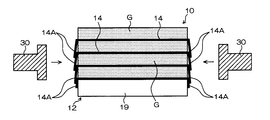
- FIG. 2 is a schematic diagram illustrating a procedure for taking out a glass plate and a slip sheet of a glass plate laminate packaged in a packing pallet.
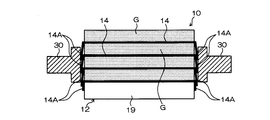
- Drawing 3 is a mimetic diagram explaining the taking-out procedure of the glass plate of a glass plate laminated body packed in a packing pallet, and a slip sheet.
- FIG. 4 is a schematic diagram illustrating a procedure for taking out a glass plate and a slip sheet of a glass plate laminate packaged in a packing pallet.
- FIG. 5 is a schematic diagram illustrating a procedure for taking out a glass plate and a slip sheet of a glass plate laminate packaged in a packing pallet.
- FIG. 1 is an external view of a packing pallet packed with a glass plate laminate according to an embodiment.
- FIG. 2 is a schematic diagram illustrating a procedure for taking out a glass plate and a slip sheet of a glass plate laminate packaged in a packing pallet.
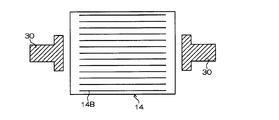
- FIG. 10 is an explanatory view showing a form of a glass sheet take-out device for advancing the slip sheet holding jig in parallel to the direction of the lines.
- FIG. 11 is a schematic diagram showing the configuration of a conventional glass plate laminate.
- FIG. 12 is a schematic diagram illustrating a problem in taking out a glass plate from the glass plate laminate shown in FIG. 11.
- a slip sheet 14 is exemplified as a sheet.
- a plurality of (for example, 80 to 150) rectangular glass plates G, G... are substantially horizontal and larger than the glass plate G between the glass plates.
- the sheets are stacked and accommodated via the interleaf papers 14, 14.
- the glass plate G is a thin large glass plate used for FPD.
- the glass plate G is a large glass plate having a thickness of 0.2 mm to 2.8 mm and a vertical and horizontal size of about 2400 mm ⁇ 2100 mm to 3200 mm ⁇ 3000 mm. .
- the interleaf paper 14 has a rough surface with a smoothness of 18 seconds or less (JIS P 8119, 1976), for example, and the contact area with the surface of the glass plate G is reduced, so that the resin content contained in the interleaf paper 14 is reduced.
- a paper quality that is transferred to the glass plate G and does not cause paper texture, burns, dirt, etc. on the surface of the glass plate G is selected and used.
- the resin content contained in the interleaf paper 14 is 0.05% by mass or less (JIS P8205, 1976), and the paper quality that does not adversely affect the quality of the glass plate G itself due to the combined effect with the paper surface roughness described above. Is selected and used.
- the cradle 16 is configured in a frame shape by a plurality of steel materials.
- any metal, resin, or the like can be used as long as it has a desired rigidity and does not generate particles, but aluminum or an aluminum alloy is preferable in terms of weight, rigidity, and cost.
- forklift openings 24 into which forks of a forklift (not shown) are inserted are formed at two positions on one side surface of the cradle 16 on all side surfaces of the cradle 16. As a result, the fork of the forklift can be inserted into the packing pallet 12 from any of the longitudinal and lateral sides of the cradle 16, thereby enabling efficient transportation work.
- the mounting plate 18 is mounted on the cradle 16 via a vibration absorbing member, an inclination angle setting member, and the like (not shown), and a tray 19 is fixed to the mounting plate 18.
- two slip sheet holding members 20 are arranged on the side surfaces of the four sides of the tray 19 with predetermined intervals, and are fixed to the tray 19 by screws 26 and 26 in a detachable manner.
- the slip sheet pressing member 20 is fastened to each side surface of the tray 19 by the screws 26, the glass sheet G is pressed from the end surface by the slip sheet pressing member 20, and the slip sheet pressing members 20, 20 on each side surface of the tray 19. The end surface of the glass plate G is clamped by.
- the slip sheet 14A protruding from the edge of the glass plate G is pressed by the slip sheet pressing member 20, and the slip sheet 14 is fixed to the tray 19 by the slip sheet pressing members 20, 20. .
- the laminated glass plates G, G... Are fixed to the tray 19 via the interleaf paper 14.
- the two slip sheet holding members 20 and 20 are arranged on each side surface of the tray 19, but the present invention is not limited to this, and the length of each side surface is set on each side surface of the tray 19. Only one corresponding one may be provided, or three or more short slip sheet pressing members may be provided along each side surface.
- the slip sheet pressing member 20 presses the slip sheet 14A that protrudes from the edge of the glass plate G and hangs down to the end surface of the glass plate G (the side surface of the glass plate laminate 10). At this time, since the overlapping portion of the end portion of the slip sheet 14A is pressed by the slip sheet pressing member 20, the slip sheet pressing member 20 does not directly contact the end surface of the glass plate G, and the flexibility of the slip sheet 14 is achieved. Thus, it is possible to reliably press the glass plate laminate 10 from the side surfaces of the four sides while protecting the glass plate G.
- the interleaf paper 14A is interposed between the interleaf pressing member 20 and the end surface of the glass plate G. Since the slip sheet 14 is held and fixed to the tray 19, the vertical movement of the glass plate G can be suppressed. In addition, the lateral displacement of the glass plate G can be prevented. Therefore, it is preferable that the uppermost layer of the glass plate laminate 10 is the slip sheet 14.
- the interleaf paper 14 of the embodiment has a Gurley stiffness of 1.0 mN or less, preferably 0.5 mN or less.
- Gurley stiffness of the slip sheet 14 exceeds 1.0 mN, that is, when the slip sheet 14 is strong, the slip sheet 14A that protrudes from the edge of the glass plate G returns to its original shape over time. Therefore, it does not sag and cannot be pressed against the end face of the glass sheet G by the slip sheet pressing jig 30 (see FIG. 2 and the like), and the slip sheet 14 may be taken out together with the glass sheet G.
- the inventor of the present application confirmed that the Gurley stiffness of the interleaf paper 14 was set to 1.0 mN or less.
- FIG. 2 is a glass plate laminate in which the slip sheet pressing member 20, the guide member 22, and the uppermost slip sheet 14 are removed from the packing pallet 12 shown in FIG. 1 by an operator or a slip sheet removing device (not shown).
- 10 is a side view of FIG.
- the slip sheet 14A that protrudes from the edge of the glass plate G hangs down along the end surface of the glass plate G because the Gurley stiffness is 1.0 mN or less.
- a driving unit such as a cylinder device
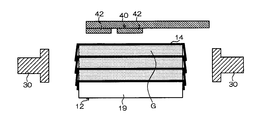
- the uppermost glass plate G is adsorbed by the plurality of adsorbing pads 34, 34... Of the glass adsorbing portion 32 constituting the glass plate extracting device. Thereafter, air is ejected from the nozzle 36 into the gap between the adsorbed glass plate G and the interleaving paper 14 below the adsorbed glass plate G, and the neutralizing process of the interleaving paper 14 is performed by the neutralizing device 38. However, the glass adsorption
- the slip sheet adsorbing portion 40 constituting the glass plate take-out device is moved above the slip sheet 14 positioned at the uppermost position and moved downward toward the slip sheet 14.
- the slip sheet 14 is sucked by the suction pads 42 and 42 of the paper suction unit 40.
- FIG. 7 is a side view of the interleaf paper 14 taken out from the glass plate laminate 10. Thereafter, when the second and subsequent glass sheets G and the second and subsequent slip sheets 14 are subsequently taken out, the procedure shown in FIGS. 2 to 7 is repeatedly performed.
- the interleaf 14 has a plurality of streaks 14B, 14B,... Formed in parallel on the surface of the interleaving paper 14 and is aligned depending on the direction of the streaks 14B, 14B.
- the Gurley stiffness of the paper 14 is different.
- the Gurley stiffness (for example, 0.24 mN) when the slip sheet 14 is pressed by moving the slip sheet pressing jig 30 in a direction orthogonal to the direction of the lines 14B, 14B.
- the slip sheet holding jig 30 is advanced in parallel to the direction of the lines 14B, 14B...
- the Gurley stiffness (for example, 0.5 mN) when the slip sheet 14 is pressed (the latter).
- the method of taking out the glass plate G of the embodiment pays attention to such characteristics of the slip sheet 14. Even when the same slip sheet 14 is used, the slip sheet pressing jig 30 is advanced in a direction orthogonal to the direction of the lines 14B, 14B... As shown in FIG.
- the laminated body 10 is positioned on the glass plate take-out device. If the glass plate laminate 10 is positioned in this manner, the slip sheet 14 protruding from the edge of the glass plate of the glass plate laminate 10 can be easily pressed against the end surface of the glass plate G by the slip sheet pressing jig 30. . Thereafter, the uppermost glass plate G of the glass plate laminate 10 is taken out by the glass adsorbing portion 32 as shown in FIG. Thereby, the taking-out method of the glass plate G of embodiment can take out only the glass plate G smoothly.
- the slip sheet 14 is exemplified as the sheet, but the sheet is not limited to this, and examples thereof include a resin film, a resin sheet, and a foamed resin sheet. Alternatively, a sheet in which at least two of these sheets are stacked and integrated may be used. Moreover, a glass plate shall include the glass plate by which the film is previously affixed on the surface. In order to further suppress the vertical movement of the glass plate G during conveyance while preventing the sheet from being soiled or damaged due to the influence from the outside of the packing pallet 12, a protective sheet that is stronger than the sheet and is not easily damaged is made of glass. It is preferable to cover the plate laminate 10 and fix the protective sheet to the tray 19 by the slip sheet pressing member 20. For example, when the sheet is a slip sheet, the protective sheet is preferably a resin sheet that is stronger than the slip sheet.
- the thickness of the sheet is not limited, the thickness is preferably 0.01 mm to 0.2 mm when the sheet size is equal to or larger than the size of the sixth generation FPD glass plate (for example, 1500 mm ⁇ 1800 mm).
- the protruding margin (length from the edge of the glass plate G to the edge of the slip sheet 14A) of the protruding slip sheet 14A from the edge of the glass sheet G is 15 mm or more. That is, by setting the length of the protruding interleaving paper 14A to 15 mm or more, the interleaving paper 14A hangs well in combination with its own weight.
- the raw material of the interleaf paper may be waste paper, virgin pulp, and a mixture thereof. Furthermore, a raw material containing cellulose or the like may be used.
- the interleaf paper 14 does not contain foreign matters larger than 200 ⁇ m.
- the size of the foreign matter is 200 ⁇ m or less, there is no possibility that the glass plate G is damaged during storage and transportation of the glass plate G.
- the size of the foreign matter serving as the threshold differs depending on the thickness of the slip sheet 14 and the material of the glass plate G, the size of the foreign matter is determined each time depending on the material of the target glass plate G and the thickness of the slip sheet 14. is required.
- SYMBOLS 10 Glass plate laminated body, 12 ... Packing pallet, 14 ... Interleaving paper, 14A ... Overhanging interleaving paper, 16 ... Stand, 18 ... Mounting plate, 19 ... Receptacle, 20 ... Interleaf presser member, 22 ... Guide member , 24 ... Forklift opening, 26 ... Screw, 30 ... Interleaf holding jig, 32 ... Glass suction portion, 34 ... Suction pad, 36 ... Nozzle, 38 ... Static elimination device, 40 ... Interleaf suction portion, 42 ... Suction pad
Landscapes
- Engineering & Computer Science (AREA)
- Mechanical Engineering (AREA)
- Life Sciences & Earth Sciences (AREA)
- Wood Science & Technology (AREA)
- Packaging Frangible Articles (AREA)
- Buffer Packaging (AREA)
- Re-Forming, After-Treatment, Cutting And Transporting Of Glass Products (AREA)
- Packaging Of Annular Or Rod-Shaped Articles, Wearing Apparel, Cassettes, Or The Like (AREA)
Abstract
Description
本出願は、2011年2月25日出願の日本特許出願2011-040508に基づくものであり、その内容はここに参照として取り込まれる。
Claims (3)
- 少なくとも2枚以上のガラス板が略水平に、かつ前記ガラス板の相互間にシートを介して上下方向に積層されたガラス板積層体であって、前記ガラス板の縁部の少なくとも一部から前記シートがはみ出すように前記ガラス板が積層され、
前記シートのガーレ剛度が1.0mN以下であるガラス板積層体。 - 前記ガラス板の縁部からはみ出した前記シートの縁部までの長さが15mm以上である請求項1に記載のガラス板積層体。
- 請求項1、又は2に記載のガラス板積層体において、シートとして筋目を有する合紙を使用し、ガラス板取出装置において、該ガラス板取出装置の合紙押さえ治具の前記ガラス板の端面に向けて進行する方向と、前記合紙の筋目の方向とが直交になるように前記ガラス板積層体を位置決めし、前記ガラス板積層体のガラス板の縁部からはみ出した前記合紙を、前記合紙押さえ治具によって前記ガラス板の端面に押し付けた後、前記ガラス板積層体の最上位のガラス板を、前記ガラス板取出装置のガラス吸着部によって取り出すガラス板の取り出し方法。
Priority Applications (3)
| Application Number | Priority Date | Filing Date | Title |
|---|---|---|---|
| CN201280010265.9A CN103402892B (zh) | 2011-02-25 | 2012-02-21 | 玻璃板层叠体及玻璃板的取出方法 |
| JP2012540970A JP5553183B2 (ja) | 2011-02-25 | 2012-02-21 | ガラス板積層体及びガラス板の取り出し方法 |
| KR1020137022265A KR101849817B1 (ko) | 2011-02-25 | 2012-02-21 | 유리판 적층체 및 유리판의 취출 방법 |
Applications Claiming Priority (2)
| Application Number | Priority Date | Filing Date | Title |
|---|---|---|---|
| JP2011-040508 | 2011-02-25 | ||
| JP2011040508 | 2011-02-25 |
Publications (1)
| Publication Number | Publication Date |
|---|---|
| WO2012115109A1 true WO2012115109A1 (ja) | 2012-08-30 |
Family
ID=46720886
Family Applications (1)
| Application Number | Title | Priority Date | Filing Date |
|---|---|---|---|
| PCT/JP2012/054145 Ceased WO2012115109A1 (ja) | 2011-02-25 | 2012-02-21 | ガラス板積層体及びガラス板の取り出し方法 |
Country Status (5)
| Country | Link |
|---|---|
| JP (1) | JP5553183B2 (ja) |
| KR (1) | KR101849817B1 (ja) |
| CN (1) | CN103402892B (ja) |
| TW (1) | TWI529109B (ja) |
| WO (1) | WO2012115109A1 (ja) |
Cited By (6)
| Publication number | Priority date | Publication date | Assignee | Title |
|---|---|---|---|---|
| JP2012246114A (ja) * | 2011-05-30 | 2012-12-13 | Kawasaki Heavy Ind Ltd | 合紙付き板状部材移載システム及びその移載方法 |
| KR200475955Y1 (ko) * | 2013-08-05 | 2015-01-15 | 쌩-고벵 글래스 프랑스 | 유리 포장장치 |
| CN106144087A (zh) * | 2016-07-26 | 2016-11-23 | 惠州市三协精密有限公司 | 一种抛光砖除胶块机构及其生产线 |
| CN110758901A (zh) * | 2019-10-22 | 2020-02-07 | 天津长荣科技集团股份有限公司 | 铺纸垫板 |
| WO2020090500A1 (ja) * | 2018-11-02 | 2020-05-07 | 日本電気硝子株式会社 | ガラス板梱包体 |
| WO2020090501A1 (ja) * | 2018-11-02 | 2020-05-07 | 日本電気硝子株式会社 | ガラス板梱包体 |
Families Citing this family (4)
| Publication number | Priority date | Publication date | Assignee | Title |
|---|---|---|---|---|
| CN105621088A (zh) * | 2014-10-28 | 2016-06-01 | 青岛富润玻璃有限公司 | 一种上片机侧工位玻璃黏连分离装置 |
| CN106697822B (zh) * | 2016-12-27 | 2019-05-31 | 佛山市顺德区颖川家具有限公司 | 一种新型防止板材粘黏装置 |
| CN106927151B (zh) * | 2017-05-16 | 2019-04-23 | 武汉华星光电技术有限公司 | 液晶面板运输装置 |
| CN113306850A (zh) * | 2021-07-29 | 2021-08-27 | 江苏茂硕新材料科技有限公司 | 一种半导体元件的防护方法及壳体 |
Citations (4)
| Publication number | Priority date | Publication date | Assignee | Title |
|---|---|---|---|---|
| JP2000351449A (ja) * | 1999-06-11 | 2000-12-19 | Mishima Kosan Co Ltd | ガラス基板搬送装置 |
| JP2005059889A (ja) * | 2003-08-12 | 2005-03-10 | Nagara Seishi Kk | ガラス用合紙 |
| JP2005132490A (ja) * | 2003-10-09 | 2005-05-26 | Asahi Glass Co Ltd | ガラス板梱包箱、梱包方法及び開梱方法 |
| WO2009008413A1 (ja) * | 2007-07-11 | 2009-01-15 | Asahi Glass Co., Ltd. | ガラス板用合紙及びガラス板積層体 |
Family Cites Families (6)
| Publication number | Priority date | Publication date | Assignee | Title |
|---|---|---|---|---|
| CN100522760C (zh) * | 2004-07-23 | 2009-08-05 | 旭硝子株式会社 | 板状体包装箱、板状体搬送方法及板状体装载、取出方法 |
| JP2007051386A (ja) * | 2005-08-17 | 2007-03-01 | Oji Paper Co Ltd | ガラス合紙 |
| JP5182283B2 (ja) * | 2007-02-26 | 2013-04-17 | 旭硝子株式会社 | 板状体の梱包パレット |
| JP5354280B2 (ja) | 2008-07-29 | 2013-11-27 | 日本電気硝子株式会社 | ガラス板梱包体 |
| JP5610261B2 (ja) * | 2009-12-15 | 2014-10-22 | 旭硝子株式会社 | ガラス板積層体 |
| JP5353787B2 (ja) | 2010-03-29 | 2013-11-27 | 旭硝子株式会社 | ガラス板パレット、ガラス板積載方法、ガラス板梱包体、およびガラス板の取り出し方法 |
-
2012
- 2012-02-21 JP JP2012540970A patent/JP5553183B2/ja active Active
- 2012-02-21 WO PCT/JP2012/054145 patent/WO2012115109A1/ja not_active Ceased
- 2012-02-21 CN CN201280010265.9A patent/CN103402892B/zh active Active
- 2012-02-21 KR KR1020137022265A patent/KR101849817B1/ko active Active
- 2012-02-24 TW TW101106422A patent/TWI529109B/zh active
Patent Citations (4)
| Publication number | Priority date | Publication date | Assignee | Title |
|---|---|---|---|---|
| JP2000351449A (ja) * | 1999-06-11 | 2000-12-19 | Mishima Kosan Co Ltd | ガラス基板搬送装置 |
| JP2005059889A (ja) * | 2003-08-12 | 2005-03-10 | Nagara Seishi Kk | ガラス用合紙 |
| JP2005132490A (ja) * | 2003-10-09 | 2005-05-26 | Asahi Glass Co Ltd | ガラス板梱包箱、梱包方法及び開梱方法 |
| WO2009008413A1 (ja) * | 2007-07-11 | 2009-01-15 | Asahi Glass Co., Ltd. | ガラス板用合紙及びガラス板積層体 |
Cited By (19)
| Publication number | Priority date | Publication date | Assignee | Title |
|---|---|---|---|---|
| JP2012246114A (ja) * | 2011-05-30 | 2012-12-13 | Kawasaki Heavy Ind Ltd | 合紙付き板状部材移載システム及びその移載方法 |
| US9242818B2 (en) | 2011-05-30 | 2016-01-26 | Kawasaki Jukogyo Kabushiki Kaisha | System for and method of transferring plate-shaped member with interleaving paper thereon |
| KR200475955Y1 (ko) * | 2013-08-05 | 2015-01-15 | 쌩-고벵 글래스 프랑스 | 유리 포장장치 |
| CN106144087A (zh) * | 2016-07-26 | 2016-11-23 | 惠州市三协精密有限公司 | 一种抛光砖除胶块机构及其生产线 |
| JPWO2020090500A1 (ja) * | 2018-11-02 | 2021-11-25 | 日本電気硝子株式会社 | ガラス板梱包体 |
| JPWO2020090501A1 (ja) * | 2018-11-02 | 2021-11-25 | 日本電気硝子株式会社 | ガラス板梱包体 |
| WO2020090501A1 (ja) * | 2018-11-02 | 2020-05-07 | 日本電気硝子株式会社 | ガラス板梱包体 |
| CN112839882A (zh) * | 2018-11-02 | 2021-05-25 | 日本电气硝子株式会社 | 玻璃板捆包体 |
| CN112888640A (zh) * | 2018-11-02 | 2021-06-01 | 日本电气硝子株式会社 | 玻璃板捆包体 |
| KR20210084429A (ko) * | 2018-11-02 | 2021-07-07 | 니폰 덴키 가라스 가부시키가이샤 | 유리판 곤포체 |
| KR20210084428A (ko) * | 2018-11-02 | 2021-07-07 | 니폰 덴키 가라스 가부시키가이샤 | 유리판 곤포체 |
| WO2020090500A1 (ja) * | 2018-11-02 | 2020-05-07 | 日本電気硝子株式会社 | ガラス板梱包体 |
| KR102719901B1 (ko) | 2018-11-02 | 2024-10-23 | 니폰 덴키 가라스 가부시키가이샤 | 유리판 곤포체 |
| CN112888640B (zh) * | 2018-11-02 | 2022-12-23 | 日本电气硝子株式会社 | 玻璃板捆包体 |
| JP7292303B2 (ja) | 2018-11-02 | 2023-06-16 | 日本電気硝子株式会社 | ガラス板梱包体 |
| JP7317040B2 (ja) | 2018-11-02 | 2023-07-28 | 日本電気硝子株式会社 | ガラス板梱包体 |
| TWI816925B (zh) * | 2018-11-02 | 2023-10-01 | 日商日本電氣硝子股份有限公司 | 玻璃板包裝體 |
| KR102719900B1 (ko) | 2018-11-02 | 2024-10-23 | 니폰 덴키 가라스 가부시키가이샤 | 유리판 곤포체 |
| CN110758901A (zh) * | 2019-10-22 | 2020-02-07 | 天津长荣科技集团股份有限公司 | 铺纸垫板 |
Also Published As
| Publication number | Publication date |
|---|---|
| CN103402892B (zh) | 2016-01-20 |
| KR101849817B1 (ko) | 2018-04-17 |
| TWI529109B (zh) | 2016-04-11 |
| CN103402892A (zh) | 2013-11-20 |
| JPWO2012115109A1 (ja) | 2014-07-07 |
| KR20140007392A (ko) | 2014-01-17 |
| JP5553183B2 (ja) | 2014-07-16 |
| TW201236945A (en) | 2012-09-16 |
Similar Documents
| Publication | Publication Date | Title |
|---|---|---|
| JP5553183B2 (ja) | ガラス板積層体及びガラス板の取り出し方法 | |
| TWI400204B (zh) | Glass plate with paper and glass plate laminated body | |
| JP5610261B2 (ja) | ガラス板積層体 | |
| JP5489088B2 (ja) | ガラス板梱包体及びガラス板積層体の梱包方法 | |
| JP5146903B2 (ja) | ガラス基板梱包装置 | |
| JP2013256315A (ja) | ガラス板積層体の積層方法及びガラス板積層体並びにガラス板梱包体 | |
| TW201502029A (zh) | 板狀體之捆包體 | |
| WO2015012095A1 (ja) | ガラス板への合紙の積層方法およびガラス板積層体からの合紙の除去方法 | |
| WO2011108315A1 (ja) | 板状体積層体 | |
| JP5630599B2 (ja) | 板状体積層体 | |
| CN102858701A (zh) | 玻璃板层叠体、托板和玻璃板捆包体 | |
| JP6897000B2 (ja) | 保護フィルム付きガラス板、その製造方法、及び梱包体 | |
| WO2021106451A1 (ja) | ガラス板梱包体 | |
| JP2013126877A (ja) | ガラス板の梱包方法、および、ガラス板の梱包体 | |
| JP2014043264A (ja) | ガラス基板の製造方法、ガラス基板の梱包方法、および、ガラス基板梱包体 | |
| CN114206740B (zh) | 玻璃板捆包体以及玻璃板捆包体的制作方法 | |
| WO2012002281A1 (ja) | 基板積重体 | |
| TW202028079A (zh) | 玻璃板包裝體 |
Legal Events
| Date | Code | Title | Description |
|---|---|---|---|
| WWE | Wipo information: entry into national phase |
Ref document number: 2012540970 Country of ref document: JP |
|
| 121 | Ep: the epo has been informed by wipo that ep was designated in this application |
Ref document number: 12749351 Country of ref document: EP Kind code of ref document: A1 |
|
| ENP | Entry into the national phase |
Ref document number: 20137022265 Country of ref document: KR Kind code of ref document: A |
|
| NENP | Non-entry into the national phase |
Ref country code: DE |
|
| 122 | Ep: pct application non-entry in european phase |
Ref document number: 12749351 Country of ref document: EP Kind code of ref document: A1 |