WO2012090412A1 - 化粧料含有シート - Google Patents
化粧料含有シート Download PDFInfo
- Publication number
- WO2012090412A1 WO2012090412A1 PCT/JP2011/006999 JP2011006999W WO2012090412A1 WO 2012090412 A1 WO2012090412 A1 WO 2012090412A1 JP 2011006999 W JP2011006999 W JP 2011006999W WO 2012090412 A1 WO2012090412 A1 WO 2012090412A1
- Authority
- WO
- WIPO (PCT)
- Prior art keywords
- cosmetic
- mass
- containing sheet
- less
- sheet according
- Prior art date
- Legal status (The legal status is an assumption and is not a legal conclusion. Google has not performed a legal analysis and makes no representation as to the accuracy of the status listed.)
- Ceased
Links
Classifications
-
- A—HUMAN NECESSITIES
- A61—MEDICAL OR VETERINARY SCIENCE; HYGIENE
- A61K—PREPARATIONS FOR MEDICAL, DENTAL OR TOILETRY PURPOSES
- A61K8/00—Cosmetics or similar toiletry preparations
- A61K8/18—Cosmetics or similar toiletry preparations characterised by the composition
- A61K8/30—Cosmetics or similar toiletry preparations characterised by the composition containing organic compounds
- A61K8/33—Cosmetics or similar toiletry preparations characterised by the composition containing organic compounds containing oxygen
- A61K8/34—Alcohols
- A61K8/345—Alcohols containing more than one hydroxy group
-
- A—HUMAN NECESSITIES
- A61—MEDICAL OR VETERINARY SCIENCE; HYGIENE
- A61K—PREPARATIONS FOR MEDICAL, DENTAL OR TOILETRY PURPOSES
- A61K8/00—Cosmetics or similar toiletry preparations
- A61K8/02—Cosmetics or similar toiletry preparations characterised by special physical form
- A61K8/0208—Tissues; Wipes; Patches
-
- A—HUMAN NECESSITIES
- A61—MEDICAL OR VETERINARY SCIENCE; HYGIENE
- A61K—PREPARATIONS FOR MEDICAL, DENTAL OR TOILETRY PURPOSES
- A61K8/00—Cosmetics or similar toiletry preparations
- A61K8/18—Cosmetics or similar toiletry preparations characterised by the composition
- A61K8/30—Cosmetics or similar toiletry preparations characterised by the composition containing organic compounds
- A61K8/40—Cosmetics or similar toiletry preparations characterised by the composition containing organic compounds containing nitrogen
- A61K8/41—Amines
-
- A—HUMAN NECESSITIES
- A61—MEDICAL OR VETERINARY SCIENCE; HYGIENE
- A61Q—SPECIFIC USE OF COSMETICS OR SIMILAR TOILETRY PREPARATIONS
- A61Q19/00—Preparations for care of the skin
-
- A—HUMAN NECESSITIES
- A61—MEDICAL OR VETERINARY SCIENCE; HYGIENE
- A61Q—SPECIFIC USE OF COSMETICS OR SIMILAR TOILETRY PREPARATIONS
- A61Q19/00—Preparations for care of the skin
- A61Q19/10—Washing or bathing preparations
Definitions
- the present invention relates to a cosmetic-containing sheet.
- Such a cosmetic-containing sheet (sheet-shaped cosmetic) is obtained by impregnating a sheet with a cosmetic containing components such as a cleaning agent, a refreshing agent, a disinfectant, and a fragrance depending on the purpose.
- a cosmetic containing component such as a cleaning agent, a refreshing agent, a disinfectant, and a fragrance depending on the purpose.
- Various performances are expected, such as removing skin and providing a comfortable skin feel.
- the base material itself constituting the sheet has a certain degree of strength and is required to have a wiping property capable of satisfactorily removing skin stains and the like.
- Patent Document 1 describes a cleaning sheet containing an oil-absorbing powder and a lower alcohol in a non-woven fabric composed of continuous long fibers in order to clean skin dirt and sebum.
- Patent Document 2 describes a skin cleaning sheet in which a specific cellulose long fiber is impregnated with a chemical solution in order to wipe off makeup stains and sebum stains.
- Patent Document 1 aims to remove not only dirt on the skin but also sebum
- Patent Document 2 aims to remove make-up dirt and sebum, so that the sebum could be wiped off. It did not focus on body odor components that could exist on the skin. In general, such a body odor component can be smelled even in a slight amount, and therefore it has been necessary to wipe off the body odor sufficiently. Therefore, the conventional technique has not been able to obtain a sufficient wiping property of body odor components. In view of this, the inventors have studied based on the cosmetics to be impregnated and the physical properties of the sheet sheet base material in order to sufficiently remove the fat component.
- the present inventors have used a cosmetic-containing sheet impregnated with tris (hydroxymethyl) aminomethane and a specific polyhydric alcohol in a specific long-fiber cellulose nonwoven fabric. It was found that not only skin dirt such as sweat and sebum but also body odor components can be wiped off.
- the present invention The following components (A) are added to a sheet-like base material having a cellulose long fiber nonwoven fabric with a surface and 60% or more of the number of fibers constituting the surface of the nonwoven fabric are cellulose long fibers having a fiber diameter of 2.9 to 7.1 ⁇ m. ) ⁇ (C) impregnated liquid cosmetics, (A) Tris (hydroxymethyl) aminomethane 0.01 mass% or more and 5 mass% or less, (B) Polyhydric alcohols having two or more hydroxyl groups in one molecule, and (C) water The mass of the liquid cosmetic with respect to the total mass of the sheet-like substrate is 20% by mass or more and 700% by mass or less.
- a cosmetic-containing sheet characterized by the above is provided.
- a cosmetic-containing sheet that can remove dirt on the skin such as sweat and sebum and can satisfactorily suppress body odor.
- the sheet-like substrate of the present invention has a cellulose long fiber nonwoven fabric on the surface, and at least 60% of the number of fibers constituting the surface of the nonwoven fabric is a cellulose long fiber having a fiber diameter of 2.9 to 7.1 ⁇ m.
- the nonwoven fabric is cellulose long fibers having a fiber diameter of 2.9 to 7.1 ⁇ m.
- the nonwoven fabric is obtained by continuously extruding dissolved cellulose from a spinning nozzle to form fibers, and bonding and entanglement thereof. More specifically, a regenerated cellulose continuous long-fiber non-woven fabric formed into a sheet by spinning using a copper ammonia method rayon solution by spinning-down tension spinning to form fibers and bonding and interlacing them is preferable. In addition, a purified cellulose long fiber nonwoven fabric such as lyocell fiber produced by the method described in JP-T-2002-521585 can also be used.
- the fiber diameter is the diameter of the fiber that is in focus when observed at a magnification at which the single fiber is about 1 cm in the electron micrograph of the nonwoven fabric surface.
- the fiber diameter was measured at 100 points where the nonwoven fabric was observed and focused. In this case, the fiber diameter at 60 points is 2.9 to 7.1 ⁇ m.
- the conventional fiber diameter used was a large fiber diameter in order to maintain the strength during wiping, but the average basis weight of the nonwoven fabric was reduced by setting the fiber diameter to 2.9 to 7.1 ⁇ m.
- Such a fiber diameter is obtained, for example, by adjusting the viscosity and temperature of the stock solution and appropriately adjusting the diameter of the spinning nozzle for spinning the stock solution when spinning using a copper ammonia method rayon stock solution. be able to.
- the nonwoven fabric may have an opening, and the surface may have a mesh-like or dot-like pattern due to such an opening. Further, the surface is not limited to a flat surface, and may be an uneven surface.
- the average basis weight of the nonwoven fabric is preferably 10 ⁇ 80g / m 2, more preferably 20 ⁇ 60g / m 2, particularly preferably 20 ⁇ 40g / m 2.
- an average basic weight can be calculated
- the thickness of the nonwoven fabric is preferably 0.1 to 0.6 mm.
- sufficient strength can be obtained during wiping.
- the obtained sheet is useful because it can improve productivity and reduce environmental load.
- Examples of such commercially available cellulose long fiber nonwoven fabric include cupra nonwoven fabric, “Benlyse (registered trademark)” (manufactured by Asahi Kasei Fibers Co., Ltd.).
- the sheet-like substrate may be composed of only one such cellulose long fiber nonwoven fabric, or may be composed of two or more layers from the viewpoint of achieving both softness and strength. Moreover, you may provide moderate thickness (bulkiness) by an embossing process.
- Tris (hydroxymethyl) aminomethane is 2-amino-2-hydroxymethyl-1,3-propanediol. Tris (hydroxymethyl) aminomethane is widely known as a buffer. However, there is no conventional example that focuses on using tris (hydroxymethyl) aminomethane to suppress the stickiness after wiping while suppressing the stickiness when wiping with a cosmetic-containing sheet. It was.
- the content of the component (A) with respect to the entire liquid cosmetic is 0.01% by mass or more and 5% by mass or less, but it suppresses the feeling of stickiness during wiping and the feeling of stickiness after wiping, and the effect persistence. From the viewpoint of improving the ratio, it is preferably 0.06% by mass or more, more preferably 0.1% by mass or more. Moreover, from a viewpoint of making skin feel favorable, Preferably it is 1.8 mass% or less with respect to the whole liquid cosmetics, More preferably, it is 1 mass% or less.
- Polyhydric alcohols are selected from polyhydric alcohols having 2 to 8 carbon atoms and polymers thereof, for example, ethylene glycol, glycerin, sorbitol, propylene glycol 1,3-butylene glycol, dipropylene glycol and polyhydric alcohol polymers thereof. These polyhydric alcohols can contain 1 type (s) or 2 or more types.
- Component (B) is preferably selected from polyhydric alcohols having 3 to 6 carbon atoms and any of these polymers, from the viewpoint of body odor control, and preferably contains at least one or more carbon atoms having 3 carbon atoms. It is more preferable to use one selected from a monohydric alcohol and a polymer thereof.
- the polyhydric alcohol having 3 carbon atoms and the polymer thereof are preferably selected from propylene glycol and polypropylene glycol, and propylene glycol and polypropylene glycol having an average degree of polymerization of 2 to 10. Those selected from any of these are more preferred. Particularly preferred are propylene glycol, dipropylene glycol, tripropylene glycol, and polypropylene glycol (PPG-7) having an average degree of polymerization of 7.
- At least one kind of polyhydric alcohol having 2 or more carbon atoms and a polymer thereof are used as component (B). More preferably, it is used.
- the polyhydric alcohol having 2 carbon atoms and the polymer thereof are preferably selected from either ethylene glycol or polyethylene glycol.
- the polyethylene glycol preferably has an average molecular weight of 100 to 3000, but from the viewpoint of further improving the stability at low temperature, polyethylene glycol having an average molecular weight of 100 to 2000 is more preferable. By using polyethylene glycol having an average molecular weight of 100 to 2000, the stability at low temperature can be further improved.
- the content of the component (B) with respect to the whole liquid cosmetic is preferably 0.05% by mass or more and 0.1% by mass from the viewpoint of removing skin dirt and body odor components, improving the skin feeling and giving moisture.
- % Or more is more preferable, Preferably it is 20 mass% or less, and 15 mass% or less is more preferable.
- From the viewpoints of a feeling of stickiness during wiping and non-stickiness after wiping it is preferably 5% by mass or less, more preferably 3% by mass or less.
- From the viewpoint of smoothing the skin after application it is preferably 1% by mass or more, more preferably 1.5% by mass or more.
- the liquid cosmetic of the present invention contains (C) water as a medium. Content with respect to the whole liquid cosmetics of a component (C) becomes like this. Preferably it is 50 mass% or more, More preferably, it is 60 mass% or more. Thereby, it is easy to impregnate a sheet-like base material, the feeling of use of the impregnated sheet on the skin is improved, and the sticky feeling can be suppressed. 99.5 mass% or less is preferable at the point which removes skin dirt and a body odor component.
- ethanol can be used in combination with the component (C) water as a cosmetic medium.
- the content of ethanol is preferably 0.1% by mass or more and 30% by mass or less in the liquid cosmetic.
- the mass ratio of water to ethanol (water / ethanol) is preferably 0.1 to 99.
- the content of ethanol in the liquid cosmetic is preferably 5% by mass or more, more preferably 10% by mass or more, and further preferably 15% by mass or more, preferably It is 30 mass% or less, More preferably, it is 25 mass%.
- the content of the component (C) is preferably 80% by mass or less, and more preferably 70% by mass or less in the liquid cosmetic.
- the mass ratio of water to ethanol is more preferably 2 to 20 and further preferably 2 to 10 from the viewpoint of enhancing the fresh feeling of use due to the balance with water and reducing the feeling of stickiness. .
- the content of ethanol in the liquid cosmetic is preferably 5% by mass or less, more preferably 3% by mass or less, and preferably 0.1% by mass or more.
- the ratio of ethanol to component (B) polyhydric alcohol is preferably 3 or less, more preferably 0.01 or more.
- the skin is not substantially contained.
- the liquid cosmetic of the present invention has a pH of 6 or more and 9 or less, and a pH of 6.8 or more and 8 or less from the viewpoint of balance between suppression of irritation to the skin and suppression of a feeling of stickiness and stickiness. It is preferable.
- liquid cosmetic of the present invention may further contain the following components as necessary.
- the liquid cosmetic of the present invention may contain (D) an antioxidant.
- component (D) include vitamin E and derivatives thereof such as dibutylhydroxytoluene (BHT), butylhydroxyanisole, and ⁇ -tocopherol; thiotaurine, evening primrose extract, ⁇ -carotene, catechin compounds, flavonoid compounds, polyphenol compounds, etc. can do.
- the catechin compound can be used as a green tea extract or the like. Among these, it is particularly preferable to select from dibutylhydroxytoluene (BHT) and ⁇ -tocopherol from the viewpoint of suppressing the feeling of stickiness during wiping.
- BHT dibutylhydroxytoluene
- ⁇ -tocopherol thiotaurine
- catechin compounds flavonoid compounds
- polyphenol compounds etc.
- antioxidants may be used alone or in combination of two or more.
- the content of the component (D) with respect to the whole liquid cosmetic is preferably 0.001% by mass or more, more preferably 0.02% by mass or more from the viewpoint of antioxidant, and has an antioxidant effect, a slimy feeling and stickiness. From the viewpoint of balance with suppression of feeling, it is preferably 1% by mass or less, more preferably 0.5% by mass or less.
- the pH can be adjusted by adding an acidic component.
- acidic components are not particularly limited.
- Examples of the powder having an acidic group include synthetic polymer powder such as a crosslinked (meth) acrylic ester resin.
- a crosslinked (meth) acrylic ester resin As the cross-linked (meth) acrylic acid ester resin, (lauryl methacrylate / sodium methacrylate) crosspolymer is preferable.
- thickeners having acidic groups include natural polymers such as xanthan gum, carrageenan and alginic acid, semi-synthetic polymers such as sodium carboxymethylcellulose, carbomers, polyacrylic acid, polyacrylic acid Na, acrylic acid / alkyl methacrylate.
- semi-synthetic polymers such as sodium carboxymethylcellulose, carbomers, polyacrylic acid, polyacrylic acid Na, acrylic acid / alkyl methacrylate.
- synthetic polymers such as acrylic acid-based polymers such as copolymers.
- carbomer, acrylic acid / alkyl methacrylate copolymer, sodium carboxymethyl cellulose and the like are preferable.
- carbomer examples include carbopol 910, carbopol 934, carbopol 940, carbopol 941, carbopol 980, carbopol 981 (above Lubrizol Advanced Materials, Inc.) and the like; acrylic acid / alkyl methacrylate copolymer as , Carbopol 1382, Carbopol ETD2020, PEMULEN TR-1, PEMULEN TR-2 (above Lubriz Advanced Materials, Inc.), etc .; commercial products such as CMC Daicel (manufactured by Daicel Chemical Industries) are also used as sodium carboxymethylcellulose it can. Of these, acrylic acid / alkyl methacrylate copolymers are particularly preferred.
- the content of the acidic component with respect to the entire liquid cosmetic is preferably 0.005% by mass or more, more preferably 0.02% by mass or more, from the viewpoint of removing dirt and body odor components from the skin by wiping. From the viewpoint of improving the viscosity, it is preferably 1% by mass or less, more preferably 0.5% by mass or less.
- the liquid cosmetic composition of the present invention preferably contains a nonionic surfactant in order to improve the skin feel, improve the stability of the preparation, and make it easy to hold on the sheet.
- the nonionic surfactant include polyoxyalkylene sorbitan fatty acid esters, polyoxyalkylene sorbit fatty acid esters, polyoxyalkylene glycerin fatty acid esters, polyoxyalkylene fatty acid esters, polyoxyalkylene alkyl ethers, polyoxyalkylene alkyl ethers, Examples include oxyalkylene alkyl phenyl ethers, polyoxyalkylene (cured) castor oils, sucrose fatty acid esters, polyglycerin alkyl ethers, polyglycerin fatty acid esters, fatty acid alkanolamides, and alkyl glycosides.
- polyoxyethylene hydrogenated castor oil polyoxyalkylene alkyl ethers, alkyl glycosides, polyoxyalkylene C8-C20 fatty acid ester, polyoxyethylene sorbitan fatty acid ester, and fatty acid alkanolamide are preferred.
- polyoxyalkylene alkyl ethers include polyoxyethylene hexyl decyl ether, polyoxyethylene octyl decyl ether, polyoxyethylene lauryl ether, polyoxyethylene cetyl ether, polyoxyethylene stearyl ether, polyoxyethylene.
- Polyoxyethylene alkyl ethers such as nonylphenyl ether, polyoxypropylene alkyl ethers, and polyoxyethylene / polyoxypropylene alkyl ethers are preferred.
- alkyl glycosides those having an alkyl group having 8 to 14 carbon atoms and a sugar (glucose) condensation degree of 1 to 2 are preferable.
- polyoxyethylene sorbitan fatty acid ester examples include polyoxyethylene sorbitan palm fatty acid ester and polyoxyethylene sorbitan monostearate.
- fatty acid alkanolamide those having an acyl group having 8 to 18 carbon atoms, particularly 10 to 16 carbon atoms are preferable, and either a monoalkanolamide or a dialkanolamide may be used, but a hydroxyalkyl group having 2 to 3 carbon atoms may be used. What has is preferable.
- fatty acid alkanolamides include oleic acid diethanolamide, palm kernel oil fatty acid diethanolamide, coconut oil fatty acid diethanolamide, lauric acid diethanolamide, polyoxyethylene coconut oil fatty acid monoethanolamide, coconut oil fatty acid monoethanolamide, laurin Examples include acid monoisopropanolamide, lauric acid monoethanolamide, palm kernel oil fatty acid methylethanolamide, and coconut oil fatty acid methylethanolamide. These nonionic surfactants may be used alone or in combination of two or more.
- polyoxyethylene hydrogenated castor oil from the viewpoint of stickiness feeling at the time of wiping and stickiness feeling immediately after wiping and retention to a sheet-like substrate.
- polyoxyethylene hydrogenated castor oil from the viewpoint of stickiness feeling at the time of wiping and stickiness feeling immediately after wiping and retention to a sheet-like substrate.
- polyoxyethylene hydrogenated castor oil from the viewpoint of stickiness feeling at the time of wiping and stickiness feeling immediately after wiping and retention to a sheet-like substrate.
- polyoxyethylene hydrogenated castor oil from the viewpoint of the stability of the liquid cosmetic.
- the content of the nonionic surfactant relative to the whole liquid cosmetic is preferably 0.05% by mass or more, more preferably from the viewpoint of suppressing stickiness immediately after wiping and improving the stability of the liquid cosmetic. From the viewpoint of suppressing stickiness after 3 hours of wiping, it is preferably 2% by mass or less, more preferably 1% by mass or less.
- the liquid cosmetic of the present invention can further contain a spherical powder.
- a spherical powder By blending the spherical powder, the smooth feeling after wiping is improved.
- the spherical powder refers to a powder having a substantially spherical shape, and does not need to be a perfect spherical shape.
- a spherical powder or inorganic powder made of an organic synthetic polymer usually obtained by suspension polymerization or the like can be used.
- examples thereof include silicone resins such as nylon resins, polystyrene resins, polyethylene resins, polymethyl methacrylate resins, polyurethane resins, phenol resins, polymethylsilsesquion sun, and organopolysiloxane elastomers.
- examples of the inorganic powder include powders such as silicic anhydride. Further, these spherical powders may be subjected to hydrophobic treatment such as silicone treatment, fluorine treatment, metal soap treatment, and fatty acid treatment.
- nylon resins such as SP-500 (Toray), polystyrene resins such as Fine Pearl (Sumitomo Chemical), Techpolymer SB (Sekisui Plastics), Fine Powder SGP (Soken Chemical), etc .; polyethylene As resin, flow beads (Sumitomo Seika) etc .; As polymethyl methacrylate resin, Matsumoto Microsphere M (Matsumoto Yushi Seiyaku), Techpolymer MB (Sekisui Plastics), Fine Powder MP (Soken Chemical), etc .; As silicone resins, KMP-590, KSP-105 (above, Shin-Etsu Chemical Co., Ltd.), Tospearl 130, Tospearl 145, Tospearl 2000B (above, GE Toshiba Silicone) etc .; As inorganic powders, Sunsphere H-121 (AGC S) ITEC). KMP-590 (Shin-Etsu Chemical Co., Ltd.) is preferable from the viewpoint of
- the particle size of the spherical powder is preferably in the range of 0.5 to 30 ⁇ m with 60% by mass or more of the total powder from the viewpoint of enhancing the skin feel, and the powder having a particle size of 1 to 10 ⁇ m is preferable. It is particularly preferably 80% by mass or more of the body.
- a powder with a particle size of less than 0.5 ⁇ m has little effect on the feel of the skin, or is preferably less because it gives a squeaky discomfort, and a powder with a particle size exceeding 30 ⁇ m is mixed. Is better. Therefore, the amount of these powders is preferably less than 40% by mass of the total powder, and more preferably 10% by mass or less. Further, from the viewpoint of skin feel, it is desirable that a powder having a particle size of 200 ⁇ m or more is substantially not contained.
- the content of the spherical powder with respect to the whole liquid cosmetic is preferably 0.1% by mass or more, more preferably 1% by mass or more, from the viewpoint of improving skin feel, from the viewpoint of preventing whitish after wiping, Preferably it is 40 mass% or less, More preferably, it is 20 mass% or less.
- liquid cosmetics of the present invention in addition to the above components, a water-soluble polymer, an antibacterial agent, an oil agent, a moisturizing component, an anti-inflammatory agent, a whitening agent, a UV absorber, You may mix
- the liquid cosmetic of the present invention can contain a water-soluble polymer.
- a water-soluble polymer By blending a water-soluble polymer, spherical powder, oily substance, etc. can be stably present while being uniformly dispersed, and usability can be improved. Moreover, moderate viscosity can be given to liquid cosmetics and the convenience can be made favorable.
- any of natural polymers, semi-synthetic polymers, and synthetic polymers can be used.
- the natural polymer include agar.
- the semisynthetic polymer include semisynthetic polysaccharide polymers of modified polysaccharides such as hydroxycellulose, hydroxypropylcellulose, methylcellulose, hydroxymethylcellulose, and cationized cellulose.
- the synthetic polymer include polyvinyl pyrrolidone, polyvinyl alcohol, and cationized polyvinyl pyrrolidone. Of these, hydroxypropylcellulose is preferred.
- the content of the water-soluble polymer with respect to the entire liquid cosmetic is preferably 0.01% by mass or more, more preferably 0.05% by mass or more from the viewpoint of suppressing stickiness immediately after wiping, and the wiping for 3 hours. From the viewpoint of suppressing the sticky feeling later, it is preferably 3% by mass or less, more preferably 1% by mass or less.
- the liquid cosmetic of the present invention can further contain an antibacterial agent.
- the antibacterial agent is selected from the group consisting of triclosan, isopropylmethylphenol (IPMP), silver-supported inorganic particles, lysozyme chloride, benzalkonium chloride, cetylpyridinium chloride (CPC), 3,4,4′-trichlorocarbanilide At least one selected from the above.
- the silver-supporting inorganic particles include silver-supporting zeolite and silver-supporting cancrinite.
- triclosan, isopropylmethylphenol (IPMP), and benzalkonium chloride are preferable from the viewpoint of the durability of the smooth feeling and the less wetness.
- These antibacterial agents may be used alone or in combination of two or more.
- the content of the antibacterial agent with respect to the whole liquid cosmetic is preferably 0.001% by mass or more, more preferably 0.01% by mass or more from the viewpoint of antibacterial effect, and preferably from the viewpoint of skin irritation. It is 0 mass% or less, More preferably, it is 1.0 mass% or less.
- one or more alcohols such as stearyl alcohol, isostearyl alcohol, cetostearyl alcohol, batyl alcohol, and behenyl alcohol may be used.
- moisturizing ingredients include lactic acid, glycine betaine, amino acids, N-amidino-L-proline, ceramide, and cholesteryl ester.
- anti-inflammatory agent examples include glycyrrhizinate, ⁇ -glycyrrhetinic acid, allantoin, indomethacin, guaiazulene, guaiazulene sulfonate, and the like.
- vitamin C derivatives ascorbic acid magnesium phosphate ester, etc.
- arbutin ascorbic acid magnesium phosphate ester, etc.
- kojic acid ascorbic acid magnesium phosphate ester, etc.
- arbutin ascorbic acid magnesium phosphate ester, etc.
- kojic acid ascorbic acid magnesium phosphate ester, etc.
- chamomile extract ethyl hexyl methoxycinnamate
- dimethoxybenzylidene dioxoimidazolidine 2-ethylhexyl propionate Octyl salicylate, oxybenzone and the like.
- alkali metal carbonates in addition to the above-mentioned acids, in addition to the acid components usually used in cosmetics, alkali metal carbonates, alkali metal hydroxides, inorganic bases such as ammonia, monoethanolamine, triethanolamine, aminomethyl Base components such as alkanolamines such as propanediol can also be used.
- these base components may increase the stickiness during wiping and the stickiness over time.
- the tris (hydroxymethyl) aminomethane of the component (A) of the present invention also has a function as a base component. Therefore, it is preferable that the content of these base components is small.
- the impregnation rate of the cosmetic-containing sheet of the present invention is mass% of the liquid cosmetic with respect to the total mass of the sheet-like substrate.
- the impregnation rate is set as an impregnation rate when the sheet-like base material before impregnating the liquid cosmetic material is impregnated with a certain amount of the liquid cosmetic material.
- the impregnation ratio of the cosmetic-containing sheet of the present invention is 20% by mass or more and 700% by mass or less, more preferably 150% by mass or more and 600% by mass or less, from the viewpoint of good feel during wiping.
- types 1 and 2 can be prepared.
- composition of the liquid cosmetic of the type 1 cosmetic-containing sheet is, for example, Component (A) Tris (hydroxymethyl) aminomethane 0.01 to 5% by mass; Component (B) Polyhydric alcohol having 2 to 8 carbon atoms, preferably 2 to 3 carbon atoms or a polymer thereof, preferably 0.05 to 5% by mass, more preferably 0.1 to 3% by mass ; Component (C) water is preferably 50 to 99.5% by mass, more preferably 60 to 80% by mass, and still more preferably 60 to 70% by mass; Ethanol, preferably 1-30% by weight; The mass ratio of water to ethanol (water / ethanol) is preferably 2-20, more preferably 2-10; It can be.
- Component (A) Tris (hydroxymethyl) aminomethane 0.01 to 5% by mass Component (B) Polyhydric alcohol having 2 to 8 carbon atoms, preferably 2 to 3 carbon atoms or a polymer thereof, preferably 0.05 to 5% by mass, more preferably 0.1 to
- composition of the liquid cosmetic of the type 2 cosmetic-containing sheet is, for example, Component (A) Tris (hydroxymethyl) aminomethane 0.01 to 5% by mass; Component (B) a polyhydric alcohol having 2 to 8 carbon atoms, preferably 2 to 3 carbon atoms or a polymer thereof, preferably 1 to 20% by mass, more preferably 1.5 to 15% by mass; Component (C) water, preferably 50-99.5% by weight; Does not contain ethanol, or preferably contains 0.1% by weight or more and 5% by weight or less, more preferably 3% by weight or less; Ethanol / polyhydric alcohol mass ratio, preferably 0.01-3; It can be.
- Component (A) Tris (hydroxymethyl) aminomethane 0.01 to 5% by mass Component (B) a polyhydric alcohol having 2 to 8 carbon atoms, preferably 2 to 3 carbon atoms or a polymer thereof, preferably 1 to 20% by mass, more preferably 1.5 to 15% by mass
- the cosmetic-containing sheet of the present invention is obtained by impregnating a sheet-like base material with a liquid cosmetic.
- a liquid cosmetic There is no restriction
- the cosmetic-containing sheet of the present invention is preferably a puff having a side of 2 to 5 cm or a sheet cut for a paper towel of about 10 to 30 cm because it is easy to use. Any container can be used as long as it can be sealed, and a stationary box or a portable bag-like one is preferably used.
- the cosmetic-containing sheet is stored in these containers as they are, or folded or rolled up.
- the cosmetic-containing sheet may be packaged by accommodating several to several hundred sheets in a single container, or may be individually packaged.
- the cosmetic-containing sheet of the present invention is used by directly wiping the skin such as the face, arms, and neck. There are no restrictions on the place and time of use, and it can be suitably used at any time, either outdoors or indoors. Since the cosmetic-containing sheet of the present invention is excellent in non-stickiness after wiping and the durability of the smooth feeling, it can maintain a comfortable skin feel when used before going out or when going out, which is particularly likely to sweat. .
- the cosmetic-containing sheet of the present invention is the only sebum that can be obtained by using a cosmetic-containing sheet in which tris (hydroxymethyl) aminomethane and a specific polyhydric alcohol are impregnated in a specific long fiber cellulose nonwoven fabric.
- body odor components can be wiped off.
- the body odor component is not particularly limited, and may be anything as long as it is a component that exists or adheres to the skin and can be felt as a body odor.
- Examples of generally known body odor components include acidic odors such as acetic acid, isovaleric acid, hexanoic acid, octanoic acid and nonanoic acid, neutral odors such as nonanal and nonenal, mercapto-alkane-ol, etc. And basic odors such as ammonia. These are perceived as body odors even in very small amounts. Therefore, the cosmetic-containing sheet of the present invention can suppress body odor by sufficiently removing such components. Furthermore, it is possible to suppress the sliminess during wiping while removing dirt such as sweat and sebum.
- the fiber diameter was defined as the diameter of the fiber that was in focus when observed at a magnification such that the single fiber was approximately 1 cm in the electron micrograph of the nonwoven fabric surface. Also, the fiber diameter was measured at an arbitrary 200 points on the surface of the nonwoven fabric. At that time, the number of fibers having a fiber diameter of 2.9 to 7.1 ⁇ m was divided by 200, and the ratio was expressed as%. The ratio of 2.9 to 7.1 ⁇ m fibers constituting the surface ”.
- this dispersion was poured into a four-necked flask, and nitrogen substitution was performed for 30 minutes while stirring.
- the temperature inside the flask was heated to 80 ° C. with an oil bath, and after reaching 80 ° C., the polymerization was carried out for 5 hours, and then cooled to room temperature.
- 3.9 g of 1N NaOH was added dropwise to the polymerized particle dispersion to effect neutralization to obtain a resin particle dispersion.
- the resin particle dispersion was freeze-dried and water was dried (lauryl methacrylate / sodium methacrylate) to obtain a cross polymer (average particle size 2.2 ⁇ m).
- the removal rate is 80% or more ⁇ : The removal rate is 70% or more and less than 80% ⁇ ⁇ : The removal rate is 60% or more and less than 70% ⁇ : The removal rate is 50% or more and less than 60% ⁇ : Removal rate is less than 50%
- Example 1 which is the product of the present invention had good results in all of body odor removal, sebum removal, non-stickiness, and strength at the time of wiping.
- Comparative Example 1 and Comparative Example 3 using a non-woven fabric whose fiber diameter constituting the non-woven fabric surface was not 2.9 to 7.1 ⁇ m had no body odor removal effect and other effects were inferior.
- Comparative Example 2 containing no polyhydric alcohols had no body odor removal effect and was poor in sebum removal effect.
- Comparative Examples 4 and 5 that did not contain tris (hydroxymethyl) aminomethane had no body odor removal effect and felt slippery regardless of the type of nonwoven fabric.
- Comparative Example 6 in which the fiber diameter of the fibers constituting the nonwoven fabric surface was not 2.9 to 7.1 ⁇ m and the basis weight was small had no effect.
- Example 2 In the same manner as in Example 1, a cosmetic-containing sheet was prepared for the liquid cosmetic having the composition shown in Table 2, and the same evaluation as described above was performed. The results are shown in Table 2.
- Example 10 In the same manner as in Example 1, a cosmetic-containing sheet was prepared for the liquid cosmetic having the composition shown in Table 3, and the same evaluation as described above was performed. Further, as an evaluation, the following low temperature stability was also evaluated. The results are shown in Table 3.
- Example 13 to 15 In the same manner as in Example 1, a cosmetic-containing sheet was prepared for the liquid cosmetic having the composition shown in Table 4, and the same evaluation as described above was performed. Moreover, as evaluation, the smoothness of the skin after application
- Evaluation criteria 6 Very smooth 5: Smooth 4: Slightly smooth 3: Neither can be said 2: Not very smooth 1: Not smooth • Judgment ⁇ : The average value of the evaluation criteria is 5 or more 6 or less ⁇ : The average value of the evaluation criteria is 4 or more to less than 5 ⁇ ⁇ : The average value of the evaluation criteria is 3 or more to less than 4 ⁇ : The average value of the evaluation criteria is 2 or more to less than 3 ⁇ : Average value is 1 or more and less than 2
- * 5 and * 6 in Tables 3 and 4 are as follows. * 5: Polyethylene glycol (average molecular weight 400), product name PEG-400, manufactured by Sanyo Chemical Industries, Ltd. * 6: Polyethylene glycol (average molecular weight 1540), product name PEG-1540, manufactured by Sanyo Chemical Industries, Ltd.
Landscapes
- Health & Medical Sciences (AREA)
- Life Sciences & Earth Sciences (AREA)
- Animal Behavior & Ethology (AREA)
- General Health & Medical Sciences (AREA)
- Public Health (AREA)
- Veterinary Medicine (AREA)
- Birds (AREA)
- Epidemiology (AREA)
- Dermatology (AREA)
- Biomedical Technology (AREA)
- Engineering & Computer Science (AREA)
- Emergency Medicine (AREA)
- Cosmetics (AREA)
- Detergent Compositions (AREA)
- Treatments For Attaching Organic Compounds To Fibrous Goods (AREA)
Abstract
本発明の化粧料含有シートは、 表面がセルロース長繊維不織布であって、該不織布の少なくとも表面を構成する繊維本数の60%以上が繊維径2.9~7.1μmのセルロース長繊維であるシート状基材に、下記成分(A)~(C)を含む液状化粧料を含浸させ、 (A)トリス(ヒドロキシメチル)アミノメタンを0.01質量%以上5質量%以下、 (B)1分子中に水酸基を2個以上有する多価アルコール類、及び (C)水 前記シート状基材の全質量に対する前記液状化粧料の質量が、20質量%以上700質量%以下である。
Description
本発明は、化粧料含有シートに関する。
肌を清拭する際に化粧料を含浸させたシートが用いられている。このような化粧料含有シート(シート状化粧料)は、目的により洗浄剤、清涼剤、殺菌剤、香料等の成分を含む化粧料をシートに含浸させたものであって、肌の汚れや皮脂を除去し、快適な肌感触が得られること等様々な性能が期待されている。また、シートを構成する基材そのものには、ある程度の強度があり、肌の汚れ等を良好に除去できる拭き取り性が求められている。
特許文献1には、肌の汚れ、皮脂を洗浄するために、連続長繊維からなる不織布に、吸油粉体、低級アルコールを含有した洗浄用シートが記載されている。
特許文献2には、メーク汚れや皮脂汚れを拭き取るために、特定のセルロース長繊維に薬液を含浸させた皮膚洗浄用シートが記載されている。
しかしながら、特許文献1は、肌上の汚れだけでなく皮脂の除去を目的とし、特許文献2記載の技術ではメーク汚れや皮脂の除去を目的としていることから、皮脂を拭き取ることはできたが、肌上に存在しうる体臭成分に着目したものではなかった。また一般に、このような体臭成分は、わずかな量でも臭いが感じられるため、体臭を抑制するには十分に拭き取られる必要があった。そのため、従来の技術では、十分な体臭成分の拭き取り性が得られるものではなかった。そこで、発明者らは脂成分を十分に除去するために、含浸する化粧料とシートシート基材の物性とを踏まえて検討を行った。
本発明者らは、上記課題に鑑み検討を行った結果、特定の長繊維セルロース不織布に、トリス(ヒドロキシメチル)アミノメタン及び特定の多価アルコールを含浸させた化粧料含有シートを用いることで、汗や皮脂等の肌汚れだけでなく、体臭成分も拭き取れることを見出した。
すなわち、本発明は、
表面がセルロース長繊維不織布であって、該不織布の少なくとも表面を構成する繊維本数の60%以上が繊維径2.9~7.1μmのセルロース長繊維であるシート状基材に、下記成分(A)~(C)を含む液状化粧料を含浸させ、
(A)トリス(ヒドロキシメチル)アミノメタンを0.01質量%以上5質量%以下、
(B)1分子中に水酸基を2個以上有する多価アルコール類、及び
(C)水
前記シート状基材の全質量に対する前記液状化粧料の質量が、20質量%以上700質量%以下であることを特徴とする化粧料含有シートを提供するものである。
表面がセルロース長繊維不織布であって、該不織布の少なくとも表面を構成する繊維本数の60%以上が繊維径2.9~7.1μmのセルロース長繊維であるシート状基材に、下記成分(A)~(C)を含む液状化粧料を含浸させ、
(A)トリス(ヒドロキシメチル)アミノメタンを0.01質量%以上5質量%以下、
(B)1分子中に水酸基を2個以上有する多価アルコール類、及び
(C)水
前記シート状基材の全質量に対する前記液状化粧料の質量が、20質量%以上700質量%以下であることを特徴とする化粧料含有シートを提供するものである。
本発明によれば、汗や皮脂等の肌の汚れを除去し、かつ体臭を良好に抑制できる化粧料含有シートが実現できる。
以下、本発明の化粧料含有シートについて説明する。
[シート状基材]
本発明のシート状基材は、表面がセルロース長繊維不織布であって、該不織布の少なくとも表面を構成する繊維本数の60%以上が繊維径2.9~7.1μmのセルロース長繊維である。
本発明のシート状基材は、表面がセルロース長繊維不織布であって、該不織布の少なくとも表面を構成する繊維本数の60%以上が繊維径2.9~7.1μmのセルロース長繊維である。
不織布の少なくとも表面を構成する繊維本数の60%以上、より好ましくは80%以上、より好ましくは95%以上、特に好ましくは100%が繊維径2.9~7.1μmのセルロース長繊維である。
また、不織布は、溶解したセルロースを紡糸ノズルから連続的に押し出して繊維化し、これを接着、交絡させて得られたものである。より具体的には、銅アンモニア法レーヨン液を用いて、流下緊張紡糸法により紡糸して繊維化し、これを接着、交絡させてシート状に形成された再生セルロース連続長繊維不織布が好ましい。また、特表2002-521585号公報に記載された方法等で製造されるリヨセル繊維等の精製セルロース長繊維不織布を用いることもできる。
繊維径とは、不織布表面の電子顕微鏡写真で単繊維が約1cm程度になる倍率で観察した時に焦点があった繊維の直径である。例えば、不織布の少なくとも表面を構成する繊維本数の60%以上が繊維径2.9~7.1μmのセルロース長繊維である場合、不織布を観察して焦点があった100点で繊維径を測定した場合、そのうち60点での繊維径が2.9~7.1μmとなる。従来の繊維径は、拭き取り時の強度を維持するために繊維径の大きいものを用いていたが、繊維径を2.9~7.1μmとすることにより、不織布の平均坪量を少なくしても、清拭時に十分な強度を得ることができ、その結果、製造コストを低減でき、また使用済みシートの廃棄量を低減できるために環境への負荷が低減できる。また、下記に説明する液状化粧料と組み合わせて用いることで、体臭抑制効果、汗や皮脂等の肌の汚れ除去効果を得ることができる。このような繊維径は、例えば、銅アンモニア法レーヨン原液を用いて紡糸して繊維化する際に、原液の粘度や温度を調整し、原液を紡糸する紡口の直径を適宜調整することで得ることができる。
不織布は、開口部を有していてもよく、表面にこのような開口部によるメッシュ調、ドット調の模様があってもよい。また、表面は平坦面である場合に限られず、凹凸面であってもよい。
また不織布の平均坪量は、10~80g/m2が好ましく、20~60g/m2がより好ましく、20~40g/m2が特に好ましい。なお、平均坪量は、JIS L 1913に準拠し、不織布を一定面積の寸法に切り出してその質量(g)を測定し、これを1m2の質量に換算して求めることができる。また、不織布の厚みは、0.1~0.6mmが好ましい。本発明では、繊維径が2.9~7.1μmのものを用いて、不織布の坪量および厚みを上記範囲に設定することで、清拭時に十分な強度が得られる。また、得られるシートは、生産性を良好にし環境への負荷も低減でき有用である。
このようなセルロース長繊維不織布の市販品としては、キュプラ不織布、「ベンリーゼ(登録商標)」(旭化成せんい株式会社製)が挙げられる。
シート状基材は、このようなセルロース長繊維不織布1枚のみで構成されてもよいし、柔らかさと強度を両立する観点から、2枚以上を重ねて構成されたものでもよい。また、エンボス処理により適度な厚み(嵩高さ)を付与してもよい。
[液状化粧料]
(A)トリス(ヒドロキシメチル)アミノメタンは、2-アミノ-2-ヒドロキシメチル-1,3-プロパンジオールである。トリス(ヒドロキシメチル)アミノメタンは、緩衝剤として広く知られている。しかしながら、化粧料含有シートによる清拭時のぬるつきを抑制しつつ、清拭後のべたつき感を抑制するために、トリス(ヒドロキシメチル)アミノメタンを用いることに着目した従来例は存在していなかった。
(A)トリス(ヒドロキシメチル)アミノメタンは、2-アミノ-2-ヒドロキシメチル-1,3-プロパンジオールである。トリス(ヒドロキシメチル)アミノメタンは、緩衝剤として広く知られている。しかしながら、化粧料含有シートによる清拭時のぬるつきを抑制しつつ、清拭後のべたつき感を抑制するために、トリス(ヒドロキシメチル)アミノメタンを用いることに着目した従来例は存在していなかった。
液状化粧料全体に対する成分(A)の含有量は、0.01質量%以上5質量%以下であるが、清拭時のぬるつき感と清拭後のべたつき感を抑制し、効果の持続性を向上させる観点から、好ましくは0.06質量%以上、より好ましくは0.1質量%以上である。また、肌感触を良好にする観点から、液状化粧料全体に対し、好ましくは1.8質量%以下、より好ましくは1質量%以下である。
(B)多価アルコール類としては、炭素数が2~8の多価アルコール、及び、これらの重合体のいずれかから選択されるものであって、例えば、エチレングリコール、グリセリン、ソルビトール、プロピレングリコール、1,3-ブチレングリコール、ジプロピレングリコール及びこれら多価アルコール重合体が挙げられる。これらの多価アルコール類は、1種又は2種以上を含むことができる。
成分(B)は、体臭抑制の観点からは、炭素数3~6の多価アルコール、及び、これらの重合体のいずれかから選択されることが好ましく、少なくとも1種以上の炭素数3の多価アルコール、及び、その重合体のいずれかから選択されるものを用いることがより好ましい。炭素数3の多価アルコール、及び、その重合体としては、プロピレングリコール、及び、ポリプロピレングリコールのいずれかから選択されるものが好ましく、プリピレングリコール、及び、平均重合度が2~10のポリプロピレングリコールのいずれかから選択されるものがより好ましい。特に好ましくは、プロピレングリコール、ジプロピレングリコール、トリプロピレングリコール、平均重合度7であるポリプロピレングリコール(PPG-7)が挙げられる。
また、低温での安定性や肌のなめらかさの向上を考慮すると、少なくとも1種以上の炭素数2の多価アルコール、及び、その重合体のいずれかから選択されるものを成分(B)として用いることがより好ましい。炭素数2の多価アルコール、及び、その重合体としては、エチレングリコール及びポリエチレングリコールのいずれかから選択されることが好ましい。ポリエチレングリコールとしては、平均分子量が100~3000のものが好ましいが、低温での安定性をより向上させるという観点からは、平均分子量が100~2000のポリエチレングリコールがより好ましい。平均分子量が100~2000のポリエチレングリコールを用いることで、低温での安定性をさらに向上させることができる。
液状化粧料全体に対する成分(B)の含有量は、肌汚れや体臭成分を除去し、肌感を良好にし、うるおいを与える観点から、好ましくは0.05質量%以上であり、0.1質量%以上がより好ましく、好ましくは20質量%以下であり、15質量%以下がより好ましい。清拭時のぬるつき感および清拭後のべたつきのなさの観点からは、好ましくは5質量%以下、より好ましくは3質量%以下である。塗布後の肌のなめらかにする観点から、好ましくは1質量%以上であり、より好ましくは1.5質量%以上である。
本発明の液状化粧料は、媒体として、(C)水を含む。成分(C)の液状化粧料全体に対する含有量は好ましくは50質量%以上、より好ましくは60質量%以上である。これにより、シート状基材へ含浸しやすく、また含浸シートの肌への使用感が良好となり、またべたつき感が抑制できる。肌汚れや体臭成分を除去する点で、99.5質量%以下が好ましい。
本発明の液状化粧料は、成分(C)水とともに化粧料の媒体として、エタノールを併用することができる。エタノールの含有量は、液状化粧料中に、0.1質量%以上30質量%以下が好ましい。水とエタノールとの質量比(水/エタノール)は、0.1~99が好ましい。
速乾性や清涼感を高める観点からは、エタノールの含有量は、液状化粧料中に、好ましくは5質量%以上、より好ましくは10質量%以上、さらに好ましくは15質量%以上であり、好ましくは30質量%以下、より好ましくは25質量%である。このとき、成分(C)の含有量は、液状化粧料中に、80質量%以下が好ましく、70質量%以下が更に好ましい。また、水との兼ね合いでみずみずしい使用感を高め、かつ、べたつき感を低減させる点から、水とエタノールとの質量比(水/エタノール)は、2~20がより好ましく、2~10が更に好ましい。
一方、肌になめらかさを付与する場合には、エタノールの含有量は、液状化粧料中に、5質量%以下が好ましく、3質量%以下がより好ましく、0.1質量%以上が好ましい。また、成分(B)多価アルコールに対するエタノールの比率(エタノール/多価アルコール)は3以下が好ましく、0.01以上がより好ましい。特に、肌のなめらかさをより高めるためには、実質的には含まないことが好ましい。
また、本発明の液状化粧料は、pHが6以上9以下であり、肌への刺激の抑制と、ぬるつき感及びべたつき感の抑制とのバランスの観点から、pH6.8以上8以下であることが好ましい。
また、本発明の液状化粧料は、必要に応じて、さらに以下の成分を配合してもよい。
本発明の液状化粧料は、(D)酸化防止剤を含んでもよい。成分(D)としては、ジブチルヒドロキシトルエン(BHT)、ブチルヒドロキシアニソール、δ-トコフェロールなどのビタミンE及びその誘導体;チオタウリン、メマツヨイグサ抽出液、β-カロチン、カテキン化合物、フラボノイド化合物、ポリフェノール化合物などを例示することができる。カテキン化合物は緑茶エキス等として用いることができる。この中でも、清拭時のぬるつき感を抑制する観点から、ジブチルヒドロキシトルエン(BHT)及びδ-トコフェロールから選択されることが特に好ましい。これらの酸化防止剤は、1種を単独で用いてもよく、2種以上を組み合わせてもよい。
液状化粧料全体に対する成分(D)の含有量は、酸化防止の観点から、好ましくは0.001質量%以上、より好ましくは0.02質量%以上であり、酸化防止効果とぬるつき感及びべたつき感の抑制とのバランスの観点から、好ましくは1質量%以下、より好ましくは0.5質量%以下である。
(その他の成分)
本発明の液状化粧料は、成分(A)を含むことから、酸性成分を加えることでpH調整することができる。このような酸性成分は、特に限定されないが、例えば、クエン酸、乳酸、リンゴ酸、リン酸、及び塩酸からなる群から選ばれる少なくとも1種以上の酸類、またはカルボキシル基などの酸性基を有する粉体、増粘剤などが挙げられる。このような酸性成分により、肌への刺激やぬるつき感及びべたつき感を抑制して肌感触を良好にでき、また肌の汚れの除去効果を良好にするとともに、製剤の安定性を向上できる。
本発明の液状化粧料は、成分(A)を含むことから、酸性成分を加えることでpH調整することができる。このような酸性成分は、特に限定されないが、例えば、クエン酸、乳酸、リンゴ酸、リン酸、及び塩酸からなる群から選ばれる少なくとも1種以上の酸類、またはカルボキシル基などの酸性基を有する粉体、増粘剤などが挙げられる。このような酸性成分により、肌への刺激やぬるつき感及びべたつき感を抑制して肌感触を良好にでき、また肌の汚れの除去効果を良好にするとともに、製剤の安定性を向上できる。
酸性基を有する粉体の例としては、架橋(メタ)アクリル酸エステル系樹脂等の合成ポリマー粉体等があげられる。架橋(メタ)アクリル酸エステル系樹脂としては、(メタクリル酸ラウリル/メタクリル酸ナトリウム)クロスポリマー等が好ましい。
酸性基を有する増粘剤の例としては、キサンタンガム、カラギーナン、アルギン酸等の天然高分子、カルボキシメチルセルロースナトリウム等の半合成高分子、カルボマー、ポリアクリル酸、ポリアクリル酸Na、アクリル酸/メタクリル酸アルキル共重合体等のアクリル酸系ポリマー等の合成高分子が挙げられる。このうち、カルボマー、アクリル酸/メタクリル酸アルキル共重合体、カルボキシメチルセルロースナトリウム等が好ましい。カルボマーとしては、カーボポール910、カーボポール934、カーボポール940、カーボポール941、カーボポール980、カーボポール981(以上Lubrizol Advanced Materials,Inc.製)等;アクリル酸/メタクリル酸アルキル共重合体としては、カーボポール1382、カーボポールETD2020、PEMULEN TR-1、PEMULEN TR-2(以上Lubrizol Advanced Materials,Inc.製)等;カルボキシメチルセルロースナトリウムとしては、CMCダイセル(ダイセル化学工業製)等の市販品も使用できる。これらのうち、アクリル酸/メタクリル酸アルキル共重合体が特に好ましい。
液状化粧料全体に対する酸性成分の含有量は、清拭により肌の汚れや体臭成分を除去する観点から、好ましくは0.005質量%以上、より好ましくは0.02質量%以上であり、肌感触を良好にする観点から、好ましくは1質量%以下、より好ましくは0.5質量%以下である。
本発明の液状化粧料は、さらに、肌感触を良好にして、また製剤の安定性を向上させ、シートへ保持しやすくするため、非イオン性界面活性剤を含むことが好ましい。非イオン性界面活性剤としては、例えば、ポリオキシアルキレンソルビタン脂肪酸エステル類、ポリオキシアルキレンソルビット脂肪酸エステル類、ポリオキシアルキレングリセリン脂肪酸エステル類、ポリオキシアルキレン脂肪酸エステル類、ポリオキシアルキレンアルキルエーテル類、ポリオキシアルキレンアルキルフェニルエーテル類、ポリオキシアルキレン(硬化)ヒマシ油類、ショ糖脂肪酸エステル類、ポリグリセリンアルキルエーテル類、ポリグリセリン脂肪酸エステル類、脂肪酸アルカノールアミド、アルキルグリコシド類等が挙げられる。
このうち、ポリオキシエチレン硬化ヒマシ油、ポリオキシアルキレンアルキルエーテル類、アルキルグリコシド類、ポリオキシアルキレンC8-C20脂肪酸エステル、ポリオキシエチレンソルビタン脂肪酸エステル、脂肪酸アルカノールアミドが好ましい。
より具体的には、ポリオキシアルキレンアルキルエーテル類としては、ポリオキシエチレンヘキシルデシルエーテル、ポリオキシエチレンオクチルドデシルエーテル、ポリオキシエチレンラウリルエーテル、ポリオキシエチレンセチルエーテル、ポリオキシエチレンステアリルエーテル、ポリオキシエチレンノニルフェニルエーテル等のポリオキシエチレンアルキルエーテル、ポリオキシプロピレンアルキルエーテル、ポリオキシエチレン・ポリオキシプロピレンアルキルエーテルが好ましい。アルキルグリコシド類としては、アルキル基の炭素数8~14で、糖(グルコース)の縮合度1~2のものが好ましい。ポリオキシエチレンソルビタン脂肪酸エステルとしては、ポリオキシエチレンソルビタンヤシ脂肪酸エステル、ポリオキシエチレンソルビタンモノステアレート等が挙げられる。脂肪酸アルカノールアミドとしては、炭素数8~18、特に炭素数10~16のアシル基を有するものが好ましく、またモノアルカノールアミド、ジアルカノールアミドのいずれでもよいが炭素数2~3のヒドロキシアルキル基を有するものが好ましい。脂肪酸アルカノールアミドの具体例としては、オレイン酸ジエタノールアミド、パーム核油脂肪酸ジエタノールアミド、ヤシ油脂肪酸ジエタノールアミド、ラウリン酸ジエタノールアミド、ポリオキシエチレンヤシ油脂肪酸モノエタノールアミド、ヤシ油脂肪酸モノエタノールアミド、ラウリン酸モノイソプロパノールアミド、ラウリン酸モノエタノールアミド、パーム核油脂肪酸メチルエタノールアミド、ヤシ油脂肪酸メチルエタノールアミド等が挙げられる。これらの非イオン性界面活性剤は、1種を単独で用いてもよく、2種以上を組み合わせてもよい。
この中でも、清拭時のぬるつき感および清拭直後のべたつき感抑制や、シート状基材への保持性の観点から、ポリオキシエチレン硬化ヒマシ油、ポリオキシアルキレンアルキルエーテル類、より具体的にはポリオキシエチレンラウリルエーテルが好ましい。特に、ポリオキシエチレン硬化ヒマシ油を含むことが液状化粧料の安定性の点で好ましい。
また、液状化粧料の肌のなめらかさの観点からは、ポリオキシエチレンソルビタン脂肪酸エステルを含むことが好ましい。
液状化粧料全体に対する非イオン性界面活性剤の含有量は、清拭直後のべたつき感抑制や液状化粧料の安定性を向上させる観点から、好ましくは0.05質量%以上、より好ましくは0.1質量%以上であり、清拭3時間後のべたつき感抑制の観点から、好ましくは2質量%以下、より好ましくは1質量%以下である。
本発明の液状化粧料には、さらに球状粉体を含むことができる。球状粉体の配合により、清拭した後のさらさら感が向上する。本発明において、球状粉体とは、形状が略球状の粉体をいい、完全な球形であることを必要としない。
球状粉体としては、通常、懸濁重合などによって得られる有機合成高分子からなる球状粉体や無機粉体を使うことができる。例えば、ナイロン樹脂、ポリスチレン系樹脂、ポリエチレン樹脂、ポリメタクリル酸メチル系樹脂、ポリウレタン系樹脂、フェノール系樹脂、ポリメチルシルセスキオンサン、オルガノポリシロキサンエラストマー等のシリコーン系樹脂が挙げられる。無機粉体としては無水ケイ酸等の粉体が挙げられる。また、これらの球状粉体は、シリコーン処理、フッ素処理、金属石鹸処理、脂肪酸処理などの疎水化処理を行ったものでもよい。
市販品としては、ナイロン樹脂として、SP-500(東レ)等;ポリスチレン系樹脂として、ファインパール(住友化学工業)、テクポリマーSB(積水化成品工業)、ファインパウダーSGP(綜研化学)等;ポリエチレン樹脂として、フロービーズ(住友精化)等;ポリメタクリル酸メチル系樹脂として、マツモトマイクロスフェアーM(松本油脂製薬)、テクポリマーMB(積水化成品工業)、ファインパウダーMP(綜研化学)等;シリコーン系樹脂として、KMP-590、KSP-105(以上、信越化学工業)、トスパール130、トスパール145、トスパール2000B(以上、GE東芝シリコーン)等;無機粉体として、サンスフェアH-121(AGCエスアイテック)が挙げられる。清拭後、時間が経過してもさらさら感を得る観点から、KMP-590(信越化学工業)が好ましい。これらを1種又は2種以上を用いることができる。
球状粉体の粒径としては、0.5~30μmの範囲に全粉体の60質量%以上が存在することが、肌感触を高める上で好ましく、粒径1~10μmの粉体が全粉体の80質量%以上であることが特に好ましい。一方、粒径が0.5μm未満の粉体は肌の感触に対してほとんど効果がないか、又はきしむような不快感を与えるため少ない方が好ましく、また粒径が30μmを超える粉体の混入は少ない方が良い。したがって、これらの粉体の量は全粉体の40質量%未満であることが好ましく、10質量%以下がさらに好ましい。また、肌感触の観点からは、粒径が200μm以上の粉体を実質的に含まないことが望ましい。
液状化粧料全体に対する球状粉体の含有量は、肌感触向上の観点から、好ましくは0.1質量%以上、より好ましくは1質量%以上であり、清拭後に白っぽくならないようにする観点から、好ましくは40質量%以下、より好ましくは20質量%以下である。
さらに、本発明の液状化粧料には、上記成分に加え、本発明の効果を害さない範囲で、水溶性高分子、抗菌剤、油剤、保湿成分、抗炎症剤、美白剤、紫外線吸収剤、pH調整剤、香料等、必要に応じて通常化粧料に配合される他の成分を配合してもよい。
本発明の液状化粧料は、水溶性高分子を含むことができる。水溶性高分子を配合することにより、球状粉体、油性物質等を均一に分散しつつ安定的に存在させ、使用性を向上できる。また、液状化粧料に適度な粘性を与え、利便性を良好にできる。
水溶性高分子としては、天然高分子、半合成高分子、合成高分子のいずれでも用いうる。天然高分子の例としては、寒天等が挙げられる。半合成高分子としては、ヒドロキシセルロース、ヒドロキシプロピルセルロース、メチルセルロース、ヒドロキシメチルセルロース、カチオン化セルロース等の変性多糖類の半合成多糖系高分子が挙げられる。合成高分子としてはポリビニルピロリドン、ポリビニルアルコール、カチオン化ポリビニルピロリドン等があげられる。このうち、ヒドロキシプロピルセルロースが好ましい。
液状化粧料全体に対する水溶性高分子の含有量は、清拭直後のべたつき感抑制の観点から、好ましくは0.01質量%以上、より好ましくは0.05質量%以上であり、清拭3時間後のべたつき感抑制の観点から、好ましくは3質量%以下、より好ましくは1質量%以下である。
本発明の液状化粧料は、さらに抗菌剤を含むことができる。抗菌剤としては、トリクロサン、イソプロピルメチルフェノール(IPMP)、銀担持無機粒子、塩化リゾチーム、塩化ベンザルコニウム、塩化セチルピリジニウム(CPC)、3,4,4'-トリクロロカルバニリドからなる群から選ばれる少なくとも1種以上である。銀担持無機粒子としては銀担持ゼオライト、銀担持カンクリナイト等が挙げられる。この中でも、さらさら感の持続性とぬるつきの少なさの観点から、トリクロサン、イソプロピルメチルフェノール(IPMP)、塩化ベンザルコニウムが好ましい。これらの抗菌剤は、1種を単独で用いてもよく、2種以上を組み合わせてもよい。
液状化粧料全体に対する抗菌剤の含有量は、抗菌効果の観点から、好ましくは0.001質量%以上、より好ましくは0.01質量%以上であり、皮膚刺激性の観点から、好ましくは5.0質量%以下、より好ましくは1.0質量%以下である。また、成分(A)に対する抗菌剤の含有量比は、抗菌効果とぬるつきの少なさの観点から、トリス(ヒドロキシメチル)アミノメタン:抗菌剤=5000:1~1:500が好ましく、特にぬるつきを抑制する観点から500:1~1:100が好ましく、40:1~1:4がより好ましく、20:1~1:4が更に好ましく、特に10:1~1:2が好ましい。
油剤としては、ステアリルアルコール、イソステアリルアルコール、セトステアリルアルコール、バチルアルコール、ベヘニルアルコール等のアルコール類を1種又は2種以上用いてもよい。
保湿成分として、乳酸、グリシンベタイン、アミノ酸類、N-アミジノ-L-プロリン、セラミド、コレステリルエステルなどが挙げられる。
抗炎症剤としては、グリチルリチン酸塩、β-グリチルレチン酸、アラントイン、インドメタシン、グアイアズレン、グアイアズレンスルホン酸塩などが挙げられる。
美白剤、紫外線吸収剤(UVケア剤)としてはビタミンC誘導体(アスコルビン酸リン酸エステルマグネシウムなど)、アルブチン、コウジ酸、カミツレエキス、メトキシケイヒ酸エチルヘキシル、ジメトキシベンジリデンジオキソイミダゾリジンプロピオン酸2-エチルヘキシル、サリチル酸オクチル、オキシベンゾンなどが挙げられる。
pH調整剤としては、上記の酸類以外で通常化粧料に用いられる酸成分の他、アルカリ金属炭酸塩、水酸化アルカリ金属等、アンモニア等の無機塩基類、モノエタノールアミン、トリエタノールアミン、アミノメチルプロパンジオール等のアルカノールアミン類等の塩基成分も用いうる。ただし、これら塩基成分は清拭時のぬるつきや経時でのべたつきを増す可能性がある。また、本発明の成分(A)のトリス(ヒドロキシメチル)アミノメタンが塩基成分としての機能も併せ持つ。従って、これら塩基成分の含有量は少ないほうが好ましい。
[化粧料含有シート]
(含浸率)
本発明の化粧料含有シートの含浸率は、シート状基材の全質量に対する液状化粧料の質量%である。含浸率は、液状化粧料を含浸する前のシート状基材に対してある量の液状化粧料を含浸させた時の増加分を含浸率として設定される。含浸率は、化粧料含有シートの質量(a)を測定した後に、含浸シートを十分水洗・乾燥させてシート状基材の質量(b)を再度測定し、その差を含浸された液状化粧料の質量として下記式から求められる。
含浸率(%)=(a-b)/b×100
(含浸率)
本発明の化粧料含有シートの含浸率は、シート状基材の全質量に対する液状化粧料の質量%である。含浸率は、液状化粧料を含浸する前のシート状基材に対してある量の液状化粧料を含浸させた時の増加分を含浸率として設定される。含浸率は、化粧料含有シートの質量(a)を測定した後に、含浸シートを十分水洗・乾燥させてシート状基材の質量(b)を再度測定し、その差を含浸された液状化粧料の質量として下記式から求められる。
含浸率(%)=(a-b)/b×100
本発明の化粧料含有シートの含浸率は、清拭時の感触の良さという観点から、20質量%以上700質量%以下であるが、150質量%以上600質量%以下であることがより好ましい。
本発明では、本発明の化粧料含有シートの具体例として、速乾性や清涼感をよりいっそう高めるタイプ(タイプ1)のものと、しっとり感や肌の滑らかさをよりいっそう高めるタイプ(タイプ2)のものが挙げられる。液状化粧料の組成比を変化させることで、タイプ1及びタイプ2のものを、それぞれ用意することができる。
タイプ1の化粧料含有シートの液状化粧料の組成は、例えば、
成分(A)トリス(ヒドロキシメチル)アミノメタンを0.01~5質量%;
成分(B)炭素数が2~8、好ましくは炭素数2~3の多価アルコール又はその重合体を、好ましくは、0.05~5質量%、より好ましくは、0.1~3質量%;
成分(C)水を、好ましくは50~99.5質量%、より好ましくは60~80質量%、さらに好ましくは60~70質量%;
エタノールを、好ましくは1~30質量%;
水とエタノールの質量比(水/エタノール)を、好ましくは2~20、より好ましくは2~10;
とすることができる。
成分(A)トリス(ヒドロキシメチル)アミノメタンを0.01~5質量%;
成分(B)炭素数が2~8、好ましくは炭素数2~3の多価アルコール又はその重合体を、好ましくは、0.05~5質量%、より好ましくは、0.1~3質量%;
成分(C)水を、好ましくは50~99.5質量%、より好ましくは60~80質量%、さらに好ましくは60~70質量%;
エタノールを、好ましくは1~30質量%;
水とエタノールの質量比(水/エタノール)を、好ましくは2~20、より好ましくは2~10;
とすることができる。
タイプ2の化粧料含有シートの液状化粧料の組成は、例えば、
成分(A)トリス(ヒドロキシメチル)アミノメタンを0.01~5質量%;
成分(B)炭素数が2~8、好ましくは炭素数2~3の多価アルコール又はその重合体を、好ましくは、1~20質量%、より好ましくは、1.5~15質量%;
成分(C)水を、好ましくは50~99.5質量%;
エタノールを含まないか、又は好ましくは0.1質量%以上、5質量%以下、より好ましくは3質量%以下で含み;
エタノール/多価アルコールの質量比で、好ましくは0.01~3;
とすることができる。
成分(A)トリス(ヒドロキシメチル)アミノメタンを0.01~5質量%;
成分(B)炭素数が2~8、好ましくは炭素数2~3の多価アルコール又はその重合体を、好ましくは、1~20質量%、より好ましくは、1.5~15質量%;
成分(C)水を、好ましくは50~99.5質量%;
エタノールを含まないか、又は好ましくは0.1質量%以上、5質量%以下、より好ましくは3質量%以下で含み;
エタノール/多価アルコールの質量比で、好ましくは0.01~3;
とすることができる。
(製法)
本発明の化粧料含有シートは、液状化粧料をシート状基材に含浸させることにより得られる。含浸の方法としては、特に制限はなく、公知の含浸方法が挙げられる。
本発明の化粧料含有シートは、液状化粧料をシート状基材に含浸させることにより得られる。含浸の方法としては、特に制限はなく、公知の含浸方法が挙げられる。
(形態、包装)
本発明の化粧料含有シートは一辺が2~5cmのパフや、10~30cm程度のペーパータオル用に切断されたものが使いやすくて好ましい。容器は密閉できるものであればなんでもよく、据え置き用の箱あるいは携帯用の袋状のものが好適に用いられる。化粧料含有シートはこれらの容器にそのまま、あるいは折りたたみ、あるいは、巻き上げた状態で収納される。化粧料含有シートはひとつの容器に数枚~数百枚を一括で収容して包装してもよいし、個別に包装してもよい。
本発明の化粧料含有シートは一辺が2~5cmのパフや、10~30cm程度のペーパータオル用に切断されたものが使いやすくて好ましい。容器は密閉できるものであればなんでもよく、据え置き用の箱あるいは携帯用の袋状のものが好適に用いられる。化粧料含有シートはこれらの容器にそのまま、あるいは折りたたみ、あるいは、巻き上げた状態で収納される。化粧料含有シートはひとつの容器に数枚~数百枚を一括で収容して包装してもよいし、個別に包装してもよい。
(使用方法)
本発明の化粧料含有シートは、顔、腕、首筋等の肌に直接清拭して使用される。使用される場所、時間帯に制限はなく、屋外、屋内のいずれにおいてもいつでも好適に用いられる。本発明の化粧料含有シートは、清拭後のべたつきのなさ、さらさら感の持続性に優れるため、特に汗が出やすい外出前や外出時などに使用することで、快適な肌感触が持続できる。
本発明の化粧料含有シートは、顔、腕、首筋等の肌に直接清拭して使用される。使用される場所、時間帯に制限はなく、屋外、屋内のいずれにおいてもいつでも好適に用いられる。本発明の化粧料含有シートは、清拭後のべたつきのなさ、さらさら感の持続性に優れるため、特に汗が出やすい外出前や外出時などに使用することで、快適な肌感触が持続できる。
本発明の化粧料含有シートは、特定の長繊維セルロース不織布に、トリス(ヒドロキシメチル)アミノメタン及び特定の多価アルコールを含浸させた化粧料含有シートを一体不可分に用いることで初めて、皮脂だけでなく、体臭成分も拭き取れることを見出し、完成されたものである。ここで、体臭成分とは、特に限定されるものではなく、肌上に存在したり付着する成分であって体臭と感じられるものであれば何でもよい。また、一般に体臭成分として知られているものとしては、例えば、酢酸、イソ吉草酸、ヘキサン酸、オクタン酸、ノナン酸などの酸性臭気、ノナナール、ノネナールなどの中性臭気、メルカプト-アルカン-オールなどの硫黄系臭気、アンモニアなどの塩基性臭気が挙げられる。これらは、ごく少量でも存在すると、体臭として感じられるものである。そこで本発明の化粧料含有シートは、このような成分を十分に除去することで、体臭を抑制できるものである。またさらに、汗や皮脂等の肌よごれを除去しつつ、清拭時のぬるつきをも抑制することができる。
なお、本発明は前述の実施形態に限定されるものではなく、本発明の目的を達成できる範囲での変形、改良等は本発明に含まれるものである。
(実施例及び比較例)
表1に示す組成の液状化粧料について、常法により、全量が100質量%となるように、各成分(質量%)を均一に混合して調製した。得られた液状化粧料を用いて、坪量(g/m2)の異なるセルロース長繊維不織布上にそれぞれ塗工することにより含浸させて、化粧料含有シートを調製した。得られた化粧料含有シートを用いて、以下の評価を行った。その結果を表1に示す。
表1に示す組成の液状化粧料について、常法により、全量が100質量%となるように、各成分(質量%)を均一に混合して調製した。得られた液状化粧料を用いて、坪量(g/m2)の異なるセルロース長繊維不織布上にそれぞれ塗工することにより含浸させて、化粧料含有シートを調製した。得られた化粧料含有シートを用いて、以下の評価を行った。その結果を表1に示す。
[シート状基材]
実施例及び比較例で用いたセルロース長繊維不織布の製法、および坪量、繊維径、繊維径2.9~7.1μmの繊維が表面を構成する割合の測定法は、下記の通りである。
実施例及び比較例で用いたセルロース長繊維不織布の製法、および坪量、繊維径、繊維径2.9~7.1μmの繊維が表面を構成する割合の測定法は、下記の通りである。
(製法1)
コットンリンターを銅アンモニア溶液で溶解し、直径0.3mmの原液吐出孔が180個/cm2である紡口を用い、流下緊張下で連続してネット上に5層重ねで紡糸してシートを形成させ、希硫酸で再生し、水洗後、高圧水流により繊維を交絡させながらシートに貫通孔及び凹部を形成させた後、乾燥させて各坪量の再生セルロース連続長繊維不織布を得た。
コットンリンターを銅アンモニア溶液で溶解し、直径0.3mmの原液吐出孔が180個/cm2である紡口を用い、流下緊張下で連続してネット上に5層重ねで紡糸してシートを形成させ、希硫酸で再生し、水洗後、高圧水流により繊維を交絡させながらシートに貫通孔及び凹部を形成させた後、乾燥させて各坪量の再生セルロース連続長繊維不織布を得た。
(製法2)
コットンリンターを銅アンモニア溶液で溶解し、直径0.6mmの原液吐出孔が45個/cm2である紡口を用い、流下緊張下で連続してネット上に5層重ねで紡糸してシートを形成させ、希硫酸で再生し、水洗後、高圧水流により繊維を交絡させながらシートに貫通孔及び凹部を形成させた後、乾燥させて各坪量の再生セルロース連続長繊維不織布を得た。
コットンリンターを銅アンモニア溶液で溶解し、直径0.6mmの原液吐出孔が45個/cm2である紡口を用い、流下緊張下で連続してネット上に5層重ねで紡糸してシートを形成させ、希硫酸で再生し、水洗後、高圧水流により繊維を交絡させながらシートに貫通孔及び凹部を形成させた後、乾燥させて各坪量の再生セルロース連続長繊維不織布を得た。
(割合(%):繊維径2.9~7.1μmの繊維がセルロース長繊維の表面を構成する割合)
不織布表面の電子顕微鏡写真で単繊維が約1cm程度になる倍率で観察した時に焦点があった繊維の直径を繊維径とした。また不織布表面の任意の200点で繊維の直径を測定し、その際に繊維径が2.9~7.1μmの繊維の本数を200で割り、その割合を%で表したものを「繊維径2.9~7.1μmの繊維が表面を構成する割合」とした。
不織布表面の電子顕微鏡写真で単繊維が約1cm程度になる倍率で観察した時に焦点があった繊維の直径を繊維径とした。また不織布表面の任意の200点で繊維の直径を測定し、その際に繊維径が2.9~7.1μmの繊維の本数を200で割り、その割合を%で表したものを「繊維径2.9~7.1μmの繊維が表面を構成する割合」とした。
(坪量:平均坪量)
不織布を20cm×50cmの寸法に8枚切り出してその質量(g)を測定して平均値を求め、平均値を1m2の質量に換算して求めた。
不織布を20cm×50cmの寸法に8枚切り出してその質量(g)を測定して平均値を求め、平均値を1m2の質量に換算して求めた。
[液状化粧料]
(合成例1:メタクリル酸ラウリル/メタクリル酸ナトリウム)クロスポリマーの合成)
ビーカーにラウリルメタクリレート(LMA)82g、メタクリル酸(MAA)3g、エチレングリコールジメタクリレート(EGDMA)15g、ラウロイルパーオキサイド2gを仕込み混合攪拌して溶解させた。ここにN-ステアロイル-N-メチルタウリンナトリウム(SMT)0.75gを溶解させたイオン交換水400gを加え、ホモミキサーで水中に分散した上記単量体成分の粒径が2.2μmになるまで分散させた。
次に、4つ口フラスコにこの分散液を注ぎ込み、攪拌しながら窒素置換を30分行った。オイルバスによりフラスコ内部の温度を80℃まで加温し、80℃に達してから5時間保持して重合を行った後、室温まで冷却した。重合した粒子の分散液に1NのNaOH3.9gを滴下して中和を行い、樹脂粒子分散液を得た。該樹脂粒子分散液を凍結乾燥し、水を乾燥させることにより(メタクリル酸ラウリル/メタクリル酸ナトリウム)クロスポリマー(平均粒径2.2μm)を得た。
(合成例1:メタクリル酸ラウリル/メタクリル酸ナトリウム)クロスポリマーの合成)
ビーカーにラウリルメタクリレート(LMA)82g、メタクリル酸(MAA)3g、エチレングリコールジメタクリレート(EGDMA)15g、ラウロイルパーオキサイド2gを仕込み混合攪拌して溶解させた。ここにN-ステアロイル-N-メチルタウリンナトリウム(SMT)0.75gを溶解させたイオン交換水400gを加え、ホモミキサーで水中に分散した上記単量体成分の粒径が2.2μmになるまで分散させた。
次に、4つ口フラスコにこの分散液を注ぎ込み、攪拌しながら窒素置換を30分行った。オイルバスによりフラスコ内部の温度を80℃まで加温し、80℃に達してから5時間保持して重合を行った後、室温まで冷却した。重合した粒子の分散液に1NのNaOH3.9gを滴下して中和を行い、樹脂粒子分散液を得た。該樹脂粒子分散液を凍結乾燥し、水を乾燥させることにより(メタクリル酸ラウリル/メタクリル酸ナトリウム)クロスポリマー(平均粒径2.2μm)を得た。
(含浸率の測定)
調製された化粧料含有シートの含浸率は、下記の方法で測定した。
化粧料含有シート1枚の質量(a)を測定し、その質量の300倍の水道水中でもみ洗いを30秒行った。洗浄に用いた水道水を捨て、再度同量の水道水でもみ洗いを30秒行った。さらに繰り返し、もみ洗いを5回行った後にシート状基材を湿度40%の環境で24時間乾燥させ、乾燥させたシート状基材の質量(b)を測った。次式より、含浸率を算出した。その結果を、表1に示す。
含浸率(%)=(a-b)/b×100
調製された化粧料含有シートの含浸率は、下記の方法で測定した。
化粧料含有シート1枚の質量(a)を測定し、その質量の300倍の水道水中でもみ洗いを30秒行った。洗浄に用いた水道水を捨て、再度同量の水道水でもみ洗いを30秒行った。さらに繰り返し、もみ洗いを5回行った後にシート状基材を湿度40%の環境で24時間乾燥させ、乾燥させたシート状基材の質量(b)を測った。次式より、含浸率を算出した。その結果を、表1に示す。
含浸率(%)=(a-b)/b×100
(pHの測定)
液状化粧料のpHは、HORIBA pH METER F-22を用いて測定した。
液状化粧料のpHは、HORIBA pH METER F-22を用いて測定した。
(評価)
専門のパネラーが、実施例及び比較例で作成した各化粧料含有シートを用い、以下の各項目について、評価方法に従って評価を行った。
専門のパネラーが、実施例及び比較例で作成した各化粧料含有シートを用い、以下の各項目について、評価方法に従って評価を行った。
(1)体臭除去効果
(評価方法)
40℃75%の室内に15分間在室し十分に発汗した後、6時間後にわきを各化粧料含有シートで清拭し、下記の評価基準にしたがって、体臭抑制について評価した。被験者は5名、評価専門パネラーは3名であった。結果は、評価基準の平均値をとり、その値から下記のように判定した。結果を表1に示す。
(評価方法)
40℃75%の室内に15分間在室し十分に発汗した後、6時間後にわきを各化粧料含有シートで清拭し、下記の評価基準にしたがって、体臭抑制について評価した。被験者は5名、評価専門パネラーは3名であった。結果は、評価基準の平均値をとり、その値から下記のように判定した。結果を表1に示す。
・評価基準
6:におわない
5:やっと感知できるにおい(何のにおいかはわからない)
4:弱いにおい
3:楽に感知できるにおい
2:やや強いにおい
1:非常に強いにおい
6:におわない
5:やっと感知できるにおい(何のにおいかはわからない)
4:弱いにおい
3:楽に感知できるにおい
2:やや強いにおい
1:非常に強いにおい
・判定
◎ :評価基準の平均値が、5以上~6以下
○ :評価基準の平均値が、4以上~5未満
○△:評価基準の平均値が、3以上~4未満
△ :評価基準の平均値が、2以上~3未満
× :評価基準の平均値が、1以上~2未満
◎ :評価基準の平均値が、5以上~6以下
○ :評価基準の平均値が、4以上~5未満
○△:評価基準の平均値が、3以上~4未満
△ :評価基準の平均値が、2以上~3未満
× :評価基準の平均値が、1以上~2未満
(2)皮脂除去効果
(評価方法)
人工皮革(ポリウレタン製)の2.5×5cm2のエリアに人工皮脂約25mg(S(g))を均一に塗布し、重量測定(W1(g))後、各化粧料含有シートで1回清拭後に再度重量(W2(g))を測定した。次式より除去率を算出し、その値から下記のように判定した。
除去率(%)=(1-(W1-W2)/S)×100
(評価方法)
人工皮革(ポリウレタン製)の2.5×5cm2のエリアに人工皮脂約25mg(S(g))を均一に塗布し、重量測定(W1(g))後、各化粧料含有シートで1回清拭後に再度重量(W2(g))を測定した。次式より除去率を算出し、その値から下記のように判定した。
除去率(%)=(1-(W1-W2)/S)×100
・判定
◎ :除去率が、80%以上
○ :除去率が、70%以上80%未満
○△:除去率が、60%以上70%未満
△ :除去率が、50%以上60%未満
× :除去率が、50%未満
◎ :除去率が、80%以上
○ :除去率が、70%以上80%未満
○△:除去率が、60%以上70%未満
△ :除去率が、50%以上60%未満
× :除去率が、50%未満
(3)ぬるつきのなさ
(評価方法)
専門のパネラー10人が各化粧料含有シートを用いて肌を清拭し、下記の評価基準にしたがって、ぬるつきのなさについて評価した。専門パネラー10人の評価基準の平均値をとり、その値から下記のように判定した。結果を表1に示す。
(評価方法)
専門のパネラー10人が各化粧料含有シートを用いて肌を清拭し、下記の評価基準にしたがって、ぬるつきのなさについて評価した。専門パネラー10人の評価基準の平均値をとり、その値から下記のように判定した。結果を表1に示す。
・評価基準
6:全くぬるつかない
5:ほとんどぬるつかない
4:あまりぬるつかない
3:どちらともいえない
2:ややぬるつく
1:ぬるつく
6:全くぬるつかない
5:ほとんどぬるつかない
4:あまりぬるつかない
3:どちらともいえない
2:ややぬるつく
1:ぬるつく
・判定
◎ :評価基準の平均値が、5以上~6以下
○ :評価基準の平均値が、4以上~5未満
○△:評価基準の平均値が、3以上~4未満
△ :評価基準の平均値が、2以上~3未満
× :評価基準の平均値が、1以上~2未満
◎ :評価基準の平均値が、5以上~6以下
○ :評価基準の平均値が、4以上~5未満
○△:評価基準の平均値が、3以上~4未満
△ :評価基準の平均値が、2以上~3未満
× :評価基準の平均値が、1以上~2未満
(4)拭き取り時の強度
(評価方法)
専門のパネラー10人が各化粧料含有シートを用いて肌を清拭し、下記の評価基準にしたがって、シートのよれ、ゆがみ、やぶれ等について評価した。専門パネラー10人の評価基準の平均値をとり、その値から下記のように判定した。結果を表1に示す。
(評価方法)
専門のパネラー10人が各化粧料含有シートを用いて肌を清拭し、下記の評価基準にしたがって、シートのよれ、ゆがみ、やぶれ等について評価した。専門パネラー10人の評価基準の平均値をとり、その値から下記のように判定した。結果を表1に示す。
・評価基準
6:十分に強い
5:強い
4:やや強い
3:やや弱い
2:弱い
1:非常に弱い
6:十分に強い
5:強い
4:やや強い
3:やや弱い
2:弱い
1:非常に弱い
・判定
◎ :評価基準の平均値が、5以上~6以下
○ :評価基準の平均値が、4以上~5未満
○△:評価基準の平均値が、3以上~4未満
△ :評価基準の平均値が、2以上~3未満
× :評価基準の平均値が、1以上~2未満
◎ :評価基準の平均値が、5以上~6以下
○ :評価基準の平均値が、4以上~5未満
○△:評価基準の平均値が、3以上~4未満
△ :評価基準の平均値が、2以上~3未満
× :評価基準の平均値が、1以上~2未満

本発明品である実施例1は、体臭除去、皮脂除去、ぬるつきのなさ、拭き取り時の強度の全てにおいて良好な結果であった。それに対し、不織布表面を構成する繊維の繊維径が2.9~7.1μmでない不織布を用いた比較例1および比較例3は、体臭除去効果がなく、その他の効果の劣るものであった。多価アルコール類を含まない比較例2は、体臭除去効果がなく、皮脂除去効果が劣るものであった。トリス(ヒドロキシメチル)アミノメタンを含まない比較例4および5は、不織布の種類によらず、体臭除去効果がなく、ぬるつきを感じるものであった。不織布表面を構成する繊維の繊維径が2.9~7.1μmでない不織布であって、坪量の小さい比較例6は、いずれの効果もないものであった。
(実施例2~9)
実施例1と同様に、表2に示す組成の液状化粧料について化粧料含有シートを調製し、上記と同様の評価を行った。その結果を合わせて表2に示す。
実施例1と同様に、表2に示す組成の液状化粧料について化粧料含有シートを調製し、上記と同様の評価を行った。その結果を合わせて表2に示す。

表2中の*1~4は、以下のとおりである。
*1:メタクリル酸ラウリル/メタクリル酸ナトリウム)クロスポリマー、合成例1で得られたもの
*2:アクリル酸/メタクリル酸アルキル共重合体、PEMULEN TR-1(Lubrizol Advanced Materials,Inc.製)
*3:ポリオキシエチレン硬化ヒマシ油(60E.O.)、エマノーンCH60(K)(花王株式会社製)
*4:ポリオキシエチレンラウリルエーテル(9E.O.)、エマルゲン109P(花王株式会社製)
*1:メタクリル酸ラウリル/メタクリル酸ナトリウム)クロスポリマー、合成例1で得られたもの
*2:アクリル酸/メタクリル酸アルキル共重合体、PEMULEN TR-1(Lubrizol Advanced Materials,Inc.製)
*3:ポリオキシエチレン硬化ヒマシ油(60E.O.)、エマノーンCH60(K)(花王株式会社製)
*4:ポリオキシエチレンラウリルエーテル(9E.O.)、エマルゲン109P(花王株式会社製)
本発明品である実施例2~9の化粧料含有シートは、体臭除去、皮脂除去、ぬるつきのなさ、拭き取り時の強度の全てにおいて良好な結果であった。
(実施例10~12)
実施例1と同様に、表3に示す組成の液状化粧料について化粧料含有シートを調製し、上記と同様の評価を行った。また、評価として、更に下記に示す低温安定性の評価も行った。その結果を合わせて表3に示す。
実施例1と同様に、表3に示す組成の液状化粧料について化粧料含有シートを調製し、上記と同様の評価を行った。また、評価として、更に下記に示す低温安定性の評価も行った。その結果を合わせて表3に示す。
[低温安定性の評価]
シート状基材に含浸させる前の液状化粧料100gをガラス瓶に入れマイナス5℃にて24時間放置した。その後、25℃に24時間放置し、結晶の有無を目視観察した。
○:結晶なし
×:結晶あり
シート状基材に含浸させる前の液状化粧料100gをガラス瓶に入れマイナス5℃にて24時間放置した。その後、25℃に24時間放置し、結晶の有無を目視観察した。
○:結晶なし
×:結晶あり
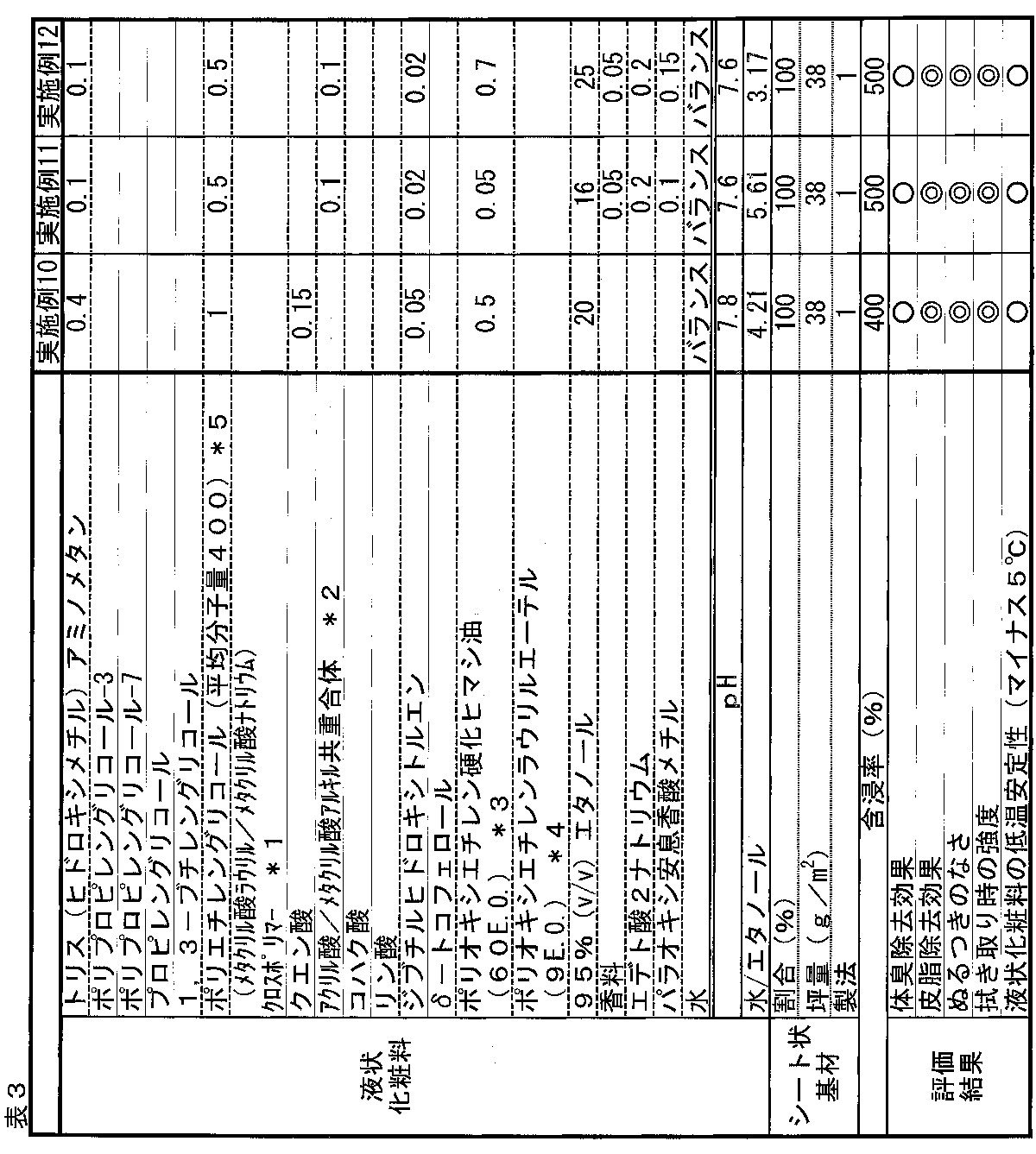
表3中*1~4は、表2と同じである。
(実施例13~15)
実施例1と同様に、表4に示す組成の液状化粧料について化粧料含有シートを調製し、上記と同様の評価を行った。また、評価として、更に下記に示す塗布後の肌のなめらかさの評価も行った。その結果を合わせて表4に示す。
実施例1と同様に、表4に示す組成の液状化粧料について化粧料含有シートを調製し、上記と同様の評価を行った。また、評価として、更に下記に示す塗布後の肌のなめらかさの評価も行った。その結果を合わせて表4に示す。
[塗布後の肌のなめらかさ]
専門のパネラー10人が各化粧料含有シートを用いて肌を清拭し、3分後に下記の評価基準にしたがって、肌のなめらかさについて評価した。専門パネラー10人の評価基準の平均値をとり、その値から下記のように判定した。結果を表4に示す。
・評価基準
6:非常になめらかである
5:なめらかである
4:ややなめらかである
3:どちらともいえない
2:あまりなめらかでない
1:なめらかでない
・判定
◎ :評価基準の平均値が、5以上~6以下
○ :評価基準の平均値が、4以上~5未満
○△:評価基準の平均値が、3以上~4未満
△ :評価基準の平均値が、2以上~3未満
× :評価基準の平均値が、1以上~2未満
専門のパネラー10人が各化粧料含有シートを用いて肌を清拭し、3分後に下記の評価基準にしたがって、肌のなめらかさについて評価した。専門パネラー10人の評価基準の平均値をとり、その値から下記のように判定した。結果を表4に示す。
・評価基準
6:非常になめらかである
5:なめらかである
4:ややなめらかである
3:どちらともいえない
2:あまりなめらかでない
1:なめらかでない
・判定
◎ :評価基準の平均値が、5以上~6以下
○ :評価基準の平均値が、4以上~5未満
○△:評価基準の平均値が、3以上~4未満
△ :評価基準の平均値が、2以上~3未満
× :評価基準の平均値が、1以上~2未満
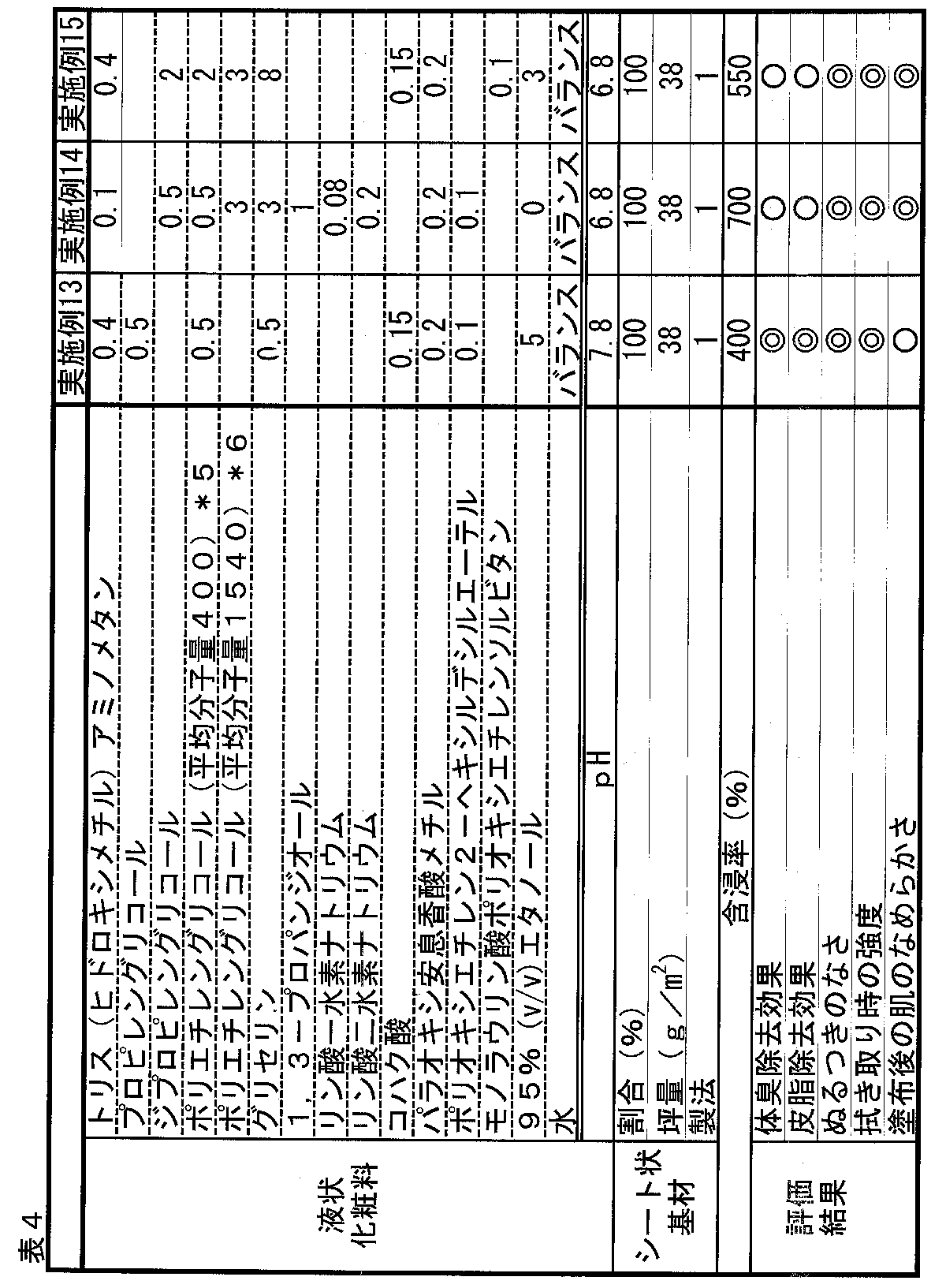
表3、4中の*5、*6は、以下のとおりである。
*5:ポリエチレングリコール(平均分子量400)、製品名PEG-400、三洋化成工業株式会社製
*6:ポリエチレングリコール(平均分子量1540)、製品名PEG-1540、三洋化成工業株式会社製
*5:ポリエチレングリコール(平均分子量400)、製品名PEG-400、三洋化成工業株式会社製
*6:ポリエチレングリコール(平均分子量1540)、製品名PEG-1540、三洋化成工業株式会社製
Claims (15)
- 表面がセルロース長繊維不織布であって、該不織布の少なくとも表面を構成する繊維本数の60%以上が繊維径2.9~7.1μmのセルロース長繊維であるシート状基材に、下記成分(A)~(C)を含む液状化粧料を含浸させ、
(A)トリス(ヒドロキシメチル)アミノメタンを0.01質量%以上5質量%以下、
(B)1分子中に水酸基を2個以上有する多価アルコール類、及び
(C)水
前記シート状基材の全質量に対する前記液状化粧料の質量が、20質量%以上700質量%以下であることを特徴とする化粧料含有シート。 - 成分(B)が、炭素数が2~8の多価アルコール、及び、これらの重合体のいずれかから選択される、請求項1に記載の化粧料含有シート。
- 前記液状化粧料のpHが6以上9以下である、請求項1又は2に記載の化粧料含有シート。
- 前記液状化粧料全体に対する成分(A)の含有量は、0.06質量%以上1.8質量%以下である、請求項1乃至3いずれか1項に記載の化粧料含有シート。
- 前記液状化粧料全体に対する成分(C)水の含有量は、50質量%以上99.5質量%以下である、請求項1乃至4いずれか1項に記載の化粧料含有シート。
- 前記液状化粧料が、さらにエタノールを含有する、請求項1乃至5いずれか1項に記載の化粧料含有シート。
- 前記液状化粧料全体に対する成分(B)の含有量は、0.05質量%以上5質量%以下である、請求項1乃至6いずれか1項に記載の化粧料含有シート。
- 前記液状化粧料が、さらにエタノールを含有し、前記液状化粧料全体に対するエタノールの含有量が、5質量%以上30質量%以下である、請求項1乃至7いずれか1項に記載の化粧料含有シート。
- 水とエタノールとの質量比(水/エタノール)が、0.1~99である、請求項8に記載の化粧料含有シート。
- 前記液状化粧料は、(D)酸化防止剤をさらに含有する、請求項1乃至9いずれか1項に記載の化粧料含有シート。
- 成分(D)が、ジブチルヒドロキシトルエン、及び、δ-トコフェロールのいずれかから選択される、請求項10に記載の化粧料含有シート。
- 成分(B)が、プロピレングリコール、及び、ポリプロピレングリコールのいずれかから選択される、請求項1乃至11いずれか1項に記載の化粧料含有シート。
- 成分(B)が、エチレングリコール、及び、ポリエチレングリコールのいずれかから選択される、請求項1乃至11いずれか1項に記載の化粧料含有シート。
- 前記液状化粧料全体に対する成分(B)の含有量は、1質量%以上20質量%以下である、請求項1乃至5いずれか1項に記載の化粧料含有シート。
- 請求項1乃至14のいずれか1項に記載の化粧料含有シートを用いて、該化粧料を身体へ塗布する化粧料含有シートの使用。
Priority Applications (1)
| Application Number | Priority Date | Filing Date | Title |
|---|---|---|---|
| CN201180063678.9A CN103282018B (zh) | 2010-12-28 | 2011-12-14 | 含有化妆品的薄片 |
Applications Claiming Priority (2)
| Application Number | Priority Date | Filing Date | Title |
|---|---|---|---|
| JP2010292319 | 2010-12-28 | ||
| JP2010-292319 | 2010-12-28 |
Publications (1)
| Publication Number | Publication Date |
|---|---|
| WO2012090412A1 true WO2012090412A1 (ja) | 2012-07-05 |
Family
ID=46382554
Family Applications (1)
| Application Number | Title | Priority Date | Filing Date |
|---|---|---|---|
| PCT/JP2011/006999 Ceased WO2012090412A1 (ja) | 2010-12-28 | 2011-12-14 | 化粧料含有シート |
Country Status (3)
| Country | Link |
|---|---|
| JP (1) | JP5872876B2 (ja) |
| CN (1) | CN103282018B (ja) |
| WO (1) | WO2012090412A1 (ja) |
Cited By (5)
| Publication number | Priority date | Publication date | Assignee | Title |
|---|---|---|---|---|
| WO2013108736A1 (ja) * | 2012-01-20 | 2013-07-25 | 花王株式会社 | 化粧料組成物 |
| WO2014163075A1 (ja) * | 2013-04-01 | 2014-10-09 | 花王株式会社 | シート状毛髪化粧品並びにそれを用いた毛髪処理方法及び頭皮の清拭方法 |
| JP2015101544A (ja) * | 2013-11-21 | 2015-06-04 | 花王株式会社 | シート用液状化粧料組成物及びシート状化粧料 |
| JP2016064996A (ja) * | 2014-09-24 | 2016-04-28 | 花王株式会社 | 皮膚化粧料 |
| US11383479B2 (en) | 2020-03-24 | 2022-07-12 | The Procter And Gamble Company | Hair cleaning implement |
Families Citing this family (8)
| Publication number | Priority date | Publication date | Assignee | Title |
|---|---|---|---|---|
| JP5548117B2 (ja) * | 2010-12-28 | 2014-07-16 | 花王株式会社 | 化粧料含有シート |
| JP6342155B2 (ja) * | 2012-12-25 | 2018-06-13 | ライオン株式会社 | 皮膚用シート |
| JP6170815B2 (ja) * | 2013-11-14 | 2017-07-26 | 花王株式会社 | 不織布 |
| JP2015189728A (ja) * | 2014-03-28 | 2015-11-02 | 花王株式会社 | シート状毛髪化粧品並びにそれを用いた毛髪処理方法及び頭皮の清拭方法 |
| JP6472978B2 (ja) * | 2014-10-28 | 2019-02-20 | 花王株式会社 | シート状化粧料 |
| JP7355493B2 (ja) * | 2018-12-07 | 2023-10-03 | 小林製薬株式会社 | 皮膚清拭用組成物 |
| JP7751965B2 (ja) * | 2018-12-26 | 2025-10-09 | 小林製薬株式会社 | 皮膚清拭用組成物 |
| JP2021084862A (ja) * | 2019-11-25 | 2021-06-03 | 花王株式会社 | プレシェーブ用シート状化粧料 |
Citations (2)
| Publication number | Priority date | Publication date | Assignee | Title |
|---|---|---|---|---|
| JP2005248365A (ja) * | 2004-03-03 | 2005-09-15 | Asahi Kasei Fibers Corp | 化粧用基材及びこれを用いた皮膚洗浄用シート |
| JP2007300963A (ja) * | 2006-05-08 | 2007-11-22 | Kao Corp | 消臭剤組成物 |
Family Cites Families (10)
| Publication number | Priority date | Publication date | Assignee | Title |
|---|---|---|---|---|
| GB917885A (en) * | 1961-06-20 | 1963-02-06 | Youngs Rubber Corp | Saturated pad for cleansing and deodorizing |
| US4462981A (en) * | 1982-12-10 | 1984-07-31 | Creative Products Resource, Associates Ltd. | Cosmetic applicator useful for skin moisturizing and deodorizing |
| JPH0236114A (ja) * | 1988-07-22 | 1990-02-06 | Kenji Nakamura | 化粧用シートおよびその製造方法 |
| JP3898331B2 (ja) * | 1998-04-17 | 2007-03-28 | 花王株式会社 | 洗浄用シート |
| JP2002037723A (ja) * | 2000-07-21 | 2002-02-06 | Lion Corp | シート状化粧料 |
| EP1622576B1 (en) * | 2003-05-07 | 2007-04-25 | Firmenich Sa | Sprayable perfume with an improved tenacity |
| JP4452143B2 (ja) * | 2004-08-09 | 2010-04-21 | 花王株式会社 | シート状化粧料 |
| JP5038656B2 (ja) * | 2005-11-18 | 2012-10-03 | 花王株式会社 | 消臭剤組成物 |
| JP5208909B2 (ja) * | 2009-12-03 | 2013-06-12 | 花王株式会社 | 消臭シートの製造方法 |
| JP5548117B2 (ja) * | 2010-12-28 | 2014-07-16 | 花王株式会社 | 化粧料含有シート |
-
2011
- 2011-12-14 WO PCT/JP2011/006999 patent/WO2012090412A1/ja not_active Ceased
- 2011-12-14 CN CN201180063678.9A patent/CN103282018B/zh active Active
- 2011-12-14 JP JP2011273894A patent/JP5872876B2/ja active Active
Patent Citations (2)
| Publication number | Priority date | Publication date | Assignee | Title |
|---|---|---|---|---|
| JP2005248365A (ja) * | 2004-03-03 | 2005-09-15 | Asahi Kasei Fibers Corp | 化粧用基材及びこれを用いた皮膚洗浄用シート |
| JP2007300963A (ja) * | 2006-05-08 | 2007-11-22 | Kao Corp | 消臭剤組成物 |
Cited By (7)
| Publication number | Priority date | Publication date | Assignee | Title |
|---|---|---|---|---|
| WO2013108736A1 (ja) * | 2012-01-20 | 2013-07-25 | 花王株式会社 | 化粧料組成物 |
| WO2014163075A1 (ja) * | 2013-04-01 | 2014-10-09 | 花王株式会社 | シート状毛髪化粧品並びにそれを用いた毛髪処理方法及び頭皮の清拭方法 |
| EP2982362A4 (en) * | 2013-04-01 | 2016-10-05 | Kao Corp | SHEET HAIR COSMETICS AND HAIR TREATMENT METHOD AND HEAD WASHING METHOD THEREWITH |
| US10391041B2 (en) | 2013-04-01 | 2019-08-27 | Kao Corporation | Sheet-shaped hair cosmetic and hair treatment method and scalp-wiping method using same |
| JP2015101544A (ja) * | 2013-11-21 | 2015-06-04 | 花王株式会社 | シート用液状化粧料組成物及びシート状化粧料 |
| JP2016064996A (ja) * | 2014-09-24 | 2016-04-28 | 花王株式会社 | 皮膚化粧料 |
| US11383479B2 (en) | 2020-03-24 | 2022-07-12 | The Procter And Gamble Company | Hair cleaning implement |
Also Published As
| Publication number | Publication date |
|---|---|
| JP5872876B2 (ja) | 2016-03-01 |
| CN103282018A (zh) | 2013-09-04 |
| CN103282018B (zh) | 2015-09-30 |
| JP2012149036A (ja) | 2012-08-09 |
Similar Documents
| Publication | Publication Date | Title |
|---|---|---|
| JP5872876B2 (ja) | 化粧料含有シート | |
| JP5548117B2 (ja) | 化粧料含有シート | |
| JP5771073B2 (ja) | 化粧料組成物 | |
| AU2016289590B2 (en) | Cleaning cloths impregnated with impregnation means based on a micellar technology | |
| JP6021320B2 (ja) | シート状化粧料 | |
| JP4274491B1 (ja) | クレンジング化粧料 | |
| JP6725470B2 (ja) | 化粧料 | |
| JP6472978B2 (ja) | シート状化粧料 | |
| JP6629590B2 (ja) | ジェル状化粧料 | |
| KR20060114685A (ko) | 보습 및 윤활 조성물 | |
| JP6560194B2 (ja) | 皮膚洗浄剤組成物 | |
| JP6315756B2 (ja) | シート状化粧料 | |
| JP6180294B2 (ja) | シート用液状化粧料組成物及びシート状化粧料 | |
| JP5086019B2 (ja) | ヘアコンディショニング組成物 | |
| TWI541028B (zh) | Cosmetic composition | |
| JP2017203000A (ja) | 皮膚化粧料 | |
| WO1999053896A1 (en) | Sheet for cleaning | |
| JP6549369B2 (ja) | シート状化粧料 | |
| JP6611675B2 (ja) | 皮膚用化粧料 | |
| JP6842402B2 (ja) | 汗及び/又は皮脂の除去方法 | |
| JP7500468B2 (ja) | 繊維処理用組成物 | |
| JP2025065944A (ja) | シート状クレンジング化粧料 | |
| TW202304407A (zh) | 片材狀化妝料 |
Legal Events
| Date | Code | Title | Description |
|---|---|---|---|
| 121 | Ep: the epo has been informed by wipo that ep was designated in this application |
Ref document number: 11852439 Country of ref document: EP Kind code of ref document: A1 |
|
| NENP | Non-entry into the national phase |
Ref country code: DE |
|
| 122 | Ep: pct application non-entry in european phase |
Ref document number: 11852439 Country of ref document: EP Kind code of ref document: A1 |