WO2012081393A1 - 硬化性組成物、及び硬化樹脂 - Google Patents
硬化性組成物、及び硬化樹脂 Download PDFInfo
- Publication number
- WO2012081393A1 WO2012081393A1 PCT/JP2011/077503 JP2011077503W WO2012081393A1 WO 2012081393 A1 WO2012081393 A1 WO 2012081393A1 JP 2011077503 W JP2011077503 W JP 2011077503W WO 2012081393 A1 WO2012081393 A1 WO 2012081393A1
- Authority
- WO
- WIPO (PCT)
- Prior art keywords
- curable composition
- cured resin
- compound
- component
- curing
- Prior art date
- Legal status (The legal status is an assumption and is not a legal conclusion. Google has not performed a legal analysis and makes no representation as to the accuracy of the status listed.)
- Ceased
Links
- GRWFFFOEIHGUBG-UHFFFAOYSA-N CC1C(COC(C2C(C)CC3OC3C2)=O)CC2OC2C1 Chemical compound CC1C(COC(C2C(C)CC3OC3C2)=O)CC2OC2C1 GRWFFFOEIHGUBG-UHFFFAOYSA-N 0.000 description 1
- YXALYBMHAYZKAP-UHFFFAOYSA-N O=C(C1CC2OC2CC1)OCC1CC2OC2CC1 Chemical compound O=C(C1CC2OC2CC1)OCC1CC2OC2CC1 YXALYBMHAYZKAP-UHFFFAOYSA-N 0.000 description 1
- IDSLNGDJQFVDPQ-UHFFFAOYSA-N O=C(CCCCC(OC1CC2OC2CC1)=O)OC1CC2OC2CC1 Chemical compound O=C(CCCCC(OC1CC2OC2CC1)=O)OC1CC2OC2CC1 IDSLNGDJQFVDPQ-UHFFFAOYSA-N 0.000 description 1
Classifications
-
- C—CHEMISTRY; METALLURGY
- C08—ORGANIC MACROMOLECULAR COMPOUNDS; THEIR PREPARATION OR CHEMICAL WORKING-UP; COMPOSITIONS BASED THEREON
- C08L—COMPOSITIONS OF MACROMOLECULAR COMPOUNDS
- C08L63/00—Compositions of epoxy resins; Compositions of derivatives of epoxy resins
-
- C—CHEMISTRY; METALLURGY
- C08—ORGANIC MACROMOLECULAR COMPOUNDS; THEIR PREPARATION OR CHEMICAL WORKING-UP; COMPOSITIONS BASED THEREON
- C08G—MACROMOLECULAR COMPOUNDS OBTAINED OTHERWISE THAN BY REACTIONS ONLY INVOLVING UNSATURATED CARBON-TO-CARBON BONDS
- C08G59/00—Polycondensates containing more than one epoxy group per molecule; Macromolecules obtained by polymerising compounds containing more than one epoxy group per molecule using curing agents or catalysts which react with the epoxy groups
- C08G59/18—Macromolecules obtained by polymerising compounds containing more than one epoxy group per molecule using curing agents or catalysts which react with the epoxy groups ; e.g. general methods of curing
- C08G59/20—Macromolecules obtained by polymerising compounds containing more than one epoxy group per molecule using curing agents or catalysts which react with the epoxy groups ; e.g. general methods of curing characterised by the epoxy compounds used
- C08G59/22—Di-epoxy compounds
- C08G59/24—Di-epoxy compounds carbocyclic
Definitions
- the present invention relates to a heat-resistant transparent resin composition having fast curability, a cured resin thereof, and an optical member made of the cured resin. More specifically, a resin composition that has low viscosity, excellent workability, and can be quickly cured by heating to form a cured resin having excellent heat resistance and transparency, and the resin composition is cured. And an optical member such as a lens made of the cured resin.
- Epoxy resins are known as resins that excel in electrical properties, moisture resistance, heat resistance, etc.
- plastic materials include mechanical component materials, electrical / electronic component materials, automotive component materials, civil engineering and building materials, molding materials, paints, and adhesives.
- optical members such as lenses.
- a cured resin obtained by curing a bisphenol-type epoxy resin is widely used as an optical semiconductor sealing material because it is excellent in electrical characteristics, moisture resistance, heat resistance and transparency.
- a material for an optical member such as a lens
- a process for connecting the camera module with a connector is required, and solder reflow heat resistance is required.
- a method for improving the heat resistance a method for improving the heat resistance by increasing the epoxy group density of the epoxy compound to increase the crosslinking density is known.
- a method of increasing the epoxy group density of an epoxy compound since most of bisphenol type epoxy compounds are bifunctional epoxy compounds, a part of the bisphenol type epoxy compound is replaced with a compound having a higher epoxy group density of three or more functions.
- Patent Documents 1 and 2 There are known a method (Patent Documents 1 and 2) and a method of increasing the epoxy group density per unit amount by reducing the repeating unit of bisphenol (Patent Document 3).
- the crosslink density does not increase so much due to the rigid structure of the aromatic ring, and it has not been sufficient in terms of heat resistance.
- the aromatic ring absorbs light having a short wavelength, there are problems such as a decrease in optical characteristics and a tendency to light degradation.
- Patent Documents 4 and 5 an invention using a hydrogenated bisphenol-type epoxy compound obtained by hydrogenating using a bisphenol-type epoxy compound as a raw material and using a catalyst such as rhodium is known ( Patent Documents 4 and 5).
- Patent Documents 4 and 5 an invention using a hydrogenated bisphenol-type epoxy compound obtained by hydrogenating using a bisphenol-type epoxy compound as a raw material and using a catalyst such as rhodium.
- Patent Documents 4 and 5 an invention using a hydrogenated bisphenol-type epoxy compound obtained by hydrogenating using a bisphenol-type epoxy compound as a raw material and using a catalyst such as rhodium.
- Patent Document 6 A method using an alicyclic epoxy compound having an Abbe number of 45 or more such as a hydrogenated bisphenol type epoxy compound is known (Patent Document 6).
- bisphenol-type epoxy compounds and hydrogenated bisphenol-type epoxy compounds are often semi-solid or solid at room temperature (25 ° C.) and have low fluidity, so it is difficult to inject them quickly and uniformly into a mold or the like. It was. In particular, it was difficult to use in a casting method that requires higher fluidity during casting. Therefore, it is often used by diluting with a solvent typified by toluene, xylene, methyl ethyl ketone, ethyl acetate, etc. to lower the viscosity of the curable composition, but there is a problem that the solvent foams, There have been many problems in using the diluted curable composition for applications such as mold molding.
- Patent Documents 7 and 8 describe inventions using a 3,4,3 ', 4'-diepoxycyclohexyl compound as a curable compound.
- the compound itself is colored, there is a problem that the transparency of the cured resin composed of the compound is lowered.
- JP-A-5-32866 Japanese Patent Laid-Open No. 7-165884 JP-A-5-326756 JP 2003-277473 A JP 2005-120357 A JP 2008-133439 A JP 2008-189698 A JP 2008-189853 A
- the object of the present invention is to have low viscosity and excellent fluidity before curing, to cure quickly by heating, to suppress the occurrence of light bleeding (chromatic aberration), and to have excellent transparency and heat resistance. It is providing the curable composition which can form curable resin.
- Another object of the present invention is a curing that has no optical blur (chromatic aberration), excellent transparency, and can maintain excellent optical properties and physical properties even when exposed to high temperature conditions such as soldering by a reflow method.
- An object is to provide a resin and an optical member made of the cured resin.
- an epoxy compound having an alicyclic ring can impart heat resistance and transparency to a resin, and further exhibit light bleeding (chromatic aberration).
- a specific epoxy compound having an ester bond in the molecule among the epoxy compounds having an alicyclic ring is excellent in fluidity, but protons generated from a cationic polymerization initiator The reaction rate with carbonyl oxygen constituting an ester bond forms a relatively stable oxonium ion, so that the curing rate is slow.
- a specific epoxy compound having no ester bond in the molecule has a fast curing speed but low fluidity.
- the curability is excellent in fluidity, can be cured quickly, and can form a resin excellent in heat resistance and transparency without bleeding of light. It was found that a composition was obtained.
- the present invention has been completed based on these findings and further research.
- the present invention comprises the following component (A) and component (B) as a curable compound at a ratio of the former / the latter (weight ratio) of 5/95 to 50/50.
- a sex composition is provided.
- the curable compound preferably further contains the following component (C), and particularly contains 5 to 60 parts by weight of component (C) with respect to 100 parts by weight of the sum of components (A) and (B). Is preferred.
- Component (C) has an epoxy group composed of two adjacent carbon atoms and oxygen atoms constituting the alicyclic ring (hereinafter sometimes referred to as “alicyclic epoxy group”) and has an ester bond. Not epoxy compounds
- the curable composition of the present invention preferably has an aromatic compound content of less than 5% by weight of the entire curable composition.
- the present invention also provides a curable resin obtained by curing the curable composition.
- the present invention further provides an optical member made of the cured resin.
- the curable composition of the present invention has a low viscosity and high fluidity before being cured, and can be easily poured into a mold or the like, and can form a cured resin quickly by cationic polymerization. Therefore, it is excellent in work efficiency. Moreover, it can be made to harden
- the resulting cured resin has a high Abbe number, so there is no blur of light (chromatic aberration), high optical properties (light transmittance, refractive index, Abbe number, etc.), physical properties (heat resistance, flexibility, water resistance) Etc.), and the optical characteristics and physical characteristics hardly change even under a high temperature condition of about 260 ° C., for example.
- Such a cured resin is particularly useful for use in an optical member such as a lens because it does not easily turn yellow even when subjected to a soldering process by a reflow method and does not easily change its shape.
- the camera module can be mounted at the same time in the reflow soldering process (mounting process), which is performed after the soldering process.
- the connecting step of the camera module with the existing connector can be omitted.
- the curable composition of this invention is characterized by including the following component (A) and a component (B) as a sclerosing
- Component (A) of the present invention is an epoxy compound in which an alicyclic ring and an epoxy group are bonded via a single bond or a linking group, and has no ester bond (included in the following component (C)) Except for compounds having an alicyclic epoxy group), and a compound that cures by forming a three-dimensional cross-linked structure with other curable compounds by cationic polymerization.
- alicyclic ring examples include monocyclic alicyclic rings such as cyclopentane ring, cyclohexane ring, cyclooctane ring, and cyclododecane ring (3 to 15-membered, preferably about 5 to 6-membered cycloalkane ring); decalin ring ( Perhydronaphthalene ring), perhydroindene ring (bicyclo [4.3.0] nonane ring), perhydroanthracene ring, perhydrofluorene ring, perhydrophenanthrene ring, perhydroacenaphthene ring, perhydrophenalene ring, Norbornane ring (bicyclo [2.2.1] heptane ring), isobornane ring, adamantane ring, bicyclo [3.3.0] octane ring, tricyclo [5.2.1.0 2,6 ] decane ring, tricyclo
- Examples of the epoxy compound in which the alicyclic ring and the epoxy group are bonded by a single bond include a compound represented by the following formula (A1).
- R 1 is a group obtained by removing q OH from a q-valent alcohol [R 1- (OH) q ], p is an integer of 1 to 30, and q is an integer of 1 to 10. .
- p may be the same or different.
- q-valent alcohol [R 1- (OH) q ] monovalent alcohols such as methanol, ethanol, 1-propanol, isopropyl alcohol, 1-butanol; ethylene glycol, 1,2-propanediol, 1,3 -Divalent alcohols such as propanediol, 1,4-butanediol, neopentyl glycol, 1,6-hexanediol, diethylene glycol, triethylene glycol, tetraethylene glycol, dipropylene glycol, polypropylene glycol; glycerin, diglycerin, Examples include trihydric or higher alcohols such as erythritol, trimethylolethane, trimethylolpropane, pentaerythritol, dipentaerythritol, sorbitol.
- the alcohol may be polyether polyol, polyester polyol, polycarbonate polyol, polyolefin polyol, or the like.
- [R 1 — (OH) q ] in the present invention has a melting point of 60 to 120 ° C., excellent compatibility with other compositions (especially other epoxy compounds), and low temperature (for example, From about -10 to 70 ° C., preferably about 10 to 60 ° C., and can prevent the start of cationic polymerization during the dissolution and kneading. Or higher aliphatic polyhydric alcohol (for example, trimethylolpropane)] is preferable.
- Examples of the epoxy compound in which the alicyclic ring and the epoxy group are bonded via a linking group include a glycidyl ether type epoxy compound having an alicyclic ring and a glycidyl ether group.
- Examples of the glycidyl ether type epoxy compound having an alicyclic ring and a glycidyl ether group include glycidyl ethers of alicyclic alcohols (particularly, alicyclic polyhydric alcohols) represented by the following formulas (A2) to (A5).
- n1, n2, and n3 each represent an average degree of polymerization, and are, for example, about 0 or more and 10.0 or less.
- the above formula is particularly preferable in that a cured resin having excellent optical properties (transparency, low refractive index, etc.) and excellent reactivity, compatibility, and heat resistance can be formed.
- the compound represented by (A1) is preferable, and in particular, 1,2-epoxy-4- (2-oxiranyl) of 2,2-bis (hydroxymethyl) -1-butanol represented by the following formula (A1-1) ) Cyclohexane adduct is preferred.
- p ′, p ′′ and p ′ ′′ are the same or different and represent an integer of 1 to 30.
- Component (B) of the present invention is an epoxy compound having an alicyclic ring and having an ester bond, and having at least one alicyclic ring in the molecule and having at least one ester bond. Good. Component (B) can form a three-dimensional crosslinked structure with other curable compounds by cationic polymerization to form a cured resin.
- the component (B) in the present invention is a liquid having a low viscosity at the temperature at the time of dissolution and kneading with other components (for example, room temperature (25 ° C.), 500 mPa ⁇ s or less, more preferably 100 mPa ⁇ s or less, particularly preferably Is preferably an epoxy compound having a melting point of ⁇ 30 ° C. or more and 100 ° C. or less and a molecular weight of 1000 or less (eg, 180 to 900, preferably about 230 to 500). It can be preferably used.
- other components for example, room temperature (25 ° C.), 500 mPa ⁇ s or less, more preferably 100 mPa ⁇ s or less, particularly preferably Is preferably an epoxy compound having a melting point of ⁇ 30 ° C. or more and 100 ° C. or less and a molecular weight of 1000 or less (eg, 180 to 900, preferably about 230 to 500). It
- an epoxy compound having an alicyclic epoxy group is excellent in compatibility with other epoxy compounds, has excellent heat resistance and optical properties, and forms a cured resin having appropriate flexibility.
- an epoxy compound having two or more (particularly two) alicyclic epoxy groups is preferable.
- Examples of the alicyclic ring include the same examples as the alicyclic ring in the component (A).
- Examples of the alicyclic epoxy group include an epoxycyclopentyl group, a 3,4-epoxycyclohexyl group, and 3,4- And epoxytricyclo [5.2.1.0 2,6 ] decane 8- (or 9) yl group (epoxidized dicyclopentadienyl group).
- n2 represents an average degree of polymerization, and is, for example, 5 or less (preferably 1 to 2).
- the component (A) and the component (B) are used as the curable compound in the former / the latter (weight ratio) of 5/95 to 50/50 (preferably 5/95 to 40/60). ).
- the curable composition according to the present invention contains the component (A) and the component (B) as a curable compound in the above range, the composition is low in viscosity and high in fluidity before being cured. It is easy to pour, and can quickly form a cured resin by cationic polymerization.
- the temperature at which the curable composition starts to cure and the curable composition is heated for 2 minutes to achieve a curing rate of 90%.
- the difference (reaction temperature gap) from the temperature at which the cured resin can be formed can be reduced (for example, 85 ° C. or less, preferably 60 ° C. or less, particularly preferably 50 ° C. or less).
- the curable composition injected into the mold can be cured and removed from the mold very quickly, and the throughput of the molding equipment (processing capacity per unit time) can be significantly improved. Can do.
- the curable composition concerning this invention can be used suitably for shaping
- the component (A) is excessive, the viscosity becomes too high and the injection into a mold or the like tends to be difficult, and when the component (B) is excessive, the curing speed tends to decrease, and the optical There is a tendency for characteristics to deteriorate.
- the proportion of the component (A) in the curable composition is, for example, 5 to 50% by weight, preferably 5% by weight or more and 35% by weight of the entire curable composition (or the total amount of the curable compound). %, More preferably 10% by weight or more and less than 35% by weight.
- the ratio of a component (A) is less than the said range, since a cure rate will fall and a crosslinking density will fall, there exists a tendency for the heat resistance of the obtained cured resin to fall.
- the proportion of the component (A) exceeds the above range, the viscosity tends to be too high and injection into a mold or the like tends to be difficult.
- the proportion of the component (B) in the curable composition varies depending on the use of the curable resin, but is, for example, 30 to 95% by weight of the entire curable composition (or the total amount of the curable compound), preferably Is about 35 to 80% by weight, more preferably about 40 to 70% by weight, and most preferably about 56 to 70% by weight.
- the ratio of a component (B) is less than the said range, fluidity
- the ratio of a component (B) exceeds the said range there exists a tendency for a cure rate to fall and it may be necessary to make hardening temperature higher.
- the curable compound which concerns on this invention is a point which can provide the more outstanding fluidity
- the component (C) of the present invention is an epoxy compound having an epoxy group (alicyclic epoxy group) composed of two adjacent carbon atoms and oxygen atoms constituting the alicyclic ring and having no ester bond. Any alicyclic epoxy compound having at least one alicyclic epoxy group and no ester bond may be used. Such a component (C) can form a three-dimensional crosslinked structure with other curable compounds by cationic polymerization to form a cured resin.
- Examples of the alicyclic ring include the same examples as the alicyclic ring in the component (A), and examples of the alicyclic epoxy group include the same examples as the alicyclic epoxy group in the component (B). it can.
- component (C) in the present invention for example, a compound represented by the following formula (C1) (a compound in which two alicyclic epoxy groups are bonded by a single bond, or bonded through a divalent hydrocarbon group) : Bicycloepoxy compound).
- Y 1 represents a single bond or a divalent hydrocarbon group.
- the divalent hydrocarbon group include a divalent aliphatic hydrocarbon group, a divalent alicyclic hydrocarbon group, and a group in which a plurality of these are bonded.
- the divalent aliphatic hydrocarbon group include linear or branched alkylene groups such as methylene, methylmethylene, dimethylmethylene, ethylene, propylene, trimethylene, and tetramethylene groups (for example, C 1-6 alkylene). Group).
- divalent alicyclic hydrocarbon group examples include 1,2-cyclopentylene, 1,3-cyclopentylene, 1,2-cyclohexylene, 1,3-cyclohexylene, 1, A divalent cycloalkylene group such as a 4-cyclohexylene group can be exemplified.
- Examples of the component (C) include compounds having one alicyclic epoxy group in the molecule in addition to the compound represented by the above formula (C1).
- the compound may have another epoxy group in addition to the alicyclic epoxy group. Representative compounds are shown below.
- the component (C) in the present invention is preferably a bicycloepoxy compound represented by the above formula (C1) in that a cured resin having excellent heat resistance can be formed.
- a cured resin having excellent heat resistance In addition to curing the curable composition, it does not shrink during curing, but rather tends to expand in volume, so that the volume shrinkage rate when curing the curable composition can be suppressed and cured.
- the compound represented by the above formula (C1-1) is preferable in that the distortion and deformation due to the curing shrinkage when the obtained cured resin is annealed can be suppressed.
- the proportion of the component (C) in the curable composition varies depending on the use of the curable resin, but is, for example, 65% by weight or less of the entire curable composition (or the total amount of the curable compound), preferably It is about 5 to 60% by weight, particularly preferably about 5 to 35% by weight.
- the amount of component (C) added to 100 parts by weight of the sum of components (A) and (B) is, for example, about 5 to 60 parts by weight, preferably 5 to 45 parts by weight, particularly preferably 5 to 25 parts by weight. About a part.
- a component (A) / component (B) / component (C) weight
- the ratio is preferably about 5 to 35/55 to 95/0 to 25 (in particular, 10 to 34/56 to 90/5 to 15).
- the component (C) When the component (C) is blended in the above range, excellent fluidity can be imparted to the curable composition while maintaining the transparency of the resulting cured resin. Furthermore, the curing rate is accelerated, and the difference between the temperature at which the curable composition starts to cure and the temperature at which the curable composition can be heated for 2 minutes to form a cured resin having a curing rate of 90% (The reaction temperature gap) can be reduced to 50 ° C. or less, and the curable composition injected into the mold can be subjected to a curing treatment and taken out from the mold more quickly, which significantly improves the throughput of the molding apparatus. Can be improved.
- the curable composition of the present invention may contain other curable compounds (cationic polymerizable compound, radical polymerizable compound, etc.) other than the above components as long as the optical properties and physical properties of the cured resin are not impaired. .
- the above components are used.
- the curable composition of the present invention contains an aromatic compound (for example, bisphenol A type epoxy compound, bisphenol F type epoxy compound, 3,3 ′, 5,5′-tetramethyl-4,4′-biphenol type epoxy).
- an aromatic compound for example, bisphenol A type epoxy compound, bisphenol F type epoxy compound, 3,3 ′, 5,5′-tetramethyl-4,4′-biphenol type epoxy.
- Compound, bisphenol type epoxy compound such as 4,4′-biphenol type epoxy compound, bisphenol A novolac type epoxy compound, naphthalenediol type epoxy compound, etc.
- content of less than 5% by weight of the whole curable composition more preferably Less than 1% by weight.
- the minimum of content of an aromatic compound is 0%.
- the ratio of the total curable compound to the total amount of the curable composition of the present invention is, for example, 60% by weight or more, preferably 80% by weight or more, and more preferably 90% by weight or more.
- the curable composition of the present invention contains various additives such as a cationic polymerization initiator, a curing agent, a curing accelerator, a radical polymerization initiator, and a photosensitizer depending on the type of the curable compound to be used. You may go out.
- the cationic polymerization initiator is a compound (curing catalyst, acid generator) that releases a substance that initiates cationic polymerization by heat or light.
- a thermal cationic polymerization initiator as the cationic polymerization initiator in that a cured resin having high heat resistance can be rapidly formed.
- the amount of the cationic polymerization initiator is, for example, 0.01 to 15% by weight, preferably 0.01 to 2% by weight, based on the entire curable composition. By mix
- cationic polymerization initiator examples include aryldiazonium salts [for example, trade name “PP-33” (manufactured by Asahi Denka Kogyo Co., Ltd.)], aryliodonium salts, arylsulfonium salts [for example, trade name “FC- 509 ”(manufactured by 3M), trade name“ UVE1014 ”(manufactured by GE Corp.), trade names“ CP-66 ”,“ CP-77 ”(both manufactured by Asahi Denka Kogyo Co., Ltd.) , Trade names "Sun-Aid SI-60L", “Sun-Aid SI-80L", “Sun-Aid SI-100L", “Sun-Aid SI-110L” (both manufactured by Sanshin Chemical Industry Co., Ltd.), etc.], allene-ion complex [ For example, the trade name “CG-24-61” (manufactured by Ciba
- a system of a chelate compound of a metal such as aluminum or titanium and an acetoacetate ester or a diketone and a silanol or a phenol is also used.
- the chelate compound include aluminum trisacetylacetonate, aluminum trisacetoacetate ethyl and the like.
- the silanol or phenols include triphenylsilanol and bisphenol S.
- the arylsulfonium salt (particularly, trade name “Sun-Aid SI-60L”, trade name “Sun-Aid SI-100L”, etc.) has a temperature at which the curable composition starts to cure, for example, 80 The temperature is lowered to ⁇ 120 ° C. (preferably 80 to 100 ° C.), and the temperature at which the curable composition starts to cure and the temperature at which the cured resin having a curing rate of 90% can be formed by heating for 2 minutes.
- An acid anhydride can be used as a curing agent.
- the acid anhydride those generally used for curing epoxy compounds can be used, but those which are liquid at room temperature are preferred. Specific examples include methyltetrahydrophthalic anhydride, methylhexahydrophthalic anhydride, dodecenyl. Mention may be made of succinic anhydride, methylendomethylenetetrahydrophthalic anhydride and the like.
- acid anhydrides that are solid at room temperature for example, phthalic anhydride, tetrahydrophthalic anhydride, hexahydrophthalic anhydride, methylcyclohexene dicarboxylic acid anhydride, as long as the fluidity of the curable composition of the present invention is not adversely affected. Etc. can be used.
- an acid anhydride that is solid at room temperature it is preferably dissolved in a liquid epoxy compound at room temperature and used as a liquid mixture at room temperature.
- the blending amount of the curing agent varies depending on the kind and amount of the cationic curable compound in the curable composition, but is, for example, less than about 40% by weight, preferably less than about 20% by weight of the entire curable composition. Preferably, it is less than about 10% by weight.
- the curing accelerator is a compound having a function of accelerating the curing reaction when an acid anhydride is used as the curing agent.
- the curing accelerator is not particularly limited as long as it is generally used.
- a diazabicycloundecene-based curing accelerator (1,8-diazabicyclo [5.4.0] undecene-7 (DBU) or Salt thereof)
- tertiary amines such as benzyldimethylamine, 2,4,6-tris (dimethylaminomethyl) phenol, 2-ethyl-4-methylimidazole, 1-cyanoethyl-2-ethyl-4-methylimidazole, etc.
- Examples thereof include organic phosphine compounds such as imidazoles and triphenylphosphine, tertiary amine salts, quaternary ammonium salts, phosphonium salts, metal salts such as tin octylate and zinc octylate.
- diazabicycloundecene curing accelerators are preferable.
- the blending amount of the curing accelerator is, for example, about 0 to 5% by weight, preferably about 0.05 to 3% by weight, based on the entire curable composition. If the blending amount is too small, the curing accelerating effect may be insufficient, and if it is too large, the hue of the cured resin may be deteriorated.
- radical polymerization initiator those known and commonly used as light or thermal radical polymerization initiators can be used.
- Representative photoradical polymerization initiators include, for example, benzoin / benzoin alkyl ethers such as benzoin, benzoin methyl ether, benzoin ethyl ether, benzoin isopropyl ether; acetophenone, 2,2-dimethoxy-2-phenylacetophenone, 2, 2-diethoxy-2-phenylacetophenone, 1,1-dichloroacetophenone, 2-methyl-1- [4- (methylthio) phenyl] -2-morpholino-propan-1-one, 2-benzyl-2-dimethylamino- Acetophenones such as 1- (4-morpholinophenyl) -butan-1-one; anthrax such as 2-methylanthraquinone, 2-ethylanthraquinone, 2-tert-butylanthraquinone, 1-chlor
- thermal radical polymerization initiators include, for example, organic peroxides such as diacyl peroxides, peroxydicarbonates, alkyl peresters, dialkyl peroxides, perketals, ketone peroxides, and alkyl hydroperoxides. Is mentioned. Specific examples of these thermal polymerization initiators include dibenzoyl peroxide, t-butyl perbenzoate, azobisisobutyronitrile, and the like.
- the blending amount of the radical polymerization initiator varies depending on the kind and amount of the radical polymerizable compound in the curable composition, but is, for example, about 0.1 to 2% by weight of the entire curable composition.
- the photosensitizer is preferably used in combination with a radical photopolymerization initiator.
- a radical photopolymerization initiator known ones can be used.
- These photosensitizers can be used alone or in combination of two or more.
- the content of the photosensitizer is not particularly limited, but is, for example, about 0.1 to 5% by weight of the entire curable composition.
- additives may be further added to the curable composition of the present invention.
- Other additives include, for example, organosiloxane compounds, metal oxide particles, rubber particles, silicone and fluorine antifoaming agents, silane coupling agents, fillers, plasticizers, leveling agents, antistatic agents, release agents. Molding agents, flame retardants, colorants, antioxidants (for example, pentaerythritol tetrakis [3- (3,5-di-t-butyl-4-hydroxyphenol) propionate] etc. can be used), ultraviolet rays Examples thereof include an absorbent, an ion adsorbent, and a pigment.
- the amount of these various additives is, for example, 5% by weight or less based on the entire curable composition.
- the curable composition of the present invention may contain a solvent, but if it is too much, bubbles may occur in the cured resin. For example, it is 10% by weight or less (particularly 1% by weight) of the entire curable composition. Or
- the curable composition of the present invention includes, for example, the above components (components (A) and (B), preferably components (A), (B) and (C)), a cationic polymerization initiator as necessary, and curing. It is prepared by mixing an agent, a curing accelerator, a radical polymerization initiator, a photosensitizer, various additives, and the like, and stirring and mixing while excluding bubbles under vacuum as necessary.
- the temperature at the time of stirring and mixing is, for example, about 10 to 60 ° C.
- a known apparatus such as a rotation / revolution mixer, a single-screw or multi-screw extruder, a planetary mixer, a kneader, or a dissolver can be used.
- the curable composition of the present invention can form a curable resin by cationic polymerization.
- the curable composition has a desired shape by pouring the curable composition into a mold of a molding apparatus and heating. Can be obtained.
- the heating temperature can be appropriately adjusted depending on the constitution of the curable composition, and is, for example, 80 to 260 ° C., preferably 90 to 210 ° C., particularly preferably 100 to 150 ° C.
- the liquid temperature of the curable composition before heating is low (for example, room temperature), in order to rapidly increase the liquid temperature, it is previously set at 150 to 250 ° C., preferably 120 to 200 ° C. for 0.1 to 10 minutes.
- the curing treatment can be performed at the above heating temperature.
- These curing conditions are appropriately adjusted according to the shape and size of the molding apparatus, the mold, and the cured resin to be obtained.
- an active energy ray for example, ultraviolet rays etc.
- the irradiation amount is, for example, about 1000 to 4000 mJ / cm 2 .
- the annealing treatment can be performed by heating at a temperature of 100 to 300 ° C. for about 10 to 300 minutes.
- the conditions for the annealing treatment are appropriately adjusted according to the shape and size of the apparatus and the cured resin, and the amount of treatment. By performing the annealing treatment, it is possible to alleviate the distortion of the cured resin to make various physical properties uniform, to prevent the occurrence of cracks, and to further suppress the shape error.
- the curable composition of the present invention has a low viscosity [for example, a viscosity at 25 ° C. of 5000 mPa ⁇ s or less, preferably 4500 mPa ⁇ s or less (for example, 10 to 4500 mPa ⁇ s), more preferably 4100 mPa ⁇ s or less (for example, 50 to 4100 mPa ⁇ s), particularly preferably 4000 mPa ⁇ s or less (eg, 50 to 4000 mPa ⁇ s), more preferably 2500 mPa ⁇ s or less (eg, 150 to 2500 mPa ⁇ s), and most preferably 1000 mPa ⁇ s or less (eg, 150 to 1000 mPa ⁇ s)], it is excellent in fluidity and can be quickly and uniformly injected into a mold or the like without unevenness.
- a low viscosity for example, a viscosity at 25 ° C
- the curable composition due to the constitution of the curable composition, even at a heating temperature of 140 ° C., 60% or more (preferably 75% or more, preferably by heat treatment for a short time (eg about 5 minutes, preferably 2 minutes or less) Particularly preferably, it can be cured at a curing rate of 90% or more. Therefore, the throughput performance of the molding apparatus can be remarkably improved.
- a cured resin can be obtained with an excellent curing rate by heat treatment at 140 ° C. for 2 minutes, it is then removed from the mold and further subjected to heat treatment (eg, aryl treatment, post-cure, etc.).
- heat treatment eg, aryl treatment, post-cure, etc.
- the curing rate (%) is defined by the calorific value in the curing process of the curable composition.
- the curing rate (%) when cured at constant temperature is ⁇
- the curing rate is represented by the following formula.
- d ⁇ / dt 1 / H T (dQ / dt) T
- H T is the total amount of heat generated during constant temperature measurement
- a heating value per unit time at (dQ / dt) T is a constant temperature measurement.
- the curing rate is determined by measuring the calorific value of the curable composition by thermal analysis using a differential scanning calorimeter (DSC).
- DSC differential scanning calorimeter
- the curable resin of the present invention is obtained by curing the curable composition, it has excellent properties in both optical properties and physical properties.
- the light transmittance (400 nm) of the cured resin of the present invention is, for example, 80% or more (preferably 86% or more), and the internal transmittance (400 nm) is, for example, 85% or more (preferably 90% or more, particularly preferably 94). %),
- the refractive index (589 nm) is, for example, 1.45 or more (preferably 1.50 or more), and the Abbe number is, for example, 45 or more (preferably 50 or more, particularly preferably 55 or more). Is preferred.
- the glass transition temperature of the curable resin of the present invention is preferably, for example, 80 to 200 ° C. (preferably 120 to 145 ° C.).
- the glass transition temperature is lower than 80 ° C., the reflow heat resistance is lowered, and deformation or the like tends to be caused by heating.
- the glass transition temperature is higher than 200 ° C., the flexibility of the cured resin is lowered, the brittleness tends to occur, and cracks tend to occur.
- the cured resin of the present invention has an elastic modulus at 25 ° C. (measured by a method based on JIS K 7244-1 to 7), for example, about 0.1 to 5 GPa (preferably 0.5 to 3 GPa).
- the flexural modulus (measured by a method according to JIS K 6911) is, for example, about 0.5 to 10 GPa (preferably 1 to 5 GPa), and has an appropriate flexibility, so that it can be easily removed from a mold or the like. Generation of cracks can be prevented when removing.
- the cured resin of the present invention does not substantially change the light transmittance, internal transmittance, refractive index, and Abbe number even when exposed to high temperature conditions (for example, about 260 ° C.) Since the volume shrinkage is 5% or less (preferably 3.5% or less, particularly preferably 3.0% or less), the shape can be maintained.
- the cured resin of the present invention has low hygroscopicity [water absorption is 5% or less (preferably 3% or less, particularly preferably 2% or less)], high-temperature and high-humidity conditions (for example, boiling water) Even when exposed to the extent of immersion, the light transmittance, internal transmittance, refractive index, and Abbe number are not substantially changed, and the shape can be maintained.
- the cured resin of the present invention hardly changes in optical characteristics and physical characteristics even at high temperatures. Therefore, for example, even when the cured resin of the present invention is mounted on an optical device and subjected to reflow treatment, changes in various physical property values, particularly optical property values, can be kept to a minimum, and excellent optical properties can be maintained. it can.
- the refractive index of the lens varies depending on the wavelength of light, and a phenomenon (chromatic aberration) that causes deviation (bleeding or blurring) in the image occurs.
- a normal lens has a structure that corrects chromatic aberration by combining a lens resin having a high Abbe number and a lens resin having a low Abbe number.
- the glass of a lens used in a camera is classified into two types according to the Abbe number. Generally, those having an Abbe number of 50 or less are called flint glass, and those having 50 or more are called crown glass.
- the cured resin of the present invention can be suitably used as a high Abbe number lens resin.
- the cured resin of the present invention can be suitably used for optical members (for example, optical material applications such as lenses, optical device applications, display device applications, electrical / electronic component material applications, etc.).
- optical members for example, optical material applications such as lenses, optical device applications, display device applications, electrical / electronic component material applications, etc.
- the optical member include an imaging lens, a spectacle lens, a filter, a diffraction grating, a prism, a light guide, and a light beam collection for a camera (on-vehicle camera, digital camera, PC camera, mobile phone camera, surveillance camera, etc.).
- Optical lens, light diffusion lens, cover glass for display device photo sensor, photo switch, LED, light emitting element, optical waveguide, optical splitter, optical fiber adhesive, display element substrate, color filter substrate, touch panel substrate, Examples thereof include a display protective film, a display backlight, a light guide plate, and an antireflection film.
- the camera module can be mounted at the same time in the soldering process (mounting process) by the reflow method, which is performed after the soldering process.
- the connection process of the camera module by the existing connector can be omitted, and the workability is excellent.
- EHPE3150 1,2-epoxy-4- (2-oxiranyl) cyclohexane adduct of 2,2-bis (hydroxymethyl) -1-butanol represented by the following formula (wherein p ′ and p ′′) P ′ ′′ are the same or different and each represents an integer of 1 to 30), trade name “EHPE3150” (manufactured by Daicel Chemical Industries), and a compound represented by the formula (A1).
- YX8000 a non-ester hydrogenated bisphenol diglycidyl compound represented by the following formula.
- SI-100L Arylsulfonium salt, trade name “Sun-Aid SI-100L” (manufactured by Sanshin Chemical Industry Co., Ltd.)
- SI-60L arylsulfonium salt, trade name “Sun-Aid SI-60L” (manufactured by Sanshin Chemical Industry Co., Ltd.)
- IRG1010 pentaerythritol tetrakis [3- (3,5-di-t-butyl-4-hydroxyphenol) propionate], trade name “IRG1010” (manufactured by Ciba Specialty Chemicals)
- a dehydration catalyst was prepared by stirring and mixing 70 g (0.68 mol) of 95 wt% sulfuric acid and 55 g (0.36 mol) of 1,8-diazabicyclo [5.4.0] undecene-7 (DBU).
- DBU 1,8-diazabicyclo [5.4.0] undecene-7
- Pseudocumene was distilled off using a 10-stage Oldershaw type distillation column, and the reaction-terminated liquid was distilled at an internal pressure of 10 Torr (1.33 kPa) and an internal temperature of 137 to 140 ° C. to obtain 731 g of bicyclohexyl-3. , 3'-diene was obtained.
- the obtained bicyclohexyl-3,3′-diene (243 g) and ethyl acetate (730 g) were charged into a reactor, and nitrogen was blown into the gas phase portion, and the temperature in the reaction system was controlled to 37.5 ° C. Then, 274 g of a 30 wt% peracetic acid ethyl acetate solution (water content 0.41 wt%) was added dropwise over about 3 hours. After the peracetic acid solution was dropped, the reaction was terminated by aging at 40 ° C. for 1 hour.
- the viscosity of the curable composition is an average value of viscosity (mPa ⁇ s) measured at 25 ° C. in a shear rate of 15 to 25 s ⁇ 1 using a rheometer (trade name “PHYSICA UDS200”, manufactured by Paar Physica). It was used.
- reaction temperature gap The curing start temperature (T1) from the measurement curve of the curing calorific value obtained in the above curing rate measurement and the temperature at which a cured resin with a curing rate of 90% can be formed by heating for 2 minutes [curing Temperature (90%, 2 minutes): T2] was calculated, and the difference (T2 ⁇ T1: ° C.) was taken as the reaction temperature gap.
- the curable compositions obtained in Examples and Comparative Examples were cast at room temperature (25 ° C.) into glass molds that had been surface-treated with a release agent in advance. Next, the cast curable composition was heated as described below using an oven in an air atmosphere to obtain a cured resin (1).
- the curable composition obtained in Example 1 The cast curable composition was heated at 100 ° C. for 60 minutes.
- the curable composition was rapidly heated from room temperature (25 ° C.) to 140 ° C. at a heating rate of 50 ° C./min and heated at 140 ° C. for 2 minutes.
- the curable composition obtained in Example 3 Casting curability Heat the composition at 200 ° C. for 5 minutes
- Cured resin (1) comprising the curable composition obtained in Examples 1 and 3: Heating at 160 ° C. for 1 hour
- the obtained cured resin (2) was evaluated for optical properties, physical properties and heat resistance by the following methods.
- the light transmittance (%) at a wavelength of 400 nm was measured by a method based on JIS B 7105 using a spectrophotometer (trade name “U-3900”, manufactured by Hitachi High-Technologies Corporation).
- the refractive index of the cured resin (2) was measured by a method based on JIS K 7142, using a refractometer (trade name “Model 2010”, manufactured by Metricon), and a refractive index of 589 nm at 25 ° C. was measured.
- Abbe number (n d ⁇ 1) / (n f ⁇ n c )
- n d represents a refractive index at 589.2 nm
- n f represents a refractive index at 486.1 nm
- n c represents a refractive index at 656.3 nm.
- the value measured by the said method was used as a refractive index.
- the glass transition temperature of the curable resin (2) was measured using a TMA measuring device (trade name “TMA / SS100”, manufactured by SII NanoTechnology Co., Ltd.) in a nitrogen atmosphere at a rate of temperature increase of 5 ° C./min and a measurement temperature range.
- the coefficient of thermal expansion was measured at 30 ° C. to 250 ° C., a tangent line was drawn on the curve before and after the glass transition point, and the glass transition temperature (Tg) was obtained from the intersection of the tangent lines.
- the linear expansion coefficient of the cured resin (2) is increased by a method according to JIS K 7197 using a TMA measuring device (trade name “TMA / SS100”, manufactured by SII Nanotechnology), that is, in a nitrogen atmosphere.
- TMA measuring device
- the coefficient of thermal expansion was measured at a temperature rate of 5 ° C./min and a measurement temperature range of 30 ° C. to 250 ° C., and the slope of the straight line on the low temperature side was expressed as the coefficient of linear expansion.
- the elastic modulus (GPa) of the cured resin (2) is determined by a method according to JIS 7244-1 to 7 using a solid viscoelasticity measuring device (trade name “RSAIII”, manufactured by TA Instruments Inc.), The dynamic viscoelastic properties of a test piece (length 40 mm ⁇ width 25 mm ⁇ thickness 0.5 mm) were measured in a nitrogen atmosphere at a heating rate of 5 ° C./minute and a measurement temperature range of ⁇ 30 ° C. to 270 ° C. The elastic modulus at ° C was read.
- a test piece (length 25 mm ⁇ width 1.0 mm ⁇ thickness 1.0 mm) was prepared from the cured resin (2), and a tensile tester (trade name “Tensilon Universal Material Testing Machine RTF-1350”, And Day) was used, and the three-point bending elastic modulus was measured at a bending speed of 1 mm / min according to JIS K 6911.
- volume shrinkage (%) was determined by curing the specific gravity (G 1 ) at 25 ° C. of the curable compositions obtained in Examples and Comparative Examples, and by curing the curable composition by the above method.
- the specific gravity (G 2 ) of the obtained cured resin (2) was measured by the following method and calculated from the following formula.
- Volume shrinkage (%) ⁇ (G 2 ⁇ G 1 ) / G 1 ⁇ ⁇ 100
- Heat resistance test A heat resistance test in which the cured resin (2) was previously heated to 270 ° C. and held for 1 minute in an air atmosphere was continuously performed three times to obtain a cured resin (3). With respect to the obtained cured resin (3), the transmittance, internal transmittance, refractive index, and Abbe number are measured by the above method, and the change in transmittance, internal transmittance, refractive index, and Abbe number due to exposure to a high temperature environment. The presence or absence was measured.
- the curable composition of the present invention Since the curable composition of the present invention has excellent fluidity, it can be cast easily and quickly, and can be cured very quickly to obtain a cured resin having excellent optical properties, physical properties, and heat resistance. I was able to.
- the cured resin (2) obtained by curing the curable compositions obtained in Comparative Examples 1 and 2 significantly deteriorated the optical properties when exposed to a high temperature environment, and was not suitable for applications such as lenses. .
- the curable composition obtained in Comparative Example 2 had a low viscosity, was easily deformed during casting and after curing had progressed to some extent, and was difficult to handle.
- the curable composition of the present invention has high fluidity before being cured, can be easily poured into a mold or the like, is cured extremely rapidly by cationic polymerization, has no light blur, and has heat resistance. A resin having excellent transparency can be formed. In addition, it is possible to suppress the occurrence of stress distortion and cracking due to curing shrinkage. Therefore, the resin obtained by curing the curable composition of the present invention can be suitably used as an optical member that can be soldered by a reflow method.
Landscapes
- Chemical & Material Sciences (AREA)
- Health & Medical Sciences (AREA)
- Chemical Kinetics & Catalysis (AREA)
- Medicinal Chemistry (AREA)
- Polymers & Plastics (AREA)
- Organic Chemistry (AREA)
- Epoxy Resins (AREA)
Abstract
硬化させる前は低粘度で流動性に優れ、加熱することにより速やかに硬化して、光のにじみ(色収差)の発現を抑制し、透明性、耐熱性に優れた硬化樹脂を形成することができる硬化性組成物を提供する。 本発明に係る硬化性組成物は、下記成分(A)、成分(B)を、前者/後者(重量比)が5/95~50/50となる割合で含有することを特徴とする。 成分(A):脂環とエポキシ基とが単結合又は連結基を介して結合しているエポキシ化合物であって、エステル結合を有しないエポキシ化合物 成分(B):脂環を有し、且つエステル結合を有するエポキシ化合物
Description
本発明は、速硬化性を有する耐熱透明樹脂組成物、その硬化樹脂、及び該硬化樹脂よりなる光学部材に関する。より詳しくは、低粘度で作業性に優れ、加熱することにより速やかに硬化して、優れた耐熱性、透明性を有する硬化樹脂を形成することができる樹脂組成物、該樹脂組成物を硬化して得られる硬化樹脂、及び該硬化樹脂からなるレンズ等の光学部材に関する。
エポキシ樹脂は電気特性、耐湿性、耐熱性等に優れる樹脂として知られており、プラスチック材料として、機械部品材料、電気・電子部品材料、自動車部品材料、土木建築材料、成形材料、塗料、接着剤、封止材等に用いられ、近年はレンズ等の光学部材用の材料としても注目されている。
特に、ビスフェノール型エポキシ樹脂を硬化して得られる硬化樹脂は、電気特性、耐湿性、耐熱性に優れる上、透明性にも優れるため光半導体の封止材料として汎用される。しかしながら、レンズ等の光学部材用の材料として使用した場合、耐熱性の点で十分とはいえず、高温下では形状が変化したり、光線透過率が著しく低下する場合がある。そのため、例えば、カメラ付き携帯電話等はリフロー方式によるハンダ付け工程(実装工程)を経て製造されるが、その工程温度(260℃程度)に耐えることができないため、ハンダ付け工程後に別途作製されたカメラモジュールをコネクタにより接続する工程が必要となり、ハンダリフロー耐熱性を備えることが求められていた。
耐熱性を向上させる方法としては、エポキシ化合物のエポキシ基密度を増加させて架橋密度を高めることにより耐熱性を向上させる方法が知られている。エポキシ化合物のエポキシ基密度を増加させる方法として、ビスフェノール型エポキシ化合物の多くは2官能性エポキシ化合物であるため、ビスフェノール型エポキシ化合物の一部を、3官能以上のエポキシ基密度のより高い化合物に置き換える方法(特許文献1、2)や、ビスフェノールの繰り返し単位を小さくして単位量あたりのエポキシ基密度を増加させる方法が知られている(特許文献3)。しかしながら、芳香環を分子内に有するビスフェノール型エポキシ化合物を含有するため、該芳香環の剛直な構造から架橋密度がそれほど上がらず、耐熱性の点で未だ十分とはいえなかった。その上、芳香環が短波長の光を吸収することから光学特性の低下や、光劣化し易い等の問題があった。
一方、芳香環を含まないエポキシ化合物として、ビスフェノール型エポキシ化合物を原料とし、ロジウム等の触媒を使用して水素添加することにより得られる水添ビスフェノール型エポキシ化合物を使用する発明が知られている(特許文献4、5)。また、レンズ等の光学部材用の材料においては、光がレンズ等を通して分散されるために生じる光のにじみ(色収差)を抑制することが課題であり、光のにじみ(色収差)を小さくする方法として、水添ビスフェノール型エポキシ化合物等のアッベ数が45以上の脂環エポキシ化合物を使用する方法が知られている(特許文献6)。しかしながら、ビスフェノール型エポキシ化合物の芳香環を水素添加により完全に消失させることは困難であり、また、反応に使用した触媒や副生物が混入するため、硬化して得られる樹脂は透明性の点で問題があり、更に、ビスフェノール型エポキシ化合物に代えて水添ビスフェノール型エポキシ化合物を使用してもエポキシ基密度は変わらないため、耐熱性の点でも課題が残されていた。
更に、ビスフェノール型エポキシ化合物や水添ビスフェノール型エポキシ化合物は、室温(25℃)において半固形や固体であることが多く、流動性が低いため金型等へ速やかに且つ均一に注入することが難しかった。とりわけ、注型時により高い流動性が求められるキャスト成形法に使用することは困難であった。そのため、トルエン、キシレン、メチルエチルケトン、酢酸エチル等に代表される溶剤で希釈して、硬化性組成物の粘度を下げて使用されることが多いが、前記溶剤が発泡する等の問題があり、溶剤希釈された硬化性組成物を金型成型等の用途に使用することには多くの課題があった。
また、特許文献7、8には、3,4,3’,4’-ジエポキシシクロヘキシル化合物を硬化性化合物として使用する発明が記載されている。しかしながら、前記化合物はそれ自体が着色しているため、該化合物からなる硬化樹脂の透明性が低下することが問題であった。
従って、本発明の目的は、硬化させる前は低粘度で流動性に優れ、加熱することにより速やかに硬化して、光のにじみ(色収差)の発現を抑制し、透明性、耐熱性に優れた硬化樹脂を形成することができる硬化性組成物を提供することにある。
本発明の他の目的は、光のにじみ(色収差)がなく、透明性に優れ、リフロー方式によるハンダ付け等の高温条件に曝しても、優れた光学特性及び物理特性を維持することができる硬化樹脂、及び該硬化樹脂からなる光学部材を提供することにある。
本発明者らは、上記課題を解決するため鋭意検討した結果、脂環を有するエポキシ化合物は、樹脂に耐熱性、透明性を付与することができ、更に、光のにじみ(色収差)の発現を抑制することができる化合物として知られているものの、該脂環を有するエポキシ化合物の中でも分子内にエステル結合を有する特定のエポキシ化合物は、流動性には優れるが、カチオン重合開始剤から発生したプロトンがエステル結合を構成するカルボニル酸素と反応して比較的安定なオキソニウムイオンを形成するためか、硬化速度が遅い。一方、分子内にエステル結合を有さない特定のエポキシ化合物は、硬化速度は早いが流動性が低い。そのため、これらを特定の範囲内で組み合わせて使用することにより、流動性に優れ、速やかに硬化して、光のにじみがなく、耐熱性、透明性に優れた樹脂を形成することができる硬化性組成物が得られることを見出した。本発明はこれらの知見に基づき、さらに研究を重ねて完成したものである。
すなわち、本発明は、硬化性化合物として、下記成分(A)、成分(B)を、前者/後者(重量比)が5/95~50/50となる割合で含有することを特徴とする硬化性組成物を提供する。
成分(A):脂環とエポキシ基とが単結合又は連結基を介して結合しているエポキシ化合物であって、エステル結合を有しないエポキシ化合物
成分(B):脂環を有し、且つエステル結合を有するエポキシ化合物
成分(A):脂環とエポキシ基とが単結合又は連結基を介して結合しているエポキシ化合物であって、エステル結合を有しないエポキシ化合物
成分(B):脂環を有し、且つエステル結合を有するエポキシ化合物
硬化性化合物としては、更に下記成分(C)を含むことが好ましく、特に、成分(A)と成分(B)の総和100重量部に対して成分(C)を5~60重量部含有することが好ましい。
成分(C):脂環を構成する隣接する2つの炭素原子と酸素原子とで構成されるエポキシ基(以後、「脂環エポキシ基」と称する場合がある)を有し、且つエステル結合を有しないエポキシ化合物
成分(C):脂環を構成する隣接する2つの炭素原子と酸素原子とで構成されるエポキシ基(以後、「脂環エポキシ基」と称する場合がある)を有し、且つエステル結合を有しないエポキシ化合物
また、本発明における硬化性組成物は、芳香族化合物の含有量が硬化性組成物全体の5重量%未満であることが好ましい。
本発明は、また、前記の硬化性組成物を硬化して得られる硬化樹脂を提供する。
本発明は、さらに、前記の硬化樹脂からなる光学部材を提供する。
本発明の硬化性組成物は、硬化させる前は低粘度で流動性が高く、金型等への流し込みが容易であり、カチオン重合することにより速やかに硬化樹脂を形成することができる。そのため、作業効率に優れる。また、140℃、2分間の加熱処理により、60%を超える優れた硬化率で硬化させることができる。そのため、加熱処理後の硬化樹脂を離型して更にアニール処理等の加熱処理を施す場合は、該加熱処理による硬化収縮の影響を最小に留めることができ、設計値からの形状誤差を極めて小さく、また硬化収縮による応力歪みや割れの発生を抑制することができる。
そして、得られる硬化樹脂は、高アッベ数を有するため光のにじみ(色収差)がなく、高い光学特性(光線透過率、屈折率、アッベ数等)、物理特性(耐熱性、柔軟性、耐水性等)を有するとともに、例えば260℃程度の高温条件下においても前記光学特性及び物理特性が変化しにくいという特性を有する。このような硬化樹脂は、リフロー方式によるハンダ付け工程に供しても黄変しにくく、また形状変化しにくいため、特に、レンズ等の光学部材の用途に有用である。例えば、本発明の硬化樹脂からなるレンズをカメラ付き携帯電話のレンズとして用いる場合、リフロー方式によるハンダ付け工程(実装工程)においてカメラモジュールを同時に実装することが可能となり、ハンダ付け工程後に行われているコネクタによるカメラモジュールの接続工程を省略することができる。
[硬化性組成物]
本発明の硬化性組成物は、硬化性化合物として、下記成分(A)、成分(B)を含むことを特徴とする。
成分(A):脂環とエポキシ基とが単結合又は連結基を介して結合しているエポキシ化合物であって、エステル結合を有しないエポキシ化合物
成分(B):脂環を有し、且つエステル結合を有するエポキシ化合物
本発明の硬化性組成物は、硬化性化合物として、下記成分(A)、成分(B)を含むことを特徴とする。
成分(A):脂環とエポキシ基とが単結合又は連結基を介して結合しているエポキシ化合物であって、エステル結合を有しないエポキシ化合物
成分(B):脂環を有し、且つエステル結合を有するエポキシ化合物
(成分(A))
本発明の成分(A)は、脂環とエポキシ基とが単結合又は連結基を介して結合しているエポキシ化合物であって、エステル結合を有しないエポキシ化合物(下記成分(C)に含まれるもの、すなわち、脂環エポキシ基を有する化合物を除く)であり、カチオン重合により他の硬化性化合物と共に三次元架橋構造を形成して硬化する化合物である。
本発明の成分(A)は、脂環とエポキシ基とが単結合又は連結基を介して結合しているエポキシ化合物であって、エステル結合を有しないエポキシ化合物(下記成分(C)に含まれるもの、すなわち、脂環エポキシ基を有する化合物を除く)であり、カチオン重合により他の硬化性化合物と共に三次元架橋構造を形成して硬化する化合物である。
前記脂環としては、シクロペンタン環、シクロヘキサン環、シクロオクタン環、シクロドデカン環等の単環の脂環(3~15員、好ましくは5~6員程度のシクロアルカン環等);デカリン環(パーヒドロナフタレン環)、パーヒドロインデン環(ビシクロ[4.3.0]ノナン環)、パーヒドロアントラセン環、パーヒドロフルオレン環、パーヒドロフェナントレン環、パーヒドロアセナフテン環、パーヒドロフェナレン環、ノルボルナン環(ビシクロ[2.2.1]ヘプタン環)、イソボルナン環、アダマンタン環、ビシクロ[3.3.0]オクタン環、トリシクロ[5.2.1.02,6]デカン環、トリシクロ[6.2.1.02,7]ウンデカン環等の多環(2~4環程度)の脂環(橋架け炭素環)等が挙げられる。
脂環とエポキシ基とが単結合で結合しているエポキシ化合物としては、例えば、下記式(A1)で表される化合物を挙げることができる。

上記式(A1)中、R1はq価のアルコール[R1-(OH)q]からq個のOHを除した基、pは1~30の整数、qは1~10の整数を示す。q個の括弧内の基において、pはそれぞれ同一であっても異なっていてもよい。q価のアルコール[R1-(OH)q]としては、メタノール、エタノール、1-プロパノール、イソプロピルアルコール、1-ブタノール等の1価のアルコール;エチレングリコール、1,2-プロパンジオール、1,3-プロパンジオール、1,4-ブタンジオール、ネオペンチルグリコール、1,6-ヘキサンジオール、ジエチレングリコール、トリエチレングリコール、テトラエチレングリコール、ジプロピレングリコール、ポリプロピレングリコール等の2価のアルコール;グリセリン、ジグリセリン、エリスリトール、トリメチロールエタン、トリメチロールプロパン、ペンタエリスリトール、ジペンタエリスリトール、ソルビトール等の3価以上のアルコールが挙げられる。前記アルコールは、ポリエーテルポリオール、ポリエステルポリオール、ポリカーボネートポリオール、ポリオレフィンポリオール等であってもよい。本発明における[R1-(OH)q]としては、なかでも、融点が60~120℃であり、他の組成物(特に、他のエポキシ化合物)との相溶性に優れ、低温(例えば、-10~70℃程度、好ましくは10~60℃程度)で溶解混練することができ、溶解混練中にカチオン重合が開始することを防止できる点で、炭素数1~10のアルコール[特に、3価以上の脂肪族多価アルコール(例えば、トリメチロールプロパン)]が好ましい。
脂環とエポキシ基とが連結基を介して結合しているエポキシ化合物としては、例えば、脂環とグリシジルエーテル基を有するグリシジルエーテル型エポキシ化合物等を挙げることができる。脂環とグリシジルエーテル基を有するグリシジルエーテル型エポキシ化合物としては、下記式(A2)~(A5)で表される脂環式アルコール(特に、脂環式多価アルコール)のグリシジルエーテルが挙げられる。下記式中、n1、n2、及びn3はそれぞれ平均重合度を示し、例えば、0以上、10.0以下程度である。

本発明における成分(A)としては、特に、光学特性(透明性、低屈折率等)に優れると共に、反応性、相溶性、耐熱性に優れる硬化樹脂を形成することができる点で、上記式(A1)で表される化合物が好ましく、特に、下記式(A1-1)で表される2,2-ビス(ヒドロキシメチル)-1-ブタノールの1,2-エポキシ-4-(2-オキシラニル)シクロヘキサン付加物が好ましい。下記式中、p'、p''、p'''は同一又は異なって、1~30の整数を示す。
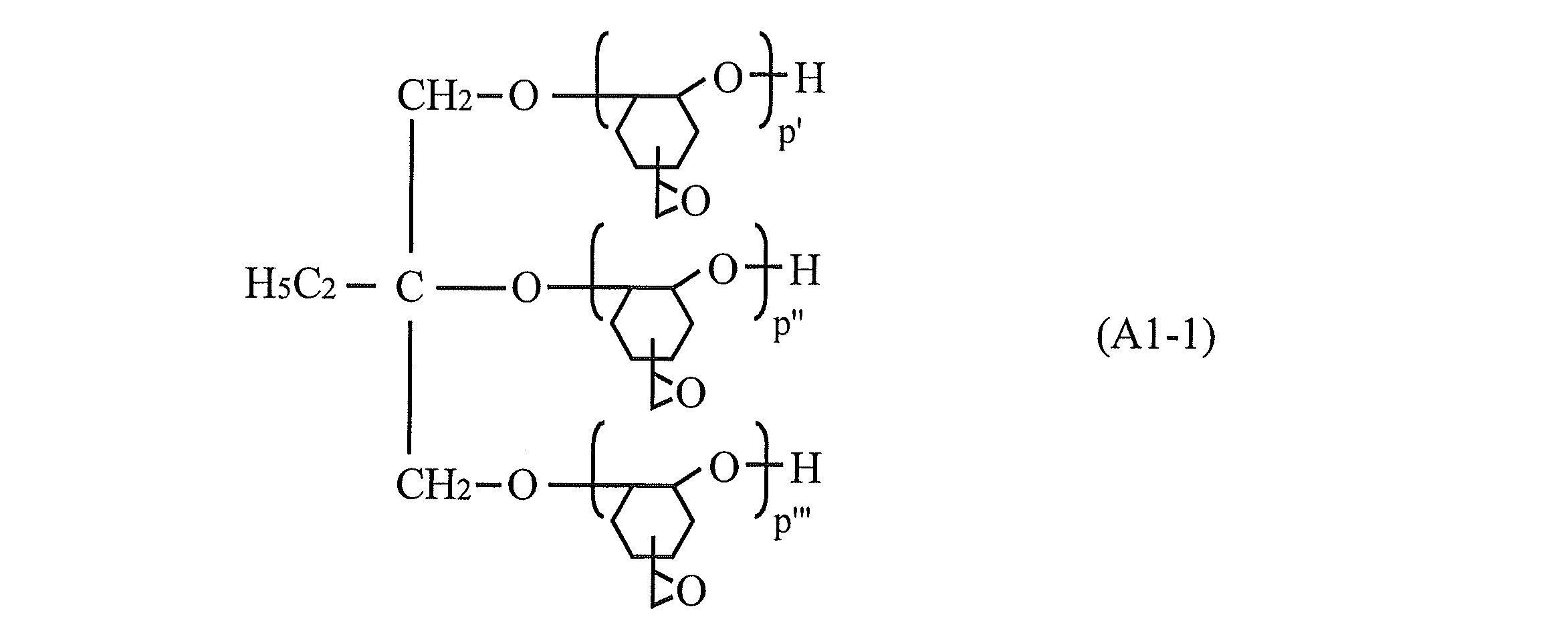
(成分(B))
本発明の成分(B)は、脂環を有し、且つエステル結合を有するエポキシ化合物であり、分子内に少なくとも1つの脂環を有し、且つ少なくとも1つのエステル結合を有するエポキシ化合物であればよい。成分(B)は、カチオン重合により他の硬化性化合物と共に三次元架橋構造を形成して硬化樹脂を形成することができる。
本発明の成分(B)は、脂環を有し、且つエステル結合を有するエポキシ化合物であり、分子内に少なくとも1つの脂環を有し、且つ少なくとも1つのエステル結合を有するエポキシ化合物であればよい。成分(B)は、カチオン重合により他の硬化性化合物と共に三次元架橋構造を形成して硬化樹脂を形成することができる。
本発明における成分(B)としては、他成分との溶解混錬時の温度において低粘度の液体(例えば、室温(25℃)で、500mPa・s以下、より好ましくは100mPa・s以下、特に好ましくは10~60mPa・s)を呈するエポキシ化合物が好ましく、例えば、融点が-30℃以上、100℃以下で、分子量が1000以下(例えば、180~900、好ましくは230~500程度)のエポキシ化合物を好適に使用することができる。
本発明における成分(B)としては、脂環エポキシ基を有するエポキシ化合物が、他のエポキシ化合物との相溶性に優れ、耐熱性、光学特性に優れ、適度な柔軟性を有する硬化樹脂を形成することができる点で好ましく、特に脂環エポキシ基を2個以上(特に、2個)有するエポキシ化合物が好ましい。
前記脂環としては、上記成分(A)における脂環と同様の例を挙げることができ、前記脂環エポキシ基としては、例えば、エポキシシクロペンチル基、3,4-エポキシシクロヘキシル基、3,4-エポキシトリシクロ[5.2.1.02,6]デカン8-(又は9)イル基(エポキシ化ジシクロペンタジエニル基)等が挙げられる。
成分(B)に含まれる代表的な化合物を下記に示す。下記式(B6)中、n2は平均重合度を示し、例えば、5以下(好ましくは、1~2)である。
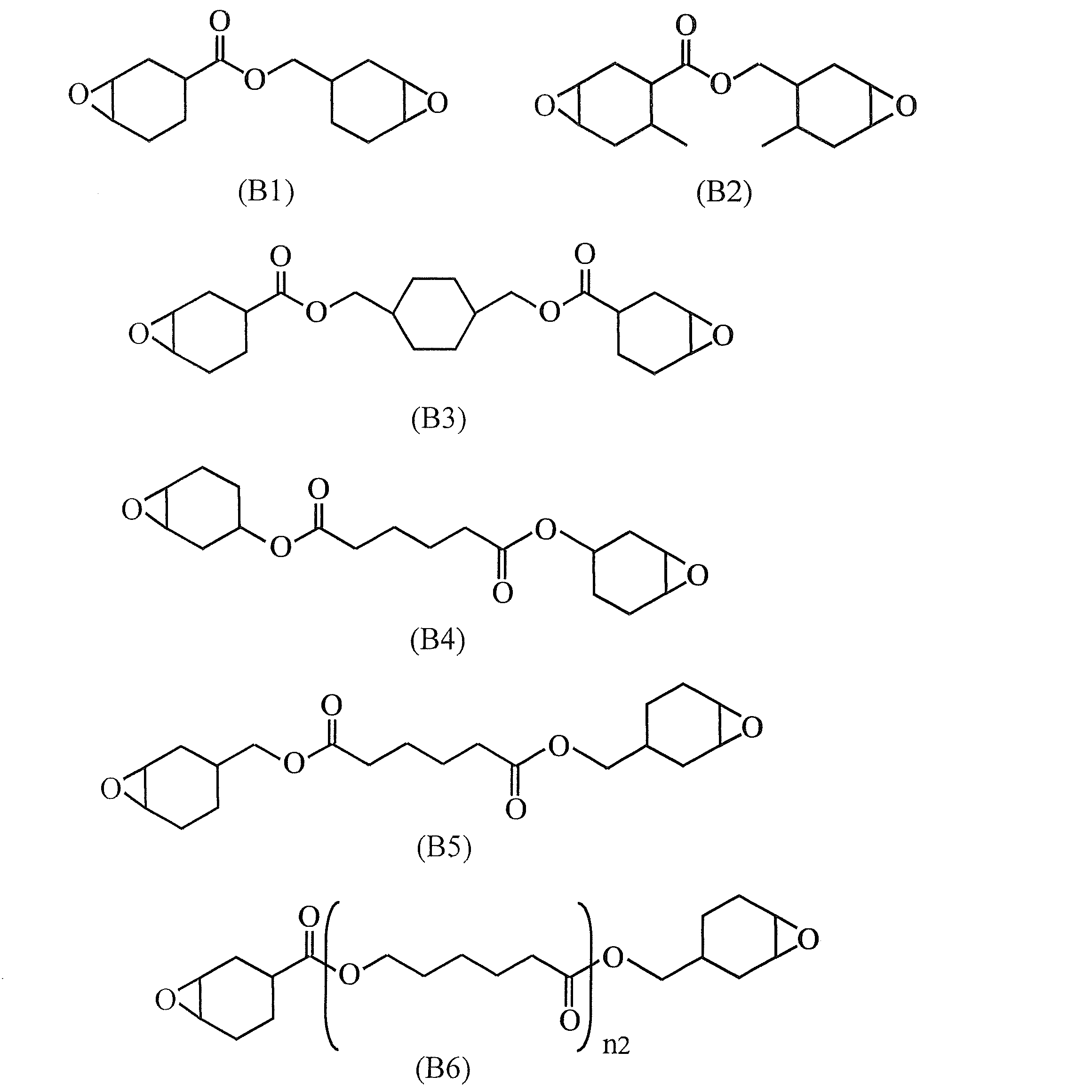
本発明に係る硬化性組成物は、硬化性化合物として上記成分(A)と成分(B)を前者/後者(重量比)が5/95~50/50(好ましくは5/95~40/60)となる割合で含有する。
本発明に係る硬化性組成物は、硬化性化合物として上記成分(A)と成分(B)とを上記範囲で含有するため、硬化させる前は低粘度で流動性が高く、金型等への流し込みが容易であり、カチオン重合することにより速やかに硬化樹脂を形成することができ、硬化性組成物が硬化を開始する温度と、前記硬化性組成物を2分間加熱して硬化率90%の硬化樹脂を形成することができる温度との差(反応温度ギャップ)を小さく(例えば、85℃以下、好ましくは60℃以下、特に好ましくは50℃以下)することができる。そのため、金型へ注入した硬化性組成物に硬化処理を施し、金型から取り出すという作業を極めて速やかに行うことができ、成型装置のスループット性(単位時間当たりの処理能力)を著しく向上させることができる。また、本発明に係る硬化性組成物は、キャスト法による成形に好適に用いることができる。一方、成分(A)が過剰となると、粘度が高くなりすぎ、金型等への注入が困難となる傾向があり、成分(B)が過剰となると、硬化速度が低下する傾向があり、光学特性が低下する傾向がある。
硬化性組成物における上記成分(A)の割合としては、硬化性組成物全体(又は、硬化性化合物の総量)の、例えば、5~50重量%であり、好ましくは5重量%以上、35重量%未満、さらに好ましくは10重量%以上、35重量%未満である。成分(A)の割合が上記範囲を下回ると、硬化速度が低下すると共に架橋密度が低下するため、得られる硬化樹脂の耐熱性が低下する傾向がある。一方、成分(A)の割合が上記範囲を上回ると、粘度が高くなりすぎ、金型等への注入が困難となる傾向がある。
硬化性組成物における上記成分(B)の割合としては、硬化樹脂の用途等によっても異なるが、硬化性組成物全体(又は、硬化性化合物の総量)の、例えば、30~95重量%、好ましくは35~80重量%、さらに好ましくは40~70重量%程度、最も好ましくは56~70重量%程度である。成分(B)の割合が上記範囲を下回ると、流動性及び耐熱性が低下し、得られる硬化樹脂の光学特性が低下し易くなる傾向がある。また、成分(B)の割合が上記範囲を上回ると、硬化速度が低下する傾向があり、硬化温度をより高くする必要が生じる場合がある。また、光学特性が低下する傾向がある。
また、本発明に係る硬化性化合物は、より優れた流動性と、より優れた硬化性を付与することができる点で、硬化性化合物として、上記成分(A)、成分(B)に下記成分(C)を配合することが好ましい。
(成分(C))
本発明の成分(C)は、脂環を構成する隣接する2つの炭素原子と酸素原子とで構成されるエポキシ基(脂環エポキシ基)を有し、且つエステル結合を有しないエポキシ化合物であり、少なくとも1つの脂環エポキシ基を有し、且つエステル結合を有しない脂環式エポキシ化合物であればよい。このような成分(C)は、カチオン重合により他の硬化性化合物と共に三次元架橋構造を形成して硬化樹脂を形成することができる。
本発明の成分(C)は、脂環を構成する隣接する2つの炭素原子と酸素原子とで構成されるエポキシ基(脂環エポキシ基)を有し、且つエステル結合を有しないエポキシ化合物であり、少なくとも1つの脂環エポキシ基を有し、且つエステル結合を有しない脂環式エポキシ化合物であればよい。このような成分(C)は、カチオン重合により他の硬化性化合物と共に三次元架橋構造を形成して硬化樹脂を形成することができる。
前記脂環としては、上記成分(A)における脂環と同様の例を挙げることができ、前記脂環エポキシ基としては、上記成分(B)における脂環エポキシ基と同様の例を挙げることができる。
本発明における成分(C)としては、例えば、下記式(C1)で表される化合物(2つの脂環エポキシ基が単結合により結合、又は2価の炭化水素基を介して結合している化合物:ビシクロエポキシ化合物)を挙げることができる。

上記式中、Y1は単結合又は2価の炭化水素基を示す。2価の炭化水素基としては2価の脂肪族炭化水素基、2価の脂環式炭化水素基、及び、これらが複数個結合した基を挙げることができる。2価の脂肪族炭化水素基としては、例えば、メチレン、メチルメチレン、ジメチルメチレン、エチレン、プロピレン、トリメチレン、テトラメチレン基等の直鎖状又は分岐鎖状のアルキレン基(例えば、C1-6アルキレン基)を挙げることができる。また、2価の脂環式炭化水素基としては、例えば、1,2-シクロペンチレン、1,3-シクロペンチレン、1,2-シクロへキシレン、1,3-シクロへキシレン、1,4-シクロへキシレン基等2価のシクロアルキレン基を挙げることができる。
式(C1)で表される化合物に含まれる代表的な化合物を下記に示す。
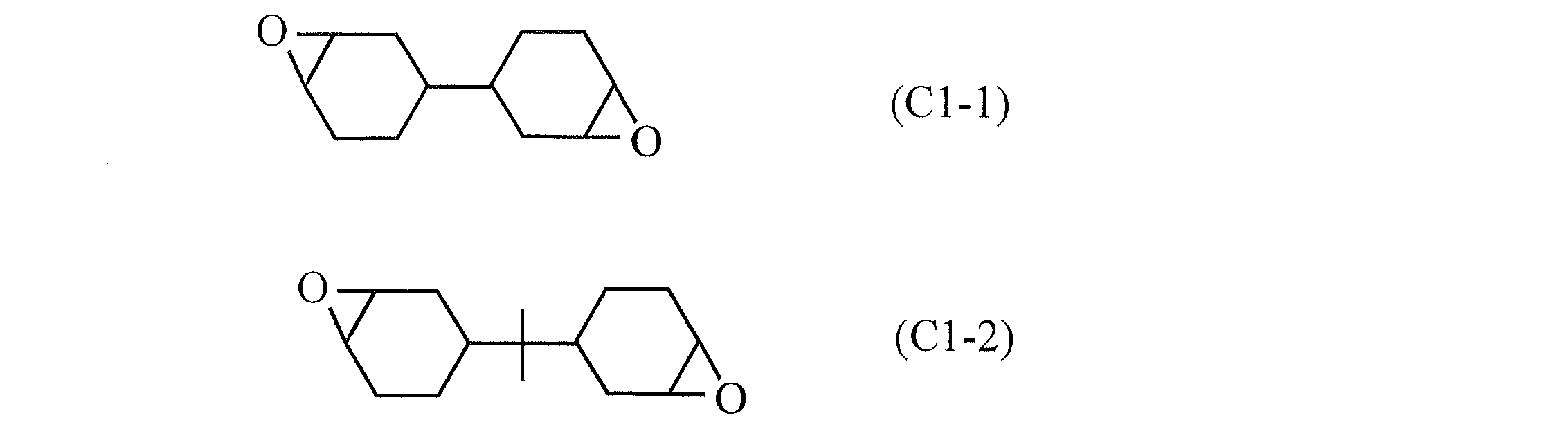
成分(C)としては、上記式(C1)で表される化合物の他に、分子内に脂環エポキシ基を1つ有する化合物も挙げられる。前記化合物は、脂環エポキシ基以外に他のエポキシ基を有していてもよい。代表的な化合物を下記に示す。
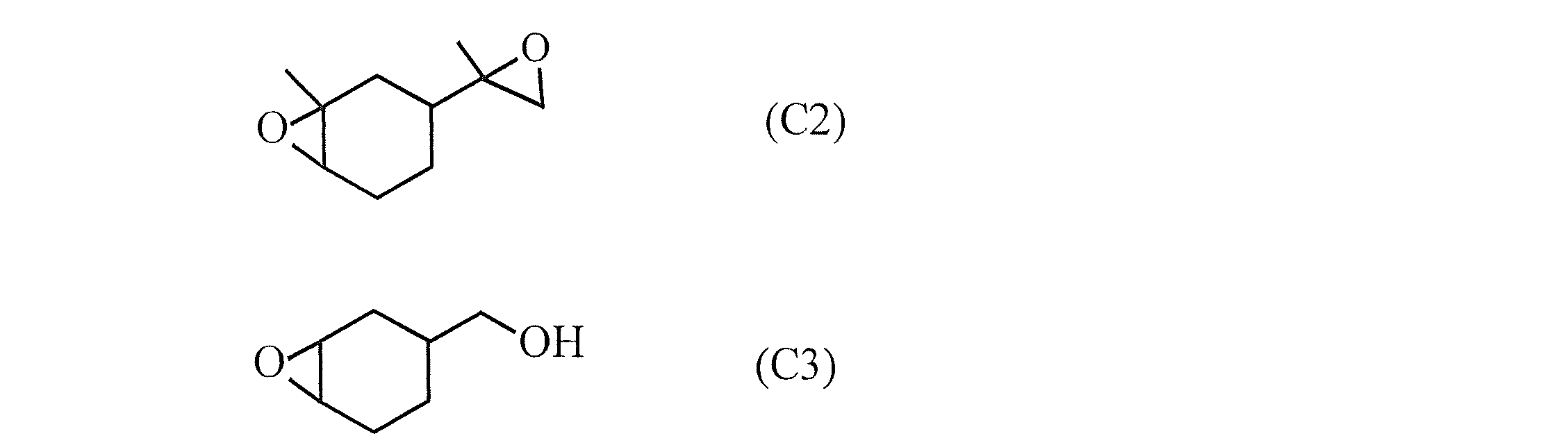
本発明における成分(C)としては、なかでも耐熱性に優れる硬化樹脂を形成することができる点で、上記式(C1)で表されるビシクロエポキシ化合物が好ましく、特に、反応性が高く、迅速に硬化性組成物を硬化させると共に、硬化時に収縮せず、むしろ体積膨張する傾向が見られるため、硬化性組成物を硬化する際の体積収縮率を抑制することができ、且つ、硬化して得られた硬化樹脂をアニール処理した際の硬化収縮による歪みや変形の発生も抑制することができる点で上記式(C1-1)で表される化合物が好ましい。
硬化性組成物における上記成分(C)の割合としては、硬化樹脂の用途等によっても異なるが、硬化性組成物全体(又は、硬化性化合物の総量)の、例えば、65重量%以下、好ましくは、5~60重量%、特に好ましくは5~35重量%程度である。
また、成分(A)と成分(B)の総和100重量部に対する成分(C)の添加量としては、例えば5~60重量部程度、好ましくは5~45重量部、特に好ましくは5~25重量部程度である。
また、成分(A)、成分(B)及び成分(C)の含有割合としては、硬化性化合物の総量を100重量部とすると、成分(A)/成分(B)/成分(C)(重量比)が、5~35/55~95/0~25程度(なかでも、10~34/56~90/5~15)が好ましい。
成分(C)を上記範囲で配合すると、得られる硬化樹脂の透明性を維持しつつ、硬化性組成物に優れた流動性を付与することができる。さらに、硬化速度を促進し、前記硬化性組成物が硬化を開始する温度と、前記硬化性組成物を2分間加熱して硬化率90%の硬化樹脂を形成することができる温度との差(反応温度ギャップ)を50℃以下にすることができ、より速やかに金型へ注入した硬化性組成物に硬化処理を施し、金型から取り出す作業を行うことができ、成型装置のスループット性を著しく向上させることができる。
(他の成分)
本発明の硬化性組成物は、硬化樹脂の光学特性、物理特性を損なわない範囲で、上記成分以外の他の硬化性化合物(カチオン重合性化合物、ラジカル重合性化合物等)を含んでいてもよい。
本発明の硬化性組成物は、硬化樹脂の光学特性、物理特性を損なわない範囲で、上記成分以外の他の硬化性化合物(カチオン重合性化合物、ラジカル重合性化合物等)を含んでいてもよい。
本発明の硬化性組成物中の硬化性化合物の総量に対する、上記成分以外の他の硬化性化合物の配合割合としては、上記成分(成分(A)、(B)、好ましくは、成分(A)、(B)、(C))の総量が、例えば60重量%以上、好ましくは80重量%以上、さらに好ましくは90重量%以上となる割合であることが好ましく、なかでも、他の硬化性化合物は実質的に含まないこと(すなわち、他の硬化性化合物の含有量は、硬化性化合物の総量に対して10重量%未満、好ましくは、5重量%未満)が好ましい。上記成分以外の他の硬化性化合物の配合割合が上記範囲を上回ると、流動性と硬化速度の両立が困難となり、得られる硬化樹脂の光学特性や物理特性が低下する傾向がある。
また、本発明の硬化性組成物は、芳香族化合物(例えば、ビスフェノールA型エポキシ化合物、ビスフェノールF型エポキシ化合物、3,3’,5,5’-テトラメチル-4,4’-ビフェノール型エポキシ化合物、4,4’-ビフェノール型エポキシ化合物等のビスフェノール型エポキシ化合物、ビスフェノールAノボラック型エポキシ化合物、ナフタレンジオール型エポキシ化合物等)の含有量が硬化性組成物全体の5重量%未満(より好ましくは、1重量%未満)であることが好ましい。芳香族化合物の含有量が上記範囲を上回ると、得られる硬化樹脂の耐熱性、光学特性(特に、透明性)が低下する傾向がある。尚、芳香族化合物の含有量の下限は0%である。
本発明の硬化性組成物全量に対する全硬化性化合物の割合は、例えば60重量%以上、好ましくは80重量%以上、さらに好ましくは90重量%以上である。
また、本発明の硬化性組成物は、使用する硬化性化合物の種類等に応じて、カチオン重合開始剤、硬化剤、硬化促進剤、ラジカル重合開始剤、光増感剤等各種添加剤を含んでいてもよい。
カチオン重合開始剤は、熱又は光によりカチオン重合を開始させる物質を放出する化合物(硬化触媒、酸発生剤)である。本発明においては、耐熱性の高い硬化樹脂を迅速に形成することができる点で、カチオン重合開始剤として熱カチオン重合開始剤を使用することが好ましい。カチオン重合開始剤の配合量は、硬化性組成物全体の、例えば0.01~15重量%、好ましくは0.01~2重量%である。この範囲で配合することにより、耐熱性、透明性等の良好な硬化樹脂を得ることができる。
上記カチオン重合開始剤としては、例えば、アリールジアゾニウム塩[例えば、商品名「PP-33」(旭電化工業(株)製)等]、アリールヨードニウム塩、アリールスルホニウム塩[例えば、商品名「FC-509」(スリーエム(株)製)、商品名「UVE1014」(G.E.(株)製)、商品名「CP-66」、「CP-77」(共に、旭電化工業(株)製)、商品名「サンエイド SI-60L」、「サンエイド SI-80L」、「サンエイド SI-100L」、「サンエイド SI-110L」(共に、三新化学工業(株)製)等]、アレン-イオン錯体[例えば、商品名「CG-24-61」(チバ・スペシャリティー・ケミカルズ社製)等]などが挙げられる。さらに、アルミニウムやチタン等の金属とアセト酢酸エステル又はジケトン類とのキレート化合物と、シラノールまたはフェノール類との系も使用される。前記キレート化合物としては、例えば、アルミニウムトリスアセチルアセトナート、アルミニウムトリスアセト酢酸エチル等が挙げられる。前記シラノールまたはフェノール類としては、例えば、トリフェニルシラノールやビスフェノールS等が挙げられる。本発明においては、なかでも、アリールスルホニウム塩(特に、商品名「サンエイド SI-60L」、商品名「サンエイド SI-100L」等)が、硬化性組成物が硬化を開始する温度を、例えば、80~120℃(好ましくは、80~100℃)に引き下げ、更に、硬化性組成物が硬化を開始する温度と、2分間加熱して硬化率90%の硬化樹脂を形成することができる温度との差(反応温度ギャップ)を小さくし、成型装置に高いスループット性を付与することができる点で好ましい。
硬化剤としては酸無水物を使用できる。酸無水物としては、一般にエポキシ化合物の硬化に使用されるものを用いることができるが、常温で液状のものが好ましく、具体例としては、メチルテトラヒドロ無水フタル酸、メチルヘキサヒドロ無水フタル酸、ドデセニル無水コハク酸、メチルエンドメチレンテトラヒドロ無水フタル酸等を挙げることができる。また、本発明の硬化性組成物の流動性に悪影響を与えない範囲で、常温で固体の酸無水物、例えば、無水フタル酸、テトラヒドロ無水フタル酸、ヘキサヒドロ無水フタル酸、メチルシクロヘキセンジカルボン酸無水物等を使用することができる。常温で固体の酸無水物を使用する場合には、常温で液状のエポキシ化合物に溶解させ、常温で液状の混合物として使用することが好ましい。硬化剤の配合量は、硬化性組成物中のカチオン硬化性化合物の種類及び量によっても異なるが、硬化性組成物全体の、例えば、40重量%未満程度、好ましくは20重量%未満程度、さらに好ましくは10重量%未満程度である。
硬化促進剤は、硬化剤として酸無水物を用いる際、硬化反応を促進する機能を有する化合物である。硬化促進剤は、一般に使用されるものであれば特に制限はないが、例えば、ジアザビシクロウンデセン系硬化促進剤(1,8-ジアザビシクロ[5.4.0]ウンデセン-7(DBU)又はその塩)、ベンジルジメチルアミン、2,4,6-トリス(ジメチルアミノメチル)フェノール等の三級アミン、2-エチル-4-メチルイミダゾール、1-シアノエチル-2-エチル-4-メチルイミダゾール等のイミダゾール類、トリフェニルホスフィン等の有機ホスフィン化合物、三級アミン塩、四級アンモニウム塩、ホスホニウム塩、オクチル酸スズ、オクチル酸亜鉛等の金属塩等が挙げられる。これらの中でも、ジアザビシクロウンデセン系硬化促進剤が好ましい。硬化促進剤の配合量は、硬化性組成物全体の、例えば、0~5重量%、好ましくは0.05~3重量%程度である。配合量が少なすぎると硬化促進効果が不十分となる場合があり、また多すぎると、硬化樹脂の色相が悪化する場合がある。
ラジカル重合開始剤(ラジカル発生剤)としては、光又は熱ラジカル重合開始剤として公知慣用のものを用いることができる。代表的な光ラジカル重合開始剤としては、例えば、ベンゾイン、ベンゾインメチルエーテル、ベンゾインエチルエーテル、ベンゾインイソプロピルエーテル等のベンゾイン・ベンゾインアルキルエーテル類;アセトフェノン、2,2-ジメトキシ-2-フェニルアセトフェノン、2,2-ジエトキシ-2-フェニルアセトフェノン、1,1-ジクロロアセトフェノン、2-メチル-1-[4-(メチルチオ)フェニル]-2-モルフォリノ-プロパン-1-オン、2-ベンジル-2-ジメチルアミノ-1-(4-モルフォリノフェニル)-ブタン-1-オン等のアセトフェノン類;2-メチルアントラキノン、2-エチルアントラキノン、2-tーブチルアントラキノン、1-クロロアントラキノン、2-アミルアントラキノン等のアントラキノン類;2,4-ジメチルチオキサントン、2,4-ジエチルチオキサントン、2-クロロチオキサントン、2,4-イソプロピルチオキサントン等のチオキサントン類;アセトフェノンジメチルケタール、ベンジルジメチルケタール等のケタール類;ベンゾフェノン等のベンゾフェノン類;キサントン類;1,7-ビス(9-アクリジニル)ヘプタン等が挙げられる。
代表的な熱ラジカル重合開始剤としては、例えば、ジアシルペルオキシド類、ペルオキシジカーボネート類、アルキルペルエステル類、ジアルキルペルオキシド類、ペルケタール類、ケトンペルオキシド類、及びアルキルヒドロペルオキシド類等の有機過酸化物等が挙げられる。これらの熱重合開始剤の具体例としては、例えば、ジベンゾイルペルオキシド、過安息香酸t-ブチルおよびアゾビスイソブチロニトリル等が挙げられる。
ラジカル重合開始剤の配合量は、硬化性組成物中のラジカル重合性化合物の種類及び量等によって異なるが、硬化性組成物全体の、例えば0.1~2重量%程度である。
光増感剤は、光ラジカル重合開始剤と組み合わせて用いることが好ましい。光増感剤としては、公知慣用のものを利用でき、例えば、N,N-ジメチルアミノ安息香酸エチルエステル、N,N-ジメチルアミノ安息香酸イソアミルエステル、ペンチル-4-ジメチルアミノベンゾエート、トリエチルアミン、トリエタノールアミン等の第3級アミン類等が挙げられる。これらの光増感剤は1種あるいは2種以上を組み合わせて用いることができる。光増感剤の含有量は、特に限定されないが、硬化性組成物全体の、例えば0.1~5重量%程度である。
本発明の硬化性組成物には、更に他の添加物を添加してもよい。他の添加剤としては、例えば、オルガノシロキサン化合物、金属酸化物粒子、ゴム粒子、シリコーン系やフッ素系の消泡剤、シランカップリング剤、充填剤、可塑剤、レベリング剤、帯電防止剤、離型剤、難燃剤、着色剤、酸化防止剤(例えば、ペンタエリスリトールテトラキス[3-(3,5-ジ-t-ブチル-4-ヒドロキシフェノール)プロピオネート]等)を使用することができる)、紫外線吸収剤、イオン吸着体、顔料等を挙げることができる。これら各種の添加剤の配合量は硬化性組成物全体の、例えば5重量%以下である。本発明の硬化性組成物は溶媒を含んでいてもよいが、あまり多いと硬化樹脂に気泡が生じる場合があるので、例えば、硬化性組成物全体の10重量%以下(なかでも、1重量%以下)であることが好ましい。
本発明の硬化性組成物は、例えば、上記成分(成分(A)、(B)、好ましくは、成分(A)、(B)、(C))、必要に応じてカチオン重合開始剤、硬化剤、硬化促進剤、ラジカル重合開始剤、光増感剤、各種添加剤等を配合して、必要に応じて真空下で気泡を排除しつつ、撹拌・混合することにより調製される。撹拌・混合する際の温度は、例えば、10~60℃程度である。撹拌・混合には、公知の装置、例えば、自転公転型ミキサー、1軸又は多軸エクストルーダー、プラネタリーミキサー、ニーダー、ディソルバー等を使用できる。
本発明の硬化性組成物はカチオン重合することにより硬化樹脂を形成することができ、例えば、上記硬化性組成物を成型装置の金型に注入し、加熱することにより目的の形状を有する硬化樹脂を得ることができる。加熱温度としては、硬化性組成物の構成により適宜調整することができ、例えば、80~260℃、好ましくは90~210℃、特に好ましくは100~150℃である。また、加熱前の硬化性組成物の液温が低い(例えば、室温)場合、急速に液温を上げるために、予め、150~250℃、好ましくは120~200℃で0.1~10分、好ましくは1~5分間加熱を行なって、硬化性組成物の液温を高くした後、上記の加熱温度において硬化処理を行なうこともできる。これらの硬化条件は、成形装置や金型、得ようとする硬化樹脂の形状や大きさにより適宜調整される。
また、加熱処理と併せて活性エネルギー線(例えば、紫外線等)を照射してもよい。活性エネルギー線として紫外線を用いる場合、その照射量は、例えば、1000~4000mJ/cm2程度である。
更に、硬化樹脂を金型から取り出した後、硬化樹脂内の残留応力を低減緩和する目的、及び、未反応の官能基の反応を進めることを目的として、硬化樹脂にアニール処理を施すことが好ましい。アニール処理は、100~300℃の温度で、10~300分程度加熱することにより行うことができ、例えば、130~180℃の温度で、10~120分間加熱する方法や、130~180℃の温度で5~60分間加熱し、更に230~280℃の温度で、1~30秒間加熱する方法等を挙げることができる。アニール処理の条件は、装置や硬化樹脂の形状や大きさ、処理量により適宜調整される。アニール処理を施すことにより、硬化樹脂の歪みを緩和して各種物性を均一にすると共に割れの発生を予防し、形状の誤差をより小さく抑制することができる。
本発明の硬化性組成物は、低粘度[例えば、25℃における粘度が5000mPa・s以下、好ましくは4500mPa・s以下(例えば、10~4500mPa・s)、より好ましくは4100mPa・s以下(例えば、50~4100mPa・s)、特に好ましくは4000mPa・s以下(例えば、50~4000mPa・s)、更に好ましくは2500mPa・s以下(例えば、150~2500mPa・s)、最も好ましくは1000mPa・s以下(例えば、150~1000mPa・s)]であるため流動性に優れ、速やかに且つムラなく均一に金型等への注入を行うことができる。
また、本発明においては上記硬化性組成物の構成により、加熱温度140℃でも、短時間(例えば、5分間程度、好ましくは2分以下)の加熱処理により60%以上(好ましくは75%以上、特に好ましくは90%以上)の硬化率で硬化させることができる。そのため、成型装置のスループット性を著しく向上させることができる。その上、加熱温度140℃で2分間の加熱処理により優れた硬化率で硬化樹脂を得ることができるため、その後、金型から取り出して更に加熱処理(例えば、アリール処理、ポストキュア等)を行っても、該加熱処理による硬化収縮の発生を抑制することができ、該硬化収縮により引き起こされる設計値からの形状誤差を最小に留めることができる。
尚、本明細書において、硬化率(%)は、硬化性組成物の硬化過程における発熱量で定義する。具体的には、定温硬化させたときの硬化率(%)をβとすると、硬化速度は、下記式で表される。
dβ/dt=1/HT(dQ/dt)T
ここで、HTは定温測定時の全発熱量であり、(dQ/dt)Tは定温測定時の単位時間あたりの発熱量である。硬化速度は、示差走査熱量計(DSC)を用いた熱分析により硬化性組成物の発熱量を測定することにより求められる。硬化率(%)は、硬化速度を時間積分することにより求められる。
dβ/dt=1/HT(dQ/dt)T
ここで、HTは定温測定時の全発熱量であり、(dQ/dt)Tは定温測定時の単位時間あたりの発熱量である。硬化速度は、示差走査熱量計(DSC)を用いた熱分析により硬化性組成物の発熱量を測定することにより求められる。硬化率(%)は、硬化速度を時間積分することにより求められる。
本発明の硬化樹脂は、上記硬化性組成物を硬化して得られるため、光学特性、物理特性の何れにも優れた性質を有する。
本発明の硬化樹脂の光線透過率(400nm)は、例えば80%以上(好ましくは、86%以上)、内部透過率(400nm)は、例えば85%以上(好ましくは90%以上、特に好ましくは94%以上)、屈折率(589nm)は、例えば1.45以上(好ましくは、1.50以上)、アッベ数は、例えば45以上(好ましくは、50以上、特に好ましくは、55以上)であることが好ましい。
また、本発明の硬化樹脂のガラス転移温度としては、例えば80~200℃(好ましくは、120~145℃)が好ましい。ガラス転移温度が80℃を下回ると、リフロー耐熱性が低下し、加熱により変形等を引き起こし易くなる傾向がある。一方、ガラス転移温度が200℃を上回ると、硬化樹脂の柔軟性が低下し、脆くなり、クラックが生じ易くなる傾向がある。
さらに、本発明の硬化樹脂は、25℃における弾性率(JIS K 7244-1~7に準拠した方法で測定)が、例えば0.1~5GPa程度(好ましくは、0.5~3GPa)であり、曲げ弾性率(JIS K 6911に準拠した方法で測定)が、例えば0.5~10GPa程度(好ましくは、1~5GPa)であり、適度な柔軟性を有するため、金型等から取り外しやすく、取り外す際にクラックの発生を防止することができる。
更にまた、本発明の硬化樹脂は、高温条件(例えば、260℃程度)に曝しても、光線透過率、内部透過率、屈折率、及びアッベ数に実質的な変化が生じることがなく、また体積収縮率が、5%以下(好ましくは、3.5%以下、特に好ましくは3.0%以下)であるため、形状も保持することができる。
更にまた、本発明の硬化樹脂は、吸湿性が低いため[吸水率が、5%以下(好ましくは、3%以下、特に好ましくは2%以下)]、高温高湿度条件(例えば、沸騰水に浸漬する程度)に曝しても、光線透過率、内部透過率、屈折率、及びアッベ数に実質的な変化が生じることがなく、形状も保持することができる。
本発明の硬化樹脂は、高温下でも光学特性や物理特性が変化しにくい。そのため、例えば、本発明の硬化樹脂を光学機器に実装してリフロー処理を施しても、各種物性値、特に光学特性値の変化を最小に留めることができ、優れた光学特性を維持することができる。
レンズの屈折率は光の波長によって異なり、像にズレ(滲みやぼやけ)が生じる現象(色収差)が発生する。この色収差の影響を少なくするため、通常のレンズは高アッベ数のレンズ樹脂と低アッベ数のレンズ樹脂とを組合せ、色収差を補正する構造となっている。カメラに使用するレンズのガラスは、アッベ数によってガラスを2つに分類し、一般に、アッベ数が50以下のものをフリントガラス、50以上のものをクラウンガラスと称している。本発明の硬化樹脂は、高アッベ数のレンズ用樹脂として好適に使用できる。
本発明の硬化樹脂は、光学部材(例えば、レンズ等の光学材料用途、オプトデバイス用途、表示デバイス用途、電気・電子部品材料用途等)に好適に使用できる。光学部材としては、例えば、カメラ(車載カメラ、デジタルカメラ、PC用カメラ、携帯電話用カメラ、監視カメラ等)の撮像用レンズ、メガネレンズ、フィルター、回折格子、プリズム、光案内子、光ビーム集光レンズ、光拡散用レンズ、表示装置用カバーガラス、フォトセンサー、フォトスイッチ、LED、発光素子、光導波路、光分割器、光ファイバー接着剤、表示素子用基板、カラーフィルター用基板、タッチパネル用基板、ディスプレイ保護膜、ディスプレイバックライト、導光板、反射防止フィルム等を挙げることができる。
特に、本発明の硬化樹脂からなるレンズをカメラ付き携帯電話のレンズとして用いると、リフロー方式によるハンダ付け工程(実装工程)においてカメラモジュールを同時に実装することが可能となり、ハンダ付け工程後に行われているコネクタによるカメラモジュールの接続工程を省略することができ、作業性に優れる。
以下に、実施例に基づいて本発明をより詳細に説明するが、本発明はこれらの実施例により限定されるものではない。
実施例及び比較例で用いた材料は下記の通りである。
[硬化性化合物]
「EHPE3150」:下記式で表される2,2-ビス(ヒドロキシメチル)-1-ブタノールの1,2-エポキシ-4-(2-オキシラニル)シクロヘキサン付加物(式中、p'、p''、p'''は同一又は異なって、1~30の整数を示す)、商品名「EHPE3150」(ダイセル化学工業社製)、前記式(A1)で表される化合物に含まれる

「YX8000」:下記式で表される非エステル系水添ビスフェノール型ジグリシジル化合物。商品名「YX8000」(ジャパンエポキシレジン社製)

「CEL2021P」:下記式で表される3,4-エポキシシクロヘキセニルメチル-3’,4’-エポキシシクロヘキセンカルボキシレート、商品名「セロキサイド2021P」(ダイセル化学工業社製)

「C1-1」:下記式で表される3,4,3’,4’-ジエポキシビシクロヘキシル(下記調製例1により得られた化合物を使用した)

[硬化性化合物]
「EHPE3150」:下記式で表される2,2-ビス(ヒドロキシメチル)-1-ブタノールの1,2-エポキシ-4-(2-オキシラニル)シクロヘキサン付加物(式中、p'、p''、p'''は同一又は異なって、1~30の整数を示す)、商品名「EHPE3150」(ダイセル化学工業社製)、前記式(A1)で表される化合物に含まれる
[カチオン重合開始剤]
「SI-100L」:アリールスルホニウム塩、商品名「サンエイド SI-100L」(三新化学工業株式会社製)
「SI-60L」:アリールスルホニウム塩、商品名「サンエイド SI-60L」(三新化学工業株式会社製)
「SI-100L」:アリールスルホニウム塩、商品名「サンエイド SI-100L」(三新化学工業株式会社製)
「SI-60L」:アリールスルホニウム塩、商品名「サンエイド SI-60L」(三新化学工業株式会社製)
[酸化防止剤]
「IRG1010」:ペンタエリスリトールテトラキス[3-(3,5-ジ-t-ブチル-4-ヒドロキシフェノール)プロピオネート]、商品名「IRG1010」(チバ・スペシャリティー・ケミカルズ社製)
「IRG1010」:ペンタエリスリトールテトラキス[3-(3,5-ジ-t-ブチル-4-ヒドロキシフェノール)プロピオネート]、商品名「IRG1010」(チバ・スペシャリティー・ケミカルズ社製)
調製例1
95重量%硫酸70g(0.68モル)と1,8-ジアザビシクロ[5.4.0]ウンデセン-7(DBU)55g(0.36モル)を撹拌混合して脱水触媒を調製した。
撹拌機、温度計、および脱水管を備え且つ保温された留出配管を具備した3リットルのフラスコに、水添ビフェノール(=4,4’-ジヒドロキシビシクロヘキシル)1000g(5.05モル)、上記で調製した脱水触媒125g(硫酸として0.68モル)、プソイドクメン1500gを入れ、フラスコを加熱した。内温が115℃を超えたあたりから水の生成が確認された。さらに昇温を続けてプソイドクメンの沸点まで温度を上げ(内温162~170℃)、常圧で脱水反応を行った。副生した水は留出させ、脱水管により系外に排出した。なお、脱水触媒は反応条件下において液体であり反応液中に微分散していた。3時間経過後、ほぼ理論量の水(180g)が留出したため反応終了とした。反応終了液を10段のオールダーショウ型の蒸留塔を用い、プソイドクメンを留去した後、内部圧力10Torr(1.33kPa)、内温137~140℃にて蒸留し、731gのビシクロヘキシル-3,3’-ジエンを得た。
95重量%硫酸70g(0.68モル)と1,8-ジアザビシクロ[5.4.0]ウンデセン-7(DBU)55g(0.36モル)を撹拌混合して脱水触媒を調製した。
撹拌機、温度計、および脱水管を備え且つ保温された留出配管を具備した3リットルのフラスコに、水添ビフェノール(=4,4’-ジヒドロキシビシクロヘキシル)1000g(5.05モル)、上記で調製した脱水触媒125g(硫酸として0.68モル)、プソイドクメン1500gを入れ、フラスコを加熱した。内温が115℃を超えたあたりから水の生成が確認された。さらに昇温を続けてプソイドクメンの沸点まで温度を上げ(内温162~170℃)、常圧で脱水反応を行った。副生した水は留出させ、脱水管により系外に排出した。なお、脱水触媒は反応条件下において液体であり反応液中に微分散していた。3時間経過後、ほぼ理論量の水(180g)が留出したため反応終了とした。反応終了液を10段のオールダーショウ型の蒸留塔を用い、プソイドクメンを留去した後、内部圧力10Torr(1.33kPa)、内温137~140℃にて蒸留し、731gのビシクロヘキシル-3,3’-ジエンを得た。
得られたビシクロヘキシル-3,3’-ジエン243g、酢酸エチル730gを反応器に仕込み、窒素を気相部に吹き込みながら、かつ、反応系内の温度を37.5℃になるようにコントロールしながら約3時間かけて30重量%過酢酸の酢酸エチル溶液(水分率0.41重量%)274gを滴下した。過酢酸溶液滴下終了後、40℃で1時間熟成し反応を終了した。さらに30℃で反応終了時の粗液を水洗し、70℃/20mmHgで低沸点化合物の除去を行い、脂環式エポキシ化合物270gを得た。得られた脂環式エポキシ化合物のオキシラン酸素濃度は15.0重量%であった。また1H-NMRの測定では、δ4.5~5ppm付近の内部二重結合に由来するピークが消失し、δ3.1ppm付近にエポキシ基に由来するプロトンのピークの生成が確認され、3,4,3’,4’-ジエポキシビシクロヘキシルであることが確認された。
実施例1~5、比較例1~4
下記表1に記載の各成分を配合し、常温(25℃)雰囲気下で自転公転型ミキサーを使用して撹拌・混合することにより硬化性組成物を得た。

下記表1に記載の各成分を配合し、常温(25℃)雰囲気下で自転公転型ミキサーを使用して撹拌・混合することにより硬化性組成物を得た。
実施例及び比較例で得られた硬化性組成物について下記方法により評価した。
[粘度]
硬化性組成物の粘度は、レオメーター(商品名「PHYSICA UDS200」、Paar Physica社製)を使用し、25℃においてせん断速度15~25s-1領域で測定した粘度(mPa・s)の平均値を使用した。
硬化性組成物の粘度は、レオメーター(商品名「PHYSICA UDS200」、Paar Physica社製)を使用し、25℃においてせん断速度15~25s-1領域で測定した粘度(mPa・s)の平均値を使用した。
[硬化率]
実施例及び比較例で得られた硬化性組成物について、示差走査熱量計(DSC)(商品名「Q2000」、ティー・エイ・インスツルメント社製)を使用して、窒素雰囲気下において、下記温度条件下で硬化発熱量を測定して測定曲線を得た。得られた測定曲線より必要パラメーターを算出し、n次元モデルの反応速度式を求め、装置内臓ソフトにより140℃で2分間加熱した際の硬化率(%)を算出した。
温度条件:50℃で3分間保持、続いて20℃/分で昇温し、250℃で3分間保持、-20℃/分で降温し、-50℃で3分間保持、続いて250℃まで20℃/分で昇温
実施例及び比較例で得られた硬化性組成物について、示差走査熱量計(DSC)(商品名「Q2000」、ティー・エイ・インスツルメント社製)を使用して、窒素雰囲気下において、下記温度条件下で硬化発熱量を測定して測定曲線を得た。得られた測定曲線より必要パラメーターを算出し、n次元モデルの反応速度式を求め、装置内臓ソフトにより140℃で2分間加熱した際の硬化率(%)を算出した。
温度条件:50℃で3分間保持、続いて20℃/分で昇温し、250℃で3分間保持、-20℃/分で降温し、-50℃で3分間保持、続いて250℃まで20℃/分で昇温
[反応温度ギャップ]
上記硬化率測定において得られた硬化発熱量の測定曲線から装置内臓ソフトを使用して硬化開始温度(T1)及び、2分間加熱で硬化率90%の硬化樹脂を形成することができる温度[硬化温度(90%、2分間):T2]を算出し、その差(T2-T1:℃)をもって反応温度ギャップとした。
上記硬化率測定において得られた硬化発熱量の測定曲線から装置内臓ソフトを使用して硬化開始温度(T1)及び、2分間加熱で硬化率90%の硬化樹脂を形成することができる温度[硬化温度(90%、2分間):T2]を算出し、その差(T2-T1:℃)をもって反応温度ギャップとした。
上記結果を下記表にまとめて示す。

実施例及び比較例で得られた硬化性組成物を予め離型剤で表面処理したガラス製の型に室温(25℃)で注型した。
次いで、注型された硬化性組成物を、大気雰囲気下でオーブンを使用して下記のように加熱し、硬化樹脂(1)を得た。
実施例1で得られた硬化性組成物:注型した硬化性組成物を100℃で60分間加熱
実施例2、4、5、及び比較例で得られた硬化性組成物:注型した硬化性組成物を常温(25℃)から昇温速度50℃/分で140℃まで急速に昇温し、140℃で2分間加熱
実施例3で得られた硬化性組成物:注型した硬化性組成物を200℃で5分間加熱
次いで、注型された硬化性組成物を、大気雰囲気下でオーブンを使用して下記のように加熱し、硬化樹脂(1)を得た。
実施例1で得られた硬化性組成物:注型した硬化性組成物を100℃で60分間加熱
実施例2、4、5、及び比較例で得られた硬化性組成物:注型した硬化性組成物を常温(25℃)から昇温速度50℃/分で140℃まで急速に昇温し、140℃で2分間加熱
実施例3で得られた硬化性組成物:注型した硬化性組成物を200℃で5分間加熱
その後、得られた硬化樹脂(1)を、一度、室温(25℃)まで冷却し、さらに大気雰囲気下でオーブンを使用して下記のようにアニール処理を施して硬化樹脂(2)を得た。
実施例1、3で得られた硬化性組成物からなる硬化樹脂(1):160℃で1時間加熱
実施例2、4、5及び比較例で得られた硬化性組成物からなる硬化樹脂(1):160℃で30分間加熱し、更に、卓上リフロー炉を使用して260℃で10秒間加熱
実施例1、3で得られた硬化性組成物からなる硬化樹脂(1):160℃で1時間加熱
実施例2、4、5及び比較例で得られた硬化性組成物からなる硬化樹脂(1):160℃で30分間加熱し、更に、卓上リフロー炉を使用して260℃で10秒間加熱
得られた硬化樹脂(2)について、下記方法で光学特性、物理特性及び耐熱性を評価した。
[透過率]
硬化樹脂(2)について、波長400nmにおける光線透過率(%)を、分光光度計(日立ハイテクノロジーズ社製、商品名「U-3900」)を用いてJIS B 7105に準拠した方法で測定した。
硬化樹脂(2)について、波長400nmにおける光線透過率(%)を、分光光度計(日立ハイテクノロジーズ社製、商品名「U-3900」)を用いてJIS B 7105に準拠した方法で測定した。
[内部透過率]
硬化樹脂(2)の内部透過率を下記式から算出した。
内部透過率(400nm)=400nmにおける光線透過率/(1-r)2
r={(n-1)/(n+1)}2
nは400nmにおける屈折率であり、下記方法で測定した400nmにおける屈折率の値を用いた。また、400nmにおける光線透過率は、上記方法で測定した値を用いた。
硬化樹脂(2)の内部透過率を下記式から算出した。
内部透過率(400nm)=400nmにおける光線透過率/(1-r)2
r={(n-1)/(n+1)}2
nは400nmにおける屈折率であり、下記方法で測定した400nmにおける屈折率の値を用いた。また、400nmにおける光線透過率は、上記方法で測定した値を用いた。
[屈折率]
硬化樹脂(2)の屈折率は、JIS K 7142に準拠した方法で、屈折率計(商品名「Model 2010」、メトリコン社製)を用いて、25℃における589nmの屈折率を測定した。
硬化樹脂(2)の屈折率は、JIS K 7142に準拠した方法で、屈折率計(商品名「Model 2010」、メトリコン社製)を用いて、25℃における589nmの屈折率を測定した。
[アッベ数]
硬化樹脂(2)のアッベ数は下の式によって算出した。
アッベ数=(nd-1)/(nf-nc)
式中、ndは589.2nmにおける屈折率、nfは486.1nmにおける屈折率、ncは656.3nmにおける屈折率を示す。なお、屈折率としては、上記方法で測定した値を用いた。
硬化樹脂(2)のアッベ数は下の式によって算出した。
アッベ数=(nd-1)/(nf-nc)
式中、ndは589.2nmにおける屈折率、nfは486.1nmにおける屈折率、ncは656.3nmにおける屈折率を示す。なお、屈折率としては、上記方法で測定した値を用いた。
[ガラス転移温度]
硬化樹脂(2)のガラス転移温度は、TMA測定装置(商品名「TMA/SS100」、エスアイアイ・ナノテクノロジー社製)を用い、窒素雰囲気下において、昇温速度5℃/min、測定温度範囲30℃~250℃で熱膨張率を測定し、ガラス転移点前後の曲線に接線を引き、この接線の交点からガラス転移温度(Tg)を求めた。
硬化樹脂(2)のガラス転移温度は、TMA測定装置(商品名「TMA/SS100」、エスアイアイ・ナノテクノロジー社製)を用い、窒素雰囲気下において、昇温速度5℃/min、測定温度範囲30℃~250℃で熱膨張率を測定し、ガラス転移点前後の曲線に接線を引き、この接線の交点からガラス転移温度(Tg)を求めた。
[線膨張係数]
硬化樹脂(2)の線膨張係数は、TMA測定装置(商品名「TMA/SS100」、エスアイアイ・ナノテクノロジー社製)を用い、JIS K 7197に準拠した方法、すなわち、窒素雰囲気下において、昇温速度5℃/min、測定温度範囲30℃~250℃で熱膨張率を測定し、低温側の直線の勾配を線膨張係数として表した。
硬化樹脂(2)の線膨張係数は、TMA測定装置(商品名「TMA/SS100」、エスアイアイ・ナノテクノロジー社製)を用い、JIS K 7197に準拠した方法、すなわち、窒素雰囲気下において、昇温速度5℃/min、測定温度範囲30℃~250℃で熱膨張率を測定し、低温側の直線の勾配を線膨張係数として表した。
[弾性率]
硬化樹脂(2)の弾性率(GPa)は、固体粘弾性測定装置(商品名「RSAIII」、ティー・エイ・インスツルメント社製)を用い、JIS 7244-1~7に準拠した方法、すなわち、試験片(長さ40mm×幅25mm×厚み0.5mm)を窒素雰囲気下において、昇温速度5℃/分、測定温度範囲-30℃~270℃で動的粘弾性特性を測定し、25℃での弾性率を読み取った。
硬化樹脂(2)の弾性率(GPa)は、固体粘弾性測定装置(商品名「RSAIII」、ティー・エイ・インスツルメント社製)を用い、JIS 7244-1~7に準拠した方法、すなわち、試験片(長さ40mm×幅25mm×厚み0.5mm)を窒素雰囲気下において、昇温速度5℃/分、測定温度範囲-30℃~270℃で動的粘弾性特性を測定し、25℃での弾性率を読み取った。
[曲げ弾性率]
硬化樹脂(2)から、試験片(長さ25mm×幅1.0mm×厚み1.0mm)を作成し、引張試験器(商品名「テンシロン万能材料試験機 RTF-1350」、(株)エー・アンド・デイ製)を使用し、JIS K 6911に準拠し、曲げ速度1mm/分で三点曲げ弾性率を測定した。
硬化樹脂(2)から、試験片(長さ25mm×幅1.0mm×厚み1.0mm)を作成し、引張試験器(商品名「テンシロン万能材料試験機 RTF-1350」、(株)エー・アンド・デイ製)を使用し、JIS K 6911に準拠し、曲げ速度1mm/分で三点曲げ弾性率を測定した。
[体積収縮率]
硬化樹脂(2)の体積収縮率(%)は、実施例及び比較例で得られた硬化性組成物の25℃における比重(G1)、及び該硬化性組成物を上記方法により硬化して得られた硬化樹脂(2)の比重(G2)を下記方法により測定し、下記式から算出した。
硬化性組成物の比重(25℃における):ポータブル電子密度計(商品名「DA-130N」、京都電子工業(株)製)を使用して測定した
硬化樹脂(2)の比重:電子比重計(商品名「SD-200L」、(株)島津製作所製)を使用して測定した。
体積収縮率(%)={(G2-G1)/G1}×100
硬化樹脂(2)の体積収縮率(%)は、実施例及び比較例で得られた硬化性組成物の25℃における比重(G1)、及び該硬化性組成物を上記方法により硬化して得られた硬化樹脂(2)の比重(G2)を下記方法により測定し、下記式から算出した。
硬化性組成物の比重(25℃における):ポータブル電子密度計(商品名「DA-130N」、京都電子工業(株)製)を使用して測定した
硬化樹脂(2)の比重:電子比重計(商品名「SD-200L」、(株)島津製作所製)を使用して測定した。
体積収縮率(%)={(G2-G1)/G1}×100
[吸水率]
硬化樹脂(2)の吸水率は、JIS K7209に準拠した方法で測定した。すなわち、硬化樹脂(2)から、試験片(長さ10mm×幅10mm×厚み1.0mm)を作成し、得られた試験片を真空乾燥機で予備乾燥(約50℃、24時間)した後、重量(W1)を測定した。
続いて、イオン交換水中に浸漬し、その後、沸騰した超純水に2時間浸漬して、取り出し、キムワイプで水分を拭き取って重量(W2)を測定し、下記式から吸水率を算出した。
吸水率(%)={(W2-W1)/W1}×100
硬化樹脂(2)の吸水率は、JIS K7209に準拠した方法で測定した。すなわち、硬化樹脂(2)から、試験片(長さ10mm×幅10mm×厚み1.0mm)を作成し、得られた試験片を真空乾燥機で予備乾燥(約50℃、24時間)した後、重量(W1)を測定した。
続いて、イオン交換水中に浸漬し、その後、沸騰した超純水に2時間浸漬して、取り出し、キムワイプで水分を拭き取って重量(W2)を測定し、下記式から吸水率を算出した。
吸水率(%)={(W2-W1)/W1}×100
[耐熱性試験]
硬化樹脂(2)を予め270℃に加熱したオーブンに、大気雰囲気下で1分間保持する耐熱試験を、連続して3回行って硬化樹脂(3)を得た。得られた硬化樹脂(3)について上記方法により透過率、内部透過率、屈折率、アッベ数を測定し、高温環境に曝すことによる、透過率、内部透過率、屈折率、アッベ数の変化の有無を測定した。
硬化樹脂(2)を予め270℃に加熱したオーブンに、大気雰囲気下で1分間保持する耐熱試験を、連続して3回行って硬化樹脂(3)を得た。得られた硬化樹脂(3)について上記方法により透過率、内部透過率、屈折率、アッベ数を測定し、高温環境に曝すことによる、透過率、内部透過率、屈折率、アッベ数の変化の有無を測定した。
上記評価結果を下記表にまとめて示す。

本発明の硬化性組成物は、流動性に優れるため容易且つ速やかに注型することができ、また、極めて速やかに硬化して、光学特性、物理特性、及び耐熱性に優れる硬化樹脂を得ることができた。一方、比較例1、2で得られた硬化性組成物を硬化して得られた硬化樹脂(2)は、高温環境に曝すと光学特性が大きく低下し、レンズ等の用途には適さなかった。また、比較例2で得られた硬化性組成物は、粘度が低く、注型してから硬化がある程度進むまでの間に型崩れし易く、取り扱いが難しかった。一方、比較例3で得られた硬化性組成物は、粘度が高すぎるため注型が困難であり、気泡の除去が難しく、均等に金型に注入して表面が平滑な硬化樹脂を得ることができなかった。さらに、比較例4は、組成物の硬化反応が極めて速く進み、硬化樹脂の内部に気泡が生じて、均一な硬化樹脂を得ることができなかった。
したがって、比較例の硬化性組成物は、何れも、成形性に劣り、とりわけキャスト法による成形に用いることが困難であるか、或いは、成形性は悪くなくとも、該硬化性組成物からは、光学特性、物理特性、及び耐熱性に優れた硬化樹脂が得られなかった。
したがって、比較例の硬化性組成物は、何れも、成形性に劣り、とりわけキャスト法による成形に用いることが困難であるか、或いは、成形性は悪くなくとも、該硬化性組成物からは、光学特性、物理特性、及び耐熱性に優れた硬化樹脂が得られなかった。
本発明の硬化性組成物は、硬化させる前は流動性が高く、金型等への流し込みが容易であり、カチオン重合することにより極めて速やかに硬化して、光のにじみがなく、耐熱性、透明性に優れた樹脂を形成することができる。また硬化収縮による応力歪みや割れの発生を抑制することができる。そのため、本発明の硬化性組成物を硬化して得られる樹脂は、リフロー方式によるハンダ付け可能な光学部材として好適に使用できる。
Claims (6)
- 硬化性化合物として、下記成分(A)、成分(B)を、前者/後者(重量比)が5/95~50/50となる割合で含有することを特徴とする硬化性組成物。
成分(A):脂環とエポキシ基とが単結合又は連結基を介して結合しているエポキシ化合物であって、エステル結合を有しないエポキシ化合物
成分(B):脂環を有し、且つエステル結合を有するエポキシ化合物 - 硬化性化合物として、更に下記成分(C)を含むことを特徴とする請求項1に記載の硬化性組成物。
成分(C):脂環を構成する隣接する2つの炭素原子と酸素原子とで構成されるエポキシ基を有し、且つエステル結合を有しないエポキシ化合物 - 成分(A)と成分(B)の総和100重量部に対して成分(C)を5~60重量部含有することを特徴とする請求項2に記載の硬化性組成物。
- 芳香族化合物の含有量が硬化性組成物全体の5重量%未満である請求項1~3の何れかの項に記載の硬化性組成物。
- 請求項1~4の何れかの項に記載の硬化性組成物を硬化して得られる硬化樹脂。
- 請求項5に記載の硬化樹脂からなる光学部材。
Applications Claiming Priority (2)
| Application Number | Priority Date | Filing Date | Title |
|---|---|---|---|
| JP2010-278251 | 2010-12-14 | ||
| JP2010278251 | 2010-12-14 |
Publications (1)
| Publication Number | Publication Date |
|---|---|
| WO2012081393A1 true WO2012081393A1 (ja) | 2012-06-21 |
Family
ID=46244503
Family Applications (1)
| Application Number | Title | Priority Date | Filing Date |
|---|---|---|---|
| PCT/JP2011/077503 Ceased WO2012081393A1 (ja) | 2010-12-14 | 2011-11-29 | 硬化性組成物、及び硬化樹脂 |
Country Status (3)
| Country | Link |
|---|---|
| JP (1) | JP5913944B2 (ja) |
| TW (1) | TWI518132B (ja) |
| WO (1) | WO2012081393A1 (ja) |
Families Citing this family (7)
| Publication number | Priority date | Publication date | Assignee | Title |
|---|---|---|---|---|
| TW201428019A (zh) * | 2012-10-01 | 2014-07-16 | Sumitomo Bakelite Co | 樹脂組成物、樹脂硬化物、透明複合體、顯示元件用基板及面光源用基板 |
| WO2015046333A1 (ja) * | 2013-09-27 | 2015-04-02 | 株式会社ダイセル | 半導体積層用接着剤組成物 |
| JP2015118349A (ja) * | 2013-12-20 | 2015-06-25 | 住友ベークライト株式会社 | 反射防止層用樹脂組成物、反射防止層および光学装置 |
| CN105940767B (zh) * | 2014-05-20 | 2018-02-09 | 积水化学工业株式会社 | 有机电致发光显示元件用密封剂 |
| WO2016021577A1 (ja) * | 2014-08-08 | 2016-02-11 | 株式会社ダイセル | 特殊形状を有するエポキシ樹脂成形物、及びそれを備えた光学装置 |
| JP6596223B2 (ja) * | 2015-04-17 | 2019-10-23 | 東京応化工業株式会社 | 接着剤組成物、積層体、積層体の製造方法 |
| JP2017040791A (ja) * | 2015-08-20 | 2017-02-23 | 株式会社ダイセル | 光学部品、及びそれを備えた光学装置 |
Citations (7)
| Publication number | Priority date | Publication date | Assignee | Title |
|---|---|---|---|---|
| JPH03247619A (ja) * | 1990-02-27 | 1991-11-05 | Hitachi Chem Co Ltd | エポキシ樹脂組成物および絶縁構造物の製造法 |
| JPH10156952A (ja) * | 1996-11-26 | 1998-06-16 | Asahi Denka Kogyo Kk | エネルギー線硬化性エポキシ樹脂組成物、光学的立体造形用樹脂組成物及び光学的立体造形方法 |
| JPH10168106A (ja) * | 1996-12-10 | 1998-06-23 | Jsr Corp | 光硬化性樹脂組成物 |
| JPH10226745A (ja) * | 1997-02-14 | 1998-08-25 | Somar Corp | 含浸用エポキシ樹脂組成物及びそれを用いたフィルムコンデンサ |
| JP2003040972A (ja) * | 2001-07-26 | 2003-02-13 | Japan Epoxy Resin Kk | 光半導体用エポキシ樹脂組成物及び光半導体装置 |
| WO2008044618A1 (en) * | 2006-09-29 | 2008-04-17 | Nippon Shokubai Co., Ltd. | Curable resin composition, optical material, and method of regulating optical material |
| JP2009013264A (ja) * | 2007-07-03 | 2009-01-22 | Nitto Denko Corp | 光半導体素子封止用エポキシ樹脂組成物およびそれを用いた光半導体装置 |
Family Cites Families (5)
| Publication number | Priority date | Publication date | Assignee | Title |
|---|---|---|---|---|
| JP5226162B2 (ja) * | 2001-05-14 | 2013-07-03 | 株式会社ダイセル | 液状エポキシ樹脂組成物及びその用途 |
| JP2003277473A (ja) * | 2002-03-26 | 2003-10-02 | Japan Epoxy Resin Kk | Led封止材用エポキシ樹脂組成物及びled装置 |
| JP2004352771A (ja) * | 2003-05-27 | 2004-12-16 | Nitto Denko Corp | 紫外線硬化型エポキシ樹脂組成物 |
| JP5000261B2 (ja) * | 2006-10-20 | 2012-08-15 | 株式会社ダイセル | エポキシ樹脂組成物及びエポキシ樹脂硬化物 |
| JP5226223B2 (ja) * | 2007-01-31 | 2013-07-03 | 株式会社ダイセル | 透明封止材料及び透明封止物 |
-
2011
- 2011-11-29 WO PCT/JP2011/077503 patent/WO2012081393A1/ja not_active Ceased
- 2011-12-06 JP JP2011267069A patent/JP5913944B2/ja not_active Expired - Fee Related
- 2011-12-09 TW TW100145493A patent/TWI518132B/zh not_active IP Right Cessation
Patent Citations (7)
| Publication number | Priority date | Publication date | Assignee | Title |
|---|---|---|---|---|
| JPH03247619A (ja) * | 1990-02-27 | 1991-11-05 | Hitachi Chem Co Ltd | エポキシ樹脂組成物および絶縁構造物の製造法 |
| JPH10156952A (ja) * | 1996-11-26 | 1998-06-16 | Asahi Denka Kogyo Kk | エネルギー線硬化性エポキシ樹脂組成物、光学的立体造形用樹脂組成物及び光学的立体造形方法 |
| JPH10168106A (ja) * | 1996-12-10 | 1998-06-23 | Jsr Corp | 光硬化性樹脂組成物 |
| JPH10226745A (ja) * | 1997-02-14 | 1998-08-25 | Somar Corp | 含浸用エポキシ樹脂組成物及びそれを用いたフィルムコンデンサ |
| JP2003040972A (ja) * | 2001-07-26 | 2003-02-13 | Japan Epoxy Resin Kk | 光半導体用エポキシ樹脂組成物及び光半導体装置 |
| WO2008044618A1 (en) * | 2006-09-29 | 2008-04-17 | Nippon Shokubai Co., Ltd. | Curable resin composition, optical material, and method of regulating optical material |
| JP2009013264A (ja) * | 2007-07-03 | 2009-01-22 | Nitto Denko Corp | 光半導体素子封止用エポキシ樹脂組成物およびそれを用いた光半導体装置 |
Also Published As
| Publication number | Publication date |
|---|---|
| TWI518132B (zh) | 2016-01-21 |
| TW201231544A (en) | 2012-08-01 |
| JP5913944B2 (ja) | 2016-05-11 |
| JP2012140607A (ja) | 2012-07-26 |
Similar Documents
| Publication | Publication Date | Title |
|---|---|---|
| JP6001668B2 (ja) | 硬化性組成物及びその硬化物、光学部材、並びに光学装置 | |
| JP5913944B2 (ja) | 硬化性組成物、及び硬化樹脂 | |
| JP6232160B1 (ja) | レンズの製造方法、レンズおよび光学装置 | |
| JP5716672B2 (ja) | 感光性樹脂組成物、感光性樹脂ワニス、感光性樹脂フィルム、及び感光性樹脂硬化物 | |
| JP2010053199A (ja) | 光半導体封止用樹脂組成物 | |
| KR20130000390A (ko) | 경화성 조성물 및 경화물 | |
| JP2009084310A (ja) | 熱・光硬化性樹脂組成物、光学材料及び光学部材 | |
| JP2012116989A (ja) | 樹脂レンズ及び光学樹脂組成物 | |
| WO2017026351A1 (ja) | 硬化性組成物及びその硬化物 | |
| JP6491637B2 (ja) | 硬化性組成物及びその硬化物、並びにウェハレベルレンズ | |
| JP2011241380A (ja) | 硬化成型体用樹脂組成物及び硬化成型体 | |
| JP2009235196A (ja) | 硬化性樹脂組成物、その硬化物、光学部材及び光学ユニット | |
| WO2011102287A1 (ja) | 硬化性組成物及び硬化物 | |
| WO2015068593A1 (ja) | 光導波路用感光性樹脂組成物および光導波路コア層形成用光硬化性フィルム、ならびにそれを用いた光導波路、光・電気伝送用混載フレキシブルプリント配線板 | |
| CN117467239A (zh) | 固化性组合物、固化物、光学构件以及光学装置 | |
| JP5778448B2 (ja) | 硬化成型体用樹脂組成物及び硬化成型体 | |
| JP2008101136A (ja) | 熱硬化性樹脂組成物 | |
| JP2013053097A (ja) | 脂環式トリエポキシ化合物、及びその製造方法 | |
| JP2012056889A (ja) | 含硫黄脂環式エポキシ化合物、及びその製造方法 | |
| CN1637088A (zh) | 可固化树脂组合物 |
Legal Events
| Date | Code | Title | Description |
|---|---|---|---|
| 121 | Ep: the epo has been informed by wipo that ep was designated in this application |
Ref document number: 11849803 Country of ref document: EP Kind code of ref document: A1 |
|
| NENP | Non-entry into the national phase |
Ref country code: DE |
|
| 122 | Ep: pct application non-entry in european phase |
Ref document number: 11849803 Country of ref document: EP Kind code of ref document: A1 |