WO2012077528A1 - 硬化性樹脂組成物 - Google Patents
硬化性樹脂組成物 Download PDFInfo
- Publication number
- WO2012077528A1 WO2012077528A1 PCT/JP2011/077495 JP2011077495W WO2012077528A1 WO 2012077528 A1 WO2012077528 A1 WO 2012077528A1 JP 2011077495 W JP2011077495 W JP 2011077495W WO 2012077528 A1 WO2012077528 A1 WO 2012077528A1
- Authority
- WO
- WIPO (PCT)
- Prior art keywords
- group
- groups
- ladder
- type
- silsesquioxane
- Prior art date
- Legal status (The legal status is an assumption and is not a legal conclusion. Google has not performed a legal analysis and makes no representation as to the accuracy of the status listed.)
- Ceased
Links
Classifications
-
- C—CHEMISTRY; METALLURGY
- C08—ORGANIC MACROMOLECULAR COMPOUNDS; THEIR PREPARATION OR CHEMICAL WORKING-UP; COMPOSITIONS BASED THEREON
- C08L—COMPOSITIONS OF MACROMOLECULAR COMPOUNDS
- C08L83/00—Compositions of macromolecular compounds obtained by reactions forming in the main chain of the macromolecule a linkage containing silicon with or without sulfur, nitrogen, oxygen or carbon only; Compositions of derivatives of such polymers
- C08L83/04—Polysiloxanes
-
- C—CHEMISTRY; METALLURGY
- C08—ORGANIC MACROMOLECULAR COMPOUNDS; THEIR PREPARATION OR CHEMICAL WORKING-UP; COMPOSITIONS BASED THEREON
- C08K—Use of inorganic or non-macromolecular organic substances as compounding ingredients
- C08K5/00—Use of organic ingredients
- C08K5/54—Silicon-containing compounds
- C08K5/5406—Silicon-containing compounds containing elements other than oxygen or nitrogen
-
- C—CHEMISTRY; METALLURGY
- C09—DYES; PAINTS; POLISHES; NATURAL RESINS; ADHESIVES; COMPOSITIONS NOT OTHERWISE PROVIDED FOR; APPLICATIONS OF MATERIALS NOT OTHERWISE PROVIDED FOR
- C09K—MATERIALS FOR MISCELLANEOUS APPLICATIONS, NOT PROVIDED FOR ELSEWHERE
- C09K3/00—Materials not provided for elsewhere
- C09K3/10—Materials in mouldable or extrudable form for sealing or packing joints or covers
- C09K3/1006—Materials in mouldable or extrudable form for sealing or packing joints or covers characterised by the chemical nature of one of its constituents
- C09K3/1018—Macromolecular compounds having one or more carbon-to-silicon linkages
-
- H—ELECTRICITY
- H10—SEMICONDUCTOR DEVICES; ELECTRIC SOLID-STATE DEVICES NOT OTHERWISE PROVIDED FOR
- H10W—GENERIC PACKAGES, INTERCONNECTIONS, CONNECTORS OR OTHER CONSTRUCTIONAL DETAILS OF DEVICES COVERED BY CLASS H10
- H10W74/00—Encapsulations, e.g. protective coatings
- H10W74/40—Encapsulations, e.g. protective coatings characterised by their materials
- H10W74/47—Encapsulations, e.g. protective coatings characterised by their materials comprising organic materials, e.g. plastics or resins
-
- C—CHEMISTRY; METALLURGY
- C08—ORGANIC MACROMOLECULAR COMPOUNDS; THEIR PREPARATION OR CHEMICAL WORKING-UP; COMPOSITIONS BASED THEREON
- C08G—MACROMOLECULAR COMPOUNDS OBTAINED OTHERWISE THAN BY REACTIONS ONLY INVOLVING UNSATURATED CARBON-TO-CARBON BONDS
- C08G77/00—Macromolecular compounds obtained by reactions forming a linkage containing silicon with or without sulfur, nitrogen, oxygen or carbon in the main chain of the macromolecule
- C08G77/04—Polysiloxanes
- C08G77/045—Polysiloxanes containing less than 25 silicon atoms
-
- C—CHEMISTRY; METALLURGY
- C08—ORGANIC MACROMOLECULAR COMPOUNDS; THEIR PREPARATION OR CHEMICAL WORKING-UP; COMPOSITIONS BASED THEREON
- C08G—MACROMOLECULAR COMPOUNDS OBTAINED OTHERWISE THAN BY REACTIONS ONLY INVOLVING UNSATURATED CARBON-TO-CARBON BONDS
- C08G77/00—Macromolecular compounds obtained by reactions forming a linkage containing silicon with or without sulfur, nitrogen, oxygen or carbon in the main chain of the macromolecule
- C08G77/04—Polysiloxanes
- C08G77/12—Polysiloxanes containing silicon bound to hydrogen
-
- C—CHEMISTRY; METALLURGY
- C08—ORGANIC MACROMOLECULAR COMPOUNDS; THEIR PREPARATION OR CHEMICAL WORKING-UP; COMPOSITIONS BASED THEREON
- C08G—MACROMOLECULAR COMPOUNDS OBTAINED OTHERWISE THAN BY REACTIONS ONLY INVOLVING UNSATURATED CARBON-TO-CARBON BONDS
- C08G77/00—Macromolecular compounds obtained by reactions forming a linkage containing silicon with or without sulfur, nitrogen, oxygen or carbon in the main chain of the macromolecule
- C08G77/04—Polysiloxanes
- C08G77/20—Polysiloxanes containing silicon bound to unsaturated aliphatic groups
Definitions
- the present invention relates to a curable resin composition, a sealant containing the same, and a cured product thereof.
- a material having a heat resistance of 150 ° C. or higher is required as a material for covering a semiconductor element in a semiconductor device having a high heat resistance and a high withstand voltage.
- a material for coating an optical material such as an LED element is required to have physical properties such as flexibility, transparency, heat yellowing resistance, and light yellowing resistance in addition to heat resistance.
- At least one first organosilicon polymer having a crosslinked structure of siloxane (Si—O—Si bond) and at least one of linear connection structures of siloxane are used.
- a synthetic polymer compound containing at least one kind of a third organosilicon polymer having a molecular weight of 20,000 to 800,000, which is formed by linking a second organosilicon polymer of a kind with a siloxane bond has been reported ( Patent Document 1). However, the physical properties of these materials are not yet satisfactory.
- An object of the present invention is to provide a curable resin composition that gives a cured product having physical properties such as high temperature heat resistance, flexibility, transparency, heat yellowing resistance, and light yellowing resistance.
- Another object of the present invention is to provide a sealant having physical properties such as high temperature heat resistance, flexibility, transparency, heat yellowing resistance and light yellowing resistance after curing.
- Still another object of the present invention is to provide a cured product having physical properties such as high temperature heat resistance, flexibility, transparency, heat yellowing resistance, and light yellowing resistance.
- the present inventors When the composition containing at least a ladder-type silsesquioxane and a novel fluorine-containing compound is cured, the present inventors have high temperature heat resistance, flexibility, transparency, heat yellowing resistance, light yellowing resistance, etc. It has been found that it has physical properties, and has led to the present invention.
- this invention provides the curable resin composition characterized by including ladder type silsesquioxane (A), a fluorine-containing compound (B), and a hydrosilylation catalyst (C).
- the fluorine-containing compound (B) is represented by the following formula (B1) [Wherein, R f represents an n-valent fluorinated hydrocarbon group, n represents an integer of 1 or more, and when n is 2 or more, the groups in n parentheses may be the same or different. Good.
- R 1 to R 3 are the same or different and each represents a hydrogen atom, an alkyl group having 1 to 4 carbon atoms, an aryl group, or the following formula (B2) (In the formula, R a , R b , R c , R d and R e are the same or different and each represents a hydrogen atom or an alkyl group having 1 to 4 carbon atoms. M represents an integer of 0 to 3. ) The group represented by these is shown. However, at least one of R 1 to R 3 is a hydrogen atom or a group represented by the above formula (B2). ] It is preferable that it is a compound represented by these.
- the curable resin composition of the present invention may further contain a polysiloxane (D) other than the ladder-type silsesquioxane (A).
- the present invention also provides a cured product obtained by curing the curable resin composition.
- this invention provides the sealing agent containing the said curable resin composition.
- the curable resin composition of the present invention exhibits a liquid state, and a cured product obtained by curing the liquid has transparency and heat-resistant yellowing at an unprecedented high temperature (180 ° C. or higher) over a long period of time. Have.
- the curable resin composition of the present invention is particularly useful as a next-generation light source sealant.
- the curable resin composition of the present invention includes a ladder-type silsesquioxane (A), a fluorine-containing compound (B), and a hydrosilylation catalyst (C).
- the curable resin composition of the present invention is preferably obtained by a hydrosilylation reaction between a ladder-type silsesquioxane and a fluorine-containing compound that can react with each other to form a carbon-silicon bond by hydrosilylation, or a crosslinking agent. It includes a ladder-type silsesquioxane capable of forming a carbon-silicon bond and a fluorine-containing compound, and a hydrosilylation catalyst.
- Ladder-type silsesquioxanes and fluorine-containing compounds that can react with each other to form a carbon-silicon bond by hydrosilylation include ladder-type silsesquioxanes having an aliphatic carbon-carbon double bond in the molecule (hereinafter, A combination of a vinyl type ladder silsesquioxane) and a fluorine-containing compound having an Si—H bond in the molecule (hereinafter referred to as an Si—H type fluorine-containing compound), or an Si—H bond in the molecule.
- Ladder-type silsesquioxane (hereinafter referred to as Si-H type ladder silsesquioxane) and a fluorine-containing compound having an aliphatic carbon-carbon double bond in the molecule (hereinafter referred to as vinyl-type fluorine-containing compound) And the combination.
- Ladder-type silsesquioxane and fluorine-containing compounds capable of forming a carbon-silicon bond by a hydrosilylation reaction with a crosslinking agent include vinyl-type ladder silsesquioxane, vinyl-type fluorine-containing compound, and a molecule as a crosslinking agent.
- Combination with a compound having a Si—H bond combination of a Si—H type ladder silsesquioxane, a Si—H type fluorine-containing compound and a compound having an aliphatic carbon-carbon double bond in the molecule as a crosslinking agent Etc.
- ladder-type silsesquioxane is a polysiloxane having a crosslinked three-dimensional structure.
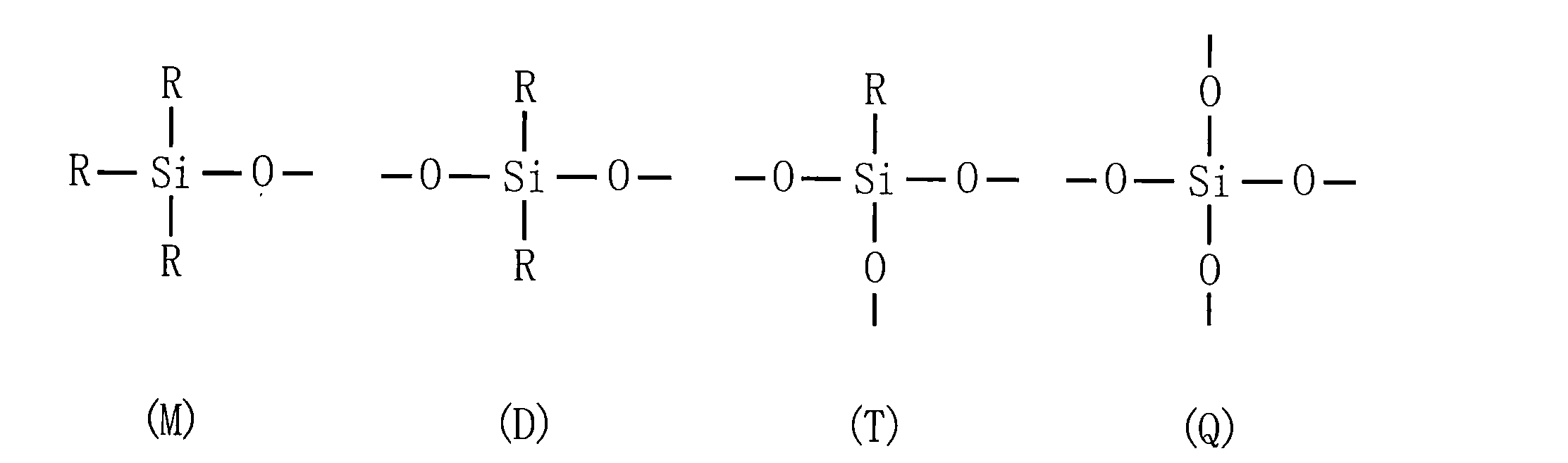
- Polysiloxane is a compound having a main chain composed of siloxane bonds (Si—O—Si), and the basic structural units thereof are represented by the following formulas (M), (D), (T), (Q) (hereinafter referred to as “polysiloxane”). , M unit, D unit, T unit, and Q unit).
- R represents an atom or atomic group bonded to a silicon atom.
- the M unit is a unit composed of a monovalent group in which a silicon atom is bonded to one oxygen atom
- the D unit is a unit composed of a divalent group in which a silicon atom is bonded to two oxygen atoms.
- the T unit is a unit composed of a trivalent group in which a silicon atom is bonded to three oxygen atoms
- the Q unit is a unit composed of a tetravalent group in which a silicon atom is bonded to four oxygen atoms.
- Silsesquioxane is a polysiloxane having the T unit as a basic structural unit, and its empirical formula (basic structural formula) is represented by RSiO 3/2 .
- As the structure of the Si—O—Si skeleton of silsesquioxane a random structure, a ladder structure, and a cage structure are known.
- the ladder-type silsesquioxane (A) contained in the curable resin composition of the present invention is a silsesquioxane having a ladder structure Si—O—Si skeleton.
- Ladder type silsesquioxane can be represented by the following formula (L), for example.
- p is an integer of 1 or more (for example, 1 to 5000, preferably 1 to 2000, more preferably 1 to 1000).
- Each R is the same or different and is a hydrogen atom, substituted or unsubstituted hydrocarbon group, hydroxyl group, alkoxy group, alkenyloxy group, aryloxy group, aralkyloxy group, acyloxy group, mercapto group (thiol group), alkylthio Group, alkenylthio group, arylthio group, aralkylthio group, carboxyl group, alkoxycarbonyl group, aryloxycarbonyl group, aralkyloxycarbonyl group, amino group or substituted amino group (mono or dialkylamino group, acylamino group, etc.), epoxy group , A halogen atom, a group represented by the following formula (1), and the like.
- Each R in the above formula (1) may be the same or different and is the same as R in the above formula (L).
- Examples of the hydrocarbon group include an aliphatic hydrocarbon group, an alicyclic hydrocarbon group, an aromatic hydrocarbon group, and a group in which two or more of these are bonded.
- Examples of the aliphatic hydrocarbon group include an alkyl group, an alkenyl group, and an alkynyl group.
- Examples of the alkyl group include C 1-20 alkyl groups such as methyl, ethyl, propyl, isopropyl, butyl, hexyl, octyl, isooctyl, decyl, dodecyl groups (preferably C 1-10 alkyl groups, more preferably C 1-4 alkyl group).
- alkenyl group examples include vinyl, allyl, methallyl, 1-propenyl, isopropenyl, 1-butenyl, 2-butenyl, 3-butenyl, 1-pentenyl, 2-pentenyl, 3-pentenyl, 4-pentenyl, 5- C 2-20 alkenyl groups such as a hexenyl group (preferably a C 2-10 alkenyl group, more preferably a C 2-4 alkenyl group).
- alkynyl group examples include C 2-20 alkynyl groups such as ethynyl and propynyl groups (preferably C 2-10 alkynyl groups, more preferably C 2-4 alkynyl groups).
- Examples of the alicyclic hydrocarbon group include C 3-12 cycloalkyl groups such as cyclopropyl, cyclobutyl, cyclopentyl, cyclohexyl and cyclododecyl groups; C 3-12 cycloalkenyl groups such as cyclohexenyl groups; bicyclohepta And C 4-15 bridged cyclic hydrocarbon groups such as nyl and bicycloheptenyl groups.
- aromatic hydrocarbon group examples include C 6-14 aryl groups such as phenyl and naphthyl groups (particularly, C 6-10 aryl groups).
- Examples of the group in which an aliphatic hydrocarbon group and an alicyclic hydrocarbon group are bonded include a cyclohexylmethyl group and a methylcyclohexyl group.
- Examples of the group in which an aliphatic hydrocarbon group and an aromatic hydrocarbon group are bonded include C 7-18 aralkyl groups such as benzyl and phenethyl groups (particularly C 7-10 aralkyl groups), and C 6-10 aryls such as cinnamyl groups.
- the hydrocarbon group may have a substituent.
- the carbon number of the substituent is 0 to 20, preferably 0 to 10.
- the substituent include halogen atoms such as fluorine atom, chlorine atom and bromine atom; hydroxyl group; alkoxy group such as methoxy and ethoxy group; alkenyloxy group such as allyloxy group; aryloxy group such as phenoxy group; benzyl Aralkyloxy groups such as oxy groups; Acyloxy groups such as acetyloxy, propionyloxy, (meth) acryloyloxy, benzoyloxy groups; mercapto groups; alkylthio groups such as methylthio and ethylthio groups; alkenylthio groups such as allylthio groups; phenylthio groups Arylthio groups such as benzylthio groups; carboxyl groups; alkoxycarbonyl groups such as methoxycarbonyl and ethoxycarbony
- alkoxy group for R examples include C 1-6 alkoxy groups (preferably C 1-4 alkoxy groups) such as methoxy, ethoxy, propoxy, isopropyloxy, butoxy, isobutyloxy groups and the like.
- alkenyloxy group examples include a C 2-6 alkenyloxy group such as an allyloxy group (preferably a C 2-4 alkenyloxy group).
- aryloxy group examples include a substituent such as a C 1-4 alkyl group, a C 2-4 alkenyl group, a halogen atom, and a C 1-4 alkoxy group on the aromatic ring such as phenoxy, tolyloxy, naphthyloxy group, and the like.
- a C 6-14 aryloxy group which may be used.
- the aralkyloxy group include C 7-18 aralkyloxy groups such as benzyloxy and phenethyloxy groups.
- the acyloxy group include C 1-12 acyloxy groups such as acetyloxy, propionyloxy, and benzoyloxy groups.
- alkylthio group examples include C 1-6 alkylthio groups (preferably C 1-4 alkylthio groups) such as methylthio and ethylthio groups.
- alkenylthio group examples include a C 2-6 alkenylthio group (preferably a C 2-4 alkenylthio group) such as an allylthio group.
- the arylthio group for example, the aromatic ring has a substituent such as a C 1-4 alkyl group, a C 2-4 alkenyl group, a halogen atom, a C 1-4 alkoxy group, etc., such as phenylthio, tolylthio, naphthylthio group, etc.
- Examples thereof include C 6-14 arylthio group.
- Examples of the aralkylthio group include C 7-18 aralkylthio groups such as benzylthio and phenethylthio groups.
- Examples of the alkoxycarbonyl group include C 1-6 alkoxy-carbonyl groups such as methoxycarbonyl, ethoxycarbonyl, propoxycarbonyl, and butoxycarbonyl groups.
- Examples of the aryloxycarbonyl group include C 6-14 aryloxy-carbonyl groups such as phenoxycarbonyl, tolyloxycarbonyl, and naphthyloxycarbonyl groups.
- Examples of the aralkyloxycarbonyl group include a C 7-18 aralkyloxy-carbonyl group such as a benzyloxycarbonyl group.
- Examples of the mono- or dialkylamino group include mono- or di-C 1-6 alkylamino groups such as methylamino, ethylamino, dimethylamino, and diethylamino groups.
- Examples of the acylamino group include C 1-11 acylamino groups such as acetylamino, propionylamino, and benzoylamino groups.
- Examples of the halogen atom include a chlorine atom, a bromine atom, and an iodine atom.
- each R is a hydrogen atom, a C 1-10 alkyl group (particularly a C 1-4 alkyl group), a C 2-10 alkenyl group (particularly a C 2 group). -4 alkyl group), C 3-12 cycloalkyl group, C 3-12 cycloalkenyl group, aromatic ring with C 1-4 alkyl group, C 2-4 alkenyl group, halogen atom, C 1-4 alkoxy group, etc.
- Optionally substituted C 6-14 aryl group, C 7-18 aralkyl group, C 6-10 aryl-C 2-6 alkenyl group, hydroxyl group, C 1-6 alkoxy group, halogen atom Is preferred.
- the ladder-type silsesquioxane occupies 50 mol% or more (more preferably 80 mol% or more, particularly preferably 90 mol% or more) of the substituted or unsubstituted hydrocarbon group in R in the formula (L). Is preferred.
- a substituted or unsubstituted alkyl group having 1 to 10 carbon atoms (particularly an alkyl group having 1 to 4 carbon atoms such as a methyl or ethyl group), an aryl group having 6 to 10 carbon atoms (particularly a phenyl group), It is preferable that the aralkyl group having 7 to 10 carbon atoms (particularly benzyl group) occupies a total of 50 mol% or more (more preferably 80 mol% or more, particularly preferably 90 mol% or more).
- Ladder type silsesquioxane can be manufactured by a well-known method.
- the ladder-type silsesquioxane represented by the formula (L) is represented by the following formula (2): (In the formula, R is the same as above. Three X's are the same or different and each represents a hydrolyzable group or a hydroxyl group.) Or one or more hydrolyzable silane compounds represented by the formula (1) and the following formula (3) or (3 ′): ) (In the formula, R and X are the same as above. A plurality of R may be the same or different.) It can obtain by attaching
- the hydrolyzable silane compound represented by formula (2) is used for forming a T unit of ladder-type silsesquioxane, and the silane compound represented by formula (3) or (3 ′) is end-capped. It functions as a stopper and is used to form M units of ladder-type silsesquioxane.
- the hydrolyzable group in X may be a group capable of forming a siloxane bond by hydrolysis and silanol condensation, such as halogen atoms such as chlorine atom, bromine atom and iodine atom; methoxy, ethoxy, propoxy group and the like C 1-10 alkoxy group; C 1-10 acyloxy group such as acetyloxy, propionyloxy, benzoyloxy group and the like.
- halogen atoms such as chlorine atom, bromine atom and iodine atom
- methoxy, ethoxy, propoxy group and the like C 1-10 alkoxy group
- C 1-10 acyloxy group such as acetyloxy, propionyloxy, benzoyloxy group and the like.
- a chlorine atom and a C 1-4 alkoxy group are preferable.
- the hydrolysis / condensation reaction is carried out, for example, by silanol condensation of the silane compound in water or a mixed solvent of water and an organic solvent in the presence of a silanol condensation catalyst, and during and after the reaction, the solvent and / or by-product ( Alcohol) and the like can be distilled off.
- the reaction temperature is -78 ° C to 150 ° C, preferably -20 ° C to 100 ° C.
- the amount of water used is 1 mol or more (for example, 1 to 20 mol, preferably 1 to 10 mol) with respect to 1 mol of the total silane compound.
- organic solvent examples include aliphatic hydrocarbons such as hexane, heptane, and octane; alicyclic hydrocarbons such as cyclohexane; aromatic hydrocarbons such as benzene, toluene, xylene, and ethylbenzene; chloroform, dichloromethane, 1, 2 Halogenated hydrocarbons such as dichloroethane; ethers such as diethyl ether, dimethoxyethane, tetrahydrofuran, dioxane; ketones such as acetone, methyl ethyl ketone, methyl isobutyl ketone; esters such as methyl acetate, ethyl acetate, isopropyl acetate, butyl acetate; N, Amides such as N-dimethylformamide and N, N-dimethylacetamide; Nitriles such as acetonitrile, propionitrile and benz
- an acid catalyst or a base catalyst can be used as the silanol condensation catalyst.
- the acid catalyst include mineral acids such as hydrochloric acid, sulfuric acid, nitric acid, phosphoric acid, and boric acid; phosphoric acid esters; carboxylic acids such as acetic acid and trifluoroacetic acid; methanesulfonic acid, trifluoromethanesulfonic acid, and p-toluenesulfonic acid.
- Sulfonic acids such as activated clay; solid acids such as activated clay; Lewis acids such as iron chloride.
- the base catalyst examples include alkali metal hydroxides such as sodium hydroxide and potassium hydroxide; alkaline earth metal hydroxides such as barium hydroxide and magnesium hydroxide; alkali metal carbonates such as sodium carbonate; barium carbonate Alkaline earth metal carbonates such as magnesium carbonate; alkali metal hydrogen carbonates such as sodium hydrogen carbonate; alkali metal alkoxides such as sodium methoxide and sodium ethoxide; alkaline earth metal alkoxides such as barium methoxide; sodium phenoxide and the like Alkali metal phenoxides; quaternary ammonium hydroxides such as tetramethylammonium hydroxide and tetrabutylammonium hydroxide; tetramethylammonium hydroxide; Quaternary phosphonium hydroxides such as tetraalkylphosphonium hydroxides such as ruphosphonium hydroxide; triethylamine, N-methylpiperidine, 4-di
- the reaction product can be separated and purified by separation means such as water washing, acid washing, alkali washing, filtration, concentration, distillation, extraction, crystallization, recrystallization, column chromatography, etc., or a separation means combining these.
- separation means such as water washing, acid washing, alkali washing, filtration, concentration, distillation, extraction, crystallization, recrystallization, column chromatography, etc., or a separation means combining these.
- the vinyl type ladder silsesquioxane is not particularly limited as long as it is a compound having a group having an aliphatic carbon-carbon double bond at the terminal or side chain of the ladder type silsesquioxane.
- the ladder-type silsesquioxane represented by the formula (L) a compound in which at least one terminal R and / or at least one side R is a group having an aliphatic carbon-carbon double bond is exemplified. It is done.
- Examples of the group having an aliphatic carbon-carbon double bond include vinyl, allyl, methallyl, 1-propenyl, isopropenyl, 1-butenyl, 2-butenyl, 3-butenyl, 1-pentenyl, 2-pentenyl, 3
- a C 2-20 alkenyl group such as a pentenyl, 4-pentenyl, 5-hexenyl group (preferably a C 2-10 alkenyl group, more preferably a C 2-4 alkenyl group); a C 3-12 group such as a cyclohexenyl group A cycloalkenyl group; a C 4-15 bridged cyclic unsaturated hydrocarbon group such as a bicycloheptenyl group; a C 2-4 alkenyl-substituted aryl group such as a styryl group; and a cinnamyl group.
- At least one of three Rs is the above C 2-20 alkenyl group, or a C 3-12 group. Also included are groups such as cycloalkenyl groups, C 4-15 bridged cyclic unsaturated hydrocarbon groups, C 2-4 alkenyl substituted aryl groups, cinnamyl groups, and the like.
- the molecular weight of the vinyl type ladder silsesquioxane is, for example, 100 to 800,000, preferably 200 to 100,000, more preferably 300 to 10,000, and particularly preferably 500 to 4000.
- the vinyl-type ladder silsesquioxane may be a mixture having various molecular weights within the above range.
- the content of the aliphatic carbon-carbon double bond in the vinyl type ladder silsesquioxane is, for example, 0.0010 to 0.0040 mmol / g, preferably 0.0012 to 0.0030 mmol / g. Further, the ratio (by weight) of the aliphatic carbon-carbon double bond contained in the vinyl-type ladder silsesquioxane is, for example, 3.0 to 9.0%, preferably 3.7 to 5.7%.
- Vinyl type ladder silsesquioxane is a hydrolyzable silane compound represented by formula (2) in the method for producing ladder type silsesquioxane (A), wherein R is an aliphatic carbon-carbon double bond. Or at least a compound in which at least one of R is a group having an aliphatic carbon-carbon double bond is used as the silane compound represented by the formula (3) or (3 ′). Can be manufactured.
- the vinyl-type ladder silsesquioxane is a ladder-type silsesquioxane (A1) having one or more hydrolyzable groups or hydroxyl groups as R in the ladder-type silsesquioxane represented by the formula (L). ) (Hereinafter sometimes simply referred to as “ladder-type silsesquioxane (A1)”) and the following formula (4): (In the formula, R is the same as above. Three Rs may be the same or different. However, at least one of R is a group having an aliphatic carbon-carbon double bond. X is hydrolysable. Group or hydroxyl group) It can manufacture by making 1 type or 2 types or more of the silane compounds (S1) represented by these react.
- It has a hydrolyzable group in R of ladder-type silsesquioxane (A1), a hydrolyzable group in X of silane compound (S1) represented by formula (4), and an aliphatic carbon-carbon double bond in R
- the group include the same hydrolyzable groups and groups having an aliphatic carbon-carbon double bond.
- a C 1-4 alkoxy group such as methoxy or ethoxy group is particularly preferable.
- the remaining R excluding the group having an aliphatic carbon-carbon double bond is the same or different, and is substituted or unsubstituted, having 1 to 10 alkyl groups (particularly alkyl groups having 1 to 4 carbon atoms such as methyl and ethyl groups), aryl groups having 6 to 10 carbon atoms (particularly phenyl groups), or aralkyl groups having 7 to 10 carbon atoms (particularly, A benzyl group).
- silane compound (S1) represented by the formula (4) monohalogenated vinylsilane, monohalogenated allylsilane, monohalogenated 3-butenylsilane, monoalkoxyvinylsilane, monoalkoxyallylsilane, monoalkoxy-3- Examples include butenylsilane.
- monohalogenated vinyl silanes include chlorodimethylvinyl silane, chloroethyl methyl vinyl silane, chloromethyl phenyl vinyl silane, chlorodiethyl vinyl silane, chloroethyl phenyl vinyl silane, chlorodiphenyl vinyl silane, and the like.
- monohalogenated allylsilanes include allylchlorodimethylsilane, allylchloroethylmethylsilane, allylchloromethylphenylsilane, allylchlorodiethylsilane, allylchloroethylphenylsilane, allylchlorodiphenylsilane, and the like.
- monohalogenated 3-butenylsilanes include 3-butenylchlorodimethylsilane, 3-butenylchloroethylmethylsilane, 3-butenylchloromethylphenylsilane, 3-butenylchlorodiethylsilane, and 3-butenyl.
- Examples include chloroethylphenylsilane and 3-butenylchlorodiphenylsilane.
- monoalkoxy vinyl silane examples include methoxy dimethyl vinyl silane, ethyl methoxy methyl vinyl silane, methoxy methyl phenyl vinyl silane, diethyl methoxy vinyl silane, ethyl methoxy phenyl vinyl silane, methoxy diphenyl vinyl silane, ethoxy dimethyl vinyl silane, ethoxy ethyl methyl vinyl silane, ethoxy methyl phenyl vinyl silane, Examples thereof include ethoxydiethylvinylsilane and ethoxyethylphenylvinylsilane.
- Typical examples of monoalkoxyallylsilane include allylmethoxydimethylsilane, allylethylmethoxymethylsilane, allylmethoxymethylphenylsilane, allyldiethylmethoxysilane, allylethylmethoxyphenylsilane, allylmethoxydiphenylsilane, allylethoxydimethylsilane, allylethoxyethyl.
- Examples include methylsilane, allylethoxymethylphenylsilane, allylethoxydiethylsilane, and allylethoxyethylphenylsilane.
- monoalkoxy 3-butenylsilane examples include 3-butenylmethoxydimethylsilane, 3-butenylethylmethoxymethylsilane, 3-butenylmethoxymethylphenylsilane, 3-butenyldiethylmethoxysilane, and 3-butenylethyl.
- the reaction between the ladder-type silsesquioxane (A1) and the silane compound (S1) represented by the formula (4) is usually performed in a solvent.
- the solvent include aliphatic hydrocarbons such as hexane, heptane, and octane; alicyclic hydrocarbons such as cyclohexane; aromatic hydrocarbons such as benzene, toluene, xylene, and ethylbenzene; chloroform, dichloromethane, 1,2-dichloroethane.
- Halogenated hydrocarbons such as: ethers such as diethyl ether, dimethoxyethane, tetrahydrofuran, dioxane; ketones such as acetone, methyl ethyl ketone, methyl isobutyl ketone; esters such as methyl acetate, ethyl acetate, isopropyl acetate, butyl acetate; N, N— Amides such as dimethylformamide and N, N-dimethylacetamide; Nitriles such as acetonitrile, propionitrile and benzonitrile; Methanol, ethanol, isopropyl alcohol, butanol, etc. Such as alcohol and the like. These solvents are used alone or in admixture of two or more.
- the amount of the silane compound (S1) represented by the formula (4) is, for example, a total of 1 mol of reactive groups (hydrolyzable groups, hydroxyl groups) in the ladder-type silsesquioxane (A1), for example.
- the amount is about 1 to 20 mol, preferably 2 to 10 mol, more preferably about 5 to 9 mol.
- the reaction between the ladder-type silsesquioxane (A1) and the silane compound (S1) represented by the formula (4) is performed in the presence of a silanol condensation catalyst.
- a silanol condensation catalyst those exemplified above can be used.
- a base catalyst is preferably used as the silanol condensation catalyst.
- the amount of the silanol condensation catalyst used is, for example, 0.1 to 10 mol, preferably 0.1 mol relative to the total of 1 mol of reactive groups (hydrolyzable group, hydroxyl group) in the ladder-type silsesquioxane (A1). 0.1 to 1.0 mol.
- the amount of silanol condensation catalyst used may be a catalytic amount.
- the reaction may be performed in the presence of a polymerization inhibitor.
- the reaction temperature can be appropriately selected depending on the reaction components and the type of the catalyst, but is usually 0 to 200 ° C, preferably 20 to 100 ° C, more preferably 30 to 60 ° C.
- the reaction may be carried out at normal pressure or under reduced pressure or pressure.
- the reaction atmosphere is not particularly limited as long as the reaction is not inhibited, and may be any of an air atmosphere, a nitrogen atmosphere, an argon atmosphere, and the like.
- the reaction can be carried out by any method such as batch, semi-batch, and continuous methods.
- the reactive group (hydrolyzable group such as alkoxy group, hydroxyl group) in the ladder-type silsesquioxane (A1) and the reactive group in the silane compound (S1) represented by the formula (4) is hydrolyzed / condensed (or condensed) to produce vinyl ladder silsesquioxane having an aliphatic carbon-carbon double bond in the corresponding molecule.
- reaction product is separated by separation means such as water washing, acid washing, alkali washing, filtration, concentration, distillation, extraction, crystallization, recrystallization, column chromatography, etc., or a combination of these. It can be purified.
- the Si—H type ladder silsesquioxane is not particularly limited as long as the ladder type silsesquioxane has a Si—H bond at a terminal or a side chain thereof.
- a compound in which at least one terminal R and / or at least one side R is a group having a hydrogen atom or a Si—H bond can be given.
- the group having a Si—H bond include groups in which at least one of three Rs is a hydrogen atom in the group represented by the formula (1).
- the molecular weight of the Si—H type ladder silsesquioxane is, for example, 100 to 800,000, preferably 200 to 100,000, more preferably 300 to 10,000, and particularly preferably 500 to 4000. When the molecular weight of the Si—H type ladder silsesquioxane is within this range, it is preferable because the compatibility with the vinyl type fluorine-containing compound is excellent.
- the Si—H type ladder silsesquioxane may be a mixture having various molecular weights within the above range.
- the content of Si—H bonds in the Si—H type ladder silsesquioxane is, for example, 0.0001 to 0.005 mmol / g, preferably 0.0005 to 0.002 mmol / g. Further, the ratio (weight basis) of Si—H groups contained in the Si—H type ladder silsesquioxane is, for example, 0.01 to 0.30%, preferably 0.1 to 0.2%.
- the Si—H type ladder silsesquioxane uses at least a compound in which R is a hydrogen atom as the hydrolyzable silane compound represented by the formula (2) in the method for producing the ladder type silsesquioxane,
- the silane compound represented by the formula (3) or (3 ′) can be produced by using at least a compound in which at least one of R is a hydrogen atom.
- the Si—H type ladder silsesquioxane is a ladder type silsesquioxane having one or more hydrolyzable groups or hydroxyl groups as R in the ladder type silsesquioxane represented by the formula (L).
- (A1) [Ladder-type silsesquioxane (A1)] and the following formula (5) (In the formula, R is the same as above. Three Rs may be the same or different. However, at least one of R is a hydrogen atom.
- X represents a hydrolyzable group or a hydroxyl group.) It can manufacture by making 1 type or 2 types or more of silane compounds (S2) represented by these react.
- the hydrolyzable group in R of the ladder-type silsesquioxane (A1) and the hydrolyzable group in X of the silane compound (S2) represented by the formula (5) are the same as the hydrolyzable groups described above. Can be mentioned.
- As the hydrolyzable group in R of the ladder-type silsesquioxane (A1) a C 1-4 alkoxy group such as methoxy or ethoxy group is particularly preferable.
- the remaining R excluding the hydrogen atom is the same or different and is a substituted or unsubstituted alkyl group having 1 to 10 carbon atoms (particularly methyl,
- An alkyl group having 1 to 4 carbon atoms such as an ethyl group), an aryl group having 6 to 10 carbon atoms (particularly a phenyl group), or an aralkyl group having 7 to 10 carbon atoms (particularly a benzyl group) is preferable.
- examples of the silane compound (S2) represented by the formula (5) include monohalogenated silane and monoalkoxysilane.
- monohalogenated silanes include chlorodimethylsilane, chloroethylmethylsilane, chloromethylphenylsilane, chlorodiethylsilane, chloroethylphenylsilane, and chlorodiphenylsilane.
- monoalkoxysilane examples include methoxydimethylsilane, ethylmethoxymethylsilane, methoxymethylphenylsilane, diethylmethoxysilane, ethylmethoxyphenylsilane, methoxydiphenylsilane, ethoxydimethylsilane, ethoxyethylmethylsilane, ethoxymethylphenylsilane, Examples thereof include ethoxydiethylsilane and ethoxyethylphenylsilane.
- the reaction between the ladder-type silsesquioxane (A1) and the silane compound (S2) represented by the formula (5) is usually performed in a solvent.
- a solvent the thing similar to the solvent used for reaction of the said ladder type silsesquioxane (A1) and the silane compound (S1) represented by Formula (4) can be used.
- the amount of the silane compound (S2) represented by the formula (5) is, for example, a total of 1 mol of reactive groups (hydrolyzable groups, hydroxyl groups) in the ladder-type silsesquioxane (A1), for example.
- the amount is about 1 to 30 mol, preferably about 1 to 10 mol, more preferably about 5 to 9 mol.
- the reaction between the ladder-type silsesquioxane (A1) and the silane compound (S2) represented by the formula (5) is performed in the presence of a silanol condensation catalyst.
- a silanol condensation catalyst an acid catalyst is usually used among the silanol condensation catalysts.
- the basic catalyst is not preferable because it reacts with the silane compound (S2) represented by the formula (5).
- the amount of the silanol condensation catalyst used is, for example, 0.001 to 1 mole, preferably 1 to 1 mole relative to a total of 1 mole of reactive groups (hydrolyzable group, hydroxyl group) in the ladder-type silsesquioxane (A1). 0.002 to 0.01 mol.
- the amount of silanol condensation catalyst used may be a catalytic amount.
- the reaction may be performed in the presence of a polymerization inhibitor.
- the reaction temperature can be appropriately selected depending on the reaction components and the type of catalyst, but is usually ⁇ 78 ° C. to 120 ° C., preferably ⁇ 30 ° C. to 60 ° C., more preferably ⁇ 10 ° C. to 30 ° C.
- the reaction may be carried out at normal pressure or under reduced pressure or pressure.
- the reaction atmosphere is not particularly limited as long as the reaction is not inhibited, and may be any of an air atmosphere, a nitrogen atmosphere, an argon atmosphere, and the like.
- the reaction can be carried out by any method such as batch, semi-batch, and continuous methods.
- the reactive group in the ladder-type silsesquioxane (A1) (hydrolyzable group such as alkoxy group, hydroxyl group) and the reactive group in the silane compound (S2) represented by the formula (5) (Hydrolysable group such as alkoxy group, hydroxyl group) is hydrolyzed / condensed (or condensed) to produce Si—H type ladder silsesquioxane having a Si—H bond in the corresponding molecule.
- reaction product is separated by separation means such as water washing, acid washing, alkali washing, filtration, concentration, distillation, extraction, crystallization, recrystallization, column chromatography, etc., or a combination of these. It can be purified.
- ladder-type silsesquioxane various ladder-type silsesquioxanes having different substituents and molecular weights can be used, and these can be used alone or in combination of two or more.
- the ladder type silsesquioxane preferably contains vinyl type ladder silsesquioxane or Si—H type ladder silsesquioxane.
- the ladder-type silsesquioxane (A) contained in the curable resin composition of the present invention contains ladder-type silsesquioxane other than vinyl type and Si—H type, and silsesquioxane having a random structure. Also good.
- the content of vinyl type ladder silsesquioxane or Si—H type ladder silsesquioxane in the total ladder type silsesquioxane is, for example, 50 to 100% by weight, preferably 60 to 100% by weight, and more preferably 70%. ⁇ 100% by weight.
- Vinyl type ladder silsesquioxane or Si—H type ladder silsesquioxane includes vinyl type or Si—H type phenyl / methyl ladder silsesquioxane having Si—H bond or alkenyl group at the terminal and / or side chain. Sun is preferred.
- the phenyl / methyl ratio is preferably 1: 0.8 to 0.8: 1.
- the content of the ladder-type silsesquioxane (A) in the curable resin composition is, for example, 10 to 90 wt%, preferably 10 to 85 wt%. When the content of the ladder-type silsesquioxane is in this range, the heat resistance is increased.
- the fluorine-containing compound contained in the curable resin composition of the present invention (B), is not particularly limited, specifically, CF 3 (CH 2) 2 Si (OCH 3) 3, C 6 F 13 C 2 H 4 Si (OCH 3 ) 3 , C 7 F 15 CONH (CH 2 ) 3 Si (OC 2 H 5 ) 3 , C 8 F 17 C 2 H 4 Si (OCH 3 ) 3 , C 8 F 17 C 2 H 4 SiCH 3 (OCH 3 ) 2 , C 9 F 19 C 2 H 4 Si (OCH 3 ) 3 , C 9 F 19 C 2 H 4 Si (C 2 H 5 ) (OCH 3 ) 2 , (CH 3 O) 3 SiC 2 H 4 C 8 F 16 C 2 H 4 Si (OCH 3 ) 3 , (CH 3 O) 2 (CH 3 ) SiC 9 F 18 C 2 H 4 Si (CH 3 ) (OCH 3 ) 2 etc. Silane compound having a fluoroalkyl group and
- R f represents an n-valent fluorinated hydrocarbon group
- n represents an integer of 1 or more (for example, 1 to 6)
- the groups in n parentheses are the same. May be different.
- R 1 to R 3 are the same or different and are the same as R in the above formula (4) or (5).
- R 1 to R 3 are the same or different and each represents a hydrogen atom, an alkyl group having 1 to 4 carbon atoms, an aryl group, or the following formula (B2) The group represented by these is shown.
- at least one of R 1 to R 3 can be a hydrogen atom or a group represented by the above formula (B2).
- R a , R b , R c , R d , and R e are the same or different and each represents a hydrogen atom or an alkyl group having 1 to 4 carbon atoms.
- m is preferably 0 or 1, particularly preferably 1.
- Examples of the alkyl group having 1 to 4 carbon atoms in R 1 to R 3 , R a , R b , R c , R d , and R e include methyl, ethyl, propyl, isopropyl, butyl, isobutyl, and t-butyl groups. Can be mentioned.
- Examples of the aryl group in R 1 to R 3 include a substituted or unsubstituted phenyl group and naphthyl group.
- a group other than a hydrogen atom or a group represented by the above formula (2) is preferably a methyl group or a phenyl group.
- R a , R b , R c , R d , and R e are preferably a hydrogen atom or a methyl group.
- examples of the hydrocarbon group in the fluorinated hydrocarbon group represented by R f include a monovalent or polyvalent aliphatic hydrocarbon group, and a monovalent or polyvalent alicyclic hydrocarbon group.
- An aliphatic hydrocarbon group a 1 to 4 valent branched aliphatic hydrocarbon group having 2 to 20 carbon atoms, a 1 to 4 alicyclic hydrocarbon group having 3 to 20 carbon atoms, and 6 to 6 carbon atoms 20 1 to 4 valent aromatic hydrocarbon groups, and 1 to 4 valent groups having a total carbon number of 4 to 22 in which two or more of these groups are bonded via or without oxygen or sulfur atoms, etc. Is mentioned.
- it is a C 3-10 divalent trivalent linear aliphatic hydrocarbon group, a C 4-10 divalent branched aliphatic hydrocarbon group, a carbon number 5 2 to 3 bivalent alicyclic hydrocarbon groups having 10 to 10 carbon atoms, divalent to trivalent aromatic hydrocarbon groups having 8 to 10 carbon atoms, and two or more of these groups are interposed via or via an oxygen atom or a sulfur atom And bivalent to trivalent groups bonded without any particular mention.
- Examples of the monovalent linear hydrocarbon group having 1 to 20 carbon atoms include methyl, ethyl, propyl, butyl, pentyl, hexyl, heptyl, octyl, undecyl, pentadecyl, octadecyl group, etc .; 1 having 2 to 20 carbon atoms
- Valent branched hydrocarbon groups include methylethyl, dimethylmethyl, 2-methylpropyl, 2,2-dimethylpropyl, 2-methylbutyl, 2,3-dimethylbutyl, 2,2-dimethylbutyl, 2-ethyl- 2-methylpropyl, 2-methylpentyl, 2,2-dimethylpentyl, 2,3-dimethylpentyl, 2,4-dimethylpentyl, 2,3,4-trimethylpentyl, 2-ethyl-2-methylpentyl, etc.
- a monovalent alicyclic hydrocarbon group having 3 to 20 carbon atoms such as cyclopentyl, 1-methylcyclopentyl, cyclohexyl, 1-methyl Lucyclohexyl, 1,4-dimethylcyclohexyl group, etc .
- examples of monovalent aromatic hydrocarbon groups having 6 to 20 carbon atoms include phenyl, 1-methylphenyl, 1,4-dimethylphenyl, naphthyl groups, etc. It is done.
- Examples of the divalent linear hydrocarbon group having 1 to 20 carbon atoms include methylene, ethylene, trimethylene, tetramethylene, pentamethylene, hexamethylene, heptamethylene, octamethylene group, etc .; As branched chain hydrocarbon groups, methylmethylene, methylethylene, dimethylmethylene, 2-methyltrimethylene, 2,2-dimethyltrimethylene, 2-methyltetramethylene, 2,3-dimethyltetramethylene, 2,2-dimethyl Tetramethylene, 2-ethyl-2-methyltrimethylene, 2-methylpentamethylene, 2,2-dimethylpentamethylene, 2,3-dimethylpentamethylene, 2,4-dimethylpentamethylene, 2,3,4-trimethyl Pentamethylene, 2-ethyl-2-methylpentamethylene group, etc .; 2 having 3 to 20 carbon atoms As the alicyclic hydrocarbon group, 1,2-cyclopentylene, 1,3-cyclopentylene, cyclopentylid
- Examples of other polyvalent hydrocarbon groups include 1,2,3-propanetriyl, 1,2,3-butyltriyl, 1,2,4-butyltriyl, 1,2,3,4-butyltetra. 1,2,3-pentanetriyl, 1,2,4-pentanetriyl, 1,2,5-pentanetriyl, 1,2,3,4-pentanetetrayl, 1,2,4,5 -Pentanetetrayl, 1,2,3-cyclohexanetriyl and the like.
- hydrocarbon groups in the fluorinated hydrocarbon group represented by R f a divalent aliphatic hydrocarbon group is preferable, and tetramethylene, pentamethylene, hexamethylene, 2-methyltetramethylene, 2-methyltrimethylene. 2-methylpentamethylene and 3-methylpentamethylene are particularly preferred.
- the fluorinated hydrocarbon group represented by R f for example, 20 to 100% of the hydrogen atoms of the hydrocarbon group before fluorination are substituted with fluorine atoms, and 30 to 90% are substituted. Preferably, 50 to 70% is more preferably substituted. In the fluorinated hydrocarbon group represented by R f , it is preferable that the hydrogen atoms bonded to the carbon atoms at both ends are not substituted with fluorine atoms.
- the fluorinated hydrocarbon group represented by R f of the present invention preferably has 3 to 8 carbon atoms, 2 to 14 fluorine atoms, and 1 to 6 —CF 2 — groups.
- it preferably has 3 to 6 carbon atoms, 2 to 8 fluorine atoms, and 1 to 4 —CF 2 — groups.
- —CF 2 — groups When there are two or more —CF 2 — groups, they are preferably continuous. By setting it as such a structure, the compound which exhibits liquid state is obtained. Moreover, when cured, a cured product having excellent heat resistance and transparency can be obtained. If the number of carbon atoms is larger than the above range, the cured product tends to become cloudy.
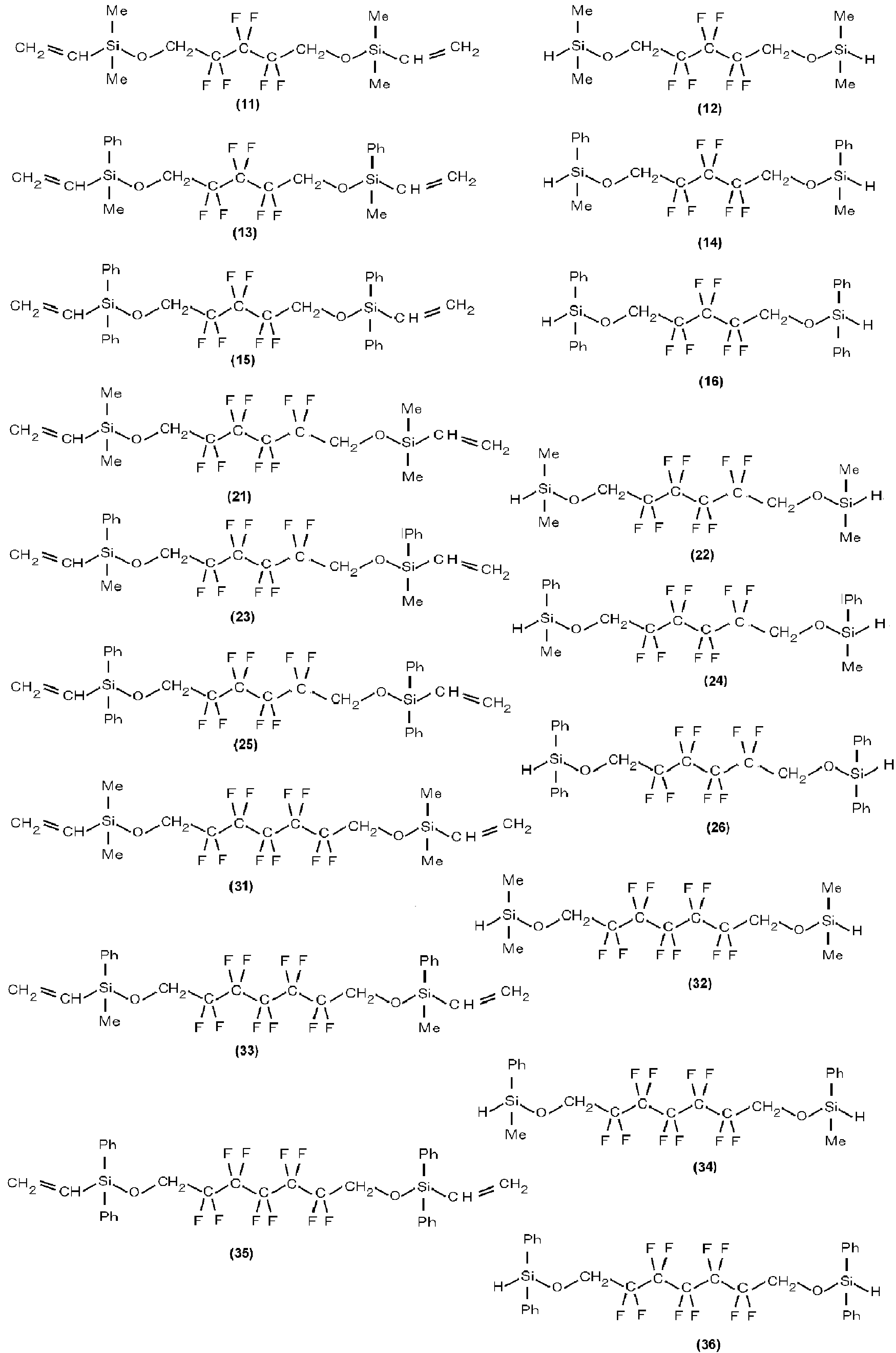
- fluorinated hydrocarbon group examples include, for example, 2,2-difluoropropanediyl, 2,2,3,3-tetrafluorobutanediyl, 2,2,3,3,4,4-hexafluoropentane.
- n1 represents an integer of 1 to 4
- n2 represents an integer of 1 to 10
- n3 represents an integer of 1 to 4.
- the compound represented by the formula (B1) exhibits a liquid state, and specific examples thereof include the following compounds.
- the fluorine-containing compound (B) is preferably a compound represented by the formula (B1).
- the content of the fluorine-containing compound (B) is, for example, 1 to 50 wt%, preferably 1 to 40 wt% in the curable resin composition. When the content is within this range, a cured product having excellent flexibility can be obtained.
- the amount of the fluorine-containing compound (B) is, for example, 1 to 30 parts by weight, preferably 1 to 20 parts by weight, and more preferably 1 to 15 parts by weight with respect to 100 parts by weight of the ladder-type silsesquioxane (A). It is. By setting the amount of the fluorine-containing compound (B) within the above range with respect to the ladder-type silsesquioxane (A), a cured product having excellent flexibility can be obtained.
- hydroxy compound represented by the formula (B4) a monovalent or polyhydric alcohol having the above R f can be used, and the hydroxy compound corresponding to the target fluorine-containing compound represented by the formula (B1) is used. it can.
- the hydroxy compound represented by the formula (B4) can be produced by a known method, and a commercially available product can also be used.
- 2,2-difluoropropanediol, 2,2,3,3-tetrafluorobutanediol, 2,2,3,3,4,4-hexafluoropentanediol, 2,2,3,3 4,4,5,5-octafluorohexanediol can be preferably exemplified.
- the amount of the silane compound (S1) represented by the formula (4) or the silane compound (S2) represented by the formula (5) is the hydroxyl to be subjected to the reaction of the hydroxy compound represented by the formula (B4).
- 1.0 to 2 mol preferably 1.0 to 1.3 mol, and more preferably about 1.0 to 1.2 mol per 1 mol of the group.
- the production of the fluorine-containing compound represented by the formula (B1) is carried out in the presence of a base.
- the presence of a base in the reaction system generally increases the reaction rate significantly.
- the bases exemplified in the synthesis of the vinyl type ladder silsesquioxane and the Si—H type ladder silsesquioxane can be used.
- tertiary amines such as triethylamine and 4-dimethylaminopyridine
- nitrogen-containing aromatic heterocyclic compounds such as pyridine, lutidine and picoline are preferable.
- the amount of the base used is, for example, about 1 to 300 mol, preferably about 1 to 1.5 mol, per 1 mol of the hydroxyl group in the hydroxy compound represented by the formula (B4).
- the reaction may be performed in the presence of a polymerization inhibitor.
- the reaction temperature can be appropriately selected depending on the reaction components and the type of catalyst. For example, when vinyl silane is used, it is about 20 to 200 ° C., preferably about 20 to 100 ° C., and more preferably about 40 to 60 ° C.
- the reaction temperature can be appropriately selected depending on the reaction components and the type of catalyst, and is, for example, ⁇ 78 to 110 ° C., preferably ⁇ 30 to 40 ° C., more preferably about ⁇ 10 to 10 ° C. It is.
- the reaction may be carried out at normal pressure or under reduced pressure or pressure.
- the reaction atmosphere is not particularly limited as long as the reaction is not inhibited, and may be any of an air atmosphere, a nitrogen atmosphere, an argon atmosphere, and the like.
- the reaction can be carried out by any method such as batch, semi-batch, and continuous methods.
- At least one hydroxyl group of the hydroxy compound represented by the formula (B4) is silylated by the reaction to produce a corresponding fluorine-containing compound represented by the formula (B1).
- the reaction product can be separated and purified by separation means such as filtration, concentration, distillation, extraction, crystallization, recrystallization, column chromatography, etc., or a separation means combining these.
- the mixture after the reaction may be washed by adding an aqueous solvent such as water, 1 to 7% dilute hydrochloric acid, and 1 to 7% sodium bicarbonate water.
- the crosslinking agent capable of forming a carbon-silicon bond by a hydrosilation reaction with a ladder-type silsesquioxane and a fluorine-containing compound has a Si—H bond and / or an aliphatic carbon-carbon double bond in the molecule. It is sufficient that the compound has one or more groups.
- it is a polysiloxane other than the ladder-type silsesquioxane (A), and has a Si—H bond and / or an aliphatic carbon-carbon two-molecule in the molecule.
- Examples include polysiloxane (D) having one or more groups having a heavy bond.
- a polysiloxane (D) having at least one group having a Si—H bond in the molecule is a Si—H type polysiloxane
- a polysiloxane having at least one group having an aliphatic carbon-carbon double bond in the molecule ( D) is referred to as vinyl-type polysiloxane.
- the polysiloxane is not particularly limited as long as it is a compound having a main chain composed of siloxane bonds (Si—O—Si), and various polysiloxanes can be used.
- Specific examples of the polysiloxane include linear, branched or cyclic siloxane, and a crosslinked silicone resin having a three-dimensional structure.
- polysiloxane (D) examples include 1,1,3,3-tetramethylsiloxane, 1,1,3,3-tetramethyl-1,3-divinylsiloxane, 1,1,3,3, 5,5-hexamethyltrisiloxane, 1,1,3,3,5,5-hexamethyl-1,5-divinyltrisiloxane, 1,1,1,3,5,5,5-heptamethyltrisiloxane, 1,1,1,3,5,5,5-heptamethyl-3-vinyltrisiloxane, 1,1,3,3,5,5,7,7-octamethyltetrasiloxane, 1,1,3,3 , 5,5,7,7-octamethyl-1,7-divinyltetrasiloxane, 1,1,1,3,5,5,7,7,7-nonamethyltetrasiloxane, 1,1,1,3 5,5,7,7,7-nonamethyl-3-vinyltetrasiloxane 1,1,1,3,5,7,7,7
- polysiloxane (D) a compound in which all or part of an alkyl group such as a methyl group of the above exemplified compound is substituted with an aryl group such as a phenyl group (preferably a C 6-20 aryl group),
- Si-H type or vinyl type linear or cyclic polydiarylsiloxanes such as polydiphenylsiloxane (preferably polydiC 6-20 arylsiloxane ); Si-H type or vinyl type linear or cyclic
- a polyalkylaryl siloxane such as polyphenylmethylsiloxane (preferably a poly C 1-10 alkyl C 6-20 aryl siloxane); a copolymer composed of the polyorganosiloxane units [dimethylsiloxane-methylvinylsiloxane copolymer] Polymer, dimethylsiloxane-methylphenylsiloxane copolymer, dimethylsiloxan
- the molecular weight of the polysiloxane (D) can be, for example, 100 to 800,000, and preferably 100 to 1000. When the molecular weight of the polysiloxane (D) is within this range, the compatibility with silsesquioxane tends to be high.
- the polysiloxane (D) can be used alone or in combination of two or more.
- the content of the polysiloxane (D) can be, for example, 10 to 1000 parts by weight, preferably 10 to 500 parts by weight, with respect to 100 parts by weight of the ladder type silsesquioxane (A).
- the content of the polysiloxane (D) is within this range, the heat resistance tends to increase.
- the content of the polysiloxane (D) in the total silicon-containing compound in the curable resin composition is, for example, 50 to 100% by weight, preferably 60 to 100% by weight, and more preferably 70 to 100% by weight.
- Polysiloxane can be produced by a so-called sol-gel method in which trialkoxysilane is hydrolyzed and changed from a solution to a sol or from a sol to a gel. Also, polysiloxanes having greatly different properties can be obtained by changing the starting alkoxysilane. Furthermore, polysiloxane can be made into Si—H type and vinyl type by a known method.
- polysiloxane (D) commercially available products such as H-terminal polydimethylsiloxane can be used.
- the total content of the ladder-type silsesquioxane (A) and the polysiloxane (D) is, for example, 50 to 99 wt%, preferably 60 to 98 wt% in the curable resin composition. When the content is within this range, a cured product having particularly high heat resistance tends to be generated.
- hydrosilylation catalyst (C) examples include known hydrosilylation reaction catalysts such as platinum-based catalysts, rhodium-based catalysts, and palladium-based catalysts.
- the content of the hydrosilylation catalyst (C) in the curable resin composition of the present invention is an amount such that platinum, palladium, or rhodium in the catalyst is in the range of 0.01 to 1,000 ppm by weight. Preferably, it is in the range of 0.1 to 500 ppm.
- the content of the hydrosilylation catalyst (C) is in such a range, the crosslinking rate is not significantly slowed, and there is less possibility of causing problems such as coloring in the crosslinked product, which is preferable.
- the curable resin composition of the present invention may contain a hydrosilylation reaction inhibitor in order to adjust the speed of the hydrosilylation reaction.
- a hydrosilylation reaction inhibitor include alkyne alcohols such as 3-methyl-1-butyn-3-ol, 3,5-dimethyl-1-hexyn-3-ol, and phenylbutynol; 3-methyl-3-pentene Ene-in compounds such as 1-yne, 3,5-dimethyl-3-hexen-1-yne; 1,3,5,7-tetramethyl-1,3,5,7-tetravinylcyclotetrasiloxane, 1, Examples include 3,5,7-tetramethyl-1,3,5,7-tetrahexenylcyclotetrasiloxane, thiazole, benzothiazole, and benzotriazole.
- the content of the hydrosilylation reaction inhibitor varies depending on the crosslinking conditions of the above composition, but practically within the range of 0.00001 to 0.01 parts by weight with respect to
- solvent A conventionally known solvent such as toluene, hexane, isopropanol, methyl isobutyl ketone, cyclopentanone, propylene glycol monomethyl ether acetate or the like may be used during the silylation reaction.
- the curable resin composition of the present invention as other optional components, precipitated silica, wet silica, fumed silica, calcined silica, titanium oxide, alumina, glass, quartz, aluminosilicate, iron oxide, zinc oxide, Inorganic fillers such as calcium carbonate, carbon black, silicon carbide, silicon nitride and boron nitride; inorganic fillers obtained by treating these fillers with organosilicon compounds such as organohalosilanes, organoalkoxysilanes and organosilazanes; silicone resins; Organic resin fine powders such as epoxy resins and fluororesins; fillers such as conductive metal powders such as silver and copper, solvents, stabilizers (antioxidants, UV absorbers, light stabilizers, heat stabilizers, etc.) , Flame retardants (phosphorous flame retardants, halogen flame retardants, inorganic flame retardants, etc.), flame retardant aids, reinforcing materials (other fillers
- the curable resin composition of the present invention preferably contains a vinyl ladder silsesquioxane, a vinyl fluorine-containing compound, and a compound having a Si—H bond in the molecule as a crosslinking agent.
- a vinyl ladder silsesquioxane a vinyl fluorine-containing compound
- a compound having a Si—H bond in the molecule as a crosslinking agent.
- Si—H type ladder silsesquioxane, Si—H type fluorine-containing compound, and a compound having an aliphatic carbon-carbon double bond in the molecule as a crosslinking agent are contained.
- the curable resin composition of the present invention can be obtained by stirring and mixing the above components at room temperature.
- the curable resin composition of the present invention includes a one-component system including a multi-component composition, and may be stored separately as a two-component or multi-component system and mixed before use.
- the curable resin composition of the present invention can be cured by a hydrosilylation reaction using the above catalyst.
- the conditions for the hydrosilylation reaction are not particularly limited, and may be carried out under the conditions known in the art using the above catalyst. From the viewpoint of the reaction rate, room temperature to 180 ° C, more preferably 60 ° C to 150 ° C, 5 to It is preferable to carry out for about 300 minutes.
- the obtained cured product is excellent in physical properties such as high temperature heat resistance, flexibility, transparency, heat yellowing resistance, and light yellowing resistance.
- the sealing agent of this invention contains the said curable resin composition. Since the hardened
- reaction product was identified by GC-MS and 1 H-NMR.
- 1 H-NMR analysis was performed by JEOL ECA500 (500 MHz).
- the ladder-type terminal ethoxy group phenylmethylsilsesquioxane used as a raw material was prepared by hydrolyzing and condensing triethoxymethylsilane and triethoxyphenylsilane (molar ratio 1: 1) by a conventional method.
- Example 1 [Production of fluorinated ladder silsesquioxane-containing curable resin composition 1 and cured product 1 thereof]
- Example 2 [Production of fluorinated ladder silsesquioxane-containing curable resin composition 2 and cured product 2 thereof] Ladder-type vinylphenylmethylsilsesquioxane (0.400 g) obtained in Synthesis Example 1, hexafluoropentanediol divinylsilane derivative (0.040 g) obtained in Synthesis Example 2 and H-terminal polydimethylsiloxane (AZMAX) (Made by Co., Ltd., molecular weight: 400 to 500, 0.182 g) was weighed into a 6 ml screw tube and stirred for 1 hour at room temperature. As a result, a transparent, uniform solution with good compatibility was obtained.
- AZMAX H-terminal polydimethylsiloxane
- Example 3 [Production of fluorinated ladder silsesquioxane-containing curable resin composition 3 and cured product 3 thereof]
- Example 4 [Production of fluorinated ladder silsesquioxane-containing curable resin composition 4 and cured product 4 thereof]
- the cured product has transparency and has heat-resistant yellowing at a high temperature (180 ° C. or higher) for a long time. It is useful as a sealing agent for light sources.
Landscapes
- Chemical & Material Sciences (AREA)
- Organic Chemistry (AREA)
- Health & Medical Sciences (AREA)
- Chemical Kinetics & Catalysis (AREA)
- Medicinal Chemistry (AREA)
- Polymers & Plastics (AREA)
- Engineering & Computer Science (AREA)
- Materials Engineering (AREA)
- Silicon Polymers (AREA)
- Compositions Of Macromolecular Compounds (AREA)
- Structures Or Materials For Encapsulating Or Coating Semiconductor Devices Or Solid State Devices (AREA)
Abstract
Description
また、本発明の他の目的は、硬化後に、高温耐熱性、柔軟性、透明性、耐熱黄変性、耐光黄変性等の物性を保有する封止剤を提供することにある。
さらにまた、本発明の他の目的は、高温耐熱性、柔軟性、透明性、耐熱黄変性、耐光黄変性等の物性を保有する硬化物を提供することにある。
上記フッ素含有化合物(B)は、下記式(B1)


で表される基を示す。但し、R1~R3の少なくとも1つは、水素原子又は上記式(B2)で表される基である。]
で表される化合物であることが好ましい。
本発明の硬化性樹脂組成物は、さらに、上記ラダー型シルセスキオキサン(A)以外のポリシロキサン(D)を含有していてもよい。
本発明の硬化性樹脂組成物は、ラダー型シルセスキオキサン(A)と、フッ素含有化合物(B)と、ヒドロシリル化触媒(C)とを含むことを特徴とする。本発明の硬化性樹脂組成物は、好ましくは、互いに反応してヒドロシリル化により炭素-ケイ素結合を形成可能なラダー型シルセスキオキサン及びフッ素含有化合物と、又は、架橋剤とのヒドロシリル化反応により炭素-ケイ素結合を形成可能なラダー型シルセスキオキサン及びフッ素含有化合物と、ヒドロシリル化触媒とを含んでいる。
一般に、ラダー型シルセスキオキサンは、架橋された三次元構造を有するポリシロキサンである。ポリシロキサンは、シロキサン結合(Si-O-Si)で構成された主鎖を有する化合物であり、その基本構成単位は、下記式(M)、(D)、(T)、(Q)(以下、それぞれM単位、D単位、T単位、Q単位という)に分類される。



で表される加水分解性シラン化合物の1種又は2種以上を、又は前記式(1)で表される加水分解性シラン化合物の1種又は2種以上と下記式(3)若しくは(3′)

で表されるシラン化合物の1種又は2種以上とを、加水分解・縮合反応(ゾルゲル反応)に付すことにより得ることができる。
ビニル型ラダーシルセスキオキサンとしては、前記ラダー型シルセスキオキサンのうち、末端又は側鎖に脂肪族炭素-炭素二重結合を有する基を持つ化合物であれば特に限定されず、例えば、前記式(L)で表されるラダー型シルセスキオキサンにおいて、末端のRの少なくとも1つ及び/又は側鎖のRの少なくとも1つが脂肪族炭素-炭素二重結合を有する基である化合物が挙げられる。

で表されるシラン化合物(S1)の1種又は2種以上とを反応させることにより製造できる。
Si-H型ラダーシルセスキオキサンとしては、前記ラダー型シルセスキオキサンのうち、末端又は側鎖にSi-H結合を有するものであれば特に限定されず、例えば、前記式(L)で表されるラダー型シルセスキオキサンにおいて、末端のRの少なくとも1つ及び/又は側鎖のRの少なくとも1つが水素原子又はSi-H結合を有する基である化合物が挙げられる。Si-H結合を有する基としては、例えば、前記式(1)で表される基において、3つのRのうち少なくとも1つが水素原子である基などが挙げられる。

で表される1種又は2種以上のシラン化合物(S2)とを反応させることにより製造できる。
本発明の硬化性樹脂組成物に含まれるフッ素含有化合物(B)としては、特に限定されないが、具体的には、CF3(CH2)2Si(OCH3)3、C6F13C2H4Si(OCH3)3、C7F15CONH(CH2)3Si(OC2H5)3、C8F17C2H4Si(OCH3)3、C8F17C2H4SiCH3(OCH3)2、C9F19C2H4Si(OCH3)3、C9F19C2H4Si(C2H5)(OCH3)2、(CH3O)3SiC2H4C8F16C2H4Si(OCH3)3、(CH3O)2(CH3)SiC9F18C2H4Si(CH3)(OCH3)2などのフルオロアルキル基とアルコキシ基を有するシラン化合物、及び下記式(B1)


上記式(B1)中、Rfで示されるフッ素化炭化水素基における炭化水素基としては、例えば、1価又は多価の脂肪族炭化水素基、1価又は多価の脂環式炭化水素基、1価又は多価の芳香族炭化水素基、及びこれらが2以上結合した1価又は多価の基などが挙げられ、好ましくは、炭素数1~20の1~4価の直鎖状の脂肪族炭化水素基、炭素数2~20の1~4価の分枝鎖状の脂肪族炭化水素基、炭素数3~20の1~4価の脂環式炭化水素基、炭素数6~20の1~4価の芳香族炭化水素基、及びこれらの基の2以上が酸素原子又は硫黄原子を介して若しくは介することなく結合した総炭素数が4~22の1~4価の基などが挙げられる。さらに好ましくは、炭素数3~10の2~3価の直鎖状の脂肪族炭化水素基、炭素数4~10の2~3価の分枝鎖状の脂肪族炭化水素基、炭素数5~10の2~3価の脂環式炭化水素基、炭素数8~10の2~3価の芳香族炭化水素基、及びこれらの基の2以上が酸素原子又は硫黄原子を介して若しくは介することなく結合した2~3価の基などが挙げられる。

上記式(B1)で表されるフッ素含有化合物は、塩基の存在下、下記式(B4)

式(B4)で表されるヒドロキシ化合物としては、上記Rfを有する1価又は多価のアルコールが使用でき、目的とする式(B1)で表されるフッ素含有化合物に対応するヒドロキシ化合物を使用できる。式(B4)で表されるヒドロキシ化合物は公知の方法で製造でき、また市販品を用いることもできる。具体的には、2,2-ジフルオロプロパンジオール、2,2,3,3-テトラフルオロブタンジオール、2,2,3,3,4,4-ヘキサフルオロペンタンジオール、2,2,3,3,4,4,5,5-オクタフルオロヘキサンジオールが好ましく例示できる。
式(B4)で表されるヒドロキシ化合物と、前記式(4)で表されるシラン化合物(S1)又は前記式(5)で表されるシラン化合物(S2)との反応は、溶媒の存在下又は非存在下で行われる。前記溶媒としては、前記ビニル型ラダーシルセスキオキサン、Si-H型ラダーシルセスキオキサンの合成で例示した溶媒を使用できる。
式(B1)で表されるフッ素含有化合物の製造は、塩基の存在下で行う。反応系に塩基を存在させることにより一般に反応速度が著しく増大する。塩基としては、前記ビニル型ラダーシルセスキオキサン、Si-H型ラダーシルセスキオキサンの合成で例示した塩基を使用できる。なかでも、トリエチルアミン、4-ジメチルアミノピリジンなどの3級アミン;ピリジン、ルチジン、ピコリンなどの窒素含有芳香族性複素環化合物などが好ましい。
ラダー型シルセスキオキサン及びフッ素含有化合物とヒドロシリル化反応により炭素-ケイ素結合を形成可能な架橋剤としては、分子内にSi-H結合、及び/又は、脂肪族炭素-炭素二重結合を有する基を1以上有する化合物で有れば良く、例えば、上記ラダー型シルセスキオキサン(A)以外のポリシロキサンであって、分子内にSi-H結合、及び/又は、脂肪族炭素-炭素二重結合を有する基を1以上有するポリシロキサン(D)が挙げられる。以下、分子内にSi-H結合を有する基を1以上有するポリシロキサン(D)をSi-H型ポリシロキサン、分子内に脂肪族炭素-炭素二重結合を有する基を1以上有するポリシロキサン(D)をビニル型ポリシロキサンと称する。ポリシロキサンとしては、シロキサン結合(Si-O-Si)で構成された主鎖を有する化合物であれば、特に限定されず、種々のポリシロキサンを使用できる。ポリシロキサンとしては、具体的には、直鎖状、分岐鎖状又は環状のシロキサン、架橋された三次元構造を有するシリコーン樹脂などが挙げられる。
本発明の硬化性樹脂組成物に含まれるヒドロシリル化触媒(C)としては、白金系触媒、ロジウム系触媒、パラジウム系触媒等の周知のヒドロシリル化反応用触媒が例示され、具体的には、白金微粉末、白金黒、白金担持シリカ微粉末、白金担持活性炭、塩化白金酸、塩化白金酸とアルコール、アルデヒド、ケトン等との錯体、白金のオレフィン錯体、白金-カルボニルビニルメチル錯体などの白金のカルボニル錯体、白金-ジビニルテトラメチルジシロキサン錯体や白金-シクロビニルメチルシロキサン錯体などの白金ビニルメチルシロキサン錯体、白金-ホスフィン錯体、白金-ホスファイト錯体等の白金系触媒、ならびに上記白金系触媒において白金原子の代わりにパラジウム原子又はロジウム原子を含有するパラジウム系触媒又はロジウム系触媒が挙げられる。これらは1種で用いてもよく、2種以上を併用してもよい。なかでも、白金ビニルメチルシロキサン錯体が、反応速度が良好であることから好ましい。
シリル化反応時にトルエン、ヘキサン、イソプロパノール、メチルイソブチルケトン、シクロペンタノン、プロピレングリコールモノメチルエーテルアセテート等の従来公知の溶媒を使用してもよい。
本発明の硬化性樹脂組成物は、上記触媒を使用したヒドロシリル化反応により硬化できる。ヒドロシリル化反応の条件は特に限定されず、上記触媒を使用して従来公知の条件で行なえばよいが、反応速度の点から、室温~180℃、より好ましくは60℃~150℃で、5~300分程度行なうのが好ましい。得られた硬化物は、高温耐熱性、柔軟性、透明性、耐熱黄変性、耐光黄変性等の物性に優れている。
本発明の封止剤は、上記硬化性樹脂組成物を含んでいる。本発明の封止剤は、その硬化物が高温耐熱性、柔軟性、透明性、耐熱黄変性、耐光黄変性等の物性に優れるので、光半導体素子等の封止剤として好適に使用できる。
300ml四つ口フラスコに、ラダー型末端エトキシ基フェニルメチルシルセスキオキサン(重量平均分子量Mw2200、1分子当たりのエトキシ基の含有量(平均)は1.5重量%、フェニル/メチル(モル比)=1/1)10gと、10重量%水酸化テトラメチルアンモニウム3.0g、メチルイソブチルケトン200g、ジメチルエトキシビニルシラン5.5gを仕込んだ。45℃で1時間加熱し、反応終了とした。酢酸エチル100gを加えた後に、500gの水で、5回水洗浄を行った。洗浄後の上層をエバポレータで濃縮した後に真空ポンプで30分減圧に引いた。得量7.8gで、液体のラダー型ビニルフェニルメチルシルセスキオキサン[本発明のラダー型シルセスキオキサン(A)に相当する化合物]が得られた。重量平均分子量Mwは1700、1分子当たりのビニル基の含有量(平均)は5.6重量%であった。
[ラダー型ビニルフェニルメチルシルセスキオキサンの1H-NMRスペクトル]
1H-NMR(CDCl3)δ0.1 ppm (br)、δ5.4-6.2 ppm (br)、δ6.8-7.8 ppm (br)
300ml四つ口フラスコにヘキサフルオロベンタンジオール(20g)とピリジン(22.3g)とトルエン(160g)を仕込んだ。室温中、マグネチックスターラーで攪拌しながら、クロロジメチルビニルシラン(25.0g)を30分間かけて滴下漏斗で滴下した。滴下終了後、オイルバスで50℃に加熱して1時間熟成した。
水(100g)を入れて攪拌した後、静置して下層(水層)を抜取った。さらに上層に5%HCl(60ml)を入れて攪拌した後静置して下層を抜取った。上層に5%重曹水を30ml入れて攪拌し、静置して下層を抜取った。
エバポレータで上層を濃縮した後、真空ポンプで減圧に引くとジビニルシラン誘導体が27g得られた。
1H-NMR(CDCl3) δ0.25 ppm (s,12H)、δ4.04 ppm (s,4H)、δ5.80 ppm (dd,4H) δ6.12 ppm (t,2H)
合成例1で得られたラダー型ビニルフェニルメチルシルセスキオキサン(0.320g)と合成例2で得られたヘキサフルオロペンタンジオールのジビニルシラン誘導体(0.150g)と1,1,3,3-テトラメチルジシロキサン(0.056g)とを6mlのスクリュー管に秤量し、1時間室温で攪拌したところ、相溶性が良好で、透明で均一な溶液が得られた。得られた混合液に白金ビニルメチルシロキサン錯体(和光純薬製;白金1.6wt%)を0.5μL仕込み、再度攪拌し、硬化性樹脂組成物1を得た。
得られた硬化性樹脂組成物1をガラスプレートに塗布し、ホットプレート上で60℃、10分間加熱すると無色透明な硬化物1が得られた。
合成例1で得られたラダー型ビニルフェニルメチルシルセスキオキサン(0.400g)と合成例2で得られたヘキサフルオロペンタンジオールのジビニルシラン誘導体(0.040g)とH末端ポリジメチルシロキサン(アズマックス社製、分子量400~500、0.182g)とを6mlのスクリュー管に秤量し、1時間室温で攪拌したところ、相溶性が良好で、透明で均一な溶液が得られた。得られた混合液に白金ビニルメチルシロキサン錯体(白金1.6wt%)を1.0μL仕込み、再度攪拌し、硬化性樹脂組成物2を得た。
得られた硬化性樹脂組成物2をガラスプレートに塗布し、ホットプレート上で60℃、10分間加熱すると無色透明な硬化物2が得られた。
合成例1で得られたラダー型ビニルフェニルメチルシルセスキオキサン(0.200g)と合成例2で得られたヘキサフルオロペンタンジオールのジビニルシラン誘導体(0.020g)と1,1,3,3,5,5-ヘキサメチルトリシロキサン(0.550g)とを6mlのスクリュー管に秤量し、1時間室温で攪拌したところ、相溶性が良好で、透明で均一な溶液が得られた。得られた混合液に白金ビニルメチルシロキサン錯体(白金1.6wt%)を0.5μL仕込み、再度攪拌し、硬化性樹脂組成物3を得た。
得られた硬化性樹脂組成物3をガラスプレートに塗布し、ホットプレート上で60℃、10分間加熱すると無色透明な硬化物3が得られた。
合成例1で得られたラダー型ビニルフェニルメチルシルセスキオキサン(0.200g)と合成例2で得られたヘキサフルオロペンタンジオールのジビニルシラン誘導体(0.020g)と1,1,3,3,5,5,7,7-オクタメチルテトラシロキサン(0.752g)とを6mlのスクリュー管に秤量し、1時間室温で攪拌したところ、相溶性が良好で、透明で均一な溶液が得られた。
得られた混合液に白金ビニルメチルシロキサン錯体(白金1.6wt%)を0.4μL仕込み、再度攪拌し、硬化性樹脂組成物4を得た。
得られた硬化性樹脂組成物4をガラスプレートに塗布し、ホットプレート上で60℃、10分間加熱すると無色透明な硬化物4が得られた。
実施例1~4で得られた硬化物1~4を、180℃で168時間、オーブン中で加熱したところ、変色は見られなかった。
Claims (5)
- ラダー型シルセスキオキサン(A)と、フッ素含有化合物(B)と、ヒドロシリル化触媒(C)とを含むことを特徴とする硬化性樹脂組成物。
- 前記フッ素含有化合物(B)が、下記式(B1)


で表される基を示す。但し、R1~R3の少なくとも1つは、水素原子又は上記式(B2)で表される基である。]
で表される、請求項1記載の硬化性樹脂組成物。 - さらに、前記ラダー型シルセスキオキサン(A)以外のポリシロキサン(D)を含有する、請求項1又は2記載の硬化性樹脂組成物。
- 請求項1~3の何れか1項に記載の硬化性樹脂組成物を硬化して得られる硬化物。
- 請求項1~3の何れか1項に記載の硬化性樹脂組成物を含む封止剤。
Priority Applications (2)
| Application Number | Priority Date | Filing Date | Title |
|---|---|---|---|
| CN201180041520.1A CN103080233B (zh) | 2010-12-07 | 2011-11-29 | 固化性树脂组合物 |
| KR1020137012137A KR101614590B1 (ko) | 2010-12-07 | 2011-11-29 | 경화성 수지 조성물 |
Applications Claiming Priority (2)
| Application Number | Priority Date | Filing Date | Title |
|---|---|---|---|
| JP2010272358A JP5690571B2 (ja) | 2010-12-07 | 2010-12-07 | 硬化性樹脂組成物 |
| JP2010-272358 | 2010-12-07 |
Publications (1)
| Publication Number | Publication Date |
|---|---|
| WO2012077528A1 true WO2012077528A1 (ja) | 2012-06-14 |
Family
ID=46207019
Family Applications (1)
| Application Number | Title | Priority Date | Filing Date |
|---|---|---|---|
| PCT/JP2011/077495 Ceased WO2012077528A1 (ja) | 2010-12-07 | 2011-11-29 | 硬化性樹脂組成物 |
Country Status (5)
| Country | Link |
|---|---|
| JP (1) | JP5690571B2 (ja) |
| KR (1) | KR101614590B1 (ja) |
| CN (1) | CN103080233B (ja) |
| TW (1) | TWI530531B (ja) |
| WO (1) | WO2012077528A1 (ja) |
Cited By (1)
| Publication number | Priority date | Publication date | Assignee | Title |
|---|---|---|---|---|
| WO2021046266A1 (en) * | 2019-09-05 | 2021-03-11 | 3M Innovative Properties Company | Composition and article including fluoropolymer and branched silsesquioxane polymer |
Families Citing this family (1)
| Publication number | Priority date | Publication date | Assignee | Title |
|---|---|---|---|---|
| CN107075017B (zh) * | 2014-11-07 | 2019-11-05 | Dic株式会社 | 固化性组合物、抗蚀材料及抗蚀膜 |
Citations (8)
| Publication number | Priority date | Publication date | Assignee | Title |
|---|---|---|---|---|
| JPH10197733A (ja) * | 1997-01-07 | 1998-07-31 | Nippon Telegr & Teleph Corp <Ntt> | 光学材料およびこれを用いた光導波路 |
| JP2005105217A (ja) * | 2003-10-01 | 2005-04-21 | Dow Corning Toray Silicone Co Ltd | 硬化性オルガノポリシロキサン組成物および半導体装置 |
| JP2007008996A (ja) * | 2005-06-28 | 2007-01-18 | Dow Corning Toray Co Ltd | 硬化性オルガノポリシロキサン樹脂組成物および光学部材 |
| JP2009114240A (ja) * | 2007-11-02 | 2009-05-28 | Shin Etsu Chem Co Ltd | 透明材料用含フッ素硬化性組成物 |
| JP2009277887A (ja) * | 2008-05-15 | 2009-11-26 | Shin Etsu Chem Co Ltd | 発光装置 |
| JP2010001335A (ja) * | 2008-06-18 | 2010-01-07 | Dow Corning Toray Co Ltd | 硬化性オルガノポリシロキサン組成物及び半導体装置 |
| JP2010001336A (ja) * | 2008-06-18 | 2010-01-07 | Dow Corning Toray Co Ltd | 硬化性オルガノポリシロキサン組成物及び半導体装置 |
| JP2012036157A (ja) * | 2010-08-11 | 2012-02-23 | Daicel Corp | フッ素含有化合物 |
Family Cites Families (2)
| Publication number | Priority date | Publication date | Assignee | Title |
|---|---|---|---|---|
| JP2000114240A (ja) * | 1998-09-30 | 2000-04-21 | Hitachi Ltd | プラズマ処理装置及びプラズマ閉じ込め方法 |
| CA2387806A1 (en) * | 2000-08-17 | 2002-02-21 | Koichiro Nakamura | Adhesive composition and optical device making use of the same |
-
2010
- 2010-12-07 JP JP2010272358A patent/JP5690571B2/ja not_active Expired - Fee Related
-
2011
- 2011-11-29 KR KR1020137012137A patent/KR101614590B1/ko not_active Expired - Fee Related
- 2011-11-29 CN CN201180041520.1A patent/CN103080233B/zh not_active Expired - Fee Related
- 2011-11-29 WO PCT/JP2011/077495 patent/WO2012077528A1/ja not_active Ceased
- 2011-12-06 TW TW100144828A patent/TWI530531B/zh active
Patent Citations (8)
| Publication number | Priority date | Publication date | Assignee | Title |
|---|---|---|---|---|
| JPH10197733A (ja) * | 1997-01-07 | 1998-07-31 | Nippon Telegr & Teleph Corp <Ntt> | 光学材料およびこれを用いた光導波路 |
| JP2005105217A (ja) * | 2003-10-01 | 2005-04-21 | Dow Corning Toray Silicone Co Ltd | 硬化性オルガノポリシロキサン組成物および半導体装置 |
| JP2007008996A (ja) * | 2005-06-28 | 2007-01-18 | Dow Corning Toray Co Ltd | 硬化性オルガノポリシロキサン樹脂組成物および光学部材 |
| JP2009114240A (ja) * | 2007-11-02 | 2009-05-28 | Shin Etsu Chem Co Ltd | 透明材料用含フッ素硬化性組成物 |
| JP2009277887A (ja) * | 2008-05-15 | 2009-11-26 | Shin Etsu Chem Co Ltd | 発光装置 |
| JP2010001335A (ja) * | 2008-06-18 | 2010-01-07 | Dow Corning Toray Co Ltd | 硬化性オルガノポリシロキサン組成物及び半導体装置 |
| JP2010001336A (ja) * | 2008-06-18 | 2010-01-07 | Dow Corning Toray Co Ltd | 硬化性オルガノポリシロキサン組成物及び半導体装置 |
| JP2012036157A (ja) * | 2010-08-11 | 2012-02-23 | Daicel Corp | フッ素含有化合物 |
Cited By (1)
| Publication number | Priority date | Publication date | Assignee | Title |
|---|---|---|---|---|
| WO2021046266A1 (en) * | 2019-09-05 | 2021-03-11 | 3M Innovative Properties Company | Composition and article including fluoropolymer and branched silsesquioxane polymer |
Also Published As
| Publication number | Publication date |
|---|---|
| JP5690571B2 (ja) | 2015-03-25 |
| CN103080233B (zh) | 2015-06-24 |
| KR101614590B1 (ko) | 2016-04-21 |
| TWI530531B (zh) | 2016-04-21 |
| KR20140005884A (ko) | 2014-01-15 |
| CN103080233A (zh) | 2013-05-01 |
| JP2012121955A (ja) | 2012-06-28 |
| TW201231556A (en) | 2012-08-01 |
Similar Documents
| Publication | Publication Date | Title |
|---|---|---|
| JP5655163B2 (ja) | 硬化性樹脂組成物及びその硬化物 | |
| WO2012060322A1 (ja) | 硬化性樹脂組成物及び硬化物 | |
| CN103154145B (zh) | 固化性树脂组合物及固化物 | |
| JP5667326B2 (ja) | 硬化性樹脂組成物及びその硬化物、封止剤、並びに光半導体装置 | |
| JP6567693B2 (ja) | 縮合反応型シリコーン組成物及び硬化物 | |
| US20140171599A1 (en) | Addition-curable silicone composition and optical element | |
| JP5690571B2 (ja) | 硬化性樹脂組成物 | |
| JP5937798B2 (ja) | ラダー型シルセスキオキサン及びその製造方法、並びに、硬化性樹脂組成物及びその硬化物 | |
| JP6307465B2 (ja) | 縮合硬化型シリコーン組成物および半導体装置 | |
| JP2017200962A (ja) | 密着付与剤及び硬化性樹脂組成物 | |
| WO2017126538A1 (ja) | 新規ポリオルガノシロキシシルアルキレン、硬化性樹脂組成物及びその硬化物 | |
| JP6844384B2 (ja) | 液状ケイ素化合物及びその製造方法 | |
| JP6225888B2 (ja) | オルガノポリシロキサン化合物及びその製造方法 | |
| TW202406916A (zh) | 由雙矽烷化合物構成的改質劑、其製造方法及其用途 | |
| CN110650992A (zh) | 硅化合物及其制造方法 | |
| JP2010018727A (ja) | 放射線重合性官能基を含有するオルガノポリシロキサンの製造方法及び該オルガノポリシロキサンを含む放射線硬化型オルガノポリシロキサン組成物 |
Legal Events
| Date | Code | Title | Description |
|---|---|---|---|
| WWE | Wipo information: entry into national phase |
Ref document number: 201180041520.1 Country of ref document: CN |
|
| 121 | Ep: the epo has been informed by wipo that ep was designated in this application |
Ref document number: 11846614 Country of ref document: EP Kind code of ref document: A1 |
|
| ENP | Entry into the national phase |
Ref document number: 20137012137 Country of ref document: KR Kind code of ref document: A |
|
| NENP | Non-entry into the national phase |
Ref country code: DE |
|
| 122 | Ep: pct application non-entry in european phase |
Ref document number: 11846614 Country of ref document: EP Kind code of ref document: A1 |