WO2012053396A1 - レジストパターン形成方法及び感放射線性樹脂組成物 - Google Patents
レジストパターン形成方法及び感放射線性樹脂組成物 Download PDFInfo
- Publication number
- WO2012053396A1 WO2012053396A1 PCT/JP2011/073356 JP2011073356W WO2012053396A1 WO 2012053396 A1 WO2012053396 A1 WO 2012053396A1 JP 2011073356 W JP2011073356 W JP 2011073356W WO 2012053396 A1 WO2012053396 A1 WO 2012053396A1
- Authority
- WO
- WIPO (PCT)
- Prior art keywords
- polymer
- compound
- group
- acid
- resin composition
- Prior art date
- Legal status (The legal status is an assumption and is not a legal conclusion. Google has not performed a legal analysis and makes no representation as to the accuracy of the status listed.)
- Ceased
Links
Classifications
-
- G—PHYSICS
- G03—PHOTOGRAPHY; CINEMATOGRAPHY; ANALOGOUS TECHNIQUES USING WAVES OTHER THAN OPTICAL WAVES; ELECTROGRAPHY; HOLOGRAPHY
- G03F—PHOTOMECHANICAL PRODUCTION OF TEXTURED OR PATTERNED SURFACES, e.g. FOR PRINTING, FOR PROCESSING OF SEMICONDUCTOR DEVICES; MATERIALS THEREFOR; ORIGINALS THEREFOR; APPARATUS SPECIALLY ADAPTED THEREFOR
- G03F7/00—Photomechanical, e.g. photolithographic, production of textured or patterned surfaces, e.g. printing surfaces; Materials therefor, e.g. comprising photoresists; Apparatus specially adapted therefor
- G03F7/004—Photosensitive materials
-
- G—PHYSICS
- G03—PHOTOGRAPHY; CINEMATOGRAPHY; ANALOGOUS TECHNIQUES USING WAVES OTHER THAN OPTICAL WAVES; ELECTROGRAPHY; HOLOGRAPHY
- G03F—PHOTOMECHANICAL PRODUCTION OF TEXTURED OR PATTERNED SURFACES, e.g. FOR PRINTING, FOR PROCESSING OF SEMICONDUCTOR DEVICES; MATERIALS THEREFOR; ORIGINALS THEREFOR; APPARATUS SPECIALLY ADAPTED THEREFOR
- G03F7/00—Photomechanical, e.g. photolithographic, production of textured or patterned surfaces, e.g. printing surfaces; Materials therefor, e.g. comprising photoresists; Apparatus specially adapted therefor
- G03F7/004—Photosensitive materials
- G03F7/0046—Photosensitive materials with perfluoro compounds, e.g. for dry lithography
-
- G—PHYSICS
- G03—PHOTOGRAPHY; CINEMATOGRAPHY; ANALOGOUS TECHNIQUES USING WAVES OTHER THAN OPTICAL WAVES; ELECTROGRAPHY; HOLOGRAPHY
- G03F—PHOTOMECHANICAL PRODUCTION OF TEXTURED OR PATTERNED SURFACES, e.g. FOR PRINTING, FOR PROCESSING OF SEMICONDUCTOR DEVICES; MATERIALS THEREFOR; ORIGINALS THEREFOR; APPARATUS SPECIALLY ADAPTED THEREFOR
- G03F7/00—Photomechanical, e.g. photolithographic, production of textured or patterned surfaces, e.g. printing surfaces; Materials therefor, e.g. comprising photoresists; Apparatus specially adapted therefor
- G03F7/004—Photosensitive materials
- G03F7/0047—Photosensitive materials characterised by additives for obtaining a metallic or ceramic pattern, e.g. by firing
-
- G—PHYSICS
- G03—PHOTOGRAPHY; CINEMATOGRAPHY; ANALOGOUS TECHNIQUES USING WAVES OTHER THAN OPTICAL WAVES; ELECTROGRAPHY; HOLOGRAPHY
- G03F—PHOTOMECHANICAL PRODUCTION OF TEXTURED OR PATTERNED SURFACES, e.g. FOR PRINTING, FOR PROCESSING OF SEMICONDUCTOR DEVICES; MATERIALS THEREFOR; ORIGINALS THEREFOR; APPARATUS SPECIALLY ADAPTED THEREFOR
- G03F7/00—Photomechanical, e.g. photolithographic, production of textured or patterned surfaces, e.g. printing surfaces; Materials therefor, e.g. comprising photoresists; Apparatus specially adapted therefor
- G03F7/004—Photosensitive materials
- G03F7/0048—Photosensitive materials characterised by the solvents or agents facilitating spreading, e.g. tensio-active agents
-
- G—PHYSICS
- G03—PHOTOGRAPHY; CINEMATOGRAPHY; ANALOGOUS TECHNIQUES USING WAVES OTHER THAN OPTICAL WAVES; ELECTROGRAPHY; HOLOGRAPHY
- G03F—PHOTOMECHANICAL PRODUCTION OF TEXTURED OR PATTERNED SURFACES, e.g. FOR PRINTING, FOR PROCESSING OF SEMICONDUCTOR DEVICES; MATERIALS THEREFOR; ORIGINALS THEREFOR; APPARATUS SPECIALLY ADAPTED THEREFOR
- G03F7/00—Photomechanical, e.g. photolithographic, production of textured or patterned surfaces, e.g. printing surfaces; Materials therefor, e.g. comprising photoresists; Apparatus specially adapted therefor
- G03F7/004—Photosensitive materials
- G03F7/027—Non-macromolecular photopolymerisable compounds having carbon-to-carbon double bonds, e.g. ethylenic compounds
- G03F7/028—Non-macromolecular photopolymerisable compounds having carbon-to-carbon double bonds, e.g. ethylenic compounds with photosensitivity-increasing substances, e.g. photoinitiators
-
- G—PHYSICS
- G03—PHOTOGRAPHY; CINEMATOGRAPHY; ANALOGOUS TECHNIQUES USING WAVES OTHER THAN OPTICAL WAVES; ELECTROGRAPHY; HOLOGRAPHY
- G03F—PHOTOMECHANICAL PRODUCTION OF TEXTURED OR PATTERNED SURFACES, e.g. FOR PRINTING, FOR PROCESSING OF SEMICONDUCTOR DEVICES; MATERIALS THEREFOR; ORIGINALS THEREFOR; APPARATUS SPECIALLY ADAPTED THEREFOR
- G03F7/00—Photomechanical, e.g. photolithographic, production of textured or patterned surfaces, e.g. printing surfaces; Materials therefor, e.g. comprising photoresists; Apparatus specially adapted therefor
- G03F7/004—Photosensitive materials
- G03F7/038—Macromolecular compounds which are rendered insoluble or differentially wettable
-
- G—PHYSICS
- G03—PHOTOGRAPHY; CINEMATOGRAPHY; ANALOGOUS TECHNIQUES USING WAVES OTHER THAN OPTICAL WAVES; ELECTROGRAPHY; HOLOGRAPHY
- G03F—PHOTOMECHANICAL PRODUCTION OF TEXTURED OR PATTERNED SURFACES, e.g. FOR PRINTING, FOR PROCESSING OF SEMICONDUCTOR DEVICES; MATERIALS THEREFOR; ORIGINALS THEREFOR; APPARATUS SPECIALLY ADAPTED THEREFOR
- G03F7/00—Photomechanical, e.g. photolithographic, production of textured or patterned surfaces, e.g. printing surfaces; Materials therefor, e.g. comprising photoresists; Apparatus specially adapted therefor
- G03F7/004—Photosensitive materials
- G03F7/039—Macromolecular compounds which are photodegradable, e.g. positive electron resists
- G03F7/0392—Macromolecular compounds which are photodegradable, e.g. positive electron resists the macromolecular compound being present in a chemically amplified positive photoresist composition
- G03F7/0397—Macromolecular compounds which are photodegradable, e.g. positive electron resists the macromolecular compound being present in a chemically amplified positive photoresist composition the macromolecular compound having an alicyclic moiety in a side chain
-
- G—PHYSICS
- G03—PHOTOGRAPHY; CINEMATOGRAPHY; ANALOGOUS TECHNIQUES USING WAVES OTHER THAN OPTICAL WAVES; ELECTROGRAPHY; HOLOGRAPHY
- G03F—PHOTOMECHANICAL PRODUCTION OF TEXTURED OR PATTERNED SURFACES, e.g. FOR PRINTING, FOR PROCESSING OF SEMICONDUCTOR DEVICES; MATERIALS THEREFOR; ORIGINALS THEREFOR; APPARATUS SPECIALLY ADAPTED THEREFOR
- G03F7/00—Photomechanical, e.g. photolithographic, production of textured or patterned surfaces, e.g. printing surfaces; Materials therefor, e.g. comprising photoresists; Apparatus specially adapted therefor
- G03F7/20—Exposure; Apparatus therefor
-
- G—PHYSICS
- G03—PHOTOGRAPHY; CINEMATOGRAPHY; ANALOGOUS TECHNIQUES USING WAVES OTHER THAN OPTICAL WAVES; ELECTROGRAPHY; HOLOGRAPHY
- G03F—PHOTOMECHANICAL PRODUCTION OF TEXTURED OR PATTERNED SURFACES, e.g. FOR PRINTING, FOR PROCESSING OF SEMICONDUCTOR DEVICES; MATERIALS THEREFOR; ORIGINALS THEREFOR; APPARATUS SPECIALLY ADAPTED THEREFOR
- G03F7/00—Photomechanical, e.g. photolithographic, production of textured or patterned surfaces, e.g. printing surfaces; Materials therefor, e.g. comprising photoresists; Apparatus specially adapted therefor
- G03F7/20—Exposure; Apparatus therefor
- G03F7/2041—Exposure; Apparatus therefor in the presence of a fluid, e.g. immersion; using fluid cooling means
-
- G—PHYSICS
- G03—PHOTOGRAPHY; CINEMATOGRAPHY; ANALOGOUS TECHNIQUES USING WAVES OTHER THAN OPTICAL WAVES; ELECTROGRAPHY; HOLOGRAPHY
- G03F—PHOTOMECHANICAL PRODUCTION OF TEXTURED OR PATTERNED SURFACES, e.g. FOR PRINTING, FOR PROCESSING OF SEMICONDUCTOR DEVICES; MATERIALS THEREFOR; ORIGINALS THEREFOR; APPARATUS SPECIALLY ADAPTED THEREFOR
- G03F7/00—Photomechanical, e.g. photolithographic, production of textured or patterned surfaces, e.g. printing surfaces; Materials therefor, e.g. comprising photoresists; Apparatus specially adapted therefor
- G03F7/26—Processing photosensitive materials; Apparatus therefor
- G03F7/30—Imagewise removal using liquid means
- G03F7/32—Liquid compositions therefor, e.g. developers
- G03F7/325—Non-aqueous compositions
-
- H—ELECTRICITY
- H10—SEMICONDUCTOR DEVICES; ELECTRIC SOLID-STATE DEVICES NOT OTHERWISE PROVIDED FOR
- H10P—GENERIC PROCESSES OR APPARATUS FOR THE MANUFACTURE OR TREATMENT OF DEVICES COVERED BY CLASS H10
- H10P76/00—Manufacture or treatment of masks on semiconductor bodies, e.g. by lithography or photolithography
Definitions
- the present invention relates to a resist pattern forming method and a radiation sensitive resin composition.
- a fine resist pattern having a line width of about 90 nm can be formed using, for example, an ArF excimer laser.
- a finer resist pattern will be required.
- immersion exposure it is said that even when a light source having the same exposure wavelength is used, the same high resolution as that when a light source having a shorter wavelength is used can be achieved. Therefore, immersion exposure is attracting attention as a technique for achieving high resolution while reducing an increase in cost in the manufacture of semiconductor elements that require a large capital investment.
- the resist film changes quality due to elution of substances contained in the resist into the immersion medium, etc., and its performance deteriorates, or the refractive index of the immersion medium changes locally due to the eluted substance.
- the lithographic properties are adversely affected by, for example, contamination of the lens surface by the eluted substance (see International Publication No. 2004/066822 pamphlet).
- it is necessary to change the resist composition and such a change usually tends to deteriorate the lithography characteristics.
- the present invention has been made based on the circumstances as described above, and its purpose is to suppress the occurrence of missing contact holes when a developer containing an organic solvent is used, and to provide a resist pattern forming method excellent in lithography characteristics. It is to provide a radiation sensitive resin composition.
- the invention made to solve the above problems is (1) a resist film forming step of applying a radiation sensitive resin composition on a substrate; (2) an exposure step, and (3) a resist pattern forming method including a development step using a developer containing 80% by mass or more of an organic solvent
- the radiation sensitive resin composition is [A] a base polymer having an acid dissociable group (hereinafter also referred to as “[A] polymer”), [B] A polymer having a higher fluorine atom content than the [A] polymer (hereinafter also referred to as “[B] polymer”), [C] a radiation sensitive acid generator (hereinafter also referred to as “[C] acid generator”), [D] solvent, and [E] [D] a compound having a relative dielectric constant greater than or equal to 15 relative to the solvent (hereinafter, also referred to as “[E] compound”) Containing Content of the said [E] compound is 10 to 200 mass parts with respect to 100 mass parts of [A] polymers, It is characterized
- the radiation-sensitive resin composition used in the resist pattern forming method further includes the [D] solvent and a predetermined amount.
- the [E] compound has a higher relative fluorine content than the [A] polymer because the relative permittivity difference of the [E] compound is greater than or equal to that of the [D] solvent. It is conceivable that the uneven distribution of the polymer on the surface of the resist film can be promoted.
- the occurrence ratio of the missing contact hole can be effectively prevented since the ratio of the [A] polymer having an acid dissociable group can be reduced on the resist film surface. Therefore, in the resist pattern formation method performed using a developer containing 80% by mass or more of an organic solvent, a resist pattern formation excellent in the effect of suppressing the missing contact hole and the lithography characteristics by combining the composition having the specific compound. Is possible.
- the relative dielectric constant of the [E] compound is preferably 20 or more and 75 or less. According to the radiation-sensitive resin composition, by setting the relative dielectric constant of the [E] compound within the above specific range, the uneven distribution of the [B] polymer on the resist film surface layer can be further promoted, and missing. The generation of contact holes can be further suppressed, and the lithography characteristics can be further improved.
- the boiling point of the [E] compound at 1 atm is preferably 180 ° C. or higher and 300 ° C. or lower.
- PB pre-baking
- the compound is preferably at least one selected from the group consisting of a lactone compound and a cyclic carbonate compound.
- the specific compound as a compound, [B] the uneven distribution of the polymer on the surface of the resist film can be promoted, and generation of missing contact holes can be further effectively suppressed. Lithographic properties can be further improved.
- the acid dissociable group of the polymer preferably has a monocyclic or polycyclic alicyclic hydrocarbon group.
- the polymer has an alicyclic hydrocarbon group, so that the resolution of the formation pattern can be improved and the lithography characteristics can be further improved.
- the radiation sensitive resin composition of the present invention is A radiation-sensitive resin composition for a resist pattern forming method using a developer having an organic solvent of 80% by mass or more, [A] a base polymer having an acid dissociable group, [B] [A] a polymer having a higher fluorine atom content than the polymer, [C] a radiation sensitive acid generator, [D] a solvent, and [E] [D] a compound having a relative dielectric constant that is 15 or more larger than that of the solvent, Content of the said [E] compound is 10 to 200 mass parts with respect to 100 mass parts of [A] polymers, It is characterized by the above-mentioned.
- the radiation sensitive resin composition According to the radiation sensitive resin composition, occurrence of a missing contact hole can be effectively suppressed by using it in a resist pattern forming method using a developer containing an organic solvent.
- the value of the dielectric constant is a value obtained by measuring at 25 ° C. by the method of JIS C2138.
- the present invention is suitable for the immersion exposure method and can provide a resist pattern forming method and a radiation-sensitive resin composition that can suppress the occurrence of missing contact holes and are excellent in lithography properties.
- the present invention includes (1) a resist film forming step of applying a radiation-sensitive resin composition on a substrate, (2) an exposure step, and (3) a developing step using a developer containing 80% by mass or more of an organic solvent.
- a resist pattern forming method comprising: [A] a base polymer having an acid-dissociable group, [B] a polymer having a higher fluorine atom content than [A] polymer, [ C] a radiation sensitive acid generator, a [D] solvent, and a compound having a relative dielectric constant of 15 or more larger than that of [E] [D] solvent, and the content of the above [E] compound is [A] It is 10 to 200 mass parts with respect to 100 mass parts of polymers.
- each process is explained in full detail.
- the composition used in the present invention is applied onto a substrate to form a resist film.
- a substrate for example, a conventionally known substrate such as a silicon wafer or a wafer coated with aluminum can be used.
- an organic or inorganic antireflection film disclosed in Japanese Patent Publication No. 6-12452 and Japanese Patent Application Laid-Open No. 59-93448 may be formed on the substrate.
- the thickness of the resist film to be formed is usually 0.01 ⁇ m to 1 ⁇ m, preferably 0.01 ⁇ m to 0.5 ⁇ m.
- the solvent in the coating film may be volatilized by pre-baking (PB) as necessary.
- PB temperature is appropriately selected depending on the composition of the composition, but is usually about 30 ° C. to 200 ° C., preferably 50 ° C. to 150 ° C.
- the PB time is usually 5 seconds to 600 seconds, and preferably 30 seconds to 150 seconds.
- a protective film disclosed in, for example, Japanese Patent Laid-Open No. 5-188598 can be provided on the resist layer.
- an immersion protective film disclosed in, for example, Japanese Patent Application Laid-Open No. 2005-352384 can be provided on the resist layer.
- Step (2) exposure is performed by reducing and projecting onto a desired region of the resist film formed in step (1) through a mask having a specific pattern and, if necessary, an immersion liquid.
- an isotrench pattern can be formed by performing reduced projection exposure on a desired region through an isoline pattern mask.
- a first reduced projection exposure is performed on a desired area via a line and space pattern mask, and then the second is so that the line intersects the exposed portion where the first exposure has been performed. Reduced projection exposure is performed.
- the first exposure part and the second exposure part are preferably orthogonal. By being orthogonal, it becomes easy to form a circular contact hole pattern in the unexposed portion surrounded by the exposed portion.
- the immersion liquid used for exposure include water and a fluorine-based inert liquid.
- the immersion liquid is preferably a liquid that is transparent to the exposure wavelength and has a refractive index temperature coefficient that is as small as possible so as to minimize distortion of the optical image projected onto the film.
- excimer laser light wavelength 193 nm
- an additive that decreases the surface tension of water and increases the surface activity may be added in a small proportion. This additive is preferably one that does not dissolve the resist layer on the wafer and can ignore the influence on the optical coating on the lower surface of the lens.
- the water used is preferably distilled water.
- the radiation used for exposure is appropriately selected according to the type of [C] acid generator, and examples thereof include ultraviolet rays, far ultraviolet rays, X-rays, and charged particle beams. Among these, far ultraviolet rays represented by ArF excimer laser and KrF excimer laser (wavelength 248 nm) are preferable, and ArF excimer laser is more preferable.
- the exposure conditions such as the exposure amount are appropriately selected according to the composition of the composition, the type of additive, and the like. In the resist pattern forming method of the present invention, the exposure process may be performed a plurality of times, and the plurality of exposures may be performed using the same light source or different light sources, but ArF excimer laser is used for the first exposure. It is preferable to use light.
- PEB post-exposure baking
- the PEB temperature is usually 30 ° C. to 200 ° C., preferably 50 ° C. to 170 ° C.
- the PEB time is usually 5 to 600 seconds, and preferably 10 to 300 seconds.
- ether solvents include diethyl ether, dipropyl ether, dibutyl ether, diphenyl ether, methoxybenzene, and the like.
- ketone solvent examples include acetone, 2-butanone, methyl-n-propyl ketone, methyl-n-butyl ketone, diethyl ketone, methyl-iso-butyl ketone, methyl-n-pentyl ketone, ethyl-n-butyl ketone, methyl- ketone solvents such as n-hexyl ketone, di-iso-butyl ketone, trimethylnonanone, cyclopentanone, cyclohexanone, cycloheptanone, cyclooctanone, methylcyclohexanone, 2,4-pentanedione, acetonylacetone, acetophenone Can be mentioned.
- amide solvents include N, N′-dimethylimidazolidinone, N-methylformamide, N, N-dimethylformamide, N, N-diethylformamide, acetamide, N-methylacetamide, N, N-dimethylacetamide, Examples thereof include N-methylpropionamide and N-methylpyrrolidone.
- hydrocarbon solvents examples include n-pentane, iso-pentane, n-hexane, iso-hexane, n-heptane, iso-heptane, 2,2,4-trimethylpentane, n-octane, iso-octane, cyclohexane , Aliphatic hydrocarbon solvents such as methylcyclohexane; Fragrances such as benzene, toluene, xylene, mesitylene, ethylbenzene, trimethylbenzene, methylethylbenzene, n-propylbenzene, iso-propylbenzene, diethylbenzene, iso-butylbenzene, triethylbenzene, di-iso-propylbenzene, n-amylnaphthalene Group hydrocarbon solvents and the like.
- n-butyl acetate isopropyl acetate, amyl acetate, 2-butanone, methyl-n-butyl ketone, and methyl-n-pentyl ketone are preferred.
- These organic solvents may be used alone or in combination of two or more.
- the content of the organic solvent in the developer is 80% by mass or more, preferably 85% by mass or more, and more preferably 90% by mass or more.
- the polymer preferably has the structural unit (I) as the structural unit containing the acid dissociable group.
- the [A] polymer preferably has a structural unit (II) containing a lactone-containing group or a cyclic carbonate-containing group, and the structural unit (III) having a hydrophilic functional group You may have.
- the polymer may have one or more of each structural unit. Hereinafter, each structural unit will be described.
- R 1 is hydrogen atom, a fluorine atom, a methyl group or a trifluoromethyl group.
- R p is an acid dissociable group.
- R 1 has the same meaning as the above formula (1).
- Examples of the monovalent organic group having a lactone structure represented by R L3 include groups represented by the following formulas (L3-1) to (L3-6), and monovalent organic groups having a cyclic carbonate structure: And groups represented by (L3-7) and (L3-8).
- Examples of preferable monomers that give the structural unit (II) include monomers described in paragraph [0043] of International Publication No. 2007/116664.
- the polymer may have a structural unit having a hydrophilic functional group (hereinafter also referred to as “structural unit (III)”).
- structural unit (III) examples include a structural unit represented by the following formula.
- the radiation sensitive resin composition contains the [E] compound
- uneven distribution of the [B] polymer on the resist film surface layer is effectively promoted.
- the existing ratio of the [A] polymer, which is a base polymer for forming a resist pattern, in the surface layer of the resist film is lowered. Therefore, it is possible to effectively suppress the occurrence of missing contact holes, which are considered to be caused by the acid dissociable group of the [A] polymer being excessively dissociated by the acid generated from the [C] acid generator.
- examples of the monomer containing a fluorine atom in the main chain and the side chain include ⁇ -fluoroacrylic acid, ⁇ -fluoroacrylic acid, ⁇ , ⁇ -fluoroacrylic acid, ⁇ -trifluoromethylacrylic acid, ⁇ - Ester compounds of fluoroalkyl groups such as trifluoromethylacrylic acid and ⁇ , ⁇ -trifluoromethylacrylic acid and derivatives thereof, and hydrogen atoms of one or more types of vinyl sites are substituted with fluorine atoms or trifluoromethyl groups
- a compound in which the side chain of the compound is substituted with a fluorine atom or a fluoroalkyl group or a derivative thereof, and a hydrogen atom bonded to a double bond of one or more alicyclic olefin compounds is replaced with a fluorine atom or a trifluoromethyl group
- Examples thereof include those which are substituted and whose side chain is a fluoroalkyl group or
- Preferred monomers that give the structural unit (FI) include trifluoromethyl (meth) acrylate, 2,2,2-trifluoroethyl (meth) acrylate, perfluoroethyl (meth) acrylic.
- Examples of monomers that give other structural units having an acid dissociable group include (meth) acrylic acid 2-methyladamantyl-2-yl ester, (meth) acrylic acid 2-ethyladamantyl-2-yl ester, ( (Meth) acrylic acid-2-methylbicyclo [2.2.1] hept-2-yl ester, (meth) acrylic acid-2-ethylbicyclo [2.2.1] hept-2-yl ester, (meth) 1- (bicyclo [2.2.1] hept-2-yl) -1-methyl ethyl ester, (meth) acrylic acid 1- (adamantan-1-yl) -1-methyl ethyl ester, (meth) 1-methyl-1-cyclopentyl acrylate, 1-ethyl-1-cyclopentyl (meth) acrylate, 1-methyl-1-cyclohexyl (meth) acrylate Glycol ester, (meth) acrylic acid 1-ethyl-1-cyclohex
- examples of preferable monomers that give other structural units derived from the aromatic compounds include, for example, styrene, ⁇ -methylstyrene, 2-methylstyrene.
- radical polymerization initiator and the solvent used for the polymerization include those similar to those mentioned in the method for synthesizing [A] polymer.
- triphenylsulfonium trifluoromethanesulfonate triphenylsulfonium nonafluoro-n-butanesulfonate and triphenylphosphonium 1,1,2,2-tetrafluoro-6- (1-adamantane carbonyloxy) -hexane-1 Sulfonate is preferred.
- iodonium salt examples include diphenyliodonium trifluoromethanesulfonate, diphenyliodonium nonafluoro-n-butanesulfonate, diphenyliodonium perfluoro-n-octanesulfonate, diphenyliodonium 2-bicyclo [2.2.1] hept-2-yl- 1,1,2,2-tetrafluoroethanesulfonate, diphenyliodonium camphorsulfonate, bis (4-tert-butylphenyl) iodonium trifluoromethanesulfonate, bis (4-tert-butylphenyl) iodonium nonafluoro-n-butanesulfonate, Bis (4-t-butylphenyl) iodonium perfluoro-n-octanesulfonate, bis (4-t-butylphenyl) iodonium 2-bic
- hept-2-yl-1,1,2,2-tetrafluoroethanesulfonate bis (4-t- butylphenyl) iodonium camphorsulfonate, and the like.
- bis (4-t-butylphenyl) iodonium nonafluoro-n-butanesulfonate is preferred.
- sulfonimide compound examples include N- (trifluoromethanesulfonyloxy) bicyclo [2.2.1] hept-5-ene-2,3-dicarboximide, N- (nonafluoro-n-butanesulfonyloxy) bicyclo [ 2.2.1] Hept-5-ene-2,3-dicarboximide, N- (perfluoro-n-octanesulfonyloxy) bicyclo [2.2.1] hept-5-ene-2,3- Dicarboximide, N- (2-bicyclo [2.2.1] hept-2-yl-1,1,2,2-tetrafluoroethanesulfonyloxy) bicyclo [2.2.1] hept-5-ene -2,3-dicarboximide, N- (2- (3-tetracyclo [4.4.0.1 2,5 .1 7,10 ] dodecanyl) -1,1-difluoroethanesulf
- the solvent is particularly limited as long as it can dissolve at least the above-mentioned [A] polymer, [B] polymer, [C] acid generator, [E] compound and optional components added as necessary.
- the solvent include alcohol solvents, ether solvents, ketone solvents, amide solvents, ester solvents, and mixed solvents thereof.
- the compound [E] is a compound having a relative dielectric constant that is 15 or more larger than that of the solvent [D].
- the [B] polymer having a higher fluorine atom content than the [A] polymer is selectively unevenly distributed on the resist surface. To be promoted.
- the concentration of the [A] polymer on the resist film surface is lowered, the occurrence of missing contact holes can be effectively prevented.
- immersion exposure by high-speed scanning can be performed at a higher speed.
- the [B] polymer is effectively unevenly distributed in the resist film surface layer by including the [E] compound in the radiation-sensitive resin composition, the amount of the [B] polymer added is less than that in the past. be able to.
- lactone compound examples include ⁇ -butyrolactone, valerolactone, mevalonic lactone, and norbornane lactone. Of these, ⁇ -butyrolactone is preferred.
- cyclic carbonate compound examples include propylene carbonate, ethylene carbonate, butylene carbonate, vinylene carbonate and the like. Of these, propylene carbonate is preferred.
- the content of the compound is from 10 parts by weight to 200 parts by weight, preferably from 25 parts by weight to 150 parts by weight, and from 50 parts by weight to 150 parts by weight with respect to 100 parts by weight of the polymer [A]. Part or less is more preferable.
- the content of the [E] compound is less than the above lower limit, the effect of promoting the uneven distribution of the [B] polymer in the resist film surface layer decreases, and the effect of suppressing the occurrence of missing contact holes tends to decrease.
- the content of the [E] compound exceeds the above upper limit, the lithography properties may be deteriorated.
- a compound may be used independently and may use 2 or more types together.
- the acid diffusion controller controls the diffusion phenomenon of the acid generated from the [C] acid generator upon exposure in the resist film, and suppresses an undesirable chemical reaction in the non-exposed region, and the resulting radiation-sensitive resin composition
- the storage stability of the product is further improved, the resolution of the resist is further improved, and the change in the line width of the resist pattern due to fluctuations in the holding time from exposure to development processing can be suppressed, which greatly improves process stability.
- An excellent composition is obtained.
- the content of the acid diffusion controller in the composition may be a low molecular weight compound (hereinafter also referred to as “acid diffusion controller” as appropriate), a form incorporated as part of the polymer, or both. Form may be sufficient.
- Examples of the amine compound include mono (cyclo) alkylamines; di (cyclo) alkylamines; tri (cyclo) alkylamines; substituted alkylanilines or derivatives thereof; ethylenediamine, N, N, N ′, N′-tetra Methylethylenediamine, tetramethylenediamine, hexamethylenediamine, 4,4′-diaminodiphenylmethane, 4,4′-diaminodiphenyl ether, 4,4′-diaminobenzophenone, 4,4′-diaminodiphenylamine, 2,2-bis (4 -Aminophenyl) propane, 2- (3-aminophenyl) -2- (4-aminophenyl) propane, 2- (4-aminophenyl) -2- (3-hydroxyphenyl) propane, 2- (4-amino) Phenyl) -2- (4-hydroxyphenyl) propane, 1 4-bis (1- (4-a
- urea compounds include urea, methylurea, 1,1-dimethylurea, 1,3-dimethylurea, 1,1,3,3-tetramethylurea, 1,3-diphenylurea, tri-n-butylthiourea, etc. Is mentioned.
- Surfactants have the effect of improving coatability, striation, developability, and the like.
- the surfactant include polyoxyethylene lauryl ether, polyoxyethylene stearyl ether, polyoxyethylene oleyl ether, polyoxyethylene n-octylphenyl ether, polyoxyethylene n-nonylphenyl ether, polyethylene glycol dilaurate, polyethylene glycol diacrylate.
- nonionic surfactants such as stearate, KP341 (manufactured by Shin-Etsu Chemical Co., Ltd.), Polyflow No. 75, no.
- sensitizer examples include carbazoles, acetophenones, benzophenones, naphthalenes, phenols, biacetyl, eosin, rose bengal, pyrenes, anthracenes, phenothiazines, and the like. These sensitizers may be used alone or in combination of two or more.
- Example 2 the radiation-sensitive resin composition of each Example and Comparative Example was prepared in the same manner as Example 1 except that the types and amounts of each component to be blended were as described in Table 2 below. .
Landscapes
- Physics & Mathematics (AREA)
- General Physics & Mathematics (AREA)
- Spectroscopy & Molecular Physics (AREA)
- Chemical & Material Sciences (AREA)
- Engineering & Computer Science (AREA)
- Ceramic Engineering (AREA)
- Materials For Photolithography (AREA)
- Photosensitive Polymer And Photoresist Processing (AREA)
- Exposure And Positioning Against Photoresist Photosensitive Materials (AREA)
- Addition Polymer Or Copolymer, Post-Treatments, Or Chemical Modifications (AREA)
Abstract
Description
(1)感放射線性樹脂組成物を基板上に塗布するレジスト膜形成工程、
(2)露光工程、及び
(3)有機溶媒を80質量%以上含有する現像液を用いる現像工程
を含むレジストパターン形成方法であって、
上記感放射線性樹脂組成物が、
[A]酸解離性基を有するベース重合体(以下、「[A]重合体」ともいう)、
[B][A]重合体よりフッ素原子含有率が高い重合体(以下、「[B]重合体」ともいう)、
[C]感放射線性酸発生体(以下、「[C]酸発生体」ともいう)、
[D]溶媒、及び
[E][D]溶媒の比誘電率よりも15以上大きい比誘電率を有する化合物(以下、「[E]化合物」ともいう)
を含有し、
上記[E]化合物の含有量が、[A]重合体100質量部に対して、10質量部以上200質量部以下であることを特徴とする。
有機溶媒が80質量%以上の現像液を用いるレジストパターン形成方法用の感放射線性樹脂組成物であって、
[A]酸解離性基を有するベース重合体、
[B][A]重合体よりフッ素原子含有率が高い重合体、
[C]感放射線性酸発生体、
[D]溶媒、及び
[E][D]溶媒の比誘電率よりも15以上大きい比誘電率を有する化合物
を含有し、
上記[E]化合物の含有量が、[A]重合体100質量部に対して、10質量部以上200質量部以下であることを特徴とする。
本発明は、(1)感放射線性樹脂組成物を基板上に塗布するレジスト膜形成工程、(2)露光工程、及び(3)有機溶媒を80質量%以上含有する現像液を用いる現像工程を含むレジストパターン形成方法であって、上記感放射線性樹脂組成物が、[A]酸解離性基を有するベース重合体、[B][A]重合体よりフッ素原子含有率が高い重合体、[C]感放射線性酸発生体、[D]溶媒、及び[E][D]溶媒の比誘電率よりも15以上大きい比誘電率を有する化合物を含有し、上記[E]化合物の含有量が、[A]重合体100質量部に対して、10質量部以上200質量部以下であることを特徴とする。以下、各工程を詳述する。
本工程では、本発明に用いられる組成物を基板上に塗布し、レジスト膜を形成する。基板としては、例えばシリコンウェハ、アルミニウムで被覆されたウェハ等の従来公知の基板を使用できる。また、例えば特公平6-12452号公報や特開昭59-93448号公報等に開示されている有機系又は無機系の反射防止膜を基板上に形成してもよい。
本工程では、工程(1)で形成したレジスト膜の所望の領域に特定パターンのマスク、及び必要に応じて液浸液を介して縮小投影することにより露光を行う。例えば、所望の領域にアイソラインパターンマスクを介して縮小投影露光を行うことにより、アイソトレンチパターンを形成できる。また、露光は所望のパターンとマスクパターンによって2回以上行ってもよい。2回以上露光を行う場合、露光は連続して行うことが好ましい。複数回露光する場合、例えば所望の領域にラインアンドスペースパターンマスクを介して第1の縮小投影露光を行い、続けて第1の露光を行った露光部に対してラインが交差するように第2の縮小投影露光を行う。第1の露光部と第2の露光部とは直交することが好ましい。直交することにより、露光部で囲まれた未露光部において円形状のコンタクトホールパターンが形成しやすくなる。なお、露光の際に用いられる液浸液としては水やフッ素系不活性液体等が挙げられる。液浸液は、露光波長に対して透明であり、かつ膜上に投影される光学像の歪みを最小限に留めるよう屈折率の温度係数ができる限り小さい液体が好ましいが、特に露光光源がArFエキシマレーザー光(波長193nm)である場合、上述の観点に加えて、入手の容易さ、取り扱いのし易さといった点から水を用いるのが好ましい。水を用いる場合、水の表面張力を減少させるとともに、界面活性力を増大させる添加剤を僅かな割合で添加しても良い。この添加剤は、ウェハ上のレジスト層を溶解させず、かつレンズの下面の光学コートに対する影響が無視できるものが好ましい。使用する水としては蒸留水が好ましい。
本工程では、工程(2)の露光後に有機溶媒を80%質量以上含有するネガ型現像液を用いて現像を行い、パターンを形成する。ネガ型現像液とは低露光部及び未露光部を選択的に溶解・除去させる現像液のことである。ネガ型現像液が含有する有機溶媒は、アルコール系溶媒、エーテル系溶媒、ケトン系有機溶媒、アミド系溶媒、エステル系有機溶媒及び炭化水素系溶媒からなる群より選択される少なくとも1種であることが好ましい。
メタノール、エタノール、n-プロパノール、iso-プロパノール、n-ブタノール、iso-ブタノール、sec-ブタノール、tert-ブタノール、n-ペンタノール、iso-ペンタノール、2-メチルブタノール、sec-ペンタノール、tert-ペンタノール、3-メトキシブタノール、n-ヘキサノール、2-メチルペンタノール、sec-ヘキサノール、2-エチルブタノール、sec-ヘプタノール、3-ヘプタノール、n-オクタノール、2-エチルヘキサノール、sec-オクタノール、n-ノニルアルコール、2,6-ジメチル-4-ヘプタノール、n-デカノール、sec-ウンデシルアルコール、トリメチルノニルアルコール、sec-テトラデシルアルコール、sec-ヘプタデシルアルコール、フルフリルアルコール、フェノール、シクロヘキサノール、メチルシクロヘキサノール、3,3,5-トリメチルシクロヘキサノール、ベンジルアルコール、ジアセトンアルコール等のモノアルコール系溶媒;
エチレングリコール、1,2-プロピレングリコール、1,3-ブチレングリコール、2,4-ペンタンジオール、2-メチル-2,4-ペンタンジオール、2,5-ヘキサンジオール、2,4-ヘプタンジオール、2-エチル-1,3-ヘキサンジオール、ジエチレングリコール、ジプロピレングリコール、トリエチレングリコール、トリプロピレングリコール等の多価アルコール系溶媒;
エチレングリコールモノメチルエーテル、エチレングリコールモノエチルエーテル、エチレングリコールモノプロピルエーテル、エチレングリコールモノブチルエーテル、エチレングリコールモノヘキシルエーテル、エチレングリコールモノフェニルエーテル、エチレングリコールモノ-2-エチルブチルエーテル、ジエチレングリコールモノメチルエーテル、ジエチレングリコールモノエチルエーテル、ジエチレングリコールモノプロピルエーテル、ジエチレングリコールモノブチルエーテル、ジエチレングリコールモノヘキシルエーテル、プロピレングリコールモノメチルエーテル、プロピレングリコールモノエチルエーテル、プロピレングリコールモノプロピルエーテル、プロピレングリコールモノブチルエーテル、ジプロピレングリコールモノメチルエーテル、ジプロピレングリコールモノエチルエーテル、ジプロピレングリコールモノプロピルエーテル等の多価アルコール部分エーテル系溶媒等が挙げられる。
n-ペンタン、iso-ペンタン、n-ヘキサン、iso-ヘキサン、n-ヘプタン、iso-ヘプタン、2,2,4-トリメチルペンタン、n-オクタン、iso-オクタン、シクロヘキサン、メチルシクロヘキサン等の脂肪族炭化水素系溶媒;
ベンゼン、トルエン、キシレン、メシチレン、エチルベンゼン、トリメチルベンゼン、メチルエチルベンゼン、n-プロピルベンゼン、iso-プロピルベンゼン、ジエチルベンゼン、iso-ブチルベンゼン、トリエチルベンゼン、ジ-iso-プロピルベンセン、n-アミルナフタレン等の芳香族炭化水素系溶媒等が挙げられる。
当該レジストパターン形成方法に用いられる感放射線性樹脂組成物は、[A]重合体、[B]重合体、[C]酸発生体、[D]溶媒及び[E]化合物を含有する。[A]重合体は、カルボキシル基等の極性基に結合した酸解離性基を有し、この酸解離性基は[C]酸発生体から発生した酸の作用により解離する。[B]重合体は、[A]重合体よりもフッ素含有率が高く、レジスト膜表層に偏在化し、レジスト膜表面の疎水性を向上させる。さらに[D]溶媒に対して所定値以上の誘電率差を有する[E]化合物を加えることで、[B]重合体のレジスト表面への偏在化が選択的に促進される。その結果、レジスト膜表面での[A]重合体の濃度が低下することなるため、ミッシングコンタクトホールの発生を効果的に抑制することができる。また、当該感放射線性樹脂組成物は、本発明の効果を損なわない限り、任意成分をさらに含有してもよい。以下、各成分について詳述する。
[A]重合体は、酸解離性基を有するベース重合体である。なお、「ベース重合体」とは、感放射線性樹脂組成物から形成されるレジストパターンを構成する重合体の主成分となる重合体をいい、好ましくは、レジストパターンを構成する全重合体に対して50質量%以上を占める重合体をいう。また、「酸解離性基」とは、カルボキシル基等の極性官能基中の水素原子を置換する基であって、露光により[C]酸発生体から発生した酸の作用により解離する基を意味する。
[A]重合体は、下記式(1)で表される構造単位(I)を有することが好ましい。


アダマンタン骨格、ノルボルナン骨格等の有橋式骨格を有する多環の脂環式基;
シクロペンタン、シクロヘキサン等のシクロアルカン骨格を有する単環の脂環式基が挙げられる。また、これらの基は、例えば炭素数1~10の直鎖状、分岐状又は環状のアルキル基の1種以上で置換されていてもよい。
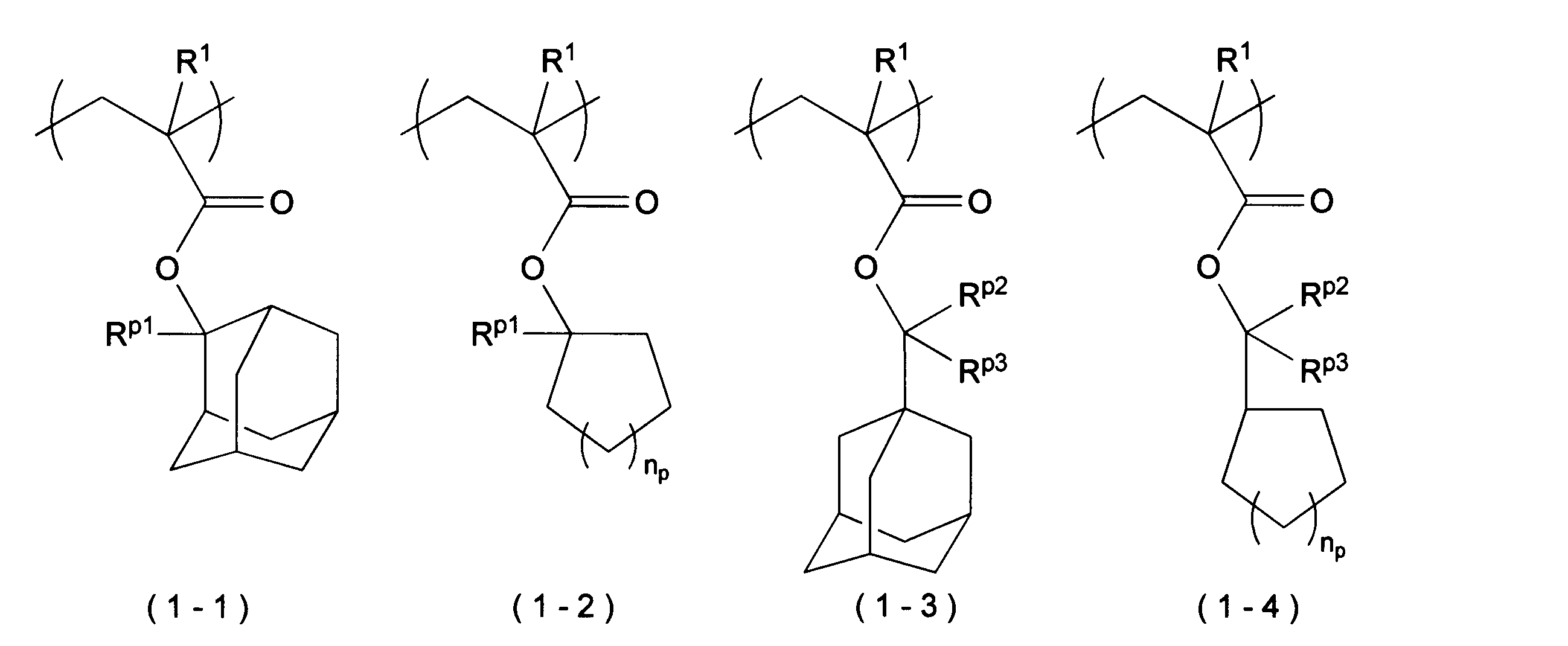

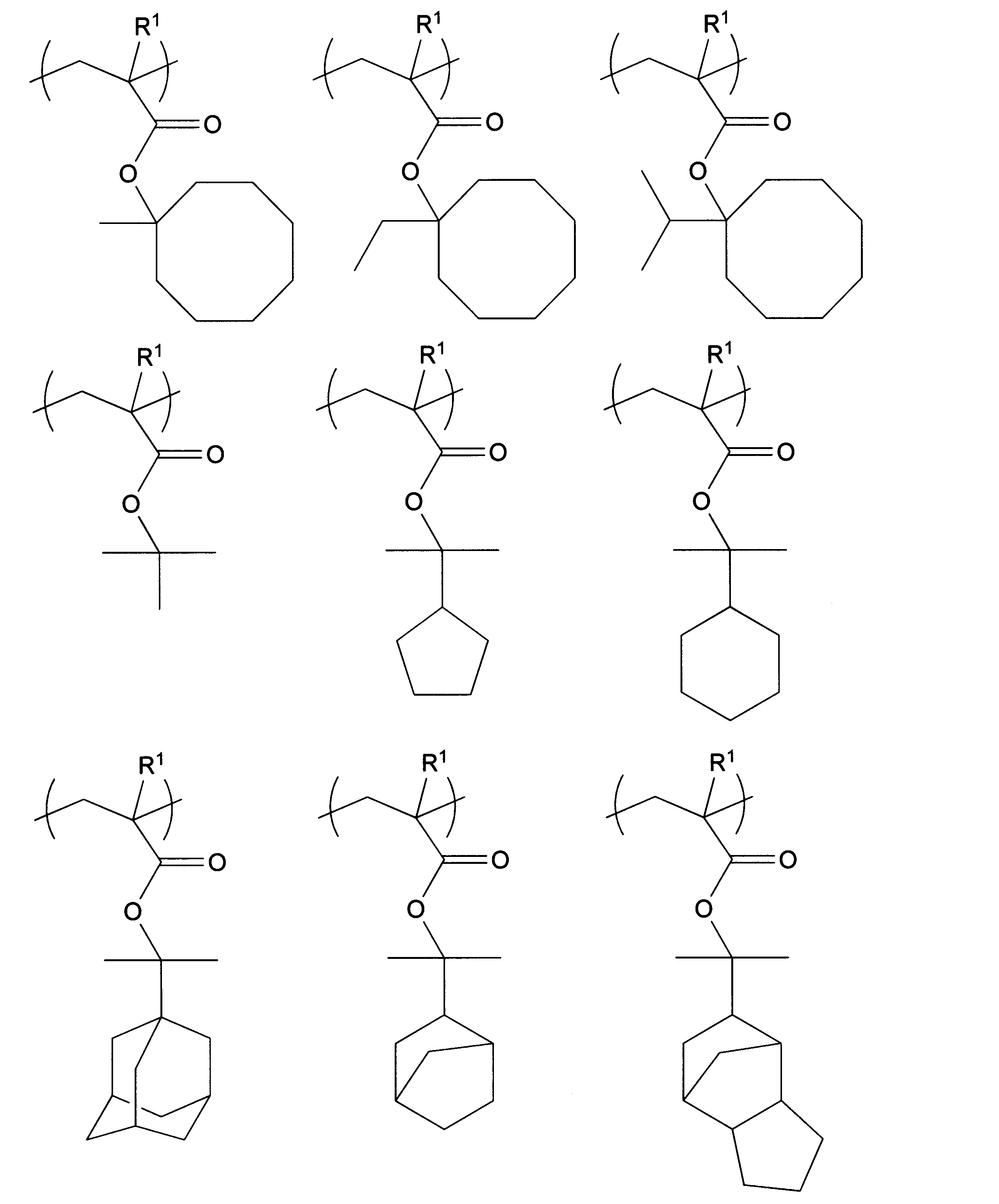
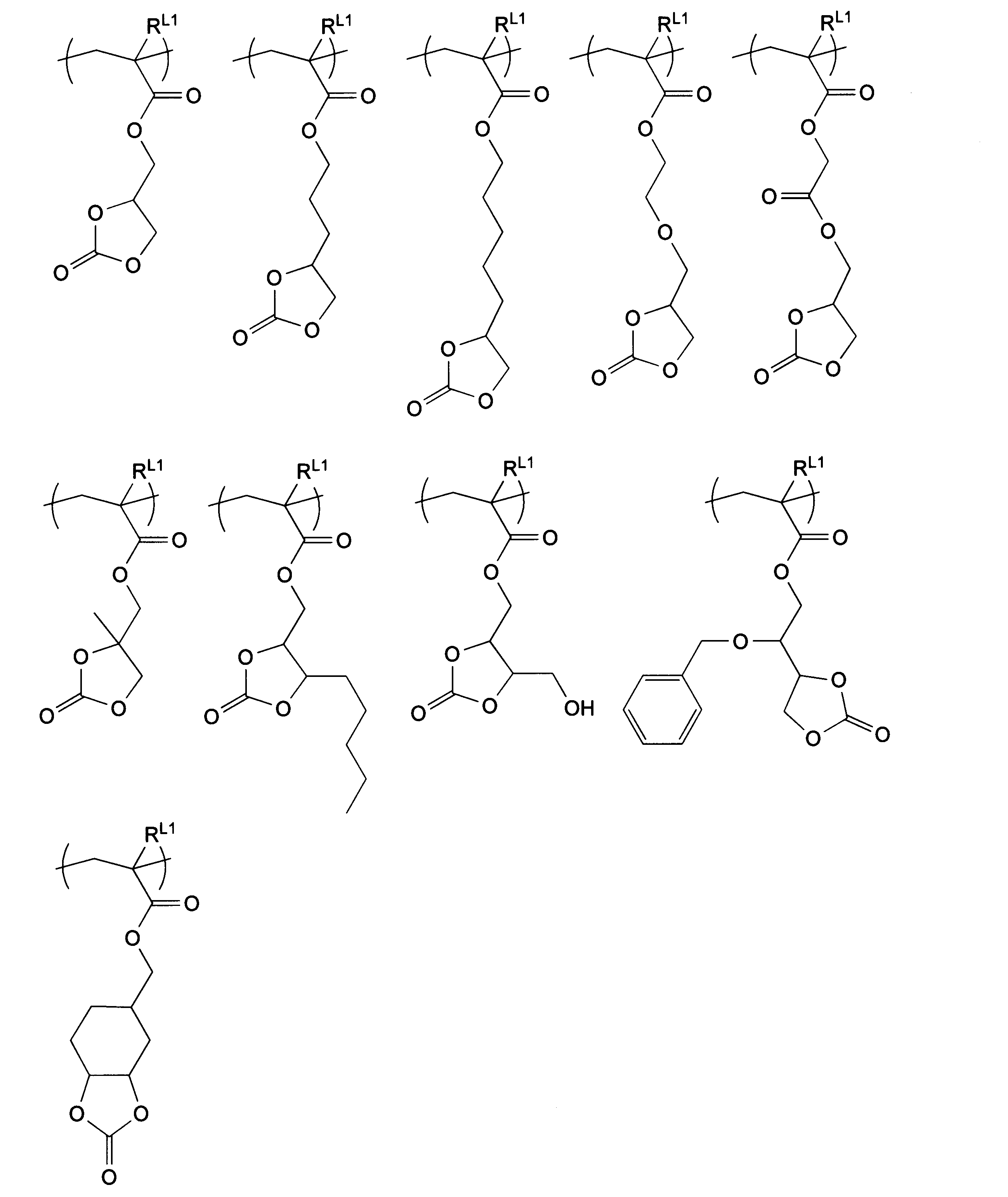
[A]重合体は、ラクトン含有基又は環状カーボネート含有基を含む構造単位(II)(以下、「構造単位(II)」ともいう)を有することが好ましい。構造単位(II)を有することで、レジスト膜の基板への密着性を向上できる。ここで、ラクトン含有基とは、-O-C(O)-構造を含むひとつの環(ラクトン環)を含有する環式基を表す。また、環状カーボネート含有基とは、-O-C(O)-O-で表される結合を含むひとつの環(環状カーボネート環)を含有する環式基を表す。ラクトン環又は環状カーボネート環を1つめの環として数え、ラクトン環又は環状カーボネート環のみの場合は単環式基、さらに他の環構造を有する場合は、その構造に関わらず多環式基と称する。


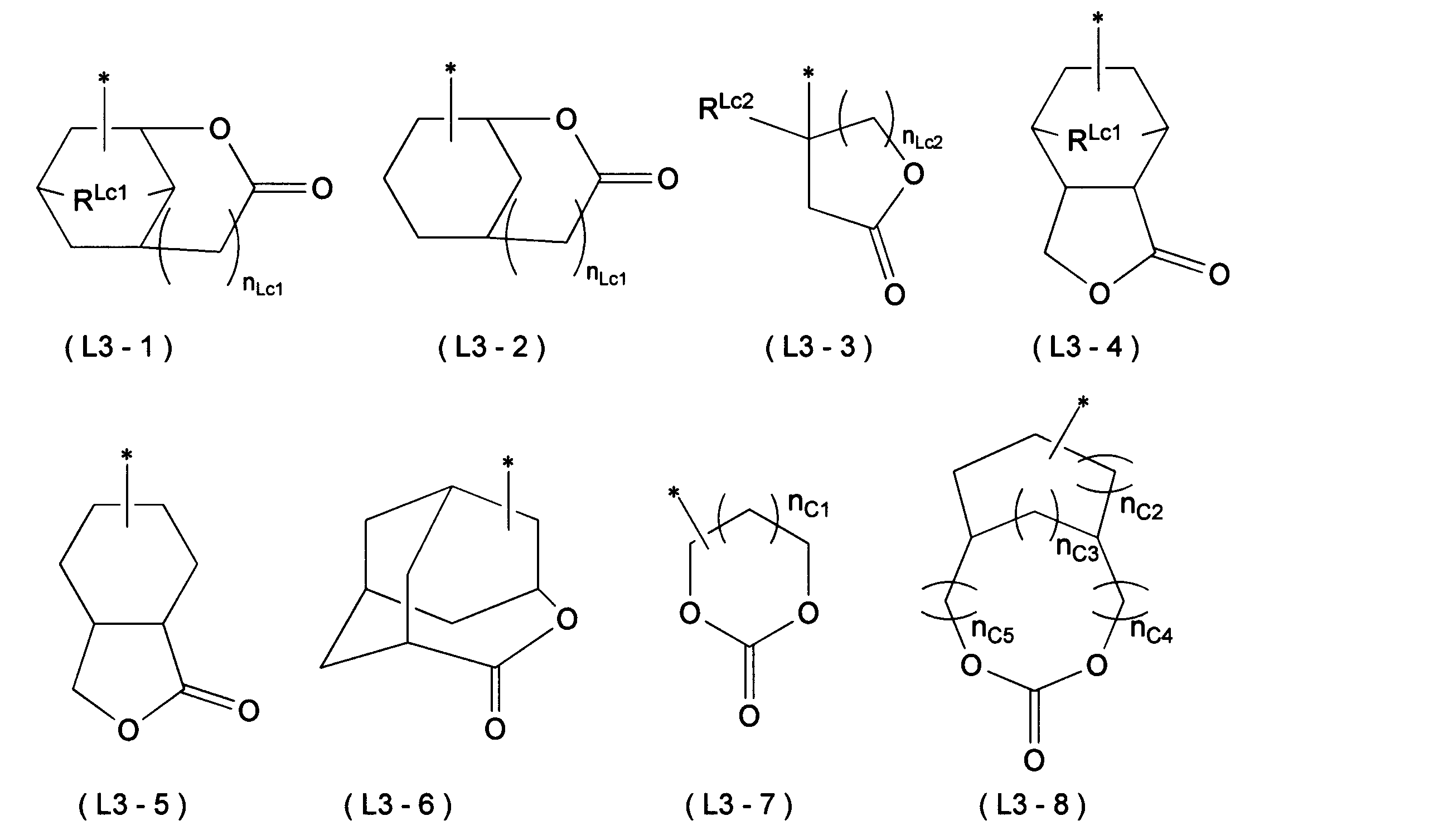
上記式(L3-3)中、RLc2は水素原子又は炭素数1~4のアルキル基である。
上記式(L3-1)及び(L3-2)中、nLc1は0又は1である。
上記式(L3-3)中、nLc2は0~3の整数である。
上記式(L3-7)中、nC1は0~2の整数である。
上記式(L3-8)中、nC2~nC5は、それぞれ独立して、0~2の整数である。「*」は上記式(L-1)のRL2に結合する結合手を表す。なお、式(L3-1)~(L3-8)で表される基は置換基を有していてもよい。
[A]重合体は、親水性官能基を有する構造単位(以下、「構造単位(III)」ともいう)を有してもよい。構造単位(III)としては、下記式で表される構造単位等が挙げられる。
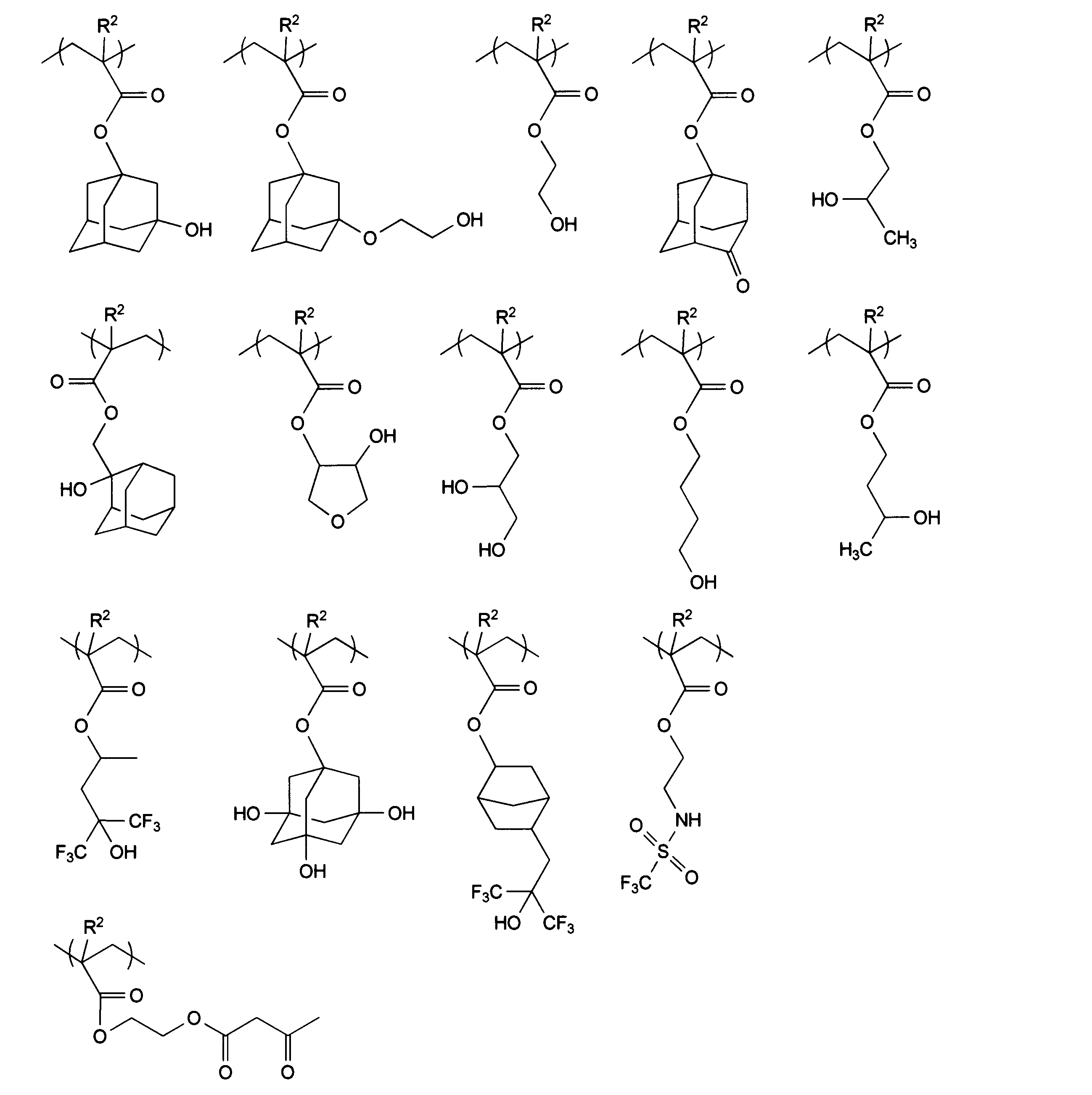
[A]重合体は、例えば所定の各構造単位に対応する単量体を、ラジカル重合開始剤を使用し、適当な溶媒中で重合することにより製造できる。
n-ペンタン、n-ヘキサン、n-ヘプタン、n-オクタン、n-ノナン、n-デカン等のアルカン類;
シクロヘキサン、シクロヘプタン、シクロオクタン、デカリン、ノルボルナン等のシクロアルカン類;
ベンゼン、トルエン、キシレン、エチルベンゼン、クメン等の芳香族炭化水素類;
クロロブタン類、ブロモヘキサン類、ジクロロエタン類、ヘキサメチレンジブロミド、クロロベンゼン等のハロゲン化炭化水素類;
酢酸エチル、酢酸n-ブチル、酢酸i-ブチル、プロピオン酸メチル等の飽和カルボン酸エステル類;
アセトン、2-ブタノン、4-メチル-2-ペンタノン、2-ヘプタノン等のケトン類;
テトラヒドロフラン、ジメトキシエタン類、ジエトキシエタン類等のエーテル類;
メタノール、エタノール、1-プロパノール、2-プロパノール、4-メチル-2-ペンタノール等のアルコール類等が挙げられる。これらの溶媒は、単独で使用してもよく2種以上を併用してもよい。
[B]重合体は、[A]重合体よりフッ素原子含有率が高い重合体である。当該レジストパターン形成方法で用いられる感放射線性樹脂組成物は[B]重合体を含有することによって、レジスト膜を形成した際に、膜中の[B]重合体の撥油性的特徴により、その分布がレジスト膜表層に偏在化する傾向がある。そのため、液浸露光時に酸発生剤や酸拡散制御剤等が液浸媒体に溶出することを抑制でき好ましい。また、この[B]重合体の撥水性的特徴により、レジスト膜と液浸媒体との前進接触角が所望の範囲に制御でき、バブル欠陥の発生を抑制できる。さらに、レジスト膜と液浸媒体との後退接触角が高くなり、水滴が残らずに高速でのスキャン露光が可能となる。

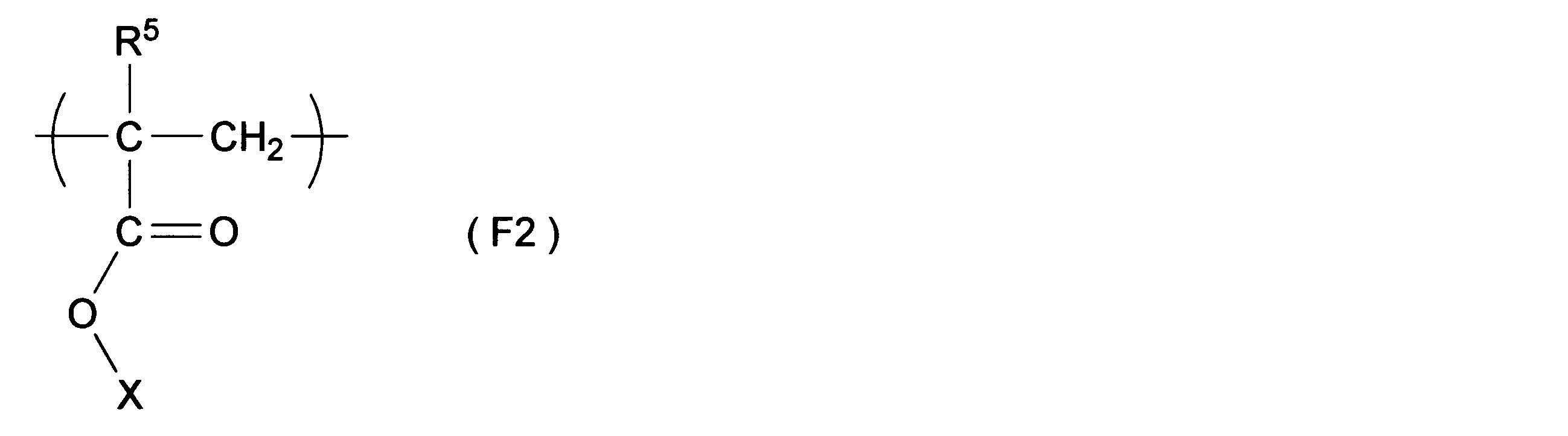
これらのシクロアルカン由来の脂環族環は、置換基を有していてもよく、例えば、メチル基、エチル基、n-プロピル基、i-プロピル基、n-ブチル基、2-メチルプロピル基、1-メチルプロピル基、t-ブチル基等の炭素数1~4の直鎖状、分岐状又は環状のアルキル基の1種以上あるいは1個以上で置換してもよい。これらは、これらのアルキル基によって置換されたものに限定されるものではなく、ヒドロキシル基、シアノ基、炭素数1~10のヒドロキシアルキル基、カルボキシル基又は酸素で置換されたものであってもよい。
[B]重合体は、例えば所定の各構造単位に対応する単量体を、ラジカル重合開始剤を使用し、適当な溶媒中で重合することにより製造できる。
[C]酸発生体は、露光により酸を発生し、その酸により[A]重合体中に存在する酸解離性基を解離させカルボキシル基等を発生させる。その結果、[A]重合体が現像液に難溶性となる。
当該組成物における[C]酸発生体の含有形態としては、後述するような化合物の形態(以下、適宜「[C]酸発生剤」と称する)でも、重合体の一部として組み込まれた形態でも、これらの両方の形態でもよい。
[D]溶媒は、少なくとも上記の[A]重合体、[B]重合体、[C]酸発生体、[E]化合物及び必要に応じて加えられる任意成分を溶解できるものであれば特に限定されない。溶媒としては、例えばアルコール系溶媒、エーテル系溶媒、ケトン系溶媒、アミド系溶媒、エステル系溶媒及びその混合溶媒等が挙げられる。
[E]化合物は、[D]溶媒の比誘電率よりも15以上大きい比誘電率を有する化合物である。[E]化合物が[D]溶媒より所定値以上大きい比誘電率を有することで、[A]重合体よりもフッ素原子含有率の高い[B]重合体のレジスト表面への偏在化が選択的に促進される。その結果、レジスト膜表面での[A]重合体の濃度が低下することになるため、ミッシングコンタクトホールの発生を効果的に防止することができる。また、[B]重合体の撥水性的特徴を高めることにより、高速スキャンによる液浸露光をより高速で行うことができる。さらに、[E]化合物を感放射線性樹脂組成物に含有させることで、[B]重合体がレジスト膜表層に効率良く偏在化するため、[B]重合体の添加量を従来よりも少なくすることができる。
当該組成物は、[A]重合体、[B]重合体、[C]酸発生体、[D]溶媒及び[E]化合物に加え、本発明の効果を損なわない範囲で、その他の任意成分として酸拡散制御体、界面活性剤、脂環式骨格含有化合物、増感剤等を含有できる。
酸拡散制御体は、露光により[C]酸発生体から生じる酸のレジスト被膜中における拡散現象を制御し、非露光領域における好ましくない化学反応を抑制する効果を奏し、得られる感放射線性樹脂組成物の貯蔵安定性がさらに向上し、またレジストとしての解像度がさらに向上するとともに、露光から現像処理までの引き置き時間の変動によるレジストパターンの線幅変化を抑えることができ、プロセス安定性に極めて優れた組成物が得られる。酸拡散制御体の当該組成物における含有形態としては、低分子化合物の形態(以下、適宜「酸拡散制御剤」ともいう)でも、重合体の一部として組み込まれた形態でも、これらの両方の形態でもよい。


界面活性剤は、塗布性、ストリエーション、現像性等を改良する効果を奏する。界面活性剤としては、例えばポリオキシエチレンラウリルエーテル、ポリオキシエチレンステアリルエーテル、ポリオキシエチレンオレイルエーテル、ポリオキシエチレンn-オクチルフェニルエーテル、ポリオキシエチレンn-ノニルフェニルエーテル、ポリエチレングリコールジラウレート、ポリエチレングリコールジステアレート等のノニオン系界面活性剤の他、以下、市販品として、KP341(信越化学工業製)、ポリフローNo.75、同No.95(以上、共栄社化学製)、エフトップEF301、同EF303、同EF352(以上、トーケムプロダクツ製)、メガファックF171、同F173(以上、大日本インキ化学工業製)、フロラードFC430、同FC431(以上、住友スリーエム製)、アサヒガードBG710、サーフロンS-382、同SC-101、同SC-102、同SC-103、同SC-104、同SC-105、同SC-106(以上、旭硝子工業製)等が挙げられる。これらの界面活性剤は、単独で使用してもよく2種以上を併用してもよい。
脂環式骨格含有化合物は、ドライエッチング耐性、パターン形状、基板との接着性等を改善する効果を奏する。
1-アダマンタンカルボン酸、2-アダマンタノン、1-アダマンタンカルボン酸t-ブチル等のアダマンタン誘導体類;
デオキシコール酸t-ブチル、デオキシコール酸t-ブトキシカルボニルメチル、デオキシコール酸2-エトキシエチル等のデオキシコール酸エステル類;
リトコール酸t-ブチル、リトコール酸t-ブトキシカルボニルメチル、リトコール酸2-エトキシエチル等のリトコール酸エステル類;
3-〔2-ヒドロキシ-2,2-ビス(トリフルオロメチル)エチル〕テトラシクロ[4.4.0.12,5.17,10]ドデカン、2-ヒドロキシ-9-メトキシカルボニル-5-オキソ-4-オキサ-トリシクロ[4.2.1.03,7]ノナン等が挙げられる。これらの脂環式骨格含有化合物は単独で使用してもよく2種以上を併用してもよい。
増感剤は、[C]酸発生体の生成量を増加する作用を表すものであり、当該組成物の「みかけの感度」を向上させる効果を奏する。
当該感放射線性樹脂組成物は、例えば[A]重合体、[B]重合体、[C]酸発生体、[D]溶媒、[E]化合物、及び、必要に応じてその他の任意成分を所定の割合で混合することにより調製できる。当該感放射線性樹脂組成物の固形分濃度としては、通常、0.1質量%~50質量%であり、0.5質量%~30質量%が好ましく、1質量%~15質量%がより好ましい。
重合体のMw及びMnは、GPCカラム(東ソー製、G2000HXL 2本、G3000HXL 1本、G4000HXL 1本)を用い、以下の条件により測定した。
カラム温度:40℃
溶出溶媒:テトラヒドロフラン(和光純薬工業製)
流速:1.0mL/分
試料濃度:1.0質量%
試料注入量:100μL
検出器:示差屈折計
標準物質:単分散ポリスチレン
重合体の構造単位含有率(モル%)及びフッ素原子含有率(質量%)を求めるための13C-NMR分析は、核磁気共鳴装置(日本電子製、JNM-EX270)を使用して測定した。
[A]重合体及び[B]重合体の合成に用いた単量体を以下に示す。
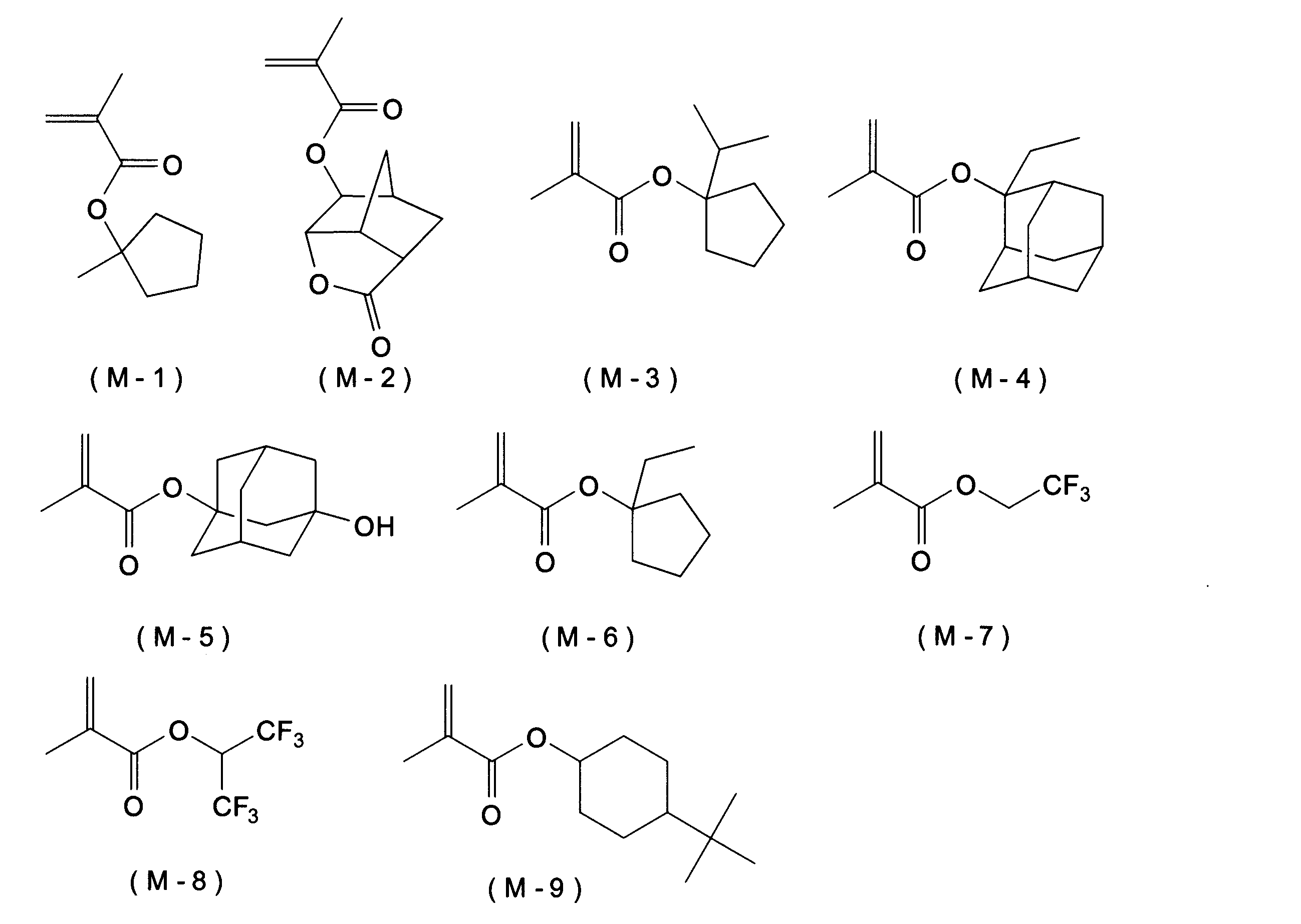
[合成例1]
上記化合物(M-1)12.9g(50モル%)及び化合物(M-2)17.1g(50モル%)を2-ブタノン60gに溶解させ、さらにAIBN0.5gを溶解させた単量体溶液を調製した。次に、30gの2-ブタノンを投入した200mLの三口フラスコを30分窒素パージした後、反応釜を攪拌しながら80℃に加熱し、上記調製した単量体溶液を、滴下漏斗を用いて3時間かけて滴下した。滴下開始を重合開始時間とし、重合反応を6時間実施した。重合終了後、重合反応液を水冷して30℃以下に冷却し、600gのメタノールへ投入して、析出した白色粉末を濾別した。濾別した白色粉末を150gのメタノールにてスラリー状にして2度洗浄した後、再度濾別し、50℃にて17時間乾燥して白色粉末の重合体(A-1)を得た(収率:80%)。重合体(A-1)のMwは、13,000であり、Mw/Mnは1.4であった。13C-NMR分析の結果、重合体(A-1)における化合物(M-1)に由来する構造単位:化合物(M-2)に由来する各構造単位の含有率は、50:50(モル%)であった。
下記表1に記載の種類及び使用量の単量体を用いた以外は、合成例1と同様に操作して重合体(A-2)~(A-4)を得た。得られた各重合体の各構造単位の含有率、Mw、Mw/Mn比、収率(%)を合わせて表1に示す。

[合成例5]
上記化合物(M-7)8.5g(30モル%)及び化合物(M-6)21.5g(70モル%)を2-ブタノン60gに溶解させ、さらにAIBN1.38gを溶解させた単量体溶液を調製した。次に30gの2-ブタノンを投入した200mLの三口フラスコを30分窒素パージした後、反応釜を攪拌しながら80℃に加熱し、上記調製した単量体溶液を滴下漏斗を用いて3時間かけて滴下した。滴下開始を重合開始時間とし、重合反応を6時間実施した。重合終了後、重合反応液を水冷し30℃以下に冷却し、600gのメタノールへ投入し、析出した白色粉末を濾別した。濾別した白色粉末を150gのメタノールにてスラリー状にして2度洗浄した後、再度濾別し、50℃にて12時間乾燥して白色粉末の重合体(B-1)を得た(収率:89%)。重合体(B-1)のMwは7,500であり、Mw/Mnは1.4であった。13C-NMR分析の結果、重合体(B-1)における化合物(M-3)に由来する構造単位:化合物(M-4)に由来する各構造単位の含有率は、30:70(モル%)であった。
単量体として、上記化合物(M-8)7.96g(20モル%)及び化合物(M-9)30.1g(80モル%)を用いた以外は合成例5と同様に操作して、重合体(B-2)を得た(収率:68%)。重合体(B-2)のMwは7,200であり、Mw/Mnは1.51であった。13C-NMR分析の結果、重合体(B-2)における化合物(M-8)に由来する構造単位:化合物(M-9)に由来する各構造単位の含有率は、20.5:79.5(モル%)であった。
上記合成例にて合成した[A]重合体及び[B]重合体以外の感放射線性樹脂組成物を構成する各成分([C]酸発生体、[D]溶媒、[E]化合物及び[F]酸拡散制御剤)について以下に示す。
C-1:トリフェニルスルホニウムノナフルオロ-n-ブタンスルホネート(下記式(C-1)で表される化合物)
C-2:1-(4-n-ブトキシナフタレン-1-イル)テトラヒドロチオフェニウムノナフルオロ-n-ブタンスルホネート(下記式(C-2)で表される化合物)
C-3:トリフェニルスルホニウム6-アダマンチルカルボニルオキシ-1,1,2,2-テトラフルオロヘキサン-1-スルホネート(下記式(C-3)で表される化合物)
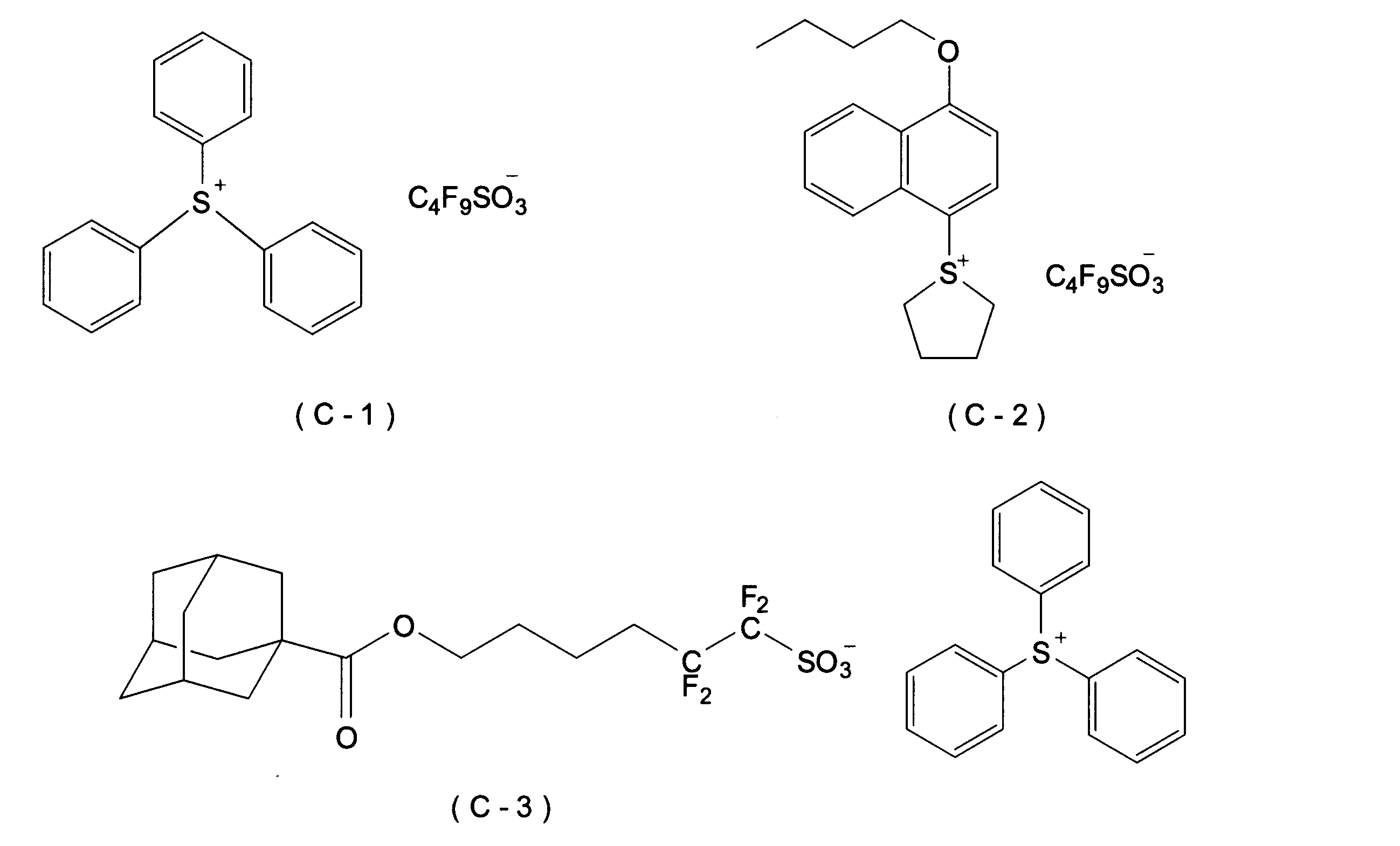
D-1:酢酸プロピレングリコールモノメチルエーテル
溶媒(D-1)は、25℃における比誘電率が8で、1気圧における沸点が146℃である。
D-2:シクロヘキサノン
溶媒(D-2)は、25℃における比誘電率が18で、1気圧における沸点が156℃である。
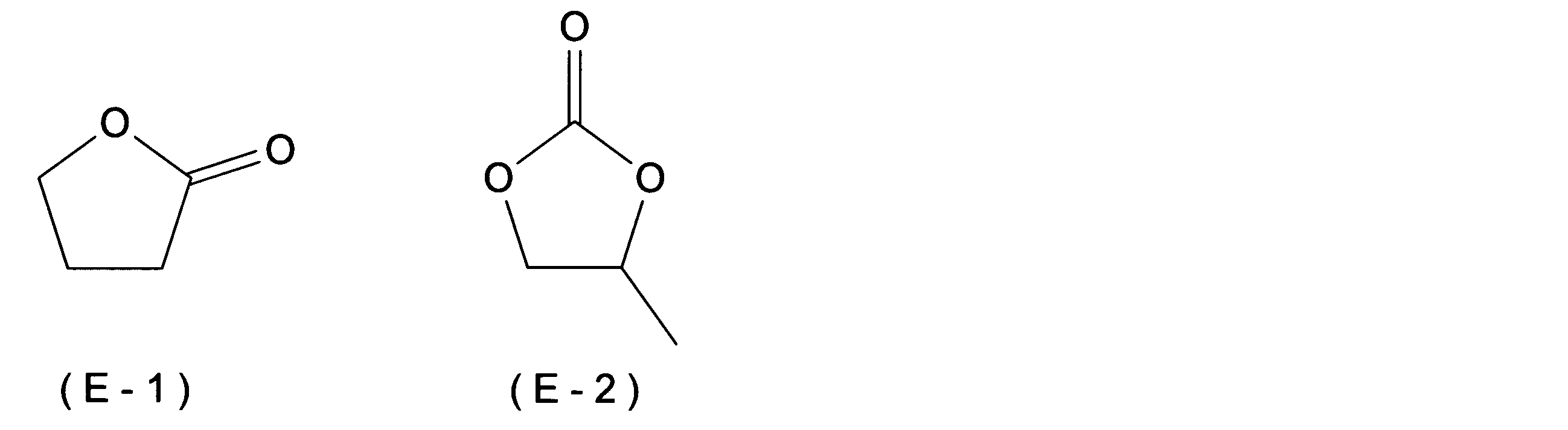
E-1:γ―ブチロラクトン(下記式(E-1)で表される化合物)
化合物(E-1)の25℃における比誘電率は42であり、1気圧における沸点は204℃である。
E-2:プロピレンカーボネート(下記式(E-2)で表される化合物)
化合物(E-2)の25℃における比誘電率は65であり、1気圧における沸点は240℃である。
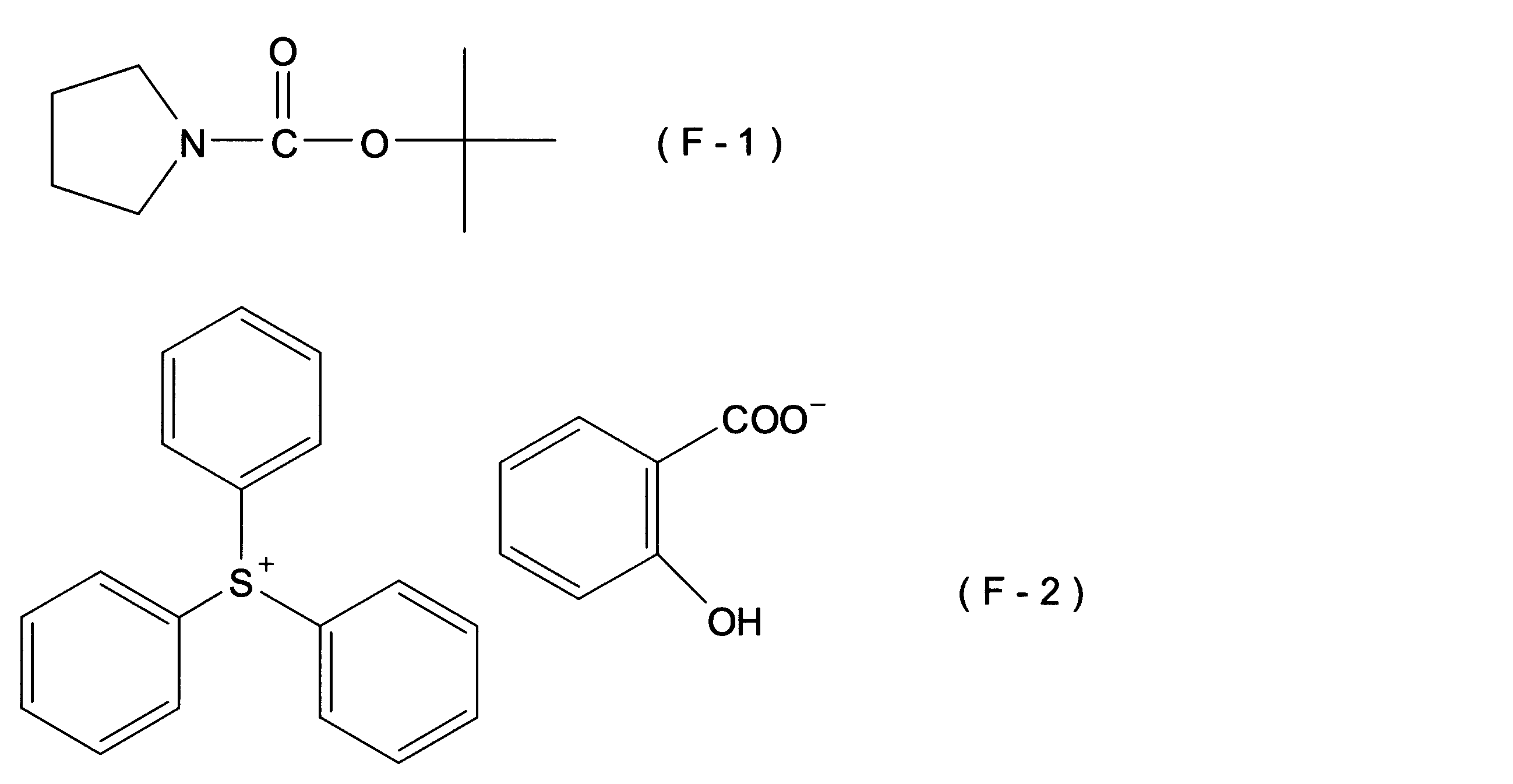
F-1:N-t-ブトキシカルボニルピロリジン(下記式(F-1)で表される化合物)
F-2:トリフェニルスルホニウムサリチレート(下記式(F-2)で表される化合物)
重合体(A-1)100質量部、重合体(B-1)3質量部、酸発生剤(C-1)9.5質量部、溶媒(D-1)2,010質量部及び溶媒(D-2)860質量部、化合物(E-1)100質量部、並びに酸拡散制御剤(F-1)0.94質量部を混合して均一溶液とした。その後、孔径200nmのメンブランフィルターを用いてろ過することにより、実施例1の感放射線性樹脂組成物(J-1)を調製した。感放射線性樹脂組成物(J-1)の固形分濃度(溶媒以外の成分の総濃度)は、5質量%であった。
実施例1において、配合する各成分の種類及び量を下記表2に記載の通りにした以外は、実施例1と同様にして、各実施例及び比較例の感放射線性樹脂組成物を調製した。

<レジストパターンの形成>
12インチシリコンウェハ上に、下層反射防止膜形成用組成物(ARC66、ブルワーサイエンス製)をスピンコーター(CLEAN TRACK Lithius Pro i、東京エレクトロン製)を使用してスピンコートした後、205℃で60秒間PBを行うことにより膜厚105nmの塗膜を形成した。次に、上記スピンコーターを使用して、実施例1で得られた感放射線性樹脂組成物(J-1)をスピンコートし、90℃で60秒間PBした後、23℃で30秒間冷却することにより膜厚100nmのレジスト膜を形成した。
実施例21において、用いる感放射線性樹脂組成物を、下記表2に記載の通りとした以外は、実施例21と同様にして、各実施例及び比較例に係るレジストパターンの形成を行った。
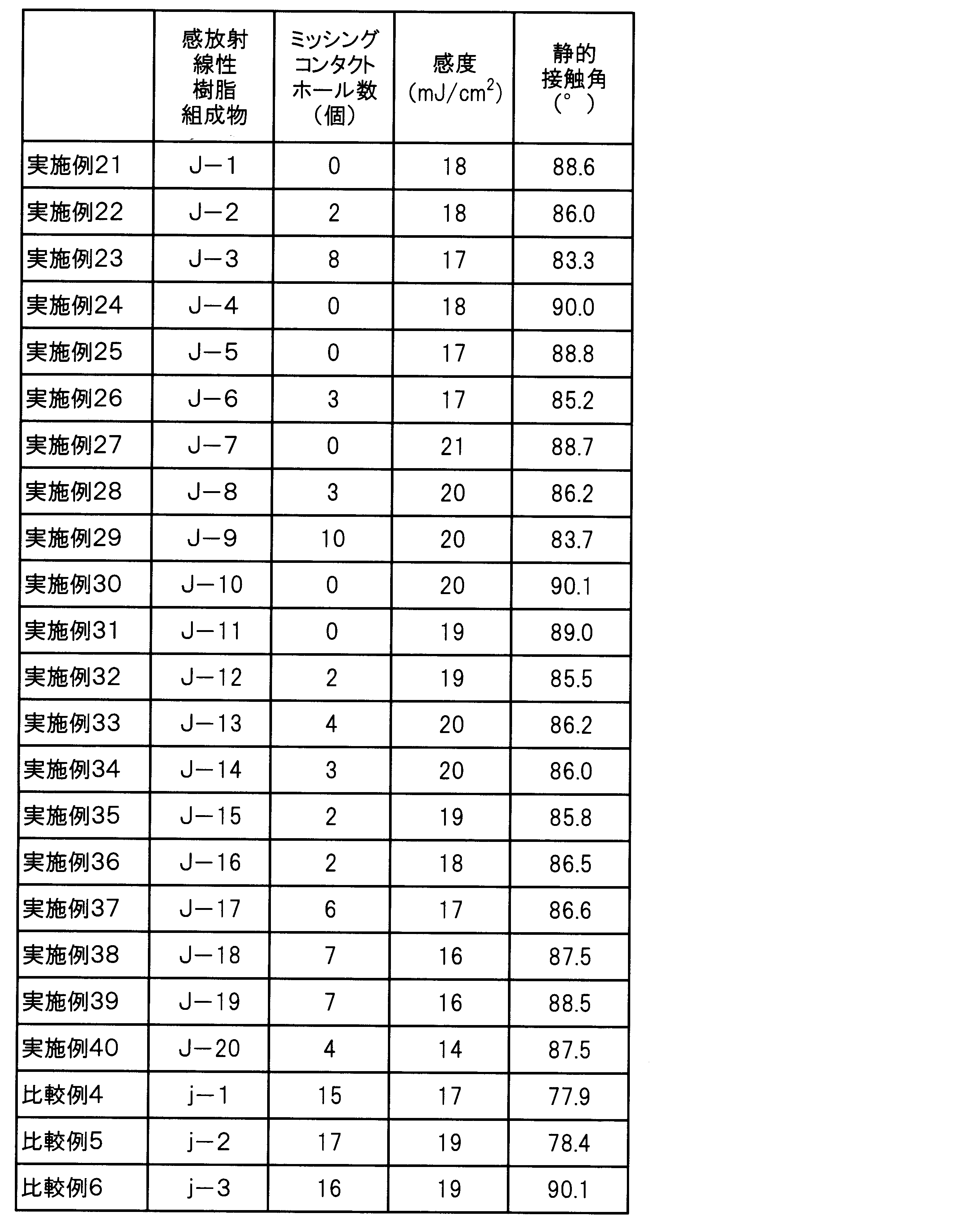
上記実施例22~40及び比較例4~6にて形成した各レジストパターンについて、ミッシングコンタクトホール発生抑制性、感度及び静的接触角を、下記方法に従って評価した。評価結果を表3に示す。
上記実施例及び比較例で形成したレジストパターンについて、走査型電子顕微鏡(「CG-4000」、日立ハイテクノロジーズ製)を用いて観測し測長を行った。観測倍率を50Kとし一視野中に観測されたミッシングコンタクトホールの数を数えることでミッシングコンタクトホール発生抑制性を評価した。ミッシングコンタクトホール数が少なければ少ない程、ミッシングコンタクトホール抑制性が良好な結果と言える。
縮小投影露光後のホールパターンの直径が0.055μmとなるように、ドットパターンを有するマスクを、液浸水を介して露光し、形成されるホールパターンが直径0.055μmのホールサイズとなるような露光量を最適露光量とし、この最適露光量を感度(mJ/cm2)とした。なお、測長には上記走査型電子顕微鏡を用いた。
まず、8インチシリコンウェハ上に、感放射線性樹脂組成物をスピンコートし、ホットプレート上で90℃の温度で、60秒間PBを行い、膜厚100nmの塗膜(フォトレジスト膜)を形成した。その後、接触角測定装置(「DSA-10」、KRUS製)を使用して、速やかに、室温:23℃、湿度:45%、常圧の環境下で、次の手順により静的接触角を測定した。
次いで、水滴を形成してから2秒後より4秒間掛けて同じポイントで10回静的接触角を連続測定した。この操作を異なる水滴形成場所で3回行い、計30点の測定値を平均して静的接触角の値とした。
Claims (6)
- (1)感放射線性樹脂組成物を基板上に塗布するレジスト膜形成工程、
(2)露光工程、及び
(3)有機溶媒を80質量%以上含有する現像液を用いる現像工程
を含むレジストパターン形成方法であって、
上記感放射線性樹脂組成物が、
[A]酸解離性基を有するベース重合体、
[B][A]重合体よりフッ素原子含有率が高い重合体、
[C]感放射線性酸発生体、
[D]溶媒、及び
[E][D]溶媒の比誘電率よりも15以上大きい比誘電率を有する化合物
を含有し、
上記[E]化合物の含有量が、[A]重合体100質量部に対して、10質量部以上200質量部以下であることを特徴とするレジストパターン形成方法。 - [E]化合物の比誘電率が、20以上75以下である請求項1に記載のレジストパターン形成方法。
- [E]化合物の1気圧における沸点が、180℃以上300℃以下である請求項1又は請求項2に記載のレジストパターン形成方法。
- [E]化合物がラクトン化合物及び環状カーボネート化合物からなる群より選択される少なくとも1種である請求項1又は請求項2に記載のレジストパターン形成方法。
- [A]重合体の酸解離性基が、単環又は多環の脂環式炭化水素基を有する請求項1又は請求項2に記載のレジストパターン形成方法。
- 有機溶媒が80質量%以上の現像液を用いるレジストパターン形成方法用の感放射線性樹脂組成物であって、
[A]酸解離性基を有するベース重合体、
[B][A]重合体よりフッ素原子含有率が高い重合体、
[C]感放射線性酸発生体、
[D]溶媒、及び
[E][D]溶媒の比誘電率よりも15以上大きい比誘電率を有する化合物
を含有し、
上記[E]化合物の含有量が、[A]重合体100質量部に対して、10質量部以上200質量部以下であることを特徴とする感放射線性樹脂組成物。
Priority Applications (5)
| Application Number | Priority Date | Filing Date | Title |
|---|---|---|---|
| KR1020147008051A KR101921367B1 (ko) | 2010-10-19 | 2011-10-11 | 레지스트 패턴 형성 방법 및 감방사선성 수지 조성물 |
| KR1020137015721A KR20130084325A (ko) | 2010-10-19 | 2011-10-11 | 감방사선성 수지 조성물 |
| JP2012518672A JP5263453B2 (ja) | 2010-10-19 | 2011-10-11 | レジストパターン形成方法及び感放射線性樹脂組成物 |
| KR1020137009902A KR101393197B1 (ko) | 2010-10-19 | 2011-10-11 | 레지스트 패턴 형성 방법 및 감방사선성 수지 조성물 |
| US13/866,087 US8815493B2 (en) | 2010-10-19 | 2013-04-19 | Resist pattern-forming method, and radiation-sensitive resin composition |
Applications Claiming Priority (2)
| Application Number | Priority Date | Filing Date | Title |
|---|---|---|---|
| JP2010234989 | 2010-10-19 | ||
| JP2010-234989 | 2010-10-19 |
Related Child Applications (1)
| Application Number | Title | Priority Date | Filing Date |
|---|---|---|---|
| US13/866,087 Continuation US8815493B2 (en) | 2010-10-19 | 2013-04-19 | Resist pattern-forming method, and radiation-sensitive resin composition |
Publications (1)
| Publication Number | Publication Date |
|---|---|
| WO2012053396A1 true WO2012053396A1 (ja) | 2012-04-26 |
Family
ID=45975113
Family Applications (1)
| Application Number | Title | Priority Date | Filing Date |
|---|---|---|---|
| PCT/JP2011/073356 Ceased WO2012053396A1 (ja) | 2010-10-19 | 2011-10-11 | レジストパターン形成方法及び感放射線性樹脂組成物 |
Country Status (5)
| Country | Link |
|---|---|
| US (1) | US8815493B2 (ja) |
| JP (2) | JP5263453B2 (ja) |
| KR (3) | KR101921367B1 (ja) |
| TW (1) | TWI524139B (ja) |
| WO (1) | WO2012053396A1 (ja) |
Cited By (4)
| Publication number | Priority date | Publication date | Assignee | Title |
|---|---|---|---|---|
| JPH0935333A (ja) * | 1995-07-14 | 1997-02-07 | Pioneer Electron Corp | 光記録媒体 |
| JP2014038321A (ja) * | 2012-07-18 | 2014-02-27 | Sumitomo Chemical Co Ltd | レジスト組成物及びレジストパターンの製造方法 |
| JP2014112214A (ja) * | 2012-11-09 | 2014-06-19 | Sumitomo Chemical Co Ltd | レジスト組成物及びレジストパターンの製造方法 |
| JP2016206586A (ja) * | 2015-04-28 | 2016-12-08 | 信越化学工業株式会社 | レジスト組成物及びパターン形成方法 |
Families Citing this family (4)
| Publication number | Priority date | Publication date | Assignee | Title |
|---|---|---|---|---|
| EP2204392A1 (en) * | 2008-12-31 | 2010-07-07 | Rohm and Haas Electronic Materials LLC | Compositions and processes for photolithography |
| JP6039028B1 (ja) * | 2015-09-11 | 2016-12-07 | 株式会社東芝 | 自己組織化材料及びパターン形成方法 |
| JP7117910B2 (ja) * | 2018-06-28 | 2022-08-15 | 東京応化工業株式会社 | レジスト組成物及びレジストパターン形成方法 |
| DE102020124247A1 (de) * | 2019-10-31 | 2021-05-06 | Taiwan Semiconductor Manufacturing Co., Ltd. | Fotolackentwickler und verfahren zum entwickeln von fotolack |
Citations (6)
| Publication number | Priority date | Publication date | Assignee | Title |
|---|---|---|---|---|
| JP2005221721A (ja) * | 2004-02-05 | 2005-08-18 | Fuji Photo Film Co Ltd | 感光性組成物及び該感光性組成物を用いたパターン形成方法 |
| JP2009025723A (ja) * | 2007-07-23 | 2009-02-05 | Fujifilm Corp | ネガ型現像用レジスト組成物及びこれを用いたパターン形成方法 |
| JP2009244780A (ja) * | 2008-03-31 | 2009-10-22 | Fujifilm Corp | ネガ型レジスト組成物およびレジストパターン形成方法 |
| JP2010020284A (ja) * | 2008-06-11 | 2010-01-28 | Tokyo Ohka Kogyo Co Ltd | 液浸露光用レジスト組成物およびそれを用いたレジストパターン形成方法 |
| JP2010134106A (ja) * | 2008-12-03 | 2010-06-17 | Fujifilm Corp | 感活性光線または感放射線性樹脂組成物、及び該感活性光線または感放射線性樹脂組成物を用いたパターン形成方法 |
| JP2010197619A (ja) * | 2009-02-24 | 2010-09-09 | Fujifilm Corp | ネガ型現像用レジスト組成物及びこれを用いたパターン形成方法 |
Family Cites Families (23)
| Publication number | Priority date | Publication date | Assignee | Title |
|---|---|---|---|---|
| US4910122A (en) | 1982-09-30 | 1990-03-20 | Brewer Science, Inc. | Anti-reflective coating |
| JPH0612452B2 (ja) | 1982-09-30 | 1994-02-16 | ブリュ−ワ−・サイエンス・インコ−ポレイテッド | 集積回路素子の製造方法 |
| JP2643056B2 (ja) | 1991-06-28 | 1997-08-20 | インターナショナル・ビジネス・マシーンズ・コーポレイション | 表面反射防止コーティング形成組成物及びその使用 |
| JP3943741B2 (ja) | 1999-01-07 | 2007-07-11 | 株式会社東芝 | パターン形成方法 |
| JP4434762B2 (ja) | 2003-01-31 | 2010-03-17 | 東京応化工業株式会社 | レジスト組成物 |
| JP4551701B2 (ja) | 2004-06-14 | 2010-09-29 | 富士フイルム株式会社 | 液浸露光用保護膜形成組成物及びそれを用いたパターン形成方法 |
| CN101395189B (zh) | 2006-03-31 | 2013-07-17 | Jsr株式会社 | 含氟聚合物及其精制方法以及感放射线性树脂组合物 |
| US8530148B2 (en) * | 2006-12-25 | 2013-09-10 | Fujifilm Corporation | Pattern forming method, resist composition for multiple development used in the pattern forming method, developer for negative development used in the pattern forming method, and rinsing solution for negative development used in the pattern forming method |
| JP4554665B2 (ja) * | 2006-12-25 | 2010-09-29 | 富士フイルム株式会社 | パターン形成方法、該パターン形成方法に用いられる多重現像用ポジ型レジスト組成物、該パターン形成方法に用いられるネガ現像用現像液及び該パターン形成方法に用いられるネガ現像用リンス液 |
| JP5186255B2 (ja) * | 2007-03-20 | 2013-04-17 | 富士フイルム株式会社 | レジスト表面疎水化用樹脂、その製造方法及び該樹脂を含有するポジ型レジスト組成物 |
| KR100990106B1 (ko) * | 2007-04-13 | 2010-10-29 | 후지필름 가부시키가이샤 | 패턴형성방법, 이 패턴형성방법에 사용되는 레지스트 조성물, 현상액 및 린스액 |
| US8034547B2 (en) * | 2007-04-13 | 2011-10-11 | Fujifilm Corporation | Pattern forming method, resist composition to be used in the pattern forming method, negative developing solution to be used in the pattern forming method and rinsing solution for negative development to be used in the pattern forming method |
| US8476001B2 (en) * | 2007-05-15 | 2013-07-02 | Fujifilm Corporation | Pattern forming method |
| JP4617337B2 (ja) * | 2007-06-12 | 2011-01-26 | 富士フイルム株式会社 | パターン形成方法 |
| JP4590431B2 (ja) * | 2007-06-12 | 2010-12-01 | 富士フイルム株式会社 | パターン形成方法 |
| US8257911B2 (en) * | 2008-08-26 | 2012-09-04 | Tokyo Electron Limited | Method of process optimization for dual tone development |
| JP5277128B2 (ja) * | 2008-09-26 | 2013-08-28 | 富士フイルム株式会社 | 液浸露光用ポジ型レジスト組成物及びパターン形成方法 |
| JP5639755B2 (ja) * | 2008-11-27 | 2014-12-10 | 富士フイルム株式会社 | 有機溶剤を含有する現像液を用いたパターン形成方法及びこれに用いるリンス液 |
| JP5183449B2 (ja) * | 2008-12-15 | 2013-04-17 | 富士フイルム株式会社 | ネガ型現像用レジスト組成物を用いたパターン形成方法 |
| JP5572375B2 (ja) * | 2008-12-15 | 2014-08-13 | 富士フイルム株式会社 | ネガ型現像用レジスト組成物、これを用いたパターン形成方法、レジスト膜、及び、パターン |
| JP5639795B2 (ja) * | 2010-02-18 | 2014-12-10 | 東京応化工業株式会社 | レジストパターン形成方法 |
| JP5675144B2 (ja) * | 2010-03-30 | 2015-02-25 | 富士フイルム株式会社 | 感活性光線性又は感放射線性樹脂組成物、及びそれを用いたパターン形成方法 |
| JP2012068544A (ja) * | 2010-09-24 | 2012-04-05 | Fujifilm Corp | パターン形成方法、化学増幅型レジスト組成物及びレジスト膜 |
-
2011
- 2011-10-11 JP JP2012518672A patent/JP5263453B2/ja active Active
- 2011-10-11 WO PCT/JP2011/073356 patent/WO2012053396A1/ja not_active Ceased
- 2011-10-11 KR KR1020147008051A patent/KR101921367B1/ko active Active
- 2011-10-11 KR KR1020137015721A patent/KR20130084325A/ko not_active Withdrawn
- 2011-10-11 KR KR1020137009902A patent/KR101393197B1/ko active Active
- 2011-10-18 TW TW100137725A patent/TWI524139B/zh active
-
2012
- 2012-12-25 JP JP2012281812A patent/JP2013101371A/ja active Pending
-
2013
- 2013-04-19 US US13/866,087 patent/US8815493B2/en active Active
Patent Citations (6)
| Publication number | Priority date | Publication date | Assignee | Title |
|---|---|---|---|---|
| JP2005221721A (ja) * | 2004-02-05 | 2005-08-18 | Fuji Photo Film Co Ltd | 感光性組成物及び該感光性組成物を用いたパターン形成方法 |
| JP2009025723A (ja) * | 2007-07-23 | 2009-02-05 | Fujifilm Corp | ネガ型現像用レジスト組成物及びこれを用いたパターン形成方法 |
| JP2009244780A (ja) * | 2008-03-31 | 2009-10-22 | Fujifilm Corp | ネガ型レジスト組成物およびレジストパターン形成方法 |
| JP2010020284A (ja) * | 2008-06-11 | 2010-01-28 | Tokyo Ohka Kogyo Co Ltd | 液浸露光用レジスト組成物およびそれを用いたレジストパターン形成方法 |
| JP2010134106A (ja) * | 2008-12-03 | 2010-06-17 | Fujifilm Corp | 感活性光線または感放射線性樹脂組成物、及び該感活性光線または感放射線性樹脂組成物を用いたパターン形成方法 |
| JP2010197619A (ja) * | 2009-02-24 | 2010-09-09 | Fujifilm Corp | ネガ型現像用レジスト組成物及びこれを用いたパターン形成方法 |
Cited By (4)
| Publication number | Priority date | Publication date | Assignee | Title |
|---|---|---|---|---|
| JPH0935333A (ja) * | 1995-07-14 | 1997-02-07 | Pioneer Electron Corp | 光記録媒体 |
| JP2014038321A (ja) * | 2012-07-18 | 2014-02-27 | Sumitomo Chemical Co Ltd | レジスト組成物及びレジストパターンの製造方法 |
| JP2014112214A (ja) * | 2012-11-09 | 2014-06-19 | Sumitomo Chemical Co Ltd | レジスト組成物及びレジストパターンの製造方法 |
| JP2016206586A (ja) * | 2015-04-28 | 2016-12-08 | 信越化学工業株式会社 | レジスト組成物及びパターン形成方法 |
Also Published As
| Publication number | Publication date |
|---|---|
| JP2013101371A (ja) | 2013-05-23 |
| KR20140046086A (ko) | 2014-04-17 |
| KR20130084325A (ko) | 2013-07-24 |
| JPWO2012053396A1 (ja) | 2014-02-24 |
| TW201222147A (en) | 2012-06-01 |
| US20130230803A1 (en) | 2013-09-05 |
| KR20130082505A (ko) | 2013-07-19 |
| KR101921367B1 (ko) | 2018-11-22 |
| US8815493B2 (en) | 2014-08-26 |
| KR101393197B1 (ko) | 2014-05-08 |
| TWI524139B (zh) | 2016-03-01 |
| JP5263453B2 (ja) | 2013-08-14 |
Similar Documents
| Publication | Publication Date | Title |
|---|---|---|
| JP5716751B2 (ja) | パターン形成方法及び感放射線性樹脂組成物 | |
| KR101279715B1 (ko) | 패턴 형성 방법 및 현상액 | |
| JP5994882B2 (ja) | レジストパターン形成方法 | |
| JP5035466B1 (ja) | レジストパターン形成用感放射線性樹脂組成物 | |
| JP5967083B2 (ja) | ダブルパターン形成方法 | |
| JP5263453B2 (ja) | レジストパターン形成方法及び感放射線性樹脂組成物 | |
| JP5928345B2 (ja) | レジストパターン形成方法 | |
| WO2014017144A1 (ja) | ネガ型レジストパターン形成方法及びフォトレジスト組成物 | |
| JP2012093706A (ja) | 感放射線性樹脂組成物及びパターン形成方法 | |
| JP6060967B2 (ja) | フォトレジスト組成物及びレジストパターン形成方法 | |
| JP5867298B2 (ja) | フォトレジスト組成物及びレジストパターン形成方法 | |
| WO2012077433A1 (ja) | パターン形成方法及び感放射線性樹脂組成物 | |
| WO2012046543A1 (ja) | レジストパターン形成方法及び感放射線性樹脂組成物 | |
| WO2012111450A1 (ja) | フォトレジスト組成物及びレジストパターン形成方法 | |
| JP2012177807A (ja) | 感放射線性樹脂組成物及びこれを用いたパターン形成方法 | |
| JP5803806B2 (ja) | レジストパターン形成方法 |
Legal Events
| Date | Code | Title | Description |
|---|---|---|---|
| WWE | Wipo information: entry into national phase |
Ref document number: 2012518672 Country of ref document: JP |
|
| 121 | Ep: the epo has been informed by wipo that ep was designated in this application |
Ref document number: 11834236 Country of ref document: EP Kind code of ref document: A1 |
|
| ENP | Entry into the national phase |
Ref document number: 20137009902 Country of ref document: KR Kind code of ref document: A |
|
| NENP | Non-entry into the national phase |
Ref country code: DE |
|
| 122 | Ep: pct application non-entry in european phase |
Ref document number: 11834236 Country of ref document: EP Kind code of ref document: A1 |