WO2012053028A1 - 残留塩素測定試薬 - Google Patents
残留塩素測定試薬 Download PDFInfo
- Publication number
- WO2012053028A1 WO2012053028A1 PCT/JP2010/006178 JP2010006178W WO2012053028A1 WO 2012053028 A1 WO2012053028 A1 WO 2012053028A1 JP 2010006178 W JP2010006178 W JP 2010006178W WO 2012053028 A1 WO2012053028 A1 WO 2012053028A1
- Authority
- WO
- WIPO (PCT)
- Prior art keywords
- residual chlorine
- reagent
- measurement
- measuring reagent
- container
- Prior art date
- Legal status (The legal status is an assumption and is not a legal conclusion. Google has not performed a legal analysis and makes no representation as to the accuracy of the status listed.)
- Ceased
Links
Images

Classifications
-
- G—PHYSICS
- G01—MEASURING; TESTING
- G01N—INVESTIGATING OR ANALYSING MATERIALS BY DETERMINING THEIR CHEMICAL OR PHYSICAL PROPERTIES
- G01N31/00—Investigating or analysing non-biological materials by the use of the chemical methods specified in the subgroup; Apparatus specially adapted for such methods
- G01N31/22—Investigating or analysing non-biological materials by the use of the chemical methods specified in the subgroup; Apparatus specially adapted for such methods using chemical indicators
- G01N31/223—Investigating or analysing non-biological materials by the use of the chemical methods specified in the subgroup; Apparatus specially adapted for such methods using chemical indicators for investigating presence of specific gases or aerosols
- G01N31/224—Investigating or analysing non-biological materials by the use of the chemical methods specified in the subgroup; Apparatus specially adapted for such methods using chemical indicators for investigating presence of specific gases or aerosols for investigating presence of dangerous gases
Definitions
- the present invention relates to a reagent for measuring free residual chlorine contained in water, and relates to a reagent used in a stable and simple method for measuring free residual chlorine.
- Diethylene-p-phenylenediamine sulfate is stable even when stored in the air, but basic substances coexist and discolor due to the action of oxygen in the air when moisture is absorbed, making it impossible to measure the concentration of effective chlorine.
- DPD dyes and buffering agents were stored separately and each was added to the measurement solution at the time of use.
- this method has a problem that the operation becomes complicated. Therefore, a reagent that can measure the residual chlorine concentration by simply adding a measuring reagent to the object to be measured without complicated preparation is desired.
- the stability over time was poor, and the reagent was colored so that accurate measurement could not be performed.
- Patent Document 3 a drug in which a DPD dye and a buffering agent are mixed and separated in a small amount by a confidential packaging bag has been developed.
- a confidential sachet should be used each time the residual chlorine concentration is measured. Since the opening operation is also troublesome, a method of storing a mixture of a DPD dye and a buffer in a brown glass bottle, taking it out with a small spoon and adding it to a measuring solution, or a method of dropping an appropriate amount of a liquid drug is being carried out.
- the work of taking out the mixed reagent from the glass bottle with a small spoon is also a troublesome work, and has the disadvantages of deterioration due to moisture absorption at the time of opening, and the liquid drug has poor storage stability until it is used up after production.
- a method of storing a powdered mixed reagent containing a DPD dye and a buffer in a measuring container and adding a certain amount of a powdered reagent to a measuring solution by a simple operation has been studied. If a powdered mixed reagent containing DPD dye and phosphate buffer currently used is stored, the powder may adhere to the measuring part of the container due to moisture in the air, and accurate measurement may not be possible. The reagent in the container is solidified during storage, which makes it difficult to use.
- the subject of the present invention is a powdery residual chlorine measuring reagent containing both a DPD dye and a buffer, in which moisture absorption due to outside air contact at the time of opening the container for effective chlorine measurement work is suppressed, and storage and measuring containers after opening It is intended to provide a reagent with low hygroscopicity that does not cause adhesion to the measuring part due to moisture absorption, solidification of the medicine in the container, or alteration when stored in a container.
- the present inventors select a buffer that has low hygroscopicity, does not react with the DPD dye during storage, is solid at room temperature, dissolves in water in a short time during measurement, and does not contain oxidizing or reducing components. As a result, it was found that a residual chlorine measuring reagent having a low hygroscopic property that does not cause adhesion to the measuring part due to moisture absorption, caking of the drug in the container, and alteration, and having a low hygroscopic property, was completed.
- the present invention (1) (A) Diethyl-p-phenylenediamine sulfate, (B) A powder that is solid at room temperature, is stable when mixed with diethyl-p-phenylenediamine sulfate, and does not solidify even when exposed to a temperature of 30 ° C. and a humidity of 50% for 5 minutes.
- the carboxylic acid solid at normal temperature and / or its acid salt is one or a mixture of two or more selected from succinic acid, monosodium hydrogen fumarate, disodium hydrogen citrate and 1.5 hydrate.
- the residual chlorine measuring reagent according to (2) above (4) The residual chlorine measuring reagent according to any one of (1) to (3) above, wherein the excipient is anhydrous sodium sulfate and / or potassium sulfate, (5) The residual chlorine measuring reagent according to any one of (1) to (4), further comprising a foaming agent, and (6) The residual chlorine measuring reagent according to (5) above, wherein the foaming agent is sodium hydrogen carbonate.
- the residual chlorine measuring reagent of the present invention is at least: (A) diethyl-p-phenylenediamine sulfate, (B) A powder that is solid at room temperature, is stable when mixed with diethyl-p-phenylenediamine sulfate, and does not solidify even when exposed to a temperature of 30 ° C. and a humidity of 50% for 5 minutes.
- Diethyl-p-phenylenediamine sulfate (DPD) Diethyl-p-phenylenediamine sulfate (DPD) may be in the form of granules or powder, and the shape is not particularly limited, but is preferably in the form of fine powder in order to improve solubility and color development.
- DPD commercially available reagents can be used as they are, but it is preferable to use reagent grades with as high a purity as possible in consideration of color development accuracy, reagent stability, and the like.
- the amount used is preferably in the range of 0.8 to 1.5% by mass, more preferably in the range of 1.1 to 1.3% by mass, based on the total amount of residual chlorine measuring reagent. If the amount is less than 0.8% by weight, sufficient color development cannot be obtained, and if it exceeds 1.5% by weight, there is no difference in the degree of color development, the economical efficiency is deteriorated, and the color development may be deteriorated.
- the pH of the solution is set within the range of 5.5 to 7.0 in order to stabilize the color development of DPD. To do. Therefore, a solid component that becomes a buffer solution in a solution state is included.
- the buffer is a powder that is solid at room temperature, does not react with the DPD dye during storage, is not oxidized or reduced, and does not solidify even when exposed to a temperature of 30 ° C. and a humidity of 50% for 5 minutes.
- a buffer having a saturated solubility in 100 g of water of 1 g or more and a 1% aqueous solution having a pH of 5.5-7 examples include a combination of disodium hydrogen phosphate, sodium tripolyphosphate, and the like and a mixture of a carboxylic acid solid at room temperature or an acid salt thereof, and of these, disodium hydrogen phosphate and A mixture with a carboxylic acid which is solid at room temperature or an acid salt thereof is preferred.
- Carboxylic acid or its acid salt that is solid at room temperature is less hygroscopic, does not react with the DPD dye during storage, dissolves in water in a short time during measurement, and does not have oxidation or reduction properties
- dibasic carboxylic acid, tribasic carboxylic acid, or acidic salts thereof may be mentioned.
- One or a mixture of two or more selected from salts is preferred.
- the amount of the buffer added is not particularly limited, but is preferably 10 to 60% by mass, particularly preferably 15 to 30% by mass, based on the total amount of residual chlorine measuring reagent.
- the mixture ratio of disodium hydrogen phosphate, sodium tripolyphosphate and the like and carboxylic acid or acid salt thereof solid at room temperature is such that the pH of a 1% aqueous solution of the buffer is 5.5 to 7, particularly preferably 6 to 7. If it is a ratio, there is no restriction
- the residual chlorine measuring reagent of the present invention contains an excipient in order to facilitate handling or to improve the stability over time of DPD.
- the excipient is a compound having a neutral pH, easily dissolved in water, and does not affect the color development of DPD, and has good fluidity in a measuring container (so that the particle size is 16 to 200). A mesh is preferable, and is not solidified during storage. Specifically, sodium sulfate, potassium sulfate, etc. can be illustrated. In order to reduce the influence of moisture, it is preferable to use anhydrous compounds such as anhydrous sodium sulfate and anhydrous potassium sulfate as much as possible. These excipients may be used alone or as a mixture of two or more.
- the mixture examples include a mixture mainly composed of potassium sulfate and a small amount of anhydrous sodium sulfate added.
- the amount of the excipient used is not particularly limited as long as the finally obtained solid mixture can be easily handled, and can be appropriately selected depending on the method of use.
- the amount of excipient added is not particularly limited, but is preferably 30 to 90% by mass, particularly preferably 50 to 80% by mass, based on the total amount of residual chlorine measurement reagent.
- the residual chlorine measuring reagent of the present invention may contain a chelating agent, a foaming agent and the like.
- the chelating agent is not particularly limited as long as it has the effect of suppressing the influence of impurities other than chloride ions and stabilizing the color development by chloride ions of DPD.
- aminochelates such as ethylenediaminetetraacetic acid are not limited.
- Examples include acids or salts thereof, oxycarboxylic acids such as citric acid, condensed phosphoric acids, and the like, but aminocarboxylic acids are particularly preferable, among which ethylenediaminetetraacetic acid (EDTA) and 1,2-trans-cyclohexanediaminetetraacetic acid (CyDTA) can be preferably used.
- the amount of the chelating agent is not particularly limited as long as it does not affect the color development of DPD, and specifically, it is preferably in the range of 0.1 to 0.5% by mass with respect to the total amount of residual chlorine measuring reagent. When the amount is less than 0.1% by mass, the influence of other metal ions cannot be excluded, and when the amount exceeds 0.5% by mass, there is no significant difference in the effect, resulting in poor economic efficiency.
- the foaming agent has an effect of making the measurement liquid uniform by dispersing the drug to facilitate dissolution and causing convection in the measurement liquid in the measurement cell.
- the foaming agent is not particularly limited as long as it reacts with a buffer to generate a gas.
- various carbonates such as sodium bicarbonate and ammonium carbonate, acetates such as amyl acetate and butyl acetate, diazoaminobenzene And sodium bicarbonate is preferable.
- the amount of the foaming agent used is 10% by mass or less, preferably 5% by mass or less, and more preferably 0.2 to 2% by mass with respect to the total amount of residual chlorine measuring reagent. If the amount added is small, the effect of dispersing the drug is low, and if it is large, foaming increases and the measured value tends to fluctuate.
- the residual chlorine measuring reagent of the present invention can be produced by mixing each component by a usual method, for example, mixing each component in powder form, or mixing each component and then grinding to powder. Can be manufactured.
- the manufactured reagent is stored in a measuring container or the like.
- the measuring container is a container that can store powder inside and can measure and discharge 0.1 to 0.3 g of powder with an accuracy of ⁇ 50% of the average discharge by simple operation.
- Various known measuring containers can be used.
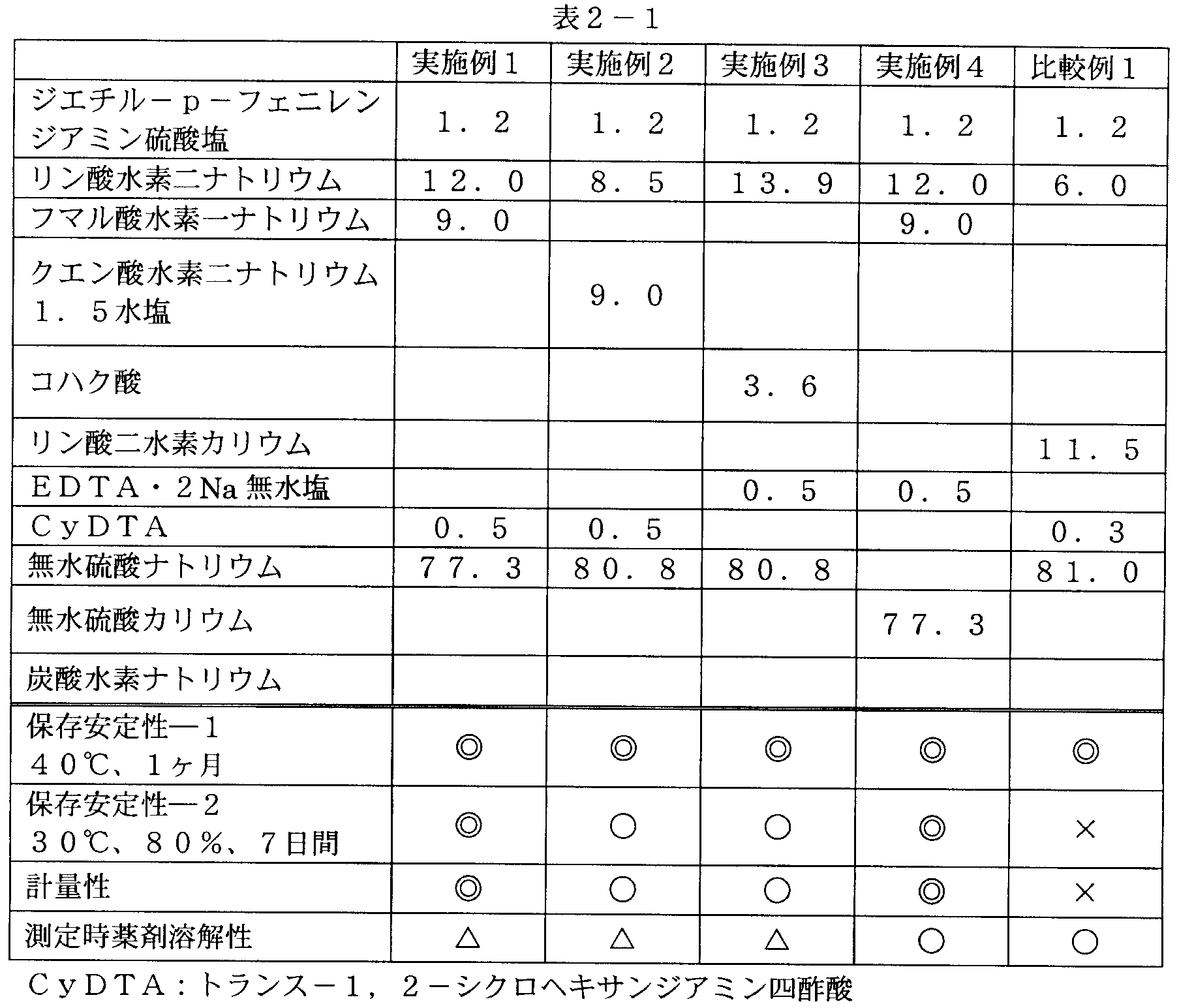
- Test samples (Examples 1 to 7 and Comparative Example 1) having the compositions shown in Tables 2-1 and 2-2 were prepared and evaluated as follows. 1. Storage stability test-1 25 g of the test sample was stored in a glass container in a sealed state, stored at 40 ° C. for 1 month, and observed for color tone and presence of consolidation. ⁇ : No change ⁇ : Slightly discolored but no problem ⁇ : Discolored
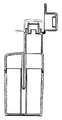
- Measurement test 25g of test sample was placed in a measurement container having the shape shown in Fig. 1 and Fig. 2, and the measurement was performed 100 times in the following way in the summer (the measurement operation was performed 10 times and the cap was closed for 1 hour). (Leave and wait ⁇ Repeat the weighing operation 10 times). The following evaluation was performed by observing the state of adhesion of the powder to the measuring ridge of the measuring container.
- the weighing operation refers to an annular weighing unit provided in the vicinity of the entrance / exit of the test sample after putting the test sample into the weighing container and closing the lid, then turning the container upside down and returning to the original posture.
- Drug solubility test during measurement Take 10 ml of water with an effective chlorine concentration of 1 ppm in a plastic square measuring cell of a chlorine concentration measuring device, put 0.25 g of a test sample in this, leave it for 30 seconds, shake the measuring cell 5 times, and The state was observed.
- the present invention it is possible to provide a residual chlorine measuring reagent with low hygroscopicity that does not cause adhesion to the measuring part due to moisture absorption, caking of the drug in the container, or alteration.
Landscapes
- Life Sciences & Earth Sciences (AREA)
- Health & Medical Sciences (AREA)
- Chemical & Material Sciences (AREA)
- Molecular Biology (AREA)
- Dispersion Chemistry (AREA)
- Biophysics (AREA)
- Toxicology (AREA)
- Physics & Mathematics (AREA)
- Analytical Chemistry (AREA)
- Biochemistry (AREA)
- General Health & Medical Sciences (AREA)
- General Physics & Mathematics (AREA)
- Immunology (AREA)
- Pathology (AREA)
- Investigating Or Analyzing Non-Biological Materials By The Use Of Chemical Means (AREA)
Abstract
本発明は、DPD色素と緩衝剤の両者を含む粉末状の残留塩素測定試薬において、有効塩素測定作業のための容器開封時における外気接触による吸湿が抑制され、開封後の保存や計量容器に収納して使用した際に、吸湿による計量部への付着や容器内薬剤の固結、変質を起こさない、吸湿性の少ない試薬を提供することを課題とする。 本発明は、(A)ジエチル-p-フェニレンジアミン硫酸塩、(B)常温で固体で、ジエチル-p-フェニレンジアミン硫酸塩と混合しても安定であり、かつ温度30℃、湿度50%の状態で5分間曝露しても固結しない粉末であり、20℃の水100gに対する飽和溶解度が1g以上であり、かつ1%水溶液のpHが5.5~7である緩衝剤、及び、(C)賦形剤、を含有する残留塩素測定試薬である。
Description
本発明は、水に含まれる遊離残留塩素測定用試薬に関し、安定であってかつ簡便な遊離残留塩素測定方法に用いられる試薬に関する。
従来から、プール水、水道水、用水、排水及びその他の水は目的に応じて塩素剤にて殺菌されており、種々の段階で遊離残留塩素の測定が行なわれている。ジエチル-p-フェニレンジアミン硫酸塩(DPD)を発色剤とし、緩衝液を組み合わせたDPD法は簡便な遊離残留塩素の測定方法として採用されている(特許文献1、特許文献2など)。
ジエチレン-p-フェニレンジアミン硫酸塩は空気中に保存しても安定であるが、塩基性物質が共存し、吸湿すると空気中の酸素の作用で変色し、有効塩素の濃度測定が行えなくなる性質を有しており、従来はDPD色素と緩衝剤を別々に保管し、使用時に測定液に各々添加する方法がとられていた。しかしながら、この方法は、操作が煩雑になるという問題があった。従って、煩雑な調製をすることなく、被測定物に測定試薬を添加するだけで残留塩素濃度が測定できる試薬が望まれていたが、発色剤と緩衝材を混合して一剤とした場合には、経時的な安定性が悪く、試薬が着色して正確な測定ができないという問題があった。
そこで、特許文献3のように、DPD色素と緩衝剤を混合し、少量ずつ機密性の包装袋で分封した薬剤が開発された。しかしながら、淨化槽の放流水中の塩素濃度の測定の様に、頻繁に塩素濃度を測定しゴム手袋等の保護具を着用する業務においては、残留塩素濃度の測定のたびに、機密性の小袋を開封する作業も面倒であるため、DPD色素と緩衝剤の混合物を褐色のガラス瓶に収納し小型スプーンで取り出して測定液に添加する方法や液状の薬剤を適当量滴下する方法が実施されている。
しかしながら、ガラス瓶から混合試薬を小型スプーンで取り出す作業もまた面倒な作業であり、開封時の吸湿による変質が起こる等の欠点を有しており、液状の薬剤は保存安定性が悪く製造後使い切るまでの期間が3~6ヶ月程度である欠点を有している。
しかしながら、ガラス瓶から混合試薬を小型スプーンで取り出す作業もまた面倒な作業であり、開封時の吸湿による変質が起こる等の欠点を有しており、液状の薬剤は保存安定性が悪く製造後使い切るまでの期間が3~6ヶ月程度である欠点を有している。
これらの欠点を解消するため、DPD色素と緩衝剤を含む粉末状の混合試薬を計量容器に収納し簡便な操作で一定量の粉状試薬を測定液に添加する方法も検討されているが、現在使用されているDPD色素と燐酸系緩衝剤を含む粉末状の混合試薬を収納した場合は、空気中の湿気により、粉末が容器の計量部に付着し正確な計量が出来なくなったり、開封後の保管時に容器内の試薬が固結し、使用困難になる欠点を有している。
本発明の課題は、DPD色素と緩衝剤の両者を含む粉末状の残留塩素測定試薬において、有効塩素測定作業のための容器開封時における外気接触による吸湿が抑制され、開封後の保存や計量容器に収納して使用した際に、吸湿による計量部への付着や容器内薬剤の固結、変質を起こさない、吸湿性の少ない試薬を提供することである。
本発明者らは、吸湿性が少なく、保存時にDPD色素と反応せず、常温で固体で、測定時には短時間で水に溶け、かつ、酸化、還元性を有する成分を含まない緩衝剤を選定することにより、吸湿による計量部への付着や容器内薬剤の固結、変質を起こさない、吸湿性の少ない残留塩素測定試薬が得られることを見出し、本発明を完成するに至った。
すなわち本発明は、
(1)(A)ジエチル-p-フェニレンジアミン硫酸塩、
(B)常温で固体で、ジエチル-p-フェニレンジアミン硫酸塩と混合しても安定であり、かつ温度30℃、湿度50%の状態で5分間曝露しても固結しない粉末であり、20℃の水100gに対する飽和溶解度が1g以上であり、かつ1%水溶液のpHが5.5~7である緩衝剤、及び、
(C)賦形剤
を含有することを特徴とする残留塩素測定試薬、
(2)緩衝剤が、燐酸水素二ナトリウムと常温で固体のカルボン酸及び/またはその酸性塩との混合物であることを特徴とする上記(1)に記載の残留塩素測定試薬、
(3)常温で固体のカルボン酸及び/またはその酸性塩が、コハク酸、フマル酸水素一ナトリウム、クエン酸水素二ナトリウム・1.5水塩から選ばれる1種または2種以上の混合物であることを特徴とする上記(2)に記載の残留塩素測定試薬、
(4)賦形剤が無水硫酸ナトリウム及びまたは硫酸カリウムであることを特徴とする上記(1)~(3)のいずれかに記載の残留塩素測定試薬、
(5)さらに、発泡剤を含有することを特徴とする上記(1)~(4)のいずれかに記載の残留塩素測定試薬、及び、
(6)発泡剤が炭酸水素ナトリウムであることを特徴とする上記(5)に記載の残留塩素測定試薬に関する。
(1)(A)ジエチル-p-フェニレンジアミン硫酸塩、
(B)常温で固体で、ジエチル-p-フェニレンジアミン硫酸塩と混合しても安定であり、かつ温度30℃、湿度50%の状態で5分間曝露しても固結しない粉末であり、20℃の水100gに対する飽和溶解度が1g以上であり、かつ1%水溶液のpHが5.5~7である緩衝剤、及び、
(C)賦形剤
を含有することを特徴とする残留塩素測定試薬、
(2)緩衝剤が、燐酸水素二ナトリウムと常温で固体のカルボン酸及び/またはその酸性塩との混合物であることを特徴とする上記(1)に記載の残留塩素測定試薬、
(3)常温で固体のカルボン酸及び/またはその酸性塩が、コハク酸、フマル酸水素一ナトリウム、クエン酸水素二ナトリウム・1.5水塩から選ばれる1種または2種以上の混合物であることを特徴とする上記(2)に記載の残留塩素測定試薬、
(4)賦形剤が無水硫酸ナトリウム及びまたは硫酸カリウムであることを特徴とする上記(1)~(3)のいずれかに記載の残留塩素測定試薬、
(5)さらに、発泡剤を含有することを特徴とする上記(1)~(4)のいずれかに記載の残留塩素測定試薬、及び、
(6)発泡剤が炭酸水素ナトリウムであることを特徴とする上記(5)に記載の残留塩素測定試薬に関する。
本発明の残留塩素測定試薬は、少なくとも、
(A)ジエチル-p-フェニレンジアミン硫酸塩、
(B)常温で固体で、ジエチル-p-フェニレンジアミン硫酸塩と混合しても安定であり、かつ温度30℃、湿度50%の状態で5分間曝露しても固結しない粉末であり、20℃の水100gに対する飽和溶解度が1g以上であり、かつ1%水溶液のpHが5.5~7である緩衝剤、及び、
(C)賦形剤
を含有する。
(A)ジエチル-p-フェニレンジアミン硫酸塩、
(B)常温で固体で、ジエチル-p-フェニレンジアミン硫酸塩と混合しても安定であり、かつ温度30℃、湿度50%の状態で5分間曝露しても固結しない粉末であり、20℃の水100gに対する飽和溶解度が1g以上であり、かつ1%水溶液のpHが5.5~7である緩衝剤、及び、
(C)賦形剤
を含有する。
(ジエチル-p-フェニレンジアミン硫酸塩(DPD))
ジエチル-p-フェニレンジアミン硫酸塩(DPD)は、顆粒状でも、粉末状でもよく、その形状は特に限定されないが、溶解性、発色性を向上させるために微粉末状が好ましい。DPDは、市販されている試薬をそのまま使用することができるが、発色の精度、試薬の安定性等を考慮した場合には、なるべく純度の高い試薬特級を用いるのが好ましい。用いる量は、残留塩素測定試薬全量に対して、0.8~1.5質量%の範囲が好ましく、さらに1.1~1.3質量%の範囲が好ましい。0.8重量%より少ないと充分な発色が得られず、1.5質量%を超えると発色程度に差は見られず、経済性も悪くなり、発色が悪くなる場合もある。
ジエチル-p-フェニレンジアミン硫酸塩(DPD)は、顆粒状でも、粉末状でもよく、その形状は特に限定されないが、溶解性、発色性を向上させるために微粉末状が好ましい。DPDは、市販されている試薬をそのまま使用することができるが、発色の精度、試薬の安定性等を考慮した場合には、なるべく純度の高い試薬特級を用いるのが好ましい。用いる量は、残留塩素測定試薬全量に対して、0.8~1.5質量%の範囲が好ましく、さらに1.1~1.3質量%の範囲が好ましい。0.8重量%より少ないと充分な発色が得られず、1.5質量%を超えると発色程度に差は見られず、経済性も悪くなり、発色が悪くなる場合もある。
(緩衝剤)
本発明の残留塩素測定試薬においては、固形混合物を検体である塩素含有溶液に溶解させたときに、DPDの発色を安定させるために、その溶液のpHを5.5~7.0の範囲にする。そのために、溶液状態で緩衝溶液となる固形成分を含有させる。
緩衝剤は、常温で固体で、DPD色素と保存時に反応せず、酸化、還元性がなく、温度30℃、湿度50%の状態で5分間曝露しても固結しない粉末であり、20℃の水100gに対する飽和溶解度が1g以上であり、かつ1%水溶液のpHが5.5~7である緩衝剤を選択する必要がある。
そのような緩衝剤としては、リン酸水素二ナトリウム、トリポリリン酸ナトリウム等と常温で固体のカルボン酸又はその酸性塩との混合物等の組合せを挙げることができるが、そのうち、リン酸水素二ナトリウムと常温で固体のカルボン酸又はその酸性塩との混合物が好ましい。
常温で固体のカルボン酸又はその酸性塩としては、吸湿性が少なく、保存時にDPD色素と反応せず、測定時には短時間で水に溶け、かつ、酸化、還元性を有さないものであれば制限はないが、二塩基性のカルボン酸、三塩基性のカルボン酸、又はそれらの酸性塩等が挙げられ、そのうち、コハク酸、フマル酸水素一ナトリウム、クエン酸水素二ナトリウム・1.5水塩から選ばれる1種または2種以上の混合物が好ましい。
緩衝剤の添加量は特に制限はないが、残留塩素測定試薬全量に対して、10~60質量%が好ましく、15~30質量%が特に好ましい。リン酸水素二ナトリウム、トリポリリン酸ナトリウム等と常温で固体のカルボン酸又はその酸性塩との混合物比率は、緩衝剤の1%水溶液のpHが5.5~7、特に好ましくは6~7になる比率であれば配合比率に制限はない。
本発明の残留塩素測定試薬においては、固形混合物を検体である塩素含有溶液に溶解させたときに、DPDの発色を安定させるために、その溶液のpHを5.5~7.0の範囲にする。そのために、溶液状態で緩衝溶液となる固形成分を含有させる。
緩衝剤は、常温で固体で、DPD色素と保存時に反応せず、酸化、還元性がなく、温度30℃、湿度50%の状態で5分間曝露しても固結しない粉末であり、20℃の水100gに対する飽和溶解度が1g以上であり、かつ1%水溶液のpHが5.5~7である緩衝剤を選択する必要がある。
そのような緩衝剤としては、リン酸水素二ナトリウム、トリポリリン酸ナトリウム等と常温で固体のカルボン酸又はその酸性塩との混合物等の組合せを挙げることができるが、そのうち、リン酸水素二ナトリウムと常温で固体のカルボン酸又はその酸性塩との混合物が好ましい。
常温で固体のカルボン酸又はその酸性塩としては、吸湿性が少なく、保存時にDPD色素と反応せず、測定時には短時間で水に溶け、かつ、酸化、還元性を有さないものであれば制限はないが、二塩基性のカルボン酸、三塩基性のカルボン酸、又はそれらの酸性塩等が挙げられ、そのうち、コハク酸、フマル酸水素一ナトリウム、クエン酸水素二ナトリウム・1.5水塩から選ばれる1種または2種以上の混合物が好ましい。
緩衝剤の添加量は特に制限はないが、残留塩素測定試薬全量に対して、10~60質量%が好ましく、15~30質量%が特に好ましい。リン酸水素二ナトリウム、トリポリリン酸ナトリウム等と常温で固体のカルボン酸又はその酸性塩との混合物比率は、緩衝剤の1%水溶液のpHが5.5~7、特に好ましくは6~7になる比率であれば配合比率に制限はない。
(賦形剤)
本発明の残留塩素測定試薬は、取扱いを容易にするため、またはDPDの経時安定性を向上させるために、賦形剤を含有する。賦形剤としては、pHが中性であり、水に容易に溶解し、DPDの発色に影響を及ぼさない化合物であって、計量容器内で流動性が良好(そのため、粒径は16~200メッシュのものが好ましい)で、保存時に固結しないものが使用される。具体的には硫酸ナトリウム、硫酸カリウム等を例示することができる。また、水分の影響を少なくするため、なるべく無水硫酸ナトリウム、無水硫酸カリウム等の無水の化合物を用いるのが好ましい。これらの賦形剤は1種単独でも2種以上の混合物でもよい。混合物としては、たとえば、硫酸カリウムを主成分とし、無水硫酸ナトリウムを少量添加したものが挙げられる。賦形剤の使用量は、最終的に得られた固形混合物の取扱い等が容易になる範囲であれば特に制限はされず、使用方法等によって適宜選択することができる。
賦形剤の添加量は特に制限はないが、残留塩素測定試薬全量に対して、30~90質量%が好ましく、50~80質量%が特に好ましい。
本発明の残留塩素測定試薬は、取扱いを容易にするため、またはDPDの経時安定性を向上させるために、賦形剤を含有する。賦形剤としては、pHが中性であり、水に容易に溶解し、DPDの発色に影響を及ぼさない化合物であって、計量容器内で流動性が良好(そのため、粒径は16~200メッシュのものが好ましい)で、保存時に固結しないものが使用される。具体的には硫酸ナトリウム、硫酸カリウム等を例示することができる。また、水分の影響を少なくするため、なるべく無水硫酸ナトリウム、無水硫酸カリウム等の無水の化合物を用いるのが好ましい。これらの賦形剤は1種単独でも2種以上の混合物でもよい。混合物としては、たとえば、硫酸カリウムを主成分とし、無水硫酸ナトリウムを少量添加したものが挙げられる。賦形剤の使用量は、最終的に得られた固形混合物の取扱い等が容易になる範囲であれば特に制限はされず、使用方法等によって適宜選択することができる。
賦形剤の添加量は特に制限はないが、残留塩素測定試薬全量に対して、30~90質量%が好ましく、50~80質量%が特に好ましい。
(その他の成分)
本発明の残留塩素測定試薬には、キレート化剤や発泡剤等を含有していても良い。キレート化剤は、塩素イオン以外の夾雑イオンによる影響を抑えDPDの塩素イオンによる発色を安定させる効果があるキレート化剤であれば特に制限されないが、具体的には、エチレンジアミン四酢酸等のアミノカルボン酸類又はその塩、クエン酸等のオキシカルボン酸類、縮合燐酸類等を例示することができるが、特にアミノカルボン酸類が好ましく、中でもエチレンジアミン四酢酸(EDTA)、1,2-トランス-シクロヘキサンジアミン四酢酸(CyDTA)を好ましく用いることができる。キレート化剤の量は、DPDの発色に影響しない量であれば特に制限されず、具体的には、残留塩素測定試薬全量に対して、0.1~0.5質量%の範囲が好ましい。0.1質量%より少ないと、他の金属イオンの影響を排除することができず、0.5質量%を超えるとその効果に大きな差はなく、経済的性が悪くなる。
本発明の残留塩素測定試薬には、キレート化剤や発泡剤等を含有していても良い。キレート化剤は、塩素イオン以外の夾雑イオンによる影響を抑えDPDの塩素イオンによる発色を安定させる効果があるキレート化剤であれば特に制限されないが、具体的には、エチレンジアミン四酢酸等のアミノカルボン酸類又はその塩、クエン酸等のオキシカルボン酸類、縮合燐酸類等を例示することができるが、特にアミノカルボン酸類が好ましく、中でもエチレンジアミン四酢酸(EDTA)、1,2-トランス-シクロヘキサンジアミン四酢酸(CyDTA)を好ましく用いることができる。キレート化剤の量は、DPDの発色に影響しない量であれば特に制限されず、具体的には、残留塩素測定試薬全量に対して、0.1~0.5質量%の範囲が好ましい。0.1質量%より少ないと、他の金属イオンの影響を排除することができず、0.5質量%を超えるとその効果に大きな差はなく、経済的性が悪くなる。
発泡剤は、薬剤を分散させて溶解を容易にするとともに、測定セル内の測定液に対流を起こして測定液を均一にさせる効果がある。発泡剤としては、緩衝剤と反応しガスを発生するものであれば特に制限されず、例えば各種炭酸水素ナトリウム、炭酸アンモニウム等の炭酸塩類、酢酸アミル、酢酸ブチル等の酢酸エステル類、ジアゾアミノベンゼン等が挙げられ、炭酸水素ナトリウムが好ましい。
発泡剤の使用量は、残留塩素測定試薬全量に対して、10質量%以下であり、好ましくは5質量%以下、さらに好ましくは0.2~2質量%である。添加量が少ないと薬剤の分散効果が低く、多いと発泡が多くなり測定値が変動しやすくなる。
発泡剤の使用量は、残留塩素測定試薬全量に対して、10質量%以下であり、好ましくは5質量%以下、さらに好ましくは0.2~2質量%である。添加量が少ないと薬剤の分散効果が低く、多いと発泡が多くなり測定値が変動しやすくなる。
(調製及び使用法)
本発明の残留塩素測定試薬は、各成分を通常の方法で混合することにより製造することができ、例えば、各成分を粉末状にして混合し、または各成分を混合してから粉状に粉砕して製造することができる。製造された試薬は、計量容器などに収納する。計量容器としては、内部に粉体を収納し、簡単な操作で0.1~0.3gの粉体を平均排出量の±50%の精度で計量、排出することが可能な容器であれば使用可能であり、各種公知の計量容器が使用される。
本発明の残留塩素測定試薬を使用するに当っては、例えば、10mlの検水に本発明の残留塩素測定試薬を約0.2g入れて溶解し、比色計などで標準色と比色して遊離残留塩素濃度を求めることができる。
本発明の残留塩素測定試薬は、各成分を通常の方法で混合することにより製造することができ、例えば、各成分を粉末状にして混合し、または各成分を混合してから粉状に粉砕して製造することができる。製造された試薬は、計量容器などに収納する。計量容器としては、内部に粉体を収納し、簡単な操作で0.1~0.3gの粉体を平均排出量の±50%の精度で計量、排出することが可能な容器であれば使用可能であり、各種公知の計量容器が使用される。
本発明の残留塩素測定試薬を使用するに当っては、例えば、10mlの検水に本発明の残留塩素測定試薬を約0.2g入れて溶解し、比色計などで標準色と比色して遊離残留塩素濃度を求めることができる。
以下、実施例により本発明をさらに詳細に説明するが、本発明の範囲は実施例に限定されるものではない。
(参考例) 緩衝剤の評価
以下の方法で、緩衝剤の評価を行った。
1.DPD色素との混合安定性
DPD色素1gと表1の組合せからなる緩衝剤1gを混合し、ガラス製サンプル瓶に収納、密封した。
40℃で7日間保存した後、観察し、変色していない場合を安定とした。
2.固結性
直径50mmのアクリル樹脂性のシャーレーに表1の組合せからなる粉末1gをとり、シャーレー全面に均一に広げた。
温度30℃、湿度50%の恒温恒湿機内にシャーレーを5分間放置した後、取り出したシャーレーを垂直に立て、粉末の移動状態を目視観察した。
<判定>
粉の大部分が流動落下した場合:○
粉の一部分が流動落下した場合:△
粉が完全に固結し落下が認められなかった場合:×
3.飽和溶解度
水温20℃±2℃の水100gを200mlビーカーにとり、表1の組合せからなる緩衝剤1gを添加し、室温20±2℃でマグネチックスターラーで1時間攪拌した。1時間後、液の状態を観察し不溶解物が存在しないことを確認した。
結果を表1に示す。
(参考例) 緩衝剤の評価
以下の方法で、緩衝剤の評価を行った。
1.DPD色素との混合安定性
DPD色素1gと表1の組合せからなる緩衝剤1gを混合し、ガラス製サンプル瓶に収納、密封した。
40℃で7日間保存した後、観察し、変色していない場合を安定とした。
2.固結性
直径50mmのアクリル樹脂性のシャーレーに表1の組合せからなる粉末1gをとり、シャーレー全面に均一に広げた。
温度30℃、湿度50%の恒温恒湿機内にシャーレーを5分間放置した後、取り出したシャーレーを垂直に立て、粉末の移動状態を目視観察した。
<判定>
粉の大部分が流動落下した場合:○
粉の一部分が流動落下した場合:△
粉が完全に固結し落下が認められなかった場合:×
3.飽和溶解度
水温20℃±2℃の水100gを200mlビーカーにとり、表1の組合せからなる緩衝剤1gを添加し、室温20±2℃でマグネチックスターラーで1時間攪拌した。1時間後、液の状態を観察し不溶解物が存在しないことを確認した。
結果を表1に示す。

(実施例)
表2-1及び2-2の組成からなる試験サンプル(実施例1~7及び比較例1)を作製し、次に示す評価を行った。
1.保存安定性試験-1
試験サンプル25gをガラス容器に密封状態に収納し、40℃に1ヶ月間保管し色調と固結の有無を観察した。
◎:変化なし ○:僅かに変色したが問題なし ×:変色
表2-1及び2-2の組成からなる試験サンプル(実施例1~7及び比較例1)を作製し、次に示す評価を行った。
1.保存安定性試験-1
試験サンプル25gをガラス容器に密封状態に収納し、40℃に1ヶ月間保管し色調と固結の有無を観察した。
◎:変化なし ○:僅かに変色したが問題なし ×:変色
2.保存安定性試験-2
図1及び図2に示す形状を有する計量容器に試験サンプル25gを収納し、蓋を閉めた状態で気温40℃、湿度80%の恒温恒湿機内に7日間保存し、色調と固結の有無を観察した。
◎:変化なし ○:軽く振ると流動し実用上問題なし ×:固結し変色
図1及び図2に示す形状を有する計量容器に試験サンプル25gを収納し、蓋を閉めた状態で気温40℃、湿度80%の恒温恒湿機内に7日間保存し、色調と固結の有無を観察した。
◎:変化なし ○:軽く振ると流動し実用上問題なし ×:固結し変色
3.計量性試験
図1及び図2に示す形状を有する計量容器内に試験サンプル25gを収納し、夏季に以下の方法で100回の計量を実施した(計量操作を10回実施→1時間蓋をして放置→ 計量操作を10回実施 の操作を繰り返し実施)。
粉体の計量容器の計量枡部への付着状況を観察し下記の評価を行った。
なお、ここで、計量操作とは、試験サンプルを計量用容器に入れて蓋を閉じた後、容器を倒立させた後に元の姿勢に戻して、試験サンプルの出入り口近傍に設けた環状の計量部(二重の円筒に囲まれた部分)に一定量の薬剤を取り分け、傾けて測定セルに排出する操作をいう。
◎:僅かに付着するが問題なく計量できた。粉体計量バラツキ0.20~0.25g
○:付着がおこったが、最後まで計量できた。粉体計量バラツキ0.15~0.25g
×:激しく付着し途中で計量できなくなった。
図1及び図2に示す形状を有する計量容器内に試験サンプル25gを収納し、夏季に以下の方法で100回の計量を実施した(計量操作を10回実施→1時間蓋をして放置→ 計量操作を10回実施 の操作を繰り返し実施)。
粉体の計量容器の計量枡部への付着状況を観察し下記の評価を行った。
なお、ここで、計量操作とは、試験サンプルを計量用容器に入れて蓋を閉じた後、容器を倒立させた後に元の姿勢に戻して、試験サンプルの出入り口近傍に設けた環状の計量部(二重の円筒に囲まれた部分)に一定量の薬剤を取り分け、傾けて測定セルに排出する操作をいう。
◎:僅かに付着するが問題なく計量できた。粉体計量バラツキ0.20~0.25g
○:付着がおこったが、最後まで計量できた。粉体計量バラツキ0.15~0.25g
×:激しく付着し途中で計量できなくなった。
4.測定時薬剤溶解性試験
塩素濃度測定器のプラスチック製角型測定セルに有効塩素濃度1ppmの水10mlを採り、これに試験サンプル0.25gを投入し30秒放置後に測定セルを5回振り薬剤の状態を観察した。
◎:薬剤が完全に溶解
○:薬剤が僅かに残っているが液の色調は完全溶解と同等
△:薬剤が残っているが液の色調は完全溶解と同等
×:薬剤が固まっており液の色調の完全溶解より薄い
塩素濃度測定器のプラスチック製角型測定セルに有効塩素濃度1ppmの水10mlを採り、これに試験サンプル0.25gを投入し30秒放置後に測定セルを5回振り薬剤の状態を観察した。
◎:薬剤が完全に溶解
○:薬剤が僅かに残っているが液の色調は完全溶解と同等
△:薬剤が残っているが液の色調は完全溶解と同等
×:薬剤が固まっており液の色調の完全溶解より薄い

本発明により、吸湿による計量部への付着や容器内薬剤の固結、変質を起こさない、吸湿性の少ない残留塩素測定試薬を提供できる。
Claims (6)
- (A)ジエチル-p-フェニレンジアミン硫酸塩、
(B)常温で固体で、ジエチル-p-フェニレンジアミン硫酸塩と混合しても安定であり、かつ温度30℃、湿度50%の状態で5分間曝露しても固結しない粉末であり、20℃の水100gに対する飽和溶解度が1g以上であり、かつ1%水溶液のpHが5.5~7である緩衝剤、及び、
(C)賦形剤
を含有することを特徴とする残留塩素測定試薬。 - 緩衝剤が、燐酸水素二ナトリウムと常温で固体のカルボン酸及び/またはその酸性塩との混合物であることを特徴とする請求項1に記載の残留塩素測定試薬。
- 常温で固体のカルボン酸及び/またはその酸性塩が、コハク酸、フマル酸水素一ナトリウム、クエン酸水素二ナトリウム・1.5水塩から選ばれる1種または2種以上の混合物であることを特徴とする請求項2に記載の残留塩素測定試薬。
- 賦形剤が無水硫酸ナトリウム及び/または硫酸カリウムであることを特徴とする請求項1~3のいずれかに記載の残留塩素測定試薬。
- さらに、発泡剤を含有することを特徴とする請求項1~4のいずれかに記載の残留塩素測定試薬。
- 発泡剤が炭酸水素ナトリウムであることを特徴とする請求項5に記載の残留塩素測定試薬。
Priority Applications (1)
| Application Number | Priority Date | Filing Date | Title |
|---|---|---|---|
| PCT/JP2010/006178 WO2012053028A1 (ja) | 2010-10-19 | 2010-10-19 | 残留塩素測定試薬 |
Applications Claiming Priority (1)
| Application Number | Priority Date | Filing Date | Title |
|---|---|---|---|
| PCT/JP2010/006178 WO2012053028A1 (ja) | 2010-10-19 | 2010-10-19 | 残留塩素測定試薬 |
Publications (1)
| Publication Number | Publication Date |
|---|---|
| WO2012053028A1 true WO2012053028A1 (ja) | 2012-04-26 |
Family
ID=45974769
Family Applications (1)
| Application Number | Title | Priority Date | Filing Date |
|---|---|---|---|
| PCT/JP2010/006178 Ceased WO2012053028A1 (ja) | 2010-10-19 | 2010-10-19 | 残留塩素測定試薬 |
Country Status (1)
| Country | Link |
|---|---|
| WO (1) | WO2012053028A1 (ja) |
Citations (7)
| Publication number | Priority date | Publication date | Assignee | Title |
|---|---|---|---|---|
| JPH09133671A (ja) * | 1995-09-05 | 1997-05-20 | Konica Corp | 残留塩素量を判定する方法、残留塩素量を判定するキット及び酸化物検出用キット |
| JP2004085453A (ja) * | 2002-08-28 | 2004-03-18 | Shinfuji Kaseiyaku Kk | 固形残留塩素測定試薬 |
| JP2005181192A (ja) * | 2003-12-22 | 2005-07-07 | Tacmina Corp | 残留塩素濃度測定方法 |
| JP2005194320A (ja) * | 2003-12-26 | 2005-07-21 | Kao Corp | 洗浄剤組成物 |
| JP2005291896A (ja) * | 2004-03-31 | 2005-10-20 | Miura Co Ltd | 残留塩素測定用組成物 |
| JP2007248224A (ja) * | 2006-03-15 | 2007-09-27 | Asahi Glass Co Ltd | 炭酸水素ナトリウム結晶粒子の分析方法 |
| JP2008233108A (ja) * | 2008-06-16 | 2008-10-02 | Shinfuji Kaseiyaku Kk | 遊離残留塩素測定用試薬 |
-
2010
- 2010-10-19 WO PCT/JP2010/006178 patent/WO2012053028A1/ja not_active Ceased
Patent Citations (7)
| Publication number | Priority date | Publication date | Assignee | Title |
|---|---|---|---|---|
| JPH09133671A (ja) * | 1995-09-05 | 1997-05-20 | Konica Corp | 残留塩素量を判定する方法、残留塩素量を判定するキット及び酸化物検出用キット |
| JP2004085453A (ja) * | 2002-08-28 | 2004-03-18 | Shinfuji Kaseiyaku Kk | 固形残留塩素測定試薬 |
| JP2005181192A (ja) * | 2003-12-22 | 2005-07-07 | Tacmina Corp | 残留塩素濃度測定方法 |
| JP2005194320A (ja) * | 2003-12-26 | 2005-07-21 | Kao Corp | 洗浄剤組成物 |
| JP2005291896A (ja) * | 2004-03-31 | 2005-10-20 | Miura Co Ltd | 残留塩素測定用組成物 |
| JP2007248224A (ja) * | 2006-03-15 | 2007-09-27 | Asahi Glass Co Ltd | 炭酸水素ナトリウム結晶粒子の分析方法 |
| JP2008233108A (ja) * | 2008-06-16 | 2008-10-02 | Shinfuji Kaseiyaku Kk | 遊離残留塩素測定用試薬 |
Similar Documents
| Publication | Publication Date | Title |
|---|---|---|
| US20250194586A1 (en) | Disinfectant composition | |
| Moore | Amino acid analysis: aqueous dimethyl sulfoxide as solvent for the ninhydrin reaction | |
| JP5496574B2 (ja) | 残留塩素測定試薬 | |
| CN111602669B (zh) | 一种固体二氧化氯缓释剂 | |
| JP4588776B2 (ja) | 遊離残留塩素測定用試薬 | |
| WO2011100789A1 (en) | Reagent for analysis | |
| WO2012053028A1 (ja) | 残留塩素測定試薬 | |
| CN108351337B (zh) | 用于含水氯分析的储存稳定的标准物 | |
| CA2494671A1 (en) | Composition and method for reducing the rate of oxygen loss from aqueous solutions | |
| CN118549585A (zh) | 一种四氯乙烯法测定丁基橡胶碘值及不饱和度的方法 | |
| CN104007108B (zh) | 一种电镀废水氰化物检测试剂盒 | |
| JP3997265B2 (ja) | 過酸化水素濃度測定用試薬およびそれを用いた過酸化水素濃度の測定方法 | |
| JP2004085453A (ja) | 固形残留塩素測定試薬 | |
| JP2003254959A (ja) | 新規なホルムアルデヒド測定用キット | |
| JP2854968B2 (ja) | 人工海水 | |
| JP2007263632A (ja) | キレート剤の測定方法およびキレート剤の測定キット | |
| JP2001340448A (ja) | 透析用製剤およびその製造方法 | |
| JP2012167976A (ja) | 金属粉中の微量炭酸の定量方法 | |
| CN110325504A (zh) | 用于测定可氧化物质的方法 | |
| JP4765617B2 (ja) | 炭酸水素ナトリウム結晶粒子の組成分析方法 | |
| US5270154A (en) | Method of making flowable alkaline thiosulfate/alkaline sulfite and the product thereof | |
| JP2005257513A (ja) | 唾液緩衝能検査試薬 | |
| JP2026032712A (ja) | リン酸イオン分析用試薬組成物及びリン酸イオン分析キット | |
| US20060234380A1 (en) | Stable water standard | |
| JP4765542B2 (ja) | 炭酸水素ナトリウム結晶粒子の組成分析方法 |
Legal Events
| Date | Code | Title | Description |
|---|---|---|---|
| 121 | Ep: the epo has been informed by wipo that ep was designated in this application |
Ref document number: 10858587 Country of ref document: EP Kind code of ref document: A1 |
|
| NENP | Non-entry into the national phase |
Ref country code: DE |
|
| 122 | Ep: pct application non-entry in european phase |
Ref document number: 10858587 Country of ref document: EP Kind code of ref document: A1 |