WO2012043188A1 - 使い捨てのパンツ型着用物品 - Google Patents
使い捨てのパンツ型着用物品 Download PDFInfo
- Publication number
- WO2012043188A1 WO2012043188A1 PCT/JP2011/070513 JP2011070513W WO2012043188A1 WO 2012043188 A1 WO2012043188 A1 WO 2012043188A1 JP 2011070513 W JP2011070513 W JP 2011070513W WO 2012043188 A1 WO2012043188 A1 WO 2012043188A1
- Authority
- WO
- WIPO (PCT)
- Prior art keywords
- panel
- melt adhesive
- side edge
- sheet
- joined
- Prior art date
- Legal status (The legal status is an assumption and is not a legal conclusion. Google has not performed a legal analysis and makes no representation as to the accuracy of the status listed.)
- Ceased
Links
Images




Classifications
-
- A—HUMAN NECESSITIES
- A61—MEDICAL OR VETERINARY SCIENCE; HYGIENE
- A61F—FILTERS IMPLANTABLE INTO BLOOD VESSELS; PROSTHESES; DEVICES PROVIDING PATENCY TO, OR PREVENTING COLLAPSING OF, TUBULAR STRUCTURES OF THE BODY, e.g. STENTS; ORTHOPAEDIC, NURSING OR CONTRACEPTIVE DEVICES; FOMENTATION; TREATMENT OR PROTECTION OF EYES OR EARS; BANDAGES, DRESSINGS OR ABSORBENT PADS; FIRST-AID KITS
- A61F13/00—Bandages or dressings; Absorbent pads
- A61F13/15—Absorbent pads, e.g. sanitary towels, swabs or tampons for external or internal application to the body; Supporting or fastening means therefor; Tampon applicators
- A61F13/15577—Apparatus or processes for manufacturing
- A61F13/15585—Apparatus or processes for manufacturing of babies' napkins, e.g. diapers
-
- A—HUMAN NECESSITIES
- A61—MEDICAL OR VETERINARY SCIENCE; HYGIENE
- A61F—FILTERS IMPLANTABLE INTO BLOOD VESSELS; PROSTHESES; DEVICES PROVIDING PATENCY TO, OR PREVENTING COLLAPSING OF, TUBULAR STRUCTURES OF THE BODY, e.g. STENTS; ORTHOPAEDIC, NURSING OR CONTRACEPTIVE DEVICES; FOMENTATION; TREATMENT OR PROTECTION OF EYES OR EARS; BANDAGES, DRESSINGS OR ABSORBENT PADS; FIRST-AID KITS
- A61F13/00—Bandages or dressings; Absorbent pads
- A61F13/15—Absorbent pads, e.g. sanitary towels, swabs or tampons for external or internal application to the body; Supporting or fastening means therefor; Tampon applicators
- A61F13/45—Absorbent pads, e.g. sanitary towels, swabs or tampons for external or internal application to the body; Supporting or fastening means therefor; Tampon applicators characterised by the shape
- A61F13/49—Absorbent pads, e.g. sanitary towels, swabs or tampons for external or internal application to the body; Supporting or fastening means therefor; Tampon applicators characterised by the shape specially adapted to be worn around the waist, e.g. diapers, nappies
- A61F13/496—Absorbent pads, e.g. sanitary towels, swabs or tampons for external or internal application to the body; Supporting or fastening means therefor; Tampon applicators characterised by the shape specially adapted to be worn around the waist, e.g. diapers, nappies in the form of pants or briefs
-
- A—HUMAN NECESSITIES
- A61—MEDICAL OR VETERINARY SCIENCE; HYGIENE
- A61F—FILTERS IMPLANTABLE INTO BLOOD VESSELS; PROSTHESES; DEVICES PROVIDING PATENCY TO, OR PREVENTING COLLAPSING OF, TUBULAR STRUCTURES OF THE BODY, e.g. STENTS; ORTHOPAEDIC, NURSING OR CONTRACEPTIVE DEVICES; FOMENTATION; TREATMENT OR PROTECTION OF EYES OR EARS; BANDAGES, DRESSINGS OR ABSORBENT PADS; FIRST-AID KITS
- A61F13/00—Bandages or dressings; Absorbent pads
- A61F13/15—Absorbent pads, e.g. sanitary towels, swabs or tampons for external or internal application to the body; Supporting or fastening means therefor; Tampon applicators
- A61F13/45—Absorbent pads, e.g. sanitary towels, swabs or tampons for external or internal application to the body; Supporting or fastening means therefor; Tampon applicators characterised by the shape
- A61F13/49—Absorbent pads, e.g. sanitary towels, swabs or tampons for external or internal application to the body; Supporting or fastening means therefor; Tampon applicators characterised by the shape specially adapted to be worn around the waist, e.g. diapers, nappies
- A61F13/49058—Absorbent pads, e.g. sanitary towels, swabs or tampons for external or internal application to the body; Supporting or fastening means therefor; Tampon applicators characterised by the shape specially adapted to be worn around the waist, e.g. diapers, nappies characterised by the modular concept of constructing the diaper
- A61F13/4906—Absorbent pads, e.g. sanitary towels, swabs or tampons for external or internal application to the body; Supporting or fastening means therefor; Tampon applicators characterised by the shape specially adapted to be worn around the waist, e.g. diapers, nappies characterised by the modular concept of constructing the diaper the diaper having an outer chassis forming the diaper and an independent absorbent structure attached to the chassis
- A61F13/49061—Absorbent pads, e.g. sanitary towels, swabs or tampons for external or internal application to the body; Supporting or fastening means therefor; Tampon applicators characterised by the shape specially adapted to be worn around the waist, e.g. diapers, nappies characterised by the modular concept of constructing the diaper the diaper having an outer chassis forming the diaper and an independent absorbent structure attached to the chassis the diaper having one or two waist members forming the diaper waist region and an independent absorbent structure attached to the one or two waist members forming the crotch region
-
- A—HUMAN NECESSITIES
- A61—MEDICAL OR VETERINARY SCIENCE; HYGIENE
- A61F—FILTERS IMPLANTABLE INTO BLOOD VESSELS; PROSTHESES; DEVICES PROVIDING PATENCY TO, OR PREVENTING COLLAPSING OF, TUBULAR STRUCTURES OF THE BODY, e.g. STENTS; ORTHOPAEDIC, NURSING OR CONTRACEPTIVE DEVICES; FOMENTATION; TREATMENT OR PROTECTION OF EYES OR EARS; BANDAGES, DRESSINGS OR ABSORBENT PADS; FIRST-AID KITS
- A61F13/00—Bandages or dressings; Absorbent pads
- A61F13/15—Absorbent pads, e.g. sanitary towels, swabs or tampons for external or internal application to the body; Supporting or fastening means therefor; Tampon applicators
- A61F13/53—Absorbent pads, e.g. sanitary towels, swabs or tampons for external or internal application to the body; Supporting or fastening means therefor; Tampon applicators characterised by the absorbing medium
- A61F13/539—Absorbent pads, e.g. sanitary towels, swabs or tampons for external or internal application to the body; Supporting or fastening means therefor; Tampon applicators characterised by the absorbing medium characterised by the connection of the absorbent layers with each other or with the outer layers
Definitions
- This invention relates to a disposable pants-type wearing article.
- a disposable pants-type wearing article having a front panel for covering the front waistline, a rear panel for covering the back waistline, and a central panel for covering the crotch part is known.
- a pants-type diaper described in Japanese Patent No. 4240463 includes an annular belt member that covers the front and rear waists and an absorbent main body that covers the crotch portion.
- a nonwoven fabric sheet is bonded to the outer surface of the back sheet, and both sides of the nonwoven fabric sheet in the width direction are folded inward to form a flap.
- the flap is joined to a belt member whose outer surface faces the outer surface.
- the disposable pull-on garment described in JP-T-2006-525857 has a ring-like elastic belt that covers the front waistline and the back waistline of the wearer, and an absorbent main body that covers the crotch.
- the absorptive main body has a barrier leg cuff formed on the side edge in the longitudinal direction.
- the absorbent main body has both longitudinal ends attached to the inner surface of the elastic belt.
- the simple diaper described in Japanese Patent Application Laid-Open No. 2006-51240 includes an annular waistline member that is in close contact with the wearer's waistline and a crotch member that covers the wearer's crotch part.
- the outer surface of the waistline member is formed with a locking portion for attaching and detaching both end portions of the crotch member.
- both end portions in the length direction of the center panel are attached to the inner surfaces of the front panel and the rear panel covering the waistline, or both end portions of the front panel and the outer sheet positioned outside the front panel If it is inserted between the middle and rear panels and the outer sheet located outside, both ends will be restrained from moving toward the outside of the front panel and rear panel, so peeling from the front panel and rear panel will not occur. It becomes easy to prevent.
- both ends of the center panel are attached to the outer surface of the front panel and the rear panel, when the toe is caught on the center panel when wearing the wearing article, both ends of the front panel and the rear panel It may be easy to peel off.
- both ends of the center panel are attached to the outer surface of the front panel and the rear panel, both ends of the center panel are It is an object to improve a disposable pants-type wearing article so that it does not easily peel from the rear panel.
- the present invention for solving the above-mentioned problems has a transverse direction and a longitudinal direction orthogonal to each other, and includes a front panel, a rear panel, and a center panel, each of the panels being the front panel and the rear panel.
- a transverse direction and a longitudinal direction orthogonal to each other and includes a front panel, a rear panel, and a center panel, each of the panels being the front panel and the rear panel.
- the central panel is bent in a U shape along the longitudinal direction and is located above the longitudinal direction
- a disposable pant-type in which at least a part of one of both ends is joined to the front panel from the outside of the waist area, and at least a part of the other of the both ends is joined to the rear panel from the outside It is a worn article.
- the present invention is characterized as follows. That is, the said front panel, the said back panel, and the said center panel have the inner surface which faces the wearer's skin of the said wearing article, and the outer surface which is the opposite surface.
- the central panel has a side edge extending between the both end portions on each side in the lateral direction, and a central area located between the side edges in the lateral direction, and the side edge portion is at least In each of the both end portions, the inner surface is bent so as to overlap the inner surface of the central region, and the inner surfaces are joined to each other via a first hot melt adhesive.
- the side edge portion is formed by stacking at least two sheet-like members and joining each other via a second hot-melt adhesive, and between the two sheet-like members.
- a plurality of elastic members extending in the longitudinal direction in the stretched state are interposed.
- the coating zone against the two sheet-like member of the second hot-melt adhesive, including a high-density coating zone coating amount is large per 1 m 2, and a low-density coated region coated amount is less per 1 m 2 is The high-density coating area is included in the at least part of the both end portions.
- the low-density application region of the second hot melt adhesive is included in a range where the elastic member is interposed in the longitudinal direction of the side edge portion. Yes.
- the central panel includes an outer surface of each of the bent side edges and an inner surface of the central area located between the side edges in the lateral direction.
- the front panel and the rear panel are joined via a third hot melt adhesive.
- the front panel and the rear panel have an upper upper edge and a lower lower edge in the longitudinal direction, and the side edge via the first hot melt adhesive.
- the range where the inner surface of the part and the inner surface of the central region are joined extends in the downward direction beyond the lower edge in at least one of the front panel and the rear panel.
- the side edge of the central panel joined to the outer surface of the front panel and the rear panel overlaps at least two sheet-like members, and the second hot melt adhesive is interposed.
- the application area of the second hot melt adhesive to the two sheet-like members includes a high density application area and a low density application area.
- At least a part of each of both end portions of the central panel joined to the front panel and the rear panel includes a high-density coating area. At both end portions, it is possible to enhance the peeling prevention effect of the two sheet-like members joined in the high-density coating area.
- wire cut surface of FIG. The figure similar to FIG. 2 which shows an example of an embodiment.
- the figure which shows the VII-VII line cut surface of FIG. The figure similar to FIG. 5 which shows an example of an embodiment.
- pant-type diaper which is an example of a disposable pant-type wearing article.
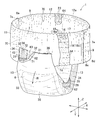
- FIG. 1 is a partially broken perspective view of a disposable pant-type diaper 1 that is an example of a disposable pant-type wearing article in a worn state, but the wearer's illustration is omitted for convenience.
- the diaper 1 includes a front panel 7, a rear panel 8, and a center panel 6.
- the diaper 1 also has a lateral direction X and a longitudinal direction Y (also referred to as a longitudinal direction Z), and the side edges of the front panel 7 located in front of the longitudinal direction Y and the rear panel 8 located behind.
- the portions 7 a and 8 a overlap each other on both sides in the lateral direction X, and are joined to each other at the joint 9 to form an annular waistline region 11 and a waistline opening 12.
- the center panel 6 is bent so that each of the front and rear end portions 42 and 43 (see FIG. 2) is located above and forms a U-shape.
- the front end portion 42 is joined to the front panel 7 from the outside of the waistline region 11 via the third hot melt adhesive 63, and the rear end portion 43 is joined to the rear panel 8 from the outside of the waistline region 11. 63 (see also FIG. 2).
- the front and rear panels 7 and 8 and the central panel 6 joined in this way form a pair of leg opening 13.
- the center panel 6 includes a leg-hole elastic member 39 extending so as to make a half-circumference around the leg-hole opening 13.
- a front panel 7 includes an inner sheet 16 that faces the skin of a diaper wearer (not shown), an outer sheet 17 that faces clothing, and a front waistline elastic member that is sandwiched between the inner and outer sheets 16 and 17. 18 and so on.
- the inner and outer surface sheets 16 and 17 are joined to each other via a fourth hot melt adhesive 64 (see FIG. 2), and the front waistline elastic member 18 is attached to at least one of the inner and outer surface sheets 16 and 17 with a hot melt adhesive (not shown). Z)).
- the front waistline elastic member 18 in FIG. 1 is in a contracted state in the circumferential direction of the waistline region 11, and the outer sheet 17 is formed with pleats 70 in a state in which peaks and valleys are repeated in the circumferential direction. Yes.
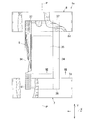
- FIG. 2 shows a developed diaper 1a obtained by peeling the front panel 7 and the rear panel 8 at the joint 9 and extending the front and rear panels 7, 8 and the central panel 6 in the horizontal direction X and the vertical direction Y.
- FIG. The orientations of the front and rear panels 7 and 8 and the center panel 6 are changed so that the orientation in the longitudinal direction Z in FIG. 1 is in the longitudinal direction Y in FIG.
- the shapes of the front panel 7, the rear panel 8, and the central panel 6 are symmetric with respect to a center line P that bisects the dimension in the lateral direction X.
- the front waistline elastic member 18 in the front panel 7 of FIG. 2 is formed of a plurality of upper elastic members 18a which are close to each other and extend in the waistline direction along the edge 12a of the waistline opening 12 in FIG. And a plurality of lower elastic members 18b extending in the waist direction with a large distance therebetween.
- the front waistline elastic member 18 is in a state of being stretched in the lateral direction X, and the breathable inner sheet 16 and the breathable outer sheet 17 of the front panel 7 are in a flat state.
- pleats 70 are formed on the inner and outer sheet 16, 17 of FIG.
- the rear waistline elastic member 23 includes a plurality of upper elastic members 23a that are close to each other and extend in the waistline direction along the edge of the waistline opening 12 in FIG. 1, and a longitudinal direction Z that is below the upper elastic member 23a in FIG. And a plurality of lower elastic members 23b extending in the waist direction and spaced apart from each other.
- the inner and outer surface sheets 21 and 22 are joined to each other via a fourth hot melt adhesive 64, and the rear waistline elastic member 23 is a hot melt adhesive (not shown) on at least one of the inner and outer surface sheets 21 and 22. It joins in the state extended
- the central panel 6 includes a liquid-permeable inner surface sheet 31, a liquid-impermeable outer surface sheet 32, and a liquid-absorbing core member 33 interposed between the both sheets 31 and 32.
- the inner surface sheet 31 and the outer surface sheet 32 extend from the peripheral edge of the core member 33 and are joined to each other via the second hot melt adhesive 62 to form a laterally extending portion 41 and a longitudinally extending portion 42.
- the laterally extending portion 41 includes a side edge portion 34 of the central panel 6, and the side edge portion 34 has a folding surface 38 parallel to the center line P with the inner surface sheet 31 forming the inner surface thereof being inward. It is bent in.
- the portion located between the side edge portion 34 and the side edge portion 34 is a central region 35 of the central panel 6, and an inner surface sheet 31 forming the inner surface of the central region 35.
- the inner sheet 31 of the side edge portion 34 are joined to each other at the front end portion 36 and the rear end portion 37 of the side edge portion 34 via the first hot melt adhesive 61.
- the front end portion 36 of the side edge portion 34 is a portion where the front panel 7 and the central region 35 overlap through the side edge portion 34, and the rear end portion 37 is the side edge of the rear panel 8 and the central region 35. It is a portion that overlaps with the portion 34.
- a plurality of leg-hole elastic members 39 are interposed between at least two sheet members of the inner sheet 31 and the outer sheet 32 forming the side edge 34.
- the elastic member 39 includes a plurality of first elastic members 39a that extend straight along the edge 34a of the side edge 34, and a plurality of lines that form a convex curve toward the edge 34a in the vicinity of the folding line 38.
- a second elastic member 39b is joined to the inner sheet 31 and / or the outer sheet 32 via a hot melt adhesive (not shown) in a state of being stretched in the longitudinal direction Y, preferably
- the side edge 34 extends in the longitudinal direction Y to such an extent that it does not reach the front and rear end portions 36, 37.
- the central region 35 of the central panel 6 hangs down, while the elastic member 39 contracts, and the front end 36 and the rear end of the side edges 34 are contracted. It acts so that the site
- the second elastic member 39b of the elastic members 39 is positioned at the center in the length direction when it is attached to the inner sheet 31 or the outer sheet 32 of the side edge 34 so as to draw a convex curve toward the edge 34a.
- the side edge has a particularly high extension rate of the protruding portion 40a.
- the contact pressure of the side edge part 34 with respect to a wearer's skin can be made especially high in the vicinity of the convex part 40a.
- the second hot melt adhesive 62 for joining the inner sheet 31 and the outer sheet 32 is separately applied so as to form a low density application area 71 and a high density application area 72. It has been.
- the application amount of the second hot melt adhesive 62 per 1 m 2 at the side edge 34 is made smaller than the application amount in the high density application area 72.
- the low density application area 71 is preferably formed between the front panel 7 and the rear panel 8 in the longitudinal direction Y of the side edge 34, and comes into contact with the skin while the diaper 1 is worn.
- the highly probable portion is prevented from becoming less flexible due to the presence of the second hot melt adhesive 62, and the elastic member 39 is prevented from being easily stretched and contracted in such a portion.
- the high density application area 72 is formed in at least a part of each of the front end portion 36 and the rear end portion 37 of the side edge portion 34, and the inner sheet 31 and the outer sheet 32 are peeled when the diaper 1 is worn. It prevents that.
- the high density application area 72 may be formed so as to occupy the entire area of each of the front end portion 36 and the rear end portion 37, but is formed only in the central portion in the lateral direction X in the illustrated example. .
- the low density application area 71 is formed in the portion corresponding to the extension of each of the elastic members 39a and 39b.
- the high density application area 72 is formed in the portion corresponding to the extension of each of the elastic members 39a and 39b.
- the elastic members 39a and 39b extend to the application area 72, the elastic members 39a and 39b are part of the side edge portion 34 between the front end portion 36 and the rear end portion 37. Can be securely held.
- the high density application area 72 also serves to firmly join the side edge 34 and the central area 35 of the central panel 6, while these may be inflexible parts, but the diaper according to the present invention In FIG. 1, even if such a part occurs, the part is outside the front panel 7 and the rear panel 8 and does not come into contact with the wearer's skin.
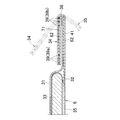
- FIG. 3 is a view showing a section taken along line III-III in FIG.
- an application region of the first hot melt adhesive 61 is formed between the side edge portion 34 and the central region 35, and the side edge portion 34 has a rear end portion.
- a high density application area 72 of the second hot melt adhesive 62 is formed, and low density application areas 71 are formed on both sides of the high density application area 72.
- the illustrated central panel 6 is a part including a laterally extending portion 41 and a longitudinally extending portion 42 in the central panel 6.
- the inner surface of the side edge portion 34 and the inner surface in the central region 35 of the central panel 6 are joined via the first hot melt adhesive 61.
- the inner surface sheet 31 and the outer surface sheet 32 are joined via the second hot melt adhesive 62, and here, the second hot melt adhesive 62 forms the low density application area 71.
- the center panel 6 is joined to the front panel 7 via a third hot melt adhesive 63.
- the breathable inner surface sheet 16 and the breathable outer sheet 17 are joined via a fourth hot melt adhesive 64.
- FIG. 4 is a diagram showing a section taken along the line IV-IV in FIG. 2, and the IV-IV line is in the vicinity of the lower edge 7d of the front panel 7 (see FIG. 1).
- the central panel 6 and the front panel 7 are not joined.
- the central panel 6 and the front panel 7 can be separated from each other. It is in a state.
- the other structure about the center panel 6 and the front panel 7 is the same structure as FIG.
- FIG. 5 shows a section cut along the line VV in FIG.
- the illustrated center panel 6 includes a bodily fluid absorbent core material 33 and a laterally extending portion 41. A part of the laterally extending portion 41 is bent at a folding line 38 to form a side edge portion 34 including an elastic member 39. At the side edge 34, the second hot melt adhesive 62 forms a low density application area 71.
- the central region 35 of the central panel 6 includes a body fluid-absorbing core material 33 and a part of the laterally extending portion 41.
- the first to fourth hot melt adhesives 61 to 64 include styrene-based, styrene-butadiene-based, styrene-butadiene-styrene-based, acryl-based, and the like.
- the conventional ones can be used.
- a conventional coating machine such as a spiral spray coater or a bar coater can be used, and a dot, spiral or bead coating pattern is adopted. can do.
- the application amount of these hot melt adhesives is preferably 5 to 30 g per 1 m 2 of areas to be joined.
- the coating amount per 1 m 2 in the low density coating area 71 is in the range of 0.3 to 3 g, and the coating amount per 1 m 2 in the high density coating area 72 is The coating amount is preferably adjusted so as to be in the range of 5 to 30 g.
- the diaper 1 of FIG. 1 may be that the wearer's toe is caught on the side edge 34 when the diaper 1 is worn, or that the toe pushes the central area 35 of the central panel 6 toward the outside of the diaper 1. . If this occurs when holding the front panel 7 or the rear panel 8 with both hands, the central panel 6 moves, for example, in the direction indicated by the arrow R in FIG. Such as peeling from the side edge 34, or receiving the action of peeling the inner sheet 31 and the outer sheet 32 at the side edge 34. There is. In order to prevent peeling of sheets due to these actions, in the diaper 1, it is sufficient to take measures to increase the application amount and application range of the first to fourth hot melt adhesives 61 to 64.
- the side edge 34 may be less flexible.
- the second hot melt adhesive 62 used for the side edge 34 is separately applied between the low density application area 71 and the high density application area 72. Therefore, the occurrence of such a problem can be prevented.
- FIGS. 6 and 7 are views similar to FIG. 2 showing an example of the embodiment of the present invention and a view taken along the line VII-VII in FIG. 6, and FIG. 7 is also a view similar to FIG. .
- the unfolded diaper 1a of FIG. 6 differs from the unfolded diaper 1a of FIG. 2 in that the application region of the first hot melt adhesive 61 for joining the side edge 34 and the center region 35 in the center panel 6 is the side edge.
- the application state of the first hot melt adhesive 61 at the rear end portion 37 of the side edge 34 is the same as the state of FIG.
- the coating area extends not only to the rear end portion 37 but also to the front panel 7 so as to exceed the lower edge 8d of the rear panel 8 (see FIGS. 1 and 2).
- the aspect of the outer surface sheet 32 in the side edge portion 34 of FIG. 7 is that the outer surface sheet 32 is bent at the edge 34 a of the side edge portion 34 and overlaps the inner surface sheet 31 and the second hot melt adhesive 62 is interposed therebetween. In joining, it differs from the aspect of the outer sheet
- FIG. 8 is also a view similar to FIG. 5 showing an example of the embodiment of the present invention.
- the unfolded diaper 1 a having the structure of FIG. 8 does not include the core material 33 illustrated in FIGS. 2 and 5 between the inner sheet 31 and the outer sheet 32 of the center panel 6, and is a core material instead of the core material 33.
- a body fluid-absorbing pad 75 wider than 33 is set on the inner surface of the central panel 6 with a part thereof being inserted between the side edge portion 34 and the central region 35.
- the pad 75 is formed by sandwiching a bodily fluid absorbent core material 76 with a liquid permeable inner surface sheet 77 and a liquid impermeable outer surface sheet 78.
- the pad 75 can be freely set to or removed from the central panel 6, and in order to stabilize the set state with respect to the central panel 6, an adhesive is provided at a portion facing the central panel 6. Can be applied or a mechanical fastener can be attached.
- the diaper 1 obtained from such an unfolded diaper 1a can also be called a diaper in which the pad 75 is replaceable or a diaper cover for using the pad 75.
- the inner sheet 16 and the outer sheet 17 of the front panel 7, the inner sheet 21 and the outer sheet 22 of the rear panel 8, a nonwoven fabric and a plastic film formed of thermoplastic synthetic fibers, these A laminated sheet of a nonwoven fabric and a plastic film or the like can be used.
- a liquid-permeable nonwoven fabric or a perforated plastic film formed of thermoplastic synthetic fibers can be used for the inner sheet 31 in the center panel.
- a liquid-impervious plastic film can be used for the outer sheet 32, but if a nonwoven fabric formed of thermoplastic synthetic fibers is laminated on the outer surface of the plastic film, the outer surface of the central panel 6 The touch can be made cloth-like.
- the plastic film when the nonwoven fabric is laminated has the laminated nonwoven fabric with the dimensions of the horizontal direction X and the vertical direction Y in FIG. 2 being slightly larger than the dimensions of the core material 33. It can be used as the inner surface sheet 31 in the laterally extending portion 41.
- the core material 33 in FIG. 2 and the core material 76 in the pad 75 in FIG. 8 are an aggregate of water-absorbing materials such as pulverized pulp or a mixture of pulverized pulp and superabsorbent polymer particles, tissue paper, liquid-permeable nonwoven fabric, etc. It can be obtained by coating with a wrapping sheet formed in (1).
Landscapes
- Health & Medical Sciences (AREA)
- Engineering & Computer Science (AREA)
- Life Sciences & Earth Sciences (AREA)
- Biomedical Technology (AREA)
- Heart & Thoracic Surgery (AREA)
- Vascular Medicine (AREA)
- Epidemiology (AREA)
- Animal Behavior & Ethology (AREA)
- General Health & Medical Sciences (AREA)
- Public Health (AREA)
- Veterinary Medicine (AREA)
- Manufacturing & Machinery (AREA)
- Absorbent Articles And Supports Therefor (AREA)
- Orthopedics, Nursing, And Contraception (AREA)
Priority Applications (3)
| Application Number | Priority Date | Filing Date | Title |
|---|---|---|---|
| CN201180047134.3A CN103140202B (zh) | 2010-09-30 | 2011-09-08 | 一次性短裤型穿用物品 |
| US13/823,442 US9101511B2 (en) | 2010-09-30 | 2011-09-08 | Disposable pants-type wearing article |
| EP11828749.9A EP2623080B1 (en) | 2010-09-30 | 2011-09-08 | Disposable pant-type clothing article |
Applications Claiming Priority (2)
| Application Number | Priority Date | Filing Date | Title |
|---|---|---|---|
| JP2010223228A JP5766421B2 (ja) | 2010-09-30 | 2010-09-30 | 使い捨てのパンツ型着用物品 |
| JP2010-223228 | 2010-09-30 |
Publications (1)
| Publication Number | Publication Date |
|---|---|
| WO2012043188A1 true WO2012043188A1 (ja) | 2012-04-05 |
Family
ID=45892661
Family Applications (1)
| Application Number | Title | Priority Date | Filing Date |
|---|---|---|---|
| PCT/JP2011/070513 Ceased WO2012043188A1 (ja) | 2010-09-30 | 2011-09-08 | 使い捨てのパンツ型着用物品 |
Country Status (5)
| Country | Link |
|---|---|
| US (1) | US9101511B2 (https=) |
| EP (1) | EP2623080B1 (https=) |
| JP (1) | JP5766421B2 (https=) |
| CN (1) | CN103140202B (https=) |
| WO (1) | WO2012043188A1 (https=) |
Cited By (1)
| Publication number | Priority date | Publication date | Assignee | Title |
|---|---|---|---|---|
| JP2014147565A (ja) * | 2013-02-01 | 2014-08-21 | Uni Charm Corp | 吸収性物品 |
Families Citing this family (6)
| Publication number | Priority date | Publication date | Assignee | Title |
|---|---|---|---|---|
| JP5297862B2 (ja) * | 2009-03-31 | 2013-09-25 | ユニ・チャーム株式会社 | 着用物品 |
| JP5822475B2 (ja) * | 2011-01-31 | 2015-11-24 | ユニ・チャーム株式会社 | 使い捨てのパンツ型の着用物品 |
| JP5968117B2 (ja) * | 2012-06-26 | 2016-08-10 | ユニ・チャーム株式会社 | 使い捨て着用物品 |
| JP6211777B2 (ja) * | 2013-03-18 | 2017-10-11 | 株式会社リブドゥコーポレーション | 吸収性物品 |
| GB2591901B (en) * | 2018-10-01 | 2022-06-15 | Kao Corp | Disposable diaper |
| CN113576762B (zh) * | 2021-08-11 | 2022-04-29 | 上海护理佳实业有限公司 | 乳垫 |
Citations (7)
| Publication number | Priority date | Publication date | Assignee | Title |
|---|---|---|---|---|
| JPH0432718U (https=) * | 1990-07-11 | 1992-03-17 | ||
| JPH07163617A (ja) * | 1993-12-16 | 1995-06-27 | Toyo Eizai Kk | 使い捨てパンツ |
| JP2003102785A (ja) * | 2001-10-01 | 2003-04-08 | Uni Charm Corp | 使い捨ておむつ |
| JP2006051240A (ja) | 2004-08-13 | 2006-02-23 | Uni Charm Corp | 簡易おむつ |
| JP2006525857A (ja) | 2003-05-27 | 2006-11-16 | ザ プロクター アンド ギャンブル カンパニー | 使い捨てプルオン衣類 |
| JP2009050651A (ja) * | 2007-08-29 | 2009-03-12 | Uni Charm Corp | 複合シート及び複合シートの製造方法 |
| JP4240463B2 (ja) | 2003-04-30 | 2009-03-18 | 株式会社リブドゥコーポレーション | パンツ型おむつ |
Family Cites Families (6)
| Publication number | Priority date | Publication date | Assignee | Title |
|---|---|---|---|---|
| JPH071860Y2 (ja) | 1989-05-29 | 1995-01-18 | 株式会社ケンウッド | 信号レベル調整装置 |
| TWI224963B (en) * | 2002-05-31 | 2004-12-11 | Kao Corp | Briefs-type diaper and briefs-type absorbent article |
| US7837665B2 (en) * | 2002-10-01 | 2010-11-23 | Kimberly-Clark Worldwide, Inc. | Three-piece disposable undergarment with folded crotch member |
| JP4298377B2 (ja) | 2003-05-22 | 2009-07-15 | ユニ・チャーム株式会社 | 使い捨てのパンツ型着用物品 |
| BRPI0622218A2 (pt) * | 2006-12-22 | 2012-01-03 | Sca Hygiene Prod Ab | um artigo absorvente tipo calÇa e um mÉtodo para produzir artigos absorventes tipo calÇa |
| EP2638888B1 (en) * | 2007-09-05 | 2015-01-28 | Uni-Charm Corporation | Absorbent Article |
-
2010
- 2010-09-30 JP JP2010223228A patent/JP5766421B2/ja not_active Expired - Fee Related
-
2011
- 2011-09-08 WO PCT/JP2011/070513 patent/WO2012043188A1/ja not_active Ceased
- 2011-09-08 EP EP11828749.9A patent/EP2623080B1/en not_active Not-in-force
- 2011-09-08 CN CN201180047134.3A patent/CN103140202B/zh not_active Expired - Fee Related
- 2011-09-08 US US13/823,442 patent/US9101511B2/en not_active Expired - Fee Related
Patent Citations (7)
| Publication number | Priority date | Publication date | Assignee | Title |
|---|---|---|---|---|
| JPH0432718U (https=) * | 1990-07-11 | 1992-03-17 | ||
| JPH07163617A (ja) * | 1993-12-16 | 1995-06-27 | Toyo Eizai Kk | 使い捨てパンツ |
| JP2003102785A (ja) * | 2001-10-01 | 2003-04-08 | Uni Charm Corp | 使い捨ておむつ |
| JP4240463B2 (ja) | 2003-04-30 | 2009-03-18 | 株式会社リブドゥコーポレーション | パンツ型おむつ |
| JP2006525857A (ja) | 2003-05-27 | 2006-11-16 | ザ プロクター アンド ギャンブル カンパニー | 使い捨てプルオン衣類 |
| JP2006051240A (ja) | 2004-08-13 | 2006-02-23 | Uni Charm Corp | 簡易おむつ |
| JP2009050651A (ja) * | 2007-08-29 | 2009-03-12 | Uni Charm Corp | 複合シート及び複合シートの製造方法 |
Non-Patent Citations (1)
| Title |
|---|
| See also references of EP2623080A4 |
Cited By (1)
| Publication number | Priority date | Publication date | Assignee | Title |
|---|---|---|---|---|
| JP2014147565A (ja) * | 2013-02-01 | 2014-08-21 | Uni Charm Corp | 吸収性物品 |
Also Published As
| Publication number | Publication date |
|---|---|
| EP2623080A4 (en) | 2015-06-24 |
| US20130172841A1 (en) | 2013-07-04 |
| CN103140202B (zh) | 2015-04-15 |
| US9101511B2 (en) | 2015-08-11 |
| CN103140202A (zh) | 2013-06-05 |
| EP2623080A1 (en) | 2013-08-07 |
| EP2623080B1 (en) | 2017-03-15 |
| JP5766421B2 (ja) | 2015-08-19 |
| JP2012075648A (ja) | 2012-04-19 |
Similar Documents
| Publication | Publication Date | Title |
|---|---|---|
| EP2760407B1 (en) | Disposable wearing article | |
| JP6473327B2 (ja) | 吸収性物品 | |
| CN106794090B (zh) | 一次性穿用物品 | |
| JP5457822B2 (ja) | 使い捨て着用物品 | |
| TWI584793B (zh) | Dispose of items with disposable dessert | |
| KR102179940B1 (ko) | 착용 물품 | |
| JP5766421B2 (ja) | 使い捨てのパンツ型着用物品 | |
| JP2017148111A (ja) | パンツ型吸収性物品 | |
| JP6830134B2 (ja) | 使い捨ておむつおよびその製造方法 | |
| JP5777271B2 (ja) | 着用物品 | |
| JP2016000116A (ja) | 使い捨て着用物品 | |
| JP6651328B2 (ja) | 使い捨ておむつおよびその製造方法 | |
| CN103997998B (zh) | 一次性穿着物品 | |
| JP4920892B2 (ja) | 使い捨てのパンツ型着用物品 | |
| US9155667B2 (en) | Pants-type wearing article | |
| WO2013054840A1 (ja) | 使い捨て着用物品 | |
| JP5906045B2 (ja) | 使い捨て着用物品 | |
| CN110536667B (zh) | 吸收性物品的制造方法 | |
| JP6436771B2 (ja) | 使い捨ての着用物品 | |
| JP6316707B2 (ja) | パンツ型吸収性物品 | |
| CN107613930A (zh) | 吸收性物品 | |
| JP2016064191A (ja) | 使い捨て着用物品 |
Legal Events
| Date | Code | Title | Description |
|---|---|---|---|
| WWE | Wipo information: entry into national phase |
Ref document number: 201180047134.3 Country of ref document: CN |
|
| 121 | Ep: the epo has been informed by wipo that ep was designated in this application |
Ref document number: 11828749 Country of ref document: EP Kind code of ref document: A1 |
|
| REEP | Request for entry into the european phase |
Ref document number: 2011828749 Country of ref document: EP |
|
| WWE | Wipo information: entry into national phase |
Ref document number: 2011828749 Country of ref document: EP |
|
| WWE | Wipo information: entry into national phase |
Ref document number: 13823442 Country of ref document: US |
|
| NENP | Non-entry into the national phase |
Ref country code: DE |