WO2011142385A1 - 硫化亜鉛青色蛍光体およびその製造方法 - Google Patents
硫化亜鉛青色蛍光体およびその製造方法 Download PDFInfo
- Publication number
- WO2011142385A1 WO2011142385A1 PCT/JP2011/060843 JP2011060843W WO2011142385A1 WO 2011142385 A1 WO2011142385 A1 WO 2011142385A1 JP 2011060843 W JP2011060843 W JP 2011060843W WO 2011142385 A1 WO2011142385 A1 WO 2011142385A1
- Authority
- WO
- WIPO (PCT)
- Prior art keywords
- zinc sulfide
- zinc
- water
- ppm
- nickel
- Prior art date
- Legal status (The legal status is an assumption and is not a legal conclusion. Google has not performed a legal analysis and makes no representation as to the accuracy of the status listed.)
- Ceased
Links
Classifications
-
- C—CHEMISTRY; METALLURGY
- C09—DYES; PAINTS; POLISHES; NATURAL RESINS; ADHESIVES; COMPOSITIONS NOT OTHERWISE PROVIDED FOR; APPLICATIONS OF MATERIALS NOT OTHERWISE PROVIDED FOR
- C09K—MATERIALS FOR MISCELLANEOUS APPLICATIONS, NOT PROVIDED FOR ELSEWHERE
- C09K11/00—Luminescent materials, e.g. electroluminescent or chemiluminescent
- C09K11/08—Luminescent materials, e.g. electroluminescent or chemiluminescent containing inorganic luminescent materials
- C09K11/60—Luminescent materials, e.g. electroluminescent or chemiluminescent containing inorganic luminescent materials containing iron, cobalt or nickel
-
- C—CHEMISTRY; METALLURGY
- C09—DYES; PAINTS; POLISHES; NATURAL RESINS; ADHESIVES; COMPOSITIONS NOT OTHERWISE PROVIDED FOR; APPLICATIONS OF MATERIALS NOT OTHERWISE PROVIDED FOR
- C09K—MATERIALS FOR MISCELLANEOUS APPLICATIONS, NOT PROVIDED FOR ELSEWHERE
- C09K11/00—Luminescent materials, e.g. electroluminescent or chemiluminescent
- C09K11/08—Luminescent materials, e.g. electroluminescent or chemiluminescent containing inorganic luminescent materials
- C09K11/58—Luminescent materials, e.g. electroluminescent or chemiluminescent containing inorganic luminescent materials containing copper, silver or gold
- C09K11/582—Chalcogenides
- C09K11/584—Chalcogenides with zinc or cadmium
-
- C—CHEMISTRY; METALLURGY
- C09—DYES; PAINTS; POLISHES; NATURAL RESINS; ADHESIVES; COMPOSITIONS NOT OTHERWISE PROVIDED FOR; APPLICATIONS OF MATERIALS NOT OTHERWISE PROVIDED FOR
- C09K—MATERIALS FOR MISCELLANEOUS APPLICATIONS, NOT PROVIDED FOR ELSEWHERE
- C09K11/00—Luminescent materials, e.g. electroluminescent or chemiluminescent
- C09K11/08—Luminescent materials, e.g. electroluminescent or chemiluminescent containing inorganic luminescent materials
- C09K11/58—Luminescent materials, e.g. electroluminescent or chemiluminescent containing inorganic luminescent materials containing copper, silver or gold
Definitions
- the present invention relates to a phosphor useful for a dispersive electroluminescence (EL) element.
- An inorganic composition mainly composed of a compound semiconductor is used in the fields of light emitting materials such as fluorescence and phosphorescence, and phosphorescent materials. Some of these have the property of emitting light by electrical energy, are used as light sources, and are partly used in display applications. In particular, a phosphor exhibiting a blue color is useful not only as a blue light emitting material but also as a white light emitting material.
- light emitting materials such as fluorescence and phosphorescence, and phosphorescent materials.
- Non-Patent Document 1 In zinc sulfide phosphors mainly composed of zinc sulfide, as those exhibiting a blue color, those doped with copper (for example, see Non-Patent Document 1) and those doped with thulium (Tm) (for example, Non-Patent Document 2) See). Moreover, what prepared zinc sulfide under hydrothermal conditions etc. (for example, refer patent document 1) and what used praseodymium as a dopant (refer nonpatent literature 3) are known.
- the known zinc sulfide phosphor exhibiting blue color has low energy efficiency and color purity, and has a problem that it is difficult to use for light source applications and display applications.
- various methods for using a large amount of a compound containing an expensive rare earth element and methods for adding other elements having a sensitizing action have been studied. However, it has not yet satisfied both energy efficiency and color purity.
- the conventional zinc sulfide blue phosphor has a y value larger than 0.16 and a small amount of blue component, the color rendering is low when white conversion is performed. Cannot be reproduced, and there are problems such as limited applications.
- the inventors of the present invention dope a zinc sulfide phosphor containing at least one element of copper or silver with at least one element of nickel and iron, which has been conventionally excluded from the viewpoint of luminous efficiency. As a result, the inventors have found that the above problems can be solved, and have completed the present invention.
- the present invention provides a zinc sulfide phosphor exhibiting a blue color having high energy efficiency and color purity.
- the zinc sulfide phosphor is suitable for use as a light source and a display by using a phosphor of a dispersed EL element.
- the production method of the present invention can produce a phosphor precursor compound in which the activation metal is homogeneously doped. As a result, the zinc sulfide phosphor exhibiting a blue color with high energy efficiency and color purity can be efficiently produced. It becomes possible to provide.
- the method for producing a zinc sulfide blue phosphor of the present invention comprises a compound containing at least one element of copper or silver, a zinc compound, a sulfurizing agent, and a compound containing at least one element of nickel or iron.
- An aqueous solution is added to an organic solvent to form a reaction mixture, and the reaction mixture is heated to azeotrope water and the organic solvent to remove water from the reaction mixture to obtain a zinc sulfide phosphor precursor.
- the zinc sulfide phosphor precursor is obtained by further firing.
- Examples of the zinc compound used in the production method of the present invention include mineral acid salts such as hydrochloric acid, sulfuric acid, nitric acid and phosphoric acid, organic acid salts such as formic acid, acetic acid, butyric acid and oxalic acid, and complex salts such as acetylacetonate. Can be used. In view of stability and persistence after removing water from the solvent contained in the reaction mixture by azeotroping water and an organic solvent, it is preferable to use a chloride. These may be used alone or in combination.
- sulfurizing agent used in the production method of the present invention for example, hydrogen sulfide, a complex of hydrogen sulfide and ammonia (for example, ammonium sulfide, ammonium hydrogen sulfide, polyammonium sulfide, etc.), thioacetamide, and thiourea are used. be able to. In consideration of stability and persistence after removing water from the solvent contained in the reaction mixture by azeotropically mixing water and an organic solvent, it is preferable to use a complex of hydrogen sulfide and ammonia. These may be used alone or in combination.
- the compound containing at least one element of copper or silver used in the production method of the present invention is a water-soluble compound.
- mineral salts such as hydrochloric acid, sulfuric acid, nitric acid and phosphoric acid
- organic acid salts such as formic acid, acetic acid, butyric acid and oxalic acid
- complex salts such as acetylacetonate of at least one element of copper or silver it can.
- hydrochloride or sulfate may be used alone or in combination.
- a compound containing an element such as chlorine, bromine, iodine, aluminum, gallium, or indium that acts as a donor for at least one of copper and silver as an acceptor is present in an aqueous solution.
- a donor element may be incorporated into the zinc sulfide phosphor precursor.
- the compound containing nickel element (hereinafter referred to as nickel compound) used in the production method of the present invention is a water-soluble compound.
- the compound containing an iron element (hereinafter referred to as an iron compound) used in the production method of the present invention is a water-soluble compound.
- mineral acid salts such as hydrochloric acid, sulfuric acid, nitric acid and phosphoric acid, organic acid salts such as formic acid, acetic acid, butyric acid and oxalic acid, and complex salts such as acetylacetonate can be used.
- hydrochlorides and sulfates In consideration of stability and persistence after removing water from the reaction mixture by azeotroping water and an organic solvent, it is preferable to use hydrochlorides and sulfates. These may be used alone or in combination.
- the method of introducing at least one element of copper or silver and at least one element of iron and nickel is not particularly limited, but generally a compound containing zinc sulfide and at least one element of copper or silver and a nickel compound And / or a method in which an iron compound is mixed and heated and fired, or a compound containing at least one element of copper or silver in which zinc sulfide is dispersed in water and dissolved in water, and a nickel compound and / or an iron compound
- the method of evaporating water while stirring and heating and firing is used.
- a method of coexisting a compound containing at least one element of copper or silver and a nickel compound and / or an iron compound in a reaction field for generating zinc sulfide that is, a compound containing at least one element of copper or silver
- a method in which a zinc compound, a sulfiding agent, a nickel compound and / or an iron compound coexist in an aqueous solution to form a sulfide is also used.
- a highly uniform dispersion method Is is preferably used.
- a compound containing at least one element of copper or silver, a zinc compound, a sulfurizing agent, and an aqueous solution containing a nickel compound and / or an iron compound are added to an organic solvent to form a reaction mixture.
- Water is removed from the reaction mixture by heating the reaction mixture to azeotrope the water and the organic solvent, and collecting only the water obtained by condensing the vapor generated by the azeotropy.
- the reaction rate between the compound containing at least one element of copper or silver, the zinc compound, and the compound containing at least one element of nickel and iron and the sulfiding agent may vary greatly.
- the aqueous solution of the sulfiding agent and the aqueous solution of the other raw material are separately added to the organic solvent and mixed in the organic solvent, and the aqueous solution of the sulfiding agent and the aqueous solution of the other raw material are immediately added to the organic solvent. It is preferable to mix.
- the concentration of the zinc compound in the aqueous solution does not cause a decrease in the homogeneity of the zinc sulfide phosphor precursor and is not particularly limited as long as the zinc compound is completely dissolved. .
- the concentration is too high, it is not preferable because the reaction is inhibited and the speed is reduced with the precipitation of the zinc sulfide phosphor precursor.
- the concentration is too low, the volumetric efficiency of the reaction system is remarkably high. Since it falls, it is not preferable. Therefore, it is prepared in the range of 0.01 to 2 mol / L, more preferably 0.1 to 1.5 mol / L.
- the amount of the compound containing at least one element of copper or silver used in the production method of the present invention and the compound containing an element acting as a donor with respect to at least one element of copper or silver as an acceptor is doped.
- the weight of the metal element to be obtained is in the range of 0.1 to 150,000 ppm, more preferably in the range of 1 to 50,000 ppm, based on the weight of the obtained zinc sulfide phosphor precursor, the effect of inclusion, and economic efficiency. In consideration of the above, it is preferably in the range of 2 to 10,000 ppm.
- the compound containing these elements is preferably further dissolved in an aqueous solution in which a zinc compound is dissolved.
- the amount of nickel compound and / or iron compound used in the production method of the present invention is extremely important because it affects the fluorescent performance of the zinc sulfide phosphor.
- the weight of the nickel element to be doped is preferably in the range of 0.1 to 20 ppm, more preferably in the range of 0.15 to 15 ppm, based on the weight of the obtained zinc sulfide phosphor precursor.
- the range of 0.2 to 10 ppm is more preferable.
- the weight of the iron element to be doped is preferably in the range of 0.1 to 50 ppm, more preferably in the range of 0.2 ppm to 30 ppm, based on the weight of the obtained zinc sulfide phosphor precursor. Considering the effect and economy, it is more preferable to contain in the range of 0.5 to 20 ppm.
- the amount of the sulfurizing agent used in the production method of the present invention may be an amount corresponding to a molar ratio of 0.5 to 5 times with respect to zinc element, but zinc metal remains unreacted in the reaction system. Then, an undesirable effect is caused on the reaction, and when used as a zinc sulfide phosphor, it leads to a decrease in color purity, limitation of use, etc., so it is usually preferable to use in a range of 1.0 to 4 mole times. More preferably, it is used in the range of 1.1 to 2 mole times.
- the concentration of the aqueous solution when the sulfurizing agent is used in the form of an aqueous solution is not particularly limited as long as the sulfurizing agent is completely dissolved and does not cause a decrease in the homogeneity of the zinc sulfide phosphor precursor.
- concentration is too high, the unreacted sulfurizing agent is deposited and remains in the target product, which is not preferable.
- the concentration is too low, the volumetric efficiency is remarkably lowered. Accordingly, the range is preferably 0.01 to 2 mol / L, and more preferably 0.1 to 1.5 mol / L.
- the organic solvent used in the production method of the present invention may be any solvent that can remove water from the reaction system by azeotroping with water.
- Halogenated hydrocarbons such as 1,1,2,2-tetrachloroethylene
- halogenated aromatic hydrocarbons such as chlorobenzene and dichlorobenzene
- saturated hydrocarbon or aromatic hydrocarbon is preferable.
- decane, dodecane, and xylene are preferable.
- the amount of the organic solvent used is not particularly limited, and may be kept larger than the amount of the aqueous solution in which the zinc compound is dissolved and the aqueous solution of the sulfiding agent.
- the production method of the present invention can be carried out in the range of 30 to 300 ° C. From the viewpoint of safety and operability, it is preferable to carry out in the range of 40 to 230 ° C., which does not require the use of special experimental equipment, reactors and the like. More preferably, it is carried out in the range of 80 ° C., more preferably in the range of 80 ° C. to 180 ° C.
- the production method of the present invention is preferably carried out under an inert gas such as nitrogen or argon because oxygen may be present in the system and side reactions such as oxidation of the product may not be sufficiently suppressed.
- an inert gas such as nitrogen or argon because oxygen may be present in the system and side reactions such as oxidation of the product may not be sufficiently suppressed.
- an aqueous solution of a raw material compound is added to an organic solvent to prepare a reaction mixture, and on the other hand, water is removed from the reaction mixture using azeotropy of water and the organic solvent. It is preferable to adopt a method of removing.
- the zinc sulfide phosphor precursor precipitated in the reaction mixture is separated from the liquid phase and dried under heat and reduced pressure as necessary.
- the temperature for drying the zinc sulfide phosphor precursor can be in the range of 10 to 200 ° C.
- the presence of a slight amount of water causes oxidation of the zinc sulfide phosphor precursor, particularly when drying at a high temperature. Since it may occur at the same time, it is preferably 150 ° C. or lower, and more preferably in the range of 30 to 120 ° C.
- the zinc sulfide phosphor precursor is baked in order to prepare the zinc sulfide phosphor.
- the firing temperature is not less than the temperature at which the crystal form of zinc sulfide changes and not more than the temperature for sublimation. That is, firing is performed at a temperature of 500 to 1250 ° C., preferably 550 to 1200 ° C., more preferably 600 to 1150 ° C.
- the heating rate up to the firing temperature is usually 2.0 to 40.0 ° C./min. If the rate of temperature increase is too fast, the furnace body and the container containing the zinc sulfide phosphor precursor are damaged, which is not preferable. If the rate of temperature increase is too slow, the production efficiency is significantly reduced, which is not preferable. From such a viewpoint, it is preferable to raise the temperature at a rate of 2.5 to 30.0 ° C./min.
- the atmosphere for firing is not particularly limited, and may be any gas atmosphere such as air, inert gas atmosphere, or reducing gas atmosphere.
- a flux may be used to promote crystallization of the zinc sulfide phosphor and increase the particle size during firing.
- the flux examples include alkali metal salts such as sodium chloride and potassium chloride, alkaline earth salts such as magnesium chloride and calcium chloride, and zinc chloride. These fluxing agents may be used alone or in combination.
- the amount used is not particularly limited, but it is preferably used in the range of 0.1 to 60% by weight with respect to the zinc sulfide phosphor precursor, considering operability and economy. Thus, it is more preferable to use in the range of 0.5 to 50% by weight.
- sulfur may be added to supplement the sulfur content missing during firing.
- the amount is not particularly limited, but is usually added in the range of 0.1 to 300 parts by weight with respect to 100 parts by weight of the zinc sulfide phosphor precursor, and in the range of 1 to 200 parts by weight. It is preferable to add at.
- the zinc sulfide phosphor that is the fired product is washed.
- the metal elements removed from the crystal growth and the added extra flux are removed.
- neutral water or acidic water can be used.
- the acid component is not particularly limited, and mineral acids such as hydrochloric acid, sulfuric acid, nitric acid and phosphoric acid, and organic acids such as acetic acid, propionic acid and butyric acid can be used. These may be used alone or in combination.
- zinc sulfide phosphors may be decomposed when they come into contact with high-concentration acidic substances, when using acidic water, it is usually preferable to use an aqueous solution of 0.1 to 20% by weight, more preferably 1 to A 10% by weight aqueous solution is used. In view of decomposition of the zinc sulfide phosphor and ion residual properties on the surface, it is preferable to use an acetic acid aqueous solution and hydrochloric acid.
- the zinc sulfide phosphor precursor is subjected to impact and the like, and after being subjected to crystal distortion, firing may be performed a plurality of times. Generally, when performing baking several times, the last baking temperature is set lowest. When firing a plurality of times, a compound containing at least one element of copper or silver and a compound containing zinc can be added and fired.
- the kind of the compound containing zinc to be used is not particularly limited, such as mineral acid salts such as hydrochloric acid, sulfuric acid, nitric acid and phosphoric acid, organic acid salts such as formic acid, acetic acid, butyric acid and oxalic acid, and acetylacetonate. Complex salts can be used.
- the amount of the compound containing zinc is not particularly limited, and is usually added in the range of 10 ppm to 50% by weight and added in the range of 100 ppm to 30% by weight with respect to the zinc sulfide phosphor precursor. It is preferred that
- the final firing temperature when firing multiple times in the method for producing a zinc sulfide phosphor of the present invention is in the range of 500 to 900 ° C., preferably in the range of 600 to 850 ° C.
- an atmosphere of baking it can implement in air, an inert gas, and a reducing gas atmosphere.
- firing is performed a plurality of times, and when adding a compound containing at least one element of copper or silver and a compound containing zinc as described above, an excess of the added compound after firing is added. It is removed by washing as an unnecessary metal component. Furthermore, other unnecessary metal components such as copper deposited on the surface by this cleaning can be removed.
- neutral water, acidic water, or oxidizing water can be used for washing. It does not specifically limit as an acid component used for acidic water, Organic acids, such as mineral acids, such as hydrochloric acid, a sulfuric acid, nitric acid, phosphoric acid, and an acetic acid, a butyric acid, can be used. These may be used alone or in combination.
- oxidizing water can also be used.
- organic peroxides such as hydrogen peroxide, persulfuric acid, peracetic acid and their salts, and t-butyl hydroperoxide can be used.
- ammonia or amines can be added in order to improve the removal efficiency of unnecessary metal components. Examples of amines that can be used include methylamine, ethylamine, ethylenediamine, ethylenediaminetetraacetic acid (EDTA), and 8-quinolinol. These may be used alone or in combination.
- acidic water or oxidizing water it is usually preferable to use 0.05 to 10% by weight aqueous solution, more preferably 0.1 to 5% by weight aqueous solution. Further, in consideration of decomposition of the zinc sulfide phosphor and ion residual property on the surface, it is preferable to use hydrochloric acid or acetic acid as the acid component and hydrogen peroxide or peracetic acid as the oxidizing component.
- ion-exchanged water ion-exchanged water having an ash content of usually 100 ppm or less, more preferably 10 ppm or less is used.
- the zinc sulfide phosphor is dried under heat and reduced pressure as necessary.
- the drying temperature can usually be carried out in the range of 10 to 200 ° C., but since the presence of a slight amount of water may cause the oxidation of the zinc sulfide phosphor particularly when drying at a high temperature, 150 ° C.
- the temperature is preferably not higher than ° C, and more preferably in the range of 30 to 120 ° C.
- the proper formation of the zinc sulfide phosphor can be confirmed by measuring the fluorescence quantum yield.
- the fluorescence quantum yield is a ratio between the number of photons emitted by excitation by incident light and the number of photons of incident light absorbed by the substance, and the larger this value, the higher the doping effect.
- the fluorescence quantum yield can be measured by a fluorescence spectrophotometer.
- the measurement conditions of the fluorescence spectrophotometer for measuring the fluorescence quantum yield are as follows.
- Measuring device FP-6500 manufactured by JASCO Corporation Excitation wavelength: 350 nm Excitation bandwidth: 5 nm
- An aqueous solution is prepared by dissolving 136.3 g (1 mol) of zinc chloride anhydride, 0.19 g of copper sulfate pentahydrate (equivalent to Cu 500 ppm) and 2.2 mg of nickel sulfate hexahydrate (equivalent to Ni 5 ppm) in 500 g of ion-exchanged water. did.
- an aqueous solution was prepared by dissolving 240.8 g of an aqueous ammonium sulfide solution (40% by weight manufactured by Wako Pure Chemical Industries, Ltd.) in 500 g of ion-exchanged water.
- a 5 L three-necked flask was equipped with a Dean Stark, a reflux tube, a thermometer, and a stirrer, 2000 ml of decane was added, and the inside of the system was purged with nitrogen.
- the aqueous solution containing zinc chloride, copper sulfate and nickel sulfate was added separately at 100 ml / hr, and the aqueous ammonium sulfide solution was added separately at 100 ml / hr.
- the reaction proceeded while removing with Dean Stark. All aqueous solutions were supplied in about 6 hours, and the water in the system was removed for another 60 minutes.
- the precipitated sulfide is precipitated, decane is removed, and then dried in a vacuum dryer at a vacuum degree of 1.3 kPa or less at 100 ° C.
- the obtained fired product was added to 200 g of 5% hydrochloric acid to disperse the fired product.
- the supernatant was removed from the dispersion by decantation, and washed with 500 g of ion-exchanged water until neutral, to obtain a first fired product. After removing the ion-exchanged water by decantation, it was dried at 100 ° C. for 12 hours at a vacuum degree of 1.3 kPa or less to obtain 24 g of a first fired product.
- ion-exchanged water 200 g is added to 20 g of the first fired product, and ultrasonic vibration is performed by performing an ultrasonic vibration (manufactured by BRANSON, Digital Sonifier) for 5 minutes continuously at an output of 60% for 5 minutes and three stop cycles for 3 minutes. added. Fine particles generated by crushing were removed by passing through a 10 ⁇ m mesh sieve. The obtained particles were removed from ion-exchanged water by filtration, and then dried at 100 ° C. for 12 hours under a vacuum degree of 1.3 kPa or less.
- the obtained fired product was dispersed in 100 g of 5% hydrochloric acid and washed. The supernatant was removed by decantation and washed with 500 g of ion-exchanged water until neutral. After removing ion-exchanged water by decantation, it was washed with 200 g of a 1% hydrogen peroxide / EDTA aqueous solution to remove excess sulfide. Furthermore, after washing
- a 20 mm square screen plate 200 mesh, 25 ⁇ m was used to make a light emitting layer with a film thickness of 40 ⁇ m on a PET film with ITO (product name: KB300N-125 manufactured by Oike Kogyo).
- a silver paste (461SS made by Atchison) is made using a screen plate (150 mesh, 25 ⁇ m) as an electrode, dried at 100 ° C. for 10 minutes to form an electrode, and a dispersion type EL device Configured.
- the produced dispersion type EL element was set at a sample measurement position of FP-6500 manufactured by JASCO Corporation and applied at 200 V and 1 kHz to cause the dispersion type EL element to emit light. The emitted light was measured with a fluorescence spectrophotometer, the emission spectrum and luminance were measured, and the chromaticity was converted to obtain the y value. The results are shown in Table 2.
- Example 2 A zinc sulfide phosphor precursor was prepared and fired in the same manner as in Example 1 except that the amount of nickel sulfate hexahydrate was 4.4 mg (equivalent to Ni 10 ppm) in Example 1.
- the fluorescence quantum yield, luminance, and chromaticity were measured in the same manner as in Example 1. The results are shown in Tables 1 and 2.
- Example 3 a zinc sulfide phosphor precursor was prepared and fired in the same manner as in Example 1 except that the amount of nickel sulfate hexahydrate was 0.4 mg (equivalent to 1 ppm of Ni).
- the fluorescence quantum yield, luminance, and chromaticity were measured in the same manner as in Example 1. The results are shown in Tables 1 and 2.
- Example 4 a zinc sulfide phosphor precursor was prepared in the same manner as in Example 1 except that the amount of copper sulfate pentahydrate added to zinc chloride anhydride was 0.12 g (equivalent to Cu 300 ppm). Baked. For the fired product, the fluorescence quantum yield, luminance, and chromaticity were measured in the same manner as in Example 1. The results are shown in Tables 1 and 2.
- Example 5 A zinc sulfide phosphor precursor was obtained in the same manner as in Example 1 except that instead of nickel sulfate hexahydrate, 3.7 mg of iron (III) chloride hexahydrate (equivalent to Fe8 ppm) was used. was prepared and fired. For the fired product, the fluorescence quantum yield, luminance, and chromaticity were measured in the same manner as in Example 1. The results are shown in Tables 1 and 2.
- Example 6 A zinc sulfide phosphor precursor was obtained in the same manner as in Example 1 except that instead of nickel sulfate hexahydrate, 9.4 mg of iron chloride (III) hexahydrate (equivalent to 20 ppm of Fe) was used instead of nickel sulfate hexahydrate. was prepared and fired. For the fired product, the fluorescence quantum yield, luminance, and chromaticity were measured in the same manner as in Example 1. The results are shown in Tables 1 and 2.
- Example 7 a zinc sulfide phosphor precursor was carried out in the same manner as in Example 4 except that 3.7 mg (equivalent to Fe8 ppm) of iron (III) chloride hexahydrate was used instead of nickel sulfate hexahydrate. was prepared and fired. For the fired product, the fluorescence quantum yield, luminance and chromaticity were measured in the same manner as in Example 4. The results are shown in Tables 1 and 2.
- Example 8 A zinc sulfide phosphor precursor was prepared and fired in the same manner as in Example 2 except that 3.7 mg of iron (III) hexahydrate (equivalent to Fe8 ppm) was further added.
- the fluorescence quantum yield, luminance, and chromaticity were measured in the same manner as in Example 2. The results are shown in Tables 1 and 2.
- Example 1 a zinc sulfide phosphor precursor was prepared and fired in the same manner as in Example 1 except that nickel sulfate hexahydrate was not added.
- the fluorescence quantum yield, luminance, and chromaticity were measured in the same manner as in Example 1. The results are shown in Tables 1 and 2.
- Example 4 a zinc sulfide phosphor precursor was prepared and fired in the same manner as in Example 4 except that nickel sulfate hexahydrate was not added.
- the fluorescence quantum yield, luminance and chromaticity were measured in the same manner as in Example 4. The results are shown in Tables 1 and 2.
- Example 9 A zinc sulfide phosphor precursor was prepared and fired in the same manner as in Example 1 except that 13.2 mg of nickel sulfate hexahydrate (equivalent to Ni 30 ppm) was added. For the fired product, the fluorescence quantum yield, luminance, and chromaticity were measured in the same manner as in Example 1. The results are shown in Tables 1 and 2.
- Example 10 A zinc sulfide phosphor precursor was prepared and fired in the same manner as in Example 6 except that 40.6 mg of iron (III) hexahydrate (equivalent to Fe 80 ppm) was added.
- the fluorescence quantum yield, luminance and chromaticity were measured in the same manner as in Example 6. The results are shown in Tables 1 and 2.
- Example 3 A zinc sulfide phosphor precursor was prepared in the same manner as in Example 1 except that 1.81 g of manganese acetate (equivalent to Mn 4500 ppm) was added instead of 0.19 g of copper sulfate pentahydrate in Example 1. Baked. For the fired product, the fluorescence quantum yield, luminance and chromaticity were measured in the same manner as in Example 1. The results are shown in Tables 1 and 2.
- Example 1 In Example 1, in place of 0.19 g of copper sulfate pentahydrate, 1.81 g of manganese acetate (equivalent to Mn 4500 ppm) was added, and nickel sulfate hexahydrate was not added. The zinc sulfide phosphor precursor was prepared and fired. For the fired product, the fluorescence quantum yield, luminance, and chromaticity were measured in the same manner as in Example 1. The results are shown in Tables 1 and 2.
- the chromaticity (y value) is higher than that of the comparative example despite the equivalent copper content. Since it is low, it turns out that the color tone of EL light emission is blue.
- a zinc sulfide phosphor having a reduced green color tone and a strong blue color tone was obtained.
Landscapes
- Chemical & Material Sciences (AREA)
- Inorganic Chemistry (AREA)
- Engineering & Computer Science (AREA)
- Materials Engineering (AREA)
- Organic Chemistry (AREA)
- Luminescent Compositions (AREA)
- Electroluminescent Light Sources (AREA)
Abstract
Description
[1]銅または銀の少なくともいずれかの元素と、ニッケルまたは鉄の少なくともいずれかの元素と、を含む硫化亜鉛青色蛍光体。
[2]ニッケルの含有量が0.1ppm以上20ppm以下である[1]に記載の硫化亜鉛青色蛍光体。
[3]鉄の含有量が0.1ppm以上50ppm以下である[1]または[2]に記載の硫化亜鉛青色蛍光体。
[4]蛍光体で分散型EL素子を形成し、200V、1kHzで当該素子を駆動したときの発光色のy値が、0.07≦y≦0.16である[1]~[3]のいずれかに記載の硫化亜鉛青色蛍光体。
[5]銅または銀の少なくともいずれかの元素を含む化合物と、亜鉛化合物と、硫化剤と、ニッケルまたは鉄の少なくともいずれかの元素を含む化合物と、を水溶液として有機溶媒中に添加して反応混合液とし、該反応混合液を加熱して、水と有機溶媒を共沸させることで該反応混合液から水を除去して硫化亜鉛蛍光体前駆体を得、該硫化亜鉛蛍光体前駆体をさらに焼成することを特徴とする[1]~[4]のいずれかに記載の硫化亜鉛青色蛍光体の製造方法。
励起波長:350nm
励起バンド幅:5nm
ソフトウェア:Spectra Manager for Windows(登録商標)95/NT Ver1.00.00 2005 日本分光株式会社製
<実施例1>
塩化亜鉛無水物136.3g(1mol)、硫酸銅5水和物0.19g(Cu500ppm相当)および硫酸ニッケル6水和物2.2mg(Ni5ppm相当)をイオン交換水500gに溶解させて水溶液を調製した。一方、硫化アンモニウム水溶液(和光純薬製 40重量%)240.8gをイオン交換水500gに溶解させて水溶液を調製した。5L三つ口フラスコに、ディーンスターク、還流管、温度計、攪拌器を装着し、デカン2000mlを加え、系内を窒素置換した。反応器内のデカンを120℃に昇温したのち、塩化亜鉛、硫酸銅および硫酸ニッケルを含有する水溶液を100ml/hr、硫化アンモニウム水溶液を100ml/hrで各々別々に加えながら、留出する水をディーンスタークで除去しながら反応を進めた。約6時間で全ての水溶液を供給し、さらに60分間系内の水分を除去した。室温に冷却後、析出した硫化物を沈殿させ、デカンを除去した後、真空乾燥機にて、1.3kPa以下の真空度で100℃、12時間乾燥し、白色固体として硫化亜鉛蛍光体前駆体を回収した。該硫化亜鉛蛍光体前駆体の回収量は、89.67gであり、理論量の92%であった。導入された銅、ニッケル量のICP分析結果を表1に示す。
実施例1において、硫酸ニッケル6水和物の量を4.4mg(Ni10ppm相当)とした以外は、実施例1と同様に行って硫化亜鉛発光体前駆体を調製し、焼成した。焼成物について実施例1と同様に蛍光量子収率、輝度及び色度を測定した。結果を表1、表2に示す。
実施例1において、硫酸ニッケル6水和物の量を0.4mg(Ni1ppm相当)とした以外は、実施例1と同様に行って硫化亜鉛発光体前駆体を調製し、焼成した。焼成物について実施例1と同様に蛍光量子収率、輝度及び色度を測定した。結果を表1、表2に示す。
実施例1において、塩化亜鉛無水物に添加する硫酸銅5水和物の量を0.12g(Cu300ppm相当)とした以外は、実施例1と同様に行って硫化亜鉛発光体前駆体を調製し、焼成した。焼成物について実施例1と同様に蛍光量子収率、輝度及び色度を測定した。結果を表1、表2に示す。
実施例1において、硫酸ニッケル6水和物に代えて、塩化鉄(III)六水和物3.7mg(Fe8ppm相当)とした以外は、実施例1と同様に行って硫化亜鉛発光体前駆体を調製し、焼成した。焼成物について実施例1と同様に蛍光量子収率、輝度及び色度を測定した。結果を表1、表2に示す。
実施例1において、硫酸ニッケル6水和物に代えて、塩化鉄(III)六水和物9.4mg(Fe20ppm相当)とした以外は、実施例1と同様に行って硫化亜鉛発光体前駆体を調製し、焼成した。焼成物について実施例1と同様に蛍光量子収率、輝度及び色度を測定した。結果を表1、表2に示す。
実施例4において、硫酸ニッケル6水和物に代えて、塩化鉄(III)六水和物3.7mg(Fe8ppm相当)とした以外は、実施例4と同様に行って硫化亜鉛発光体前駆体を調製し、焼成した。焼成物について実施例4と同様に蛍光量子収率、輝度及び色度を測定した。結果を表1、表2に示す。
実施例2において、塩化鉄(III)六水和物3.7mg(Fe8ppm相当)をさらに添加した以外は、実施例2と同様に行って硫化亜鉛発光体前駆体を調製し、焼成した。焼成物について実施例2と同様に蛍光量子収率、輝度及び色度を測定した。結果を表1、表2に示す。
実施例1において、硫酸ニッケル6水和物を添加しなかった以外は、実施例1と同様に行って硫化亜鉛発光体前駆体を調製し、焼成した。焼成物について実施例1と同様に蛍光量子収率、輝度及び色度を測定した。結果を表1、表2に示す。
実施例4において、硫酸ニッケル6水和物を添加しなかった以外は、実施例4と同様に行って硫化亜鉛発光体前駆体を調製し、焼成した。焼成物について実施例4と同様に蛍光量子収率、輝度及び色度を測定した。結果を表1、表2に示す。
実施例1において、硫酸ニッケル6水和物13.2mg(Ni30ppm相当)を添加した以外は、実施例1と同様に行って硫化亜鉛発光体前駆体を調製し、焼成した。焼成物について実施例1と同様に蛍光量子収率、輝度及び色度を測定した。結果を表1、表2に示す。
実施例6において、塩化鉄(III)6水和物40.6mg(Fe80ppm相当)を添加した以外は、実施例6と同様に行って硫化亜鉛発光体前駆体を調製し、焼成した。焼成物について実施例6と同様に蛍光量子収率、輝度及び色度を測定した。結果を表1、表2に示す。
実施例1において、硫酸銅5水和物0.19gに代えて、酢酸マンガン1.81g(Mn4500ppm相当)を添加した以外は、実施例1と同様に行って硫化亜鉛発光体前駆体を調製し、焼成した。焼成物について実施例1と同様に蛍光量子収率、輝度及び色度を測定した。結果を表1、表2に示す。
実施例1において、硫酸銅5水和物0.19gに代えて、酢酸マンガン1.81g(Mn4500ppm相当)を添加し、硫酸ニッケル6水和物を添加しなかった以外は、実施例1と同様に行って硫化亜鉛発光体前駆体を調製し、焼成した。焼成物について実施例1と同様に蛍光量子収率、輝度及び色度を測定した。結果を表1、表2に示す。

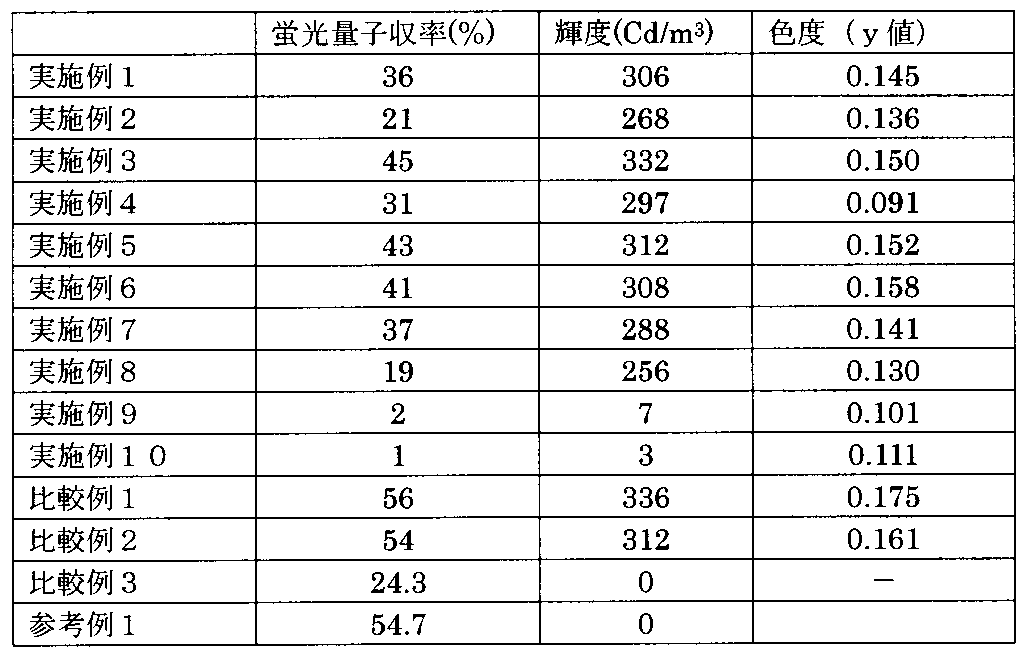
Claims (5)
- 銅または銀の少なくともいずれかの元素、ならびにニッケルまたは鉄の少なくともいずれかの元素を含む硫化亜鉛青色蛍光体。
- ニッケルの含有量が0.1ppm以上20ppm以下である請求項1に記載の硫化亜鉛青色蛍光体。
- 鉄の含有量が0.1ppm以上50ppm以下である請求項1または2に記載の硫化亜鉛青色蛍光体。
- 蛍光体で分散型EL素子を形成し、200V、1kHzで当該素子を駆動したときの発光色のy値が、0.07≦y≦0.16である請求項1~3のいずれかに記載の硫化亜鉛青色蛍光体。
- 銅または銀の少なくともいずれかの元素を含む化合物と、亜鉛化合物と、硫化剤と、ニッケルまたは鉄の少なくともいずれかの元素を含む化合物と、を水溶液として有機溶媒中に添加して反応混合液とし、
該反応混合液を加熱して、水と有機溶媒を共沸させることで該反応混合液から水を除去して硫化亜鉛蛍光体前駆体を得、
該硫化亜鉛蛍光体前駆体をさらに焼成することを特徴とする請求項1~4のいずれかに記載の硫化亜鉛青色蛍光体の製造方法。
Priority Applications (3)
| Application Number | Priority Date | Filing Date | Title |
|---|---|---|---|
| JP2012514819A JPWO2011142385A1 (ja) | 2010-05-14 | 2011-05-11 | 硫化亜鉛青色蛍光体およびその製造方法 |
| US13/697,126 US20130105737A1 (en) | 2010-05-14 | 2011-05-11 | Zinc sulfide blue phosphor and a method for producing the same |
| CN2011800240457A CN102892861A (zh) | 2010-05-14 | 2011-05-11 | 硫化锌蓝色荧光体及其制造方法 |
Applications Claiming Priority (2)
| Application Number | Priority Date | Filing Date | Title |
|---|---|---|---|
| JP2010112274 | 2010-05-14 | ||
| JP2010-112274 | 2010-05-14 |
Publications (1)
| Publication Number | Publication Date |
|---|---|
| WO2011142385A1 true WO2011142385A1 (ja) | 2011-11-17 |
Family
ID=44914437
Family Applications (1)
| Application Number | Title | Priority Date | Filing Date |
|---|---|---|---|
| PCT/JP2011/060843 Ceased WO2011142385A1 (ja) | 2010-05-14 | 2011-05-11 | 硫化亜鉛青色蛍光体およびその製造方法 |
Country Status (4)
| Country | Link |
|---|---|
| US (1) | US20130105737A1 (ja) |
| JP (1) | JPWO2011142385A1 (ja) |
| CN (1) | CN102892861A (ja) |
| WO (1) | WO2011142385A1 (ja) |
Families Citing this family (1)
| Publication number | Priority date | Publication date | Assignee | Title |
|---|---|---|---|---|
| TW201529766A (zh) * | 2014-01-23 | 2015-08-01 | Jhih-Hong Zhong | 用於光固化之有色塗料 |
Citations (5)
| Publication number | Priority date | Publication date | Assignee | Title |
|---|---|---|---|---|
| JPS56156649A (en) * | 1980-04-24 | 1981-12-03 | Toshiba Corp | Color picture tube |
| JPH0578656A (ja) * | 1991-09-19 | 1993-03-30 | Toshiba Corp | カラー陰極線管 |
| JPH08264132A (ja) * | 1995-03-23 | 1996-10-11 | Sony Corp | 陰極線管 |
| JP2002138279A (ja) * | 2000-11-02 | 2002-05-14 | Toshiba Corp | 表示装置用蛍光体とその製造方法、およびそれを用いた電界放出型表示装置 |
| JP2005194477A (ja) * | 2004-01-09 | 2005-07-21 | Japan Atom Energy Res Inst | 中性子検出用蛍光材料 |
Family Cites Families (10)
| Publication number | Priority date | Publication date | Assignee | Title |
|---|---|---|---|---|
| US2285464A (en) * | 1939-06-27 | 1942-06-09 | Robert F Ruthruff | Preparation of phosphors |
| US2615849A (en) * | 1948-12-31 | 1952-10-28 | Rca Corp | Infrared quenchable zinc sulfide phosphors |
| US2774902A (en) * | 1953-08-18 | 1956-12-18 | Sylvania Electric Prod | Electroluminescent lamp |
| US3017366A (en) * | 1959-01-05 | 1962-01-16 | Gen Electric | Electroluminescent phosphor and treatment |
| US4556820A (en) * | 1983-12-27 | 1985-12-03 | Rca Corporation | Image display including a light-absorbing matrix of zinc-iron sulfide |
| JPH02152196A (ja) * | 1988-12-03 | 1990-06-12 | Osaka Prefecture | 分散型el素子 |
| US5102579A (en) * | 1990-03-21 | 1992-04-07 | Usr Optonix, Inc. | Method for preparing sulfide phosphors |
| JPH05310467A (ja) * | 1992-05-11 | 1993-11-22 | Dowa Mining Co Ltd | ZnS系焼結体の製造方法 |
| JPH10308183A (ja) * | 1997-05-09 | 1998-11-17 | Sony Corp | カラー陰極線管 |
| CN102112576B (zh) * | 2008-08-06 | 2013-07-31 | 株式会社可乐丽 | 硫化锌系荧光体的制造方法 |
-
2011
- 2011-05-11 WO PCT/JP2011/060843 patent/WO2011142385A1/ja not_active Ceased
- 2011-05-11 JP JP2012514819A patent/JPWO2011142385A1/ja active Pending
- 2011-05-11 US US13/697,126 patent/US20130105737A1/en not_active Abandoned
- 2011-05-11 CN CN2011800240457A patent/CN102892861A/zh active Pending
Patent Citations (5)
| Publication number | Priority date | Publication date | Assignee | Title |
|---|---|---|---|---|
| JPS56156649A (en) * | 1980-04-24 | 1981-12-03 | Toshiba Corp | Color picture tube |
| JPH0578656A (ja) * | 1991-09-19 | 1993-03-30 | Toshiba Corp | カラー陰極線管 |
| JPH08264132A (ja) * | 1995-03-23 | 1996-10-11 | Sony Corp | 陰極線管 |
| JP2002138279A (ja) * | 2000-11-02 | 2002-05-14 | Toshiba Corp | 表示装置用蛍光体とその製造方法、およびそれを用いた電界放出型表示装置 |
| JP2005194477A (ja) * | 2004-01-09 | 2005-07-21 | Japan Atom Energy Res Inst | 中性子検出用蛍光材料 |
Also Published As
| Publication number | Publication date |
|---|---|
| CN102892861A (zh) | 2013-01-23 |
| JPWO2011142385A1 (ja) | 2013-07-22 |
| US20130105737A1 (en) | 2013-05-02 |
Similar Documents
| Publication | Publication Date | Title |
|---|---|---|
| Shang et al. | (Zn, Mg) 2 GeO 4: Mn 2+ submicrorods as promising green phosphors for field emission displays: hydrothermal synthesis and luminescence properties | |
| JP5337158B2 (ja) | 硫化亜鉛系蛍光体の製造方法 | |
| Li et al. | Facile synthesis, growth mechanism and luminescence properties of uniform La (OH) 3: Ho3+/Yb3+ and La 2 O 3: Ho3+/Yb3+ nanorods | |
| JP2013173806A (ja) | β型サイアロンの製造方法 | |
| JPWO2011142385A1 (ja) | 硫化亜鉛青色蛍光体およびその製造方法 | |
| JP5529545B2 (ja) | Ii族金属硫化物蛍光体前駆体および蛍光体の製造方法 | |
| JPWO2008133289A1 (ja) | 青色蛍光体 | |
| JP5394914B2 (ja) | イリジウム元素含有蛍光体およびその製造方法 | |
| JP2020100702A (ja) | フッ化物蛍光体の製造方法 | |
| JP2010143967A (ja) | 硫化亜鉛蛍光体の製造方法 | |
| JP5627281B2 (ja) | 硫化亜鉛蛍光体およびその前駆体ならびにそれらの製造方法 | |
| JP5547493B2 (ja) | イリジウム含有蛍光体の製造方法 | |
| WO2006001194A1 (ja) | 蛍光体及びその製法並びにそれを用いた粒子分散型elデバイス | |
| JP4979194B2 (ja) | 窒化アルミニウム系蛍光体 | |
| JP2009161680A (ja) | 高結晶性蛍光体の調製方法 | |
| WO2010147180A1 (ja) | 硫化亜鉛系青色蛍光体の製造方法 | |
| TW202532612A (zh) | 氟化物螢光體、其製造方法及發光裝置 | |
| JP5572032B2 (ja) | 硫化亜鉛系蛍光体の製造方法 | |
| JP5688765B2 (ja) | 赤色蛍光体およびその製造方法 | |
| CN112608152A (zh) | 一种提高YVO4:Eu3+陶瓷发光强度的方法 | |
| JP2012025861A (ja) | 硫化亜鉛系蛍光体およびその製造方法 | |
| JP2010143965A (ja) | 蛍光体製造方法 | |
| JP2010270253A (ja) | 硫化亜鉛系蛍光体の製造方法 | |
| JP2011148873A (ja) | 蛍光体粒子の製造方法 | |
| JP2018109079A (ja) | 緑色蛍光体、発光素子及び発光装置 |
Legal Events
| Date | Code | Title | Description |
|---|---|---|---|
| WWE | Wipo information: entry into national phase |
Ref document number: 201180024045.7 Country of ref document: CN |
|
| 121 | Ep: the epo has been informed by wipo that ep was designated in this application |
Ref document number: 11780642 Country of ref document: EP Kind code of ref document: A1 |
|
| WWE | Wipo information: entry into national phase |
Ref document number: 2012514819 Country of ref document: JP |
|
| NENP | Non-entry into the national phase |
Ref country code: DE |
|
| WWE | Wipo information: entry into national phase |
Ref document number: 13697126 Country of ref document: US |
|
| 122 | Ep: pct application non-entry in european phase |
Ref document number: 11780642 Country of ref document: EP Kind code of ref document: A1 |