WO2011129285A1 - 便器の洗浄方法 - Google Patents
便器の洗浄方法 Download PDFInfo
- Publication number
- WO2011129285A1 WO2011129285A1 PCT/JP2011/058961 JP2011058961W WO2011129285A1 WO 2011129285 A1 WO2011129285 A1 WO 2011129285A1 JP 2011058961 W JP2011058961 W JP 2011058961W WO 2011129285 A1 WO2011129285 A1 WO 2011129285A1
- Authority
- WO
- WIPO (PCT)
- Prior art keywords
- toilet bowl
- composition
- viscosity
- water
- toilet
- Prior art date
- Legal status (The legal status is an assumption and is not a legal conclusion. Google has not performed a legal analysis and makes no representation as to the accuracy of the status listed.)
- Ceased
Links
Classifications
-
- E—FIXED CONSTRUCTIONS
- E03—WATER SUPPLY; SEWERAGE
- E03D—WATER-CLOSETS OR URINALS WITH FLUSHING DEVICES; FLUSHING VALVES THEREFOR
- E03D9/00—Sanitary or other accessories for lavatories ; Devices for cleaning or disinfecting the toilet room or the toilet bowl; Devices for eliminating smells
- E03D9/02—Devices adding a disinfecting, deodorising, or cleaning agent to the water while flushing
- E03D9/03—Devices adding a disinfecting, deodorising, or cleaning agent to the water while flushing consisting of a separate container with an outlet through which the agent is introduced into the flushing water, e.g. by suction ; Devices for agents in direct contact with flushing water
- E03D9/032—Devices connected to or dispensing into the bowl
-
- C—CHEMISTRY; METALLURGY
- C11—ANIMAL OR VEGETABLE OILS, FATS, FATTY SUBSTANCES OR WAXES; FATTY ACIDS THEREFROM; DETERGENTS; CANDLES
- C11D—DETERGENT COMPOSITIONS; USE OF SINGLE SUBSTANCES AS DETERGENTS; SOAP OR SOAP-MAKING; RESIN SOAPS; RECOVERY OF GLYCEROL
- C11D1/00—Detergent compositions based essentially on surface-active compounds; Use of these compounds as a detergent
- C11D1/66—Non-ionic compounds
- C11D1/72—Ethers of polyoxyalkylene glycols
-
- C—CHEMISTRY; METALLURGY
- C11—ANIMAL OR VEGETABLE OILS, FATS, FATTY SUBSTANCES OR WAXES; FATTY ACIDS THEREFROM; DETERGENTS; CANDLES
- C11D—DETERGENT COMPOSITIONS; USE OF SINGLE SUBSTANCES AS DETERGENTS; SOAP OR SOAP-MAKING; RESIN SOAPS; RECOVERY OF GLYCEROL
- C11D3/00—Other compounding ingredients of detergent compositions covered in group C11D1/00
- C11D3/16—Organic compounds
- C11D3/20—Organic compounds containing oxygen
- C11D3/2003—Alcohols; Phenols
- C11D3/2006—Monohydric alcohols
- C11D3/201—Monohydric alcohols linear
Definitions
- the present invention relates to a toilet bowl cleaning method.
- a method is also known in which a toilet film is formed on the toilet surface to continuously wash the toilet bowl.
- Japanese Patent Application Laid-Open No. 2005-187511 and Japanese Patent Application Laid-Open No. 2006-206882 disclose a cleaning method in which a component discharged from a container adheres and solidifies to an arbitrary portion and then is gradually dissolved with water while gradually releasing the active component. Is described.
- the present invention relates to a toilet bowl cleaning method including the following steps 1 to 3.
- Step 1 (a) 14 to 64% by mass of polyoxyethylene alkyl ether having an alkyl group having 14 to 22 carbon atoms and an average added mole number of ethylene oxide of 20 to 80, (b) containing ethanol and water Applying a toilet bowl cleaning composition having a viscosity of 50 to 3000 mPa ⁇ s at 25 ° C. to the toilet bowl.
- Process 2 A process in which (b) is volatilized from the composition applied in Process 1 by leaving it for 1 minute to 3 hours after Process 1 to form a gel having a higher viscosity than the composition before application.
- Step 3 A step of applying water to the gel formed in Step 2 to produce a washing medium containing (a) and water, and applying the washing medium to a toilet bowl.
- Step 1 (a) 14 to 64% by mass of polyoxyethylene alkyl ether having an alkyl group having 14 to 22 carbon atoms and an average added
- a composition containing a water dissolution delay component and a cleaning component described in JP-A-2005-187511 is difficult to dissolve or collapse when the drying process is prolonged, and the slow dissolution characteristics of the component are impaired. Further, the composition containing a water dissolution delay component, a drug component, and a solvent described in JP-A-2006-206882 has a small content of components that contribute to detergency and does not have sufficient detergency. In addition, the slow dissolution properties of the components are not sufficient.
- the composition described in WO 02/26925 has a very high viscosity and is designed to be stuck on the toilet surface and partly stay in the toilet surface. Not suitable for.
- the present invention provides a toilet bowl cleaning method including a step of applying a toilet bowl cleaning composition excellent in ease of application to a toilet bowl and durability of detergency to the toilet bowl.
- the present invention is excellent in the ease of application to a toilet and the durability of cleaning power.
- the viscosity of the cleaning composition of the present invention at 25 ° C. (hereinafter referred to as initial viscosity) is 50 to 3000 mPa ⁇ s, preferably 100 to 2500 mPa ⁇ s, and more preferably 150 to 2000 mPa ⁇ s. It is 50 mPa ⁇ s or more from the viewpoint of adhesion of the cleaning composition to the toilet bowl, and 3000 mPa ⁇ s or less from the viewpoint of workability such as ease of discharge when the composition is housed in a container.
- the cleaning composition of the present invention contains, as component (a), a polyoxyethylene alkyl ether having an alkyl group with 14 to 22 carbon atoms and an average added mole number of ethylene oxide of 20 to 80.
- the component (a) is a cleaning component and a component that contributes to imparting the initial viscosity and forming a high-viscosity gel after ethanol volatilization.
- Component (a) has 14 to 22 carbon atoms, preferably 16 to 18 carbon atoms in the alkyl group. It is 14 or more from the viewpoint of adhesion to the toilet and detergency, and is 22 or less from the viewpoint of ease of extracting the composition from the container.
- the average added mole number of ethylene oxide of component (a) is 20 to 80, preferably 25 to 70, more preferably 30 to 60. It is 20 or more from the viewpoint of detergency, and 80 or less from the viewpoint of adhesion to the toilet.
- the cleaning composition of the present invention preferably contains 14 to 64% by mass, further 15 to 60% by mass, and more preferably 20 to 50% by mass of the component (a). 14 mass% or more is preferable from a viewpoint of detergency maintenance and the adhesiveness to a toilet bowl, and 64 mass% or less is preferable from a viewpoint of the ease of taking out the composition from a container.
- the cleaning composition of the present invention can contain cleaning components other than the component (a).
- a surfactant is preferable, and among these, a nonionic surfactant other than the component (a) is preferable.
- a surfactant having a polyoxyethylene (ethylene oxide average added mole number of 1 to 6) chain is preferable.
- the carbon number of the alkenyl group is Polyoxyethylene alkenyl ether having 8 to 18 ethylene oxide average addition moles of 1 to 6, polyoxyethylene alkyl phenyl ether having an alkyl group having 8 to 18 carbon atoms and ethylene oxide average addition moles of 1 to 6
- a nonionic surfactant mixture containing an ethylene oxide-added alkyl group or alkenyl group in which the alkyl group or alkenyl group has 8 to 18 carbon atoms and the ethylene oxide average addition mole number is 1 to 6, and the alkyl group has a carbon number of A polyoxyethylene group having 8 to 18 and an average added mole number of ethylene oxide of 1 to 6
- Alkyl amine oxide containing a fatty acid ethylene oxide average addition molar number contains a polyoxyethylene group is 1-6 alkanol amides (8-18 carbon atoms) are exemplified by the carbon number of 8 to 18 acyl group.
- the cleaning composition of the present invention contains ethanol as the component (b).
- the component (b) is a component that contributes to the provision of the initial viscosity together with the component (a), and is a volatile component, so the viscosity of the composition is increased by volatilizing the component (b) from the composition.
- the cleaning composition of the present invention preferably contains 2 to 30% by mass, more preferably 3 to 15% by mass of component (b). It is preferably 2% by mass or more from the viewpoint of easy extraction of the composition from the container and a uniform and wide application range, and is preferably 30% by mass or less from the viewpoint of adhesion to the toilet bowl and durability of cleaning power.
- the cleaning composition of the present invention can contain volatile alcohols other than the component (b).
- the “volatile component” refers to a substance that has a saturated vapor pressure of 1 kPa or higher at 20 ° C. and volatilizes at 20 ° C. and normal pressure.
- the detergent composition of the present invention contains a quaternary ammonium salt type cation having a quaternary ammonium salt type having one or two hydrocarbon groups having 6 to 16 carbon atoms, preferably 8 to 14 carbon atoms, for the purpose of imparting bactericidal properties.
- An active surfactant may be added.
- cationic surfactant 1 or more types of cationic surfactant chosen from the cationic surfactant represented by the following general formula (1) and the cationic surfactant represented by General formula (2) Agents are preferred.
- R 1 is a hydrocarbon group having 8 to 18 carbon atoms or
- R 5 , R 6 , R 7 , R 9 and R 10 are each independently an alkyl group having 1 to 3 carbon atoms
- R 8 , R 11 and R 12 are each independently an alkyl group having 1 to 3 carbon atoms
- R 2 and R 3 each independently represents an alkyl group having 1 to 3 carbon atoms
- R 4 represents an alkylene group having 1 to 3 carbon atoms.
- Z- is an anionic group, preferably a halogen ion, an amino acid ion, a fatty acid soap anion residue, a phosphate ester anion residue having a linear or branched alkyl group or alkenyl group having 1 to 30 carbon atoms, phosphone Polycyclic aromatic having acid ester anion residue, sulfonate ester anion residue or sulfate ester anion residue, or styrene sulfonate ion having a polymerization degree of 3 or more, or having a hydrocarbon group as a substituent
- An anionic oligomer or polymer containing a formalin condensate of a sulfonated compound is shown. ]
- R 13 and R 14 each independently represents a long chain alkyl group, a long chain alkenyl group or a long chain hydroxyalkyl group having 6 to 14 carbon atoms and a total carbon number of R 13 and R 14 of 16 to 26
- R 15 and R 16 are each independently an alkyl group having 1 to 3 carbon atoms, a hydroxyalkyl group, or — (OR 18 ) n —OH (wherein R 18 is an alkenyl group having 2 to 4 carbon atoms, and n is 1 Indicates a number of ⁇ 10.)
- Z- represents the same meaning as described above.
- R 1 is preferably an alkyl group having 6 to 18 carbon atoms and more preferably an alkyl group having 8 to 14 carbon atoms from the viewpoint of detergency.
- R 13 and R 14 are preferably each independently an alkyl group having 8 to 12 carbon atoms.
- a halogen ion is preferable.
- the content of the cationic surfactant is preferably from 0.1 to 8% by mass, more preferably from 1 to 5% by mass in the composition from the viewpoint of bactericidal properties.
- a builder component may be blended for the purpose of improving detergency. Examples of the builder component include the following.
- Amino acids such as aspartic acid, glutamic acid and glycine, and alkali metal salts or alkanolamine salts thereof.
- Aminocarboxylic acids such as nitrilotriacetic acid, iminodiacetic acid, ethylenediaminetetraacetic acid, hydroxyethylethylenediaminetriacetic acid, diethylenetriaminepentaacetic acid, glycol etherdiaminetetraacetic acid, hydroxyethyliminodiacetic acid, triethylenetetraminehexaacetic acid, diencoric acid And alkali metal salts or alkanolamine salts thereof.
- hydroxycarboxylic acids such as citric acid and malic acid
- aminocarboxylic acids such as ethylenediaminetetraacetic acid and hydroxyethylethylenediaminetriacetic acid, and salts thereof are preferable.
- the salt form is preferably a sodium salt, potassium salt, ammonium salt or alkanolamine salt.
- the content of the builder component is preferably 0.1 to 5% by mass, particularly preferably 0.2 to 3% by mass in the composition from the viewpoint of detergency.
- the content of the builder component is preferably 0.1 to 5% by mass, particularly preferably 0.2 to 3% by mass in the composition from the viewpoint of detergency.
- the weight ratio of the cationic surfactant to the builder component is preferably in the range of 10/1 to 1/10 of the cationic surfactant / builder component.
- the builder component and the cationic surfactant cause a weak interaction, preventing the cationic surfactant from adsorbing and stabilizing on the toilet surface, thereby causing water sealing that causes ring contamination. It is thought that the bactericidal effect is expressed in the part.
- the cleaning composition of the present invention contains water together with the above components.
- the water content is an amount adjusted so that the total amount of the cleaning composition is 100% by mass. That is, the balance of the cleaning composition is water.
- the cleaning composition of the present invention forms a gel having a viscosity higher than the viscosity of the composition before volatilization by volatilization of ethanol as component (b).
- the viscosity of the gel formed by volatilization of ethanol as component (b) is preferably 10 Pa ⁇ s or more at 25 ° C., more preferably 100 Pa ⁇ s or more, and further preferably 1000 Pa ⁇ s or more.
- the viscosity of this gel is the viscosity of the gel formed after the component (b) is volatilized from the cleaning composition, and can be measured using, for example, TOKIMEC VISCOMETER MODEL BM (manufactured by TOKIMEC INC).
- the viscosity of the gel is called “viscosity after volatilization” for convenience.
- a gel having a viscosity after volatilization can be formed by sufficiently volatilizing ethanol from the composition.
- the ambient temperature for example, room temperature
- the viscosity after volatilization is preferably 10 Pa ⁇ s or more from the viewpoint of the detergency of the gel.
- the toilet bowl cleaning composition of the present invention was obtained by uniformly applying 10 g to a glass petri dish having an inner diameter of 85 mm and drying it at 40 ° C. and a humidity of 50% for 3 hours. It is preferable to form a gel of 10 Pa ⁇ s or more.
- the gel formed by volatilization of the ethanol component (b) is gradually soluble in water.
- being slowly soluble in water means that 10 g of the composition is uniformly applied to a glass petri dish having an inner diameter of about 85 mm and dried in an environment of 40 ° C. and humidity of 50% for 3 hours. It is a physical property such that when 10 g of 25 ° C. tap water is gently added and left for 1 minute, a part of the component (a) is dissolved in the tap water.
- composition of the present invention filled in a squeeze container is ejected and applied to the toilet surface
- the composition of the present invention filled in a spray container is sprayed and applied to the toilet surface, and the like.
- the pH of the cleaning composition of the present invention at 25 ° C. is preferably 2 to 13, more preferably 3 to 11, and particularly preferably 3 to 7.
- the pH was measured using a Horiba Ltd. pH meter D-52S and a pH electrode 6367-10D.
- the toilet bowl cleaning method of the present invention comprises applying the cleaning composition of the present invention to a toilet bowl, volatilizing (b) ethanol from the applied composition, and having a high viscosity and preferably a water-soluble gel. And (a) polyoxyethylene alkyl ether is eluted by applying water to the gel to wash the toilet bowl.
- Process 1 The process of apply
- Process 2 A process in which (b) is volatilized from the composition applied in Process 1 by leaving it for 1 minute to 3 hours after Process 1 to form a gel having a higher viscosity than the composition before application.
- Step 3 A step of applying water to the gel formed in Step 2 to produce a washing medium containing (a) and water, and applying the washing medium to a toilet bowl.
- the application of the cleaning composition to the toilet bowl in step 1 is a method of discharging the liquid filled in the squeeze container and applying it to the toilet bowl surface, and a method of spraying the liquid filled in the spray container and applying the liquid to the toilet bowl surface.
- the application amount of the cleaning composition is preferably 2 to 50 g, more preferably 5 to 40 g per use on the toilet surface. 2 g or more is preferable from the viewpoint of durability of the detergency, and 50 g or less is preferable from the viewpoint of use efficiency of the cleaning composition.
- the squeeze squeeze container is not particularly limited, but a container described in JP-A-2009-298426 is preferable.
- the container body includes a flexible container body and a pressure regulating member that regulates the pressure deformation of the container body within the container body, and discharges the content liquid by pressing the container body.
- the spray container (it is called a trigger type spray container) with which the trigger type sprayer was mounted
- worn is mentioned.
- the trigger type spray container include a container body containing a liquid detergent composition, and a trigger type liquid ejector attached to the mouth part of the container body, and further, the mouth part of the container body. Is mounted with a trigger sprayer for ejecting a liquid detergent composition, a vertical pipe and a horizontal pipe are formed in the trigger sprayer, and the vertical pipe and the horizontal pipe are formed in the vertical pipe.
- a spray container (referred to as spray container (I)) in which a valve for blocking communication with the road is provided.
- volume is preferably 0.1 ⁇ 0.28 cm 3 of the horizontal pipe in the spray container (I), the volume under the valve of the vertical pipe is preferably 0.06 ⁇ 0.19 cm 3.
- the spray container (I) is provided with a cylinder at a lower position of the horizontal pipe, and a spin element is mounted at the tip of the horizontal pipe, and a nozzle having a nozzle hole is fitted at the tip of the spin element. It is fixed.
- the spray container (I) pulls the trigger, discharges the air in the cylinder to the outside, and when the trigger is returned, the liquid detergent composition is sucked up through a vertical pipe immersed in the liquid detergent composition of the container body.
- a trigger spray container of “Bath Magiclin Foaming Spray” (Kao Co., Ltd.) washed and dried can be used.
- step 2 ethanol as component (b) is volatilized from the composition to form a gel having a higher viscosity than the composition before coating.
- step 2 it is preferable to evaporate ethanol as component (b) from the composition to form a viscosity gel of 10 Pa ⁇ s or higher at 25 ° C.
- the gel formed in step 2 is preferably gradually soluble in water.
- the coating amount of the composition in step 1 is in the above range, it is usually higher in viscosity than the composition before coating by allowing it to stand at room temperature for several minutes to several hours, specifically for 1 minute to 3 hours.
- a gel that is gradually soluble in water is formed.
- Step 3 water is applied to the gel formed in Step 2 (for example, contact with running water, etc.) to generate a cleaning medium containing (a) and water, and the cleaning medium is applied to the toilet bowl.
- Step 2 after the gel viscosity reaches 10 Pa ⁇ s or higher at 25 ° C., application of water to the gel in Step 3 can be started. If the gel formed from the cleaning composition of the present invention in Step 2 is washed per flush in a general flush toilet, peeling, excessive dissolution, viscosity reduction, etc. due to contact with water The cleaning component containing the component (a) is released by contact with the water staying at the application site, and the toilet bowl is cleaned. That is, the cleaning is performed when the cleaning medium containing the component (a) and water comes into contact with the toilet.
- cleaning medium containing a component and water can contain the water-soluble component from a gel suitably.
- a cleaning composition to the rim
- a seat-type flush toilet is provided with a supply port for washing water for cleaning the inner wall surface of the bowl of the toilet body, and in many cases, a water discharge port is provided on the back of the periphery of the toilet.
- Comparative Example 13 in Table 2 is the composition described in Example 6 of JP-A-2005-187511
- Comparative Example 14 in Table 2 is the composition described in Example 10 of JP-A-2006-206882.
- the pH (25 ° C.) was adjusted with a 6N sodium hydroxide aqueous solution or 6N hydrochloric acid as necessary.
- tests for ease of application, cleaning durability, and prevention of ring contamination were conducted by the following methods.
- the initial viscosity of the composition and the viscosity after volatilization were measured by the following methods. The results are shown in Tables 1 and 2.
- the apparatus for measuring the initial viscosity is TOKIMEC INC.
- a TOKIMEC VISCOMETER MODEL BM manufactured by KK was used.
- the measurement conditions were 25 ° C. and the rotor was No. 3 was used to set the number of revolutions to 30 rpm, and the measured value one minute after the start of measurement was taken as the initial viscosity.
- the viscosity after volatilization was measured using a sample obtained by uniformly applying 10 g of the composition to a glass petri dish having an inner diameter of 85 mm and drying it in an environment of 40 ° C. and 50% humidity for 3 hours. In the composition containing ethanol, ethanol is volatilized under these conditions.
- the measurement apparatus was Physica MCR-301 manufactured by Anton Paar, CP50-1 (series 3275) as a plate, and measurement was performed at 25 ° C. and a shear rate of 0.1 s ⁇ 1.
- Ring contamination prevention The washing sustainability evaluation method was performed, and the period until ring-shaped dirt was generated on the draft line of the liquid reservoir in the toilet bowl was evaluated according to the following evaluation criteria. Since ring contamination once generated cannot be easily removed by flash operation, the test was terminated when it occurred once. 1: Ring contamination is present after 50 flash operations 2: Ring contamination is not confirmed after 50 flash operations, but ring contamination is confirmed before 70 flash operations 3: 70 operations Ring contamination is not confirmed after the flash operation, and ring contamination is confirmed until the 90th flash operation 4: Ring contamination is not confirmed after the 90th flash operation, and until the 110th flash operation 5: No ring dirt is present after 110 flash operations.
Landscapes
- Chemical & Material Sciences (AREA)
- Engineering & Computer Science (AREA)
- Health & Medical Sciences (AREA)
- Life Sciences & Earth Sciences (AREA)
- Public Health (AREA)
- Chemical Kinetics & Catalysis (AREA)
- Oil, Petroleum & Natural Gas (AREA)
- Wood Science & Technology (AREA)
- Organic Chemistry (AREA)
- Emergency Medicine (AREA)
- Epidemiology (AREA)
- Hydrology & Water Resources (AREA)
- Water Supply & Treatment (AREA)
- Detergent Compositions (AREA)
- Cleaning By Liquid Or Steam (AREA)
- Cosmetics (AREA)
Abstract
本発明は、下記1~3の工程を含む便器の洗浄方法である: 工程1:(a)アルキル基の炭素数が14~22でエチレンオキサイド平均付加モル数が20~80であるポリオキシエチレンアルキルエーテルを14~64質量%、(b)エタノール、及び水を含有し、25℃における粘度が50~3000mPa・sである、便器用洗浄剤組成物を便器に塗布する工程、 工程2:工程1の後、1分~3時間放置することで、工程1で塗布された組成物から(b)を揮発させて塗布前の組成物よりも高粘度のゲルを形成させる工程、 工程3:工程2で形成させたゲルに水を適用して(a)と水とを含む洗浄媒体を生じせしめ、該洗浄媒体を便器に適用する工程。
Description
本発明は便器の洗浄方法に関する。
背景技術
背景技術
水洗便器の洗浄に関して、従来、タンク内の洗浄水に洗浄剤有効成分を溶出させて、持続的に便器の汚れを洗浄し、清潔な状態を保たせることを目的とした洗浄剤組成物が知られている。これらは、トイレ用のオートクリーナーとして知られている。
また、水洗便器の形態に制限されずに適用できる手段として、便器表面に徐溶性の被膜を形成して、持続的に便器の洗浄等を行う方法も知られている。例えば特開2005-187511や特開2006-206882には、容器から吐出した成分が、任意の部分に対し付着固化した後、水によって徐溶化しながら有効成分を徐放することによって洗浄する洗浄方法が記載されている。
また、便器表面に徐溶性のゲルを付着させて、洗浄成分を徐放させて持続的に便器の洗浄等を行う方法も知られている。例えば国際公開第02/26925には、15000mPa・s以上の粘度を有する剤を対象物に直接適用することが記載されている。US-B6323171には、油汚れやべたつき汚れを除去するミクロエマルジョン組成物が記載されている。
発明の要約
発明の要約
本発明は、下記1~3の工程を含む便器の洗浄方法
工程1:(a)アルキル基の炭素数が14~22でエチレンオキサイド平均付加モル数が20~80であるポリオキシエチレンアルキルエーテルを14~64質量%、(b)エタノール、及び水を含有し、25℃における粘度が50~3000mPa・sである、便器用洗浄剤組成物を便器に塗布する工程。
工程2:工程1の後、1分~3時間放置することで、工程1で塗布された組成物から(b)を揮発させて塗布前の組成物よりも高粘度のゲルを形成させる工程。
工程3:工程2で形成させたゲルに水を適用して(a)と水とを含む洗浄媒体を生じせしめ、該洗浄媒体を便器に適用する工程。
に関する。
発明の詳細な説明
工程1:(a)アルキル基の炭素数が14~22でエチレンオキサイド平均付加モル数が20~80であるポリオキシエチレンアルキルエーテルを14~64質量%、(b)エタノール、及び水を含有し、25℃における粘度が50~3000mPa・sである、便器用洗浄剤組成物を便器に塗布する工程。
工程2:工程1の後、1分~3時間放置することで、工程1で塗布された組成物から(b)を揮発させて塗布前の組成物よりも高粘度のゲルを形成させる工程。
工程3:工程2で形成させたゲルに水を適用して(a)と水とを含む洗浄媒体を生じせしめ、該洗浄媒体を便器に適用する工程。
に関する。
発明の詳細な説明
洗浄成分を徐放する被膜を形成できる組成物を用いて便器を洗浄するにあたり、便器への塗布容易性(容器からの洗浄剤組成物の出しやすさ、便器への付着しやすさ、均一かつ広い範囲への洗浄剤組成物の塗布のしやすさ)と洗浄力の持続性に優れることが望まれる。
特開2005-187511に記載されている水溶解遅延成分と洗浄成分を含む組成物は乾燥過程が長時間になると難溶化や崩落を起こし、成分の徐溶特性が損なわれてしまう。 また、特開2006-206882に記載されている水溶解遅延成分と薬剤成分と溶媒とを含む組成物は洗浄力に寄与する成分の含有量が少なく、十分な洗浄力を有していない。それに加えて、成分の徐溶特性も十分ではない。国際公開第02/26925に記載されている組成物は極めて高粘度であり、便器表面に組成物を貼り付けて、部分的に滞留するように設計されているため、便器表面に均一塗布する用途には適していない。
本発明は、便器への塗布容易性と洗浄力の持続性に優れた便器用洗浄剤組成物を、便器に塗布する工程を含む便器の洗浄方法を提供する。本発明は便器への塗布容易性と洗浄力の持続性が優れている。
<洗浄剤組成物>
本発明の洗浄剤組成物の25℃における粘度(以下、初期粘度という)は50~3000mPa・s、好ましくは100~2500mPa・s、より好ましくは150~2000mPa・sである。洗浄剤組成物の便器への付着性の観点より50mPa・s以上であり、組成物を容器に収容して用いる場合の排出容易性等の作業性の観点より3000mPa・s以下である。
本発明の洗浄剤組成物の25℃における粘度(以下、初期粘度という)は50~3000mPa・s、好ましくは100~2500mPa・s、より好ましくは150~2000mPa・sである。洗浄剤組成物の便器への付着性の観点より50mPa・s以上であり、組成物を容器に収容して用いる場合の排出容易性等の作業性の観点より3000mPa・s以下である。
本発明の洗浄剤組成物は、(a)成分として、アルキル基の炭素数が14~22でエチレンオキサイド平均付加モル数が20~80であるポリオキシエチレンアルキルエーテルを含有する。(a)成分は洗浄成分であるとともに、上記初期粘度の付与やエタノール揮発後の高粘度ゲルの形成に寄与する成分である。(a)成分のアルキル基の炭素数は14~22であり、16~18が好ましい。便器への付着性及び洗浄力持続性の観点から14以上であり、容器からの組成物の抜き出しやすさの観点から22以下である。また、(a)成分のエチレンオキサイド平均付加モル数は20~80であり、25~70、更に30~60が好ましい。洗浄力持続性の観点から20以上であり、便器への付着性の観点から80以下である。本発明の洗浄剤組成物は、(a)成分を14~64質量%、更に15~60質量%、より更に20~50質量%含有することが好ましい。洗浄力持続性及び便器への付着性の観点から14質量%以上が好ましく、容器からの組成物の抜き出しやすさの観点から64質量%以下が好ましい。
本発明の洗浄剤組成物は、(a)成分以外の洗浄成分を含有することができる。洗浄成分としては界面活性剤が好ましく、その中でも、(a)成分以外の非イオン性界面活性剤が好ましい。ここで、(a)成分以外の非イオン性界面活性剤としてはポリオキシエチレン(エチレンオキサイド平均付加モル数1~6)鎖を有する界面活性剤が好ましく、具体的にはアルケニル基の炭素数が8~18でエチレンオキサイド平均付加モル数が1~6であるポリオキシエチレンアルケニルエーテル、アルキル基の炭素数が8~18でエチレンオキサイド平均付加モル数が1~6であるポリオキシエチレンアルキルフェニルエーテル、アルキル基またはアルケニル基の炭素数が8~18でエチレンオキサイド平均付加モル数が1~6であるエチレンオキシド付加アルキル基またはアルケニル基を含有する非イオン性界面活性剤混合物、アルキル基の炭素数が8~18でエチレンオキサイド平均付加モル数が1~6であるポリオキシエチレン基を含有するアルキルアミンオキサイド、アシル基の炭素数が8~18でエチレンオキサイド平均付加モル数が1~6であるポリオキシエチレン基を含有する脂肪酸(炭素数8~18)アルカノールアミド等が挙げられる。
本発明の洗浄剤組成物は、(b)成分として、エタノールを含有する。(b)成分は、(a)成分とともに上記初期粘度の付与に寄与する成分であり、また、揮発性成分であるため、組成物から(b)成分を揮発させることで組成物の粘度を上昇させることができる。本発明の洗浄剤組成物は、(b)成分を2~30質量%、更に3~15質量%含有することが好ましい。容器からの組成物の抜き出しやすさ、及び均一且つ広い範囲に塗布できる観点から2質量%以上が好ましく、便器への付着性及び洗浄力の持続性の観点から30質量%以下が好ましい。
本発明の洗浄剤組成物は、(b)成分以外の揮発性のアルコールを含有することができる。ここで「揮発性成分」とは、20℃の飽和蒸気圧が1kPa以上であり、20℃、常圧で揮発する物質を指す。
本発明の洗浄剤組成物には、殺菌性を付与する目的で炭素数6~16、好ましくは8~14の炭化水素基を1つ又は2つ有する4級アンモニウム塩型の殺菌性を有するカチオン性界面活性剤を配合しても良い。
上記カチオン性界面活性剤としては、下記一般式(1)で表されるカチオン性界面活性剤及び一般式(2)で表されるカチオン性界面活性剤から選ばれる1種以上のカチオン性界面活性剤が好ましい。

〔式中、R1は炭素数8~18の炭化水素基又は

(式中R5、R6、R7、R9、R10はそれぞれ独立に炭素数1~3のアルキル基であり、R8、R11、R12はそれぞれ独立に炭素数1~3のアルキレン基である。)で表わされる基を示し、R2、R3はそれぞれ独立に炭素数1~3のアルキル基を表し、R4は炭素数1~3のアルキレン基を表す。Z-は陰イオン基であり、好ましくはハロゲンイオン、アミノ酸イオン、脂肪酸セッケンアニオン残基、炭素数1~30の直鎖若しくは分岐鎖のアルキル基若しくはアルケニル基を有するリン酸エステルアニオン残基、ホスホン酸エステルアニオン残基、スルホン酸エステルアニオン残基若しくは硫酸エステルのアニオン残基、又は重合度3以上のスチレンスルホン酸イオンを有するか若しくは置換基として炭化水素基
を有することがある多環式芳香族化合物のスルホン化物のホルマリン縮合物を含有するアニオン性オリゴマー若しくはポリマーを示す。〕
を有することがある多環式芳香族化合物のスルホン化物のホルマリン縮合物を含有するアニオン性オリゴマー若しくはポリマーを示す。〕

〔式中、R13及びR14はそれぞれ独立に炭素数6~14、かつR13及びR14の合計炭素数が16~26の長鎖アルキル基、長鎖アルケニル基または長鎖ヒドロキシアルキル基を示し、R15及びR16は独立に炭素数1~3のアルキル基、ヒドロキシアルキル基又は-(OR18)n-OH(式中R18は炭素数が2~4のアルケニル基、nは1~10の数を示す。)
で表される基を示し、Z-は前記と同じ意味を示す。〕
一般式(1)中、R1として洗浄力の観点から炭素数6~18のアルキル基が好ましく、さらに炭素数8~14のアルキル基が好ましい。一般式(2)中、R13及びR14はそれぞれ独立に炭素数8~12のアルキル基が好ましい。また、一般式(1)及び(2)中のZ-としては、ハロゲンイオンが好ましい。
上記カチオン界面活性剤の含有量は、殺菌性の点から、組成物中、0.1~8質量%が好ましく、1~5質量%がより好ましい。
本発明の洗浄剤組成物には、洗浄性を向上する目的でビルダー成分を配合しても良い。
ビルダー成分としては、以下のものが挙げられる。
(i)アスパラギン酸、グルタミン酸、グリシン等のアミノ酸、及びそのアルカリ金属塩又はアルカノールアミン塩。
(ii)ニトリロ三酢酸、イミノ二酢酸、エチレンジアミン四酢酸、ヒドロキシエチルエチレンジアミン三酢酸、ジエチレントリアミン五酢酸、グリコールエーテルジアミン四酢酸、ヒドロキシエチルイミノ二酢酸、トリエチレンテトラミン六酢酸、ジエンコル酸等のアミノカルボン酸、及びそのアルカリ金属塩又はアルカノールアミン塩。
(iii)ジグリコール酸、オキシジコハク酸、カルボキシメチルオキシコハク酸、クエン酸、乳酸、酒石酸、シュウ酸、リンゴ酸、オキシジコハク酸、グルコン酸、カルボキシメチルコハク酸、カルボキシメチル酒石酸等の有機酸、及びそのアルカリ金属塩又はアルカノールアミン塩。
これらの中でも、クエン酸、リンゴ酸等のヒドロキシカルボン酸、エチレンジアミン四酢酸、ヒドロキシエチルエチレンジアミン三酢酸等のアミノカルボン酸、及びこれらの塩が好ましい。塩の形態としては、ナトリウム塩、カリウム塩、アンモニウム塩、アルカノールアミン塩が好ましい。
で表される基を示し、Z-は前記と同じ意味を示す。〕
一般式(1)中、R1として洗浄力の観点から炭素数6~18のアルキル基が好ましく、さらに炭素数8~14のアルキル基が好ましい。一般式(2)中、R13及びR14はそれぞれ独立に炭素数8~12のアルキル基が好ましい。また、一般式(1)及び(2)中のZ-としては、ハロゲンイオンが好ましい。
上記カチオン界面活性剤の含有量は、殺菌性の点から、組成物中、0.1~8質量%が好ましく、1~5質量%がより好ましい。
本発明の洗浄剤組成物には、洗浄性を向上する目的でビルダー成分を配合しても良い。
ビルダー成分としては、以下のものが挙げられる。
(i)アスパラギン酸、グルタミン酸、グリシン等のアミノ酸、及びそのアルカリ金属塩又はアルカノールアミン塩。
(ii)ニトリロ三酢酸、イミノ二酢酸、エチレンジアミン四酢酸、ヒドロキシエチルエチレンジアミン三酢酸、ジエチレントリアミン五酢酸、グリコールエーテルジアミン四酢酸、ヒドロキシエチルイミノ二酢酸、トリエチレンテトラミン六酢酸、ジエンコル酸等のアミノカルボン酸、及びそのアルカリ金属塩又はアルカノールアミン塩。
(iii)ジグリコール酸、オキシジコハク酸、カルボキシメチルオキシコハク酸、クエン酸、乳酸、酒石酸、シュウ酸、リンゴ酸、オキシジコハク酸、グルコン酸、カルボキシメチルコハク酸、カルボキシメチル酒石酸等の有機酸、及びそのアルカリ金属塩又はアルカノールアミン塩。
これらの中でも、クエン酸、リンゴ酸等のヒドロキシカルボン酸、エチレンジアミン四酢酸、ヒドロキシエチルエチレンジアミン三酢酸等のアミノカルボン酸、及びこれらの塩が好ましい。塩の形態としては、ナトリウム塩、カリウム塩、アンモニウム塩、アルカノールアミン塩が好ましい。
上記ビルダー成分の含有量は、洗浄力の点から、組成物中、0.1~5質量%が好ましく、特に0.2~3質量%が好ましい。
本発明において、上記一般式(1)および(2)で示したカチオン性界面活性剤と、上記(i)~(iii)に記したビルダー成分を組合わせて使用することで、便器水封部に発生するリング汚れの防止効果がより向上する。そのため、カチオン界面活性剤とビルダー成分を組合わせて使用することが好ましい。カチオン界面活性剤とビルダー成分の重量比は、カチオン界面活性剤/ビルダー成分で10/1~1/10の範囲であることが好ましい。この理由については明確ではないが、ビルダー成分とカチオン界面活性剤が弱い相互作用を起こし、カチオン界面活性剤が便器表面に吸着安定化することを防ぐことにより、リング汚れ発生の起因となる水封部内で殺菌効果を発現すると考えられる。
本発明において、上記一般式(1)および(2)で示したカチオン性界面活性剤と、上記(i)~(iii)に記したビルダー成分を組合わせて使用することで、便器水封部に発生するリング汚れの防止効果がより向上する。そのため、カチオン界面活性剤とビルダー成分を組合わせて使用することが好ましい。カチオン界面活性剤とビルダー成分の重量比は、カチオン界面活性剤/ビルダー成分で10/1~1/10の範囲であることが好ましい。この理由については明確ではないが、ビルダー成分とカチオン界面活性剤が弱い相互作用を起こし、カチオン界面活性剤が便器表面に吸着安定化することを防ぐことにより、リング汚れ発生の起因となる水封部内で殺菌効果を発現すると考えられる。
本発明の洗浄剤組成物は、上記各成分とともに水を含有する。水の含有量は、洗浄剤組成物の合計で100質量%となるように調整する量である。つまり、洗浄剤組成物の残部は水である。
本発明の洗浄剤組成物は、(b)成分であるエタノールの揮発により、揮発前の組成物の粘度よりも高粘度のゲルを形成する。具体的には、(b)成分であるエタノールの揮発により形成されるゲルの粘度は、25℃で10Pa・s以上が好ましく、より好ましくは100Pa・s以上、更に好ましくは1000Pa・s以上である。このゲルの粘度は、洗浄剤組成物から(b)成分が揮発した後に形成されるゲルの粘度であり、例えば、TOKIMEC VISCOMETER MODEL BM(TOKIMEC INC製)を用いて測定することができる。以下、のゲルの粘度を便宜的に「揮発後粘度」という。このような揮発後粘度を有するゲルは組成物からエタノールが十分揮発することで形成でき、上記した便器表面への塗布操作後に、便器が設置されている環境温度(例えば室温)で、1分間~3時間、乾燥する方法が最も簡便な方法として挙げられる。揮発後粘度はゲルの洗浄力持続性の観点より10Pa・s以上が好ましい。本発明の便器用洗浄剤組成物は、内径85mmのガラス製シャーレに均一に10gを塗布し、40℃、湿度50%で3時間乾燥させたとき、(b)の揮発により、25℃における粘度が10Pa・s以上のゲルを形成することが好ましい。
また、(b)成分であるエタノールの揮発により形成されたゲルは、水に対して徐溶性であることが好ましい。ここで、水に対して徐溶性であるとは、組成物10gを内径約85mmのガラス製シャーレに均一に塗布し、40℃、湿度50%の環境下で3時間乾燥させて生じるゲルに、25℃の水道水10gを静かに加えて1分間放置した時に、前記水道水中に(a)成分の一部が溶解するような物性のことである。
スクイズ容器に充填された本発明の組成物を吐出して便器表面に塗布する、スプレー容器に充填された本発明の組成物を噴射して便器表面に塗布する等の方法により便器表面に本発明の組成物を付着させ、エタノールが揮発するまで放置することで、上記揮発後粘度を有し、好ましくは水に対して徐溶性のゲルを形成させることができる。
本発明の洗浄剤組成物の25℃でのpHは、好ましくは2~13、より好ましくは3~11、特に好ましくは3~7である。pHは、(株)堀場製作所pHメータD-52S、pH電極6367-10Dを用いて測定したものである。
<便器の洗浄方法>
本発明の便器の洗浄方法は、本発明の洗浄剤組成物を便器に塗布し、塗布された組成物から(b)エタノールを揮発させて、高粘度で好ましくは水に対して徐溶性のゲルを形成し、該ゲルに水を適用して(a)ポリオキシエチレンアルキルエーテルを溶出させて、便器を洗浄するものである。具体的には、下記1~3の工程を含む。
工程1:本発明の便器用洗浄剤組成物を便器に塗布する工程。
工程2:工程1の後、1分~3時間放置することで、工程1で塗布された組成物から(b)を揮発させて塗布前の組成物よりも高粘度のゲルを形成させる工程。
工程3:工程2で形成させたゲルに水を適用して(a)と水とを含む洗浄媒体を生じせしめ、該洗浄媒体を便器に適用する工程。
本発明の便器の洗浄方法は、本発明の洗浄剤組成物を便器に塗布し、塗布された組成物から(b)エタノールを揮発させて、高粘度で好ましくは水に対して徐溶性のゲルを形成し、該ゲルに水を適用して(a)ポリオキシエチレンアルキルエーテルを溶出させて、便器を洗浄するものである。具体的には、下記1~3の工程を含む。
工程1:本発明の便器用洗浄剤組成物を便器に塗布する工程。
工程2:工程1の後、1分~3時間放置することで、工程1で塗布された組成物から(b)を揮発させて塗布前の組成物よりも高粘度のゲルを形成させる工程。
工程3:工程2で形成させたゲルに水を適用して(a)と水とを含む洗浄媒体を生じせしめ、該洗浄媒体を便器に適用する工程。
工程1での洗浄剤組成物の便器への塗布は、スクイズ容器に充填された液体を吐出して便器表面に塗布する方法、スプレー容器に充填された液体を噴射して便器表面に塗布する方法等が挙げられる。洗浄剤組成物の塗布量は、便器表面への1回あたりの使用量が2g~50gとなるようにすることが好ましく、より好ましくは5~40gである。洗浄力の持続性の観点より2g以上が好ましく、洗浄剤組成物の使用効率の観点より50g以下が好ましい。
スクイズ容器としては、特に限定されるものではないが、好ましくは特開2009-298426に記載の容器が挙げられる。可撓性を有する容器本体と、容器本体の押圧変形を容器本体内で規制する押圧規制部材とを備え、容器本体を押圧することにより内容液を吐出させるタイプのものである。
スプレー式容器としては、特に限定されるものではないが、好ましくはトリガー式スプレーヤーが装着されたスプレー容器(トリガー式スプレー容器という)が挙げられる。トリガー式スプレー容器としては、液体洗浄剤組成物を収容する容器本体と、容器本体の口部に装着されたトリガー式液体噴出器とを具備するものが挙げられ、更には、容器本体の口部に液体洗浄剤組成物を噴出するトリガー式スプレーヤーが装着され、該トリガー式スプレーヤーの内部に垂直管路及び水平管路が形成され、該垂直管路内に該垂直管路と上記水平管路との連通を遮断するバルブが配設されたスプレー容器(スプレー容器(I)という)が挙げられる。スプレー容器(I)における上記水平管路の容積は0.1~0.28cm3が好ましく、上記垂直管路の上記バルブ下の容積は0.06~0.19cm3が好ましい。スプレー容器(I)は、水平管路の下方位置にシリンダーを備え、また、水平管路の先端部にスピンエレメントが装着され、さらに、このスピンエレメントの先端部にノズル孔を有するノズル部が嵌着固定されている。スプレー容器(I)は、トリガーを引いて、シリンダー内の空気を外に排出し、トリガーを戻した際に容器本体の液体洗浄剤組成物に浸した垂直管路を通じて液体洗浄剤組成物を吸い上げ、上記シリンダー内に液体を満たし、再びトリガーを引くことにより、該シリンダー内の液体を押し出して垂直管路に導き、さらに水平管路、スピンエレメントを通じて液体の流れにスピンを与え、最後にノズルから噴出するタイプのものである。トリガー式スプレー容器としては、例えば、「バスマジックリン泡立ちスプレー」(花王(株))のトリガー式スプレー容器を、洗浄、乾燥させたものを使用できる。
工程2では、組成物から(b)成分であるエタノールを揮発させて、塗布前の組成物よりも高粘度のゲルを形成させる。工程2では、組成物から(b)成分であるエタノールを揮発させて、25℃で10Pa・s以上の粘度ゲルを形成させることが好ましい。工程2で形成されるゲルは、水に対して徐溶性であることが好ましい。工程1における組成物の塗布量が前記範囲である場合、通常、室温程度で数分~数時間、具体的には1分間~3時間、放置することで、塗布前の組成物よりも高粘度で好ましくは水に対して徐溶性のゲルが形成される。
工程3では、工程2で形成させたゲルに水を適用(例えば流水を接触させる等)して(a)と水とを含む洗浄媒体を生じせしめ、該洗浄媒体を便器に適用する。工程2で、ゲルの粘度が25℃で10Pa・s以上となった後に、工程3でのゲルへの水の適用を開始することができる。工程2で本発明の洗浄剤組成物から形成されたゲルは、一般的な水洗トイレでのフラッシュ1回あたりの洗浄であれば、水との接触により、剥離、過剰な溶解、粘度の低下等は生じず、塗布箇所に滞留して水との接触により(a)成分を含む洗浄成分が放出されて便器の洗浄が行われる。すなわち、(a)成分と水とを含む洗浄媒体が便器と接触することで洗浄が行われる。(a)成分と水を含む洗浄媒体は、ゲルからの水溶性成分を適宜含むことができる。
本発明では、洗浄剤組成物を、腰掛式水洗便器(いわゆる洋式便器)のリム部分(縁裏部分)に塗布することが好ましい。通常、腰掛式水洗便器では、便器本体のボウルの内壁面を洗浄するための洗浄水の供給口が設けられ、多くは、便器周辺の縁裏に水の排出口が設けられている。本発明では、工程1、2で、腰掛式水洗便器から排出される洗浄水の流路下流に本発明の洗浄剤組成物を塗布してゲルを形成させることが好ましい。
実施例
実施例
次の実施例は本発明の実施について述べる。 実施例は本発明の例示について述べるものであり、本発明を限定するためではない。
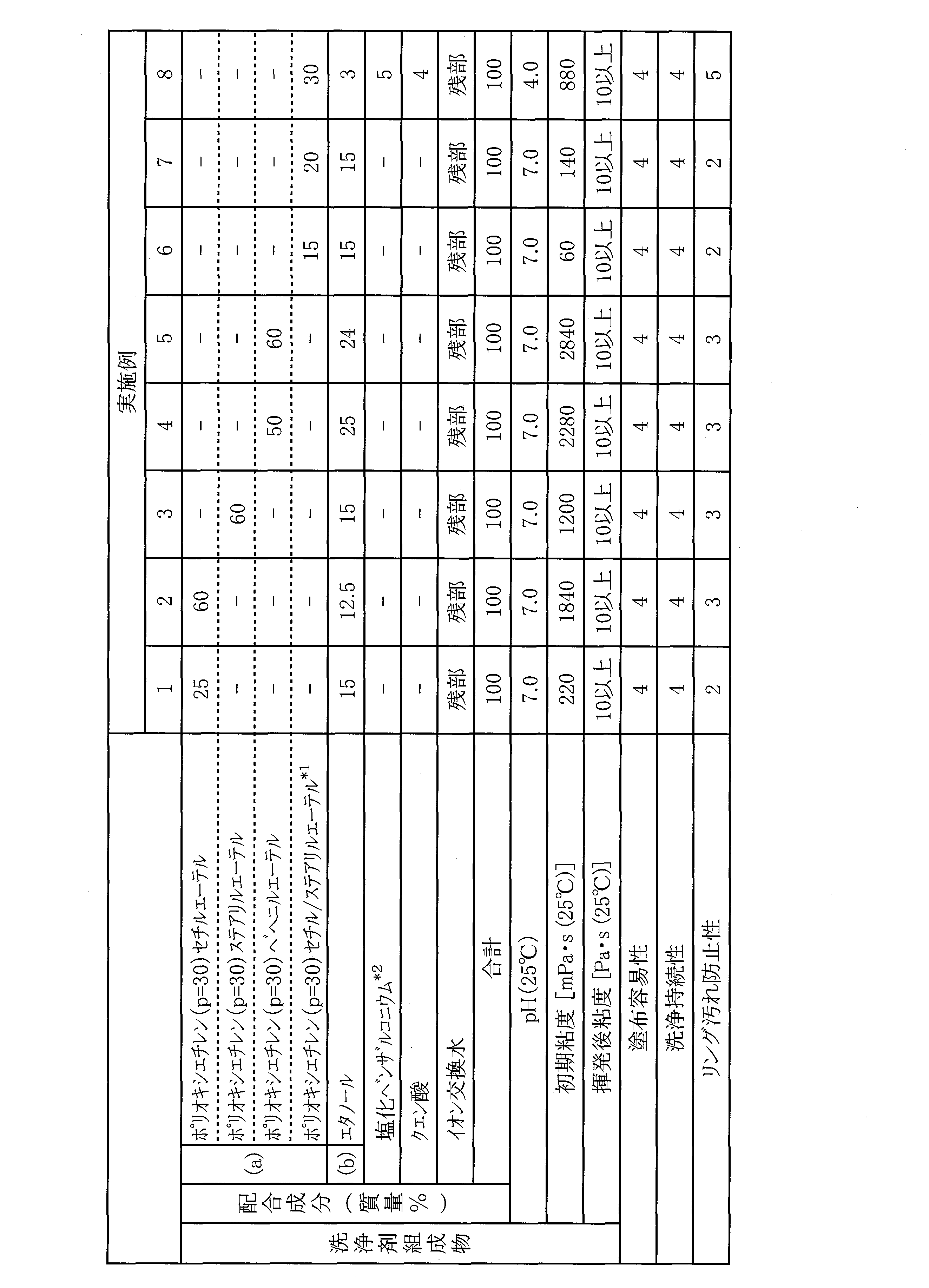
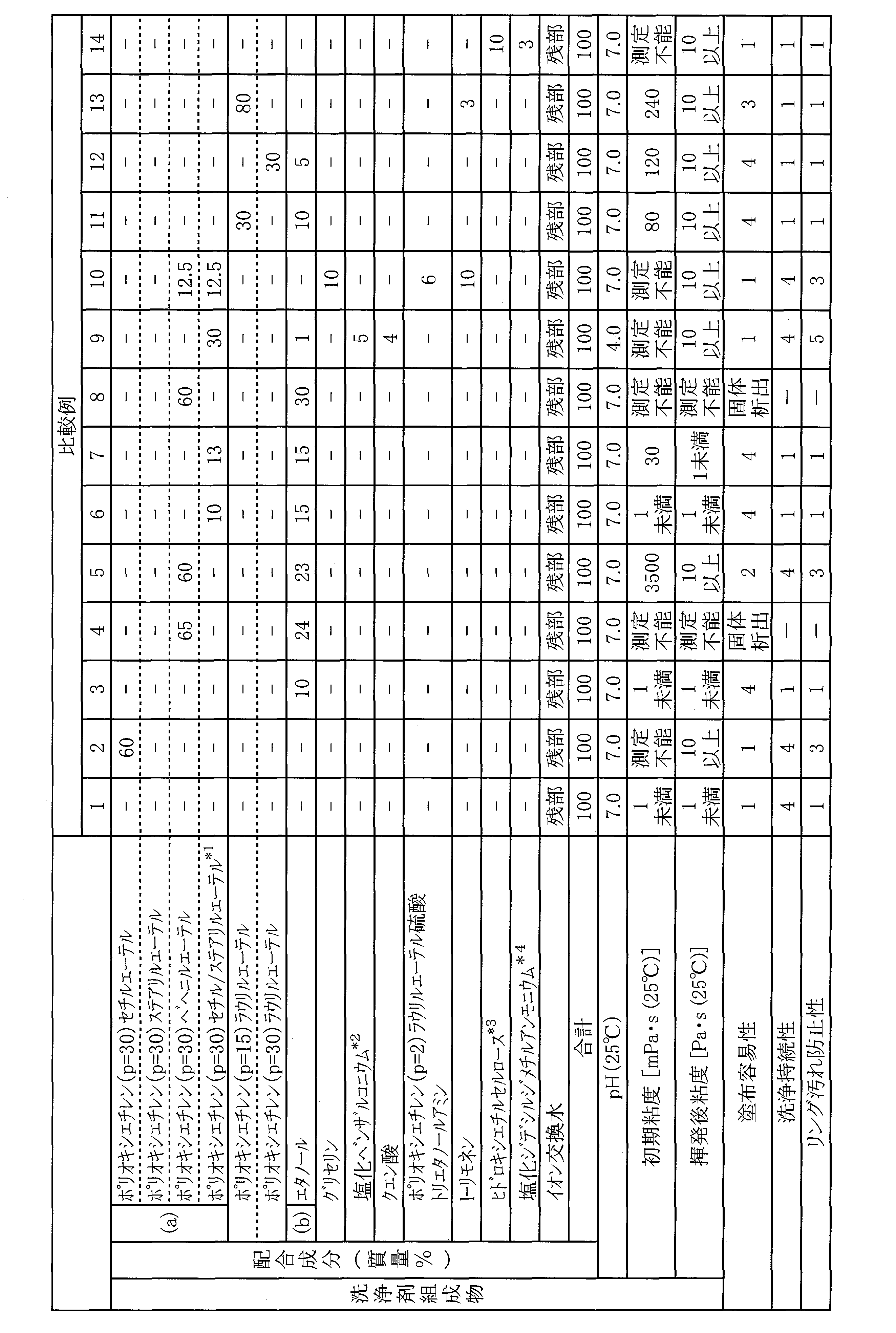
表1、2に示す各成分を用い、実施例、比較例の洗浄剤組成物を得た。なお、表2の比較例13は特開2005-187511の実施例6に、また表2の比較例14は特開2006-206882の実施例10に、それぞれ記載されている組成物である。pH(25℃)は必要に応じ6N-水酸化ナトリウム水溶液又は6N-塩酸で調整した。各洗浄剤組成物を用い、下記の方法により塗布容易性、洗浄持続性、およびリング汚れ防止性の試験を行った。また、組成物の初期粘度と揮発後粘度を以下の方法で測定した。結果を表1、2に示す。
(粘度の測定法)
初期粘度の測定装置は、TOKIMEC INC.製 TOKIMEC VISCOMETER MODEL BMを用いた。測定条件は、25℃で、ローターはNo.3を用いて、回転数を30rpmに設定し、測定開始1分後の測定値を初期粘度とした。
揮発後粘度は、内径85mmのガラス製シャーレに均一に組成物10gを塗布し、40℃、湿度50%の環境下で3時間乾燥させたサンプルを用いて測定した。エタノールを含む組成物は、この条件でエタノールが揮発する。測定装置はAnton Paar社製のPhysica MCR-301、プレートとしてCP50-1(series3275)を用い、25℃、剪断速度が0.1s-1の条件で測定した。
初期粘度の測定装置は、TOKIMEC INC.製 TOKIMEC VISCOMETER MODEL BMを用いた。測定条件は、25℃で、ローターはNo.3を用いて、回転数を30rpmに設定し、測定開始1分後の測定値を初期粘度とした。
揮発後粘度は、内径85mmのガラス製シャーレに均一に組成物10gを塗布し、40℃、湿度50%の環境下で3時間乾燥させたサンプルを用いて測定した。エタノールを含む組成物は、この条件でエタノールが揮発する。測定装置はAnton Paar社製のPhysica MCR-301、プレートとしてCP50-1(series3275)を用い、25℃、剪断速度が0.1s-1の条件で測定した。
(塗布容易性)
表1の洗浄剤組成物を、500mlスクイズ容器を用いて洋式便器の縁裏部に塗布した時の塗布容易性について評価した。スクイズ容器を手で握るだけで洗浄剤組成物を吐出させることができ、洗浄剤組成物が付着し、かつ、洋式便器の縁裏に塗布できることを容易に塗布できると規定する。被験者10名がトイレ便器縁裏への塗布作業を行い、下記評価基準により評価した。
1:0~2名が容易に塗布できたと回答した。
2:3~5名が容易に塗布できたと回答した。
3:6~8名が容易に塗布できたと回答した。
4:9~10名が容易に塗布できたと回答した。
表1の洗浄剤組成物を、500mlスクイズ容器を用いて洋式便器の縁裏部に塗布した時の塗布容易性について評価した。スクイズ容器を手で握るだけで洗浄剤組成物を吐出させることができ、洗浄剤組成物が付着し、かつ、洋式便器の縁裏に塗布できることを容易に塗布できると規定する。被験者10名がトイレ便器縁裏への塗布作業を行い、下記評価基準により評価した。
1:0~2名が容易に塗布できたと回答した。
2:3~5名が容易に塗布できたと回答した。
3:6~8名が容易に塗布できたと回答した。
4:9~10名が容易に塗布できたと回答した。
(洗浄持続性)
500mlスクイズ容器を用いて、洗浄剤組成物20gを洋式便器の縁裏部に塗布し、1時間室温乾燥してゲルを形成させた。実施例では、初期粘度よりも高粘度で水に対して徐溶性のゲルが形成されていた。毎日9時から17時まで1時間ごとにモデル汚れ(オレイン酸:49.95質量%、トリオレイン:49.95質量%、スダンIII:0.10質量%)20μlをピペットで便器面へ適用したのちフラッシュ操作を行った。この操作を月曜日から金曜日の5日間連続して行い、土曜日および日曜日は操作を中断した。この操作を繰返し、下記評価基準により評価した。
1:1~10回のフラッシュ操作後、汚れの残留がある。
2:11~30回のフラッシュ操作後、汚れの残留がある。
3:31~50回のフラッシュ操作後、汚れの残留がある。
4:50回のフラッシュ操作後、汚れの残留が無い。
500mlスクイズ容器を用いて、洗浄剤組成物20gを洋式便器の縁裏部に塗布し、1時間室温乾燥してゲルを形成させた。実施例では、初期粘度よりも高粘度で水に対して徐溶性のゲルが形成されていた。毎日9時から17時まで1時間ごとにモデル汚れ(オレイン酸:49.95質量%、トリオレイン:49.95質量%、スダンIII:0.10質量%)20μlをピペットで便器面へ適用したのちフラッシュ操作を行った。この操作を月曜日から金曜日の5日間連続して行い、土曜日および日曜日は操作を中断した。この操作を繰返し、下記評価基準により評価した。
1:1~10回のフラッシュ操作後、汚れの残留がある。
2:11~30回のフラッシュ操作後、汚れの残留がある。
3:31~50回のフラッシュ操作後、汚れの残留がある。
4:50回のフラッシュ操作後、汚れの残留が無い。
(リング汚れ防止性)
上記洗浄持続性の評価方法を行い、便器内の液溜まり部の喫水線上にリング状の汚れが発生するまでの期間について、下記評価基準により評価した。リング汚れは一度発生したらフラッシュ操作によって容易に除去できないものであるため、一度発生した時点で試験を終了した。
1:50回のフラッシュ操作後、リング汚れが存在する
2:50回のフラッシュ操作後にはリング汚れが確認されず、70回のフラッシュ操作までの間にリング汚れが確認される
3:70回のフラッシュ操作後にはリング汚れが確認されず、90回のフラッシュ操作までの間にリング汚れが確認される
4:90回のフラッシュ操作後にはリング汚れが確認されず、110回のフラッシュ操作までの間にリング汚れが確認される
5:110回のフラッシュ操作後、リング汚れが存在しない
上記洗浄持続性の評価方法を行い、便器内の液溜まり部の喫水線上にリング状の汚れが発生するまでの期間について、下記評価基準により評価した。リング汚れは一度発生したらフラッシュ操作によって容易に除去できないものであるため、一度発生した時点で試験を終了した。
1:50回のフラッシュ操作後、リング汚れが存在する
2:50回のフラッシュ操作後にはリング汚れが確認されず、70回のフラッシュ操作までの間にリング汚れが確認される
3:70回のフラッシュ操作後にはリング汚れが確認されず、90回のフラッシュ操作までの間にリング汚れが確認される
4:90回のフラッシュ操作後にはリング汚れが確認されず、110回のフラッシュ操作までの間にリング汚れが確認される
5:110回のフラッシュ操作後、リング汚れが存在しない
*1 セチル基/ステアリル基=13/87(質量比)
サニゾールC(花王株式会社製)
*3 HECダイセル SE-900(ダイセル化学工業株式会社製)
*4 コータミンD10E(花王株式会社製)
Claims (4)
- 下記1~3の工程を含む便器の洗浄方法:
工程1:(a)アルキル基の炭素数が14~22でエチレンオキサイド平均付加モル数が20~80であるポリオキシエチレンアルキルエーテルを14~64質量%、(b)エタノール、及び水を含有し、25℃における粘度が50~3000mPa・sである、便器用洗浄剤組成物を便器に塗布する工程、
工程2:工程1の後、1分~3時間放置することで、工程1で塗布された組成物から(b)を揮発させて塗布前の組成物よりも高粘度のゲルを形成させる工程、
工程3:工程2で形成させたゲルに水を適用して(a)と水とを含む洗浄媒体を生じせしめ、該洗浄媒体を便器に適用する工程。 - (b)を2~30質量%含有する、請求項1記載の便器の洗浄方法。
- 内径85mmのガラス製シャーレに均一に10gを塗布し、40℃、湿度50%で3時間乾燥させたとき、(b)の揮発により、25℃における粘度が10Pa・s以上のゲルを形成する、請求項1又は2記載の便器の洗浄方法。
- 工程2で形成されたゲルの粘度が、25℃で10Pa・s以上である、請求項1~3何れか1項に記載の便器の洗浄方法。
Priority Applications (2)
| Application Number | Priority Date | Filing Date | Title |
|---|---|---|---|
| SG2012072294A SG184336A1 (en) | 2010-04-12 | 2011-04-11 | Method for washing toilet bowl |
| CN201180018368.5A CN102834497B (zh) | 2010-04-12 | 2011-04-11 | 便器的洗净方法 |
Applications Claiming Priority (2)
| Application Number | Priority Date | Filing Date | Title |
|---|---|---|---|
| JP2010091185A JP5530788B2 (ja) | 2010-04-12 | 2010-04-12 | 便器用洗浄剤組成物 |
| JP2010-091185 | 2010-04-12 |
Publications (1)
| Publication Number | Publication Date |
|---|---|
| WO2011129285A1 true WO2011129285A1 (ja) | 2011-10-20 |
Family
ID=44798661
Family Applications (1)
| Application Number | Title | Priority Date | Filing Date |
|---|---|---|---|
| PCT/JP2011/058961 Ceased WO2011129285A1 (ja) | 2010-04-12 | 2011-04-11 | 便器の洗浄方法 |
Country Status (5)
| Country | Link |
|---|---|
| JP (1) | JP5530788B2 (ja) |
| CN (1) | CN102834497B (ja) |
| SG (1) | SG184336A1 (ja) |
| TW (1) | TWI576489B (ja) |
| WO (1) | WO2011129285A1 (ja) |
Cited By (1)
| Publication number | Priority date | Publication date | Assignee | Title |
|---|---|---|---|---|
| CN103845008A (zh) * | 2012-11-30 | 2014-06-11 | 宋金山 | 一种清洁厕所(厨房)的方法 |
Families Citing this family (5)
| Publication number | Priority date | Publication date | Assignee | Title |
|---|---|---|---|---|
| JP6144543B2 (ja) * | 2013-06-07 | 2017-06-07 | 株式会社ダイゾー | エアゾール組成物 |
| US20150094251A1 (en) * | 2013-09-27 | 2015-04-02 | S. C. Johnson & Son, Inc. | Dilutable gel cleaning concentrates |
| JP7066313B2 (ja) * | 2016-08-09 | 2022-05-13 | 小林製薬株式会社 | 液体洗浄組成物 |
| JP6141501B1 (ja) | 2016-09-02 | 2017-06-07 | 第一工業製薬株式会社 | ゲル組成物 |
| JP7829287B2 (ja) * | 2021-05-14 | 2026-03-13 | 小林製薬株式会社 | 水洗トイレ用液体芳香洗浄剤組成物 |
Citations (7)
| Publication number | Priority date | Publication date | Assignee | Title |
|---|---|---|---|---|
| JPH09202899A (ja) * | 1996-01-25 | 1997-08-05 | Lion Corp | ゲル状洗浄剤組成物 |
| JP2001329294A (ja) * | 2000-05-23 | 2001-11-27 | Kyoritsu Seiyaku Kk | トイレ用洗浄剤及び水洗トイレ用便器の洗浄法 |
| JP2005179507A (ja) * | 2003-12-19 | 2005-07-07 | Lion Corp | 固体清浄具用液体組成物、固体清浄具および容器入り清浄用品 |
| JP2005187511A (ja) * | 2003-12-24 | 2005-07-14 | Lion Corp | 液体組成物、及び洗浄方法 |
| JP2006169318A (ja) * | 2004-12-14 | 2006-06-29 | Kao Corp | トイレ用液体洗浄剤 |
| JP2006206882A (ja) * | 2004-12-27 | 2006-08-10 | Lion Corp | 水徐溶性組成物、及びそれを用いた洗浄方法 |
| JP2011057780A (ja) * | 2009-09-08 | 2011-03-24 | Earth Chemical Co Ltd | トイレ用ゲル状洗浄剤組成物 |
Family Cites Families (6)
| Publication number | Priority date | Publication date | Assignee | Title |
|---|---|---|---|---|
| CN1079823C (zh) * | 1994-12-21 | 2002-02-27 | 花王株式会社 | 液体洗涤剂组合物 |
| JP2003183697A (ja) * | 2001-12-20 | 2003-07-03 | Lion Corp | トイレ用洗浄剤組成物 |
| JP2004027031A (ja) * | 2002-06-26 | 2004-01-29 | Lion Corp | 塗布洗浄用液体洗浄剤組成物、製品および洗浄方法 |
| JP2004196987A (ja) * | 2002-12-19 | 2004-07-15 | Lion Corp | 液体洗浄剤組成物 |
| JP2004203848A (ja) * | 2002-12-20 | 2004-07-22 | Lion Corp | 植物抽出物含有組成物 |
| TWI365075B (en) * | 2004-09-22 | 2012-06-01 | Kao Corp | Microemulsion |
-
2010
- 2010-04-12 JP JP2010091185A patent/JP5530788B2/ja not_active Expired - Fee Related
-
2011
- 2011-04-11 CN CN201180018368.5A patent/CN102834497B/zh not_active Expired - Fee Related
- 2011-04-11 WO PCT/JP2011/058961 patent/WO2011129285A1/ja not_active Ceased
- 2011-04-11 SG SG2012072294A patent/SG184336A1/en unknown
- 2011-04-12 TW TW100112676A patent/TWI576489B/zh not_active IP Right Cessation
Patent Citations (7)
| Publication number | Priority date | Publication date | Assignee | Title |
|---|---|---|---|---|
| JPH09202899A (ja) * | 1996-01-25 | 1997-08-05 | Lion Corp | ゲル状洗浄剤組成物 |
| JP2001329294A (ja) * | 2000-05-23 | 2001-11-27 | Kyoritsu Seiyaku Kk | トイレ用洗浄剤及び水洗トイレ用便器の洗浄法 |
| JP2005179507A (ja) * | 2003-12-19 | 2005-07-07 | Lion Corp | 固体清浄具用液体組成物、固体清浄具および容器入り清浄用品 |
| JP2005187511A (ja) * | 2003-12-24 | 2005-07-14 | Lion Corp | 液体組成物、及び洗浄方法 |
| JP2006169318A (ja) * | 2004-12-14 | 2006-06-29 | Kao Corp | トイレ用液体洗浄剤 |
| JP2006206882A (ja) * | 2004-12-27 | 2006-08-10 | Lion Corp | 水徐溶性組成物、及びそれを用いた洗浄方法 |
| JP2011057780A (ja) * | 2009-09-08 | 2011-03-24 | Earth Chemical Co Ltd | トイレ用ゲル状洗浄剤組成物 |
Cited By (1)
| Publication number | Priority date | Publication date | Assignee | Title |
|---|---|---|---|---|
| CN103845008A (zh) * | 2012-11-30 | 2014-06-11 | 宋金山 | 一种清洁厕所(厨房)的方法 |
Also Published As
| Publication number | Publication date |
|---|---|
| CN102834497A (zh) | 2012-12-19 |
| TW201144538A (en) | 2011-12-16 |
| TWI576489B (zh) | 2017-04-01 |
| JP2011219645A (ja) | 2011-11-04 |
| JP5530788B2 (ja) | 2014-06-25 |
| CN102834497B (zh) | 2014-12-24 |
| SG184336A1 (en) | 2012-11-29 |
Similar Documents
| Publication | Publication Date | Title |
|---|---|---|
| JP5530788B2 (ja) | 便器用洗浄剤組成物 | |
| JP3001980B2 (ja) | シャワー設備すすぎ洗浄用水性組成物及びシャワー設備を清浄に保持する方法 | |
| US9926519B2 (en) | Self-adhesive detergent compositions with color-changing systems | |
| JP7468877B2 (ja) | 洗浄剤組成物 | |
| JP5575466B2 (ja) | 硬質表面用洗浄剤組成物 | |
| CN114621824A (zh) | 一种疏水防垢无痕速干型淋浴房玻璃清洁乳及其制备方法 | |
| TW200307748A (en) | Antifouling detergent for hard surfaces | |
| JP6584004B2 (ja) | 浴室用の泡吐出容器入り液体洗浄剤を用いた浴槽の洗浄方法 | |
| JP2010013621A (ja) | 親水コーティング剤 | |
| RU2399655C2 (ru) | Жидкая чистящая композиция для твердой поверхности | |
| CN102639686A (zh) | 清洁组成物及使用该组成物清洁面板的方法 | |
| JP2017019964A (ja) | 硬質表面用液体洗浄剤組成物 | |
| CN103365121A (zh) | 抗蚀剂剥离组合物及利用该抗蚀剂剥离组合物剥离抗蚀剂的方法 | |
| JP6383584B2 (ja) | 局所汚れ除去製品 | |
| JP5726011B2 (ja) | 便器用洗浄剤組成物 | |
| JP2004210808A (ja) | 硬表面の液体洗浄剤組成物 | |
| WO2022215608A1 (ja) | 酸性洗浄剤組成物 | |
| JP2024151172A (ja) | 硬質表面用洗浄剤組成物 | |
| JP6443965B2 (ja) | 液体漂白剤組成物 | |
| CN114574289B (zh) | 一种具有清洁、除菌、除霉的膏体组合物及其制备方法 | |
| CN102655749A (zh) | 形成透明膜的液状抗菌剂组合物 | |
| TW202231862A (zh) | 硬質表面用處理劑組合物 | |
| JP2010013624A (ja) | 洗浄剤 | |
| JPH0539499A (ja) | 樹脂部品用洗浄液及び該部品の洗浄方法 | |
| JP7856696B2 (ja) | 洗浄製品 |
Legal Events
| Date | Code | Title | Description |
|---|---|---|---|
| WWE | Wipo information: entry into national phase |
Ref document number: 201180018368.5 Country of ref document: CN |
|
| 121 | Ep: the epo has been informed by wipo that ep was designated in this application |
Ref document number: 11768806 Country of ref document: EP Kind code of ref document: A1 |
|
| NENP | Non-entry into the national phase |
Ref country code: DE |
|
| 122 | Ep: pct application non-entry in european phase |
Ref document number: 11768806 Country of ref document: EP Kind code of ref document: A1 |