WO2011129204A1 - (メタ)アクリル酸エステルの製造方法 - Google Patents
(メタ)アクリル酸エステルの製造方法 Download PDFInfo
- Publication number
- WO2011129204A1 WO2011129204A1 PCT/JP2011/058432 JP2011058432W WO2011129204A1 WO 2011129204 A1 WO2011129204 A1 WO 2011129204A1 JP 2011058432 W JP2011058432 W JP 2011058432W WO 2011129204 A1 WO2011129204 A1 WO 2011129204A1
- Authority
- WO
- WIPO (PCT)
- Prior art keywords
- meth
- acrylic acid
- acid ester
- ring
- group
- Prior art date
- Legal status (The legal status is an assumption and is not a legal conclusion. Google has not performed a legal analysis and makes no representation as to the accuracy of the status listed.)
- Ceased
Links
Classifications
-
- C—CHEMISTRY; METALLURGY
- C07—ORGANIC CHEMISTRY
- C07C—ACYCLIC OR CARBOCYCLIC COMPOUNDS
- C07C67/00—Preparation of carboxylic acid esters
- C07C67/14—Preparation of carboxylic acid esters from carboxylic acid halides
-
- C—CHEMISTRY; METALLURGY
- C07—ORGANIC CHEMISTRY
- C07C—ACYCLIC OR CARBOCYCLIC COMPOUNDS
- C07C2603/00—Systems containing at least three condensed rings
- C07C2603/56—Ring systems containing bridged rings
- C07C2603/58—Ring systems containing bridged rings containing three rings
- C07C2603/70—Ring systems containing bridged rings containing three rings containing only six-membered rings
- C07C2603/74—Adamantanes
Definitions
- the present invention relates to a method for producing (meth) acrylic acid ester useful as a resist raw material and a high-functional polymer raw material.
- a tertiary alcohol ester can be synthesized by allowing an acid or an acid halide to act on the corresponding tertiary alcohol.
- a general acid-sensitive tertiary alcohol ester is synthesized by reacting an acid halide with a corresponding tertiary alcohol in the presence of an amine such as triethylamine because of its acid sensitivity.
- Patent Document 1 describes a method of producing a corresponding (meth) acrylic acid ester by reacting a tertiary alcohol and a (meth) acrylic acid halide in the presence of triethylamine. When alcohol and methacrylic acid halide are reacted, the target compound cannot be obtained in a sufficiently satisfactory yield.
- Patent Document 2 describes a method of improving the yield of a corresponding tertiary alcohol ester by reacting an organic metal compound such as an organolithium reagent or a grinder reagent with an acid halide with a tertiary alcohol.
- an organic metal compound such as an organolithium reagent or a grinder reagent
- an acid halide with a tertiary alcohol.
- the object of the present invention is to produce the desired (meth) acrylic acid ester in an excellent yield from a tertiary alcohol containing a bulky group and the like and (meth) acrylic acid halide (meta) ) To provide a method for producing an acrylic ester.
- a tertiary alcohol and (meth) acrylic containing a bulky group or the like in the presence of an organolithium reagent or a grinder reagent and a tertiary amine.
- an organolithium reagent or a grinder reagent and a tertiary amine When reacting with an acid halide, it is difficult for the tertiary alcohol, which is one reaction substrate, to withdraw a proton by an organolithium reagent or a Grineer reagent (particularly a Grineer reagent) due to steric hindrance such as a bulky group.
- the present invention provides the following formula (1) or (2) R 1 MgX 1 (1)
- R 1 Li (2) (Wherein R 1 represents an alkyl group or a haloalkyl group, and X 1 represents a halogen atom)
- R 1 Li (2) (Wherein R 1 represents an alkyl group or a haloalkyl group, and X 1 represents a halogen atom)
- R 2 is an alkyl group having 1 or more carbon atoms
- R 3 is an alkyl group having 2 or more carbon atoms
- ring Z is a monocyclic or polycyclic non-aromatic or aromatic ring having 5 or more carbon atoms.
- the method for producing the (meth) acrylic acid ester is preferably carried out in the presence of a polymerization inhibitor.
- a polymerization inhibitor 4,4′-thiobis (6-tert-butyl-m-cresol), 4 At least one compound selected from 4,4'-butylidenebis (6-t-butyl-m-cresol) and 1,1,3-tris (5-t-butyl-4-hydroxy-2-methylphenyl) butane Is preferably used.
- triethylamine is preferable.
- the method for producing a (meth) acrylic acid ester according to the present invention even if an organolithium reagent is used as the organometallic compound, it can be handled easily and can be safely scaled up. Even when an organomagnesium compound such as a Grignard reagent, which has a problem in terms of yield, is used, the carbon atom having a hydroxyl group such as 2-adamantyl-2-butanol is not a ring such as an alicyclic hydrocarbon ring.
- a tertiary alcohol having a steric hindrance having an alkyl group having 2 or more carbon atoms and a (meth) acrylic acid halide (especially also a methacrylic acid halide having a larger steric hindrance) are reacted rapidly to obtain 80%.
- the desired (meth) acrylic acid ester can be obtained with an excellent yield exceeding. Therefore, the method for producing a (meth) acrylic acid ester according to the present invention is suitable for industrialization.
- the (meth) acrylic acid ester obtained by the present invention is useful as a resist material and a highly functional polymer material.
- organometallic compound represented by the formula (1) or (2) is used.
- R 1 represents an alkyl group or a haloalkyl group
- X 1 represents a halogen atom.
- alkyl group for R 1 examples include C 1-6 alkyl groups such as methyl, ethyl, propyl, isopropyl, butyl, isobutyl, s-butyl and t-butyl groups. Among these, a C 1-4 alkyl group is particularly preferable.
- haloalkyl group in R 1 one or more of hydrogen atoms constituting the alkyl group such as trifluoromethyl, 2,2,2-trifluoroethyl group, etc. are replaced with halogen atoms (fluorine atoms, chlorine atoms, etc.) And the like.
- Examples of the halogen atom for X 1 include a chlorine atom, a bromine atom, and an iodine atom.
- organometallic compound represented by the formula (1) include organomagnesium compounds such as methylmagnesium bromide, ethylmagnesium bromide, butylmagnesium bromide, methylmagnesium chloride, ethylmagnesium chloride, butylmagnesium chloride (Grineer reagent, etc. ).
- organomagnesium compounds such as methylmagnesium bromide, ethylmagnesium bromide, butylmagnesium bromide, methylmagnesium chloride, ethylmagnesium chloride, butylmagnesium chloride (Grineer reagent, etc. ).
- organic lithium compounds such as methyllithium, ethyllithium, and butyllithium, are mentioned as a typical example of the organometallic compound represented by Formula (2).
- the organomagnesium compound can also be used in combination with a copper halide.
- organometallic compound in the present invention it is preferable to use a compound represented by the above formula (1) from the viewpoint that it is easy to handle, can be safely scaled up and is suitable for industrialization. .
- Tertiary amine examples include aliphatic amines, aromatic amines, alicyclic amines, and heterocyclic amines. Moreover, a hydroxyl group, a nitro group, etc. may be contained. Furthermore, in addition to monoamines, polyamines such as diamines may be used.
- tertiary amine in the present invention include trimethylamine, triethylamine, diisopropylethylamine, tri-n-propylamine, triisopropylamine, tributylamine, N-methyl-diethylamine, N-ethyl-dimethylamine, N-ethyl- Aliphatic amines such as diamylamine; aromatic amines such as N, N-dimethylaniline and diethylaniline; alicyclic amines such as N, N-dimethyl-cyclohexylamine and N, N-diethyl-cyclohexylamine; N, N— Heterocyclic amines such as dimethylaminopyridine, N-methylmorpholine, diazabicycloundecene (DBU), diazabicyclononene (DBN), N-methylpyridine, N-methylpyrrolidine; tetramethylethylenediamine, triethylenediamine,
- aliphatic amines such as trimethylamine and triethylamine, and heterocyclic amines such as N-methylmorpholine are preferable, and aliphatic amines such as trimethylamine and triethylamine are particularly preferable for the yield of the target compound. It is preferable in that it can be further improved.
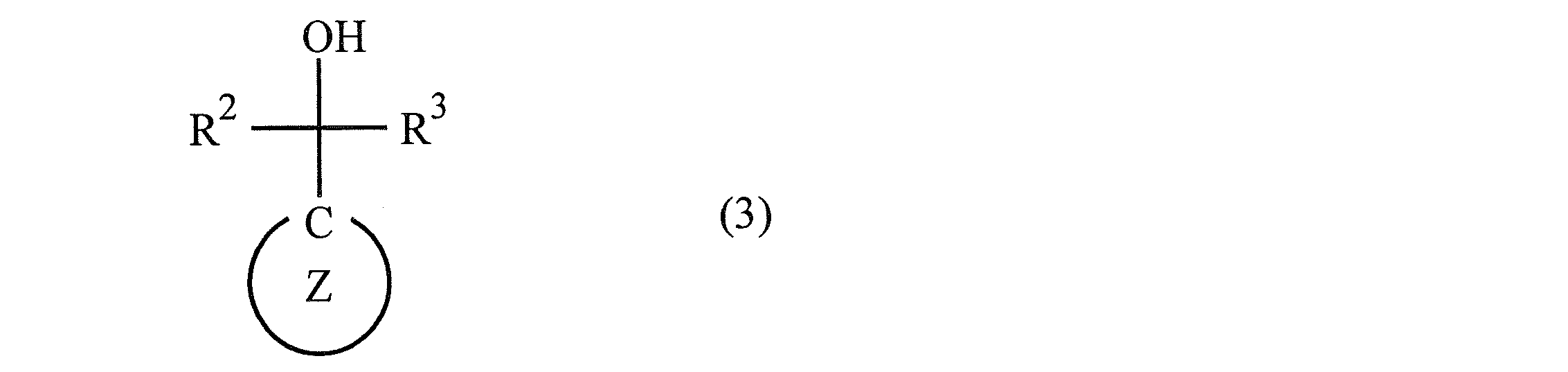
- tertiary alcohol The tertiary alcohol in the present invention is represented by the formula (3).
- R 2 represents an alkyl group having 1 or more carbon atoms
- R 3 represents an alkyl group having 2 or more carbon atoms
- ring Z represents a monocyclic or polycyclic non-aromatic or aromatic ring having 5 or more carbon atoms. .
- alkyl group having 1 or more carbon atoms in R 2 examples include linear or branched groups such as methyl, ethyl, propyl, isopropyl, butyl, isobutyl, s-butyl, t-butyl, pentyl, hexyl, octyl and decyl groups. Examples thereof include a chain alkyl group. In the present invention, an alkyl group having 1 to 6 carbon atoms (particularly 1 to 4 carbon atoms) is preferable.
- alkyl group having 2 or more carbon atoms in R 3 examples include linear or branched chain such as ethyl, propyl, isopropyl, butyl, isobutyl, s-butyl, t-butyl, pentyl, hexyl, octyl and decyl groups. And the like.
- an alkyl group having 2 to 6 carbon atoms (particularly 2 to 4 carbon atoms) is preferable.
- the non-aromatic ring in ring Z includes an alicyclic hydrocarbon ring (non-aromatic hydrocarbon ring) and a non-aromatic heterocyclic ring.
- the alicyclic hydrocarbon ring includes monocyclic hydrocarbon ring and polycyclic hydrocarbon ring [spiro hydrocarbon ring, ring assembly hydrocarbon ring, bridged cyclic hydrocarbon ring (including condensed cyclic hydrocarbon ring)
- the non-aromatic heterocyclic ring includes a monocyclic heterocyclic ring and a polycyclic heterocyclic ring (such as a bridged cyclic heterocyclic ring).
- Examples of the monocyclic hydrocarbon ring having 5 or more carbon atoms in the ring Z include C 5-12 cycloalkane rings such as cyclopentane, cyclohexane, cycloheptane, and cyclooctane ring; C 5-12 cycloalkene rings such as cyclohexene ring. Etc.
- Examples of spiro hydrocarbon rings include C 5-16 spiro hydrocarbon rings such as spiro [4.4] nonane, spiro [4.5] decane, and spirobicyclohexane rings.
- Examples of the ring-assembled hydrocarbon ring include ring-assembled hydrocarbon rings containing a C 5-12 cycloalkane ring such as bicyclohexane and biperhydronaphthalene ring.
- Examples of the bridged cyclic hydrocarbon ring having 5 or more carbon atoms in the ring Z include a pinane, bornane, norpinane, norbornane, bicyclooctane ring (bicyclo [2.2.2] octane ring, bicyclo [3.2.1].
- Bicyclic hydrocarbon rings such as octane ring; 3 such as homobredan, adamantane, tricyclo [5.2.1.0 2,6 ] decane, tricyclo [4.3.1.1 2,5 ] undecane ring Cyclic hydrocarbon ring; tetracyclo [4.4.0.1 2,5 . 1 7,10 ] dodecane, and tetracyclic hydrocarbon rings such as perhydro-1,4-methano-5,8-methanonaphthalene ring.
- the bridged cyclic hydrocarbon ring includes diene hydrogenates [eg, cycloalkadiene dimer hydrogenates such as cyclopentadiene, cyclohexadiene, cycloheptadiene (eg, perhydro-4). , 7-methanoindene, etc.), dimers of butadiene (vinylcyclohexene) and hydrogenated products thereof, and the like.
- diene hydrogenates eg, cycloalkadiene dimer hydrogenates such as cyclopentadiene, cyclohexadiene, cycloheptadiene (eg, perhydro-4). , 7-methanoindene, etc.), dimers of butadiene (vinylcyclohexene) and hydrogenated products thereof, and the like.
- the bridged cyclic hydrocarbon ring includes a condensed cyclic hydrocarbon ring such as perhydronaphthalene (decalin), perhydroanthracene, perhydrophenanthrene, perhydroacenaphthene, perhydrofluorene, perhydroindene, perhydroindene.
- a condensed ring formed by condensing a plurality of 5- to 8-membered cycloalkane rings such as a phenalene ring is also included.
- Preferred bridged cyclic hydrocarbon rings include norbornane, bornane, adamantane, bicyclooctane, tricyclo [5.2.1.0 2,6 ] decane, decalin ring and the like.
- Examples of the monocyclic non-aromatic heterocycle having 5 or more carbon atoms in the ring Z include oxygen atom-containing heterocycles such as oxolane, oxane, oxepane, and oxocan ring; nitrogen atom-containing heterocycles such as perhydroazepine ring, etc. Can be mentioned.
- Examples of the polycyclic non-aromatic heterocyclic ring include a bridged cyclic heterocyclic ring.
- the aromatic ring having 5 or more carbon atoms in the ring Z includes an aromatic hydrocarbon ring and an aromatic heterocycle.
- the aromatic hydrocarbon ring include monocyclic or polycyclic aromatic hydrocarbon rings such as benzene, naphthalene, anthracene, phenanthrene, and phenalene ring.
- the aromatic heterocycle include one or more heteroatoms such as oxygen atom, nitrogen atom, sulfur atom such as furan, thiophene, pyridine, pyridazine, pyrimidine, pyrazine, quinoline, isoquinoline, quinazoline, quinoxaline, acridine, phenazine ring, or the like.
- a monocyclic or polycyclic aromatic heterocyclic ring containing a plurality of them can be mentioned.
- the ring Z in the present invention is preferably a polycyclic non-aromatic ring (hydrocarbon ring or heterocyclic ring), particularly a bridged cyclic ring (bridged) containing 2 to 4 rings such as an adamantane ring.
- a cyclic hydrocarbon ring or a bridged cyclic heterocycle) is preferred.
- Ring Z may have a substituent.
- the substituent is not particularly limited as long as it does not impair the reaction.
- a halogen atom bromine, chlorine, fluorine atom, etc.
- an alkyl group methyl, ethyl, butyl, t-butyl group, etc.
- a hydroxyl group protected with a protecting group an amino group protected with a protecting group, and the like.
- protecting group for the hydroxyl group examples include protecting groups commonly used in the field of organic synthesis, such as alkyl groups (for example, C 1-4 alkyl groups such as methyl and t-butyl groups), cycloalkyl groups (for example, cyclohexyl).
- aralkyl group eg benzyl group, etc.
- substituted methyl group eg methoxymethyl, methoxythiomethyl, benzyloxymethyl, t-butoxymethyl, 2-methoxyethoxymethyl group etc.
- substituted ethyl group eg , 1-ethoxyethyl, 1-methyl-1-methoxyethyl, etc.
- acyl groups for example, C 1-6 aliphatic acyl groups such as formyl, acetyl, propionyl, butyryl, isobutyryl, valeryl, pivaloyl groups; acetoacetyl group Benzoyl, naphthoyl and other aromatic acyl groups
- alkoxycarbonyl groups For example, methoxycarbonyl, ethoxycarbonyl, C 1-4 alkoxycarbonyl group such as t- butoxycarbonyl group), an aralkyloxycarbonyl group (e.g.,
- Preferred protecting groups for hydroxyl groups include C 1-4 alkyl groups, substituted methyl groups, substituted ethyl groups, acyl groups, C 1-4 alkoxycarbonyl groups, and the like.
- amino-protecting group examples include an alkyl group, a cycloalkyl group, an aralkyl group, an acyl group, an alkoxycarbonyl group, and an aralkyloxycarbonyl group exemplified as the protective group for the hydroxyl group.
- Preferred protecting groups for amino groups include C 1-4 alkyl groups, C 1-6 aliphatic acyl groups, aromatic acyl groups, C 1-4 alkoxycarbonyl groups and the like.
- the most typical example of the tertiary alcohol in the present invention is 2-adamantyl-2-butanol.
- the (meth) acrylic acid halide in the present invention is represented by the formula (4).
- R 4 represents a hydrogen atom or a methyl group
- X 2 represents a halogen atom.
- halogen atom for X 2 examples include a chlorine atom, a bromine atom, and an iodine atom.
- Examples of the (meth) acrylic acid halide in the present invention include (meth) acrylic acid chloride, (meth) acrylic acid bromide, (meth) acrylic acid iodide, and the like.
- (meth) acrylic acid chloride is preferable because it is easily available.
- the method for producing a (meth) acrylic acid ester according to the present invention is the method represented by the formula (3) in the presence of the organometallic compound represented by the formula (1) or (2) and a tertiary amine.
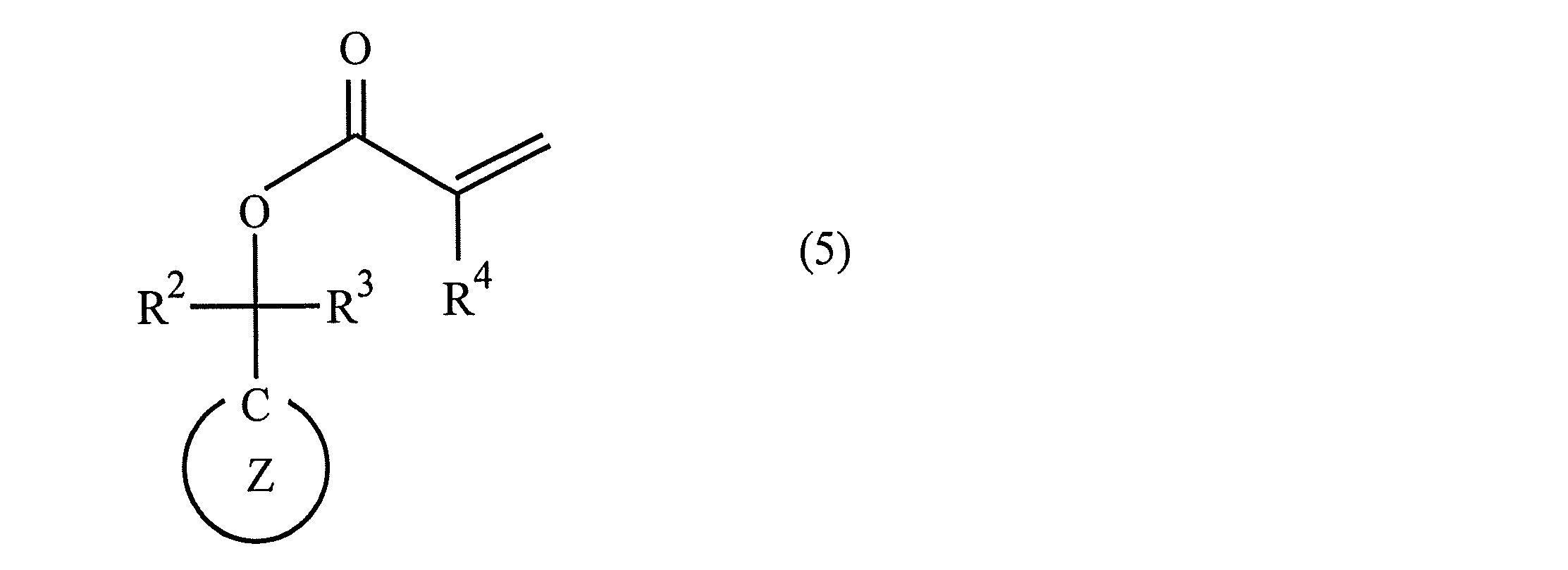
- a (meth) acrylic acid ester represented by the formula (5) is obtained by reacting a tertiary alcohol and a (meth) acrylic acid halide represented by the formula (4).
- the (meth) acrylic acid halide is activated by the tertiary amine.
- a bulky tertiary alcohol represented by formula (3) which is represented by formula (1) or (2) due to steric hindrance (particularly represented by formula (1)).
- (meth) acrylic acid halides activated with tertiary amines especially methacrylic acid halides with higher steric hindrance
- the desired (meth) acrylic acid ester can be obtained with a high yield.
- the amount of the organometallic compound represented by the formula (1) or (2) is, for example, about 1 to 5 mol, preferably about 1 to 3 mol, relative to 1 mol of the tertiary alcohol used as a raw material. .
- the usage-amount of the organometallic compound represented by Formula (1) or (2) is less than the said range, the yield of (meth) acrylic acid ester tends to fall,
- Formula (1) or (2 When the amount of the organometallic compound represented by () exceeds the above range, the load tends to increase in the quenching operation after the reaction.
- the amount of the tertiary amine used is, for example, 1 to 7 mol, preferably about 3 to 5 mol, per 1 mol of the tertiary alcohol used as a raw material. If the amount of tertiary amine used is less than the above range, the yield of (meth) acrylic acid ester tends to be reduced. On the other hand, if the amount of tertiary amine used exceeds the above range, the cost increases. Tend.
- the amount of the (meth) acrylic acid halide represented by the formula (4) is, for example, 1 to 5 mol, preferably about 2 to 4 mol, per 1 mol of the tertiary alcohol used as a raw material.
- the amount of the (meth) acrylic acid halide represented by the formula (4) is less than the above range, the yield of the (meth) acrylic acid ester tends to decrease, whereas the formula (4) represents When the amount of (meth) acrylic acid halide used exceeds the above range, by-products such as a polymer derived from (meth) acrylic acid halide tend to increase.
- the reaction is preferably performed in the presence of a polymerization inhibitor.
- a polymerization inhibitor By adding a polymerization inhibitor, the (meth) acrylic acid halide represented by the formula (4) to be subjected to the reaction and the (meth) acrylic acid ester which is the target product are polymerized to by-produce oligomers. Can be prevented.
- (meth) acrylic acid ester with very low oligomer content as an impurity is used as a raw material for resist polymer, a uniform and homogeneous resist film can be formed, and a fine pattern can be formed with excellent sensitivity and resolution. Therefore, it is possible to cope with the recent miniaturization of the substrate circuit.
- the polymerization inhibitor it is preferable to use phenols in which one of the two ortho positions of the phenolic hydroxyl group on the benzene ring is unsubstituted and the other is substituted with a hydrocarbon group.
- phenols having such a specific structure polymerization of raw materials and products having a (meth) acryloyl group is suppressed, and oligomer by-product can be prevented.
- hydrocarbon group at the ortho position of the phenolic hydroxyl group on the benzene ring examples include alkyl groups such as methyl, ethyl, propyl, isopropyl, butyl, isobutyl, sec-butyl, t-butyl, pentyl, and hexyl groups; Examples thereof include cycloalkyl groups such as propyl, cyclopentyl and cyclohexyl groups; aryl groups such as phenyl and naphthyl groups; aralkyl groups such as benzyl groups and the like.
- the hydrocarbon group is preferably an alkyl group having 1 to 10 carbon atoms such as methyl, ethyl, isopropyl, t-butyl group, and particularly preferably t-butyl group.
- the meta-position and the para-position of the phenolic hydroxyl group may or may not have a substituent.
- an ortho having no substituent is particularly preferable.
- the hydrocarbon group include the same examples as described above, but an alkyl group having 1 to 3 carbon atoms such as a methyl group is particularly preferable.
- alkyl group in R 5 and R 6 examples include alkyl groups having 1 to 6 carbon atoms such as methyl, ethyl, propyl, isopropyl, butyl, isobutyl, s-butyl, t-butyl, pentyl, and hexyl groups. It is done.
- R 6 is particularly preferably a t-butyl group
- R 5 is preferably an alkyl group having 1 to 3 carbon atoms, particularly a methyl group.
- the amount of the polymerization inhibitor used is, for example, about 0.001 to 0.1 mol, preferably about 0.005 to 0.05 mol, per 1 mol of the tertiary alcohol used as a raw material.
- the production of (meth) acrylic acid ester is preferably performed in an organic solvent.
- the organic solvent may be any solvent inert to the reaction.
- ethers such as diethyl ether, tert-butyl methyl ether (MTBE), 1,2-dimethoxyethane, tetrahydrofuran (THF); heptane, hexane, Aliphatic hydrocarbons such as octane; aromatic hydrocarbons such as benzene, toluene and xylene can be used. These can be used alone or in combination of two or more.
- a combination of tetrahydrofuran and toluene or tetrahydrofuran and tert-butyl methyl ether it is preferable to use a combination of tetrahydrofuran and toluene or tetrahydrofuran and tert-butyl methyl ether, and in particular, a combination of tetrahydrofuran and toluene is used because of excellent solubility of the organometallic compound. It is preferable.
- the reaction temperature can be appropriately selected within the range of, for example, about ⁇ 100 ° C. to 150 ° C. depending on the type of organometallic compound and reaction components.
- the reaction temperature is, for example, about 0 ° C. to 50 ° C., preferably about 0 ° C. to 25 ° C., particularly preferably 0 ° C. to 15 ° C. It is.
- the reaction temperature is, for example, about ⁇ 5 ° C. to 10 ° C., preferably about ⁇ 2 ° C. to 5 ° C.
- the reaction temperature is out of the above range, the yield tends to decrease.
- the reaction can be performed by a conventional method such as a batch system, a semi-batch system, or a continuous system.
- an organometallic compound represented by the formula (1) or (2) (or a solution containing the same) is sequentially added to a solution containing a tertiary alcohol represented by the formula (3) as a raw material.
- (meth) acrylic acid halide (or a solution containing the same) represented by the formula (4) is sequentially added to the system, and then a tertiary amine is sequentially added.
- the reaction product After completion of the reaction, if necessary, after quenching with water, methanol, etc., for example, by using separation and purification means such as filtration, concentration, extraction, washing, distillation, crystallization, recrystallization, column chromatography, etc. You can get things. Further, when adding a polymerization inhibitor, by-products of the oligomer can be remarkably suppressed, for example, after completion of the reaction, the reaction product is subjected to extraction using water and an organic solvent, and the resulting organic layer For example, the target reaction product can be obtained simply by concentration and distillation.
- high-purity (meth) acrylic acid with an excellent yield for example, 80% or more, preferably 85% or more, particularly preferably 89% or more. Esters can be obtained.
- the (meth) acrylic acid ester thus obtained can be suitably used as a raw material monomer for a resist polymer, such as a functional polymer monomer or an intermediate raw material for fine chemicals.
- a uniform and homogeneous resist film can be obtained, and a desired fine pattern can be obtained with high accuracy.
- Example 1 2 g (0.0096 mol) of 2-adamantyl-2-butanol is dissolved in 15 g of toluene, and 0.034 g of 4,4-butylidenebis- (6-tert-butyl-m-cresol) (BBM-S) is used as a polymerization inhibitor. (0.01 eq) was added and cooled to 0 ° C. Thereto, 18.24 g (2 eq) of a 1.0 mol / L ethylmagnesium bromide / THF solution was dropped, and after completion of the dropping, the inside of the dropping funnel was washed away with 2 g of toluene. The temperature was raised to 50 ° C. and held for 1 hour.
- BBM-S 4,4-butylidenebis- (6-tert-butyl-m-cresol)
- Example 2 2-Adamantyl-2-methacryloyloxybutane was obtained in the same manner as in Example 1 except that the reaction temperature after the dropwise addition of triethylamine was changed from 30 ° C. to 10 ° C. (yield: 89.43%).
- a tertiary alcohol having a large steric hindrance and a (meth) acrylic acid halide are rapidly reacted to obtain a target in an excellent yield ( A (meth) acrylic acid ester can be obtained.
- the (meth) acrylic acid ester obtained by the present invention is useful as a resist material and a highly functional polymer material.
Landscapes
- Chemical & Material Sciences (AREA)
- Organic Chemistry (AREA)
- Organic Low-Molecular-Weight Compounds And Preparation Thereof (AREA)
- Low-Molecular Organic Synthesis Reactions Using Catalysts (AREA)
Abstract
優れた収率で、目的とする(メタ)アクリル酸エステルを製造することができる(メタ)アクリル酸エステルの製造方法を提供する。本発明の(メタ)アクリル酸エステルの製造方法は、有機金属化合物及び第3級アミンの存在下、下記式(3)で表される第3級アルコールと下記式(4)で表される(メタ)アクリル酸ハライドとを反応させて、下記式(5)で表される(メタ)アクリル酸エステルを得ることを特徴とする。前記(メタ)アクリル酸エステルの製造方法は、重合禁止剤の存在下で反応させることが好ましい。
Description
本発明は、レジスト原料、高機能性ポリマー原料として有用な(メタ)アクリル酸エステルの製造方法に関する。
一般に、第3級アルコールエステルは、対応する第3級アルコールに酸又は酸ハライドを作用させることにより合成することができる。また、一般的な酸感応性の第3級アルコールエステルは、その酸感応性のため、トリエチルアミン等のアミン類の存在下、対応する第3級アルコールに酸ハライドを作用させて合成される。
しかしながら、その分岐鎖の一つに嵩高い脂環式炭化水素環等を含有する第3級アルコールエステルは、対応するアクリル酸エステルの重合物が多く生成したり、多量の塩が析出するために基質濃度を上げられないなどの問題により、対応する第3級アルコールから上記の手法を用いて効率よく合成することは困難であった。特許文献1には、トリエチルアミンの存在下、第3級アルコールと(メタ)アクリル酸ハライドとを反応させて、対応する(メタ)アクリル酸エステルを製造する方法が記載されているが、第3級アルコールとメタクリル酸ハライドとを反応させた場合に、十分に満足のいく収率で目的化合物を得られないことが問題であった。
特許文献2には、有機リチウム試薬又はグリニア試薬等の有機金属化合物と酸ハライドとを第3級アルコールに反応させることにより、対応する第3級アルコールエステルの収率を改善する方法が記載されている。しかしながら、特に有機金属化合物としてグリニア試薬を使用する場合は、例えば2-アダマンチル-2-ブタノールなどの、ヒドロキシル基を有する炭素原子が脂環式炭化水素環等の環以外に炭素数2以上のアルキル基を有する第3級アルコールを使用すると、十分に満足のいく収率で目的化合物を得られないことが問題であった。
従って、本発明の目的は、嵩高い基等を含有する第3級アルコールと(メタ)アクリル酸ハライドから、優れた収率で目的とする(メタ)アクリル酸エステルを製造することができる(メタ)アクリル酸エステルの製造方法を提供することにある。
本発明者等は、上記課題を解決するため鋭意検討した結果、有機リチウム試薬又はグリニア試薬、及び第3級アミンの存在下で、嵩高い基等を含有する第3級アルコールと(メタ)アクリル酸ハライドとを反応させると、一方の反応基質である第3級アルコールが、嵩高い基等の立体障害により有機リチウム試薬又はグリニア試薬(特に、グリニア試薬)によりプロトンを引き抜くことが困難であっても、併用する第3級アミンにより他方の反応基質である(メタ)アクリル酸ハライドを活性化することができるため、第3級アルコールと(メタ)アクリル酸ハライドとの反応が速やかに進行して、対応する(メタ)アクリル酸エステルを高収率で製造することができることを見いだした。本発明はこれらの知見に基づいて完成させたものである。
すなわち、本発明は、下記式(1)又は(2)
R1MgX1 (1)
R1Li (2)
(式中、R1はアルキル基又はハロアルキル基を示し、X1はハロゲン原子を示す)
で表される有機金属化合物及び第3級アミンの存在下、下記式(3)

(式中、R2は炭素数1以上のアルキル基、R3は炭素数2以上のアルキル基、環Zは炭素数5以上の単環若しくは多環の非芳香族性又は芳香族性環を示す)
で表される第3級アルコールと下記式(4)

(式中、R4は水素原子又はメチル基を示し、X2はハロゲン原子を示す)
で表される(メタ)アクリル酸ハライドとを反応させて、下記式(5)
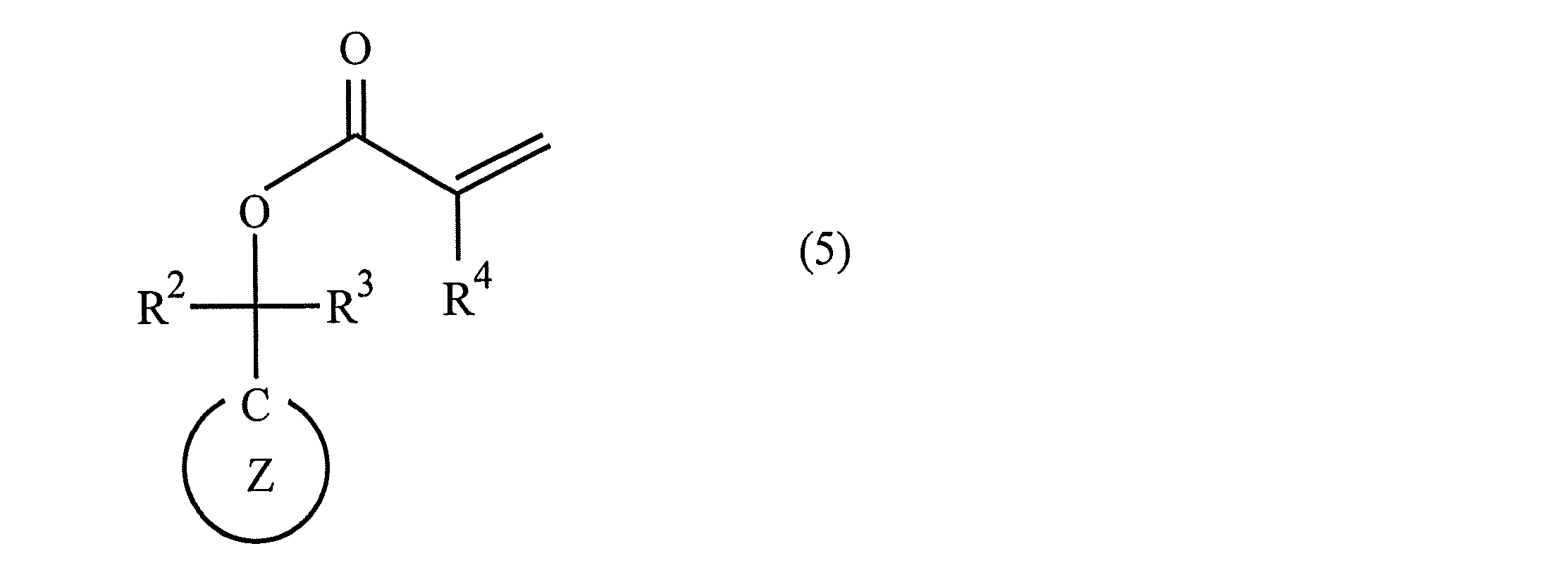
(式中、R2、R3、R4、環Zは前記に同じ)
で表される(メタ)アクリル酸エステルを得る(メタ)アクリル酸エステルの製造方法を提供する。
R1MgX1 (1)
R1Li (2)
(式中、R1はアルキル基又はハロアルキル基を示し、X1はハロゲン原子を示す)
で表される有機金属化合物及び第3級アミンの存在下、下記式(3)
で表される第3級アルコールと下記式(4)
で表される(メタ)アクリル酸ハライドとを反応させて、下記式(5)
で表される(メタ)アクリル酸エステルを得る(メタ)アクリル酸エステルの製造方法を提供する。
前記(メタ)アクリル酸エステルの製造方法は、重合禁止剤の存在下で反応させることが好ましく、重合禁止剤としては、4,4′-チオビス(6-t-ブチル-m-クレゾール)、4,4′-ブチリデンビス(6-t-ブチル-m-クレゾール)及び1,1,3-トリス(5-t-ブチル-4-ヒドロキシ-2-メチルフェニル)ブタンから選択された少なくとも1種の化合物を使用することが好ましい。
第3級アミンとしては、トリエチルアミンが好ましい。
本発明に係る(メタ)アクリル酸エステルの製造方法によれば、有機金属化合物として有機リチウム試薬を使用しても、また、取り扱いが容易で安全にスケールアップすることができるが従来は目的化合物の収率の点で問題があったグリニア試薬等の有機マグネシウム化合物を使用しても、2-アダマンチル-2-ブタノールなどの、ヒドロキシル基を有する炭素原子が脂環式炭化水素環等の環以外に炭素数2以上のアルキル基を有する立体障害の大きい第3級アルコールと、(メタ)アクリル酸ハライドとを(特に、より立体障害が大きいメタクリル酸ハライドとも)、速やかに反応させて、80%を超える優れた収率で目的とする(メタ)アクリル酸エステルを得ることができる。そのため、本発明に係る(メタ)アクリル酸エステルの製造方法は、工業化に適している。本発明により得られる(メタ)アクリル酸エステルは、レジスト原料、高機能性ポリマー原料として有用である。
[有機金属化合物]
本発明では、前記式(1)又は(2)で表される有機金属化合物を用いる。式中、R1はアルキル基又はハロアルキル基を示し、X1はハロゲン原子を示す。
本発明では、前記式(1)又は(2)で表される有機金属化合物を用いる。式中、R1はアルキル基又はハロアルキル基を示し、X1はハロゲン原子を示す。
R1におけるアルキル基としては、例えば、メチル、エチル、プロピル、イソプロピル、ブチル、イソブチル、s-ブチル、t-ブチル基などのC1-6アルキル基等を挙げることができる。これらの中でも、特に、C1-4アルキル基が好ましい。
R1におけるハロアルキル基としては、トリフルオロメチル、2,2,2-トリフルオロエチル基等の前記アルキル基を構成する水素原子の1又は2以上がハロゲン原子(フッ素原子、塩素原子等)で置き換えられた基等を挙げることができる。
X1におけるハロゲン原子としては、塩素原子、臭素原子、ヨウ素原子等を挙げることができる。
式(1)で表される有機金属化合物の代表的な例として、メチルマグネシウムブロミド、エチルマグネシウムブロミド、ブチルマグネシウムブロミド、メチルマグネシウムクロリド、エチルマグネシウムクロリド、ブチルマグネシウムクロリドなどの有機マグネシウム化合物(グリニア試薬など)が挙げられる。また、式(2)で表される有機金属化合物の代表的な例として、メチルリチウム、エチルリチウム、ブチルリチウムなどの有機リチウム化合物が挙げられる。有機マグネシウム化合物はハロゲン化銅と組み合わせて用いることもできる。
本発明における有機金属化合物としては、なかでも、取り扱いが容易であり、安全にスケールアップすることができ工業化に適している点で、上記式(1)で表される化合物を使用することが好ましい。
[第3級アミン]
本発明における第3級アミンとしては、例えば、脂肪族アミン、芳香族アミン、脂環式アミン、複素環アミン等を挙げることができる。また、ヒドロキシル基やニトロ基等が含まれていてもよい。さらに、モノアミンの他、ジアミン等のポリアミンであってもよい。
本発明における第3級アミンとしては、例えば、脂肪族アミン、芳香族アミン、脂環式アミン、複素環アミン等を挙げることができる。また、ヒドロキシル基やニトロ基等が含まれていてもよい。さらに、モノアミンの他、ジアミン等のポリアミンであってもよい。
本発明における3級アミンの具体例としては、トリメチルアミン、トリエチルアミン、ジイソプロピルエチルアミン、トリ-n-プロピルアミン、トリイソプロピルアミン、トリブチルアミン、N-メチル-ジエチルアミン、N-エチル-ジメチルアミン、N-エチル-ジアミルアミン等の脂肪族アミン;N,N-ジメチルアニリン、ジエチルアニリン等の芳香族アミン;N,N-ジメチル-シクロヘキシルアミン、N,N-ジエチル-シクロヘキシルアミン等の脂環式アミン;N,N-ジメチルアミノピリジン、N-メチルモルホリン、ジアザビシクロウンデセン(DBU)、ジアザビシクロノネン(DBN)、N-メチルピリジン、N-メチルピロリジン等の複素環アミン;テトラメチルエチレンジアミン、トリエチレンジアミン等のジアミン等を挙げることができる。
本発明における第3級アミンとしては、特に、トリメチルアミン、トリエチルアミン等の脂肪族アミン、N-メチルモルホリン等の複素環アミンが好ましく、特にトリメチルアミン、トリエチルアミン等の脂肪族アミンが、目的化合物の収率をより向上させることができる点で好ましい。
[第3級アルコール]
本発明における第3級アルコールは、前記式(3)で表される。式中、R2は炭素数1以上のアルキル基、R3は炭素数2以上のアルキル基、環Zは炭素数5以上の単環若しくは多環の非芳香族性又は芳香族性環を示す。
本発明における第3級アルコールは、前記式(3)で表される。式中、R2は炭素数1以上のアルキル基、R3は炭素数2以上のアルキル基、環Zは炭素数5以上の単環若しくは多環の非芳香族性又は芳香族性環を示す。
R2における炭素数1以上のアルキル基としては、例えば、メチル、エチル、プロピル、イソプロピル、ブチル、イソブチル、s-ブチル、t-ブチル、ペンチル、ヘキシル、オクチル、デシル基などの直鎖状又は分岐鎖状のアルキル基等を挙げることができる。本発明においては、なかでも、炭素数1~6(特に炭素数1~4)のアルキル基が好ましい。
R3における炭素数2以上のアルキル基としては、例えば、エチル、プロピル、イソプロピル、ブチル、イソブチル、s-ブチル、t-ブチル、ペンチル、ヘキシル、オクチル、デシル基などの直鎖状又は分岐鎖状のアルキル基等を挙げることができる。本発明においては、なかでも、炭素数2~6(特に炭素数2~4)のアルキル基が好ましい。
環Zにおける非芳香族性環には、脂環式炭化水素環(非芳香族性炭化水素環)及び非芳香族性複素環が含まれる。脂環式炭化水素環には、単環式炭化水素環及び多環式炭化水素環[スピロ炭化水素環、環集合炭化水素環、架橋環式炭化水素環(縮合環式炭化水素環を含む)]が含まれ、非芳香族性複素環には、単環式複素環及び多環式複素環(架橋環式複素環等)が含まれる。
環Zにおける炭素数5以上の単環式炭化水素環としては、例えば、シクロペンタン、シクロヘキサン、シクロヘプタン、シクロオクタン環などのC5-12シクロアルカン環;シクロヘキセン環などC5-12シクロアルケン環等を挙げることができる。スピロ炭化水素環としては、例えば、スピロ[4.4]ノナン、スピロ[4.5]デカン、スピロビシクロヘキサン環などのC5-16スピロ炭化水素環等を挙げることができる。環集合炭化水素環としては、例えば、ビシクロヘキサン、ビパーヒドロナフタレン環などのC5-12シクロアルカン環を含む環集合炭化水素環等を挙げることができる。
環Zにおける炭素数5以上の架橋環式炭化水素環としては、例えば、ピナン、ボルナン、ノルピナン、ノルボルナン、ビシクロオクタン環(ビシクロ[2.2.2]オクタン環、ビシクロ[3.2.1]オクタン環等)などの2環式炭化水素環;ホモブレダン、アダマンタン、トリシクロ[5.2.1.02,6]デカン、トリシクロ[4.3.1.12,5]ウンデカン環などの3環式炭化水素環;テトラシクロ[4.4.0.12,5.17,10]ドデカン、パーヒドロ-1,4-メタノ-5,8-メタノナフタレン環などの4環式炭化水素環等を挙げることができる。
架橋環式炭化水素環には、ジエン類の二量体の水素添加物[例えば、シクロペンタジエン、シクロヘキサジエン、シクロヘプタジエンなどのシクロアルカジエンの二量体の水素添加物(例えば、パーヒドロ-4,7-メタノインデンなど)、ブタジエンの二量体(ビニルシクロヘキセン)やその水素添加物など]に対応する環なども含まれる。
また、架橋環式炭化水素環には、縮合環式炭化水素環、例えば、パーヒドロナフタレン(デカリン)、パーヒドロアントラセン、パーヒドロフェナントレン、パーヒドロアセナフテン、パーヒドロフルオレン、パーヒドロインデン、パーヒドロフェナレン環などの5~8員シクロアルカン環が複数個縮合した縮合環も含まれる。
好ましい架橋環式炭化水素環として、ノルボルナン、ボルナン、アダマンタン、ビシクロオクタン、トリシクロ[5.2.1.02,6]デカン、デカリン環等が挙げられる。
環Zにおける炭素数5以上の単環式非芳香族性複素環としては、例えば、オキソラン、オキサン、オキセパン、オキソカン環などの酸素原子含有複素環;パーヒドロアゼピン環などの窒素原子含有複素環等を挙げることができる。多環式非芳香族性複素環としては架橋環式複素環等を挙げることができる。
また、環Zにおける炭素数5以上の芳香族性環には、芳香族炭化水素環及び芳香族複素環が含まれる。芳香族炭化水素環としては、例えば、ベンゼン、ナフタレン、アントラセン、フェナントレン、フェナレン環などの単環または多環の芳香族炭化水素環が挙げられる。芳香族複素環としては、例えば、フラン、チオフェン、ピリジン、ピリダジン、ピリミジン、ピラジン、キノリン、イソキノリン、キナゾリン、キノキサリン、アクリジン、フェナジン環などの酸素原子、窒素原子、硫黄原子などのヘテロ原子を1または複数個含む単環または多環の芳香族複素環が挙げられる。
本発明における環Zとしては、なかでも、多環の非芳香族性環(炭化水素環又は複素環)が好ましく、特に、アダマンタン環などの2~4個の環を含む架橋環式環(架橋環式炭化水素環又は架橋環式複素環)が好ましい。
環Zは置換基を有していてもよい。該置換基としては、反応を損なわないものであれば特に限定されることがなく、例えば、ハロゲン原子(臭素、塩素、フッ素原子など)、アルキル基(メチル、エチル、ブチル、t-ブチル基などのC1-4アルキル基など)、保護基で保護されたヒドロキシル基、保護基で保護されたアミノ基などが挙げられる。
前記ヒドロキシル基の保護基としては、有機合成の分野で慣用の保護基、例えば、アルキル基(例えば、メチル、t-ブチル基などのC1-4アルキル基など)、シクロアルキル基(例えば、シクロヘキシル基など)、アラルキル基(例えば、ベンジル基など)、置換メチル基(例えば、メトキシメチル、メトキシチオメチル、ベンジルオキシメチル、t-ブトキシメチル、2-メトキシエトキシメチル基など)、置換エチル基(例えば、1-エトキシエチル、1-メチル-1-メトキシエチルなど)、アシル基(例えば、ホルミル、アセチル、プロピオニル、ブチリル、イソブチリル、バレリル、ピバロイル基などのC1-6脂肪族アシル基;アセトアセチル基;ベンゾイル、ナフトイル基などの芳香族アシル基など)、アルコキシカルボニル基(例えば、メトキシカルボニル、エトキシカルボニル、t-ブトキシカルボニル基などのC1-4アルコキシカルボニル基など)、アラルキルオキシカルボニル基(例えば、ベンジルオキシカルボニル基、p-メトキシベンジルオキシカルボニル基など)が例示できる。好ましいヒドロキシル基の保護基には、C1-4アルキル基、置換メチル基、置換エチル基、アシル基、C1-4アルコキシカルボニル基などが含まれる。
前記アミノ基の保護基としては、前記ヒドロキシル基の保護基として例示した、アルキル基、シクロアルキル基、アラルキル基、アシル基、アルコキシカルボニル基、アラルキルオキシカルボニル基などが挙げられる。好ましいアミノ基の保護基には、C1-4アルキル基、C1-6脂肪族アシル基、芳香族アシル基、C1-4アルコキシカルボニル基などが含まれる。
本発明における第3級アルコールの最も代表的な例は、2-アダマンチル-2-ブタノールである。
[(メタ)アクリル酸ハライド]
本発明における(メタ)アクリル酸ハライドは、前記式(4)で表される。式中、R4は水素原子又はメチル基を示し、X2はハロゲン原子を示す。
本発明における(メタ)アクリル酸ハライドは、前記式(4)で表される。式中、R4は水素原子又はメチル基を示し、X2はハロゲン原子を示す。
X2におけるハロゲン原子としては、塩素原子、臭素原子、ヨウ素原子等を挙げることができる。
本発明における(メタ)アクリル酸ハライドとしては、例えば、(メタ)アクリル酸クロライド、(メタ)アクリル酸ブロミド、(メタ)アクリル酸アイオダイド等を挙げることができる。本発明においては、なかでも、入手が容易な点で、(メタ)アクリル酸クロライドが好ましい。
[(メタ)アクリル酸エステルの製造方法]
本発明に係る(メタ)アクリル酸エステルの製造方法は、前記式(1)又は(2)で表される有機金属化合物及び第3級アミンの存在下、前記式(3)で表される第3級アルコールと前記式(4)で表される(メタ)アクリル酸ハライドとを反応させて、前記式(5)で表される(メタ)アクリル酸エステルを得ることを特徴とする。
本発明に係る(メタ)アクリル酸エステルの製造方法は、前記式(1)又は(2)で表される有機金属化合物及び第3級アミンの存在下、前記式(3)で表される第3級アルコールと前記式(4)で表される(メタ)アクリル酸ハライドとを反応させて、前記式(5)で表される(メタ)アクリル酸エステルを得ることを特徴とする。
本発明においては、塩基として式(1)又は(2)で表される有機金属化合物と、第3級アミンを組み合わせて使用するため、第3級アミンにより(メタ)アクリル酸ハライドを活性化することができ、式(3)で表される嵩高い第3級アルコールであって、立体障害により式(1)又は(2)で表される有機金属化合物(特に、式(1)で表される有機金属化合物)によるプロトンの引き抜きが困難である第3級アルコールでも、第3級アミンにより活性化された(メタ)アクリル酸ハライドと(特に、より立体障害が大きいメタクリル酸ハライドとも)速やかに反応させることができ、高い収率で目的とする(メタ)アクリル酸エステルを得ることができる。
前記式(1)又は(2)で表される有機金属化合物の使用量としては、原料として用いる第3級アルコール1モルに対して、例えば1~5モル、好ましくは1~3モル程度である。式(1)又は(2)で表される有機金属化合物の使用量が上記範囲を下回ると、(メタ)アクリル酸エステルの収率が低下する傾向があり、一方、式(1)又は(2)で表される有機金属化合物の使用量が上記範囲を上回ると、反応後のクエンチ作業において負荷が増大する傾向がある。
第3級アミンの使用量としては、原料として用いる第3級アルコール1モルに対して、例えば1~7モル、好ましくは3~5モル程度である。第3級アミンの使用量が上記範囲を下回ると、(メタ)アクリル酸エステルの収率が低下する傾向があり、一方、第3級アミンの使用量が上記範囲を上回ると、コスト高となる傾向がある。
式(4)で表される(メタ)アクリル酸ハライドの使用量としては、原料として用いる第3級アルコール1モルに対して、例えば1~5モル、好ましくは2~4モル程度である。式(4)で表される(メタ)アクリル酸ハライドの使用量が上記範囲を下回ると、(メタ)アクリル酸エステルの収率が低下する傾向があり、一方、式(4)で表される(メタ)アクリル酸ハライドの使用量が上記範囲を上回ると、(メタ)アクリル酸ハライド由来の重合物等の副生成物が増加する傾向がある。
また、本発明に係る(メタ)アクリル酸エステルの製造方法においては、重合禁止剤の存在下で反応を行うことが好ましい。重合禁止剤を添加することにより、反応に供する式(4)で表される(メタ)アクリル酸ハライドや、目的生成物である(メタ)アクリル酸エステルが重合してオリゴマーを副生することを防止することができる。不純物としてのオリゴマー含有量が極めて低い(メタ)アクリル酸エステルをレジスト用ポリマーの原料として用いると、均一且つ均質なレジスト膜を形成することができ、優れた感度及び解像度で微細パターンを形成することができるため、近年の基板回路の微細化に対応することができる。
前記重合禁止剤としては、ベンゼン環上におけるフェノール性水酸基の2つのオルト位のうち一方は無置換であり他方は炭化水素基で置換されているフェノール類を使用することが好ましい。このような特定の構造を有するフェノール類を用いることにより、(メタ)アクリロイル基を有する原料や生成物の重合が抑制され、オリゴマーの副生を防止できる。
ベンゼン環上におけるフェノール性水酸基のオルト位に有する炭化水素基としては、例えば、メチル、エチル、プロピル、イソプロピル、ブチル、イソブチル、s-ブチル、t-ブチル、ペンチル、ヘキシル基等のアルキル基;シクロプロピル、シクロペンチル、シクロヘキシル基等のシクロアルキル基;フェニル、ナフチル基等のアリール基;ベンジル基等のアラルキル基等を挙げることができる。前記炭化水素基としては、メチル、エチル、イソプロピル、t-ブチル基等の炭素数1~10のアルキル基が好ましく、特に、t-ブチル基が好ましい。
前記フェノール類において、フェノール性水酸基のメタ位、パラ位には置換基を有していても有していなくてもよいが、フェノール性水酸基の2つのメタ位のうち、置換基を有しないオルト位に隣接する方には、置換基として炭化水素基を有しているのが好ましい。該炭化水素基としては、前記と同様の例を挙げることができるが、特にメチル基等の炭素数1~3のアルキル基が好ましい。
前記フェノール類の好ましい例として、下記式(6)
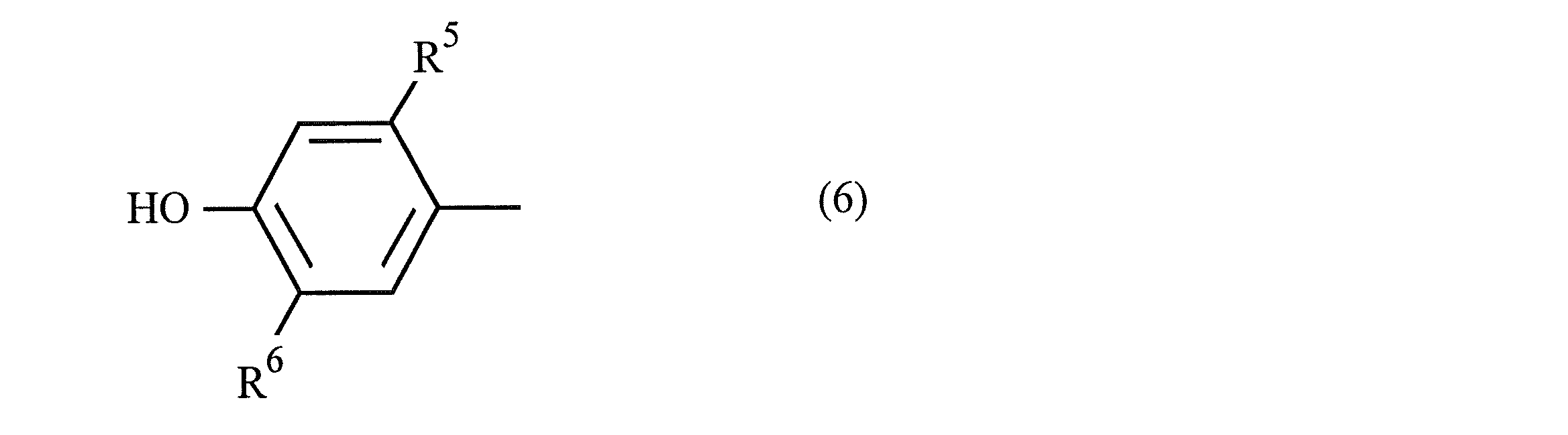
(式中、R5、R6は、同一又は異なって、アルキル基を示す)
で表される4-ヒドロキシ-2,5-ジアルキルフェニル基を有する化合物を挙げることができる。
で表される4-ヒドロキシ-2,5-ジアルキルフェニル基を有する化合物を挙げることができる。
R5、R6におけるアルキル基としては、例えば、メチル、エチル、プロピル、イソプロピル、ブチル、イソブチル、s-ブチル、t-ブチル、ペンチル、ヘキシル基等の炭素数1~6のアルキル基等が挙げられる。R6としては、特に、t-ブチル基が好ましく、R5としては、炭素数1~3のアルキル基、特にメチル基が好ましい。
前記式(6)で表される4-ヒドロキシ-2,5-ジアルキルフェニル基を有する化合物の代表的な例として、例えば、4,4′-チオビス(6-t-ブチル-m-クレゾール)、4,4′-ブチリデンビス(6-t-ブチル-m-クレゾール)、1,1,3-トリス(5-t-ブチル-4-ヒドロキシ-2-メチルフェニル)ブタン等を挙げることができる。これらは単独で又は2種以上を組み合わせて使用できる。
重合禁止剤の使用量は、原料として用いる第3級アルコール1モルに対して、例えば0.001~0.1モル、好ましくは0.005~0.05モル程度である。
本発明において(メタ)アクリル酸エステルの製造は、有機溶媒中で行うことが好ましい。有機溶媒としては、反応に不活性な溶媒であればよく、例えば、ジエチルエーテル、tert-ブチルメチルエーテル(MTBE)、1,2-ジメトキシエタン、テトラヒドロフラン(THF)などのエーテル類;ヘプタン、ヘキサン、オクタンなどの脂肪族炭化水素;ベンゼン、トルエン、キシレンなどの芳香族炭化水素などを挙げることができる。これらは単独で又は2種以上を組み合わせて使用することができる。本発明においては、なかでも、有機金属化合物の溶解性等に優れる点で、テトラヒドロフランとトルエン又はテトラヒドロフランとtert-ブチルメチルエーテルを組み合わせて使用することが好ましく、特に、テトラヒドロフランとトルエンを組み合わせて使用することが好ましい。
反応温度は、有機金属化合物や反応成分の種類などにより、例えば-100℃~150℃程度の範囲内で適宜選択できる。例えば、有機金属化合物として式(1)で表される化合物を用いる場合には、反応温度は、例えば0℃~50℃程度、好ましくは0℃~25℃程度、特に好ましくは0℃~15℃である。有機金属化合物として式(2)で表される化合物を用いる場合には、反応温度は、例えば-5℃~10℃、好ましくは-2℃~5℃程度である。反応温度が上記範囲を外れると、収率が低下する傾向がある。
反応は、回分式、半回分式、連続式などの慣用の方法により行うことができる。一般には、原料となる式(3)で表される第3級アルコールを含む溶液中に、式(1)又は(2)で表される有機金属化合物(又はこれを含む溶液)を逐次添加し、次いで、式(4)で表される(メタ)アクリル酸ハライド(又はこれを含む溶液)を系内に逐次添加し、次いで第3級アミンを逐次添加する方法等により行われる。前記重合禁止剤を添加する場合は、式(4)で表される(メタ)アクリル酸ハライドを添加する前の適宜な時期に系内に添加することが好ましい。
反応終了後、必要ならば水、メタノール等でクエンチした後、例えば、濾過、濃縮、抽出、洗浄、蒸留、晶析、再結晶、カラムクロマトグラフィーなどの分離精製手段を用いることで、目的反応生成物を得ることができる。また、重合禁止剤を添加する場合は、オリゴマーの副生を顕著に抑制できるため、例えば、反応終了後、反応生成物を水と有機溶媒を用いた抽出に付し、得られた有機層を、例えば濃縮、蒸留するだけで、目的反応生成物を得ることができる。本発明に係る(メタ)アクリル酸エステルの製造方法によれば、優れた収率(例えば80%以上、好ましくは85%以上、特に好ましくは89%以上)で、高純度の(メタ)アクリル酸エステルを得ることができる。
こうして得られた(メタ)アクリル酸エステルは、機能性高分子のモノマーや精密化学品の中間原料など、特に、レジスト用ポリマーの原料単量体として好適に使用でき、得られるポリマーを用いてレジスト膜を形成すると、均一且つ均質なレジスト膜が得られ、所望の微細パターンを精度よく得ることができる。
以下、実施例により本発明をより具体的に説明するが、本発明はこれらの実施例により限定されるものではない。尚、生成物の収率はHPLC分析により算出した。
実施例1
2-アダマンチル-2-ブタノール 2g(0.0096モル)をトルエン 15gに溶解し、重合禁止剤として4,4-ブチリデンビス-(6-tert-ブチル-m-クレゾール)(BBM-S)0.034g(0.01eq)添加し、0℃に冷却した。そこへ1.0mol/Lのエチルマグネシウムブロマイド/THF溶液 18.24g(2eq)を滴下し、滴下終了後、トルエン 2gで滴下ロート内を洗い流した。温度を50℃まで上げて1時間保持した。その後、0℃まで冷却し、メタクリル酸クロライド 3.01g(3eq)をトルエン 5gに希釈した溶液を0℃付近の温度を保持しながらフラスコ内にゆっくり滴下した。
その後、トリエチルアミン 3.89g(4eq)を滴下し、30℃まで昇温し、3時間反応させて、2-アダマンチル-2-メタクリロイルオキシブタンを得た(収率:81.2%)。
温度を10℃以下まで冷却し、トルエン 20g添加後、0℃~10℃の範囲内で水 16gを添加した。さらに10%硫酸を用いて水層をpHを8付近にした。有機層と水層に分液した後、有機層に1N水酸化ナトリウム水溶液 13g添加し、有機層と撹拌した。その後、分液して2-アダマンチル-2-メタクリロイルオキシブタンを得た(収率:81.3%)。
2-アダマンチル-2-ブタノール 2g(0.0096モル)をトルエン 15gに溶解し、重合禁止剤として4,4-ブチリデンビス-(6-tert-ブチル-m-クレゾール)(BBM-S)0.034g(0.01eq)添加し、0℃に冷却した。そこへ1.0mol/Lのエチルマグネシウムブロマイド/THF溶液 18.24g(2eq)を滴下し、滴下終了後、トルエン 2gで滴下ロート内を洗い流した。温度を50℃まで上げて1時間保持した。その後、0℃まで冷却し、メタクリル酸クロライド 3.01g(3eq)をトルエン 5gに希釈した溶液を0℃付近の温度を保持しながらフラスコ内にゆっくり滴下した。
その後、トリエチルアミン 3.89g(4eq)を滴下し、30℃まで昇温し、3時間反応させて、2-アダマンチル-2-メタクリロイルオキシブタンを得た(収率:81.2%)。
温度を10℃以下まで冷却し、トルエン 20g添加後、0℃~10℃の範囲内で水 16gを添加した。さらに10%硫酸を用いて水層をpHを8付近にした。有機層と水層に分液した後、有機層に1N水酸化ナトリウム水溶液 13g添加し、有機層と撹拌した。その後、分液して2-アダマンチル-2-メタクリロイルオキシブタンを得た(収率:81.3%)。
実施例2
トリエチルアミン滴下後の反応温度を30℃から10℃に変更した以外は実施例1と同様にして、2-アダマンチル-2-メタクリロイルオキシブタンを得た(収率:89.43%)。
トリエチルアミン滴下後の反応温度を30℃から10℃に変更した以外は実施例1と同様にして、2-アダマンチル-2-メタクリロイルオキシブタンを得た(収率:89.43%)。
比較例1
2-アダマンチル-2-ブタノール 0.01モル、トリエチルアミン 0.01モル及びテトラヒドロフラン 40mlの混合液に、メタクリル酸クロライド 0.01モルを約30分かけて滴下した。滴下終了後、室温(25℃)で6時間撹拌し、2-アダマンチル-2-メタクリロイルオキシブタンを得た(収率:5%未満)。
2-アダマンチル-2-ブタノール 0.01モル、トリエチルアミン 0.01モル及びテトラヒドロフラン 40mlの混合液に、メタクリル酸クロライド 0.01モルを約30分かけて滴下した。滴下終了後、室温(25℃)で6時間撹拌し、2-アダマンチル-2-メタクリロイルオキシブタンを得た(収率:5%未満)。
比較例2
2-アダマンチル-2-ブタノール2g(0.0096モル)をtert-ブチルメチルエーテル(MTBE) 10gに溶解し、重合禁止剤としてBBM-S 0.034g(0.01eq)添加し、0℃に冷却した。そこへ0.9mol/Lのエチルマグネシウムブロマイド/MTBE溶液 18.25g(2eq)滴下し、滴下終了後、MTBE 1.7gで滴下ロート内を洗い流した。温度を50℃まで上げて1時間保持した。その後、0℃まで冷却し、メタクリル酸クロライド 3.01g(3eq)をTHF 10gに希釈した溶液を0℃付近の温度を保持しながらフラスコ内にゆっくり滴下した。
その後、30℃まで昇温し、1時間反応させて、2-アダマンチル-2-メタクリロイルオキシブタンを得た(収率:5%未満)。
2-アダマンチル-2-ブタノール2g(0.0096モル)をtert-ブチルメチルエーテル(MTBE) 10gに溶解し、重合禁止剤としてBBM-S 0.034g(0.01eq)添加し、0℃に冷却した。そこへ0.9mol/Lのエチルマグネシウムブロマイド/MTBE溶液 18.25g(2eq)滴下し、滴下終了後、MTBE 1.7gで滴下ロート内を洗い流した。温度を50℃まで上げて1時間保持した。その後、0℃まで冷却し、メタクリル酸クロライド 3.01g(3eq)をTHF 10gに希釈した溶液を0℃付近の温度を保持しながらフラスコ内にゆっくり滴下した。
その後、30℃まで昇温し、1時間反応させて、2-アダマンチル-2-メタクリロイルオキシブタンを得た(収率:5%未満)。
本発明に係る(メタ)アクリル酸エステルの製造方法によれば、立体障害の大きい第3級アルコールと、(メタ)アクリル酸ハライドとを速やかに反応させて、優れた収率で目的とする(メタ)アクリル酸エステルを得ることができる。本発明により得られる(メタ)アクリル酸エステルは、レジスト原料、高機能性ポリマー原料として有用である。
Claims (4)
- 下記式(1)又は(2)
R1MgX1 (1)
R1Li (2)
(式中、R1はアルキル基又はハロアルキル基を示し、X1はハロゲン原子を示す)
で表される有機金属化合物及び第3級アミンの存在下、下記式(3)
で表される第3級アルコールと下記式(4)

で表される(メタ)アクリル酸ハライドとを反応させて、下記式(5)
で表される(メタ)アクリル酸エステルを得る(メタ)アクリル酸エステルの製造方法。 - 重合禁止剤の存在下で反応させる請求項1に記載の(メタ)アクリル酸エステルの製造方法。
- 重合禁止剤が、4,4′-チオビス(6-t-ブチル-m-クレゾール)、4,4′-ブチリデンビス(6-t-ブチル-m-クレゾール)及び1,1,3-トリス(5-t-ブチル-4-ヒドロキシ-2-メチルフェニル)ブタンから選択された少なくとも1種の化合物である請求項2に記載の(メタ)アクリル酸エステルの製造方法。
- 第3級アミンがトリエチルアミンである請求項1~3の何れかの項に記載の(メタ)アクリル酸エステルの製造方法。
Applications Claiming Priority (2)
| Application Number | Priority Date | Filing Date | Title |
|---|---|---|---|
| JP2010093987A JP5687843B2 (ja) | 2010-04-15 | 2010-04-15 | メタクリル酸エステルの製造方法 |
| JP2010-093987 | 2010-04-15 |
Publications (1)
| Publication Number | Publication Date |
|---|---|
| WO2011129204A1 true WO2011129204A1 (ja) | 2011-10-20 |
Family
ID=44798582
Family Applications (1)
| Application Number | Title | Priority Date | Filing Date |
|---|---|---|---|
| PCT/JP2011/058432 Ceased WO2011129204A1 (ja) | 2010-04-15 | 2011-04-01 | (メタ)アクリル酸エステルの製造方法 |
Country Status (3)
| Country | Link |
|---|---|
| JP (1) | JP5687843B2 (ja) |
| TW (1) | TW201141831A (ja) |
| WO (1) | WO2011129204A1 (ja) |
Citations (5)
| Publication number | Priority date | Publication date | Assignee | Title |
|---|---|---|---|---|
| JP2001048933A (ja) * | 1999-08-05 | 2001-02-20 | Daicel Chem Ind Ltd | フォトレジスト用高分子化合物及びフォトレジスト用樹脂組成物 |
| JP2001240625A (ja) * | 2000-02-25 | 2001-09-04 | Toshiba Corp | フォトレジスト用高分子化合物及びフォトレジスト用樹脂組成物 |
| JP2002173466A (ja) * | 2000-12-04 | 2002-06-21 | Daicel Chem Ind Ltd | 第3級アルコールエステルの製造方法 |
| JP2002173467A (ja) * | 2000-12-06 | 2002-06-21 | Toray Ind Inc | 3級エステルを含むアクリルモノマーの製造方法 |
| JP2002193884A (ja) * | 2000-12-21 | 2002-07-10 | Daicel Chem Ind Ltd | (メタ)アクリル酸エステルの製造法 |
-
2010
- 2010-04-15 JP JP2010093987A patent/JP5687843B2/ja not_active Expired - Fee Related
-
2011
- 2011-04-01 WO PCT/JP2011/058432 patent/WO2011129204A1/ja not_active Ceased
- 2011-04-12 TW TW100112554A patent/TW201141831A/zh unknown
Patent Citations (5)
| Publication number | Priority date | Publication date | Assignee | Title |
|---|---|---|---|---|
| JP2001048933A (ja) * | 1999-08-05 | 2001-02-20 | Daicel Chem Ind Ltd | フォトレジスト用高分子化合物及びフォトレジスト用樹脂組成物 |
| JP2001240625A (ja) * | 2000-02-25 | 2001-09-04 | Toshiba Corp | フォトレジスト用高分子化合物及びフォトレジスト用樹脂組成物 |
| JP2002173466A (ja) * | 2000-12-04 | 2002-06-21 | Daicel Chem Ind Ltd | 第3級アルコールエステルの製造方法 |
| JP2002173467A (ja) * | 2000-12-06 | 2002-06-21 | Toray Ind Inc | 3級エステルを含むアクリルモノマーの製造方法 |
| JP2002193884A (ja) * | 2000-12-21 | 2002-07-10 | Daicel Chem Ind Ltd | (メタ)アクリル酸エステルの製造法 |
Also Published As
| Publication number | Publication date |
|---|---|
| TW201141831A (en) | 2011-12-01 |
| JP5687843B2 (ja) | 2015-03-25 |
| JP2011225456A (ja) | 2011-11-10 |
Similar Documents
| Publication | Publication Date | Title |
|---|---|---|
| US20170088502A1 (en) | Method for producing carboxylic acid anhydride and method for producing carboxylic acid ester | |
| US10822298B2 (en) | (Meth)acrylic monomer and method for producing same | |
| JP4646389B2 (ja) | 第3級アルコールエステルの製造方法 | |
| TWI576338B (zh) | (Meth) acrylic acid adamantyl ester | |
| JP5491087B2 (ja) | (メタ)アクリル酸エステルの製造方法 | |
| JP5550991B2 (ja) | 非対称第3級アルコールの製造方法 | |
| JP5687843B2 (ja) | メタクリル酸エステルの製造方法 | |
| JP5602981B2 (ja) | 高純度メタクリル酸誘導体の製造法 | |
| US6872846B2 (en) | Process for preparation of tertiary alcohol esters | |
| JP2013053098A (ja) | (メタ)アクリル酸エステルの製造方法 | |
| JP6154737B2 (ja) | 環状脂肪族アクリレート類の製造方法 | |
| JP5886708B2 (ja) | 非対称第3級アルコールの製造方法 | |
| JP2002193895A (ja) | 環式骨格を有する3−アクリロイルオキシプロピオン酸エステル誘導体、及びアクリル酸エステル混合物 | |
| JP5519157B2 (ja) | (メタ)アクリル酸エステルの製造法 | |
| JP4651188B2 (ja) | (メタ)アクリル酸エステルの製造法 | |
| TWI576337B (zh) | The method for producing the alkyl (meth) acrylate of gold | |
| CN102976891B (zh) | 不对称叔醇及(甲基)丙烯酸酯的制造方法 | |
| JP2014091725A (ja) | (メタ)アクリル酸エステルの製造方法 | |
| JP2025149307A (ja) | (メタ)アクリル酸エステルの製造方法 | |
| JP2008169139A (ja) | ケトン化合物及び3級アルコール化合物の製造法 | |
| JP5585172B2 (ja) | 脂環式エステル化合物の製造方法 | |
| JP2021172588A (ja) | 3−アセトキシスチレンの製造方法 | |
| JP2013241372A (ja) | (メタ)アクリル酸エステルの製造方法 |
Legal Events
| Date | Code | Title | Description |
|---|---|---|---|
| 121 | Ep: the epo has been informed by wipo that ep was designated in this application |
Ref document number: 11768725 Country of ref document: EP Kind code of ref document: A1 |
|
| NENP | Non-entry into the national phase |
Ref country code: DE |
|
| 122 | Ep: pct application non-entry in european phase |
Ref document number: 11768725 Country of ref document: EP Kind code of ref document: A1 |