WO2011126063A1 - 金属複合体及びその調製に有用な化合物 - Google Patents
金属複合体及びその調製に有用な化合物 Download PDFInfo
- Publication number
- WO2011126063A1 WO2011126063A1 PCT/JP2011/058746 JP2011058746W WO2011126063A1 WO 2011126063 A1 WO2011126063 A1 WO 2011126063A1 JP 2011058746 W JP2011058746 W JP 2011058746W WO 2011126063 A1 WO2011126063 A1 WO 2011126063A1
- Authority
- WO
- WIPO (PCT)
- Prior art keywords
- group
- atom
- compound
- same
- formula
- Prior art date
- Legal status (The legal status is an assumption and is not a legal conclusion. Google has not performed a legal analysis and makes no representation as to the accuracy of the status listed.)
- Ceased
Links
- XWWXVHGWYCXJCJ-UHFFFAOYSA-N CC1(C)OB(c2ccc(-c3ccc(B4OC(C)(C)C(C)(C)O4)[s]3)[s]2)OC1(C)C Chemical compound CC1(C)OB(c2ccc(-c3ccc(B4OC(C)(C)C(C)(C)O4)[s]3)[s]2)OC1(C)C XWWXVHGWYCXJCJ-UHFFFAOYSA-N 0.000 description 1
Classifications
-
- C—CHEMISTRY; METALLURGY
- C07—ORGANIC CHEMISTRY
- C07D—HETEROCYCLIC COMPOUNDS
- C07D251/00—Heterocyclic compounds containing 1,3,5-triazine rings
- C07D251/02—Heterocyclic compounds containing 1,3,5-triazine rings not condensed with other rings
- C07D251/12—Heterocyclic compounds containing 1,3,5-triazine rings not condensed with other rings having three double bonds between ring members or between ring members and non-ring members
- C07D251/14—Heterocyclic compounds containing 1,3,5-triazine rings not condensed with other rings having three double bonds between ring members or between ring members and non-ring members with hydrogen or carbon atoms directly attached to at least one ring carbon atom
- C07D251/16—Heterocyclic compounds containing 1,3,5-triazine rings not condensed with other rings having three double bonds between ring members or between ring members and non-ring members with hydrogen or carbon atoms directly attached to at least one ring carbon atom to only one ring carbon atom
- C07D251/20—Heterocyclic compounds containing 1,3,5-triazine rings not condensed with other rings having three double bonds between ring members or between ring members and non-ring members with hydrogen or carbon atoms directly attached to at least one ring carbon atom to only one ring carbon atom with no nitrogen atoms directly attached to a ring carbon atom
-
- C—CHEMISTRY; METALLURGY
- C07—ORGANIC CHEMISTRY
- C07D—HETEROCYCLIC COMPOUNDS
- C07D251/00—Heterocyclic compounds containing 1,3,5-triazine rings
- C07D251/02—Heterocyclic compounds containing 1,3,5-triazine rings not condensed with other rings
- C07D251/12—Heterocyclic compounds containing 1,3,5-triazine rings not condensed with other rings having three double bonds between ring members or between ring members and non-ring members
- C07D251/26—Heterocyclic compounds containing 1,3,5-triazine rings not condensed with other rings having three double bonds between ring members or between ring members and non-ring members with only hetero atoms directly attached to ring carbon atoms
- C07D251/38—Sulfur atoms
-
- C—CHEMISTRY; METALLURGY
- C08—ORGANIC MACROMOLECULAR COMPOUNDS; THEIR PREPARATION OR CHEMICAL WORKING-UP; COMPOSITIONS BASED THEREON
- C08G—MACROMOLECULAR COMPOUNDS OBTAINED OTHERWISE THAN BY REACTIONS ONLY INVOLVING UNSATURATED CARBON-TO-CARBON BONDS
- C08G61/00—Macromolecular compounds obtained by reactions forming a carbon-to-carbon link in the main chain of the macromolecule
- C08G61/02—Macromolecular compounds containing only carbon atoms in the main chain of the macromolecule, e.g. polyxylylenes
-
- C—CHEMISTRY; METALLURGY
- C08—ORGANIC MACROMOLECULAR COMPOUNDS; THEIR PREPARATION OR CHEMICAL WORKING-UP; COMPOSITIONS BASED THEREON
- C08G—MACROMOLECULAR COMPOUNDS OBTAINED OTHERWISE THAN BY REACTIONS ONLY INVOLVING UNSATURATED CARBON-TO-CARBON BONDS
- C08G61/00—Macromolecular compounds obtained by reactions forming a carbon-to-carbon link in the main chain of the macromolecule
- C08G61/12—Macromolecular compounds containing atoms other than carbon in the main chain of the macromolecule
-
- B—PERFORMING OPERATIONS; TRANSPORTING
- B22—CASTING; POWDER METALLURGY
- B22F—WORKING METALLIC POWDER; MANUFACTURE OF ARTICLES FROM METALLIC POWDER; MAKING METALLIC POWDER; APPARATUS OR DEVICES SPECIALLY ADAPTED FOR METALLIC POWDER
- B22F2998/00—Supplementary information concerning processes or compositions relating to powder metallurgy
-
- C—CHEMISTRY; METALLURGY
- C08—ORGANIC MACROMOLECULAR COMPOUNDS; THEIR PREPARATION OR CHEMICAL WORKING-UP; COMPOSITIONS BASED THEREON
- C08G—MACROMOLECULAR COMPOUNDS OBTAINED OTHERWISE THAN BY REACTIONS ONLY INVOLVING UNSATURATED CARBON-TO-CARBON BONDS
- C08G2261/00—Macromolecular compounds obtained by reactions forming a carbon-to-carbon link in the main chain of the macromolecule
- C08G2261/10—Definition of the polymer structure
- C08G2261/12—Copolymers
- C08G2261/124—Copolymers alternating
-
- C—CHEMISTRY; METALLURGY
- C08—ORGANIC MACROMOLECULAR COMPOUNDS; THEIR PREPARATION OR CHEMICAL WORKING-UP; COMPOSITIONS BASED THEREON
- C08G—MACROMOLECULAR COMPOUNDS OBTAINED OTHERWISE THAN BY REACTIONS ONLY INVOLVING UNSATURATED CARBON-TO-CARBON BONDS
- C08G2261/00—Macromolecular compounds obtained by reactions forming a carbon-to-carbon link in the main chain of the macromolecule
- C08G2261/10—Definition of the polymer structure
- C08G2261/14—Side-groups
- C08G2261/141—Side-chains having aliphatic units
- C08G2261/1412—Saturated aliphatic units
-
- C—CHEMISTRY; METALLURGY
- C08—ORGANIC MACROMOLECULAR COMPOUNDS; THEIR PREPARATION OR CHEMICAL WORKING-UP; COMPOSITIONS BASED THEREON
- C08G—MACROMOLECULAR COMPOUNDS OBTAINED OTHERWISE THAN BY REACTIONS ONLY INVOLVING UNSATURATED CARBON-TO-CARBON BONDS
- C08G2261/00—Macromolecular compounds obtained by reactions forming a carbon-to-carbon link in the main chain of the macromolecule
- C08G2261/10—Definition of the polymer structure
- C08G2261/14—Side-groups
- C08G2261/143—Side-chains containing nitrogen
-
- C—CHEMISTRY; METALLURGY
- C08—ORGANIC MACROMOLECULAR COMPOUNDS; THEIR PREPARATION OR CHEMICAL WORKING-UP; COMPOSITIONS BASED THEREON
- C08G—MACROMOLECULAR COMPOUNDS OBTAINED OTHERWISE THAN BY REACTIONS ONLY INVOLVING UNSATURATED CARBON-TO-CARBON BONDS
- C08G2261/00—Macromolecular compounds obtained by reactions forming a carbon-to-carbon link in the main chain of the macromolecule
- C08G2261/10—Definition of the polymer structure
- C08G2261/14—Side-groups
- C08G2261/149—Side-chains having heteroaromatic units
-
- C—CHEMISTRY; METALLURGY
- C08—ORGANIC MACROMOLECULAR COMPOUNDS; THEIR PREPARATION OR CHEMICAL WORKING-UP; COMPOSITIONS BASED THEREON
- C08G—MACROMOLECULAR COMPOUNDS OBTAINED OTHERWISE THAN BY REACTIONS ONLY INVOLVING UNSATURATED CARBON-TO-CARBON BONDS
- C08G2261/00—Macromolecular compounds obtained by reactions forming a carbon-to-carbon link in the main chain of the macromolecule
- C08G2261/30—Monomer units or repeat units incorporating structural elements in the main chain
- C08G2261/31—Monomer units or repeat units incorporating structural elements in the main chain incorporating aromatic structural elements in the main chain
- C08G2261/314—Condensed aromatic systems, e.g. perylene, anthracene or pyrene
- C08G2261/3142—Condensed aromatic systems, e.g. perylene, anthracene or pyrene fluorene-based, e.g. fluorene, indenofluorene, or spirobifluorene
-
- C—CHEMISTRY; METALLURGY
- C08—ORGANIC MACROMOLECULAR COMPOUNDS; THEIR PREPARATION OR CHEMICAL WORKING-UP; COMPOSITIONS BASED THEREON
- C08G—MACROMOLECULAR COMPOUNDS OBTAINED OTHERWISE THAN BY REACTIONS ONLY INVOLVING UNSATURATED CARBON-TO-CARBON BONDS
- C08G2261/00—Macromolecular compounds obtained by reactions forming a carbon-to-carbon link in the main chain of the macromolecule
- C08G2261/30—Monomer units or repeat units incorporating structural elements in the main chain
- C08G2261/32—Monomer units or repeat units incorporating structural elements in the main chain incorporating heteroaromatic structural elements in the main chain
- C08G2261/322—Monomer units or repeat units incorporating structural elements in the main chain incorporating heteroaromatic structural elements in the main chain non-condensed
- C08G2261/3223—Monomer units or repeat units incorporating structural elements in the main chain incorporating heteroaromatic structural elements in the main chain non-condensed containing one or more sulfur atoms as the only heteroatom, e.g. thiophene
-
- C—CHEMISTRY; METALLURGY
- C08—ORGANIC MACROMOLECULAR COMPOUNDS; THEIR PREPARATION OR CHEMICAL WORKING-UP; COMPOSITIONS BASED THEREON
- C08G—MACROMOLECULAR COMPOUNDS OBTAINED OTHERWISE THAN BY REACTIONS ONLY INVOLVING UNSATURATED CARBON-TO-CARBON BONDS
- C08G2261/00—Macromolecular compounds obtained by reactions forming a carbon-to-carbon link in the main chain of the macromolecule
- C08G2261/40—Polymerisation processes
- C08G2261/41—Organometallic coupling reactions
- C08G2261/411—Suzuki reactions
Definitions
- the present invention relates to a metal complex and a compound useful for the preparation thereof.
- Conjugated compounds with properties such as thermal conductivity, electrical conductivity, heat resistance, etc. are compounded with metals to compensate for each other's weaknesses and develop new functions. Is attracting attention as a new generation of materials. And in order to manufacture a metal composite, it is indispensable to adsorb
- an object of this invention is to provide the compound which can adsorb
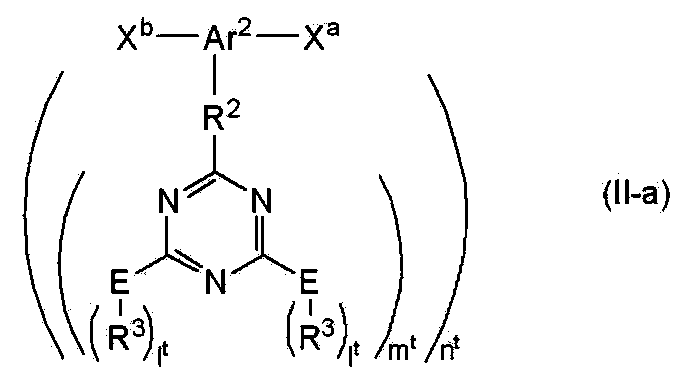
- the present invention first provides a compound represented by the following formula (II-a).
- Ar 2 represents an aromatic group which may have a substituent
- R 2 represents a direct bond or an organic group which may have only an oxygen atom as a hetero atom.
- E represents a hetero atom
- R 3 represents a monovalent hydrocarbon group or a hydrogen atom
- m t and n t each independently represents an integer of 1 or more
- l t represents 1 to 3
- a plurality of R 3 , E and l t may be the same or different from each other, and when there are a plurality of m t , they may be the same or different from each other.
- X a and X b are each independently a halogen atom, a nitro group, —SO 3 Q (where Q represents a substituted or unsubstituted monovalent hydrocarbon group), —B (OQ 1 ) 2 (where, Q 1 is either a hydrogen atom or a monovalent hydrocarbon group, one of two Q 1 is bonded to Q 1 with .2 pieces to form a ring may being the same or different), -.
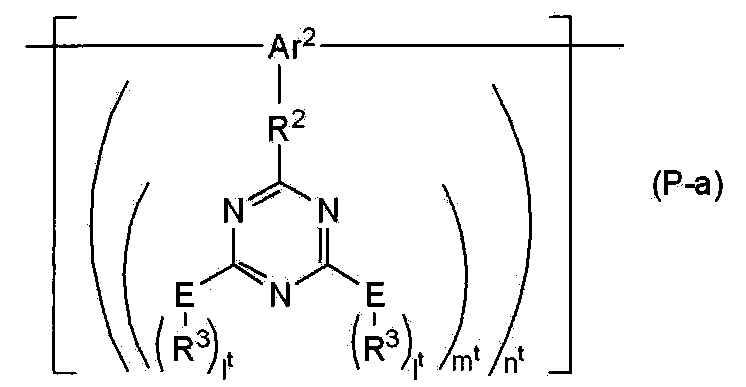
- the present invention secondly provides a polymer compound having a structural unit represented by the following formula (Pa) and having a molecular weight of 5 ⁇ 10 2 to 1 ⁇ 10 7 .
- Ar 2 represents an aromatic group which may have a substituent
- R 2 represents a direct bond or an organic group which may have only an oxygen atom as a hetero atom.
- E represents a hetero atom
- R 3 represents a monovalent hydrocarbon group or a hydrogen atom
- m t and n t each independently represents an integer of 1 or more
- l t represents 1 to 3
- a plurality of R 3 , E and l t may be the same or different from each other, and when there are a plurality of m t , they may be the same or different from each other. When there are a plurality of groups in parentheses to which m t and n t are attached, they may be the same as or different from each other.)
- the present invention provides a metal composite obtained by bringing the polymer compound into contact with a film or plate metal, or a film or plate metal compound.
- the present invention provides a metal composite obtained by contacting the polymer compound with metal nanoparticles having an aspect ratio of less than 1.5, or metal compound nanoparticles having an aspect ratio of less than 1.5.
- the present invention provides an electronic device including the metal composite.
- a compound capable of efficiently and strongly adsorbing a metal and a metal complex using the compound can be obtained.
- the compound of the present invention is particularly useful as a raw material for advanced functional materials such as electronic composite materials.
- adsorption means chemical adsorption or physical adsorption.
- the compound of the present invention is a compound represented by the formula (II-a).
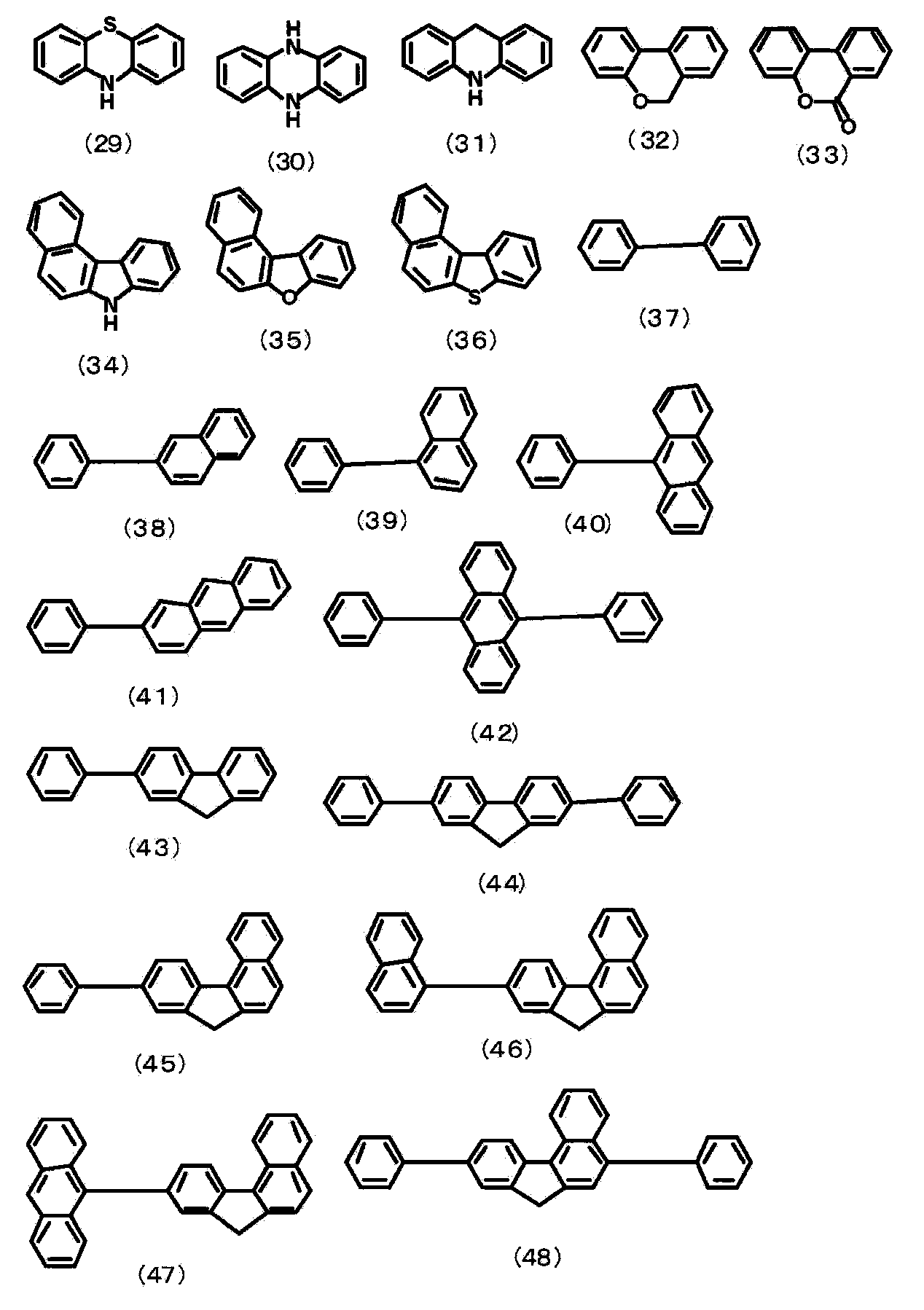
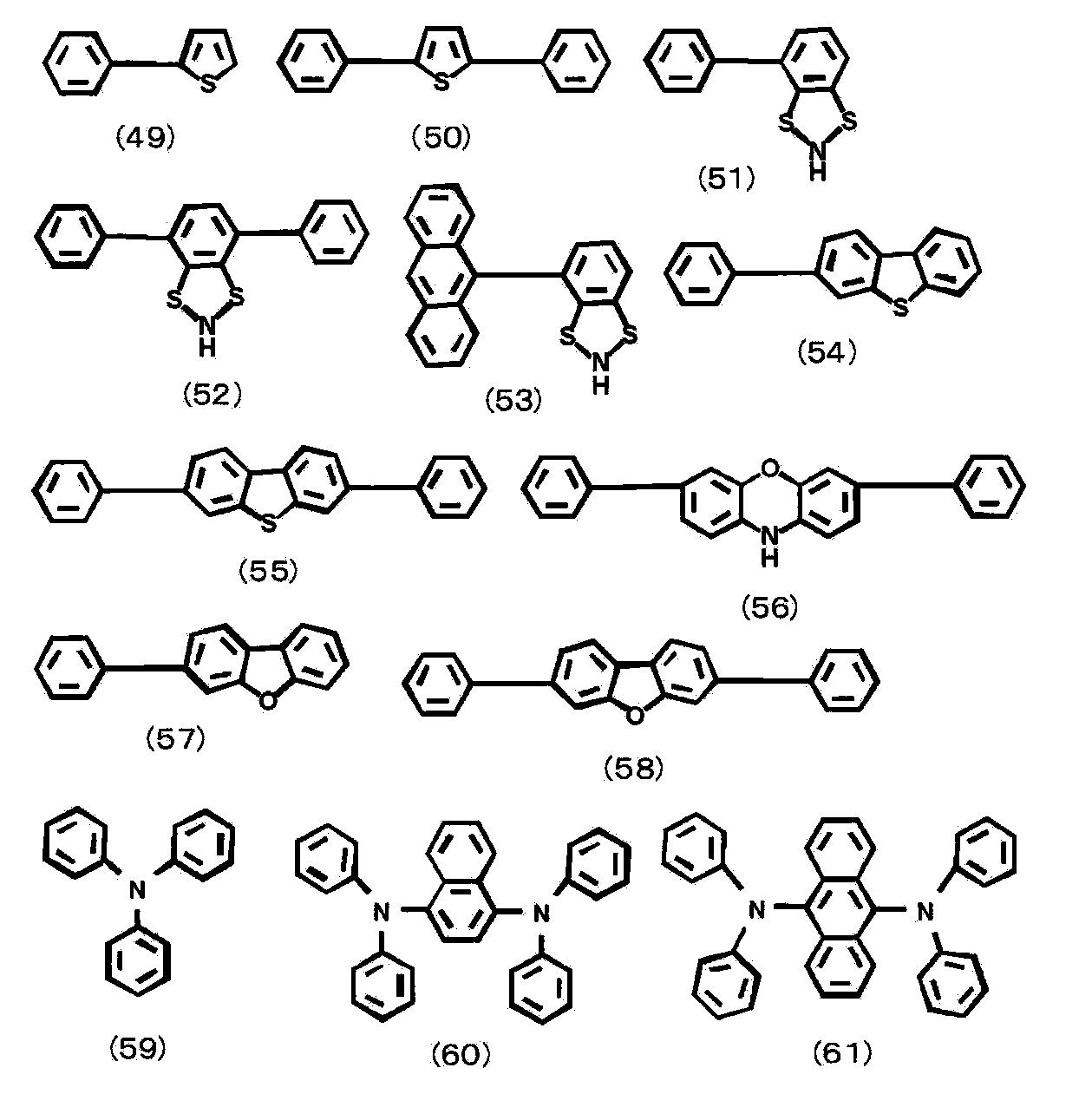
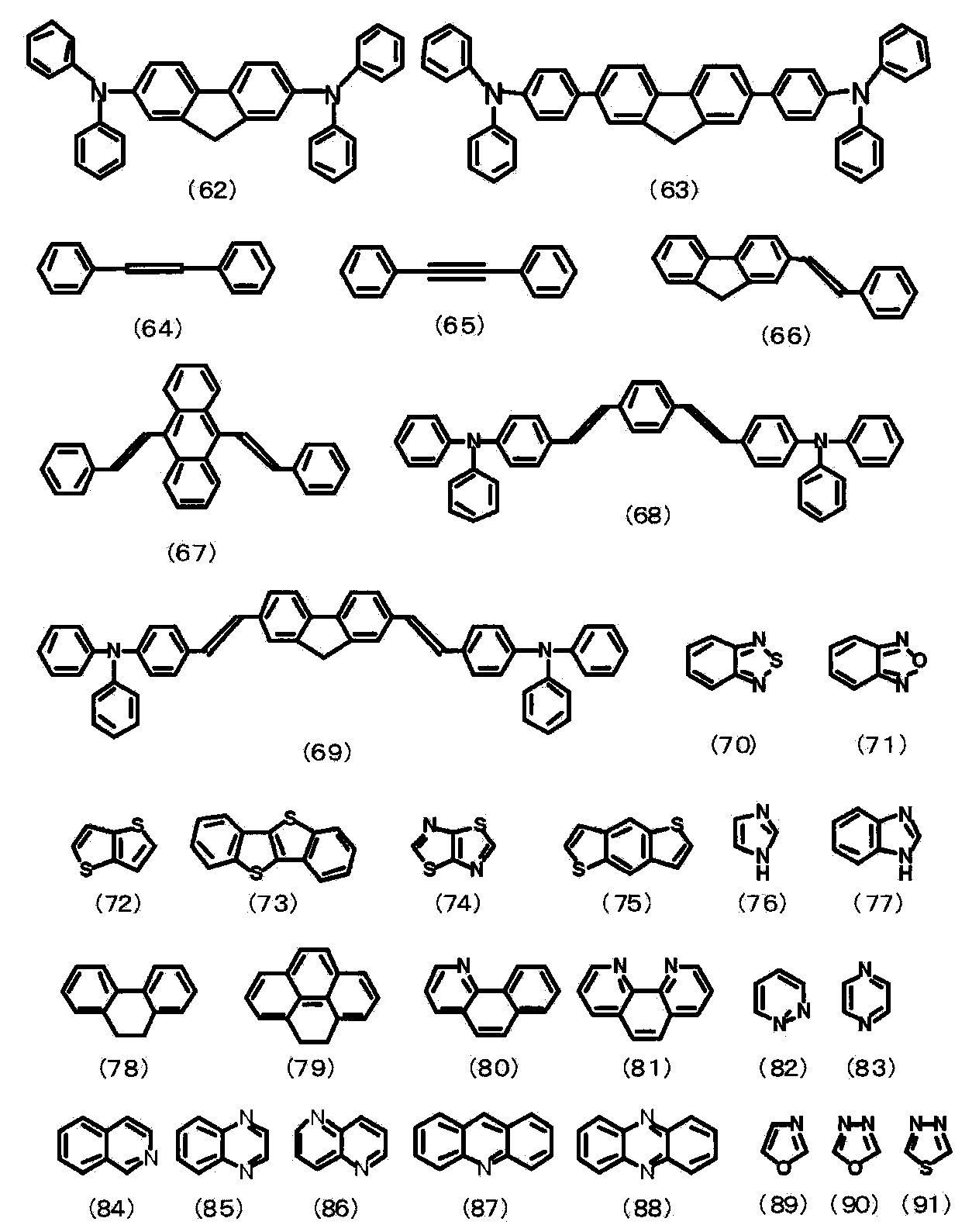
- Ar 2 Examples of the aromatic group represented by the following include the remaining atomic groups obtained by removing two hydrogen atoms from the compounds represented by the following formulas (1) to (91). This aromatic group may have a substituent.
- the formulas (1) to (12), (15) to (22), (24) to (31), Compounds represented by (37) to (40), (43) to (46), (49), (50), (59) to (76) are preferred, and the compounds represented by formulas (1) to (3), (8 ) To (10), (15) to (21), (24) to (31), (37), (39), (43) to (45), (49), (50), (59) to
- the compound represented by (76) is more preferable, and the compounds represented by formulas (1) to (3), (8), (10), (15), (17), (21), (24), (30), ( 59), (60) and (61) are more preferred, and compounds represented by formulas (1) to (3), (8), (10) and (59) are particularly preferred.
- the aromatic group represented by formula (1) may have, a halogen atom, a monovalent hydrocarbon group that may have a substituent, a mercapto group, a carbonyl mercapto group, a thiocarbonyl mercapto group, Hydrocarbon thio group optionally having substituent, hydrocarbon thiocarbonyl group optionally having substituent, hydrocarbon dithio group optionally having substituent, hydroxyl group, having substituent Optionally having a hydrocarbon oxy group, a carboxyl group, an aldehyde group, a hydrocarbon carbonyl group optionally having a substituent, a hydrocarbon oxycarbonyl group optionally having a substituent, having a substituent.
- Optionally substituted hydrocarbon carbonyloxy group, cyano group, nitro group, amino group, optionally substituted hydrocarbon monosubstituted amino group, optionally substituted hydrocarbon disubstituted amino group, Hos Inomoto, which may have a substituent hydrocarbon monosubstituted phosphino group, which may have a substituent hydrocarbon-disubstituted phosphino group, wherein :-P ( O) (OH) 2 , A carbamoyl group, an optionally substituted hydrocarbon monosubstituted carbamoyl group, an optionally substituted hydrocarbon disubstituted carbamoyl group, the formula: —B (OH) 2 A group represented by: a boric acid ester residue, a sulfo group, a hydrocarbon sulfo group that may have a substituent, a hydrocarbon sulfonyl group that may have a substituent, and a substituent.
- the aromatic group represented by may have only one kind of these substituents or may have two or more kinds. Moreover, when there are a plurality of substituents, they may be combined to form a ring.
- the halogen atom as a substituent include a fluorine atom, a chlorine atom, a bromine atom, and an iodine atom, a fluorine atom, a chlorine atom, and a bromine atom are preferable, and a chlorine atom and a bromine atom are more preferable.
- Examples of the monovalent hydrocarbon group which may have a substituent are a methyl group, an ethyl group, a propyl group, an isopropyl group, a butyl group, an isobutyl group, a t-butyl group, a pentyl group, and a hexyl group.
- an aryl group is an alkyl group having 1 to 12 carbon atoms, more preferably an aryl group having 6 to 18 carbon atoms, an alkyl group having 1 to 6 carbon atoms, an aryl group having 6 to 12 carbon atoms particularly preferred.
- a part or all (particularly 1 to 3, especially 1 or 2) of the hydrogen atoms constituting each group are the above-mentioned “monovalent optionally having substituent (s)”. It is a group that may be substituted with a “hydrocarbon group”.
- the substituents are a hydrocarbon monosubstituted amino group, a hydrocarbon disubstituted amino group, a hydrocarbon monosubstituted phosphino group, a hydrocarbon disubstituted phosphino group, a hydrocarbon monosubstituted carbamoyl group, and a hydrocarbon disubstituted carbamoyl group.
- 1 or 2 of hydrogen atoms constituting the group is a group which may be substituted with the above-mentioned “monovalent hydrocarbon group which may have a substituent”.
- the boric acid ester residue as a substituent is, for example, a group represented by the following formula.
- the monovalent heterocyclic group as a substituent is a remaining atomic group obtained by removing one hydrogen atom from a heterocyclic compound.
- Heterocyclic compounds include pyridine, 1,2-diazine, 1,3-diazine, 1,4-diazine, 1,3,5-triazine, furan, pyrrole, thiophene, pyrazole, imidazole, oxazole, thiazole, oxa Monocyclic heterocyclic compounds such as diazole, thiadiazole, azadiazole; condensed polycyclic heterocyclic compounds in which two or more of the heterocyclic rings constituting the monocyclic heterocyclic compound are condensed; monocyclic heterocyclic Bridge two heterocyclic rings constituting a compound or one aromatic ring and one heterocyclic ring constituting a monocyclic heterocyclic compound with a divalent group such as a methylene group, an ethylene group or a carbonyl group.
- Examples of the divalent hydrocarbon group represented by R ′ include a methylene group, an ethylene group, a 1,2-propylene group, a 1,3-propylene group, a 1,2-butylene group, a 1,3-butylene group, 1 Divalent saturated hydrocarbon groups having 1 to 50 carbon atoms such as 1,4-butylene group, 1,5-pentylene group, 1,6-hexylene group, 1,9-nonylene group, 1,12-dodecylene group; 2 carbon atoms such as ethenylene group, propenylene group, 3-butenylene group, 2-butenylene group, 2-pentenylene group, 2-hexenylene group, 2-nonenylene group, 2-dodecenylene group, etc., and ethynylene group To 50 divalent unsaturated hydrocarbon groups; cyclopropylene group, cyclobutylene group, cyclopentylene group, cyclohexylene group, a 1,2-
- the hydrogen atom in these groups may be substituted with a substituent.
- the hydrocarbon group having two or more ester bonds as a substituent is, for example, a group represented by the following formula. (Wherein R ′ and n have the same meaning as described above.)
- the hydrocarbon group having two or more amide bonds as a substituent is, for example, a group represented by the following formula.
- the metal cation represented by M is preferably a monovalent to trivalent ion, and Li, Na, K, Cs, Be, Mg, Ca, Ba, Ag, Al, Bi, Cu, Fe, Ga, Mn, Examples include ions of metals such as Pb, Sn, Ti, V, W, Y, Yb, Zn, and Zr.
- the substituent includes carbon such as methyl group, ethyl group, propyl group, isopropyl group, butyl group, isobutyl group, and t-butyl group.
- Examples thereof include alkyl groups having 1 to 10 atoms.
- Examples of the monovalent hydrocarbon group represented by R include an alkyl group, a cycloalkyl group, an aryl group, and an aralkyl group.
- the anion represented by M ′ is F ⁇ , Cl ⁇ , Br ⁇ , I ⁇ , OH ⁇ , ClO ⁇ , ClO 2 ⁇ , ClO 3 ⁇ , ClO 4 ⁇ , SCN ⁇ , CN ⁇ , NO 3 ⁇ , SO 4 2- , HSO 4 ⁇ , PO 4 3- , HPO 4 2- , H 2 PO 4 ⁇ , BF 4 ⁇ , PF 6 ⁇ , CH 3 SO 3 ⁇ , CF 3 SO 3 ⁇ , Tetrakis (imidazolyl) borate anion, 8-quinolinolato anion, 2-methyl-8-quinolinolato anion, 2-phenyl-8-quinolino
- Examples of the monovalent heterocyclic group having a quaternized nitrogen atom as a substituent in the heterocyclic ring include groups represented by the following formulae. (Wherein R and M ′ have the same meaning as described above.)
- R 2 As the organic group which may have only an oxygen atom as the hetero atom represented by the above, CH of a monovalent hydrocarbon group which may have the above substituent 2
- An atomic group may be mentioned, and these groups may form a ring.
- R 2 Preferably, the remaining atomic group obtained by removing part of the hydrogen atom from the optionally substituted alkyl group, or part of the hydrogen atom removed from the optionally substituted aryl group More preferably, the remaining atomic group obtained by removing a part of hydrogen atoms from an alkyl group having 1 to 12 carbon atoms, or the remaining atomic group obtained by removing a part of hydrogen atoms from a phenyl group. And more preferably a remaining atomic group obtained by removing a part of hydrogen atoms from an alkyl group having 1 to 6 carbon atoms, and a remaining atomic group obtained by removing a part of hydrogen atoms from a phenyl group.
- examples of the hetero atom represented by E include an oxygen atom, a sulfur atom, a nitrogen atom, a phosphorus atom, a silicon atom, a selenium atom, and a tellurium atom, preferably an oxygen atom and a sulfur atom. And a nitrogen atom, more preferably an oxygen atom and a sulfur atom, and particularly preferably a sulfur atom.
- E is an oxygen atom or a sulfur atom
- R 3 When is a hydrogen atom, an isomerization reaction represented by the following reaction formula may occur. The compound produced by this isomerization reaction exhibits the same effect as the compound of the present invention.
- E is a sulfur atom and R 3
- R 3 When is a hydrogen atom, a structure of -EE is easily generated by a reaction between two molecules of -E-H. The compound produced by this reaction also exhibits the same effect as the compound of the present invention.
- R 3 The monovalent hydrocarbon group represented by is the same as the monovalent hydrocarbon group which is explained and exemplified in the paragraph of the substituent and may have a substituent. Multiple R 3 May be the same or different from each other, and a plurality of R 3 They may form a ring.
- X a And X b examples of the halogen atom represented by the formula include a fluorine atom, a chlorine atom, a bromine atom and an iodine atom, and a chlorine atom, a bromine atom and an iodine atom are preferable.
- the substituted or unsubstituted monovalent hydrocarbon group represented by Q is the same as the monovalent hydrocarbon group which may have a substituent described and exemplified in the paragraph of the substituent. is there.
- a fluorine atom is mentioned as a substituent.
- X a And X b -SO represented by 3
- Q include a methanesulfonate group, a benzenesulfonate group, a p-toluenesulfonate group, and a trifluoromethanesulfonate group.
- the monovalent hydrocarbon group represented by the above examples include monovalent hydrocarbon groups which may be substituted as described and exemplified in the above-mentioned substituent group, but an alkyl group is preferable, and methyl Group, ethyl group, propyl group, isopropyl group, butyl group, isobutyl group, pentyl group, hexyl group and nonyl group are more preferable, and methyl group, ethyl group, propyl group, butyl group, pentyl group and hexyl group are more preferable.
- Examples of the monovalent hydrocarbon group represented by the above include monovalent hydrocarbon groups which may be substituted as described and exemplified in the above-mentioned substituent group, but an alkyl group is preferable, and methyl Group, ethyl group, propyl group, isopropyl group, butyl group, isobutyl group, pentyl group, hexyl group and nonyl group are more preferable, and methyl group, ethyl group, propyl group, butyl group, pentyl group and hexyl group are more preferable.
- X a And X b Is preferably a halogen atom, -SO 3 Q, -B (OQ 1 ) 2 , -B (OQ 01 ) 3 ⁇ M a More preferably, a chlorine atom, a bromine atom, an iodine atom, -SO 3 Q is more preferably a chlorine atom, bromine atom, iodine atom or trifluoromethanesulfonate group, particularly preferably a chlorine atom, bromine atom or iodine atom, particularly preferably a bromine atom.
- l t Is an integer of 1 to 3.
- R directly connected to E when E is a silicon atom 3 L representing the number of t R is directly connected to E when E is a nitrogen atom or a phosphorus atom 3 L representing the number of t Is 2, and when E is an oxygen atom, sulfur atom, selenium atom or tellurium atom, R directly connected to E 3 L representing the number of t Is 1.
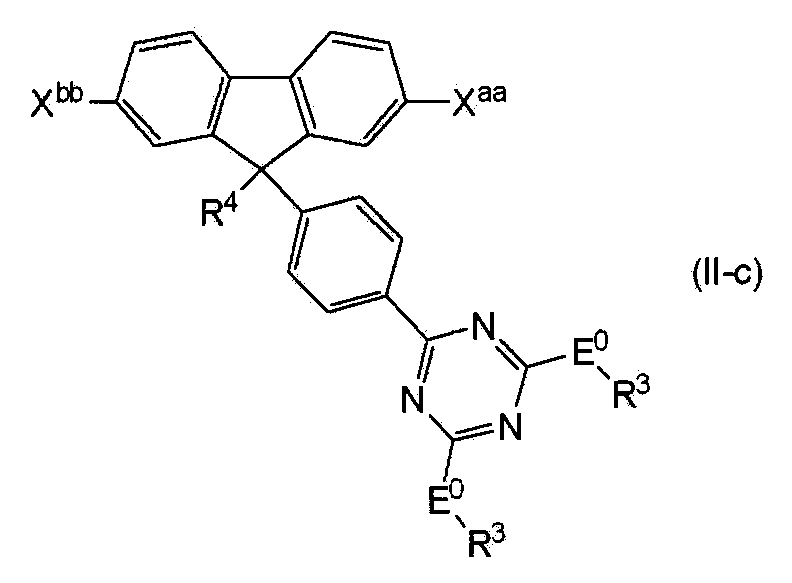
- a compound represented by the following formula (II-a) is preferable, and a compound represented by the following formula (II-c) is more preferable.
- E 0 represents a sulfur atom or an oxygen atom.
- R 02 When there are a plurality of these, they may be the same as or different from each other.
- R 3 , X a And X b Has the same meaning as described above.
- n t When there are a plurality of groups in parentheses marked with, they may be the same as or different from each other. ) (Wherein R 3 , R 4 And E 0 Has the same meaning as described above.
- X aa And X bb Each independently represents a chlorine atom, a bromine atom or an iodine atom.
- R in the formula (II-b) 02 The divalent hydrocarbon group represented by is the same as the divalent hydrocarbon group described and exemplified in the section of the divalent hydrocarbon group represented by R ′, but a phenylene group is preferable.
- Examples of the halogen atom represented by the formula include a fluorine atom, a chlorine atom, a bromine atom and an iodine atom, and a chlorine atom, a bromine atom and an iodine atom are preferable.
- the monovalent hydrocarbon group represented by is the same as the monovalent hydrocarbon group which may be substituted as described and exemplified in the paragraph of the substituent.
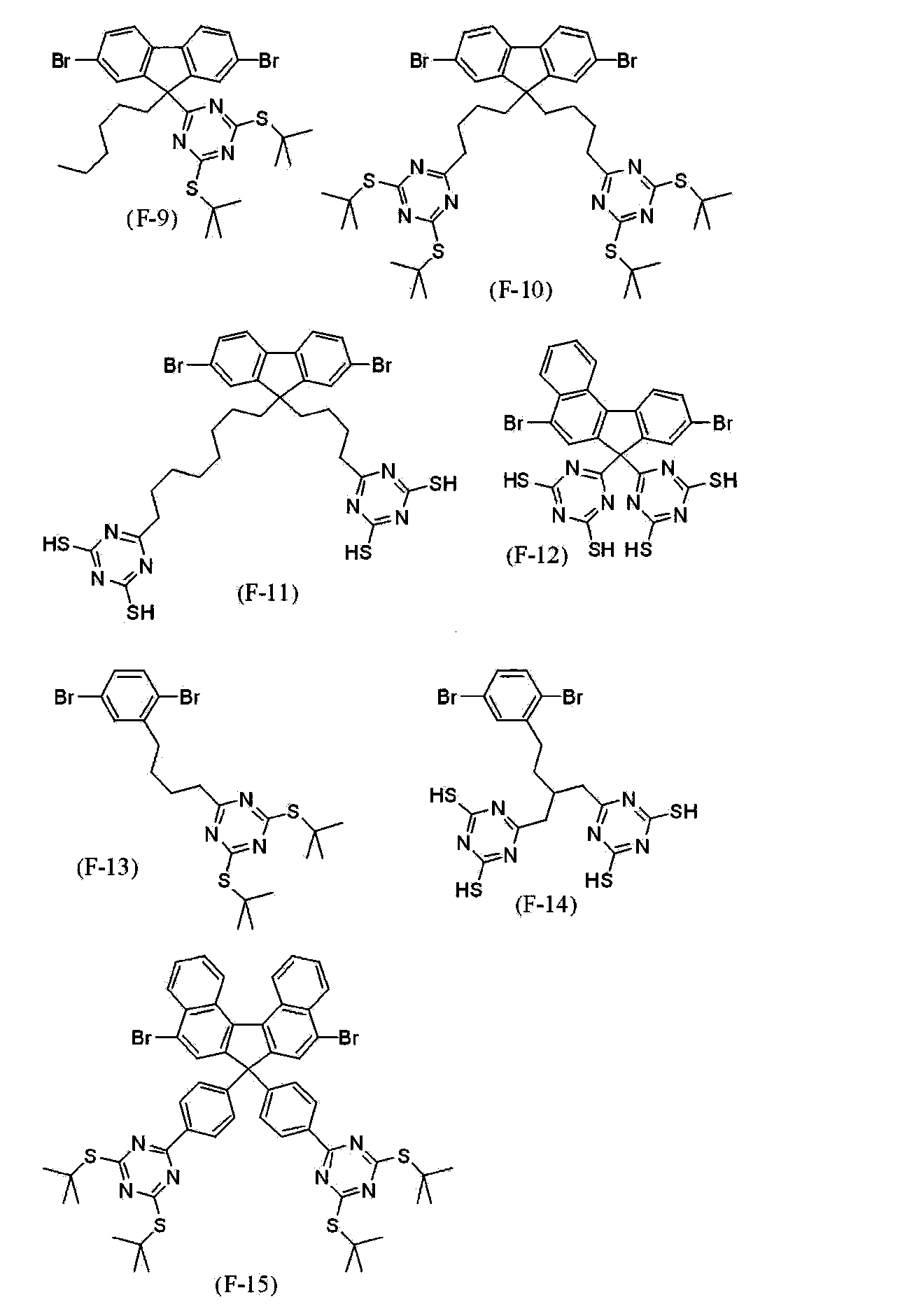
- Examples of the compound of the present invention include compounds represented by the following formulas (F-1) to (F-29), and are represented by the following formulas (F-1) to (F-12). Compounds are preferred.
- ⁇ Production method of compound> The compound of the present invention may be synthesized by any method, but an example of the synthesis method will be described below (Scheme A). This scheme A is X a And X b Applicable when is a halogen atom.
- Another example of the method for synthesizing the compound of the present invention includes a method of reacting a compound represented by the following formula (II-t) with a compound represented by the following formula (II-u). (Wherein R 2 , R 3 , E, l t And m t Has the same meaning as described above.
- X c Is a halogen atom, a nitro group, -SO 3 Q, -B (OQ 1 ) 2 , -B (OQ 01 ) 3 ⁇ M a , -Si (Q 2 ) 3 Or -Sn (Q 3 ) 3 Represents.
- m t When there are a plurality of groups in parentheses marked with, they may be the same as or different from each other. ) (Wherein Ar 2 , X a , X b And n t Has the same meaning as described above.
- X d Is a halogen atom, a nitro group, -SO 3 Q, -B (OQ 1 ) 2 , -B (OQ 01 ) 3 ⁇ M a , -Si (Q 2 ) 3 Or -Sn (Q 3 ) 3 Represents. ) X in the formula (II-t) c And X in the formula (II-u) d When is a halogen atom, Kumada-Tamao coupling can be used.
- the compound represented by the formula (II-t) or the compound represented by the formula (II-u) in advance with magnesium or with alkylmagnesium chloride or the like, X c Or X d -MgX c , -MgX d Or -MgCl followed by a nickel catalyst (eg, NiCl 2 (Dppe) 2 ) Or palladium catalyst (eg, Pd (PPh 3 ) 4 In the presence of), the compound represented by the formula (II-a) can be obtained by reacting with the other.
- a nickel catalyst eg, NiCl 2 (Dppe) 2
- palladium catalyst eg, Pd (PPh 3 ) 4
- the compound represented by the formula (II-a) can be obtained by reacting with the other.
- Yamamoto coupling can also be used. That is, the compound represented by the formula (II-t) and the compound represented by the formula (II-u) are converted into a nickel catalyst (for example, bis (1,5-cyclooctadiene) nickel (0)
- the compound represented by the formula (II-a) can be obtained by coupling in the presence of ().
- X in the formula (II-t) c X in the formula (II-u) d One is a halogen atom and the other is -B (OQ 1 ) 2 Or -B (OQ 01 ) 3 ⁇ M a
- a Suzuki-Miyaura coupling can be used. That is, the compound represented by the formula (II-t) and the compound represented by the formula (II-u) are converted into a base and a palladium catalyst (for example, Pd (PPh 3 ) 4
- the compound represented by the formula (II-a) can be obtained by coupling in the presence of ().
- the compound represented by the formula (II-t) and the compound represented by the formula (II-u) may be converted into an Ullmann reaction, a Gracer reaction, a Mizorogi-Heck reaction, a Negishi coupling, a Still cup.
- the compound represented by the formula (II-a) can be obtained by ring, Sonogashira coupling, Buchwald-Hartwig reaction, or the like.
- the polymer compound of the present invention has a structural unit represented by the formula (Pa) and has a molecular weight of 5 ⁇ 10. 2 ⁇ 1 ⁇ 10 7 It is a high molecular compound.
- the polymer compound of the present invention is preferably a conjugated polymer compound because the charge easily moves in the molecule. Since the molecular weight of the polymer compound of the present invention is excellent in electrical conductivity and coatability, 1 ⁇ 10 3 ⁇ 2 ⁇ 10 6 Is preferred 2 ⁇ 10 3 ⁇ 1 ⁇ 10 6 Is more preferable, 2 ⁇ 10 3 ⁇ 5 ⁇ 10 5 Is more preferable. The molecular weight of the resulting polymer compound may not be uniform, and it may be difficult to accurately measure the molecular weight.
- the number average molecular weight or the weight average molecular weight is obtained from the molecular weight distribution converted into a standard polymer compound such as polystyrene, and used as the molecular weight of the conjugated compound.
- Ar in the formula (II-a) 2 , R 2 , E, R 3 , M t , N t And l t It is the same as described and exemplified as.
- Examples of the structural unit represented by the formula (Pa) include X of the compounds represented by the formulas (F-1) to (F-28).
- the structural unit represented by the formula (P-a) has excellent conductivity, HOMO energy level, LUMO energy level, and ease of synthesis. Therefore, the structural unit represented by the following formula (P-b)
- R 3 And E 0 May be the same as or different from each other.
- R 02 When there are a plurality of these, they may be the same as or different from each other.
- n t When there are a plurality of groups in parentheses marked with, they may be the same as or different from each other.
- R in the above formula (Pb) 02 Is preferably a phenylene group.
- E in the formula (Pc) 0 , R 3 And R 4 Is E in the formula (II-c) 0 , R 3 And R 4 It is the same as described and exemplified as.
- the polymer compound of the present invention may be a homopolymer composed only of the structural units described above, or may be a copolymer including other structural units.
- Examples of other structural units include a structural unit composed of a dioctyl fluorenediyl group, a structural unit composed of a bithiophenediyl group, and the like, -Ar 2 -The structural unit represented by-(Note that this structural unit is different from the structural unit represented by the formula (P-a)).
- the polymer compound of the present invention is a copolymer, the adsorption to the metal nanoparticles or metal compound nanoparticles becomes stronger and the solubility in a solvent is improved.
- the number of structural units represented by the formula (Pa) contained is preferably 1 to 2000, more preferably 1 to 1000, still more preferably 1 to 200, particularly preferably 1 to 50, 1 to 20 is particularly preferable.
- the polymer compound of the present invention may be synthesized by any method. As an example of the synthesis method, a method using the compound of the present invention will be described below.
- the polymer compound of the present invention may be reacted, for example, using the compound of the present invention alone, but the compound of the present invention, the compound represented by the following formula (Va) and / or the following formula (You may make it react together with the compound represented by Vb).
- Va the compound represented by the following formula
- Each of these compounds may be used alone or in combination of two or more. (Where X a , X b And Ar 2 Has the same meaning as described above. ) (Where X a And Ar 2 Has the same meaning as described above.
- the resulting polymer compound is a polymer compound composed only of the structural unit represented by the formula (Pa).
- the compound of the present invention is reacted in combination with the compound represented by the formula (Va) and / or the compound represented by the formula (Vb)
- the resulting polymer compound is It is a high molecular compound containing the structural unit represented by a following formula (PVa), and / or the group represented by a following formula (PVb).
- the resulting polymer compound is Ar 2
- the group represented by the formula is likely to have a linear structure in which the chain is continuous, and the group represented by the formula (PVb) is included as a terminal thereof.
- the compound represented by the formula (Va) and / or the compound of the present invention may further be -X.
- the resulting polymer compound has a dendritic or network structure.
- X of the compound of the present invention a And X b When is a halogen atom, Kumada-Tamao coupling can be used.
- X of the compound of the present invention a And X b
- Yamamoto coupling can also be used. That is, the polymer compound of the present invention can be obtained by coupling in which the compound of the present invention is reacted in the presence of a nickel catalyst (for example, bis (1,5-cyclooctadiene) nickel (0)).
- a nickel catalyst for example, bis (1,5-cyclooctadiene
- X of these compounds a And X b Is preferably a halogen atom.
- X of the compound of the present invention a And X b
- One of the is a halogen atom, (1) The other is -B (OQ 1 ) 2 Or -B (OQ 01 ) 3 ⁇ M a If it is, (2) X of the compound of the present invention a And X b Is a halogen atom, and X of the compound represented by the above formula (Va) is present a And X b And X of the compound represented by the formula (Vb) a -B (OQ 1 ) 2 Or -B (OQ 01 ) 3 ⁇ M a Or (3) X of the compound of the present invention a And X b -B (OQ 1 ) 2 Or -B (OQ 01 ) 3 ⁇ M a And X of the compound represented by the above formula (Va) a And X b And / or X of the compound represented by the formula (Vb) a And X b When both are halogen
- the compound of the present invention is converted to a base and a palladium catalyst (eg, Pd (PPh 3 ) 4
- the polymer compound of the present invention can be obtained by the reaction in the presence of ().
- the polymer compound of the present invention can be produced by subjecting the compound of the present invention to Ullmann reaction, Gracer reaction, Mizorogi-Heck reaction, Negishi coupling, Stille coupling, Sonogashira coupling, Buchwald-Hartwig reaction, etc. Can be obtained.
- the polymer compound of the present invention is represented by R in the formula (Pa). 3 Is preferably a hydrogen atom because it can be more efficiently and more strongly adsorbed to metal nanoparticles or metal compound nanoparticles.
- the compound of the present invention is R 3
- the coupling reaction or the like may not easily proceed.
- R 3 After synthesizing a polymer compound using the compound of the present invention in which is not a hydrogen atom, a carboxylic acid such as aluminum chloride or formic acid, a sulfonic acid such as trifluoromethanesulfonic acid, or the like is used.
- R 3 It is preferable to carry out a reaction for converting to a hydrogen atom.
- the metal composite of the present invention includes the polymer compound of the present invention and a film-like or plate-like metal, or a film-like or plate-like metal compound, or metal nanoparticles or an aspect having an aspect ratio of less than 1.5. It is a metal composite obtained by contacting metal compound nanoparticles having a ratio of less than 1.5.
- the thickness of the film-like or plate-like metal, or the film-like or plate-like metal composite is usually 0.01 nm to 10 cm, preferably 0.01 nm to 0.5 cm, and preferably 0.01 nm to 200 ⁇ m. Is more preferable, and 0.01 nm to 20 ⁇ m is even more preferable.
- Examples of the metal or metal constituting the metal compound include aluminum, scandium, titanium, vanadium, chromium, manganese, iron, cobalt, nickel, copper, zinc, gallium, germanium, yttrium, zirconium, niobium, molybdenum, ruthenium, Rhodium, palladium, silver, cadmium, indium, tin, antimony, lanthanum, cerium, europium, hafnium, tantalum, tungsten, rhenium, osmium, iridium, platinum, gold, mercury, thallium, lead, bismuth, aluminum, titanium , Vanadium, chromium, manganese, iron, cobalt, nickel, copper, zinc, gallium, germanium, yttrium, zirconium, molybdenum, ruthenium, rhodium, palladium, silver, indium, tin, Timon, lanthanum, cerium, tantalum,
- metal compound examples include alloys, metal oxides, composite oxides, metal nitrides, metal sulfides, and metal salts, and alloys, metal oxides, composite oxides, and metal sulfides are preferable.
- Metal compounds include indium tin oxide (ITO), indium zinc oxide (IZO), molybdenum oxide, aluminum oxide, titanium oxide, zinc oxide, copper oxide, copper dioxide, magnesium oxide, yttrium oxide, tungsten oxide (VI) , Silicon oxide, tin (IV) oxide, nickel tungsten, cerium oxide, manganese oxide, tin sulfide, cobalt oxide, holmium oxide, cobalt tetroxide, iron tetroxide, cobalt aluminate (CoAl 2 O 4 ), Spinel (Al 2 O 3 Indium tin oxide, indium zinc oxide, molybdenum oxide, aluminum oxide, titanium oxide, zinc oxide, copper oxide, copper dioxide, magnesium oxide, yttrium oxide, tungs
- the film-like or plate-like metal or film-like or plate-like metal oxide is formed by casting, rolling, chamfering, polishing, etc., vacuum deposition such as vapor deposition, sputtering, ion plating, electroplating, Although it can be produced by plating treatment such as anodic oxidation, electroless plating, chemical plating, etc., application of a particle dispersion, etc., those produced by rolling, vapor deposition, sputtering, or ion plating are preferred.
- the metal nanoparticles and metal composite nanoparticles usually have a longest axis length of 10 ⁇ m or less, preferably 0.1 nm to 1 ⁇ m, more preferably 1 nm to 500 nm.
- the metal nanoparticles and metal compound nanoparticles have an aspect ratio (that is, the longest diameter / the shortest diameter, which is an average value when the aspect ratio is distributed) of less than 1.5.
- the ratio is preferably 1.4 or less, more preferably 1.3 or less, still more preferably 1.2 or less, and particularly preferably 1.1 or less.
- the metal nanoparticles may be the metal itself, or other metal adsorbed on the metal.
- the metal compound nanoparticles may be the metal compound itself or those obtained by adsorbing other substances on the metal compound.
- the contact includes (1) a method of attaching the polymer compound of the present invention to a film-like or plate-like metal, or a film-like or plate-like metal compound, and (2) a polymer compound of the present invention to a film-like or A method of applying to a plate-like metal, or a film-like or plate-like metal compound, (3) A method of stirring or kneading the polymer compound of the present invention and metal nanoparticles or metal compound nanoparticles. Can do.
- a solvent is preferably interposed.
- other components may coexist in the system, or ultrasonic waves may be applied.
- a solution containing 0.0001 to 50% by weight of the polymer compound of the present invention is prepared and applied to a film-like or plate-like metal, or a film-like or plate-like metal compound. It is preferable.
- the solvent when a solvent is interposed at the time of contact, the solvent can dissolve the polymer compound of the present invention and does not dissolve the metal nanoparticles or metal compound nanoparticles. Is usually used.
- This solvent includes methanol, ethanol, benzyl alcohol, acetone, methyl ethyl ketone, dimethylformamide, dimethyl sulfoxide, ethyl acetate, toluene, xylene, orthodichlorobenzene, chloroform, tetrahydrofuran, hexane, benzene, diethyl ether, acetonitrile, acetic acid, Examples include water, propanol, butanol, and N-methylpyrrolidone.
- this solvent may be used individually by 1 type, or may use 2 or more types together.
- the temperature for stirring and kneading is preferably -70 ° C to 200 ° C, more preferably -10 ° C to 120 ° C, still more preferably 0 ° C to 100 ° C, and particularly preferably 20 ° C. ° C to 70 ° C.
- the stirring and kneading time is preferably 0.01 seconds to 1000 minutes, more preferably 0.1 seconds to 900 minutes, and further preferably 1 second to 500 minutes.
- a step of purifying the obtained complex (hereinafter referred to as “purification step”) may be performed.
- the solvent can be removed by heating and drying the resulting composite.
- the excess can be obtained by spraying a solvent capable of dissolving the polymer compound or immersing the obtained complex in the solvent.
- the high molecular compound can be removed.
- excess polymer compound is removed by ultrasonic dispersion, centrifugation, supernatant removal, redispersion, dialysis, filtration, washing, heating, drying, etc. can do.
- an electronic device including the metal composite of the present invention that is, an electronic device in which the polymer compound of the present invention and a metal or a metal compound are stacked in layers can easily transfer charges between the layers.
- the flowing current is increased.
- the electronic device of the present invention include light emitting devices such as organic EL devices, photoelectric conversion devices such as transistors and solar cells.
- the polymer compound J has two types of repeating units represented by the following formula. Structural unit represented by the following formula in polymer compound J: Was 4.4 mol%. Moreover, the number average molecular weight of polystyrene conversion of the high molecular compound J was 6.7 * 10 ⁇ 3 >, and the weight average molecular weight of polystyrene conversion was 1.3 * 10 ⁇ 4 >.
- a 50 ml flask was charged with 485 mg of polymer compound J and 31.5 ml of toluene and stirred at room temperature. Subsequently, after adding aluminum chloride, it stirred at 115 degreeC for 1 hour.
- the solid is considered to be a polymer compound P-1 (polymer) having two types of repeating units represented by the following formula.
- the number average molecular weight in terms of polystyrene of the polymer compound P-1 was 6.6 ⁇ 10 3
- the weight average molecular weight in terms of polystyrene was 1.6 ⁇ 10 4 .
- the polymer compound G has two types of repeating units represented by the following formula.
- the number average molecular weight of polystyrene conversion of the high molecular compound G was 7.9 * 10 ⁇ 3 >, and the weight average molecular weight of polystyrene conversion was 1.9 * 10 ⁇ 4 >.
- a 50 ml flask was charged with 80 mg of polymer compound G and 20 ml of toluene, and stirred for 10 minutes at room temperature. Subsequently, after adding aluminum chloride, it stirred for further 1 hour. The organic layer in the reaction vessel was dropped into 500 ml of methanol to deposit a precipitate. The precipitate was filtered and dried to obtain 40 mg of a solid.
- polymer compound K is represented by the following formula. (In the formula, n and m are numbers representing the number of repeating units.
- N m is 7: 1 when estimated from the charging ratio.
- N m is 7: 1 when estimated from the charging ratio.
- the solid is considered to be a polymer compound P-3 (polymer) represented by the following formula. (In the formula, n and m are numbers representing the number of repeating units.
- N m is 7: 1 when estimated from the charging ratio.
- the number average molecular weight in terms of polystyrene of the polymer compound P-3 was 4.3 ⁇ 10 3 , and the weight average molecular weight in terms of polystyrene was 1.5 ⁇ 10 4 .
- 6.7 mg of the polymer compound P-1 was dissolved in 3 mL of toluene.
- Example 7 Take 7 mg of silver nanoparticles (nano powder, particle size: ⁇ 100 nm, 99.5% trace metals base, manufactured by Aldrich), add to 1.5 mL of toluene, put the whole container in an ultrasonic cleaner and ultrasonicate the silver particles. Diffused. At this time, the liquid was cloudy in gray for a while, but after 1 hour, silver nanoparticles were precipitated and the supernatant became transparent. After once again diffusing the silver particles with ultrasonic waves, 2 mg of the polymer compound P-1 was added and stirred, the resulting dispersion was still turbid even after 1 hour and the silver particles were dispersed.
- Hexane is distilled off from an hexane solution of silver nanoparticles surface-modified with dodecanethiol (particle size (DLS): 5-15 nm, 0.25% (w / v) hexane solution, manufactured by Aldrich) with an evaporator (here The weight of silver nanoparticles was 8.6 mg), and 2.2 g of toluene was added to prepare a toluene solution of silver nanoparticles. 1.32 g was taken from the toluene solution of silver nanoparticles, 1.29 g was taken from the polymer compound P-3 toluene solution, and both were mixed. The obtained mixed solution was transparent and uniform, and no precipitate was formed.
- DLS particle size
- PHS particle size
- the dodecanethiol on the surface of the silver nanoparticles was replaced by the polymer compound P-3, and methanol.
- the silver nanoparticles are precipitated together with the polymer compound P-3, and no silver nanoparticles are present in the liquid.
- This precipitate is a complex of the polymer compound P-3 and silver nanoparticles.
- This precipitate was separated from the methanol solution using a centrifuge, dried, and measured for 1 H-NMR spectrum (in deuterated chloroform, TMS standard), there was no signal that could be attributed to dodecanethiol.
Landscapes
- Chemical & Material Sciences (AREA)
- Organic Chemistry (AREA)
- Health & Medical Sciences (AREA)
- Chemical Kinetics & Catalysis (AREA)
- Medicinal Chemistry (AREA)
- Polymers & Plastics (AREA)
- Polyoxymethylene Polymers And Polymers With Carbon-To-Carbon Bonds (AREA)
- Powder Metallurgy (AREA)
- Organic Low-Molecular-Weight Compounds And Preparation Thereof (AREA)
Abstract
Description
本発明は第一に、下記式(II−a)で表される化合物を提供する。
本発明は第二に、下記式(P−a)で表される構成単位を有する、分子量が5×10²~1×10⁷の高分子化合物を提供する。
本発明は第三に、前記高分子化合物と、膜状若しくは板状の金属、又は、膜状若しくは板状の金属化合物とを接触させることにより得られる金属複合体を提供する。
本発明は第四に、前記高分子化合物と、アスペクト比が1.5未満の金属ナノ粒子、又は、アスペクト比が1.5未満の金属化合物ナノ粒子とを接触させることにより得られる金属複合体を提供する。
本発明は第五に、前記金属複合体を含む電子素子を提供する。
本発明により、金属と効率よく強固に吸着できる化合物、及び、それを用いた金属複合体が得られる。また、本発明の化合物は、電子複合材料等の先端機能材料の原料として、特に有用である。
本明細書において、「吸着」とは、化学吸着、物理吸着を意味する。
<化合物>
本発明の化合物は、前記式(II−a)で表される化合物である。
前記式(II−a)中、Ar2で表される芳香族基としては、以下の式(1)~(91)で表される化合物から水素原子を2個取り除いた残りの原子団等が挙げられる。この芳香族基は、置換基を有していてもよい。
以下の式(1)~(91)で表される化合物の中でも、合成が容易であるので、式(1)~(12)、(15)~(22)、(24)~(31)、(37)~(40)、(43)~(46)、(49)、(50)、(59)~(76)で表される化合物が好ましく、式(1)~(3)、(8)~(10)、(15)~(21)、(24)~(31)、(37)、(39)、(43)~(45)、(49)、(50)、(59)~(76)で表される化合物がより好ましく、式(1)~(3)、(8)、(10)、(15)、(17)、(21)、(24)、(30)、(59)、(60)、(61)で表される化合物が更に好ましく、式(1)~(3)、(8)、(10)、(59)で表される化合物が特に好ましい。

前記Ar2で表される芳香族基は、これらの置換基を一種のみ有していても二種以上有していてもよい。また、複数の置換基がある場合には、それらが一緒になって環を形成していてもよい。
置換基であるハロゲン原子としては、フッ素原子、塩素原子、臭素原子、ヨウ素原子が挙げられ、フッ素原子、塩素原子、臭素原子が好ましく、塩素原子、臭素原子が更に好ましい。
置換基である、置換基を有していてもよい1価の炭化水素基としては、メチル基、エチル基、プロピル基、イソプロピル基、ブチル基、イソブチル基、t−ブチル基、ペンチル基、ヘキシル基、ノニル基、ドデシル基、ペンタデシル基、オクタデシル基、ドコシル基等の炭素数1~50のアルキル基;シクロプロピル基、シクロブチル基、シクロブチル基、シクロペンチル基、シクロヘキシル基、シクロノニル基、シクロドデシル基、ノルボニル基、アダマンチル基等の炭素数3~50の環状飽和炭化水素基;エテニル基、プロペニル基、3−ブテニル基、2−ブテニル基、2−ペンテニル基、2−ヘキセニル基、2−ノネニル基、2−ドデセニル基等の炭素数2~50のアルケニル基;フェニル基、1−ナフチル基、2−ナフチル基、2−メチルフェニル基、3−メチルフェニル基、4−メチルフェニル基、4−エチルフェニル基、4−プロピルフェニル基、4−イソプロピルフェニル基、4−ブチルフェニル基、4−t−ブチルフェニル基、4−ヘキシルフェニル基、4−シクロヘキシルフェニル基、4−アダマンチルフェニル基、4−フェニルフェニル基等の炭素数6~50のアリール基;フェニルメチル基、1−フェニレンエチル基、2−フェニルエチル基、1−フェニル−1−プロピル基、1−フェニル−2−プロピル基、2−フェニル−2−プロピル基、3−フェニル−1−プロピル基、4−フェニル−1−ブチル基、5−フェニル−1−ペンチル基、6−フェニル−1−ヘキシル基等の炭素数7~50のアラルキル基が挙げられ、炭素数1~50のアルキル基、炭素数6~50のアリール基が好ましく、炭素数1~12のアルキル基、炭素数6~18のアリール基がより好ましく、炭素数1~6のアルキル基、炭素数6~12のアリール基が特に好ましい。
置換基である、置換基を有していてもよい炭化水素チオ基、置換基を有していてもよい炭化水素チオカルボニル基、置換基を有していてもよい炭化水素ジチオ基、置換基を有していてもよい炭化水素オキシ基、置換基を有していてもよい炭化水素カルボニル基、置換基を有していてもよい炭化水素オキシカルボニル基、置換基を有していてもよい炭化水素カルボニルオキシ基は、各基を構成する水素原子の一部又は全部(特には1~3個、とりわけ1個又は2個)が、前記「置換基を有していてもよい1価の炭化水素基」で置換されていてもよい基である。
置換基である、炭化水素一置換アミノ基、炭化水素二置換アミノ基、炭化水素一置換ホスフィノ基、炭化水素二置換ホスフィノ基、炭化水素一置換カルバモイル基、炭化水素二置換カルバモイル基は、各基を構成する水素原子の1個又は2個が、前記「置換基を有していてもよい1価の炭化水素基」で置換されていてもよい基である。
置換基であるホウ酸エステル残基は、例えば、以下の式で表される基である。

置換基である2個以上のエーテル結合を有する炭化水素基は、例えば、以下の式で表される基である。

R’で表される2価の炭化水素基としては、メチレン基、エチレン基、1,2−プロピレン基、1,3−プロピレン基、1,2−ブチレン基、1,3−ブチレン基、1,4−ブチレン基、1,5−ペンチレン基、1,6−ヘキシレン基、1,9−ノニレン基、1,12−ドデシレン基等の炭素原子数1~50の2価の飽和炭化水素基;エテニレン基、プロペニレン基、3−ブテニレン基、2−ブテニレン基、2−ペンテニレン基、2−ヘキセニレン基、2−ノネニレン基、2−ドデセニレン基等のアルケニレン基、及び、エチニレン基等の炭素原子数2~50の2価の不飽和炭化水素基;シクロプロピレン基、シクロブチレン基、シクロペンチレン基、シクロヘキシレン基、シクロノニレン基、シクロドデシレン基、ノルボニレン基、アダマンチレン基等の炭素原子数3~50の2価の環状飽和炭化水素基;1,3−フェニレン基、1,4−フェニレン基、1,4−ナフチレン基、1,5−ナフチレン基、2,6−ナフチレン基、ビフェニル−4,4’−ジイル基等の炭素原子数6~50のアリーレン基等が挙げられる。これらの基における水素原子は、置換基で置換されていてもよい。
置換基である2個以上のエステル結合を有する炭化水素基は、例えば、以下の式で表される基である。

置換基である2個以上のアミド結合を有する炭化水素基は、例えば、以下の式で表される基である。

前記Mで表される金属カチオンとしては、1~3価のイオンが好ましく、Li、Na、K、Cs、Be、Mg、Ca、Ba、Ag、Al、Bi、Cu、Fe、Ga、Mn、Pb、Sn、Ti、V、W、Y、Yb、Zn、Zr等の金属のイオンが挙げられる。
前記Mで表される置換基を有していてもよいアンモニウムカチオンにおいて、該置換基としては、メチル基、エチル基、プロピル基、イソプロピル基、ブチル基、イソブチル基、t−ブチル基等の炭素原子数1~10のアルキル基が挙げられる。
前記Rで表される1価の炭化水素基としては、アルキル基、シクロアルキル基、アリール基、アラルキル基等が挙げられる。
前記M’で表されるアニオンとしては、F−、Cl−、Br−、I−、OH−、ClO−、ClO2 −、ClO3 −、ClO4 −、SCN−、CN−、NO3 −、SO4 2−、HSO4 −、PO4 3−、HPO4 2−、H2PO4 −、BF4 −、PF6 −、CH3SO3 −、CF3SO3 −、テトラキス(イミダゾリル)ボレートアニオン、8−キノリノラトアニオン、2−メチル−8−キノリノラトアニオン、2−フェニル−8−キノリノラトアニオン等が挙げられる。
置換基である第4級化された窒素原子を複素環内に有する1価の複素環基としては、以下の式で表される基が挙げられる。

前記式(II−a)中、R2で表されるヘテロ原子としては酸素原子のみを有していてもよい有機基としては、前記置換基を有していてもよい1価の炭化水素基のCH2を酸素原子で置き換えた基から水素原子の一部を取り除いた残りの原子団、及び、前記置換基を有していてもよい1価の炭化水素基から水素原子の一部を取り除いた残りの原子団が挙げられ、これらの基同士は環を形成してもよい。R2としては、好ましくは、置換基を有していてもよいアルキル基から水素原子の一部を取り除いた残りの原子団、置換基を有していてもよいアリール基から水素原子の一部を取り除いた残りの原子団であり、より好ましくは、炭素数1~12のアルキル基から水素原子の一部を取り除いた残りの原子団、フェニル基から水素原子の一部を取り除いた残りの原子団であり、更に好ましくは、炭素数1~6のアルキル基から水素原子の一部を取り除いた残りの原子団、フェニル基から水素原子の一部を取り除いた残りの原子団である。
前記式(II−a)中、Eで表されるヘテロ原子としては、酸素原子、硫黄原子、窒素原子、リン原子、ケイ素原子、セレン原子、テルル原子が挙げられ、好ましくは酸素原子、硫黄原子、窒素原子であり、更に好ましくは酸素原子、硫黄原子であり、特に好ましくは硫黄原子である。
なお、Eが酸素原子又は硫黄原子であり、かつ、R3が水素原子の場合は、下記反応式で表される異性化反応が起こることがある。この異性化反応で生成する化合物も本発明の化合物と同等の効果を発揮する。

前記式(II−a)中、R3で表される1価の炭化水素基としては、前記置換基の項で説明し例示した、置換基を有していてもよい1価の炭化水素基と同じである。複数あるR3は互いに同一でも異なっていてもよく、複数のR3同士は環を形成してもよい。
前記式(II−a)中、Xa及びXbで表されるハロゲン原子としては、フッ素原子、塩素原子、臭素原子、ヨウ素原子が挙げられ、塩素原子、臭素原子、ヨウ素原子が好ましい。
Xa及びXbで表される−SO3Qにおいて、Qで表される置換又は非置換の1価の炭化水素基は、前記置換基の項で説明し例示した、置換基を有していてもよい1価の炭化水素基と同じである。ここで、置換基としては、フッ素原子が挙げられる。
Xa及びXbで表される−SO3Qとしては、メタンスルホネート基、ベンゼンスルホネート基、p−トルエンスルホネート基、トリフルオロメタンスルホネート基が挙げられる。
Xa及びXbで表される−B(OQ1)2及び−B(OQ01)3・Maにおいて、Q1又はQ01で表される1価の炭化水素基としては、前記置換基の項で説明し例示した、置換基を有していてもよい1価の炭化水素基が挙げられるが、アルキル基が好ましく、メチル基、エチル基、プロピル基、イソプロピル基、ブチル基、イソブチル基、ペンチル基、ヘキシル基、ノニル基がより好ましく、メチル基、エチル基、プロピル基、ブチル基、ペンチル基、ヘキシル基が更に好ましい。2個のQ1が一緒に環を形成する場合には、2個のQ1からなる2価の炭化水素基としては、1,2−エチレン基、1,1,2,2−テトラメチル−1,2−エチレン基、1,3−プロピレン基、2,2−ジメチル−1,3−プロピレン基、1,2−フェニレン基が好ましい。
Xa及びXbで表される−B(OQ01)3・Maにおいて、Maは、前記Mとして説明し例示したものと同じである。
Xa及びXbで表される−Si(Q2)3、−Sn(Q3)3において、Q2、Q3で表される1価の炭化水素基としては、前記置換基の項で説明し例示した、置換基を有していてもよい1価の炭化水素基が挙げられるが、アルキル基が好ましく、メチル基、エチル基、プロピル基、イソプロピル基、ブチル基、イソブチル基、ペンチル基、ヘキシル基、ノニル基がより好ましく、メチル基、エチル基、プロピル基、ブチル基、ペンチル基、ヘキシル基が更に好ましい。
前記式(II−a)中、Xa及びXbは、好ましくは、ハロゲン原子、−SO3Q、−B(OQ1)2、−B(OQ01)3・Maであり、より好ましくは、塩素原子、臭素原子、ヨウ素原子、−SO3Qであり、更に好ましくは、塩素原子、臭素原子、ヨウ素原子、トリフルオロメタンスルホネート基であり、特に好ましくは、塩素原子、臭素原子、ヨウ素原子であり、とりわけ好ましくは臭素原子である。
前記式(II−a)中、ltは、1~3の整数である。Eがケイ素原子である場合、Eに直結するR3の数を表すltは3であり、Eが窒素原子又はリン原子である場合、Eに直結するR3の数を表すltは2であり、Eが酸素原子、硫黄原子、セレン原子又はテルル原子である場合、Eに直結するR3の数を表すltは1である。
前記式(II−a)で表される化合物の中でも、下記式(II−b)で表される化合物が好ましく、下記式(II−c)で表される化合物がより好ましい。
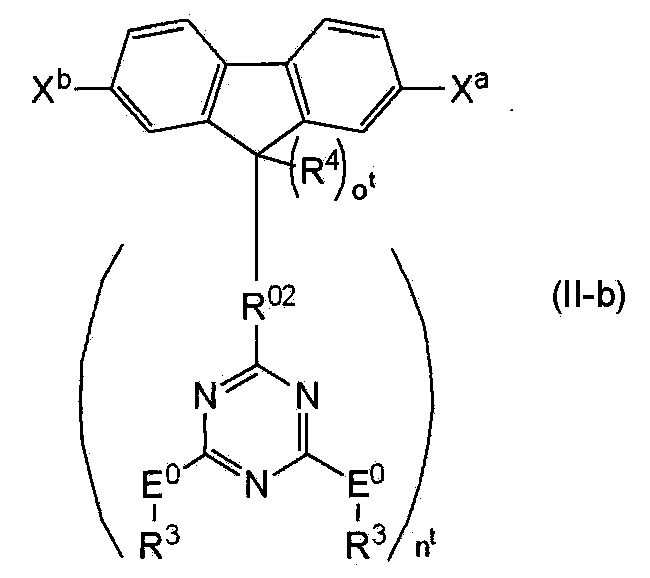
前記式(II−b)中のR02で表される2価の炭化水素基としては、前記R’で表される2価の炭化水素基の項で説明し例示した2価の炭化水素基と同じであるが、フェニレン基が好ましい。
前記式(II−b)中のXa及びXbで表されるハロゲン原子としては、フッ素原子、塩素原子、臭素原子、ヨウ素原子が挙げられ、塩素原子、臭素原子、ヨウ素原子が好ましい。
前記式(II−b)、(II−c)中のR4で表される1価の炭化水素基は、前記置換基の項で説明し例示した、置換基を有していてもよい1価の炭化水素基と同じである。
本発明の化合物の例としては、以下の式(F−1)~(F−29)で表される化合物が挙げられ、以下の式(F−1)~(F−12)で表される化合物が好ましい。


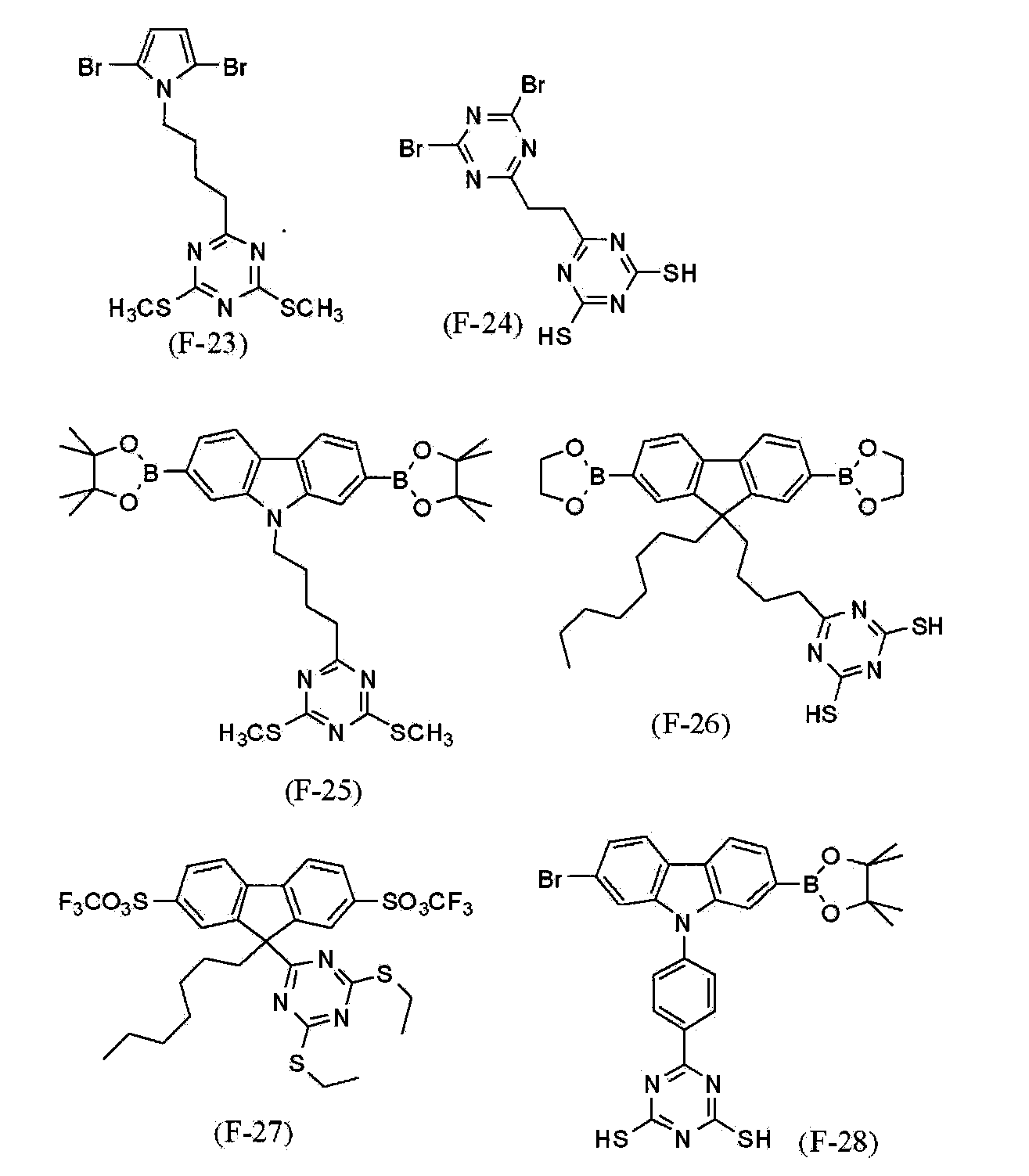

本発明の化合物は、如何なる方法で合成したものであってもよいが、合成方法の一例を以下で説明する(スキームA)。

(1)(Q1O)2B−B(OQ1)2と反応させることにより、Xa及びXbの少なくとも一方が−B(OQ1)2に変換された化合物が得られ、
(2)(Q2)3SiClと反応させることにより、Xa及びXbの少なくとも一方が−Si(Q2)3に変換された化合物が得られ、
(3)(Q3)3SnCl又は(Q3)3Sn−Sn(Q3)3と反応させることにより、Xa及びXbの少なくとも一方が−Sn(Q3)3に変換された化合物が得られる。
これらの変換方法における各反応は、パラジウム触媒の存在下で行うと、反応速度が向上する。なお、Xa及びXbが、ヨウ素原子又は臭素原子である場合、前記有機リチウムの反応は省略可能である。
本発明の化合物の合成方法の他の一例としては、下記式(II−t)で表される化合物と下記式(II−u)で表される化合物とを反応させる方法が挙げられる。
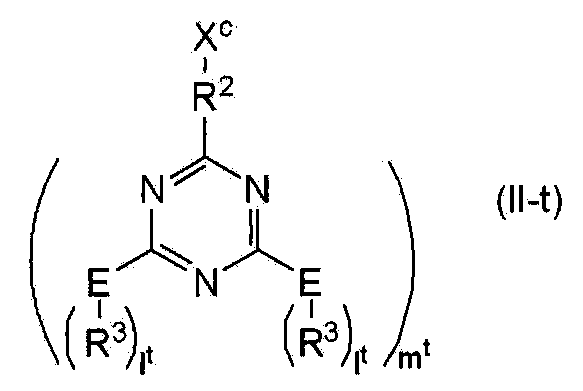
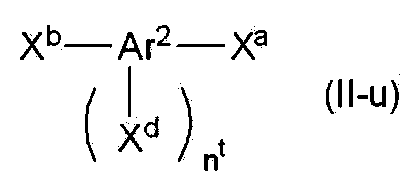
前記式(II−t)中のXc及び前記式(II−u)中のXdがハロゲン原子である場合、熊田・玉尾カップリングを用いることができる。即ち、前記式(II−t)で表される化合物、又は、前記式(II−u)で表される化合物に対して、予めマグネシウムを反応させるか、アルキルマグネシウムクロライド等を反応させることにより、Xc又はXdを、−MgXc、−MgXd又は−MgClとした後、ニッケル触媒(例えば、NiCl2(dppe)2)又はパラジウム触媒(例えば、Pd(PPh3)4)の存在下で、他方と反応させることにより、前記式(II−a)で表される化合物を得ることができる。
前記式(II−t)中のXc及び前記式(II−u)中のXdがハロゲン原子である場合、山本カップリングを用いることもできる。即ち、前記式(II−t)で表される化合物、及び、前記式(II−u)で表される化合物を、ニッケル触媒(例えば、ビス(1,5−シクロオクタジエン)ニッケル(0))の存在下で反応させるカップリングにより、前記式(II−a)で表される化合物を得ることができる。
前記式(II−t)中のXc、前記式(II−u)中のXdの一方がハロゲン原子であり、他方が−B(OQ1)2又は−B(OQ01)3・Maである場合、鈴木・宮浦カップリングを用いることができる。即ち、前記式(II−t)で表される化合物、及び、前記式(II−u)で表される化合物を、塩基及びパラジウム触媒(例えば、Pd(PPh3)4)の存在下で反応させるカップリングにより、前記式(II−a)で表される化合物を得ることができる。
その他にも、前記式(II−t)で表される化合物、及び、前記式(II−u)で表される化合物を、ウルマン反応、グレーサー反応、溝呂木・ヘック反応、根岸カップリング、スティルカップリング、薗頭カップリング、ブッフバルト・ハートウィッグ反応等させることにより、前記式(II−a)で表される化合物を得ることができる。
<高分子化合物>
本発明の高分子化合物は、前記式(P−a)で表される構成単位を有する、分子量が5×10²~1×10⁷の高分子化合物である。本発明の高分子化合物は、電荷が分子内を移動し易くなるので、共役高分子化合物であることが好ましい。
本発明の高分子化合物の分子量は、電気伝導性及び塗布性が優れるので、1×10³~2×10⁶が好ましく、2×10³~1×10⁶がより好ましく、2×10³~5×10⁵が更に好ましい。得られる高分子化合物の分子量は均一ではないことがあり、また、正確な分子量を計測することが困難なことがある。この場合には、GPC(ゲル浸透クロマトグラフィー)を用いて、ポリスチレン等の標準高分子化合物に換算した分子量の分布から、数平均分子量又は重量平均分子量を得て、共役化合物の分子量とする。
前記式(P−a)中のAr2、R2、E、R3、mt、nt及びltは、前記式(II−a)中のAr2、R2、E、R3、mt、nt及びltとして説明し例示したものと同じである。また、前記式(P−a)で表される構成単位の例としては、前記式(F−1)~(F−28)で表される化合物のXa及びXbに対応する2個の原子又は基を取り除いてなる基が挙げられる。
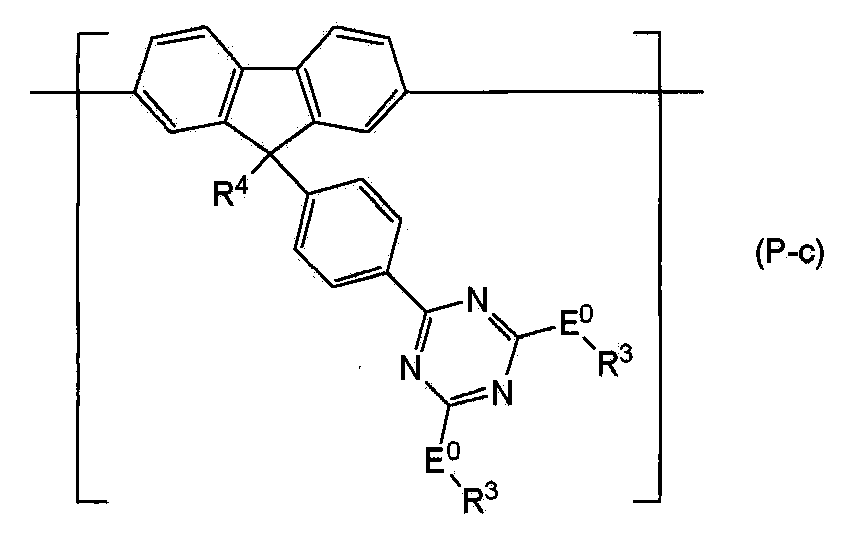
前記式(P−a)で表される構成単位は、導電性、HOMOのエネルギーレベル、LUMOのエネルギーレベル、及び、合成のし易さが良好となるので、下記式(P−b)で表される構成単位であることが好ましく、下記式(P−c)で表される構成単位であることがより好ましい。

前記式(P−b)中のR02、E0、R3、R4、ot及びntは、前記式(II−b)中のR02、E0、R3、R4、ot及びntとして説明し例示したものと同じである。
前記式(P−b)中のR02は、フェニレン基であることが好ましい。
前記式(P−c)中のE0、R3及びR4は、前記式(II−c)中のE0、R3及びR4として説明し例示したものと同じである。
本発明の高分子化合物は、以上で説明した構成単位のみからなる単独重合体であってもよいし、その他の構成単位を含む共重合体であってもよい。その他の構成単位としては、ジオクチルフルオレンジイル基からなる構成単位、ビチオフェンジイル基からなる構成単位等の式、−Ar2−で表される構成単位(なお、この構成単位は、前記式(P−a)で表される構成単位とは異なる。)等が挙げられる。
本発明の高分子化合物が共重合体である場合、金属ナノ粒子又は金属化合物ナノ粒子への吸着がより強固になり、かつ、溶媒への溶解性が向上するので、該高分子化合物1分子に含まれる前記式(P−a)で表される構成単位の数は、1~2000個が好ましく、1~1000個がより好ましく、1~200個が更に好ましく、1~50個が特に好ましく、1~20個がとりわけ好ましい。
<高分子化合物の製造方法>
本発明の高分子化合物は、如何なる方法で合成したものであってもよいが、合成方法の一例として、本発明の化合物を用いた方法を以下で説明する。
本発明の高分子化合物は、例えば、本発明の化合物を単独で用いて反応させてもよいが、本発明の化合物と、下記式(V−a)で表される化合物及び/又は下記式(V−b)で表される化合物とを併用して反応させてもよい。これらの各化合物は、1種単独で用いても2種以上を併用してもよい。


本発明の化合物を単独で用いて反応させた場合、得られる高分子化合物は、前記式(P−a)で表される構成単位のみからなる高分子化合物である。一方、本発明の化合物と、式(V−a)で表される化合物及び/又は式(V−b)で表される化合物とを併用して反応させた場合、得られる高分子化合物は、下記式(P−V−a)で表される構成単位及び/又は下記式(P−V−b)で表される基を含む高分子化合物である。


得られる高分子化合物は、Ar2で表される基が鎖状に連なった線状の構造となりやすく、前記式(P−V−b)で表される基は、その末端として含まれる。また、前記式(V−a)で表される化合物及び/又は本発明の化合物(前記式(II−a)で表される化合物)が、更に−Xaで表される基を有する場合には、得られる高分子化合物は、樹状や網目状の構造となる。
本発明の高分子化合物を得るための反応としては、本発明の化合物のXa及びXbがハロゲン原子である場合、熊田・玉尾カップリングを用いることができる。即ち、本発明の化合物に対して、予めマグネシウムを反応させるか、アルキルマグネシウムクロライド等を反応させることにより、Xa又はXbを、−MgXa、−MgXb又は−MgClとした後、ニッケル触媒(例えば、NiCl2(dppe)2)又はパラジウム触媒(例えば、Pd(PPh3)4)の存在下で、反応させることにより、本発明の高分子化合物を得ることができる。また、前記式(V−a)で表される化合物及び/又は前記式(V−b)で表される化合物を系中に共存させる場合、それらの化合物のXa及びXbもハロゲン原子であることが好ましい。
本発明の化合物のXa及びXbがハロゲン原子である場合、山本カップリングを用いることもできる。即ち、本発明の化合物を、ニッケル触媒(例えば、ビス(1,5−シクロオクタジエン)ニッケル(0))の存在下で反応させるカップリングにより、本発明の高分子化合物を得ることができる。また、前記式(V−a)で表される化合物及び/又は前記式(V−b)で表される化合物を系中に共存させる場合、それらの化合物のXa及びXbもハロゲン原子であることが好ましい。
本発明の化合物のXa及びXbの一方がハロゲン原子であり、
(1)他方が−B(OQ1)2又は−B(OQ01)3・Maである場合、
(2)本発明の化合物のXa及びXbがハロゲン原子であり、共存する前記式(V−a)で表される化合物のXa及びXb、並びに、前記式(V−b)で表される化合物のXaが−B(OQ1)2又は−B(OQ01)3・Maである場合、又は、
(3)本発明の化合物のXa及びXbが−B(OQ1)2又は−B(OQ01)3・Maであり、共存する前記式(V−a)で表される化合物のXa及びXb、並びに/又は、前記式(V−b)で表される化合物のXaとXbの両方がハロゲン原子である場合、
鈴木・宮浦カップリングを用いることができる。即ち、本発明の化合物を、塩基及びパラジウム触媒(例えば、Pd(PPh3)4)の存在下で反応させるカップリングにより、本発明の高分子化合物を得ることができる。
その他にも、本発明の化合物を、ウルマン反応、グレーサー反応、溝呂木・ヘック反応、根岸カップリング、スティルカップリング、薗頭カップリング、ブッフバルト・ハートウィッグ反応等させることにより、本発明の高分子化合物を得ることができる。
本発明の高分子化合物は、前記式(P−a)中のR3が水素原子であると、金属ナノ粒子又は金属化合物ナノ粒子とより効率よく、より強固に吸着できるので好ましい。しかし、前述の合成方法を適用した場合には、本発明の化合物としてR3が水素原子である化合物を用いると、カップリング反応等が進みにくいことがある。その場合は、R3が水素原子ではない本発明の化合物を用いて高分子化合物を合成した後、塩化アルミニウム、蟻酸等のカルボン酸、トリフルオロメタンスルホン酸等のスルホン酸等を用いて、前記式(P−a)中のR3を水素原子に変換する反応を行うことが好ましい。
<金属複合体>
本発明の金属複合体は、本発明の高分子化合物と、膜状若しくは板状の金属、又は、膜状若しくは板状の金属化合物、或いは、アスペクト比が1.5未満の金属ナノ粒子又はアスペクト比が1.5未満の金属化合物ナノ粒子とを接触させることにより得られる金属複合体である。
前記膜状若しくは板状の金属、又は、膜状若しくは板状の金属複合体の厚さは、通常、0.01nm~10cmであり、0.01nm~0.5cmが好ましく、0.01nm~200μmがより好ましく、0.01nm~20μmが更に好ましい。
前記金属、又は、金属化合物を構成する金属としては、アルミニウム、スカンジウム、チタン、バナジウム、クロム、マンガン、鉄、コバルト、ニッケル、銅、亜鉛、ガリウム、ゲルマニウム、イットリウム、ジルコニウム、ニオブ、モリブデン、ルテニウム、ロジウム、パラジウム、銀、カドミウム、インジウム、すず、アンチモン、ランタン、セリウム、ユウロピウム、ハフニウム、タンタル、タングステン、レニウム、オスミウム、イリジウム、白金、金、水銀、タリウム、鉛、ビスマスが挙げられ、アルミニウム、チタン、バナジウム、クロム、マンガン、鉄、コバルト、ニッケル、銅、亜鉛、ガリウム、ゲルマニウム、イットリウム、ジルコニウム、モリブデン、ルテニウム、ロジウム、パラジウム、銀、インジウム、すず、アンチモン、ランタン、セリウム、タンタル、タングステン、イリジウム、白金、金、鉛及びビスマスが好ましく、アルミニウム、チタン、バナジウム、クロム、マンガン、鉄、コバルト、ニッケル、銅、亜鉛、ガリウム、ロジウム、パラジウム、銀、インジウム、すず、タングステン、イリジウム、白金、金及び鉛が更に好ましく、アルミニウム、クロム、マンガン、鉄、コバルト、ニッケル、銅、ロジウム、パラジウム、銀、インジウム、すず、イリジウム、白金、金が特に好ましい。
金属化合物としては、合金、金属酸化物、複合酸化物、金属窒化物、金属硫化物、金属塩が挙げられ、合金、金属酸化物、複合酸化物、金属硫化物が好ましい。
金属化合物としては、インジウムスズ酸化物(ITO)、インジウム亜鉛酸化物(IZO)、酸化モリブデン、酸化アルミニウム、酸化チタン、酸化亜鉛、酸化銅、二酸化銅、酸化マグネシウム、酸化イットリウム、酸化タングステン(VI)、酸化ケイ素、酸化スズ(IV)、ニッケルタングステン、酸化セリウム、酸化マンガン、硫化スズ、酸化コバルト、酸化ホルミウム、四三酸化コバルト、四三酸化鉄、アルミン酸コバルト(CoAl2O4)、スピネル(Al2O3/MgO)等が挙げられ、インジウムスズ酸化物、インジウム亜鉛酸化物、酸化モリブデン、酸化アルミニウム、酸化チタン、酸化亜鉛、酸化銅、二酸化銅、酸化マグネシウム、酸化イットリウム、酸化タングステン(VI)、酸化ケイ素、酸化スズ(IV)が好ましく、インジウムスズ酸化物(ITO)、インジウム亜鉛酸化物(IZO)、酸化モリブデン、酸化アルミニウム、酸化チタン、酸化亜鉛がより好ましい。
前記膜状若しくは板状の金属、又は、膜状若しくは板状の金属酸化物は、鋳造、圧延、面削、研磨等の成型、蒸着、スパッタリング、イオンプレーティング等の真空成膜、電気めっき、陽極酸化、無電解めっき、化学めっき等のめっき処理、粒子分散液の塗布等の塗装によって作製できるが、圧延、蒸着、スパッタリング、イオンプレーティングによって作製されたものが好ましい。
前記金属ナノ粒子、金属複合体ナノ粒子は、通常、最長軸の長さが10μm以下であり、好ましくは0.1nm~1μmであり、より好ましくは1nm~500nmである。
前記金属ナノ粒子、金属化合物ナノ粒子は、アスペクト比(即ち、最も長い径/最も短い径を意味し、アスペクト比に分布がある場合には平均値とする。)が1.5未満であるが、好ましくは1.4以下であり、より好ましくは1.3以下であり、更に好ましくは1.2以下であり、特に好ましくは1.1以下である。
前記金属ナノ粒子は、前記金属そのものであっても、前記金属にその他の物質が吸着したものであってもよい。また、前記金属化合物ナノ粒子は、前記金属化合物そのものであっても、前記金属化合物にその他の物質が吸着したものであってもよい。
前記金属、前記金属化合物に吸着し得る物質としては、炭素数が1~50のアルカンチオール(例えば、テトラデカンチオール、ドデカンチオール、デカンチオール、オクタンチオール)、無機多孔体、ポリアクリルアミド、ポリビニルピロリドン、ポリアクリル酸等が挙げられる。なお、これらの物質の少なくとも一部は、金属複合体の製造工程において、本発明の高分子化合物に置き換わる。
前記接触は、(1)本発明の高分子化合物を膜状若しくは板状の金属、又は、膜状若しくは板状の金属化合物に貼り付ける方法、(2)本発明の高分子化合物を膜状若しくは板状の金属、又は、膜状若しくは板状の金属化合物に塗布する方法、(3)本発明の高分子化合物と、金属ナノ粒子又は金属化合物ナノ粒子とを、攪拌又は混練させる方法により行うことができる。この接触の際には、溶媒を介在させることが好ましい。また、この接触の際には、系中にその他の成分を共存させてもよいし、超音波をかけてもよい。
前記(2)の場合には、本発明の高分子化合物を0.0001~50重量%含む溶液を調製し、膜状若しくは板状の金属、又は、膜状若しくは板状の金属化合物に塗布することが好ましい。
前記(3)の場合であって、接触の際に溶媒を介在させるときには、該溶媒としては、本発明の高分子化合物を溶解させることができ、金属ナノ粒子又は金属化合物ナノ粒子を溶解させないものが通常用いられる。この溶媒としては、メタノール、エタノール、ベンジルアルコール、アセトン、メチルエチルケトン、ジメチルホルムアミド、ジメチルスルホキサイド、酢酸エチル、トルエン、キシレン、オルトジクロロベンゼン、クロロホルム、テトラヒドロフラン、ヘキサン、ベンゼン、ジエチルエーテル、アセトニトリル、酢酸、水、プロパノール、ブタノール、N−メチルピロリドンが挙げられ、共役化合物の溶解性の観点から、メタノール、エタノール、ベンジルアルコール、アセトン、メチルエチルケトン、ジメチルホルムアミド、ジメチルスルホキシド、酢酸エチル、トルエン、キシレン、クロロホルム、テトラヒドロフラン、ベンゼン、アセトニトリル、プロパノール、ブタノール、N−メチルピロリドンが好ましい。なお、この溶媒は、一種単独で用いても二種以上を併用してもよい。
前記(3)の場合には、攪拌や混練の温度は、好ましくは−70℃~200℃、より好ましくは−10℃~120℃、更に好ましくは0℃~100℃であり、特に好ましくは20℃~70℃である。
前記(3)の場合には、攪拌や混練の時間は、好ましくは0.01秒~1000分、より好ましくは0.1秒~900分、更に好ましくは1秒~500分である。
前記接触によって、本発明の高分子化合物が金属又は金属化合物に吸着していることを確認する方法としては、高分子化合物と金属又は金属化合物との相互作用に起因する、化学結合(共有結合、配位結合、水素結合)の結合エネルギーの変化、原子の電子密度の変化、電子の軌道のエネルギーレベルの変化等を捉えることが好ましい。これらの変化を捉える方法としては、赤外分光法、近赤外分光法、ラマン分光法、紫外可視吸収分光法、蛍光分光法、燐光分光法、光電子分光法、示差走査熱量測定(DSC)、熱重量分析(TG)核磁気共鳴(NMR)法等が挙げられる。これらの変化は、見た目の色の変化としても現れる場合がある。また、溶解性が変化することで金属複合体となったことを確認できる場合もある。
前記接触の後に、得られた複合体を精製する工程(以下、「精製工程」と言う。)を行ってもよい。
前記(2)の場合には、得られた複合体を、加熱、乾燥させることで、溶媒を除去することができる。また、得られた複合体に過剰の高分子化合物が吸着している場合には、該高分子化合物を溶解できる溶媒を吹きかけたり、得られた複合体を溶媒に没入させたりすることにより、余剰の高分子化合物を除去することができる。
前記(3)の場合には、得られた複合体を、超音波分散、遠心分離、上澄み除去、再分散、透析、ろ過、洗浄、加熱、乾燥等させることにより、余剰の高分子化合物を除去することができる。
<電子素子>
本発明の金属複合体では、高分子化合物と金属又は金属化合物との間での電荷の移動が容易である。従って、本発明の金属複合体を含む電子素子、即ち、本発明の高分子化合物と金属又は金属化合物とを層状に積み重ねた電子素子は、層間での電荷の移動が容易であり、素子内に流れる電流が増加されたものとなる。本発明の電子素子としては、有機EL素子等の発光素子、トランジスタ、太陽電池等の光電変換素子等が挙げられる。
<実施例1>
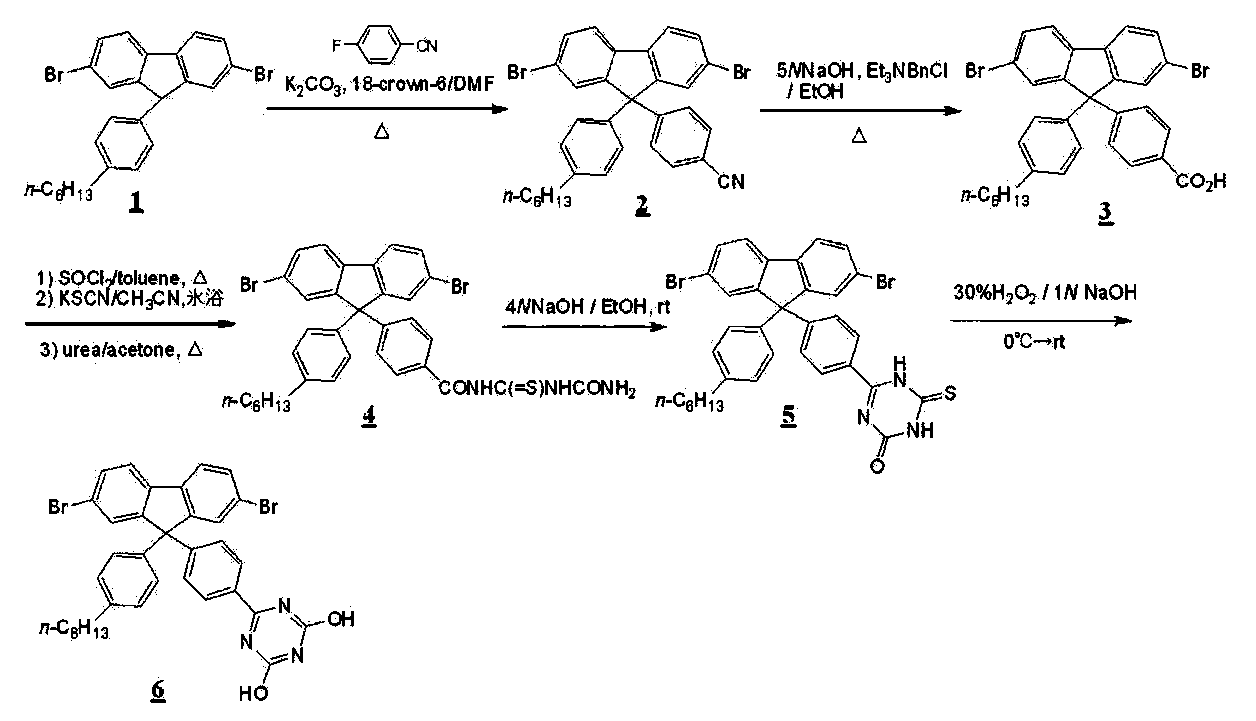
窒素雰囲気下、化合物1(特開2009−149850号公報実施例1に記載のM1a)16.4g(33.9mmol)、4−フルオロベンゾニトリル4.11g(34.0mmol)、炭酸カリウム9.36g(67.8mmol)及び18−クラウン−6 8.95g(33.9mmol)のDMF懸濁液(164ml)を135~140℃で25時間加熱攪拌した。冷却後、水(492ml)で希釈し、1N塩酸(20.3ml)を加えて酢酸エチルで抽出、分液した。水層を酢酸エチルで抽出し、合わせた有機層を飽和食塩水で洗浄後、有機層を無水硫酸マグネシウムで乾燥させた。減圧下濃縮して得た残渣をシリカゲルクロマト精製(SiO2、600g、ヘキサン:酢酸エチル=30:1→25:1(体積比))して、化合物2 13.3g(22.7mmol)を結晶として得た。収率は67.2%であった。この化合物2について、NMRで構造を確認した。
[化合物3の合成]
窒素雰囲気下、化合物2 13.9g(23.8mmol)、塩化トリエチルベンジルアンモニウム1.81g(7.96mmol)、5N水酸化ナトリウム水溶液(192ml)及びエタノール(192ml)の混合物を16時間半加熱還流した。冷却後、濃塩酸で中和し、減圧下エタノールを除いた。混合物に濃塩酸を加えてpHを2とし、t−ブチルメチルエーテルで抽出、分液した。水層をt−ブチルメチルエーテルで抽出し、合わせた有機層を飽和食塩水で洗浄後、有機層を無水硫酸マグネシウムで乾燥させた。減圧下、濃縮して化合物3 13.8g(22.9mmol)を結晶として得た。収率は96.2%であった。この化合物3について、NMRで構造を確認した。
[化合物4の合成]
窒素雰囲気下、化合物3 12.6g(20.9mmol)とトルエン(38ml)との混合物に塩化チオニル20.6g(173mmol)を加え、80℃で1時間加熱した。冷却後、減圧下で濃縮し、得られた残渣にトルエンを加え、更に減圧濃縮する操作を3回繰り返した後、更に減圧乾燥させることで酸塩化物13.2g(21.2mmol)を得た。みかけ収率は101%であった。
窒素雰囲気下、イソチオシアン酸カリウム2.27g(23.4mmol)のアセトニトリル溶液(51ml)を氷浴で冷却しながら、前記酸塩化物12.1g(19.5mmol)のトルエン溶液(12ml)を15分かけて滴下した。滴下終了後、同温度で1時間攪拌した。得られた混合物をろ過し、ろ液を減圧下、濃縮した。得られた残渣にアセトン(47ml)を加え、更に尿素1.40g(23.3mmol)を加えて還流温度で3時間加熱攪拌した。冷却後、混合物を減圧下濃縮し、水を加えて析出した結晶をろ過した。結晶を水で洗浄し、減圧乾燥させて、化合物4 11.1g(15.8mmol)を結晶として得た。収率は81.0%であった。この化合物4について、NMRで構造を確認した。
[化合物5の合成]
窒素雰囲気下、化合物4 10.2g(14.5mmol)、エタノール(136ml)及び4N水酸化ナトリウム水溶液(272ml)の混合物を室温で終夜攪拌した。氷浴で冷却しながら、1M硫酸でpH6とし、析出した結晶をろ過した。結晶を水で洗浄し、減圧乾燥させて、化合物5 10.3g(15.0mmol)を結晶として得た。みかけ収率は103%であった。この化合物5について、NMRで構造を確認した。
[化合物6の合成]
窒素雰囲気下、化合物5 10.3g(15.0mmol)と1N水酸化ナトリウム水溶液(121ml)の混合物を氷浴で冷却しながら、30重量%過酸化水素水(30.3ml)を滴下した。同温度で15分攪拌後、室温で30分攪拌した。TLCにて原料の消失を確認後、氷浴で冷却しながら1M硫酸でpH7とした。析出した結晶をろ過し、結晶を水、ヘキサンと酢酸エチルとの混合溶媒(ヘキサン:酢酸エチル=2:1(体積比))で洗浄後、減圧乾燥させて化合物6 6.67g(9.94mmol)を結晶として得た。収率は66.3%であった。この化合物6について、NMRで構造を確認した。
<実施例2>
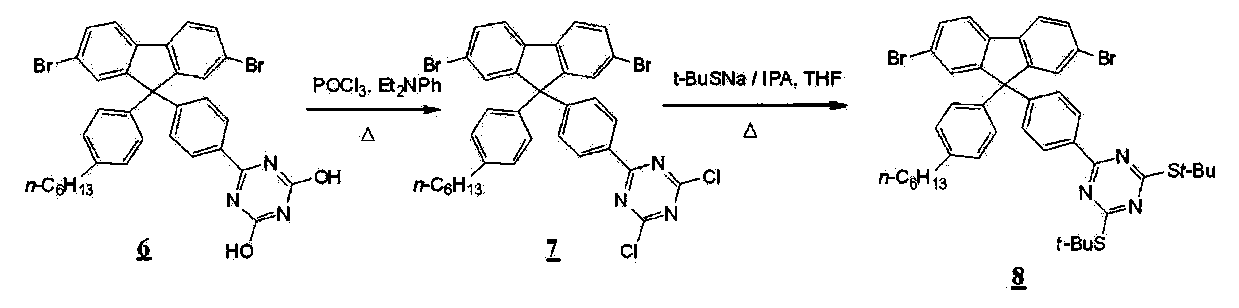
窒素雰囲気下、化合物6 6.61g(9.85mmol)、オキシ塩化リン19.8ml(212mmol)及びN,N−ジエチルアニリン1.51g(10.1mmol)の混合物を105℃で3時間加熱攪拌した。冷却後、減圧下に過剰のオキシ塩化リンを除き、残渣にクロロホルムと水を加え室温で1時間攪拌した。分液した有機層を水、炭酸水素ナトリウム水溶液(水層がpH7となる程度)、飽和食塩水の順に洗浄し、有機層を無水硫酸マグネシウムで乾燥させた。減圧下、濃縮して得られた結晶を更に減圧乾燥させて、化合物7 7.00g(9.85mmol)を得た。収率は100%であった。この化合物7について、NMRで構造を確認した。
[化合物8の合成]
窒素雰囲気、氷浴下で55重量%水素化ナトリウム0.91g(20.9mmol)に脱水イソプロピルアルコール(210ml)を加え、水素化ナトリウムが消失、かつ水素発生が止むまで室温で攪拌した。再び氷浴で冷却しながらt−ブチルメルカプタン2.54ml(22.5mmol)を滴下した。滴下終了後、室温で化合物7 7.00g(9.89mmol)の脱水THF溶液(37ml)を滴下した。得られた混合物を還流温度で2時間加熱撹拌した。冷却後、得られた混合物を減圧下で濃縮し、得られた残渣にヘキサンを加え、析出した結晶をろ過によって取り出し、ヘキサン及びアセトニトリルで洗浄、減圧乾燥させて化合物8(4.40g)を得た。また、そのろ液を濃縮し、得られた残渣をシリカゲルクロマト精製(SiO2、30g、ヘキサン→ヘキサン:トルエン=8:1→6:1(体積比))して、化合物8を合わせて5.46g(6.70mmol)結晶として得た(液体クロマトグラフィ純度:97.2%)。ヘキサンとクロロホルムとの混合溶媒(ヘキサン:クロロホルム=10:1(体積比))を約50ミリリットル用いて再結晶を行い、結晶をヘキサンで2回洗浄することにより、化合物8 3.0gを得た。収率は37.2%であった。この化合物8について、NMRで構造を確認した。
<実施例3>(高分子化合物P−1の合成)
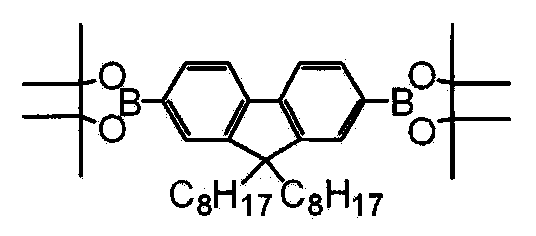
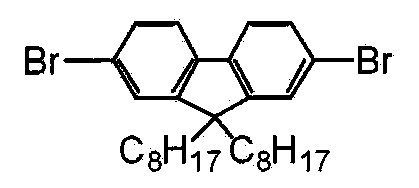
50mlフラスコに化合物8を100mg(0.12mmol)と、下記式:


NMRの結果から、高分子化合物Jは、下記式で表される繰り返し単位2種を有する。

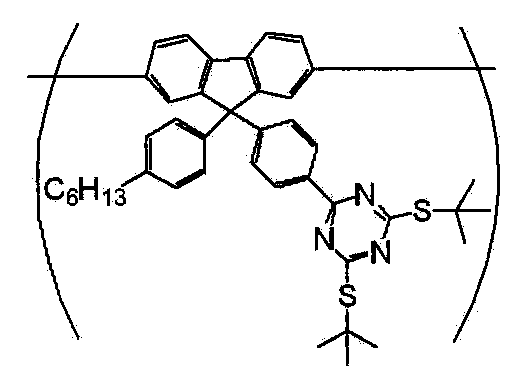
50mlフラスコに高分子化合物Jを485mg、トルエン31.5ml仕込み、室温で攪拌した。次いで塩化アルミニウムを加えた後、115℃で1時間攪拌した。冷却後、反応容器中の有機層をメタノール100mlに滴下し、沈殿を析出させた。該沈殿を濾過、乾燥させることにより、固体260mgを得た。NMRの分析結果から高分子化合物Jのt−ブチル基由来のシグナルが完全に消失していることを確認した。固体は下記式で表される繰り返し単位2種を有する高分子化合物P−1(重合体)であると考えられる。

<実施例4>(高分子化合物P−2の合成)
50mlフラスコに化合物8を100mg(0.12mmol)と、下記式:
NMRの結果から高分子化合物Gは、下記式で表される繰り返し単位2種を有する。
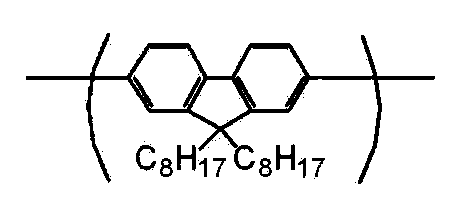
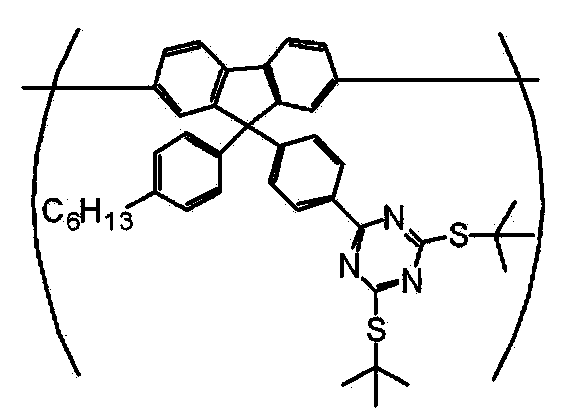
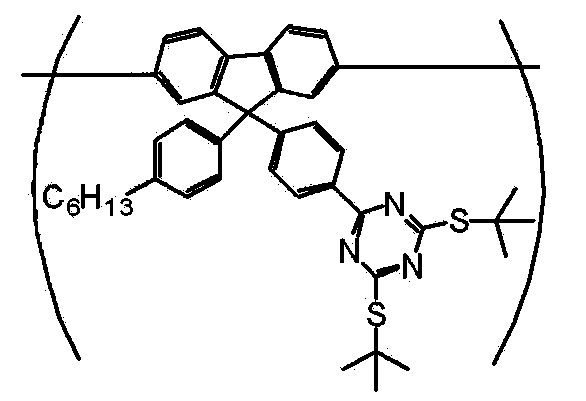
50mlフラスコに高分子化合物Gを80mg、トルエン20ml仕込み、10分室温で攪拌した。次いで塩化アルミニウムを加えた後、更に1時間攪拌した。反応容器中の有機層をメタノール500mlに滴下し、沈殿を析出させた。該沈殿を濾過、乾燥させ、固体を40mg得た。NMRの分析結果から高分子化合物Gのt−ブチル基由来のシグナルが完全に消失していることを確認した。固体は下記式で表される繰り返し単位2種を有する高分子化合物P−2(重合体)であると考えられる。


<実施例5>(高分子化合物P−3の合成)
50mlフラスコに、化合物8を100mg(0.12mmol)と、下記式:
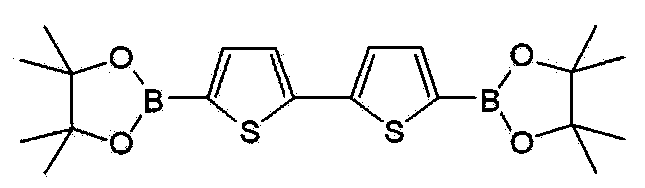

NMRの結果から高分子化合物Kは下記式で表される。
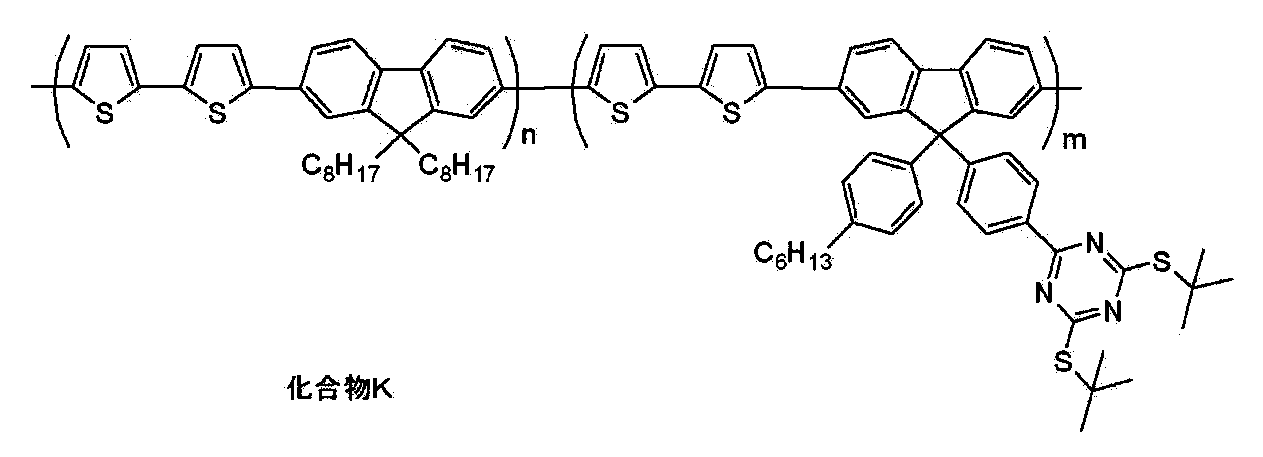
また、高分子化合物Kのポリスチレン換算の数平均分子量は3.5×10³であり、ポリスチレン換算の重量平均分子量は1.1×10⁴であった。
50mlフラスコに、高分子化合物Kを300mg、トルエン3.9ml仕込み、氷水浴で冷却し、次いでトリフルオロメタンスルホン酸0.6mLとトリフルオロ酢酸0.6mLを加えた後、80度に加熱し7時間攪拌した。室温まで冷却後、反応容器中の有機層をメタノール100mlに滴下し、沈殿を析出させた。該沈殿を濾過、乾燥させ、クロロホルムに溶かして、これをメタノール100mlに滴下し、沈殿を析出させた。該沈殿を濾過、乾燥させ、固体を250mg得た。NMRの分析結果から高分子化合物Gのt−ブチル基由来のシグナルが完全に消失していることを確認した。固体は下記式で表される高分子化合物P−3(重合体)であると考えられる。

高分子化合物P−3のポリスチレン換算の数平均分子量は4.3×10³であり、ポリスチレン換算の重量平均分子量は1.5×10⁴であった。
<実施例6>
高分子化合物P−1の6.7mgをトルエン3mLに溶かした。ドデカンチオールで表面修飾された銀ナノ粒子のヘキサン溶液(粒子サイズ(DLS):5−15nm、0.25%(w/v)ヘキサン溶液、アルドリッチ製)3mLからヘキサンをエバポレーターで留去し、トルエン3mLを加え、これを高分子化合物P−1トルエン溶液と混合して、1.5時間静置した。この溶液は安定であり、沈殿は生成しなかった。これを用いてスピンコーティング(事前にポアフィルターでろ過、500rpm、2分)を行うことにより、膜厚が10nmの膜を作製した。これは高分子化合物P−1と銀ナノ粒子との複合体である。
<実施例7>
銀ナノ粒子(ナノパウダー、粒子サイズ:<100nm、99.5% trace metals basis、アルドリッチ製)を7mgとり、トルエン1.5mLに加え、容器ごと超音波洗浄機に入れて超音波によって銀粒子を拡散させた。この時、しばらく液は灰色に濁っていたが、1時間もすると銀ナノ粒子は沈殿して上澄みは透明となった。もう一度、超音波で銀粒子を拡散させた後、高分子化合物P−1を2mg加えて攪拌すると、得られた分散液は静置して1時間経っても濁っており、銀粒子が分散していた。このことから、高分子化合物P−1が銀粒子の表面に吸着することによって、銀ナノ粒子が安定化されていることが分かった。
<実施例8>
高分子化合物P−3の8.6mgをトルエン2.2gに溶かし、高分子化合物P−3トルエン溶液を調製した。ドデカンチオールで表面修飾された銀ナノ粒子のヘキサン溶液(粒子サイズ(DLS):5−15nm、0.25%(w/v)ヘキサン溶液、アルドリッチ製)からヘキサンをエバポレーターで留去し(ここで、銀ナノ粒子の重量は8.6mg)、トルエン2.2gを加え、銀ナノ粒子のトルエン溶液を調製した。
銀ナノ粒子のトルエン溶液から1.32gを取り、高分子化合物P−3トルエン溶液から1.29g取り、両者を混合した。得られた混合溶液は透明で均一であり、沈殿は生成しなかった。これをメタノールに滴下すると、茶色の沈殿が生成し、上澄みは無色で透明であった。
一方、銀ナノ粒子のトルエン溶液をメタノールに滴下すると、沈殿は生成せず、茶色の透明な液体で均一となった。また、高分子化合物P−3のトルエン溶液をメタノールに滴下すると黄色の沈殿が生成し、上澄みは無色で透明であった。
これらのことから考察すると、銀ナノ粒子のトルエン溶液と高分子化合物P−3のトルエン溶液との混合によって、銀ナノ粒子の表面にあったドデカンチオールは高分子化合物P−3によって置換され、メタノール中では高分子化合物P−3と共に銀ナノ粒子は沈殿し、液中に銀ナノ粒子は存在しない。この沈殿は高分子化合物P−3と銀ナノ粒子との複合体である。この沈殿を、遠心分離機を用いてメタノール溶液と分離し、乾燥させて1H−NMRスペクトル(重クロロホルム中、TMS標準)を測定すると、ドデカンチオールに帰属できるシグナルはなかった。一方、前記の銀ナノ粒子のトルエン溶液からトルエンをエバポレーターで留去し乾燥させて、1H−NMRスペクトル(重クロロホルム中、TMS標準)を測定すると、ドデカンチオールに帰属できるシグナル(例えば、2.66ppmが特徴的である。)が確認できた。
これらのことから考察すると、銀ナノ粒子のトルエン溶液と高分子化合物P−3のトルエン溶液との混合によって、銀ナノ粒子の表面にあったドデカンチオールのほとんどは高分子化合物P−3によって置換され、高分子化合物P−3と銀ナノ粒子との複合体が生成しており、高分子化合物P−1は銀ナノ粒子に強く吸着していることが分かった。
Claims (12)
- 下記式(II−a)で表される化合物。
(式中、Ar2は、置換基を有していてもよい芳香族基を表し、R2は、直接結合、又は、ヘテロ原子としては酸素原子のみを有していてもよい有機基を表し、Eは、ヘテロ原子を表し、R3は、1価の炭化水素基又は水素原子を表し、mt及びntはそれぞれ独立に、1以上の整数であり、ltは、1~3の整数である。複数あるR3、E及びltは、各々、互いに同一であっても異なっていてもよい。mtは、複数ある場合には、それらは互いに同一であっても異なっていてもよい。Xa及びXbはそれぞれ独立に、ハロゲン原子、ニトロ基、−SO3Q(ここで、Qは置換又は非置換の1価の炭化水素基を表す。)、−B(OQ1)2(ここで、Q1は、水素原子又は1価の炭化水素基を表すか、2個のQ1が結合して一緒に環を形成する。2個あるQ1は、互いに同一であっても異なっていてもよい。)、−B(OQ01)3・Ma(式中、Q01は、水素原子又は1価の炭化水素基を表すか、2~3個のQ01が結合して一緒に環を形成する。3個あるQ01は、互いに同一であっても異なっていてもよい。Maは、金属カチオン又は置換基を有していてもよいアンモニウムカチオンを表す。)、−Si(Q2)3(ここで、Q2は、1価の炭化水素基を表す。)、又は、−Sn(Q3)3(ここで、Q3は、1価の炭化水素基を表す。)を表す。mt、ntが付された括弧内の基が複数ある場合には、それらは互いに同一であっても異なっていてもよい。)
- 下記式(II−b)で表される、請求項1に記載の化合物。
(式中、R02は、2価の炭化水素基を表し、E0は、硫黄原子又は酸素原子を表す。R4は、1価の炭化水素基又は水素原子を表し、n1は1又は2であり、ot=2−ntである。複数あるR3及びE0は、各々、互いに同一であっても異なっていてもよい。R02は、複数ある場合には、それらは互いに同一であっても異なっていてもよい。R3、Xa及びXbは、前記と同じ意味を有する。ntが付された括弧内の基が複数ある場合には、それらは互いに同一であっても異なっていてもよい。)
- R02がフェニレン基である、請求項2に記載の化合物。
- Xa及びXbがそれぞれ独立に、塩素原子、臭素原子又はヨウ素原子である、請求項2又は3に記載の化合物。
- 下記式(II−c)で表される、請求項4に記載の化合物。
(式中、R3、R4及びE0は、前記と同じ意味を有する。Xaa及びXbbはそれぞれ独立に、塩素原子、臭素原子又はヨウ素原子を表す。)
- 下記式(P−a)で表される構成単位を有する、分子量が5×10²~1×10⁷の高分子化合物。
(式中、Ar2は、置換基を有していてもよい芳香族基を表し、R2は、直接結合、又は、ヘテロ原子としては酸素原子のみを有していてもよい有機基を表し、Eは、ヘテロ原子を表し、R3は、1価の炭化水素基又は水素原子を表し、mt及びntはそれぞれ独立に、1以上の整数であり、ltは、1~3の整数である。複数あるR3、E及びltは、各々、互いに同一であっても異なっていてもよい。mtは、複数ある場合には、それらは互いに同一であっても異なっていてもよい。mt、ntが付された括弧内の基が複数ある場合には、それらは互いに同一であっても異なっていてもよい。)
- 前記式(P−a)で表される構成単位が、下記式(P−b)で表される構成単位である、請求項6に記載の高分子化合物。
(式中、R02は、2価の炭化水素基を表し、E0は、硫黄原子又は酸素原子を表し、R4は、1価の炭化水素基又は水素原子を表し、ntは1又は2であり、ot=2−ntである。R3は、前記と同じ意味を有する。複数あるR3及びE0は、各々、互いに同一であっても異なっていてもよい。R02は、複数ある場合には、それらは互いに同一であっても異なっていてもよい。ntが付された括弧内の基が複数ある場合には、それらは互いに同一であっても異なっていてもよい。)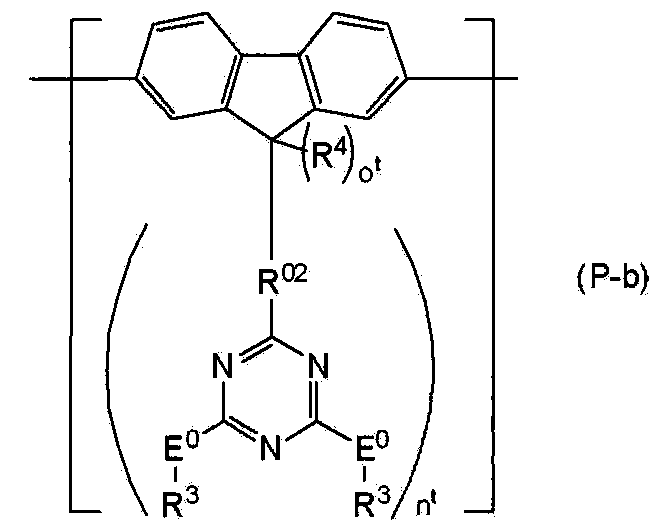
- R02がフェニレン基である、請求項7に記載の高分子化合物。
- 前記式(P−b)で表される構成単位が、下記式(P−c)で表される構成単位である、請求項8に記載の高分子化合物。
(式中、R3、R4及びE0は、前記と同じ意味を有する。)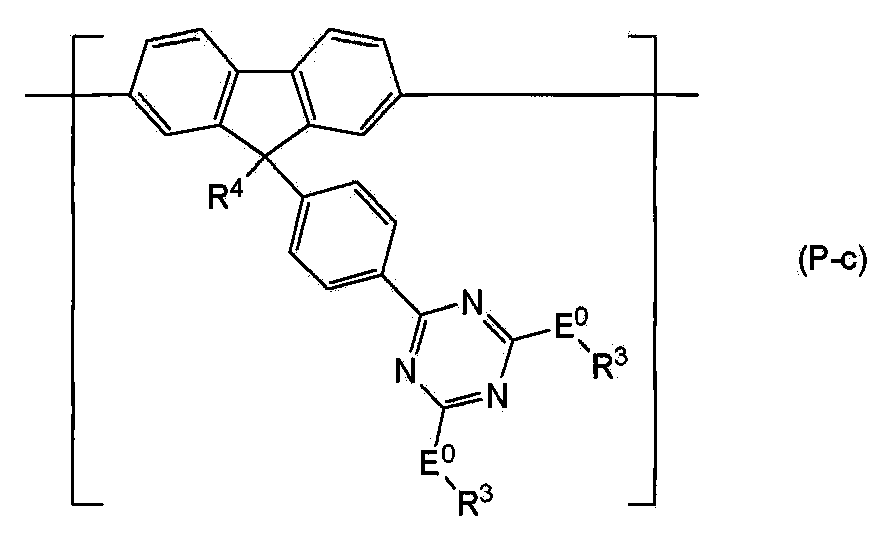
- 請求項6~9のいずれか一項に記載の高分子化合物と、膜状若しくは板状の金属、又は、膜状若しくは板状の金属化合物とを接触させることにより得られる金属複合体。
- 請求項6~9のいずれか一項に記載の高分子化合物と、アスペクト比が1.5未満の金属ナノ粒子、又は、アスペクト比が1.5未満の金属化合物ナノ粒子とを接触させることにより得られる金属複合体。
- 請求項10に記載の金属複合体、及び/又は、請求項11に記載の金属複合体を含む電子素子。
Priority Applications (3)
| Application Number | Priority Date | Filing Date | Title |
|---|---|---|---|
| CN2011800159436A CN102822230A (zh) | 2010-04-05 | 2011-03-31 | 金属复合体及对其调制有用的化合物 |
| DE112011101194T DE112011101194T5 (de) | 2010-04-05 | 2011-03-31 | Metallverbundwerkstoff und zu seiner Herstellung verwendbare Verbindung |
| US13/583,154 US20130018155A1 (en) | 2010-04-05 | 2011-03-31 | Metal composites and compound useful for preparation thereof |
Applications Claiming Priority (2)
| Application Number | Priority Date | Filing Date | Title |
|---|---|---|---|
| JP2010-086738 | 2010-04-05 | ||
| JP2010086738A JP5740830B2 (ja) | 2010-04-05 | 2010-04-05 | 金属複合体及びそれに有用な化合物 |
Publications (1)
| Publication Number | Publication Date |
|---|---|
| WO2011126063A1 true WO2011126063A1 (ja) | 2011-10-13 |
Family
ID=44762998
Family Applications (1)
| Application Number | Title | Priority Date | Filing Date |
|---|---|---|---|
| PCT/JP2011/058746 Ceased WO2011126063A1 (ja) | 2010-04-05 | 2011-03-31 | 金属複合体及びその調製に有用な化合物 |
Country Status (6)
| Country | Link |
|---|---|
| US (1) | US20130018155A1 (ja) |
| JP (1) | JP5740830B2 (ja) |
| CN (1) | CN102822230A (ja) |
| DE (1) | DE112011101194T5 (ja) |
| TW (1) | TW201202208A (ja) |
| WO (1) | WO2011126063A1 (ja) |
Cited By (1)
| Publication number | Priority date | Publication date | Assignee | Title |
|---|---|---|---|---|
| WO2012133465A1 (ja) * | 2011-03-28 | 2012-10-04 | 住友化学株式会社 | 電子デバイス、高分子化合物、有機化合物及び高分子化合物の製造方法 |
Families Citing this family (2)
| Publication number | Priority date | Publication date | Assignee | Title |
|---|---|---|---|---|
| CN107000065B (zh) * | 2014-12-26 | 2019-12-27 | 昭和电工株式会社 | 银纳米线的制造方法、通过该方法得到的银纳米线及含有该银纳米线的墨 |
| KR101850243B1 (ko) * | 2016-03-28 | 2018-04-23 | 주식회사 엘지화학 | 화합물 및 이를 포함하는 유기 전자 소자 |
Citations (9)
| Publication number | Priority date | Publication date | Assignee | Title |
|---|---|---|---|---|
| JPH09302073A (ja) * | 1996-05-09 | 1997-11-25 | Agency Of Ind Science & Technol | 多分岐重合体およびその製造方法 |
| JP2001167885A (ja) * | 1999-09-29 | 2001-06-22 | Konica Corp | 有機エレクトロルミネッセンス素子 |
| JP2006225428A (ja) * | 2005-02-15 | 2006-08-31 | Tokyo Institute Of Technology | 1,3,5−トリアジン環を有する共重合体、その製造法およびその使用 |
| WO2009124627A1 (de) * | 2008-04-07 | 2009-10-15 | Merck Patent Gmbh | Pluorenderivate für organische elektrolumineszenzvorrichtungen |
| WO2010041559A1 (ja) * | 2008-10-06 | 2010-04-15 | 住友化学株式会社 | 含窒素複素環構造を含む高分子化合物、並びにそれを含有する組成物、溶液、薄膜及び高分子発光素子 |
| WO2010087510A1 (ja) * | 2009-01-29 | 2010-08-05 | 住友化学株式会社 | 高分子化合物及びそれを用いる発光素子 |
| WO2010117075A1 (ja) * | 2009-04-10 | 2010-10-14 | 住友化学株式会社 | 金属複合体及びその組成物 |
| WO2010131930A2 (ko) * | 2009-05-15 | 2010-11-18 | 제일모직 주식회사 | 유기광전소자용 화합물 및 이를 포함하는 유기광전소자 |
| WO2010136109A1 (de) * | 2009-05-29 | 2010-12-02 | Merck Patent Gmbh | Materialien für organische elektrolumineszenzvorrichtungen |
Family Cites Families (8)
| Publication number | Priority date | Publication date | Assignee | Title |
|---|---|---|---|---|
| AU2003268487A1 (en) * | 2002-09-05 | 2004-03-29 | Nanosys, Inc. | Nanocomposites |
| JP4464277B2 (ja) * | 2002-09-24 | 2010-05-19 | イー・アイ・デュポン・ドウ・ヌムール・アンド・カンパニー | 導電性有機ポリマー/ナノ粒子複合材料およびその使用方法 |
| US7317047B2 (en) * | 2002-09-24 | 2008-01-08 | E.I. Du Pont De Nemours And Company | Electrically conducting organic polymer/nanoparticle composites and methods for use thereof |
| DE10356099A1 (de) * | 2003-11-27 | 2005-07-07 | Covion Organic Semiconductors Gmbh | Organisches Elektrolumineszenzelement |
| US7455886B2 (en) * | 2005-08-22 | 2008-11-25 | Eastman Kodak Company | Nanocomposite materials and an in-situ method of making such materials |
| JP5353186B2 (ja) | 2007-11-30 | 2013-11-27 | 住友化学株式会社 | アミン系高分子化合物及びそれを用いた発光素子 |
| KR20110055563A (ko) * | 2008-07-30 | 2011-05-25 | 스미또모 가가꾸 가부시키가이샤 | 적층 구조체, 그의 제조 방법 및 그것을 포함하는 전자 소자 |
| CN102387880B (zh) * | 2009-04-10 | 2014-07-02 | 住友化学株式会社 | 金属复合体及其组合物 |
-
2010
- 2010-04-05 JP JP2010086738A patent/JP5740830B2/ja not_active Expired - Fee Related
-
2011
- 2011-03-31 DE DE112011101194T patent/DE112011101194T5/de not_active Withdrawn
- 2011-03-31 US US13/583,154 patent/US20130018155A1/en not_active Abandoned
- 2011-03-31 CN CN2011800159436A patent/CN102822230A/zh active Pending
- 2011-03-31 WO PCT/JP2011/058746 patent/WO2011126063A1/ja not_active Ceased
- 2011-04-01 TW TW100111641A patent/TW201202208A/zh unknown
Patent Citations (9)
| Publication number | Priority date | Publication date | Assignee | Title |
|---|---|---|---|---|
| JPH09302073A (ja) * | 1996-05-09 | 1997-11-25 | Agency Of Ind Science & Technol | 多分岐重合体およびその製造方法 |
| JP2001167885A (ja) * | 1999-09-29 | 2001-06-22 | Konica Corp | 有機エレクトロルミネッセンス素子 |
| JP2006225428A (ja) * | 2005-02-15 | 2006-08-31 | Tokyo Institute Of Technology | 1,3,5−トリアジン環を有する共重合体、その製造法およびその使用 |
| WO2009124627A1 (de) * | 2008-04-07 | 2009-10-15 | Merck Patent Gmbh | Pluorenderivate für organische elektrolumineszenzvorrichtungen |
| WO2010041559A1 (ja) * | 2008-10-06 | 2010-04-15 | 住友化学株式会社 | 含窒素複素環構造を含む高分子化合物、並びにそれを含有する組成物、溶液、薄膜及び高分子発光素子 |
| WO2010087510A1 (ja) * | 2009-01-29 | 2010-08-05 | 住友化学株式会社 | 高分子化合物及びそれを用いる発光素子 |
| WO2010117075A1 (ja) * | 2009-04-10 | 2010-10-14 | 住友化学株式会社 | 金属複合体及びその組成物 |
| WO2010131930A2 (ko) * | 2009-05-15 | 2010-11-18 | 제일모직 주식회사 | 유기광전소자용 화합물 및 이를 포함하는 유기광전소자 |
| WO2010136109A1 (de) * | 2009-05-29 | 2010-12-02 | Merck Patent Gmbh | Materialien für organische elektrolumineszenzvorrichtungen |
Cited By (2)
| Publication number | Priority date | Publication date | Assignee | Title |
|---|---|---|---|---|
| WO2012133465A1 (ja) * | 2011-03-28 | 2012-10-04 | 住友化学株式会社 | 電子デバイス、高分子化合物、有機化合物及び高分子化合物の製造方法 |
| US9306169B2 (en) | 2011-03-28 | 2016-04-05 | Sumitomo Chemical Company, Limited | Electronic device, polymer compound, organic compound, and method of producing polymer compound |
Also Published As
| Publication number | Publication date |
|---|---|
| JP2011219517A (ja) | 2011-11-04 |
| DE112011101194T5 (de) | 2013-01-17 |
| CN102822230A (zh) | 2012-12-12 |
| JP5740830B2 (ja) | 2015-07-01 |
| US20130018155A1 (en) | 2013-01-17 |
| TW201202208A (en) | 2012-01-16 |
Similar Documents
| Publication | Publication Date | Title |
|---|---|---|
| JP2010261102A (ja) | 金属複合体及びその組成物 | |
| TWI675033B (zh) | 含有雜環的化合物、使用該化合物的聚合物及其用途 | |
| Gao et al. | Wirelike dinuclear ruthenium complexes connected by bis (ethynyl) oligothiophene | |
| CN103917575A (zh) | 共轭高分子的制造方法、共轭高分子、光电转换元件、太阳能电池以及太阳能电池模块 | |
| EP2418033A1 (en) | Metal complex and composition containing same | |
| JP5100830B2 (ja) | 無機ナノ粒子を含む共役重合体の薄膜およびその製造方法 | |
| JP5432458B2 (ja) | 基材に芳香族ポリマーが結合した構造体の製造方法、並びに、導電性基材に結合した芳香族ポリマー鎖を有してなる構造体、及び該構造体を含む電子素子 | |
| WO2013056355A1 (en) | Preparation of high molecular weight polymers 8y direct arylation and heteroarylation | |
| JP5740830B2 (ja) | 金属複合体及びそれに有用な化合物 | |
| Yamada et al. | BDH‐TTP as a Structural Isomer of BEDT‐TTF, and Its Two‐Dimensional Hexafluorophosphate Salt | |
| Kraevaya et al. | Oxidative polymerization of triarylamines: a promising route to low-cost hole transport materials for efficient perovskite solar cells | |
| JP5338121B2 (ja) | 複素環高分子化合物 | |
| KR101732522B1 (ko) | 광전자 분야 어플리케이션용 높은 전도성과 흡수성을 가진 신규한 저분자/올리고머의 합성 | |
| JP2013237813A (ja) | π電子共役重合体及びそれを用いた有機半導体デバイス | |
| JP6361009B2 (ja) | 光電変換特性を有するジピリン金属錯体シート及びその製造方法 | |
| JP5340547B2 (ja) | 芳香族ポリマーの製造方法 | |
| WO2008062892A1 (en) | Heterocyclic compounds and heterocyclic polymers | |
| JP2007119709A (ja) | 芳香族ポリマーの製造方法 | |
| El-Shekeil et al. | The DC Electrical Conductivity of the Direct Electrochemically Synthesized Poly (azomethinethiosemicarbazone)–Metal Complexes | |
| JP2014114265A (ja) | ジチオフェン化合物及びそのジチオフェン基を有するπ電子共役重合体、並びにその重合体を用いた有機半導体デバイス | |
| CN115044018B (zh) | 一类含有卟啉骨架结构的有机共轭聚合物及其制备方法与应用 | |
| JP2730757B2 (ja) | 導電性複素環式重合体およびその製造方法 | |
| JP6112717B2 (ja) | ジチエノゲルモール骨格を有する有機ヘテロ高分子およびその製造方法 | |
| JP5354593B2 (ja) | 複合材料及びその製造方法 | |
| JP2013209606A (ja) | 有機半導体化合物 |
Legal Events
| Date | Code | Title | Description |
|---|---|---|---|
| WWE | Wipo information: entry into national phase |
Ref document number: 201180015943.6 Country of ref document: CN |
|
| 121 | Ep: the epo has been informed by wipo that ep was designated in this application |
Ref document number: 11765963 Country of ref document: EP Kind code of ref document: A1 |
|
| WWE | Wipo information: entry into national phase |
Ref document number: 13583154 Country of ref document: US |
|
| WWE | Wipo information: entry into national phase |
Ref document number: 112011101194 Country of ref document: DE Ref document number: 1120111011946 Country of ref document: DE |
|
| 122 | Ep: pct application non-entry in european phase |
Ref document number: 11765963 Country of ref document: EP Kind code of ref document: A1 |