WO2011122260A1 - 非水電解質二次電池用負極合剤、非水電解質二次電池用負極および非水電解質二次電池 - Google Patents
非水電解質二次電池用負極合剤、非水電解質二次電池用負極および非水電解質二次電池 Download PDFInfo
- Publication number
- WO2011122260A1 WO2011122260A1 PCT/JP2011/055336 JP2011055336W WO2011122260A1 WO 2011122260 A1 WO2011122260 A1 WO 2011122260A1 JP 2011055336 W JP2011055336 W JP 2011055336W WO 2011122260 A1 WO2011122260 A1 WO 2011122260A1
- Authority
- WO
- WIPO (PCT)
- Prior art keywords
- negative electrode
- electrolyte secondary
- secondary battery
- pvdf
- nonaqueous electrolyte
- Prior art date
- Legal status (The legal status is an assumption and is not a legal conclusion. Google has not performed a legal analysis and makes no representation as to the accuracy of the status listed.)
- Ceased
Links
Classifications
-
- H—ELECTRICITY
- H01—ELECTRIC ELEMENTS
- H01M—PROCESSES OR MEANS, e.g. BATTERIES, FOR THE DIRECT CONVERSION OF CHEMICAL ENERGY INTO ELECTRICAL ENERGY
- H01M4/00—Electrodes
- H01M4/02—Electrodes composed of, or comprising, active material
- H01M4/62—Selection of inactive substances as ingredients for active masses, e.g. binders, fillers
-
- H—ELECTRICITY
- H01—ELECTRIC ELEMENTS
- H01M—PROCESSES OR MEANS, e.g. BATTERIES, FOR THE DIRECT CONVERSION OF CHEMICAL ENERGY INTO ELECTRICAL ENERGY
- H01M4/00—Electrodes
- H01M4/02—Electrodes composed of, or comprising, active material
- H01M4/13—Electrodes for accumulators with non-aqueous electrolyte, e.g. for lithium-accumulators; Processes of manufacture thereof
- H01M4/133—Electrodes based on carbonaceous material, e.g. graphite-intercalation compounds or CFx
-
- H—ELECTRICITY
- H01—ELECTRIC ELEMENTS
- H01M—PROCESSES OR MEANS, e.g. BATTERIES, FOR THE DIRECT CONVERSION OF CHEMICAL ENERGY INTO ELECTRICAL ENERGY
- H01M4/00—Electrodes
- H01M4/02—Electrodes composed of, or comprising, active material
- H01M4/13—Electrodes for accumulators with non-aqueous electrolyte, e.g. for lithium-accumulators; Processes of manufacture thereof
- H01M4/139—Processes of manufacture
- H01M4/1393—Processes of manufacture of electrodes based on carbonaceous material, e.g. graphite-intercalation compounds or CFx
-
- H—ELECTRICITY
- H01—ELECTRIC ELEMENTS
- H01M—PROCESSES OR MEANS, e.g. BATTERIES, FOR THE DIRECT CONVERSION OF CHEMICAL ENERGY INTO ELECTRICAL ENERGY
- H01M4/00—Electrodes
- H01M4/02—Electrodes composed of, or comprising, active material
- H01M4/36—Selection of substances as active materials, active masses, active liquids
- H01M4/58—Selection of substances as active materials, active masses, active liquids of inorganic compounds other than oxides or hydroxides, e.g. sulfides, selenides, tellurides, halogenides or LiCoFy; of polyanionic structures, e.g. phosphates, silicates or borates
- H01M4/583—Carbonaceous material, e.g. graphite-intercalation compounds or CFx
- H01M4/587—Carbonaceous material, e.g. graphite-intercalation compounds or CFx for inserting or intercalating light metals
-
- H—ELECTRICITY
- H01—ELECTRIC ELEMENTS
- H01M—PROCESSES OR MEANS, e.g. BATTERIES, FOR THE DIRECT CONVERSION OF CHEMICAL ENERGY INTO ELECTRICAL ENERGY
- H01M4/00—Electrodes
- H01M4/02—Electrodes composed of, or comprising, active material
- H01M4/62—Selection of inactive substances as ingredients for active masses, e.g. binders, fillers
- H01M4/621—Binders
-
- H—ELECTRICITY
- H01—ELECTRIC ELEMENTS
- H01M—PROCESSES OR MEANS, e.g. BATTERIES, FOR THE DIRECT CONVERSION OF CHEMICAL ENERGY INTO ELECTRICAL ENERGY
- H01M4/00—Electrodes
- H01M4/02—Electrodes composed of, or comprising, active material
- H01M4/62—Selection of inactive substances as ingredients for active masses, e.g. binders, fillers
- H01M4/621—Binders
- H01M4/622—Binders being polymers
- H01M4/623—Binders being polymers fluorinated polymers
-
- H—ELECTRICITY
- H01—ELECTRIC ELEMENTS
- H01M—PROCESSES OR MEANS, e.g. BATTERIES, FOR THE DIRECT CONVERSION OF CHEMICAL ENERGY INTO ELECTRICAL ENERGY
- H01M4/00—Electrodes
- H01M4/02—Electrodes composed of, or comprising, active material
- H01M2004/021—Physical characteristics, e.g. porosity, surface area
-
- Y—GENERAL TAGGING OF NEW TECHNOLOGICAL DEVELOPMENTS; GENERAL TAGGING OF CROSS-SECTIONAL TECHNOLOGIES SPANNING OVER SEVERAL SECTIONS OF THE IPC; TECHNICAL SUBJECTS COVERED BY FORMER USPC CROSS-REFERENCE ART COLLECTIONS [XRACs] AND DIGESTS
- Y02—TECHNOLOGIES OR APPLICATIONS FOR MITIGATION OR ADAPTATION AGAINST CLIMATE CHANGE
- Y02E—REDUCTION OF GREENHOUSE GAS [GHG] EMISSIONS, RELATED TO ENERGY GENERATION, TRANSMISSION OR DISTRIBUTION
- Y02E60/00—Enabling technologies; Technologies with a potential or indirect contribution to GHG emissions mitigation
- Y02E60/10—Energy storage using batteries
Definitions
- the present invention relates to a negative electrode mixture for a nonaqueous electrolyte secondary battery, a negative electrode for a nonaqueous electrolyte secondary battery, and a nonaqueous electrolyte secondary battery.
- Non-aqueous electrolyte secondary batteries using lithium are mainly used as power sources for small electronic devices used in homes such as mobile phones, personal computers, and video camcorders as batteries that can obtain large energy with a small volume and weight. ing.
- PVDF Polyvinylidene fluoride
- Binder resin binder resin
- PVDF has excellent electrochemical stability, mechanical properties, slurry properties, and the like.
- PVDF has poor adhesion to a metal foil that is a current collector. Therefore, a method has been proposed in which a functional group such as a carboxyl group is introduced into PVDF to improve the adhesiveness to the metal foil (see, for example, Patent Documents 1 to 5).
- PVDF tends to be unevenly distributed on the electrode surface when the amount of the binder added is small and when the electrode is manufactured by rapid drying.
- the amount of the binder in the vicinity of the current collector is reduced, and the adhesion to the current collector is reduced.
- the binding force between the active materials is reduced at a location where the amount of PVDF is small. Therefore, when the binder is unevenly distributed, an electrode having a low peel strength can be obtained even when PVDF having a functional group such as a carboxyl group is used.
- Patent Document 5 uses inorganic particles containing at least one element selected from Si, Ge, Mg, Sn, Pb, Ag, Al, Zn, Cd, Sb, Bi, and In as an electrode active material.
- a negative electrode material using a modified fluorine-containing polymer as a binder is disclosed.
- a modified fluorine-containing polymer such as a vinylidene fluoride copolymer obtained by graft copolymerization of acrylic acid is used as a binder. It is disclosed that it is possible to prevent the active material from falling off or peeling of the electrode due to the change, and as a result, it is possible to improve the cycle characteristics of the nonaqueous electrolyte secondary battery.
- the present invention has been made in view of the above-described problems of the prior art, and can produce a negative electrode for a non-aqueous electrolyte secondary battery and a non-aqueous electrolyte secondary battery with high productivity, and a non-aqueous electrolyte secondary battery.
- An object of the present invention is to provide a negative electrode mixture for a non-aqueous electrolyte secondary battery.
- Another object of the present invention is to provide a non-aqueous electrolyte secondary battery negative electrode obtained by applying and drying the mixture to a current collector and a non-aqueous electrolyte secondary battery having the electrode.
- the present inventors have found that a nonaqueous electrolyte secondary battery containing a carbon-based negative electrode active material using a specific modified vinylidene fluoride polymer as a binder It was found that the negative electrode material mixture can solve the above problems, and the present invention has been completed.
- the negative electrode mixture for a non-aqueous electrolyte secondary battery of the present invention contains a modified vinylidene fluoride polymer, a carbon-based negative electrode active material, and an organic solvent, and the modified vinylidene fluoride polymer has an inherent viscosity.
- the modified vinylidene fluoride polymer is preferably 1 to 10 parts by weight.
- the specific surface area of the carbon-based negative electrode active material is preferably 2 to 6 m 2 / g.
- the carboxyl group-containing monomer is preferably at least one unsaturated carboxylic acid selected from acrylic acid and methacrylic acid.
- the negative electrode for nonaqueous electrolyte secondary batteries of the present invention can be obtained by applying and drying the negative electrode mixture for nonaqueous electrolyte secondary batteries on a current collector.
- the negative electrode for a non-aqueous electrolyte secondary battery preferably has a mixture layer having a thickness of 20 to 150 ⁇ m formed from the negative electrode mixture for a non-aqueous electrolyte secondary battery.
- the nonaqueous electrolyte secondary battery of the present invention has the negative electrode for a nonaqueous electrolyte secondary battery.
- the negative electrode mixture for a nonaqueous electrolyte secondary battery of the present invention contains a carbon-based negative electrode active material, and can produce a negative electrode for a nonaqueous electrolyte secondary battery and a nonaqueous electrolyte secondary battery with high productivity.
- a negative electrode for a nonaqueous electrolyte secondary battery is produced, it is possible to suppress the uneven distribution of the binder in the mixture layer, and the peel strength between the mixture layer and the current collector is excellent.
- the negative electrode for nonaqueous electrolyte secondary batteries and the nonaqueous electrolyte secondary battery of this invention are manufactured using this negative electrode mixture for nonaqueous electrolyte secondary batteries, they are manufactured with high productivity.
- the negative electrode mixture for a non-aqueous electrolyte secondary battery of the present invention contains a modified vinylidene fluoride polymer, a carbon-based negative electrode active material, and an organic solvent, and the modified vinylidene fluoride polymer has an inherent viscosity of 1.
- This is a polymer obtained by subjecting a vinylidene fluoride polymer of 3 dl / g or more to radiation graft copolymerization with a carboxyl group-containing monomer so that the graft amount is 1 to 5% by weight.
- the negative electrode mixture for a non-aqueous electrolyte secondary battery of the present invention contains a modified vinylidene fluoride polymer.
- a carboxyl group-containing monomer is grafted to a vinylidene fluoride polymer having an inherent viscosity of 1.3 dl / g or more so that the graft amount is 1 to 5% by weight.
- a polymer obtained by radiation graft copolymerization is used.
- the modified vinylidene fluoride polymer used in the present invention is obtained from a vinylidene fluoride polymer having an inherent viscosity of 1.3 dl / g or more and a carboxyl group-containing monomer.
- the vinylidene fluoride-based polymer is not particularly limited as long as the inherent viscosity is within the above range, and a homopolymer of vinylidene fluoride or a copolymer of vinylidene fluoride and other monomers can be used. .
- the vinylidene fluoride polymer is a polymer having usually 80 parts by weight or more, preferably 85 parts by weight or more of a structural unit derived from vinylidene fluoride per 100 parts by weight of the polymer.
- the vinylidene fluoride polymer is produced by polymerizing vinylidene fluoride or copolymerizing vinylidene fluoride and other monomers as required.
- Examples of the other monomers include fluorine monomers copolymerizable with vinylidene fluoride, hydrocarbon monomers such as ethylene and propylene, and polar group-containing monomers.
- Examples of the fluorine-based monomer copolymerizable with vinylidene fluoride include perfluoroalkyl vinyl ethers typified by vinyl fluoride, trifluoroethylene, tetrafluoroethylene, hexafluoropropylene, and perfluoromethyl vinyl ether. .
- the polar group-containing monomer at least one monomer selected from a group consisting of a carboxyl group-containing monomer and a carboxylic anhydride group-containing monomer is usually used.
- carboxyl group-containing monomer unsaturated monobasic acid, unsaturated dibasic acid, monoester of unsaturated dibasic acid and the like are preferable.
- Examples of the unsaturated monobasic acid include acrylic acid and methacrylic acid.
- Examples of the unsaturated dibasic acid include maleic acid and citraconic acid.
- the unsaturated dibasic acid monoester preferably has 5 to 8 carbon atoms, and examples thereof include maleic acid monomethyl ester, maleic acid monoethyl ester, citraconic acid monomethyl ester, and citraconic acid monoethyl ester.
- acrylic acid, methacrylic acid, maleic acid, citraconic acid, maleic acid monomethyl ester, and citraconic acid monomethyl ester are preferable as the carboxyl group-containing monomer.
- the said other monomer may be used individually by 1 type, and may use 2 or more types.
- carboxylic anhydride group-containing monomer examples include unsaturated dibasic acid anhydrides, specifically maleic anhydride and citraconic anhydride.
- the vinylidene fluoride-based polymer can be produced by a method such as suspension polymerization, emulsion polymerization, or solution polymerization, but aqueous suspension polymerization or emulsion polymerization is preferable from the viewpoint of ease of post-treatment. Aqueous suspension polymerization is particularly preferred.
- suspending agents such as methylcellulose, methoxylated methylcellulose, propoxylated methylcellulose, hydroxyethylcellulose, hydroxypropylcellulose, polyvinyl alcohol, polyethylene oxide, gelatin, etc. (Vinylidene fluoride and other monomers copolymerized if necessary) to 0.005 to 1.0 part by weight, preferably 0.01 to 0.4 part by weight based on 100 parts by weight use.
- diisopropyl peroxydicarbonate dinormalpropyl peroxydicarbonate, dinormalheptafluoropropyl peroxydicarbonate, diisopropyl peroxydicarbonate, isobutyryl peroxide, di (chlorofluoroacyl) peroxide, Di (perfluoroacyl) peroxide and the like can be used.
- the amount to be used is 0.1 to 5 parts by weight, preferably 0.3 to 4 parts by weight, based on 100 parts by weight of all monomers used for copolymerization (vinylidene fluoride and other monomers copolymerized if necessary). 2 parts by weight.
- a vinylidene fluoride polymer obtained by adding a chain transfer agent such as ethyl acetate, methyl acetate, diethyl carbonate, acetone, ethanol, n-propanol, acetaldehyde, propyl aldehyde, ethyl propionate, carbon tetrachloride, etc. It is also possible to adjust the degree of polymerization.
- the amount used is usually 0.1 to 5 parts by weight, preferably 0, based on 100 parts by weight of all monomers used for copolymerization (vinylidene fluoride and other monomers copolymerized if necessary). .5-3 parts by weight.
- the amount of all monomers used for copolymerization is usually 1: 1 to 1: in a weight ratio of total monomers: water. 10, preferably from 1: 2 to 1: 5, the polymerization is carried out at a temperature of from 10 to 80 ° C., the polymerization time is from 10 to 100 hours, and the pressure during the polymerization is usually carried out under pressure. 0 to 8.0 MPa-G.
- vinylidene fluoride and other monomers copolymerized as required can be easily polymerized, and a vinylidene fluoride polymer can be obtained.
- the vinylidene fluoride polymer has an inherent viscosity (logarithmic viscosity at 30 ° C. of a solution obtained by dissolving 4 g of a resin in 1 liter of N, N-dimethylformamide. The same applies hereinafter) of 1.3 dl / g or more. A value in the range of 1.7 to 5.0 dl / g is preferable, and a value in the range of 2.0 to 4.0 dl / g is more preferable. If it is the viscosity within the said range, it can use suitably for the negative mix for nonaqueous electrolyte secondary batteries.
- the inherent viscosity ⁇ i can be calculated by dissolving 80 mg of vinylidene fluoride polymer in 20 ml of N, N-dimethylformamide and using an Ubbelote viscometer in a constant temperature bath at 30 ° C.
- ⁇ i (1 / C) ⁇ ln ( ⁇ / ⁇ 0 )
- ⁇ is the viscosity of the polymer solution
- ⁇ 0 is the viscosity of the solvent N, N-dimethylformamide alone
- C is 0.4 g / dl.
- the vinylidene fluoride polymer has a polystyrene-equivalent weight average molecular weight measured by GPC is usually in the range of 300,000 to 2.5 million, preferably in the range of 500,000 to 2,000,000.
- the modified vinylidene fluoride polymer used in the present invention has a graft amount of 1 to 5% by weight of a carboxyl group-containing monomer on a vinylidene fluoride polymer having an inherent viscosity of 1.3 dl / g or more.
- it is a polymer obtained by radiation graft copolymerization.
- carboxyl group-containing monomer unsaturated monobasic acid, unsaturated dibasic acid, monoester of unsaturated dibasic acid and the like are preferable.
- Examples of the unsaturated monobasic acid include acrylic acid and methacrylic acid.
- Examples of the unsaturated dibasic acid include maleic acid and citraconic acid.
- the unsaturated dibasic acid monoester preferably has 5 to 8 carbon atoms, and examples thereof include maleic acid monomethyl ester, maleic acid monoethyl ester, citraconic acid monomethyl ester, and citraconic acid monoethyl ester. Can do.
- carboxyl group-containing monomer acrylic acid and methacrylic acid are preferred as the carboxyl group-containing monomer.
- 1 type may be used individually or 2 or more types may be used as a carboxyl group-containing monomer.
- Radiation graft copolymerization can be carried out by continuously or intermittently irradiating a mixture of the vinylidene fluoride polymer, a carboxyl group-containing monomer, and an optionally used solvent.
- a polar solvent examples include water, alcohols, N-methyl-2-pyrrolidone, N, N-dimethylformamide, N, N-dimethylacetamide, dimethyl sulfoxide, hexamethylphosphoamide, dioxane, tetrahydrofuran, tetramethylurea , Triethyl phosphate, trimethyl phosphate and the like, and water and alcohols are preferable.
- a solvent may be single 1 type or may mix 2 or more types.
- Examples of radiation include ⁇ -rays, ⁇ -rays, ⁇ -rays, x-rays, neutron beams, proton beams, electron beams, etc., preferably using ⁇ -rays or electron beams, and more preferably using electron beams. preferable.
- the irradiation with radiation is preferably performed in the range where the absorbed dose of the mixture is 0.1 to 200 kGy, more preferably 1 to 50 kGy.
- the amount of the carboxyl group-containing monomer used for the radiation graft copolymerization is usually 1 to 50 parts by weight with respect to 100 parts by weight of the vinylidene fluoride polymer.
- the graft amount of the carboxyl group-containing monomer is 1 to 5% by weight, and preferably 2 to 4% by weight. In the said range, since it is excellent in the peeling strength of a mixture layer and a collector, and also excellent in the productivity of the negative electrode for nonaqueous electrolyte secondary batteries, it is preferable.
- the graft amount of the carboxyl group-containing monomer can be adjusted by adjusting the absorbed dose or the amount of the carboxyl group-containing monomer used for radiation graft copolymerization.
- the graft amount of the carboxyl group-containing monomer can be determined by the method described in the examples.
- the modified vinylidene fluoride polymer used in the present invention is modified by radiation graft copolymerization, the graft amount (modified amount) can be increased as compared with modification using a peroxide.
- the modified vinylidene fluoride polymer has a polystyrene-equivalent weight average molecular weight measured by GPC is usually in the range of 50,000 to 2,000,000, preferably in the range of 300,000 to 1,500,000.
- the negative electrode mixture for a nonaqueous electrolyte secondary battery of the present invention contains a carbon-based negative electrode active material.
- a carbon-type negative electrode active material A conventionally well-known carbon-type negative electrode active material can be used.
- the carbon-based negative electrode active material artificial graphite, natural graphite, non-graphitizable carbon, graphitizable carbon, or the like is used.
- the said carbon material may be used individually by 1 type, or may use 2 or more types.
- the energy density of the battery can be increased.
- the artificial graphite can be obtained, for example, by carbonizing an organic material, heat-treating it at a high temperature, pulverizing and classifying it.
- MAG series manufactured by Hitachi Chemical Co., Ltd.
- MCMB manufactured by Osaka Gas
- the specific surface area of the carbon-based negative electrode active material is preferably 1 to 10 m 2 / g, and more preferably 2 to 6 m 2 / g.
- the specific surface area is less than 1 m 2 / g, even when a conventional binder is used, the uneven distribution of the binder is unlikely to occur, so the effect of the present invention is small. If the specific surface area exceeds 10 m 2 / g, the amount of decomposition of the electrolytic solution increases and the initial irreversible capacity increases, which is not preferable.
- the specific surface area of the carbon-based negative electrode active material can be determined by a nitrogen adsorption method.
- the negative electrode mixture for a nonaqueous electrolyte secondary battery of the present invention contains an organic solvent.
- the organic solvent those having an action of dissolving the modified vinylidene fluoride polymer are used, and preferably a solvent having polarity is used.
- Specific examples of the organic solvent include N-methyl-2-pyrrolidone, N, N-dimethylformamide, N, N-dimethylacetamide, dimethyl sulfoxide, hexamethylphosphoamide, dioxane, tetrahydrofuran, tetramethylurea, triethyl phosphate.
- N-methyl-2-pyrrolidone, N, N-dimethylformamide, N, N-dimethylacetamide, and dimethyl sulfoxide are preferable.
- the organic solvent may be used alone or in combination of two or more.
- the negative electrode mixture for a non-aqueous electrolyte secondary battery of the present invention contains the modified vinylidene fluoride polymer, a carbon negative electrode active material, and an organic solvent.
- the negative electrode mixture for a non-aqueous electrolyte secondary battery of the present invention has 0 modified vinylidene fluoride polymer per 100 parts by weight in total of the modified vinylidene fluoride polymer (binder resin) and the carbon-based negative electrode active material. It is preferably 5 to 15 parts by weight, more preferably 1 to 10 parts by weight, and the carbon-based negative electrode active material is preferably 85 to 99.5 parts by weight, and 90 to 99 parts by weight. It is more preferable.
- the organic solvent is preferably 20 to 300 parts by weight, and 50 to 200 parts by weight. More preferably.
- the negative electrode mixture for a non-aqueous electrolyte secondary battery of the present invention may contain components other than the modified vinylidene fluoride polymer, the carbon negative electrode active material, and the organic solvent.
- a conductive aid such as carbon black, a pigment dispersant such as polyvinylpyrrolidone, and the like may be included.
- the other component may contain a polymer other than the modified vinylidene fluoride polymer.
- Examples of the other polymer include fluorides such as polyvinylidene fluoride, vinylidene fluoride-hexafluoropropylene copolymer, vinylidene fluoride-trifluoroethylene copolymer, and vinylidene fluoride-perfluoromethyl vinyl ether copolymer.
- Examples include vinylidene polymers.
- the viscosity of the negative electrode mixture for a non-aqueous electrolyte secondary battery of the present invention when measured using an E-type viscometer at 25 ° C. and a shear rate of 2 s ⁇ 1 is usually 2000 to 50000 mPa ⁇ s, Preferably, it is 5000 to 30000 mPa ⁇ s.
- the modified vinylidene fluoride polymer, the carbon negative electrode active material, and the organic solvent may be mixed so as to form a uniform slurry.
- the order of mixing is not particularly limited.
- the modified vinylidene fluoride polymer is dissolved in a part of an organic solvent to obtain a binder solution, and the carbon-based negative electrode active material and the remaining organic are added to the binder solution.
- Examples include a method of adding a solvent, stirring and mixing, and obtaining a negative electrode mixture for a nonaqueous electrolyte secondary battery.
- the negative electrode for a non-aqueous electrolyte secondary battery of the present invention is obtained by applying and drying the negative electrode mixture for a non-aqueous electrolyte secondary battery on a current collector, and the current collector and the non-aqueous electrolyte secondary battery And a layer formed from the negative electrode mixture.
- coating and drying the negative mix for nonaqueous electrolyte secondary batteries to a collector is used as a mixture Marked as layer.
- the current collector used in the present invention includes, for example, copper, and the shape thereof includes, for example, a metal foil, a metal net, and the like.
- a copper foil is preferable.
- the thickness of the current collector is usually 5 to 100 ⁇ m, preferably 5 to 20 ⁇ m.
- the thickness of the mixture layer is usually 20 to 250 ⁇ m, preferably 20 to 150 ⁇ m.
- the negative electrode mixture for a non-aqueous electrolyte secondary battery is applied to at least one surface, preferably both surfaces of the current collector.
- the method for coating is not particularly limited, and examples thereof include a method using a bar coater, a die coater, or a comma coater.
- drying performed after the coating is usually performed at a temperature of 50 to 150 ° C. for 1 to 300 minutes.
- the pressure at the time of drying is not particularly limited, but it is usually carried out under atmospheric pressure or reduced pressure.
- heat treatment may be performed after drying. When heat treatment is performed, it is usually performed at a temperature of 100 to 250 ° C. for 1 to 300 minutes. In addition, although the temperature of heat processing overlaps with the said drying, these processes may be a separate process and the process performed continuously.
- press processing may be performed.
- it is usually performed at 1 to 200 MPa-G. It is preferable to perform the press treatment because the electrode density can be improved.
- the negative electrode for nonaqueous electrolyte secondary batteries of the present invention can be produced.
- a layer structure of the negative electrode for non-aqueous electrolyte secondary batteries when the negative electrode mixture for non-aqueous electrolyte secondary batteries is applied to one surface of the current collector, a two-layer structure of a mixture layer / current collector When the negative electrode mixture for a nonaqueous electrolyte secondary battery is applied to both sides of the current collector, it has a three-layer structure of a mixture layer / current collector / mixture layer.
- the negative electrode for a non-aqueous electrolyte secondary battery according to the present invention is excellent in the peel strength between the current collector and the mixture layer by using the negative electrode mixture for a non-aqueous electrolyte secondary battery. It is preferable because the electrode is less likely to be cracked or peeled off in the process, etc., leading to improvement in productivity.
- the negative electrode for a non-aqueous electrolyte secondary battery of the present invention is excellent in the peel strength between the current collector and the mixture layer as described above.
- the peel strength between the current collector and the mixture layer is According to JIS K6854, it is usually 0.5 to 20 gf / mm, preferably 1 to 10 gf / mm when measured by a 180 ° peel test.
- the negative electrode for a nonaqueous electrolyte secondary battery of the present invention has a mixture layer formed from the negative electrode mixture for a nonaqueous electrolyte secondary battery, and the mixture layer suppresses uneven distribution of the binder. Has been. Therefore, the peel strength between the current collector and the mixture layer is excellent.
- Nonaqueous electrolyte secondary battery The nonaqueous electrolyte secondary battery of the present invention is characterized by having the negative electrode for a nonaqueous electrolyte secondary battery.
- the non-aqueous electrolyte secondary battery of the present invention is not particularly limited except that the non-aqueous electrolyte secondary battery has the negative electrode.
- the non-aqueous electrolyte secondary battery conventionally known ones can be used for parts other than the negative electrode, for example, the positive electrode and the separator.
- PVDF (1) powdery polyvinylidene fluoride (1)
- PVDF (1) had a weight average molecular weight of 750,000 and an inherent viscosity of 2.1 dl / g.
- PVDF (2) powdery polyvinylidene fluoride (2)
- PVDF (2) had a weight average molecular weight of 300,000 and an inherent viscosity of 1.1 dl / g.
- polymer (1) The weight average molecular weight of the polymer (1) was 500,000, and the inherent viscosity was 1.7 dl / g.
- Shodex KD-806M (made by Showa Denko KK) is used for the separation column
- RI-930 (differential refractive index detector) made by JASCO Corporation is used for the detector
- the flow rate of the eluent is 1 mL. / Min and column temperature of 40 ° C.
- the specific surface area of the active material was measured by a nitrogen adsorption method.
- Vm 1 / (v (1-x)
- the specific surface area of the sample (active material) was calculated by the following formula.
- Vm is an adsorption amount (cm 3 / g) necessary for forming a monomolecular layer on the sample surface
- v is an actually measured adsorption amount (cm 3 / g)
- x is a relative pressure.
- the adsorption amount (v) of nitrogen on the active material at the liquid nitrogen temperature was measured as follows.
- the sample tube is filled with the active material, and while flowing a helium gas containing nitrogen gas at a concentration of 20 mol%, the sample tube is cooled to ⁇ 196 ° C. to adsorb nitrogen to the active material.
- the test tube is then returned to room temperature.
- the amount of nitrogen desorbed from the sample was measured with a thermal conductivity detector, and was defined as the adsorption amount (v).
- Example 1 (Acrylic acid graft polymerization to PVDF)
- a 500 mL sample bottle 150 g of PVDF (1), 8 g of acrylic acid, and 232 g of methanol were charged and mixed with stirring.
- the obtained mixture was transferred to a polyethylene bag (Lami Zip (registered trademark), manufactured by Nippon Production Co., Ltd.), and the inside of the bag was purged with nitrogen. Thereafter, the bag entrance was heat sealed and sealed.
- Li Zip registered trademark
- the bag sealed with the mixture was irradiated with an electron beam so that the absorbed dose of the mixture was 20 kGy.
- the reaction product was taken out from the bag and transferred to Nutsche attached to the suction filtration bottle.
- the reaction product was washed and filtered in Nutsche using ion-exchanged water to remove a part of the unreacted acrylic acid, methanol, and acrylic acid homopolymers. Then, it dried at 80 degreeC for 20 hours, and obtained the powdery reaction mixture.
- the following purification operation was performed. First, 10 g of the obtained powdery reaction mixture was added to 90 g of N-methyl-2-pyrrolidone (NMP), and dissolved by stirring at 65 ° C. for 5 hours. Subsequently, the obtained solution (A) was dropped dropwise into 500 mL of a solution in which ion-exchanged water and methanol were mixed at a ratio of 1: 1 (mass ratio) to cause reprecipitation.
- NMP N-methyl-2-pyrrolidone
- acrylic acid grafted PVDF (1) After 100 g of the solution (A) was added dropwise, the temperature was raised to 60 ° C. and stirred for 1 hour. The precipitate was dried at 80 ° C. for 20 hours to obtain acrylic acid grafted PVDF (1).
- the weight average molecular weight of acrylic acid grafted PVDF (1) was 500,000, and the inherent viscosity was 1.7 dl / g. In addition, the weight average molecular weight was calculated
- the amount of acrylic acid grafted on acrylic acid grafted PVDF (1) was determined by Fourier transform infrared spectroscopy (FT-IR) spectrum.
- the binder solution (1) was applied on a glass plate.
- the glass plate was placed in a constant temperature bath at 120 ° C. for 60 minutes, and NMP was removed to prepare a cast film having a thickness of about 10 ⁇ m.
- the IR spectrum of the cast film was measured using a Fourier transform infrared spectrophotometer FT-730 manufactured by HORIBA (Horiba, Ltd.).
- the absorbance ratio between the peak (1710 cm ⁇ 1 ) derived from the carbonyl group in the PAA (polyacrylic acid) graft chain and the peak derived from PVDF (3025 cm ⁇ 1 ) in the PAA (polyacrylic acid) graft chain was calculated, and the graft amount was quantified.
- a cast film having a thickness of about 10 ⁇ m produced by the same method as described above by changing the ratio of PVDF (1) and commercially available PAA (Jurimer AC10LP (registered trademark), manufactured by Nippon Pure Chemical Co., Ltd.) It was used.
- the binder solution (1) was set on an E-type viscometer (manufactured by Toki Sangyo Co., Ltd.) and then kept warm at 30 ° C. for 1 minute. Thereafter, the solution viscosity was measured at a shear rate of 2 s ⁇ 1 for 5 minutes. The value obtained stably and continuously during the measurement was taken as the viscosity of the binder solution (1).
- the cast film was immersed in the following electrolytic solution at 80 ° C. for 24 hours. Then, the film was taken out from the electrolyte solution, the surface was lightly wiped with a nonwoven fabric, and the weight was measured. The rate of weight change before and after immersion in the electrolyte was calculated as the degree of swelling.
- electrolytic solution a solution obtained by dissolving 1 mol / L of electrolyte LiPF 6 in a mixed solution of ethylene carbonate (EC) 23.8 vol%, dimethyl carbonate (DMC) 42.0 vol%, and ethyl methyl carbonate (EMC) 34.2 vol%. used.
- Electrode production 8 g of binder solution (1), artificial graphite (manufactured by Hitachi Chemical Co., Ltd., MAG, average particle size 20 ⁇ m, specific surface area 4.2 m 2 / g) 9.2 g, and N-methyl-2- Pyrrolidone 5.8g was stirred and mixed to obtain a negative electrode mixture (1) for a non-aqueous electrolyte secondary battery.
- the viscosity of the negative electrode mixture (1) for nonaqueous electrolyte secondary batteries was 12500 mPa ⁇ s.
- a negative electrode mixture (1) for a non-aqueous electrolyte secondary battery obtained by using a spacer and a bar coater was used so that the basis weight after drying was 150 g / m 2 . It apply
- acrylic acid graft polymerization to PVDF Except having changed to 4 g of acrylic acid and 236 g of methanol, it carried out like Example 1 and changed to acrylic acid graft PVDF (1), and obtained acrylic acid graft PVDF (c2).
- the weight average molecular weight of acrylic acid grafted PVDF (c2) was 500,000, and the inherent viscosity was 1.7 dl / g.
- Example 2 Except having changed acrylic acid graft PVDF (1) into the following acrylic acid graft PVDF (2), it carried out similarly to Example 1, a binder solution (2), the negative electrode mixture for nonaqueous electrolyte secondary batteries (2) A negative electrode (2) for a nonaqueous electrolyte secondary battery was obtained.
- the viscosity of the negative electrode mixture (2) for nonaqueous electrolyte secondary batteries was 12800 mPa ⁇ s.
- Example 3 Except having changed acrylic acid graft PVDF (1) into the following acrylic acid graft PVDF (3), it carried out similarly to Example 1, and carried out similarly to binder solution (3), the negative electrode mixture for nonaqueous electrolyte secondary batteries (3) A negative electrode (3) for a nonaqueous electrolyte secondary battery was obtained.
- the viscosity of the negative electrode mixture (3) for nonaqueous electrolyte secondary batteries was 13500 mPa ⁇ s.
- acrylic acid graft polymerization to PVDF Except having changed to acrylic acid 24g and methanol 216g, it carried out like Example 1 and changed to acrylic acid graft PVDF (1), and obtained acrylic acid graft PVDF (3).
- the acrylic acid grafted PVDF (3) had a weight average molecular weight of 500,000 and an inherent viscosity of 1.7 dl / g.
- acrylic acid graft polymerization to PVDF Except having changed to 40 g of acrylic acid and 200 g of methanol, it carried out like Example 1 and changed to acrylic acid graft PVDF (1), and obtained acrylic acid graft PVDF (c3).
- the weight average molecular weight of acrylic acid grafted PVDF (c3) was 500,000, and the inherent viscosity was 1.7 dl / g.
- acrylic acid graft polymerization to PVDF Except having changed to 60 g of acrylic acid and 180 g of methanol, it carried out similarly to Example 1, and changed to acrylic acid graft PVDF (1), and obtained acrylic acid graft PVDF (c4).
- the weight average molecular weight of acrylic acid grafted PVDF (c4) was 500,000, and the inherent viscosity was 1.7 dl / g.
- Example 5 The same procedure as in Example 1 was conducted except that the acrylic acid grafted PVDF (1) was changed to the carboxyl group-containing vinylidene fluoride polymer (1), and a binder solution (c5), a negative electrode for a nonaqueous electrolyte secondary battery was used. A mixture (c5) and a negative electrode (c5) for a nonaqueous electrolyte secondary battery were obtained. The viscosity of the negative electrode mixture (c5) for nonaqueous electrolyte secondary batteries was 12000 mPa ⁇ s.
- Example 6 The same as in Example 1 except that the acrylic acid grafted PVDF (1) was changed to the following electron beam irradiated PVDF (c6) and that N-methyl-2-pyrrolidone for adjusting the mixture viscosity was changed to 3 g. It carried out and obtained the binder solution (c6), the negative electrode mixture (c6) for nonaqueous electrolyte secondary batteries, and the negative electrode (c6) for nonaqueous electrolyte secondary batteries. The viscosity of the negative electrode mixture (c6) for nonaqueous electrolyte secondary batteries was 13000 mPa ⁇ s.
- PVDF (1) (Electron beam irradiation to PVDF) PVDF (1) was changed to PVDF (2), and the same procedure as in Example 1 was carried out except that 8 g of acrylic acid was not used, and the acrylic acid grafted PVDF (1) was changed to obtain electron beam irradiated PVDF (c6). .
- the weight average molecular weight of the electron beam irradiated PVDF (c6) was 200,000, and the inherent viscosity was 0.9 dl / g.
- Example 7 Example 1 except that the acrylic acid grafted PVDF (1) was changed to the following acrylic acid grafted PVDF (c7) and the N-methyl-2-pyrrolidone for adjusting the viscosity of the mixture was changed to 3 g. It carried out and obtained the binder solution (c7), the negative electrode mixture (c7) for nonaqueous electrolyte secondary batteries, and the negative electrode (c7) for nonaqueous electrolyte secondary batteries.
- the viscosity of the negative electrode mixture (c7) for nonaqueous electrolyte secondary batteries was 13500 mPa ⁇ s.
- acrylic acid graft polymerization to PVDF Except having changed PVDF (1) into PVDF (2), it carried out like Example 1 and changed to acrylic acid graft PVDF (1), and obtained acrylic acid graft PVDF (c7).
- the weight average molecular weight of acrylic acid grafted PVDF (c7) was 200,000, and the inherent viscosity was 0.9 dl / g.
- Example 8 The same procedure as in Example 1 except that the acrylic acid grafted PVDF (1) was changed to the acrylic acid grafted PVDF (c8) shown below, and the N-methyl-2-pyrrolidone for adjusting the mixture viscosity was changed to 3 g.
- the binder solution (c8), the negative electrode mixture for nonaqueous electrolyte secondary batteries (c8), and the negative electrode for nonaqueous electrolyte secondary batteries (c8) were obtained.
- the viscosity of the negative electrode mixture (c8) for nonaqueous electrolyte secondary batteries was 14000 mPa ⁇ s.
- PVDF (1) (Acrylic acid graft polymerization to PVDF) PVDF (1) was changed to PVDF (2), except that acrylic acid 24 g and methanol 216 g were changed.
- acrylic acid grafted PVDF (c8) was obtained by changing to acrylic acid grafted PVDF (1). It was.
- the weight average molecular weight of acrylic acid grafted PVDF (c8) was 200,000, and the inherent viscosity was 0.9 dl / g.
- Example 9 Example 1 except that the acrylic acid grafted PVDF (1) was changed to the acrylic acid grafted PVDF (c9) shown below, and N-methyl-2-pyrrolidone for adjusting the mixture viscosity was changed to 3 g. Then, a binder solution (c9), a negative electrode mixture for nonaqueous electrolyte secondary battery (c9), and a negative electrode for nonaqueous electrolyte secondary battery (c9) were obtained.
- the viscosity of the negative electrode mixture (c9) for nonaqueous electrolyte secondary batteries was 15000 mPa ⁇ s.
- PVDF (1) (Acrylic acid graft polymerization to PVDF) PVDF (1) is changed to PVDF (2), and the procedure is the same as in Example 1 except that acrylic acid is changed to 40 g and methanol is changed to 200 g.
- Acrylic acid grafted PVDF (c9) is obtained by changing to acrylic acid grafted PVDF (1). It was.
- the weight average molecular weight of acrylic acid grafted PVDF (c9) was 200,000, and the inherent viscosity was 0.9 dl / g.
- Example 10 The same procedure as in Example 1 except that the acrylic acid graft PVDF (1) was changed to the acrylic acid graft PVDF (c10) shown below and N-methyl-2-pyrrolidone for adjusting the mixture viscosity was changed to 3 g. It carried out and obtained the binder solution (c10), the negative electrode mixture (c10) for nonaqueous electrolyte secondary batteries, and the negative electrode (c10) for nonaqueous electrolyte secondary batteries. The viscosity of the negative electrode mixture (c10) for nonaqueous electrolyte secondary batteries was 18000 mPa ⁇ s.
- PVDF (1) (Acrylic acid graft polymerization to PVDF) PVDF (1) was changed to PVDF (2), and the same procedure as in Example 1 was performed except that acrylic acid 60 g and methanol 180 g were changed to acrylic acid grafted PVDF (1) to obtain acrylic acid grafted PVDF (c10). It was.
- the weight average molecular weight of acrylic acid grafted PVDF (c10) was 200,000, and the inherent viscosity was 0.9 dl / g.
- a maleic acid grafted PVDF (c11) was obtained in the same manner as in Example 1 except that the maleic acid was changed to 12 g and methanol 228 g.
- the maleic acid grafted PVDF (c11) had a weight average molecular weight of 500,000 and an inherent viscosity of 1.7 dl / g.
- the maleic acid graft amount of maleic acid grafted PVDF (c11) was determined by Fourier transform infrared spectroscopy (FT-IR) spectrum using the same method as the grafting amount of acrylic acid.
- the binder solution (c11) was applied on a glass plate.
- the glass plate was placed in a constant temperature bath at 120 ° C. for 60 minutes, and NMP was removed to prepare a cast film having a thickness of about 10 ⁇ m.
- the IR spectrum of the cast film was measured using a Fourier transform infrared spectrophotometer FT-730 manufactured by HORIBA (Horiba, Ltd.).
- a maleic acid grafted PVDF (c12) was obtained in the same manner as in Example 1 except that the maleic acid was changed to 40 g and methanol 200 g.
- the maleic acid grafted PVDF (c12) had a weight average molecular weight of 500,000 and an inherent viscosity of 1.7 dl / g.
- the maleic acid graft amount of maleic acid grafted PVDF (c12) was determined in the same manner as the maleic acid grafted amount of maleic acid grafted PVDF (c11).
- Example 4 6 g of binder solution (3), artificial graphite (manufactured by Hitachi Chemical Co., Ltd., MAG, average particle size 20 ⁇ m, 4.2 m 2 / g) 9.4 g, and N-methyl-2-pyrrolidone 2 for adjusting the mixture viscosity .8 g was mixed by stirring to obtain a negative electrode mixture (4) for a non-aqueous electrolyte secondary battery.
- artificial graphite manufactured by Hitachi Chemical Co., Ltd., MAG, average particle size 20 ⁇ m, 4.2 m 2 / g
- N-methyl-2-pyrrolidone 2 for adjusting the mixture viscosity .8 g was mixed by stirring to obtain a negative electrode mixture (4) for a non-aqueous electrolyte secondary battery.
- Example 2 The same procedure as in Example 1 was conducted except that the negative electrode mixture (1) for nonaqueous electrolyte secondary battery was changed to the negative electrode mixture (4) for nonaqueous electrolyte secondary battery, and the negative electrode for nonaqueous electrolyte secondary battery (4 )
- the viscosity of the negative electrode mixture (4) for a nonaqueous electrolyte secondary battery was 14500 mPa ⁇ s.
- the viscosity of the negative electrode mixture (c13) for nonaqueous electrolyte secondary batteries was 14000 mPa ⁇ s.
- Example 5 4 g of binder solution (3), artificial graphite (manufactured by Osaka Gas Co., Ltd., MCMB, average particle size 6.5 ⁇ m, specific surface area 2.9 m 2 / g) 9.6 g, and N-methyl-2 for adjusting the mixture viscosity -7.0 g of pyrrolidone was mixed by stirring to obtain a negative electrode mixture (5) for a non-aqueous electrolyte secondary battery.
- MCMB average particle size 6.5 ⁇ m, specific surface area 2.9 m 2 / g
- N-methyl-2 for adjusting the mixture viscosity -7.0 g of pyrrolidone was mixed by stirring to obtain a negative electrode mixture (5) for a non-aqueous electrolyte secondary battery.
- Example 2 The same procedure as in Example 1 was conducted except that the negative electrode mixture for nonaqueous electrolyte secondary battery (1) was changed to the negative electrode mixture for nonaqueous electrolyte secondary battery (5), and the negative electrode for nonaqueous electrolyte secondary battery (5 )
- the viscosity of the negative electrode mixture (5) for nonaqueous electrolyte secondary batteries was 14500 mPa ⁇ s.
- the viscosity of the negative electrode mixture (c14) for nonaqueous electrolyte secondary batteries was 14000 mPa ⁇ s.
- Example 6 4 g of binder solution (3), artificial graphite (manufactured by Hitachi Chemical Co., Ltd., MAG, average particle size 38 ⁇ m, specific surface area 1.5 m 2 / g) 9.6 g, and N-methyl-2- for adjusting the mixture viscosity Pyrrolidone (3.9 g) was mixed with stirring to obtain a negative electrode mixture (6) for a non-aqueous electrolyte secondary battery.
- artificial graphite manufactured by Hitachi Chemical Co., Ltd., MAG, average particle size 38 ⁇ m, specific surface area 1.5 m 2 / g
- N-methyl-2- for adjusting the mixture viscosity Pyrrolidone (3.9 g) was mixed with stirring to obtain a negative electrode mixture (6) for a non-aqueous electrolyte secondary battery.
- Example 2 The same procedure as in Example 1 was conducted except that the negative electrode mixture (1) for nonaqueous electrolyte secondary battery was changed to the negative electrode mixture (6) for nonaqueous electrolyte secondary battery, and the negative electrode for nonaqueous electrolyte secondary battery (6 )
- the viscosity of the negative electrode mixture (6) for nonaqueous electrolyte secondary batteries was 13500 mPa ⁇ s.
- the viscosity of the negative electrode mixture (c15) for nonaqueous electrolyte secondary batteries was 13000 mPa ⁇ s.
- Example 7 4 g of binder solution (3), artificial graphite (manufactured by Osaka Gas Co., Ltd., MCMB, average particle size 23 ⁇ m, specific surface area 0.9 m 2 / g) 9.6 g, and N-methyl-2-pyrrolidone for adjusting the mixture viscosity 2.0 g was stirred and mixed to obtain a negative electrode mixture (7) for a non-aqueous electrolyte secondary battery.
- MCMB average particle size 23 ⁇ m, specific surface area 0.9 m 2 / g
- Example 2 The same procedure as in Example 1 was conducted except that the negative electrode mixture for nonaqueous electrolyte secondary battery (1) was changed to the negative electrode mixture for nonaqueous electrolyte secondary battery (7), and the negative electrode for nonaqueous electrolyte secondary battery (7 )
- the viscosity of the negative electrode mixture (7) for a nonaqueous electrolyte secondary battery was 14300 mPa ⁇ s.
- binder solution (c5) artificial graphite (manufactured by Osaka Gas Co., Ltd., MCMB, average particle size 23 ⁇ m, specific surface area 0.9 m 2 / g) 9.6 g
- N-methyl-2-pyrrolidone for adjusting the mixture viscosity 2.0 g was stirred and mixed to obtain a negative electrode mixture (c16) for non-aqueous electrolyte secondary batteries.
- Example 2 The same procedure as in Example 1 was conducted except that the negative electrode mixture for nonaqueous electrolyte secondary battery (1) was changed to the negative electrode mixture for nonaqueous electrolyte secondary battery (c16), and the negative electrode for nonaqueous electrolyte secondary battery (c16) )
- the viscosity of the negative electrode mixture (c16) for nonaqueous electrolyte secondary batteries was 13800 mPa ⁇ s.
- the gauge pressure was set to 7 MPa, the negative electrode on which the damplon tape was attached was pressed for 20 seconds, and then the mixture layer was peeled from the current collector. Similar to the fluorine strength of the electrode surface, the release surface of the mixture layer from which the current collector has been peeled off and the release surface of the current collector from which the mixture layer has been peeled off from the mixture layer. The fluorine intensity was measured by this method.
- release surface of the mixture layer from which the current collector has been peeled off is also referred to as the “release surface of the mixture layer”, and the current collector layer from which the mixture layer has been peeled off This peeling surface is also referred to as a “current collector peeling surface”.
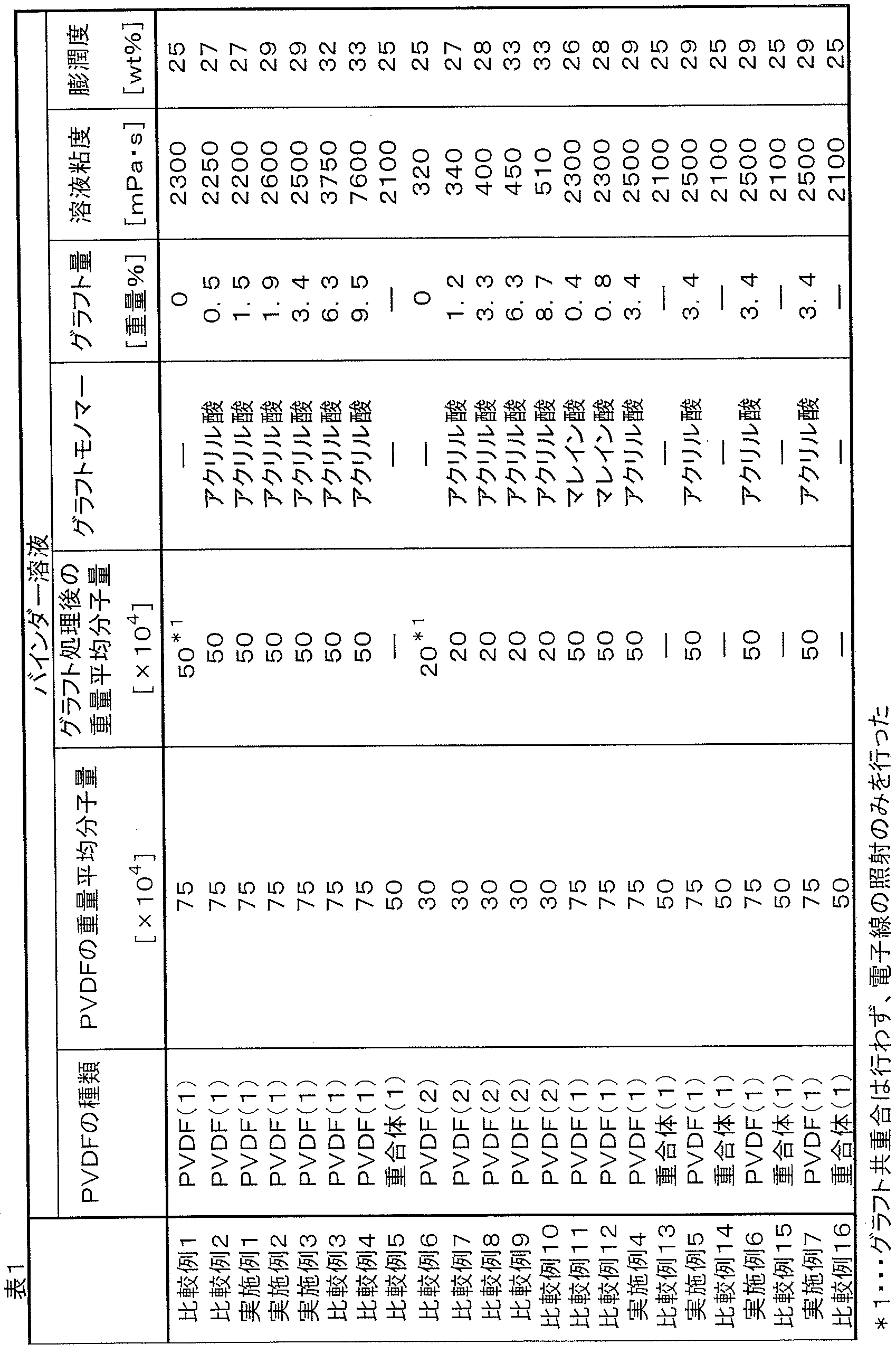
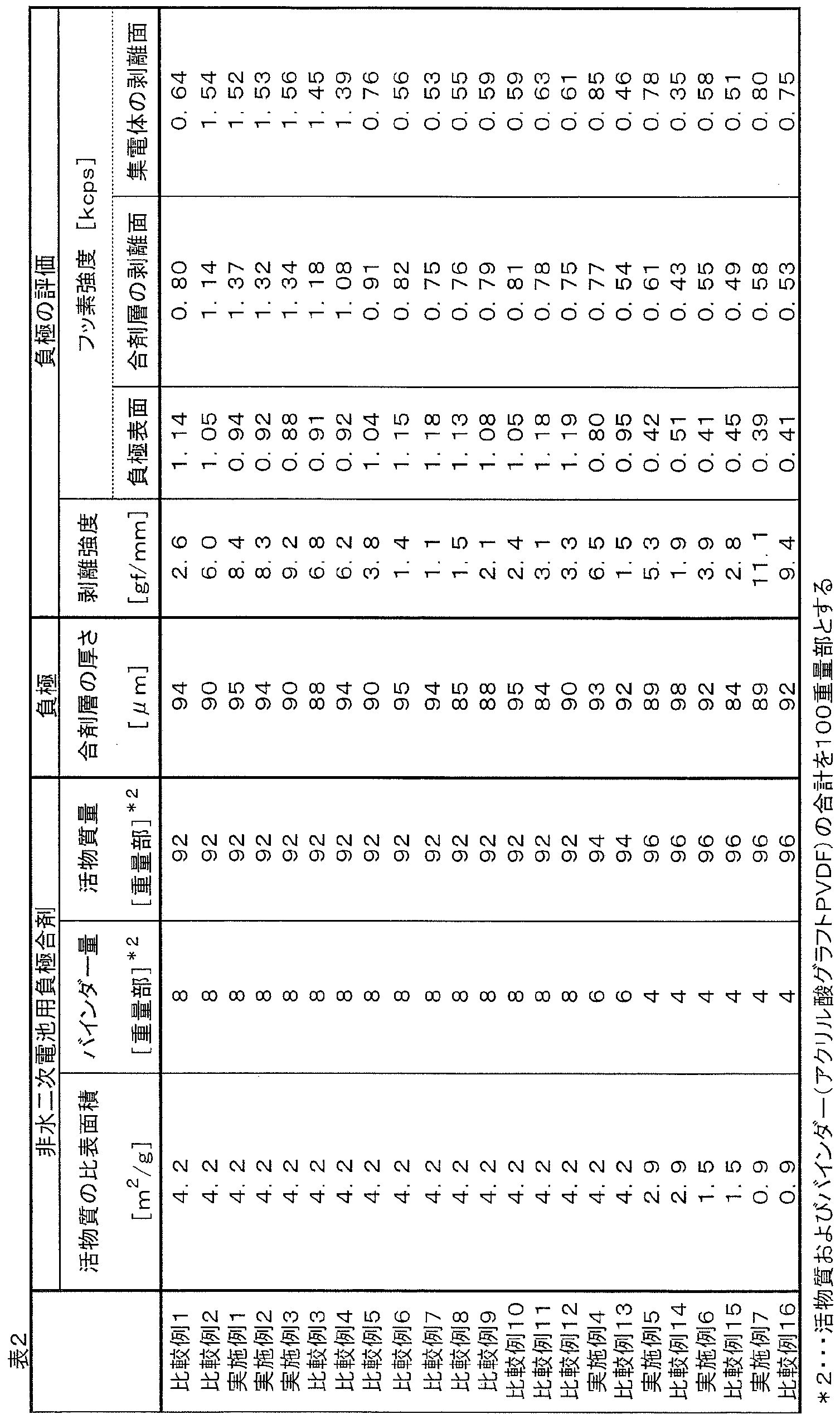
- Tables 1 and 2 show the compositions of the binder solution and the negative electrode mixture for nonaqueous electrolyte secondary batteries used in Examples and Comparative Examples, the thickness of the obtained negative electrode mixture layer, and the negative electrode evaluation results.
Landscapes
- Chemical & Material Sciences (AREA)
- Chemical Kinetics & Catalysis (AREA)
- Electrochemistry (AREA)
- General Chemical & Material Sciences (AREA)
- Engineering & Computer Science (AREA)
- Materials Engineering (AREA)
- Manufacturing & Machinery (AREA)
- Inorganic Chemistry (AREA)
- Battery Electrode And Active Subsutance (AREA)
Abstract
Description
本発明の非水電解質二次電池用負極合剤は、変性フッ化ビニリデン系重合体を含む。
ここでηは重合体溶液の粘度、η0は溶媒のN,N-ジメチルホルムアミド単独の粘度、Cは0.4g/dlである。
本発明の非水電解質二次電池用負極合剤は、炭素系負極活物質を含む。炭素系負極活物質としては、特に限定は無く、従来公知の炭素系負極活物質を用いることができる。
本発明の非水電解質二次電池用負極合剤は、有機溶剤を含有する。有機溶剤としては前記変性フッ化ビニリデン系重合体を溶解する作用を有するものが用いられ、好ましくは極性を有する溶剤が用いられる。有機溶剤の具体例としては、N-メチル-2-ピロリドン、N,N-ジメチルホルムアミド、N,N-ジメチルアセトアミド、ジメチルスルホキシド、ヘキサメチルホスフォアミド、ジオキサン、テトラヒドロフラン、テトラメチルウレア、トリエチルホスフェイト、トリメチルホスフェイトなどが挙げられ、N-メチル-2-ピロリドン、N,N-ジメチルホルムアミド、N,N-ジメチルアセトアミド、ジメチルスルホキシドが好ましい。また、有機溶剤は1種単独でも、2種以上を混合してもよい。
本発明の非水電解質二次電池用負極は、前記非水電解質二次電池用負極合剤を、集電体に塗布・乾燥することにより得られ、集電体と、非水電解質二次電池用負極合剤から形成される層とを有する。
本発明の非水電解質二次電池は、前記非水電解質二次電池用負極を有することを特徴とする。
内容量2リットルのオートクレーブに、イオン交換水1075g、メチルセルロース0.4g、ジノルマルプロピルパーオキシジカーボネート2.3g、酢酸エチル5g、フッ化ビニリデン420gを仕込み、25℃で15時間懸濁重合を行った。この間の最高圧力は4.0MPaに達した。重合完了後、重合体スラリーを脱水、水洗した。その後、80℃で20時間乾燥をおこない、粉末状のポリフッ化ビニリデン(1)(PVDF(1))を得た。PVDF(1)の重量平均分子量は75万であり、インヘレント粘度は2.1dl/gであった。
内容量2リットルのオートクレーブに、イオン交換水1040g、メチルセルロース0.4g、ジノルマルプロピルパーオキシジカーボネート2.0g、酢酸エチル8g、フッ化ビニリデン400gを仕込み、25℃で12時間懸濁重合を行った。この間の最高圧力は4.0MPaに達した。重合完了後、重合体スラリーを脱水、水洗した。その後、80℃で20時間乾燥をおこない、粉末状のポリフッ化ビニリデン(2)(PVDF(2))を得た。PVDF(2)の重量平均分子量は30万であり、インヘレント粘度は1.1dl/gであった。
内容量2リットルのオートクレーブに、イオン交換水1040g、メチルセルロース0.8g、ジイソプロピルパーオキシジカーボネート3.0g、フッ化ビニリデン396gおよびマレイン酸モノメチルエステル4.0gを仕込み、28℃で45時間懸濁重合を行った。この間の最高圧力は4.1MPaに達した。重合完了後、重合体スラリーを脱水、水洗した。その後、80℃で20時間乾燥をおこない、粉末状のカルボキシル基含有フッ化ビニリデン系重合体(1)(重合体(1))を得た。重合体(1)の重量平均分子量は50万であり、インヘレント粘度は1.7dl/gであった。
前記PVDF(1)、PVDF(2)、および重合体(1)のポリスチレン換算の重量平均分子量はゲルパーミエーションクロマトグラフィー(GPC)により測定した。
活物質の比表面積は、窒素吸着法によって測定した。
ここで、Vmは試料表面に単分子層を形成するに必要な吸着量(cm3/g)、vは実測される吸着量(cm3/g)、xは相対圧力である。
(PVDFへのアクリル酸グラフト重合)
500mLのサンプル瓶に、PVDF(1)150g、アクリル酸8g、メタノール232gを仕込み、攪拌混合した。得られた混合物をポリエチレン製の袋(ラミジップ(登録商標)、株式会社日本生産社製)に移し、袋内を窒素置換した。その後、袋の入り口をヒートシールし、密封した。
アクリル酸グラフトPVDF(1)のアクリル酸のグラフト量は、フーリエ変換赤外分光(FT-IR)スペクトルによって求めた。
バインダー溶液(1)をE型粘度計(東機産業株式会社製)にセットした後、30℃で1分間保温した。その後、せん断速度2s-1で5分間、溶液粘度の測定を行った。測定中に安定して連続的に得られた値を、バインダー溶液(1)の粘度とした。
まず、バインダー溶液(1)をガラス板上に塗布して、150℃の恒温槽に5時間入れ、NMPを除去することによって厚みが約100μmのキャストフィルムを作製した。
バインダー溶液(1)8g、人造黒鉛(日立化成工業株式会社製、MAG、平均粒径20μm、比表面積4.2m2/g)9.2g、および合剤粘度調整用のN-メチル-2-ピロリドン5.8gを攪拌混合し、非水電解質二次電池用負極合剤(1)を得た。非水電解質二次電池用負極合剤(1)の粘度は12500mPa・sであった。
アクリル酸グラフトPVDF(1)を、下記電子線照射PVDF(c1)に変更した以外は、実施例1と同様に行い、バインダー溶液(c1)、非水電解質二次電池用負極合剤(c1)、非水電解質二次電池用負極(c1)を得た。非水電解質二次電池用負極合剤(c1)の粘度は12300mPa・sであった。
アクリル酸8gを用いなかったこと以外は実施例1と同様に行い、アクリル酸グラフトPVDF(1)に変えて電子線照射PVDF(c1)を得た。電子線照射PVDF(c1)の重量平均分子量は50万、インヘレント粘度は1.7dl/gであった。
アクリル酸グラフトPVDF(1)を、下記アクリル酸グラフトPVDF(c2)に変更した以外は、実施例1と同様に行い、バインダー溶液(c2)、非水電解質二次電池用負極合剤(c2)、非水電解質二次電池用負極(c2)を得た。非水電解質二次電池用負極合剤(c2)の粘度は12300mPa・sであった。
アクリル酸4g、メタノール236gに変更した以外は実施例1と同様に行い、アクリル酸グラフトPVDF(1)に変えてアクリル酸グラフトPVDF(c2)を得た。アクリル酸グラフトPVDF(c2)の重量平均分子量は50万、インヘレント粘度は1.7dl/gであった。
アクリル酸グラフトPVDF(1)を、下記アクリル酸グラフトPVDF(2)に変更した以外は、実施例1と同様に行い、バインダー溶液(2)、非水電解質二次電池用負極合剤(2)、非水電解質二次電池用負極(2)を得た。非水電解質二次電池用負極合剤(2)の粘度は12800mPa・sであった。
アクリル酸12g、メタノール228gに変更した以外は実施例1と同様に行い、アクリル酸グラフトPVDF(1)に変えてアクリル酸グラフトPVDF(2)を得た。アクリル酸グラフトPVDF(2)の重量平均分子量は50万、インヘレント粘度は1.7dl/gであった。
アクリル酸グラフトPVDF(1)を、下記アクリル酸グラフトPVDF(3)に変更した以外は、実施例1と同様に行い、バインダー溶液(3)、非水電解質二次電池用負極合剤(3)、非水電解質二次電池用負極(3)を得た。非水電解質二次電池用負極合剤(3)の粘度は13500mPa・sであった。
アクリル酸24g、メタノール216gに変更した以外は実施例1と同様に行い、アクリル酸グラフトPVDF(1)に変えてアクリル酸グラフトPVDF(3)を得た。アクリル酸グラフトPVDF(3)の重量平均分子量は50万、インヘレント粘度は1.7dl/gであった。
アクリル酸グラフトPVDF(1)を、下記アクリル酸グラフトPVDF(c3)に変更した以外は、実施例1と同様に行い、バインダー溶液(c3)、非水電解質二次電池用負極合剤(c3)、非水電解質二次電池用負極(c3)を得た。非水電解質二次電池用負極合剤(c3)の粘度は16000mPa・sであった。
アクリル酸40g、メタノール200gに変更した以外は実施例1と同様に行い、アクリル酸グラフトPVDF(1)に変えてアクリル酸グラフトPVDF(c3)を得た。アクリル酸グラフトPVDF(c3)の重量平均分子量は50万、インヘレント粘度は1.7dl/gであった。
アクリル酸グラフトPVDF(1)を、下記アクリル酸グラフトPVDF(c4)に変更した以外は、実施例1と同様に行い、バインダー溶液(c4)、非水電解質二次電池用負極合剤(c4)、非水電解質二次電池用負極(c4)を得た。非水電解質二次電池用負極合剤(c4)の粘度は18500mPa・sであった。
アクリル酸60g、メタノール180gに変更した以外は実施例1と同様に行い、アクリル酸グラフトPVDF(1)に変えてアクリル酸グラフトPVDF(c4)を得た。アクリル酸グラフトPVDF(c4)の重量平均分子量は50万、インヘレント粘度は1.7dl/gであった。
アクリル酸グラフトPVDF(1)を、前記カルボキシル基含有フッ化ビニリデン系重合体(1)に変更した以外は、実施例1と同様に行い、バインダー溶液(c5)、非水電解質二次電池用負極合剤(c5)、非水電解質二次電池用負極(c5)を得た。非水電解質二次電池用負極合剤(c5)の粘度は12000mPa・sであった。
アクリル酸グラフトPVDF(1)を、下記電子線照射PVDF(c6)に変更したのと、合剤粘度調整用のN-メチル-2-ピロリドンを3gに変更した以外は、実施例1と同様に行い、バインダー溶液(c6)、非水電解質二次電池用負極合剤(c6)、非水電解質二次電池用負極(c6)を得た。非水電解質二次電池用負極合剤(c6)の粘度は13000mPa・sであった。
PVDF(1)をPVDF(2)に変え、アクリル酸8gを用いなかったこと以外は実施例1と同様に行い、アクリル酸グラフトPVDF(1)に変えて電子線照射PVDF(c6)を得た。電子線照射PVDF(c6)の重量平均分子量は20万、インヘレント粘度は0.9dl/gであった。
アクリル酸グラフトPVDF(1)を、下記アクリル酸グラフトPVDF(c7)に変更したのと、合剤粘度調整用のN-メチル-2-ピロリドンを3gに変更した以外は、実施例1と同様に行い、バインダー溶液(c7)、非水電解質二次電池用負極合剤(c7)、非水電解質二次電池用負極(c7)を得た。非水電解質二次電池用負極合剤(c7)の粘度は13500mPa・sであった。
PVDF(1)をPVDF(2)に変えた以外は実施例1と同様に行い、アクリル酸グラフトPVDF(1)に変えてアクリル酸グラフトPVDF(c7)を得た。アクリル酸グラフトPVDF(c7)の重量平均分子量は20万、インヘレント粘度は0.9dl/gであった。
アクリル酸グラフトPVDF(1)を、下記アクリル酸グラフトPVDF(c8)に変更したのと、合剤粘度調整用のN-メチル-2-ピロリドンを3gに変更した以外は、実施例1と同様に行い、バインダー溶液(c8)、非水電解質二次電池用負極合剤(c8)、非水電解質二次電池用負極(c8)を得た。非水電解質二次電池用負極合剤(c8)の粘度は14000mPa・sであった。
PVDF(1)をPVDF(2)に変え、アクリル酸24g、メタノール216gに変更した以外は実施例1と同様に行い、アクリル酸グラフトPVDF(1)に変えてアクリル酸グラフトPVDF(c8)を得た。アクリル酸グラフトPVDF(c8)の重量平均分子量は20万、インヘレント粘度は0.9dl/gであった。
アクリル酸グラフトPVDF(1)を、下記アクリル酸グラフトPVDF(c9)に変更したのと、合剤粘度調整用のN-メチル-2-ピロリドンを3gに変更した以外は、実施例1と同様に行い、バインダー溶液(c9)、非水電解質二次電池用負極合剤(c9)、非水電解質二次電池用負極(c9)を得た。非水電解質二次電池用負極合剤(c9)の粘度は15000mPa・sであった。
PVDF(1)をPVDF(2)に変え、アクリル酸40g、メタノール200gに変更した以外は実施例1と同様に行い、アクリル酸グラフトPVDF(1)に変えてアクリル酸グラフトPVDF(c9)を得た。アクリル酸グラフトPVDF(c9)の重量平均分子量は20万、インヘレント粘度は0.9dl/gであった。
アクリル酸グラフトPVDF(1)を、下記アクリル酸グラフトPVDF(c10)に変更したのと、合剤粘度調整用のN-メチル-2-ピロリドンを3gに変更した以外は、実施例1と同様に行い、バインダー溶液(c10)、非水電解質二次電池用負極合剤(c10)、非水電解質二次電池用負極(c10)を得た。非水電解質二次電池用負極合剤(c10)の粘度は18000mPa・sであった。
PVDF(1)をPVDF(2)に変え、アクリル酸60g、メタノール180gに変更した以外は実施例1と同様に行い、アクリル酸グラフトPVDF(1)に変えてアクリル酸グラフトPVDF(c10)を得た。アクリル酸グラフトPVDF(c10)の重量平均分子量は20万、インヘレント粘度は0.9dl/gであった。
アクリル酸グラフトPVDF(1)を、下記マレイン酸グラフトPVDF(c11)に変更した以外は、実施例1と同様に行い、バインダー溶液(c11)、非水電解質二次電池用負極合剤(c11)、非水電解質二次電池用負極(c11)を得た。非水電解質二次電池用負極合剤(c11)の粘度は12500mPa・sであった。
マレイン酸12g、メタノール228gに変更した以外は実施例1と同様に行い、アクリル酸グラフトPVDF(1)に変えてマレイン酸グラフトPVDF(c11)を得た。マレイン酸グラフトPVDF(c11)の重量平均分子量は50万、インヘレント粘度は1.7dl/gであった。
マレイン酸グラフトPVDF(c11)の、マレイン酸のグラフト量は、アクリル酸のグラフト量と同様の方法を用いてフーリエ変換赤外分光(FT-IR)スペクトルによって求めた。
アクリル酸グラフトPVDF(1)を、下記マレイン酸グラフトPVDF(c12)に変更した以外は、実施例1と同様に行い、バインダー溶液(c12)、非水電解質二次電池用負極合剤(c12)、非水電解質二次電池用負極(c12)を得た。非水電解質二次電池用負極合剤(c12)の粘度は12500mPa・sであった。
マレイン酸40g、メタノール200gに変更した以外は実施例1と同様に行い、アクリル酸グラフトPVDF(1)に変えてマレイン酸グラフトPVDF(c12)を得た。マレイン酸グラフトPVDF(c12)の重量平均分子量は50万、インヘレント粘度は1.7dl/gであった。
バインダー溶液(3)6g、人造黒鉛(日立化成工業株式会社製、MAG、平均粒径20μm、4.2m2/g)9.4g、および合剤粘度調整用のN-メチル-2-ピロリドン2.8gを攪拌混合し、非水電解質二次電池用負極合剤(4)を得た。
バインダー溶液(c5)6g、人造黒鉛(日立化成工業株式会社製、MAG、平均粒径20μm、比表面積4.2m2/g)9.4g、および合剤粘度調整用のN-メチル-2-ピロリドン2.8gを攪拌混合し、非水電解質二次電池用負極合剤(c13)を得た。
バインダー溶液(3)4g、人造黒鉛(大阪ガス株式会社製、MCMB、平均粒径6.5μm、比表面積2.9m2/g)9.6g、および合剤粘度調整用のN-メチル-2-ピロリドン7.0gを攪拌混合し、非水電解質二次電池用負極合剤(5)を得た。
バインダー溶液(c5)4g、人造黒鉛(大阪ガス株式会社製、MCMB、平均粒径6.5μm、比表面積2.9m2/g)9.6g、および合剤粘度調整用のN-メチル-2-ピロリドン5.8gを攪拌混合し、非水電解質二次電池用負極合剤(c14)を得た。
バインダー溶液(3)4g、人造黒鉛(日立化成工業株式会社製、MAG、平均粒径38μm、比表面積1.5m2/g)9.6g、および合剤粘度調整用のN-メチル-2-ピロリドン3.9gを攪拌混合し、非水電解質二次電池用負極合剤(6)を得た。
バインダー溶液(c5)4g、人造黒鉛(日立化成工業株式会社製、MAG、平均粒径38μm、比表面積1.5m2/g)9.6g、および合剤粘度調整用のN-メチル-2-ピロリドン3.9gを攪拌混合し、非水電解質二次電池用負極合剤(c15)を得た。
バインダー溶液(3)4g、人造黒鉛(大阪ガス株式会社製、MCMB、平均粒径23μm、比表面積0.9m2/g)9.6g、および合剤粘度調整用のN-メチル-2-ピロリドン2.0gを攪拌混合し、非水電解質二次電池用負極合剤(7)を得た。
バインダー溶液(c5)4g、人造黒鉛(大阪ガス株式会社製、MCMB、平均粒径23μm、比表面積0.9m2/g)9.6g、および合剤粘度調整用のN-メチル-2-ピロリドン2.0gを攪拌混合し、非水電解質二次電池用負極合剤(c16)を得た。
〔剥離強度〕
実施例および比較例で得られた負極を試料とし、合剤層と集電体との剥離強度をJIS K6854に準拠して180°剥離試験により測定した。
(負極表面のフッ素強度)
実施例および比較例で得られた電極を、40mm角に切断し、蛍光X線測定装置(Shimadzu製、蛍光X線装置、XRF-1700)を使用して、40kV、60mA、照射直径30mmの条件で、合剤層側における負極表面のフッ素強度を測定した。
実施例および比較例で得られた電極を、40mm角に切断し、合剤層側の負極表面にダンプロン(登録商標)テープ(NO375)(日東電工CSシステム社製)を貼り付けた。
Claims (7)
- 変性フッ化ビニリデン系重合体、炭素系負極活物質、および有機溶剤を含有し、
前記変性フッ化ビニリデン系重合体が、インヘレント粘度が1.3dl/g以上のフッ化ビニリデン系重合体に、カルボキシル基含有モノマーをグラフト量が1~5重量%となるように、放射線グラフト共重合することにより得られる重合体である非水電解質二次電池用負極合剤。 - 変性フッ化ビニリデン系重合体および炭素系負極活物質の合計を100重量部とすると、変性フッ化ビニリデン系重合体が1~10重量部である請求項1に記載の非水電解質二次電池用負極合剤。
- 炭素系負極活物質の比表面積が2~6m2/gである請求項1または2に記載の非水電解質二次電池用負極合剤。
- 前記カルボキシル基含有モノマーが、アクリル酸およびメタクリル酸から選択される少なくとも1種の不飽和カルボン酸である請求項1~3のいずれか一項に記載の非水電解質二次電池用負極合剤。
- 請求項1~4のいずれか一項に記載の非水電解質二次電池用負極合剤を、集電体に塗布・乾燥することにより得られる非水電解質二次電池用負極。
- 前記非水電解質二次電池用負極合剤から形成される、厚さ20~150μmの合剤層を有する請求項5に記載の非水電解質二次電池用負極。
- 請求項5または6に記載の非水電解質二次電池用負極を有することを特徴とする非水電解質二次電池。
Priority Applications (2)
| Application Number | Priority Date | Filing Date | Title |
|---|---|---|---|
| KR1020127018064A KR101412382B1 (ko) | 2010-03-30 | 2011-03-08 | 비수 전해질 2 차 전지용 부극 합제, 비수 전해질 2 차 전지용 부극 및 비수 전해질 2 차 전지 |
| JP2012508178A JP5697660B2 (ja) | 2010-03-30 | 2011-03-08 | 非水電解質二次電池用負極合剤、非水電解質二次電池用負極および非水電解質二次電池 |
Applications Claiming Priority (2)
| Application Number | Priority Date | Filing Date | Title |
|---|---|---|---|
| JP2010-077693 | 2010-03-30 | ||
| JP2010077693 | 2010-03-30 |
Publications (1)
| Publication Number | Publication Date |
|---|---|
| WO2011122260A1 true WO2011122260A1 (ja) | 2011-10-06 |
Family
ID=44711986
Family Applications (1)
| Application Number | Title | Priority Date | Filing Date |
|---|---|---|---|
| PCT/JP2011/055336 Ceased WO2011122260A1 (ja) | 2010-03-30 | 2011-03-08 | 非水電解質二次電池用負極合剤、非水電解質二次電池用負極および非水電解質二次電池 |
Country Status (4)
| Country | Link |
|---|---|
| JP (1) | JP5697660B2 (ja) |
| KR (1) | KR101412382B1 (ja) |
| TW (1) | TWI442617B (ja) |
| WO (1) | WO2011122260A1 (ja) |
Cited By (3)
| Publication number | Priority date | Publication date | Assignee | Title |
|---|---|---|---|---|
| JP2020087643A (ja) * | 2018-11-22 | 2020-06-04 | カーリットホールディングス株式会社 | 非水電解質二次電池用電極 |
| US11643486B1 (en) * | 2022-06-08 | 2023-05-09 | Arkema Inc. | Non-linear vinylidene fluoride copolymers |
| WO2025205939A1 (ja) * | 2024-03-29 | 2025-10-02 | 株式会社クレハ | 電極合剤、電極、および電池 |
Families Citing this family (3)
| Publication number | Priority date | Publication date | Assignee | Title |
|---|---|---|---|---|
| KR101674842B1 (ko) * | 2012-10-01 | 2016-11-09 | 아사히 가세이 가부시키가이샤 | 축전 소자용 전극 및 비수계 리튬형 축전 소자 |
| KR20170020032A (ko) * | 2015-08-13 | 2017-02-22 | 주식회사 엘지화학 | 이차전지용 캐소드 및 그의 제조방법 |
| CN112151788B (zh) * | 2019-06-26 | 2024-10-01 | 伊翁布洛克斯有限公司 | 具有高性能电解质和氧化硅活性材料的锂离子电池 |
Citations (7)
| Publication number | Priority date | Publication date | Assignee | Title |
|---|---|---|---|---|
| JPH09289023A (ja) * | 1996-02-22 | 1997-11-04 | Kureha Chem Ind Co Ltd | 電極バインダー溶液、電極合剤、電極構造体および電池 |
| JPH10302800A (ja) * | 1997-04-28 | 1998-11-13 | Kureha Chem Ind Co Ltd | 電池用バインダー溶液、これを含有する電極合剤、およびそれを用いた電極構造体ならびに電池 |
| JP2004079218A (ja) * | 2002-08-09 | 2004-03-11 | Mitsubishi Materials Corp | 穿孔装置 |
| JP2004220911A (ja) * | 2003-01-15 | 2004-08-05 | Mitsubishi Materials Corp | リチウムポリマー電池用負極材料及びこれを用いた負極、並びにこの負極を用いたリチウムイオン電池及びリチウムポリマー電池 |
| JP2005047275A (ja) * | 2003-07-29 | 2005-02-24 | Arkema | 変性フッ素化ポリマーを含む構造物と、この構造物をベースにした電極 |
| WO2009047969A1 (ja) * | 2007-10-11 | 2009-04-16 | Kureha Corporation | フッ化ビニリデン系ポリマー粉体及びその利用 |
| JP2010500440A (ja) * | 2006-08-08 | 2010-01-07 | アルケマ フランス | 不飽和極性モノマーを照射グラフトした官能化pvdf |
-
2011
- 2011-03-08 KR KR1020127018064A patent/KR101412382B1/ko not_active Expired - Fee Related
- 2011-03-08 JP JP2012508178A patent/JP5697660B2/ja not_active Expired - Fee Related
- 2011-03-08 WO PCT/JP2011/055336 patent/WO2011122260A1/ja not_active Ceased
- 2011-03-16 TW TW100108956A patent/TWI442617B/zh not_active IP Right Cessation
Patent Citations (7)
| Publication number | Priority date | Publication date | Assignee | Title |
|---|---|---|---|---|
| JPH09289023A (ja) * | 1996-02-22 | 1997-11-04 | Kureha Chem Ind Co Ltd | 電極バインダー溶液、電極合剤、電極構造体および電池 |
| JPH10302800A (ja) * | 1997-04-28 | 1998-11-13 | Kureha Chem Ind Co Ltd | 電池用バインダー溶液、これを含有する電極合剤、およびそれを用いた電極構造体ならびに電池 |
| JP2004079218A (ja) * | 2002-08-09 | 2004-03-11 | Mitsubishi Materials Corp | 穿孔装置 |
| JP2004220911A (ja) * | 2003-01-15 | 2004-08-05 | Mitsubishi Materials Corp | リチウムポリマー電池用負極材料及びこれを用いた負極、並びにこの負極を用いたリチウムイオン電池及びリチウムポリマー電池 |
| JP2005047275A (ja) * | 2003-07-29 | 2005-02-24 | Arkema | 変性フッ素化ポリマーを含む構造物と、この構造物をベースにした電極 |
| JP2010500440A (ja) * | 2006-08-08 | 2010-01-07 | アルケマ フランス | 不飽和極性モノマーを照射グラフトした官能化pvdf |
| WO2009047969A1 (ja) * | 2007-10-11 | 2009-04-16 | Kureha Corporation | フッ化ビニリデン系ポリマー粉体及びその利用 |
Cited By (4)
| Publication number | Priority date | Publication date | Assignee | Title |
|---|---|---|---|---|
| JP2020087643A (ja) * | 2018-11-22 | 2020-06-04 | カーリットホールディングス株式会社 | 非水電解質二次電池用電極 |
| JP7209420B2 (ja) | 2018-11-22 | 2023-01-20 | カーリットホールディングス株式会社 | 非水電解質二次電池用電極 |
| US11643486B1 (en) * | 2022-06-08 | 2023-05-09 | Arkema Inc. | Non-linear vinylidene fluoride copolymers |
| WO2025205939A1 (ja) * | 2024-03-29 | 2025-10-02 | 株式会社クレハ | 電極合剤、電極、および電池 |
Also Published As
| Publication number | Publication date |
|---|---|
| JP5697660B2 (ja) | 2015-04-08 |
| TW201212354A (en) | 2012-03-16 |
| KR101412382B1 (ko) | 2014-06-25 |
| TWI442617B (zh) | 2014-06-21 |
| KR20120094120A (ko) | 2012-08-23 |
| JPWO2011122260A1 (ja) | 2013-07-08 |
Similar Documents
| Publication | Publication Date | Title |
|---|---|---|
| JP5684235B2 (ja) | 非水電解質二次電池用合剤、非水電解質二次電池用電極および非水電解質二次電池 | |
| CN103155247B (zh) | 非水电解质二次电池用负极混合剂、非水电解质二次电池用负极和非水电解质二次电池 | |
| JP5626791B2 (ja) | 非水電解質二次電池用負極合剤、非水電解質二次電池用負極および非水電解質二次電池 | |
| CN103261247B (zh) | 1,1-二氟乙烯类共聚物、及该共聚物的用途 | |
| JP5697660B2 (ja) | 非水電解質二次電池用負極合剤、非水電解質二次電池用負極および非水電解質二次電池 | |
| CN110167976B (zh) | 偏氟乙烯共聚物粒子及其利用 | |
| JP2010514140A (ja) | リチウムイオン電池および電気二重層キャパシタのための電極バインダー組成物および電極 | |
| JP6016930B2 (ja) | 非水電解質二次電池用バインダー、非水電解質二次電池用バインダー溶液、非水電解質二次電池用負極合剤およびその用途 | |
| WO2014002937A1 (ja) | 非水電解質二次電池用樹脂膜の製造方法および非水電解質二次電池用樹脂膜 | |
| EP3809500A1 (en) | Binder composition, electrode mixture, electrode structure, method for manufacturing electrode structure, and secondary cell | |
| JP7062476B2 (ja) | バインダー組成物、電極合剤原料、電極合剤、電極、非水電解質二次電池および電極合剤の製造方法 | |
| JP5548131B2 (ja) | 非水電解質二次電池用負極合剤、非水電解質二次電池用負極および非水電解質二次電池 | |
| JP5400058B2 (ja) | 非水電解質二次電池用負極合剤、非水電解質二次電池用負極および非水電解質二次電池 | |
| JP2024515670A (ja) | 部分フッ素化ポリマーを製造するための方法 |
Legal Events
| Date | Code | Title | Description |
|---|---|---|---|
| 121 | Ep: the epo has been informed by wipo that ep was designated in this application |
Ref document number: 11762500 Country of ref document: EP Kind code of ref document: A1 |
|
| ENP | Entry into the national phase |
Ref document number: 20127018064 Country of ref document: KR Kind code of ref document: A |
|
| WWE | Wipo information: entry into national phase |
Ref document number: 2012508178 Country of ref document: JP |
|
| NENP | Non-entry into the national phase |
Ref country code: DE |
|
| 122 | Ep: pct application non-entry in european phase |
Ref document number: 11762500 Country of ref document: EP Kind code of ref document: A1 |