WO2011121906A1 - 情報記録媒体用ガラス基板の製造方法及び情報記録媒体用ガラス基板 - Google Patents
情報記録媒体用ガラス基板の製造方法及び情報記録媒体用ガラス基板 Download PDFInfo
- Publication number
- WO2011121906A1 WO2011121906A1 PCT/JP2011/001468 JP2011001468W WO2011121906A1 WO 2011121906 A1 WO2011121906 A1 WO 2011121906A1 JP 2011001468 W JP2011001468 W JP 2011001468W WO 2011121906 A1 WO2011121906 A1 WO 2011121906A1
- Authority
- WO
- WIPO (PCT)
- Prior art keywords
- grinding
- magnesium
- calcium
- information recording
- base plate
- Prior art date
- Legal status (The legal status is an assumption and is not a legal conclusion. Google has not performed a legal analysis and makes no representation as to the accuracy of the status listed.)
- Ceased
Links
Images

Classifications
-
- G—PHYSICS
- G11—INFORMATION STORAGE
- G11B—INFORMATION STORAGE BASED ON RELATIVE MOVEMENT BETWEEN RECORD CARRIER AND TRANSDUCER
- G11B5/00—Recording by magnetisation or demagnetisation of a record carrier; Reproducing by magnetic means; Record carriers therefor
- G11B5/84—Processes or apparatus specially adapted for manufacturing record carriers
- G11B5/8404—Processes or apparatus specially adapted for manufacturing record carriers manufacturing base layers
-
- C—CHEMISTRY; METALLURGY
- C03—GLASS; MINERAL OR SLAG WOOL
- C03C—CHEMICAL COMPOSITION OF GLASSES, GLAZES OR VITREOUS ENAMELS; SURFACE TREATMENT OF GLASS; SURFACE TREATMENT OF FIBRES OR FILAMENTS MADE FROM GLASS, MINERALS OR SLAGS; JOINING GLASS TO GLASS OR OTHER MATERIALS
- C03C19/00—Surface treatment of glass, not in the form of fibres or filaments, by mechanical means
Definitions
- the present invention relates to a method for producing a glass substrate for information recording medium and a glass substrate for information recording medium.
- This glass substrate for information recording media is generally manufactured through a lapping process.
- the grinding apparatus is provided by using a grinding liquid with pure water as a solvent or by using a grinding apparatus having a function of separating polishing sludge components such as polishing scraps. Clogging of a grindstone as a grinding member is prevented (see Patent Document 1).
- the frequency of dressing of the grinding member such as diamond sheet
- the productivity will be reduced, as well as scratching the ground surface of the glass base plate (which refers to the workpiece during the glass substrate manufacturing process) This may cause quality degradation such as occurrence of cracks and poor flatness of the ground surface.
- the cost increases in order to promote the deterioration of the grinding member.
- the present invention provides a method for manufacturing a glass substrate for an information recording medium that is less likely to cause clogging of the grinding member, is efficient, and has a low risk of quality deterioration, and an information recording medium manufactured by the manufacturing method.
- the purpose is to provide a glass substrate.
- One aspect of the present invention is a method for manufacturing a glass substrate for an information recording medium, which includes a lapping process in which a surface of a glass base plate is lapped using a grinding device provided with a grinding member and a grinding liquid, the lapping process Then, the grinding liquid is lapped so that the total content of calcium and magnesium is always 5 mg / L or less.
- This is a method for producing a glass substrate for an information recording medium.
- Another aspect of the present invention is an information recording medium glass substrate manufactured by the above-described method for manufacturing an information recording medium glass substrate.
- the grinding fluid contains calcium or magnesium
- an insoluble metal salt is formed by the calcium or magnesium and the surfactant in the grinding fluid, and clogging of grinding members such as grindstones and diamond sheets.
- the calcium or magnesium component is contained in the grinding fluid during lapping.
- an insoluble metal salt is generated by the calcium component or magnesium component and the surfactant in the grinding fluid, and as a result, there is a possibility of clogging the grinding member as described above.
- a conventional grinding device having a sludge separation function is used, it is difficult to prevent clogging of the grinding member only by separating the generated sludge.
- the present invention has been completed as a result of such studies.
- FIG. 1 is a perspective view of a glass substrate 100 for information recording medium manufactured by the method for manufacturing a glass substrate for information recording medium according to this embodiment
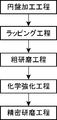
- FIG. 2 is a manufacturing of the glass substrate for information recording medium according to this embodiment. It is process explanatory drawing for demonstrating the process of a method.
- the method for manufacturing a glass substrate for an information recording medium includes a disk processing step, a lapping step, a rough polishing step, a chemical strengthening step, and a precision (finish) polishing step.
- the glass substrate 100 for information recording media is manufactured.
- the glass material to be used is not particularly limited.
- a glass composition containing silicon oxide (SiO 2 ) as a main component and not containing both magnesium and calcium can be used.
- a glass composition containing one or both of magnesium and calcium can also be used.
- a glass composition containing no cerium or a glass composition containing cerium can also be used.
- the disk processing step is a step of processing plate glass made of a glass material into a disk-shaped glass base plate.
- a disk-shaped glass base plate having an outer diameter of 2.5 inches, 1.8 inches, 1 inch, 0.8 inches, etc. and a thickness of 2 mm, 1 mm, 0.63 mm, etc. is formed. Is done.
- size and thickness of the glass base plate formed by a disk processing process are not specifically limited.
- the lapping step is a step of processing the glass base plate into a predetermined plate thickness.
- the lapping process is composed of two processes, a first lapping process and a second lapping process.
- both the front and back surfaces of the glass base plate are lapped to preliminarily adjust the overall shape of the glass base plate, that is, the parallelism, flatness and thickness of the glass base plate.
- both the front and back surfaces of the glass base plate are again lapped to finely adjust the parallelism, flatness and thickness of the glass base plate.
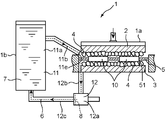
- the grinding apparatus 1 for lapping both the front and back surfaces of the glass base plate in the first and second lapping steps, a grinding apparatus capable of simultaneous grinding on both sides as shown in FIG. 3 is used in this embodiment.
- the grinding apparatus 1 includes an apparatus main body 1a and a grinding liquid supply unit 1b that supplies a grinding liquid to the apparatus main body 1a.
- the apparatus main body 1a includes a disk-shaped upper surface plate 2 and a lower surface plate 3 that are arranged at intervals in the vertical direction so as to be parallel to each other and rotate in opposite directions.
- a plurality of diamond sheets 4 for lapping both the front and back surfaces of the glass base plate 10 are attached to the opposing surfaces of the upper and lower surface plates 2 and 3.
- a plurality of rotatable carriers 5 are provided between the upper and lower surface plates 2 and 3.
- the carrier 5 is provided with a plurality of through holes 51.
- the glass base plate 10 is fitted into the through hole 51 and disposed.
- the upper and lower surface plates 2 and 3 can be operated by separate driving.
- the carrier 5 sandwiched between the surface plates 2 and 3 via the diamond sheet 4 rotates while maintaining a plurality of glass base plates 10 while lowering the surface plate 3 with respect to the center of rotation of the surface plates 2 and 3. Revolve in the same direction as.
- the grinding liquid 7 is supplied between the upper surface plate 2 and the glass base plate 10 and between the lower surface plate 3 and the glass base plate 10, respectively.
- the lapping of the glass base plate 10 can be performed.
- the diamond sheet 4 having a particle size of about 9 ⁇ m is used in the first lapping step, and a particle size of about 4 ⁇ m is used in the second lapping step.
- the grinding liquid supply unit 1 b includes a liquid storage unit 11 and a liquid recovery unit 12.
- the liquid storage part 11 includes a liquid storage part main body 11a and a liquid supply pipe 11b extended from the liquid storage part main body 11a to the apparatus main body 1a.
- the liquid supply pipe 11b has a discharge port 11e.
- the liquid recovery part 12 was extended from the liquid recovery part main body 12a, the liquid recovery pipe 12b extended from the liquid recovery part main body 12a to the apparatus main body part 1a, and the grinding liquid supply part 1b from the liquid recovery part main body 12a. And a liquid return pipe 12c.
- the grinding liquid 7 put in the liquid storage unit main body 11a is supplied to the apparatus main body 1a from the discharge port 11e of the liquid supply pipe 11b, and is recovered from the apparatus main body 1a to the liquid recovery unit main body 12a via the liquid recovery pipe 12b. Is done.
- the collected grinding liquid 7 is returned to the liquid storage part 11 through the liquid return pipe 12c and can be supplied again to the apparatus main body part 1a. Therefore, the grinding fluid circulation path 6 of the grinding fluid supply part 1b is formed by the liquid storage part main body 11a, the liquid supply pipe 11b, the liquid recovery pipe 12b, the liquid recovery part main body 12a, and the liquid return pipe 12c.
- the grinding fluid supply unit 1b includes a metal ion removal filter 8 in the middle of the grinding fluid circulation path 6 (in the illustrated example, the boundary between the fluid recovery unit main body 12a and the fluid return pipe 12c).
- the grinding liquid 7 passes through the metal ion removal filter 8 when circulating through the grinding liquid circulation path 6.
- metal ions such as calcium ions, magnesium ions, and cerium ions, contained in the grinding fluid 7 are removed by the metal ion removal filter 8.
- the metal ion removal filter 8 is provided in the liquid recovery unit main body 12a.
- the grinding liquid 7 is returned from the liquid recovery part main body 12a to the liquid storage part main body 11a, metal ions are removed from the grinding liquid 7.
- the grinding fluid 7 includes, for example, polyalkylene glycol, alkylene glycol monoalkyl ether, alcohol (such as methanol), fatty acid, nonion, and amines (such as monoethanolamine, diethanolamine, and triethanolamine). used.
- the grinding fluid 7 is used while maintaining a state where the total content of calcium and magnesium is always 5 mg / L or less in the lapping step. If the total content of calcium and magnesium is 5 mg / L or less, clogging of the diamond sheet 4 as a grinding member is difficult to occur, and if it exceeds 5 mg / L, clogging of the diamond sheet 4 is likely to occur. is there.
- a grinding solution in which the total amount of calcium and magnesium in the grinding solution is 5 mg / L or less can be adjusted, and the glass base plate can be lapped using this grinding solution.
- the grinding fluid 7 is used while maintaining a total content of calcium and magnesium of 3 mg / L or less at all times. Thereby, it is possible to further prevent clogging of the diamond sheet 4.
- a grinding solution in which the total amount of calcium and magnesium in the grinding solution is 3 mg / L or less can be adjusted, and the glass base plate can be lapped using this grinding solution.
- the grinding fluid 7 is preferably used while the cerium content is constantly maintained at 10 mg / L or less in the lapping step. If the cerium content is 10 mg / L or less, clogging of the diamond sheet 4 as a grinding member is difficult to occur, and if it exceeds 10 mg / L, clogging of the diamond sheet 4 is likely to occur. For example, before the start of the lapping process, a grinding liquid in which the amount of cerium in the grinding liquid is 10 mg / L or less can be adjusted, and the glass base plate can be lapped using this grinding liquid.
- the ground surface of the glass base plate 10 is free from defects such as large waviness, chipping and cracks, and the surface roughness of the surface of the glass base plate 10 is Rmax of 2 ⁇ m to 4 ⁇ m, Ra is preferably about 0.2 ⁇ m to 0.4 ⁇ m.
- the grinding fluid 7 when the grinding fluid 7 contains calcium, magnesium and / or cerium, they can be removed by the metal ion removal filter 8.
- the grinding fluid 7 is used with water having a total calcium and magnesium content of 1 mg / L or less (hereinafter sometimes referred to as “dilution water”). By diluting, the amount of calcium and / or magnesium contained in the grinding fluid 7 may be maintained.
- the calcium and magnesium contents of the grinding fluid 7 are periodically measured, and the total content of calcium and magnesium becomes 5 mg / L. It is better to dilute when it reaches 3 mg / L.
- a predetermined amount of the dilution water may be periodically added to the grinding fluid 7 without measuring the calcium and magnesium contents of the grinding fluid 7.
- the total content of calcium and magnesium in the grinding fluid 7 can always be maintained at 5 mg / L or less or 3 mg / L or less.
- the lapping process can be started from a state in which the total amount of calcium and magnesium in the grinding liquid 7 is very small by diluting the grinding liquid 7 with the diluting water before starting the lapping process, for example.
- the rough polishing step is a step of polishing the surface of the glass base plate 10 so as to improve the surface roughness to the extent that the surface roughness finally required in the precision polishing step described later can be efficiently obtained. .
- the rough polishing method is, for example, the first and second lapping processes except that a polishing pad and a polishing liquid (for example, those containing colloidal silica as an abrasive) are used instead of the diamond sheet and the grinding liquid used in the lapping process. It can be performed using a polishing apparatus having a configuration similar to that of the grinding apparatus used in the above.
- the chemical strengthening step is a step of forming a chemically strengthened layer on the glass base plate 10 by immersing the glass base plate 10 in a chemical strengthening treatment solution.
- a chemical strengthening treatment solution By forming the chemically strengthened layer, the impact resistance, vibration resistance, heat resistance and the like of the glass base plate 10 can be improved.
- this chemical strengthening step by immersing the glass base plate 10 in a heated chemical strengthening treatment liquid, alkali metal ions such as lithium ions and sodium ions contained in the glass base plate 10 are converted into potassium ions having a larger ion radius. It is carried out by an ion exchange method for substitution with alkali metal ions. Compressive stress is generated in the ion-exchanged region due to distortion caused by the difference in ion radius, and the surface of the glass base plate 10 is strengthened.
- the precision polishing step is a step of further precisely polishing the surface of the glass base plate 10 after the rough polishing step.
- the precision polishing process can be performed using a polishing apparatus having the same configuration as the polishing apparatus used in the rough polishing process, except that a polishing pad softer than the polishing pad used in the rough polishing process is used.
- a glass substrate 100 for an information recording medium as shown in FIG. 1 After passing through a precision polishing step, a glass substrate 100 for an information recording medium as shown in FIG. 1 can be obtained through steps such as cleaning.
- the grinding device used in the first and second lapping steps, the polishing device used in the rough polishing step, and the precision polishing step are not limited to those in the above embodiment, and various devices can be used and can be changed as appropriate.
- the polishing liquid used in the rough polishing process and the precision polishing process includes colloidal silica as an abrasive.
- the present invention is not limited to this, and various types can be used and can be changed as appropriate.
- Glass base plate of composition 1 A disk-shaped glass base plate having the following composition (hereinafter referred to as “glass base plate of composition 1”) was produced.
- Glass workpiece composition 1 SiO 2: 64.5 wt%, Al 2 O 3: 14.9 wt%, Li 2 O: 3.6 wt%, Na 2 O: 11.2 wt%, K 2 O: 0.4 wt%, MgO: 0.6 wt%, CaO: 1.6 wt%, CeO 2: 0.5% by weight, ZrO 2: 2.0 wt%, SnO 2: 0.7 wt% It consists of a glass material containing. Since the glass base plate of this composition 1 contains calcium, magnesium and cerium, calcium, magnesium and cerium of the glass base plate come out in the grinding liquid during the lapping process, and the amount of calcium in the grinding liquid, magnesium The amount of cerium increases.
- a disk-shaped glass base plate having the following composition (hereinafter referred to as “glass base plate of composition 2”) was produced.
- the glass base plate of composition 2 is SiO 2 : 66.5 mass%, Al 2 O 3 : 14.1 mass%, Li 2 O: 7.3 mass%, Na 2 O: 3.0 mass%, K 2 O: 1.8% by mass, MgO: 2.4% by mass, CeO 2 : 0.6% by mass, TiO 2 : 1.9% by mass, Nb 2 O 5 : 2.4% by mass Is. Since the glass base plate of composition 2 contains magnesium and cerium, magnesium and cerium of the glass base plate come out into the grinding fluid during the lapping process, and the amount of magnesium and cerium in the grinding fluid increase. To do.
- glass base plate of composition 3 a disk-shaped glass base plate having the following composition (hereinafter referred to as “glass base plate of composition 3”) was produced.
- Glass workpiece composition 3 SiO 2: 63.6 wt%, Al 2 O 3: 13.8 wt%, Li 2 O: 5.7 wt%, Na 2 O: 10.7 wt%, Sb 2 It consists of a glass material containing O 3 : 0.6 mass% and ZrO 2 : 5.6 mass%. Since the glass base plate of this composition 3 does not contain calcium, magnesium, or cerium, the amount of calcium, the amount of magnesium, and the amount of cerium in the grinding liquid do not increase during the lapping process.
- the total amount of calcium and magnesium in the grinding fluid is 3 mg / L or less.
- a grinding liquid having an amount of 10 mg / L or less was prepared, and the produced glass base plate having the composition 1 to 3 was lapped using this grinding liquid. That is, while using the grinding apparatus provided with the metal ion removal filter shown in FIG. 3, during the lapping process, by diluting the grinding liquid with the dilution water according to the situation, the calcium and magnesium in the grinding liquid can be reduced.
- the glass base plates having compositions 1 to 3 were lapped so that the total amount was always 3 mg / L or less and the amount of cerium was always kept 10 mg / L or less.
- first diamond sheet a diamond sheet having a particle size of 9 ⁇ m
- second diamond sheet a diamond sheet having a particle size of 4 ⁇ m
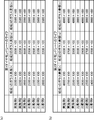
- FIGS. 4 (a) and 4 (b) show the life of the first and second diamond sheets.
- the life of the diamond sheet is the number (n) of the glass base plates that have been lapped before the diamond sheet becomes unusable (requires replacement).
- the glass base plate became unusable (end of life) when the flatness of the glass base plate reached an average value of 8 ⁇ m or more.
- the flatness was measured with a flat nesting tester “FT-900” (manufactured by NIDEK) using a laser oblique incidence interferometer.
- Example 2 The total amount of calcium and magnesium in the grinding fluid to be adjusted before the start of the lapping process is 3 mg / L and 5 mg / L or less.
- a glass base plate having compositions 1 to 3 was lapped in the same manner as in Example 1 except that the following conditions were maintained. The results are shown in FIGS. 4 (a) and 4 (b).
- Example 3 The total amount of calcium and magnesium in the grinding liquid to be adjusted before the start of the lapping process is set to 5 mg / L or less. During the lapping process, the total amount of calcium and magnesium in the grinding liquid is always kept at 5 mg / L or less.
- a glass base plate having compositions 1 to 3 was lapped in the same manner as in Example 1 except that the amount was not controlled. The results are shown in FIGS. 4 (a) and 4 (b).
- the amount of cerium was not controlled by using a metal ion removal filter that was adjusted to remove calcium and magnesium but allow cerium to permeate by adjusting the chelating agent.
- the amount of cerium in the grinding fluid adjusted before the start of the lapping process was 10 mg / L or less.
- the cerium contained in the glass base plate during the lapping step Appeared in the grinding fluid, and the amount of cerium in the grinding fluid gradually increased to exceed 10 mg / L (that is, the amount of cerium exceeded 10 mg / L during the lapping process).
- the glass base plate of composition 3 does not contain cerium, the amount of cerium in the grinding fluid did not exceed 10 mg / L without controlling the amount of cerium.
- the tap water used for diluting the grinding fluid had a total content of calcium and magnesium of 15 mg / L. Therefore, the total amount of calcium and magnesium contained in the grinding fluid adjusted before the start of the lapping process exceeded 5 mg / L. However, since the grinding fluid passes through the metal ion removal filter during the lapping process, the total amount of calcium and magnesium in the grinding fluid is 5 mg / L or less and the amount of cerium is 10 mg / L or less (that is, in the lapping process). Only in the initial stage, the total amount of calcium and magnesium exceeded 5 mg / L).
- the total amount of calcium and magnesium was not controlled by using a metal ion removal filter that was adjusted so that cerium was removed by adjusting the chelating agent but calcium and magnesium were permeated.
- the grinding fluid adjusted before the start of the lapping process has a total content of calcium and magnesium of 5 mg / L or less.
- the glass base plate of composition 1 it is contained in the glass base plate during the lapping step.
- the magnesium contained in the glass base plate during the lapping process is released into the grinding liquid, respectively, and the total amount of calcium and magnesium in the grinding liquid gradually increases.
- the amount exceeded 5 mg / L that is, the total amount of calcium and magnesium exceeded 5 mg / L from the middle of the lapping process).
- the glass base plate of composition 3 contains neither calcium nor magnesium, the total amount of calcium and magnesium in the grinding fluid did not exceed 5 mg / L without controlling the total amount of calcium and magnesium. .
- the same tap water as that used in Comparative Example 1 was used, and the same metal ion removal filter as that used in Comparative Example 2 was used. Therefore, the total amount of calcium and magnesium contained in the grinding fluid adjusted before the start of the lapping process exceeded 5 mg / L. And in the glass base plate of composition 1, calcium and magnesium contained in the glass base plate during the lapping step, and in the glass base plate of composition 2, magnesium contained in the glass base plate during the lapping step, respectively. The total amount of calcium and magnesium in the grinding fluid gradually increased (that is, the total amount of calcium and magnesium continuously exceeded 5 mg / L during the lapping process).
- the glass base plate of composition 3 contains neither calcium nor magnesium, the total amount of calcium and magnesium in the grinding fluid did not increase even though the total amount of calcium and magnesium was not controlled (however, the lapping process) Inside, there was no change in that the total amount of calcium and magnesium continuously exceeded 5 mg / L).
- the amount of cerium in the grinding fluid gradually increased and exceeded 10 mg / L (that is, the amount of cerium exceeded 10 mg / L during the lapping process).
- the glass base plate of composition 3 does not contain calcium, magnesium, or cerium, the total amount of calcium and magnesium in the grinding fluid did not increase even though the total amount of calcium and magnesium was not controlled (however, The total amount of calcium and magnesium continuously exceeded 5 mg / L during the lapping process). Further, even if the amount of cerium was not controlled, the amount of cerium in the grinding fluid did not exceed 10 mg / L.
- One aspect disclosed in the present specification is a method of manufacturing a glass substrate for an information recording medium, which includes a lapping process in which a surface of a glass base plate is lapped using a grinding apparatus including a grinding member and a grinding liquid. In the lapping process, the grinding liquid is lapped so that the total content of calcium and magnesium is always 5 mg / L or less. .
- the grinding liquid is lapped so that the total content of calcium and magnesium is always 5 mg / L or less, it is generated from calcium and magnesium and the surfactant in the grinding liquid. Less insoluble metal salt is produced. This reduces the risk of clogging of the grinding member. Therefore, the frequency of dressing of the grinding member can be reduced, and the lapping process can be performed efficiently.
- the grinding member is less likely to be clogged, it is possible to suppress the generation of scratches on the ground surface of the glass base plate, and it is possible to suppress the flatness of the ground surface from being deteriorated, which may reduce the quality. Less. In addition, deterioration of the grinding member can be suppressed, and a glass substrate can be manufactured at low cost.
- the grinding liquid in the above-described manufacturing method, in the lapping step, is lapped so that the total content of calcium and magnesium is always 3 mg / L or less. It is characterized by this.
- Another aspect disclosed in the present specification is characterized in that, in the manufacturing method, in the lapping step, the grinding liquid is lapped so that the cerium content is always 10 mg / L or less. Is.
- the grinding fluid is lapped so that the cerium content is always 10 mg / L or less. If the amount of cerium contained in the grinding fluid exceeds 10 mg / L, the grinding member will be clogged, the dressing frequency of the grinding member will be increased, the productivity will be reduced, and the ground surface of the glass base plate will be scratched. Or the flatness of the ground surface deteriorates. Moreover, there is a high risk that the deterioration of the grinding member will be accelerated. Therefore, as in this embodiment, clogging of the grinding member can be suppressed by lapping the grinding fluid so that the cerium content is always 10 mg / L or less.
- the frequency of the dressing process of a grinding member can be lowered
- production of the scratch to the grinding surface of a glass base plate can be suppressed, and it can suppress that the flatness of a grinding surface deteriorates.
- deterioration of the grinding member can be suppressed, and a glass substrate can be manufactured at low cost.
- the glass base plate is made of a glass material containing at least one component of calcium and magnesium.
- the glass base plate is made of a glass material containing at least one component of calcium and magnesium.
- the glass base plate which is the object of lapping, is made of a glass material containing either or both of calcium and magnesium, it is included in the glass base plate during lapping when performing lapping. Calcium and / or magnesium comes into the grinding fluid, and the amount of calcium and magnesium contained in the grinding fluid increases. As a result, the grinding member is easily clogged.
- the total amount of calcium and magnesium in the grinding fluid can be constantly reduced by diluting the grinding fluid with the above dilution water or removing calcium and magnesium from the grinding fluid with a metal ion removal filter. Since it is used at 5 mg / L or less or 3 mg / L or less, clogging of the grinding member is less likely to occur even when lapping a glass base plate made of a glass material containing calcium and / or magnesium components. . Therefore, the method for producing a glass substrate for an information recording medium disclosed in this specification is also suitable for lapping a glass base plate made of a glass material containing at least one component of calcium and magnesium.
- Another aspect disclosed in the present specification is characterized in that, in the manufacturing method, the grinding fluid is diluted with water having a total content of calcium and magnesium of 1 mg / L or less.
- the grinding liquid when the grinding liquid is diluted with water (dilution water) having a total content of calcium and magnesium of 1 mg / L or less before the lapping step, the calcium and magnesium in the grinding liquid
- the wrapping process can be started from a state where the total content of is very small. Thereby, clogging of the grinding member during the lapping process can be further suppressed, and further deterioration of the grinding member can be further suppressed.
- the glass base plate that is the object of lapping is calcium and magnesium.
- calcium and magnesium in the grinding fluid can be obtained by diluting with the above water even if calcium or magnesium components appear in the grinding fluid during lapping.
- the total content can be always maintained at 5 mg / L or less or 3 mg / L or less.
- Another aspect disclosed in the present specification is characterized in that, in the above-described manufacturing method, as the grinding apparatus, a grinding liquid circulation path provided with a metal ion removal filter is used.
- a grinding device provided with a metal ion removing filter in the grinding fluid circulation path is used, for example, a glass material that is an object of lapping processing contains calcium, magnesium and / or cerium. Even if calcium, magnesium, or cerium components appear in the grinding fluid during lapping, the total amount of calcium and magnesium in the grinding fluid is always 5 mg / L or less by the above metal ion removal filter. Or 3 mg / L or less, or the cerium content in the grinding fluid can always be maintained at 10 mg / L or less.
- Another embodiment disclosed in this specification is a glass substrate for information recording media manufactured by the above manufacturing method.
- the present invention provides a method for producing a glass substrate for an information recording medium that is less likely to cause clogging of the grinding member, is efficient, and has a low risk of quality deterioration.
- an information recording medium such as a hard disk (HD) is provided.
- HD hard disk
Landscapes
- Engineering & Computer Science (AREA)
- Chemical & Material Sciences (AREA)
- Geochemistry & Mineralogy (AREA)
- Life Sciences & Earth Sciences (AREA)
- Chemical Kinetics & Catalysis (AREA)
- General Chemical & Material Sciences (AREA)
- Mechanical Engineering (AREA)
- Materials Engineering (AREA)
- Organic Chemistry (AREA)
- Manufacturing & Machinery (AREA)
- Manufacturing Of Magnetic Record Carriers (AREA)
- Surface Treatment Of Glass (AREA)
- Magnetic Record Carriers (AREA)
Abstract
本発明の情報記録媒体用ガラス基板の製造方法は、ガラス素板の表面を、研削部材としてのダイヤモンドシートを備えた研削装置と研削液とを用いてラッピング加工するラッピング工程を含んでいる。このラッピング工程では、研削液を、カルシウムとマグネシウムとの含有量が総量で常時5mg/L以下になるようにしてラッピング加工する。本発明は、研削部材が目詰まりを起こすおそれが少なく、効率良く、しかも品質が低下するおそれが少ない情報記録媒体用ガラス基板の製造方法を提供する。
Description
本発明は、情報記録媒体用ガラス基板の製造方法及び情報記録媒体用ガラス基板に関する。
情報記録媒体の高密度化に伴い、情報記録媒体用ガラス基板に求められる要求は上がっており、平滑化、高清浄化が必須となっている。この情報記録媒体用ガラス基板は、一般に、ラッピング工程を経て製造される。従来、そのラッピング工程では、純水を溶媒とした研削液を使用することにより、或いは研磨屑などの研磨スラッジ成分を分離する機能を備えた研削装置を使用することにより、研削装置に設けられた研削部材としての砥石の目詰まりを防止するようにしている(特許文献1参照)。
研削部材が目詰まりを起こすと、ダイヤモンドシート等の研削部材のドレス処理の頻度があがり生産性が落ちるだけでなく、ガラス素板(ガラス基板の製造工程中のワークをいう)の研削面にスクラッチが生じたり研削面の平坦度が悪くなる等、品質低下の要因ともなる。さらには、研削部材の劣化を促進するためにコストがあがってしまう。
本発明は、研削部材が目詰まりを起こすおそれが少なく、効率良く、しかも品質が低下するおそれが少ない情報記録媒体用ガラス基板の製造方法の提供、及びその製造方法により製造された情報記録媒体用ガラス基板の提供を目的とする。
本発明の一局面は、ガラス素板の表面を、研削部材を備えた研削装置と研削液とを用いてラッピング加工するラッピング工程を含む情報記録媒体用ガラス基板の製造方法であって、ラッピング工程では、上記研削液を、カルシウムとマグネシウムとの含有量が総量で常時5mg/L以下になるようにして、ラッピング加工することを特徴とする情報記録媒体用ガラス基板の製造方法である。
本発明の他の一局面は、上記情報記録媒体用ガラス基板の製造方法により製造された情報記録媒体用ガラス基板である。
本発明の目的、特徴、局面及び利点は、以下の詳細な記載と添付図面とによって、より明白となるであろう。
ラッピング工程において、研削液中にカルシウムやマグネシウムが含まれていると、カルシウムやマグネシウムと研削液中の界面活性剤とで不溶性の金属塩を生成し、砥石やダイヤモンドシート等の研削部材に目詰まりを起こすおそれがある。又、カルシウムやマグネシウムを含有しないか又は含有量の少ない研削液を用いたとしても、ガラス基板の素材としてカルシウムやマグネシウムが含まれたものを使用すると、ラッピングに際して研削液中にカルシウム成分やマグネシウム成分が出て、カルシウム成分やマグネシウム成分と研削液中の界面活性剤とで不溶性の金属塩を生成し、その結果、上記のように研削部材に目詰まりを起こすおそれがある。又、このような場合に、従来のスラッジ分離機能を備えた研削装置を使用したとしても、生成したスラッジを分離するだけで、研削部材の目詰まりを防止するのは難しい。本発明はこのような検討の結果完成された。
以下、本発明の実施形態を説明する。ただし、本発明はこの実施形態に限定されない。図1は、本実施形態に係る情報記録媒体用ガラス基板の製造方法により製造された情報記録媒体用ガラス基板100の斜視図、図2は、本実施形態に係る情報記録媒体用ガラス基板の製造方法の工程を説明するための工程説明図である。
この実施形態では、情報記録媒体用ガラス基板の製造方法は、円盤加工工程と、ラッピング工程と、粗研磨工程と、化学強化工程と、精密(仕上)研磨工程とを含み、これらの工程を経て情報記録媒体用ガラス基板100が製造される。
使用するガラス素材は、特に限定されない。例えば、酸化ケイ素(SiO2)を主成分とし、マグネシウムとカルシウムとの両方を含まないガラス組成物が使用できる。また、マグネシウムとカルシウムとの一方または両方を含むガラス組成物も使用できる。さらに、セリウムを含まないガラス組成物、又はセリウムを含むガラス組成物も使用できる。
円盤加工工程は、ガラス素材から構成した板ガラスを、円盤形状のガラス素板に加工する工程である。この円盤加工工程で、例えば、外径が2.5インチ、1.8インチ、1インチ、0.8インチ等で、厚みが2mm、1mm、0.63mm等の円盤形状のガラス素板が形成される。円盤加工工程で形成されるガラス素板の大きさや厚みは特に限定されない。
上記ガラス素板として、酸化ケイ素(SiO2):55~75質量%、酸化アルミニウム(Al2O3):5~18質量%、酸化リチウム(Li2O):1~10質量%、酸化ナトリウム(Na2O):3~15質量%、酸化カリウム(K2O):0.1~5質量%、(但し、Li2O+Na2O+K2Oの総量:10~25質量%)、酸化マグネシウム(MgO):0.1~5質量%、酸化カルシウム(CaO):1~5質量%、酸化セリウム(CeO2):0.1~5質量%、酸化ジルコニウム(ZrO2):0~8質量%を含むガラス素材からなるものが好ましい。
ラッピング工程は、上記ガラス素板を所定の板厚に加工する工程である。この実施形態では、ラッピング工程は、第1ラッピング工程と、第2ラッピング工程との2つの工程から構成されている。
第1ラッピング工程では、ガラス素板の表裏の両面をラッピング加工して、ガラス素板の全体形状、すなわちガラス素板の平行度、平坦度および厚みを予備調整する。
第2ラッピング工程では、更に、ガラス素板の表裏の両面を再びラッピング加工して、ガラス素板の平行度、平坦度および厚みを微調整する。
上記第1及び第2ラッピング工程においてガラス素板の表裏の両面をラッピング加工する研削装置1としては、この実施形態では、例えば図3に示すような両面同時研削可能な研削装置を使用する。この研削装置1は、装置本体部1aと、装置本体部1aに研削液を供給する研削液供給部1bとを備えている。
装置本体部1aは、互いに平行になるように上下に間隔を隔てて配置され、互いに逆方向に回転する円盤状の上定盤2と下定盤3とを備えている。
この上下の定盤2、3の対向するそれぞれの面に、ガラス素板10の表裏の両面をラッピング加工するための複数のダイヤモンドシート4が貼り付けられている。上下の定盤2、3の間には、回転可能な複数のキャリア5が設けられている。
このキャリア5には、複数の貫通孔51が設けられている。この貫通孔51にガラス素板10がはめ込まれて配置される。なお、上下の定盤2、3は別駆動で動作することができる。
ダイヤモンドシート4を介して定盤2、3に挟まれているキャリア5は、複数のガラス素板10を保持した状態で、自転しながら、定盤2、3の回転中心に対して下定盤3と同じ方向に公転する。このような動作をしている研削装置1において、研削液7を上定盤2とガラス素板10との間、及び下定盤3とガラス素板10との間に、夫々供給することにより、ガラス素板10のラッピング加工を行うことができる。
ダイヤモンドシート4は、第1ラッピング工程では、粒度が9μm程度のものが使用され、第2ラッピング工程では、粒度が4μm程度のものが使用される。
研削液供給部1bは、液貯留部11と液回収部12とを備えている。液貯留部11は、液貯留部本体11aと、液貯留部本体11aから装置本体部1aに延ばされた液供給管11bとを備えている。液供給管11bは吐出口11eを有する。
液回収部12は、液回収部本体12aと、液回収部本体12aから装置本体部1aに延ばされた液回収管12bと、液回収部本体12aから研削液供給部1bに延ばされた液戻し管12cとを備えている。
液貯留部本体11aに入れられた研削液7は、液供給管11bの吐出口11eから装置本体部1aに供給され、装置本体部1aから液回収管12bを介して液回収部本体12aに回収される。
回収された研削液7は、液戻し管12cを介して液貯留部11に戻され、再度、装置本体部1aに供給可能とされている。したがって、液貯留部本体11aと液供給管11bと液回収管12bと液回収部本体12aと液戻し管12cとによって、研削液供給部1bの研削液循環路6が形成されている。
この実施形態では、研削液供給部1bは、研削液循環路6の途中(図例では液回収部本体12aと液戻し管12cとの境界部)に、金属イオン除去フィルター8を備えている。研削液7は、研削液循環路6を循環するに際して、金属イオン除去フィルター8を通過する。この通過に際して、研削液7に含まれる金属イオン、例えばカルシウムイオン、マグネシウムイオン、さらにはセリウムイオン等が金属イオン除去フィルター8によって除去される。
この実施形態では、金属イオン除去フィルター8は、液回収部本体12aに設けられている。研削液7が液回収部本体12aから液貯留部本体11aに戻される際に研削液7から金属イオンが除去される。
この実施形態では、研削液7は、例えば、ポリアルキレングリコール、アルキレングリコールモノアルキルエーテル、アルコール(メタノールなど)、脂肪酸、ノニオン、アミン類(モノエタノールアミン、ジエタノールアミン、トリエタノールアミンなど)を含むものが使用される。
研削液7は、ラッピング工程において、カルシウムとマグネシウムとの含有量が総量で常時5mg/L以下の状態を維持しながら使用される。カルシウムとマグネシウムとの含有量が総量で5mg/L以下では、研削部材としてのダイヤモンドシート4の目詰まりを起こし難くでき、5mg/Lを超えると、ダイヤモンドシート4の目詰まりを起こし易くなるからである。例えば、ラッピング工程の開始前に、研削液中のカルシウムとマグネシウムの総量が5mg/L以下の研削液を調整し、この研削液を用いてガラス素板をラッピング加工することができる。
より好ましくは、研削液7は、カルシウムとマグネシウムとの含有量が総量で常時3mg/L以下の状態を維持しながら使用される。これにより、より一層、ダイヤモンドシート4の目詰まりを起こし難くできる。例えば、ラッピング工程の開始前に、研削液中のカルシウムとマグネシウムの総量が3mg/L以下の研削液を調整し、この研削液を用いてガラス素板をラッピング加工することができる。
研削液7は、ラッピング工程において、セリウムの含有量が常時10mg/L以下の状態を維持しながら使用されるのが好ましい。セリウムの含有量が10mg/L以下では、研削部材としてのダイヤモンドシート4の目詰まりを起こし難くでき、10mg/Lを超えると、ダイヤモンドシート4の目詰まりを起こし易くなるからである。例えば、ラッピング工程の開始前に、研削液中のセリウムの量が10mg/L以下の研削液を調整し、この研削液を用いてガラス素板をラッピング加工することができる。
第2ラッピング工程を終えた時点で、ガラス素板10の研削面は、大きなうねり、欠け、ひび等の欠陥が除去され、ガラス素板10の表面の面粗さは、Rmaxが2μmから4μm、Raが0.2μmから0.4μm程度とするのが好ましい。このような面状態にしておくことで、次の研磨工程で研磨を効率よく行うことができる。
第1及び第2ラッピング工程の後、ガラス素板10の表面に残った研削部材やガラス粉を除去するための洗浄工程を行うことが好ましい。
第1及び第2ラッピング工程において、研削液7にカルシウム、マグネシウム及び/又はセリウムが含有されている場合に、金属イオン除去フィルター8によってそれらを除去できる。金属イオン除去フィルター8に代えて、或いは、金属イオン除去フィルター8と共に、カルシウムとマグネシウムとの含有量が総量で1mg/L以下の水(以下「希釈水」という場合がある)で研削液7を希釈することによって、研削液7に含有されるカルシウム及び/又はマグネシウムの量を維持してもよい。
例えばラッピング工程中に、希釈水で研削液7を希釈する場合に、定期的に研削液7のカルシウム及びマグネシウムの含有量を測定してカルシウムとマグネシウムとの含有量が総量で5mg/Lになったときや3mg/Lになったときに希釈することがよい。あるいは、研削液7のカルシウム及びマグネシウムの含有量を測定することなく、定期的に研削液7に上記希釈水を所定量入れるようにしてもよい。希釈水による研削液7の希釈を例えばラッピング工程中に行うことにより、研削液7中のカルシウムとマグネシウムとの含有量を総量で常時5mg/L以下や3mg/L以下に維持できる。また、希釈水による研削液7の希釈を例えばラッピング工程の開始前に行うことにより、研削液7中のカルシウムとマグネシウムの総量が非常に少ない状態からラッピング工程を開始できる。
粗研磨工程は、後述の精密研磨工程で最終的に必要とされる面粗さを効率よく得ることができる程度に面粗さを向上させるようにガラス素板10の表面を研磨する工程である。
粗研磨の方法は、例えばラッピング工程で使用したダイヤモンドシートと研削液に代えて、研磨パッドと研磨液(例えば研磨材としてコロイダルシリカを含んだもの)を使用する以外は、第1及び2ラッピング工程で使用した研削装置と類似の構成の研磨装置を用いて行なうことができる。
化学強化工程は、化学強化処理液にガラス素板10を浸漬してガラス素板10に化学強化層を形成する工程である。化学強化層を形成することでガラス素板10の耐衝撃性、耐振動性及び耐熱性等を向上させることができる。
この化学強化工程は、加熱された化学強化処理液にガラス素板10を浸漬することによってガラス素板10に含まれるリチウムイオン、ナトリウムイオン等のアルカリ金属イオンをそれよりイオン半径の大きなカリウムイオン等のアルカリ金属イオンによって置換するイオン交換法によって行われる。イオン半径の違いによって生じる歪みより、イオン交換された領域に圧縮応力が発生し、ガラス素板10の表面が強化される。
精密研磨工程は、粗研磨工程後のガラス素板10の表面を更に精密に研磨する工程である。精密研磨工程は、例えば粗研磨工程で使用した研磨パッドよりも軟質の研磨パッドを使用する以外は、粗研磨工程で使用した研磨装置と同一の構成の研磨装置を用いて行なうことができる。
精密研磨工程を経た後、洗浄等の工程を経て、図1に示すような情報記録媒体用ガラス基板100を得ることができる。
なお、第1及び第2ラッピング工程で使用する研削装置、粗研磨工程及び精密研磨工程で用いる研磨装置は、上記実施形態のものに限らず、種々のものを使用でき、適宜変更できる。
又、上記実施形態では、粗研磨工程及び精密研磨工程で用いる研磨液は、研磨材としてコロイダルシリカを含んだものであった。しかし、これに限らず、種々のものを使用でき、適宜変更し得る。
以上、本発明の一実施形態が詳細に説明されたが、上記した説明は、全ての局面において例示であって、本発明はこれらに限定されない。例示されていない無数の変形例が、本発明の範囲から外れることなく想定され得ると解される。
以下、実施例を挙げて、本発明を更に詳しく説明する。ただし、本発明はこの実施例に限定されない。
〔実施例1〕
以下の組成を有する円盤状のガラス素板(以下「組成1のガラス素板」という)を製作した。組成1のガラス素板は、SiO2:64.5質量%、Al2O3:14.9質量%、Li2O:3.6質量%、Na2O:11.2質量%、K2O:0.4質量%、MgO:0.6質量%、CaO:1.6質量%、CeO2:0.5質量%、ZrO2:2.0質量%、SnO2:0.7質量%を含むガラス素材からなるものである。この組成1のガラス素板は、カルシウム、マグネシウム、セリウムを含んでいるので、ラッピング工程中にガラス素板のカルシウム、マグネシウム、セリウムが研削液中に出て、研削液中のカルシウムの量、マグネシウムの量、セリウムの量が増加する。
以下の組成を有する円盤状のガラス素板(以下「組成1のガラス素板」という)を製作した。組成1のガラス素板は、SiO2:64.5質量%、Al2O3:14.9質量%、Li2O:3.6質量%、Na2O:11.2質量%、K2O:0.4質量%、MgO:0.6質量%、CaO:1.6質量%、CeO2:0.5質量%、ZrO2:2.0質量%、SnO2:0.7質量%を含むガラス素材からなるものである。この組成1のガラス素板は、カルシウム、マグネシウム、セリウムを含んでいるので、ラッピング工程中にガラス素板のカルシウム、マグネシウム、セリウムが研削液中に出て、研削液中のカルシウムの量、マグネシウムの量、セリウムの量が増加する。
又、以下の組成を有する円盤状のガラス素板(以下「組成2のガラス素板」という)を製作した。組成2のガラス素板は、SiO2:66.5質量%、Al2O3:14.1質量%、Li2O:7.3質量%、Na2O:3.0質量%、K2O:1.8質量%、MgO:2.4質量%、CeO2:0.6質量%、TiO2:1.9質量%、Nb2O5:2.4質量%を含むガラス素材からなるものである。この組成2のガラス素板は、マグネシウム、セリウムを含んでいるので、ラッピング工程中にガラス素板のマグネシウム、セリウムが研削液中に出て、研削液中のマグネシウムの量、セリウムの量が増加する。
更に、以下の組成を有する円盤状のガラス素板(以下「組成3のガラス素板」という)を製作した。組成3のガラス素板は、SiO2:63.6質量%、Al2O3:13.8質量%、Li2O:5.7質量%、Na2O:10.7質量%、Sb2O3:0.6質量%、ZrO2:5.6質量%を含むガラス素材からなるものである。この組成3のガラス素板は、カルシウム、マグネシウム、セリウムを含んでいないので、ラッピング工程中に研削液中のカルシウムの量、マグネシウムの量、セリウムの量が増加することはない。
ラッピング工程の開始前に、カルシウムとマグネシウムの総量が1mg/L以下である水(希釈水)で研削液を希釈することにより、研削液中のカルシウムとマグネシウムの総量が3mg/L以下、セリウムの量が10mg/L以下の研削液を調整し、この研削液を用いて、製作した組成1~3のガラス素板をラッピング加工した。すなわち、図3に示した金属イオン除去フィルターを備えた研削装置を用いるとともに、ラッピング工程中は、状況に応じて、上記希釈水で研削液を希釈することにより、研削液中のカルシウムとマグネシウムの総量を常時3mg/L以下、セリウムの量を常時10mg/L以下に保つようにして、組成1~3のガラス素板をラッピング加工した。
第1ラッピング工程では、粒度が9μmのダイヤモンドシート(以下「第1ダイヤモンドシート」という)を使用し、第2ラッピング工程では、粒度が4μmのダイヤモンドシート(以下「第2ダイヤモンドシート」という)を使用した。
上記条件でラッピング加工を行なった結果として、第1及び第2ダイヤモンドシートのライフを図4(a)、図4(b)に示す。ダイヤモンドシートのライフは、ダイヤモンドシートが使用不可(要交換)になるまでにラッピング加工したガラス素板の枚数(n)である。第1ダイヤモンドシートの場合は、ガラス素板の平坦度が平均値で8μm以上になった時点で使用不可になった(ライフの終了)と判定した。そして、その時点までにラッピング加工したガラス素板の枚数(n=加工回数×1回の加工枚数)を図4(a)に示した。
第2ダイヤモンドシートの場合は、ガラス素板の平坦度が平均値で7μm以上になった時点で使用不可になった(ライフの終了)と判定した。そして、その時点までにラッピング加工したガラス素板の枚数(n=加工回数×1回の加工枚数)を図4(b)に示した。
なお、平坦度は、レーザー斜入射干渉計を用いたフラットネステスター「FT-900」(NIDEK社製)で測定した。
〔実施例2〕
ラッピング工程の開始前に調整する研削液中のカルシウムとマグネシウムの総量を3mg/L超え5mg/L以下とし、ラッピング工程中は研削液中のカルシウムとマグネシウムの総量を常時3mg/L超え5mg/L以下に保つようにした他は、実施例1と同様にして、組成1~3のガラス素板をラッピング加工した。結果を図4(a)、図4(b)に示す。
ラッピング工程の開始前に調整する研削液中のカルシウムとマグネシウムの総量を3mg/L超え5mg/L以下とし、ラッピング工程中は研削液中のカルシウムとマグネシウムの総量を常時3mg/L超え5mg/L以下に保つようにした他は、実施例1と同様にして、組成1~3のガラス素板をラッピング加工した。結果を図4(a)、図4(b)に示す。
〔実施例3〕
ラッピング工程の開始前に調整する研削液中のカルシウムとマグネシウムの総量を5mg/L以下とし、ラッピング工程中は研削液中のカルシウムとマグネシウムの総量を常時5mg/L以下に保つようにし、セリウムの量を制御しなかった他は、実施例1と同様にして、組成1~3のガラス素板をラッピング加工した。結果を図4(a)、図4(b)に示す。
ラッピング工程の開始前に調整する研削液中のカルシウムとマグネシウムの総量を5mg/L以下とし、ラッピング工程中は研削液中のカルシウムとマグネシウムの総量を常時5mg/L以下に保つようにし、セリウムの量を制御しなかった他は、実施例1と同様にして、組成1~3のガラス素板をラッピング加工した。結果を図4(a)、図4(b)に示す。
詳しくは、キレート剤の調整によりカルシウム及びマグネシウムは除去するがセリウムは透過させるように調整した金属イオン除去フィルターを用いることによって、セリウムの量を制御しないようにした。
したがって、ラッピング工程の開始前に調整した研削液は、セリウムの量が10mg/L以下であったが、組成1及び組成2のガラス素板では、ラッピング工程中にガラス素板に含まれたセリウムが研削液中に出て、研削液中のセリウムの量が徐々に増加し、10mg/L超えになった(つまりラッピング工程の途中からセリウムの量が10mg/Lを超えた)。一方、組成3のガラス素板では、セリウムが含まれていないため、セリウムの量を制御しなくても、研削液中のセリウムの量は10mg/L超えにならなかった。
〔比較例1〕
ラッピング工程の開始前に、上記希釈水に代えて水道水を用いて研削液を希釈し、ラッピング工程中は研削液中のカルシウムとマグネシウムの総量を常時5mg/L以下に保つようにした他は、実施例1と同様にして、組成1~3のガラス素板をラッピング加工した。結果を図4(a)、図4(b)に示す。
ラッピング工程の開始前に、上記希釈水に代えて水道水を用いて研削液を希釈し、ラッピング工程中は研削液中のカルシウムとマグネシウムの総量を常時5mg/L以下に保つようにした他は、実施例1と同様にして、組成1~3のガラス素板をラッピング加工した。結果を図4(a)、図4(b)に示す。
詳しくは、研削液の希釈に用いた水道水は、カルシウムとマグネシウムの含有量が総量で15mg/Lであった。したがって、ラッピング工程の開始前に調整した研削液は、カルシウムとマグネシウムの含有量が総量で5mg/L超えであった。しかし、ラッピング工程中は、研削液が金属イオン除去フィルターを通過するため、研削液中のカルシウムとマグネシウムの総量が5mg/L以下、セリウムの量が10mg/L以下になった(つまりラッピング工程の初期のみカルシウムとマグネシウムの総量が5mg/Lを超えていた)。
図4(a)、図4(b)の結果から、ラッピング工程中に一時的にカルシウムとマグネシウムの含有量が総量で5mg/L超えになることにより、カルシウム及びマグネシウムが、研削液に含まれる脂肪酸やノニオン等の界面活性剤と不溶性の金属塩を生成して、第1及び第2ダイヤモンドシートに目詰まりを起こすことが助長されたものと思われる。
〔比較例2〕
ラッピング工程の開始前に調整する研削液中のカルシウムとマグネシウムの総量を5mg/L以下とし、ラッピング工程中は研削液中のカルシウムとマグネシウムの総量を制御しなかった他は、実施例1と同様にして、組成1~3のガラス素板をラッピング加工した。結果を図4(a)、図4(b)に示す。
ラッピング工程の開始前に調整する研削液中のカルシウムとマグネシウムの総量を5mg/L以下とし、ラッピング工程中は研削液中のカルシウムとマグネシウムの総量を制御しなかった他は、実施例1と同様にして、組成1~3のガラス素板をラッピング加工した。結果を図4(a)、図4(b)に示す。
詳しくは、キレート剤の調整によりセリウムは除去するがカルシウム及びマグネシウムは透過させるように調整した金属イオン除去フィルターを用いることによって、カルシウムとマグネシウムの総量を制御しないようにした。
したがって、ラッピング工程の開始前に調整した研削液は、カルシウムとマグネシウムの含有量が総量で5mg/L以下であったが、組成1のガラス素板では、ラッピング工程中にガラス素板に含まれたカルシウムとマグネシウムが、組成2のガラス素板では、ラッピング工程中にガラス素板に含まれたマグネシウムが、夫々、研削液中に出て、研削液中のカルシウムとマグネシウムの総量が徐々に増加し、5mg/L超えになった(つまりラッピング工程の途中からカルシウムとマグネシウムの総量が5mg/Lを超えた)。一方、組成3のガラス素板では、カルシウムもマグネシウムも含まれていないため、カルシウムとマグネシウムの総量を制御しなくても、研削液中のカルシウムとマグネシウムの総量は5mg/L超えにならなかった。
図4(a)、図4(b)の結果から、ラッピング工程中にカルシウムとマグネシウムの含有量が総量で5mg/L超えになることにより、カルシウム及びマグネシウムが、研削液に含まれる脂肪酸やノニオン等の界面活性剤と不溶性の金属塩を生成して、第1及び第2ダイヤモンドシートに目詰まりを起こすことが助長されたものと思われる。
〔比較例3〕
ラッピング工程の開始前に、上記希釈水に代えて水道水を用いて研削液を希釈し、ラッピング工程中は研削液中のカルシウムとマグネシウムの総量を制御しなかった他は、実施例1と同様にして、組成1~3のガラス素板をラッピング加工した。結果を図4(a)、図4(b)に示す。
ラッピング工程の開始前に、上記希釈水に代えて水道水を用いて研削液を希釈し、ラッピング工程中は研削液中のカルシウムとマグネシウムの総量を制御しなかった他は、実施例1と同様にして、組成1~3のガラス素板をラッピング加工した。結果を図4(a)、図4(b)に示す。
詳しくは、上記比較例1で用いた水道水と同じ水道水を用い、又、上記比較例2で用いた金属イオン除去フィルターと同じ金属イオン除去フィルターを用いた。したがって、ラッピング工程の開始前に調整した研削液は、カルシウムとマグネシウムの含有量が総量で5mg/L超えであった。そして、組成1のガラス素板では、ラッピング工程中にガラス素板に含まれたカルシウムとマグネシウムが、組成2のガラス素板では、ラッピング工程中にガラス素板に含まれたマグネシウムが、夫々、研削液中に出て、研削液中のカルシウムとマグネシウムの総量が徐々に増加した(つまりラッピング工程中は連続してカルシウムとマグネシウムの総量が5mg/Lを超えていた)。一方、組成3のガラス素板では、カルシウムもマグネシウムも含まれていないため、カルシウムとマグネシウムの総量を制御しなくても、研削液中のカルシウムとマグネシウムの総量は増加しなかった(ただしラッピング工程中は連続してカルシウムとマグネシウムの総量が5mg/Lを超えていたことには変わりがない)。
図4(a)、図4(b)の結果から、ラッピング工程中連続してカルシウムとマグネシウムの含有量が総量で5mg/L超えになることにより、カルシウム及びマグネシウムが、研削液に含まれる脂肪酸やノニオン等の界面活性剤と不溶性の金属塩を生成して、第1及び第2ダイヤモンドシートに目詰まりを起こすことがさらに助長されたものと思われる。
〔比較例4〕
ラッピング工程の開始前に、上記希釈水に代えて水道水を用いて研削液を希釈し、ラッピング工程中は研削液中のカルシウムとマグネシウムの総量もセリウムの量も制御しなかった他は、実施例1と同様にして、組成1~3のガラス素板をラッピング加工した。結果を図4(a)、図4(b)に示す。
ラッピング工程の開始前に、上記希釈水に代えて水道水を用いて研削液を希釈し、ラッピング工程中は研削液中のカルシウムとマグネシウムの総量もセリウムの量も制御しなかった他は、実施例1と同様にして、組成1~3のガラス素板をラッピング加工した。結果を図4(a)、図4(b)に示す。
詳しくは、上記比較例1で用いた水道水と同じ水道水を用い、又、研削装置に金属イオン除去フィルターを備えなかった。したがって、ラッピング工程の開始前に調整した研削液は、カルシウムとマグネシウムの含有量が総量で5mg/L超えであった。そして、組成1のガラス素板では、ラッピング工程中にガラス素板に含まれたカルシウムとマグネシウムとセリウムが、組成2のガラス素板では、ラッピング工程中にガラス素板に含まれたマグネシウムとセリウムが、夫々、研削液中に出て、研削液中のカルシウムとマグネシウムの総量が徐々に増加した(つまりラッピング工程中は連続してカルシウムとマグネシウムの総量が5mg/Lを超えていた)。また、研削液中のセリウムの量が徐々に増加し、10mg/L超えになった(つまりラッピング工程の途中からセリウムの量が10mg/Lを超えた)。一方、組成3のガラス素板では、カルシウムもマグネシウムもセリウムも含まれていないため、カルシウムとマグネシウムの総量を制御しなくても、研削液中のカルシウムとマグネシウムの総量は増加しなかった(ただしラッピング工程中は連続してカルシウムとマグネシウムの総量が5mg/Lを超えていたことには変わりがない)。また、セリウムの量を制御しなくても、研削液中のセリウムの量は10mg/L超えにならなかった。
図4(a)、図4(b)の結果から、ラッピング工程中連続してカルシウムとマグネシウムの含有量が総量で5mg/L超えになることにより、カルシウム及びマグネシウムが、研削液に含まれる脂肪酸やノニオン等の界面活性剤と不溶性の金属塩を生成して、第1及び第2ダイヤモンドシートに目詰まりを起こすことがさらに助長されたものと思われる。
以上のように、本明細書は様々な態様を開示している。本明細書が開示する態様のうち主なものを以下に纏める。
本明細書が開示する一態様は、ガラス素板の表面を、研削部材を備えた研削装置と研削液とを用いてラッピング加工するラッピング工程を含む情報記録媒体用ガラス基板の製造方法であって、ラッピング工程では、上記研削液を、カルシウムとマグネシウムとの含有量が総量で常時5mg/L以下になるようにして、ラッピング加工することを特徴とする情報記録媒体用ガラス基板の製造方法である。
この態様によれば、研削液を、カルシウムとマグネシウムとの含有量が総量で常時5mg/L以下になるようにして、ラッピング加工するため、カルシウムやマグネシウムと研削液中の界面活性剤とで生成される不溶性の金属塩を少なくできる。これにより、研削部材が目詰まりを起こすおそれが少なくなる。したがって、研削部材のドレス処理の頻度を下げることができ、効率良く、ラッピング加工を行なうことができる。
又、研削部材が目詰まりを起こし難いため、ガラス素板の研削面へのスクラッチの発生を抑えることができるとともに、研削面の平坦度が悪くなるのを抑えることができ、品質が低下するおそれが少なくなる。しかも、研削部材の劣化を抑えることができ、ガラス基板を低コストで製造できる。
本明細書が開示する他の一態様は、上記製造方法において、ラッピング工程では、上記研削液を、カルシウムとマグネシウムとの含有量が総量で常時3mg/L以下になるようにして、ラッピング加工することを特徴とするものである。
この態様によれば、カルシウムとマグネシウムとの含有量が総量で常時3mg/L以下の状態を維持しながら研削液を使用することで、より一層、研削部材の目詰まりを起こし難くできる。
本明細書が開示する他の一態様は、上記製造方法において、ラッピング工程では、上記研削液を、セリウムの含有量が常時10mg/L以下になるようにして、ラッピング加工することを特徴とするものである。
この態様によれば、研削液を、セリウムの含有量が常時10mg/L以下になるようにして、ラッピング加工する。研削液に含まれるセリウムの量が10mg/Lを超えると、研削部材が目詰まりを起こして、研削部材のドレス処理の頻度があがり生産性が落ちるだけでなく、ガラス素板の研削面にスクラッチが生じたり、研削面の平坦度が悪くなる。又、研削部材の劣化を早めるおそれが高くなる。そこで、この態様のように、研削液を、セリウムの含有量が常時10mg/L以下になるようにして、ラッピング加工することにより、研削部材の目詰まりを抑えることができる。これにより、研削部材のドレス処理の頻度を下げることができ、効率良く、ラッピング加工を行なうことができる。また、ガラス素板の研削面へのスクラッチの発生を抑えることができるとともに、研削面の平坦度が悪くなるのを抑えることができる。しかも、研削部材の劣化を抑えることができ、ガラス基板を低コストで製造できる。
本明細書が開示する他の一態様は、上記製造方法において、上記ガラス素板として、カルシウムとマグネシウムとの少なくとも一つの成分を含むガラス素材からなるものを用いることを特徴とするものである。
この態様によれば、ガラス素板として、カルシウムとマグネシウムとの少なくとも一つの成分を含むガラス素材からなるものを用いる。ラッピング加工の対象物であるガラス素板がカルシウムとマグネシウムとのいずれか一方又は両方の成分を含むガラス素材からなる場合に、ラッピング加工を行なうと、ラッピング加工中にガラス素板に含まれているカルシウム及び/又はマグネシウムが研削液中に出て、研削液に含有されるカルシウムとマグネシウムとの量が増加し、その結果、研削部材の目詰まりが起き易くなる。
しかし、上述のように、研削液を上記希釈水で希釈したり、金属イオン除去フイルターで研削液からカルシウムやマグネシウムを除去することによって、研削液中のカルシウムとマグネシウムとの含有量を総量で常時5mg/L以下や3mg/L以下になるようにして使用するため、カルシウム及び/又はマグネシウムの成分を含むガラス素材からなるガラス素板をラッピング加工した場合でも、研削部材の目詰まりが起き難くなる。したがって、本明細書が開示する情報記録媒体用ガラス基板の製造方法は、カルシウムとマグネシウムとの少なくとも一つの成分を含むガラス素材からなるガラス素板をラッピング加工する場合にも好適な方法である。
本明細書が開示する他の一態様は、上記製造方法において、上記研削液を、カルシウムとマグネシウムとの含有量が総量で1mg/L以下の水で希釈することを特徴とするものである。
この態様によれば、例えば、ラッピング工程の開始前に研削液をカルシウムとマグネシウムとの含有量が総量で1mg/L以下の水(希釈水)で希釈したときには、研削液中のカルシウムとマグネシウムとの含有量が総量で非常に少ない状態からラッピング工程を開始することができる。これにより、ラッピング工程中における研削部材の目詰まりを更に抑えることができ、ひいては研削部材の劣化を更に抑えることができる。また、例えば、ラッピング工程中に研削液をカルシウムとマグネシウムとの含有量が総量で1mg/L以下の水(希釈水)で希釈したときには、ラッピング加工の対象物であるガラス素板がカルシウムとマグネシウムとのいずれか一方又は両方の成分を含むガラス素材からなる場合に、ラッピング加工に際して研削液中にカルシウムやマグネシウムの成分が出ても、上記水で希釈することによって、研削液中のカルシウムとマグネシウムとの含有量を総量で常時5mg/L以下や3mg/L以下に維持できる。
本明細書が開示する他の一態様は、上記製造方法において、上記研削装置として、研削液循環路に金属イオン除去フイルターを備えているものを用いることを特徴とするものである。
この態様によれば、研削装置として研削液循環路に金属イオン除去フイルターを備えているものを用いるため、例えばラッピング加工の対象物であるガラス素板がカルシウム、マグネシウム及び/又はセリウムを含むガラス素材からなる場合に、ラッピング加工に際して研削液中にカルシウムやマグネシウムやセリウムの成分が出ても、上記金属イオン除去フイルターによって、研削液中のカルシウムとマグネシウムとの含有量を総量で常時5mg/L以下や3mg/L以下に維持したり、研削液中のセリウムの含有量を常時10mg/L以下に維持できる。
本明細書が開示する他の一態様は、上記製造方法により製造された情報記録媒体用ガラス基板である。
この態様によれば、スクラッチの発生や平坦度の低下が抑制された情報記録媒体用ガラス基板が得られる。
この出願は2010年3月31日に日本国で出願された日本国特許出願特願2010-80028号を基礎とするものであり、その内容はこの出願に含まれる。
本発明は、研削部材が目詰まりを起こすおそれが少なく、効率良く、しかも品質が低下するおそれが少ない情報記録媒体用ガラス基板の製造方法を提供するので、例えばハードディスク(HD)等の情報記録媒体用のガラス基板を製造する分野において広範な産業上の利用可能性が期待される。
Claims (7)
- ガラス素板の表面を、研削部材を備えた研削装置と研削液とを用いてラッピング加工するラッピング工程を含む情報記録媒体用ガラス基板の製造方法であって、
ラッピング工程では、上記研削液を、カルシウムとマグネシウムとの含有量が総量で常時5mg/L以下になるようにして、ラッピング加工することを特徴とする情報記録媒体用ガラス基板の製造方法。 - ラッピング工程では、上記研削液を、カルシウムとマグネシウムとの含有量が総量で常時3mg/L以下になるようにして、ラッピング加工することを特徴とする請求項1に記載の情報記録媒体用ガラス基板の製造方法。
- ラッピング工程では、上記研削液を、セリウムの含有量が常時10mg/L以下になるようにして、ラッピング加工することを特徴とする請求項1又は2に記載の情報記録媒体用ガラス基板の製造方法。
- 上記ガラス素板として、カルシウムとマグネシウムとの少なくとも一つの成分を含むガラス素材からなるものを用いることを特徴とする請求項1~3の何れか一項に記載の情報記録媒体用ガラス基板の製造方法。
- 上記研削液を、カルシウムとマグネシウムとの含有量が総量で1mg/L以下の水で希釈することを特徴とする請求項1~4の何れか一項に記載の情報記録媒体用ガラス基板の製造方法。
- 上記研削装置として、研削液循環路に金属イオン除去フイルターを備えているものを用いることを特徴とする請求項1~5の何れか一項に記載の情報記録媒体用ガラス基板の製造方法。
- 請求項1~6の何れか一項に記載の情報記録媒体用ガラス基板の製造方法により製造された情報記録媒体用ガラス基板。
Priority Applications (1)
| Application Number | Priority Date | Filing Date | Title |
|---|---|---|---|
| JP2012505905A JP5083477B2 (ja) | 2010-03-31 | 2011-03-14 | 情報記録媒体用ガラス基板の製造方法 |
Applications Claiming Priority (2)
| Application Number | Priority Date | Filing Date | Title |
|---|---|---|---|
| JP2010-080028 | 2010-03-31 | ||
| JP2010080028 | 2010-03-31 |
Publications (1)
| Publication Number | Publication Date |
|---|---|
| WO2011121906A1 true WO2011121906A1 (ja) | 2011-10-06 |
Family
ID=44711676
Family Applications (1)
| Application Number | Title | Priority Date | Filing Date |
|---|---|---|---|
| PCT/JP2011/001468 Ceased WO2011121906A1 (ja) | 2010-03-31 | 2011-03-14 | 情報記録媒体用ガラス基板の製造方法及び情報記録媒体用ガラス基板 |
Country Status (2)
| Country | Link |
|---|---|
| JP (1) | JP5083477B2 (ja) |
| WO (1) | WO2011121906A1 (ja) |
Cited By (2)
| Publication number | Priority date | Publication date | Assignee | Title |
|---|---|---|---|---|
| JP2012043492A (ja) * | 2010-08-17 | 2012-03-01 | Showa Denko Kk | 磁気記録媒体用ガラス基板の製造方法 |
| JP2014217904A (ja) * | 2013-05-07 | 2014-11-20 | コニカミノルタ株式会社 | ガラス物品の製造方法 |
Citations (5)
| Publication number | Priority date | Publication date | Assignee | Title |
|---|---|---|---|---|
| JPH1110540A (ja) * | 1997-06-23 | 1999-01-19 | Speedfam Co Ltd | Cmp装置のスラリリサイクルシステム及びその方法 |
| JPH11169849A (ja) * | 1997-12-11 | 1999-06-29 | Speedfam Co Ltd | ガラス研削機用供給液のリサイクルシステム |
| JP2003006843A (ja) * | 1999-12-28 | 2003-01-10 | Hoya Corp | 情報記録媒体用基板の製造方法及び情報記録媒体の製造方法 |
| JP2004075859A (ja) * | 2002-08-19 | 2004-03-11 | Chubu Kiresuto Kk | 研磨スラリーの清浄化法 |
| JP2006099943A (ja) * | 2004-08-30 | 2006-04-13 | Showa Denko Kk | 磁気ディスク用基板および磁気ディスクの製造方法 |
Family Cites Families (1)
| Publication number | Priority date | Publication date | Assignee | Title |
|---|---|---|---|---|
| JP2012064295A (ja) * | 2009-11-10 | 2012-03-29 | Showa Denko Kk | 磁気記録媒体用ガラス基板の製造方法 |
-
2011
- 2011-03-14 WO PCT/JP2011/001468 patent/WO2011121906A1/ja not_active Ceased
- 2011-03-14 JP JP2012505905A patent/JP5083477B2/ja active Active
Patent Citations (5)
| Publication number | Priority date | Publication date | Assignee | Title |
|---|---|---|---|---|
| JPH1110540A (ja) * | 1997-06-23 | 1999-01-19 | Speedfam Co Ltd | Cmp装置のスラリリサイクルシステム及びその方法 |
| JPH11169849A (ja) * | 1997-12-11 | 1999-06-29 | Speedfam Co Ltd | ガラス研削機用供給液のリサイクルシステム |
| JP2003006843A (ja) * | 1999-12-28 | 2003-01-10 | Hoya Corp | 情報記録媒体用基板の製造方法及び情報記録媒体の製造方法 |
| JP2004075859A (ja) * | 2002-08-19 | 2004-03-11 | Chubu Kiresuto Kk | 研磨スラリーの清浄化法 |
| JP2006099943A (ja) * | 2004-08-30 | 2006-04-13 | Showa Denko Kk | 磁気ディスク用基板および磁気ディスクの製造方法 |
Cited By (2)
| Publication number | Priority date | Publication date | Assignee | Title |
|---|---|---|---|---|
| JP2012043492A (ja) * | 2010-08-17 | 2012-03-01 | Showa Denko Kk | 磁気記録媒体用ガラス基板の製造方法 |
| JP2014217904A (ja) * | 2013-05-07 | 2014-11-20 | コニカミノルタ株式会社 | ガラス物品の製造方法 |
Also Published As
| Publication number | Publication date |
|---|---|
| JP5083477B2 (ja) | 2012-11-28 |
| JPWO2011121906A1 (ja) | 2013-07-04 |
Similar Documents
| Publication | Publication Date | Title |
|---|---|---|
| JP6024881B2 (ja) | イオン交換ガラス物品の製造方法 | |
| JP4993046B2 (ja) | 情報記録媒体用ガラス基板の製造方法 | |
| JP6419578B2 (ja) | ハードディスク用ガラス基板の製造方法 | |
| JP5083477B2 (ja) | 情報記録媒体用ガラス基板の製造方法 | |
| JP2010079948A (ja) | 磁気ディスク用ガラス基板の製造方法 | |
| JP2006324006A (ja) | 情報記録媒体用ガラス基板の製造方法及び情報記録媒体用ガラス基板 | |
| JP5313006B2 (ja) | 磁気ディスク用ガラス基板の製造方法 | |
| WO2013118648A1 (ja) | ガラス製品の製造方法および磁気ディスクの製造方法 | |
| JP6208565B2 (ja) | 研磨用キャリアの製造方法、磁気ディスク用基板の製造方法、および磁気ディスク用ガラス基板の製造方法 | |
| JP6152340B2 (ja) | 円板形状の基板の製造方法、及び研削又は研磨用キャリア | |
| JP7809741B2 (ja) | 磁気ディスク用基板、磁気ディスク、およびハードディスクドライブ | |
| WO2013099083A1 (ja) | Hdd用ガラス基板の製造方法 | |
| JP6034580B2 (ja) | Hdd用ガラス基板の製造方法 | |
| WO2012001884A1 (ja) | 情報記録媒体用ガラス基板の製造方法 | |
| CN109107971B (zh) | 磁盘用玻璃基板的制造方法 | |
| JP5310671B2 (ja) | 磁気記録媒体用ガラス基板及びその製造方法 | |
| JP2010080026A (ja) | 磁気ディスク用基板の製造方法 | |
| JP2010238271A (ja) | 磁気ディスク用ガラス基板及びその製造方法 | |
| CN102473425A (zh) | 磁盘用玻璃基板的制造方法 | |
| JP2015069673A (ja) | 情報記録媒体用ガラス基板の製造方法 | |
| JPWO2012133373A1 (ja) | 磁気ディスク用ガラス基板の製造方法 | |
| JP2015225687A (ja) | 磁気ディスク用ガラス基板の製造方法 | |
| CN106881663A (zh) | 磁记录介质用玻璃基板的制造方法 | |
| JP2012208994A (ja) | 磁気ディスク用ガラス基板の製造方法 | |
| JP2017079087A (ja) | 磁気記録媒体用ガラス基板の製造方法 |
Legal Events
| Date | Code | Title | Description |
|---|---|---|---|
| 121 | Ep: the epo has been informed by wipo that ep was designated in this application |
Ref document number: 11762159 Country of ref document: EP Kind code of ref document: A1 |
|
| WWE | Wipo information: entry into national phase |
Ref document number: 2012505905 Country of ref document: JP |
|
| NENP | Non-entry into the national phase |
Ref country code: DE |
|
| 122 | Ep: pct application non-entry in european phase |
Ref document number: 11762159 Country of ref document: EP Kind code of ref document: A1 |