WO2011114985A1 - 静電荷像現像用トナー - Google Patents
静電荷像現像用トナー Download PDFInfo
- Publication number
- WO2011114985A1 WO2011114985A1 PCT/JP2011/055651 JP2011055651W WO2011114985A1 WO 2011114985 A1 WO2011114985 A1 WO 2011114985A1 JP 2011055651 W JP2011055651 W JP 2011055651W WO 2011114985 A1 WO2011114985 A1 WO 2011114985A1
- Authority
- WO
- WIPO (PCT)
- Prior art keywords
- wax
- toner
- parts
- mass
- resin particles
- Prior art date
- Legal status (The legal status is an assumption and is not a legal conclusion. Google has not performed a legal analysis and makes no representation as to the accuracy of the status listed.)
- Ceased
Links
Classifications
-
- G—PHYSICS
- G03—PHOTOGRAPHY; CINEMATOGRAPHY; ANALOGOUS TECHNIQUES USING WAVES OTHER THAN OPTICAL WAVES; ELECTROGRAPHY; HOLOGRAPHY
- G03G—ELECTROGRAPHY; ELECTROPHOTOGRAPHY; MAGNETOGRAPHY
- G03G9/00—Developers
- G03G9/08—Developers with toner particles
- G03G9/087—Binders for toner particles
- G03G9/08775—Natural macromolecular compounds or derivatives thereof
- G03G9/08782—Waxes
-
- G—PHYSICS
- G03—PHOTOGRAPHY; CINEMATOGRAPHY; ANALOGOUS TECHNIQUES USING WAVES OTHER THAN OPTICAL WAVES; ELECTROGRAPHY; HOLOGRAPHY
- G03G—ELECTROGRAPHY; ELECTROPHOTOGRAPHY; MAGNETOGRAPHY
- G03G9/00—Developers
- G03G9/08—Developers with toner particles
- G03G9/0802—Preparation methods
- G03G9/0804—Preparation methods whereby the components are brought together in a liquid dispersing medium
- G03G9/0806—Preparation methods whereby the components are brought together in a liquid dispersing medium whereby chemical synthesis of at least one of the toner components takes place
-
- G—PHYSICS
- G03—PHOTOGRAPHY; CINEMATOGRAPHY; ANALOGOUS TECHNIQUES USING WAVES OTHER THAN OPTICAL WAVES; ELECTROGRAPHY; HOLOGRAPHY
- G03G—ELECTROGRAPHY; ELECTROPHOTOGRAPHY; MAGNETOGRAPHY
- G03G9/00—Developers
- G03G9/08—Developers with toner particles
- G03G9/087—Binders for toner particles
- G03G9/08784—Macromolecular material not specially provided for in a single one of groups G03G9/08702 - G03G9/08775
- G03G9/08795—Macromolecular material not specially provided for in a single one of groups G03G9/08702 - G03G9/08775 characterised by their chemical properties, e.g. acidity, molecular weight, sensitivity to reactants
-
- G—PHYSICS
- G03—PHOTOGRAPHY; CINEMATOGRAPHY; ANALOGOUS TECHNIQUES USING WAVES OTHER THAN OPTICAL WAVES; ELECTROGRAPHY; HOLOGRAPHY
- G03G—ELECTROGRAPHY; ELECTROPHOTOGRAPHY; MAGNETOGRAPHY
- G03G9/00—Developers
- G03G9/08—Developers with toner particles
- G03G9/087—Binders for toner particles
- G03G9/08784—Macromolecular material not specially provided for in a single one of groups G03G9/08702 - G03G9/08775
- G03G9/08797—Macromolecular material not specially provided for in a single one of groups G03G9/08702 - G03G9/08775 characterised by their physical properties, e.g. viscosity, solubility, melting temperature, softening temperature, glass transition temperature
Definitions
- the present invention relates to an electrostatic charge image developing toner used for developing an electrostatic latent image formed on a photoreceptor in an electrophotographic (including electrostatic printing) image forming apparatus. More specifically, the present invention contains natural sunflower wax as a wax, and is excellent in fixing property, peelability, storage stability (blocking resistance), printing durability, printing durability after standing at high temperature, and fine line reproducibility. The present invention relates to a charge image developing toner.
- Patent Document 1 discloses an electrophotographic toner containing a plant-derived natural wax (carnauba wax, candelilla wax, etc.) as a wax. It is also known to use a natural wax and a synthetic hydrocarbon wax in combination in order to balance the fixability and the peelability.
- Patent Document 2 discloses a dry toner containing a plant wax and a synthetic hydrocarbon wax.
- the lower limit of the non-offset temperature of the toner for electrophotography disclosed in Patent Document 1 is 140 to 145 ° C.
- the fixing strength is not necessarily high.
- the dry toner disclosed in Patent Document 2 has a slightly inferior image quality in fine details after printing 20,000 sheets as described in Table 5 of the document.
- the present invention has been achieved in view of the above-described actual situation, and has an excellent electrostatic charge with excellent fixability, peelability, storage stability (blocking resistance), printing durability, printing durability after standing at high temperature, and fine line reproducibility.
- An object is to provide a toner for image development.
- the present inventor has intensively studied to achieve the above object, and by incorporating natural sunflower wax into the colored resin particles, fixing property, peelability, storage stability (blocking property), printing durability, after standing at high temperature It was found that the printing durability and reproducibility of fine lines can be improved, and the present invention has been completed based on these findings.
- the toner for developing an electrostatic charge image of the present invention is a toner for developing an electrostatic charge image containing colored resin particles containing a binder resin, a colorant and a wax, wherein the wax contains a natural sunflower wax,
- the natural sunflower wax has an acid value of 10 mgKOH / g or less, and the content of the natural sunflower wax is 1 to 10 parts by mass with respect to 100 parts by mass of the binder resin.
- the toner for developing an electrostatic charge image having such a constitution contains a proper amount of the natural sunflower wax, thereby fixing the toner in comparison with the conventional toner containing other natural wax, petroleum wax and / or synthetic ester wax. , Peelability, storage stability (blocking property), printing durability, printing durability after standing at high temperature, and fine line reproducibility.
- the wax may further contain petroleum wax, and the content of the petroleum wax may be 1 to 10 parts by mass with respect to 100 parts by mass of the binder resin.
- the wax may further contain a synthetic ester wax, and the content of the synthetic ester wax may be 1 to 10 parts by mass with respect to 100 parts by mass of the binder resin.
- the natural sunflower wax has one melting point (TmD) defined by the endothermic peak temperature at the time of temperature rise measured by a differential scanning calorimeter (DSC), and the half-value width of the endothermic peak is It is preferable that it is 8 degrees C or less.
- TmD melting point
- DSC differential scanning calorimeter
- the toner for developing an electrostatic charge image having such a configuration can improve the low-temperature fixability by containing the natural sunflower wax excellent in sharp melt property.
- the melting point (TmD) of the natural sunflower wax defined by the endothermic peak temperature at the time of temperature rise measured by a differential scanning calorimeter (DSC) is preferably 70 to 85 ° C.
- the toner for developing an electrostatic charge image having such a configuration can achieve both a low-temperature fixability and a blocking resistance of the toner at a high level.
- the electrostatic charge image developing toner having such a configuration is less likely to cause aggregation in the manufacturing stage of the toner.
- the colored resin particles may be produced by a wet method.
- the colored resin particles may have a core-shell structure.
- the present invention by containing an appropriate amount of the natural sunflower wax, compared with conventional toners containing other natural waxes, petroleum waxes and / or synthetic ester waxes, fixability, releasability and storage stability. (Anti-blocking property), printing durability, printing durability after standing at high temperature and fine line reproducibility are high.
- the toner for developing an electrostatic charge image of the present invention is a toner for developing an electrostatic charge image comprising colored resin particles containing a binder resin, a colorant and a wax, wherein the wax contains a natural sunflower wax,
- the acid value of the sunflower wax is 10 mgKOH / g or less, and the content of the natural sunflower wax is 1 to 10 parts by mass with respect to 100 parts by mass of the binder resin.
- the electrostatic image developing toner of the present invention may be simply referred to as “toner”.
- the toner containing a natural wax such as carnauba wax as disclosed in the above-mentioned Patent Document 1 has insufficient releasability from the fixing roll as shown in Examples described later.
- the conventional toner containing a plant-based wax and a synthetic hydrocarbon-based wax as disclosed in Patent Document 2 may be deteriorated in storage stability and durability due to exposure of the wax during pulverization. there were.
- the toner of the present invention contains natural sunflower wax as shown in the examples to be described later, so that fixing property, peelability, storability (anti-blocking property), printing durability, printing after standing at high temperature Improves durability and fine line reproducibility.
- the toner of the present invention includes colored resin particles containing a binder resin, a colorant, and a predetermined amount of natural sunflower wax.
- the production method of the colored resin particles, the colored resin particles obtained by the production method, and the toner of the present invention obtained through the external addition step of the colored resin particles will be described in order.
- the production method of colored resin particles is roughly classified into dry methods such as a pulverization method and wet methods such as an emulsion polymerization aggregation method, a dispersion polymerization method, a suspension polymerization method and a dissolution suspension method. Is done.
- a wet method is preferable because a toner excellent in printing characteristics such as fine line reproducibility is easily obtained.
- a polymerization method such as an emulsion polymerization aggregation method, a dispersion polymerization method, and a suspension polymerization method is preferable because a toner having a relatively small particle size distribution on the order of microns can be easily obtained.
- a polymerization method is more preferable.
- the emulsion polymerization aggregation method is a method for producing colored resin particles by polymerizing emulsified polymerizable monomers to obtain a resin fine particle emulsion and aggregating it with a colorant dispersion or the like.
- the dissolution suspension method includes forming a droplet of a solution obtained by dissolving or dispersing a toner component such as a binder resin, a colorant, and wax in an organic solvent in an aqueous medium, and removing the organic solvent to obtain colored resin particles. It is a method of manufacturing. In the present invention, the above-mentioned known methods can be used.
- the colored resin particles of the present invention can be produced by employing a wet method or a dry method. Preferred among the wet methods (A) When the colored resin particles are produced by employing a suspension polymerization method, or (B) When the colored resin particles are produced by employing a pulverization method among the dry methods, The following steps are performed.
- A) Suspension polymerization method (A-1) Preparation step of polymerizable monomer composition First, a polymerizable monomer, a colorant, natural sunflower wax, and other additives as necessary are mixed, The polymerizable monomer composition is prepared by dissolving. The mixing at the time of preparing the polymerizable monomer composition is performed using, for example, a media type dispersing machine.
- the polymerizable monomer means a monomer having a polymerizable functional group, and the polymerizable monomer is polymerized to become a binder resin.
- a monovinyl monomer is preferably used as the main component of the polymerizable monomer.
- the monovinyl monomer examples include styrene; styrene derivatives such as vinyl toluene and ⁇ -methylstyrene; acrylic acid and methacrylic acid; methyl acrylate, ethyl acrylate, propyl acrylate, butyl acrylate, acrylic acid 2
- Acrylic esters such as ethylhexyl and dimethylaminoethyl acrylate
- methacrylic esters such as methyl methacrylate, ethyl methacrylate, propyl methacrylate, butyl methacrylate, 2-ethylhexyl methacrylate and dimethylaminoethyl methacrylate
- acrylamide And amide compounds such as methacrylamide
- olefins such as ethylene, propylene, and butylene; and the like.
- These monovinyl monomers can be used alone or in combination of two or more.
- styrene
- a crosslinkable polymerizable monomer refers to a monomer having two or more polymerizable functional groups.
- crosslinkable polymerizable monomer examples include aromatic divinyl compounds such as divinylbenzene, divinylnaphthalene, and derivatives thereof; ethylenically unsaturated carboxylic acid esters such as ethylene glycol dimethacrylate and diethylene glycol dimethacrylate; N , N-divinylaniline, and divinyl compounds such as divinyl ether; compounds having three or more vinyl groups such as trimethylolpropane trimethacrylate and dimethylolpropane tetraacrylate; These crosslinkable polymerizable monomers may be used alone or in combination of two or more. In the present invention, it is desirable to use the crosslinkable polymerizable monomer in a proportion of usually 0.1 to 5 parts by mass, preferably 0.3 to 2 parts by mass with respect to 100 parts by mass of the monovinyl monomer. .
- the macromonomer means a reactive oligomer or polymer having a polymerizable carbon-carbon unsaturated bond at the end of the molecular chain and having a number average molecular weight (Mn) of usually 1,000 to 30,000.
- Mn number average molecular weight
- As the macromonomer it is preferable to use an oligomer or polymer having a Tg higher than the glass transition temperature (Tg) of a polymer (binder resin) obtained by polymerizing a polymerizable monomer.
- the proportion of the macromonomer is usually 0.01 to 10 parts by weight, preferably 0.03 to 5 parts by weight, and more preferably 0.1 to 2 parts by weight with respect to 100 parts by weight of the monovinyl monomer. It is desirable to use in.
- a colorant is used.
- color toners usually four types of toners are used, black toner, cyan toner, yellow toner, and magenta toner
- a black colorant, a cyan colorant, a yellow colorant, and a magenta colorant are used. Can do.
- black colorant carbon black, titanium black, and pigments such as magnetic powder such as zinc zinc oxide and nickel iron oxide can be used.
- cyan colorant for example, a compound such as a copper phthalocyanine pigment and a derivative thereof, and an anthraquinone pigment is used. Specifically, C.I. I. Pigment Blue 2, 3, 6, 15, 15: 1, 15: 2, 15: 3, 15: 4, 16, 17: 1, 60, and the like.
- azo pigments such as monoazo pigments and disazo pigments, and compounds such as condensed polycyclic pigments are used.
- magenta colorant examples include compounds such as monoazo pigments, azo pigments such as disazo pigments, and condensed polycyclic pigments. Specifically, C.I. I. Pigment Red 31, 48, 57: 1, 58, 60, 63, 64, 68, 81, 83, 87, 88, 89, 90, 112, 114, 122, 123, 144, 146, 149, 150, 163, 170 , 184, 185, 187, 202, 206, 207, 209, 238, 251 and C.I. I. Pigment Violet 19 etc. are mentioned.
- the colorant may be used alone, or two or more colorants may be used in combination.
- the colorant is preferably used in an amount of 1 to 10 parts by mass with respect to 100 parts by mass of the monovinyl monomer.
- the wax comprises natural sunflower wax.
- Natural sunflower wax refers to a wax extracted from sunflower, the main component of which is a fatty acid monoester having 20 to 24 carbon atoms on the fatty acid side and 24 to 28 carbon atoms on the aliphatic alcohol side. Has a peak.
- Natural sunflower wax has a lower carbon number and a melting point than other natural waxes such as carnauba wax and candelilla wax conventionally used in toner, as shown in Table 1 in the examples described later. The distribution is narrow. From these characteristics, it is presumed that the toner quality that could not be achieved with conventional natural waxes could be realized by changing the degree of wax oozing from the toner particles during fixing.
- the toner of the present invention containing natural sunflower wax has a fixability, peelability, storage stability (against blocking property), compared with conventional toners containing other natural waxes. From the viewpoint of printing durability, printing durability after standing at high temperature, and fine line reproducibility, the toner is more excellent. This is considered to be caused by the change in the degree of bleeding at the time of fixing described above. Further, as described in detail in Examples below, the toner of the present invention containing natural sunflower wax is a toner having excellent fixability as compared with conventional toners containing only petroleum wax and synthetic ester wax. .
- Natural sunflower wax is a wax extracted from sunflower and may be obtained by extraction from sunflower seeds and purification, but commercially available ones can also be used.
- the method of extracting from sunflower seeds is as follows. First, only crude wax is collected from crude sunflower oil obtained by squeezing sunflower seeds. A natural sunflower wax is obtained by refining the crude wax. If necessary, the main component of the extracted wax may be distilled to remove low-boiling components.
- the acid value of natural sunflower wax that can be used in the present invention is 10 mgKOH / g or less.
- Natural sunflower wax having an acid value of more than 10 mgKOH / g is not preferred because it contains a large amount of free fatty acids and tends to liquefy.
- the acid value of natural sunflower wax is preferably 5 mgKOH / g or less, particularly preferably 0.5 to 3 mgKOH / g.
- the content of the natural sunflower wax that can be used in the present invention is 1 to 10 parts by mass with respect to 100 parts by mass of the binder resin. When the content is less than 1 part by mass, the toner fixing and peeling properties, which are the effects of the present invention, are not exhibited. When the content exceeds 10 parts by mass, filming is likely to occur in the member of the developing unit in the image forming apparatus, and printing durability is likely to be reduced.
- the content of the natural sunflower wax is preferably 2 to 9 parts by mass, particularly preferably 3 to 8 parts by mass with respect to 100 parts by mass of the binder resin.
- the natural sunflower wax has one melting point (TmD) defined by the endothermic peak temperature at the time of temperature rise measured by a differential scanning calorimeter (DSC), and the half-value width of the endothermic peak is 8 ° C. or less. Is preferred.
- TmD melting point
- DSC differential scanning calorimeter
- the half-value width of the endothermic peak is particularly preferably 7 ° C. or less, and more preferably 6 ° C. or less.
- Natural sunflower wax preferably has a melting point (TmD) of 70 to 85 ° C.
- fusing point (TmD) is melting
- Natural sunflower wax having a melting point (TmD) of less than 70 ° C. may have reduced blocking resistance.
- natural sunflower wax having a melting point (TmD) exceeding 85 ° C. is slow to melt in the fixing stage of the toner, so that the low temperature fixability of the toner may be lowered.
- the melting point (TmD) is particularly preferably 70 to 80 ° C., and more preferably 75 to 80 ° C.
- the wax may further contain petroleum wax.
- the acid value of the petroleum wax that can be used in the present invention is preferably 5 KOH / g or less.
- the melting point (TmD) of the petroleum wax that can be used in the present invention is 60 to 90 ° C., and the half-value width of the melting point peak is preferably 8 ° C. or less.
- Specific examples of petroleum waxes include paraffin, microcrystalline, and petrolatum.
- Commercially available petroleum waxes include HNP-11 (trade name: manufactured by Nippon Seiwa Co., Ltd.), HNP-9 (trade name: manufactured by Nippon Seiwa Co., Ltd.), and PW-140 (trade name: manufactured by Nippon Seiwa Co., Ltd.). ), SP-0160 (trade name: manufactured by Nippon Seiwa Co., Ltd.) or the like.
- the content of petroleum wax is preferably 1 to 10 parts by mass with respect to 100 parts by mass of the binder resin.
- the wax may further contain a synthetic ester wax.
- the acid value of the synthetic ester wax that can be used in the present invention is preferably 5 KOH / g or less.
- the melting point (TmD) of the synthetic ester wax that can be used in the present invention is preferably 60 to 85 ° C., more preferably 65 to 75 ° C.
- the synthetic ester wax include pentaerythritol esters such as pentaerythritol tetramyristate, pentaerythritol tetrapalmitate, pentaerythritol tetrastearate, and pentaerythritol tetralaurate, and dipentaerythritol hexamyristate, dipentalyst.
- polyhydric alcohol ester compounds such as dipentaerythritol esters such as erythritol hexapalmitate and dipentaerythritol hexalaurate.
- synthetic ester waxes include WEP-7 (trade name: NOF Corporation, melting point 70 ° C.), WEP-4 (trade name: NOF Corporation, melting point 71 ° C.), WEP-6 (trade name). : NOF Corporation, melting point 77 ° C.) and the like can be used.
- the content of the synthetic ester wax is preferably 1 to 10 parts by mass with respect to 100 parts by mass of the binder resin.
- One type of natural sunflower wax may be used alone, or two or more types of natural sunflower wax may be used in combination.
- petroleum wax and / or synthetic ester wax one kind of petroleum wax or synthetic ester wax may be used in combination with natural sunflower wax, or two or more kinds of petroleum wax and / or synthetic wax.
- Ester wax may be used in combination with natural sunflower wax.
- the total wax content is desirably 3 to 30 parts by mass with respect to 100 parts by mass of the monovinyl monomer.
- the total content of wax is less than 3 parts by mass with respect to 100 parts by mass of the monovinyl monomer, there is a possibility that sufficient releasability may not be obtained, and the total content of wax is 30 parts by mass. If it exceeds, the storage stability of the toner may be lowered.
- the total content of the wax is particularly preferably 4 to 20 parts by mass and more preferably 5 to 10 parts by mass with respect to 100 parts by mass of the monovinyl monomer.
- the content ratio of natural sunflower wax is preferably 50% by mass or more based on the total content of wax. As shown in Examples described later, it is particularly preferable to use a combination of three kinds of waxes, natural sunflower wax, petroleum wax and synthetic ester wax.
- a positively or negatively chargeable charge control agent can be used to improve the chargeability of the toner.
- the charge control agent is not particularly limited as long as it is generally used as a charge control agent for toner, but among charge control agents, the compatibility with the polymerizable monomer is high, and stable chargeability. (Charge stability) can be imparted to the toner particles, and therefore a positively or negatively chargeable charge control resin is preferable. Further, from the viewpoint of obtaining a positively chargeable toner, a positively chargeable charge control resin is preferable. More preferably used.
- the charge control agent in a proportion of usually 0.01 to 10 parts by mass, preferably 0.03 to 8 parts by mass with respect to 100 parts by mass of the monovinyl monomer. If the addition amount of the charge control agent is less than 0.01 parts by mass, fog may occur. On the other hand, when the addition amount of the charge control agent exceeds 10 parts by mass, printing stains may occur.
- the molecular weight modifier is not particularly limited as long as it is generally used as a molecular weight modifier for toners.
- t-dodecyl mercaptan, n-dodecyl mercaptan, n-octyl mercaptan, and 2,2, Mercaptans such as 4,6,6-pentamethylheptane-4-thiol; tetramethylthiuram disulfide, tetraethylthiuram disulfide, tetrabutylthiuram disulfide, N, N′-dimethyl-N, N′-diphenylthiuram disulfide, N, And thiuram disulfides such as N′-dioctadecyl-N, N′-diisopropylthiuram disulfide; These molecular weight modifiers may be used alone or in combination of two or
- (A-2) Suspension step for obtaining a suspension (droplet formation step)
- the polymerizable monomer composition obtained through the above-described (A-1) polymerizable monomer composition preparation step is suspended in an aqueous dispersion medium and suspended (polymerizable monomer composition dispersion). Liquid).
- the suspension means that droplets of the polymerizable monomer composition are formed in an aqueous dispersion medium.
- Dispersion treatment for forming droplets is, for example, an in-line type emulsifying disperser (manufactured by Ebara Manufacturing Co., Ltd., trade name: Ebara Milder), a high-speed emulsifying / dispersing machine (manufactured by Special Machine Industries Co., Ltd., trade name: TK , Homomixer MARK II type) and the like, which can be vigorously stirred.
- Ebara Manufacturing Co., Ltd., trade name: Ebara Milder a high-speed emulsifying / dispersing machine
- TK Homomixer MARK II type
- a dispersion stabilizer in the aqueous dispersion medium in order to improve the particle diameter control and the circularity of the colored resin particles in the formation of droplets.
- the aqueous dispersion medium may be water alone, but can also be used in combination with a solvent that is soluble in water, such as lower alcohol and lower ketone.
- dispersion stabilizer examples include sulfates such as barium sulfate and calcium sulfate; carbonates such as barium carbonate, calcium carbonate and magnesium carbonate; phosphates such as calcium phosphate; metals such as aluminum oxide and titanium oxide. Oxides and metal compounds such as metal hydroxides such as aluminum hydroxide, magnesium hydroxide, and ferric hydroxide; water-soluble polymer compounds such as polyvinyl alcohol, methylcellulose, and gelatin; anionic surfactants , Organic polymer compounds such as nonionic surfactants and amphoteric surfactants;
- a dispersion stabilizer containing a colloid of a hardly water-soluble metal hydroxide (a hardly water-soluble inorganic compound) that is soluble in an acid solution is preferably used.
- the dispersion stabilizers can be used alone or in combination of two or more.
- the addition amount of the dispersion stabilizer is preferably 0.1 to 20 parts by mass, more preferably 0.2 to 10 parts by mass with respect to 100 parts by mass of the polymerizable monomer.
- polymerization initiator used for the polymerization of the polymerizable monomer composition examples include inorganic persulfates such as potassium persulfate and ammonium persulfate; 4,4′-azobis (4-cyanovaleric acid), 2 2,2′-azobis (2-methyl-N- (2-hydroxyethyl) propionamide, 2,2′-azobis (2-amidinopropane) dihydrochloride, 2,2′-azobis (2,4-dimethylvaleronitrile) ), And azo compounds such as 2,2′-azobisisobutyronitrile; di-t-butyl peroxide, benzoyl peroxide, t-butylperoxy-2-ethylhexanoate, t-hexylperoxy- 2-ethylhexanoate, t-butyl peroxypivalate, diisopropyl peroxydicarbonate, di-t-butyl peroxy Organic peroxides such as phthalate
- the polymerization initiator may be added at the stage before the droplet formation after the polymerizable monomer composition is dispersed in the aqueous dispersion medium containing the dispersion stabilizer. It may be added directly to the composition.
- the addition amount of the polymerization initiator is preferably 0.1 to 20 parts by mass, more preferably 0.3 to 15 parts by mass, and more preferably 1.0 to 10 parts by mass with respect to 100 parts by mass of the monovinyl monomer. More preferably, it is part by mass.
- the addition amount of the polymerization initiator is less than 0.1 parts by mass, the fixability may be lowered.
- the addition amount of the polymerization initiator exceeds 20 parts by mass, the storage stability may be lowered.
- a desired suspension (water system containing droplets of a polymerizable monomer composition) obtained by the step (A-2) of obtaining a suspension (droplet formation step).
- the dispersion medium is heated to initiate polymerization, and an aqueous dispersion of colored resin particles is obtained.
- the polymerization temperature in the present invention is preferably 50 ° C. or higher, more preferably 60 to 98 ° C.
- the polymerization time in the present invention is preferably 1 to 20 hours, more preferably 2 to 15 hours.
- the step (A-2) for obtaining the suspension (droplet formation step) also in this polymerization step.
- the polymerization reaction may be allowed to proceed while performing a dispersion treatment by stirring.
- the colored resin particles obtained by the polymerization step are used as a core layer, and a so-called core-shell type (or “capsule type”) colored resin particle obtained by forming a shell layer different from the core layer outside the core layer is used. Is preferred.
- the core-shell type colored resin particles provide a balance between lowering the fixing temperature of toner and preventing aggregation during storage by coating a core layer made of a material having a low softening point with a material having a higher softening point. Can be taken.
- the method for producing the core-shell type colored resin particles is not particularly limited and can be produced by a conventionally known method.
- An in situ polymerization method and a phase separation method are preferable from the viewpoint of production efficiency.
- a method for producing core-shell type colored resin particles by in situ polymerization will be described below.
- a polymerizable monomer shell polymerizable monomer
- a shell polymerization initiator for forming a shell layer and a shell polymerization initiator
- Core-shell type colored resin particles can be obtained.
- the same polymerizable monomers as those described above can be used.
- monomers such as styrene and methyl methacrylate, which can produce a polymer having a Tg exceeding 80 ° C., alone or in combination of two or more.
- Examples of the polymerization initiator for shell used for the polymerization of the polymerizable monomer for shell include potassium persulfate and persulfates such as ammonium persulfate; 2,2′-azobis (2-methyl-N- (2-hydroxyethyl) And water-soluble azo compounds such as 2,2′-azobis- (2-methyl-N- (1,1-bis (hydroxymethyl) 2-hydroxyethyl) propionamide)); An agent can be mentioned.
- the addition amount of the polymerization initiator for shell used in the present invention is preferably 0.1 to 30 parts by mass, more preferably 1 to 20 parts by mass with respect to 100 parts by mass of the polymerizable monomer for shell. preferable.
- the polymerization temperature of the shell layer is preferably 50 ° C. or higher, more preferably 60 to 95 ° C.
- the polymerization time of the shell layer is preferably 1 to 20 hours, more preferably 2 to 15 hours.
- the aqueous dispersion of colored resin particles obtained after the above (A-3) polymerization step is a series of operations of washing, filtration, dehydration, and drying in accordance with conventional methods. Is preferably repeated several times as necessary.
- an acid or an alkali is added to the aqueous dispersion of colored resin particles and washed.
- the dispersion stabilizer used is an acid-soluble inorganic compound
- an acid is added to the colored resin particle aqueous dispersion
- the dispersion stabilizer used is an alkali-soluble inorganic compound.
- an alkali is added to the colored resin particle aqueous dispersion.
- (B) Pulverization method When the pulverization method is used to produce colored resin particles, the following process is performed. First, a binder resin, a colorant, and natural sunflower wax, and other additives as necessary, are mixed with a mixer such as a ball mill, a V-type mixer, a Henschel mixer (trade name), a high-speed dissolver, an internal Mix using a mixer, Fallberg, etc. Next, the mixture obtained as described above is kneaded while being heated using a pressure kneader, a twin-screw extrusion kneader, a roller or the like.
- a mixer such as a ball mill, a V-type mixer, a Henschel mixer (trade name), a high-speed dissolver, an internal Mix using a mixer, Fallberg, etc.
- the obtained kneaded material is coarsely pulverized using a pulverizer such as a hammer mill, a cutter mill, or a roller mill. Furthermore, after finely pulverizing using a pulverizer such as a jet mill or a high-speed rotary pulverizer, it is classified into a desired particle size by a classifier such as an air classifier or an airflow classifier, and colored resin particles obtained by a pulverization method. Get.
- suspension polymerization method can be used for the binder resin used by the grinding
- the colored resin particles obtained by the pulverization method can be made into core-shell type colored resin particles by a method such as an in situ polymerization method, similarly to the colored resin particles obtained by the suspension polymerization method (A) described above.
- binder resin other resins that have been widely used for toners can be used.
- specific examples of the binder resin used in the pulverization method include polystyrene, styrene-butyl acrylate copolymer, polyester resin, and epoxy resin.
- Colored resin particles can be obtained by a production method such as the aforementioned (A) suspension polymerization method or (B) pulverization method.
- A) suspension polymerization method or B) pulverization method the colored resin particles constituting the toner will be described.
- the colored resin particles described below include both core-shell type and non-core type.
- the volume average particle diameter Dv of the colored resin particles constituting the toner is preferably 4 to 12 ⁇ m, more preferably 5 to 11 ⁇ m, and even more preferably 6 to 10 ⁇ m from the viewpoint of image reproducibility. .
- the volume average particle diameter Dv of the colored resin particles is less than the above range, the fluidity of the toner is lowered, the image quality is liable to be deteriorated due to fogging, and the printing performance may be adversely affected.
- the volume average particle diameter Dv of the colored resin particles exceeds the above range, the resolution of the obtained image tends to be lowered, and the printing performance may be adversely affected.
- the particle size distribution (Dv / Dn), which is the ratio of the volume average particle size (Dv) to the number average particle size (Dn) of the colored resin particles, is 1.0 to 1. 3, more preferably 1.0 to 1.25, and even more preferably 1.0 to 1.2.
- the volume average particle diameter Dv and the number average particle diameter Dn of the colored resin particles are values measured using a particle size measuring machine.
- Examples of the method for measuring the volume average particle diameter Dv and the method for calculating the particle diameter distribution Dv / Dn include the following methods. Note that the Dv measurement method and the Dv / Dn calculation method are not necessarily limited to the following methods. First, about 0.1 g of colored resin particles are weighed, taken into a beaker, and 0.1 mL of an alkylbenzene sulfonic acid aqueous solution (manufactured by Fuji Film, trade name: Drywell) is added as a dispersant. Add 10-30 mL of Isoton II to the beaker and disperse with a 20 W (Watt) ultrasonic disperser for 3 minutes.
- an alkylbenzene sulfonic acid aqueous solution manufactured by Fuji Film, trade name: Drywell
- the colored resin particles can be used as they are, but from the viewpoint of adjusting the chargeability, fluidity, storage stability, etc. of the toner, the colored resin particles are used together with external additives.
- An external additive treatment may be performed by mixing and stirring to attach the external additive to the surface of the colored resin particles to obtain a one-component toner.
- the one-component toner may be further mixed and stirred together with carrier particles to form a two-component developer.
- the external additive examples include inorganic fine particles composed of silica, titanium oxide, aluminum oxide, zinc oxide, tin oxide, calcium carbonate, calcium phosphate, and / or cerium oxide; polymethyl methacrylate resin, silicone resin, and / or melamine Organic fine particles made of a resin or the like; Among these, inorganic fine particles are preferable, and among inorganic fine particles, silica and / or titanium oxide are preferable, and fine particles made of silica are particularly preferable. In addition, although these external additives can also be used individually, respectively, it is preferable to use 2 or more types together.
- the external additive it is desirable to use the external additive at a ratio of usually 0.05 to 6 parts by mass, preferably 0.2 to 5 parts by mass with respect to 100 parts by mass of the colored resin particles.
- a ratio of usually 0.05 to 6 parts by mass preferably 0.2 to 5 parts by mass with respect to 100 parts by mass of the colored resin particles.
- the amount of the external additive added is less than 0.05 parts by mass, a transfer residue may occur. If the amount of the external additive exceeds 6 parts by mass, fog may occur.
- the wax composition was washed with methanol three times, and white clay was further added to 1 to 10% with respect to the wax composition, followed by stirring at 90 to 100 ° C. for 10 to 15 minutes to remove impurities by adsorption.
- the wax from which impurities have been removed is further processed using a molecular distillation apparatus while increasing the temperature stepwise under high vacuum (absolute pressure of 0.005 Torr or less) and high temperature (120 to 230 ° C.). Removal of natural sunflower wax (1) in a yield of 80%.
- Natural sunflower wax (2) was not distilled using a molecular distillation apparatus.
- TmD Wax Melting Point
- Half Width Measure 6-8 mg of measurement sample (wax) into sample holder, and use differential scanning calorimeter (trade name: RDC-220, manufactured by Seiko Instruments Inc.).
- the DSC curve was obtained under the condition that the temperature was raised from ⁇ 20 ° C. to 100 ° C. at a rate of 10 ° C./min.
- the top of the peak of the DSC curve was specified as the melting point (TmD), and the half width of the peak of the DSC curve was obtained.
- TmD melting point
- TmD half-value width were determined from the top of the maximum peak.
- Table 1 shows the acid value, the melting point (TmD), and the half-value width of the DSC curve of the above-mentioned two kinds of natural sunflower wax and the above-mentioned various natural waxes.
- Table 1 also shows the carbon number peak on the aliphatic alcohol side and the carbon number peak on the fatty acid side.
- the hydroxyl value of natural sunflower wax (1) was 2 mgKOH / g
- the hydroxyl value of natural sunflower wax (2) was 5 mgKOH / g.
- Preparation of polymerizable monomer composition for core Polymerizable monomer for core consisting of 77 parts of styrene and 23 parts of n-butyl acrylate, polymethacrylate macromonomer (manufactured by Toagosei Co., Ltd., product name) AA6) 0.25 parts, carbon black (Mitsubishi Chemical Corporation, product name: # 25B) 7 parts, and positive charge control resin (quaternary ammonium base-containing styrene / acrylic resin, manufactured by Fujikura Kasei Co., Ltd., product name: FCA -592P) 0.75 part was stirred with a stirrer having a stirring blade, mixed, and then uniformly dispersed with a media-type disperser.
- Granulation step The above polymerizable monomer composition for core is added to the magnesium hydroxide colloid dispersion at 45 ° C., and stirred with a stirrer equipped with a stirring blade until the resulting coarse droplets are stabilized. .
- t-butylperoxydiethyl acetate as a polymerization initiator
- TETD tetraethylthiuram disulfide
- divinylbenzene as a crosslinkable polymerizable monomer
- polymerizable monomer for shell 1.5 parts of methyl methacrylate as a polymerizable monomer for shell and 2,2′-azobis (2-methyl-N— as a water-soluble polymerization initiator for shell (2-Hydroxyethyl) -propionamide) (manufactured by Wako Pure Chemical Industries, Ltd., product name: VA086) was prepared by dissolving 0.1 part in 10 parts of ion-exchanged water.
- the polymerization reaction of the polymerizable monomer composition for the core was started by heating until the liquid temperature of the dispersion in the reactor reached 90 ° C. with a jacket attached to the outside of the reactor.
- the polymerization reaction was continued and the polymerization conversion rate reached 95%, the shell polymerizable monomer and the shell water-soluble polymerization initiator were added while maintaining the temperature in the reaction system at 90 ° C. .
- the polymerization reaction was continued by maintaining the temperature in the reaction system at 90 ° C. for 3 hours, and then cooling water was injected into the jacket, and the temperature in the system was lowered to about 25 ° C. to stop the polymerization reaction.
- an aqueous dispersion containing the produced core-shell type colored resin particles was obtained in the reactor.
- Post-treatment step The obtained aqueous dispersion containing the colored resin particles was stripped.
- 1 part of a non-silicone-based antifoaming agent manufactured by San Nopco, product name: SN deformer 180
- Nitrogen gas was allowed to flow into the reactor, and the gas layer was replaced with nitrogen gas.
- the aqueous dispersion containing the colored resin particles is heated to 90 ° C., and nitrogen gas is blown into the liquid from a gas blowing pipe having a straight tube shape for 6 hours to remove volatile substances in the liquid. I removed it.
- the aqueous dispersion containing the colored resin particles was cooled to 25 ° C. by injecting cooling water into the jacket.
- the wet colored resin particles after washing with water were dried with a vacuum dryer at a temperature of 40 ° C. for 72 hours to obtain dried core-shell colored resin particles (1).
- the physical property evaluation of the colored resin particles (1) to (7) is shown in Table 2 together with the wax composition of each colored resin particle.
- toner for developing electrostatic image The toner for developing electrostatic images of Examples 1 to 4 and Comparative Examples 1 to 3 was produced by externally treating the colored resin particles (1) to (7).
- Example 1 100 parts of colored resin particles (1), hydrophobized silica fine particles (1) (Cabot, product name: TG820F) 0.6 parts, and hydrophobized silica fine particles (2) (manufactured by Nippon Aerosil Co., Ltd.) , Product name: NA50Y) 1 part was added and mixed using a Henschel mixer to obtain an electrostatic charge image developing toner of Example 1.
- Example 2 An electrostatic image developing toner of Example 2 was obtained in the same manner as in Example 1 except that the colored resin particles (1) were changed to the colored resin particles (2).
- Example 3 An electrostatic image developing toner of Example 3 was obtained in the same manner as in Example 1 except that the colored resin particles (1) were changed to the colored resin particles (3).
- Example 4 An electrostatic charge image developing toner of Example 4 was obtained in the same manner as in Example 1 except that the colored resin particles (1) were changed to the colored resin particles (4).
- Comparative Example 1 A toner for developing an electrostatic charge image of Comparative Example 1 was obtained in the same manner as in Example 1 except that the colored resin particles (1) were changed to the colored resin particles (5).
- Comparative Example 2 A toner for developing an electrostatic charge image of Comparative Example 2 was obtained in the same manner as in Example 1 except that the colored resin particles (1) were changed to the colored resin particles (6).
- Comparative Example 3 A toner for developing an electrostatic charge image of Comparative Example 3 was obtained in the same manner as in Example 1 except that the colored resin particles (1) were changed to the colored resin particles (7).
- the fixing rate is based on the following formula, when the temperature is changed, the fixing roll temperature is left for 5 minutes or more to stabilize the temperature, and then the tape is peeled off from the black solid area on the test paper printed with the modified printer. It was calculated from the ratio of the image density before and after.
- the tape peeling operation is to apply an adhesive tape (manufactured by Sumitomo 3M Co., Ltd., product name: Scotch Mending Tape 810-3-18) to the measurement part of the test paper, and attach it by pressing at a constant pressure. It is a series of operations for peeling the adhesive tape in the direction along the paper.
- the image density was measured using a reflection type image density measuring machine (product name: RD914, manufactured by Gretag Macbeth).
- Fixing rate (%) (after ID / before ID) ⁇ 100 Before ID: Image density before tape peeling After ID: Image density after tape peeling
- the fixing roll temperature corresponding to a fixing rate of 80% was defined as the fixing temperature of the electrostatic image developing toner.
- the sieve on which the toner was placed was vibrated for 30 seconds under a condition of an amplitude of 1 mm using a powder measuring machine (manufactured by Hosokawa Micron Corporation, trade name: Powder Tester PT-R), and the mass of the toner remaining on the sieve was measured. Measurement was made to be the mass of the aggregated toner. The ratio (mass%) of the mass of the aggregated toner to the mass of the toner initially put in the container was calculated. The above measurement was performed three times for each sample, the mass ratio (mass%) of the aggregated toner was calculated, and the average value was used as an index of storage stability.
- white solid printing (printing density 0%) is performed, the printer is stopped in the middle of white solid printing, and the toner in the non-image area on the developed photosensitive member is adhesive tape (manufactured by Sumitomo 3M Ltd., product) Name: Scotch mending tape 810-3-18) and then peeled off and affixed to printing paper.
- the whiteness (B) of the printing paper to which the adhesive tape was applied was measured with a whiteness meter (Nippon Denshoku Co., Ltd., trade name: ND-1).
- the whiteness (A) was measured and the whiteness difference (BA) was taken as the fog value. Smaller values indicate better fogging.
- the number of continuous prints that can maintain image quality with a fog value of 1 or less was examined.
- the thin line reproducibility test was conducted using a commercially available non-magnetic one-component development type color printer (printing speed: 20 sheets / min). Put the toner to be used for the test into the developing device of the printer, set the copy paper, and leave it in a normal temperature and humidity environment at a temperature of 23 ° C. and a relative humidity of 50% (N / N) for 2 ⁇ 2 dot lines ( A line image was continuously formed with a width of about 85 ⁇ m, and the density distribution data of the line image was measured every 500 sheets by a print evaluation system (trade name: RT2000, manufactured by YA-MA).
- the full width at the half maximum of the density is defined as the line width
- the first line image is reproduced with a difference in the line width of 10 ⁇ m or less with reference to the line width of the first line image.
- the number of sheets that can maintain the line width difference of 10 ⁇ m or less was examined up to 10,000 sheets.
- “10000 ⁇ ” indicates that the above-mentioned standard is satisfied even when 10,000 line images are printed continuously.
- Table 3 shows the measurement and evaluation results of the electrostatic image developing toners of Examples 1 to 4 and Comparative Examples 1 to 3 together with the wax composition of each toner.
- the minimum fixing temperature of the toner of Comparative Example 1 is 10 ° C. or more higher than the minimum fixing temperature of the toners of Examples 1 to 4. This is due to the use of a wax having a high melting point (83 ° C.) like natural carnauba wax. Further, the critical peeling temperature of the toner of Comparative Example 1 was less than 200 ° C. Furthermore, the mass ratio of the aggregated toner in the toner of Comparative Example 1 was 10 times that of the toners of Examples 1 to 4.
- Aggregation in the toner of Comparative Example 1 is considered to be due to the widening of the particle size distribution of the toner due to the use of natural carnauba wax containing a low molecular weight component.
- the durability of the toner of Comparative Example 1 in a normal temperature and humidity environment, the durability after being left at high temperature, and the fine line reproducibility were all inferior to those of the toners of Examples 1 to 4.
- the toner of Comparative Example 2 will be examined.
- the minimum fixing temperature of the toner of Comparative Example 2 is 5 ° C. or more higher than the minimum fixing temperature of the toners of Examples 1 to 4. Further, the critical peeling temperature of the toner of Comparative Example 2 was less than 200 ° C.
- the mass ratio of the aggregated toner in the toner of Comparative Example 2 was 30 times that of the toners of Examples 1 to 4. Aggregation in the toner of Comparative Example 2 is considered to be caused by the widening of the particle size distribution of the toner due to the use of natural candelilla wax containing a low molecular weight component. Further, the durability of the toner of Comparative Example 2 in a normal temperature and humidity environment, the durability after being left at high temperature, and the fine line reproducibility were all inferior to those of the toners of Examples 1 to 4. Subsequently, the toner of Comparative Example 3 will be examined. The minimum fixing temperature of the toner of Comparative Example 3 is 10 ° C. or more higher than the minimum fixing temperature of the toners of Examples 1 to 4. From this result, it can be seen that the toner of Comparative Example 3 containing no natural sunflower wax has particularly poor fixability.
- the toners of Examples 1 to 4 containing natural sunflower wax all have a minimum fixing temperature of 145 ° C. or less, the ratio of the aggregated toner in the storage stability test is 1% by mass, and the environment at normal temperature and humidity
- the toners of Examples 1 to 3 containing distilled natural sunflower wax (1) have a durability test result and a fine line reproducibility after standing at a high temperature of 200 ° C. or higher, in addition to the above results. All of the test results exceeded 10,000 sheets.
- the toners of Examples 1 to 4 containing natural sunflower wax have a fixing property, peelability and storage stability (comparative examples 1 and 2) with other natural waxes (comparative examples 1 and 2). It can be seen that the toner is more excellent in terms of anti-blocking properties, printing durability, printing durability after being left at high temperature, and fine line reproducibility. Further, from the above results, the toners of Examples 1 to 4 containing natural sunflower wax are toners having excellent fixability compared with the conventional toner containing only petroleum wax and synthetic ester wax (Comparative Example 3). I understand that there is. Further, among the toners of Examples 1 to 3, the toner of Example 3 in which natural sunflower wax, petroleum wax, and synthetic ester wax are combined has the lowest minimum fixing temperature and the highest critical peeling temperature.
Landscapes
- Physics & Mathematics (AREA)
- Spectroscopy & Molecular Physics (AREA)
- General Physics & Mathematics (AREA)
- Developing Agents For Electrophotography (AREA)
- Inks, Pencil-Leads, Or Crayons (AREA)
Abstract
Description
さらに詳しくは、本発明は、ワックスとして天然ヒマワリワックスを含有し、定着性、剥離性、保存性(耐ブロッキング性)、印字耐久性、高温放置後の印字耐久性及び細線再現性に優れた静電荷像現像用トナーに関する。
また、長期間の画像安定性の要望に対しては、トナーの印字耐久性や細線再現性を高めることが重要である。
さらに近年、平均気温の高い地域における画像形成装置の需要が増えているため、高温条件下であっても、長時間高い印字耐久性を発揮できるトナーが求められている。
また、定着性と剥離性のバランスをとるべく、天然ワックスと合成炭化水素系ワックスを併用することが知られている。特許文献2には、植物系ワックスと合成炭化水素系ワックスを含有した乾式トナーが開示されている。
上記特許文献2に開示された乾式トナーは、当該文献の表5に記載されているように、2万枚印刷後、繊細部において画像品質がやや劣るものがあった。
本発明は、上記実状を鑑みて成し遂げられたものであり、定着性、剥離性、保存性(耐ブロッキング性)、印字耐久性、高温放置後の印字耐久性及び細線再現性に優れた静電荷像現像用トナーを提供することを目的とする。
以下、本発明の静電荷像現像用トナーを、単に「トナー」と称することがある。
これに対し、本発明のトナーは、後述する実施例において示すように、天然ヒマワリワックスを含むことにより、定着性、剥離性、保存性(対ブロッキング性)、印字耐久性、高温放置後の印字耐久性及び細線再現性を向上させる。
以下、着色樹脂粒子の製造方法、当該製造方法により得られる着色樹脂粒子、及び、当該着色樹脂粒子の外添工程を経て得られた本発明のトナーについて、順に説明する。
一般に、着色樹脂粒子の製造方法は、粉砕法等の乾式法、並びに、乳化重合凝集法、分散重合法、懸濁重合法及び溶解懸濁法等の湿式法に大別される。これらの製造方法の内、細線再現性等の印字特性に優れたトナーが得られ易いことから、湿式法が好ましい。湿式法の中でも、ミクロンオーダーで比較的小さい粒径分布を持つトナーが得られ易いことから、乳化重合凝集法、分散重合法及び懸濁重合法等の重合法が好ましく、重合法の中でも懸濁重合法がより好ましい。
(A-1)重合性単量体組成物の調製工程
先ず、重合性単量体、着色剤、天然ヒマワリワックス及びさらに必要に応じてその他の添加物を、混合、溶解して重合性単量体組成物の調製を行う。重合性単量体組成物を調製する際の混合には、例えばメディア式分散機を用いて行う。
上記モノビニル単量体のうち、スチレン、スチレン誘導体、アクリル酸エステル、及びメタクリル酸エステルが好適に用いられる。
本発明では、架橋性の重合性単量体を、モノビニル単量体100質量部に対して、通常0.1~5質量部、好ましくは0.3~2質量部の割合で用いることが望ましい。
本発明では、マクロモノマーを、モノビニル単量体100質量部に対して、通常0.01~10質量部、好ましくは0.03~5質量部、さらに好ましくは0.1~2質量部の割合で用いることが望ましい。
天然ヒマワリワックスとは、ヒマワリから抽出されたワックスのことを示し、その主成分は脂肪酸モノエステルであり、脂肪酸側の炭素数が20~24に、脂肪族アルコール側の炭素数が24~28にピークを有する。天然ヒマワリワックスは、後述する実施例中の表1に示すように、従来からトナーに使用されているカルナウバワックスやキャンデリラワックス等の他の天然ワックスよりも炭素数が少なく、かつ、融点の分布が狭くなっている。このような特徴から、定着時のトナー粒子からのワックスの染み出し具合が変化することで、従来からの天然ワックスでは到達しなかったトナー品質を実現できたと推定される。
ヒマワリの種子から抽出する方法は、以下の通りである。まず、ヒマワリの種子を圧搾して得られた粗ヒマワリ油から粗ワックスのみを採取する。当該粗ワックスを精製することにより、天然ヒマワリワックスが得られる。なお必要に応じて、抽出されたワックスの主成分を蒸留し、低沸点成分を除去してもよい。
天然ヒマワリワックスの酸価は、5mgKOH/g以下であることが好ましく、0.5~3mgKOH/gであることが特に好ましい。
天然ヒマワリワックスの含有量は、結着樹脂100質量部に対して2~9質量部であることが好ましく、3~8質量部であることが特に好ましい。
当該吸熱ピークの半値幅は、7℃以下であることが特に好ましく、6℃以下であることがさらに好ましい。
融点(TmD)が70℃未満の天然ヒマワリワックスは、耐ブロッキング性が低下することがある。一方、融点(TmD)が85℃を超える天然ヒマワリワックスは、トナーの定着段階において溶融が遅く、そのためトナーの低温定着性が低くなるおそれがある。
当該融点(TmD)は、70~80℃であることが特に好ましく、75~80℃であることがさらに好ましい。
石油ワックスの具体例としては、パラフィン、マイクロクリスタリン、及びペトロラタム等を挙げることができる。市販の石油ワックスとしては、HNP-11(商品名:日本精蝋株式会社製)、HNP-9(商品名:日本精蝋株式会社製)、PW-140(商品名:日本精蝋株式会社製)、SP-0160(商品名:日本精蝋株式会社製)等が使用できる。
石油ワックスを用いる場合には、結着樹脂100質量部に対して、石油ワックスの含有量が1~10質量部であることが好ましい。
合成エステルワックスの具体例としては、ペンタエリスリトールテトラミリステート、ペンタエリスリトールテトラパルミテート、ペンタエリスリトールテトラステアレート、及びペンタエリスリトールテトララウレート等のペンタエリスリトールエステル、並びに、ジペンタエリスリトールヘキサミリステート、ジペンタエリスリトールヘキサパルミテート、及びジペンタエリスリトールヘキサラウレート等のジペンタエリスリトールエステル等の多価アルコールエステル化合物等を挙げることができる。市販の合成エステルワックスとしては、WEP-7(商品名:日油株式会社製、融点70℃)、WEP-4(商品名:日油株式会社製、融点71℃)、WEP-6(商品名:日油株式会社製、融点77℃)等が使用できる。
合成エステルワックスを用いる場合には、結着樹脂100質量部に対して合成エステルワックスの含有量が1~10質量部であることが好ましい。
ワックスの総含有量は、モノビニル単量体100質量部に対して、4~20質量部であることが特に好ましく、5~10質量部の割合であることがさらに好ましい。
天然ヒマワリワックスを、石油ワックス及び/又は合成エステルワックスと組み合わせて用いる場合には、天然ヒマワリワックスの含有割合が、ワックスの総含有量に対して50質量%以上であることが好ましい。
後述する実施例において示すように、天然ヒマワリワックス、石油ワックス及び合成エステルワックスの3種類のワックスを組み合わせて使用することが特に好ましい。
帯電制御剤としては、一般にトナー用の帯電制御剤として用いられているものであれば、特に限定されないが、帯電制御剤の中でも、重合性単量体との相溶性が高く、安定した帯電性(帯電安定性)をトナー粒子に付与させることができることから、正帯電性又は負帯電性の帯電制御樹脂が好ましく、さらに、正帯電性トナーを得る観点からは、正帯電性の帯電制御樹脂がより好ましく用いられる。
本発明では、帯電制御剤を、モノビニル単量体100質量部に対して、通常、0.01~10質量部、好ましくは0.03~8質量部の割合で用いることが望ましい。帯電制御剤の添加量が、0.01質量部未満の場合にはカブリが発生することがある。一方、帯電制御剤の添加量が10質量部を超える場合には印字汚れが発生することがある。
分子量調整剤としては、一般にトナー用の分子量調整剤として用いられているものであれば、特に限定されず、例えば、t-ドデシルメルカプタン、n-ドデシルメルカプタン、n-オクチルメルカプタン、及び2,2,4,6,6-ペンタメチルヘプタン-4-チオール等のメルカプタン類;テトラメチルチウラムジスルフィド、テトラエチルチウラムジスルフィド、テトラブチルチウラムジスルフィド、N,N’-ジメチル-N,N’-ジフェニルチウラムジスルフィド、N,N’-ジオクタデシル-N,N’-ジイソプロピルチウラムジスルフィド等のチウラムジスルフィド類;等が挙げられる。これらの分子量調整剤は、それぞれ単独で、あるいは2種以上を組み合わせて用いてもよい。
本発明では、分子量調整剤を、モノビニル単量体100質量部に対して、通常0.01~10質量部、好ましくは0.1~5質量部の割合で用いることが望ましい。
上記(A-1)重合性単量体組成物の調製工程を経て得られる重合性単量体組成物を、水系分散媒体中に懸濁させて懸濁液(重合性単量体組成物分散液)を得る。ここで、懸濁とは、水系分散媒体中で重合性単量体組成物の液滴を形成させることを意味する。液滴形成のための分散処理は、例えば、インライン型乳化分散機(荏原製作所社製、商品名:エバラマイルダー)、高速乳化・分散機(特殊機化工業社製、商品名:T.K.ホモミクサー MARK II型)等の強攪拌が可能な装置を用いて行うことができる。
水系分散媒体は、水単独でもよいが、低級アルコール、及び低級ケトン等の水に溶解可能な溶剤と併用して用いることもできる。
分散安定化剤の添加量は、重合性単量体100質量部に対して0.1~20質量部であることが好ましく、0.2~10質量部であることがより好ましい。
重合開始剤の添加量は、モノビニル単量体100質量部に対して0.1~20質量部であることが好ましく、0.3~15質量部であることがより好ましく、1.0~10質量部であることがさらに好ましい。重合開始剤の添加量が0.1質量部未満の場合には定着性が低下することがある。一方、重合開始剤の添加量が20質量部を超える場合には保存性が低下することがある。
上記(A-2)懸濁液を得る工程(液滴形成工程)により得られた、所望の懸濁液(重合性単量体組成物の液滴を含有する水系分散媒体)を、加熱し、重合を開始し、着色樹脂粒子の水分散液が得られる。
本発明における重合温度は、50℃以上であることが好ましく、60~98℃であることがより好ましい。また、本発明における重合時間は、1~20時間であることが好ましく、2~15時間であることがより好ましい。
なお、重合性単量体組成物の液滴を安定に分散させた状態で重合を行うために、本重合工程においても上記(A-2)懸濁液を得る工程(液滴形成工程)に引き続き、攪拌による分散処理を行いながら重合反応を進行させてもよい。
コアシェル型の着色樹脂粒子は、低軟化点の物質よりなるコア層を、それより高い軟化点を有する物質で被覆することにより、トナーの定着温度の低温化と保存時の凝集防止とのバランスを取ることができる。
着色樹脂粒子が分散している水系分散媒体中に、シェル層を形成するための重合性単量体(シェル用重合性単量体)とシェル用重合開始剤を添加し、重合を行うことでコアシェル型の着色樹脂粒子を得ることができる。
本発明において用いるシェル用重合開始剤の添加量は、シェル用重合性単量体100質量部に対して0.1~30質量部であることが好ましく、1~20質量部であることがより好ましい。
上記(A-3)重合工程後に得られる着色樹脂粒子の水分散液は、常法に従い、洗浄、濾過、脱水、及び乾燥の一連の操作を、必要に応じて数回繰り返し行われることが好ましい。
使用した分散安定化剤が、酸に可溶な無機化合物である場合、着色樹脂粒子水分散液へ酸を添加し、一方、使用した分散安定化剤が、アルカリに可溶な無機化合物である場合、着色樹脂粒子水分散液へアルカリを添加する。
粉砕法を採用して着色樹脂粒子を製造する場合、以下のようなプロセスにより行われる。
先ず、結着樹脂、着色剤、及び天然ヒマワリワックス、さらに必要に応じてその他の添加物を、混合機、例えば、ボールミル、V型混合機、ヘンシェルミキサー(:商品名)、高速ディゾルバ、インターナルミキサー、フォールバーグ等を用いて混合する。次に、上記により得られた混合物を、加圧ニーダー、二軸押出混練機、ローラ等を用いて加熱しながら混練する。得られた混練物を、ハンマーミル、カッターミル、ローラミル等の粉砕機を用いて、粗粉砕する。更に、ジェットミル、高速回転式粉砕機等の粉砕機を用いて微粉砕した後、風力分級機、気流式分級機等の分級機により、所望の粒径に分級して粉砕法による着色樹脂粒子を得る。
前述の(A)懸濁重合法、又は(B)粉砕法等の製造方法により、着色樹脂粒子が得られる。
以下、トナーを構成する着色樹脂粒子について述べる。なお、以下で述べる着色樹脂粒子は、コアシェル型のものと、そうでないものの両方を含む。
上記着色樹脂粒子の体積平均粒径Dvが、上記範囲未満である場合には、トナーの流動性が低下し、カブリ等による画質の劣化が起り易くなり、印字性能に悪影響を及ぼす場合がある。一方、上記着色樹脂粒子の体積平均粒径Dvが、上記範囲を超える場合には、得られる画像の解像度が低下し易くなり、印字性能に悪影響を及ぼす場合がある。
上記着色樹脂粒子の粒径分布(Dv/Dn)が、上記範囲を超える場合には、トナーの流動性が低下し、カブリ等による画質の劣化が起り易くなり、印字性能に悪影響を及ぼす場合がある。
なお、着色樹脂粒子の体積平均粒径Dv、及び個数平均粒径Dnは、粒径測定機を用いて測定される値である。
まず、着色樹脂粒子を約0.1g秤量し、ビーカーに取り、分散剤としてアルキルベンゼンスルホン酸水溶液(富士フイルム社製、商品名:ドライウエル)0.1mLを加える。そのビーカーへ、更にアイソトンIIを10~30mL加え、20W(Watt)の超音波分散機で3分間分散させた後、粒径測定機(ベックマン・コールター社製、商品名:マルチサイザー)を用いて、アパーチャー径;100μm、媒体;アイソトンII、測定粒子個数;100,000個の条件下で、着色樹脂粒子の体積平均粒径(Dv)、及び個数平均粒径(Dn)を測定し、粒径分布(Dv/Dn)を算出する。
なお、1成分トナーは、さらにキャリア粒子と共に混合攪拌して2成分現像剤としてもよい。
なお、これらの外添剤は、それぞれ単独で用いることもできるが、2種以上を併用して用いることが好ましい。
<天然ヒマワリワックス(1)>
ヒマワリの種子を圧搾して得られた粗ヒマワリ油を、徐々に低下させて0℃まで冷却し、粗ヒマワリ油に含まれる粗ワックスを析出させ、濾別採取した。
この粗ワックス析出物を、n-ヘキサンと混合することで、ワックス主成分をn-ヘキサンに抽出し、不純物を濾別分離した。濾液のn-ヘキサンを除去し、ワックス濃縮物を得た。
さらにワックス濃縮物とメタノールを溶融混合した後、徐々に冷却してワックスの結晶を析出させた。ワックス結晶物を濾別し、溶剤を除去して、ワックス組成物を得た。
ワックス組成物をメタノールで3回洗浄し、さらに白土をワックス組成物に対して1~10%となるように加え、90~100℃で、10~15分間撹拌して不純物を吸着除去した。
不純物を除いたワックスを、さらに分子蒸留装置を用いて高真空(絶対圧で0.005Torr以下)、高温(120~230℃)下で温度を段階的に上昇しながら処理し、留出分を除去して、収率80%にて、天然ヒマワリワックス(1)を得た。
白土をワックス組成物に加えて不純物を吸着除去する工程までは、上記天然ヒマワリワックス(1)と同様である。天然ヒマワリワックス(2)は、分子蒸留装置を用いた蒸留を行わなかった。
上記2種の天然ヒマワリワックス、市販の天然カルナウバワックス(セラリカNODA社製、商品名:精製カルナウバワックスNo1)及び市販の天然キャンデリラワックス(セラリカNODA社製、商品名:精製キャンデリラワックス特号)について、ワックスの酸価の測定、並びに、ワックスの融点(TmD)及び半値幅の測定を行った。
ワックスの酸価は、日本油化学協会(JOCS)制定の基準油脂分析手法である、JOCS 2.3.1-96に準拠して測定した。
ワックスの水酸基価は、日本油化学協会(JOCS)制定の基準油脂分析手法である、JOCS 2.3.6.2-96に準拠して測定した。
測定試料(ワックス)を、試料用ホルダーに6~8mgを計量し、示差走査熱量分析機(セイコーインスツル社製、商品名:RDC-220)を用いて、-20℃~100℃まで10℃/分で昇温する条件で測定を行い、DSC曲線を得た。当該DSC曲線のピークのトップを融点(TmD)として特定し、当該DSC曲線のピークの半値幅を求めた。なお、DSC曲線に複数のピークを有する場合は、最大ピークのトップから融点(TmD)及び半値幅を求めた。
なお、表1には記載していないが、天然ヒマワリワックス(1)の水酸基価は2mgKOH/g、天然ヒマワリワックス(2)の水酸基価は5mgKOH/gであった。

上記2種の天然ヒマワリワックス、及び/又は、市販の各種天然ワックス等を使用して、着色樹脂粒子(1)乃至(7)を製造した。
3-1.コア用重合性単量体組成物の調製
スチレン77部及びn-ブチルアクリレート23部からなるコア用重合性単量体、マクロモノマーとしてポリメタクリル酸エステルマクロモノマー(東亜合成株式会社製、製品名:AA6)0.25部、カーボンブラック(三菱化学株式会社、製品名:#25B)7部、及び正帯電制御樹脂(4級アンモニウム塩基含有スチレン/アクリル樹脂、藤倉化成株式会社製、製品名:FCA-592P)0.75部とを、撹拌翼を有する攪拌装置で攪拌し、混合した後、メディア型分散機により、均一分散させた。この混合液に、天然ヒマワリワックス(1)を5部、石油ワックス(日本精蝋株式会社製、製品名:HNP-11、融点68℃)を3部添加し、混合、溶解してコア用重合性単量体組成物を得た。
25℃で、イオン交換水240部に塩化マグネシウム(水溶性多価金属塩)10部を溶解した水溶液を、攪拌しながら、イオン交換水45部に水酸化ナトリウム(水酸化アルカリ金属塩)5部を溶解した水溶液を、徐々に添加して、水酸化マグネシウムコロイド(難水溶性の金属水酸化物コロイド)の分散液を調製した。得られたコロイドの粒径分布を粒径分布測定機(株式会社島津製作所製、製品名SALD粒径分布測定機)で測定したところ、D50(個数粒径分布の50%累積値)が0.36μm、D90(同90%累積値)が0.80μmであった。
上記水酸化マグネシウムコロイド分散液に、45℃で、上記コア用重合性単量体組成物を添加し、撹拌翼を備えた攪拌装置により、生成する粗い液滴が安定するまで攪拌した。ここに、重合開始剤としてt-ブチルパーオキシジエチルアセテート4.4部、分子量調整剤としてテトラエチルチウラムジスルフィド(TETD)1.0部、及び架橋性の重合性単量体としてジビニルベンゼン0.5部を添加し、次いで、高速剪断攪拌機(株式会社荏原製作所製、製品名:エバラマイルダー)を用いて15,000rpmの回転数で5分間高速剪断攪拌して、重合性単量体組成物の液滴を造粒した。
シェル用重合性単量体として、メチルメタクリレート1.5部を、シェル用の水溶性の重合開始剤として、2,2’-アゾビス(2-メチル-N-(2-ハイドロキシエチル)-プロピオンアミド)(和光純薬株式会社製、製品名:VA086)0.1部をイオン交換水10部に溶解した溶液を、それぞれ用意した。
撹拌翼を持つ攪拌装置を備えた反応器を用意した。この反応器に、上記コア用重合性単量体の液滴が分散した水系分散液を投入した。
得られた着色樹脂粒子を含む水系分散液をストリッピング処理した。まず、得られた着色樹脂粒子を含む水系分散液に非シリコーン系消泡剤(サンノプコ株式会社製、製品名:SNデフォーマー180)1部を加えた。反応器内に、窒素ガスを流して、その気層部を窒素ガスで置換した。次いで、着色樹脂粒子を含む水系分散液を、90℃になるまで加熱し、液中に気体吹き込み口が直管形状の気体吹き込み管から窒素ガスを6時間吹き込んで、液中の揮発性物質を除去していった。その後、着色樹脂粒子を含む水系分散液を、ジャケットに冷却水を注入することにより25℃まで冷却した。
上記「3-1.コア用重合性単量体組成物の調製」において、石油ワックス3部を合成エステルワックス(製品名:WEP-7、日油株式会社製、融点70℃)3部に変更したこと以外は、着色樹脂粒子(1)の製造方法と同様にして、着色樹脂粒子(2)を得た。
上記「3-1.コア用重合性単量体組成物の調製」において、石油ワックスの添加量を2部に変更し、更に合成エステルワックス(製品名:WEP-7、日油株式会社製)を1部添加したこと以外は、着色樹脂粒子(1)の製造方法と同様にして、着色樹脂粒子(3)を得た。
上記「3-1.コア用重合性単量体組成物の調製」において、天然ヒマワリワックス(1)5部を天然ヒマワリワックス(2)5部に変更したこと以外は、着色樹脂粒子(1)の製造方法と同様にして、着色樹脂粒子(4)を得た。
上記「3-1.コア用重合性単量体組成物の調製」において、天然ヒマワリワックス(1)5部を市販のカルナウバワックス(セラリカNODA社製、商品名:精製カルナウバワックスNo1)5部に変更したこと以外は、着色樹脂粒子(1)の製造方法と同様にして、着色樹脂粒子(5)を得た。
上記「3-1.コア用重合性単量体組成物の調製」において、天然ヒマワリワックス(1)5部を市販のキャンデリラワックス(セラリカNODA社製、商品名:精製キャンデリラワックス特号)5部に変更したこと以外は、着色樹脂粒子(1)の製造方法と同様にして、着色樹脂粒子(6)を得た。
上記「3-1.コア用重合性単量体組成物の調製」において、天然ヒマワリワックス(1)を使用せず、石油ワックスの添加量を5部に変更し、更に合成エステルワックス(製品名:WEP-7、日油株式会社製)を3部添加したこと以外は、着色樹脂粒子(1)の製造方法と同様にして、着色樹脂粒子(7)を得た。
着色樹脂粒子(1)乃至(7)について、体積平均粒径(Dv)の測定及び粒径分布(Dv/Dn)の算出を行った。
着色樹脂粒子(1)乃至(7)の物性評価を、各着色樹脂粒子のワックス組成と併せて表2に示す。

上記着色樹脂粒子(1)乃至(7)に外添処理を施して、実施例1乃至4及び比較例1乃至3の静電荷像現像用トナーを製造した。
着色樹脂粒子(1)100部に、疎水化処理したシリカ微粒子(1)(キャボット社製、製品名:TG820F)0.6部、及び疎水化処理したシリカ微粒子(2)(日本アエロジル株式会社製、製品名:NA50Y)1部を添加し、ヘンシェルミキサーを用いて混合して、実施例1の静電荷像現像用トナーを得た。
着色樹脂粒子(1)を着色樹脂粒子(2)に変更したこと以外は、実施例1と同様にして実施例2の静電荷像現像用トナーを得た。
着色樹脂粒子(1)を着色樹脂粒子(3)に変更したこと以外は、実施例1と同様にして実施例3の静電荷像現像用トナーを得た。
着色樹脂粒子(1)を着色樹脂粒子(4)に変更したこと以外は、実施例1と同様にして実施例4の静電荷像現像用トナーを得た。
着色樹脂粒子(1)を着色樹脂粒子(5)に変更したこと以外は、実施例1と同様にして比較例1の静電荷像現像用トナーを得た。
着色樹脂粒子(1)を着色樹脂粒子(6)に変更したこと以外は、実施例1と同様にして比較例2の静電荷像現像用トナーを得た。
着色樹脂粒子(1)を着色樹脂粒子(7)に変更したこと以外は、実施例1と同様にして比較例3の静電荷像現像用トナーを得た。
実施例1乃至4、及び、比較例1乃至3の静電荷像現像用トナーについて、トナー特性の測定及び評価を行った。トナー特性としては、最低定着温度及び限界剥離温度の測定、並びに、保存性評価、常温常湿(N/N)環境下における耐久性評価、高温下に放置後の耐久性評価及び細線再現性評価を行った。
市販の非磁性一成分現像方式のカラープリンター(印字速度=20枚/分)の定着ロール部の温度を変化できるように改造したプリンターを用いて、定着試験を行った。定着試験は、改造プリンターの定着ロールの温度を変化させて、それぞれの温度での静電荷像現像用トナーの定着率を測定し、温度-定着率の関係を求めることにより行った。
ID前:テープ剥離前の画像濃度
ID後:テープ剥離後の画像濃度
記録媒体と定着ロールを分離するためのプレートを設けた市販の非磁性一成分現像方式のカラープリンター(印字速度=20枚/分)を改造し、定着ロール表面の温度を変化できるようにし、剥離試験を行った。剥離試験は、改造プリンターの定着ロールの温度を150℃から200℃に変化させて、温度23℃及び相対湿度50%(N/N)の常温常湿環境下で印字試験を行い、10枚印字したときに剥離不良が発生する温度を限界剥離温度とした。剥離不良とは定着ロールに記録媒体が剥離されずに巻きついて詰まってしまう状態、または記録媒体面に分離プレートの跡が観察されることである。
下記表3に、「200<」とあるのは、改造プリンターの定着ロールの温度を200℃としても剥離不良が発生しなかったことを示す。
静電荷像現像用トナー10gを密閉可能な容器(ポリエチレン製、容量:100mL)に入れて、密閉した後、当該容器を55℃の温度に保持した恒温水槽の中に沈めた。8時間経過した後、恒温水槽から当該容器を取り出し、容器内のトナーを42メッシュの篩上へ置いた。この際、容器内でのトナーの凝集構造を破壊しないように、容器内からトナーを静かに取り出し、注意深く篩上に移して置くようにした。トナーを置いた篩を、粉体測定機(ホソカワミクロン社製、商品名:パウダテスタPT-R)を用いて、振幅1mmの条件で、30秒間振動させた後、篩上に残留したトナーの質量を測定し、凝集トナーの質量とした。最初に容器に入れたトナーの質量に対する凝集トナーの質量の割合(質量%)を算出した。
なお、1サンプルにつき上記測定を3回行い、凝集トナーの質量の割合(質量%)を算出し、その平均値を保存性の指標とした。
市販の非磁性一成分現像方式のカラープリンター(印字速度=20枚/分)を用い、現像装置のトナーカートリッジに、トナーを充填した後、印字用紙をセットした。温度23℃、湿度50%の常温常湿(N/N)環境下で、24時間放置した後、同環境下にて、5%印字濃度で10,000枚まで連続印字を行った。
500枚毎に黒ベタ印字(印字濃度100%)を行い、反射式画像濃度計(マクベス社製、商品名:RD914)を用いて黒ベタ画像の印字濃度を測定した。さらに、その後、白ベタ印字(印字濃度0%)を行い、白ベタ印字の途中でプリンターを停止させ、現像後の感光体上における非画像部のトナーを、粘着テープ(住友スリーエム社製、商品名:スコッチメンディングテープ810-3-18)に付着させた後、剥ぎ取り、それを印字用紙に貼り付けた。次に、その粘着テープを貼り付けた印字用紙の白色度(B)を、白色度計(日本電色社製、商品名:ND-1)で測定し、同様にして、未使用の粘着テープだけを印字用紙に貼り付け、その白色度(A)を測定し、この白色度の差(B-A)をカブリ値とした。この値が小さい方が、カブリが少なく良好であることを示す。カブリ値が1以下の画質を維持できる連続印字枚数を調べた。
静電荷像現像用トナーを、密閉できる容器に温度23℃及び湿度50%の環境下で入れて密閉した。この容器を、温度50℃の環境下に5日間保存した後、開封して、温度23℃及び湿度50%のN/N環境下に戻した。容器内から静電荷像現像用トナーを取り出し、この静電荷像現像用トナーを用いて、上記「6-4.耐久性試験」の項で説明した方法と同様にカブリ値が1以下の画質を維持できる連続印字枚数を調べた。
細線再現性試験は、市販の非磁性一成分現像方式のカラープリンター(印字速度:20枚/分)を用いて行った。該プリンターの現像装置に、試験に供するトナーを入れ、コピー用紙をセットし、温度23℃及び相対湿度50%(N/N)の常温常湿環境下で一昼夜放置後、2×2ドットライン(幅約85μm)で連続して線画像を形成し、500枚毎に、印字評価システム(YA-MA社製、商品名:RT2000)によって、線画像の濃度分布データを測定した。評価は、その濃度の最大値の半値における全幅を線幅として、一枚目の線画像の線幅を基準として、その線幅の差が10μm以下のものを1枚目の線画像を再現しているとして、線画像の線幅の差が10μm以下を維持できる枚数を10,000枚まで調べた。
下記表3に、「10000<」とあるのは、10,000枚連続で線画像を印字しても、上記基準を満たしていることを示す。
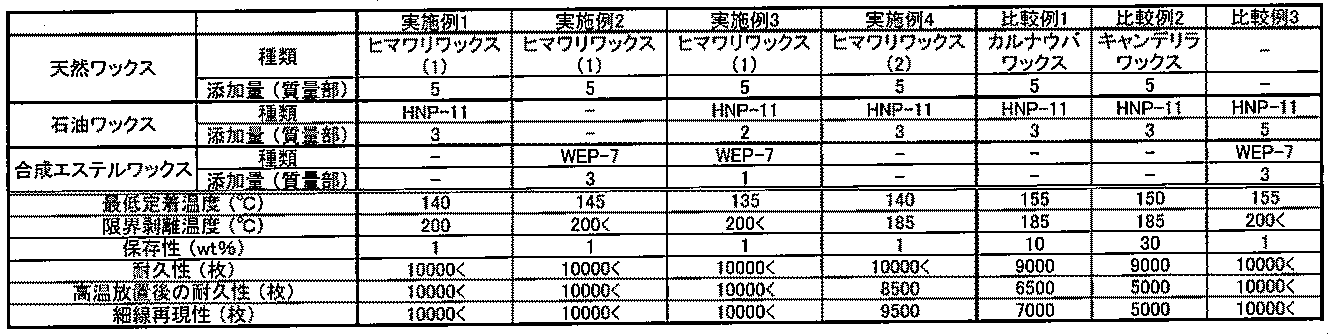
まず、比較例1のトナーについて検討する。比較例1のトナーの最低定着温度は、実施例1乃至4のトナーの最低定着温度と比べて10℃以上高い。これは、天然カルナウバワックスの様に高い融点(83℃)を持つワックスを使用したことによるものである。また、比較例1のトナーの限界剥離温度は200℃未満であった。さらに、比較例1のトナー中の凝集トナーの質量の割合は、実施例1乃至4のトナーの場合の10倍であった。比較例1のトナー中の凝集は、低分子量成分を含む天然カルナウバワックスを用いたことによってトナーの粒径分布が広がったことに起因していると考えられる。また、比較例1のトナーの常温常湿環境下での耐久性、高温放置後の耐久性及び細線再現性は、いずれも実施例1乃至4のトナーの場合よりも劣る結果となった。
次に、比較例2のトナーについて検討する。比較例2のトナーの最低定着温度は、実施例1乃至4のトナーの最低定着温度と比べて5℃以上高い。また、比較例2のトナーの限界剥離温度は200℃未満であった。さらに、比較例2のトナー中の凝集トナーの質量の割合は、実施例1乃至4のトナーの場合の30倍であった。比較例2のトナー中の凝集は、低分子量成分を含む天然キャンデリラワックスを用いたことによってトナーの粒径分布が広がったことに起因していると考えられる。また、比較例2のトナーの常温常湿環境下での耐久性、高温放置後の耐久性及び細線再現性は、いずれも実施例1乃至4のトナーの場合よりも劣る結果となった。
続いて、比較例3のトナーについて検討する。比較例3のトナーの最低定着温度は、実施例1乃至4のトナーの最低定着温度と比べて10℃以上高い。この結果から、天然ヒマワリワックスを含まない比較例3のトナーは、定着性が特に悪いことが分かる。
以上の結果から、天然ヒマワリワックスを含む実施例1乃至4のトナーは、他の天然ワックスを含む従来のトナー(比較例1及び比較例2)と比べて、定着性、剥離性、保存性(対ブロッキング性)、印字耐久性、高温放置後の印字耐久性及び細線再現性の観点からより優れたトナーであることが分かる。また、以上の結果から、天然ヒマワリワックスを含む実施例1乃至4のトナーは、石油ワックス及び合成エステルワックスのみを含む従来のトナー(比較例3)と比べて、優れた定着性を有するトナーであることが分かる。
さらに、実施例1乃至3のトナーの内、天然ヒマワリワックス、石油ワックス及び合成エステルワックスを組み合わせた実施例3のトナーは、最低定着温度が最も低く、かつ、限界剥離温度が最も高い。
Claims (7)
- 結着樹脂、着色剤及びワックスを含有する着色樹脂粒子を含む静電荷像現像用トナーであって、
前記ワックスが、天然ヒマワリワックスを含有し、
前記天然ヒマワリワックスの酸価が10mgKOH/g以下であり、当該天然ヒマワリワックスの含有量が、結着樹脂100質量部に対して1~10質量部であることを特徴とする、静電荷像現像用トナー。 - 前記ワックスが更に石油ワックスを含有し、
前記石油ワックスの含有量が、結着樹脂100質量部に対して1~10質量部であることを特徴とする、請求の範囲第1項に記載の静電荷像現像用トナー。 - 前記ワックスが更に合成エステルワックスを含有し、
前記合成エステルワックスの含有量が、結着樹脂100質量部に対して1~10質量部であることを特徴とする、請求の範囲第1項又は第2項に記載の静電荷像現像用トナー。 - 前記天然ヒマワリワックスが、示差走査型熱量計(DSC)により測定される昇温時の吸熱ピーク温度で規定される融点(TmD)を1つ有し、吸熱ピークの半値幅が8℃以下であることを特徴とする、請求の範囲第1項乃至第3項のいずれか一項に記載の静電荷像現像用トナー。
- 示差走査型熱量計(DSC)により測定される昇温時の吸熱ピーク温度で規定される前記天然ヒマワリワックスの融点(TmD)が、70~85℃であることを特徴とする、請求の範囲第1項乃至第4項のいずれか一項に記載の静電荷像現像用トナー。
- 前記着色樹脂粒子が、湿式法により製造されるものであることを特徴とする、請求の範囲第1項乃至第5項のいずれか一項に記載の静電荷像現像用トナー。
- 前記着色樹脂粒子が、コアシェル構造を有することを特徴とする、請求の範囲第1項乃至第6項のいずれか一項に記載の静電荷像現像用トナー。
Priority Applications (4)
| Application Number | Priority Date | Filing Date | Title |
|---|---|---|---|
| CN201180014714.2A CN102792231B (zh) | 2010-03-19 | 2011-03-10 | 静电影像显像用墨粉 |
| US13/579,123 US8663887B2 (en) | 2010-03-19 | 2011-03-10 | Toner for developing electrostatic images |
| JP2012505639A JPWO2011114985A1 (ja) | 2010-03-19 | 2011-03-10 | 静電荷像現像用トナー |
| KR1020127021467A KR101708527B1 (ko) | 2010-03-19 | 2011-03-10 | 정전하 이미지 현상용 토너 |
Applications Claiming Priority (2)
| Application Number | Priority Date | Filing Date | Title |
|---|---|---|---|
| JP2010064836 | 2010-03-19 | ||
| JP2010-064836 | 2010-03-19 |
Publications (1)
| Publication Number | Publication Date |
|---|---|
| WO2011114985A1 true WO2011114985A1 (ja) | 2011-09-22 |
Family
ID=44649080
Family Applications (1)
| Application Number | Title | Priority Date | Filing Date |
|---|---|---|---|
| PCT/JP2011/055651 Ceased WO2011114985A1 (ja) | 2010-03-19 | 2011-03-10 | 静電荷像現像用トナー |
Country Status (5)
| Country | Link |
|---|---|
| US (1) | US8663887B2 (ja) |
| JP (1) | JPWO2011114985A1 (ja) |
| KR (1) | KR101708527B1 (ja) |
| CN (1) | CN102792231B (ja) |
| WO (1) | WO2011114985A1 (ja) |
Cited By (1)
| Publication number | Priority date | Publication date | Assignee | Title |
|---|---|---|---|---|
| JP2012078737A (ja) * | 2010-10-06 | 2012-04-19 | Oki Data Corp | 現像剤、現像剤の製造方法、画像形成ユニット及び画像形成装置 |
Families Citing this family (3)
| Publication number | Priority date | Publication date | Assignee | Title |
|---|---|---|---|---|
| WO2013146234A1 (ja) * | 2012-03-30 | 2013-10-03 | 三菱化学株式会社 | 静電荷像現像用トナー |
| US12095113B2 (en) | 2018-08-07 | 2024-09-17 | Zeon Corporation | Composition for non-aqueous secondary battery functional layer and method of producing same, functional layer for non-aqueous secondary battery, non- aqueous secondary battery member, and non-aqueous secondary battery |
| CN113302560B (zh) * | 2019-04-19 | 2024-03-26 | 日油株式会社 | 蜡膨胀剂及含有该蜡膨胀剂的蜡组合物 |
Citations (5)
| Publication number | Priority date | Publication date | Assignee | Title |
|---|---|---|---|---|
| JPH0950150A (ja) * | 1995-05-31 | 1997-02-18 | Canon Inc | 静電荷像現像用トナー及びその製造方法 |
| JP2002139863A (ja) * | 2000-10-31 | 2002-05-17 | Konica Corp | トナーの製造方法及びそれを用いた画像形成方法 |
| JP2002229251A (ja) * | 2001-01-30 | 2002-08-14 | Nippon Zeon Co Ltd | トナー |
| JP2009031467A (ja) * | 2007-07-26 | 2009-02-12 | Asahi Kasei Chemicals Corp | トナー組成物 |
| JP2011048315A (ja) * | 2009-08-27 | 2011-03-10 | Nippon Seiro Co Ltd | トナー用ワックス |
Family Cites Families (10)
| Publication number | Priority date | Publication date | Assignee | Title |
|---|---|---|---|---|
| KR970001393B1 (ko) | 1991-09-11 | 1997-02-06 | 캐논 가부시기가이샤 | 정전하상 현상용 토너 및 가열정착방법 |
| JPH06230600A (ja) | 1993-02-05 | 1994-08-19 | Tomoegawa Paper Co Ltd | 電子写真用トナー |
| JPH112917A (ja) | 1997-06-10 | 1999-01-06 | Ricoh Co Ltd | 乾式トナー |
| JP2003207939A (ja) * | 2002-01-15 | 2003-07-25 | Sharp Corp | トナー及び現像剤 |
| JP4209888B2 (ja) * | 2003-01-17 | 2009-01-14 | パナソニック株式会社 | トナー、トナーの製造方法、二成分現像剤及び画像形成方法 |
| FR2862222B1 (fr) * | 2003-11-18 | 2008-10-10 | Oreal | Composition cosmetique comprenant de la gomme de gellane ou un de ses derives, un compose solide et un sel monovalent, procedes mettant en oeuvre cette composition et utilisations |
| US20050129640A1 (en) | 2003-11-18 | 2005-06-16 | L'oreal | Liquid cosmetic composition comprising gellan gum or a derivative thereof, a solid compound, and a monovalent salt, processes for using this composition, and methods of using same |
| WO2006066312A1 (en) | 2004-12-20 | 2006-06-29 | Research Laboratories Of Australia Pty Ltd | Marking liquid |
| JP5183903B2 (ja) * | 2006-10-13 | 2013-04-17 | 信越化学工業株式会社 | 高分子化合物、レジスト材料及びこれを用いたパターン形成方法 |
| US7943283B2 (en) | 2006-12-20 | 2011-05-17 | Xerox Corporation | Toner compositions |
-
2011
- 2011-03-10 JP JP2012505639A patent/JPWO2011114985A1/ja active Pending
- 2011-03-10 KR KR1020127021467A patent/KR101708527B1/ko active Active
- 2011-03-10 US US13/579,123 patent/US8663887B2/en not_active Expired - Fee Related
- 2011-03-10 WO PCT/JP2011/055651 patent/WO2011114985A1/ja not_active Ceased
- 2011-03-10 CN CN201180014714.2A patent/CN102792231B/zh active Active
Patent Citations (5)
| Publication number | Priority date | Publication date | Assignee | Title |
|---|---|---|---|---|
| JPH0950150A (ja) * | 1995-05-31 | 1997-02-18 | Canon Inc | 静電荷像現像用トナー及びその製造方法 |
| JP2002139863A (ja) * | 2000-10-31 | 2002-05-17 | Konica Corp | トナーの製造方法及びそれを用いた画像形成方法 |
| JP2002229251A (ja) * | 2001-01-30 | 2002-08-14 | Nippon Zeon Co Ltd | トナー |
| JP2009031467A (ja) * | 2007-07-26 | 2009-02-12 | Asahi Kasei Chemicals Corp | トナー組成物 |
| JP2011048315A (ja) * | 2009-08-27 | 2011-03-10 | Nippon Seiro Co Ltd | トナー用ワックス |
Cited By (1)
| Publication number | Priority date | Publication date | Assignee | Title |
|---|---|---|---|---|
| JP2012078737A (ja) * | 2010-10-06 | 2012-04-19 | Oki Data Corp | 現像剤、現像剤の製造方法、画像形成ユニット及び画像形成装置 |
Also Published As
| Publication number | Publication date |
|---|---|
| KR101708527B1 (ko) | 2017-02-20 |
| CN102792231B (zh) | 2014-06-25 |
| JPWO2011114985A1 (ja) | 2013-06-27 |
| KR20130010458A (ko) | 2013-01-28 |
| US8663887B2 (en) | 2014-03-04 |
| CN102792231A (zh) | 2012-11-21 |
| US20120315575A1 (en) | 2012-12-13 |
Similar Documents
| Publication | Publication Date | Title |
|---|---|---|
| KR20190112207A (ko) | 정전하상 현상용 토너 | |
| JPWO2018181189A1 (ja) | マゼンタトナー | |
| JP5598640B1 (ja) | 静電荷像現像用トナー | |
| JP6413826B2 (ja) | トナー | |
| JP5087996B2 (ja) | 静電荷像現像用トナーの製造方法 | |
| JP5845570B2 (ja) | 静電荷像現像用トナー及びその製造方法 | |
| JP5549579B2 (ja) | シアントナー | |
| JP6057043B1 (ja) | イエロートナー | |
| KR101708527B1 (ko) | 정전하 이미지 현상용 토너 | |
| JP5987900B2 (ja) | 静電荷像現像用トナー | |
| JP5402151B2 (ja) | トナー | |
| JP6402845B2 (ja) | マゼンタトナー | |
| WO2016158626A1 (ja) | イエロートナー | |
| JP6825621B2 (ja) | 静電荷像現像用マゼンタトナー | |
| JP6024862B1 (ja) | イエロートナー | |
| JP4506667B2 (ja) | 静電荷像現像用トナー及びその製造方法 | |
| JP7183679B2 (ja) | 重合トナーの製造方法 | |
| CN112805632B (zh) | 静电图像显影用调色剂用蜡及包含其的静电图像显影用调色剂 | |
| JP2007178954A (ja) | 静電荷像現像用イエロートナー及びその製造方法 | |
| JP2011013392A (ja) | 電子写真用正帯電性トナー | |
| WO2016136452A1 (ja) | トナー | |
| WO2018043160A1 (ja) | イエロートナー |
Legal Events
| Date | Code | Title | Description |
|---|---|---|---|
| WWE | Wipo information: entry into national phase |
Ref document number: 201180014714.2 Country of ref document: CN |
|
| 121 | Ep: the epo has been informed by wipo that ep was designated in this application |
Ref document number: 11756171 Country of ref document: EP Kind code of ref document: A1 |
|
| WWE | Wipo information: entry into national phase |
Ref document number: 2012505639 Country of ref document: JP |
|
| WWE | Wipo information: entry into national phase |
Ref document number: 13579123 Country of ref document: US |
|
| ENP | Entry into the national phase |
Ref document number: 20127021467 Country of ref document: KR Kind code of ref document: A |
|
| NENP | Non-entry into the national phase |
Ref country code: DE |
|
| 122 | Ep: pct application non-entry in european phase |
Ref document number: 11756171 Country of ref document: EP Kind code of ref document: A1 |