WO2011108509A1 - 低品位グリセリンからのアリルアルコールとプロピレンの製造方法、及びそのための触媒 - Google Patents
低品位グリセリンからのアリルアルコールとプロピレンの製造方法、及びそのための触媒 Download PDFInfo
- Publication number
- WO2011108509A1 WO2011108509A1 PCT/JP2011/054565 JP2011054565W WO2011108509A1 WO 2011108509 A1 WO2011108509 A1 WO 2011108509A1 JP 2011054565 W JP2011054565 W JP 2011054565W WO 2011108509 A1 WO2011108509 A1 WO 2011108509A1
- Authority
- WO
- WIPO (PCT)
- Prior art keywords
- catalyst
- glycerin
- composite oxide
- propylene
- allyl alcohol
- Prior art date
- Legal status (The legal status is an assumption and is not a legal conclusion. Google has not performed a legal analysis and makes no representation as to the accuracy of the status listed.)
- Ceased
Links
Images


Classifications
-
- C—CHEMISTRY; METALLURGY
- C07—ORGANIC CHEMISTRY
- C07C—ACYCLIC OR CARBOCYCLIC COMPOUNDS
- C07C1/00—Preparation of hydrocarbons from one or more compounds, none of them being a hydrocarbon
- C07C1/20—Preparation of hydrocarbons from one or more compounds, none of them being a hydrocarbon starting from organic compounds containing only oxygen atoms as heteroatoms
-
- B—PERFORMING OPERATIONS; TRANSPORTING
- B01—PHYSICAL OR CHEMICAL PROCESSES OR APPARATUS IN GENERAL
- B01J—CHEMICAL OR PHYSICAL PROCESSES, e.g. CATALYSIS OR COLLOID CHEMISTRY; THEIR RELEVANT APPARATUS
- B01J21/00—Catalysts comprising the elements, oxides, or hydroxides of magnesium, boron, aluminium, carbon, silicon, titanium, zirconium, or hafnium
- B01J21/06—Silicon, titanium, zirconium or hafnium; Oxides or hydroxides thereof
- B01J21/063—Titanium; Oxides or hydroxides thereof
-
- B—PERFORMING OPERATIONS; TRANSPORTING
- B01—PHYSICAL OR CHEMICAL PROCESSES OR APPARATUS IN GENERAL
- B01J—CHEMICAL OR PHYSICAL PROCESSES, e.g. CATALYSIS OR COLLOID CHEMISTRY; THEIR RELEVANT APPARATUS
- B01J21/00—Catalysts comprising the elements, oxides, or hydroxides of magnesium, boron, aluminium, carbon, silicon, titanium, zirconium, or hafnium
- B01J21/06—Silicon, titanium, zirconium or hafnium; Oxides or hydroxides thereof
- B01J21/066—Zirconium or hafnium; Oxides or hydroxides thereof
-
- B—PERFORMING OPERATIONS; TRANSPORTING
- B01—PHYSICAL OR CHEMICAL PROCESSES OR APPARATUS IN GENERAL
- B01J—CHEMICAL OR PHYSICAL PROCESSES, e.g. CATALYSIS OR COLLOID CHEMISTRY; THEIR RELEVANT APPARATUS
- B01J23/00—Catalysts comprising metals or metal oxides or hydroxides, not provided for in group B01J21/00
- B01J23/70—Catalysts comprising metals or metal oxides or hydroxides, not provided for in group B01J21/00 of the iron group metals or copper
- B01J23/74—Iron group metals
- B01J23/745—Iron
-
- B—PERFORMING OPERATIONS; TRANSPORTING
- B01—PHYSICAL OR CHEMICAL PROCESSES OR APPARATUS IN GENERAL
- B01J—CHEMICAL OR PHYSICAL PROCESSES, e.g. CATALYSIS OR COLLOID CHEMISTRY; THEIR RELEVANT APPARATUS
- B01J23/00—Catalysts comprising metals or metal oxides or hydroxides, not provided for in group B01J21/00
- B01J23/70—Catalysts comprising metals or metal oxides or hydroxides, not provided for in group B01J21/00 of the iron group metals or copper
- B01J23/76—Catalysts comprising metals or metal oxides or hydroxides, not provided for in group B01J21/00 of the iron group metals or copper combined with metals, oxides or hydroxides provided for in groups B01J23/02 - B01J23/36
- B01J23/78—Catalysts comprising metals or metal oxides or hydroxides, not provided for in group B01J21/00 of the iron group metals or copper combined with metals, oxides or hydroxides provided for in groups B01J23/02 - B01J23/36 with alkali- or alkaline earth metals
-
- B—PERFORMING OPERATIONS; TRANSPORTING
- B01—PHYSICAL OR CHEMICAL PROCESSES OR APPARATUS IN GENERAL
- B01J—CHEMICAL OR PHYSICAL PROCESSES, e.g. CATALYSIS OR COLLOID CHEMISTRY; THEIR RELEVANT APPARATUS
- B01J37/00—Processes, in general, for preparing catalysts; Processes, in general, for activation of catalysts
- B01J37/0009—Use of binding agents; Moulding; Pressing; Powdering; Granulating; Addition of materials ameliorating the mechanical properties of the product catalyst
-
- B—PERFORMING OPERATIONS; TRANSPORTING
- B01—PHYSICAL OR CHEMICAL PROCESSES OR APPARATUS IN GENERAL
- B01J—CHEMICAL OR PHYSICAL PROCESSES, e.g. CATALYSIS OR COLLOID CHEMISTRY; THEIR RELEVANT APPARATUS
- B01J37/00—Processes, in general, for preparing catalysts; Processes, in general, for activation of catalysts
- B01J37/0009—Use of binding agents; Moulding; Pressing; Powdering; Granulating; Addition of materials ameliorating the mechanical properties of the product catalyst
- B01J37/0027—Powdering
- B01J37/0036—Grinding
-
- B—PERFORMING OPERATIONS; TRANSPORTING
- B01—PHYSICAL OR CHEMICAL PROCESSES OR APPARATUS IN GENERAL
- B01J—CHEMICAL OR PHYSICAL PROCESSES, e.g. CATALYSIS OR COLLOID CHEMISTRY; THEIR RELEVANT APPARATUS
- B01J37/00—Processes, in general, for preparing catalysts; Processes, in general, for activation of catalysts
- B01J37/009—Preparation by separation, e.g. by filtration, decantation, screening
-
- B—PERFORMING OPERATIONS; TRANSPORTING
- B01—PHYSICAL OR CHEMICAL PROCESSES OR APPARATUS IN GENERAL
- B01J—CHEMICAL OR PHYSICAL PROCESSES, e.g. CATALYSIS OR COLLOID CHEMISTRY; THEIR RELEVANT APPARATUS
- B01J37/00—Processes, in general, for preparing catalysts; Processes, in general, for activation of catalysts
- B01J37/02—Impregnation, coating or precipitation
- B01J37/03—Precipitation; Co-precipitation
- B01J37/031—Precipitation
-
- C—CHEMISTRY; METALLURGY
- C07—ORGANIC CHEMISTRY
- C07C—ACYCLIC OR CARBOCYCLIC COMPOUNDS
- C07C29/00—Preparation of compounds having hydroxy or O-metal groups bound to a carbon atom not belonging to a six-membered aromatic ring
- C07C29/60—Preparation of compounds having hydroxy or O-metal groups bound to a carbon atom not belonging to a six-membered aromatic ring by elimination of -OH groups, e.g. by dehydration
-
- C—CHEMISTRY; METALLURGY
- C07—ORGANIC CHEMISTRY
- C07C—ACYCLIC OR CARBOCYCLIC COMPOUNDS
- C07C2523/00—Catalysts comprising metals or metal oxides or hydroxides, not provided for in group C07C2521/00
- C07C2523/70—Catalysts comprising metals or metal oxides or hydroxides, not provided for in group C07C2521/00 of the iron group metals or copper
- C07C2523/74—Iron group metals
- C07C2523/745—Iron
-
- C—CHEMISTRY; METALLURGY
- C07—ORGANIC CHEMISTRY
- C07C—ACYCLIC OR CARBOCYCLIC COMPOUNDS
- C07C2523/00—Catalysts comprising metals or metal oxides or hydroxides, not provided for in group C07C2521/00
- C07C2523/70—Catalysts comprising metals or metal oxides or hydroxides, not provided for in group C07C2521/00 of the iron group metals or copper
- C07C2523/76—Catalysts comprising metals or metal oxides or hydroxides, not provided for in group C07C2521/00 of the iron group metals or copper combined with metals, oxides or hydroxides provided for in groups C07C2523/02 - C07C2523/36
- C07C2523/78—Catalysts comprising metals or metal oxides or hydroxides, not provided for in group C07C2521/00 of the iron group metals or copper combined with metals, oxides or hydroxides provided for in groups C07C2523/02 - C07C2523/36 with alkali- or alkaline earth metals or beryllium
-
- Y—GENERAL TAGGING OF NEW TECHNOLOGICAL DEVELOPMENTS; GENERAL TAGGING OF CROSS-SECTIONAL TECHNOLOGIES SPANNING OVER SEVERAL SECTIONS OF THE IPC; TECHNICAL SUBJECTS COVERED BY FORMER USPC CROSS-REFERENCE ART COLLECTIONS [XRACs] AND DIGESTS
- Y02—TECHNOLOGIES OR APPLICATIONS FOR MITIGATION OR ADAPTATION AGAINST CLIMATE CHANGE
- Y02P—CLIMATE CHANGE MITIGATION TECHNOLOGIES IN THE PRODUCTION OR PROCESSING OF GOODS
- Y02P20/00—Technologies relating to chemical industry
- Y02P20/50—Improvements relating to the production of bulk chemicals
- Y02P20/52—Improvements relating to the production of bulk chemicals using catalysts, e.g. selective catalysts
Definitions
- the present invention relates to an iron oxide-based composite oxide catalyst and a method for producing allyl alcohol and propylene from glycerin using this catalyst. According to the present invention, it is possible to produce hydrocarbons from low-grade glycerin. More specifically, the present invention relates to a method for selectively producing allyl alcohol and propylene, which are C3 compounds, from an aqueous glycerin solution containing an alkali metal using an iron oxide composite oxide catalyst.
- Patents relating to the synthesis of hydrocarbon compounds from glycerin using catalysts include mainly acrolein synthesis (Patent Documents 1 to 10) and 1,2-propanediol and 1,3-propanediol (Patent Documents 11 to 10). 13).
- Other examples include acrylic acid (Patent Document 14) and compound synthesis having a carbonyl group or a carboxyl group (Patent Document 15).
- solid acid catalysts such as heteropolyacids mainly containing tungsten and molybdenum, phosphoric acid, zeolite, and zirconia solid superacids are used.
- a metal catalyst such as a platinum group element (palladium, platinum) or nickel is used.
- Non-Patent Documents 1 and 2 have studied a reaction for converting glycerin contained in a glycerin aqueous solution into a useful chemical substance using an iron oxide catalyst, and using an iron oxide catalyst containing zirconia, from glycerin to allyl alcohol, propylene, and carboxylic acids. It has been reported that ketones and the like can be obtained (Non-Patent Documents 1 and 2).
- Patent Documents 1 to 15 and Non-Patent Documents 1 and 2 are specifically incorporated herein by reference.
- the above-mentioned low-grade glycerin contains water. However, water becomes a catalyst deterioration component with respect to the conventional solid acid catalyst, platinum group catalyst, and nickel catalyst.
- hydrocarbons such as allyl alcohol and propylene can be obtained from glycerin in an aqueous solution by using the iron oxide catalyst described in Non-Patent Documents 1 and 2.
- allyl alcohol and propylene which are C3 compounds are most useful, and a method with high selectivity of allyl alcohol and propylene has been desired.
- glycerin a byproduct of biodiesel fuel
- the iron oxide catalysts described in Non-Patent Documents 1 and 2 generate hydrocarbons such as allyl alcohol and propylene.
- the production rate of hydroxyacetone, carboxylic acids and ketones produced in parallel with allyl alcohol and propylene is increased, and as a result, the selectivity of allyl alcohol and propylene is lowered.
- allyl alcohol and propylene which are C3 compounds are most useful, and a method with high selectivity of allyl alcohol and propylene has been desired.
- the present inventors can produce allyl alcohol and propylene with high selectivity even when an aqueous glycerin solution is used as a raw material by supporting an alkali metal on an iron oxide catalyst in which zirconia, titania or alumina is combined with iron oxide.
- an iron oxide catalyst in which zirconia, titania or alumina is combined with iron oxide.
- the present invention is as follows.
- the glycerin-containing aqueous solution contains substantially no alkali metal.
- the supported amount of alkali metal is in the range of 1 to 5 mol% of the total number of moles of the metal constituting the composite oxide.
- the glycerin-containing aqueous solution has an alkali metal content in the range of 0.1 to 10% by mass and a glycerin content in the range of 1 to 70% by mass.
- allyl alcohol and propylene which are C3 compounds, can be synthesized with high selectivity, using an aqueous solution of glycerin and an aqueous solution of glycerin containing an alkali metal as raw materials.
- Example 1 It is explanatory drawing of the reactor used in the Example.
- the product yield of Example 1 is shown.
- the product selectivity of Example 1 is shown.
- the product yield of Example 2 is shown.
- the product selectivity of Example 2 is shown.
- the product yield of Example 3 is shown.
- the product selectivity of Example 3 is shown.
- the product yield of Comparative Example 1 is shown.
- the product selectivity of Comparative Example 1 is shown.
- the product yield of Comparative Example 2 is shown.
- the product selectivity of Comparative Example 2 is shown.
- the product yield and the route I / route II ratio of Example 2 and Comparative Example 1 are shown.
- the product yield of Example 4 is shown.
- the product selectivity of Example 4 is shown.
- the product yield of Example 5 is shown.
- the product selectivity of Example 5 is shown.
- the product yield of Example 6 is shown.
- Example 6 The product selectivity of Example 6 is shown.
- the product yield of Example 7 is shown.
- the product selectivity of Example 7 is shown.
- the product yield of Example 8 is shown.
- the product selectivity of Example 8 is shown.
- the total yield of allyl alcohol + propylene of Comparative Example 3 and Examples 4 to 8 is shown.
- the total yield of hydroxyacetone + carboxylic acid + ketones of Comparative Example 3 and Examples 4 to 8 is shown.
- the product yield of Reference Example 1 is shown.
- the product yield of Reference Example 2 is shown.
- the product yield of Reference Example 3 is shown.
- the product yield of Comparative Example 4 is shown.
- the product yield of Reference Example 4 is shown.
- the product yield of Example 9 is shown.
- route II ratio of Example 9 is shown.
- the product yield of Example 10 is shown.
- the product yield of Reference Example 5 is shown.
- the product yield of Example 11 is shown.
- the product yield of Example 12 is shown.
- the product yield of Example 13 is shown.
- route II ratio of Example 13 is shown.
- the product yield of Example 14 is shown.
- route II ratio of Example 14 is shown.
- the present invention relates to an iron oxide-based composite oxide catalyst in which an alkali metal is supported on a composite oxide of at least one of zirconia, titania and alumina and iron oxide.
- This catalyst is for use in converting glycerin in an aqueous solution containing glycerin and glycerin in an aqueous solution containing an alkali metal and glycerin to at least allyl alcohol and propylene. This conversion reaction will be described in detail in the method for producing allyl alcohol and propylene.
- the composite oxide catalyst of the present invention is based on a composite oxide of at least one of zirconia, titania and alumina and iron oxide, and an oxide in which one of zirconia, titania and alumina is combined with iron oxide.
- an oxide in which two or all of zirconia, titania and alumina are combined with iron oxide may be used.
- the total content of zirconia, titania and alumina can range from 5 to 80% by weight of the composite oxide.
- the conversion rate of allyl alcohol and propylene from glycerin varies depending on the type and content of zirconia, titania and alumina, so the type and content of zirconia, titania and alumina can be determined as appropriate according to the desired conversion rate. .
- the content of zirconia is preferably in the range of 5 to 50% by mass, more preferably in the range of 5 to 40% by mass, and more preferably in the range of 7 to 35%. It is in the mass% range. If the content of zirconia is small, the conversion rate from glycerin to allyl alcohol and propylene tends to be low, and if the content of zirconia is too large, it hardly converts to allyl alcohol and propylene.
- the titania content is preferably in the range of 10 to 65% by mass of the composite oxide, more preferably in the range of 15 to 60% by mass, more preferably 20 to 50%. It is in the mass% range. If the titania content is low, the conversion rate from glycerin to allyl alcohol and propylene tends to be low, and if the titania content is too high, the conversion rate to allyl alcohol and propylene tends to be low. is there.
- the content of alumina is preferably in the range of 5 to 50% by mass of the composite oxide, more preferably in the range of 5 to 40% by mass, more preferably 7 to 35%. It is in the mass% range. If the alumina content is low, the conversion rate from glycerin to allyl alcohol and propylene tends to be low, and if the alumina content is too high, the conversion rate to allyl alcohol and propylene tends to be low. is there.
- the amount of alkali metal supported on the composite oxide of at least one of zirconia, titania and alumina and iron oxide is in the range of 0.2 to 5% by mass, preferably 0.5 to 3% by mass with respect to the composite oxide. More preferably, it is in the range of 0.8 to 2% by mass.
- the alkali metal loading is expressed in mol%, it is in the range of 0.1 to 8.5 mol%, preferably in the range of 0.5 to 5 mol%, more preferably the total number of moles of the metal constituting the composite oxide. Is in the range of 1 to 5 mol%.
- the amount of alkali metal supported is small, the effect of supporting alkali metal cannot be obtained, and in the conversion reaction to allyl alcohol and propylene using glycerol aqueous solution containing alkali metal as a raw material, the production of carboxylic acids and the like increases, and allyl alcohol And propylene selectivity tends to decrease. If the amount of alkali metal supported is excessive, the production of allyl alcohol, propylene, carboxylic acids, ketones and the like tends to decrease, and the polymerization reaction product of glycerin tends to increase.
- the alkali metal include lithium, sodium, potassium, rubidium, and cesium.
- alkali metal loading in the range of 1 to 5 mol% is as follows when expressed in mass% for each alkali metal. Lithium 0.18-1 mass% Sodium 0.37-2% by mass Potassium 0.57-3 mass% Rubidium 1.1-6% by mass Cesium 1.7-9% by mass
- the composite oxide catalyst supporting an alkali metal of the present invention is a composite oxide of at least one of zirconia, titania and alumina and iron oxide, and iron nitrate and zirconium, titanium or aluminum nitrate as a raw material, for example, ammonia.
- the composite oxide obtained by the coprecipitation method used, and then obtained by, for example, supporting an alkali metal using an alkali metal nitrate, for example. After supporting the alkali metal, preferably after calcination, pulverization, classification, granulation and the like can be performed as necessary.
- the composite oxide catalyst carrying an alkali metal of the present invention can be in an appropriate shape such as powder, particle, granule, pellet or molded article.
- the present invention relates to a method for producing allyl alcohol and propylene using the iron oxide-based composite oxide catalyst supporting the alkali metal.
- an aqueous solution containing glycerin or an aqueous solution containing an alkali metal and glycerin is brought into contact with the catalyst of the present invention under heating to convert glycerin in the aqueous solution into at least allyl alcohol and propylene.
- the aqueous solution containing glycerin as the raw material does not substantially contain an alkali metal, and the glycerin content is preferably in the range of 1 to 70% by mass, more preferably in the range of 5 to 50% by mass. More preferably, it is in the range of 10 to 40% by mass.
- the glycerin content is less than 5% by mass, the main products tend to be propylene and ketones, but the carbon dioxide gas production tends to increase, and when the glycerin content exceeds 70% by mass, There is a tendency for polymerization products to increase.
- substantially free of alkali metal means that in the preparation step of the aqueous solution containing glycerin, no alkali metal is intentionally added, or a step in which the alkali metal is mixed is not passed. This means that the alkali metal content is less than 0.1% by mass.
- the conversion reaction by the catalyst of the present invention proceeds more smoothly as the content of the alkali metal is lower. Accordingly, the content of the alkali metal is preferably as low as possible. However, for example, if it is in the range of 0.1 to 10% by mass, the conversion reaction by the catalyst of the present invention is not hindered, and the selectivity of allyl alcohol and propylene is high. Can be implemented. However, the lower the content of alkali metal contained in the aqueous solution containing glycerin, the smoother the conversion reaction by the catalyst of the present invention.
- the aqueous solution containing glycerin is diluted with water to reduce the content of alkali metal. It may be preferable to lower.
- the degree of dilution can be appropriately determined in consideration of the glycerin content after dilution and the selectivity of allyl alcohol and propylene obtained from the glycerin content after dilution.
- the contact between the glycerin and the catalyst under heating can be performed at a temperature in the range of 300 to 450 ° C., preferably in the range of 320 to 400 ° C., for example.
- the heating temperature is lower than 300 ° C, the reaction does not proceed sufficiently.
- the heating temperature is higher than 450 ° C, decomposition of the product and oxidation reaction proceed, and carbon dioxide gas tends to be generated.
- the ratio of the catalyst amount to the raw material glycerin supply rate (W / F, W: catalyst amount / g, F: raw material glycerin supply rate / g-glycerin h ⁇ 1 ) is, for example, in the range of 0.5 to 20, preferably 1 to 10. Can range.
- W / F is less than 0.5, the reaction does not proceed sufficiently, and when W / F exceeds 20, the decomposition and oxidation reaction of the product proceeds, and carbon dioxide gas tends to be generated.
- the conversion reaction of glycerin to allyl alcohol and propylene in the production method of the present invention is carried out by supplying an aqueous solution containing glycerin together with a carrier gas, if necessary, to a fixed bed or fluidized bed reactor storing the catalyst of the present invention. Recovering the product exiting the reactor can be carried out.
- the conversion reaction of glycerin to allyl alcohol and propylene follows the reaction formula shown below.
- the conversion reaction of glycerin has at least a reaction route I that becomes allyl alcohol and then propylene, and a reaction route II that turns into hydroxyacetone, then carboxylic acids, and then ketones, and in addition, acrolein is generated. There is also a reaction.
- the reaction targeted by the present invention is reaction pathway I in which allyl alcohol is then converted to propylene, and allyl alcohol can be recovered as a liquid, and propylene that is the final product of pathway I can be recovered as a gas. .
- the product of the reaction path II is recovered as a liquid.
- the production ratio of allyl alcohol and propylene which are products in the reaction path I, can be controlled by changing the type of catalyst, reaction temperature, W / F, glycerin content of the glycerin aqueous solution as a raw material, etc.
- reaction temperature 350 ° C. to 375 ° C.
- W / F 0.5 to 2.0
- allyl alcohol by-products such as hydroxyacetone, carboxylic acids, and ketones are obtained as aqueous solutions, they can be easily separated from water by ordinary separation methods such as distillation.
- the raw material used in the conversion reaction of glycerin to allyl alcohol and propylene in the production method of the present invention is a glycerin-containing aqueous solution containing an alkali metal
- the degree and rate of precipitation depend on the concentration of alkali metal contained in the raw material.
- the amount of alkali metal supported on the catalyst exceeds a certain level, the function of the catalyst tends to decrease.
- the conditions for alkali metal contained in the raw material to be difficult to precipitate on the catalyst surface are selected for the conversion reaction, or after a predetermined time has elapsed, It is possible to perform regeneration such as removing a part of the alkali metal by washing.
- the alkali metal in the raw material may be precipitated on the catalyst surface, thereby possibly improving the activity of the catalyst.
- Catalyst preparation example 1 Preparation method of zirconia-iron oxide catalyst (ZrO 2 -FeO X catalyst) (1) About 600 ml of distilled water was put into a 1000 ml beaker. Thereto, 44.84 g of iron (III) nitrate nonahydrate was added and stirred until it was completely dissolved. (2) About 70 ml of distilled water was put into a 100 ml beaker. To this, 1.871 g of zirconium nitrate oxide was added and stirred until it was completely dissolved. (3) The aqueous solution of (2) was added to the aqueous solution of (1) and stirred for about 30 minutes.
- the obtained solid was pulverized using a mortar and air baked at 500 ° C. for 2 hours. The rate of temperature increase from room temperature to 500 ° C. was 2 ° C./min.
- the obtained powder was pressed into a tablet by pressing at 2 tons and 15 min using a tablet molding machine, and catalyst pellets having a particle size of 300 to 850 ⁇ m were obtained using a sieve.
- the obtained catalyst pellet was analyzed for crystallinity by X-ray diffraction, it was confirmed to be hematite, which is one of the crystals of iron oxide.
- the titania-iron oxide catalyst (TiO 2 —FeO X catalyst) and the alumina-iron oxide catalyst (Al 2 O 3 —FeO X catalyst) were replaced with titanium tetraisopropoxide instead of 1.871 g of zirconium nitrate oxide in the above preparation method. Prepared by using 10.24 g or 21.01 g aluminum nitrate. When the crystallinity of the obtained catalyst pellets was analyzed by X-ray diffraction, it was confirmed to be hematite, which is one of iron oxide crystals.
- Catalyst preparation example 2 Method for preparing potassium-supported zirconia-iron oxide catalyst (K-ZrO 2 -FeO X catalyst) (1) About 600 ml of distilled water was put into a 1000 ml beaker. Thereto, 44.84 g of iron (III) nitrate nonahydrate was added and stirred until it was completely dissolved. (2) About 70 ml of distilled water was put into a 100 ml beaker. To this, 1.871 g of zirconium nitrate oxide was added and stirred until it was completely dissolved. (3) The aqueous solution of (2) was added to the aqueous solution of (1) and stirred for about 30 minutes.
- Example 1 As a feedstock, the waste liquid containing glycerin (glycerin concentration is 40% by mass) discharged when biodiesel fuel is synthesized from waste edible oil is 10% by mass (glycerin concentration is 4% by mass) with water. A diluted aqueous solution was used. Using the apparatus shown in FIG. 1, a zirconia iron oxide catalyst supporting 1 mol% of K prepared in Catalyst Preparation Method 2 was used as a catalyst, N 2 (20 cm 2 / min) as a carrier gas, and a feed rate of 2.0. ml (aqueous solution) / h, reaction temperature 350 ° C., reaction pressure was atmospheric pressure, and the reaction was carried out under the conditions shown in Table 1 below.
- FIGS. 3-1 product yield
- FIGS. 4-1 product yield
- Figure 3-1 product yield
- Figure 3-1 product yield
- -The total yield of allyl alcohol and propylene was about 20% to 25%, and the activity was stable during the reaction time of 6 hours.
- the total yield of carboxylic acid and ketones was constant at about 20%, and the activity was stable during the reaction time of 6 hours.
- Figure 3-2 product selectivity shows the following. ⁇ Allyl alcohol selectivity was highest.
- reaction route I Allyl alcohol + propylene Reaction route II: In the case of direct conversion of BDF byproduct glycerin containing a large amount of impurities, hydroxyacetone + carboxylic acid + ketones, in the example, route I ( ⁇ ) preferentially proceeds and route II ( ⁇ ) was suppressed, and the ratio of Route I / Route II was about 1.5 times that of Example 2 as compared to Comparative Example 1.
- Example 4 The same procedure as in Example 1 was performed except that an aqueous solution obtained by diluting the reagent glycerin with water so as to be 30% by mass as a raw material was used, and the usage amount of the catalyst and W / F were changed as shown in Table 2.
- the results are shown in FIGS. 8-1 (product yield) and 8-2 (product selectivity).
- the results shown in Fig. 8-1 (product yield) show the following. -Production of allyl alcohol and propylene was confirmed. ⁇ The synthesis of allyl alcohol and propylene from BDF-derived glycerol waste liquid was confirmed to be a reaction of the iron oxide catalyst and glycerol.
- Figure 8-2 product selectivity shows the following. ⁇ Allyl alcohol selectivity was highest.
- Example 5 The same procedure as in Example 3 was performed except that the amount of catalyst used was changed as shown in Table 2. The results are shown in FIGS. 9-1 (product yield) and 9-2 (product selectivity).
- Figure 9-1 (product yield) shows the following. Allyl alcohol and propylene are produced and these are the main products. ⁇ The synthesis of allyl alcohol and propylene from BDF-derived glycerol waste liquid was confirmed to be a reaction of the iron oxide catalyst and glycerol.
- Figure 9-2 (product selectivity) shows the following. ⁇ Allyl alcohol selectivity was highest.
- Example 6 The same procedure as in Example 4 was performed except that the catalyst was changed to a zirconia iron oxide catalyst supporting 1 mol% of Na. The results are shown in FIGS. 10-1 (product yield) and 10-2 (product selectivity). The results shown in Fig. 10-1 (product yield) indicate the following. Allyl alcohol and propylene are produced and these are the main products. -A product yield almost equal to that of the K-supported ZrO2-FeOX catalyst was obtained.
- Figure 10-2 product selectivity shows the following. Allyl alcohol and propylene are produced and these are the main products. -Selectivity was almost the same as K-supported ZrO2-FeOX catalyst.
- Example 7 The same procedure as in Example 4 was performed except that the catalyst was replaced with a zirconia iron oxide catalyst supporting 1 mol% of Rb.
- the results are shown in FIGS. 11-1 (product yield) and 11-2 (product selectivity).
- the results shown in Fig. 11-1 (product yield) indicate the following. Allyl alcohol and propylene are produced and these are the main products. -The product yield is almost the same as that of K-supported ZrO2-FeOX catalyst.
- Figure 11-2 product selectivity shows the following. Allyl alcohol and propylene are produced and these are the main products. ⁇ It has almost the same selectivity as K-supported ZrO2-FeOX catalyst.
- Example 8 The same procedure as in Example 4 was performed except that the catalyst was replaced with a zirconia iron oxide catalyst supporting 1 mol% of Cs. The results are shown in FIGS. 12-1 (product yield) and 12-2 (product selectivity). The results shown in Fig. 12-1 (product yield) indicate the following. Allyl alcohol and propylene are produced and these are the main products. -The product yield is almost the same as that of K-supported ZrO2-FeOX catalyst. The following can be seen from the results in Figure 12-2 (product selectivity). Allyl alcohol and propylene are produced and these are the main products. ⁇ It has almost the same selectivity as K-supported ZrO2-FeOX catalyst.
- FIGS. 13-1 and 13-2 show the experimental results of Examples 5 to 8 and Comparative Example 3.
- Figure 13-1 shows the relationship between the difference in supported alkali metal and the total yield of allyl alcohol + propylene
- Figure 13-2 shows the difference in supported alkali metal and the total yield of hydroxyacetone + carboxylic acid + ketones. Shows the relationship.
- ⁇ Alkyl metal loading greatly improves allyl alcohol + propylene yield.
- ⁇ Alkali metal loading is effective for synthesis of allyl alcohol + propylene from glycerin.
- Example 1 The same procedure as in Example 3 was performed except that a ZrO2-FeOX catalyst (ZrO2 loading was changed from 0% by mass to 100% by mass) was used as the catalyst. The results are shown in FIG. 14 (product yield).
- Example 2 The same procedure as in Example 3 was performed except that a TiO2-FeOX catalyst (the amount of TiO2 supported was changed from 0% by mass to 75% by mass) was used as the catalyst. The results are shown in FIG. 15 (product yield).
- Example 3 The same procedure as in Example 3 was performed except that the amount of Al2O3-FeOX catalyst Al2O3 supported was changed from 0% by mass to 25% by mass. The results are shown in FIG. 16 (product yield).
- Comparative Example 4 The same procedure as in Example 3 was performed except that a solid acid catalyst (beta-type zeolite) was used as the catalyst, the catalyst amount was 0.2 g, and the reaction time was set to time. The results are shown in FIG. 17 (product yield).
- a solid acid catalyst beta-type zeolite
- Example 9 Using an aqueous solution obtained by diluting the reagent glycerin with water so as to be 30% by mass as a raw material, the amount of catalyst used is 0.6 g, W / F is 1 h, and the amount of potassium supported on the catalyst is 0 to 10 mol% (Zr + The procedure was the same as in Example 1 except that the amount was changed (relative to the number of moles of Fe).
- the experimental conditions are as follows.
- FIGS. 19-1 product yield
- 19-2 route I / route II ratio
- the results shown in FIG. 19-1 indicate the following. -It was confirmed that the production of allyl alcohol and propylene in pathway I was large (27-28 mol% -C) when the potassium loading was in the range of 1-5 mol%. The following can be understood from the result of FIG. 19-2 (path I / path II ratio). -The path I / path II ratio increased with increasing potassium loading.
- Example 10 Same as Example 1 except that an aqueous solution obtained by diluting the reagent glycerin with water so as to be 30% by mass as a raw material was used, the amount of catalyst used was 0.6 g, W / F was 1 h, and the reaction temperature was changed. Implemented.
- the experimental conditions are as follows.
- Example 5 The same procedure as in Example 3 was carried out except that a ZrO2-FeOX catalyst (ZrO2 loading was 0% by mass) was used as the catalyst, and W (catalyst weight) / crude glycerin was changed in the range of 1.5-10.
- the experimental conditions are as follows. The results are shown in FIG. 21 (product yield).
- Catalyst ZrO2 (7) -FeOX catalyst (ZrO2 loading is 7% by mass)
- Reaction temperature 350 °C
- Feedstock 10% by mass water-diluted crude glycerin (approximately 3.7% by mass in terms of glycerin)
- Supply speed 2ml / h W (catalyst weight) / crude glycerin 1.5-10
- Example 11 The same procedure as in Example 1 was conducted except that the amount of potassium supported on the catalyst was changed.
- the experimental conditions are as follows. The results are shown in FIG. 22 (product yield).
- Catalyst K-supported ZrO2 (7) -FeOX catalyst (ZrO2 support is 7% by mass)
- Reaction temperature 350 °C
- Feedstock 10% by mass water-diluted crude glycerin (approximately 3.7% by mass in terms of glycerin)
- Supply speed 2ml / h W (catalyst weight) / crude glycerin 5h
- Example 12 The same operation as in Example 1 was carried out except that the amount of catalyst used was changed.
- the experimental conditions are as follows. The results are shown in FIG. 23 (product yield).
- Example 13 Under the same conditions as in Example 1, the change in the product over the course of the reaction time was examined.
- the experimental conditions are as follows. The results are shown in FIGS. 24-1 (product yield) and 24-2 (route I / route II ratio).
- Example 14 Except that the amount of potassium supported on the catalyst was changed to 3 mol%, the change in the product with the passage of the reaction time was examined under the same conditions as in Example 1.
- the experimental conditions are as follows. The results are shown in FIGS. 25-1 (product yield) and 25-2 (route I / route II ratio).
- the present invention is useful in the field of recycling glycerin.
Landscapes
- Chemical & Material Sciences (AREA)
- Organic Chemistry (AREA)
- Engineering & Computer Science (AREA)
- Materials Engineering (AREA)
- Chemical Kinetics & Catalysis (AREA)
- Organic Low-Molecular-Weight Compounds And Preparation Thereof (AREA)
- Catalysts (AREA)
- Low-Molecular Organic Synthesis Reactions Using Catalysts (AREA)
Abstract
本発明は、ジルコニア、チタニア、アルミナの少なくとも1 種と酸化鉄との複合酸化物に、アルカリ金属を担持した、酸化鉄系の複合酸化物触媒に係る。また、本発明は、上記複合酸化物触媒に、グリセリンを含有する水溶液を加熱下に接触させて、前記水溶液中のグリセリンを少なくともアリルアルコール及びプロピレンに転換する、アリルアルコール及びプロピレンの製造方法に係る。 本発明によれば、グリセリン水溶液を原料とし、アリルアルコール及びプロピレンを高い選択率で生成することができる。
Description
本出願は、2010年3月1日出願の日本特願2010-44302号の優先権を主張し、その全記載は、ここに特に開示として援用される。
本発明は、酸化鉄系の複合酸化物触媒とこの触媒を用いてグリセリンからアリルアルコールおよびプロピレンを製造する方法に関する。本発明によれば低品位グリセリンからの炭化水素の製造も可能である。より詳しくは、本発明は、アルカリ金属を含有するグリセリン水溶液から、酸化鉄系の複合酸化物触媒を用いてC3化合物であるアリルアルコールおよびプロピレンを選択的に製造する方法に関する。
油脂産業、特に植物油の製造時、さらに、東南アジア等のパーム油製造事業所等においては、含水または含アルカリ金属の低品位グリセリンが多量に排出されている。グリセリンは水と任意の割合で混合するため、これら低品位グリセリンから水やアルカリ金属を除去することは非常に困難である。また、バイオディーゼルの普及に伴い、アルカリ金属水溶液を含むグリセリンは多量に排出されている。
触媒を用いたグリセリンからの炭化水素化合物の合成に関する特許としては、主にアクロレインの合成(特許文献1~10)と1,2-プロパンジオール、1,3-プロパンジオールの合成(特許文献11~13)があげられる。その他、アクリル酸(特許文献14)、カルボニル基またはカルボキシル基を有する化合物合成(特許文献15)があげられる。アクロレイン合成では、主にタングステン、モリブデンを含むヘテロポリ酸、燐酸、ゼオライト、ジルコニア系固体超強酸という、固体酸触媒が用いられている。一方、プロパンジオールの合成では、白金族元素(パラジウム、プラチナ)やニッケルなどの金属触媒が用いられている。
本発明者らは、酸化鉄系触媒を用いてグリセリン水溶液に含まれるグリセリンを有用化学物質に転換する反応を検討し、ジルコニアを含有する酸化鉄系触媒で、グリセリンからアリルアルコール、プロピレン、カルボン酸類、ケトン類等が得られることを報告した(非特許文献1~2)。
2009年3月 触媒学会 第103回触媒討論会
2009年9月 触媒学会 第104回触媒討論会
特許文献1~15及び非特許文献1及び2の全記載は、ここに特に開示として援用される。
上述の低品位グリセリンは水を含有する。ところが、水は、従来の固体酸触媒や白金族触媒、ニッケル触媒に対して触媒劣化成分となる。それに対して、非特許文献1~2に記載の酸化鉄系触媒を用いることで、水溶液中のグリセリンからもアリルアルコールおよびプロピレン等の炭化水素が得られる。しかし、アリルアルコールおよびプロピレンと並行してヒドロキシアセトン、カルボン酸類およびケトン類も生成する。グリセリンからの生成物としては、C3化合物であるアリルアルコールおよびプロピレンが最も有用性が高く、アリルアルコールおよびプロピレンの選択率が高い方法が望まれていた。
また、バイオディーゼル燃料の副生物であるグリセリンは、アルカリ金属を含有する水溶液である。アルカリ金属を含有する水溶液におけるグリセリンに対しても、非特許文献1~2に記載の酸化鉄系触媒は、アリルアルコールおよびプロピレン等の炭化水素を生成する。しかし、アリルアルコールおよびプロピレンと並行して生成するヒドロキシアセトン、カルボン酸類およびケトン類の生成率が高まり、結果としてアリルアルコールおよびプロピレンの選択率が低下する問題もあった。前述のように、グリセリンからの生成物としては、C3化合物であるアリルアルコールおよびプロピレンが最も有用性が高く、アリルアルコールおよびプロピレンの選択率が高い方法が望まれていた。
そこで本発明の目的は、グリセリン水溶液を原料とし、アリルアルコールおよびプロピレンを高い選択率で生成できる触媒と、この触媒を用いたアリルアルコールおよびプロピレンの製造方法を提供することにある。さらに本発明の別の目的は、アルカリ金属を含むグリセリン水溶液を原料とし、アリルアルコールおよびプロピレンを高い選択率で生成できる触媒と、この触媒を用いたアリルアルコールおよびプロピレンの製造方法を提供することにある。
本発明者らは、酸化鉄にジルコニア、チタニアまたはアルミナを複合した酸化鉄系触媒にアルカリ金属を担持することで、グリセリン水溶液を原料としても、アリルアルコールおよびプロピレンを高い選択率で生成できること、さらには、アルカリ金属を含むグリセリン水溶液を原料としても、アリルアルコールおよびプロピレンを高い選択率で生成できることを見出して本発明を完成させた。
本発明は以下のとおりである。
[1]
ジルコニア、チタニアおよびアルミナの少なくとも1種と酸化鉄との複合酸化物にアルカリ金属を担持した酸化鉄系の複合酸化物触媒であって、
グリセリン含有水溶液中のグリセリンを少なくともアリルアルコールおよびプロピレンに転換するために用いられるための、触媒。
[2]
前記グリセリン含有水溶液がアルカリ金属を含有する[1]に記載の触媒。
[3]
前記グリセリン含有水溶液がアルカリ金属を実質的に含有しない[1]に記載の触媒。
[4]
前記複合酸化物はジルコニア-酸化鉄系複合酸化物であり、ジルコニアの含有量が5~50質量%の範囲である[1]~[3]のいずれかに記載の触媒。
[5]
前記ジルコニア、チタニアおよびアルミナの合計の含有量は、複合酸化物の5~80質量%の範囲である[1]~[3]のいずれかに記載の触媒。
[6]
前記複合酸化物はチタニア-酸化鉄系複合酸化物であり、チタニアの含有量が10~65質量%の範囲である[1]~[3]のいずれかに記載の触媒。
[7]
前記複合酸化物はアルミナ-酸化鉄系複合酸化物であり、アルミナの含有量が5~50質量%の範囲である[1]~[3]のいずれかに記載の触媒。
[8]
アルカリ金属担持量が複合酸化物を構成する金属の合計モル数の1~5モル%の範囲である[1]~[7]のいずれかに記載の触媒。
[9]
前記グリセリン含有水溶液は、アルカリ金属の含有量が0.1~10質量%の範囲であり、グリセリンの含有量が1~70質量%の範囲である[2]に記載の触媒。
[10]
前記グリセリン含有水溶液は、グリセリンの含有量が1~70質量%の範囲である[2]に記載の触媒。
[11]
ジルコニア、チタニアおよびアルミナの少なくとも1種と酸化鉄との複合酸化物にアルカリ金属を担持した酸化鉄系の複合酸化物触媒に、グリセリンを含有する水溶液を加熱下に接触させて、前記水溶液中のグリセリンを少なくともアリルアルコールおよびプロピレンに転換することを含む、アリルアルコールおよびプロピレンの製造方法。
[12]
前記グリセリン含有水溶液がアルカリ金属を含有する[11]に記載の製造方法。
[13]
前記グリセリン含有水溶液がアルカリ金属を実質的に含有しない[11]に記載の製造方法。
[14]
前記複合酸化物はジルコニア-酸化鉄系複合酸化物であり、ジルコニアの含有量が5~50質量%の範囲である[11]~[13]のいずれかに記載の製造方法。
[15]
前記ジルコニア、チタニアおよびアルミナの合計の含有量は、複合酸化物の5~80質量%の範囲である[11]~[13]のいずれかに記載の製造方法。
[16]
前記複合酸化物はチタニア-酸化鉄系複合酸化物であり、チタニアの含有量が10~65質量%の範囲である[11]~[13]のいずれかに記載の製造方法。
[17]
前記複合酸化物はアルミナ-酸化鉄系複合酸化物であり、アルミナの含有量が5~50質量%の範囲である[11]~[13]のいずれかに記載の製造方法。
[18]
前記複合酸化物触媒におけるアルカリ金属担持量が複合酸化物を構成する金属の合計モル数の1~5モル%の範囲である[11]~[17]のいずれかに記載の製造方法。
[19]
前記加熱下の接触は、300~450℃の範囲の温度で行う[11]~[18]のいずれかに記載の製造方法。
[20]
原料グリセリン供給速度に対する触媒量の割合(W/F、W: 触媒量/g、F: 原料グリセリン供給速度/g-グリセリンh-1)が0.5~20の範囲である[11]~[19]のいずれかに記載の製造方法。
[21]
プロピレンを気体として回収する[11]~[20]のいずれかに記載の製造方法。
[1]
ジルコニア、チタニアおよびアルミナの少なくとも1種と酸化鉄との複合酸化物にアルカリ金属を担持した酸化鉄系の複合酸化物触媒であって、
グリセリン含有水溶液中のグリセリンを少なくともアリルアルコールおよびプロピレンに転換するために用いられるための、触媒。
[2]
前記グリセリン含有水溶液がアルカリ金属を含有する[1]に記載の触媒。
[3]
前記グリセリン含有水溶液がアルカリ金属を実質的に含有しない[1]に記載の触媒。
[4]
前記複合酸化物はジルコニア-酸化鉄系複合酸化物であり、ジルコニアの含有量が5~50質量%の範囲である[1]~[3]のいずれかに記載の触媒。
[5]
前記ジルコニア、チタニアおよびアルミナの合計の含有量は、複合酸化物の5~80質量%の範囲である[1]~[3]のいずれかに記載の触媒。
[6]
前記複合酸化物はチタニア-酸化鉄系複合酸化物であり、チタニアの含有量が10~65質量%の範囲である[1]~[3]のいずれかに記載の触媒。
[7]
前記複合酸化物はアルミナ-酸化鉄系複合酸化物であり、アルミナの含有量が5~50質量%の範囲である[1]~[3]のいずれかに記載の触媒。
[8]
アルカリ金属担持量が複合酸化物を構成する金属の合計モル数の1~5モル%の範囲である[1]~[7]のいずれかに記載の触媒。
[9]
前記グリセリン含有水溶液は、アルカリ金属の含有量が0.1~10質量%の範囲であり、グリセリンの含有量が1~70質量%の範囲である[2]に記載の触媒。
[10]
前記グリセリン含有水溶液は、グリセリンの含有量が1~70質量%の範囲である[2]に記載の触媒。
[11]
ジルコニア、チタニアおよびアルミナの少なくとも1種と酸化鉄との複合酸化物にアルカリ金属を担持した酸化鉄系の複合酸化物触媒に、グリセリンを含有する水溶液を加熱下に接触させて、前記水溶液中のグリセリンを少なくともアリルアルコールおよびプロピレンに転換することを含む、アリルアルコールおよびプロピレンの製造方法。
[12]
前記グリセリン含有水溶液がアルカリ金属を含有する[11]に記載の製造方法。
[13]
前記グリセリン含有水溶液がアルカリ金属を実質的に含有しない[11]に記載の製造方法。
[14]
前記複合酸化物はジルコニア-酸化鉄系複合酸化物であり、ジルコニアの含有量が5~50質量%の範囲である[11]~[13]のいずれかに記載の製造方法。
[15]
前記ジルコニア、チタニアおよびアルミナの合計の含有量は、複合酸化物の5~80質量%の範囲である[11]~[13]のいずれかに記載の製造方法。
[16]
前記複合酸化物はチタニア-酸化鉄系複合酸化物であり、チタニアの含有量が10~65質量%の範囲である[11]~[13]のいずれかに記載の製造方法。
[17]
前記複合酸化物はアルミナ-酸化鉄系複合酸化物であり、アルミナの含有量が5~50質量%の範囲である[11]~[13]のいずれかに記載の製造方法。
[18]
前記複合酸化物触媒におけるアルカリ金属担持量が複合酸化物を構成する金属の合計モル数の1~5モル%の範囲である[11]~[17]のいずれかに記載の製造方法。
[19]
前記加熱下の接触は、300~450℃の範囲の温度で行う[11]~[18]のいずれかに記載の製造方法。
[20]
原料グリセリン供給速度に対する触媒量の割合(W/F、W: 触媒量/g、F: 原料グリセリン供給速度/g-グリセリンh-1)が0.5~20の範囲である[11]~[19]のいずれかに記載の製造方法。
[21]
プロピレンを気体として回収する[11]~[20]のいずれかに記載の製造方法。
本発明によれば、グリセリンの水溶液およびアルカリ金属含むグリセリンの水溶液を原料として、C3化合物であるアリルアルコールおよびプロピレンを高い選択率で合成することができる。
<触媒>
本発明は、ジルコニア、チタニアおよびアルミナの少なくとも1種と酸化鉄との複合酸化物にアルカリ金属を担持した酸化鉄系の複合酸化物触媒に関する。この触媒は、グリセリンを含有する水溶液中のグリセリン並びにアルカリ金属およびグリセリンを含有する水溶液中のグリセリンを、少なくともアリルアルコールおよびプロピレンに転換するために用いられるためのものである。この転換反応については、アリルアルコールおよびプロピレンの製造方法において詳述する。
本発明は、ジルコニア、チタニアおよびアルミナの少なくとも1種と酸化鉄との複合酸化物にアルカリ金属を担持した酸化鉄系の複合酸化物触媒に関する。この触媒は、グリセリンを含有する水溶液中のグリセリン並びにアルカリ金属およびグリセリンを含有する水溶液中のグリセリンを、少なくともアリルアルコールおよびプロピレンに転換するために用いられるためのものである。この転換反応については、アリルアルコールおよびプロピレンの製造方法において詳述する。
本発明の複合酸化物触媒は、ジルコニア、チタニアおよびアルミナの少なくとも1種と酸化鉄との複合酸化物をベースとするものであり、ジルコニア、チタニアおよびアルミナの1種類が酸化鉄と複合した酸化物であっても、ジルコニア、チタニアおよびアルミナの2種類または全部が酸化鉄と複合した酸化物であってもよい。ジルコニア、チタニアおよびアルミナの合計の含有量は、複合酸化物の5~80質量%の範囲であることができる。ジルコニア、チタニアおよびアルミナの種類と含有量に応じて、グリセリンからのアリルアルコールおよびプロピレンの転換率が変化するので、所望の転換率に応じてジルコニア、チタニアおよびアルミナの種類と含有量は適宜決定できる。
ジルコニアと酸化鉄との複合酸化物の場合は、ジルコニアの含有量は、複合酸化物の好ましくは5~50質量%の範囲、より好ましくは5~40質量%の範囲、より好ましくは7~35質量%の範囲である。ジルコニアの含有量が少ないと、グリセリンからのアリルアルコールおよびプロピレンへの転換率が低くなる傾向があり、ジルコニアの含有量が多くなりすぎると、アリルアルコールおよびプロピレンへほとんど転換しなくなる。
チタニアと酸化鉄との複合酸化物の場合は、チタニアの含有量は、複合酸化物の好ましくは10~65質量%の範囲、より好ましくは15~60質量%の範囲、より好ましくは20~50質量%の範囲である。チタニアの含有量が少ないと、グリセリンからのアリルアルコールおよびプロピレンへの転換率が低くなる傾向があり、チタニアの含有量が多くなりすぎても、アリルアルコールおよびプロピレンへの転換率が低くなる傾向がある。
アルミナと酸化鉄との複合酸化物の場合は、アルミナの含有量は、複合酸化物の好ましくは5~50質量%の範囲、より好ましくは5~40質量%の範囲、より好ましくは7~35質量%の範囲である。アルミナの含有量が少ないと、グリセリンからのアリルアルコールおよびプロピレンへの転換率が低くなる傾向があり、アルミナの含有量が多くなりすぎても、アリルアルコールおよびプロピレンへの転換率が低くなる傾向がある。
ジルコニア、チタニアおよびアルミナの少なくとも1種と酸化鉄との複合酸化物へのアルカリ金属担持量は、複合酸化物に対して0.2~5質量%の範囲、好ましくは0.5~3質量%の範囲、より好ましくは0.8~2質量%の範囲である。アルカリ金属担持量は、モル%で表示すると、複合酸化物を構成する金属の合計モル数の0.1~8.5モル%の範囲、好ましくは0.5~5モル%の範囲、より好ましくは1~5モル%の範囲である。アルカリ金属担持量が少ないと、アルカリ金属の担持効果が得られず、アルカリ金属を含有するグリセリン水溶液を原料とするアリルアルコールおよびプロピレンへの転換反応において、カルボン酸類等の生成が増加し、アリルアルコールおよびプロピレンの選択性が低下する傾向がある。アルカリ金属担持量が多くなりすぎると、アリルアルコール、プロピレン、カルボン酸類、ケトン類等の生成が減少し、グリセリンの重合反応生成物が増加する傾向がある。アルカリ金属としては、リウチム、ナトリウム、カリウム、ルビシウム、セシウムを挙げることができる。アルカリ金属の種類と担持量によってアルカリ金属の担持効果は変動するが、カルボン酸類等の生成を抑制し、アリルアルコールおよびプロピレンの選択性を高めるという観点からはナトリウムが最も好ましく、次いでルビシウム、カリウムの順である。アルカリ金属は単独種を担持することもできるが、2種以上を組み合わせて担持することもできる。尚、1~5モル%の範囲のアルカリ金属担持量は、各アルカリ金属について質量%で表示すると以下の通りである。
リチウム 0.18~1 質量%
ナトリウム 0.37~2 質量%
カリウム 0.57~3 質量%
ルビジウム 1.1~6 質量%
セシウム 1.7~9 質量%
リチウム 0.18~1 質量%
ナトリウム 0.37~2 質量%
カリウム 0.57~3 質量%
ルビジウム 1.1~6 質量%
セシウム 1.7~9 質量%
本発明のアルカリ金属を担持した複合酸化物触媒は、ジルコニア、チタニアおよびアルミナの少なくとも1種と酸化鉄との複合酸化物を硝酸鉄およびジルコニウム、チタンまたはアルミニウムの硝酸塩を原料として、例えば、アンモニアを用いる共沈法により調製し、次いで得られた複合酸化物に、例えば、アルカリ金属の硝酸塩を用いてアルカリ金属を担持することで得られる。アルカリ金属の担持後、好ましくは、焼成した後に必要により粉砕、分級、造粒等を行うこともできる。本発明のアルカリ金属を担持した複合酸化物触媒は、粉体、粒子、顆粒、ペレットまたは成形体等、適宜の形状とすることができる。
<製造方法>
本発明は上記アルカリ金属を担持した酸化鉄系の複合酸化物触媒を用いる、アリルアルコールおよびプロピレンの製造方法に関する。この製造方法では、上記本発明の触媒に、グリセリンを含有する水溶液またはアルカリ金属およびグリセリンを含有する水溶液を加熱下に接触させて、前記水溶液中のグリセリンを少なくともアリルアルコールおよびプロピレンに転換する。
本発明は上記アルカリ金属を担持した酸化鉄系の複合酸化物触媒を用いる、アリルアルコールおよびプロピレンの製造方法に関する。この製造方法では、上記本発明の触媒に、グリセリンを含有する水溶液またはアルカリ金属およびグリセリンを含有する水溶液を加熱下に接触させて、前記水溶液中のグリセリンを少なくともアリルアルコールおよびプロピレンに転換する。
前記原料となるグリセリンを含有する水溶液は、アルカリ金属を実質的に含有せず、かつグリセリンの含有量が1~70質量%の範囲であることが好ましく、より好ましくは5~50質量%の範囲、さらに好ましくは10~40質量%の範囲である。グリセリンの含有量が5質量%未満では、主生成物はプロピレンとケトン類となるが炭酸ガス生成量が増加するという傾向があり、また、グリセリンの含有量が70質量%を超えるとグリセリン自身の重合生成物が増加するという傾向がある。上記グリセリンを含有する水溶液において、アルカリ金属を実質的に含有しないとは、グリセリンを含有する水溶液の調製工程において、意図的にアルカリ金属を添加しないこと、またはアルカリ金属が混入する工程を経ないことを意味し、アルカリ金属の含有量は、0.1質量%未満であることを意味する。
また前記原料となるグリセリンを含有する水溶液にアルカリ金属が含まれる場合、アルカリ金属の含有量は、低いほど本発明の触媒による転換反応はスムーズに進行する。従って、上記アルカリ金属の含有量は、低いほど好ましいが、例えば、0.1~10質量%の範囲であれば、本発明の触媒による転換反応を支障なく、アリルアルコールおよびプロピレンの選択率が高い状態で実施できる。但し、グリセリンを含有する水溶液に含まれるアルカリ金属の含有量は、低いほど本発明の触媒による転換反応はスムーズに進行するので、グリセリンを含有する水溶液を水で希釈してアルカリ金属の含有量を低くすることが好ましい場合がある。希釈の程度は、希釈後のグリセリンの含有量と希釈後のグリセリン含有量により得られるアリルアルコールおよびプロピレンの選択率も考慮して、適宜決定することができる。
前記加熱下のグリセリンと触媒との接触は、例えば、300~450℃の範囲、好ましくは320~400℃の範囲の温度で行うことができる。加熱温度が300℃を下回ると、反応が十分に進まず、また450℃を超えると生成物の分解と酸化反応が進み、炭酸ガスが生成する傾向がある。
原料グリセリン供給速度に対する触媒量の割合(W/F、W: 触媒量/g、F: 原料グリセリン供給速度/g-グリセリンh-1)は、例えば、0.5~20の範囲、好ましくは1~10の範囲であることができる。W/Fが0.5を下回ると反応が十分に進まず、W/Fが20を超えると生成物の分解と酸化反応が進み、炭酸ガスが生成するという傾向がある。
本発明の製造方法におけるグリセリンのアリルアルコールおよびプロピレンへの転換反応は、本発明の触媒を格納した固定床または流動床の反応器に、グリセリンを含有する水溶液を、必要によりキャリアーガスと共に供給し、反応器から流出する生成物を回収することが実施することができる。グリセリンのアリルアルコールおよびプロピレンへの転換反応は、以下に示される反応式に従う。

グリセリンの転換反応には、少なくとも、アリルアルコール、次いでプロピレンとなる反応経路Iと、ヒドロキシアセトン、次いでカルボン酸類、さらにとケトン類へと転換される反応経路IIがあり、それ以外にアクロレインを生成する反応もある。本発明が目的とする反応は、アリルアルコール、次いでプロピレンとなる反応経路Iであり、アリルアルコールは液体として回収することができ、経路Iの最終生成物であるプロピレンは気体として回収することができる。それに対して、反応経路IIの生成物等は、液体として回収される。
また、反応経路Iにおける生成物であるアリルアルコールおよびプロピレンの生成割合は、触媒の種類、反応温度、W/F、原料とするグリセリン水溶液のグリセリン含有量等を変化させることで制御でき、例えば、アリルアルコールの生成割合を増やしたい場合には、アルカリ金属担持ZrO2-FeOX触媒を使用し、反応温度350℃~375℃、W/F=0.5~2.0、グリセリン含有量30重量%~50重量%とし、プロピレンの生成割合を増やしたい場合には、同様の触媒を使用して反応温度375℃~400℃、W/F=5.0~15、グリセリン含有量5重量%~20重量%とする。
また、アリルアルコール、副生物であるヒドロキシアセトン、カルボン酸類およびケトン類等は、水溶液として得られるので、これらは通常の分離法、たとえば蒸留により水と容易に分離可能である。
本発明の製造方法におけるグリセリンのアリルアルコールおよびプロピレンへの転換反応において用いる原料が、アルカリ金属を含有するグリセリン含有水溶液である場合、反応の進行に伴って、原料に含まれるアルカリ金属が触媒表面に析出する場合がある。析出の程度や速度は、原料に含まれるアルカリ金属の濃度等に依存する。実施例でも示すように、触媒へのアルカリ金属の担持量が一定以上になると、触媒の働きが低下する傾向がある。従って、前記転換反応を原料に含まれるアルカリ金属が触媒表面に析出しにくい条件(例えば、反応液中のアルカリ金属濃度を低くする)を選択する、あるいは、一定時間経過した後に、触媒表面に析出したアルカリ金属を洗浄するなどして一部除去するなどの再生を施すことができる。但し、転換反応開始時のアルカリ金属担持量が比較的少ない場合には、原料中のアルカリ金属が触媒表面に析出することで、触媒の活性を向上させる可能性もある。
以下、本発明を実施例によりさらに説明する。但し、本発明は実施例に限定される意図ではない。
触媒調製例1
ジルコニア-酸化鉄触媒(ZrO2-FeOX触媒)の調製方法
(1) 1000 mlビーカーに蒸留水を約600 mlを入れた。そこへ、硝酸鉄(III)九水和物44.84 gを加え、完全に溶解するまで攪拌した。
(2) 100 mlビーカーに蒸留水を約70 mlを入れた。そこへ、硝酸酸化ジルコニウム 1.871 gを加え,完全に溶解するまで攪拌した。
(3) (1)の水溶液に(2)の水溶液を加え、約30分間攪拌した。
(4) アンモニア水(28質量%)を100 ml三角フラスコに約40 mlとり、蒸留水を加えて約100 mlとした。
(5) (3)の水溶液にpHメーターをセットし、マイクロポンプを用い、pHが7.0になるまで(4)のアンモニア水溶液を滴下した。滴下終了までの滴下量は約60 ml、滴下時間は約45分であった。その後、一時間攪拌し続けた。
(6) 得られた沈殿物を吸引濾過により分離した。その後、ビーカーに移し、110℃の乾燥機に静置して約24 h乾燥させた。
(7) 得られた固体は乳鉢を用いて粉砕し、500℃・2 h空気焼成した。尚、室温から500℃までの昇温速度は2℃/minとした。
(8) 焼成後、再度乳鉢にて粉砕した。得られた粉末は,錠剤成形器を用いて2トン・15 minでプレスしてタブレットに成形し、篩を用いて粒径300~850μmの触媒ペレットを得た。
(9) 得られた触媒ペレットを、X線回折法によりその結晶性を分析したところ、酸化鉄の結晶の一つであるヘマタイトであることを確認した。
ジルコニア-酸化鉄触媒(ZrO2-FeOX触媒)の調製方法
(1) 1000 mlビーカーに蒸留水を約600 mlを入れた。そこへ、硝酸鉄(III)九水和物44.84 gを加え、完全に溶解するまで攪拌した。
(2) 100 mlビーカーに蒸留水を約70 mlを入れた。そこへ、硝酸酸化ジルコニウム 1.871 gを加え,完全に溶解するまで攪拌した。
(3) (1)の水溶液に(2)の水溶液を加え、約30分間攪拌した。
(4) アンモニア水(28質量%)を100 ml三角フラスコに約40 mlとり、蒸留水を加えて約100 mlとした。
(5) (3)の水溶液にpHメーターをセットし、マイクロポンプを用い、pHが7.0になるまで(4)のアンモニア水溶液を滴下した。滴下終了までの滴下量は約60 ml、滴下時間は約45分であった。その後、一時間攪拌し続けた。
(6) 得られた沈殿物を吸引濾過により分離した。その後、ビーカーに移し、110℃の乾燥機に静置して約24 h乾燥させた。
(7) 得られた固体は乳鉢を用いて粉砕し、500℃・2 h空気焼成した。尚、室温から500℃までの昇温速度は2℃/minとした。
(8) 焼成後、再度乳鉢にて粉砕した。得られた粉末は,錠剤成形器を用いて2トン・15 minでプレスしてタブレットに成形し、篩を用いて粒径300~850μmの触媒ペレットを得た。
(9) 得られた触媒ペレットを、X線回折法によりその結晶性を分析したところ、酸化鉄の結晶の一つであるヘマタイトであることを確認した。
チタニア-酸化鉄触媒(TiO2-FeOX触媒)およびアルミナ-酸化鉄触媒(Al2O3-FeOX触媒)は、上記調製方法において、硝酸酸化ジルコニウム 1.871gに代えて、チタンテトライソプロポキシド10.24gまたは硝酸アルミニウム21.01gを用いることで調製した。いずれも得られた触媒ペレットを、X線回折法によりその結晶性を分析したところ、酸化鉄の結晶の一つであるヘマタイトであることを確認した。
触媒調製例2
カリウム担時ジルコニア-酸化鉄触媒(K-ZrO2-FeOX触媒)の調製方法
(1) 1000 mlビーカーに蒸留水を約600 mlを入れた。そこへ、硝酸鉄(III)九水和物44.84 gを加え、完全に溶解するまで攪拌した。
(2) 100 mlビーカーに蒸留水を約70 mlを入れた。そこへ、硝酸酸化ジルコニウム 1.871 gを加え,完全に溶解するまで攪拌した。
(3) (1)の水溶液に(2)の水溶液を加え、約30分間攪拌した。
(4) アンモニア水(28質量%)を100 ml三角フラスコに約40 mlとり、蒸留水を加えて約100 mlとした。
(5) (3)の水溶液にpHメーターをセットし、マイクロポンプを用い、pHが7.0になるまで(4)のアンモニア水溶液を滴下した。滴下終了までの滴下量は約60 ml、滴下時間は約45分であった。その後、一時間攪拌し続けた。
(6) 得られた沈殿物を吸引濾過により分離した。その後、ビーカーに移し、110℃の乾燥機に静置して約24 h乾燥させた。得られた固体は乳鉢を用いて粉砕した。
(7) 得られた粉末6.0 gを焼成皿へ移した。硝酸カリウムを47.32 mg用意し、同硝酸カリウムへ水を1.5ml加えて溶解させた。他のアルカリ金属を担持する場合、硝酸ナトリウムは39.77 mg、硝酸ルビジウムは69.00 mg、硝酸セシウムは91.22 mgとした。これらアルカリ金属イオンの担持量は、ジルコニウムと鉄のモル数(Zr+Fe)に対し1mol%となるように設定している。
(8) (7)で得られた粉末側と硝酸カリウムを含む水溶液を混合させた。スパチュラを用いて、約15 min攪拌し、一昼夜放置した。
(9) (8)を減圧乾燥機に入れ、減圧下で40℃・2 h →60℃・2 h減圧乾燥させた後、110℃の乾燥機に静置して約24 h乾燥させた。得られた固体は乳鉢を用いて粉砕した。
(10) (9)で得られた粉末を500℃・2 h空気焼成した。尚、室温から500℃までの昇温速度は2℃/minとした。
(11) 焼成後、再度乳鉢にて粉砕した。得られた粉末は,錠剤成形器を用いて2トン・15 minでプレスしてタブレットに成形し、篩を用いて粒径300~850μmの触媒ペレットを得た。
(12) 得られた触媒ペレットを、X線回折法によりその結晶性を分析したところ、酸化鉄の結晶の一つであるヘマタイトであることを確認した。
カリウム担時ジルコニア-酸化鉄触媒(K-ZrO2-FeOX触媒)の調製方法
(1) 1000 mlビーカーに蒸留水を約600 mlを入れた。そこへ、硝酸鉄(III)九水和物44.84 gを加え、完全に溶解するまで攪拌した。
(2) 100 mlビーカーに蒸留水を約70 mlを入れた。そこへ、硝酸酸化ジルコニウム 1.871 gを加え,完全に溶解するまで攪拌した。
(3) (1)の水溶液に(2)の水溶液を加え、約30分間攪拌した。
(4) アンモニア水(28質量%)を100 ml三角フラスコに約40 mlとり、蒸留水を加えて約100 mlとした。
(5) (3)の水溶液にpHメーターをセットし、マイクロポンプを用い、pHが7.0になるまで(4)のアンモニア水溶液を滴下した。滴下終了までの滴下量は約60 ml、滴下時間は約45分であった。その後、一時間攪拌し続けた。
(6) 得られた沈殿物を吸引濾過により分離した。その後、ビーカーに移し、110℃の乾燥機に静置して約24 h乾燥させた。得られた固体は乳鉢を用いて粉砕した。
(7) 得られた粉末6.0 gを焼成皿へ移した。硝酸カリウムを47.32 mg用意し、同硝酸カリウムへ水を1.5ml加えて溶解させた。他のアルカリ金属を担持する場合、硝酸ナトリウムは39.77 mg、硝酸ルビジウムは69.00 mg、硝酸セシウムは91.22 mgとした。これらアルカリ金属イオンの担持量は、ジルコニウムと鉄のモル数(Zr+Fe)に対し1mol%となるように設定している。
(8) (7)で得られた粉末側と硝酸カリウムを含む水溶液を混合させた。スパチュラを用いて、約15 min攪拌し、一昼夜放置した。
(9) (8)を減圧乾燥機に入れ、減圧下で40℃・2 h →60℃・2 h減圧乾燥させた後、110℃の乾燥機に静置して約24 h乾燥させた。得られた固体は乳鉢を用いて粉砕した。
(10) (9)で得られた粉末を500℃・2 h空気焼成した。尚、室温から500℃までの昇温速度は2℃/minとした。
(11) 焼成後、再度乳鉢にて粉砕した。得られた粉末は,錠剤成形器を用いて2トン・15 minでプレスしてタブレットに成形し、篩を用いて粒径300~850μmの触媒ペレットを得た。
(12) 得られた触媒ペレットを、X線回折法によりその結晶性を分析したところ、酸化鉄の結晶の一つであるヘマタイトであることを確認した。
実施例1
供給原料として、廃食用油からバイオディーゼル燃料を合成された際に排出される、グリセリンを含む廃液(グリセリン濃度は40質量%)を10質量%(グリセリン濃度4質量%)となるように水で希釈した水溶液を用いた。図1に示す装置を用い、触媒には触媒調製方法2で調製したKを1モル%担持したジルコニア酸化鉄触媒を使用し、キャリアーガスとしてN2(20cm2/min)、原料供給速度を2.0ml(水溶液)/h、反応温度350℃、反応圧力は大気圧で、以下の表1に示す条件で実施した。反応時間は6時間とし、2時間毎(0-2h、2-4h、4-6h)に生成した液体およびガスを捕集して分析した。分析方法は、GC(FID、TCD)およびGC-MSで行った。結果を図2-1(生成物収率)および2-2(生成物選択率)に示す。W/F=(触媒量W)/(原料供給速度F[グリセリン-g/h])
供給原料として、廃食用油からバイオディーゼル燃料を合成された際に排出される、グリセリンを含む廃液(グリセリン濃度は40質量%)を10質量%(グリセリン濃度4質量%)となるように水で希釈した水溶液を用いた。図1に示す装置を用い、触媒には触媒調製方法2で調製したKを1モル%担持したジルコニア酸化鉄触媒を使用し、キャリアーガスとしてN2(20cm2/min)、原料供給速度を2.0ml(水溶液)/h、反応温度350℃、反応圧力は大気圧で、以下の表1に示す条件で実施した。反応時間は6時間とし、2時間毎(0-2h、2-4h、4-6h)に生成した液体およびガスを捕集して分析した。分析方法は、GC(FID、TCD)およびGC-MSで行った。結果を図2-1(生成物収率)および2-2(生成物選択率)に示す。W/F=(触媒量W)/(原料供給速度F[グリセリン-g/h])
図2-1(生成物収率)の結果から以下のことが分かる。
・6時間の反応時間中は、反応転化率はほぼ100%を維持し、高活性を示した。
・アリルアルコールとプロピレンの合計収率が約20%~25%であり、6時間の反応時間中、活性も安定していた。
・カルボン酸とケトン類の合計収率が約20%で一定であり、6時間の反応時間中、活性が安定していた。
図2-2(生成物選択率) の結果から以下のことが分かる。
・アリルアルコール選択率が最も高かった。
尚、図2-2に示す生成物選択率は、図2-1における不明成分(グリセリン重合物)を除いて算出した値である。以下の実施例および比較例においても同様である。
・6時間の反応時間中は、反応転化率はほぼ100%を維持し、高活性を示した。
・アリルアルコールとプロピレンの合計収率が約20%~25%であり、6時間の反応時間中、活性も安定していた。
・カルボン酸とケトン類の合計収率が約20%で一定であり、6時間の反応時間中、活性が安定していた。
図2-2(生成物選択率) の結果から以下のことが分かる。
・アリルアルコール選択率が最も高かった。
尚、図2-2に示す生成物選択率は、図2-1における不明成分(グリセリン重合物)を除いて算出した値である。以下の実施例および比較例においても同様である。
実施例2及び3
触媒の使用量を表1に示すように替えた以外は実施例1と同様に実施した。結果を図3-1(生成物収率)および3-2(生成物選択率)並びに図4-1(生成物収率)および4-2(生成物選択率)に示す。
図3-1(生成物収率) の結果から以下のことが分かる。
・6時間の反応時間中は、反応転化率はほぼ100%を維持し、高活性を示した。
・アリルアルコールとプロピレンの合計収率が約20%~25%であり、6時間の反応時間中、活性が安定していた。
・カルボン酸とケトン類の合計収率が約20%で一定であり、6時間の反応時間中、活性が安定していた。
図3-2(生成物選択率) の結果から以下のことが分かる。
・アリルアルコール選択率が最も高かった。
触媒の使用量を表1に示すように替えた以外は実施例1と同様に実施した。結果を図3-1(生成物収率)および3-2(生成物選択率)並びに図4-1(生成物収率)および4-2(生成物選択率)に示す。
図3-1(生成物収率) の結果から以下のことが分かる。
・6時間の反応時間中は、反応転化率はほぼ100%を維持し、高活性を示した。
・アリルアルコールとプロピレンの合計収率が約20%~25%であり、6時間の反応時間中、活性が安定していた。
・カルボン酸とケトン類の合計収率が約20%で一定であり、6時間の反応時間中、活性が安定していた。
図3-2(生成物選択率) の結果から以下のことが分かる。
・アリルアルコール選択率が最も高かった。
図4-1(生成物収率) の結果から以下のことが分かる。
・アリルアルコールとプロピレンの合計収率が約20%であった。
・触媒量が少ないため未反応グリセリンが残存した。
図4-2(生成物選択率) の結果から以下のことが分かる。
・アリルアルコール選択率が最も高かった。
・アリルアルコールとプロピレンの合計収率が約20%であった。
・触媒量が少ないため未反応グリセリンが残存した。
図4-2(生成物選択率) の結果から以下のことが分かる。
・アリルアルコール選択率が最も高かった。
比較例1及び2
触媒を触媒調製方法1で調製した触媒に替えた以外は実施例2または3と同様の条件で実施した。結果を図5-1(生成物収率)および5-2(生成物選択率)並びに図6-1(生成物収率)および6-2(生成物選択率)に示す。
図5-1(生成物収率) の結果から以下のことが分かる。
・6時間の反応時間中は、反応転化率はほぼ100%を維持し、高活性であった。
・アリルアルコールとプロピレンの合計収率が約25%であった。
・カルボン酸とアリルアルコール収率が増加、プロピレンとケトン類収率低下した。これは、BDF副成グリセリンのカリウムや不純物の蓄積の影響で逐次反応が進行しないためと考えられる。
図5-2(生成物選択率) の結果から以下のことが分かる。
・プロピレン収率の減少が顕著した。
・K担持ZrO2-FeOX(実施例2)と比較し、反応経路Iの選択率が低かった。
触媒を触媒調製方法1で調製した触媒に替えた以外は実施例2または3と同様の条件で実施した。結果を図5-1(生成物収率)および5-2(生成物選択率)並びに図6-1(生成物収率)および6-2(生成物選択率)に示す。
図5-1(生成物収率) の結果から以下のことが分かる。
・6時間の反応時間中は、反応転化率はほぼ100%を維持し、高活性であった。
・アリルアルコールとプロピレンの合計収率が約25%であった。
・カルボン酸とアリルアルコール収率が増加、プロピレンとケトン類収率低下した。これは、BDF副成グリセリンのカリウムや不純物の蓄積の影響で逐次反応が進行しないためと考えられる。
図5-2(生成物選択率) の結果から以下のことが分かる。
・プロピレン収率の減少が顕著した。
・K担持ZrO2-FeOX(実施例2)と比較し、反応経路Iの選択率が低かった。
図6-1(生成物収率) の結果から以下のことが分かる。
・アリルアルコールとプロピレンの合計収率が約20%であった。
・カルボン酸とアリルアルコール収率が増加、プロピレンとケトン類収率低下した。
図6-2(生成物選択率) の結果から以下のことが分かる。
・アリルアルコールとプロピレン選択率は比較例2とほぼ同程度であった。
カルボン酸とケトン類の選択率が低かった。
・アリルアルコールとプロピレンの合計収率が約20%であった。
・カルボン酸とアリルアルコール収率が増加、プロピレンとケトン類収率低下した。
図6-2(生成物選択率) の結果から以下のことが分かる。
・アリルアルコールとプロピレン選択率は比較例2とほぼ同程度であった。
カルボン酸とケトン類の選択率が低かった。

実施例2と比較例1の結果から、反応経路Iの収率および反応経路IIの収率、並びに反応経路Iと経路IIの収率のモル比を対比して図7に示す。
反応経路I:アリルアルコール+プロピレン
反応経路II:ヒドロキシアセトン+カルボン酸+ケトン類
不純物を多く含むBDF副生グリセリンの直接転換の場合、実施例では、経路I(○)が優先的に進み、経路II(□)は抑制され、経路I/経路IIの比は、比較例1に比べて実施例2が約1.5倍であった。
反応経路I:アリルアルコール+プロピレン
反応経路II:ヒドロキシアセトン+カルボン酸+ケトン類
不純物を多く含むBDF副生グリセリンの直接転換の場合、実施例では、経路I(○)が優先的に進み、経路II(□)は抑制され、経路I/経路IIの比は、比較例1に比べて実施例2が約1.5倍であった。
実施例4
原料として30質量%となるように試薬グリセリンを水で希釈した水溶液を用い、触媒の使用量、W/Fを表2に示すように替えた以外は実施例1と同様に実施した。結果を図8-1(生成物収率)および8-2(生成物選択率)に示す。
図8-1(生成物収率) の結果から以下のことが分かる。
・アリルアルコールおよびプロピレンの生成を確認した。
・BDF由来グリセリン廃液からのアリルアルコール,プロピレン合成は,同酸化鉄系触媒とグリセリンの反応であることを確認した。
図8-2(生成物選択率) の結果から以下のことが分かる。
・アリルアルコール選択率が最も高かった。
原料として30質量%となるように試薬グリセリンを水で希釈した水溶液を用い、触媒の使用量、W/Fを表2に示すように替えた以外は実施例1と同様に実施した。結果を図8-1(生成物収率)および8-2(生成物選択率)に示す。
図8-1(生成物収率) の結果から以下のことが分かる。
・アリルアルコールおよびプロピレンの生成を確認した。
・BDF由来グリセリン廃液からのアリルアルコール,プロピレン合成は,同酸化鉄系触媒とグリセリンの反応であることを確認した。
図8-2(生成物選択率) の結果から以下のことが分かる。
・アリルアルコール選択率が最も高かった。
実施例5
触媒の使用量を表2に示すように替えた以外は実施例3と同様に実施した。結果を図9-1(生成物収率)および9-2(生成物選択率)に示す。
図9-1(生成物収率) の結果から以下のことが分かる。
・アリルアルコールおよびプロピレンが生成し、これらが主生成物である。
・BDF由来グリセリン廃液からのアリルアルコール,プロピレン合成は,同酸化鉄系触媒とグリセリンの反応であることを確認した。
図9-2(生成物選択率) の結果から以下のことが分かる。
・アリルアルコール選択率が最も高かった。
触媒の使用量を表2に示すように替えた以外は実施例3と同様に実施した。結果を図9-1(生成物収率)および9-2(生成物選択率)に示す。
図9-1(生成物収率) の結果から以下のことが分かる。
・アリルアルコールおよびプロピレンが生成し、これらが主生成物である。
・BDF由来グリセリン廃液からのアリルアルコール,プロピレン合成は,同酸化鉄系触媒とグリセリンの反応であることを確認した。
図9-2(生成物選択率) の結果から以下のことが分かる。
・アリルアルコール選択率が最も高かった。
実施例6
触媒を、Naを1モル%担持したジルコニア酸化鉄触媒に替えた以外は実施例4と同様に実施した。結果を図10-1(生成物収率)および10-2(生成物選択率)に示す。
図10-1(生成物収率) の結果から以下のことが分かる。
・アリルアルコールおよびプロピレンが生成し、これらが主生成物である。
・K担持ZrO2-FeOX触媒とほぼ同程度の生成物収率が得られた。
図10-2(生成物選択率) の結果から以下のことが分かる。
・アリルアルコールおよびプロピレンが生成し、これらが主生成物である。
・K担持ZrO2-FeOX触媒とほぼ同程度の選択率を示した。
触媒を、Naを1モル%担持したジルコニア酸化鉄触媒に替えた以外は実施例4と同様に実施した。結果を図10-1(生成物収率)および10-2(生成物選択率)に示す。
図10-1(生成物収率) の結果から以下のことが分かる。
・アリルアルコールおよびプロピレンが生成し、これらが主生成物である。
・K担持ZrO2-FeOX触媒とほぼ同程度の生成物収率が得られた。
図10-2(生成物選択率) の結果から以下のことが分かる。
・アリルアルコールおよびプロピレンが生成し、これらが主生成物である。
・K担持ZrO2-FeOX触媒とほぼ同程度の選択率を示した。
実施例7
触媒を、Rbを1モル%担持したジルコニア酸化鉄触媒に替えた以外は実施例4と同様に実施した。結果を図11-1(生成物収率)および11-2(生成物選択率)に示す。
図11-1(生成物収率) の結果から以下のことが分かる。
・アリルアルコールおよびプロピレンが生成し、これらが主生成物である。
・K担持ZrO2-FeOX触媒とほぼ同程度の生成物収率を示す。
図11-2(生成物選択率) の結果から以下のことが分かる。
・アリルアルコールおよびプロピレンが生成し、これらが主生成物である。
・K担持ZrO2-FeOX触媒とほぼ同程度の選択率を示す。
触媒を、Rbを1モル%担持したジルコニア酸化鉄触媒に替えた以外は実施例4と同様に実施した。結果を図11-1(生成物収率)および11-2(生成物選択率)に示す。
図11-1(生成物収率) の結果から以下のことが分かる。
・アリルアルコールおよびプロピレンが生成し、これらが主生成物である。
・K担持ZrO2-FeOX触媒とほぼ同程度の生成物収率を示す。
図11-2(生成物選択率) の結果から以下のことが分かる。
・アリルアルコールおよびプロピレンが生成し、これらが主生成物である。
・K担持ZrO2-FeOX触媒とほぼ同程度の選択率を示す。
実施例8
触媒を、Csを1モル%担持したジルコニア酸化鉄触媒に替えた以外は実施例4と同様に実施した。結果を図12-1(生成物収率)および12-2(生成物選択率)に示す。
図12-1(生成物収率) の結果から以下のことが分かる。
・アリルアルコールおよびプロピレンが生成し、これらが主生成物である。
・K担持ZrO2-FeOX触媒とほぼ同程度の生成物収率を示す。
図12-2(生成物選択率) の結果から以下のことが分かる。
・アリルアルコールおよびプロピレンが生成し、これらが主生成物である。
・K担持ZrO2-FeOX触媒とほぼ同程度の選択率を示す。
触媒を、Csを1モル%担持したジルコニア酸化鉄触媒に替えた以外は実施例4と同様に実施した。結果を図12-1(生成物収率)および12-2(生成物選択率)に示す。
図12-1(生成物収率) の結果から以下のことが分かる。
・アリルアルコールおよびプロピレンが生成し、これらが主生成物である。
・K担持ZrO2-FeOX触媒とほぼ同程度の生成物収率を示す。
図12-2(生成物選択率) の結果から以下のことが分かる。
・アリルアルコールおよびプロピレンが生成し、これらが主生成物である。
・K担持ZrO2-FeOX触媒とほぼ同程度の選択率を示す。
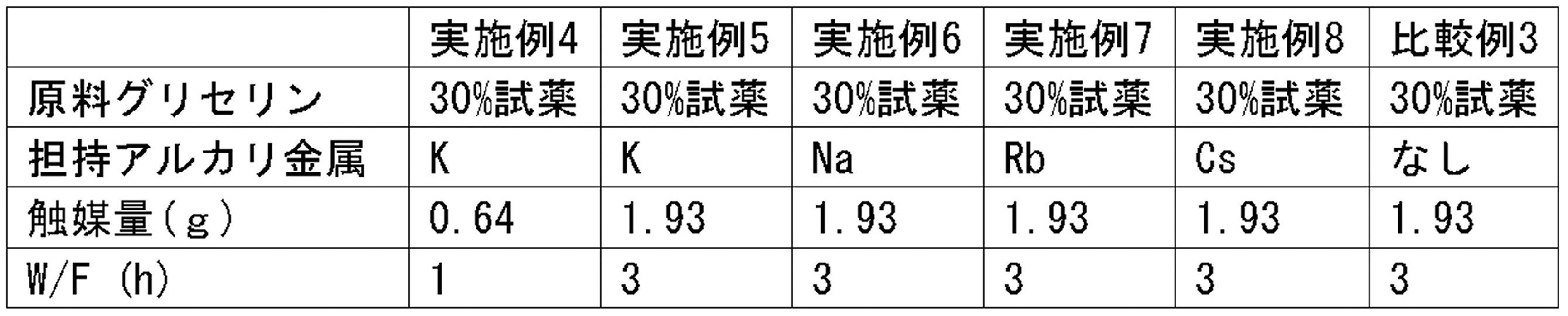
実施例5~8および比較例3の実験結果をまとめて図13-1および13-2に示す。図13-1は、担持アルカリ金属の違いとアリルアルコール+プロピレンの合計収率との関係を示し、図13-2は、担持アルカリ金属の違いとヒドロキシアセトン+カルボン酸+ケトン類の合計収率との関係を示す。
図13-1の結果から以下のことが分かる。
・アルカリ金属の担持により,アリルアルコール+プロピレン収率が大きく向上する。
図13-2の結果から以下のことが分かる。
・アルカリ金属担持は,グリセリンからのアリルアルコール+プロピレン合成に有効である。
図13-1の結果から以下のことが分かる。
・アルカリ金属の担持により,アリルアルコール+プロピレン収率が大きく向上する。
図13-2の結果から以下のことが分かる。
・アルカリ金属担持は,グリセリンからのアリルアルコール+プロピレン合成に有効である。
参考例1
触媒としてZrO2-FeOX触媒(ZrO2担持量を0質量%~100質量%で変化)を用いた以外は実施例3と同様に実施した。結果を図14(生成物収率)に示す。
触媒としてZrO2-FeOX触媒(ZrO2担持量を0質量%~100質量%で変化)を用いた以外は実施例3と同様に実施した。結果を図14(生成物収率)に示す。
参考例2
触媒としてTiO2-FeOX触媒(TiO2担持量を0質量%~75質量%で変化)を用いた以外は実施例3と同様に実施した。結果を図15(生成物収率)に示す。
触媒としてTiO2-FeOX触媒(TiO2担持量を0質量%~75質量%で変化)を用いた以外は実施例3と同様に実施した。結果を図15(生成物収率)に示す。
参考例3
触媒としてAl2O3-FeOX触媒Al2O3担持量を0質量%~25質量%で変化)を用いた以外は実施例3と同様に実施した。結果を図16(生成物収率)に示す。
触媒としてAl2O3-FeOX触媒Al2O3担持量を0質量%~25質量%で変化)を用いた以外は実施例3と同様に実施した。結果を図16(生成物収率)に示す。
比較例4
触媒として固体酸触媒(ベータ型ゼオライト)を用い、触媒量を0.2g、反応時間を時間とした以外は実施例3と同様に実施した。結果を図17(生成物収率)に示す。
触媒として固体酸触媒(ベータ型ゼオライト)を用い、触媒量を0.2g、反応時間を時間とした以外は実施例3と同様に実施した。結果を図17(生成物収率)に示す。
参考例4
触媒としてMg担持ZrO2-FeOX触媒を用いた以外は実施例4と同様に実施した。結果を図18(生成物収率)に示す。
触媒としてMg担持ZrO2-FeOX触媒を用いた以外は実施例4と同様に実施した。結果を図18(生成物収率)に示す。
実施例9
原料として30質量%となるように試薬グリセリンを水で希釈した水溶液を用い、触媒の使用量を0.6gとし、W/Fを1 hとし、触媒のカリウム担持量を0から10mol%(Zr+Feモル数に対して)変化させた以外は実施例1と同様に実施した。実験条件は以下の通りである。
原料として30質量%となるように試薬グリセリンを水で希釈した水溶液を用い、触媒の使用量を0.6gとし、W/Fを1 hとし、触媒のカリウム担持量を0から10mol%(Zr+Feモル数に対して)変化させた以外は実施例1と同様に実施した。実験条件は以下の通りである。
触媒:K担持ZrO2(7)-FeOX触媒 (ZrO2担持量は7質量%)
反応温度 = 350℃
供給原料 = 30 質量%水希釈試薬グリセリン原料
原料の供給速度 = 2ml/h
触媒量 = 0.6 g,W/F = 1 h
反応温度 = 350℃
供給原料 = 30 質量%水希釈試薬グリセリン原料
原料の供給速度 = 2ml/h
触媒量 = 0.6 g,W/F = 1 h
結果を図19-1(生成物収率)および19-2(経路I/経路II比)に示す。
図19-1(生成物収率) の結果から以下のことが分かる。
・カリウム担持量が1~5mol%の範囲で、経路Iのアリルアルコールおよびプロピレンの生成が多い(27~28mol%-C)ことを確認した。
図19-2(経路I/経路II比) の結果から以下のことが分かる。
・カリウム担持量の増加に伴って、経路I/経路II比が増大した。
図19-1(生成物収率) の結果から以下のことが分かる。
・カリウム担持量が1~5mol%の範囲で、経路Iのアリルアルコールおよびプロピレンの生成が多い(27~28mol%-C)ことを確認した。
図19-2(経路I/経路II比) の結果から以下のことが分かる。
・カリウム担持量の増加に伴って、経路I/経路II比が増大した。
実施例10
原料として30質量%となるように試薬グリセリンを水で希釈した水溶液を用い、触媒の使用量を0.6gとし、W/Fを1 hとし、反応温度を変化させた以外は実施例1と同様に実施した。実験条件は以下の通りである。
原料として30質量%となるように試薬グリセリンを水で希釈した水溶液を用い、触媒の使用量を0.6gとし、W/Fを1 hとし、反応温度を変化させた以外は実施例1と同様に実施した。実験条件は以下の通りである。
触媒:K担持ZrO2(7)-FeOX触媒 (ZrO2担持量は7質量%) (Kを1mol%担持)
反応温度 = 325~400℃
供給原料 = 30 質量%水希釈試薬グリセリン原料
供給速度 2ml/h
触媒量=0.6 g,W/F = 1 h
反応温度 = 325~400℃
供給原料 = 30 質量%水希釈試薬グリセリン原料
供給速度 2ml/h
触媒量=0.6 g,W/F = 1 h
結果を図20(生成物収率)に示す。
図20(生成物収率) の結果から以下のことが分かる。
・反応温度が350℃のときに、経路Iと経路IIの合計収率が最も高くなり、かつアリルアルコールの収率も最も高くなる。
図20(生成物収率) の結果から以下のことが分かる。
・反応温度が350℃のときに、経路Iと経路IIの合計収率が最も高くなり、かつアリルアルコールの収率も最も高くなる。
参考例5
触媒としてZrO2-FeOX触媒(ZrO2担持量を0質量%)を用い、W(触媒重量)/粗製グリセリンを1.5~10の範囲で変化させた以外は実施例3と同様に実施した。実験条件は以下の通りである。結果を図21(生成物収率)に示す。
触媒としてZrO2-FeOX触媒(ZrO2担持量を0質量%)を用い、W(触媒重量)/粗製グリセリンを1.5~10の範囲で変化させた以外は実施例3と同様に実施した。実験条件は以下の通りである。結果を図21(生成物収率)に示す。
触媒:ZrO2(7)-FeOX触媒 (ZrO2担持量は7質量%)
反応温度 = 350℃
供給原料 = 10 質量%水希釈粗製グリセリン(グリセリン換算 約3.7質量%)
供給速度 2ml/h
W(触媒重量)/粗製グリセリン=1.5~10
反応温度 = 350℃
供給原料 = 10 質量%水希釈粗製グリセリン(グリセリン換算 約3.7質量%)
供給速度 2ml/h
W(触媒重量)/粗製グリセリン=1.5~10
結果を図21(生成物収率)に示す。
図21(生成物収率) の結果から以下のことが分かる。
・W(触媒重量)/粗製グリセリンが高くなると、生成物はプロピレンとケトン類に集約される。
・W(触媒重量)/粗製グリセリン=13において経路I/経路II比は極大を示す。
図21(生成物収率) の結果から以下のことが分かる。
・W(触媒重量)/粗製グリセリンが高くなると、生成物はプロピレンとケトン類に集約される。
・W(触媒重量)/粗製グリセリン=13において経路I/経路II比は極大を示す。
実施例11
触媒のカリウム担持量を変化させた以外は実施例1と同様に実施した。実験条件は以下の通りである。結果を図22(生成物収率)に示す。
触媒のカリウム担持量を変化させた以外は実施例1と同様に実施した。実験条件は以下の通りである。結果を図22(生成物収率)に示す。
触媒:K担持ZrO2(7)-FeOX触媒 (ZrO2担持量は7質量%)
反応温度 = 350℃
供給原料 = 10 質量%水希釈粗製グリセリン(グリセリン換算 約3.7質量%)
供給速度 2ml/h
W(触媒重量)/粗製グリセリン=5h
反応温度 = 350℃
供給原料 = 10 質量%水希釈粗製グリセリン(グリセリン換算 約3.7質量%)
供給速度 2ml/h
W(触媒重量)/粗製グリセリン=5h
図22(生成物収率) の結果から以下のことが分かる。
・カリウムの担持によりプロピレンの収率が減少し、アリルアルコールの収率が増加する。カリウムの担持によりアリルアルコールからプロピレンへの反応が抑制されることを示唆する。
・カリウム担持量の増加に伴い、カルボン酸とケトン類が減少する。
・カリウムの担持によりプロピレンの収率が減少し、アリルアルコールの収率が増加する。カリウムの担持によりアリルアルコールからプロピレンへの反応が抑制されることを示唆する。
・カリウム担持量の増加に伴い、カルボン酸とケトン類が減少する。
実施例12
触媒の使用量を変化させた以外は実施例1と同様に実施した。実験条件は以下の通りである。結果を図23(生成物収率)に示す。
触媒の使用量を変化させた以外は実施例1と同様に実施した。実験条件は以下の通りである。結果を図23(生成物収率)に示す。
触媒:K担持ZrO2(7)-FeOX触媒 (ZrO2担持量は7質量%) (Kを5mol%担持)
反応温度 = 350℃
供給原料 = 10 質量%水希釈粗製グリセリン(グリセリン換算 約3.7質量%)
供給速度 2ml/h
W(触媒重量)/粗製グリセリン=1.5~10
反応温度 = 350℃
供給原料 = 10 質量%水希釈粗製グリセリン(グリセリン換算 約3.7質量%)
供給速度 2ml/h
W(触媒重量)/粗製グリセリン=1.5~10
図22(生成物収率) の結果から以下のことが分かる。
・触媒量が少ないと、逐次反応が進行しにくい。
・W/F=1.5のときにアリルアルコール収率が最大になる。
・触媒量が少ないと、逐次反応が進行しにくい。
・W/F=1.5のときにアリルアルコール収率が最大になる。
実施例13
実施例1と同様の条件で反応時間の経過による生成物の変化を調べた。実験条件は以下の通りである。結果を図24-1(生成物収率)及び24-2(経路I/経路II比)に示す。
実施例1と同様の条件で反応時間の経過による生成物の変化を調べた。実験条件は以下の通りである。結果を図24-1(生成物収率)及び24-2(経路I/経路II比)に示す。
触媒:K担持ZrO2(7)-FeOX触媒 (ZrO2担持量は7質量%) (Kを1mol%担持)
反応温度 = 350℃
供給原料 = 10 質量%水希釈粗製グリセリン(グリセリン換算 約3.7質量%)
供給速度 2ml/h
W/F=5h
反応温度 = 350℃
供給原料 = 10 質量%水希釈粗製グリセリン(グリセリン換算 約3.7質量%)
供給速度 2ml/h
W/F=5h
図24-1(生成物収率)及び24-2(経路I/経路II比)の結果から以下のことが分かる。
反応時間の経過に伴いアリルアルコールの収率が増大し、逐次反応が抑制される。
反応時間の経過に伴いアリルアルコールの収率が増大し、逐次反応が抑制される。
2時間反応後と6時間反応後における触媒表面へのカリウム析出量を分析した結果を以下に示す。
2時間後 触媒に対し 1質量% 相当のカリウムが析出(1.7 mol%相当)
6時間後 触媒に対し 3質量% 相当のカリウムが析出(5.0 mol%相当)
2時間後 触媒に対し 1質量% 相当のカリウムが析出(1.7 mol%相当)
6時間後 触媒に対し 3質量% 相当のカリウムが析出(5.0 mol%相当)
実施例14
触媒のカリウム担持量を3mol%とした以外は、実施例1と同様の条件で反応時間の経過による生成物の変化を調べた。実験条件は以下の通りである。結果を図25-1(生成物収率)及び25-2(経路I/経路II比)に示す。
触媒のカリウム担持量を3mol%とした以外は、実施例1と同様の条件で反応時間の経過による生成物の変化を調べた。実験条件は以下の通りである。結果を図25-1(生成物収率)及び25-2(経路I/経路II比)に示す。
触媒:K担持ZrO2(7)-FeOX触媒 (ZrO2担持量は7質量%) (Kを3mol%担持)
反応温度 = 350℃
供給原料 = 10 質量%水希釈粗製グリセリン(グリセリン換算 約3.7質量%)
供給速度 2ml/h
W/F=5h
反応温度 = 350℃
供給原料 = 10 質量%水希釈粗製グリセリン(グリセリン換算 約3.7質量%)
供給速度 2ml/h
W/F=5h
図25-1(生成物収率)及び25-2(経路I/経路II比)の結果から以下のことが分かる。
・実施例13と同様の傾向が見られた。
・反応時間の経過に伴いアリルアルコールの収率が増大し、逐次反応が抑制される。
・実施例13と同様の傾向が見られた。
・反応時間の経過に伴いアリルアルコールの収率が増大し、逐次反応が抑制される。
2時間反応後と6時間反応後における触媒表面へのカリウム析出量を分析した結果を以下に示す。
2時間後 触媒に対し 1質量% 相当のカリウムが析出(1.7 mol%相当)
6時間後 触媒に対し 3質量% 相当のカリウムが析出(5.0 mol%相当)
2時間後 触媒に対し 1質量% 相当のカリウムが析出(1.7 mol%相当)
6時間後 触媒に対し 3質量% 相当のカリウムが析出(5.0 mol%相当)
本発明は、グリセリンの再生利用分野に有用である。
Claims (15)
- ジルコニア、チタニアおよびアルミナの少なくとも1種と酸化鉄との複合酸化物にアルカリ金属を担持した酸化鉄系の複合酸化物触媒であって、
グリセリン含有水溶液中のグリセリンを少なくともアリルアルコールおよびプロピレンに転換するために用いられるための、触媒。 - 前記複合酸化物はジルコニア-酸化鉄系複合酸化物であり、ジルコニアの含有量が5~50質量%の範囲である請求項1に記載の触媒。
- 前記ジルコニア、チタニアおよびアルミナの合計の含有量は、複合酸化物の5~80質量%の範囲である請求項1に記載の触媒。
- 前記複合酸化物はチタニア-酸化鉄系複合酸化物であり、チタニアの含有量が10~65質量%の範囲である請求項1に記載の触媒。
- 前記複合酸化物はアルミナ-酸化鉄系複合酸化物であり、アルミナの含有量が5~50質量%の範囲である請求項1に記載の触媒。
- アルカリ金属担持量が複合酸化物を構成する金属の合計モル数の1~5モル%の範囲である請求項1~5のいずれかに記載の触媒。
- ジルコニア、チタニアおよびアルミナの少なくとも1種と酸化鉄との複合酸化物にアルカリ金属を担持した酸化鉄系の複合酸化物触媒に、グリセリンを含有する水溶液を加熱下に接触させて、前記水溶液中のグリセリンを少なくともアリルアルコールおよびプロピレンに転換することを含む、アリルアルコールおよびプロピレンの製造方法。
- 前記複合酸化物はジルコニア-酸化鉄系複合酸化物であり、ジルコニアの含有量が5~50質量%の範囲である請求項7に記載の製造方法。
- 前記ジルコニア、チタニアおよびアルミナの合計の含有量は、複合酸化物の5~80質量%の範囲である請求項7に記載の製造方法。
- 前記複合酸化物はチタニア-酸化鉄系複合酸化物であり、チタニアの含有量が10~65質量%の範囲である請求項7に記載の製造方法。
- 前記複合酸化物はアルミナ-酸化鉄系複合酸化物であり、アルミナの含有量が5~50質量%の範囲である請求項7に記載の製造方法。
- 前記複合酸化物触媒におけるアルカリ金属担持量が複合酸化物を構成する金属の合計モル数の1~5モル%の範囲である請求項7~11のいずれかに記載の製造方法。
- 前記加熱下の接触は、300~450℃の範囲の温度で行う請求項7~12のいずれかに記載の製造方法。
- 原料グリセリン供給速度に対する触媒量の割合(W/F、W: 触媒量/g、F: 原料グリセリン供給速度/g-グリセリンh-1)が0.5~20の範囲である請求項7~13のいずれかに記載の製造方法。
- プロピレンを気体として回収する請求項7~14のいずれかに記載の製造方法。
Priority Applications (1)
| Application Number | Priority Date | Filing Date | Title |
|---|---|---|---|
| JP2012503169A JP5721238B2 (ja) | 2010-03-01 | 2011-03-01 | 低品位グリセリンからのアリルアルコールとプロピレンの製造方法、及びそのための触媒 |
Applications Claiming Priority (2)
| Application Number | Priority Date | Filing Date | Title |
|---|---|---|---|
| JP2010044302 | 2010-03-01 | ||
| JP2010-044302 | 2010-03-01 |
Publications (1)
| Publication Number | Publication Date |
|---|---|
| WO2011108509A1 true WO2011108509A1 (ja) | 2011-09-09 |
Family
ID=44542161
Family Applications (1)
| Application Number | Title | Priority Date | Filing Date |
|---|---|---|---|
| PCT/JP2011/054565 Ceased WO2011108509A1 (ja) | 2010-03-01 | 2011-03-01 | 低品位グリセリンからのアリルアルコールとプロピレンの製造方法、及びそのための触媒 |
Country Status (2)
| Country | Link |
|---|---|
| JP (1) | JP5721238B2 (ja) |
| WO (1) | WO2011108509A1 (ja) |
Cited By (5)
| Publication number | Priority date | Publication date | Assignee | Title |
|---|---|---|---|---|
| WO2014209068A1 (ko) * | 2013-06-27 | 2014-12-31 | 주식회사 엘지화학 | 알릴 알코올의 제조방법 및 이에 의하여 제조된 알릴 알코올 |
| WO2014209063A1 (ko) * | 2013-06-27 | 2014-12-31 | 주식회사 엘지화학 | 알릴알콜의 제조방법 |
| JP2017051941A (ja) * | 2015-09-08 | 2017-03-16 | 株式会社ダイセル | オレフィン化反応用触媒及びオレフィンの製造方法 |
| JP2018522889A (ja) * | 2015-07-30 | 2018-08-16 | サントレ ナティオナル ド ラ ルシェルシェ シアンティフィク | グリセロールのアリルアルコールへの直接脱酸素脱水素反応のためのレニウム含有担持不均一系触媒の使用 |
| US12410109B2 (en) | 2020-09-28 | 2025-09-09 | Daicel Corporation | Method for producing olefin and olefination reaction catalyst |
Citations (4)
| Publication number | Priority date | Publication date | Assignee | Title |
|---|---|---|---|---|
| JP2000044984A (ja) * | 1998-05-25 | 2000-02-15 | Ronfoodo:Kk | 油脂類から脂肪酸の低級アルキルエステルを製造する方法 |
| JP2008162907A (ja) * | 2006-12-27 | 2008-07-17 | Nippon Shokubai Co Ltd | グリセリンからのアリルアルコールおよびアクリル酸の製造方法 |
| WO2008092534A1 (de) * | 2007-01-29 | 2008-08-07 | Evonik Degussa Gmbh | Verfahren zur regenerierung eines katalysators für die dehydratisierung von glycerin |
| WO2009044081A1 (fr) * | 2007-09-20 | 2009-04-09 | Arkema France | Procede de fabrication d'acroleine a partir de glycerol |
-
2011
- 2011-03-01 JP JP2012503169A patent/JP5721238B2/ja not_active Expired - Fee Related
- 2011-03-01 WO PCT/JP2011/054565 patent/WO2011108509A1/ja not_active Ceased
Patent Citations (4)
| Publication number | Priority date | Publication date | Assignee | Title |
|---|---|---|---|---|
| JP2000044984A (ja) * | 1998-05-25 | 2000-02-15 | Ronfoodo:Kk | 油脂類から脂肪酸の低級アルキルエステルを製造する方法 |
| JP2008162907A (ja) * | 2006-12-27 | 2008-07-17 | Nippon Shokubai Co Ltd | グリセリンからのアリルアルコールおよびアクリル酸の製造方法 |
| WO2008092534A1 (de) * | 2007-01-29 | 2008-08-07 | Evonik Degussa Gmbh | Verfahren zur regenerierung eines katalysators für die dehydratisierung von glycerin |
| WO2009044081A1 (fr) * | 2007-09-20 | 2009-04-09 | Arkema France | Procede de fabrication d'acroleine a partir de glycerol |
Non-Patent Citations (2)
| Title |
|---|
| KOJI MUKAIDA ET AL.: "Feox-kei Shokubai ni yoru Glycerin no Sekiyu Kagaku Kanren Yuyo Busshitsu eno Henkan Hanno", DAI 104 KAI SHOKUBAI TORONKAI TORONKAI A YOKOSHU, 27 September 2009 (2009-09-27), pages 139 * |
| KOJI MUKAIDA ET AL.: "Sankatetsu-kei Shokubai o Mochiita Glycerin kara no Sekiyu Kagaku Kanren Yuyo Busshitsu no Gosei", DAI 103 KAI SHOKUBAI TORONKAI TORONKAI A YOKOSHU, 30 March 2009 (2009-03-30), pages 142 * |
Cited By (9)
| Publication number | Priority date | Publication date | Assignee | Title |
|---|---|---|---|---|
| WO2014209068A1 (ko) * | 2013-06-27 | 2014-12-31 | 주식회사 엘지화학 | 알릴 알코올의 제조방법 및 이에 의하여 제조된 알릴 알코올 |
| WO2014209063A1 (ko) * | 2013-06-27 | 2014-12-31 | 주식회사 엘지화학 | 알릴알콜의 제조방법 |
| CN104755451A (zh) * | 2013-06-27 | 2015-07-01 | Lg化学株式会社 | 制备烯丙醇的方法 |
| US9120718B1 (en) | 2013-06-27 | 2015-09-01 | Lg Chem, Ltd. | Method for preparing allyl alcohol |
| US9487460B2 (en) | 2013-06-27 | 2016-11-08 | Lg Chem, Ltd. | Method for producing allyl alcohol and allyl alcohol produced thereby |
| CN105308010B (zh) * | 2013-06-27 | 2017-06-16 | Lg化学株式会社 | 制备烯丙醇的方法以及由该方法制备的烯丙醇 |
| JP2018522889A (ja) * | 2015-07-30 | 2018-08-16 | サントレ ナティオナル ド ラ ルシェルシェ シアンティフィク | グリセロールのアリルアルコールへの直接脱酸素脱水素反応のためのレニウム含有担持不均一系触媒の使用 |
| JP2017051941A (ja) * | 2015-09-08 | 2017-03-16 | 株式会社ダイセル | オレフィン化反応用触媒及びオレフィンの製造方法 |
| US12410109B2 (en) | 2020-09-28 | 2025-09-09 | Daicel Corporation | Method for producing olefin and olefination reaction catalyst |
Also Published As
| Publication number | Publication date |
|---|---|
| JP5721238B2 (ja) | 2015-05-20 |
| JPWO2011108509A1 (ja) | 2013-06-27 |
Similar Documents
| Publication | Publication Date | Title |
|---|---|---|
| JP6417009B2 (ja) | グリセリン脱水反応用触媒、その製造方法およびアクロレインの製造方法 | |
| CN111108088B (zh) | 用于将醛氧化酯化成羧酸酯的催化剂 | |
| CN105837420B (zh) | 从甘油制备丙烯醛的方法 | |
| TWI579265B (zh) | 製備乙烯及乙酸之方法 | |
| JP6100972B2 (ja) | グリセロールからアクリル酸を製造する方法 | |
| US9079841B2 (en) | Process for preparing acrolein from glycerol or glycerin | |
| JP5820818B2 (ja) | オレフィン製造用触媒及びオレフィンの製造方法 | |
| CN104837799B (zh) | 将可自生物质衍生得的脂肪醇催化转化制得有价值的烯烃或含氧化合物 | |
| JP5721238B2 (ja) | 低品位グリセリンからのアリルアルコールとプロピレンの製造方法、及びそのための触媒 | |
| JP5846388B2 (ja) | 新規なグリセリン脱水用触媒とその製造方法 | |
| JP6553804B2 (ja) | アクリル酸製造用不均一系触媒及びそれを用いたアクリル酸製造方法 | |
| WO2014070733A1 (en) | Renewable isobutene and isoprene from a mixture of acetic acid and propionic acid | |
| JP7448153B2 (ja) | 触媒の製造方法、及び触媒、並びに3-ヒドロキシ-3-メチルブタン酸の製造方法 | |
| JP5914615B1 (ja) | アリルアルコールから3−ヒドロキシプロピオン酸を製造するための不均一系触媒、これを用いたアリルアルコールから3−ヒドロキシプロピオン酸を製造する方法 | |
| US10301245B2 (en) | Use of molybdenum and vanadium mixed oxides as catalysts for the oxidation of unsaturated alcohols into unsaturated carboxylic acids | |
| JP5130107B2 (ja) | アクリル酸の製造方法 | |
| JP6533621B2 (ja) | グリセリン脱水反応用触媒、その製造方法および前記触媒を利用したアクロレインの製造方法 | |
| WO2014024782A2 (ja) | グリセリンからアクリル酸を製造するための触媒とその製造方法 | |
| HK40026213A (en) | Catalyst for the oxidative esterification of aldehydes to carboxylic acid esters | |
| WO2012035540A1 (en) | Process for the production of acrolein and reusable catalyst thereof | |
| US20150239815A1 (en) | Method for preparing acrolein from glycerol | |
| WO2017111392A1 (ko) | 글리세린 탈수 반응용 촉매, 이의 제조 방법 및 상기 촉매를 이용한 아크롤레인의 제조 방법 | |
| WO2015046716A1 (ko) | 글리세린 탈수반응용 촉매, 이의 제조 방법 및 아크롤레인의 제조 방법 |
Legal Events
| Date | Code | Title | Description |
|---|---|---|---|
| 121 | Ep: the epo has been informed by wipo that ep was designated in this application |
Ref document number: 11750619 Country of ref document: EP Kind code of ref document: A1 |
|
| WWE | Wipo information: entry into national phase |
Ref document number: 2012503169 Country of ref document: JP |
|
| NENP | Non-entry into the national phase |
Ref country code: DE |
|
| 122 | Ep: pct application non-entry in european phase |
Ref document number: 11750619 Country of ref document: EP Kind code of ref document: A1 |