WO2011083809A1 - シクロオレフィン系ポリマー接着用tac基材、tac接着部材、および液晶表示装置 - Google Patents
シクロオレフィン系ポリマー接着用tac基材、tac接着部材、および液晶表示装置 Download PDFInfo
- Publication number
- WO2011083809A1 WO2011083809A1 PCT/JP2011/050073 JP2011050073W WO2011083809A1 WO 2011083809 A1 WO2011083809 A1 WO 2011083809A1 JP 2011050073 W JP2011050073 W JP 2011050073W WO 2011083809 A1 WO2011083809 A1 WO 2011083809A1
- Authority
- WO
- WIPO (PCT)
- Prior art keywords
- cycloolefin
- tac
- cycloolefin polymer
- base material
- adhesive layer
- Prior art date
- Legal status (The legal status is an assumption and is not a legal conclusion. Google has not performed a legal analysis and makes no representation as to the accuracy of the status listed.)
- Ceased
Links
Images


Classifications
-
- C—CHEMISTRY; METALLURGY
- C09—DYES; PAINTS; POLISHES; NATURAL RESINS; ADHESIVES; COMPOSITIONS NOT OTHERWISE PROVIDED FOR; APPLICATIONS OF MATERIALS NOT OTHERWISE PROVIDED FOR
- C09J—ADHESIVES; NON-MECHANICAL ASPECTS OF ADHESIVE PROCESSES IN GENERAL; ADHESIVE PROCESSES NOT PROVIDED FOR ELSEWHERE; USE OF MATERIALS AS ADHESIVES
- C09J145/00—Adhesives based on homopolymers or copolymers of compounds having no unsaturated aliphatic radicals in a side chain, and having one or more carbon-to-carbon double bonds in a carbocyclic or in a heterocyclic system; Adhesives based on derivatives of such polymers
-
- C—CHEMISTRY; METALLURGY
- C09—DYES; PAINTS; POLISHES; NATURAL RESINS; ADHESIVES; COMPOSITIONS NOT OTHERWISE PROVIDED FOR; APPLICATIONS OF MATERIALS NOT OTHERWISE PROVIDED FOR
- C09J—ADHESIVES; NON-MECHANICAL ASPECTS OF ADHESIVE PROCESSES IN GENERAL; ADHESIVE PROCESSES NOT PROVIDED FOR ELSEWHERE; USE OF MATERIALS AS ADHESIVES
- C09J7/00—Adhesives in the form of films or foils
- C09J7/20—Adhesives in the form of films or foils characterised by their carriers
- C09J7/22—Plastics; Metallised plastics
-
- C—CHEMISTRY; METALLURGY
- C09—DYES; PAINTS; POLISHES; NATURAL RESINS; ADHESIVES; COMPOSITIONS NOT OTHERWISE PROVIDED FOR; APPLICATIONS OF MATERIALS NOT OTHERWISE PROVIDED FOR
- C09J—ADHESIVES; NON-MECHANICAL ASPECTS OF ADHESIVE PROCESSES IN GENERAL; ADHESIVE PROCESSES NOT PROVIDED FOR ELSEWHERE; USE OF MATERIALS AS ADHESIVES
- C09J7/00—Adhesives in the form of films or foils
- C09J7/30—Adhesives in the form of films or foils characterised by the adhesive composition
- C09J7/38—Pressure-sensitive adhesives [PSA]
-
- C—CHEMISTRY; METALLURGY
- C09—DYES; PAINTS; POLISHES; NATURAL RESINS; ADHESIVES; COMPOSITIONS NOT OTHERWISE PROVIDED FOR; APPLICATIONS OF MATERIALS NOT OTHERWISE PROVIDED FOR
- C09J—ADHESIVES; NON-MECHANICAL ASPECTS OF ADHESIVE PROCESSES IN GENERAL; ADHESIVE PROCESSES NOT PROVIDED FOR ELSEWHERE; USE OF MATERIALS AS ADHESIVES
- C09J2203/00—Applications of adhesives in processes or use of adhesives in the form of films or foils
- C09J2203/318—Applications of adhesives in processes or use of adhesives in the form of films or foils for the production of liquid crystal displays
-
- C—CHEMISTRY; METALLURGY
- C09—DYES; PAINTS; POLISHES; NATURAL RESINS; ADHESIVES; COMPOSITIONS NOT OTHERWISE PROVIDED FOR; APPLICATIONS OF MATERIALS NOT OTHERWISE PROVIDED FOR
- C09J—ADHESIVES; NON-MECHANICAL ASPECTS OF ADHESIVE PROCESSES IN GENERAL; ADHESIVE PROCESSES NOT PROVIDED FOR ELSEWHERE; USE OF MATERIALS AS ADHESIVES
- C09J2400/00—Presence of inorganic and organic materials
- C09J2400/20—Presence of organic materials
- C09J2400/22—Presence of unspecified polymer
-
- C—CHEMISTRY; METALLURGY
- C09—DYES; PAINTS; POLISHES; NATURAL RESINS; ADHESIVES; COMPOSITIONS NOT OTHERWISE PROVIDED FOR; APPLICATIONS OF MATERIALS NOT OTHERWISE PROVIDED FOR
- C09J—ADHESIVES; NON-MECHANICAL ASPECTS OF ADHESIVE PROCESSES IN GENERAL; ADHESIVE PROCESSES NOT PROVIDED FOR ELSEWHERE; USE OF MATERIALS AS ADHESIVES
- C09J2401/00—Presence of cellulose
- C09J2401/006—Presence of cellulose in the substrate
Definitions
- the present invention is used in various displays such as a liquid crystal display used as a liquid crystal display device such as a television, a computer, a car navigation system, an in-vehicle instrument panel, an automatic teller machine (hereinafter abbreviated as ATM), and a mobile phone.
- a liquid crystal display used as a liquid crystal display device such as a television, a computer, a car navigation system, an in-vehicle instrument panel, an automatic teller machine (hereinafter abbreviated as ATM), and a mobile phone.
- the present invention relates to a cycloolefin polymer bonding TAC substrate, a TAC bonding member, and a liquid crystal display device.
- liquid crystal display devices are widely known as displays used in televisions, computers, car navigation systems, in-vehicle instrument panels, ATMs, mobile phones and the like.
- the liquid crystal display device includes a liquid crystal cell having a liquid crystal layer formed between a pair of substrates, and a backlight unit that irradiates the liquid crystal cell with light from one surface side of the liquid crystal cell.
- the backlight unit is mainly known as a direct type or a side edge type. Since the direct type has a feature that a large number of light sources are directly installed on the back surface of the liquid crystal cell, it is difficult to reduce the thickness of the backlight unit due to the structure.
- the side edge type has a feature that a light guide plate is laminated on the back surface of a liquid crystal cell via at least one optical sheet, and a light source is installed on at least one side of the light guide plate. It is possible to reduce the thickness of the backlight unit by thinning the light guide plate.
- an optical member such as a polarizing plate or a retardation plate is used together with a liquid crystal cell containing liquid crystal.
- a so-called cycloolefin polymer substrate such as a cycloolefin polymer (COP) or a cycloolefin copolymer (COC) is used as a polarizing plate member.
- a substrate of triacetylcellulose hereinafter referred to as TAC is used.
- the surface of the cycloolefin polymer was inactive and could not be properly bonded.
- the surface of the TAC or cycloolefin polymer substrate is subjected to ultrasonic fusion, ultraviolet irradiation, mat treatment, corona treatment, plasma treatment, etc. It was necessary to perform a pre-treatment, and even if it was able to adhere, air bubbles in the adhesive layer were mixed.
- Patent Document 1 Although air bubble removal is good, it cannot be applied without applying heat of 100 ° C. or higher from the blending. . In addition, since it is necessary to perform easy adhesion treatment such as corona treatment, plasma treatment, and blast treatment on one side of the substrate sheet, there is a problem that the process becomes long or a dedicated device is required.
- the present invention has been made on the basis of the above-mentioned demands, that is, it is extremely excellent in removing air at the time of pasting, excellent in transparency and pasting workability, and bonded without impairing polarization after pasting.
- An object of the present invention is to provide a cycloolefin polymer adhesion TAC substrate, a TAC adhesion member, and a liquid crystal display device capable of enhancing strength.
- the TAC base material for cycloolefin polymer adhesion of the present invention has an adhesive layer on the surface of the TAC base material, and the adhesive layer includes paraffin or naphthene and at least an adhesion assistant, a TAC polymer, and a cycloolefin polymer.
- This configuration makes it possible to realize a TAC substrate that can be firmly bonded to a cycloolefin-based polymer.
- the TAC base material for cycloolefin polymer adhesion of the present invention is characterized in that the paraffin or naphthene has a number average molecular weight in the range of 100 or more and 1000 or less.
- a TAC substrate that is excellent in transparency and has an adhesive layer that has viscoelasticity, and is capable of firmly adhering to a cycloolefin polymer in which bubbles are prevented from being involved in the adhesive interface. It can be realized.
- Paraffin and naphthene are hydrocarbon chain polymers of the same type as the polymer chain that forms the backbone of the cycloolefin polymer, and have a molecular weight as low as several hundred to several thousand, so the polymer chain that forms the backbone of the cycloolefin polymer It is easy to diffuse between (easy to enter), and the molecular chain on the surface of the polymer formed by the cycloolefin polymer can be activated (movable).
- the base material and TAC base material which were formed with the cycloolefin type polymer by using the paraffin and naphthene whose number average molecular weights are in the range of 100 or more and 1000 or less as the main component of the adhesive layer. Can be bonded more firmly.
- the macromonomer may be formed of a cycloolefin monomer.
- the number average molecular weight of the cycloolefin-based macromonomer is preferably 1000 or more in the cycloolefin-based polymer adhesion TAC substrate of the present invention.
- the mixing ratio (ratio) of the macromonomer in the adhesive layer is preferably 0.1% by weight or more and 95% by weight or less.
- the macromonomer occupying the adhesive layer is preferably formed by bonding a polymer chain, which is a soft segment, via an azo group.
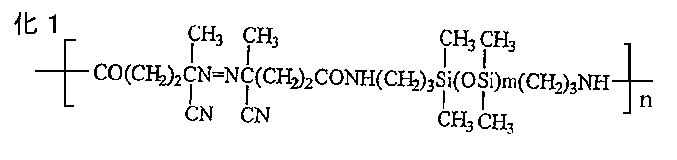
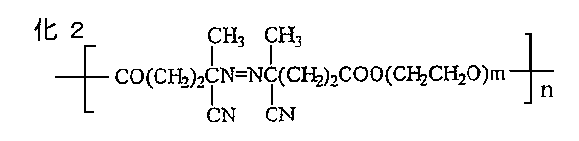
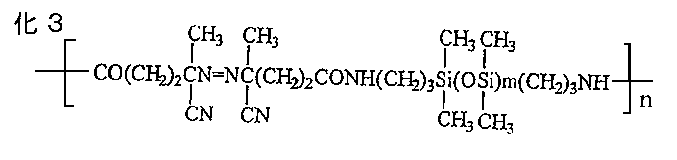
- the macromonomer is preferably formed by the following structural formula.
- the thermoplastic elastomer is preferably a block copolymer comprising a styrene monomer unit and a rubber monomer unit.
- the TAC base material for cycloolefin polymer adhesion of the present invention preferably contains at least one of diethyl ether, tetrahydrofuran, toluene, xylene, chlorobenzene, and dichlorobenzene in the adhesive layer. With this configuration, the TAC and the adhesive layer can be more firmly bonded.
- the surface of the adhesive layer is preferably provided with a separate film.
- the TAC adhesive member of the present invention is characterized in that the cycloolefin polymer base material is bonded to the adhesive layer forming surface of the cycloolefin polymer adhesive TAC base material via the adhesive layer.
- the TAC substrate or the cycloolefin polymer substrate is preferably formed of a sheet having a thickness of 10 ⁇ m or more and 10 mm or less.
- the liquid crystal display device of the present invention is characterized in that a TAC adhesive member is provided on at least one surface of a liquid crystal cell.
- the TAC base material for adhering cycloolefin polymer of the present invention By using the TAC base material for adhering cycloolefin polymer of the present invention, it is possible to efficiently prevent air (air) from remaining between the adherend surface at the time of pasting and at the time of pasting. Effective for reducing defects caused by entrained bubbles. Moreover, by using the TAC base material for cycloolefin polymer adhesion, it is excellent in transparency and laminating workability, and the adhesive strength can be enhanced without impairing the polarization after laminating.
- the TAC substrate for cycloolefin polymer adhesion of the present invention is extremely excellent in air removal at the time of pasting, excellent in transparency and pasting workability, and has an adhesive strength without impairing polarization after pasting. Can be enhanced.
- the TAC adhesive member of the present invention can realize an adhesive member firmly bonded to a cycloolefin polymer.
- the liquid crystal display device of the present invention can improve the brightness because of increased transparency, and can realize a liquid crystal display device with good visibility because it does not disturb the polarization.
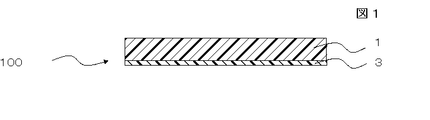
- FIG. 1 shows a partial cross-sectional view of a cycloolefin polymer adhesion TAC substrate 100 according to a first embodiment of the present invention cut from a thickness direction.
- the adhesive layer 3 is formed on the surface of the TAC substrate 1, and the adhesive layer 3 includes paraffin or naphthene and at least an adhesion aid, a TAC polymer, a cycloolefin polymer, a cycloolefin copolymer, and a macromonomer. Or any one of thermoplastic elastomers.
- TAC substrate 1 for example, a TAC film produced by a solution casting method is preferably used.
- TAC is a lower fatty acid ester of cellulose, which has a number average molecular weight (Mn) of 80,000 to 200,000, preferably 100,000 to 200,000, more preferably 150,000 to 200,000.
- the solution containing TAC can also contain various additives such as fine particles, plasticizers, ultraviolet absorbers, and dimensional stability improvers. Examples of such commercially available base sheet include FUJITAC (manufactured by FUJIFILM Optomaterial), KC4UYW (manufactured by Konica Minolta), and the like.
- the thickness of the TAC substrate 1 can be determined as appropriate, but generally it is 10 ⁇ m or more and 10 mm or less, preferably about 500 ⁇ m or less, particularly 20 ⁇ m, in view of workability such as strength and handling, and thin layer properties. As mentioned above, 300 micrometers or less are preferable and 30 micrometers or more and 200 micrometers or less are more preferable.
- paraffin and naphthene constituting the adhesive layer 3 paraffin is represented by the chemical formula C n H 2n + 2 and naphthene is represented by the chemical formula C n H 2n .
- the number average molecular weight of paraffin and naphthene is in the range of 100 or more and 1000 or less, preferably in the range of 200 or more and 600 or less, and the average carbon number is 7 or more and 72 or less, preferably 16 or more, 45 It is about the following. Thereby, adhesive strength can be improved.
- the adhesive layer 3 contains, in addition to paraffin or naphthene, an adhesion assistant, a polymer constituting a cycloolefin polymer, a macromonomer, or the like.
- the “polymer constituting the cycloolefin-based polymer” preferably has a low molecular weight (molecular weight is about 1,000 to 100,000, particularly 10,000 to 40,000).
- the “adhesion aid” includes low molecular weight (molecular weight of about 500 to 10,000) cycloolefin polymer, binder resin (regardless of thermosetting resin or thermoplastic resin), acrylic, Initiators, crosslinkers, thermoplastic elastomers and the like can be presented.
- the mixing ratio of the “adhesion aid” in the adhesive layer is less than 50% by weight.
- the initiator is mainly used for causing a polymerization reaction. The initiator itself is rarely incorporated into the backbone polymer chain.
- thermoplastic elastomer various types can be used, and examples thereof include a block copolymer composed of a styrene monomer unit and a rubber monomer unit.
- the styrene monomer unit can also be expressed as a hard segment, and the rubber monomer unit as a soft segment.
- thermoplastic elastomer examples include polystyrene-polyisoprene-polystyrene (SIS), polystyrene-polybutylene-polystyrene (SBS), polystyrene-poly (ethylene / butylene) block-polystyrene (SEBS), and polystyrene-poly (ethylene / propylene).
- SEBS block-polystyrene
- SI polystyrene-polyisoprene
- SB polystyrene-polybutylene
- SEP polystyrene-poly (ethylene / propylene) block
- SEBS is preferable.
- SEBS its mass average molecular weight is, for example, preferably 20,000 or more and 500,000 or less, more preferably 50,000 or more and 350,000 or less.
- Clayton G1651 SEBS type, manufactured by Clayton Polymer
- the soft segment means an amorphous flexible (flexible) molecular segment constituting the polymer, and examples thereof include an olefin skeleton, an isoprene skeleton, and a butadiene skeleton.
- the rubber monomer unit means a polymer substance exhibiting rubber elasticity, for example, isoprene-butadiene copolymer rubber, poly (ethylene / butylene) block copolymer rubber, isoprene rubber, butadiene rubber, carboxylated butadiene rubber. Natural rubber, epoxy natural rubber, and the like.
- a photopolymerization initiator In the case of a polymerization reaction of a photopolymerizable polyfunctional monomer, it is preferable to use a photopolymerization initiator.
- a photopolymerization initiator a photoradical polymerization initiator and a photocationic polymerization initiator are preferable, and a photopolymerization initiator is particularly preferable. It is a radical polymerization initiator.
- photo radical polymerization initiators examples include acetophenones, benzophenones, Michler's benzoylbenzoate, ⁇ -amyloxime ester, tetramethylthiuram monosulfide, and thioxanthones.
- photoradical polymerization initiators include KAYACURE (DETX-S, BP-100, BDK, CTX, BMS, 2-EAQ, ABQ, CPTX, EPD, ITX, QTX, BTC, manufactured by Nippon Kayaku Co., Ltd. MCA, etc.), Irgacure (651, 184, 500, 907, 369, 1173, 2959, 4265, 4263, etc.) manufactured by Ciba Specialty Chemicals Co., Ltd., Esacure (KIP100F, KB1, EB3, BP, manufactured by Sartomer) X33, KT046, KT37, KIP150, TZT) and the like.
- KAYACURE DETX-S, BP-100, BDK, CTX, BMS, 2-EAQ, ABQ, CPTX, EPD, ITX, QTX, BTC, manufactured by Nippon Kayaku Co., Ltd. MCA, etc.
- a photocleavable photo radical polymerization initiator is preferred.
- the photocleavable photoradical polymerization initiator is described in “Latest UV Curing Technology” by Kazuhiro Takashiro (Technical Information Association, Inc., page 159, 1991).
- photocleavable photoradical polymerization initiators include Irgacure (651, 184, 907) manufactured by Ciba Specialty Chemicals.
- the photopolymerization initiator is preferably used in the range of 0.1 to 15 parts by mass, more preferably in the range of 1 to 10 parts by mass with respect to 100 parts by mass of the polyfunctional monomer.
- a photosensitizer may be used.
- the photosensitizer include n-butylamine, triethylamine, tri-n-butylphosphine, Michler's ketone and thioxanthone.
- Examples of commercially available photosensitizers include KAYACURE (DMBI, EPA) manufactured by Nippon Kayaku Co., Ltd.
- the photopolymerization reaction is preferably performed by ultraviolet irradiation after the antistatic layer is applied and dried.
- Ultraviolet light emitted from rays such as ultra-high pressure mercury lamp, high pressure mercury lamp, low pressure mercury lamp, carbon arc, xenon arc, metal halide lamp, etc. can be used for ultraviolet irradiation.
- the crosslinking agent is used to give a three-dimensional structure.
- the cross-linking agent is incorporated into a polymer chain serving as a trunk itself.
- the crosslinking agent is not particularly limited, and is an isocyanate-based crosslinking agent, an aziridine-based crosslinking agent, coronate HL (hexamethylene diisocyanate, HDI-TMP adduct) manufactured by Oxazolytan Kogyo, BXX5134 (aziridin-based crosslinking agent) manufactured by Toyo Ink, and Nippon Shokubai Epocross RPS-1005 (oxazoline-based cross-linking agent), Mitsubishi Gas Chemical's TETRAD-X, TETRAD-C (both epoxy-based cross-linking agents) and the like.
- Macromonomer is a high molecular weight monomer that has a polymerizable functional group and polymerizes to polymerize.
- those having both a polymerization function and an initiation function not only give the macromonomer itself a three-dimensional structure as a cross-linking agent, but also polymerize the macromonomer itself into a polymer.
- the macromonomer acts to catch paraffin and naphthene, and to prevent the paraffin and naphthene from diffusing too much into the substrate 2 (too much entry).
- paraffin and naphthene as an adhesive are more easily diffused into the substrate 2 as the number average molecular weight is smaller.
- the base material 2 As described above, diffusion of paraffin or naphthene into the base material 2 can appropriately adhere to the base material 2. However, if the paraffin or naphthene diffuses too much into the base material 2, the base material 2 is particularly thin. It tends to be brittle. Therefore, by mixing the macromonomer, the diffusion of paraffin and naphthene into the base material 2 can be suppressed and the durability can be improved, and by mixing the macromonomer into the adhesive layer 3, the adhesive strength of the base material can be obtained as a result. Can be improved.
- the macromonomer is not particularly limited, and is a methacryloyl group-based macromonomer manufactured by Toagosei Co., Ltd. 45% AA-6, AA-6SR, AA-6, AA-10, AS-6, AN-6S, AB-6, AW-6S, AA-714SK, AY-707S, AY-714S, AK-5, AK-30, AK-32, hydroxyl group-based macromonomer HA-6S, HA-6SX, HN-6 manufactured by Toagosei Co., Ltd. , HK-20, manufactured by Kyoei Chemical Co., Ltd.
- Macromonomer Epolite M-1230, Epolite 40E, Epolite 100E, Epolite 200E, Epolite 400E, Epolite 70E, Epolite 70P, Epo Ito 200P, Epolite 400P, Epolite 1500NP, Epolite 1600, Epolite 80MF, Epolite 100MF, Epolite 4000, Epolite 3002, Kyoei Chemical Co., Ltd.
- ester-based macromonomer Epoxy ester M-600A, Epoxy ester 40EM, Epoxy ester 70PA, Epoxy Ester 200PA, epoxy ester 80MFA, epoxy ester 3002A, epoxy ester 3000M, epoxy ester 3000A, manufactured by Kyoei Chemical Co., Ltd.
- urethane acrylate macromonomer AH-600, AT-600, UA-306H, UA-306T, UA-306I UA-510H, UF-8001 and the like.
- the macromonomer is preferably formed from an initiator having a cross-linked structure in which a polymer chain that is a soft segment and an azo group are continuous.
- the macromonomer is preferably formed from the following structural formula.
- the WPS Pure Chemical VPS series (Chemical Formula 3) and VPE series (Chemical Formula 4) can be preferably used.
- the above macromonomer has a structure in which a polymer segment, which is a soft segment, and an azo group are repeatedly bonded.
- the azo group portion is cleaved to function as an initiator, and an interpenetrating polymer network (IPN) is formed in the adhesive layer.
- IPN interpenetrating polymer network
- the diffusion of paraffin or naphthene into the base material 2 can be more effectively suppressed and the durability can be improved. Further, since the macromonomer makes IPN as described above, the strength in the in-plane direction of the adhesive layer 3 can be improved. By mixing the macromonomer into the adhesive layer 3, the adhesive strength of the substrate 2 can be more effectively improved.
- the molecular weight of the macromonomer is preferably 5000 or more, and more preferably in the range of 20,000 to 100,000. More preferably, the molecular weight of the macromonomer is in the range of 20,000 to 40,000.
- the mixing ratio of the macromonomer in the adhesive layer 3 is preferably 0.1% by weight or more and 95% by weight or less, and preferably 3% by weight or more and 30% by weight or less. More preferred.
- the macromonomer can be appropriately mixed with paraffin or naphthene, and the effect of adding the macromonomer, that is, the effect of improving the adhesive strength can be expected.
- the macromonomer is formed of a cycloolefin monomer, and the number average molecular weight of the cycloolefin macromonomer is 1000 or more.
- the adhesive layer 3 is formed by dissolving the adhesive component in a solvent to form an adhesive layer coating solution, which is applied to the surface of the TAC substrate 1 and dried.
- an adhesive layer coating solution other additives such as pigments, dyes, antioxidants, anti-aging agents, fillers, ultraviolet absorbers, antistatic agents are used as long as the effects of the present invention are not adversely affected.
- An agent and / or an anti-electromagnetic wave agent can be included.
- the adhesive layer 3 made of paraffin or naphthene as a main component with the above configuration on the surface of the TAC substrate 1 is prepared by dissolving in an organic solvent such as toluene and applying the solvent, and then blowing off the solvent.
- an organic solvent such as toluene
- the solvent component of the adhesive layer 3 causes the surface of the TAC substrate 1 to swell, so that the TAC substrate 1 and the adhesive layer 3 are firmly bonded.
- the solvent is not particularly limited as long as it can be dissolved in the adhesive component and can be removed by drying.
- diethyl ether, tetrahydrofuran, toluene, xylene, chlorobenzene, and dichlorobenzene can be suitably used.
- the coating method for example, a known method such as a roller coating method or a spray coating method can be applied.
- the drying conditions after coating are usually 40 ° C. or more and 80 ° C. or less in warm air for 30 seconds or more and 2 minutes or less, preferably 50 ° C. or more and 60 ° C. or less in warm air for 40 seconds or more, 1.5 minutes. It is as follows.
- FIG. 4 shows a partial cross-sectional view of a structure in which the surface of the TAC substrate 100 for adhering cycloolefin polymer is coated with a separate film 50.
- the separate film 50 include a PET film whose surface is treated with silicone and a paper whose surface is treated with silicone.
- the thickness of the sheet-like adhesive is not particularly limited and is appropriately set as necessary.
- the thickness is 0.5 ⁇ m or more and 100 ⁇ m or less, preferably 5 ⁇ m or more and 75 ⁇ m or less, more preferably 15 ⁇ m or more, It is 50 ⁇ m or less, more preferably 25 ⁇ m or more and 50 ⁇ m or less.
- the concentration of the adhesive layer coating solution, the coating method, and the drying conditions of the TAC substrate 100 for cycloolefin polymer adhesion described above can be carried out in accordance with the case of the sheet-like adhesive sheet.
- the exposed adhesive surface of the sheet-like adhesive obtained as described above is preferably covered with a releasable sheet as in the case of the adhesive sheet.
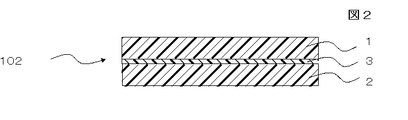
- FIG. 2 shows a partial cross-sectional view of the TAC adhesive member 102 according to the second embodiment of the present invention cut from the thickness direction.
- This embodiment is different from the first embodiment in that the cycloolefin polymer substrate 2 is adhered to the adhesive layer 3 of the cycloolefin polymer adhesion TAC substrate 100.
- the cycloolefin-based polymer substrate 2 is not particularly limited as long as it is formed of a resin having a monomer unit composed of a cyclic olefin (cycloolefin).
- a monomer comprising a cyclic olefin include norbornene and polycyclic norbornene monomers.
- the cycloolefin polymer substrate 2 used in the present invention may be a homopolymer of a monomer composed of the above cyclic olefin, or may be a copolymer.
- the cycloolefin polymer substrate 2 used in the present invention preferably has a saturated water absorption at 23 ° C. of 1% by mass or less, and in particular within a range of 0.1% by mass or more and 0.7% by mass or less. Are preferred. This is because the use of such a cycloolefin-based polymer substrate 2 makes the retardation film of the present invention less susceptible to changes in optical properties and dimensions due to water absorption.
- the saturated water absorption is obtained by immersing the water absorption in water at 23 ° C. for 1 week in accordance with ASTM D570 and measuring the increased weight.
- transparent substrate made of the cycloolefin polymer base material 2 used in the present invention include, for example, Ticona Topas, JSR Arton, Nippon Zeon Corporation ZEONOR, Nippon Zeon Corporation ZEONEX, Mitsui Chemicals, Inc. Examples include manufactured appels.
- the TAC substrate 1 and the cycloolefin polymer substrate 2 are in the form of a film, but the present invention is not limited to this.
- both the TAC substrate 1 and the cycloolefin polymer substrate 2 may have a thick plate shape.
- the TAC substrate 1 and the cycloolefin polymer substrate 2 are preferably formed of a sheet having a thickness of 10 ⁇ m or more and 10 mm or less.
- the “sheet” includes the plate shape and the film shape described above.
- the thickness of the TAC substrate 1 is about 50 to 100 ⁇ m, and the thickness of the cycloolefin polymer substrate 2 is 50 ⁇ m or more. About 150 ⁇ m or less.
- the adhesive layer 3 is one of paraffin or naphthene and at least an adhesion aid, a polymer constituting the TAC substrate 1 and the cycloolefin polymer, a macromonomer, or a thermoplastic elastomer. It is formed including one kind.
- the thickness of the adhesive layer 3 is about 1 ⁇ m or more and 100 ⁇ m or less.
- TAC adhesive members 102a, 102b, and 102c are provided on at least one surface of the liquid crystal cell 16.
- the liquid crystal cell 16 performs display by partially blocking or transmitting light emitted by a light source such as the backlight 10.
- the liquid crystal display device 20 includes a pair of polarizing plates 14 a and 14 b and a pair of retardation plates 15 a and 15 b in which light from the backlight 10 is attached to both surfaces of the liquid crystal cell 16, and the optical rotation of liquid crystal molecules in the liquid crystal cell 16. A part is obstructed by the relationship, and a desired display is performed.
- the polarization characteristics of the polarizing plates 14a and 14b and the phase difference plates 15a and 15b are accurately set to desired values.
- the backlight 10 of the present embodiment causes linear light to be incident on the side surface of the light guide plate 12 made of the transparent cycloolefin polymer substrate 2, and converts the light into planar light through the light guide plate.
- the polarizing plate 14a made of TAC and the retardation plate 15a made of cycloolefin polymer adhered to the light guide plate 12 transmit only light (polarized light) having an amplitude component in a specific direction of the light, and transmit linearly polarized light.
- the light enters the liquid crystal cell 16.
- the backlight 10 is an edge that illuminates a liquid crystal display element by causing point light or linear light to enter a side surface of a light guide plate 12 made of a transparent material, converting the light into planar light through the light guide plate 12.
- a light-type backlight was used.
- a cycloolefin polymer that is highly transparent and does not disturb polarization is used as the material of the light guide plate 12.
- TAC was used as a material for the polarizing plates 14a and 14b.
- the cycloolefin type polymer was used as a raw material of the phase difference plates 15a and 15b.
- Adhesive layer (not shown) of light guide plate 12 and polarizing plate 14a constituting TAC adhesive member 102a, adhesive layer (not shown) of polarizing plate 14a and retardation plate 15a constituting TAC adhesive member 102b, and TAC adhesion Paraffin and cycloolefin macromonomer were used as an adhesive layer (not shown) between the retardation plate 15b and the polarizing plate 14b constituting the member 102c.
- the separation film 50 is peeled off immediately before the bonding step from the cycloolefin polymer bonding TAC substrate 100 with the separation film 50 to protect the surface of the adhesive layer and to adhere to a member that is not desired to be bonded. Such erroneous adhesion can be avoided.
- the conventional structure of the light guide plate and the polarizing plate is simply that they are stacked or taped around the light guide plate and the polarizing plate, and the backlight does not enter the polarizing plate.
- the use efficiency of was impaired.
- the cycloolefin polymer substrate 2 that is the light guide plate 12 and the retardation plate 15a and the TAC substrate 1 that is the polarizing plate 14a are the paraffin and cycloolefin macromonomer that are the adhesive layer 3 (not shown). Is firmly bonded. Moreover, since there was no remaining bubble, the utilization efficiency of the backlight light could be increased. Furthermore, since the cycloolefin polymer substrate 2 has no polarization, it does not disturb the polarization of the backlight light and the light transmitted through the polarizing plate 14a even when used for the light guide plate 12 and the phase difference plates 15a and 15b. Furthermore, since there is no need for heating in the manufacturing process, the polarizing characteristics of the polarizing plates 14a and 14b, which are the TAC substrate 1, are not impaired, and the liquid crystal display device 20 with excellent polarizing characteristics and improved visibility can be realized.
- phase difference plates 15a and 15b are pasted on both surfaces of the liquid crystal cell 16.
- either one may be used, and the linearly polarized light incident on the liquid crystal cell 16 must become elliptically polarized light when emitted from the liquid crystal cell 16.
- the phase difference plates 15a and 15b may be omitted.
- Example 1 (Adhesive layer)
- an adhesive sheet composed of a polymer (styrene-based thermoplastic elastomer), paraffin and toluene was used. The mixing ratio of polymer, paraffin and toluene was adjusted to 10% by weight, 20% by weight and 70% by weight.
- the prepared sample was well stirred and applied to the TAC film (Fujitack 80 ⁇ m) on the TAC film (Fujitack 80 ⁇ m) with the aim of a film thickness of 30 ⁇ m after drying.
- An adhesive layer was formed by drying at room temperature for 1 minute, and placed in a hot air dryer set at 80 ° C. for 100 seconds to remove the toluene solvent. Thereafter, the TAC film was taken out from the dryer, and a separator (silicon pet 100 ⁇ m) was laminated to prepare a sample.
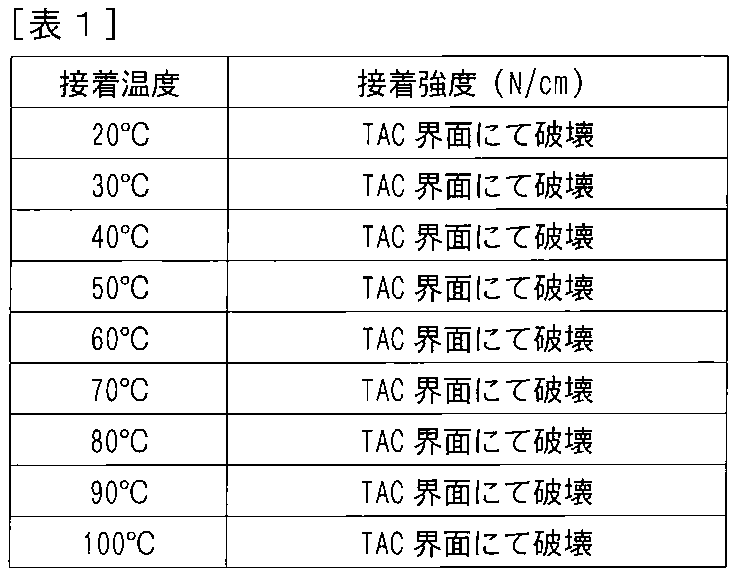
- a strip-shaped test piece having a width of 10 mm and a length of 250 mm is cut from the TAC adhesive sheet to be evaluated, prepared by the above method, and attached to a ZEONOR film made by ZEON Corporation. Sexuality was evaluated. As a result, it was possible to achieve good pasting without air bubbles in all samples.
- the bonding conditions in the examples were a temperature of 20 ° C. to 100 ° C., a pressure of 0.1 Mpa, and a bonding time of 60 sec.
- the thickness of the adhesive layer (adhesive sheet) was 30 ⁇ m.
- a peeling port is provided between the base material layer and the adhesive layer of the adhesive sheet portion, and the edge of the separated adhesive layer is gripped by a gripping device of a small desktop testing machine LSC series manufactured by Tokyo Tester, and the peeling angle is 90 degrees.
- the peel strength at the interface between the base sheet layer and the adhesive layer was measured at a peel rate of 30 mm per minute, and the measured adhesion strength of each test piece was evaluated.
- an adhesive sheet composed of a polymer (styrene-based thermoplastic elastomer), paraffin and toluene was used.
- the mixing ratio of the polymer, paraffin and toluene was 10% by weight, 20% by weight and 70% by weight.
- the bonding conditions in the examples were a temperature of 20 ° C. to 100 ° C., a pressure of 0.1 Mpa, and a bonding time of 60 seconds.
- the thickness of the adhesive layer (adhesive sheet) was 30 ⁇ m.
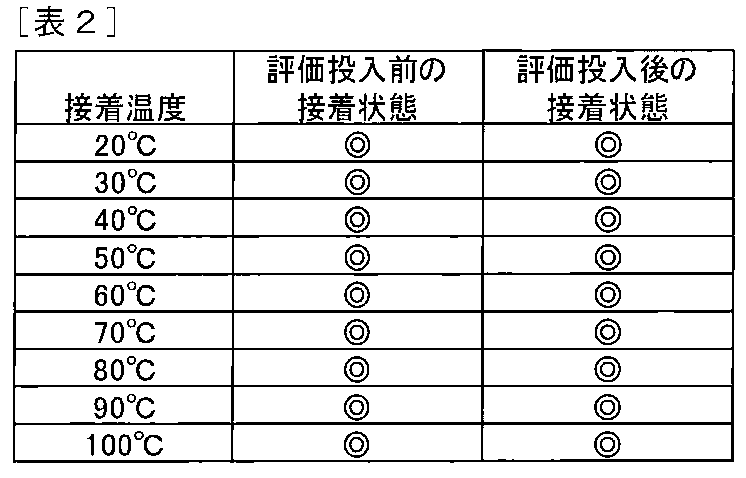
- the conditions of the thermostatic layer were as follows: time: 72 hours, temperature: 60 ° C.
- thermo durability of the thermostatic bath was excellent.
- a sample in which a TAC base material and a cycloolefin polymer were bonded with an acrylic adhesive sheet was prepared.
- the adhesive strength is the same as that of the present invention, bubbles were generated at the adhesive interface from the beginning of the adhesion, and it was not worthy of evaluation, so other reliability tests were not performed.
- a strip-shaped test piece having a width of 10 mm and a length of 250 mm was cut from the TAC adhesive sheet to be evaluated, prepared by the above method, and attached to a ZEONOR film manufactured by Nippon Zeon Co., Ltd. for bonding under each condition.
- the bonding conditions in the examples were a temperature of 20 ° C. to 100 ° C., a pressure of 0.1 Mpa, and a bonding time of 60 sec.
- the thickness of the adhesive layer (adhesive sheet) was 30 ⁇ m.
- the conditions of the thermal shock test were evaluated by performing a cycle of a temperature from ⁇ 20 ° C. to 60 ° C. for 10 minutes for 100 cycles. The results are shown in [Table 4] below.
- an experiment was performed by preparing a sample by applying the same method as described above using an adhesive obtained by adding a macromonomer to paraffin.
- the sample preparation method used in the experiment is as described above.
- the thickness of the adhesive layer of each sample was 1 to 100 ⁇ m.
- VPE-0401 manufactured by Wako Pure Chemical VPE-0201 manufactured by Wako Pure Chemical
- VPE-0601 manufactured by Wako Pure Chemical were used.
- the mixing ratio of the macromonomer was regulated to 3 to 30% by weight. Further, the preferable range of the molecular weight of the macromonomer is defined within the range of 20,000 to 40,000.
- the mixing ratio of the macromonomer was 0.1% by weight, it took a long time to create the adhesive layer, but it could be created and desired adhesive properties could be realized.
- the mixing ratio of the macromonomer is 95% by weight, the kinematic viscosity of the adhesive layer is increased, so that it is difficult to form the adhesive layer with a uniform film thickness on the TAC base material, but desired adhesive properties can be realized. It was.
- the bonding temperature is preferably 60 ° C. or higher.
- the adhesive layer was formed by drying at room temperature for 1 minute, and it put into the hot air dryer set to 80 degreeC for 100 second, and removed toluene of a solvent. Thereafter, a cycloolefin polymer film having an adhesive layer (hereinafter referred to as a cycloolefin polymer adhesive sheet) was taken out from the dryer, and a separator (silicon pet 100 ⁇ m) was laminated to prepare a sample.
- a cycloolefin polymer adhesive sheet a cycloolefin polymer adhesive sheet
- a separator silicon pet 100 ⁇ m
- a strip-shaped test piece having a width of 10 mm and a length of 250 mm is cut from the cycloolefin polymer adhesive sheet to be evaluated, prepared by the above-described method, adhered to a TAC film, and bonded under each condition to evaluate the air release property. Went. As a result, it was possible to achieve good pasting without air bubbles in all samples.
- a strip-shaped test piece having a width of 10 mm and a length of 250 mm was cut from the cycloolefin polymer adhesive sheet to be evaluated, which was prepared by the above-described method, and was bonded to a TAC film and bonded under each condition.
- the bonding conditions in the examples were a temperature of 20 ° C. to 100 ° C., a pressure of 0.1 Mpa, and a bonding time of 60 to 600 seconds.
- the thickness of the adhesive layer (adhesive sheet) was 25 ⁇ m and 35 ⁇ m.
- a peeling port is provided between the base material layer and the adhesive layer of the adhesive sheet portion, and the edge of the separated adhesive layer is gripped by a gripping device of a small desktop testing machine LSC series manufactured by Tokyo Tester, and the peeling angle is 90 degrees.
- the peel strength at the interface between the base sheet layer and the adhesive layer was measured at a peel rate of 30 mm per minute, and the measured adhesion strength of each test piece was evaluated. As a result, the bonding strength was 0.01 N / cm or less and could not be bonded.
Landscapes
- Chemical & Material Sciences (AREA)
- Organic Chemistry (AREA)
- Adhesives Or Adhesive Processes (AREA)
- Polarising Elements (AREA)
- Adhesive Tapes (AREA)
- Liquid Crystal (AREA)
Abstract
Description

下である。
(接着層)
実施例には、ポリマー(スチレン系熱可塑性エラストマー)とパラフィンとトルエンにて構成される接着シートを使用した。ポリマー、パラフィン、トルエンの混合比は10重量%、20重量%、70重量%にて調整をした。この調整したサンプルをよく攪拌してラボ用オートコーターにて、TACフィルム(フジタック80μm)上に上記の調整した塗布溶液を乾燥後膜厚30μm狙いで塗布を行った。室温にて1分間乾燥して接着層を形成し、80℃に設定した熱風乾燥機に100秒間入れ、溶剤のトルエンを除去した。その後乾燥機からTACフィルムを取り出し、セパレータ(シリコンペット100μm)をラミネートして、サンプルを作成した。
上記方法にて作成した、評価対象のTAC接着性シートから幅10mm、長さ250mmの短冊形試験片を裁断し、日本ゼオン社製のゼオノアフィルムに貼り付け各条件にて接着を行い、エアー抜け性の評価を行った。その結果、すべてのサンプルにおいて気泡の混入もなく良好な貼り付けが実現できた。
上記方法にて作成した、評価対象のTAC接着性シートから幅10mm、長さ250mmの短冊形試験片を裁断し、日本ゼオン社製のゼオノアフィルムに貼り付け各条件にて接着を行った。
上記方法にて作成した、評価対象のTAC接着性シートから幅10mm、長さ250mmの短冊形試験片を裁断し、日本ゼオン社製のゼオノアフィルムに貼り付け各条件にて接着を行った。
その結果、恒温層への投入前と比較しても接着層からの発泡もなく、良好な接着状態であることに変わりはなかった。評価(恒温層)の投入前後における貼り合わせ状態において、発泡がない場合を◎、発泡は多少見られる場合を×とした。以下[表2]に示す。
比較例としてアクリル系接着シートでTAC基材とシクロオレフィン系ポリマーとを接着したサンプルを作成した。接着強度は本発明と同等な強度が得られるが、接着当初より接着界面に気泡が発生したため、評価に値しないことから、他の信頼性試験は実施しなかった。
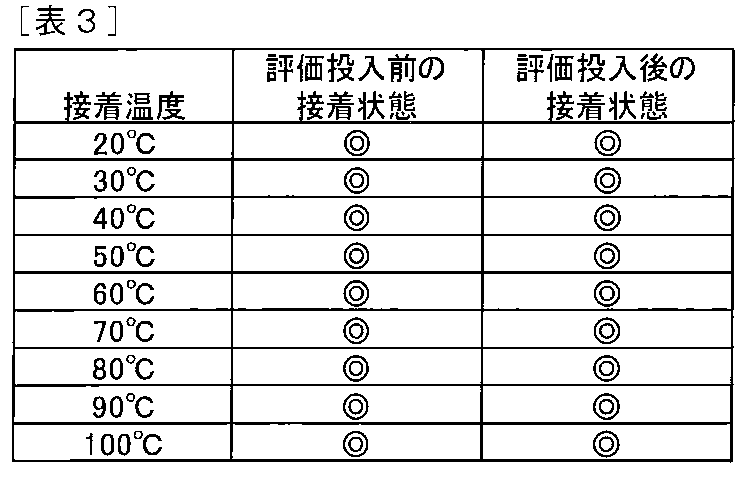
上記方法にて作成した、評価対象のTAC接着性シートから幅10mm、長さ250mmの短冊形試験片を裁断し、日本ゼオン社製のゼオノアフィルムに貼り付け各条件にて接着を行った。恒温湿層の条件は、時間:72時間、温度:60℃、湿度:90%とした。その結果、恒温湿層への投入前と比較しても接着層からの発泡もなく、良好な接着状態であることに変わりはなかった。評価(恒温層)の投入前後における貼り合わせ状態において、発泡がない場合を◎、発泡は多少見られる場合を×とした。以下[表3]に示す。
上記方法にて作成した、評価対象のTAC接着性シートから幅10mm、長さ250mmの短冊形試験片を裁断し、日本ゼオン社製のゼオノアフィルムに貼り付け各条件にて接着を行った。実施例での接着条件は、温度20℃~100℃、圧力0.1Mpa、接合時間60secとした。接着層(接着シート)の厚さは30μmであった。
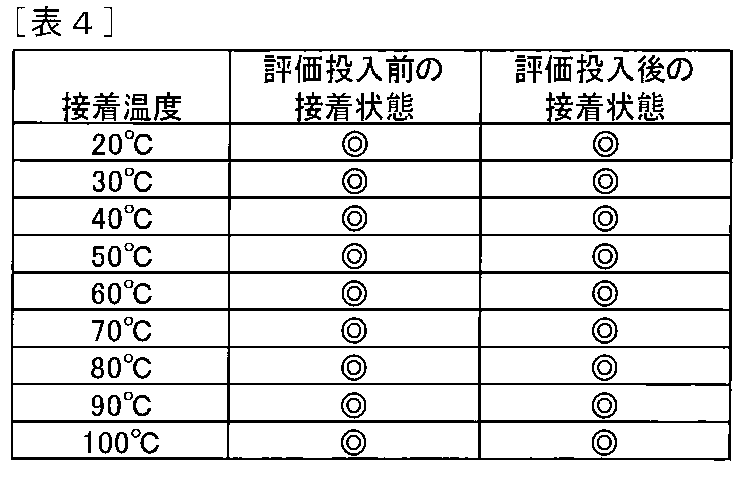
シクロオレフィン系ポリマー側に接着層を塗布した比較実験例には、上記と同じように、ポリマー(スチレン系熱可塑性エラストマー)とパラフィンとトルエンにて構成される接着シートを使用した。ポリマー、パラフィン、トルエンの混合比は10重量%、20重量%、70重量%にて調整をした。この調整したサンプルをよく攪拌してラボ用オートコーターにて、シクロオレフィン系ポリマーフィルム(ゼオノアフィルム100μm)上に上記の調整した塗布溶液を乾燥後膜厚25μm、35μm狙いで塗布を行った。室温にて1分間乾燥して接着剤層を形成し、80℃に設定した熱風乾燥機に100秒間入れ、溶剤のトルエンを除去した。その後乾燥機から、接着層の存在するシクロオレフィン系ポリマーフィルム(以下シクロオレフィン系ポリマー接着シートと称す)を取り出し、セパレータ(シリコンペット100μm)をラミネートして、サンプルを作成した。
上記方法にて作成した、評価対象のシクロオレフィン系ポリマー接着シートから幅10mm、長さ250mmの短冊形試験片を裁断し、TACフィルムに貼り付け各条件にて接着を行い、エアー抜け性の評価を行った。その結果、すべてのサンプルにおいて気泡の混入もなく良好な貼り付けが実現できた。
上記方法にて作成した、評価対象のシクロオレフィン系ポリマー接着シートから幅10mm、長さ250mmの短冊形試験片を裁断し、TACフィルムに貼り付け各条件にて接着を行った。 実施例での接合条件は、温度20℃~100℃、圧力0.1Mpa、接合時間60~600secとした。接着層(接着シート)の厚さは25μm、35μmであった。その接着シート部の基材層と接着剤層との間に剥離口を設け、分離された接着剤層の端部を東京試験機製小型卓上試験機LSCシリーズの掴み装置で掴み、剥離角度90度法により、剥離速度毎分30mm条件で基材シート層と接着剤層との界面の剥離強度を測定し、各試験片の測定値の密着強度と評価した。その結果、接合強度は0.01N/cm以下であり、接着することはできなかった。
2 シクロオレフィン系ポリマー基材
3 接着層
10 バックライト
20 液晶表示装置
50 セパレートフィルム
100 シクロオレフィン系ポリマー接着用TAC基材
102 TAC接着部材
102a TAC接着部材
102b TAC接着部材
102c TAC接着部材
Claims (14)
- トリアセチルセルロース基材の表面に接着層を有しており、
前記接着層は、
(A)パラフィンあるいはナフテンと、
(B)少なくとも、接着補助剤、トリアセチルセルロースポリマー、シクロオレフィンポリマー、シクロオレフィンコポリマー、マクロモノマー、または熱可塑性エラストマーのいずれか1種とを含んでいることを特徴とする、シクロオレフィン系ポリマー接着用トリアセチルセルロース基材。 - 前記パラフィンまたは前記ナフテンの数平均分子量は、100以上、1000以下の範囲内であることを特徴とする請求項1記載のシクロオレフィン系ポリマー接着用トリアセチルセルロース基材。
- 前記マクロモノマーが、シクロオレフィン系のモノマーにより形成されている請求項1又は2に記載のシクロオレフィン系ポリマー接着用トリアセチルセルロース基材。
- 前記シクロオレフィンマクロモノマーの数平均分子量が1000以上であることを特徴とする請求項3記載のシクロオレフィン系ポリマー接着用トリアセチルセルロース基材。
- 前記接着層内に占める前記マクロモノマーの混合比(割合)が0.1重量%以上、95重量%以下であることを特徴とする請求項1ないし請求項4のいずれかに記載のシクロオレフィン系ポリマー接着用トリアセチルセルロース基材。
- 前記マクロモノマーは、ソフトセグメントである高分子鎖がアゾ基を介して結合してなる構造を有することを特徴とする請求項1ないし5のいずれかに記載のシクロオレフィン系ポリマー接着用トリアセチルセルロース基材。
- 前記マクロモノマーが、以下の構造式(化1に示す)により形成されている請求項6記載のシクロオレフィン系ポリマー接着用トリアセチルセルロース基材。

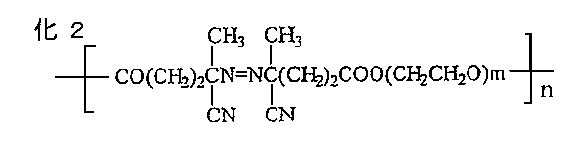
- 前記マクロモノマーが、以下の構造式(化2に示す)により形成されている請求項6記載のシクロオレフィン系ポリマー接着用トリアセチルセルロース基材。
- 前記熱可塑性エラストマーが、スチレンモノマーユニットとゴムモノマーユニットからなるブロック共重合体であることを特徴とする、請求項1ないし8のいずれかに記載のシクロオレフィン系ポリマー接着用トリアセチルセルロース基材。
- 前記接着層は、ジエチルエーテル、テトラヒドロフラン、トルエン、キシレン、クロロベンゼン、およびジクロロベンゼンの内、少なくとも1つを含むことを特徴とする、請求項1ないし9のいずれかに記載のシクロオレフィン系ポリマー接着用トリアセチルセルロース基材。
- 前記接着層の表面にセパレートフィルムを設けたことを特徴とする、請求項1ないし10のいずれかに記載のシクロオレフィン系ポリマー接着用トリアセチルセルロース基材。
- 請求項1ないし10のいずれか記載のシクロオレフィン系ポリマー接着用トリアセチルセルロース基材の接着層形成面に前記接着層を介してシクロオレフィン系ポリマー基材が接着されていることを特徴とするトリアセチルセルロース接着部材。
- 前記トリアセチルセルロース基材または前記シクロオレフィン系ポリマー基材は、10μm以上、10mm以下の厚みのシートで形成される請求項12記載のトリアセチルセルロース接着部材。
- 請求項12または13記載のトリアセチルセルロース接着部材を、液晶セルの少なくとも片面に設けることを特徴とする液晶表示装置。
Priority Applications (2)
| Application Number | Priority Date | Filing Date | Title |
|---|---|---|---|
| CN201180005514.0A CN102712832B (zh) | 2010-01-08 | 2011-01-06 | 环烯烃系聚合物粘接用tac基材、tac粘接部件以及液晶显示装置 |
| JP2011549013A JP5628835B2 (ja) | 2010-01-08 | 2011-01-06 | シクロオレフィン系ポリマー接着用tac基材、tac接着部材、および液晶表示装置 |
Applications Claiming Priority (2)
| Application Number | Priority Date | Filing Date | Title |
|---|---|---|---|
| JP2010-003238 | 2010-01-08 | ||
| JP2010003238 | 2010-01-08 |
Publications (1)
| Publication Number | Publication Date |
|---|---|
| WO2011083809A1 true WO2011083809A1 (ja) | 2011-07-14 |
Family
ID=44305546
Family Applications (1)
| Application Number | Title | Priority Date | Filing Date |
|---|---|---|---|
| PCT/JP2011/050073 Ceased WO2011083809A1 (ja) | 2010-01-08 | 2011-01-06 | シクロオレフィン系ポリマー接着用tac基材、tac接着部材、および液晶表示装置 |
Country Status (3)
| Country | Link |
|---|---|
| JP (1) | JP5628835B2 (ja) |
| CN (1) | CN102712832B (ja) |
| WO (1) | WO2011083809A1 (ja) |
Cited By (3)
| Publication number | Priority date | Publication date | Assignee | Title |
|---|---|---|---|---|
| JP2016187869A (ja) * | 2015-03-28 | 2016-11-04 | 日本製紙株式会社 | ハードコートフィルム |
| WO2017098718A1 (ja) * | 2015-12-07 | 2017-06-15 | 富士フイルム株式会社 | バックライトユニット |
| WO2018207845A1 (ja) * | 2017-05-12 | 2018-11-15 | 株式会社ダイセル | シート、シートの製造方法及び貼り付け方法 |
Families Citing this family (6)
| Publication number | Priority date | Publication date | Assignee | Title |
|---|---|---|---|---|
| JP6279853B2 (ja) * | 2013-07-23 | 2018-02-14 | サムスン エスディアイ カンパニー,リミテッドSamsung Sdi Co.,Ltd. | 偏光板用接着剤組成物 |
| CN104277720B (zh) * | 2013-07-08 | 2017-07-21 | 三星Sdi株式会社 | 粘合剂组合物、粘合剂膜、偏振板及显示装置 |
| JP7450356B2 (ja) * | 2018-09-28 | 2024-03-15 | 帝人株式会社 | 熱変性ポリマー層-無機基材複合体、ポリマー部材-無機基材複合体、及びそれらの製造方法 |
| CN110967781B (zh) * | 2018-09-28 | 2023-05-23 | 浜松光子学株式会社 | 太赫兹波用光学元件及其制造方法 |
| JP7532020B2 (ja) | 2018-09-28 | 2024-08-13 | 浜松ホトニクス株式会社 | テラヘルツ波用光学素子及びその製造方法 |
| CN116814190A (zh) * | 2023-06-28 | 2023-09-29 | 杭州光粒科技有限公司 | 一种用于对tac薄膜表面进行接枝改性的接枝层胶液以及改性方法 |
Citations (6)
| Publication number | Priority date | Publication date | Assignee | Title |
|---|---|---|---|---|
| JPH0545517A (ja) * | 1990-12-25 | 1993-02-23 | Nippon Synthetic Chem Ind Co Ltd:The | 粘着剤層を有する偏光板 |
| JPH11249259A (ja) * | 1998-02-26 | 1999-09-17 | Fuji Photo Film Co Ltd | 写真感光材料包装用粘着性シートおよび粘着剤 |
| JP2000290615A (ja) * | 1999-02-02 | 2000-10-17 | Tokai Rubber Ind Ltd | 熱可塑性放熱性粘着剤組成物およびそれを用いたプラズマディスプレイパネル |
| WO2001088052A1 (fr) * | 2000-05-15 | 2001-11-22 | Toagosei Co., Ltd. | Agent collant et composition adhesive |
| JP2003292915A (ja) * | 2002-04-04 | 2003-10-15 | Nitto Denko Corp | 接着シート |
| JP2006028437A (ja) * | 2004-07-21 | 2006-02-02 | Panac Co Ltd | 機能フイルムの接合方法、光学フィルター及びプラズマディスプレイパネル |
Family Cites Families (2)
| Publication number | Priority date | Publication date | Assignee | Title |
|---|---|---|---|---|
| JP5105065B2 (ja) * | 2008-01-22 | 2012-12-19 | 東亞合成株式会社 | 位相差フィルム付き偏光板の製造方法 |
| JP2009235205A (ja) * | 2008-03-26 | 2009-10-15 | Tomoegawa Paper Co Ltd | 粘着剤組成物及びそれを用いた粘着シート |
-
2011
- 2011-01-06 CN CN201180005514.0A patent/CN102712832B/zh not_active Expired - Fee Related
- 2011-01-06 JP JP2011549013A patent/JP5628835B2/ja active Active
- 2011-01-06 WO PCT/JP2011/050073 patent/WO2011083809A1/ja not_active Ceased
Patent Citations (6)
| Publication number | Priority date | Publication date | Assignee | Title |
|---|---|---|---|---|
| JPH0545517A (ja) * | 1990-12-25 | 1993-02-23 | Nippon Synthetic Chem Ind Co Ltd:The | 粘着剤層を有する偏光板 |
| JPH11249259A (ja) * | 1998-02-26 | 1999-09-17 | Fuji Photo Film Co Ltd | 写真感光材料包装用粘着性シートおよび粘着剤 |
| JP2000290615A (ja) * | 1999-02-02 | 2000-10-17 | Tokai Rubber Ind Ltd | 熱可塑性放熱性粘着剤組成物およびそれを用いたプラズマディスプレイパネル |
| WO2001088052A1 (fr) * | 2000-05-15 | 2001-11-22 | Toagosei Co., Ltd. | Agent collant et composition adhesive |
| JP2003292915A (ja) * | 2002-04-04 | 2003-10-15 | Nitto Denko Corp | 接着シート |
| JP2006028437A (ja) * | 2004-07-21 | 2006-02-02 | Panac Co Ltd | 機能フイルムの接合方法、光学フィルター及びプラズマディスプレイパネル |
Cited By (5)
| Publication number | Priority date | Publication date | Assignee | Title |
|---|---|---|---|---|
| JP2016187869A (ja) * | 2015-03-28 | 2016-11-04 | 日本製紙株式会社 | ハードコートフィルム |
| WO2017098718A1 (ja) * | 2015-12-07 | 2017-06-15 | 富士フイルム株式会社 | バックライトユニット |
| WO2018207845A1 (ja) * | 2017-05-12 | 2018-11-15 | 株式会社ダイセル | シート、シートの製造方法及び貼り付け方法 |
| JPWO2018207845A1 (ja) * | 2017-05-12 | 2019-12-26 | 株式会社ダイセル | シート、シートの製造方法及び貼り付け方法 |
| CN110621499A (zh) * | 2017-05-12 | 2019-12-27 | 株式会社大赛璐 | 片材、片材的制造方法以及贴附方法 |
Also Published As
| Publication number | Publication date |
|---|---|
| CN102712832B (zh) | 2014-07-16 |
| CN102712832A (zh) | 2012-10-03 |
| JP5628835B2 (ja) | 2014-11-19 |
| JPWO2011083809A1 (ja) | 2013-05-13 |
Similar Documents
| Publication | Publication Date | Title |
|---|---|---|
| CN111902275B (zh) | 粘合片、带有粘合层的光学膜、层叠体和图像显示装置 | |
| WO2011083809A1 (ja) | シクロオレフィン系ポリマー接着用tac基材、tac接着部材、および液晶表示装置 | |
| CN103930942B (zh) | 具有粘接剂层的图像显示装置用单元及使用了该单元的图像显示装置 | |
| JP4151828B2 (ja) | 両面粘着シートおよびタッチパネル付き表示装置 | |
| CN103858158B (zh) | 具有粘接剂层的图像显示装置用单元及使用该单元的图像显示装置 | |
| CN102053420B (zh) | 液晶显示装置 | |
| TW201231607A (en) | Optical pressure-sensitive adhesive sheet, liquid crystal display and input device comprising the same | |
| CN105885717A (zh) | 带有粘合剂的光学薄膜及图像显示装置 | |
| CN104254583A (zh) | 图像显示装置用粘接片、图像显示装置的制造方法及图像显示装置 | |
| CN103764777A (zh) | 粘合剂 | |
| KR102631155B1 (ko) | 점착제 조성물 | |
| KR20160002889A (ko) | 광학 적층체 및 그것을 이용한 표시 장치 | |
| KR102326138B1 (ko) | 적층체, 점착제 조성물 및 점착 시트 | |
| CN113474700B (zh) | 层叠体 | |
| JP2018039863A (ja) | ゴム系粘着剤組成物、ゴム系粘着剤層、粘着フィルム、ゴム系粘着剤層付光学フィルム、光学部材、及び画像表示装置 | |
| TWI677546B (zh) | 黏接劑、黏接片與顯示體 | |
| TW202035618A (zh) | 著色黏著片及顯示設備 | |
| CN114641711A (zh) | 图像显示装置及光学构件组 | |
| JP2020140010A (ja) | 積層体及び表示装置 | |
| KR20210130165A (ko) | 플렉서블 적층체 | |
| WO2022004138A1 (ja) | 粘着剤層付き偏光板 | |
| CN106010319B (zh) | 粘性薄板 | |
| KR20210132075A (ko) | 플렉서블 적층체 | |
| KR20210130166A (ko) | 적층체 | |
| JP2017119847A (ja) | ゴム系粘着剤組成物、ゴム系粘着剤層、ゴム系粘着剤層付光学フィルム、光学部材、画像表示装置、及びゴム系粘着剤層の製造方法 |
Legal Events
| Date | Code | Title | Description |
|---|---|---|---|
| WWE | Wipo information: entry into national phase |
Ref document number: 201180005514.0 Country of ref document: CN |
|
| 121 | Ep: the epo has been informed by wipo that ep was designated in this application |
Ref document number: 11731807 Country of ref document: EP Kind code of ref document: A1 |
|
| WWE | Wipo information: entry into national phase |
Ref document number: 2011549013 Country of ref document: JP |
|
| NENP | Non-entry into the national phase |
Ref country code: DE |
|
| 122 | Ep: pct application non-entry in european phase |
Ref document number: 11731807 Country of ref document: EP Kind code of ref document: A1 |