WO2011006568A1 - Materialien für elektronische vorrichtungen - Google Patents
Materialien für elektronische vorrichtungen Download PDFInfo
- Publication number
- WO2011006568A1 WO2011006568A1 PCT/EP2010/003660 EP2010003660W WO2011006568A1 WO 2011006568 A1 WO2011006568 A1 WO 2011006568A1 EP 2010003660 W EP2010003660 W EP 2010003660W WO 2011006568 A1 WO2011006568 A1 WO 2011006568A1
- Authority
- WO
- WIPO (PCT)
- Prior art keywords
- formula
- indices
- substituted
- organic
- group
- Prior art date
- Legal status (The legal status is an assumption and is not a legal conclusion. Google has not performed a legal analysis and makes no representation as to the accuracy of the status listed.)
- Ceased
Links
Classifications
-
- C—CHEMISTRY; METALLURGY
- C07—ORGANIC CHEMISTRY
- C07C—ACYCLIC OR CARBOCYCLIC COMPOUNDS
- C07C13/00—Cyclic hydrocarbons containing rings other than, or in addition to, six-membered aromatic rings
- C07C13/28—Polycyclic hydrocarbons or acyclic hydrocarbon derivatives thereof
- C07C13/32—Polycyclic hydrocarbons or acyclic hydrocarbon derivatives thereof with condensed rings
- C07C13/62—Polycyclic hydrocarbons or acyclic hydrocarbon derivatives thereof with condensed rings with more than three condensed rings
-
- H—ELECTRICITY
- H10—SEMICONDUCTOR DEVICES; ELECTRIC SOLID-STATE DEVICES NOT OTHERWISE PROVIDED FOR
- H10K—ORGANIC ELECTRIC SOLID-STATE DEVICES
- H10K85/00—Organic materials used in the body or electrodes of devices covered by this subclass
- H10K85/60—Organic compounds having low molecular weight
- H10K85/615—Polycyclic condensed aromatic hydrocarbons, e.g. anthracene
- H10K85/622—Polycyclic condensed aromatic hydrocarbons, e.g. anthracene containing four rings, e.g. pyrene
-
- H—ELECTRICITY
- H10—SEMICONDUCTOR DEVICES; ELECTRIC SOLID-STATE DEVICES NOT OTHERWISE PROVIDED FOR
- H10K—ORGANIC ELECTRIC SOLID-STATE DEVICES
- H10K85/00—Organic materials used in the body or electrodes of devices covered by this subclass
- H10K85/60—Organic compounds having low molecular weight
- H10K85/615—Polycyclic condensed aromatic hydrocarbons, e.g. anthracene
- H10K85/623—Polycyclic condensed aromatic hydrocarbons, e.g. anthracene containing five rings, e.g. pentacene
-
- H—ELECTRICITY
- H10—SEMICONDUCTOR DEVICES; ELECTRIC SOLID-STATE DEVICES NOT OTHERWISE PROVIDED FOR
- H10K—ORGANIC ELECTRIC SOLID-STATE DEVICES
- H10K85/00—Organic materials used in the body or electrodes of devices covered by this subclass
- H10K85/60—Organic compounds having low molecular weight
- H10K85/615—Polycyclic condensed aromatic hydrocarbons, e.g. anthracene
- H10K85/626—Polycyclic condensed aromatic hydrocarbons, e.g. anthracene containing more than one polycyclic condensed aromatic rings, e.g. bis-anthracene
-
- C—CHEMISTRY; METALLURGY
- C07—ORGANIC CHEMISTRY
- C07C—ACYCLIC OR CARBOCYCLIC COMPOUNDS
- C07C2603/00—Systems containing at least three condensed rings
- C07C2603/02—Ortho- or ortho- and peri-condensed systems
- C07C2603/52—Ortho- or ortho- and peri-condensed systems containing five condensed rings
-
- H—ELECTRICITY
- H10—SEMICONDUCTOR DEVICES; ELECTRIC SOLID-STATE DEVICES NOT OTHERWISE PROVIDED FOR
- H10K—ORGANIC ELECTRIC SOLID-STATE DEVICES
- H10K85/00—Organic materials used in the body or electrodes of devices covered by this subclass
- H10K85/60—Organic compounds having low molecular weight
- H10K85/615—Polycyclic condensed aromatic hydrocarbons, e.g. anthracene
-
- Y—GENERAL TAGGING OF NEW TECHNOLOGICAL DEVELOPMENTS; GENERAL TAGGING OF CROSS-SECTIONAL TECHNOLOGIES SPANNING OVER SEVERAL SECTIONS OF THE IPC; TECHNICAL SUBJECTS COVERED BY FORMER USPC CROSS-REFERENCE ART COLLECTIONS [XRACs] AND DIGESTS
- Y02—TECHNOLOGIES OR APPLICATIONS FOR MITIGATION OR ADAPTATION AGAINST CLIMATE CHANGE
- Y02E—REDUCTION OF GREENHOUSE GAS [GHG] EMISSIONS, RELATED TO ENERGY GENERATION, TRANSMISSION OR DISTRIBUTION
- Y02E10/00—Energy generation through renewable energy sources
- Y02E10/50—Photovoltaic [PV] energy
- Y02E10/549—Organic PV cells
Definitions
- the present invention relates to compounds containing
- Arylalkynyl groups with multiple ring bridging The invention further relates to the use of the compounds according to the invention in electronic devices, preferably organic
- Electroluminescent devices as well as methods for producing the compounds of the invention.
- the invention further relates
- Organic semiconductors such as those disclosed below
- OLEDs organic electroluminescent devices
- the structure of these devices, in which organic semiconductors are used as functional materials, is, for example, in
- thermal stability of the connections used in the electronic devices There is also room for improvement regarding the thermal stability of the connections used in the electronic devices.
- a high thermal stability is both at the cleaning of the material by mass sublimation as well as the application of the material by thermal evaporation required.
- a high glass transition temperature is desirable for the use of the compounds in durable, temperature stable electronic devices.
- JP 2005174735 describes a large number of compounds which can be summarized under the general structural formula Ar-C ⁇ C-Ar as functional materials in organic electroluminescent devices. However, there is still a need for alternative materials, especially improved materials
- condensed aromatics in particular anthracene or pyrene derivatives
- matrix materials in particular for blue-emitting electroluminescent devices, eg. B. 9,10-bis (2-naphthyl) - anthracene (US 5935721).
- anthracene derivatives are in
- the object underlying the present invention is therefore to provide such improved compounds for
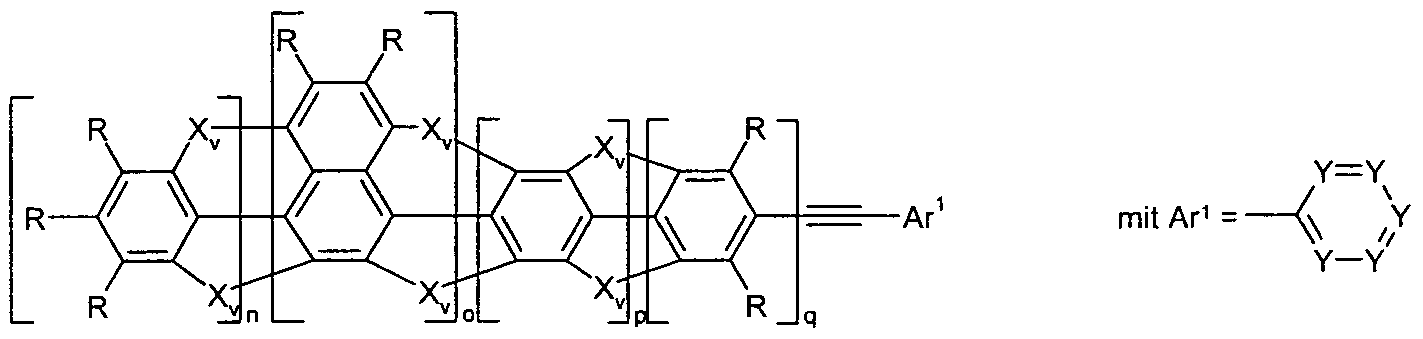
- the present invention thus relates to compounds of the formula (I) - A -
- Heteroaralkyl distru having 5 to 60 aromatic ring atoms, which may be substituted in each case with one or more radicals R 1 ; two or more substituents R on the phenylene groups and / or on the naphthylene groups and / or on the substituent Ar may be linked to one another and
- R 2 is the same or different H, D or an aliphatic, aromatic or heteroaromatic organic radical having 1 to 20 C atoms in each occurrence, in which one or more H-
- Atoms may be replaced by D or F; in this case, two or more adjacent or non-adjacent radicals R 2 may be linked together and optionally form a mono- or polycyclo aliphatic or aromatic ring system.
- the radicals R form by linking with each other to the phenylene or naphthylene units fused polycyclic aromatic systems, in particular no polycyclic condensed aromatic systems having more than two aromatic nuclei, such as anthracene or pyrene.
- An aryl group in the sense of this invention contains 6 to 60 C atoms; a heteroaryl group in the context of this invention contains 2 to 60 carbon atoms and at least one heteroatom, with the proviso that the sum of
- heteroatoms are preferably selected from N, O and / or S.
- aryl group or heteroaryl either a simple aromatic cycle, ie benzene, or a simple heteroaromatic cycle, for example pyridine, pyrimidine, thiophene, etc., or a fused aryl or heteroaryl group, for example naphthalene, anthracene, phenanthrene, quinoline, isoquinoline, benzothiophene, benzofuran and indole.
- the radical Ar is selected from benzene, biphenyl, terphenyl, naphthalene, pyridine, pyrimidine, pyrazine, pyridazine, triazine, quinoline, isoquinoline, thiophene, benzothiophene and indole, each with one or may be substituted by a plurality of R radicals.
- An aralkyl group in the context of this invention is an alkyl group substituted with an aryl group, the term aryl group being as defined above and alkyl group defined as a non-aromatic organic radical having 1-40 carbon atoms, in which also single H atoms or CH 2 groups may be substituted by the groups mentioned above in the definition of R and R 1 .
- a heteroaralkyl group in the context of this invention is an alkyl group substituted by a heteroaryl group, wherein the term
- Heteroaryl group as defined above and alkyl group is defined as a non-aromatic organic radical having 1-40 carbon atoms, in which also substituted single H atoms or CH 2 groups by the above in the definition of R and R 1 groups substituted could be.
- An aromatic ring system in the sense of this invention contains 6 to 60 carbon atoms in the ring system.
- a heteroaromatic ring system in the context of this invention contains 5 to 60 aromatic ring atoms, at least one of which represents a heteroatom.
- the heteroatoms are preferably selected from N, O and / or S.
- An aromatic or heteroaromatic ring system in the sense of this invention is to be understood as meaning a system which does not necessarily contain only aryl or heteroaryl groups but in which also several aryl or heteroaryl groups a non-aromatic moiety (preferably less than 10% of the atoms other than H), such as e.g. An sp 3 -hybridized C, Si, N or O atom, an sp 2 -hybridized C- or N-
- Atom or a sp-hybridized carbon atom can be connected.
- systems such as 9,9'-spirobifluorene, 9,9'-diarylfluorene, triarylamine, diaryl ethers, stilbene, etc. are to be understood as aromatic ring systems in the context of this invention, and also systems in which two or more aryl groups, for example by a linear one or cyclic alkyl, alkenyl or alkynyl group or by a
- Silyl group are connected. Furthermore, systems in which two or more aryl or heteroaryl groups are linked together via one or more single bonds are understood as aromatic or heteroaromatic ring systems in the context of this invention.
- the radicals are methyl, ethyl, n-propyl, i-propyl, n-butyl, i-butyl, s-butyl, t-butyl, 2-methylbutyl, n-pentyl, s-pentyl, cyclopentyl, n Hexyl, cyclohexyl, n-heptyl, cycloheptyl, n-octyl,
- a C 1 to C 40 alkoxy group is preferably understood as meaning methoxy, trifluoromethoxy, ethoxy, n-propoxy, isopropoxy, n-butoxy, isobutoxy, s-butoxy, t-butoxy or 2-methylbutoxy.
- aromatic or heteroaromatic ring system having 5-60 aromatic ring atoms, which may be substituted in each case with the abovementioned radicals R and which may be linked via any positions on the aromatic or heteroaromatic, are understood in particular groups which are derived from benzene, Naphthalene, anthracene, phenanthrene, pyrene, chrysene, perylene, fluoranthene,
- Phenanthridine benzo-5,6-quinoline, benzo-6,7-quinoline, benzo-7,8-quinoline, phenothiazine, phenoxazine, pyrazole, indazole, imidazole, benzimidazole, naphthimidazole, phenanthrimidazole, pyrimididazole, pyrazine imidazole, quinoxaline imidazole, oxazole, Benzoxazole, naphthoxazole, anthroxazole, Phenanthroxazole, isoxazole, 1, 2-thiazole, 1, 3-thiazole, benzothiazole,
- Oxadiazole 1, 2,4-oxadiazole, 1, 2,5-oxadiazole, 1, 3,4-oxadiazole, 1, 2,3-thiadiazole, 1, 2,4-thiadiazole, 1, 2,5-thiadiazole, 1, 3,4-thiadiazole, 1, 3,5-triazine, 1, 2,4-triazine, 1, 2,3-triazine, tetrazole, 1, 2,4,5-tetrazine, 1, 2,3, 4-tetrazine, 1, 2,3,5-tetrazine, purine, pteridine, indolizine and benzothiadiazole.
- the sum of the values of the indices v 2, 3 or 4 that is, there are two, three or four bridging groups X in the central structural unit of the molecule, particularly preferably the sum of the values of the indices v equal to two or three, most preferably equal to two.
- a + b + c + d + e is 2, 3 or 4, more preferably 2 or 3. It is further preferred that the individual indices b, c, and d are the same or different 0 or 1 amount.
- a preferred embodiment of the invention is when c is 1, that is, a naphthyl group is present in the central structural unit of the molecule.
- a further preferred embodiment of the invention is when the sum of the values of the indices x and y is equal to 1.
- R is H, D, CN or a straight-chain alkyl group having 1 to 20 C atoms or a
- heteroaromatic ring system having 5 to 40 aromatic ring atoms, wherein said groups may each be substituted by one or more identical or different radicals R 1 .
- R is H, D, CN or a straight-chain
- R is H, D, CN, or an alkyl group having 1 to 10 carbon atoms, which may optionally be substituted with one or more identical or different radicals R 1 .
- R is H, D, CN, or an alkyl group having 1 to 10 carbon atoms, which may optionally be substituted with one or more identical or different radicals R 1 .
- indices f, g, h, i, j, k, l and m being, independently of one another, 0 or 1 and j + k + I + m ⁇ 1, and the sum of the values of the indices w is at least equal to 1, that is to say that at least one unit X is present in the right half of the molecule.
- Y is CR or N.
- Y is preferably CR or N, where not more than two groups Y side by side represent N.
- the index o has the value 1 or 2, particularly preferably the value 1.
- Ar 1 represents a phenyl, biphenyl, terphenyl, pyrazinyl, pyridazyl, pyrimidyl or triazinyl group which may be substituted by one or more R groups.
- Ar 1 represents a phenyl, biphenyl, terphenyl, pyrazinyl, pyridazyl, pyrimidyl or triazinyl group which may be substituted by one or more R groups.
- the same embodiments are preferred as those which have also been mentioned as preferred above for compounds of the formula (I) or (II).
- Preferred embodiments of the compounds according to the invention are also those compounds which are included in the structural formulas (IV) to
- radical Ar is particularly preferred
- one or more polymerisable functional groups or one or more electron withdrawing or electron donating groups are present.
- the compounds according to the invention of the formulas (I) to (XII) can be prepared by synthesis steps known to the person skilled in the art.
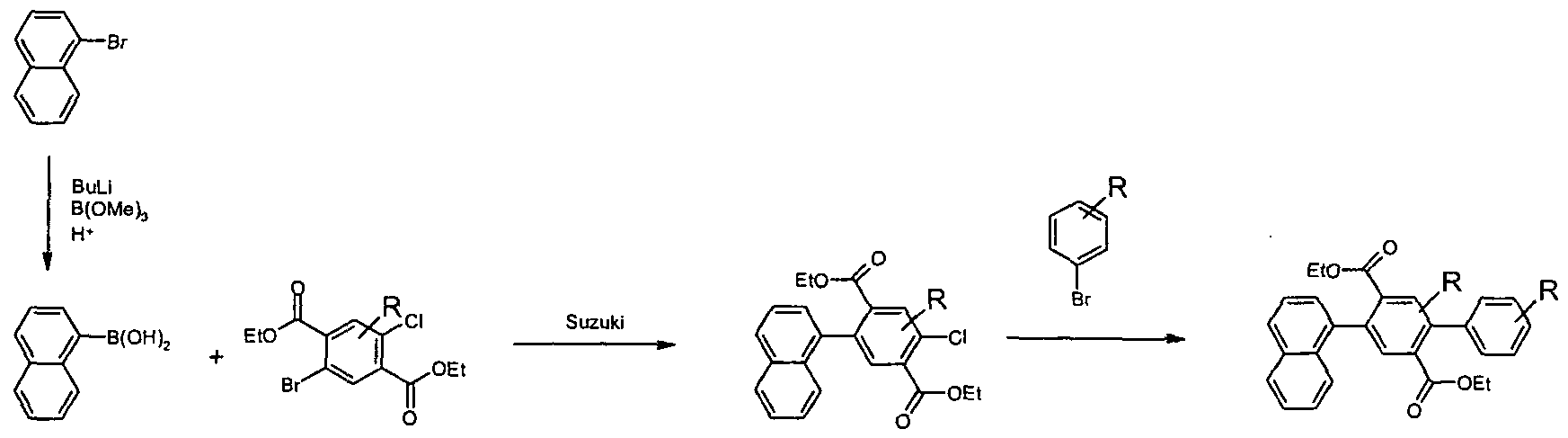
- the various skeletons can be prepared by a sequence of transition-metal-catalyzed cross-coupling and subsequent acid-catalyzed cyclization of corresponding tertiary alcohols.
- the synthetic routes shown in the following Schemes 1 and 2 shall serve.
- alkynyl derivatives according to the invention are preferably prepared by Sonogashira coupling of the aryl halides with the corresponding alkyne derivatives according to Scheme 3.
- the compounds Ar'-Br correspond to those shown in Scheme 1 and 2
- the invention accordingly also provides a process for preparing the compounds of the general formulas (I) to (XII) according to the invention, characterized by the steps a) functionalization of a cross-coupling catalyzed, for example, by transition metal catalysis and subsequent Friedel-Crafts reaction to introduce the bridges , consisting of several aromatic rings basic body by halogenation and b) coupling reaction, preferably Sonogashira reaction with a
- a polymerization or oligomerization reaction can also follow the stated steps.
- Oligomers, polymers or dendrimers are produced. Particularly preferred compounds for this purpose are those which are substituted by reactive leaving groups, such as bromine, iodine, boronic acid or boronic acid esters. These can also be used as comonomers for the production of corresponding conjugated, partially conjugated or non-conjugated polymers, oligomers or as the core of dendrimers.
- the polymerization is preferably carried out via the
- Halogen functionality or the boronic acid functionality are halogen functionality or the boronic acid functionality.
- an oligomer is a compound which has three to nine repeat units.
- a polymer is understood as meaning a compound which has ten or more repeat units.
- Another object of the invention are accordingly dimers
- the compounds are part of a main chain of an oligomer or polymer or a side chain of an oligomer or polymer or a dendrimer or provide a
- End group of a polymer, oligomer or dendrimer is end group of a polymer, oligomer or dendrimer.
- Oligomers, polymers or dendrimers may be conjugated, partially conjugated or non-conjugated.
- the oligomers or polymers may be linear, branched or dendritic.
- the units according to formulas (I) to (XII) can both be directly
- heteroaromatic group linked together.
- three or more units of the formula (I) to (XII) can have a trivalent or more highly valent group, for example, via a trivalent or higher valent aromatic or heteroaromatic group, be linked to a branched oligomer or polymer.
- the functionalized compounds of the general formulas (I) to (XII) are homopolymerized or copolymerized with further monomers.
- copolymers it is preferred that the
- Suitable and preferred comonomers are selected from fluorenes (eg according to EP 842208 or WO 00/22026), spirobifluorenes (eg according to EP 707020, EP 894107 or US Pat
- Carbazoles eg according to WO 04/070772 or WO 04/113468
- Thiophenes eg according to EP 1028136
- dihydrophenanthrenes eg according to WO 05/014689
- cis and trans indenofluorenes eg according to WO 04/041901 or WO 04/113412
- ketones e.g. B. according to
- WO 05/040302 phenanthrenes (for example according to WO 05/104264 or DE 102005037734) or also several of these units.
- These polymers usually contain other units, for example
- fluorescent or phosphorescent units such as. Vinyltriarylamines (for example according to DE 102005060473) or phosphorescent metal complexes (for example according to WO 06/003000), and / or
- Cargo transport units in particular those based on
- Triarylamines Since either one or two halogen functionalities, preferably bromine, can be selectively introduced into the compounds according to the invention, it is possible to carry out targeted dimers, trimers, tetramers, pentamers, etc.
- the coupling reaction is here preferably a Suzuki coupling.
- Halogenation preferably bromination, and further coupling with monofunctionalized compounds, the corresponding pentamers are selectively accessible. It is also possible to use the dimers, trimers,
- the invention furthermore relates to formulations comprising at least one compound according to one of the formulas (I) to (XII) and / or at least one oligomer, polymer or dendrimer comprising at least one compound according to one of the formulas (I) to (XII) and at least one Solvent, preferably an organic solvent.
- the invention furthermore relates to the use of the compounds according to the invention or the use of dimers, oligomers, polymers or dendrimers containing the novel compounds
- the electronic device is preferably an organic one
- Electroluminescent device OLED
- O-IC organic integrated circuit
- O-FT organic field effect transistor
- O-TFT organic thin film transistor
- O-LET organic light emitting transistor
- O-SC organic solar cell
- O-FQD organic field quench device
- LOC light emitting electrochemical cell
- O-laser organic laser diode
- OLED Electroluminescent device
- the compounds of the invention within the electronic device as a dopant, as a matrix material, as Hole transport compound and / or used as an electron transport compound.
- Compounds according to the invention preferably one or more electron-withdrawing groups, for example imidazole, benzimidazole or triazine derivatives.
- electron-withdrawing groups for example imidazole, benzimidazole or triazine derivatives.
- matrix material for fluorescent or phosphorescent dopants are preferably the
- the invention furthermore relates to the use of the compounds according to the invention as charge transport material and / or
- a layer of the electronic device, in which one or more of the compounds of the invention is contained, can both a hole transport layer, a hole injection layer, a
- a charge blocking material such as hole blocking material or electron blocking material, and as
- the invention further relates to electronic devices or organic electroluminescent devices (organic
- OLEDs organic integrated circuits
- O-FETs organic field-effect transistors
- OF-TFTs organic thin-film transistors
- O-LETs organic light-emitting transistors
- O-SCs organic solar cells
- organic optical detectors organic photorecept
- the organic electroluminescent device according to the invention contains a cathode, an anode and at least one emitting layer.
- these layers may also contain further layers, for example one or more hole injection layers in each case,
- Hole transport layers hole blocking layers
- Electron transport layers electron injection layers
- one or more interlayers may be introduced between two emitting layers, which have, for example, an exciton-blocking function. It should be noted that not
- each of these layers must be present. These layers may contain compounds of general formulas (I) to (XII) as defined above.
- the organic electroluminescent device may contain an emitting layer, or it may contain a plurality of emitting layers, wherein preferably at least one emitting layer contains at least one compound according to formulas (I) to (XII), as defined above.
- the compounds according to the invention may also be contained exclusively in layers other than the emitting layer, for example in an electron transport layer or a hole transport layer.
- emission layers are present, they preferably have a total of several emission maxima between 380 nm and 750 nm, so that overall white emission results.
- the emitting layers may use various emissive compounds which may fluoresce or phosphoresce.
- Matrix material is in a system of matrix (host) and dopant
- the mixture of compounds according to formulas (I) to (XII) and the matrix material in these cases contains between 1 and 50% by volume, preferably between 2 and 50% by volume, particularly preferably between 3 and 40% by volume, in particular between 5 and 15% by volume of the compounds according to formulas (I) to (XII) based on the total mixture of dopant and matrix material. Accordingly, the mixture contains between 99 and 50% by volume, preferably between 98 and 50% by volume, more preferably between 97 and 60% by volume, in particular between 95 and 85% by volume of the matrix material, based on the total mixture Dopant and matrix material.
- Suitable matrix materials are materials of various substance classes.
- Preferred matrix materials are selected from the classes of the oligoarylenes (for example 2,2 ', 7,7'-tetraphenylspirobifluorene according to EP 676461 or dinaphthylanthracene), in particular the
- Oligoarylenevinylenes eg DPVBi or spiro-DPVBi according to EP 676461
- the polypodal metal complexes eg according to WO 04/081017
- the hole-conducting compounds eg according to WO 04/058911
- ketones in particular ketones, phosphine oxides, Sulfoxides, etc. (eg according to WO 05/084081 and WO 05/084082), the atropisomers (eg according to WO 06/048268), the boronic acid derivatives (eg according to WO 06/117052), the Benzanthracenes (eg according to
- Particularly preferred matrix materials are selected from the classes of the oligoarylenes containing naphthalene, anthracene, benzanthracene, benzphenanthrene and / or pyrene or atropisomers of these compounds, the ketones, the phosphine oxides and the sulfoxides. Very particularly preferred
- Matrix materials are selected from the classes of oligoarylenes containing anthracene, benzanthracene, benzphenanthrene and / or pyrene or atropisomers of these compounds.
- an oligoarylene is to be understood as meaning a compound in which at least three aryl or arylene groups are bonded to one another.
- Most preferred are 9,10-diarylanthracene derivatives wherein at least one aryl group is a fused aryl group or 2,9,10-triaryl anthracene derivatives wherein at least one aryl group is a fused aryl group.
- Suitable matrix materials are, for example, the materials depicted in the following table, as well as derivatives of these materials, as described in WO 04/018587, US Pat.
- Another preferred application is the use of the compound as a matrix material for fluorescent or phosphorescent dopants, in particular for fluorescent dopants.
- the proportion of the dopant is between 0.1 and 50.0% by volume, preferably between 0.5 and 20.0% by volume, particularly preferably between 1.0 and 10.0% by volume.
- Preferred fluorescent dopants are, besides the
- a monostyrylamine is meant a compound containing a styryl group and at least one amine, which is preferably aromatic.
- a distyrylamine is meant a compound containing two styryl groups and at least one amine, which is preferably aromatic.
- a tristyrylamine is understood as meaning a compound which contains three styryl groups and at least one amine, which is preferably aromatic.
- Tetrastyrylamine is understood to mean a compound containing four styryl groups and at least one amine, which is preferably aromatic.
- an arylamine or an aromatic amine is understood as meaning a compound which contains three aromatic or heteroaromatic ring systems bonded directly to the nitrogen, of which at least one condensed ring system is preferred
- the styryl groups are particularly preferably stilbenes, which may also be further substituted on the double bond or on the aromatic.
- Examples of such dopants are substituted or unsubstituted tristilbenamines or further dopants, which are described, for example, in WO 06/000388, WO 06/058737, WO 06/000389, WO 07/065549 and WO 07/115610.
- compounds according to WO 06/122630 are preferred as dopants.
- Preferred dopants are furthermore diarylamine derivatives or bis (diarylamine) derivatives of monobenzoindofluorene or dibenzoindenofluorene, for example according to WO 08/006449 or WO 07/140847.
- Still further preferred dopants are the compounds disclosed in DE 102008035413.
- the compounds disclosed in DE 102008035413 are the compounds disclosed in DE 102008035413.
- these groups are bonded directly to the central unit according to the invention and more preferably still contain one or, in the case of the phosphine oxide, two further aromatic substituents.
- the dopant is preferably selected from the class of metal complexes containing at least one element of atomic number greater than 20, preferably greater than 38 and less than 84, particularly preferably greater than 56 and less than 80. Preference is given to using metal complexes comprising copper, molybdenum, tungsten, Rhenium,
- Ruthenium, osmium, rhodium, iridium, palladium, platinum, silver, gold or europium contain, in particular iridium, platinum and copper.
- the phosphorescent dopant is particularly preferably selected from compounds of the formulas (P1) to (P4)
- Formula (P3) Formula (P4) where: DCy is the same or different at each occurrence as a cyclic group containing at least one donor atom, preferably nitrogen, carbon in the form of a carbene or phosphorus, via which the cyclic group is bonded to the metal and which in turn carry one or more substituents R. can; the groups DCy and CCy are linked by a covalent bond;
- CCy is the same or different at each occurrence a cyclic
- A is the same or different at each occurrence as a mononionic, bidentate chelating ligand, preferably a diketonate ligand;
- R is as defined above.
- phosphorescent dopants can be the
- bridges X are S or NR and / or when one or more radicals R stand for N (Ar) 2 .
- Such compounds can also be used in an electron-blocking layer.
- Electron-poor heteroaromatics are preferably 6-membered heteroaromatics having at least one nitrogen atom and corresponding condensed systems, for example pyridine, pyrazine, pyrimidine, pyridazine, triazine, quinoline, quinoxaline or phenanthroline, or 5-membered heteroaromatics having at least one nitrogen atom and one further heteroatom, selected from N, O or S, and corresponding condensed systems, for example, pyrazole, imidazole, oxazole, oxadiazole or benzimidazole.
- the bridge X is preferably C (R) 2 .
- Compounds of the invention may also be preferably used in a hole blocking layer.
- Suitable charge transport materials as used in the hole injection or hole transport layer or in the electron transport layer of the organic electroluminescent device according to the invention
- Suitable hole transport or hole injection materials are, for example, the materials listed in the following table.
- Suitable electron transport or electron injection materials that can be used in the electroluminescent device according to the invention are, for example, the materials listed in the following table. Further suitable electron transport and electron injection materials are, for example, AlQ 3 , BAIQ, LiQ and LiF.
- low work function metals, metal alloys or multilayer structures of various metals are preferable, such as
- Alkaline earth metals alkali metals, main group metals or lanthanides (eg Ca, Ba, Mg, Al, In, Mg, Yb, Sm, etc.). Furthermore, are suitable
- Alloys of an alkali or alkaline earth metal and silver for example an alloy of magnesium and silver.
- further metals which have a relatively high work function, such as, for example, As Ag or Al, which then usually combinations of metals, such as Ca / Ag, Mg / Ag or Ba / Ag are used.
- alkali metal or alkaline earth metal fluorides but also the corresponding oxides or carbonates in question (eg LiF, Li 2 O, BaF 2 , MgO, NaF, CsF, Cs 2 CO 3 , etc.). Furthermore, for that
- Lithium quinolinate can be used.
- the layer thickness of this layer is preferably between 0.5 and 5 nm.
- materials with a high work function are preferred.
- the anode has a work function greater than 4.5 eV. Vacuum up.
- metals with a high redox potential such as Ag, Pt or Au, are suitable for this purpose.
- metal / metal oxide electrodes eg Al / Ni / NiO x , Al / PtO x
- at least one of the electrodes must be transparent or
- Preferred anode materials here are conductive mixed metal oxides. Particularly preferred are indium tin oxide (ITO) or indium zinc oxide (IZO). Preference is furthermore given to conductive, doped organic materials, in particular conductive doped polymers.
- an organic electroluminescent device wherein one or more layers are coated by a sublimation method.
- an organic electroluminescent device characterized in that one or more layers are coated with the OVPD (Organic Vapor Phase Deposition) method or with the aid of a carrier gas sublimation.
- the materials are applied at a pressure between 10 "5 mbar and 1 bar.
- an organic electroluminescent device characterized in that one or more layers of solution, such. B. by spin coating, or with any printing process, such.
- any printing process such as screen printing, flexographic printing or offset printing, particularly preferred but LITI (Light Induced Thermal Imaging, Thermal Transfer Printing) or InkJet Printing (Inkjet Printing).
- LITI Light Induced Thermal Imaging, Thermal Transfer Printing
- InkJet Printing Inkjet Printing
- organic electroluminescent devices characterized in that they are produced by a hybrid process in which one or more layers of solution and one or more other layers by vapor deposition by OVPD or
- An advantageous aspect of the compounds according to the invention is that, due to the conjugation of the ⁇ -electrons between the aromatics and the alkyne group, in general a uniform distribution of the
- the compounds according to the invention furthermore preferably have a high thermal stability and a high glass transition temperature. This has an advantageous effect on the achievable degree of purity of
- a high glass transition temperature will prolong the life of the electronic devices.
- reaction mixture is stirred for 2 h at RT.
- the reaction solution is diluted with water, extracted with dichloromethane, the organic phase dried over MgSO 4 , concentrated and purified on silica gel with heptane / EA 10: 1. This gives 3.4 g (10.04 mmol) of the product as a brown oil.
- Reaction solution is added 1.02 g of dichloro-bis (triphenylphosphine) palladium (II) (1.45 mmol) and 0.55 g of CuI and again briefly nachentgast. The mixture is then refluxed for 2 h. After complete conversion, the reaction solution is poured into water, extracted with dichloromethane and the organic phase dried over MgSO 4 . The crude product is crystallized from DMSO and then sublimed. This gives 4.2 g (11.1 mmol) of the product as a white solid.
- Bromide D can be found in the published application WO 2008/006449.
- inventive OLEDs and OLEDs according to the prior art is carried out according to a general method according to WO 04/058911, based on the conditions described here
- the OLEDs have in principle the following layer structure: Substrate / optional hole injection layer (HIL1) 5 nm / hole transport layer (HTL) 140 nm / electron blocking layer (EBL) 20 nm / emission layer (EML) 30 nm / optional hole blocking layer (HBL) 10 nm /
- Electron transport layer (ETL) 20 nm and finally a cathode.
- the cathode is formed by a 100 nm thick aluminum layer, wherein depending on the electron transport material used, a 1 nm thick electron injection layer (EIL) of LiF or LiQ is introduced between the cathode and the electron transport layer.
- EIL electron injection layer
- Table 2 All materials are thermally evaporated in a vacuum chamber.
- the emission layer always consists of at least one matrix material (host material, host material) and an emitter (dopant,
- Dopant which is added to the matrix material or the matrix materials by co-evaporation in a certain volume fraction.
- An indication such as H1: (1) (95%: 5%) here means that the material H1 is present in a volume fraction of 95%, and compound (1) in a proportion of 5% in the layer.
- the OLEDs are characterized by default.
- the lifetime is defined as the time after which the brightness has dropped from a certain starting brightness to half. This value can be known with the aid of those skilled in the art
- Electroluminescent devices which contain a compound according to formula (I) as dopant in an emitting layer.
- Examples e and f represent comparative examples in which the
- Electroluminescent device can be obtained, such as improved lifetime and improved energy efficiency.
Landscapes
- Chemical & Material Sciences (AREA)
- Organic Chemistry (AREA)
- Physics & Mathematics (AREA)
- Spectroscopy & Molecular Physics (AREA)
- Engineering & Computer Science (AREA)
- Materials Engineering (AREA)
- Electroluminescent Light Sources (AREA)
- Compositions Of Macromolecular Compounds (AREA)
- Polyoxymethylene Polymers And Polymers With Carbon-To-Carbon Bonds (AREA)
- Photovoltaic Devices (AREA)
- Organic Low-Molecular-Weight Compounds And Preparation Thereof (AREA)
Abstract
Description




Claims




Priority Applications (3)
| Application Number | Priority Date | Filing Date | Title |
|---|---|---|---|
| US13/384,273 US8759554B2 (en) | 2009-07-16 | 2010-06-17 | Materials for electronic devices |
| JP2012519901A JP2012532900A (ja) | 2009-07-16 | 2010-06-17 | 電子素子のための材料 |
| DE112010002940T DE112010002940A5 (de) | 2009-07-16 | 2010-06-17 | Materiallien fur elektronische Vorrichtungen |
Applications Claiming Priority (2)
| Application Number | Priority Date | Filing Date | Title |
|---|---|---|---|
| DE102009033371.1 | 2009-07-16 | ||
| DE102009033371A DE102009033371A1 (de) | 2009-07-16 | 2009-07-16 | Materialien für elektronische Vorrichtungen |
Publications (1)
| Publication Number | Publication Date |
|---|---|
| WO2011006568A1 true WO2011006568A1 (de) | 2011-01-20 |
Family
ID=42735382
Family Applications (1)
| Application Number | Title | Priority Date | Filing Date |
|---|---|---|---|
| PCT/EP2010/003660 Ceased WO2011006568A1 (de) | 2009-07-16 | 2010-06-17 | Materialien für elektronische vorrichtungen |
Country Status (4)
| Country | Link |
|---|---|
| US (1) | US8759554B2 (de) |
| JP (1) | JP2012532900A (de) |
| DE (2) | DE102009033371A1 (de) |
| WO (1) | WO2011006568A1 (de) |
Cited By (3)
| Publication number | Priority date | Publication date | Assignee | Title |
|---|---|---|---|---|
| US8901298B2 (en) | 2008-10-31 | 2014-12-02 | Merck Patent Gmbh | Materials for organic electroluminescence devices |
| US9278927B2 (en) | 2011-08-03 | 2016-03-08 | Samsung Display Co., Ltd. | Heterocyclic compound and organic light-emitting device including the same |
| CN113424332A (zh) * | 2019-02-18 | 2021-09-21 | 默克专利有限公司 | 用于有机电子器件的组合物 |
Families Citing this family (3)
| Publication number | Priority date | Publication date | Assignee | Title |
|---|---|---|---|---|
| CN105646458A (zh) * | 2014-11-13 | 2016-06-08 | 上海和辉光电有限公司 | 一种化合物及其制备方法和应用 |
| EP3274419B1 (de) | 2015-03-25 | 2019-04-03 | Merck Patent GmbH | Materialien für organische elektrolumineszenzvorrichtungen |
| JP2020504762A (ja) * | 2017-01-04 | 2020-02-13 | メルク パテント ゲーエムベーハー | 有機エレクトロルミネッセンスデバイス用の材料 |
Citations (3)
| Publication number | Priority date | Publication date | Assignee | Title |
|---|---|---|---|---|
| JPH10340785A (ja) * | 1997-06-09 | 1998-12-22 | Toyo Ink Mfg Co Ltd | 有機エレクトロルミネッセンス素子材料およびそれを使用した有機エレクトロルミネッセンス素子 |
| JP2008231052A (ja) * | 2007-03-22 | 2008-10-02 | Shinshu Univ | フルオレン−フルオランテン化合物及びそれを用いた有機電界発光素子 |
| EP2075309A2 (de) * | 2007-12-31 | 2009-07-01 | Gracel Display Inc. | Neue organische Elektrolumineszenzverbindungen und organische Elektrolumineszenzvorrichtung damit |
Family Cites Families (49)
| Publication number | Priority date | Publication date | Assignee | Title |
|---|---|---|---|---|
| US4539507A (en) | 1983-03-25 | 1985-09-03 | Eastman Kodak Company | Organic electroluminescent devices having improved power conversion efficiencies |
| DE4111878A1 (de) | 1991-04-11 | 1992-10-15 | Wacker Chemie Gmbh | Leiterpolymere mit konjugierten doppelbindungen |
| US5151629A (en) | 1991-08-01 | 1992-09-29 | Eastman Kodak Company | Blue emitting internal junction organic electroluminescent device (I) |
| EP0676461B1 (de) | 1994-04-07 | 2002-08-14 | Covion Organic Semiconductors GmbH | Spiroverbindungen und ihre Verwendung als Elektrolumineszenzmaterialien |
| DE4436773A1 (de) | 1994-10-14 | 1996-04-18 | Hoechst Ag | Konjugierte Polymere mit Spirozentren und ihre Verwendung als Elektrolumineszenzmaterialien |
| JP3865406B2 (ja) | 1995-07-28 | 2007-01-10 | 住友化学株式会社 | 2,7−アリール−9−置換フルオレン及び9−置換フルオレンオリゴマー及びポリマー |
| DE19614971A1 (de) | 1996-04-17 | 1997-10-23 | Hoechst Ag | Polymere mit Spiroatomen und ihre Verwendung als Elektrolumineszenzmaterialien |
| DE19652261A1 (de) | 1996-12-16 | 1998-06-18 | Hoechst Ag | Arylsubstituierte Poly(p-arylenvinylene), Verfahren zur Herstellung und deren Verwendung in Elektroluminszenzbauelementen |
| HN1998000118A (es) | 1997-08-27 | 1999-02-09 | Pfizer Prod Inc | 2 - aminopiridinas que contienen sustituyentes de anillos condensados. |
| US5935721A (en) | 1998-03-20 | 1999-08-10 | Eastman Kodak Company | Organic electroluminescent elements for stable electroluminescent |
| DE19846766A1 (de) | 1998-10-10 | 2000-04-20 | Aventis Res & Tech Gmbh & Co | Konjugierte Polymere, enthaltend spezielle Fluorenbausteine mit verbesserten Eigenschaften |
| US6166172A (en) | 1999-02-10 | 2000-12-26 | Carnegie Mellon University | Method of forming poly-(3-substituted) thiophenes |
| KR100738762B1 (ko) | 1999-09-21 | 2007-07-12 | 이데미쓰 고산 가부시키가이샤 | 유기 전자발광 소자 및 유기 발광 매체 |
| JP4094203B2 (ja) | 2000-03-30 | 2008-06-04 | 出光興産株式会社 | 有機エレクトロルミネッセンス素子及び有機発光媒体 |
| JP4170655B2 (ja) | 2002-04-17 | 2008-10-22 | 出光興産株式会社 | 新規芳香族化合物及びそれを利用した有機エレクトロルミネッセンス素子 |
| ATE529494T1 (de) | 2002-07-19 | 2011-11-15 | Idemitsu Kosan Co | Organische elektrolumineszente vorrichtungen und organisches lichtemittierendes medium |
| JP4025137B2 (ja) | 2002-08-02 | 2007-12-19 | 出光興産株式会社 | アントラセン誘導体及びそれを利用した有機エレクトロルミネッセンス素子 |
| JP2004075567A (ja) | 2002-08-12 | 2004-03-11 | Idemitsu Kosan Co Ltd | オリゴアリーレン誘導体及びそれを利用した有機エレクトロルミネッセンス素子 |
| US7839074B2 (en) | 2002-08-23 | 2010-11-23 | Idemitsu Kosan Co., Ltd. | Organic electroluminescence device and anthracene derivative |
| GB0226010D0 (en) | 2002-11-08 | 2002-12-18 | Cambridge Display Tech Ltd | Polymers for use in organic electroluminescent devices |
| US20060063027A1 (en) | 2002-12-23 | 2006-03-23 | Covion Organic Semiconductors Gmbh | Organic electroluminescent element |
| DE10304819A1 (de) | 2003-02-06 | 2004-08-19 | Covion Organic Semiconductors Gmbh | Carbazol-enthaltende konjugierte Polymere und Blends, deren Darstellung und Verwendung |
| DE10310887A1 (de) | 2003-03-11 | 2004-09-30 | Covion Organic Semiconductors Gmbh | Matallkomplexe |
| EP1491568A1 (de) | 2003-06-23 | 2004-12-29 | Covion Organic Semiconductors GmbH | Halbleitende Polymere |
| DE10328627A1 (de) | 2003-06-26 | 2005-02-17 | Covion Organic Semiconductors Gmbh | Neue Materialien für die Elektrolumineszenz |
| DE10333232A1 (de) | 2003-07-21 | 2007-10-11 | Merck Patent Gmbh | Organisches Elektrolumineszenzelement |
| DE10337346A1 (de) | 2003-08-12 | 2005-03-31 | Covion Organic Semiconductors Gmbh | Konjugierte Polymere enthaltend Dihydrophenanthren-Einheiten und deren Verwendung |
| JP2007517079A (ja) | 2003-10-22 | 2007-06-28 | メルク パテント ゲーエムベーハー | エレクトロルミネセンスのための新規材料、およびそれらの使用 |
| JP4280617B2 (ja) | 2003-12-11 | 2009-06-17 | キヤノン株式会社 | 有機発光素子 |
| DE102004008304A1 (de) | 2004-02-20 | 2005-09-08 | Covion Organic Semiconductors Gmbh | Organische elektronische Vorrichtungen |
| DE102004020298A1 (de) | 2004-04-26 | 2005-11-10 | Covion Organic Semiconductors Gmbh | Elektrolumineszierende Polymere und deren Verwendung |
| TW200613515A (en) | 2004-06-26 | 2006-05-01 | Merck Patent Gmbh | Compounds for organic electronic devices |
| DE102004031000A1 (de) | 2004-06-26 | 2006-01-12 | Covion Organic Semiconductors Gmbh | Organische Elektrolumineszenzvorrichtungen |
| DE102004032527A1 (de) | 2004-07-06 | 2006-02-02 | Covion Organic Semiconductors Gmbh | Elektrolumineszierende Polymere |
| EP1655359A1 (de) | 2004-11-06 | 2006-05-10 | Covion Organic Semiconductors GmbH | Organische Elektrolumineszenzvorrichtung |
| TW200639140A (en) | 2004-12-01 | 2006-11-16 | Merck Patent Gmbh | Compounds for organic electronic devices |
| EP1669386A1 (de) | 2004-12-06 | 2006-06-14 | Covion Organic Semiconductors GmbH | Teilkonjugierte Polymere, deren Darstellung und Verwendung |
| EP1888706B1 (de) | 2005-05-03 | 2017-03-01 | Merck Patent GmbH | Organische elektrolumineszenzvorrichtung und in deren herstellung verwendete boronsäure- und borinsäure-derivate |
| DE102005023437A1 (de) | 2005-05-20 | 2006-11-30 | Merck Patent Gmbh | Verbindungen für organische elektronische Vorrichtungen |
| DE102005037734B4 (de) | 2005-08-10 | 2018-02-08 | Merck Patent Gmbh | Elektrolumineszierende Polymere, ihre Verwendung und bifunktionelle monomere Verbindungen |
| DE102005058543A1 (de) | 2005-12-08 | 2007-06-14 | Merck Patent Gmbh | Organische Elektrolumineszenzvorrichtungen |
| DE102005060473A1 (de) | 2005-12-17 | 2007-06-28 | Merck Patent Gmbh | Konjugierte Polymere, deren Darstellung und Verwendung |
| DE102006015183A1 (de) | 2006-04-01 | 2007-10-04 | Merck Patent Gmbh | Materialien für organische Elektrolumineszenzvorrichtungen |
| DE102006025846A1 (de) | 2006-06-02 | 2007-12-06 | Merck Patent Gmbh | Neue Materialien für organische Elektrolumineszenzvorrichtungen |
| DE102006031990A1 (de) | 2006-07-11 | 2008-01-17 | Merck Patent Gmbh | Neue Materialien für organische Elektrolumineszenzvorrichtungen |
| DE102007024850A1 (de) | 2007-05-29 | 2008-12-04 | Merck Patent Gmbh | Neue Materialien für organische Elektrolumineszenzvorrichtungen |
| DE102008035413A1 (de) | 2008-07-29 | 2010-02-04 | Merck Patent Gmbh | Verbindungen für organische elektronische Vorrichtungen |
| DE102008054141A1 (de) * | 2008-10-31 | 2010-05-06 | Merck Patent Gmbh | Neue Materialien für organische Elektrolumineszenzvorrichtungen |
| DE102009005746A1 (de) | 2009-01-23 | 2010-07-29 | Merck Patent Gmbh | Materialien für organische Elektrolumineszenzvorrichtungen |
-
2009
- 2009-07-16 DE DE102009033371A patent/DE102009033371A1/de not_active Withdrawn
-
2010
- 2010-06-17 DE DE112010002940T patent/DE112010002940A5/de not_active Withdrawn
- 2010-06-17 WO PCT/EP2010/003660 patent/WO2011006568A1/de not_active Ceased
- 2010-06-17 US US13/384,273 patent/US8759554B2/en active Active
- 2010-06-17 JP JP2012519901A patent/JP2012532900A/ja not_active Withdrawn
Patent Citations (3)
| Publication number | Priority date | Publication date | Assignee | Title |
|---|---|---|---|---|
| JPH10340785A (ja) * | 1997-06-09 | 1998-12-22 | Toyo Ink Mfg Co Ltd | 有機エレクトロルミネッセンス素子材料およびそれを使用した有機エレクトロルミネッセンス素子 |
| JP2008231052A (ja) * | 2007-03-22 | 2008-10-02 | Shinshu Univ | フルオレン−フルオランテン化合物及びそれを用いた有機電界発光素子 |
| EP2075309A2 (de) * | 2007-12-31 | 2009-07-01 | Gracel Display Inc. | Neue organische Elektrolumineszenzverbindungen und organische Elektrolumineszenzvorrichtung damit |
Non-Patent Citations (7)
| Title |
|---|
| "Charge-Generation Layers", IDMC, 2003 |
| ORGANIC LETTERS, vol. 8, no. 25, 2006, pages 5841 - 5844 |
| R. GRISORIO ET AL.: "Influencing the spectral stability and the lectroluminescence behavior of new blue-emitting bifluorene-based materials by the 7,7'-functionalization of the core", J. PHYS. CHEM., vol. 112, 2008, pages 7005 - 7014, XP002601791 * |
| R. GRISORIO, ET AL.: "Synthesis of bifluorene-based molecular materials: effect of C-9 spirocyclohexane functionalization and end-group tailoring", TETRAHEDRON, vol. 64, 28 June 2008 (2008-06-28), pages 8738 - 8745, XP002601790 * |
| S.-C. YUAN ET AL.: "Star-shaped oligo(fluorene ethynylene)-functionalized truxene derivatives: synthesis, characterization, and their size effects", TETRAHEDRON, vol. 65, 26 March 2009 (2009-03-26), pages 4165 - 4172, XP002601792 * |
| T. MATSUMOTO; T. NAKADA; J. ENDO; K. MORI; N. KAWAMURA; A. YOKOI; J. KIDO, MULTIPHOTON ORGANIC EL DEVICE HAVING CHARGE GENERATION LAYER |
| Y. SHIROTA ET AL., CHEM. REV., vol. 107, no. 4, 2007, pages 953 - 1010 |
Cited By (4)
| Publication number | Priority date | Publication date | Assignee | Title |
|---|---|---|---|---|
| US8901298B2 (en) | 2008-10-31 | 2014-12-02 | Merck Patent Gmbh | Materials for organic electroluminescence devices |
| EP2340290B1 (de) * | 2008-10-31 | 2015-11-25 | Merck Patent GmbH | Neue materialien für organische elektrolumineszenzvorrichtungen |
| US9278927B2 (en) | 2011-08-03 | 2016-03-08 | Samsung Display Co., Ltd. | Heterocyclic compound and organic light-emitting device including the same |
| CN113424332A (zh) * | 2019-02-18 | 2021-09-21 | 默克专利有限公司 | 用于有机电子器件的组合物 |
Also Published As
| Publication number | Publication date |
|---|---|
| DE102009033371A1 (de) | 2011-05-12 |
| JP2012532900A (ja) | 2012-12-20 |
| US20120172597A1 (en) | 2012-07-05 |
| DE112010002940A5 (de) | 2012-09-20 |
| US8759554B2 (en) | 2014-06-24 |
Similar Documents
| Publication | Publication Date | Title |
|---|---|---|
| DE112009004294B4 (de) | Materialien für organische Elektrolumineszenzvorrichtungen, deren Verwendung, Verfahren zu deren Herstellung und elektronische Vorrichtung | |
| DE112009003904B4 (de) | Materialien für organische Elektrolumineszenzvorrichtungen | |
| EP2340290B1 (de) | Neue materialien für organische elektrolumineszenzvorrichtungen | |
| EP2046915B1 (de) | Neue materialien für organische elektrolumineszenzvorrichtungen | |
| EP2663567B1 (de) | Verbindungen für organische elektrolumineszenzvorrichtungen | |
| DE102009005289B4 (de) | Materialien für organische Elektrolumineszenzvorrichtungen, Verfahren zu deren Herstellung und elektronische Vorrichtungen, enthaltend diese | |
| DE112010004304B4 (de) | Materialien für elektronische Vorrichtungen | |
| EP2024310B1 (de) | Materialien für organische elektrolumineszenzvorrichtungen | |
| DE102009009277B4 (de) | Organische elektronische Vorrichtung, Verfahren zu deren Herstellung und Verwendung von Verbindungen | |
| DE102006031990A1 (de) | Neue Materialien für organische Elektrolumineszenzvorrichtungen | |
| DE102007024850A1 (de) | Neue Materialien für organische Elektrolumineszenzvorrichtungen | |
| DE102005040411A1 (de) | Neue Materialien für organische Elektrolumineszenzvorrichtungen | |
| DE102010048607A1 (de) | Verbindungen für elektronische Vorrichtungen | |
| WO2006005626A2 (de) | Organische elektrolumineszenzvorrichtung | |
| DE102010033548A1 (de) | Materialien für elektronische Vorrichtungen | |
| DE102007002714A1 (de) | Neue Materialien für organische Elektrolumineszenzvorrichtungen | |
| EP1924670A2 (de) | Verbindungen für organische elektronische vorrichtungen | |
| WO2012048781A1 (de) | Materialien auf basis von triphenylen für organische elektrolumineszenzvorrichtungen | |
| DE102009034625A1 (de) | Neue Materialien für organische Elektrolumineszenzvorrichtungen | |
| EP2892876A1 (de) | Verbindungen für elektronische vorrichtungen | |
| DE112011102056B4 (de) | Verbindungen für elektronische Vorrichtungen | |
| WO2016102040A1 (de) | Carbazole mit zwei dibenzofuran- oder dibenzothiophensubstituenten | |
| EP4240718A1 (de) | Materialien für elektronische vorrichtungen | |
| WO2011006568A1 (de) | Materialien für elektronische vorrichtungen |
Legal Events
| Date | Code | Title | Description |
|---|---|---|---|
| 121 | Ep: the epo has been informed by wipo that ep was designated in this application |
Ref document number: 10725055 Country of ref document: EP Kind code of ref document: A1 |
|
| WWE | Wipo information: entry into national phase |
Ref document number: 2012519901 Country of ref document: JP Ref document number: 1120100029407 Country of ref document: DE Ref document number: 112010002940 Country of ref document: DE |
|
| WWE | Wipo information: entry into national phase |
Ref document number: 13384273 Country of ref document: US |
|
| 122 | Ep: pct application non-entry in european phase |
Ref document number: 10725055 Country of ref document: EP Kind code of ref document: A1 |
|
| REG | Reference to national code |
Ref country code: DE Ref legal event code: R225 Ref document number: 112010002940 Country of ref document: DE Effective date: 20120920 |